Home Sections Archive by category Features (Page 17)

Features

Features
Will Falling Gas Prices Be Good for Business?

The downward trend in fuel prices has delighted consumers, but businesses have mixed thoughts when assessing the long-term impact.

The downward trend in fuel prices has delighted consumers, but businesses have mixed thoughts when assessing the long-term impact.

In 2008, as gas prices hit $4 per gallon, the blame game heated up as well, with Congress berating oil-company CEOs for profiteering during an economic slowdown, and the execs sniping at Congress for restricting drilling and refining at home, contributing to a dependence on oil-rich but often-unfriendly foreign governments.

Caught in the middle of that exchange were average Americans, who — already buffeted by an economic crash that bled jobs and drained retirement portfolios — increasingly found themselves diverting money from other household needs in order to fill up the gas tank.

At the same time, businesses of all kinds were forced to make tough decisions, from retail stores pondering whether to pass hefty shipping surcharges to customers, to construction firms seeing profits shrink as the cost of fuel and supplies far outstripped what they had anticipated during the bid process.

Now that gas prices have reversed course and plummeted, even dipping below $2 for regular at many stations in Massachusetts, one would expect those trends to be reversed, giving businesses some reprieve from six years of sky-high rates.

Not so fast.

“What I’ve found funny is that a lot of our paper suppliers — paper companies and different media outlets that make deliveries here — put on a gas surcharge,” said Steve Lang, president of Curry Printing in West Springfield. “But it never seems to come off. When we’re dealing with UPS, they’ll add their little surcharge in there for high gas prices, but it doesn’t come off when the prices come down.”

In fact, some analysts say the plunge in global oil prices will eventually affect small businesses in negative ways. Expected cutbacks and layoffs in the oil industry could be felt in related industries, such as the housing market in areas where petroleum companies operate, as well as restaurants and retailers that rely on oil-industry workers as their customers, Rohit Arora, CEO and co-founder of Biz2Credit, wrote in Inc.

“Lower oil and gasoline prices have many, many benefits for consumers and will likely help vitalize auto-industry sales and the spending of newly found disposable income,” he noted. “This is good news for small-business owners, of course. However, prices that are too low could eventually have serious negative implications longer-term.”

In short, while consumers are pleased with more money in their pockets, the impact on businesses of all kinds remains mixed, and uncertain.

Food for Thought

Retail businesses are anticipating that more disposable income will trickle down as increased sales. But so far, that hasn’t happened at Big Y, said Claire D’Amour, the chain’s vice president for corporate communications.

“Right now, it’s hard to tell, I think,” she told BusinessWest. “Low gas prices means there’s more disposable income, more cash in people’s wallets, but whether that’s translated into opportunities for higher sales, well, we haven’t seen anything specifically pointing to that this year.”

In reality, she noted, “after 2007, people changed their shopping patterns; they became more thrifty. With more money in their wallets now, will we see that change? We did have robust sales for the holiday season, which we’re happy about. But is that a reflection of gas prices? It’s hard to be sure.”

In fact, consumers aren’t seeing lower prices at food stores, for reasons that extend far beyond the retail sector. According to the U.S. Department of Agriculture, recent food-production challenges include a cattle herd that’s been much smaller than normal, which affects beef prices, and poor weather in the West that has hindered certain crops. High wheat production, on the other hand, has kept cereal and bread pricing relatively stable.

Still, the U.S. Department of Labor reports that the Consumer Price Index (CPI) for all items rose just 0.8% over the past 12 months, the second-lowest rise in the past 50 years, exceeded only by 2008, the year financial markets — and the economy in general — spun into crisis. The 2014 CPI has much to do with energy costs, which fell 10.6% over the year, with gasoline falling 21%.

The drop is due mainly to the highest global oil production since 1989, but industry analysts differ when it comes to how long this period might last.

“Most of us in the industry are surprised that it’s fallen as hard and fast as it has,” Ryan Lance, CEO of ConocoPhillips, said at a meeting of the Center for Strategic and International Studies. “I don’t know that I have a real good answer to that question, other than it doesn’t feel like the fundamentals would support that kind of fall.”

Instead, Lance predicts oil prices will rebound faster than anticipated, as they did in 2009, on the heels of the Great Recession. “People were worried about the global economy, and prices went to $30, $40 a barrel, and just a matter of months later, it was back to $100 a barrel,” he said. “And that’s the kind of volatility we’re in.”

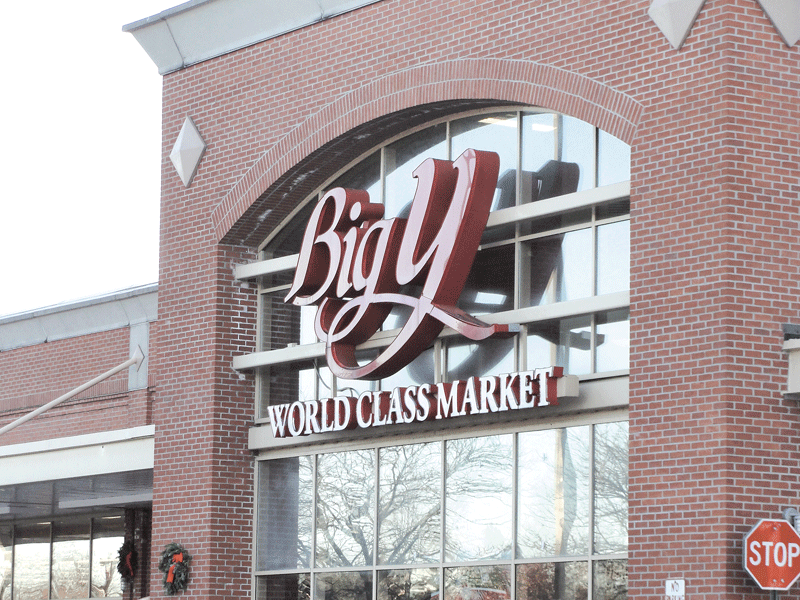
After a strong holiday season, Big Y executives are unsure how gas prices will affect consumer behavior heading into 2015.

After a strong holiday season, Big Y executives are unsure how gas prices will affect consumer behavior heading into 2015.

On the other hand, Larry Zimpleman, chairman and CEO of Principal Financial Group, told the Wall Street Journal that he predicts the era of relatively tight supplies controlled by OPEC, and resulting high energy prices, to be coming to an end.

The reasons why are numerous, including continuing sluggish growth in both emerging and developed economies, reducing the demand for oil; new technologies, such as fracking, making previously shuttered oil fields productive once again, increasing the volume of oil coming onto the market; and continued incremental improvement in alternative sources of energy, like wind and solar. “Thus,” he said, “I think pressure is likely to remain on oil prices for an extended period.”

That’s good news for general contractors, said Craig Sweitzer, president of Craig Sweitzer & Co., a construction firm in Monson with seven employees.

“It’s absolutely huge,” said Sweitzer, who has seven gas-powered vehicles in his fleet. “We’re lucky, because we decided to upgrade and give everyone a truck last year, which we’d never done before. Add in insurance and taxes and fuel, and it was a huge windfall to have gas prices go down. We drive big trucks that consume a lot of fuel; it’s a very big part of our expenses.”

He noted that some contruction-related industries — like road pavers, which use oil in their asphalt products — have clauses built into their contracts that protect against sudden increases in fuel prices, “but we’re the little guys, and people don’t typically do that with us. The airlines, for instance, pre-buy on their contracts, but we’re completely prey to the market.”

Moving On Down

The drop in energy prices is equally welcome at other businesses that use a lot of gas, like commercial movers.

“In our case, there are two parts to our company,” said Rod Sitterly, president of Sitterly Moving & Storage in Springfield. “One would be local household and commercial moving. Gas prices have very little effect there because everything is local; the truck sits there for five hours, then goes two miles to its destination. So, for the local household and local commercial jobs, there’s very little effect. Some moving companies were charging a fuel surcharge for those moves, but we never did.

“The long-distance moves, that’s a totally different story,” he continued. “Obviously, fuel is a bigger segment of the cost. The major movers, the major van lines — we’re with Atlas, for example — for the moment, they have an 8% fuel surcharge that has been as high as 14%, so there has been a significant decline in that.”

He noted that this environment stems from the days when industry rates were regulated by the Interstate Commerce Commission, and companies were allowed to tag on fuel surcharges to reflect rising gas prices.

“Since deregulation, you can charge whatever you want, and over time, a lot of charges have gone away — but the fuel surcharge never did,” Sitterly said. “For long-distance moving, obviously it has a big effect. Even people moving themselves to Florida or someplace long-distances often don’t consider how much they’ll pay to get to their new location.”

Big Y, with more than 50 stores across the region, saw its fuel surcharges on produce trucked from California and other distant locales increase by $1 million in just six months in 2008, when oil prices shot up. While those fees are not an issue right now, D’Amour said, the company is not yet benefiting in other ways one might expect now that energy prices have fallen.

“In terms of our utilities, a lot of utility rates get locked in, so they’re not fluctuating,” she said, adding that the chain has also seen little decrease in production costs — say, for canned goods — passed down to retailers. “We’re not seeing reductions, but there’s a huge lag time.”

As for how less-expensive gas might change customer spending habits, she reiterated that Big Y, like other businesses, are still waiting for positive signs.

“There were lots of lessons learned from 2008 in terms of how people buy — ­whether they might splurge here or there [with extra cash] or pay off another credit card. Right now, it’s hard to tell.”

For others, like Sweitzer, the benefits are clear and immediate — and come with a political upside.

“Now that America is one of the largest oil producers, you feel good buying gas; it’s a win-win economically and culturally,” he told BusinessWest. “Everyone feels it. I’m sure a lot of people had a better Christmas because of the extra money in their pockets.”

Joseph Bednar can be reached at [email protected]

Features
Tattoo Shops Thrive as Industry Gains Acceptance

Tattoo Afterlife co-owners Timmy Barnes and Matt Olivieri

Tattoo Afterlife co-owners
Timmy Barnes and Matt Olivieri

When Timmy Barnes was busy drawing on his friends in high school, he never considered making a career out of tattoos.

But it wasn’t long before he was making a more permanent impression, tattooing customers out of his basement. Licensed in Massachusetts since 2005, he’s now known widely — internationally, actually — as Timmy B, and co-owns Tattoo Afterlife in Northampton.

“Most people get tattooed for the same reason they buy a certain type of clothing or get plastic surgery: it’s an expression of themselves,” he told BusinessWest. “When you see a tattoo, you instantly know a little more about that person without them having to say anything.”

At the custom shop he opened with business partner Matt Olivieri, customers don’t pick images from a book; the artists who work there, in a converted auto garage on Pleasant Street, are aiming for something more unique.

“You come in and tell us what you like, things about your life that you want to showcase, and we will make you something we feel best represents you,” Barnes said. “This is a shop that people seek out, rather than walk in and wing it.

“A lot of people can mimic what we do, but it’s not the same,” he added. “It’s like a pair of shoes you really like — you’re not going to pay for a knockoff; you’ll pay for the version you really want. There is a difference.”

Olivieri, who also owns a line of organic skin-care products (more on that later), isn’t a tattoo artist himself, but has long loved the craft.

“I’m somebody who gets tattooed because I like the art. Some of mine have personal meaning, but I’d say 80% don’t. I like to get tattooed by friends, people I trust, and I let them run with the art. Then again, some people only want something on their body that has meaning. It’s really all about you and how you want to express yourself.”

Scot Padgett, the resident artist at Living Art Studio on Main Street in Northampton, has been practicing body art for decades, and has seen attitudes toward tattoos shift dramatically over the years.

Scot Padgett

Scot Padgett, whose work is seen here, says custom tattoos have become increasingly popular as clients have become more savvy.

“Make no mistake, there was a lack of social acceptance years ago,” he said. “Today, if you walk down the street here, it’s not unusual to find arm sleeves and body pieces and even people with work on their faces, which a lot of us in the businesses don’t necessarily agree with. There is a level of social acceptance now. For that reason alone, there’s a whole additional clientele who, maybe 20, 25, 30 years ago, wouldn’t have even considered it.

“We used to deal with the 18-to-25, male demographic,” he continued. “Today, the median age is around 40, and 70% female. Before, people were covering stuff up so they wouldn’t give their mother a heart attack; now they’re coming in with mom — or grandma. I definitely think there’s been a lessening of the social stigma.”

Mary Bowen, shop manager of Off the Map Tattoo in Easthampton, sees the same, ever-widening range of customers.

“We have lots of 18-year-olds getting their first tattoos, and 75-year-olds getting their first tattoos … someone working on a full body suit to someone pretty committed to getting just one,” she said.

Bowen recalled a three-generation appointment, where a woman came in with her mother and her 89-year-old grandmother for matching tattoos. “When we say you’re never too old, we mean it literally.”

Padgett welcomes the new openness to tattoos, which first became legal in Massachusetts in 2001. “People ask how long I’ve been doing this, and I say, ‘since before it was cool,’” he said. “When I got into this, you were just as likely to be ostracized by your own family members than by the community at large.”

Moving the Needle

Padgett tattooed in Connecticut for more than a decade before the Bay State came calling in 2001, and he worked with Northampton’s Board of Health on the language regulating tattoo shops, which vary from community to community.

“Unlike many states, there’s no statewide regulation,” he said. “I think there should be a federal mandate that, if it’s legal in one state, it should be nationwide. Not only is that not the case, but our state has put the onus on individual municipalities.”

Like Barnes, he emphasizes custom tattoos, a philosophy that has gained a significant foothold in the industry.

“In the old days, you’d have what was known in the vernacular as ‘flash’ on the walls,” he said, referring to stock art that tattooers would reproduce on clients. “There would be commercially available flash that people would buy and sell and circulate around the industry. When you’d go into a shop, you’d see the same designs hanging on the wall, and typically people would come in and choose from the commercially available product. It was not unusual to see the same eagle or sailing ship on other people — hundreds of people.”

Not only are custom tattoos more gratifying for him, they also allow the customer to fully embrace the experience, which results in fewer regrets.

“You’re less likely to make an error in judgment if you take the time to think about it, make an appointment, show up for the appointment, talk about it, as opposed to walking in off the street on a whim and pointing to a piece of art,” Padgett said, noting that he emphasizes the education and information aspect of his trade. “I’d rather you call me Tuesday and say, ‘I’m not sure about Wednesday’s appointment’ than call me Thursday and say, ‘I’m not sure about Wednesday’s appointment.’”

After all, he added, “it’s not like getting a bad haircut.”

Padgett, a widely recognized artist, recently tattooed a customer from Iceland, and attracts repeat business from far-flung tattoo enthusiasts. “I have clients from all over the place. That’s not a ‘hooray for me’ thing; it’s just that people have a comfort level for certain people. We try to provide an experience. I think that’s what brings a lot of people back.”

Tattoo Afterlife is a much newer presence in Northampton, having opened just five months ago.

“Business has grown every single month,” Olivieri said, adding that the shop will soon offer the services of six artists. The other side of the business is Tranquillity Massage, with two full-time massage therapists offering five types of massage, for customers who want to relax before getting inked. “We try to take care of our clients, make it a whole experience for them. We want them to feel as comfortable as possible while they’re here.”

Tattoo Afterlife has also made connections with local businesses — a hotel, restaurants, a neighboring bar — to offer discounts to customers, especially those traveling to Northampton from far away. And many do — the weekend before speaking with BusinessWest, Barnes tattooed clients from New Jersey and Australia, who had come specifically to seek him out.

“It’s a huge thing, with people from all over the world seeking out their favorite artists and turning appointments into vacations,” Olivieri said. “At the end of the day, it’s permanent, so if you’re going to fly across the world, you might as well check out the scenery and what’s going on locally. We try to be a part of that whole process when people come to town. We want to bring something to the table.

“At the end of the day, this is a service industry,” he added. “We’re all about customer service.”

Global Outlook

Gabriel Ripley, who opened Off the Map nine years ago and has since expanded it to shops in Oregon and Italy, got into the field via a different type of customer service: by using his computer-programming expertise to launch tattoonow.com, which develops and designs websites for tattoo artists. From there, he branched out by opening a tattoo shop, which features seven artists in Easthampton alone.

Mary Bowen

Mary Bowen says today’s tattoo enthusiasts often seek out favorite artists, and appreciate the fact that Off the Map brings in guest artists regularly.

“We’ll also bring in guest artists regularly — from all over the country and overseas as well,” Bowen said. “It’s great for the tattoo artists here because everyone can continue to learn from each other, and it’s great for the clients, who get access to these artists close to home. As custom tattooing is becoming more popular, people are becoming collectors of tattoo artists. The old-school way was to buy from the same person forever; now people seek out a specific style for each tattoo.”

She said the people have myriad rationales for wanting body art. “Oftentimes it’s a celebration, or people get a memorial tattoo to deal with life changes, whether it’s dealing with grief or getting a new job or getting divorced. Everyone has their own personal catalyst.”

Olivieri tells a similar story. “The other day, we had a guy who fought in Vietnam, 60 years old, who had never gotten a tattoo but was intrigued by it. Timmy has tattooed rock stars, medical doctors, and kids who turned 18 and just wanted a tattoo. It used to be that, if your were tattooed, you were looked at as a certain genre of human being, but that has now vanished. It’s now mainstream and socially acceptable to get tattoos, so all those people who were on the fence all those years are making appointments. They know they won’t be frowned upon or looked at differently.”

Bowen agrees. “They might have been thinking about this for years, if not decades. But reality shows have brought tattooing to the forefront, and it’s become more socially acceptable; at this point, it’s almost more unusual to meet someone who doesn’t have a tattoo.”

Still, she added, it’s a decision that shouldn’t be rushed. “It’s important for people to look at websites, do some research, check out the quality of the work, call the studio or stop in. I’ve gotten comments here like, ‘you’re nicer than I expected; you’re not scary at all!’ There’s this old-school perception of bikers in leather and jeans, smoking cigarettes and doing tattoos.”

Though the reality, in most cases, is far more pleasant — and sanitary — “the anxieties about getting a foot in the door are pretty significant for people,” she continued. “It’s a lifelong choice, so we don’t want them to feel pressured.”

That said, “we’re definitely growing. We’ve officially maxed out our space. Most of our artists are booked out weeks, if not months, ahead of time. A lot of times, it’s the guest artists who take walk-ins. We have a large clientele and huge support in the Valley,” Bowen said, citing several best-of citations in Valley Advocate reader polls. “It’s wonderful to hear that positive reinforcement. And we’re certainly not slowing down.”

Piece in the Valley

Olivieri and Barnes opened their first venture on Long Island, but weren’t happy with the lifestyle there, so they opened Tattoo Afterlife in Northampton, not far from Barnes’ hometown of Belchertown, and put the custom nature of the shop’s art front and center.

“You can’t come in here with a photocopy and say, ‘put it on my body,’” Olivieri said. “Every single person here is an artist. Tattooers understand the trade and can take anything and put it on your body, but here, everyone has an art background; they strive to give you something 100% original and custom, one of a kind. They’re trying to create art every single day.”

Olivieri focuses most of his energies on running the business end of the shop and selling products, particularly Redemption Aftercare, an organic, vegan, petroleum-free balm designed to be applied during and after a tattoo. A New Yorker named Bili Vegas created the formula, and he and Olivieri own and market the product. He also sells tattoo and skin-care products from other companies, including Eternal Ink and Stencil Stuff.

Redemption Aftercare, Olivieri said, “is the only balm in the world that’s USDA-certified organic and contains no chemicals and no petroleum — both things that stop the healing process. There’s a huge niche for us, as people are starting to become more aware of what they’re putting in their bodies.”

That’s particularly true in progressive Northampton. “It’s a very liberal town, and it’s open to new ideas,” he said. “And, frankly, there are five colleges with 65,000 students within a 15- to 20-mile radius. With tattooing becoming more popular, kids want to get tattooed, and lot of kids here are well-off. It’s a very good market for what we do.”

Northampton, Barnes added, “has everything you want from a big city, but mom-and-pop versions of it. All the businesses know each other, and all the employees downtown know each other. It’s an easy place to market and cross-promote. Everyone is on each other’s team.”

In that spirit, Barnes wants Tattoo Afterlife to become known for more than body art, as he and Olivieri plan a series of community events and fund-raisers to boost the profile of their craft.

“Tattooing has always had this stigma, but it’s getting harder to stereotype us,” Barnes said. “How can you call us a bunch of gnarly drug addicts and bikers when we’re raising money for children’s charities? I want to take this thing to the next level, to push the boundaries. We’ll always do tattoos, but what else can we do?”

Cost and Effect

Bowen admits that tattoos can be a significant financial investment, but added that enthusiasts are willing to pay the artists they admire. “You have to keep your budget in mind, of course. But the choice shouldn’t be made solely on price; if someone is very inexpensive, there’s probably a good reason why.”

The other big anxiety, beyond price and permanence, is pain.

“Lots of people get nervous about the pain; it’s not a pain-free process,” Bowen said. “A lot of times, people have nerves, but in the end, it’s not nearly as bad as they thought it would be. The mental is often far more significant than the physical pain of it.”

Usually, a glass of water or coffee is enough to calm a new customer’s nerves, Olivieri said, but for others, “we have a good rapport with the bar across the street. If they need a couple of hours to think about it, they can go there and have a drink. There’s no pressure here. Our job is to make the client feel as comfortable as possible.”

That said, “people are more excited than nervous,” he noted. “Timmy has a six-month waiting list, and some customers have been waiting years to see him, so when they get here, it’s like Christmas morning. They say, ‘you don’t know how long I’ve waited,’ and we say, ‘no, we get it.’”

Bowen likes to quote Ripley, her shop’s owner, in explaining that kind of excitement.

“One of the phrases Gabe uses is ‘making the world better, one tattoo at a time.’ We hope, by creating art, we’re positively impacting people’s lives — helping them move their lives in a more positive direction.”

Making art, in other words, that’s much more than skin deep.

Joseph Bednar can be reached at [email protected]

Community Spotlight Features
In Holyoke, Municipal Investments Pay Dividends

Mayor Alex Morse

Mayor Alex Morse says Holyoke has been a leader among area communities in efforts to build a creative-economy sector.

When Alex Morse was elected mayor of Holyoke in 2011, he was determined to revitalize the city and alter the way people thought about it.

“My number-one job was to change the perception that Holyoke’s best days were behind us,” he said.

His efforts have been largely successful, and dedicated planning and teamwork have led to major investments in infrastructure and noteworthy projects.

“Good things have happened in the last year, and there are a lot of shovels in the ground. People can see things moving forward, which is a sign that the economy in Holyoke is getting better, and we will continue to put more shovels in the ground this year,” Morse said. “The city is on a positive trajectory.”

The most significant undertaking is the new, $3.5 million passenger-rail platform being built on Dwight and Main streets. “We broke ground on Dec. 22, and when it is finished in September, it will be the first completed rail platform in Western Mass.,” the mayor said.

The project is a reflection of foresight, because when Morse took office, there were no plans for a commuter-rail stop in Holyoke. “But it was a huge economic-development opportunity, and although there were times when funding was short, we were able to get $4 million in state and federal funds for it through MassWorks grants; it has been paid for without taking any money from local sources,” Morse said, adding that Marcos Marrero, the town’s Planning and Economic Development director, worked closely with the state Department of Transportation, “and we made it a priority project, as it is integral to the revitalization of our downtown.”

In addition, Morse said new businesses have opened and apartments are under construction (more about that later) that will help to reinvigorate the city.

“We see ourselves as part of the Springfield/Hartford metro area, and have a lot of space available that is very affordable. People are recognizing that, and folks from as far away as San Francisco are investing here,” he told BusinessWest, citing the purchase of the Wauregan building on 384 Dwight St., which is co-owned by San Francisco artist Scott Reilly, and adding that Vertitech IT moved its national headquarters to Holyoke last year, and the city helped the company work with Holyoke Community College to find employees.

Expanding the creative-arts community has been a cornerstone of the city’s economic-development strategy, and Morse hired a creative-economy coordinator shortly after he took office. “We’re the first community in the state to have a full-time person dedicated to bolstering the creative economy. It is a job creator that generates a lot of revenue, and we have seen an uptick of artists moving here, and a spike in the development of makers spaces,” he said.

They include Gateway City Arts on 91-114 Race St., which was founded in 2012 by artists Lori Divine and Vitek Kruta with a cash incentive from the city. “The business provides space in which craftspeople work, teach, and hold events. It has become an incubator space for artists,” Morse said.

“People are amazed at the amount of talent we have in Holyoke, and on any given night, you can see cars parked on Race Street for an art gallery, opening show, or performance,” he added. “We’ve taken it very seriously.”

He also pointed to the Brick Co-workshop Co. on Dwight Street as another example of success. Artists representing 10 different trades have made it their home and are helping to promote the city as a center for arts and crafts. Plus, the Holyoke Creative Arts Center, which provides classes at a minimal cost, has plans to move from 400 South Elm St. into the three-story, red-brick Wauregan Building, located in the newly designated Art and Innovation District, later this month.

Time and effort has also been spent to encourage people in the community to open businesses, and Holyoke was one of six cities named as a winner of the Working Cities Challenge. It was sponsored by the Federal Reserve Bank of Boston, which identified 21 working cities whose median income was lower than the state average, then challenged them to create innovative proposals that would help provide employment.

Holyoke’s winning program is called the Stimulating Potential and Accessing Resources or Knowledge Initiative (SPARK). Its goal is to link the Massachusetts Green High Performance Computing Center with the city’s innovation-economy strategy and increase the number of businesses owned by Latinos. The initiative is being led by the city in partnership with the Greater Holyoke Chamber of Commerce, and is supported by other partners in the public, private, and nonprofit realms.

Morse said the idea is to create a pipeline that will help Latinos who are interested in the creative arts see themselves as entrepreneurs and open businesses. “We want to continue to build on our local talent and have hired a director for the program,” he said, adding that the city will receive $250,000 over three years to implement the program.

Plethora of Projects

When a city invests in itself, Morse said, it sends a message that it is willing to partner with businesses to grow the economy.

To that end, Holyoke boasts a new library and senior center, and also kicked off Phase 2 of a $4.3 million Canal Walk project on Race Street over the summer. Phase 1, which runs between Dwight and Appleton streets, is complete, and the second section of the walkway will include a foot bridge over the canal.

“This is just one of the improvements we’ve made to catalyze retail businesses along the canal and make our downtown walkable,” Morse said.

Vibrant metropolises also contain residential living space, he added, noting that the city is making progress on this front as well. A groundbreaking ceremony was held in August for a $20 million project that will transform the former Holyoke Catholic High School into 55 one- and two-bedroom apartments. The city has been working with Denis Walsh, who owns Weld Management, for several years on his vision to create the new residences in the 74,000-square-foot building, which is set on 2.3 acres.

“The prospect of getting more people to live downtown is exciting, and this is a great example of a public/private partnership,” Morse said, noting that the city contributed $750,000 toward the project. He added that a $1.4 million renovation of Veterans Park, which can be seen from the building, was completed last year.

The Holyoke Transportation Center also overlooks the park and contains a café on the first floor operated by the Log Cabin Banquet and Meeting House. Holyoke Community College holds classes in the building, and it is also home to a Head Start program.

“The conversion of Holyoke Catholic High School will complete that block and bring more life to the neighborhood,” Morse said, adding that Walsh is also developing high-end, market-rate apartments on the upper floors of a few other buildings.

One challenge the city faces, however, is a lack of eateries downtown. Attracting restaurateurs has been difficult because liquor licenses have not been available. In order to mitigate the problem, Morse put together a proposal that received approval from the City Council and the state, which will give Holyoke 13 additional liquor licenses.

“The caveat is that they can only be used for full-service restaurants in the downtown urban-renewal district,” the mayor said. “Although a liquor license can go for upwards of $100,000 on the open market, these will only cost $10,000 because they’re being offered as an economic incentive. We plan to hold an event later this month to explain what is involved, and have invited people in town as well as restaurant operators from places that include Worcester, Hartford, Amherst, and Pittsfield.”

Plans have also been made to address the former Parsons Paper Co. site, which has been an eyesore since a fire devastated the property in 2008. Northeast Utilities has provided $250,000 to assess the contamination, demolish what remains of the buildings, and clean up the brownfields, as part of a mitigation agreement connected to a former electric plant near the dam and canal.

When the work is complete, the property will be put on the market, and Morse said a business has already expressed interest in the site.

Meanwhile, Divine and Kruta, who opened Gateway City Arts, also purchased the Steam Building on Race Street last year and are turning it into office space.

“The city and Holyoke Community College recently announced that HCC is moving its entire culinary-hospitality department downtown, and the Steam Building is being considered as one of the potential sites,” Morse said. “We are hoping to pair the college program with a full-service, privately owned restaurant.”

Private-sector growth is also occurring, and Marcotte Ford on Main Street recently broke ground on an $8 million expansion. “We worked hard to keep them here,” Morse said. “They were landlocked, but were able to purchase an old dealership next to them. We’re working to help them get some city land between the properties as well as negotiating a tax incentive.”

Bright Future

Morse said a number of other projects are on the horizon, among them the redevelopment of the old Lynch Middle School.

The project was put out to bid last spring, and the city chose Frontier Development from the firms that responded. It will create 25,000 square feet of retail space in the building with the opportunity for expansion, which will lead to jobs and turn a non-taxpaying property into one that generates taxes, Morse told BusinessWest. “Plus, we think it will bring people to the city, as it’s right off the highway.”

In addition, the recently decommissioned Mt. Tom coal plant will be assessed to determine what it would take to clean it up and reuse the property.

The mayor said the projects that have come to fruition have not happened overnight, and the effort and thought that have gone into them will continue.

“Today,” he concluded, people see Holyoke as a city on the rise.”

Holyoke at a glance

Year Incorporated: 1850
Population: 40,135 (2012)

Area: 22.8 square miles

County: Hampden

Residential Tax Rate: $19.04
Commercial Tax Rate: $39.74
Median Household Income: $33,030
Family Household Income: $36,262
Type of government: Mayor, City Council
Largest Employers: Holyoke Medical Center; Holyoke Public Schools; Holyoke Community College; Amica Mutual Insurance Co.
* Latest information available

Features
HitPoint Studios Brings Gaming Innovation to Downtown Springfield

The white rabbit in Fablewood

The white rabbit in Fablewood, a social game played on Facebook, is a fan favorite, says Paul Hake.


Aaron St. John says there are “three legs of the stool” that make a region fertile ground for businesses — and entire industries — to take root: access to talent, quality of life, and access to capital.

Until recently, he said, the perception among high-tech firms was that the Pioneer Valley had the first two in spades, but would always be trounced by the likes of Cambridge, New York, and Silicon Valley when it came to capital.

That perception is changing, he told BusinessWest, and HitPoint Studios is exhibit A.

The video-game-development company that he and Paul Hake started in 2008 has grown exponentially from its humble beginnings and now employs about 35 people. Based first in Greenfield, then Hatfield, and most recently in Amherst, the firm relocated to downtown Springfield last week, thanks to a commitment of $1.25 million by area investors to keep HitPoint local at a time when Boston and California were calling.

“Our entire round of funding is from the Valley,” St. John said. “We’ve had access to talent and good quality of life in this region — it’s a good place to live. But access to capital has been a challenge for this area. So I think it’s really encouraging that we didn’t need any outside funds.”

These investments in HitPoint’s future — about 40% of it from MassMutual’s Springfield Venture Fund and the rest from members of River Valley Investors — is a sign that the Valley’s reputation in this regard might be changing. The Venture Fund requires recipients to base their operations in Springfield, but regardless, St. John believes the city’s downtown is a natural spot for HitPoint to grow.

Aaron St. John

Aaron St. John says Springfield’s location, amenities, and rising profile make it an ideal place to grow HitPoint.

“Seeing all the entrepreneurship taking place in Springfield is very encouraging in a business where we rely on being innovative and finding creative solutions,” he said. “Being engaged by a city in that way, we got the feeling of an open door, of Springfield rolling out the red carpet, and asking, ‘what can we do?’ We felt this would be a good place for HitPoint.”

As they packed up boxes for the big move to the City of Homes, St. John and Hake talked with BusinessWest about what the move means for their company — and for the gaming industry in general.

Roads Taken

HitPoint’s founders traveled different roads to their eventual partnership. St. John’s older brother was an executive at Microsoft who introduced him to some of the big names in the game industry, and by age 16, he could see that making games — something he was passionate about — could be a viable career.

While still a teenager, on summer break from Earlham College in Indiana, St. John found himself interning for Monolith, a then-fledgling game company which is now one of the biggest online game portals. The company solicited game ideas from its people and got more than 100 back; of the three ideas deemed best, two were submitted by St. John. He was quickly hired on full-time.

That experience led to the development of Sanity: Aiken’s Artifact, which was brought to market by Fox Interactive. Later, St. John returned to his native Bay State to finish his degree at UMass Amherst; he launched his own design company, Golden Goose Games, soon after.

Hake, on the other hand, didn’t grow up playing video games; in fact, he wasn’t allowed to play console games at home. But he got hooked on computers after his father brought home an IBM PS2 and started teaching him how to program. Soon after, the family got another computer and a few PC games, and he played them all the time.

At UMass, he got more into gaming — not just playing them, but making them, using his programming background and the classes he was taking to build his skills in that arena. When the results of one assigment — he created a scrolling game with flying and shooting features — was particularly well-received, he decided this was what he wanted to do with his life.

So, after college, Hake landed a contract position with the Tiger Electronics division of Hasbro Toys. Eventually, he gained enough experience and contacts developing games that he was able to launch his own company, Paul Hake Productions, in 2004.

Having both attended UMass for a spell, the pair worked together casually from time to time and decided to go into business together in 2008. They began with eight employees — four from each company — but soon saw their enterprise take off.

HitPoint has long specialized in four lines of business: branded entertainment, which are games designed for companies’ Websites; casual games, which are also typically work-for-hire projects; social games, typically played through Facebook; and independent games, which the company designs and distributes on its own — a niche St. John and Hake have been working to expand.

Not that partnering with other companies hasn’t been lucrative.

“We were a first-party partner with Microsoft, one of two they chose to work with. We were developing their strategic titles for launch of Windows 8; we did about 12 titles for Microsoft, all featured in the App store, all top-grossing and top-ranked,” St. John said. “Then, just this past year, we worked on a product with Dreamworks to promote How to Train Your Dragon 2, a map-based explorer game, where you fly a dragon over a real, updating GPS map.”

In addition, HitPoint boasts several social games on Facebook — including Fablewood, Seaside Hideaway, and Jane Austen Unbound — with another set to release soon.

Facebook games and many mobile games are free to play, but are often monetized with ‘punch points’ in the game where there’s a significant time investment to get to the next level — and an option to get past those punch points faster by paying. The biggest hits of the genre can be extraordinarily lucrative. And with most people now playing games on their phones, mobile platforms represent an area of the gaming market that’s only expected to continue its surge in popularity.

Nuts and Bolts

Designing and developing each game is a painstaking process involving programmers, gameplay designers, graphic artists, sound specialists, and others. To coordinate them, St. John and Hake adhere to a software-development process known in the industry as ‘scrum,’ in which phases of a project are broken into short ‘sprints’ with specific goals. It’s the reason HitPoint can keep upwards of 15 projects in the air at one time.

Each must undergo a process of risk assessment and profit projection before being greenlit, which involves determining what’s achievable in the amount of time available and whether a project complements the company’s strategic goals — goals that will now turn heavily to independent projects, starting with a new product set to launch in the second quarter of 2015; they’re hush-hush on the details right now.

“We want to be focused around our own titles,” St. John said. “We work with other companies — we’re continuing our relationship with American Family Insurance, with one of the biggest insurance-based games, and we have relationships with some of the larger companies in the industry, like EA and a large Japanese company. But most of our effort is spent on games we’re launching and maintaining ourselves, where we own the game and the infrastructure.”

They’ll be entering this new phase in downtown Springfield — One Financial Plaza, to be exact — during a time of bustling activity in the neighborhood, with class A tenancy rates up in the towers; investments by a host of companies as well as UMass, Bay Path University, and Cambridge College; and, of course, the $800 million MGM Springfield casino set to open in 2017.

It definitely represents a more jarring change than HitPoint’s last move, from a retrofitted barn in Hadley to digs on University Drive in Amherst.

For that last move, “we mostly wanted to get out of the barn,” Hake said with a laugh. “It was getting a little old and crowded, and during the past few years, we’d been building up our own properties, including the suite of games on Facebook that we own and a couple of games on mobile as well.”

Then, starting early last year, he continued, “we discussed raising capital to continue our independent growth, and as part of that, we’re making this move to Springfield.”

St. John said there’s no reason why Springfield can’t be an attractive spot for companies such as his. “There’s easy access to [Bradley] airport, and we have several people that live close to Boston, who have much easier access to the office. I’m excited about all that. With the new-product innovation we have planned, we expect to grow quite a bit out of Springfield over the next two or three years.”

St. John has always been loath to look beyond Western Mass. as HitPoint’s headquarters, saying the the region’s colleges provide a solid pipeline of talent.

“We’ve gotten a lot of mileage out of being in Western Massachusetts,” he told BusinessWest. “Frankly, the game industry is pretty competitive, especially the competition for talent. We don’t have a warehouse, we don’t even have physical goods that we sell; the value of this company is in the people who work here. And the kinds of people we have to attract find the Valley a phenomenal place to live.”

He recognizes that being among the biggest players on the regional game-development block gives HitPoint, access to some of the top talent graduating from the region’s colleges and universities, but he also believes that, should the Valley become a hub for game developers as he believes it can, there will be plenty of talent to go around, because out-of-staters will be drawn by the quality of life. “We’ve found people who want to live here, people willing to move from California, New York, Texas.”

Downtown Dreams

The question, though, is can Western Mass. realistically become that video-game hub?

“That’s certainly my hope,” St. John said. “We’re hoping we can engage other entrepreneurs in area schools to look at the gaming industry, start game companies, and make their own games.”

He said HitPoint has been active with area colleges, and hosted two ‘game jams’ last year, at which students, with the help of faculty and HitPoint staffers, designed games for 24 hours straight.

“We saw a lot of talent and actually hired some people from those events; we’ve seen a few of them start their own projects on Kickstarter, things like that,” he noted. “It’s our hope — assuming we’ll be a successful presence in the area — that we’ll see a change in the perception students have about this area.

“That was certainly my perspective,” St. John continued. “I grew up in Amherst, and all I wanted to do was play games. We want to change people’s perceptions locally, but also change the industry perception, so people say, ‘why not Western Mass.?’”


Joseph Bednar can be reached at [email protected]

Community Spotlight Features
In Enfield, Growth Efforts Focus on Thompsonville

Peter Bryanton

Peter Bryanton says Thompsonville was a thriving center in its heyday, but may be on its way back.

Enfield town officials have had a revitalization plan for the village of Thompsonville for more than two decades now. It was created in 1992 after the former Bigelow-Sanford Carpet Co. was transformed into a 470-unit apartment complex.

Community Development Division Director Peter Bryanton said that Thompsonville was a thriving center in its heyday, with stores, eateries, and businesses that benefitted from the people who lived in the neighborhood and worked in the Bigelow factory. But after the mill closed in 1971, the area began to languish, and many neighborhood businesses closed their doors.

However, when construction on Bigelow Commons began, small businesses began to open again. “Town officials thought Bigelow Commons was a new starting point and formed a committee to work toward revitalizing the village. The Thompsonville Revitalization Strategy Plan was created as a result of their effort, and although it was a good plan, it was never implemented due to a lack of funding and resources,” Bryanton told BusinessWest, adding that updates were made in 2010.

But over the past year, a great deal of progress has occurred, and what was once a dream is fast becoming a reality. In fact, the town held a recent breakfast for commercial real-estate investors, developers, consultants, and other interested parties, which was attended by more than 100 people. The goal was to let them know about projects and new initiatives that have drawn residents and tourists into Thompsonville, and why it is has become a desirable investment.

“We told people what we’ve done and where we are headed, and we also created a book for them that shows every piece of property available in Enfield,” said Courtney Hendricson, assistant town manager of Development Services, adding that the impetus behind the recent initiatives was the announcement that a commuter rail line linking New Haven, Hartford, and Springfield will begin operating in 2016.

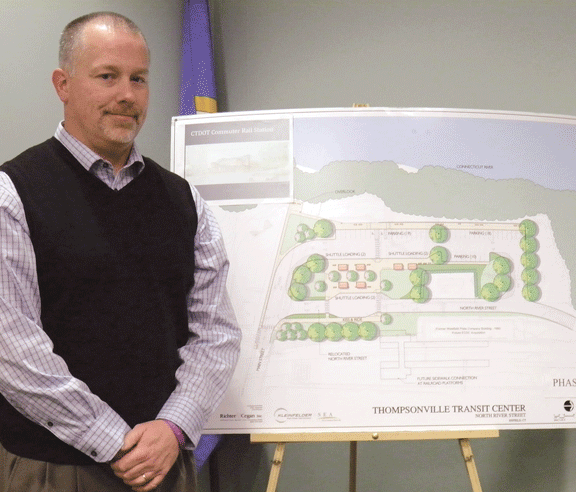
“Our plan revolves around building a new, multi-modal transit center that will include commuter rail and bus service; we know that many people want to live near these stations,” she said. “Rail service will make it easy to get to different places without owning a car, and surveys show that people in their 20s and 30s overwhelmingly want a walkable lifestyle. There is generally a 30% increase in property values within a half-mile of a transit station.”

Bryanton agreed. “Revitalization is finally happening; five years ago it was just an idea, but now it’s a reality. Once Enfield has commuter rail service, it will become a destination for people looking for a lifestyle based around public transit — we just need to get the transit center built,” he said, adding that it will be located in the former Westfield Casket Hardware building on 33 North River St.

He added that the four-story structure, which sits on the Connecticut River, is owned by Enfield Community Development Corp. and is in good shape.

“The ground floor will be used as the entranceway to get upstairs to the second floor, where the rail platform will be located. The third and fourth floors will be turned into loft apartments,” Bryanton said, adding that a portion of space on the first and second floors will also be designated for mixed use, which will allow people to shop, eat, and do business at the station.

However, land is needed to build a parking lot and a bus turnaround, and the town has been negotiating with Northeast Utilities about a plot adjacent to the building that was once home to a power plant. It is contaminated, so the negotiations are focused on who will pay for the cleanup, which will likely be a joint effort financed with brownfield grant money and funds from NU.

“In addition to the parking lot and bus turnaround, we also plan to build a new riverfront park on the property,” Bryanton said.

Town officials are lobbying the state and federal government to get funding to build the transit platform. “State officials told us they will build it after the rail service begins, but that means it would not stop in Enfield when it starts up, which is key to our development focus,” Hendricson said.

However, work is progressing, and Connecticut recently launched the Hartford Line. The commuter rail service will use Amtrak’s New Haven–Springfield Line and supplement existing intercity rail services between the two cities. The project is a joint venture between Connecticut and Massachusetts, with support from the federal government.

Once the line is operational and the transit platform has been built, Enfield officials say, they plan to focus their efforts on promoting public transportation, which will help spur private investment in the village.

Multi-faceted Approach

Hendricson said the town’s economic-development efforts rest on five pillars.

The first is an initiative called Riverfront Recapture, which involves capitalizing on access to the Connecticut River. “It’s our greatest natural resource and borders many of our neighborhoods as well as downtown Thompsonville, so we feel it has a lot of potential,” she explained, adding that the town plans to build a hiking and bicycling trail along the river, extending from Fresh Water Pond to the business corridor and down to the river. It is currently in the design stage.

The second and most important pillar is the revitalization plan for Thompsonville. “But we don’t want to ignore our other neighborhoods, which include Hazardville,” Hendricson said, noting that lessons learned from a successful streetscape plan implanted there, as well as from projects completed in other areas of town, will be employed in Thompsonville’s revival.

She also stressed that town officials feel it is important to celebrate the businesses that stayed open after the Bigelow carpet factory closed and have done well.

The fourth pillar is to continue to attract new businesses and retain the 3,000 companies that make Enfield their home. “They include many Fortune 100 companies,” said Hendricson. “We share the headquarters for MassMutual and are home to the headquarters for the North American and South American branches of Lego. The Hallmark Distribution Center and Advanced Auto Distribution Centers for the entire East Coast are also in Enfield, and we have many small, mom-and-pop businesses and home-based operations.”

Finally, town officials also plan to take advantage of the traffic that the MGM casino in Springfield will generate. “We believe Enfield could serve as a secondary destination because we have so many retail businesses and restaurants,” Hendricson said, discussing how the commuter rail platform in Thompsonville will play into the equation.

The revitalization of that village is being done in stages. The infrastructure around Fresh Water Pond, located in the center of the neighborhood, has been upgraded with new lighting, benches, planters, and trash receptacles. “We are also working to improve a walking path around the lake,” Hendricson said. “It is an ongoing effort.”

Engaging the interest of businesses and residents is another element in the plan. “It’s critical to make sure the neighborhood meets their needs,” she went on.

Hendricson noted that Thompsonville contains many multi-family homes, and although officials hope new residences will be built, they want to retain the character that was established when the carpet mill was thriving. “We’re not looking to change the proportion of multi-family housing. But we are looking to increase the number of housing options, so people can choose to live in a loft apartment, a multi-family residence, or a single-family home,” she told BusinessWest.

Town officials have staged new events over the past year to attract people to the center. The signature event was a Community and Farmer’s Market, staged from June through October on Wednesdays from 4 to 8 p.m. in front of Fresh Water Pond. There were 30 to 40 vendors each week, including artisans, farmers, food trucks and community groups, said Hendricson, adding that the market was a great success and went far beyond expectations.

Festivals were also held for families on Earth Day and Halloween, which generated positive feedback, while a presentation for business owners allowed officials to share their vision for the future. “We gave awards to businesses who have been in Thompsonville for years; we wanted to recognize and thank them. We plan to do this annually,” Hendricson said.

In addition, land was set aside to create a community garden. “There were 50 plots, and we asked people to pay $25 to become a member. They received soil and seeds, and they shared equipment. The town provided water, porta-potties, and security cameras, and a master gardener from the University of Connecticut gave a weekly seminar,” Hendricson said. “The garden was run by volunteers, and people are already asking if we are going to do it again next summer. We’ve been really working to engage the community.”

Another initiative, which focused on the use of alternative transportation, proved highly successful. Called the Magic Carpet Shuttle, it’s a bus service that takes people through the town with a number of dropoff spots. It connects to the Hartford Express (run by the Connecticut Department of Transportation) in the Macy’s parking lot.

“We started the shuttle to prove that residents will use other modes of transportation, but it has taken off beyond our expectations,” said Hendricson. “We expanded the route and the hours because 100 to 150 people ride on it every day.”

The success of these programs is being used to show investors that the outlook for Thompsonville is bright. “We’ve been meeting with developers in Greater Hartford and Springfield who are looking for opportunities,” she went on.

The town is also in the process of changing the zoning in the village, Bryanton added. It is mostly residential, but will soon have more areas designated for mixed-use development.

Moving Forward

Town officials believe their vision for Thompsonville will be realized over the next few years.

“We’ve done our homework and are making it into a desirable destination by bringing back its economic vitality,” Hendricson said. “There is so much potential, and I can easily picture it becoming a walkable, safe, attractive downtown for tourists and residents. I have no doubt it will happen.”

Bryanton agreed. “It’s been a long process to get where we are today, but we are finally on the doorstep,” he said. “We have a vision, and we know that, once the transit center is in place, people will come here.”

Enfield at a glance

Year Incorporated: 1683 in Massachusetts; annexed to Connecticut in 1749
Population: 44,654 (2010)
Area: 34.2 square miles
County: Hartford
Residential Tax Rate: $29.13 (plus fire district tax)

Commercial Tax Rate: $29.13 (plus fire district tax)
Median Household Income: $69,356
<strong>Family Household Income: $80,997
Type of government: Town Council; Town Manager
Largest Employers: MassMutual; Hallmark Cards Distribution Center; the Lego Group

* Latest information available

Features
White Lion Brewing Is Making a Name for Itself

Ray Berry Jr.,

Ray Berry Jr., seen here at a display of White Lion at Table & Vine, says his company’s mission is to build a great brand and help revitalize a great city.

Not long after graduating from American International College with a degree in finance, Ray Berry Jr. went to work for a nonprofit agency called Mason Square Development Corp., which, as the name suggests, was dedicated to helping small-business ventures off the ground in that low-income Springfield neighborhood.

Summing up the now-defunct agency’s mission, Berry said it was created to help entrepreneurs understand the risks of a business venture and overcome their fear of accepting those risks, assist them with forging business plans, and guide them with the task of developing the connections and relationships needed to succeed.

“I think it’s important for any entrepreneur to map and frame out their ideas, utilize the networks that are in the community, and not be afraid to take advice along the way,” said Berry, who served the MSDC as deputy director. “There are individuals out there who have a tremendous amount of proven experience in establishing companies and moving them forward. If you have a vision or dream, and once you get through that fear of risk and get over that hurdle, you utilize the resources available and push your dream forward.”

Today, Berry is definitely practicing what he preached 15 years ago as he pushes his own dream forward.

It’s called White Lion Brewing Co., a venture he launched just a few months ago — after nearly four years of planning — with some working capital, an imaginative brand, an intriguing mission statement, and that aforementioned willingness to accept risk.

And in that short time, he has enjoyed what could only be called a roaring start while making White Lion “Springfield’s beer,” even though it’s not brewed here — yet.

As it states on the bottom of the six-pack container that features many of the city’s landmarks, “Springfield is our home. We share the city’s pride in its legacy of innovation and ingenuity. We intend to serve as a catalyst for Springfield’s renaissance. One that celebrates diversity and urban vibrancy. We have a dual mission: Build a great brand. Revitalize a GREAT CITY.”

The first component of that mission is still a work in progress, but Berry believes important strides have been made. The second? Well, he intends to be a big part of the renaissance he sees coming for Springfield by bringing the brewing operation to the city, and with it, jobs and a renewed sense of pride that in some ways is already evident.

“The city of Springfield does not have a product that folks can rally around, and it was important to me to create one,” said Berry, who by day is vice president of Administration and Finance for United Way of Pioneer Valley. “We want to be a game changer, a difference maker, part of the community fabric, part of the legacy that moves the city of Springfield forward.”

As for the brand … the white lion, a color mutation of the African lion, found in South Africa and zoos around the world but mostly in Europe, has nothing to do with Springfield. Or everything to do with it, if you listen to Berry.

“Folklore will state that it’s an extension beyond race, color, creed, or gender,” he explained, noting Springfield’s diverse population. “It doesn’t matter who you are, what economic status you come from, a white lion is a symbol of good in all mankind. It goes on to say that, if you’re in the presence of a white lion, you will be sanctified with infinite prosperity.”

Already, a strong connection is being forged between the city and the brand.

Indeed, when Gov.-elect Charlie Baker paid a visit to Springfield the day after the Nov. 4 election, Mayor Domenic Sarno had a six-pack of White Lion pale ale waiting for him as a gift.

That highly visible bit of marketing and public relations is only one way in which White Lion’s fast start has manifested itself. The company’s two products — there’s also a cream ale, with more on the way in 2015 — are now in more than 120 locations (liquor stores, bars, and restaurants) in Western Mass. and just beyond, and Berry has ambitious plans to grow those numbers and make his brand a household name.

For this issue, BusinessWest looks at his multi-phase strategy for making White Lion both a player in the craft-beer universe and a major player in Springfield’s future.

Mane Attraction

As he talked with BusinessWest after posing for some photos beside a rack of his products at Table & Vine in West Springfield, Berry used the opportunity to provide an education in the craft-beer industry and quantify and qualify its explosive growth.

“There are nearly two full aisles of craft beers here now, and new ones arrive regularly — there are more than 2,000 craft-beer establishments across the country,” he said while walking through one of them, pointing out a seemingly endless array of imaginative names — Smuttynose, Dogfish Head, Otter Creek, and Magic Hat, among others — and colorful packages. Some of these brands are local in origin, such as Berkshire Brewing in South Deerfield, Paper City in Holyoke, Fort Hill in Easthampton, and Iron Duke in Ludlow, while others are regional powerhouses like Samuel Adams and Harpoon.

WhiteLionBoxArtEntering such a crowded field would seem like a risk not worth accepting, but Berry thinks otherwise, and he started coloring in his entrepreneurial canvas roughly four years ago.

He did so after analyzing the market and noting one important point — there was no craft-beer product attached to Springfield, a city with a history of brewing operations, most of which didn’t outlast Prohibition; those that survived didn’t live long after it was repealed.

“The concept goes back at least four years; that’s how long I’ve been having general conversations with friends in the Valley around craft beer, their growing popularity, and the fact that there wasn’t a local product here in Springfield,” he explained. “But, like any entrepreneur with an idea, sometimes they come and go, so this idea came and went, I would sit on it, time would pass, and I would revisit it. I did that off and on for a three-year period.”

What eventually enabled him to break that cycle was research into the various options of getting a craft beer off the ground, including a contract-brewing business model, but also a growing sense that one of the ways he could have an impact in the region, and especially Springfield, was through entrepreneurship.

“I would sit with friends, especially after college, over the past 15 to 20 years and brainstorm about what we could do to make a difference, beyond what we were already doing with our volunteer work and our 9-to-5 jobs,” he told BusinessWest. “And it always gravitated back toward an entrepreneurial spirit.

“What I tell folks now is that we always had great ideas, but there was hesitation because we knew there was always risk associated with taking that step from idea to reality,” he went on. “And I think that probably held us back for some time, but it got to the point where we felt that now was the time to make a difference and be part of that ongoing change in the region.”

He used that collective ‘we’ to refer to those friends he conversed with and various team members he’s recruited since moving White Lion off the drawing board. These include brewmaster Mike Yates, who oversees the brewing of White Lion at Mercury Brewing in Ipswich; distributors Williams Distributing (Hampden and Hampshire counties), Quality Beverage (Central Mass.), and Girardi Distributors (Franklin and Berkshire counties); and warehousing partner R.M. Sullivan Co. in Westfield.

Berry told BusinessWest that success in the highly competitive craft-beer industry comes with being creative, not only with what goes inside the bottle (although that’s obviously important), but also with the name on the bottle, the packaging, the marketing and public-relations work, even the tap the bartender pulls to fill a glass with your product.

And he believes he’s effectively expressing his creativity, especially with the brand White Lion.

“We wanted to think outside the box,” he said, “and cause the consumer to, at a minimum, pause and ask the questions, ‘why that name? Where’d the name come from?”

People are now asking those questions across Western and Central Mass., said Berry, adding that the next pushes will be into the eastern part of the Bay State and Northern Conn.

Coming to a Head

Creating a brand, hiring a brewmaster, outsourcing brewing operations, and forging relationships with a warehouse operator and distributors are just some of the many components of what Berry called phase 1 of his entrepreneurial venture.

Others include launching a website, use of various social-media vehicles to gain visibility, and creation of imagery and packaging that can compete with all those offerings seen in the aisles at Table & Vine, assignments being handled by the Springfield-based companies DIF Design and TSM Design, respectively. There’s also the tasks of building a portfolio of locations that will offer White Lion products and getting the word out about those products.

With the former, Berry has forged relationships with a number of liquor stores and bars, and also with several restaurants in and around the city, including the recently reopened Fort, Max’s and Max Burger, Nadim’s, Plan B Burger, and others. And there have ben discussions with MGM about making the products available in the $800 million casino to be built in the South End.

Meanwhile, the products have gained exposure through a number of events and public-relations efforts, including Baker’s visit to the mayor’s office, but especially a launch event on Oct. 21 at the Lyman & Merrie Wood Museum of Springfield History that drew more than 300 people. Berry has also been telling the story to area Rotary clubs, chambers of commerce, and other groups.
But there is other work to be done as well, he said, and much of it echoes the advice and services provided to entrepreneurs by Mason Square Development Corp., he said, adding that many of these assignments fall into the categories of relationship building and tapping into resources that can help a venture grow.

Ray Berry Jr. says he has a product — and a name — that will stand out in the crowded craft-beer market.

Ray Berry Jr. says he has a product — and a name — that will stand out in the crowded craft-beer market.

As one example, he cited White Lion’s success in becoming one of the 30 ventures chosen to comprise the first cohort of the accelerator program created by Valley Venture Mentors and funded through a grant from MassMutual.

There are substantial cash awards for ventures that fare well in what amounts to a four-month learning experience, mentoring exercise, and competition, noted Berry, but the bigger reward is the ability to tap into the knowledge and resourcefulness of those leading the accelerator program.

“Teams such as White Lion are going to be in front of a multitude of individuals who are there to provide advice for startups,” he said. “It’s going to be a great opportunity for all these companies.”

As another example, he cited a relationship forged with AIC to bring two or three interns each year into the White Lion operation, giving the company access to young talent and potential future employees, while providing those students with real-world experience with a growing enterprise.

“This partnership will enable three seniors majoring in marketing to get hands-on experience and be part of this new startup,” Berry explained, “all while having the principles they learned in school applied to real-life scenarios.”

As for phase 2 of this operation, that entails bringing the brewing operation, as well as other components of the company, under one roof in Springfield, preferably in or near the central business district, and then taking the brand into new markets in the Northeast and eventually beyond.

Berry said he’s engaged in discussions with city officials with the goal of identifying 8,000 to 10,000 square feet of manufacturing space to house brewing equipment, a bottling line, and possibly a canning line. His planned timeline is to have such a facility in operation by late 2016, but there will be challenges to meeting it, especially the need to raise the estimated $1 million to $1.5 million he’ll need to create his operations facility through what he expects will be a mix of debt and equity financing.

Berry is hoping that his ongoing efforts to create exposure, as well as participation in VVM’s accelerator program, will open the eyes of not only beer drinkers, but potential investors as well.

In the meantime, he intends to foster controlled growth and carefully manage the company’s progression.

“We’re a very, very young company, and we have to be very careful not to overextend ourselves,” he explained. “Everything will be well thought out prior to making any major decisions. Every step has been well planned, and our placement has been right on target. The future of White Lion will follow suit.”

Ale’s Well That Ends Well

Looking forward, Berry said there are many directions his venture might take.

He noted, for example, that, as the craft beer industry continues to take market share from industry giants such as Miller and Anheuser Bush, those larger players are responding by acquiring some of those much-smaller rivals in deals that feature large numbers of zeroes.

Such a fate might await White Lion, he said, adding quickly that, for now, he’s simply focused on building exposure for his product, expanding its footprint, verifying its sustainability, and making real progress with phase 2.

The company has indeed enjoyed a roaring start, but Berry knows that this is in all ways a marathon and not a sprint — and he’s in it for the long haul.


George O’Brien can be reached at [email protected]

Features
Suit Up Springfield Will Do More Than Help Men Look the Part

From left, Jeremy Casey, Justin Roberts, and Nico Santaniello

From left, Jeremy Casey, Justin Roberts, and Nico Santaniello, three members of the board of mentors working to get Suit Up Springfield off the ground.

Justin Roberts acknowledged that not everyone wears a suit, or even a tie, in this age when casual Friday has seemingly given way to casual every day.

But he added quickly that many still do command a certain bit of respect for their choice of attire, and derive some all-important confidence from it as well. Meanwhile, there are many instances — especially the job interview — where formal wear remains a must, even for those who don’t have any in their closets.

And this is why Roberts, Development officer at American International College, partnered with several other young professionals across the region to create an organization called Suit Up Springfield.

As the name implies, this nonprofit’s mission is to put suits — and also ties, shirts, dress socks, and shoes, if necessary — in the hands of those who need them, similar to the way Dress for Success provides office-appropriate clothing, as well as mentoring and other forms of support for women looking to advance.

Indeed, like that organization, Suit Up Springfield, now barely two months old, plans to do much more than help men look the part and dress professionally. It will show them how to tie the ties they pick off the rack and how and when to button a suit, for starters, said Roberts, who is partial to bowties himself, and then it will drive home the point that simply wearing the right clothes isn’t enough to get a job — or succeed with one’s goals for life and work.

“The suit is a starting place,” said Roberts, adding that the agency, through its so-called ‘board of mentors,’ also plans to provide everything from interviewing tips to various levels of mentoring to advice on how to give back to the community and encouragement to do so.

“When you walk into a room wearing a suit, you gain the respect of the people in that room,” said Jeremy Casey, vice president of the board and a vice president with First Niagara Bank. “But to succeed, you need much more than the suit.”

At present, Suit Up Springfield has neither a location from which to carry out its mission nor a firm set of procedures on how to collect and dispense clothing — the board is working diligently on both assignments. But what it does have is momentum, and lots of it.

Ever since Roberts began finalizing his concept and announcing the group’s intentions through a host of social-media vehicles, the response — from within the city but also well outside it — has been nothing short of phenomenal, and also inspirational, giving those involved more hard evidence that they are meeting a recognized need.

This response has manifested itself in everything from pledges to donate clothing to requests about how and in what ways to volunteer support, to inquiries from groups and individuals about how to get similar programs off the ground in other cities.

“We put up a Facebook page, and within hours we had hundreds of likes,” said Casey. “And we had all these people reaching out, saying, ‘how can we help? We want to donate suits; we want to donate shirts,’ until it grew virally out of control, to the point where we have more than 500 e-mails in a queue right now saying, ‘we have multiple suits we want to donate.’

“The most incredible aspect of this month-and-a-half-long journey has been the number of people who have come out and said they want to help,” he went on. “I know from working on a lot of boards that many nonprofits solicit for help. We’re not soliciting for help, but more people are saying, ‘how can we get involved?’ which is extremely refreshing and shows the vibrance of this community and the need for this organization.”

Roberts agreed, and said his inbox and voice mail have been flooded with inquiries from individuals in other communities looking to emulate the model they’re creating or applaud the group’s efforts.

“I’ve been approached by people in Boston and Providence about this,” he said. “Within the first week of starting this, I got a call from every politician in Western Mass. as well some of the most powerful CEOs in the region. The response has been incredible.”

For this issue, BusinessWest takes an in-depth look at this fledgling nonprofit and how it intends to carry out its unique but all-important mission.

Knot Withstanding

Retracing the steps that led to the creation of Suit Up Springfield, Casey said the original idea tossed around by some of those involved was to meet a recognized need for formalwear by taking referred individuals to thrift shops and other outlets and purchasing items for them.

SuitUpLogoBut organizers quickly determined that the emerging nonprofit could — and should — be much more, with a system for collecting and dispensing thousands of items, and a mission that went beyond simply outfitting those who might need a 42-long and matching tie for a job interview or to move their career forward.

Early on in the discussions, Casey noted, it became clear that a mentoring component should be part of the equation.

“The suit is a catalyst to get them in the door,” he told BusinessWest. “If they get a suit from us, they have to go through our mentorship program, which teaches about civic engagement, professionalism, giving back to the community, and the things that happen to the community when you do those things.”

The Dress for Success program, which now has 125 affiliates in the U.S., Australia, Canada, New Zealand, the Netherlands, the United Kingdom, and other countries, serves as an attractive model to emulate, said Casey, adding that research revealed a lack of comparable agencies devoted to meeting the needs of men — as well as a desire to create some, as those e-mails suggested.

But while offering advice and inspiration to those in other cities looking to borrow this concept, Suit Up Springfield’s immediate goals are to create an infrastructure and start to collect the 1,200 to 1,500 suits that Casey believes have already been pledged, formally and informally.

Moving forward, Suit Up Springfield intends to move quickly to set up a storefront in or near downtown Springfield — the goal is the end of this year — and also finalize procedures for building an inventory of donated attire and then dispensing it, create a network for fielding referrals, and even forge a partnership with a dry cleaner, said Roberts, adding that the overarching goal is to create a sustainable model.

A changing commercial real-estate climate — one of many byproducts of the official start of the casino era in Springfield — has complicated the search for a location, but organizers remain confident they can find something, well, suitable, and in good order.

“If we were doing this a year ago, it would have been a lot easier, but the casino vote has certainly changed things,” said Casey, adding that, while downtown real estate is becoming an increasingly hot commodity, organizers are confident they can secure the space and visibility they require.

As for a process for accepting donations, organizers said they will look to create options — from individuals dropping off new or almost-new items at the agency’s eventual location (probably on a designated day or days each month) to area companies and nonprofits staging what Roberts called “suit drives” at their locations.

And organizers believe there will be plenty of clothing to collect.

They say they’ve already heard (mostly via e-mail) from college presidents, company CEOs, and a host of professionals, from lawyers to bankers to accountants, saying they are ready and willing to donate items from their closets.

Niko Santaniello, treasurer of the board and a financial adviser with Northwestern Mutual, said there are a number of factors — from changing styles to the more informal nature of business dress, to the growing ranks of retiring Baby Boomers who have far less need for suits and ties — that will help keep the racks filled in the years to come.

But the biggest factor, he told BusinessWest, is a desire to help the fledgling organization carry out its multi-faceted mission, meaning elements such as mentoring and helping individuals get involved in the community — and stay involved.

“One of the things we’ve discussed as a board is how to keep individuals we serve involved in the community,” he said, “whether it’s from volunteering at our storefront, joining the Young Professional Society, volunteering with a nonprofit, mentoring others, or showing guys how to tie a tie. We want them to stay involved.”

Casey agreed, and predicted that, if the organization develops as planned, its mission will benefit not only the individuals it serves, but the business community and the region as a whole.

“What business wouldn’t want someone else to do free training for a new employee?” he asked rhetorically. “Individuals are getting trained on civic engagement, which is something that 99% of organizations are passionate about, and also on professionalism, which is something that every business teaches right now, because they want to make sure their customers, or end users, are satisfied with the product or service they’re providing.”

A Natural Fit

As they talked with BusinessWest, Roberts, Casey, and Santaniello paused at one point to reference their brightly colored and wildly patterned Happy Socks, the Swedish product that has become a must-have accessory for young professionals.

They did so to illustrate how styles change and how important it can be to have the right look — whatever it is and for however long it remains in vogue.

Some things don’t change, though, they added quickly, noting that a suit always makes a statement, and sometimes it can help open a door.

Suit Up Springfield was created to not only help an individual find an open door, but give them the confidence to walk through it.

In the process of doing so, its organizers believe it will succeed with that mission of building opportunities.

For more information on the agency, visit www.suitupspringfield.com.

George O’Brien can be reached at [email protected]

Community Spotlight Features
Efforts to Revitalize Deerfield Gain Momentum

From left, Kayce Warren, Carolyn Shores Ness, and Paul Olszewski

From left, Kayce Warren, Carolyn Shores Ness, and Paul Olszewski are working to revitalize Deerfield’s Center Village District.

The Yankee Candle Flagship Store is one of the most popular attractions in New England and draws tens of thousands of people to Deerfield each year. But although the complex is only about a quarter-mile from the village center, most visitors fail to go the distance and discover what the downtown area has to offer.

“In the past, our downtown businesses have missed out on the opportunity to benefit from the potential associated with Yankee Candle,” said Deerfield interim Town Administrator Kayce Warren. “So we’re working to make the center into a place that people will want to visit — a place where they can shop, eat in our restaurants, buy produce from local farm stands, and just enjoy.”

The idea is not new, and town officials and community-based groups began focusing on sustaining the economic viability of the town decades ago.

But last March, a study called the South Deerfield Complete Streets and Livability Plan was completed, outlining a revitalization plan for the future. The 116-page document is part of the Franklin Council Regional Government’s Plan for Sustainable Development and contains measures that will bring South Deerfield into the 21st century and transform its downtown into a thriving, walkable destination. It encompasses economic development, land use, and transportation, and details topics ranging from driving routes and parking to bike paths, new sidewalks, and an enhanced streetscape design.

However, the plan is married to two other initiatives. The first involves a joint effort between the Planning Board and the Deerfield Economic Development Industrial Corp. (DEDIC), which owns and manages Deerfield Industrial Park. The board requested help from DEDIC several months ago to change the zoning within the park to allow for commercial development, because it is currently zoned strictly for industrial use. It’s considered a critical component in helping Deerfield move forward, since manufacturing has declined and DEDIC has had to turn away interested commercial developers and businesses in recent years.

“The industrial park is only about a mile from downtown, and if more businesses move here and the streetscape plan is implemented, it would not only generate an increase in tax dollars, but would also bring more employees to town who could shop, eat, and do business in the village,” Warren said. “An influx of new businesses would support both our public and private sectors.”

The third initiative is focused on sustaining the agricultural history of the town by enacting measures to help local farms prosper, as well as preserving the farmland that plays a major role in Deerfield’s bucolic landscape and economy. Efforts have been spearheaded by the nonprofit organization Community Involved with Sustaining Agriculture, or CISA.

“We recognized in the ’70s that agriculture was an important economic generator. Our soil is in the top 5% in the world, especially along the Connecticut River, so the potential for production is huge,” said Carolyn Ness Shores, a member of the Board of Selectmen and Board of Health. “We have struggled to maintain a balance for many years, but there has been a resurgence of interest in our downtown, and the goal of the streetscape plan is to revitalize this center and connect it to Yankee Candle and our industrial park, which will make it more attractive to businesses and residents.”

Need for Change

Today, the village center contains two banks, an antique store, an art gallery, several restaurants and farm stands, a few retail shops, a gas station, some small businesses, and the offices for CISA and state Rep. Stephen Kulik.

But it has been apparent for quite some time that the formerly thriving downtown has not been headed in a sustainable direction.

“When we applied for a grant for the streetscape plan, we knew we had to figure out how to attract people and give them a reason to be downtown. I was on the Planning Board for more than 20 years, and it has been a long-term vision,” Shores Ness said, adding that it’s important to consider Deerfield’s economic history to realize the value of the three-pronged plan.

Paul Olszewski agrees. “Things started to slide in the ’70s when large companies closed or were sold,” said DEDIC’s chairman of the board, citing Deerfield Plastics and Oxford Pickle Co. as examples.

Things came to a head in that arena in 1977, when Millers Falls Tools, which is owned by Ingersoll Rand, threatened to move out of the area and take 700 to 800 jobs with it. When that occurred, a group of business people and residents in Deerfield took action, and, led by John Ciesla, DEDIC was formed as an emergency response.

“A group of folks worked night and day to build Deerfield Industrial Park along with a new building on the property, and tax incentives and other measures were used as a carrot on a stick to get Millers Falls Tools to relocate from Greenfield to the building,” Olszewski said. The plan worked, and the tool company became the anchor business in the new park, which was zoned for manufacturing and industrial development.

A few years later, the nonprofit Deerfield Land Trust was formed by a small group of concerned citizens with the goal of preserving agricultural land. It was a grassroots effort, and Shores Ness said meetings were held at her kitchen table.

“At the time, the balance between agriculture, industry, and residential was about 30/30/30. But since then, the town has struggled to maintain that balance,” she told BusinessWest. “However, we’ve managed to keep a uniform tax rate that is conservative and stable, which helps to make Deerfield attractive.”

Years ago, long before it became a household name, CISA took a proactive stance on the agricultural front and began encouraging people to “buy local” and “grow local.”

“We have fought hard to get equity in the farm bill,” Shores Ness said, adding that $32 million in federal funds is distributed in Massachusetts each year, and Deerfield gets a large proportion of the money. “But it’s a constant struggle for farmers to sustain their businesses. It would be very easy for them turn their land into building lots, but if that happens, the top 5% of the best soil in the world will be lost forever.”

Hope for the Future

Olszewski said the town’s geographic location is ideal for businesses, because it sits directly off Interstate 91, is close to the Five Colleges system and a half-hour from the Mass Turnpike, and is expected to benefit from the planned resumption of rail service via Amtrak’s Vermonter passenger train. But, despite all that, other efforts have been needed and initiated to promote economic development.

In 2009, the town purchased the former Oxford Pickle Co. property and leveled the 15-acre site. It was zoned for all types of business, and currently the town is negotiating with New England Natural Bakers, which wants to build on a portion of the property.

Warren said the hope is that other businesses will follow, because the site is adjacent to the downtown area.

Olszewski said DEDIC is also working with the Planning Board to change the zoning in the industrial park to include commercial development, and will present the plan to residents at the April 2015 town meeting.

He said two pivotal events occurred that led DEDIC to become active again, as the board hadn’t done much for years.

“Last year, Disston Tools closed their plant in the industrial park; they were the anchor tenant and were leasing the building that Millers Falls Tools had been in before them,” said Olszewski. “Then John Ciesla died. He was DEDIC’s original chairman and spearheaded the effort to purchase land in 1977 to create the industrial park.”

The terms of the board members had expired, and the selectmen made new appointments during the summer. And since Olszewski took over as chairman, he has spent a lot of time in Boston working with the Department of Housing and Urban Development, and has requested funding to pay for technical assistance to update the new zoning plan that will be presented to residents in April.

If this occurs, he said, it will open doors in the industrial park.

For example, there is a building set on five acres that could be used as an incubator for small businesses or offices. “People could be very creative with the space. But time is of the essence, as the building has been empty for several years, and we want to see something done with it while it is still in good shape and we can still market it,” Olszewski went on, adding that, if the zoning plan is approved, DEDIC could also help market the remainder of the Oxford Pickle site.

However, implementation of the streetscape plan will be required to keep the three sectors of the community balanced and interconnected, which includes filling empty storefronts as well as attracting entrepreneurs to purchase or lease land preserved for farming, which can be found within a half-mile of downtown.

“The new streetscape plan will provide connectivity, and if agriculture and economic development keep pace, it will keep the downtown viable,” Warren told BusinessWest, adding that local produce is used by the restaurants in town and sold in its farm stands.

Olszewski added that niche farming is becoming fruitful, as evidenced by the success of Berkshire Brewing Co. in South Deerfield, which has negotiated with MGM to carry its ales and lagers in the casino slated for downtown Springfield.

But in order for everything to gel, funding is needed to implement the streetscape plan. It was a complex endeavor to create it, and included incorporating suggestions from residents culled from numerous focus groups and meetings.

However, the final version contains many bullet points, which include improving the street markings and adding parking areas; making the center look more like a village through the establishment of green spaces, trees, and other beautification measures; designing bicycle lanes; establishing pedestrian plazas; introducing a farmer’s market with high-end foods and a bakery; exploring the use of the pickle factory as an incubator for UMass Amherst; and creating a new intersection and a more unified identify.

“But we need money to do all of these things, and it’s very competitive to get federal funding for streetscape projects,” Shores Ness said.

However, the selectmen voted to make obtaining federal funding for the streetscape a priority earlier this month, and the town is working with the Franklin Regional Council of Governments on that goal.

Optimistic Outlook

The potential of the combined initiatives has amped up town officials’ enthusiasm about the future.

“What’s exciting is that everyone is working together to make our center village vital again,” Shores Ness said. “It’s been a long process and a slog for a lot of people in town, but we think we have all of the pieces in place, and we are getting to the point where we can overcome the last hurdle and move into the 21st century.

“We have a vision for Deerfield, and we plan to make our downtown a walkable, sociable place where people feel safe and where businesses want to settle, due to our unique, viable mix of sectors,” she went on. “There will be connectivity between the synergy of Yankee Candle, the industrial park, and our center village district.”

And when that happens, the balance the town once knew will finally be restored.

Deerfield at a glance

Year Incorporated: 1677
Population: 5,125 (2010)
Area: square miles: 33.44 square miles
County: Franklin
Residential Tax Rate: $13.71
Commercial Tax Rate: $13.71
Median Household Income: $66,970 (2012)
Family Household Income: $86,165 (2012)
Type of government: Town Meeting; Board of Selectmen
Largest Employers: Yankee Candle Co.; Pelican Products; Deerfield Academy

* Latest information available

Community Spotlight Features
In Palmer, Life Goes On After Failed Casino Bid

Linda Leduc and Charles Blanchard

Linda Leduc and Charles Blanchard say it’s important to implement strategies to raise Palmer’s profile and reputation as a business-friendly town.

Charles Blanchard says many residents and people who drive through Palmer think, because the majority of its mills have closed, that industrial jobs no longer exist in town.

“We hear it all the time,” the town manager said, adding that this is an erroneous conclusion, and a new video, titled Industry Alive in Palmer: An Inside Look at Local Businesses, has been created to dispel that notion.

It was shown for the first time on Oct. 14 during a Town Council meeting and showcases eight of the town’s successful manufacturing companies. They range in size from large to very small, but many have been operating for generations inside former mills and locations such as the Maple Tree Industrial Center, a 48-acre site on Route 20 with access to rail that abuts the Massachusetts Turnpike.

“There are people doing things behind walls here better than anywhere else in the world; it’s just interesting that it’s happening in Palmer,” said Mark Borsari, president of Sanderson MacLeod Inc., a company featured in the video that makes twisted wire brushes.

Darcy Fortune agrees. “I’m a fifth-generation Palmer resident, and before I did the interviews for this video, I did not realize how many factories, foundries, commercial distribution facilities, and industrial parks we have here in town,” said the co-creator of the production. “Although Palmer is known as the Town of Seven Railroads, it should actually be called the Hub for Industrial Activity.

“People work hard here every day behind the scenes to produce products that are distributed all over the world,” she went on. “These establishments are participating in the American dream, and they deserve recognition, along with the smaller mom-and-pop businesses that prosper here. Palmer is an ideal place to live, work, and operate a business.”

Getting that message across was the unofficial motivation behind the video, which shows that there is definitely life in this community after a high-stakes attempt to bring a casino to a site off Turnpike exit 8 — an endeavor that went on for several years — came to an abrupt end 13 months ago when town voters voted against the plan.

And while the casino dominated talk in the town, officials there didn’t wait for the matter to be decided before moving forward with a number of economic-development-related initiatives. These include everything from a tax-increment-financing (TIF) zone to establishment of so-called priority-development sites, a status that requires officials to issue permits for new businesses in those sites within 180 days, to the creation of the new position of economic development director. Linda Leduc, who had been serving as the town’s planner, now has that new title as well, and she’s moving ahead with a number of strategic initiatives ro raise Palmer’s profile and bring more businesses to the community.

“We have a variety of strategies and resources that can help businesses that want to move here,” she noted. “They include our priority-development- zoned properties, which have an expedited permitting process, as well as our single tax rate. We just want people to know that Palmer is a business-friendly town.”

Making Strides

Leduc said she plans to use the video as a marketing tool at economic-development conferences and other appropriate settings. She told BusinessWest that she and Blanchard came up with the idea for the production after she became economic-development director last year, and they began to tour local businesses with Lenny Weake, president of the Quaboag Hills Chamber of Commerce.

“We wanted to see what types of businesses were in town, make sure the town was meeting their needs, and find out what they needed to help them grow and prosper,” Leduc said, adding that the visits generated a wealth of information and insight.

Blanchard said they visited 16 companies. “Along the way, we met a lot of owners, learned about their businesses, and became excited about what was going on in Palmer. Many had developed a strong niche in the marketplace, and their prosperity has been a well-kept secret,” he told BusinessWest, citing examples that included a foundry, a precision metal company, a construction firm, and a major tree service.

After the trio completed their visits, Blanchard approached M-Pact TV General Manager Bruce Henriques with the idea of creating a video that would focus on companies involved with manufacturing and distribution. M-Pact is the town’s public-access station and airs in Palmer and Monson on channels 7 and 12.

Henriques said he would be happy to do the work at no charge. “I had been self-employed most of my life when I took this job 15 years ago, and I wanted to give the station a more commercial feel and do more for the business community, so it was an ideal fit,” he explained. “I know some of the business owners who are profiled in the video, and they have gone through some tough times over the years. I felt they deserved a break; they supply jobs and are doing some great things people aren’t even aware of.”

Leduc concurred. “We wanted people to understand the types of businesses we have here and why they are successful, and the video speaks loudly about why a business would want to be located in Palmer.”

Since its completion, the video has been shown frequently on the public-access channels and has also been posted on the town’s website, YouTube, and Facebook. Companies featured in the production include Palmer Foundry, Mustang Motorcycle Seats, Rathbone Precision Metals Inc., Sanderson MacLeod, Maple Leaf Distribution Services Inc., Palmer Paving Corp., Northern Tree Service, Northern Construction Service LLC, Architectural Millwork Specialists, and BL Tees Inc.

Beyond simply telling Palmer’s story, though, town officials are also taking steps to incentivize businesses to move there.

Within the TIF zone, for example, a new business that opens there can negotiate an agreement with the town to pay taxes on a graduated rate for a period of no less than five and no more than 20 years. The state also offers incentives connected with the agreement, and Leduc said Palmer Corp. and, more recently, Detector Technology Inc. have taken advantage of the program.

“Palmer Corp. moved into warehouse space and made $1 million in improvements,” she noted, “while Detector Technology acquired a second building and changed warehouse space into manufacturing space.”

Right Place, Right Time

Blanchard believes there is plenty of opportunity to build a business in Palmer’s four villages, including space in a mill in Thorndike that is only partially occupied. He also believes the town is an ideal location for businesses due to its location.

“Palmer has access to a number of major highways,” he said, adding that, in addition to the turnpike, Routes 20, 32, 181, and 67 run through town. “Plus, there are a number of freight lines that go into Palmer Industrial Park, and there is an off-loading rail-line facility at Maple Street Industrial Park on Route 20.”

Blanchard cited Sherwood Industries, which is not showcased in the video, as a prime example of how Palmer’s access to rail is beneficial to businesses.

“They bring lumber products here by rail from the Northwest, then distribute them all over the Northeast and into the Carolinas,” he said. “And last year, they received an industrial rail access grant to extend rail service onto their property to allow more products to be brought in and distributed.

“There was also another grant issued to expand rail service in our industrial park,” he went on, adding that many local businesses not featured in the video are doing well, such as American Dry Ice, which distributes carbon dioxide and dry ice to various firms, including hospitals and restaurants.

Leduc agrees there is plenty of room for new businesses. “Palmer Technology Center and Maple Tree Industrial Park have unfilled space, and there are some empty storefronts available in Depot Village,” she said.

The town also has five priority-development sites, and in 2009, the community received a $15,000 grant to conduct a study to determine what was needed in terms of water and traffic control to put the sites to “their highest and best use,” said Leduc. These sites include:

• Olson Farm, 30 acres of open land zoned for mixed business along Route 20;
• The Holbrook site, a downtown parcel of less than a half-acre on the corner of Route 20 and Bridge Street;
• Chamber Road Industrial Park, a site containing two parcels of shovel-ready land totaling 10.7 acres;
• Thorndike Energy, an old mill complex located off Church Street on five acres with the potential for 90,000 square feet of renovated building space; and
• The area formerly slated for the casino, 152 acres across from the turnpike exit controlled by Northeast Realty.

Moving Pictures

Leduc, Blanchard, Fortune, Henriques, and other people who helped create the video hope it will inspire new businesses to consider moving to these sites or other available properties in Palmer. However, Blanchard said the production has already had an impact within the town.

“It opened new lines of communication between town officials and existing businesses, which we hope will continue whenever an issue comes up and they need support,” he told BusinessWest.

Meanwhile, the screening before the Town Council probably inspired a vote to make the town more business-friendly, or at least not less so.

“They were scheduled to vote on the tax-classification rate that night,” said Blanchard. “Although we have historically maintained a single tax rate, the council was considering changing it because of rising costs. But the video made them recognize the value of maintaining the single tax rate, and they voted to continue it to help the businesses in Palmer.”

It is the hope of those involved that the video, not to mention the many other initiatives undertaken by town officials, will yield more success stories to relate in the years and decades to come.

Palmer at a glance

Year Incorporated: 1775
Population: 12,140 (2010)
Area: 32 square miles
County: Hampden
Residential Tax Rate: Palmer, $19.36; Three Rivers, $20.06; Bondsville, $19.97; Thorndike, $20.25
Commercial Tax Rate: Palmer, $19.36; Three Rivers, $20.06; Bondsville, $19.97; Thorndike, $20.25
Median Household Income: $50,050
Family Household Income: $58,110
Type of government: Town Council
Largest Employers: Baystate Wing Hospital; Sanderson MacLeod Inc.; Camp Ramah; Big Y

* Latest information available

Features
When It Comes to the Family Business, Explore All Your Options

By MICHAEL KLEIN, PsyD

While we often think of family-run enterprises as corner mom-and-pop shops, more than one-third of the S&P 500 are family-owned. Companies as significant as media giant Comcast are family-owned. Mars, the food manufacturer, is also family-owned. Ford Motor Co. still retains family leadership, and, of course, there’s always Walmart, owned and operated by the Walton family.

As many family-business consultants will affirm, family-owned companies can be incredibly complex. Due to the overlap of roles between owners, employees, board members, and family, there is frequently a lack of clarity surrounding fundamental business facets and processes, including job responsibilities, performance expectations, individual development and advancement, as well as compensation policies, among many others.

Page8DarkPortrait

Michael Klein

Michael Klein

Add in a variety of topics that are often undiscussable — including substance abuse, estate planning, share transfers, leadership succession, and many others — and one can often find a tornado of conflict and emotion just waiting to touch down.

The more mature (i.e., older) a family business is, the more likely that lessons have been learned from generation to generation. However, no matter how old a family business may be, complexity is always present. Unfortunately, the individual family member often loses out due to the greater issues of family and business. Many, if not most, family-business consultants focus their attention on maintaining engagement and involvement, maximizing the business while understanding the family dynamics. Few are focused on what is in the best interest of an individual.

Family-business processes, systems, strategies, and planning are all critical issues if the business is to survive and thrive. A focus on individual interests, growth, satisfaction, and development comes only after larger issues are addressed. Sadly, the individual family member can become an afterthought.

Consider the prevalence of this theme of family-business expectations for employment versus individual talents, desires, and dreams. Many recent children’s movies are centered fundamentally around the individual’s conflict with family legacy, tradition, and power. As just one example, Brave’s Merida is pressured to follow in her mother’s footsteps (and the family business) as a properly behaved queen despite her desire for very ‘unqueenly’ activities and passions.

Back in the real world, however, decisions about family-business employment are far more complicated and have more than one side to the story.

Three Perspectives

In my research, as well as experience with family-business clients, the following three perspectives are exceedingly common but rarely discussed openly, thoroughly, or objectively:

• As an active member of the family business: “Is this the best path for me going forward?”
• As a current family-business owner or parent: “What is the role of the family business in the future of my children?”
• As a next-generation member: “Should I join the family business?”

With each of these perspectives comes the underlying question, is this the best fit between person and career/job? The answer doesn’t fall out of the sky, but requires patience, tolerance for ambiguity, and a willingness to change direction when needed.

Quick decisions should be avoided at all costs. The following is a sample of some of the questions each constituency should start asking, followed by some important things to remember.

Questions for active family-business members include:

• How satisfying is my current role?
• Do I have options to change my role?
• Which family relationships are most important to me?

Keep in mind, nobody can decide your path for you. There are always pros and cons to any decision or change. You owe it to yourself and your family to either fully engage or disengage from the business sooner or later.

Questions for owners/parents include:

• What would make me most satisfied for my children?
• What skills, talents, or interests do they have that might fit well in the family business?
• Am I considering other options for my children?

Keep in mind, your own feelings about the business may be very different from your son or daughter. If your child decides not to join initially, they might be interested when they are older. In the meantime, be as objective as you can about your child’s personality, skills, interests, and motivations.

Questions for next-generation family members include:

• What excites me about the family business?
• What traits or skills do I have that will contribute to the business?
• Is there something I would be giving up if I joined?

Try as best you can to separate the idea of being a member of your family from working in the family business. Focus on understanding and developing your skills, not making a lifelong commitment to one path or another. You probably won’t have all the answers about what you may want from work until you have worked for a while.

Go with the Flow

Regardless of what the genetic lottery hands us at birth, our personal and professional experiences should result in new insights into who we are and what we are capable of. As our work lives progress, we should be able to develop new skills and abilities, as well as perhaps discover interests and passions we didn’t know we possessed. Ultimately, our jobs and other professional experiences should guide us toward finding out where our true strengths and talents lie.

For some, the family business provides an unmatched arena for this type of professional development. Unfortunately, for far too many, the family business stands directly in the way of this — and, as a result, it stands in the way of healthy adult development.

Family businesses are wonderful career and professional opportunities for many family members. While it is not a secret that the primary beneficiaries of arranged marriages are the families, we do not as easily admit this is often the case in family-business employment.

Family businesses can be wonderful opportunities for professional and personal growth, satisfaction, and success. But they should never be the only option. n


Michael Klein, PsyD, is a business consultant and author of Trapped in the Family Business: A Practical Guide for Uncovering and Managing This Hidden Dilemma. He holds a doctoral degree in professional and applied psychology, and supports family businesses and their advisors by providing assistance in the hiring, management, and development of leaders, managers, and employees. He has more than 20 years of experience working in multiple industries, including manufacturing, insurance, healthcare, construction, financial services, education, pharmaceuticals, real estate, and entertainment; mkinsights.com;trappedinthefamilybusiness.com

Features
Casino Project Generates Challenges, Anticipation

A panoramic view of the section of Springfield’s South End that will be transformed into MGM’s $800 million casino complex.

A panoramic view of the section of Springfield’s South End that will be transformed into MGM’s $800 million casino complex.

Thirty-three months.

That’s how long MGM Resorts International has to complete construction on its $800 million casino complex in Springfield’s South End, according to the host-community agreement inked early this year.

That means August 2017, if you haven’t already done the math.

Kevin Kennedy, Springfield’s chief development officer, said the city (or MGM) might eventually erect one of those digital displays that counts down the months, days, hours, minutes, and seconds until something starts, as cities hosting the Olympics have done. But even without such a device, everyone involved will know that the clock is ticking — and that time, as that old saying goes, is money.

That’s why MGM didn’t put this project aside during the four months between when it was announced that a measure to repeal the state’s gaming law would appear on the election ballot and when it was soundly defeated, said Mike Mathis, president of MGM Springfield.

“There was a mandate from our chairman, Jim Murren, and our president, Bill Hornbuckle, an attitude that ‘we’re going to win this on Nov. 4, so let’s keep the intensity up so we don’t lose that time,’” said Mathis, adding that work pressed on with everything from final design to workforce-development issues to the overall timetable for what will easily be the largest construction project in this region’s history.

In some ways, this initiative will look like one of those 1960s-style urban-renewal projects, said those we spoke with, noting that several buildings, many of them damaged by the June 2011 tornado, will be torn down within the 14.5-acre site, and a number of businesses will be relocated to make way for the casino project. But it will also be different in many respects.

Indeed, this will be a private project, one that won’t bulldoze an area, but rather preserve many buildings within it, including historic 101 State St. — the original home of MassMutual — as well as First Spiritual Church and the façade of distinctive 73 State St. And instead of taking taxpaying properties off the rolls, as many of those massive urban-renewal projects did, this one will raise the amount of taxes generated within those 16 acres from $634,000 at present to $17.6 million when the casino opens its doors.

Mathis, who has been involved with several MGM casino initiatives, in this country and abroad, said the Springfield project presents some distinctive challenges — and opportunities — with its urban setting, its location in a state that has no experience with gaming at this level, and its so-called inside-out design.

“They’re all unique, but this is particularly unique, because of the integration with the existing downtown environment; this is not a greenfield project,” he explained. “There’s no template in our portfolio for a project like this, but that said, we’ve built in challenging environments at major scale, so this is certainly within our wheelhouse.”

Mike Mathis

Mike Mathis says MGM’s Springfield casino complex is unique in many respects, and thus it presents a number of challenges.

Mathis said work has already commenced on the site, with some soil testing underway, as well as surveying and preliminary work to attain excavation permits. The first component of the complex to take shape will be a 3,500-car parking garage that will sit on the site of the tornado-damaged Zanetti School, said Mathis, noting that the casino project will take a number of existing surface parking spaces offline in the South End. He expects that facility to be completed over the next 12 to 14 months.

Next will come the hotel tower, which will incorporate the façade of 73 State St. into its design, as well as other components on what Mathis called “parallel tracks.” These include retail areas, a projected 50 units of market-rate housing near the casino site, and other facilities. Many of those components will be preceded by demolition of existing structures, including the school, the Western Mass. Correctional Alcohol Center on Howard Street, and a retail complex on Main Street, among others, and the relocation of roughly 20 businesses.

Meeting that 33-month mandate will be challenging on many levels, especially if the planned I-91 viaduct reconstruction project takes place at the same time, as expected. But all parties involved — MGM, the city, and the state — have no shortage of incentives to meet that timetable.

For this issue, BusinessWest talked with Mathis, Kennedy, and others about what the next 33 months might be like. The words heard most often were ‘challenging’ and ‘exciting.’

The Suspense Is Building

Kennedy, who has played a role in several development projects — from the new federal courthouse to significant improvements to State Street to Union Station — in his current role and also as aide to U.S. Rep. Richard Neal, said the casino will be like those initiatives in some ways, but there are important differences that might actually make the MGM complex a smoother, easier undertaking.

“The scale is obviously much different than anything we’ve ever done here in Springfield before — there haven’t been any $800 million projects,” he told BusinessWest. “However, the nature of the projects and how a project gets done … they’re all pretty similar in terms of permitting, demolition, and all the things that will happen here.

“But in terms of complications, while this is the largest economic-development project we’ve undertaken, the complexity of it, from a government standpoint, is actually less than either the U.S. courthouse and State Street,” he went on. “On the courthouse, not only did we have to make deals with property owners, tear down a portion of Technical High School, and move the Alexander House, but this was a three-tiered governmental project — there was federal, state, and local involvement, and everyone has their regulatory issues. And when you’re redoing 3.2 miles of State Street, we were two years in the planning process alone.”

But the casino project will undoubtedly have its challenges, said Kennedy, adding that one matter of particular concern is infrastructure and, more specifically, old and deteriorating water and sewer lines in that part of the city.

“When we had our negotiations with MGM, we talked to them extensively about these infrastructure issues, and they are very much on board for this because they can’t afford to have a water or sewer problem,” Kennedy noted. “And we don’t want them to have a breakdown, either, because some of our funds are attached to their ability to do business.”

The Western Mass. Correctional Alcohol Center

The Western Mass. Correctional Alcohol Center on Howard Street will be one of the buildings demolished to make way for the casino.

Overall, the keys to keeping the project on schedule and free of problems are organization and communication, said Kennedy, who was preparing last week for the first of what will be regular meetings “between our team and their team” (MGM).

“We’ll start to scope out what the issues are, how we’re going to do this, and who needs to be assembled on either side of the table in order to coordinate this and deliver the project by August 2017,” he explained.

Mathis acknowledged that building an urban casino — and building one in a heavily regulated state like Massachusetts — will be a different experience for himself and MGM, but lessons learned during other projects will serve the company well.

“We’ve built City Center, an 18 million-square-foot project in Las Vegas, one of the largest private developments at that time in the entire country, so we know how to do sophisticated construction in tough environments,” he said. “So we’re confident we can hit our time period. But it takes a lot of work, it takes a lot of preparation, and our group recognizes that.”

Meanwhile, all the principal parties involved — MGM, the city, and the state — have plenty of motivation to help this project proceed on schedule.

“The great thing is that the state is our partner on this, as is the city,” said Mathis. “We all have the common goal to get this facility up and start generating revenue and putting people to work.”

Overall, he said he hopes to harness the considerable energy present at a gathering at the Basketball Hall of Fame on election night to move the casino project from the drawing board to reality.

“The energy in the room was palpable — everyone wanted to be a part of this,” he told BusinessWest, adding that this level of support and enthusiasm should help the company navigate the many kinds of challenges that will present themselves over the next 1,000 days or so.

Placing Their Chips

Indeed, while the transformation of the site in the South End will be the focus of most of the region’s attention over the next three years, there are many other matters to address to ensure a successful opening in the summer or fall of 2017, said Mathis, adding that MGM and its many types of partners in this region are already working on some of them.

Relocation of businesses to be displaced by the casino complex is one such matter, said Mathis, noting that uncertainty in the wake of the referendum vote has delayed this process somewhat and has now generated a new sense of urgency (see related story, page 43).

“One of the things that we negotiated with the city was to provide incentives — we’ll pay the moving costs for tenants if they relocate in the downtown Springfield area,” he explained. “For those who take us up on that offer, we’ll be happy to subsidize that move and keep the energy downtown. We’re already talking with other commercial property owners about space that they can make available that we can provide a pre-agreed group rate to and make this transition as easy as possible.”

Meanwhile, MGM is preparing to close on roughly $35 million worth of real estate it has acquired in the South End for the project, he went on, adding that designs for the project, while not final, are close, and at this moment they do not require any additional acquisitions.

As designs are completed, the company will also go about hiring a general contractor for the massive project, he went on, adding that there are a number of developments happening simultaneously.

“We’re excited about our preparedness to move forward with the project with our different contractors and suppliers,” he said, adding that workforce development is another focal point moving forward. And there are challenges in this regard, Mathis told BusinessWest, because gaming is new to the Bay State, and thus there is no trained workforce in place, as there would be in Las Vegas, Atlantic City, or Macau.

“There is a significant amount of training that needs to take place in a market like this that doesn’t have casinos or gaming,” he said, adding that MGM is working with a host of parties, including the area community colleges and regional employment boards, to identify and then train a workforce.

Another partner is the American Red Cross and its Boots to Business program. As part of that initiative, several area veterans will go to Las Vegas to be trained on table games. After eight months of training and honing their skills, they will return to this region and train others who have been identified as good candidates for those positions.

Other priorities for MGM and various partners are to develop a comprehensive marketing strategy for MGM Springfield — one that focuses on the Bay State as well as surrounding states with competing casinos — and work to sell Springfield (and its new casino) as a destination for meetings and conventions.

“A casino is one of the things that meeting planners look for, but they also look for the things that come with a casino, like four-star hotel rooms, which this market doesn’t have. They look for high-end restaurants and diverse entertainment experiences,” he said, adding that MGM’s complex will make this region that much more attractive to those booking conventions.

“We’re one of the largest convention-space operators in the world — our Mandalay Bay events center is the fifth-largest convention facility in the country — so we know as much about conventions as we do about gaming,” Mathis went on, adding that MGM has a huge database of current and potential clients, including some groups that are too small to consider Las Vegas, but would find Springfield a good fit.

Mary Kay Wydra, director of the Greater Springfield Convention & Visitors Bureau, said that, with the defeat of ballot Question 3, Springfield and the region as a whole can now market themselves as the future home of a gaming complex, a considerable addition to the current list of amenities.

“If we can capture a fraction of their [MGM’s] national and international database and get the regional groups that those entities represent, those will be obvious targets as the building opens and the casino comes online,” she told BusinessWest. “They’re already familiar with MGM — they know what that brand stands for — and they know its quality and what they’re going to get. We’re excited about starting our work with them in that matter.”

Not Hedging Their Bets

That excitement, coupled with large doses of anticipation, should make the next 33 months an intriguing time for the region, one that will test the imagination — and sometimes the patience — of all those involved.

“It would not be wise to think that we’re not going to have some challenges as we go through this,” Kennedy told BusinessWest. “There will be some bumps in the road. We have a partnership with MGM, and any partnership will have some tension built into it. There will be some issues as we move through this process.”

But as all those we spoke with noted, there is more than enough incentive to get through those issues and clear those bumps.

August 2017 will no doubt arrive quickly, and the countdown has already begun.

George O’Brien can be reached at [email protected]

Community Spotlight Features
Southampton’s Building Boom Brings Challenges

Although the downturn in the economy in 2008-09 caused building to come to an abrupt standstill in most cities and towns across Western Mass., Southampton was an exception.

“Building never came to a halt here, and new housing continues to go up,” said Ed Cauley, vice chair of the Board of Selectmen.

“Right now, there are four new subdivisions with 35 lots in various stages of development, plus a half-dozen single lots where new homes are being built; there is a lot of growth going on,” he continued, adding that the new homes are priced between $400,000 and $500,000.

Heather Budrewicz

Heather Budrewicz says 24 building permits for new homes have been issued this year in Southampton.

Town Administrator Heather Budrewicz agrees. “We’ve already issued 24 building permits for new homes this year. The market turns over very fast, and I don’t know of any new houses that are sitting empty,” she said, noting that, in 2009, 26 new homes were built; in 2010, the number increased to 32, and since that time, at least two dozen houses have been built every year.

In fact, Selectman David McDougall calls home ownership in Southampton “the dream,” explaining that, as people become successful, they want to build a home in the country on an expansive lot.

“But if you work in Springfield or the surrounding cities, your options are limited,” he said. “You can buy land in Montgomery or Huntington, but they are farther out and require longer commutes. Southampton is one of the last areas that is convenient to I-91 and has reasonably priced land that people can build a dream on.”

Cauley also cites Southampton’s location and adundance of land as attributes that have led to the town’s popularity, but said the school system, large amount of open space, and opportunities for recreation also attract homeowners, who often move to the town from Holyoke and Westfield.

“Route 10 runs through Southampton, and we’re close to I-91 and exits 3 and 4 off the Massachusetts Turnpike; we’re a bedroom community, but are close to Northampton and Easthampton, which have a lot to offer in the way of arts and restaurants,” Cauley said, explaining that residents are able to enjoy living in a rural atmosphere but also benefit from nearby shopping and entertainment venues.

“Southampton is a beautiful place. It’s picturesque, people are friendly, we have a great school system, the taxes are reasonable, and we provide good services,” he went on.

The town was once an agricultural community, and although there are still two working dairy farms, several equestrian operations, and a number of small farms, former farmland has become a prime focus for developers, and because there is so much of it, Cauley said the majority of lots in new subdivisions are at least an acre in size.

“Plus, we have 14 conservation areas that contain 600 acres. They range from 9 to 200 acres and are under the jurisdiction of the Conservation Commission,” Budrewicz said. “We also have three parks, including Labrie Field, which contains 19.4 acres and is a multi-field athletic complex that is so new, we are still waiting for the grass to reseed itself so the soccer fields can be fully utilized.”

Growing Pains

However, rapid growth in Southampton has led to significant financial problems as voters have repeatedly turned down proposals to increase taxes.

In July, a Proposition 2½ override was rejected by voters. Town officials were hoping to raise $1 million to avoid budget cuts, and said if the override was passed, $200,000 would have gone into two dwindling stabilization accounts and $40,000 would have gone into a fund to pay future employee benefits.

But it didn’t happen, and there have been repercussions, which include a change in the student/teacher ratio at Norris Elementary School. “It’s a very small school, and for many years the ratio of students to teachers was 17/1, which is what you find at many private schools,” Budrewicz said. “But this year, we had to change, and it is now 24/1.”

Town officials say they may also have to close the library, and although Cauley says the town’s police officers, firefighters, and other service providers are doing an excellent job, the growth in population indicates a need for more feet on the street.

“We’re a small town that is growing faster than other communities, and we would like to be able to do more, but we have been forced to tighten our belts,” he said.

McDougall said there has been significant controversy surrounding the budget, but what new residents often don’t realize is that the town spends $1.19 in services for every dollar it takes in, with 60% of the annual budget allocated for educational expenses.

The shortfall and differing opinions in the community led the selectmen to request a review of their budget process this summer by the Department of Revenue’s Division of Local Services. The results were released last month, and state inspectors said the town is in a “vulnerable financial condition,” and noted that voters have failed to pass every Proposition 2½ override proposal on the ballot since 1991, although 39 override questions have been put before them during that time period, ranging from $1,500 to the recently requested $1 million.

In addition, a recent report from the Pioneer Valley Planning Commission shows the number of housing units in Southampton grew by 47% between 1990 and 2010, and the population increased by 93% between 1970 and 2012.

And therein lies the problem, said McDougall.

“Proposition 2½ was passed in the early ’80s when the town’s population was between 1,500 and 1,900 people. At that time, the town was a small farming community, but since then it has become a bedroom community of about 6,000 people, and the budget has not kept pace with the growing cost of services,” he noted, explaining that the town is losing money on new homes.

“When new roads go in, they have to be plowed, which requires trucks and manpower. The police need to patrol these roads, but the police force has shrunk in size in the last decade due to a lack of funds. We only have one full-time firefighter, our chief, with the rest working part-time or on-call. People complain that we are slow to plow the roads, but we just don’t have the resources,” he went on. “Our Finance Committee has been advocating for an override to Proposition 2½ for six years to reset the financial equation, so it’s not a new problem, but one that has slowly grown. No one wants to pay more taxes, but we have gone from having $670,000 in our stabilization fund in 2007 to $90,000 today in two accounts, and although some people say we are mismanaging the money, it’s hard to do when you don’t have any.”

The Department of Revenue also noted the difficulty of balancing the town’s budget due to the shortfall, but recommended a number of changes, which the selectmen have begun to implement.

Moving Forward

However, town officials don’t expect the growth to stop or even slow down, and Cauley says the town is a great place to live because there is a lot to do, including activities staged by the school and a wide variety of sports teams for children.

Recreation includes fishing on the Manhan River, along with an endless number of hiking trails. “We’re in the foothills of Pomeroy Mountain, and hikers who go to the top can see UMass Amherst on one side and Mount Tom on the other side,” Cauley said, adding that other enjoyable venues include concerts at Conant Park held throughout the summer and fall, as well as the annual Celebrate Southampton event that evolved from the former Old Homes Day.

“One-third of the area that makes up Hampton Ponds is in Southampton, and we also have a Memorial Day parade with ceremonies that a large number of people march in,” Cauley told BusinessWest.

Residents also enjoy the Manhan Rail Trail, which starts on Coleman Road and continues through Easthampton into Northampton. In fact, it is so popular that a new greenway project is underway that would connect to the trail and extend in the opposite direction toward Westfield.

Charlie McDonald, chairman of the Conservation Commission, said a group called The Friends of Greenway has kept the idea moving forward over the past few years. The initiative involves purchasing 4.25 miles of old railroad track owned by Pioneer Valley Railroad and transforming it into a bike path.

Two years ago, after the section of rail corridor was appraised at $340,000, the Conservation Commission applied for and received a state Local Acquisition for Natural Diversity Grant. It will pay for 80% of the land, and the town will be responsible for the remaining 20%, which will come from Community Preservation Act funds.

“In November of 2012, 80% of the residents at a town meeting voted in favor of purchasing the track,” McDonald said, adding that the Mass. Department of Transportation has been supportive, and the town is currently in negotiations with the railroad to purchase the property.

After that occurs, officials will find a company to remove the rails in exchange for keeping and selling them. “The final step will be to develop a design for a permanent, paved trail,” McDonald said.

He believes the project will enhance quality of life in town and may lead to economic growth, because it will bring new people into Southampton. “This is a residential community, and many people like to bike and take their children with them. So the new trail will make it safer and give people a great place to exercise, as well as connecting the town to a variety of cities through a network of trails, he explained.”

Continuing Process

In short, although Southampton is primarily a residential town, it has a balanced slate of offerings. “We don’t have a lot of restaurants and businesses, but we have enough,” Cauley said.

McDougall agreed. “People move here to escape the noise and crowds in nearby cities,” he said.

Still, both say it is a mixed blessing, due to the budget situation. “People want a simple answer, but it’s a complicated issue, and it will take earnest, open discussions to solve it,” McDougall said. “But it’s not a new problem, and the dream of owning a country home with a long driveway in Southampton will continue.”

Southampton at a glance

Year Incorporated: 1753
Population: 5,792 (2010)

Area: 29.1 square miles

County: Hampden

Residential Tax Rate: $15.20
Commercial Tax Rate: $15.20
Median Household Income: $61,831
Family Household Income: $64,960
Type of government: Town Meeting; Board of Selectmen
Largest Employers: Town of Southampton/Norris Elementary School, Big Y
* Latest information available

Features
A Primer on the New Law Requiring Employers to Provide Sick Leave

By JEFFREY TRAPINI and HUNTER KEIL

Jeffery Trapani

Jeffery Trapani

Hunter Keil

Hunter Keil

Through a ballot intitiative in the November election, voters in Massachusetts decided to require employers to provide sick-time benefits to all workers. The law passed by a margin of approximately 60% to 40%, and it goes into effect on July 1, 2015.

Here what employers need to know about this measure and how it will impact their business.

What the Law Requires

The law applies to all employers, regardless of size. If the employer has 11 or more employees, then the sick time must be paid, and if the employer has fewer than 11 employees, it may be unpaid.

Regardless of the size of the employer, the law has the same requirement for accrual. Employers must provide a minimum of one hour of sick time for every 30 hours worked by an employee, up to a maximum of 40 hours of sick time per year. The law applies to both full-time and part-time employees, although obviously part-time employees will not accrue sick time as quickly as full-time employees. Employees who are exempt from overtime requirements are presumed to work 40 hours per week for the purposes of accrual, unless their normal work week is fewer than 40 hours, in which case it will accrue based on their normal work week.

Employees are allowed to carry up to 40 hours of sick time accrued in one calendar year over to the next calendar year, but employers are not required to allow employees to use more than 40 hours of sick time in one year. For that reason, this carry-over provision affects when an employee can take his or her sick time, but not the total amount of time that can be taken in a year.

Sick time may be used by employees for a number of reasons. In addition to caring for an employee’s own health, it can be used for caring for the employee’s child, spouse, parent, or parent of a spouse. Sick time can be used for both unforeseen illnesses and for routine medical appointments. If the use of earned sick time is foreseeable, the employee is required to make a good-faith effort to provide notice to the employer. Finally, sick time can be used to address the psychological, physical, or legal effects of domestic violence.

Employees will begin accruing sick time under this law on July 1, 2015 or on the date of their hire, whichever is sooner. Although employees begin accruing sick time upon hire, there is a 90-day waiting period for use of the sick time. Therefore, employees cannot use accrued sick time until they have been employed for 90 days or more by the employer, but they begin accruing it immediately.

The law does not require accrued sick time to be paid to an employee upon termination or resignation. Employers should be careful, however, if they have a paid-time-off (PTO) policy that grants employees a certain amount of paid time off that can be used as either vacation or sick time. The law does not require an employer to provide paid sick time in addition to PTO, provided that the PTO policy meets the minimum criteria of the law.

The Massachuetts Wage Act, however, requires employers to pay employees for all of their accrued vacation time upon termination or resignation. If an employer does not differentiate between vacation time and sick time, then it arguably must pay all accrued PTO at the time of the employee’s departure. If a policy is unclear, the courts may construe it against the employer, so it would be wise for an employer to make sure it is clear on this point.

The Law Is a Floor

The new law, which will be codified as Chapter 149, §§ 148C, 148D, acts as a floor below which employers may not drop, but nothing in the law forbids employers from granting more benefits to employees than the law requires. If an employer’s existing policy grants more generous sick-time benefits to its employees than the law requires, the employer does not need to modify its policy in reaction to this law. However, employers should be cautious in assuming that their policy is in compliance with the law, and it would be prudent to seek advice.

While an employer’s sick-time policy may be generous, it may still have details that are not in compliance with this law. For example, an employer may grant more than 40 hours of sick time per year, but if it does not allow up to 40 hours per year to be rolled over to the next calendar year, it may not be in compliance. Likewise, if an employer does not provide benefits, including sick time, to part-time employees, it will not be in compliance with the law regardless of how generous its sick-time policy may be for full-time employees.

Potential Liability for Employers

Both individual employees and the Massachusetts attorney general have the right to enforce the provisions of the law. Like other statutes relating to employment discrimination and wages, employers may be sued for interfering with or denying an employee from using earned sick leave, or for retaliating against employees for asserting their rights to sick leave or for supporting the rights of another employee. If the employer is found to have engaged in such conduct, it can be liable for any lost wages or other damages resulting from the adverse employment action. Further, it also appears that an employer’s decision maker may also be liable to the employee.

Employers should take special note of the retaliation provision of the statute. Where damages are awarded, they must be automatically tripled, and the employee may also recover attorney fees and costs. The mandatory tripling of damages and the availability of attorney fees for a successful plaintiff pose the possibility of surprisingly large awards, creating an incentive for attorneys to represent employees in these cases. It would be wise for employers to be meticulous in ensuring that their sick-time policies comply with the law, and that their policies are uniformly followed.

Attorney General Regulations

The law requires the attorney general to promulgate regulations on a number of the provisions in this law. These regulations will clarify ambiguities, and employers will have to make sure that they are in compliance with these as well. Employers should be aware that further modifications to their policies may be necessary when this occurs.

Jeffrey Trapani and Hunter Keil are attorneys with Springfield-based Robinson Donovan, specializing in employment law and litigation; (413) 732-2301.

Features
Professional Service Providers Must Hone Networking Skills

Networking is a key business-development tool and is often the best method of building new connections and expanding your influence in the business community.

Kristi Reale, CPA, CVA

Kristi Reale

But as professional service providers, our education and training is often focused on technical skills, leaving little or no room for soft-skills training on subjects like networking or business development. Further, networking can put many of us outside of our natural comfort zone. In the end, however, the gain is worth the pain, and by building a plan and following the tips below, your next networking experience might just be a little more enjoyable and productive.

In reality, networking should be exciting, fun, and a path toward advancement. Remember that people, not companies, make decisions; therefore, it is imperative that, as professionals, we expand our referral sources. People do business with and refer business to people they know, like, and trust. Networking allows us to expand our circle of influence and develop and cultivate new relationships. Our professional network can open doors for us that would have otherwise remained closed.

If you are new to the networking process or looking to improve your networking capabilities, the following tips may help you achieve your goals.

Plan ahead. Time is very valuable, so you want to make sure the events you attend are of good quality, with the type of people you want to do business with. You want to meet and establish relationships with other referral sources and decision makers. There are various organizations that specialize in business networking as well as industry-specific organizations. The more relevant your target audience is, the more relevant your meetings and referrals will be.

Set goals. Before you attend a networking event, do your best to set concise and attainable goals. For example, ‘I am going to speak with three people in the manufacturing industry.’ Having clear goals allows you to focus your efforts and determine success based on a measurable outcome.

Observe. If you are just getting started with business development, try to watch others closely. See how the experts are working the room. Determine if there is an experienced team member in your organization whom you can ask to take you under their wing and show you how they make connections. Not only can this be helpful in the learning process, it will also help you build a reputation within your own organization as someone focused on and committed to networking.

Be prepared. Networking opportunities can happen anywhere, often when you least expect it. You should always have your business cards readily available and be prepared to make an effective introduction of yourself and your company. Sometimes this is referred to as an elevator pitch. In less than two minutes, you should be able to introduce yourself and your company and provide a very brief explanation of what sets you apart from the competition. Get to the point quickly; you can always delve into detail later at a follow-up meeting.

Listen. When you are meeting a referral source, let them speak. People are passionate about their businesses and are usually willing to tell you about them. They will also appreciate when you take a genuine interest in what they are saying. Do not hesitate to ask open-ended questions, such as, ‘what separates you from your competition?’ This expands the conversation, shows you are engaged and sincere about learning more about their business.

Be a giver. As you are listening, you should be asking yourself, ‘how can I help this person?’ and ‘What can I do for them?’ Listen for their pains and see what relief you can offer. If their concern is outside of your expertise, whom can you recommend? By having a giving mentality and not expecting anything in return, you establish trust, while at the same time strengthening the relationship with the connection you have now recommended. This can turn into a win-win for everyone involved.

Take notes. Before leaving a networking event, take notes on the back of the business cards you received. List your topics of conversation with those individuals and any notable facts or other interesting items. This will help tremendously with follow-up. Additionally, when you take the time to remember small details about people, they appreciate it. Just as when you were in school, retention comes from taking good notes.

Be patient. When networking, you need to think long-term; networking is much more than an exchange of business cards or connecting on social media. Just as with a personal relationship, it takes time to establish trust. The point is to make long-lasting valuable relationships that are mutually beneficial to both parties. Having connections can open doors, but relationships can close deals.

Follow up. Hold yourself accountable; having a pile of business cards is not going to make relationships. Follow up with either a personalized e-mail or telephone call, and make sure you mention something you discussed at the event. Invite this person to lunch or for coffee. If you are reading a publication and see an article that would interest them, forward it. This shows you are sincerely interested in their business and in building a relationship.

Be prepared for rejection. Not every connection made when networking will turn into a relationship. You will have e-mails and telephone calls ignored, meetings cancelled and, inevitably, people who forgot they even met you. Keep this in mind: it is better to strike out then never get up to bat, and if you keep trying, you will eventually knock it out of the park.

By preparing for a networking event, having a plan, executing the plan, and following up, you will inevitably find more success in your professional networking efforts. Remember that people, not companies, make decisions, and people do business with and refer business to people they know, like, and trust.

Kristi Reale, CPA, CVA is a senior manager with Meyers Brothers Kalicka, P.C. in Holyoke. In addition to the tax, accounting, and consulting services she provides clients, she is also a certified valuation analyst; (413) 536-8510.

Events Features WMBExpo
Scenes From the Fourth Annual Event

IMG_0169
The fourth annual Western Mass. Business Expo, produced by BusinessWest and again presented by Comcast Business, was staged Oct. 29 at the MassMutual Center in downtown Springfield. More than 2,000 attendees passed through the doors, and they had the opportunity to visit more than 150 exhibitor booths, stroll the new Retail Marketplace, take in more than a dozen educational seminars, and watch several presentations on the Show Floor Theater, ranging from a discourse on overcoming one’s fear of public speaking to an update on the next-generation space telescope. The day’s programming started with a keynote address from Gov. Deval Patrick at the ACCGS kickoff breakfast. Later, Patricia Diaz Dennis, retired senior vice president for AT&T, presidential appointee to the Federal Communications Commission, and member of the MassMutual board of directors, was the keynote speaker at the luncheon program presented by the Professional Women’s Chamber. The day was capped off with a pitch contest by Valley Venture Mentors and the popular Expo Social. Below is a photographic look back at the Expo. Watch the video here.

Thank You to Our Sponsors

WMBExpoSponsors2014WEB

All names left to right:
AM7J6653Tim Paige, Stephanie Dumont, Laurie Deyette, Paul Salvos, Matt Strong, Robert Cortes, Charlene Johnson, and Kyle Wills from presenting sponsor Comcast Business;
AM7J6616
Dolly Werenski of Hampden Bank and Jamina Scippio-McFadden and Dr. William Davila of UMass Springfield;
AM7J7000
the Expo Retail Marketplace;
AM7J6962
Rachel Elliott from Baystate Children’s Hospital photographs Laurie Deyette from Comcast Business with Mr. Potato Head;
AM7J6763
Amanda Gagnon and Anita Bird from MGM Springfield greet visitors to the company’s booth;
AM7J7053
Tia Allen, Sharon Marshall, and Tim Steffen of Northwestern Mutual chat with Ryan Bouvier of Pioneer Valley Indoor Karting and Wilder Gulmi-Landy and Justin Roberts of American International College.

AM7J6932
Barbara Perry of Envision Marketing, Dawn Creighton of Associated Industries of Massachusetts, and Kristi Reale of Meyers Brothers Kalicka, P.C.;
AM7J6833
Jennifer Meunier and Judith Miller of the Isenberg School of Management at UMass Amherst with Mychal Connolly of Stinky Cakes;
AM7J6943
Trecia Marchand of Pioneer Valley Federal Credit Union chats with Andrea Hill-Cataldo, Jill Tower, and Peggy Popp of Johnson & Hill Staffing Services;
AM7J6955
Glenda DeBarge and Eric Harlow of Health New England share a moment with Alysia Cosby from the YMCA of Greater Springfield;
AM7J6937
Alfonso Santaniello of Creative Strategy Agency with Ed Nunez, Meaghan Parker, and Bill Russo-Appel from Freedom Credit Union;
AM7J6969
Kenneth Anderson from HazCommpliance, LLC and Joanne Gruszkos from MassMutual Financial Group.

The Expo featured a wide range of seminars and special presentations on the Show Floor Theater, as well as lively breakfast and lunch programs that gave attendees plenty to see, learn, and do.
AM7J6581
Jeremy Casey, vice president of Small Business Banking at First Niagara, presents a seminar “The Path to Building Name Net Worth.”
AM7J6534
From left: Gov. Deval Patrick, the breakfast keynoter, with BusinessWest Publisher John Gormally and his son, Hunter;
AM7J6565
Peter Rosskothen, co-owner and president of the Log Cabin Banquet & Meeting House, gives his Show Floor Theater presentation titled “The Entrepreneurial Process”;
AM7J6792
Carla Cosenzi, president of TommyCar Auto Group, presents the seminar “How to Delegate and Empower Your Management to Drive Employee Success”;
AM7J6674
Thom Fox, business advisor, philanthropist, and host of The Engine on NewsRadio 560 WHYN, gives his Show Floor Theater presentation titled “Nope, No Way, Never! How to Overcome Your Fear of Public Speaking.”
AM7J6684
Isa Deloge, area director of Best Buddies Massachusetts, presents a seminar titled “What Does Your Billboard Say”;
AM7J6805
Dana Barrows, JD, CLU, ChFC, AEP with Northwestern Mutual, presents his talk titled “Essential Strategies for Business Owners in the Current Environment”;
AM7J6589
Meghan Rothschild, co-founder and director of PR and marketing for chikmedia, presents a seminar titled “Public Relations 101: How to Get Your Message Heard”;
AM7J6711
Delcie Bean, founder of Paragus Strategic IT, presents a seminar titled “Win-Win Thinking”;
AM7J6876
Patricia Diaz Dennis, retired senior vice president for AT&T, presidential appointee to the Federal Communications Commission, and member of the MassMutual board of directors, presents the keynote address at the luncheon program presented by the Professional Women’s Chamber.
AM7J7061
Brian Comber, NASA thermal engineer, gives his Show Floor Theater presentation titled “NASA Is Alive: Building the Next-generation Space Telescope.”
AM7J6920
Kirk Smith, president and CEO of the YMCA of Greater Springfield, gives his Show Floor Theater presentation titled “Righteous Leadership.”

Valley Venture Mentors and BusinessWest invited VVM alumni and members of the current class to apply for a spot in the second annual Pitch Contest and Demo Day. The participating startups — Artifact Cider Project, Caswell Communications, CloudContacts, Nudger, and Piddx — made two-minute pitches to a panel of judges who offered immediate feedback.
AM7J7161
VVM Executive Director Paul Silva speaks at the event;
AM7J7207
contestants (left to right) Jake Mazar, Jan Caswell, Ian Ricci, Spiro Marangoudakis, Mike Mullen, and Brian Lobdell;
AM7J7179
Pitch Contest winner Jake Mazar, developer of Artifact Cider Project.

Plenty of folks stuck around for the annual Expo Social (all names left to right):
AM7J7248
Sarah Calabrese and Darcy Fortune of ABC 40 / Fox 6 with Mike Sarage of Valley Venture Mentors;
AM7J7246
Evan Plotkin of NAI Plotkin, Justin Roberts of American International College, Alfonso Santaniello of Creative Strategy Agency, Jeremy Casey of First Niagara, Peter Ellis of DIF Design, and Tim Steffen of Northwestern Mutual;
AM7J7210
Mike Mullen chats with Dianne Doherty of the UMass Small Business Development Center;
AM7J7223
Amanda Gagnon and Kelley Tucky of MGM Springfield, Seth Stratton of Fitzgerald Attorneys at Law, and Ed Marin and Mark Stolarczyk of MGM Springfield;
AM7J7241
Harry Georgiades and Bob McNamara of McNamara Waste Services with Chris Thompson of the Springfield Falcons.

View all the photos from the 2014 WMBExpo below:
Features
Springfield Welcomes a New Industry — and a Brighter Economic Outlook

SubwayPage6DPA few hundred new jobs in Springfield is always cause for celebration. But city leaders are thinking much bigger than that.

For instance, David Cruise recalled his first meetings with representatives of CNR Changchun Railway Vehicles, the Chinese-based rail-car manufacturer that announced a $565 million deal last month to build at least 284 new subway cars for the MBTA, and to base its operations at the former Westinghouse site in Springfield.

“We were very excited about the opportunity to have CNR Changchun here in the area — it’s a very unique opportunity to bring sustaining wages and career opportunities to people of all ages,” said Cruise, president and CEO of the Regional Employment Board of Hampden County (REB). “We believe they’re very, very committed — not only to fulfilling this contract with the MBTA, but using that contract to expand their business in other parts of the country, while keeping their corporate offices and manufacturing facility here in Springfield.”

Kevin Kennedy, Springfield’s chief development officer, said he and Mayor Domenic Sarno have the same idea.

“In our discussions, what really intrigued the mayor and me the most is that they immediately said to us, ‘we want to make this our American manufacturing headquarters,’” Kennedy told BusinessWest. “Their goals went well beyond the MBTA contract, and it says to us that they plan to have prolonged growth, sustained growth, both from a jobs point of view and and from an ecomomic-development point of view … from every point of view we could think of.”

In other words, the world’s largest rail-car maker setting up shop in Springfield could represent far more than the expected initial 100 to 125 construction jobs and 225 to 250 jobs at the plant.

David Cruise

David Cruise says he was impressed with CNR Changchun’s commitment to growing in Springfield.

“They are very serious about getting into the American rail-car market,” Kennedy continued. “After the original contract, they’re looking at other opportunities, and we could see significant job growth. And I think the key right now — the thing everyone in political and private life is talking about — is jobs.”

Sarno agreed. “The impression I get from them is, this is really going to blossom for them,” he said. “Increased jobs are going to come from this — good-paying jobs, hundreds of jobs — and will solidify and strengthen the tax base. But I think this is something even bigger. This will be their North American hub; they’re already looking at secondary projects in the Springfield area.”

In other words, CNR Changchun’s decision to set up shop in Springfield, catalyzed by the MBTA’s decision to award the company the contract to manufacture almost 300 new cars, could lead to many more economic benefits down the road — or the track, as the case may be.

Mass Appeal

The saga that eventually brought CNR Changchun to Springfield began late last year, when the MBTA first announced the project.

“We’re always looking for different opportunities, and when we came across the MBTA advertising for the bid, we contacted them and got the list of bidders who had taken out bid specs, and we contacted all of them to talk about Springfield, how Springfield would be very receptive to them coming here,” Kennedy said. “As it turned out, potential bidders had already looked at Springfield. We ended up with two that already had half a stake down in the ground here, and we met with both over a period of months.”

Those companies were CNR Changchun — which bought the former Westinghouse site from Pinnacle Entertainment — and Hyundai Rotem, which aimed to build a plant on Progress Avenue. Both companies met extensively with city officials and learned about potential workforce-training initiatives involving Springfield Technical Community College, Holyoke Community College, Western New England University, and Roger L. Putnam Vocational Technical Academy, as well as the region’s two one-stop career centers, CareerPoint and Future Works, and entities like the REB and the Economic Development Council.

“One of my first questions for the CNR folks, when they indicated they had taken an option on the property from Pinnacle, was ‘why Springfield?’” Kennedy said. “They said to me, ‘you’ve got a great workforce, a great location, great transportation system. We think this would be a really good place for workforce development and for our employees to work.’”

The city’s appeal would only be heightened, he added, by the MGM Springfield resort casino to be built in the South End if a ballot measure aimed at barring casinos in Massachusetts is defeated this Tuesday. “A number of Millennials are interested in quality-of-life issues, and we’re not talking about gambling; we’re talking about entertainment.”

Meanwhile, the entire Page Boulevard corridor around the Westinghouse site could see a bump in quality of life, Sarno added.

“The restaurants in that area are ecstatic. Now we’re going to get spinoff businesses — people are going to want to eat, get their hair cut, need this, need that,” the mayor said. “We also have great housing stock there. Someone may say, ‘hey, I work here; if I buy a house in the area, I can walk to work.’ There’s tremendous potential there for the long haul.”

Cruise also used that term ‘long haul’ when describing his interactions with CNR Changchun over the past several months.

“We would have been pleased with whomever was selected if they were coming into the area, but we’re particularly pleased by this selection,” he said. “In the discussions we were part of, it was pretty evident to us that this company was committed to being in the area for the long haul — that the MBTA contract to provide rail cars in Boston was critical to them, but they were going to use this as a platform for additional business around the country.”

In addition, “our impression was that they were committed to making certain that local residents were hired for their production and assembly positions, and that was really important to us,” Cruise said. “Their reputation as the largest builder of railway cars in the world certainly wasn’t lost on us. I was impressed by a number of things they had to say. This could be very, very significant.”

Sarno said the company appreciated the way the city seamlessly brought together players from the business, political, and workforce-development realms to craft a vision of what the city and its environs could offer.

“They really liked the red carpet we rolled out for them here in Springfield,” the mayor said. “CNR Changchun is very good with grassroots, with reaching out, and had meetings with Putnam, WNEU, workforce-development people, the media, vendors, the employment base. They really wanted to touch every base they could here in Springfield, and we helped facilitate that.”

Added state Sen. Gale Candaras, at the recent press conference where Gov. Deval Ptrick announced the MBTA deal, “their level of engagement with people here was amazing. Right from the beginning, they wanted to be here; they were committed to this site.”

Engine for Growth

Like Kennedy, the mayor said the city’s greatest appeal to CNR Changchun — which will do business here under the name CNR MA — is its worker pool and, more importantly, the infrastructure already being built to train it for what are expected to be well-paying precision-manufacturing jobs.

For the REB’s part, Cruise explained, it will take a three-pronged approach. It will coordinate with the CareerPoint and Future Works career centers, the Department of Veterans Services, and area vocational high schools to identify existing candidates for jobs; help develop training programs at Putnam, STCC, and WNEU to increase that pool; and work closely with labor unions whose members have the required skills associated with rail-car assembly, as well as the REB’s network of advanced-manufacturing firms to connect CNR MA with area companies that can manufacture required parts and components.

“When trying to build a workforce of this size, you have to have educational outreach programs to make certain the community as a whole is aware of the positions that will be available — primarily production opportunities, but I suspect some in the corporate office in Springfield as well,” Cruise told BusinessWest.

“It’s critical that companies assist CNR in their efforts to get the workforce,” he continued, “but also make certain, as the workforce is selected, that we have an infrastructure in place to continue to provide skills to their incumbent workforce. In my opinion, this area has the educational infrastructure to be able to respond to workforce needs, which is not something you find in too many areas. I suspect one of the reasons CNR chose Springfield as a location for their facility was that they saw the resources available here, and I think that was important to them.”

CNR MA expects to break ground on its new, $60 million plant sometime in 2015, just as planned worker-training programs begin to gear up. The initial project to build 152 Orange Line cars and 132 Red Line cars — replacing vehicles that have been in use for between 35 and 45 years — is set to continue until a planned delivery date of 2021, but by then, the company is hopeful that an expanded workforce will be busy with other projects well into the future.

“This is huge,” Cruise said, “not only for the whole issue of job creation, but also for some of the smaller companies, sheet-metal companies, and the labor unions here in the area, who can be suppliers and partners in this work.

“We think it will have a ripple effect on other companies,” he continued. “Whenever you bring a manufacturing facility of this magnitude in the area, there will be some spinoff for some of the smaller companies that provide goods and services to them. That’s critical.”

Richard Davey, secretary and CEO of the Mass. Department of Transportation, recognized the importance of this project to the people of Springfield.

“The governor has talked about transportation not being about just trains and buses, but lifting communities, about jobs and economic development,” he said.

Added Patrick, “they’ve been thoroughly vetted; they’ve constructed these kinds of cars all over the world, and they’re very well-respected. One condition of this deal is that they do the assembly and manufacturing here in Western Mass., and they have chosen to do that right here in East Springfield.”

Springfield Bound

Sarno suspects that most people didn’t consider his city a front-runner, yet, after CNR Changchun officials visited about 50 sites along the Northeast corridor, it settled on Springfield.

“Even though the region’s manufacturing base has eroded since the old days, dating back to the ’70s, it’s still a hotbed for precision machining,” he told BusinessWest. “And they liked what they saw here. They liked the supports from the city and state, they liked the workforce development we have here, our farm system, and they really loved the property.”

The mayor also believes the rise of a new industry in Springfield could be a catalyst to attract other manufacturing firms of all types. “I think it’s the best advertisement to come to Springfield.”

Kennedy said a manufacturer of this size and reputation locating in Western Mass. is unheard of these days, but in a way, it fits in perfectly with the other positive changes happening in Springfield, from MGM Springfield and Union Station to the area colleges procuring a presence downtown and the development of an innovation district plan.

“All these pieces of the puzzle are coming together — it’s happening,” he said. “There’s certainly enthusiasm happening in the business community, recognizing what’s happening here. What we need now is to translate this into a real marketing effort for Springfield, so the general public can see it.”

And other businesses, of course.

“We really are at a pivotal moment in the city’s history,” Sarno said, citing not just potential new jobs, but planned improvements in public safety and education. “We’re moving in the right direction, though obviously we always want to do more.

“I’m bullish on Springfield,” he concluded, “and I think people are starting to be bullish on Springfield as well.” Including, in CNR Changchun, one more large firm that’s betting big on the City of Homes.

Joseph Bednar can be reached at [email protected]

Community Spotlight Features
Stockbridge Broadens Its Palette of Offerings
Chuck Gillett and Jorja Ann Marsden

Chuck Gillett and Jorja Ann Marsden say town officials and residents alike are adamant about maintaining the historic character of Stockbridge.

In 1967, artist Norman Rockwell told the editors of McCall’s magazine that they could not showcase his work titled “Main Street” unless they let readers know the scene depicted Christmas Eve in Stockbridge, where he lived and had his studio.

Today, the painting is of one of Rockwell’s masterpieces that reflect life in small-town America, and Stockbridge has become a destination for tourists who appreciate its history and character.

“Some people view Stockbridge as the quintessential New England village and come here just to see that,” said Selectman Chuck Gillett.

Jorja Ann Marsden agrees. “A woman from Virginia recently stopped in my office just to tell me how nice it is that we don’t have a single stoplight,” said the town administrator. “She said we should keep things that way.”

Town officials are well aware of the importance of maintaining the town’s charm, and it’s something the Board of Selectmen keeps in mind when making decisions.

“We see ourselves partly as a travel destination,” Gillett said, as he named a list of things to see and do, and spoke about them in detail. They include the Norman Rockwell Museum; Tanglewood (its entrance is in Lenox, but 90% of the grounds are in Stockbridge); the Berkshire Theater Festival; the Kripalu Center for Yoga & Wellness; Chesterwood, the 144-acre summer estate and studio owned by renowned American sculptor Daniel Chester French, who is best known for his statue of Abraham Lincoln in the Lincoln Memorial in Washington, D.C.; Naumkeag House & Gardens, a 44-room Gilded Age estate built by 19th-century attorney Joseph Choate; and the National Shrine of Divine Mercy.

“Many people drive here purposefully just to go to our museums, see a play, or visit an historic site,” Gillett said, adding that, in addition to attracting tourists, 64% of the town’s residents are second homeowners from New York, Connecticut, and New Jersey.

Although they all enjoy the town’s ambience and cultural attractions, tourists are often dismayed to discover there is no cell-phone service downtown.

However, the problem is being addressed by the selectmen, and Gillett said it’s important to resolve this dilemma, because, in addition to being an inconvenience, the lack of service poses a significant safety issue. “Our downtown is only one block, but it’s a big problem for people who stay at the Red Lion Inn because they expect to be able to use their phones. But more importantly, we have had situations where police, firefighters, and emergency medical technicians needed to communicate via cell phones and were unable to do so.”

Historic Preservation

Gillett and Marsden agree that town officials and residents are adamant about maintaining the historic character of Stockbridge.

That principle was one of the major reasons why the selectmen voted unanimously in September to issue a special permit to allow Denver-based Travassa Experiental Resorts & Spas to add a four-story wing to Elm Court on 310 Old Stockbridge Road.

Gillett explained that Travassa plans to preserve the historic integrity of the palatial, Gilded Age mansion, which it purchased for $9.8 million in 2012, with plans to transform it into an elaborate, high-end resort/spa with a restaurant. The estate, which sits on close to 90 acres and is situated in the northeast corner of town, hearkens to a time when wealthy families built cottages in the Berkshires and used them as summer homes.

“Andrew Carnegie and George Westinghouse lived here, and there are about 15 similar homes in Stockbridge and Lenox,” Gillett said, noting that Elm Court was built in 1885 by William Douglas Sloane and Emily Thorn Vanderbilt.

The estate remained in the family until 2012, but Gillett said it was unoccupied from the early ’70s until 2002, when Vanderbilt descendants Robert and Sonja Berle began restoring it. “They ran a bed and breakfast there,” he noted.

But when the couple put the estate on the market, many townspeople feared it would be torn down, which has been the fate of several similar cottages. Although Gillett said the Berle family was committed to finding a buyer who would use it for an appropriate purpose, the property was on the market for about five years before it was sold.

Still, the proposal to turn it into a hotel evoked some controversy. “About 200 people attended a meeting held by the selectmen to discuss the proposal. They didn’t think we should grant the permit because they believed the hotel would be too big and would create too much traffic,” Gillett said.

After much consideration and three separate hearings over a four-month period, however, the selectmen agreed to issue Travassa the permit it was seeking.

“The majority of residents felt it was a positive project. They wanted to see the cottage saved and hoped to prevent it from being turned into multi-housing units. But we had to create a special, cottage-era estate bylaw so they can build the annex,” Gillett said, noting that 16 of the resort’s rooms will be inside Elms Court and 80 will be in the new building.

The project is expected to cost $50 million, and Travassa still needs to seek approval from Lenox officials, because the driveway and about 50 feet of the road in front of Elms Court are located in that town.

“We see it as another business in Stockbridge that will be significant,” Gillett noted. “The hotel and spa will bring new tax revenue to the town and will also generate economic activity for Stockbridge and Lenox because it will create jobs and bring tourists here who will frequent our shops and restaurants and visit our cultural attractions.”

Other efforts to improve Stockbridge include $500,000 of infrastructure work to enhance the downtown area.

“Last year, Main Street was repaved and a bike lane was added along two blocks that run from Route 7 and Route 102 to the Red Lion Inn,” said Marsden. “This year the other end of the street is being repaved. The area extends from the Red Lion Inn to the First Congregational Church of Stockbridge.

“The town also invested $150,000 of taxpayers’ money in new sidewalks because the ones downtown were dangerous,” she went on. “They had been undermined by frost heaves and tree roots, and we felt it was an important safety issue.”

And then, there are the ongoing efforts to bring cell-phone service downtown. Lack of it has become a safety issue in the community, said Marsden, who cited two recent examples.

“In one instance, a man fell off a roof and hit his head on a rock; his co-workers had to run a block to get to the police station because they couldn’t use their cell phones to call for help,” she said, adding that a similar scenario occurred when a driver hit a bicyclist near the fire station.

“We have also had power outages which had the potential to create problems for our elderly citizens who rely on their cell phones to get help if they have an emergency,” she went on.

In the past two years, Gillett said, town officials have contacted cell-phone service providers and encouraged them to install a tower that would provide service to the downtown district. They also hired an engineer to examine a portion of the town landfill to determine if it would be a suitable location. Since there is no electricity on the property, National Grid was brought to the site, and a representative told town officials it will cost $400,000 to install underground electric lines, which are needed for the tower to operate.

But the site has been deemed appropriate, and on Oct. 8, the selectmen passed an article that will allow a tower to be built on the property.

“We’ve put out a request for proposals; they’re due Nov. 19, and we hope to have service downtown by the end of next summer,” Gillett said. “The tower won’t be visible and will have a positive effect on the health and safety of our residents, as well as the tourists who shop downtown.”

Marsden added that expanded cell-phone service will also benefit home-business owners who need to stay in touch with their clients during a power outage.

However, this is not the only step the town has taken to promote safety. Last year, officials purchased a $470,000 rescue vehicle that is fully equipped with the Jaws of Life, as well as medical and stabilization equipment, including foam to extinguish fires.

“We put aside money for four years until we could afford to purchase the vehicle,” Gillett said, adding the selectmen believe it is important to be proactive in matters that affect the health and safety of residents. “We owned some rescue equipment before we made the purchase, but it was kept at a number of different sites,” he explained. “Now it’s all in one place, and the rescue vehicle has already been put to use.”

Continued Progress

Marsden said town officials are determined to preserve the historic charm of Stockbridge, while taking steps to keep up with the times.

“We are a very small community and want to maintain our small-town feel as well as the historic integrity that exists here. But we are looking toward the future,” she said.

Gillett agreed. “It’s important to us to maintain our reputation as the quintessential New England village in a typical New England setting. But we will continue to do all we can to maintain the safety of our residents, as well as the visitors who come to our town.”

Stockbridge at a glance

Year Incorporated: 1739
Population: 1,947 (2010)

Area: 23.7 square miles

County: Berkshire

Residential Tax Rate: $11.12

Commercial Tax Rate: $11.12
Median Household Income: $48,571 (2010)

Family Household Income: $59,556 (2010)

Type of government: Open Town Meeting
Largest Employers: Kripalu Center for Yoga & Health, National Shrine of Divine Mercy, Red Lion Inn

* Latest information available

Features
Nominations Sought for BusinessWest’s Recognition Program

BizDiffMakrsLOGO2011When BusinessWest launched its Difference Makers program in 2009, it did so with the sentiment that there are many different ways in which an individual or a group can make a difference in the region.

Since then, the various groups of winners have proven that such thoughts are merely an understatement, and the class of 2014 did that perhaps better than any other.

The honorees were Paula Moore, a school teacher who started the Youth Social Educational Training (YSET) Academy to help keep young people off the streets and out of trouble; the Gray House, a nonprofit that provides a host of programs and services ranging from a food pantry to adult education to its Kids Club; Michael Moriarty, an attorney and director of Olde Holyoke Development Corp., who has been passionate about childhood literacy; Colleen Loveless, who has expanded the reach and the impact of Rebuilding Together Springfield in dramatic ways; and the Melha Shriners, a fraternal organization that changes lives in many ways, but especially through its efforts to help fund the many Shriners Hospitals for Children.

“The class of 2014 showed that difference makers come in many forms and take on a wide range of missions,” said Kate Campiti, associate publisher of BusinessWest. “In each case, though, the overriding goal is to improve life for the people who live in this region.”

And there are many more stories still to be told, she went on, adding that BusinessWest is now accepting nominations for the Difference Makers class of 2015.

The nomination form on page 13 explains essentially how this process works, said BusinessWest Editor George O’Brien, who noted that the phrase ‘Difference Maker,’ as the class of 2014 proved, is a truly subjective phrase with a number of meanings.

“Since Difference Makers was launched, we’ve recognized business executives, nonprofit managers, college presidents, a crusading police chief, and a woman who founded a program to fill the shelves of school libraries,” he explained. “All these stories are different, but the common thread is people — and organizations — stepping up to improve quality of life here in Western Mass.”

“Since the beginning, the readers of BusinessWest have helped its staff with the difficult task of selecting honorees by relating these remarkable stories of how individuals and groups are making a difference,” he went on. “And we’re seeking your assistance again.”

As with another BusinessWest recognition, 40 Under Forty, Difference Makers is a nomination-driven process, Campiti said, urging those who propose an individual or group for consideration to be thorough with their nomination and, in simple terms, effectively answer the question ‘why is this nominee a Difference Maker?’

Nominations, which can also be completed online here, are due at the end of the business day (5 p.m.) on Dec. 15. The winners, as chosen by a review panel comprised of BusinessWest writers and editors, will be profiled in the magazine’s Feb. 9 edition and saluted at the annual Difference Makers gala, to take place in late March.

Questions about the program and the nomination process can be forwarded to [email protected], or call (413) 781-8600, ext. 102.

Previous Difference Makers

2009
• Doug Bowen, president and CEO of PeoplesBank
• Kate Kane, managing director of the Springfield office of Northwestern Mutual Financial/the Zuzolo Group
• Susan Jaye-Kaplan, founder of GoFIT and co-founder of Link to Libraries
• William Ward, executive director of the Regional Employment Board of Hampden County
• The Young Professional Society of Greater Springfield

2010
• The Irene E. and George A. Davis Foundation
• Ellen Freyman, attorney and shareholder at Shatz Schwartz and Fentin, P.C.
• James Goodwin, president and CEO of the Center for Human Development
• Carol Katz, CEO of the Loomis Communities
• UMass Amherst and its chancellor, Robert Holub

2011
• Tim Brennan, executive director of the Pioneer Valley Planning Commission
• Lucia Giuggio Carlvalho, founder of Rays of Hope
• Don Kozera, president of Human Resources Unlimited
• Robert Perry, retired partner/consultant at Meyers Brothers Kalicka
• Anthony Scott, Holyoke police chief

2012
• Charlie and Donald D’Amour, president/COO and chairman/CEO of Big Y Foods
• William Messner, president of Holyoke Community College
• Majors Tom and Linda-Jo Perks, officers of the Springfield Corps of the Salvation Army
• Bob Schwarz, executive vice president of Peter Pan Bus Lines
• The Women’s Fund of Western Massachusetts

2013
• Michael Cutone, John Barbieri, and Thomas Sarrouf, organizers of Springfield’s C3 Policing program
• John Downing, president of Soldier On
• Bruce Landon, president and general manager of the Springfield Falcons
• The Sisters of Providence
• Jim Vinick, senior vice president of Investments at Moors & Cabot Inc.

2014
• The Gray House
• Colleen Loveless, executive director of the Springfield chapter of Rebuilding Together
• The Melha Shriners
• Paula Moore, founder of YSET Academy and a teacher at Roger L. Putnam Vocational Training Academy
• Michael Moriarty, attorney, director of Olde Holyoke Development Corp., and supporter of childhood-literacy programs

Features
Hadley Fire Victims Maintain an Entrepreneurial Spirit

VietnameseOwner

Jorge Sosa and his wife, Dora Saravia

Chuong Son, left, and Jorge Sosa and his wife, Dora Saravia, are among those who have overcome myriad challenges and gotten back in business.

A year later, Chuong Son remembers each of the many emotions he experienced that fateful night when he learned that the Norwottuck Shoppes, the Hadley strip mall that housed his Vietnamese restaurant, was ablaze — and also those that characterized the weeks and months to follow.

The first was an intense fear that he might have been the one responsible for this conflagration that lit up the night sky and displaced a dozen small businesses.

“I remember it like it was yesterday. A friend of mine called me … he was driving down the road and said, ‘there’s smoke coming from where your store is at the back of the building; did you leave something on?’” said Son, who emigrated to this country in 1989 from Vietnam. “We got scared and nervous and made the drive right down there.”

Later, he would learn, from one of the firefighters who responded to the blaze, that the prevailing theory was that it started in the laundromat located within the mall, news that brought a sense of relief, to be replaced later by a feeling of relative calm rooted in the belief that his business was insured for $1 million.

This was followed by disappointment and anxiety, however, when he was informed that his insurance involved two fewer zeros. And over the next 10 months, there would be gratitude, frustration, resolve, and finally pride and controlled euphoria as he reopened Banh Mi Saigon, a Vietnamese sandwich shop he operates with his wife, Mung Pham, on Main Street in Northampton.

The emotions Son felt during his long climb back were common among the other business owners victimized by the blaze — especially the frustration and resolve.

The fast-moving fire

The fast-moving fire quickly raced through the strip mall, displacing 12 small-business owners.

The former resulted from fights with insurance companies over coverage and, especially, large amounts of confusion and misinformation that characterized attempts to secure support and loans from agencies such as the Small Business Administration. And the latter defined the efforts to overcome all that and get back in business.

Not all of them have made a full recovery, but as the anniversary of the Oct. 27 blaze approaches, one of the many themes of this multi-tiered story has been the ability of several business owners to overcome various forms of adversity and continue to demonstrate a strong entrepreneurial spirit.

Consider the case of Jorge Sosa and his wife, Dora Saravia, owners of Mi Tierra, a popular Mexican restaurant leveled by the blaze. After struggling through a period when simply paying his mortgage and the loan on a box truck he had recently purchased for his business became a stern challenge, Sosa secured a loan from the Samuel Adams Brewing the American Dream program, in conjunction with Common Capital. He used that money to acquire a $54,000 tortilla-making machine and become a partner in a Springfield-based venture called Estelita’s Taqueria, which supplies tortillas to a number of local clients.

Meanwhile, thanks in large part to the cash flow created by that venture, he is ready to reopen Mi Tierra on the site of a former Japanese restaurant further west on Route 9. As he talked with BusinessWest about the past 12 months — as well as what lies ahead — he was putting some finishing touches on the new eatery with the goal of making a statement by opening one year after the tragedy.

“It’s been a long nightmare,” he said, using that word for the first of many times. “It’s been very difficult for many of us to make it back. But here we are.”

Three other businesses destroyed in the fire — a bakery, a dry cleaner, and a karate studio — have reopened almost across the street in the former Registry of Motor Vehicles plaza, while for others, the recovery is still a work in progress.

Overall, it’s been a trying ordeal and a learning experience, not only for the business owners, but for the agencies that have provided various forms of assistance.

Len Gendron, chairman of the Western Mass. chapter of SCORE (the Service Corps of Retired Executives), said that agency, which eventually provided assistance to several of the displaced business owners, will likely be more proactive the next time such a crisis occurs.

“Ordinarily, we don’t go straight to the victims in such cases — we do solicit, but we don’t go out and touch them,” he explained, adding that things changed when a news accounts indicated that, nine months after the fire, many business owners were having problems getting any real assistance.

“We reacted to that, approached the victims, and said, ‘how can we help?’” he went on, adding that SCORE set up meetings with the SBA and local banks and later assigned mentors to those who attended the meeting. “This was a good experience, and it opened our eyes to what these disaster victims go through, and we’ve decided, as a chapter, that, should we get another business disaster like this, we’re going to step up very early and offer our assistance.”

From the Ground Up

Like Son, Sosa is able to recall many moments, and emotions, both during that fateful night and then over the next several months.

He remembers being at work that evening when one of the bartenders on duty alerted him to “some kind of fire on the roof.”

He recalls going outside to investigate and seeing nothing emanating from his kitchen. He went back inside, saw growing amounts of smoke, and directed patrons to leave. He stayed, with the goal of finding out what had happened — but for too long.

“I started to get scared — the smoke was starting to get really, really thick,” he noted. “I was trying to see where the fire was coming from and if there was any way to stop it; the police started screaming, ‘get out,’ and that’s when I realized I couldn’t breathe anymore and just got out.”

He also recalled a question from his 8-year-old daughter a few days later. “She said, ‘are we going to lose our house because we don’t have a job?’” he told BusinessWest, adding that while he gave a resounding ‘no,’ deep down, he wasn’t entirely sure.

Such sentiments help explain that, while the fire was a fast-moving conflagration that started near the middle of the strip mall and worked its way to both ends, devouring everything in its path, this was in many ways a slow-moving ordeal that tested the patience, and the will, of those involved.

Son remembers help coming from many directions — from monetary donations collected and distributed by the Amherst Area Chamber of Commerce soon after the fire, to assistance from representatives of U.S. Rep. Jim McGovern’s office, to direct support from Common Capital and SCORE more recently. And he was grateful for all of it.

“We come from a place where people are very reserved; culturally and traditionally, people keep to themselves and don’t open up in terms of receiving help from the public,” he explained. “Going through this situation, we found out that there were people who didn’t even know us but took the time to send encouraging e-mails and donate their hard-earned money to help us rebuild.

“People came out of nowhere and said, ‘how can we help you?’” he went on. “Coming from where we’re from, it’s difficult to open up to receive that help, so just the initiative from all these people saying ‘we can help you’ helped us in terms of being more open. We did all that we could to reopen just because of strangers who helped us out.”

But while there was support from the community and many agencies, there were also large amounts of confusion, miscommunication, and, as it would turn out, misinformation, that would frustrate and delay comeback efforts.

Gendron told BusinessWest that many problems were related to SBA loans, who was eligible for them, and what they could be used for.

“The real problem wasn’t a lack of information, because there was a lot of it being provided, but it was conflicting information,” he explained. “These folks were reaching out to everybody, and everybody told them something different.”

Elaborating, he said the governor had declared the area an economic disaster, but his administration didn’t fully explain that this designation, and the support it creates in the form of loans, is not related to rebuilding, as most fire victims assumed, but for paying bills that were due at the time of the disaster and for carrying forward.

“The victims started calling around and even reached an SBA representative down south, who basically told them they weren’t qualified, which was true — they weren’t qualified for rebuild loans. They started reaching out to absolutely everybody, and everybody had a different answer. It got totally confused, and they didn’t get the information they needed.”

Len Gendron

Len Gendron says the fire and its aftermath have provided a learning experience on many levels — for the victims, but also for the agencies that worked to help them.

Meanwhile, victims faced another challenge. While the Norwottuck Shoppes sat on heavily traveled Route 9, considered a prime location for commercial real estate, business owners there were generally charged rents far below what others in that area were paying — and far below what they were being quoted for possible new sites they could call home.

“They had more affordable rents for a prime location like that than you would find in downtown Northampton or downtown Amherst,” said Dan Crowley, who covers Hadley and some other towns for the Daily Hampshire Gazette. “To recreate that tenant/property-owner relationship from scratch somewhere else was going to be difficult — it was going to be more expensive for them.

“And a lot of them really liked being where they were, in the center of Hadley,” he went on. “In listening to them, I got the impression that this was working for them and appealing to them. And some of them had been there a long time — they had established clienteles and relationships with customers that develop over 10, 15, or 20 years.”

It was one of Crowley’s stories recounting the challenges and frustrations of the victims that caught the attention of those at SCORE, which later scheduled meetings, assigned mentors, and helped link victims with needed support from banks and agencies such as Common Capital.

Recovery Mission

Sosa told BusinessWest that the fire occurred at a time when things were really coming together for Mi Tierra.

The couple had recently purchased tortilla-making equipment and was supplying them to a steadily growing list of clients. Meanwhile, the restaurant and its recently opened bar were drawing a steam of regular and new customers.

Things all changed in a matter of those few chaotic minutes when he realized the building was on fire.

And if there was chaos that night, there would be more in the months to come, as the couple would wrangle with insurance providers and struggle to get their various business operations back up and running.

“It’s been a long, very difficult year,” said Sosa, adding that the financial support from Common Capital and the Samuel Adams Brewing the American Dream program have been instrumental in creating needed cash flow, momentum, and resolve to reopen Mi Tierra.

He acknowledged that there is a good amount of risk with this new venture — the footprint is much larger and the rent considerably higher than what they were paying — but he believes it is worth taking on.

“People have supported us over the years, and we believe they will continue to support us here,” he said. “We can offer a lot to our clients. It’s going to be difficult, but we can make this work.”

Son used similar language to describe his comeback. He told BusinessWest that, while the fight to get back on his feet has been long and difficult, he drew needed inspiration from the many forms of support he has received, and has been driven by his desire to be in business for himself.

He arrived in Amherst after a long, twisting journey that took him from Vietnam to Thailand and then Camden, N.J. He worked for many years in the food-services operation at UMass Amherst, but long desired to start his own venture. Realizing that there were no Vietnamese restaurants in the region at the time, and sensing there was a need for one, he opened Banh Mi Saigon, complete with just 20 seats, in the Norwottuck shops in 2012.

It took some time to build a clientele, primarily because few were familiar with Vietnamese food and the company had little, if any, money for advertising. Slowly but surely, however, the venture established a firm footing.

As he watched the fire quickly consume the wood-framed strip mall, Son knew he would soon have to start over. But little did he know how difficult that would be.

“We thought we were covered for $1 million, so we went to sleep saying to ourselves, ‘I think we’ll be all right; we can rebuild easily with $1 million,’” he told BusinessWest. “But then we called the insurance company and found out we were only covered for $10,000, and it took all our savings, $100,000, to build the place.

“We didn’t know what to do or who to ask for help, and we didn’t think we could do it again because we didn’t have the capital,” he went on, adding that, through the help of SCORE and his mentor, Dan Healy, he was able to secure a $50,000 loan from Common Capital, the Holyoke-based nonprofit loan fund, to relaunch Banh Mi Saigon.

After the fire, Son originally desired to stay in Hadley, but he eventually set his sights on the Northampton location — the former home, ironically enough, to a failed Vietnamese restaurant — because he thought that made more sense and offered more potential to help him grow the venture.

He said business was slow at the start (he ropened in late August), but it has picked up via word of mouth and repeat business. (He is closed Mondays, the day BusinessWest visited, but several people came to the door in the belief that he might be open).

He is optimistic, but also realistic, and understands that he must drive more volume to his venture if he is going to pay rent that is roughly five times higher than what it was in the Norwottuck Shoppes.

The Bottom Line

Summing things up for his family — and no doubt all the others impacted by the fire — Sosa again reached for the word ‘nightmare,’ but quickly added that it’s been one with countless instances of people, often perfect strangers, reaching out to help the victims of this tragedy realize new dreams.

“We’ve gone through every emotion,” he said. “Many times we cried because of our situation, and many times we cried out of happiness for what friends had done for us.”

And a full year later, with their business once again open, they will likely cry again.


George O’Brien can be reached at [email protected]

Community Spotlight Features
Hampden Strives to Increase Revenue, Cut Costs

John Flynn

John Flynn says Hampden is a town rich in community spirit, where many municipal officials are following in the footsteps of family members who served before them.

John Flynn says many people want to make improvements to their homes but are curtailed by their budgets and increases in the cost of living. “Municipalities are no different, and it’s always a balancing act between what we want to do and what we can afford,” said the chair of the Select Board in Hampden, adding that budgetary decisions are determined by residents at town meetings.

He noted that one way to raise additional revenue is to attract new businesses, but Hampden’s ability to do so is limited by its lack of town water and sewer facilities. However, town officials and employees are working diligently to find ways to increase services and make infrastructure improvements without burdening the taxpayers.

Flynn said this is important because Hampden is a small town with a number of significant financial obligations, which include payments on a $2 million bond taken out to improve its roads over a five-year period, and approximately $8 million owed as the town’s share of the new $67.4 million Minnechaug Regional High School that opened two years ago and serves students from Hampden and Wilbraham.

“The payments for the school will be spread out over 30 years, but it’s a pretty big bill to pay,” Flynn said. “However, we are continually looking to reduce costs through grants and programs, including those offered by the state and federal government and the Pioneer Valley Planning Commission. As a result, we are able to continue to improve the town while lightening the burden of the cost to the taxpayers, who are our friends and neighbors.”

Jane Budynkiewicz agrees. “The school department has a grant writer, but the town does not, so we take time out from our normal schedules to fit this in,” said the Board of Health coordinator. “I try my hardest to get anything that will help the people in this town. They put their faith in me, so I constantly work to find something, bigger, better, and more helpful.”

Over the past year, proactive measures by the Select Board have led to a number of initiatives, which include two solar-energy projects on town-owed property that have the potential to generate income while reducing Hampden’s electric bill.

Flynn said the selectmen and the energy company Soltage are currently in negotiations, with the shared goal of building solar-collection systems on the town’s capped landfill and the roof of Thornton Burgess Middle School.

Seeds for the projects were sown last year when several companies expressed interest in building solar facilities in Hampden. The proposals led the selectmen to schedule meetings with officials from other communities that have small-scale solar-electricity systems on publicly owned land, and it soon became clear that there were economic benefits with few drawbacks.

Flynn said Hampden’s landfill is an ideal location for a solar-collecting station, which fits in perfectly with the vision selectmen had for the property years ago when it was capped. “It was repurposed to allow the land to generate income; a piece of the property is being leased for a cell-phone tower, but we wanted to find a way to use the large, grassy area on the site to bring in revenue while keeping our overhead to a minimum and limiting the impact on our residents,” he noted, adding that, in addition to generating income, the Select Board hopes the cost of running the town’s streetlights might be mitigated because the line item constitutes Hampden’s largest electric expense.

In addition to these public projects, requests to install solar stations on private property are on the rise. Several weeks ago, construction began on a 3.2-megawatt, photovoltaic electricity-generating facility at the privately owned Kibbe Farm gravel pit on 229 Somers Road. The property is being leased by Minnechaug Solar, LLC (formerly known as Soltas Holdings, LLC).

And earlier this month, a special permit was granted to Stephen Andwood that will allow him to use a portion of a lot he owns for a solar-energy facility that will be built by solar-solutions provider Heliovaas.

“A proposal for a fifth solar project, which would also be built on private property, was presented to the board at our Oct. 6 meeting,” Flynn said. “The number of solar projects taking place in Hampden over the past year has exploded.”

An increase in tax revenue is also expected when a major renovation of Hampden Country Club is complete. The club was sold at auction in 2012 for $1.4 million, and since that time, the golf course and pro shop have been redesigned, and a $9 million banquet facility is under construction that will hold more than 200 people.

Flynn cited yet another project that will add to the tax coffers. “Last year, National Grid started work on a new substation off of Allen Street which is almost finished. We anticipate that all of these projects will increase our tax revenue by $300,000, which is a significant amount for Hampden.”

Exemplary Dedication

Flynn said community spirit is a cornerstone of life in Hampden. He told BusinessWest that it can be seen and felt in places such as Village Food Mart, where friends and neighbors inadvertently meet and enjoy conversations while they tend to the daily tasks of living.

“People who live here fall in love with the town,” he said as he extolled Hampden’s attributes and noted that some families have made it their home for more than a century.

“Many of the people who serve in our town government have family members who held similar positions, and saw how rewarding these roles can be,” Flynn noted, adding that his father and great-grandfather were long-term selectmen, and the Town Hall, which is getting a facelift thanks to Community Preservation Act funds, was donated to the town by a Hampden family.

Senior Center Director Becky Moriarty agrees that community spirit flourishes in all segments of the population. “Hampden is an amazing town, and I have been very fortunate to work here for 12 years. The Senior Center community is like one big family, and our building is like a home away from home,” she said.

However, she concurs that efforts to procure funding for services and amenities to improve the lives of residents has to be aggressive and ongoing in order for the town to continue to offer the lifestyle residents enjoy today.

“The budget we receive from the town is not always enough, so supplementing it with grant funds is how we fill in the financial gaps,” Moriarty explained, as she listed grants the senior center received within the past year.

They include an annual Formula Grant from the Executive Office of Elder Affairs that pays for a part-time activities coordinator; Title IIIB grant funding from Greater Springfield Senior Services, which pays for a portion of the outreach coordinator’s salary; a grant from the Hampden Cultural Council that was used to provide entertainment at a celebratory event; and a grant from the Mass. Assoc. of Councils on Aging that allowed the center to offer an Aging Mastery Program, which is a health and wellness initiative.

Budynkiewicz cited other examples of how the town benefits from grants and outside funding.

“Two years ago, the Hampden Health Coalition purchased a trailer for the Board of Health that costs $5,234, and we were able to fill it with emergency-preparedness equipment, which includes cots, blankets, pillows, medical supplies, and personal-care kits, with state funding,” she noted. “As a result, if we have a major power outage, I can call the fire or police department and have them tow the trailer to a designated site and have a shelter equipped in less than an hour.”

She also just received news that an application for a $1,400 grant for the transfer station was approved by the Mass. Dept. of Environmental Protection. “We want to use it to put up new signage and look into recycling bins,” she said.

Cost-saving measures are also adopted by every town department whenever there is opportunity to do so. “We take advantage of discount pricing for natural gas and gasoline by participating in a county-wide contract,” Flynn said, while the Select Board belongs to a regional group that includes representatives from Wilbraham, East Longmeadow, Longmeadow, and Ludlow, who share ideas to promote growth, increase revenue, and reduce the price tag associated with running their towns.

Graybar Electric recently contacted town officials and offered to help obtain energy-efficient lightbulbs through a Department of Energy Resources grant program. “We were approved for 565 free, energy-efficient lamps for the Town Hall and anticipate they will save us $525 a year,” said Select Board Administrative Assistant Pamela Courtney.

She agrees that town employees are very dedicated, and cited a few examples of their laudatory commitment.

“Eva Wiseman, who is the town clerk and tax collector, is always looking for ways to reduce costs in her office, which she achieves by doing much of the work herself, rather than contracting it out. And the Board of Health coordinator [Budynkiewicz] employs every tactic she can to get the best prices on anything that needs to be purchased for the town and continually goes above and beyond to work for the 5,000-plus bosses who employ all of us on a daily basis,” Courtney said, referring to the residents.

“In fact, the employees of the town of Hampden always do more than is expected from them, particularly when it comes to providing good service and saving money,” she went on. “We live in the town, so it behooves us to work hard to manage our budgets well.”

Gaining Ground

Flynn said residential growth is beginning again after being stalled by the economy for years, and two homes in a 20-lot subdivision were sold last year. A new church is also planned, and the wide range of benefits the community offers is expected to continue.

“We don’t just give lip service to the idea of doing more,” he said. “We believe we have the best roads in the area and great schools, which all adds up to a source of tremendous community pride.”

Hampden at a glance

Year Incorporated: 1878
Population: 5,139 (2010)

Area: 19.7 square miles

County: Hampden

Residential Tax Rate: $18
.00
Commercial Tax Rate: $18.00
Median Household Income: $65,662
Family Household Income: $75,407
Type of government: Select Board
Largest Employers: Hampden-Wilbraham Regional School District, Rediker Software Inc., Hampden Police Department

* Latest information available

Community Spotlight Features
Williamstown Officials Look to Drive Development

From left, Select Board Chair Ron Turbin and Selectmen Hugh Daley

From left, Select Board Chair Ron Turbin and Selectmen Hugh Daley and Andy Hogeland enjoy the weekly Williamstown Farmer’s Market.

Hugh Daley doesn’t mince words or spare any hyperbole when he talks about all that Williamstown has to offer visitors and residents alike.

“It is so beautiful that, once people move here, they never want to leave,” said Daley, one of three selectmen serving this picturesque community in the northwest corner of the Bay State. “You can hike in the morning, spend the afternoon in a world-class art museum, and have a nice dinner without ever having to get in your car.”

Andy Hogeland, another selectman, was equally descriptive. “People can go to the farmer’s market for fresh produce and community conversation, then walk to see the Magna Carta exhibit at the Clark Art Institute, or attend the Bluegrass Festival in North Adams,” he said during an interview late last month.

And board Chair Ron Turbin isn’t shy about extolling the town’s virtues either, noting that its elementary school is a state-of-the-art green building, and the Massachusetts School Building Authority recently approved a feasibility study to renovate or rebuild Mount Greylock Regional High School, which serves Williamstown and Lanesborough.

But all three elected leaders are quick to note that this community is lacking something — an economic-development plan.  “About 10 years ago, an ad hoc committee was formed to focus on economic development, but nothing much happened,” Turbin said.

That is about to change, though, because Daley and Hogeland have spent the past four months working on a plan to foster growth. They were elected to the board in May after two longstanding members retired, and are adamant about pursuing options that will revitalize the town by encouraging business expansion and increasing the number of young families who live there.

“We want to encourage new investments and get more businesses to move here,” Daley said. “The area offers great appeal, and we are formulating a plan to identify the type of businesses we hope to attract; we need to figure out who our audience is so we can pitch Williamstown to them.”

Such action is particularly important now because the town’s population is shrinking, and many residents are growing older, which is occurring in many neighboring communities in the Berkshires as well.

However, it became more evident earlier this year when the Berkshire Regional Commission released demographic data showing that, although Williamstown is a college town (it is home to prestigious Williams College), its overall population is graying, and with some potential economic consequences.

“If we don’t start working on economic development and regenerate our population, we will become even smaller, and 20 years from now the town may not offer the same opportunities we have today,” Daley said, adding that jobs are needed so young people will feel confident they can move to the area and thrive.

Hogeland recently met with the economic-development director from North Adams, where a “Vision 2030” master plan has been adopted, and says he plans to stage additional meetings with other town economic directors to share and compare ideas.

“We can learn from each other,” he said. “The towns in Berkshire County need to be less competitive between themselves and more complementary so they can team up and market themselves to the broader community, which includes promoting tourism on a regional basis.”

He pointed to examples where it is already happening, such as a partnership between the Clark Art Institute and the Massachusetts Museum of Contemporary Art in North Adams. Bus service was instituted between the museums a few months ago, Hogeland said.

He told BusinessWest that Williamstown’s new plan will have several themes, and efforts to increase tourism will be high on the list. “Town officials will strive to promote the town’s attractions so guests will stay in the area longer,” he noted, adding that a group of volunteers has already developed a new website, www.destinationwilliamstown.org, which lists myriad cultural events in Berkshire County.

Hogeland and Daley also want to pursue greater access to broadband connectivity so families and individuals who want to live in Williamstown and work remotely will have the power they need. “It will give them the best of all worlds,” Hogeland said.

New Initiatives

The selectmen noted that several new housing projects are underway, which will increase options available to prospective residents and those who already live there.

The first is Cable Mills on Water Street, which will be a community of 82 new and renovated mixed-income homes. Units will range from lofts and flats to townhouses and single-family-style duplexes created through an adaptive reuse of three historic mill buildings and a number of carefully designed new homes, all set on a nine-acre site.

“It’s a very interesting project and a great regenerative use of an old industrial site that is within walking distance to downtown,” Daley said.

When the project is complete, Hogeland added, it will benefit existing businesses on Spring Street, and may also promote additional development on Water Street, which is already home to three restaurants, two art galleries, and a new retail store.

Earlier this year, he went on, the downtown area, which includes the dramatically expanded Clark Art Institute, was designated as a Massachusetts Cultural District. It includes Spring Street and the upper part of Water Street, and town officials hope it will help their efforts to draw more people downtown and promote events in Williamstown.

“We would also like to create an attractive walkway between Water Street and Spring Street, which are connected now by Latham Street,” Turbin said, adding that the Mass. Dept. of Highways is also scheduled to repave Water Street and some  sidewalks.

Hogeland believes the relatively inexpensive cost of living in Williamstown helps make it an ideal setting for businesses whose clients are elsewhere, such as Integrated Eco Strategy on Water Street, which does LEED-certified work.

Turbin agreed. “The only thing we don’t have here is traffic,” he said.

The second initiative, which is a new housing complex for seniors, will replace affordable housing that was lost when Tropical Storm Irene flooded Spruces Mobile Home Park.

“The park had about 300 residents, many of whom were elderly,” said Turbin. “There are still about 40 mobile homes there, but most of the residents were displaced. We are committed to providing replacement housing for them, which is important, as the park is in the flood plain and will be closed in another year.”

A grassroots organization called Higher Ground, which began in the churches to collect money for displaced residents of the park, came up with the concept for the new complex, called Highland Woods, and construction has begun on land donated by Williams College.

“Highland Woods will contain 40 units,” Turbin told BusinessWest. “It has come about as a result of a true partnership between three nonprofit organizations, which include Higher Ground, Berkshire Housing Development Corp., and Boston’s Women’s Institute for Housing and Economic Development, who are working on it with support from the town.”

Daley agreed. “It’s a reuse and redevelopment of existing space, which we want to focus on in order to protect and preserve the natural beauty of our town,” he said.

In addition, Berkshire Housing Development Corp. and Boston Women’s Institute for Housing and Economic Development are also studying the best way to convert the former PhoTech mill property on Cole Avenue into housing. The property has been a vacant eyesore for at least 15 years.

“They are the lead developers and will figure out how many units could fit here and how much it would cost to bring the project to market,” Daley said. “There were proposals for the site in the past, but they never came to fruition.”

Preservation efforts were also furthered two years ago when the town created a new agricultural commission. “We want to preserve opportunities for farmers to prosper and promote the sustainable agriculture that already exists in Williamstown,” Turbin said.

Work in Progress

The new economic-development plan will include proposals to promote business growth as well as welcome new companies to town, and officials say there is space for start-ups along with larger firms.

Williams College owns much of the property on Spring Street and leases second-story office space to commercial enterprises. There are also three sites available on Route 2, which include a plot of land and two empty buildings.

One of those properties is the former Williamstown Financial Center, a 16,000-square-foot, state-of-the-art building in an attractive location, with parking, that has been vacant for about a year and is for sale, Daley said.

The second site is a 3,500-square-foot office condo, and Daley said space is also available in a building on Spring Street whose landlord rents to small businesses that share amenities, such as a conference room. “We feel we can help companies grow from home-based businesses into firms with offices,” he noted.

An additional 1.2-acre site at 59 Water St., which housed a town garage in the past, is also available and is zoned commercial.

Hogeland said town officials will refine the economic-development plan they are developing with feedback from the public, which they hope to receive at several community forums that are in the planning stages. “We need to find out what people here want and need, and we hope the new plan will encourage residents to get involved in the community,” he said.

However, the first draft will be presented to the selectmen this month.

“We want to protect the current economy, enhance and entice new investments from existing businesses, and augment what we have by getting new people and businesses to move here,” Hogeland told BusinessWest.

The selectmen said Williamstown benefits from a very active chamber of commerce and generous support provided by Williams College. In addition to donating land for Highland Woods, the college donated $1.5 million to help pay for the elementary school, helped fund a new youth center, and held a business-plan competition last winter for its students that gave winners seed money to start new businesses in Williamstown.

“The town and the college work together whenever our interests align, and it supports our community projects at all levels,” Hogeland said. “We have a lot of professors on our boards, and the college has work-study programs in our schools,” including one called Reading Buddies.

Bright Future

Hogeland owns a manufacturing company in North Adams and believes other business owners may want to settle in Williamstown and enjoy its many offerings, even if their business is located elsewhere in Berkshire County.

“We have everything — good quality of life, access to a high-quality educational system, culture, and hiking trails,” he reiterated. “The pursuit of an economic-development plan is a great step forward for the town.”

Williamstown at a glance

Year Incorporated: 1765
Population: 7,754 (2010)

Area: 46.87 square miles

County: Berkshire

Residential Tax Rate: $15.28

Commercial Tax Rate: $15.28
Median Household Income: $40,223 (2010)

Family Household Income: $70,000 (2010)

Type of government: Town Manager, Board of Selectmen
Largest Employers: Williams College, Steinerfilm, Town of Williamstown

* Latest information available

Features
From the Governor to an Update on NASA, the Expo Will Have It All

The final countdown is underway for the fourth annual Western Mass. Business Expo, a day-long event that will feature everything from one of Gov. Deval Patrick’s last appearances in the region to an update on NASA’s next-generation space telescope.

The Expo, organized by BusinessWest and again presented by Comcast Business, will take place Oct. 29 at the MassMutual Center in downtown Springfield. As has been the case the past three years, this will be the place for business owners and managers to be.

WMBExpoComcastDateThat’s because there will be something for everyone, from lively breakfast and lunch programs to nearly a dozen informative seminars; from intriguing special presentations on the Show Floor Theater to the day-capping Expo Social, one of the region’s best networking events, this year sponsored by MGM Springfield and Northwestern Mutual.

“Since BusinessWest became involved with the Expo in 2011, the goal has been to create an environment where this region’s business community could be informed, entertained, and inspired, while at the same time gaining invaluable exposure before an audience of decision makers,” said Kate Campiti, the publication’s associate publisher. “This year, we’ve once again accomplished that goal.”

Indeed, in addition to more than 150 exhibitors, the Expo will feature a host of intriguing and informative programs, starting with the breakfast hosted by the Affiliated Chambers of Commerce of Greater Springfield.

It will feature outgoing two-term Gov. Patrick, who is expected to talk about his administration’s many accomplishments over the past eight years, while also providing an outlook on this region’s future.

The Expo’s luncheon, presented by the Professional Women’s Chamber of Commerce, will feature keynoter Patricia Diaz Dennis, a member of MassMutual’s board of directors, a former senior vice president for AT&T, and former presidential appointee.

The Expo will also feature a number of special presentations on its Show Floor Theater. These include a morning talk by Peter Rosskothen, owner of the Log Cabin and Delaney House and a serial entrepreneur, called “The Entrepreneurial Process.” This will be a highly interactive program centered around the process of turning a dream into reality.

Speaking of dreams, one of the afternoon programs on the Show Floor Theater is titled “NASA Is Alive: Testing the Next-generation Space Telescope.” It will feature Brian Comber, an engineer with NASA who will discuss his work in the ongoing development of the James Webb Space Telescope and its potential to unlock the secrets of the universe.

Expo organizers are also planning a forum featuring candidates for governor of the Commonwealth, although they are still awaiting commitments for those hopefuls.

In addition, there will be more than a dozen informational seminars. These will cover three broad areas: Professional Development, Entrepreneurship, and Sales and Marketing, and feature titles ranging from “The Path to Building Name Net Worth” to “Unleashing Peak Sales Performance” to “What Does Your Billboard Say?”

Expo Social sponsor MGM Springfield, which plans to build an $800 million resort casino in the city’s South End, will also present two seminars, titled “Doing Business with MGM Springfield” and “MGM Resorts International: Dedicated to Community and Diversity.”

The Expo will wrap up with the encore to last year’s well-received and highly inspirational Pitch Contest — featuring area startup ventures and organized by Valley Venture Mentors — as well as the Expo Social.

Other sponsors include silver sponsors DIF Design, Health New England, Johnson & Hill Staffing, and MassMutual Financial, and education sponsor the Isenberg School of Management at UMass Amherst.

BusinessWest will present its comprehensive guide to the Expo in its Oct. 20 issue. For more information, to register, or to purchase a booth, call (413) 781-8600 or visit www.wmbexpo.com.

Community Spotlight Features
South Hadley Leaders Seek Rebirth of the Falls

Michael Sullivan

Michael Sullivan says the Falls offers opportunities for investors, business owners, and developers.

Two years ago, South Hadley won a Communities by Design award from the American Institute of Architects, or AIA. In addition to the accolades, it earned town leaders a visit from a sustainable-design assessment team, which created a revitalization plan for the Falls section of town.

The committee that crafted the winning proposal is called the Rise of the Falls Facilitation Group, and part of its work involves implementing recommendations put forth in the report.

It has been updated with new ideas and adjustments, but the vision of a rebirth of the industrial neighborhood, which had fallen into a state of disinvestment, has become a focus for town officials.

“The Falls was once the center of life and commerce in South Hadley, and we want to restore that vibrancy today,” said John Hine, chair of the Board of Selectmen.

Frank DeToma agreed. “The Falls has enormous potential, and a lot of people are working to move the area toward that goal,” said the board’s vice chair.

The South Hadley Falls Neighborhood Assoc., which was formed two years ago in response to a recommendation by the AIA, has taken a proactive approach to improvement. It publishes a monthly newsletter, continuously lobbies the Select Board to take action that will help that section of town, and has created events that have brought thousands of people to the area.

Its efforts have been supplemented by the Rise of the Falls group, which is working to create a historic district in the neighborhood. Other initiatives are being undertaken by the four-month-old South Hadley Redevelopment Authority, which has been tasked with improving economic conditions in the Falls. The group has chosen a consultant to write a redevelopment plan, which it needs to move forward, and was in negotiations with the firm when BusinessWest went to press.

However, over the past year, these endeavors received a major boost from a number of noteworthy projects. A new library has been built at the corner of Main and Canal streets on a formerly vacant lot, and is slated to open this fall. Its brick façade is reminiscent of the industrial history of the Falls, and the public spaces inside have beautiful views of the Connecticut River.

The library is situated above a new, $12 million park slated to open this month. It is set on the banks of the river and overlooks the Holyoke Dam.

John Hine, left, and Frank DeToma

John Hine, left, and Frank DeToma hope the vibrant neighborhood that once existed in the Falls can be revived to meet 21st-century standards.

Work on the park began in April when the Texon factory building, which was an eyesore that had been vacant for 20 years, was torn down. “It was a very complicated demolition,” DeToma said.

But it is complete, and the park, which features a lookout platform, will be handicap-accessible and enhanced by attractive landscaping and plantings that will be installed in October.

Town officials don’t plan to hold a grand opening ceremony until next May, because the park must remain closed from Nov. 1 to April 1 due to a mandate by the Army Corps of Engineers. “But we will have limited access for special viewings if the conditions are right,” said Town Administrator Mike Sullivan. He explained that the park is being built by Holyoke Gas & Electric as remuneration to the town for using its half of the river, which came about through an agreement with the Federal Energy Regulatory Commission.

In addition to the breathtaking lookout platform, the park will feature walking areas and a quarter-mile pathway that will begin at the Vietnam Memorial Bridge.

“It is very much in keeping with the master plan of trying to link the village common with the Falls through a series of bike paths and walkways, and we are hoping that, in the future, this path can be linked to the beachgrounds below,” said Sullivan, adding that the town is working with the Pioneer Valley Planning Commission to create a comprehensive plan for a bicycle and pedestrian pathway.

“It’s all part of our efforts to redevelop the Falls,” DeToma said.

Innovative Measures

Work by the South Hadley Falls Neighborhood Assoc. is ongoing because it wants people to see what the Falls has to offer. The association has organized many activities, including a block party, a fall cleanup day, a tag sale, a winter luminary, and other social events.

The Falls Fest music festival, held at Beachgrounds Park in July, attracted more than 6,000 visitors, and Sullivan says the area has the potential to become a center for the arts.

“Many people don’t realize what a beautiful piece of earth it is,” he said. “It’s important for visitors to come here because there’s a rule of thumb that, if people visit a place eight times in a year who have not visited before, they are five times more likely to consider it as a place to live and establish a business.”

Other efforts to bring people to the Falls are being undertaken by the Rise of the Falls group. A few months ago, it met with representatives from the Bike/Walk Group, the Tree Committee, the Falls Neighborhood Assoc., and the Board of Health to discuss how to create a map that would showcase the walkability of the neighborhood. The meeting was fruitful, and maps will soon be published that will outline four self-guided walking loops.

Housing plays a vital role in revitalization, and officials are looking at opportunities to create a variety of new units. A property at 1 Canal St. owned by the town is large enough to house 14 units. “We think it would be an ideal place for commuter housing,” Sullivan said.

He explained that this type of housing, typically made up of apartments that contain 400 to 600 square feet, appeals to young people who are living at home but want to live independently while paying off student loans. “It’s an interesting new phenomenon and would be a way of putting more wallets in the Falls,” he said.

A developer wants to build three duplex homes very close together on Ludlow Street, and the former Carew Street School building, owned by Lake Star Development, could also be turned into housing. In addition, the town is working with the Pioneer Valley Planning Commission and the Department of Housing to create a 40R district that would increase the amount of land zoned for dense housing.

Currently, the Falls contains many two- and three-family homes. However, a number of owners had stopped renting their apartments, so last year the town held a symposium to educate them on best practices to attract good tenants.

“It was well-attended, and I think it made a difference,” Sullivan said. “If we can increase the number of people in the Falls, there will be a tipping point that makes it worthwhile for people to invest in small businesses, such as barbershops, dry cleaners, and the traditional services needed in a small village.”

Zoning changes may be needed, but the infrastructure is in place, and several initiatives are in the works, including an application for a grant that would make housing-rehabilitation funds available to qualified Falls homeowners.

The vision of recreating a walkable village will also be boosted, Sullivan said, when Amtrak’s Vermonter passenger train begins running from Springfield to St. Albans, Vt., because people from the Falls will be able to walk to the Holyoke station and go to New York or Montreal.

Another bonus is the fact that the Falls has a number of very successful restaurants, which officials say are an important part of creating a walkable, vibrant neighborhood.

“There is El Guanaco, the Vietnamese restaurant Sok’s, and Ebenezer’s, which has typical pub fare,” said DeToma. “Plus, The Egg & I and the Ruse are South Hadley institutions.”

Hine agreed. “The village has good bones. We just need to add meat and muscles to the skeleton that is there,” he said.

That will happen when new businesses make their home in the area. However, interest in the neighborhood is already beginning to rise. The new Patriot Care Corp. medical-marijuana cultivation center will create 30 jobs, and town officials have been working with other companies considering the location, Sullivan said.

Seemingly unlimited opportunity exists in a five-building complex on Gaylord Street that was once a bustling mill. “It has 270,000 square feet of unoccupied space, and some of it is in move-in condition; it would be ideal for a small manufacturer who needed 20,000 to 30,000 square feet,” Sullivan said, adding that Lake Star Development, which owns the property, is willing to subdivide it.

“We believe the complex is also an ideal area for startups or venture capitalists. One section contains 159,000 square feet that is wide-open space and could be converted to a research facility,” Sullivan said, adding that E Ink moved into a 45,000-square-foot space in a building there three years ago.

Potential also exists in the former library on 27 Bardwell St., and DeToma said residents have suggested ideas for the structure that range from a bed and breakfast to an art gallery.

Efforts are also being made to address neglected properties, and although Sullivan said some owners are less than cooperative, town officials believe their efforts will yield positive results.

“In the short term, it’s very painful as people shake their fists and call us names, but the reality is that, long term, it will result in a better appearance and draw more people who are willing to make investments,” he told BusinessWest.

Far-reaching Vision

Sullivan said South Hadley is using many tools to encourage investors, residents, and visitors to view the Falls as a great place to live and work.

“Everything we’re trying to do is inherently contained within the name of the committee, the Rise of the Falls,” he said. “And the area has so much to offer — riverfront property, a very affordable tax rate, and the influence of colleges and urban centers like Chicopee and Holyoke.”

DeToma agreed. “The Falls is getting lots of attention, and it’s going to pay off soon.”

South Hadley at a glance

Year Incorporated: 1775
Population: 17,514 (2010)
Area: 18.4 square miles
County: Hampden
Residential Tax Rate: $18.65 or $19.21
Commercial Tax Rate: $18.65 or $19.21
Median Household Income: $46,678 (2010)
Family Household Income: $58,693 (2010)
Type of government: Town Meeting; Board of Selectmen
Largest Employers: Mount Holyoke College, Loomis Communities, E Ink

Latest information available

Community Spotlight Features
West Springfield Takes Active Approach to Growth

Mayor Edward Sullivan

Mayor Edward Sullivan says the quality of life in West Springfield helps attract new businesses to the town.

Mayor Edward Sullivan says the city of West Springfield has changed its tactics toward economic development, and is moving forward “like a battleship,” which is a significant development.

“In the past, we moved like an aircraft carrier,” he said, meaning more deliberately. “But we are no longer sitting back on our heels. Instead, we have taken a proactive approach and are moving from a passive role to an active role. We’re doing a better job of marketing through our website and collaborations with regional agencies and commercial brokers. Nothing happens overnight, but we’ve laid the groundwork and put a strategic plan in place.”

To that end, Tara Gehring has been hired as the town’s first economic-development coordinator and assistant planner. She grew up in West Springfield, completed an internship in town, has a master’s degree in regional planning, and is part of a new team Sullivan created that meets with him weekly to brainstorm ideas to promote economic development. Members include Mark Noonan, the town’s conservation officer and assistant planner, and Douglas Mattoon, director of planning and development.

“We call ourselves the ‘crossroads of New England,’” said Sullivan. “And we have a lot to offer, including access to Interstate 91, Route 90, and Route 5, which meet in West Springfield, along with the CSX rail yard, which is the largest rail yard in Southern New England. And we believe that new investments by business owners will add to the quality of life.”

However, the mayor told BusinessWest the town is also investing in itself. He pointed to its new, $107 million high school, which opened in February; a $16.1 million library reconstruction and renovation project that is underway; and recent infrastructure improvements. He said they are all important because when communities are rated, these things, along with public safety, recreation, and access to highways, are taken into account.

Sullivan’s team meetings have resulted in marketing initiatives that include a redesign of the town’s website, which now contains links to commercial banks and business opportunities. “If someone is looking for commercial property, they can visit the website instead of having to look on their own. In the past, the town did not have a listing of available commercial sites,” Gehring said.

New guidebooks have also been created that are available online or at Town Hall. The first is titled “Business and Residents’ Guide to Permits and Licensing,” and lists the town’s departments and the permits they handle. There is also a more comprehensive version called the “West Springfield Permitting Guidebook.” It is more detailed and includes the names and contact information of the employees in each town department, as well as office hours and other pertinent information.

In addition, monthly open houses will begin Sept. 9. They will be held on the second Tuesday of each month from 10:30 to 11:30 a.m. for people hoping to open a new business or expand an existing one. The sessions will be attended by the heads of every department involved in the permitting process and will give people the opportunity to discuss their projects in a group setting.

“We wanted to remove any hoops or hurdles that businesses face, so we’re trying to streamline the process,” said the mayor. “It’s all part of our new, proactive approach.”

Mattoon noted that people who attend the meetings will have instant access to critical information, such as zoning laws and parking regulations. “In the past, there was no way to get representatives from every department to discuss a project. People had to go to each individual department, and in some cases, they were not aware of what was going on in other departments.”

Noonan added that these sessions will allow town officials to work more cohesively. “We want to change the way we operate as a municipality, and these meetings will provide us with business owners’ concerns so we can address them in a faster and more efficient manner.”

Sullivan concurred. “Time is money, and people would rather get a quick ‘no’ than a six-month ‘yes,’” he said.

Dedicated Measures

This summer, a team of experts began the preliminary work needed to create a new use for the former Southwick Paper Co. mill site at 150 Front St.

“We hope to revitalize the property and have it serve as an economic-development catalyst; it’s situated on the Westfield River and has an old canal on it,” Sullivan said, noting that Fibermark’s world headquarters are located in a separate building on the property.

From left, Mark Noonan, Tara Gehring, and Douglas Mattoon

From left, Mark Noonan, Tara Gehring, and Douglas Mattoon meet with Mayor Edward Sullivan every week to brainstorm ideas to promote economic development.

The project began about three months ago when Gehring requested help from John Mullin in assessing the site. An economic-development expert at UMass Amherst, he complied by assigning three graduate students to conduct a complete inventory of the property, including zoning and whether easements will be needed to move forward.

A public forum was held on Aug. 14 by the UMass researchers to gain input from neighbors and interested parties on what they would like to see built on the multi-level site, which includes several buildings.

“The district has vast potential because access to the river has not been taken advantage of, and there was discussion about using the site for small light manufacturing, condominiums, retail shops, and even a micro-brewery,” said Mattoon, adding that rezoning may be required to bring the plan to fruition. “All of the ideas had merit, and once we get the final report, the next step will be to implement the goals and objectives.”

In addition, improvements to other areas of the town are changing the landscape. They include an initial plan unveiled in June for a $650,000 Mittineague Park Gateway Project. The work is expected to be finished next year and will include a new pedestrian bridge along the nature trail and improvements to the park’s entranceway, the community garden, a horseshoes tournament pit, and parking facilities. In addition, accessibility to areas around the park, such as the Ezekiel Day House, commonly known as Santa’s House, will be improved.

Traffic flow to the UNICO building located within the park will also be modified, and a $1.4 million renovation of that structure, which began a year ago, has just been completed.

“Now it can be used year-round as a recreational facility,” said Mattoon, noting that the building, which was as constructed by volunteers from the nonprofit service club in the 1970s, was outdated and had never been insulated, so heating costs prohibited using it during the winter.

Improvements include a new kitchen, outdoor playscape, pool, picnic area, and parking lot as well as handicap accessibility.

“It can hold 100 to 150 people, and our plan is to have it become a meeting space for groups such as the Garden Club; the Senior Center will also use it as an ancillary building,” Mattoon said.

Sullivan added that “these things are important because people who do site reviews look at a town’s amenities. We’re investing in West Springfield in hopes that businesses will, too.”

The lack of parking in the Merrick Memorial District and downtown area is another obstacle officials are working to remove, as it has been a roadblock for business owners who have expressed interest in these sections of town but felt the problem was significant enough to settle elsewhere.

“Our zoning is not consistent with the needs of small businesses, especially in the Merrick section,” Noonan said, adding that the district now includes several empty storefronts.

He noted that the regulations were adequate when they were created in the ’50s because, at that time, people who lived there were able to walk to work at nearby companies such as Gibarco, and do the majority of their shopping in the neighborhood. “So many families didn’t own a car,” he told BusinessWest.

Sullivan said efforts are being made to expand the restrictive regulations, and measures may include shared parking space. For example, a business that is open during the day might share space with a restaurant that opens in the evening.

“Things that functioned for the 20th century are being re-examined or built anew for the 21st century,” Noonan added.

To that end, Gehring is exploring areas of town that haven’t been examined for a while to determine if business owners in these locations need help. For example, she recently visited the large industrial section behind Century Plaza on Memorial Avenue, but was happy to report that the business owners didn’t need any assistance from the town.

In addition, Gehring is working closely with the West of the River Chamber’s economic-development team to open lines of communication. “And in June, West Springfield had a table at the Western Mass. Developers Conference in Springfield — it was the first time the town was represented,” Gehring said, adding that she narrated a bus tour through the town in which she highlighted several neighborhoods.

“I want to help move our community forward for the next generation by assisting businesses and improving investment in West Springfield,” she added.

Infrastructure improvement is also ongoing, and West Springfield has undertaken more road repairs this year than it has in the last three or four years. In addition, the town put in a new water main from the Southwick Well Fields to the tanks and feeder system, and purchased additional land to protect the water supply.

The town also enacted a zone change in July in the Memorial Corridor Overlay District. “It was adapted to achieve economic stimulus as well as a means of protection from adverse uses that may or may not be associated with a casino built 800 yards from the West Springfield border,” Mattoon said. “It prohibits businesses such as pawn shops, but opens up opportunities for small businesses operating in 900 square feet or less that were previously not allowed, as it had industrial zoning.”

Multiple Offerings

Sullivan says the improvements West Springfield has made and continues to make, coupled with its focus on helping business owners succeed, should result in growth.

“Why wouldn’t a business want to come here?” he asked rhetorically. “We have everything they could want, and we plan to continue to invest money to enhance the quality of life in town. There is a lot going on here, and it all adds up to what government can do to help promote economic development.”

West Springfield at a glance

Year Incorporated: 1774
Population: 28,391 (2010)

Area: 17.5 square miles

County: Hampden

Residential Tax Rate: $16.41

Commercial Tax Rate: $31.99
Median Household Income: $40,266 (2010)

Family Household Income: $50,282 (2010)

Type of Government: Mayor, City Council
Largest Employers: Northeast Utilities; Brightside for Families and Children; Home Depot; Itt Exelis; UPS
* Latest information available

Commercial Real Estate Features Sections

Springfield Unveils Blueprint for Downtown Innovation District

From the wreckage of a natural-gas explosion in Springfield almost two years ago has emerged a revitalization plan — one that encompasses far more than the immediate blast zone.

The “Worthington Street District Plan,” as the plan’s creators title it, contains an overarching vision of transforming much of downtown Springfield into an ‘innovation district,’ characterized by entrepreneurial businesses, expanded market-rate housing, new dining and entertainment options, and a raft of infrastructure and traffic-flow improvements.

It is, in a word, ambitious, said Kevin Hively of Ninigret Partners of Rhode Island, which produced the study in conjunction with Utile Inc. of Boston. The firms were hired by DevelopSpringfield, using part of an $850,000 settlement between the city and Columbia Gas stemming from the natural-gas explosion that rocked the Worthington Street-Chestnut Street area the day after Thanksgiving in 2012.

Base-Model“We want to create an innovation district with a lot of energy and momentum taking place, but the fact of the matter is, innovation districts are driven by talent, and talent is driven by job opportunities and quality of life,” Hively told an assembly of municipal and economic-development officials and other neighborhood stakeholders.

“If you’re going to have an innovation district, you have to create a strong, robust, urban lifestyle environment,” he added. “The reality is, they are related.”

A key example is Kendall Square in Cambridge, which boasts, by far, the nation’s highest density of biotech and IT firms — 163 per square mile, to be precise. (Palo Alto, Calif. comes in a distant second, with 36.) Yet, Kendall Square developers have also been focused on quality of life, as evidenced by the emergence of outdoor cafés, charging stations for electronic devices, and lively kayak and canoe activity along the Charles River.

To develop such an environment in Springfield, the report notes, Worthington Street and its environs is the best place to start.

The key is the neighborhood’s pre-existing assets, including the architectural character of the building stock, public ownership of a number of parking lots and other empty parcels, existing housing stock that can be upgraded, proximity to Union Station, and pre-existing places — like Stearns Square, Apremont Triangle, and Matoon Street — that can serve as anchors for activity.

Once demand for an urban lifestyle — and development in response to that demand — lift the profile of this neighborhood, businesses will hopefully become interested in the neighborhoods northeast of Chestnut Street, producing a cascade effect of development, public improvement, and general buzz across the entire district.

Mayor Domenic Sarno noted that the plan isn’t unlike the city’s efforts over the past three years to bring large-scale improvements to Springfield in the wake of the June 2011 tornado. “From a potentially devastating tragedy, an opportunity has come forth,” he said. “As we did with the tornado, we have an opportunity to define this area as an innovation district.”

Jay Minkarah, president and CEO of DevelopSpringfield, said his organization commissioned the study to establish a vision for how the downtown area should be developed. “We have a tremendous opportunity to create a truly vibrant, urban district, one that is walkable, with an innovation-based economy and market-rate housing — those are exactly the things we’d like to do.”

After all, Sarno added, “if we want to move the city forward, we have to be bold and innovative.”

Food for Thought

As one example, Sarno emphasized repositioning the city’s entertainment district as a restaurant district, because a neighborhood known for catering solely to large clubs and their patrons detracts from its universal appeal.

The Utile/Ninigret report highlighted several ways this can be accomplished, including placing size limits on venues to discourage large clubs; requiring all venues to have full kitchens; and using façade-improvement program funds to improve the aesthetic appearance of the district.

Another key is drawing an eclectic mix of retail businesses to the district, a goal, Hively noted, that Springfield officials can’t just wish into reality.

“It’s very hard to create a successful retail business,” he noted. “It’s out of the hands of the city. It cannot create a successful retail business, but it can create an environment that allows people to come in; then it’s up to the retailers to get people to come in and convert those people from shoppers to buyers.”

But downtown revitalization is about more than making it a destination for diners and shoppers; attracting people to live there is equally important, which is why the city is also looking at ways to develop more market-rate housing downtown. Officials believe a growing network of young entrepreneurs and residents want to see downtown become more livable, and that future rail service to the area will bring new opportunities, both to attract residents and encourage further development around Union Station.

It may sound a dizzying exercise in chickens and eggs, but the report highlights several improvements Springfield can undertake to make the district more attractive for both walkers and motorists. These include upgrading Stearns Square; redesigning Apremont Triangle’s open space and streetscape; converting Dwight and Chestnut streets to two-way streets; restriping travel lanes on cross streets; retrofitting Worthington and Bridge streets; improving Lyman Street, especially at the entrance to Union Station; and incorporating public art and lighting into underpasses.

This stretch of Worthington Street, which includes the site of the natural-gas blast, is among the areas the city hopes to revitalize as part of a broad innovation district.

This stretch of Worthington Street, which includes the site of the natural-gas blast, is among the areas the city hopes to revitalize as part of a broad innovation district.

The good news, Hively noted, is that the innovation district has plenty going for it already, from the neighborhood’s pre-existing geographic assets to economic-development success stories such as the Baystate Innovation Center, a business accelerator that creates an anchor and partner for health technology startups; the entrepreneurial support system of entities like Valley Venture Mentors, Springfield Angels, and River Valley Investors; and Tech Foundry, which acts as a training ground for building career skills and filling job openings.

“Everyone in the world wants an innovation district, but not everyone can have one,” Hively said, adding that the key questions are, does it have to be created from scratch, and are there people willing to make it happen? Clearly, he added, the answers in Springfield are no and yes, respectively. “You don’t have to create this from whole cloth.”

Added Sarno, “we are thinking big, thinking bold, thinking innovative. But the bones are already here, where other cities are sinking millions of dollars into that.”

Still, while those foundational elements exist, the study notes, they are still nascent and the lack critical mass necessary to have a major impact — yet. Other efforts are necessary, among them the potential conversion of the Willys-Overland Building on Worthington Street, which was damaged in the explosion, into a catalytic project featuring a mix of business uses, small-scale manufacturing, and housing.

Sarno said he envisions a neighborhood of revitalized properties featuring retail, dining, and business on ground level, parking on the second floor, and market-rate housing on the third. “It is extremely important that we continue to make downtown Springfield vibrant.”

Safety First

Kevin Kennedy, Springfield’s chief development officer, said the study is valuable in the way it outlines development concepts and encourages residents and businesses to generate more. “For some ideas, the city would have to help with some infrastructure, and that’s what we would do.”

The city has also been focused on public safety and raising people’s confidence in walking downtown — efforts that include everything from a lighting-improvement project along some of the city’s main thoroughfares, including the downtown club district, to police strategies to more effectively patrol the area. Public perception of crime and safety, after all, are “the 900-pound gorilla in the room,” said the mayor.

However, Evan Plotkin, president of NAI Plotkin, told Sarno and others gathered at the study presentation that the best way to make the innovation district safe is to make it vibrant. “Bringing foot traffic to these neighborhoods will do more to create a sense of safety than anything else you can do,” he said. “Having a police plan will augment that, but there’s nothing better for public safety than foot traffic.”

As for the Utile/Ninigret report, Plotkin said he hopes the city moves forward with some of the ambitious plans, and that the study doesn’t just sit on a shelf. “I think we can get it done.”

He’s not alone, judging by the sentiment of Herbie Flores, executive director of the New England Farmworkers’ Council and, like Plotkin, someone invested in the future of Springfield’s downtown.

“There are always going to be negative people in Springfield,” Flores told Sarno at the end of the presentation. “The hell with them. We’re behind you.”

Joseph Bednar can be reached at [email protected]
Features Sections Travel and Tourism

Clark Art Institute Reopens After Major Renovation

The Sterling and Francine Clark Art Institute in Williamstown celebrated the grand reopening of its 140-acre campus on July 4. It has been transformed by a $145 million renovation designed to give visitors a more coherent and expanded view of art and nature.

“It’s a whole new Clark; we have recast the public profile of the institution,” said Thomas Loughman, associate director for programs and planning. “We have maintained the beautiful, intimate experience we are known for, but created a better way to experience it so visitors can connect with the great pinnacle of human creation, which is art.”

Reflecting pools greet visitors to the Clark.

Reflecting pools greet visitors to the Clark.

The changes, which include new architecture and the newly built Clark Center, the main entryway into the campus, are breathtaking and have attracted rave reviews. The building was designed by Pulitzer Prize-winning architect Tadeo Ando to direct people’s views as they enter through walls of glass and three-tiered reflecting pools outside, where trees and hillsides are mirrored in water that comes right to the edge of the glass. In addition to their aesthetic value, the pools are advanced water-management systems that will reduce the Clark’s potable water use by 1 million gallons a year.

“Ando is truly dedicated to the idea that great architecture needs to be in harmony with the landscape, and the reason the Clark Center has so much glass is because it was meant to bring the outside in,” Loughman said.

“The glass was installed to create a connection, historically and visually, with views to the left and right,” he continued, as he sat in a room backed by glass that looked out onto another pool of water. “The materials used in this building frame one’s view of the landscape, whether it is man-made and orderly or partially wild, with gradations in between.”

New ways to circulate between the buildings have also been created, which include a bridge outside and a hallway between the Clark Center and the museum. It has glass on one side, which changes as people travel along it, redirecting their view from a lily pond on the left to the reflecting pools on the right. Exhibit space has also been increased within the museum building itself, which had been closed for three years before the grand reopening last month.

Sally Majewski, manager of public relations and marketing, said reaction to the transformation has been overwhelmingly positive. “We’ve had an incredible response to what has been done, which has been very gratifying.”

She added that, when the museum building closed for the renovation, 75 French paintings from the Clark’s collection were sent on a three-year international tour in 11 cities. “They returned just in time to be reinstalled before we reopened,” Majewski told BusinessWest, noting that the international tour drew more than 2.6 million visitors.

In addition to the Clark Center and renovated museum building, other changes have been made, and the entire campus has become so inviting that locals can be seen walking their dogs along miles of pathways in the verdant landscape and pausing to sit beside the reflecting pools, while people from all over the world view art, study, and conduct research inside the buildings.

Ambitious Plan

Loughman said the expansion plans were first conceived in the late ’90s, when it became clear that the facilities at the Clark were too limited for their program, but they had ample room to grow.

Thomas Loughman says the design of the Clark and its surroundings help visitors make the connection between the beauty of nature and art.

Thomas Loughman says the design of the Clark and its surroundings help visitors make the connection between the beauty of nature and art.

“The population of the town is only 5,000, but we have a very big impact on the region and on the global mission of portraying the history of art,” he said. “The fellows who do research here come from all over the world, and we have exchange relationships with museums around the world in terms of lending and borrowing. And although we had 140 acres, we were hunkered down in two old buildings. So we commissioned Cooper Robertson and Partners in New York City to create a master plan. They told us we needed to change the circulation of the campus, which included moving the parking to one spot, and responsibly crossing two brooks via a bridge to allow access to the rest of the campus.”

In 2002, an architectural competition was launched, and Ando was chosen to design two new buildings. The first — the 42,600-square-foot Clark Center — includes more than 11,000 square feet of gallery space for special exhibitions, a multi-purpose pavilion for events, a dining area, a museum store, family spaces, and an all-glass museum pavilion that creates a new entrance to the original museum building.

The second new structure is the Lunder Center at Stone Hill, which houses smaller exhibits and contains a new art classroom, a seasonal café on a terrace that offers a sweeping view of the landscape, and the Williamstown Art Conservation Center’s facilities.

Phase 1 was completed in 2008 and included the Lunder Center, a new bridge, and a free shuttle service provided between that building and the main campus. Phase 2 involved the construction of the Clark Center with its reflecting pools, site work to the parking lot, and renovations to the museum building and Manton Research Center.

Consideration was also given to the environment, and the terraced reflecting pools that cover an acre were part of Ando’s master plan. They unite the museum’s campus by providing a peaceful view from inside and outside of Stone Hill Meadow, Christmas Brook, and its wetlands.

But they are functional as well and have helped position the Clark at the forefront of the museum world as a leader in sustainability and energy conservation.

Loughman said all the rainwater from the roofs and terraces is channeled into the pools and used to flush the toilets. “It’s a huge advance to have our stormwater-management system and gray-water system tied together in a sustainable fashion,” he told BusinessWest, as he gazed at the sheet of water, which is about 12 inches deep and has a bottom composed of Berkshire river rock and fieldstone.

Funding for the project came entirely from donations, with the exception of $1 million from the Massachusetts Cultural Facilities Fund, and financial vehicles were created to keep it moving forward. “People care deeply about our mission, which is to bridge the distance that separates the general public from what is happening in art history,” Loughman said. “We try to connect our guests with ideas and objects, and our new facilities let us do this better.”

Unification Efforts

Each of the four buildings on the campus has a distinct character. “The museum, which was built in the ’50s, is clad in white marble and looks like a Greek temple or mausoleum, while the Manton Research Center, designed in the ’60s, is clad in purple granite and built in New Brutalist style,” said Loughman, pointing out some of the differences.

But today, thanks to Tadeo Ando Architect and Associates, Selldorf Architects, and Reed Hilderbrand and Gensler, materials used in the Clark Center mirror those used in the museum and Manton Center.
The museum’s interior has also undergone change. The building gained 15% more exhibit space, which equates to about 2,200 square feet. That was made possible by moving the loading docks, mailroom, and other service spaces. “It allows us to put a substantially greater number of works on view, many of which were held in storage,” Loughman said.

New lighting and environmental controls were also installed, and three small galleries were created to showcase silver and porcelain as guests move west to east throughout the building. “In the past, we had very primitive displays, but the new cases give us so much more space,” he continued. “There is also a purpose-built gallery for American paintings in the former mailroom that allows us to show off our great collection of Winslow Homer and George Inness. We originally had two of Inness’ works in our collection, but two years ago, we were given eight more of them. Now, we have a place to display them.”

Other changes made to the museum building included raising and reconfiguring the height of the academic gallery to mirror the Impressionist artwork on display there. In addition, new walls were erected to create small showcases within the larger gallery, and the color in some areas was changed to create a more spacious feel.

A new small room with special lighting allows the museum to showcase pastels, and is one of three areas carved out to spotlight select pieces of art. “Ando and the curators tried to create moments of surprise by creating them so they could highlight a small number of works,” Majewski said.

There has also been a change, which began seven years ago, in the type of work put on display. “We wanted to challenge ourselves to show things beyond what people expect to see at the Clark,” Loughman said.
In the past, that was a collection of great 19th-century French and American paintings. But today, the Clark has exhibitions of 20th- and 21st-century art as well as non-Western art and antiquity.

“What we’ve done on these fronts seems very provocative, but we have created immersive experiences that include contemporary art,” Loughman noted, referring to a number of exhibitions, including “Circles of Influence,” which showcases the work of the abstract expressionist Georgia O’Keefe and the modernist Arthur Dove.

Today, a show called “Unearthed: Recent Archaeological Discoveries from Northern China” is on display in the new Clark Center, while an exhibit titled “Raw Color: The Circles of David Smith” can be seen in the Lunden Center.

The multi-million-dollar, multi-phase project that began 15 years ago is almost complete, and a video presentation near the new entrance to the museum building documents the undertaking. Although it has taken time, the end result is a seamless experience, due to the work of four internationally renowned architects who added more than 13,000 square feet of gallery space, demolished the former physical plant building to make way for the new Clark Center and its three reflecting pools, upgraded major utilities, added a series of new geothermal wells, planted 1,000 new trees, and created new ways to circulate among the four buildings on the campus.

Unified Atmosphere

Other changes include upgrades and expansion of the walking trails, a new entry drive, and parking areas with water-permeable surfaces that lead to the rainwater-collection system.

A renovation of the Manton Research Center will complete the project. “The lobby will be turned into a public reading room. It’s one of the greatest art-history libraries in the world, but it has been behind doors, so it is critical to bring it out,” Loughman said.

Although this is important, he added, what has been already accomplished is extraordinary.

“The transformation allowed us to leap over something very old and non-functional and become something that is a generation ahead of our peers in terms of design and sustainability,” he said. “It was difficult to do everything at once, but our project was driven by unity and the historic connection to the earth, which is really art.”

Community Spotlight Features

Community Spirit Fuels Growth in Southwick

Russell Fox grew up in Southwick and remembers when it was primarily a farming town. Although that has changed, farming still plays a significant role in the town’s economy, and the close-knit community that developed generations ago continues to be a cornerstone of life there today.

“There’s a community spirit in Southwick that people want to be part of,” said Fox, chairman of the Board of Selectmen. “It is alive and well and is enhanced by the generosity of our residents. We’re also very fortunate to have an extremely active business community that invests time and money in the town, along with many boards and commissions manned by volunteers.”

Karl Stinehart concurred. “People willingly step forward to volunteer to improve the community and help move it forward,” said the town’s chief administrative officer.

A prime example is the town’s new Whalley Park, which exists thanks to the generosity of John Whalley III and Kathy Whalley, who donated a 70-acre parcel to Southwick in honor of their son John Whalley IV, then paid to outfit it.

Russell Fox says residents' willingness to help the town makes Southwick an attractive place to live and work.

Russell Fox says residents’ willingness to help the town makes Southwick an attractive place to live and work.

Fox said the park is in line with the town’s open-space plan and fulfills the need for more playing fields for youth sports, which were sorely needed. “The park also has a beautiful playscape, pavilion, underground irrigation system, and plenty of safe parking,” he told BusinessWest, adding that it will be run by the Parks and Recreation Commission.

It is located on 42 Powder Mill Road, adjacent to the Southwick Recreation Center, which stands as an example of the long history of private investment for public good. The center was formed in the ’60s by a group of farmers and residents, and is still run entirely by volunteers. “The people who created this nonprofit took out mortgages on their homes to raise the money they needed to acquire 24 acres for the center,” Stinehart said.

Today, it hosts sports teams that include soccer, baseball, softball, basketball, and floor hockey, serving hundreds of children and teens each year and boasting one of the best fields for travel soccer in Western Mass. “People love to come to Southwick and play on the field here,” Fox said.

A new, $500,000 animal shelter, called the Polverari/Southwick Animal Control Facility, is also being built, thanks to the generosity of residents Robert and Barbara Polverari, who approached town officials with the idea.

Stinehart said their proposal was timely, because the town had outgrown its old shelter, which was an outdated cinderblock building with electric heat. “It was so small, there was no way to separate different types of animals other than provide them with their own cages. It got to the point where we had to bring in temporary structures to house the kittens and cats,” he said.

The new facility not only fills a need, but also pays tribute to some town residents. For example, the adoption room was named after 22-year-old Haley Tierney, who was killed last year in a motor-vehicle accident, while the outdoor cat field is named for logger Tyler Granfield, who died in 2012 at age 28 while working at a job in East Longmeadow.

Southwick officials said there are many other examples of residents pitching in to address gaps the town cannot afford. For example, last year, when the police department needed bulletproof vests, residents and businesses came forward to pay for them. “And in the past few years, they also paid for two police dogs,” Stinehart said.

The town’s residents also support local businesses, who, in turn, do their share to contribute to the quality of life. “We were the first local community to have flags that welcome people to the town along our business corridor,” Stinehart said, noting that the business community paid for them. “There are also U.S. flags along College Highway that were donated and demonstrate the patriotism of the townspeople.”

Proactive Stance

Signs that greet drivers entering Southwick read, “Recreational Community,” and its attractions include the Congamond Lakes, the 6.3 mile Southwick Rail Trail, three golf courses, and a miniature golf course. “Southwick is also the home of motocross, plus we have two campgrounds and a very active Parks and Recreation Committee,” Fox said. “The town has also invested millions in cleaning up its lakes, and we have rehabilitated our boat ramp.”

The regional school system has expanded in the last two years and now includes Granville, in addition to Southwick and Tolland. The addition of the third town made the school system eligible for state funding not previously available, which prompted major renovations to Woodland Elementary School, Powder Mill Middle School, and the Southwick-Tolland-Granville Regional High School, which are all on one campus on Feeding Hills Road.

Fox said the three-year, $69 million project is nearing completion and includes additions as well as upgrades. “A new science wing and a wing that will become a junior high for seventh- and eighth-graders is being added to the high school,” he said, adding that the middle school currently houses grades 5 through 8.

Other improvements to the schools include new roofs, windows, heating, air conditioning and ventilation systems, and upgrades to make the buildings handicapped-accessible. “What’s unusual about this project is that the state typically only approves renovations to one school at a time, but they approved renovations for all of our three schools simultaneously,” Fox said. “This is a major step for the region, and everything is on schedule, so we are very happy.”

The state will pay for 40% of the work, and the three towns will share the remaining cost. “The voters of Southwick, Tolland, and Granville all approved debt exclusions to make this a reality,” Steinhart said. “They understand it’s important to keep our schools up-to-date so we can equip students with the skill sets they will need to enter the job market.”

A new, rubberized track at the high school is also under construction, thanks to a combination of Community Preservation Act funding and a $500,000 donation from alumnus Steven Nielsen via the Steven and Elizabeth Nielsen Gift Fund.

Nielsen graduated in 1981 and resides in Florida, but continues to support his alma mater. “He funds the Atkinson Scholarship, which is one of the largest scholarships given to a student at the high school each year. Plus, he has anonymously donated computers and school supplies,” Fox said, adding that Nielsen’s philanthropy is an example of the generosity of Southwick’s former and current residents and their dedication to the town.

Moving Forward

Economic growth has also occurred in the business arena. A new funeral home has been approved, Rite Aid expanded, and a CVS was built. “There is also a new Pride gas station, a new dollar store, and several new businesses in our industrial park,” Fox said.

In addition, in an effort to promote local businesses, the town partnered with Agawam to complete an expansion of Route 57, which will also benefit residents who use it to travel back and forth to work.
Other projects include $17 million of sewer infrastructure improvements downtown and around the lakes. Phase 1 was completed a few years ago, and the town is set to embark on Phase 2.

Karl Stinehart says Southwick takes a proactive stance to applying for state and federal money to improve quality of life.

Karl Stinehart says Southwick takes a proactive stance to applying for state and federal money to improve quality of life.

Stinehart explained that part of the motivation for the sewer work comes from the fact that Southwick is growing. Its population has reached about 9,500, and once it exceeds 10,000, it will no longer qualify for federal funding aimed at towns with populations beneath that number. “We want to make sure we don’t lose out on any opportunities to offset future expenses.”

But the small-town community spirit remains strong and is boosted by a number of active civic organizations in town, which include the Rotary and Lions clubs. “The Rotary hosts an Interact Club in the high school and offers internships and job shadowing through their Business Education Alliance program. This things connect people and keep them integrated,” Stinehart said.

Fox agreed. “The Rotary took up a collection this year to pay for the annual fireworks display. They received donations as small as $1 from children and as large as thousands from adults, which says a lot about our community; there is a reason why Southwick is growing, and it’s that people want to live here,” he said, adding the town has seven churches for 9,500 people, which illustrates the diversity of the population.

Seniors are choosing to live in Southwick, too, and several new 55-and-over communities have proved popular. “The American Inn, which offers independent and assisted living, has more than 200 residents who came from towns that include Westfield and Agawam as well as states as far away as New York because they wanted to make Southwick their home,” Fox said.

He has given updates on town government at the inn and said the Board of Selectmen has held meetings there. “Many people who live there are active in the community and we want to reach out and welcome new residents and urge them to become involved. We are a whole community, from young to old.”

To that end, a new, 1,500-square-foot addition was added to the Council on Aging building to accommodate the increase in demand for services and activities for seniors.

There are also two solar projects under development. “They are being done very tastefully; we appreciate alternative energy, but want to keep our rural views and vistas,” Fox said, adding that the farms in existence are very active and profitable.

Bright Future

Many new developments are taking place throughout the town. “We’re very busy and have a lot of positive things going on. We’ve been proactive with our infrastructure as well as improvements to our schools, and our fire station, police station, library, and Town Hall have all been renovated or moved to new buildings,” Fox said. “So I’m optimistic that new businesses will continue to come to Southwick, which will help with our tax rate and make the town an even more desirable place to raise a family.”

However, he reiterated that the strong sense of community will continue to play a major role in Southwick’s development. “The spirit that began when the town was first settled carries down to this day.”

Features

At a Time of Change in Retail, Holyoke Mall Marks 35 Years

Holyoke Mall General Manager William Rogalski

Holyoke Mall General Manager William Rogalski

When the Holyoke Mall opened in the Ingleside section of the city in 1979, shopping malls were the hottest trend in retail.

These days, as the center celebrates its 35th anniversary, they’re anything but, losing ground to online retail options and smaller shopping centers. But Holyoke Mall remains a draw, said General Manager William Rogalski.

“Certainly, our traffic is good. In recent years, sales have fluctuated with the economy, but we’re still a significant part of people’s shopping experience,” he told BusinessWest. “Online shopping does affect us, but I’m still of the belief that people still like to see it, touch it, feel it, and try it on before they buy.”

To get shoppers inside the mall, though, variety and a fresh experience are key — part of the mall’s mission to get visitors to “stay longer and shop more,” to quote an oft-repeated mantra at Ingleside.

“We’ve always tried to be a shopping center where everyone can go, from the high end — like Apple, Sonoma, Pottery Barn, and a new store opening up, Michael Kors — to traditional retail tenants, to value tenants like Burlington Coat Factory and everything in between,” said Rogalski. “That’s what makes the difference for people here — there’s something for everyone.”

The fact is, despite the surge in online retail, consumers still visit brick-and-mortar stores for the vast majority of their shopping, according to a 2013 Nielsen report titled “Brick by Brick: The State of the Shopping Center.”

“Shopping centers aren’t just places to buy things,” the report notes. “They’re social centers, places for entertainment, and employment hubs. They’re also transforming what consumers can expect from a shopping experience.”

With the increasing diversification and aging of the U.S. population, the report continues, the line between shopping, entertainment, and community building has blurred, and this blending of experiences has created an opportunity for retail centers to strengthen social ties within communities that are looking for communal experiences.

“It’s a gathering point, even for people who don’t even shop, like mall walkers; for them, it’s a social experience,” Rogalski said. “And it’s nice to have them. Frankly, they’re a good source of information. They’re here every day, as we are, but we don’t see everything. In some cases, they become our eyes and ears. We’ve made some relationships, made some good friends.”

The goal of any mall, of course, is to ring up sales, and to that end, Rogalski — and Pyramid Management Group, which owns Holyoke Mall and 19 other properties in Massachusetts and New York — are not sitting on past laurels, instead moving forward with a series of renovations and possible future additions to keep the crowds coming back and spending money.

For this issue, Rogalski — a West Springfield native who actually worked at the just-opened Holyoke Mall in 1979, at Blake’s department store — sits down with BusinessWest to discuss some of those changes, and why he believes malls are far from irrelevant in the 21st century.

The Mall’s Changing Face

Signage goes up at Holyoke Mall in 1979.

Signage goes up at Holyoke Mall in 1979.

At its opening, Holyoke Mall was one of the largest shopping centers in the Northeast, with 125 stores covering 1.1 million square feet and surrounded by 5,000 parking spaces. Today, almost 200 stores (counting kiosks) sprawl across 1.6 million square feet of shopping space, and the construction of additional parking garages has expanded vehicle capacity to 7,052.

But the mall still needed some work, said Rogalski, who has managed the facility for a dozen years. “We’re working on a major renovation now, retiling the whole center. We’re redoing the wood trim, replacing the wooden handrails with metal handrails, upgrading restrooms, and putting in a new guest-services area.”

Other changes will include refacing the mall’s signature glass elevator, new directional signage in the hallways, a continuation of energy-efficient lighting upgrades, new interior landscaping, and what’s known in the industry as ‘soft seating areas’ to help guests relax and extend their stay.

“It’s a pretty significant renovation. People will notice,” Rogalski said, adding that the work is largely taking place overnight so as not to disrupt shoppers. During BusinessWest’s visit, much of the the top floor had been torn out, awaiting new white tile, and fire alarms were being tested in the future location of Michael Kors.

He added that customer feedback has guided some of the changes, and mall management is also listening when it comes to future additions — including, perhaps, a movie theater. The Ingleside Eight Screen Cinema, which opened in 1979 and was located downstairs, beside the current food court, was shuttered in 1998.

“Of [Pyramid’s] 14 enclosed centers, we are one of two that does not have a movie theater. That’s definitely in the cards somewhere down the road for us,” he said, noting, however, that the mall is currently about 95% leased. “In one regard, that’s a good thing. But in another, it’s not so good, because we need to create space to include a movie theater. We’d be fine from a parking aspect; it’s a matter of getting contiguous space to do a theater.”

Pyramid is exploring other entertainment options as well, Rogalski added. “There’s always a buzz that gets created when we bring in new stores, restaurants, or entertainment. A lot of the changes happen gradually, but it’s always good to add new blood.”

Holyoke Mall, which attracts between 18 million and 19 million visitors a year, saw a downturn when the economy went south six years ago, but the hit wasn’t as severe as it was for retail centers in other regions.

“That’s probably more a reflection of Western Mass. as a whole as related to the general economy. Maybe because it’s our Yankee roots’ we’re a bit more conservative,” he noted. “When the nation is on a high, we don’t hit the high peaks; we roll a little bit below that. And when the nation hits lows, we roll a little bit above that; we skew more along the center line and don’t waver too far. That’s not to say we don’t have ups and downs, but they’re not as dramatic.”

Rather, the dramatic shifts come with the seasons, especially the holiday rush, from Thanksgiving through New Year’s Day, when many retailers find out whether they will turn a profit for the year.

“We’re in our second-best season now, back-to-school time,” Rogalski said. “Then we’ll have a little dip, accentuated by having the Big E for three weeks, drawing everyone’s attention. We certainly don’t shut down, but we feel the impact. Then we ramp up for the holidays. It’s a critical time, and it has been extended with the advent of gift cards — now it really flows into the end of December and the beginning of January.”

He added that malls tend to be slaves to the weather, citing a downturn in sales due to this year’s harsh, extended winter. “That impacted spring sales because people just weren’t in the mood. That’s one thing we can’t control.”

Gauging the Future

There’s plenty that malls can control, however, and it’s critical that they keep an eye on trends that have battered some shopping centers and helped others.

On the plus side for Holyoke Mall is its enviable location at the crossroads of two major interstates. While malls located away from highways have struggled in recent decades, Ingleside’s location draws shoppers from as far away as New York to the west, Hartford to the south, Worcester to the east, and Vermont and New Hampshire to the north. “We are at the intersection of 90 and 91,” Rogalski said. “Pyramid definitely paid attention to Marketing 101: location, location, location.”

America’s first enclosed mall, Southdale Center in Edina, Minn., was a true innovation in the way it invited people to browse, eat, hang out with friends, or just wander about. Early malls encouraged walking by placing anchor stores as far apart as possible, forcing visitors to pass dozens of small shops.

The model caught on big time, and the number of regional malls more than doubled from 1973 to 2006, topping 1,500 nationally, according to CoStar Realty Information. But since 2006, only one traditional enclosed mall has been built, in Salt Lake City. Analysts point to a number of factors hurting enclosed malls, from the growing popularity of smaller outdoor shopping centers to the rise in e-commerce.

But Pyramid has been proactive with freshening up a number of its properties, Rogalski said, including Walden Galleria near Buffalo, N.Y., Destiny USA in Syracuse, N.Y., Palisades Center in West Nyack, N.Y., and, of course, Ingleside.

Of course, no property that’s been around as long as Holyoke Mall will look much like it did 35 years ago, if only because the retail world is constantly in flux. Of the original 125 stores at Ingleside, only a few remain, including anchors JCPenney and Sears, as well as American Eagle Outfitters, Deb, Foot Locker, General Nutrition, Kay Jewelers, Motherhood Maternity, and Radio Shack.

Enclosed malls have been hurt by the decline of traditional anchors; Holyoke’s other two original anchors, G. Fox and Steiger’s, are long gone. But at the same time, the definition of an anchor has broadened significantly, and Holyoke Mall now boasts 12 anchors after launching with only four.

“We were probably the first developer out there that saw value in bringing in big-box retail,” Rogalski said. “Some said it can’t be done, that they want to be in strip locations, pad locations. But now you see the Targets, the Best Buys, you see Babies R Us, Hobby Lobby, AC Moore, those type of retailers. We thought they would be successful in a closed shopping center, and they’ve been wildly successful.

“Sometimes it takes retailers a while to think out of the box and get them out of their comfort zone,” he said. “But, at the end of the day, this is the Northeast; we aren’t sunny and 70 degrees 12 months of the year. It’s a nice convenience for shoppers to have all this under one roof.”

That kind of convenience, he said, will continue to make the Holyoke Mall a destination, especially given its prime location at the crossroads of the Pioneer Valley.

“It’s easy to get to, easy to park, easy to walk,” Rogalski said. “It definitely is an attraction.”

Joseph Bednar can be reached at [email protected]
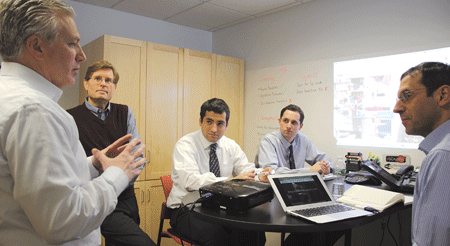
Community Spotlight Features
New Developments Send Westfield’s Spirits Soaring

Kate Phelon says a host of new restaurants and other new businesses are bringing a renewed sense of vibrancy to Westfield’s downtown area.

Kate Phelon says a host of new restaurants and other new businesses are bringing a renewed sense of vibrancy to Westfield’s downtown area.

This summer, Westfield was ranked as a “City on the Rise” and one of the “Best Cities to Live in Massachusetts” on different websites. Officials are pleased by the accolades, and believe they reflect a number of dramatic changes that are attracting people to its shops, restaurants, and year-round events.

“It’s an exciting time for us due to new developments at the airport and the continued growth and revitalization of our downtown,” said Peter Miller, the city’s director of Community Development, who noted everything from a number of new restaurants in the central business district to a growth spurt at the municipal airport in the city’s north end.

The $80 million Great River Bridge project is finally complete, and Miller said it is significant because people avoided coming to the city for years because of the traffic congestion.

“Westfield had developed a reputation for being a traffic nightmare,” he said. “But we finally have a pattern that flows and is aesthetically pleasing. We’ve restriped and fully reconstructed our roads, we have new plantings and new sidewalks, and have renovated four parks. We also made a commitment to use the Park Square Green as a gathering space. It is the focal point of the city, and we are working to develop programs and community-based activities that will be held there throughout the year.”

Westfield-Barnes Regional Airport is also experiencing growth, and Miller said a $21 million resurfacing project of the 9,000-foot runway is complete. It was paid for by a partnership between the city, the state Aeronautics Commission, and the federal government.

In addition, Gulfstream Aerospace Corp., a unit of Virginia-based General Dynamics, has completed a $23 million expansion, which led to the creation of more than 100 new jobs. The Westfield location has also been chosen to service the new Gulfstream G650 aircraft, a twin-engine, $100 million corporate jet.

“When the company decided to expand, Westfield was one of four airports across the nation they looked at. It’s impressive that Barnes was chosen, and it put Westfield on the map for people who use corporate aircraft,” said Kate Phelon, executive director of the Greater Westfield Chamber of Commerce, as she explained that the area’s skilled workforce was a critical factor in the decision.

However, Miller said there are a number of other things that made the airport attractive. He cited its modern terminal, which was constructed in 2006, as well as the availability of 24/7 runway access and fire service, made possible through a partnership with the 104th Fighter Wing of the Massachusetts Air National Guard at Barnes.

“We’ve learned through this expansion that we can really position ourselves as a hub for aircraft maintenance and specialized services,” said Miller. “We’ve been building toward this for the last decade, but in the past we didn’t have the facilities to accommodate it. The runway and new terminal were the game changers.”

The change has sparked growth, and several developers and fixed-base operators have been expanding to accommodate the increase in traffic. “Rectrix and Whip City Aviation are also in the process of evaluating and expanding their hangar space,” Miller said.

In addition, Papp’s Bar & Grill opened at the airport several months ago. “It’s very unique and has an observation deck bar. We think it will attract more people to the airport and make them aware of how much activity is generated there,” he noted.

The city is also developing a new program at Westfield Vocational Technical High School that will train students for careers in aviation.

Phelon said a representative from Gulfstream is on the high school’s advisory board and has been instrumental in the creation of the program, which is important, because there are not enough skilled workers to fill available positions at Gulfstream.

“We’re still trying to identify a facility to house the program at the airport, but hope to launch it in the fall of 2015,” she explained. “It will be the third of its kind in the Northeast and will give students another choice of careers in a growing industry where they can get a job that pays well after graduating from high school.”

Takeoff Mode

The city’s downtown also boasts a number of new attractions, and the Hangar Pub & Grill, which opened during the first week in June, is thriving. “It has a great atmosphere and is a place where families and students can come together and enjoy themselves,” Miller said, adding that Westfield is its second location; the first is on University Drive at UMass Amherst.

Phelon also believes the restaurant will result in an increase in foot traffic downtown. “The Hangar is a well-known name, and we see it as a magnet that will drive traffic to our downtown and help other new businesses. It is so popular that some nights there is a line of people waiting outside the door.”

Other new, popular eateries include Wings Over Westfield, which opened in the former School Street Bistro building; Two Rivers Burrito Co.; and Clemenza’s Brick Oven Pizza.

However, there is still room for growth, and Miller said the city is hoping to attract other restaurateurs to the city. “The Hangar has demonstrated that there is an audience for new eateries.”

In addition, city officials are focused on filling empty commercial space that includes a full block on Elm Street. “We’re focusing on attracting investors from the region because they understand our market and culture,” Miller said.

Another development, finally coming to fruition after more than a decade of work, is the extension of the Columbia Greenway rail trail. “Westfield is the northern terminus of the trail, and this summer it will be extended into our downtown,” Miller said. “We’re looking forward to it, as we believe it will introduce an entirely new population to our shops, businesses, and restaurants.”

Phelon agreed. “Rail trails have become so popular that we believe it will inspire entrepreneurs and further economic development,” she said.

Other news includes a groundbreaking ceremony this month for a new, $7 million, 22,000-square-foot senior center being built on Noble Street, which will serve thousands of residents. It is expected to be completed next summer.

The city’s marketing tagline is “Business Focused, Community Driven,” while the chamber’s is “The Power of Community,” and Miller said the concept of community is something city officials take very seriously.

“We’re very fortunate to have a diverse group of people working toward the goal of creating a place where community matters, neighbors engage with each other, and people know each other,” he said.

Phelon concurred and said the chamber is using all its resources to promote activities and events that bring people together.

“We’re the only chamber of commerce in the area that hosts free, monthly coffee hours with the mayor,” she said, “which is a great opportunity for people to learn about what is going on in the city.”

Although the Westfield Business Improvement District dissolved earlier this summer, Miller said, “our message to businesses and the public is that the city and chamber stand committed to continuing the progress made in the past seven years. We will continue to raise the bar, and the social, community aspect of our city is being fostered through festivals, new restaurants, Westfield State University, and the efforts of our chamber.”

Two MusicFest concerts staged this summer each attracted more than 1,000 people, and local restaurants took advantage of available vendor space during the concerts, which created a festive atmosphere in the city.

Upcoming events include a MusicFest featuring a Beatles tribute band on Aug. 21, a fall street festival called Megaplanetpalooza on Sept. 20, a Haunted Chocolate Walk on Oct. 25, and a Lantern Light Parade Nov. 29, as well as an expansive, city-wide event titled “The Universe According to Josh Simpson,” which is ongoing through October and includes exhibitions of the glass blower’s work in galleries, banks, and restaurants, as well as demonstrations, a film series, lectures, raffles, and children’s activities.

Phelon said these events and others, such as Small Business Saturday, are advertised on the chamber’s website, through mailings, and in its newsletter. “We want to do all we can to support businesses and entrepreneurs who have taken a chance on our downtown.”

A partnership between the city and community radio station WSKB 89.5, which is operated by Westfield State University, kicked off in June and also serves to publicize local events.

“A different personality hosts the show every weekday between 6 and 8 a.m.,” Miller said. Officials from the city’s nonprofit organizations take to the air on Mondays and Tuesdays, Mayor Daniel Knapik is the host on Wednesdays and Fridays, and Patrick Berry from Westfield News Group is the featured guest on Thursdays.

“It’s a great way to learn about what’s going on in the community and gives people another way to interact,” Miller said. “The university approached us with the idea, and we were more than pleased to use the station to promote local events.”

Plane Speaking

Officials say Westfield is accomplishing its goal of becoming a vibrant community.

“There’s a synergy happening among the people who live and work here,” said Phelon. “Plus, Westfield is the only community in Massachusetts whose population has grown in every census conducted over the past 60 years. We’re also the largest city before you get to the hilltowns, and it may inspire growth when people come here, eat in our restaurants, and attend our events. We’re very proud of how our city looks, and with the upgraded traffic flow, it’s a great place to visit.”

Miller agreed. “We have a lot more to offer now,” he said, “than we ever had before.”

Westfield at a glance

Year Incorporated: 1669
Population: 41,094 (2010)

Area: 47.3 square miles

County: Hampden

Residential Tax Rate: $18.18

Commercial Tax Rate: $33.84
Median Household Income: $57,018 (2010)

Family Household Income: $55,327 (2010)

Type of government: Mayor, City Council
Largest Employers: Westfield State University, Noble Hospital, Savage Arms Inc., Mestek Inc., National Envelope
* Latest information available

Features
Annual Show Will Put the Spotlight on Entrepreneurship

WMBExpoComcastDateOrganizers of the Western Mass. Business Expo, slated for Oct. 29 at the MassMutual Center, are finalizing elements of the show, which will certainly have an entrepreneurial flair to it.

Indeed, the highly successful pitch contest, which made its debut at the 2013 Expo, will be staged again this year. Organized by Valley Venture Mentors (VVM), the contest, as the name suggests, features entrepreneurs with developing ventures pitching their ideas to a panel of judges — with $3,000 in prize money on the line.

This year’s contest will likely feature fewer presenting ventures — perhaps five as opposed to the 10 last year — which should allow for more give and take between those presenting the pitches and those who will judge them, said VVM President Scott Foster, adding that this will likely produce what he called a “Shark Tank effect — only nicer.”

Meanwhile, this year’s slate of educational seminars will include a track on entrepreneurship. The roster is still being finalized, but it will feature some of the region’s rising stars offering insight into what it takes to succeed in business today.

Delcie Bean, founder and president of Paragus Strategic IT, one of the fastest-growing technology companies in the country, will be among those presenting interactive programs designed to inform and inspire those in attendance.

“Through initiatives like VVM, this region is putting a great deal of emphasis on entrepreneurship and growing organically by spurring the creation and growth of new small businesses,” said BusinessWest Associate Publisher Kate Campiti. “For the 2014 show, Expo organizers wanted to add momentum to these efforts by showcasing new business ventures through the pitch contest and relaying success stories written by some of the region’s noted entrepreneurs.

“These are people who have taken risks, beaten the long odds on making it in today’s highly competitive global economy, and have much to share with Expo attendees,” she went on. “These will be compelling stories that will hopefully inspire others to reach high.”

As the entrepreneurship track comes together, so do other elements of the show, which is expected to draw more than 150 exhibitors and 2,500 attendees, said Campiti. The other seminar tracks are professional development and sales and marketing, and those programs are being finalized as well, she said, as are the Show Floor Theater presentations.

The Women’s Professional Chamber of Commerce has announced that Patricia Diaz Dennis, retired senior vice president and assistant general counsel for AT&T and commissioner of the Federal Communications Commission during the Reagan administration, has been confirmed as the luncheon speaker.

Dennis, a member of the board of directors at MassMutual, is a highly sought-after speaker, whose broad résumé also includes service on the National Labor Relations Board, a stint as assistant secretary of State for human rights and humanitarian affairs, a three-year term as chair of the Girl Scouts of America, and a lengthy stint on the Texas State University System Board of Regents.

At AT&T, from which she retired in 2008, she was responsible for corporate litigation, procurement, corporate real estate, environmental corporate compliance, IT, and trademark and copyright legal matters. Before joining AT&T in 1995, Dennis was special counsel to Sullivan & Cromwell for communications matters in the international law firm’s Washington, D.C. office. From 1989 to 1991, she was a partner and head of the communications section of the Jones, Day, Reavis & Pogue law firm.

One of the highlights of previous shows has been the day-ending Expo Social, said Campiti, adding that it has become one of the best networking opportunities of the year. This year’s social, to be sponsored by MGM Springfield and Northwestern Mutual, will be no exception.

Other sponsors include Presenting Sponsor Comcast Business; Silver Sponsors DIF Design, Health New England, and Johnson & Hill Staffing Services; and Education Sponsor the Isenberg School of Management at UMass Amherst.

For more information on the event, visit www.businesswest.com or www.wmbexpo.com. n

Features
Is This as Good as the Recovery Is Going to Get?

Mike Oleksak

Mike Oleksak says positive things are happening with the economy, but many business owners don’t believe what they’re seeing and hearing.

Andre Mayer says business owners who are still waiting for what would be considered a real economic recovery should probably stop waiting.

That’s because, in his view, this is about as real as it’s going to get.

“At this point, we’re really past the recovery phase; the recession ended five years ago,” said Mayer, senior vice president for communications and research at Associated Industries of Massachusetts. “We never had the recovery we were hoping for and expecting — that big burst of growth where GDP goes up quickly and rejoins the prior trend line. It never happened.”

And it’s very likely that it just won’t happen, at least not any time soon, he said, adding that business owners would be wise to accept this state of the economy and get on with hiring people, expanding their ventures, and moving forward rather than waiting for that aforementioned burst.

And he believes many are doing just that.

“We have been adding quite a few jobs in the first quarter of this year, when the national economy was contracting,” he said, adding that ‘we,’ in this case, refers to the state as a whole, but includes Western Mass. “And that, to me, seems to reflect a change of attitude. In other words, employers, instead of hunkering down and going all out to preserve productivity and not dilute it, because that’s what got them through the recession, are now taking a more sustainable path and sort of coming to the realization that this is the economy we have to live with.”

Bob Nakosteen, professor of Economics at the Isenberg School of Management at UMass Amherst, agreed, and pointed to the latest unemployment figures as evidence of what he considered progress, at least in some respects.

Indeed, while the state’s jobless rate fell to 5.5% in June, the lowest since August 2008, and 3,700 jobs were added, the manufacturing sector lost more than 1,000 jobs, and the construction industry lost more than 900, what Nakosteen called “hidden disappointments.”

And he said they may provide more evidence of something that many are now calling ‘secular stagnation,’ or ‘economic immobilism,’ terms that aren’t new — they go back at least as far as the Great Depression — but are being summoned with greater frequency by many economists to help describe and explain the phenomenon that Mayer touched on: a recovery that certainly doesn’t look or feel like one.

“There are a number of factors in our economy, some of them demographic, some of them technological, some of them stemming from globalization, that imply that we’re simply not going to experience the growth in this economy that we have in the past, especially job growth,” said Nakosteen while explaining secular stagnation, which he said is now being hotly debated in the “economics blogosphere.” “The workforce is getting older and large numbers are retiring, technology is developing quickly — but it’s doing so in a way that seems to be removing jobs rather than adding jobs — and globalization continues to put great pressure on our domestic workforce, especially the blue-collar occupations and manufacturing.

“And the prospects for any of this changing are simply not good,” he went on, adding that some economists believe it may be decades before the current scene improves markedly.

Meanwhile, the tepid state of the recovery is being reflected by ongoing caution on the part of area business owners, said commercial lenders we spoke with, who noted that many, perhaps still waiting for that burst they have seen following other downturns, such as the ones in the mid-’90s and just after 9/11, are hesitant about pulling the trigger on expansions or new hiring.

“I don’t see anybody really jumping in full force to bring people back or undertake plant expansion,” said Michael Oleksak, executive vice president and chief lending officer at Holyoke-based PeoplesBank. “Everyone is still pretty hesitant.”

Luke Kettles, senior vice president and chief lending officer at Hampden Bank, agreed, summoning a phrase that has been given a thorough workout over the past several years.

“People are guardedly optimistic,” he said, adding that, in this case, that means they often lack the confidence to move ahead with expansion plans or new hiring.

“Employers are not adding people unless they really need to,” he explained, adding that most are still looking to improve efficiency and trim fat rather than add to their workforces.

For this issue, BusinessWest takes an in-depth look at the state of the recovery, such as it is, and whether any change in the forecast can be expected any time soon.

Dollar Signs

While secular stagnation, if that’s what the region is experiencing, is a mostly negative term, there are some positives to be gleaned from recent economic statistics and trends, said both Nakosteen and Mayer.

Perhaps the most important of these is that the recovery — and job growth — has finally extended beyond the Greater Boston area, said Nakosteen, adding that both Central and Western Mass. are enjoying better unemployment numbers of late.

The June jobs report provides more evidence of this, he noted, but real signs of improvement started appearing earlier in the spring.

“Over the past few months, unemployment rates have come down dramatically in metropolitan areas in the Berkshires and Springfield, where they were the highest,” he noted. “This is a really good thing. It doesn’t mean they’re low enough to make you feel you’re in a true recovery, but for the first time since the recovery began, it now seems to be extending past Route 495.”

Mayer agreed. “Growth has evened out a good deal,” he told BusinessWest, adding that the Greater Boston area recovered quickly and profoundly after the recession while most of the rest of the state lagged well behind.

“Over the past year, the jobs have been added in the Worcester and Springfield metro areas at the same rate as in the Boston and MetroWest areas,” he noted. “At this point, we’re seeing growth, albeit modest growth, on the labor-market side almost everywhere.”

Luke Kettles

Luke Kettles says some sectors, such as senior housing, are experiencing growth, but by and large, many business owners are hesitant about expanding or new hiring.

Still, the recovery being witnessed in this region — and many other parts of the country, for that matter — is atypical of what is generally seen after prolonged downturns, said Mayer, citing a lack of growth in GDP and describing what much of the country, and this region, have experienced as a “watered-down version of a boom.”

“One reason, maybe the main reason, why this recession was such a bad one is that it seems to have knocked our GDP down a few percentage points long-term — we haven’t just bounced right back to that point where we left off,” he said. “And by now, waiting for that to happen doesn’t seem realistic, although we are on an upward track.”

Nakosteen concurred. “Sometimes after a recession, we’d have 9% or 10% gross-domestic-product growth for a year or two — it was just stunning,” he said. “We haven’t done better than two or three percentage points the past several years, and I just don’t think you’re going to see that big figure ever again.

“That’s a dangerous thing for me to say,” he added quickly, reflecting on the gravity of his own words. “But I’m buying into this secular-stagnation argument, and I don’t know what to tell people except that, however they have to adjust to the idea that there may not be a pot of gold at the end of the rainbow, they’d probably better at least think that through.”

Referencing the declines in both manufacturing and construction jobs, he said those numbers, if they don’t change, are ample evidence that the recovery lacks “oomph,” and that this is as good as it is likely to get.

“I thought manufacturing, and construction as well, were on very positive trajectories, and that this might continue more or less unabated,” he noted. “Now, there’s been an abatement.”

That said, both Mayer and Nakosteen anticipate further improvement in the economy, especially if business owners and managers can somehow gain the confidence needed to expand operations and add to their workforces — and consumers can buy again — possibly by recognizing the new economic reality for what it is, and making it better than it’s been.

“It’s time for us to not wait for magic, but to think hard about what we can do to continually make our economic climate better,” Nakosteen said.

Lending Credence

But Oleksak and Kettles said there are still a number of factors holding area business owners back when it comes to hiring and borrowing to expand.

And many are still continuing to do what essentially got them through the recession, said Oleksak, referring to everything from better inventory control to improving production efficiencies to controlling or, in many cases, reducing salary.

Uncertainty about health-insurance costs is one of the factors leading to hesitancy, he noted, adding that these expenses have been a drain on hiring for some time because they keep going up and there is little, if anything, to indicate that this trend will not continue.

Meanwhile, interest rates, which are still historically low but moving back up and projected to continue rising, are another impediment to progress.

“We’ve had such low interest rates for so long that’s there’s also concern about over-leveraging yourself in light of the fact that we’re going to see some higher interest rates down the road,” he explained. “And when interest rates start increasing, there’s more concern about the economy, with people asking if we’re going to fall backward again.”

Kettles said that some sectors, such as senior living, medical office facilities, social services, and even self-storage, are doing well, and Hampden Bank is having a solid year in commercial lending, due in part to the many bank mergers in recent years.

Still, he also sees hesitancy among many business owners, especially when it comes to hiring.

“Benefit costs are increasing, and healthcare costs are pretty significant, so people do not hire unless it’s really necessary,” he said. “Profit margins may be improving, nationally as well as locally, but I think it’s through improving efficiencies and doing more with less. People aren’t going out and adding a position unless they really need to, and a lot of times they’ll try to use part-time labor until they really need a full-time position.”

Kettles noted that many of the manufacturers the bank does business with have been willing to make investments in new equipment and technology, but these purchases often translate to fewer jobs, not more of them.

Overall, confidence, or the lack thereof, remains a factor as well, said both Kettles and Oleksak, noting that, while the June jobs report is generally positive, business owners aren’t necessarily buying into such reports.

“There is some improvement going on,” said Oleksak, “and people are being cautiously optimistic, but I’m not sure they’re really believing what they’re seeing.”

As evidence of this, he cited the residential real-estate market. While those at PeoplesBank and other institutions were expecting the refinancing market to slow this year, mainly because most everyone who could refinance already has, they were expecting sales to pick up, but they haven’t.

“If you look at the numbers, we’re about 5% to 10% behind last year,” he said, adding that an overall lack of confidence is the primary reason.

Whether confidence improves in the near future is likely a function of whether the news continues to improve, and whether it can actually convince people to believe what they see, said those we spoke with.

Nakosteen, for one, believes conditions will continue to improve.

“I think the next 12 months are going to be pretty good,” he told BusinessWest. “A lot of things, especially at the national level, but also at the state level, are getting better. Households are just in a much better position than they’ve been in for years to make healthy consumption decisions, and therefore employers will be making more job offers, buying more equipment, and so on. Over the next year, we’re going to see reasonable economic growth.”

Bottom Line

But what does ‘reasonable’ mean?

It probably doesn’t mean the kind of burst that traditionally accompanies the end of a recession, or the kind of oomph that economists expected and business owners are in many respects still waiting and hoping for.

As Mayer explained, that kind of jolt simply isn’t realistic a full five years after the recession was declared over.

This is the economy this region may have to deal with — like it or not.


George O’Brien can be reached at [email protected]

Community Spotlight Features
Hadley Takes Steps to Enhance Commercial Growth

David Nixon says Hadley’s mix of open space, farmland, commerce, and homes has positioned it well for the future.

David Nixon says Hadley’s mix of open space, farmland, commerce, and homes has positioned it well for the future.

The town of Hadley has always strived to achieve a balance between open land, agricultural enterprise, and retail business. But over the past year, special efforts have been made to enhance commercial opportunity along the 13-mile stretch of Route 9 that runs through the town. The effort includes proactive measures, partnerships, and infrastructure improvements.

“We admire and respect people who are trying to establish and maintain a business. It’s a very difficult thing to do and takes a lot of sacrifice,” said Town Administrator David Nixon. He added that building lots are available on Route 9 and the town has been approached by a number of business owners who want to expand, particularly in the shopping-mall area of the roadway.

“There is a lot of new construction taking place,” he told BusinessWest, listing several expamples. “Texas Roadhouse is in the permitting process, a Starbucks store is under construction, and other businesses are being built or are under design. It’s good for the community and good for America, so we are doing whatever we can to support them and give owners the opportunity to flourish.”

A major milestone was reached several months ago when the state granted the town 12 new liquor licenses it applied for last fall. “The restaurant/hospitality trade is very important to our local economy, and last November, the town reached its quota of liquor licenses,” Nixon explained. “We knew there was a market for them, and we wanted to be able to provide opportunity for new restaurants and stores that would address the need for dining and entertainment. As a result of our petition, six new licenses for malt and wine and six for all-alcohol were granted.”

The licenses are for establishments on Route 9. One has already been applied for, and interest has been expressed in the remainder. “We expect more applications for them in the near future,” he said.

Hadley has also been proactive in helping 13 small businesses recover from losses suffered in a fire last October that leveled the strip mall at 206 Russell St. that housed them. “We developed a coalition to help the owners get back on their feet and find new locations to re-establish their businesses. It includes the Chamber of Commerce, United Way of Hampshire County, the town of Hadley, and our legislative delegation, as well as banks and charitable institutions,” Nixon said.

The coalition worked to make sure the owners received insurance money and any benefits available to them, he explained, adding that some of the businesses were quite successful and had been established by immigrants who realized the American dream through hard work and sweat equity put forth by their families.

The coalition also helped the owners create business plans and document their history so they could receive bank loans and apply for grant money. “Some have reopened, and others are still looking for the right location, but our work with them is ongoing,” Nixon said.

For this, the latest installment of its Community Spotlight series, BusinessWest looks at how this town strategically positioned between Northampton and Amherst is certainly the right place at the right time for commercial development.

Setting the Stage

Nixon said the town has also been proactive in taking steps to ensure that existing and potential business owners have the infrastructure they need to thrive. To that end, town officials partnered with the Mass. Department of Transportation to improve travel along Route 9 for vehicular traffic as well as for pedestrians and bicyclists.

Progress is being made, and new walking paths will be installed within the next year that will connect residential neighborhoods to shopping areas. In addition, a plan to widen and recondition the road is in the design stage and is expected to be complete next summer. It includes bicycle lanes, which will be enhanced by an upgrade of the Norwottuck Rail Trail by the Department of Conservation Resources.

Nixon said promoting bicycle use is part of the town’s ongoing strategy to reduce energy consumption, and officials have collaborated with the Pioneer Valley Planning Commission to realize that goal. The project includes a study paid for by a Community Innovation Challenge grant received last year, and the final report is expected in the near future.

“We also just received grant money to purchase three bicycle racks,” Nixon said. Two will be installed on municipal property along Route 9, and the third will be stationed at a local business chosen by the Select Board.

Town officials are also working with the state Department of Transportation to install safe pedestrian crossings along Route 9. Nixon said this is critical because the town common, which stretches a mile and a half and is the longest intact town common in New England, is being used for an increasing number of events.

Over the past year, these have included a farmer’s market, a 5K road race, and the town’s annual Asparagus Festival, which was held in early June. The festival kicked off for the first time last year at the Seven Sisters Market Bistro & Long Hollow Bison Farm at 270 Russell St., and this year, it was moved to the town common.

“It was extremely successful,” said Nixon. “People came from as far away as Brooklyn, and a story about it was published in Yankee magazine.”

But parking and walking to the common is problematic. People who attend such events often park in the Hopkins Academy lot or along Route 9, which means they have to cross the busy road on foot. “If they park on the south end of the road, they have to walk across four lanes of traffic,” Nixon explained, adding that the new crossings will be a boon to pedestrian safety.

The problem of aging water lines is also being addressed. “The lines we have are about 75 years old and will be replaced with higher-capacity ones and better materials,” he noted. The town plans to borrow money to finance the project, and officials are working with legislators to procure state funding to help pay for the improvement. Nixon said the preliminary cost for phase 1 is $400,000, and an additional $500,000 will be needed to complete phase 2.

A program to upgrade the town’s fire hydrants is also underway, and water valves are being tested by the Fire Department and Department of Public Works.

“We are also repairing our wastewater lines because we want to be sure there is enough capacity for our wastewater-treatment plan to handle an expansion,” he said. “It’s important to have this infrastructure in place and working properly so business owners know there is abundant water for their needs as well as enough to put out fires.”

Growth Patterns

Agriculture has always been an important part of Hadley’s economy, and the steps taken to bring new business to Route 9 and support firms already there have the potential to spur economic growth, since the town’s agricultural profile includes enterprises such as Carrs Cider, which is sold in package stores and restaurants; Valley Malt, which provides ingredients to make locally produced beer; and V-One Vodka, which can be purchased in Hadley and has plans to expand.

“Many Hadley restaurants support local agriculture, and we have six dairy farms and thousands of acres used to grow vegetables and fruit, such as strawberries, asparagus, corn, potatoes, squash, and pumpkins. So opportunities for new restaurants are linked to an opportunity for growth in both commercial and agricultural areas,” Nixon said.

He told BusinessWest the town is a leader in land preservation and has thousands of acres protected for agriculture and wildlife.

“But we also want to have the right kinds of commerce to provide people with employment as well as services they need, want, and enjoy,” he said in conclusion. “The commercial base helps to keep our taxes affordable, and the mix of open land, commerce, and residences in small villages and neighborhoods has provided Hadley with a very stable and vibrant community that is well-positioned to handle the challenges of the future.”

Hadley at a glance

Year Incorporated: 1661
Population: 5,520 (2010)
Area: 24.7 square miles
County: Hampden
Residential Tax Rate: $10.64
Commercial Tax Rate: $10.64
Median Household Income: $51,851 (2010)
Family Household Income: $61,897 (2010)
Type of government: Open Town Meeting, Board of Selectmen
Largest Employers: Super Stop & Shop, Evaluation Systems Group Pearson, Elaine Center at Hadley, Home Depot, Lowe’s Home Improvement
* Latest information available

Community Spotlight Features
Balanced Growth Continues in East Longmeadow

Paul Federici

Paul Federici says a favorable business climate bodes well for further economic development in East Longmeadow.

Paul Federici says East Longmeadow has undergone a growth spurt over the past several years, and the trend is continuing.

“The town has been fortunate to have new developments in both our residential and commercial areas,” said the clerk of the Board of Selectmen. “Real estate has picked up tremendously in terms of new construction as well as sales of existing homes, and there has also been a steady increase in commercial growth.”

He attributes the upswing to the availability of property, East Longmeadow’s favorable business climate, and the town’s many amenities. “Businesses and individuals like what we have to offer, and our single tax rate is a big incentive for businesses to move here. We’ve never had a serious discussion about changing the rate because town officials want to keep business owners happy and give them the ability to grow without additional tax burdens. Plus, residents and employees can take advantage of our restaurants, shops, and businesses.”

Robyn Macdonald agrees. “The school system is great, and the town is very safe. The crime rate is very, very low,” said the director of Planning, Zoning, and Conservation. “The single tax rate has a lot to do with the increase in business.”

This business growth is important because East Longmeadow suffered a loss of tax revenue during the recession. “We had a severe slowdown of residential building after the downturn in the economy,” Federici said. “A number of businesses moved out of our industrial area or ceased to operate, and the Appropriations Committee had to tighten their purse strings.”

Although the town fared better than others of its size, Macdonald added, foreclosures occurred for the first time in years. “There were also fears that other businesses would be forced to leave.”

But that has changed, and a surge in balanced growth has helped to improve East Longmeadow’s financial outlook. “Last year, the town was given a triple-A rating by Standard & Poor,” Federici said, referring to the upgrade in long-term bond rating from AA to AA+.

Federici credits the strong fiscal rating in part to dedicated efforts by the Appropriations Committee and town department heads to adhere to tight budgetary constraints while retaining high standards, which include working closely with new businesses to minimize the pain of relocating to the community or opening new.

“Building Commissioner Dan Hellyer does an outstanding job of helping builders get permits and other things they need, which range from utilities to curb cuts,” he said.

As a result, the landscape continues to evolve. “I’ve lived here since 1996, worked in East Longmeadow since 1986, and have witnessed tremendous growth over the years,” said Federici. “We foresee it continuing because we have a favorable business climate.”

Altered Landscape

Roughly 70% of the town is zoned for residential use, and a number of new, high-end housing developments have taken root over the past few years.

“It’s good to see so many developers have confidence in East Longmeadow and are willing to put their shovels in the ground and build houses in anticipation of selling them,” Federici said.

Al Joyce, president of Rose Bud Builders of East Longmeadow, said his company has a new subdivision on Wisteria Lane, off Somers Road (Route 83). “It contains eight lots. Five homes have been built and sold, and the remaining three are under construction,” he said.

In addition, the Great Woods development of single-family homes on Shaker Road and Prospect Street continues to expand. “Phase 11 is almost complete, and we are anticipating Phase 12,” Macdonald said.

Meanwhile, Kent Pecoy & Sons Construction Co. also has a new subdivision called Bella Vista that contains 30 lots, and Macdonald said the homes are all large, with five bedrooms.

“A ribbon-cutting ceremony was held after the first one was completed about 18 months ago, and they are selling as fast as they are built; prices start at about $500,000, and demand continues to be strong,” Federici said.

“Families see East Longmeadow as a good place to live and buy a home. It is a growing community with a great school system and a busy rotary area filled with shops and restaurants,” he added, noting that a new high school has been proposed as well.

Town officials are also happy that Bay Path University in Longmeadow has chosen to expand its campus to East Longmeadow. It is building a new, two-story, 56,000-square-foot structure that will be called the Center for Graduate Studies in Health Sciences; construction is underway, with a completion date expected in early 2015.

“It will be prestigious to have their graduate-studies program here, and it’s also nice to see a parcel of land that sat vacant for many years put to such a good use,” Macdonald said. “The building will be absolutely gorgeous and fits in well with the neighborhood, as there is a residential area across the street and subdivisions on the other side of it.”

Federici agrees. “It’s wonderful that they have chosen to expand from Longmeadow to East Longmeadow, and the college is already doing a lot for us,” he said, noting that Bay Path has made a commitment to provide the town with an annual payment (as a nonprofit, it is exempt from paying taxes), and plans to offer scholarships to East Longmeadow High School graduates and town employees.

Growth is also occurring a short distance away in the town’s Industrial Garden district.  A vacant building on 126 Industrial Dr. was given new life when it was purchased by the Arbors Kids two years ago. “They renovated it and have been very successful. They offer full-time day care, after-school care, and summer camps, which is a great addition to the town,” Federici said, adding that, a short distance away, a new self-storage facility is also in the initial phase of construction.

Go Graphics is another firm that finds East Longmeadow attractive. It relocated from a shopping plaza on North Main Street to a 5,000-square-foot space on Benton Drive in the industrial park. “The company that was in the space before them left because they downsized, and Go Graphics took advantage of the opportunity to move there, which gave them room to expand,” Federici said.

Nearby, he added, the Deer Park section of the Industrial Garden district is also growing. “GMH Fence relocated from Parker Street to a space on Benton Road as they needed more space.”

Change has also taken place in the town center. “Bentley’s Bistro on North Main Street just celebrated its one-year anniversary, and Baystate Rug opened next door about a month ago,” Federici said, adding that the side of the building that houses Bentley’s had been vacant for close to a year, and the portion that is home to Baystate Rug had been empty for almost two years.

The former Spoleto’s restaurant building at 84 Center Square has also changed hands. It was sold to its long-term managers, has reopened as Center Square Grill, and has a staff of about 75 employees.

And Macdonald said a new gas station and convenience store have been approved at the corner of Chestnut Street and Shaker Road on an empty piece of property. “It will contain a 6,500-square-foot building,” she told BusinessWest.

Housing options for older adults are also expanding. The Fields at Chestnut, a condominium association with individual homes for people age 55 and over, continues to grow. “It’s in Phase 5. Most of the homes contain 2,200 square feet, and they are sold as fast as they are built,” Macdonald said.

The town also boasts a new assisted-living facility. Emeritus at East Longmeadow opened a few weeks ago on the grounds of the former Bluebird Acres apple orchard on Parker Street. The property had been vacant for a number of years, and Federici said it offers assisted-living apartments as well as a unit for people with dementia. “It is a well-staffed facility,” he told BusinessWest.

Solid Base

Federici is happy about the surge in residential and commercial activity, especially since East Longmeadow does not have an economic-development director and the marketing budget is limited.

“The town is definitely on the upswing, and the growth is balanced,” he said. “New businesses and families are moving here, and we still have our stalwarts — Lenox and Hasbro. Lenox has been growing and has spent tens of millions of dollars on their facility and training for their employees in the last decade.

“There is still plenty of open land and space available,” he went on. “The town has a lot to offer, and the future looks bright.”

East Longmeadow at a glance

Year Incorporated: 1894
Population: 15,720 (2010)
Area: 13 square miles
County: Hampden
Residential Tax Rate: $20.47
Commercial Tax Rate: $20.47
Median Household Income: $62,680 (2010)
Family Household Income: $70,571 (2010)
Type of government: Open Town Meeting; Board of Selectmen
Largest Employers: Hasbro Games, Lenox, Lower Pioneer Valley Educational, Redstone

* Latest information available

Events Features
The Class of 2014 Has Its Day in the Sun

DSC_0632
DSC_0674The population of 40 Under Forty winners in Western Mass. officially reached 320 on June 19, as BusinessWest’s Class of 2014 received their plaques — and the applause of more than 600 people — at ceremonies at the Log Cabin Banquet & Meeting House in Holyoke. Perfect weather greeted guests on the penultimate day of spring, and they enjoyed one of the best networking events of the year. The gala featured fine food, music — each winner was introduced to a song of their choosing — and a chance to meet this program’s eighth class of rising stars, as well as many previous winners. On the pages that follow, we offer a fun look back at a memorable evening. Meanwhile, we’ll remind you that the nomination process for the Class of 2015 begins in roughly six months. So it’s time to start thinking about who could be the next members of this prestigious club. This year’s gala was sponsored by Baystate Medical Center, Fathers & Sons, Hampden Bank, Health New England, the Isenberg School of Management at UMass Amherst, Moriarty & Primack, P.C., Paragus Strategic IT, St. Germain Investment Management, and the Young Professional Society of Greater Springfield.

Program Sponsors:

BaystateMedCenter130x70

For reprints contact: Denise Smith Photography / www.denisesmithphotography.com / [email protected]
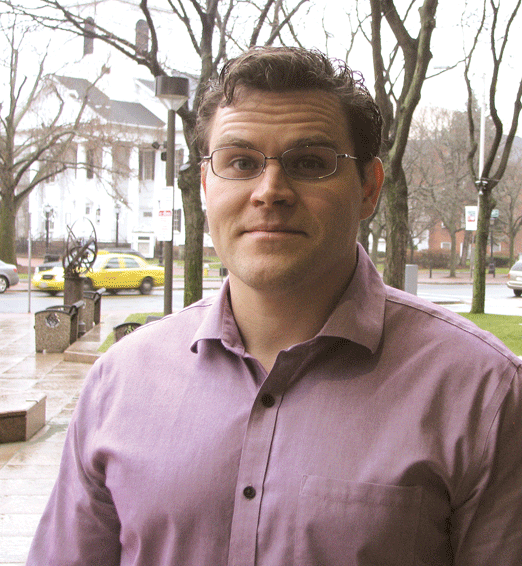
DSC_0582
From left, Jennifer Stratton, assistant professor of Education at Springfield College; Seth Stratton, class of 2014, attorney with Fitzgerald Attorneys at Law; Kathleen Schneider, senior director of Budget and Award Management for Save the Children; Michael Schneider, class of 2014, associate attorney at Doherty, Wallace, Pillsbury & Murphy, P.C.; Kevin Maltby, class of 2014, attorney at Bacon Wilson, P.C.; and his wife, Eliza Maltby.

DSC_0586Mike Matty, president of St. Germain Investment Management, one of this year’s 40 Under Forty sponsors, congratulates Patricia Faginski, vice president and financial advisor for the company and member of the class of 2014.


Below, from left, Melinda Moreno, adjunct professor at Bay Path College, networks with Tamara Blake, class of 2014, director of Psychology at Bay Path College and president and founder of Angels Take Flight; Lee Hagon, class of 2014, vocal music director at Minnechaug Regional High School; York Mayo, CEO of Community Volunteers; Angela Lussier, class of 2014, CEO of Anglea Lussier Enterprises; and Nick Rattner, editor at the Ugly Duckling Presse.

DSC_0588

DSC_0601


Jeremy Casey, class of 2013, assistant vice president and Commercial Services officer at Westfield Bank, networks with Garett DiStefano, class of 2014, director of residential dining at UMass Amherst.
DSC_0595
From left, Terra Missildine, co-owner and operations manager at Beloved Earth Environmentally Friendly Custodial Services; Kyle Sullivan, class of 2014, business insurance broker at the John M. Glover Agency; Ashley Clark, assistant store manager, officer at TD Bank; Alfonso Santaniello, class of 2014, president and CEO of the Creative Strategy Agency; Juli Thibault, Manager of Talent Acquistion at Baystate Health; and Jesse Tolan, digital media coordinator at the Creative Strategy Agency.

DSC_0621Jill Monson, left, class of 2010, chief inspiration officer at Inspired Marketing, networks with Rich Griffin, project manager for the City of Springfield, and his wife, Nicole Griffin, class of 2014, president and CEO of Griffin Staffing Network.


DSC_0617
Representing Health New England, one of the program’s sponsors, are, from left, Robert Azeez, Medicaid behavioral health manager; Taylor Moore, credit and collections analyst; Kerri Kane, process improvement facilitator; and Yvonne Diaz, account executive for existing business.

DSC_0614Anthony Surrette, class of 2014, principal at Corbin & Tapases, P.C., stops for a picture with his proud mother, Theresa Surrette.

DSC_0610


From left, Sandy Cassanelli, class of 2014, CEO of Greenough Packaging, and her husband, Craig Cassanelli, president of Greenough Packaging, stop for a picture with Michael Schneider, class of 2014, associate attorney at Doherty, Wallace, Pillsbury & Murphy, P.C., and his wife, Kathleen Schneider, senior director of budget and award management for Save the Children.

DSC_0626

Representing Hampden Bank, an event sponsor, are, from left, Amy Scribner, vice president and director of marketing; Kristy Batchelor, branch manager at the Tower Square location; and Peg Daoust, branch manager at the Boston Road location.

DSC_0623
Representing the UMass Isenberg School of Management, an event sponsor, are Kyle Bate, left, academic advisor and director of regional program development, and Katherine Piedra, director of the full-time MBA program.


DSC_0637Steve Oparowski, art director at Darby O’Brien Advertising, represents event sponsor Paragus Strategic IT near the main hallway, handing out martini glasses to the guests.


DSC_0644


From left, Mark Wisnewski, Greenfield town councilor, and his wife, Francia Wisnewski, class of 2014, regional program manager at Raising a Reader Massachusetts, network with Denise Hurst, class of 2014, quality improvement manager and human rights coordinator at the Department of Mental Health, and her husband, Justin Hurst, also a member of the class of 2014, owner of Hurst & Crane Investments, and a Springfield city councilor.

DSC_0647
Rich Griffin, left, project manager for the city of Springfield, stops for a photo with Jose Delgado, class of 2014, mayoral aide for the city of Springfield, and Danielle Emery, a second-grade teacher at Kensington Elementary School.

DSC_0651
Representing Monson Savings Bank are, from left, Jaimye Hebert, class of 2011, vice president of Commercial Lending; Melanie Garcia, teller; Robert Chateauneuf, class of 2014, assistant vice president of Commercial Lending; his wife, Shauna Chateauneuf, case manager at MassMutual Financial Group; and Sara Rodrigues, teller.

DSC_0655
From left, Seth Stratton, class of 2014, attorney at Fitzgerald Attorneys at Law; Jennifer Stratton, assistant professor of Education at Springfield College; and Seth’s mother, Mary Stratton, talk with Patrick Leary, class of 2007, shareholder and vice president of Moriarty and Primack, P.C., an event sponsor.

DSC_0615
Jason Randall, class of 2014, director of Human Resources for Peter Pan Bus Lines, networks with Pam Thornton, center, business development manager for United Personnel, and Cindy Landry, human resources generalist at Health New England.

DSC_0657
From left, Waleska Lugo-DeJesus, class of 2012, director of Multicultural Affairs at Westfield State University, networks with Ed Nunéz, senior business development officer at Freedom Credit Union and treasurer of the Young Professional Society of Greater Springfield, an event sponsor; Michelle Crosby, branch manager at PeoplesBank; Jason Tsitso, class of 2012, project manager at R&R Windows; and Sarah Tsitso, class of 2007, executive director of the Springfield Boys & Girls Club.

DSC_0661
Representing Fathers & Sons, an event sponsor, are, from left, Tony Quiterio, manager; Shera Smith, sales; Steve Langieri, sales manager; Bill Visneau, product specialist; Damon Cartelli, class of 2010, general manager; and Stephen Parent, sales director.

DSC_0669
Representing event sponsor Baystate Medical Center are, from left, Sean Gouvin, class of 2014, director of Facilities Planning and Engineering; Ryan Thomas, performance improvement coordinator; and Kevin Kirrane, process improvement coordinator.

DSC_0680
Ryan McCollum, left, owner of RMC Strategies, shares a moment with Erin Brunelle, class of 2013, realtor at Century 21 Hometown Associates, and Holyoke Mayor Alex Morse, class of 2014.

DSC_0703


Jim Barrett, managing partner of Meyers Brother Kalicka, P.C., one of five judges chosen to review this year’s 40 Under Forty nominations, receives a gift basket on stage. Each of the judges was given a basket in gratitude for their hard work.


SelfieGOBAlfonso Santaniello, class of 2014, president and CEO of the Creative Strategy Agency, surprises George O’Brien, BusinessWest editor, with a quick selfie as he accepts his award on stage at the Log Cabin.

Community Spotlight Features
Lenox Strives to Become a Year-round Destination

Channing Gibson, left, and Christopher Ketchen

Channing Gibson, left, and Christopher Ketchen want Lenox to become a year-round tourist attraction.

When Channing Gibson envisions what the town of Lenox will look like in the future, he sees a vibrant, year-round destination with a wide array of recreational activities that appeal to young people, along with the cultural attractions that have drawn tourists to the area for generations.

“Recreation could range from birding to biking, hunting, horseback riding, and cross-country skiing,” said the chair of the town’s Board of Selectmen. “We have a town beach on Laurel Lake, and although the traditional tourist comes here for relaxation and culture, there is an opportunity to attract people for recreation as well.”

Right now, the town is packed with tourists whose typical goal is to relax and enjoy the wealth of cultural events offered during the summer. In the coming months, many guests will also attend weddings, because the pastoral setting and large number of historic inns and hotels have made Lenox a popular place to get married. “There are so many places to stay that range from modest accommodations to high-end inns and hotels,” Gibson said.

But during the winter, business dies down, and many storefronts close their doors. In addition, young people in Lenox, as well as in other towns in the Berkshires, are leaving the area, and the town’s demographics reflect an aging population.

So the community is looking to create new recreational venues that would attract tourists year-round and appeal to young people. To that end, officials are waiting for the final report from a study conducted by the Conway School of Landscape Design. It is titled “Lenox’s 2013 Open Space and Recreation Plan,” and provides recommendations to improve existing natural and recreational resources.

In order to understand why the town has chosen this focus for its economic-development plan, Gibson said, it’s necessary to look at its past. He explained that the General Electric manufacturing plant in Pittsfield and the tourist industry played vital roles in the town’s economy for generations, and although GE closed its doors in 1986, Lenox continued to thrive, thanks to tourism.

“The Berkshire Visitors Bureau says that Lenox accounts for 40% of the tourist dollars spent in the Berkshires. Our geography works for us, and our hardworking innkeepers and people in the hospitality business make sure that visitors who come to the Berkshires want to stay in Lenox,” he said, adding that Canyon Ranch, Cranwell Resort and Spa, and Tanglewood, whose offices are in Lenox, are among the town’s leading attractions. “But even though we are in the right place, it’s something we can’t take for granted. We have to do things to improve revenues from tourism, and there is a lot of land available that is presently underdeveloped that can be put to good use.”

Town Manager Christopher Ketchen concurs, and says putting a new spin on tourism offers great potential. “We specialize in hospitality and making folks feel welcome, and the town offers picturesque natural beauty in winter as well as in spring, summer, and fall. Plus, we have been designated by the state as a green community and are starting to become known as a center for health and wellness.”

Gibson said the Conway report contains many suggestions, including the fact that existing trails, parks, and other natural resources could be linked by a pathway which would give residents and tourists easy access to recreational resources.

“There are lots of little pieces of land that could also be developed and linked by a trail that could be used for walking, biking, and more; it’s something we can do ourselves,” he told BusinessWest, adding that there is plenty of open space available for new recreational venues, which could increase the town’s vitality and help change its demographics. “Our goal is to find a way to take what worked in the past and bring it into the future.”

Need for Growth

When town officials created the FY 2015 budget, it included a fiscal-impact analysis. Gibson said it had been suggested by a consultant who did some free work for the town, and the Planning Board thought it was an excellent idea. “There are a lot of people with different ideas about what should be done in terms of economic development, and we were told it was important to understand what was needed and what was realistic.”

Unfortunately, it was eliminated from the budget due to cost. But since that time, several things have put a positive spin on the future.

The first is that Ketchen was hired in April; the town had been without a manager for almost a year. He had served as finance director in Hopkinton and deputy director of general government in Wellesley before moving to Lenox, and town officials are optimistic that his enthusiasm and ideas will result in concrete gains.

Ketchen says his plans include hosting open houses so interested builders and developers can meet town officials from different departments.

In addition, a concerted effort is being made to market the attractions in Lenox via the Internet. “In the past, the Select Board did very little in the way of marketing, other than maintaining our infrastructure,” Gibson said. “But now the Berkshire Visitors Bureau is promoting Lenox as a year-round destination with a Google display ad.”

Some businesses have also started their own marketing campaigns, and Gibson said they have been successful. “But we want to maximize the success and continue to promote the town and bring more tourists here,” he explained.

The Conway report will help facilitate that goal. Its recommendations take into consideration the results of two community forums, in which residents overwhelmingly stated that one of their top priorities was to protect the town’s natural resources. But although they want to maintain the pastoral views and ecological richness found in Lenox, the initial report showed that many do not know where the town’s parks are or where they can access hiking trails.

This needs to be remedied, and town officials hope they will also be able to add new recreational offerings. Collaborative efforts will be required to make the vision a reality, but if the plan is approved, it will allow the town to apply for competitive grants from the state as well as from other entities. In addition, Lenox will be able to use monies set aside beginning in 2006 when the town approved the Community Preservation Act. “The Conway report is timely, as last year the state added recreation to the areas in which Community Preservation funds could be used,” Ketchen said.

Although most people think of the Berkshires as a summer destination, he added, marketing will focus on events held during other seasons, such as the Apple Squeeze Festival in the fall; Shakespeare and Co., which hosts performances year-round; and the summer cottages built by wealthy individuals during the Gilded Age. “Some have been reused and turned into hotels and museums,” Ketchen said, citing Canyon Ranch and Ventford Hall Mansion and Gilded Age Museum as examples.

In addition, Lenox continues to maintain its infrastructure and retain the town’s reputation as a safe, beautiful community. “The majority of our efforts are aimed at tourism,” Gibson said. “We make sure the roads are well-paved, the town is run well, and we have good police and fire departments. It helps the community at large, but is also good for our tourist industry.”

Gibson says every town in the Berkshires is focused on bringing new business to the area, but they have different things to offer. For example, Pittsfield ranks high in terms of size and capacity of building space, while North Adams appeals to lovers of the arts. “So we needed to create our own fertile seed bed, because we don’t have the Mass Turnpike nearby or a lot of industrial space.”

Breaking Ground

Plans for a small, high-end boutique hotel and spa within a Gilded Age mansion were recently permitted, and a new Courtyard by Marriott hotel has received approval from the Zoning Board.

Both will add to the town’s character, but “the Marriott’s demographics are slightly different than our other inns and represent a young, energetic clientele,” said Gibson. “It’s exciting and could relate well to our plan to create new recreation and change our demographics.”

Ketchen agrees. “We have a lot to offer young people in terms of lifestyle. There is a small-town familiarity here that lends itself to a deep and meaningful sense of community, and this feels like fertile ground for businesses,” he said. “Focusing on year-round amenities will give us an opportunity to bring new vitality to the community, and our creativity will drive our economy in the future.”

Gibson is looking forward to bringing the vision to fruition. “I’m very excited about the potential represented in the Conway plan,” he said. “It’s still pie in the sky, and we are not there yet, but we have a good chance for success.”

Lenox at a glance

Year Incorporated: 1767
Population: 5,025 (2010)
Area: 21.7 square miles

County: Berkshire
Residential Tax Rate: $12.07
Commercial Tax Rate: $14.91
Median Household Income: $45,581 (2010)
Family Household Income: $61,413 (2010)
Type of government: Open Town Meeting, Board of Selectmen, Town Manager
Largest Employers: B Mango & Bird, Canyon Ranch, Boston Symphony Orchestra Inc., Cranwell Resort Spa & Golf
* Latest information available

Community Spotlight Features
Zone Change Spurs New Growth in Agawam

Deborah Dachos

Deborah Dachos says a recently approved ordinance for mixed-use zoning in the Walnut Street Extension area will promote revitalization.

Mayor Richard Cohen created what he calls a “dream plan” to revitalize the Walnut Street Extension area years ago, and says it has taken tremendous patience and untold hours of dedicated work to bring it to fruition.

The idea is to make the area into an attractive, walkable, downtown-style location with venues that enhance quality of life for residents of the city, he told BusinessWest, adding that the plan received a major boost early this month when city councilors approved a mixed-use business C zoning change for the area. It relaxes dimensional requirements for buildings and is aimed at encouraging the development of new restaurants, cafés, family-oriented enterprises, and second-story residences.

“Agawam is a great place to live, work, and play, and we want to maintain those attributes and continue to develop them. Our goal is to create an environment that is friendly and can be used by families for entertainment. We don’t have a downtown, and need a place where people can walk and have things to do,” said Cohen, adding that the Walnut Street Extension area had been declining for years, and prior to the zone change, there was no incentive for business owners to improve their property because they were uncertain as to whether they could realize a return on their investments.

Deborah Dachos, director of Planning and Community Development, agreed, and said the new zoning offers an ideal setting for growth and is in line with what business owners and residents want in that section of the city. “The zoning change has finally passed,” she said. “It involved a concerted effort to work with businesses to make the area more user-friendly and less restrictive. We worked hard on the plan, which includes the old Food Mart site and former Ames store building.”

She explained that the downturn in this commercial area began when Food Mart and Ames moved out, leaving both structures in the Springfield Street shopping plaza vacant. The decline was exacerbated after a fire led to the closing of the former Games and Lanes building, which housed a bowling alley. “The Walnut Street commercial area was developed in the ’50s, and the decline occurred over a 10-year period. But the mayor and I made a concerted effort to revitalize the area 12 years ago.”

Progress began after the city sought and gained acceptance from the state to designate the location as an exceptional-opportunity area. The designation made tax-increment financing possible, allowing the city and businesses to agree on a property-tax exemption for up to 20 years, based on a percentage of value added through new construction or significant improvements.

In 2010, city officials also completed an economic-development plan that made the Walnut Street Extension neighborhood a priority. It included the provision for mixed-use zoning, which was refuted by the city council last December before being passed this month.

Parking has been problematic for business owners in the district, but that obstacle is being addressed. The Pioneer Valley Planning Commission accepted the city’s application for district technical assistance, and has plans to study parking and pedestrian issues in the area. “Their report will provide the town with the information we need to seek a MassWorks grant of up to $1 million to address the deficits and construct new parking areas. It’s important because business owners have complained that there is inadequate parking,” Dachos said, adding that the study was contingent on getting mixed-use zoning passed.


Inroads to Success

New venues for family entertainment have begun to crop up in the Walnut Extension Street area in the past few years, and several new businesses are expected to open in the future.

Revitalization began when Dave’s Pet Food City purchased the former Ames building about six years ago. The company used about half of the space and put the remainder up for lease.

Stick Time Sports Inc. opened its doors last fall in a portion of the building, offering training for hockey, field hockey, and lacrosse in its complex, which includes two 45-by-85-foot synthetic turf fields, a strength and conditioning space, a fully equipped pro shop, and a birthday party/conference room for special events.

And a new YMCA is scheduled to open in early August in the old Food Mart building. It is under construction, and will be called the Agawam YMCA Wellness and Program Family Center.

“It will offer everything included in a traditional YMCA, with the exception of a swimming pool and basketball gym,” said  Kristine Allard, chief operating officer for the YMCA of Greater Springfield. “There will be a fitness center, café, community space, group exercise area, and technical center, as well as a child-development center with projects and activities for children whose parents are exercising or participating in other programs.”

The facility is being built in response to need expressed by residents and city leaders, and will be the first YMCA in New England without a pool and gym. “It’s a groundbreaking concept, and we are extremely excited about it; it will be beautiful and functional and will contribute to the community,” Allard said.

Mayor Richard Cohen

Mayor Richard Cohen says the Walnut Street Extension area is becoming a center for family recreation.

The site was chosen several years ago, but it took time to raise enough money to proceed with construction. Allard said $300,000 has been raised for that purpose, but $100,000 is still needed to cover the first year of operating expenses, and fund-raising efforts include soliciting new memberships as well as donations.

Another major improvement is also anticipated. The former Games and Lanes site at 346-350 Walnut St. Extension, which has been an abandoned eyesore for 13 years, may soon be sold and revitalized, thanks in part to an environmental study completed in March that provided the city with a cost-assessment and remediation plan for the 2.3-acre brownfields site. The building on the property was occupied by Standard Uniform Corp. from 1969 through the late ’80s, and when an underground gasoline tank was removed in 1989, contamination was discovered.

“In the past, developers were reluctant to purchase the property because the cost of cleaning it up was unknown,” Dachos said.  “The current owner invested $1 million to do the work, but it was not enough. So in 2012, the city applied for a MassDevelopment grant so prospective buyers would have a better understanding of what needed to be done.”

She told BusinessWest that four parties recently expressed interest in the site, and a Ware couple is pursuing a purchase-and-sale agreement. “They want to make the property into a family entertainment center with a racing theme,” she said, adding that go-kart racing would not have been possible before the mixed-use ordinance passed because the site had been zoned for industrial use.

“Their plan is consistent with other new businesses in the shopping center, which include a tae kwon do training center that opened about 18 months ago and a new Napa Auto Parts store,” Dachos said. “The theme of the Walnut Street Extension area has become family-oriented entertainment and services. A new Dollar General store opened a few months ago at 53 Springfield St., and a Salvation Army Family Store opened about two years ago at 65 Springfield St.”

Cohen said fulfilling his dream plan has taken years of effort, but the vision is finally being realized.

“We have been diligent in pursuing our goal of making this area into a beautiful place for families to enjoy, and we are finally going to be able to see the fruits of our labor,” he explained. “Many people become critical when they see empty buildings, but they don’t know the passion and time it takes to get something to happen. Now that the economy is turning around, there is money for mixed-use zoning from state, federal, and private investors, and a private-public partnership is beginning to take shape.”

Infrastructure improvements that will advance the plan include widening the Morgan Sullivan Bridge from four lanes to five. The bridge connects West Springfield and Agawam, and MassHighway has deemed it structurally and functionally deficient. It approved $12.3 million for bridge reconstruction and remediation of three intersections neighboring the span.

“The bridge is the gateway into the Walnut Street shopping-center area,” Cohen said.

Dachos added that the state has assigned the project to a consultant and it is in the design stage, with construction expected to begin in the winter of 2016-17.

The mayor said these improvements are needed to promote the area and give new businesses the easy commuter access they need to thrive. “There were a lot of pieces of the puzzle that had to be put into place. But everything is finally coming together.”

Other changes are also being made to enhance quality of life in the city. Agawam’s 50-acre School Street Park will undergo a $2 million expansion this year that will include a splash park, disk golf, a volleyball area, a picnic area, walking trails, and a band shell, where open-air concerts can be held during the summer. And a 1.7-mile stretch is being added to the 3.7-mile Connecticut River Walk and Bike Path, which will make the park accessible from the pathway that runs from Springfield into Agawam.

The city will also begin construction on a new dog park this summer, said Cohen, adding that funding for that project comes from a variety of sources. The city received a $237,000 grant from the Stanton Foundation, which was supplemented by $14,000 in Community Preservation Funds and another $10,000 raised by the Agawam Dog Owner’s Group.

In addition, the city recently saw completion of a $4 million project on Main Street that includes new curbing, lights, signs, sidewalks, and traffic signals.

“There are a lot of nice things going on here,” the mayor said, noting that Agawam was designated the second-safest city in the Commonwealth and the 11th-safest in the U.S. in January, based on data from police reports.


Future Outlook

Cohen is happy the City Council voted in favor of mixed-use zoning in the Walnut Street Extension area, and says the future outlook is bright.

“Agawam is a beautiful place, and our convenient location, affordable land and buildings, and low tax rate allow us to build good lives for ourselves and our children. We are proud that this is a safe community with family values and great schools, and the year 2014 bodes very well for Agawam residents,” he said.

“We have learned to be patient and never give up,” the mayor added, “and I hope our dream and vision for the Walnut Street Extension will become a reality that the community will be proud of in the near future.”

Community Spotlight Features
Partnerships Anchor Easthampton’s Development

Jessica Allan

Jessica Allan says Easthampton will soon have three breweries, thanks to the quality of its water and improvements in infrastructure.

Mayor Karen Cadieux says Easthampton’s transformation from a mill town into a thriving city began roughly 15 years ago, and continues today due to unique and ongoing collaborations.
“One hand helps the other here, and partnerships between the city and private business owners have spearheaded revitalization,” she explained. “Public funding has encouraged business owners to make investments, which is how our story began.”
Town Planner Jessica Allan agrees.
“The city finds money through grants for infrastructure, and as a result, private business owners use their own money to make improvements to their property,” she noted. “Things have happened in Easthampton because the community and city have worked together to improve different areas. Our arts community has also formed collaborations to help Easthampton gain recognition in and outside of the Pioneer Valley.
“In the past, Easthampton had a really strong manufacturing base. It is still happening within the mills, but in a creative way,” she continued, citing enterprises that include furniture makers and a high-end wrapping-paper business whose clients include New York City boutiques.
She pointed to the Pleasant Street mills project that is now underway as a good example of a public-private partnership. Several years ago, Michael Michon, who owns Mill 180; Will Bundy, who owns the Eastworks Mill; and James Witmer, who owns the Brickyard Mill, approached the city for help. “They told us they had tenants who wanted to move into their buildings but were hesitant due to the lack of parking,” Allan said, adding that the trio had the idea of connecting their buildings and flipping the entrances, so they would open facing the Manhan Rail Trail instead of on Pleasant Street, because there was space there for a new parking lot.
The owners paid for the design, which includes 440 parking spaces, trees, and lighting. “The city did its part by applying for a MassWorks grant. The city received $2.75 million in October 2012 for the first phase of the project, and a second $1.5 million a year later to increase the parking capacity,” Allan said.
Money from the first grant will pay for an upgrade of the water lines as well as burying the electric lines. “We’re really dealing with safety issues,” Allan said. “The original water lines are still there, and the fire-suppression system doesn’t have enough pressure. There will also be new lateral connections to each building, so, if there is a problem in one building, it won’t affect the others. And burying the electric lines is helpful to the fire department.”
All those involved said Western Mass Electric Co. is a key player in the undertaking and that the utility made additional investments outside the area to some of their substations so the mills can get the power they need.
Cadieux says the project has been challenging, and Allan has held weekly construction meetings with representatives from city departments, the mill owners, the design consultant and engineering team, WMECO, and the construction contractor.
“The project is really complex, and a number of easements were needed,” she said. “But the end result will be rewarding and will spawn new economic activity. And the mill owners have spent millions on their buildings in anticipation of being able to fill in their empty space.”
Cadieux agrees. “It’s absolutely fantastic to have all these groups working together,” she said. “The project is very important to everyone involved.”

Ongoing Collaborations
Cadieux said the city’s history of partnerships began 15 years ago on Cottage Street when a buyer wanted to purchase the former 9,000-square-foot Majestic Theater, which was an eyesore that had been closed for years.
“But the owner of the theater insisted that he would not sell to the man unless he also bought the parking lot across the street. He couldn’t afford both properties, but the city was able to help by purchasing the lot with state funds,” she explained. “It was advantageous to both sides because the city needed more parking. And since that time, the city has received a great deal of state funding for infrastructure improvements. As a result, many restaurants and businesses have gone into space on the street.”
The city’s next major project is aimed at helping downtown businesses as well as providing people with a new recreational outlet. It’s called the Nashawannuck Pond Promenade Park, and will finally bring to fruition an idea that was born about a decade ago. The park is in the design stages, and, thanks in part to a $400,000 grant from the state, construction is expected to begin this summer.
“The 30-acre pond is in the heart of the community and will provide a gathering space for residents and visitors,” Allan said, as she viewed the peaceful body of water from the mayor’s office windows.
“The park will be the gateway to the cultural district on Cottage Street and will make Easthampton a destination location. We want to attract tourism and bring foot traffic downtown,” she told BusinessWest, adding that this is another example of how public funding spurs economic development in the city.

Mayor Karen Cadieux

Mayor Karen Cadieux says Easthampton is flourishing due to its diverse economy.

The project will include three handicap-accessible boat ramps, a 1,600-square-foot plaza, and a 4,000-square-foot boardwalk.
She added that the city is also looking at streamlining its permitting process and has partnered with the Greater Easthampton Chamber of Commerce to develop a workshop for first-time business owners. “In the past two years, ten new businesses have applied for permits downtown, and we are filling in vacant storefronts,” she said.
Allan explained that increased interest in space downtown is related to Easthampton City Arts+ and the events it sponsors, such as monthly art walks, which are very popular.
The formation of that organization resulted from yet another collaboration, this one between Easthampton City Arts and the Easthampton Cultural Council, which shared office space and coordinated events at Old Town Hall with a shared mission before they merged and became ECA+.
The group has worked with the city on a variety of occasions, and last year it was successful in its bid to have Cottage Street designated by the state as its 16th cultural district. “The effort was spearheaded by ECA+,” Allan said, adding that the city applied for the designation from the Mass. Cultural Council in January 2013.
The mayor says these partnerships are beneficial. “It’s exciting to have all of this happening in one community, and the growth that is taking place due to partnerships between the city, private businesses, and the arts community makes Easthampton unique.
“Again, it’s a matter of people working hand in hand,” Cadieux continued. “The arts community stimulates art growth, which attracts businesses to the city, and that results in our diversity.”
Fifty affordable-housing units called Cottage Square Apartments are also under construction in a long-abandoned building at 15 Cottage St. “It was our largest tax title and was purchased by a developer three years ago. The city supported the developer’s idea, and the project was permitted under special zoning,” Cadieux explained, referring to Easthampton’s so-called “smart-growth zoning,” which allows for denser development downtown. The mayor added that the city procured  $200,000 in Community Preservation Act monies, which has helped the owner leverage additional state and federal funding.
Improvements to infrastructure, as well as the city’s pure water, which comes from the Barnes Aquifer, have also played a role in attracting three breweries to the city over the past three years. The Abandoned Building Brewery was created through a renovation of 2,700 square feet in the Brickyard Mill; the Ford Hill Brewery and Hop Farm, located in a 9,500-square-foot building on three acres less than a mile away, is expected to be operational by the end of the year; and New City Brewing, which is not yet open, has chosen Mill 180 as its home.

Bright Future
Cadieux said partnerships will continue to take center stage in Easthampton. “Things have happened here because the business community and the city have worked together. We are committed to working collaboratively with our business and arts community and do all we can to foster partnerships.
“As a result,” she concluded, “we are flourishing — which is exciting, especially during these economic times.”

Features
Fourth Annual Western Mass. Business Expo Set for Oct. 29

When BusinessWest first presented the Western Mass. Business Expo in October 2011, the immediate goals were to catch the region’s attention, re-energize a concept that had become stale over time, and lay the groundwork for an event that would become an important part of the fall landscape in Greater Springfield.

Three and a half years later, it’s safe to say that those goals have been met.

Indeed, the term ‘Expo’ has become part of the local lexicon, attendance continues to grow with each edition of the show, and the level of energy on the show floor at MassMutual Center continues to increase.

Keeping the needle moving in these directions is a daunting challenge, but this was the assignment BusinessWest gladly accepted in late 2010, said Kate Campiti, the magazine’s associate publisher and sales manager, and it’s one that continues to motivate the staff.

WMassBusinessLogo2014“Continuous improvement — that’s a phrase you hear in businesses large and small and across all sectors; it’s what enables companies to succeed in an ultra-competitive environment,” she said. “And continuous improvement applies to this show as well. It’s not a goal — it’s a mandate from the business community.”

With that in mind, planning for this year’s Expo, which is expected to feature more than 150 exhibitors and draw more than 2,500 attendees, began days after the curtain came down on the 2013 event, said Campiti, adding that a number of component parts of the show are falling into place.

The Affiliated Chambers of Commerce of Greater Springfield and the Professional Women’s Chamber will again stage the breakfast and lunch programs, respectively, she noted, while Northwestern Mutual has signed on as sponsor of the popular day-capping Expo Social, ensuring that it will continue to be one of the best networking events of the year.

“The Expo has been very successful with its basic mission of bringing the business community together — to learn, network, share experiences and ideas, and create some momentum for the region,” said Kate Kane, managing director of the Springfield office of Northwestern Mutual, as she explained her company’s participation as social sponsor. “Our company is all about community, so we saw this as a natural fit for us, a way to bring businesses together and celebrate the many good things happening here.”

As Kane mentioned, education is an important facet of the Expo. Over the years, the event has featured insightful keynote speakers, panel discussions, and seminar leaders, and more of the same is on tap for 2014.

In the weeks and months ahead, details of specific show programs will be presented in this space. In the meantime, area business leaders, educators, and nonprofit managers are invited to submit proposals for seminars and Show Floor Theater presentations that they can lead.

Previous seminars and special presentations have been offered on subjects ranging from social media to one local business leader’s conquest of Mount Everest; from Obamacare to working with Millennials. Presentations should be 45 minutes in length, be interactive, and give business owners and managers insight they can take back to their office or plant. The deadline for submissions is June 20. They may be sent to [email protected].

In addition to Northwestern Mutual and presenting sponsor Comcast Business, a number of other area companies have signed on as Expo sponsors. These include silver sponsors Health New England, Johnson & Hill Staffing, and DIF Design, and education sponsor, the Isenberg School of Management at UMass Amherst. Additional sponsorship opportunities are still available, said Campiti.

For more information on the Expo, to register for the show, or to purchase a booth, call (413) 781-8600, e-mail [email protected], or visit wmbexpo.com.

Community Spotlight Features
Planned Growth Boosts Great Barrington’s Vitality

Betsy Andrus

Betsy Andrus says Great Barrington culture and art venues draw thousands of people to the town each year.

Christopher Rembold calls the economic activity that has taken place in Great Barrington during the last year “a rising wave.”

“It’s a really exciting time, and things are just going to get better with all of the projects and investments that are being made here,” said the town planner, noting that the community’s walkable downtown — featuring a Main Street that bustles with business in small shops and eateries — has been extended in the past year, thanks to businesses and developers who purchased and are renovating and moving into historic buildings.

Meanwhile, the village of Housatonic, just outside downtown, is also experiencing growth as small businesses expand, restaurants open their doors, and old mills become sought-after locations for commerce.

But the vitality that the hub of the Southern Berkshires is known for has been carefully crafted.

“Economic development is very important to Great Barrington, but the way we define it is particular to our community,” said Town Manager Jennifer Tabakin. “People really value local businesses and the quality of life here. We have a beautiful environment with conservation land and natural resources, so it’s a matter of keeping things balanced while supporting sustainable growth that is appropriately scaled.”

The town created a so-called master-plan framework three years ago, which was passed by the Board of Selectmen and earned the prestigious American Planning Assoc. Masssachusetts Chapter Award. “It is a very comprehensive vision that came about after hundreds of meetings with town staff members and community members who looked at our strengths, our weaknesses, our challenges, and our values,” said Tabakin, adding that anyone who wants to start a business in Great Barrington can access the document on the town’s website, www.townofgb.org. “It’s a wonderful resource that defines where we want to go.”

Rembold agreed and said the key element in the plan is promoting locally based growth.

“Many of our buildings and downtown businesses are owned by people who live in Great Barrington, and although they may not employ a lot of people individually, together they employ a great number,” he said. “These business owners are active in our civic organizations and contribute to our nonprofits and our award-winning Fairview Hospital. Small businesses tend to be resilient, and almost every business has relationships with other businesses and with our banks, which makes for a tight-knit community.

“We hope to attract more activity in line with that,” he went on. “Great Barrington is not looking for large corporations.”

However, Tabakin said opportunities to establish new businesses or expand still exist in publicly and privately owned property. “We hope to attract companies that will employ younger people,” she added, noting that the town’s population contains a high percentage of retirees, and officials would like to attract more members of the younger generations to the community.

For this, the latest installment of its Community Spotlight series, BusinessWest examines the many positive developments in Great Barrington, and how that wave Rembold described is just starting to build.


Right Place, Right Time

The success of the local businesses that dominate the Great Barrington economy is fueled by a number of factors, which include an active arts community, the town’s location — near the New York border and not far from many other destinations in the Berkshires — and its plethora of small shops and boutiques.

Many of these ventures have expanded, and some have earned national recognition.

McTeigue & McClelland is one of them. The jewelry store plans to move from its location on 597 South Main St. into the former Christian Science church on Main Street. “They purchased the structure last year and are renovating it and expanding their business,” Rembold said. “It is a real success story because they are also protecting and preserving an historic building. The company is nationally known, and we are lucky to have their business here.”

He added that Salisbury Bank is another example of a business that has chosen to invest in Great Barrington’s downtown. “They opened a new branch on Main Street last week. They renovated an old structure because they wanted to be downtown in a historic building. And the Barrington Boutique, a bed and breakfast with an artistic look, also just opened. It covers the entire third floor of an historic building, and they put in an elevator.

“I could go on and on with examples like this,” he continued. “There are so many businesses who want to be in Great Barrington and Housatonic.”

Jennifer Tabakin

Jennifer Tabakin says the town’s master-plan framework earned the prestigious American Planning Assoc. Massachusetts Chapter Award.

Betsy Andrus, executive director of the Southern Berkshire Chamber of Commerce, concurred. “A new furniture store is about to move in on Main Street, and over the past three months, the chamber received three calls from store owners who wanted to find space in Great Barrington,” she said.

Shoppers appreciate the fact that the town issues its own currency, called Berkshares, which can be purchased at local banks. “It’s popular because it gives people a 5% discount when they are shopping. The program has recently expanded, and architects, printers, and other business people also accept Berkshares,” Tabakin said.

Andrus said the walkable downtown area, which is intersected by side streets housing small businesses, is always bustling with activity. “Nothing stays vacant for every long. Things move very quickly, and in the past year Main Street has seen huge renovations,” she told BusinessWest.

The former Betros Market on the north end of the street, which was a blighted property for many years, was purchased a year ago and has been completely renovated. “It is fully permitted for a 2,500-square-foot, 90-seat restaurant, and the owner is looking for businesses who want to lease space in it,” Rembold said. “And a year ago, Cumberland Farms redid the look of their structure. There has been a lot of progress in that area, and the street is expanding north and south. Our downtown is no longer limited to a small area.”

Opportunity Abounds

Although most downtown storefront space is occupied, space zoned for business use is available in a number of other locations, including three former schools on the Searles/Bryant campus on Bridge Street. “The river runs behind the buildings, and Iredale Mineral Cosmetics, which is one of our biggest companies, is in the former middle/high school. The complex is noteworthy because it’s LEED-certified,” Tabakin said, adding that it was the first project of its size to receive the LEED Gold designation in Southern Berkshire County.

She said the Bridge Street corridor, which the complex sits on, is a prime location. “Iredale is the anchor company, and the property is adjacent to other successful businesses on Main Street. But the big news is that Main Street is being reconstructed. It is long overdue, and work on the curbs, sidewalks, catch basins, and lighting will start this summer.”

The $5 million project is being funded by the state, and will include a large number of new plantings and trees. “Both community and town officials contributed to the design, which will make the street easier to cross,” said Tabakin. “The design has already created excitement and helped expand the streetscape on both ends.”

Andrus agreed. “In the past, people didn’t go past the post office. Now the walkability of downtown has been extended with the new bank, another new jewelry store, a new gallery, and the Prairie Whale Restaurant, which buys from local farms and is a farm-to-table operation.”

The village of Housatonic has also witnessed development activity, as businesses have chosen to locate or relocate in three former mills in the Monument Mills Complex.

“All of the mills are partially occupied by businesses that are leaders in their field, such as Country Curtains and Berkshire Pulse,” Rembold said, adding that the latter is an arts center that serves 650 students. It leased the first two stories of the former Barbieri lumber operation for six years, but moved into larger studios in the Rubin Mill building across the parking lot from its former location earlier this month.

A new restaurant called Pleasant and Main also opened last month in Housatonic, and Rembold tells businesses who are contemplating a move to Great Barrington not to hesitate if they find a suitable spot. “It is so vibrant that, if anyone waits, the space may be taken,” he told BusinessWest.

Town officials are also taking measures to stimulate economic growth. For example, Rembold said they are working to assess the cost of cleaning up the former Reid Dry Cleaners building by the post office, which is a contaminated site. “It is a privately owned, beautiful building with parking for at least 30 vehicles,” he explained. “We’re working with the owners to get funds from a federal grant program to pay for the assessment and cleanup.”

Tabakin said town officials continually look for opportunities to tap into state and federal monies, and do their best to alert business owners and nonprofits about available programs.

Andrus said the former St. James Church on the south end of Main Street was recently purchased and will become a performance space, thanks to a grant from the Massachusetts Cultural Council.

The arts community is thriving in Great Barrington, and thousands of visitors are drawn to the town each year due to its cultural attractions, which include the renowned Mahawie Performing Arts Center. “There are an endless number of cultural organizations within a mile of downtown, including the Daniel Arts Center at Bard College, the Berkshire Playwright Lab, and the Community Access to the Arts,” Andrus said.

Great Barrington is also breaking new ground in the emerging farming and agriculture sector of the Southern Berkshires, and Rembold said the town’s more than 70 restaurants provide an important outlet for farmers selling produce.

Meanwhile, Wired West, an organization focused on expanding fiber-optic broadband, also expanded into Great Barrington within the past year.

“The town already has cable, but fiber optic is 100 times faster, which is great for filmmakers and the healthcare industry,” Rembold said, adding that the service has already been installed in anchor institutions such as Town Hall and Fairview Hospital. “The trunk lines are up, and the next step will be to expand to individual homes and businesses.”

In addition, demand for housing is on the rise, especially for single-floor living. A new development called Barrington Brook, which will be made up of 44 single-floor condominiums and homes, was permitted last year, and the model unit is expected to open soon.

Bright Future

Tabakin said the town’s popularity and desirability continues to grow.

In addition to drawing tourists and people from the Southern Berkshires who do their shopping and business there, “we have had six calls this year to do film shoots here,” she noted.

They include the seven-minute film “Selfie,” which has gone viral and is a testament to the life and people who work and reside in a town whose name and reputation continue to rise.

Great Barrington at a glance

Year Incorporated: 1761
Population: 7,003 (2012)
Area: 45.2 square miles
County: Berkshire
Residential Tax Rate: $13.56
Commercial Tax Rate: $13.56
Median Household Income: $50,882 (2012)
Family Household Income: $75,508 (2012)
Type of government: Open town meeting
Largest Employers: Butternut Ski Area and Shop, URJ Eisner Camp, Fairview Hospital, Berkshire Hills RSD, Berkshire Meadows, Simon’s Rock College
* Latest information available

Features
Springfield’s New Police Commissioner Charts a Course

Page6CommishARTJohn Barbieri acknowledged that his analogy wasn’t perfect, but believed it worked on a number of levels, so he went with it.

He was talking about law-enforcement personnel and why many people don’t understand why they can’t prevent crime, or criticize them for not doing so. And he drew a comparison to getting a bad diagnosis from one’s doctor.

“For a community to expect the police to resolve crime in a city is like going to your doctor and being mad at him because you have cancer,” said Barbieri, a deputy chief who will become Springfield’s police commissioner next month. “If the doctor could go back 20 years and take the cigarette out of your hand or stop you from working at the asbestos factory, that would be one thing. Don’t be upset with him because you have cancer; be upset with him if he doesn’t treat it properly.

“I can’t go back 20 years and give the person who broke into your car an educational opportunity or parental discipline,” he went on. “The best I can possibly do is look at the trends and patterns from when such break-ins occur, be responsive and try to have police in that area, make an arrest whenever possible, and work with area residents and educate them about what’s going on in their neighborhood.”

If a community wants to make a serious dent in crime, there must be what he called a “holistic response” to the matter, and a police department will certainly play a key role in that, he said, adding that police must work in collaboration with neighborhood residents, other social agencies, the school department, and other players.

Indeed, collaboration has been the word heard most often in the many media interviews, neighborhood meetings, and other gatherings at which Barbieri has spoken or taken questions since he was named commissioner on March 19.

And it will continue to be heard in the weeks, months, and years to come, because it is the one-word thrust of Barbieri’s philosophy regarding public-safety initiatives and how to make them more effective.

Collaboration between police, the public, and neighborhood groups lies at the heart of the C3 (Counter Criminal Continuum) Policing program in the city’s North End, a multi-faceted initiative aimed at stemming gang-related crime, which Barbieri has co-led, and for which he and other organizers were named Difference Makers by BusinessWest in 2013.

Barbieri wants to expand that specific program to Mason Square, the South End, and Forest Park, but he wants the key ingredients in its success formula — cooperation and information from neighborhood residents — to become a city-wide phenomenon.

“The goal is to go into those neighborhoods and work with the residents to teach them that the department does care, legitimize our services to them, and show them we can be responsive,” he continued. “And then educate them with regard to their responsibilities with preventing crime in their neighborhoods and being our eyes and ears.”

And while working to inspire residents to take a more active role in public-safety efforts, Barbieri has a number of other goals and objectives — everything from making more effective use of available resources to improvements in crime analysis, to making sure the department is ready if and when a casino opens in the South End.

In a broad-ranging interview with BusinessWest, he addressed those issues and many others, and in the course of doing so, put that term ‘collaboration’ to early and repeated use.

Chief Concerns

The office at police headquarters that Barbieri will soon be vacating in favor of the commissioner’s space has an eclectic array of photos on the walls, everything from assorted views of his prized 1966 Chevy Impala — “driving it keeps me sane” — to an image of the World Trade Center the moment the second plane struck the south tower. He said he hung it there so he could point to it whenever someone says a major act of terrorism can’t happen in a city like Springfield.

There’s also a shot of him in a cruiser taken a few months after he joined the force in 1988, one of several times the city was beset with fiscal problems and the police budget was stretched thin — as the photo made clear.

“We didn’t have enough money to paint the cruisers black and white,” he said in noting why the car he was sitting in was all white (it came that way), and also why it looked beat up. “The car was in such disrepair that you had to leave it running at all times. It had a bad battery, so you ran it all night; if you shut it off, it wouldn’t restart, and you’d have to call a tow truck and get a jump.”

Several years later, during the Clinton presidency and a period of heightened federal assistance for law-enforcement efforts, things were much different. Springfield’s force numbered roughly 700 officers, nearly double the current number, community policing was in vogue, and the police could effectively “smother” crime in many ways and many places, said Barbieri, by effectively deploying all that manpower.

John Barbieri

John Barbieri has a number of goals and objectives for his department, including an expansion of the C3 Policing program into three additional neighborhoods.

Those days are gone, and they are, in all likelihood, not coming back, he went on, adding that this reality is why he places such a heavy emphasis on collaboration and involving city residents and a host of other partners in the process of combating crime and making the streets safer.

Talk of inspiring more collaborative efforts has dominated what Barbieri called the “whirlwind tour” he’s been on since he prevailed over two other deputy chiefs in the search for the successor to the retiring William Fitchet.

That tour has included interviews with many local media outlets, community meetings, and the release of his five “priority objectives” for the department and his administration:

• Initiate a movement toward a proactive, patrol-centered department ideology;
• Deliver improved response times;
• Create increased levels of service through clearer lines of delegation of authority and responsibility for line supervisors;
• Build relationships with stakeholders for collaborative problem-solving, enhanced communications, and unified effort; and
• Develop and implement measurement and feedback processes to modify and enhance operations as required regarding calls for service.

Barbieri borrowed the term ‘listening tour’ to describe the six weeks or so since he’s been named the new commissioner, and said it will continue for the next several months, and involve meetings and briefings with the Chamber of Commerce, the City Council and its various subcommittees, the press, concerned-citizens groups, and many other constituencies.

“Hopefully during the listening tour there will be educational opportunities for both of us,” he said. “I want and need to know what some of the concerns of the community are, although I’d like to think I’m fairly well plugged in. And the other part is educating people about this department; there are people out there who still think we have 700 officers and community policing and that we’re going to be able to focus on every small aspect of their concerns. We’ll work with them with regard to prioritization, and I have to work on attaining maximum efficiency here.”

It’s been a relatively quick ride to the top for Barbieri, who joined the force in 1988 after serving as a special police officer for Baystate Medical Center and later as a supervisor there.

Seemingly from the start, his work on the force has involved gangs and gang-related violence. Indeed, one of his first assignments was with the City Uniform Anti-gang Patrol, and after working on a patrol that focused on the city’s schools, whereby he became familiar with many at-risk youths, he was one of the city’s first two gang-intelligence officers.

He was named sergeant in 1995, lieutenant in 2001, captain in 2005, and deputy chief in 2009. In that latest assignment, he had a number of responsibilities, including supervision of the uniform division, the Police Academy, the Street Crimes unit, and anti-gang deployments, including the C3 initiative.

That work in the North End, which he remains involved with, has garnered local and national press, including a segment on 60 Minutes, with Barbieri sharing the spotlight with State Police Officers Michael Cutone and Tom Sarrouf, who drew inspiration for their counter-insurgency tactics from their experiences serving with the Special Forces in Iraq and Afghanistan.

That press has inspired a number of cities to explore creating similar initiatives, said Barbieri, adding that he was recently in Michigan, consulting with state police there on plans to create programs in Detroit, Lansing, Flint, and other cities.

“They’re running into a lot of the same problems in those cities that we ran into here — gang activity and economically impacted cities,” he explained. “And they have several cities that don’t have the financial wherewithal to increase their police departments. So they reached out to us because we have a plan and it’s working.”

Arresting Developments

Overall, the C3 program has been hailed as a major success — crime is down in a number of categories — and the initiative has shown what can happen when the residents of a neighborhood take an active role in making it safer by reporting crimes and providing police with information that could prevent more of them.

As an example, he pointed to a recent shooting on Osgood Street that remains under investigation. Thanks to shot-spotter technology, police were on the scene within a minute, and have received a number of leads from witnesses.

“The level of cooperation we get now down there is just unprecedented,” he said. “We got a number of tips and calls, and we continue to get tips and calls since the shooting occurred. That just didn’t happen before C3 Policing.”

It’s happening now, he said, because those involved in the program have been able to convince residents of the North End that there is a direct connection between this higher level of cooperation and improved quality of life. And this is something that has to happen in other neighborhoods, he said, adding that an obvious key is the simple act of reporting crimes.

“Statistics just tell you about reported crime,” he noted. “And if you look at the worst neighborhoods, where we have the shootings, the drug dealing, and other crimes that makes the newspapers and television, it’s all the little things, the lawlessness in that neighborhood — it’s permissive for all this to occur. And in those neighborhoods, they don’t report crime because they’re afraid, they’re inured, and they’re apathetic.”

The risk to doing all this is that there will be reported crime, something that might create apprehension among those who watch crime statistics or drive Springfield higher on those infamous lists of the most dangerous places to live, he went on, but when crimes are reported, police departments have a better chance of preventing more of them down the road.

Looking forward and acting on the assumption that there won’t be significant, if any, additions to the force in terms of personnel, Barbieri said one of his priorities is to review departmental procedures and initiatives with the goal of ensuring that people and resources are being used in the most efficient manner possible.

“The goal is to take a baseline snapshot of what we do, look at where we want to be, and analytically look at a transition method to get us there,” he said. “We need a projected plan and timeline — and I have the basis of that on paper and in my head — and get a management team in here, because as smart as I’d like to think I am, it’s much smarter to take the experience and intelligence of eight or nine people and put them together to come up with a well-balanced plan.

“The objective is to make us the most efficient department possible with the number of officers we have,” he went on. “There may be a time when I’ll go to the mayor for more police officers, but I’m not there yet.”

And those aforementioned partners that Barbieri listed, especially city residents, can play a role in making the department more efficient through the information they provide.

“In this modern era, what we need is for people to report crime; we need neighborhood residents to get involved and be the eyes and ears of the police,” he told BusinessWest. “And we need to look at that reported crime and put officers where it’s occurring. It’s less about free travel time for police officers for discretionary response, and more about directed patrol time, because there are so many things going on above and beyond what the sector officers may know from their own experience. Neighborhood residents and our computer experts here can predict trends and patterns, and we need to put officers where the dots are.”

Elaborating, Barbieri said another of his goals is to improve crime-analysis efforts, something Boston has been doing, in an effort to both stem crime and more efficiently utilize available resources.

“Instead of catching on to a series of breaks into homes after there have been 30 breaks, and have eight detectives follow up in hopes of catching somebody,” he said, “my hope is to catch on to a series of breaks after three or four them, have uniformed patrol officers patrol more heavily in those neighborhoods in an effort to apprehend that person, but, more importantly, to deter them.”

Looking further ahead, and toward the elephant in the room, the $800 million MGM Springfield gaming and entertainment complex planned for the South End, Barbieri said it will present new and different kinds of challenge for his department.

There are still some hurdles to clear before it becomes reality — especially a referendum question that will soon be in the hands of the Supreme Judicial Court — and it will be at least three years before a casino opens its doors, but Barbieri said the city, and his force, must aggressively move forward with the assignment of being ready.

“We have to plan, plan, plan, plan — that’s the biggest thing,” he said, adding that there will be visits to a number of cities that have casinos to observe, ask questions, and learn. “And once the details start to emerge as to just what we’re looking at, we have to start planning immediately. And then you have to plan to adjust your plan once it starts.”

Off-the-cuff Remarks

Thinking back on those days when Springfield had 700 police offers and could easily afford to paint its cruisers black and white, Barbieri said everyone knew that those conditions wouldn’t last forever — and they didn’t.

“We made the most of it while we had it, though,” he said, adding that the force has adjusted to the new reality, and it will continue to do so in the years to come. Part of that adjustment is stressing that holistic approach to improving public safety and then making it happen.

And this comes back to that notion of collaboration — a word you’ll keep hearing from the new police commissioner long after his listening tour is over.

George O’Brien can be reached at [email protected]