Home Posts tagged Big E
Business Talk Podcast Special Coverage

We are excited to announce that BusinessWest has launched a new podcast series, BusinessTalk. Each episode will feature in-depth interviews and discussions with local industry leaders, providing thoughtful perspectives on the Western Massachuetts economy and the many business ventures that keep it running during these challenging times.

Go HERE to view all episodes

Episode 241: September 1, 2025

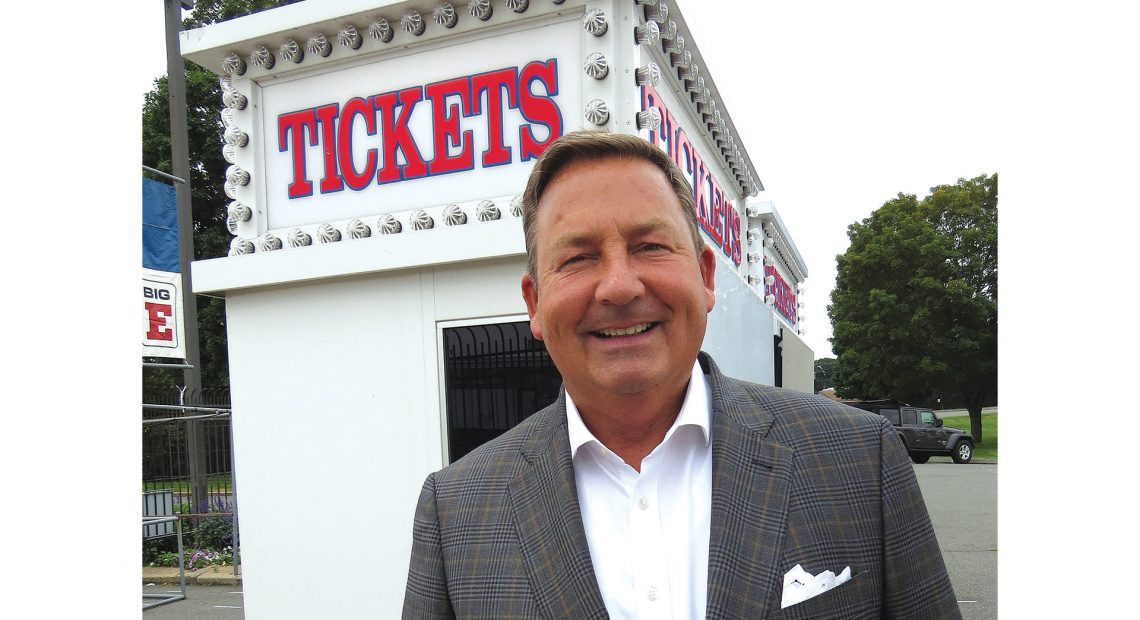
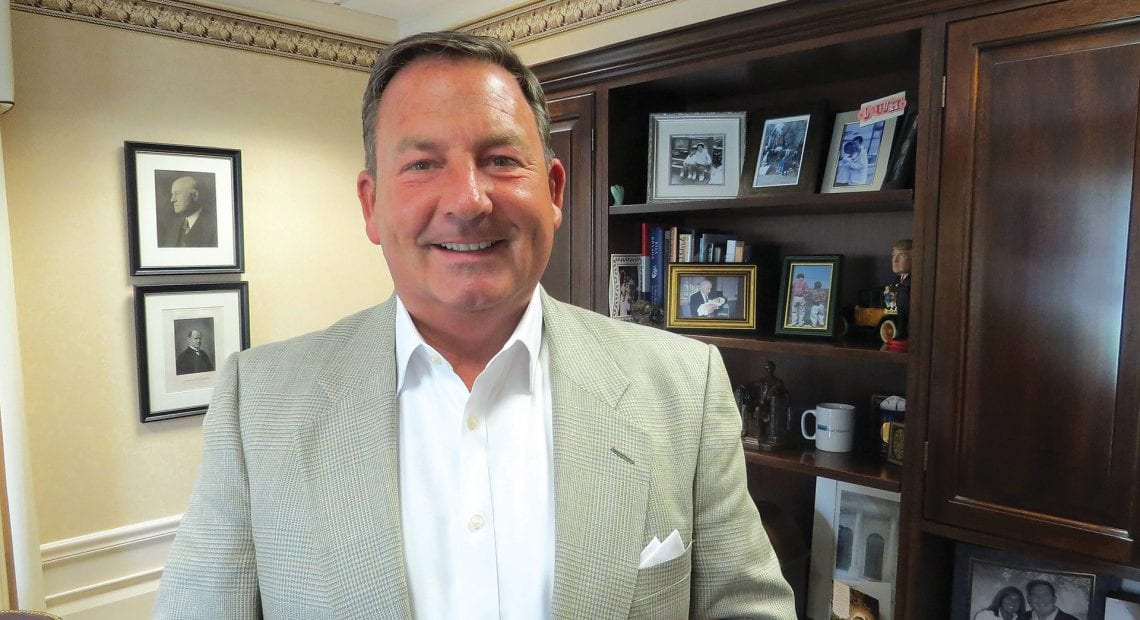
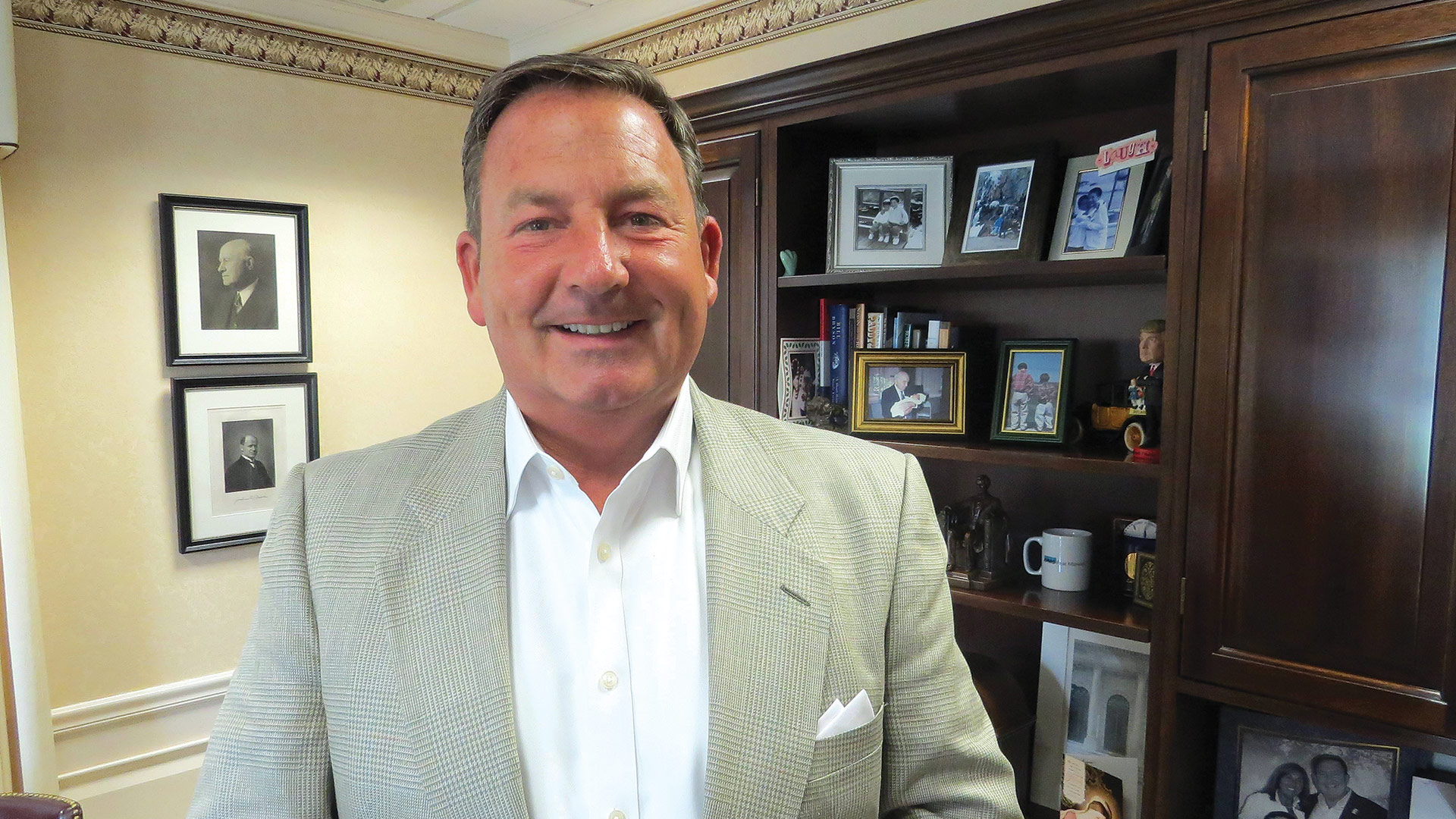
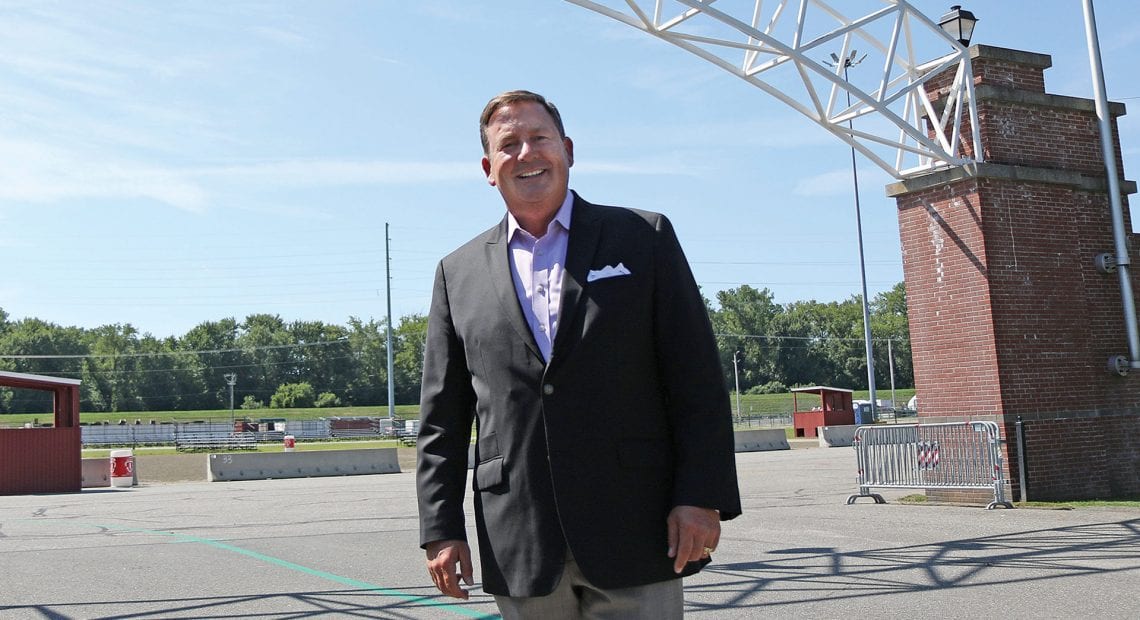
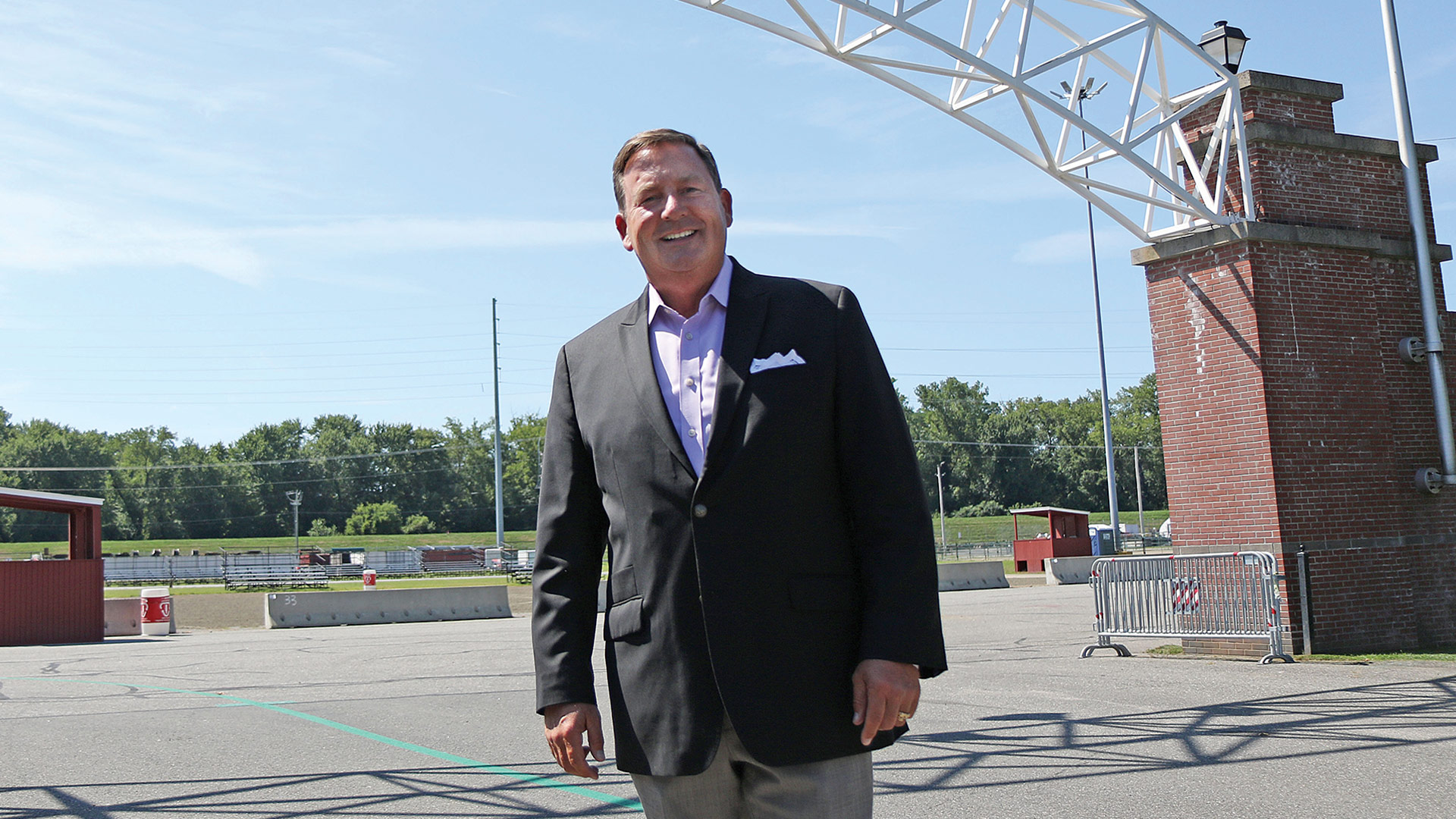
BusinessWest contributing writer George O’Brien talks to Gene Cassidy, President and CEO, Eastern States Exposition

Gene Cassidy understands that the Big E generates traffic jams outside the fairgrounds — and sometimes traffic jams inside the grounds as patrons flock to new attractions and food vendors. What he can’t understand is why some can’t look past those ‘good problems to have’ and see the annual fair as a true economic engine for the region, bringing money into the 413 and helping several sectors of the economy directly. This is one of many points he made in a wide-ranging discussion with BusinessWest contributing writer George O’Brien on the next episode of BusinessTalk. He also talks about the weather (as it pertains to the fair’s bottom line), the prospects for the 2025 edition, and what’s new — and old — for the show this year. It’s must listening, so tune into BusinessTalk, a podcast presented by BusinessWest.

Also Available On

Opinion

Editorial

Rain, rain, go away.

That’s Gene Cassidy’s wish every year when it comes to the 17 days of the Big E, the agricultural fair that will celebrate its 110th year when it kicks off next week.

That’s because the weather is typically the most impactful factor in how successful the fair proves to be. After a rainy 2023 dampened attendance (and profits), a largely clear-skied 2024 saw the Big E set records for attendance (1,633,937) and net income (more than $6 million).

As Cassidy, president and CEO of Eastern States Exposition, told BusinessWest in the story on page 10, all of that $6 million will be put back into the facility, which is grappling with some $250 million in deferred maintenance on grounds dominated by buildings more 100 years old.

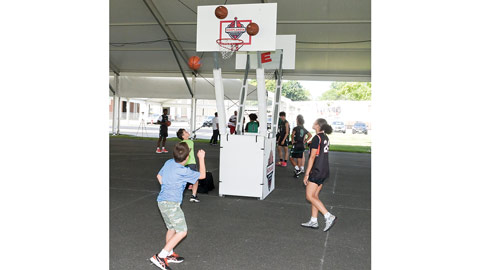
So, clearly, the success of the Big E is critical to the Eastern States Exposition (ESE), as is the site’s robust, year-round slate of activities, from animal, mineral, and home shows to the annual Hooplandia 3-on-3 basketball tournament.

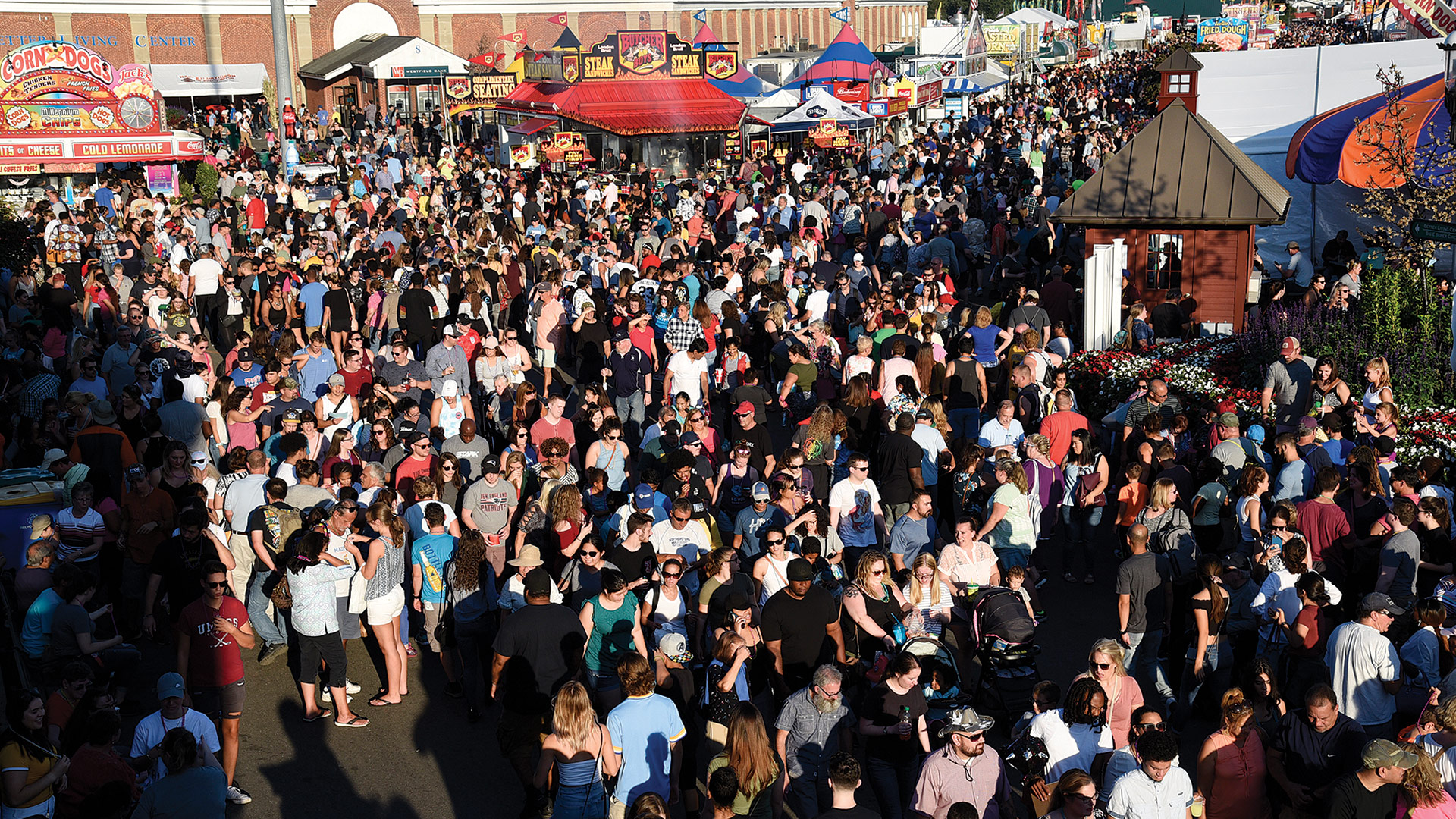
And that success — and impact — ripples out much further than the grounds on Memorial Avenue. In fact, ESE attracts about 3 million people to West Springfield annually, across a bustling calendar of more than 120 year-round events — slightly more than half that crowd count coming from the Big E itself.

And, according to a study conducted by Regional Economic Models Inc. (REMI) of Amherst, ESE’s economic impact on Hampden County in 2024 was $235 million in gross regional product (GRP), and its larger footprint across New England and New York equaled a record-breaking $1.167 billion.

“The impact of Eastern States Exposition is not limited to the Springfield area, agriculture in Massachusetts, or even agriculture in New England; we have touched 26 states and multiple Canadian provinces,” Cassidy said when the report was released earlier this summer. “This makes us arguably the most impactful agricultural fair in North America.”

The study revealed that the ESE created 8,085 jobs across New England and New York in 2024; 60.8% of all jobs created went to individuals without a college degree, 5,646 jobs were filled by individuals in the bottom 20% of income earners, and 1,310 jobs created across the region supported Hispanic employment. Employment growth was observed across all races, income levels, and education groups.

Meanwhile, since 1995, when the Big E first expanded from 12 to 17 days, ESE has donated 1% of its annual gross revenue to the town of West Springfield each year to build and bolster the Eastern States Exposition-West Springfield Trust. In 2024, 26 groups benefited from the trust, including sports teams, food rescues, and cultural centers. ESE’s overall contributions, including a sizable donation of $370,970 made on June 12 of this year, now total $5,425,220.

At a time of economic uncertainty, that overall impact of the ESE — again, much of it driven by that 17-day fair window in September — is critical to this region, and something to be celebrated.

Plus, the Big E is simply a lot of fun — rain or shine.

Home Improvement Special Coverage

All Under One Roof (Actually, Two)

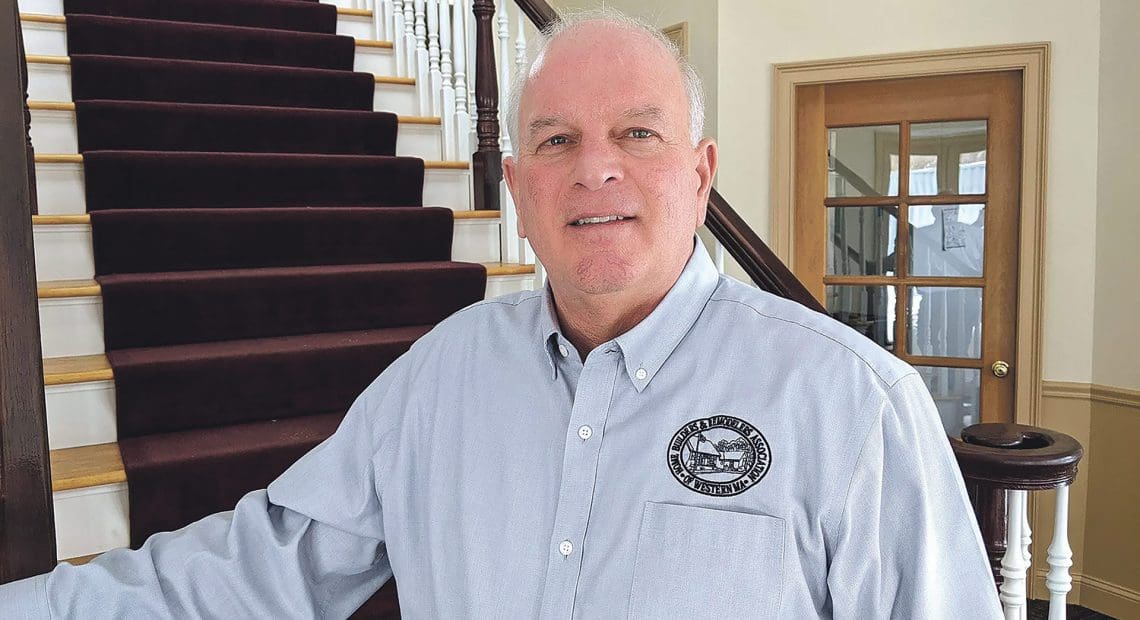
Andy Crane says the home show thrives

Andy Crane says the home show thrives, even in the internet age, because home-improvement business owners need to stay visible and put work into the pipeline.

Andy Crane acknowledged that many contractors and home-improvement companies are busy these days, thanks to a combination of factors, from people staying in their homes — due to higher interest rates and a shortage of inventory — to finding enough help to get jobs done.

They’re so busy that some — but certainly not all — are booking jobs several months out and even into next year, in some cases.

But even in this climate, where some contractors can’t touch new business for a few more quarters, it’s important to stay in front of consumers and continue to put business into the pipeline, said Crane, president of the Home Builders and Remodelers Assoc. of Western Massachusetts (HBRAWM).

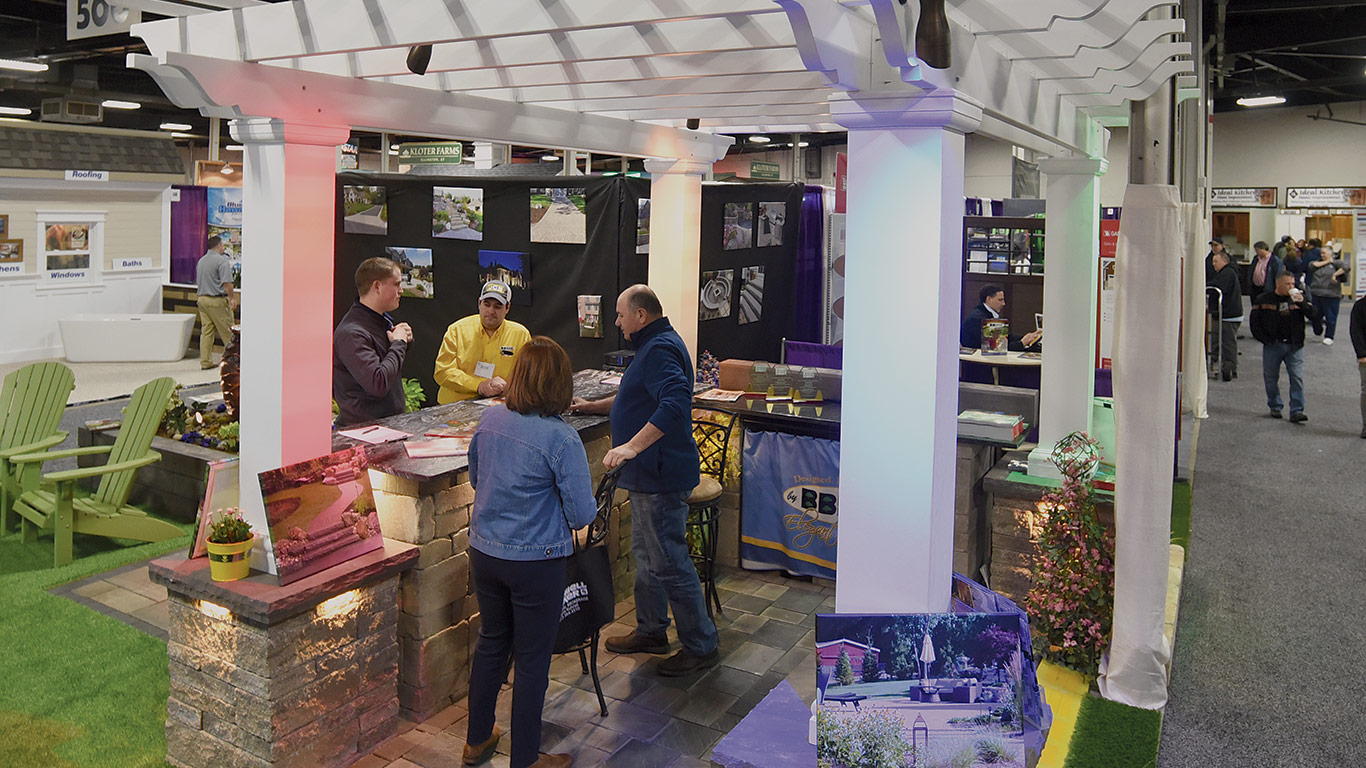
And that’s why he’s not only expecting a sellout of booth space when it comes to this year’s Original Western Mass Home & Garden Show, taking place March 27-30 at the Eastern States Exposition — the 70th edition of this spring tradition — but also why the show is expanding into a second building this year, one dedicated almost exclusively to the ‘garden’ aspect of the event.

And with that move, the show is turning back the clock in some respects.

“Back in the day, we had two buildings, and a few years, we had three buildings,” Crane told BusinessWest. “This year, we’re going to have at least two and an outdoor area.”

The second building, known as the A Barn, will be geared toward yard equipment and accessories, plantings, and landscapes, with some details still to be finalized, he said, adding that this has been an element missing since COVID.

But getting back to his thoughts about contractors and why they want to be at this show, Crane said many aren’t coming to the Big E grounds looking for work — they already have enough. Instead, they want to make connections and enable consumers to at least get the process started.

“It gets the juices flowing — you might get some ideas and talk to some people,” he said. “Let’s say they can’t do it for a while … if you don’t get that process moving along, you’ll never get it done.”

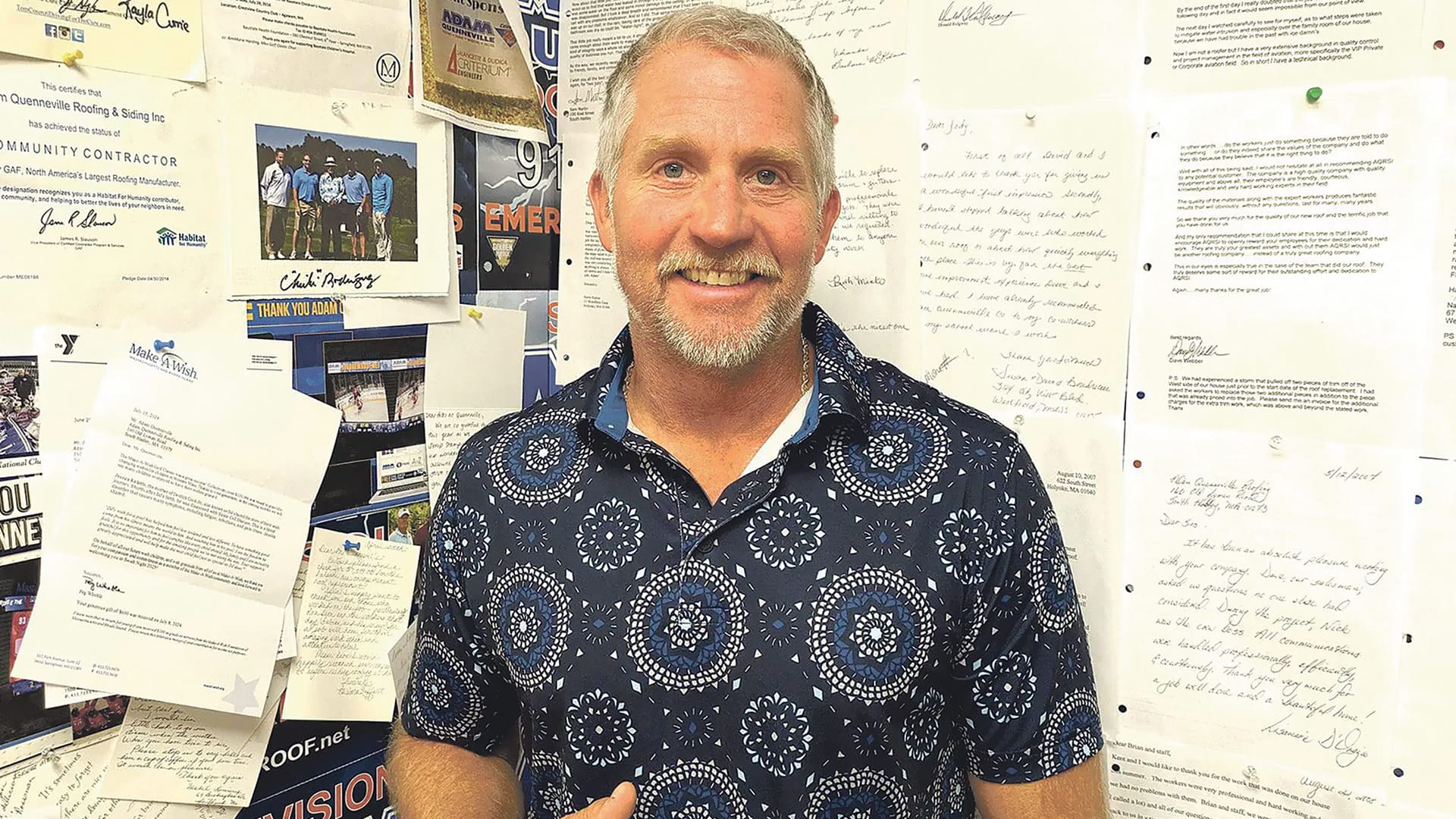
Adam Quenneville, president of Adam Quenneville Roofing & Siding, agreed. His company has been part of the home show for roughly 25 years, and he comes back each year to help make sure the phones keep ringing.

“I would think that people still enjoy touching and feeling products and getting a sense for what they think that person is like. You can’t get that off a laptop; you just can’t.”

This is a quieter time of the year — although roof crews can work pretty much year-round — and a good time to make connections and add projects for the rest of the year, he said.

“It’s great to get out and see potential customers, and it’s an opportunity to get leads, give estimates, and secure business. A lot of people are going there because they have a home improvement in mind, and it’s nice to be able to let them see us in person, talk to us, get information, and go from there.”

With that, Quenneville spoke for every vendor at the show, including the ones who sell beer nuts and pickles, most of whom are focused not on making sales that day, but on the ‘go from there’ part of the equation.

It’s why the show has thrived for 70 years, and why the 2025 edition is shaping up as another opportunity to build back from the tumultuous COVID years and continue to grow.


Through the Roof

Crane said the home show, which annually attracts between 12,000 and 15,000 visitors and, recently, about 300 to 400 vendors, will be marking 70 years in some subtle ways, with additional giveaways and other promotions.

But mostly, this show will be like the 69 that have come before it, in that it presents an opportunity for the public to gather, see what’s new (or not so new, but still important), talk with experts, maybe finalize some plans for what they want to do, and put a face and business card with a person and company they’ve seen on the internet or heard about from neighbors, friends, or relatives.

Adam Quenneville says he’s been coming back to the home show for 25 years

Adam Quenneville says he’s been coming back to the home show for 25 years because it provides valuable exposure and leads for new projects.
Staff Photo

It’s been this way since the mid-’50s — except that part about the internet, said Crane, adding that, before social media and before consumers could click on websites, contractors had to get out in front of people. The home show was created to give members of the HBRAWM an opportunity to show what they do, how they do it, and, yes, how much it will cost.

And while consumers can learn much about a product or contractor by visiting a website, and still more by following up with friends and neighbors who placed a specific contractor’s sign on their lawn, there is still much to be gained from seeing these professionals in person, Crane said.

“I would think that people still enjoy touching and feeling products and getting a sense for what they think that person is like. You can’t get that off a laptop; you just can’t. “If it’s a zero-turn mower, would you rather sit on one than look at a picture?” he asked rhetorically. “How about picnic tables and high-top tables … you might as well get the exact one you want and the exact color. As for sheds, isn’t it better to stand in the shed rather than look at a picture of one? You can visualize where your mower is going to go and where your pool equipment is going to go or the pellets for your wood stove. That’s what the show brings that computers don’t bring.”

It still does that, but it has become much more, he went on, adding that the event has become a rite of spring for many, and a social gathering for some, with friends and neighbors often gathering at the show and then going elsewhere for dinner.

“The show is still a great place to talk, shop, and get ideas about your home, your property, some of the things that people like to do in their homes,” he said, adding that, while some things have changed since Dwight Eisenhower was patrolling the White House, the best things about the home show are what hasn’t changed.

For 2025, there will be more of the same, said Crane, with the emphasis on more, especially when it comes to space for visitors to roam and take in the many exhibitors, who cross every spectrum of home and garden improvement, from who can do the work to how to pay for it.

Indeed, there will be several banking and finance institutions on hand, he noted, adding that the categories for vendors runs the alphabetical gamut, from air filtration to women’s clothing, with more than eight dozen in between, everything from awnings and canopies to foundation repair; kitchens and baths (huge items of interest) to mosquito protection; sheds and gazebos to wells and pumps.

It will all be under … well, two large roofs in 2025, said Crane, adding, again, that a second building is something the public has asked for, and something that’s needed to properly showcase vendors and products.

Fast Facts:

What: The 70th edition of the Original Western Mass Home & Garden Show
Where: Eastern States Exposition
When: March 27-30
Show Producer: Home Builders & Remodelers Assoc. of Western Massachusetts
Admission: General admission: $10; with coupon: $7; children under 12: free
For More Information: Call (413) 733-3126

As noted, the A Barn will focus on lawn and garden equipment, furniture, and accessories, everything from mowers and snow throwers to chairs, tables, firepits, and fountains — items that couldn’t be displayed as effectively in years past due to a lack of space.


Starting the Conversation

While the additional space provides room for more vendors and a chance to spread out, it also further activates the outdoor spaces at the Big E, said Crane, adding that there will now be traffic between the buildings — and opportunities to capture the attention of that traffic.

Over the years, those staffing the Adam Quenneville booth have succeeded in gaining the attention of visitors, said the company’s owner, adding that it has generated a steady flow of leads — and eventually customers.

“If I have to guess, I’d say we get about 100 opportunities,” he said, meaning actual estimates for potential customers. “We’ll probably give 90 people prices and secure about 50% of that — 45 to 50 jobs.”

That more than justifies the cost of the booth, he said, adding that the show has been one of the more successful methods of getting right in front of the public, telling the company’s story, and keeping the pipeline of work flowing.

Nick Riley, president of Chicopee-based N. Riley Construction, agreed. His firm specializes in home remodeling and new construction, and he’s been a regular participant at the show for the past 20 years because of the opportunities it provides to be visible, talk to people directly, and hand out business cards.

“We do really well at the home show, and that’s why we keep coming back,” he said, adding that he doesn’t take leads directly at the show, but instead instructs visitors to call and make appointments — and many of them do. “It’s about more than the eventual leads … it’s about getting in front of people, seeing them in person, and saying hello.”

Hundreds of other home and garden professionals can say the same thing, and they have — some of them for a half-century or more.

They keep coming back because the Western Mass Home & Garden Show has long been a spring tradition, a social event for some, a chance to gather ideas for most, and an opportunity, for those on the vendor list, to get down to business.

Opinion

Editorial


Depending on where you live, where you work, or where you operate a business, the Big E is either a big inconvenience or a big, as in big, and important engine for this region’s economy.

Actually, it’s both. But mostly, and to most people, it’s the latter.

Yes, it can be a disruptive force if you live within a mile or so of the fairgrounds, and especially if you do business on Memorial Avenue in West Springfield.

But mostly, it’s a powerful economic force, a 17-day fair that brings people, vitality, and various kinds of business to the region.

A 2019 economic impact study pegged the overall impact of the Big E at $681 million annually, a number that is now certainly much higher. It also brings thousands of jobs and millions in income-tax and sales-tax revenue.

There are dozens of business sectors, small businesses, and individuals that benefit from the Big E. That list includes hotels, motels, restaurants, and taverns; businesses that rent tents; gas stations and convenience stores; a certain casino in the South End of Springfield; and the businesses and residents around the Big E that devote their lawns and lots to fair parking.

It all adds up to a very large impact, one that can be measured in many different ways. Maybe the most effective is a glance back to 2020, the year when there wasn’t a Big E.

The negative impact was enormous. Hotels that booked rooms to visitors, vendors, horse-show participants, and more lost all of that. So did the restaurants, taverns, stores, and homeowners on the side streets off Memorial Avenue.

It was a crushing loss, something not covered by PPP or most any other form of relief.

So, when the Big E returned in 2021, those businesses, and this region as a whole, were all reminded of just how important the fair is to this region — not that anyone needed reminding.

As the 2024 fair continues, people are being reminded again. Those long lines of cars stretching down I-91 in both directions, and into downtown Springfield and deep into Agawam to the east and west, should be a very welcome sight, as much as they slow things down for area residents trying to get from here to there.

Those cars tell a story, a story not of traffic that is backed up, but one of a region getting a boost. A big boost.

Features

Ride of Passage

Gene Cassidy

Gene Cassidy is hoping for less rain in 2024 — and the continuation of a trend whereby presidential election years have been good for large fairs.

Gene Cassidy says presidential election years are generally good ones, attendance-wise, for large fairs like the Big E.

As he explains it, the general population, bombarded with information about candidates, issues, and polls, is looking for a break from all that.

“They want to get out and get away from the news,” said Cassidy, president and CEO of the Big E, adding that this year, people may really want to get away from the news, considering the seemingly heightened tensions around this year’s race.

If they do, that would certainly help the Big E — which will take place Sept. 13-29 — bounce back from a somewhat down year in 2023 when it comes to attendance, due to seemingly relentless rain that started early in the fair, almost wiped out the middle weekend, continued through the 17-day stretch, and led to something Cassidy had never seen in his more than 30 years of involvement with the fair.

“It rained so hard one day, the midway never opened, and that had never, ever happened before,” he told BusinessWest as he quickly did some math in his head. “Let’s see, that’s 30 fairs times 17 days … that’s 510 days; one day out of 510, the midway was closed.”

Pulling out a white book in which he keeps detailed information about the weather, attendance, and other matters, Cassidy noted that the fairgrounds received 1.7 inches of rain the first Monday of the Big E’s 2023 run, and then on the middle weekend (Friday, Saturday, and Sunday) it received 5.1 inches of rain, a half-inch more than the region typically receives, on average, for the entire month of September.

“It rained so hard one day, the midway never opened, and that had never, ever happened before.”

Overall attendance was down about 11% from the year prior, he said, noting that it would have been a sharper decline had there not been a rise in attendance at night, generally after the rains had subsided. And had it not been for a 33% increase in the price of general admission — from $15 to $20, the first such increase in 13 years — 2023 would have been much worse for the Big E.

But enough about last year’s fair.

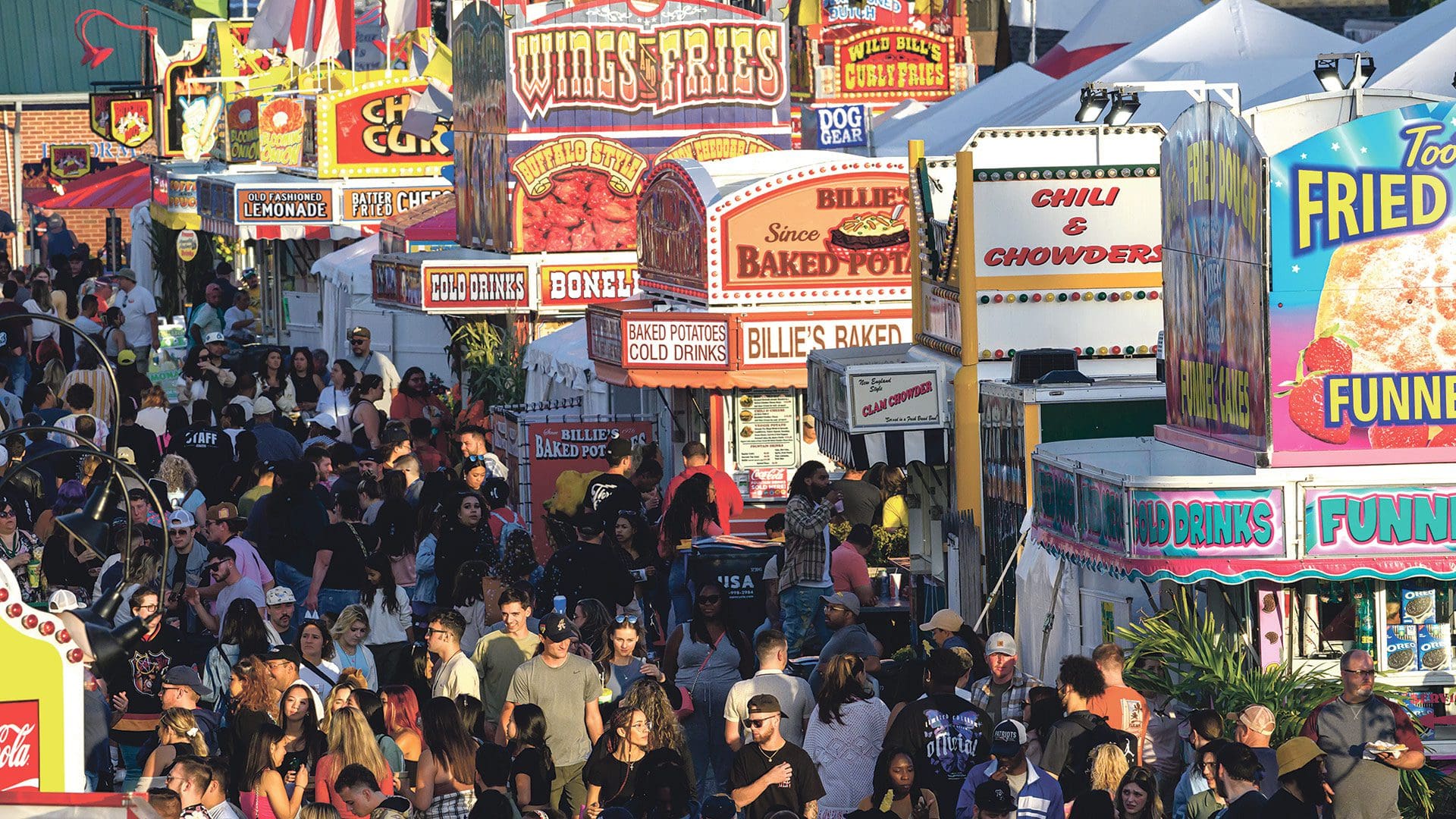
Fair food

Fair food is one of the perennial draws of the Big E.
Photo courtesy of the Big E

The Big E has certainly turned the page, and Cassidy and others charged with presenting the event are buoyed by everything from those election-year stats to early results from other fairs around the country, to the sense that the weather can’t be as bad this year as it was last.

It can’t, right?

Cassidy said he can’t concern himself with the extended forecasts, or even what the three weather apps on his phone are telling him. He focuses on what he can control, specifically the product he presents those 17 days. And by product, he means everything from the music to the rides on the midway to, of course, the food.

He believes there’s a solid lineup — some new food offerings as always, and a mix of music that ranges from Ludacris to America; Chubby Checker (back by popular demand) to Average White Band — and that 2024 will be a year to maybe, just maybe, meet his long-set goal of topping the attendance of the Minnesota State Fair (more on that later).

For this issue, we look at the 2024 fair and how things are looking up — hopefully, not at more clouds and raindrops.


Fair Game

Speaking of presidential elections … each year Cassidy has been at the helm of the Big E, he has sent a handwritten letter to the sitting president inviting him to attend that year’s fair.

The letter generally goes out in late winter, he said, adding that the only president who has even responded to the missives — and he sent his regrets that he could not attend — is Donald Trump. (The only president to attend the Big E, and this was well before Cassidy’s time, was Dwight Eisenhower in 1953, who wanted to see how one of the cows he bred fared in competition.)

In keeping with tradition, Cassidy sent a letter to President Biden. He hasn’t heard back and doesn’t expect to, especially with recent events. Gov. Maura Healey is expected to make an appearance, though, as she did last year, Cassidy said, adding quickly that he is more focused on the general population than elected officials.

And he expects this year will be a solid one for the fair, despite widespread concerns about the economy and inflation, some rising COVID numbers, and ever-increasing competition for the family’s leisure and entertainment dollar.

“I won’t say the Big E, and fairs in general, are recession-proof. I don’t want to jinx myself; I know people are feeling the pinch,” Cassidy said, while hinting strongly that the fair can withstand economic headwinds, and has historically. “People may postpone a vacation, but they won’t postpone attendance at the fair.”

That track record includes the ticket-price increase, which, he noted, was met with little pushback.

“If you plug the $15 admission ticket in 2010 into an inflation calculator, it actually translated to $20.65 in 2023. We loathe raising our ticket prices, which is why we waited so long to do it, but it saved us; had we not had the increase in the ticket price, we would have had red ink last year.”

“If you plug the $15 admission ticket in 2010 into an inflation calculator, it actually translated to $20.65 in 2023,” he told BusinessWest. “We loathe raising our ticket prices, which is why we waited so long to do it, but it saved us; had we not had the increase in the ticket price, we would have had red ink last year.”

What the fair can’t withstand is rain like last year, which pushed attendance down to 1,427,234, off considerably from the 1,603,000 in 2022, the second-highest attendance on record, behind only 2019 at 1,629,000, Cassidy noted, adding, again, that the weather cannot be controlled.

The music lineup can be, but putting together a slate of performers is becoming increasingly difficult, due primarily to mounting competition for acts from casinos and other venues, and the subsequent rising demands from in-demand performers.

“Buying entertainment gets more difficult annually,” he said. “When I say difficult … prices are off the charts. And the type of talent that we foster today in the entertainment business is not unlike hiring people for entry-level jobs.

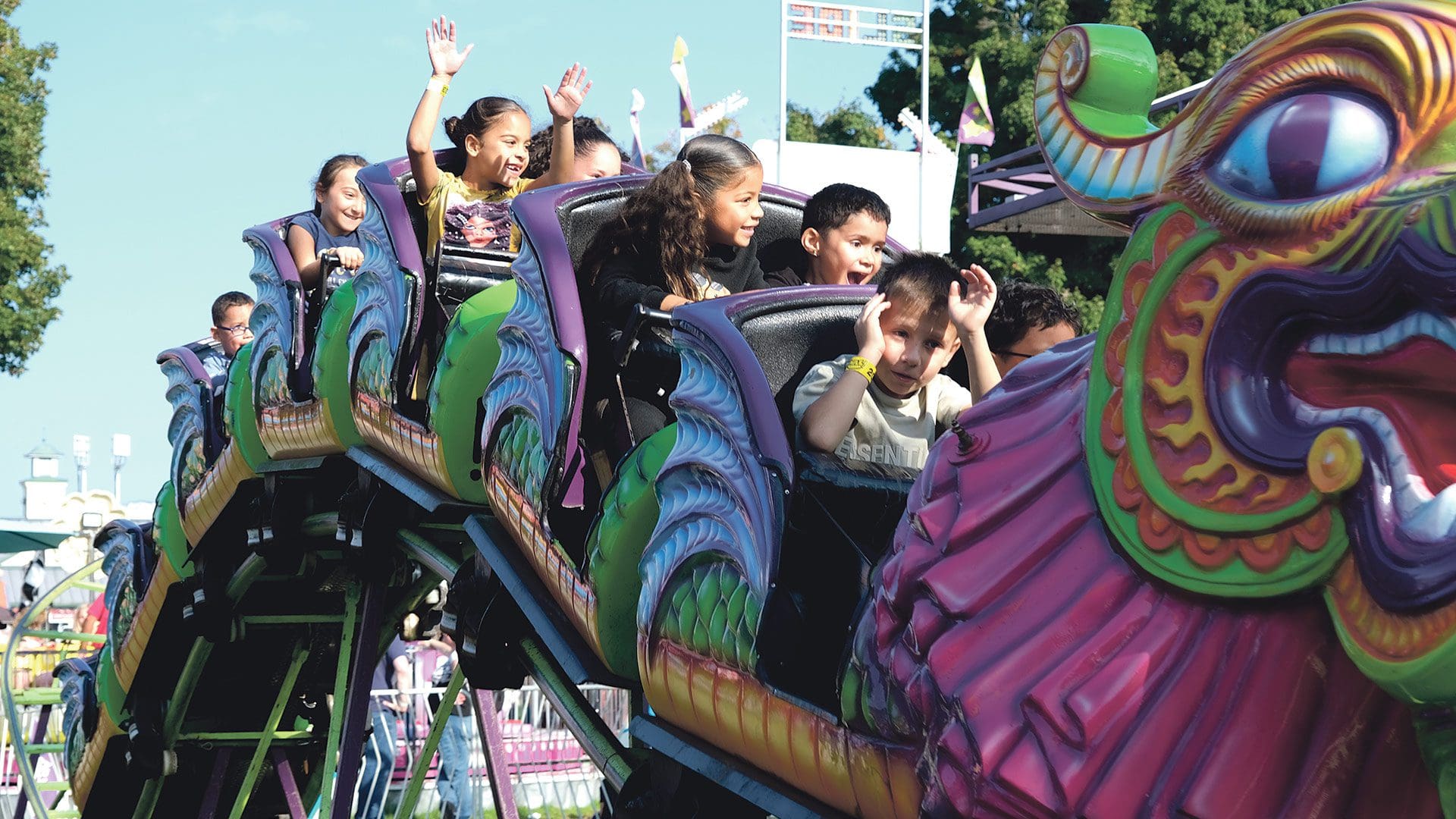
rides to enjoy

Kids of all ages will find rides to enjoy at the Big E midway.
Photo courtesy of the Big E

“Everyone wants a corner office coming out of college, and they want to work at home in their pajamas,” he explained, adding that, in the entertainment world, performers want what amounts to the equivalent. “They want gobs and gobs of money, and, because of the ubiquity of casinos everywhere, they’re used to having beautiful green rooms, lots of air conditioning, climate-controlled arenas, and more.”

The fair cannot provide those things, but it has still managed to put together a strong slate. The lineup for the Big E Arena includes Ludacris, Dustin Lynch with special guest Dylan Scott, Phil Wickham, America with special guest Jim Messina, the Brothers Osbourne, Public Enemy, and Big Time Rush. The Court of Honor Stage, meanwhile, will feature Asia, Debby Boone, Herman’s Hermits, and Wang Chung, among many others.

“We originally booked Ludacris back in 2008, but he was viewed at the time by the police chief as being so controversial that we can to cancel him,” Cassidy recalled. “There’s a new police chief, and time has softened Ludacris.”

As for food … Big E officials will keep the public in suspense a little longer, but there will be several new vendors and 44 new food offerings, with vendors featuring $3 items on Mondays, to be called ‘3-buck bites.’

Overall, with its lineup of entertainment, food, some new rides, new float animals, and more, the Big E is expected to follow the lead set by fairs that have already had their 2024 runs, said Cassidy, who closely monitors what’s happening elsewhere.

“Wisconsin closed recently; they had a bang-up fair and set a record at the same time as they were dealing with extraordinary heat — over 100 degrees for four days of the fair,” he noted. “Iowa opened strong … these numbers bode well.”

The Minnesota State Fair comes later, and, as noted, Cassidy has long made it a goal to top that fair in attendance.

“They always beat us — they’re number 4, we’re number 5,” he said in reference to the country’s largest fairs. “We’ve been chasing Minnesota going way back to the very first fair in 1916. I want to challenge people to come to the fair so we can displace them.”


Meet Me Midway

Returning to his thoughts about election years and the attendance bump they generally provide, Cassidy acknowledged that, in this day and age, it’s very difficult to actually escape the news.

But people are likely to try, and the fair can provide that needed respite, he said, adding that this quality is one of many that can, and hopefully will, add up to a year where attendance records are approached and even threatened, and Minnesota’s numbers might even be eclipsed.

That’s if Mother Nature cooperates more than she did last year.

Community Spotlight Special Coverage

Community Spotlight


Mayor Will Reichelt

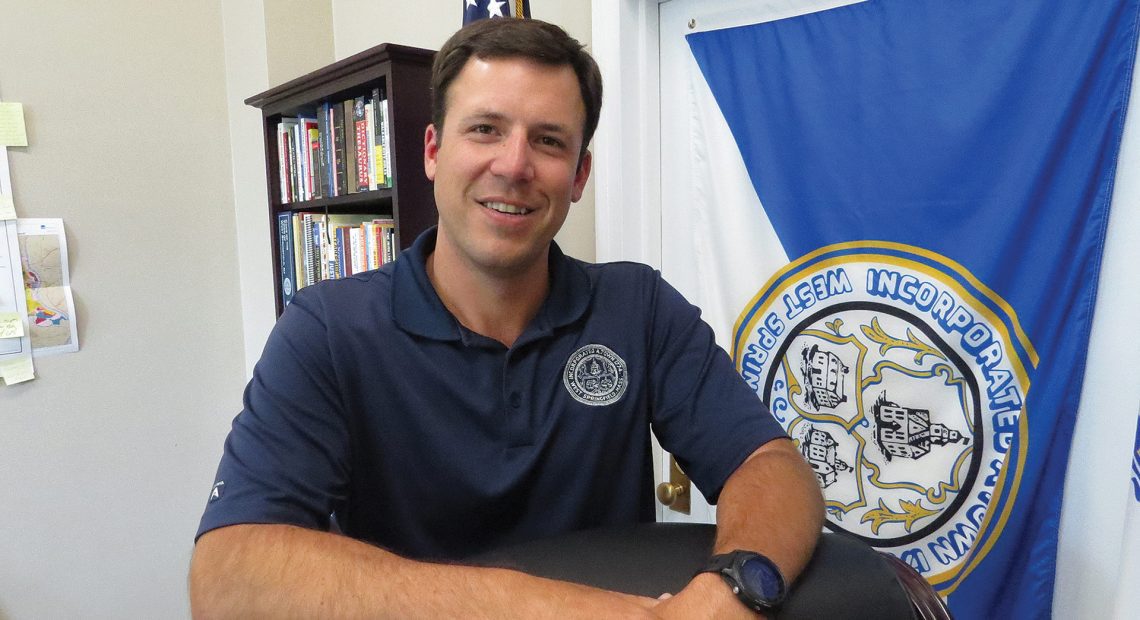
Mayor Will Reichelt says planning is underway for West Springfield’s 250th birthday, with anniversary-themed events slated for each month of the year.

Once the 17 days of the Big E Fair begin, Gene Cassidy settles into a routine he’s followed for years now.

His day starts early, with a few minutes in his office in the Brooks Building, before he gets into a golf cart and proceeds to his ‘other office’ in the Hampden County building. Along the way, he stops in with employees in the parking area, the ticket booths, and other areas to get a sense of how things went the day before and what would be expected in the hours to come. And to stress, again, the importance of these 17 days to the overall health and vitality of this West Side institution.

“I remind people that they can make the difference between someone who’s a patron having a good day or a bad day,” he said. “Or I’ll thank them if the day before was pouring rain … I’m very conscientious about making sure that people understand that we make 87% of our revenue in 17 days. The people who work here, they have to know how important their role is to delivering to the fairgoing public an experience that’s at the highest level it can possibly be.”

Before any of that, though, Cassidy checks the attendance numbers for the corresponding day of the fair the year before. That number becomes a target and a tone setter, he explained, adding that, if that day from the year before was a washout due to rain, there probably won’t be any trouble matching or exceeding results and moving toward the ultimate goal of improvement over last year. If it was a really good day the year prior, it’s the opposite.

Which means that, this Big E season, there will be some big nuts to crack.

“I remind people that they can make the difference between someone who’s a patron having a good day or a bad day.”

Indeed, the fair set five single-day attendance records in 2022, starting on opening day, and continuing to the second Friday, the second Saturday (when the single-day record was broken and more than 177,789 came through the gates), the second Monday, and the final day. Overall, the 2022 fair came in just shy of the 17-day record of 1,543,470 set in 2018.

“People really responded to the fair last year, and, overall, the weather was pretty good,” Cassidy said, touching on a subject we’ll get back to in some depth later. “People really came out.”

Those new standards set last year, and maybe some others as well, might fall this year, based on what Cassidy has seen in Wisconsin, which just wrapped up its annual fair, as well as Indiana and elsewhere.

Indeed, while inflation remains high, and Americans have plowed through most of the money they saved during the pandemic and are now taking on more debt, attendance at fairs like the Big E is up, said Cassidy, who believes such institutions provide what people are looking for these days.

“We represent the very best of the American way of life,” he said. “The fair is a place for family and friends and camaraderie. The Wisconsin fair recently ended, and they had amazing attendance, and Indiana is going on now, and they had a few record-setting days. People gravitate toward that which satisfies the need for human interaction. Even in years when we have high inflation, people may sacrifice a trip to Disney or a trip to Boston for a Red Sox game to get together with family at the fair.”

West Springfield at a glance

Year Incorporated: 1774
Population: 28,835
Area: 17.5 square miles
County: Hampden
Residential Tax Rate: $15.54
Commercial Tax Rate: $30.58
Median Household Income: $40,266
Median Family Income: $50,282
Type of Government: Mayor, City Council
Largest Employers: Eversource Energy, Harris Corp., Home Depot, Interim Health Care, Mercy Home Care
* Latest information available

The ramp-up to the Big E is always big news in West Springfield, and this year is no exception. But there are other developing stories, as they say, starting with the community’s 250th birthday in 2024; a major, as in major, upgrade of Memorial Avenue, the mailing address for the Big E and many other businesses; and the opening of the town’s first cannabis enterprises.

Mayor Will Reichelt said planning for the 250th is well underway, with a full slate of events set, starting early in 2024 and continuing throughout the year.

That slate includes a 250th Leap Year celebration on Feb. 29, with specifics to be determined; a 250th Ball, slated for May 18; a parade and block party in June; a golf tournament and 5K in July; a parade in August … you get the idea.

As for the massive, $26 million upgrade to Memorial Avenue, work is already underway, said Reichelt, noting tree-removal work and other initiatives, and it will ramp up considerably over the next few years, bringing improvement to a major thoroughfare, but undoubtedly some headaches as well.

For this, the latest installment of its Community Spotlight series, BusinessWest takes an in-depth look at West Springfield and the many things happening in this community, starting with the annual fair.


On a Good Run

Reichelt was among the competitors at the recent Ironman competition that wove its way through several area communities, including West Springfield — and a stretch of the Connecticut River for the swimming part of the competition.

He finished in just under seven and half hours — the top finishers came in at just over four hours — a time that he will look to improve upon next year (yes, he’s already committing to doing it again).

“Even in years when we have high inflation, people may sacrifice a trip to Disney or a trip to Boston for a Red Sox game to get together with family at the fair.”

“I bought an Ironman training guide and wrote my time for this year and my projected time for next year,” he said, adding that the target for the 2024 event is to get under six hours. “If I start training now, I think I can get there.”

The Ironman is one of many events already on the 2024 calendar — or soon to announce official dates — that will take on the flavor of the 250th anniversary, everything from St. Patrick’s Day activities to the block party, which will embody elements of a Taste of West Springfield event that was a staple in the community for many years.

Overall, planning for the 250th is ongoing and will ramp up over the coming months, said Reichelt, noting that, while the actual 250th birthday is Feb. 25, this will be a year-long celebration.

Gene Cassidy

Gene Cassidy says the Big E came close to setting a new 17-day attendance record in 2022, and if the weather cooperates, it might accomplish that feat this year.

By the time it’s over, some major thoroughfares will look considerably different, he said, starting with Memorial Avenue. By this time next year, a project that has been nearly a decade in the making will be well underway, he noted, adding that highlights of the ambitious undertaking, designed to improve traffic flow, will include a reduction of lanes from four to three along a stretch by the Big E, with reconstruction of traffic islands to allow for better turning in and out of businesses along the street. The stretch from Union Street to the Memorial Bridge will also feature a bike lane.

In addition, water and sewer mains are being replaced, and drainage systems will be improved, he said, adding that the project will take several years to complete.

Meanwhile, the city will soon commence work on another major infrastructure project in its downtown area.

It includes construction of a roundabout at the intersection of Westfield and Elm Streets, an area that has seen renewed vibrancy with the opening in recent years of new restaurants and the redevelopment of the former United Bank building into a mixed-use facility called Town Commons. Also planned are improvements to the town common, with new sidewalks, tree plantings, and more.

Beyond infrastructure, there are some new developments within the business community as well, said the mayor, noting that the town’s first cannabis dispensaries — the community was a late entry in this sweepstakes — will be opening in the coming weeks, with one on Memorial Avenue near the bridge, and the other on Riverdale Street.

Meanwhile, the town continues to work with Amherst Brewing on redevelopment of the former Hofbrahaus restaurant just off Memorial Avenue — a project that has been paused with hopes that it can be restarted — and plans are being forwarded, by the same group that redeveloped the former United Bank building, to redevelop a long-closed nursing home off Westfield Street, with housing being the preferred option.


Fair Game

As he talked with BusinessWest about the upcoming Big E, the weather, and the overall goal of matching or exceeding last year’s numbers, Cassidy got up from his desk and retrieved his notes from previous fairs.

In deep detail, he has recorded not just the attendance for a given day, but the weather and other factors that might provide deeper insight into those numbers.

Especially the weather.

Indeed, Cassidy goes much deeper than ‘rain,’ ‘sun,’ or even ‘partly cloudy’ to describe a day. Much, much deeper.

“We missed the 17-day record last year by just a little bit, and the reason we missed it is because we had five days of rain,” he explained. “I often laugh, because people will say ‘oh, the weather was great year.’ Well, it was great on the day they came.”

Running back over his notes, Cassidy revealed the level of detail given to cataloguing, if that’s the right term, each day of the fair, so that the numbers can be fully understood and put in their proper context.

“That first Sunday was a threatening mix all day; Monday and Tuesday were heavy rain; Monday, there was sun at 5 p.m.; Tuesday, there was sun at 2 p.m., and it was very hot,” he said, reading from his notes. “The first Thursday, there was heavy rain with lightning all day. And the second Monday was pleasant, but there was serious rain at 5:30, and the people ran out — although we had a very big day that day. We had a big day on the final Sunday, but it was cold and overcast.”

All this serves to show the importance of weather to the success of the fair, Cassidy said, adding that this isn’t lost on anyone at the fair, with everyone involved hoping that the seemingly constant rains that have swollen area rivers and damaged crops of all kinds will take a break in mid- to late September.

Beyond weather, Cassidy also likes to talk about what’s new at the fair, starting with entertainment, but also food.

Regarding the former, the 2023 fair will feature an eclectic mix of musical acts, including John Fogerty, Bachman-Turner Overdrive, Parker McCollum, Jimmy Eat World, Quinn XCII, Chris Young, and many more. As for the food, Cassidy teased that there is an intriguing new addition for the 2023 fair, but he couldn’t announce what it was at the moment.

What he did say is that food has come a long way — a long, long way — over the past few decades, with offerings that go well beyond traditional fair food and also beyond the ‘everything that can possibly be fried’ category as well.

“The food is so different today than it was 20 years ago, when it was more fair food,” he told BusinessWest. “There is a lot of high-quality food here, and it has nothing to do with being fried. The food today is so much more creatively put together. You can get steak tips with real mashed potatoes and fresh vegetables; no one thought you could buy that on a fairgrounds 20 years ago.

“When I first started in the fair industry, there were hamburgers and hot dogs and cotton candy and candied apples; there was a guy who made sausages,” he went on. “Today, the quality of food, the abundance of it, and the diversity of it are significantly different.”

Some of these eclectic offerings are available at a new area that made its debut in 2022 and will return this year. It’s called the Front Porch, and it promotes small businesses, many of them taking their first opportunity to showcase their brand, Cassidy said.

Last year, there were nine or 10 businesses participating, and this year, there will be seven or eight, to provide the ventures with more room to operate, he said, adding that some will be back from last year, while others will not, primarily because they’ve moved on to brick-and-mortar operations.

“It’s a fun way for people to get their feet on the ground,” he said, adding that the Front Porch has become an intriguing and popular addition to the landscape at the Big E — and one more reason for folks to show up in West Springfield … and maybe break a few more records.

Sports & Leisure

Stressing the Fundamentals

Gene Cassidy, president and CEO of the Big E,

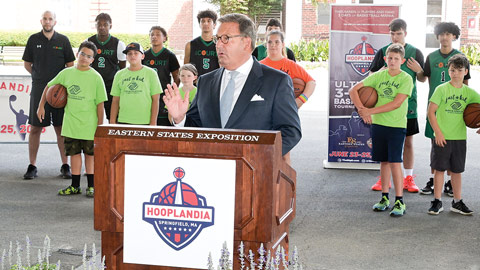
Gene Cassidy, president and CEO of the Big E, announces plans for Hooplandia at a press conference staged last month.

Mark Rivers acknowledged that a lot of things have changed since he and officials at the Big E and the Naismith Memorial Basketball of Fame first announced that the region would host a giant three-on-three basketball tournament to be called Hooplandia.

Indeed, that announcement came late in 2019, just a few months before the arrival of COVID-19, which would eventually cancel large-scale events of all kinds and put plans for Hooplandia on ice — for 2020, 2021, and then 2022.

But what hasn’t changed, said Rivers, a marketing and programming consultant to the Eastern States Exposition who has also worked with the Hall of Fame on tournaments, is that what he calls the ‘fundamentals’ are still in place.

“Fundamentally, and probably most importantly, the idea going in, even in 2019, was to create an event that would be around for 40 years or more, just like in Spokane. So if you’re looking at creating an event that’s a 40-year event, it doesn’t get stale after a few years — it’s still a grand idea and still a great proposition for the region.”

“Three-on-three basketball is still very, very popular, and Springfield is the birthplace of basketball,” he told BusinessWest, as he explained, succinctly and effectively, why those who conceived Hooplandia are still bullish on this concept and are proceeding with a tournament set for late June 2023.

If anything, conditions are even better, he said, noting that three-on-three basketball has only become more popular as a sport — and a competition (more on that later).

John Doleva, president and CEO of the Hall of Fame, agreed, noting that, while it might have been easy to walk away from the event given all the challenges and uncertainty moving forward, the vast potential of the concept led them to stay the course.

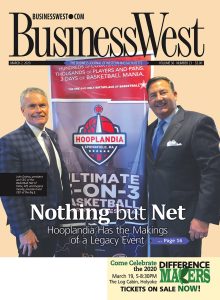
The cover of the March 2, 2020 edition of BusinessWest

The cover of the March 2, 2020 edition of BusinessWest announced Hooplandia. That was just a few weeks before the pandemic shut down the state and put Hooplandia on ice for what will be three years.

“Everyone stayed with it, and that’s very encouraging,” he said. “To have all those entities — the Big E, the city of West Springfield, Mark Rivers — step up and be as committed, if not more, after a couple of years is a very positive thing.

“Everything is lined up for a great event,” he went on. “It just took a little longer to get there.”

In fact, it will be roughly four years from the date it was first conceptualized until the whistle that starts the first game on June 23, 2023. But everyone involved is sure it will be worth the wait.

Turning back the clock, Rivers said planning for Hooplandia began in early 2019. Inspired by a huge tournament in Spokane, Wash. called Hooptown USA that brings tens of thousands of people to that city every June, Rivers conceived of a concept that would unite the Big E and the Hall of Fame in an endeavor that would capitalize on the soaring popularity of three-on-three basketball and bring the game to the area where the sport was invented.

The March 2, 2020 issue of BusinessWest featured Doleva and Eugene Cassidy, president and CEO of the Big E, standing on either side of a poster promoting Hooplandia. The headline read: “Nothing but Net: Hooplandia Has the Makings of a Legacy Event.”

Just a few weeks later, the state was in lockdown. A few months later, it was clear to everyone that there would be no Hooplandia in 2020. And as the pandemic persisted and subsequent surges continued to hit the nation and the region, the tournament was scrapped for 2021 as well.

And while the situation improved somewhat that year — enough for the Big E to make a much-anticipated comeback after being idled for 2020 — there were too many uncertainties and not enough time to put a tournament in place for 2022, Rivers said.

Young players get a taste for 3-on-3 basketball

Young players get a taste for 3-on-3 basketball at the press conference announcing the Hooplandia event set for June, 2023.

“We thought we could do it in 2021, but there was still a lot of overhang related to crowd gathering and big events,” he said. “And with Hooplandia, you need almost a year’s run-up, because you open up registration six months prior and mobilize your whole organization, and we couldn’t predict what June 2021 was going to look like. Then, we get into 2021, and we just didn’t have enough time to get it organized for ’22; and once you commit, you commit, and we were fearful about putting a lot of time and resources into this and having to pull the plug again.”

But through all of that, no one involved in Hooplandia had any thoughts of giving up on this concept.

That’s because of those fundamentals, he went on, adding that what was true in those early days of 2020 remains true today — Hooplandia does have the makings of a legacy event.

“Fundamentally, and probably most importantly, the idea going in, even in 2019, was to create an event that would be around for 40 years or more, just like in Spokane,” Rivers explained. “So if you’re looking at creating an event that’s a 40-year event, it doesn’t get stale after a few years — it’s still a grand idea and still a great proposition for the region. It’s not like three-on-three basketball went away or Springfield is no longer the birthplace of the game. Those things didn’t change.”

Essentially, organizers are picking up where they left off, said Cassidy, with expectations that the 2023 event will draw 1,000 or more teams (4,000 players) across a number of categories — from youths to veterans; from those in wheelchairs to what would be considered professionals in this sport — and that it will grow over time to draw several thousand teams and someday rival Spokane’s event in terms of size and prestige.

“Spokane is the benchmark because that is an economic driver — it’s an annual event that brings tens of millions of dollars to the local economy. To bring in 1,500 teams and grow that every year to 10,000, that’s a big initiative, but it’s not an unrealistic goal.”

The original plan was to mobilize the grounds of the Eastern States, play a handful of games at the Hall of Fame, have both organizations work together on marketing and promoting the event, and conduct some outreach to basketball organizations and teams throughout the Northeast, Rivers said. And, by and large, that is still the plan.

If anything, he went on, three-on-three basketball is probably even more popular than it was when Hooplandia was first conceived.

“It’s now an Olympic sport, it’s now an international sport with national teams representing their countries in international play, and there’s more and more tournaments around the country that are focusing on this caliber of basketball,” he explained. “So it’s become a little more common, and I think we have a great opportunity to be a leader in that segment.”

Doleva agreed.

“No one has stepped back from that, and I guess that’s the big thing,” he said. “No one has said, ‘let’s do this on a 25% scale.’ It’s all hands on deck.”

Elaborating, he said local organizers have Spokane as a target, with a goal of seeing Hooplandia approach and even exceed that scale when it comes to everything from the number of participating teams to the impact on the local economy.

“Spokane is the benchmark because that is an economic driver — it’s an annual event that brings tens of millions of dollars to the local economy,” Doleva told BusinessWest. “To bring in 1,500 teams and grow that every year to 10,000, that’s a big initiative, but it’s not an unrealistic goal.”

Hooplandia will actually be staged the same weekend as the festival in Spokane, but organizers don’t see it as competition for that event.

“We’re 3,000 miles away,” Doleva said. “We see this an opportunity for people from the Midwest east to come to Springfield and play in a tournament where they might not have gone all the way to the West Coast — and you have the allure of the Hall of Fame.”

These are more of the fundamentals that prompted organizers to take Hooplandia from the drawing board to reality more than three years ago. And they are the fundamentals that have prompted them to stay the course — and stay on course — through more whitewater than anyone could have imagined in early March 2020.

As Cassidy told BusinessWest and all those assembled at a recent press conference to announce the new date for the tournament, “it’s game on for 2023!”


George O’Brien can be reached at [email protected]

Daily News Events Luxury Living Restaurants Sports & Leisure STUFF Made in Western Mass Tourism & Hospitality Travel and Tourism Work/Life Balance

WEST SPRINGFIELD — The Big E announced Thursday that its food lineup for 2022 includes a number of new offering, including flame-grilled vegan options, sweet apple fries, bubble tea, noodle bowls, brunch options and more.

The line-up of new options includes:


New Locations

SoulFully, on New England Avenue: 100% vegan, flame grilled burgers, grilled hot dogs, loaded fries, and milkshakes;

Cha Feo, Young Building: various milk teas, boba teas and Thai teas;

Riceballs Arancini, East Road: beef, veggie, big mac, Philly, Italiano riceballs, Arancini;

Ferrindino Maple Farm, Better Living Center: maple cotton candy and maple cream;

Bakery on Brewer, New England Ave.: apple, apple bacon, blueberry and pumpkin fritters;

Sassys Sweet Potatoes, East Road: roasted root veggies, sweet potato tacos, sweet potato bread, sweet potato pie and Southwest sweet potatoes;

The Happy Dough Co., West Road: apple fries and apple fry sundaes;

Villa of Lebanon, Young Building: baba ganoush, baklava, kofta kabobs, falafel, hummus, kataif, kunapa, meat pies, spinach pie and tabouli

BoardWok Noodles, The Front Porch (Inside Gate 5): yakisoba noodles and rice bowls

The Place 2 Be, The Front Porch: breakfast all day: mini fruity pebble/berries and cream pancakes, Mini Nutella and coconut pancakes and milkshakes topped with waffles and pancakes;

Las Kangris Food Truck, Young Building: yellow rice with pigeon peas, baked pork, baked chicken, green bananas “al mojo,” and seafood salad;

Kulfi Ice Cream Taste of Persia, Food Court: Kulfi, a traditional Indian ice cream;

Frankie’s Famous Italian Frozen Lemonade, Young Building: Springfield’s iconic lemon Italian ice;


Chick-Fil-A, Springfield Road: chicken sandwiches, wraps and more

The West Side Grille Cider Garden, sponsored by Downeast Cider – Outside the Young Building: a selection of Downeast craft ciders Original Blend and Cider Donut in cans and on draft brewed in Boston; and

Ann Maries Candies, West Road: old fashioned candies, fudge and nuts.

Oldies with New Offerings

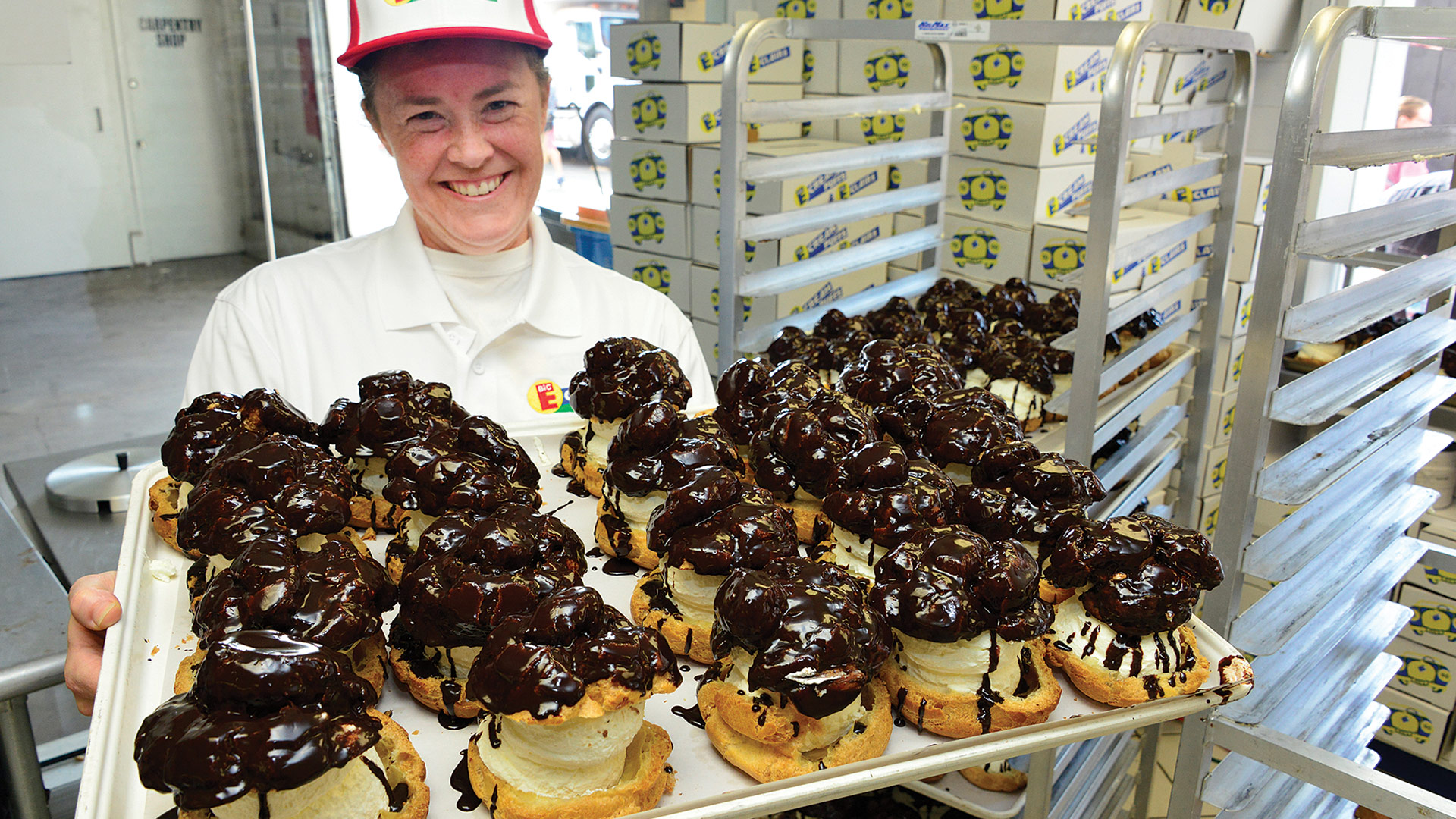
The Big E Bakery: For 2022, it introduces an exciting new flavor cream puff, chocolate;

Harpoon Beer Hall, located on New England Avenue will be debuting a completely revamped menu of pretzels including the Oh that’s Sweet pretzel coated in cinnamon sugar crust served with warm caramel dipping sauce;

Chompers on New England Avenue will feature a new chicken pot pie chomper, crunchy balls with chicken, potatoes, veggies, mozzarella and cheddar cheese with a roasted chicken gravy dipping sauce.

Visit TheBigE.com to see a complete list of new food offerings.

Daily News

WEST SPRINGFIELD — Multi-platinum-selling country artist Brantley Gilbert is headed to The Big E Arena on Sept. 18. Tickets go on sale Friday, exclusively at TheBigE.com. Concert tickets include admission to The Big E. 


With back-to-back platinum albums and a grassroots following millions strong, Brantley Gilbert’s music has been shared, covered, and adopted as the soundtrack to Saturday night and Sunday morning by audiences around the world.  


The Georgia native who started as the defiant life-of-the-party can still go ‘til sunrise, but he’s also emerged as something far greater: the leader of a massive tribe of hard-working, fun-loving believers for whom electric guitar-shredding, rapping, and twang can go hand-in-hand-in-hand. They call themselves the BG Nation, and when the BG Nation watches Gilbert on a stage, they don’t just see a star. They see themselves.  


Seven No. 1 hits punctuate his career: “Country Must be Country Wide,” “You Don’t Know Her Like I Do,” CMA Awards Song of the Year nominee “Dirt Road Anthem,” “My Kinda Party,” RIAA 5x Platinum-certified “Bottoms Up,” “One Hell of an Amen” and collaboration with Lindsay Ell “What Happens in A Small Town.”  


Gilbert recently teamed up with longtime friend Jason Aldean for their long-awaited collaboration Rolex® On A Redneck,” encompassing the hard-working and fun-loving attitude that both Gilbert and BG Nation possess. Gilbert has been back in the studio preparing new music to be announced later this year. 


For more information on Brantley Gilbert at The Big E Arena, sponsored by Truly Hard Seltzer, visit TheBigE.com.  

Daily News

WEST SPRINGFIELD — Dropkick Murphys, one of America’s most celebrated Celtic punk bands, is headed to The Big E Arena on Sept. 16. Tickets go on sale Friday at 10 a.m., exclusively at TheBigE.com. Concert tickets include admission to The Big E. 

Dropkick Murphys remain Boston’s rock ‘n’ roll underdogs turned champions. Since 1996, the band has created the kind of music that’s meant to be chanted at last call, in packed arenas, and during the fourth quarter, third period or ninth inning of a comeback rally.  

The band’s latest album, Turn Up That Dial (2021), released via Dropkick Murphys’ own Born & Bred Records, is its 10th studio album and fourth consecutive Billboard Top 10 album debut, joining 11 Short Stories Of Pain & Glory (2017), Signed and Sealed in Blood (2013) and Going Out In Style (2011). Dropkick Murphys recently released a digital-only expanded edition of their Turn Up That Dial album, available in both stereo and 3-dimensional Dolby Atmos mixes. The expanded album features three bonus tracks including “We Shall Overcome” and the previously released B-sides, the cover songs “James Connolly” (by Larry Kirwan) and “The Bonny” (by Gerry Cinnamon). 

The band’s celebrated discography also includes gold-selling album The Warrior’s Code (2005), featuring the near double platinum classic “I’m Shipping Up To Boston.”  

For more information on Dropkick Murphys at The Big E Arena, sponsored by Truly Hard Seltzer, visit TheBigE.com. 

Daily News

WEST SPRINGFIELD — The West Springfield Board of Health instituted a mask mandate for the city starting Friday morning — the same day the Big E opens its 17-day fair, the Republican reported.

The mandate requires face coverings in all indoor public places, as well as private places open to the public, regardless of vaccination status, for those age 2 and older.

“The Big E is not the only big event in this town,” said Dr. Heather Sankey, a Baystate Health obstetrician and Board of Health member, according to the Republican. “We have people traveling from other states to come to Costco or the hockey arena or whatever event we are doing, and it’s very important that we protect everybody throughout all of this.”

Business Talk Podcast Special Coverage

We are excited to announce that BusinessWest, in partnership with Living Local, has launched a new podcast series, BusinessTalk. Each episode will feature in-depth interviews and discussions with local industry leaders, providing thoughtful perspectives on the Western Massachuetts economy and the many business ventures that keep it running during these challenging times.

Episode 78: September 6, 2021

George O’Brien has a lively discussion with Eugene Cassidy, president and CEO of the Big E

Eugene Cassidy

BusinessWest Editor George O’Brien has a lively discussion with Eugene Cassidy, president and CEO of the Big E. As the start of the fair approaches, there is both anticipation and apprehension about the 17-day gathering in the wake of COVID and the Delta variant.  The two discuss what the expectations are for the 2021 fair, the steps being taken in the wake of COVID, and the importance of the fair to the region and especially its business community. It’s must listening so join us on BusinessTalk, a podcast presented by BusinessWest in partnership with Living Local.

Sponsored by:

Also Available On

Daily News


WEST SPRINGFIELD — The West Springfield Board of Health is considering a mask mandate for the upcoming Big E to help curb the spread of COVID-19.

At a special meeting staged Wednesday, Dr. Heather Sankey, the board’s chair, said she feared the 17-day fair, slated to begin Sept. 17, could become a super-spreader event.

The Board of Health is planning a public hearing before the start of the fair to consider a mask mandate, and could vote to require masks indoors and at large outdoor events.

The Big E drew more than 1.6 million visitors in 2019. Big E officials are encouraging those who are not fully vaccinated to wear a face covering while on the fairgrounds.

Cover Story

Fair Amount of Intrigue
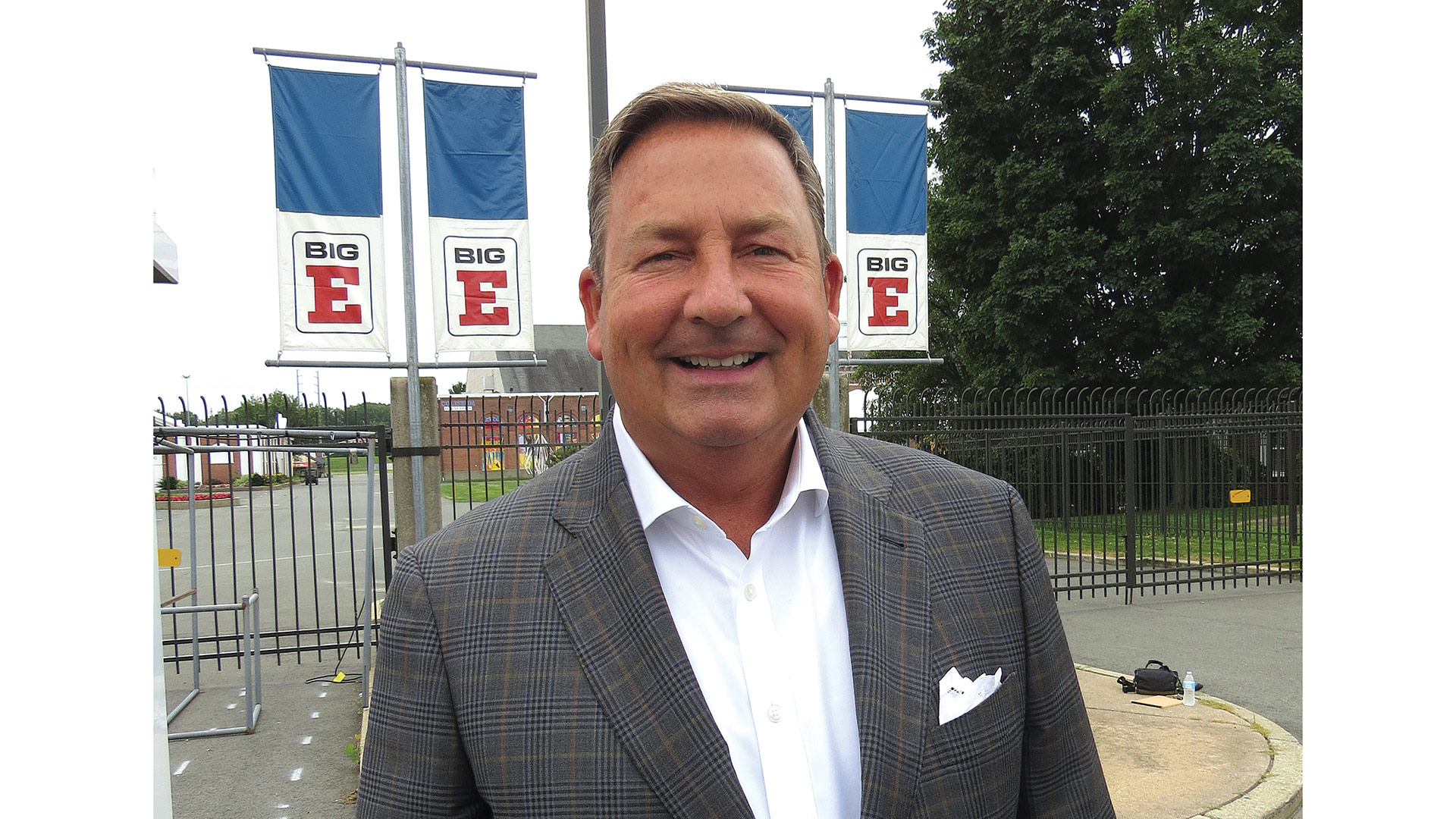
Eugene Cassidy, president and CEO of the Big E

Eugene Cassidy, president and CEO of the Big E

As the calendar turns to late summer, all eyes in the region turn to the Big E in West Springfield and the much-anticipated 2021 edition of the fair. The show did not go on in 2020 due to COVID-19, a decision that impacted businesses across a number of sectors. There will be a fair this year, and the goal is to make it as normal — there’s that word again — as possible. But it will be different in some respects. Meanwhile, as COVID cases surge in other parts of the country and uncertainty about the fall grows with each passing day, the anticipation for the fair comes with a healthy dose of anxiety.


In a normal year — and this isn’t one, to be sure — what keeps Gene Cassidy up most at night is the weather.

Cassidy, president and CEO of the Big E, has been quoted many, many times over the years saying that just a few days of steady rain — especially if they come on weekends — can turn a great fair, attendance- and revenue-wise, into an average one, or worse, just like that. So even though there’s nothing he can do about the weather, he frets about it. A lot.

This year … while ‘afterthought’ might be too strong a word when it comes to the weather, it might not be, either.

Indeed, Cassidy has other matters to keep him up at night, including a pandemic that is entering a dangerous and unpredictable stage, a workforce crisis that has already forced the cancellation of a giant Ferris wheel that was scheduled for this year’s fair and may pose a real challenge for vendors and other participating businesses during the fair’s 17 days, and even concerns about whether one of the organizers of his massive car show can get into this country (he’s been given the AstraZeneca vaccine, which isn’t recognized in the U.S.).

“I have a fear … that the long arm of the government can suddenly change our lives — we lived through that in 2020, to be sure,” he noted. “And the Eastern States Exposition is surviving on a very thin thread; we cannot withstand being shuttered for another fair because the vacuum that would occur in our economy is nearly three quarters of a billion dollars, and there’s no way that anyone is going to able to replace that.”

“I have a fear … that the long arm of the government can suddenly change our lives — we lived through that in 2020, to be sure. And the Eastern States Exposition is surviving on a very thin thread; we cannot withstand being shuttered for another fair.”

As the Big E enters the final countdown before it kicks off on Sept. 17, there are equal amounts of anticipation and anxiety. The former is natural given the fact that the region hasn’t gone without a fair, as it did in 2020, since World War II; Cassidy noted that advance ticket sales are “off the charts,” and running 80% higher than in 2019, which was a record-setting year for the Big E.

The fair will offer a welcome escape for all those who have spent much of the past 18 months cooped up and not doing the things they would traditionally be doing. And it will provide a much-needed boost for businesses in several sectors, from hotels and restaurants to tent-renting enterprises, for those homeowners in the area who turn their backyards into parking lots, and for countless vendors who had a big hole in their schedule (actually, lots of holes) last year.

People like Sharon Berthiaume.

The Chicopee resident has been coming to the Big E with her booth, A Shopper’s Dream — which features animal-themed merchandise (mugs, ornaments, floormats, metal signs, etc.) — for 30 years now. She said the Big E is by far the biggest show on her annual slate, and one she and others sorely missed last year.

“It was a major loss, a huge disappointment last year,” she said. “We’ve been coming back for so many years, and we have a lot of regulars who come back year after year looking to see if we have anything new. I’m looking forward to being back.”

But the anxiety comes naturally as well. Indeed, the tents, ticket booths, and other facilities are going up — more slowly, in some cases, because of a lack of workers — as COVID-19 cases are spiking and as states and individual communities are pondering mask mandates, vaccination passports, and other steps.

While there are dozens, if not hundreds, of other area events and gatherings that might be impacted in some way by the changing tide of the pandemic, from weddings to the Basketball Hall of Fame enshrinement ceremonies early next month, none will be watched more closely than the Big E.
Gene Cassidy says there is pent-up demand for the Big E

Gene Cassidy says there is pent-up demand for the Big E, but because of the pandemic and fears among some people about being in crowds, he’s not expecting to set any attendance records this year.
Photo courtesy of The Big E

Cassidy told BusinessWest he watches and reads the news every day. He’s concerned by the trends regarding the virus, but buoyed by the fact that fairs of this type have been going off, mostly without hitches, across the country. And the turnouts have certainly verified a high level of pent-up demand for such events.

Overall, the sentiment within the region, and the business community, concerning the Big E and the fate of this year’s fair was perhaps best summed up Stacey Gravanis, general manager of the Sheraton Springfield.

“It’s huge … and it’s not just the business side, it’s the emotional side as well,” she said of the Big E and losing it for 2020, “because it’s been around for so many years. It’s something we’ve looked forward to every year for as long as I can remember. So we’re super happy to have it back this year, and we all have our fingers crossed right now.”

And their toes as well. That’s how important the Big E is to the region and its business community.


The Ride Stuff

As he talked with BusinessWest about the upcoming fair and ongoing planning for it, Cassidy joked about how much he and his staff had to tap their memory banks after their forced and certainly unwanted hiatus.

“It’s been two years since we’ve produced a fair, and even though you’ve done this 30 times before, it’s surprising how much you forget,” he said, noting quickly that institutional memory has certainly kicked in for the staff of 26, down from 31 — a nod to one of the many ways the pandemic has impacted the Big E.

It’s been two years since we’ve produced a fair, and even though you’ve done this 30 times before, it’s surprising how much you forget.”

And while getting the show ready for primetime, Cassidy, who also chairs the International Assoc. of Fairs and Expositions, a worldwide trade association, has been on the phone and in Zoom meetings with others from his industry. Such conversations have gone on with those in this time zone and others with institutions on the other side of the world. And the reports cover a broad spectrum.

“Australia has shut itself down again — after only nine deaths from this Delta variant,” he said. “And that’s a scary development; I think there are 24 million people in Australia, and to have that country impacted like that … it’s been devastating to their economy, and people are quite anxious there.”

Closer to home, and as noted earlier, the news has been much better.
It’s been a very long 18 months for the vendors who work the Big E

It’s been a very long 18 months for the vendors who work the Big E, and they are among the many people happy to have the 17-day fair back on the slate.
Photo courtesy of The Big E

“At the fairs that have been produced, the crowds have not been diminished,” he said, listing successful events in Indiana, Wisconsin, and California as evidence. “At those fairs that have run, people have really returned — and in a large way; there have been a lot of attendance records set.”

At home, those off-the-charts advance ticket sales tell Cassidy that some people are interested in eliminating some contact points and avoiding the crowds at the ticket booths. But mostly, they tell him there is certainly pent-up demand for the fair.

“People are ready to get back to normal,” he said, adding, again, that the overriding goal for the staff was, and is, to make the fair as normal — as much like previous years — as possible.

But more important than normal is the safety of attendees and employees, said Cassidy, noting that a wide range of cleaning and sanitizing protocols are being put in place, and steps are being taken to try to thin crowding in some areas.

“We’ve have intentionally thinned out the grounds a little bit,” he explained. “There’s going to be roughly 10% more space on the fairgrounds as we have tried to space things out a little bit.”

Elaborating, he said there has been some attrition when it comes to food and other types of vendors, and some of the “lower performers,” as he called them, have been eliminated.

“We thought that space was more important than that commercial activity,” he explained, adding quickly, though, that the science is inexact regarding whether creating more space reduces lines and points of contact.
Gene Cassidy says his overriding goal is to make the 2021 Big E as ‘normal’ as possible.

Gene Cassidy says his overriding goal is to make the 2021 Big E as ‘normal’ as possible.
Photo courtesy of The Big E

When asked about what he expects for attendance this year, Cassidy said he believes last year’s record of 1.62 million is, in all likelihood, not in danger of being broken, because there are some — how many, he just doesn’t know — who will not want to be part of large crowds of people this year. He’d like to see 1.4 million, and notes that he needs 1.2 million to pay for the fair.

“My goal is simply to provide a great, healthy, family experience for the fairgoing public,” he said, adding that several factors will determine overall turnout. “Our demographic is a little bit older than in other parts of the country, and I think some people are going to be hesitant about large crowds, and I think that will have an impact on us. At the same time, if you look at some of the other events, their popularity has been very high. So I suppose it can go either way, but I think we will see some scaling back of attendance, and that’s OK.”

While crowd control is an issue, there are other concerns as well, as Cassidy, especially workforce, which will be more of a challenge for vendors than for the Big E itself, which has seen most of the regular workforce it hires come back again this year.

Indeed, he noted that work on several of the larger tents that dot the fairgrounds started earlier this year because vendors had fewer people to handle that work. This trend, coupled with cancellation of the Ferris wheel, which demands large operating crews, obviously leaves reason for concern.

However, Cassidy believes the clock, or the calendar, to be more precise, may be working in the favor of employees.

“We open on Sept. 17, and the unemployment bonus checks will cease in the first week of September,” he said. “So, hopefully, people will be wanting to get back to work.”


Impact Statement

While there is anticipation and some anxiety within the confines of the Big E, there’s plenty of both outside the gates as well.

As was noted earlier and in countless stories on these pages over the years, the Big E impacts the local economy, and many individual businesses, in a profound way. Gravanis tried to quantify and qualify it.

“It’s thousands of dollars in room and beverage revenue,” she said. “It’s keeping our people employed on a full-time basis. It’s seeing these people, these vendors, that we’ve worked with over the past 20 to 30 years — we missed them last year. It has both financial and impact for our staff and our local businesses.”
The Avenue of States will be open for business at the Big E

The Avenue of States will be open for business at the Big E, which is seeing record numbers of advance ticket sales for the 2021 fair.
Photo courtesy of The Big E

Elaborating, she said the hotel, like all others, suffered a seemingly endless string of hits last year as events were canceled, tourism came to a screeching halt, and airlines (who book crews into the hotel on a nightly basis) all but shut down. But the Big E, because of its duration and scope, was perhaps the biggest single hit of all.

Which is why having it back is so important, and also why those fingers are crossed.

“We get hundreds, if not thousands, of room nights, as well as the incremental spending in our restaurants — it’s extensive,” said Gravanis. “We sell out every weekend of the year with a combination of vendors and attendees; right now, there are very few rooms left.”

Berthiaume certainly has her fingers crossed. She told BusinessWest that the return of fairs, and especially the Big E, could not have come soon enough for vendors like her. She said the Charleston (R.I.) Seafood Festival, staged earlier this month, was the first event she’d worked in roughly 18 months, and it has been a long, rough ride since gatherings started getting canceled in March 2020.

“It was crazy last year because you couldn’t plan — life was in limbo,” she said, adding that events were postponed early in the year and there was general uncertainty about when or if they would be held. This year, there was less uncertainty, but also nothing in the calendar, for most, until very recently.

She said a good number of vendors have been forced to pack it in or take their businesses online. “I know a lot of people who have gone out of business because of this. Many had been in business, like us, for 30 years or more, and they figured, ‘what the heck, I’m not going to do this anymore — it’s too hard.’”

Like Cassidy, she senses a strong urge on the part of many people to get back to doing the things they’ve missed for the past year and half, and she cited the seafood festival as solid evidence.

“They had people waiting for two hours to get off the highway to get in — the traffic was so backed up,” Berthiaume recalled. “We hadn’t seen people like that in maybe five years.

“Everyone is ready to get out there,” she went on, with some enthusiasm in her voice. “People are just so happy to be out in public. So the Big E, based on what I’ve seen with their tickets for the concerts … everyone is ready to roll; everyone is waiting for the Big E.”


Fair Weathered Friends

Getting back to the weather … yes, Cassidy is still concerned about it on some levels. And why not? There has been record rainfall this summer and extreme conditions in other parts of the country and across the globe.

He’s hoping all that is in the past tense, with the same going for the very worst that this pandemic can dish out.

The weather can never be an afterthought at the Big E, but this year it is well down the big list of things that keep organizers up at night.

Indeed, this is a time of anticipation and anxiety — and for keeping those fingers crossed.


George O’Brien can be reached at [email protected]

Daily News

WEST SPRINGFIELD — Eastern States Exposition (ESE) will stage a 2021 Big E Job Fair on July 20 from 10 a.m. to 1 pm in the café area of the Eastern States Farmers Market located near the Mallary Complex.

The event is open to the public and is free of charge. Job-seekers will have the opportunity to network with many different ESE departments. This is a rare opportunity for many hours of work in a short period of time as The Big E is open for 17 straight days. Additionally, once workers experience a Big E job, they tend to return year after year.

“We have people who have been with us for decades, some who take vacation time and others that come in from other areas of the country to assume their Big E role and reconnect with co-workers,” said Gene Cassidy, ESE president and CEO. “We really have a Big E family during the Fair.”

With pandemic-related unemployment benefits set to expire in early September, working at The Big E is an opportunity to ease back into the workforce, said Jessica Fontaine, ESE Human Resources director.

ESE will be recruiting for positions in the following areas:


• Wine Barn Staff — beverage service prep, waitstaff;

• Retail Staff —  Storrowton Village and Farmers Market;

• Security Staff — gate, roving, supervisors;

• Parking attendants and shuttle drivers;

• Custodial, bathroom attendants, trash collection;

• ESE Foundation representatives;

• Guest information/admin. support;

• Vendor information staff

• Creative arts assistants

• Stage hands


To join The Big E team, please apply ahead of time (if possible) by visiting https://tinyurl.com/JobsESE

All staff will receive training for their roles as well as any COVID safety measures. Directions:  Enter Gate 1 and take an immediate left, driving past the Avenue of States, Coliseum, Farm-a-Rama and Young Buildings to the Farmers Market, a red building in front of the Mallary Complex dome. The Farmers Market will be open for shopping as well on July 20.

Daily News

WEST SPRINGFIELD — In what might be the biggest promotion in the 104-year history of the Big E, the fair is selling ‘Golden Ticket’ lifetime passes to the annual event for just 100 customers.

The tickets will be sold on the fair’s website, www.thebige.com, on Wednesday, Nov. 18, from 10 a.m. until the 100 tickets are gone. Each $1,000 ticket will offer lifetime admission to the Big E for its holder and an accompanying guest, along with free parking and a host of annual surprises and benefits.

“The Golden Ticket offers a lifetime of wonder for its lucky purchasers and their guests, offering years and years of the fair as a VIP forever,” said Eugene Cassidy, president and CEO of the Eastern States Exposition. “This is the time of year we typically put one fair to bed and begin the long, exciting road to the next one. With the unfortunate derailment in 2020, we are fully committed to making the 2021 edition our greatest yet. The Golden Ticket is the ideal promotion to get under way with style and sizzle.”

Purchased tickets will be delivered to recipients in time for the holiday gift-giving season.

The Big E has already begun to announce plans for 2021, including a headlining concert with country superstar Brad Paisley.

Daily News

WEST SPRINGFIELD — The Big E, North America’s fifth-largest fair, has been named to the “Best of the Best” listing for 2020 by the American Bus Assoc. The listing includes events and attractions from throughout the U.S. and Canada.

“Best of the Best” honors outstanding travel-industry members who go above and beyond for the group-tour industry. Categories include Adventure, Culture, Entertainment, Festivals & Events, Food & Beverage, Lodging, and Shopping.

The Big E, which has also been named a “Top 100 Event” and an “Internationally Known Event” by the ABA in recent years, is featured in the Festival & Events category. Bright Nights at Forest Park was also named in this category.

“We are honored to be named among the ‘Best of the Best’ by the American Bus Association,” said Gene Cassidy, president and CEO of the Eastern States Exposition. “We have had a long relationship with the ABA and annually host 800 or more motor coaches at the Big E. Because our bus business is so important, we constructed the Gate 1 Transportation Center to serve guests who depend on buses to visit the fair. And we can’t wait to welcome people back.”

Plans are underway for the 2021 Big E, scheduled for Sept. 17 to Oct. 3. A concert by country superstar Brad Paisley was announced last month. For more information, visit www.thebige.com.

Daily News

WEST SPRINGFIELD — The Big E is returning in 2021 with a headline performance by Brad Paisley, one of country music’s most decorated male solo artists, on Friday, Sept. 24 at the Big E Arena. Next year’s concert marks the 20th anniversary of the first time Paisley played the Big E. Special guests and the ticket on-sale date will be announced in the spring.

Over the past 20 years, Paisley’s songwriting and showmanship have won him numerous honors, including three Grammys, two American Music Awards, 14 Country Music Assoc. Awards (including Entertainer of the Year), and 15 Academy of Country Music Awards, among many others. A member of the Grand Ole Opry since 2001, Paisley has written 21 of his 24 number-one hits and amassed more than 3.9 billion on-demand streams so far.

Coronavirus Special Coverage

Coping with a Lost Year

Gene Cassidy

Gene Cassidy says the Eastern States Exposition is much like the farmers it helps promote; one lost season can spell disaster.

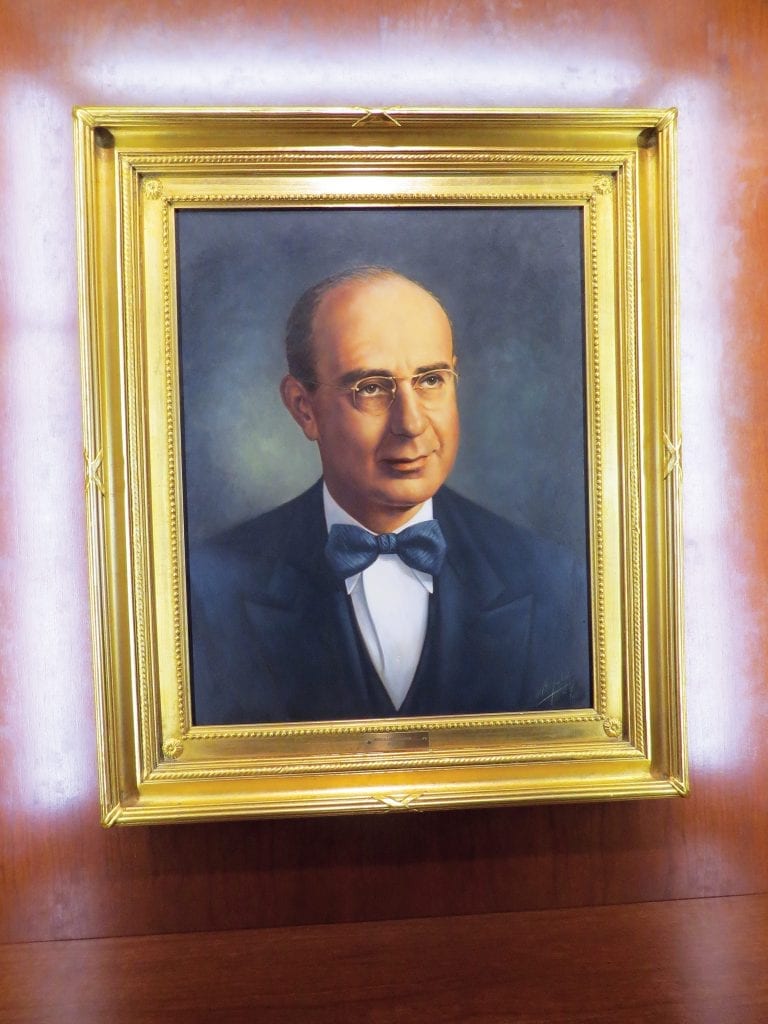
As he talked with BusinessWest about the cancellation of this year’s Big E and how the Eastern States Exposition (ESE) will respond to that huge loss of revenue, Gene Cassidy stopped and pointed to a picture at the opposite end of the company’s large conference room.

“That’s J. Loring Brooks, son of Joshua L. Brooks, founder of the Eastern States Exposition,” said Cassidy, president and CEO of ESE. “He was the Big E’s chief development officer. When the Eastern States had rainy fairs or fairs where, for one reason or another, we didn’t make any money, he would get on the phone and fundraise; when we had difficult times, he would find the funding to make ends meet.”

J. Loring Brooks died in 1984, Cassidy went on, and it’s been a long time since the fair has needed to try to raise money in that fashion — and it would be difficult do it that way now. “That’s not an aircraft carrier you can turn on a dime,” he noted, adding quickly that he did hire a development officer last year, and is looking into various strategies to perhaps do some fundraising.

Action of various kinds — from a development campaign to borrowing to discovering new revenue streams — is needed because 2020 has been the rainiest of years — figuratively, if not literally — in the fair’s 102-year history, and the assignment of making ends meet, as he put, is going to be a very stern challenge.

“We’re not unlike the farmer — if he loses a season, he can go broke,” said Cassidy, who quickly went from that analogy to another one. “I cavalierly refer to the Big E as the church bazaar for this nonprofit; if you don’t have your annual fundraiser, how can you execute on your mission?”

The Big E, he noted — originally known as the Eastern States Industrial and Agricultural Exposition — was created to be that church bazaar, the method for raising money needed to support a mission of promoting agriculture.

Thus, the COVID-19 pandemic has done more than close the fair for the first time since World War II. It has put the Eastern States Exposition on precarious financial ground; put plans for rehabbing and modernizing some of the buildings on the grounds, especially the obsolete Coliseum, on ice; left large questions marks about how the ESE is going to respond to the agricultural community’s ongoing need for a platform; and even raised some doubts about the fate of the fair in 2021.

“We’re not unlike the farmer — if he loses a season, he can go broke. I cavalierly refer to the Big E as the church bazaar for this nonprofit; if you don’t have your annual fundraiser, how can you execute on your mission?’”

But while those at the Big E are certainly moving full steam ahead with planning for next year’s fair, they must also contend with a massive hole in the budget — the Big E accounts for 85% of the yearly revenue, and much of the remaining 15% (all the many types of shows on the books after mid-March) has been wiped off the calendar as well.

Grounds for Change

That makes this year decidedly different, said Cassidy, noting that, in a typical year, his staff would be on what amounts to cruise control as it enters the final six or seven weeks of lead-up to the Big E. This year, these employees are searching imaginatively for ways to generate revenue and close the budget gap.

“We’re in a phase now of trying to discover how we can do smaller types of events that can generate some resources in order for us to sustain ourselves through to next season,” he explained, noting that the fair, despite its wealth of space, buildings, parking, and amenities, is still limited in what it can do. Put another way, it’s limited by what it can’t do, according the governor’s reopening plan — bring large numbers of people together in close proximity to one another.

J. Loring Brooks

When he was the Big E’s chief development officer, J. Loring Brooks would get on the phone and raise money when the fair had bad years, usually as a result of weather.

Options, most of which involve keeping visitors in their cars and taking full advantage of the Big E’s sprawling, 59-acre main parking lot, include everything from a drive-in theater — a cost-benefit analysis is currently underway — to concerts to events like the recent ‘Taste of the Big E,’ a gathering that was eye-opening in a number of ways.
Indeed, the Taste, which involved visitors driving onto the Big E property and then staying in their cars to sample some of the food that would have been offered at this year’s fair, drew far more people than organizers were expecting, said Cassidy, adding that traffic was backed up the full length of Memorial Avenue. “People drove for hours to get here, and then they spent hours waiting in line to get in.”

Ultimately, the Taste helped convince Big E organizers that they simply couldn’t control the turnout for this year’s fair, said Cassidy, adding that the event showed that, if you open for the doors for something people want, they will come.

“When we saw the response to the food show, we knew there was no way to control the number of people on the fairgrounds for the Big E,” he explained. “And knowing that really helped make the decision that staging the fair would not in the best interests of the people who came.”

But the Taste also provided ample evidence that different types of revenue-generating events can possibly be staged at the fairgrounds during the pandemic. These won’t generate anything approaching the income the fair did, but they may help limit the flow of red ink in a year no one could have comprehended just five months ago.

“We’re in a phase now of trying to discover how we can do smaller types of events that can generate some resources in order for us to sustain ourselves through to next season.”

A drive-in theater is among them, said Cassidy, noting that, decades ago, there was one just a half-mile or so down Memorial Avenue, and other one on Riverdale Street. Drive-ins have staged something approaching a comeback during the pandemic, but the startup costs are considerable — $90,000 to buy the camera to project the movies, for example.

“We’ve done a lot of due diligence to discover if there’s a way we could actually turn a profit,” he noted. “That’s one of many things that are on the table.”

Another is the possibility of bringing carnival rides — which are not discussed anywhere in the reopening plan, according to Cassidy — to the fairgrounds. Others include finding new uses for the state buildings (or the grounds outside them), and staging concerts where attendees stay in their cars.

“There are some challenges to putting these on, and some limitations, but they’re a viable option for us,” he noted. “People want to get out to events like this, and a lot of entertainers are dying to work; they’ve lost a lot of opportunities, and they need to work.”

Daunting Challenge

While optimistic that some revenue streams can be created in the midst of the pandemic, Cassidy is also realistic and knows that, collectively, these efforts will generate only a fraction of what a solid Big E would.

“My goal is to get this organization through this very difficult time and run a Big E in 2021 that brings people together again,” said Cassidy, adding, again, that this will be a stern challenge not unlike that faced by a farmer who loses a year’s worth of crops.

Or a small fundraiser that loses its annual bazaar.

Those analogies might not seem appropriate for an organization, and an event, that brings 1.5 million people to the region every year. But for Cassidy, they work, and they illustrate just what he and his staff are up against.

—George O’Brien

Opinion

Big E Cancellation a Major Blow

Going back to the early days of the pandemic, one of the overriding questions on the minds of many in this region, and especially its business community, was: will there be a Big E?

Late last month, we finally learned the answer: no.

In many ways, that verdict, arrived at after lengthy discussions between Big E organizers and officials in West Springfield, was not unexpected. Looking at the situation objectively, one had to wonder how organizers could possibly stage a fair that draws more than 100,000 people on a good day and keep not only these visitors safe, but also the workers, vendors, and area residents.

It just didn’t seem doable, even to those who really, as in really, wanted the Big E to happen.

And that’s a large constituency, especially within the business community, where many different kinds of ventures benefit greatly from the 17-day fair and the 1.5 million people drawn to it annually. That list includes hotels, restaurants, tent-rental companies, transportation outfits, food vendors, breweries, and many, many more. These businesses have already lost so much to the pandemic, and now they’ve suffered perhaps the biggest loss of all.

Canceling the Big E was certainly the right move from a public-health perspective, and it makes sense on so many levels. But that doesn’t soften the blow for constituencies ranging from large corporations to homeowners near the fairgrounds who turn their driveways and lawns into parking lots.

Indeed, the year-long (at least) challenge of surviving the pandemic just became a little sterner for all kinds of businesses within the 413.

And the community loses out as well. The Big E isn’t just an annual event, it’s a century-old tradition that has become part of the fabric of this region.

Canceling the Big E was certainly the right move from a public-health perspective, and it makes sense on so many levels. But that doesn’t soften the blow for constituencies ranging from large corporations to homeowners near the fairgrounds who turn their driveways and lawns into parking lots.

Meanwhile, the cancellation of the Big E provides more evidence — not that anyone needed any — of just how cruel this pandemic has become for business owners, most of whom have worked diligently to abide by the rules and do everything they can to position themselves to survive COVID-19.

Indeed, so much of this fight to survive involves matters far out of the control of these business owners — from orders to shelter in place to the many details and deadlines (often coming without any real warning) with regard to reopening the economy, to the loss of key customers, such as the Big E and MGM Springfield, which is due to reopen soon after being closed for nearly four months.

As the stories that begin on page 6 clearly show, business owners have done whatever they can do to pivot, create new revenue streams, and simply try to weather this storm. But the pandemic keeps throwing more challenges at them, with the Big E’s cancellation being the latest.

The silence on Memorial Avenue this September will be deafening. And the blow to the region will be significant.

Coronavirus Special Coverage

Opinion

Going back to the early days of the pandemic, one of the overriding questions on the minds of many in this region, and especially its business community, was: will there be a Big E?

On Monday, we finally learned the answer: no.

In many ways, that verdict was not unexpected. Looking at the situation objectively, one had to wonder how organizers could possibly stage a fair that draws more than 100,000 people on a good day and keep not only these visitors safe, but also the workers, vendors, and area residents. It just didn’t seem doable, even to those who really, as in really, wanted the Big E to happen.

And that’s a large constituency, especially within the business community, where many different kinds of ventures benefit greatly from the 17-day fair and the 1.5 million people drawn to it annually. That list includes hotels, restaurants, tent-rental companies, transportation outfits, food vendors, breweries, and many, many more. These businesses have already lost so much to the pandemic, and now they’ve suffered perhaps the biggest loss of all.

Indeed, the year-long (at least) challenge of surviving the pandemic just became a little sterner for all kinds of businesses within the 413.

And the community loses out as well. The Big E isn’t just an annual event, it’s a century-old tradition that has become part of the fabric of this region.

Canceling the Big E was certainly the right move from a public-health perspective, and it makes sense on so many levels. But that doesn’t soften the blow for constituencies ranging from large corporations to homeowners near the fairgrounds who turn their driveways and lawns into parking lots.

The silence on Memorial Avenue this September will be deafening. And the blow to the region will be significant.

Daily News

WEST SPRINGFIELD — For the safety of fairgoers, staff, vendors, entertainers, exhibitors, sponsors, suppliers, and the broader community, the leadership of the Eastern States Exposition have canceled the 2020 Big E.

“Please know that this decision was not made lightly,” a statement noted. “The Big E fair is so much more than just a fair; it is tradition, it is celebration, it is the showcase of everything we are so proud of in New England. This is why our hearts are heavy as we bring you this news.”

The fair has been put on hold before, during both World War I and World War II.

“We know our faithful fairgoers will be disappointed,” the statement noted. “This decision was difficult and complex, but we all know in our hearts that it’s the right thing to do for the health and safety of the 1.6 million people who support us each year.

“Our staff has spent the last few months working tirelessly to figure a way to bring our annual New England tradition to everyone this fall. Despite exploring all our options and planning extensively, we realized that the Big E experience that everyone has come to know and love would not be the same.

“We care for each and every one of our fairgoers, and our job is to help you make the best memories possible. Because of that, we must now switch our focus to the future. Please join us in doing that.”

Next year’s edition of the Big E is scheduled for Sept. 17 to Oct. 3, 2021.

Coronavirus Special Coverage

Proceeding as Planned

Gene Cassidy

Even if the fair goes on as scheduled, Gene Cassidy says, crowd counts could be way down.

Gene Cassidy likes to say those at the Big E ‘manufacture’ the 17-day annual fair that is by far the biggest single event on the region’s calendar.

“It’s like putting an automobile together,” he told BusinessWest. “You really can’t cut components out and expect the vehicle to run; it costs ‘X’ number of dollars to produce the fair, and we’re still going to spend that — we have to produce a fair that people are going to want to come to.”

And so, those planning the 2020 edition of the Big E are proceeding with the mindset of including all the parts that typically go into the Big E, despite the COVID-19 pandemic that is currently decimating the local economy and wiping events off the calendar in wholesale fashion.

But while Cassidy is currently certain there will be a Big E — that’s currently — he’s less certain about a great many other things. Perhaps most importantly, he doesn’t know how many people will come to the fairgrounds this September. He quoted at least one poll showing that 50% of respondents said they would not let the pandemic impact their decision to attend an event like the Big E, but another 40% said they wouldn’t attend such an event unless there was a vaccine for the virus.

And if attendance is down 20%, 30%, or even 40%? “It’s going to be a heavy lift to overcome that, but we can’t afford not to go forward.”

And if the fair should have to be canceled? That has happened a few times during the history of the fair — during World Wars I and II, to be specific — but Cassidy isn’t thinking in those terms, because the economic hit would be extremely difficult to absorb.

“I don’t want to say we’d close, but it would be a difficult, heavy lift to figure out how we would sustain ourselves so we could reopen in the future,” he told BusinessWest, adding that such a decision won’t have to be made for some time, and he is obviously hoping, and projecting, that enough progress can be made that he won’t have to take that course.

“I have confidence that we’re going to learn from this bug faster than we’ve learned from anything in the past,” he said. “And I have confidence that, by the time we get to the summer, things are going to start to loosen up; we’ve learned a lot, and we’re going to learn a great deal more — and we will open.”

As he talked about this fall’s Big E and the prospects for it, Cassidy joked that, for a change, the ongoing reconstruction of the Morgan-Sullivan Bridge, which links West and Agawam and abuts the Big E property, will not be the main topic of conversation this summer and fall.

It will still be a topic — two lanes will be closed until late summer 2021, according to the current schedule — but certainly not the topic.

“I don’t want to say we’d close, but it would be a difficult, heavy lift to figure out how we would sustain ourselves so we could reopen in the future.”

Indeed, the bridge is now largely an afterthought as the Big E and the region cope with the global pandemic and questions about both the short term and the long term that simply cannot be answered.

Already, the virus has had a huge impact on the Big E, as it has on any venue that hosts large gatherings. Searching his memory banks — and it was hard to remember back that far because so much has happened, or not happened, as the case may be — Cassidy said the last event event staged at the Big E was an antique and crafts show on March 7 and 8.

Everything since has been wiped off the calendar, including the huge home show scheduled for late in March and the planned Hooplandia, a 3-on-3 basketball festival slated to make its much-awaited debut in June.

Everything is cancelled or postponed through June, he went on, adding that he was not aware of any cancellations for July at this time. Aside from the basketball tournament, this summer was to be dominated by a number of horse shows and a few other gatherings.

But most of the attention has now shifted to the fair, which annually attracts more than 1 million people to the region and contributes more than a quarter-billion dollars to the local economy. At this point in time, the expectation is that the show will go on, said Cassidy, adding that adjustments can and will be made to help maintain the safety of visitors and employees alike.

These will come in such realms as ticketing and accessing the property, he said, adding quickly that, given the nature of fairs — putting a lot of people in very close proximity to one another as they do everything from ride on rides to eat fried dough to watch concerts — there isn’t much more that can be done to facilitate social distancing.

“The fact is … a fair is not the place where you can enforce social distancing,” he said. “We can be suggestive, but that’s not what a fair is. It’s uniquely the American way of life, and it just doesn’t lend itself to social distancing.”

These sentiments explain why there are questions — and concerns — about just how many people will make that pilgrimage to West Springfield this fall, and how many times they’ll make it.

“Citizens are going to decide how close they want to be to other people,” said Cassidy. “And I suspect that there’s a segment of society that may never return to a fair again.”

For now, those planning the fair are proceeding to ‘manufacture’ a fair like those that have come before it — but with some adjustments for the pandemic, obviously.

“We’re building a comprehensive plan for cleaning and disinfecting,” he told BusinessWest, adding that, given the fact that the Big E is an agricultural fair, it has rigorous policies in place for disinfecting the various facilities on the grounds.

Other changes will come with ticketing — there will be print-at-home ticketing, for example — as well as with access to the grounds in an effort to create some distance between people. Employees will wear masks and gloves, and visitors will be wearing masks as well, he said.

As for planning for the fair, it is, in most all respects, right on schedule.

“We’re going at the same speed as we always do,” Cassidy noted. “All the entertainment is booked; the concessionaires are lined up, although many of them are not working currently, and and I hope they can make to September. We’re going full-speed ahead — at this point, the fair is more than 90% ready to go.”

And, as noted earlier, it has all the components that the fairs have had in recent years.

“It costs us about $20 million to run the fair, and we hope to gross about $23 million or $24 million from the fair’s operation,” Cassidy noted. “We can’t produce an event that’s compromised, because people won’t come back.”

That said, one of his biggest concerns moving forward is the massive workforce needed to put on the fair, and the generational nature of that workforce.

“We have grandparents, parents, and grandchildren, all of whom participate in the workforce,” he explained. “And we have hundreds of people who volunteer at the Eastern States, many of whom are over age 65. My job is to protect my 65-year-old as well as any patrons who are in that demographic. That’s what our plan is focused on — how do we protect people who are most vulnerable?”

—George O’Brien

Tourism & Hospitality

Gene Cassidy stands in front of what will soon be the midway sign that Big E visitors know very well.

Production of the Big E Takes a Village, and We’re Not Talking About Storrowton

As the clock ticks down the start of another Big E, an elaborate and well-choreographed effort is underway to get everything set for opening night. As it turns out, this is just one of the myriad traditions synonymous with this annual celebration of New England.

Eugene Cassidy likens the process of getting the Big E ready for opening day to choreographing a dance number. In short, a large number of people have to work in sync and in cooperation with one another to get the desired result.

Preparations for the 17-day long fair, which starts Sept. 13, begin 18 months before it happens, and there are countless moving parts that need to come together — properly and on time — to not only have the fair ready for prime time, but to ensure that each day of The Big E is a success.

“Even though we’re now just a month away from the 2019 fair, we’re well into planning for 2020,” said Cassidy, president and CEO of the Eastern States Exposition, while explaining how the jig-saw puzzle that is the 2019 fair comes together.

“Everybody is probably on pins and needles as we get ready,” he went on. “Coordinating the fairgrounds is really like being a dance instructor. There are so many little things that need to be considered, like what gets placed first. The choreography that’s required is very important.”

And this year, there is more to be choreographed than merely the tents, displays, rides, and flower gardens.

Indeed, while managing the traffic to and from the fair has always been a matter of import (and a stern test) this year there is a much higher degree of difficulty to those maneuvers.

That’s because the Morgan-Sullivan Bridge, which connects Agawam with West Springfield and borders the western end of the fairgrounds, is roughly one third of the way through a three-year renovation project.
The four-lane bridge is down to two, and as anyone who has ever tried to cross the bridge during Big E time knows, four lanes are not nearly enough.

Strategies are being developed to address the matter, said Agawam Mayor William Sapelli, adding that he is working with both the Big E and the town of West Springfield to devise ways to mitigate tieups.

“We discussed the traffic concerns and how we’re going to mitigate some of those issues,” he said. “The Big E has been very, very cooperative. There’s going to be a lot of coordination between the two police departments… it’s kind of like an orchestrated dance; we have our side and they have theirs.”

So it seems there will be a lot of dancing going on, figuratively, before and during this edition of the Big E, which will look to top last year’s record attendance mark of 1,543,470 people.

Organizers believe they have the lineup to do just that, as we’ll see, and, as always, are keeping their fingers crossed on the weather, which is one puzzle piece that can’t be choreographed.

For this issue and its focus on tourism and hospitality, BusinessWest talked at length with Cassidy and others at the fair to gain some perspective on this year’s edition and also how these fairs come to life.

Gene Cassidy says the carnival rides and games, brought in by the North American Midway Entertainment right after Labor Day, all go up in a matter of days.

Parts of the Whole

Cassidy has been coming to the Big E since his youth, and he has many vivid memories from his visits. Among them is his first view of an elephant when he was 7.

Today, it’s his job — and his mission — to make lasting memories for others. He’s been doing this for eight years as president and CEO, and 26 years of working for the exposition in various capacities.

These memory-making duties are rewarding, but also quite challenging at this time, said Cassidy, listing everything from new and different hurdles being faced by agriculture fairs, especially from animal-rights groups, to mounting competition for the time and attention of families — competition that certainly didn’t exist when the fair was launched, to the aging infrastructure of the Big E itself, with many buildings approaching 100 years in age.

These facilities are “capital intensive,” according to Cassidy, who said donations to the fair are modest because some people do not recognize the Eastern States as something that is worthy of making charitable contributions to.

“Because the fair is so successful, we’re sort of a victim of our own success,” he said. “We produce tremendous agricultural events that draw interest across North America, and we make enough income in order to support those events, but we do not have enough income to recapitalize the facility.”

This makes things difficult when updating the older buildings that hold some of the fair’s most beloved traditions. Over the past seven years, Cassidy said, the corporation has spent about $30 million fixing up the buildings.

“My goal is to raise awareness of the importance of the Eastern States in order to stimulate the interest of our region’s businesses in order to raise money to help recapitalize the facilities,” he said, adding that this awareness-raising process comes down to many factors, including the task of putting on a good show each year.

Brynn Cartelli, Longmeadow native and winner of season 14 of The Voice, is set to perform at The Big E on Sept. 13-15 on the Court of Honor stage.


And this involves choreography, but also a blending of the traditional and the new in ways that will draw audiences of all ages. And Noreen Tassinari, director of marketing at the Eastern States Exposition, believes this has been accomplished with the 2019 edition of the fair.

“The Big E is, across generations, a tradition here in Western Mass., Connecticut, and throughout New England — people come for many reasons, and some of the reasons are their favorite family traditions,” she said, adding that for many, the fair is a yearly stop in their calendar, which is why it’s so important to keep adding new items to the extensive list of things to do at the fair.

“We like to have a fresh approach each year, so we like to introduce new entertainment and features and certainly new foods so people are buzzing about what’s going on at the Big E this year,” she said. “We want people thinking ‘we can’t miss the fair.’”

Among the new additions for 2019 are a star-studded entertainment lineup with three stages featuring big-name stars like Loverboy, Carly Rae Jepsen, and Brynn Cartelli, as well as other local artists. Other entertainment includes everything from Ireland’s Dingle Peninsula Showcase, a cultural, educational, trade and tourism showcase featuring products from the Emerald Isle, to the Avenue of States, a unique display of buildings representing each New England state.

John Lebeaux Commissioner of the Mass. Department of Agricultural Resources, believes that The Big E might not have as significant of an impact as it does today without the unique representation from all New England states.

“It’s one of the top 10 biggest agricultural fairs in the United States,” he said. “I don’t think we would have been able to achieve that were it not for this regional aspect.”

This extended reach and regional flavor makes the Big E more than a fair and a tradition, said Cassidy, adding that it also a force within the local economy.

“A lot of our mission is to create and build a local economy,” he said, adding that the lastest economic-impact study, conducted in 2014, showed that the annual impact regionally totaled $479 million.

In Cassidy’s seven years as CEO, five have set new records for attendance. If the record is broken again, that will be a good problem to have, in most respects, because of what promises to be a trying year traffic-wise.

As a result of the bridge-construction work, left turns from River Road onto Memorial Ave. are “no longer allowed,” according to The Big E website, and fair-goers are being asked to use Baldwin Street to get to the Eastern States instead.

This will no doubt create lengthier travel times for many people traveling to and from the area, but both Agawam and West Springfield are doing what they can to minimize the inconvenience.

Sapelli said The Big E is making sure that any larger vehicles, including horse trailers and delivery trucks, are using a specific route with better access rather than coming through Agawam and having to make a tight turn onto the bridge. In addition, the fair partnered with King Ward Coach Lines, which will be shuttling people from various locations, including the Enfield Mall, to cut down on the number of vehicles that need to come in for parking.

With realistically only two ways to get to Memorial Avenue, and one of them under serious construction, West Springfield Mayor William Reichelt says delays are, unfortunately, inevitable.

“We’re working with each other and then the state to make sure there are enough resources,” he said. “I think, unfortunately, there’s just going to be traffic going that way because we went from four down to two lanes.”

Sapelli agrees and asks that people be patient while waiting to get into the fair.

“We’ll all get through this, it’s a wonderful fair,” he said. “They do a lot for the economy and the surrounding communities.”

Fair Game

Despite the likely traffic jams, the fair is likely to draw record-breaking crowds. Again, that has been the trend. For now, it’s crunch-time for the Big E staff who have to choreograph another major production.

Between the entertainment artists, the Avenue of States, the seemingly-endless food vendors, and everything in between, it’s easy to see why this fair has become a tradition for families across the Northeast and even beyond.

“You almost need more than one visit to do it justice,” said Tassinari. “We really have the New England flavor and feel, and that’s part of our mission.”

Meetings & Conventions

Horse Sense

President and CEO Gene Cassidy

President and CEO Gene Cassidy.

When people think of the Eastern States Exposition, they often think immediately of the Big E, the 17-day fair that dominates the tourism landscape at the start of each fall. But Eastern States is much more than that, as reflected by its diverse array of events, both large and small, and the resulting economic impact on the region — not to mention its important mission of keeping its agricultural heritage alive for future generations.

Fifty-two years ago, notes Greg Chiecko, a local camping group set up shop at the Eastern States Exposition — and have come back every year since.

“That was our first non-fair event. They took the building for the whole month — it took that long to set up, do their show, and move out.”

How things have changed, said Chiecko, director of Sales. The Big E, the 17-day fair that has taken place each fall for more than a century, remains the ESE’s most famous calling card. But outside the fair, the grounds hosts more than 100 events annually, some small-scale, some much larger, like the camping and outdoor show that now crams hundreds of vehicles into three large buildings each February.

One of the many horse shows at the ESE.

One of the many horse shows at the ESE.

“The dynamics have changed substantially over the past 50 years,” Chiecko said. “They’ve been doing it so long, it’s amazing. They still take a little while to move in, but they do it with such accuracy, and they literally move out of all the buildings in a day.”

A quick look at the coming month’s schedule demonstrates the range of groups that present events here. February alone offers the Amherst Railway Society’s Railroad Hobby Show, the aforementioned Springfield RV Camping and Outdoor Show, the Springfield Sportsmen’s Show, and two dog shows. March brings the Old Deerfield Spring Sampler Craft Fair, Mark’s Northeast Motorsports Expo, the Antique & Modern Firearms Show, the Maple Harvest Day & Pancake Breakfast, the AMMO Fight League, a Massachusetts 4-H Blue Ribbon Calf Sale, and the large Western Mass. Home and Garden Show — not to mention two more dog shows.

“We call ourselves the flexible facility in the heart of New England, and we truly are,” said Chiecko, who will leave the ESE next month to become president and CEO of the Outdoor Amusement Business Assoc. “And every show is different. The Big E and the Fiber Festival are the only events we produce. We’re a landlord the rest of the year. Some of these are volunteer groups, some are professional promoters, some are associations … it runs the gamut. They produce the shows, and we offer services, like ticket takers, ticket sellers, security, and more. They can use our services or use their own.”

Greg Chiecko calls the ESE “the flexible facility in the heart of New England.”

Greg Chiecko calls the ESE “the flexible facility in the heart of New England.”

Gene Cassidy, president and CEO of the Eastern States Exposition, noted that the facility also offers services like advertising, sign manufacturing, banking, and other amenities that many venues don’t have in their portfolio. The result of this flexibility and roster of services results in a high retention rate, with groups that return year after year. In addition, he noted, “some staff people have been here for 40 years. So there’s a lot of institutional memory.”

The ESE’s consumer shows — home shows, gun shows, camp shows, sport shows, and the like — tend to be among its most popular offerings, Chiecko said. “We’re also the dog-show capital of the Northeast. In 2017, we had 36,000 AKC-registered dogs on our property, just from the AKC shows, not counting other groups. Dog shows are a big deal. And we love dog shows because they come on holidays: Easter, Thanksgiving weekend, Fourth of July weekend, times of the year when it would be difficult to fill our spaces.”

“In 2017, we had 36,000 AKC-registered dogs on our property, just from the AKC shows, not counting other groups. Dog shows are a big deal.”

EASTEC, the largest manufacturing event east of the Mississippi, returns to the fairgrounds this May for its biannual visit. “Exhibitors love it, and the area restaurants and hotels do great,” Chiecko said, adding that local trade shows, from the likes of J. Polep Distribution Services and Performance Food Group, also regularly host events. Meanwhile, clients book parties and weddings at Storrowton Tavern and the Carriage House, which managed by a private firm but owned by the ESE.

That’s far from an exhaustive list, but it does lend credence to Chiecko’s “flexible facility” motto.

“I’ve been here 24 years, and I’ve never heard a “can we do it?” inquiry that I’ve had to say ‘no’ to,” he said. “The facility is so flexible, and our crew is so flexible, we can do anything.”

Animal Attraction

Despite the myriad events the ESE presents each year, its heritage remains firmly rooted in animals and agriculture.

“We do 13 horse shows outside the three we do for the fair,” Chiecko said. “We do a sheep show, youth cattle shows, and we have a big poultry show coming up next month. And this past year, we had the National Rabbit Association. We had 18,000 rabbits here.”

“The joke,” Cassidy quickly added, “was that 18,000 rabbits came, and 36,000 left.”

The attendance level varies among these events, Chiecko noted. “A lot of the horse shows tend to watch themselves rather than anything else. But the rabbit show attracted a huge population from the general public.”

The annual Western Mass. Home and Garden show

The annual Western Mass. Home and Garden show brings attendees face to face with hundreds of local businesses.

However, when it comes to most animal events, Cassidy said, “I wish there were more people engaged. It’s our job to promote the breed or species, put it out there for the public to consume, and they’re free events. The fact is, if the Big E had more days or we had more acreage, more of those shows would take place during the course of the fair so we could get as many people from the public exposed to that. But we do our best to try to promote interest in it; we believe it’s important for agriculture. It’s mission-driven; we’re not making any money on that. That’s all stuff we promote and invest heavily in.”

Still, “the more shows we can put in during the fair, the more it helps us fund our agriculture program, most of which happens outside of the fair, in the other 49 weeks of the year,” he went on. “We make it available to the public so they can have the exposure. It’s tough in this day and age, when the youth in the general population are so disassociated from agriculture, and we deal with the hardcore animal activists, the people who have serious agendas against consumption of animals, and they influence public policy to the detriment of the greater good of society.”

That has affected the national 4-H program, which gets federal funding and is being influenced by people outside of agriculture, which results in regulation making it harder for children to be involved. Meanwhile, Future Farmers of America, a private nonprofit not under federal control, is going strong, Cassidy explained, noting that, no matter the vehicle, it’s important to keep engaging young people in agriculture and animal rearing. “Those are the kids that going to feed the world in the next generation.”

It’s one of the reasons why the Big E, which continues to set attendance records, is so critical, in that it helps fund the other 49 weeks of events while driving interest in animal shows; people are more likely to check out such shows once they’ve bought a ticket and are at the fairgrounds.

“At one time, we had four or five antique shows here. The Internet has almost eliminated antique shows because people can shop from the comfort of their own living room.”

“The fair is just a fundraiser. It’s like your church bazaar, except we just happen to run 17 days and are one of the biggest in the world,” Cassidy said. “It’s a fundraiser for us to drive stewardship into our mission. I wish more people were as excited about that mission as we are. I look down the road a generation, and we’ve got a lot of work to do.”

On the other hand, Chiecko said, the consumer shows are still strong because people enjoy events that reflect their hobbies and interests. But even there, the Internet has impacted certain shows.

“At one time, we had four or five antique shows here. The Internet has almost eliminated antique shows because people can shop from the comfort of their own living room, which is really too bad, because the quality of what people get isn’t nearly the same. It’s the same with craft shows. That’s the nature of the business cycle — we’re no different than a brick-and-mortar store dealing with Amazon.”

Living the Mission

Cassidy emphasized more than once during BusinessWest’s visit that the Eastern States Exposition makes a priority of its agricultural mission. “Not everyone relates to that mission. But if we can’t support agriculture, we can’t support everything else we support – and we support a lot.”

He’s not just talking about planned events. The fairgrounds has been a staging center for emergency situations as well. Northeast Utilities set up camp and fed its crews there during the famous October 2011 snowstorm. A few months before that, the ESE’s dorms housed hundreds of people suddenly made homeless by the tornado that struck the region. “We’ve hosted large RV rallies here,” Chiecko said. “If a cattle guy breaks down on 91, they might come here.”

So there’s a community impact in addition to the economic impact to the region — more than a half-billion dollars a year, he noted, with only part of that generated by the 17-day Big E. “Year-round operations play a big role.”

He believes its impact will only grow now that MGM Springfield has opened across the river.

“I think we have a good partnership,” he said, one that extends beyond parking cars for MGM during its first week of operation last summer. “They bring large conventions to town, which utilize rooms and banquet spaces downtown — well, we have 355,000 square feet of exhibit space. We’re hoping to see more city-wide conventions. It’s a tight-knit community here.”

Dog shows have become a surprisingly robust source of bookings for the ESE.

Dog shows have become a surprisingly robust source of bookings for the ESE.

For convention goers and people who attend events at Eastern States, MGM is another activity to take in while visiting Springfield, he added, while people who come to Springfield mainly for the casino might also take in an event at the fairgrounds — and everyone benefits.

“Because of the advertising campaign MGM launched, it put Springfield on the map in a bigger way, and I think our fair benefited from that,” Cassidy said of last year’s record attendance at the Big E, which took place a few weeks after MGM opened. “My hope is that, with the synergies we’ve developed in partnership with MGM, we can help bring more commerce to the city of Springfield in the form of non-fair events: trade shows, professional shows, manufacturing shows.”

With that in mind, he keeps plugging away at that year-round mission — because, simply put, the Eastern States Exposition is more than a center for events of all kinds. It’s a critical piece of the region’s tourism and economic picture.

“If this place ever went away, the impact on our economy would be devastating,” he said.

Which is why he doesn’t intend to let the ESE go to the dogs — well, except on those weekends when it does.

Joseph Bednar can be reached at [email protected]