
Violations of Wage and Overtime Laws Can Come with a Hefty Price
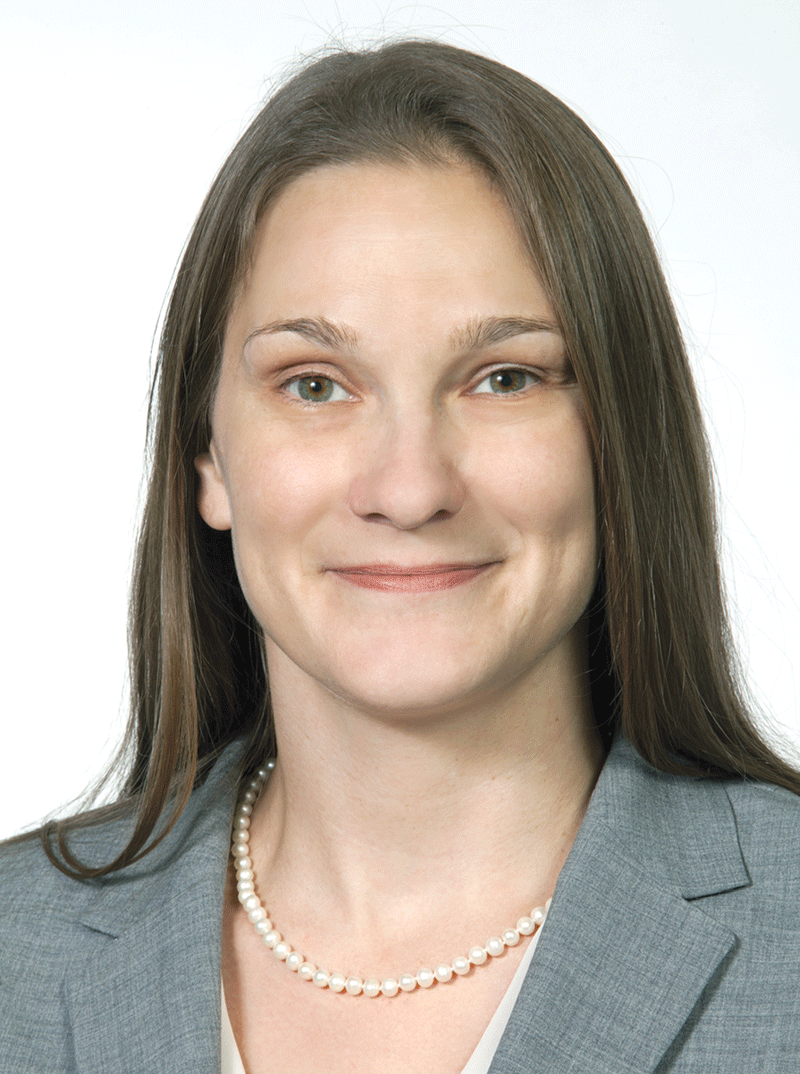
Karina L. Schrengohst
In fact, in Massachusetts, there are mandatory treble (triple) damages for violations of wage-and-hour laws relating to minimum wage, tips, and overtime. This means that, if an employer is found in violation of state law, at minimum, for every dollar an employer does not pay in accordance with wage and hour laws, that employer will have to pay three times that amount. And violations of child-labor laws bring civil and criminal penalties.
Thus, in order to reduce their risk of liability, restaurant and coffee-shop owners should consult with their employment counsel and familiarize themselves with state and federal laws.
Employers, such as restaurants and coffee shops, who employ individuals who receive gratuities must be familiar with minimum-wage and tip law. In Massachusetts, employees who receive at least $20 a month in gratuities ($30 a month under federal law) may be paid $2.63 per hour, provided that their hourly pay rate and tips together are at least equal to the state minimum wage of $8 per hour.
There are two areas in particular which relate to tips that employers should be aware of: tip pooling and service charges.
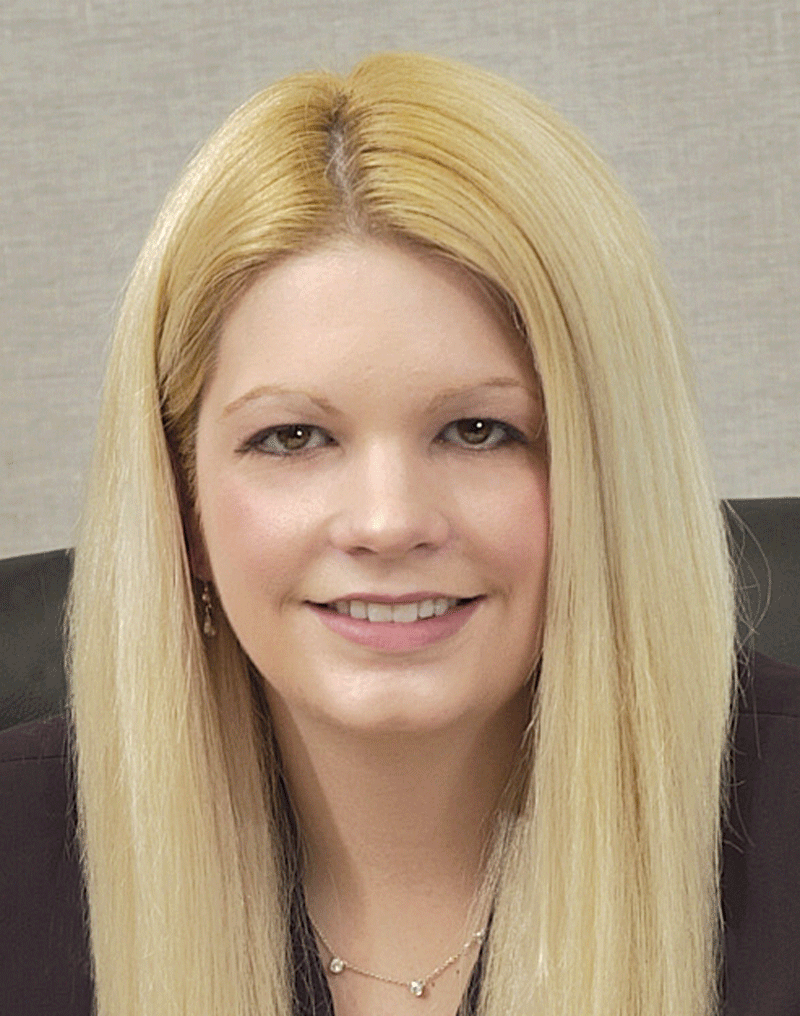
Amy Royal
Under the Bay State’s tip law, if a restaurant chooses to impose a service charge on an invoice, which serves as the functional equivalent of a tip or gratuity, all the proceeds from that service charge must be paid to waitstaff employees or bartenders as a tip.
Employers may, however, charge a ‘house fee’ or ‘administrative fee,’ which they may use or distribute at their discretion, but only if the employer provides a designation or written description of that house or administrative fee, informing the patron that the fee does not represent a tip or service charge for waitstaff employees, bartenders, or other service employees. This language informs the patron that the fee is not a gratuity that goes to employees. Thus, any fees not intended as gratuities and not paid to employees should not be labeled a service charge.
Under Massachusetts law, restaurants are exempt from paying employees overtime; however, they may not be exempt under federal law. Restaurants with annual gross sales of at least $500,000 are subject to both state and federal law, the latter in the form of the Fair Labor Standards Act (FLSA). If subject to the FLSA, employees working in restaurants must be paid 1.5 times the minimum wage (not 1.5 times $2.63 per hour) for all hours worked in excess of 40 hours per week.
Minor Concerns
Child-labor laws are designed to protect minors from hazardous jobs and allow minors to balance education with employment. They prohibit employment based on age (minors under 14 years old may not work) and the hazardousness of a job. Minors must obtain work permits. And after 8 p.m., all minors must be under the direct and immediate supervision of an adult supervisor who is located and reasonably accessible in the workplace.
Child-labor laws restrict the time a minor may work, setting rules for the earliest permissible hour, the latest permissible hour, the number of hours per day and week, and the number of days per week. Restrictions vary based on age and whether it is a school day, school night, weekend, holiday, school year, or summertime.
Two recent examples of violations of child-labor laws reveal the hefty financial consequence of non-compliance. In June 2011, the owners of five Dunkin’ Donuts franchises were fined $6,000 for violating state child-labor laws. The franchises employed minors without work permits, before the earliest permissible hour, after the latest permissible hour, and beyond the maximum number of daily hours allowed under child labor laws.
And in October 2011, the owners of two Boston-area Chinese restaurants were ordered to pay more than $129,000 in penalties and $52,000 in restitution for violations of state laws, including minimum-wage and child-labor laws. One of the restaurants was cited for employing a 16-year-old for nine months without pay and allowing her to work beyond permissible work hours and in excess of maximum work hours.
Employers who violate Massachusetts wage and hour laws are subject to mandatory treble damages for any unpaid wages. In addition, a prevailing employee will be awarded attorneys’ fees and costs of the litigation. Because the damages are mandatory, even an employer who makes an honest mistake or takes reasonable steps to comply with wage and hour laws will be subject to these hefty damages.
In contrast, under the FLSA, employers may offer a good-faith defense for violations. Under state and federal law, employers who violate child labor laws are subject to civil and/or criminal penalties, including civil citations, civil fines, criminal fines, and imprisonment.
Considering the consequences of violations, restaurant owners should regularly consult with their employment counsel to review their practices and policies to ensure compliance with state and federal law.
Karina L. Schrengohst, Esq. and Amy B. Royal, Esq. specialize exclusively in management-side labor and employment law at Royal LLP, a woman-owned, boutique, management-side labor and employment law firm; (413) 586-2288; [email protected]; [email protected]
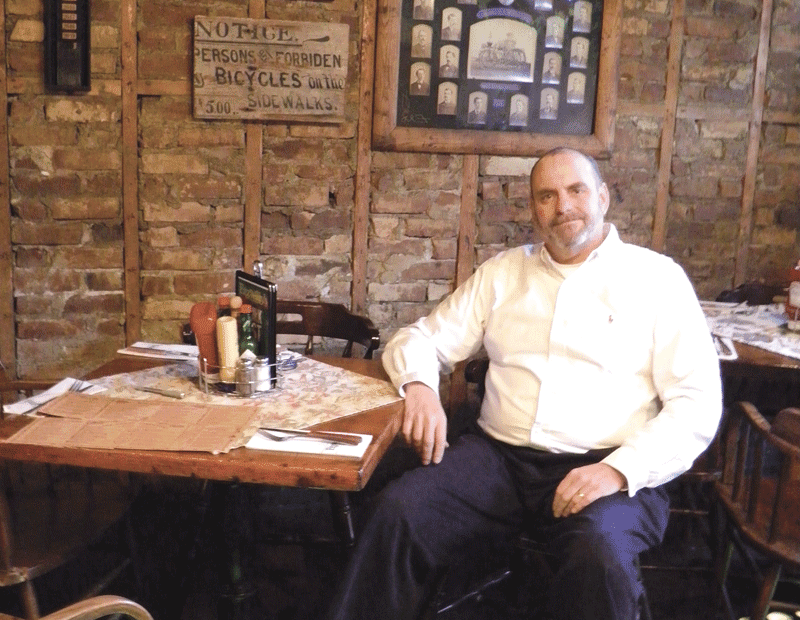
Success at Fitzwilly’s Comes from a Carefully Crafted Atmosphere
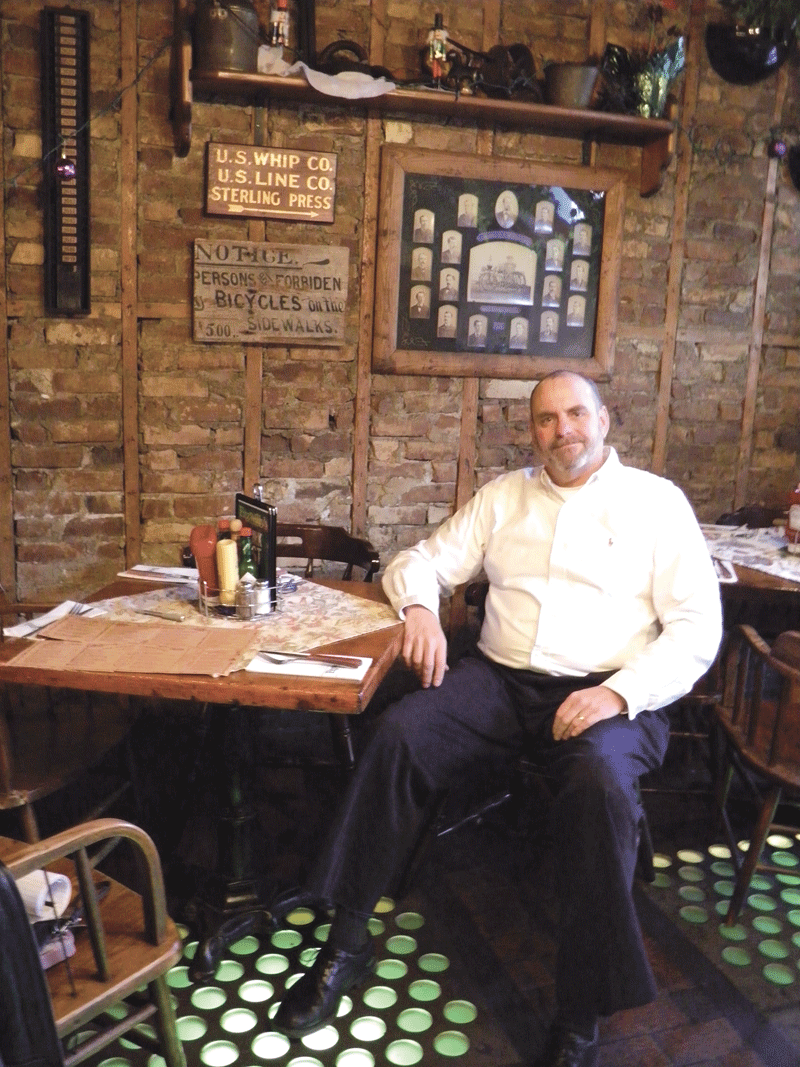
Fred Gohr says Fitzwilly’s was an immediate success in the 1970s, and it has remained popular despite much stiffer competition in Northampton today.
“It was an awful place,” he said. “And there was nothing happening in Northampton at the time. But I always had a burning desire to own a casual restaurant, and the city had caught my eye.”
Today, the eatery he named Fitzwilly’s (after the 1967 movie starring Dick Van Dyke) has not only stood the test of time, but has become a destination in its own right that continues to draw patrons of all ages who appreciate the comfortable, eclectic atmosphere, the good but inexpensive food, and the jovial staff. Many have worked there for more than 30 years and carried on the tone set by Kirwood, who was nicknamed ‘Captain Fun’ by his employees.
The pub-style décor that has charmed patrons for decades was carefully staged. Kirwood visited antique shops and purchased items he believed would become conversation pieces, along with a number of enormous, shining brass planters. He kept the tavern’s original bar, exposed the brick walls, and established a uniform for waitresses that consisted of form-fitting Danskin tops and full-length wraparound skirts.
He also had art pieces made for his restaurant, including a funky submarine emblazoned as the ‘U.S.S. Fitzwilly’ that hangs from the ceiling and was once a gas tank in an old airplane.
“He had a great eye for those sorts of things and a real talent for decorating,” said Fred Gohr, who was hired by Kirwood in 1978 to run the kitchen and today owns Fitzwilly’s with three partners.
But Kirwood takes no credit, and said the funky atmosphere wasn’t an original idea. “T.G.I. Friday’s was just starting up in New York City, and it was an overwhelming success. So I copied everything they did,” he explained. “I put junk and interesting stuff on the walls, created an inexpensive menu, and hired a neat staff. And the place was a raging success from the time it opened. There was nothing like it in town. It was jammed, and everyone in it was laughing all the time.”
Staff members were happy because they were making money, the patrons loved the silly names and odd combinations of foods on the menu, and the fun-filled, friendly ambiance proved to be contagious.
Kirwood said word of mouth spread quickly, and he soon had patrons driving from as far away as New Haven. Many skiers stopped on their way to the northern states, and the college crowd and their parents also loved the establishment. In fact, Fitzwilly’s brought a new crowd of people to Northampton, which encouraged other young entrepreneurs to open clothing stores and boutiques.
“Many people credit Fitzwilly’s and Roger Kirwood with the beginning of the turnaround in downtown Northampton,” Gohr said. “Fitzwilly’s was opened as an exercise in comfort and informality that, coupled with good food and drink, would make a lot of people happy. It worked, and continues to make people happy today.”
Learning Curve
Kirwood may have gotten the idea for the décor from the T.G.I. Friday chain, but his belief system played a major role in the mood of his new restaurant.
“When I bought the place, I had the idea that no one liked to go out and eat formally. It’s expensive, and you’d better know which fork to use, which impinges on the comfort zone,” he said. “I wanted to create a place that had no rules — just quality, good food, and personality. And everyone I hired was very friendly.”
Fitzwilly’s was not his first venture in the restaurant business. In 1967, at age 25, the former insurance salesman bought a building on Memorial Drive in West Springfield and created a restaurant that he named the Red Gertrude. “At the time, the Red Garter was a popular chain across the country, and I had a banjo fascination,” he said.
His budget was very limited, so he created tables from sawhorses and sheets of plywood and promoted the banjo music. The concept worked well for a while, but when Gertrude’s popularity began to wane, he changed the name to Sweet Charity’s and hired a different rock ‘n’ roll band each week. “But eventually that bombed,” he said.
His next venture was Fitzwilly’s, and he did his best to ensure that customers received outstanding service. There were also special trademarks, such as napkins sewn from kettlecloth that became so popular that patrons took them when they left to use as headbands or scarves.
Kirwood also relied on colorful and unusual marketing, such a full page newspaper ad he ran with just one word — “Delicious” — on the entire page, and included nothing else but his logo in small print at the bottom.
The rules for staff were simple — all of the brass railings had to be shined every morning, and anyone who answered the phone had to identify themselves by name. “The real charm came from the people I hired,” he said, adding that bartender Jeff Spooner was among them and still has a very strong following.
As time went on, Kirwood opened other Fitzwilly’s sites in a New Haven firehouse and in Bridgeport and Danbury, Conn. He also purchased the entire building the Northampton eatery was housed in and expanded the establishment, adding two more dining areas, a second bar, and a loft.
Attention to Detail
When Gohr took over, he changed little about Fitzwilly’s, although he continued to scour antique shops for unusual pieces. “Art is important in this town. We are proud to say that Northampton was voted the best small arts town in America a few years back,” he said.
“It’s also like a family here. We have customers we see many, many times each week. We don’t try to pretend to be a fancy, upscale restaurant. But people can be assured that, when they come here, they will get excellent food, quality and service. “
The back bar has been nicknamed ‘Spooner’s Bar,’ due to the beloved barkeep, who has developed a large following on Friday and Saturday nights. “This has really become a local gathering place,” Gohr said, adding that patrons start out as college students, get married, bring their families there, and also use the restaurant for business lunches.
“We are one of the few places in town that serves lunch with table service where people can get waited on,” Gohr said. “But lunch has always been one of our fortes. The majority of our lunch patrons are here on business.”
Gohr has watched Northampton change since he began his career there decades ago. “I remember when Fitzwilly’s was very busy in the late ’70s. At that time, Northampton didn’t have the shops and art scene it has today,” he said. “We relied on the locals and college students and staff, and although they are still a large part of our clientele, folks from out of town have become a big part of our customer base today.”
Although the number of excellent restaurants in Northampton has grown and the scene has changed dramatically, it hasn’t affected Fitzwilly’s.
“We do a lot to make sure we maintain consistent service,” said Gohr. “And I can’t say enough about how the longevity and success of this restaurant has been fueled by the staff.”
People have their favorite nooks, but a focus that has been maintained is the ample space between tables, designed to afford diners a good deal of privacy.
“It’s another reason we are successful,” Gohr said. “We could probably squeeze in at least another 40 seats, but it would take away from the comfort of the dining experience. And we understand and respect the fact that business folks need privacy.”
The most popular spot is the loft, which holds two tables. It’s known as ‘the roost,’ and it’s regarded as the best seat in the house, giving patrons a birds-eye view of the entire restaurant. But no matter where people sit, the experience is the same. “It’s fun here,” Gohr said.
Bottom Line
The atmosphere in the building originally built as a Masonic temple remains informal, and the chairs at Fitzwilly’s still don’t match. But generations of people have found a home there and have formed relationships with its longstanding employees.
“There really is something on the menu for every occasion,” said Gohr. “You can have a beer and share an appetizer or sit at a table and have a great filet mignon or the finest seafood available; we also have burgers and reubens and serve food until midnight. Folks know that, when other restaurants are closed, you can still get a bite at Fitzwilly’s.”
In short, it has never lost its style. “It’s the kind of place that is just a lot of fun,” Kirwood said. “It has stayed consistent since I opened it years ago. And that’s the whole story.”
Restaurant Owners Hope to Emerge from Recession Stronger
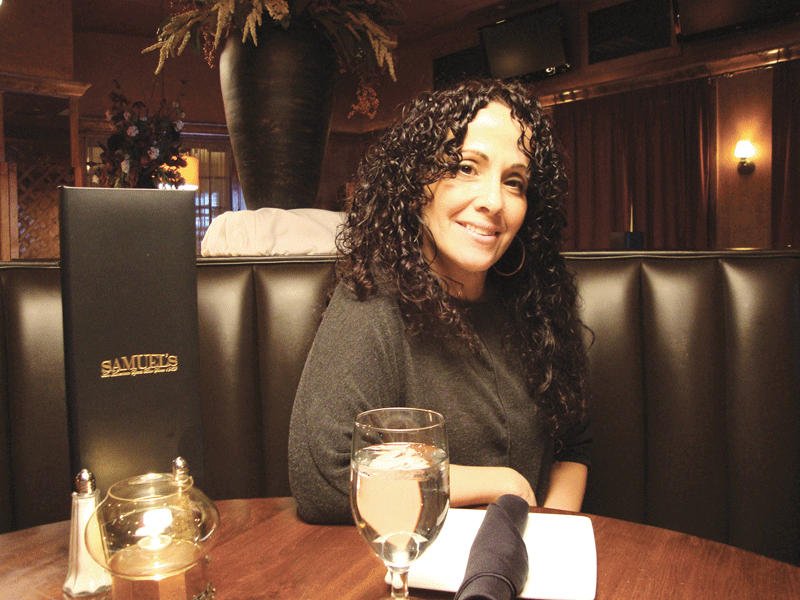
Gina Campiti says the economics of the restaurant industry may have changed, but its focus on customers should not.
Reflecting on the three high-profile restaurants that have closed within a scone’s throw of her restaurant in the last year — Sitar, Onyx, and Pazzo — Gina Campiti said, “it was scary. It is scary.”
Campiti is the general manager of Samuel’s Sports Bar at the Basketball Hall of Fame, and for her, such closures aren’t good for her business and the spirit of healthy competition — but, most importantly, they’re not good for the city of Springfield.
“I feel terrible for those people that went out of business,” she said. “That’s an incredible loss of money for the owners, a loss for the staff, and a loss for those people who enjoyed the restaurants. It’s depressing in such high-profile parts of the city.”
But the space formerly housing Onyx isn’t dark anymore. The Spoleto Group, owner of seven area restaurants, including their namesake Italian dining room in Northampton, unveiled their latest “concept,” as Bill Collins calls them, this past summer. And with three bars and 450 seats, this second Mama Iguana’s location is anything but quiet.
Collins is the chief operating officer of the Spoleto Group, and he and owner Claudio Guerra both say this location has been one of the most exciting for the pair. “It’s our busiest location out of all our restaurants,” Collins said.
“The reason why is that, if you take a look at what has closed there,” he said, “places were selling food at $25 to $28 a plate, with $12, $15 martinis. And here we are, selling a quality house margarita for $7.50. We’re selling entrees for $9 to $12. Our focus is keep it cheap, keep it fun, and they will come. We’ve had great success with people reacting to our prices in this downturn.”
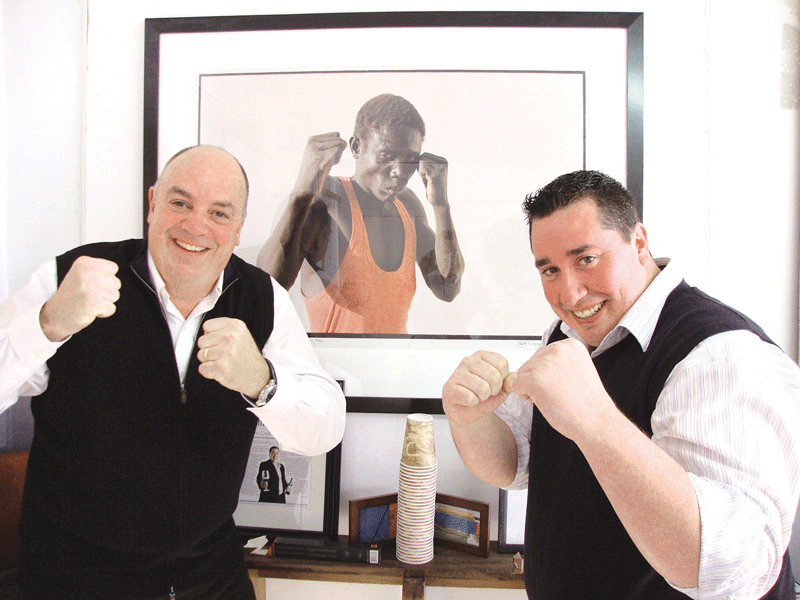
Bill Collins (right, with Claudio Guerra) says patrons respond to reasonable prices and a fun atmosphere.
At the same time, the nation’s restaurateurs are claiming a rebound in 2011 after two lean years. The National Restaurant Assoc. reports that restaurants added a net 230,000 jobs during 2011, their strongest performance since 2006. In addition, the restaurant industry finished the year only 20,000 jobs shy of fully adding back the 366,000 jobs lost during the recession. Complete recovery is expected in early 2012.
In talking to area restaurateurs, their news was more like fine wine than sour grapes, and in addition to some strong sales numbers, most offered that the gradual crawl out of the economic downturn has given them hope for the year ahead. If they made it this far, they said, 2012 holds the promise of a rebounding marketplace along with the business acumen honed from staying afloat through the Great Recession.
So, what’s on the menu for 2012? BusinessWest sat down with chefs and operators of area restaurants and gathered some food for thought.
Dish Network
Campiti unfolded the leatherbound menu on the table in front of her, which now offers 51 tapas dishes to choose from.
“This menu is a big change for us,” she explained, “and I think it’s headed in the right direction. We were successful with half the number of tapas that we had on there before. I’m hoping for even half of the excitement that we had after we changed our menu the last time.”
She explained that the little dishes are a different concept in dining, and the past year’s successful operations at Samuel’s are a direct result of that.
“Some would say, if you give people too much choice, they’ll never make up their mind,” she explained. “But you don’t need to make up your mind! A tapa is a small plate. Instead of concentrating on one entrée in front of you, you’ve got a bunch of different plates on your table that you pick from. You talk, you share. You put a big entrée in front of someone, and that’s the center of their attention. Put a variety of plates around the table, and it promotes conversation.”
Her restaurant’s location in the Hall of Fame building is a slam dunk, she said, even with the number of other eateries in close proximity.
“People go where people are,” she continued. “If it’s a busy area, people will come out. It’s an attraction. It’s not competitive to us. It can actually complement the businesses around it. Everyone has their own brand, and customers want variety.”
Ralph Santaniello, co-owner of the Federal in Agawam, agreed with that sentiment. “I’m of the belief that there aren’t just a set number of restaurants that can survive. If you do a good job, there’s room for everyone.
“At the end of the day,” he went on, “the more diners that we can keep in the Springfield area, that’s a good thing for all of the restaurants around us — not to lose them to Northampton or West Hartford.”
He and Mike Presnal, his business partner and head chef, said that 2011 was a strong year. “Not only were we up around 20% over the year before, saleswise,” Santaniello said, “but our gift-certificate sales were up even higher. In December, that was around 35%.”
Asked for the secret ingredient to their success, Santaniello said it was simple: consistency and quality.
“Number one, we have never had a different chef,” he said. “And the fact is, we’re a chef-owned restaurant, a chef-driven restaurant. It’s hard to make it when you’re an owner but not an operator. We know what goes in and out of the kitchen and bar and dining room every night of operation.”
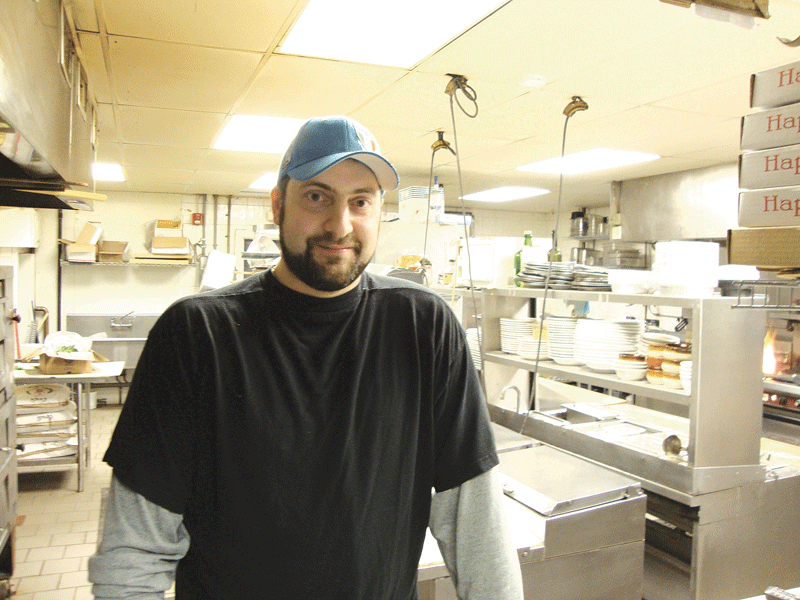
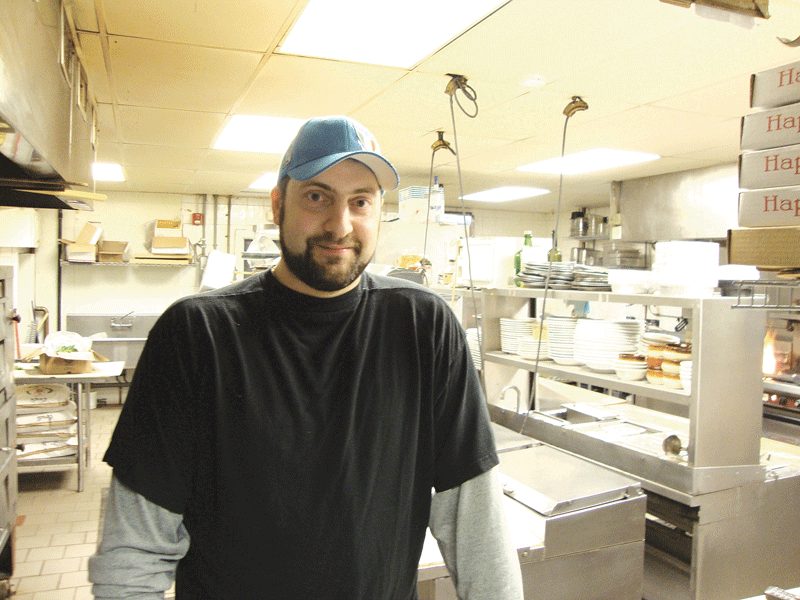
Antonio DiBenedetto says consistency is one key to keeping diners returning to a restaurant often.
“It can be tough out there,” he noted, “but I think that places are closing down because there’s a lack of complete attention. You have to keep an eye on everything going on around you, every aspect of the business, not just food. It’s not one thing, it’s a million things, and consistency is a big one. The same person has made the sauces here for years. There’s no book for recipes; our food has been the same for decades.”
He joked that no one makes meatballs like his mother — “but every Italian cook will tell you that!” — and that his restaurant has weekly specials to offer some variety beyond what people might find locally. “Whatever looks good, or whatever’s in season,” he said — “osso buco, veal chops. One of my favorites is chicken carbonara, since I was a kid and my mom would make it. I try to duplicate it, but of course it’s not as good as hers.”
New World Order
The Farm Table restaurant is the newest business venture from the Kittredge family, owners of Kringle Candle. It’s housed in one of the oldest structures in Bernardston, across from the candle company’s retail flagship, and after a meticulous renovation both historic and green, it opened for lunch and dinner this past October.
Rubén Eduardo is the general manager of the restaurant, and he said that opening a restaurant in what many acknowledge to be a still-sluggish economy offered nothing but uncertainty. “We all know that the national economy was in a pretty low gear,” he added, “so we had no clear idea what would be the response when we opened.”
But what followed exceeded even their highest expectations. “I thought that we would hit about 30 reservations during the nighttime and about the same at lunch, and to my surprise, especially in this economy, it has been quite the opposite direction. Day one, for example, when we were open for lunch, we were expecting 30 or 40 people to join us. We had more than 200. So then we said, ‘OK, maybe that’s more like friends and family.’ But that trend didn’t go down.”
Early on, he realized that his reservation operation needed to be re-evaluated. With one person acting as host and fielding calls for reservations, it wasn’t enough for peak performance, especially for a day with reservations into the triple digits: one Tuesday alone fielded 400 calls for dinner.
Currently more than 60% of his clientele are repeat diners, and some of them are traveling from as far as Connecticut. He said people respond to the restaurant’s mission. “Western Mass. is blessed with amazing products and craftsmanship. In terms of our philosophy, the idea is that the food is, whenever possible, organic and sustainable. And priority is given to local farms. That is reflected in the building as well.”
The ceilings and floors are made from salvaged barn boards, all the stone work comes from within a 50-mile radius, and most of the furniture is made in Vermont. “Even our napkins are made in Hadley,” Eduardo added.
These are the details that make a difference, he said, for the customers and the staff — whom he credits for contributing to a memorable experience. “When our team is serving, they’re proud that these foods are local,” he continued. “These are the things that make a difference in the culture of a restaurant. I think that the enthusiasm from the public comes from the enthusiasm of a restaurant’s team.”
At the new Mama Iguana’s, Collins said a similar level of attention to each restaurant’s physical space has always been a key ingredient to the Spoleto Group’s success. “But the tough part about the economy now is that Claudio and I have had to change how we run the businesses,” he said. “It used to be easy to put up a great atmosphere with great food and service, and you’ve got yourself a busy restaurant that’s making money. It’s now more of a scientific business for us.”
The seven restaurants they oversee are Spoleto’s in Northampton and East Longmeadow; Spoleto Express, Pizzeria Paradiso, Paradise City Tavern, and Mama Iguana’s, all in Northampton; and the newest Mama Iguana’s in Springfield. Collins said this new economy has turned the pair into better businesspeople than they were before.
“We’ve been forced by the times and the economy to do that, and what Claudio and I are finding is that it’s the most exciting thing we’ve ever done,” he said. “We have taken an approach during this downturn to make all our concepts as affordable as possible. We’d rather set a stage where guests could come out two, three times a week and have an affordable, great meal, rather than having them come in once for $150 and not see them again for a couple weeks. Because what do people need at this time more than ever? A release — a place to come for a cocktail and some good food.”
After an entire life spent in the restaurant industry, Guerro agreed, adding that “this is a new world we’re living in. A couple years ago, we were asking, ‘how do we survive this storm?’ Now, it’s more like this is the new reality, and how do we make money in that reality?”
“We’ve been working a tremendous amount on the nuts and bolts of our operation, and streamlining the systems,” Collins said. “With these transitions, when the economy comes back, we’re ready for takeoff.”
Your Serve
Over at Samuel’s, Campiti agreed that the industry she has worked in all her life has been altered. “To me, I don’t look at this as a recession any longer,” she explained. “Now, it’s a change in the way of life.”
But, there’s one thing that doesn’t change, she said — a focus on customers, an idea which everyone who spoke with BusinessWest agreed.
“A customer walks through your door prepared to have a good experience, and they are pleasantly surprised to have a great experience,” Campiti said. “That’s what keeps us all here.”
Thing5 Move Downtown Spurs Momentum in Springfield
The recent announcement that Thing5 LLC will be creating a new call center in One Financial Plaza, thus bringing 500 new jobs to Springfield, is a positive story for the city and the region — on a number of levels.
Let’s start with the jobs. That’s priority No. 1 in the Greater Springfield area, and it has been for many years now. Some might look at this and say, ‘it’s only call-center jobs,’ or words to that effect, but these opportunities come on many levels, from entry positions to management slots, and, in many cases, they can be handled by those who do not possess a college education. The region needs those high-quality jobs (call them white-collar, if you like), but it also needs employment opportunities like these, especially in such large volume.
Beyond the employment factor, there are many other aspects to this story, all of them positive. First, this company started here, in the Technology Park at Springfield Technical Community College — which was created to spur this kind of tech-related enterprise — and thus provides solid evidence that we can incubate ventures and grow them into major employers.
Also, this company stayed here. Indeed, when it reached that proverbial next level, there were, quite obviously, opportunities to take Thing5 almost anywhere — because there isn’t a city or town in the Commonwealth or well beyond it that wouldn’t fight, and fight hard, for 500 jobs. But management chose to stay in the City of Homes, largely because of the lower cost of living, available workforce, access, quality of life, and affordable commercial real estate.
This shows that our various assets are tangible — and sellable.
But perhaps the biggest benefit will come in the form of greater momentum downtown. First, this move gives a substantial boost to the office tower known as One Financial Plaza, which has had several dark floors for many years, but has been staging something of a comeback recently.
Beyond that, though, the 500 new employees working downtown will provide a larger critical mass of people needed to spur additional investments, be they in support businesses, hospitality-related ventures such as restaurants and clubs, or badly needed retail.
And there is another component — the possibility that some of these employees may soon be working and living downtown, thanks to a program that will offer reduced lease rates to Thing5 employees at the nearby Morgan Square apartments, managed by the same company (Samuel D. Plotkin) that also manages One Financial Plaza. This additional residential piece could further stimulate investment in the central business district and be a key contributor to the kind of vibrancy that other Northeast cities have enjoyed.
As we said, there are many angles to this positive story for Springfield and its downtown. The headlines were all about the jobs coming to the city — and that’s an important aspect of this — but there are many other elements that bode well for the City of Homes.
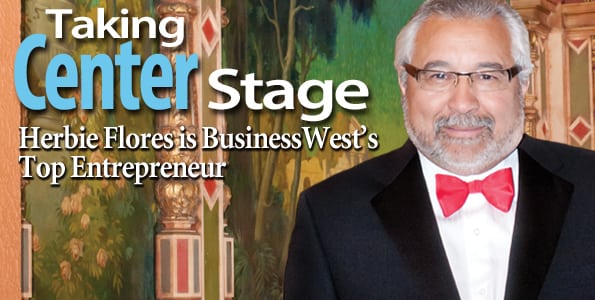
Herbie Flores Is Making His Vision for Springfield Reality
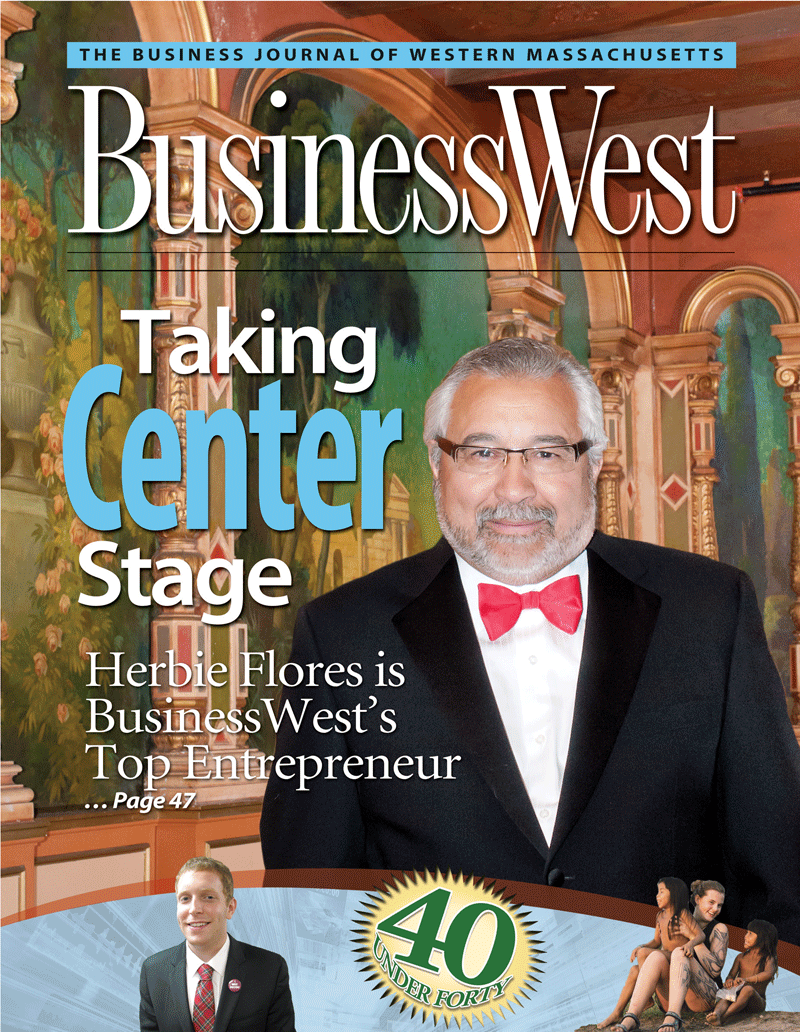 Heriberto “Herbie” Flores has always had a heart for needy people, partly because he grew up poor. From its humble origins 40 years ago providing legal and financial assistance for migrant farm workers, he has grown his multi-agency nonprofit, Partners for Community, into an $80 million force for economic development and community improvement. But he’s made bigger news with a series of real-estate acquisitions, including the Paramount Theater (seen here), that promise to transform Springfield’s downtown. The kind of long-term change Flores envisions for the City of Homes will require energy and passion — and BusinessWest’s Top Entrepreneur for 2011 has no shortage of either.
“This city is coming back,” Heriberto Flores said. “People don’t want to live out in the woods.”
He was sharing a vision of a societal shift away from suburban sprawl back to a city-life model, especially as aging Baby Boomers increasingly seek to live close to all the amenities they need and desire, from food stores and restaurants to banks and performing arts.
As Flores spoke those words, he was standing beside the stage of the 86-year-old Paramount Theater on Main Street in Springfield, an icon of music and theater that has fallen into disrepair — but whose walls, ceilings, and fixtures are breathtaking in their ornate beauty, for anyone willing to look beyond the dust, grime, and faded paint.
And vision is something Herbie Flores has in spades.
Just as he sees the potential in the Paramount — a $1.75 million purchase that will require millions more to restore to a multicultural center for performing arts and community events — he’s also an unabashed optimist when it comes to Springfield itself, choosing to focus on the positives of the city and not the large pockets of poverty, high-school dropout rates, crime, and other issues that often color people’s perceptions.
“When you start looking at the assets, the city has clean water and natural resources. We have companies like Big Y, Peter Pan, and MassMutual. We have three TV stations in this city. We have Baystate Medical Center — how many people would kill to have a hospital like that in their region? And all the schools and universities … this is a very good region,” he told BusinessWest.
“I could live anywhere, but I live in Springfield,” Flores continued. “The investments we make in the city, some people say, ‘they’re paying too much for that.’ ‘Why are they doing that?’ But you have to invest for the future. I don’t believe Springfield will be in the position it is today in the future. I see the changes coming.”
For the past three decades, from his stewardship of a social-assistance network called Partners for Community to his more recent ambition to transform the city’s downtown, Herbie Flores has been the catalyst for many of those changes, and for those reasons, among others, he is BusinessWest’s Top Entrepreneur for 2011.

Herbie Flores outside the State House in Boston, mid-1980s.
“Purchases like the Paramount and the Bowles building [further south on Main Street] involve risk, and they require vision,” O’Brien continued. “Together with other things happening downtown to bring vibrancy and a larger, more diverse residential population in that area, these bold steps could provide the much-needed spark that Springfield needs.”
Said Flores, “the city needs help, the city and the region; we have a responsibility to step up to the plate. There are problems, but you can’t just stand in the corner and complain. And nobody’s going to do it for you.”
That optimism doesn’t go unnoticed by those in Flores’ circle.
“I think very highly of Herbie,” said Russ Omer, vice president of Commercial Lending for Chicopee Savings Bank, the lead lender on the Paramount project. “He’s been involved in the neighborhood for 30 years, and I’ve always known Herbie to be community-minded. Whatever he did, he always did it for the betterment of his community. The Paramount is just one example of what he does for Greater Springfield.”
For this issue, Flores speaks about some of those initiatives, and discusses how he is creating a legacy that promises to keep improving Springfield long after he’s gone.
Street-level Perspective

Herbie Flores says the acquisition of the Bowles Building could be a spark for downtown revitalization.
The $11 million project, completed in July 2011, combined federal tax credits, private-investment tax credits, Mass. Department of Housing and Community Development funds, city of Springfield HOME funds, and private financing — a good example of the tapestry of players Flores must weave together to turn one of his visions into reality.
And although it’s just one parcel amid one of the poorest neighborhoods in Massachusetts, when one stands under the rebuilt wood porches and clean, quiet doorways away from the street, it doesn’t feel like a low-income neighborhood.
“America was not built by rich people,” Flores said. “It was built by poor people who did something to create wealth.”
Flores knows something about starting poor. Born in Caguas, Puerto Rico, he was intimately acquainted with poverty as his family struggled for sustenance throughout his childhood. It was there, he said, that he began to identify himself with economically deprived groups and devote himself to service on their behalf.
He moved to Springfield with his family in 1965, then served with the Army in Vietnam in the late ’60s. He has remained active in veterans’ causes, and was named Springfield Veteran of the Year in 2001.
But it was his affinity with migrant farm workers that led to the development of an agency — the New England Farm Workers’ Council — to help them out with various needs, from fuel assistance to job skills to education. That agency would, in the decades that followed, morph into Partners for Community, an $80 million nonprofit with several departments under its umbrella.
Those include the Corporation for Public Management, which seeks solutions to welfare dependency, chronic joblessness, and illiteracy, and also focuses on providing services to those with physical and developmental disabilities; the Corporation for Justice Management, a leader in community-based offender re-entry services to reduce recidivism and address public safety; and New England Partners in Faith, which supports small, faith-based organizations.
Solid Ground
Those agencies share space with a number of private businesses in a number of buildings owned by the Farm Workers’ Council downtown, including 11-13 Hampden St., 1628 Main St., and 1666 Main St., among others.
About 25 years ago, Flores made his first forays into real estate through Brightwood Development Corp. (BDC), a nonprofit formed with the goal of providing housing and economic development on the north side of Springfield. As president and CEO of the BDC, he developed a $2.5 million shopping center, La Plaza del Mercado, on Main Street in 1995, followed by a $3 million neighborhood medical clinic, El Centro de Salud Medico Inc., the next year. That was immediately followed by a $2 million rehabilitation of blighted, multi-family houses in the North End.
His recent deals are helping him secure a wide swath of downtown, which will have a dual effect. First, the resulting critical mass of space will ultimately create economies of scale for development opportunities, as well as a diverse mix of inventory that will suit the needs of a wide range of potential tenants. Second, it will allow him to control the immediate environs around his buildings, reducing opportunities for negative elements to creep in.
The Massasoit building, which houses the Paramount, will be renovated as phase one of Flores’ planned downtown redevelopment. The theater will boast a completely new façade, with interior renovation of the seats and stage area, including all technical aspects of a performing-arts theater. Work on the four-story building, which will include other commercial and residential space, is expected to begin during the first quarter of 2012.
As Flores led BusinessWest through the cavernous corridors — including a projection room hollowed out of equipment and rows of narrow, beaten-up, red seats in need of restoration or replacement — he talked about the impossibility of pleasing everyone with a project of this scale, but with a clear belief that the end result will be worth all the give and take.
“You can work to do something for yourself,” he said from the theater floor, just in front of the stage, “or you can work to do something for society.” Clearly, he envisions a restored, vibrant Paramount as an example of the latter.
Then there’s the Bowles building, a property recently purchased for $2 million which currently houses the Student Prince restaurant; that structure will be phase two of the council’s planned downtown development. The office building will be renovated for commercial and residential space, with work beginning sometime in 2013. However, the adjacent parking lot, which will be converted to a four-story, covered parking garage, will be part of phase one and will be completed first.
Flores said the Bowles project could became a key initiative in efforts to prompt more people with disposable income to make downtown Springfield their mailing address, a necessary ingredient in any municipal recovery effort.
Flores has been a participant in two so-called ‘City2City’ excursions that have taken delegations from the Springfield area to resurgent cities — Greensboro and Winston-Salem, N.C. in 2010, and Grand Rapids, Mich. late last year — and said that, in both instances, investments in the downtown areas, and especially those in market-rate housing and entertainment-related ventures, provided sparks that translated into real momentum.
He says he wants to do the same in Springfield.
Glass Half-full
Flores said he enjoys the politics and networking necessary to bring together the necessary investors, both public and private, to create real-estate deals. And he enjoys the challenge of doing so at a time when many people still don’t believe in Springfield’s potential.
“Sometimes people tell you it’s a bad time to invest in Springfield,” he said. “But if you take that attitude, nothing gets done. You have to be able to see the opportunities and run with them.”
Simply put, it doesn’t matter whether people see the city’s glass as half-empty of half-full. “The way I see it, even if the glass is empty, then there are more opportunities.”
The number of projects occurring downtown, he added, will make the landscape more attractive to other investors, although many of the city’s problems — keeping kids in school, creating more jobs, etc. — will take more than time and money to solve, and he also believes Springfield desperately needs an infusion of young, middle-class residents. Still, he said, banks are willing to back realistic capital projects today, even though lending regulations are more difficult to navigate.
Omer called Flores an example of someone creating projects that the entire community can benefit from — the Paramount being a good example.
“He wants to make it available to faith-based organizations, Springfield public schools, and other community events, as well as some general entertainment,” he said, adding that the mere idea of restoring that building appeals to many longtime city dwellers.
“I tell the story that I grew up in Springfield, and I used to go to the movies there. They’d pass out free pencil boxes in the ’50s and ’60s. Today, it could be a museum in itself. I think it’s a great thing to preserve in Springfield, and now the city is going to get to enjoy it.”
Flores says he doesn’t envision the Paramount as a standalone attraction, but something that should operate alongside other entertainment venues and restaurants as part of a destination district for fine arts.
“The symphony should be doing a show, the Basketball Hall of Fame should be doing some kind of activity, the MassMutual Center should be doing some hockey, CityStage should be doing something, and the Paramount should be doing something,” he said. “If we think with a big vision, advertising will come in, and everyone can make money.”
Omer said Flores approaches projects with the big picture in mind, “kind of like a chess player, always four or five moves ahead of the pack. He’s a very bright, astute businessman, and over the years he’s been very successful at completing his projects.”
Something to Build On
In addition to his other endeavors, Flores is president of the North End Educational Development Fund, which administers the largest Hispanic scholarship fund in New England, providing college scholarships for underprivileged, inner-city Springfield residents — and, hopefully, starts them on their own journeys of success.
“I’d like to see another 25 millionaires come out of Springfield,” he told BusinessWest. “If people can make money here, they will invest and stay. I see myself as a catalyst to open doors.”
As he walked around the Bowles building and toward his modest office overlooking Hampden Street, Flores said people have wondered what wealth he could have amassed as a for-profit real-estate entity. But he said he’s building more than just physical structures. He’s also constructing a legacy — through his nonprofit endeavors guided by a committed board — that will far outlast his own life and continue to remake Springfield for decades to come.
“I’m not making anything for myself,” he said. “I’m building all this wealth for the nonprofit, so that, when I’m gone, we’ll be able to do some good in the future. Money is neutral — money is not good or bad. Good people with money can do good things, and bad people with money can do a lot of bad things.
“I have tried to set up these programs and buildings to have something for the next generation,” he continued. “I don’t know who’s going to be here 25 years from now, but these programs and services will still be here.”
Flores said he believes people should take responsibility for their community with the resources they have, and he’s tried to run his business — and prioritize his life — that way.
“I’m hard on myself. I keep saying there’s more that can be done,” he said. “I ask, ‘did you leave it better than found it? What did you do to make this country better?’ I can honestly say I’m still working on it.”
To Herbie Flores, that goal is paramount — and reachable.
Joseph Bednar can be reached at businesswest.com
Previous Top Entrepreneurs
• 2010: Bob Bolduc, founder and CEO of Pride
• 2009: The Holyoke Gas & Electric Department
• 2008: Arlene Kelly and Kim Sanborn, founders of Human Resource Solutions and Convergent Solutions Inc.
• 2007: John Maybury, president of Maybury Material Handling
• 2006: Rocco, Jim, and Jayson Falcone, principals of Rocky’s Hardware Stores and Falcone Retail Properties
• 2005: James (Jeb) Balise, president of Balise Motor Sales
• 2004: Craig Melin, president and CEO of Cooley Dickinson Hospital in Northampton
• 2003: Tony Dolphin, president of Springboard Technologies in Springfield
• 2002: Timm Tobin, then-president of Tobin Systems Inc.
• 2001: Dan Kelley, then-president of Equal Access Partners
• 2000: Jim Ross, Doug Brown, and Richard DiGeronimo, then-principals of Concourse Communications
• 1999: Andrew Scibelli, then-president of Springfield Technical Community College
• 1998: Eric Suher, president of E.S. Sports in Holyoke
• 1997: Peter Rosskothen and Larry Perreault, co-owners of the Log Cabin Banquet and Meeting House
• 1996: David Epstein, president and co-founder of JavaNet and the JavaNet Café in Northampton
Holyoke’s Young Mayor Is Ready to Get to Work
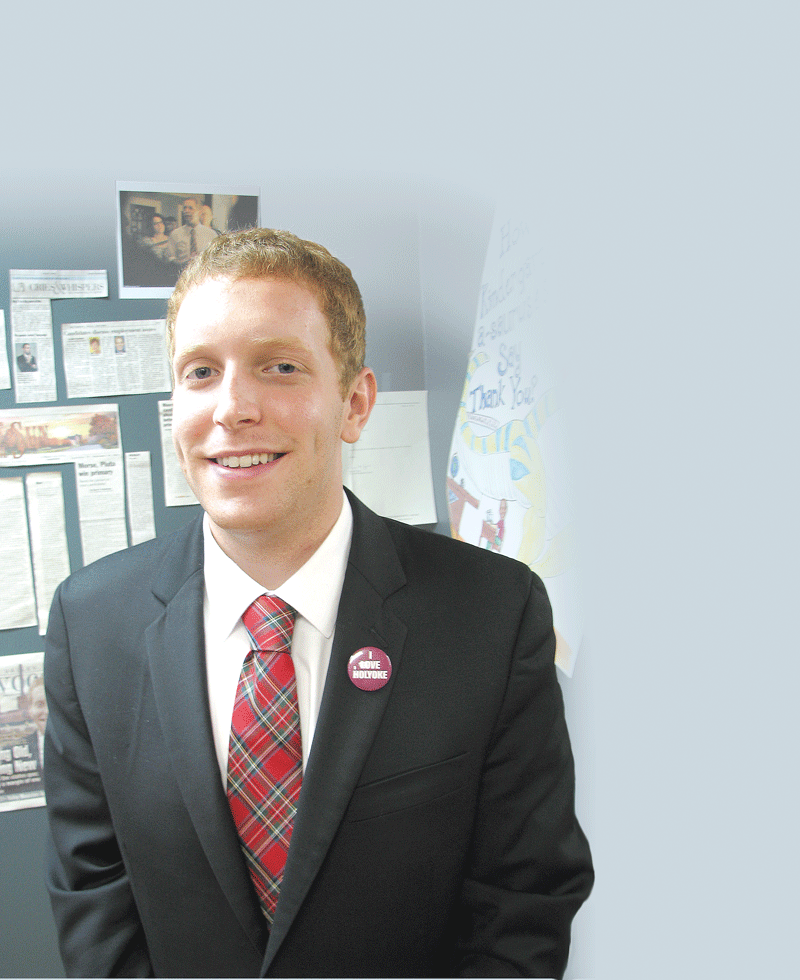
Holyoke Mayor-elect Alex Morse
Alex Morse graduated from Brown University last spring with a degree in Urban Studies.
This means that he knows a lot more than most people about what prompted the decline of every major Northeast city in the ’50s, ’60s, and ’70s, and also about what some of those same communities have done to reinvent themselves and bring people back downtown.
And at Brown, he had a working laboratory in the form of one of the more intriguing urban comebacks, albeit one that is still very much a work in progress. In Providence, city officials, led by flamboyant and controversial mayor Vincent (Buddy) Cianci, literally moved a river, among other initiatives, in their efforts to reinvigorate a moribund central business district and make their community a destination.
Providence, its downtown, and its public school system became the subjects of many of Morse’s classroom projects in Urban Studies, but his hometown of Holyoke also figured prominently in his coursework; indeed, the recent Hope 6 project in the city’s Churchill neighborhood became the subject of one assignment, and his experiences growing up in a declining urban core gave him a unique perspective for the classroom — in the many forms it took.
“Unlike my classmates in Urban Studies and Political Science, I actually came from a struggling urban community, and could use my perspective from growing up here and going to public schools,” he explained. “A lot of the kids at Brown had gone to private schools and didn’t have the experience that I had; I thought that what I brought to the table was much more relevant than what my classmates had to offer. And at the same time, I could take what I learned at Brown and bring it back to Holyoke.”
And it was while working toward his degree — probably early in his junior year, by his estimation — that Morse boldly decided that he would like to continue his education in urban studies in Holyoke City Hall, specifically the spacious ground-floor mayor’s office.
It was with extreme confidence that Morse entered the race nearly a year ago, and it was this character trait, coupled with a solid game plan, a message of hope, and a positive campaign tone, captured in his lapel pin bearing the words ‘I Love Holyoke,’ that propelled him to victory over incumbent Elaine Pluta on Nov. 1.
In a wide-ranging interview with BusinessWest a few weeks before his inauguration, Morse, whose campaign exploits have made news well outside the 413 area code — at 22, he’s the second-youngest mayor in the state’s history, and he’s already been a guest at the White House — talked at length about his road to the corner office and what he plans to do when he officially takes office.
He said that, while his business card and door plaque will say ‘mayor,’ he considers himself, first and foremost, to be the city’s “chief marketing officer.”
Indeed, he told BusinessWest, while Holyoke has suffered (and continues to suffer) from many of the ailments facing Northeast cities — from high concentrations of poverty in the urban core to a struggling public school system —perhaps its biggest problem is perception and the fact that no one is telling the city’s story, or at least to the right people.
And he believes that, from the perspective of a marketer, or salesperson, he has a quality product to sell.
“Holyoke is a great city, and we’re at a great time,” he explained. “Things are really falling into place in a really great way for our city. And I’m prepared to be Holyoke’s biggest salesperson and spokesperson as mayor, and I think that’s what Holyoke needs, someone willing to stand up and promote our assets.”
Beyond marketing, Morse says his primary assignment is to help make sure that Holyoke takes full advantage of what he called “its moment.”
Elaborating, he said pieces of the recovery puzzle — an emerging creative economy, the possible return of rail service, investments in downtown, the Canal Walk, a growing reputation as a ‘green’ community, the Victory Theatre project, and especially the high-performance computing center and the attention it is generating — are coming together, and Holyoke must seize its opportunity to do something special.
“This is the moment; we have a window of opportunity over the next two years to take advantage of this incredible moment,” he said. “It comes down to what we do with that moment, and this is why I ran for mayor. We can either stay the same and cling to the status quo, or we can embrace the future and do things differently.”
News Flash
One of Morse’s biggest challenges since election night has been handling all the media requests.
They’ve come from far and wide, including the Boston Globe, the Christian Science Monitor (which made him one of its ‘30 under 30’ subjects), New England Cable News, MSNBC, CommonWealth magazine, and the Brown University alumni magazine, among others.
He doesn’t say ‘yes’ to everyone — he’s spending most of his time on transition issues — but there haven’t been many ‘nos’ to date. That’s because he views such press encounters as opportunities — not for him, necessarily, but for Holyoke. He endeavors to take the focus of questioners from himself to the city, and often, the interviews take place while he’s offering a tour of the community to someone who has never seen it or knows little about it (he took the Globe on one just before meeting with BusinessWest).
And he can already see some tangible results from all that press.

The high-performance computing center is one of many projects that Morse believes has “put all eyes on Holyoke.”
Thanks to all that attention from the Fourth Estate before and after the election, many in the region know at least some of the Alex Morse story — that he’s young, openly gay, has had dinner at the White House (he said the invitation just appeared in the mail one day), and isn’t a supporter of a casino as an economic-development strategy. Those who have read a little more thoroughly know that he grew up in the city, attended Peck Middle School and Holyoke High School, where he was salutatorian, and was accepted at the only college he applied to — Brown.
They might also know by now that Morse’s parents have worked mostly blue-collar jobs — his father with Carando (he now has a manager’s position there) and his mother with a day-care facility she ran out of the family home — and that he was the first one in his family to earn a college degree.
He told BusinessWest that his upbringing has provided him a unique perspective on one of the main challenges facing his city and most others like it: narrowing the income gap between the poor and the wealthy, and bolstering the middle class.
“We need people with disposable income in downtown Holyoke,” he explained. “It’s not sustainable to have concentrated poverty in our downtown.”
What most have come to learn about Morse is that running for mayor certainly wasn’t anything spontaneous. Rather, it was a well-thought-out plan, a common-sense career path chosen because of his affection for his hometown, knowledge of urban challenges and models for revitalization, and a desire to bring real change to a city that has long been the butt of jokes.
“The last two years of my life have been pretty much consumed by the campaign,” he explained. “It’s something I’ve thought about for about four years. It didn’t matter exactly who I was running against; I could have been running against Elaine Pluta, I could have been running against another long-term city councilor — there was nothing personal about it, it was just something I wanted to do.”
Morse said his campaign strategy was fairly straightforward, and involved meeting as many residents and business owners as possible, framing everything in the positive — “I focused on my ideas and my plans, and people respected that” — and, in a nutshell, “getting people excited about Holyoke again.”
To say that he succeeded with all that would be an understatement. He won the endorsement of the Republican, a paper with a long and deep record of supporting incumbents, and was swept into office by a 53-47 margin.
And while some have suggested that the election results represent a vote against Pluta, a longtime city councilor elected mayor two years ago, and/or a vote against casinos, Morse certainly doesn’t see it that way.
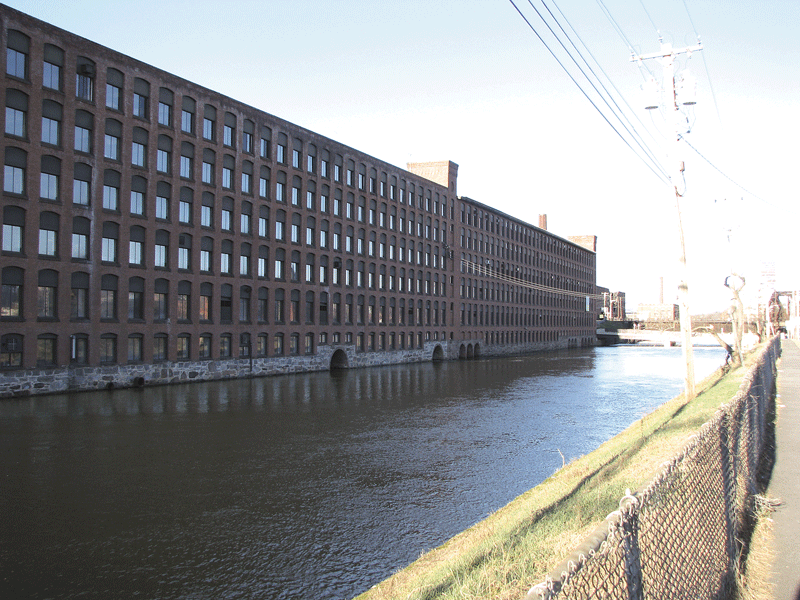
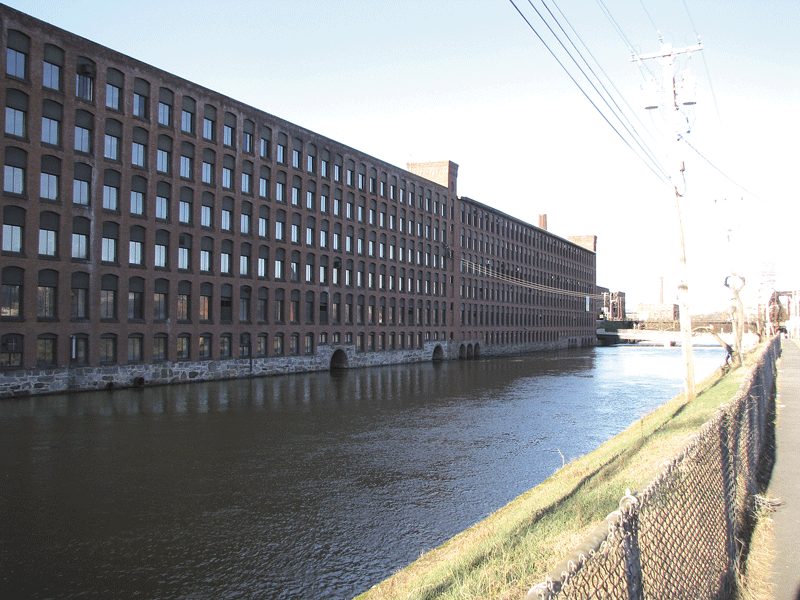
Morse will soon become a resident of Open Square, seen here from just across the canal, in a move he equates to putting his money where his mouth is.
A Moveable Feast
It’s called BYOR.
That’s short for Bring Your Own Restaurant, a rather unique grassroots initiative started by a group of city residents more than a year ago in response to a perceived lack of dining options in the downtown area.
Participants bring tables, chairs, and potluck dishes to designated spots — empty lots near the canals and the parking area of a closed gas station have worked — that in essence become those nights’ restaurant, said Morse, adding that he’s taken part in several of these get-togethers. He’s hoping, of course, that someday soon this BYOR tradition will end out of necessity — or lack thereof, in this case. And bringing that day closer to reality is just one of many formal and informal items on his list of goals and objectives.
At the top of that list is rebranding the city, or changing the long-held perceptions about it. He’s noticing incremental improvement in the way people talk about his community — he mentioned he’s heard people saying they should move to the city, or move back to it, as the case may be — but maintains that it still has a long way to go.
As chief marketing officer, Morse said he’ll essentially go anywhere and do anything to put Holyoke front and center and sell attributes ranging from cheap, ‘green’ energy to housing prices well below those in surrounding cities.
“We have a great foundation here — it’s not as if we have to start over,” he told BusinessWest. “We just have to restore it to what it once was and beyond that. During the campaign, I talked about bringing us from the Paper City to the Digital City, and I’m going to be the one to lead us into the future — and a better future.”
Rebranding is something he believes Providence did quite well, and its success in that realm is just one component of a broad revitalization strategy he would like to make one of many models Holyoke can borrow from in the years ahead.
Another was the partnerships forged with the business community, he went on, as well as the desire to take bold and dramatic steps, such as reclaiming the Providence River, once spanned by the ‘world’s widest bridge’ (1.5 miles) as recorded in the Guinness Book of World Records, and making it a true asset through initiatives such as the famed WaterFire installation.
“There’s a lot of good things happening in Providence in terms of what they’ve done to rebrand themselves,” he said. “Some of the reflections and experiences I’ve had in Providence will help inform what I want to do in Holyoke in terms of perception and the way Providence has used the artists’ community in the downtown, restaurants, how they’ve taken advantage of the river with WaterFire, and how they’re bringing people into downtown.
“They had some very concerted efforts on the part of the municipal government, and what they did well was partner with business,” he continued. “There were a lot of public-private partnerships to get investment back in Providence.”
Morse said he and his classmates at Brown studied a number of communities, including Baltimore, Detroit, Boston, and others, and that there are common denominators and lessons to be taken from many models for recovery.
“Holyoke is unique in many senses and special in many senses, but at the same time, we have followed the same trajectory as many Northeast and Midwestern cities in terms of deindustrialization and the moving of factories to the south and then overseas; Holyoke is just a part of that story,” he explained.
“Any urban community struggles with issues like public education; it’s how we respond to them that’s really going to make a difference,” he continued. “What I’m interested in as mayor is looking at what other mayors are doing, looking at what other school systems are doing, looking at best practices, and learning from what’s worked and what hasn’t worked.”
Live and Learn
Morse said much of his administration’s focus and energy will be directed toward the downtown area, where efforts will be concentrated on seizing momentum from the computing center, while also working on the many aspects involved with getting more people living in that area.
And the new mayor won’t just be talking about it — he’ll be doing it.
Indeed, he will be the first residential tenant in Open Square, the massive former mill complex now home to dozens of businesses, a café, a performing-arts group, and more, and is awaiting final touches on the space before moving in later this month.
“I made a statement that I wanted to move downtown to help change the perception there,” he told BusinessWest. “If I show a business owner our downtown or Open Square, or talk to young families about moving here, I can say, ‘hey, the mayor lives right down the street; it must be safe.’
“It’s a symbolic gesture, but I’m putting my money where my mouth is,” he continued. “Anything we can do to promote downtown and bring more people and more business there … I think that will help us.”
Overall, Morse says he sees a good deal of momentum downtown, and it comes in a number of forms — from the attendance at the regular BYOR events to growing interest in commercial property in that area, to a growing sense of community, coupled with changing demographics, that he believes are a very positive sign.
“There’s a community today that didn’t exist 10 years ago in Holyoke — a progressive, young, arts-friendly constituency here in downtown,” he explained. “There’s an interest in downtown moreso than I’ve ever seen before, and that’s very refreshing to me, someone who was born and raised here; it’s great to see interest from people who weren’t born here but want to move here and have things happen downtown.”
From his studies of other cities, Morse said he fully understands the chicken-and-egg scenario when it comes to growing the population in the urban core; professionals, empty nesters, and others with disposable income need good reasons to move to a downtown — safe streets, attractive housing, and nightlife are all high on the list — but many of those things, and especially the nightlife part, won’t happen unless there is already a critical mass of urban dwellers capable of supporting businesses.
“If we want to support a thriving small-business community — restaurants, cafés, and nightclubs — we need to have people with money in their pockets,” he explained. “And that means we have to convince people to move to Holyoke, bring their business here, and be a part of this.
“A lot of young professionals and even single people, men and women, want to live in urban communities; I’m convinced of that,” he continued. “Over the past 50 years, there’s been a lot of disinvestment in cities, as if cities were bad, but now, attitudes are changing, and we need to take advantage of that.”
Forward Thinking
When asked what someone ambitious enough to run for mayor of a major city while still a college student might do next for a career challenge, Morse smiled broadly and paused for a minute.
While he didn’t speculate on what else he might do, he mentioned Thomas Menino, the longest-serving mayor in Boston’s history (18 years) and hinted that this is a record of service he may try to emulate.
“Holyoke needs consistent leadership over the next decade,” he said, hinting that he plans to be around at least that long — if the voters are so inclined.
For now, though, he’s focused on getting on with his work as chief marketing officer and with enabling Holyoke to take advantage of that window of opportunity he mentioned.
He said he’s never seen people this excited about the city, and that he considers it his job to capture that excitement and have it translate it into tangible, positive change. He acknowledged that he certainly can’t change the citiy’s fortunes in two years, but he can certainly get the ball rolling.
And if he does, he might be back in the White House soon.
George O’Brien can be reached at [email protected]
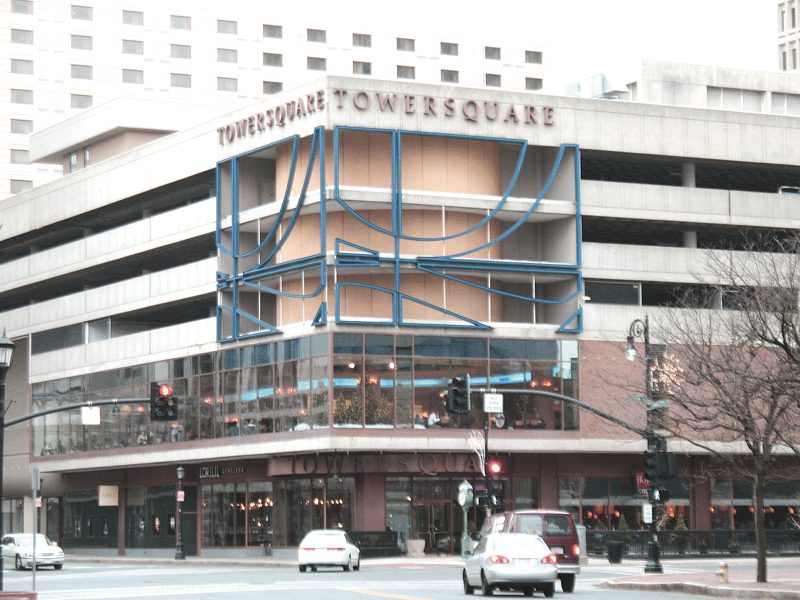
Cambridge College to Move to Tower Square This Spring

First-floor space in Tower Square will be built out for Cambridge College this winter for an early-spring opening.
“We’ve been in conversations with the college because our site was so badly in need of an upgrade, and we launched an extensive search to find a location where we could put it,” said Forte, director of Cambridge College’s Springfield Regional Center, currently located on Cottage Street.
“They narrowed it down, and Tower Square was the number-one option for us,” she continued. “So we’re updating to a state-of-the-art center to better serve our students, and also to serve the population of downtown, the people working downtown. We want to help the city while we help our students.”
By that, Forte intends for the school to become yet another cog in the intriguing downtown revitalization efforts involving education, including the Springfield School Department’s move to the former federal building on Main Street and the soon-to-open UMass design center in Court Square.
The Main Street location makes sense for Cambridge College as well, with its easy access from I-91, Forte explained.
“We have approximately 40% to 45% of our students coming from Connecticut, Springfield, and north of Springfield, so there’s a lot of travel along the 91 corridor,” she told BusinessWest. “Tower Square is right beside that, so it makes sense to make it even easier for those commuters. It also gives students a lot more exposure to downtown restaurants, dry cleaners, all sorts of services like that.”
Spring Forward
Construction will soon begin on the new facility, to be located on the building’s first floor, with the college expecting to move in sometime this spring.
Deborah Jackson, president of the Cambridge, Mass.-based school, which boasts a network of seven regional centers across the U.S., agreed that the Tower Square location makes the Springfield facility more accessible.
“Cambridge College is delighted to partner with the city of Springfield and Tower Square to offer a high-quality education in what will be a state-of-the-art facility,” she said at a recent press conference. “In this new facility, we look forward to continuing our 20-year tradition of offering exceptional undergraduate and graduate education to working adults in Western Mass. and Connecticut.”
Springfield Mayor Domenic Sarno echoed those sentiments. “I’m elated that my administration has worked hand in hand with President Jackson and Cambridge College to make this happen,” he said at the briefing. “Tower Square is a great location for the college — it fits right into our vision for downtown toward a more eclectic market rate and higher education focus.”
Fred Christensen, senior property manager of Tower Square, said the addition of Cambridge “will have have a tremendous impact not only on Tower Square, but also on downtown Springfield as a whole. We look forward to accommodating their students at their new location.”
The college will occupy 18,000 square feet of space near Lorilil Jewelers, which was at one time occupied by the U.S. Factory Outlets store. More than 300 faculty, staff, and students will make the move, which should boost business at eateries and retail shops in and around Tower Square.
Cambridge College, a private, nonprofit school which targets its programs at working adults, has had a regional center in Western Mass. since 1977, when it was established in Northampton. The center moved to Cottage Street in Springfield in 1991, and later to a larger building on that same street.
Overdue Move
Forte said the Springfield Regional Center is the oldest of the satellite campuses and in need of an update. “We currently have some issues with space, but we’re going from eight classrooms to 14 classrooms.”
The regional center offers graduate-degree programs in education, management, and counseling and psychology, many of which lead to licensure and certification. Undergraduate degrees are also offered in human services, management, and multidisciplinary studies.
“We’ve been in Springfield since 1991, and we want to continue to elevate the city and all of its people,” Forte said of the high-profile move to Tower Square. “Because it’s right on the first floor, we’re going to be really easy to find and be very accessible. We’re hoping to be done by late March or April; that’s our hope, but it all depends on construction.”
Joseph Bednar can be reached at [email protected]
Thing5 Move Downtown Spurs Momentum in Springfield
The recent announcement that Thing5 LLC will be creating a new call center in One Financial Plaza, thus bringing 500 new jobs to Springfield, is a positive story for the city and the region — on a number of levels.
Let’s start with the jobs. That’s priority No. 1 in the Greater Springfield area, and it has been for many years now. Some might look at this and say, ‘it’s only call-center jobs,’ or words to that effect, but these opportunities come on many levels, from entry positions to management slots, and, in many cases, they can be handled by those who do not possess a college education. The region needs those high-quality jobs (call them white-collar, if you like), but it also needs employment opportunities like these, especially in such large volume.
Beyond the employment factor, there are many other aspects to this story, all of them positive. First, this company started here, in the Technology Park at Springfield Technical Community College — which was created to spur this kind of tech-related enterprise — and thus provides solid evidence that we can incubate ventures and grow them into major employers.
Also, this company stayed here. Indeed, when it reached that proverbial next level, there were, quite obviously, opportunities to take Thing5 almost anywhere — because there isn’t a city or town in the Commonwealth or well beyond it that wouldn’t fight, and fight hard, for 500 jobs. But management chose to stay in the City of Homes, largely because of the lower cost of living, available workforce, access, quality of life, and affordable commercial real estate.
This shows that our various assets are tangible — and sellable.
But perhaps the biggest benefit will come in the form of greater momentum downtown. First, this move gives a substantial boost to the office tower known as One Financial Plaza, which has had several dark floors for many years, but has been staging something of a comeback recently.
Beyond that, though, the 500 new employees working downtown will provide a larger critical mass of people needed to spur additional investments, be they in support businesses, hospitality-related ventures such as restaurants and clubs, or badly needed retail.
And there is another component — the possibility that some of these employees may soon be working and living downtown, thanks to a program that will offer reduced lease rates to Thing5 employees at the nearby Morgan Square apartments, managed by the same company (Samuel D. Plotkin) that also manages One Financial Plaza. This additional residential piece could further stimulate investment in the central business district and be a key contributor to the kind of vibrancy that other Northeast cities have enjoyed.
As we said, there are many angles to this positive story for Springfield and its downtown. The headlines were all about the jobs coming to the city — and that’s an important aspect of this — but there are many other elements that bode well for the City of Homes.
Send photos with a caption and contact information to: ‘Picture This’ c/o BusinessWest Magazine, 1441 Main Street, Springfield, MA 01103 or to [email protected]
Old Masters to Monet

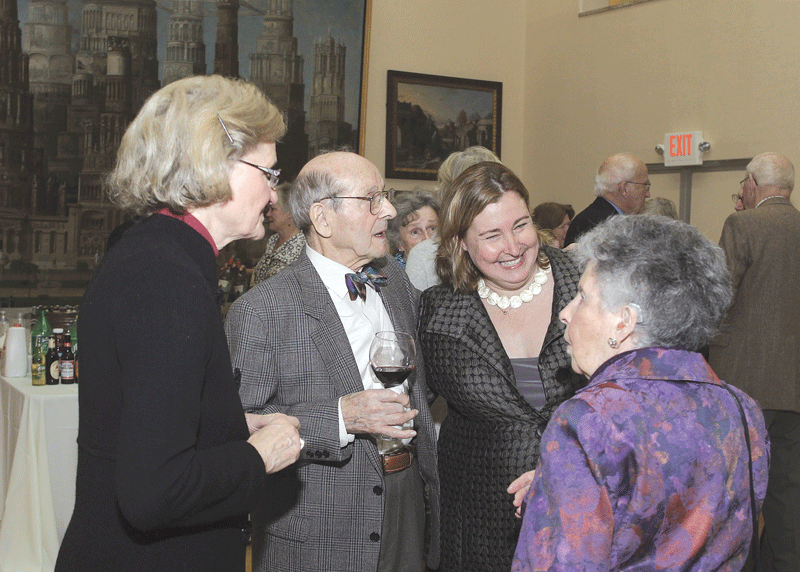
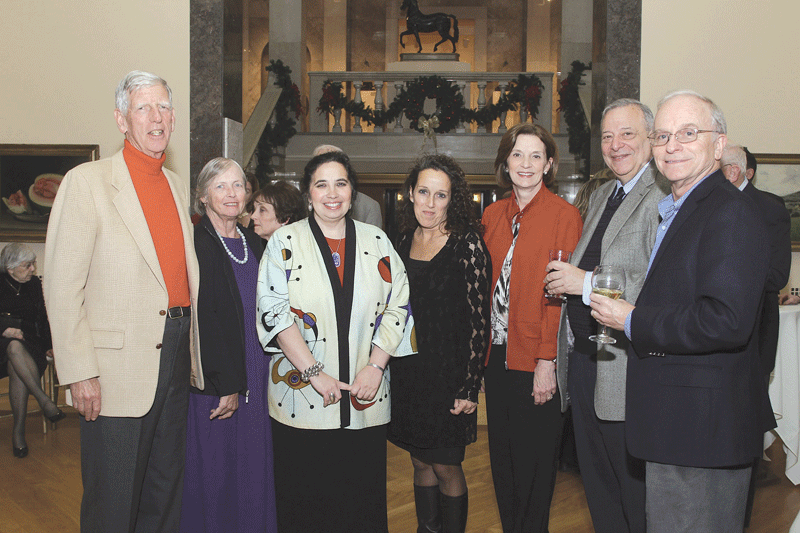
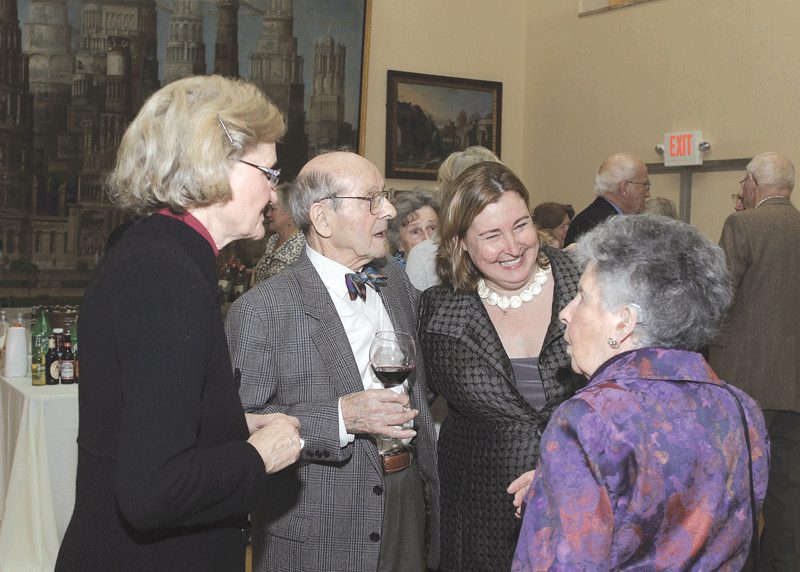
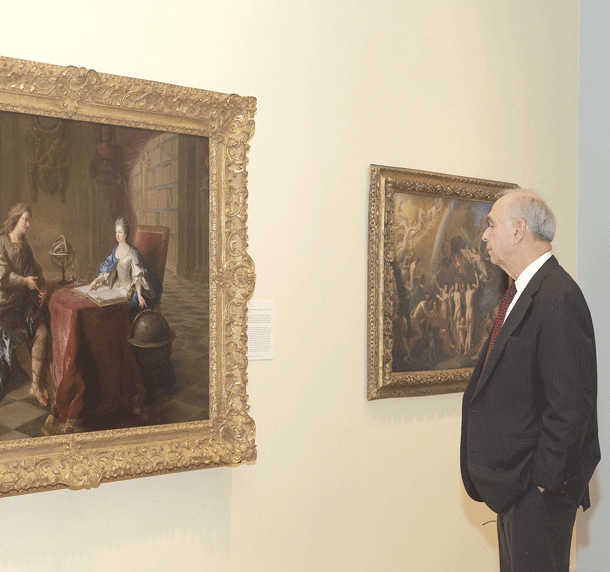 More than 150 guests attended the D’Amour Museum of Fine Arts’ preview reception for the exhibition “Old Masters to Monet: Three Centuries of French Painting” from the Wadsworth Atheneum. Guests included exhibition sponsors and major donors to the Springfield Museums. The exhibition of 50 masterpieces will be on view through April 29. “Old Masters to Monet” was organized by the Wadsworth Atheneum Museum of Art in Hartford. Presentation of the exhibition in Springfield is funded in part by the Michele and Donald D’Amour Fund, established in 2008 to bring world-class art exhibitions to the D’Amour Museum of Fine Arts. From top: from left, Patricia Hambley, Mark Hambley, and Joanna Rosenthal: from left, Joanna Rosenthal, David Starr; Holly Smith-Bové, president of the Springfield Museums; and Peggy Starr; from left, Lyman Wood; Merrie Wood; Heather Haskell, director of the Springfield Art Museums; Julia Courtney, curator of art, Springfield Museums; Michele D’Amour; Dr. Eric Zafran, curator of European art at the Wadsworth Atheneum; and Donald D’Amour; Dr. Paul Friedmann looks over some of the paintings.
Food Fest West
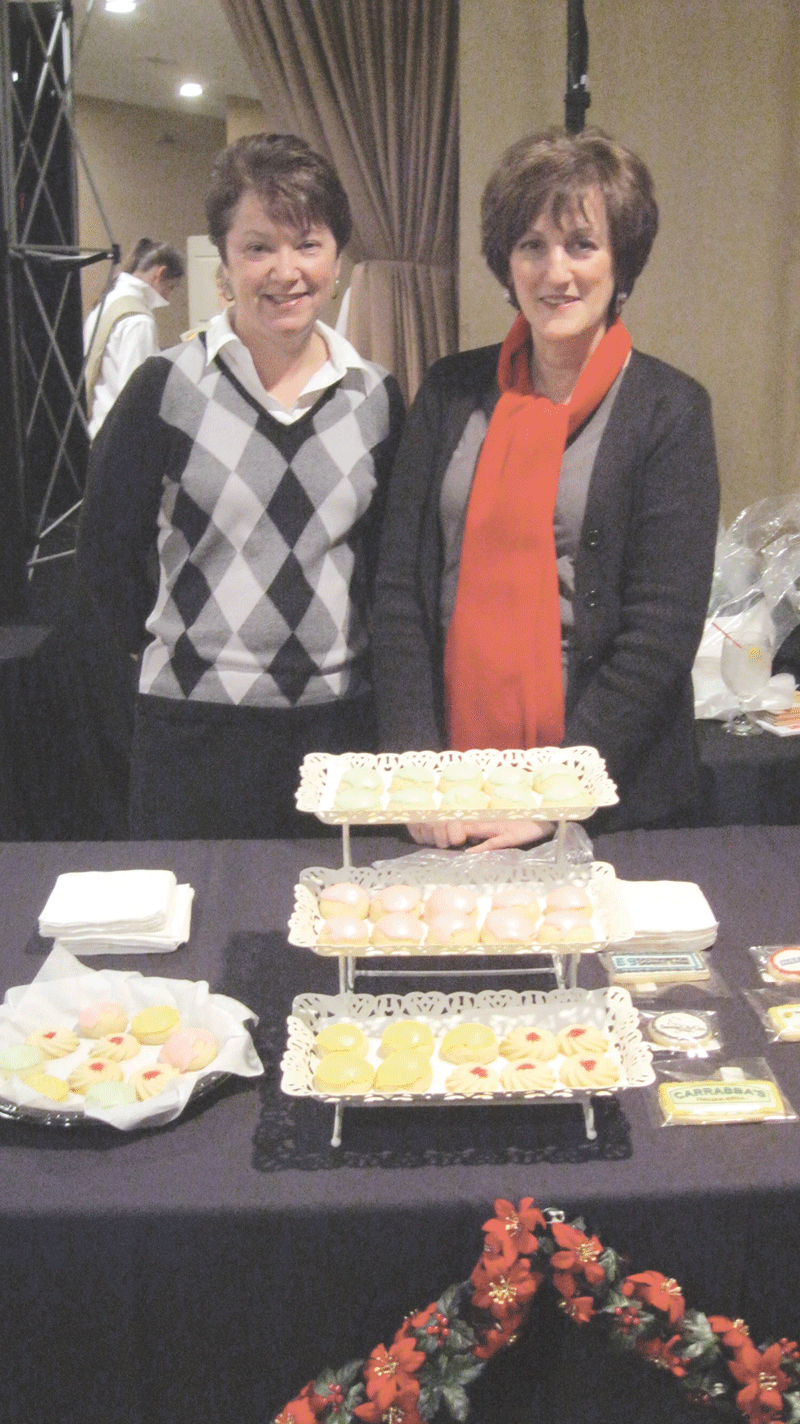
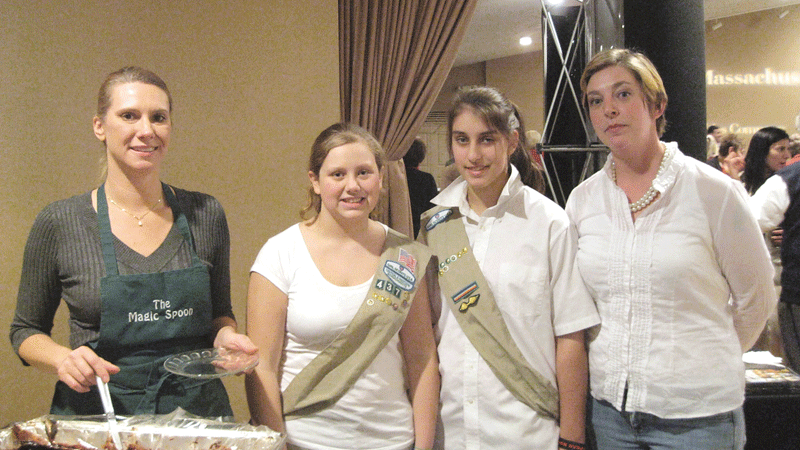
The West of the River Chamber of Commerce (WRC) staged its Fifth Annual Food Fest West on Dec. 8 at Crestview Country Club in Agawam. Sponsored by Western Massachusetts Electric Co., First Niagara Bank, and OMG Inc., the event featured the foods of area restaurants including Carrabba’s Italian Grill, Casa di Lisa, Chez Josef, Crestview Country Club, Lower Pioneer Valley Educational Collaborative, Magic Spoon, Mama Iguana’s, Nina’s Cookies, Nora’s, O’Connor’s Pub & Grille, Partners Restaurant, Tekoa Country Club, and Tokyo Asian Cuisine. Restaurants competed to win awards and prizes for best food and best presentation during the course of the evening. A chef auction was also be held, where attendees could bid on meals provided by their favorite chefs. Proceeds raised by Food Fest West will go toward the Partnership for Education and the WRC Educational Fund, which provides grants to businesses for on-the-job training and continuing educational needs. Top, the team from the Magic Spoon. Bottom, some of the desserts that tempted attendees.
Award-winning Efforts

 At Freedom Credit Union’s recent annual dinner, Ana Frasco, mortgage processor, top, received the President’s Award from Barry Crosby, Freedom president and CEO. The award recognizes her commitment to professional excellence. She was nominated by a colleague who recognized her exemplary attitude in her service to members and fellow employees, and her contributions to the success of the credit union. In addition, Julia Beaudoin, bottom, Freedom’s director of Human Resources, received a special Tribute Award from Crosby for her leadership actions taken during the tornado on June 1, 2011, ensuring the safety of employees and members at the Freedom branch on Main Street in Springfield.
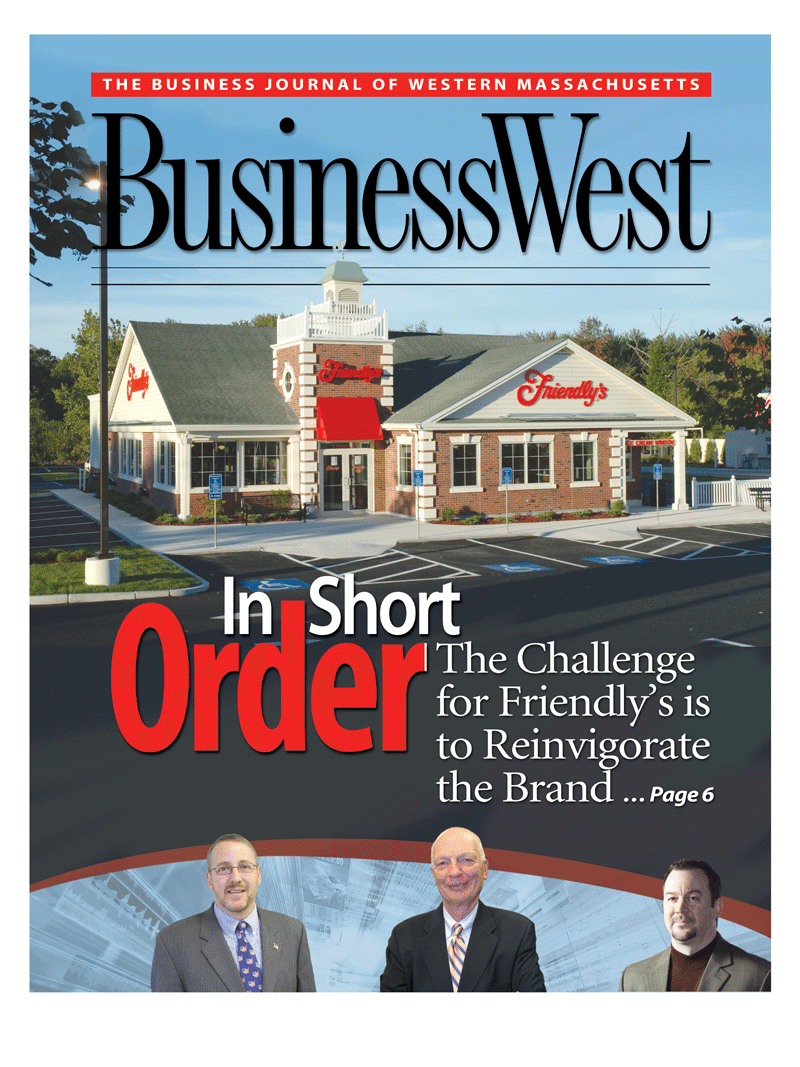
The Challenge for Friendly’s is to Reinvigorate the Brand
 Harsha Agadi, Friendly’s chairman and CEO, has presided over several brand-reclamation projects over a 25-year career in the restaurant industry, most notably the recovery at Church’s Chicken, and he’s confident he can steer the Wilbraham-based chain to a similar comeback. He said the recent Chapter 11 bankruptcy filing is a regrettable but necessary part of that process, which includes a multifaceted plan to reinvigorate the brand by giving it a new look, feel, and attitude.
Were it not for the Boston Red Sox, Friendly Ice Cream Corp. would easily be the most criticized, scrutinized, analyzed, and perhaps overanalyzed institution in New England this fall.
Since the Wilbraham-based company filed for Chapter 11 bankruptcy protection on Oct. 5, there has been seemingly endless speculation about went wrong for this company (as with the local 9), and a few Canadian forests felled to provide the newsprint for the voluminous speculation about what could — and should — come next (again, just like with the team that plays on Yawkey Way).
Roughly a week after the filing, for example, the Boston Globe carried a piece with commentary from five restaurant-industry executives about what they believe the company might do to improve its chances for success post-bankruptcy. Ideas ranged from hiring a ‘cleanliness concierge’ as part of a focus on being family-friendly, to shelving the restaurants and putting Friendly’s ice cream counters in Panera Bread outlets, to moving the kitchen back to the front of the store as part of a ‘return to short-order cooking’ approach.
Chief Executive Harsha Agadi says he’s read much of the commentary, criticism, and thoughts on the future. And he agrees with some of it. He openly acknowledged that Friendly’s must improve its food, its service, and its looks, and there are plans in place to do all of that and more.
What he doesn’t agree with are any and all suggestions that, moving forward, Friendly’s will only be talked about glowingly in the past tense. He admitted to BusinessWest that, once a restaurant chain develops a reputation for being tired, slow, inattentive to changes in the marketplace, and inconsistent — and Friendly’s has earned all those adjectives, by most accounts — it is certainly difficult to change the course of public opinion.
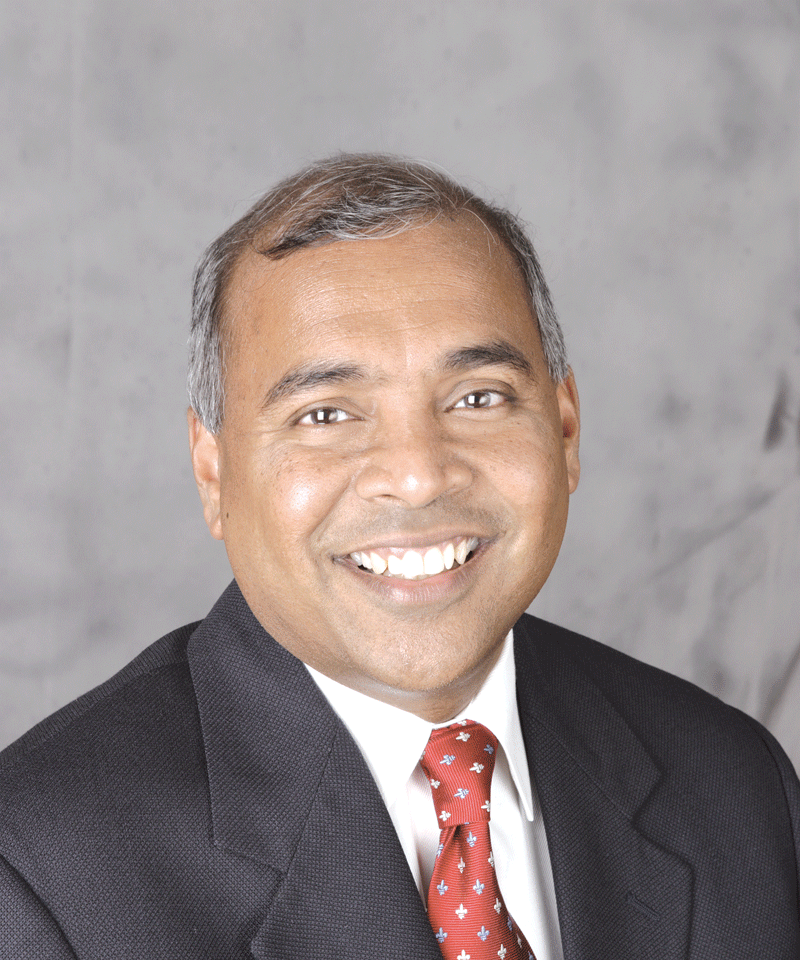
Harsha Agadi says the process of changing a restaurant chain’s reputation is not a simple thing, “but at the same time, it’s not terribly difficult, either.”
“When I got involved with Church’s in 2004, it had declining sales, hadn’t franchised anything in three years, and was closing more stores than it was opening,” he recalled. “From 2004 to 2009, we grew stores and sales every year, and we expanded into many different countries.”
Friendly’s can make a similar comeback, he said in a wide-ranging interview a few weeks after the bankruptcy filing, noting that the Chapter 11 procedure was a necessary step in that direction.
It will give the still-profitable company relief from a massive debt burden, and especially from leases signed during boom years for the commercial real-estate market that have severely hindered the company as it has sought to make investments in its operation.
The company won’t be starting over, Agardi stressed repeatedly, using the term ‘business as usual’ early and often, but rather building on its core strengths — especially an ice-cream business that has grown exponentially over the past several years (more on that later) — and, in many ways, updating and reinvigorating the Friendly’s brand.
For this issue, BusinessWest looks at how Agadi plans to go about that assignment and how, by next spring, if not much earlier, people will be talking about his company using much more positive tones.
Any Given Sundae
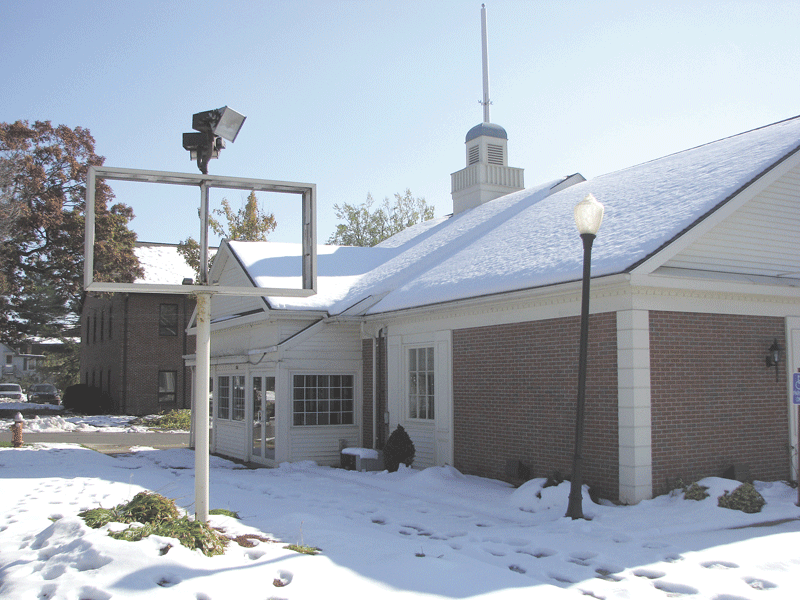
The Friendly’s on Route 20 in West Springfield was one of the casualties as the chain sought relief in Chapter 11 bankruptcy and the closure of several dozen locations.
In recent years, he went on, Chapter 11 has become an effective and increasingly popular relief mechanism for companies burdened with heavy debt, large court settlements, severe cash-flow issues, and combinations of the above.
And this has been especially true in the restaurant industry, he continued, due in large part to the high volumes of risk involved with establishments of any and all sizes.
“As a business lawyer, I’ve always thought that an investment in a restaurant or a chain was the riskiest investment you could make,” he explained. “For starters, tastes change; what’s hot today may not be hot tomorrow. There’s also high overhead — generally you have to lease the space, and there are often multiple employees — and a huge element of theft, of both money and product. And there’s also the spoilage factor; if you’re a seller of clothing, that product may eventually go out of style, but it doesn’t go bad and have to be thrown out if you don’t sell in three days.
“You have all of these problems conspiring against you as you’re trying to keep 12 balls in the air,” he continued, adding that these factors coupled with intense competition are responsible for the high mortality rate across the sector.
All that said, the Friendly’s filing, while certainly not surprising to most industry watchers, was met with large degrees of sadness and disappointment, Katz continued, noting that many in this region especially were dismayed that years of ownership changes, a revolving door at the top leadership rung, and apparent missteps or lack of proper response to changes within the restaurant industry would lead to this.
And like many in this area who can talk nostalgically about the Awful Awful (a Friendly’s milk shake so named because it was ‘awful big and awful good’) Katz had his own thoughts and theories on what happened to the company.
He mentioned everything from his belief that the Friendly’s name doesn’t resonate as well in other regions of the state or country as it does in Western Mass. — where it was founded by Curtis and Prestley Blake, and where that surname appears on many college buildings and other facilities — to a general deterioration in quality and consistency.
Perhaps the biggest factor, he believes, has been the larger, more convoluted menus in the restaurants and other indications that Friendly’s was (and is) trying to be too many things to too many people in an age of heightened specialization.
“It had morphed itself into a business that no longer knew what it was,” said Katz, echoing the sentiments of some of the analysts in the Boston Globe and other publications. “Friendly’s management may disagree, but I’ve talked to former employers and former managers, and my own personal opinion is that for a number of years you could go to Friendly’s and get a burger, a hot dog, and good fries; there were friendly people, good prices, and always great ice cream. You had a good time with your family, and it was a reasonable place to go. It’s all different now.”
Friendly Pursuasion
Agadi hears such comments, and while he agrees that some changes must be made, he bristles at the notion that Friendly’s has somehow lost its way.
“If we were drifting, how is that I’m still serving 1 million customers a week, 52 million people a year?” he asked rhetorically, adding that he believes that many elements of the company’s model still work. However, there is that proverbial but, or several of them, as the case may be.
“We need to improve our service dramatically, there’s no question in my mind,” he said. “Our number-one issue is speed, and we’re addressing that speed of service every day.”
Looking back, Agadi said it was series of factors that brought Friendly’s to this point, everything from the soaring cost of butter — a huge factor for a company that makes 16 million gallons of ice cream a year — to those aforementioned albatross-like leases, to an economy that has many still cutting back on non-essentials, which includes ice-cream cones and Jim Dandys.
“There’s been a massive — and that word is massive — escalation in commodities costs over the past two years,” he explained. “And that’s driven by butter pricing; it’s gone up 57% in the past two years, while milk has gone up 22%. And if my commodity costs go up 57%, I can’t go and charge my customer almost half more overnight and expect him to pay it.
“That cost essentially evaporated a lot of profitability, which caused many of these issues,” he continued. “The company is still profitable, contrary to what everyone in the media is saying, but these commodity prices are having a huge impact on us. The other thing is the economy itself; the unemployment rate is 9% or 10%, and it’s even greater than that because it doesn’t take into account the number of people who are working part-time that used to work full-time, or the people who have had their hours cut back, and all that affects restaurants.”
On the real-estate front, Agadi went on, the company has been able to get relief from some leases sold when market conditions where much different — generally from landlords concluding that a tenant paying less rent is better than no tenant at all — but not in enough instances to make a real difference.
“When you’re locked into stores that don’t make money and have these high rents,” he said, “all you’re doing is bleeding.”
Considering all these factors, he said the company had little recourse but to take relief in the form of Chapter 11, and to take other steps as well, including the closing of 63 stores, a few of them in Western Mass. What the filing does, in essence, is provide the company with time and breathing room, and the ability to renegotiate more of those leases, he went on, adding that the company intends to take full advantage of this opportunity and eventually emerge a stronger, more vibrant chain.
And most initiatives have been in place for some time, he said, noting everything from an aggressive marketing campaign for the company’s so-called ‘High 5’ menu (items cost $5) to a move back to fresh, not frozen hamburgers (“I wish we had 10 years ago”), to plans for remodeling and updating the chain’s restaurants.
Meanwhile, the price of butter has actually started to come down.
“Many good things are starting to happen,” Agadi said, adding that the code word being used internally is ‘the American,’ the name given to some new-look, new-attitude stores that will start taking shape over the next several months.
“We’re making changes to the product,” he said, referring specifically to food, but also a broad spectrum of measurables. “And those changes, in many respects, are going back to who we are and how we did things; we’re going back to our classical roots.”
Just Desserts
And with that, he returned to the subject of Friendly’s prospects for altering public opinion about its products and services, and the skepticism voiced by many analysts about whether it can actually do that.
“It’s not a simple thing to change your reputation,” Agadi told BusinessWest, “but at the same time, it’s not terribly difficult, either. You need a plan, you need capital, which we have access to through our partner, Sun Capital, and you need to test a few stores and then start replicating the entire chain with the new look — very aggressively and rapidly.”
And by that, he meant both the menu, featuring the High 5 component, and the facilities themselves, a few of which will soon sport a new, contemporary look that will be “brighter and fresher,” and immediately send a message that this is not the same restaurant it was even a few months ago.
“When you walk in, there has to be a marked change,” he explained, “so people will say, ‘wow, that’s a different-looking Friendly’s.’”
The new look has to be backed up by better service and food, he went on, adding that there is already some hard data confirming improvement in at least that first department.
“Our speed of service and friendliness have improved dramatically over the past six months,” he said. “We track this religiously, every day, every store — my head of operations gets a report, we all look at the results and see how our stores are doing in service, hospitality, friendliness, accuracy of order, and more.
“And this is measured not by us, but by outside customers who go to the Applebees, the Dennys, the Ruby Tuesdays, and other chains,” he continued. “We’re starting to see a measurable change in our service level.”
By next spring, the new-look Friendly’s will make its debut in the Greater Springfield area, he said, adding that a few area locations will be made over, and the movement will then spread to other regions. Beyond the look, there will be new, slimmer menus with more healthy choices, changes in staff uniforms, and remodeled fountain areas that will pay homage to the chain’s ice-cream lineage.
“We want to bring back heritage items,” he said, “in a contemporary atmosphere.”
At the same time, the company will continue to build on what Agadi calls its “other business” — ice-cream items sold in the restaurants and now more than 7,000 supermarkets (up from 4,000 just a few years ago), including the recently added Wal-Mart. The surge has brought Friendly’s to 95% capacity at its Wilbram manufacturing facility and a search for alternatives to make ice cream — a good problem to have, actually.
“We’ve been around for 76 years and just set a record — 165,000 cases of 48-ounce cartons,” he said. “That’s an example of what I mean by business as usual.”
As for the far-more-problematic and image-impaired restaurant side of the business, Agadi is confident that he can continue a quarter-century-long track record of success with brand building and, in many cases, revitalization.
“I’ve had 100% success with moving the brand in the right direction, and I believe that, in this case, we can, and will, do the same,” he said, adding that, three years out, he expects to be selling ice cream in 10,000 supermarkets and have the restaurant chain back up to 500 stores, with maybe half of those redone into the ‘American’ model, and movement into markets in Canada and Mexico.
Those are ambitious goals, but he’s done it with Church’s Chicken and other chains he’s been involved with.
Stepping to the Plate
Red Sox fans will have to wait until at least next February, and probably next April or even midsummer, to gauge how the team is faring with its bounce-back initiative.
Agadi says the transformation and rebranding of his company is already well underway, and by about the time the Grapefruit League swings into high gear, people in this area will be able to see and experience a change for the better.
Chapter 11 bankruptcy is a regrettable part of the process, he told BusinessWest, but it’s also a big factor in this company’s efforts to enable people to stop using the past tense when they refer to the Friendly’s brand in a positive light.
George O’Brien can be reached at [email protected]
Springfield’s Rebuilding Effort Comes at Intriguing Time for Urban Centers
Dave Dixon says there is a surge in interest in urban living, which presents huge opportunities for cities like Springfield.
Dave Dixon was understandably wary about incorporating the phrase ‘silver lining’ into any statements he made concerning the June 1 tornado and its aftermath.
But he nonetheless put it to use as he talked about the efforts to rebuild Springfield and, more specifically, the work to revitalize the downtown and South End sections of the city. And that silver lining is all about timing and emerging trends in urban centers, he explained.
“If this tornado had struck 10 years earlier, let’s say, I think this would be a much grimmer task, because we’d be rebuilding in the face of continuing disinvestment in the city,” said Dixon.
He’s the principal in charge of planning and urban design at Goody Clancy, the Boston-based architecture, planning, and preservation firm now co-leading the efforts to blueprint a rebuilding plan for Springfield with New Orleans-based Concordia (see related story, page 62).
Elaborating, Dixon said that, over the past several years, there has been a discernable upswing in the popularity of urban living. Spawned by a number of factors, including a desire among aging Baby Boomers to live in places where they can walk rather than drive to most required destinations, the trend has helped transform a number of urban centers, many with the same social and economic challenges as Springfield’s central business district and South End.
“Ten years ago, the world didn’t look like this,” said Dixon, who has seen or helped orchestrate revivals in cities ranging from Baltimore to New Orleans to Wichita, Kan. “This disaster in Springfield, like the one in New Orleans, happened at a time when cities are changing and have opportunities that they haven’t had for 40 or 50 years.
“What has gone on, particularly over the past decade, has been a profound transition in demographics, in the way real-estate markets work, in the values that the folks who bring investment with them because they attract employers, have all undergone,” he continued, adding that there are more single individuals or couples (as opposed to families) than was the case a decade ago, and income levels for such people are higher. “There are simply more people that could decide they want to live in an urban environment. They may have wanted to in the past, but it didn’t work for them. And now they’re looking to make it work.”
Indeed, the real silver lining for Springfield, said Dixon, is an apparent, and growing, pent-up demand for downtown mailing addresses. To illustrate, he took out a piece of paper and sketched a simple chart showing the rising popularity of urban living.
The line moves upward at a steady clip, he explained while drawing, but the recession of the past several years has restricted the angle of ascent because, among other factors, homeowners looking to relocate to urban centers are still having trouble selling their homes, and market-rate housing builders are still being challenged in their efforts to finance such endeavors.
Like a dam holding back water, these factors are effectively bottling up demand, he continued, adding that, when conditions improve and that figurative dam breaks, cities properly positioned to capitalize on the trend could benefit significantly.
And in many ways, the tornado has helped put Springfield in such a position, he went on, acknowledging that the city still faces a number of challenges in this regard — including crime, the perception of same, and a concentration of subsidized-housing projects in both the downtown and South End — and that progress certainly won’t occur overnight.
But the city has many of the key ingredients to join the list of other success stories, he said, listing a decent “walkability index” — more on that later — a solid existing inventory of buildings that can be converted into market-rate housing, and, thanks to the tornado, some vacant acreage on which to build such housing, as well as businesses to sustain an urban population.
Dixon acknowledged that many are skeptical that such urban living could help transform Springfield’s downtown area, but he’s seen enough evidence of the trend in other parts of the country to believe it could certainly happen here.
Walking the Walk
As he talked with BusinessWest, Ron Mallis, a senior planner with Goody Clancy, was using his iPhone to see how well several downtown Springfield addresses fared on a Web site called walkscore.com. The site essentially assesses a location based on one’s ability to walk to amenities ranging from coffee shops to entertainment venues to banks, and gives it a score from 1 to 100, with the latter being the best.
The DevelopSpringfield office at 1182 Main St. earned an 89, while the Red Rose restaurant just a few blocks south notched an 82. Those statistics are not to be discounted, said Mallis, because many constituencies, from young artists to aging Boomers to business owners, are looking at such numbers with greater interest.
“People are more health-conscious than they were years ago,” he explained. “People have woken up to the fact that walking and health have a direct correlation, and that certainly plays a part in the decisions people are making about where they want to live.
Dixon agreed. “If you look at surveys about how much people want to drive, it used to be that, the younger you were, the more you liked getting in the car and driving; now it’s the reverse, and some of it is health-driven; it’s viewed as unhealthy to be in a car a lot.”
But there’s more to this trend than exercise, he continued, adding that many individuals within different age groups, when queried about what they want from a residential address, put that intangible ‘community’ high on their list. “And people think of urban areas as offering much more opportunity for community — to run into each other and meet each other.
“When you look at the top-10 criteria that people listed for where they wanted to live, from the ’60s up until probably 2003, or at least through the ’90s, it was golf courses, near golf courses, on a golf course, and as far away from work as possible,” he went on. “None of those are on the list in 2011. Surveys now show it’s proximity to Main Street, diversity, the ability to walk to work … and even telecommuters are much more interested in living in denser, walkable areas, perhaps because they spend the day by themselves.”
Dixon and Mallis have seen such trends emerge as they’ve helped Goody Clancy compile an extensive portfolio of work in older urban areas. The firm has taken part in a number of downtown projects, from guiding 12 million square feet of mixed-use development around the Massachusetts Institute of Technology to revitalization plans for communities as such as Baltimore, Akron, Ohio, Jamestown, N.Y., and, locally, Greenfield.
To illustrate his point on urban living and add a measure of credibility to the argument, Dixon pointed to Wichita, a city of about 900,000 and a downtown still fighting its way back from decades of disinvestment and an out-migration of people and businesses.
“Even the lawyers moved out of the downtown, which is unusual,” he said. “Compared to many parts of downtown Wichita, Springfield’s South End would look cool — it would look like an arts district. But downtown is beginning to take off; there are several hundred units of new, cool lofts — they’re rentals right now because the condo market isn’t there yet; one was rented out before it was finished, and another, more expensive building is almost rented out.
“Meanwhile, there’s another, more conventional project with larger, more expensive units that’s just sitting there because that’s not what the market’s going to come back to,” he went on. “The market’s about cool, urban, walkable living spaces. It’s more about living near a cool bakery than it is about giving a view.”
In Springfield, the firm has been assigned the task of coordinating efforts to develop strategic initiatives focused on the downtown and South End, one of three areas, or districts, of concentration involving neighborhoods impacted by the tornado. Since being hired in September, the firm’s representatives have undertaken a general inventory of this sector’s assets and liabilities, said Dixon, adding that there are more of the former than many people might think, and some could help the city take advantage of the pendulum moving back toward urban living.
And in many ways, the city is already making some strides, said Mallis, noting efforts to attract artists to the Morgan Square apartment complex (see BusinessWest, Aug. 29), and other initiatives to create more market-rate housing at several downtown-area properties.
As for the South End, Dixon said it has the potential to be “a hip place,” given its diversity, solid walk scores, proximity to many restaurants and cultural attractions, and decent inventory of properties that could, with some imagination, entrepreneurial flair, and requisite demand, be retrofitted into housing units.
As he walked with BusinessWest down Main Street, Dixon pointed out several such buildings near an already-thriving market-rate complex, the Willows, created from the former Milton Bradley manufacturing complex off Union Street. He gestured to everything from office and retail properties with large vacancy rates to abandoned or underutilized manufacturing and warehouse structures.
“You can just look at those properties and see that, if the market is there a half-block away,” he said, “it can be at those sites as well.”
There are also several currently vacant parcels, including the former Gemini site and some others created by the tornado, which provide opportunities for developers with vision.
Beyond vacant lots, though, the tornado has provided a spark for the city, said Dixon, when pressed about why market-rate housing and related developments haven’t happened sooner.
“As horrible and painful as the tornado has been for many people,” he said, “it has sort of galvanized the moment; it has the community focused, the city focused, everybody focused on how to rebuild better.”
Building Momentum
This combination of focus and determination has arrived at the intersection of rising interest in urban living and pent-up demand. It’s an intriguing situation that could make Springfield’s downtown the right place at the right time.
“Put all these things together, and Springfield, like many cities, has opportunities that it hasn’t had for a very long time,” said Dixon. “They don’t happen automatically, though. Cities have all these problems — fragmented land ownership, zoning, tax structures — which are not necessarily geared to the kind of development you want, and crime and the perception of crime.
“But there are lot of cities that have been very patient over the past 10 years, looking at what’s happening, removing the obstacles, investing in downtowns, and getting tremendous payoffs. Springfield has that opportunity; something like the tornado is a kind of wakeup call that it’s not just time to change, but to take stock. And when you take stock, you can take advantage of these opportunities.”
In other words, this could a silver lining that makes Springfield a shining example of how urban centers can be revitalized.
George O’Brien can be reached at [email protected]
Involvement, Strong Leadership Called Keys to Rebuilding Effort
Bobbie Hill says plans and process are important, but involvement and leadership are the keys to revitalizing a city.
And she said there will be all three when it comes to the task of rebuilding Springfield in the wake of the June 1 tornado. However, none will be the real key to a successful effort.
Instead, the most vital component — and she says she’s learned this from considerable experience — is getting the residents of the community in question to take a real ownership stake in the recovery initiatives.
“It’s the relationship-building, the community-capacity-building, the taking-ownership piece,” said Hill, a consultant with the New Orleans-based planning and architecture firm Concordia, which is heading the team of companies coordinating Springfield’s rebuilding-plan process. “Those are the keys; it’s ownership, and holding yourself, your neighbors, elected officials, and developers accountable to doing it and doing it right.
“That engagement component, that people component, is as important if not more important than individual concepts,” she continued. “This can’t just be about development projects; that’s not what transforms a community.”
What does, she stressed again, is a willingness on the part of residents to get involved and stay involved, and not give in to the theory, or temptation, that government will take care of things. And it comes through leadership, she went on, noting that, in most every community where the 11-person firm has lent its disaster-response, planning, and design expertise, leaders from the community have emerged.
The process of getting the community involved in the rebuilding effort began earlier this month with neighborhood meetings in the three identified sectors involving areas of the city damaged by the tornado. Sector 1 is the metro center (downtown) and the South End, while Sector 2 is composed of Six Corners, Upper Hill, Old Hill, and Forest Park, and Sector 3 includes Sixteen Acres and East Forest Park.
Those neighborhood meetings were followed up with a city-wide gathering a few days later, and two more sessions of neighborhood meetings and another city-wide session are scheduled for November and December, said Hill, adding that the four firms collaborating on the endeavor will present an implementation and financing plan to a community congress on Jan. 5.
That’s the process, in simple terms, she said, adding that it’s too early to discuss specific potential redevelopment projects, although plenty of suggestions — from a supermarket to market-rate housing projects to reforestation proposals — have come forth at the neighborhood sessions.
In subsequent neighborhood meetings, the suggestions will be discussed at greater length, and eventually priorities will be established, and consultants will “put numbers” to potential recommendations in an effort to determine which ones make sense and which ones don’t.
More importantly, though, the initial sessions have yielded evidence of the requisite level of involvement, leadership, and community spirit that will be necessary for a successful recovery effort.
“I was really encouraged by what I saw and heard the other night,” she referring to the neighborhood meeting in Sector 2. “There was definitely a strong sense of community, people really caring for other and celebrating diversity — that really came across.”
There are four firms involved in the process of coordinating the neighborhood meetings and compiling the report to be completed Jan. 5. They are:
• Corcordia, which, among other projects in its portfolio, led coordination for the Unified New Orleans Plan after Hurricane Katrina that included selection and management of 12 national, regional, and local planning firms that created plans for 14 planning districts and an overall city-wide recovery plan;
• Goody Clancy, a Boston-based urban planning and design firm that has coordinated revitalization efforts in a number of major cities (see related story, page 60);
• Berkebile Nelson Immenschuh McDowell Inc. (BNIM), considered the most experienced firm in the country when it comes to helping tornado-impacted communities engage in a transformative recovery planning process; and
• The Project for Public Spaces (PPS), a nonprofit planning, design, and educational organization dedicated to helping people create and sustain public places that build stronger communities.
For more information on the process or to submit ideas online, visit www.rebuildspringfield.com. The schedule for future neighborhood and citywide meetings is as follows:
• Six Corners, Upper Hill, Old Hill, and Forest Park: Nov. 15, 6:30 to 9 p.m. at the J.C. Williams Center, Florence Street;
• Sixteen Acres, East Forest Park: Nov. 16, 6:30 to 9 p.m. at the Holy Cross gymnasium, Plumtree Road;
• Metro Center, South End: Nov. 17, 6:30 to 9 p.m. at the Gentile Apartments Community Room, Williams Street;
• Metro Center, South End: Dec. 6, 6:30 to 9 p.m. at the Gentile Apartments Community Room, Williams Street;
• Sixteen Acres, East Forest Park: Dec. 7, 6:30 to 9 p.m. at the Holy Cross gymnasium, Plumtree Road;
• Six Corners, Upper Hill, Old Hill, and Forest Park: Dec. 8, 6:30 to 9 p.m. at the J.C. Williams Center, Florence Street;
• City-wide: Dec. 10, 8:30 to 11:30 a.m. at the MassMutual Center; and
• Community Congress: Jan. 5, 6:30 to 9 p.m. at the MassMutual Center.
— George O’Brien

Apple Looms Large, but Competition Abounds in Tech Marketplace

iPad 2
“Though the iPad 2 is an improvement on the original iPad in numerous ways, it’s still an evolutionary product, not a revolutionary one,” MacWorld reports. “If you’re happy with your current iPad, there’s no reason to dump it just because there’s a shinier, newer one.”
Yet, the magazine notes, some of the product’s deficiencies have been remedied, while the design is even smaller and thinner than before.
The iPad 2 uses a new, Apple-designed processor called the A5, a dual-core version of the 1 GHz chip that powers the iPhone 4 and last year’s iPad. The new model also boasts 512 MB of RAM and processing speed significantly faster than before. Notably, it also adds front- and rear-facing cameras.
“The first iPad was a bolt from the blue, a device that defined an entire category, and a tough act to follow,” MacWorld concludes. “The iPad 2 follows it with aplomb.”
The product isn’t without challengers, however. The Motorola Xoom, according to Popular Mechanics, “hits one cutting-edge mark after another,” featuring an Android 3.0 Honeycomb operating system, plenty of power with a dual-core 1 GHz processor, 1 GB of RAM, and both front- and rear-facing cameras for videoconferencing as well as shooting photos. The high-resolution, 10.1-inch screen impresses, too.
“For now, the Xoom is a step ahead of the competition when it comes to connectivity,” the magazine notes, after launching on Verizon’s 3G network in the spring and moving to 4G with subsequent shippings. And HDMI compatibility means that the Xoom ($499 and up) can share its video with a home-entertainment center.
Amazon — which updated its e-reader offerings in 2011 with the Kindle Touch 3G ($149) or without 3G ($99), as well as a non-Touch Kindle ($79) — made its biggest splash in the tablet market, by launching the Kindle Fire, a 7-inch tablet with a very attractive $199 price tag.

Kindle Fire
“But this tablet isn’t supposed to be about tech specs,” according to PC World. “It’s meant to be a dead-simple slate for consuming Amazon content. At the top, the interface has a search bar that can search locally, in the cloud, and on the Web. Below that is a strip of content categories, followed by a stylized list of recent content. On the bottom of the screen, users can pin their favorite apps, books, and other media.”
Time will tell how much an Amazon-centric tablet at a comparatively low price will cut into the market for iPads and their ilk; the Fire ships Nov. 15, but Amazon has been taking pre-orders for months.
Smartphones and Laptops
Apple has upgraded its smartphone line with the iPhone 4S, which Engadget calls “a new spin on an old phone that will shock none, but give it half a chance, and it will still impress.”
The 4S ($199 and up) runs on the same new dual-core processor powering the iPad 2, and while RAM remains the same at 512 MB, its maximum storage has doubled to 64 GB (in the $399 model). Its most notable feature might be Siri, a ‘digital helper’ with advanced voice recognition that some users have found uncanny.
“Siri can do a huge number of things, from sending texts and e-mails to finding restaurants and getting directions from one place to another — things that, it must be said, could largely be done before by voice on other devices and platforms,” Engadget notes. “It’s really the enhanced ability to understand casually spoken English mixed in with the notion of context that sets this apart.”

Motorola Atrix 4G
“But the phone is a game-changer because of its laptop and HD multimedia docking systems,” it goes on. “As soon as you plug the phone into either dock, a full-fledged Firefox browser launches, your Android apps scale up in size, and you leave thumb typing behind.” In addition, the multimedia dock has three USB ports and an HDMI port, so it can power plenty of entertainment equipment.
For consumers in the market for an attractive, lightweight notebook computer, PC World calls the Asus U36S “pretty darn close to perfect.” Aside from speakers that leave something to be desired, the magazine says this super-thin ultraportable has all the features the average user could want — and more.
The review model ($870) features an Intel Core i5 processor, 4GB of RAM (which can be upgraded to 8GB), a discrete Nvidia GeForce GT 520M graphics card, and a 640 GB hard drive. It also features built-in wi-fi and Bluetooth, and runs a 64-bit version of Windows 7 Home Premium.
It’s also a slim machine, at 3.7 pounds and 0.75 inches thick, except for a battery compartment that bumps out to 1.1 inches. That battery tests at between eight and 10 hours of use.

MacBook Air
With 4 GB of RAM and 128 GB of SSD storage, CNET notes, the 13-inch Air is a better bet for trouble-free mainstream computing than the 11-inch version, which offers only 2 GB of RAM and a 64 GB SSD. Its performance approaches that of the more expensive 13-inch MacBook Pro, and its battery life is excellent.
Cameras and Other Fun Stuff

Nikon D7000
“The usual caveats apply: it’s not the right camera for everyone, and it’s not best at everything,” the site notes. “But its combination of design, feature set, performance, and photo quality for the price is hard to beat (and will be especially so once the street price starts to drop).”
For those more interested in video, PC World praises the Epson Megaplex MG-50 ($699) and MG-850H ($799) portable projectors.

Epson Megaplex MG-50
Speaking of the iPod, Apple’s latest iPod Touch, now on its fifth generation, comes with a variety of features. “It records HD video, chats over video or iMessages, checks your e-mail, keeps your appointments, connects to the cloud, rents movies, plays music, takes pictures, and plays more games than any of its competitors,” CNET reports. It’s priced from $199 (8 GB) to $399 (64 GB).
Music, movies, photos, games. Increasingly, today’s mobile high-tech products do all of these and more. For a society of voracious media consumers, it’s an exciting time, and 2012 only promises more evolution, and perhaps a revolution or two as well.
Just like Steve Jobs would have wanted.
Joseph Bednar can be reached at [email protected]
Restaurants, Banquet Facilities Optimistic about Upcoming Party Season
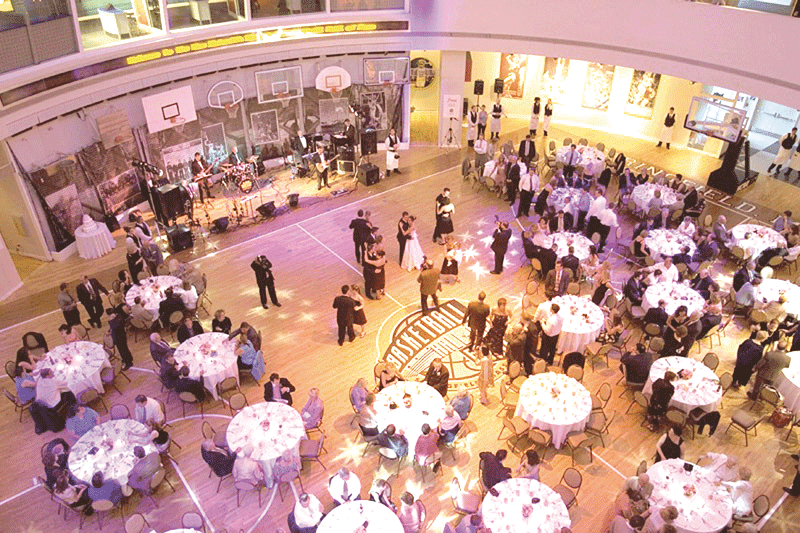
Center court at the Basketball Hall of Fame provides one of the region’s unique party environments.
Early October is when things finally settle down on Memorial Avenue in West Springfield. For Jeffrey Daigneau, who’s busy booking holiday parties at his restaurant, Lattitude, they’re just heating up.
“We’re getting calls now. We probably have 15 or 20 parties already booked,” said Daigneau, who spoke with BusinessWest the day after the Eastern States Exposition — which dominates his street and hinders business for two and a half weeks — ended its 2011 run. “We haven’t gotten many calls with the Big E going on, but our busy season really starts today.”
Other restaurant owners and banquet-facility managers are reporting the same. So far, they say, business is looking up.
“Many companies feel parties are very important,” said Joe Stevens, owner of Hofbrauhaus in West Springfield. “They want to say thank you to their people who have been with them year-round — and we’re grateful to have them.”
He noted that the majority of companies that have booked parties have returned. “They want this certain Friday, this specific Saturday; usually, as they’re leaving, they say, ‘see you next year,’ and we just put them in the books.
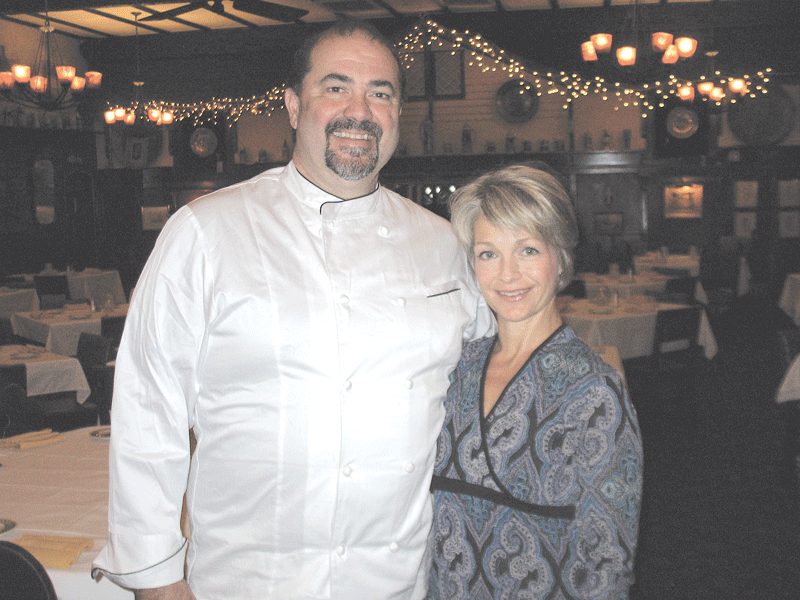
Joe Stevens, with his wife, Liz, says his holiday-party business at Hofbrauhaus has been bolstered by repeat customers.
Newer venues are optimistic about a strong season as well, including Mill One at Open Square in Holyoke, which offers exposed brick, hardwood floors, and not much else in the way of permanent décor, allowing party planners to design their own night.
“It’s a beautiful facility from the 1800s,” said Michelle St. Jacques, property manager of Open Square. “It’s a blank slate, so we let people know that their event can be how they want it to turn out, without having the carpeting or wallpaper interfering with that.
“In addition, we have a selection of caterers to choose from, or you can choose your own, as long as they’re licensed and insured,” she continued. “We try to cater to individual wants. People can design their parties themselves in a very unique venue. They enjoy the fact that there are no set decorations that could interfere and conflict with their decisions. On the whole, people love it.”
For this issue, BusinessWest talks to several area dining facilities to get a feel for how they’re marketing the holiday season to area companies — and why they’re feeling good about the prospects so far.
They Shoot, They Score
“Right now, things are starting to pick up for the holiday season. We already have some bookings for December,” said Josh Belliveau, corporate event manager at the Basketball Hall of Fame.
That’s good news after a stretch of years in which employers across the U.S. have scaled back such late-fall, early-winter shindigs. According to Amrop Battalia Winston, a global executive-search firm that tracks a number of business trends, last year reflected the worst holiday-party slump in 22 years, with 79% of companies conducting some kind of celebration — lower than even the 81% figure recorded in both 2008 and 2009, at the peak of the recession.
Belliveau said it helps to be able to offer partygoers an uncommon experience.
“If you book your holiday party at the Hall of Fame, it’s a unique venue,” he said. “Our guests have many options — to tour the museum or do some additional fun things, like a scavenger hunt, shooting contests on center court, music, and dancing. We can even do [an electronic] sign outside the building, welcoming guests of that company. That makes it personal to employees who are attending. We think our facilities have the ability to provide that special atmosphere.”
Belliveau has booked a range of different groups, from formal sit-down dinner receptions to social receptions on the court, with hors d’ouevres, interactive play, and DJs and bands. “It’s a social atmosphere.”
Evan Mattson, controller at Tucker’s restaurant in Southwick, has seen the same variety of celebration styles.
“We do sit-down parties, we do station parties, we do buffets — we host all kinds of different parties,” said Mattson, adding that the facility handles gatherings of all sizes — “20 on up to 150” — and also conducts functions off-site when desired. Of all the options, he noted, “I think the station parties are becoming more and more popular.”
Stevens said there isn’t much Hofbrauhaus can’t do when it comes to party planning for groups ranging from less than 10 to more than 300. He noted that the facility hosts both formal sit-down services and cocktail parties with food stations and a cash or open bar.
“I’d say most people enjoy being served, getting waited upon, especially when it comes to the holiday season and businesses saying thank you to their staff,” he told BusinessWest. “Personally, I prefer a party where you can move around; I’m big into food stations and passed-around hors d’ouevres. I like to see people and circulate and not be confined to a certain table. But that’s just me.”
St. Jacques agreed, noting that many companies are getting away from sit-down dinners, and not just for budgetary reasons. “They realize there’s more interaction when people are getting up and getting food, passing by other guests, and that seems to be the trend, from what I’ve seen.”
She said Open Square is a good option for people who have very specific catering needs. “They can provide the food they like; some people like ethnic dishes and have to go to a certain caterer. You can’t get that at some facilities with their regular banquet staff.
“I think our venue is good because you can pick a theme and set the food choices,” she continued. “If you want to have an hors d’ouevres party, those are becoming popular. Cocktail parties are a nice holiday option without breaking the bank. That can be a good choice in this economy.”
Lattitude is making some improvements to enhance its party offerings, Daigneau added, including making the ‘wine room,’ where many functions are held for groups of 15 to 20, two to three times bigger; that renovation will be complete before the December rush of events.
But he said smaller parties are more common these days than large ones. “We do big Christmas parties, but what I’m seeing is parties of 25, 30.”
Looking Up?
That reflects the trends reported by Amrop Battalia Winston last year (this year’s survey won’t be released until November). In 2010, 28% of companies responding to the survey said their parties had become more modest — on the heels of the nearly half (49%) that downsized in 2009. Meanwhile, only 11% intended to hold more lavish parties.
In addition, company parties have increasingly become an employees-only zone. Only 26% of surveyed businesses planned to include family members, while 5% intended to invite clients and friends. The 69% of parties labeled employees-only was up from 52% just four years earlier.
Of those employers deciding to forgo having a party altogether, 55% said they did not consider it appropriate in tough economic times, compared to 27% who said a get-together just wasn’t within their budget. On the other hand, 37% of those having a holiday party said the primary reason was to celebrate a good year, 33% cited employee morale, and 29% said they wanted to project optimism about the future to clients and employees.
If holiday parties are, indeed, reflective of the economic mood, area restaurants and banquet facilities may be reporting some good news for the region overall.
“Some companies have done very well,” Stevens said. “Some have downsized their parties, but others have actually gotten too big for us; they can’t do their parties here anymore because they passed the 300 mark. It runs the gamut.”
Mattson said he’s optimistic about 2011 as well.
“They’re booking now. We have several booked already for December,” he told BusinessWest, noting that, even in a sluggish economy, many employers still want to thank their employees by making merry at what they hope will be the most wonderful time of the year.
Joseph Bednar can be reached at [email protected]
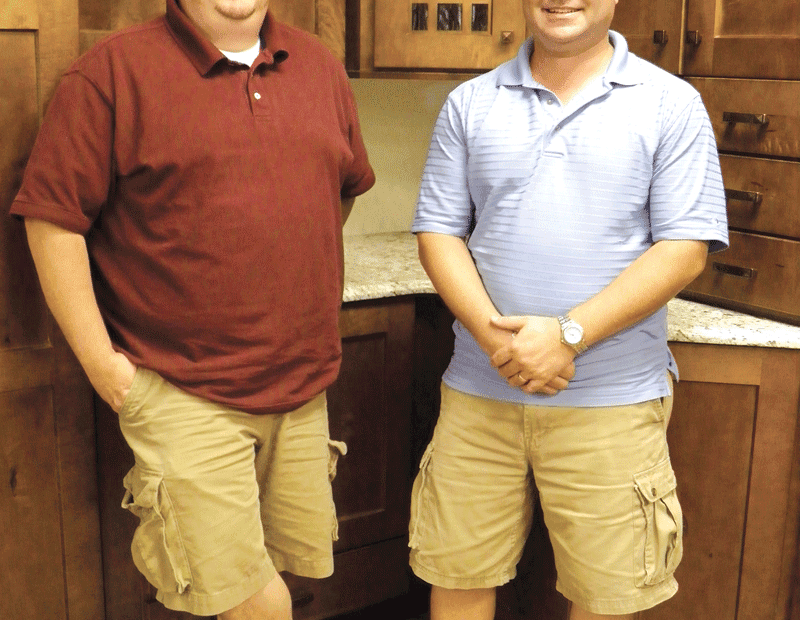
Easy Access to Highways Drives Business Success
Kathy Miro says she was impressed by how supportive the business community is, and how loyal customers are, after opening a pizzeria in Enfield.
Several months ago, Michael “Monte” Monteforte and Jay Bellamo opened Bellmont Kitchen and Bath in Enfield, Conn.
“This location is perfect,” Monteforte said as he stood in their gleaming new showroom on Hazard Avenue, otherwise known as Route 190, explaining that they looked at sites in Windsor Locks, East Windsor, and Enfield before finding exactly what they wanted in the former Video Galaxy Plaza.
“This is a key location because we wanted to be right off a highway,” Monteforte said. “Enfield has four exits off of Route 91, there are plenty of stores and restaurants which draw customers here, and Route 190 gets all of the traffic going to and from Somers.”
Ray Warren, Enfield’s director of Development Services, agrees that the town’s location makes it an excellent spot to own and operate a business. Since it is bordered on the north by Longmeadow and East Longmeadow, it draws traffic from Massachusetts as well as from Somers to its east, East Windsor and Ellington to its south, and Suffield and Windsor Locks to its west.
“Enfield has a population of 45,000 people, which makes it a good-sized small town. We have more than 1,200 small businesses along with many large operations. Lego, Hallmark, MassMutual, and the headquarters for Brooks Brothers are all here,” Warren said.
The majority of the retail sector is located along two main corridors, although Route 5 also has its share of entrepreneurs. They are Hazard Avenue and Elm Street, thoroughfares that run parallel to each other. “Our retail sector is in a very concentrated area with shopping on both sides of the streets,” said Mayor Scott Kaupin.
The town’s biggest constraint in terms of new development is lack of land. “We have turned away businesses due to lack of space,” Warren said. But there are still a number of businesses under construction, and the many stores in Enfield Mall and the adjacent shopping centers represent substantial investments.
“This year, we issued more than $43 million in construction value of building permits,” Warren said. “In FY 2011, the town estimated it would take in $350,000 in building-permit fees. But we took in more than $700,000.”
New Horizons
Although the town has little commercial land available, there is space available for renovation of existing properties and property zoned for industrial development.
Enfield has also seen growth in the professional sector, and both Hartford Hospital and St. Francis Hospital recently built medical offices there.
Michael Monteforte and Jay Bellamo say Enfield’s location alongside I-91 and Route 190 was a factor in locating there.
When Eppendorf moved to the town several years ago, it purchased a large campus. “They are just about to complete their first expansion, and we are already in conversation about a second expansion,” Kaupin said.
The company had access to a large, professional labor pool in New York, but executives have told Warren they found an equally capable and educated workforce here.
“We are part of what is known as the Knowledge Corridor,” Kaupin said of the stretch of land running from the Northampton/Amherst area past Hartford that contains a plethora of colleges and universities, which results in a large pool of well-educated people. In addition, Asnuntuck Community College in Enfield is a leader in the field of machine technology and has forged great relationships with local companies.
Warren said 30,000 people from Massachusetts work in Enfield, and most companies employ workers from the north and south. “The fact that there is a supply of labor which stretches from Springfield to Hartford in a two-state region makes this a very attractive place to do business.”
Enfield has been chosen as a stopping place on the proposed New Haven-Hartford-Springfield commuter-rail line. Its station will be located in the village of Thompsonville, an old mill area of Enfield which is in need of a great deal of revitalization.
Kaupin is hopeful that, when the project is complete, it will lead to a rebirth in the village, boosting demand for housing as well as for new businesses and restaurants that will be needed to provide service to commuters.
Helping Hands
Kathy and Michael Miro opened Mama Miro’s Pizzeria and Restaurant in January after spending $90,000 and eight months gutting and remodeling a building on Hazard Avenue that had sat empty for about two years.
Kathy said they have been impressed by how friendly other business owners have been since they opened their eatery. “Business owners here help each other,” she said, adding that the pizzeria is their first venture. They have also been surprised by how quickly they gained loyal customers. Although business was slow at first, their weekend breakfast offering has proved so popular, they recently expanded it to seven days a week.
The couple, who moved to Enfield from Brooklyn, N.Y. the fateful week of Sept. 11, 2001, said people come from as far away as Chicopee and Manchester, Conn. to enjoy their thin, New York-style pizza. “Our customers have become our friends, and we have made a lot of them since we opened. One woman comes here three times a day, three days a week, and we have a group of widows who met here and continue to come here for comfort,” Kathy said.
Although they could have located closer to the mall, they chose the site because it has its own parking lot and they will be able to hold fund-raisers there if and when they choose.
Kaupin said the Miros’ experience is not unusual, as the town has a very strong chamber of commerce which serves Enfield, Somers, Suffield, and East Windsor. “The North Central Chamber of Commerce is heavily weighted towards small business. Other chambers in the state are very large, but the members here are very good at networking and share their challenges as well as solutions to problems,” he explained.
Town officials are also doing all they can to encourage economic development, which has included freezing the tax rate for four years in a row. “This was a very deliberate effort which occurred without any reductions is essential services,” Kaupin said. “In the past, the town had been on the higher end of the tax structure, but now we are very competitive.”
The town also created an Administrative Review Team to expedite the permitting process. Team meetings bring everyone to the table who will be involved with a new business. “We meet with business owners, review their plans, and offer advice,” Warren said, adding that money and time are saved by identifying issues and addressing them in the planning stage. “And if they are on a tight timeline, they can go through the Land Review and Building Department simultaneously, which shortens the whole review process. It’s very important, as this is New England, where development is governed by a large body of rules, and we want people to succeed.”
Kaupin said their team approach provides “proverbial one-stop shopping” for new business owners, which is critical in this community, since there are five fire districts and a regional health district independent of the town. The retail arena continues to grow, and available space is always filled quickly. “First and foremost, we are known as a regional shopping area.”
And one that attracts businesses with a pitch that is very appealing — a location that literally drives customers right to their doors.
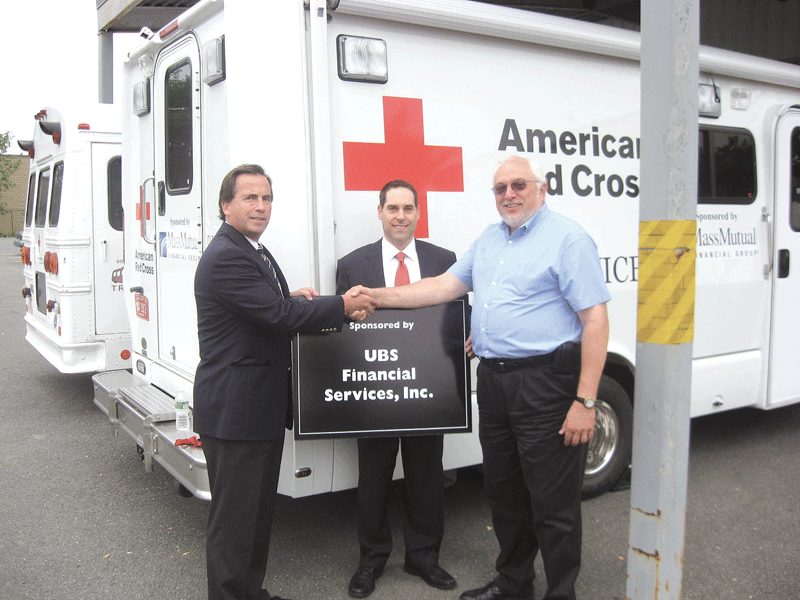
Send photos with a caption and contact information to: ‘Picture This’ c/o BusinessWest Magazine, 1441 Main Street, Springfield, MA 01103 or to [email protected]
Community Response

 The American Red Cross Pioneer Valley Chapter has benefited from a recent outpouring of generosity from area individuals and businesses. At top left, the chapter’s executive director, Rick Lee (right), accepts a check for $20,000 from UBS Financial Services in Springfield to support local disaster-relief and recovery efforts. The check, representing a corporate donation, a company matching gift, and employee contributions, is presented by George Keady III, UBS senior vice president and branch manager (left), and James Calabrese, UBS account vice president. Bottom, the staff of Texas Roadhouse in Springfield presents a $13,000 donation to Mary Nathan, the chapter’s director of Disaster Services. The restaurant fed victims of the June 1 tornadoes and helped with cleanup, then coordinated a fund-raiser involving Texas Roadhouse restaurants all over New England to raise the $13,000 donation.
The following business incorporations were recorded in Hampden, Hampshire, and Franklin counties and are the latest available. They are listed by community.
AMHERST
Craig’s Door — A Home Assoc. Inc., 69 South Pleasant St., Amherst, MA 01002. Gerald Gates, same.
CHICOPEE
Gerardo’s Transit Inc., 32 Mercelle St., Chicopee, MA 01020. Kellymar Alejandro, 47 Parkside St., Springfield, MA 01020. Passenger transport for hire.
FEEDING HILLS
Absolute Transport Inc., 24 Hickory St., Feeding Hills, MA 01030. Mazen Awkal, same. Vehicle transport
HAMPDEN
Gio’s Pizzeria Inc., 9 Allen St., Hampden, MA 01036. Giovanni Cirillo, 95 Wedgewood Dr., Ludlow, MA 01056. Restaurant.
HOLYOKE
Adult Community Employment Supports Inc., 30 Center St., Holyoke, MA 01040. Lizzy Ortiz, 32 Mansfield St., Springfield, MA 01108. Vocational programs for people over 18 with disabilities.
HPL Realty Corp., 335 Maple St., Holyoke, MA 01040. Terry Plum, 70 Pinehurst St., Holyoke, MA 01040. Nonprofit corporation to benefit the Holyoke Public Library.
International Laser Solutions Inc., 362 Race St., Holyoke, MA 01040. Edward Sordillo, 97 Lariviere Dr., Chicopee, MA 01020. Laser marking, etching and engraving.
LENOX
Good Vibes Distributing Inc., 172 Housatonic St., Lenox, MA 01240. Kevin Kirshner, same. Wholesaler.
NORTH ADAMS
Howling Inc., 135 Bonair Ave., North Adams, MA 01247. Jared Bruce Decoteau. Same. Restaurant.
PALMER
Advanced Precision Products Inc., 7 First St., Palmer, MA 01069. Jeffrey Buck, same. Precision component manufacturing.
PITTSFIELD
Erich Schmidt, 435 South St., Pittsfield, MA 01201. Erich Schmidt, 37 Bracelan Court, Lenox, MA 01240.
SOUTHWICK
Acclaim Properties Inc., 464 North Loomis Street, Southwick, MA 01077. David Tagliavini, 149 Prospect St., Suffield, CT 06078. Property management.
J & C Property Services Inc., 114 Granville Road, Southwick, MA 01077. Craig Filiault, same.
SPRINGFIELD
American Center for Immigrant Development Inc., 857 State St., Springfield, MA 01109-3103. Eskedar Ayehu Adamu, 33 Maple St., Malden MA, 02148. After-school program including job search and job training.
David Peck, DMD, 174 Worthington St., Springfield, MA 01103. David Peck, DMD 153 Prynwood Road, Longmeadow, MA 01106. General dentistry.
Forest Park Business Assoc. Inc., 185 Belmont Ave, Springfield, MA 01108. Daniel Morrissery, 119 Marengo Park, Springfield, MA 01108. Nonprofit organization.
Hispanic Mark Inc., 1145 Main St., Suite 501, Springfield, MA 01103. John David Perez, 247 Central St., Floor 2 Springfield, MA 01105. Business consulting.
WEST SPRINGFIELD
Ageo Tech Solutions Inc., 2042 Westfield St., West Springfield, MA 01089. Anthony Kashmanian, same. Computer technician.
Bertera Foreign Motors Corp., 657 Riverdale St., West Springfield, MA 01089. Aldo Bertera, 162 Forest Ridge Road, West Springfield, MA 01089. Foreign automobile sales and service.
Dijon Express Corp., 91 Hill St., West Springfield, MA 01089. Ildar Ismailov, same. Transportation services.
In Our hands Day Care Center Inc., 101 Belmont Ave., West Springfield, MA 01089. Joyce Roswess, same. Day care center for children.
WESTFIELD
Infiniti Logistics Inc., 108 Miller St., Westfield, MA 01085. Yaroslav Burkovskiy, same. Truck leasing.
WILBRAHAM
Bizcykl Inc., 8 Powers Dr., Wilbraham, MA 01095. Gregory Allan Pastore, same. Waste and recycling management.
Canosa Restaurants Inc., 5 Anvil Road, Wilbraham, MA 01095. Santiago Canosa, same. Restaurant

United Bank announced the following:

Barbara-Jean DeLoria
•
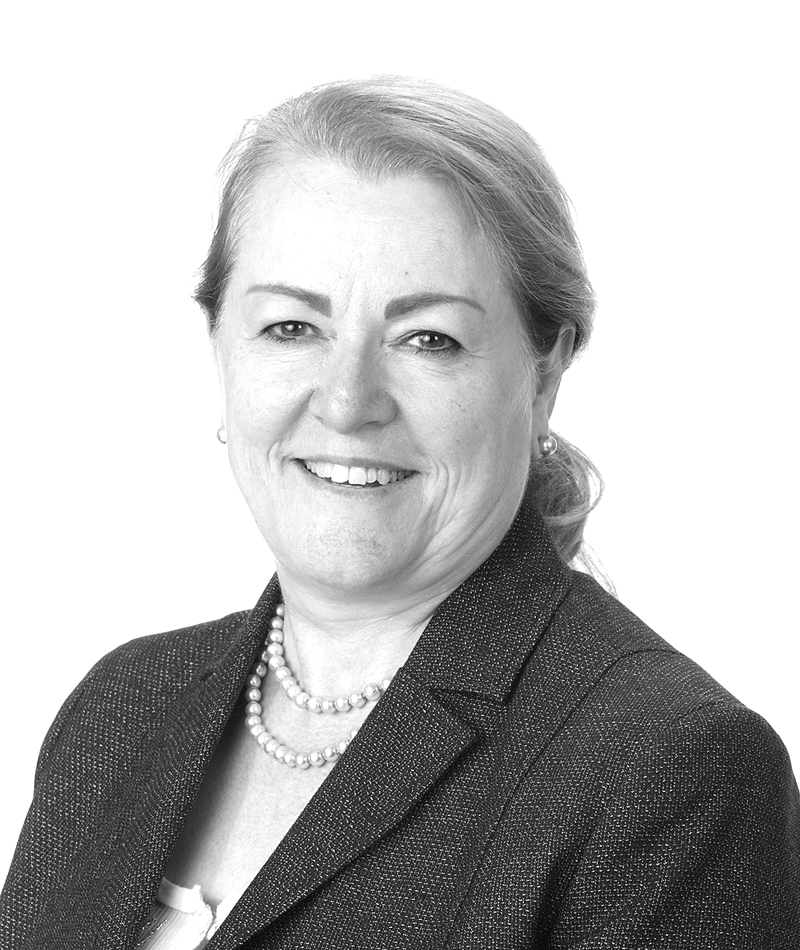
Milly Parzychowski
•••••
Attorney Susan Fentin, a partner with Skoler, Abbott & Presser, P.C., will be a key speaker at the 2011 Advanced Employment Issues Symposium in Nashville, Tenn. on Oct. 6 and 7. Fentin will be part of the keynote panel that will begin the symposium and will be speaking on independent contractor misclassification, a topic of significance for employers in Massachusetts and elsewhere in the U.S.
•••••

Tamara Fricke
•••••
Dietz & Co. Architects announced the following:
• Jamie Kelliher has joined the firm. He graduated from Cornell University with a bachelor of Architecture degree and the University of Arizona with a master of Architecture degree in Urban Design. Prior to joining Dietz & Co. Architects, he worked at Drachman Institute for Regional Development in Tucson, Ariz. and Paolo Soleri/Arcosanti Planning Office in Mayer, Ariz., where he acquired experience working on complex, high-end, award-winning, multi-family, mixed-use building projects. He collaborated on the Soleri Bridge and Plaza in Scottsdale, Ariz., where the design incorporated hallmarks of Paolo Soleri’s signature style and was also designed to bring awareness of our human connection to the sun and the natural world;

Josh Payne

Kris Kennedy
• Mark Hellen has joined the firm. He graduated from New York University and Boston Architectural College with a master of Architecture degree. Prior to joining the firm, he spent over 10 years at CBT in Boston, working on various educational, residential, and commercial projects. His extensive list of experience, regionally, includes the design of Turner Hill Cottage Development, a residential project on an exclusive golf course in Ipswich, Mass., and Northfield Mount Hermon Rhodes Art Center, an educational project encompassing multiple classroom, art, and performance spaces. His most complex past project is Champlain College, which included adding four dormitory buildings to an existing neighborhood.
•••••

Kristen Adams
•••••
Attorney Ryan Alekman, a Partner of Alekman DiTusa in Springfield, has been elected to a two-year term on the Board of Governors of the Massachusetts Academy of Trial Attorneys. A graduate of the Western New England College School of Law, he handles personal-injury and criminal-defense cases.
•••••
Nuvo Bank & Trust Co. has promoted Susan Fearn to Assistant Vice President in addition to her duties as Client Sales and Service Manager.
•••••
Brian O’Shea, Manager of the Holyoke McDonald’s, 285 Maple St., and Jeremy Zimowsky, manager of the 2194 Northampton St., Holyoke McDonald’s, are recipients of Outstanding Restaurant Manager awards by the Connecticut and Western Mass. McDonald’s Owner-Operator Assoc. The award recognizes managers whose McDonald’s restaurants operate at an outstanding level and exemplify leadership following McDonald’s key initiatives. The top 10% of restaurant managers are bestowed with the honor.
•••••
The Mass. Society of Certified Public Accountants Inc. recently elected its board of directors for the 2011-12 fiscal year. The MSCPA board of directors sets policies, manages programs, and oversees activities that benefit the 10,500-plus-member organization and accounting profession. The following will serve as board officers:
• Stuart Benton, CPA, Bradford Soapworks Inc., as chairman;
• Kenneth Kirkland, CPA, KAF Financial Group, as chairman-elect;
• Merrill Puopolo, CPA, CBIZ, Tofias & Mayer Hoffman McCann P.C. – Tofias New England Division, as vice-chairwoman of finance;
• Tracy Noga, CPA, Bentley University, as vice chairwoman;
• William Mahoney, CPA, Edelstein & Co. LLP, as vice chairman;
• Jeffrey Solomon, CPA, Levine Katz Nannis + Solomon P.C., as past chairman; and
• Theodore Flynn, CAE, MSCPA, as president and CEO.
The following will sit on the board as members: Cheryl Burke, DiCicco Gulman & Co. LLP; Frank Constance, CPA, Coles & Bodoin LLP; Kristin Costa, CPA, Braver P.C.; Paul Gerry Jr., CPA, Gray Gray & Gray LLP; Gerald Gerson, CPA, Litman Gerson LLP; Scott Levy, CPA, Grant Thornton LLP; Kevin Martin Jr., CPA, MST, Kevin Martin & Associates P.C.; Carla McCall, CPA, Alexander Aronson Finning & Co. P.C.; Robb Morton, CPA, CITP, Boiselle Morton & Associates LLP; George Neble, CPA, Ernst & Young LLP; Charles O’Donnell, CPA, Hans Kissle Co. Inc.; and Carolyn Stall, CPA, Stall Advisors LLC.
•••••
The Springfield Technical Community College Foundation recently welcomed three new members to its board:
Raymond Berry
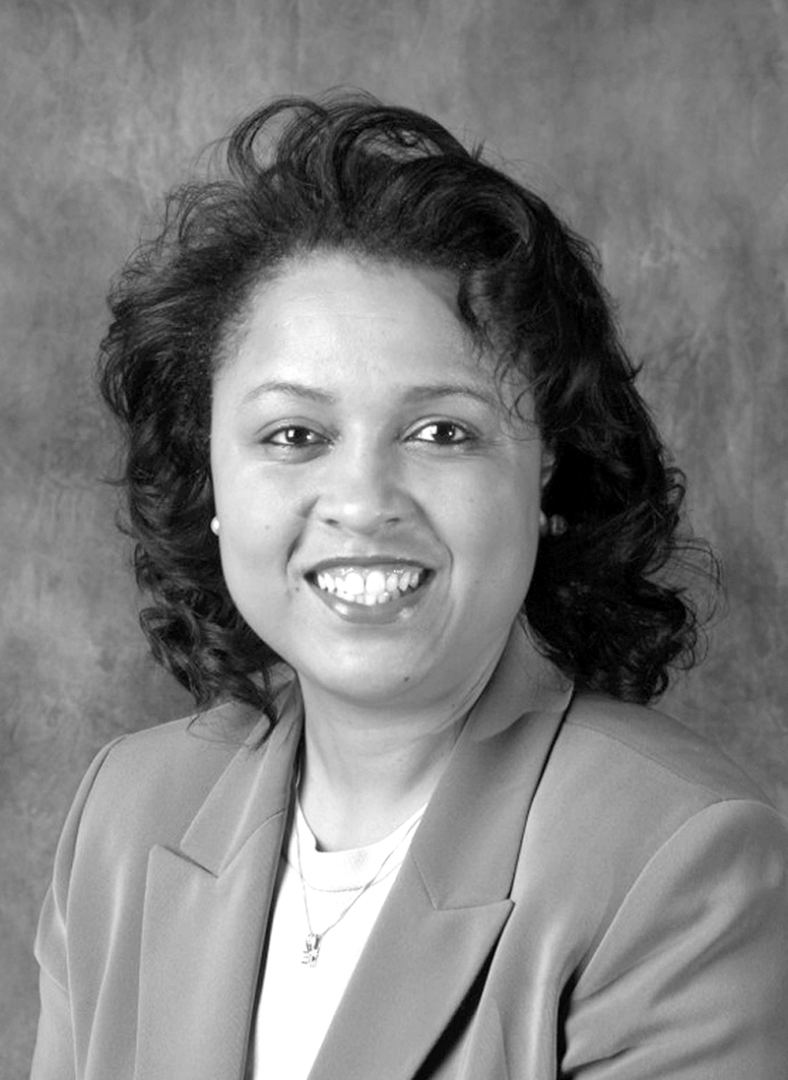
Sheila King Goodwin
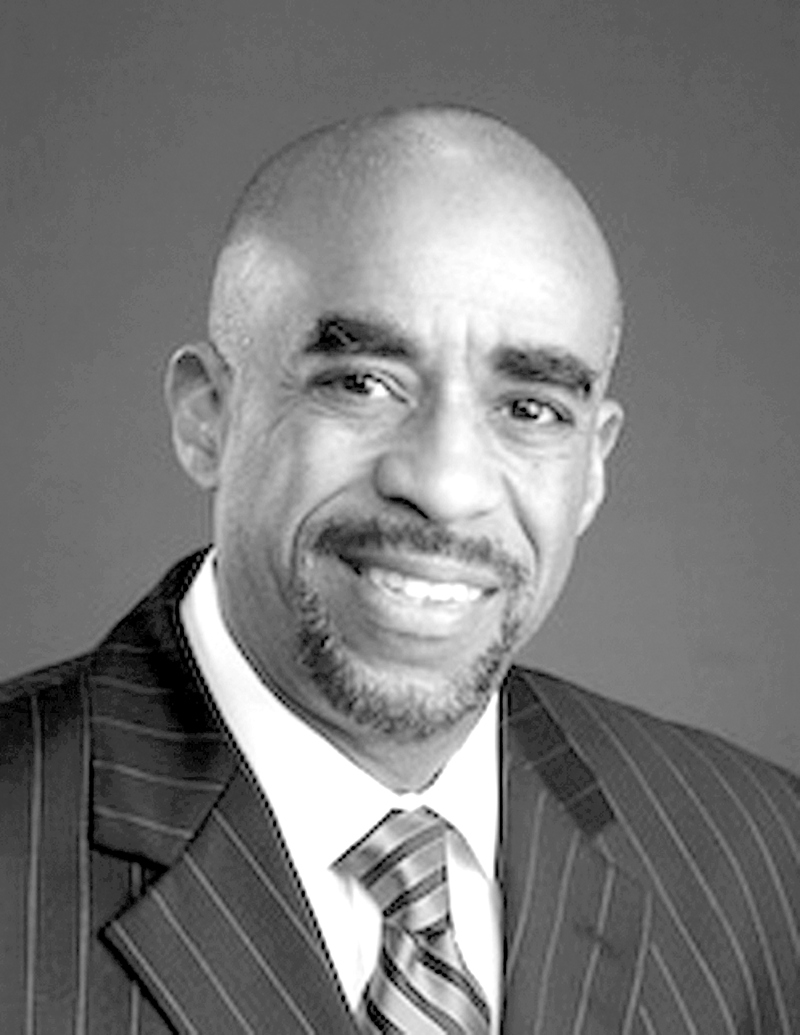
Michael Weekes
trade association, and also of the Human Services Providers Charitable Foundation.

Small Specialty Shops Thrive in This Affluent Town

Lois Brooke says moving her store to Longmeadow was too good an opportunity to pass up.
Fifteen years ago, Lois Brooke started a business named Floral Fantasies and erected a building on Memorial Drive in West Springfield to house the fresh and silk flower arrangements and gift items she carries.
Although the shop was doing well, when she heard that florist William Burrows was retiring and the storefront in the Longmeadow Shops that he occupied was available, she moved her business there because she said the opportunity was too good to pass up.
“I thought it was a great walk-in location. It is a nice community, and a lot of my customers come from Longmeadow, Hampden, and Wilbraham, so I figured it would be more convenient for them,” Brooke explained.
Her shop carries a wide variety of unique gift items that range from fanciful figurines to sea-glass jewelry, specialty chocolate, high-end designer purses, and unusual silver and crystal.
“People come to the Longmeadow Shops looking for something different,” she said, adding that some are seeking bridal or shower gifts and want something more unique and memorable than what couples have registered for.
After moving to Longmeadow, Brooke discovered another bonus: a close-knit community of business owners who work together to support one another. During prom season, she puts roses in a nearby clothing store as promgoers rent tuxedos there, and both businesses tell their customers about each other’s offerings.
Brooke has also carried on the tradition started by Burrows of decorating the plaza during the holiday season, and provides free flowers each week to Starbucks and other stores, which brings new customers to her store.
When it comes to the world of business, Longmeadow is small, and its business space is fairly limited. The majority of storefronts are owned by people who specialize in high-end goods at retail shops, or who operate specialty restaurants, most of which are located in a triangle that includes the Longmeadow Shops on Bliss Road, the Big Y plaza, and Williams Place across the street, which rents office space as well.
There are also a number of small retail establishments in a strip along the Enfield line in the Armata’s supermarket plaza area and at two other plazas at the junction of Shaker and Maple roads. Office space also exists in a building at 1200 Converse St., and many doctors and dentists occupy two buildings on Dwight Road.
“Longmeadow is a small community, but that is the benefit of doing business there,” said Sarah Tsitso, executive director of the East of the River Chamber of Commerce, adding that residents like to patronize community businesses. “The town has a little bit of everything, from banks to clothing shops, along with great public schools.”
Small Wonder
Longmeadow boasts a single tax rate, and Tsitso said the Board of Selectmen works continuously with the chamber to ensure that Longmeadow remains a good place to own and operate a business.
The town sits on the Connecticut line and is easily accessible from Route 5, which runs directly through it via Longmeadow Street, where it connects to Interstate 91 North.
“Longmeadow also has a college in its midst, so it draws parents and a large crowd of continuing-education students from all over the region,” Tsitso said, referring to Bay Path College on Longmeadow Street. “In addition, it has two wonderful golf courses with banquet facilities.”
Town Manager Robin Crosby told BusinessWest that the community is well-informed, and has a higher per-capita income than the average earned by residents in Western Mass. as a region.
“The people here can afford services and are willing to pay for them; plus, the town is very pedestrian- and bicycle-friendly,” she said. “The Longmeadow Shops are located right next to the high school and athletic fields, which makes it easy for families to shop there.”
Walter Gunn agrees. “We are a destination spot because the stores here are upscale,” said the Planning Board chairman. “We also have a lot of professional services and small businesses that include engineers, lawyers, and real-estate agents. Longmeadow doesn’t have an industrial park, and there is no zoning for one. Professional and retail is what the town is all about, and the shops and stores cater to an affluent population. The Longmeadow Shops attract people from out of town. They are a destination, and it’s a safe and secure place for people to shop.”
Over the past year, there have been a number of changes with regard to the town’s retail landscape, and several storefronts have vacated, but Crosby said they fill in quickly.
Camile Hannoush, who co-owns Hannoush Jewelers with his family, says they opened their third Gift-ology store in town last fall. The chain now has dozens of stores across Western Mass. and beyond.
Hannoush said the company chose the Longmeadow Shops because it is a great market for the type of product it carries. “We have handmade and very unique gift items such as pillows from different parts of the country, handmade blown glass which is actually wall art, and handmade purses,” he said, naming several exclusive lines. “Gift boutiques have done very well in Longmeadow because of the demographics. There is a demand for that type of product in town, and I feel that customers who go there want something that other stores don’t offer.”
Hannoush told BusinessWest that, although its Springfield store does well, the company doesn’t have to do as much target marketing in Longmeadow because the location attracts clients interested in its merchandise. “It’s not like going to a mall. The shops here are a destination and a retail mecca with a lot of beautiful co-tenants that we felt were a good fit,” he said. “It’s a great area that is convenient and a pretty place for people to go and shop. They feel comfortable there.”
Crosby said that feeling exists throughout the town, and small restaurants also do well. She cites the Iron Chef as an example. It serves Asian cuisine and opened in a small space on Shaker Road in the Armata’s plaza a number of years ago.
Joann Melikian and her brother, Ardy Iennaco, along with other family members, have been working since January to open a second Primo’s Pizza shop on Maple Road in Longmeadow. The family business will sit in a small strip mall across the street from the Iron Chef and next to a Chinese restaurant in the four-corner section of town on the Enfield border.
Primo’s does excellent business in its shop on Worthington Street in Springfield, Melikian said, but has had its eye on Longmeadow for more than seven years.
“We grew up in Longmeadow, and the whole family lives here, with the exception of my sister, who is in the military, and my brother Frank, who lives in East Longmeadow,” she said. “It’s a small community, we know everyone, we can service more towns with takeout in Longmeadow, and there are only a few other pizza shops in town.” She added that the type of pizza they make will be new to the town because it is baked in old-style ovens.
Location, Location, Location
The family has been looking for an appropriate location in town for years, and when Iennaco discovered that the owner of the Maple Street location would allow them to open a pizza business there, he was thrilled. “I’ve wanted to be in this spot for seven years because I knew it will be a home run,” he said. “There is a steady flow of traffic, and there are two schools nearby,” he added, explaining that their operation will offer takeout and meals that will feed three to eight people.
“It is a great economic opportunity,” Melikian agreed. “We’re a family-oriented business and don’t have a big staff. This is small and is exactly what we were looking for. We grew up here and think people need the opportunity to have old-style, homemade pizza.”
There are many business owners in Longmeadow expressing similar sentiments. Indeed, while the products vary — from flowers to jewelry to pizza — everyone seems to be hitting home runs.
Fundraising for Nonprofits Workshop
May 25: The Association of Fundraising Professionals will present a workshop titled “Strategic Planning for the Development Office” from 8 to 11:30 a.m. at the Delaney House, Route 5, Holyoke. Nat Follansbee, associate head for external relations at the Loomis Chaffee School, Windsor, Conn., will lead the hands-on training. Follansbee will demonstrate how to maximize fundraising success through effective strategic planning. The cost is $50 for members, $65 for non-members in advance. Breakfast is included. For more information or to register, visit www.afpwma.org.
Paradise City Arts Festival
May 28-30: The Three County Fairgrounds in Northampton will once again come alive with one of America’s most spectacular fairs of fine crafts, paintings, and sculpture during the Memorial Day weekend. The Paradise City Arts Festival is also a great way to spend a holiday weekend at the height of spring, with live music, food, and an outdoor sculpture garden. Festival organizers note that there’s new work by all 260 artists, and performers scheduled include Ameranouche, Samirah Evans and Her Handsome Devils, Roger Salloom, and Jessica Freeman. Additionally, Salloom will present an award-winning documentary about his career that is airing nationally this spring. Restaurants participating in the festival include the Eastside Grill, India House, Spoleto, Mama Iguana’s, Great Wall, Amber Waves, Pizzeria Paradiso, and Bart’s Homemade Ice Cream. Food offerings will include strawberry tartlets, pomegranate chicken kabobs, fish tacos, and Thai green curry, as well as the standards, blackened short ribs, blackened scallops, and bananas foster bread pudding with spicy chocolate sauce. In addition, Paradise City’s silent art auction will benefit the Breast Form Fund, which offers financial assistance to uninsured and under-insured women to purchase breast prostheses and post-mastectomy bras after breast-cancer surgery. A special themed exhibit titled “The Nature of Beauty” is also planned in the arena. Hours are Saturday, 10 a.m. to 6 p.m.; Sunday, 10 a.m. to 6 p.m.; and Monday, 10 a.m. to 4 p.m. Tickets: $12 for adults, $10 for seniors, $8 for students, and free for ages 12 and under. For more information, visit www.paradisecityarts.com.
HR and Social Media Workshop
June 16: Representatives from Royal LLP and the Vann Group will present a free seminar titled “Social Networking Media and the Workplace: The Good, the Bad, and the Ugly” from 8:30 to 10 a.m. in the NUVO Bank community room, 1500 Main St., Springfield. Registration begins at 8:15 a.m. Seating is limited. To register, contact Ann-Marie Marcil at
[email protected] or (413) 586-2288.
40 Under Forty Gala
June 23: BusinessWest will present its 40 Under Forty Class of 2011 at a not-to-be-missed gala at the Log Cabin Banquet & Meeting House beginning at 5 p.m. The 40 Under Forty program, initiated in 2007, has become an early-summer tradition in the region. For more information on the event or to order tickets ($60 per person, with tables of 10 available), call (413) 781-8600, ext. 10, or visit
www.businesswest.com.
Summer Business Summit
June 27-28: The Resort and Conference Center of Hyannis will be the setting for the Summer Business Summit, hosted by the Mass. Chamber of Business and Industry of Boston. Nominations are being accepted for the Mass. Chamber, Business of the Year, and Employer of Choice awards. The two-day conference will feature educational speakers, presentations by lawmakers, VIP receptions, and more. For more information, visit www.masscbi.com.
Jazz & Art Festival
July 8-10: A Mardi Gras theme will kick off the 5th annual Hampden Bank Hoop City Jazz & Art Festival on July 8, featuring Glenn David Andrews with the Soul Rebels, and hosted by Wendell Pierce, star of the HBO series TREME. The celebration, planned at Springfield’s Court Square on the Esplanade, continues throughout the weekend with a lineup of world-class entertainment. On July 9, performances are slated by Marcus Anderson, the UK Kings of Jazz Groove, Down to the Bone, 17-year-old jazz newcomer Vincent Ingala, and Gerald Albright. On July 10, performances begin with the Eric Bascom Quintet, followed by Samirah Evans and Her Handsome Devils. Kendrick Oliver and The New Life Orchestra will also perform, and Latin jazz performer Poncho Sanchez will close out the festival. Organizers will also be increasing the number of merchandise vendors, artisans, and crafters, as well as food vendors. For more information, visit www.hoopcityjazz.org.
Western Mass.
Business Expo
Oct. 18: Businesses from throughout Hampden, Hampshire, Franklin, and Berkshire counties will come together for the premier trade show in the region, the Western Mass. Business Expo. Formerly known as the Market Show, the event, produced by BusinessWest and staged at the MassMutual Center in Springfield, has been revamped and improved to provide exposure and business opportunities for area companies. The cost for a 10-by-10 booth is $700 for members of all area chambers and $750 for non-members; corner booths are $750 for all chamber members and $800 for non-members, and a 10-by-20 booth is $1,200 for all chamber members and $1,250 for non-members. For more information, log onto www.businesswest.com or call (413) 781-8600, ext. 100.
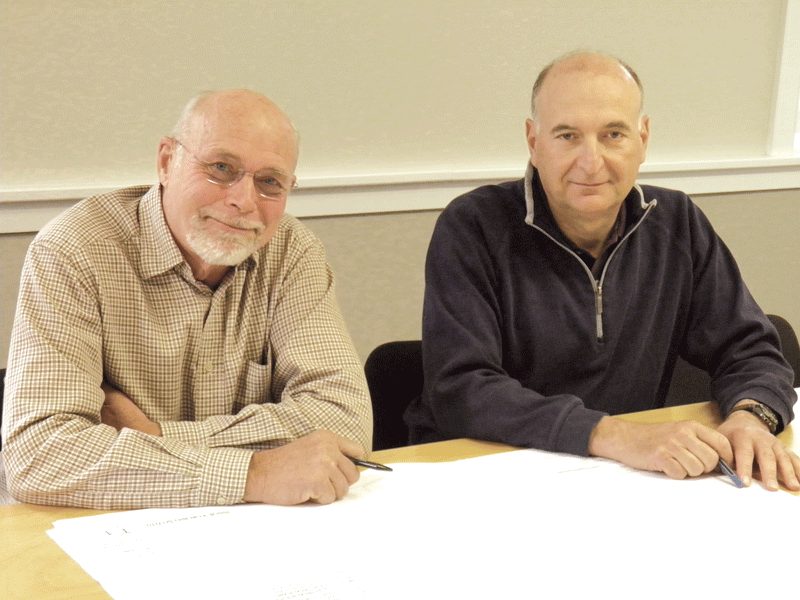
Amherst Construction Company Has a Solid Foundation
Donald Teagno, left, and Louis Gallinaro say the majority of the work handled by Teagno Construction is in residential settings.
In fact, when the founder and president of Teagno Construction Inc. (TCI) in Amherst graduated from the UMass School of Education in the early ’70s, his plan was to teach English.
“I taught for six months at the junior-high-school level,” he recalled. “But I was in a fairly conservative school district, and I couldn’t use the creative techniques I had been taught at UMass.”
After that experience, he decided to embark upon an entirely different pathway that would allow him to utilize his natural talents. “I had always been pretty handy, and I started working as a carpenter for a developer in Amherst,” he said.
While doing so, Teagno became acquainted with a few local architects who needed work done on their own homes. He accepted one job at a time that included making custom furniture for some of his clients. By 1974, word of mouth had spread, and he began operating under the business name ‘Donald Teagno Building Contractor.’
“I was a lone carpenter and a sole proprietor,” he told BusinessWest. “When I became busier, I took on a partner. And little by little, the jobs got larger until I had three or four people working for me. But I had no preconceived notions that I would end up where I am today.”
However, by 1985, the company had grown substantially, and he incorporated under the name Teagno Construction. But he continued working in the field alongside his employees until it became necessary for him to remain in the office to give estimates and keep up with up with his payroll and other paperwork.
Leaving the construction sites to do office work was not an easy transition for the craftsman. “There are certain times during our company’s history when we made major leaps, and his was one of them,” Teagno explained. “But it was very difficult for me to delegate work to other people; I wanted things done in a certain way with a certain quality. Little by little, I was able to relax, once I was sure my reputation was being supported by my employees. But it was a slow process.”
In the early years, he worked almost exclusively with homeowners, putting on additions and doing interior renovations. “It was almost all negotiated work, but in 1985 I started doing larger jobs and branched out into multi-family work and the competitive market. And after about 10 or 15 years, I had built a reputation by doing unique projects,” he said. “We are not famous for it, but we have jacked up buildings to replace foundations, which we started doing in the ’80s.”
One of those jobs resulted in some recognition. TCI is certified by the state as a historical contractor, and its work on an 18-unit row house on South Street in Northampton won an award for historic preservation.
“We did a total renovation and extensive structural repairs there,” he explained. “The building was sliding down, and we had to pick up the foundation, level it, then pour a new foundation underneath it, which can cause some of the plaster inside to crack. These jobs are especially challenging, as it is really hard to figure out their cost. In the process of picking up a house, you find its weak points, so you have to look at it carefully to determine any problems that may arise. In the worst-case scenario, a project will become cost-prohibitive.”
On the Home Front
TCI’s portfolio is diverse and includes work in museums and local colleges. “We even built a ski lodge — the Swift River Inn in Cummington — which is now a school,” said general manager Louis Gallinaro. “And our marquee project on the industrial side was building All Saints Church in South Hadley.”
But the majority of the company’s projects have always been in the residential setting. It is in this realm where the business began and the reason TCI remains so sensitive to its customers’ ideas, thoughts, and feelings.
“Our residential work all started with my reputation for quality work and attention to people’s needs,” Teagno said.
In fact, almost 90% of his work comes from customer referrals. He does little advertising and relies mainly on word of mouth.
Teagno says he has been able to weather three recessions, two of them quite severe in nature, due to his company’s diversity, his commitment to listen closely to what customers say they want, and his quality work. In fact, these are core values that are adhered to during every project, although, on commercial jobs such as restaurant renovations, timing sometimes takes precedence.
“When you listen to people closely, you are able to do what they want in the way they want it,” Gallinaro explained. “Most homeowners have never done this type of work before, and they want to be educated about the entire process.”
Teagno says his employees take the time to inform and explain exactly what they are doing each step of the way, which helps clients feel comfortable.
“Each customer is a whole new experience. We don’t just build things, we have relationships with our customers. And you can’t put a price on a relationship,” he said.
“We want them to have a good experience, so we do the absolute best job we can. Listening to our customers is not lip service for us, and it’s not always in our best financial interest. It would be easier to cut corners to save money, but we don’t do that.”
He says most homeowners are more concerned about quality workmanship than the length of time a project will take to complete. Working in the industrial/commercial arena is a different story, however, as venues such as restaurants have opening dates and tight timelines.
Competitive bidding for such jobs makes up about 25% of TCI’s portfolio, and results in added benefits for residential customers. “It keeps our pencils sharp and allows us to give more value when we negotiate work with homeowners,” Teagno said.
Making History
TCI Inc. has done a considerable amount of work in local museums. Its most noteworthy project was a renovation made to the Emily Dickinson Museum in Amherst.
It was built as a private residence around 1856 and is the site where Dickinson composed the majority of her 1,800 poems. “We helped create the visitor’s room within the structure. One section was renovated extensively, but we left portholes in some of the wall sections so people could see how the building was initially constructed,” Gallinaro said.
He told BusinessWest that it was a privilege to work in such a historic setting. “We got to walk on hallowed ground in a building that is on the state and federal register.”
However, working on such old structures presents a stern set of challenges.
“Historic buildings were not built to the same standards we have today; in order to do the work, you need a good foundation, which is how the whole thing started,” Teagno explained, alluding to his firm’s diverse specialty work and the first time he had to raise a building to lay a new foundation. “I was brought in to make some repairs when I was on my own, and the jobs I got after that became increasingly challenging.”
The company is also responsible for renovating the Words and Pictures Museum in Northampton, which has since closed its doors. “The building had all kinds of structural issues. It had been renovated many times and was compromised over the years,” Teagno said.
TCI has also done work at local colleges, which runs the gamut from dormitory renovations to building new science labs and structures, such as an 18,000-square-foot classroom and administration building for the Bement School in Deerfield. Another noteworthy project was the construction of a 10,000-square-foot day-care center for Mount Holyoke College.
“We have also done a number of renovations for medical and dental facilities,” Gallerino said. “Nine years ago, we converted the gas station across the street into a successful practice. The building had been closed for years before we started the work.”
In addition, the company has built and renovated many area eateries, sometimes working in the same building more than once. “Restaurants are usually complicated because they involve a lot of equipment along with special heating and plumbing requirements and fire-safety issues,” Gallinaro said. “And the people we work with all have different needs.”
Plane Speaking
But no matter who their client is, their approach remains the same.
Teagno’s employees go in with an ear to the ground, making sure they understand the meaning behind a customer’s words so they can transform their dreams into reality.
It’s an interesting way to do business and perhaps not that far afield from the creative teaching methods Teagno wanted to employ long before he started his unique construction company.

Gas Prices Shroud Summer Travel Season with Question Marks

Mary Kay Wydra, left, and Michele Goldberg show off some of the advertising aimed at drawing people from the Boston area to Western Mass.
Two more have been added in recent years: high gas prices, and seemingly endless speculation about the impact they will have on the local tourism industry. And those traditions will continue in 2011. Gas prices are already at $4 per gallon, and most analysts say they will go much higher. This has many restaurateurs and tourist-attraction managers understandably nervous, but there is also the sentiment that the fuel prices will keep people closer to home for their summer fun.
“For Americans, taking a summer vacation is a birthright,” said Mary Kay Wydra, director of the Greater Springfield Convention and Visitor’s Bureau. “People are going to travel, but they will probably make different choices. Based on the fact that it costs $60 to $80 to fill a gas tank, they may visit two attractions instead of three, and may eat at less-expensive restaurants.
“It’s very important this year that destinations show value to the customer,” she continued, hitting on a point that she and others would stress repeatedly as they assessed the approaching summer season.
And to that end, the bureau is teaming up with area venues to offer vacation packages that include hotel stays combined with discounts to hot spots such as the Naismith Memorial Basketball Hall of Fame in Springfield and Six Flags in Agawam.
This year, another of the bureau’s goals is to capture the interest of people in the eastern part of the state. “Our feeder markets are Boston, Connecticut, and New York, and we are targeting our marketing efforts in the Boston area this summer,” Wydra said.
A number of marketing initiatives will kick off in June, including digital billboards, online advertising, and a free coupon book that will be distributed at Exit 6 and Exit 15 on the Mass. Turnpike for a weekend, with signs posted before the exit to alert drivers to the giveaway who might otherwise breeze through the fast lane.
“We are cautiously optimistic about the summer. Our visitor numbers are never as high as major metropolitan areas like Boston, but they are also never as low,” Wydra said. “We are a drive-to destination, so it is important that we do everything possible to respond to rising gas prices. Destinations that get creative and show value to consumers are the ones that are going to be successful.”
For this issue and its focus on tourism, BusinessWest talked with a number of people in this sector about what they expect this summer, and what factors will determine the volume of travel — and spending.
Current Events
Wydra said the area is fortunate to have upcoming events designed to draw large crowds, such as the enshrinement at the Basketball Hall of Fame on Aug. 12, not to mention the Hoop City Jazz & Art Festival (July 8-10), Indian Day at the Museum of Springfield History (July 17), a Mini-Grand Prix car race in downtown Springfield (July 23-24), and the Six Flags concert series. “And if you go farther north, there are outdoor attractions which include zip lines,” she said.
Michele Goldberg, director of marketing for the Visitor’s Bureau, agrees. “There are two zip lines and three whitewater-rafting businesses in Charlemont. Plus there is the Quinnetukut Riverboat cruise in Northfield, the Lady Bea cruise at Brunelle’s in South Hadley, and boating, hiking and fishing,” she said.
Wydra touts the views from the rivers as attractions in themselves. “They are incredible, and the rivers are a magnet that attracts people of all ages,” she said.
Cliff Stevens is cautiously optimistic about the upcoming season. He owns Moxie Outdoor Adventures in Charlemont, which offers white-water rafting, family float trips, and related river activities. He says weather is always a major factor in the business.
“But last year we had a good season and held our own. We are expecting to do about the same this year,” he said.
The downturn in the economy has affected his bottom line, but Stevens hasn’t raised prices in about five years because he knows it’s important to keep excursions affordable.
“I think it will be a good season for local tourism,” he told BusinessWest. “We are no more than a tank of gas away for many people, so I’m optimistic that families will get out and relax. The trips we offer include lunch and have held up during the recession because they are a good value. There are five campgrounds in Charlemont, and people can stay at them, take a hike, go rafting, and have a nice getaway weekend, which has helped us.”
However, the soaring cost of gas has affected his employees, who typically have full-time jobs and work as river guides on weekends because they enjoy challenging situations as well as being on the water. “Some come from Boston, and the first question they’re asking is if I will give them money for gas,” Stevens said. “They are more hesitant to work for a day even though that has been their tradition.”
He is honoring their request because it is difficult to find professionals with enough expertise to navigate waterways that can quickly become treacherous.
Tanks for the Memories
Kevin Kennedy says the geographic area that stretches from the Berkshires to Springfield is home to more than 700,000 residents. “That’s a good-sized audience of people who don’t have to drive more than an hour to get to us,” said Kennedy, staff liaison of Museums10, a collaboration of seven campus museums and three independent facilities that have joined forces to attract visitors. The consortium is facilitated by Five Colleges Inc., which provides administrative support from its Amherst office.
“Each one has a different audience and different strengths, but there is also a lot of overlap,” Kennedy said. He views times such as these when gas prices soar and travel becomes more expensive as an opportunity to reach out to local audiences.
The group conducts an annual survey based on zip codes to gauge the economic impact their visitors have on the economy. Most guests drive from locations less than 90 minutes away, with many coming from Boston, Albany, New Haven, and Brattleboro.
“Because it’s an easy drive, people don’t have to wince too hard when they fill their gas tanks,” Kennedy said. “We’re also seeing folks from Hampshire County who have lived here for years and have been to some of the museums, but not all of them. People are looking for opportunities in their own backyards, and I think it’s good to have an increase in local visitors.”
The license-plate survey, which began in 2007, shows the most notable shift in attendance is the percentage of people from Massachusetts. In 2007, 37.9% of visitors came from the Bay State. That number rose to 47.3% the following year, held fairly steady at 45.6% in 2009, and climbed to 51.9 % last year.
Museums10 is looking to add value to its visits, and although six of the 10 museums don’t charge admission, they do feature gift shops, so the consortium is thinking about creating a card that would offer people reduced admissions and/or gift-shop discounts.
Soar Subject
Mike Desrosiers says he’s optimistic about the year ahead at the Basketball Hall of Fame.
“If the recent spring vacation was any indication of how the summer will play out, we are very hopeful,” he said, referring to April school-vacation week. “We had an attendance level that trumped what we’ve done in the past few years, and that is always encouraging.”
Officials at Yankee Candle Flagship in South Deerfield are also optimistic, but their confidence stems largely from measures they have taken to attract visitors.
“We typically see 1 million to 1.5 million people every year,” said Jim Ovitt, director of retail operations. Most guests are within a 2 ½-hour drive, and when gas prices rose in 2008, Yankee Candle Flagship saw more local traffic and fewer visitors from outlying areas.
Its strategy has been to implement a continuous stream of new offerings that keep the attraction fresh and provide more reasons for visits.
“Several years ago when gas prices rose, we looked at what we could do strategically around key events that would drive traffic to this location,” said Ovitt, adding that such efforts have kept the company’s numbers stable. “The fact that we have free admission and offerings for every age makes us very attractive to families of two or more.
“We try to change things to make newness part of the excitement,” he continued, “with events, entertainment, and attractions within the store such as our Wax Works, where people can create their own candles from wax beads with layers of fragrances. It has been so popular, we had to renovate the area twice to add more capacity.”
The candy shop is under renovation, and will reopen as Yankee Candy, while Santa’s Toy Shop is being expanded in line with its successful marketing strategy.
The New England Air Museum in Windsor Locks, Conn. has not experienced the same success. Although the facility is only about 20 minutes from downtown Springfield and a member of the Greater Springfield Convention and Visitor’s Bureau, the attraction has not been faring well, said Assistant Director Debbie Reed.
“The state line seems to scare people off,” she said. “It’s almost like a barrier, and we don’t know why.”
Museum officials hope to reverse this trend via a radio-advertising campaign aimed at the Springfield market. There is optimism, but administrators are adopting a wait-and-see attitude.
“January was terrible because of the weather; the last three months have been OK, but there is uncertainty because of the gas prices,” she said. “This season could be good, or it could be bad; we don’t know what to expect.”
However, a number of special events are also on their menu, including the annual Space Expo, which typically draws visitors from Rhode Island, Connecticut, Vermont, and parts of Western Mass.
The Bottom Line
Looking ahead to the summer season, the ever-optimistic but also realistic Wydra said there are a number of question marks hanging over the tourism sector — another tradition of sorts.
But while there is a good dose of concern about whether gas prices will temper visitation to area attractions and overall spending, there is widespread optimism that this sector will withstand that challenge and post solid numbers.
But as Wydra and others said many times, it all comes down to providing value.
“The term ‘new’ is so important, as new elements keep people coming back,” Wydra said. “And our attractions are always reinventing themselves.”
A guide to the area’s finest restaurants
Click here:RestaurantsBW0511a
Working in Paradise City Certainly Has Advantages

Crist Myers, president and CEO of Myers Information Systems, says the company’s Northampton location helps to enhance the creativity of its employees.
Six years ago, the owners of Myers Information Systems Inc. relocated the broadcast-software company from Holyoke to Northampton.
“We don’t do business locally or regionally,” said President and CEO Crist Myers as he explained that decision. “We moved here because we wanted to offer our employees the very best atmosphere we could find to enhance their creativity.”
The business is adjacent to the Norwottuck Rail Trail so employees can take a stroll or ride their bicycles on it. They can also walk downtown, which Myers said is a wonderful option when they need a break from work. “They don’t have to jump in their cars to go somewhere to have lunch. They can interact with people downtown where there is a blend of academics and professionals,” he said, adding that employees also take advantage of the many events and offerings available after hours and on weekends, which range from concerts to performances, restaurants, and pubs.
The fact that Northampton is the hub of the five-college area also made the city an attractive choice of mailing address, Myers said. “When you’re in the software business, it is important to have young, professional talent, and this area is conducive to attracting that kind of employee. We seem to get a higher quality of résumés here and can take advantage of the local college graduating classes.”
His rent is higher than it would be in surrounding communities. “But without a doubt, it’s worth it,” he told BusinessWest. “It is a nicer environment for employees, and in the long run, that is a positive for them and for an employer. They enjoy being here because it’s safe and quiet and there is alternative transportation — buses and walking and biking trails, which cuts down their expenses. Some of our employees ride their bicycles to work, which they couldn’t do before.”
There are many business owners in Northampton who use similar words to describe why they’re located in Paradise City, said Suzanne Beck, executive director of the Greater Northampton Chamber of Commerce. She agrees that Northampton is very appealing to young people and professionals because of the lifestyle it offers.
“It combines rural and urban characteristics and has everything from farmland to a vibrant downtown commercial district,” she said. “It’s also very easy to get to, and there are no traffic jams at any time of the day.”
Although rents downtown can be pricey, Beck says there are many different price points throughout the city, particularly for office space. And entrepreneurs thrive in all areas. “Entrepreneurs are attracted to Northampton because there is a very strong entrepreneurial character which is visible due to the mix of retail stores and commercial and professional businesses downtown. The entrepreneurial spirit is tangible here,” Beck said.
In addition, Northampton’s residents are well-rounded. Teri Anderson, the city’s economic development coordinator, says 91% have a minimum of a high-school diploma, and 50% have a bachelor’s degree or higher, making for a highly skilled and educated workforce.
“We also have a very good public-school system and offer business-development assistance through our office to help with site selection, resource and referrals, financial assistance, and business counseling sessions,” she told BusinessWest.
The single tax rate, set at $12.96 per thousand of assessed valuation, is another attractive draw. “It’s pretty low compared to a split tax where commercial and industrial property is taxed at $35 to $40 per thousand,” Anderson said, citing figures from surrounding communities. “And the proximity of the five colleges offers strong research capabilities and access to students for internships.”
Center of Attention
Northampton has a number of business hubs, including its downtown district, King Street and Pleasant Street, the I-91 Industrial Park, Village Hill, Florence Center, and the smaller Leeds Center.
“We have manufacturing and technology here, as well as a strong independent retail and restaurant sector,” Anderson noted. “Plus, Northampton’s commercial property values seem to hold their value even during recessions.”
Space is available for small and medium-sized businesses throughout the city, and opportunities exist at Village Hill, which occupies the grounds of the former Northampton State Hospital, which has been the subject of an ongoing reuse project for more than 20 years.
“Kollmorgen relocated to the village, and there is another 100,000 square feet available on smaller sites; it’s a good spot for small retailers and restaurants,” Anderson said, noting that there is a ready-made market of employees and residents who live in the 90 units on the property.
The downtown area is thriving and sees a steady stream of both foot and vehicular traffic. “We have one of the strongest downtowns in Western New England,” said Anderson. “We’re known as a cultural destination and have a large number of art organizations, businesses, and cultural events which range from art shows to music and concerts. In fact, Northampton has been listed among the top 25 art destinations in the country since 2000 by American Style magazine.”
The Three County Fairground, which serves as a showcase for cultural and agricultural exhibitions, also attracts tourists. “The Paradise City Arts Festival brings thousands of people to Northampton each year from all over New England and New York. It is important to downtown, as it is very beneficial to the retailers and restaurants,” Anderson said.
Pat Goggins has owned Goggins Real Estate for 30 years, and does most of the commercial rentals and sales business in Northampton. He said his job is made much easier because of the town’s well-deserved reputation as a cultural, retail, and culinary center.
“All people have to do is drive through the downtown area to see that it is thriving,” he said. “And the Business Improvement District, led by Dan Yacuzzo, helps make that happen.”
King Street and Pleasant Street benefit due to a ripple effect, he continued. “While they don’t have the same walkability as downtown, they lead directly there and are able to satisfy what the downtown area can’t in terms of demand.”
Meanwhile, Florence offers a village setting and is quieter than the downtown area, which some people appreciate. “It has its own business center and an industrial section in the old mill buildings, where space is available,” Anderson said.
Goggins concurred, and said Florence “has more of a service-based downtown but people love the quaintness and pace there.”
The industrial park is another attractive option. It is home to a wide range of ventures, including VOmax, which makes performance apparel for a number of sports, and relocated there from Plainfield in February of 2007.
“The top three reasons we moved here are access to a trained labor force, access to a major highway and metropolitan areas such as Boston and New York, and available space — we didn’t have the space to expand in Plainfield,” explained owner Michael Restuccia. “And the local access to art and design culture has certainly helped influence some of our newer products and designs.”
He said VOmax has taken advantage of the intelligent, well-skilled college population in the area. “We’ve hired a number of interns to help with initiatives, and have also engaged a local marketing and consulting firm to help build our brand,” he said. “They’ve helped us sign license agreements with the National Basketball Assoc., the National Hockey League, and Major League Baseball teams.”
The city is also becoming known as a prime location for green businesses and companies such as Environmental Compliance Systems Inc., which recently opened a new division in Florence in the Nonotuck Mill.
Thrive Time
Beck said one of the factors that attracts such companies is that the majority of Northampton business owners share similar values. “There are a lot of businesses here that are dedicated to supporting the community as well as their employees,” she said. “They are family-friendly.”
And while business owners and their employees support Northampton, it supports them as well, providing an attractive blend of commerce, activity, the arts, architecture, and, in a word, energy.
For visitors and business owners alike, it is truly paradise found.

Vice President and Comptroller, Lincoln Real Estate

Kathryn Grandonico
Grandonico has played a major role in that development, which she first envisioned when she was working in New York City and began paying attention to details in restaurants and shops.
Her family has owned Lincoln Real Estate for more than 40 years, and she has been involved with the business since she was old enough to help carry tools. “We want to bring every building we own back to its original grandeur. Every family dinner is a business meeting,” she said, adding that she and her brother Peter plant flowers around town every spring to welcome people. “One of my goals is to get cast-iron snowflakes put on the lampposts in winter to give downtown more life and vibrancy.”
Grandonico is the first vice president of the Amherst Chamber of Commerce and a member of its Government Affairs Committee, and is also part of a group called Promoting Downtown, a liasion to the town’s Design Review Board that is instrumental in the annual Merry Maple holiday celebration. “My experiences are all coming full-circle,” she said. “I am seeing small-business owners work to create an atmosphere and experience like I saw in New York.”
She has been a mentor to many business owners and developed and marketed Boltwood Marketplace for farmers, artists, and craftspeople after she discovered space was limited at the Farmer’s Market.
“I feel it is my responsibility to modernize the town — keep it up with the times and help beautify it while filling it with local businesses,” she said. “We are at the cusp of hearkening back to the 1950s when Amherst was in its heyday. The locals are coming back, and Amherst is filled with culture and academic status and people who want quality goods and a quality experience.”
Grandonico is one of them, and her love for her hometown, combined with her energy, passion, and enthusiasm, are helping bring her vision to reality.
— Kathleen Mitchell
CPA Workshop
April 26: Timothy F. Murphy, partner at Skoler, Abbott & Presser, P.C., of Springfield, will present a workshop titled “Continuing Legal Education” to certified public accountants from 3 to 5:40 p.m. at the Kittredge Center at Holyoke Community College, Homestead Avenue, Holyoke. For more details, visit www.skoler-abbott.com.
Not Just Business As Usual
April 26: Al Verrecchia, retired CEO and chairman of the board of Hasbro Inc., will be the keynote speaker for a program titled Not Just Business As Usual, presented by the Springfield Technical Community College (STCC) Foundation. The foundation will capture the energy and excitement of the college’s past, present, and future at the unique affair that will be staged at the Log Cabin Banquet and Meeting House in Holyoke. In addition, two past Entrepreneurship Hall of Fame inductees, Balise Motor Sales and Smith & Wesson, will be honored for their continued success and contributions to the local community. A cocktail and networking reception is planned from 5:30 to 7 p.m., followed by a dinner program from 7 to 9 p.m. Tickets are $175 each or $1500 for a table of 10. Proceeds raised from the event will benefit STCC. For more information, visit www.notjustbusinessasusual.net.
Understanding Financial Reports
April 27: Robb Morton of Boisselle, Morton & Associates will lead a workshop from 9 a.m. to noon on how to read financial statements. Following the presentation at the Scibelli Enterprise Center, 1 Federal St., Springfield, a lunch is planned as well as a question-and-answer session. The program is sponsored by the Massachusetts Small Business Development Center Network (MSBDC). The cost is $40. For more information, call the MSBDC at (413) 737-6712, or visit www.msbdc.org/wmass.
Elevator Pitch Competition
April 27: Six community banks will sponsor an elevator pitch competition at the awards banquet for the Harold Grinspoon Charitable Foundation’s Entrepreneurship Initiative. Representatives from each bank will also serve as judges at the annual event, which features an overview of an idea for a new business. An elevator pitch can be delivered in the time span of an elevator ride. The event will feature a student representative from American International College, Bay Path College, Elms College, Greenfield Community College, Holyoke Community College, Smith College, Springfield College, Springfield Technical Community College, UMass Amherst, Western New England College, and Westfield State University. The judges will pick the top three students, who will receive cash awards. All students will receive a stipend for participating. Program highlights also include keynote speaker Johnny Earle, founder of Johnny Cupcakes, an Entrepreneurs & Awardees Exhibit featuring 35 student entrepreneurs from area colleges, and the Grinspoon, Garvey & Young Alumni Spirit Award. For more information, visit www.hgf.org.
Destination Dine
April 28: The Greater Springfield Convention and Visitors Bureau will host a moveable feast that begins at 4:30 p.m. at the Museum of Springfield History. Attendees will be treated to appetizers from Adolfo’s Ristorante, and will listen to music by the Eric Bascom Trio while they tour the museum. Participants will then board Peter Pan motor coaches at 6 p.m. for their next stop, Holyoke’s Wistariahurst Museum. In Holyoke, attendees will be entertained by members of The Enchanted Circle Theatre and the Ted Wirt Jazz Quintet while indulging in dinner stations provided by the Delaney House. Northampton’s historic Calvin Theatre is next on the agenda, with desserts from local restaurants capping the night, along with live music and a disc jockey. Buses will depart the Calvin, returning to Springfield at approximately 10:30 p.m. The cost is $65 per person, and non-refundable reservations can only be made online at www.valleyvisitor.com. The fee includes all food and transportation costs (including driver’s tip), two complimentary beer or wine tickets, entertainment, and a hospitality bag. There is limited seating and no tickets will be sold at the door. Participants must be 21 or older.
Cash Flow Workshop
May 4: Robb Morton of Boisselle, Morton & Associates will present a workshop on the basics of cash flow, how to improve cash flow, the timing of cash inflows and outflows, how cash flow is different from profit, and how to determine your company’s cash flow. The cost is $40. The 9-to-11 a.m. program will take place at the Scibelli Enterprise Center, 1 Federal St., Springfield, and is sponsored by the Mass. Small Business Development Center Network (MSBDC). For more information, call the MSBDC at (413) 737-6712, or visit www.msbdc.org/wmass.
Online Tools Seminar
May 11: From FourSquare to YouTube, Yelp, Groupon, Facebook, Google Places, Twitter, MagCloud, and Issuu, there is an array of low-cost, easy-to-use online tools that allow small business owners to attract new customers and enhance relationships with existing ones. Larri Cochran of Fresh Table, LLC will present a talk from 9 to 11 a.m. at the Scibelli Enterprise Center, 1 Federal St., Springfield, on who is using which tools so you can identify where your customers are online and which tools fit your business. The seminar goal is to create an integrated marketing strategy that maximizes returns for manageable efforts. The cost is $40. The program is sponsored by the Mass. Small Business Development Center Network (MSBDC). For more information, call the MSBDC at (413) 737-6712, or visit www.msbdc.org/wmass.
Using New Media
May 18: Gretchen Siegchrist of Media Shower Productions and Robert Malin of Malin Productions will lead a presentation from 9 to 11 a.m. that will teach participants how they can use the new media to grow their social media reach and influence. After an overview of different types of online videos for businesses, they will look at various platforms for sharing videos online including YouTube. The cost is $40 for the presentation at the Scibelli Enterprise Center, 1 Federal St., Springfield. The Mass. Small Business Development Center Network is sponsoring the event. For more information, call the MSBDC at (413) 737-6712, or visit www.msbdc.org/wmass.
40 Under Forty Gala
June 23: BusinessWest will present its Forty Under 40, Class of 2011, at a not-to-be-missed gala at the Log Cabin Banquet & Meeting House, beginning at 5 p.m. The 40 Under Forty program, initiated in 2007, has become an early summer tradition in the region. For more information on the event or to order tickets ($60 per person, with tables of 10 available) call (413) 781-8600, ext. 10; or visit www.businesswest.com.
Summer Business Summit
June 27-28: The Resort and Conference Center of Hyannis will be the setting for the Summer Business Summit, hosted by the Mass. Chamber of Business and Industry of Boston. Nominations are being accepted for the Mass. Chamber, Business of the Year, and Employer of Choice awards. The two-day conference will feature educational speakers, presentations by lawmakers, VIP receptions, and more. For more information, visit www.masscbi.com.
Jazz & Art Festival
July 8-10: A Mardi Gras theme will kick off the 5th annual Hampden Bank Hoop City Jazz & Art Festival on July 8, featuring Glenn David Andrews with The Soul Rebels, and hosted by Wendell Pierce, star of the HBO series, TREME. The celebration, planned at Springfield’s Court Square on the Esplanade, continues throughout the weekend with a line up of world-class entertainment. On July 9, performances are slated by Marcus Anderson, the UK Kings of Jazz Groove, Down to the Bone, 17-year-old jazz newcomer Vincent Ingala, and Gerald Albright. On July 10, performances begin with The Eric Bascom Quintet, followed by Samirah Evans and Her Handsome Devils. Kendrick Oliver and The New Life Orchestra will also perform, and Latin jazz performer Poncho Sanchez will close out the festival. Organizers will also be increasing the number of merchandise vendors, artisans and crafters as well as food vendors. For more information, visit www.hoopcityjazz.org.
Western Mass. Business Expo
Oct. 18: Businesses from throughout Hampden, Hampshire, Franklin, and Berkshire counties will come together for the premier trade show in the region, the Western Mass. Business Expo. Formerly known as the Market Show, the event, produced by BusinessWest, and staged at the MassMutual Center in Springfield, has been revamped and improved to provide exposure and business opportunities for area companies. The cost for a 10-by-10 booth is $700 for members of all area chambers, and $750 for non-members; corner booths are $800 for all chamber members and $850 for non-members, and a 10-by-20 booth is $1,200 for all chamber members and $1,250 for non-members. For more information, log onto www.businesswest.com, or call (413) 781-8600, ext. 100.
The ‘City in the Country’ Is Turning Some Heads
Michael Supranowicz says the Berkshires offer quality of life, good schools and colleges, and plenty to do after work, among other draws.
“Pittsfield had a $21 million increase in retail sales from 2008 to 2009. It was one of only three cities in the state with an increase, so we know we are attracting people and something is happening here,” said the president and CEO of the Berkshire Chamber of Commerce.
The region contains about 30 towns and cities, with commercial hubs in Pittsfield, Lee, and Great Barrington. These communities boast residential and business space that is lower in cost than other, larger cities in the Northeast, said Supranowicz, with plenty of opportunity for growth.
Deanna Ruffer, Pittsfield’s community development director, agreed. “We are the city in the country. That characterizes not only what we offer businesses but what we have for all those who come here as a destination for health care, legal activities, shopping, and more.”
During the past five years, Pittsfield, which is a short distance from the Mass Turnpike, has concentrated its efforts on becoming a cultural and entertainment destination.
The historic Colonial Theater reopened about five years ago after a comprehensive restoration, and the Barrington Stage Company moved to Pittsfield from Great Barrington, investing millions into renovating an old theater. The two attractions draw at least 100,000 people a year, Ruffer said. In addition, a six-screen movie theater opened a year ago behind the façade of a historic building.
“We have it all and are known to be very pro-business. Recently, the mayor approached the vice president of General Dynamics and helped them get a Navy contract which will create 500 new jobs,” she said.
There is land available for development in existing buildings as well in the 52-acre William Stanley Business Park, a remediated brownfield site that sits a quarter-mile from downtown. The chamber offers a site locator on its Web page that shows the diversity of properties and buildings available.
“Mayor James Ruberto set a vision for this community to become the best small city in New England, and we are well along the way to accomplishing that,” said Ruffer. “We really have something to offer everyone, and this is a great place to live, work, and play.”
Middle Ground
Richard Vinnette, executive director of the Community Development Corp. in the centrally located town of Lee, calls it “the gateway to the Berkshires.”
Located off Route 2 and boasting a single tax rate, the area has a rich concentration of art, recreation, and cultural venues. “We are right in the middle of what is the quintessential Berkshires. Tanglewood and Jacob’s Pillow are only minutes away, and we are well-positioned to accommodate innovative companies,” he said. “It is a great place to live and do business, and those who do live and work here know that there is no place like the Berkshires.”
There are a number of economic opportunities in Lee with state incentives available to relocate or expand businesses there. Greylock Mill, situated two miles from I-90, is offering both a 17-acre parcel and a 28-acre lot with rail service. Quarry Hill Business Park has a number of lots sized from two to eight acres, while Laurel Mill, which has a building on 15 acres, is also available, as is another six-acre parcel for sale or lease.
“There are a number of real-estate opportunities available to developers; we have a 200-year tradition of skilled manufacturing and innovation that continues today, and we are well-positioned to accommodate innovative companies,” Vinnette said, adding that businesses such as Country Curtains, Boyd Technologies, and Onyx Specialty Papers Inc. have evolved over the years and offer new businesses the chance to form synergestic partnerships.
“We also have wonderful restaurants and shops downtown, plus the 60 brand- name shops at Premium Outlets provide retail diversions,” Vinnette said, explaining that tourists who come to Lee to shop often explore its walking downtown, which “also has a great array of retail shops and restaurants.”
The Community Development Corp. and a private developer recently worked together to create a viable business plan in the downtown area. The CDC is building a 61-car parking lot near the historic Baird-Benton building, while the developer, whose business addresses the needs of college-age students with Asperger’s syndrome, is doing a $3 million renovation to convert the top two floors of the building into office and classroom space for students with special needs.
Southern Exposure
Great Barrington is nestled in the southwestern corner of the state, and its 46 acres are bordered by Connecticut and New York. It is the commercial and cultural hub of the Southern Berkshires and its eight contiguous towns.
Proponents say it has everything that a large city offers, but on a smaller scale, with close to 50 gourmet restaurants, a diverse number of small businesses, the county courthouse, a small hospital, and a large second-home market. The region, with its two ski areas, fall foliage, hiking trails, fishing, and more, attracts a continuous influx of tourists which double its population year-round.
“We have a walking downtown and are a quintessential New England village with a variety of businesses. There are also some tremendous businesses in the area with an international reach,” said Christine Ludwiszewski, chief executive officer of the Southern Berkshire Chamber of Commerce, citing examples that include Sheffield Plastics, Fairview Hospital, and Jane Iredale mineral cosmetics.
“But there are also many small new businesses that have opened recently, including the Magic Fluke, which relocated here on Jan. 1 from New Hartford, Conn. We have a new clothing shop opening on Main Street and a new restaurant, Fiori, on Railroad Street,” she continued. “Our downtown, which is very walkable, has two hardware stores, a half-dozen restaurants, a number of women’s clothing stores, and specialty shops such as a Swedish furniture store. There are also at least three art galleries downtown, so Great Barrington is a great tourist destination and an exciting place to live and shop. We get visitors from Hartford, Albany, New York City, and around the world.”
Great Barrington is also known as a cultural mecca. The historic Mahaiwe Performing Arts Center has undergone $8 million in renovations in recent years and offers concerts, lectures, and films, as well as Broadway plays. “They open here before they go to Broadway; we also have a castle in the middle of town that has been converted to a private school,” Ludwiszewski said.
And although Pittsfield is becoming a haven for artists and culture, “we definitely have a different ambiance, with well-established art galleries, films, and theater,” Ludwiszewski said. Antique shops in the area also bring in many tourists, and since Route 7 is the main downtown throughfare, businesses in that location see a lot of traffic.
The town also has a number of redevelopment projects underway which will provide new office, gallery, and/or loft space for businesses. The former St. James Episcopal Church is being refurbished, and the owner hopes to use it as a wedding and/or music venue. The purchase of the old firehouse was recently approved, and will have space for a café as well as classroom space for students studying culinary arts and woodworking.
Two former schools, which sit on the same piece of downtown property, are also undergoing renovation. Iredale Cosmetics is converting one into office space for its own use, while the other will be transformed into private residences, retail, and office space.
Nearby towns are home to vibrant businesses, and opportunity exists there, Ludwiszewski said. Egremont’s thriving retail shops include a high-end ski clothing store, an antique lighting store, and an Asian antique shop.
“The quality of life is peaceful in the Berkshires,” she continued. “We are surrounded by beautiful scenery, we have excellent schools and health care, and businesses rely on each other to prosper.”
Supranowicz agrees. “When people talk about relocating their business, they want to know what there is for employees to do after work, and we have so many established cultural attractions,” he said. “Plus, there is just such an attractive quality of life here. We have colleges that offer training opportunities so businesses can change as quickly as their customers and a huge second-home market in South County which provides another layer of customers who spend a lot of time and dollars here.
“There is a mix of business in every community,” he concluded. “A lot is happening here.”
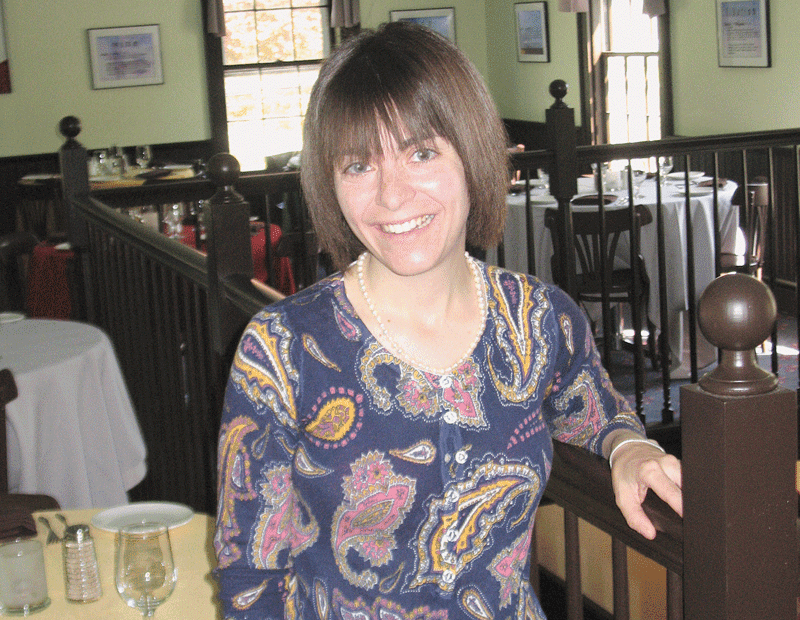
Restaurants Strive to Better Accommodate Food Allergies
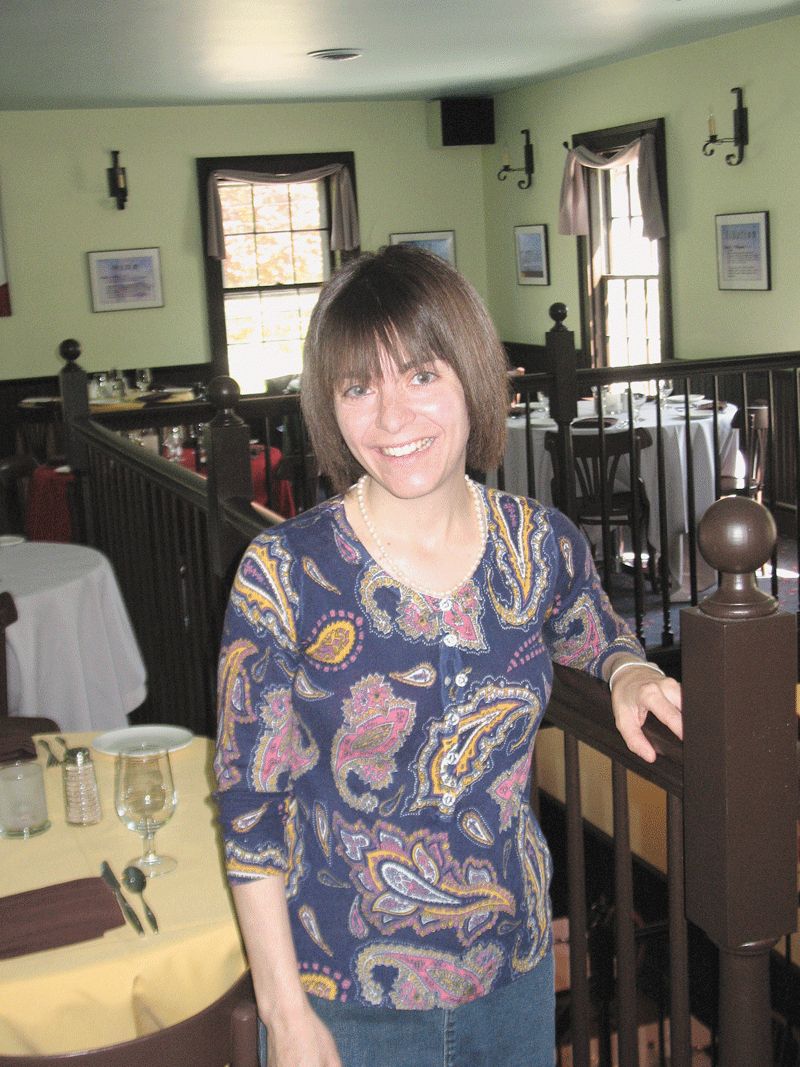
Perigee’s Dawn LaRochelle says one of her goals is to avoid making people with allergies and other dietary restrictions feel like second-class citizens.
“When we opened nine years ago, the big thing was Atkins, no carbs,” said the co-owner of the Federal Restaurant in Agawam. “Today, it’s gluten-free. Back then, we heard someone had a gluten allergy or celiac disease probably once every two or three months. Now it’s at least once a night.”
Dawn LaRochelle has also seen a significant uptick in food allergies. She operates Perigee Restaurant and Apogee Catering in Lee, and says a full 30% of her catering clientele has restrictions based on celiac, a genetic disorder which typically manifests as intestinal sensitivity to gluten, a protein found in wheat and other grains.
“I have a tremendous interest in — and concern for — people who have food allergies, as well as with voluntary dietary restrictions, like kosher or vegetarian diets,” LaRochelle said. “I come from a family of physicians, and I’ve seen first-hand the effects of allergies on people and how devastating it is, feeling like they can’t go out, can’t do anything.”
But that’s changing, at least at some restaurants that put a priority on making people with food allergies of all types feel welcome and safe (more on that later). In the meantime, a state law that went into effect last year mandates a series of steps restaurants must take to educate their staff about the dangers of food allergies and avoiding reactions — which can be deadly — in patrons.
Dr. Jonathan Bayuk, an allergist and immunologist with Hampden County Physician Associates, founded the Western Mass. Food Allergy Network several years ago to help the food-allergic public navigate experiences like dining out. He noted that the Massachusetts law, in a way, follows up on federal guidelines for food packaging, which, in recent years, requires the presence of any of seven allergens — eggs, milk, wheat, fish, soy, peanuts, and tree nuts — to be prominently labeled; producers even warn consumers if a food product has been manufactured on shared equipment.
“Obviously, restaurant menus don’t come with that kind of packaging,” Bayuk said. “So the state has begun the process of making sure people know what’s in the dishes.”
This month, HCN examines what’s in the law, why it was implemented, and other ways in which restaurants are ensuring that guests’ experiences are safe, no matter what their allergy.
Something to Chew On
Ming Tsai, chef and owner of Blue Ginger restaurant in Wellesley and occasional television personality, worked with state Sen. Cynthia Stone Creem to craft the language of the bill and then lobbied on its behalf. A national spokesman for the Food Allergy and Anaphylaxis Network (FAAN), Tsai said he wanted the law to mandate simple, inexpensive measures that would be not only effective but realistic for restaurants of all types to implement.
“I’m so proud that Massachusetts is the first state to pass such comprehensive legislation,” Tsai noted in a statement on his Web site after Gov. Patrick signed the bill. “I’ve always said that, if you are in the restaurant industry, it’s your duty to serve everyone safe food.”
FAAN estimates that more than 12 million Americans, 3 million of them children, have food allergies, and that food-related anaphylaxis results in about 150 deaths and more than 50,000 emergency-room visits each year.
Such allergies are also on the rise, though doctors have not determined exactly why. One theory Bayuk has cited, known as the ‘hygeine hypothesis,’ posits that the immune system, which is designed to fight the parasites, worms, and other organisms humans encounter, has less to do these days and has become a bit, well, bored. The idea is that Americans — with their fixation on cleaning products, hand sanitizers, and reluctance to let kids play outside as much as in the past — have created an aseptic environment, and in the absence of those pathogens, our bodies have become oversentitized to allergens, typically proteins, that should pose no threat to humans.
Recognizing this sharp rise in food allergies and how such conditions could threaten diners, the state’s new law requires, among other things:
• The placement in restaurant kitchens of a poster providing general information on food allergies as they relate to food preparation;
• Menus to include a statement that the customer should inform the waitstaff of any food-allergy issue;
• Standard food-service courses to include the viewing of an approved food-allergy video; and
• The state Department of Public Health to develop a voluntary program for restaurants to be designated as ‘food-allergy friendly’ and to maintain a listing of restaurants receiving that designation on its Web site. In order to receive such a designation, restaurants would be required to make available to the public a master list of all the ingredients used in the preparation of each item on the menu. Tsai said this aspect of the law was inspired by the ‘Food Bible’ he keeps at Blue Ginger, detailing all the ingredients used in each menu item.
The year before the Massachusetts law was passed, FAAN produced a 60-page guide for restaurants that includes case studies, best practices, up-to-date research, food-labeling information, and practical strategies for avoiding cross-contamination of food items, as well as suggested procedures for keeping guests safe and steps to prepare for an allergic emergency. Restaurants are able to download and use the guide as a basis for their food-allergy-management programs.
“Studies show that reactions in restaurants are often caused by lack of staff education about food allergy,” said Anne Muñoz-Furlong, founder and CEO of FAAN. “In a number of situations, the guests did not inform the staff of their allergy. Serving guests with food allergies requires staff education and clear communication between guests and staff. This training program helps staff achieve those goals so everyone can have an enjoyable and safe restaurant meal.”
Bayuk sees the law as a good step forward, particularly considering that restaurants tend to vary widely in their treatment of the food-allergy issue.
“Most restaurants, I would say, are open to talking about it, but don’t want to give you any guarantees,” he said, adding that some national chains, like Chili’s, are diligent about posting all their ingredient information online, but other eateries have been slower to educate the public. “It depends on the server in back and the manager; it’s confusing if they don’t understand how foods can cross-react. Parents [of food-allergic children] are used to this, and if they don’t get the answers they want, they’ll just leave.”
Safe Havens
But they don’t always have to leave. LaRochelle, for one, wants every patron at Perigee to feel welcome and safe, regardless of allergy or other dietary restriction.
She told HCN that she got into cooking when she was 15. She had decided to become a vegetarian, but her mother didn’t want to cook separate meals for her, so she learned how to cook for herself. As it turned out, her family liked her food so much that her mother and sister eventually turned vegetarian as well.
LaRochelle, who has since gone back to eating meat, remembers vividly what it was like to go to restaurants as a vegetarian. “My only option was was either pasta primavera — which might have chicken stock in it — or extras of the side vegetables everyone else was getting with their main course. Or I can have X, but without the Y,” she said. “No matter what I did, I always felt like a second-class citizen, like the dinners being prepared for me weren’t as good as everyone else’s.”
So she made a point of producing a menu at Perigee that offers numerous items — clearly marked on the menu as such — that are appropriate in their unaltered form for kosher, vegetarian, and gluten-allergic customers. She’s also willing to alter dishes for diners with other food allergies — her staff is allergy-trained — and the menu, based on what’s in season in the Berkshires, changes regularly, so customers can return again and again without having to repeat the same meal.
“As a patron of the restaurant, you want to feel comfortable. You can grill my servers about anything; I want you taken care of,” LaRochelle said. “I’m in hospitality because I want to be hospitable. At the end of the day, no matter how great the food is, one week later, people aren’t going to remember what they ate or drank, but they will remember how they felt at your restaurant, and if your response to their allergy made the meal something special.”
The Federal’s Santaniello said servers will direct customers to allergen-free options — including a ‘you be the chef’ section where diners can craft their own combination of entrée, sauce, and sides — and said the menu is extensive enough that chefs don’t have to alter many dishes. “We don’t want to take too many things from the entrée, because if we take too much away, you won’t enjoy it,” he said.
Still, “we’re a little different than some restaurants because we’re fine dining, and we make almost everything from scratch,” Santaniello said. “That doesn’t mean there aren’t still some sauces and bases made at a different time, with ingredients in them you can’t take out, but we can tailor entrees to what a person’s needs are. If it’s a gluten allergy, we can make an entrée without gluten. Nut allergy is another big one. The key is to make sure that guests, at the end of the day, have as good an experience as they can despite their allergy to gluten or any kind of food.”
Bayuk is gratified that many restaurants do go out of their way to provide options and reassurance to food-allergic patrons. But the dining-out experience, he said, can still be a minefield.
“I haven’t heard an overwhelming sigh of relief from parents,” he said of the restaurant law. “Every day, I see parents of kids with food allergies, and they still struggle with this. There’s so much more awareness at many places regardless of the state law, so I’m optimistic. But you still need to be careful.”
Joseph Bednar can be reached at [email protected]

Separating Hype from Reality on Debt Relief
Cover March 14, 2011
Michael Katz keeps a box of tissues behind his desk. And they get a lot of use from the people who sit down to talk with him about their crippling debt, and the reasons — unemployment, divorce, medical bills, or perhaps plain old bad decisions — it has spiraled out of control.
It’s not just feelings of anxiety and helplessness, but often a sense of desperation that brings them to tears — and to promising-sounding solutions, like debt-settlement companies that promise to drastically reduce or eliminate that crushing red tide.
Reality, they often find, paints a far different picture.
“So many people I talk to found these agencies through a television commercial or on the Internet, and in a very high percentage of cases, they have no idea about the legitimacy of the agency,” said Katz, an attorney with Bacon Wilson, P.C. who specializes in business and insolvency law and co-chairs the firm’s bankruptcy department.
“Most people who come to see me who have been in one of these programs found them to be unsuccessful and basically worthless,” he continued, explaining that many of them charged membership fees in the hundreds of dollars, followed by a monthly maintenance fee. This monthly payment typically goes into a ‘dedicated account’ which builds up over time, and is eventually used to make ‘full and final’ settlement offers to one or more of a customer’s creditors.

Thom Fox says people should be wary of companies that want to enroll them in a program without offering credit counseling.
That anecdotal evidence is backed up by a Federal Trade Commission (FTC) study determining that 65% of people who leave debt-settlement programs do so without receiving any settlements whatsoever. Overall, during the survey period, they paid $55.6 million in fees while receiving just $58.1 million in savings from settlements — essentially a wash.
However, the FTC points out, those figures don’t include other costs typically associated with debt-settlement programs, such as late fees and interest charges from creditors, meaning the cost of using such a program, in many cases, far outweights the benefits.
“The FTC received a couple thousand complaints about these services, and that put them on the radar,” said Thom Fox, community outreach director at Cambridge Credit Counseling Corp. in Agawam. “When the FTC did its report, the findings were startling to many people.”
The data eventually led the FTC to amend its Telemarketing Sales Rule. The new regulations, which went into effect in October, set tighter restrictions on how debt-settlement companies — specifically those that solicit customers by phone or receive phone calls in response to ads — conduct their business.
But consumers must still be wary of the remedies they seek to get out of debt, Fox said. In this issue, BusinessWest examines what those options are, and why becoming debt-free is almost never as easy as a TV commercial might make it sound.
Cards on the Table
For instance, Fox said, a consumer might owe $10,000 on a credit card, and the creditor might accept a $7,000 settlement. But while payments to a debt-relief firm are amassing in escrow, that $10,000 can rise at an alarming rate. “Your creditor’s not being paid during that time, the bills pile up, you fall behind, and maybe you get sued,” he said, adding that debt-settlement programs have rarely explained that to clients, but now they have to lay it all out.
Under the new FTC rule, debt-relief companies that run ads or engage in telemarketing will not be able to charge upfront fees until three conditions have been met: the service successfully renegotiates, settles, reduces, or otherwise alters the terms of at least one debt; a written settlement, debt-management plan, or other agreement is worked out between the consumer and the creditor; and the consumer has made at least one payment to the creditor as a result of this agreement.
Also, debt-relief services cannot require that consumers set aside payments in a dedicated account unless the account is maintained at an insured financial institution; the consumer owns the funds (including any interest accrued); and the consumer can withdraw the funds at any time without penalty. In addition, the debt-relief firm cannot own, control, or have any affiliation with the company administering the account, nor receive any referral fees from it.
Finally, before the consumer signs up for any debt-relief service, the company must disclose certain aspects of their services, including how long it will take for consumers to see results, how much it will cost, the negative consequences that could result from using debt-relief services, and detailed information about dedicated accounts if they require them.
The Better Business Bureau (BBB) heartily supports the changes. From December 2007 — roughly the start of the Great Recession — through late 2010, the BBB received more than 6,000 complaints from consumers about debt-relief or debt-settlement companies. Complainants typically said they were charged large up-front fees in exchange for a promise — soon proven empty — to significantly reduce or eliminate their debt.
But consumers aren’t out of the woods because of a rule change, the bureau stresses, and still need to use caution when enlisting a third party to help them get out of debt.
“The debt-relief industry has flourished in the current economy, and you can bet that many unscrupulous companies are feverishly trying to figure out ways to get around the new laws, such as relying less on telephones to solicit new customers,” said Alison Southwick, BBB spokesperson. “While these new rules provide effective new protections, consumers still need to be on the lookout for deceptive debt-relief services.”
Fox said the rule takes aim at all sorts of misleading marketing practices, from promising to cut personal debt by 75% to using President Obama’s image in ads, giving the debt-relief service the appearance of government approval.
“A lot of these things are going away” with the new rules in place, Fox told BusinessWest. “They’re trying to get rid of deceptive advertising, give people proper disclaimers, and empower people with knowledge. Debt settlement can hurt people as well as help them.”
Katz added that people facing debt issues have local options — banks, lawyers, and agencies like Cambridge, to name a few — that provide a level of security that an out-of-state debt-relief firm might not.
“That way, if you have issues or problems, you know where to find someone to help you,” he said. “You can go to a local office and sit down with someone to talk about a program, rather than doing business with someone you and I and, frankly, sometimes Google has never heard of, who has no desire to be a responsible citizen or work out your concern.”
Problem Not Solved
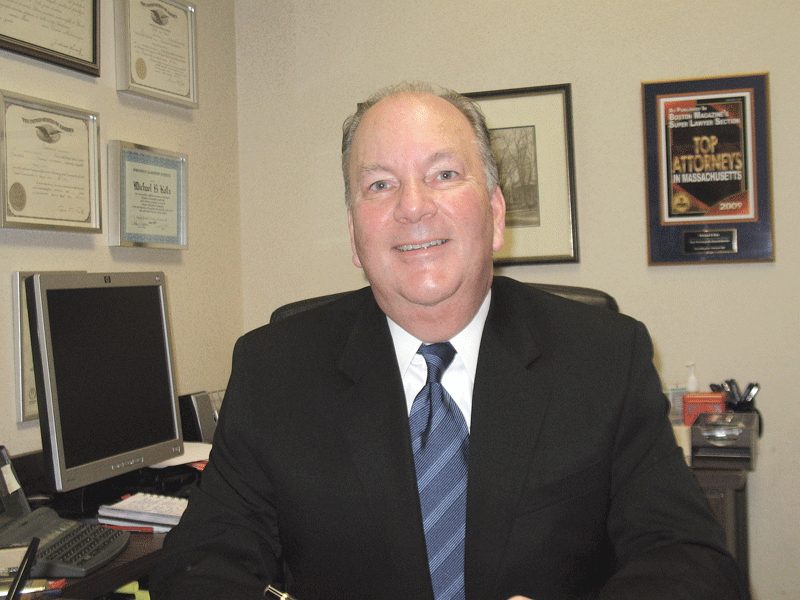
Mike Katz says bankruptcy can be preferable to debt relief because it erases all the debt at once so that an individual can begin to rebuild his credit rating.
Another issue, he explained, is the problem of ‘phantom income.’ It can take several forms.
“If you owe the bank $200,000 on your home and the bank forecloses on the house, and the house sells for $100,000, by law the bank is required to report the money being written off to the taxing authorities, including the IRS and the Mass. Department of Revenue, and they issue a 1099 to you as well as to the IRS,” he said. “Therefore, you owe federal and state income tax on the amount of debt being written off by the lender, and must pay taxes on it at the same rate as your own personal income tax.”
Similarly, Katz explained, “any debt that’s settled through one of the debt-settlement agencies will result in phantom income being produced. And we have found that, in virtually every agency we have dealt with, that fact has never been disclosed to people until the end of the term.”
As an example, he noted that someone with $50,000 in debt who settles for $25,000 might be taxed 30% on the $25,000 written off, or $7,500.
Opting instead for Chapter 7 bankruptcy proceedings, he noted, does not produce any phantom income and might cost as little as $2,000 to erase the entire debt, and the individual can start rebuilding his ruined credit score immediately, especially if he’s diligent about paying other bills, such as a mortgage or car payment. Choosing debt settlement can be equally devastating to one’s credit rating — again, something customers weren’t always told in the past — with little chance of improving it during the life of the plan, which might be three years or more.
“You don’t get any extra credit unless you pay your creditors in full,” Katz said. “So it’s better to do the Chapter 7 and start building your credit back three years earlier than not having it paid in full and still having a black mark on your credit. That’s the reality.”
That’s not to say bankruptcy is the only answer — “it’s not a good thing for anybody,” he said — but he recommended at least talking to a lawyer with expertise in that field.
If someone is considering using a debt-relief agency, Katz said, at minimum they should go online and search for positive or negative comments about that firm. But even then, they should be aware that companies often hire people to post false comments on message boards, praising their services or blasting a competitor’s, a practice that extends to other service industries as well, such as restaurants and hotels.
“So when you see reports online, you have to take them with some skepticism because you don’t know who’s writing them,” he noted, adding that the Better Business Bureau is often a more reliable resource to investigate customers’ experience with various agencies.
A good start, Fox said, is to seek help from a nonprofit agency, which is more likely to focus on the needs of each client, and not just the bottom line.
“Let’s say 100 people call me tomorrow; we’ll offer a debt-management program to roughly 20 of them. That’s about how many would qualify. But the remaining 80% receive personalized advice regarding their situation. Our average employee has been here eight years and has made a career out of helping people with their finances.”
No Quick Fix
The mistake many consumers make, Fox said — and one that has been exacerbated by those ads trumpeting quick, dramatic debt reduction — is relying on a one-size-fits-all program to solve their problem quickly. But the first step in the journey out of the red has to be a serious study and understanding of their own situation, how it developed, and what it will take to avoid future setbacks.
To that end, Cambridge Credit Counseling conducts hundreds of seminars each year — reaching about 7,000 people in Western Mass. annually — in addition to issuing publications and maintaining a weekly YouTube show called Your Money. That’s in addition to spending hours at a time providing free, intensive counseling services to its clients, whether they’re among the 20% referred to debt-management programs or the 80% who aren’t.
“Our goal is empowerment. Maybe 90% of the people who call us have never put a budget into play. They understand their income, but they don’t understand their expenses,” he said — and, specifically, which ones can easily be reduced or eliminated.
“The best learning experiences are the mistakes you make, not the triumphs you have,” Fox continued. “But people aren’t learning financial literacy in their school systems, although that philosophy started changing after the financial collapse. Money is a central aspect of life, and people need to know how to manage it.”
It’s an issue close to the heart of Brady Chianciola, assistant vice president and regional manager at PeoplesBank, who has initiated a series of financial-literacy programs for area students.
“Locally, we’re trying to start young and educate the youth of the region with financial-literacy initiatives,” he said of the school-based programs in Springfield and other Pioneer Valley communities — from budgeting and recognizing the difference between needs and wants to seminars on mortgages and mutual-fund investing.
“No matter what, you need to know about the complex financial landscape we live in,” Chianciola said. “We certainly understand how easy it is to get into trouble, and we hope that, by the time they get out into the real world, they’ll understand these concepts and not fall into some of the traps and scams out there.”
In talking to parents, Chianciola is encouraged by their support of the program. “They say they didn’t have this education,” he told BusinessWest, “but they’re excited about their kids starting young and not falling into the same pitfalls they did.”
Fox said his agency is providing a crash course to people who are learning the hard way. “Our counseling sessions can be an hour and a half, two hours. We do an in-depth budget analysis. We can’t give anyone advice without a full understanding of their goals and situation and aspirations. We can’t build a plan from nothing.”
While making sure any solution fits the individual is simple common sense, he said, it’s a practice that has been neglected by debt-relief services and people who are clamoring for an easy way out — when one usually doesn’t exist.
In most cases, Fox said, “there’s not going to be a quick answer. If anyone gives you a quick answer just to enroll you in their program for debt settlement or debt management, you’re with the wrong agency. Walk away; nobody benefits from that. They’re not providing value if they’re pushing you into a program that’s going to hurt you.”
In too many cases, the end result is more debt — and more tears to wipe away.
Joseph Bednar can be reached at [email protected]
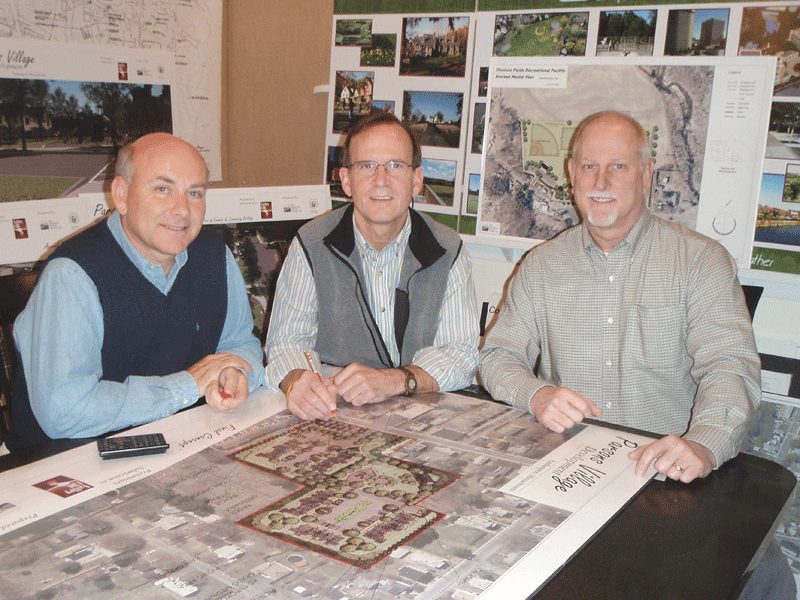
BDG Continues to Grow in a Competitive Landscape
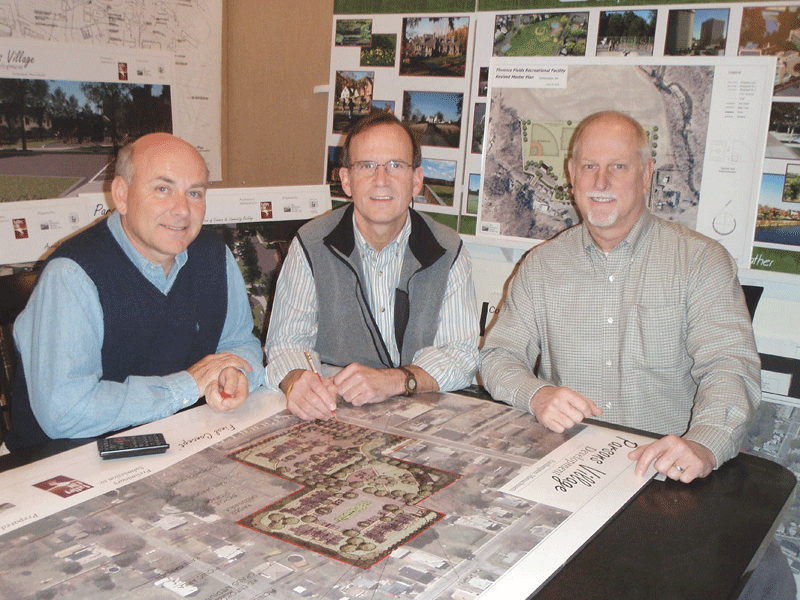
From left, Richard Klein, Peter Wells, and Mark Darnold say doing a feasibility study of a tract of land before a project begins is cost-effective, as it gives developers valuable information about potential problems.
Many developers have a vision of what they want to build on a piece of property. But bringing that dream to reality, be it residential housing, a school, a park, retail space, or a bank, is a complex undertaking.
It all begins with the land and what it can accommodate. And that’s one of the reasons Berkshire Design Group, or BDG, as it’s known, stands out in a field of competitors. The group, which has an impressive and diverse portfolio of award-winning projects, was founded by landscape architects Peter Wells and Richard Klein. They have done many feasibility studies to insure that tracts are suitable for proposed projects.
It’s a step that some developers skip, which can prove costly in the end.
“We analyze sites to make sure they can accommodate what the developer wants to do on them, and isn’t always possible,” Wells said.
He explained that, if a bank is proposed for a site, the property should be evaluated for zoning and traffic requirements. If the client wants a drive-through, it triggers additional concerns, including where it will exit to the street. There are also requirements that must be met to accommodate the Americans with Disabilities Act. In addition, wetlands and rare species as well as topographical constraints play a role in determining the cost and feasibility of a project.
“Our training is in landscape architecture, and we strive to protect the land while still allowing development to continue,” said Wells. “We work with the topography, not against it. For example, if a site has varied topography, the road that runs along it will be built to blend in with the landscape.”
The firm’s portfolio is filled with a number of diverse projects. “One of the things that makes us different is that we don’t specialize in any one type of development. We have done everything you can imagine, from master planning for schools and campuses to state parks, shopping centers, malls, and all types of housing developments,” said Klein. “It is unusual for a firm to have experience with so many different types of projects.”
Another benefit, which has helped make BDG the largest and most well-known firm of its type in Western Mass., is that it offers one-stop shopping. Its services include landscape architecture, civil engineering, surveying, zoning and permitting, bidding, and overseeing construction. One of the partners handles every project from start to finish.
The firm opened 27 years ago with Wells and Klein, but since then Mark Darnold and Mark Lindhult have joined them, adding to their ability to oversee large projects. And although the principals could have grown the venture by taking on more project managers, thus relinquishing direct control of some projects, Wells and Klein decided to maintain a hands-on approach and have kept that promise.
“It means that our clients get someone with more than 30 years of experience who is a professional and can see things that a younger staff person may not see,” Klein said.
Ground Level
BDG has been feted with a continual stream of awards over the years, including several for the Rocky Hill Cohousing project in Northampton.
“This was a very sustainable and green project with regards to the site development and stormwater management,” said Wells. “Plus, we created a tremendous amount of open space.”
The company’s most recent award came from AIA New York for two dormitories at Amherst College. “The buildings were done using sustainable practices with an eye toward the traditional classic architecture that is the hallmark of Amherst College,” said Klein. “The design was aesthetically pleasing and functionally exceptional in every facet of the building; we have always strived to be as green as possible even when green wasn’t in fashion.”
The firm cares deeply about its clients’ success, he continued, because the principals believe it reflects back on them. And that has a lot to do with how each building, as well as the overall property, looks when it is finished.
“We want to build projects that people like, will use, and that meet the goals for sustainability,” Klein said, adding that the company has completed many LEED (Leadership in Energy and Environmental Design) projects. At present, BDG is engaged in a Living Building Challenge as it plans for the construction of an environment classroom at Smith College.
The concept of Living Building Challenges is based on making decisions by addressing environmental, social, and economic problems that can arise, such as habitat loss and the lack of community distinctiveness.
Wells said the principals’ concern for the land goes back to their identity.
“We use sustainable principles in all of our projects,” he explained. “We have evolved over the years, as we started out as landscape architects and added other disciplines. We look at land differently than other professionals, which allows us to guide our clients more holistically and efficiently; if a building looks good and is in character with its surroundings instead of looking like it was forced on the land, it is usually more profitable.”
Decades of experience gives BDG a decided advantage over its competitors. “We can look at and envision opportunities and constraints on a piece of property as well as the permitting hurdles,” Klein explained. “There may be traffic issues, poor soil, or a site may be too steep for various types of development.”
BDG recently conducted a study on a tract of land for a proposed school. “We found it had topographical constraints. It sloped too much to develop any playing fields. If they had used it for that purpose, their budget would have had to increase, and it could have become quite costly,” Klein said, as he sat in the company’s Northampton office in a room covered with mockup boards in all stages of completion. “Because of our depth of knowledge, we are able to inform clients quickly about additional costs during construction.”
Klein said the company’s A-to-Z approach is one of the keys to its success.
“We are able to take a blank piece of land and do a feasibility study on it to see what it can carry in terms of capacity,” he explained. “After that is determined, we do a preliminary design and get all of the permitting approved, then do the construction documents. We bid the project for developers, and we oversee the construction.” BDG can also illustrate a design proposal before ground is broken by employing computer-generated models and animation.
Step by Step
The permitting process is typically complex and takes many months to complete. “We know the regulations. We also have good working relationships with many board members in the surrounding cities and towns in the Commonwealth,” Wells said.
Right now, the company is in the process of developing several of the largest projects in Western Mass., including the $42 million master plan for Three County Fairgrounds in Northampton and the Colvest Group’s $25 million Chicopee Crossing, which is under construction and will include a hotel, retail shops, and restaurants.
Other projects include the new Easthampton High School and two housing developments in that community — an apartment complex with 50 units in an old mill building on Cottage Street, and Parsons Village, a 38-unit affordable-housing development on four and a half acres. Construction on the village is expected to begin in 2012.
BDG also conducted all of the site work and design for the housing at the former Northampton State Hospital, which includes townhouses, single-family, and multi-family rental units. In addition, BDG is on the team working to redevelop the Indian Motorcyle Apartments at Mason Square in Springfield.
“And we are in the permitting process for Northampton’s newest park, which will be built on 30 acres in Florence,” said Wells. Recent work also includes completion of the new $40 million pharmacy building at Western New England College.
Their company’s client list contains a substantial number of repeat customers who like the fact that they don’t have to hire a number of consultants to get the job done.
“Our process is cost-effective and streamlined so there is less chance of scheduling conflicts or mistakes,” Wells explained. “For instance, a developer could go to four firms who would have to coordinate to complete a project. But we can do it all under one roof. And because we are in Western Mass., our focus is here in the Pioneer Valley.
“We know the area, know the local contractors, and know the local bidding processes, as we do a lot of it and have strong relationships with general contractors,” he continued, adding that he and Klein visit their sites often, which insures that things move along smoothly.
Their expertise and reputation has allowed them to develop a broad customer base which reaches to distant shores, including Taiwan, Puerto Rico, New York, Los Angeles, and Atlantic City.
But their real focus is the Pioneer Valley, where they approach projects in a way that shows respect for the environment. And that respect for the land bodes well for the future — both for BDG and for its clients.
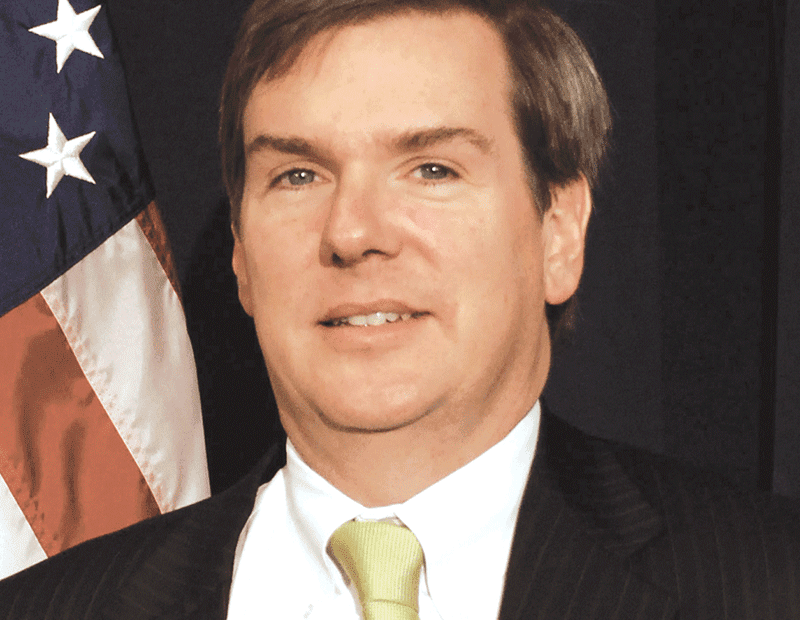
A Progress Report from the State’s Economic-development Czar
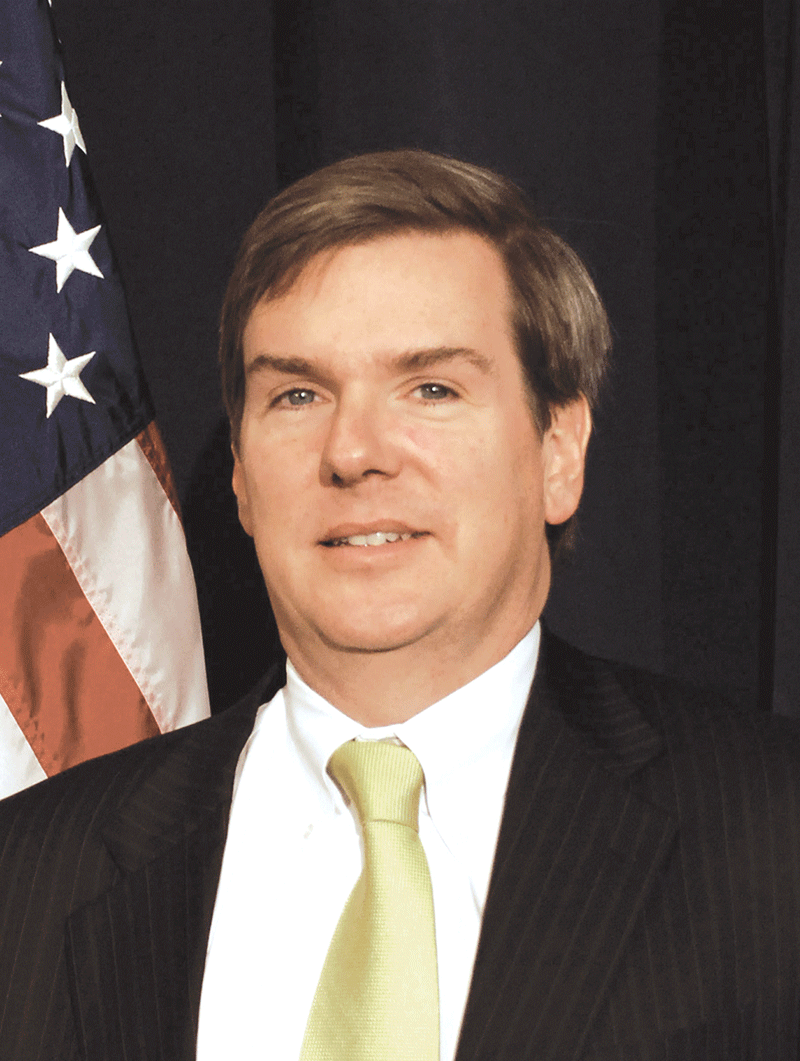
Greg Bialecki, secretary of Housing & Economic Development
Greg Bialecki acknowledged that that much of the progress being seen in Springfield and other area communities has been generated by state and/or federal assistance — on one level or another.
Examples abound, from the presence of Liberty Mutual in the Technology Park at Springfield Technical Community College to the high-performance computing center in Holyoke; from the tax incentives recently awarded to Smith & Wesson in exchange for its pledge to create 225 new jobs at its Springfield plant and make significant investments there, to the backup data center soon to be take shape at the former Technical High School on Elliot Street in Springfield.
Bialecki, the state secretary of Housing and Economic Development, prefers to look at the state’s contributions as investments that will help trigger private-sector spending in older, former manufacturing centers, like Springfield, Holyoke, Chicopee, and others, that need a boost in their efforts to reinvent themselves and spur economic growth.
The Deval Patrick administration’s strategic plan has been to make prudent, well-thought-out investments capable of generating significant returns, said Bialecki, adding that this policy will continue in the second term that started this month, and that, given some help in the form of economic recovery, such returns should soon be visible and measurable.
The data center taking shape at the old Tech High building is another example of state investment in a gateway city — Springfield.
BusinessWest: Talk about the state’s investments in economic development and the goals and expectations that come with this assistance.
Bialecki: “Everyone who does investing is always looking for leverage, and the state is no exception. The governor has asked me to look for opportunities where a state investment will be matched, not just one-to-one, but many times over, by private investment. The high-performance computing center is a good example of that; the state has committed $25 million to that effort, which will probably be a $160 million project when all is said and done, and a number of private colleges involved have made sizeable investments as well. Originally, we put out the promise of some public funding to encourage private funding, but at this point, all the money that’s needed to make this go is in hand.
“Smith & Wesson is another example. Our $6 million investment tax credit is probably going to be about 10% of the actual private investment. Smith & Wesson has committed to spend at least $60 million in new plant equipment there over the next several years, so we’re just making a commitment that’s way overmatched by private investment.”
BusinessWest: How do these investments fit into the state’s broad strategic initiative involving the so-called Gateway Cities, such as Springfield and Holyoke, and are there signs that state-assisted projects are, in fact, stimulating private development?
Bialecki: “You can see some examples of the model this administration is advancing taking place in Springfield. Liberty Mutual is one, and the old federal building, 1550 Main St., is another, and so is the data center. These are public/private projects, for the most part, and examples of how state assistance has been provided to help older cities. We do believe that, if you’re really going to be a catalyst for economic development and job creation, we need to be thinking not only about places where we can do public projects — Union Station might be an example — but balancing that out with projects where we are providing an incentive for private investment.
“These projects send a bit of a different message about the way we think of the economic potential of different regions of the state, including our older cities. In other words, this approach is based on the view, the perspective, that good things are happening in all the regions and many of our cities, and if we can address their challenges, but also talk up the good things about them, we can convince private business to locate there.”
BusinessWest: Some people and groups criticize such public assistance to private companies, calling it corporate welfare and a flawed system for spurring economic development and job growth. How do you respond to that, and does the state need to make such incentives available to compete with other regions and cities?
Bialecki: “We believe that some level of assistance is probably required in a number of these places to help people make the decision to locate in a Springfield or locate in Western Mass., in part because of what other regions are offering, but also in part because some companies like it here and want to be able to stay here.
“Frankly, the Smith & Wesson deal, although that was real money, was in a way a blockbuster deal, in terms of the amount of incentives compared to what other states are offering. We have other states offering some of our companies huge deals — they’re saying, ‘if you move here, we’ll build you a factory, and we’ll pay for it.’ And if you talk to Smith & Wesson and ask them if the state’s willingness to commit to incentives was an important part of their decision, they’ll say, ‘yes, absolutely.’ But they’ll also say that they really like being in Springfield, we’ve got a great workforce; it’s not a case where they’re saying, ‘we don’t want to be in Massachusetts, we don’t wan’t to be in Springfield, but if you pay us enough, we’ll stay here.’ They want to be here.”
BusinessWest: How important is balance, in terms of public and private investments, to a city’s long-term success?
Bialecki: “Very important. The ultimate goal, obviously, is to maximize the amount of private-sector job-creation and private-sector investment in the region. We’re glad to continue to make significant public investments as well, but, realistically, and from our point of view, you’re only to going to be able to say we have a healthy economy in Western Mass. if there’s not only public dollars going into employment and investment, but also private dollars, and more private dollars than public.”
BusinessWest: Talk about the plight of the gateway cities and what the state is doing to assist them.
Bialecki: “Our approach is very consistent in that we don’t look down condescendingly on these cities — we view them as being able to participate in and contribute to the economic health of the state. We want them to be in the mainstream of the business mix in the state. What are the big industries in Massachusetts? Health care, higher ed, financial services, high tech … a measure of our success should be that those industries are in our gateway cities. In Springfield, MassMutual was already there, but getting Liberty Mutual was big — these are Fortune 100 companies, and they both have a presence there.
“There are also many colleges and universities in Springfield, and that’s important, as well as Baystate Medical center and other health care providers. We want to add the tech sector to that mix, and the high-performance computing center will help. We want the gateway cities to be in the mainstream of the state’s economy, especially the innovation economy.”
BusinessWest: What role does housing, specifically market-rate housing that will, theoretically, attract young people and professionals, play in economic development, and what is the state doing to stimulate such developments?
Bialecki: “Housing is a critical component, and we want to make sure that cities have a good mix of all kinds of people living within their boundaries. We want there to be enough affordable housing for those at that end of the spectrum, but also enough places for people who are middle-class and above and have choices about where they want to live. How can we create an environment where people will want to live in our gateway cities?
“We started a new program where, for the first time, we have money available to provide tax-incentive support for people to create market-rate housing in gateway cities. It’s a pilot program with $5 million available initially, and it’s something [Springfield] Mayor [Domenic] Sarno has expressed great interest in. Officials in Springfield have done an inventory of what market-rate housing is available today, and identified potential pipeline opportunities where such housing can be created; developers will probably need some help, and we’re willing to do that.”
BusinessWest: Is there a policy or strategic plan for helping these cities, and if so, what are the main elements?
Bialecki: “Some of the strategies that people have talked about in the past for helping gateway cities have been to mitigate the challenges and the problems facing these cities, such as public safety, and those are important things to do. But we are actually aiming higher. We’re not just trying to mitigate the problems; our vision focuses on determining what these cities, like Springfield, would look like if they were functioning at a high level and were contributing to the economic life of the region.
“And if you look back, all of these played that role at one time, some more recently than others. Holyoke was the first planned industrial city in the country, New Bedford was the whaling capital of the world, and Lowell and Lawrence were main textile centers. Most all of these cities were, at some point in time, not just keeping up with the economic prosperity of their neighbors, they were driving the economic prosperity of their respective region.
“We understand the challenges, but we think that that is the right aspiration to have for these cities: what would it look like and feel like for Springfield to be that driving force again?”
BusinessWest: What are the immediate hurdles to achieving that goal, and what has to be done for the city to achieve this vision?
Bialecki: “There are a lot of good building blocks in Springfield, like its colleges, universities, and fine health care facilities. We would like to see other aspects of the innovation economy; we’d like to see more tech companies. There are some initiatives with incubator space [at STCC], and there is the Pioneer Valley Life Sciences Initiative to get some other life sciences and biotech. There is plenty to build on.
“And development of these sectors goes back to my earlier comments about how many projects require some measure of state assistance. While it’s true that, to jump-start some of these things, assistance is needed, our goal is to move off that.
“In other words, let’s talk about the things we have to do in Springfield and the other gateway cities so that the businesses will say, ‘you don’t need to persuade me to open a new business unit in Springfield — that’s where things are happening; that’s where I want to be.’
BusinessWest: Is there a model to be followed in terms of such a recovery?
Bialecki: “Lowell is the classic; that’s the one everyone points to, and they have had a good deal of success over a prolonged period of time, going back to the ’80s. But I’ve seen some very impressive changes and improvements more recently, over the past four years, for example. In Haverhill, the mayor has made a big focus on market-rate housing in the downtown, mostly in old mills and even to the point where people said, ‘what are you doing?’ But it’s worked out very well; he’s got a lot of telecommuters there and people who can work anywhere, and it’s a short commute to Boston. And he’s generated a lot of street life, a lot of new restaurants.
“And New Bedford’s done very nicely. We’ve helped them with some things, and they’ve used those projects to trigger some private investments; there is a nice creative-economy element to what they’ve done, with a lot of artists moving in.
“The thing about gateway cities is that there’s no silver-bullet project that’s going to put you over the top; it’s an accumulation of things that are going to make a difference, including that all-important private investment.”
George O’Brien can be reached at [email protected]
Incentives — They’re a Necessary Evil
‘Corporate welfare.’
That’s the term used in some circles to describe the incentives — mostly in the form of state and local tax breaks, but they come in other forms as well — given to companies to locate in a community or remain there and expand their operations. It has a very negative connotation, and, in the eyes of many, it’s warranted.
Welfare, a term that’s being removed from the lexicon, at least in this state, and replaced with ‘transitional assistance,’ implies help to those who outwardly need it. Some would say that businesses, or at least the vast majority of them, don’t need and don’t deserve tax breaks and other assistance when very few companies, and no residents, get such help.
But this view does not reflect the current world in which we live and try to do business. Indeed, jobs are the lifeblood of every community, every region, every state, and, yes, every country, and the competition for jobs has never been more intense. Thus, incentives like those recently awarded by the state and the city of Springfield to Smith & Wesson and Titeflex (see story, page 6), and by the state to Qteros (now doing business in Chicopee), are certainly warranted, if not exactly popular.
States and economic-development regions are being quite imaginative, and generous, with incentives, especially in this economy and when so many former manufacturing centers are struggling. If these companies and others, such as Performance Food Group in Springfield when it was looking to expand in the city, did not get the tax breaks they requested, they would, in all likelihood, have gone elsewhere.
All this said, communities and states have a responsibility to award incentives wisely and fairly, with an eye toward helping a region, not an individual business. Most people remember when Springfield was handing out grants and attractive loans willy-nilly, to seemingly anyone who wanted to open a restaurant and had a business plan in hand — and they remember the consequences: unpaid loans and vacant storefronts.
Which is why we’re pleased to see that the state’s Economic Assistance Coordinating Council has changed the rules when it comes to how it awards tax subsidies. These changes, which came in the wake of criticism that the state had squandered millions of dollars over the years on dubious projects, such as fast-food restaurants and retailers who probably would have opened in the Bay State anyway, were certainly overdue.
The new regulations, adopted early in 2010, limit which companies are eligible for subsidies, and give state economic-development officials more discretion over the awards. In short, priority is now given to manufacturers and companies at the cutting edge of new technology and processes (such as Qteros) and to opportunities for job growth in the so-called Gateway Cities, which include Springfield, Holyoke, Chicopee, and others in this region.
And these awards come with some heavy strings, such as the promise of new jobs and investments in these companies’ operations. So while time will ultimately tell what happens at Smith & Wesson, Titeflex, Qteros, and other companies in this region, the money spent by the state and the communities involved appears for now to be well-spent.
As we said at the top, business incentives — or that much-less-flattering term for them, corporate welfare — seem inherently unfair when residential taxpayers don’t receive breaks and many business owners stay in a region for decades, and sometimes expand several times, without asking for or receiving financial assistance.
But the reality is that these incentives are, indeed, necessary, and you might as well drop the word ‘evil’ that usually follows that term.
When you do the math, and divide the state tax subsidies awarded to Smith & Wesson ($6 million) by the number of jobs created (225), it’s about $26,000. That’s a lot of money for a job, but for a region that’s screaming for new employment opportunities, especially good-paying jobs in manufacturing, that price sounds like a bargain.
And a price well-worth paying — if, and only if, the conditions are right.
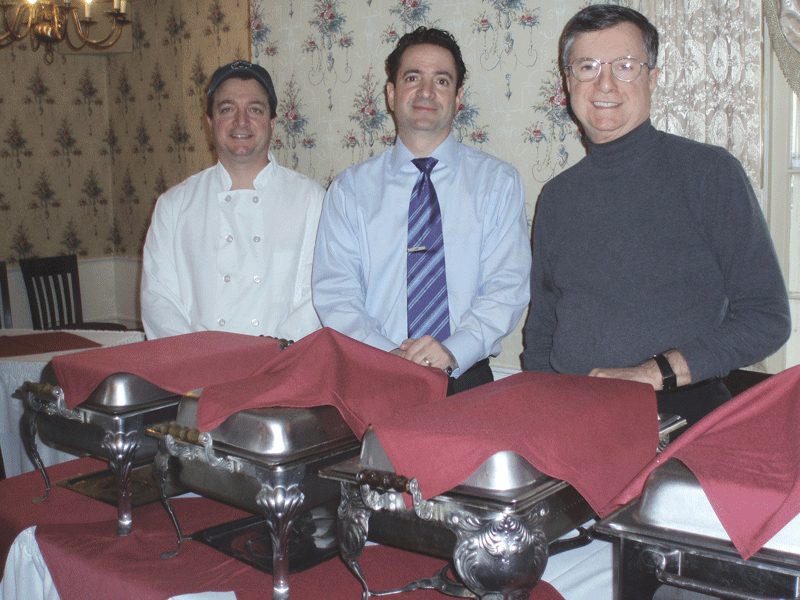
At Storrowton Tavern, History and Fine Dining Come Together
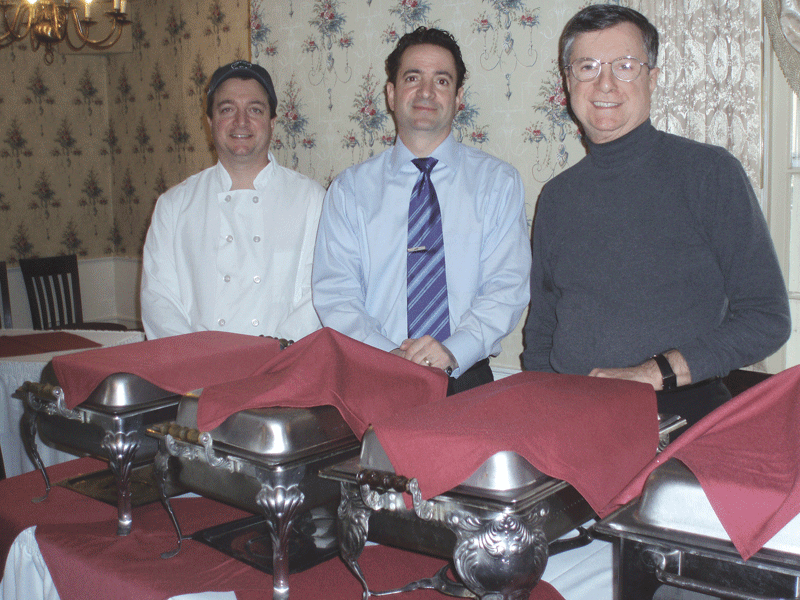
From left, Vincent Calvanese, Donald Calvanese, and their father, Andrew Calvanese, say they love the history of Storrowtown and the memories it has created for patrons.
“First, there was the challenge of revitalizing an incredible establishment. Second, it was a great opportunity for my two sons. And third, there are the memories at the Tavern, not only that I have, but that many other people had,” he told BusinessWest. “I love this place because of the personal feelings I have attached to it. And I love people, and I wanted to bring it back for them.”
The historic tavern that is a vital part of Storrowton Village was closed for two years before the Calvanese family reopened the doors, serving New England foods that have been enjoyed there for more than a century.
“Today, there is life here again, and I am very proud of what we have accomplished; this establishment is more than 200 years old, and it’s open once more. The restaurant business is hard work and takes a lot of dedication, but I was made for this,” said Andrew, who began his restaurant career 47 years ago when he was hired as a weekend cleaning person making $1 per hour at Friendly’s Ice Cream in Springfield.
The Calvanese family is happy to be in the restaurant business together and run Storrowton as a true family operation. Andrew handles public relations, while Donald is the general manager, Vincent is the executive chef, and his son Vincent is a cook.
They all love the business and believe they couldn’t find a better place to be. Before coming to West Springfield, Donald ran the food service at Wilbraham Country Club with his late mother, Doreen Calvanese, and Andrew and Vincent were at the helm of Suffield Country Club’s restaurant and pub.
However, the sons wanted to work together at a place that would allow them to grow. Donald said they looked at many restaurants before reading in a newspaper that the Eastern States Exposition sales department was looking for someone to reopen Storrowton. But nothing had seemed right — until they set foot on the old tavern grounds.
“I fell in love with it the first time I saw it,” Donald said, adding he had never eaten there. “The location is great, the building is great, and its history is interesting. The floors are uneven, and it’s impossible to heat and cool, but it has a lot of character, and we work with it.”
Andrew said the people at the Big E liked the concept of having a family run it, and the decision was made. He is proud that they were chosen out of a field of more than 40 applicants, and calls their relationship with the Big E “incredible … we are like a big family with them.”
Donald agreed and said exposition staff members played a role in helping them get the restaurant back on its feet. “It’s so nice to have a restaurant like this open again, especially with all of the chains going up. There is a lot of competition, but things are going well.”
Wayne McCary, president and CEO of the Eastern States Exposition, says the Calvanese family fit the bill.
“Storrowton Tavern is a unique part of the culture of Eastern States Exposition and its year-round events, and it was critical to create a business relationship with partners who would operate the Tavern in conjunction with the Exposition itself as well as the many shows on our grounds,” he said. “The Calvanese family is a great choice and represent the tradition of Storrowton Tavern well.”
Course of Action
However, it took a tremendous amount of work to ready the historic buildings for use again. But the family worked as a team and began renovating and cleaning even before negotiations were finished. They got down on their hands and knees and scrubbed floors, painted rooms and ceilings, put in new carpeting, and renovated the entire kitchen.
In November 2003, after months of hard work, they opened the doors Thanksgiving week and were thrilled to have 600 people enjoy the holiday there.
This year, they will feed more than 1,000 at both a sit-down meal inside the old building and at a buffet in the Carriage House across the green.
Andrew says people love the ambience of the old tavern, and they treat it and the people who come there like family. He filled a large bookcase near the doorway with part of his late wife’s collection of more than 1,000 cookbooks for people to peruse while waiting for a table, and recently finished restaining the paneled walls, which took months of painstaking labor. He and his second wife got married there, and Storrowton is his favorite place because of the “romance here,” he said.
The old tavern has a fascinating history, as it is actually two buildings that were joined together. One is Atkinson Tavern, which was built around 1789 at Atkinson Hollow in the town of Prescott. The original owner was John Atkinson, Prescott’s last surviving Revolutionary War veteran, who used it as a store, tavern, and home for his family.
Andrew likes to point out that the Vermont Room, located on the second floor above the pub and tavern, was once used as lodging for guests who stayed there.
In 1928, when the state took Prescott by eminent domain along with three other towns in the Swift River Valley to create the Quabbin Reservoir, Helen Storrow had the building moved to the Early American village she was creating in West Springfield. In 1930, the Baptist meeting house, believed to be built around 1822, was brought to Storrowton Village from Southwick. It was joined to the tavern in 1957, doubling the size and scope of the restaurant.
The tavern has five dining rooms, which are furnished with period antiques. Andrew said his family members brought many of their own heirlooms there, which include a set of Gone with the Wind commemorative plates and a glass case filled with Hummel figurines.
The Calvaneses also took over the operation of the Carriage House, a modern banquet facility which sits on the other side of the green across from the tavern. It accomodates parties of up to 350 people.
Donald loves the atmosphere and the fact that the tavern is part of the village. “You can leave the restaurant with a glass of wine and walk around the green or sit on a park bench. It looks like something out of the Colonial days,” he said, adding that they like seeing patrons enjoying the grounds.
Vincent also loves the diversity of events held on the Exposition grounds, which add to their business. “What I love about Storrowton is that there is always action here. We can have a post-funeral reception in the afternoon and a wedding at night. Plus, there are events such as the horse shows and the Big E,” he said.
Just Desserts
Andrew’s career in the restaurant business began as a cleaning person at Friendly’s. A month later, he was promoted to dishwasher, and, a month after that, he became the evening shift manager. “Within three months, I was the highest-paid part-time employee at the store, making $2.50 an hour; the food business just fit me,” he said.
After that, he spent 20 years as delicatessan manager at Gus & Paul’s Bakery and Deli in Springfield, where he discovered not only how much he enjoyed working with people, but how fulfilling it was to help them create memorable life events. His next move was to Suffield Country Club, where he stayed until moving to Storrowton.
His passion for the business was passed on to Donald and Vincent, who both worked as dishwashers at the Mountain Laurel Restaurant in Enfield, Conn. when they were young teens. Donald went on to become a waiter at area restaurants, then moved on to Mount Holyoke College, where he worked as chef/manager of its food-service operation for four years, before spending four years at Wilbraham Country Club.
Vincent was introduced to the business at age 12, when he helped out at a wedding his parents were catering. “I remember how happy we made people,” he said, adding that knowing he plays a role in people’s memorable life events continues to be rewarding, even though he is behind the scenes. During the course of his career, he worked at several area restaurants and opened one in Haydenville named DaVinci’s, which he operated for two years.
At one point, he was offered the position of head chef at Storrowton Tavern, but didn’t take it because he didn’t want to leave his family members.
Family is extremely important to the Calvanese men and women, and so is history.
“I feel like this is my second home because, when I came in here, I thought about my personal memories. And now, we are creating them for others,” Andrew said. “When we hold a party here, it’s like having a party in our own home. This is a landmark that we have revitalized, and so many people are happy this is open again.”
Vincent agreed. “We have something special here. We are working owners and always have been. We are here just to make people happy. It’s our goal, and what we want to continue to do. When I was first offered a job here, I didn’t want to leave my family. But I somehow felt like I belonged here, and here I am now. Operating Storrowton is a challenge, but one that is interesting, due to the many events staged on the Exposition grounds.”
Andrew says many people think Storrowton Tavern is open only during the Big E, and some come back every year at that time, making their own history. But memories have always been made within the tavern’s walls, and that tradition will continue, which suits him just fine.
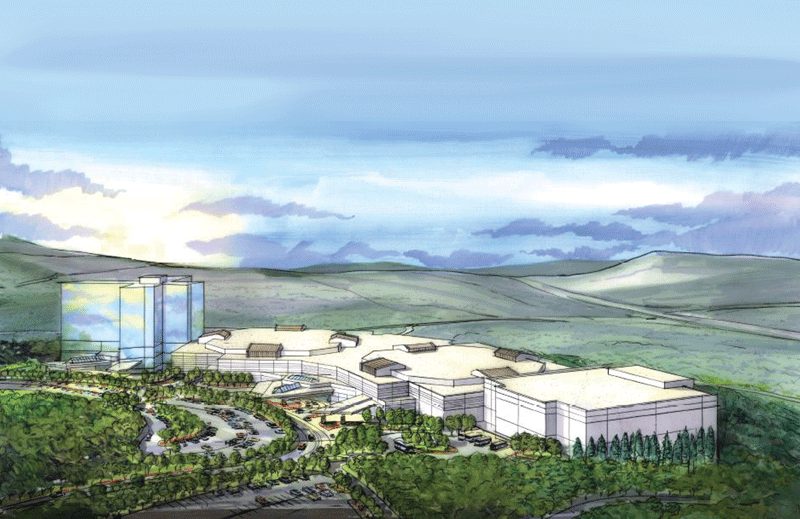
As Key Votes Loom, Palmer Casino Backers Put Their Chips on the Table
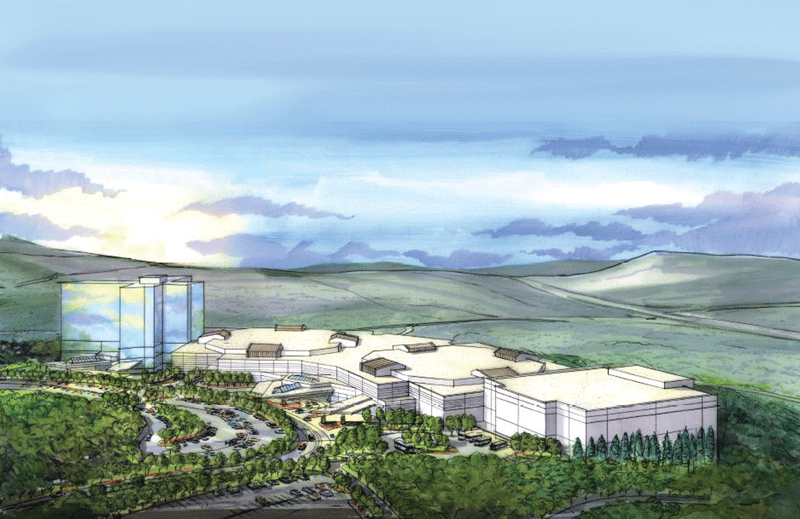
Casino Rendering
The storefront has been open for just over a year now. In fact, an open house was recently staged to mark the anniversary.
It’s right in the middle of Main Street in Palmer, clearly visible to those approaching downtown from Route 32. The Mohegan Sun sign is large and prominent in the window.Visitors to the former retail space — now decorated in the motif of the casino in Uncasville, Conn. operated by the Mohegan Tribal Gaming Authority, complete with a few seats from the arena where the WNBA’s Connecticut Sun play — have a few primary objectives, said Paul Brody, vice president of development for that organization.
Some want to pose questions about the potential impact on their homes or businesses from a proposed $1 billion casino complex on land just off the exit 8 interchange of the Turnpike. “They want to know about traffic and how that will be and how it will be mitigated,” he said. But most are inquiring about jobs and, more specifically, what kinds of opportunities will be created. Mohegan Sun isn’t taking job applications, but it is signing people up, with the intent of calling them back if the complex becomes reality.
“And some others … they just want to know what’s going on with this thing,” said Brody, one of four Mohegan employees who staff the storefront. “They want to know if this is going to happen, and when — whether it will be one year, two years, or more.”
And Brody says he tells them basically what he also told BusinessWest when it stopped by the office: that these are certainly critical times for those who support — and oppose — organized gaming in Massachusetts, and especially for those who have invested considerable time (several years), energy, and emotion in Mohegan Sun’s proposed complex, which would be built on a hill high above the pike and Route 32 and include a 164,000-square-foot casino, a 600-room hotel, 12 restaurants, and 100,000 square feet of retail space.
The state House of Representatives has passed a bill calling for two casinos and several slot operations at racetracks (called racinos by some), and the Senate is due to vote on its own version later this month. There is strong sentiment that the Senate will also vote to support some kind of gaming package, but the devil is in the details, and Brody acknowledged that, while he is not conceding anything regarding the broad vote to green-light casinos, he said the conversation is, in many ways, shifting to where they’ll be located, not if.
And thus, Brody also tells visitors, as he told BusinessWest, that, in response to a request for data that might help legislators determine where, Mohegan Sun commissioned a study that shows that a casino in Palmer, or “Greater Palmer,” as she called it, would benefit the state more than one built in another proposed location (Milford), assuming that the second casino is built at the Wonderland complex in Boston.
The study, conducted by Morowicz Gaming Advisors, LLC, concludes that a casino in Palmer, instead of Milford in Central Mass., would result in $43.8 million in additional gaming revenue annually to the state, and nearly $100 million more in out-of-state dollars coming to the Commonwealth, primarily because it would lure more New York State residents than one farther east.
The study — which, to no one’s surprise, is being questioned by the backers of a Milford casino, who have a different take — is one of many ways backers of the Palmer resort are trying to build momentum at a time that many consider critical to the town’s future.
They’re presenting the proposal as more than a casino, but also as a way for an economically beleaguered community to replace manufacturing jobs that have left over the past two decades and provide long-term stability, while also bringing other types of development to nearby vacant or underutilized real estate. Meanwhile, they’re presenting it as the state’s best bet for a secondary resort outside Boston.
“This is not just a singular project on the hill, but potentially other kinds of development that will blend with the flow of traffic,” said Leon Dragone, president of the Northeast Resort Group, which owns the proposed casino property and leases it to Mohegan Sun, and now also occupies the space two doors down from Mohegan on Main Street. “There are several other properties we’re looking at.”
The Hand That’s Been Dealt Them
There’s a cluster of signs greeting motorists getting off the exit 8 interchange, most of them directing them to businesses and attractions in Palmer, to the right down Route 32, or in Ware, a few miles to the left.
But there are three relatively new additions that, along with a smattering of lawn signs along Route 32 supporting the casino effort, tell of the sense of urgency in Palmer these days and the importance of the casino to the town’s fortunes.
There’s the ‘Mohegan Sun — A World at Play’ sign in bright yellow, flanked by two signs of support, one for each of two recently formed groups: Palmer Businesses for a Palmer Casino and Citizens for Jobs & Growth in Palmer.
Robert Young is a member of both groups. He owns a landscaping company and has lived in Palmer most of his life, or at least long enough to see most manufacturing jobs leave and nothing of any substance to fill the employment void. Indeed, as he listed the manufacturers that have departed, including Tambrands, Zero Corp., Pearson Industries, and others, he said efforts to attract different kinds of employers, including those in high tech and the biosciences, have not met with success.
He acknowledged that the former Tambrands complex, seeking new tenants for more than a decade now, has attracted some new businesses, but few if any that are large employers.
“Palmer is a town that’s dying, and it’s been dying for a long time,” he said, noting that the ease with which Mohegan Sun and Northeast found vacant storefronts in the middle of downtown says something about the deterioration of the central business district. “We’ve lost tons of manufacturing jobs and support jobs, and nothing has materialized to replace them.
“We have no more jobs for a lifetime,” he continued, noting that, in his view and in the opinion of those who undertook a study on the subject at UMass, casino jobs are the new factory jobs that can support families for decades.
But jobs are not the only component of the argument being proferred by the support groups and other Palmer-site backers, who say a casino could lead to other kinds of economic development in the community and, in the process, fill a number of vacant parcels in and around Palmer with everything from additional hotels and restaurants to golf courses.
“There are a number of sites that could potentially be developed,” said Dragone, citing a 30-acre parcel once proposed for a Lowe’s and a 95-acre parcel in Ware as just two examples.
He said a North Carolina-based firm is being considered to create a master plan for nearby undeveloped parcels. Speaking broadly, he said a casino in Palmer could do for the town and surrounding region what the resort in Uncasville has done for Mystic, Conn., about a half-hour down the road, known for attractions such as its aquarium and Mystic Seaport.
“It’s quite legendary what’s occurred there, which has been a direct result of the blossoming of the gaming industry in the southeastern part of Connecticut,” he said. “It’s become much more of a year-round tourist attraction, where before, it was mostly seasonal.”
Doubling Down
While the Palmer casino support groups present their arguments about the benefits of resort casinos in general and a Palmer facility in particular, Mohegan Sun is devoting most of its efforts now toward pressing the case for a Western Mass. casino, said Brody, who is now splitting his time between Palmer and Boston, where he and lobbyists hired by the firm are trying to gain the ear of lawmakers.
The Morowicz Gaming Advisors’ numbers already have the attention of many legislators. They show that if there was one casino in Boston and a second in Palmer, the total gross slot and table revenues for the state in 2014 would be $1.168 billion, as opposed to $1.124 million for a Boston/Milford mix. Meanwhile, total out-of-state money coming into the Commonwealth would be $216.4 million with a Boston/Palmer scenario, compared to $119.1 million with a Boston/Milford combination.
The former numbers result from a Central Mass. facility essentially “cannibalizing” (the report’s authors’ word) the Eastern Mass. casino and racinos, while the latter is due largely to Palmer’s proximity to New York, resulting in reduced drive time for New York residents traveling to Palmer, as opposed to Central Mass.
Those in the industry say individuals will generally drive no more than two hours to frequent a casino, said Brody, which puts a Palmer resort in reach for people in Albany, Schenectedy, and Troy, and a Milford facility less so.
While Milford-resort backers have questioned the study’s results, Brody said that, objectively speaking, they are hard to argue with.
“There’s no outpost in the western portion of the state to attract the gaming revenue from this area and the New York, Vermont, and New Hampshire area,” he explained, adding that, in addition to that geographical logic, it’s clear, to him at least, that a Central Mass. casino would be far more vulnerable to cannibalism from existing facilities and ones that could come on the drawing board.
“What happens if New Hampshire launches gaming in the next few years at Rockingham and Seabrook?” he asked rhetorically. “That will have a profound impact on that whole Central Mass./ Eastern Mass. area. There’s a huge concentration of either existing or proposed facilities, all in or near Eastern Mass., and that’s why the math from this study is so compelling.”
Time will tell if the numbers and words coming out of the Mohegan camp will sway the decision makers in Boston, but Brody remains cautiously confident, and conveys this to visitors to the company’s storefront.
He said the volume of traffic increases when “something happens” like the House vote or when a key player endorses casinos. And that means the facility is quite busy these days.
“People sense that this is closer to reality than ever before,” he said. “We see it in the community, and we see it right here. There is still a ways to go, but people are excited; they sense that this is real.”
Roll of the Dice
Brody told BusinessWest that Mohegan Sun opened its storefront on Main Street to provide a resource for those with questions, opinions, and desires to land one of the projected 3,000 jobs to be created at the proposed resort. Meanwhile, the company wanted to provide a highly visible way of showing that, in some ways, it was already part of the Palmer community.
Whether Mohegan eventually assumes an exponentially greater presence and occupies a hilltop rather than a 1,000-square-foot storefront remains to be seen. The Legislature still has to decide if it will give the go-ahead for casinos, and then, if it does take that step, where to put them.
The Palmer site’s backers think they have a good hand, but they’re working hard to improve their odds in any way they can.
And in only a few weeks, they should find out if that hand is a winner.
George O’Brien can be reached at [email protected]
ACCGS
www.myonlinechamber.com
(413) 787-1555
n Nov. 2: Springfield Chamber of Commerce Board of Directors Meeting, 12 noon to 1 p.m., TD Bank Conference Center, Springfield.
n Nov. 3: ACCGS Business@Breakfast, Making Chamber Connections, 7:15 to 9 a.m., Chez Josef, Agawam. Cost: members $20, non-members $30.
n Nov. 4: WRC Food Fest West, 5 to 7:30 p.m., Crestview County Club, Agawam. Featuring 12 local restaurants, beer tasting, wine tasting, and cooking demonstrations. Cost: $25.
n Nov. 11-20: Italy Trip.
Nov. 12: ACCGS Legislative Steering Committee, 8-9 a.m., TD Bank Conference Center, Springfield.
n Nov. 17: ERC Board of Directors Meeting, 8-9 a.m., the Gardens of Wilbraham, Community Room, Wilbraham.
n Nov. 17: Women’s Partnership Meeting, 11:30 a.m. to 1:30 p.m., Max’s Tavern, Springfield. Cost: members $25, non-members $35.
n Nov. 17: ACCGS Ambassadors’ Meeting, 4-5 p.m., EDC Conference Room, Springfield.
n Nov. 17: Government Reception, 5 to 7:30 p.m., Storrowton Tavern, West Springfield. Cost: members $50, non-members $60.
n Nov. 18: ACCGS Board of Directors Meeting, 8-9 a.m., TD Bank Conference Center, Springfield.
n Nov. 23: WRC Board of Directors Meeting, 8-9 a.m., Captain Leonard House, Agawam.
Young Professional Society of Greater Springfield
www.springfieldyps.com
n Nov. 18: November’s Third Thursday, 5-8 p.m., Pasquale’s Ristorante, East Longmeadow. Cost: free for members, non-members $10. Includes food and cash bar.
Amherst Area Chamber of Commerce
www.amherstarea.com
n Nov. 17: Amherst Area Chamber After 5, 5-7 p.m., Cowls Building Supply, Amherst. Cost: members 5, non-members $10.
Chicopee Chamber of Commerce
www.chicopeechamber.org
(413) 594-2101
n Nov. 4: Mine Your Business, 4-7 p.m., Kittredge Center, PeoplesBank Room 303. Two-on-two meetings: your decision maker and your top salesperson meet with another local decision maker and his or her top salesperson. Sponsored by BusinessWest, Chicopee Chamber of Commerce, First American Insurance, Greater Holyoke Chamber of Commerce, Holyoke Community College, the Log Cabin/Delaney House, Marcotte Ford, and Meyers Brothers Kalicka, P.C. To participate, contact Gail Sherman at (413) 594-2101 or [email protected]
n Nov. 17: Salute Breakfast, 7:15 to 9 a.m., Delaney House, Holyoke. Cost: members $18, non-members $25. Sign up online at www.chicopeechamber.org
Franklin County Chamber of Commerce
www.franklincc.org
(413) 773-5463
n Nov. 6 and 7: CiderDays, Sweet and Hard, Shelburne Falls, Colrain, New Salem, and Deerfield. Cidermaking workshops, marketplace, cider salon, tastings, orchard tours, and harvest supper. Some events require tickets; others are free. See www.ciderday.org for more information.
n Nov. 19: FCCC Breakfast Series: “Greenfield Renaissance,” 7:30 to 9 a.m., Greenfield Grille, Greenfield. Moderator: Ted Carmen, Concord Square Planning & Development. Panelists: Jordi Herold, Bank Row buildings; Ed Wierzbowski, Pushkin and Arts Block; and Mark Zaccheo, 30 Olive St. Sponsors: Harmon Personnel Service and Hampton Inn & Suites. Cost: members $12, non-members $15. The public is invited.
Greater Easthampton Chamber of Commerce
www.easthamptonchamber.org
(413) 527-9414
n Nov. 6: 10th Annual Bowl-a-Thon, 3 p.m. and 6:30 p.m., Canal Bowling Lanes, Southampton. Sponsored by the Greater Easthampton Chamber Holiday Spirit Committee. Pizza, raffles, and free pizza for bowlers. Cost: $100 per five-member team. For more information or to enter, call the chamber at (413) 527-9414.
n Nov. 8: Holiday Lights Cocktail Party, 5 to 8 p.m., Venus and the Cellar Bar, Easthampton. Second annual get-together. Complimentary hors d’oeuvres and cash bar. Donations accepted toward Chamber of Commerce downtown holiday lights fund.
n Nov. 10: Networking by Night-Business Card Exchange, 5-7 p.m. Hosted & sponsored by Northeast Center for Youth & Families, 203 East St., Easthampton. Door prizes, hors d’oeuvres, and host beer and wine. Cost: members $5, non-members $15.
Greater Holyoke Chamber of Commerce
www.holycham.com
(413) 534-3376
n Nov. 3: Valley Job Fair, 2-5 p.m., Borders/Pottery Barn entrance at the Holyoke Mall. Presented by the Greater Holyoke Chamber of Commerce and CareerPoint. Sponsored by the Holyoke Mall at Ingleside. Cost: $200 for employers, free to all job seekers. WTCC-FM 90.7 will be broadcasting live.
n Nov. 4: Mine Your Business, 4-7 p.m., Kittredge Center, PeoplesBank Room 303. Two-on-two meetings: your decision maker and your top salesperson meet with another local decision maker and his or her top salesperson. Sponsored by BusinessWest, Chicopee Chamber of Commerce, First American Insurance, Greater Holyoke Chamber of Commerce, Holyoke Community College, the Log Cabin/Delaney House, Marcotte Ford, and Meyers Brothers Kalicka, P.C. To participate, contact Doris Ransford at (413) 534-3376 or [email protected]
n Nov. 18: Chamber After Hours, 5-7 p.m. Hosted and sponsored by Eighty Jarvis Restaurant, Holyoke. Cost: members $5, non-members $10 cash.
n Nov. 19: Annual Greater Holyoke Economic Development Breakfast, 7:30 a.m., Log Cabin Banquet and Meeting House. Featured speaker: Jack Wilson, president of UMass and chairman of the Massachusetts Green High Performance Computing Center. Cost: $25. Call the chamber at (413) 534-3376 for tickets, or reserve online at holycham.com
Greater Northampton Chamber of Commerce
www.explorenorthampton.com
(413) 584-1900
n Nov. 3: November Arrive @5, 5-7 p.m., Smith College Art Museum, Northampton. A casual mix-and-mingle with colleagues and friends. Cost: $10 for members.
n Nov. 16: New Member Lunch, 12 noon to 1 p.m., Northampton Chamber of Commerce, Northampton. This is our chance to sit down with you and learn more about your business
and how the chamber can best serve you; to introduce you to people who are active in the chamber; and to tell you about the programs and benefits your membership helps support. A light lunch will be served. The event is free.
Northampton Area Young Professional Society
www.thenayp.com
(413) 584-1900
n Nov. 10: NAYP Dinner with a Purpose, Venus and Cellar Bar, Easthampton.
Quaboag Hills Chamber of Commerce
www.qvcc.biz
(413) 283-2418
See chamber’s Web site for information about upcoming events.
South Hadley/Granby Chamber of Commerce
www.shchamber.com
(413) 532-6451
n Nov. 9: Third Annual Economic Summit, 8 to 9:30 a.m., Willits-Hallowell Center, Mount Holyoke College, South Hadley. Speaker: James Hartley, professor of Economics, Mount Holyoke College. Cost: $15 at the door, including full breakfast. RSVP by Nov. 5.
n Nov. 17: After 5, 5-7 p.m., Cowls Building Supply, Amherst.
Three Rivers Chamber of Commerce
www.threeriverschamber.org
(413) 283-6425
n Nov. 28: Christmas on the Common, 5 p.m., Three Rivers Gazebo. Santa arrives at 6 p.m. Sponsored by Three Rivers Chamber of Commerce. Special guests: Palmer High School Chorus and Santa Claus. Cost: Free for all kids and their families.
Greater Westfield Chamber of Commerce
www.westfieldbiz.org
(413) 568-1618
See chamber’s Web site for information about upcoming events.
This Unique Event Will Put Businesses in Front of Decision Makers

Mine Your Business
Peter Rosskothen says he gets some of his business at the Log Cabin-Delaney House from referrals, and still more from essentially showing people what he can do — putting on an event that prompts people to think of his venues when it’s their turn to stage a get-together.
But Rosskothen, co-owner of those Holyoke institutions, says that networking remains a big part of efforts to fill the calendars at both locations, and that’s why he does a lot of it. “It’s important to get in front of people, remind them you’re there, start new relationships, and strengthen existing ones,” he told BusinessWest.
For all these reasons, Rosskothen is a participant and strong supporter of Mine Your Business, what is being described as a networking and sales-building event slated for Nov. 4 at the Kittredge Center at Holyoke Community College. He said the gathering, presented by BusinessWest and sponsored by several area companies, including the Log Cabin-Delaney House, will give those involved a chance to not only tell their stories, but tell them to an audience of decision makers.
“And this is the audience you want to be reaching,” he said. “And that’s what makes this event different. At a trade show or a typical networking event, you get some exposure and you meet quite a few people, but you don’t generally get to see the decision makers, the people you need to be seeing.”
Here’s how it works: participating companies will send two representatives to the event — a decision maker and a top sales executive. This team will then meet a series of other teams for eight-minute discussions, or encounters, during which introductions can be made, information can be shared, relationships can be initiated or taken to a higher level, and, down the road, sales can be made.
With this sequence of events in mind, Kate Campiti, associate publisher and advertising director at BusinessWest, said that event organizers have incorporated the slogan ‘it’s where the conversation starts’ into Mine Your Business promotional efforts.
“People tend to do business with people they know and trust, people they have a relationship with,” she explained. “Relationships start when people get to know each other and come to understand their respective businesses can help one another.”
At press time, nearly two dozen companies, representing several business sectors, had signed on to take part in Mine Your Business. The list includes financial-services providers, printing companies, office-supply companies, a Ford dealer, and much more. Profiles of participating companies begin on page 21.
There is still plenty of time for companies to reserve space, however.
In addition to the Greater Holyoke and Chicopee Chambers of Commerce, Mine Your Business is being sponsored by First American Insurance, Holyoke Community College, Marcotte Ford, and Meyers Brothers Kalicka, P.C.
For more information or to reserve space, call the Greater Holyoke Chamber at (413) 534-3376, the Chicopee Chamber at (413) 594-2101, or BusinessWest at (413) 781-8600.
A to Z Moving & Storage Inc.
380 Union St., Suite One, West Springfield, MA 01089
(413) 736-4440
www.a-zmovers.net
A to Z can move individuals and businesses, and no job is too small or too large. A to Z can also store excess files — and a customer’s active ones — as well as providing delivery and pickup when needed them. All customers are treated with courtesy and professionalism.
ABC 40 and Fox 6 WGGB-TV
1300 Liberty St., Springfield, MA 01104
(413) 733-4040
www.wggb.com
As Springfield’s only locally owned TV stations, a commitment and access to local communities, support of viewers, and strength of programming combine to make WGGB-TV ABC 40 and Fox 6 a valuable partner to create visibility and awareness for local businesses.
BusinessWest
1441 Main St., Springfield, MA 01103
(413) 781-8600
www.businesswest.com
Founded in 1984, BusinessWest is the region’s premier business publication bringing local business news, trends, and information to nearly 30,000 readers. Published bi-weekly, BusinessWest is read by business owners, presidents, CEOs, senior managers, and professionals throughout Western Mass., and it is committed to the region’s economic health, vitality, and future.
Comcast Business Class
222 New Park Dr., Berlin, CT 06037
(413) 730-4579
www.business.comcast.com
Comcast Business Services offers Western Mass. businesses a one-stop solution for all of their communication needs. With business-class Internet, voice, and TV, companies can leverage the power of Comcast’s fiber-optic network while enjoying the convenience of one provider for all three services and 24/7 customer support.
Deliso Financial and Insurance Services
540 Meadow St., Suite 108, Agawam, MA 01001
(413) 785-1100
www.delisofinancialservices.com
After 20 years in the financial-services industry, Jean Deliso’s passion for finance and strategic planning led to the creation of Deliso Financial and Insurance Services in 2000. Deliso Financial and Insurance Services is a comprehensive financial-management agency.
First American Insurance Agency Inc.
510 Front St., Chicopee, MA 01021
(413) 592-8118
www.faiagency.com
This family-owned insurance agency is proud of its local heritage and committed to its strong principles of personal service. Founded in 1986 by President Ed Murphy, First American Insurance Agency is a proud example of the region’s powerful entrepreneurial spirit, growing to become a leading insurance agency specializing in both personal and commercial lines of coverage.
Hadley Printing
58 Canal St., Holyoke, MA 01040
(413) 536-8517
www.hadleyprinting.com
For more than 100 years, Hadley Printing has provided high-quality printing to a wide range of clients throughout the Northeast. Hadley Printing’s excellent reputation is a result of company values reflecting honesty, integrity, and a strong work ethic. Customers trust and respect Hadley Printing for high-quality work and exceptional service.
Holyoke Community College
303 Homestead Ave., Holyoke, MA 01040
(413) 552-2500
www.hcc.edu
Since 1946, Holyoke Community College has been a gateway to quality education and career advancement. Seeking to realize their dreams and aspirations, more than 100,000 students have come through the doors of the college. Today, HCC serves more than 9,000 students annually in more than 100 associate degree and certificate options, and more than 5,500 in non-credit and workforce-development courses.
Holyoke Gas & Electric/HGE.net
9 Suffolk St., Holyoke, MA 01040
(413) 536-9300
www.hged.com
Formed in 1902, HG&E is a municipally owned utility that provides electricity, natural gas, and fiber-optic Internet services to more than 18,000 customers. Its mission to customers is to provide competitive energy rates, reliable service, and excellent customer service.
INK Products
25 Grove St., Chicopee, MA 01020
(413) 594-7533
www.inkprod.com
INK Products was established in 1996 with the intent to bring businesses competitive prices on a wide variety of printing and office supplies, and to provide businesses with a source of answers to any questions regarding their supply needs. Service like this is not available at superstores or mail-order companies.
The Log Cabin Banquet & Meeting House
500 Easthampton Road, Holyoke, MA 01040
(413) 535-5077
The Delaney House
1 Country Club Road, Holyoke, MA 01040
(413) 532-1800
www.logcabin-delaney.com
Beautiful settings and Old World charm have given the Log Cabin and the Delaney House a reputation as premier banquet facilities and restaurants in the Valley. Attention to detail, exclusive service, and unrivaled menus distinguish the quality options offered to customers.
Marcotte Ford
1025 Main St., Holyoke, MA 01040
(800) 842-0699
www.marcotteford.com
Marcotte Ford is a premier new Ford and used car dealer. With a friendly and helpful sales staff, highly skilled mechanics, and multiple automotive certifications, Marcotte’s mission is to make every customer a customer for life by consistently offering superb customer care, competitive prices, and a knowledgeable staff.
Meyers Brothers Kalicka, P.C.
330 Whitney Ave., Suite 800, Holyoke, Massachusetts 01040
(413) 536-8510
www.meyerskalicka.com
Meyers Brothers Kalicka, P.C. is the largest independently owned and operated CPA firm based in Western Mass. Its mission is to provide professional services of superior quality and value to enable clients to achieve their goals. Every MBK client, from individual proprietorships to multi-million-dollar international organizations, receives the personal attention of one of the partners.
Moriarty & Primack
One Monarch Place, Suite 1300, Springfield, MA 01144
(413) 739-1800
www.mass-cpa.com
Moriarty & Primack, P.C. was founded in 1993 by the late Richard Moriarty and Jay Primack. At that time, each had 18 years of diversified public-accounting experience with Big Four firms. Today, many individuals on the staff have a large-accounting-firm background. The firm and its affiliates have a total professional staff of 28, of whom 17 are certified public accountants.
Northeast Security Partners
33 Sylvan St., West Springfield, MA 01089
(413) 733-7306
www.northeastsecuritysolutions.com
Northeast Security Solutions is a company driven by the goal of achieving total customer satisfaction in everything it does. It’s the only one-stop security company in the area offering mechanical and electronic security integration, saving customers time, money, and ‘buck-passing’ between suppliers.
Ondrick Natural Earth
729 Fuller Road, Chicopee, MA 01020
(413) 594-8803
www.ondricknaturalearth.com
Ondrick Natural Earth is the Greater Springfield’s most comprehensive supplier of landscaping and building stone. With an impressive inventory, a knowledgeable sales staff, and a homeowner-friendly store, Ondrick meets landscape, architectural, and building-stone needs, from wall and patio stone to natural thin stone veneers.
Peter Pan Bus Lines
P.O. Box 1776 , Springfield, MA 01102
(800) 343-9999
www.peterpanbus.com
Peter Pan is one of the largest privately owned intercity bus companies in the industry, with the most modern fleet on the road. Its new, state-of-the-art motorcoaches have changed bus travel, offering passengers amenities such as wi-fi, electrical outlets for laptops and cell phone chargers, tray tables, extra legroom, safety restraints, and more.
Telemundo
866 Maple Ave., Hartford, CT 06114
(860) 956-1303
www.zgsgroup.com
This Spanish-language, American television network is operated by ZGS Communication, a Hispanic-owned company with a profound commitment to serving the local communities where it conducts business.
Valley Engraved Gifts & Awards
120 Whiting Farms Road, Holyoke, MA 01040
(888) 226-5252
www.signature-engravers.com
Valley Engraved Gifts & Awards, a division of Signature Engraving Systems, is a privately held corporation and an offshoot of United Innovations Inc., an engineering design firm. Now the benchmark for computerized engravers, Signature has evolved to not only develop better tools and systems, but also educate the industry about personalization so they can benefit from increased margins and experience the pleasure of making their customers happy.
United Bank
95 Elm St., West Springfield, MA 01089
(866) 959-2265
www.bankatunited.com
United Bank is a federally chartered stock bank headquartered in West Springfield. The bank has been doing business in the Pioneer Valley since 1882. Today, it has more than $1.5 billion in assets and offices throughout the Greater Springfield area.
Valley Computer Works
84 Russell St., Hadley, MA 01035
(413) 587-2666
www.valleycomputerworks.com
Valley Computer Works has been selling and servicing computers in the Pioneer Valley since 1999. It offers a wide array of services for residential and commercial clients. Fueled by a growing client base and the constant expansion of its staff and facilities, Valley Computer Works has established itself as a premier computer consulting, sales, and service business.
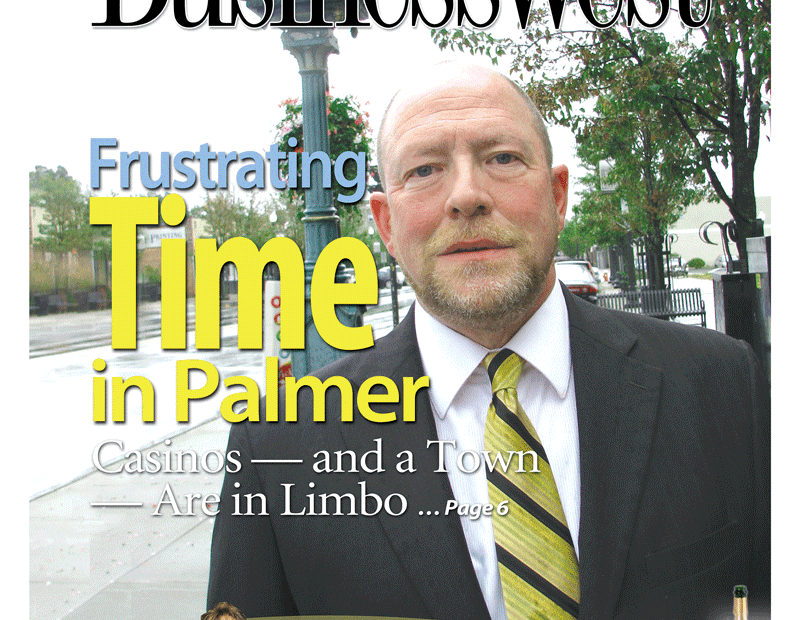
Casinos — and a Town — Are in Limbo

Cover October 11, 2010
“Hopeful frustration.”
That’s the phrase Paul Burns summoned, after a few moments of careful consideration, to describe his mindset these days, a few months after gaming legislation that seemed destined to pass in Boston fell by the wayside instead.
Failure on the part of the governor and Legislature to seal a deal on casinos has left gaming — and the town of Palmer, which Burns serves as town councilor — in a serious state of limbo, one where Mohegan Sun’s plans to build a $1 billion resort casino on a hillside parcel just off the Mass. Turnpike are agonizingly close to becoming reality, yet, in some ways, no closer than they were years ago.
That’s where the frustration comes in.
As for ‘hopeful,’ well, Burns, like many others in this town who support gaming, believes that casinos are essentially too big to fail in the Bay State, and that common sense dictates that if several casinos are approved — or even one — Palmer is the state’s first, best choice.
“It was very frustrating to watch the process — I couldn’t understand why the three groups couldn’t get together on this,” said Burns, noting that he’s become an unofficial spokesperson for supporters of a casino, although he stressed repeatedly that he speaks for himself, not the nine-member Town Council as a whole. “But at the end of the day, I think common sense will prevail and this will get done.”
Whether casinos are indeed too big to fail is still a matter for debate, but there’s no debating that the proposed facility in Palmer is a nearly all-consuming matter there, where the assessor’s office estimates that a casino on the scale being planned could bring the town more than $15 million in total tax revenues annually, nearly double the amount collected now. Meanwhile, there are estimates that the casino will create more than 3,000 jobs (not to mention 1,500 temporary construction jobs) and spur more ancillary economic development, and it will certainly change the landscape of the community in just about every way that word can be defined.
“Let’s just say it casts a very big shadow,” said Burns, noting that, while things haven’t ground to a halt while the gaming issue plays itself out, much of what happens in this town business- and economic-development-wise will be impacted by whether the casino becomes reality. “I want to see a casino project, but everyone wants to see a resolution to this matter.”
These are indeed frustrating, anxious times for Palmer. It has been 14 years, by Burns’ count, since the issue of a casino was first raised here. Over the past few years, gaming bills have come increasingly closer to passage, but have never made it to fruition. In late June, things came apart in an almost maddening way, as Gov. Deval Patrick and leaders of the state House and Senate could not reconcile their differences over how many slot parlors, or ‘racinos,’ as they’re called, the state should license, scuttling legislation that most in Palmer and elsewhere thought would pass — in some form.
Now, there is optimism that a measure can be passed next year or even this fall. But there are also nagging questions, especially about who will be governor come January and what that individual’s mindset will be when it comes to gaming.
Republican candidate Charles Baker has said publicly that he supports one casino to start to see how gaming and the Commonwealth suit one another. If Baker prevails in November, and sticks to that plan, will Palmer be the chosen site?
For this issue, BusinessWest examines the mood in Palmer and the thought processes moving forward as the elephant in the room that is casino gambling grows ever larger in stature.
High-stakes Proposition
It’s called Nostalgia Day.
That’s the name given to the annual community get-together in Palmer that marked its fifth year on Sept. 18. Once staged on Main Street, the event was moved a few years ago to Legion Field behind Converse Middle School. Nostalgia Day pays homage to the community’s past, especially its status as a rail hub; this is known as the ‘Town of Seven Railroads.’ This year, the event included everything from narrated trolley rides to a Wiffle ball tournament to entertainment ranging from polka music to a tribute to Fleetwood Mac.
While taking part in all those things, attendees were also talking about the casino, said Robert Young, president of K.E.Y. Property Services and also president of something called Palmer Businesses for a Palmer Casino. “And they were letting some anger out.”
“The frustration was palpable,” said Young as he described the general mood, at least among casino backers, and they are, according to most all assessments, in the majority in this community. “The issue’s not dead; it’s not moving forward, and it’s not moving backward. It’s in limbo.”
In some ways, it’s always been in that state. Palmer passed a resolution supporting a casino within its borders several years ago, and in 2007, the proposal for Mohegan Sun’s $1 billion facility — complete with a 164,000-square-foot casino, a 600-room hotel, 12 restaurants, and 100,000 square feet of retail space — took shape.
For the past several years, casinos have been the subject of debate on Beacon Hill, with the Palmer facility always taking prominence as one of the lead proposals and essentially the Western Mass. option. Over the past few years, gaming measures have been gaining momentum as the state’s fiscal situation has worsened and the need for additional revenue has risen.
Indeed, in previous years, the players in Boston never really came close to passing a measure, but earlier this past spring, Patrick, House Speaker Robert DeLeo, and Senate President Therese Murray were seemingly united in their support for some form of gaming measure.
They just couldn’t agree on the final details, especially those concerning the number of racinos, and once again, the clock ran out on the legislative session.
There is some speculation that the Legislature may return to session and vote on a casino bill this fall, but most consider it more likely that the issue will play itself out again next spring and summer, when there may be a new governor and several new legislators in office.
So this leaves casino backers watching, reading, assessing, and, well, weighing the odds.
Late last month, they read about the New England Gaming Summit, staged in Mohegan, Conn., where Mohegan Sun officials reaffirmed their commitment to a project in Massachusetts — and Palmer. “When Massachusetts is ready, we will be ready,” said Mitchell Grossinger Etess, the company’s president and CEO.
They’ve also read that, while more casinos are being proposed in the states surrounding Massachusetts, and the sector suffers through the effects of the Great Recession, the gaming industry remains bullish on New England, and Mohegan Sun is still focused on the Town of Seven Railroads.
“Palmer is without question the premier site for a casino resort in the Commonwealth,” Etess told the Gaming News late last month. “More than 11 million adults are within two hours of Palmer throughout New York and New England. Its central location makes it ideal to draw significant out-of-state traffic.”
While these signs look positive for casino backers, so, too do many of the comments from those now in the Legislature — and those who wish to unseat them in the November general election, said Leon Dragone, president of the Northeast Resort Group, which owns the proposed casino property and leases it to Mohegan Sun.
“I’ve been watching the legislative contests, from Cape Cod westward,” he said, “and almost everyone running is for casinos; no one is running away from this issue.”
Meanwhile, area legislators, as well as some from outside this region, seem to favor one of the resort casinos being located in Western Mass., said Dragone, adding that such strong support is a relatively new phenomenon and another reason to remain optimistic about the prospects for a Palmer casino.
A Winning Hand?
But while many signs seems to be pointing in the right direction, there are still a number of hurdles to clear and certainly no assurances that last summer’s close call will translate into triumph when the matter comes to the Legislature again.
And this is where much of the current frustration surfaces in Palmer, said Burns, noting that, to many, the casino has become Palmer’s best hope for economic revival after a prolonged slide during which most of the town’s manufacturing plants have closed down or moved out. And there really isn’t a plan B, or at least one that’s being given any real consideration until the casino mattered is settled — somehow.
“In the back of my mind, and for the sake of the town, I have to at least be prepared to say at some point, ‘if this doesn’t happen, what’s next?’” he told BusinessWest. “If it gets to that point, then I guess we’ve failed, and after two or three years of really hard work, that’ll be tough to deal with. But hopefully, we don’t wind up at that point.
“And if it doesn’t come here, the next steps are a little less clear,” he continued. “This helps to solve a lot of economic issues in one swoop. Without something of this magnitude, you’ve got to build in much smaller pieces; you’re not going to have someone come in and pay $9 million a year in property taxes — it’s going to take an awful lot of smaller entities to make up that difference.”
Young agreed. He said he’s watched a number of manufacturing facilities close or move, and only a fraction of the jobs lost have been replaced. The Monson Developmental Center, which is located in Palmer and employs several hundred people, is slated to be closed by the state in 2013, further reducing the base of jobs in the Quaboag area.
“We have to do something to create jobs here,” he said, “and a casino is easily our best option. People are losing their livelihoods here in Palmer, and that’s why this issue becomes extremely important.”
Moving forward, the main priority for Palmer casino backers is to stay visible, especially with regard to lawmakers, and drive home the point that the town intends to remain a prominent player in this realm.
“We’re trying to keep ourselves in the media so the focus stays on Palmer,” said Burns, “and people don’t assume we’ve given up or gone away.”
Young agreed, and said Palmer Businesses for a Palmer Casino is keeping the town’s name, intentions, and status as what he called “the frontrunner” in the casino race in front of people.
“We’re keeping the word alive,” he said, “that this bill is not dead, that Palmer and the business community are still active in pursuing this, and that most people in this town want this to happen.”
Meanwhile, Burns said he’s watching the governor’s race closely and knows who he’ll be voting for, although he’s not saying. He did say that this race poses some tricky questions for casino backers, and an atmosphere where it will be unlikely if individuals or groups like Palmer Businesses for a Palmer Casino will endorse either of the frontrunners, Patrick or Baker.
The latter is a somewhat unknown quantity on this issue, so he is somewhat of a wild card, said Burns. But Patrick, while he supports more resort casinos and essentially authored the legislation that came so close to passing, also gets most of the blame for the demise of this year’s effort.
“How can you go out and support the governor who killed the casino in Palmer?” asked Burns, referring to this year’s close call. “Still, you don’t want to tick off anyone; we need to be able to communicate with whoever ends up becoming governor in January.”
Sizing up the current state in Palmer, at least among casino backers, Burns again came back to that phrase ‘hopeful frustration,’ and said that mindset will likely remain until there is reason to lose either of those two words.
“There’s a sense in Palmer that this is still coming here,” he said. “We may be deluding ourselves, I don’t know; we understand it’s a process and there’s a lot to this process that still has to happen, but we’re hopeful this will work out for us.”
Still on Track?
Mohegan Sun officials have unveiled a new architect’s rendering of the planned Palmer casino. The new concept pays homage to the Town of Seven Railroads by incorporating what looks like a rail trestle into the design of the complex.
Whether this latest rendering actually moves off the drawing board and onto the hill just off exit 8 of the turnpike remains to be seen. Amid the myriad questions still to be answered, there is optimism among casino backers and that aforementioned hopeful frustration.
It may well be at least another nine or 10 months before they know for sure, but casino backers like Burns believe Palmer can and will eventually come out from under that shadow.
George O’Brien can be reached
at [email protected]
ACCGS
www.myonlinechamber.com
(413) 787-1555
n Oct. 1: Hampden/Wilbraham Golf Classic. Hosted by the Country Club of Wilbraham. To register, contact the chamber at (413) 787-1555 or [email protected]
n Oct. 6: ACCGS October Business@Breakfast, 7:15 to 9 a.m. Hosted by the Cedars, 419 Island Pond Road, Springfield. Cost: members, $20; non-members, $30. To register, contact the chamber at (413) 787-1555 or [email protected]
n Oct. 13: ACCGS October After 5, 5 to 7 p.m. ‘Be Your Best Self’ Table Top Expo, the Mind, Body & Spirit Expo. Hosted by MassMutual Center. Cost: members, $10; non-members, $20. To register, contact the chamber at (413) 787-1555 or [email protected]
n Oct. 23: UMass vs. UNH Bus Trip to Gillette Stadium, 11:00 a.m. bus departure. Cost: ticket to the game, $20; ticket and bus ride, $40; ticket, bus, and food, $50.
n Oct. 29: Super 60 Awards Luncheon, 11:30 a.m. to 1:30 p.m. Hosted by Chez Josef, Agawam. Keynote dpeaker: Steven Little. To register, contact the chamber at (413) 787-1555 or [email protected]
Young Professional Society of Greater Springfield
www.springfieldyps.com
n Oct. 21: Third Thursday, 5 to 8 p.m. Hosted by the Munich Haus Restaurant, 13 Center St., Chicopee.
n Oct. 23: The Down Syndrome Resource Group of Western Massachusetts ‘Buddy Walk.’ This group provides information about family support, resources, parent training, and social opportunities. Its mission is to discover, encourage, and embrace the potential of all individuals with Down syndrome. Registration for the walk to begin at 10 a.m., with coffee and light refreshments available. Two-mile walk to begin at about 11 a.m., followed by a complimentary lunch and entertainment.
Amherst Area Chamber of Commerce
www.amherstarea.com
Please see chamber’s Web site for news of upcoming events.
Chicopee Chamber of Commerce
www.chicopeechamber.org
(413) 594-2101
n Oct. 4: Checkpoint 2010, 7:30 a.m. Hosted by Log Cabin Banquet & Meeting House, 500 Easthampton Road, Holyoke. Keynote Speaker: U.S. Sen. Scott Brown. Presented by the Chicopee and Greater Westfield chambers of commerce. Cost: members, $25; non-members, $30. To reserve tickets, contact the Chicopee Chamber of Commerce at (413) 594-2101 or www.chicopeechamber.org
n Oct. 20: October Salute Breakfast. Hosted by Summit View Banquet & Meeting House, Holyoke. Guest speaker: political consultant Tony Cignoli. To reserve tickets, contact the chamber at (413) 594-2101 or www.chicopeechamber.org
n Oct. 27: After 5 Business Card Swap – Speed Networking, 5 to 6:30 p.m. Hosted by the Delaney House, 3 Country Club Road, Holyoke. Limited to 24 people; registration ends on Oct. 25. Cost: members, $25; non-members, $35. To reserve tickets, contact the chamber at (413) 594-2101 or www.chicopeechamber.org
Franklin County Chamber of Commerce
www.franklincc.org
(413) 773-5463
Please see chamber’s Web site for news of upcoming events.
Greater Easthampton Chamber of Commerce
www.easthamptonchamber.org
(413) 527-9414
n Oct. 1: Casino Night, 7 to 11 p.m., at One Cottage St., Easthampton. Major sponsors: Easthampton Savings Bank and Finck & Perras Insurance Agency. Cost: $25 in advance; $30 at the door. See www.easthamptonchamber.org for more information.
n Oct. 13: Networking by Night Business Card Exchange, 5 to 7 p.m. Co-hosted and co-sponsored by Nashawannuck Gallery and Harry King Rug & Home, 36-40 Cottage St., Easthampton. Hors d’ouevres by Sunshine Bakery, beer and wine, door prizes. Cost: members, $5; non-members, $15.
Greater Holyoke Chamber of Commerce
www.holycham.com
(413) 534-3376
n Oct. 14: Fall Salute Breakfast, 7:30 a.m., at the Log Cabin, Easthampton Road, Holyoke. Sponsored by Holyoke Medical Center and Comcast. Cost: $18; tables reserved for parties of eight.
n Oct: 20: Chamber After Hours, 5 to 7 p.m. Hosted by Holyoke Children’s Museum, 444 Dwight St., Holyoke. Sponsored by All Sales Consulting, LLC. Cost: members, $5; non-members, $10 cash.
Greater Northampton Chamber of Commerce
www.explorenorthampton.com
(413) 584-1900
n Oct. 6: Annual Chamber Open House, 5 to 7 p.m. Hosted by the Greater Northampton Chamber of Commerce, 99 Pleasant St., Northampton. It’s the don’t-miss chamber event of the year. More than 300 people regularly attend. Food and drink donated by member restaurants. Cost: $10 for members.
Northampton Area Young Professional Society
www.thenayp.com
(413) 584-1900
n Oct. 14: NAYP Party with a Purpose, 5 to 8 p.m., at KW Home. Cost: members, free; guests, $5.
Quaboag Hills Chamber of Commerce
www.qvcc.biz
(413) 283-2418
Please see chamber’s Web site for news of upcoming events.
South Hadley/Granby Chamber of Commerce
www.shchamber.com
(413) 532-6451
n Oct. 15: Legislative Breakfast, 7:15 to 9 a.m. Hosted by the Courtyard by Marriott. Sponsored by Western Massachusetts Electric Co.
n Oct. 27: After 5, 5 to 7 p.m. Hosted by Hickory Ridge Country Club. Sponsorships available.
Three Rivers Chamber of Commerce
www.threeriverschamber.org
(413) 283-6425
n Oct. 4: Chamber Meeting, 7 p.m. Hosted by Three Rivers Chamber of Commerce office, Palmer Technology Park, Springfield St., Palmer.
Greater Westfield Chamber of Commerce
www.westfieldbiz.org
(413) 568-1618
n Oct 13: WestNet After 5 Networking Octoberfest, 5 to 7 p.m. Hosted by East Mountain Country Club, 1458 East Mountain Road, Westfield. Cost: members, $10; non-members, 15. Bring plenty of business cards for exchange, and bring a gift to highlight your business. For more information, e-mail [email protected], call (413) 568-1618, or check out www.westfieldbiz.org
n Oct. 16: ‘Bring Back the 80s’ Dance, 7 to 11 p.m. Hosted by Westwood Restaurant and Pub, 94 North Elm St., Westfield. Featuring Orange Crush, the 80s Dance Party Band. Cost: $20. Prizes awarded for most authentic dressers and raffles.
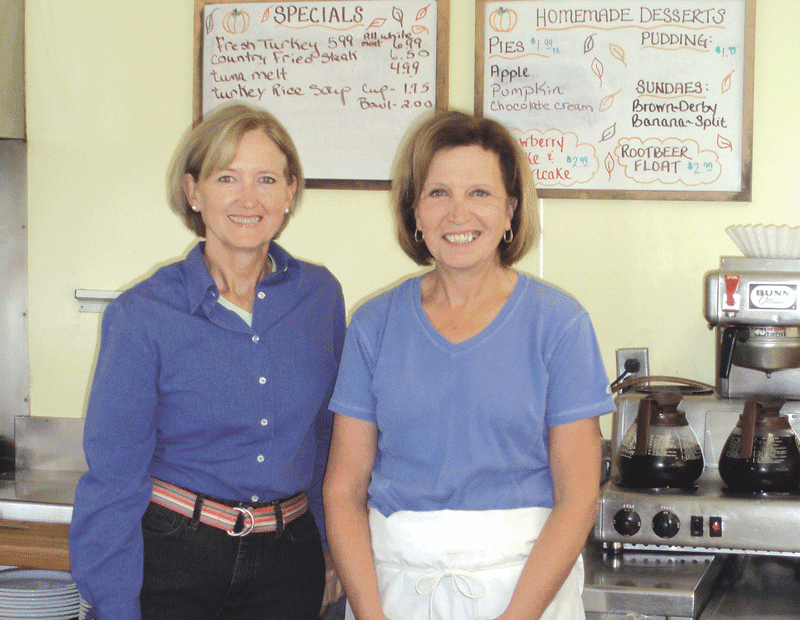
Get the Word Out: This Town Is Open for Business

Granby, Mass.
Emre Evren, who chairs Granby’s Planning Board and Master Plan Committee, said town officials have developed a new master plan that will focus on economic development.
It has been carefully crafted, using data collected from a number of sources. They include a self-assessment, a survey completed by residents of the town, and a list of Granby’s strengths, which were recently outlined in a report compiled by the Center for Urban and Regional Policy at Northeastern University. The new plan is scheduled to be completed this fall and will be presented to town residents thereafter.
Following one of the master plan’s recommendations, an economic-development committee will be formed, and it will take a proactive approach. “We are eager to send the message out that Granby is a great town for any type of business,” Evren said. “In the past, we haven’t promoted the availability of land and locations that are available and haven’t successfully told people we are open to new business. But the economic-development committee will drive relationships and promote the town to suitable investors.”
Evren cited strengths outlined in the Northeastern report as solid proof that Granby is a town that investors or business owners should consider. An important one is the uniform tax rate. “We were told our average tax rate is lower than most of the communities that participated in Northeastern’s survey. And the average square foot of manufacturing space is much cheaper here than in most other locations in the immediate area,” Evren said. “The report also stated that Granby has great access to a technically skilled and educated labor force. Plus, our housing market is affordable, and our public schools are well-performing, which is a concern for some business owners.”
Granby’s location is also a key to business success. Route 202 passes directly through the town, and the Massachusetts Turnpike and Route 91 are only about seven miles away. “People think we are in a remote location. But we are not,” Evren said. “We believe one advantage we have is that many neighboring residents drive through Granby. We are bordered by South Hadley, Chicopee, Belchertown, Ludlow, and Amherst, and we are only 15 minutes from Amherst Center.”
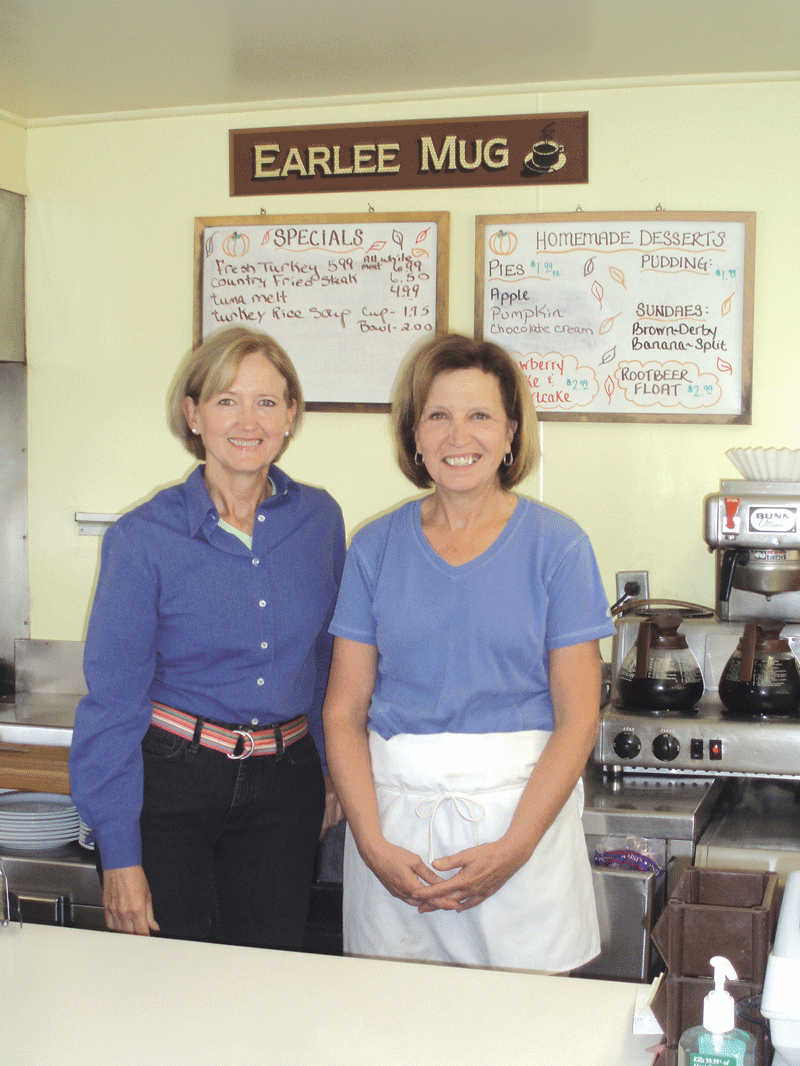
Cindy Mugnier, left, and Earleen Kenyon, co-owners of the Earlee Mug restaurant/truck stop, say that business owners and residents have been extremely supportive since they purchased the eatery and renamed it a year ago.
Evren said the emerging vision includes a livelier business district, which stretches along Route 202, from the South Hadley town line past the center known as Five Corners. Town officials would like to see more retail shops and restaurants open in that area. “Residents told us they would like to see more places in town where they could shop or eat.”
Food for Thought
Earleen Kenyon and her sister, Cindy Mugnier, have proof that residents will support restaurants. They purchased a truck stop/eatery known as Manny’s Place about a year ago and renamed it the Earlee Mug. Although they had never owned a restaurant before, they have done very well.
“We took a leap of faith when we bought it. But this is a good place to own a business,” Mugnier said. “The community gets behind you, and the town officials are very easy to work with. This is a rural community, and there is a real sense of community here. People have been here for multiple generations.”
The eatery is located between two farms, and both of them have been very helpful, letting Mugnier and Kenyon know when fruits and vegetables are at their peak.
“Pleasantbrook Farm and Feed has gone so far as to help us when we had problems with our cash register and other technology,” said Mugnier. “You get a real sense that everyone is pleased that you are here, that they want you to be successful and will do what they can to help that happen.”
Kenyon agrees. “The townspeople support local businesses,” she said, adding that she and Mugnier benefit from their location, which is directly across from Dufresne Park, which hosts events that range from baseball and soccer games to canine agility and horse shows. “Plus, we are right on Route 202, which is a busy road; everything is just pleasant here.”
Scott Merrill is vice president of Dressell’s Service Station. His family has owned the business since the 1960s, and he says Granby is a small but tightly knit community where people get to know one another.
“It has a nice country feeling and is a nice spot to live in. There is also quite a bit of land available,” he said. “There is room to grow and room to build — plenty of opportunity here. Plus, the taxes are lower than in surrounding communities.”
New Areas of Growth
Granby is home to large expanses of agricultural land and open space, since a portion of the Mount Holyoke Range State Park lies within its borders.
“Part of our endeavor is to keep a lot of open space,” Evren said. “We are trying to balance our agricultural/open space land with other types of economic development. Our premise is that new businesses should be consistent with Granby’s traditional New England town feel and fit in that overall mosaic, because we are a suburban town with a lot of rural characteristics which we don’t want to lose.”
Still, results from the town survey showed that the majority of residents are in favor of commercial and industrial development as long as new businesses don’t pollute the air or water.
To that end, the town is working on a green-communities initiative that could qualify Granby for state grants if it meets a number of requirements, which include designating an area for green-energy research and development or green manufacturing. “This would interest our residents based on our master plan survey results. We would like to see economic development, but it needs to be cognizant of the community’s environmental concerns,” Evren said.
Five Corners, located about a mile from the South Hadley line on Route 202, contains the majority of the town’s businesses. A corridor zoned for business extends several miles down the road, ending about a half-mile before the town common.
“This is the area that will be our primary target for new business,” Evren said. “There is vacant land available in that area.”
Five Corners offers connections to sewer and water hookups, which are not available in all parts of Granby. “But the town may be open to extending those services to new businesses along the corridor,” Evren said. “There is nothing concrete in place, but there has been conversation around it.”
Another area that holds promise for growth is New Ludlow Road. The town is currently working to install a sewer line extension there. “It will require some zoning changes, but there is a lot of possibility in the area,” said Evren, adding, “it could be an ideal location for an industrial or office park or light industrial development.
“The right new business could thrive in this town, because people are receptive and committed to local businesses,” he said. “Granby is a small town in terms of population. But we have a lot of land that would be suitable for businesses. We want people to come and take a look at what we have to offer. We believe they will like what they find here.”