Home Sections Archive by category Construction (Page 3)

Construction

Construction

Surveying the Landscape

The National Assoc. of Landscape Professionals (NALP) recently released its annual list of the top 2019 landscape trends.

Drawing upon the expertise of the industry’s 1 million landscape, lawn-care, irrigation, and tree-care professionals, NALP annually predicts trends that will influence the design and maintenance of backyards across America in the year ahead. NALP develops its trends reports based on a survey of its members. It also draws from the expertise of landscape professionals from across the U.S. who are at the forefront of outdoor trends.

“Homeowners yearn for beautiful outdoor spaces without the hassle of upkeep. With the rise of multi-functional landscape design and automated processes, consumers can spend more time enjoying their landscapes than ever before,” said Missy Henriksen, NALP’s vice president of Public Affairs. “This year’s trends reflect current lifestyle preferences as well as innovations happening in the industry that are transforming landscapes across the country.”

NALP listed the following five trends influencing outdoor spaces in 2019.

Two-in-one Landscape Design

Functional elements are becoming a necessity in today’s landscapes. Consumers desire stunning outdoor features that have been cleverly designed to serve a dual tactical purpose. An edible vertical garden on a trellis that acts as a privacy fence, a retaining wall that includes built-in seating for entertaining, and colorful garden beds that divide properties all combine function and style.

Automated Lawn and Landscape Maintenance

The latest technology and equipment allow tasks to be more streamlined and environmentally efficient than ever before. Robotic lawnmowers continue to rise in popularity among both homeowners and landscape professionals. Also, programmable irrigation systems and advanced lighting and electrical systems help outdoor spaces become extensions of today’s smart homes. Homeowners relish knowing these technological advancements give them more time to relax and enjoy their outdoor spaces.

Pergolas

A staple of landscape design for years, pergolas constructed of wood or composite materials are now becoming more sophisticated. They can now come with major upgrades, including roll-down windows, space heaters, lighting, and sound systems. When paired with a luxury kitchen, seating area, or fire feature, pergolas can become the iconic structure for outdoor sanctuaries.

Pretty in Pink

Pops of coral and blush are anticipated to add a more feminine touch to landscapes this year. With ‘living coral’ named Color of the Year by Pantone, a leading provider of color systems and an influencer on interior and exterior design, landscape professionals predict this rich shade of pink could bring fresh blooms of roses, petunias, zinnias, and hibiscus to flower beds. Experts also anticipate light blush tones to become the ‘new neutral’ and another option for hardscapes and stone selections.

Mesmerizing Metals

Whether homeowners want a bold statement or whimsical touch, incorporating metals can bring new dimensions to landscape design. Used for decorative art, water features, or furniture and accessories, creative uses of metals, including steel and iron, can make for lovely accents or entire focal points.

Architecture Construction

Designs on Growth

As one local architect noted, we’re far enough away from the last recession to start worrying about the next one — and recessions tend to hit this sector particularly hard. Still, despite mixed signals in the long-term economic picture nationally, work remains steady locally, with municipalities, colleges, and businesses of all kinds continuing to invest in capital projects. Even if storm clouds do appear down the road, the 2019 outlook in architecture seems bright.

Curtis Edgin put it in simple terms when asked how 2019 is shaping up in the architecture sector.

“We’re busy; I can’t complain,” he told BusinessWest. Those five words sum up a strong outlook in an industry that tends to be a leading indicator for the economy as a whole — when things slow down, construction, finance, and other areas tend to follow — and is currently trending up, or at least holding steady.

“We’re far from the last recession — maybe far enough to worry about the next one,” said Edgin, a principal with Caolo & Bieniek Associates (CBA) in Chicopee. “But I don’t see that coming yet, looking at our workload.”

The American Institute of Architects (AIA) reports a similar outlook, with architecture firm billings nationally strengthening to a level not seen in the previous 12 months. Indicators of work in the pipeline, including inquiries into new projects and the value of new design contracts, also improved in January.

“The government shutdown affected architecture firms but doesn’t appear to have created a slowdown in the profession,” AIA Chief Economist Kermit Baker noted. “While AIA did hear from a few firms that were experiencing significant cash-flow issues due to the shutdown, the data suggests that the majority of firms had no long-term impact.”

Broken down by region, the Northeast is performing better than the West, but slightly trailing the South (which continues to rebuild from a rough 2018 hurricane season) and the Midwest. Nationally, billings softened slightly in February from the January pace, but remain strong in the big-picture sense, Baker said. “Overall, business conditions at architecture firms across the country have remained generally healthy.”

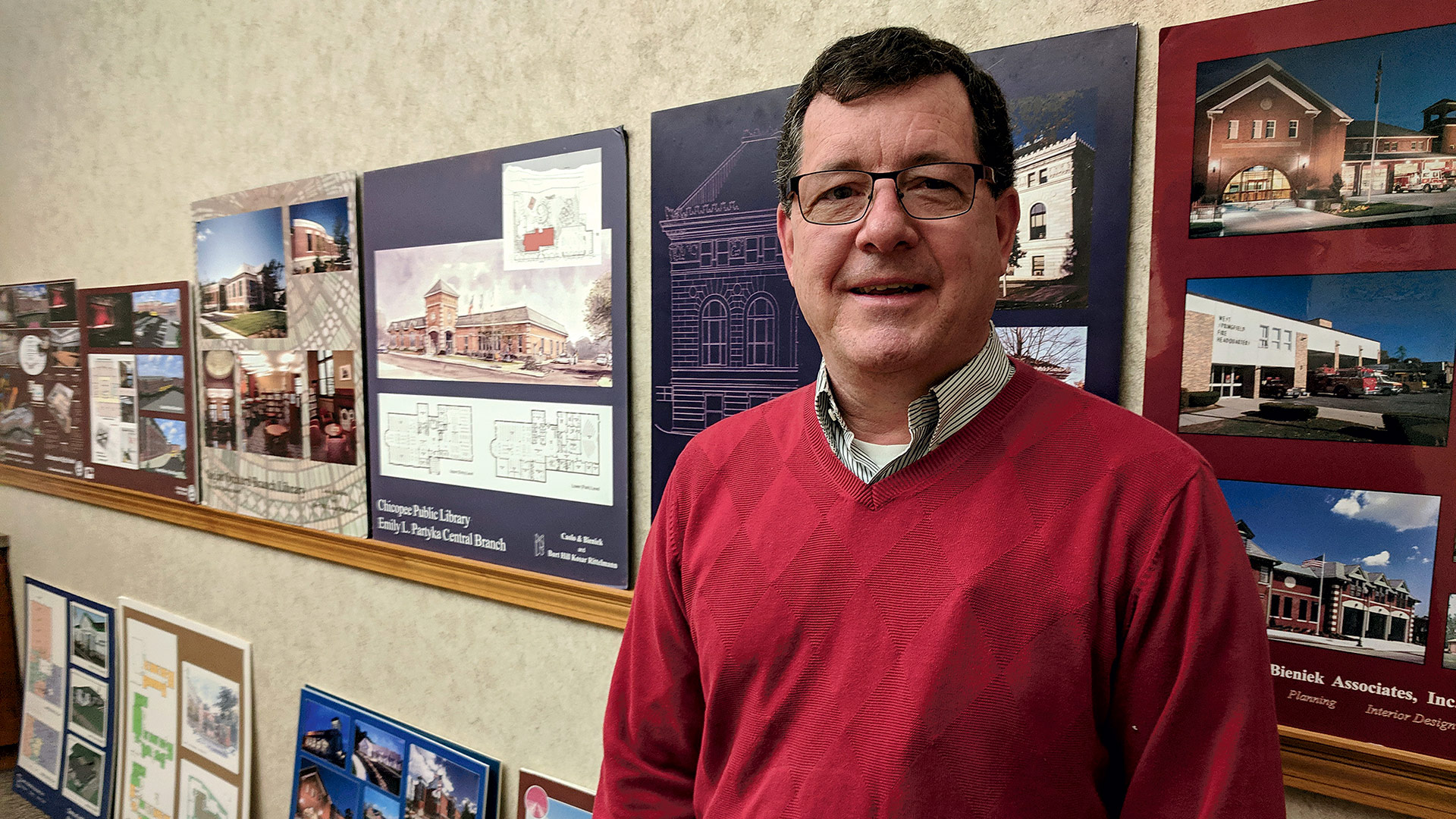
Curtis Edgin says specializing in a range of diverse niches is a plus for any firm

Curtis Edgin says specializing in a range of diverse niches is a plus for any firm, serving as a buffer against a downturn in any one area.

Jonathan Salvon, a principal with Kuhn Riddle Architects in Amherst, reports strong business as well, especially in the education realm, traditionally a strength for the firm, with projects for UMass and a historic-renovation conversion project for Elms College.

“Then there’s a mix of multi-family housing and commercial projects,” he told BusinessWest. “We’ve got a new office building for Way Finders going up on the old Peter Pan site in Springfield, which is our biggest commercial project at the moment. And there’s a 36-unit, multi-family housing project going up on University Drive in Amherst.”

Caolo & Bieniek, known for its wide range of public projects, from schools to fire and police stations, has expanded its base of private projects since merging with Reinhardt Associates in 2017.

“It’s been kind of a good synergy. We’ve blended our strengths and their strengths,” Edgin said, noting that one example is the recently completed Baystate Health & Wellness Center on the Longmeadow-East Longmeadow line, as Reinhardt has a solid history in medical office buildings.

“E-commerce has been growing at about three times the rate of traditional brick-and-mortar sales. The slowdown in housing hasn’t helped, as new residential development often spurs new retail construction activity. Instead, larger shares of investment in these facilities is going to the renovation of existing buildings.”

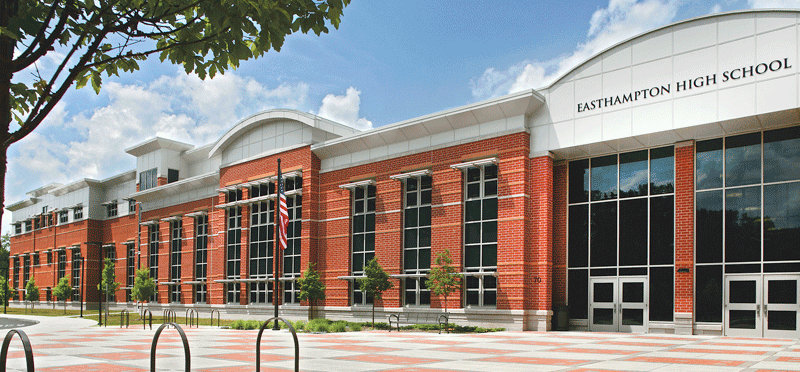
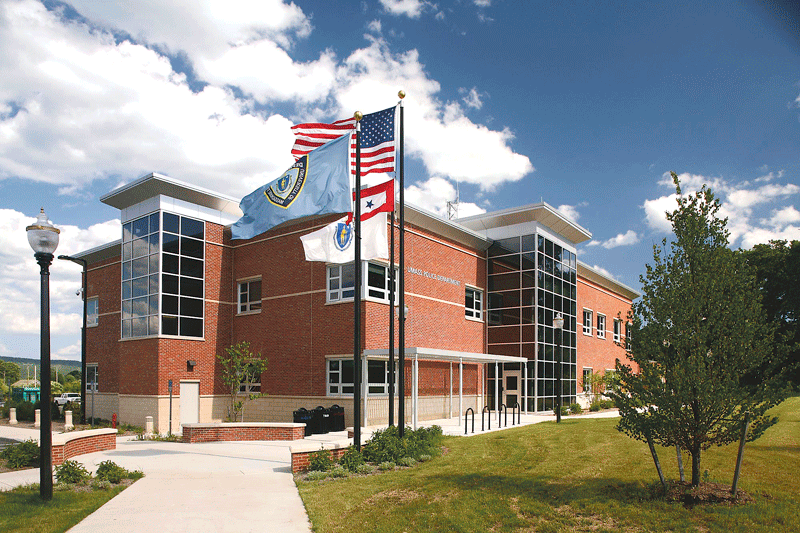
Other recent CBA projects recently started or well underway include a senior center in West Boylston, a police station in Williamstown, a public-safety complex in Lenox, a renovation of Chicopee’s public-safety facility, a pre-K to grade-8 school in Easthampton, and some work with UMass Amherst, Westfield State University, and other colleges.

“There’s a good mix of private and public, and we seem to be doing a fair amount of work with human-services agencies,” Edgin added, noting that the firm just did a project for Guidewire in Chicopee, and Sunshine Village in the city has also been a consistent client. “We seem to have a bit going in that sector right now. We’re busy, and it’s a good mix all around.”

Strong Pace, but Red Flags

The AIA suggests that growth in architecture should continue at least through 2020, but a number of emerging red flags suggest a cautious outlook.

Spending on non-residential buildings nationally is projected to grow by 4.4% this year, paced by healthy gains in the industrial and institutional building sectors, it notes. For 2020, growth is projected to slow to 2.4%, with essentially no increase in spending on commercial facilities, but gains in the 3% range in the industrial and institutional categories.

“Still,” Baker said, “there is growing concern inside and outside of the industry that a broader economic downturn may be materializing over the next 12 to 24 months.”

Nationally, growth in gross domestic product is estimated to be close to 3% in 2019, while the job market continues to be healthy, with more than 2.6 million net new payroll jobs added in 2018, an improvement over 2017’s figure of just under 2.2 million. In fact, the national unemployment rate was below 4% for most of 2018. Consumer-sentiment levels remained strong, and the nation’s factories also were busy, with industrial output achieving its strongest growth in almost a decade.

Jonathan Salvon says one of his firm’s three ‘legs,’ residential work, has been impacted by a slowdown in single-family construction

Jonathan Salvon says one of his firm’s three ‘legs,’ residential work, has been impacted by a slowdown in single-family construction over the past decade, but a rising portfolio of multi-family projects has picked up the slack.

However, there are several signals that point to an emerging slowdown in the broader economy, and therefore in the construction sector, Baker noted. These include declines in leading economic indicators, weakness in some key sectors of the economy, and softness in the markets of major U.S. trading partners. “These signals may be temporary responses to negative short-term conditions, but historically they have preceded a more widespread downturn.”

Meanwhile, since dropping sharply during the Great Recession, housing starts have had a very slow recovery, the AIA notes, and Salvon can attest to that reality locally. But Kuhn Riddle has adjusted in other ways.

“We’ve always been a stool with three legs,” he said. “One-third is work for various colleges, charter schools, prep schools, secondary schools, and even some day cares — we run the whole gamut in education. The second third is residential work; in the past, before the 2009 recession, that was often single-family residences. That market has never really come back, at least for us. But we’ve been lucky to develop a new market in multi-family projects.”

The third leg is a variety of commercial projects, including office buildings, restaurants, and bank renovations, to name a few, Salvon said.

“Hopefully we all stay busy. But we do know it goes in cycles; we’ve been through plenty of slower times and a lot of boom times. But we’ve been very blessed. We’re pretty busy and hope to stay that way.”

Nationally, Baker sees design work on the commercial front as a bit of a mixed bag at the moment.

“Business investments often reflect what corporate leaders feel is the growth potential for their companies. Investment nationally in new plants and equipment saw healthy growth in 2017 and through the first half of 2018, but slowed significantly beginning in the third quarter of last year,” he noted. “Given the recent trends in business-confidence scores, investment is unlikely to accelerate anytime soon. Business confidence fell sharply through 2018, with the fourth quarter showing the lowest levels in six years.”

In the Bay State, the picture is equally muddy. The Business Confidence Index issued monthly by Associated Industries of Massachusetts (AIM) reported a gain in February after dropping in January to its lowest level in more than two years.

“Employers remain generally optimistic about a state economy that continues to run at full-employment levels and a U.S. economy that is projected to grow by 2.2% this year,” said Raymond Torto, Chair of AIM’s Board of Economic Advisors and a lecturer at the Harvard Graduate School of Design. “At the same time, the erosion of confidence among Massachusetts manufacturers during the past 12 months raises some concern about the long-term sustainability of the recovery.”

On a sector-by-sector basis, Baker reported, design work for retail facilities continues to suffer from the growth on online shopping.

“E-commerce has been growing at about three times the rate of traditional brick-and-mortar sales. The slowdown in housing hasn’t helped, as new residential development often spurs new retail construction activity,” he noted. “Instead, larger shares of investment in these facilities is going to the renovation of existing buildings.”

On the other hand, office projects represent the strongest commercial sector in construction right now, with 5% growth projected for this year and 1% in 2020. “This sector has benefited from strong job growth and the apparent bottoming out of the years-long decline in office space per employee,” Baker said. “Much of the increase has come from the booming technology sector, so the outlook is dependent on continued growth in this industry sector.”

Meanwhile, eds and meds — or education and healthcare, two pillars of the Western Mass. economy — represent very healthy sectors nationally for architects and general contractors. AIA projects 5.5% in the education sector this year and an additional 4% in 2020, and 4% growth in healthcare in 2019 followed by 3.6% in 2020. 

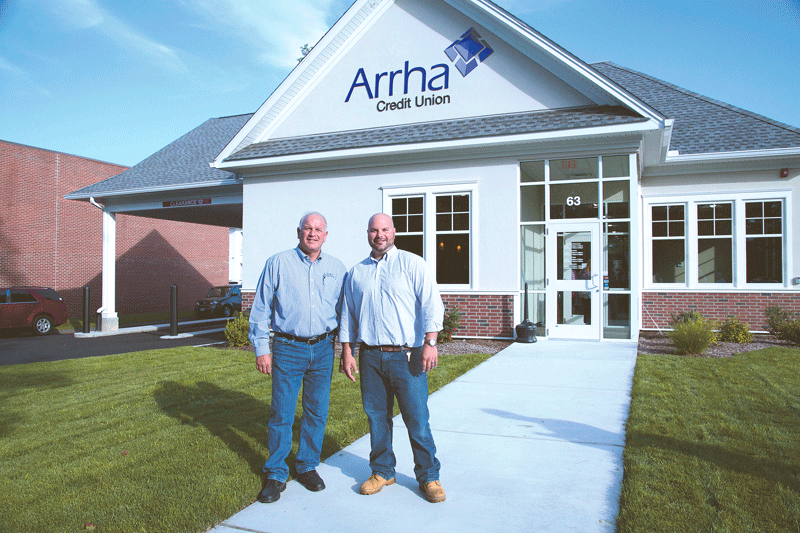
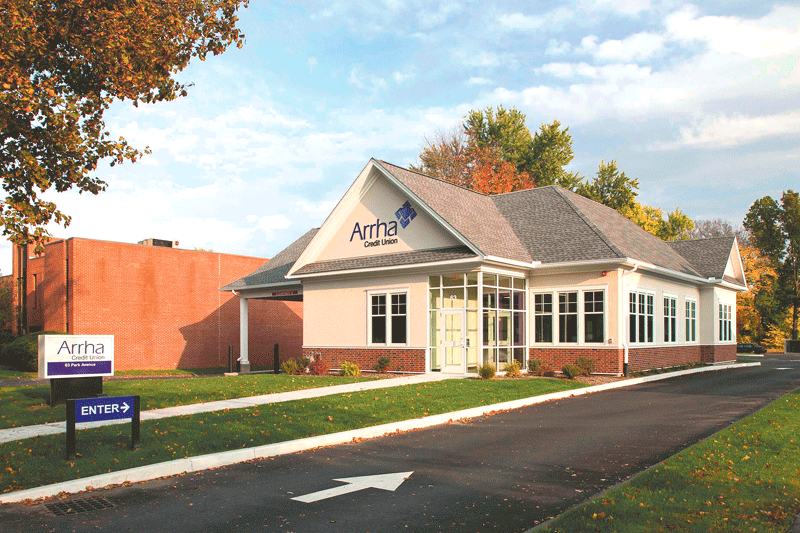
“We’re pretty diversified and active in a lot of different environments,” Edgin said. “It’s not just schools, not just police stations, not just fire stations, but a little bit of everything.” He cited the recent renovation of Polish National Credit Union’s Front Street branch in Chicopee, as well as a new Arrha Credit Union branch in West Springfield and a project with the Boys and Girls Club of West Springfield. “A lot of things take a while, so it’s that advance planning that keeps you busy a year or two from now.”

Leading Indicator

Baker reported that business conditions at U.S. architecture firms in 2018, as measured by AIA’s Architecture Billings Index (ABI), were essentially unchanged from 2017.

“Since the ABI has been shown to lead construction spending by an average of nine to 12 months, this would suggest that the growth in spending on non-residential buildings in 2019 should be close to the growth rate of 2018,” he noted. “Additionally, new design contracts coming into architecture firms grew at a healthy pace in 2018, underscoring the robust level of backlogs currently enjoyed by most firms.”

Meanwhile, Dodge Data & Analytics recently released its 2019 Dodge Construction Outlook, which predicted that total U.S. construction starts for 2019 will be $808 billion, staying essentially even with the $807 billion estimated for 2018.

“There are, of course, mounting headwinds affecting construction, namely rising interest rates and higher material costs, but for now these have been balanced by the stronger growth for the U.S. economy, some easing of bank lending standards, still-healthy market fundamentals for commercial real estate, and greater state financing for school construction and enhanced federal funding for public works,” said Robert Murray, chief economist for Dodge Data & Analytics.

Locally, both architects and builders are maintaining the same sort of cautious optimism, at least in the short term.

“Right now, it’s strong,” Edgin said. “We’ve increased our staffing.”

Finding talented staff remains a challenge, he said, because strong growth among architecture firms in general means stiff competition, and Greater Springfield isn’t always a top destination for young professionals in the field compared to, say, Boston or New York, where pay scales are higher (but, of course, so is the cost of living).

Salvon understands that reality as well, but said Kuhn Riddle has benefited from its location in downtown Amherst, where it has easy access to the UMass architecture program. “We’ve been a little spoiled — we’ve been privileged to get some employees out of that program over the last decade or so, and we’ve tried to make a nice work environment, so people been staying here.”

All things considered, he told BusinessWest, the outlook seems strong in architecture locally, and others agree.

“We’ve been able to build some good staff and a good team, so we’re happy about that,” Edgin said. “Hopefully we all stay busy. But we do know it goes in cycles; we’ve been through plenty of slower times and a lot of boom times. But we’ve been very blessed. We’re pretty busy and hope to stay that way.”

Joseph Bednar can be reached at [email protected]

Construction

From Bedside to Job Site

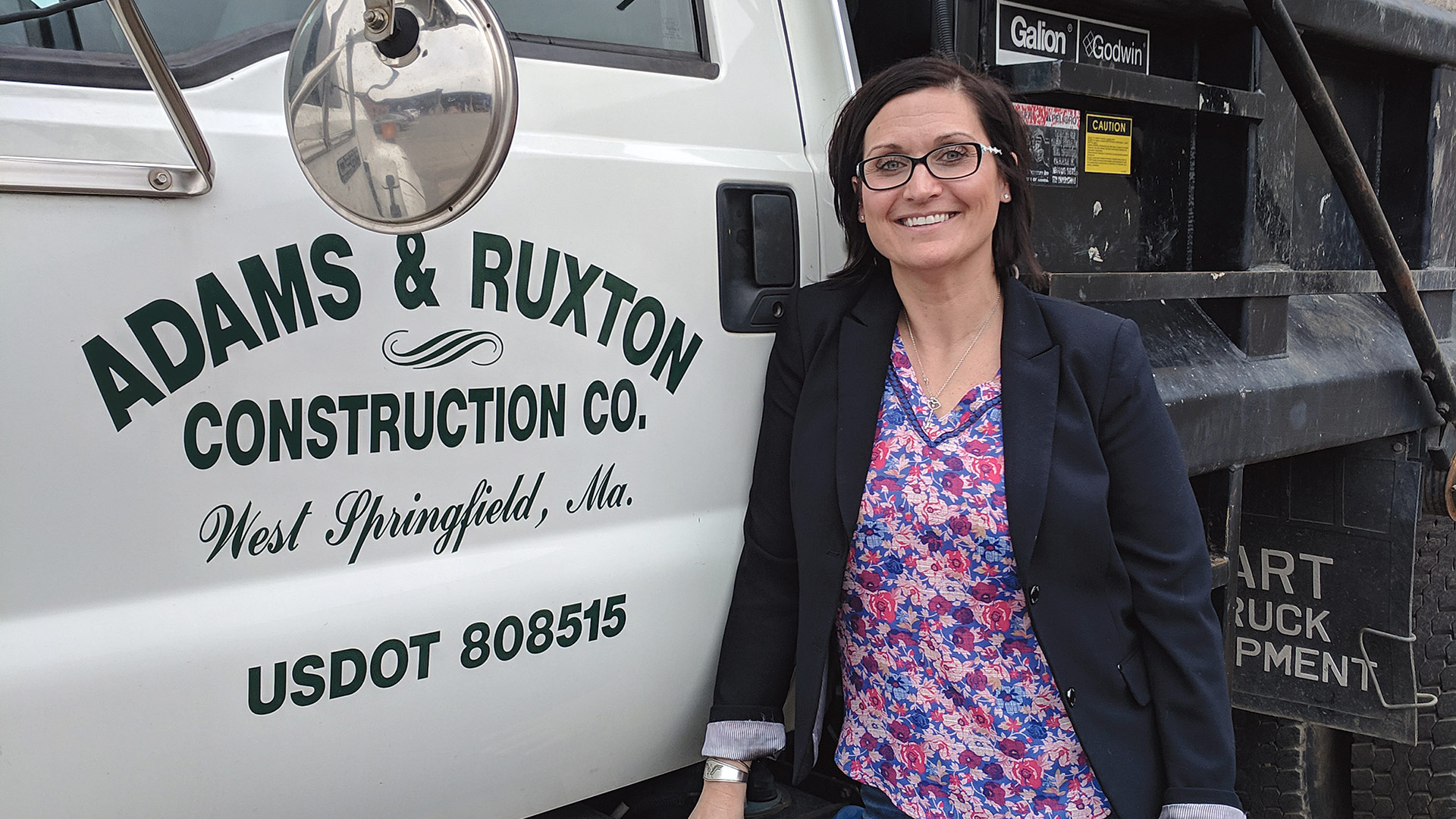
Dorothy Ostrowski says she’s never been happier than she is at the helm of a venerable construction firm.

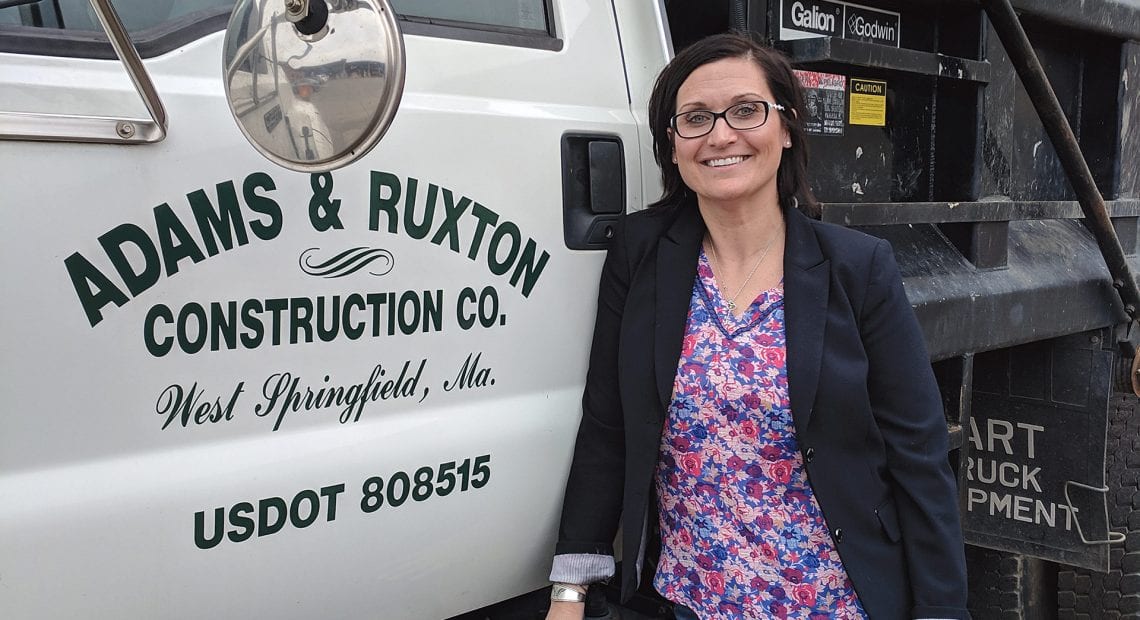
After more than a decade in nursing, Dorothy Ostrowski says she’s never been happier than she is at the helm of a venerable construction firm.

Dorothy Ostrowski has never settled for having just one ball in the air.

Like the time, a few years ago, when she was building a house with her husband, Mike, while pregnant with their second child, completing a dual master’s degree, and starting a new nursing job.

“Somehow, I don’t know how everything fits on my plate, but it all does,” she told BusinessWest. “One of the biggest things I believe is that anyone’s capable of anything. It’s really how bad do you want it, and how much does it impact you, your life, and your family?”

“One of the biggest things I believe is that anyone’s capable of anything. It’s really how bad do you want it, and how much does it impact you, your life, and your family?”

She had to ask all those questions, plus a few more, when the opportunity arose last April to purchase Adams & Ruxton Construction, a 110-year-old West Springfield company, from its then-owner, family friend Andy Touchette.

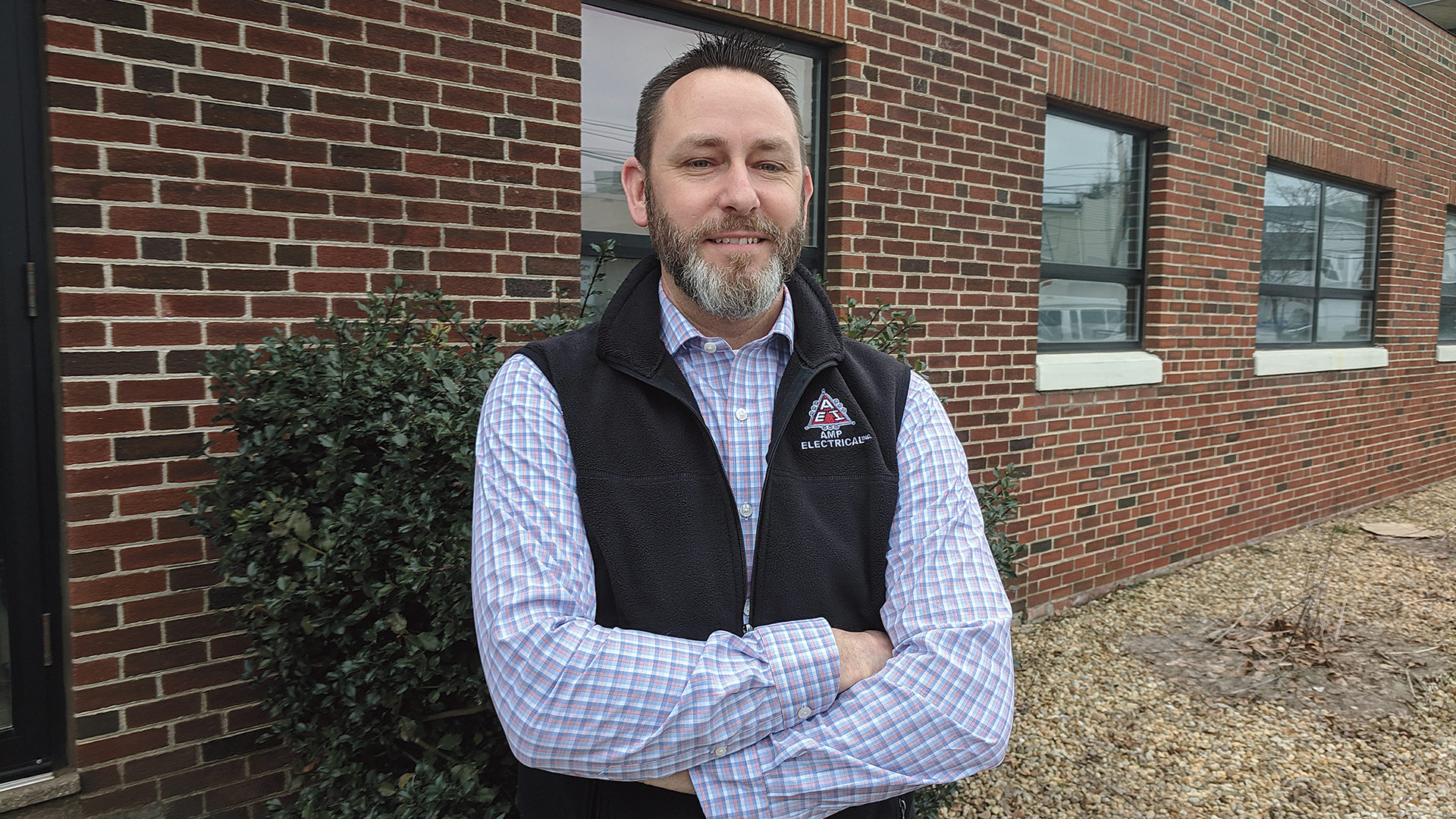
With Mike busy running his own company, Amp Electric, it was a decision that rested fully with Dorothy, who had worked in nursing for well over a decade but was intrigued by putting the MBA she earned in 2015 to good use.

He said, ‘what do you think? Do you think you can run it?’” she recalled. “And I was like, ‘you know what? It’s time to do something for me. It’s time to do something for our family. It’s time to do something where I know I have a passion and I can be a good leader.’ So I immediately contacted Andy and said we’re interested.”

Mike had long admired Adams & Ruxton and the work Touchette did there. “I knew it wasn’t a dud. It was all about if the numbers worked and whether or not we could afford it — and whether or not she wanted to run it. That’s how it came to be.”

Once the deal and a transition plan was in place, Dorothy spent the next six months working with Touchette, unpaid, learning every aspect of the business, from contracts and estimating to equipment and planning — “every nut and bolt,” as she put it.

Mike Ostrowski knew enough about his friend’s company

Mike Ostrowski knew enough about his friend’s company — and his wife’s skillset — to know this would be a good fit.

With a diverse range of work, from excavation to commercial buildings, the firm’s recent clients include Chicopee Electric Light, Bank of America, the Diocese of Springfield, Callaway, and Coldwell Banker, among others. The company is also currently being evaluated for woman-owned and veteran-owned certifications, which would open up more doors, especially in the realm of state and federal contracts.

It’s a new adventure for sure, one far different than her career stops to this point would have predicted. For this issue’s focus on construction and architecture, BusinessWest talked with Ostrowski about the many twists in her path, from the roads outside Afghanistan’s capital to emergency departments at area hospitals, to her new task, building a new career — both literally and figuratively.

Joining the Force

Growing up, Ostrowski’s plans were much different than her eventual path into nursing. Specifically, she wanted to be a police officer, eventually studying criminal justice at Holyoke Community College.

Before that, though, at age 17, she signed up with the Army National Guard. A friend had recently joined the service, so she spoke with the same recruiter, who explained the opportunities available in a military police role.

“It was one of those turning points in life, like, ‘what am I going to do with the rest of my life?’” she recalled. After attending boot camp the summer after her junior year, she left for Fort McClellan in Alabama the following year, after her high-school graduation, for what would become a seven-year stint, with stops in Italy, Honduras, Panama, and — most memorably — a nine-month tour in Afghanistan, two years after the 2001 U.S. invasion.

“Wherever I’ve been, we’ve always talked about us opening a business — maybe a daycare for special-needs children or something else. I’ve always had that desire to do more and be more.”

“We did a lot of security stuff in Kabul; we were there to support the rebuilding of the Afghan national army,” she explained. Partway through, she became a chase driver for Gen. Karl Eikenberry, tasked with ‘defensive driving’ to protect the general and others from gunfire and IEDs.

“I’ve had dinner at President [Hamid] Karzai’s palace,” she recalled. “We traveled by Chinooks and Blackhawks with Apache escorts through the mountains, met with warlords, and rode in armored-up Chevy Suburbans with thick, bulletproof glass.”

But her future wouldn’t be in police work — civilian or military. Instead, while taking classes at HCC, she crossed paths with some people who got her interested in medical assisting. After earning her certification in that field and working for a podiatrist, she landed in the Emergency Department of Baystate Medical Center. It was an eye-opening experience.

“That was my first taste of the chaotic world of emergency-room nursing, and I loved it,” she said. “I don’t think you ever get stagnant in that kind of environment. You never know what’s going to come around the corner next, and if you become complacent somewhere, you start to miss things and start to make mistakes. It’s the ever-changing part of it and the constant knowledge. No two patients have the same cookie-cutter symptoms or diagnosis. It’s that constant education that keeps you on your toes.”

She performed well in that environment, and colleagues began suggesting she attend nursing school, which she did, earning an associate degree in nursing at Springfield Technical Community College with help from G.I. Bill benefits, and soon found herself in a new-graduate residency at Baystate.

“But I always wanted more,” she said. “I stayed there long enough to get experience, then I did travel nursing. I saw a lot of different places and different ways procedures are done.”

Ostrowski eventually returned to Western Mass., where she dated, then married Mike, and earned her bachelor’s degree in nursing at Elms College. She took ER jobs at Baystate and Mercy Medical Center, but soon decided she wanted to shift into a less hectic type of job that allowed her more time with family. So she accepted a job with Sound Physicians, a medical process-improvement company, and went back to Elms for a dual master’s degree in nursing and business administration.

“Throughout these transitions, I always wanted more,” she said. “I wanted to be more in a leadership position.”

She found that by buying Adams & Ruxton.

“Wherever I’ve been, we’ve always talked about us opening a business — maybe a daycare for special-needs children or something else,” she said. “I’ve always had that desire to do more and be more.”

After Sound Physicians, she worked at St. Francis Medical Center in Hartford as a process-improvement nurse, and had moved to a role as nurse manager at Connecticut Children’s Hospital when the opportunity arose to buy the construction company.

“I’ve never not been happy as a nurse, and I think I would have potentially stayed in nursing longer had I stayed at the bedside,” she explained. “But I had moved into more of that management piece of nursing, and I constantly struggled with being a nurse’s nurse versus the business of healthcare. It was a difficult internal turmoil to be in, when you know what you want to do through your nurses and patients, but your constraints are based on finances.”

Furthermore, the job was keeping her busy 60 hours a week or more, and she felt she wasn’t home nearly enough to be with her family, especially her older son. “He was struggling to read as a first-grader, and I could have counted on my two hands how many times I was home in time to be able to read to him.”

Time to Change

Something had to give. And her husband could see it, too.

“Between the unhappiness of where she was and having a friend of ours running this [construction] business the past 10 years and how well he’s done, that put it into perspective — ‘hey, it’s just another type of business,’” Mike said. “We’re buying a fully established business that’s completely up and running. All you have to do is go in and replicate what’s going on. You don’t have to build it from the ground up — you can make your changes, you can improve it and grow the business, but in the beginning, all you have to do is replicate it and keep it going.”

“Knowing where to get the answers and knowing to tell someone you don’t know the answer — you get more respect from that than from anything.”

The transition period was important, Dorothy said.

“Andy said he had gotten multiple offers from people he thought would potentially be able to take this business on, but they weren’t the right fit,” she noted. “There’s a certain quality that Adams & Ruxton provides. You have to be the right kind of person who’s going to be there for your clients and your prospective clients. And Andy really wanted to make this a warm handoff. So, the last six months, he made sure he introduced me to all his key clients, and he’s come back in a consultative way; if there’s someone I didn’t meet during those six months, he goes out and meets them with me so they know they’re in the same hands they were before.”

She said the most gratifying aspect of her career move was the fact that Adams & Ruxton’s employees, many of whom have been there more than 20 years, stayed on board when she arrived — and have been a rich resource.

“There’s a constant conversation — if I don’t know something in the construction realm, I have the support system and the knowledge within these walls to ask the questions. I know finances, and I understand how to run the business. I may not know everything there is to know about general contracting, but I know when to say I don’t know, and I know when to ask the questions. I have a great support team.”

Mike agreed. “Knowing where to get the answers and knowing to tell someone you don’t know the answer — you get more respect from that than from anything,” he said.

Both are pleased that business — both at the firm and in the industry as a whole — is healthy right now, Dorothy said. “Our construction rampup this year has started much earlier this year than previous years, so I have no worries about the busy-ness or sustainability.”

It’s a peace she said she began to forge during the period she worked directly with Touchette.

“Over those first six months, there were times I’d never been more sure of something in my career, even as a nurse, and I’ve never been happier than I am now,” she told BusinessWest. “I probably have more stress because I directly impact the livelihoods of the people who work for me, but I’m happier. I enjoy coming to work every day. I enjoy learning new things every day.”

Ostrowski thinks back to other times of transition during her life — like when she missed her graduation from Elms in 2010 because she was delivering her first child — and sees one whirlwind after another, but that suits her just fine.

“I’ve never backed down from a challenge, and I think this is probably the coolest challenge I can embrace, and I will make this successful because I’ve got a great team around me,” she said. “I’m lucky to be where I am right now.”

Joseph Bednar can be reached at [email protected]

Construction

Home Free

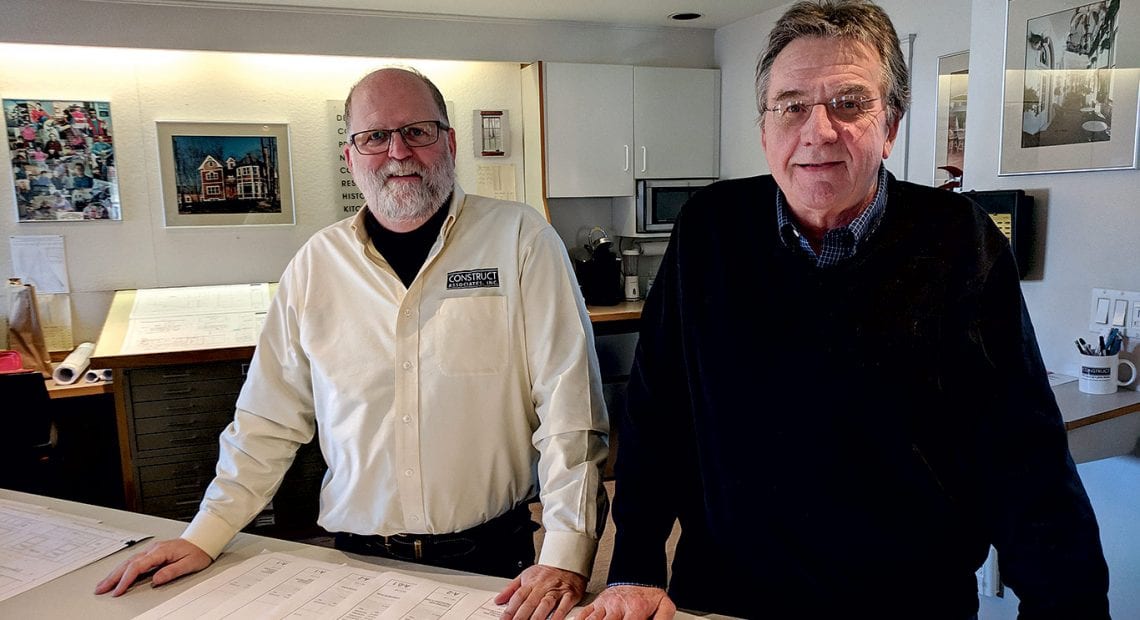
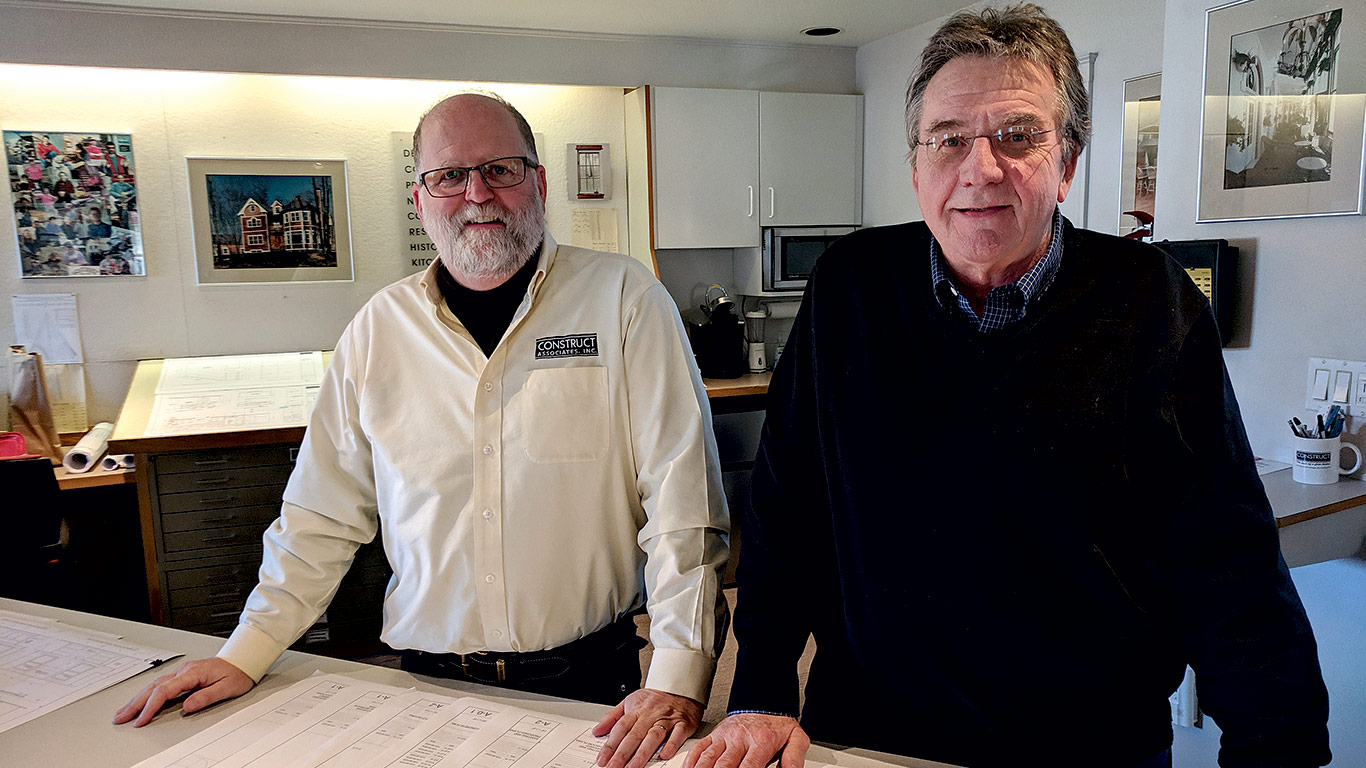
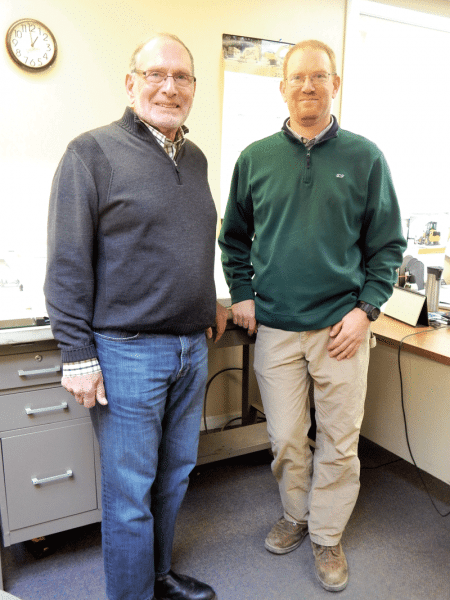
Partners Stephen Ross (left) and Bob Walker

Partners Stephen Ross (left) and Bob Walker

Construct Associates has built a reputation for home renovation and restoration in Western Mass. over the past few decades, which is fortunate these days, since business is surging in that area. The reasons are myriad — among them, plenty of old housing stock in the Pioneer Valley, a generally strong economy, and the continued aging of America and the desire among the senior set to remain in their homes and age in place. It all adds up to opportunity, and Construct is making the most of it.

Stephen Ross says residential renovation is looking up — in more ways than one.

“We’re doing a lot of aging-in-place stuff — personal elevators, residential elevators, additions,” he told BusinessWest. “I like to say that an elevator costs probably 10 months worth of a decent retirement community. There, you’re not going to get that money back. But with an elevator, it’s equity toward your house.”

Ross and Bob Walker, the partners at Construct Associates in Northampton, say aging in place is a major trend in residential construction and renovation these days, with the Baby Boom generation continuing to swell the ranks of the over-65 age group, many of them loath to give up independent living.

“I saw a poll recently where 88% of people want to remain in their home, and a lot of them are trying to do just that,” Ross said, noting again that elevators, accessible showers, and other additions pay for themselves if they make the difference between staying there and moving to a retirement community. “I’ve got two of those in the works now. One is an in-law suite, where they’re making it accessible for the in-laws, and the other is a professional couple that wants to be able to utilize their whole house.”

Meanwhile, Walker is wrapping up a first-floor master suite in Northampton with an aging-in-place concept. “It’s an older home right in the middle of town, but all the bedrooms are upstairs. A couple years ago, they did a big kitchen remodel, and now they want a bedroom and bath and laundry on the first floor, where they can get to all of it. We’re putting in a curbless shower, in case of limited mobility.”

“We did a pretty serious job search back in the fall, but we we got a lot of people we felt weren’t qualified for the quality work we do. Sometimes you do get good people come in who are older guys. The labor pool is aging, and it would be nice to see a lot more young people coming into the field.”

Not only do older people want to age in place, Ross said, but the Five College area tends to have consistent rotation of housing stock, and new owners want to come in and put their mark on their new house. And many newcomers to the region arrive from pricier markets, so they’re getting relative bargains and have money left over for remodeling.

“We’re a high-end firm,” Walker added. “We’ll do the whole gamut of work, but our real money is in high-end residential remodeling. At this point, we really are working off our reputation, our referral base. I’m doing a major house remodel in Longmeadow now — four bathrooms, going through the house and upgrading. I have another major job like that, a big Victorian in town here with a high-end kitchen, a big master bath, upgrading mechanical systems, making it as energy-efficient as possible.”

New home building remains a quieter market, Ross added, so Construct is in the right place these days. “Kitchens and bathrooms are our bread and butter, and it always seems like weve got one or two, if not four or six, going on in the background.”

Innovative Idea

Walker and three other partners — Hobie Iselin, Bob Reckman, and Chris Dawson — launched Construct Associates in 1984 with a bright idea — and good timing.

The idea was to create a construction company based on the model of a law office, where the owners share space, marketing, and accounting, but are responsible for managing their own projects.

This residential addition in Northampton

This residential addition in Northampton features an elevator, an amenity that has become more popular in recent years.

The good timing had to do with the company’s home city of Northampton, which was growing quickly and had recently begun to capture the imagination of developers. Construct had a hand in shaping the commercial rebirth of the city, building or renovating the Northampton Brewery, the Hotel Northampton, the Calvin Theater, two Bart’s Ice Cream Shops, Bruegger’s Bagel Bakery, Pinch Pottery, Pleasant Street Video, Silverscape Designs, and other properties.

Other partners have come and gone over the years; today, Walker shares ownership with Ross, who first joined the company as a carpenter in 1988 and became a partner in 2006.

The workload has changed over the years; Construct Associates does far more residential work — mainly home-renovation projects — than it used to. But it still does some light commercial work, notably the recent renovation of New England Treatment Access, the marijuana dispensary a block away from its Northampton headquarters.

The firm’s design and construction capabilities cover everything from antique designs to modern styles, the partners note, but they specialize in older buildings, providing innovative designs and construction for kitchen and bathroom remodeling, renovations, and additions, as well as new construction projects.

“We do all our carpentry. We don’t sub out any carpentry because we have our in-house guys,” Walker said.

While the volume of work has been strong lately, he noted, the staffing issues that plague many contractors may be the only thing holding back further growth.

“We lost a few guys last year, and we’re trying to replace them. We did a pretty serious job search back in the fall, but we we got a lot of people we felt weren’t qualified for the quality work we do. Sometimes you do get good people come in who are older guys. The labor pool is aging, and it would be nice to see a lot more young people coming into the field.”

He said he hired a carpenter last year who recently graduated from Smith Vocational and Agricultural High School — one of only three students in the carpentry program at the time. That’s not surprising, as a decades-long emphasis on pushing kids into college has contributed to talent shortages in what are generally well-paying careers in the construction trades.

“The most interesting thing I see in vocational schools is the percentage that are going to college,” Ross said. “Back when we were kids, if you went to vocational school, that meant you were going into a vocation. I’m personally shocked at the kids going on to higher education.”

Walker agreed. “It’s interesting. You can make a really good wage doing this rather than try to come into the job market with some computer skill that every guy and his brother has.”

Smooth Sailing

Other than finding talent, the construction-industry landscape is looking strong in 2019, Walker said.

“One of my lumber-yard reps asked how we were doing because he was really surprised that, right after the first of the year, things are still hopping. He sees it because he supplies a lot of builders. Generally, you get to this time in January, and things kind of slow up, but they’re moving quite well.”

Part of that has been the mild winter — though at press time, shortly after this interview, a major snowstorm was expected to sweep through the Northeast.

“There are jobs where I might have pushed a little harder to get concrete in the ground had I known we would have had this mild weather,” Ross said, “but you had that first [November] snowfall that made you think winter was coming, and then it didn’t.”

He’s expecting a solid spring surge this year, though, once people get their tax refunds and the weather starts to get truly warm.

“One of my lumber-yard reps asked how we were doing because he was really surprised that, right after the first of the year, things are still hopping. He sees it because he supplies a lot of builders. Generally, you get to this time in January, and things kind of slow up, but they’re moving quite well.”

“People are funny,” he said. “They’ll call you in the spring when it starts warming up and want to do something right then, but in reality, some of them should be talking to us right now and planning ahead.”

At the start of 2019, though, the calls have been coming in, partly due to the lack of snow.

“With the weather being mild,” Ross said, “some of them are a little more anxious to get some projects started, when normally they would be hunkered down because they don’t want people tramping sand and salt into their house, and opening and closing doors. So we have more calls than we usually do this time of year, but winter will have to come sooner or later. It’ll be interesting to see what happens then.”

The desire to age in place, however, or simply to turn an old house into something fresh and modern, aren’t ideas subject to the season, and on that front, Construct Associates continues to make its mark on Northampton and the region.

Joseph Bednar can be reached at [email protected]

Construction

National Outlook

According to the 2019 Dodge Construction Outlook released by Dodge Data & Analytics, a leader in construction-industry forecasting and business planning, total U.S. construction starts for 2019 will be $808 billion, staying essentially even with the $807 billion recorded in 2018.

“Over the past three years, the expansion for the U.S. construction industry has shown deceleration in its rate of growth, a pattern that typically takes place as an expansion matures,” said Robert Murray, chief economist for Dodge Data & Analytics. “After advancing 11% to 14% each year from 2012 through 2015, total construction starts climbed 7% in both 2016 and 2017, and a 3% increase is estimated for 2018. There are, of course, mounting headwinds affecting construction, namely rising interest rates and higher material costs, but for now these have been balanced by the stronger growth for the U.S. economy, some easing of bank lending standards, still-healthy market fundamentals for commercial real estate, and greater state financing for school construction and enhanced federal funding for public works.”

One important question going into 2019 is whether deceleration is followed by a period of high-level stability or a period of decline, he noted. For 2019, it’s expected that growth for the U.S. economy won’t be quite as strong as what happened in 2018, as the benefits of tax cuts begin to wane. Short-term interest rates will rise, as the Federal Reserve continues to move monetary policy towards a more neutral stance. Long-term interest rates will also rise, reflecting higher inflationary expectations by the financial markets. At the same time, any erosion in market fundamentals for commercial real estate will stay modest. In addition, the greater funding from state and local bond measures passed in recent years will still be present, and it’s likely that federal spending for construction programs will increase.

“In this environment, it’s forecast that growth for construction starts will decelerate further, but not yet make the transition to the point where the overall volume of activity declines” Murray noted. “For 2019, total construction starts are forecast to hold basically steady at $808 billion. By major sector in dollar terms, residential building will be down 2%, non-residential building will match its 2018 amount, and non-building construction will increase 3%.”

The pattern of construction starts by more specific segments includes the following:

• Single-family housing will be unchanged in dollar terms, alongside a modest 3% drop in housing starts to 815,000. There will be a slight decline in homebuyer demand as the result of higher mortgage rates, diminished affordability, and reduced tax advantages for home ownership as the result of tax reform.

• Multi-family housing will slide 6% in dollars and 8% in units to 465,000. Market fundamentals such as occupancies and rent growth had shown modest erosion prior to 2018, which then paused in 2018 due to the stronger U.S. economy. However, that erosion in market fundamentals is expected to resume in 2019.

• Commercial building will retreat 3%, following 2% gains in 2017 and 2018, as well as the substantial percentage increases that took place earlier. While 2018 market fundamentals for offices and warehouses were healthy, this year, vacancy rates are expected to rise as the economy slows, slightly dampening construction. Hotel construction will ease back from recent strength, and store construction will experience further weakness.

“There are, of course, mounting headwinds affecting construction, namely rising interest rates and higher material costs, but for now these have been balanced by the stronger growth for the U.S. economy, some easing of bank lending standards, still-healthy market fundamentals for commercial real estate, and greater state financing for school construction and enhanced federal funding for public works.”

• Institutional building will advance 3%, picking up the pace slightly from its 1% gain in 2018, which itself followed an 18% hike in 2017. Educational facilities should see continued growth in 2019, supported by funding coming from numerous school-construction bond measures. Healthcare projects will make a partial rebound after pulling back in 2018. Airport terminal and amusement-related projects are expected to stay close to the elevated levels of construction starts reported in 2017 and 2018.

• Manufacturing plant construction will rise 2% following a 18% jump in 2018. The recent pickup in petrochemical plant projects should continue, and cuts in the corporate tax rate from tax reform should encourage firms to invest more in new plant capacity.

• Public-works construction will increase 4%, reflecting growth by most of the project types. The omnibus federal appropriations bill passed last March provided greater funding for transportation projects that will carry over into 2019, and environmental-related projects are getting a lift from recently passed legislation.

• Electric utilities and gas plants will drop 3%, continuing to retreat after the exceptional amount reported back in 2015. New generating capacity continues to come online, dampening capacity utilization rates for power generation.

Dodge Data & Analytics is North America’s leading provider of analytics and software-based workflow-integration solutions for the construction industry. 

Construction

Screen Test

Andy Crane, executive director of the Home Builders and Remodelers Assoc. of Western Mass.

Andy Crane, executive director of the Home Builders and Remodelers Assoc. of Western Mass.

Online learning isn’t a recent innovation, but in the world of continuing education for construction professionals, there aren’t many programs doing it — and few are doing it more effectively than the Home Builders and Remodelers Assoc. of Western Mass., says the association’s executive director. Its partnership with Holyoke Community College, he notes, is helping contractors get the training they need on a schedule that doesn’t take them off the worksite at critical times — and that benefits everyone.

Education, Andy Crane says, isn’t an afterthought for the Home Builders and Remodelers Assoc. of Western Mass. — it’s part of its mission statement.

“We get calls multiple times a day just asking questions, all over the spectrum,” said Crane, the HBRA’s executive director. “It could range from grading the soil to what you need on the roof to what kind of energy efficiency you need, and we’re expected to know that — and if we don’t, we know who to call. The fact that you can call and get an answer to your question is, I think, critical to the building trade in general. I think it validates us.”

On a broader scale, the association has long conducted continuing-education classes for construction supervisors and building professionals. The state requires 12 hours of classwork every two years, but the value of education goes beyond that, Crane said. Take, for example, a course on writing construction contracts.

“Very few people know how to do it properly, how to write a good contract,” he told BusinessWest. “There are contracts written on the back of napkins, or on lumber yard receipts. You’re collecting thousands of dollars from Mr. and Mrs. Smith, and the contractor may or may not take off, and Mr. and Mrs. Smith have no avenue to turn to. Contracts are not just one-way — they protect me, but they protect you as well. Writing the proper contract and including the right licensing and registration numbers and insurance — it’s huge.”

In recent years, the state began allowing up to six of those 12 hours of classwork to be conducted online. Crane said the HBRA wanted to get into that — but wanted to do it right. So the association approached Ken White, dean of Community Services at Holyoke Community College (HCC), to develop an online continuing-education platform that would compare favorably with any live classroom experience.

“More and more education and training is going from live classroom instruction to convenient online learning,” White said, adding that it makes particular sense in the construction world.

“We’re serving construction supervisors who are critically important individuals on the job; they’re overseeing everything that’s happening,” he explained. “To have them off site to go to a full-day program is a huge commitment of time that many times might not be in the best interest of the homeowner or the builder.

“HBRA has been doing premium classes for decades — of the six or seven home builders associations in the Commonwealth, they’re recognized by the rest of them as the best, by far,” he went on. “They asked us if there was a way to take their live instruction and create an online opportunity. That way, they can wrap their training and continuing development around their schedules, which may be weekends, evenings, and early mornings. And instead of taking it in these huge chunks of four hours or eight hours, they can do it an hour here and an hour there.”

HCC partnered with MindEdge Learning and MRW Connected to create a gateway and learning-management platform, White explained.

“We used a videographer to actually film all the live classrooms that take place here at the HBRA, with a three-camera setup. We keep the anonymity of the students because all you’re seeing are backs of heads; the focus is on the instruction. It’s filmed, it’s edited by the college to make sure it flows correctly, then it’s reviewed by the presenter, who is a builder or someone in the construction industry here in the Commonwealth. They look at it, and when it’s approved, it’s released to the public.”

The current course list is a deep dive into key construction issues: “Building an Airtight House,” “Energy Code Overview,” “Avoiding Costly Building Mistakes,” “Lead Safety Isn’t Just About Lead Paint,” and “Fall Prevention and Silica Exposure” are just a few of the topics.

“The reviews have been superlative,” White said. “They’ve picked some really great individuals who not only know their trade, but have great communication skills and keep up to date.”

He called continuing education the “lifeblood of decision making” for construction supervisors.

“On the job, if you make the wrong decision, people could get hurt, or something could leak, or something might not be up to code. They have a lot on the line. That’s why it’s important to have to be the best-educated, most experienced individuals in this profession. The college is just happy to be a part of it.”

Anytime, Anywhere

Crane said the HBRA is still teaching about 100 people a month at its headquarters in Springfield, but contractors are increasingly choosing the convenience of the online model.

“Some leave the job site and attend a live training,” White added. “But you can get an identical experience taking the same class online around your own schedule.”

Purchasing a class is as simple as logging on to the HBRA website, perusing course options, and paying for them via a secure checkout. A few minutes after payment is processed, the user receives an e-mail with a link to log onto a class at his or her convenience.

Since the online program began in the summer of 2017, it has seen 295 registrations through the portal, White noted, adding that the HBRA of Western Mass. is at the forefront of this type of education in the construction industry.

Ken White says HCC aimed to create an online platform that would be as well-received as the live classes the local HBRA is already known for.

Ken White says HCC aimed to create an online platform that would be as well-received as the live classes the local HBRA is already known for.

“They’re the only ones who have online learning that’s a live video capture of the actual classes, so what students are seeing is a very engaging, identical experience that they can take in smaller portions if they’d like. Whenever they stop, they can get back in back exactly where they left off. And at the very end, there’s a final examination with 20 multiple-choice questions they have to get right to get credit.”

Crane noted that questions need to be answered every 20 minutes or so, too, which ensures that the user actually watches the material.

“The problem with online classes, when they first came out, was that you could literally pay your fee and pay your kid five bucks to pass the test by sitting there doing this,” he said as he mindlessly pressed a button. “Because we’re considered leaders in the industry, we thought that was wrong, so we helped get the rules changed so that, if you want people to learn stuff, you have to create a platform that makes them learn. You take a certain portion of time, maybe 20 minutes, then you’re tested on that 20 minutes. When you pass, you move on to the next 20 minutes. So you get your six hours of credit, you actually have to do six hours.”

After passing the final exam, the user prints a certificate to send in to the state to renew their license.

It works well for many construction professionals, Crane added, though many still prefer to be in a live classroom.

“You can take 12 hours live or do six live and six online. Personally, I don’t like doing things online. In fact, I hate it. I first came here because they offered classes here, downstairs in our conference room. I sat here for two days — there’s no tests when you do it this way; if you’re here 12 hours, they assume you learned.”

To feel the same confidence in an online platform, he said, “we had to build a program that follows the state’s protocol to a T, and make it tough so they’re actually learning something. Our classes are $90 for three classes. For-profit businesses will run that for $29, but they don’t care what you learn. They’re willing to wait for the hammer to drop and then close down, and they don’t care; they’ll just do it to somebody else.”

White said he works with other companies to provide various types of training, both live and online. “But in terms of this particular industry, we’re not aware of anyone else doing this. And the other plus is, with live training, most folks are local supervisors and builders. Online, we have folks as far as Cape Cod, Nantucket, even Cape Coral, Florida. It allows folks, wherever they’re located, to take this and not have to drive a half-day to get here and back and deal with traffic.”

Learning Curve

Even in its live classrooms, Crane noted, the HBRA of Western Mass. has been ahead of the curve.

“If other associations do it, they go get a professor at a college or some local professional and rent a room at the Holiday Inn and run a class,” he said. “Nobody I’m aware of has an online product. We’re the only ones out of the Home Builders Association running an online program. There are bootleg courses online, being taught by people in Arkansas and Canada and California at half the cost, but the content is nowhere near as professional as ours is.”

White said he was impressed by what he saw when he first attended a class in Springfield.

“I was really blown away because it was very professional and intensive, with an incredible amount of information, a lot of interaction between student and instructor, a lot of passion, and all relevant information that helps business owners and construction professionals and supervisors in their day-to-day decision making, whether it’s dealing with OSHA or lead issues or whatever the case may be.

“When I went back to report to my vice president, Jeff Hayden, I told him the instruction is superlative. I said, ‘there’s a lot of engagement, it was interactive — this is perfect for live video capture.”

In the end, he said, HCC and the association have turned out a premium learning experience.

“And it’s due to the folks that Andy hires to teach,” White added. “They’re experts. This isn’t a sideline; it’s what they’ve been doing all their lives. They live this 365 days a year. So folks are really happy about the product the HBRA has put out, and we’re happy to have been selected to partner with them and create these models.”

Crane agreed. “This is a unique partnership that benefits consumers, clients of builders, the state — it benefits everyone who touches this product.”

Joseph Bednar can be reached at [email protected]

Construction

Creating a Solid Foundation

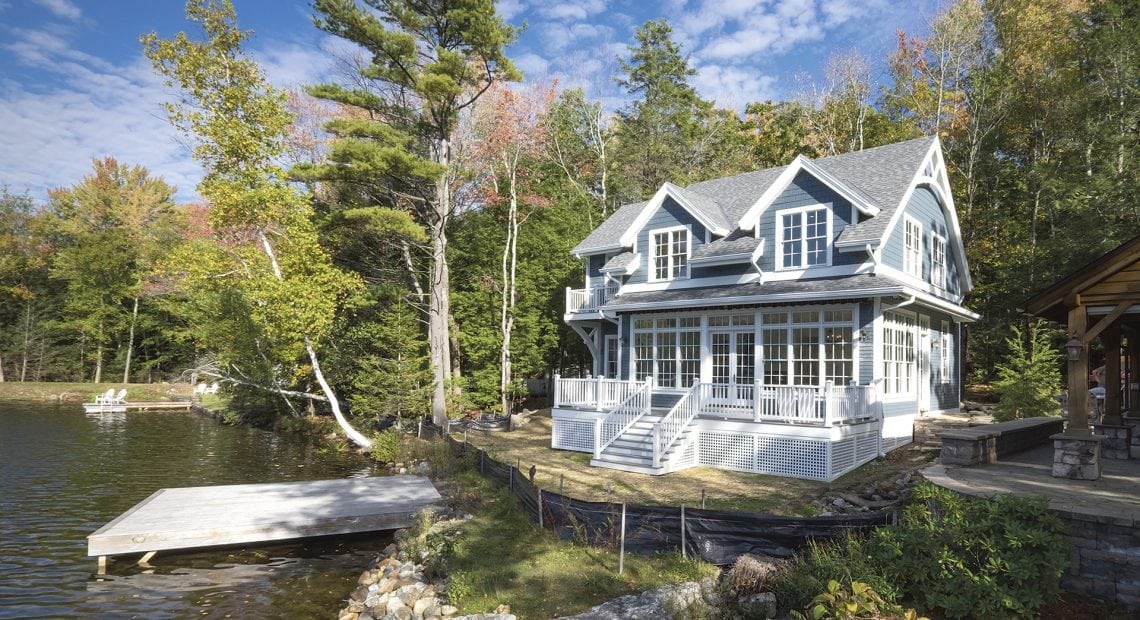
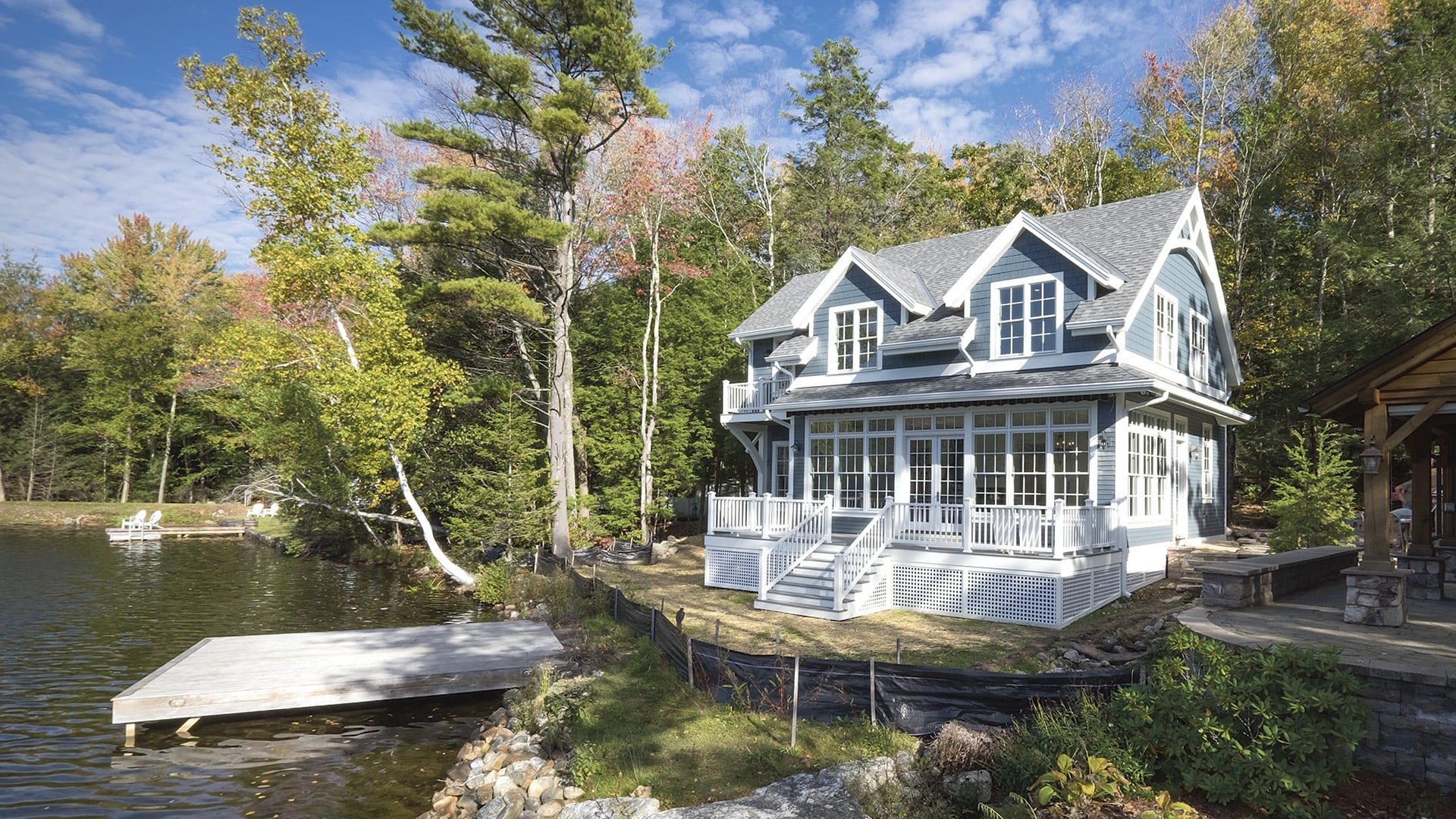
This lake home in Westhampton

This lake home in Westhampton is one of the many projects in Keiter Builders’ portfolio of residential projects.

While earning his master’s degree in finance at the University of Rhode Island, Scott Keiter wasn’t thinking about using it to manage his own construction company. But after a dose of the ‘real world,’ as he called it, while working for an insurance company, his passion for carpentry took his career in a completely different direction. In a short decade, Keiter Builders has constructed a solid business foundation and a diverse portfolio of projects across several disciplines.

Scott Keiter likes to say his company is what he calls “a typical Valley builder.”

By that, he means it is relatively small, at least when compared to outfits in larger cities, boasts a diverse portfolio — out of necessity and good business sense more than anything else — is agile, and also always looking to add new disciplines to the equation.

Florence-based Keiter Builders is quite atypical, however, in that it is a first-generation company, started just 10 years ago, almost at the height of the Great Recession (we’ll get back to that challenge later), and therefore doesn’t have a long history.

Indeed, most of the builders in the 413 can boast in their ads — and on the sides of their trucks — that they were launched a half-century or more ago. Their principals can talk about starting out working for their fathers, who can talk about starting out working for their fathers.

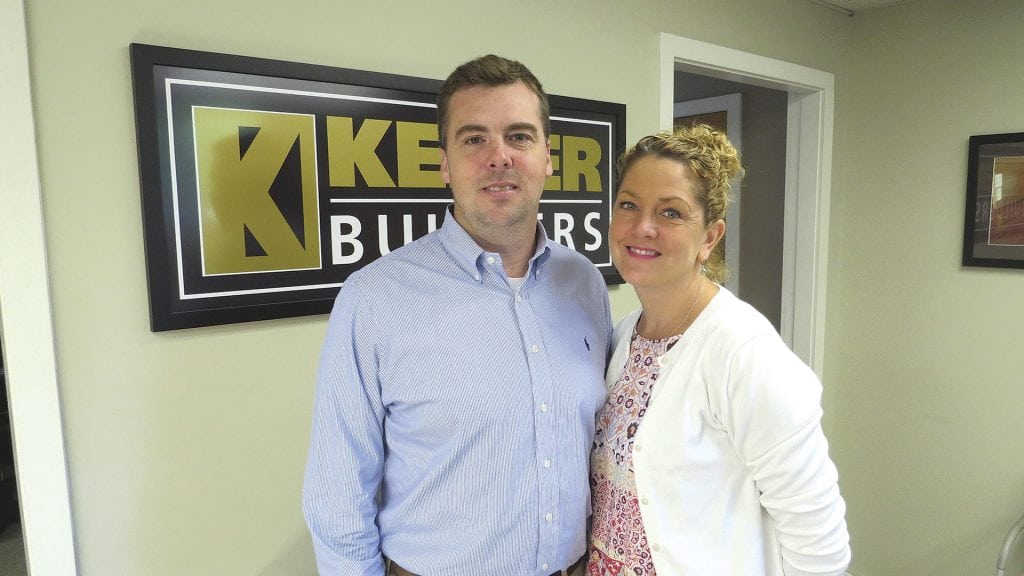
Scott and Jill Keiter.

There isn’t any of that Keiter Builders, said Scott, who noted that his father is an aerospace engineer and he himself earned a master’s degree in economics at the University of Rhode Island, and while he was earning it, thoughts of putting it to use to manage his own construction company rarely, if ever, entered his mind.

However, and this is a big ‘however,’ Keiter worked as a carpenter during the summer while in high school and college, developed somewhat of a passion for building, and stayed in touch with the industry throughout his education.

“I tried different careers, and between my bachelor’s degree and my master’s degree, I went to work for State Farm Insurance in auto claims — that was my introduction to the real world,” he said. “Which wasn’t for me; when I got my master’s degree, I decided I needed a break and went back to carpentry.”

To move the story along, things “progressed,” as he put it, deploying a word he would use early and often, and Keiter Builders started to establish a foothold and begin its transformation into, well, a typical Valley builder.

Download the PDF: List of General Contractors

Today, as noted, it is diverse, specializing in commercial, residential, and institutional work, with clients including Smith College and Amherst College, a number of smaller businesses in and around Paradise City, and the city of Northampton itself — Keiter is currently handling a number of projects within Look Park, for example.

As much as Scott Keiter is into building dwellings, commercial spaces, and softball diamonds, among other things, right now he’s mostly engaged in building his business, a process that, like most, he finds enjoyable, but also quite challenging, given the pressures of what comes day to day.

“One of my challenges is looking ahead,” he explained. “You’re just so busy as a small-business owner, it takes everything you’ve got just to get through the day, but you need to focus on tomorrow as well as today.”

With that in mind, he wants to continuously expand the portfolio, and he’s doing that through various initiatives, everything from investments in the ‘heavy construction division,’ as he called it, which is pursuing subsurface utility work, trenching, and heavy civil projects, to efforts toward gaining certification to handle work for the state Division of Capital Asset Management and Maintenance, or DCAM, which would enable it to pick up work at UMass Amherst and other state-run facilities (more on all that later).

For this issue and its focus on construction, BusinessWest turns the spotlight on Keiter Builders, a comparatively young firm that has constructed a solid business foundation and is looking to continue building upon it.

By the Booklet

As part of those business-building efforts he described, Keiter said the company has become more aggressive in its efforts to promote its brand.

Like most all builders, large and small, word-of-mouth referrals have always been the most effective marketing tool, but the company has added another component with a slick promotional brochure that Keiter and his staff, including his wife, Jill, invested considerable time and energy in and are quite proud of.

This booklet does a very effective job of explaining the company’s depth and agility — or that ‘progression,’ as Keiter described it, while detailing not only what it does, but also, and perhaps more importantly, how.

Indeed, it devotes pages to the firm’s work to carefully develop a sound pre-construction strategy and manage the construction process and meet the most fundamental of objectives in this highly competitive business — finishing on time and to the specifications set by the client.

But it mostly focuses on wide array of projects in the portfolio.

That list includes everything from a telescope observatory dome at Smith College to the memorial fountain at Look Park; from the Valentine Hall rooftop deck at Amherst College to the work at Roberto’s restaurant in Northampton; from the new Northampton offices of the law firm Bacon Wilson to the Convino Wine Bar in Thornes Marketplace.

It also includes an addition and renovation to the optical studios almost directly across Main Street in Florence from the Keiter offices, as well as a host of new homes, remodelings, and additions.

Overall, that brochure shows a great deal of progression in a decade and how quickly the company has been able to establish itself within this market.

And remember, it started at the height of the recession. Well, sort of.

“We weren’t really a construction company at that time,” said Keiter, adding that the enterprise amounted to him handling a wide array of carpentry work. “We went out and just built a network of clients, and kept at it.”

By that he meant, well, a lot of things, including taking whatever jobs he could get, eventually adding his first employee and then more as the project list grew — “we’re really fortunate to have an excellent group of craftsmen working for us” — and lots of hard work building the solid relationships that are the very bedrock of this sector.

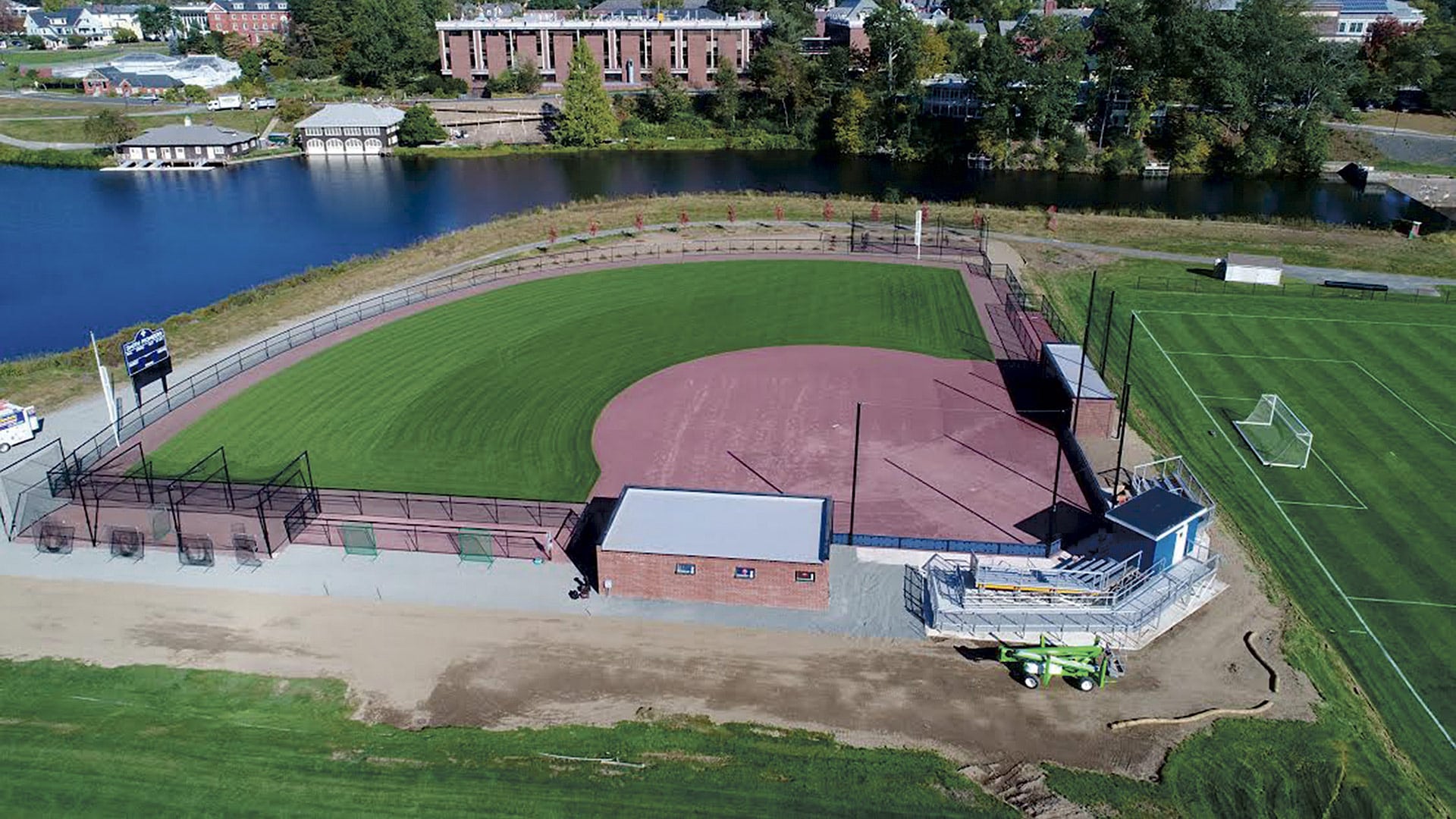
The softball field at Smith College

This relationship-building ability is clearly evident in the list of projects the company is currently handling, including several smaller initiatives at both Smith and Amherst Colleges, for which Keiter has already handled a number of assignments, and ongoing work at Look Park — which is in the midst of a comprehensive capital-improvement project. Renovation of Pines Theater is among the current initiatives.

There are a also a few residential projects ongoing, as well as a new building to support teen housing being developed by a Greenfield-based group called Dial/Self, said Keiter, adding that the company continues to build on the relationships it has forged in its early years while also establishing new ones.

“I don’t think there’s a defining moment over the past 10 years when it comes to how we’ve arrived here,” Keiter explained. “We try to take a long-term approach to our work as it relates to the quality, but also the relationships, and that’s really paid off for us.”

He offered Smith College as an example.

“We’ve been working with them for about six years,” he explained. “We started off doing very small projects, and we’ve just earned their respect and worked our way up to being involved with larger projects. As a first-generation company, we have to consistently prove our value.”

The company currently handles work within a relatively small geographic radius — roughly 15 miles from its Florence base, by Keiter’s estimates — but it is looking to expand that reach as well as its list of core competencies.

Keiter Builders handled renovations of the common area at Amherst College, one of its many institutional clients.

Indeed, Keiter, as noted, is currently investing in a heavy-construction division — a subsidiary of the company, actually — based in Hatfield. This division pursues work with utilities and larger contractors and focus on excavating, trenching, and site work, and it has been growing steadily, said Keiter.

Such diversification is important, especially for a sector so profoundly impacted by downturns in the economy.

“We need to stay engaged in many different disciplines,” he explained. “Sometimes, when commercial or institutional is a little slow, the residential fills the gaps. We really enjoy all the different kinds of projects; it keeps us sharp.”

Meanwhile, the company now owns a number of properties in the Northampton area and will look to develop them, said Keiter, adding that he’s eyeing a mix of commercial and residential development opportunities.

Then there’s the process of becoming DCAM-certified, which, Keiter said, should open a number of doors, including the large one involving UMass Amherst.

“We’re starting to enter the public arena,” he told BusinessWest, adding that DCAM certification should be a catalyst for growth within the heavy-construction division as well as the traditional contracting side of the venture.

Building a Legacy

Keiter, who has young children, said that someday, maybe his company can be one of those that boasts multiple generations of ownership and a half-century of history.

“I really enjoy building the business — it’s a pleasure to build a legacy,” he explained. “My hope is that maybe, sometime down the line, there will be a second generation.”

For now, he’s focused on that business- and legacy-building process, and said the formula for doing that is pretty straightforward.

“You have to keep grinding and building a reputation,” he explained. “And in our industry, there are no shortcuts to doing that.”

Indeed, there’s just hard work — on the job site and in creating and strengthening relationships. And success in those realms has enabled Keiter to come a in way in a short decade.

George O’Brien can be reached at [email protected]

Construction

New Life for an Old Building

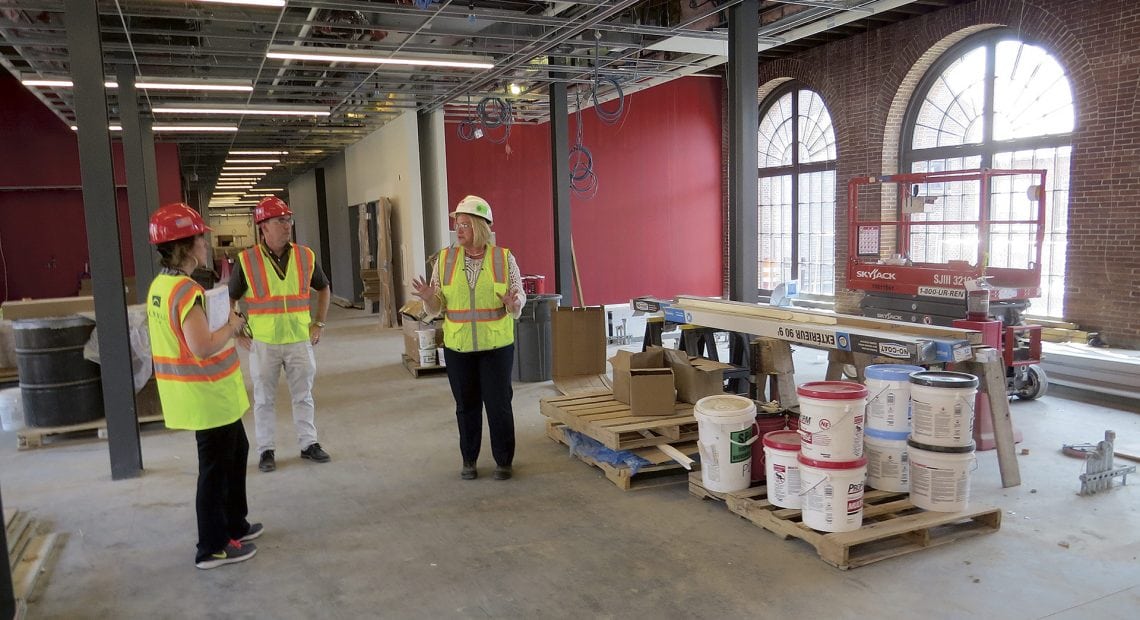
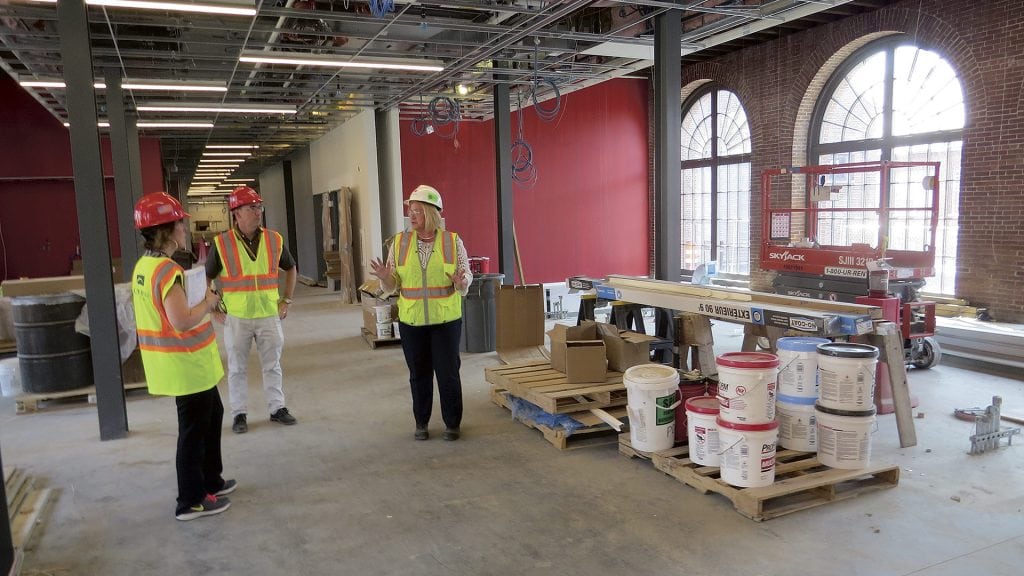
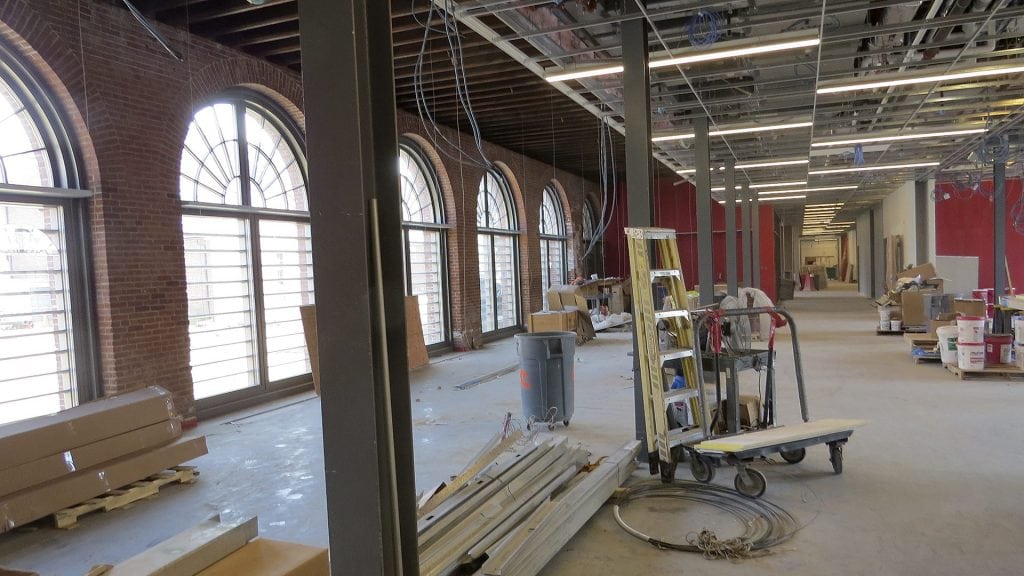
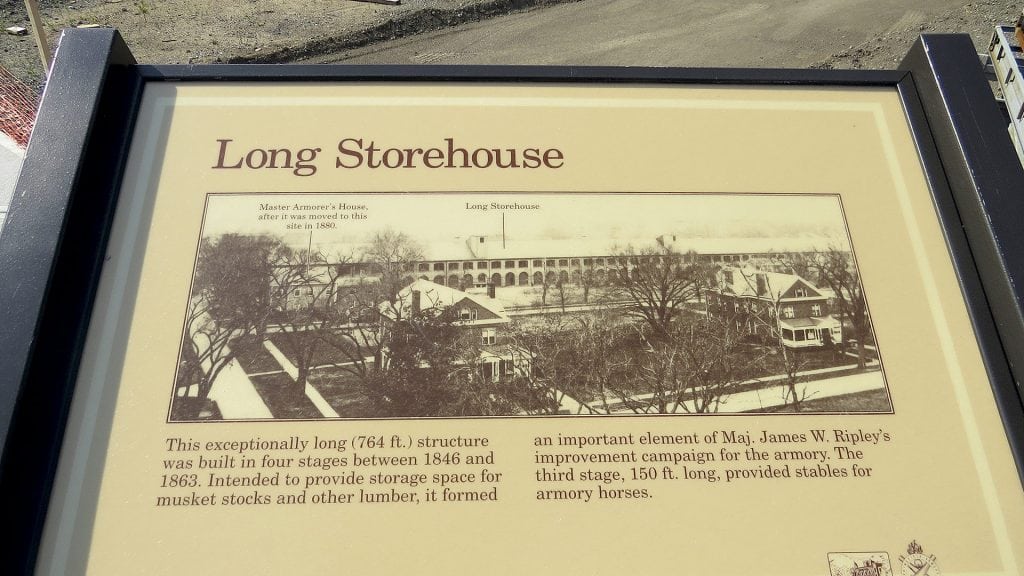
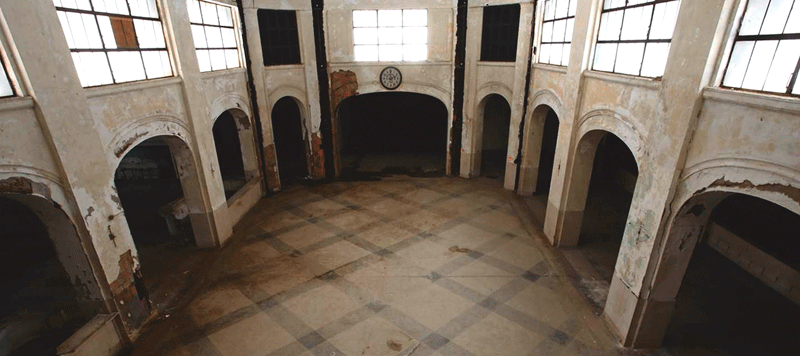
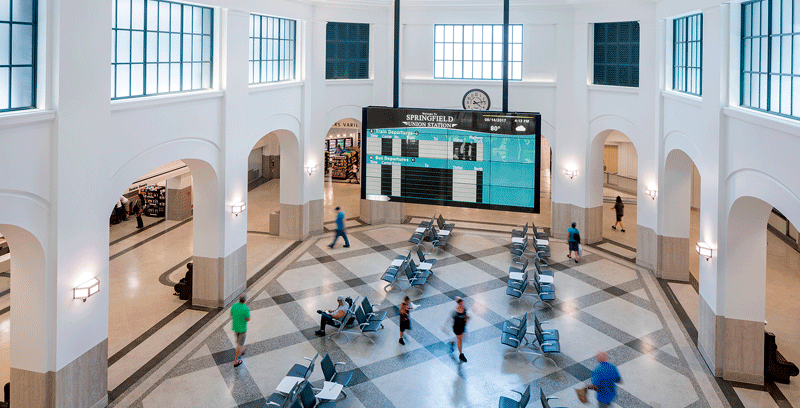
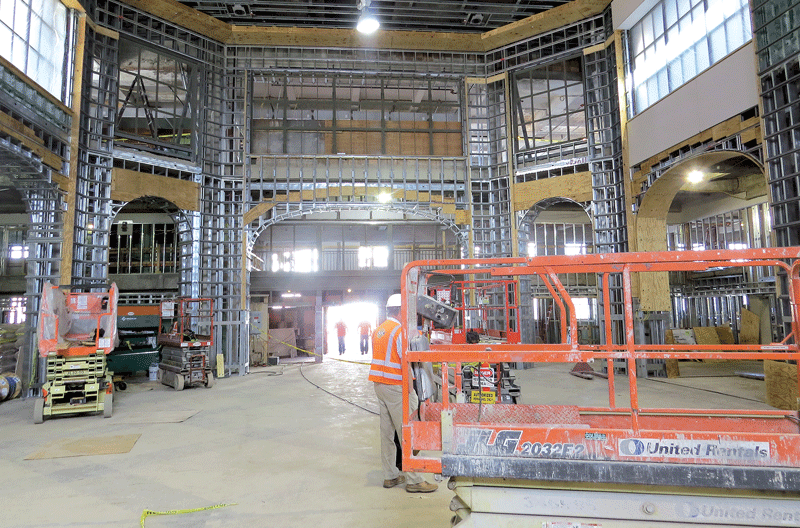
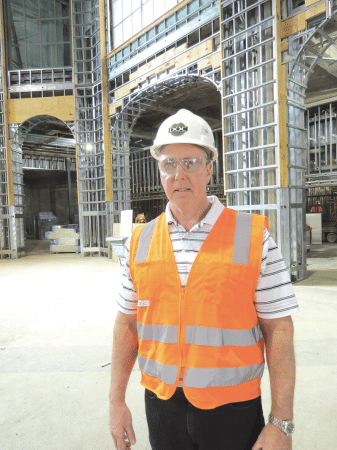
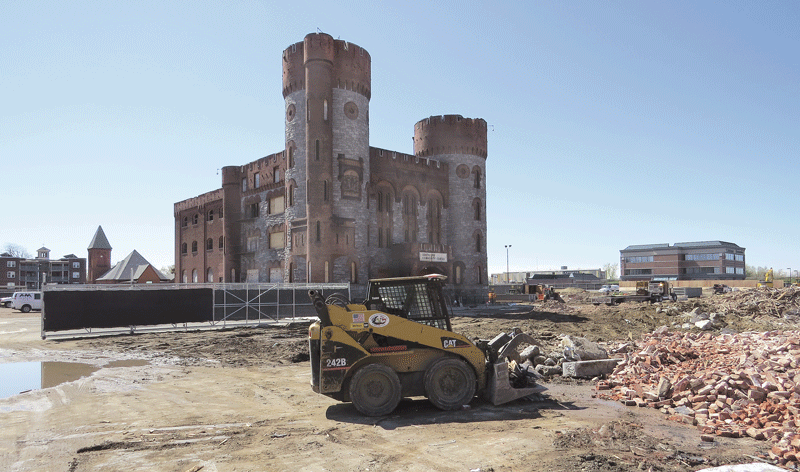
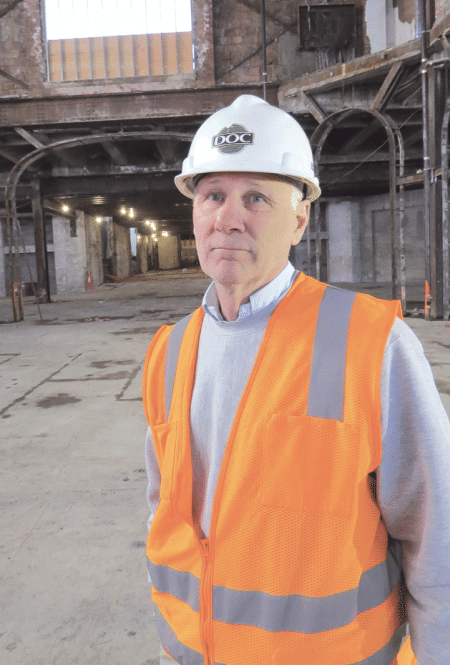
Begun almost two years ago, a massive, $50 million project to convert the structure at Springfield Technical Community College, formerly part of the Springfield Armory complex, known as Building 19 into a new learning commons is moving rapidly toward its conclusion. Used more than 150 years ago to warehouse gun-barrel stocks, the building will become home to a wide variety of facilities and services — from the library to the admissions office; from common areas to learning spaces — and should be ready for occupancy late this fall, said Socha.

Construction Sections

Framing the Issue

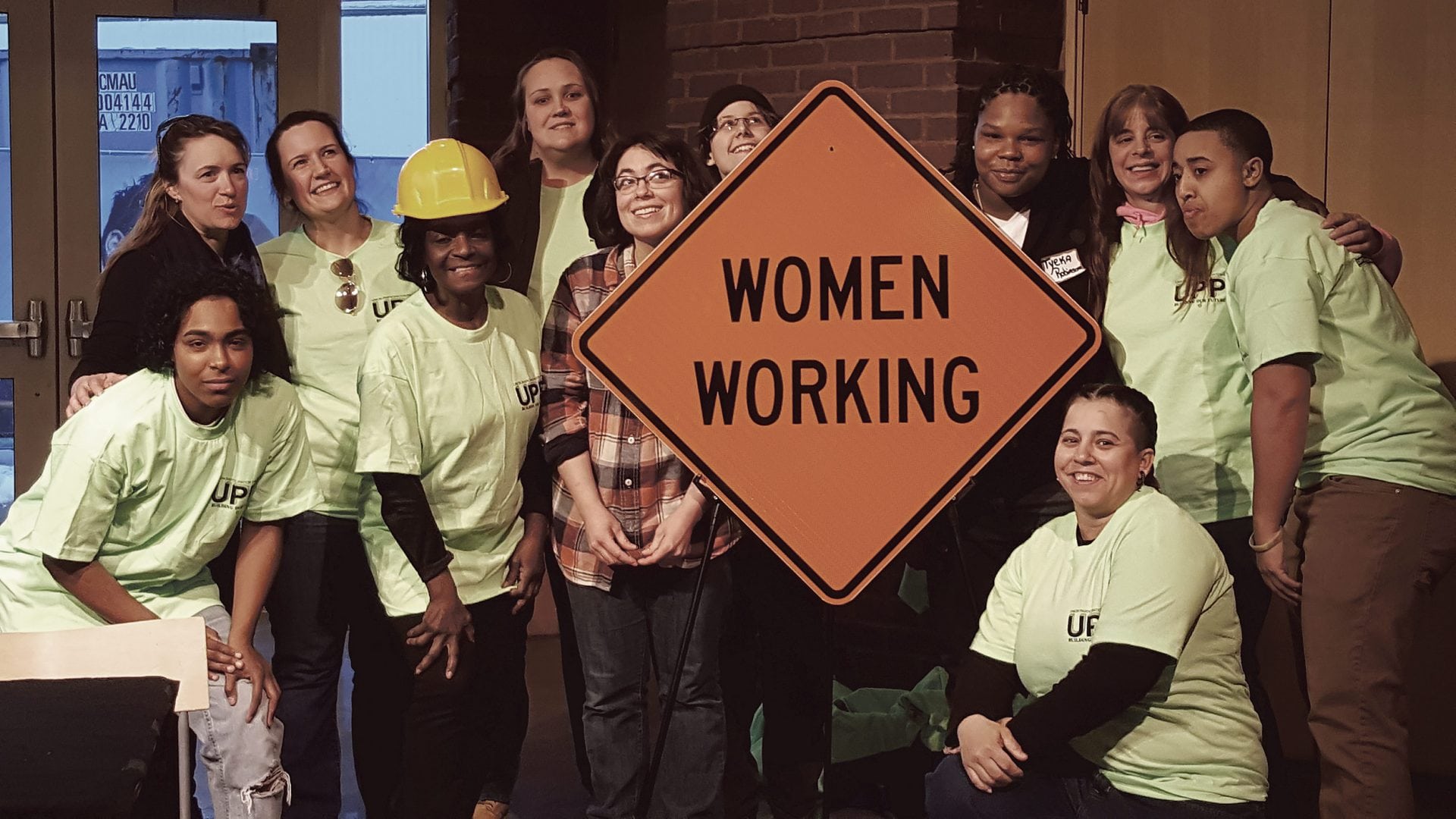
Local union carpenters gather for a forum on women in construction at Mount Holyoke College.

Construction has long been a male-dominated industry, but the playing field doesn’t have to be so uneven, several carpenters with Local 336 told BusinessWest. They all took different paths to the field, but all say women with an interest in working with their hands shouldn’t shy away from a career society has too often said they’re not suited for. Progress in diversifying the workforce has been incremental, but several regional developments offer reason for optimism.

Lily Thompson laughs when she hears that women can’t handle themselves on a construction site.

“That’s a societal thing as much as anything,” said Thompson, a journey-level carpenter with Local 336 of the New England Regional Council of Carpenters. “If a mother can pick a sleeping child out of bed 2,500 times, there’s no reason she can’t pick up metal studs and shlep stuff around; 90% of this business is moving and fastening.”

Yet, the stereotypical messages persist. “You wouldn’t believe how many times kids are told, ‘that’s a boy thing,’ or ‘that’s a girlie thing,’” she went on, recalling the day her young daughter was helping her install a barn door, and a passerby took note of them and commented, ‘a lady with a saw — how unusual.’

“It doesn’t get any more basic than that,” she said of how gender roles get reinforced in traditionally male professions. “But society has changed a lot lately, and Western Mass. is prime territory for people doing non-traditional things.”

Julie Boucher, another journey-level carpenter, didn’t get those messages at an early age, or, if she did, she ignored them.

“I wanted to be a carpenter since I was a little girl, probably since I was 4 or 5, playing with Lincoln Logs and Legos,” she told BusinessWest. Her route to that career was a circuitous one.

“I went to vocational school and learned the trade, but when I got out, it was difficult to find a job,” she said. “Being a woman, a lot of companies took one look and said I wasn’t needed or wanted, so I got a little discouraged.”

After serving in the Navy for a time before getting a medical discharge and then studying business administration at Holyoke Community College, she again became interested in carpentry, and after a professor handed her a pamphlet for the carpenter’s union, she applied.

“The job can be difficult mentally and physically, and sometimes I think the mental struggle is harder than the physical struggle,” she said. “But if building and working with your hands is something you love to do, you should follow your dreams.”

Katurah Holiness

Katurah Holiness, here pictured at the MGM Springfield site, says she appreciates the different avenues of training available in her union.

Lisa Clauson, director of Strategic Partnerships for the union’s Carpenter’s Labor Management Program, loves testimonials like that one.

“We’ve been working aggressively over the past two years to expand our union’s diversity and ensure we reflect the communities we work in and our members live in,” she said, noting that this effort includes bringing in more men of color, but in particular has focused on recruiting women of all backgrounds.

Tradeswomen, Clauson noted, represent fewer than 3% of the construction industry nationally, and closer to 2% in Springfield. “We, and many other building trades, all have very successful tradeswomen, so it is not an issue of women not being physically capable, but it is an issue of women being recruited and encouraged to do this work — and an issue of contractors being willing to employ them. The construction trades are one of the last industries to diversify opportunities for women.”

Indeed, while female representation in the construction trades rose steadily between the 1980s and 2007, the number then leveled off and has decreased ever since. One factor was certainly the Great Recession, which hit construction hard and chased many professionals out of the field — women at a higher rate.

They should come back, Thompson said, with opportunities on the rise.

“I’ve been doing this almost 16 years,” she said. “The pay and benefits are great, and I work with a great group of people. It’s something I like to do, versus sitting at a desk. I tried making sandwiches and was a receptionist in a hair salon, but that wasn’t where I wanted to be.”

Test of Time

Thompson graduated from Franklin County Technical School in 2001, and decided to focus on carpentry after trying out some trades — auto-body and electrical work, to name two — that she found less appealing.

“I like building things, and seeing things that are long-lasting. You get to look at it and have pride in your work for years to come,” she said, noting that her skills translate well to her personal life, too; she and her husband, a mechanic, bought a run-down property 12 years ago and worked to turn it into a home.

A home is something Katurah Holiness didn’t have when she entered the world of carpentry. An Air Force veteran, she was driving for Uber and sleeping on a series of friends’ couches, and when she got tired of hopping around, she went to stay at Soldier On in Leeds, where she lived for much of 2016 and 2017.

She had never had much interest in carpentry, but one day she gave a union carpenter a ride, and chatting with him piqued her interest. She applied with the union and quickly became an apprentice and got hired on the MGM Springfield job.

“With the carpenter’s union, there are so many avenues you can go as far as interest,” she said. “You can take a welding course, learn about framing and sheetrock … the avenues don’t end. There are a number of things you can get into, specialties and certifications you can train for.”

Her car broke down shortly before she started as a carpenter, and Holiness initially was able to get to work through getting rides with other members and sometimes from other women who lived at Soldier On. Steady work at the union apprentice rate enabled her to save, pay off some of her debts, and eventually move to an apartment.

Besides those pluses, she enjoys the work, and feels at home working alongside almost all men.

“I came from a male-dominated background in the military, so it’s not new to me in the least,” she said. “I can vouch for the men I’ve worked with; they’re for the most part good guys, and they’re willing to train you and educate you if you’re willing to learn.”

That’s not to say some stereotypes of the field aren’t occasionally true, Thompson said, including ribald or condescending teasing.

“I just put in my imaginary earplugs. Its ‘hey, you’ve got your sexy jeans on today,’ or ‘where did you get your boots from, the kids’ section?’ You take it with a grain of salt — smile, wave, give some s–t back when it comes down to it. As for the physical part, well, if you’re active in life and don’t want to go to the gym every day, come give this a whirl.”

The union has been trying to motivate more of that whirl-giving among women in several ways, Clauson said. One is recruiting aggressively from members’ networks, community organizations, career centers and job-training programs, vocational schools, and other sources.

“We’re spreading the word about the opportunities for this work and letting women know that, when this work is done union, they can earn living wages, be fully trained in the craft for free, and get great benefits. Our recruitment work has involved intensive outreach in the vocational schools throughout Western Mass. as well.”

Meanwhile, to retain women in the trade, the union has created a ‘Sisters in the Brotherhood’ chapter for its women to come together regularly to network and support each other.

“We have mentorship programs and are working to educate our members on the value of diversity and the need for harassment-free worksites. We are also working with our contractors on these issues,” she explained.

Finally, the union has been persuading developers to require diversity in their contractors.

“This last step is key to ensuring women get hired and get work,” she said. “Contractors are slow to change their hiring practices, but if owners of construction work require them to bring in a diverse workforce, they will do so. This often gives women — and people of color — a foot in the door to demonstrate their work ethic and skills, and many are then kept for other jobs that don’t have requirements.”

Success stories in this realm have included MGM, with women accounting for at least 6.9% of all work hours, people of color 15.3%, and veterans 8% — minimums that are consistently being exceeded. “MGM is a remarkably different worksite than most,” Clauson said. “Our women constantly talk about how different it is to be seeing other tradeswomen all around them.”

Lily Thompson

Lily Thompson takes a break from work renovating Blanchard Hall at Mount Holyoke College.

Meanwhile, the UMass Amherst Building Authority has also set work-hour goals of 6.9% for women and 15.3% for people of color. Three years ago, she added, these goals existed but were ignored, but a compliance officer started enforcing them in 2015, and now the all jobs are exceeding these numbers.

Mount Holyoke College recently completed its first project (a renovation of Blanchard Hall) with work-hour requirements of 7% for women and 16% for people of color. And Smith College recently announced it will require the same percentages on its $100 million Neilson Library project.

Finally, the city of Springfield is reworking the Springfield Responsible Employer Ordinance, which requires city construction contractors to employ 35% Springfield residents, 20% people of color, 6.9% women, and 5% veterans.

“It has largely been unenforced, and they are now creating a new enforcement plan and have recently hired a compliance officer to oversee it,” Clauson said.

Small Steps

Boucher said every additional woman on a job site makes the environment healthier for all women. That’s partly why she coordinates the training center of the union’s apprenticeship mentoring program and helped launched its Sisters in the Brotherhood chapter.

“I naturally wanted to help other people; that’s in my blood,” she said. “I started a mentorship program at my local because I know how important it is to have that support. I wanted to be there for the apprentices coming in and help guide them in any way I can. Not all apprentices want mentoring, but the ones that do, I try to provide a support system for them. We have a great team of mentors to help out.”

The progress achieved in diversifying the construction workforce regionally is exciting, Clauson said, but much more needs to be done.

“Women historically have done many physically demanding and dirty jobs, but traditionally they are doing work of this type in low-wage and low-skilled industries,” she said, citing jobs in cleaning, food service, and personal care. “Construction careers, in contrast, are higher-paid, skilled, and, when unionized, have good wages, free training, and strong benefits. Women need to be able to access these opportunities.”

And be treated equally on the job site, Boucher said.

“There are companies that allow me to do my job, and then companies that don’t allow me to do my job, in the sense that I’ll get put on menial tasks, easy tasks, because my foreman or journeyman I’m working with don’t think I’m capable of doing it. I wish I was challenged a little more. Let me do the framing; let me handle drywall. But that’s not always the case.”

It helps that the union supports workforce training, she added. For example, Boucher earned a construction management degree at Wentworth Institute of Technology in Boston, and the local paid for one-third of the tuition; most of the classes were held at Springfield Technical Community College through an exchange between the two institutions.

Thompson said women are ultimately responsible for taking such opportunities to better their careers. “Women today want to be 50-50, want to feel like they’re equal partners,” she noted. “Whether just out of college or age 50, as long as you’re physically able, there are lots of positions in construction. I didn’t see myself doing this full-time, but it works. I’m much happier than I’d be in an office.”

Holiness agreed. “A lot of people think it’s only for males because they’re stronger, but that’s not true,” she said. “Where there’s a will, there’s a way. There’s nothing you can’t do.”

Joseph Bednar can be reached at [email protected]

Construction Sections

Building Concern

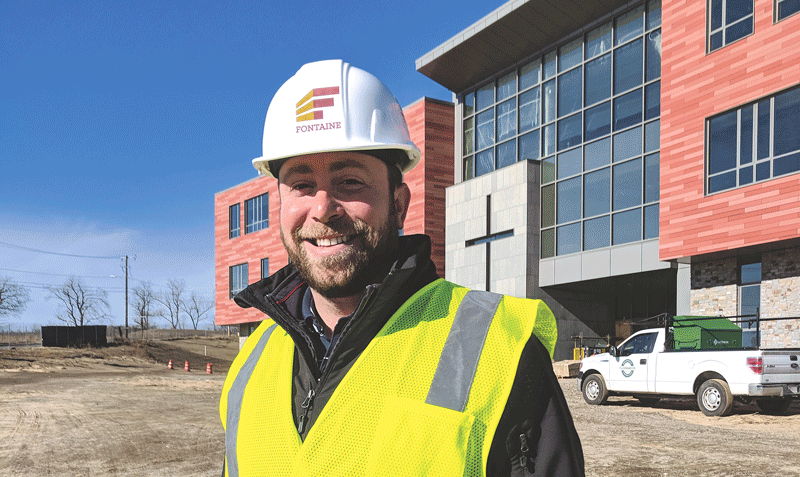
David Fontaine Jr.

David Fontaine Jr. outside one of his company’s current high-profile projects, the new Pope Francis High School.

The good news for area contractors is that construction is humming along in Western Mass. The bad news? A limited talent pool has been stretched even thinner, and companies often struggle to find skilled workers. It’s actually a national problem, as a decades-long emphasis on college degrees has steered young people away from the trades as a viable career option. That needs to change, industry experts say, if they want to keep growing.

Long before the MGM Springfield casino project put hundreds of workers — carpenters, ironworkers, plumbers, electricians, you name it — to work, the region’s construction companies found themselves struggling with a critical element of the business: finding workers.

n some ways, it’s a good problem to have — it means construction activity is up regionally — but it may not be sustainable.

“In Western Mass., it’s a combination of things,” said David Fontaine Jr., president of Fontaine Brothers in Springfield. “Everyone is very busy, with a lot of large projects going on and demanding a lot of labor. And then, you’re seeing a shortage of people entering the trades. Its hard to distinguish which is more the culprit right now, but it’s definitely those two things going on.”

Fran Beaulieu, president of Phil Beaulieu & Sons Home Improvement in Chicopee, agrees.

“There is a shortage, and it’s hard to find new help; they just don’t come knocking on your door,” he told BusinessWest. “So we have to create from within. We do have a nice crop of younger guys working for us, under 30, and we’re doing everything we can to retain them — making a better work environment, making it profitable for them, and showing them there is a future in this. That’s how you retain them.”

Attracting new blood to the field? That’s a little more challenging.

“It’s hard work,” he said, perhaps referring to both the actual jobs and convincing people to do them. “When you decide you want to be a carpenter, plumber, or electrician, you know it will be hard work. And there will be days when it’s 28 degrees out — those are the bad days. But then there are a lot of good days — nice, sunny days when it’s 75 degrees out, and people sitting at their desks wish they were outside.”

It doesn’t help, he noted, that some elements of society have looked down at the construction trades over the past quarter-century, pushing hard the idea that young people need to earn a college degree.

Yet, “if you take the job professionally, you can do really, really well,” he said, noting that someone who starts at age 18 may be earning $80,000 to $90,000 by the time they’re 23 or 24, while someone who went to college is just starting out in an entry-level job, often saddled with six-figure debt.

“And that’s working for someone else; never mind venturing out and doing your own projects,” he went on. “I always tell young guys, ‘the carpenter becomes the builder, the builder becomes the developer, and the developer becomes the real-estate owner.’ After five or six years, they’re often no longer wearing a toolbelt, because they’re managing the people working for them. This business can be very lucrative; there’s a lot of opportunity. We all need a plumber from time to time.”

If You Build It…

America needs a lot more than that. Last year, the National Assoc. of Home Builders’ Economics and Housing Policy Group conducted a national online survey of 2,001 young adults (ages 18-25) in response to growing concerns over labor supply in the trades. The current scarcity is all the more concerning, the report noted, given projections from the Bureau of Labor Statistics that the construction sector will add around 790,000 new jobs between 2014 and 2024.

Among respondents who say they want to work in construction, 80% cited good pay as a reason why — the top motivator, in fact. Other reasons include the ability to obtain useful skills (74%), the ability to work outside (53%), the ability to start one’s own business (50%), and the fact that it doesn’t require a college degree (37%).

On the other hand, when respondents who said they were not interested in a construction career were asked why, the top reason was the desire for a less physically demanding job, cited by 48%, followed by the difficulty of the work (32%), the desire for an office job (26%), the desire to open their own business (20%) and, interestingly, the desire to make more money than people in the trades make (19%).

Interesting, because there seems to be a perception gap when it comes to salary. Of the respondents uninterested in a construction career, almost half (44%) think annual salary averages less than $51,000, and only 2% think someone can earn more than $100,000.

Still, the report notes, “most young adults who have yet to make up their minds on a career see very little chance they would join the trades even if the pay was high. This decision is based more on their view that construction work is physically demanding and difficult, and less so on often-repeated presumptions that it is because they prefer ‘new economy’ type jobs, or because the work is seasonal or requires being outside in the elements.

Fran Beaulieu

Fran Beaulieu says recruiting talent is a constant challenge in the industry, which is why he focuses on creating a strong culture of retention and advancement.

“The helpful news for the construction industry is that many 18- to 25-year olds who in theory would not like to work in the trades would reconsider it for an annual salary of $75,000 or more,” it continues. “Although the average annual salary is below this for the trades relevant to the home building industry, $75,000-plus salaries are available for the top 10% to 25% of workers, and it may be worthwhile to make this more widely known.”

Fontaine is doing his part.

“I think this is a great career,” he said. “We have a lot of people here who have had long, successful careers. And certainly, a lot of other contractors in the area have employed a lot of the same people for years and years. A lot of that is the unions, which have great healthcare programs and pension programs that people can take advantage of.”

It’s the other side of the coin, the too-slow trickle of younger workers, that has contractors concerned. Take, for example, these comments published in BusinessWest during 2017 alone:

• From Joe Marois, president of Marois Construction in South Hadley: “Now we’re being faced with a labor shortage, which is always a challenge. That’s the nature of construction — it’s never perfect. I don’t know to what extent the casino is affecting that, but basically, the labor pool for tradespeople is very small.”

• From Laurie Raymaakers, co-owner of J.L. Raymaakers & Sons in Westfield: “What we’re not seeing is qualified or experienced people to hire to grow with us. The need for skilled tradespeople is not going away, and it’s not just us — everyone we talk to within the industry says the same thing. And it’s a field where you can make a very good wage.”

• And from Brian Ruud, owner of Vista Home Improvement in Chicopee, who noted that companies have to be willing to pay competitive wages for good talent: “It’s hard to find good people … We’re happy with where we are now. We could grow more if we had the right people, but we’ll find them.”

Jason Garand

Jason Garand says the local carpenters union has developed programs to introduce young people to well-paying careers in the trade.

Jason Garand, business manager of Carpenters Local Union 336 in Springfield, agreed that the promise of good pay is a must to attract young people, noting that, if an 18-year-old with no plans to go to college can earn $11 an hour at McDonald’s or $13 an hour on a job site, doing hard work in the elements, he might choose fast food, even though there’s a much lower career ceiling in that field — perhaps store management, but no higher.

“He might say, ‘I’ll take the easier path in the short term,’ but in the long term, it’s a dead end,” he noted.

As one of its efforts to raise the profile of its trade, the union recently partnered with Putnam Vocational Technical Academy to bring two students in as apprentices to work on the MGM Springfield project.

“We’re giving them a taste of what construction is all about, and our rate is $16 to start — that’s an apprentice, walking in with no skills,” Garand said, adding that, in the long term, “the union has a wage and benefit package that puts you in the middle class.”

Daily Grind

Fontaine was quick to note that the office side of the business isn’t seeing the same shortage, as the flow of young people graduating from schools like Wentworth Institute of Technology or Worcester Polytechnic Institute with degrees in construction management or engineering has been steady.

“We’re seeing more of a shortage of people going into the trades, the laborers — carpenters, plumbers, pipefitters.”

He added that young people who come from families with construction trades in their background are much more likely to enter the field themselves. Meanwhile, Beaulieu said, immigrants, many from South and Central America or Eastern Europe, are entering the field locally at a higher rate than American-born young people.

“There are some drawbacks,” Fontaine said. “There’s a lot of travel involved, a lot of driving to and from job sites. You’re up and on the road early; some people are averse to that. And there are fluctuations in the construction industry; the market is going to go up and down. It’s not a career where you expect to be employed 52 weeks a year. Especially in the early stage of a career, that can drive some people away, too.”

Beaulieu agreed that it’s not the easiest career. “It’s tough on the body; you have to take care of yourself and stay thin — but the job itself will keep you thin.”

For whatever reason, he went on, “I don’t think a lot of seniors and juniors, when they’re thinking about career opportunities, are necessarily thinking about a trade. But, on the other hand, you don’t have to leave college with huge debt, you’re going to get paid right out of the gate, and five or six years later, you can be a master at the trade.”

With that in mind, Beaulieu says he focuses on training from within, so that his own people can grow in their careers, stay with the firm, and advance to project management and beyond.

The Foundation of the Wall and Ceiling Industry recently conducted its own study on why the construction business struggles to attract new talent, and emerged with five takeaways:

• Young people thrive on regular communication. They enjoy collaborating on teams. Mentoring programs will encourage them to stay on board with a company.

• What matters to a young person about work differs from older generations. Young people enjoy technology, and the construction industry is using more of it. Experts recommend appealing to young people’s interest in technology.

• Company culture is important. Young people want jobs that come with perks and ‘come and go as you like’ atmospheres, which are common among high-tech firms. To be appealing, construction firms need to create ‘good fit’ cultures.

• Companies need to develop new recruitment strategies to meet the long-term employment forecasts, which are positive.

• The construction industry needs to target the right group of young people for field positions — those out of high school but not in college. An older group, attending two-year community-college programs, is an up-and-coming recruitment target as well; they may have tried a career path or two and are ready to settle down.

Like others BusinessWest has spoken with recently about this challenge, Fontaine said there’s no one fix, but added that the tide may be turning when it comes to getting the word out that careers in the construction trades are more stable and lucrative than young people might think.

“I think it’s been a challenge for a while, but the unions have done a good job recruiting people into the trades the last couple of years; they’ve done a good job, especially with some projects like the casino, of reaching into the local market,” he noted. “People are becoming more aware of the opportunities than they were five years ago. But it’s still a constant challenge to get and keep good people.”

Joseph Bednar can be reached at [email protected]

Construction Sections

On the Horizon

In the construction industry, many firms, general contractors, and individual construction workers have done their job a certain way for decades. They learned a certain technique, process, or order of operations that they trust and has worked for them time and time again in the past. For this reason, many construction companies and workers are hesitant and skeptical of adopting new and emerging trends in the industry.

However, the technology developing for the construction industry has grown at an exponential rate, and companies that fail to adopt these new practices could seriously fall behind their competition.

Currently, the construction industry faces a variety of issues that have stifled many projects and raised concerns from the general public. One of the biggest issues facing the industry in 2018 is an overall shortage of laborers that are considered ‘qualified’ construction workers. Another major issue is the glaring number of fatal work injuries that the industry faces, highest among any sector in the U.S. Construction projects have grown increasingly intricate, causing contractors to underestimate the time it will take to complete the project on time and under budget. So, what will 2018 bring to help resolve these issues?

Cutting-edge Robotics

One of the ways the construction industry will try to address its issues with skilled labor is with cutting-edge robotics to streamline and standardize many of their work processes. There have already been great advances in this avenue of construction. Robotic bricklayers have been manufactured to correctly lay up to 3,000 bricks per day, equal to six times faster than a typical bricklayer. By using a combination of a conveyor belt, robotic arm, and concrete pump, this cutting-edge machine will not be able to fully take over a construction site but could offer a construction company huge efficiencies, when used in the right scenarios. These types of robots have only just started to be used in major construction projects.

So, why has this trend not already taken off? So far, the technology and reliance on these machines is still relatively new to the sector. As mentioned earlier, many general contractors are hesitant to adopt new technologies or new ways to complete projects, not to mention having to make a giant investment to do so. Plus, relying solely on a relatively new piece of equipment to lay thousands of bricks is a bold move. However, as these types of construction robots prove themselves more and more, work out their kinks, and skilled laborers become scarcer, a larger number of companies will be willing to make this plunge into the new age of construction robotics.

Internet of Things

As everyone has heard, the Internet of Things (IoT) is going to revolutionize everything: the manufacturing sector, retail, construction, even each individual household. Currently, there are companies offering machine-to-machine construction equipment that offers communication between the two, plus offering diagnostics on the machinery’s fluids, temperature, and even motion sensors. This instant communication between equipment and updates for operators means far less downtime for the construction company and easier maintenance.

So, why would the construction industry not have already adopted these IoT-connected machines, or be more hesitant to adopt these machines than a sector like manufacturing? Well, for the more sophisticated IoT-enabled machines, they can have a fairly high initial cost.

Now, this is the same for the manufacturing industry, too but with one major difference. A manufacturing environment is much more controlled and consistent than a construction environment. On a construction project, it can be very difficult to judge how much a company will use any particular set of machinery and, to go even further, how much they will use it from project to project. In a manufacturing environment, it is much easier to know exactly how often a piece of equipment is used for each process, and, therefore, it is easier to know where to invest in the IoT.

However, as these products become more common, prices will begin to decrease, and construction companies will find the smartest areas to invest in the IoT and begin to see just how beneficial it can be to the bottom line.

3D Model Videos

From architects to general contractors to the customers themselves, 3D models of a construction project helps the overall visualization of the project. For architects, a 3D tour of the structure allows them to see their building come to life rather than being a picture on a piece of paper or a CAD file. A 3D model allows them to see how the building will act and feel for the people using it, to see how each room compliments the next, and to see if everything makes logical sense.

General contractors have a similar reaction to the video, except in a practical sense, inspecting it for potential problems or issues in the construction process. It will not give as much information as a CAD file, but the 3D-model video could provide some insight that they may not have put together otherwise.

Finally, for the customer, they will get to see their final product. The customer will be able to familiarize themselves with the new structure and be able to point out the things they like and, potentially, the things they do not like.

Exoskeletons

Exoskeletons have drawn huge hype for the last few years, not just for the construction industry but for applications as far as military combat. These exoskeletons are mechanical suits that are worn outside of clothing that will help with lifting heavy equipment, machinery, or supplies. Basically, they give an outer shell that is sturdier and stronger.

However, these suits have had a hard time coming to fruition for a couple of major reasons. First off, the power supply of the exoskeleton has been very tough to develop (small engine doing lots of work over long periods of time). Second, they do not always provide the proper joint flexibility (can cause accidents on tough terrain).

However, strides have still been made in their development. Many of today’s exoskeletons use a combination of springs and counterweights in order to store potential energy and turn it into kinetic energy when you need it. There is still a long way to go for this technology, but these basic suits could prevent job-site injuries due to fatigue and general tiredness.

Autonomous Handling of Materials

Autonomous material handling is another technology that is easier served to a manufacturing or warehousing environment than a job site, and for the same reasons. A manufacturing environment has a set layout that can be programmed into the robot. The layout never changes, so the machine can easily predict where to go without things going awry. However, for a job site, things are constantly changing, not just from one job site to another, but even while the structure is being built. Plus, a construction site will not have the same uniform surface to travel over like a manufacturing facility.

So, how will the construction industry make it over these hurdles? One of the prevailing ideas is heavy-duty drones that provide a 3D map of the job site with designated loading and unloading zones. These drones would have a variety of cameras and sensors in order to account for variables not calculated in their original flight path. Also, it would use the Internet of Things to coordinate with other pieces of heavy machinery.

This article first appeared in Digital Journal.

Construction Sections

Building Momentum

construction-2018artdpAfter years of slow recovery after the recession that struck almost a decade ago, area construction firms are reporting strong volume in 2017 and predicting the same, if not better, in 2018. Whether relying on diverse expertise, a widening geographic footprint, or repeat business from loyal customers, there are plenty of ways to grow in the current economic environment, and contractors are optimistic they will do just that.

Even during good times for the construction industry — which 2017 certainly was, to hear area contractors tell it — everyone still has to keep on their toes.

“We’re optimistic for next year, but there are a lot of smart people working in New England, and everyone’s trying to get their fair share of the pie,” said Jeff Bardell, president of Daniel O’Connell’s Sons. “It’s still very competitive, and it’s been that way for a long time.”

While O’Connell is based in Holyoke, the firm has branched out over the years to develop a significant presence in Eastern Mass., Connecticut, and Rhode Island, particularly with large utility projects, while closer to home, it has maintained strong activity at area colleges and universities, including work at Amherst College and UMass, not to mention Dartmouth College in New Hampshire and Marist College in New York.

We’re optimistic for next year, but there are a lot of smart people working in New England, and everyone’s trying to get their fair share of the pie.”

“We’re busy, but not out-of-control busy, in Western Mass. The projects we’re doing now aren’t as big as they were for awhile, but we’re still fairly busy.”

However, the heavy civil side has been a different story, featuring projects like upgrades to the Uxbridge Wastewater Treatment Facility, a runway rehabilitation at Hanscom Airfield in Bedford (one of many projects for MassPort), and a biogas co-generation facility at the Bucklin Point Wastewater Treatment Facility in Rhode Island — not to mention some MassDOT highway work in Worcester and a pedestrian bridge over the Providence River.

“Things are going fairly well for us,” Bardell said. “Everyone is working.”

Kevin Perrier, president of Five Star Building Corp. in Easthampton, had a similar outlook, noting that “2017 has proven to be one of our busiest years, with work from one end of the state to the other. Both public and private work has certainly kept our guys busy, and it looks like next year will be more of the same.”

While margins are still tight, workload has remained busy, including two large mechanical upgrade projects for MassPort and increasing work at Logan International Airport over the past several years.

While those two firms have broadened their reach, Chicopee-based A. Crane Construction recorded a strong 2017 mostly close to home, said partner A.J. Crane. “We do a lot of local, private commercial work, and it seems that sector is booming, with a lot of small to medium-sized businesses either building new facilities or renovating their existing facilities. It’s nice to see. And we’re helping as much as we can with that, which we really like to see.”

Recent projects include a remodel of the Sunshine Village offices in Chicopee, Arrha Credit Union’s new West Springfield branch, a new office for Ameriprise Financial in South Hadley, two renovations for Oasis Shower Doors, an office renovation for Noonan Energy, and ongoing work for Ondrick Natural Earth and AM Lithography.

Five Star Building Corp

Five Star Building Corp. opened its Boston office to handle a growing volume of business from the eastern part of the state.

“We’re in that sweet spot between small firms and huge commercial industrial contractors,” he told BusinessWest. “We’re a good size where we can serve a lot of those people that are upgrading and building new, local businesses. We’ve recently serviced quite a few financial-services offices, some retail, and, obviously, the whole legalization of medical and recreational marijuana is going bananas, and we’re doing quite a bit of that, too.”

Clearly, these are high times for area builders, and they expect to keep rolling in 2018.

Branching Out

Bardell said O’Connell’s broad geographic footprint — and its expertise in many different types of work — are both hedges against shifting economic tides.

“We see it rotate from place to place. I would say from ’09 to ’12 or ’13, we were really busy in Rhode Island, hundreds of millions of work there. Now we have maybe $20 million in work there. When we’re not busy in the Eastern Mass. region, we’re doing a lot of work for MDC in Hartford, redoing their treatment plant. It just rolls from one area to the other.”

As a result, he went on, “we pursue a lot of college work, and then we pursue heavy civil work. We do bridges, water and wastewater plants, drinking-water facilities — those have kind of become the bread and butter of our company.”

From a backlog standpoint, O’Connell is in pretty good shape, he told BusinessWest, but firms need to stay aggressive. “Talk to any contractor, and they’ll say they’re looking for more work; you burn it off quickly. But we’re here working through the holiday, with a lot of projects coming out in all kinds of places. There are projects in the Hudson Valley in New York out to bid right now, projects with Connecticut treatment plants, a very large university job in upstate New York, and some treatment-plant projects in Rhode Island.

Now boasting 50 employees, Five Star has developed a strong presence out east as well, opening a Boston office to support the “booming” seaport and commercial construction happening there. Long-term relationships with airlines like Southwest and Jet Blue have kept the firm busy at Logan, while projects like a new Westborough Town Hall, a library in Sherborn, a new charter school in Plymouth, and the Uxbridge fire station attests to the company’s diversity. Closer to home, major projects have included new life sciences laboratories at Holyoke Communtiy College and an ongoing upgrade of the entry at Noble Hospital in Westfield.

“Between healthcare and the airport and transportation sector, we’ve found ourselves all over, with a lot of long-time clients keeping us very busy this year,” Perrier said. “We’re fortunate enough to have another $30 million on the books for next year, so we’re happy about that.”

One goal has not to become too focused on one particular niche or industry, like some companies that focus almost all their energy on, say, healthcare or auto dealerships, he went on. “We’ve always been somewhat reluctant to do that, because it makes you more susceptible to shifts in the economy. We’ve been lucky to have some diversity and to be spread out across the state.”

That said, he added, “we’ve seen our fair share of the work. It’s safe to say the bad economy is behind us. Everyone has a pretty full plate.”

Crane has diversified in other ways, opening divisions in property management and condominium management, and taking on more and larger commercial jobs. And customer loyalty is important, because a construction job might lead to other jobs down the line. “We’re not just building someone a new, 5,000-square-foot facility. They’ll call us for everything else, which is nice.”

The benefits of a strong local construction market are twofold, Crane went on. “Businesses are spending money on their real estate here, which brings everybody’s property values up, and second, if they’re investing in property here, that means they’re not moving their business anywhere else, which is huge. Everyone knows construction drives the economy.”

Help Wanted

Perrier says contractors remember what the recent recession years were like — and how many years it took to return to something resembling normalcy — so everyone is a little gunshy, but they’re also optimistic that a strong 2017 will spill over into an even better 2018.

“The last two or three years, the economy has been strong,” he told BusinessWest. “We’re fortunate to stay busy. During the recession, most general contractors just wanted to keep people busy, try to see some growth and not lose their key players, and weather the storm. We made it out of that, and we continue to see growth. Last year was one of our best years.”

Bardell added that most operations professionals in construction will say they don’t have enough good, quality workers.

“It seems like things are picking up a little with availability of work to pursue, so we’re pretty optimistic, to be perfectly honest with you,” he said. “The biggest problem is finding people to do the work. That’s not getting any easier, and it’s going to be the biggest issue for us. We actively recruit at a lot of colleges; we’re trying to build a little farm team of guys and gals who can move up the ranks. We’ve been pretty successful doing that, but sometimes you can’t keep up with the volume.”

Not that high volume is a bad thing, of course.

“Things were good last year, and next year is looking great, too,” Crane concluded. “Hopefully it keeps rolling.”

Joseph Bednar can be reached at [email protected]

Construction Sections

A Matter of Resiliency

union-station-before

The Grand Concourse at Union Station before (top) and after.

The Grand Concourse at Union Station before (top) and after.

Springfield’s Union Station — and the project to bring it back to productive life after more than 40 years of dormancy — have both been described using a whole host of words and phrases.

But ‘a bureaucrat’s delight?’

That was a new one, and one that most people probably wouldn’t expect to see the light of day. But Kevin Kennedy, Springfield’s chief Development officer, summoned it as he talked about the latest additions to what is becoming known as the Union Station trophy case — only there is no such thing. Yet.

These would be two awards from the Environmental Protection Agency (EPA)— one for the best environmental rehabilitation project in New England region, and the second, announced after all the regional awards, is the so-called Phoenix Award, for the best brownfield redevelopment project in the country.

This was the first such honor for the Western Mass. region, and to earn it, the Springfield project prevailed over a wide range of impressive initiatives, from transformation of 14 acres of former rail yards, junk yards, and auto-repair shops into a recreational center in New Jersey, to a stunning metamorphosis for the so-called ‘Big Marsh’ in Chicago.

The award — and the efforts that made it possible — are significant on many levels, said Kennedy, because this was the work that went on behind the scenes, in every sense of that phrase. And this is what he meant by ‘bureaucrat’s delight.’

“From a professional basis, this is what we do in the background to make these projects happen,” he explained. “Everyone focuses on the public side of things, the up-front things that you see. But when you develop a project, you have to be able to work within the bureaucracy to satisfy all the regulatory issues and help with some of the funding.”

Indeed, while much of the focus on the station project has been on high-profile, highly visible initiatives, such as the façade, the parking garage, the new bus terminal, and the stunning transformation of the main concourse, all that wouldn’t have been possible without the environmental remediation work that came before it.

This environmental cleanup involved the former baggage-building property adjacent to the terminal, which was demolished, and the former site of the Hotel Charles, said Kennedy, noting that the property had petroleum, metals, and asbestos contamination. Meanwhile, the project — creation of a new and expanded intermodal transportation facility — also addressed air quality and congestion mitigation.

The Springfield Redevelopment Authority, owners of the building and managers of the redevelopment project, and lead contractor Daniel O’Connell’s Sons worked with a number of vendors to handle the remediation. The Westfield-based environmental engineering firm Tighe & Bond handled the analysis, specifications, and oversight of the work, while T&M Equipment Corp. in Springfield, LVI Environmental Services in Everett, American Environmental in Holyoke, and NCM Contracting Group in Weston handled various aspects of the cleanup and demolition work.

But when Kennedy says the $95 million could not have come to its successful conclusion without that remediation, he really means it, and on many levels, from not only a construction standpoint, but also what would have to be called a momentum standpoint.

Indeed, there were several times over the past few decades when the Union Station project was stalled, even dead in the water. But it was progress with the environmental issues that kept the project relevant and put it, well, back on track.

“Back around the turn of this century, there was a start to this project, and then it stopped,” Kennedy recalled. “We had to figure out in 2007 and 2008 how to restart the project, and there were two very important funding sources that enabled us to get things restarted.”

The first was a $350,000 planning grant awarded by then-Gov. Deval Patrick that enabled the city to hire an architect to start the process of organizing the project, and the second was a roughly $250,000 EPA assessment grant to be used to identify to scope of the environmental issues at the site, including the baggage building and Hotel Charles footprint.

Lauren Liss, president and CEO of MassDevelopment, addresses those assembled at a press conference on Dec. 11

Lauren Liss, president and CEO of MassDevelopment, addresses those assembled at a press conference on Dec. 11 to announce that the Union Station project had won the Phoenix Award.

“Those were the two items that kick-started the project again,” Kennedy told BusinessWest. “They allowed us to scope out how to do this, and without them, I don’t know how we would have been able to start.”

In essence, the initial environmental work enabled planners to “get our arms around the project,” as Kennedy put it, enabling them to go back to the major funders, including the Federal Transit Authority and the Mass. Department of Transportation with a far sharper picture of what needed to be done at the site and what could be done with it.

“There were so many of those boring things that those of us in the inside of the government had to put together,” he went on, adding that these boring, behind-the-scenes efforts, spearheaded by SRA director Chris Moskal and consultant Maureen Hayes, eventually made those stunning ‘after’ shots in the before-and-after scenarios possible.

The environmental-cleanup efforts, and the project as a whole, were effectively summed up in the application for the brownfield awards, where Springfield officials listed the key project lessons as ‘resiliency.’  “A long-vacant train-station redevelopment project that had many starts and stops was restored to a state-of-the-art intermodal transit center thanks to the resiliency of its people and leaders,” the application reads.

As for that reference to a trophy case, there really is one, as noted. But the Union Station project has collected a number of awards, including the two EPA prizes, the Paul and Niki Tsongas Awards from Preservation Massachusetts in the category called ‘Best Now and Then,’ the Springfield Preservation Trust’s 2017 Project Rehabilitation Award, and the Honow Award from the Assoc. of General Contractors of Massachusetts.

Collectively, they speak to the enormity of the project and the significance of resurrecting a huge piece of Springfield’s past and making it a significant part of its future.

As for it being a ‘bureaucrat’s delight,’ only the bureaucrats can truly say.

— George O’Brien

Construction Sections

Green Goals

Thanks in part to the U.N.’s “2030 Agenda for Sustainable Development,” ‘green’ building projects are increasing worldwide. From 2015 to 2018, the percentage of global builders with at least 60% of their projects certified green will double, according to the “World Green Building Trends” report.

One of the main motivations driving green construction is to reduce carbon emissions, reports Interesting Engineering. And successful ways to do that revolve around energy usage — namely, to decrease energy consumption and increase energy efficiency in homes and buildings around the world.

Here’s how those goals break down into the top five global green-building trends this year.

Solar Panels of All Sizes

The worldwide acceptance of solar as the energy of the future is causing solar technology to get better and cheaper — quickly.

In 2016, India set aside $3 billion in state funding to ensure its capacity for solar power reaches 100 gigawatts by 2022. In May, the United Kingdom generated nearly one-quarter of its power needs from solar panels. And China is currently in the middle of creating the largest solar-thermal farm in the world.

Huge, heavy panels with bulky grids are no longer the only options for a solar-roof install. In the U.S., Tesla has already rolled out its new solar shingles, while Forward Labs’ standing seam metal solar roofing is set to be released in 2018.

In Australia, Professor Paul Dastoor of the University of Newcastle is performing the final trials on lightweight solar panels made by printing electronic ink onto plastic sheets. These solar panels are cheap to produce and ship and could potentially be a game changer for the solar-panel industry.

Home Energy Storage

“Batteries capable of storing power at utility scale will be as widespread in 12 years as rooftop solar panels are now,” estimates Bloomberg New Energy Finance. And that makes sense, considering the same type of lithium-ion battery used to power an electric vehicle can also be used to store power in the home. This double demand enables manufacturers to increase battery production, which drives down prices. And lower prices mean home batteries will be within reach of more people.

Some major players have already jumped in on the home-battery-manufacturing opportunity. Mercedes-Benz has produced suitcase-sized at-home energy storage for Germany since 2015, but it plans to expand internationally and has recently made the product available to California residents in the U.S. Meanwhile, Powervault is the number-one at-home battery manufacturer in the UK, and ElectrIQ is one of the newest home-energy-storage manufacturers in the U.S., with a home battery that stores 10 kWh of energy.

Energy-management Systems

To get the most out of solar panels and batteries, energy-management systems (EMSs) are often installed in green homes and businesses. EMSs monitor how much energy a building uses and can automate lighting, power, and HVAC systems to ensure optimal energy savings.

For example, the Edge, a building in Amsterdam that won the BREEAM award for offices in 2016, has 30,000 sensors that connect to a smartphone app. This app collects data from office employees and adjusts temperature and lighting according to how many people are inside the building and even keeps track of individual employee’s air and lighting preferences.

Another example is Honda’s smart home in the U.S., which has an experimental home EMS that communicates with the electrical grid to create optimal energy performance.

Passive Building Design

Passive building designs help minimize energy consumption by reducing the need for electrical lighting and temperature control in the first place. How? By using advanced design techniques that allow for maximum amounts of natural daylight to come in, while restricting heat loss in the winter and reducing heat gain in the summer.

And one element of passive design that has a big impact in temperature control is what goes on the roof.

Green roofs play an important part in helping regulate the temperature inside and outside of many passive buildings and homes. The plants and soil systems put in place help insulate the building in the winter and shade it in the summer.

Sustainable Building Materials

Reclaimed wood and recycled materials are high on the list of sustainable building supplies. But there’s also a lot of innovation happening in the world of eco-friendly concrete.

Why is making concrete green so important? Because it’s the world’s most used construction material, and it’s responsible for producing copious amounts of CO2.

There are several concrete alternatives, such as AshCrete, Ferrock, and HempCrete — but the most recent buzz is self-healing concrete. This concrete is supplemented with bacteria that, when exposed to moisture, will become active and grow limestone that will fill any cracks that happen over time. This is a big deal since no added concrete is needed to maintain it.

Luckily for us, this worldwide trend of creating green building solutions will grow along with the burgeoning demand for better ways to sustain our planet.

Maybe soon, the term ‘green building’ won’t be needed because all building practices will be sustainable.

This article first appeared in Proud Green Building.

Construction Sections

Driving Force

As federal and state lawmakers continue to search for solutions to fund and finance critically needed transportation infrastructure, the latest America THINKS national public opinion survey by infrastructure-solutions firm HNTB Corp. finds Americans with definitive views on how that funding should be generated and who should be responsible for maintaining and building the nation’s transportation network.

According to the survey, “Paying for Infrastructure – 2017,” 70% of respondents expressed their willingness to pay higher taxes and tolls to maintain existing as well as build new infrastructure. That number jumps to 84% if those revenues are guaranteed by law to exclusively fund transportation infrastructure needs.

“Americans value mobility and are willing to pay more to maintain and grow transportation infrastructure, especially if they know how their money will be used,” said Kevin Hoeflich, HNTB Toll Services chairman and senior vice president.

The HNTB survey also found nearly three in four Americans (73%) support public-private partnerships as a way to maintain existing and build new transportation infrastructure. Fifty-two percent believe the responsibility for funding maintenance and building new transportation infrastructure should be shared by the government and private sector.

“P3s are in the news as an increasingly popular option for funding new projects,” said Hoeflich. “However, the deals must be structured properly so the public gets the best return on its investment in infrastructure. We can expect to see more of them as the sources of traditional funding are under pressure.”

The desire to avoid congestion and save time is behind the willingness of almost six in 10 Americans (59%) to pay a toll, even when a free alternative is available, according to the HNTB survey. Of these respondents, 57% are willing to pay an average of $1.70 to use a priced managed lane, also called express lanes, if that would save 15 to 30 minutes of time, avoid congestion, and provide a predictable travel time.

The conversion of general-purpose interstate lanes to priced managed lanes is supported by 77% of survey respondents. Among this group, 50% believe reducing congestion is the most important reason for this conversion, an increase from 43% from the same question asked in a 2016 HNTB survey.

“People are frustrated spending time stuck in traffic, and they want solutions. They are concerned about how congestion contributes to traffic fatalities,” Hoeflich said. “Priced managed lanes offer a promising solution to both congestion and funding by providing a choice to get out of traffic. The public has demonstrated a willingness to pay to use them in many urban areas.”

HNTB’s survey found 80% of respondents support adding tolls to existing highways and interstates. When asked how those toll revenues should be used, reducing congestion was cited by 41% of respondents; improving safety, 40%; adding vehicle capacity, 34%; and adding transit capacity, 21%. Twenty percent of respondents would never support tolls on existing highways or interstates.

The survey also found two-thirds of respondents (66%) support tolls to fund critical infrastructure projects if there are insufficient funds from other sources. Meanwhile, the concept of reduced toll rates for low-income users is supported by more than three in four Americans (76%).

“Most importantly, there is growing recognition of tolls as a source of revenue that can help fund decades of neglect of maintenance and operations, system improvements, and other critical transportation needs,” said Hoeflich.

HNTB’s America THINKS “Paying for Infrastructure – 2017” survey polled a random nationwide sample of 1,027 Americans, ages 18 and older, between July 14 and July 16, 2017.

HNTB Corp. is an employee-owned infrastructure-solutions firm serving public and private owners and contractors. HNTB professionals nationwide deliver a full range of infrastructure-related services, including award-winning planning, design, program management, and construction management; www.hntb.com

Construction Sections

Happy Returns

President Joe Marois (left) and Vice President Carl Mercieri

President Joe Marois (left) and Vice President Carl Mercieri

A construction company doesn’t grow and thrive for almost a half-century — through some dramatic economic ups and downs — without the kind of client loyalty that makes it a go-to option for any number of job types. For Marois Construction, those include educational facilities, public buildings, medical offices, bank branches, and more. The firm has certainly left its mark on the Valley — with no signs of slowing down.

There are advantages to being in business for 45 years. One is that it’s plenty of time to build a reputation.

“People are looking for quality work — people they know they can trust,” said Joe Marois, president of Marois Construction in South Hadley, a business he built from the ground up — literally and figuratively — starting in 1972. “We’ve established that trust. We’ve made a lot of friends on our projects.”

A lot of friends means plenty of repeat business, and that has been a key component of the success of one of the region’s iconic names in construction, an entity that quickly grew beyond its roots building cabinets and restoring furniture from a small shed. Five years after that humble beginning, Marois boasted seven employees and five trucks. Today, headquartered in a large building on Old Lyman Road, the company currently employs about 45 people.

The repeat business has long been buoyed by the firm’s close relationships with area colleges and universities and expertise in niches as diverse as bank branches and medical offices. Current projects have the company busy at UMass Amherst, Elms College, a new Polish National Credit Union branch in Chicopee, the new state office building in Springfield, Veterans Memorial Cemetery in Agawam, and Central High School in Springfield, to put up a new press box and scoreboard.

The company also has a standing contract with the city of Springfield to perform needed maintenance and renovation jobs on public schools. “We’re all over the place there,” Marois said. “We never know what the needs will be.”

Carl Mercieri, Marois’ long-time vice president, said those assignments can be for just about anything. “They’re more maintenance-type things, on-call services, everything from changing a window to replacing ceilings in the classrooms over the summer, or repair old plaster. It’s pretty interesting. It’s more service work, but it’s good for the guys; they go to a job for two or three days, then move on to another for some change of scenery.”

Marois Construction workers prepare to install equipment on the roof of John Adams Hall at UMass Amherst.

Marois Construction workers prepare to install equipment on the roof of John Adams Hall at UMass Amherst.

In short, times are better for Marois — and for the industry as a whole, of course — than they were a few years ago, in the shadow of the Great Recession, when all firms were scrambling just to keep their crews reasonably busy.

“We were really coming off a bad time during the recession, where it was all about survival,” Marois said. “A few of our contemporaries did not make it. It was a culling of the industry, I guess you’d say. And it was further complicated by an influx of outside contractors into our area from New York and Boston; they were hungry too. Right now, we’re turning the corner and staying busy.”

Getting Around

A quick rundown of some of the firm’s recent project reflects its diversity. To wit:

• An upgrade of the electrical and fire-pump systems at John Adams Hall at UMass, a residential tower, included installation of twin emergency generators on the roof of the 22-story building, placed on a new structural steel frame.

• Also at UMass, a renovation of the Amherst Student Affairs Suite in the Whitmore Administration Building included the demolition of a 4,000-square-foot space, rebuilding of interior partitions, and finishes including porcelain tile flooring, recessed light fixtures, and a bamboo slat ceiling.

• A project at Veritas Preparatory Charter School included more than 22,000 square feet of demolition and renovated spaces, including new classrooms, a science lab, a music room, a reception area, and office space.

• The Keating Quadrangle at Elms College features the inlaid college logo and a large firepit that’s popular with students and staff. The project consisted of new drainage systems, underground electrical work, and multiple landscaping features including concrete, pavers, stone, and plantings.

• On the medical side, the Raymond Center at Baystate Health – South Hadley Adult Medicine consisted of developing 14,000 square feet of primary-care space within an existing building.

• At the Lee Hutt Gallery at the Yiddish Book Center in Amherst, the existing building was converted into a working sculpture studio, as Marois worked closely with the owner on all aspects of the design-build project.

• The company also built a single-story addition to Plainfield Congregational Church to provide new bathrooms and meeting space. Site improvements included a new well, septic tank, and grading. Repairs and improvements to the existing structure included replacement of piers supporting the existing timber-framed floor, thermal improvements to walls, and more.

• Marois also designed and constructed a facility to house supplies and equipment required to maintain the runways and grounds at Westover Air Reserve Base in Chicopee.

These cupolas are being designed for a project in Amherst.

These cupolas are being designed for a project in Amherst.

The jobs are still coming, but a new obstacle looms, he said. “Now we’re being faced with a labor shortage, which is always a challenge. That’s the nature of construction — it’s never perfect. I don’t know to what extent the casino is affecting that, but basically, the labor pool for tradespeople is very small.”

National data bear that challenge out. According to the Associated General Contractors of America, construction employment increased by 28,000 jobs in August, yet contractors still face a lack of experienced workers. Association officials say construction job growth would have been even higher had a majority of firms not reported having a hard time finding qualified staff.

“Construction firms have stayed busy, adding employees in the past year at nearly twice the rate of employers throughout the economy, but more than two-thirds of contractors report difficulty finding craft workers as the number of unemployed, experienced construction workers hit a 17-year low in August,” said Ken Simonson, the association’s chief economist. “Although construction spending has fluctuated recently, many contractors are still looking for qualified craft workers and project managers.”

More than half of the survey’s respondents said they were having trouble finding carpenters, bricklayers, electricians, concrete workers, or plumbers, while some salaried positions, such as project managers and supervisors, are also hard to fill, Simonson added, noting that federal, state, and local leaders should act on measures aimed at recruiting and preparing more young adults for high-paying construction careers. “Exposing students to construction as a career path will encourage more of them to pursue these high-paying careers,” said Stephen Sandherr, the association’s CEO.

Marois would welcome that development. “I just don’t see a lot of evidence of new tradespeople or young people who are enthusiastic about learning a trade.”

Brave New World

Marois and Mercieri have an old-school ethos when it comes to quality work, but recognize that the way jobs are processed today is different than it used to be.

“It has gotten to be technically advanced as far as the computer systems we are using at the insistence, many times, of our clients,” Marois said. “For a dinosaur like me, that’s a challenge.”

Added Mercieri, “sometimes we run into a situation where a project requires specific software, either scheduling or reporting, and some are good, some are bad. It takes away from the normal, day-to-day business, and it’s something we do more to satisfy others than ourselves.”

Green building, however, is a building trend that has grown well past trendiness in recent years; instead, it’s standard operating procedure for many clients. Marois has worked on multiple LEED-certified structures, but even those that don’t reach for those goals are subject to a new world of sustainability.

“There are always new heating and cooling standards, new insulation values on buildings — seismic standards are another thing that’s a great concern for people — to the detriment of renovating older facilities that are non-correctable, for lack of a better word,” Marois said. “With these 100-year-old mill buildings they want to converting to loft apartments, none comply with the basic structural requirements in place today, and they either get variances on them, or it’s not affordable, with the money it takes to bring it to the standard they expect.”

The business has changed in other ways, too, such as Marois’ increased reliance on outsourcing some of the framing and demolition work than in the past, but he’s still keeping his crews active, after 45 years of loyal clients, technological advances, and economic ups and downs.

“I couldn’t even count how many repeat customers we have,” Mercieri said. “The past 18 months have been busier than we’ve been in a long time.”

Joseph Bednar can be reached at [email protected]

Construction Sections

In the Pipeline

Company principals Laurie and John Raymaakers

Company principals Laurie and John Raymaakers

John and Laurie Raymaakers had a decision to make after the early-’90s recession torpedoed their property-management business — try to rebuild that enterprise, or go in a different direction. They chose, of all things, asphalt seal-coating, but that was only the beginning. Over the years, their company grew, added equipment and services, and is now a heavy civil-engineering firm and general contractor boasting 26 employees, with an intriguing side business in materials recycling — a true, under-the-radar success story in the local construction world.

John and Laurie Raymaakers knew when to shift gears, even if they didn’t always know how.

As the 1990s dawned, the couple ran a successful property-management operation, with 14 employees and some 900 units in seven apartment complexes.

But, due to the recession that struck the nation’s economy at the turn of the decade, the owners the couple worked for started bleeding properties at a startling rate. “We lost 73% of our business within six months,” Laurie told BusinessWest.

With prospects bleak — Laurie went to work at a local police department and a Boys & Girls Club to help make ends meet — the pair looked for another opportunity to strike out on their own, and they found one in seal-coating asphalt driveways and parking lots.

“When we started the seal-coating business, our kids were young, and we would sit around the table and fold brochures into trifolds, then drive around in the station wagon, putting them in newspaper boxes. That’s why we say the kids have been in this business since they were little — it was cheap labor.”

Today, however, ‘this business’ has moved far away from its roots fixing driveway cracks. J.L. Raymaakers & Sons — the couple’s two boys, John Jr. and Joshua, grew up to become partners in the company — is a general contractor and heavy civil-engineering firm employing 26 people and maintaining a fleet of 17 trucks.

The progression between the two points is a lesson in identifying opportunities and working hard to grab them, with the goal of growing a modest, Westfield-based family business into a multi-faceted operation.

Exhibit A is the seal-coating idea itself, one John came up with while researching what types of businesses he might be suited for, and which of those weren’t suffering from an overcrowded market.

This culvert installation in Blandford

This culvert installation in Blandford is an example of J.L. Raymaakers & Sons’ civil-engineering work.

“I saw a need for it; there weren’t many people at the time doing it,” he explained. “It was mostly crack filling, and it wasn’t too expensive to get into. But it started mushrooming; we were doing asphalt work, but then doing little paving jobs.”

For instance, some parking lots couldn’t be seal-coated until a broken catch basin was fixed. So they learned how to fix catch basins, which became a lucrative part of the business. Then they added small excavating projects to their roster.

‘We can do that’ became the couple’s motto, Laurie said. “If someone needed work done, we’d say, ‘we can do that’; then we’d look it up on the computer or ask somebody.”

From a couple of employees and one dumptruck, J.L. Raymaakers & Sons expanded further, getting into some pipe work, which led to the company’s most significant niche to date, heavy civil engineering.

“We’ve always been a general contractor, even from the property-management days, when we’d do carpentry and electrical,” John said, but the firm would, indeed, find its most profitable growth from the ground — or beneath it, actually — up.

Big Digs

Today, John told BusinessWest, the firm regularly takes on $2 million to $3 million jobs, with work ranging from storm-basin cleaning and repair to storm-drain installation and repair; from water and sewer-line installation to concrete work and retaining walls — a step up, certainly, from seal-coating driveways.

Recently, these jobs include a pump station handling sewage for three Southwick schools, a fuel-containment center at Bradley International Airport that involved moving million-gallon tanks, a new water-distribution line for the Thorndike section of Palmer, and, on the general-contracting side, a new security building at Savage Arms, a company for which Raymaakers has completed several projects.

We’re trying to build in as much diversity as we can. We’re trying to stay well-rounded, so that, if the city and state work slows down, the private sector might pick up, and vice versa. The newest thing for us is buildouts on commercial property, additions and that type of thing.”

“We’re trying to build in as much diversity as we can,” he said. “We’re trying to stay well-rounded, so that, if the city and state work slows down, the private sector might pick up, and vice versa. The newest thing for us is buildouts on commercial property, additions and that type of thing.”

That’s being accomplished partly through a recent foray into a steel-building division that promises to keep crews busy in the colder months, when civil-engineering projects tend to shut down. In many instances, Raymaakers is working at the subcontracting level, with an eye on positioning itself as the lead contractor — controlling projects and hiring subcontractors — on an increasing number of jobs.

“The main focus of our business has been this heavy civil construction, but it’s seasonal,” Laurie said. “We’re trying to find ways to expand our season year-round. We’re not just outdoor people.”

That said, the flow of work on the civil-engineering side is strong, even though the firm is typically competing with 15 others to, say, install a water line.

“What we’re not seeing,” Laurie said, “is qualified or experienced people to hire to grow with us. The need for skilled tradespeople is not going away, and it’s not just us — everyone we talk to within the industry says the same thing. And it’s a field where you can make a very good wage.”

Still, the company has hired at a consistent pace over the years, and expansion has taken several shapes recently, from new equipment purchases to the hiring of a second project manager. Meanwhile, John Jr., whose main role is project manager and estimator, and Joshua, a site supervisor, are slowly transitioning into greater leadership roles with the intention of someday running the company on their own.

“They’ve grown with us and learned with us, and they excel in their areas,” Laurie said. “John Jr. is involved in the steel buildings, and Joshua takes the biggest, hardest jobs and is always encouraging us to look at purchasing some properties and renovating them and putting them up for resale. They have their own ideas within the company.”

General-contracting work, like this warehouse

General-contracting work, like this warehouse, helps the firm stay diverse and busy throughout the year.

But the family didn’t stop there. Through their civil engineering and construction work, J.L. Raymaakers & Sons digs up a lot of dirt. So instead of piling it up and letting it go to waste on their 10-acre property, they began cleaning it and separating usable product to sell. That side company, called ROAR (Raymaakers Onsite Aggregate Recycling), employs four of the Raymaakers’ total team of 26.

“We were seeing a need for people wanting loam or trap rock, so we set up an area where smaller construction companies, landscapers, and homeowners can come and buy it,” John said. “We’ve grown that to where we’re selling bark mulch, colored rock, processed gravel, and all kinds of trap rock.”

ROAR simply makes sense, from both a financial and environmental perspective, Laurie added. “We’d rather utilize the land we have and make money off it, while recycling these products from our own jobs.”

Growing Together

Co-owner of a certified women-owned business enterprise (WBE), Laurie is gratified that perceptions about women in construction have come a long way.

She recalls, early in the seal-coating days, that John burned himself badly when a block filled with crack filler splashed him, and for four months, it was just Laurie and her sister-in-law working the driveways and parking lots. After one job, the property owner wouldn’t even answer the door to pay them, having trouble accepting the fact that women were doing the work.

Today, that’s just a humorous story in the history of a true regional success story. John is the first to admit that maintaining a strong family business is a tough road, but repeatedly praised the company’s dedicated crews and long-time employees for their role in growing the firm.

“We’ve had our ups and downs, but we’ve worked hard to get here,” Laurie added. “It’s a constant in your life. There’s been some sacrifice at times, but I’m really proud of what we’ve done.”

John noted that not only their sons have grown up with the company, but so have many of their teenage friends, who now work there.

“All these friends of our kids, they’ve been here 10, 15 years. We don’t tend to lose people,” he said.

That’s a plus for this family that just keeps digging for more opportunities — literally and figuratively.

Joseph Bednar can be reached at [email protected]

Construction Sections

On the Rise

Andy (left) and A.J. Crane

Andy (left) and A.J. Crane stand before a recent project, Arrha Credit Union’s new West Springfield branch.

When BusinessWest sat down in 2008 with the principals at A. Crane Construction, company founder Andrew Crane noted a motto he adhered to, reflecting the scope of projects his firm was willing to take on: “picnic tables or bridges — it doesn’t matter.”

“Well, we finally did a bridge,” his son, A.J. Crane, happily told BusinessWest recently, showing off some pictures of a small span over a culvert, connecting the former Chap de Laine’s Furniture site in South Hadley — incidentally, one of Crane’s first clients almost three decades ago — to Newton Street.

It’s just one example, said the younger Crane — who runs the company alongside his father — of how A. Crane has expanded its scope over the past decade, assembling a broader book of business in the commercial-building world and branching out into new realms.

“We’ve opened divisions in property management, condominium management, and we’re running more crews over the past four or five years,” he told BusinessWest. “We’ve taken on many more commercial jobs — larger-scale commercial work. We now have the office staff and field crews to handle those types of jobs.”

For example, the company is in the process of completing a remodel of the Sunshine Village offices in Chicopee; other recent projects range from Arrha Credit Union’s new West Springfield branch to a Dairy Queen renovation; from a new office for Ameriprise Financial in South Hadley to a major renovation for Oasis Shower Doors, as well as ongoing work for Ondrick Natural Earth and AM Lithography.

“My dad’s skill set was more residential,” Crane said. “I went to school to do different types of things; I have a degree in civil engineering. We’ve tailored our system and processes in the office to accommodate larger jobs, dealing with architects and engineers — that’s right in our wheelhouse.”

As it approaches its 30th anniversary next year, the firm has come a long way since its humble beginnings in Chicopee in 1988, when it relied mainly on word of mouth, reputation, and loyalty — and that willingness to tackle any type and size of job — to build a healthy clientele.

From the Ground Up

Andrew Crane started in the construction world working for Daniel O’Connell, and from there spent eight years with a family business that built post-and-beam homes before striking out on his own.

For the better part of two decades, he conducted business out of a house in Chicopee, doing jobs only for people he knew personally. A little over a decade ago, he moved to Grattan Street, but has outgrown that space as well and has begun looking for a larger headquarters in the same city.

In a fiercely competitive industry, the father-and-son principals say they have avoided the low-bid trap by cultivating a reputation for attentive service and quality control — and a stable of loyal clients — allowing them to earn realistic profits and grow the business without cutting corners.

A. Crane Construction recently tackled a major renovation form Oasis Shower Doors.

A. Crane Construction recently tackled a major renovation from Oasis Shower Doors.

No contractor was unscathed by the Great Recession, which impacted construction, particularly residential work, as hard as any industry. But A.J. Crane said the firm’s reputation and relationships kept it afloat.

“Residential construction took a huge hit,” he said. “But we were always busy because our crews are talented, and we’ve taken the same personal approach, whether dealing with homeowners or private, family-owned businesses. We’ll never give up residential — we’re building a 3,600-square-foot house in Longmeadow right now — because that’s where our roots are.”

We want to work for people who have privately owned, family-owned businesses and plan on being here for generations, which means they have buildings and facilities that will be here for generations, and would rather not build them more than once.”

While seeking a diverse roster of work to keep crews busy, Crane says the company’s relationship-based style of doing business is especially appreciated by local clients, as opposed to national chains.

“We want to work for people who have privately owned, family-owned businesses and plan on being here for generations,” he said, “which means they have buildings and facilities that will be here for generations, and would rather not build them more than once.”

Design preferences are constantly changing, he added, not only in elements like a home’s floors, cabinetry, and trimwork, but in commercial building as well. For instance, EIFS, short for exterior insulation and finish system — a stucco-like, insulated, water-resistant finished surface, is becoming more popular. “We just put a bunch of it on AM Lithography. It’s a great-looking project, and improves the insulation value.”

Indeed, quality and sustainability are important to the Cranes; Andrew has been heavily involved with the Home Builders & Remodelers Assoc. of Mass., including a stint as president, during which time he advocated at the state level for continuing-education requirements for construction supervisors, as well as more stringent building codes requirements aimed at weeding out small, renegade contractors who use shoddy materials or fail to secure proper insurance.

The rise of ‘green’ construction brings its own set of high standards, and A. Crane has done plenty of that type of work as well.

“The codes are stringent now, not just HVAC and insulation, but occupancy-sensing lighting in office buildings, no more switches, things like that,” A.J. said. “It makes it more complicated to build, more complicated to fix or make repairs, and they drive the cost up.”

New Territory

Through the years, A. Crane has seen a roughly even split between homebuilding and commercial work, but its experience with multi-family residential work — for instance, it recently won a contract from a condominium association to build 60 decks — was one of the factors in the firm’s move into property and condominium management.

“We were asked to work for a local association down the street in Chicopee, then asked by another one in South Hadley,” A.J. Crane said. “We manage the finances, insurance, snowplowing — we don’t necessarily do it in-house, but we execute what the board of trustees decides, and make recommendations. We’re certified to do it, and we manage about 200 units now.”

The service is a valuable one for smaller companies — say, with a footprint of 6,000 to 7,000 square feet — that don’t have their own maintenance department, and don’t do much long-term facilities planning.

“Take a dental office. What does that guy know about buildings? But if you have 10 years left on the roof, and it’ll cost $12,000 to replace, you should start planning for that now. Or maybe there’s a $30,000 siding job coming up five years from now. Or you want to get on a maintenance schedule for HVAC and irrigation. You go to work every day, and you don’t want to think about that.”

A. Crane employs 11 people full-time, but on any given day, there may be 65 in the field, he noted. In addition, the firm supports and sponsors dozens of area organizations, from Sunshine Village to local high schools to the Springfield Thunderbirds. Andrew continues to pursue state-level advocacy with organizations like the Massachusetts Convention Center Authority and the Home Builders & Remodelers Assoc. of Massachusetts, while A.J. serves on the boards of the Western Mass. chapter of the American Red Cross, the Chicopee Chamber of Commerce, the Westmass Area Development Corp., and several other entities.

In that latter role, he has seen interest rise the Chicopee River Business Park, “and that’s great for economic development,” he told BusinessWest. “Everyone knows we need business to drive housing, and housing drives the economy.”

A. Crane Construction plans to be around well past its 30th anniversary, building many of those homes and businesses so crucial to a growing Pioneer Valley.

Joseph Bednar can be reached at [email protected]

Construction Sections

Home Makers

An example of Laplante Construction’s work

An example of Laplante Construction’s work creating both indoor and outdoor spaces.

When it comes to custom homes, trends come and go, but buyers are always looking for the next big thing — or, to be more accurate, the next not-so-big thing, as one of those trends favors downsizing in favor of easier maintenance and more energy-efficient touches. But high-end homebuyers aren’t shorting themselves on the interior; they still want the best floors, trims, and technology money can buy. And many are turning to Laplante Construction to get the job done.

Ray and Bill Laplante both grew up around the construction business, so it’s not surprising they’ve made a name among the region’s top luxury home builders.

“My dad was a builder, and my older brother was a builder,” said Ray Laplante, who launched East Longmeadow-based R.E. Laplante Construction — since shortened to Laplante Construction — in the early 1970s. “I started out doing a lot of work for them, and after a few years, there wasn’t enough for me, so I went out on my own, doing remodeling and framing and building.”

At the time, duplexes were in vogue in Springfield, and he cut his teeth there, but soon started building custom homes in Longmeadow, Wilbraham, East Longmeadow, and surrounding towns. “Business just took off from there,” he said, and soon he was developing entire subdivisions of high-end residences in those communities.

His son, Bill, grew up in the business too, helping on job sites when he was only 13 years old.


SEE: List of Home Builders


“I would clean out houses, do final cleanings upon completion of houses,” he told BusinessWest. “Then I started in the framing crew, working as a mason tender and doing some finish work. I basically worked through all the way through high school and college, through the summer breaks and vacations.”

He graduated from Trinity College in 1992 with a degree in economics, but a few days after graduation, he was back out on job sites, where he worked for about five years, framing houses and performing myriad other tasks. But, though the experience was invaluable, his heart wasn’t in the field.

“So I started working in the office,” he said, “in project management and then in financial management and sales and marketing, touching virtually all aspects of contruction and understanding how everything goes together — all facets of building.”

Company founder Ray Laplante (left) and President Bill Laplante

Company founder Ray Laplante (left) and President Bill Laplante say a healthy mix of residential and commercial building and remodeling keeps their business thriving.

That’s the part of the business he enjoyed most, Bill said — working with clients on the big picture, and shepherding their vision to reality.

“Growing up, I always liked the idea of seeing something built,” he continued, “but I knew pretty early on, after getting out of college, that I didn’t want to stay in the field; I wanted to work with people, helping design and build what is, in many cases, their largest investment: a new home. That’s really what I’ve enjoyed. My passion is in working with the people and selling our services.”

Today, Bill Laplante serves as the company’s president, working alongside its founder to bring those visions to life — including, in 2014, a replica of Thomas Jefferson’s famed Monticello estate in Somers, Conn.

But luxury homes are only one staple of this family business, as it expands its reach in commercial construction as well, delivering a range of building and remodeling services with the diversity to weather economic cycles and record continued growth.

Estate of Mind

In fact, Ray said, Laplante takes on many different types of jobs, from single bathroom remodels up to large commercial buildings. “And every once in a while, you get a Monticello thrown in there.”

That’s not quite true, of course, as both he and Bill acknowledged that Monticello Somers, built at the behest of Friendly’s co-founder S. Prestley Blake, was a once-in-a-generation project. Ray and Bill Laplante designed the project themselves based on copious research into the original Virginia estate, creating a ‘modernized replica’ that’s historically accurate in the façade, yet decked out in 21st-century amenities inside.

“It was extremely interesting trying to recreate a building like that,” Bill said. “One of the most challenging aspects was trying to create a modernized interior within a very old exterior. And there were code issues that didn’t exist in the original Monticello.”

To be sure, custom finishes, modern touches, and code compliance have long been facets of Laplante Construction’s work building and renovating high-end homes in the Greater Springfield region. But, contrary to a Monticello-scale project, Bill said the trend in luxury homes today is moving away from massive floor plans and toward spaces that are smaller, but still pack all the bells and whistles.

While many homeowners are looking to downsize, Bill Laplante says, the company still puts up plenty of large homes.

While many homeowners are looking to downsize, Bill Laplante says, the company still puts up plenty of large homes.

“We’re seeing people generally downsize. There has been an increased demand for single-family living, low maintenance, and high energy efficiency. Many people are selling their 4,000-square-foot, two-story, inefficient colonial and want a 2,500-square-foot, very well-appointed, single-family house that’s very low-maintenance, which they can shut down and head to Florida over the winter and really reduce their operating expenses.”

He credits a desire for a simpler lifestyle; people are staying home more and enjoying the space they have, but don’t necessarily want to maintain a sprawling estate.

“It’s amazing — 15 years ago, we built one or two ranches. Nowadays, we’re building, six, eight, 10 ranches a year,” he went on. “That’s because of downsizing. Everyone used to want a colonial, but now focus on ranches and other things. It’s becoming desirable to buy those smaller homes and put money into them.”

And they are investing plenty of money into them, he added. “They want all the amenities — granite countertops, expensive finishes, Wolf and Sub-Zero appliances. They want those outdoor spaces, the screen porches, the outdoor kitchens, all very well-appointed.”

That goes for remodeling as well, Bill added, which has long been a critical part of the business — which was fortuitous when the market for custom homes dried up in the years following the financial crash in 2008.

“People weren’t building homes, but they were still trying to renovate their homes,” he noted. “What served us well was, we never abandoned the remodeling. Other builders at the time wouldn’t take on smaller remodeling projects; they were busy with bigger housing projects. We always maintained smaller remodeling jobs. Then, when the new-construction market dried up, we were well-positioned to respond to demand for remodeling as well.”

Those home remodels, which are often aimed at creating a getaway without actually having to get away, often include outdoor elements, particularly features that blur the lines between inside and outside living, Ray noted. “We’re starting to see a lot of outdoor-living projects — carriage houses, pool cabanas, outdoor kitchens, things of that sort.”

These can all carry hefty price tags, but, interestingly, other home costs have come down in recent years, notably whole-home technology — the devices that control heat, cooling, lights, security cameras, and irrigation remotely.

“The old ‘smart house’ was very expensive, but nowadays, with technology and with the iPhones and apps available, virtually every manufacturer has a product or an app that can be controlled on a cell phone from anywhere in the United States,” Bill explained. “That goes for heating, lighting, security cameras, you name it — and people are really embracing that. I mentioned people closing up the house and going down to Florida for the winter; they can check in with their phones, see what the temperature reading is in the house, or turn the lights on and off.”

clients want the interior well-appointed with high-end flooring, tile, trims, and technology.

No matter the size of the home, Bill and Ray Laplante say, clients want the interior well-appointed with high-end flooring, tile, trims, and technology.

Homeowners appreciate the cost reductions in that area, as they do the savings they realize from energy-efficient investments.

“Because of the spike in energy costs a few years ago, everyone became much more concerned with energy efficiency,” Bill said. “When people move from 4,000-square-foot homes into smaller, higher-energy-efficiency houses, they’re shocked by the savings in operating costs. We’re doing a lot with spray-foam insulation, energy-efficient windows, air sealing, and super-energy-efficient heating and cooling equipment. Then there are people who want to go even further, into geothermal heating as well as photovoltaic and solar.

“Some of these technologies, there’s not a great payback on, but there are some tax credits available to explore alternative energies,” he added. “And it makes people feel good to reduce their carbon footprint and be energy-conscious.”

Down to Business

Laplante Construction is widely recognized as a custom home builder, but its commercial roster is deep and far-reaching — and has been expanding over the past decade.

“Going back to the ’80s, when my father did a lot of Jiffy Lubes in the area, that type of work has always been there,” Bill said, “but I would say there’s been a resurgence over the past eight to 10 years in commercial. We’ve done a wide range of things, from banks to an eye-care office to a behavioral health clinic to Kringle Candle Country Barn in Bernardston to a school in West Springfield. We have a pretty good diversity of commercial construction.”

That mix of expertise promises to keep Laplante growing as it moves forward with what has been one of its best years in the past decade.

“Maintaining that diversity, and keeping the commercial work going as we do our residential new construction and remodeling, allows us to be flexible and weather turns in one or two sectors,” he told BusinessWest. “With the increase in commercial work, we feel very comfortable and confident moving forward.”

Joseph Bednar can be reached at [email protected]

Construction Sections

Blueprint for Growth

From left, the principals at Caolo & Bieniek Associates, James Hanifan, Bert Gardner, Curtis Edgin, and John MacMillan.

From left, the principals at Caolo & Bieniek Associates, James Hanifan, Bert Gardner, Curtis Edgin, and John MacMillan.

“More horsepower.”

That’s the phrase summoned by Curtis Edgin when he was asked to identify the primary advantage gained through the union of two architecture firms, Caolo & Bieniek Associates (CBA), which he serves as a principal, and Reinhardt Associates, a long-time competitor.

He would go on at length in his answer and use a number of different words and phrases, but the term ‘horsepower’ probably summed it up best.

He used it to describe everything the union brings to the table: experience, client bases, contacts within both the public and private sectors, and simple know-how — about this business, this market, and much more.

It’s a case of simple addition by … addition, said Edgin, noting that this new, larger firm has a bigger engine, if you will, one capable of fueling additional growth.

And by engine, he meant people in particular.

“In a service business, and especially architecture, it’s about the people; it’s not about tables and chairs and computers,” he explained. “Your main resource is the intelligence you bring to the table; architecture is about designs, but it’s really about relationships.”

John MacMillan, formerly president at Reinhardt Associates and now a partner with Caolo & Bieniek, agreed. With a larger team, he noted, the firm brings more experience to the forefront, especially in several specialty areas shared by CBA and Reinhardt, including schools, public-safety complexes, senior centers, and others.

“The competition is getting tougher, and you have to be able to show people more of what you can do,” he explained, touching on a theme he would return to often as he spoke with BusinessWest. “This union certainly strengthens the résumé; we can show 30 or 40 examples of past projects.”

Both MacMillan and Edgin agreed that, because of these shared specialities, talents, and especially relationships forged through decades of work with common institutions, cities, and towns, the union of the companies made sense on a number of levels.

“John and Reinhardt have a good, established client base, and CBA has a good, established client base,” Edgin explained. “And we thought that joining together those assets would be beneficial as we continue to serve those past clients and also pursue future clients.”

For this issue and its focus on construction, BusinessWest takes an in-depth look at the union of the two firms and what this additional horsepower means in terms of growth potential.

Progress — by Design

The walls of an architecture firm’s lobby — and this case, the conference room as well — usually tell a story.

It’s told through photographs and renderings of projects that have made it from the drawing board to reality — and the firm’s portfolio as well.

The walls within Caolo & Bieniek’s offices in Chicopee relate such a story, with images of schools, public-safety complexes, senior centers, bank branches, municipal offices, libraries, and more.

Actually, the walls and the images tell two stories — well, sort of. Caolo & Bieniek’s deep portfolio and wide diversity of projects mirror the body of work assembled by Reinhardt Associates.

The new Easthampton High School

The new Easthampton High School is one of many education-sector projects in the Caolo & Bieniek portfolio.

Indeed, both firms focused on both private and public-sector work, and especially the latter. In fact, they competed against each other for probably hundreds of individual projects for the better part of 60 years. (Caolo & Bieniek was founded in 1955, and the Reinhardt firm in 1957.)

These common specialties were among the most common-sense reasons for the firms coming together in what the principals prefer to call a “strategic alliance.”

Talks began sometime last fall, and they culminated in an agreement earlier this year that saw MacMillan and another architect join the Caolo & Bieniek firm.

As noted, the union gives the firm more horsepower at a time when it is certainly needed. Indeed, while the economy is relatively strong and work somewhat plentiful — in both the public and private sectors — competition for that work is as keen as ever.

And it’s coming from all points on the compass, especially the east, said MacMillan, where a number of Boston-area firms are becoming more aggressive in their pursuit of work in the 413 area code.

“We’re getting more competition from the east, including some of the larger firms, which have set up satellite offices in this area,” he explained. “And everyone is looking for specialists these days, so it’s harder to be a general practitioner.”

Overall, the firm intends to use its additional horsepower and existing strengths and contacts to generate more growth, said Edgin.

One of these strengths is simple diversity, a trait that helps keep operations afloat when one segment of the industry falls off, as school construction did years ago when the state cut back on funding. But it also helps when times are better and there are a number of projects to bid on.

And the company’s portfolio — not to mention those walls in the lobby and conference room — reveal that it has undertaken everything from restoration work on the clock tower of the Old Chapel at UMass Amherst to the new transit center in downtown Westfield; from a host of police and fire stations to school projects across the region and well outside it.

Roughly 75% of the joined firms’ portfolios fall in the public-sector realm, said Edgin, adding that schools are a big component of this work, and projects run the gamut from preschool to colleges and universities.

umasspolicefacility

Among the many projects in the Caolo & Bieniek portfolio are the new UMass Police facility, top, and the new Arrha Credit Union branch in West Springfield.

Among the many projects in the Caolo & Bieniek portfolio are the new UMass Police facility, top, and the new Arrha Credit Union branch in West Springfield.

The firms have collectively done a considerable amount of work for UMass Amherst, for example — the new police headquarters there is another example — and Westfield State University, where projects include a residence hall, classroom spaces, and the Eli Campus Center.

Public-safety complexes have become another strong niche, said MacMillan, noting that experience with such structures certainly helps in the highly competitive bidding process, and it has helped the firm amass nearly a dozen such projects over the years.

And he believes the combined experience of the firms helped CBA as it won the contract to build a new public-safety complex for the town of Westhampton.

Other specialties include libraries and senior centers, he went on, adding, again, that the firms have been very similar in the composition of their portfolios, although Reinhardt would often venture out of the 413 area code — it did a lot of work on both the North and South Shores of the Bay State — while CBA stayed closer to home.

The union of the companies also allows CBA to be more responsive because it can bring more resources to bear, said Edgin, adding that this is another important trait within a market that has become, in a word, more demanding.

“People want things faster, they wants things to be less expensive — they want it all,” he said. “By joining together, we can be responsive to clients.”

Building Momentum

Architects use numbers and images in their work, but, as Edgin noted, this is a relationship-driven business, where people make all the difference.

But ‘horsepower’ is a term that works, well, because it has a number of definitions, in this case the ability to offer valuable resources and experiences in efforts to serve the client.

And through this union of two former competitors, a larger firm can bring considerably more horsepower to bear.

George O’Brien can be reached at [email protected]

Construction Sections

Driving Forces

An overhead view of work on the inner lanes of I-91’s Springfield viaduct.

An overhead view of work on the inner lanes of I-91’s Springfield viaduct.

In May 2015, the Massachusetts Department of Transportation signed a $148 million contract with the Joint Venture of JF White-Schiavone to overhaul the 1-91 viaduct in Springfield. The project is immense in scope, and although it has inconvenienced drivers, especially during peak hours, it is ahead of schedule and brings concrete benefits for the local economy and area businesses that manufacture or provide products needed for the repair and reconstruction of the 45-year-old section of highway.

Richard Masse says that, when the state Department of Transportation (or MassDOT, as it’s called) developed plans for reconstructing the 1-91 viaduct that runs through Springfield, it was well aware of the impact and inconvenience the project would have on drivers traveling north and south.

Indeed, state officials felt that completing the $148 million project on time or ahead of schedule was so critical that they built an attractive bonus into the contract to keep work moving along as quickly as possible.

“We established an incentive of $50,000 a day for up to 180 days to finish earlier than the contract specified,” said Masse, district project development engineer for MassDOT Highway Division District 2.

This equates to a potential bonus of $9 million for the Joint Venture of JF White-Schiavone if specific conditions are met. And those conditions are clearly outlined: the entire project does not have to be complete, but the ‘full beneficial use’ milestone has to be met, which means work on all lanes and ramps must be finished, and they must be open and functioning, before Aug. 6, 2018. This constitutes the majority of the work.

Such incentives are rare, and this is the largest ever offered by District 2, but it is tempered by a disincentive: There will be a penalty of $50,000 for every day the contractor is late in meeting the milestone.

But that’s not likely to happen. In fact, JF White-Schiavone, benefiting from mostly benign weather (the recent storm was a definite exception), is three months ahead of schedule, and workers continue to labor around the clock to get the project done.

The roadway under reconstruction is only eight-tenths of a mile in length, but the work involves far more than simply removing the old decking on the six traffic lanes and repaving them. There are 96 separate spans of bridge between the south abutment on State Street and the north abutment near the I-291 exit, and each span is supported by a pier that needs to be repaired.

Officials say the viaduct project is proceeding ahead of schedule

Officials say the viaduct project is proceeding ahead of schedule, thanks to relatively mild winters and some attractive incentives.

In fact, the $148 million contract holds enormous weight — literally and figuratively — and area businesses are benefiting due to the materials that are needed and will be used by the time the project is complete.

Specifically, crews will replace 44,000 tons of concrete with the new bridge deck and barriers, use 7.2 million pounds (3,600 tons) of steel reinforcement, install 134 drainage inlets on the bridge, erect 2.5 miles of snow fence on the barriers, and paint 28 acres, or 1.2 million square feet, of steel.

Concrete is being purchased from Construction Service in Wilbraham, asphalt paving comes from Lane Construction Corp. in Springfield, the 600-plus feet of noise-control curtains mounted in front of downtown hotels were purchased from Sound Seal in Agawam, and gravel and stone is being provided by Ginmar Enterprises in Ludlow.

In addition, Commonwealth Guardrail in Westfield is furnishing that product, all catch basins and manhole castings will be purchased from E.J. Prescott Inc. in West Springfield, and CJ’s Towing Unlimited Inc. in Springfield is part of the safety plan to remove vehicles involved in crashes as quickly as possible, which is important because traffic is already squeezed between the barriers on the viaduct.

The project has also had a positive effect on employment. The Federal Highway Administration has done studies on the impact of major undertakings and reports that every $1 billion in spending supports 13,000 jobs for a year. “Since this project will cost $148 million, that translates to more than 1,900 job years of employment that are either created or supported,” Masse said.

For this issue and its focus on construction, BusinessWest takes an indepth look at the I-91 project — what’s been completed, what’s still to come, and what the long-term benefits will be for Springfield and the region.

Route Geometry

Although some people think the $950 million MGM Springfield resort casino has affected work that is being done on the viaduct or the way the on and off ramps will be configured in the future, it’s not true and simply a coincidence that construction on both projects is taking place simultaneously.

“We identified the need for the viaduct project late in 2011 before expanded gaming was even signed into law, and the project was approved and initiated prior to any casino proposals,” said Masse.

The viaduct was constructed and opened in 1971, and no improvements were made to it other than a few limited repairs that took place between 1999 and the early 2000s. As a result, the decking deteriorated as millions of vehicles passed over it and chemicals, salt, and sand were used to combat ice and snow during frigid winter months.

“It had reached the point where emergency repairs of potholes were becoming routine. We had to go out on the road in the middle of commuter traffic without warning, and it became clear that it was time for a long-term fix,” Masse said.

MassDOT did its best to identify challenges that might occur as it developed a plan for the project. The agency determined it was critical to keep the public informed about what was happening on a daily basis, so the contract contained language that mandated hiring a public-relations firm for that purpose.

Regina Villa Associates in Boston was chosen, and the company issues frequent notices and updates about the work in progress to all local media outlines. There is also a project webpage (www.massdot.state.ma.us/i91viaductrehab/home.aspx) where people can sign up to get e-mail alerts about daily or weekly changes.

In addition, work on the project is discussed at biweekly meetings that include officials from MassDOT, the Springfield Department of Public Works, the Springfield Parking Authority (two of its main facilities are under the viaduct), and MGM Springfield.

Masse noted that the casino has initiated its own street closings and plans to install a detection system at the end of the exit 6 ramp to facilitate traffic flow and help prevent accidents; if traffic starts to back up toward the highway, the stoplight will change to allow vehicles to move off the ramp. Other work is also being done on streets around the casino, but that has no bearing on the 1-91 viaduct project.

However, MGM’s presence at the meetings is important. “It gives us an opportunity to coordinate work and exchange schedule updates,” Masse said. “Their cooperation has been an important part of the project and helped to limit disruption.”

Although some media outlets have reported that a number of drivers have avoided the viaduct and will continue to do so until the project is complete, Masse said everything possible is being done to reduce the impact on local businesses.

“We understand that our projects are generally an inconvenience, and we certainly appreciate that there can be some negative impact on local businesses. But we haven’t had any feedback of that nature,” he told BusinessWest, adding that business owners as well as the general public are invited to send comments, suggestions, or inquiries to MassDOT via the project website, and feedback has already resulted in things such as adjustments to signage.

the reconstructed viaduct will help make Springfield an attractive destination

Richard Masse says that, when it’s completed, the reconstructed viaduct will help make Springfield an attractive destination.

Another change that went live Feb. 1 was made in response to input from drivers who expressed concern about safety where lanes on I-91 South are reduced from two down to one.

The feedback led MassDOT to implement a pilot program for a ‘dynamic lane merge system,’ which is designed to make merging safer and alleviate congestion.

It’s the first time this system has been used in the Commonwealth, and it will help to ensure that vehicles familiar with the lane closure don’t bypass others and cause them to wait for a longer period of time than those who use the roadway on a frequent basis. The system works by using computer sensors to monitor traffic and letting drivers know what the best merge strategy is via electronic signage.

Paving the Way

The viaduct project has many goals, including replacement of the reinforced concrete bridge deck, painting of all structural steel, replacing the bridge bearings, improving bridge drainage and highway lighting on and under the structure, miscellaneous structural steel repairs, improving traffic signage on the structure, and other safety improvements in the immediate vicinity, such as installing new sprinkler systems and LED lighting on the upper levels of the 1-91 North and South parking garages, which are run by the Springfield Parking Authority in space leased from the state.

Masse said the project was divided into two main phases so half the decks could be replaced at a time. Last year, work was concentrated on the inside decks, and traffic was moved to the outside, and now that phase I is complete, the process has been reversed, and construction is taking place in the low-speed travel lane and shoulder portions of the viaduct, and on the I-91 northbound on-ramp to I-291 East.

The same ramps that were closed during phase I will remain closed, and the only change is that the exit 9 off-ramp from I-91 North to Route 20 West/Route 20A East will be closed until phase II is complete.

About 100 people show up to work at the site every day, and in addition to day and evening shifts, construction efforts often continue throughout the night. The noisy work of demolishing the existing decks is done during the day, and debris is carried away after dark.

“The crews use very large jackhammers mounted to excavating equipment to break up the deck,” Masse said, noting that saws are also used to cut portions of the material.

Workers recently began painting the steel girders, which is no small task — again, there are 1.2 million square feet of steel to repaint. But when the job is complete, it will help enhance the perception of that section of the highway.

“The beige paint that had reached the end of its useful life is being covered with a blue-green hue that will be much more attractive visually,” Masse said.

In addition to aesthetics, safety will be improved. “When we finish the deck replacement, the shoulder on the median side in the high-speed lane will be wider,” he continued, explaining that, in the past, there were two feet between the guardrail and the edge of the road, but a narrower concrete barrier will allow the inside shoulder to expand to four feet in width.

Other safety improvements include the construction of a barrier to stop I-291 traffic from shooting across several lanes on I-91 South to exit 7 at the Memorial Bridge.

When the project was in the development stage, Masse noted, input about this dangerous maneuver led MassDOT to make plans to install the new jersey barrier.

The number of drainage inlets will also be increased, which will reduce the amount of water that collects along the shoulder of the roadway.

Passing Thoughts

After the roadways are fully open, the remaining work will commence, and by the time the project is finished, the structural steel will be painted, municipal street lights will be installed, all final paving and traffic markings on local streets will be finished, temporary traffic signals will be replaced with permanent ones, and the temporary off-ramp from I-91 South to Birnie Avenue will be removed.

There is no doubt that the project is an inconvenience to drivers who have to schedule additional time to get to their destinations. But the benefits will be concrete: sales of products used in construction will help local companies to flourish, and drivers will have a safer and more appealing roadway to travel on between downtown Springfield and the Connecticut River.

“When everything is newly paved and painted and a modern lighting system is installed, the viaduct should help to make Springfield a more attractive destination,” Masse said. “When people see a highway that is well-cared-for, it will provide a welcoming gateway not only to Springfield, but to Western Mass.”

Construction Sections

Building on the Past

Chris Jacobs

Chris Jacobs took the reins at Barron & Jacobs last year after more than 31 years with the company.

Chris Jacobs has construction in his blood.

“I’ve been with the company since it opened in 1986,” said Jacobs, who succeeded his father, Cecil Jacobs, last year as president of Barron & Jacobs Associates Inc. “I was 15 then, working summers, and I kept working summers through college.”

After graduation, he came on board full-time and worked his way up the chain, serving long stints as general manager of construction, then general manager of the whole company, before taking the reins from his father.

Growing up, he doesn’t recall a time when he didn’t want to work in the family business. “What young kid doesn’t like construction?”

But he also has an appreciation of history and tradition, and Barron & Jacobs is steeped in both, starting with its offices in an 1895 Victorian home in downtown Northampton, purchased from the city’s historical society and restored to its original look.

Behind that home sits a carriage house that once sheltered the first car-repair garage in Northampton — a garage visited frequently by Amelia Earhart early in her flight career, to learn about reciprocating engines.

That sort of history reflects the value that Cecil Jacobs, who’s known as “Jake,” places on the historical and architectural integrity of a building — a quality that has informed his company’s work and helped him forge a pioneering name in design-build construction — a tradition Chris Jacobs is excited to continue.

“We invented design-build back in the ’80s; previous to that, it was all general contractors,” he told BusinessWest. “Then everyone became design-build companies, even if they didn’t have designers and drafting people on their staff.”


Chart of General Contractors


His father established a philosophy at the company that whatever enhances a home should not take away from it — to have alterations and additions look like they’ve been there from day one, and to duplicate existing architecture and at the same time bring in modern conveniences.

“We’re doing a lot of the same: kitchens, additions, bathrooms, whole-house renovations,” the new president said. “The recession put a little slowdown on the bigger residential projects, but they are definitely coming back.”

Reconstructing History

Cecil Jacobs began laying the foundation for his future company in 1963 when he completed his tour of duty in Vietnam with the 6143rd Engineering Group, and went to work as a  designer for the Architectural Building Products Division of Reynolds Metals Co. (also known as Reynolds Aluminum). In the mid-’70s, he was appointed vice president of the division, overseeing the development, sales, and marketing of energy-conserving building products.

He loved working there. But his future started to shift when, in the early 1980s, David Reynolds, the company’s president, asked a question: is there another market for us other than remodeling and building new homes? In other words, is there something remodelers weren’t doing because it was too big, and that homebuilders didn’t want to do because it involved existing structures?

whole-house remodel in Longmeadow

This whole-house remodel in Longmeadow is an example of the way Barron & Jacobs updates homes while retaining their original character.

That was the birth of design-build. Jacobs was tasked with investigating the feasibility of a third major market that would encompass whole-home renovations and other major projects beyond the scope of smaller-scale remodeling. Over a two-year period, he conducted that study for Reynolds, establishing test locations in Springfield, Boston, and California, and became convinced there was a significant market.

However, Reynolds retired soon after, and the new president had virtually no interest in the project. Then, In 1986, the head of Jacobs’ division, Jim Barron, retired, and Jacobs, at age 45, felt that was a good time for him to leave as well. So after the company agreed that he could pursue and develop his design-build research on his own, Jake launched his own firm with his wife, Kathleen, putting Barron’s name on the door symbolically, to honor his mentor.

The company has benefited from the fact that Western Mass. isn’t a hotbed of new building, but there are plenty of older homes in need of renovation, meaning existing structures take on a higher value than they would in a more booming region for new construction.

As for individual projects, Chris Jacobs said, “it’s really up to the individual whether they want a European style or a traditional style. As full-service design-builders, we go shopping with them.”

That’s when many decisions are made, he went on. “The shopping is a crucial piece. Many homeowners don’t know a good cabinet from a bad cabinet, so the shopping is a crucial key to making sure the project goes correctly. We make sure they’re getting good appliances; the industry is plagued with bad appliances. We have people that we trust, that we’ve been shopping with for years.”

It takes not only skill to tackle whole-home remodels, he said, but also the personal touch and flexibility to interact with the homeowner, who may change their minds several times during a project. But, generally, detailed planning and productive shopping create a strong foundation for a successful remodel.

Steady Growth

In addition to home remodeling and whole-house renovations, Barron & Jacobs’ portfolio includes additions, add-a-levels, kitchen and bathroom remodels, screened porches and porch enclosures, three-season rooms, sunrooms and conservatories, garages and carriage houses, attic and basement conversions, as well as business renovations and expansions.

In the commercial realm, the firm recently did a rec-room project for Coca-Cola in Northampton, and is currently working on a financial building in West Springfield. While commercial building rebounded from the Great Recession quicker than residential construction, and most of Barron & Jacobs’ work is residential, the company managed to ride out those years successfully, thriving on its reputation. “It’s a tradition of building satisfaction,” Chris Jacobs said. “We’ve been doing it for over 30 years.”

In fact, the recession didn’t really hit the company until three or four years after it began in 2007,” he added. “We had a little bump in the road — as it turned out, bigger than a bump — but we could see it coming back last year, and this year is already looking good.”

As for new building, it’s not something the company pursues, although it recently built a house in New Hampshire for a past customer. “It’s usually a past customer who requests it. We don’t have our own building lots.”

Meanwhile, the firm has strived to develop a reputation as an environmentally friendly builder, both in its emphasis on energy-efficient insulation, windows, and other materials, and through an extensive focus on recycling building materials.

Through all of this, the company, which boasts 15 employees, continues to grow, with Jacobs and co-designer Adam Skiba — who comes from an architectural background and has been on board for a year and a half — looking to add another designer this year.

And, of course, the new president is already eyeing the third generation of leadership at the company, although that transition is far off — specifically, his 5-year-old adopted son.

“He’s already banged his first nail, and he’s good at it,” Jacobs said. “No pressure, though.”

Joseph Bednar can be reached at [email protected]

Construction Sections

Building Expectations

constructiondpartThe construction sector has always been a good barometer when it comes to the economy and what may happen with it in the foreseeable future. And this historical trend is one of many reasons why cautious optimism abounds in the region. Indeed, many firms report that they have a number of projects on the books for the year ahead and beyond, and that these projects involve a number of economic sectors.


Gagliarducci Construction in Springfield has been in business since 1916, and the fourth-generation, family-owned company has had to switch its focus many times over the years to keep pace with change. It specializes in excavation, earth moving, site work, and mobile crushing of stone, concrete, and asphalt, and the majority of its current projects are centered in educational and healthcare settings.

And it is extremely busy, reflective of a trend involving many players within the broad construction sector — one that is generating a good deal of optimism within the industry, and probably outside as well, because the sector has historically been a good barometer regarding the economy and what will happen with it.

“We have jobs on the books that extend well into 2018,” said Jerome Gagliarducci as he and his son Jay talked about their business history and projections for the future. “Most of the jobs are in the private sector and involve hospitals and schools. Between 2000 and 2006, we did a lot of work for the Massachusetts Department of Transportation, but education and healthcare are a big part of the Western Mass. economy, and this is where the money is being spent now. There are a lot of colleges in the Pioneer Valley, and we’re glad to be involved in their ongoing projects.”

Still, having jobs booked this far in advance of a new year is not something they take for granted. “There have been times when all of our projects were completed by the end of the fall or winter and we had nothing scheduled for the upcoming year,” said Jay Gagliarducci. “We have been lucky: it’s unusual to have so many new jobs lined up this early that will continue into the future.”

Eric Forish, president of Forish Construction Inc. in Westfield, said his firm has also fared well.

“We’re celebrating our 70th year in business, and the last few years have been good ones; I credit that to our staff and expect that work in the commercial construction industry will continue to move in a positive direction,” he told BusinessWest, noting that the company typically has six or seven major projects taking place simultaneously.

Holyoke-based Daniel O’Connell’s Sons Inc. also reports that 2016 has been a good year. The company also has offices in Franklin, New Haven, Conn., and Kingston, N.Y., and President Jeff Bardell is often on the road. He told BusinessWest that entirely different dynamics exist in Eastern and Western Mass.

“Things are booming in the Boston area inside of Route 128. It’s obvious to drivers because there are so many cranes up,” Bardell said. Construction is also taking place in Western Mass., but not at the same level, and work in the public sector has declined.

“Work has been pretty steady here for the past few years, but the amount of roadwork, wastewater-treatment work, and public infrastructure spending has decreased over the past 12 months,” Bardell went on, noting that work in that sector was much more prevalent four or five years ago.

However, institutional jobs have filled the gap. “Colleges are still spending money, and we have done some nice projects,” he said.

Bardell believes some people are waiting for the work on Interstate 91 and the MGM casino in Springfield to be complete before launching new projects.

“A lot of people are looking at Springfield and hoping redevelopment will occur when the casino is finished,” he said, adding that one of O’Connell’s largest jobs in Springfield is the $60 million Union Station intermodal transportation center.

Eric Forish

Eric Forish says the $4 million, LEED-certified Westfield Transit Pavilion at Elm and Arnold streets is one of many projects his firm is working on at present.

It includes a 120,000-square-foot historical renovation to the old station in the downtown Railroad Historic District. The project has been complex and includes construction of a new, 24-bay bus terminal; a 480-car parking facility; and upgrades to the landscaping and hardscapes around the area.

Before the work began, Union Station consisted of two vacant buildings: a three-story terminal and a two-story baggage building that were both constructed in 1926.

“We’ve been working vigorously to wrap up the project and are very close to being done,” Bardell said, adding that he expects that to happen in the first quarter of 2017.

For this edition and its focus on construction, BusinessWest looks at a host of projects keeping commercial builders busy, as well as what they have lined up for the future.

Going Up

Bardell said O’Connell recently completed new residence halls at Amherst College. Four new dorms were erected as part of a greenway campus project, which will include demolishing the old dorms and building a 250,000-square-foot science center and expansive greenway along the full length of the landscape that can be used for recreation and relaxation.

Jerome and Jay Gagliarducci

Jerome and Jay Gagliarducci say they have work booked into 2018 and expect to be very busy in the coming year.

Another project at UMass Amherst will be completed in January, but right now work is still underway on its historic South College building. It includes a renovation of 30,000 square feet in the structure, built in 1886, and a four-story, 67,500-square-foot addition that will provide new common areas, faculty offices, classrooms, and an auditorium.

“The new building will be LEED-certified,” Bardell said. “It will be used next semester, and furniture is being moved into it now.”

The company has other ongoing projects in the educational sector. It just finished a $110 million job at Vassar College centered around an 80,000-square-foot Bridge Building that spans two sections of campus terrain and connects to the school’s Olmsted Hall via a two-level skywalk.

In addition, a $2 million renovation and addition to Philips Exeter Academy Center’s theater in Exeter, N.H. is underway. The job started two months ago and will expand the space to 63,000 square feet.

Four months ago, O’Connell began working on the $9 million Dartmouth College Hood Museum expansion and renovation project, which involves a restoration and addition to the existing gallery space. When it is finished by the end of next year, there will be five new galleries and advanced technology classrooms.

The company also has a few smaller jobs, including a renovation project at the Culinary Institute of America in Poughkeepsie, N.Y.

Another project in that state is at the Trinity-Pawling School, where O’Connell began working on a 27,000-square-foot addition to the Smith Field House about a month ago that will be complete sometime next year. “It will be used for basketball, lacrosse, and other sports,” Bardell said.

In addition to jobs in the educational sector, O’Connell has projects in other realms. Six months ago, it began a $29 million dollar upgrade to an existing wastewater-treatment plant that serves Mansfield, Foxborough, and Norton in the eastern part of the state.

Work on the MFN Regional Treatment Plant entails installing new aeration facilities, chemical facilities, and electrical upgrades as well as concrete work, and is expected to take another two years.

O’Connell is also doing a $17 million project in Providence, R.I. on the Providence River Pedestrian Bridge that connects two sides of the city and includes sections of a riverfront park.

“We’re optimistic as we look ahead at the coming year,” said Bardell. “We have some backlog, which we like, and are always looking for new work.”

Varied Portfolios

The majority of Gagliarducci’s projects take two to three years to complete.

“We’re usually the first on a site and the last to leave it. But it is a challenge to predict a year ahead of time exactly when we will be needed,” Jay said, explaining that schedules change from one month to the next, and although the end date is usually firm, weather and production by other trades affect the timetable.

Right now, all of the company’s work is institutional, and there has been plenty of it.

It just finished an addition at Baystate Franklin Medical Center in Greenfield and started one at Baystate Wing Hospital in Palmer that will open in 2018.

“We dig the foundations and put in sewer, water, and drainage systems, which is work that people don’t see,” Jerome explained, adding that such work takes place at the start of a project, while work at the end of a project involves paving, curbing, sidewalks, and more.

Galiarducci has also broken ground at the site of the new Pope Francis High School in Springfield, which is slated to open in the fall of 2018. This school is being built on 40 acres of open space, which is unusual in this area; most of the company’s projects involve working in or around existing structures.


List of General Contractors in Western Mass.


The company was just hired to undertake work in a massive renovation of what’s known as Building 19 at Springfield Technical Community College, and that job will carry over into 2018.

Gagliarducci worked with O’Connell on the Amherst College greenway residence project, and will complete phase 1 of another large project at the Isenberg School of Management at UMass Amherst this month, which involves relocating water, sewer, and drainage lines in the footprint and moving them to allow for new construction.

Although the work may not sound complex, renovations and additions in tight spots can be quite challenging. “UMass presented real challenges because we had to work around the student traffic,” Jay told BusinessWest.

Deerfield Academy has also hired the firm to do site work for a new hockey arena. The project began in March and will be completed in 2018.

“It involves a lot of digging inside the foundation to support the renovation,” Jerome said, explaining that the firm will put in new sewer lines, curbing, and a parking lot.

Later this winter, it will begin a drainage project at Springfield Armory Museum.

This is a federal project, as the museum is owned by the government, and will include new sewer lines and curbing, sidewalks, and pavement. The work should be finished by the end of next year. “We’re also starting phase 2 of an over-55 community in Hadley,” he noted.

The first phase consisted of building seven or eight units, most of which have been spoken for, and the second phase will commence next spring when Gagliarducci will do site work to allow additional housing units to be built.

The company is also involved with the new South End Community Center in Springfield. Jay noted that Fontaine Brothers is building the new center on Marble Street and his firm is doing the sitework, which began in September.

Westfield’s Gaslight District Improvement Project is also on Gagliarducci’s roster. “It was our job to put in the water, sewer and drainage lines, as well as the sidewalks, curbs, and two parking lots, in addition to reconstructing several streets,” Jerome said, explaining that the project began two and a half years ago and involves major reconstruction in the area.

Future Endeavors

Forish Construction has a mix of ongoing projects that include the new $4 million Westfield Transit Pavilion at Elm and Arnold streets. The glass and steel building will have five bus berths, a shelter for passengers, a coffee shop, and administrative offices, and will be surrounded by brick walkways. Parking will be available in an adjacent facility, and there will be repair stations and racks for bicycles.

“It is the first major piece of the city’s long-term downtown redevelopment plan that will be completed,” Forish said, noting that the pavilion will be LEED-certified.

Several buildings were knocked down to make way for the new pavilion, which will make it more convenient for Westfield State students to travel to and from the university via a shuttle that runs between them.

The company has also several projects underway or that have been recently completed at UMass Amherst, including a roughly $4 million renovation to the W.E.B. Du Bois Library. “It is our third major project in this library, which they are redoing floor by floor,” Forish said.

Auto dealerships rank high on the company’s list of projects, and include work for Sarat Ford, Curry Nissan, and Sarat-Lincoln.

“We’re just wrapping up a renovation and addition to Lia Chrysler on King Street in Northampton,” Forish said, noting it is adjacent to Lia’s Honda store.

No one can predict the future, but work has been steady for Forish and other commercial contractors.

“We have a number of projects already under contract for 2017,” Forish said, noting that they include auto dealerships as well as private industrial buildings and the company is always active in the public sector and plans to bid on some local projects.

He told BusinessWest his optimism stems in part from the fact that Donald Trump is the new president-elect.

“It appears he is business-friendly and wants to see growth in U.S. and an increase in jobs here as opposed to abroad. We are already seeing a rise in the stock market, and people are optimistic about the direction the country is headed in, so we are hopeful that good things will come to fruition,” Forish said.

In the meantime, commercial contractors will continue to work hard to complete current projects, bid on new jobs, and rely on the stellar reputations that have kept them busy for generations as they plan for the New Year and beyond.

Construction Sections

Centuries in the Making
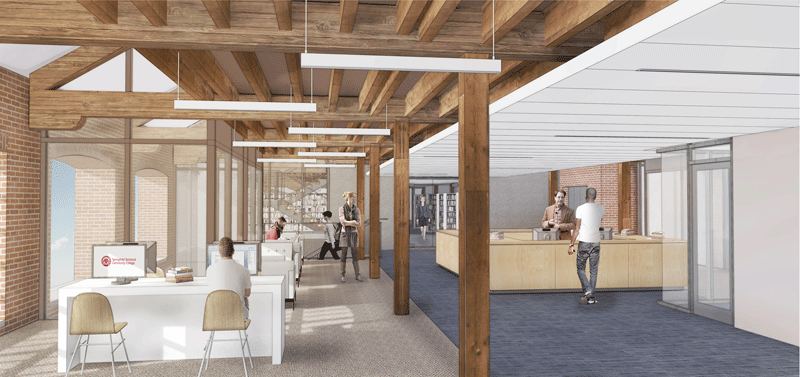
Rendering of the library in the renovated Building 19.

Rendering of the library in the renovated Building 19. (Ann Beha Architects)

As Springfield Technical Community College commences a year-long 50th-anniversary celebration, a landmark historic restoration project is taking shape — with the accent on ‘landmark.’ So-called Building 19, a 700-foot-long warehouse that predates the Civil War, is being converted into a campus center, a project that will enable the past and present to co-exist in a powerful fashion.

Tom Duszlak says he’s heard all the rumors.

Actually, they’re more like legends. And some of them are fact.

Like the story related to him about the construction crews that, while working to set oil tanks at what is known as Building 32 on the campus of the Springfield Armory more than a half-century ago, unearthed bones belonging to soldiers from the War of 1812.

“They were digging out the floors to put in these storage tanks when they came across some skeletons,” said Alex Mac-Kenzie, curator at the Armory, noting that, in the early 19th century, Building 32 was a barracks. An influenza outbreak swept the region, killing several soldiers, and they were buried right on site.

There are many other stories concerning people finding bones, uniform fragments, tools, and other items on the grounds during various building projects, and the validity of some tales is a matter of conjecture. But Duszlak says there is absolutely no debating the underlying (pun intended) sentiment regarding this historic site, chosen more than two centuries ago by George Washington: that one never really knows what might be found in the ground there.
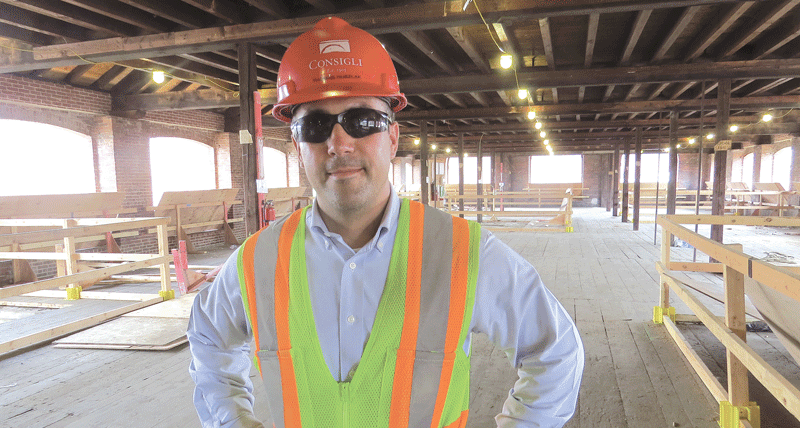
Tom Duszlak

Tom Duszlak says the Building 19 projects comes with a healthy list of challenges, including uncertainty about what crews may unearth at this historic site.

And that’s just one of the many challenges confronting Hartford, Conn.-based Consigli Construction, which Duszlak serves as project superintendent, as it takes the lead role in an ambitious, $50 million project to convert the cavernous structure known as Building 19 (right next door to Building 32) into a new campus center for Springfield Technical Community College.

Actually, crews have already unearthed some “artifacts” (Duszlak’s word) while undertaking some extensive infrastructure work at the site.

“We found some cow bones and a few pieces of metal that might be part of an old piece of manufacturing equipment,” he said, adding that the ‘we,’ in this case, is mostly a reference to the full-time archeologist — hired by the National Park Service, which manages the Armory site — who is on hand whenever crews dig deeper than four inches.

And there’s been a lot of digging to date, with most of it still to come — this building is 700 feet long, said Duszlak, adding quickly that, while a small part of him wants to unearth something intriguing — “I’d love to find an old cannonball or something like that” — the project superintendent in him is more pragmatic and fully understands that finding ordnance, let alone old soldiers’ bones, would mean potentially lengthy delays in an already-demanding project.

As mentioned, the fact that the Armory grounds could be described collectively as an archeological site is just one of the challenges facing Consigli, Ann Beha Architects, the state Division of Capital Asset Management and Maintenance (DCAMM), and STCC administrators as they proceed with this project. Others include the reality that this mammoth initiative must play itself out on a crowded college campus populated by 8,000 students and another 1,000 faculty and staff; that the site’s infrastructure, complete with some brick water lines, is quite old and mostly in need of replacement; that the work is taking place, in part, on a road system designed for horses and buggies; and that, with every bit of digging or restoration work, unforeseen problems may arise.

But the challenges ever-present in this project to convert what amounts to a 19th-century warehouse for walnut gun stocks into a thoroughly wired, 21st-century community-college nerve center, are also what make it so intriguing, and so rewarding.

“There’s history all around you here,” Duszlak noted. “Working in an environment like this — a functioning college campus — is logistically difficult, and this is demanding work. But it’s fun to blend the past with the present.”
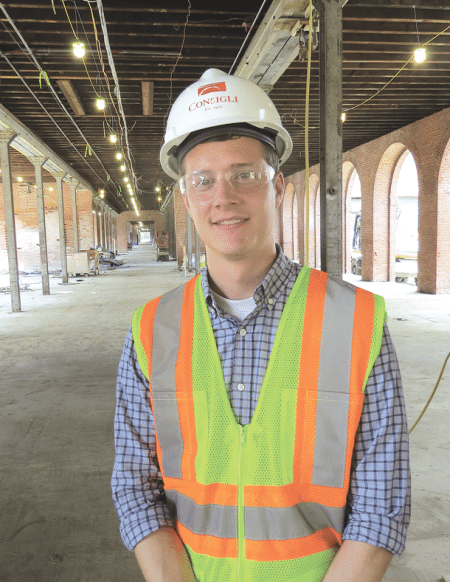
Architect George Faber

Architect George Faber stands in the center of historic Building 19 as a multi-faceted restoration effort takes place around him

George Faber, project designer with Boston-based Ann Beha working on the Building 19 project, agreed.

“One of the main design goals here is respecting the building as it is, and as it was, while making it modern for contemporary use,” he said. “We’re obviously not trying to replicate the old; we’re trying to complement it in a way that might even teach someone about the history of this campus.”

For this issue and its focus on construction, BusinessWest talked with Duszlak, Faber, and others involved with this project — which is historic in every sense of that word — to get a sense for all that’s involved with an endeavor that has been centuries in the making — quite literally.

History Lessons

As he and others gave BusinessWest a quick tour of the Building 19 construction site, Faber stopped to point out a few of the original wooden shutters, or louvers, that graced the dozens of arches and curved windows that give the structure its unique identity.

Crews will replicate those features, and be meticulous in their efforts to match the material, look, and original color — something that was difficult to determine, Faber explained, adding that some of the originals that are in good shape will be restored and put back in place.

Thus, there will be an effective blend, or co-existence, if you will, of old and new, which, in a nutshell, is what this project is all about.

In construction circles, this kind work is considered a specialty, both for the architects and the contractors. And both Consigli and Ann Beha Architects have deep portfolios of similar projects.

Consigli, for example, has handled a number of projects in the category it calls ‘landmark restoration,’ including one unfolding just a mile or so, as the crow flies, from the STCC campus. This would be work on the headquarters building of the former Westinghouse complex on Springfield’s east side, now the home of the massive assembly plant being built by Chinese rail car maker CRRC MA.

Other projects in the portfolio include an elaborate restoration of New York’s historic Capitol Building, which dates back to 1867; restoration of the Smithsonian American Art Museum’s 19th-century Renwick Gallery; renovation of three historic buildings on the Trinity College campus in Hartford; and work to restore the exterior envelope of Maine Medical Center in Portland, opened in 1874.

Ann Beha Architects, meanwhile, has undertaken many historic preservation and restoration initiatives on college campuses, including MIT, the University of Chicago, Yale, Bates, and others.

“Ann Beha started her career doing historic-preservation work, so it’s always been a big focus for us,” said Faber, referring to the company’s founder. “We’ve done work in museums, colleges, and other institutions.”

This is the first project for both firms on the STCC campus, which means crews have undoubtedly absorbed a number of history lessons — and heard a number of stories, like the one about soldiers’ skeletons being unearthed — while taking on this ambitious undertaking.

They know, for example, that the buildings they’re using to stage and manage this project (as opposed to the traditional trailers that dot most construction sites) were once officers’ quarters dating back to the Civil War.

By then, of course, the Armory had accumulated almost a century of history, having opened its doors in 1777. Chosen by Washington in part because the site would be safe from naval bombardment — Springfield is located just north of a waterfall in Enfield that cannot be navigated by ocean-going vessels — the Armory did, nonetheless, come under attack. Sort of.

This was Shays’ Rebellion in 1787, a quickly crushed insurrection — one that nonetheless helped inspire the Federal Constitutional Convention — led by Pelham farmer Daniel Shays, a Revolutionary War solider who had gathered a number of rebels who, like him, were upset with their financial plight and thus the state’s government, and decided that seizing the arsenal in Springfield would certainly get someone’s attention.

Since arriving on site several months ago, crews might also have been learned about John Garand, the legendary Canadian-born firearms designer employed by the Armory who created the famous M1 Garand semi-automatic rifle, which Gen. George Patton would call “the greatest battle implement ever devised.”
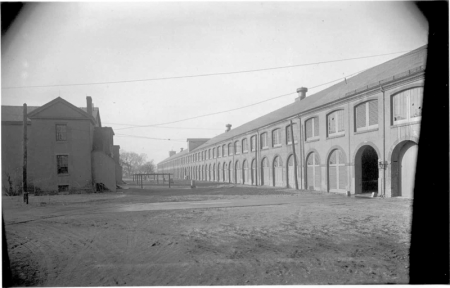
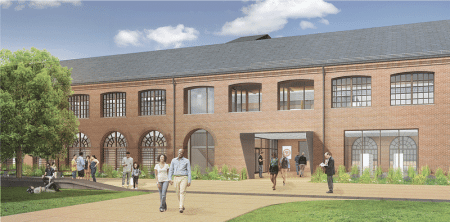
building-19

Building 19,

Above, Building 19, as seen in the early 1930s; below, a rendering of what will be called the Learning Commons. (Ann Beha Architects)

At its height, during World War II, the Armory would employ more than 14,000 people making M1s and a host of other weapons, but two decades after that conflict ended, Defense Secretary Robert McNamara — earning himself an ignominious place in Springfield history — determined that private defense contractors could manufacture the nation’s weapons. He ordered the decommissioning of the Armory, putting more than 2,000 people out of work, a decision that would damage the local economy but also pave the way for the site’s next life.

Indeed, a group of area leaders, including then- (and also future) Springfield Mayor Charlie Ryan; Edmund Garvey, then-director of the Springfield Technical Institute; state Rep. Anthony Scibelli; and Springfield industrialist Joseph Deliso Sr. pushed for legislation that would create a “two-year college of technology.” (Their efforts, and their legacy, will be celebrated at STCC’s Founders Day festivities on Sept. 9, the first in a year-long series of events to mark the college’s 50th anniversary.)

Blueprint for the Future

The Founders Day speeches will be delivered in the gym in Building 2 on the STCC campus (a.k.a. Scibelli Hall). Those taking them in will need to look only a few dozen yards to the north to see the beehive of activity at ‘19,’ as it’s known colloquially.

Unlike other Armory structures, especially its main administration building, now named after Garvey, 19 has not had any significant role with the college since it was formed, other than as a warehouse for equipment that was no longer needed but couldn’t be discarded.

All that is about to change, though, and in a big way.

Indeed, the renovated structure, due to open in the fall of 2018, will be home to a wide array of offices and facilities now scattered across the campus, including the library, admissions, registration, financial aid, the bookstore, the welcome center, student government, the parking office, health services, student activities, a café, the IT help desk, meeting and conference space, and much more.

This collection of facilities will be called the Learning Commons, and if that sounds like a lot to put under one roof, remember that the roof of 19 covers a building longer than two football fields, complete with the end zones, and there are two full floors and a loft third floor.

As noted, converting a structure that large, built a century and a half before the Internet was conceived, 40 years before the lightbulb, 35 years before the telephone, and 80 years before air conditioning (and thus not designed for any of the above) — all while maintaining its original architectural elements and being on the cutting edge of energy efficiency (LEED Silver designation) — will be a stern challenge.

This will require, as Faber noted earlier, coexistence of the old and the new, because they’re both vital, but for different reasons.

“From a design standpoint, it’s really about respecting the tradition of the building,” he explained, adding that this can and will be done, while also making the facility ‘green’ and state-of-the-art with regard to information technology.

Duszlak said there are a number of stages to the project, many of which will be carried out concurrently.

Late this spring, work began in earnest on infrastructure, what he called the “enabling phase,” including water, sewer, and electrical lines. He added that crews made the very most of the three months when the student population is greatly diminished, with the goal of minimizing disruption when they return this week.

Maureen Socha, director of Facilities for STCC, said the project represented an opportunity for the college and DCAMM to greatly improve an aging, and often failing, infrastructure system, one that has been seized.

“A lot of our infrastructure is original to the Armory — we still have brick pipes and clay pipes everywhere,” she explained. “This was a huge opportunity to upgrade that system.”
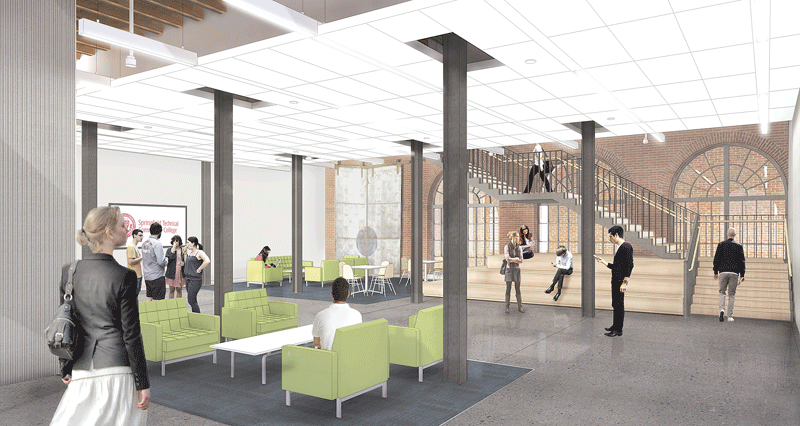
renovated ‘19

An architect’s rendering of the forum section of the renovated ‘19.’ (Ann Beha Architects)

While infrastructure work continues on a smaller scale, restoration work on both the exterior and interior of the building have commenced, with the goal of preparing the structure for the extensive build-out work that will follow to create offices, a library, a café, and gathering spaces out of what was a cavernous warehouse.

“The roof gets brought up to current code, the second floor gets brought up to code, a lot of the existing joists get reinforced with structural steel,” Duszlak said. “There’s new elevators to be put in, new mechanical shafts to get cut through the building … a lot of it is just upgrading the skeleton of the building to get it ready for the tradespeople to create the spaces.”

There are many elements to this blend of restoration and renovation work, ranging from cleaning and repointing the hundreds of thousands of bricks to matching (after first determining) the original color of those louvers.

And in a way, the louvers are a microcosm of the project’s many challenges and the huge amount of research and even lab work that goes into such preservation and restoration efforts.

“We had a consultant who took paint chips off the building, took them to a lab, and, through use of a high-powered microscope, was able to pick out the different layers that had been painted over time,” he said. “We found four or five different colors layered on top of one another.” (A darker brown has been declared ‘original.’)

Research has involved poring over hundreds of old photos from not only the Armory but the Library of Congress, he went on, adding, again, the goal is a modern, energy-efficient facility that nonetheless pays respect to the building’s historic look and role.

Soon, work will commence on a 3D coordination of the space, said Duszlak, adding that this will enable crews to make sure all the mechanicals — plumbing, electrical, and HVAC services — are properly coordinated and there are no conflicts.

“There are a number of architectural elements that Ann Beha is concerned about,” he explained. “They want to keep a lot of the timbers exposed to give it some of the old-feel look, but keeping that much square footage exposed, and the ceiling, it limits where you can put duct work and electrical, which adds to the challenges and emphasizes the importance of the 3D coordination.”

Past is Prologue

Looking ahead, Duszlak noted that there is considerable digging (maybe 75% of the total for the project) still to be undertaken at 19 and its larger footprint.

“We have new structural upgrades that we have to dig foundations for,” he explained, “and we have electrical utilities that run the complete 715-foot length of the foundation. There’s new under-slab plumbing and drainage that services new bathrooms … we’ll be doing a lot of digging four to seven feet down.

“So there’s the potential for finding a lot of really cool artifacts,” he went on, adding that, while he doesn’t want to encounter anything that might hinder progress, he wouldn’t mind creating some new stories — or legends.

That’s what can happen when the past, present, and future come together in such dramatic, and historic, fashion.

George O’Brien can be reached at  [email protected]

Construction Sections

Raising the Bar

Roy family: Keith, his son Josh, his wife Jamie

From left to right, three generations of the Roy family: Keith, his son Josh, his wife Jamie, and their son Bentley.

The motto for the Keith G. Roy Construction Company is “When You Want It Done RIGHT.”

And those words are far more than a catchy phrase to Roy; they form the basis of a value system that pervades his company and leads to attention to detail that customers never know about because many of the things they do cannot be seen.

But the pride and satisfaction that Roy takes in “doing things the right way” has helped the company thrive during its 60-year history.

The business focuses on residential work that includes a handyman repair service; installing windows; installing and repairing roofing and siding; basement conversions; attic remodeling; home additions, remodels, and renovations; and other major projects.

“We work closely with each homeowner, and are willing to make changes at the drop of a hat,” Roy said, explaining that, after a project has started, people sometimes decide they want something different than they initially agreed upon or planned.

Such changes are not problematic, because one thing that sets the company apart from many of its competitors is that Roy does not use subcontractors, with the exception of licensed plumbers, electricians, and excavators.

His employees are paid by the hour, and since they remain at the job site until the project is done and meets his exacting standards, they don’t rush and never have to wait for a subcontractor to show up. Again, because Roy is focused on “doing it right,” his employees go above and beyond what is required or mandated by the building code.

For example, when they build a deck, which comprises a healthy share of their business, Roy insists on using ceramic-coated nails because he says new decking materials are corrosive to metal and the more-expensive nails prevent them from popping up later on. In addition, he uses copper flashing instead of using aluminum flashing where the deck meets the house because it doesn’t corrode.

“The building code doesn’t require it, but it’s the right thing to do,” Roy said, as he used the phrase that would occur repeatedly throughout the interview.

In addition, stainless-steel nails are used on cedar products instead of galvanized ones, as the latter can lead to black streaks as the wood weathers.

“The stainless-steel nails are four times more expensive, but we do things correctly with quality products while keeping the cost as reasonable as possible. It’s what people expect, but not what they always get, and it not only prevents future complaints, it satisfies the customer’s vision,” Roy told BusinessWest, adding that the company does a lot of repeat business and recently got a call from a customer he worked for 15 years ago who kept his contact information for more than a decade.

“You can’t please everyone, but I can’t sleep at night if I don’t do my best to make people happy,” he said. “I’ve stayed up many nights thinking about problem situations and the right thing to do to resolve them.”

Every employee must meet expectations, and although they must be qualified and experienced to be hired, Roy puts them through more training before they are sent to a job site.

His son, Josh Roy, is vice president of the company, and had to work his way up the ladder before he was put in charge of overseeing jobs. But he shares the same belief system.

“I like the satisfaction I get from making people happy,” Josh said. “We take pride in what we do, and many newly hired people have told me they are impressed by the quality of work we expect from them.

For this issue, BusinessWest takes a look at the history of this Westfield construction company, why it continues to grow, and how it has weathered several recessions and come out on top.

Changing Times

John L. Roy Construction was born in 1946 when Keith’s father returned home from the Navy after the end of World War II. He set up shop on Main Street in Springfield with his brother and began doing residential and commercial projects.

Keith’s mother, Elaine Roy, served as office manager, and although his uncle left the business after the first few years, his parents did well, and the construction firm thrived.

Keith began working at age 12, and already knew so much he was able to install a composite ceiling in his uncle’s home by himself.

The following summer, he built a treehouse that featured a Dutch door, paneling on the walls, and a linoleum floor, and continued helping his father with the business.

After graduating from high school, he earned a bachelor’s degree in accounting, became interested in marketing, and in 1980 was given the title of vice president of the company.

Three years later, John retired, and Keith changed the name of the business from John L. Roy Construction to Keith G. Roy Construction and took over for his father.

three-season room with a 12-foot knotty-pine ceiling

Keith G. Roy Construction created this three-season room with a 12-foot knotty-pine ceiling for a homeowner in Suffield, Conn.

When the recession of the late ’80s hit, Keith downsized in many respects, moved the office into his Southwick home, and began working as a sole proprietor.

Things improved considerably during the ’90s, and in 2008 Keith moved his business to its current location on Mainline Drive in Westfield. The Great Recession hit at about the same time, but he took the opposite strategy from most of his competitors and increased his advertising when others were cutting back, which not only worked but solidified his brand.

“We’ve been growing steadily since that time,” Roy said.

Josh Roy also began working in the family business at age 12 and joined the business in 2010.

“I take pride in the work that we do and the fact that we get it right the first time,” he said, echoing his father’s long-standing work ethic and adding that job sites are kept clean, and when a project is finished, the employees get on their hands and knees to make sure everything is immaculate so the homeowner has nothing to do but move their furniture into the space and enjoy it.

Part of the praise they frequently receive may be due to the fact that people understand what is taking place in their home, because sales manager Ken Faulker devotes time to educating each customer when he visits them to estimate a job or create a design plan.

“Our employees are motivated by quality, rather than speed, because they are paid by the hour,” Faulker noted, adding that, although this is a small company, it operates like a large one. All employees are certified in their trade and adhere to best practices, the company provides in-house training to supplement skill sets, it has its own warehouse, and is a distributor of the American-made Starmark cabinets, which it uses almost exclusively in its custom-designed kitchens and bathrooms.

Keith G. Roy Construction is also a dealer for Onyx countertops, which are made to order and look like marble or granite.

Additions are a big part of the firm’s business, and Keith takes pride in making them look like the rest of the house. The crew just finished a 22-by-22 addition with a breezeway-style area that will be used as an in-law suite. It includes a kitchenette, living room, full bathroom, bedroom, and deck.

However, the majority of the company’s recent work has been focused on remodeling kitchens and bathrooms and building decks.

Many of the decks are on local lakes with sweeping views and are multi-story structures with hidden or grand staircases that contain landings and seating.

For example, the company just finished a 700-square-foot deck over a walk-out basement that overlooks a lake and has a rain-removal system beneath it.

Josh Roy says that using their own crew rather than subcontractors allows them to address problems or concerns a homeowner may have immediately.

“They can talk directly to us instead of having to talk to a subcontractor who is only responsible for a specific part of the job,” he explained.

Continuing History

Keith G. Roy Construction was named “Best Contractor” and “Best Bathroom Remodeler” in the Republican’s 2015 Reader Raves, and has an A+ rating from the Better Business Bureau.

The Roys are proud of these ratings, like the challenge of knowing every job will be different, and enjoy giving customers more than they expect.

“There are many little things they never know about because a lot of what we do can’t be seen, such as gluing down subflooring,” Keith said. “But it’s important to us; we do things the right way and try to exceed our customers’ expectations.”

To that end, the company offers the Keith Roy Guarantee, which ensures on-schedule completion, a cost-effective process from beginning to end, a final product that exceeds expectations, and honesty, integrity, and great value.

“We want to form good relationships and are proud that our business is in its third generation, which helps us guarantee our work long into the future,” Keith said.

Josh agrees and says the company plans to keep growing. “We’ve met or exceeded our goals for the last four years and will continue to increase them.”

Construction Sections

Varied Landscape

David Fontaine Jr

David Fontaine Jr. says Fontaine Bros. has a good mix of new construction and historic renovation work lined up.

The building industry has travelled a tough road in its efforts to recover from the Great Recession, with mostly modest improvements in business volume amid ever-mounting competition for available work. But in recent months, the skies have become brighter, and most builders are expressing real optimism that the better times are real and have some staying power.

It’s easy to notice major commercial construction projects underway during the summer, and this year is no exception. Business is booming, and local companies say they are doing well — one is actually having a record year — but competition is stiff, and it takes a good track record to get hired in today’s market.

“Business has been very good,” said David Fontaine Jr., vice president of Fontaine Bros. Inc. in Springfield. “The market is very competitive, but we have gotten our fair share of business over the last few years. We’ve been consistently busy and have work lined up on the books that is a good mix of new construction and historic renovation.”

Eric Forish, president of Forish Construction Co. Inc. in Westfield, said his company has also been fortunate. “The past two years have been our best out of 70 years in business, and the forward momentum is continuing,” he told BusinessWest.

But he says it takes a lot to win a bid. “A company has to have a multitude of strengths and share the customer’s expectations; they want a safe job site, quality, and performance, and these things, coupled with excellent customer service, have been our priorities.”

Although Keiter Builders Inc. in Florence has been very busy and has a number of projects underway, it is also aware of the high level of competition and what it takes to prevail in a contest for a job.

“The bids have been very close on the last half-dozen jobs we won; we were within a few percentage points of our competitors,” said company President Scott Keiter. “The owners are creating their short lists of candidates based on reputation; then it’s all about the numbers.”

However, the firm deliberately searches for challenging and complex projects.

“We truly enjoy them, whether they involve creating an observatory or a new restaurant. We’re good at complex undertakings; they keep us on our toes,” Keiter said, adding that he started his business eight years ago in the depths of the recession, but has done well. “Everything keeps going in the right direction, we are proud of our work, and we’re growing.”

Stephen Greenwald, president of Renaissance Builders in Gill, says there is considerable work available across the board in residential, industrial, and commercial sectors.

“We’re busier than we were last year and have work through the beginning of next year,” he said, noting that it used to be like that 10 years ago, but hasn’t been that way for a long time.

The type of work the company handles varies; about 50% to 60% is commercial, 30% is residential, and 10% to 15% is industrial, although the numbers change from one year to the next, and Greenwald agreed that landing jobs is highly competitive and a number of factors enter into the equation.

“Margins are still slim, but one of the reasons is that materials continue to go up in price,” he told BusinessWest. “But since the recession ended, business has steadily gotten better.”

However, Forish networks with many local, regional, and national firms and noted this year is unusual: some contractors are busy, while others are not. He doesn’t know why, but noted that, “historically, election years create a degree of angst.”

Different Landscapes

Fontaine said his company is frequently hired to do construction management.

“We help throughout the design process and are involved long before the actual construction work begins,” he said, explaining that the firm works in conjunction with the architect and owners, helps with the budget, and makes sure the job starts on time and stays on budget.

Most projects are several years in duration, and landing them is no easy feat.

“There are a lot of really qualified large and small companies bidding on projects, and we’re definitely seeing more companies with a national reach coming into the area,” Fontaine said. “We focus on our relationships with our clients, and the success of our projects keeps us busy. But we live and die based on our reputation and our continuing results. In our business, you can’t take a day off. You have to consistently do your best to get and keep clients.”

Eric Forish

Eric Forish (standing) spends a moment with Michael Oakes at Super Brush in Springfield, where Forish Construction Co. is putting on a 12,000-square-foot addition.

Forish agrees. “We’re always looking to take on new work. You can’t sit on your laurels; we’re constantly challenged to find new opportunities and markets,” he said. “If you’re good at what you do, every day you’re completing work, so you need to find new jobs. You have to keep going; you can’t assume that things will stay steady in any industry.”

Fontaine Bros. has a number of projects that were recently completed as well as ones that are underway or in the planning stages. It recently finished a historic renovation of the 100,000-square-foot, $33 million Shrewsbury Public Library that involved keeping the front of the building and adding 40,000 square feet, and it’s finishing a new elementary school in Athol.

Local work includes the $55 million Pope Francis High School being built by the Diocese of Springfield on the grounds of the former Cathedral High School on Surrey Road in Springfield that suffered extensive damage during the 2011 tornado.

“The project is in the final design stages, and we expect to break ground in September,” Fontaine said, adding that many people have wondered when the work will begin and don’t understand how much has to be done behind the scenes before construction can start.

“It’s a great project for us, and will put a lot of local people to work. I’m happy to see the school being rebuilt,” he added. The undertaking will take two years from start to finish, and the school is expected to open in September 2018.

Fontaine Bros. is also working on the MGM casino parking garage in Springfield; construction is underway, and concrete was being poured at the time of the BusinessWest interview.

“We partnered with Tishman Construction, and it’s great to be included in the project,” Fontaine said. “We’re excited about being part of the revitalization of the city and appreciate the fact that Tishman and MGM sought participation from local contractors and tradespeople.”

The majority of work Fontaine Bros. handles involves ‘green’ building, and many of its projects are LEED- or Massachusetts CHPS-certified. The company has been ranked as one of the Top 100 Green Contractors by the Engineering News-Record for the past few years.

Forish has also been busy. Over the past year, the company completed the new Sarat Ford and Sarat Lincoln auto dealerships in Agawam and the Marcotte Commercial Truck Center in Holyoke, put on a large addition at Astro Chemicals in Springfield, and most recently completed the Curry Nissan dealership in Chicopee and a new $6.5 million senior center in Westfield.

Projects underway include the $3.5 million PVTA Pavilion in Westfield, a 30,000-square-foot addition to Hillside Plastics in Turners Falls, a 12,000-square-foot addition at Super Brush in Springfield, and a multitude of jobs at UMass Amherst.

Keiter has a varied portfolio that includes a number of residential construction projects, and the firm is putting additions on a number of homes and building a few new ones in the Northampton area. However, about 80% of its work is commercial, and the roster includes a number of jobs at Smith College. The work includes a large window-and-door installation on the president’s house, a large dormer addition on a classroom building, and a renovation to another building to accommodate a gluten-free kitchen.

The firm is also handling a major renovation of the Alumni Gym at Amherst College, which houses its athletic operations.

“We’re very diverse, and also have a site division that does a lot of earthwork, which is a fast-growing part of our business,” Keiter said, adding that the firm began doing excavation and site work about three years ago.

Last year the company also completed a number of jobs at Smith College. It finished a telescope observatory in McConnell Hall, put a new roof on the building, and made mechanical upgrades; repurposed space to create a scientific drone research room in Bass Hall for the Science Department; and did a good deal of office-renovation work. Is also handled a buildout for an attorney’s office in Northampton and created a new restaurant (ConVino) in the basement of Thornes Marketplace in Northampton, which required completely changing the layout of the space.

Renaissance Builders also has a large, diverse portfolio. Last year, the company completed a major church renovation in Greenfield, a significant renovation of an apartment building in Northampton, another major renovation of a food-distribution company’s warehouse in Hatfield, and an addition for a commercial cabinet maker in Northfield. And on the residential side, it built two new homes in Chesterfield and Montague.

“Earlier this year, we did a large historical renovation in downtown Turner’s Falls, and right now we’re doing a renovation in Gardner for a service company,” said Greenwald. “We’re also building a day-care center and doing renovations at a private school in Northfield, and renovating a chain of tire stores in multiple locations.”

Future Forecast

Forish attributes his company’s success to the dedication of his employees, but said the company’s longevity poses its own set of challenges.

“We have a supervisor and general manager who both have 30 years of experience who are retiring, a tradesman with 25 years who is retiring, and two others who were recently recognized for 40 years of service who could retire,” he said. “Being a strong, mature company has its advantages, but it also creates challenges when you need to replace people. We’re always looking for motivated individuals to join our Forish family.”

Although it’s impossible for commercial construction companies to predict what the future will hold, Forish and other company spokesmen say this year looks like it will be a good one.

“But it’s always difficult to tell how much is due to the economy versus the typical busy summer, so we’re always looking ahead,” Keiter said.

Still, Greenwald noted that the economy in Western Mass. seems to be holding its own. “Businesses are putting money into expansion and infrastructure improvements, which I interpret to mean they are doing well; we see it as a positive sign.”

One that should contribute to a stellar season as local commercial construction companies not only hold their own, but thrive in a competitive environment where attention to detail and reputation makes a world of difference.

Construction Sections

Finishing Work

Union Station’s Grand Hall

Union Station’s Grand Hall awaits the final touches to its restoration.

As he talked about the massive, $88.5 million Union Station redevelopment project, Richard Fairbanks made early and frequent references to its many stages, the critical sequencing of its various components, and the formidable challenge of handling this work while partnering with — and dealing with — a veritable alphabet soup of agencies and stakeholders.

They range from CSX, the transportation giant that runs trains through the facility, to the SRA (Springfield Redevelopment Authority), which owns the property, to MassDOT (Mass. Department of Transportation), which is essentially calling most of the shots.

“With most projects, you have a few agencies to deal with, but mostly it’s the customer, and things are much simpler,” said Fairbanks, project manager with Holyoke-based Daniel O’Connell’s Sons, which is handling the project, citing, as one example, the expansion of the Sr. Mary Caritas Cancer Center, which O’Connell built for the Sisters of Providence Health System. “Here, it gets really, really complicated with all those entities.”

‘Complicated’ is probably the best adjective to describe this project, which has been, in some respects, three or even four decades in the making — that’s how long the 90-year-old station, built by the Boston & Albany Railroad, has been mostly vacant — but is now approaching the proverbial end of the line.

Well, in most respects, as we’ll see.

Indeed, the 377-space parking garage has taken shape with interior infrastructure work still to complete; the bus-berth area (there will be 27 bays for inter-city and intra-city buses) is nearing completion; and the long-anticipated work to return the interior of the station, and especially the so-called Grand Hall, to its former glory is entering its final stages, with framing completed and work on the finishes set to start.

Richard Fairbanks

Richard Fairbanks says the Union Station project is complicated by its many stages and myriad stakeholders.

Meanwhile, work on the large commercial spaces above and around the Grand Hall is continuing, said Kevin Kennedy, Springfield’s chief development officer and long-time driver of the project, adding that these areas are approaching the ‘white-box’ stage, from which it can build out to suit tenants’ needs and desires.

“Everything is pretty much on track,” he said, borrowing terminology from the industry to describe the pace of progress. “Things are taking shape on schedule.”

But some of the work will not be done on schedule, due in large part to two more of those seemingly endless acronyms — in this case the ADA (Americans with Disabilities Act) and the FRA (Federal Railroad Administration).

The former requires six feet of space on either side of the so-called headhouse on a rail platform (the structure at the top of the stairway to the platform and the elevator), and the latter recently refused to grant a waiver for the renovated Union Station and its planned five and a half feet of space.

So it’s back to the drawing board in the real sense of that phrase, Kennedy said, adding that new designs, funded by MassDOT, will be drafted, and the platform should be completed about a year from now.

But the station itself and the complex’s many components, from the parking garage to the bus berths, will be completed on schedule by the end of this year, with the landmark due to celebrate what should be a grand opening — or reopening, to be more precise — next January.

Fairbanks, who succeeded Bob Aquadro as project manager earlier this year, has been with O’Connell for nearly 30 years, and has a number of large projects on his résumé, including the new courthouse in Taunton and work at Yale University, including a renovation of a music facility that is in many ways similar to the Union Station endeavor, right down to the terrazzo floor.

Most of his recent work has been in the 413 area code, including the cancer center expansion and an addition to the women’s correctional facility in Chicopee.

While he’s only been project manager on Frank B. Murray Way for several months, he knows the full history of the project, and said this initiative, which started more than four years ago, has been more complex than most because of its many stages, intertwined players at the local, state, and federal levels, and the unforeseen problems that come with working on a building opened a year before Charles Lindberg flew across the Atlantic.

“You try to capture everything on the drawings before the project is bid,” he explained, “but when you get on the job, you find things that weren’t on the drawings, and that leads to change orders.”

An architect’s rendering of the renovated Union Station.

An architect’s rendering of the renovated Union Station.

The primary challenge, though, is coordinating all the various steps in this project so that the work can proceed smoothly and without interruption, efforts that were helped by a mild, relatively snowless winter that enabled the parking garage to go up seemingly overnight.

“This is essentially five projects in one — there are a lot of steps,” he said, listing the terminal, platform, parking garage, bus berths, and the extremely complicated process of waterproofing the terminal and tunnel that connects it to the platforms.

“This is a difficult process because it all has to be sequenced,” he said of the waterproofing work, which began months ago and is ongoing. “The trains can never stop, so you can’t take all the tracks out at once.”

But there is light at the end of that tunnel — figuratively, but also literally — and light in the tunnel as well.

Indeed, as he walked and talked with BusinessWest while giving a tour of the construction site, Fairbanks pointed to the terrazzo floor in the terminal — perhaps the most celebrated original surviving element of the station (most of the original wooden benches that were due to be part of the restoration were reported stolen under mysterious circumstances).

“This will be the last stage,” he said, noting that a firm that specializes in the restoration of such floors will start its work when virtually everything else is done.

And it will be a fitting finishing touch, he said, noting that it will represent the capstone (at least when it comes to the terminal) of a project that has been historic in every sense of that word.

— George O’Brien

Construction Sections

Work in Progress

American Environmental’s Tom MacQueen

American Environmental’s Tom MacQueen says employees of construction-related companies appreciate having steady work close to home.

With construction on the MGM Springfield casino underway, plenty of local businesses — 40 to 50 over the next six to nine months — will have worked on the project in its first phase. But that’s just the beginning, say city and regional business leaders, who say MGM has forged a number of strategic partnerships to ensure that even more area companies — those in construction, but also providers of myriad other services — benefit from this $900 million effort.

Construction is moving forward on the 14.5-acre MGM Springfield site between Union and State streets and Columbus Avenue and Main Street.

About 70% of the footprint for the garage, casino, hotel, and outdoor space has been cleared, and about 45 local and non-regional companies have been employed during the process.

Work to compact the ground and get it ready for the garage, which will be the first structure built, is taking place now. Demolition is also still occurring in the area where the casino and hotel will be built, and on April 19 the First Spiritualist Church was moved 600 feet from its former home on 33-37 Bliss St. in preparation for placing it on a new foundation.

Brian Packer, MGM’s vice president of construction, told BusinessWest that one building and the rear portion of the State Armory still need to be knocked down. In addition, the rear of two structures, 73 State St. and the Union Chandler Hotel, whose historic front facades will be preserved, also still need to be demolished once the facades are secured and braced.

“We are encouraged by the tremendous progress MGM Springfield has made over the last several months. As we begin the next phase of construction, our outreach efforts will focus on electrical, mechanical, and drywall,” he said. “We anticipate announcing dates for information sessions soon for union companies interested in these jobs. MGM Springfield continues to support the involvement of local businesses — and minority-, woman-, and veteran-owned businesses — and we encourage these companies to participate in the process.”

Eric Nelson, vice president and project executive for Tishman Construction Corp., the general contractor overseeing the MGM build, said a concerted effort has been made to hire as many local subcontractors as possible in keeping with the project labor agreement, and they will continue to hire firms over the next 12 months.

“A significant amount of the work has gone to firms in Springfield and the surrounding communities,” he said.

Local businesses benefiting from the trickle-down effect include American Environmental Inc., a minority-owned Holyoke business which did a significant amount of abatement and some demolition; Ultimate Abatement, a woman-owned firm in Springfield, which received a large contract to do abatement on the former YWCA building; Gagliarducci Construction Inc., which handled site work; and New England Blue Print Paper in Springfield, which has contributed printing and copying services.

Within the next six to nine months, Packer said, 40 to 50 local companies will have worked on the project, and the majority are in Springfield.

Gerry Gagliarducci, owner of Gagliarducci Construction Inc., said he has had a crew on site since last year. The company has done exploratory work for underground utilities, screened excavated materials for reuse on the site, and, most recently, conducted preparations needed to move the church.

“We’ve enjoyed our relationship with MGM and Tishman Construction. This project is a big boost to the local economy and carries down to all areas of business, including fuel for vehicles, lunches, and major expenditures,” he noted, adding that workers with good-paying jobs may buy new automobiles or make other major purchases.

Work for local firms has come about in part because MGM has been reaching out to the business community for several years to initiate strategic partnerships and discussions. They also participate in events such as the annual Western Mass. Business Expo, staged by BusinessWest, and have held informational sessions for contractors, which will continue before substantial work comes up for bid.

Brian Packer

Brian Packer, pictured in front of the First Spiritualist Church during its 600-foot relocation, says MGM expects to reach out soon to local firms for electrical, mechanical, drywall, and other types of work.

Local providers have also benefited. They include Caring Health in Springfield, which won the bid for the drug-testing portion of the contract and has tested every construction employee on the site, as well as Arrow Security Co. Inc., which has provided security services for the property since the construction began.

“The project has definitely been beneficial to us,” said Arrow CEO John DeBarge. “Prior to the recession, 10% of our business was new construction. It went to 0%, and MGM is the first substantial project we’ve obtained, which helps our business and our employees. We’ve hired a number of new employees who are Springfield residents.”

At this point, the abatement and demolition is almost complete, site work is starting, and construction of the framework is expected to begin in the fall.

Outreach Efforts

Jeffrey Ciuffreda, president of the Springfield Regional Chamber, said his organization has an excellent relationship with MGM, and is working closely with the company to make sure local businesses benefit not only during the building process, but once the casino is operational.

He noted that MGM’s agreement with the city of Springfield includes spending $50 million annually on local goods and services after it opens, but said the word ‘local’ is relative, and includes Hampden, Hampshire, Franklin, and Berkshire counties.

So far, MGM has carried out its end of the contract and joined with the Springfield Regional Chamber to host two supplier and vendor fairs attended by its former vice president of global procurement, who came from Las Vegas to highlight opportunities for local businesses and provide strategies and insights for doing business with the casino. A vendor fair was also staged in Holyoke in conjunction with the Greater Holyoke Chamber of Commerce.

Businesses doing construction work have to be unionized, but suppliers and service providers do not when the project opens. However, they do have to be registered with the Mass. Gaming Commission.


Click HERE to download a chart of the region’s General Contractors


Companies hired so far tout the benefits of the project to the regional economy. They include American Environmental Inc., which has done a significant amount of work on the project. It won the first abatement contract, has been working for MGM since last March, and since that time has been awarded a half-dozen additional abatement contracts and an equal number of structural take-down contracts that have included demolishing the former YWCA on Howard Street, which dated back to the 1900s and most recently housed the Western Massachusetts Alcohol Treatment Center; the former St. Joseph Rectory on Howard Street; and the Springfield Rescue Mission on Bliss Street, which relocated to the former Orr Cadillac building on Mill Street, which the casino resort provided in exchange for the mission’s former property.

“It’s been a wonderful foundation project for the entire calendar year,” said Tom MacQueen, American Environmental’s general manager, adding that area employees appreciate having steady work close to home and MGM has done a great job identifying qualified, local contractors.

In addition, American Environmental has been introduced to new contractors on the site and made arrangements to work with them in the future, which is an extra benefit of working on the project.

T&M Equipment Corp. in Springfield is another local company benefiting from the ripple effect. The union-affiliated contractor was hired to do excavation work for the garage and hotel and has been on site for about a month.

“This is great for local companies, and we are excited to work with MGM and be part of history in Springfield,” said Project Manager Taylor Wright. “This site is really large and will not only bring more work to area companies, but will allow more people to be employed from local unions.”

MGM is working to increase union construction workforce opportunities, and has convened a Community Partners Network, which has grown from nine to 21 members. The network holds biweekly meetings to identify ways to recruit diverse populations that meet union requirements and are ready to join a union or a union joint apprenticeship and training committee, and also recruit people who may not meet union requirements and need supportive services and soft-skills training.

MGM has also met with a number of trade unions to share construction timelines, potential partnerships, and other issues pertinent to hiring. They include the Carpenters Union #108; the Painters & Allied Traders Council #35; Ironworkers Local #7; and a bevy of other groups. In addition, a construction diversity task force has been formed.

Outreach continues, and MGM Springfield and Tishman are exploring the possibility of developing an ongoing partnership with Putnam Vocational Academy students interested in joining unions and working on the Springfield job site.

The Springfield Regional Chamber created a list of members for MGM that could do construction-related work, and goals have been established by the Mass. Gaming Commission for doing business with certified minority-, woman-, and veteran-owned companies.

Ciuffreda has also told MGM about local companies that manufacture windows and other supplies that will be needed during construction, and said officials have expressed real interest in them.

900 million project

With the $900 million project only in its early stages, MGM expects to involve many more local workers.

“The door was open early on, and although we can’t offer our members any guarantees, as the construction unfolds we will make sure that MGM’s list continues to be updated,” he told BusinessWest, adding that MGM has divided chamber members into categories and given the list to contractors, who are encouraged to use local suppliers.

“We’ve told our members that MGM is a world-class organization and is big on quality, quantity, and cost,” Ciuffreda noted, adding that some local firms may be too small to be competitive in terms of pricing or unable to produce the large number of items needed.

However, the chamber has filed a grant request with the Gaming Commission that would allow it to provide technical assistance to businesses. Funds will be targeted toward minority-, woman-, and veteran-owned firms that wish to do business with the casino.

MGM’s future needs will be seemingly endless, and goods and services needed will range from security to special hardware, signage, exterminators, alcoholic beverages — the casino has already agreed to work with local craft-beer producers — to food, which Ciuffreda said could be supplied by farmers in the Pioneer Valley. Other non-gaming vendors will include linen suppliers, garbage handlers, and limousine service companies. However, the majority of those firms won’t be hired for more than a year from now, when advertisements and meetings will provide interested businesses with the information they need.

“We are on track for the September 2018 opening and are excited to share in the economic growth,” said Seth Stratton, vice president and general counsel for MGM Springfield. “The silver lining is that there is still plenty of time for businesses to ramp up or start with us, and as we get closer to the opening, we will step up our own processes and procedures to formally do outreach with the business community so we can spend the amount of money we have agreed to in our contract.”

Keeping Pace

Ciuffreda said MGM will do well because it is a behemoth with an established history, but its future success will be measured by the impact it has on local companies. At this point, MGM is doing everything it promised, he noted, but the chamber will continue its quest to make sure its members benefit from the spinoff.

For example, the chamber has a 100-page document listing items that MGM Detroit purchases, and Ciuffreda intends to sit down with officials and find out what is procured from national companies and what could be supplied locally to fulfill the $50 million annual agreement as things move forward.

“We won’t leave any rocks unturned,” he told BusinessWest. “The trickle-down effect is not only going to happen, it’s happening right now and will continue to grow.”

Construction Sections

Fertile Environment

GreenUrban-519278869Companies involved in U.S. construction plan on intensifying their involvement in green building over the next three years, according to the new World Green Building Trends Study from Dodge Data & Analytics, conducted with support from United Technologies Corp. and its UTC Climate, Controls & Security business. The U.S. is also one of the global leaders in the percentage of firms expecting to construct new green institutional projects and green retrofits of existing buildings.

The global study, which received additional support from Saint-Gobain, the U.S. Green Building Council, and the Regenerative Network, positions the U.S. as a strong participant in the global green movement. Responses from more than 1,000 building professionals from 60 countries place the U.S. green industry in context. The study also provides specific comparisons with 12 other countries from which a sufficient response was gained to allow for statistical analysis: Australia, Brazil, China, Colombia, Germany, India, Mexico, Poland, Saudi Arabia, Singapore, South Africa, and the United Kingdom.

According to the report, U.S. construction should see an increase in the share of green work in the next few years, largely as a result of companies intensifying their involvement in the green-building industry. An increasing percentage of respondents projected that more than 60% of their projects would be green projects — from 24% of respondents in 2015 to 39% in 2018. Respondents projecting that fewer than 15% of their projects would be certified green plummeted from 41% in 2015 to 27% by 2018.

Worldwide Trend

While this increased share of green building is impressive, it is significantly less than many developing countries included in the survey. For example, Brazil expects six-fold growth (from 6% to 36%) in the percentage of companies conducting a majority of their projects green, five-fold growth is expected in China (from 5% to 28%), and fourfold growth is expected in Saudi Arabia (from 8% to 32%).

“The strong U.S. industry for green-building projects is clearly an opportunity for U.S. firms, but so is the rapid rise of green in many of the developing countries,” said Stephen Jones, senior director of Industry Insights, Dodge Data & Analytics. “Expertise from experienced green designers, builders, and manufacturers from the U.S. is likely to be essential to support the aggressive green-building expectations revealed by the study respondents.”

In the U.S., the highest percentage of respondents report that they expect to work on new green institutional projects (such as schools, hospitals, and public buildings), green retrofits of existing buildings, and new green commercial construction (such as office and retail buildings) in the next three years. When compared with global averages, it becomes clear that the U.S. is a leader in new green institutional construction and green retrofits of existing buildings. For example:

• 46% of U.S. respondents expect to work on new green institutional buildings, compared to 38% globally; and

• 43% of U.S. respondents plan to work on green retrofits of existing buildings, again well above the global average of 37%.

The U.S. is also distinguished from the global findings in terms of the importance it places on reducing energy consumption as an environmental reason for building green. Over three-quarters (76%) of U.S. respondents consider this important, nearly double the percentage of the next most important environmental factor, which is reducing water consumption. While the other 12 countries in the study prioritize the reduction of energy consumption, only Germany, Poland, and Singapore do so to the same extent.

“The survey shows that global green building activity continues to double every three years,” said United Technologies Chief Sustainability Officer John Mandyck. “More people recognize the economic and productivity value that green buildings bring to property owners and tenants, along with the energy and water benefits to the environment, which is driving the green-building industry’s growth. It’s a win-win for people, planet, and the economy.”

Cost and Value

The study demonstrates the benefits of building green, with median operating cost decreases for green buildings of 9% expected in just one year globally. Building owners also report seeing a median increase of 7% in the value of their green buildings compared to traditional buildings, an increase that is consistent between newly built green buildings and those that are renovated green. These business benefits are a critical driver for the growth of green building anticipated globally.

The U.S. is also notable for having the lowest percentage of respondents who report that their company uses metrics to track green-building performance. Only 57% of U.S. respondents report using metrics, compared to a 75% average globally. This may be linked to the fact that the U.S. is also the country with the highest level of concern reported about higher perceived first costs for green building, notably more than the percentage who consider this an important challenge to building green in other developed countries with active construction markets, like Germany and the U.K. u

Dodge Data & Analytics, which prepared this article, is a leading provider of data, analytics, news, and intelligence serving the North American construction industry.

Construction Sections

Driving Force

The new Balise Hyundai in Springfield.

The new Balise Hyundai in Springfield.

Contractors who have made inroads in auto-dealership construction are finding these to be good times indeed, as area dealers, from solo stores to large chains, engage in what can only be described as a building boom. The reasons are myriad, from an improving economy to demands from car makers that showrooms have a consistent look, to changes in the way cars are purchased and serviced today, and how 21st-century dealership design reflects those shifts.

If there’s one driving force behind all the auto-dealership construction and expansion over the past few years, Bill Peffer noted, it is, quite simply, a growing economy.

“The reason you’re seeing dealerships around the country refurbish is because the economy is really good, and a good economy drives good sales of new cars, trucks, and SUVs,” said Peffer, president and chief operating officer of the multi-state Balise Auto Group, which boasts several dealerships, focusing on different brands, in the Greater Springfield region. “More dealerships mean more points to sell the products — although dealers are finding the competition is pretty strong as well.”

Balise has been renovating and expanding in the area, most recently with a new Hyundai dealership on Columbus Avenue in Springfield, but with several new facilities over the past decade. Meanwhile, the Lia Auto Group has built and renovated new stores across the Pioneer Valley, as have TommyCar Auto Group in Hampshire and Franklin counties, Sarat Ford Lincoln in Agawam, Marcotte Ford in Holyoke, and Fathers & Sons in West Springfield, just to name a few.

“Part of it is the growth of the industry,” added Eric Forish, president of Forish Construction in Westfield, one of the region’s leading builders of auto dealerships, a tradition that started with his father in the 1940s. “Most dealers in our area have multiple locations, multiple brands, multiple facilities. That’s the nature of how they operate in their industry. And the volume of activity at each location often requires growth in the size of the facility.”

Indeed, according to MiBiz, a Michigan-based business website, the facility, training, and technology expenses required to run a modern dealership favor larger dealer groups that can share back-office resources and spread out narrow margins over higher sales volumes.

Balise — which contracts with South Hadley-based Associated Builders on its Western Mass. construction and renovation — is certainly one of those large players. But more dealerships also means more challenges to stay on top of current trends.


Click HERE to download a chart of the region’s general contractors


“They want to have more inventory, so parking areas get larger,” Forish said. “They want to be green-friendly, so they update their lighting fixtures in the parking lots; LED fixtures return tremendous savings from conserving energy. Then there’s the energy efficiency of the buildings themselves. There are a multitude of ways dealers try to stay current. Their products are new, and they want their facilities to be new facilities.

“Even on the service side,” he went on, “the technicians’ tools are way beyond anything they used to have. In the repair area, it’s all computerized. Their equipment is state of the art. Even the lifts themselves are very much different than the lifts of years ago. The whole operation is much more modern. Many types of businesses have to keep up with technology, and it’s no different in auto dealerships.”

But while area dealers focus on drawing in new business, manufacturers have their own ideas about what constitutes an ideal showroom and service center — and those changes are also helping to drive the current building boom.

Consistent Look

The trend among car makers is to standardize, to some degree, the look and feel of showrooms that sell their brands, and they are in some cases providing incentives — and in others, simply issuing mandates — to renovate and modernize their showrooms.

“Most brands in the U.S. are well-established brands, with few new players over the past 25 or 30 years,” Peffer said. “As those brands mature, they develop touch points unique to the brand to differentiate from the next brand.”

These mandates can encompass everything from the exterior façade to the colors of the interior walls to the furniture where customers wait for service.

“What’s driving the process now is that manufacturers are requiring their dealers to upgrade to a new image,” Forish said. “These design programs are similar to chain restaurants, where you have to have a consistent national image. Car dealerships need to do the same in terms of exterior exposure and interior finishes.”

Forish should know, having tackled dozens of projects for auto dealers — most recently multiple projects for Curry in Chicopee, Sarat in Agawam, and the New York-based Lia Auto Group. “We’ve done probably a dozen facilities for them,” he said of Lia. “We must be doing something right because they keep bringing us back.”

Other dealers have tapped Forish’s niche experience as well, from Marcotte Ford, which chose the company to build its new truck center in Holyoke, the only one of its kind in the region, to facilities for Steve Lewis Subaru in Hadley and Cernak Buick in Easthampton. “The names go on and on. We certainly have deep roots with the auto dealerships.”

Marcotte Ford

Marcotte Ford’s new commercial truck center in Holyoke.

As a partner with many different manufacturers, Peffer said, Balise is well aware of the demands they’re placing on dealers. For instance, the chain’s new Hyundai dealership on Columbus Avenue in Springfield boasts a six-bay express service element for customers who want to get in and out quickly, a separate cash-wash facility, and a ready-credit used-car space, all in separate buildings on the same grounds.

“That illustrates the Hyundai global brand identity,” he told BusinessWest. “This is the direction you’ll see Hyundai dealerships around the country move to.”

Meanwhile, Fathers & Sons is currently building a dedicated showroom in West Springfield for Audi because that maker, like others, wants dealers to move away from the old ‘auto mall’ facility that sells many different nameplates under one roof, to reduce the chance of a customer driving away with another maker’s product. Audi has also provided direction on the new facility’s design, what it calls a ‘terminal’ concept with an aesthetic dominated by glass and metal.

Although car makers are increasingly asking for specific design elements, Peffer said, dealer groups can bring consistency as well. “Balise Toyota, Honda, and Ford all have a well-lit, spacious, drive-up service lane where you’re met by the assistant service manager.”

These areas are typically marked with signage explaining the pricing for a range of basic services, another attempt to be transparent with customers who have likely already done their homework on the Internet.

“The nature of doing business as an auto dealer has changed, as well as the type of service they offer and the nature of customer-service relationships,” Forish added. “If you’ve taken your vehicle in for service at a newer dealership recently, you realize that, at most of these places, you drive into a building and are greeted by the service writer that reviews the scope of repairs or maintenance you’re going to receive. Then you go relax in these wonderful customer lounges, which have high-definition TV, wireless access for your devices, and play areas for the kids.

“It’s all about the experience for the customer,” he went on. “And the dealerships — especially if they have some age to them — need to get to these current standards to be part of a brand.”

Shifting Tides

As manufacturers ramp up mandates for standardization in their showrooms, MiBiz notes, some dealer groups have resisted the change. A 2013 study by auto-industry consultant Glen Mercer found that, while expansion of showrooms and service departments can pay off on the bottom line, other modernization efforts bring little return on investment.

Still, customers appreciate changes aimed at improving their experience, Peffer said.

“More and more people start shopping for prices online, and by the time they get to the dealership to make the purchase, they’re there to buy, as opposed to just kicking the tires,” he told BusinessWest. “They get all their information online, and by the time they hit the showroom floor, they’re looking for a good experience.

“That’s what differentiates a dealer from another dealer,” he went on. “And the facility makes the experience. How convenient is it? How inviting is it? Is there ample parking? Is there a delivery area for new cars? The footprint for dealerships has really changed to amplify the experience. They’re not just big boxes with a bunch of inventory.”

In short, he said, the modern dealership reflects what customers want, and the list is a simple one. “They want greater transparency with the advent of the Internet. And you have to provide convenience and a logical flow to how their car is serviced.”

On those points and others, too many dealerships built decades ago simply fall short. That, in turn, should continue to provide plenty of opportunity for contractors looking for a hot niche to drive new business.

Joseph Bednar can be reached at  [email protected]

Construction Sections

Slowdown on I-91

I-91 viaduct

After 45 years, the I-91 viaduct needs much more than a series of patches.

At a recent public meeting about the massive, ongoing I-91 viaduct project, attendees were able to view a yellowed page from the Springfield Daily News featuring an aerial shot of the viaduct slicing through the downtown in 1970. The headline: “I-91 Linkup Provides Access to a Bright City Future.”

That was a long time ago, said Richard Masse, acting director for Mass. Department of Transportation (DOT) Region 2.

“It’s been 45 years,” he told BusinessWest. “We’re way beyond the road being reliable. We shouldn’t have to come out and patch holes, but we’ve been doing that on a regular basis.”

The original construction of Springfield’s portion of I-91, including the raised viaduct, cost just north of $50 million, while the current project — which, over the next three-plus years, will replace the viaduct deck, repair and replace the structural steel, and include other improvements — will cost $148 million, the bid submitted by Framingham-based JF White-Schiavone.

It will also be a significant inconvenience to commuters and businesses traveling to, from, and through Springfield’s downtown.

“There’s no way we can do this project on I-91 without causing some traffic congestion and delay, but we do want to provide information so people know what’s going on,” Masse said, explaining that the recent installation of cameras, sensors, and message boards along the mile-long stretch of raised highway to help motorists deal with the long-term effects of the lane and ramp closures beginning this month. Information will also be posted online for those who want to check out conditions before leaving home.

The elevated viaduct through Springfield carries about 75,000 vehicles per day. Essentially a concrete deck slab supported by steel girders — which are in turn supported by steel pier caps, column piers, and footings with pile foundations — the structure has undergone several rehabilitation projects over the past quarter-century, but nothing approaching a total deck replacement.

“The viaduct deck is in horrible condition, and we’re here to fix it, to give it life for the next 20 to 30 years,” said Ralph Romano, a MassDOT engineer, by way of explaining what the project — which stretches from the Interstate 291 interchange to around State Street — entails.

Now and Later

The first stage of the project, known as stage 1A, is coming to a close, and included pre-emptive repairs to the bridge deck to prepare the two outer lanes of I-91 to handle traffic while rehabilitation of the inner lanes is taking place.

In addition, some local roads were reconfigured to prepare for increased traffic volume due to upcoming detours, including construction of the West Columbus Avenue Extension to help improve traffic flow, and construction of a temporary off-ramp from I-91 south at Birnie Avenue (to be called exit 6-7) to carry traffic onto downtown streets.

Stage 1B, beginning this month and lasting through next fall, will see the inner lanes of I-91 north and south along the median closed for deck reconstruction. All traffic will be shifted to the right, using the shoulder and breakdown lanes. Speed limits have been reduced through the work area and will be enforced with doubled fines, Romano said.

During this phase, JF White-Schiavone will demolish and replace the deck along the median and high-speed lanes of I-91, along with the I-291 on-ramp to I-91 south and the left side of the I-291 off-ramp from I-91 north, in phases. Access to I-291 will be maintained at all times, with the possible exception of overnight closures where detours will be implemented.

The DOT has been testing ramp closures and detours over the past few months while crews performed preliminary deck work, mostly at night. The Birnie Avenue connector onto the interstate has been closed since October, and this month will see the closing of southbound exits 6 and 7, on-ramps from Union and State streets onto I-91 north, and the Route 20 connector into I-91 south.

Detours involving East and West Columbus Avenue, Hall of Fame Avenue, and other roads — details and maps are available online at www.massdot.state.ma.us/i91viaductrehab/traffic.aspx — will be well-marked, Romano said, while I-291 will be accessible through downtown using Liberty and Dwight streets.

“A lot of thought went into this,” Romano said of the traffic-management plan, “but traffic engineering is not an exact science. It relies on human behavior sometimes, so there’s only so much we can do. But we do try to respond to anything that’s not quite right, and we will be doing that throughout the project.”

Stage 2 of the project, slated for late fall 2016 through late fall 2017, won’t see any ramp reopenings, but traffic in both directions will shift to the center, newly constructed lanes, while construction shifts to the low-speed travel lanes and the shoulders, along with the I-91 northbound on-ramp to I-291 east, which will be constructed in two phases.

Additionally, the exit 9 off-ramp from I-91 north to Route 20 will be closed for the first part of stage 2. Again, access from I-91 north to I-291 east will be maintained at all times, except for possible overnight closures. By late fall 2017, commuters will have full use of I-91 in both directions. The temporary exist 6-7 will be removed, along with the West Columbus Avenue Extension.

Then the project moves to a punch-list phase, as workers paint the structural steel, install municipal street lighting where necessary, complete final paving and traffic markings on local streets, and restore all disturbed areas. By the time the contract ends in February 2019, the completed viaduct will feature slightly wider shoulders, new lighting, and stormwater improvements to help protect local water quality.

Throughout the project, the contractors are responsible for controlling construction-related dust emissions, using a combination of sprinklers and sprayers, wind screens, and wind barriers will also be used to control the spread of dust between sidewalks and the work zone.

Bracing for Impact

For most Springfield workers and commuters, though, dust is far down the list of concerns. Traffic is typically at the top.

Taylor Rock, a worksite outreach coordinator with MassRides, was on hand at the public meeting to encourage the public to carpool, either on their own or with the help of a ‘matching program’ they can access online through her agency. MassRides also provides emergency rides home for people whose carpool partners have to leave work early.

Rock cited a study noting that 96% of people driving to work downtown do so alone. Meanwhile, 40% of them have access to flexible work hours. By carpooling and avoiding using the highway during peak rush hours, she said, motorists can make a dent in the traffic hassles that are bound to come.

“We’re not telling people to take their cars off the road, but just look at some alternate ways of traveling,” she said. “You may be able to counter some of the effects of the traffic congestion that will come with this project.”

Masse agreed.

“There will be only one lane open in each direction, and during peak commuting hours, early morning and late afternoon, these lanes will be pushed to their capacity, so the more vehicles we can get off that path by carpooling, vanpooling, and shifting work hours, the better,” he said. “The more people that take advantage of those solutions, the more we can help the situation up on the highway.”

A second ‘bright future’ for I-91 in Springfield, to quote that old newspaper headline, may seem far away once traffic slows to a crawl. But, as Masse noted, the days of patching are over as a more permanent fix begins.

Joseph Bednar can be reached at  [email protected]

Construction Sections

Afterschool Special

Kevin Perrier

Kevin Perrier, on the roof of Parsons Place.

When Easthampton officials sought to repurpose a 113-year-old elementary-school building, they issued a request for proposals, but received only one response. Fortunately, they liked what they heard, and after an accelerated construction schedule that saw the building gutted and renovated in four months, the former Parsons Street School is now a high-end, 15-unit apartment complex called Parsons Place, and the “calculated risk” its developer took has paid off with full occupancy, from its bottom floor to its striking penthouse roof.

Kevin Perrier called it a “calculated risk” — but he liked the odds of success.

He was standing in the 5,200-square-foot penthouse of Parsons Place, a high-end apartment complex that opened earlier this month inside the former Parsons Street School in Easthampton. That penthouse — considerably larger than the building’s other 14 units — recently became the final space leased.

In other words, the risk paid off.

“I don’t think there’s anything like it in the area,” said Perrier, president of Easthampton-based Five Star Building Corp., which gutted the school and converted it to living space in just four months. Perrier’s other company, Norwich Properties, purchased the property from the city in late 2014 for $10,000.

“It was certainly a calculated risk. It hadn’t been done, but we felt strongly it could be done,” he told BusinessWest. “Based on the feedback we heard, what people were looking for, we were confident we could find 15 families willing to pay a little more in rent to get an awful lot more in amenities. So we were very confident it would be leased in a timely manner.”

Part of the property’s appeal, Perrier said, is a regional dearth of high-end apartments such as these. “It’s more like what you might find in Boston — all high-end cabinets, mahogany floors throughout most of the units, 12-foot ceilings, central air, all-tile bathrooms, high-end appliances … even little touches, like fridges with ice makers and mosaic tile backsplashes.”

Within four weeks of availability, the 14 regular units, measuring 950 square feet, had been leased, while the penthouse was claimed a few days after a recent open house, and residents started moving in at the start of September.

Parsons Place

From the front, Parsons Place still looks like a century-old schoolhouse, complete with a false door that’s actually now someone’s bedroom wall.

Neighborhood response in the New City neighborhood of Easthampton has been decidedly different from the ire that has greeted Parsons Village, a 38-unit, low-income housing complex a few hundred feet down the road; that complex also opened this month.

“We are very pleased with the amazing renovation of this school building that sat vacant and unused for several years,” Easthampton Mayor Karen Cadieux told BusinessWest, adding that the city is pleased the property is back on the tax roll, while the renovated building and grounds will enhance the neighborhood values and esthetics.

That’s something neighbors were not saying about the development of Parsons Village. But Perrier said a much more positive vibe surrounded Parsons Place, lending a sense of fun to what was a very ambitious schedule. “We had a great crew. We started April 6 and finished August 6. That’s for a complete gut and 25,000 square feet. That’s an aggressive timeline. Everyone stepped up to the plate for us. The original goal was occupancy by November; we beat that by two months.”

Sole Response

When the city issued an RFP last fall for the former Parsons Street School, potential developers were charged with preserving the historic character of the building, along with the usual compliance with land-use boards and commissions, Cadieux said.

“Additional considerations were given to proposals that offered to provide barrier-free handicapped-accessible and/or adaptable residential units,” she added. “We received only one proposal.”

That was Perrier, who saw no hurdles meeting the goals of historical preservation and accessibility. In its finished state, Parsons Place includes one ADA-compliant unit, but all apartments may easily be adapted as such, having been designed with wide hallways and interior spaces.

“The city had quite a few … not restrictions, but strong suggestions about what they wanted and didn’t want,” he said. “One mandatory one was that the building be saved. We tried to meet as many requirements as possible when we put in a proposal, and as it turned out, we were the only bidder on the project.”

Still, “the City Council and the mayor seemed excited about what we wanted to do,” he went on. “No one wanted an affordable-housing project, which this neighborhood just endured; that project wasn’t received favorably by the neighbors. This neighborhood was looking for something other than affordable housing, and we saw an opportunity for a high-end project.”

The idea, he said, was to tap into the segment of renters who might consider Northampton, by offering units comparable to what might be found there, but with more amenities for the price. The penthouse costs $3,500 a month, while the other 14 units are being leased at $1,400.

“It was clear there was a need and a demand for high-end products, things you can’t find in any units around here — dishwashers, central air, stainless appliances, high-end cabinetry, that kind of thing,” Perrier said. “You might hit one or two of those points in rental properties here, but you usually won’t get all of them.”

When tackling the conversion of the school, Perrier said, it helped that it isn’t technically a historic building, and isn’t subject to the restrictions of being placed on such a registry. The elementary school was built in 1902 and expanded in 1908; it closed in 2011.

“We tried to maintain it as much as possible,” Perrier said of the character of the red-brick building, which still looks very much like a century-old school at first glance. “It had storefront glass doors, and we took those out and replaced them with historically accurate doors. In the elevator shaft, we could have gone the less expensive route with cement siding, but we did it with brick instead.

20-foot spiral staircase

This 20-foot spiral staircase connects the penthouse living room with a roof deck.

“We were able to maintain the exterior look of the building,” he added, “but in the interior, there wasn’t as much to be salvaged. With the asbestos and lead paint, it was almost a complete gut. But we kept many of the original wooden beams in the penthouse, and overall, there’s a happy medium between modern touches and a ’20s vibe. We kept some of the schoolhouse fixtures in the common areas, and certainly tried to keep it as historically accurate as possible in many areas.”

View to a Hill

Those amenities and the quirky aesthetics of the school drew renters from well outside the region, including Vermont, New Hampshire, Connecticut, and Eastern Mass., some of whom work in the Valley and sought a shorter commute.

The penthouse — which has direct elevator access with a key card — is especially striking, with its 32 skylights, three bedrooms (the other units feature one or two), two and a half bathrooms, 17-foot ceilings, a large tub and walk-in shower, higher-end appliances and light fixtures, and in-suite laundry (other renters share a laundry room on the lower level). Then there are dramatic touches like the dark exposed beams and a dramatic, 20-foot spiral staircase connecting the living room with a rooftop deck, offering views of Mount Tom and well beyond.

The project stands in stark contrast to Parsons Village, a project originally rejected by the Planning Board in 2011 after objections from neighbors, but eventually approved in 2012. But city officials have long emphasized the need for all types of housing in a city that has seen incomes and property values rise in recent years but has retained an eclectic, arts-driven vibe as well.

“There’s nothing like this around here,” Perrier reiterated, standing in the kitchen of Parsons Place’s recently leased penthouse. “I’m not even sure you can get something like this in Northampton right now.”


Joseph Bednar can be reached at [email protected]

Construction Sections

Space Race

The MassMutual Center garage

The MassMutual Center garage is critical to parking capacity downtown, but was in dire need of repairs.

At a time when parking is at a premium in downtown Springfield, the central district’s largest parking garage, serving the MassMutual Center and numerous local businesses, plays an important role for workers and event-goers alike. But the five-story structure has long fallen into disrepair.

“We’ve had problems with drainage and water leaking from the roof through the various levels and damaging property and people’s cars,” said Mary McNally, executive director of the Springfield Parking Authority. “Then all that stuff accumulates on the iron, so that’s rusted; we’ve had a significant amount of property-damage claims.

“Overall, we just wanted to maintain the structural integrity of the building,” she went on, “because it’s the main garage in the city, and there’s no plan at present to replace it, so we needed to do somewhat of an intermediate level of repair.”

For the past several weeks, Marois Construction has set up shop in the garage, barricading off large swaths of parking spaces as workers perform a number of repairs aimed at keeping the structure serviceable for the near future. The job is expected to be finished in mid-November.

Marois submitted a bid of $889,940, the lowest of three bids received. The others were Contracting Specialists Inc. of Attleboro for $1,099,750, and P.J. Spillane of Everett for $1,463,890.

Renovations include a host of needed upgrades, McNally said. “They’ll fix the drainage and fix the waterproofing, restore the roof integrity, and install new drains. There will be some painting, some remortaring of the exits, some of the cinderblock needs to be restored, and many of the bar joists, which support the deck structure on each floor, need to be replaced. They’re also resurfacing some of the concrete on the lower levels that get the most traffic.”

Joe Marois, president of the South Hadley-based contractor, said the goal is to complete an intermediate repair that will hold up for the foreseeable future whether or not the garage is eventually rebuilt.

“We’ve recently finished up all the concrete, masonry, and block repairs that had to be done. We’re changing out some of the plumbing, drainage, and so forth, and doing some miscellaneous concrete repair and reinforcing some of the existing steel,” he told BusinessWest. “We’re addressing the concerns in the city’s engineering report.”

Shuffling the Decks

Garage Beam

rusted ironwork in the garage

Top: some of the rusted ironwork in the garage. Bottom: one of many areas off-limits to parkers until issues with drainage and loose debris can be remedied.

The 44-year-old MassMutual Center garage — which borders Harrison Avenue, Dwight Street, and Falcons Way — is the oldest and highest-volume garage in Springfield’s central business district, with a maximum capacity of 1,232 vehicles.

But the structure has been problematic for users for some time, with certain areas roped off on occasion to protect vehicles from debris. Preserving its functionality is critical at a time when the city will lose close to 500 spaces from two downtown parking garages under the I-91 viaduct.

That viaduct is undergoing a massive reconstruction that will close down a mile-long stretch of the interstate for at least two years starting this fall, making hundreds of parking spaces off limits. But McNally, who meets with state Department of Transportation officials every three weeks to review the upcoming construction schedule, is convinced the central district will have enough parking.

“I was worried a year ago, but not currently,” she said. “The contractor [Framingham-based J.F. White Contracting Co.] is very cognizant of the impact on both garages, north and south. I’ve been assured repeatedly at these meetings that they will do what they say they’ll do — and the contract they have with the state requires that they take no more than 450 spaces from the second levels on both garages. With the current occupancy and capacity, I don’t expect any problems at all. That’s very good news.”

One reason for reassurance is the fact that the repair work on the nearby MassMutual Center garage promises to recapture about 100 spaces perennially lost, especially in the winter, to leakage and drainage problems. “If those issues are remedied, those spaces come back,” she said.

In addition, McNally noted, the fifth-level roof deck, which is typically chained off, may also be available for use soon, bringing all 1,232 spaces in the garage back into play.

“There have been considerable engineering studies assuring us the roof deck is safe for parking, and that’s 200 spaces,” she explained. “The roof was never declared unsafe, but there wasn’t demand for it. We anticipated there would be demand, though, which is why we went ahead and did those tests, giving us the comfort that it’s safe.”

Looking Forward

The Springfield Parking Authority, which is funded by parking revenues, oversees on-street and off-street parking in Springfield, including the downtown parking garages. The Marois project is part of a $4 million capital plan for improvements to city garages.

The Parking Authority has also been working with MGM Springfield on a long-term commuter-parking arrangement during construction of the $800 million casino in Springfield’s South End — necessary, because the project footprint will eliminate several parking areas in the district.

Marois said both major construction projects downtown — the viaduct restoration and the casino — are going to strain parking options to some degree, making his company’s repair work on the MassMutual Center garage that much more important.

“I totally think that’s going to be a big deal,” he said. “We’re going to lose a lot of spaces underneath the viaduct while they’re doing that work. I think the city has taken the right steps here in anticipation of that shortage.”

Joseph Bednar can be reached at [email protected]

Construction Sections

Staying Plugged in to Opportunity

David Mitowski and Tim Hodnicki

David Mitowski and Tim Hodnicki stand near a van for Generator Boss, a new division created by Easthampton Electrical Services.

Easthampton Electrical Services, launched 60 years ago by Henry Mitowski, has always been entrepreneurial in nature, expanding from its roots in residential work to commercial customers, especially large apartment complexes. Today, this entrepreneurial bent continues with two new divisions, one focused on sales and service of home generators, and the other on a unique model for residential service. Overall, the company is keeping up with current trends — literally and figuratively.

Easthampton Electrical Services has been successful in a challenging niche market, and this track record is something President David Mitowski is quite proud of.

The company specializes in major apartment renovations, which is difficult work, because the units are usually occupied, and, unlike working in a new-construction setting, where electricians do their work and leave, they not only have to interact with residents, they also work alongside plumbers, carpenters, and other professionals who are doing renovations in the same unit at the same time.

“It takes a lot of teamwork and complex coordination, and can be slow and tedious,” said Mitowski. “We have to schedule things with the contractor and take part in daily and weekly meetings.”

The personality of their electricians factors heavily into the work because they need to be friendly and personable as the job may require moving tenants’ furniture, interacting with them, and explaining what they are doing.

“They need to put the tenant at ease, diffuse any animosity before it happens and do a really good job cleaning up. We leave a place in better shape than when we get there,” Mitowksi said.

But while the company has thrived on this demanding playing field, it has by no means been limited to it.

Indeed, as the firm started 60 years ago by Mitkowski’s father, Henry, soon after he finished his tour of duty with the Marine Corps, marks that milestone, it can also celebrate business diversity and an entrepreneurial spirit.

One could say that Easthampton Electrical has remained plugged in — figuratively speaking in this case — to changes within the industry and new and potentially lucrative opportunities.

The company has created two new divisions over the past few years, both of which are in the process of being trademarked.

The first, called Generator Boss, was born in response to recognized need after several recent weather calamities that created sizable and prolonged power outages, including the 2011 tornado and October nor’easter the same year.

As the names suggests, this venture involves the sale, installation, and service of home generators, and to date it has proven a sound addition to the company’s portfolio of services.

As has the other new division, called Electrical Experts, which is limited strictly to residential work, which runs the gamut from replacing an electrical outlet to resetting a circuit breaker or changing all of the wiring in a house.

What makes this service different from the way other contractors work is that everything has a pre-set price listed on a menu, and their trucks carry thousands of parts, making it highly unusual for an electrician to have to leave a job and return, which saves the homeowner and the company time and money.

Together, these various business divisions have made Easthampton Electrical a powerful player in the highly competitive local market, one with strong growth potential.

For this issue and its focus on construction, BusinessWest looks at the company’s first 60 years of keeping the lights on, and how the future looks even brighter.

Watt’s Happening

David Mitkowski said he started working with and beside his father when he was roughly 10 years old.

He told BusinessWest that all through high school and college, the plan was not to get involved with the family business. However, after graduating from college in 1973 with a degree in psychology, he realized he didn’t want to continue his schooling, which was necessary to pursue a job in that field.

“I was at a crossroads,” he said, while explaining why he decided to go join his father and eventually succeed him as president.

“My father had four employees at the time and did mostly small commercial and residential jobs, but I went to an estimating school and started bidding on big projects, such as schools and fire stations,” he went on, adding that his father handled the smaller jobs as he transitioned the company into the commercial, industrial, and bid market.

Since that time, Easthampton Electric has renovated more than 2,000 apartments and approximately 2 million square feet of commercial and industrial space. It has also completed more than 100 new residential projects and an equal number of new commercial and industrial jobs.

“At one point in the 80s, we had 35 employees. But then the economy took a downturn and we had to scale back,” Mitowski said, as he outlined the firm’s history and its tradition of doing quality work.

David Mitowski

David Mitowski says electricians at Easthampton Electrical Services are carefully chosen not only for their technical skills, but their ability to relate well to people.

Today, 75% of the company’s work involves renovating apartments, and Mitowski said it has become known for its ability to excel in this area. And due to its long history, in some cases it is returning to places it has worked at in the past; for example, it handled the original electric work when Heritage Green in Sturbridge was built 25 years ago, and went back for a second time as it helped rehab the apartment complex and bring it up to current standards.

Personality and the willingness to help others also comes into play in this niche, because the tradespeople working in an apartment must be willing to help each other.

“We might need to help a plumber lift a sink into place, but they will turn around and help us later,” Mitowski explained. “You can teach someone to do electrical work, but you can’t teach them respect for others and give them a likeable attitude, and we put as much emphasis on that when we hire someone as we do on their skills.”

The company recently finished rehabbing Colonial Estates in Springfield, and, overall, the work included installing new kitchens, bathrooms, lighting, smoke detectors, and safety upgrades in the 500-unit complex. “Right now, we’re working on an apartment complex in Pittsfield and also just finished 100 units in Pittsfield,” Mitowski said.

Although the atmosphere is not for everyone, Tim Hodnicki, who has been with the firm for 14 years and was recently named vice president, enjoys working in a team environment.

“We all come together to get a job done and try to complete it as quickly as possible. For example, everyone needed to revamp a kitchen goes in the same time and we may be able to install a brand new one in a day or two because we help each other,” he said. “The tradespeople work as a unit, which helps to forge strong relationships and leads to repeat business. It’s very different than working in new construction because everyone has to get along.”

Amping Up

In many ways, though, the second generation of the company has been as entrepreneurial as the first, especially in recent years and with the addition of new business ventures.

These expansion efforts have involved seizing opportunites as they have presented themselves, said Mitowski, and this was especially true with Generator Boss.

He said the idea was formulated after he received a call from General Electric and Briggs and Stratton asking if he wanted to sell generators.

“We had installed commercial models, but realized no one in the area was installing whole home automatic generators,” he noted, adding that although people were buying them from local stores, they had to hire a plumber and electrician to install them, and if something went wrong, they had no way to know which professional to contact.

Hodnicki agreed, and said people appreciate not having to call different professionals.

“We do the entire installation and all the maintenance, which includes yearly oil changes,” he explained. “The generators have been really popular; they kick on as soon as the power goes off and keep the heat on in the winter and the air conditioning going in the summer.

“They’re especially important if people have a well or have medical issues,” he went on, adding that price varies depending on the size of the home and how much the homeowner wants to operate, but the cost typically ranges from $5,000 to $10,000.

“They give people independence and security during a storm,” Mitowski said. “We installed one in Chester and the homeowner called us later and told us he lost power the next day.”

Meanwhile, the decision to launch Electrical Experts was made last September after Mitowski once again received a call.

It came from Success Group International in Florida, which asked if he was interested in joining a network of providers that use the same small business plan, which includes a pre-set price system, and is based on a model that was created after defining best practices for plumbers, roofers, heating and air conditioning specialists, and electricians.

Mitowski said the concept appealed to him, because the company hadn’t done much residential work after he transitioned it into the commercial/industrial sector.

The new venture involved a tremendous amount of training, and prices had to be adjusted to fit the Western Mass. geographic area, but the new branch of the company opened in March and has done very well.

“We’re very responsive, and schedule specific service times so customers don’t have to wait for someone to show up,” Hodnicki said.

He spent an enormous amount of time and energy training the electricians assigned to the new division and new method of pricing, but says it eliminates inefficiencies and is more cost effective than the usual way of doing business.

Mitowski concurs. “In the past, people would call us with a problem and we would send an electrician to their home who might have to go to the store and get a part. After they returned to the office, we would price the visit and send the person a bill,” he said, adding that one of customers’ biggest complaints has always been that a job takes too long. “We realize some people work faster than others, but this doesn’t affect the customer now because we charge a uniform price and they know what the work will cost right down to the penny before we start.

“Payments are made immediately after we finish, and we can get people approved for financing if they need it,” he went on. “No one else in the area has a system like this.”

Customers can also elect to sign up for a yearly plan, which costs $9.95 a month and gives them a discounted price on all services, a free annual inspection of their home’s electrical service, and waives any dispatch fees. “It includes checking every smoke detector and installing new batteries,” Mitowski said. “The yearly plan is especially good for people in older homes with aging electrical systems because we can keep an eye on things.”

Every electrician assigned to the division has been carefully screened and must undergo regular drug testing. “We believe it will help eliminate any doubts a homeowner might have about letting someone into their home,” Hodnicki said, adding that yearly background checks are also planned.

In addition, the company began installing EZ Breathe Ventilation Systems in people’s basements a year ago, a type of exhaust fan that can cover up to 7,000 square feet and maintain healthy humidity levels for $2 to $4 per month, eliminating the need for a dehumidifier.

“Before we decided to install the units we put one in the basement here. This building is about 100 years old and it got rid of the musty odor and all of the moisture,” Mitowski said, adding that the units cost $1,500 to $1,700 and bring fresh dry air into a basement while expelling odors, mold spores and contaminated air.

Wired for Growth

Mitowski is enthusiastic about the company’s new ventures, and says Easthampton Electrical’s future is bright.

“We have a lot of good things going on,” he said. “Our new divisions have exceeded our expectations and we’re very excited about their potential for success. We’re looking to grow, and this gives us a better chance to serve the local community. Rehabilitation work is great, but we want to serve more homeowners and make sure they get the value for their dollar that they expect.”

He added that Hodnicki wants to continue to expand the business, which is another bright spot for the company as it seeks out new ways to serve the residents of Western Mass. and Connecticut.

Construction Sections
Union Station Project Moves to Critical Next Phase

Bob Aquadro

Bob Aquadro stands inside the gutted central concourse at Union Station. Inset: an architect’s rendering of the planned new concourse.

Springfield Mayor Domenic Sarno had probably been inside the old terminal building at Union Station a few dozen times since he was elected in November 2007, for press conferences, meetings with state officials, and assorted other gatherings staged to inform the public about its pending revitalization.

He had become quite familiar with the dark, dank interior of the old station, which has sat vacant and unused for more than 35 years, and many of its features, such as the terrazzo floor, some relics from the golden age of rail, the central concourse, and the famous clock stationed at its south end, its hands seemingly frozen in time.

So the mayor was somewhat taken aback when he walked in the 89-year-old building earlier this month as BusinessWest was offered a tour and update on the ongoing construction there.

He barely recognized the place, and for good reason.

The interior had been gutted right down to the brick walls and the structural steel support beams. The skeletal steel frame of the concourse, with its various-sized arches, was all that was left of the once-proud centerpiece. The clock was gone, and the tunnel that connected the terminal with Lyman Street and the rail platforms above was open for the first time in what is believed to be three decades. The mezzanine and third floors, also gutted to the walls, were inaccessible because the stairways to them had been torn down.

“Wow … this is really opened up,” said Sarno as he walked in the front entrance with Kevin Kennedy, the city’s chief development officer. “This place is huge.”

The work to gut the interior, revealing just how massive the landmark on Frank B. Murray Way is, represents some of the still-early-stage work in a massive, long-awaited, $76 million project to convert the long-dormant station into an intermodal transportation center and, hopefully, revitalize the area surrounding Springfield’s famous Arch. For Sarno and Kennedy, this is a multi-faceted economic-development initiative, one designed to restore a landmark but also create momentum and spur additional activity.

But for Bob Aquadro, senior project manager with Holyoke-based Daniel O’Connell’s Sons, it’s merely the latest — and also one of the largest, most challenging, and most complex — projects in a long career in construction.

Indeed, this multi-phase endeavor entails both new construction — especially a six-level parking garage and adjacent bus terminal — and historic renovation of both the station’s interior and exterior. Meanwhile, it also involves a host of constituencies, especially the two railroads — Amtrak and CSXT — that own the rails above the station and run several trains over them each day at speeds sometimes exceeding 40 miles per hour.

This project also features some rather tight deadlines and extremely difficult work — with both of those elements in evidence with efforts to waterproof that aforementioned tunnel area, one of the next steps in this intricate process.

“This is one of the most complex processes that I have seen in many years — there are a lot of players, and there’s a lot to put together to make this come off properly,” Aquadro said, referring to the tunnel work specifically, but also the project as a whole. “And once we get the railroads on board, we have a detailed phase-in plan for going through their yard and digging up that tunnel.”

There will be many other challenges involved with this endeavor, and for this issue and its focus on construction, BusinessWest looks at how, collectively, they will make this project as intriguing as it is historic.

UnionStationOldDays

Union Station

At top, Union Station not long after it opened in 1926. Above, an architect’s rendering of the renovated station, bus depot, and parking garage.


Platform Issues

Union Station wouldn’t be the first Springfield landmark that Daniel O’Connell’s Sons has constructed — or reconstructed, as the case may be.

Indeed, the company handled the massive rehabilitation of the of the Memorial Bridge in the early ’90s, and it also handled the $60 million initiative to build a new federal courthouse on State Street, a three-year project that was completed in 2008.

Aquadro served as project manager for the federal courthouse work, as he did for construction of the new, $80 million Taunton Trial Court, his most recent major assignment, and another endeavor that stretched through three building seasons.

“Projects I tend to get involved with are generally very lengthy,” said Aquadro with a laugh, adding that work to revitalize Union Station and build its related components will certainly continue that trend. By the time a ceremonial ribbon is cut in 2017, he will have spent close to four years on this assignment.

As he talked about the project, he and Clerk of the Works Leroy Clink stressed that there are many moving parts and a number of intriguing elements — starting with the station itself.

It is coming up on its 90th birthday, said Aquadro, and it is certainly showing its age — not to mention the fact that it has spent more than half its lifetime is serious decline or complete dormancy.

Indeed, like most all of the grand rail facilities, many of them called Union Station, built in the first two decades of the 20th century — many conceived to replace earlier structures that ushered in the era of rail travel — Springfield’s landmark fell victim to the rise of air travel and the nation’s interstate highway system, both of which began altering the landscape in the 1950s.

Changes in how Americans got from one place to another eventually led to the destruction of many of those stations, including, famously (or infamously as the case may be), New York’s Pennsylvania Station, torn down in the early ’60s. Others fell into serious decline and were eventually revitalized and often repurposed. That list includes Washington D.C.’s Union Station, New York’s Grand Central Terminal, Boston’s North Station, Worcester’s Union Station, and many others.

Springfield’s Union Station had to wait much longer than those facilities, but perseverance, especially on the part of U.S. Rep. Richard Neal and Kennedy, who once served as Neal’s senior aide, finally paid off.

Plans to convert the station into an intermodal transit center and mixed-use facility, which have been on the drawing board for more than 20 years, are finally becoming reality, although most of those mixed uses proposed over the years — everything from an IMAX theater to a day-care facility to various forms of retail — have been shelved or scrapped altogether.

What survived were plans to restore the station to something approaching its former glory — at least in terms of aesthetics — and outfit it to accommodate expanded rail service within the region, and also build a new facility that would handle intercity, and perhaps intracity, bus travel.

Work at the station has actually been underway for well over a year now, with much of it focused on asbestos removal — an intricate and time-consuming effort — and then demolition of the station’s former baggage area to make way for the new bus facilities.

Given the station’s advanced age and decades of dormancy, crews spent considerable time assessing its condition and looking for possible surprises, said Aquadro, adding that designers and engineers needed to know what they were up against moving forward.

“That’s one of the reasons we did all this work early, to help the designers see what’s here, because it is very difficult,” he told BusinessWest. “We had to remove a lot of asbestos, and just removing the roof gave us an awful lot of information. There were some surprises, but it goes along with the investigation; this structure was built under different building standards than what we use today, and all of that had to be looked at.”

The $76 million Union Station project

The $76 million Union Station project is a mix of new construction and historic renovation.

Dry Subject Matter

Until recently, most of the work at Union Station was conducted out of the public’s view, with asbestos removal and other steps inside the terminal, said Aquadro, adding that the physical landscape started changing with the demolition of the baggage building, which is not complete.

And it will continue to change in a number of ways over the next several months with the start of construction of the parking garage, the bus depot, and a new road that will connect Frank B. Murray Way with Liberty Street.

Still, much of the work will go on behind the scenes, said Clink, including the upcoming work to waterproof the tunnel area and safeguard the complex from rain water.

“The waterproofing that the original builders put on this facility has failed; for this to become a working train station, that water has to be stopped,” he explained, adding that decades ago there were efforts to restore the tunnel without dealing with the water problems, and they met with disastrous results.

“This passenger tunnel is such a challenging piece because there are so many parties involved,” he went on, listing Amtrak, CSXT, and the Mass. Department of Transportation as just a few.

Dealing with these parties has been time-consuming, frustrating, and, yes, expensive, he added, noting that rail officials charge the city (and therefore those budgeting this project) for the time and effort negotiating how the trains will continue running throughout this process.

But all that has occurred to date will likely be a relative walk in the park compared with what’s to come, said Clink, adding that the waterproofing work on the track level must be carefully orchestrated so as not to seriously disrupt rail service, while also keeping construction workers safe.

Elaborating, he noted, as Aquadro did, that all rail service cannot be halted while crews for the railroads essentially remove or raise track, and the construction company that wins the bid for this stage of the project builds what amounts to a waterproof membrane around the nearly century-old tunnel. Instead, the work will be done in five stages, one set of tracks at a time, with CSXT actually laying some new, temporary track — known as a shoo-fly track — so trains can effectively travel around the work in progress.

This work is called positive-side waterproofing, said Aquadro, and it cannot be done in cold weather, which means the clock is ticking. Winter is eight months away, but that time will go by quickly, and Aquadro estimates it will take perhaps five or six weeks to complete each of the five phases.

“It’s a very tight timetable — there is very little margin for error,” he told BusinessWest, adding that the original starting date was April 1, which is now well in the rear-view mirror.

On the Right Track

Making the terminal building itself more weathertight will be much easier, said Aquadro, adding that water problems there were caused by leaks in the roof which will soon be addressed.

“And once it’s watertight, it’s sheetrock and studs, and off we go,” he said, referring to work to build out the old train station and its central concourse, which will have new and appropriate finishes and of obviously a more modern look.

The exterior of the building, while it still appears solid, needs some work as well, he said, adding that, when this project is completed, Springfield will have a unique and functional blend of old and new.

Like the trains that run above it, this project is all about moving parts, he noted in conclusion, and making everything run on time.

It’s a challenge — actually, a series of them — that he’s attacking head on.


George O’Brien can be reached at [email protected]

Construction Sections
Safco Foam Insulation Helps Homeowners Fill In the Gaps

Stuart Fearn (center, with certified sprayers Todd Kinney, left, and Tyler Jenson)

Stuart Fearn (center, with certified sprayers Todd Kinney, left, and Tyler Jenson) says customers see spray-foam insulation as an investment that pays off in lower heating and cooling bills.

Stuart Fearn was a mechanical engineer by trade, but when the plant where he worked closed 12 years ago, he decided to switch gears and try his hand at entrepreneurship, figuring the sky was the limit.

Well, the roof, anyway.

“I looked at a bunch of different fields I might get into, and I came across spray-foam insulation,” he told BusinessWest. “I had never heard of it before, and I looked into it and studied it for months. I talked to people in the industry — suppliers and contractors from other areas, all over the United States — and I found out this was the real deal. So I decided to start my own business.”

He launched his Hampden-based company, Safco Foam Insulation, in 2003, touting the product’s ability to seal buildings more tightly than with fiberglass insulation, thereby reducing customers’ costs for heating and cooling. The timing, as it turned out, was ideal because of what was happening with energy prices at the time.

“When I started, those prices had started to rise. So my first five or six years in business, I saw 30% growth every year. Now I have multiple trucks and full-time crews, certified sprayers who have been working with me for more than eight years. All we do is spray-foam insulation.”

The upside for customers, Fearn noted, is the quality of the product. “The only downside is that it costs more money — initially.”

However, he said, “we did a cost analysis, and the average payback time is three years. It’s a no-brainer; it’s money in the bank. I ask people, ‘what else are you going to spend money on in your house that’s going to pay for itself? Nothing.’”

About 75% of Safco’s business comes through building and remodeling contractors — with about a 50-50 split between commercial and residential jobs — and the rest of the Fearn’s clients are homeowners.

“I’ve insulated hospitals; last year, we did a brand-new hotel,” he said. “We did the Pine Point Library renovation on Boston Road in Springfield. And we’ve done five or six jobs for Kringle Candle, which is a super-green company.”

Fearn recently sat down with BusinessWest to explain how spray foam is creating more energy-efficient new homes — and perhaps extending the lives of some older ones.

Expansion Mode

Spray-foam insulation, he explained, is sprayed onto any open surface or studded wall after electrical and plumbing services are in place. In seconds, the product expands to 100 times its initial liquid volume, permanently adhering to the surfaces of the surrounding building materials and sealing all gaps. The foam takes less than one minute to cure, and can be covered with sheetrock boards within a few minutes.

Icynene, the specific spray-foam brand Safco uses, is ‘hydrophobic,’ drying quickly after contact with water and losing none of its insulating properties. But it’s also breathable, so any moisture in the building’s concrete or lumber escapes through the foam, thus eliminating any risk of mildew or mold.

“It’s a solid, so it controls air movement, and condensation is eliminated,” he explained. “When that happens, it prevents rot, mold, mildew, all kinds of bad things. And the building life is a lot longer.”

For those reasons and others, “it’s becoming more and more popular, not only here in Western Mass., but all over the country,” Fearn said. “In Eastern Mass., around the Boston area, inside of 495, spray-foam insulation is the rule right now. It has the majority of the market share in certain pockets of the country.”

He noted that, across the country, insulation sales overall went up 6% last year, reflecting an uptick in construction following several lean or middling years. “But Icynene sales and market share went up double that,” he said. “The spray-foam business is growing throughout the country, along with awareness of the product.”

That awareness is being driven partly by popular home-improvement shows on the HGTV and DIY networks, he said. “About 50 people at the Home and Garden Show told me they saw this on Holmes on Homes, which uses it almost every week. They’ve used spray foam on This Old House. It’s becoming mainstream, and building codes are now encouraging it.”

When Fearn launched his enterprise, there were spray-foam insulators in Pittsfield and Charlton, but the field has since become far more crowded as the product becomes more popular with contractors and homeowners.

“We’re in a good place right now, but it is a very competitive environment. That means everyone has to be cost-competitive — and I haven’t raised my prices in probably seven or eight years,” he told BusinessWest. “At the same time, we’ve invested in the best equipment so my guys can work more efficiently, so we don’t have to raise prices.”

That’s the same kind of long-term cost analysis that consumers and contractors bring to the spray-foam decision, he noted, understanding that the initial cost up front is eventually surpassed by lower heating and cooling costs.


Keeping Cool

The proof, to Fearn, is in satisfied clients, noting that his company has completed more than 2,000 jobs. He ran into many of them at the recent Western Mass. Home & Garden Show at the Eastern States Exposition, and counted at least 24 fellow vendors through which his company had obtained work.

Indeed, spray foam saw an explosion in popularity over the past decade; in 2008, it represented about 3% of all new-home insulation but rose to 11% in 2012, riding a tide of stricter home-energy codes, according to a report by Home Innovation Research Labs.

But that figure fell back to 8% in 2013, and it may have to do with cost, the report noted. “Home builders are economizing across multiple product categories, using fewer and less expensive materials. This was seen in porches, decks, windows, flooring, and other product categories.” Meanwhile, with spray foam more common in higher-end homes, the market shift toward multi-family homes, currently accounting for one-third of all new home starts, might be keeping spray-foam sales down.

Still, Fearn continues to make inroads with the product, recounting a customer he saw at the show, a homeowner from Enfield. “He said, ‘thank you, thank you … you insulated my Cape, and it’s unbelievable; it’s super warm up there. I don’t even run the heat on the second floor anymore; I just heat it from the first floor, and the second floor stays warm, within two degrees of the first floor.’

“He was ecstatic,” Fearn went on, “but I said, ‘if you think you’re happy now, wait until the summer.’ Customers notice an even greater improvement in the summer, especially in a two-story house. Because of the foam insulation against the roof, it stops heat from coming in in the first place.

“Most people in our neck of the woods, when they think about insulation, they think of the terrible winter that just ended, and everyone thinks about heating,” he added. “But when are all the electrical brownouts? In the summer.”

Simply put, he argued, a product like spray-foam insulation reduces dependence on air conditioning, which reduces the load on the entire electrical grid. “The peak load on the grid comes during the summer. If we want to lower electrical demand in the summer, most of it comes in the form of AC. If we could minimize that, it would go a long way toward helping out our entire electrical infrastructure.”

Fearn noted that homes don’t have to be small or aesthetically dull to save on energy.

“These buildings insulated with foam are super-efficient, and they’re going to be affordable to keep around,” he said. “There are large, Victorian houses in Forest Park and Hill-McKnight in Springfield, and they’re beautiful. But if there’s a little more price increase in energy, those may be extinct because people just cannot afford to live in them and heat them.

“A large portion of the existing housing stock that is like that,” he went on. “That’s very worrisome to me. But it’s also market possibility for me.”


Joseph Bednar can be reached at [email protected]

Construction Sections
Recreation of Monticello Was A Project for the Ages

S. Prestley Blake takes a photo of the replica of Monticello he had built in Somers.

S. Prestley Blake takes a photo of the replica of Monticello he had built in Somers.

Bill Laplante remembers the phone call like it was yesterday.

That’s because it seemingly came out of nowhere, and also because it marked the unofficial start of easily the most intriguing — and also one of the more challenging — endeavors in his long career as a home builder, and what he would repeatedly call “the opportunity of a lifetime.”

On the other end of the line was S. Prestley Blake, the then-98-year-old co-founder of Friendly Ice Cream and admirer of both Jefferson and the Laplante company’s work — it built the home his daughter and son in law now reside in, and also the new residence for the president of Springfield College (erected a dozen years ago), for which Blake developed a deep appreciation regarding both its design and workmanship.

“He said ‘Bill … I’m thinking about building a replica of Monticello in Somers,’” said Laplante, president of the East Longmeadow-based firm launched by his father, Ray. “He said he wanted me to come over and assess the property, take a look at things, review the site plans … that’s how it all started.”

It all ended just a few months ago, with a black-tie party that was combination early 100th birthday bash and open house attended by more than 250 people at what would have to be called ‘Blake’s Monticello,’ although it’s highly unlikely that he’ll ever spend a night in it.

This Monticello, slightly smaller than the original, Thomas Jefferson’s home in Charlottesville, Va., is what Blake, reached by BusinessWest in Florida, called, alternately, a “gift to the community,” his “swan song,” and “something I’m doing for posterity, not profit.”

Indeed, he expects to certainly lose money on the home currently on the market with a sticker price of $6.5 million, roughly $1 million less than what it cost to buy the land, raze what was on it, and build the landmark. There have been a few inquiries, and those interested will have to eventually impress Blake, who has the final say on this sale and insists he’ll only sell to someone who has both the requisite financial wherewithal and the same commitment to the community that he does.

As for Laplante, his crews, and lead design consultant Jennifer Champigny (not to mention Prestley Blake and his wife Helen) the endeavor quickly became a labor of love, a project no one really wanted to see end, although everyone involved was firmly committed to getting things done before Blake became a centenarian last November. Overall, the huge undertaking was completed in an impressive 14 months, more than three decades less than it took Jefferson to complete the original.

“The whole project, from start to finish, was a lot of fun … everyone who worked on it, from day one, thoroughly enjoyed it,” said Laplante. “It truly was a once-in-a-lifetime opportunity.”

The building process, began in the spring of 2013, soon after Blake closed on the nine acres of land off Hall Hill Road, just a few hundred yards from the Massachusetts border, and the structures built on it (owned then by the estate of the late Big Y co-founder Gerry D’Amour and his wife Jeanne). It was preceded by a visit to the original Monticello by Laplante and his father.

They took hundreds of photographs, made volumes of notes, and purchased the book Monticello in Measured Drawings, which soon became invaluable.

Bill Laplante

Bill Laplante, standing in the foyer at the
Somers Monticello, called the project the “opportunity
of a lifetime.”

Using these resources, the Laplante company built an almost exact replica of the exterior of Jefferson’s home, and an ultra-modern, luxurious — and ‘green’ —interior. Both elements can certainly turn heads.

“I think this is the most prominent private house in the country,” Blake told BusinessWest in reference to his creation, noting that this assessment is based on aesthetics and the model that inspired it, not sheer size or features. “The White House is the most prominent house in the country, but that’s owned by the government. This is a private house I built on my own.”

For this issue and its focus on contruction, BusinessWest takes an in-depth look at why Blake’s Monticello came to be built and how. In the course of doing so, it became clear why those who view the house use the same word to describe it as those called upon to recount the building process: memorable

Landmark Decisions

They eventually dubbed it ‘Monticello Highway.’

That was the name given to the path that Blake had carved between the site of the Somers Monticello and his own home, just a few hundred yards away (the properties abut).

Blake would take that path on his small, four-wheel-drive motorized vehicle called a ‘Gator,’ said Laplante, adding that he was at the construction site by 7:30 a.m. almost every day he was in this region to observe, take photos, and offer both suggestions and commentary — mostly the latter, because he gave great latitude to the builders.

What the Blakes saw emerge on the gently rolling parcel is one of the few replicas of Monticello in this country — there’s a bank modeled after it in Monticello, Ind., and a chiropractor’s office in Paducah, Ky., for example — and certainly the most extensive and expensive.

The Monticello in Somers has a number of things the one in Charlottesville doesn’t, including:

• A three-car garage;
• A tiled patio atop the three-car garage, which was a very popular gathering spot during the party in October;
• An elevator;
• Laundry rooms on the first and second floors;
• A wine chiller;
• Wolf and Sub-Zero appliances;
• A pantry with floor-to-ceiling cabinets, a so-called library ladder to reach those heights, and leathered granite counter tops;
• Five full baths complete with walk-in showers, towel warmers, and other amenities;
• Coffee stations in most of the rooms and a second-floor kitchenette; and
• Geothermal heating and cooling.

It does, however, have many of the same exterior features, including the white columns, roof ballustrades, and signature dome at the front of the structure (or the back at the original Monticello; the back entrance was the main entrance in Jefferson’s time), and some interior elements as well, including a tea room, a lavish foyer (although the one in Somers has a double staircase), ornate hard-wood floors, and so-called great room.

DownHallRooms

At top, the dining room in the Somers Monticello, and above, the bathroom off the master bedroom.

At top, the dining room in the Somers Monticello, and above, the bathroom off the master bedroom.

Retelling the story of how it all came about, Laplante said Blake was never particularly fond of the large estate built by the D’Amours, and has always been enamored with Monticello, architecturally and otherwise, and conceived a project to replace one with the other and, in the process, build something memorable and lasting.

As Blake was finalizing his purchase of the site, he was also engaging Laplante on the undertaking to come.

The trip to Charlottesville was educational and therefore quite helpful, said Laplante, adding that this was his first visit to the landmark.

“We met with the people giving the tours of Monticello, we toured the entire facility, and took a number of photographs, including many detailed photographs,” he explained. “We were focusing on the exterior of the building, because the original plan called for building a replica of Monticello, especially with regard to the exterior façade, but make it into a modernized single-family home on the inside — something that someone would be interested in purchasing and living in.”

Monticello in Measured Drawings became a valuable resource, he went on, adding that it was assembled by an architectural group that recreated scaled drawings of the original.

“It was very difficult, because there were areas that were 1:32 scale, because of the size of the house and obviously the size of the book,” Laplante explained. “We were dealing with very, very small scale, but it was very helpful having that, as well as the photos we took of the original and the tours we took.”

Glory Details

Beyond the basic mission of reproducing the original Monticello’s exterior, the Blakes’ only real instructions to the builders were simple, said Laplante, adding that he was told not to spare any expense, to build a replica as exacting as possible, and, inside “to make every room spectacular.”

And by all accounts, he and his crews followed those instructions to the letter.

Attention to detail can be seen in many aspects of the recreation work, including the brick used. Bricks in the original were hand-made made on-site in Virginia, said Laplante, adding that those used in Somers were also hand-made and cast to look like what was used in the early 19th century.

The decision was made early on to place the dome at the front of the house, the side facing Hall Hill Road, said Laplante, adding that the ‘front’ façade of the replica is, by his estimation, 98% accurate to scale.

One of the main differences between the two Monticellos is that the one in Virginia has an open porch, complete with arched-brick openings, on the left side, while the one in Somers has an enclosed hearth room, located just off the kitchen, in that location.

Also, Jefferson’s Monticello had a room inside the dome, while the one in Somers does not, and the second-floor windows in the replica are larger than those in the original to meet modern building codes.

“Working around the windows was perhaps the biggest challenge in designing this, because we were designing an interior around an exterior that was built 200 years ago,” he said, adding that both the original and replica (at least from the ‘front’ view) are two-story homes that don’t look like two-story homes.

The kitchen in the Somers Monticello is certainly different than the one in Thomas Jefferson’s original in Charlottesville, Va.

The kitchen in the Somers Monticello is certainly different than the one in Thomas Jefferson’s original in Charlottesville, Va.

And while creating a modern interior within a two-century-old shell came complete with many challenges, that assignment gave the builders and designer plenty of opportunities to stretch their collective imaginations.

“From the beginning, the Blakes said, ‘we want every room we walk into to be spectacular,’” said Laplante. “But they didn’t micro-manage the design and the details; they let us come up with what we thought should be done.”

Some of the details were taken from the original, he went on, citing such things as floor patterns (although slightly different wood species were used), but the interior obviously bears little resemblance to the one in Charlottesville.

The kitchen in Jefferson’s Monticello was a simple facility in the basement. The kitchen in Somers is massive, with the most modern appliances and quartz countertops. The Monticello in Virginia had five outdoor privvys; the one in Somers has nine baths, many of then featuring Carrara marble.

The biggest difference between the two landmarks, however, is the ‘green’ nature of the replica. Jefferson heated with wood. The Somers home features geothermal heating and cooling equipment (which Laplante said is becoming increasingly popular due to attractive tax credits). It also has LED lighting, energy-efficient windows and doors, and icynene spray foam insulation. Meanwhile, raw materials from the site, including oak and cedar trees and red stone harvested from the parcel were used in the construction.

Overall, the buildings are worlds apart in terms of building materials and processes and creature comforts, but they look remarkably similar in large, framed photographs hanging side by side in the wood-paneled garage.

History in the Remaking

In addition to the party in October, the Blakes had a small gathering in the Somers landmark just before the holidays.

For the event, dubbed ‘Christmas at Monticello,’ the Blakes actually borrowed a few pieces of furniture and had some tables placed in the great room, said Laplante, who was among those invited.

The scene was a little strange, he recalled, but understandable because while the Blakes built the home, technically, it’s not theirs.

Soon, if the right buyer and right price come together, it will belong to someone. But it many respects, it will always belong to the community, said Blake, adding that, like the original, it was built to last and built to inspire.

And it is already doing just that.

George O’Brien can be reached at [email protected]

Construction Sections
Outlook Improves for Commercial Builders, Despite Stiff Competition

Fred Snyder, left, and Eric Forish

Fred Snyder, left, and Eric Forish spend a moment outside the new Westfield Senior Center, one of many projects keeping Westfield-based Forish Construction busy.

It’s only January, but Keiter Builders Inc. in Florence already has challenging projects on its roster for spring and summer.

“We’re seeing signs that 2015 will be busy, and the year is shaping up to be a good one,” said company President Scott Keiter, as he went through a list of contracts the firm was recently awarded. “We don’t have all the work we need yet, but we’re looking forward to getting more in the spring. This time of year is always slow for us, but the jobs we have are multi-dimensional and we’re excited about what we have lined up.”

Dave Fontaine Jr. said Fontaine Brothers, Inc. in Springfield is also doing quite well and has enough to work to last through the end of the year.

In fact, he expects 2015 to be better than 2014, which was solid.

“Public projects slowed down last year compared to what we saw immediately following the recession. It wasn’t dramatic, but there was a little less work,” said the company’s vice president. “We do a lot for the Massachusetts School Building Authority, and they didn’t have as many jobs. But things seem to be normalizing and we have a lot of good opportunities for 2016; a decent amount of large-scale public work and private clients who want projects done; things seem to finally be settling into a relatively normal economic climate.”

Eric Forish agrees. “The recession has passed,” said the president of Forish Construction in Westfield as he explained that private projects diminished significantly for a few years during the downturn in the economy, but are on the rise again. “Last year was our best year ever and I believe that 2015 will be a very good one.”

Renaissance Builders in Turners Falls has also had plenty of work. “We were extremely busy last year. We hired four new field personnel and one new office worker,” said President Stephen Greenwald, adding that most of the company’s commercial projects were privately funded. “While they haven’t been large in volume, they were extremely steady throughout the year.”

Still, commercial builders agree that competition is stiff, particularly for public jobs, which requires meticulous attention to detail and an ability to bid low, but not too low.

“The economy has stabilized, but it’s a new reality; we’re still adjusting to it and don’t know whether we can trust it,” said Greenwald. “The margins are better, but they will never go back to what they were before the recession. If you want to stay competitive, and busy, you have to be extremely accurate in your bidding. There is no room for mistakes.”

Keiter concurred, and said his company works very hard to estimate projects appropriately, and more importantly, execute them. “Margins are lean, but we are bidding to be successful. We win some and lose some, but we believe our systems are efficient, which helps us stay more cost effective than some of our competitors,” he explained. “We put a lot of energy into developing systems across the board from sales and estimating to production.”

Local companies say that downsizing their expectations helped some of them weather the recession. “Things got tight for a few years and a lot of companies dove after work and lost money. But we knew what we needed to do; we were cautious and realistic and did not try to maintain the same volume,” Fontaine said.

Forish Builders took a similar approach. “One of the keys to our success is that we have always been a very lean and aggressive company,” said its president. “This was not the first recession our company has gone through, and because we have learned from our experience, we made adjustments quickly.”

Competitive Arena

Although the economy is improving, the landscape has changed for commercial builders, as national companies are now competing for local projects.

“Firms are setting up offices in Springfield,” Fontaine said, adding that there are two ways that commercial builders get public jobs. The first is by prequalifying as a general contractor and bidding competitively; and the second is to be selected as a construction manager at risk. In this scenario, the property owner or agency chooses a contractor based on its experience and fees, and they join the project team during the design phase.

Dave Fontaine Jr.

Dave Fontaine Jr. says the volume of both public and private construction projects has increased in recent months, and the trend should continue into 2015.

“It’s a fee-based system and that’s the market where a lot of larger companies are competing with us,” said Fontaine, adding that very large firms typically have sophisticated sales and marketing departments. “But we have been relatively successful. We have hard bid cost-efficiency experience as well as the expertise it takes to be a construction manager, which sometimes works to our advantage, especially with clients we’ve worked for in the past.”

Greenwald also noted an influx of competition.

“We showed up to walk through a simple job priced at $50,000, and there were 16 builders there, so we didn’t bother to bid on it,” he said. “In the last two years, we have seen more and more builders from out of the area bidding on public-works jobs that range from $50,000 to $2 million, so if we think we will be outbid, we don’t follow through.”

Renaissance Vice President Tricia Perham added that it takes time and money to put together a bid, and in the current market, the investment is not always worthwhile. “As a result, we’re focusing our energy on referrals and past clients. But ironically, sometimes a municipality wants to hire us but has to hire someone else, because they are mandated to take the lowest bid,” she said, adding that this happened recently in the town of Montague.

Forish recalled a recent public job that he believes might have drawn four to six bids prior to the recession. “There were 12 companies bidding for it,” he told BusinessWest. “There is less opportunity right now in the public sector than in the private sector. But I don’t worry about what other companies are selling. We are selling ourselves and our product is very strong.”

Some local contractors speculate that the national companies opening offices in the area are doing so because of the $800 million MGM Resorts International Casino that will be built in Springfield’s South End.

However, area commercial builders don’t expect to be hired to build the casino and although it is far too early to tell who will get the job, they believe it will go to a massive national or international company.

“But there may be other opportunities as companies relocate or find they need to expand when they begin providing services to the casino, so, it may indirectly help area contractors,” Forish said, adding that suppliers and subcontractors are likely to benefit from the casino complex.

Plentitude of Work

The firms BusinessWest interviewed say they are doing well, however, despite fierce competition and other factors.

Fontaine Brothers recently finished a new $85 million high school in West Springfield and is close to finishing work on the new, $33 million Auburn High School, which was done under construction management at risk.

In addition, the firm recently completed a new junior/senior high school in East Bridgewater as well as Monomoy Regional High School in Chatham.

“Worcester has also been a very strong market for us for the past 15 years, and we have a presence in Eastern Mass.,” said Fontaine. “But Western Mass is our home market.”

His company will continue to be busy throughout the winter as it begins work on a new elementary school in Athol and ground is broken for a library renovation in Shrewsbury. “We are also finishing up the renovation of the old Chicopee High School,” Fontaine said, adding that the entire interior was gutted.

Other projects include demolishing the Plains Elementary School in South Hadley and building a new one, as well as additions to Pioneer Valley Chinese Charter Immersion School in Hadley and Southwick High School.

“Our work through 2015 is solid, so we are focusing on picking up projects late in the year that will carry us through 2016-17,” Fontaine said.

Keiter Builders does some residential work and has contracts to build a few new homes this year. But it has also landed a significant number of commercial jobs, and recently finished the Convino Restaurant in the basement of Thornes Market in Northampton, which opened several weeks ago.

“The work was very involved, because the space had never been used for a restaurant before,” Keiter explained.

The builder also completed demolition and reconstruction of the entryway to the Smith College Conference Center last summer, and is wrapping up work on the Carroll Room in the Campus Center at the college, where it installed maple paneling.

Other projects include shoring up a number of large granite stairways for a private client on an historic, commercial building in Northampton and a residential housing upgrades project at Smith College.

“It’s multifaceted, involves multiple buildings, and will include roofing, new windows, paint, and upgrades to their heating, ventilation, and air conditioning systems,” Keiter said of the work at Smith. “The work will be done during an eight-week period over the summer when students are on break.”

In addition, Smith hired the firm to handle the McConnell Hall Observatory project, which includes removing a flat roof and putting a domed ceiling on the structure.

“We’re also working for Western Builders on a commercial project in Holyoke,” Keiter said, noting that it’s not uncommon for his company to subcontract with other area builders on large projects.

Forish said his firm is also busy. “We’re finishing a fire-protection system at the UMass Dubois Library as well as a wastewater treatment plant for Kanzaki Specialty Papers in Ware. And last summer we completed a highway department complex in Deerfield and a large addition to Holyoke Charter School,” he said, adding that work on the new Westfield Senior Center and a new facility for Sarat Ford Lincoln in Agawam is underway, as are large additions to Pioneer Valley Christian School and Astro Chemicals Inc.

Renaissance Builders also has its share of contracts. It is upgrading a manufacturing facility, renovating a multi-family apartment building for a commercial landlord in Northampton, and will replace a condominium complex in the spring in Gill that burned to the ground.

Paradigm Shift

Greenwald said the margins on private work have improved compared to what they were a few years ago. But improvement is relative, he added, because five to seven years ago, the numbers were a lot better. “We bid on projects if we think we have a good chance of getting the work, especially if it is a unique job with difficult logistics or circumstances and we have a good idea of how to solve the problem,” he told BusinessWest.

Indeed, the ability to do specialized work helps local commercial contractors. Fontaine said 90% of its work involves green building, and last year the firm was named as one of the “Top 100 Green Building Contractors” by the Engineering News Record.

Renaissance Builders also does its share of green building, and Perham said that has given the company an edge over other commercial builders. “We’ve put a lot of energy into training our employees in green-building techniques and energy efficiency. We have also done work for chemically sensitive clients,” she said.

Since the economy has improved, contractors agree that the forecast appears bright for the coming year. “Things in our network are slowly progressing in the right direction, and the year ahead in the Pioneer Valley looks good,” Keiter said.

Fontaine agreed. “The landscape has changed as larger firms have entered our market. But we are also competing with local firms that have been in the valley for decades,” he said. “Overall, we’re excited to see what 2015 will bring, and we certainly hope other local contractors do well, as it helps the local economy to have work stay here.”

Forish concurred. “Everyone had at least one tough year during the recession,” he said. “But we adjusted quickly, and things look better, at least for the short term. We hope it continues in the long term.”