Home Archive by category Sections (Page 50)

Sections

Health Care

Recovery Mission

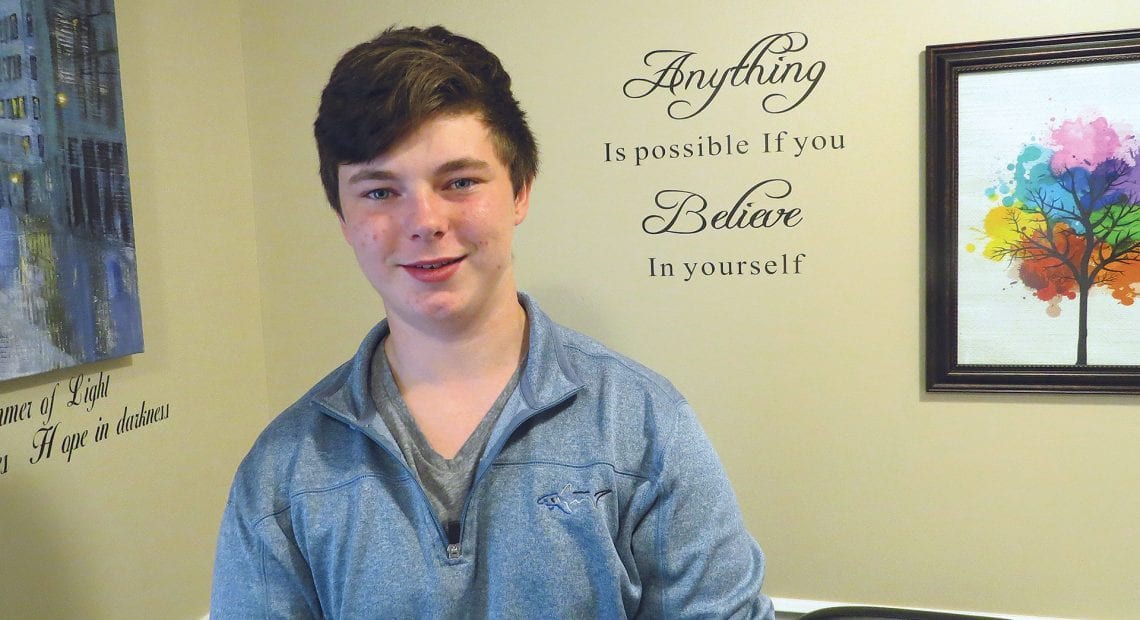
Michael, a three-time resident of Goodwin House

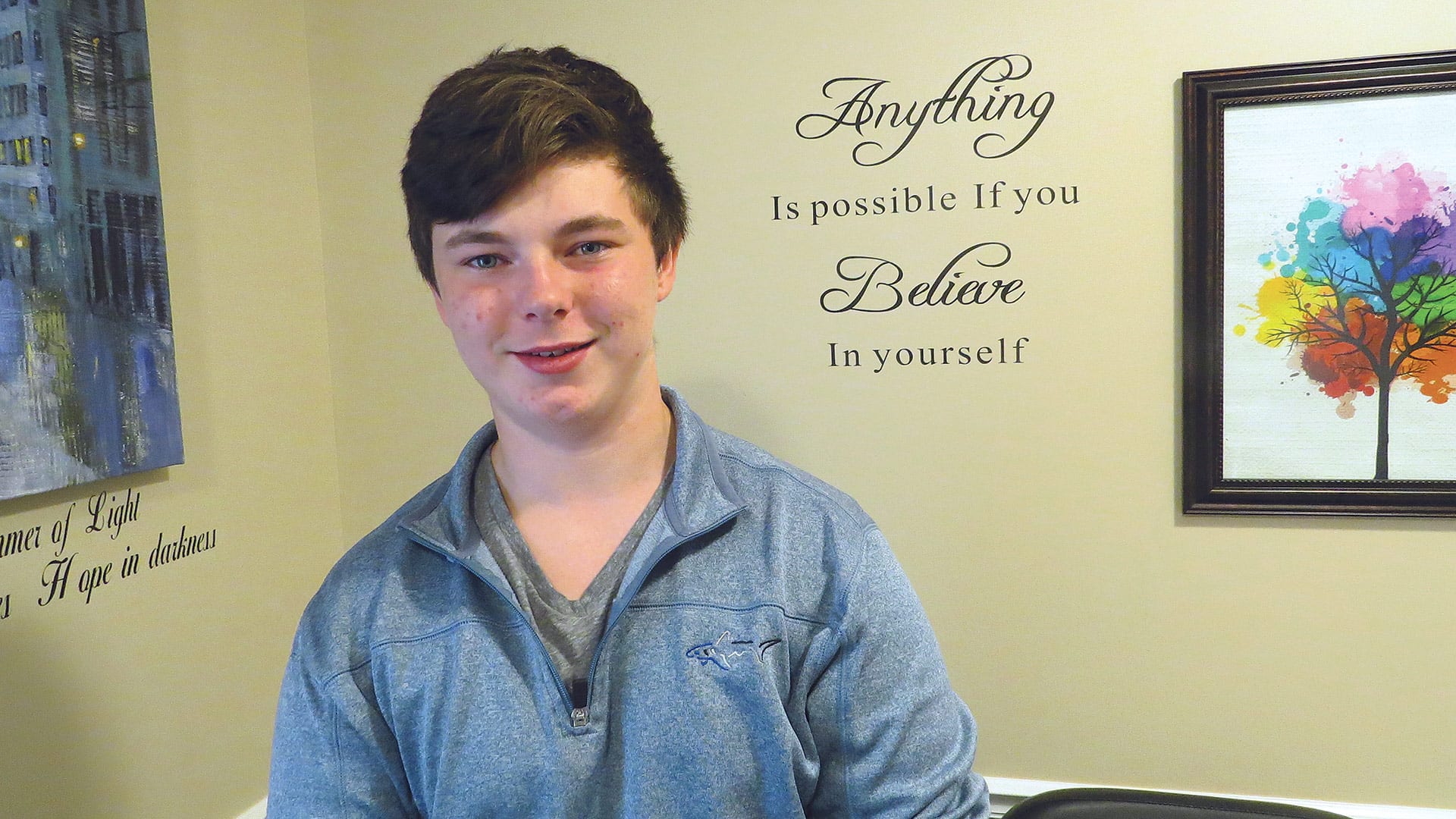
Michael, a three-time resident of Goodwin House, feels he has finally found the strength and resolve to stay on the path to recovery.

Chantal Silloway started using substances at age 12 and eventually battled her way to sobriety at 25; she’s been clean for 32 years. With her background, she knows full well that no two people take the same path to substance use, and likewise, no two take the same path to recovery. This is the mindset, and operating philosophy, she brings to her role as director of the Goodwin House in Chicopee, a place where young men try to piece their lives back together.

Michael (policy allows use of his first name only) remembers that not long after his family moved while he was in middle school, he started “looking up to the wrong people.”

This was a development that would have consequences he says he couldn’t have foreseen.

He told BusinessWest that his descent into substance abuse began when he started drinking with these individuals and smoking some weed, as he put it. Things would only escalate from there.

“I started doing percocets and slowly became addicted to those,” he recalled. “Then I couldn’t afford them anymore, so I was introduced to heroin, and soon developed a real problem … I wasn’t feeling good when I wasn’t using it, and when I was using it, I felt fine.

“I hated life. It was like … I wasn’t even enjoying the fact that I was super young and had so much to look forward to. I didn’t really care anymore, because all I needed was that drug.”

“Eventually, I turned over to the needle, and once I started shooting it, it became a whole different ballgame,” he went on. “It became my life — that became my top priority every day. I eventually spiraled out of control; I dropped out of high school, I started stealing from friends, family … anything I could do to get that fix.”

Michael was offering these flashbacks while sitting down with BusinessWest on the front porch of Goodwin House, a large home on Fairview Avenue in Chicopee. This unique facility, the only one of its kind in the Commonwealth, is a 90-day program providing substance-abuse treatment for males ages 13-17, operated by the Center for Human Development (CHD). Michael says he feels at home here, and he should; this is his third stint here and also his last.

He’ll be aging out of the program soon, but, more importantly, he feels he has, through the help of those at Goodwin House, found the strength and resolve to stay on the path to recovery, with his next stop hopefully being a so-called ‘sober house’ for individuals over 18.

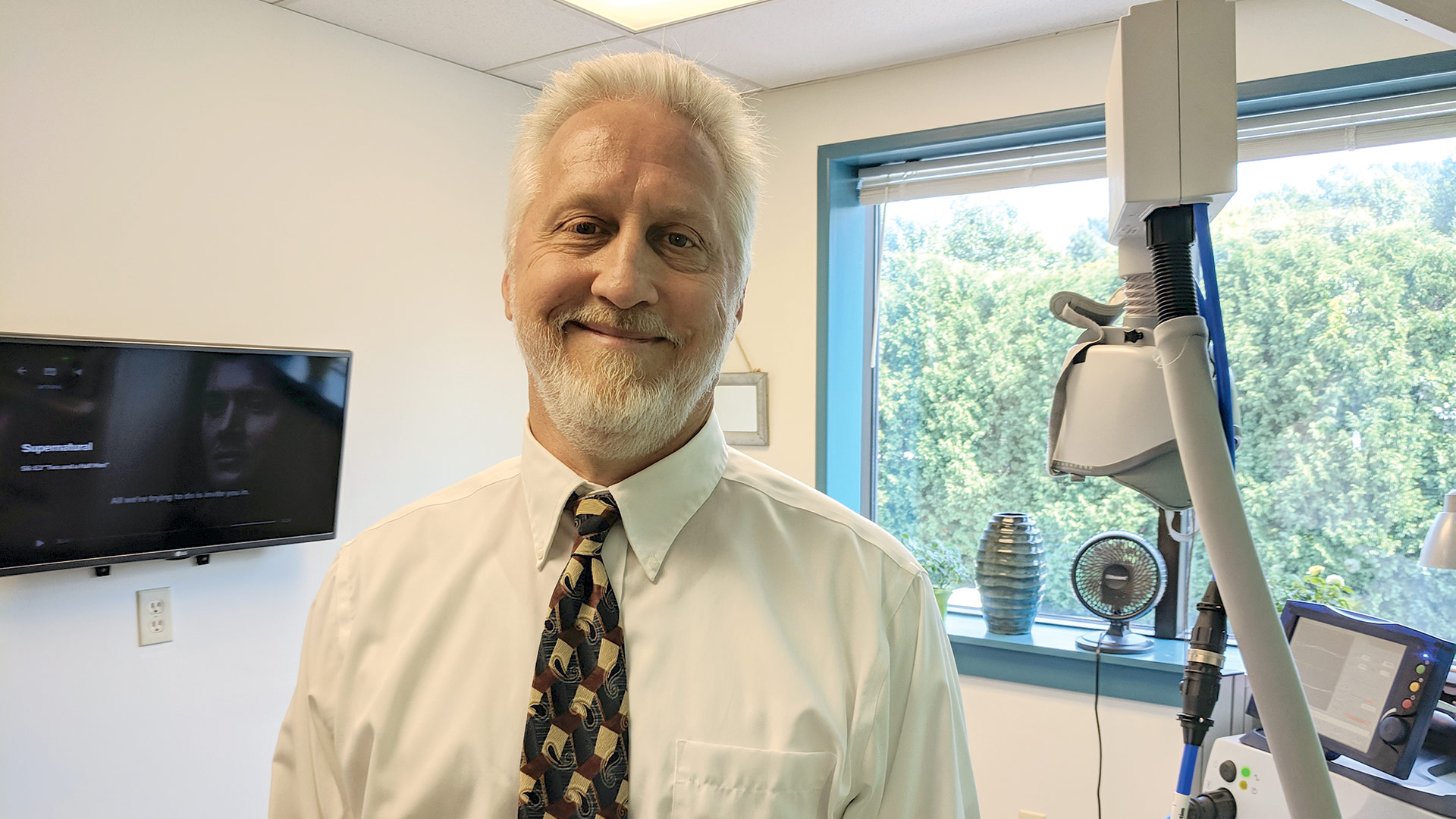
“This is a great success story — we’re very excited for him,” said Chantal Silloway, program director at Goodwin House and someone who can, like many in positions like hers, speak from experience when it comes to substance abuse and recovery.

“I started using substances starting at age 12, and became clean at age 25; I’ve been sober for 32 years,” said Silloway, who has worked for CHD since 2004 in various capacities involving substance-abuse programs. “It’s long been my goal to lead a program like this one.”

With her background, Silloway knows that no two people take the same path to substance use, and, likewise, none take the same path to recovery. Thus, this 90-day residential recovery program focuses on the uniqueness of each young man that arrives at its door, with a view to self-empowerment and the future they choose.
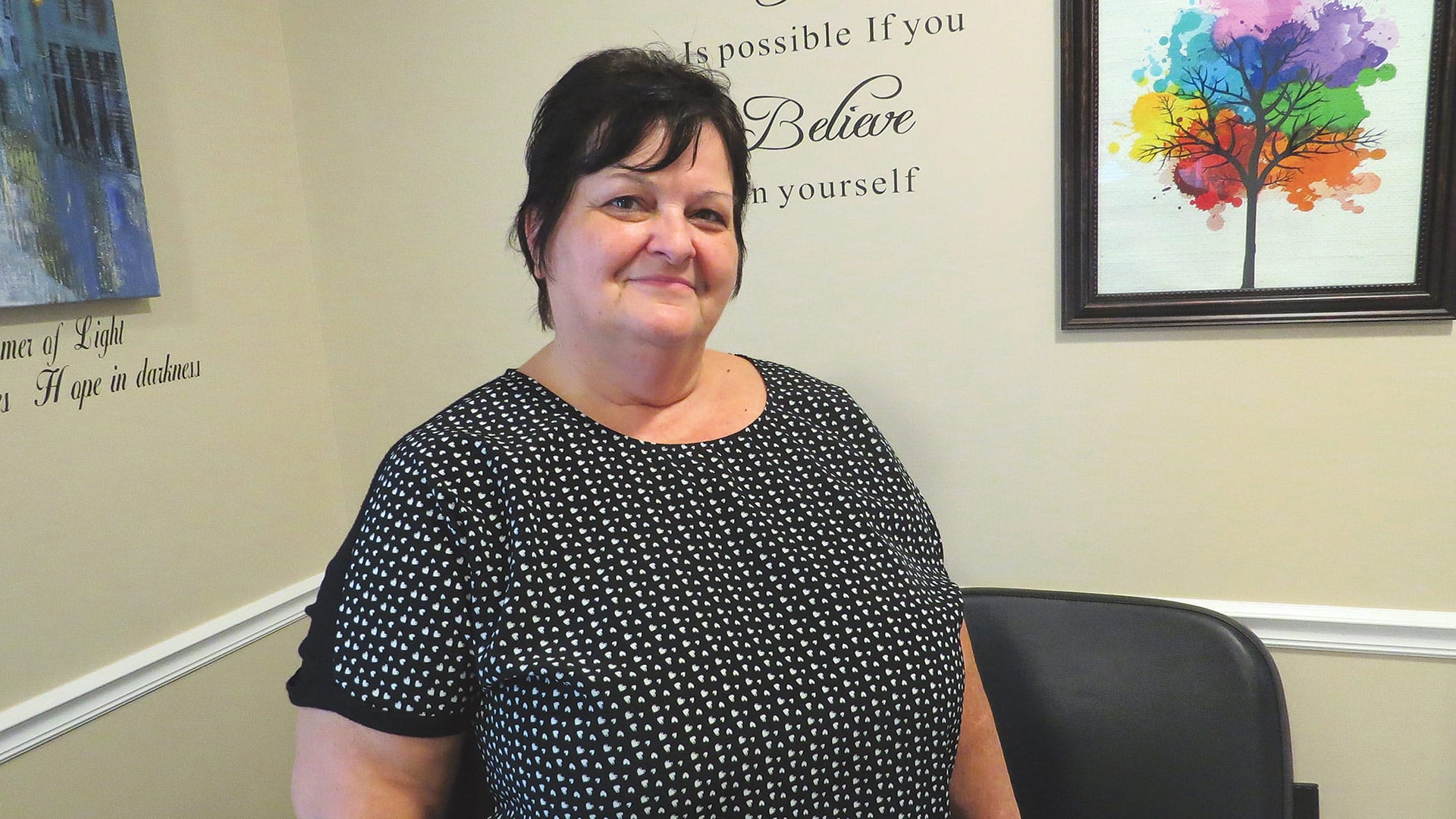
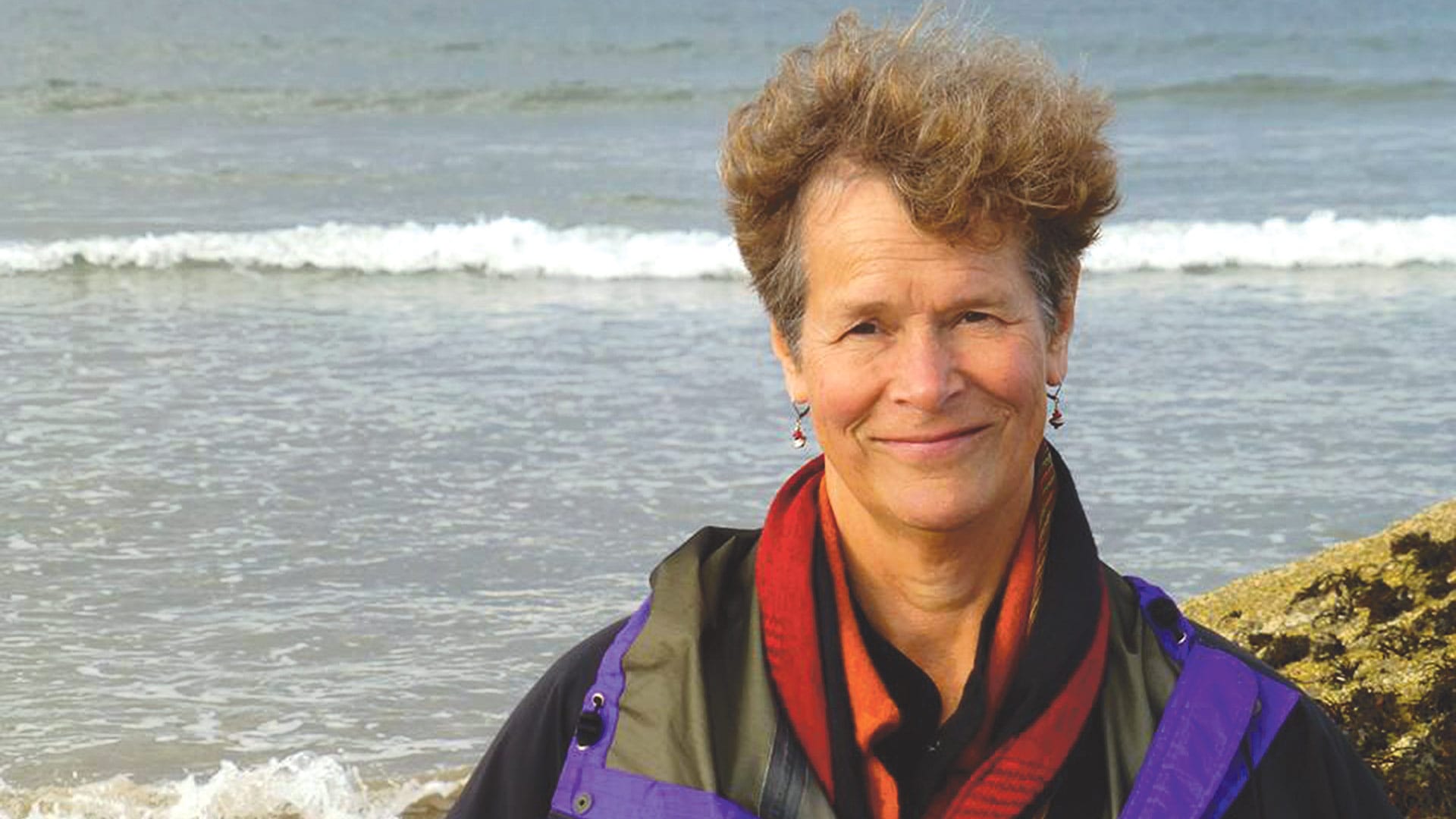
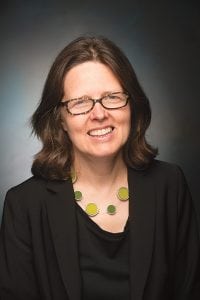
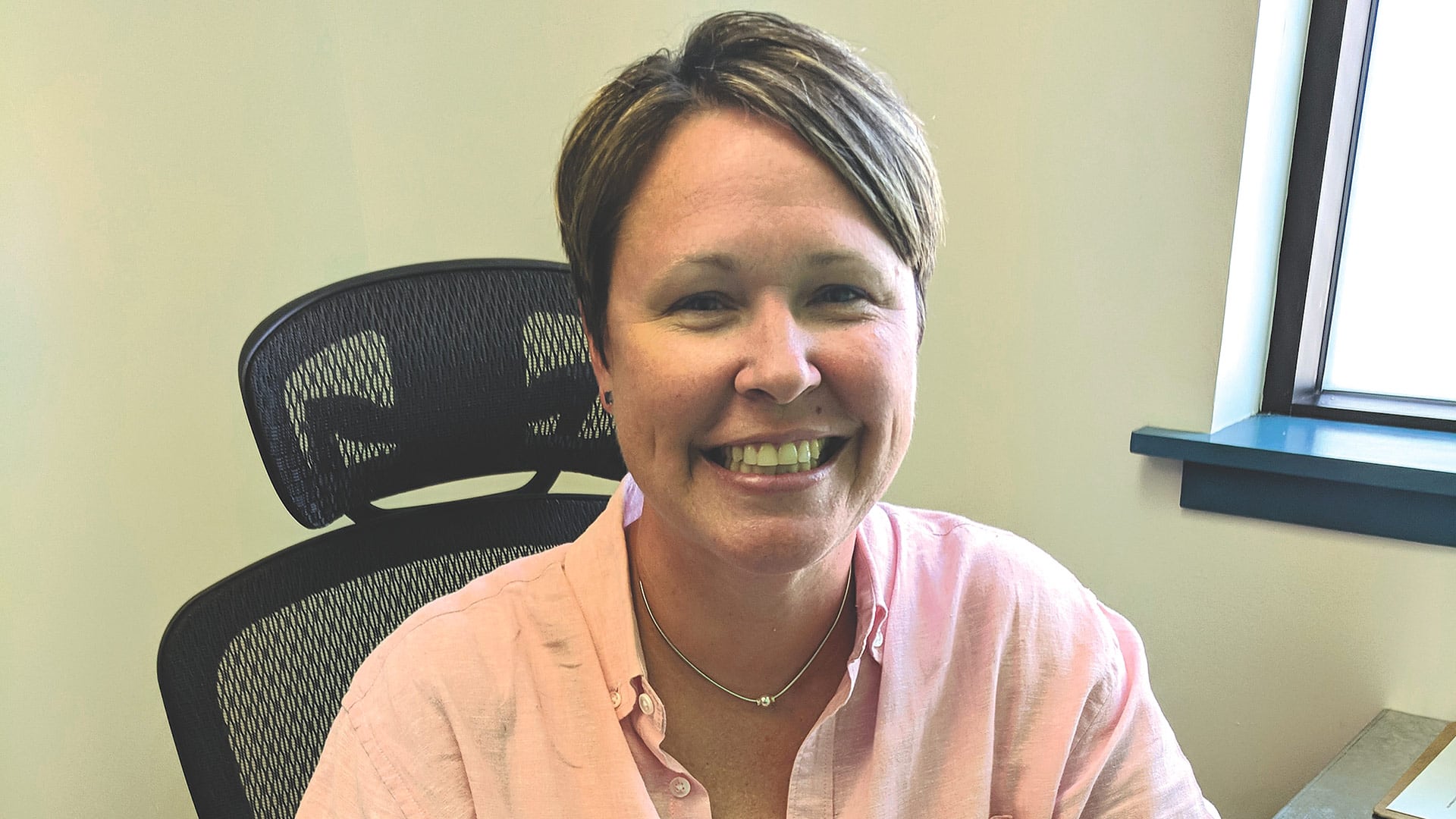
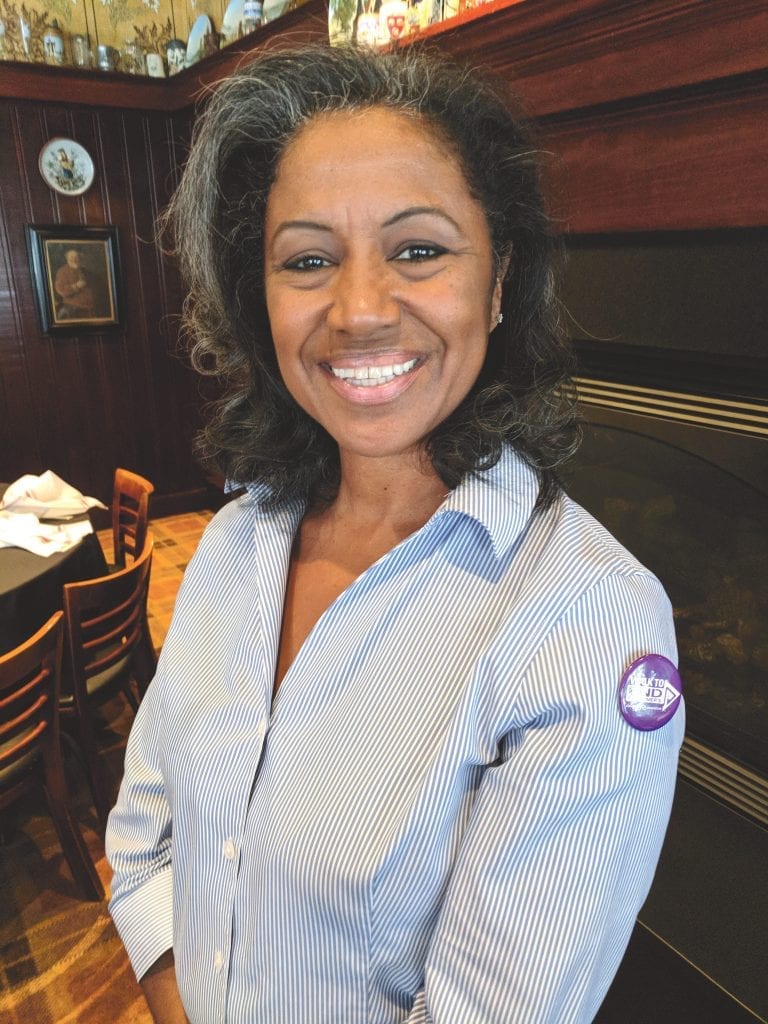
Chantal Silloway says no two people take the same path to substance abuse, or to recovery.

Chantal Silloway says no two people take the same path to substance abuse, or to recovery.

Elaborating, she said that young men are referred to Goodwin House from a variety of sources, including detox facilities, hospitals, the Department of Children & Families, the Department of Youth Services, and parents and guardians themselves. But where they were referred from is not really important, she said. What is, however, is that they arrive with a willingness to help themselves.

Without that, recovery is simply not attainable, she went on, adding that Michael is a good example of this, as we’ll see, and also an example of why many residents make return visits to this facility.

At Goodwin House, a team of clinicians and recovery specialists use evidence-based programs to help residents find and maintain sobriety. Treatment programs include assessment and treatment planning, individual and group therapy, recovery school and/or educational tutoring, vocational and employment-search assistance, recovery meetings, and after-care services and resources.

Often, said Silloway, the path to recovery means getting family members deeply involved in the process, so there is a family-therapy program as well.

Success at this facility is measured in different ways, she went on, adding that while residents do “graduate” from this program and there is a ceremony to commemorate that, there are other milestones, such as ongoing care, accomplishing specific goals that residents have set, and simply becoming ‘stabilized,’ a significant goal in itself.

For this issue, BusinessWest paid a visit to Goodwin House and talked at length with Silloway and Michael. And it is through his eyes, and his thoughts, that we came to understand what happens at this unique facility and how it is helping others change the course of their lives.

Strong Dose of Reality

Flashing back again to those days when heroin was dominating his life, Michael said he needed five to 30 bags of the drug a day, meaning he needed $20 to $80 a day to fuel his habit. And, as he said, he would do anything he had to do to come up with that cash.

Addiction caused him no end of legal problems, and it strained relationships with family and friends to the tipping point and beyond, he went on. But the actual toll was much, much higher.

“I hated life,” he said. “It was like … I wasn’t even enjoying the fact that I was super young and had so much to look forward to. I didn’t really care anymore, because all I needed was that drug.”

Most all of the people who come to Goodwin House are there because they arrived at the same place that Michael did, said Silloway — a place where they probably hated life and didn’t really care anymore. And they needed a way out and a path to a better life.

Helping to provide all that was the motivation for Goodwin House, a facility named after Jim Goodwin, long-time director of CHD. It opened its doors in May 2017.

“Eventually, I turned over to the needle, and once I started shooting it, it became a whole different ballgame. It became my life — that became my top priority every day. I eventually spiraled out of control; I dropped out of high school, I started stealing from friends, family … anything I could do to get that fix.”

The program operated there was created from the ground up by Silloway, and modeled loosely on a similar facility for young girls ages 13-17 in the Worcester area called Highland Grace House.

Residents must have a substance-abuse disorder, and the substances range from marijuana to alcohol to opioids, said Silloway, adding that a resident’s journey there begins with a referral, usually after a stint in detox.

This is a treatment facility and a next step after detox, she told BusinessWest, adding that Goodwin House can accommodate up to 15 young men at a given time. There are a handful there now, and there could and should be more given the state of the opioid crisis in this state and this country, she went on, but there is still a powerful stigma attached to addiction, and this is, unfortunately, keeping many from seeking the help they need.

Residents — that’s the term used to describe those participating in the program — come from across the Commonwealth, noted Silloway. They arrive, as she noted earlier, under different circumstances and with unique backstories.

But the common denominator is that successful recovery must begin with admitting that one has a problem, and possessing a willingness to do something about it — ingredients that are very often missing from the equation.

“We focus on them wanting to be here as opposed to being mandated, and some can be mandated to come,” she explained. “When they get here, they need to have a willingness to work on themselves.”

At Home with the Concept

Indeed, Michael said his first visit to Goodwin House was triggered by his arrest on various charges (he didn’t want to get into any great detail) in November 2017, followed by a stint in detox.

“I was sent here,” he said, putting heavy emphasis on that word ‘sent.’ “I came here for all the wrong reasons; I wasn’t coming here for myself at first, I was coming for the courts.”

With the benefit of hindsight, he believes that first time in detox and his initial visit to Fairview Avenue ultimately saved his life. But he knows now that he when he first arrived, he just wasn’t ready to change — as in change his friends, the places he hung out at, or, most importantly, himself as a person.
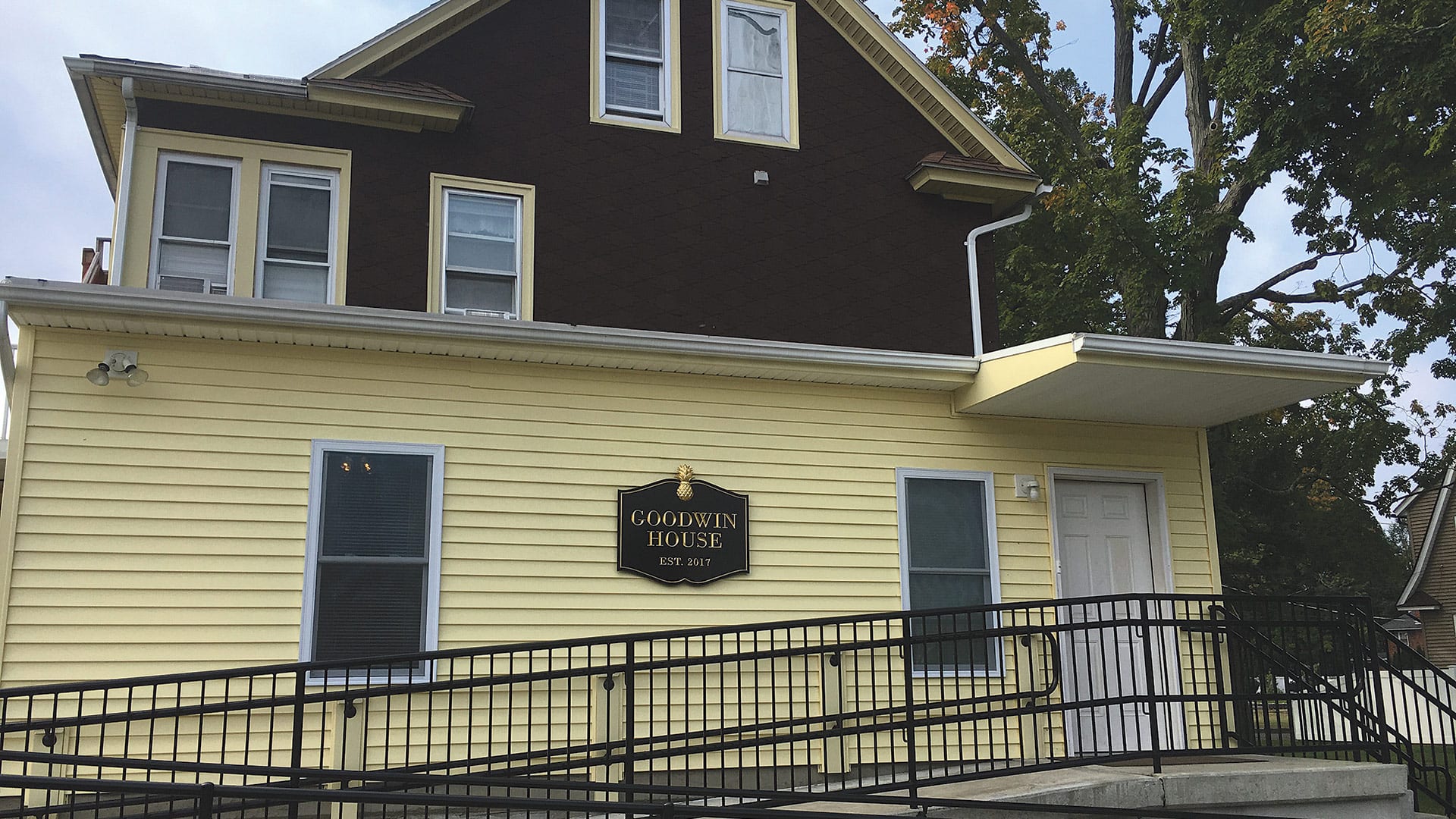
This residential treatment program for males ages 13-17 is the only facility of its kind in the Commonwealth.

This residential treatment program for males ages 13-17 is the only facility of its kind in the Commonwealth.

He started using again while he was at Goodwin House, got kicked out of the program, went back to detox, came back to Goodwin House, used again after only a few weeks, and was again kicked out of the program. He went to detox yet again and then to a halfway house in the Boston area, where he was discharged for using. The frustrating cycle continued with one more trip to detox and his third referral to Goodwin House. This time, though, things were different.

Silloway told BusinessWest that those addicted to substances like heroin, other drugs, and even alcohol are essentially in recovery for the rest of their lives. Recovery is a journey, and very often a long and difficult one, she went on, adding that is why it is not considered a failure to relapse and return to Goodwin House a few times, as Michael has.

“As someone’s leaving,” she said, “we say, ‘we hope we don’t see you back here, but if you need us, we’re here.’”

Michael still needed them, and they were there for him when he checked back in over the summer. Only this time, he arrived with a different attitude.

“When I went to detox for the fourth time, I decided I was sick of living that way and knew I needed to make some changes,” he recalled.

And over the course of the past 10 weeks or so, he has made some, and, with the help of the large support network at the Goodwin House, Michael is ready to do something he was never ready to do before — live without drugs.

“I feel like I wanted to make a change — I just didn’t know how,” he said. “But then, I started second-guessing whether I wanted to make that change. I got through that second-guessing, but I’m addict; I’ll always want to use. But now, it’s a matter of what will happen if I use. Am I going to die? Am I going to have more legal issues?

“Now, I’m happy,” he went on. “Before, I didn’t have any emotion — I just got through the day. Now, I can take in the memories that I have; every day, something can happen, and it can turn into a good memory or a bad memory.”

When asked about the long term, Michael said he doesn’t think in such terms. In fact, he doesn’t even take things one day at a time.

“I’m locked in on thought-by thought, minute-by minute,” he explained, “because that last thought can bring you right back to where I was.”

Positive Steps

On Oct. 18, Michael will turn 18. As noted, he will then officially age out of Goodwin House. He’s hoping that his next short-term address will be a sober house, which will be what he called “another stepping stone on the journey to living without drugs.”

He admits to being somewhat nervous, but not scared.

“The way I was brought up was to always want more out of life, to achieve something greater than you’ve already achieved,” he explained. “I want to keep putting one foot in front of the other every day, because I don’t want to take one step forward and two steps back. I did that for such a long time … I don’t want to start this all over again.”

Getting to this point has been a long struggle, but Michael has found the will to change and keep moving forward. The Goodwin House has played a huge role in that, and the goal moving forward is to write more success stories like this.

George O’Brien can be reached at [email protected]
Features

Test Driving a New Model

Paul Mina

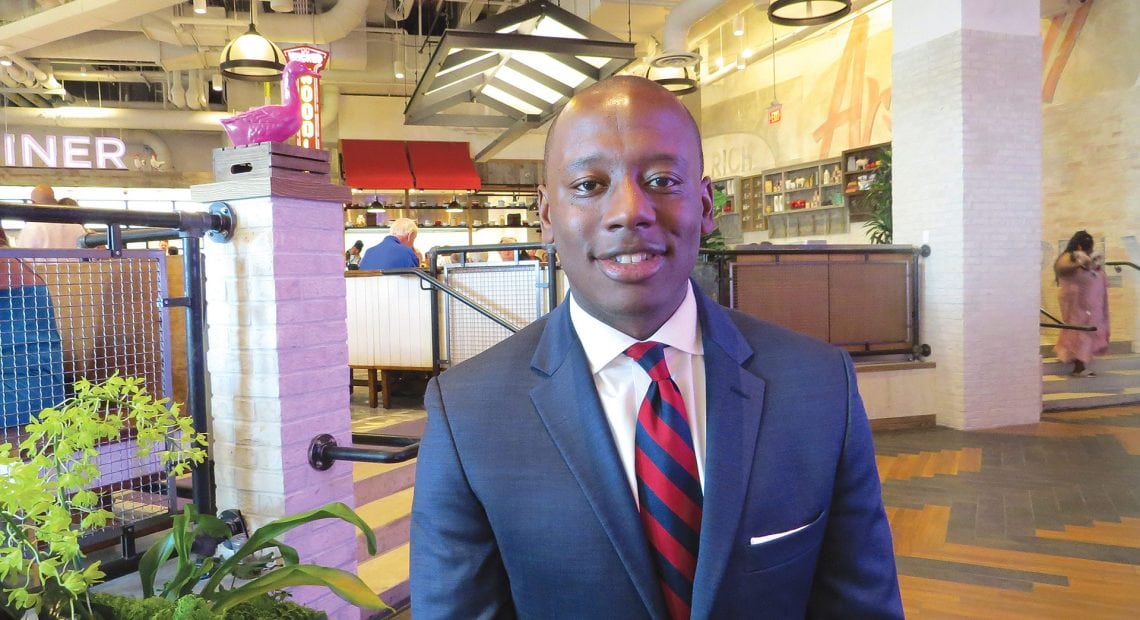
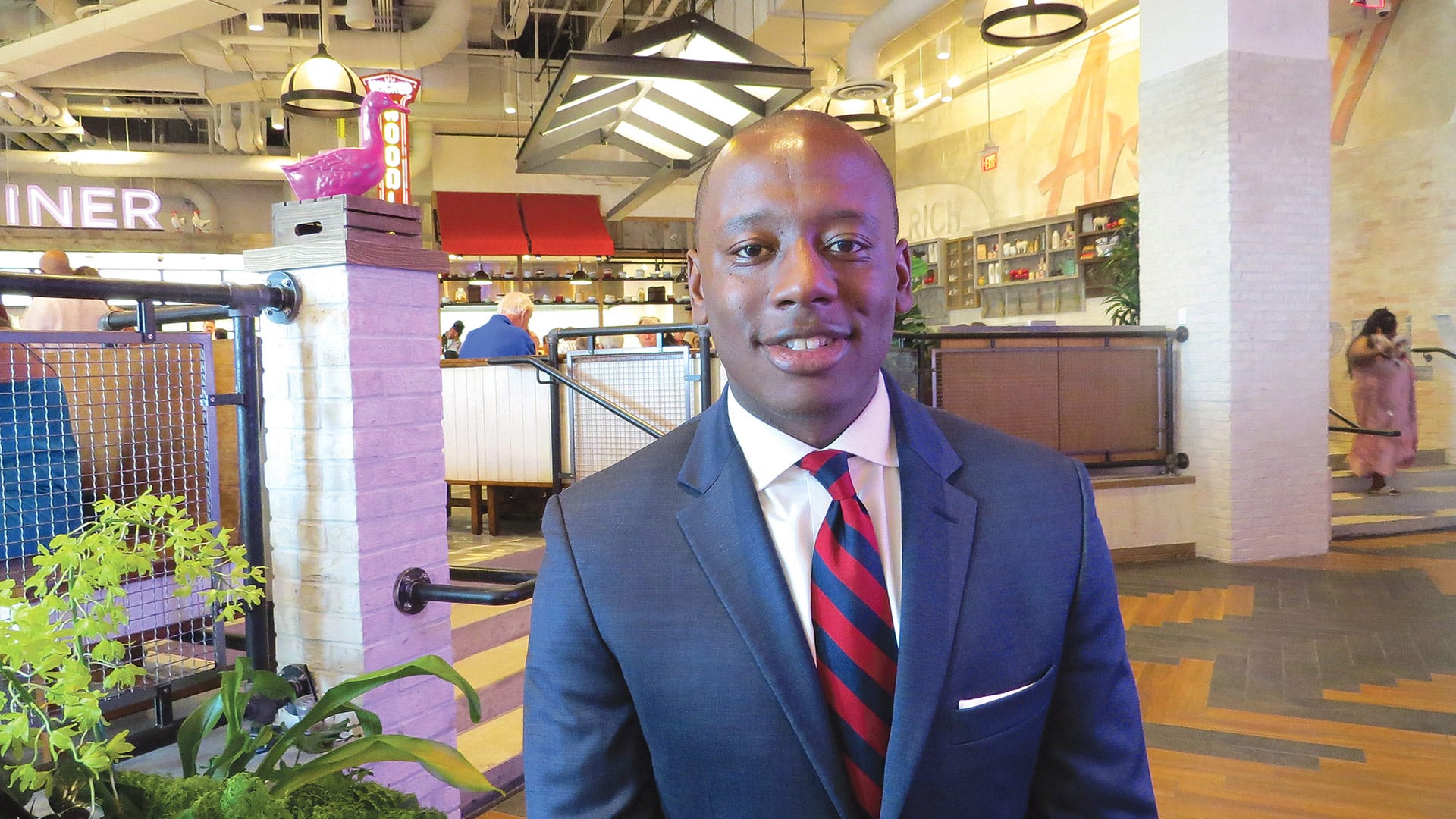
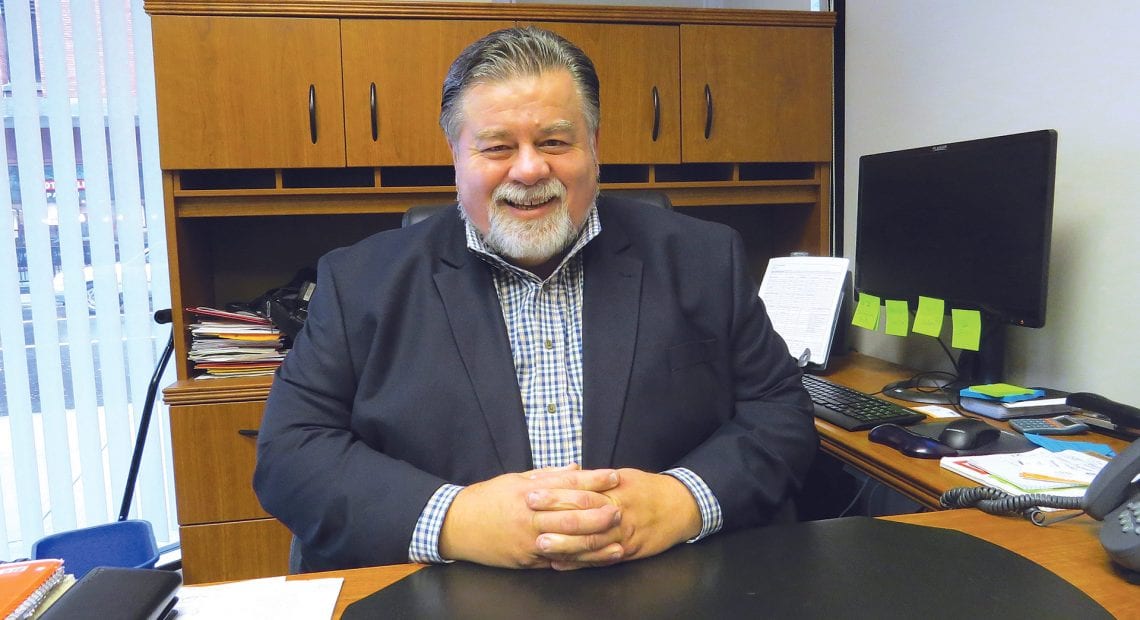
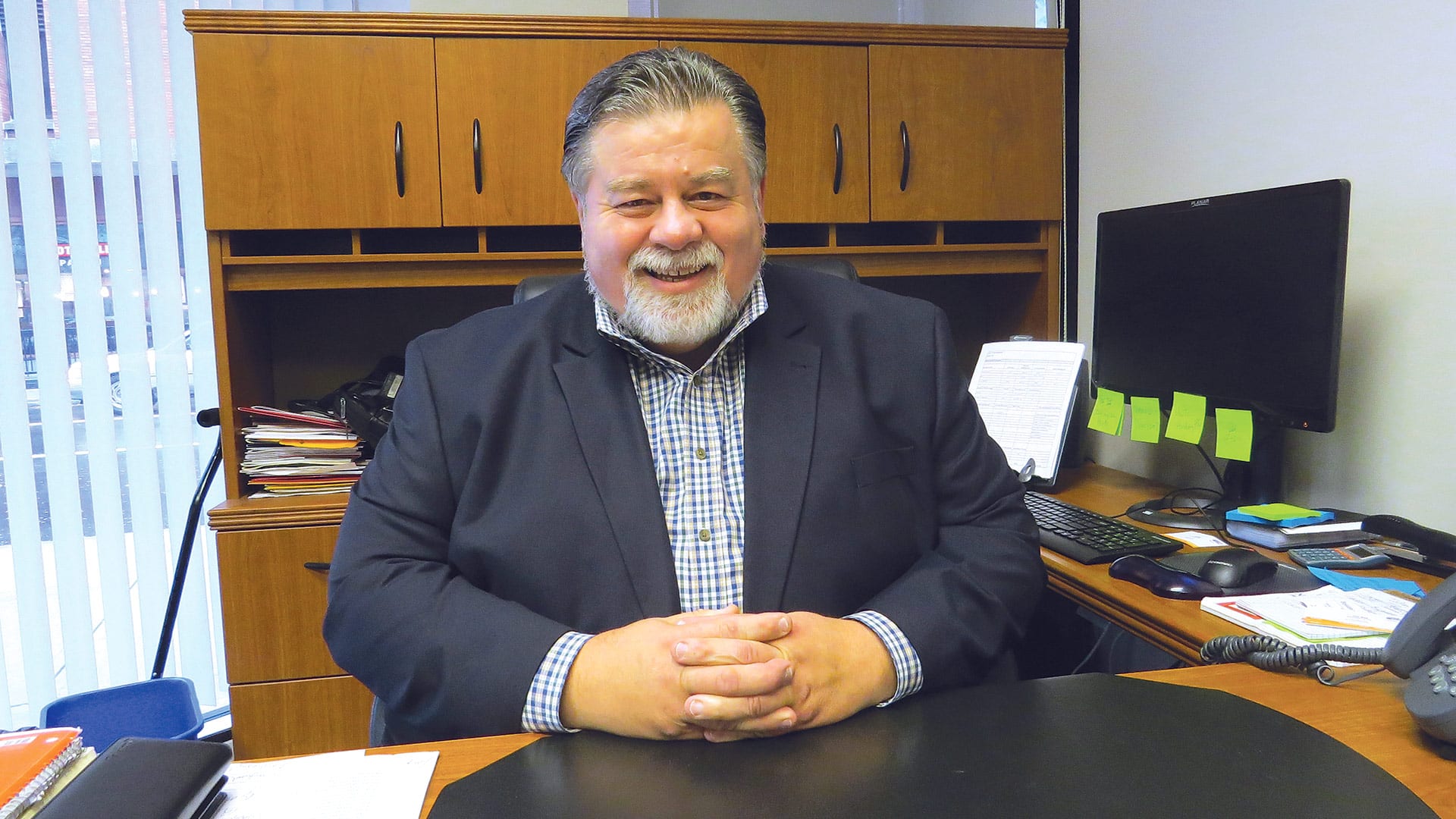
Paul Mina says the United Way of Pioneer Valley has to go back to basics in many respects, but it also has to do a lot of outside-the-box thinking.

Steve Lowell says he took the phone call back in early August; he doesn’t recall the exact date.

Everything else, though, he remembers quite clearly.

That’s because on the other end of the line was Paul Mina, president and CEO of the United Way of Tri County, who asked for a moment of Lowell’s time — and used it to get a whole lot more than that.

Mina was calling Lowell, president and CEO of Monson Savings Bank, and chairman of the board of the United Way of Pioneer Valley (UWPV), with a proposition of sorts, a unique partnership that has many potential — and, in some cases, already real — benefits for both United Ways.

That partnership comes in the form of a management agreement (two and a half years in length) whereby UWTC, as it’s called, will essentially share a CEO (Mina) with UWPV and handle backroom operations — bookkeeping, marketing, and others — for this region’s United Way for a percentage of the funds raised during its annual campaign.

This partnership, forged after several years of unsettledness at the top for UWPV — it has seen two CEOs and two interim CEOs since early 2016 — brings what Lowell called some “much-needed stability,” while also enabling UWPV to maintain its autonomy at a time when many such agencies are entering into mergers.

But it also gains much more, including perhaps $200,000 in savings on administrative costs and, even more importantly, a CEO with 30 years of experience working within the United Way family, said Lowell, adding that Mina brings a wealth of experience, and energy, to his expanded role.

“We needed some stability in the organization, and we needed a forward-looking, positive strategy,” he explained. “And in talking with Paul, our board of directors became convinced that he could do all that; he’s hit the ground running and done more in the month he’s been on board than I would have thought possible.”

Mina’s comments on his expanded duties and his approach to them echo those sentiments.


Steve Lowell

Steve Lowell

“We needed some stability in the organization, and we needed a forward-looking, positive strategy. And in talking with Paul, our board of directors became convinced that he could do all that; he’s hit the ground running and done more in the month he’s been on board than I would have thought possible.”


“I’m not a United Way CEO who hangs around and goes to meetings,” he told BusinessWest. “I’m a get-your-hands-dirty, fundraising person; I’m the chief fundraiser here, and I’m the chief fundraiser at our other office in Framingham, and I lead by example in that regard.”

By that, he meant that he’s generally not in his office at 1441 Main St. and is instead on the road, visiting area companies and stressing to decision makers that, while the times, and charitable giving habits, have changed, the United Way is still relevant, and it still plays a pivotal role within the community it serves.

“The first thing I said to everyone here in Springfield when we met on the first day was, ‘take your job descriptions and throw them out the window,’” he went on. “That’s because we’re all fundraisers, and that includes people who never leave this office.”

Such energy — and such a focus on fundraising — will certainly be necessary because, as most know, this United Way is much smaller (in every way) than it was a decade or even five years ago, especially when it comes to annual donations.

Indeed, this was a $5 million United Way — that’s the parlance used — earlier this decade, and is now closer to a $2 million agency. The loss of financial-services giant MassMutual as a major contributor — that corporation now gives back to the community through its own foundation — has been a major factor in the decline of the UWPV, but there are other factors as well.

These include changes within the business community, especially the smaller number of locally based banks and other types of companies, as well as those noted changes in how many individuals and businesses give back. Many now donate directly to a specific cause or charity, often through vehicles like the hugely successful Valley Gives program.

In response to these trends, and to bring its numbers higher, UWPV has to go back to basics in some respects, some Mina, and remind companies why it’s so important to support the United Way.

But it must also think outside the box, which in this case means beyond the traditional payroll-deduction model of giving back, as is the case with a new initiative called ‘Feed a Family,’ which invites individuals and businesses to donate specifically to the many food banks supported by the United Way (more on that later).

For this issue, BusinessWest looks at the new partnership arrangement, the projected benefits, and how the UWPV looks to capitalize on them.

When a Plan Comes Together

Summing up his first several weeks on the job, Mina said he’s on what he described as a ‘thank-you tour.’

By that, he meant he’s reaching out to many individuals who have been strong supporters of UWPV over the years, letting them know their support is certainly appreciated. He’s doing so, he said, because, due to all the transition in leadership in recent years, such acknowledgements have been somewhat lacking.

“We didn’t thank people enough — we didn’t honor people enough,” he told BusinessWest, adding quickly, “you can never thank people enough.”

Mina said that’s one of many lessons he’s learned over a more than 40-year career working for and behalf of nonprofits. It began with a lengthy stint as director of the Lincoln Square Boys Club in Worcester and, later, the Worcester Boys and Girls Club’s Camp Hargrove as well. He joined the United Way organization in 1988 as senior campaign fundraiser for the United Way of Central Mass., and in 1994, he became president of the United Way of Assabet Valley in Marlboro.

Since 1996, he’s led the UWTC, an entity created through the merger of several smaller United Ways based in Marlboro, Framingham, Norwood, Westborough, and Clinton — the three counties (actually parts of them) being Middlesex, Norfolk, and Worcester.

And since 2006, he’s also been president and CEO of Mass211, a program (a phone number, really) that connects callers to information about critical health and human services available in their community.

With these stops on his résumé, Mina is well aware of the many challenges facing United Ways across the country and across the region, especially the smaller organizations. Most all of them are looking for creative answers to the twin challenges of increasing revenues and reducing expenses.

It was with this thought in mind that a proactive Mina — aware that UWPV had launched a search to find a successor to Jim Ayers, who left his position as president and CEO to seek another opportunity, and looking for a way to help two United Ways — picked up the phone and called Steve Lowell.

“I said, ‘it’s very important that the western part of the state has an anchor United Way,’” he recalled, adding that he invited Lowell to breakfast to “hear him out.”

He agreed (Mina, Lowell, and Denis Gagnon, vice chair of UWPV, got together the next day, in fact), and Lowell recalls soon liking what he was hearing.

“He said that he might have a solution for a solution for our organization that would allow it to keep its autonomy and the local oversight we want, but also gain some efficiencies,” Lowell recalled, adding that, with that opening, he was all ears.

Fast-forwarding a little, the two sides worked out a proposal and took it back to their respective full boards. Mina said his board had a number of questions, which were answered sufficiently to garner a 17-1 vote to enter into the agreement. The vote was unanimous at the UWPV, which, said Lowell, viewed the partnership as the best possible path for the agency moving forward.

“This really benefits both organizations,” he told BusinessWest, adding that, beyond the help on the expense side of the budget, UWPV gains from Mina’s vast experience working for the United Way and guiding agencies through the recent whitewater.

“He has more than 30 years of United Way experience; he’s been through some tough times and been successful at turning them into positive situations,” Lowell said. “When you put it all together, it was a great solution for us.”

Shared Enthusiasm

Gagnon agreed with that assessment.

He noted that Mina and UWTC have a strong track record of bringing United Ways together in a merger, creating efficiencies, and providing ways for these agencies to carry out their missions effectively given the many challenges they’re facing.

This arrangement is not a merger, he said, stressing that point repeatedly, but the goals are similar, and so are the basic strategies for achieving them.

“We needed a new leader and a few other key staff members,” he said, noting that, with Ayers’ departure, there were some others as well. “The United Way of Tri County can provide that all in one shot, rather than have separate recruiting efforts.”

The plan is for Mina to spend half his week in Springfield and other half in Framingham, leading the UWTC, although he knows there will some weeks where he’ll be in one region more than the other. And these will certainly not be 40-hour weeks.

But will this arrangement work as intended for both agencies?

Those we spoke with are, as noted, certainly optimistic, and also convinced that this partnership is better than the alternative — hiring a CEO specifically for UWPV and keeping the backroom operations in Springfield, especially at this critical time for the organization — the middle of an all-important annual campaign.

More to the point, both United Ways need it to work and are committed to making it work, said Mina, noting that all United Ways are facing a host of challenges, including those mentioned earlier with regard to how people give and why.

Which brings him back to those notions of stressing the basics, but also thinking outside the box.

“People give through their heart to their head to their wallet,” he explained. “And we have to do a good job of telling people what happens when they contribute to the United Way. It’s not a right that we have that people give to us, it’s a privilege, and we have to prove that what we’re doing is valuable and that it helps improve quality of life for the people who live and work here.

“And in order to do that, you have to be able to show ROI,” he went on, “and you can’t do that if you’re not out in the community seeing what’s important and doing what’s necessary to be done.”

As an example of this, he noted the Feed a Family drive, which specifically targets food pantries and other agencies that help feed those within the community.

“At the United Way of Pioneer Valley, we have focused for decades on funding safety-net services that assist this very vulnerable population. One such service area is our food-security initiative where food pantries and congregate meal programs feed hungry individuals and families in our region,” he said, noting that last year, United Way- funded programs provided more than 251,000 meals in the Pioneer Valley.

“While that’s an impressive number, the need unfortunately continues to increase rapidly, and donations lag far behind,” he went on, adding that the initiative will directly support the Gray House, Home City Development Inc., Open Pantry Community Services, the Salvation Army, and the Springfield Rescue Mission (all based in Springfield), as well as Neighbors Helping Neighbors in South Hadley, Our Community Food Pantry in Southwick, and Providence Ministries for the Needy in Holyoke.

Bottom Line

The Feed a Family drive is, as Mina noted, somewhat outside-the-box thinking for this United Way, but something definitely needed amid these changing and very challenging times.

The same can be said for the management agreement between the UWPV and UWTC. It is something different, but also something both boards deemed ultimately necessary — not just for this area’s United Way, but for both agencies.

Rather than an act of desperation, Mina called it “an act of intelligence,” and he credited both boards for having the imagination, and good sense, to make it happen.

Will it work? Time will tell, but so far the arrangement has generated what its architects hoped it would — stability and optimism.

George O’Brien can be reached at [email protected]
Community Spotlight

Community Spotlight

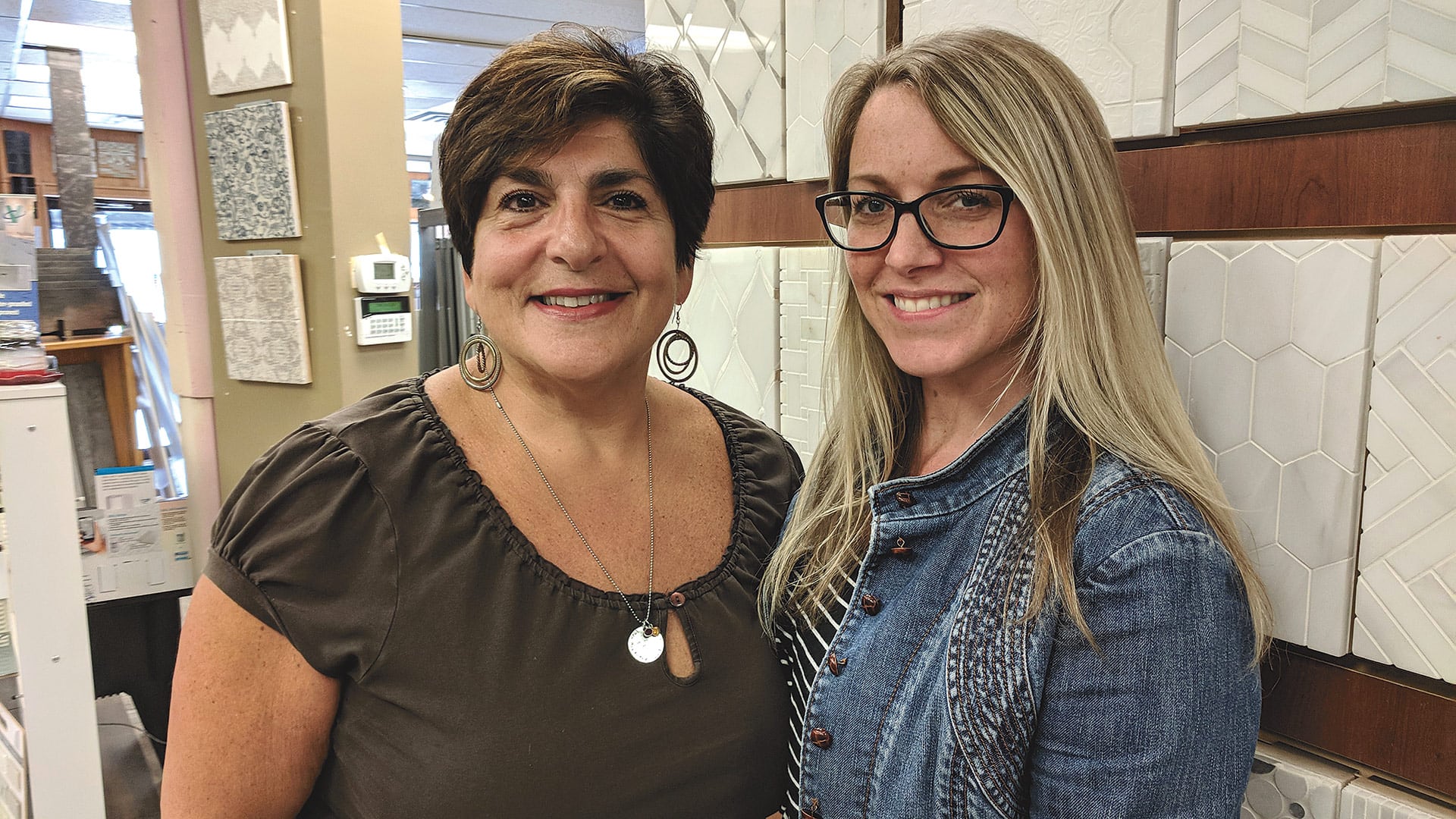
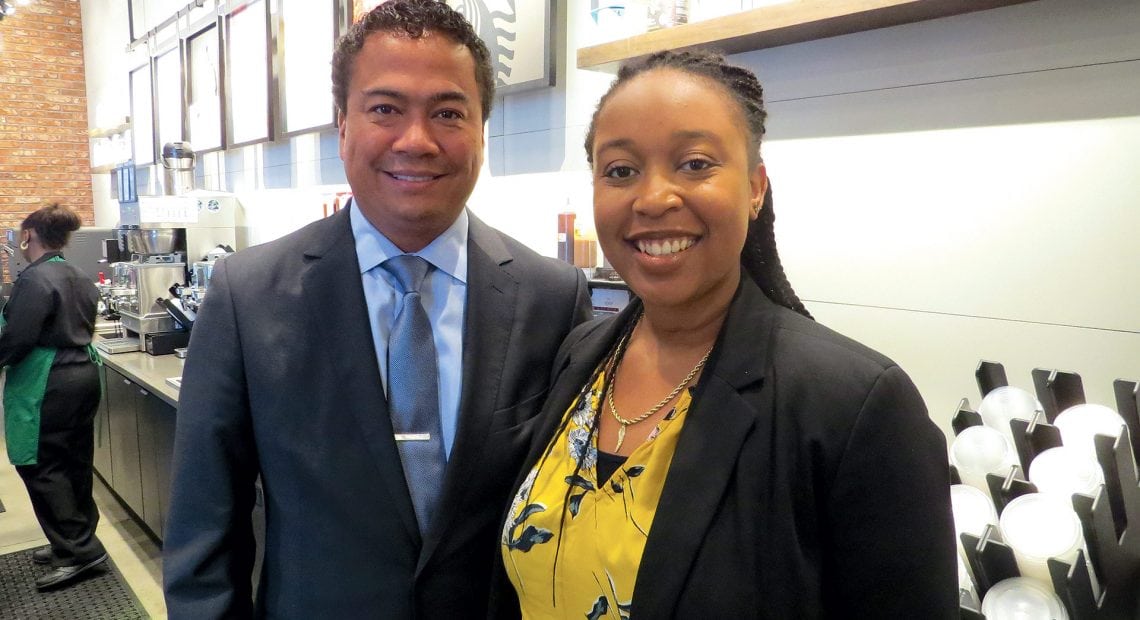
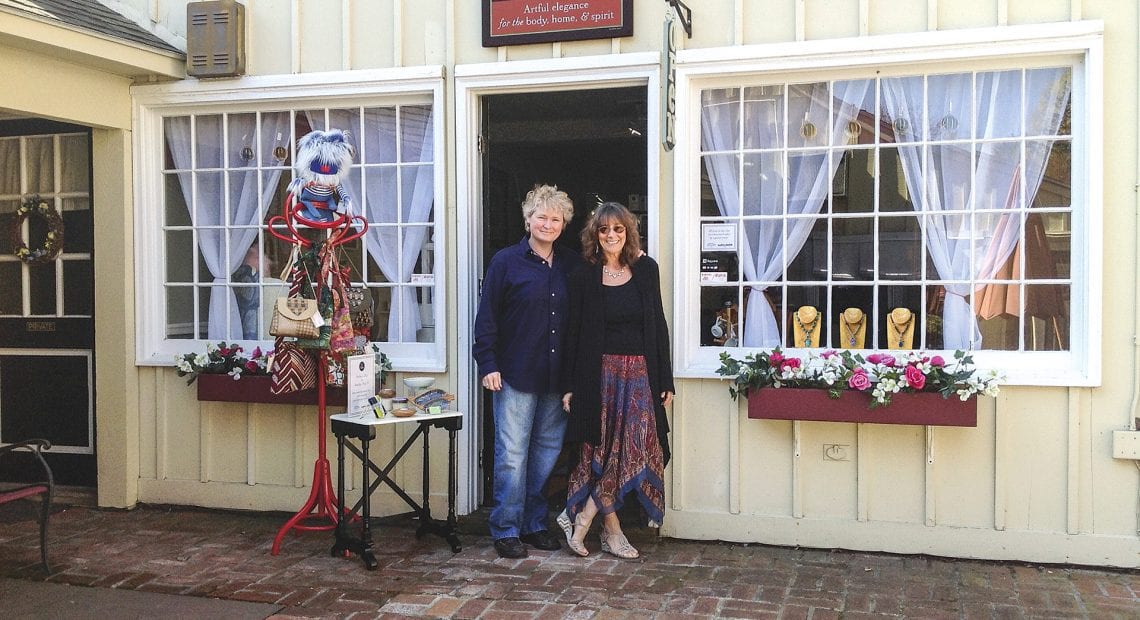
Margaret Kerswill (left) and Laureen Vizza

Margaret Kerswill (left) and Laureen Vizza in front of their Main Street shop, Mutability in Motion.

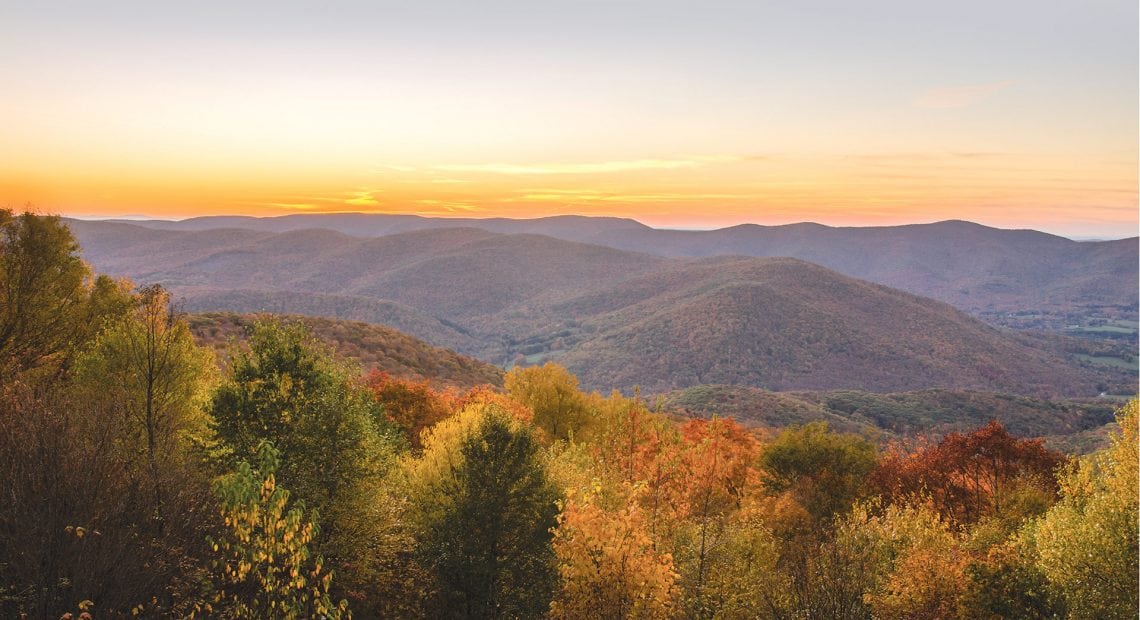
Margaret Kerswill has a couple of good views of Stockbridge’s business community. One is as president of the Stockbridge Chamber of Commerce. The other is from her storefront window on Main Street.

“I think there’s a real appeal that’s well-defined in our town’s tagline, which is ‘a quintessential New England town.’ It feels small; it feels intimate,” said Kerswill, co-owner with her wife, Laureen Vizza, of Mutability in Motion, a downtown store that sells crafts handmade by artisans from across the U.S., many of them local.

“There’s a connection between people in town,” she went on. ‘When you walk through town in the morning, just about everyone says ‘good morning’ to you. There’s a very nice atmosphere about Stockbridge.”

Still, outsiders often peg the community as a tourist destination — which is certainly is — and not much else, and are surprised to find a bustling local economy that doesn’t shut down during slow tourism seasons.

“I know being in my shop, a lot of the visitors who come, who have never been here, are often surprised to see businesses stay open year-round,” Kerswill said. “When they visit other tourist areas at the beginning and end of the season, a lot of those restaurants and shops close down. We’re a small town, so most of our foot traffic is in the summer season, but we’re still here year-round, serving local regulars.”

Still, Stockbridge relies heavily on tourism and visitorship for economic development. With a population of just under 2,000 — ranking it in the bottom sixth in the Commonwealth — the community doesn’t have a deep well of residents or businesses from which to draw tax revenue, but it does boast a widely noted series of destination attractions, from Tanglewood to the Norman Rockwell Museum; from the Berkshire Theatre Festival to Berkshire Botanical Garden.

Other attractions continue to emerge as well, including the oft-delayed Elm Court project by Travaasa Berkshire County, which will turn the historic Elm Court Estate into a resort featuring 112 hotel rooms, a 60-seat restaurant, and a 15,000-square-foot spa.

The property, which sits on the border of Stockbridge and Lenox on Old Stockbridge Road, was constructed in 1886 as a summer cottage for William Douglas Stone and Emily Vanderbilt, completed a series of renovations in 1919, and evolved into an inn in the ’40s and ’50s, hosting dinners, events, and overnight accommodations. It was eventually placed on the National Register of Historic Places.

The project to renovate it began six years ago when Front Yard purchased the estate from the Berle family, who had run a boutique, wedding-oriented hotel there from 2002 to 2009. Eight neighbors appealed the 2015 approval of the resort by the Lenox Zoning Board of Appeals, but the Massachusetts Land Court eventually ruled in favor of the developer, Front Yard LLC. This past summer, Front Yard asked the Stockbridge Select Board for — and received — an extension of the permit which would have expired last month. Construction is expected to begin in the spring.

Meanwhile, the Boston Symphony Orchestra is developing a $33 million construction project at Tanglewood, a four-building complex that will house rehearsal and performance space for the Tanglewood Music Center as well as a new education venture known as the Tanglewood Learning Institute — the first weatherized, all-season structure at Tanglewood, which the BSO plans to make available for events beyond the summer months.

“We really are an amazing cultural center here, between the visual arts and handcrafted arts and crafts,” Kerswill said. “We’ve got music, dance, and theater with amazing summer-stock casts. On one hand, we have the feel of country living, but we have the convenience of Manhattan two hours away, Albany 45 minutes away, Boston two hours away, and all the culture in our immediate area. It’s remarkable. That’s why I’m here — the culture and the arts.”

Community Ties

As chamber president, Kerswill leads a member base that’s smaller than most chambers, but “strong and loyal,” as she called it.

“We do some chamber-related functions to connect,” she said, “and we also have tri-town chamber mixers with people from Lenox and Lee, where we get together and share experiences in an informal setting over cocktails for a couple hours.”

Margaret Kerswill

Margaret Kerswill

“We really are an amazing cultural center here, between the visual arts and handcrafted arts and crafts. We’ve got music, dance, and theater with amazing summer-stock casts.”

The chamber also presents an annual event to honor members and businesses, alternating between an individual one year and a company the next. On top of that, it puts on two major events. One is the three-day Main Street at Christmas festival — slated this year for Nov. 30 through Dec. 2 — which brings thousands of people into town with activities for families and children, concerts, caroling at the Red Lion Inn, and self-guided house tours. On Sunday, Main Street closes down for several hours, antique cars are brought in, and the strip transforms into a scene straight out of a Norman Rockwell painting.

That follows a summer arts and crafts fair each August, a weekend-long event that always sells out its vendor capacity, she said. “There’s no entry fee for patrons, and people freely walk around and come and go as they please. That brings a lot of people to town, at a time when summer is winding down and there’s less traffic.”

Stockbridge at a glance

Year Incorporated: 1739
Population: 1,947 (2010)
Area: 23.7 square miles
County: Berkshire
Residential Tax Rate: $9.76
Commercial Tax Rate: $9.76
Median Household Income: $48,571
Median Family Income: $59,556
Type of government: Town Administrator; Open Town Meeting
Largest Employers: Austen Riggs Center; Tanglewood; Red Lion Inn
* Latest information available

Not wanting to rest on its laurels when it comes to its status as a desirable town for tourists and residents alike, a visionary project committee was formed by Stockbridge officials several years ago to develop recommendations that could be implemented over the next 20 years. The committee issued a report in 2016 titled “Planning a Way Forward.”

That report noted that residents value the town’s cultural institutions and historic buildings; its open space, recreation sites, and walking trails; and its downtown (although many would like to see additional shops and services, as well as more parking). Meanwhile, they want to see smart housing growth that takes into account the community’s aging population, as well as additional transportation options and better accommodation of walkers and bicyclists.

As a result, the document envisioned a Stockbridge in 2036 that mixes the traditional strengths of tourism, culture, and creative economy with green- and technology-based businesses, food production from local farmers, and agri-tourism. The ideal community would also be less auto-reliant, expanding pedestrian networks, bicycle infrastructure, and regional bus and ride-sharing services.

The report also predicts a socially and economically diverse population that provides equally diverse housing options, from apartments and condominiums to smaller single-family homes, co-housing projects, and historic ‘Berkshire cottages.’ These include a mix of sustainable new construction and repurposed buildings, including the preservation of older homes, along with an increase of people living close to the town center, including mixed-use buildings with apartments over shops to support downtown businesses.

While the overall vision may be ambitious, it encompasses the sorts of goals a town of Stockbridge’s size can reasonably set when looking to move into its next era.

Blast from the Past

Kerswill, for one, is happy she and Vizza set up shop in Stockbridge — right next to the Red Lion Inn, in fact, which is in many ways the heart of the downtown business culture.

“It’s a great experience being in downtown in Stockbridge,” she told BusinessWest. “We don’t have any chain stores or restaurant franchises. We are all independently owned, and the chances are good, when you pop into one of our stores, that you’re going to be meeting the owner. It becomes a very personal experience because of that.”

As for the Red Lion itself, “it’s cozy and intimate,” she went on, “and they’ve modernized with things that people expect, like wi-fi, but you still get a real, old-fashioned experience, and I think people really crave that. I know I do.”

Joseph Bednar can be reached at [email protected]

Employment

(And Also Be at Least Reasonably Happy Doing It)

By John Graham

Most everyone has figured out that performance expectations keep going up. To put it bluntly, we face the challenge of doing more in less time. And it’s not about to change anytime soon.

In the past, those with lots of experience fared well. But not today. Experience can hold us back, like running against a strong wind. Experience is about what we’ve done in the past, and it has value in an ever-changing environment. On the other hand, expertise prepares us for what we must do next so we can face the future with confidence.

The question, then, is how to transition from experience to expertise, from looking backward for answers to looking forward with solutions. Here are 17 ways to do it.

1. Have the right mindset. Experience short-circuits the thinking process. We go from zero to 60 in a split second. We tear into tasks because we’ve been there before and know what to do. It takes an analytical mindset when entering uncharted territory.

2. Figure out what you need to know. More often than not, problems, misunderstandings, and confusion occur because we didn’t ask enough questions — or, more likely, any questions. We get off on the wrong foot by not knowing what we need to know.

3. Give yourself time. Some say they do their best work in a crisis or at the last minute. It’s also easy to deceive ourselves. Where does that leave us when we run out of time? The answer: in trouble and making excuses. And feeling overwhelmed.

4. Work on it and let it sit. The best solutions rarely, if ever, occur on the first attempt, whether it’s writing a report or working on a project. The human mind needs ‘noodling’ time to work in the background without pressure. Remember, everything can be improved.

5. Avoid confrontations. It isn’t easy, particularly since we seem to possess an urge to be right, a gyroscope of the mind. When coming into contact with an opposing view, the mind pushes back to regain its balance. It helps to view it as a signal to take a closer look before having a confrontation.

6. Never assume things will go smoothly. Why do we never get over being surprised when things go wrong? It’s as if someone is playing cruel jokes on us or deliberately throwing us curveballs to cause us grief. It’s best to be prepared by anticipating what might go wrong.

7. Second-guess yourself. To avoid getting blindsided, ask yourself ‘what if’ questions to foresee possible outcomes. Then, when asked about alternatives, you can say you considered various options and why you chose this one.

8. Learn something new. If you can do your job without thinking about it, you’re probably bored and underproductive. The human mind gets moving and stays active by coming up with new ideas, making improvements, and solving problems.

9. Go beyond what’s expected of you. It’s easy to put up a ‘I’ve reached my limit’ or a ‘I’m not paid to do that’ sign. Everyone feels that way at times. If we do, we can count on dismal days ahead.

10. Be present. It’s easy to be at work and not be present. The average employee spends just under eight hours a week on personal stuff, most of it on e-mail and social media. For those ages 18 to 34, add two hours a week, according to a staffing firm Office Team survey. That’s a day each week of not being present.

11. Ask questions. Have you started on a task and get into it only to discover you’re on the wrong track? Most of us have — too many times. It occurs when we’re too sure of ourselves or reluctant (or embarrassed) to ask questions. Asking the right questions is a sign that you’re thinking about what you’re doing.

12. Look for possibilities. Instead of just doing your work each day, take it to another level and interact with it so you get feedback from what you’re doing. Ask yourself: is it clear? Is it complete? Will the recipient understand it? Is it necessary? Will it make the right impression? What have I missed? Should I start over? Is it time for another set of eyes?

13.Take a chance. It’s invigorating to try something new. You may have been thinking about it for a long time, and it doesn’t really make any difference what it is. By taking your mind off all the annoying daily irritations, it can help invigorate your outlook and improve your productivity.

14. Have clear goals. Tedium sets in on any job. One day you realize that what was interesting and challenging is now tiring and unpleasant — perhaps even intolerable. If so, it’s ‘goal think’ time. Start by asking what you want to accomplish today, then add another goal for the coming month, and so on. When you know where you’re going, the tedium fades away.

15. Eliminate confusion. We may not be in a position to control the confusion around us, but we can avoid adding to it. We can make sure our messages are accurate and complete so there’s no misunderstanding, our address book and other files are current so we don’t need to bother others, we meet deadlines so we don’t leave others waiting, and so on.

16. Raise your standards. Others respond to us based on how they view us. How do they see you? Someone who get things done, who takes quality seriously, and who demands a lot from yourself? Make a conscious decision as to how you want to be perceived.

17. Take on a challenge. Nose around to see what you can find, drop a few hints, and even raise your hand. But be sure it’s something you want to sink your teeth into. If it is, you’ll have a great time doing it.

Follow this advice, and not only will you get your work done, but it will be more than you thought possible, and you’ll be happier at the same time. Better yet, your employer and your customers will be happier, too.
As it turns out, happiness doesn’t depend on what others do for us, but what we do for ourselves.

John Graham of GrahamComm is a marketing and sales strategy consultant and business writer. He is the creator of “Magnet Marketing,” and publishes a free monthly e-bulletin, “No Nonsense Marketing & Sales Ideas”; [email protected]

Law

A Clear Roadmap

By Kimberly A. Klimczuk

Kimberly A. Klimczuk

Kimberly A. Klimczuk

The National Labor Relations Act (NLRA) is a federal law that protects employees’ right to engage in concerted activity. Although the NLRA is commonly thought of as protecting employees’ right to form a labor union, which it does, it also protects the right to engage in other concerted activities that may have nothing to do with unions. ‘Concerted activity’ is a broad term and refers to any action employees take together for their mutual aid and protection, such as when two employees go together to HR to complain about their supervisor, or when an individual employee speaks on behalf of himself and his coworkers to demand they all get a raise. The NLRA applies to all employers, whether unionized or not.

The National Labor Relations Board (NLRB) is the federal agency responsible for enforcing the NLRA. It has long held that employer policies or rules that interfere with the right to engage in concerted activity violate the NLRA. In 2004, however, the board, in its Lutheran Heritage decision, expanded the NLRA’s protections by ruling that work rules not intended or used to target concerted activity would nevertheless be unlawful if an employee could “reasonably construe” the rule to prohibit concerted activity.

Under the Obama administration, the board relied on the ‘reasonably construe’ standard to declare unlawful a number of commonplace rules. For example, the NLRB found that policies asking employees to refrain from negative comments about co-workers and managers and asking employees to represent the company in the community in a positive and professional manner were unlawful because employees could interpret the policies to restrict their rights to discuss the terms and conditions of their employment. At the same time, the board held similar rules to be lawful, such as a rule prohibiting “disloyal, disruptive, competitive, or damaging conduct.”

These decisions created confusion for employers. Without a clear standard as to when a rule would be considered legal, employers wondered whether common-sense rules that had long been part of company culture would be declared illegal by the NLRB.

NLRB members are appointed by the president, and, unsurprisingly, the members appointed by President Trump have been friendlier to employers. Late last year, the NLRB issued a decision (The Boeing Company, 365 NLRB No. 154) that established a new standard for evaluating the legality of employer rules. Under this new standard, the board will weigh the interests of the employer in maintaining work rules against the impact of those rules on employees’ right to engage in concerted activity.

In its decision, the board noted that, “over the past decade and one-half, the board has invalidated a large number of common-sense rules and requirements that most people would reasonably expect every employer to maintain.”

The board’s general counsel also issued a memorandum this past June that provides further guidance to employers on how handbook rules should be interpreted under the new standard. The general counsel instructed that the board’s regional directors and other officers should not be interpreting general work rules “as banning all activity that could conceivably be included.” He then went on to group common handbook policies into three categories:

1. Rules That Are Generally Lawful to Maintain

• Civility rules;

• Rules prohibiting photography or recording;

• Insubordination, non-cooperation, and refusal-to-cooperate rules;

• Disruptive-behavior rules;

• Rules protecting disclosure of confidential, proprietary, and customer information (as long as they don’t reference wage or employee information);

• Rules against defamation or misrepresentation;

• Rules prohibiting use of employer’s logos or intellectual property;

• Rules requiring authorization to speak on behalf of the company; and

• Rules banning disloyalty, nepotism, or self-enrichment.

2. Rules That Warrant Individual Scrutiny

These rules are not clearly lawful or unlawful. Instead, the lawfulness of these types of rules must be determined on a case-by-case basis:

• Broad conflict-of-interest rules;

• Confidentiality rules that encompass ‘employer business’ or employee information;

• Rules preventing disparagement of the employer;

• Rules prohibiting or regulating use of the employer’s name (as opposed to employer’s logo or trademark);

• Rules restricting employees from generally speaking to the media;

• Rules banning off-duty conduct that would harm the employer; and

• Rules prohibiting making false statements (as opposed to defamation).

3. Rules That Are Unlawful to Have

• Confidentiality rules regarding wages, benefits, or working conditions; and

• Rules that prohibit joining outside organizations or that require employees to refrain from voting on matters concerning the employer.

Bottom Line

The memo is good news for employers because it provides a clear roadmap to evaluate the legality of employer handbook rules and reverts to a more common-sense standard. It also declares several policies lawful that had been declared unlawful by the prior board.

Employers that shied away from enacting handbook policies like no camera recording or respect/civility rules, or changed handbook policies to ensure compliance with the Obama board’s crackdown, may want to revisit those decisions.

Kimberly Klimczuk is a partner with Springfield-based Skoler Abbott. An employment-law attorney, she specializes in labor relations and collective bargaining; employment litigation; employee handbooks, personnel policies, and practices; and other labor and employment matters; [email protected]; (413) 737-4753.

Features

Thinking Outside the Big Box

This Google Earth image of the Eastfield Mall shows how, with the closing of its main anchors, its vast parking lots are almost empty.

This Google Earth image of the Eastfield Mall shows how, with the closing of its main anchors, its vast parking lots are almost empty.

The emergence of online shopping giants like Amazon and changing shopping patterns have spelled doom for giant retailers while also hastening the demise of indoor shopping malls across the country. The Eastfield Mall in Springfield is part of this trend, and so is the ambitious plan for its next life — as a so-called ‘community within a community.’

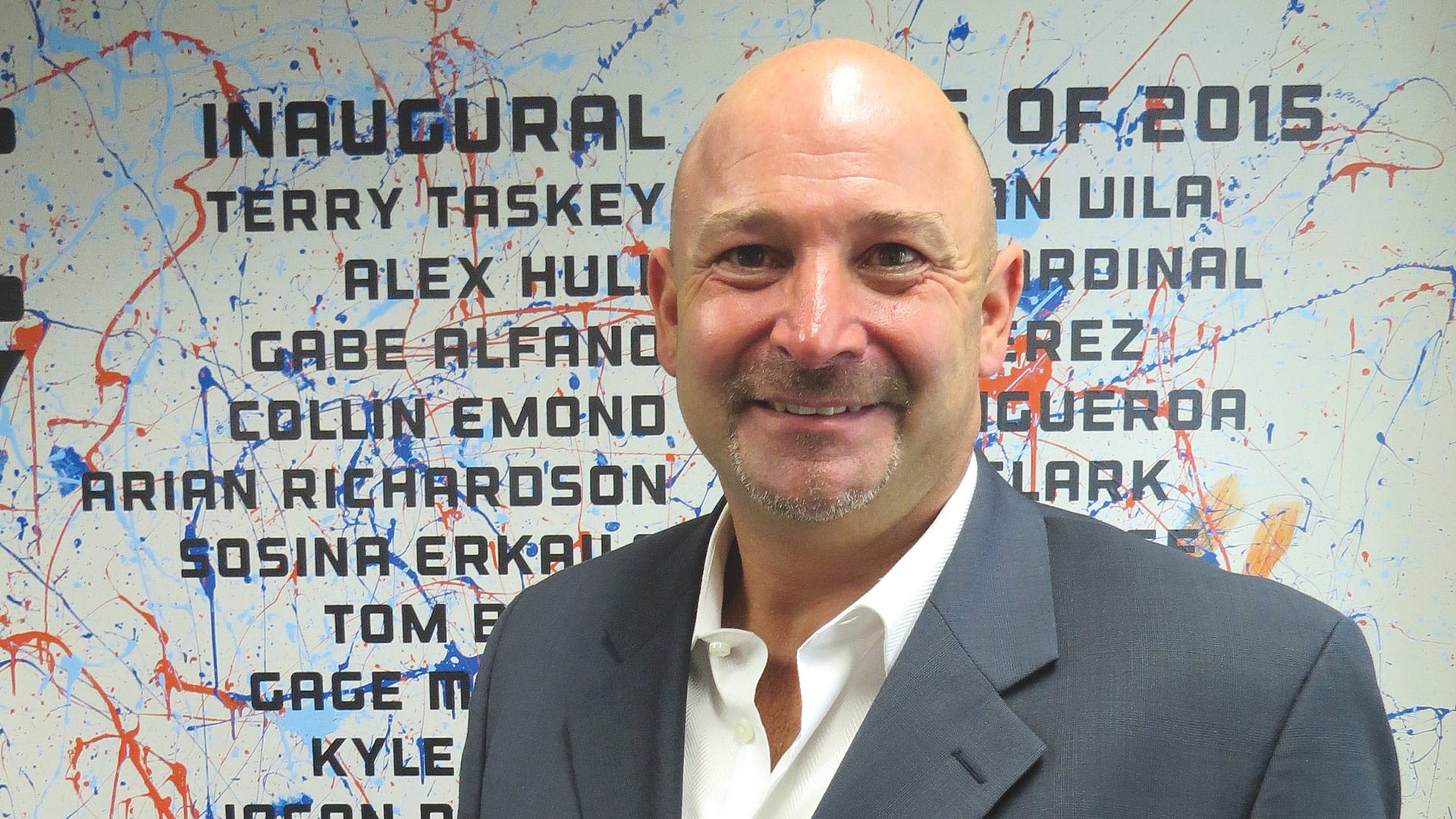
Chuck Breidenbach says the term ‘de-malling’ — or the verb ‘de-mall’ — while still not officially in the dictionary, has been part of the business lexicon for quite some time now.

That’s because, ever since they started building large, enclosed shopping malls more than 50 years ago, some have occasionally failed and had to be repurposed. This region has witnessed the phenomenon a few times, starting with the so-called ‘dead mall’ in Hadley, which went silent more than 30 years ago, and the Fairfield Mall in Chicopee, which succumbed at the start of this century.

But the pace of de-malling has picked up in recent years, as everyone knows, thanks to Amazon and other online retailers, as well as changing shopping habits, especially among the younger generations. And with those trends, old shopping malls have found new lives as everything from homeless shelters to apartment complexes to mixed-use facilities blending residential, retail, and entertainment elements.

Which brings us to the Eastfield Mall in Springfield, near the border with Wilbraham. The facility is historic, sort of, because it is the first enclosed mall in the region, opened in the mid-’60s. But it is also typical of recent trends, because most all of its big box stores — Sears, JCPenney, and Macy’s — have closed, leaving hundreds of thousands of square feet of vacant retail space looking for a new purpose.

Finding one has been Breidenbach’s day job (or one of them) for some time now, in his role as managing director of MDC Retail Properties Group, a division of New Jersey-based Mountain Development Group, which has owned the mall since 1998.

Mountain Development recently hired the real-estate brokerage firm Cushman and Wakefield to market a joint-venture partnership opportunity for the property’s mixed-use development. The solution taking shape on the drawing board — a work in progress, to be sure — is called Eastfield Commons, a $200 million, mixed-use development that Breidenbach likes to call a “community within a community.”

That’s because it will be just that, a community, a place where — theoretically, but also realistically — if all goes as planned, someone can live, work, shop, eat, take their children to daycare, go to the gym, see a movie, and more, all while walking a few hundred yards at most.

“You want to develop this as a tightly knit, walkable community,” he explained, adding that just what shape this community will take remains to be seen.

At many converted malls, the inclination is to go vertical, with multi-story developments. But at Eastfield, the tact may well be to go horizontal, with one or two levels.

The concept plan taking shape (see rendering on page 8) calls for 450,000 to 500,000 square feet of commercial space (remodeled and new construction) and 23 residential buildings with 12 units each (276 total units). The cinemas will remain, as will the existing food court.

“The idea is to open it up and take it from an enclosed mall to an open-air concept with a lot of public space, a lot of green space … very much the opposite of what you get in an enclosed mall,” he said, adding that this has been the trend nationally, by and large.

“Our vision is to put in a number of restaurants of different types and price points so people have their choice,” he went on. “And to also have some specialty retail, a mix of national and local, so we can give this center its own local flair.”

Flair of any kind has been a missing ingredient at the sprawling site off Boston Road, but as the art and science of mall conversion continues to mature — and Springfield continues its economic recovery — there is considerable optimism that Eastfield can do what it did 50 years ago and get the region buzzing about something new and different.

“The idea is to open it up and take it from an enclosed mall to an open-air concept with a lot of public space, a lot of green space … very much the opposite of what you get in an enclosed mall.”

For this issue, BusinessWest talked at length with Breidenbach about mall redevelopment in general, and repurposing Eastfield in particular. He noted that, with these projects, the market will dictate what can be done, but imaginative, outside-the-box — or in this case, outside-the-big-box — thinking is always needed.

Setting Sale

Breidenbach has had a long career in retail — long enough to have seen malls come to what amounts to full circle, meaning from being in demand to being in serious decline.

“I’ve seen a lot of things come and go; I’ve lived through the golden years of shopping centers, when you couldn’t put them up fast enough,” he told BusinessWest. “And now, we’re in the gray years of shopping centers, where you can’t redevelop or convert them into something else fast enough.”

The latest cycle — of conversion, or de-malling — began early in this century, he went on, adding that, as was noted earlier, Fairfield Mall, now the site of a Home Depot and other retail outlets, was part of that early wave.

But the pace of conversion really picked up roughly a decade ago, he said, as the Great Recession, coupled with the emergence of online retailers and some changing shopping patterns, took a huge toll on traditional retailers, a trend that continues today.

“There was a change in generations,” he explained. “The Baby Boom generation was and still is, in many ways, a very shopping-oriented culture. The Millennials and Generation-X folks are not.”

Some facilities — Breidenbach calls them super-regional malls, or fortress malls (the Holyoke Mall is one of them) — have been more resilient to the forces of change, because of sheer volume of stores, location (the Holyoke Mall certainly has that), and other factors.

“Holyoke has multiple levels, multiple anchors, parking decks … it’s made to do a massive amount of business,” he explained. “And retailers have pulled back into those fortress malls really as a means of protection.”

Meanwhile, those same retailers are leaving smaller facilities such as Eastfield, he went on, adding that the handwriting was pretty much on the wall for many of these malls years ago. And major real-estate companies, such as the Rouse Co., which developed and owned Eastfield for many years, saw that handwriting and sold off many of those properties.

Today, Eastfield’s huge parking lots fronting Boston Road are barren wastelands. Cars, and not many of them, are clustered near one of the main entrances where a few retailers still do business, such as Old Navy, the 99 Restaurant, O’Donnell’s Restaurant, and others.

Changing this landscape is an involved process, said Breidenbach, adding that, when it comes to how malls are converted these days, it’s generally a function of what the market in question wants, needs, and will support. In other words, while there are models that be studied and perhaps borrowed from, each property is unique, and so is its conversion.

Opened in 1967, Eastfield was the region’s first enclosed mall.

Opened in 1967, Eastfield was the region’s first enclosed mall. Today, it is part of an ongoing trend that is seeing these facilities put to new and imaginative uses.

“Your market studies will lead you to specific strategies and different amounts of space devoted to different types of uses,” he explained. “Those studies will determine how much you need for multi-family rental, multi-family condominium-style properties, retail uses, restaurant uses, entertainment uses, personal services, medical uses, health and fitness — it all depends on what the market will bear, what’s missing in the area, and what people are leaving the area to try and find because they’re dissatisfied with what they get, or it’s not being supplied.

“We have to follow the numbers very closely,” he went on, adding that market studies are followed up with surveys of various constituencies (including residents, small-business owners, and restaurateurs) in the area in question asking people what they want to see and what they’ll come to that location for.

At Eastfield, the emerging solution is a what Breidenbach calls a ‘live, work, play’ atmosphere, one that is seemingly internet-resistant.

This rendering shows the proposed components of Eastfield Commons.

This rendering shows the proposed components of Eastfield Commons.

In other words, one can’t live on the internet, or eat a meal there, or have their haircut there, or take dance lessons there.

And that’s the general idea as one goes about repurposing a mall, he went on, adding that the goal is to create a destination that will hopefully appeal to all generations, but especially those who seem to like this model — empty-nesters and the younger audiences that are less inclined to shop than their parents or grandparents.

“These younger generations would much rather pay for an experience than an expensive pair of jeans,” said Breidenbach, adding that ‘experience’ is a broad term that covers everything from a movie to a meal out to laser tag.

And these sentiments are reflected in some of the statistics relayed to attendees at the latest Shopping Center Convention in Las Vegas, a massive gathering Breidenbach has attended religiously for decades now.

“We heard that restaurant sales in the U.S. had surpassed grocery stores for the first time in history,” he said. “That means more people are eating out — they’re spending their time and money in that direction, as opposed to eating at home and then buying things.”

The Shopping Center Convention, staged annually in May, has seen discussion gravitate in recent years toward the internet and, more specifically, how to survive it, with a big focus being on just what to do with traditional malls, like Eastfield, that have been marginalized (Breidenbach’s word) by the fortress malls and online shopping.

Mixed-use developments — vertical and horizontal alike — have become the answer in many cases, with individual components varying, as stated earlier, with identified need and demand.

Breidenbach believes there will be a need for housing at that site, particularly the multi-family variety, because there haven’t been any new developments of that type in that area in decades, and there is apparent need for such a product.

“We see a huge a huge opportunity there for up-do-date multi-family housing,” he told BusinessWest. “And we also see a need for up-to-date, current retail space, meaning junior anchors, stores up to 20,000 to 25,000 square feet; this is an opportunity to think differently.”

Registering Results

Or to think outside the box — the big box, he said in conclusion.

Such thinking is necessary at Eastfield, a once-vibrant shopping area that has become part of an ongoing trend in this country — one that is seeing the enclosed shopping mall turned into a relative ghost town.

Now, Eastfield wants to be part of another trend — bringing new life to these deserted or nearly deserted areas.

If things go as planned, a property that made some history a half-century ago can make some more.

George O’Brien can be reached at [email protected]
Banking and Financial Services

Life Goals

Gary Thomas

Gary Thomas says a diversified portfolio of investments is always a good idea, with a mix of high growth potential and stable returns.

In an ever-changing world — one in which career trends, technology, and, yes, financial markets have a way of shifting — it can be daunting to craft an investment strategy. Gary Thomas, president of the Wealth Technology Group, relishes the chance to help clients do just that, by focusing on the big picture. His job isn’t just financial planning, he says, but life planning — at least, as much as one can plan for the unexpected turns of life.

It can be daunting, Gary Thomas said, to plan for the future when no one knows what the future will look like.

“As long as there are innovators in this country, there’s going to be change, and that change is going to create disruption. And we’ve seen it already in the jobs that aren’t there that were there 20 years ago,” he said.

That’s not a new trend, of course. “We don’t even know what we want until we see it,” Thomas went on. “Henry Ford once said that, if he’d asked his consumers what they wanted, they would have said ‘faster horses.’ You just don’t know what you want until you get introduced to an idea. You always think things will be the same as they are in this little snapshot of life. You want to hang on to the past, but technology is going to be changing. And we can’t stop that.”

That’s the definition of progress, and that’s good for investment markets, which — despite their short-term fluctuations — have always grown over the long term, said Thomas, president of the Wealth Technology Group. “When the economy grows, everybody benefits sooner or later, but it doesn’t always go in a straight line.”

“Henry Ford once said that, if he’d asked his consumers what they wanted, they would have said ‘faster horses.'”

He shared these thoughts by way of explaining why it’s important for individuals planning for retirement — or just looking to save for college and other expenses — to diversify their investment portfolios. And, indeed, Wealth Technology Group helps clients preserve assets, lower their tax burden, and pass legacies to the next generation through a broad mix of tools, including mutual funds, managed accounts, real-estate investment trusts, energy shares, annuities, and life-insurance options — with the goal of creating financial stability in what can be a volatile world.

That means trusting the long-term record of the stock market, he went on, but also making sure to place money in vehicles with a more predictable return.

“You have to have a philosophy where you basically pay yourself first,” he said. “I almost don’t care where you put it, as long as you put it away. If you’re far enough away from retirement, you should have a pretty diversified approach in equities, but as you get close to retirement, you need to make sure you have some secure money, for when markets go down.”

In other words, investors have to be both educated and flexible — especially at a time when Americans are living longer, meaning they have to make their money last longer.

“We’re in a different situation than our parents or grandparents were. It takes a more creative approach, it takes education, and it takes some hand holding, too,” Thomas said, bringing the conversation back to the role his firm plays. He cited studies suggesting that individuals with a consistent financial advisor tend to do as much as 2% better per year than those that don’t, even accounting for fees.

“Part of it is behavioral science — and having somebody to call,” he explained. “Typically, people make mistakes by moving around too much. You’ve got to have a balanced approach, where you have some secure money and some growth-oriented money for your older years.”

Thomas doesn’t only help his clients navigate this landscape in his Westfield office. He’s been active over the years delivering workshops, seminars, and classroom lectures on financial topics, so he knows the value of educating people.

“In some ways, people are more torn these days, because trying to sort out all that information on the internet is like trying to take a sip through a firehose,” he told BusinessWest. “Everybody’s got an agenda — the posts you see on websites are often promoted content, and it’s hard to distinguish. Even if they’re not, they still represent one person’s philosophy.”

The goal, he added, is for clients to develop their own philosophy.

“Money and financial security mean different things to different people, and it plays a big role in our life whether we want to admit it or not,” he said. “At the same time, there’s just too much information out there — we’re bombarded with it — and there’s a big difference between information and knowledge, or between information and wisdom.”

So, while some investors get wrapped up in “the latest shiny thing,” like Bitcoin or gold, he said, it’s more important to save consistently.

“You can make a lot of money from being average if you don’t switch things around too much, because the market’s averages are pretty darn good,” he said. “But you also have to have that nest egg because when things go down.”

Growing Need

When Thomas launched his business around 1991, financial planning was a field on the cusp of significant evolution.

“Before that, everybody just had a stockbroker, they had an insurance agent, they had an accountant, but there wasn’t much in the financial-planning world. So, basically, we started the company, and it was more estate planning to begin with, but it just sort of evolved over time into money management and financial planning, because that’s where the need was.”

For years, he built the company’s reputation through a number of call-in radio programs around Western Mass., an approach that appealed to listeners hungry for information about financial strategies. “People were looking for straight information and not a sales job. That’s been our philosophy ever since.”

It’s a philosophy that’s also middle-of-the-road when it comes to investment risk, he added.

“If you come from an insurance background, you tend to be very conservative. If you come from a stock background, you tend to be maybe more aggressive. Well, I come from a legal background, and lawyers like to question everything. So it also made me a little skeptical about some of the products. So, basically, we took a more conservative approach to money management — not ultra-conservative, but middle of the road.”

One key message, which has become a company motto of sorts, is “it’s not what you make, it’s what you keep” — which is why he helps clients navigate tax-related pitfalls as well.

“I take more of a holistic approach because of my background; I have a master’s in tax law. And what good is it if you make a ton of money but you have to pay 40% of it back in taxes? So we try to use strategies to avoid that. It’s a total approach of, where are you going to be down the road? If you take money out, is it going to be taxable? Are you going to have some tax-free money?”

While taking a conservative approach, he remains confident in the stock market, but understands that it can be scary to obsess over its fluctuations on a day-to-day basis — and that investors need to rely on other sources for guaranteed returns.

“I take more of a holistic approach because of my background; I have a master’s in tax law. And what good is it if you make a ton of money but you have to pay 40% of it back in taxes? So we try to use strategies to avoid that. It’s a total approach of, where are you going to be down the road? If you take money out, is it going to be taxable? Are you going to have some tax-free money?”

“I’ve been around long enough to see that markets don’t always go up,” he explained, “and when the markets are down, you need a conservative piece someplace to take money from when you need it.”

That said, Thomas added, “this country’s always going to grow. No matter what happens, no matter what financial crisis there is, we’re always looking for new ideas and new ways to grow. And that’s what the market does. You think of the major companies today that are big names, which were not in existence 25 years ago, like Amazon and Google. And Apple was almost out of business.”

He shares these strategies of diversified investment with mainly clients approaching their retirement years, but also many young families that are trying to figure out how they’ll pay for college for their kids, at a time when the average sticker price for four years of education is around $200,000. “It’s a real challenge today,” he noted.

In short, there are many reasons why people walk through his door.

“We do some estate planning, too, but it’s primarily holistic, complete financial planning — helping to find the right portfolio and the right financial tools for each individual, and then we actively manage that,” he explained. “It’s not just about picking an investment. It’s got to be right for you.”

As an independent financial-services firm, the Wealth Technology Group isn’t tied to any single product, and as an accredited investment fiduciary, he’s required to keep the client’s interests at the fore.

“If someone goes into a store, and the owner says, ‘that suit looks good on you,’ maybe it does — but maybe that’s just the suit they want to push that day,” he explained by way of analogy. Fiduciary responsibility simply means the firm considers more than what’s suitable for a client, but what would best meet his or her needs. “It’s not just going to benefit me as a financial advisor, but benefit you as the owner of it.”

Getting the Word Out

Long after his radio talk-show days, Thomas still enjoys conducting seminars and workshops that promote his work in more effective ways than a short radio or TV ad. They’re a means not only to help people understand the compexities of financial planning, but to get the word out that the Wealth Technology Group helps clients from all walks of life, not just high-net-worth individuals, as some firms do.

And when he shares his perspectives, both through seminars and one-on-one, he emphasizes that financial planning is really about life planning — and people are not always emotionally prepared for the changes that retirement will bring.

“Retirement brings a change in lifestyle,” he said. “It’s like you’re going 60 miles an hour, then you retire — and it can be hard to adjust when you don’t have eight hours a day filled up. If your purpose in life was to be a journalist and you were a journalist for 35 years and all of a sudden someone told you you weren’t valued as a journalist anymore, you’d better have a purpose beyond that. So we encourage people to have interests that really excite them beyond work.”

In fact, people don’t expect to be impacted by that lifestyle change, as well as the social withdrawal that sometimes comes with it, as much as they worry about money.

“I’ve had clients in the past that have come in and said, ‘I’m only 200 more Mondays away from retirement,’ and the next time I see them, they say, ‘only 150 more Mondays.’ And I say, ‘you know, what are you going to do the day you walk out the door?’”

Sometimes, the sudden change brings about problems with drinking or eating or their marriage, he went on, noting that some of the first astronauts who went to the moon came back and ran into personal issues once they were past that exciting, challenging phase of their lives.

But you don’t have to go to the moon to feel loss, he went on, and Thomas continues to help people plan for all stages of life — not just financially, but holistically. Because money matters, but it’s not everything.

“There’s got to be something beyond that ‘200 more Mondays.’ So that’s what we encourage people to think about,” he said. “Join a senior center, do something, get involved. And don’t concentrate too much on money. That’s our job.”

Joseph Bednar can be reached at [email protected]
Autos

Cruise Control

As the 2019 models continue to roll into area showrooms, area auto dealers report that sales remain brisk, at something approximating the levels of 2017, which was a very robust year for the industry. Meanwhile, a host of trends have continued or accelerated, including torrid sales of SUVs and trucks, a high volume of used-car transactions, and a heavy emphasis on improving the overall consumer experience.

Jeb Balise held his hand up with his thumb and forefinger barely a half-inch apart.

And then, for emphasis, he brought them even closer together.

“They’re down about that much,” Balise, president of Balise Motor Sales, told BusinessWest, referring to new car sales in 2018 (which still has a few months left, obviously) compared to a year ago.

Essentially, sales are flat, which, as Balise and others told us back at the start of this year, around President’s Day sales time, is a really good thing, because auto sales — an almost always accurate barometer when it comes to the national economy — have been rock solid the past several years.

“They’re just about the same as last year — down a tiny, tiny bit,” said Balise, adding that there is just that much less pent-up demand (resulting from cars, like their owners, living longer lives these days) this year than the past few. But there are still a number of other factors driving steady sales, including a still-booming economy, record-low unemployment, quality vehicles across the board, attractive incentives from the manufacturers, and more.

So sales are still humming, and Carla Cosenzi, president of the Tommy Car Auto Group, believes that at her four dealerships, sales are actually up from a year ago.

“We’re seeing an increase in 2018 over last year, and 2017 was a very good year for us,” she said, echoing Balise’s comments. “It’s not a significant increase, but an increase nonetheless, and 2017 was a really good year.”

Overall, 2018 has been a year when recent trends in the auto market have maintained their speed or even accelerated slightly. These include red hot used-car sales; white-hot SUV and truck sales (especially the former); growing interest in electric and hybrid vehicles, although they still comprise a very small segment of the market; and new levels of convenience for the consumer.

“We’re seeing an increase in 2018 over last year, and 2017 was a very good year for us. It’s not a significant increase, but an increase nonetheless, and 2017 was a really good year.”

Peter Wirth, co-owner of Mercedes-Benz of Springfield, which opened just over a year ago, says he’s seen all or most of the above at his dealership, a facility that has met or exceeded the lofty goals set for its first year of operation.

And that’s especially true in an often-overlooked but quite important segment of this business — the service department.

There are many qualitative measures for this, he said, especially the fact that the dealership recently hired its 12th technician, tripling the number it started with, for the 14-bay facility.

This surge in business in the service department stems from a variety of factors, from how long Mercedes models stay on the road to the fact that the next-closest dealership is in Hartford, said Wirth, adding that demand has risen steadily since the ceremonial grand-opening ribbon was cut — a clear sign that the new dealership has made its presence known.

“The floodgates opened, and in a good way,” he noted. “We’ve been at capacity for the next few days in the service department since the day we opened, and way we’re keeping up is by adding capacity so we can keep it at a reasonable timeframe for customers.”

“It’s been a 100% success story — we’ve never had to send a technician home early; we’ve never run out of work,” he went on. “Not just in the amount of work we’re getting, but also in the team we were able to build.”

For this issue and its focus on auto sales, BusinessWest talked with several area dealers to gauge the local market and the forces, well, driving it. Cars aren’t selling themselves, obviously, but in many respects this industry is on cruise control.

Pedal to the Metal

Those who spoke with BusinessWest said that, these days, the new models arrive at the dealership almost year round, unlike years ago, when all or most would be revealed in the early fall, to considerable fanfare.

Still, many new models do make their debuts as the leaves change colors, and thus this is a good time to take stock — literally and figuratively — of what’s happening at area dealerships and within this all-important sector.

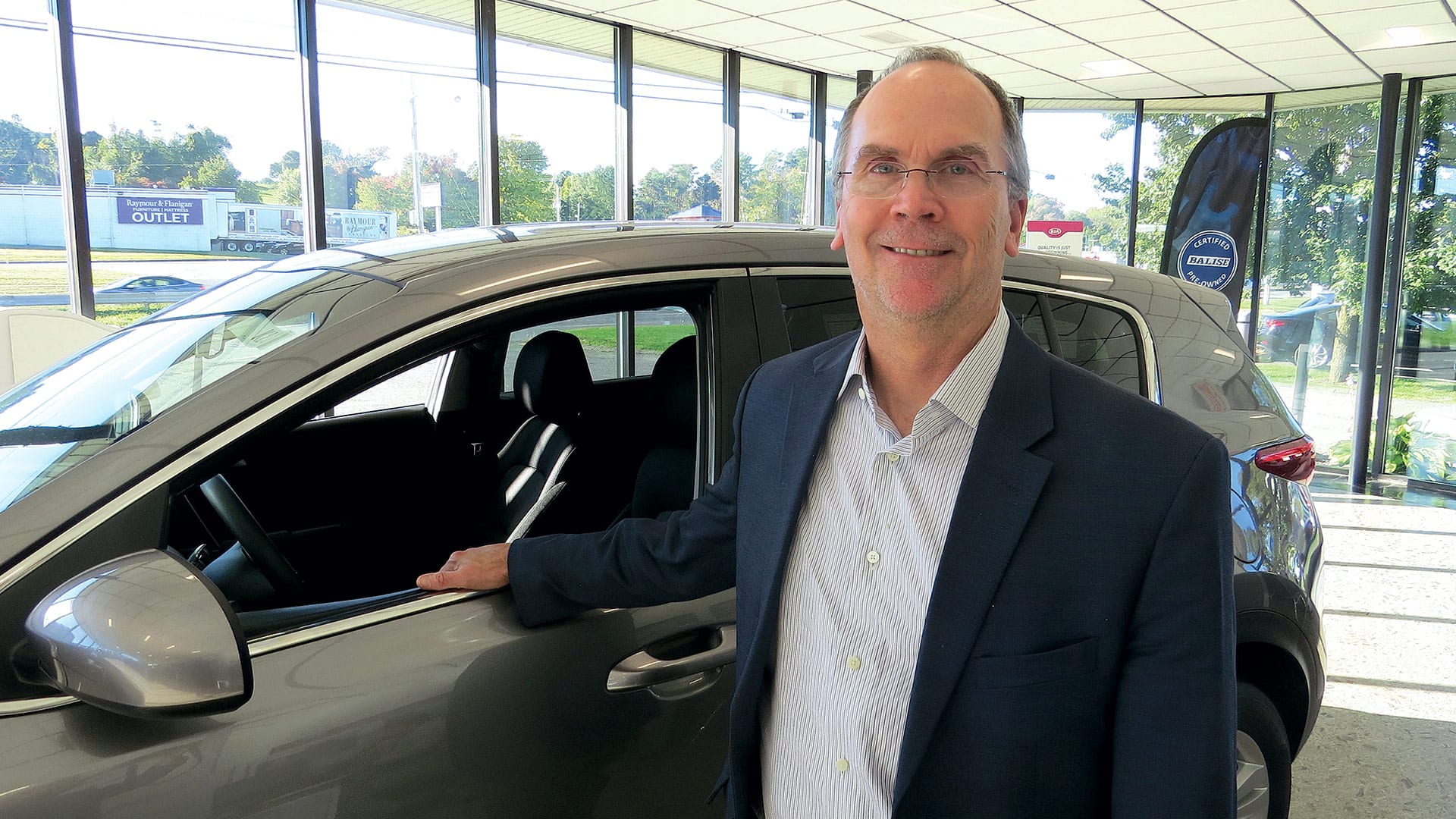
Jeb Balise, seen here at his company’s Kia dealership on Riverdale Street

Jeb Balise, seen here at his company’s Kia dealership on Riverdale Street, says new-car sales are down just slightly from 2017, but still at a very high volume.

First and foremost, said Balise, this remains a buyer’s market in most all respects, even though demand remains high, especially for those trucks and SUVs. That’s because supply is also high as the manufacturers continue to make product and dealers try to move it — usually with good success.

“All of the manufacturers are producing plenty of cars, and demand is off just slightly from a year ago — just enough to put the consumer in the driver’s seat, if you will,” he told BusinessWest. “Incentives have never been better — even for SUVs.

“It’s not because there isn’t demand,” he went on, referring specifically to the SUV segment of the market. “It’s more because all the manufacturers have them now, and they’re trying to grab their piece of the pie.”

The seismic shift (another industry term) to SUVs has been ongoing for quite some time now, but it moved to an even higher gear in 2018.

Indeed, all those we spoke with said sales of SUVs now exceed those of cars (sedans) for almost all models they sell. Overall, Balise said, truck and SUV sales now account for roughly 60% of all vehicles sold and leased.

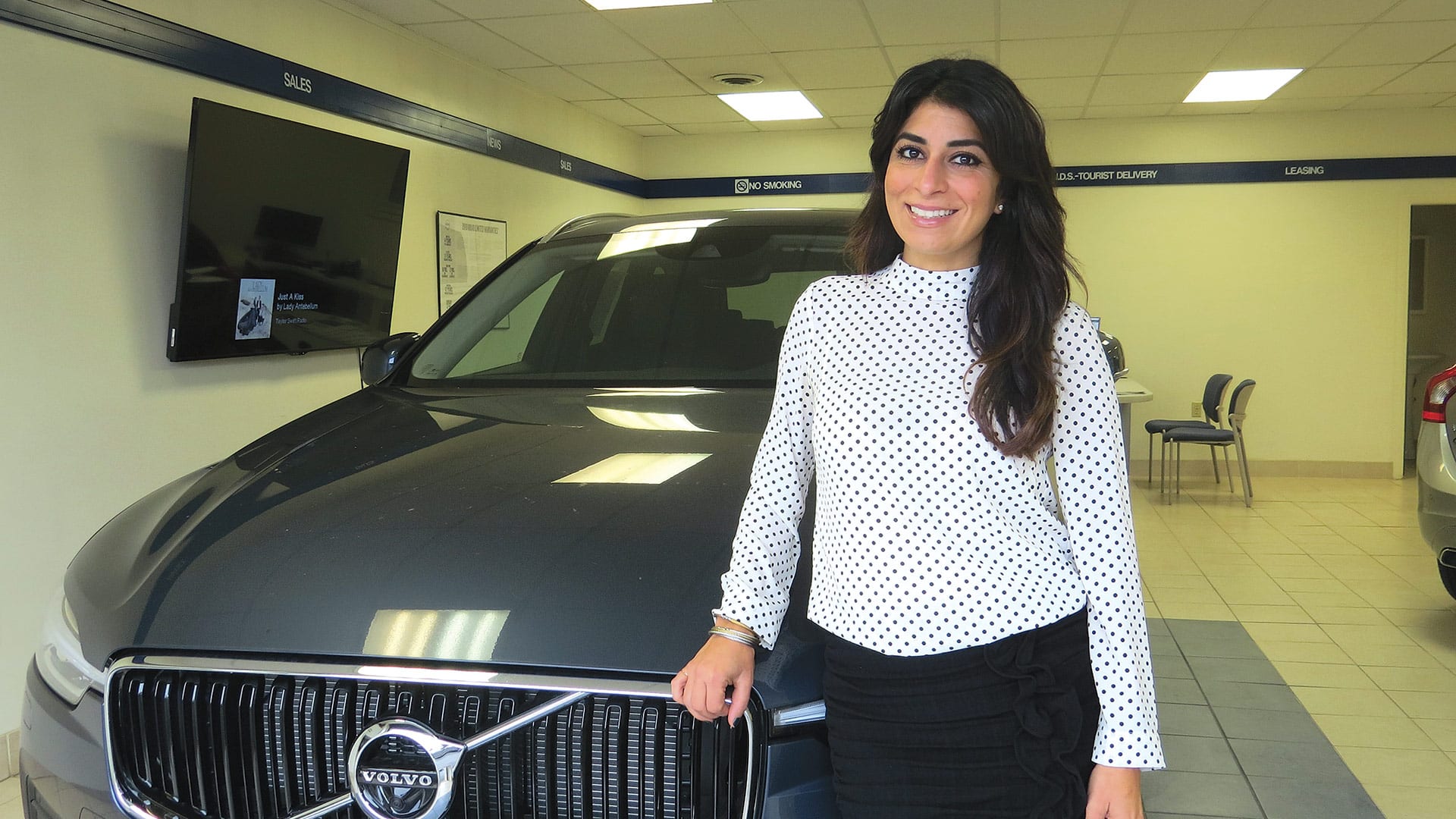
And this trend toward SUVs extends to some manufacturers renowned for their cars, such as Volkswagen and Volvo, said Cozenzi. Indeed, as she stood in the Volvo dealership recently acquired by the TommyCar Auto Group, she was surrounded by SUVs — small, medium, and large — on the small showroom floor.

They’re all selling, at Volvo and other dealerships, and especially the smaller SUVs, said Cosenzi, adding that they appeal to drivers of all ages for reasons ranging from accessibility (they’re easier to get in and out of, for most people, anyway) to decent gas mileage.

“The smaller SUVs, like the Rogue [Nissan] and the Tiguan [Volkswagen], continue to dominate,” she said. “The Rogue is the number-one-selling vehicle at the Nissan store, and it’s been that way for a few years now.”

Even Mercedes is now selling and leasing more SUVs than cars, said Wirth, adding that the company passed that milestone in 2017, and the arrow continues to move upward.

Still, there are plenty of sedans to be sold, said all those we spoke with, noting that, overall, car makers are turning out quality, easy-to-maintain products across the board, giving consumers plenty of often-hard choices to make, thus motivating the manufacturers to offer solid incentives.

And soon there will be an intriguing new choice, said Wirth, noting the arrival — probably by early next year — of the Mercedes A class, an entry-level luxury vehicle, complete with some different bells and whistles, that should bring that famous nameplate onto more driveways.

“This opens us up to a whole new customer,” he said. “You might have someone attracted to this car not because of the Mercedes-Benz design or the Mercedes-Benz safety or the brand image; it might be just because of the technology in the car. You can say, ‘hey, Mercedes, I’m cold,’ and the temperature will come up, or ‘hey, Mercedes, I’m hungry,’ and it will list the restaurants. And this is in the car that represents the entry point, not the $100,000 model.”

Staging a Coupe

Looking back on his first year of doing business in the Pioneer Valley, Peter Wirth, who previously managed a Mercedes dealership on Long Island, said this past 12 months have certainly been a learning experience.

Among the things he’s learned is that this market is somewhat more conservative than the one he left — a trait that shows up in higher volumes of used-car sales as compared to new-car transactions and more sales than leases — and also generally less aware that Mercedes is now more affordable and therefore more attainable than it has been historically because of the introduction of entry-level models.

Peter Wirth, seen here with members of the service team at Mercedes-Benz of Springfield

Peter Wirth, seen here with members of the service team at Mercedes-Benz of Springfield, says the company has exceeded all the goals it set for its first year of operation — especially in service.

“We still have some work to do on the matter of affordability,” he told BusinessWest, adding that perceptions about the Mercedes brand being beyond one’s reach remain despite more than ample evidence to the contrary. And that goes across the board, for passenger and commercial vehicles alike.

But he’s hoping that area residents will follow the lead of Jeff Bezos, who recently ordered 20,000 Sprinters (a cargo van made by Mercedes) for Amazon.

“I’m sure he did the math before he placed that order — I’m sure he sat down and looked at the life-cycle cost, the reliability, the down time, and everything else. He’s a pretty clever guy, and the fact that they committed to us says something.”

To Wirth, it says people need to look beyond the sticker price on the windshield (and Mercedes is competitive in that regard as well with many models) and look at the other ingredients that go into the equation, such as dependability, maintenance costs, convenience, and the sum of all these parts.

“We’ve been having the conversations regarding affordability, but also about how this is an amazing value proposition,” he noted. “We’re still working on it, but we’ve made great headway.”

Something Wirth didn’t need to learn, because he knew it already, is how important customer service and providing convenience are these days, especially to time-strapped, increasingly demanding customers.

“Time is money,” he said, adding that the dealership works to save customers some of that precious commodity in every way it can, from picking up a car bound for the service department at one’s home to getting them in and out of that service waiting room as soon as possible.

Cosenzi agreed, and said the TommyCar Auto Group has responded with something called Click, Drive, Buy, a new program that enables someone to buy or lease a vehicle almost entirely from home and on the internet.

“Especially at our Volkswagen store, we’re seeing a lot of our customers complete the entire transaction online and just come into the dealership to take delivery of the vehicle,” she explained. “I don’t think we anticipated that it would be as popular as it is, but people enjoy the convenience; they like buying a car this way. And it’s been popular with people of all ages.”

Gearing Up

As he brought his forefinger ever closer to his thumb while comparing sales this year to last, Balise emphasized, again, that anything at or near last year’s mark is quite good.

And while he didn’t want to make too many projections about 2019, because things can change quickly, as history shows, he implied that he may well be doing the same thing with his fingers this time next year.

That’s because the basic laws of supply and demand — not to mention an economy still in high gear — should keep this industry operating in what amounts to the status quo.

And that’s a high-octane sales climate.

George O’Brien can be reached at [email protected]
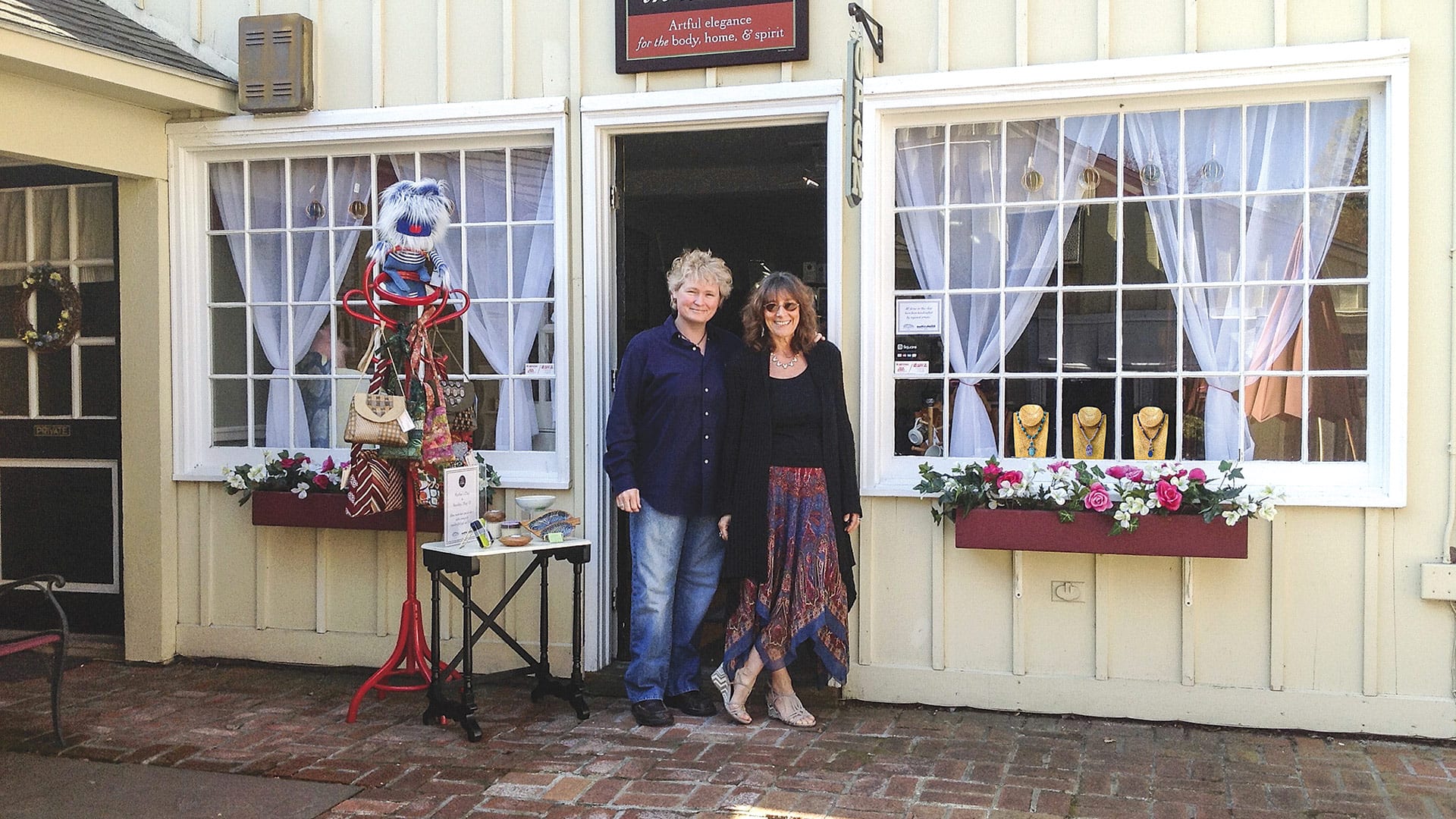
Business of Aging

One Step at a Time

Scenes like this one — from the 20th Rays of Hope Walk five years ago — are played out each October in Forest Park.

Scenes like this one — from the 20th Rays of Hope Walk five years ago — are played out each October in Forest Park.

Lucy Giuggio Carvalho is a tough person to say no to, as Kathy Tobin found out one afternoon 25 years ago.

“I was a health reporter for WGGB, and I was in the lobby of Baystate Medical Center to do a story,” Tobin told BusinessWest. “And this little petite thing comes walking across the lobby, points at me, and says, ‘I had a dream about you, and you’re going to help me.’ And that’s how I met Lucy.”

Carvalho — then a nurse at Baystate — had been diagnosed with breast cancer some time earlier, and, inspired by an AIDS fund-raising walk she had recently participated in, had a vision to bring something like that to Western Mass. to raise money and awareness around the cause of breast-cancer research and treatment.

A quarter-century later, it’s safe to say that Carvalho’s creation — known as the Rays of Hope Walk & Run Toward the Cure of Breast Cancer — has done just that, and a whole lot more.

As it turned out, Tobin did help her; WGGB became the media sponsor of the first Rays of Hope walk in 1994, and Tobin spearheaded a half-hour documentary special to bring attention to the cause.

“She had this overwhelming desire, not just to do this walk, but to change the way we treat breast cancer,” said Tobin, who has come full circle since then, now serving as director of Annual Giving and Events for Baystate Health, which has long overseen the Rays of Hope organization.

The first Rays of Hope event attracted some 500 walkers and raised $50,000. Today, it has raised more than $14.2 million and attracts about 24,000 walkers and runners each October. This year’s annual fundraiser, slated for Oct. 21, will once again step off from Temple Beth El on Dickinson Street in Springfield and wind through and around Forest Park.

As usual, all money raised remains local, administered by the Baystate Health Foundation to assist patients and their families affected by breast cancer. Funds support research, treatment, breast-health programs, outreach and education, and the purchase of state-of-the art equipment, as well as providing grants to various community programs throughout Western Mass. 

“Sometimes I can’t believe all that’s been accomplished,” Carvalho said. “I never would have believed we could raise the amount of money we raised; $14.2 million over the last 25 years is a lot of money, and we can do a lot of things with it — and we have. I’m really proud of Rays of Hope and all we’ve accomplished.”

It wouldn’t have happened, she added, without the continuing, loyal support from the community. “We’ve mostly accomplished what we have through individual walkers and local organizations that have supported Rays of Hope from the beginning. Most of the agencies that got involved in the early years are still involved, as well as the walkers; they come back year after year.”

Carvalho said she created Rays of Hope with a very specific vision.

“I wanted to help people that were going through breast-cancer treatment, to help them navigate the healthcare system,” she explained. “I’d found it difficult, and it was my motivation to make it easier for other people, seeing that I had such a hard time. And I wanted the money to stay local, too. That was really important for me.”

Beyond the critical funding, however, she has long recognized the importance of Rays of Hope as a bonding agent for individuals facing one of life’s most daunting challenges, and the people who love them.

Lucy Carvalho (left) and Kathy Tobin at the first Rays of Hope walk in 1994.

Lucy Carvalho (left) and Kathy Tobin at the first Rays of Hope walk in 1994.

“I think the event is very unique in that, when you’re there, it feels like there’s a big hug all around you, and that people really care about you. It’s just uplifting to be involved, and it’s something to look forward to, something that has become a tradition.”

Tobin also compared the event to a massive hug — one with a great deal of feeling behind it. “We have such a support system in place. It’s like a sorority — but I shouldn’t say sorority, because men are diagnosed, too. It’s just a network of people who care.”

Changing Times

Dr. Grace Makari-Judson has witnessed the evolution of Rays of Hope from a clinical standpoint; she was appointed medical director of Baystate’s breast program at the same time Carvalho was organizing her first walk.

“Lucy’s initial mission for Rays of Hope was not only helping breast-cancer research, but trying to provide coordinated care … a holistic approach,” Makari-Judson said — in other words, to make the journey easier for others than it was for her.

“Thinking back, it’s amazing how much we’ve been able to do with addressing those goals,” Makari-Judson went on. “Twenty-five years ago, women were having mammograms in the hospital, sharing the same waiting room with people who needed X-rays or had pneumonia. Biopsies were done in the operating room, and women got unnecessary scars.

“Today,” she went on, “we have a dedicated breast center where women go for mammograms and other breast imaging. We have needle core biopsy, which is done at the breast center and is a less invasive approach, so women go home with a Band-Aid instead of a scar. That’s the minimally invasive approach started in the mid-’90s and has since become the standard of care. It’s the whole philosophy of less is more.”

Other examples are sentinel node biopsy, introduced at Baystate in 1996, and radiactive seed localization, started in 2010. Both are minimally invasive procedures that Baystate pioneered in the region that have since become national standards of care, Makari-Judson said — and both benefited from Rays of Hope funding.

Meanwhile, Carvalho’s vision of more coordinated care has become reality as well, the doctor said.

Dr. Grace Makari-Judson

Dr. Grace Makari-Judson

“Twenty-five years ago, physicians were seeing patients all in a row — the surgeon, then the medical oncologist, then a radiation oncologist,” she explained. “And sometimes that would leave women with conflicting information. In today’s approach, we have something called a multi-disciplinary breast conference, where we get all the experts together to review radiology images and pathologist slides and come to a consensus recommendation. That has had a positive impact on care and really enhances our mission.”

It’s a model, she said, that started to coalesce around the time Rays of Hope was being launched, and it eventually spread to all Baystate hospitals and eventually became the model of care regionally and nationally.

“Everything about cancer has come such a long way,” Tobin agreed. “Women don’t have to wait days for biopsy results; they don’t necessarily have to have drastic surgeries. Everything about treatment has changed.”

“Twenty-five years ago, women were having mammograms in the hospital, sharing the same waiting room with people who needed X-rays or had pneumonia. Biopsies were done in the operating room, and women got unnecessary scars.”

Then there’s the Rays of Hope Center for Breast Cancer Research, launched in 2011 with the help of a $1.5 million Rays of Hope grant. The center brings together a group of scientists with diverse areas of expertise who work toward reducing the impact of breast cancer — for instance, understanding how obesity, diabetes, and environmental exposures interact to alter breast-cancer risk and prognosis.

It’s important work, and not something to be taken for granted, Tobin said, adding that many events like Rays of Hope eventually peter out — Avon’s national fundraiser for breast cancer isn’t continuing this year, for example — and such events require a lot of work and diligence to thrive and grow.

“Sometimes the fundraising becomes secondary,” she added. “After a while, people want to be a part of it, but they don’t remember the fundraising piece, and that’s critical to our survival. We’re trying to drive home the point that, yes, we need your involvement, but we also need your fundraising, because that’s what makes the programs happen.”

And it’s not just Baystate programs that benefit, Tobin added. Other local organizations, like Cancer House of Hope, also rely on support from Rays of Hope.

“We’re always getting new people involved,” Carvalho said. “Unfortunately, it’s often because they have breast cancer or someone close to them has breast cancer — but that passion keeps us going, and keeps us a vibrant organization. I think we’re always going to walk until there’s a cure, and we don’t need to walk anymore.”

Personal Impact

Denise Jordan was first introduced to Rays of Hope by her late friend, Tracy Whitley, and she joined its advisory board in 2008. A decade later, she’s chairing the 25th interation of the event, dedicating her service to Whitley, who succumbed to the disease last year.

Jordan calls herself an ambassador for Rays of Hope, making public and media appearances and encouraging people to take part in the Oct. 21 walk. She hasn’t found it to be a hard sell.

“I think, as long as people are affected by breast cancer, there will always be a willingness to participate in an initiative whose main focus is finding a cure,” she told BusinessWest. “Also, unlike a lot of organizations, when you give money to Rays of Hope, you can actually say, ‘the money I gave went to this person or that person; I know that because all the money stays right here in the region.’”

During her time as chief of staff for the city of Springfield, Jordan helped establish Pink & Denim Days, when city employees took up that dress code in exchange for donations to Rays of Hope. “It was really an easy ask,” she said. “Folks were very enthusiastic.”

Rays of Hope has proven to be a meaningful event for both survivors and supporters, as well as an educational experience for all ages.

Rays of Hope has proven to be a meaningful event for both survivors and supporters, as well as an educational experience for all ages.

So was Jordan, when she was asked to chair the event this year, even though she had some reservations about the time commitment. But when she thought about her Whitley, and the way she not only battled cancer but became a strong advocate for survivors, it wasn’t a hard decision.

“There’s going to be some special things happening that day,” she said of this year’s walk. “I’m pushing to get more people involved. We’ve had participants in the past who have missed a couple walks, but, this being the 25th anniversary, we’re hoping to bring a lot of folks back to the walk.”

Tobin agreed. “We’re adding some exciting elements. We’re going to tell the story of the progress we’ve made and celebrate some joyous stories of beating the disease — and remember those we’ve lost. I think there will be some special moments.”

Having been active in the walk for 25 years, Tobin has lots of stories, but likes to recount one from the event’s first year. Her 4-year-old son attended and took in the speeches, and as he settled into his car seat for the ride home, he said, ‘I’m so glad I’m not a girl.’

“My feminist self practically slammed on the brakes,” she laughed. But when she asked why, “he said, ‘because I can never get breast cancer.’

“The earnestness of this little boy took my breath away,” she continued. “I realized in that moment the impact this walk was having, and could have, if someone that young understood the seriousness of breast cancer.”

The fact that he assumed it was a girl’s disease isn’t odd; many adults think the same thing, and Rays of Hope has created plenty of teaching moments around that misconception as well.

In short, it’s hard to overestimate the impact this 25-year tradition has had on breast-cancer treatment, research, awareness, education — not to mention the giant hug of support that so many women (and men) need.

“Lucy had certainly given us a gift,” Tobin said. “She had done something incredible in that parking lot that day, and $14.2 million later, we’ve seen a lot of profound moments.”

Added Carvalho, “there’s a spirit at Rays of Hope, and I don’t know exactly how it came to be, but it’s real, and it’s powerful, and it’s heartwarming. That’s what I’m proud of — how the community has come together to make a difference.”

Joseph Bednar can be reached at [email protected]

Community Spotlight

Community Spotlight

With projects like the convenience store on Shaker Road complete, East Longmeadow is anticipating progress

With projects like the convenience store on Shaker Road complete, East Longmeadow is anticipating progress on higher-profile developments, like the health complex at the Longmeadow line and a possible mixed-use project on Chestnut Street.

Denise Menard has witnessed plenty of growth in East Longmeadow’s Town Hall since becoming the community’s first town manager two years ago, from the creation of a seven-member Town Council to the creation of a Human Resources department, a new director of Finance and director of Planning and Community Development, and the establishment of a Board of Health overseen by a full-time director.

But she says the most important change in the city offices may be the ease with which new businesses to town can navigate the permitting process.

“I see myself as a business manager for the town — a business manager that has the authority to make the kinds of decisions that need to be made to streamline the process,” she said. “Just being here day to day, helping implement the priorities of the council and all these other things, is a real a plus for the community. And in the last two years, we’ve seen a lot.”

Take, for instance, the 18,000-square-foot medical office building at 250 North Main St. constructed by Associated Builders last year for Baystate Dental Group. The dental office occupies the first floor, and the second floor is being rented for medical and office space.

“That’s a great credit to the community; they just wanted to locate in East Longmeadow,” Menard said. “We’ve been told by regional economic-development groups that we are one of the hottest communities right now to try to locate businesses in, and that’s an awesome example.”

Another, more complex project in the health realm is a joint venture with the town of Longmeadow — a medical complex that will add to East Longmeadow Skilled Nursing Center at 305 Maple St., cross town lines, and provide benefits to both communities.

“We’ve been told by regional economic-development groups that we are one of the hottest communities right now to try to locate businesses in, and that’s an awesome example.”

The project includes four structures on a 20-acre site: a 50,000-square-foot medical office building in Longmeadow that will be occupied by Baystate Health; a two-story, 25,000-square-foot office building in East Longmeadow; and an assisted-living facility and expansion of an existing skilled-nursing facility run by Berkshire Health.

“It’s really moving along,” she said, adding that the buildings on the East Longmeadow side should be up by the spring. Meanwhile, the two towns have worked together to improve road infrastructure at the site. The project encompasses three intersections on Dwight Road — two in Longmeadow and one in East Longmeadow. Longmeadow is managing the road improvements, and East Longmeadow is receiving contributions from the nursing-home developer, which will pass through to Longmeadow to offset the cost of the street improvements.

“The road improvements have been painful to say the least, but it will be such a great improvement at the end of the day,” Menard said. “It’s so nice to have a joint venture with Longmeadow, and both sides are going to win with that. Longmeadow and I are good neighbors. The two town managers really work well together.”

Major projects like these are complemented by a number of other developments in town, a trend she says was boosted by the town’s change in government two years ago.

“I’ve had developers come in and say, ‘we waited because we wanted to see what the new charter was going to be like before we decided to come to East Longmeadow,’” she recalled. “So there was a change in the philosophy of people looking in from the outside, as to what they would like to see here, and I think they’re happy with what they see now with the new government.”

Setting Down Roots

Menard said East Longmeadow has a decent stock of developable land.

“We have industrial space, and we also have agricultural land, and we’re wondering what’s going to happen with that because farming is getting more difficult. But we want to be agriculture-friendly and hope to continue down that path.”

The new director of Planning and Community Development, Constance Brawders, has been taking the land stock into consideration as part of a master plan that’s in the early stages, Menard added.

“That master plan will focus on what residents here want,” she explained, adding that a series of public forums will focus on topics like recreation, traffic, and what kind of land-use mix residents want, balancing residential neighborhoods with the need for commercial and industrial investment.

East Longmeadow
at a Glance

Year Incorporated: 1894
Population: 15,720
Area: 13.0 square miles
County: Hampden
Residential Tax Rate: $20.94
Commercial Tax Rate: $20.94
Median Household Income: $62,680
Median Family Income: $70,571
Type of Government: Town Council, Town Manager
Largest Employers: Cartamundi; Lenox; Redstone Rehab & Nursing Center; East Longmeadow Skilled Nursing and Rehabilitation
* Latest information available

“It will take a little while, but it hasn’t been updated in a long time,” she told BusinessWest. “So it’s time for us to take a snapshot of today and see what we want to look like in the future.”

It’s healthy to conduct such an exercise because society changes a lot over the years, and that affects how businesses operate and how towns cater to their needs.

“Think about the changes in the world just in the past 20 years. There are huge differences,” she said. “The big businesses that required a lot of space because they needed a lot of employees — now maybe they don’t need so many on site because a lot of them can work from home. My son works from home, and he’s part of a huge organization; they don’t require the footprint they used to.

“So a lot of things have changed since we’ve updated our plan,” she went on, “and it’ll be time to just address what we have now and what the current businesses and residents and everybody that has anything to do with East Longmeadow wants, so we can move forward. That’s really exciting.”

Some projects in the works have the potential to create vibrancy in town, such as an ongoing plan to create a mixed-use development at 330 Chestnut St., in the former Package Machinery building. The project would include commercial, retail, and possibly office space in the front part of the building, and above will be some residential apartments or condominiums.

The applicant for that project, MM Realty Partners, withdrew the proposal last winter, but they are now moving forward. The exact nature of the project is still being hammered out, but Menard says mixed use is a promising model for the site, due to the energy and foot traffic it would create.

“That’s the interesting part about it, but we’ve got to make sure it’s the right fit in the right spot for East Longmeadow,” she noted. “It certainly is an interesting concept.”

Other projects have come on line recently, including a gas station and 6,500-square-foot convenience store at 227 Shaker Road, a lot that had been empty for many years. That development was delayed when Atlantis Management Group bought out the property, but after a second round of permitting and approvals, construction went forward and was completed this year.

“The whole change in ownership delayed them applying for the permits they needed to bring it all together,” she added, “but now that’s on board, and they’re always busy.”

Attractive Mix

Part of what makes East Longmeadow attractive, Menard said, is a healthy mix of properties of all kinds, both residential and commercial.

“We have some very high-end housing, but we have some very moderate housing as well,” she noted. “We have a great Recreation Department, and our schools have a great reputation.”

Residents and businesses also appreciate that the town is conservative when it comes to taxation and spending, she added.

“Businesses see that our tax rate isn’t fluctuating up and down; it is really just gradually going to a level of what we need to address the needs of the community. And it’s a community that people are saying they want their children to grow up in. They want to own houses here.”

Employers feel the same way, she added. “In fact, we had a business come in — he was going to be leasing from somebody in East Longmeadow — and he said, ‘I want to come here because my staff, my workers, would be able to live in a nice community with good amenities and good community spirit.’”

Maintaining that culture takes planning, of course, and the woman who sees herself as a business manager is pleased that those plans will be carefully crafted — and hopefully implemented — in the coming years.

“This is a moving, growing community, to be sure,” Menard said. “We have a lot going for us.”

Joseph Bednar can be reached at [email protected]

Banking and Financial Services

Sowing Seeds

Julia Coffey brought this selection of mushrooms to a local farmers market

Julia Coffey brought this selection of mushrooms to a local farmers market. She also sells to restaurants, campus food services, and other food distributors.

Julia Coffey’s business was mushrooming — in more ways than one.

In fact, her enterprise, Mycoterra Farm, specializes in mushrooms. And when she was looking for a larger space in which to grow, she received a fortuitous phone call.

“In mushroom production, as with much agriculture, efficiency of scale is big — and we had maxed out capacity at our farm in Westhampton,” Coffey said.

She found a closed equestrian center on the market in South Deerfield that would make an ideal space, and initially pursued loans through the USDA Farm Service Agency. But she still needed more funding to get up and running on the new site.

“We were trying to figure out how to get the new farm online with a little less money than I needed, and it was Rebecca who reached out to me to see if we had any funding needs,” she recalled. “It was very timely.”

That was Rebecca Busansky, program manager for the Pioneer Valley Grows Investment Fund, or PVGrows for short, a regional investment and loan program launched in 2015 that provides financing and technical assistance to food and farming businesses in Western Mass.

“We really set out to help the whole food system. This is about farms and local food businesses and everything that makes a healthy food system,” Busansky told BusinessWest the day after the Franklin County Community Development Corp. (FCCDC), which oversees the fund, marked the project’s three-year anniversary with a celebration at Raven Hollow Winery at Koskinski Farms in Westfield.

It wasn’t just an anniversary being celebrated, but a funding milestone — $1.25 million, in fact, halfway to the fund’s original goal of $2.5 million. That money has helped more than 25 local farms and food entrepreneurs grow their businesses — and, in turn, a critical sector of the Western Mass. economy.

Mycoterra is a good example. The gourmet and exotic mushroom farm, as Coffey described it, grows “wood-loving” mushrooms indoors year-round. Mycoterra specializes in shiitake, oyster, and lion’s mane mushrooms, but experiments with many other varieties as well — and, in doing so, impacts scores of other food-related businesses.

“We market directly to farmers markets, about 50 restaurants statewide, and campus food services, and with the recent move, we’re increasing production and are working with a number of local distributors,” she noted.

John Waite, executive director of the FCCDC, said PVGrows offers an innovative, mission-driven way for community members to invest in their values by supporting and sustaining businesses that can make real changes to how food is grown, distributed, and purchased. “It takes the local movement to a whole new level. It’s beyond eating local — it’s investing locally.”

Good Idea, Naturally

To date, nearly 50 investors, including individuals, businesses, and foundations from New England and New York, have contributed a minimum investment of $1,000 to the fund, with interest paid annually, Busansky explained. These community investments are pooled together to provide the financing that farm and food entrepreneurs need to grow their businesses.

The fund grew out of existing FCCDC programs that provide technical assistance to local farms and food producers in the Valley, she added, noting that a need became evident for a funding source specifically aimed at benefiting these businesses.

Jennifer Ladd says supporting local food production brings cultural, economic, and even regional security benefits.

Jennifer Ladd says supporting local food production brings cultural, economic, and even regional security benefits.

Three foundations have been important to the fund’s growth: the Solidago Foundation, the Lydia B. Stokes Foundation, and the Henry P. Kendall Foundation, which collectively established a loan-loss reserve. A community pool was then established, accepting investments of $1,000 to $10,000 with a five-year term and a very low interest rate.

“We felt it was important to add this community-investment piece,” Busansky said. “The whole idea was to make it a minimum $1,000 to invest, which doesn’t make it completely accessible to everyone, but it’s not only open to wealthy people, either. It democratizes capital.”

Larger investments come with longer terms and higher interest rates, with the idea that investors with a little more money could be willing to take on more risk, Busansky added. But so far, there hasn’t been much risk for investors.

“We have 25 well-performing businesses borrow from us so far, and we haven’t touched the loan-loss reserve — in part because we give a lot of technical assistance.”

Coffey described the loan process as easy to navigate, but that straightforward experience wasn’t the only thing that impressed her.

The recent three-year anniversary celebration featured food provided by many of the fund’s borrowers.

The recent three-year anniversary celebration featured food provided by many of the fund’s borrowers.

“I’ve got a background in bookkeeping, so I feel I had some skill sets that some people don’t,” she said. “But they were prepared to offer technical assistance, too, for people and startups and agricultural food businesses that need it. They are a very knowledgeable resource, and it was great getting things established right away.”

The FCCDC has been involved in small-business lending for close to 30 years and has plenty of expertise in providing guidance to young enterprises, Busansky noted, from business plans to websites. So she’s not surprised the PVGrows fund has found early success in its mission. “We have a system in place that’s worked well, and now we’re ready to seek the additional $1.25 million in commitments.”

Jennifer Ladd is one of those investors. “You don’t have too be a wealthy person to invest in Pioneer Valley Grows, which I think is a wonderful thing about it,” she told BusinessWest.

“Supporting agriculture in this Valley feels like contributing to a sense of vitality. It’s the same kind of feeling I get when supporting the arts — there’s creativity, growth, collaborations between people,” she went on. “And there are multiple layers of assurance that your money will actually have an impact and be of service.”

Ladd said the low interest rates for investors shouldn’t deter anyone because most people getting involved in this do so because they believe in the value of supporting local farm and food businesses.

“I enjoy cheese, fruits, vegetables, and wine around here, and I don’t mind not getting much of a financial return,” she said. “I’m choosing low interest because that serves people just starting out. These new endeavors need time to get their roots in the ground, so to speak, and this money can help them do that. It will yield benefits in many ways.”

Some of that benefit is cultural, she added, contributing to quality of life and a certain agricultural fabric of the region, as well as a sense of connection with people who thrive off the land and wind up feeding their neighbors.

“We don’t have huge farms here, like in the Midwest, with thousands of acres of corn. This is agriculture we actually do benefit from immediately,” Ladd said. “I also feel like it’s contributing to my sense of security; with climate change and the volatility we see in the world, it’s good to have food being produced locally. So it’s a sort of regional security that has a payoff right now.”

Green Thoughts

Food and farm businesses applying for financing and business support through the PV Grows Investment Fund are vetted for mission fit by a consortium of community-lending institutions and food and agriculture specialists, Busansky explained.

Terry and Susan Ragasa, owners of Sutter Meats in Northampton, were among the early borrowers. “From start-up funds to get us open to facilitating a business consultation to get us to the next level, the PVGrows Investment Fund has been an incredibly supportive asset for Sutter Meats,” Terry noted.

Coffey has had a similar experience, as she grows a business that takes agriculture and sustainability seriously. Her mushrooms are handcrafted in small batches, and her natural methods of production accelerate decomposition, build soil, and cycle nutrients — critical processes for healthy ecosystems, she explained.

In turn, she also appreciates the financial ecosystem being created through the PVGrows investors and borrowers. She said she ran into an old friend recently who had invested in the fund, around the same time Coffey became a borrower, and it struck her how PVGrows is essentially neighbors helping neighbors — and helping a critical part of the region’s economy succeed.

“Western Mass. has a phenomenal agricultural economy, not just the producing, but the processing, and the loan program helps add layers to it,” Coffey said. “We eat really well locally, but the funding and the technical aspects of setting up a business — and setting up a business well — is something that is often overlooked.”

As the fund expands, the hope is that Mycoterra won’t be the only agricultural business in the region that’s mushrooming.


Joseph Bednar can be reached at [email protected]

Business of Aging

The Power of Movement

Chad Moir turned his resentment against Parkinson’s disease into a chance to help others fighting the disease that took his mother.

Chad Moir turned his resentment against Parkinson’s disease into a chance to help others fighting the disease that took his mother.

As they don boxing gloves and pound away, with various levels of force, at punching bags suspended from the ceiling, the late-morning crowd at this Southampton gym looks a lot like a group exercise class at a typical fitness center.

Except that most of them are older than the usual gym crowd. Oh, and all of them are battling Parkinson’s disease.

“A lot of them have never boxed before in their lives, and now they get to put on gloves and punch something,” said Chad Moir, owner of DopaFit Parkinson’s Wellness Center in Southampton. “Some are hesitant at first, but usually the hesitant ones are the ones who get into it the most.”

Tricia Enright started volunteering at DopaFit before joining Moir’s team as a fitness trainer.

“I just fell in love with the people,” she told BusinessWest. “I absolutely love my job, and I don’t think many people can say that. But you come here, and they inspire you in so many different ways — they walk in here with all these things they’re dealing with and get in front of these bags, and they’re pushing it and fighting. It’s so amazing to see. It makes me want to come to work every day, which is not something I’ve experienced before.”

Tricia Enright says she’s inspired not only by members’ physical progress, but by the support they give each other as well.

Tricia Enright says she’s inspired not only by members’ physical progress, but by the support they give each other as well.

It’s not just boxing. Members at DopaFit, all of whom are at various stages of Parkinson’s, engage in numerous forms of exercise, from cardio work to yoga to spinning, and more. On one level, activities are designed to help Parkinson’s patients live a more active life by improving their mobility, gait, balance, and motor skills.

But research has shown, Moir said, that it does more than that: Exercise releases the neurotransmitter dopamine into the brain, slowing the progress of Parkinson’s symptoms.

Moir has seen those symptoms first-hand, by watching his mother, stricken with an aggressive form of Parkinson’s, decline quickly and pass away five years after her diagnosis.

“She went through a hard diagnostic process,” he said. “There were probably about three to four years where we knew something was wrong; she was going to the doctor, but they couldn’t figure out what it was. There are symptoms of apathy and depression and anxiety that come along with Parkinson’s, and those manifested first. So they were trying to treat it as a mental-health issue, but Parkinson’s was underlying everything the whole time. Eventually she got her diagnosis, and from there she deteriorated pretty quickly.”

Moir said he took his mother’s death hard. “I fell into a bit of a depression. I hated Parkinson’s disease and everything to do with it. I didn’t even want to hear the word Parkinson’s. But one day, something clicked, and I decided I was going to use my resentment toward Parkinson’s in a positive way and start to fight back.”

He used a half-marathon in New York City to raise some money for the Parkinson’s Disease Foundation, and ended up collecting about $6,000 — an exciting tally, as it was the first time he’d ever raised money for a cause. And he started to think about what else he could do for the Parkinson’s community.

“At that point, I was a personal trainer, and the more I looked into it, the more I found out that exercise is the best thing someone with Parkinson’s can do. All the research shows that it can slow the progress of some of the symptoms of Parkinson’s, so I started researching what people with Parkinson’s could do through exercise.”

He started working with individuals in their homes, but a visit to a support-group meeting in Southwick was the real game changer. “I asked the people there if they wanted a group exercise class, and they said ‘yes,’ so I started one. I think we had four people at first.”

These days, a visitor to DopaFit will typically see around 25 people working out. “Really, it’s set up like a regular gym would be — aerobic training, running, dumbbells,” Moir said.

“At that point, I was a personal trainer, and the more I looked into it, the more I found out that exercise is the best thing someone with Parkinson’s can do. All the research shows that it can slow the progress of some of the symptoms of Parkinson’s, so I started researching what people with Parkinson’s could do through exercise.”

The difference is the clientele — and the progress they’re making toward maintaining as active a life as they can.

Small Steps

The first DopaFit gym was launched in Feeding Hills in 2015, but moved to the Eastworks building in Easthampton a year later. This year’s move to the Red Rock Plaza in Southampton was a bid for more space; ample parking right outside the door and a handicapped-accessible entrance are pluses as well.

Meanwhile, a second DopaFit location in West Boylston — Moir lives in Worcester — boasts about 20 members.

When the business was starting out, Moir was studying occupational therapy at American International College. “That’s a grueling program, so I had to make a choice — and I don’t love school as much as I love this. The deal with my wife was that I could leave the OT program, but I’ve got to finish my degree.”

Today, he’s back at AIC, working toward a degree in public health. “They’ve been instrumental and supportive of what I’m doing here, creating a business and working with this population,” he said. “Any time you’re helping the public with a healthcare need, it becomes public health.”

The Southampton gym runs classes four days a week — exercise groups on Monday, Tuesday, and Thursday, and a yoga session on Wednesday. “Most people come two or three times a week, but some come every day,” Moir said, adding that members with jobs often make time for exercise before or after their work schedule.

Individuals are referred to DopaFit by their therapists, neurologists, movement-disorder specialists, and family members as well.

“Some go to their neurologist, who says, ‘you need to exercise,’ and they find out about us, exercise here for six months, go back to the neurologist, and their scores are better than they’ve been. When the neurologist finds out they’re going to DopaFit, they reach out and start referring more people. The proof is in the pudding.

“Exercise is the best medicine,” he added. “Your pills are great because they help with the symptoms of Parkinson’s, but when the medicine wears off, the symptoms come back right away. The exercise helps prolong some of that, so you’re less symptomatic for a longer period of time.”

When they first arrive at DopaFit, members undergo an assessment of where they are physically and where they would like to be in six months. Then they’re assigned to one of two exercise groups. No Limits is made up of people who don’t need assistance getting in and out of chairs and can move about freely with no assistive equipment, like canes, walkers, or wheelchairs. The second group, Southpaw, requires a little more assistance.

“The exciting thing is, some of those people come to that class with canes and eventually come in with no canes, and eventually they’re in the next class, running and jumping around,” Moir said. “Especially for someone who’s been sedentary for a while, it really makes a huge improvement.”

He said studies have shown that Parkinson’s patients who have been sedentary can show improvement in their symptoms simply by getting up and doing the dishes or another minor task each day, just because they’re up and moving. “If you take someone sedentary and get them moving in a training facility, sometimes the outcomes are almost immeasurable.”

Not to mention that exercise can be fun, Enright said.

“You get these people on the floor with a hockey stick and a ball, it brings them back to when they were 8,” she said. “They’re spinning and jogging, and it’s just so neat to see what it brings out in them. It’s such a testament for what this does for them. They’re pretty inspiring.”

Special Connections

Between the business and his studies, Moir doesn’t have a lot of time to stand still, but he said he occasionally allows himself to step back and let the potential of DopaFit sink in.

“I’ve been so deeply involved in it that I forget how special this really is,” he told BusinessWest, and not just because of members’ physical progress, but their growing confidence.

“A lot of times, they’re leery of going out to eat because they can’t eat a bowl of soup, or their food’s going to be shaking off the fork. When they come here, they don’t have to worry about that, or they talk about that with each other and tell each other, ‘oh this is how I get around that.’ Or, ‘when I go to this restaurant, I order this because it’s easier to eat.’”

Those conversations and the social support they gain at DopaFit hopefully translate to greater confidence in other areas of their lives, Moir said. “That support system is huge, and it’s special.”

Enright agreed. “They’re such a close group, and the support they receive is as important as the exercise, and they come for that too. But the physical piece really is amazing, to watch them slow the progression of the disease because of what they’re doing here.”

She said members are excited when they visit their neurologist, and the doctor is pleasantly surprised with how they’re managing their symptoms. “Exercising gives you a lot of confidence in your physical ability anyway, so that’s really cool to watch. They’re amazing.”

In addition to the exercise and yoga, DopaFit also hosts the Smile Through Art Workshop once a month, an art program for individuals with Parkinson’s disease that’s run by Moir’s wife, Saba Shahid.

“It’s even more gratifying knowing that, every day, I get to honor my mother. What’s happening here is a living testament to the values she instilled in me.”

“It’s the only art program in the country designed specifically for people with Parkinson’s,” he explained. “We do different art projects that work on different symptoms of Parkinson’s disease, like tremors. Or we’ll do a workshop on handwriting.”

One goal of that particular class is, simply, the increased independence someone gets by being able to sign a check or do any number of other tasks that most others take for granted. “When you give that back to someone, it’s another barrier they feel they can successfully navigate in society.”

Moir has certainly navigated his own path since those days when he was so angry about his mother’s death that he couldn’t even think about Parkinson’s disease.

“It’s even more gratifying knowing that, every day, I get to honor my mother,” he said. “What’s happening here is a living testament to the values she instilled in me.”

Joseph Bednar can be reached at [email protected]

Autos

Expansion Mode

Carla Cosenzi says the recently acquired Volvo dealership in South Deerfield is a perfect fit for the TommyCar Auto group.

Carla Cosenzi says the recently acquired Volvo dealership in South Deerfield is a perfect fit for the TommyCar Auto group.

Carla Cosenzi says that, like most companies in its category, the TommyCar Auto Group is always on the lookout for possible additions to the portfolio of dealerships.

But growth for the sake of growth is not what this venture — started by her father, the late Tom Consenzi, and taken to a new level by Carla and her brother, Tom — is looking for.

“It’s important for us to have the right brand at the right time and the right location moreso than just looking to grow,” she told BusinessWest, adding that all those boxes could certainly be checked with the company’s recent acquisition of Pioneer Volvo in South Deerfield.

Right location? Check. The dealership is only a few miles north on I-91 from the group’s other facilities — Northampton Volkswagen and the adjacent Country Hyundai, as well as Country Nissan on Route 9 in Hadley.

Right brand? Check. Volvo has always been renowned for its quality and focus on safety, and it has recently introduced several new models, including a small SUV, the XC40, that is turning heads in the industry.

Right time? Check. Auto sales in 2018 are just slightly off the levels set in 2017 — although the TommyCar Auto Group has registered growth over that span — but overall volume remains at very high levels.

Overall, this acquisition is solid in every respect, said Cozenzi, adding that that it gives the TommyCar Auto Group its first real entry into the luxury-car bracket, meaning a brand that won’t really compete with the three sold just down the interstate.

Meanwhile, the group’s size and economies of scale will enable it to give the Volvo dealership greater visibility and opportunities to grow.

“It’s a small dealership, and it was family-owned and operated, so we’re going to continue the same values they had,” she explained. “But since we’re a bit of a larger group, we have the ability to add more amenities than they were able to provide, but with the same core values.

“We’ll grow the brand — we’ll give the brand more exposure through advertising,” she went on. “And since we’re a larger group with more of a following, we’ll be able to attract more people to the dealership, and to Volvo.”

Given all this, it’s understandable why the TommyCar Auto Group has had its eye on the Volvo dealership for some time, and also why it moved quickly and decisively when the family-owned operation came on the market earlier this year.

“It’s a small dealership, and it was family-owned and operated, so we’re going to continue the same values they had. But since we’re a bit of a larger group, we have the ability to add more amenities than they were able to provide, but with the same core values.”

“This is a brand that we’ve been looking at for a long time because it fits in well with the other manufacturers we have in the group, it’s a great location, and it’s a perfect size for us,” she explained. “We’re really attracted to Volvo and everything it stands for in terms of luxury and convenience it provides to customers, the value of the brand, and the safety of the vehicle.”

Cozenzi said the dealership in Deerfield is, indeed, small compared to most these days, and not exactly modern. However, it is comfortable and well-appointed. She said it is likely the company will renovate it in the short term and replace it in the long term, meaning over the next several years.

In the meantime, as she said, it is a solid addition to the portfolio, a brand with a number of redesigned models, cars, and SUVs alike.

“So it’s an exciting time for us to be getting involved with the brand,” said Cosenzi, citing the XC 40 as one example of a Volvo model in strong demand. “I’m coming to learn the brand, and it’s clear that they’re very innovative.”

As an example, she noted ‘Care by Volvo,’ a comprehensive package of services that brings new layers of convenience to customers.

“They take care of the essentials when they lease you a vehicle, including insurance, maintenance, repairs, a concierge service, and more,” she said. “So you can see them changing with the times, and it’s exciting to be partners with an manufacturer that’s so on edge with what’s happening.”

Like she said … the right brand and the right time — and the right location.

— George O’Brien

Business Management

The Forces of Change

“People don’t change unless the pain of not changing becomes greater than the pain of change.” That was one of many observations made by those presenting the latest installment of BusinessWest’s Future Tense series late last month. The more important point made: by the time companies get to that point, it might just be too late to change.

‘Burn the boats.’

That’s supposedly what the Vikings did before entering into battle — a bold indication that there would be absolutely no turning back from a particular course of action — and the phrase has become heard with increasing frequency in boardrooms across this country and in many others.

And Mark Borsari, president of Palmer-based wire-brush manufacturer Sanderson MacLeod, made it one of many phrases (and takeaway strategies) he offered as co-presenter of the latest installment in BusinessWest’s ongoing and appropriately titled Future Tense series.

Borsari shared the podium with Jim Barrett, managing partner at Holyoke-based Meyers Brothers Kalicka, and advice not to be afraid to burn the boats was among the many messages they passed along to audience members during a program titled “Change Considerations: An Examination of Lean Process, Market Disruption, and the Future of Your Business.”

The two focused on every phrase within that long title, but especially that one word ‘change.’ Like others who presented in this series before them, they noted that change is coming at business owners at an unprecedented pace and scale. And while there are some changes that cannot be foreseen or remotely planned for — Barrett summoned the example of the city of Westfield, a buggy-whip manufacturing hub that was one of few communities worldwide economically devastated by the invention of the automobile — there are things business owners can and must do.

Over the course of their talk, Barrett and Borsari listed several — from embracing new technology to being ultra-diligent when it comes to investing in it; from watching the horizon for imminent changes to recognizing emerging new trends in workforce skill sets; from embracing lean practices (whatever your business sector), to, yes, being fully prepared to burn the boats when it comes to all or most of the above.

Mark Borsari says his parents used the wet-facecloth method to get him up in the morning

Mark Borsari says his parents used the wet-facecloth method to get him up in the morning, and now he manages his company with the same mindset.

“You need to have confidence in what you’re doing,” said Borsari, noting that many lean initiatives and investments in new technology fail because leadership lacked the confidence to ride out the inevitable early questions and problems that accompany change. “If you’re a leader, stick with it; you have to burn the boats.”

One also has to keep his head out of the sand, he went on, referencing a business he was once in — the making of dentures — to get his points across.

“If you’re a leader, stick with it; you have to burn the boats.”

“That technology had not changed, until about 2004, in 150 years,” he explained. “You’d go to the dentist, the guy would put that big plastic thing with a bunch of goop in your mouth, make an impression, and send it off to a dental laboratory to a dental technician who would, by hand, make teeth; they were getting $120 to $130 a unit on average.”

By 2006 or so, intra-oral scanning had completely changed the landscape, he said, adding that a milling center in a dentist’s office can now make a tooth in hours instead of days and for a fraction of the cost.

“That is technology that is absolutely disruptive; if people in that industry were watching, they would have seen what was coming, but they missed it,” he noted. “Now these technicians have milling centers in their laboratories, and they’re making $40 a unit. You go from $120 to $40 with inflation — that’s the stuff that scares you to death.”

Barrett agreed, and for another example of not recognizing what in hindsight, or even careful foresight, seems obvious, he recalled Jim Keyes’ now-infamous quote from a decade ago: “Neither Redbox nor Netflix are even on the radar screen in terms of competition; it’s all Walmart and Apple.”

“Two years later, Blockbuster files for bankruptcy, and today, Netflix is worth about $62 billion. That’s how fast change can happen, and if you don’t anticipate the disruption, chances are you’re not going to make it,” said Barrett, adding that the business landscape is littered with similar examples of companies moving too slowly, or not moving at all, to anticipate change and get ahead of it.

How and why does that continue to happen?

“People don’t change unless the pain of not changing becomes greater than the pain of change,” said Barrett, adding that companies and business sectors are going to keep doing what has made them successful until it becomes more than obvious that they can no longer do that.

But at the rate change is happening, that won’t be possible in the near future. By the time the pain of not changing exceeds that of changing, it may be too late to change.

For this issue, BusinessWest recaps the third segment in its Future Tense series, a presentation that brought home the need for business owners and managers to prepare for and be able to withstand what can possibly come at them in the months and years to come, rather than be a buggy-whip maker in the age of the automobile.

Brush with Fame

Rosie Noble worked at Sanderson McLeod for a half-century, Borsari told those gathered at Tech Foundry for this installment of Future Tense. Her job — no, make that her domain — was a specific wire brush, or stylus, made for the healthcare sector.

“Rosie walked seven miles a day, 14 feet at a time, for 50 years — she has 2% body fat,” said Borsari as he attempted to draw a picture of how these brushes were made. “You are not going to find another Rosie Noble working for Sanderson MacLeod, walking seven miles a day, making brushes for the rate we were paying. And Rosie wants to retire; what do you do?”

The answer was the Rosie 2, built with her input. It’s the world’s first (and only) fully automatic twisted-wire stylus machine — technology that does essentially what its namesake did starting when Lyndon Johnson was in the White House. Ultimately, Borsari said, the company didn’t build this machine because it wanted to, but because it had to to remain competitive.

“People don’t change unless the pain of not changing becomes greater than the pain of change.”

The Rosie 2 is a great example of a company adapting to change, embracing and utilizing technology, and finding better and more efficient ways to do things, he noted, adding that, moving forward, it’s incumbent on all business owners and managers to write their own Rosie stories.

Jim Barrett

Jim Barrett says that, while lean practices are most commonly associated with the factory floor, this is a strategy, and mindset, that all business sectors must embrace.

There are many factors involved in this equation, said the presenters, starting with the world of work and the rapid pace of change of pace in that realm, most of it driven by technology.

To sum it all up, Barrett talked about this country’s new Lockheed-Martin F-35 fighter jet, a plane that uses artificial intelligence to self-diagnose its needs in term of fuel, parts, maintenance, ammunition, and more. Those servicing the plane don’t have to accumulate that data, as they did with past models, because the plane provides it for them.

Emerging technology does essentially the same for business owners across virtually all sectors, he went on, adding that, in the future (and even today, for that matter), employees, especially those involved in finance, won’t be needed to gather or even analyze information — again, because technology, like Blockchain, will do that for them.

“Today, a large part of the financial function is data analysis; 60% to 80% of the time is spent gathering data and making that sure that data is compatible, either between years or sets or whatever metric you’re trying to measure to: ‘do we have the right data? Is it good data? Is it compatible?’ — 60% to 80% of the time!” he said. “Moving forward, that’s largely going to be automated out of existence, all that time is going to be freed up, and that’s going to be a huge disruption to the financial function of industries.”

Instead, one of employees’ primary functions is to take the information available to them and help management decide what to do from a strategic standpoint. And to do that, they’ll probably need different skill sets than they have now, said Barrett, adding that they’ll need to do everything from “help the company make smart bets,” as he called them, to making sure the business is using the right data and the right metrics.

Instead of counting money in the cash drawer and figuring out where it came from, the retail finance employee of the future (or today) will need to be able to help answer questions like, ‘should we open a new store or close a store?’ ‘Do we go online?’ ‘How much does that cost?,’ said Barrett.

“And that’s a whole different skill set than the finance function of the past,” he went on, adding that employers and human-resources professionals need to be aware of these changes as they create their workforces.

“What people in the finance function need to understand is they need to adapt to this information, because what made them successful in the past is not going to make them successful or, like the buggy whip, relevant in the future,” Barrett noted. “If you’re still counting cash, your competition is way ahead of you.”

Investments in the Future

Borsari agreed, and said that knowing what to do with both data and emerging technology is the biggest challenge facing business owners and managers today.

With that, he clicked to a PowerPoint slide with two images — one of a palm tree, the other of an iceberg — and kept it there for a few moments as he talked about the immensely difficult and far-reaching decisions business owners face when it comes to investing in technology.

“Those of you who run businesses or run companies or organizations and have to make these decisions know that it’s exhausting — absolutely exhausting,” he said. “Our job, when you get right down to it, is to be on the bow of a ship looking out and seeing what’s on the horizon long before it gets there. It’s either an iceberg that’s going to put a hole in the side of the ship and sink you, or a pretty place you might want to take the company and go sailing.

“What people in the finance function need to understand is they need to adapt to this information, because what made them successful in the past is not going to make them successful or, like the buggy whip, relevant in the future. If you’re still counting cash, your competition is way ahead of you.”

“And it’s exhausting because you’re getting bombarded from all sides,” he went on. “Our challenge is, ‘how do we look at the palm trees and the icebergs and sort out what is the technology we think is relevant, what we think works for us, and what doesn’t?’”

Elaborating, he said the place companies must start is with a basic question: what is the technology for? And until it’s answered, the checkbook should certainly stay in the drawer. The goal, he went on, is to embrace and choose technology that enhances that which already separates you in the marketplace.

“Understand what the value-driver is for your customer,” he told his audience. “What do they come to you for? Then determine if technology is going to help you, neutralize you, or put you at a disadvantage. Once you buy it, you own it.”

Borsari noted that Palmer-based Sanderson MacLeod is not going to make wire brushes less expensively than companies in China, or almost anywhere else, given the high cost of doing business in this state.

“So why do people buy from us?” he asked rhetorically before answering that question for the audience.

“Our feeling is that our customers have to think that they’re either with us or that not being with us is a competitive disadvantage,” he said, adding that the company is known for its innovation and making products that stand out in the marketplace.

“These are the things that we think about when we consider technology,” he explained. “Is it going to help us with this, or does it make us more of a commodity?”

This discussion of technology and investments in it led naturally to another of those phrases in the program’s title — lean process.

Lean, the science of taking waste out of the process, can help drive decisions on technology investments, said Borsari, who cited the ‘5 Ms’ of waste — man, machine, method, materials, and money — and the need to identify which one (or ones) are the target of new technology.

“What are you buying the machine for?” he said. “Sometimes you think you’re chasing something, and you realize that’s not what you’re really chasing.”

What all companies are chasing are greater efficiencies and better ways of doing things, said Barrett, adding that a great misconception in business today is that lean is just for the manufacturing floor.

That’s a very limiting attitude, said Barrett, adding that Meyers Brothers, and the financial-services sector as a whole, is starting to embrace lean — out of necessity more than desire. But there are hurdles to be overcome, he said, primarily because these businesses are “dealing with people, not machines, and people are resistant to change.”

“We’re great at analyzing data — we made a career analyzing data — and people love to sit at their desks and play with spreadsheets,” he explained. “But that’s not valuable anymore; people are going to continue doing what made them successful over the past 30 years, even though times are changing.”

That’s why, said both Barrett and Borsari, what a company ultimately needs to change through lean isn’t equipment, technology, or even processes — but the culture.

The Naked Truth

Borsari called it ‘wet-facecloth management.’

And, obviously, he needed to explain that.

“When I was a kid, my parents didn’t like me sleeping in,” he noted. “They’d come in the first time and say, ‘you’ve got 10 minutes to get up.’ If I didn’t get up in 10, they’d say, ‘you’ve got five minutes, then we’re coming up with a wet facecloth.’

“It is impossible to not deal with reality when you’re facing a cold facecloth in the morning,” he went on, adding that the tactic almost always worked, and today, he more or less runs Sanderson MacLeod the same way. Reality, in this case, isn’t having to get out of bed, but to operate with the full knowledge that a few mistakes, or even one big one, can make your company the next Blockbuster or the next Kodak, a venerable institution that just didn’t position itself for the advent of digital photography.

With that, he said ‘wet-facecloth management’ means avoiding certain attitudes, including putting a company’s collective heads in the sand, as the dental technicians obviously did at the start of this century.

“Their heads were in the sand; there’s no question that there was technology coming up that would make a tooth faster than layering porcelain by hand,” he said. “You have to question yourself, and you have to have people in your organization who are empowered to challenge you on that.

“You want them reading, and you want them not feeling that if they come to you with an idea that’s a little out of whack, they’re not going to have your ear,” he went on. “But you have to make sure you don’t get your heads in the sand when it comes to technology, because if you do miss a major one, that will shut the doors.”

Another mindset to avoid is ‘magic-bullet thinking,’ he went on.

“This is where someone goes to a presentation, comes back, and says, ‘we have to buy this thing; it’s unbelievable,’” he said. “That’s dangerous; there are no magic bullets. There are things that will help you, but there are no magic bullets. I’ve bought magic bullets. They don’t work.”

Still another mindset to avoid, said both Borsari and Barrett, is the thinking that all the answers have to come from inside the company.

The proper mentality is to ‘get naked,’ as Borsari called it.

“I encourage people to get out and see other companies, and to have people come and pull you apart,” he explained. “Bare what you have; you want an idea that can come through and change things, but don’t get into thinking that you have everything covered, because you don’t.”

Barrett agreed, and said one of the bigger challenges facing businesses in all sectors is changing the culture of an organization and inspiring people to think lean, avoid magic bullets, and get their heads out of the sand.

What’s needed is a compelling message, he told BusinessWest.

“To stand in front of people and tell people they need to be more efficient because if we’re not more efficient and we’re not doing it better, we’re going to be out of business — that’s not really motivational to a lot of people,” he explained. “You need to find some way to engage them.

“In our business,” he said, “that might be to say, ‘yes, you might lose 60% to 80% of what you used to do, but if you understand that, you can now spend your time going out to customers and trying to help them with their business, and you can do better stuff that, A, they value, and, B, they’re going to pay more for, and you can have a better feeling when you leave that you helped somebody, as opposed to reading spreadsheets.’

“The message can’t be, ‘we have to be lean because we don’t we to be the next Blockbuster,’” he went on. “The message has to be, ‘we have to be lean so we can do better, higher-value stuff that’s more rewarding for us and more valuable for our customers.”

Bottom Line

‘Wet-facecloth management?’ ‘Burning the boats?’

These are not phrases you would probably hear in the boardroom 20 years ago, or even a few years ago.

But you hear them now, because the times (maybe you’ve heard this) are changing. And change is coming quickly and profoundly, and companies need to be aware that they have to change attitudes and change the way they do things.

As Barrett so aptly put it, businesses, and especially those who lead, simply can’t wait around until the pain of not changing becomes greater than the pain of change.

George O’Brien can be reached at [email protected]

Berkshire County

Changing the Narrative

Created through the merger of several economic-development-focused agencies, 1Berkshire has a broad mission statement, but it can be boiled down to making this unique region a better place in which to live, work, and do business.

Jonathan Butler says he grew up during what was, in most all respects, a down time for many communities in the Berkshires.

This was a period — a few decades in length, by most estimates — when General Electric in Pittsfield and Sprague Electric in North Adams were slowly disappearing from the landscape and taking roughly 25,000 jobs with them.

Butler told BusinessWest that he’s heard countless stories about what it was like when those huge employers were in their heyday and the downtown streets were clogged with people on payday — and every other day, for that matter — and seemingly everyone who wanted or needed a job had one.

“But that’s not part of my narrative,” he said, adding that he grew up on the other side of all that, when the downtowns were populated largely by empty storefronts and jobs were much harder to come by.

“The good-old-days stories are actually getting quite old,” he went on. “That’s because a few generations have grown up not knowing them.”

Instead, there are new stories being told, said Butler, involving everything from ziplining to craft beers; from health spas to new and exotic eateries; from communities’ populations getting larger to populations getting younger.

Indeed, the best stories involve people — a lot of them just like Butler — who grew up during those darker times, left the area (because that’s what they thought they had to do), and are now coming back to enjoy all of those things mentioned above.

Jonathan Butler

Jonathan Butler

“The good-old-days stories are actually getting quite old. That’s because a few generations have grown up not knowing them.”

“We’ve really changed the narrative around what it’s like to live in the Berkshires,” he noted. “People my age that grew up here, went away, and have had the chance to come back, whether it’s to live here or visit family, are shocked at what they see.”

This changing of the narrative was and is the unofficial mission statement for 1Berkshire, an economic-development-focused organization that resulted from the merger of four agencies — the Berkshire Chamber of Commerce, the Berkshire Convention and Visitors Bureau, the Berkshire Economic Development Corp., and Berkshire Creative, a support organization for entrepreneurs and those involved in the arts.

Housed in an historic former firehouse called Central Station in downtown Pittsfield, 1Berkshire’s employees are focused on a number of strategic initiatives collectively aimed at advancing the region’s economy and making this a better place to live, work, visit, and operate a business.

“We spend a lot of time and energy bringing visitors to the Berkshires, but we also spend significant time and energy promoting this as a place for families and for people to relocate to,” he explained.

The ‘visit’ component has always been a huge part of the equation, said Butler, noting that tourism has long been the primary economic driver in the Berkshires. That’s still true today, but visitation is becoming more diversified, or “rounded out,” as he termed it.


“We have an extremely robust visitor experience here,” he noted, adding that that tourism spending, up 30% over the past decade ago, now averages about $500 million a year. “There’s the performing arts, the visual arts … but we’ve also become established as a food economy — dining in the Berkshires is great, for the foodie audience but also the more traditional audiences.

“There’s a farm-to-table component of our economy — there’s a lot of agritourism — and there’s also the recreational economy: hiking, biking, adventure sports, scenic rail, and more,” he went on. “People have always come here for nature and culture, but what’s catching up is the recreational economy and the health and wellness economy.”

But those other parts of the puzzle are equally important, he went on, adding that 1Berkshire is also committed to bringing people here to live, work, and start and grow businesses.

Overall, the agency was conceived as a “better way to do economic development,” said Butler, and to date, the evidence, both qualitative and quantitative in nature, would show that it’s succeeding in that role.

“Over the past 15 to 20 years, the Berkshires have been re-energized, but there are still a number of challenges,” he said, adding that the largest involves ongoing efforts to attract young people and lower the age of the region’s population, a vital component to overall vitality and economic sustainability.

For this issue and its focus on Berkshire County, BusinessWest talked with Butler about 1Berkshire and how it has gone about helping to change the narrative in this unique corner of the Commonwealth.

New Breed of Economic Development

‘The Year of the Dog.’

That was the name attached to the 63rd annual Fall Foliage Parade, staged on Sept. 30 in downtown North Adams. When asked, Butler was more than willing to explain, and started by noting that an elementary-school class in that community has the honor of coming up with a name to accompany the much-anticipated event, which draws thousands to that town.

“This is the Chinese Year of the Dog, and they recently opened a dog museum in North Adams,” he noted, referring to the facility located in the former Quinn’s Paint & Wallpaper Co. on Union Street. “So … it all makes sense.”

There was a huge banner at the top of the 1Berkshire website hyping the parade, he said, adding that the promotional support for such traditional gatherings is just one of many functions carried out by the agency.

There’s also something called simply ‘the jobs thing.’ This is a job-posting site on that same website (1berkshire.com). All positions listed (and there is a fee for such postings) must be for jobs in Berkshire County and come with a salary of at least $40,000. Those doing some browsing can search by field (they range from administrative and clerical to hospitality and tourism to sales and advertising) and by experience (entry-level, mid-level, and senior-level).

1Berkshire also has an events calendar filled with a host of programs, including a youth-leadership program and Berkshire Young Professionals events; a ‘relocation’ button on its website that enables visitors to explore every community from Adams to Windsor; and ‘featured opportunities,’ such as a ‘Get Mentored’ program that pairs selected entrepreneurs with experienced mentors. Applications are being accepted now for the winter session.

“We’ve really changed the narrative around what it’s like to live in the Berkshires. People my age that grew up here, went away, and have had the chance to come back, whether it’s to live here or visit family, are shocked at what they see.”

Then there’s the Berkshire Blueprint, a detailed strategic plan for the region — similar in many ways to the Pioneer Valley Planning Commission’s Plan for Progress — that was first drafted in 2007 and is now being updated.

All of these are examples of how 1Berkshire is carrying out that aforementioned assignment — to find a better way to do economic development, said Butler, who was hired to lead the Berkshire Chamber four years ago, and spent much of the next 18 months working out the merger of the chamber and the convention and visitors bureau into 1Berkshire.

Overall, two years after the all the components of this agency came together, the venture is proving to be much bigger than the sum of its parts.

Going back those four years, he said several of the smaller economic-development-related agencies were doing good work but struggling to keep the doors open financially. Discussions commenced on the many potential benefits from bringing them together under one roof and one administrator, he went on, adding that this somewhat unique economic-development model became reality.

That uniqueness is matched by the region itself, he went on, adding that, while the Berkshires is part of Western Mass., or the 413, as many call it, in many, if not all, respects, it is more than just one of four counties.

“We’re a little bit of our own place,” he explained. “We have our own identity, our own brand. People actually know the Berkshires of Massachusetts on a national level, and even internationally, as a destination. But we’re small — only 135,000 people, with about one-third of them living in Pittsfield.”

That small population is matched by a small economy anchored by a few large employers — General Dynamics and a few banks, for example — and dominated in most ways by tourism.

There are many benefits to living and working in the region, Butler went on, adding that 1Berkshire exists primarily to educate people about them and encourage them to take full advantage of it all.

Right Place, Right Time

To carry out its multi-faceted mission, 1Berskshire, with an annual budget of roughly $2 million, relies on revenue from a number of different streams.

They include membership dues — there are currently about 1,000 members — as well as larger donations from so-called ‘investors,’ major employers such as Berkshire Bank, Greylock Federal Credit Union, and General Dynamics. There is also revenue from website advertisements (a spot hyping a Harry Potter-inspired Halloween party at the Blantyre is among those on the site now), the jobs initiative, and other programs; there are actually two web sites — berkshires.org, the primary visitor portal for the region, and 1berkshire.com.

And there is state money, because the convention and visitors bureau is part of the mix and is funded in part by the Commonwealth, and also because the agency is a regional economic-development council.

As noted earlier, a primary function of the agency is to drive visitation to the region, because tourism has a very broad impact on overall vibrancy in the region.

“With visitation, there is a ripple effect that goes well beyond the traditional visitor-stakeholder economy,” Butler explained. “It has an impact on the quality of our downtowns. We have much more vibrant downtowns today than we did 20 years ago, whether it’s Pittsfield, Lee, or Great Barrington. Those communities have benefited from visitor activity, which has made them a better place to live. It’s had a ripple effect into downtown housing projects, new restaurants and eateries, and things to do.

But there are many other aspects to the mission, he went on, listing everything from advocacy for members to the all-important work aimed at bringing new residents to the area, not just tourists.

Tracing his own career, Butler said that, after earning a graduate degree, he went to work for the Commonwealth in economic development and later for state Sen. Ben Downing in the State House.

He “worked his way back” to the Berkshires, as he put it, and worked as town manager for the city of Adams for six years before becoming director of the chamber.

Now, in his new role, he and his staff are working to encourage others to work their way to the Berkshires, or discover it for the first time, not as a place to leaf-peep or hike or ski — although they can do all of that — but as a place to live.

And this is important work, he said, because so many young people of his generation did in fact leave, in part because so many jobs disappeared, leaving communities demographically older and less vibrant.

But many are returning because what they see now is not the Berkshires of their youth.

“There are so many stories of people who choose, after they get their careers started, to come back to the Berkshires,” he explained. “The dialogue for them when they were kids might have been that they needed to get their college degrees and go off somewhere where there was lots of opportunity and be successful.

“Now, that dialogue is starting to shift to ‘go out, get your degree, experience the world, and why not come back to the Berkshires?’” he went on. “That’s important — that’s really important — and we’re seeing more and more of it.”

Good ‘New’ Days

Getting back to those stories about when the major manufacturers like GE were humming, Butler said they’re getting so old, they’re not really worth telling anymore.

That was a different Berkshires region, and so was the one he grew up with in the ’90s.

The Berkshires of today is not like either of those Berkshires. It is different, vibrant, diverse, and always changing — in short, it’s a different narrative, he explained.

Creating that narrative and making the story known is what 1Berskshire is all about, and four years after its formation, it is thriving in that all-important role.

George O’Brien can be reached at [email protected]
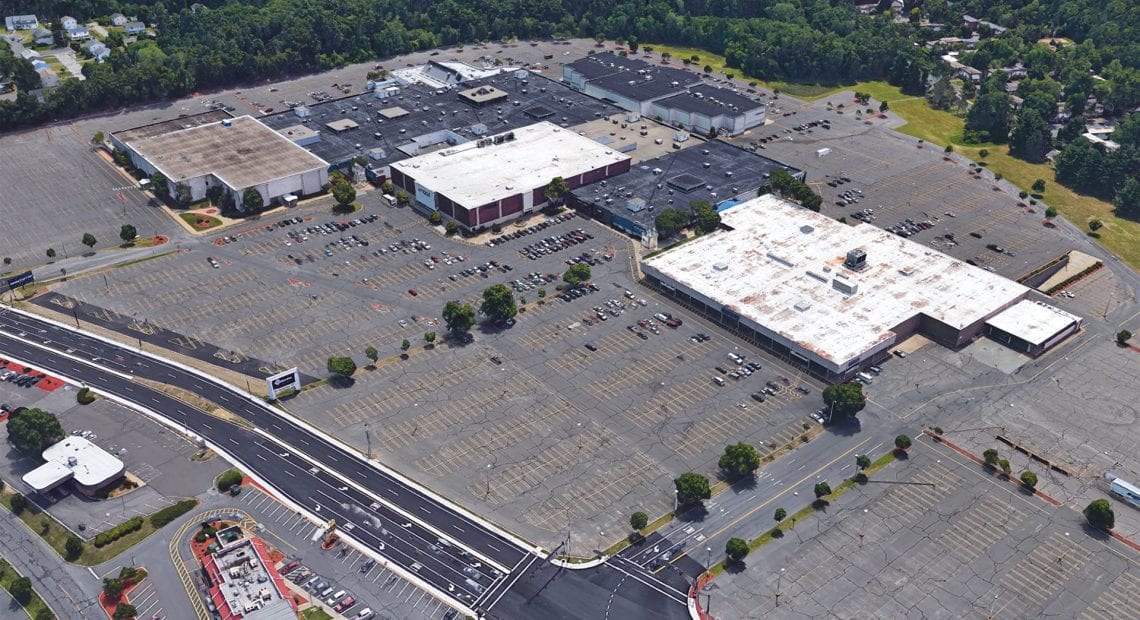
Accounting and Tax Planning

Five Hot Tax Topics

The Tax Cuts and Jobs Act represents a seismic shift within the broad realm of accounting and tax planning, and some of the aftershocks may not be felt, and fully understood, for some time. But some things are known, and individuals and businesses should understand their implications.

By Teresa Judycki

For better or worse, the Tax Cuts and Jobs Act was the most significant tax-law overhaul since the Reagan Administration, and there’s potential for more change on the way. With the breadth and depth of this law, it can be hard to determine what might be meaningful to you and your business.

This article will highlight five hot tax topics that may be particularly meaningful for this tax year.

Qualified Opportunity Funds

Taxpayers with large gains from sales of property to an unrelated person should be aware of Qualified Opportunity Funds. Enacted as part of the Tax Cuts and Jobs Act, a new Opportunity Zone program encourages investment in low-income community businesses.

Terri Judycki, CPA, MST

Terri Judycki, CPA, MST

The program allows individual and corporate taxpayers to defer tax on gains from the sale of stock or other assets by investing in an Opportunity Fund, which invests in businesses in Opportunity Zones. The tax is deferred until the earlier of Dec. 31, 2026 or the date the new investment is sold. To defer a gain, the taxpayer must invest within 180 days of the sale.

For example, if a taxpayer sells appreciated securities for $1 million at a $700,000 gain, tax on the $700,000 could be deferred until Dec. 31, 2026 (or earlier if the investment is sold prior to that date) by investing $700,000 in a Qualified Opportunity Fund within 180 days of sale. Capital gains on the new investment are exempt from tax if the investment is held for more than 10 years. Opportunity Funds may be a multi-investor fund or a single-investor fund established by a taxpayer to invest in projects he or she selects.

While there are a few multi-investor funds, many are hesitant to promise tax deferral until the IRS issues proposed regulations in this area, but September news is that the proposed rules are being reviewed and should be issued soon.

Foreign Accounts

For taxpayers with unreported income from foreign accounts, the Streamlined Filing Procedures (SFP) are still available. The Offshore Voluntary Disclosure Program ended Sept. 28, 2018.

Under SFP, taxpayers who can certify that the failure was non-willful can file amended returns and pay a reduced penalty. The IRS also has procedures in place for filing delinquent information returns reporting the existence of a foreign account when there has been no unreported income.

For example, a life-insurance policy with Sun Life may have a cash value that’s now increased to more than $10,000. That is a ‘foreign account’ that must be reported or could be subject to penalties. Consider reviewing any asset that is a foreign account and ensuring that tax filings are current, because penalties are confiscatory and may include criminal penalties.

The civil penalties for willful violations are capped at the greater of $124,588 or 50% of the amount in the account.

Employee Parking

I hoped to be able to provide you with specifics related to employee parking, but that guidance has not been issued as of the date of this writing. Perhaps there will be guidance by the time you are reading this article.

As a reminder, the Tax Cuts and Jobs Act provides that no deduction is allowed for the expense of a qualified transportation fringe, which includes van pools, transit passes, and qualified parking. Qualified parking is parking provided to an employee on or near the business premises of the employer or on or near a location from which the employee commutes to work by commuter highway vehicle or carpool. Tax-exempt organizations are subject to tax on the expense. But what is the ‘expense’ of qualified parking? At the 2018 AICPA Not-for-Profit Industry Conference, a speaker said that guidance had not yet been issued, because those in Treasury could not agree on the meaning of the law.

The cost of a parking permit is easy to quantify, but the law encompasses all expenses of providing parking. There are some practitioners who think a portion of depreciation on a parking lot owned by the business could be disallowed. Some others think the IRS may require apportioning office rent if the lease entitles the tenant to a certain number of parking spaces. As the law applies to amounts paid or incurred after Dec. 31, 2017, it affects computation of taxable income for entities with fiscal years ending in 2018. There are many practitioners hoping for retroactive repeal or postponement.

State and Local Tax Itemized Deduction

In August, the IRS issued proposed regulations in response to state legislation intended to circumvent the $10,000 limit on the state and local tax itemized deduction. A few states have enacted or considered enacting programs permitting state residents to make contributions to state agencies or charities in exchange for state and local tax credits that could be applied to income or property taxes.

In the proposed regulations, IRS restates the general rule that charitable deductions must be reduced by anything of value received in return for the charitable donation. The proposed rules, applicable to contributions made after Aug. 27, 2018, provide that, if a taxpayer receives a tax credit in return for a donation, the tax credit is a benefit to the taxpayer that must reduce the charitable contribution deduction.

It is important to note that these rules apply to programs created in response to the Tax Cuts and Jobs Act as well as to pre-existing programs, such as the Massachusetts program that provides tax credits in exchange for gifts of conservation land.

There has been no response from the IRS to the Connecticut strategy; Connecticut now imposes tax on a pass-through entity instead of on the individual partner or shareholder, which should result in shifting the deduction away from the individual who is subject to the $10,000 limit. The shareholder or partner should now be able to report his or her share of the entity’s income net of the state tax.

Trusts that pay taxes are also subject to the $10,000 limit, but a trust does not have to share the beneficiary’s $10,000 limit, providing a potential benefit.

Alimony

Finally, for those who will be divorced soon, the tax consequences of alimony differ for payments under instruments finalized after Dec. 31, 2018.

Before the Tax Cuts and Jobs Act, alimony was deductible by the payor and taxable to the payee. This resulted in shifting income from the higher-earning spouse paying the alimony to the former spouse who may be in a lower tax bracket. Alimony payments finalized after Dec. 31, 2018 will no longer be deductible by the paying spouse and no longer included in the income of the recipient spouse. There are some workarounds such as division of property where the spouse in the lower tax bracket receives property with the greatest unrealized gain or by using a Qualified Domestic Relations Order to shift retirement assets (along with the tax burden) to the lower-income spouse.

While this change will not affect pre-2019 alimony instruments, it may apply if the parties modify the pre-2019 agreement and state in the modification that the new rules are to apply. If this law change will impact you, be sure to discuss its effects with your attorney.

If you have any questions about the material featured in this article or how it might apply to you specifically, be sure to consult your tax professional or CPA.

Terri Judycki is a senior tax manager with Holyoke-based public accounting firm Meyers Brothers Kalicka, P.C.; (413) 322-3510; [email protected]

Home Improvement

Serving Up Style

Karen Belezarian-Tesini (left) and Sarah Rietberg

Karen Belezarian-Tesini (left) and Sarah Rietberg are selling plenty of white and gray tiles these days.

Professional designers can often walk into a house and tell what decade it was built in by the styles of certain rooms, and the kitchen is definitely high on that list. From the high-gloss look of the ’80s to the more neutral ’90s; from a shift back to color at the turn of the Millennium to the current embrace of whites and grays, kitchens do seem to reflect their time. But one trend of the past generation isn’t likely to change — the increased perception of the kitchen as a home’s main hub of activity.

The economy wasn’t the only thing that went flat a decade ago. So did kitchen colors.

“When the economy tanked in 2007, 2008, everything became very flat. Color was gone, along with texture, pattern, flowers. Everything became industrial and cold — no frills. And that’s how the economy was, too,” said Karen Belezarian-Tesini, manager of Best Tile in Springfield. And she’s not the only one who noticed the coinciding trends.

“It’s funny how the economy dictates the colors,” said Frank Nataloni, co-owner of Kitchens & Baths by Curio in Springfield, recalling how many kitchens of the late ’80s featured high-gloss surfaces and plenty of black and red, but when the recession of the early ’90s hit, it was all earth tones. By 2000, color had come back, but around 2008, neutrals took over again. “I don’t know what that means, but when you look back, you can clearly see it.” That decade-ago shift has stuck, however, and even intensified, he added. “Everything now is white and gray.”

While taupe is making a comeback, said Belezarian-Tesini — “I love that more than gray because it gives you an option to go either way, warm or cool” — she’s seen the white-and-gray trend intensify over the years. But better financial times might be causing a subtle style shift.

“Now that the economy is picking back up, it’s getting a little warmer — softer edges, a little more color in glass mosaic or patterns,” she said.

That would be just fine by Lisa Lindgren, designer with Kitchens by Chapdelaine in East Longmeadow.

“The most popular kitchen is white — white on white. So whenever I get a client who wants some color and wants to do something a little different, I get excited,” she told BusinessWest. “People tend to be so scared of color. A lot of it is about sellability, but we tend to encourage people to go for what you like. It’s your house.”

Frank Nataloni

Frank Nataloni says styles shifted away from bold colors when the economy tanked, and have largely remained muted since.

R.J. Chapdelaine, owner of the company, an offshoot of builder and remodeling firm Joseph Chapdelaine & Sons, agreed.

“Whenever you have someone who comes in with a little imagination, wants to have a little fun, it gets exciting,” he said. “And why not? That’s where people want to spend their time. Kitchens are getting bigger, and other living spaces are getting a little bit smaller.”

For this issue’s focus on home improvement, BusinessWest visited a few companies that deal in kitchen design to get a read on some of the hot styles — only to find that the hottest is a decidedly cool white. But they offered plenty of other food for thought as well.

What’s Your Style?

Take countertops, for instance, where white- and gray-colored quartz surfaces are in, both Lindgren and Nataloni said.

But they’ll find contrast in other places, Lindgren noted, like weathered driftwood for accent pieces or a dark wood floor — or, more commonly these days, porcelain planks designed to look exactly like wood. “That’s the most popular floor. You can’t even tell it’s not wood. It’s pretty fascinating.”

“That seems to be what everyone’s looking for right now,” Nataloni added. “With some of them, it’s amazing how much it actually looks like real wood. You can even feel the texture. That’s what people are looking for.”

And homeowners aren’t stopping in the kitchen, Belezarian-Tesini said. “When I sell those planks, I might sell 2,000-3,000 square feet at a time. They’re doing their bedrooms, they’re doing the whole house. It’s just incredible. People say, ‘oh my gosh, I love that,’ and when we tell them that it’s porcelain, they look again and say, ‘are you sure? Really?’ ‘Yeah, really.’”

In addition to the move away from tile floors into wood and wood-like porcelain, Chapdelaine noted that shiplap walls — in both vertical and horizontal patterns — are popular as well, perhaps driven by their ubiquitousness on HGTV.

As for cabinetry, while painted white tops the list right now, Nataloni said, he was working with someone recently who wants a black cabinet with a rubbed-off type of finish so there’s some wood coming through. Still, those neutral shades provide plenty of flexibility.

R.J. Chapdelaine and Lisa Lindgren say it’s fun to work with customers who have a design vision not necessarily bound by what’s currently fashionable.

R.J. Chapdelaine and Lisa Lindgren say it’s fun to work with customers who have a design vision not necessarily bound by what’s currently fashionable.

“With a white or gray cabinet, we can make it look very formal or casual in the scheme of things,” he said. “I haven’t sold a cherry kitchen in over a year, but at one time, that was probably 60% of our business. Some woods remain relatively popular, though, including walnut. “That’s the fashion part of the business, and it changes depending on who walks through the door.”

Sarah Rietberg, showroom manager at Best Tile, said all these trends amount to people seeking a clean, uncluttered look in their kitchens, which is why subway-style tile backsplashes are still common, but with a twist — different sizes, something with a little texture to it, or even lines that aren’t perfectly straight.

“Those things can add some oomph to subway tile,” she said. “People want a little movement, but nothing too crazy. They don’t want to take away from the other things going on.”

In addition, a well-placed accent color can be striking amid a sea of white, Chapdelaine said. “We just did one all-white kitchen with a hale navy blue island, and it’s a striking look.”

Indeed, Belezarian-Tesini said, many customers complement the dominance of white and gray with mosaic tile backsplashes; where once a mosaic pattern broke up the solid color of the rest of the backsplash, now it’s being used across the entire backsplash to break up the white of the kitchen.

Sometimes it’s hard to predict the next trend, she added. “If you asked me 10 years ago if glass would still be here, I’d have said no, but glass is hotter than it’s ever been. It’s the medium of choice now. People still use ceramic, and porcelain has really come up the ladder. But glass has become the decorative. It’s a 10-year trend for sure, and it’s probably going to last longer than that.”

Meanwhile, she sees metallic tile coming into its own. “As technology gets better, you’re going to see more things within the glazing. You’re even seeing crystals in the glazing, little pieces of metal, to create a true, realistic metallic. So technology advances, and the tile changes.”

Good, Better, Best

The upside of so many options in kitchen surfaces is that there’s typically something for every budget, Nataloni said.

“We have to have a good, better, and best product selection,” he told BusinessWest. “We have a product for people flipping homes that’s very current with the trends, reasonably priced, good quality, with a quick turnaround time. Then we have a semi-custom type of product that offers a lot of selection and is a little quicker than the higher-end product. That means a lot if someone is doing a home renovation, because a kitchen is not an inexpensive proposition. If you know where to save money, you can get more bang for your buck, and that’s our skill.”

Some customers arrived with a vision in mind for their kitchen, he explained, and his job is to refine it. “Then there are other people who come in and don’t have a vision, and they’re looking for me to help them create the vision. That’s why we have to be flexible in meeting the need of whoever is coming to us.”

To help people envision the end product — quite literally — Nataloni uses a virtual-reality device called ProKitchen Oculus, which uses Oculus VR goggles to allow people to walk around in the environment Nataloni has programmed into the computer.

“For people who have a hard time visualizing, it really solves that problem for them,” he said. “We create a basic floor plan in 3D, and you’re actually in the room, so you can look and walk around. They literally see what they’re going to buy, or as close as possible to what it’s going to be like.”

For example, one customer was having trouble envisioning the soffit Nataloni suggested for the top of their cabinets. “Then I showed it to them on the Oculus, and their response was, ‘oh, now I understand what you were talking about.’ For those type of people, it really helps tremendously.”

Chapdelaine also sees a healthy mix — about 50-50 — of people who know exactly what they want and customers who need a little more guidance. “And that guidance can occur through Lisa, or through decorators. We see clients occasionally bring in a decorator to help them make decisions on color, cabinetry, and tile.

Most of those are typically renovating their whole house, Lindgren added. “It doesn’t tend to happen just with a kitchen, but with a broader scope.”

Whole-home renovations are common these days, said Chapdelaine, who noted that the remodeling business has been outpacing new home building for some time. His grandfather, who first hung out a shingle in 1925, saw the value of remodeling work early on, and evolved the firm in that direction after originally focusing on new construction.

“That became an integral part of our business,” he said. “You have to evolve. I see people who just build houses or just remodel, and I’d find that difficult. You can go from building three, four, five houses at a time to building one or maybe none, and doing all remodeling.”

Open Wide

He and Chapdelaine’s father also recognized perhaps the most prominent shift in kitchen design, and one that remains dominant today — the open floor plan.

“They were building compartmentalized houses, but they rolled into a more open floor plan on the single-story executive ranches,” he recalled. “Now, there’s very little compartmentalized building. Everything is wide open, with less formal living spaces.”

Nataloni said homeowners prefer a free flow of traffic through the kitchen, and islands are desirable if they can be put in. “Gone are the days of the U-shaped kitchen or a peninsula only, unless it’s necessary. Everyone is looking to have cabinetry that creates the outside shell of the kitchen and then some kind of an island in the middle, whether it’s with seating or without.”

That’s also the style potential homebuyers prefer when they’re visiting open houses, which is one reason why hot trends — like that white and gray — remain so dominant once they take hold; people design the room not only for their own comfort, but with resale in mind.

“For many people, this is where they’re staying, but we do have a lot of people coming in saying, ‘look, I want to fix up the kitchen, and we’re not going to be here forever, so I want it saleable,’” he noted. “We get probably more of the people who are staying for the foreseeable future, and they want to enjoy it. That’s the majority of our business.

Belezarian-Tesini said most of her business at Best Tile contractor-driven — either builders putting up or remodeling houses, or homeowners shopping for product, then hiring a professional to do the work. The do-it-yourself crowd is much smaller — perhaps because the kitchen is such a critical part of 21st-century home life that people don’t want to get it wrong.

That said, “business has been fantastic,” she noted. “I’ve seen a lot of new construction over the last few years. When I started here 23 years ago, it was all new building. Then it went to remodeling, and now it’s coming back again to new construction, which is nice to see.”

So, for the foreseeable future, she’ll continue to track the design trends and help customers design the kitchen of their dreams — usually with an open concept.

“It makes for easy living, and really great entertaining,” she said. “After all, the kitchen is the heart of the home.”

Joseph Bednar can be reached at [email protected]
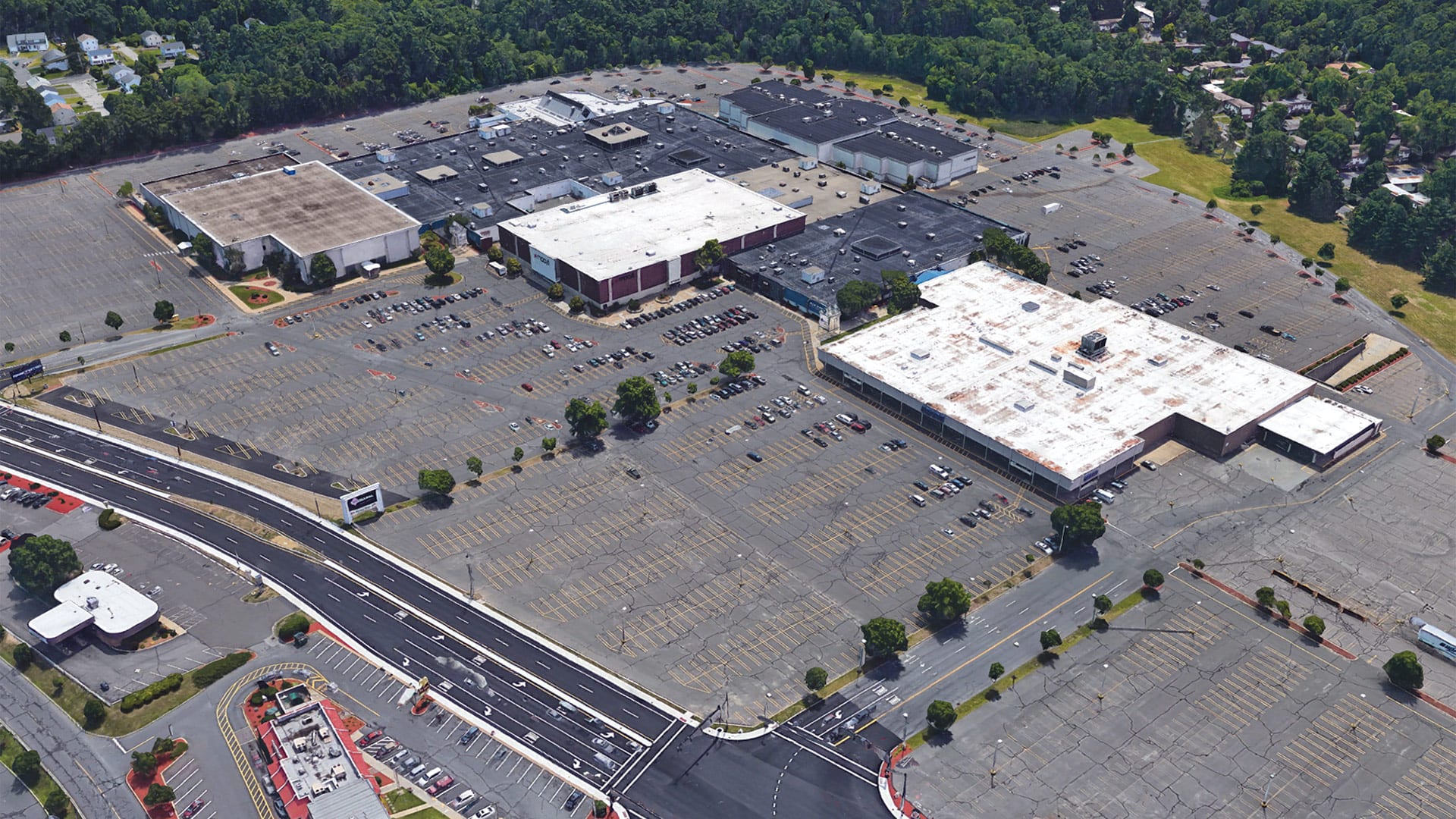
Community Spotlight

Community Spotlight

Folks in Western Mass. know they’re often dismissed by residents out east, Lisa Stowe says. So how does a city like Westfield make its case as a vibrant destination for a business looking to plant roots?

By working together.

That’s exactly what a handful of partners — municipal leaders, Westfield Gas + Electric (WG+E), Whip City Fiber, the Greater Westfield Chamber of Commerce, and corporate sponsor Westfield Bank — have done by launching Go Westfield, a still-evolving engine to encapsulate what makes this city a desirable landing spot, and, more importantly, tell people about it.

“We worked on this for six or eight months,” said Stowe, marketing and communications specialist for WG+E. “We want to use this opportunity to highlight what makes Westfield unique and a good place to do business. So many people think Massachusetts stops at 495, but there are a lot of things that are not so great about living in that part of the state — cost of living, high traffic, the cost of buying a piece of land. We wanted to draw attention to the things that make Westfield really attractive for people who are looking to relocate.”

The partners in Go Westfield had been doing that, to varying degrees, in their own ways, she added, but a focused partnership allows them to broadcast the message more efficiently.

“If you’re a site selector, we check a lot of boxes,” Stowe said, citing not only the city’s access to Mass Pike, an airport, and rail service, but its strong inventory of developable land — not to mention the municipal utility.

“If you’re a commercial customer, you pay 18% less than the state average for electricity, and 13% lower for gas rates than the state average,” she added. “If you’re an organization doing manufacturing, that’s significant. We feel that’s a good piece of the story to tell.”

Kate Phelon

Kate Phelon

“We really want to promote our city and the positive aspects of it. It’s an ongoing joint effort to drive the message that businesses should come look at Westfield to develop. We have quite a bit of developable land, but how do you get the word out to a company in Texas or Minnesota?”

So is Whip City Fiber, a division of WG+E that now reaches 70% of residences and businesses with high-speed internet. “The fiber project is a big deal,” she said, noting that customers like not only the speed, but the fact that service comes from a local company, not a national behemoth. “We’ve easily met the targets we had set in the business plan.”

Kate Phelon, executive director of the Greater Westfield Chamber of Commerce, said early meetings with the Go Westfield partners focused on how to promote the economic-development landscape in Westfield.

“We wanted a way to really persuade businesses to come to Westfield,” she told BusinessWest. “There are the usual assets everyone knows, like the turnpike exchange, airport, and rail, but we wanted to get a group of stakeholders together and come up with a marketing plan for all of it. We’re very excited about this initiative. There’s a local component to it, but the bigger initiative is a push outside the region to get companies to look at Westfield for commercial developments.”

The group has been discussing marketing strategies as well as ideas like industry-specific focus groups.

“We really want to promote our city and the positive aspects of it,” she said. “It’s an ongoing joint effort to drive the message that businesses should come look at Westfield to develop. We have quite a bit of developable land, but how do you get the word out to a company in Texas or Minnesota?

Westfield also boasts strong schools, a state university, and proximity to numerous other colleges, she added, as well as a chamber of commerce that continually strives to keep businesses informed of state and national trends and developments that could affect them.

In short, the Whip City has a lot going for it, and Go Westfield is just starting to broadcast that message far and wide.

Heart of the City

Meanwhile, the Elm Street Urban Renewal Plan, approved in 2013, focuses on revitalizing 4.88 acres in a two-block area in the heart of downtown Westfield running along both sides of Elm Street, the city’s main commercial thoroughfare. The city has also directed funding to revitalize the so-called Gaslight District adjacent to it.

One recent success story is the $6.6 million Olver Transit Pavilion, which opened in April 2017. The transit center was designed to both catalyze related economic development and increase the use of public transportation. The state-of-the-art center includes parking space for four buses with bicycle racks, as well as a bicycle-repair station, which speaks to the proximity of the Columbia Greenway Rail Trail only a block away.

The Westfield Redevelopment Authority also demolished a former bowling alley near the transit center, with plans to create a multi-story, mixed-use building with retail, restaurants, office space, and market-rate apartments. The city recently issued a request for proposals for the project, taking advantage of the area’s designation as an ‘opportunity zone,’ a state program that provides tax relief for people willing to invest in certain neighborhoods in need of economic development.

“The PVTA project was the first phase of renewal,” said Peter Miller, Westfield’s director of Community Development. “We’re looking for private development to get some mixed-use retail space on the ground floor, and residential space on the top floors.”

Joe Mitchell, the city Advancement officer, noted that Millennials in particular are drawn to urban, mixed-use living, one reason why such projects have popped up around the region in recent years.

“A three-bedroom house and a white picket fence on a half-acre is not what young people are looking for,” he said. “They want a coffee shop downstairs and a bike rack, and being part of a tight-knit community where there’s activity going on right at their doorstep.”

Another $25,000 in state money will soon fund a wayfinding project for downtown, not just to point visitors to destinations off the main thoroughfare but to help them access parking as well. “We have sufficient parking in our downtown, but people don’t always know where it is,” Miller said. “This infusion of money from the state will allow us to better direct people to where the parking is.”

Phelon noted that the city recently switched all on-street parking, which had been a mix of one-hour and two-hour time limits, to two hours across the board — a small change, maybe, but a good example of how quality-of-life issues can be communicated and remedied across departments.

The momentum downtown has spurred some organic growth, too, Mitchell added, noting that Myers Information Systems is relocating there from Northampton, bringing 20 software-development professionals and renovating 110 Elm St., which used to be a restaurant with industrial space above it.

“They’re moving from an urban, walkable space they’ve outgrown in Northampton to buying one of our old buildings and investing private dollars here,” he added. “It was an extremely underutilized building, and they’re converting it into modern office space. They have a real vision for it.”

He doesn’t think Myers will be the last to make that move. “One of the reasons to relocate to Westfield is that we’re at the cusp of something, and people want to be a part of it.”

Back to School

Phelon says Westfield has accomplished more in recent years because of its culture of collaboration. One example is the Westfield Education to Business Alliance, which connects the city’s schools, where students are beginning to contemplate their career paths, with companies that are eager to mine local talent.

At a time when the state is looking for public schools to forge more meaningful pathways to economic development, she added, the alliance puts the Whip City at the forefront of an important trend.

Westfield at a glance

Year Incorporated: 1669
Population: 41,552
Area: 47.4 square miles
County: Hampden
Residential Tax Rate: $19.36
Commercial Tax Rate: $36.82
Median Household Income: $45,240
Median Family Income: $55,327
Type of Government: Mayor, City Council
Largest Employers: Westfield State College, Baystate Noble Hospital, Savage Arms Inc., Mestek Inc., Advance Manufacturing Co.
* Latest information available

She said the next phase could be an adopt-a-classroom program in which area businesses could engage repeatedly with a teacher and his or her students. “I also think we need to get students and teachers into the business world on a regular basis. The work environment is changing so rapidly, with technology and robotics and social media.”

Because of this, she went on, it would benefit teachers to see what employees at area companies do on a day-to-day basis, and how. “That’s what they need to be teaching, so they need to see that.”

The Westfield Education to Business Alliance also facilitates a career fair at Westfield High School that gives students exposure to the types of career opportunities available at local companies — and, more important, what skill sets they will need to take advantage of them.

The goal of the next career fair will be to attract 75 companies, up from 51 last time, to interact with the 500 or so students who show up.

“It’s not a job fair; it’s a career fair,” Phelon stressed. “The message is twofold: for students to see what companies are here, and see that they can go away to college and come back here and get good jobs. It’s also good for these students to talk to these employees about their hiring practices, what degree do I need, should I expect a drug test or a CORI check, what are your procedures. And they could talk to students about internships and co-ops.”

The alliance one of many examples of how Westfield continues to bring people and organizations together to raise the fortunes of all.

“The mayor [Brian Sullivan] has been very supportive of these collaborations,” Miller said. “He made building bridges his theme. That’s how we’ll get the most out of the assets we have — not by operating in silos.”

Phelon agreed. “We have our individual purposes and missions, but there’s a bigger picture of working together and collaborating. It’s such a great city, and we’re fortunate to have the assets we have.”

Now it’s time to let everyone know it.

Joseph Bednar can be reached at [email protected]
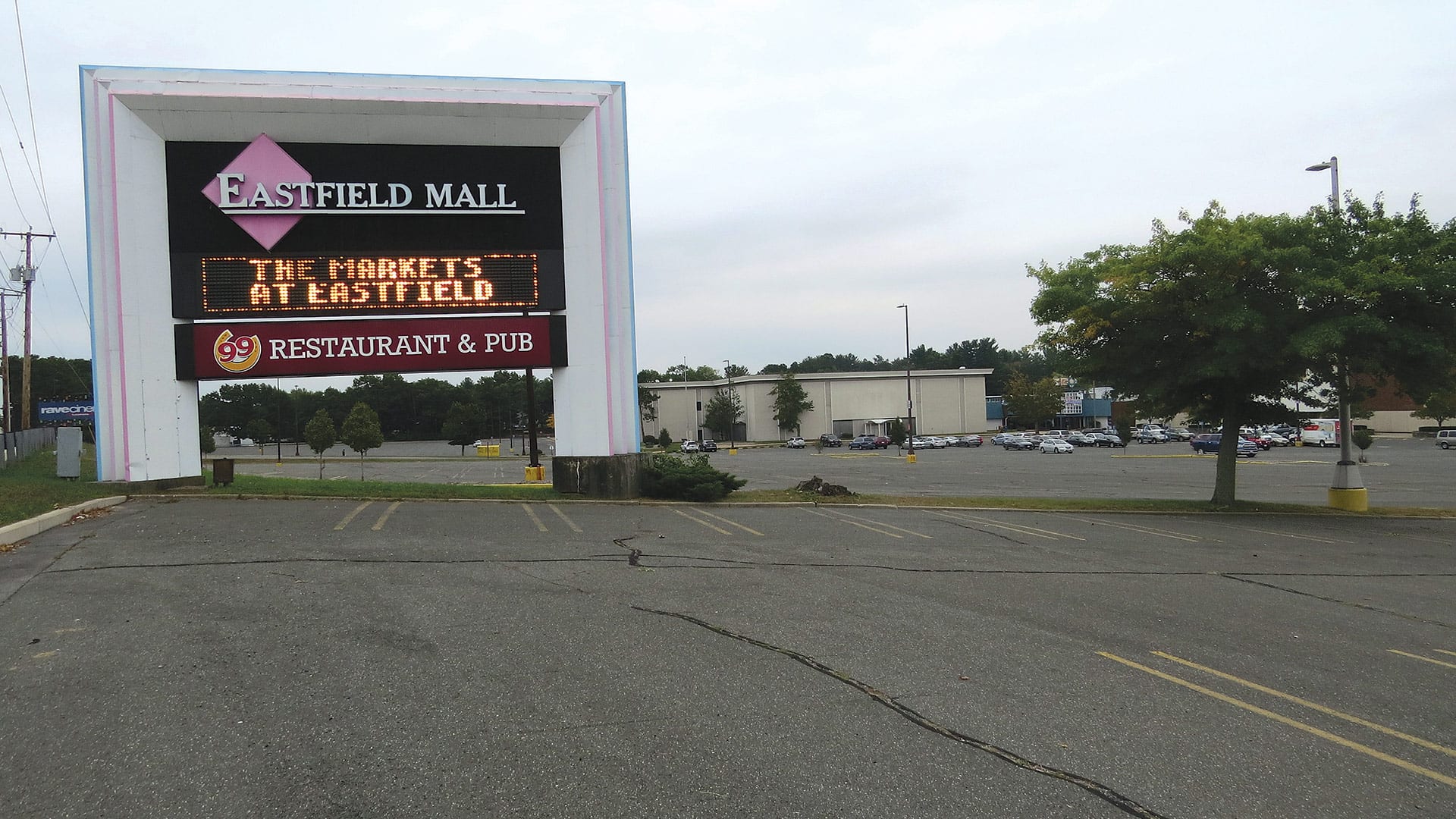
Berkshire County

Creating an Ecosystem

State and local officials joined with stakeholders in the Berkshire Innovation Center to break ground on the project last week.

State and local officials joined with stakeholders in the Berkshire Innovation Center to break ground on the project last week.

Steven Boyd isn’t just the president and board chairman of the Berkshire Innovation Center; he’s a true believer that the $13.8 million facility will be a game changer for the region’s manufacturing and life-sciences economy.

“From a broad perspective, I’d say the center aims to support the legacy manufacturing base that has a long history of innovation here in the Berkshire region,” he told BusinessWest. “We’re an innovation center that is equal parts research and teaching institution and programming for private-sector businesses.”

State and local officials gathered last Tuesday at the William Stanley Business Park of the Berkshires in Pittsfield to break ground on a project that has been in the planning and fundraising stages for a decade, and is expected to open by the third quarter of 2019.

The two-story, 20,000-square-foot workforce-development center will include training facilities, lab space, clean rooms, and office and event space for small- to medium-sized companies, just to name a few amenities, with the collective goal of boosting economic growth, employment, and private investment in the region.

“The center aims to support and accelerate growth and innovation by providing access to state-of-the-art equipment like 3D printers and a microscopy suite, as well as conferencing and teaching facilities,” Boyd said, adding that the center will also be the centerpiece of the mostly underdeveloped, 52-acre business park it calls home.

“The building will have all these types of spaces combined into a very cooperative, shared maker-space type of environment,” he went on, with one goal being to bring ideas and inventions from colleges and research institutions, even those from the eastern part of the state, together with local manufacturing knowhow and the resources needed for commercialization.

“One of the things that makes Cambridge so vibrant is all the new technology that’s being researched or commercialized as a result of all the ideation happening at places like MIT,” Boyd said. “So, as part of stimulating the economy in the Berkshires, we want to promote more of that ideation and commercialization here.”

Gov. Charlie Baker said as much at last week’s groundbreaking. “Our administration is focused on boosting the Commonwealth’s thriving life-sciences sector in every corner of the state,” he noted. “Investing in the Berkshire Innovation Center will help expand the capacity and capabilities of this region’s entrepreneurial community to drive job creation, retention, and outside investment in Western Massachusetts.”

Boyd, who is also CEO of Boyd Technologies in Lee, said the Baker administration has been focused on creating a network of innovation in manufacturing and the life sciences that encompasses the entire state, and the Berkshire Innovation Center (BIC) will be a key part of it.

“They recognize all the momentum going on in Boston and see the opportunity to provide efficiencies by creating a statewide ecosystem,” he noted. “In the Berkshires, we have available space and facilities at lower cost to provide that type of efficiency. It can be invented at MIT and commercialized in the Berkshires, and you don’t have to get on a plane and fly halfway around the world to make something that’s truly innovative.”

Nearly 5,000 jobs in Berkshire Country are in the manufacturing sector, making it the fifth-largest industry in the region.

With that in mind, Housing and Economic Development Secretary Jay Ash noted that the center will serve as an anchor institution for region, “strengthening connections between the life sciences and advanced-manufacturing industries and education institutions, creating jobs, and shaping the next generation of home-grown innovators.”

Precision Endeavor

At the start of the summer, the BIC board brought on Consigli Construction Co., one of the largest general contractors in the Northeast, to oversee construction at the former General Electric site. John Benzinger, a senior project manager for Skanska USA Building Inc. of Springfield, will serve as the owner’s project manager. Skanska recently served as the project manager for Union Station in Springfield.

Resources inside in the innovation center, when it is completed, will include:

• Precision measurement and reverse engineering utilizing the BIC’s flagship platform, the Hexagon Metrology 121510 CMM with touch probe, laser scanner, camera module, and ROMER Arm;

• A rapid prototyping center featuring cutting-edge 3D printing capabilities in plastics and metals;

• Precision analysis and microscopy with the Zeiss Axio Imager 2 platform, for both life-sciences and materials research;

• Clean-room lab space to conduct research or pilot production for nanotechnology, life sciences, or other applications requiring a clean environment; and

• Wet-lab space to conduct collaborative life-sciences research or start up a biotechnology company. The lab will feature sinks, DI water, fume hoods, biosafety cabinets, autoclave, centrifuge, incubators, deep freezer, glass washer, ice machine, and lab supplies.

The center will also offer customized training programs for advanced manufacturing, access to Berkshire Community College’s engineering technology classes, and the space for companies to conduct their own proprietary training in technology-loaded classrooms.

In addition, BIC members will be able to collaborate on research with UMass Amherst, Rensselaer Polytechnic Institute, UMass Lowell, and SUNY Colleges of Nanoscale Science & Engineering, as well as develop training and internship programs with Berkshire Community College (BCC), McCann Technical School, and Taconic High School.

This broad coalition of academic partnerships sets BIC apart from other facilities, like the Institute for Applied Life Sciences at UMass Amherst, that provide cutting-edge resources for manufacturers and commercialization opportunities for innovators, Boyd said.

“When we started thinking about the business plan, we felt this area is underserved in terms of business-class conferencing and teaching areas,” he told BusinessWest. “Of course, BCC has wonderful classrooms and teaching facilities, and many companies around here have their own conference rooms, but not a place to host larger-scale strategic meeting or annual board retreats. I think it would be nice to have a local facility that allows third-party distance learning and access to state-of-the-art conferencing that is otherwise not available here.”

Steven Boyd

Steven Boyd

“We’re an innovation center that is equal parts research and teaching institution and programming for private-sector businesses.”

In fact, it’s the workforce-development aspects of the facility that have Boyd as excited as the cutting-edge technology.

“Specifically, we envision training that is very germane to industry, and at the same time we want to provide a provide a place for our fundamentals to be available for incumbent workers,” he said. “BCC will play a very central role in training — in manufacturing fundamentals, LEAN manufacturing concepts, STEM-related programs — but we also will bring in subject-matter experts to talk about things like sensors and actuators that relate to automation systems and things that provide deeper lifelong learning for the workplace out here — and, of course provide a steady stream of talent.”

Next Generation

That last aspect is key, he added — the idea that partnering with area high schools and colleges on training and internship programs will boost the pipeline of young talent into fields like biotechnology and precision manufacturing that desperately need it.

“It’s self-serving for businesses in that way,” Boyd said. “We’re preparing kids in schools today for careers that may start with a local company but end with a long career in biotech. Our point is, if you are qualified in this space and engage in a growth mindset and lifelong learning, you will have the opportunity for upward mobility, both at your specific company or at another one in the industry at large.”

Plans for the Berkshire Innovation Center were launched about a decade ago, when the city of Pittsfield received a $6.5 million earmark in then-Gov. Deval Patrick’s $1 billion life-sciences bill to construct a facility in the William Stanley Business Park. When the project moved forward in 2014, the Massachusetts Life Sciences Center provided an additional $3.2 million.

However, construction, originally scheduled to begin in 2015, was delayed after the original bids came in $3 million higher than expected. Since then, a coalition of state, local, and private-sector funding sources raised the difference, with the state coming through with the final $2.3 million earlier this year. Boyd was elected the BIC’s first president and board chairman in 2015, while Rod Jané, president of New England Expansion Strategies in Westborough, was hired as the BIC project director.

While planning the facility, the BIC has already begun developing and launching its programs, such as a speaker series that, since 2015, has conducted more than 10 speaking events on topics relevant to advanced manufacturers in the region. The featured speakers for these events have included executives from the medical-device industry, advanced equipment manufacturers, researchers from leading research universities in the region, workforce-development leaders, and career-center directors from colleges and universities.

“If you are qualified in this space and engage in a growth mindset and lifelong learning, you will have the opportunity for upward mobility, both at your specific company or at another one in the industry at large.”

Meanwhile, BIC workforce-training programs were launched in 2016, and have featured all-day training seminars on topics such as lean manufacturing and continuous improvement, thermoplastics for medical devices, and medical-device regulations. That same year, the first wave of advanced R&D equipment, acquired through grants by Berkshire Community College, and training for employees of BIC member companies on the advanced equipment has been ongoing.

Taken as a whole, Boyd said, the innovation center will essentially cast a net to attract and train the next generation for some of today’s most intriguing careers — and, in some cases, careers that haven’t even emerged yet. What is clear, he added, is that modern manufacturing jobs are a far cry from long-outdated stereotypes about factory floors.

“You don’t get dirty on the production floor,” he said. “Quite the opposite, at Boyd Technologies, they’re the cleanest spaces in the building. They’re precise and clean-room controlled and certified as such, and people that work there are mainly using computers. Of course, there are materials and all types of processes and actual manufacturing, but it requires statistics and technical reading and understanding of biocompatibility and sterilization methods. All these are things the workforce of today have to be cognizant of.”

The Berkshire Innovation Center promises to not only build that awareness, but provide the resources and partnerships to make the Berkshires a key part of a high-tech ecosystem that is no longer the exclusive domain of Boston and Cambridge.

Joseph Bednar can be reached at [email protected]
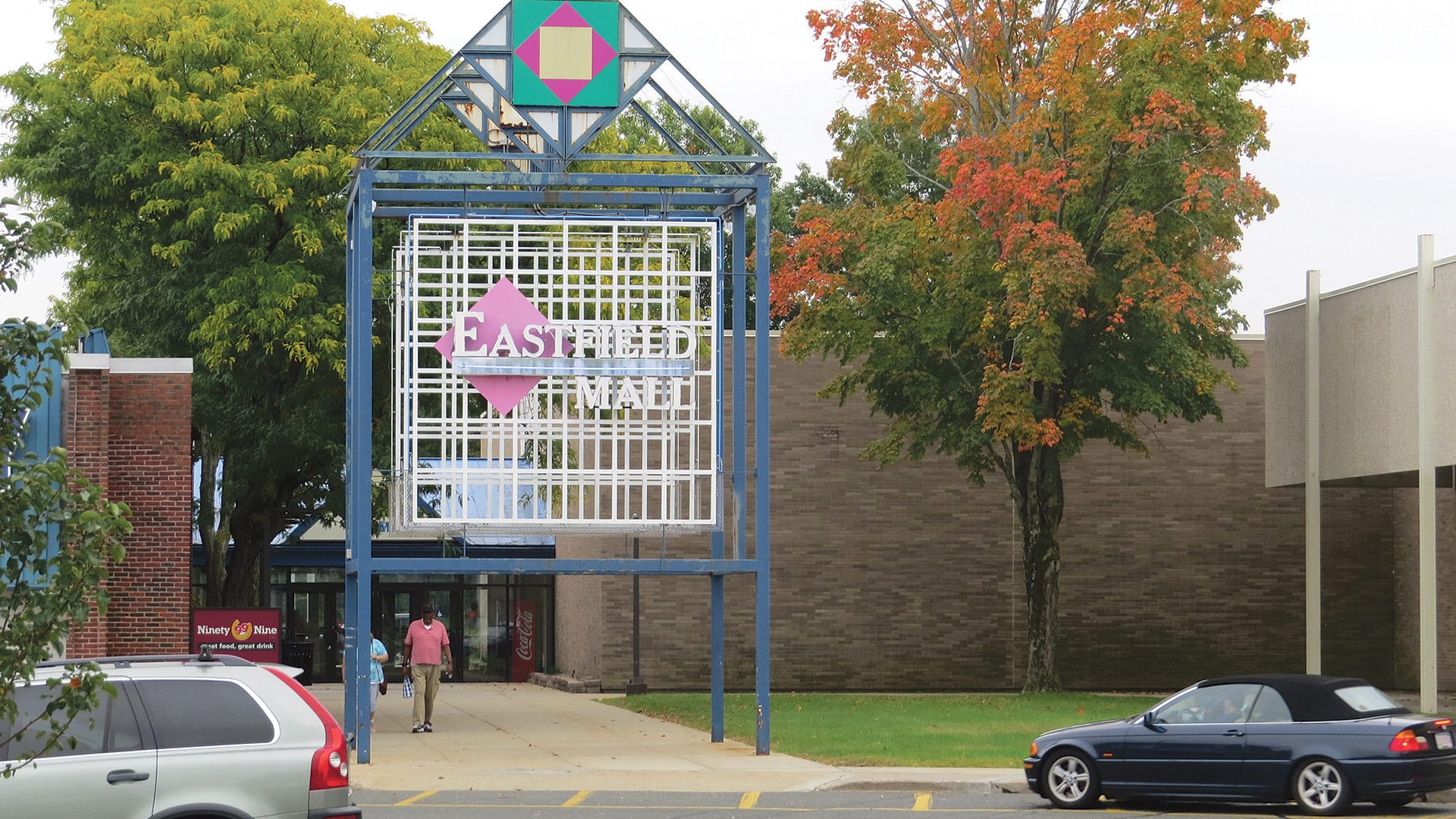
Accounting and Tax Planning

New Rules of the Road

By Julie Quink, CPA

Tax-IncentivesIn 2018, nonprofit organizations face implementation of the first major overhaul of accounting standards in two decades. The goal of the overhaul is to improve the communication of financial results for donors and other outside stakeholders and to emphasize transparency in financial reporting.

With these changes, nonprofit organizations can expect significant changes in financial reporting practices. Donors and outside stakeholders can expect enhanced information on liquidity, access to cash and endowments.

What are the significant financial reporting changes for nonprofits?

Some of the major changes in the new standards encompass net asset classification, liquidity and availability, investment returns, reporting of functional expenses, and presentation of statement of cash flows.

Net Assets

The new accounting standards focus on the existence or absence of donor restrictions as opposed to the type of restriction. The new rules provide for two classes of ‘net assets’ — with donor restrictions and without donor restrictions. Previously, nonprofits have reported three required classes of net assets — unrestricted, temporarily restricted, and permanently restricted.

Julie Quink, CPA

Julie Quink, CPA

For underwater endowments, in which the fair value of the endowment at the reporting date is less than the original gift or the amount required to be maintained by the donor or by law, the cumulative amount of losses is netted in assets with donor restrictions under the new classifications. Previously, the accumulated losses were included in unrestricted net assets.

Disclosures relative to underwater endowments now encompass the aggregate amount of original gifts required to be maintained, endowment spending policies, and discussion of actions taken or strategy relative to the underwater status of the endowment. For the nonprofit, a concern may be that the status of and strategy of managing underwater endowments is highlighted in the new financial-statement disclosures.

The goal of the change is to simplify tracking and reporting of donor restrictions and also to enhance disclosures on the nature, amounts, and types of donor restrictions.

Liquidity and Availability

Quantitative and qualitative information is required under the new standards relative to liquidity and availability of liquid assets, which are typically cash and investments.

The qualitative disclosures require analysis of how the organization manages its liquid assets to meet cash needs for expenditures within one year of the statement of financial-position date. The quantitative information regarding the liquid assets and their availability to meet the current-year needs can be presented on the face of the financial statements or in the notes to the financial statements.

Donors, grantors, creditors, and other stakeholders want to understand that these nonprofit organizations that they are evaluating have adequate financial resources to meet obligations as they become due. For the nonprofit organization, a concern is that this liquidity information can highlight potential liquidity shortfalls, which may affect future donations and grants.

Investment Returns

Investment income is to be reported net of internal and external investment expenses. This has been an optional presentation under current standards. The requirement to disclose investment expenses net in investment income has been removed. The netting of fees against income does not suggest that nonprofits should not still manage and monitor investment fees, but assists in eliminating the burden of trying to identify embedded investment fees.

Functional Expenses

Currently, only health and welfare organizations are required to report expenses by function. Under the revised standards, all nonprofits must report expenses by function and must disclose the methodology used for the allocations to program and overhead expenses in the notes to the financial statements.

Nonprofit organizations should have been allocating expenses to programmatic and administrative expenses even though not required to detail the expenses by function. The requirement for functional reporting and disclosures may require nonprofits to review their allocation policies for consistency.

Statement of Cash Flows

The new rules continue to allow nonprofits to choose the method, direct or indirect, by which they present operating cash flows. The new guidance does eliminate the need to add an indirect reconciliation if using the direct method in presenting operating cash flows.

By streamlining the requirements, it is believed that the statement of cash flows will be a more useful statement and result in a reduction of costs to the nonprofit to prepare the financial statements.

Conclusion

The new accounting and reporting standards are intended to provide more transparency to donors and other stakeholders. These changes may, however, have a significant time and financial impact on nonprofit organizations as they implement the new requirements.

Julie Quink, CPA is the managing principal of Burkhart, Pizzanelli, P.C., specializing in the accounting and consulting aspects of the practice. She is also a certified fraud examiner.

Education

The New College Try

Diane Prusank

Diane Prusank

Diane Prusank says Westfield State University is a few years behind the other Massachusetts state schools in adopting the so-called ‘college structure’ for its Division of Academic Affairs.

In most respects, that’s a good thing, she told BusinessWest, because it has provided the 180-year-old institution with an opportunity to learn from what those other schools have done and shape a system that reflects what amounts to best practices. And that’s important, because going from 25 academic departments to four colleges is a significant change for students and faculty alike.

“It takes time for people to see how this works, time for people to talk with those at other institutions and say, ‘how did this go for you?’” said Prusank, who last spring was named WSU’s provost and vice president for Academic Affairs. “So, in some ways, coming later than our sister institutions was really beneficial.”

Elaborating, she noted that the delay, if it can be called that, in adopting this structure resulted from, among other things, apprehension that it might create silos at the university at a time when greater collaboration between the departments was and is the goal, as well as an additional (and perhaps unwanted) layer of bureaucracy.

But over the course of a 15-month planning period — one that included examination of what’s happened at the other state universities and other institutions of higher learning after they adopted the college system — it was determined that these fears were mostly unfounded.

In fact, that review showed the college structure fostered greater communication among faculty members within various programs, and also new collaborative efforts.

Jennifer Hanselman

Jennifer Hanselman

Juline Mills

Juline Mills

Emily Todd

Emily Todd

Once you place faculty essentially in proximity to each other in the kinds of meetings and events that colleges put together, they create a chemistry with each other that you don’t see when they’re spread out across 25 different departments,” said Prusank, who joined the university in 2008 as dean of Academic Programs and Accreditation.

“When there are eight of them in the room, they start to talk about things they have in common,” she went on. “And they start to create connections. Sometimes people worry that when you create the college system you’ve made silos, that these colleges will separate themselves from each other. But the truth is that those deans have conversations with other, and they make connections.”

Under the new system, WSU now has four colleges — the College of Graduate and Continuing Education, the College of Mathematics and Sciences; College of Education, Health, and Human Services; and College of Arts, Humanities, and Social Sciences.

Three new founding deans were also appointed in June: Jennifer Hanselman, former chair of the Department of Biology, was appointed interim dean of the College of Mathematics and Sciences; Juline Mills, most recently a professor in the College of Business at the University of New Haven, was named dean of the College of Education, Health, and Human Services; and Emily Todd, former chair of the Department of English at WSU, was named interim dean of the College of Arts, Humanities, and Social Sciences.

As for Prusank, she brings a great deal of experience to her new role as provost and vice president of Academic Affairs — and the process of bringing the college system to fruition.

Before coming to WSU a decade ago, she served as a faculty member, associate dean, and assistant provost at the University of Hartford. At Westfield State, in addition to her work as dean of Academic Programs and Accreditation, she’s served as dean of Undergraduate Studies, chair and faculty member in the Department of Communications, and chief of staff in the President’s Office.

Thus, she brings a number of different perspectives to the shift from 25 departments to four colleges. And from the lens of both a faculty member and administrator, she said it brings with it considerable promise for enhanced collaboration and innovation, as well as greater operational efficiencies.

“You get a lot of points of sharing that you didn’t have before,” she said, referring, again, to what happens when you bring the chairs of eight departments together for meetings of the individual colleges. “You get a lot of synergy, a lot of collaboration, and a lot of sharing. And that’s great for our students because it opens up more opportunities for them.”

Elaborating on the nature of these opportunities, she said they come in many different forms, from greater collaboration on curriculum and potential new programs of study to creation of new events, to the broadening of existing events, such as alumni gatherings, which might now involve graduates of several different (but related) programs instead of one.

“You get a lot of points of sharing that you didn’t have before. You get a lot of synergy, a lot of collaboration, and a lot of sharing. And that’s great for our students because it opens up more opportunities for them.”

“There’s synthesis and collaboration that opens doors for students that might not have been there before,” she explained.

Prusank told BusinessWest that a shift to the ‘college’ format is something that’s been under consideration at the university for some time.

“Westfield State has had this conversation periodically over the past few decades, as most institutions have,” she explained. “Eventually, the college structure found its way onto college campuses across the country.”

Discussions were ongoing when Ramon Torrecilha took the helm as president in 2015, she went on, adding that he essentially took the conversation to a higher level, asking the advisory committee on academic planning to research the college format, talk with campus constituencies, look at what other schools had done, and make a recommendation on what should be done moving forward.

The eventual recommendation was to take this step, she said, adding that what followed was a lengthy implementation period involving work to determine, among other things, how many colleges would be created and the composition of each one (the specific departments). When that work was completed, searches were conducted for the deans that would lead each college, as well as for the provost and vice president of Academic Affairs.

While there will be a period of adjustment to the new system, Prusank said the many types of benefits are becoming increasingly apparent to students and faculty alike. Chief among these benefits for students is greater access to assistance when its needed.

“With the older structure, when we had a dean of Undergraduate Studies, students who had academic issues or problems would have to go to that dean, and there are 4,500 full-time undergraduate students looking for one person,” she explained. “Now, with the four-college structure, there are four different points of access; it’s easier to get that individual quicker.”

There are many other benefits to this system, she told BusinessWest, adding that, while WSU may be the last school in the state system to embrace this structure, it is already making up for lost time.

— George O’Brien

Home Improvement

Sparking Success

Jay Peloquin says gas fireplaces are especially popular at a time when natural gas is inexpensive.

Jay Peloquin says gas fireplaces are especially popular at a time when natural gas is inexpensive.


Jay Peloquin remembers the heady days for pellet stoves, back in 2008, when oil surged to more than $100 a barrel.

“When oil prices were skyrocketing, we couldn’t keep these things in stock,” he recalled. “We had people lining up out the door just to order stoves because it would save them so much money over their regular heating bills.”

Oil prices have come down significantly since then, he said, but pellet stoves remain popular, particularly for people who otherwise heat their house with electricity or propane. “For people in the right situation, it’s still a great investment — it pays for itself within a few years, and you’re using a clean energy source.”

For Fireside Designs, a family business that dates back 40 years, those economic trends have occasionally impacted sales, said Peloquin, the West Springfield store’s general manager. But more important has been a continual focus on what products — in the categories of fireplaces, heating equipment, and grills — customers want most.

In the realm of fireplaces, that tends to be gas-burning units, in addition to pellet stoves. In addition, “if you have an existing brick-and-mortar fireplace used for wood, and if you want to convert it to gas to make it more efficient and get more heat out of it, you can do a gas fireplace insert, because natural gas is one of the cheapest ways to heat right now.”

As for new construction, Fireside receives a number of calls from consumers who want a higher-end fireplace rather than the one that came with the house.

“A lot of times, builders will spec in a fireplace for a customer, and if they’re building, say, a $400,000 house and putting in a $1,000 fireplace, something doesn’t add up,” Peloquin said. “So that’s when they come to us and see what’s available for their budget and the style they want, whether they want contemporary, traditional, or something in between. Some higher-end builders do tend to spec in some of the fireplaces we carry, because we definitely are on the higher end.”

Whether a large wall unit or a smaller fireplace installed above the TV, he said, there are plenty of options for customers who want to bring the heat home.

Tools of the Trade

When Peloquin’s father, Jean, launched the company 40 years ago, its product line was a far cry from what it is today.

Back then, the elder Peloquin sold tool sets, which evolved into a small retail store on Brookdale Street in Springfield, mainly focusing on tools and glass doors. From there, around the mid-’80s, he moved into selling and installing stoves, before relocating to Riverdale Street in West Springfield, not far from the store’s current location on that same road.

“We found that during our off season, we needed to keep busy. So that was when we got into the grills, which keeps us busy during the spring and summer.”

In 2004, Jay came on board, and has seen the store grow consistently since then. But he had a long path to his leadership role of today.

“When my father brought me in, he said, ‘go sweep the warehouse. Go stock the shelves,’” Peloquin recalled. “I wasn’t treated with kid gloves by any means. My father was very hard on me, but 14 years later, I can say it was worth it. Because I started at the bottom — from stockboy to installer to salesperson to general manager — it’s been a gradual path to where I’m confident, and the employees feel confident that I can lead them, and my father feels that way as well.”

During his tenure, Fireside saw a major shift to outdoor grills as a significant part of the inventory because people weren’t seeking out home-heating products during the warmer months of the year.

“We found that during our off season, we needed to keep busy,” he said. “So that was when we got into the grills, which keeps us busy during the spring and summer, even though during that time we’re still putting in fireplaces for new constructions and additions.”

Besides the Napoleon line of grills, Fireside sells the Big Green Egg, a versatile charcoal grill that does anything a regular grill or oven does, in addition to its capabilities as a smoker, he explained.

“Those are very popular as well. They have more of a cult following, whereas they don’t advertise nationally, but if you try the food off of them once, you’ve got to have one. It’s that good,” Peloquin said. “On the internet and YouTube, you’ll find people cooking new recipes, and we have customers who come in and say, ‘this is one of the best things I’ve ever bought,’ and they use it every day.”

Grill islands are becoming more popular as well, he noted, due to the growing prevalence of outdoor entertaining spaces. “Napoleon makes modular products, and you can put in, say, a sink or some cabinets for an outdoor kitchen. It’s something that’s relatively new for us, but something we’re definitely moving toward doing more of.”

As for the wintertime work, that’s the prime season for pellet stoves — Fireside is the number-two Harman dealer in the country — and gas fireplaces and inserts. “We’re starting to expand and getting into the commercial side of fireplaces as well, and we’re working with builders that are building senior citizens’ homes and resorts,” he said.

“There are things in my father’s 40 years of experience that I haven’t experienced, so I still need to learn from him. But also with all the new products that come out, we learn together,” he went on. “Every day, it’s a new thing — it’s learning, it’s evolving, not just in terms of products, but your advertising and who you’re marketing to.”

Take social media, for instance; Fireside has a robust Facebook presence, and highlights not only products, but informational links like safety tips.

“That’s the thing about social media — it isn’t necessarily about ‘come in and see our sale and buy this,’” Peloquin told BusinessWest. “If you engage people enough to where they want to read about something that goes on in their everyday lives, I feel like that’s brand building.”

Hot Takes

Because Fireside Designs has been around a long time, there aren’t many companies with the Peloquins’ experience in the field, he noted. That’s also a long time to develop good word of mouth and repeat business, which is something the team relies on.

“We can advertise all we want, but especially in this day of social media, if you’re not treating your customer right from A to Z, you’re not going to survive,” he said. “I’m taking over [leadership] gradually, and I want to make that a priority.”

Part of that reputation is shouldered by Fireside’s in-house technicians, he noted. “If you buy something from us, you don’t have to go somewhere else if something breaks. That’s the advantage of buying from a company like ours, a fireplace specialty store, as opposed to buying fireplaces online. People go to Home Depot and buy a fireplace, and then when something happens, they come to us for service. When you buy something from us, if anything goes wrong, we take care of our customers, and we service everything we sell.”

That’s just part of being a small business with deep community roots, he added.

“As a family business, we do appreciate when customers keep their business local. That’s helped us get to where we are today. Hopefully consumers realize that when you keep your business local, it supports the community.”

If Jean Peloquin set his son to sweeping floors 14 years ago instead of a cushy job he hadn’t earned, perhaps it was a way to determine whether he had a passion for this business. As it turned out, a fire was lit — both literally and figuratively.

“I don’t really consider this a job; I consider it what I do,” Jay said. “I consider this my future. I work every day not as a 9-to-5 thing, but to improve the business as a whole. I enjoy what I do, and I enjoy the fact that my experiences — from sweeping the floors to being an installer to what I do now — all of that together has made me a leader here. And I have employees that trust me — great employees that I look forward to keeping around for a long time.”

Joseph Bednar can be reached at [email protected]
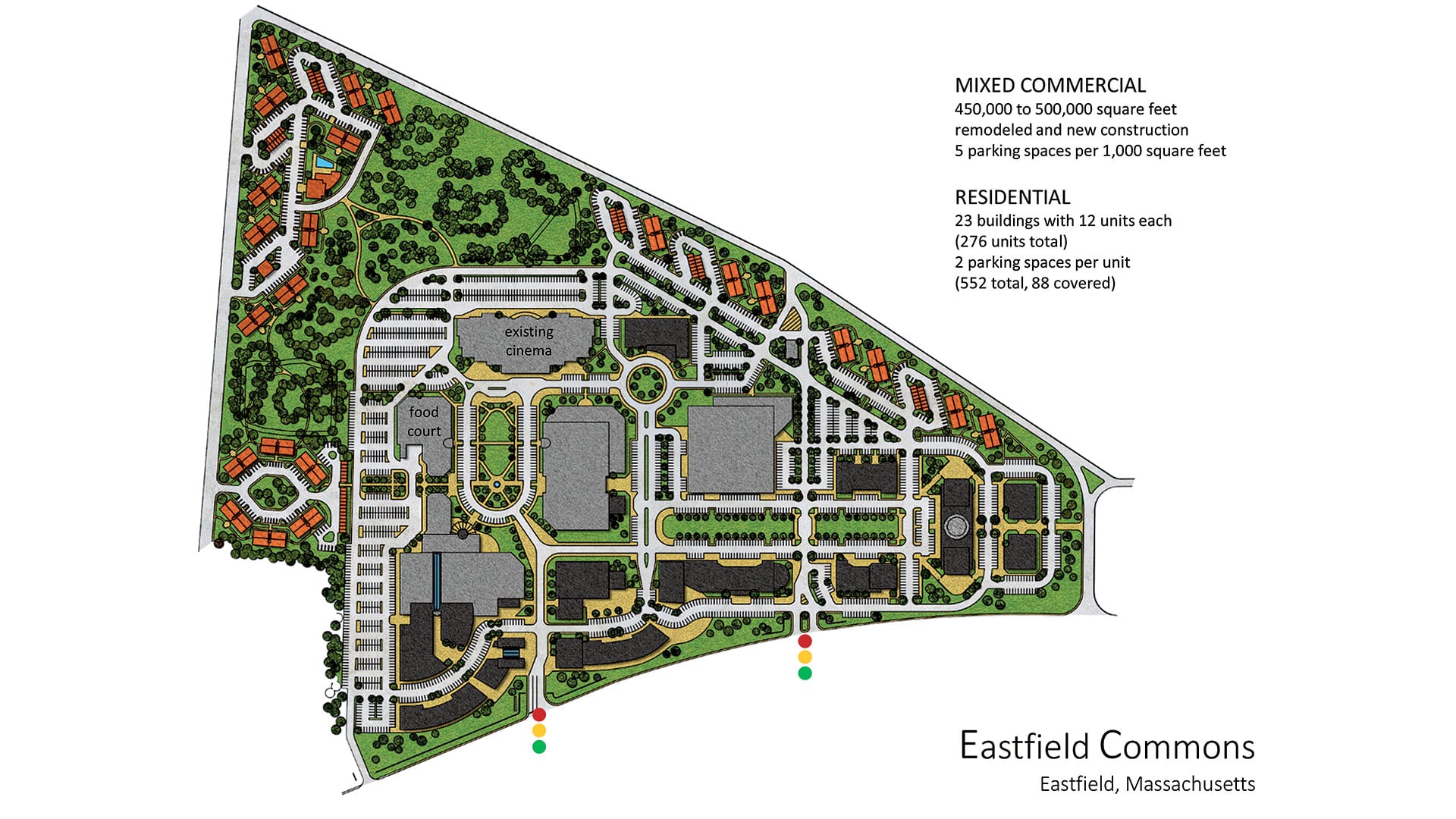
MGM Springfield

Looking at His Reflection

Mike Mathis, seen here with Anita Bird

Mike Mathis, seen here with Anita Bird, assistant general manager of the Starbucks at MGM Springfield, says the $960 million initiative has gone from being a campaign and project to being an employer and operator.

When Mike Mathis rode down Main Street with Springfield Mayor Domenic Sarno in the back of a Rolls-Royce (built in the city) on Aug. 24, it was the symbolic end to a journey that began nearly six years earlier. Or one stage of it, anyway. Indeed, Mathis, president and COO of MGM Springfield, made it clear that the journey continues, personally and professionally, as the casino works over the next few years to ‘hit its stride,’ as he put it.

Mike Mathis said there were so many high points during the journey to opening the $960 million MGM Springfield that he was having some trouble listing and ranking some that stood out above the others.

As for low points, well, he didn’t have any trouble at all with that assignment.

There was one stood out well above the others, and it brought with it some lessons — and humility — that served him well for the rest of the sojourn that climaxed on Aug. 24 when the resort casino opened, but is still very much ongoing.

It came in the fall of 2015 as the design of the casino, and, more specifically, its hotel, changed considerably — from a 25-story glass tower that would dominate the skyline to a five-story facility along Main Street that would blend in. And especially at a hastily arranged press conference to announce the change and the days that followed.

Mathis, named president and COO of MGM Springfield roughly a year and a half before that day, looked uncomfortable and quite defensive at that press conference, called after news of the design change leaked out in the local press and spurred a reaction he and others within the company were not prepared for after years of doing business in Las Vegas and other locales where such design changes aren’t really news, let alone confidence-shattering developments.

“Some of our naysayers took advantage of that and accused us of a bait and switch,” Mathis recalled. “Meanwhile, some of the folks that were more pessimistic about what our intentions were — despite years of goodwill I thought we had earned — seized on that moment.

“It was almost a condition of … this community had seen such a tough run that even some of our supporters thought that maybe MGM is too good to be true — the commitment is too good to be true — and used that change to say, ‘I told you so.’ That was challenging on many levels for me personally and the team.”

“It was almost a condition of … this community had seen such a tough run that even some of our supporters thought that maybe MGM is too good to be true — the commitment is too good to be true — and used that change to say, ‘I told you so,’” he went on. “That was challenging on many levels for me personally and the team.”

Elaborating, he said that he and his team members were all very visible in those days — and throughout the process — and some of those they greeted on the streets in the days following the announcement made their feelings known.

“I got a lot of personal flak on the streets, some of it not so gracious,” he recalled. “But that was a very small window and from a small majority, and that’s what I kept telling myself. And we weathered that storm, and we got the right information out. We didn’t handle it perfectly by any means, and I told the mayor that, but we got past it.”

Indeed, and on Aug. 24, Mathis and Mayor Domenic Sarno shared an energetic high-five as they opened the doors to the casino complex just before 11 a.m., capping a six-year journey that actually began in Brimfield, not Springfield, as some may recall.

Or at least the first part of the journey.

Mike Mathis says it takes two to three years for a facility like MGM Springfield to fully “ramp up.”

Mike Mathis says it takes two to three years for a facility like MGM Springfield to fully “ramp up.”

Building and opening the casino was obviously a long and difficult assignment, but it was just a step in the process, said Mathis, who told BusinessWest that MGM Springfield has gone from being a campaign and a project (one that officially ended on Aug. 24) to being an employer and an operator. And with that change, there are new responsibilities — for him and the team.

“That means thinking about the customer first, and everything flows from that,” he explained, adding that one of the things he’s most proud of to date is how the workforce, much of it without any experience working in gaming, has progressed. “There’s so much you can overcome in our industry with a positive attitude, and that’s been really gratifying to see.”

For this issue, BusinessWest talked with Mathis, clearly the face of MGM Springfield, about the journey he’s on — the parts have been completed and the ones still to come.

A Solid Bet

As noted earlier, when Mathis, then vice president of Global Gaming Operations for MGM’s hospitality division, first arrived on the scene in Western Mass. with the goal of helping the company win one of the coveted casino licenses in the Bay State, the focus wasn’t on Springfield, but tiny Brimfield.

That’s where Mathis, who described himself as the “MGM advance Massachusetts guy,” first touched down and commenced learning all about Massachusetts politics, zoning, and more.

Eventually, he and the team would learn some other things — primarily that a Turnpike exit needed to make a Brimfield casino happen was not in the cards, as they say in this business, and also that Brimfield residents weren’t very responsive to the idea of having a project of this scale in their proverbial backyard.

“We mistakenly thought, because they host the antiques fair a few times a year that brings in hundreds of thousands of people a year, that they would be receptive to this attraction,” he recalled. “What we learned is that they like that a few times a year — to let their town get taken over — but they weren’t looking for that 365 days a year.”

Mathis and the team at MGM would learn many other things in the weeks, months, and years to come, especially the fact that they were not in Las Vegas anymore, and that things move much more slowly in the Bay State.

They also learned a lot about Springfield, which, in the early going, was emerging as a competitor to Brimfield. And the more they learned, the more they came to like the city and understand that whichever proposal emerged from the City of Homes would be a formidable candidate for the Western Mass. license.

Fast-forwarding a little, by late 2013, MGM’s plan to place a resort casino in Springfield’s South End was the only Western Mass. proposal still on the table after voters in West Springfield and Palmer rejected casino referendums and officials in Springfield chose the MGM option over two others placed into contention.

But still the fight wasn’t over, as MGM had to withstand a statewide referendum bid to ban casinos in November 2014, which it did, when 59% of voters gave the go-ahead to commence the casino era.

All that was left now was to design and build the facility, staff it up, meet a host of conditions set by the city and the Mass. Gaming Commission, and eventually open the doors.

“I remember the humility of Jim Murren walking into his [Sarno’s] office and saying, ‘mayor, we do these all the time, but we want to make sure we understand what your goals are before we even think about what we want to do here.”

Mathis, of course, was involved in every step of the process, and he recalls it as the most challenging but ultimately rewarding experience in his career.

“Seeing crowds enjoy this product that we created out of thin air, and seeing it serviced by a bunch of my friends and supporters and volunteers that I’ve been with since we were knocking on doors back in 2012 and 2013 … that’s as good as it gets,” he told BusinessWest. “That’s been the highlight of my career.”

As he looks back on that process, dozens, if not hundreds, of memories float to the surface — from attending neighborhood council meetings across Springfield to working with volunteers to summon the votes to defeat the ballot initiative on gaming, to visiting the Springfield Armory with MGM Chairman Jim Murren to learn about city history and architecture, and especially the influence of Frederick Law Olmstead, who designed not only Central Park in New York but Forest Park in Springfield.

And, yes, that uncomfortable press conference when the design change was announced.

Early on the in the process, when Mathis was still on the advance team and not yet the face of the project, he recalls watching senior-management members as they worked to develop a relationship with Springfield and its leaders — and learning from those experiences.

Mike Mathis and Springfield Mayor Domenic Sarno ride in style on opening day of MGM Springfield

Mike Mathis and Springfield Mayor Domenic Sarno ride in style on opening day of MGM Springfield — in a Rolls-Royce made in the city — at the symbolic end of a journey that began six years ago.   Getty Images

“My memory from those early days was how important it was for the chairman of our company to really understand what the mayor wanted,” he recalled. “I remember the humility of Jim Murren walking into his [Sarno’s] office and saying, ‘mayor, we do these all the time, but we want to make sure we understand what your goals are before we even think about what we want to do here.’”

All In

Actually, MGM doesn’t really do this all the time. It opened National Harbor in Maryland in late 2016, and another casino in Detroit a few years earlier. But it hasn’t opened many in this country, and hadn’t opened anything in the middle of an urban area like downtown Springfield.

So this was a pioneering effort in many ways, and for Mathis, who had previously done considerable work for the company overseas, in locales ranging from Singapore to Toronto, it was, quite obviously, a significant career stepping stone to be put in charge of it all.

To put that in perspective, he flashed back to the Gaming Commission session in early 2014 (he easily summoned the exact date, Jan. 24), when he was announced as the president of the project.

“There was a huge round of applause, and I recognized some of the voices in the audience saying ‘attaboy,’ and that was based on some of the relationships I had formed over the two years before that,” he recalled. “It was a special moment, and it really cemented for me how important this project was going to be for not just the company but the community, and they saw me as the face of it. And I thought that I owed them personally to deliver on the commitment; there was no way I was going to let these people down.”

He said the biggest challenges involved with coming to a new market like Massachusetts is understanding the local population’s experience with gaming, and its wants, needs, perceptions, and fears.

“We would go into neighborhood meetings and ask how many people had been to Las Vegas,” he recalled. “And not many had, and that told me that, to the extent that they know gaming, they know it in a regional way, and they don’t know some of the great things we do in Las Vegas, a lot of which is MGM.

“And that gives you some perspective on the group and the level of education you have to give them,” he went on. “Because I knew what the fear was — the fear was a slot box that would be cavernous and unimaginative and prey on the worst elements of the business. Overall, you have to identify with people on a very personal level and overcome some of the stereotypes people have from watching movies about what a casino operator is.”

Now that MGM Springfield is open, there’s been that shift he described, going from being a project to an operation. For him, the day-to-day is obviously much different, with a great deal of time spent on the casino floor.

“I view my role, especially in this early stage, as being quality assurance,” he explained. “I try to put on the eyes of the customer and walk through every space and observe every interaction.”

I do so with the mindset, ‘what is the customer experiencing, from the minute they enter our garage, or even further downstream — what are they experiencing as they travel on I-91 or the Turnpike?’” he went on. “‘What are they seeing for signage? What are they seeing in terms of access and traffic?’ These are all things I’m trying to see from their perspective.”

He said he will frequently engage patrons, asking them about their experience, their meal, and more. And many times, they’ll engage him because they recognize him from all those times he’s been in the news — and walking around the city, through the good times and the bad.

That’s when happens when you’re the face of the operation.

As for MGM Springfield as an operation, not a project, he said that, overall, it takes two to three years for a resort casino like this one to “hit its stride,” as he put it.

“That’s the typical ramp-up,” he went on. “There’s a lot of runway for us to do more business and more profitable business moving forward, especially as understand our staffing patterns, our peaks and valleys throughout the week and throughout the season, and what the customer wants and doesn’t want.”

Next Question

When asked what comes next for him — a prolonged stay in Springfield, a new assignment in another corner of the world, or something in between — Mathis said he really hasn’t had any time to think about that.

“The journey was amazing, and I’d be worried about trying to replicate it — if I could replicate it,” he explained. “This has been pretty unique, and it would be a mistake to think I could find another Springfield and do what we did here.”

And with that, he went back to the casino floor to engage customers and be engaged by them.

The journey has, indeed, been amazing, but in most all respects, this trip is far from over.

George O’Brien can be reached at [email protected]
Women in Businesss

Leadership Course

Nancy Buffone

Nancy Buffone

Nancy Buffone has three degrees from UMass Amherst and has spent her entire career working for her alma mater. The job titles and long lists of responsibilities have changed over the past 23 years, but the one constant has been that she loves — really loves — coming to work every day. As a manager, leader, mentor, and role model, she says it’s her mission to make all those on the teams she supervises feel the same way.

Nancy Buffone says that as a manager — and as a leader — one thing she tries to do is put herself in the shoes of those she’s supervising.

And in the case of younger staff members, that’s not a hard assignment, because she’s certainly been in those shoes.

Indeed, not long after graduating from UMass Amherst more than 20 years ago, Buffone went to work for the institution in the Provost’s Office. A few decades later, she is associate vice chancellor of University Relations, a relatively new realm at the school, has two offices, and manages roughly 35 people handling a wide array of assignments, from planning commencement to putting out the alumni magazine to dispensing news.

Putting herself in the shoes of those carrying out that work enables her to better understand their wants, needs, anxieties, and challenges, she said, and overall, it makes her a better leader and the offices she supervises better places to work.

“If you don’t enjoy coming to work, it can be really hard to come to work every day,” she said, making an observation that essentially defines her approach to management.

Becoming a more effective leader is one of the few things not actually listed on Buffone’s job description (we’ll get into what is a little later on), but professional development is something she takes very seriously.

In fact, earlier in her career, while working for the university’s Provost’s Office, she developed a leadership program for academic department chairs — an initiative that filled what she saw as an enormous need.

“This was something brand new, and there was a lot to the job. It was a new challenge, and it was something just so out of the box, so out of the comfort zone for me.”

As part of her own professional-development efforts, she became a participant in the Leadership Pioneer Valley program, specifically as a member of its class of 2013. She said the experience not only provided her with a much better understanding of the four-county region — one of LPV’s stated goals — but helped her do something she said all good leaders need to do — step out of her comfort zone.

In this case, that meant taking on the additional responsibilities of the Communications Department with University Relations, which effectively tripled her workload and the number of people she was managing.

“This was something brand new, and there was a lot to the job,” she said. “It was a new challenge, and it was something just so out of the box, so out of the comfort zone for me.

“And to some extent, it still is, but I love it,” she went on. “This is a place to get creative and take a lot of the work that we’re doing here every day and think about how we’re going to tell that story; that’s fun, and that’s a challenge for me.”

Her ability to move well beyond that comfort zone has been invaluable as she has taken on that ever-growing list of responsibilities, many if not most of which have to do with telling the university’s story — and telling it much better than it was told decades ago.

In many respects, it’s better story to tell these days, said Buffone, who was in a particularly good mood on the day she spoke with BusinessWest because the new U.S. News & World Report rankings of the nation’s colleges had just come up, and the university had moved up a few notches in many of the categories.

“We keep moving in the right direction,” she said, noting, for example, that the school moved up from 29th to 26th on the list of best public institutions, and from 75th to 70th among all schools.

Meanwhile, her career has taken on the same general trajectory as the university’s. For this issue and its focus on women in business, we talked with Buffone about her multi-faceted role at the university, but moreso about the broad subject of leadership and her ongoing efforts to improve those skills.

Background — Check

There are two large bowls of candy in Buffone’s office at the Whitmore Administration Building on the UMass Amherst campus. And it’s the same in her other office on University Drive, where the Community Relations staff is based.

The candy serves many purposes, she told BusinessWest, noting that, in many respects, it is an icebreaker and a temptation that brings people to those offices, which they generally leave with more than a miniature Mr. Goodbar or Reese’s Peanut Butter Cup in their hand. Indeed, they also generally leave with a smile.

“We work very hard at our jobs, so I want to laugh very hard while we’re working,” she said of her general approach to management and leadership. “I want to make sure we’re having a good time while we’re doing this.

“As for the candy … my only rule is that you’re not allowed to ask — just take,” she went on. “But over the years, the candy has been a nice icebreaker for people, and it brings people in — it’s an opening.”

Stocking her office — and later her offices — with candy is just one of the traits Buffone has developed in a career that has seen her take on a growing list of responsibilities since she graduated from the university in 1995.

Nancy Buffone sums up her broad job description by saying that that many employees she now supervises are tasked with “telling UMass Amherst’s story.”

Nancy Buffone sums up her broad job description by saying that that many employees she now supervises are tasked with “telling UMass Amherst’s story.”

As a student, she took a job working in the Provost’s Office (the provost is the chief academic officer on the campus) and had the opportunity to work for and be mentored by Judy Barker, who, as fate would have it, retired soon after Buffone graduated.

She was offered a job approximating the one Barker held, thus commencing a 14-year stint in the Provost’s Office that turned out to be learning experiencing on a number of levels.

“It was an amazing educational opportunity,” Buffone recalled. “I learned so much not just about how UMass works, but also higher education and especially public higher education. Being in the Provost’s Office, I never knew from day to day what I’d be working on; my position evolved into more of a generalist position that allowed me to get involved with many different things.”

That list included everything from working on a number of search committees for many senior administrative positions to creating new events on campus, working with the news office to promote faculty honors, and much more.

Along the way, she worked for several provosts who also became mentors, and she also earned two more degrees, including a doctorate in higher education policy and leadership. She said she was given the opportunity by those provosts to take what she was learning in the classroom and apply it in the workplace, especially within the broad realm of leadership and, more specifically, the academic department-chair level.

“Looking at what universities did to train the next person to be in the chair’s role, it became clear that at most places … it was nothing,” she explained. “So I was able to create an orientation leadership program for new department chairs that still exists today, although in a slightly different format.”

That program was among the hardest things to give up as Buffone moved on to the next chapter in her career in early 2009, as executive director of External Relations and University Events as part of the new University Relations department.

That office, created by then-Chancellor Robert Holub, is tasked with a wide variety of assignments, including community relations, events, media relations, federal and state government relations, and more. Early on, Buffone was placed in charge of events, with one of the first being the school’s 150th anniversary, a party that was several years in the making.

“We work very hard at our jobs, so I want to laugh very hard while we’re working. I want to make sure we’re having a good time while we’re doing this.”

These days, she leads two teams, one handing events and community relations and the other assigned to communications — a very broad term covering everything from the alumni magazine to the college website.

As she said, the expansion of her duties and the title on her business card tripled her workload and put dozens more people under her supervision, giving her more opportunities to apply lessons learned in graduate school and also while working with and for many great mentors.

Leading by Example

When asked to describe her style of management, Buffone paused for a second before noting that she’s from New York (Long Island, to be more specific) and thus relies heavily on sarcasm.

And then gave an example. Sort of.

“I learned how to manage by making mistakes, and I try not to repeat my mistakes,” she said with a laugh. “I started small, managing one person, and then four, and then it grew seemingly overnight when I took on the communications team. But whatever the number is, it’s really about trying to understand what I can do for the people I work with every day to make their jobs easier.

“If they can focus on what they need to do, especially the creative people … if I can make it so they can focus on what they’re trying to accomplish and not worry about distractions, then that means they’re going to be better at their jobs,” she went on. “I’m trying to create an environment that will foster that creativity and foster collaboration; to me, that’s really important.”

As for her own professional development, Buffone said her involvement with LPV enabled her to do something she really needed to do but was hard pressed to find the time for — doing some reflection on what she wanted to do and where she wanted to go professionally.

“I think it’s hard to find the time to think about what you want and about how to get where you need to go when you’re moving from project to project — it’s just too fast sometimes,” she explained. “Leadership Pioneer Valley offered that opportunity to really think about what I wanted and what skills I needed to keep moving forward.”

Elaborating, she said that, through her LPV experience, she decided she needed to get more involved in her community (Amherst), and she has, serving as a town meeting member and as president of the Amherst Area Chamber of Commerce board.

Meanwhile, at the office — or, again, at both her offices — she works hard at her job and equally hard at making sure people enjoy their jobs, something she believes is key to promoting creativity and, ultimately, better, more effective telling of the university’s many stories.

That includes the staging of what she called ‘standing meetings,’ which are just that — 15-minute meetings, instituted about five months ago, in which the participants stand and, in this case, keep a huge inventory of individual projects (700 a year for the communications department alone, by Buffone’s estimate) on track.

“The meetings will go half an hour even though they’re supposed to go 15 minutes,” she explained. “But if you’re sitting, the meeting can go way too long; that’s the thinking, and they’ve been pretty effective.”

As have most of her initiatives, all aimed at not only getting the word out about everything going on at the school, but making everyone on the team as enthusiastic about their role as she is.

“I’ve been really lucky; I’ve been at UMass for 23 years now, and I love my job, I really do, and I love coming to work just about every day,” she said. “And that’s how I want the people I work with to feel.”

Grade Expectations

Unlike the university itself and several of its departments — from food service to the marching band — there are no rankings for communications and events departments.

But there are still measures of success, and plenty of them, Buffone said, listing everything from letters to the editor of the alumni magazine (they show that the material is being read) to feedback on a host of events, to the sense of satisfaction showed by her team members when one of those events is over.

Another measure might be how many times she has to fill those candy bowls — which is often. That shows that people are breaking the ice, coming into her offices, communicating, and enjoying their hard work.

Which, at this university and within this department, is an effective course of action — literally and figuratively.

George O’Brien can be reached at [email protected]
Insurance

Lines of Defense

While major data breaches at national companies justifiably make news, small businesses may not recognize that hackers target businesses of all sizes and types. But awareness is on the rise, especially as insurance companies hone their products aimed at protecting against cyber threats — and help clients understand that buying insurance is only one line of defense, and that complete protection requires in-house diligence, too.

When is cybercrime not cybercrime?

When it falls under the broad category of something called ‘social engineering,’ said Bill Trudeau, president and CEO of the Insurance Center of New England.

That term refers to a broad range of ways to manipulate people into giving up confidential information, or even money. It can include anything from phishing schemes to leaving a flash drive on the ground, hoping someone will find it and load it onto their computer out of curiosity, thereby installing malware on their company’s network.

Or say, Trudeau suggested, a CFO receives an e-mail he thinks is from the company CEO, reading, “we worked out a new deal with ABC Company. Wire them a $20,000 deposit; I’ll have full details when I return.”

“If they get your CFO to wire money to an unknown source, it’s not really theft because they did it voluntarily; it was a trick,” Trudeau said. More importantly, the loss would not be covered by typical cyber liability insurance, because it’s not technically a cybercrime, which involves the perpetrator physically hacking a network, not conning someone else into doing it. Instead, the client would need a fraud endorsement on its insurance policy.

“Social engineering is cropping up more, spreading like a pandemic,” Trudeau said. “Now, enough bookkeepers have been embarrassed or fired that, when they see an e-mail like this, they usually say, ‘wait, I’m not falling for this.’”

But the ones who do succumb to social engineering make it abundantly clear that, while cyber liability insurance is still an important part of a company’s defense against risk, just as important is a culture that trains employees in avoiding being conned.

“Social engineering is a relatively new term that refers to illegal fund transfer or diversion,” said John Dowd Jr., president of the Dowd Insurance Agency. “You can also unwittingly introduce a virus to a third party. This virus may have been put on your website by someone without you knowing it, and when people go onto your website, they get infected … and it’s your fault.”

That’s not to say cybercrime the way most people understand it — a hacker breaking in and exposing confidential data, for example — isn’t still a major problem, one that companies need to work with their insurance agents to cover. While historic breaches like Target in 2013, with 70 million customer records exposed, make headlines, the reality is that most breaches occur in businesses with 100 or fewer employees.

According to the latest report by Cybint Solutions, which provides cybersecurity education and training solutions to businesses and organizations, a hacker attack occurs every 39 seconds, affecting one in three Americans each year.

Bill Trudeau

Bill Trudeau says businesses need to take stock of exactly what data is at risk, and how damaging it would be to have it exposed, in order to craft a plan of defense.

In 2016, 95% of breached records came from three industries: government, retail, and technology. However, 64% of all companies have experienced web-based attacks, and 43% of cyberattacks targeted small businesses. Meanwhile, 62% experienced phishing and social-engineering attacks.

The threat is growing due to the increasingly interconnected nature of the world today, Cybint notes. According to a recent Symantec Internet Security threat report, there are 25 connected devices per 100 inhabitants in the U.S. By 2020, there will be roughly 200 billion connected devices.

The total cost for cybercrime committed globally has added up to $100 billion, Cybint adds. “Don’t think that all that money comes from hackers targeting corporations, banks, or wealthy celebrities,” the report notes. “Individual users like you and me are also targets. As long as you’re connected to the Internet, you can become a victim of cyberattacks.”

It’s concerning, the report notes, that only 38% of global organizations claim they are prepared to handle a sophisticated cyber attack.

“Many businesses, by and large, do not manage the threat as well as they should,” Dowd told BusinessWest. “This could be due to lack of understanding the true exposure and financial implications of a breach. Certain businesses have a greater exposure than others, but any business that stores personal information or uses a computer has the potential for a claim.”

Growing Costs

While the average cost for each lost or stolen record containing sensitive and confidential information increased 4.8% last year, to $148, according to IBM’s annual “Cost of a Data Breach” report, Trudeau said companies need to individually assess what they have at stake.

“You’ve got to look at this on a granular level,” he said. “What data do you have? What data-breach exposure do you have? Do you store information that’s a concern?”

The answer to that question could vary by quite a bit. “You might have blueprints or schematics, designs, but how critical is it? Some might shake their heads and say, ‘no one cares; it’s on the Internet, so it’s not top secret.’ But if a law firm’s files are stolen, there could be embarrassment and reputation risk. You have to decide what you’re trying to accomplish.”

Cyber liability coverage typically protects against a wide range of losses that businesses may suffer directly or cause to others, and these come in two forms: first-party and third-party losses. Third-party losses involve regulatory fines and lawsuits brought by affected customers, while first-party losses are what the business itself incurs up front, such as business-income loss, data-retrieval services, downtime, and notification of customers, to name a few.

The costs to businesses associated with a data breach, from lawsuits to regulatory fines to notification expense, can be staggering, Dowd noted, and insurance companies have responded with new policy forms that protect against many cyberthreats that customers may never have heard of.

“Policies today are much broader than they used to be out of necessity — the crooks keep coming up with unique ways to hack into your computers and steal information,” he said. “In some cases, they will charge you a ransom to return the information they stole from you. Insurance policies can cover all of the costs associated with a breach, including fines and penalties.”

When a data breach does occur, how a company responds up front — self-reporting to authorities and having a turn-key response — can reduce its liability. In fact, carriers that specialize in this type of coverage, like Beazley and Chubb, have turn-key response operations as part of the policy.

“Social engineering is cropping up more, spreading like a pandemic. Now, enough bookkeepers have been embarrassed or fired that, when they see an e-mail like this, they usually say, ‘wait, I’m not falling for this.’”

Immediately notifying victims and paying for identify-theft-prevention services can help avoid the liability costs that typically outweigh the first-party losses, Trudeau added. “You need liability coverage, but you hope you’ll never have to use that if you handle everything correctly with the victims.”

Businesses need to have not only insurance against cybercrime, but a plan of defense in case something does occur, Dowd said. “Virtually no one is immune from this danger. The laws on the books today are very strict with regard to protecting personal information, whether it is your clients or your employees.”

In response, according to the Cybint report, approximately $1 trillion is expected to be spent globally on cybersecurity from 2017 to 2021. Meanwhile, unfilled cybersecurity jobs worldwide will reach 3.5 million by 2021. Even now, more than 209,000 cybersecurity jobs in the U.S. are unfilled, and postings are up 74% over the past five year. Clearly, it’s a threat that isn’t expected to go away.

Eyes Wide Open

Employers can take a number of steps to prevent data theft, such as protecting every computer connected to the Internet or the internal network with anti-virus and anti-spyware software; installing security-software updates promptly to stay ahead of hackers; securing the company’s wi-fi network by requiring passwords or even configuring the wireless access point or router to hide the network name; securing computers and network components and requiring log-on passwords for all employees; and continually educating employees on security guidelines for computer, network, database, e-mail, and Internet usage, as well as penalties for violating those guidelines.

And, of course, training employees on how to spot a scam.

“It’s not a data breach when you fool someone into giving up data,” Trudeau said. “In the last few years, insurance providers have seen a striking increase in people voluntarily parting with their money. We need to make sure we’re having the right conversations.”

He said he’s heard of someone posing as a technician visiting a business, and asking to use the bathroom. Once out of sight, he ducks into the first empty cubicle he sees and inserts a flash drive onto a computer to upload malware.

“Certainly prevention is important. A lot of little things can happen,” he told BusinessWest. “Awareness is important, to stay fully ahead of all the shenanigans.”

Some cybersecurity-insurance carriers pose a long series of questions on their application forms about the details of a company’s exposure to data risk, and if the underwriter isn’t satisfied with the answers, they may not write the policy until certain practices have been changed and safeguards put in place. Companies may also choose to hire a third party to poke around their computer systems and challenge their operations when necessary.

“Prevention is critical because the fallout from a breach is not limited to out-of-pocket expense,” Dowd said. “You can also lose clients and sales.”

Indeed, according to an Economist Intelligence Unit consumer survey conducted in 2013, 18% of respondents had been a victim of a data breach, and, of those individuals, 38% said they no longer did business with the organization because of the breach. Meanwhile, 46% said they advised friends and family to be careful of sharing data with the breached company.

“Having a good IT firm who knows how to protect your system on an ongoing basis is critical,” Dowd continued. “Going through the application-for-coverage process is very helpful and often eye-opening because it reveals what you may or may not be doing correctly from a prevention standpoint. I will often suggest to clients that they go through the process of applying in order to educate themselves, even if they ultimately choose not to buy the insurance policy.”

After all, the best policy against becoming a victim is knowledge and vigilance. But an actual insurance policy is a good idea, too.

Joseph Bednar can be reached at [email protected]

Health Care

Deep Dive

Stacey Kronenberg (right), operations manager at Achieve TMS East

Stacey Kronenberg (right), operations manager at Achieve TMS East, demonstrates the dTMS technique with technician Sara Pittman.

With data in hand showing that its signature treatment — known as deep transcranial magnetic stimulation — has a strong track record in battling depression, Achieve TMS East has seen significant growth in the region. Now it has further reason to be excited, with the technique showing great promise in treating OCD.

Margie Pierce understands the difficulty — and, yet, the importance — of tackling the problem of depression.

“It’s the leading cause of disability worldwide right now,” said Pierce, a licensed clinical social worker and director of operations at Achieve TMS East, a fast-growing chain of behavioral-health practices that employ an innovative approach to treating depression known as deep transcranial magnetic stimulation, or dTMS.

“We’ve had people who were chronically depressed for 20 years have a fabulous response to this, and we’ve had people chronically depressed who have not had a great response,” she told BusinessWest. “We can’t pigeonhole people when they come in, whether they’re going to respond or you’re not. It’s kind of hit or miss, just like with medications. Some people respond to certain medications, and others don’t.”

That said, however, dTMS has proven remarkably effective in most people who undergo it — in many cases, people who have tried a seemingly endless string of medications and therapies with little success. That explains why the organization has grown to 11 offices across Western Mass., with broader geographic expansion planned.

“We can’t pigeonhole people when they come in, whether they’re going to respond or you’re not. It’s kind of hit or miss, just like with medications. Some people respond to certain medications, and others don’t.”

Deep transcranial magnetic stimulation, or dTMS, is a non-invasive technique that applies a series of brief magnetic pulses to the brain, by passing high currents through an electromagnetic coil placed adjacent to a patient’s scalp. The pulses induce an electric field in the underlying brain tissue and activates underactive areas in the brain associated with depression.

Dr. John Zebrun, senior medical officer with Achieve TMS East, said transcranial magnetic stimulation (TMS) was developed in Europe in the 1990s, and the first machine to receive FDA approval in the U.S. was the Neurostar machine, in 2008, which reached two to three centimeters into the brain, unlike dTMS — developed by an Israeli company called BrainsWay — which reaches six to seven centimeters in, and earned FDA approval in 2013.

“It enables you to get deeper into the brain tissue, so the volume of brain tissue is larger,” Zebrun told BusinessWest. “We don’t miss the target, ever, and there’s more stimulation in that area.”

The developers of the original TMS technique, he explained, wanted to discover if there were circuits or networks in the brain tissue they could stimulate to ease clinical depression. They targeted the left prefrontal area, which imaging scans suggested were underactive in patients with depression.

“The thought was to stimulate that area first and get it closer to a normal activity level, and that would help with depression — and it did. And that still is the primary target,” he said, noting that the device produces a magnetic field, not an electric current. “It’s getting groups of neurons in the circuit to fire together. As they get used to firing together, they’re more connected to each other.”

After a standard treatment of 36 sessions, he went on, those neurons become trained to fire normally. Treatment statistics show that 51% of patients who undergo the entire protocol get all the way to remission, while 75% get at least halfway to their goal. About one-third will need repeat, ‘booster’ treatments down the road, while two-thirds don’t.

Dr. John Zebrun says deep transcranial magnetic stimulation gets deeper into the brain than traditional TMS

Dr. John Zebrun says deep transcranial magnetic stimulation gets deeper into the brain than traditional TMS — and shows great promise for OCD as well.

In short, those are great numbers for a depression treatment, Zebrun said, and that success explains why Achieve has grown so rapidly across the region — and promises to become a more widely known name across the Northeast.

Long Time Coming

The breakthrough in TMS occurred in 1995, Zebrun said; that was when researchers first demonstrated that a magnetic field could stimulate the right neurons and get a response.

“So it’s been around a long time,” he said. “It varies from machine to machine, but they’re all operating within a certain range and certain power level to get the antidepressant effects.”

FDA approval was only one key development, however; insurances companies still needed to pay for the treatment if doctors hoped to reach a wide market. Medicare accepted it in 2015, and other payers soon came on board.

The FDA originally approved TMS for patients who had failed to find relief with another antidepressant treatment. “But insurance companies added extra layers, expecting to see about four medication and psychotherapy trials before they give this approval,” Zebrun said. “But a lot of people out there have already been through years of treatment and tried several medications.”

Dr. Thomas Bombardier, an ophthalmologist turned businessman, was involved with launching a chain of Achieve TMS businesses in California, Pierce told BusinessWest, and when he saw the benefits and how patients were responding out west, he decided to bring the model to his Western Mass. stomping grounds, teaming with two other owners to open Achieve TMS East.

Patients are referred to Achieve by their primary-care doctors, therapists, and psychiatrists, and some self-refer after hearing about the practice through social media or friends or family members.

“We’re very open to however they can get into the door to get the help they need,” Pierce said, noting that, while the majority of people who seek out tDMS are good candidates for it, some aren’t, due to medical contraindications, recent seizures, or even metal in the head that could heat up during the treatment. Everyone also gets a psychiatric consult to see if the treatment will be appropriate.

Stacey Kronenberg, operations manager at Achieve TMS East, demonstrated the dTMS technique for BusinessWest on Sara Pittman, a technician with the practice, although at a very low power level. Pittman put on a soft cap followed by the dTMS helmet, and Kronenberg set the device to a single-pulse mode, moving centimeter by centimeter until she found the motor area for Pittman’s hand, which twitched. From this process of ‘mapping,’ she could locate the right area to target for treatment.

The power setting isn’t uniform for each patient, and can be altered by the thickness of the skull, how much sleep the patient got the night before, even how much coffee they drank that morning. The process involves 36 ‘taps’ in two seconds as the neurons are stimulated, followed by a 20-second break, then another 36 taps in two seconds, then a 20-second break — a cycle repeated 55 times, totaling just over 20 minutes.

Initial treatments are run at lower power than later treatments to desensitize the patient to the sensation, which Pittman described as more of an annoyance — like a woodpecker tapping at her head — than anything. “It’s a tolerable discomfort,” Zebrun added. “I wouldn’t say it’s a breeze, but it’s tolerable.”

Margie Pierce

Margie Pierce says some people have come in after battling depression for 20 years — and finally found relief through dTMS.

Some patients pass the time by chatting with the technician, while others choose something to watch on Netflix, on the big TV hung on the wall beside the treatment chair.

“A lot of people, at the end, are like, ‘oh, I’m done already?’ They’re enjoying their conversation or their show,” Kronenberg said. “I think we should work for Netflix. A lot of people come in and are like, ‘I want to get Netflix.’”

That’s because they’re at the office often enough to binge a lot of TV — five days a week for six weeks, in fact, which is how long it takes to train the brain. “A lot of patients don’t want to leave when it comes to the end of their treatment,” she said. They tell us, “I’m so used to coming and seeing you. Who can I talk to now?’”

Beyond Depression

For starters, they can talk to their loved ones, in most cases, about how effective the treatment was. And depression isn’t the only use for dTMS. The FDA recently approved it as a treatment for obsessive compulsive disorder. In fact, dTMS has been successful in trials for OCD in ways that traditional TMS cannot be, because the target area of the brain is deeper than for depression.

“The surface coils [of TMS] would need so much energy to get that deep, it would hurt. The surface area would get too much stimulation rather than area you’re targeting, and you’d risk a seizure. That wouldn’t happen with dTMS,” Zebrun explained.

He said he hopes to reach people who don’t find standard cognitive treatment for OCD effective. “It can devastate one’s life. You can get wound up into some of these compulsions, or your mind can be so caught up and obsessed with obsessive thinking that you can’t focus on anything else. You can’t get through a planned project because there’s too many interruptions from your loops of thought that come in. There’s a wide range of those obsessions and compulsions.”

Even milder symptoms of OCD can really bother people, he added. “They wish they could get rid of these images popping into their head that started from nowhere and have no relation to anything in their lives and are disturbing to them.”

“They’ll say, ‘why wouldn’t you try this? What do you have to lose, except maybe your depression?’ … For most people, it’s going to help.”

Kronenberg also hopes dTMS makes an impact on the lives of these patients, noting that OCD is one of the most thorny issues that therapists tackle. And, much like depression, she added, OCD can be a “hidden” disease because there’s some stigma and shame associated with it.

But there shouldn’t be, Zebrun said, especially when something like dTMS exists, with its strong track record and its minimal side effects, which may include facial muscle contractions and headaches, which are both temporary. Fewer than one patient in 1,000 may experience a seizure — a risk similar to that of taking an antidepressant medication at the maximum dose.

Because it’s tolerable, he added, patients can do it before or after work, or during their lunch break, and return to their normal activities.

And maybe a normal life.

“People who for 20 years were depressed say it’s life-changing for them,” said Anita Taylor, marketing director at Achieve TMS East. “When we hear those kind of stories, we’ll ask them, ‘what would you say to someone thinking about this?’ They’ll say, ‘why wouldn’t you try this? What do you have to lose, except maybe your depression?’ It’s worth it to give it a try, go in wholeheartedly, and, for most people, it’s going to help.” u

Joseph Bednar can be reached at [email protected]

Commercial Real Estate

Making a Big Splash

This rendering shows the many components of the planned $650 million resort and water park in Palmer.

This rendering shows the many components of the planned $650 million resort and water park in Palmer.

More than five years after Palmer residents rejected a casino proposal for a huge tract of land just off Turnpike exit 8, the property is back in the news, this time as the planned site of a $650 million water park, resort spa, and sports complex.

It’s the most basic tenet in commercial real estate.

Location, location, location.

Since the Massachusetts Turnpike opened in 1957, the large tract of land sitting atop the hill overlooking the exit 8 ramp in Palmer has always possessed that coveted quality. But over the ensuing 60-plus years, little has been done to capitalize on it.

Indeed, among the more than 20 exits on the Pike, exit 8 is arguably the least developed. There’s a small gas station and attached convenience store just off the exit ramp, but one has to go a half mile left or right to find much commercial development, and even then there isn’t much.

Still, Northeast Development saw the enormous potential in the property more than 20 years ago, and first obtained an option on more than 200 acres owned by the late John Lizak — who owned several properties within the town — and later acquired it outright soon after casino-gambling legislation was passed in the Commonwealth.

An opportunity to place a casino, proposed by the owners of Mohegan Sun, at the site went by the boards in 2013, when Palmer residents rejected a casino referendum, but now the property is the focus of another high-profile initiative — one on almost the same scale as the MGM casino eventually placed in the South End of Springfield.

“I remember being at a meeting with them and hearing them say, ‘this is a hot idea — irrespective of the casino, water parks are hot commodities if they’re done right.’”

And, ironically, it’s a concept that actually became part of the rejected casino proposal — a water park.

Or a water park on a much, much larger scale, to be more specific. This would be a $650 million water park resort and spa, featuring everything from a man-made tubing river (if constructed as planned, it would be the longest in the country) to batting cages to athletic fields.

“As the casino competition started heating up, everyone was putting something new into what they were doing,” said Paul Robbins, president of Paul Robbins Assoc., a Wilbraham-based marketing and public-relations firm and spokesperson for the Palmer Sports Group. His firm has also represented Northeast Development for many years. “Doug Flutie was going to be part of Ameristar [one of the casinos proposed for Springfield], and MGM was touting its entertainment. That’s also when Mohegan introduced the concept of a water park.

“And I remember being at a meeting with them, and hearing them say, ‘this is a hot idea — irrespective of the casino, water parks are hot commodities if they’re done right.’”

Those at Palmer Sports Group obviously feel the same way.

Led by Winthop ‘Trip’ Knox, who has been involved with the design and construction of more than 3,000 water-related facilities for water parks, resorts, and deluxe hotels, and Michael D’Amato, who managed the construction of the later stages of the Foxwoods Resort Casino, including the Grand Pequot Tower, the group is thinking big.

As in very big.

Indeed, the complex will feature indoor and outdoor sports facilities, a resort hotel, and two indoor water parks, as well as an indoor hockey and basketball facility, an indoor sports bubble, a baseball complex, soccer and mixed-use fields, beach-volleyball courts, restaurants, and on-site townhomes.

There is demand for all of the above, said Robbins, adding that there isn’t anything like this in the Northeast, and the developers expect to draw visitors from a 300-mile radius and do so for at least 10 months out of the year; yes, the water in the tubing river will be heated.

“The developers believe there are 25 million people in the catchment area for this facility,” said Robbins, who used the phrases ‘Disney-esque’ and ‘think Orlando’ a number of times as he talked about just what is being proposed for the Palmer site.

Elaborating, he said there will be a large water park attached to the resort complex (again, like the Disney parks) that become part of the package of staying at that facility. There will also be second water park for day trippers, as well as a host of other facilities.

Robbins said the Palmer site, while somewhat remote (which explains the lack of development at and around the exit 8 interchange), lies roughly halfway between Springfield and Worcester and is easily accessible to several major population centers. And that has made it a hot property, as they say in this business, for some time.

“When Mohegan signed on, I had a number of meetings with them, and they absolutely loved that site,” said Robbins. “They loved it because [then-Gov.] Deval Patrick said he wasn’t thrilled about casinos going to urban areas; his vision was for a bucolic, ‘drive to the destination, stay a few nights’ type of resort, and that’s what Mohegan is. But the location is also ideal.”

So much so that Northeast pursued a number of different development opportunities for the site, but eventually returned to the concept that grew out of the casino proposal and may eventually replace it as Palmer biggest hope to replace the many manufacturing jobs that were lost there over the past few decades and bring new vibrancy to the community.

Preliminary estimates call for 2,000 jobs, said Robbins, adding that the project might well become a synergistic complement to the recently opened MGM Springfield, offering people from outside the region more reason to come to the Bay State, and specifically Western Mass., for an extended stay.

At present, there is no timetable for the development, said Robbins, adding that the Palmer Sports Group is working with town officials to secure the necessary approvals and make the project a reality.

— George O’Brien

Community Spotlight

Community Spotlight

Once a dominant retail force, Enfield Square Mall has struggled in recent years.

Once a dominant retail force, Enfield Square Mall has struggled in recent years.

While Laurie Whitten doesn’t think the recent opening of MGM Springfield, a few miles north over the Massachusetts border, is a negative, neither is she convinced the incoming traffic does much for nearby Enfield, Conn. The same goes for a casino expected to open in East Windsor, Conn. in the spring of 2020.

“For the most part, casinos are pretty much on their own,” said Whitten, Enfield’s recently appointed director of Development Services. “A lot of people think if you’re across the street, you’ll get all sorts of business, but for the most part, people leave and don’t go shopping or out to eat.”

The way she sees it, any benefit to nearby towns, like Enfield, might be in housing or hotel development, as workers new to the area might be looking for somewhere to live, and casino visitors increase demand for hotel rooms. “That’s where the trickle-down would be when it comes to development.”

But Enfield isn’t looking to surrounding towns for energy, she added; instead, it’s busy creating its own — and she’s excited about the future.

Take the planned transformation of the Thompsonville neighborhood on the Connecticut River, with an intermodal transit center as the centerpiece of a walker-friendly village.

Part of this effort is a river-access project to be funded through a $3.4 million Federal Highway Administration grant. The bulk of the money is being used for riverfront improvements, including the construction of a biking and walking path from Freshwater Pond to the riverfront.

In addition, last year, Eversource signed an access agreement with the town to allow environmental site assessment work to be done to determine the extent of contamination on its North River Street property near the station. TRC Solutions is under contract to perform the work.

Depending on the results of that survey, if the site needs to be remediated or capped, the transit center could be looking at a three- to five-year timeline. In the meantime, the state will build a basic rail station, with an elevated, double-tracked platform on each side. Later on, the town will build in some parking, bus facilities, and outdoor recreation, including walking trails and overlook areas so people can enjoy the view of the river.

Enfield at a Glance

Year Incorporated: 1683
Population: 44,654
Area: 34.2 square miles
County: Hartford
Residential Tax Rate: $33.40
Commercial Tax Rate: $33.40
Median Household Income: $67,402
Median Family Income: $77,554
Type of Government: Town Council, Town Manager
Largest Employers: Lego Systems Inc., MassMutual, Retail Brand Alliance, Enfield Distribution Center
* Latest information available

“There are a lot of different things happening down there,” Whitten said. “We’re certainly working toward being prepared for a new train station and focusing on some adapted reuse of dilapidated buildings down there. We will also be adopting new regulations for downtown Thompsonville, promoting mixed use and higher densities in that area.”

Meanwhile, a Complete Streets plan with new bike paths is under consideration, and renovations at the former St. Adalbert School, which stood vacant for 12 years, are almost complete as developer William Bellock turns it into an apartment building with 20 one-bedroom units, less than a quarter-mile from Town Hall.

“When you’re developing transit-oriented development, the idea is to create higher density,” Whitten said. “Millennials, especially, like to live someplace where they don’t need a car. With high density, they can walk to the train station or ride a bike.”

Moving In

Speaking of housing, development in that sector is on the rise, Whitten noted. “We have some high-end apartments under construction on the north end, and we just adopted some new regulations to allow apartments in transition zones along the I-91 corridor — that would be the transition between commercial, industrial, and residential.”

Meanwhile, a design-district overlay was approved for the Hazardville area of town to promote some historic-style achitecture and mixed use, Whitten said. “We’re also working with developers about the reuse or expansion of some of the larger buildings in downtown, and we just approved a large industrial warehouse distribution center on the south end of King Street, in Metro Park North.”

Enfield has seen an influx of manufacturing, warehousing, and distribution businesses over the past few years, which is a positive for a town that continues to diversify away from its traditional reputation as a retail center. The corridors of Routes 220 and 190, bordering Enfield Square Mall, continue to be a bustling mix of restaurants and retail, but the mall itself, heavily buffeted by store departures over the past decade, doesn’t draw nearly the traffic it used to.

An example is Panera Bread, which was recently approved for an outbuilding in the nearby Home Depot plaza — but will be leaving the mall to get there.

“We’re going to be working diligently to promote smart growth and customer-friendly service, which will probably include some new software; we want to streamline the development process.”

Still, Enfield’s growth in the manufacturing, warehousing, and distribution sectors, as well as a strong uptick in small and sole-proprietor businesses over the past few years — reflecting an entrepreneurial wave the entire region has experienced — remain positive signs.

So are community-building events like the popular Enfield Regional Farmers Market, which runs every Wednesday from July through mid-October, featuring farm-fresh fruit and vegetables, artisan goods, musical entertainment, and a food truck.

Meanwhile, the Thompsonville Community Garden, established a decade ago by the town of Enfield, the University of Connecticut Master Gardener Program, and a grant from the Department of Energy and Environmental Protection, has been a popular program as well.

The garden features 50 raised garden beds, which are rented for the planting season; the rental includes use of tools, seeds, starter plants, compost, water, and educational sessions — and a sense of community for Enfield gardeners who want to grow their own organic vegetables.

Location, Location, Location

Organic growth is something Whitten would like to see on a town-wide basis, of course, noting that Enfield is an attractive location for a number of reasons, including its location between Boston and New York, along I-91, and close to Bradley Airport. “I think there’s a lot of potential in our location,” she told BusinessWest.

That said, she called Enfield a town in transition in some ways, especially when it comes to economic development. “We have a lot of new members on the Town Council, and there’s been a complete reorganization of the Land Use Department. They lose a lot of their top people, so we’re trying to get reorganized and get some good people in there and work as a team.”

Meanwhile, “we’re going to be working diligently to promote smart growth and customer-friendly service, which will probably include some new software; we want to streamline the development process.”

And the development potential is there, she added, pointing again to Enfield’s surplus of available land and possible reuse sites. To that end, officials will be looking at establishing some tax-abatement policies to help businesses access some of those opportunities. “We’re going to be here to help them through the process.”

With the Thompsonville transit center on the horizon and the town continuing to leverage its location and amenities, this community that lies between what will eventually be two casinos is betting big on its future as a business and lifestyle destination.

Joseph Bednar can be reached at [email protected]

Women in Businesss

Giving Credit Where It’s Due

Jennifer Calheno

Jennifer Calheno was tasked with taking LUSO Federal Credit Union from $36 million assets to $100 million in 10 years. She did it in seven.

Jennifer Calheno started working at LUSO Federal Credit Union as a teller when she was just 17 — actually, a much different LUSO than the one that exists today.

Back then, this was a tiny operation — three teller windows, a handful of employees, and a small back room in a nondescript building on East Street in Ludlow. There were just a thousand members or so, all of them part of the town’s large and very proud Portuguese community.

At the time, the credit union closed mid-afternoon on Wednesdays, Thursdays, and Fridays and reopened in the evening; Calheno, daughter of one of the institution’s board members, would work that 6-to-8 shift, not ever thinking that her very part-time job would become a career.

Today, as noted, it’s a much different LUSO, with more than 6,000 members, $220 million in assets, a gleaming new 15,000-square-foot headquarters building further down East Street, a second branch in Wilbraham, and more than 40 employees.

And Calheno, working in concert with an ambitious, forward-thinking board and that growing staff, has a lot to do with all that growth. If not the architect of that transformation — and she took on that role to some extent as well — she was certainly the builder. Taking full advantage of a spate of mergers and acquisitions within the financial-services industry and new regulations that have allowed credit unions to move well beyond their original charters and customer bases, she put LUSO on a strong growth trajectory.

And kept it on that path over the past 20 years.

When hired, she was charged with taking the credit union from $36 million in assets to $100 million in 10 years, and without diluting capital. She did it in seven years, primarily through much more aggressive marketing and building name recognition.

“I do not find myself to be an expert in everything, because then I wouldn’t be good at anything. I bring in people who are good at what they do and I listen to what they have to say, and I take their opinions into value.”

“Marketing was my focus while earning my bachelor’s degree, and I always thought that was something that was weak here,” she recalled. “We had to get over that stigma of being just the Portuguese credit union because of our name, and we did that.”

Specifically, LUSO, which originated with the Portuguese-American Club in Ludlow, changed and expanded its charter to serve anyone who lives, works, worships, or attends school in Hampden County.

“That was the pivotal changing point for us,” she noted. “That allowed me to expand my marketing, expand my targeting, and to really get out of that mindset that we were the Portuguese credit union serving the Portuguese community; slowly but surely, the message caught on.”

And while LUSO has grown in terms of assets, members, employees, the use of cutting-edge technology, and every other suitable measure, Calheno says she’s grown as a manager and a leader, learning, among other things, about how to manage work and life, grow a thick skin, listen effectively, and surround herself with individuals whose talents complement, but don’t necessarily duplicate, her own.

“I do not find myself to be an expert in everything, because then I wouldn’t be good at anything,” she explained. “I bring in people who are good at what they do, and I listen to what they have to say, and I take their opinions into value.”

In doing all that while growing assets and membership, Calheno has also raised the institution’s profile and gotten the credit union and its employees more involved within the community, especially with young people and the all-important realm of financial literacy.

Indeed, every Wednesday, without fail, Calheno returns to her teller roots and sits behind a small desk at St. John the Baptist School (which she attended as a child), taking deposits from the students — and teachers — there.

She says these duties represent equal parts role modeling for employees who are also active within the community and simply giving back to the town that has been her lifelong home.

“It gets me out of the office, and it’s really fun,” she said, referring not only to her banking duties, but her work teaching classes for Junior Achievement.

For this issue and its focus on women in business, we talked with Calheno about LUSO and its profound growth, but also the many roles she takes as president and CEO of the credit union, including mentor, role model, and yes, teller at St. John the Baptist School.

By All Accounts

Calheno remembers the considerable amount of flak she received from the community when plans for LUSO’s new headquarters building were announced back in 2005.

It wasn’t the bank’s expansion that had people riled up, but the chosen location — the long-time home to the Double D Dairy Bar, a small mom-and-pop restaurant and local institution.

“They made the best ice cream … everyone loved the Double D,” said Calheno, who placed herself firmly within that constituency.

What the general public didn’t know, but Calheno did, was that the mom and pop behind the Double D were quite ready to call it a career, and the landmark’s days were numbered anyway.

Today, it’s home to a start-of-the-art facility that clearly speaks to how far the credit union has come over the past 20 years, or since Calheno decided to take her career back to where it started not quite a decade before.

Jennifer Calheno says she honed a number of skills over her 20 years at LUSO

Jennifer Calheno says she honed a number of skills over her 20 years at LUSO, especially the ability to effectively listen.

By that time, Calheno, just 26, had earned her MBA from Northeastern, spent some time in banking — as manager of one of WestBank’s in-store branches in Chicopee — and taken a job with the Secretary of State’s office, one that didn’t have much growth potential, as she recalled.

Meanwhile, the manager of LUSO at that time, someone Calheno worked for during her teller days, was getting ready to retire. While looking to replace her, the credit union’s board was also looking to grow the institution — and also for someone who could make that growth happen.

“The board had come together with a strategic plan — they wanted to grow the member base, they wanted to grow the asset size, and they felt they needed a new organization chart, a new structure, in order to that; they wanted to bring in a CEO,” she recalled, adding that, because she had an MBA and some experience in the business, she was asked to put together a job description for this CEO in waiting.

She did so, and while drafting it, she began to see a match between the board’s needs, her own skills, and her desire to find employment that challenged her professionally and personally.

“I thought to myself, ‘with my background and my experience, and knowing LUSO the way I do, I think this is something I can do,’” she recalled. “I looked at other opportunities, but I felt that this was a chance to come back to the organization that gave me a start, and I felt more confident coming into an organization I already knew so much about. I knew the culture, and I’d lived in this community practically my whole life.”

She recalled that she was probably the least experienced of the 15 eventual candidates for the position, at least when it came to management. But she also believed she would work the hardest to gain the respect and recognition of the board and achieve the aggressive goals spelled out in that aforementioned strategic plan.

Fast-forwarding a little, she was awarded the job, and took it with the expectation of still being in it 20 years later.

“I clearly recall a conversation I had with Mr. Dias at that time,” she said, referring to Joseph Dias Jr., founder of the credit union. “I told him I wasn’t looking for this to be a jumping ground to something else; I’m looking at this opportunity to be my career. I told him I wanted to succeed, and if I succeeded, then LUSO would succeed.”

To make a long story short, that’s exactly what’s happened; over the past 20 years, both she and the institution have grown immeasurably.

While only 26 when she took the helm, Calheno said she already understood that she was only as good as the team in place around her, and by team, she meant both the board and the employees she worked with.

“I don’t think that any opinion is not worth listening to. If that opinion jibes with where I was already going, excellent — then, it’s an immediate ‘awesome, let’s go with it.’ If it’s something different from what I’m thinking, I’m going to pursue it further.”

In both cases, there was passion for the institution and a shared vision, she said, adding that both are necessary ingredients in any success formula.

“They give me a lot of freedom, and they give me a lot of trust,” she said of the board, adding that she has taken full advantage of both to meet the ambitious goals for assets and memberships, build and open the new building, add the branch in Wilbraham, and, overall, take LUSO to a much higher plane, one she probably couldn’t have been envisioned when she was working the night shift while in high school.

In turn, she awards those working with and for her a large amount of trust — at least when she feels it’s been earned.

“I don’t micromanage — I don’t have time to micromanage,” she said. “And I do have a lot of trust in the people here. I wouldn’t have put the management team in place the way I have if I didn’t believe in them to do things the way I want them done.

“But if you start to do things not the way I want them done … then we have a problem,” she said. “If you were to ask people here about my management style, they would say, ‘the less we see of Jen, the better job we’re doing.’”

She said the most important skill she’s developed over the years is listening and valuing the thoughts and opinions being expressed.

“I don’t think that any opinion is not worth listening to,” she told BusinessWest, adding this constitutes sound advice for all managers. “If that opinion jibes with where I was already going, excellent — then, it’s an immediate ‘awesome, let’s go with it.’ If it’s something different from what I’m thinking, I’m going to pursue it further, and I’m never just going to disregard someone.”

As for work-life balance, this is for her, as it is for most women with ‘president and chief executive officer’ written on her business card, a real challenge, one that isn’t really mastered, but dealt with to the best of one’s ability.

“My family sometimes does say to me, ‘put the phone down’ or ‘get away from the computer,’ because my job is not a 9-to-5 job,” she said. “My job is 24/7, and I do tell my family that sometimes, LUSO has to come first. If I can do both, I will. Multi-tasking? That’s what I do all day, every day.”

Dollars and Sense

Calheno’s office in the new headquarters building is large, modern, and bright — there are four glass walls, after all.

Through those walls she can see the offices around her, Ludlow Country Club across the street, and the parking lot where the Double D once served up ice cream. Figuratively speaking, though, what she can see is how far she and LUSO Federal Credit Union have come in 20 years, and especially since she was a teller there in high school.

What she can see is how those remarks she made to Joseph Dias all those years ago — about how she wanted to succeed, and if she did, LUSO would succeed as well — have come to fruition.

From all angles, and in every way, it’s quite a view.

George O’Brien can be reached at [email protected]

Creative Economy

Dramatic Effect

the Colonial Theatre was reopened in 2006

Following a $21 million renovation, the Colonial Theatre was reopened in 2006 after more than 50 years of inactivity.

Kate Maguire was out shopping recently, wearing a shirt that proudly celebrated the 90th anniversary of the Berkshire Playhouse in Stockbridge.

“The young girl at the register — she was probably 18 — was stunned. She said, ‘that theater is 90 years old? I had no idea!’ For her, it was ancient history. But she made me realize that, yes, 90 years of theater is a long time.”

As artistic director and CEO of the Berkshire Theatre Group, which puts on performances at venues in Stockbridge and Pittsfield, Maguire has witnessed quite a bit of that history first-hand since joining the organization 25 years ago.

“The facilities represent two iconic sites,” she said. “The Colonial Theatre is the center of Pittsfield — the center of the county.” As for the playhouse in Stockbridge, also known as the Fitzpatrick Main Stage, “considering that culture is the heart of the community in the Berkshires, that is as iconic a structure as any in Berkshire County.”

But while the buildings themselves are iconic, more importantly, each campus has brought countless people to see some of the most remarkable names in the history of American theater, as well as up-and-coming talent, Maguire noted. “It has created a sort of cultural destination for artists and audiences. That’s what the buildings represent.”

They’re also an economic driver, she added, currently drawing about 75,000 visitors a year and contributing almost $4 million to the local economy annually — as well as employing some 600 people in some capacity each year.

Berkshire Theatre Group (BTG) was created in 2010 by the merger of the Berkshire Theatre Festival, housed at the main stage in Stockbridge, and the Colonial Theatre, built in 1903 in Pittsfield. One of the largest arts organizations in the region, BTG oversees the development, production, and presentation of theatre, music, and various other performing arts.

Kate Maguire says involving hundreds of children in productions each year is key to securing BTG’s future.

Kate Maguire says involving hundreds of children in productions each year is key to securing BTG’s future.

The Stockbridge campus presents work at two venues. The 314-seat Fitzpatrick Main Stage, designed by famed architect Stanford White, is a summer-only venue where classical theatre and world premieres are produced. Meanwhile, the 122-seat Unicorn Theatre, open year-round, is home for new and emerging artists, and a space where more experimental, provocative works often finds a receptive audience.

Meanwhile, in Pittsfield, the 780-seat Colonial Theatre — built in 1903 and re-opened in 2006 following a $21 million restoration — hosts family entertainment, comedy, live music, and other events year-round.

Located in the lobby of the Colonial is the Garage, a name that pays homage to its former owner, Berkshire Auto Co. This newest BTG venue, complete with a stage, lights, and sound system, is a dedicated space for local and regional music, comedy performers, and more.

In short, Maguire said, there’s something for everyone.

“I want people to know they’re welcome here,” she told BusinessWest. “They can listen to acoustic musicians or hear a really funny comedian in the Garage, sit with friends, have a drink, then go into the majestic Colonial Theatre and have a completely different experience. Or they might see a rock band on stage, and the following week see an opera performed. It’s a space where people come together from all strata and all walks of life.”

Rich History

The Colonial Theatre opened its doors on Sept. 28, 1903. Built in five and a half months, it boasted pristine acoustics and classic Gilded Age architecture. As was sometimes the custom in that day, the exterior of the theater was designed by a respected local architect, Joseph McArthur Vance, who also designed Pittsfield’s Masonic Temple, the Christian Science building, the superstructure of the Wahconah Park Stadium, Mount Greylock’s Bascom Lodge, and the Mahaiwe Theatre in Great Barrington.

“I want people to know they’re welcome here. They can listen to acoustic musicians or hear a really funny comedian in the Garage, sit with friends, have a drink, then go into the majestic Colonial Theatre and have a completely different experience. Or they might see a rock band on stage, and the following week see an opera performed. It’s a space where people come together from all strata and all walks of life.”

From its early days, the space played host to some of the most notable lights in theater, including Maude Adams, Ethel Barrymore, John Barrymore, Sarah Bernhardt, Eubie Blake, Billie Burke, George Cohan, Irene Dunne, Grace George, William Gillette, Walter Hampden, Helen Hayes, Al Jolson, Alfred Lunt and Lynn Fontanne, Julia Marlow and E.H. Sothern, Will Rogers, Lillian Russell, Ted Shawn, Noble Sissell, Ruth St. Denis, Laurette Taylor, and Ed Wynn.

the Colonial Theatre

Following a $21 million renovation, the Colonial Theatre was reopened in 2006 after more than 50 years of inactivity.

To the south in Stockbridge, the Berkshire Playhouse was founded in 1928 when Mabel Choate sold the Stockbridge Casino to financier Walter Clark. An organization called the Three Arts Society remodeled the casino’s interior by adding a stage and seating for 450 people, and christened the new theatre the Berkshire Playhouse.

In 1937, the Colonial was renovated with a new marquee, projection room, and two retail stores added to the front of the building. With cinema on the rise, the venue operated primarily for the next decade and a half as a movie theater, although some community performances continued. In 1951, the Colonial closed due to the rise of TV and the decline of touring theatrical companies — and would remain closed for more than a half-century.

Down in Stockbridge, the Berkshire Playhouse was reorganized as a nonprofit organization in 1964 and renamed the Berkshire Theatre Festival. In 1976, the playhouse was added to the National Register of Historic Places. In 1996, the Unicorn Theatre was reopened after a lengthy renovation and became BTG’s official second stage.

To the north, meanwhile, efforts to restore and reopen the Colonial were picking up in the 1990s. And organization called Friends of the Colonial Theatre Restoration was formed in 1994, and public tours in 1997 led to increased community awareness of the venue’s potential. A $2.5 million appropriation in state funding followed, and designation of the facility in 1998 as a National Historic Treasure by the Save America’s Treasures Program of the National Park Service only increased the momentum.

After years of design, planning, and community fundraising, the rehabilitation of the historic theater — and the extensive renovation of the adjacent Berkshire Auto Garage — were undertaken. In 2006, the $21 million restoration was complete, and the theater reopened. The 22-month construction process preserved and reinstalled all historically significant architectural and design features — from the vaulted, gilded entrance to the elaborately decorated boxes and balcony to the custom plasterwork — while creating a modern performance center.

“I feel it’s very important to make sure that the community recognizes the theater as their own,” Maguire told BusinessWest. “The doors were closed for 50 years, and the community got together and put in a lot of hard work and money renovate that theater.”

In a year when the Berkshire Theatre Festival marked its 90th summer season and the Colonial Theatre celebrated its 115th birthday, the community continues to show its support, she added. “We’ve been successful in fund-raising, and certainly a lot of people coming to our shows — we’re very grateful for the attendance.”

Kid Stuff

Maguire might be even more proud, though, of the way BTG engages with children, reaching about 13,000 students with cultural programs each year and putting many of them on stage in any given year; this past summer, about 100 Berkshire-area youth performed in Tarzan of the Apes at the Colonial.

“Imagine how many other kids are coming to these productions,” she said. “We are ensuring the vitality of the future of these buildings. Those 100 kids in Tarzan in the summertime — those kids are going to remember that experience, and make sure that building is here for the next generation.”

She believes that because it’s her own story. Growing up in Lowell, she used to attend performances of Boston Children’s Theatre.

“I was amazed at the quality of work, and it looked like an army of kids were working on these produtions,” she recalled. “Little did I know that, many years later, I’d have the opportunity to create such programming in the community I live in now. Every single doorway I’m walked through has been opened because of theater.”

Maguire wants to open those doors for others today — not just children who might feel a spark to follow a passion for theater, but area residents and Berkshires visitors who become part of a long, rich history every time they buy a ticket.

Joseph Bednar can be reached at [email protected]

Health Care

In Search of Empathy

Catherine Williamson

Catherine Williamson says empathy is at the heart of the dementia-friendly movement.

Empathy is a quality America can always use more of — and that’s especially true, Catherine Williamson said, when it comes to families struggling with dementia.

“What attracted me to the dementia-friendly movement is being able to help individuals adjust to what’s going on in their lives,” she recently told a group of business leaders, who met for lunch at the Student Prince in Springfield for a presentation by the Springfield Dementia Friendly Coalition.

“It’s about empathy, and some of us are not great at being empathetic,” she went on. “Our lives are fast-paced, and we’ve got a lot going on — kids, jobs, husbands and wives, volunteering. We’ve got so much going on that, sometimes, we forget to stop and think about someone else not being able to move as fast as we can, or understand things the way we can.”

Williamson, a certified dementia practitioner and gerontologist with SilverLife Care at Home, said a goal of the dementia-friendly movement is to educate the community, and even the loved ones of people with dementia, about how daily experiences differ for individuals with that condition — everything from going to the library to visiting a doctor; from having a financial-planning meeting with an attorney to simply eating out at a restaurant.

To demonstrate, she led the lunch attendees in a virtual ‘dementia experience,’ in which participants use common objects to block or hinder their eyesight, hearing, range of hand motion, and other faculties, then try to communicate with each other — again, as a way to create empathy and reinforce the need for dementia-friendly changes in society.

“People with functional limitations are dealing with this constantly,” she said. “Imagine how much this impacts their daily lives, their relationships, getting around, even wanting to be out in the community. If you felt like this all the time, in this impaired state, you’d probably want to stay home, too. We need to think about how to make our communities and businesses and public spaces a little easier to navigate.”

The business leaders at the lunch shared their professional and personal experiences with dementia and learned about what it would mean to make Springfield a dementia-friendly community — a designation that an increasing number of Massachusetts cities and towns have been pursuing, one in which businesses, municipal departments, and other entities make a collective effort that help people who are memory-challenged to function in the community and live independently for as long as possible.

“Sometimes, we forget to stop and think about someone else not being able to move as fast as we can, or understand things the way we can.”

“What can we do as a community to improve the quality of lives?” asked Anna Randall of Greater Springfield Senior Services, one of the coalition members. “Being dementia-friendly means different things to different communities, depending on their populations and what resources they already have. We’re here to ask businesses what we can do to help your clients and make this community dementia-friendly.”

At a Loss

Nearly 5.1 million Americans age 65 and older are living with Alzheimer’s disease, the most common form of dementia, and the number is expected to reach 7.1 million in the next decade. Nearly 60% of people with dementia live in their own communities, and one in seven live alone, creating an urgent need, dementia-friendly advocates say, for communities to support people with dementia and their caregivers. 

Attendees of the recent Springfield Dementia Friendly Coalition

Attendees of the recent Springfield Dementia Friendly Coalition lunch underwent a virtual ‘dementia experience’ to get a small taste of what’s it’s like to navigate the world with cognitive impairment.

Meghan Lemay, regional manager in the Springfield office of the Alzheimer’s Assoc., said Alzheimer’s disease is a true epidemic, currently the sixth-leading cause of death in the U.S. and the only major disease that has been increasing in incidence — by a 123% rate since 2000, in fact. At the same time, incidences of diseases like cancer and heart disease have been falling.

In addition, she noted, Alzheimer’s is the most expensive disease in America, expected to cost the healthcare system and caregivers some $277 billion in 2018 alone.

“It’s something we have to address on multiple fronts,” Lemay said. “We know it impacts families directly and has a significant emotional impact, but there’s also a significant financial impact for individuals and our communities.”

Springfield, in fact, is disproportionally affected, with a higher rate of dementia than other Massachusetts communities on average. Demographically, meanwhile, the condition affects African-Americans and Latinos at a higher rate than whites.

While individual communities seek the dementia-friendly designation, a state-level organization known as Dementia Friendly Massachusetts is supporting those efforts. On the community level, Randall noted, businesses who go through dementia-friendly training can then display that fact, “to say this company has gone the extra mile to show they care about their community and want to be more inclusive for people caring with dementia.”

“It’s something we have to address on multiple fronts. We know it impacts families directly and has a significant emotional impact, but there’s also a significant financial impact for individuals and our communities.”

Williamson noted that such steps by businesses could include modifying entryways, altering lighting, or changing the ways they interact with customers. And the changes don’t have to be dramatic. For example, a coffee shop in Boston became more dementia-friendly when it complemented its chalkboard menu with large-print menus at the register. “It’s little things like that — different types of things you can do.”

One attendee of the recent lunch in Springfield noted that some businesses have gone the opposite route, citing the increasing use of automated ordering kiosks at McDonald’s and the dominance of self-checkout lanes at Stop & Shop as two developments that can be problematic for certain individuals.

However, on the plus side, many restaurants have embraced the Purple Table training program designed to help visitors with dementia, autism, PTSD, hearing or vision impairment, or other conditions benefit from a more predictable environment and additional accommodations when dining out.

When families make a Purple Table reservation, participating restaurants provide accommodations that work best for that diner, along with extra patience and attention from staff who have been trained to understand different needs and how to best meet them. Those steps might differ depending on the visitor, but the underlying philosophy of empathy and understanding is the same.

Law and Order

The recent lunch gathering was funded by a dementia-friendly capacity-building grant from the Massachusetts Council on Aging under a service incentive grant from the Massachusetts Executive Office of Elder Affairs, allowing the coalition to hold focus-group meetings with local government and public officials, first responders, and members of the business community.

The goal is to make them aware of the issues facing individuals living with dementia, their friends, family, and care partners; to give an overview of the movement; and to elicit their thoughts and engagement in the initiative. In addition, the group will meet with those living with dementia and their care partners.

The coalition chair, Synthia Scott-Mitchell from Springfield Partners for Community Action, noted that “a dementia-friendly community is defined as one that is informed, safe, and respectful of individuals with dementia and their families, and provides supportive options for improved quality of life.”

But legislators can make a difference, too, and recently did, by passing a first-of-its-kind bill — subsequently signed into law by Gov. Charlie Baker — that aims to make life a little easier for individuals with dementia and their families, through a multi-pronged approach.

More than 130,000 people are currently living with Alzheimer’s disease in Massachusetts, and being cared for by more than 337,000 family and friends. According to the Alzheimer’s Assoc., in 2018, Massachusetts will spend more than $1.6 billion in Medicaid costs caring for people with Alzheimer’s.

“Alzheimer’s is the single largest unaddressed public health threat in the 21st century, and we remain on the front lines of this crisis every day here in the Commonwealth,” said Daniel Zotos, director of Public Policy & Advocacy of the Alzheimer’s Assoc., Massachusetts/New Hampshire Chapter. “This legislation follows in the tradition of Massachusetts being a national leader in healthcare, and we commend the governor and Legislature for ensuring everyone impacted by Alzheimer’s gets the quality care and support they deserve.”

Among its mandates, the bill:

• Establishes a comprehensive state plan to address Alzheimer’s disease within the Executive Office of Health and Human Services, while also establishing a permanent advisory council to help coordinate government efforts and ensure that public and private resources are maximized and leveraged;

• Requires curriculum content about Alzheimer’s and other dementias be incorporated into continuing-medical-education programs that are required for granting the renewal of licensure for physicians, physician assistants, registered nurses, and licensed nurse practitioners;

• Ensures proper notification of an Alzheimer’s or dementia diagnosis to the family or legal guardian and provides information on available resources to both the patient and family;

• Requires state hospitals to implement an operational plan for the recognition and management of patients with dementia or delirium; and

• Establishes minimum training standards for social workers in elder protective services, to ensure protection from abuse and exploitation for elders with Alzheimer’s and dementia.

Small Steps, Big Impact

When it comes to making communities more navigable and manageable for people with dementia, every effort helps, Williamson said, noting that the dementia-friendly movement also seeks to raise awareness — often through workplace presentations — of resources available to help families grapping with Alzheimer’s, when they’re not always willing to seek them out because of shame or stigma.

“If we go into your workplace and address your employees, we’re reaching folks that might need help,” she said. “It’s not just about doing the right thing for your customers, but also for your staff — folks who are taking care of their loved ones, but might not want to come forward.”

As the statistics show, those folks are legion. Increasingly, Williamson and her fellow coalition members hope, they are starting to find their communities a little friendlier, in some very important ways.

Joseph Bednar can be reached at [email protected]

MGM Springfield

For Starters…

Alex Dixon, seen here at MGM Springfield’s South End Market

Alex Dixon, seen here at MGM Springfield’s South End Market, says ‘normal’ isn’t something to expect at the facility for some time.

The long-awaited opening of MGM is now being talked about in the past tense. It was, as most everyone predicted it would be, a momentous event in the city’s history. But thanks to some careful planning, it was not the disruptive force that some were anticipating.

Alex Dixon came away with a few observations — and a few questions — after MGM Springfield’s first weekend of operation late last month.

In that latter category … well, he was wondering out loud if that fruity libation ‘Sex on the Beach’ is the official drink of Greater Springfield. It must be, he concluded, because the bars on the premises ran out of some or all of the ingredients needed to make it — vodka, peach schnapps, orange juice, and cranberry juice — so some people had to drink something else. And usually did.

But for a while, it was also a challenge to get something involving Coca Cola. “We ran out at one point,” said Dixon, general manager of the facility. “We managed to get some more, but we were out for a while.”

“We ran through so many different scenarios, and none of them came to be; we’re as excited for what happened as we are for what didn’t happen.”

As for observations … he said the company may have to take some steps to help some employees with their feet.

“We’re looking right now into getting some foot care for a lot of our employees,” he said several days after the opening. “People were on their feet more in the past 72 hours than they’ve been in a long time. So we’re looking to store some Epsom salts or some foot care, because people need to take care of their feet.”

OK, those were observations more of the tongue-in-cheek variety. Getting more serious — although he was quite serious about those foot problems — he said the long-awaited opening for MGM, meaning not just not opening day but those first several days, were noteworthy not just for what happened — huge crowds and general excitement for the region’s new, $960 million toy — but also for what didn’t happen.

And with that, Dixon summoned the contrived phrase ‘carmageddon.’ That’s not in the dictionary, but if it were, ‘gridlock’ would be listed as a synonym. Some people were predicting something approaching that, meaning Big E-like traffic jams and parking issues, during the first few days. Anxiety was such that some downtown Springfield-based businesses actually closed their doors or altered their schedules in the wake of some predictions. There were electronic signs on I-91 alerting motorists that MGM was opening on Aug. 24, and therefore they should expect delays.

But, for the most part, none of that happened, and what looked to the untrained eye to be a somewhat slow start for the casino was actually the fruits of some careful planning, said Dixon.

Elaborating, he said MGM officials made arrangements with the Big E for casino patrons to park there for free and be shuttled over. And then, in the countless media interviews that took place leading up to and just after the opening, those same officials kept urging people to park across the river to take advantage of that option.

Long story short, they did, and with positive results for area commuters and businesses downtown and elsewhere.

As for hard numbers on MGM’s opening day and first weekend, Dixon didn’t have any at press time. So he qualified things as best he could.

“It was phenomenal,” he said of the opening and the weekend that followed. “And the big jubilation is that we did it — and by ‘we,’ I mean literally the entire community, meaning the city, the Commonwealth, and all the different agencies we’ve been working with to coordinate things. We ran through so many different scenarios, and none of them came to be; we’re as excited for what happened as we are for what didn’t happen.

“We need to get people rested up because this is a marathon, although we had a sprint initially. People need their rest.”

“We did very well in terms of volume — we’re still tabulating the numbers,” he went on. “But we didn’t have the side effects that can potentially come with too many cars, too many pedestrians, and too many issues.”

Looking ahead, and, more specifically, addressing the question of when something approaching normalcy might descend on MGM Springfield, Dixon said it will be a while before that happens.

Indeed, while the week days after the opening were far less hectic, the Labor Day weekend (with Stevie Wonder appearing at the MassMutual Center on Sept. 1) was fast approaching, with Enshrinement weekend for the Basketball Hall of Fame coming the following week, and the Big E to open on Sept. 14.

“I don’t think we’ll see ‘normal’ for some time yet,” said Dixon with a huge smile on his face, implying that not normal is good, as in really good.

For this issue, BusinessWest talked with Dixon about MGM’s long-awaited opening and got a behind-the-scenes look (sort of, but not really) at what was happening, and, as he noted, not happening.

General Manager Alex Dixon didn’t have specific numbers

General Manager Alex Dixon didn’t have specific numbers, but he said volume at MGM Springfield those first few days met or exceeded expectations. Getty Images

Crowd Control

In the days leading up to the opening, there were many MGM employees working long days and often long nights as well, said Dixon, who put himself in that category.

So one of the many items on his to-do list as general manager in the days immediately following the opening was to make sure that those who needed to caught up on their rest.

“That Sunday was focused on really looking at people’s days off, to make sure that, if they couldn’t take a full day, they could at least take some hours off,” he explained. “We need to get people rested up because this is a marathon, although we had a sprint initially. People need their rest.”

After that first weekend, most certainly needed some rest, he went on, adding that the facility was at or near full capacity for many stretches, especially Friday and Saturday nights.

For the most part, the hundreds of employees, many wearing their uniforms for the first time, came through it well, despite what were for some 16-, 18-, even 20-hour days for those at the top levels.

As the bartenders, waiters, and waitresses serving up Sex on the Beach drinks — or not, as the case may be — they had some very long nights, but few seemed to be complaining, said Dixon.

“I heard anecdotally that someone said they made more in three hours than she did in three weeks at her last job,” he said. “That’s not only heartwarming, but it gives an indication of the sheer volume we encountered, and our restaurants were far busier than any of us could have imagined.”

Flashing back to opening day, he said that he and his team handled the different waves of visitors smoothly, but made some adjustments on the fly. The first wave comprised of the thousands who assembled on Main Street in advance of the 11 a.m. opening — some were on the street before 6, said Dixon, adding that the first order of business that day (literally and figuratively) was to get those people into the building safely and in an orderly fashion in order to reopen Main Street to traffic.

The first order of business for those at MGM Springfield

The first order of business for those at MGM Springfield was to get the throngs on Main Street who gathered on the morning of opening day into the facility safely and in an orderly fashion.

That all happened according to plan, he went on, adding that the next wave was a mixed group that included large numbers of workers spilling out of the downtown office buildings and walking the few blocks to the casino. Another wave came through that night, again filling the casino to something approaching full capacity.

As for the adjustments, or tweaks, as Dixon called them, they included everything from reconfiguring the ling lines for people looking to sign up for the M Life Rewards program to devising ways to handle all the traffic at the brick-oven pizzeria at the Cal-Mare restaurant.

“The pizza counter was wildly successful, and we needed more space, we needed another point of sale to handle everyone,” he noted. “That brick-oven pizza was just a hit, so we made some adjustments.”

Getting back to that phrase ‘carmageddon,’ Dixon said it didn’t happen on opening weekend, and that shows, by and large, that it’s not likely to happen on a large scale.

When asked if that was a good thing, he said it was — for MGM, the region, and its business community.

“Through this big peak, we’ve shown that there’s not an over-arching impact to the business community in a negative way, such as slowing down commerce to the rest of the city,” he told BusinessWest. “We’re just really proud of the planning we did in advance, with the city, West Springfield, and the Big E; that investment in the shuttles really paid off.”

And the investment grew in size, because the shuttle service, originally to be offered only on opening day (Friday), was extended through the weekend in yet another attempt to control the impact of the casino’s opening on the region and its businesses.

Drinking it In

When pressed, Dixon said he doesn’t know what goes into a Sex on the Beach drink and wouldn’t know how to make one.

“But apparently half of Springfield does, because that’s must have been the most popular drink,” he said with a laugh, adding that besides stocking on up on peach schnapps and whatever else might be needed, he and his team will continue to make tweaks and adjust as necessary, because ‘normal,’ as he noted, isn’t something likely to be seen at MGM for a while.

And as he also noted, this is a marathon, even though it started with a sprint.

George O’Brien can be reached at [email protected]

Banking and Financial Services

Collaborative Culture

 President Paul Scully

President Paul Scully

When Country Bank sought to overhaul its space on South Street in Ware a few years ago — a former mill building that houses about 110 employees — its leaders banked on what they call a collaborative culture, where low cubicles, glass walls, and comfortable, casual meeting spaces all aim to promote better communication and interaction, and a work environment that appeals to the young professionals that comprise the bank’s future.

Walking down the wide main hallway of Country Bank’s headquarters in Ware, you notice certain things. The central, glass-walled café. Conference spaces with names like ‘Integrity Room’ and ‘Prosperity Room,’ reflecting the bank’s values. The occasional beach ball.

Wait, what?

“Someone said to me, ‘what’s the deal with the beach balls?’” bank President Paul Scully said. “Well, we had them at a company event, and they ended up in the hallway. And when you’re walking down the hall and someone’s coming toward you and there’s a beach ball there, what do you do? You kick it.”

It can be an icebreaker of sorts, he went on, as the roughly 110 employees who work in the former mill building on South Street — almost half of the entire Country Bank organization — don’t necessarily all know each other. But it’s also, well, kind of fun.

“For people who visit, it’s unexpected,” said Shelley Regin, the bank’s senior vice president of Marketing, who estimated about 40 such balls reside somewhere in the building. “Normally, the hallway’s full of beach balls, but they make their ways into the offices, too.”

While fun to kick around, Scully said, the balls also promote interaction, a concept which was, frankly, the driving force in a recent, multi-year renovation of Country Bank’s main office. It’s the reason cubicles were lowered, solid walls were replaced by glass, and some of the gathering spaces feature couches rather than traditional chairs.

“When we moved in here 13 years ago, everyone had a cubicle as tall as me, and you couldn’t see one another,” he told BusinessWest. “That didn’t foster good collaboration. And there was no daylight because the work stations were so tall, they blocked the daylight.”

Scully had a catchy description of what the renovation aimed to reflect — “Google comes to Ware” — and explained why that type of culture is important.

One of the casual meeting spaces at Country Bank

One of the casual meeting spaces at Country Bank, is meant to spur creative thinking in an informal setting.

“We love the fact that we are in a mill town and that we’re a flourishing business here. But how can we attract the talent we need? We’re a $1.6 billion bank with 14 locations and growing — and we need to have Millennial talent to help move it forward. And they’re not going to want to hide in a cubicle and come out twice a day, for lunch and to leave. We said, ‘let’s really look at what is happening in workspaces that’s breeding collaboration and fun, and people just working together as a whole unit.’”

Like the low cubicles, the glass promotes more openness as well, Regin said.

“They put me behind glass walls so they can keep an eye on me,” Scully joked, before noting that his office used to be tucked away in a corner, as opposed to its current spot at the end of that main hallway. “You never went there unless you had to. It didn’t do anything for collaboration, nor did it allow me really to be a part of things. Now, right here, at my desk, this is the hub.

“We’re a $1.6 billion bank with 14 locations and growing — and we need to have Millennial talent to help move it forward. And they’re not going to want to hide in a cubicle and come out twice a day, for lunch and to leave.”

“The glass just opens everything up,” he went on, “and it supports the philosophy that we’re all equal components of the organization, and it’s not like you have to be behind a closed wall to do important things. We do have shades that come down. But if you put the shades down, everyone’s going to want to know what’s going on in Paul’s office, so you might as well just have them up and let them see.”

For this issue’s focus on banking and finance, BusinessWest paid a visit to Ware to learn how Country Bank is using its thoroughly 21st-century space — and several touches of fun that go well beyond the stray beach ball — to better position itself as an employer of choice at a time when competition is high for young talent.

Milling About

When Country Bank moved its headquarters in 2005 from Main Street to 44,000 square feet of former mill space on nearby South Street, it had options to relocate in another town, but the bank’s leaders felt it important to remain an economic engine in the community it had called home for more than 150 years.

“We looked at adding onto the main office, which was a Band-Aid approach, and then this fell in our lap,” Scully said of the former American Athletic Shoe plant, famous for its ice skates. “It was a very large employer, and had maintained the building meticulously. We have a lot of space here. You could easily say we could use half of it, but it works well for us; it allows us to have a big area for innovation and technology, and we have a whole education facility as well.”

The first renovation, to make the space suitable for bank operations, took place 13 years ago, and included those high cubicles and some decidedly unattractive color schemes and décor.

“Everything was kind of a pale yellow,” Scully said. “I started to walk around one Saturday and said, ‘this is awful. The color tones aren’t energizing. You can’t see anything. Let’s bulldoze it down and make it something where people are going to come in and say it’s is a really cool space.’

“It’s a great company, too, which is more important than being a cool space,” he was quick to add. “But you have to have those two together in order to really have it become a destination.”

As opposed to 2005, however, the latest renovation, which began around 2015, took place while people were working in the building — and often shifting around to accommodate the changes. “I moved five times in a year,” Regin said.

One of the casual meeting spaces at Country Bank

One of the casual meeting spaces at Country Bank, is meant to spur creative thinking in an informal setting.

“Really, the key piece was that group that moved into the first section that was done,” Scully recalled. “They were going to make it or break it for us, because if they said, ‘oh, it’s awful,’ we were doomed. Like anything else, when you say you’re going to change something, people immediately think of 1,000 reasons why it’s not going to work. It’s like Who Moved My Cheese? — ‘you’re throwing me off, you didn’t ask my input.’

But when that first group of employees settled in, they were more than satisfied. “Within the first week, they invited everybody in the building for brunch on a Friday because they were so excited about their space. We didn’t pay them for that. I think it spoke to just how much they loved it.”

The renovation stretched over two years because of the need to work around each department. In addition to the collaborative elements, the building also features a conference center with state-of-the-art multi-media equipment, an expansive IT space, and a number of small activity rooms. A gym was considered at one point, but Scully worried that it might turn into wasted space if interest waned, and besides, there’s a gym around the corner that Country didn’t want to siphon business from.

He had reservations about the central café as well, but that has proven to be a big hit. The fridge is stocked with fresh fruit all week, and Fridays feature a brunch with pastries or a yogurt bar. Then there are the Friday-morning games, like Hangman or Pictionary, that began with a few employees sneaking away from the brunch.

“We would all be hanging in the café, and one of the departments would go in a conference room and close the doors every Friday, and that wasn’t really working with me,” Scully recalled. When he found out they were using the short morning break to play games, however, “I said, ‘how about if you do that for everybody?’ They said, ‘really? We can do that?’”

bank based in an old mill building.

Paul Scully says visitors are often surprised to see a bank based in an old mill building.

So now, employees get an e-mail telling them what that Friday’s game is, and anyone is welcome to join in. It’s as much a way to get people talking and collaborating as are the small meeting spaces decked out with couches.

“When you go into a conference room, so often people think there’s a protocol of behavior, in the way you interact with one another,” Scully said. “It’s different when you’re sitting on a couch, bouncing ideas around. That’s what we really wanted to do — have it so people can think in an innovative fashion and look at things totally differently.”

Have a Ball

If visitors and new employees are surprised by the culture being fostered inside the building, he added, the exterior can be unexpected, too.

“I had a gentleman come in last week, and I explained, ‘OK, we’re in a mill building. And you’re going to think, this can’t be it. But you’re in the right place.’ And he said to me, ‘Scully, you’ve explained to us your building before, but this is not the typical bank,’ and I said, ‘at many levels, we’re not the typical bank.’ And that’s fine with us.”

He recalled speaking with someone who had also renovated a mill some years ago. “When I explained about the beach balls, he said, ‘beach balls?’ I couldn’t decide at that time whether we had just lost his confidence in us as a bank or not. But that wasn’t the case at all. The next day, I Federal Expressed him a bunch of beach balls and got a text from him the following day saying, ‘where’s the pump?’ I have every reason to believe those beach balls are flying through the air at his office as well.”

Banking, admittedly, has a staid reputation, and it’s not necessarily a field young people get excited about, he noted. But it is an industry where the culture is changing, and banks with an ear toward what Millennials prefer — when it comes to collaboration, flexibility, and even fun — will have an edge in attracting them.

“We would all be hanging in the café, and one of the departments would go in a conference room and close the doors every Friday, and that wasn’t really working with me.”

“This isn’t about a space,” he said. “It’s about the present and the future. Clearly, my generation is the minority this building, which is great. The Scully generation can’t be the generation that dictates how we’re going to do business. We want to be able to attract young talent and then unleash them, and let them think about how to do things differently.”

In that sense, the physical space is critical, Regin said. And it’s working. “A few years ago, most of our people who worked here were very local — 20 minutes to a half-hour away — and now they’re coming an hour. When they come to this space and realize what Country Bank has to offer, they’re willing to travel that hour, or even longer.”

In a job market where banks have to compete for talent, she added, Country Bank has plenty to offer when it comes to culture. “When people walk in here and see there’s a collaborative atmosphere, that’s important. That’s what people are looking for, especially the Millennial segment — they want to be at a place where they feel valued and there’s room for growth. It’s a destination, not just a job, where they sit in their cube all day and don’t see anyone.”

Scully agreed. “It’s important to have a place where, if someone is comparing their options, hopefully they say, ‘hey we like the option of coming here.’”

Joseph Bednar can be reached at [email protected]

Architecture

Decade of Design

Kevin Shea (left, with Richard Morse)

Kevin Shea (left, with Richard Morse) says Architecture EL built its extensive portfolio of projects largely on direct-design work.

When Kevin Shea launched his own architecture firm after almost two decades working for someone else, it wasn’t exactly a great time to start a business — particularly one in a construction-related field.

It was 2008, actually, right at the start of the Great Recession, which would significantly dry up building activity for the next few years.

“We started at the bottom, but we got lucky, and we worked hard and delivered good client service — the things you want to build on as a new business,” said Shea, who has grown his firm, Architecture EL, from a solo practice to a six-person operation. “Now were seeing some of the firms that survived and hung on — some older, respected firms — start to close up or retire, which puts us in a good spot; we’re well-established at this point, and we can take on the work and fill in the gaps.”

As the East Longmeadow-based firm celebrates its 10-year anniversary in October, Shea can look back at an eclectic blend of projects, ranging from affordable housing to municipal work; from a children’s museum to a country club.

“We started at the bottom, but we got lucky, and we worked hard and delivered good client service — the things you want to build on as a new business.”

“We have a good, diverse mix of work,” he told BusinessWest. “We’ve done some restaurant work locally; we’re looking at significant renovations to Elmcrest Country Club, which had a couple of fires last year; and we’re looking at more affordable housing and some private residential.”

For example, the E. Henry Twiggs Estates, a 75-unit affordable-housing project in the Mason Square neighborhood of Springfield, is being developed by Home City Housing. “We’ve worked through phase 1 with Home City on Twiggs, and now phase 2 is almost slated to begin at the end of the year, so that’s represented a lot of our office time lately,” he said.

Two of the residences in the E. Henry Twiggs Estates, an affordable-housing development in Springfield.

Two of the residences in the E. Henry Twiggs Estates, an affordable-housing development in Springfield.

“We’ve gotten to grow with some good work in housing, especially the affordable-housing sector,” he went on, citing other upcoming work, such as a project with Community Builders, a nonprofit that has become a significant force in the affordable-housing market from Boston to New York. “We’re in the early throes of conversations to do a 70-unit multi-family renovation in Western Mass. — it’s not contracted yet, but well along in the talks. That’ll be nice.”

While developing a strong base in multi-family housing, Shea said his firm has built a diverse portfolio in other areas as well, with recent and upcoming projects including a childcare center in Monson, a fire-station addition in Hampden, and an accessibility project at Hatfield Town Hall, following more extensive design work several years ago on that town’s municipal offices.

“You never know what we’ll be up to,” said Richard Morse, a consultant at the firm — and sometimes, the work can be very outside the box. Take, for instance, a planned project to design a veterans’ memorial on North Main Street in East Longmeadow, in front of the Pleasant View Senior Center, a stone’s throw Route 83 from Architecture EL’s office.

“That’s a relatively modest commission in terms of dollars, but it’s important to us here in East Longmeadow,” Shea said. “A veterans group came to us; they have an agreement for a piece of land in the front yard of the senior center, so we’re in the early stages of a design project for a memorial.”

Morse noted that the project is in the fund-raising stages, but there have already been conversations about what it will look like.

“They came to us with a shopping list, and we’re bringing to it a sense of space and respect and contemplation — and we have to do that in front of a building along a busy street,” Shea said. “We don’t just want to build a chunk of stone; we want to create a space where people come and reflect. That’s one that we’re really honored to have a chance to with these veterans. It’s a nice project, and we’re happy to be doing it close to home, right here in town.”

Unrolling the Future

Shea has always wanted to be an architect, having told the story on occasion of seeing old blueprints lying around his house as a child and being fascinated by what they represented. Architecture ended up fitting his personality, with its blend of hands-on and creative work, mechanical and artistic skills.

So after graduating from Roger Williams University in Rhode Island, he took a job with a small architecture firm for 18 years before deciding in 2008 to strike out on his own.

Architecture EL — the acronym stands for Environment Life — was built on the idea of direct design. It’s more common than ever, in fact, to partner with owners and contractors in the design and construction of a building, whereas, decades ago, those elements were far more often bid separately.

The firm’s recent projects

The firm’s recent projects include restaurants, affordable housing, municipal facilities, and many others.

“I think the trend is toward more hands-on work, more design-build, more working with the trades in the field,” he said. “We see a little of the traditional drawing on spec and bidding to three or five contractors. But we see more of the construction-management side of things, where a developer wants to partner with us and a favorite contractor or builder and basically pull together architects, engineers, and contractors to get an efficient, affordable team.”

That has always been his preferred model, he added. “The nice thing is, you usually get to the point pretty quickly. The contractor is at the table, and you can move from design to construction pretty efficiently.”

With friendly cooperation among all parties, Morse said, “we can be the bridge between the client and the contractor because that gets kind of lopsided without our involvement. We’re able to have dialogue with the builder and come up with ways to control cost and schedule.”

The ‘EL’ in the company’s name doesn’t stand for East Longmeadow, as some may assume, but, as noted earlier, for Environment Life, concepts reflected in the types of work Shea takes on. Green building was on the rise when Architecture EL was born, but it’s become in many ways standard practice, reflected in both customer demands and Massachusetts building codes.

But Shea said he’s not interested in the bare minimum. “On the environmental side, we keep digging further into energy and good design, to deliver not just code compliance but a healthy, safe, well-constructed building. That piece never goes away.”

The ‘life’ piece is a more general idea, but it gets into the whole experience of a space and the specific ways it will benefit the lives of those who live in and use it, whether it’s residents benefiting from affordable housing; the kids who will benefit from an accessibility-improvement project at the Wilbraham Children’s Museum; or the employees of Marcotte Ford who work in that company’s commercial truck center, built in 2015, or its new headquarters, which opens this month.

“We don’t specialize in custom, single-family residential, but it seems that those who end up here need someone to help solve a problem. A lot of times, they have a house, a budget, a program, and can’t figure out how to put it all together.”

“Even a private residential project, that’s very intimate for the client,” Morse said. “You’re designing space where they’ll spend a good portion of their lives, so that always makes our work interesting and impactful.”

Shea agreed. “We don’t specialize in custom, single-family residential, but it seems that those who end up here need someone to help solve a problem. A lot of times, they have a house, a budget, a program, and can’t figure out how to put it all together. It’s nice to work with those people. Those projects can be fun.”

Answer Man

Whether designing a municipal project, a place of business, or a home — or a multi-home development — Shea has never stopped seeing his role as focusing on a client’s environment and life, and coming up with solutions that enhance both.

“We’ve been busy for quite a while, and we seem to be staying busy. Clearly the economy is moving along,” he noted. “We’ve seen a lot of smaller single-family projects creeping up, three or four at a time. These are people who aren’t just hiring a contractor, they want to make sure they get to a good solution. People are looking to invest in the design time up front.”

Morse said the team is cautiously optimistic that the good times will persist.

“We’ve been lucky, and we’ve been busy,” Shea added. “We’ve been growing steadily, though we’re not looking to grow too much. We just want to keep working hard for our clients. That’s what keeps them coming back.”

Joseph Bednar can be reached at [email protected]

Technology

Better Living Through Apps

Today’s smartphone apps are countless, with uses ranging from entertainment to enrichment. In the latter category, apps help users manage their personal finance, improve their fitness, and give their brains a workout. With that in mind, here are some of the more popular and well-reviewed apps available today.

It’s hard to imagine, but there was a time when everyone couldn’t access virtually all the world’s information in their hand at a moment’s notice. Besides the accumulated knowledge available on a smartphone, myriad apps are available to help users with a wide range of tasks, from managing their finances to tracking their fitness goals to getting an education in various topics.

For this year’s roundup of what’s hot in technology, BusinessWest checks in on what the tech press is saying about some of the most popular smartphone apps.

Money Matters

Smartphones have put a world of personal finance in people’s hands. For example, Intuit’s Mint gives users a real-time look into all their finances, from bank accounts and credit cards to student loans and 401(k) accounts. The budgeting app has attracted more than 20 million users, and it’s easy to see why, says NerdWallet, which identifies the popular service as one of the best budgeting and saving tools available.

“The free app automatically syncs to bank, credit card and investment accounts, pulling data with little effort on the part of the user, and provides free credit-score information. It’s a tool for reluctant budgeters — many people fall into that category, and they’ll be happy keeping tabs on their spending with this service.”

As its name notes, You Need a Budget, or YNAB, “makes no bones about the fact you need to manage your money rather than the other way around,” according to PC World, noting that the popular program, which started life more than a decade ago as manual-input desktop software, is now a subscription-based web app that can sync with users’ financial accounts.

“YNAB includes customizable reports that break down your income and expenses by category, account, and time frame,” the publication explains. “Its greatest strength, however, is its huge community of devout users who freely share their tips on the app as well as the larger enterprise of personal budgeting. The home site is also rich with support resources ranging from help docs to weekly videos to podcasts, all with the aim of helping you get and keep your finances in order.”

For people who find it difficult to track their expenses while trying to reach their savings goals, Wally might be able to help, by giving users a total view of their finances.

“Wally’s interface is simple and easy to navigate, which makes setting your budget and entering expenses a breeze. The app delivers plenty of features without crowding the screen,” Bankrate notes, adding, however, that “what you put into Wally is what you get out of it. The app makes it simple to track your expenses in the hope that you’ll stick to your budget and reach your goals, but it largely depends on the user being diligent in uploading every expense. If you can do that, Wally will be a tremendous aid in helping you reach your savings goals.”

Finally, Acorns is modernizing the old-school practice of saving loose change, rounding up the user’s purchases on linked credit or debit cards, then sweeping the change into a computer-managed investment portfolio.

“Acorns goes after its target market — young, would-be investors who have little money to invest — by waiving management fees for up to four years. College students are ripe for this kind of service and could wind up with a nice little pot of money after four years of rounding up,” Nerdwallet says. “We’re behind any tool that encourages mindless, automatic saving. If you don’t have to think about saving, you’re more likely to do it.”

No Pain, No Gain

What if physical wellness tops one’s priority list? No fear — there are countless apps for that, too, providing users with information on what they’re eating, how to exercise, and how to stay committed to better habits.

One of the most popular nutrition apps is MyFitnessPal, which offers a wealth of tools for tracking what and how much the user eats, and how many calories they burn through activity, explains PC Magazine. “Of all the calorie counters I’ve used, MyFitnessPal is by far the easiest one to manage, and it comes with the largest database of foods and drinks. With the MyFitnessPal app, you can fastidiously watch what you eat 24/7, no matter where you are.”

Added BuiltLean, “MyFitnessPal is not a one-size-fits-all app. Personal diet profiles can be changed to fit a person’s specific needs, whether they are on a strict diet or have certain recommendations from their doctor or dietitian. The program calculates caloric need based on height, weight, gender, and lifestyle.”

Seven-minute workout challenges have become popular for their ease of use, and the 7 Minute Fitness Challenge app is among the more popular apps promoting this activity.

“I like that the video instructions are led by both male and female trainers, and they do a great job guiding you through each exercise via video, audio, image and text,” notes a review in USA Today. “When you upgrade to the paid version, you can also track your weight and visualize your progress, which might help you stay motivated. It also shows a calendar of all of your workouts and lets you see them at a glance. I’ve had this app for three years now, and they do a great job of updating it regularly to add new exercises and respond to user requests.”

Strong offers many features found in scores of other apps — creating custom routines, logging workouts, and tracking weight over time — but does some things that are particularly useful, according to the Verge.

“Each time I start a new workout for my arms or legs, Strong notes how much I lifted the previous workout. It does so automatically, and it’s amazing how such a simple thing has had such a powerful effect on me,” the reviewer notes. “Bumping that number up over time has become a game to me, and it’s pushed me to gently ramp up the difficulty level on my exercise more than anything I’ve tried short of a personal trainer. The first time I successfully did 40 push-ups, I could scarcely believe it. Previous apps I used required me to update my routines manually; automating that has made all the difference.”

What about emotional wellness? There are plenty of meditation apps available for that. For example, “the moment you open the Calm app, you might feel a sense of … calm. Relaxing sounds of falling rain play automatically in the background, but you could also opt to be greeted by a crackling fireplace, crickets, or something called ‘celestial white noise,’” according to Mindful.

The relaxation continues with Calm’s free meditations — 16 in total, lasting from three to 30 minutes. “Like many other apps, you can set a timer for silent meditation or meditate to intermittent bells,” the site notes. “For nighttime relaxation, Calm features four free ‘sleep stories’ — bedtime stories for adults on everything from science fiction to scenic landscapes to help you transition into slumber.”

App-lied Learning

Countless popular apps focus on education and learning for all ages. For kids, the Children’s MD blog recommends Khan Academy, which collaborates with the U.S. Department of Education and myriad public and private educational institutions to provide a free, world-class education for anyone.

“It’s incredibly easy to use, there are no ads, and it’s appropriate for any school-aged child that knows how to read,” the blog reports, noting that Khan Academy started as a math-learning site but has expanded to many other subjects, from art history to economics. “My kids will spend hours looking at computer-science projects that other kids have shared and incorporating ideas into their own programs. The Khan platform combines educational videos with practice problems and project assignments.”

Meanwhile, Brainscape promises to help students learn more effective ways to study with their classmates, while helping teachers track and create better study habits for students. “This app is a very effective way of using and creating flashcards in a digital manner,” Education World notes. “It’s not much different in terms of creating flashcards and learning from them; however, one cool feature is the ability to set up study reminders, which slightly deters you from procrastination.”

However, the publication notes, the paid content “is a bit of a turnoff from the app, but not to worry — it makes up for it with the ability to create your own digital flashcards. Once the cards are created, you can go through the questions and guess the answer before revealing it, just like normal flashcards.”

Meanwhile, Photomath focuses on, well, math, and does it well, Digital Trends reports. “For high-school students who just need a bit more guidance on how to isolate ‘x’ in their algebra homework, Photomath is essentially your math buddy that can instantly solve and explain every answer. Simply snap a photo of the question (you can also write or type), and the app will break down the solution into separate steps with helpful play-by-play, so that you can apply the same principles to the rest of your homework.”

For older students and adults, The Great Courses is one of the more venerable services out there, created by the Teaching Company during the 1990s with the goal of gathering educational lectures on a video format.
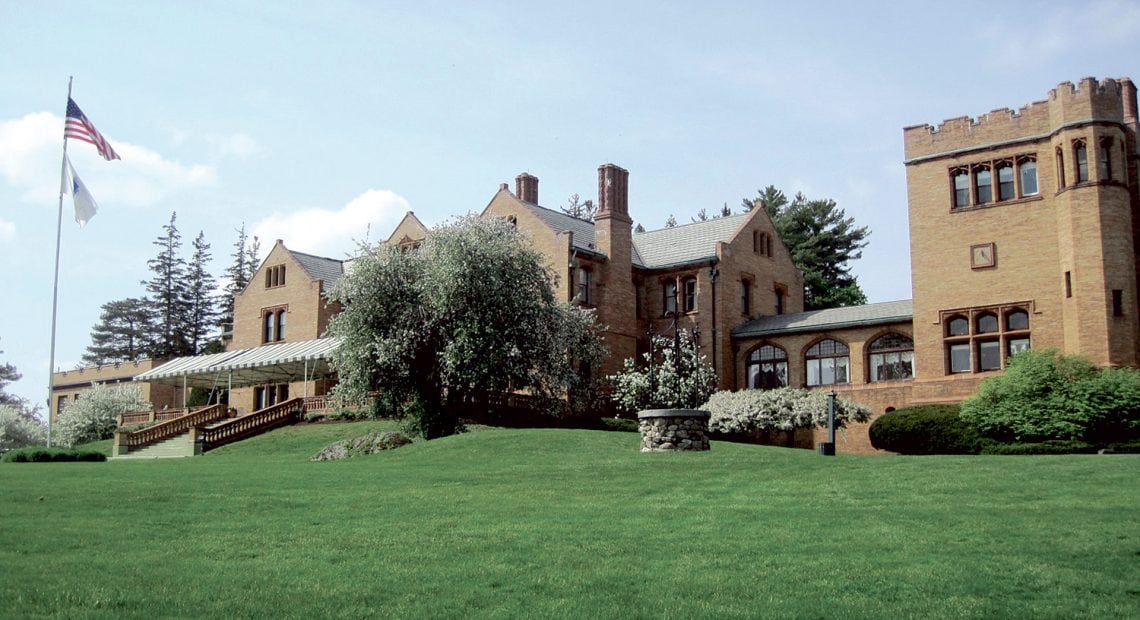
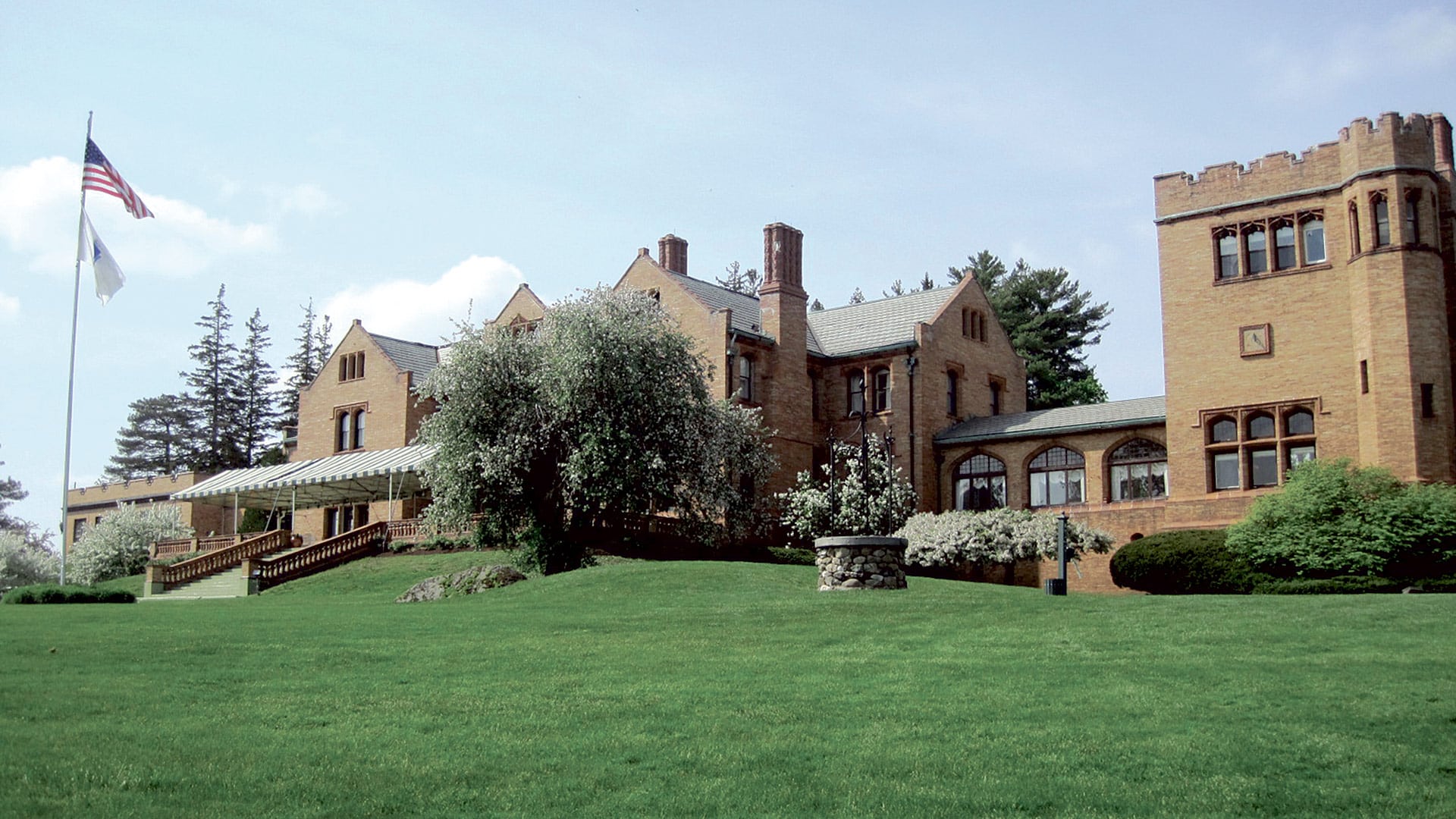
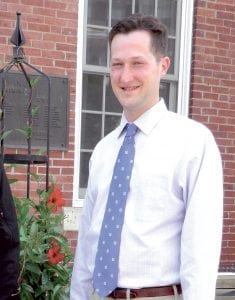
“What helped the Teaching Company to grow more and more famous is their strong ethic toward a lifelong learning, meaning that, for them, learning is not only a short-term journey with an end, but more of a lifelong adventure during which anyone should keep gathering knowledge,” Gria.org notes. “Users have access to an entire online digital video library, but they also get other supports, such as CDs and DVDs or hard-copy materials such as workbooks and guidebooks.”

In short, whatever you’re looking to improve in your life, as the famous ad slogan notes, there’s an app for that.

Joseph Bednar can be reached at [email protected]

Community Spotlight

Community Spotlight

The former Cranwell Spa & Golf Resort

The former Cranwell Spa & Golf Resort is undergoing a $60 million renovation and expansion by the Miraval Group.

As its town manager, Christopher Ketchen is certainly bullish on Lenox.

“If you’re moving to the Berkshires, Lenox has clearly got to be on your radar for many reasons,” he told BusinessWest, adding that he’s one of the more recent converts. “I made the move here myself from the Boston area four years ago. I’m originally from Alford, and when I moved back to this area, I chose to live in Lenox.”

Lenox may be known mainly — and deservedly — for its cultural and recreational attractions, from Tanglewood, the summer home of the Boston Symphony Orchestra, to Shakespeare & Co., to the town’s collection of rustic inns and bed and breakfasts.

But a different sort of economic energy has been bubbling up in recent years, from the small businesses, hotels, and motels springing up along the Route 7 corridor to an ongoing, $60 million expansion and renovation at the former Cranwell Spa & Golf Resort. The Miraval Group, a subsidiary of Hyatt Hotels, purchased the property in 2016 for $22 million and plans to transform it into a high-end wellness resort.

Then there’s the new Courtyard by Marriott, which opened last year and features 92 rooms with panoramic views, an indoor pool, a large patio with firepits, a restaurant, and a 12,000-square-foot event space. Meanwhile, the 112-room Travaasa Experimental Resort at Elm Court, which straddles the Lenox and Strockbridge line, is moving forward as well.

Other projects in recent years include the relocation of Morrison’s Home Improvement Specialists Inc. from Pittsfield and its adaptive reuse of a blighted building that had been vacant for 10 years, an apartment conversion at the Walker Street Residences by the Allegrone Companies, and the construction of Allegrone’s headquarters and co-working office space using green design and technology in a building on Route 7.

Chris Ketchen says Lenox is a draw

Chris Ketchen says Lenox is a draw because of its schools, healthy finances, cultural offerings, and a host of other factors.

“The hospitality industry is probably the biggest economic driver locally,” Ketchen told BusinessWest. “Miravar, the Cranwell development, is still in progress, Elm Court is still in progress, Marriott is up and running. As far as new projects coming in the door, there’s nothing else on that scale today, but that could change tomorrow.”

Moving On Up

In some ways, Lenox doesn’t need the kind of business growth other towns and cities do, because its strengths have long lay in both tourism for visitors and quality of life for residents.

“The town has gotten a fair amount of regional and national recognition in recent years for the schools and for the town’s financial practices,” Ketchen said, noting that Lenox is just one of two Massachusetts municipalities west of the Connecticut River whose finances have AAA ratings from Standard & Poor’s, the other being Great Barrington.

Meanwhile, “our schools are knocking it out of the park year after year in terms of their recognition at both the federal Department of Education and various statewide rankings. The high school ranked number four by U.S. News & World Report, the annual benchmark rating a lot of districts measure themselves by, so a very attractive place for families to locate and make a home.”

Lenox at a glance:

Year Incorporated: 1767
Population: 5,025
<strong>Area: 21.7 square miles
County: Berkshire
Residential Tax Rate: $12.14 
Commercial Tax Rate: $14.98
Median Household Income: $85,581
Median Family Income: $111,413
Type of Government: Board of Selectmen, Open Town Meeting
Largest Employers: Canyon Ranch, Boston Symphony Orchestra, Kimball Farms

* Latest information available

Not wanting to rest on its laurels, Lenox residents recently approved an appropriation to work with regional agencies to update the town’s comprehensive master plan. “The Planning Board is undertaking that as we speak,” Ketchen said, “and we’ve created a housing production plan through the affordable housing committee, so we’re tackling those issues in a thoughtful way moving forward.”

The state seeks 10% of housing units in any town to be affordable, but in Lenox, the current level is just over 7%, based on the 2010 Census.

The town has also been undertaking significant infrastructure improvements in recent years, the latest announcement being a $9 million, federally funded widening and improvement of a stretch of Walker Street, in addition to water and sewer improvements there.

“We’ve been investing heavily in infrastructure through aggressive capital-improvement programs,” Ketchen said.

To address an aging population — the median age of residents is 51, reflecting a trend in other towns in the Berkshires — town officials created a first-time-homebuyers program in 2016 in partnership with four banks that offers up to $10,000 in down payments to qualified applicants. They also changed zoning requirements to make it easier to build new apartments and condominiums or convert older housing stock into appealing residences, as well as adopting a Complete Streets policy that will make the town eligible for state funds to improve connectivity for pedestrians and bicyclists.

Meanwhile, to address a dearth of of market-rate apartments in Lenox, Allegrone Companies completed a renovation last year of the 1804 William Walker House, transforming it into eight market-rate apartments.

The Whole Package

To encourage companies to move to Lenox or expand, town officials have been focused on a five-year open-space plan that was adopted several years ago.

“With our proximity to employment centers in Pittsfield and also Springfield and Albany, there are options for workers who want to make Lenox their home.”

“We have an open-space and recreation plan that was really well-conceived by the Conway School in conjunction with our Land Use Department, and we’re a few years into executing that plan to preserve open space,” Ketchen said, noting projects like a major improvement to Lenox Town Beach at Laurel Lake last year. In addition, the Berkshire Natural Resources Council, the regional land trust, has been working to develop a regional trail network with a long section passing through Lenox.

Add it all up, Ketchen said, and this town of just over 5,000 residents has plenty to offer.

“With our proximity to employment centers in Pittsfield and also Springfield and Albany, there are options for workers who want to make Lenox their home — and it’s a wonderful place to make a home,” he told BusinessWest. “The town is well-managed financially. We have outstanding schools, libraries, and community center. For a town of our size, we’re providing a lot of services for residents of all ages. Our public-safety and public-works operations are some of the best in the business.”

He added that the town’s tax rates are low — $12.14 for residents and $14.98 for businesses — and relatively stable from year to year.

“Couple that with the employment opportunities and the outstanding municipal and educational programs, the arts and cultural amenities of the region, and the recreational opportunities — put that together, and you have a very attractive package.”

Joseph Bednar can be reached at [email protected]

Features

Jim Barrett was talking about the future of work, market disrupters, and, more specifically, the skills that employees will need in the future. And to get his points across, he repeatedly referenced the F-35 stealth fighter jet recently introduced into service by the Air Force, Navy, and Marines.


“The pilot has a helmet that is custom-sculpted to their head,” Barrett, managing partner of the Holyoke-based accounting firm Meyers Brothers Kalicka, explained. “They put the visor down, and they see, through cameras, 360 degrees around the plane. They’re not really using their vision anymore; they’re looking straight ahead and seeing the screen in front of them.

“Years ago, when these planes touched down, people would run out to the tarmac and say, ‘how much fuel do you need? How much ammunition do you need? Is there anything wrong?’ And they’d do all the tests,” he went on. “This new jet actually has the ability to send back information to the base about how much fuel it’s used, how much ammunition it’s used; it does a self-diagnosis of what it needs such that, when the pilot touches down on the deck, there are people already lined up with the exact parts it needs and the exact amount of ammunition. They eliminated all the time and people it took to gather all that information.”

The moral to that story? Essentially, the same thing is happening in the workplace, said Barrett, adding that, in the future — and even now, for that matter — people will need a different set of skills to succeed in the workplace.

Using his sector, financial services, as an example, he said that, years ago, people would spend large chunks of time gathering and analyzing data. “Now, machines are going to do that for you,” he went on. “So you’ll need people who can make determinations about what data is relevant, because the data is already going to gathered and analyzed.”

Barrett will get into much greater detail about all this at the third installment of BusinessWest’s Future Tense series, created to help business owners understand the future and be better prepared for it, on Sept. 20.

Fast Facts:

What: Future Tense lecture series, the third installment
When: Sept. 20, starting at 8 a.m.
Where: Tech Foundry, 1391 Main St., Springfield, 9th floor
For More Information: Call (413) 781-8600
To Register: Visit businesswest.com/lecture-series

He will be joined by Mark Borsari, president of wire-brush manufacturing firm Sanderson MacLeod, who will discuss change and innovation through lean concepts and focus on resulting cultural considerations and the broad impact on competitiveness.

Barrett and Borsari will wrap up the series, which has drawn a wide range of business owners and managers to Tech Foundry’s facilities to hear about arguably the most vexing topic in business — the future.

In the first installment, Delcie Bean, founder of Paragus Strategic IT, talked about how technology — in such forms as artificial intelligence, driverless cars, and 3-D printing, will change not only the workplace, but society as a whole. In the second installment, wealth-management advisor Amy Jamrog presented a program titled “What Got You Here Might Not Get You There: Mistakes Business Owners Make Before and After Retirement.”

The third installment will have many focus points, said Barrett, but especially the market forces and market disrupters that will shape his sector, but also all industries.

And, as noted earlier, to succeed, people will need a different skill set.

“It’s not analyzing the data as much as determining what to do with it,” he explained. “It’s about making better decisions with the date you have, as opposed to gathering and analyzing it.”

The program will begin at 8 a.m. with registration and a continental breakfast. There will be then be remarks from sponsors — Paragus and the Jamrog Group — followed by the presentation and a discussion. Tickets are $25 each, with the proceeds going to Tech Foundry.

For more information, call (413) 781-8600. To register, visit businesswest.com/lecture-series.

Banking and Financial Services

Expanding the Footprint

Glenn Welch

Glenn Welch

Although many Freedom Credit Union members have ties to West Springfield, Glenn Welch said, the institution has never had a physical branch there.

But that will soon change, following the announcement that Freedom has agreed to a merger with West Springfield Federal Credit Union (WSFCU), bringing the West Side institution under the Freedom umbrella.

“This is a tremendous opportunity to extend our products and services to West Springfield, an area where we do not have a branch but where many of our members live and work,” said Welch, Freedom’s president and CEO. “We promise our members accessibility to us, whether it’s at a branch location or through mobile banking. This merger delivers on that promise.”

Freedom, which is headquartered in Springfield and serves members in the four counties of Western Mass. with 10 branches, was originally chartered as the Western Massachusetts Telephone Workers Credit Union in 1922 and renamed in 2004. It currently has $491 million in assets with 28,000 members who live, work, or attend school in Hampden, Hampshire, Franklin, or Berkshire county.

West Springfield Federal Credit Union, which was initially chartered in 1960 as the West Springfield Municipal Employees Credit Union before its name change in 2003, has nearly 3,000 members and more than $29 million in assets.

Welch noted that WSFCU members will have access to many new products and services, including member business lending, use of 55,000 surcharge-free ATMs across the worldwide Allpoint Network, and robust mobile-banking products and services. All employees of WSFCU will become part of the Freedom Credit Union family. The West Springfield Federal Credit Union location will remain open at 58 Union St. and conduct business as Freedom Credit Union.

“This is a tremendous opportunity to extend our products and services to West Springfield, an area where we do not have a branch but where many of our members live and work. We promise our members accessibility to us, whether it’s at a branch or through mobile banking.”

“The additional products, services, and opportunities available to both our members and the employees who serve them is a win-win proposition,” said Ann Manchino, manager of West Springfield Federal Credit Union. “We are excited for a new chapter in our history and to be part of the Freedom Credit Union family.”

The merger will require regulatory and member approvals, and is anticipated to be complete by the end of 2018.

Pending regulatory approval, Freedom Credit Union will have 11 total branches, including three offices in Springfield and locations in Feeding Hills, Ludlow, Chicopee, Easthampton, Northampton, Turners Falls, and Greenfield.

Credit unions are cooperative financial institutions owned by their members. As a not-for-profit organization, Welch noted, Freedom Credit Union returns its profits to its members in the form of high rates on deposit accounts, low rates on loans, and low or no fees for its services.