Home Posts tagged Features (Page 12)
Banking and Financial Services Sections
How to Improve Your Minimum Adequate Rate of Success

Charlie Epstein

Charlie Epstein

If you are the owner of a company and you sponsor a qualified retirement plan, such as a 401(k), I’d like to ask you to consider the following scenario. Imagine you are about to board an airplane at Bradley International Airport. Your destination is Los Angeles. As you are checking in at the gate, the agent comes on the PA system and says, “ladies and gentlemen, I have an announcement to make. The captain and the FAA want me to let you know that there is an 85% chance that this plane will not make it to your final destination on time and safely. Have a nice flight!”
Would you board that airplane? Of course not! Why? There is not a minimum adequate rate of success (MARS) for you to feel comfortable that you will get to your destination on time and safely.
Let me ask you another question: what is the MARS of your company’s 401(k) retirement plan? What is the minimum adequate rate of success that all of your employees will arrive at their final destination (retirement) with an adequate percentage of replacement income? Will they arrive at their retirement destination on time and safely, with enough money to generate a ‘paycheck for life’ to pay for all the things they desire to do when they retire? What percentage of your employees will have replaced an adequate percentage of their current income (i.e. approximately 70% to 90%, adjusted for inflation) at their retirement age? Do you even know?
A reporter at the Dallas Morning News recently interviewed me for a story on the pending employee-fee-disclosure regulations. The reporter read an article I wrote, in which I stated that the majority of retirement expenses have already been available for participants both on their Web site and on their statements. I also noted that while some of the disclosures will be new, the majority of 401(k) participants won’t even notice or care. I went on to tell the reporter that the Department of Labor’s emphasis on fee disclosure and transparency misses the bigger issue — employees need to save more money, not save more on expenses.
Now, don’t get me wrong. Saving on expenses is a good thing, but not the most important factor when it comes to creating paychecks for life through your company’s retirement plan. Study after study has shown that actually increasing your contribution percentage by 1% more per year is six times more valuable than saving 50% of 1% in expenses.
Plan sponsors and advisors need to educate participants on the need to save more money. How much more? To start with, a minimum adequate rate of savings for an employee to successfully accumulate enough money by retirement age is 10%. The average savings rate in America’s 401(k) plans currently stands at a dismal 3% to 4%. The 10% savings rate should be the starting point by which you, the plan sponsor/fiduciary, can begin to benchmark your 401(k) plan’s MARS. Hold your advisor accountable to help you measure this success rate each year, and begin moving the dial by getting employees to save more.
The onus cannot be entirely on your employees. You can (and must) do more to encourage this higher rate of savings by integrating automatic features into your plan:
• Automatic enrollment at a rate at least equal to your company match. If you have a 50% match on the first 6% of pay that employees contribute, then begin the automatic-enrollment feature at 6% of pay. It’s simple. As soon as employees become eligible to participate in your 401(k) plan, they are automatically enrolled at 6%. If they want to opt out, they can. The Vanguard Group and other large providers like Fidelity have done studies showing that 70% of employees who are automatically enrolled stay in the plan at the rate they were enrolled.
• Automatic increase. As an entrepreneur, you know the power of ‘incremental success.’ Every day, you work incrementally to improve the quality of your products and services to increase incrementally your margins and profits. There is no overnight success. It takes a long-term commitment to work every day to improve your business model.
The same can be said of saving for retirement. You don’t get rich overnight. The turtle usually wins the race, one slow step at a time. If the goal is to get a larger percentage of your employees saving 10%, it will not happen overnight. It takes time. However, employees need the support and structure in place to help get them there. This is why adding the automatic-increase feature to your retirement plan is so critical.
If, for example, employees have been automatically enrolled at 6%, then (with the automatic-increase feature) each year employees’ contributions will be automatically increased by 1%. In four years, they will be saving the magic 10% and well on their way to creating a paycheck for life. Similarly, studies show that 70% of plan participants do not opt out of the automatic-increase feature. They don’t actually miss the 1% in their paychecks. With ongoing education on the benefits of incrementally increasing savings by 1% each year, employee success rates will increase.
If your motivation for establishing a 401(k) plan is to provide a valuable benefit to your employees, then you may want consider if the value is truly there. I believe the best way to gauge that value is by focusing on employee success, which you can do by evaluating what your plan’s current success rate is for each employee and what your new MARS benchmark and goal will be going forward.
Getting your retirement plan to MARS won’t be easy and won’t happen overnight. However, neither was getting America to the moon! After President Kennedy announced in 1961 that we would put a man on the moon by the end of the decade, it took us only eight years to do it. If you announced that your company will have a minimum adequate success rate of 10% for 85% of all of your employees by the end of the decade, you can make it happen. You can set in motion all sorts of unforeseen positive forces that will jet-propel a larger portion of your employee population to arriving on time and safely with a paycheck for life at their retirement destination.

Charlie Epstein is the author of Paychecks for Life — How to Turn Your 401(k) into a Paycheck Manufacturing Company (www.paychecksforlife.org). As America’s 401(k) Coach, he has been nominated one of the top 100 Most Influential Individuals in the 401(k) Industry by 401k Wire Magazine. He has trained more than 2,000 advisors across the country on how to create greater success for plan sponsors and plan participants; (413) 478-8580; [email protected]

Briefcase Departments

UMass President Awards $750,000 for Innovative Faculty Research
BOSTON — UMass President Robert Caret recently announced nearly $750,000 in grants to faculty members from the President’s Science and Technology Initiatives Fund to support six promising research projects, which range from creating standards for testing robotic systems to detecting financial fraud in large-scale securities data to developing new skin-cancer imaging technologies. The initiatives showcase a range of innovative research being undertaken by UMass faculty members that contribute to the growth of the Commonwealth’s economy, especially in the science and technology sectors, and extend the boundaries of human knowledge. The grants provide seed funding to accelerate research activity across all five campuses and position researchers to attract larger investments from external sources to expand the scope of their projects. “The Science & Technology fund advances the work of producing the discoveries and technological breakthroughs that will improve lives, create jobs, and preserve our planet,” said Caret. “It supports the ideas and inventiveness of our faculty and fosters a culture of collaboration across all five campuses that attracts investments and underscores our role as an innovation engine for the Commonwealth.” This marks the ninth year the President’s Science and Technology Initiatives Fund awards have been handed out. It’s one of three funds that President Caret taps to help advance the work of UMass faculty members: the other two are the Commercial Ventures and Intellectual Property Technology Development Fund and the Creative Economy Initiatives Fund. Since 2004, the Science & Technology Fund has provided $7.5 million to UMass researchers, which, in turn, has generated $207 million in funding from outside sources for vital research efforts and led to the creation of nearly 20 research centers on the five campuses. UMass’s annual research expenditures climbed to $587 million in fiscal year 2011; that same year the university generated income of $36.5 million from faculty discovery and innovation. To date, the President’s Science & Technology Fund has financed more than 60 projects representing the breadth of academic inquiry at UMass. Locally, a grant project at UMass Amherst called ‘Big Data Informatics Initiative (BDI2)’ focuses on areas such as detecting financial fraud in large-scale securities data, correlating video/audio surveillance data to spot trends or anomalies in real time, and smart-meter data processing by energy utilities. Collaborators include the Massachusetts Green High Performance Computing Center, Holyoke Gas & Electric, MIT, and commercial partners such as EMC, Nokia, GE Global Research, and Yahoo Research. The total awarded was $136,250.

MCDI Transitions to Family Self-sufficiency Focus
SPRINGFIELD — The Massachusetts Career Development Institute Inc. recently announced a transition in its core services that will increasingly revolve the agency around family self-sufficiency initiatives and de-emphasize some workplace-training programs, many of which are now being undertaken at the community-college and vocational-secondary-school level. The move will have the immediate impact of downsizing the organization by 15% of its current workforce. The agency will also plan to relocate to a smaller, more efficient training and educational facility within Springfield as it transitions to a more appropriate operating model, according to Timothy Sneed, executive director of MCDI. The new emphasis at MCDI will be on career counseling and training tracks that are in high demand, eliminating those that are being shifted to other training sources. However, MCDI will continue its vocational training programs that address the growing employer demand in health care through its Certified Nurse Aide/Home Health Aide and Medical Office Professional training programs. Sneed said he anticipates an opportunity for MCDI to grow into other health-related training programs based on employers’ needs. Sneed indicated that, in an effort to focus on program strengths, MCDI is evolving into an agency that supports “family self-sufficiency” and will provide a host of direct and indirect resources in support of the family. “There has been a shift in the funding landscape with respect to vocational training, and most federal and state dollars are targeted at funding community colleges and technical-high-school programs,” said Sneed. “So, in many areas MCDI has been duplicating services with more training funding going to the community colleges and vocational programs at the secondary-school level. We will continue to provide multiple levels of adult basic education and English for speakers of other languages (ESOL) together with career and academic advising. Our support-services strategy will include job-readiness and life-skills training, which is so critical in today’s job market. We will temporarily discontinue our trade programs in culinary arts, precision-manufacturing technology, and sheet-metal welding and fabrication.” He continued, “while this reorganization is difficult, we see this as an opportunity to strengthen our core training programs with a vision of future expansion opportunities. The impact upon a portion of our workforce is truly unfortunate. At the same time, our management and board of directors see this as a positive step in the long-term viability of MCDI and, most importantly, those we serve in our community.”

GSCVB Unveils 2012-13 Pioneer Valley Visitor Guide
SPRINGFIELD — The Greater Springfield Convention and Visitors Bureau (GSCVB) has unveiled the new 2012-2013 Guide to Masachusetts’ Pioneer Valley, which is now available by ordering online at www.valleyvisitor.com. The guide is free of charge and is a collaboration between the GSCVB and the Franklin and Hampshire County Regional Tourist Councils. The guide, a 112-page publication, contains information about some of the region’s top attractions, accommodations, and restaurants. The book offers new features, including a listing of farmers’ markets and expanded listings of attractions, accommodations, restaurants, shopping, transportation, recreational sites, colleges, and prep schools.

Architecture Sections
Architects Increasingly Focus on Eco-friendly Design

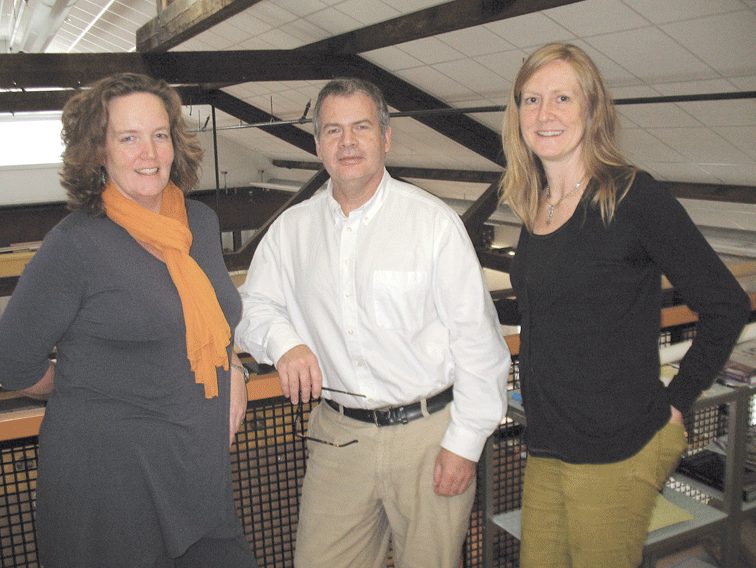
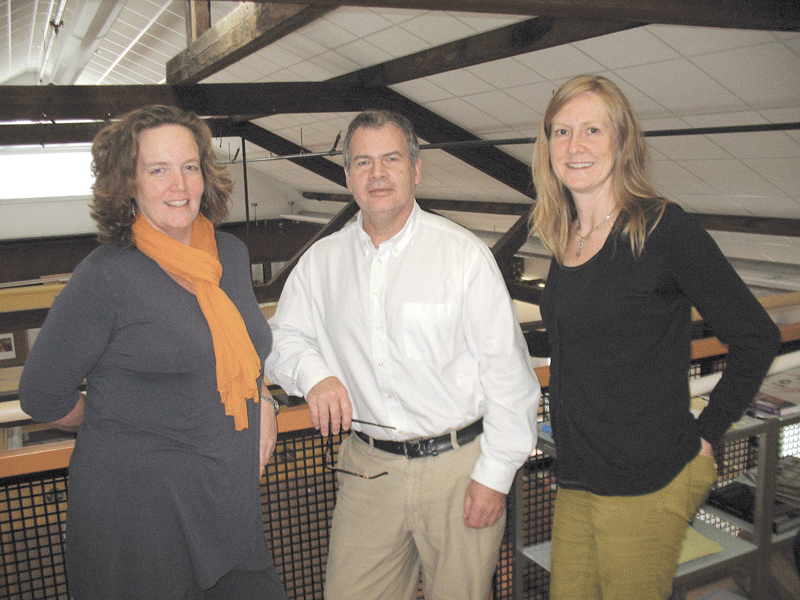
From left, Aelan Tierney, Charles Roberts, and Ann Wills Marshall

From left, Aelan Tierney, Charles Roberts, and Ann Wills Marshall have all worked on LEED projects at Kuhn Riddle Architects.

New England Environmental (NEE) is an Amherst-based consulting firm that specializes in environmental assessment, restoration, and management. Oh, and setting a good example.

“We saw that project as sort of a laboratory for the kind of work they do, almost an exhibit of sorts,” said Ann Wills Marshall, an architect with Kuhn Riddle Architects in Amherst, which designed NEE’s new headquarters in Amherst with the sort of ‘green’ features that fit the company’s mission.

“They can take clients through and show them what a bioswale is, and a rain garden that uses all native plants and doesn’t require irrigation. It has a tremendous amount of green space,” Marshall noted.

The development will earn Platinum certification — the toughest-to-attain rating — from LEED, or Leadership in Energy and Environmental Design, a program developed in 1994 by the U.S. Green Building Council (USGBC) to encourage environmentally friendly and energy-efficient design, construction, and operation of buildings.

And New England Environmental, which uses both geothermal heat and photovoltaic solar panels for energy, is only one of Kuhn Riddle’s recent LEED projects. Others include the George N. Parks Minuteman Marching Band Building, a 15,000-square-foot facility at UMass; the Ken Burns Wing of the Jerome Liebling Center for Film, Photography, and Video, a 6,700-square-foot addition to the facility at Hampshire College; and the Northeast Veteran Training and Rehabilitation Center in Gardner — which, like NEE, boasts both geothermal and photovoltaic energy.

In fact, LEED has become a major buzzword in the architecture and construction world; the state has mandated eco-friendly design on many projects, while individual cities and towns are increasingly seeking out the long-term benefits of energy-efficient, environmentally non-invasive design as well.

“It’s an involved process,” said Charles Roberts, a principal with Kuhn Riddle. “First, the client has to decide what they want to do, then we sit down with the user groups and our LEED consultants and basically go through the checklist typical for all projects and see what points are attainable. It’s important to do that as early in the design process as possible.”

Those ‘points’ are awarded according to a development’s adherence to five key areas: sustainable site development, water savings, energy efficiency, materials selection, and indoor environmental quality.

Sustainable site development includes the reuse of existing buildings, when possible, and preservation of the surrounding environment. Water conservation may include the recycling of gray (previously used) water or the installation of catchments for rainwater.

Energy efficiency can be increased by orienting buildings to take advantage of seasonal changes in the sun’s position and by the use of alternative energy sources, such as solar, wind, geothermal, biomass, or water.

Meanwhile, developers are encouraged to use as much recycled or renewable materials as possible, or those that require the least energy to manufacture, are locally sourced, or are in themselves recyclable. Finally, indoor environmental quality emphasizes how the building user feels in a space and involves ventilation, temperature control, and the use of nontoxic materials.

New England Environmental

New England Environmental incorporated both geothermal and photovoltaic energy on its LEED Platinum project.

“Good architecture has always been environmentally responsible,” Roberts said. “Development and land-use patterns create stresses on the environment, and as buildings become much more complicated, LEED is kind of an effort to try to think about these pressures and minimize them.”

However, they should not get in the way of basic aesthetic appeal, said Aelan Tierney, an associate with Kuhn Riddle.

“While it’s important to focus on sustainability,” she said, “it’s also important to remember that buildings should be beautiful. So the form can still be beautiful if it’s a green building, or a LEED-certified building. I think there are some people out there who are so hyperfocused on sustainability that they forget about the aesthetics. In our firm, they’re equally important to us.”


Breaking Ground

Other architects are saying the same. Among them is Jim Hanifan, a principal with Caolo & Bienek in Chicopee, which recently completed the new UMass police station, the first LEED-certified building on the Amherst campus, but very likely not the last.

That project earned Gold status, just under platinum in the USGBC’s rating system, which is based on the points assigned for green compliance. Further down are Silver and simply ‘certified.’ The police station features a geothermal heating and cooling system drawing heat and cold from the earth.

“We’ve also got the Northampton police station,” Hanifan said. “They’re going to occupy the building in a couple of weeks, and that’s targeted for LEED Gold as well.”

Another of the firm’s jobs, the new Easthampton High School set to open in 2013, has earned certification from Massachusetts CHPS (Collaborative for High Performance Schools), a LEED-like green-building program for the Commonwealth. Among the considerations are bigger windows to maximize daylight, a photovoltaic array being installed on the roof to harvest solar power, and LED lighting. “It’s similar to LEED in its requirements,” he said of the CHPS designation.

Hanifan said building owners, whether governments or businesses, want to know the long-term savings built into an investment in green design — which can be costly up front. “You’re trying to balance improvements to a building’s system with what the projected payoff will be. Maybe you’ll spend $250,000 on improved mechanical or electrical systems, and you try to project out how many years it will take to pay that back.”

Tierney said the owners of the Northeast Veteran Training and Rehabilitation Center took this into account when they had 28 geothermal wells and more than 8,000 square feet of electrical panels installed. “It’s a large initial investment, but in the end, they’ll save money. In a lot of cases, it’s easier to get capital funding than it is to get operational funding.”

Added Marshall, “I think there’s a leap of faith you have to take, knowing you have these upfront costs, but they will pay for themselves in a very short time.”

And the initial costs can be significant, Hanifan said, noting that some LEED points are easier to come by than others, and not every type of point is attainable. “Some points you won’t get, depending on the building design,” he said. For instance, a developer can earn points for tearing down an existing building and reusing the site for a new structure. “But if it’s a clean site, there’s no way to get that point.”

The LEED certification process itself is costly, which is why some cities and towns will put a priority on green design, but not go for the certification, he added. “So you’re getting the payback for sure and achieving the intent of a LEED project; you just don’t have a plaque on the wall that says you achieved it.”


The Old College Try

The Liebling Center project at Hampshire College is a good example of a broad mix of LEED points, Roberts said, from the use of native plants to cutting-edge air-quality-monitoring systems, to white, reflective surfaces to keep the building cool. It also gained points for its location along a bus route and the installation of bike racks and showers, all of which encourage earth-friendly commuting.

“It’s a good example of a project done on a modest budget,” he said, “and just by doing pieces of all these things, were were able to achieve LEED Gold.”

Hampshire College has been pursuing eco-friendly development for some time, and other area schools have done the same. In fact, the U.S. Green Building Council recently opened a local branch on the UMass campus.

“The university has been working to expand its green-building commitment for more than a decade now,” said Ludmila Pavlova, a senior planner at the UMass Campus Planning Physical Plant, who started the branch. “Here, we can provide education, outreach, and information to the general public about the LEED rating system and green building.

“It’s really important that people who use the rating system talk to the general public, network, and learn together,” she continued. “It’s great to have a location where people looking into green building can come to learn how to become proficient in green building, and turn around and help their communities as well.”

UMass recently made a commitment to build all new structures to a minimum of LEED Silver, and the state already requires all publicly funded buildings of at least 20,000 square feet to be 20% over baseline in terms of energy efficiency. All of which makes plenty of sense to Pavlova.

“People live in buildings and spend most of their time in buildings,” she told BusinessWest. “Forty percent of our energy is embodied in buildings. If we want to improve the environment, one of the first basic places to improve it is in the places where you work and live.

“Our buildings constitute such a huge investment, and so much of our ongoing operations and capital costs go into facility maintenance,” she added. “And so much of our health depends on how buildings keep us healthy — or not.”

That’s just one more reason businesses and communities are increasingly choosing to build green — and often taking the LEED while they’re at it.


Joseph Bednar can be reached at [email protected]

Briefcase Departments

Springfield Parking Authority Reorganized

SPRINGFIELD — Mayor Domenic Sarno and Springfield Parking Authority (SPA) Chairwoman Mary E. McNally recently announced several changes at the Springfield Parking Authority. The SPA board has eliminated the position of executive director effective June 30, 2012. Harold King currently serves as the SPA’s Executive Director. Ehsanul Bhuiya will oversee day-to-day operations at the SPA on an interim basis. Springfield Redevelopment Authority Executive Director and former SPA Executive Director Christopher Moskal will temporarily provide management oversight for the SPA. In preparation for a refinancing of the SPA bonds due in June of 2013, and the issuance of a request for proposals (RFP) for the management of on and off street parking currently contracted to Republic Parking and expiring in early 2013, Sarno has directed the City’s Director of Internal Audit Cecilia Goulet, to undertake a review of the SPA’s current financial position and report back to him and the SPA Board of Directors within 60 days.
“Taking better advantage of the economic development capabilities of the Springfield Parking Authority as an essential element in our economic development delivery system is key to our continued success,” said Sarno. “With the current debt of the authority and the conditions of its facilities, especially the civic center garage, it is important for the city to make sure that there is a clear expectation of the SPA, better management and marketing of all on and off street parking in the downtown area and its return to its original role as an economic development tool for the city.” Since last year, the City has been working with the Commonwealth of Massachusetts and MassDevelopment on the issue of parking in the downtown. A study was commissioned by MassDevelopment and was recently presented to the business community by Utile Inc. The study assesses the current parking inventory and demand in downtown as well as locations for potential new parking sites to replace the aging Civic Center garage in the central business district.


UMass Family Business Center Forges Partnership with BFF Affiliate Network

AMHERST — The UMass Amherst Family Business Center has joined the Business Families Foundation (BFF) Affiliate Network to work collaboratively on developing additional educational material, supporting business-family communities, and encouraging research in the field of family business. As a philanthropic organization, the BFF supports research and develops and disseminates educational material to family enterprises and professionals working with them to help them be aware of and address their unique growth and development challenges. It has been working for the past decade with a collaborative network of university-based centers for family enterprise and is welcoming new centers to join this affiliate network worldwide. These centers provide a wide range of courses, services, and activities to business family communities and are also providers of BFF’s “Road Map for Entrepreneurial Families” in-class program. “The UMass Family Business Center shares our values and those of our affiliate network members in their dedication and care in serving business-family communities in their region through quality continuous education,” said Dr. Pascale Michaud, president of BFF. Members of the BFF Affiliate Network contribute to the shared goal of increasing awareness of the unique features of family-owned enterprises and entrepreneurial families by offering educational and continuous learning options for business family members, those who advise them, and students in the field who may be helpful in anticipating and dealing with family business growth and development. For more information, contact Ira Bryck at the UMass Family Business Center at (413) 545-4545 or [email protected].


U.S. Family Wealth Shrank During the Recession

WASHINGTON — The Great Recession left the median U.S. family in 2010 with no more wealth than it had in the early 1990s, erasing more than two decades of accumulated prosperity, the Federal Reserve announced recently. The median family had a a net worth of $77,300 in 2010, compared to $126,400 in 2007, the Fed announced. The crash of housing prices explained three-quarters of the loss, which was compounded by the loss of income, as the earnings of the median family fell by 7.7% during the same period. The new data comes from the Fed’s release of its triennial Survey of Consumer Finance, one of the broadest and deepest sources of information about the financial health of U.S. families. The latest survey is based on data collected in 2010, and figures are reported in 2010 dollars. The survey underscores the fact that Americans are saving less for future needs and making little progress in repaying debt. The share of families saving anything over the previous year fell to 52% in 2010 from 56.4% in 2007.


Sections Technology
Normandeau Communications Is All About Making Connections

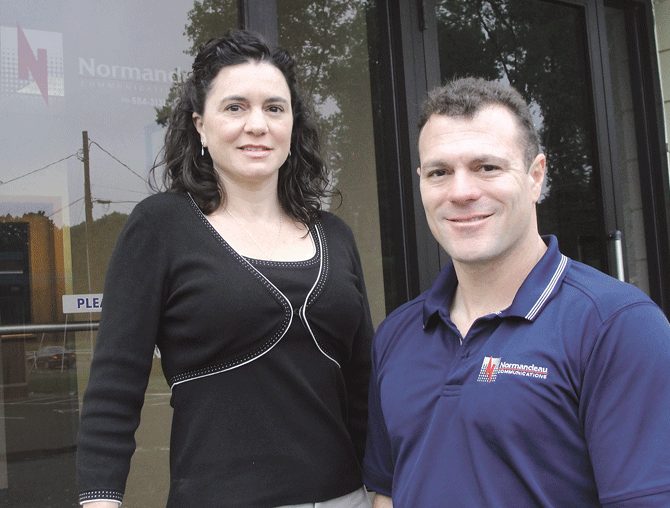
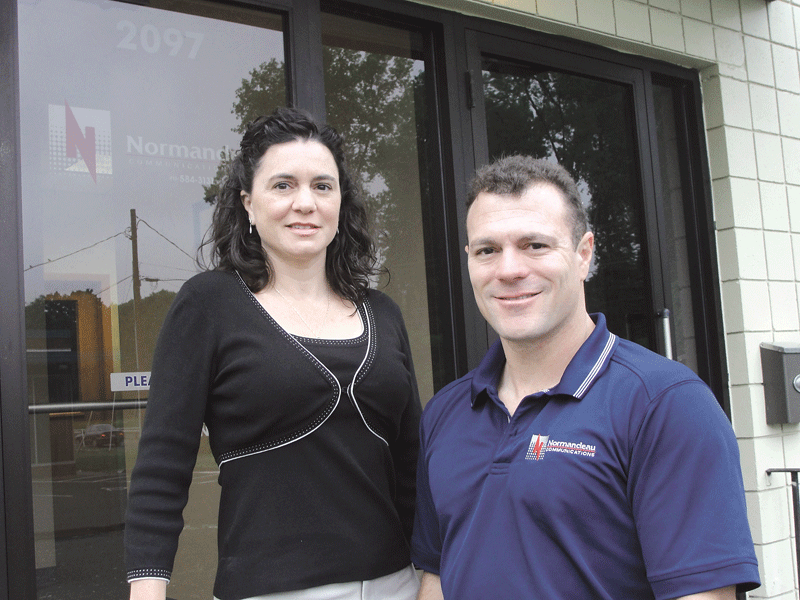
Kim Durand and Brett Normandeau

Kim Durand and Brett Normandeau say they strive to match clients with business technologies that, in many cases, they weren’t even aware of.

WestIt wasn’t too long ago that business phone calls had to be made from a desk, and call management meant having a good secretary.
But there’s more than a hint of gee-whiz in Kim Durand’s voice when she describes some of the technology being installed by Normandeau Communications these days. Take the LG-Ericsson iPECS-LIK product, which manages all kinds of communication — phone calls, e-mails, texts, faxes, etc. — across multiple sites, and even on the road.
“The system processes all calls and does the call management for you,” said Durand, director of sales. “Not only can calls be sent to your cell phone, but voice mails left at your office can automatically appear on your smart phone with the .wav file attached, so you can listen to voice mail at any time. Any time people are on the road and not at their desks, like salespeople, it’s really important for them to be able to do the things they need to do.”
Normandeau has been selling, installing, and servicing telephone systems for 22 years, but voice over Internet protocol (VoIP) technology — which uses the Internet to exchange various forms of communication that have traditionally been carried over land lines — has added elements of convenience unheard of in those early days.
The company’s primary product line, Estech Systems Inc., gives business clients the option of a traditional digital business phone system, an Internet protocol telephony system, or a mix of the two.
But Normandeau is also touting a new patnership with LG-Ericsson, whose iPECS-LIK product further streamlines communication within any size business, from small offices to multi-site corporations with thousands of users, allowing calls to be forwarded between sites and even, as Durand mentioned, to mobile phones.
“We’re also providing surveillance systems as well as loudspeaker paging systems,” said Brett Normandeau, the company’s president and Durand’s brother. “All that ties in very well to your telephone system or your whole communication system. With Web access, I can log in and check the surveillance cameras, tie into the phone system, check e-mails” — all from a distance.
These are certainly exciting times in communications, and Normandeau has tried to stay ahead of the curve as it grows its presence in the Valley. Its visibility was boosted two years ago by a move from Florence to Riverdale Street in West Springfield.
“For us it’s been a convenient spot because a lot of our customer base is located in the Hampden County area,” Normandeau said, “and having acess to Interstate 91 and the Mass Pike makes it more convenient.”
In this issue, BusinessWest sits down with Normandeau and Durand to talk about how these siblings — and the company their father began — is making new connections every day.

New Menu
“Communications is not just talking anymore,” Normandeau said at one point. “It’s the integration of many different types of technology that allows you to communicate more effectively — be it Web sharing, desktop collaboration, instant messaging.”
“We’re taking these technologies,” Durand quickly added, “and merging them into single platforms that are able to offer comprehensive solutions for the customer.”
At its heart, Normandeau commiunications has been trading in phone systems since Ray Normandeau launched the enterprise in Florence in 1990, using money from an early-retirement package offered by a streamlining AT&T.
As Ray built his business on word of mouth and a few loyal customers, Brett started working alongside his father from the start, having been licensed as an electrical journeyman shortly before Ray launched the company. He took over as president when his father retired about 10 years ago.
At the start, clients were mainly residential, but gradually, the emphasis turned to business customers, which today comprise more than 90% of the client base.
“We’ve been expanding slowly since we started with just me and my father,” Normandeau said. “We’re moving into different avenues now. We just opened up a training room to hold seminars.”
That’s an important development, he and Durand said, because technology is changing so rapidly that employers don’t always understand what’s available to help their teams do their jobs.
“It’s technical training, training people on different technologies being brought to market,” Durand said. “These are business customers and commercial clients that might be looking for training on these technologies and how to apply them to their business. We’re really trying to find the right applications to fit our customer base.”
With the LG-Ericsson product, the focus is on consolidating different modes of communication. “It collects all technology — digital, analog, wi-fi, phones — and integrates them all with one solution,” Durand said. “That’s really important when you have multi-site networks with multiple locations, like bank branches or realtors. A lot of different types of businesses can benefit from this type of technology.”
Take the Three County Fair in Northampton, for example, which is now using the iPECS-LIK system to manage communication among seven buildings and across the grounds, while incorporating staff mobile phones and providing options for exhibitors as well.
“Because it’s an old fairgrounds, they have an antiquated communications infrastructure,” Normandeau said. “But because of the technology, we were able to utilize all that infrastructure and bring it up to IP specifications, so they could link it all together. It allows them to use old analog-type techniques and IP techniques in the same system.”
But the technology links sites much more far-flung than across a fairgrounds.
“We’ve gone from very small home offices to large companies with multiple sites across the country,” Normandeau said. “We’re implementing a system to connect an East Longmeadow office with a San Jose, Calif. office. Two weeks ago, we finished one connecting Hartford to Orlando.”
Such new products have allowed Normandeau to expand its reach from the smaller businesses that were long its bread and butter to bigger clients.
“The larger customers are definitely much more accessible to us now,” Durand said. “We’ve been doing this for so long now that we know what the implications are for each business; even if they don’t understand them, we can help them find what the right solution is, by making use of their existing infrastructure and minimizing the costs to the customer. That’s the thing we’ve excelled the most at — offering cost-effective solutions while still providing the technology to see them into the future.”

Knowledge Is Power
On July 18, Normandeau will host a seminar with a representative from LG-Ericsson to talk about the how its communications technology can benefit businesses, especially those with multiple sites. It’s just one of many such events aimed at educating clients — and potential clients.
“Customers in general are becoming more informed,” Durand said. “They’re looking at different technologies, and they do recognize what was not possible years ago is really feasible now.
“It’s really about educating customers so they know what they’re getting,” she continued. “We want people to know what the differences are. We know it’s a significant investment to update technology and phone systems. As a family business, this level of customer service has been really critical for us.”
Added Normandeau, “telephone systems don’t even have to be hardware-based on a customer’s premises anymore. They can be hosted IP systems. We are improving that solution as well, so customers can have an IP phone, but all system connectivity and features are located off-site.”
That option is especially important at a time when disaster recovery and business continuation are on the minds of Western Mass. businesses more than ever, following a year marked by tornadoes in June, tropical-storm flooding in August, and a freak snowstorm and widespread power outages in October.
“We moved a lot of clients, especially in the downtown Springfield area” following the tornado, he noted.
“As soon as it happened, Brett drove down there to try to reach out to our customers,” Durand added. “So many were impacted, with physical damage to their buildings, and communications were lower on the priority list at the moment.”
Still, she said, “it was a very busy year.” And yet another teaching opportunity — and those are, after all, yet another chance to make connections.

Joseph Bednar can be reached at [email protected]

Chamber Corners Departments

ACCGS
www.myonlinechamber.com
(413) 787-1555

• May 9: After5, 5-7 p.m., Elegant Affairs/the Glass Room, 1380 Mai• St., Springfield. Enjoy a night of food, drink, great company, and fantastic networking. Cost is $10 for members, $20 for non-members. Registratio• may be done online at www.myonlinechamber.com, or  e-mail [email protected].

AMHERST AREA CHAMBER OF COMMERCE
www.amherstarea.com
413-253-0700

• May 9: Chamber Breakfast, 7:15-9 a.m., at the Red Barn. Cost is $12 for members, $15 for non-members.
• May 22: Chamber After Five, 5-7 p.m., at the The Lord Jeffery Inn. Cost is $5 for members, $10 for non-members.

GREATER EASTHAMPTO• CHAMBER OF COMMERCE
www.easthamptonchamber.org
(413) 527-9414

• May 10: Networking by Night Business Card Exchange, 5-7 p.m. Sponsored by Easthampto• Savings Bank and hosted by Amy’s Place Bar & Grill, 80-82 Cottage St., Easthampton. This event features hors d’ouevres, door prizes, and a cash bar. Tickets: $5 for members, $15 for future members.
• May 18: Wine & Microbrew Tasting, 6-8:30 p.m., One Cottage Street (corner of Cottage and Unio• streets) i• Easthampton. Sample more tha• 50 wines and microbrews and enjoy fine food and a• extraordinary raffle. Major sponsor: Easthampto• Savings Bank. Event sponsor: Innovative Business Systems. Wine Sponsor: Westfield Spirit Shop. Microbrew sponsor: Big E’s Supermarket. Food Sponsor: Log Rolling at the Log Cabin/Delaney House. Benefactor: Finck & Perras Insurance Agency. Tickets are $30 i• advance, $35 at the door. To order tickets or for more information, call the chamber office at (413) 527-9414 or order online at www.easthamptonchamber.org.
• May 20: “For The Kids!” Easthampton’s 12th Annual Big Rig Day, 9 a.m. to 3 p.m. (rai• or shine), at the Easthampto• Municipal Building & Public Safety Complex, Payso• Avenue, Easthampton. See trucks of all sizes — constructio• equipment, safety vehicles, and specialty cars and trucks. Free admissio• and parking. For more information, visit www.bigrigday.com.

GREATER HOLYOKE CHAMBER OF COMMERCE
www.holycham.com
(413) 534-3376

• May 16: Chamber After Hours, 5-7 p.m., at Simplicity Salon, 1735 Northampto• St., Holyoke. Sponsored by Girls Inc. of Holyoke and Girl Scouts of Central and Wester• Mass. Cost is $10 for chamber members, $15 for non-members. A marketing table is $25. Joi• your friends and colleagues for this informal evening of networking. Call the chamber at (413) 534-3376 or register online at holyokechamber.com.
• May 21: The 44th Annual Holyoke Chamber Golf Tournament at Wyckoff Country Club, 233 Easthampto• Road, Holyoke. Registratio• and lunch at 11 a.m. Tee off at noo• (scramble format). Cost is $125 per player, which includes 18 holes of golf, cart, lunch, prizes, dinner buffet, gift bag, and foursome photo. Awards, cash prizes, and raffles will follow dinner, consisting of a• array of elaborate food stations. Call the Holyoke Chamber at (413) 534-3376 to sig• up, or register online at holyokechamber.com.
• May 30: Greater Holyoke Chamber of Commerce Annual Meeting, 4 p.m.,
at the Log Cabi• Banquet & Meeting House. Program followed by grand receptio• with assorted food stations. Sponsored by Goss & McLai• Insurance Agency; Resnic, Beauregard, Waite & Driscoll; TD Bank; Dowd Insurance Agency Inc.; and PeoplesBank. Tickets are $25. Call  (413) 534-3376 or register online at holyokechamber.com.

NORTHAMPTO• AREA YOUNG PROFESSIONAL SOCIETY
www.thenayp.com
(413) 584-1900

• May 10: May Networking Event, 5-8 p.m., at Ibiza Tapas i• Northampton. Free to NAYP members, $5 for guests. Visit www.thenayp.com for details.

SOUTH HADLEY/GRANBY CHAMBER OF COMMERCE
www.shchamber.com
(413) 532-6451

• May 18: Legislative Breakfast, 7:30-9 a.m., at the Orchards Golf Club, South Hadley. Sponsors: South Hadley & Granby Chamber of Commerce. Special guests: legislative representatives. Tickets are $15 at the door. RSVP at (413) 532-6451 by May 11. Seating is limited.
• May 21: South Hadley & Granby Day at the Orchards Golf Club. Tee times, 8 a.m.-2 p.m. Sponsor: South Hadley & Granby Chamber of Commerce. Opportunity to wi• a foursome at the Orchards. Cost is $65 per person, lunch included. For tee times and details, call Tony Giannetti at (413) 533-1784, or e-mail [email protected].

WEST OF THE RIVER CHAMBER OF COMMERCE
www.ourwrc.com
(413) 426-3880

• May 10: Programs Committee Meeting, 7:30- 9 a.m., at Management Search Inc., West Springfield.
• May 17: Economic Development Committee Meeting, 7:30-8:30 a.m., at the Work Opportunity Center, Agawam.
• May 18: Executive Committee Meeting, 8-9 a.m., at Hampde• Bank, West Springfield.
• May 22: Board of Directors Meeting, 7:30- 8:30 a.m., at the Captai• Leonard House, Agawam.

GREATER WESTFIELD CHAMBER OF COMMERCE
www.westfieldbiz.org
(413) 568-1618

• May 16: WestNet Plus 1, 5-7 p.m. Hosted by Pioneer Valley Railroad, Old Montgomery Road, Westfield. Our monthly networking event will be held o• the Pinsly Railroad Dining Car and Caboose with a• opportunity to check out a locomotive i• the shop. Our sponsor this month is Comcast. The featured speaker this month is Andrew Morehouse of the Food Bank of Wester• Massachusetts. It’s a great opportunity to make business connections, so bring your business cards. Cost is $10 for members, $15 cash for non-members.

YOUNG PROFESSIONAL SOCIETY OF GREATER SPRINGFIELD
www.springfieldyps.com

• May 17: 4th Annual Great Golf Escape, 11 a.m.- 5 p.m., at Shaker Farms Country Club, Westfield. Non-member registrations opens April 1. Only 32 foursomes available.

Restaurants Sections
Mama Iguana’s Was Designed to Create Memorable Experiences

Bill Collins gives Claudio Guerra

Bill Collins gives Claudio Guerra a ride to his car on the restaurant’s free pedicab.

Talk about fun.
In fact, that’s exactly what Claudio Guerra did as he described how and why he created Mama Iguana’s in Springfield just north of the Basketball Hall of Fame. The Mexican restaurant, which opened last June, is a much larger version of the Northampton eatery with the same name and has been so successful, there was standing room only on the patio all last summer.
Hand-painted pieces of original Mexican artwork in vivid colors surround a large, gleaming rectangular bar in the semi-enclosed outdoor spot that seats 100 and has an adjacent dining area where the mood is lively, thanks in part to lights in a rainbow of bright hues.
The fun-filled atmosphere that Guerra created continues inside the three-story restaurant, which was designed to embody the spirit that is at the heart and soul of the six other eateries he owns. “We really try. It doesn’t happen by accident — it’s a labor of love,” Guerra said as he talked to BusinessWest about a lifetime spent in the restaurant business, which began when he was about 10 years old and worked as a coat checker in his father’s Long Island eatery.
Over the course of several hours, Guerra unveiled the secrets of his past and present success. The journey hasn’t always been easy, and when the recession hit in 2008, he had to reinvent the way he did business. But laughter and openness are givens for him, as he enjoys life, truly loves fun, and is always on the hunt for a new spot to open another restaurant.
In addition to owning and operating Mama Iguana’s in Springfield and Northampton, Guerra owns Spoleto’s in Northampton and East Longmeadow and the Paradise City Tavern, Pizzeria Paradiso, and Spoleto’s Express, all in Northampton.
Although they encompass different moods, Mama Iguana’s was designed “to be super-casual for super fun. It has the right price and environment for today’s economic reality and is a place where people can feel comfortable and relax,” Guerra said.
It boasts the largest selection of tequila brands in the Northeast, and more than 200 bottles of high-quality, 100% blue agave sit behind the bar. Many come from small microbreweries Guerra discovered in Mexico, and people can join a Tequila Club, which allows them to keep track of the varieties they have tried; attend sessions of the resaurant’s Tequila University, which features owners or speakers from the breweries; and/or make reservations for tequila dinners, with a menu of foods matched with appropriate tequilas.
Guerra did a major renovation of the the interior and exterior of the former home of Onyx Fusion Bar and Restaurant (the old Basketball Hall of Fame). He felt it lacked warmth, so he spent countless hours and a significant amount of money changing the lighting to make the space more intimate; it now includes enormous, wrought-iron candelabras. He also brought artists in from Mexico and California to create original works that include panels, papier-mâché sculptures, and paintings to insure it had an authentic atmosphere.
Oversized imitation skeleton heads also abound. They reflect the Mexican Day of the Dead celebration held to honor deceased relatives, and include two skeleton figures seated on a full-size motorcyles across from the stairwell between the first and second floors.
Guerra also did away with the TV screens behind the bar (although major sporting events are still broadcast on a large pull-down screen) and replaced it with “fun artwork.” Many pieces were purchased on shopping expeditions in Mexico, including the head of an angel, which weighs about 150 pounds and is almost six feet in height.
Guerra points out a large wall mural painted by an artist he brought in from San Francisco. It’s a replica of a carving from Mayan ruins, and has four gods seated in a canoe with a day and night paddler, meant to represent the cycle of life.
“When people walk in, they know this is not a chain,” he said, adding that the three floors of the building often accommodate entirely different types of parties.
“We can have a bachelorette party on one floor, a doctor’s convention on another, and a sporting event on the main floor,” said Bill Collins, director of Operations. “We turned this into a place that is beautiful and festive and took advantage of its great infrastructure.”

Dedicated Commitment
However, it takes far more than lively décor to make an eatery a success, and Guerra has a recipe with many ingredients.
The most critical — along with exceptional food and atmosphere — is the way the customer is treated. “I haven’t met a person who hasn’t had the experience of walking into a restaurant and being seated at a less-than-desirable table when other tables were available,” Guerra said.
It’s something he won’t stand for, and says he does not believe in seating people so the wait staff have the opportunity to serve approximately the same number of clients. Instead, he rotates their shifts between the most popular tables, and says it is up to them to ask co-workers for help if it’s needed. “My philosophy is all about accomodating the customer, and they should always be seated at the best possible table,” he said. “We understand the art of pleasing people.”
Since he believes the philosophy and resulting behavior in any business must come from the top, he plays an active role in demonstating the principle. Recently a little girl seated with her family of six asked him if she could order a glass of Orangina. He told her they didn’t have it, but asked her to “hold on” for a few minutes. “I ran to the nearest store and bought a bottle. I enjoy doing fun things for people.”
Although he acknowledges it’s not possible to accommodate every request, “on any given night at Spoleto’s we are cooking dishes we haven’t had on the menu for 20 years because a customer asked for them,” he said.
Everyone who works for Guerra is schooled in the belief that it is their job to make the customer feel welcome. He says the difference between a memorable experience and one that leaves a person unsatisfied occurs the moment they are greeted at the door.
“When a person walks in and looks at the waitperson, the experience is won or lost in a millisecond according to whether the person looks miserable or cheerful,” he said. “I have spent my life studying the way a person approaches a table. It’s part of the social structure of a good restaurant, and although anyone can learn to serve food, not everyone has the ability to make people feel welcome.”
Guerra says he has wait staff who have worked for him for 10 years and never had a complaint. “It’s not because they didn’t make mistakes, which is especially true for a high-pressure hosting position,” he said. “You can tell the customer there is a 45-minute wait in a way that will make them laugh. But it’s an art. The science is at the back of the house.”
That’s where the food is prepared, and every night the Mexican moles, salsa, and other sauces at Mama Iguana’s are tasted by the chef, cook, manager, and Collins when he is on site before they are served. Guerra says the word ‘mole’ means to chop, and every village in Mexico has their own version of the sauce.
“Our moles are the heart of our kitchen and have incredibly complex flavors with at least 25 ingredients, which can includes seeds, nuts, and dried peppers,” he said. They are used in a variety of ways, and a dish called Holy Mole with pulled chicken, pork, and sautéed vegetables is topped with three mole sauces. The menu is Tex-Mex, and prices average between $10 and $14 for an entrée.

Business Lesson
Guerra was born in Germany and immigrated to the U.S at age 3 with his family. His father found work as a waiter in New York City before opening a French eatery on Long Island. A short time later, his mother opened a German restaurant, and then his parents opened an Italian restaurant together.
Guerra was always in the restaurants, and graduated from checking coats to busing tables to dishwashing and eventually cooking. After graduating from high school, he served as an apprentice to a cook in an elite French restaurant in Europe. When he returned, his father opened the Mill on the River restaurant in South Windsor, Conn., and one day when they were driving around, “we stumbled onto Northampton. Before I even got out of the car, I looked around and knew, ‘this was it,’” Guerra said.
He opened Spoleto’s there 25 years ago and said it was a success from the start. “My formula has always been simple. Treat your customers and employees the way you would want to be treated.”
Guerra continued to open new eateries, including the upscale French restauarant, Del Raye, which he turned into a pub in 2008, and they all did well until the recession hit. He had opened another Spoleto’s in East Longmeadow as well as the Northampton Mama Iguana’s in 2007, and the downturn in the economy affected business across the board. “It was extremely tough. We were struggling to survive,” he said.
During that time, a consulting company contacted him and offered to conduct a free, in-depth analysis of his restaurants. Although Guerra didn’t hire the firm to make changes, the exercise did point out a number of areas that needed improvement. “So we rolled up our sleeves and concentrated on the nuts and bolts of our predicament,” he said.
And although the Springfield Mama Iguana’s did well, the restaurant group as a whole continued to struggle to turn the numbers around until the beginning of this year, “when the lights went on and we opened our eyes.”
Guerra said he finally realized he had too much invested in liquor and food. He reduced the inventory at his restaurants by 35% and began holding weekly meetings with all of his managers. In addition, every chef and manager was given a budget and had to do a weekly cost analysis.
“I never had to think about these things before. It was very painful, but now that the systems are in place, there have been some wonderful surprises; the managers are working harder, and the employees are energized. We have given them the tools and knowledge of how to do their jobs better,” he explained, comparing the way they operated in the past to a football team with great players but without a game plan. Now, everyone is informed about the plan, and all is going well.
Guerra said he’s happy he opened Mama Iguana’s in Springfield. “It’s a great market with high visibility. People want to be able to go out to a fun environment and not spend a lot, and Mexican cuisine allows you to do that.”

Recipe for Success
Many families and businesses hold parties and meetings at Mama Iguana’s. The third floor has pull-down screens that can be used for business presentations and is a quiet spot for those who seek that atmosphere, while the other floors are more lively.
And when guests leave, they don’t have to worry about how far away they parked because a cyclist sits outside, waiting to give them a ride to their vehicle in the restaurant’s pedicab.
It’s all part of the fun, and Guerra continues to do all he can to ensure that people will have positive experiences when they visit. To him, business is about making sure the customer has — what else? — fun, along with positive memories and, in this case, a great Mexican adventure in his Mama Iguana style.

Banking and Financial Services Sections
Many Factors Go into Determining the Success of a 401(k) Plan

Charlie Epstein

Charlie Epstein

The future retirement of many Americans depends on the success of their retirement plans. Although some believe that Social Security will be enough to provide a satisfactory standard of living in retirement, the administration’s funds are quickly running dry; Social Security trustees estimate that funds will be completely depleted by 2038.
The 401(k) retirement plan has increasingly become a means to providing an adequate retirement, but plan sponsors (employers) often have trouble determining what qualifies as a successful plan.
What follows are suggestions to ensure successful retirement for both plan participants and sponsors.

Creating Success for Plan Participants
The ultimate measure of the success of a plan is in providing paychecks for life, an adequate amount of money throughout retirement. However, many participants do not have the time, energy, or knowledge to ensure that their retirement years will be their desirement years — the time in which they enjoy everything they desire. Employers can help employees by using what I call the ‘401(k) on autopilot’ system:
• Automatic enrollment: Enrolling in a plan is the first step in creating a successful retirement. However, many employees do not enroll in their companies’ 401(k) plans. Each year, employers can notify employees that, if they do not opt out of the companies’ 401(k) plans, they will be automatically enrolled. More often than not, the employee’s inactivity will work in their favor, and they will begin saving for their future automatically. Not only does increased enrollment help the employees with their future retirement savings, but it provides additional tax benefits for the employer and, in certain instances, helps to boost the employer’s tax-deferred contributions as well.
• Automatic increase: This is another feature that employers can take advantage of in creating successful retirements for employees. It is commonly said that contributing 10% of one’s income will be enough for a successful retirement. However, most participants will start contributing at a level well below 10% (sometimes only 2% or 3%). By automatically increasing contributions by 1% each year until they reach 10%, employees can painlessly move toward the target percentage. By explaining automatic increases to employees, as well as other elementary financial concepts, employers help their participants become more financially savvy in understanding retirement benefits.
• Automatic default into a qualified default investment account (QDIA): Today, most 401(k) plans allow participants to choose their contribution allocations. However, many participants don’t have the time or knowledge to understand which investments will give them the greatest returns at an appropriate risk. Contributions without a predetermined destination default into QDIAs, which provide participants with greater returns on their money at appropriate risk, based on their target years to retirement. As long as plan sponsors conducts due diligence when selecting QDIAs, they receive fiduciary protection through ERISA.
• Automatic open re-enrollment: This auto feature not only keeps participants enrolled in the plan, but it also nudges them into QDIAs. Once a year, plan sponsors can inform their participants that they have 30 days to review their investment choices and that, if they do not make a selection, their contributions will go into QDIAs. This further enhances the fiduciary protection of the plan sponsor and ensures that participants’ contributions will be invested in appropriate funds.
If left to their own devices, most participants would not be able to create paychecks for life; however, employers can help by putting their 401(k) plans on the autopilot system and educating employees about fundamental retirement-plan concepts. For more information on how to use these auto-features for your plan, contact your financial advisor.

Creating Success for Plan Sponsors
Retirement plans don’t just help participants achieve paychecks for life. Employers receive a number of benefits from retirement plans as well, and should measure their plans’ success based on the following metrics.
Tax deductions: Employers are able to deduct the amounts that they match in employee contributions.
Tax deferrals: Success for employers, like success for employees, often comes down to how much money they can save. This money grows even more productively if contributed on a pretax basis. Employers have a number of plans that they can take advantage of, including 401(k), profit sharing, and cash-balance plans. If you are able to contribute up to $250,000 per year to retirement plans but are not doing so, you should consult an advisor. You will not only benefit from more tax deductions, but you will also have tax deferrals, which will allow your money to grow more rapidly than after-tax contributions.
Success in retirement ultimately depends on one thing: providing paychecks for life. As Social Security funds dwindle, employers must look for an alternative way to provide adequate retirement funds for themselves as well as their employees. By taking some of the steps listed above, plan sponsors can ensure adequate funds for participants in addition to receiving fiduciary protection and taking advantage of tax deductions and deferrals for their own retirement savings.

Charlie Epstein, CLU, ChFC, AIF is the president of Holyoke-based Epstein Financial.  He is the author of the book Paychecks for Life, which offers nine principles for participants to turn their 401(k) plans into a secure retirement income. Epstein has frequently been named to 401(k) Wire’s Top 100 Most Influential People in the 401(k) Industry List and Top 300 Most Influential DC Advisor List. He is a member of the Legg Mason Retirement Advisory Council; (413) 932-6236; [email protected]

Chamber Corners Departments

ACCGS
www.myonlinechamber.com
(413) 787-1555

• May 2: Business@Breakfast, 7:15 at the Log Cabin Banquet and Meeting House in Holyoke.  Breakfast Networking begins at 7:15. Panel discussion by Mayors Domenic Sarno of Springfield and Alex Morse of Holyoke. Jim Madigan of WGBY TV is the chief greeter and moderator. Sponsors include Freedom Credit Union, season ticket Sponsor; FastSigns, season sign sponsor; Verizon Wireless, coffee bar sponsor. Salutes go to MacDuffie School for 50 years of chamber membership, and Pioneer Valley Christian School on its 40th anniversary. Also, the Bell Ringers from the Pioneer Valley Christian School will be performing that morning. Cost is $20 for members, $30 for non-members. Register online at www.myonlinechamber.com or e-mail [email protected].
• May 9: After5, 5-7 p.m., Elegant Affairs/the Glass Room, 1380 Main St., Springfield. Enjoy a night of food, drink, great company, and fantastic networking. Cost is $10 for members, $20 for non-members. Registration may be done online at www.myonlinechamber.com, or  e-mail [email protected].

AMHERST AREA CHAMBER OF COMMERCE
www.amherstarea.com
413-253-0700

• May 9: Chamber Breakfast, 7:15-9 a.m., at the Red Barn. Cost is $12 for members, $15 for non-members.
• May 22: Chamber After Five, 5-7 p.m., at the The Lord Jeffery Inn. Cost is $5 for members, $10 for non-members.

CHICOPEE CHAMBER OF COMMERCE
www.chicopeechamber.org
(413) 594-2101

• April 25: April Business After Hours, 5-7 p.m., at the Hampton Inn, Memorial Drive, Chicopee. Tickets are $5 for pre-registered members, $15 for non-members.
• April 18: April Salute Breakfast, 7:15-9 a.m., at the Kittredge Center at Holyoke Community College. Tickets are $19 for members, $26 for non-members. Chairperson: Ron Proulx, Dave’s Truck Repair, Inc. Chief greeter: Jeffrey Hayden, Kittredge Center at Holyoke Community College. Guest speaker: Trevor Smith, Laugh For No Reason Salutes: Ashland Water Technologies, 100-year anniversary; King Ward Coach Lines, 25-year anniversary; Marcotte Ford, 50-year anniversary; and Minuteman Press, new facility. Bows: the Arbors at Chicopee, 10-year anniversary; Young Professional Society of Greater Springfield, five-year anniversary.

GREATER EASTHAMPTON CHAMBER OF COMMERCE
www.easthamptonchamber.org
(413) 527-9414

• May 5: Spring Recycling Day, 8:30 a.m.-1:30 p.m. Dispose responsibly of your old computer, monitor, TV, stereo, and/or home or office appliance. Location: Valley Recycling, 245 Easthampton Road, Route 10, Northampton. Recycling services courtesy of Duseau Trucking, Hatfield. This event is open to the public. Contact the chamber office for recycling fees; 100% of fees benefit chamber community programs.
• May 10: Networking by Night Business Card Exchange, 5-7 p.m. Sponsored by Easthampton Savings Bank and hosted by Amy’s Place Bar & Grill, 80-82 Cottage St., Easthampton. This event features hors d’ouevres, door prizes, and a cash bar. Tickets: $5 for members, $15 for future members.
• May 18: Wine & Microbrew Tasting, 6-8:30 p.m., One Cottage Street (corner of Cottage and Union streets) in Easthampton. Sample more than 50 wines and microbrews and enjoy fine food and an extraordinary raffle. Major sponsor: Easthampton Savings Bank. Event sponsor: Innovative Business Systems. Wine Sponsor: Westfield Spirit Shop. Microbrew sponsor: Big E’s Supermarket. Food Sponsor: Log Rolling at the Log Cabin/Delaney House. Benefactor: Finck & Perras Insurance Agency. Tickets are $30 in advance, $35 at the door. To order tickets or for more information, call the chamber office at (413) 527-9414 or order online at www.easthamptonchamber.org.
• May 20: “For The Kids!” Easthampton’s 12th Annual Big Rig Day, 9 a.m. to 3 p.m. (rain or shine), at the Easthampton Municipal Building & Public Safety Complex, Payson Avenue, Easthampton. See trucks of all sizes — construction equipment, safety vehicles, and specialty cars and trucks. Free admission and parking. For more information, visit www.bigrigday.com.

GREATER HOLYOKE CHAMBER OF COMMERCE
www.holycham.com
(413) 534-3376

• April 24: Business Person of the Year Award Dinner, 6 p.m., at the Delaney House, Country Club Road, Holyoke. The Greater Holyoke Business Community will honor Joseph L. Peters of Universal Plastics Corp. as Business Person of the Year. To register or for more information, call the chamber at (413) 534-3376 or register online at holyokechamber.com.
• April 25: Beacon Hill Summit, 7 a.m. to 7 p.m. Members of area chambers, including Greater Holyoke, will participate in a one-day trip to the State House to meet with top leaders. Your payment of $180 covers coffee and danish, transportation to and from Beacon Hill, lunch with local legislators, a wrap-up reception, and legislative materials. Buses depart at 7 a.m. from the Plantation Inn at exit 6 off the Mass Pike and will return at 7 p.m. Call the chamber at (413) 534-3376, or register online at holyokechamber.com
• May 16: Chamber After Hours, 5-7 p.m., at Simplicity Salon, 1735 Northampton St., Holyoke. Sponsored by Girls Inc. of Holyoke and Girl Scouts of Central and Western Mass. Cost is $10 for chamber members, $15 for non-members. A marketing table is $25. Join your friends and colleagues for this informal evening of networking. Call the chamber at (413) 534-3376 or register online at holyokechamber.com.
• May 21: The 44th Annual Holyoke Chamber Golf Tournament at Wyckoff Country Club, 233 Easthampton Road, Holyoke. Registration and lunch at 11 a.m. Tee off at noon (scramble format). Cost is $125 per player, which includes 18 holes of golf, cart, lunch, prizes, dinner buffet, gift bag, and foursome photo. Awards, cash prizes, and raffles will follow dinner, consisting of an array of elaborate food stations. Call the Holyoke Chamber at (413) 534-3376 to sign up, or register online at holyokechamber.com.
• May 30: Greater Holyoke Chamber of Commerce Annual Meeting, 4 p.m.,
at the Log Cabin Banquet & Meeting House. Program followed by grand reception with assorted food stations. Sponsored by Goss & McLain Insurance Agency; Resnic, Beauregard, Waite & Driscoll; TD Bank; Dowd Insurance Agency Inc.; and PeoplesBank. Tickets are $25. Call  (413) 534-3376 or register online at holyokechamber.com.

GREATER NORTHAMPTON CHAMBER OF COMMERCE
www.explorenorthampton.com
(413) 584-1900

• April 27: Greater Northampton Chamber Auction, 6:30-9:30 p.m., at the
Clarion Hotel & Conference Center. Sponsored by Coca-Cola Refreshments. Tickets are $45 in advance and $50 at the door ($40 for donors). Bid to win your favorites from an inspired offering of more than 250 dining, shopping, travel, and entertaining choices. Visit www.explorenorthampton.com/auction for details. Dine all night long from an abundant, three-course meal of appetizers, mini-entrees, and desserts. Taste the season’s special V-One Vodka concoctions prepared by creator Paul Kozub. Sponsored by V-One Vodka and Eastside Grill.

• May 2: May Arrive@5, 5-7 p.m., at North Country Landscapes (Route 66, Westhampton). Sponsored by Czelusniak Funeral Home. Cost is $10 for chamber members, $20 for guests.

NORTHAMPTON AREA YOUNG PROFESSIONAL SOCIETY
www.thenayp.com
(413) 584-1900

• May 10: May Networking Event, 5-8 p.m., at Ibiza Tapas in Northampton. Free to NAYP members, $5 for guests. Visit www.thenayp.com for details.

PROFESSIONAL WOMEN’S CHAMBER
www.professionalwomenschamber.com
(413) 755-1310

• April 26: Professional Women’s Chocolate Affair, 6-9 p.m., at Chez Josef in Agawam. Event features elegant chocolate desserts, appetizers, cordials, and shopping at vendor booths. Tickets are $35 in advance, $40 at the door. Proceeds will go to the Professional Women’s scholarship fund.

QUABOAG HILLS CHAMBER OF COMMERCE
www.qvcc.biz
(413) 283-2418

• April 27: Lasagna Dinner to benefit Elm Hill Center, 5-7 p.m., at
Brookfield Congregational Church, 8 Common St., Brookfield. Enjoy a lasagna dinner with a great crowd. Admission is $10 for adults, $8 for seniors, and $5 for children 12 years old and younger. The menu includes homemade lasagna, tossed salad, bread, beverages, and dessert. Make-your-own-sundaes will be available for a small additional cost. Take a chance in one of the great raffles. There is a family takeout meal deal for only $30. Proceeds will benefit therapeutic programming initiatives at Elm Hill Center. For more information, call Laurie Reynolds at (508) 347-8181, ext. 120.
n April 28: Volunteer Day at Elm Hill, 9:30 a.m-1:30 p.m., at the Elm Hill Center, 26 East Main St., Brookfield. Help at the spring cleanup of the Elm Hill grounds and mansion. Great for groups to work together. Refreshments will be available to thank all of the volunteers for their efforts in honor of National Volunteer Week. Proceeds will benefit therapeutic-programming initiatives at Elm Hill Center. For more information, call Ed LaPointe, (508) 347-8181, ext. 137, or visit www.rehabresourcesinc.org/elmhill/events.htm

SOUTH HADLEY/GRANBY CHAMBER OF COMMERCE
www.shchamber.com
(413) 532-6451

• May 18: Legislative Breakfast, 7:30-9 a.m., at the Orchards Golf Club, South Hadley. Sponsors: South Hadley & Granby Chamber of Commerce. Special guests: legislative representatives. Tickets are $15 at the door. RSVP at (413) 532-6451 by May 11. Seating is limited.
• May 21: South Hadley & Granby Day at the Orchards Golf Club. Tee times, 8 a.m.-2 p.m. Sponsor: South Hadley & Granby Chamber of Commerce. Opportunity to win a foursome at the Orchards. Cost is $65 per person, lunch included. For tee times and details, call Tony Giannetti at (413) 533-1784, or e-mail [email protected].

THREE RIVERS CHAMBER OF COMMERCE
www.threeriverschamber.org
(413) 283-6425

• May 7: Chamber meeting, 7-8 p.m., at the chamber office, 2376 Main St., Three Rivers.

WEST OF THE RIVER CHAMBER OF COMMERCE
www.ourwrc.com
(413) 426-3880

• May 2: Wicked Wednesday, 5- 7 p.m, at the Holiday Inn, Enfield. WRC invites you to join us on the first Wednesday of every month at businesses across Agawam and West Springfield. Get a little wicked with us and see what WRC is all about. These events are free for WRC members and $10 for non-members.
• April 24: Board of Directors Meeting, 7:30- 8:30 a.m., at the Captain Leonard’s House, Agawam.
• May 1: Membership Committee Meeting, 8-9 a.m., at Westfield Bank, Agawam.
• May 2: Education Committee Meeting, 8-9 a.m., at the Agawam High School Career Development Center, Agawam.
• May 10: Programs Committee Meeting, 7:30- 9 a.m., at Management Search Inc., West Springfield.
• May 17: Economic Development Committee Meeting, 7:30-8:30 a.m., at the Work Opportunity Center, Agawam.
• May 18: Executive Committee Meeting, 8-9 a.m., at Hampden Bank, West Springfield.
• May 22: Board of Directors Meeting, 7:30- 8:30 a.m., at the Captain Leonard House, Agawam.

GREATER WESTFIELD CHAMBER OF COMMERCE
www.westfieldbiz.org
(413) 568-1618

• May 16: WestNet Plus 1, 5-7 p.m. Hosted by Pioneer Valley Railroad, Old Montgomery Road, Westfield. Our monthly networking event will be held on the Pinsly Railroad Dining Car and Caboose with an opportunity to check out a locomotive in the shop. Our sponsor this month is Comcast. The featured speaker this month is Andrew Morehouse of the Food Bank of Western Massachusetts. It’s a great opportunity to make business connections, so bring your business cards. Cost is $10 for members, $15 cash for non-members.

YOUNG PROFESSIONAL SOCIETY OF GREATER SPRINGFIELD
www.springfieldyps.com

• May 17: 4th Annual Great Golf Escape, 11 a.m.- 5 p.m., at Shaker Farms Country Club, Westfield. Non-member registrations opens April 1. Only 32 foursomes available.

Environment and Engineering Sections
Rivers Protection Act Balances Needs of Development, Environment

Melissa Coady paused before explaining the Rivers Protection Act. Because there’s a lot to explain.
“Of all the pieces of wetlands protection regulations, the section about riverfront protection is the most convoluted,” said Coady, project environmental scientist for Tighe & Bond in Westfield. “There’s so much ‘if this, then this’ that has do with when a parcel was created or when the land was subdivided.”
The Rivers Protection Act, initiated by the Massachusetts Department of Environmental Protection (DEP), was passed into law in 1996 with a number of goals in mind, from preventing water pollution to erosion control; from protecting wildlife to preserving shellfish supplies. It does so by barring or heavily regulating development along the edges of rivers and streams.
“The riverfront area exists to protect the functions and value of those streams and the adjacent areas, in terms of water supplies, groundwater, flood control, prevention of floor damage, wildlife habitat, and fisheries,” Coady said. “It’s trying to roll all these into one area.”
Any understanding of those regulations begins with the riverfront area itself, which is defined as the area along any perennial stream — roughly defined as a stream or river that runs all year, except in extreme drought — between the water line’s annual high-water mark and a parallel line measured 200 feet offshore (except in certain urban areas; more on that later).
“The initial purpose of the Rivers Protection Act was to provide a buffer zone along streams and rivers that are considered perennial — that is, they don’t dry out,” said John Prenosil, president of JMP Environmental Consutling in Springfield. “The idea is to provide wildlife habitat protection, water quality, flood protection, nutrient removal, benefits of that nature.
“A perennial stream,” he explained, “is defined as a stream that’s shown on the most recent USGS [U.S. Geological Survey] mapping as a solid blue line. A dashed line represents an intermittent stream, meaning it dries out.”
And protected property doesn’t necessarily have to be, well, wet. According to the DEP, “riverfront areas may contain wetlands and flood plains, as well as what have traditionally been considered upland areas. As a result, the features of the riverfront area vary by location: from asphalt and landscaped greenways in urban areas to woods, lawns, and farm fields in suburban and rural areas.”

Melissa Coady says the state’s riverfront rules are among its most complex regulations in the realm of wetlands protection.

As Coady noted, “even though it can be comprised entirely of an upland, non-vegetated area, it’s still considered a wetland resource area under the act.”
That can make life tricky for developers, and even thornier for individuals who purchase their dream property, only to find out it’s essentially useless to them.

Multiple Goals
The DEP, however, decided 16 years ago that the value of protecting waterways outweighed the needs of developers. It argued that unspoiled riverfront areas prevent pollution by filtering and trapping sediments, oils, metals, and other pollutants, as well as cleaning water through toxic chemical breakdown in soils and plant roots.
It also asserted that riverfronts protect water supplies by removing pollutants that are carried in runoff from nearby commercial sites, roadways, housing developments, and parking lots before they reach surface water, as well as allowing water to seep down into the ground to replenish groundwater supplies and maintain base flows in streams and wetlands. More than 60% of Massachusetts communities are at least partly dependent on surface water as their primary source of drinking water.
In addition, according to the DEP, riverfront areas protect fisheries and land containing shellfish by moderating stream temperatures, reducing erosion, and filtering sediments and pollutants before they reach rivers — important, because these fisheries and shellfish beds are critical for recreational and commercial harvesting, as well as providing food sources to support the aquatic food chain.
Riverfront areas also protect wildlife habitats by providing food, shelter, and water for many plants, birds, and animals; serving as travel corridors year-round and during seasonal migrations; and harboring rare or endangered plants and animals.
Finally, the DEP noted, riverfronts control flooding and prevent storm damage by absorbing and storing water during storms and releasing the water slowly back to the river.
The law does take into account the fact that urban development tends to spring up alongside waterways. The protected area is reduced from 200 feet to 25 feet inland from the high-water mark in cities with a population above 90,000 or areas of smaller communities with a certain population density; in Western Mass., only Springfield merits that distinction.

John Prenosil

John Prenosil says navigating the nuances of the act is difficult because every site and proposed development project is different.

Prenosil said the 25-foot urban zone “makes sense from a development standpoint; it’s difficult to work in a riverfront area that’s never developed. The point of the act was to protect an undisturbed buffer from the edge of streams and rivers. I think the original intent and purpose was not so much to provide protection along developed areas. It’s for when you go up to the hilltowns and have that proverbial 30-foot-wide trout stream, to provide some protection from development.”
Historically, Coady said, urban areas were built up along rivers to begin with, “so the function and value of undeveloped riverfront areas are virtually absent. But there’s still a need to regulate to a certain extent how those areas get developed.”
However, Prenosil noted, “that being said, the Rivers Protection Act does make development in urbanized areas difficult for sure,” even in municipalities that qualify for the 25-foot protected area.
Of all the resource areas designated by the DEP, Coady said, riverfronts are probably the trickiest to deal with. “The burden is always on the applicant no matter what the filing is — to demonstrate that you’ve met the performance standards, that you won’t have an adverse impact, and if you do have an impact on the resource area, that you’re mitigating it in the way the regulations call for.”

Some Exceptions
But what about properties purchased before the act went into effect? It turns out the law offers a bit of wiggle room.
“If you are working on a parcel of land that was recorded on or before Oct. 6, 1997, then you are allowed to alter 5,000 square feet, or 10% of the total riverfront area, whichever is greater,” Coady explained. However, “you have to keep at least 100 feet of undisturbed vegetation between the high-water line of the river and the limits of your disturbance. So, even though the provision allows for the development of the riverfront area, they’re still trying to protect the corridor along the river.”
And what if someone purchases a previously developed parcel along a river or stream? As it turns out, the state grants some leeway for development, as municipalities and state agencies are always seeking to improve neglected properties while still adhering to the intent of the 1996 law.
“If you’re not looking at a pristine landscape, if you’ve got an area that already has roads, or has an old parking lot, or is devoid of topsoil — dumping grounds, that sort of thing — if you clean that up, you can develop that area,” Coady explained.
“They’re trying to give an incentive to improve the existing conditions,” she added. “But there are some caveats. The total footprint of the work can’t exceed the total amount of degraded area, and you have to provide some sort of restoration of the degraded riverfront area.
“It could be that people have been dumping things there, and you could be removing the dumped material. You could plant native herbaceous or woody species to enhance the existing riverfront area,” she continued. For instance, if the previously developed area encroaches to within 75 feet of the river, but the 50 feet closest to the water line is undisturbed, a developer might provide new plantings over the intervening 25 feet.
“When you’re redeveloping a piece,” Prenosil noted, “as long as everything stays the same footprint, it’s relatively straightforward, as long as you’re getting no closer to the waterfront.”
Decisions are made on a case-by-case basis, Coady added. “That’s one of the reasons this set of regulations is so lengthy and complex. It’s very difficult, even with a clear-cut case, to fit these projects into neat little boxes. A lot of headscratching goes into it, and sometimes, there’s a lot of gray area.”

Common Good
The DEP claims that the legislation “took a measured approach to environmental protection — work in the riverfront area is not prohibited, but applicants must demonstrate that their projects have no practicable alternatives and will have no significant adverse impacts.”
With her background in this field, Coady said, it was natural for her to consider flood plains and wetlands and rare species when she purchased property, but not everyone seeks professional help before making a purchase, and many have been stuck with undevelopable land.
“It would absolutely be recommended to have a feasibility study done beforehand,” she said. “If the property has any wetlands or riverfront area, it would be advisable to take into consideration what uses someone wants to get out of that property in the future, because it may not be feasible under the current regulations.”
The law can be particularly thorny in cities that don’t meet the population threshold for the 25-foot exception, Prenosil said.
“This works great up in the hilltowns, but Pittsfield is problematic when working with residential areas,” he noted. “It’s difficult to apply one standard to everyone because there’s always unique situations.
“Basically,” he continued, “the DEP said, ‘look, we need more protections along the streams and rivers.’ The regulations are always changing; they’re dynamic. Maybe the next iteration of this will address some of those problems.”

Joseph Bednar can be reached at [email protected]

Company Notebook Departments

First Niagara Invests $50,000 to Support
At-risk Teens
SPRINGFIELD — The YMCA of Greater Springfield and the YMCA of Greater Hartford have received $50,000 grants from First Niagara Bank to support their Y-AIM Programs. Y-AIM (Achieve academically; Inspire to attend college; Move toward personal, family, and community advancement) works to provide talented, underachieving at-risk youths entering the ninth grade with a solid support system throughout all four years of high school. The YMCAs are taking a regional approach to overcoming the obstacles young people face on the path to success. “Business partners in our region have long supported the mission of the YMCA — particularly our work with teens,” said Kirk Smith, president and CEO of the YMCA of Greater Springfield. “First Niagara and its employees have given thousands of volunteer service hours to young people throughout the Northeast, and they are making the Hartford/Springfield region a better place for kids and families. We are grateful for their forward-thinking approach of addressing these vital needs on a regional basis.”

Hampden Bancorp Feted by Boston Club for Women on Board of Directors
SPRINGFIELD — Hampden Bancorp, the parent company of Hampden Bank, was recently recognized by the Boston Club as one of the leading New England companies having two or more women serving on its board of directors. This recognition, reserved for those organizations dedicated to the advancement of women to top leadership positions, was presented at the club’s annual Corporate Salute in Marblehead. “We are especially proud of this recognition in that it confirms what we have always believed — that leadership is leadership regardless of gender,” said Glenn Welch, president and COO of Hampden Bank and board member of Hampden Bancorp Inc. “We are also extremely proud of the women who serve in key leadership positions, including our senior management team and throughout our entire organization.” Hampden Bancorp has 11 members on its board of directors, including Judith Kennedy; Kathleen O’Brien Moore; Arlene Putnam; Mary Ellen Scott; Linda Silva Thompson; Thomas Burton, vice chair; Richard Kos; Stanley Kowalski Jr.; Richard Suski; Welch; and Stuart Young Jr., chairman of the board. The Boston Club is one of the largest communities of women executives and professional leaders in the Northeast. Its goal is to impel the advancement of women to top leadership positions.

Link to Libraries
Receives Award from Monson Savings
MONSON — Link to Libraries was among the top 10 organizations recently recognized by Monson Savings Bank through its community-giving program. More than 65 organizations doing community-service work participated in the voting, and Link to Libraries came in as one of the top 10 organizations honored by public vote. “It is an honor to be recognized for work we do in the community and to be recognized by both Monson Savings Bank and the public,” said Susan Jaye-Kaplan, Link to Libraries co-founder. “We truly feel privileged to do the work we do and thank Steven Lowell and the Monson Savings Bank community.” Lowell, president of Monson Savings Bank, made the recent presentation to Jaye-Kaplan. Link to Libraries is a local, not-for-profit organization whose mission is to donate books to underserved youth in public elementary schools and nonprofit organizations in Western Mass. and Connecticut. For more information, visit www.linktolibraries.org or call (413) 224-1031.

Stevens 470 Updates Marketing Strategies
for Arbors Kids
WESTFIELD — Stevens 470 recently developed advertising and marketing materials for the Arbors Kids, a family-owned business that offers child-care services, summer camps, and before- and afterschool programs. The Arbors Kids also recently opened an additional child-care center in East Longmeadow. The project also included a brand update, with new collateral and information sheets for every Arbors Kids location. Stevens 470 also designed and built a new Web site that reflects the wide range of child-care services offered by the Arbors Kids. The new Web site is easy to navigate and built on a content-management system that allows the Arbors Kids to edit and create its own content, as well as update and manage pages. The Web site also features responsive design that will change in appearance to fit the viewer’s screen size (computer, tablet, or smartphone) for maximum readability. For more information on the Arbors Kids, visit www.arborskids.com.

Students Plan
Globetrotting Excursions During Spring Vacation
WILBRAHAM — Many students at Wilbraham & Monson Academy will travel the globe on school-sponsored trips that include India, England, and Italy during the school’s March vacation. Trips are offered to provide students with a deeper understanding of the places, people, and cultures they study at the academy. Students traveling to India will spend the school’s traditional spring vacation learning about the economic shifts within the world’s largest democracy and the diversity of religions that coexist in the subcontinent. Students traveling to England will be housed at Plymouth College, a boarding school where they will be immersed in British boarding-school life. Additionally, the group will spend time visiting historical sites in the south of England as well as London. In Italy, students will explore some of the most remarkable contributions to Western art and design from Italian culture, ranging from the ancient Romans to modern designers. Before each trip, students are given selected readings that will prepare them for the sites they will visit and give them appropriate cultural, historic, and political information about the country.

Agenda Departments

‘Music for the Eyes’ Exhibition, Reception
Through April 7: The artwork of Preston Trombly, host of Sirius/XM Satellite Radio’s nationally broadcast Symphony Hall channel, titled “Music for the Eyes,” will be exhibited through April 7 at the Arno Maris Gallery in Ely Hall on the Westfield State University campus. An artist reception at the gallery is planned for Feb. 29 from 5:30 to 8 p.m. On March 7 at 9:30 a.m., Trombly will present a lecture on his work at the gallery titled “Confluence of Creativity: Similarities Between Composing Music and Making Visual Art.” Regular gallery hours are Tuesday through Friday from 2 to 5 p.m., Thursday from 2 to 7 p.m., and Saturday from 1 to 5 p.m. For more information, call (413) 572-4400 or visit www.westfield.ma.edu/galleries.

Women in Philanthropy Conference
March 13: Women in Philanthropy of Western Mass. will host a conference titled “Growing Philanthropy, New Visions, New Voices,” from 8 a.m. to 4 p.m. at the MassMutual Center, 1277 Main St., Springfield. The event features nationally known leaders in the field of fund development, and is appropriate for women and men who are seasoned professionals or newcomers to the field. Workshops will be led by Penelope Burk, author of Donor-Centered Fundraising; Phil Cubeta, chair in Philanthropy of the American College; and Karen Osborne, president of the Osborne Group. The keynote address, titled “New Leadership for a New Nonprofit Sector,” will be presented by Rosetta Thurman. In addition, sessions will be led by Diana McLain Smith, chief transformation officer of New Profit Inc.; Kristin Leutz and Katie Allan Zobel of the Community Foundation of Western Mass.; Phyllis Williams-Thompson of the Prematurity Campaign of the March of Dimes; Deborah Koch, director of grants at Springfield Technical Community College; Dennis Bidwell of Bidwell Advisors; and Joe Waters and Joanna MacDonald, co-authors of Cause Marketing for Dummies. For more conference details, visit www.wipwm.com. The cost of the conference, with an early discount, is $140. For more information, contact Carol Constant at (413) 222-1761 or [email protected].

Economics Conference
March 13: The Department of Economics at Western New England University in Springfield will host its ninth annual Jolicoeur Economics Conference from 9:30 a.m. to 12:20 p.m. in Sleith Hall Auditorium. “Economics of the 2012 Election” will be the topic of the event, which is free and open to the public. The conference will feature two sessions: “The Economy and the Great Recession,” from 9:30 to 10:20 a.m., and “The 99% and the 1%,” from 11 a.m. to 12:20 p.m. For more information, visit www.wne.edu.

Financing Your Business
March 16: The Mass. Small Business Development Center Network will host a lecture titled “Financing Your Business” from 9 to 11 a.m. at the Scibelli Enterprise Center, 1 Federal St., Springfield. Speakers will include Ray Milano of the U.S. Small Business Administration, Gary Besser of First Niagara Bank, and Christopher Sikes, director of Common Capital Inc. Topics include what lenders are looking for, SBA loan programs, new SBA programs, and venture capital and grants. For more information, call (413) 737-6712 or visit www.msbdc.org/wmass. The cost is $40.

Pioneer Valley USO Gala
March 16: The Log Cabin on Easthampton Road in Holyoke will be the setting for the second annual dinner-dance gala of the Pioneer Valley USO. The featured speaker will be American Captain Richard Phillips, who offered himself as a hostage to save his crew from Somali pirates and was freed in a high-seas rescue by U.S. Navy SEALS. The gala theme will be “Proud to be an American.” A cocktail hour at 6 p.m. will be followed by the dinner program at 7. Heroes from each branch of the U.S. Armed Forces and top Pioneer Valley USO supporters will be honored. The Western Massachusetts All Stars Band, led by Joe Pereira, will provide the evening’s entertainment. Tickets are $45 per person and are available online at www.pioneervalleyuso.org or by calling (413) 557-3290. Tickets are limited. The mission of the Pioneer Valley USO is to “lift the spirits of America’s troops and their families.”

Difference Makers
March 22: BusinessWest will stage its Fourth Annual Difference Makers Celebration at the Log Cabin Banquet & Meeting House in Holyoke. The program recognizes area individuals and organizations that are truly making a difference in this region. This year’s honorees are:
• Donald and Charlie D’Amour, chairman/CEO and president/COO, respectively, of Big Y Foods;
• William Messner, president of Holyoke Community College;
• Majors Tom and Linda-Jo Perks, officers with the Springfield Corps of the Salvation Army;
• Bob Schwarz, executive vice president of Peter Pan Bus Lines; and
• The Women’s Fund of Western Massachusetts.
The awards ceremony will feature entertainment, butlered hors d’ oeuvres, and introductions of the winners. Tickets are $55 per person, with tables of 10 available. For more information or to order tickets, call (413) 781-8600, e-mail [email protected], or visit www.businesswest.com.

Women’s Leadership Conference
March 23: Keynote speakers Sister Helen Prejean, Marjora Carter, and Ashley Judd will share personal stories, as well as insightful advice and perspectives, during Bay Path College’s annual event at the MassMutual Center in downtown Springfield. The theme for the 7:30 a.m. to 4:30 p.m. event is “Lead with Compassion.” Prejean is a member of the Sisters of St. Joseph of Medaille and an anti-death penalty activist, while Carter, an eco-entrepreneur, is president of the Majora Carter Group, and Judd is a film and stage actor and human-rights activist. For more information on the conference or to register, visit www.baypathconference.com or call Briana Sitler, director of special programs, at (413) 565-1066.

Author Lecture
March 28: Internationally acclaimed author Tom Perrotta will read from his upcoming novel, The Leftovers, at 10:10 a.m. and 11:15 a.m. in Scibelli Hall Theater, as part of the Ovations series at Springfield Technical Community College. The talks are free and open to the public. Two of Perrotta’s books, Election and Little Children, have been made into movies, and five novels have been national bestsellers. For more information, call (413) 755-4233.

ADA, FMLA Workshop
March 29: Royal LLP, in conjunction with the Human Service Forum, will present a workshop at the Delaney House in Holyoke on the compliance issues involving the ADA and FMLA. The interactive workshop addresses some of the most common questions that upper management faces each day. Attendees will learn skills and strategies that can help reduce the risk of employment litigation. For more information on the 8:30 a.m. to noon event, contact Ann-Marie Marcil at (413) 586-2288 or visit www.humanserviceforum.org.

Not Just Business as Usual
April 5: Former NBA player and businessman Ulysses “Junior” Bridgeman will be the guest speaker at the Springfield Technical Community College Foundation’s third annual Not Just Business as Usual event at the Naismith Memorial Basketball Hall of Fame in Springfield. A cocktail and networking reception is planned from 5:30 to 7 p.m., followed by the dinner program from 7 to 9 p.m. Bridgeman spent most of his 12-year NBA career with the Milwaukee Bucks, but also played for the Los Angeles Lakers. He is the current franchise owner of more than 160 Wendy’s and 120 Chili’s restaurants. The event encourages local businesses to come together for an evening to network, learn from one another, and support student success. Funds from the event will provide students access to opportunities through scholarships, technology, and career direction to be successful future employees and citizens. “It’s a time to celebrate innovations, change, and our region’s success,” said STCC Foundation Interim Director Robert LePage. A variety of sponsorship opportunities are available, and individual tickets are $175 each. For more information, contact LePage at (413) 755-4477 or [email protected].

Constitution Café
April 10: Author and philosopher Christopher Phillips’ latest book, Constitution Café, draws on the nation’s rebellious past to incite meaningful change today. He proposes that Americans revise the Constitution every so often, not just to reflect the changing times, but to revive and perpetuate the original revolutionary spirit. He will present a free lecture at 8 p.m. in the dining hall at Blake Student Commons, on the Bay Path College campus, 588 Longmeadow St., Longmeadow. The lecture is part of the annual Kaleidoscope series. For more information, call (413) 565-1000 or visit www.baypath.edu.

Marketing Basics Seminar
April 11: The Mass. Small Business Development Center Network will host a lecture titled “Marketing Basics” from 3 to 5 p.m. at the Greater Northampton Chamber of Commerce, 99 Pleasant St., Northampton. Dianne Doherty of the MSBDC Network will present the workshop that will focus on the basic disciplines of marketing, beginning with research (primary, secondary, qualitative, and quantitative). For more information, call (413) 737-6712 or visit www.msbdc.org/wmass. The cost is $40.

Slam Poet Lecture
April 13: Taylor Mali, a former high-school teacher who has emerged from the slam-poetry movement as one of its leaders, will discuss his performances at 10:10 a.m. and 11:15 a.m. in Scibelli Hall Theater, as part of the Ovations series at Springfield Technical Community College. The talks are free and open to the public. For more information, call (413) 755-4233.

Comedy Night to
Benefit Charities
April 21: Smith & Wesson Corp. will host a benefit comedy show to support two local children’s charities, the Shriners Hospitals for Children and the Ronald McDonald House, beginning at 6 p.m. at the Cedars Banquet Hall, 419 Island Pond Road, Springfield. Tickets are $30 per person, and include the show, hot and cold hors d’oeuvres prior to the show, a cash bar, raffles, fund-raising, games, and music. Teddie Barrett of Teddie B. Comedy will emcee the event, featuring professional comedians Bill Campbell, Dan Crohn, and Stacy Yannetty Pema. For tickets or more information, contact Phyllis Settembro, Smith & Wesson, (413) 747-3597; Karen Motyka, Shriners Hospital, (413) 787-2032; or Jennifer Putnam, Ronald McDonald House, (413) 794-5683.

Walk of Champions
May 6: The Goodnough Dike area of the Quabbin Reservoir will be the setting for the seventh annual Walk of Champions in Ware. Participants walk in honor or in memory of loved ones affected by cancer, with the determination to make a difference in those affected by the disease. The event offers a five-mile or two-mile walk, with entertainment and refreshments along the route. For more information, visit www.baystatehealth.org/woc or e-mail Michelle Graci, manager of fund-raising events at Baystate Health at [email protected].

Small-business Seminar
May 16: Local business owners will talk about what they have done to keep ahead of the many demands on their time, and at the same time adjust for the economic environment, during a workshop titled “Adapt, Diversify, Reinvent & Grow” at the Scibelli Enterprise Center, 1 Federal St., Springfield. Presenters include Paul DiGrigoli of Digrigoli Salon & School of Cosmetology; Tara Tetreault of Jackson & Connor; Kate Vishnyakov of Kate Gray Inc.; and Rick Ricard of Larien Products. The 9 to 11 a.m. session is sponsored by the Mass. Small Business Development Center Network. The cost is $40. For more information, call (413) 737-6712 or visit www.msbdc.org/wmass.

Management Fundamentals Workshop
May 24: Lyne Kendall of the Mass. Small Business Development Center Network will present “Business Plan Basics” from 9:30 a.m. to 12:30 p.m. at Amherst Town Hall, first floor meeting room, 4 Boltwood Walk. The workshop will focus on management fundamentals from startup considerations through business-plan development. Topics will include financing, marketing, and business planning. The cost is $40. For more information, call (413) 737-6712 or visit www.msbdc.org/wmass.

40 Under Forty
June 21: BusinessWest will present its sixth class of regional rising stars at its annual 40 Under Forty gala at the Log Cabin Banquet & Meeting House in Holyoke. Nominations are currently being scored by a panel of five judges. The 40 highest scorers will be feted at the June 21 gala, which will feature music, lavish food stations, and introductions of the winners. Tickets are $60 per person, with tables of 10 available. Early registration is advised, as seating is limited. For more information, call (413) 781-8600, ext. 100, or visit www.businesswest.com.

Western Mass.
Business Expo
Oct. 11: BusinessWest will again present the Western Mass. Business Expo. The event, which made its debut last fall at the MassMutual Center in downtown Springfield, will feature more than 180 exhibitors, seminars, special presentations, breakfast and lunch programs, and the year’s most extensive networking opportunity. Comcast Business Class will again be the presenting sponsor of the event. Details, including breakfast and lunch agendas, seminar topics, and featured speakers, will be printed in the pages of BusinessWest over the coming months. For more information or to purchase a booth, call (413) 781-8600, or e-mail [email protected], or visit www.wmbexpo.com.

Chamber Corners Departments

Affiliated Chambers of Commerce of Greater Springfield
www.myonlinechamber.com
(413) 787-1555

• March 14: ACCGS After 5, 5-7 p.m.
• March 14: Professional Women’s Chamber Up the Ladder: The Healthcare Business, 11:30 a.m.-1 p.m., MassMutual Room at the Basketball Hall of Fame, Springfield. Guest Speaker will be Susan Toner, vice president of Development, Baystate Health. Cost is $25 for members, $35 for non-members. Hosted by Max’s Tavern.
• March 21: ERC Board of Directors meeting, 8-9 a.m.,  the Gardens of Wilbraham Community Room, 2 Lodge Lane, Wilbraham.

Amherst Area
Chamber of Commerce
www.amherstarea.com
413-253-0700

• March 14: Chamber Breakfast, 7:15-9 a.m., at the the Courtyard by Marriott. Craig Melin, president and CEO of Cooley Dickinson Hospital, will will be the featured speaker. Sponsored by Cooley Dickinson Hospital and VNA & Hospice of Northampton. Cost is $5 for members, $10 for non-members.
• March 28: Margarita Madness, 5-7 p.m., at the Eric Carle Museum of Picture Book Art. The public is invited to this margarita-tasting event; guests can sample 12 margaritas and vote for their favorites. The cost is $25 per person, $40 per couple. Chamber members, $20 per person. Sponsored by MassLive.com, the Valley Advocate, Greenfield Savings Bank, Applewood at Amherst, Copycat Amherst, Encharter Insurance LLC, Hope & Feathers Framing, Johnny’s Tavern, Judie’s Restaurant, 30 Boltwood, Lit, the Pub, UMass Fine Arts Center, Your Promotional Consultant/NEPM, and more.

Chicopee Chamber of Commerce
www.chicopeechamber.org
(413) 594-2101

• March 21: March Salute Breakfast,  7:15-9 a.m. at the MassMutual Learning & Conference Center, 350 Memorial Dr., Chicopee. Tickets are $19 for members and $26 for non-members. Sign up online at www.chicopeechamber.org
• March 21: Table Top Expo & Business Networking Event, 4:30-7 p.m. at the Log Cabin Banquet & Meeting House, 500 Easthampton Road in Holyoke. Presented by the Chicopee, Greater Holyoke, Greater Easthampton, and Greater Northampton chambers of commerce. More than 175 exhibitors and 600 visitors are expected. Tickets are $5 pre-registered, $10 at the door. Sign up online at www.chicopeechamber.org

Franklin County
Chamber of Commerce
www.franklincc.org
(413) 773-5463

• March 23: Monthly Chamber Breakfast Series, 7:30-9 a.m., Greenfield Grille, Federal St., Greenfield. Theme: “Art and Business in Partnership: Fostering Our Local Economy.” The keynote speaker will be Peter Kageyama, authority on community development. Presenters: Meri Jenkins, Mass. Cultural Council; Matthew Glassman, Double Edge Theater; Dee Schneidman, New England Foundation for the Arts; and Erica Wheeler, Soulful Landscape Program. Tickets: $12 for members, $15 for non-members. Sponsored by Greenfield Savings Bank. This is followed by the Creative Economy Summit 3 in downtown Greenfield, March 23 and 24. Theme is “Art and Business in Partnership.” Admission is $35. Features practical workshops for two days, and many noted speakers and presenters; www.creativeeconomysummit.com

Greater Easthampton
Chamber of Commerce
www.easthamptonchamber.org
(413) 527-9414

• March 16: St. Patrick’s Day Luncheon, noon-2 p.m., at the Clarion Hotel & Conference Center, One Atwood Dr., Northampton. Honored guest: Molly Bialecki, Distinguished Young Woman of Greater Easthampton. Sponsored by Easthampton Learning Foundation and Finck & Perras Insurance Agency. Tickets are $21.95 for members, $23.95 for non-members.
• March 21: 18th annual Table Top Exposition & Business Networking Event, 4:30-7 p.m, at the Log Cabin Banquet & Meeting House, 500 Easthampton Road, Holyoke. Presented by the Greater Easthampton, Chicopee, Greater Holyoke, and Greater Northampton chambers of commerce. Exhibitor table fee: $100 (must be a member). Contact participating chambers for more info. Attendee-only tickets: $5 in advance, $10 at the door.

Greater Holyoke
Chamber of Commerce
www.holycham.com
(413) 534-3376

• March 15: St. Patrick’s Salute Breakfast, 7:30 a.m., at the Log Cabin Banquet & Meeting House. Cost: $20.
• March 19: Checkpoint Legislative Luncheon, 11:30 a.m., at the Log Cabin Banquet & Meeting House. Presented by Chicopee, Greater Holyoke, and Greater Westfield chambers of Commerce. Keynote speaker will be U.S. Sen. Scott Brown. Sponsored by Charter Oak Insurance and Financial Services Co.; Associated Industries of Massachusetts; Sullivan, Hayes & Quinn, LLC; Columbia Gas of Massachusetts; Mestek Inc.; GZA Proactive by Design; and Westfield Bank. Cost: $35 for members of presenting chambers, $45 for non-members.
• March 21: Table Top Expo, 4:30-7 p.m. (March 28 snow date), at the Log Cabin Banquet & Meeting House. Presented by the Greater Holyoke, Chicopee, Greater Easthampton, and Greater Northampton chambers of commerce. Annual event with up to 180 exhibitors and 700 attendees. Tables (members of presenting chambers only) are $100. Attendee cost: $5 in advance, $10 at the door. For a list of sponsors, check the BusinessWest ad.

Greater Northampton
Chamber of Commerce
www.explorenorthampton.com
(413) 584-1900

• March 21: 18th Annual Table Top Exposition & Business Networking Event, 4:30-7 p.m., at the the Log Cabin Banquet and Meeting House, 500 Easthampton Road, Holyoke. Tickets are $5 in advance, $10 at the door.

Greater Westfield
Chamber of Commerce
www.westfieldbiz.org
(413) 568-1618

• March 16: Annual St. Patrick Day’s Breakfast, 7:15-9 a.m. at Westfield State University, 577 Western Ave., Westfield. Guest speaker will be George O’Brien, editor of BusinessWest Magazine. Entertainment by some of the Dan Kane Singers. Cost: $25 for chamber members, $30 for non-members. To reserve tickets, contact Carrie Dearing at (413) 568-1618 or [email protected]
• March 19: CheckPoint 2012 Annual Legislative Luncheon at the Log Cabin Banquet & Meeting House, 500 Easthampton Road, Holyoke. Keynote speaker is U.S. Sen. Scott Brown. A collaboration between the Greater Westfield, Chicopee, and Greater Holyoke chambers of commerce. Cost: $35 for chamber members, $45 for non-members. To reserve tickets, contact Carrie Dearing at (413) 568-1618 or [email protected]
• March 28: WestNet Plus One!, 5- 7 p.m. Come and network with fellow chamber members and meet new members and businesses in the area. Guest speaker will be Patrick Berry, president of the Westfield News. Hosted by PeoplesBank, 281 East Main St., Westfield.  Cost: $10 for chamber members, $15 cash for non-members. Don’t forget your business cards! To register, contact Carrie Dearing at (413) 568-1618 or [email protected]
• March 31: 2012 Spring Southwick Economic Development Commission (EDC) Home & Business Show, 10 a.m.-3 p.m. at Southwick Town Hall, 454 College Highway. This tabletop exhibit of Southwick businesses is free to the public, and the EDC will be collecting non-perishable food items for the local food pantry. Several free seminars will be held. Visit www.southwickma.info for more information.

Young Professional Society of Greater Springfield
www.springfieldyps.com

• March 15: March Third Thursday Networking/Social Event, 5-7 p.m.,
the Still Bar & Grill,  858 Suffield St., Agawam. This event is, as always, free for YPS members and $10 for non-members, and will include food and a cash bar.

Landscape Design Sections
Design Professionals Navigates Shifting Landscape in a Competitive Field

Peter DeMallie (right, with Ben Wheeler)

Peter DeMallie (right, with Ben Wheeler) says factors like ADA compliance and ecological concerns have made landscape architecture more complex over the years.

Peter DeMallie says some people have an image of landscape architects hauling potted plants and bags of mulch into a torn-up backyard.
“Landscape architecture is not just selecting plant species and outlining them on a map of the property,” said DeMallie, president of Design Professionals Inc. “That’s a very small component of what landscape architects do.”
Rather, the projects his company tackles tend to be much larger in scale, with significant elements of civil engineering, site planning, and land surveying, some of the other specialties of this South Windsor, Conn.-based firm.
“The crux of our landscape-architecure business supports our other disciplines, our civil-engineering and land-surveying business, and most of that work is for commercial and industrial clients,” said Benjamin Wheeler, a landscape architect and director of Operations for the company.
Design Professionals, which celebrated 25 years in business last year, has worked on more than 2,500 projects in more than 120 communities in Connecticut, Massachusetts, and Rhode Island, encompassing residential, retail, office, and industrial sites, as well as schools, churches, parks and sports fields, and municipal facilities.
“We average 100 new projects a year, and that’s over all disciplines,” DeMallie said. “Not all those have a landscape-architecture component, but a large number of them do.
“We aren’t the type of firm that goes into somebody’s backyard,” he added, before correcting himself somewhat and detailing some relatively larger-scale residential jobs. “They’re primarily high-end residences looking for professional designs in and around the pool, associated landscaping, waterfalls … we can do that, but typically for the higher-end market.”
In fact, residential work used to be a larger portion of the business, before the housing market collapsed in 2008 and launched the Great Recession.
“The demand for services dropped off appreciably during the recession, and even after the official recession end. The economic impact to our business, to the design marketplace, was heavily impacted,” DeMallie said.
Many anticipated projects were backlogged, he explained, and residential work in particular suffered; “as for single-family subdivisions, we have worked on one in the last three years. Forty percent of our business used to be residential; now it’s probably under 20%.”
Still, Design Professionals has stayed busy with projects ranging from a Fedex Ground distribution center in South Windsor to the design of the Farmington Sports Arena, which features a mix both natural- and artificial-surface fields.
DeMallie and Wheeler recently sat down with BusinessWest to talk about how the company has grown over the past quarter-century, and particularly how the business of landscape architecture has changed over that time. It’s a complicated field, to be sure, even though the outcome is often fun and games.

Green Acres
One current job that is strictly a landscape-architecture project involves extensive work at South Windsor High School, bringing the grounds and athletic fields up to code, including handicapped access under the Americans with Disabilities Act.
“ADA compliance is a component of every single project now, whether public or private sector, whether it’s an educational facility, police station, industrial facility, office space, you name it,” said DeMallie. “It’s one of the many challenges for every site.”
Another major shift has been the increasing prominence of ecological concerns over the past few decades, and the expanding maze of regulatory hassles that surround those issues.
“Environmentally, if you think back as late as the 1960s or even the 1970s, wetlands was not a major factor,” he noted. “But preservation of inland wetlands has grown — the recognition of those sites as important environmental assets. Wetlands on site or adjacent to the site have become a major issue. The idea is to avoid the impact of wetlands, but if it can’t be avoided, you must minimize the impacts and justify the impacts.”
“Erosion control and sedimentation control were an afterthought years ago,” he added. “Now it’s standard operating procedure.”
He laughed when he evoked the pre-1970 view of filling in a wetland as a positive thing — “you were just removing mosquitoes. It has changed a lot.”
Wheeler said “low-impact development” has become a watchword, and referred to a retail project in Easthampton, Conn. that was approved under new local parking-lot regulations. One component of those guidelines is that stormwater runoff is directed into ‘rain gardens’ rather than into underground systems. “The gardens are planted with material that’s appropriate and can tolerate both moist and dry conditions.”
The benefit, he explained, has to do with keeping runoff, which may contain anything from fertilizers to debris from the metals on cars, out of the municipal water system.
“Another trend in site design, also part of the green movement, is that you’re seeing more use of LED lighting for [outdoor] fixtures,” he explained. “The technology is those is rapidly improving, so much that I think, in a very few years, we’re going to see even more extensive use of LED lights for site lighting. We’re not quite there in all projects, but in certain situations, it does make sense.”
DeMallie noted that the costs of such amenities are coming down as well, and site owners are always looking to affect the bottom line.
“You can save a lot on energy efficiency,” Wheeler said. “You spent more on the install, but there’s a long-term return on investment.”

Breaking New Ground
The sheer range of the firm’s portfolio is impressive. “Every retail development has a landscape-architecture component,” DeMallie said. A good example is Buckland Commons in South Windsor, a two-building project in South Windsor that includes a bank, retail space, and offices.
“As a landscape architect, I worked to develop multiple concepts for the property, and after one concept was selected, we moved forward with the local approval process,” Wheeler explained. “The site design included signage, determining plant species and their proper location, also a decorative screening wall. I also helped determine the appropriate amount of lighting for the site and worked closely with soil scientists to come up with a wetland mitigation plan, because there was some direct wetland impact with that project.”
That’s a good example of the range of skill sets that go into many commercial, industrial, and municipal projects — it’s no surprise that the Landscape Architecture program at Ohio State University, where Wheeler earned his degree, is housed in the School of Engineering. “It’s a pretty diverse profession,” he said. “I’m constantly working with engineers and surveyors on projects.”
But, again, not as many residential projects as in the past. DeMallie said it’s not just the housing market that has impacted that side of the business, but inadequate long-term planning by communities, with plenty of McMansions and over-55 housing erected over the past decade or two, but not nearly enough affordable homes for young professionals.
“That’s one of the problems in the Hartford and Springfield area,” he said. “The farther you go out from Hartford and Springfield, beyond the heavily urbanized city and suburban areas, as you get into the exurban areas, there’s still land available — but most don’t have full utilities to support it.
“It’s no surprise to anyone that this region has lost some of its young workforce, and one reason is that we don’t have the housing projects to meet their desires and needs, as well as affordable mass transit. It affects our ability as an employer to attract and retain employees with the skill sets we want.”
Still, the company has navigated changes in its industry before, and will continue to do so as the impact of the recession begins to lift. After all, the landscape is always changing — and Design Professionals continues to shape it.

Joseph Bednar can be reached at [email protected]

Agenda Departments

‘Music for the Eyes’ Exhibition, Reception
Through April 7: The artwork of Preston Trombly, host of Sirius/XM Satellite Radio’s nationally broadcast Symphony Hall channel, titled “Music for the Eyes,” will be exhibited through April 7 at the Arno Maris Gallery in Ely Hall on the Westfield State University campus. An artist reception at the gallery is planned for Feb. 29 from 5:30 to 8 p.m. On March 7 at 9:30 a.m., Trombly will present a lecture on his work at the gallery titled “Confluence of Creativity: Similarities Between Composing Music and Making Visual Art.” Regular gallery hours are Tuesday through Friday from 2 to 5 p.m., Thursday from 2 to 7 p.m., and Saturday from 1 to 5 p.m. For more information, call (413) 572-4400 or visit www.westfield.ma.edu/galleries.

Manufacturing Seminar
Feb. 29: Presentations by the Economic Development Council of Western Mass., MassDevelopment, Massachusetts Offices of International Trade and Investment, and Associated Industries of Massachusetts will highlight a seminar titled “Promoting Manufacturing in Massachusetts,” from 4 to 7 p.m. at the Springfield Country Club, 1375 Elm St., West Springfield. A networking reception is also planned. For more information or to register, contact Gloria Fischer at [email protected].

Zonta Club to Fete Gobi
March 12: State Rep. Anne M. Gobi has been chosen by the Zonta Club of Quaboag Valley to receive its Founders Day Award. Gobi will be honored at the club’s dinner meeting at 5:30 p.m. at the Ludlow Country Club, 1 Tony Lema Dr., Ludlow. Gobi was first elected to the Massachusetts House of Representatives in 2001, and represents the 11 towns of the 5th Worcester District. She previously taught in the public school system, and opened her own law practice in 1996. She has worked with Legal Assistance Corporation of Central Mass. to provide free legal services to victims of domestic violence. She is currently a member of the Women’s Caucus, and has co-sponsored bills to update 209A restraining orders to give victims greater protections and enhance the ability of law enforcement to act on the orders. The Founders Day Award is given annually to a woman in the greater Quaboag area who exemplifies the ideals of Zonta International, a service organization of business and professional women. The event is open to the public and tickets must be reserved by March 1. Tickets are $18 payable by March 1, or $20 payable at the door. For more information, contact Marge Cavanaugh at (413) 283-6448 or via e-mail to [email protected], or visit www.zontaqv.org.

Women in Philanthropy Conference
March 13: Women in Philanthropy of Western Mass. will host a conference titled “Growing Philanthropy, New Visions, New Voices,” from 8 a.m. to 4 p.m. at the MassMutual Center, 1277 Main St., Springfield. The event features nationally known leaders in the field of fund development, and is appropriate for women and men who are seasoned professionals or newcomers to the field. Workshops will be led by Penelope Burk, author of Donor-Centered Fundraising; Phil Cubeta, chair in Philanthropy of the American College; and Karen Osborne, president of the Osborne Group. The keynote address, titled “New Leadership for a New Nonprofit Sector,” will be presented by Rosetta Thurman. In addition, sessions will be led by Diana McLain Smith, chief transformation officer of New Profit Inc.; Kristin Leutz and Katie Allan Zobel of the Community Foundation of Western Mass.; Phyllis Williams-Thompson of the Prematurity Campaign of the March of Dimes; Deborah Koch, director of grants at Springfield Technical Community College; Dennis Bidwell of Bidwell Advisors; and Joe Waters and Joanna MacDonald, co-authors of Cause Marketing for Dummies. For more conference details, visit www.wipwm.com. The cost of the conference, with an early discount, is $140. For more information, contact Carol Constant at (413) 222-1761 or [email protected].

Financing Your Business
March 16: The Mass. Small Business Development Center Network will host a lecture titled “Financing Your Business” from 9 to 11 a.m. at the Scibelli Enterprise Center, 1 Federal St., Springfield. Speakers will include Ray Milano of the U.S. Small Business Administration, Gary Besser of First Niagara Bank, and Christopher Sikes, director of Common Capital Inc. Topics include what lenders are looking for, SBA loan programs, new SBA programs, and venture capital and grants. For more information, call (413) 737-6712 or visit www.msbdc.org/wmass. The cost is $40.

Pioneer Valley USO Gala
March 16: The Log Cabin on Easthampton Road in Holyoke will be the setting for the second annual dinner-dance gala of the Pioneer Valley USO. The featured speaker will be American Captain Richard Phillips, who offered himself as a hostage to save his crew from Somali pirates and was freed in a high-seas rescue by U.S. Navy SEALS. The gala theme will be “Proud to be an American.” A cocktail hour at 6 p.m. will be followed by the dinner program at 7. Heroes from each branch of the U.S. Armed Forces and top Pioneer Valley USO supporters will be honored. The Western Massachusetts All Stars Band, led by Joe Pereira, will provide the evening’s entertainment. Tickets are $45 per person and are available online at www.pioneervalleyuso.org or by calling (413) 557-3290. Tickets are limited. The mission of the Pioneer Valley USO is to “lift the spirits of America’s troops and their families.”

Difference Makers
March 22: BusinessWest will stage its Fourth Annual Difference Makers Celebration at the Log Cabin Banquet & Meeting House in Holyoke. The program recognizes area individuals and organizations that are truly making a difference in this region. This year’s honorees are:
• Donald and Charlie D’Amour, chairman/CEO and president/COO, respectively, of Big Y Foods;
• William Messner, president of Holyoke Community College;
• Majors Tom and Linda-Jo Perks, officers with the Springfield Corps of the Salvation Army;
• Bob Schwarz, executive vice president of Peter Pan Bus Lines; and
• The Women’s Fund of Western Massachusetts.
The awards ceremony will feature entertainment, butlered hors d’ oeuvres, and introductions of the winners. Tickets are $55 per person, with tables of 10 available. For more information or to order tickets, call (413) 781-8600, e-mail [email protected], or visit www.businesswest.com.

Women’s Leadership Conference
March 23: Keynote speakers Sister Helen Prejean, Marjora Carter, and Ashley Judd will share personal stories, as well as insightful advice and perspectives, during Bay Path College’s annual event at the MassMutual Center in downtown Springfield. The theme for the 7:30 a.m. to 4:30 p.m. event is “Lead with Compassion.” Prejean is a member of the Sisters of St. Joseph of Medaille and an anti-death penalty activist, while Carter, an eco-entrepreneur, is president of the Majora Carter Group, and Judd is a film and stage actor and human-rights activist. For more information on the conference or to register, visit www.baypathconference.com or call Briana Sitler, director of special programs, at (413) 565-1066.

Author Lecture
March 28: Internationally acclaimed author Tom Perrotta will read from his upcoming novel, The Leftovers, at 10:10 a.m. and 11:15 a.m. in Scibelli Hall Theater, as part of the Ovations series at Springfield Technical Community College. The talks are free and open to the public. Two of Perrotta’s books, Election and Little Children, have been made into movies, and five novels have been national bestsellers. For more information, call (413) 755-4233.

Not Just Business as Usual
April 5: Former NBA player and businessman Ulysses “Junior” Bridgeman will be the guest speaker at the Springfield Technical Community College Foundation’s third annual Not Just Business as Usual event at the Naismith Memorial Basketball Hall of Fame in Springfield. A cocktail and networking reception is planned from 5:30 to 7 p.m., followed by the dinner program from 7 to 9 p.m. Bridgeman spent most of his 12-year NBA career with the Milwaukee Bucks, but also played for the Los Angeles Lakers. He is the current franchise owner of more than 160 Wendy’s and 120 Chili’s restaurants. The event encourages local businesses to come together for an evening to network, learn from one another, and support student success. Funds from the event will provide students access to opportunities through scholarships, technology, and career direction to be successful future employees and citizens. “It’s a time to celebrate innovations, change, and our region’s success,” said STCC Foundation Interim Director Robert LePage. A variety of sponsorship opportunities are available, and individual tickets are $175 each. For more information, contact LePage at (413) 755-4477 or [email protected].

Constitution Café
April 10: Author and philosopher Christopher Phillips’ latest book, Constitution Café, draws on the nation’s rebellious past to incite meaningful change today. He proposes that Americans revise the Constitution every so often, not just to reflect the changing times, but to revive and perpetuate the original revolutionary spirit. He will present a free lecture at 8 p.m. in the dining hall at Blake Student Commons, on the Bay Path College campus, 588 Longmeadow St., Longmeadow. The lecture is part of the annual Kaleidoscope series. For more information, call (413) 565-1000 or visit www.baypath.edu.

Marketing Basics Seminar
April 11: The Mass. Small Business Development Center Network will host a lecture titled “Marketing Basics” from 3 to 5 p.m. at the Greater Northampton Chamber of Commerce, 99 Pleasant St., Northampton. Dianne Doherty of the MSBDC Network will present the workshop that will focus on the basic disciplines of marketing, beginning with research (primary, secondary, qualitative, and quantitative). For more information, call (413) 737-6712 or visit www.msbdc.org/wmass. The cost is $40.

Slam Poet Lecture
April 13: Taylor Mali, a former high-school teacher who has emerged from the slam-poetry movement as one of its leaders, will discuss his performances at 10:10 a.m. and 11:15 a.m. in Scibelli Hall Theater, as part of the Ovations series at Springfield Technical Community College. The talks are free and open to the public. For more information, call (413) 755-4233.

Comedy Night to
Benefit Charities
April 21: Smith & Wesson Corp. will host a benefit comedy show to support two local children’s charities, the Shriners Hospitals for Children and the Ronald McDonald House, beginning at 6 p.m. at the Cedars Banquet Hall, 419 Island Pond Road, Springfield. Tickets are $30 per person, and include the show, hot and cold hors d’oeuvres prior to the show, a cash bar, raffles, fund-raising, games, and music. Teddie Barrett of Teddie B. Comedy will emcee the event, featuring professional comedians Bill Campbell, Dan Crohn, and Stacy Yannetty Pema. For tickets or more information, contact Phyllis Settembro, Smith & Wesson, (413) 747-3597; Karen Motyka, Shriners Hospital, (413) 787-2032; or Jennifer Putnam, Ronald McDonald House, (413) 794-5683.

Walk of Champions
May 6: The Goodnough Dike area of the Quabbin Reservoir will be the setting for the seventh annual Walk of Champions in Ware. Participants walk in honor or in memory of loved ones affected by cancer, with the determination to make a difference in those affected by the disease. The event offers a five-mile or two-mile walk, with entertainment and refreshments along the route. For more information, visit www.baystatehealth.org/woc or e-mail Michelle Graci, manager of fund-raising events at Baystate Health at [email protected].

40 Under Forty
June 21: BusinessWest will present its sixth class of regional rising stars at its annual 40 Under Forty gala at the Log Cabin Banquet & Meeting House in Holyoke. Nominations are currently being scored by a panel of five judges. The 40 highest scorers will be feted at the June 21 gala, which will feature music, lavish food stations, and introductions of the winners. Tickets are $60 per person, with tables of 10 available. Early registration is advised, as seating is limited. For more information, call (413) 781-8600, ext. 100, or visit www.businesswest.com.

Western Mass.
Business Expo
Oct. 11: BusinessWest will again present the Western Mass. Business Expo. The event, which made its debut last fall at the MassMutual Center in downtown Springfield, will feature more than 180 exhibitors, seminars, special presentations, breakfast and lunch programs, and the year’s most extensive networking opportunity. Comcast Business Class will again be the presenting sponsor of the event. Details, including breakfast and lunch agendas, seminar topics, and featured speakers, will be printed in the pages of BusinessWest over the coming months. For more information or to purchase a booth, call (413) 781-8600, or e-mail [email protected], or visit www.wmbexpo.com.

Chamber Corners Departments

Affiliated Chambers of Commerce of Greater Springfield
www.myonlinechamber.com
(413) 787-1555

• March 6: Springfield Chamber of Commerce Board of Directors’ meeting, noon to 1 p.m., TD Bank Conference Center, Springfield.
• March 7: ACCGS Business @ Breakfast, Springfield Marriott. Doors open at 7:15 a.m. Cost is $20 for members, $30 for non-members.
• March 8: ACCGS Board of Directors meeting, 8- 9 a.m., TD Bank Conference Center, Springfield.
• March 9: ACCGS Legislative Steering Committee, 8-9 a.m., TD Bank Conference Center, Springfield.
• March 14: ACCGS After 5, 5-7 p.m.
• March 14: Professional Women’s Chamber Up the Ladder: The Healthcare Business, 11:30 a.m.-1 p.m., MassMutual Room at the Basketball Hall of Fame, Springfield. Guest Speaker will be Susan Toner, vice president of Development, Baystate Health. Cost is $25 for members, $35 for non-members. Hosted by Max’s Tavern.
• March 21: ERC Board of Directors meeting, 8-9 a.m.,  the Gardens of Wilbraham Community Room, 2 Lodge Lane, Wilbraham.

Amherst Area
Chamber of Commerce
www.amherstarea.com
413-253-0700

• March 14: Chamber Breakfast, 7:15-9 a.m., at the the Courtyard by Marriott. Craig Melin, president and CEO of Cooley Dickinson Hospital, will will be the featured speaker. Sponsored by Cooley Dickinson Hospital and VNA & Hospice of Northampton. Cost is $5 for members, $10 for non-members.
• March 28: Margarita Madness, 5-7 p.m., at the Eric Carle Museum of Picture Book Art. The public is invited to this margarita-tasting event; guests can sample 12 margaritas and vote for their favorites. The cost is $25 per person, $40 per couple. Chamber members, $20 per person. Sponsored by MassLive.com, the Valley Advocate, Greenfield Savings Bank, Applewood at Amherst, Copycat Amherst, Encharter Insurance LLC, Hope & Feathers Framing, Johnny’s Tavern, Judie’s Restaurant, 30 Boltwood, Lit, the Pub, UMass Fine Arts Center, Your Promotional Consultant/NEPM, and more.

Chicopee Chamber of Commerce
www.chicopeechamber.org
(413) 594-2101

• March 2: Shining Stars Banquet, 6:30-10 p.m., Castle of Knights, 1599 Memorial Dr., in Chicopee. Recognizing the Business of the Year — MicroTek Inc.; Citizen of the Year — Vern Campbell of Chicopee Visiting Nurse Assoc.; and Chamber Volunteer of the Year — Ron Proulx of Dave’s Truck Repair Inc. Tickets are $60 each. Sign up online at www.chicopeechamber.org
• March 21: March Salute Breakfast,  7:15-9 a.m. at the MassMutual Learning & Conference Center, 350 Memorial Dr., Chicopee. Tickets are $19 for members and $26 for non-members. Sign up online at www.chicopeechamber.org
• March 21: Table Top Expo & Business Networking Event, 4:30-7 p.m. at the Log Cabin Banquet & Meeting House, 500 Easthampton Road in Holyoke. Presented by the Chicopee, Greater Holyoke, Greater Easthampton, and Greater Northampton chambers of commerce. More than 175 exhibitors and 600 visitors are expected. Tickets are $5 pre-registered, $10 at the door. Sign up online at www.chicopeechamber.org

Franklin County
Chamber of Commerce
www.franklincc.org
(413) 773-5463

• March 23: Monthly Chamber Breakfast Series, 7:30-9 a.m., Greenfield Grille, Federal St., Greenfield. Theme: “Art and Business in Partnership: Fostering Our Local Economy.” The keynote speaker will be Peter Kageyama, authority on community development. Presenters: Meri Jenkins, Mass. Cultural Council; Matthew Glassman, Double Edge Theater; Dee Schneidman, New England Foundation for the Arts; and Erica Wheeler, Soulful Landscape Program. Tickets: $12 for members, $15 for non-members. Sponsored by Greenfield Savings Bank. This is followed by the Creative Economy Summit 3 in downtown Greenfield, March 23 and 24. Theme is “Art and Business in Partnership.” Admission is $35. Features practical workshops for two days, and many noted speakers and presenters; www.creativeeconomysummit.com

Greater Easthampton
Chamber of Commerce
www.easthamptonchamber.org
(413) 527-9414

• March 8: Networking by Business Card Exchange, 5-7 p.m., at Harley-Davidson of Southampton, 17 College Highway, Southampton. Sponsored by Puffer Printing and Copy Center. Door prizes, hors d’ouevres, host beer and wine. Tickets: $5 for members, $15 for future members.
• March 16: St. Patrick’s Day Luncheon, noon-2 p.m., at the Clarion Hotel & Conference Center, One Atwood Dr., Northampton. Honored guest: Molly Bialecki, Distinguished Young Woman of Greater Easthampton. Sponsored by Easthampton Learning Foundation and Finck & Perras Insurance Agency. Tickets are $21.95 for members, $23.95 for non-members.
• March 21: 18th annual Table Top Exposition & Business Networking Event, 4:30-7 p.m, at the Log Cabin Banquet & Meeting House, 500 Easthampton Road, Holyoke. Presented by the Greater Easthampton, Chicopee, Greater Holyoke, and Greater Northampton chambers of commerce. Exhibitor table fee: $100 (must be a member). Contact participating chambers for more info. Attendee-only tickets: $5 in advance, $10 at the door.

Greater Holyoke
Chamber of Commerce
www.holycham.com
(413) 534-3376

• March 1: Leadership Holyoke opening session, 8 a.m. Hosted by Holyoke Community College.
• March 15: St. Patrick’s Salute Breakfast, 7:30 a.m., at the Log Cabin Banquet & Meeting House. Cost: $20.
• March 19: Checkpoint Legislative Luncheon, 11:30 a.m., at the Log Cabin Banquet & Meeting House. Presented by Chicopee, Greater Holyoke, and Greater Westfield chambers of Commerce. Keynote speaker will be U.S. Sen. Scott Brown. Sponsored by Charter Oak Insurance and Financial Services Co.; Associated Industries of Massachusetts; Sullivan, Hayes & Quinn, LLC; Columbia Gas of Massachusetts; Mestek Inc.; GZA Proactive by Design; and Westfield Bank. Cost: $35 for members of presenting chambers, $45 for non-members.
• March 21: Table Top Expo, 4:30-7 p.m. (March 28 snow date), at the Log Cabin Banquet & Meeting House. Presented by the Greater Holyoke, Chicopee, Greater Easthampton, and Greater Northampton chambers of commerce. Annual event with up to 180 exhibitors and 700 attendees. Tables (members of presenting chambers only) are $100. Attendee cost: $5 in advance, $10 at the door. For a list of sponsors, check the BusinessWest ad.

Greater Northampton
Chamber of Commerce
www.explorenorthampton.com
(413) 584-1900

• March 7: March Arrive @5, 5-7p.m., at the Montessori School of Northampton, 51 Bates St,, Northampton; $10 for members. Casual mix and mingle with colleagues and friends. Sponsored by King Auto Body.
• March 9: Annual Meeting, noon-2 p.m., at the Clarion Hotel & Conference Center, 1 Atwood Dr., Northampton.
• March 21: 18th Annual Table Top Exposition & Business Networking Event, 4:30-7 p.m., at the the Log Cabin Banquet and Meeting House, 500 Easthampton Road, Holyoke. Tickets are $5 in advance, $10 at the door.

Northampton Area
Young Professional Society
www.thenayp.com
(413) 584-1900

• March 8: NAYP Monthly Networking Event, 5-8 p.m., at Spare Time Family Fun Center, 525 Pleasant St., Northampton. Free for members, $5 for guests.

Greater Westfield
Chamber of Commerce
www.westfieldbiz.org
(413) 568-1618

• March 5: Mayor’s Coffee Hour, 8-9 a.m. Meet Mayor Dan Knapik and learn about what’s happening in Westfield. Open to the public. Hosted by Tighe & Bond, 53 Southampton Road, Westfield. To register, contact Carrie Dearing at (413) 568-1618 or [email protected]
• March 16: Annual St. Patrick Day’s Breakfast, 7:15-9 a.m. at Westfield State University, 577 Western Ave., Westfield. Guest speaker will be George O’Brien, editor of BusinessWest Magazine. Entertainment by some of the Dan Kane Singers. Cost: $25 for chamber members, $30 for non-members. To reserve tickets, contact Carrie Dearing at (413) 568-1618 or [email protected]
• March 19: CheckPoint 2012 Annual Legislative Luncheon at the Log Cabin Banquet & Meeting House, 500 Easthampton Road, Holyoke. Keynote speaker is U.S. Sen. Scott Brown. A collaboration between the Greater Westfield, Chicopee, and Greater Holyoke chambers of commerce. Cost: $35 for chamber members, $45 for non-members. To reserve tickets, contact Carrie Dearing at (413) 568-1618 or [email protected]
• March 28: WestNet Plus One!, 5- 7 p.m. Come and network with fellow chamber members and meet new members and businesses in the area. Guest speaker will be Patrick Berry, president of the Westfield News. Hosted by PeoplesBank, 281 East Main St., Westfield.  Cost: $10 for chamber members, $15 cash for non-members. Don’t forget your business cards! To register, contact Carrie Dearing at (413) 568-1618 or [email protected]
• March 31: 2012 Spring Southwick Economic Development Commission (EDC) Home & Business Show, 10 a.m.-3 p.m. at Southwick Town Hall, 454 College Highway. This tabletop exhibit of Southwick businesses is free to the public, and the EDC will be collecting non-perishable food items for the local food pantry. Several free seminars will be held. Visit www.southwickma.info for more information.

Young Professional Society of Greater Springfield
www.springfieldyps.com

• March 10: 2nd Annual “Young Professionals Cup” Dodgeball Tournament, 10 a.m.-7 p.m.,  Springfield College. The YPS is partnering up with Springfield College to bring the Pioneer Valley the most epic dodge ball tournament of this decade. The battle for the Young Professionals Cup will consist of 48 coed, eight-person teams. The tournament will be a points-based, round-robin format, with each team playing a minimum of three games.
• March 15: March Third Thursday Networking/Social Event, 5-7 p.m.,
the Still Bar & Grill,  858 Suffield St., Agawam. This event is, as always, free for YPS members and $10 for non-members, and will include food and a cash bar.

Company Notebook Departments

Tighe & Bond Launches New Web Site
WESTFIELD — Tighe & Bond recently launched a new Web site aimed at making information on the engineering firm’s core services easier to find and more comprehensive, according to David Pinsky, president. “Part of being a progressive engineering firm that is client-focused means keeping up with technology and making it easier for our clients and others to readily find the information they seek on our Web site,” said Pinsky. He added that the firm wanted to “bring elements of our core business into greater focus and create a fresh design.” Beyond the firm’s traditional core business — civil engineering, water, wastewater, and environmental consulting — the Web site highlights newer areas of expertise. These areas include renewable energy, as well as the latest 3D modeling and GIS technologies. In addition, the Web site offers interactive features such as the ability to ask a question on each Web site page, review current projects that are out to bid, and request a host of technical papers authored by Tighe & Bond staff. The Web site also features a revitalized section on career opportunities and information on the company’s culture. Facebook, Twitter, and LinkedIn are also integrated to keep followers up to date on the latest news. Lastly, the Web site spotlights the firm’s commitment to sustainability, documents the firm’s history, and provides a link to the online commemorative book, Engineering a Century of Progress: The Evolution of Tighe & Bond.

NUVO Bank Unveils No-Catch Checking
SPRINGFIELD — NUVO Bank & Trust Co. is now offering No-Catch Checking, a free account with no hidden requirements, according to M. Dale Janes, CEO. Customers may open a No-Catch Checking account with a deposit of $10; going forward, there is no minimum balance to maintain. Customers will have the benefits of no direct-deposit requirements, no monthly maintenance or activity charges, no service charges, no hidden fees, and no ATM fees. “We simply adjusted the requirements of our original two checking-account options,” said Janes. “We listened to what is going on regionally and nationally and heard consumers demanding simplicity in banking, with no games or hoops to jump through.”

Cooley Dickinson Named High-performing Hospital
NORTHAMPTON — Two independent rating organizations have verified that patients who choose Cooley Dickinson Hospital (CDH) for their health needs receive better quality and safer outcomes, even as the hospital has reduced the cost of care, according to Dr. Mark Novotny, chief medical officer. The hospital is among the 2011 Top Performing Hospitals in the Premier health care alliance’s national QUEST collaborative. In the delivery of evidence-based care, CDH ranked 10 percentage points above the top-performing hospitals’ score of 84%, and its cost per adjusted admission was $780 lower than that of other community hospitals in its size group. This is the first year CDH placed among the top-performing QUEST hospitals. “Being a QUEST member means redesigning the way we provide care so that patients receive reliable, safe, and efficient health care every time they visit Cooley Dickinson,” added Novotny. QUEST, the most comprehensive hospital collaborative (300 hospitals) in the nation, measures, compares, and scales solutions for the complex task of caring for patients. In related news, the Leapfrog Group reported that CDH ranked in the top 10% on overall value, a measure that takes into account the quality of care hospitals provide. This is the second consecutive year that CDH has ranked in Leapfrog’s top 10%. “Achieving high overall value is the key success factor for health systems,” said Novotny. “More than ever, employers and patients expect superb outcomes at low cost.” Among the Leapfrog database of 1,066 hospitals from 43 states, CDH earned roll-up scores of 81 on quality and 88 on resource use in Leapfrog’s 2011 Hospital Survey. The value score combines the quality and resource scores, with quality weighted most. The hospital’s 83 for value is 11 points above the 72 score needed to rank in the top 10%. Leapfrog’s quality score is based on a hospital’s performance on more than 20 national quality standards. The standards measured include care provided for common conditions such as pneumonia and normal deliveries of babies, intensive-care unit physician staffing levels, and performance on preventing conditions such as pressure ulcers and central-line-associated bloodstream infections.

Lord Jeffery Inn Reopens in Downtown Amherst
AMHERST — The transformation of the Lord Jeffery Inn is complete, according to the Amherst Inn Co., an affiliate of Amherst College and owner of the inn. The downtown property features 49 state-of-the-art guestrooms, including three king, three queen, and two double/double suites. The inn has added a 2,360-square-foot ballroom along with a tented garden area that can accommodate up to a 40’ x 80’ tent. The project also included upgrading the 46,000-square-foot building’s internal systems, adding 20 parking spaces, and creating a new restaurant. The renovation and expansion also included significant energy-efficiency improvements that make it one of the greenest inns in the Pioneer Valley, according to Amherst College President Biddy Martin. “The absence of the Lord Jeff over the past few years has shown how important the inn is to the vibrancy of the college and the community,” said Martin. “The Lord Jeff has long served as a beacon, welcoming visitors to the town of Amherst and to Amherst College. We are thrilled that the magnificently renovated inn and restaurant is open to guests once again.” Last June, the Mass. Historical Commission announced that it had voted and approved the expansion of the boundaries of the Amherst Central Historic Business District to allow for the inclusion of the Lord Jeffery Inn. The vote was the first step in recognizing the historical significance of the inn, which is now included on the National Historic Registry along with such notable community landmarks as the Emily Dickinson Homestead, the Evergreens, the Strong House, and the West Cemetery. “The new inn was given a fresh contemporary update representing the spirit of a new generation of modern comfort,” added Rob Winchester, president and COO of Waterford Hotel Group Inc., the inn’s management company. “This renovation addresses the evolving needs of today’s traveler, offering a more contemporary style and the latest technology. We are thrilled to reintroduce the Lord Jeffery Inn to the community as the premier destination for lodging, dining, corporate meetings, and social events.”

Holyoke Community College Going Smoke-free
HOLYOKE — Holyoke Community College will become an entirely smoke-free campus on Aug. 13, college President William Messner announced recently. On that day, smoking will no longer be permitted in any building or outdoor area on the 135-acre HCC campus. Smoking is now allowed only outdoors outside 20-foot buffer zones around entryways. “The decision to establish a smoke-free campus reflects HCC’s commitment to provide an accessible, safe, and healthy environment in which to learn and work,” Messner said in a message sent out today to the HCC community. “It is also a result of the efforts of HCC students and the staff members of the HCC Smoke-Free Committee, who urged us to join the hundreds of other colleges and universities that have already made smoke-free a reality.” The full text of Messner’s statement is available on the HCC Web site at www.hcc.edu/smokefree, along with resources and links for people who want to quit smoking. Counseling and nicotine patches are also being made available through HCC Health Services. “We understand that overcoming the addiction to tobacco is a great challenge,” Messner said. “For students and staff who wish to quit smoking or find ways to manage their cravings on campus, HCC will provide a variety of resources.” HCC will also be holding events throughout the spring semester to raise awareness about the new smoking policy and the health benefits of quitting. Testimonials from people who quit smoking will be going up soon in the main lobby of HCC’s Frost Building. “As with any change, it will take time to adjust,” Messner said. “During the transition to a smoke-free campus, all members of the HCC community must share the responsibility of self-enforcement and of creating an environment that is respectful and cooperative.”

United Bank Supports Several United Ways
WEST SPRINGFIELD — United Bank’s employees and its United Bank Foundation recently contributed a combined totaled of $97,643 in support of the United Ways of Pioneer Valley, Hampshire County, and Central Mass. United’s employee campaign totaled more than $58,000, surpassing last year’s level of giving, according to Richard Collins, president and CEO. In addition, the bank’s foundation contributed $39,000 to the three United Ways. “The participation of our employees is also a reflection of United Bank’s commitment to the communities where we live and work,” said Collins. “It’s particularly meaningful in today’s trying economic times. Our neighbors need our help; our employees stepped up to provide that help.”

First Niagara Donates
$50,000 to Mass Mentoring Partnership
BOSTON – Mass Mentoring Partnership (MMP), a Boston-based nonprofit that is an umbrella organization for youth mentoring statewide, recently announced that First Niagara Bank will donate $50,000 to support the organization’s mentoring efforts, with a focus on initiatives in Western Mass. During Mass Mentoring’s annual Youth Mentoring Forum at State Street, which was held recently at State Street Financial Center, MMP Chief Program Officer Marty Martinez thanked representatives from First Niagara for signing on as the Western Mass. sponsor of National Mentoring Month (January) and for its support of the annual Champions of Mentoring fund-raising event with the Boston Red Sox, which will be held June 7 at Fenway Park. “National Mentoring Month is a time when mentoring organizations across the country come together with a focus on raising awareness of the importance of mentors, acknowledging and appreciating current mentors, and positioning our organizations for future success,” said Martinez. “We’re thrilled to partner with First Niagara to promote National Mentoring Month and expand quality mentoring in Western Mass.” During January, First Niagara supported MMP’s efforts to promote the importance of mentoring through a multi-faceted marketing campaign with a focus on Western Mass. Throughout National Mentoring Month, MMP aims to help Massachusetts mentoring programs celebrate the everyday people who are making a difference for young people in their communities.

Banking and Financial Services Sections
It Acts as a Fiduciary ‘Get Out of Liability Free’ Card

Charlie Epstein

Charlie Epstein

In the game of Monopoly, no one ever wanted to get sent to jail and miss out on the $200. Everyone loved to get the ‘get out of jail free’ card. When it comes to managing their company’s 401(k) retirement plan, every plan sponsor fiduciary would love to stay out of the Department of Labor’s (DOL) crosshairs and have a fiduciary ‘get out of liability free’ card.
However, that’s becoming increasingly harder. The DOL has added 300 new employees focused on auditing qualified retirement plans to make sure you, the plan sponsor fiduciary, are meeting your responsibilities under ERISA. With increased government scrutiny, the value of this card has just gone up.
One such card does exist. It’s called a qualified deferred investment account (QDIA). It’s not only good for protecting you, the plan sponsor, but it’s even better for the average 401(k) participant who has little investment knowledge and should not be picking their investments and managing their money.
QDIAs have become all the rage in 401(k) plans, and may account for 60% to 70% of total assets in all retirement plans. So what is a QDIA, and why is it such a good alternative? The following Q & A is meant to assist you, as the fiduciary plan sponsor, to protect you, and to help your employees better manage their retirement outcomes.

Why is it important for plan sponsors to know about QDIAs?
ERISA section 404(c) and the corresponding DOL regulations define how a plan sponsor can establish protective relief as a fiduciary for investment decisions made by employees in participant-directed 401(k) plans. As introduced in the Pension Protection Act of 2006 and effective Dec. 24, 2007, plan sponsors have the option to designate a default fund, qualifying as a QDIA. If the plan complies with the requirements of the regulation, the fiduciary will not be liable for losses that result from investments in the QDIA (your fiduciary ‘get out of liability free’ card).

What is a default investment?
When participants fail to make investment elections and a decision must be made to invest their participant-directed contributions (either employer profit sharing or employee deferrals), plan fiduciaries must step into the decision-making role and invest their contributions in a default investment.

What is an approved QDIA?
The DOL has approved these types of QDIAs:
• Lifestyle or target-date fund: Creates an investment model based on a participant’s age, retirement date, and life expectancy. Is not professionally managed for individual investors.
• Professionally managed account: Is actively managed by investment managers. Provides an appropriate asset mix of equities and fixed income for each individual participant. Takes into account the primary decision factors of age, retirement date, and life expectancy.
• Balanced fund: Offers a mix of equity and fixed-income investments. Is based on group demographics of the plan as a whole. May not consider risk tolerances of individual participants.
A stable value fund, or money market, by definition is not a QDIA because it does not provide investments in equities and fixed income. The DOL was specific in its definition of a QDIA, noting that it is a long-term investment and therefore must have a percentage of its assets invested in equities and fixed-income securities to qualify for protection. A stable value fund product may be used for the first 120 days of a participant’s participation in the plan, but no longer to qualify for relief.

What happens if a plan sponsor doesn’t designate an approved QDIA?
Without an approved QDIA, plan fiduciaries remain potentially liable for losses when a participant fails to actively direct investments.

When is a QDIA appropriate for a plan?
A QDIA is appropriate for any plan with participant assets that lacks participant-investment direction. Plans with automatic enrollment features, obviously, have default investments, but situations frequently occur in the life of a 401(k) that may result in the need for a QDIA, including:
• Incomplete enrollment forms;
• Beneficiary/alternative payee balance;
• Qualified domestic relations order (QDRO);
• Removal of investment options;
• Rollovers;
• Missing persons; or
• Disputes.

What role do plan sponsors play in selecting QDIAS?
Plan sponsors are responsible for prudent selection of appropriate QDIAs for their plan, as well as for monitoring QDIAs. The plan sponsor should also be able to demonstrate the due-diligence process followed when selecting QDIAs. While QDIAs offer a ‘set it and forget it’ investment option for participants, this is not the case for plan sponsors.

How do plan sponsors determine what type of QDIA is appropriate?
Plan sponsors should consider either the age of individual participants or the average age of the group of participants. Participant investment knowledge and education, or lack thereof, is appropriate to consider as well. Today, target-date funds make up the largest percentage of QDIAs in 401(k) plans.

Are cost and fees, as well as performance, important QDIA selection criteria?
DOL regulations specify that cost and fees should be an important consideration in the selection of QDIAs. It is also important that the plan sponsor fiduciaries have an ongoing due-diligence process for selecting and monitoring their QDIA and documenting that process.

How can plan sponsors receive safe harbor relief from QDIAS?
Merely selecting a QDIA alternative alone does not give fiduciary relief to a plan sponsor. Plan sponsors can receive safe-harbor relief from fiduciary liability for default outcomes when default investments are of the three QDIA types discussed above and meet the following criteria:
• Participants and beneficiaries must have been given an opportunity to provide investment direction, but failed to do so;
• A notice must be furnished to participants and beneficiaries 30 days in advance of the first investment in the QDIA and 30 days prior to every plan year thereafter;
• All material — such as investment prospectus and other notices — provided to the plan for the QDIA must be provided to participants and beneficiaries;
• Participants and beneficiaries must have the opportunity to direct investments out of the QDIA as frequently as from other plan investments, but at least quarterly;
• The plan may not impose financial penalties or otherwise restrict the ability of a participant or beneficiary to transfer the investments from the QDIA to any other investment alternative available under the plan; and
• The plan must offer a broad range of investment alternatives as defined in the DOL’s regulation under section 404(c) of ERISA.

When it comes to managing your qualified retirement plan, no plan sponsor fiduciary should leave their fiduciary processes to chance. The QDIA option provides one of the few protective reliefs from liability-free cards under ERISA. Every plan sponsor should take advantage of a QDIA.

Charles D. Epstein, CLU, ChFC, AIF is the founder of the 401k Coach Program, which offers expert training to financial professionals to develop the skills, systems, and processes necessary to excel in the 401(k) industry and facilitate successful retirement outcomes for plan sponsors and participants. He is the author of the book Paychecks for Life, which offers nine principles for participants to turn their 401(k) plans into their paycheck-manufacturing company; [email protected]

Cover Story
Troy Industries Has Growth, Diversification In Its Sights

Steve Troy calls his venture, “the biggest company no one’s heard of.” And that’s largely due to his hard work to fly under the radar screen as he’s nurtured Troy Industries, a government contractor that designs, manufactures, and markets advanced small arms components and other products, into a diverse, cutting-edge company that will soon have 100 employees. But remaining anonymous is becoming increasingly difficult as this unique success story adds new and intriguing chapters.

Steve Troy already had plenty of evidence that his company was becoming a real force in the large but mostly unseen world of modern small arms design and manufacturing.
There were the soaring revenues, which had doubled nearly every year since the venture was started in 2003, as well as a rapidly expanding workforce, which stood at six only a few years ago, and is now approaching 100. And then, there was the growing collection of trade magazine covers featuring company products —  publications such as Guns & Ammo, Tactical Weapons, American Rifleman, Shotgun News, and SWAT magazine.
But then came some additional proof that made him pause and reflect.
Indeed, when Troy, a Massachusetts state trooper stationed in Lee (he calls that his “night job”) was issued his MP 15 semi-automatic patrol rifle roughly a year ago, he noticed that the Smith &Wesson-made product bore several components with the Troy Industries name on them.
“I looked down, and there they were, a Troy sight and a Troy handguard,” he said, adding that he was not involved in the procurement process, and, to the best of his knowledge, the state police didn’t know he manufactured the components. “For them to endorse that product was personally rewarding, and it also drove home the importance of the high quality standards we set here; I’m using this gun.”
Personal satisfaction has come in a number of forms for Troy since he started the company not long after a deployment in Kuwait as a security forces team chief with the  U.S. Air Force in 1998, during which he concluded that he could design and manufacture a gun sight better than the one on the weapon he was issued — and then set out to prove his point.
Since then, Troy Industries has seen its product catalog expand to more than 300 items — including sights, slings, upgrade kits for existing weapons (much more on that later), and a gun stock that comes complete with an embedded GPS device — and revenues skyrocket. (Troy, the sole owner of the venture, wouldn’t release specific numbers, but said sales are now in eight-digit territory and he believes they could hit nine in only a few years.)
The company is now a vendor for some of the best-known arms makers in the world, including Smith & Wesson, Sturm Ruger, Viking Tactics, LaRue Tactical, and many others, and its products are being used by U.S. Army Special Forces (Green Berets), SEAL teams, SWAT units, traditional law enforcement, government agencies, the Colombian National Police, and similar outfits in other countries.

Law enforcement is another market in which Troy Industries is looking for greater market share.

Law enforcement is another market in which Troy Industries is looking for greater market share.

Along the way, there have been several prominent success stories, probably the most significant of which is an upgrade kit, known as the “M14 modular chassis system,” that has enabled the U.S. military to take thousands of mothballed M14 carbines produced at the Springfield Armory in the years just prior to its closure in 1968 and put them back into productive use as a more attractive alternative to the smaller-caliber M16.
“We’ve taken a weapon that was 50 years old and transformed it into the front-line, tip-of-the-spear of American special operations and airborne brigades,” he said, adding that the chassis system reduces recoil, enabling users to fire more quickly and accurately, while also allowing users to add scopes and other hardware that transform the basic M14 into a sniper weapon. “These are being used all over Afghanistan and Iraq, and soldiers are doing very well with them.”
Meanwhile, the company has produced its own version of the M-4 carbine, one of the mainstays in the U.S. military today, and has submitted the entry in hopes of winning a large government contract to replace the current Colt product now in use.
At least that’s the ultimate goal.
At the very least, Troy Industries wants to use this exercise to showcase individual components of the product — everything from the sight to the magazine — with the hope and expectation that some of those parts will become specifications for the eventual weapon chosen for production.
As that project and a host of other initiatives are advanced, the main challenge for this company moving forward, said Troy, who is still a part-time CEO in this venture — he parks his state police car, No. 2061 in a designated spot behind the building — is to effectively control the growth of this rapidly expanding company and create an effective balance of on-site production and outsourced work.
“The growth has been phenomenal, but we need to carefully control growth going forward,” he explained. “The business is there for us because of the reputation we’ve built, and it’s easy to attract new business, but we want to make sure that we can deliver on what we promise.”

Taking His Shot
The Troy Industries logo says a little about the company, sort of, but a lot more about its founder.
And it’s not the design — a somewhat mean-looking Trojan horse with what appear to be heavily armed soldiers rappelling down it — that speaks volumes, as much as the time and energy Steve Troy says he put into it.
“I came up with it myself and I’m rather proud of it,” he said, adding that there was much thought and imagination that went into the concept, which is both a play on his last name and a nod to modern weaponry and technology, as well as great attention to detail.
And the same can certainly be said for every other aspect of this venture, which Troy started with a $10,000 home equity loan, some mechanical ability but no formal training in that area (he said he built that house himself), and certainly no shortage of confidence as he went about designing and manufacturing improvements over what he saw and experienced first-hand when it came to weaponry.
Retelling the story, Troy said that he was already involved in a different kind of entrepreneurial venture with a colleague from his deployment in Kuwait when he started to conceptualize what would become Troy Industries. That business was called Basher Tactical, which he started with Matthew Picardi, now a lieutenant colonel in Homeland Security. It provided training seminars for police departments and federal agencies seeking to learn how to handle so-called “active-shooter disturbances,” such as the incidents at Columbine in 1999, Heath High School in West Paducah, Ky., in 1997, and Virginia Tech in 2007.
“We’d set training scenarios for between 100 and 150 students,” he explained, “where we had both a classroom session and an active portion where we actually seize control of a school; we’d teach the history of active shooters, and some theories on response, touch on motivation, and then do a training scenario in which they’d be responding, containing, and assaulting the situation.”
Eventually, Picardi would opt to continue his work in training, while Troy would launch his own venture, focused on small arms components and accessories, that started with some R&D and crude prototyping in his basement.
“While I was in Kuwait, I saw some shortfalls in the weapons they had,” said Troy, an expert marksman, “pistol master,” and trained sniper. “I decided that I could do better; I saw what was out there, and no one was really hitting it right on the head, so I developed a set of folding sights for a federal contract that I responded to and won for internally silenced rifles for tunnel fighting for homeland security.”
To date, the company has delivered more than 500,000 of these or similar sights, while also expanding the product catalog to more than 300 products. These items come with names — such as ‘battlerail,’ ‘prograde sling adapter,’ ‘low-profile gas block,’ ‘mash hook,’ ‘NAV stock’ (that’s the GPS device), and ‘Medieval flash suppressor,’ to name just a few — that mean little to those not versed in automatic or semi-automatic weapons, and some sell for just a few dollars each.
But together, this roster of products has become a very effective niche for the company, and for a number of area manufacturers as well; while Troy produces some of these components and accessories at its facilities on Capital Drive in West Springfield, a former U.S. Postal Service processing facility, many others are outsourced to a host of businesses, all within 10 miles of the Troy plant.
Most all the products now in the catalog have come to fruition though the same basic formula, if you will, that Troy employed with the folding sight that he started with: observing, listening, and learning, and then applying that data to improve upon products already on the market.
And it has obviously been a winning formula, based on Steve Troy’s ambitious sales projections, as well as the amount of expansion going on at the company’s facility. And if the growth has come quickly and steadily, it has also come quietly. Indeed, with the exception of those trade-industry magazine covers and stories — seen by a relatively small percentage of the population — Troy Industries has flown effectively under the radar, especially in this region.
“We’re probably the biggest company no one’s heard of,” said Troy, adding that BusinessWest’s look inside is the first provided to local media. Nationally? Well that’s a slightly different story; Troy has been starting to get some attention, he noted, adding that one of the Hollywood studios has expressed interest in doing a television segment on the company and recently asked for background information with which to start preliminary research.

Staying on Target
While giving a tour of his facility — which included stops at everything from the injection molding area to the procurement warehouse, complete with razor wire (security is ultra tight here) to a new employee-wellness center now taking shape in an area being built out on the second level of the 55,000-square-foot complex — Troy stopped to pick up one of the M4s that he and his engineering team designed from scratch.
Moving his hands quickly across the weapon, Troy pointed out several features that he thought made the gun stand out, from the sight to the hand rest, and reiterated his hope that at least some of these individual components will catch the attention of those who will eventually award the contract.
“We’re competing against 60 other companies, and from what we understand, we’re in the top of the competition,” he said. “What we think the Army will do is say, ‘we’d like to take the features on these various weapons and combine them’; we’re just trying to enable the government to see our accessories, which is our main line, and our enhancements, and maybe incorporate them into the rifle of the future for the military.
“Right now, basically only commando forces are using our products,” he continued. “They’re choosing them over the general-issue items, because we’re superior to everything that is issued in the Army, but we’re not mainstream, or general issue.”
While gunning hard for such broader customer bases, Steve Troy is focused on many other aspects of a rapidly evolving business plan.
Chief among is them is the expansion of his operations and manufacturing facilities, a definite work in progress being undertaken with expected further growth, diversification, and new-product development in mind. Indeed, as he showcased different areas of the business, Troy noted that many were at some level of transition to new and larger quarters.
One in particular is the engineering department; 10 people are currently crowded into cramped quarters that will soon be replaced by a much larger suite of offices on that second level.
Meanwhile, in addition to an ongoing push to increase the quantity of items in the colorful product catalog, there is also a greater stress on quality and efficiency. The company recently received ISO-9001 status — Troy proudly displayed the plaque — and is engaged in an organization-wide ‘lean’ initiative.
“Most people in our industry choose not to do this,” he said of ISO certification. “It’s not required in our industry, but as a growing company working toward being different and unique among the competition, I chose that as a way of strengthening our quality and our processes.
“With this rapid growth that we’ve had, we just haven’t had time to slow down,” he continued. “With many things, we’ve just thrown money at them; we’ve characteristically had a high scrap rate, rather than really getting into the problems that were scrapping parts.”
The stronger focus on lean will enable the company to continue its insistence on only sending out parts that meet the highest of standards — “the user is betting his life that the product will perform properly,” said Troy — while also reducing waste and therefore cost.
Part of the quality initiative is to continue to increase the amount of work done on-site, he continued. “We’re not looking to take all our production in-house, but we certainly want to have more involvement in especially our military product line,” Troy told BusinessWest. “Doing so will only help ensure quality.”
Marketing is another area in which the company is sharpening its focus. While it is still somewhat press shy (and that is changing), Troy is being aggressive with getting its name and product list known across the broad market in which it operates. Initiatives include everything from a large, high-tech trade booth display, taken to several dozen shows a year, to an interactive Web site designed, in large part, to tell the company’s story.
There is also ongoing work in research and development, much of it following intensive research, consultation with customers and potential customers, and lots of hard questions about what’s needed in the field.
“There are some incredible things that are happening around the world that we’re involved in,” he said. “We’re doing consultation for governments, as well as counter-terrorism training, consultation on product design and development for larger weapons manufacturers, and other work that I’m passionate about.”

Bullet Points
‘Passion’ was the word Troy used to also describe his work with the State Police, and explain why he is still a part-time CEO at the company he started.
“I guess it’s one of the ways I give back the community,” he said of his police work, adding quickly that he is at least thinking about retirement and devoting more time and energy to Troy Industries.
For now, though, his police uniform still hangs on a locker in his cramped office (he’s also due to get larger quarters through the renovation project), where the walls feature photos, citations, and assorted memorabilia from his days in the military.
Those experiences helped provide the spark for the largest company that most people have never heard of, but will probably know much more about soon, because it’s going great guns — and in more ways than one.

George O’Brien can be reached at [email protected]

Features
Leadership Pioneer Valley Gets Down to Business

Kimberly Williams

Kimberly Williams hopes to gain deep insight into the issues and challenges confronting area communities through Leadership Pioneer Valley.

Kimberly Williams said she was “almost” embarrassed to admit that she needed her car’s GPS device to get her to Westfield and, more specifically, the Genesis Spiritual Life Center just a few blocks from that city’s downtown.
But she fessed up to help drive home one of many points about why she’s one of the 44 individuals in the inaugural class of a program called Leadership Pioneer Valley (LPV), and why she’s excited about its potential to become a real learning opportunity.
Williams, a consultant in the Office of Diversity at Baystate Health, grew up in Springfield, left the area upon graduation from high school, settled in Washington, D.C., and returned to this area nine years ago. She says Springfield has changed considerably since her childhood in the ’70s, and admitted that, while she and her two children have taken a number of day trips across Western Mass., she doesn’t know much at all about many of the cities and towns in which her co-workers at Baystate live.
LPV, which staged a weekend-long retreat at Genesis in late October to kick off its program, will help enlighten her by taking her into many of those communities, including the Amherst-Northampton area, Franklin County, Holyoke, and Chicopee, where she anticipates getting much more than an understanding of Western Mass. geography.
“I have what I’d call a surface understanding of many of the communities, and this region as a whole,” she said, adding that she wants to greatly expand that base of knowledge while also honing leadership skills.
Tony Maroulis, executive director of the Amherst Area Chamber of Commerce and another member of the inaugural class of leaders, agreed. He told BusinessWest that he has a particular fascination with cities, and expects that his nine-month tour of duty with LPV will provide a greater understanding of the issues facing Springfield, Holyoke, Chicopee, and other area urban centers.
But well beyond that, he anticipates that the interaction with his 43 classmates and the projects they become involved in through LPV will help advance the cause of regional thinking and doing in Western Mass., and the removal of boundary lines real and imagined.
“I’m lucky enough to sit on the board of the Greater Springfield Convention and Visitors Bureau, so I get a little more of a valley-wide perspective, but I still get wind up getting in my own silo sometimes because there’s so much to do in Amherst,” he told BusinessWest. “Sometimes, I don’t have a valley-wide view, and I entered this program thinking, ‘what are the connections that we can make and the synergies we can create? And through those connections and synergies, what can we solve?’
“This is a very diverse place that covers a big geographic area,” Maroulis continued, referring to the Pioneer Valley. “And its geography is both an asset and a curse in a way; we have a river that cuts us right down the middle, and we’ve got mountain ranges that go ways they don’t anywhere else.
The 44 members of the inaugural class of Leadership Pioneer Valley.

The 44 members of the inaugural class of Leadership Pioneer Valley.

“We need to break through all that … and eat through the tofu curtain from my end,” he went on, referring to the term that has come to describe an invisible barrier between the Northampton-Amherst area and points of the Holyoke Range.
Achieving progress toward such ambitious goals are among the many motivations for LPV, said its program director, Laura Wondolowski. She noted that the initiative was sparked by an action item in an overhaul of the Pioneer Valley Planning Commission’s Plan for Progress, one calling for a vehicle to “recruit and train a new generation of regional leaders.”
For this issue, BusinessWest talked with Wandolowski and some of the members of the class of 2012 to get perspective on the work ahead of them, and their expectations for this ambitious endeavor.

Heading in the Right Direction
Wondolowski said this first class of leaders represents diversity in a number of forms.
Introduced at a reception on Oct. 18 at the MassMutual Conference Center in Chicopee, the class includes individuals from across Hampden, Hampshire, and Franklin counties, represents several major employers and most industry groups — from health care to financial services to technology, as well as the broad nonprofit realm — and is culturally diverse as well. And while most class members are in their late 30s and 40s, some are much younger, and others can remember growing up in the ’60s.
Such a mix will provide the group with a number of different perspectives, which is important as it goes about the task of not only building leadership skills, but also broadening its participants’ base of knowledge concerning the region and its population, said Wondolowski.
“We wanted to make sure we had a good mix of individuals,” she said, adding that aggressive recruiting efforts helped create the high level of diversity and representation within industry sectors and geographic regions. More than 50 applications were received.
Participants will take part in a nine-month program of experiential learning that will take place at organizations and locations across the region, she explained, adding that there will be sessions devoted to team-building exercises and development of leadership skills, as well as field visits to many area communities.
“The field-based and challenge-based curriculum is specifically designed to help class members refine their leadership skills, gain connections, and develop a greater commitment to community stewardship and cultural competency,” said Wondolowski. “The program also features small-group projects, where class members will take action to address a regional need identified in the Pioneer Planning Commission’s Plan for Progress.”
Williams, 43, said she entered the program with a number of goals and expectations, but especially a desire to gain a better understanding of the region as a whole and many of its individual communities, knowledge and insight she believes will help her in her professional capacity at Baystate.
And she’s excited about LPV’s model, which involves learning while doing.
“That’s a critical component of adult education,” she said. “Adults learn by doing something as opposed to reading about it or getting instruction. This program is going to give all of us the chance to hone or develop new leadership skills, while also applying those skills within the community; it’s a learning opportunity on many levels.”
Maroulis, meanwhile, is looking forward to learning about other communities and the challenges they face, and also making real progress with perhaps removing that ‘tofu curtain’ from the local lexicon.
“We’re still trying to figure out how to work regionally in Hampshire County,” he said, adding that there remains a great divide between Amherst and Northampton symbolized by the Coolidge Bridge. “I think we’re doing it better and better, but we’re not there, not completely, and there’s much work to do across the entire valley.”
“To get more of a handle on that, and meet some people from the lower valley and to start working with those same people and getting them to think about those issues, will be a challenge and also a lot of fun,” he continued. “And fun is a big part of it for me.”

The Road Ahead
Maroulis doesn’t recall exactly how, but he remembers some discussion from the opening retreat focusing on the town of Gill. To which more than a few of the individuals present said, ‘where’s Gill?’
“No one from Hampden County had a clue, but the three people from Franklin County set everyone straight,” he recalled, noting that he already knew, and now others are aware that the community is just northeast of Greenfield, not far from the Vermont line.
By the time this inaugural class has graduated next spring, members will have benefited from much more than geography lessons, Maroulis went on, adding that, while learning new leadership skills, participants will also gain a better understanding of the many issues facing the area, and perhaps make progress on the task of thinking and acting like a region.

George O’Brien can be reached at [email protected]

Features
Business Owners Here Say This Town Is Ideal

Joe Hickson

Joe Hickson enjoys working in Hampden alongside his wife and children — and often his grandchildren.

There’s no town water and no sewer systems. Yet, somehow, a business class has emerged in Hampden that echoes the words of one business person in town: “I wouldn’t choose to be anywhere else, really.”
Those are the sentiments of Rich Rediker, creator and owner of Rediker Software. From his large, contemporary clapboard structure he built behind Monson Savings Bank in the center of town, he joked that, to build such a building as his, “not many would make a business decision like this in Hampden.”
“When you get to a certain square footage, you need fire sprinklers,” he explained, “and as there’s no town water, we had to spend an incredible amount of money to bury a tank to keep the water pressurized. To build this building in this town was many times more expensive than anywhere else I could have gone — more than I ever could have imagined, but worth it.”
Pointing out the window to the woods in autumn colors, he added, “look out there at the view — we’re in a beautiful spot. I like it here. It’s home.”
Rediker Software is a pioneering leader in school administrative software, and when Rediker said he wouldn’t imagine putting his business in any other location, he wasn’t the only one in this semirural town of 4,000 of that mind.
Joe Hickson’s Private Garden, recognized across the continent as the resource for greenhouse and agricultural glass buildings that are, in his words, “the crème de la crème,” also makes the conscious decision to stay home, as in hometown.
“We’re not the cheapest, and, in fact, we’re the most expensive,” he said of the glass buildings his company has built to clients’ specifications as far away as Europe. “But if you want something that’s going to stand out and make you money, that’s what you get.”
Fred Shea

Fred Shea says people who work for him tend to stay with his company for many years.

Just across the road, yet a little closer to heaven, is Stained Glass Resources Inc., owned and operated by Fred Shea. He graduated with a degree in English back in the mid-1970s, but he was unsure about taking a job in the rat race. “I had done stained glass as a hobby previously,” he said. “Rather than work some job that I didn’t enjoy, I’d try my hand at stained-glass repair.” After a short while passing out his business cards to churches and private institutions, it wasn’t long before he established a reputation as one of the region’s leading restorers of this ancient art.
When asked why he chose Hampden as the place for his work and home life, he said it just happened that way. But, as the years passed, the town became the place he wanted to stay. “It’s not crowded, close enough to the city, suburban in some ways, rural in others,” he said. “It’s like being out in the country.” And that, combined with these companies’ reputations in the world beyond, makes doing business in Hampden continue to be the ideal place that they all choose to call home base.

Nobody Does It Better
Shea went on to say that he moved to a few different locations within town before finally settling in the workshop that now contains all operations for complete stained-glass restoration, from the smallest of windows to full cathedrals.
At the height of his business, there was another outpost in the Pittsburgh area and, adjacent to the building in Hampden, a full millworking studio. The economic downturn, however, dimmed those operations. “We were one of the three or four largest studios in the country, right around the time the economy fell,” he said.
Describing some noteworthy jobs that his firm has overseen, Shea described the restoration of a cathedral in Pennsylvania with windows all designed by Tiffany Studios, but also cited several projects in the Pioneer Valley, like all windows at St. Mary’s Parish in Longmeadow, and in Springfield, the Bethesda Evangelical Lutheran church on Island Pond Road and the brownstone Sacred Heart on Chestnut Street, to name but a few.
In the airy space behind his office, the colorful panels from a church nearby await restoration. Shea explained how the cames, the lead support systems, deteriorate over time, along with the waterproofing becoming brittle. From careful dismantling to repair to fabrication of new panels that are indistinguishable from the old, it’s all done in his shop.
Hampden will always be the home base for this operation that has a strong national presence and continues to thrive despite the hard economic reality faced by his clients. “Endowments have been destroyed by this economy,” he said. “Schools, chapels, universities — all completely dried up. You get in touch with your contact people at those places, and they tell you that we have no money to spend on this work.
“Stained-glass windows last around 100 years,” Shea continued, “and sometimes the deterioration can go from moderate to severe in the course of a decade. So people might be postponing it as long as they can; it’s not like plumbing or the roof, or if the organ doesn’t play, then you couldn’t hold services. If the window falls out, it’s still a discretionary purchase.”
He has faith, however, that the current financial climate will eventually improve. “As the economy picks up, I’m sure our business will also,” he said.
“We love what we do here,” he added, “and everyone who works here stays here for a long time — 10, 15, 20-plus years. We provide ourselves on providing the highest quality. There are others, two or three other studios in the country, who also do high-quality work, but there isn’t anyone who’s doing it better.”
Across the street, Hickson’s business has been built on that same business credo.
He and others in the office threw out some client names that would be familiar to readers of Architectural Digest. Private Garden has an exclusive contract with the Bellagio in Las Vegas, and is also responsible for the largest hydroponic tomato grower in the Northeast, with many acres under glass. He displayed some plans for another installation, called GlassPoint, which comprises 500 acres under glass with concave mirrors. “It’s like a magnifying glass,” he explained, “turning water into steam, pumping the steam into the ground, to liquefy solid oil in the Bakersfield oil fields.”
The business that became Private Garden has a backstory that exemplifies how Hickson has earned the reputation his firm has built over the past few decades. As the regional manager for a company that sold greenhouses 28 years ago, he admitted that, at that time, fresh out of a career in the National Park Service, “I knew nothing then about greenhouses.
“In the first six to eight months, we sold $1.5 million in greenhouses,” he continued, “but nothing was happening … we were getting deposits, but no work was being delivered. As it happened, the parent company went into Chapter 11 and told me that they weren’t going to perform. The customers that you sold to, they were done. That went against everything in my grain — I had made a commitment with these people.
“I left the company, and soon thereafter, they went into Chapter 7 bankruptcy,” he went on. “When everything of theirs was liquidated, I sat down with each of my customers, all throughout New England. I went to the auction and bought all of the materials I needed to fulfill all of those obligations. I was just a young kid at the time, 28 years old, with no substantial money, but we did co-checks with the owners, and after all was said and done, we were late with fulfillment, but we performed. And from there we never looked back.”
These days, Hickson’s wife, Kathy, and their children are all part of the family business, and that means his grandchildren are also part of the daily operations. That, he said, is what makes it all worthwhile. He agreed that the economy is tough out there for an industry like his — it is the construction business, and clients have just as much trouble with bank financing — but that staying close to one’s roots makes it all worthwhile at the end of the day.
“Let’s face it, it’s been a tough economy, and in my opinion, it has transformed the way people do business,” he said. “But the grandkids are here four days a week all over my office. How many owners of a business can say they love having the place a mess?”

Setting the Record Straight
Rediker said he has a long commute to work each day — if he rides his bike. “It’s only about 20 minutes, but then much longer on the way home. It’s all uphill.”
That last statement wouldn’t be used to describe his business career or the success enjoyed by his software systems, used in all but one of the 50 states and in 115 countries. And in true entrepreneurial fashion, it all began because he saw a need and invented the means to address it.
“I kid my customers that I was a chemistry teacher back when they were adding carbon to the periodic table of elements,” he said of his backstory. “Sometimes people respond by asking, ‘in the 1980s, you mean?’”
As a teacher in high school, he wrote a program to take attendance. “To make a long story short,” he explained, “it just expanded. I was the class advisor and responsible for kids’ tardy letters. I was keeping track of it with pencil on a daily list every day. I figured out how to do it a lot more efficiently, quickly, and I figured there had to be a market for this.”
There was, and continues to be. He was on his way the next morning to a month of meetings from Bangkok to Portugal, and he said that the company was branching out from primary- and secondary-school administrative software to admissions programs for schools, replacing the pen-and-paper method of the application process.
Of his modern, yet traditional headquarters in town, he told of the many features designed into the building, all specific to the needs of Hampden: a $50,000 natural-gas generator, the aforementioned water system, and the ‘cloud’ of servers on the premises for his worldwide clients.
“I could have built an ugly building here, but together with the bank out closer to the street, we made it look the same,” he explained. “We didn’t have to, but we wanted it to be an attractive corner in town. When you live here, you don’t want to save a few hundred thousand dollars and put up an ugly building.”
Meanwhile, just as important to his hometown is the ability to create much-needed jobs at a time when they are the foundation of every financial-recovery plan. “These are my friends and neighbors here, and if there’s one single thing that this country needs right now, it’s jobs,” he said.
Rediker Software continues to be a business with a strong market share, and is the largest employer in town. The man himself just smiled and said he’s happy to be able to continue to run his business.
“Many businesses like this end up selling out to a larger company,” he said, “and once they do, they’re owned by some giant investment bank; then you have to grow by so many percent every year. To me, if I don’t grow, so what? And yet, we’ve still been profitable for 31 years.”

Sales and Marketing Sections
It’s the Latter, and It Comes Down to Attitude, Behavior, Technique

By JIM MUMM

Jim Mumm

Jim Mumm

We’ve all heard the question; are great salespeople born or made?
It’s a great question because every business relies on sales; no sales means no company.
The only possible answer is that great salespeople are made. There are only three overarching determinates of success in any endeavor: attitude, behavior, and technique. And all three can be taught. Therefore, great salespeople must be made. Let me explain.
Let’s take the simple things first. Behavior consists of goals, plans, and actions. You probably remember that Yogi Berra said “you’ve got to be very careful if you don’t know where you’re going, because you might not get there.” Without goals, how can you tell if a salesperson got there? The best salespeople are those who set goals, and people can be taught to make goals.
Once goals are set, they can be achieved only by first developing a plan. There are thousands of books, classes, and software that can help us learn how to make plans.  Therefore, people can be taught to make plans. Finally, goals and a plan are great, but they must be followed up with actions. Except for our autonomic activities such as breathing, people simply cannot be born knowing what actions to take and how to take them.
People are born knowing very little about how to take any actions. We all learned what to do and how to act. Therefore, once again, people can be taught what actions to take and how to take them. Consequently, people can be taught how to set goals, make a plan, and take the actions to execute the plan. Nearly everything that can be taught can be studied, practiced, and improved upon. Therefore, people can be taught the behaviors necessary to make them great salespeople.
Next, let’s look at technique. Technique refers to the strategies, tactics, and personal presence used to implement behavior. The first two are easy. Strategies and tactics can and are routinely taught. Again, there are countless books, courses, and software designed to teach strategies and tactics. If we can’t teach these, we should close all the business and military schools.
Personal presence is a little harder to debunk. However, some descriptions include the first thing you notice about other people, the physical features: body, eyes, smile, voice, handshake, personality, mannerisms, attitude. Can’t each of these be learned? Of course they can be learned. Therefore, because strategies, tactics, and personal presence can all be taught, it just follows that technique too can be taught.
Finally we come to attitude. According to Wikipedia, attitude means “a person’s perspective toward a specified target and way of saying and doing things.” Webster’s defines attitude as “a mental position toward a fact or state.” In sales, I would argue that attitude consists of how you view the market you are in, how you view your company, and how you view yourself. Again, let’s take the easy stuff first: market and company. If a salesperson believes he or she is in a tough market, couldn’t a senior executive teach them how to leverage or exploit the company’s position in the market?
Every senior-level executive or business owner worth his salt can perform a SWOT analysis (strengths, weaknesses, opportunities, and threats), or pay to have one performed, to demonstrate to the salesperson how their company is uniquely positioned to capture sales. A lot of executives don’t do this. But if they did, the salesperson could certainly be taught how to approach the market and articulate their company’s unique position within it to capture sales.
So that leaves us with the salesperson’s view of himself or herself. Isn’t this is the true essence of attitude? As difficult as it sounds to determine if one can be taught to have a better attitude or not, this is simple, too.
You merely need to remember the last time you went to the gym or worked out at home. You might have been tired or unenthusiastic, but once you put on your shoes and hit the treadmill, didn’t you instantly feel better? Didn’t your attitude instantly improve? Of course it did. If one can so easily manipulate one’s own attitude, wouldn’t it be simple to teach someone how to do this? Again, this is an easy answer — a resounding yes!
The bottom line is that there truly is one must-have characteristic of a salesperson: he or she must have a desire to continuously learn and grow. Anyone who has this desire can be an extremely effective and successful salesperson. Anyone with a desire to learn can be taught a sales system, and those who use a superior sales system will consistently outperform other salespeople.

Jim Mumm is CEO of Sandler Training in Chicopee and the author of Why Sales People Fail and What to do About It; www.jimmumm.sandler.com

Sections Technology
Apple Looms Large, but Competition Abounds in Tech Marketplace

iPad 2

iPad 2

Though its visionary leader, Steve Jobs, passed away earlier this fall, Apple continues its impressive momentum. If the iPad — which proved to be an über-popular media-consumption tool among all age groups, kids to senior citizens — was the tech product of 2010, its successor, the iPad 2 ($499 and up), raises the bar even further.
“Though the iPad 2 is an improvement on the original iPad in numerous ways, it’s still an evolutionary product, not a revolutionary one,” MacWorld reports. “If you’re happy with your current iPad, there’s no reason to dump it just because there’s a shinier, newer one.”
Yet, the magazine notes, some of the product’s deficiencies have been remedied, while the design is even smaller and thinner than before.
The iPad 2 uses a new, Apple-designed processor called the A5, a dual-core version of the 1 GHz chip that powers the iPhone 4 and last year’s iPad. The new model also boasts 512 MB of RAM and processing speed significantly faster than before. Notably, it also adds front- and rear-facing cameras.
“The first iPad was a bolt from the blue, a device that defined an entire category, and a tough act to follow,” MacWorld concludes. “The iPad 2 follows it with aplomb.”
The product isn’t without challengers, however. The Motorola Xoom, according to Popular Mechanics, “hits one cutting-edge mark after another,” featuring an Android 3.0 Honeycomb operating system, plenty of power with a dual-core 1 GHz processor, 1 GB of RAM, and both front- and rear-facing cameras for videoconferencing as well as shooting photos. The high-resolution, 10.1-inch screen impresses, too.
“For now, the Xoom is a step ahead of the competition when it comes to connectivity,” the magazine notes, after launching on Verizon’s 3G network in the spring and moving to 4G with subsequent shippings. And HDMI compatibility means that the Xoom ($499 and up) can share its video with a home-entertainment center.
Amazon — which updated its e-reader offerings in 2011 with the Kindle Touch 3G ($149) or without 3G ($99), as well as a non-Touch Kindle ($79) — made its biggest splash in the tablet market, by launching the Kindle Fire, a 7-inch tablet with a very attractive $199 price tag.
Kindle Fire

Kindle Fire

The Fire features a dual-core processor and 8 GB of storage, and promises 7.5 hours of video playback on one charge. Although it has a USB port for file transfers, it offers neither a camera nor a microphone.
“But this tablet isn’t supposed to be about tech specs,” according to PC World. “It’s meant to be a dead-simple slate for consuming Amazon content. At the top, the interface has a search bar that can search locally, in the cloud, and on the Web. Below that is a strip of content categories, followed by a stylized list of recent content. On the bottom of the screen, users can pin their favorite apps, books, and other media.”
Time will tell how much an Amazon-centric tablet at a comparatively low price will cut into the market for iPads and their ilk; the Fire ships Nov. 15, but Amazon has been taking pre-orders for months.

Smartphones and Laptops
Apple has upgraded its smartphone line with the iPhone 4S, which Engadget calls “a new spin on an old phone that will shock none, but give it half a chance, and it will still impress.”
The 4S ($199 and up) runs on the same new dual-core processor powering the iPad 2, and while RAM remains the same at 512 MB, its maximum storage has doubled to 64 GB (in the $399 model). Its most notable feature might be Siri, a ‘digital helper’ with advanced voice recognition that some users have found uncanny.
“Siri can do a huge number of things, from sending texts and e-mails to finding restaurants and getting directions from one place to another — things that, it must be said, could largely be done before by voice on other devices and platforms,” Engadget notes. “It’s really the enhanced ability to understand casually spoken English mixed in with the notion of context that sets this apart.”

Motorola Atrix 4G

Motorola Atrix 4G

For tech observers watching mobile phones evolve into the CPUs of full-fledged laptops, the Motorola Atrix 4G ($199) takes a big step in that direction, according to Popular Mechanics. “The Atrix would be a powerhouse based on its smartphone chops alone: a dual-core 1GHz processor running Android 2.2, a GB of RAM, front- and rear-facing cameras, and access to AT&T’s future 4G network,” the magazine notes.
“But the phone is a game-changer because of its laptop and HD multimedia docking systems,” it goes on. “As soon as you plug the phone into either dock, a full-fledged Firefox browser launches, your Android apps scale up in size, and you leave thumb typing behind.” In addition, the multimedia dock has three USB ports and an HDMI port, so it can power plenty of entertainment equipment.
For consumers in the market for an attractive, lightweight notebook computer, PC World calls the Asus U36S “pretty darn close to perfect.” Aside from speakers that leave something to be desired, the magazine says this super-thin ultraportable has all the features the average user could want — and more.
The review model ($870) features an Intel Core i5 processor, 4GB of RAM (which can be upgraded to 8GB), a discrete Nvidia GeForce GT 520M graphics card, and a 640 GB hard drive. It also features built-in wi-fi and Bluetooth, and runs a 64-bit version of Windows 7 Home Premium.
It’s also a slim machine, at 3.7 pounds and 0.75 inches thick, except for a battery compartment that bumps out to 1.1 inches. That battery tests at between eight and 10 hours of use.
MacBook Air

MacBook Air

For something a little more pricey, CNET raves about the 13-inch MacBook Air ($1,299), which has been updated with the latest Intel CPU for better performance and battery life. Although its 128 GB SSD drive is smaller than a standard hard drive, the model still vastly outperforms its predecessor. The new second-generation Core i5 processor is a jump of two Intel generations. And it now includes a backlit keyboard, a popular feature dropped in the previous generation.
With 4 GB of RAM and 128 GB of SSD storage, CNET notes, the 13-inch Air is a better bet for trouble-free mainstream computing than the 11-inch version, which offers only 2 GB of RAM and a 64 GB SSD. Its performance approaches that of the more expensive 13-inch MacBook Pro, and its battery life is excellent.

Cameras and Other Fun Stuff

Nikon D7000

Nikon D7000

For those in the market for a mid-priced digital camera, CNET loves the Nikon D7000 ($939), which it praises for its great viewfinder, first-rate photo quality, and streamlined controls.
“The usual caveats apply: it’s not the right camera for everyone, and it’s not best at everything,” the site notes. “But its combination of design, feature set, performance, and photo quality for the price is hard to beat (and will be especially so once the street price starts to drop).”
For those more interested in video, PC World praises the Epson Megaplex MG-50 ($699) and MG-850H ($799) portable projectors.
Epson Megaplex MG-50

Epson Megaplex MG-50

These units (the price difference reflects video resolution and brightness) have an iPad-, iPhone-, and iPod-compatible dock on the front and can project large, high-resolution videos or still images from the content stored on those units or from online sources such as YouTube. The MegaPlex units also work with a variety of other devices.
Speaking of the iPod, Apple’s latest iPod Touch, now on its fifth generation, comes with a variety of features. “It records HD video, chats over video or iMessages, checks your e-mail, keeps your appointments, connects to the cloud, rents movies, plays music, takes pictures, and plays more games than any of its competitors,” CNET reports. It’s priced from $199 (8 GB) to $399 (64 GB).
Music, movies, photos, games. Increasingly, today’s mobile high-tech products do all of these and more. For a society of voracious media consumers, it’s an exciting time, and 2012 only promises more evolution, and perhaps a revolution or two as well.
Just like Steve Jobs would have wanted.

Joseph Bednar can be reached at [email protected]

Features
Region’s Business Successes Will Be Feted on Oct. 28

Formerly called the Fabulous 50, the Super 60 — a celebration of successful and growing businesses — has become an annual tradition in Western Mass. This year’s Super 60 lunch, slated for Oct. 28 at Chez Josef, will honor individual companies, but also recognize the diversity and vibrancy of the entire local business community — a worthwhile message as the economy continues its slow recovery.

Jeffrey Ciuffreda says the annual Super 60 luncheon is more than a recognition of individual achievement in business, although it is definitely that, too.
It’s also a celebration of Western Mass. as a whole.
“I believe this program is a great showcase of our region and truly shows the diversity of our employment base, our businesses, which is our strength,” said Ciuffreda, president of the Affiliated Chambers of Commerce of Greater Springfield, which sponsors the event. “The list of winners includes human-services providers, manufacturers, institutions of higher education, technology, environmental firms, insurers, and more.”
And that’s a positive message at a time when the economy continues to slog toward some semblance of forward momentum. The Super 60, Ciuffreda said, is an opportunity to honor some of the success stories being written across Western Mass. during these uncertain times.
For 23 years now, the luncheon at Chez Josef in Agawam has toasted the chamber’s top 30 companies in the total revenue and revenue growth categories (there are actually 53 businesses being honored this year, as seven overlap both lists). This year’s event is scheduled for Oct. 29, and will feature as a keynote speaker Paul Kozub, president of V-One Vodka.
“The two categories allow one to see businesses in a couple of important ways,” Ciuffreda said. “Revenue speaks for itself oftentimes in the size of a company or in its longevity. The Revenue growth category oftentimes includes newer companies who have solidified their base and are beginning to show real growth, or companies that have been around for some time and continue to do the right things and therefore grow in our area.
“The program has always been well-received and attended by more than 500 people,” he added. “Oftentimes the winners use this award in their marketing and advertising, and the public realizes the significance of it.
The companies being honored represent virtually every sector of the economy, from financial services to education; from human services to manufacturing; from health care to retail.
The top finisher in the total revenue category is Savage Sports Corp. in Westfield, followed by Springfield College (which made the top three last year as well) and Hannoush Jewelers. NUVO Bank & Trust, chartered four years ago, is the top company in the revenue growth category for 2011, followed by Convergent Solutions in Wilbraham (last year’s top growth company) and Samuel’s in Springfield. Those six companies alone demonstrate the diversity of the Super 60.
Average revenue for the top 30 companies in total revenue exceeded $28 million in 2010. In the growth category, the average growth for the top 30 companies was 23%, and half of them recorded revenue growth in excess of 30%.
The luncheon will run from 11:30 a.m. to 1:30 p.m. The keynote speaker, Kozub, is a classic example of the entrepreneurial spirit running through the Pioneer Valley. His father ran a successful family business, and his grandfather produced and distributed his own vodka during the 1930s. Inspired by those stories, Kozub started making vodka at home, visiting Poland several times to perfect the recipe.
Six years ago, V-One Vodka made its debut in 10 liquor stores and five restaurants. In the first year, Kozub spent all of his time visiting restaurants and liquor stores with samples of his product. Today, V-One is widely distributed and considered one of the top vodkas in the world.
Ciuffreda called Kozub “a businessperson who fits the mold of an entrepreneur and started his own company within the last 10 years and has met with great success, not just regionally but nationally and internationally. It is safe to assume that many of the award winners started as Paul did: with an idea, with a product, and with great determination.”
For more information on the Super 60 luncheon or to order seats ($50 for chamber members or $70 for non-members), call (413) 787-1555. n

TOTAL REVENUE

American International College
1000 State St., Springfield, MA 01109
(800) 242-3142
www.aic.edu
Vincent Maniaci, President
Launched in 1885, AIC is a private, co-educational, four-year institution in the geographic center of Springfield. Liberal arts serves as the core in all its academic offerings, and the college is organized into schools of Arts, Education, and Sciences; Business Administration; Health Sciences; and Continuing and Extended Studies.

Associated Electro-Mechanics Inc.
185 Rowland St., Springfield, MA 01107
(413) 781-4276
www.aemservices.com
Elayne Lebeau, CEO
Associated Electro-Mechanics Inc. is the largest independent industrial service center in the Northeast, providing industry with services that cover electrical, mechanical, machining, welding, and field services. Its multi-faceted field service crews and a staff of electrical and mechanical engineers complement the departmentalized staff operations.

City Tire Co. Inc.
25 Avocado St., Springfield, MA 01101
(413) 737-1419
www.city-tire.com
Peter Greenberg, President
With 11 locations in Massachusetts, Connecticut, Vermont, and New Hampshire, City Tire offers quality tires from a number of top brands, while its service department specializes in alignments, oil changes, brakes, suspension, and more.

Delaney Restaurant Inc. / The Log Cabin
500 Easthampton Road, Holyoke, MA 01040
(413) 535-5077
www.logcabin-delaney.com
Peter Rosskothen, President
The Delaney House restaurant offers 13 private-themed rooms for any special occasion, with seating for up to 260. It offers two dining options — fine dining and the more casual Mick. The Log Cabin Banquet & Meeting House offers quality banquet facilities for weddings, showers, anniversaries, engagement parties, bar/bat mitzvahs, business meetings, holiday parties, and more.

The Dennis Group, LLC
1537 Main St., Springfield, MA 01103
(413) 746-0054
www.dennisgrp.com
Tom Dennis, CEO
The Dennis Group offers complete planning, design, architectural, engineering, and construction-management services. The firm is comprised of experienced engineering and design professionals dedicated to excellence in the implementation of food-manufacturing processes and facilities.

Disability Management Services Inc.
1350 Main St., Springfield, MA 01103
(413) 523-1126
www.disabilitymanagementservices.com
Robert Bonsall Jr., President
Founded in 1995, DMS is an independent, full-service third-party administrator and consulting firm, specializing in the management of individual and group disability products. DMS is headquartered in Springfield, with an additional office located in Syracuse, N.Y., and employs more than 200 professional associates.

Environmental Compliance Services Inc.
588 Silver St., Agawam, MA 01001
(413) 789-3530
www.ecsconsult.com
Mark Hellstein, CEO
For more than 25 years, ECS has specialized in environmental site assessments; testing for asbestos, lead, indoor air quality, and mold; drilling and subsurface investigations; and emergency response management.

Hannoush Jewelers Inc.
1655 Boston Road, Unit B7, Springfield, MA 01129
(888) 325-3935
www.hannoush.com
Norman Hannoush, CEO
Since it opened its first store in 1980, Hannoush Jewelers has grown its network to more than 50 company-owned and franchised locations throughout the U.S. The chain operates under a philosophy of family ownership and personal attention to detail, and boasts more than 400 professionally trained employees.

Insurance Center Of New England
1070 Suffield St., Agawam, MA 01001
(413) 781-2410
www.icnegroup.com
Dean Florian, President
In operation since 1866, Insurance Center of New England Group (ICNE Group) is a locally owned, independent insurance agency, providing full-service insurance solutions for individuals and businesses. It operates six locations throughout Massachusetts.

Jet Industries Inc.
307 Silver St., Agawam, MA 01001
(413) 781-2010
Michael Turrini, President
Jet Industries manufactures aircraft engines, parts, and equipment, as well as turbines and turbine generator sets and parts, aircraft power systems, flight instrumentation, and aircraft landing and braking systems.

The Gaudreau Group
1984 Boston Road, Wilbraham, MA 01095
(800) 750-3534
www.gaudreaugroup.com
Jules Gaudreau Jr., President
The Gaudreau Group is an insurance and financial-services agency serving neighboring families and businesses since 1921. It offers a consultative approach to assessing needs and risks and then offering a custom solution.

Joseph Freedman Co. Inc.
115 Stevens St., Springfield, MA 01104
(888) 677-7818
www.josephfreedmanco.com
John Freedman, president
Founded in 1891, the company provides industrial scrap-metal recycling, specializing in aluminum, copper, nickel alloys, and aircraft scrap, and has two facilities in Springfield — a 120,000-square-foot indoor ferrous facility, and a 60,000-square-foot chopping operation.

Kittredge Equipment Co.
100 Bowles Road, Agawam, MA 01001
(413) 304-4100
www.kittredgeequipment.com
Wendy Webber, CEO
Serving a variety of establishments and institutions for more than 80 years, Kittredge is a one-stop, full-service equipment and supplies dealership for the food service industry, with three showroom locations — in Agawam, Natick, and Williston, Vt.

Marcotte Ford Sales
1025 Main St., Holyoke, MA 01040
(800) 923-9810
www.marcotteford.com
Bryan Marcotte, President
The dealership sells new Ford vehicles as well as pre-owned cars, trucks, and SUVs, and features a full service department. Marcotte has achieved the President’s Award, one of the most prestigious honors given to dealerships by Ford Motor Co., on multiple occasions over the past decade.

Maybury Material Handling
90 Denslow Road, East Longmeadow, MA 01028
(413) 525-4216
www.maybury.com
John Maybury, President
Since 1976, Maybury Material Handling has been designing, supplying, and servicing all types of material-handling equipment throughout New England. Maybury provides customers in a wide range of industries with solutions to move, lift, and store their parts and products.

Mental Health Association Inc.
995 Worthington St., Springfield, MA 01109
(413) 734-5376
www.mhainc.org
Linda Williams, Executive Director
The Mental Health Assoc. Inc. provides residential and support services to enhance the quality of life for individuals challenged with mental impairments. Affordable quality housing, advocacy, and public education are part of the agency’s dedication to empowering individuals to develop their fullest potential.

Rocky’s Hardware Inc.
40 Island Pond Road, Springfield, MA 01118
(413) 781-1650
www.rockys.com
Rocco Falcone II, President
With locations throughout Massachusetts, Rhode Island, and New Hampshire, the family-run business founded in 1926 is a fully stocked, convenient source for not only typical hardware-store items but also a line of goods for the home, yard, and garden.

Sarat Ford Sales Inc.
245 Springfield St., Agawam, MA 01001
(888) 254-2911
saratford.dealerconnection.com
John Sarat Jr., CEO
Founded in 1929, Sarat has grown to become the largest Ford dealership in Western Mass. The third-generation business sells a wide variety of new and used vehicles and boasts a 24-bay service center with a $1 million parts inventory, and has received Ford’s Distinguished Achievement Award for excellent customer service multiple times.

Savage Sports Corp.
100 Springdale Road, Westfield, MA 01085
(413) 568-7001
www.savagearms.com
Albert Kasper, President
Founded in 1995, Savage Sports Corp. designs and manufactures center-fire rifles, rim-fire rifles, shotguns, and muzzleloaders for the hunting and shooting sports industries. It also offers firearms, ranges, bullet traps, and accessories.

Specialty Bolt & Screw Inc.
235 Bowles Road, Agawam, MA 01001
(413) 789-6700
www.specialtybolt.com
Alan Crosby, CEO
Founded in 1977, Specialty Bolt & Screw Inc. is a distributor of innovative fastener solutions. The company has engineering resources on staff to help determine the optimum fastener for each application, and utilizes state-of-the-art technology along with more than 30 years of experience to help clients achieve their objectives.

Spectrum Analytical Inc.
11 Almgren Dr., Agawam, MA 01001
(413) 789-9018
Dr. Hanibal Tayeh, CEO
For more than a decade, Spectrum Analytical Inc. has provided quantitative analysis of soil, water, and, more recently, air samples, as well as petroleum products. Consulting firms, industries, municipalities, universities, and the public sector are among the constituencies that make up the client list.

Springfield College
263 Alden St., Springfield, MA 01109
(413) 748-3000
www.springfieldcollege.edu
Dr. Richard Flynn, CEO
Founded in 1885, Springfield College is a private, independent, coeducational, four-year college offering undergraduate and graduate degree programs with its Humanics philosophy — educating students in spirit, mind, and body for leadership in service to others.

Tighe & Bond Inc.
53 Southampton Road, Westfield, MA 01085
(413) 562-1600
www.tighebond.com
David Pinsky, President
Celebrating its 100th anniversary in 2011, Tighe & Bond specializes in environmental engineering, focusing on water, wastewater, solid-waste, and hazardous-waste issues, and provides innovative engineering services to public and private clients around the country and overseas.

Titan USA Enterprises Inc.
140 Baldwin St., West Springfield, MA 01089
(888) 482-6872
www.titanman.com
Ralph Colby, CEO
For almost four decades, Titan USA Enterprises has served industrial distributors as a manufacturer of premium-quality, solid-carbide, high-speed steel, and cobalt cutting tools.

United Personnel Services Inc.
1331 Main St., Springfield, MA 01103
(413) 736-0800
www.unitedpersonnel.com
Mary Ellen Scott, President
United provides a full range of staffing services, including temporary staffing and full-time placement, on-site project management, and strategic recruitment in the Springfield, Hartford, and Northampton areas, specializing in administrative, professional, medical, and light-industrial staff.

Universal Plastics Corp.
75 Whiting Farms Road, Holyoke, MA 01040
(800) 553-0120
www.universalplastics.com
Joseph Peters, CEO
Since 1965, Universal Plastics has been a leading force in the custom thermoforming industry. It specializes in precision custom thermoforming, a plastic-manufacturing process that converts a sheet of plastic into a highly detailed finished product with less tooling investment than other plastic molding processes.

Valley Communications Systems Inc.
201 First Ave., Chicopee, MA 01020
(413) 592-4136
www.valleycommunications.com
Edward Tremble, President
Valley is a diversified communications company serving New England with broadband TV distribution systems, satellite-dish installations, data and voice cabling, computer interactive whiteboards, data/video projection equipment and systems, videoconference room design, telephone systems, sound systems, security systems, and AV equipment.

W.F. Young Inc.
302 Benton Dr., East Longmeadow, MA 01028
(800) 628-9653
www.absorbine.com
Tyler Young, CEO
This family-run business prides itself on offering a variety of high-quality products that can effectively improve the well-being of both people and horses with its Absorbine brands.

Whalley Computer Associates Inc.
One Whalley Way, Southwick, MA 01077
(413) 569-4200
www.wca.com
John Whalley, President
WCA is a locally owned family business that has evolved from a hardware resale and service group in the 1970s and 1980s into a company that now focuses on lowering the total cost of ownership of technology and productivity enhancement for its customers. Whalley carries name-brand computers as well as low-cost performance compatibles.

YMCA of Greater Springfield Inc.
275 Chestnut St., Springfield, MA 01104
(413) 739-6951
www.springfieldy.org
Kirk Smith, CEO
The YMCA focuses on youth development, with child-care, educational, and enrichment programs; on healthy living, with programs in exercise, fitness, and nutrition; and on social responsibility, with scholarships and social-services programs. Also includes the Scantic Valley Y Family Center in Wilbraham.

REVENUE GROWTH

ABIDE INC.
P.O. Box 886, East Longmeadow, MA 01028
(800) 696-2243
www.abideinc.com
Frank Tilli, CEO
With more than 14 years of experience, Abide is an environmental contracting and restoration firm using the latest equipment and technology. It provides abatement services to remove environmental hazards, as well as general contracting services to rebuild and restore facilities following remediation.

Acme Metals & Recycling Inc.
64 Napier St., Springfield, MA 01104
(413) 737-3112
www.acmerecycling.com
George Sachs, President
For more than 70 years, Acme Metals & Recycling has been a leader in state-of-the-art recycling services,  offering consultations, on-site evaluations, plant dismantling, demolition services, and more. It also provides steel mills, paper mills, foundries, and overseas markets with valuable materials recycled from its facilities.

American International College
1000 State St., Springfield, MA 01109
(800) 242-3142
www.aic.edu
Vincent Maniaci, President
Launched in 1885, AIC is a private, coeducational, four-year institution in the geographic center of Springfield. Liberal arts serves as the core in all its academic offerings, and the college is organized into schools of Arts, Education, and Sciences; Business Administration; Health Sciences; and Continuing and Extended Studies.

Benchmark Carbide
572 St. James Ave., Springfield MA 01109
(413) 732-7470
www.benchmarkcarbide.com
Paul St. Louis, President
A manufacturer of carbide end mills and reamers, Benchmark (a division of Custom Carbide Corp.) sells its products to distributors throughout the continental U.S. and Canada. Its extensive line of products includes its best-selling aluminum series and its patented variable-helix end mills.

Braman Chemical Enterprises Inc.
147 Almgren Dr., Agawam, MA 01001
(413) 732-9009
www.braman.biz
Gerald Lazarus, President
Braman has been serving New England since 1890, using state-of-the-art pest elimination procedures for commercial and residential customers. The company has offices in Agawam, Worcester, and Lee, as well as Hartford and New Haven, Conn.

Complete Healthcare Solutions Inc.
1497 North Main St., Palmer, MA 01069
(800) 250-8687
www.completehealthcaresolutions.com
Michael Penna, CEO
Founded in 1994, CHS provides affordable software solutions for small to mid-sized health care practices.  The company helps customers with electronic medical records, practice-management software, medical billing, document management, data security, and a host of other services.

Consolidated Health Plans Inc.
2077 Roosevelt Ave., Springfield, MA 01104
(413) 733-4540
www.consolidatedhealthplan.com
Kevin Saremi, President
Established in 1993, Consolidated Health Plans is a leader in providing third-party claims administration of medical, dental, disability, flex, accident, and life insurance programs for employees and college students throughout the country.

Convergent Solutions Inc.
9501 Post Office Park, Wilbraham, MA 01095
(413) 509-1000
www.convergentsolutions.com
Arlene Kelly, CEO
A health care billing solutions provider founded in 2006, Convergent Solutions provides hardware and software products that help eliminate human error in medical billing processes, thus helping bring down the cost of health care.

Dietz & Co. Architects Inc.
17 Hampden St., Springfield, MA 01103
(413) 733-6798
www.dietzarch.com
Kerry Dietz, CEO
Dietz & Co. provides a full range of architectural services in the public and private sectors, including work in housing, education, heath care, commercial facilities, historic preservation, and sustainable projects. The firm seeks to bring the benefits of integrated design into all its projects, from individual buildings to entire neighborhoods.

Duval Precision Grinding Inc.
940 Sheridan St., Chicopee, MA 01022
(413) 593-3060
Ronald Duval, CEO
Since its inception in 1988, Duval Precision Grinding has specialized in precision grinding, metal coating, and engraving.

EOS/Proshred
75 Post Office Park, Suite 7401, Wilbraham, MA 01095
(413) 596-5479
www.proshred.com
Joseph Kelly, CEO
Proshred is a paper-shredding company providing secure on-site document shredding and recycling services for safeguarding private information, maintaining legislative compliance, and protecting public image.

The Futures Health Group, LLC
136 Williams St., Springfield, MA 01105
(800) 218-9280
Peter Bittel, CEO
The Futures Health Group provides special education and clinical services and management to 25,000 students and individuals. Bittel has more than 35 years of clinical and executive leadership experience in the areas of special education, rehabilitation, and developmental disabilities.

Gandara Center
147 Norman St., West Springfield, MA 01089
(413) 736-8329
www.gandaracenter.org
Dr. Henery East-Trou, CEO
Focusing on the Latino/Hispanic community, Gandara Center provides substance-abuse recovery, mental-health, and housing services for men, women, children, adolescents, and families throughout the Pioneer Valley.

Kittredge Equipment Co.
100 Bowles Road, Agawam, MA 01001
(413) 304-4100
www.kittredgeequipment.com
Wendy Webber, CEO
Serving a variety of establishments and institutions for more than 80 years, Kittredge is a one-stop, full-service equipment and supplies dealership for the food service industry, with three showroom locations — in Agawam, Natick, and Williston, Vt.

Litron Inc.
207 Bowles Road, Agawam, MA 01001
(413) 789-0700
www.litron.com
Mark Plasso, President
Litron was founded in 1997 as a laser welding and laser systems company, but has grown to incorporate four distinct, yet interrelated, divisions: open-air laser welding, laser systems, microwave electronic packaging, and glovebox hermetic sealing. The company services the aerospace, medical, and industrial markets.

Marcotte Ford Sales
1025 Main St., Holyoke, MA 01040
(800) 923-9810
www.marcotteford.com
Bryan Marcotte, President
The dealership sells new Ford vehicles as well as pre-owned cars, trucks, and SUVs, and features a full service department. Marcotte has achieved the President’s Award, one of the most prestigious honors given to dealerships by Ford Motor Co., on multiple occasions over the past decade.

The Markens Group
1350 Main St., Suite 1508, Springfield, MA 01103
(413) 686-9199
www.markens.com
Ben Markens, President
Markens has guided hundreds of businesses toward excellence since 1988. It provides services in strategic management, profit planning, sales and marketing, mergers and acquisitions, and more.

Moriarty & Primack, P.C.
One Monarch Place, Springfield, MA 01144
(413) 739-1800
www.mass-cpa.com
Jay Primack, CEO
While audit and tax services continue to be a dominant aspect of the accounting firmís business, practice professionals also provide a wide range of services in the areas of tax-planning and tax-compliance services.

NetLogix Inc.
181 Notre Dame St., Westfield, MA 01085
(413) 586-2777
www.netlgx.com
Marco Liquori, President
NetLogix offers a wide range of IT services, including equipment sales; managed network services and remote monitoring; network design, installation, and management; network security and firewalls; disaster-recovery and business-continuity services; VoIP; wi-fi; and more.

NUVO Bank & Trust Co.
1500 Main St., Springfield, MA 01115
(413) 787-2700
www.nuvobank.com
M. Dale Janes, CEO
Chartered in 2007, NUVO is an independent, locally owned bank that provides loans, deposits, and cash-management services for both personal-banking and business-banking needs.

O’ConnelL CARE AT HOME & HEALTHCARE STAFFING
14 Bobala Road, Suite 1B, Holyoke, MA 01040
(413) 533-1030
www.opns.com
Francis O’Connell, President
For more than two decades, O’Connell Care at Home and Healthcare Staffing has grown to deliver the a wide range of home health care and staffing services across the Pioneer Valley. Services range from nursing care and geriatric health care management to advocacy and transportation.

PC Enterprises / Entre Computer
138 Memorial Ave., West Springfield, MA 01089
(413) 736-2112
www.pc-enterprises.com
Norman Fiedler, CEO
PC Enterprises (d/b/a Entre Computer) assists organizations with procuring, installing, troubleshooting, servicing, and maximizing the value of technology. In business since 1983, it and continues to evolve and grow as a lead provider for many businesses, health care providers, retailers, and state, local, and education entities.

Pioneer Spine & Sports Physicians
271 Park St., West Springfield, MA 01089
(413) 785-1153
www.spinesports.com
Dr. Scott Cooper, CEO
The practice specializes in the diagnosis and treatment of neurologic and musculoskeletal disorders. While best-known for expertise in sports medicine and spine care, it treats a wide variety of conditions. In addition to routine non-operative care, the practice also provides the latest in minimally invasive and reconstructive surgery of the spine.

Robert F. Scott Co., Inc.
467 Longmeadow St., Longmeadow, MA 01106
(413) 567-7089
Leonard Rising III, President
Robert F. Scott Co. Inc. (known as Longmeadow Garage) is a locally owned and operated full-service gasoline and automotive service station. Its staff includes ASE-certified technicians well-versed in all makes and models.

Samuel’s
1000 West Columbus Ave., Springfield, MA 01105
(413) 732-7267
www.samuelstavern.com
Edward Grimaldi, CEO
Located at the Basketball Hall of Fame, Samuels is a sports bar that takes as its motto “It’s better to eat in a bar than to drink in a restaurant,” and backs it up with a menu strong on new American cuisine, seafood, tapas, and an extensive selection of wine and other drinks.

Sarat Ford Sales Inc.
245 Springfield St., Agawam, MA 01001
(888) 254-2911
saratford.dealerconnection.com
John Sarat Jr., CEO
Founded in 1929, Sarat has grown to become the largest Ford dealership in Western Mass. The third-generation business sells a wide variety of new and used vehicles and boasts a 24-bay service center with a $1 million parts inventory, and has received Ford’s Distinguished Achievement Award for excellent customer service multiple times.

Springfield College
263 Alden St., Springfield, MA 01109
(413) 748-3000
www.springfieldcollege.edu
Dr. Richard Flynn, CEO
Founded in 1885, Springfield College is a private, independent, coeducational, four-year college offering undergraduate and graduate degree programs with its Humanics philosophy — educating students in spirit, mind, and body for leadership in service to others.

United Personnel Services Inc.
1331 Main St., Springfield, MA 01103
(413) 736-0800
www.unitedpersonnel.com
Mary Ellen Scott, President
United provides a full range of staffing services, including temporary staffing and full-time placement, on-site project management, and strategic recruitment in the Springfield, Hartford, and Northampton areas, specializing in administrative, professional, medical, and light-industrial staff.

Valley Communications Systems Inc.
201 First Ave., Chicopee, MA 01020
(413) 592-4136
www.valleycommunications.com
Edward Tremble, President
Valley is a diversified communications company serving New England with broadband TV distribution systems, satellite-dish installations, data and voice cabling, computer interactive whiteboards, data/video projection equipment and systems, videoconference room design, telephone systems, sound systems, security systems, and AV equipment.

YWCA Of Western Massachusetts
One Clough St., Springfield, MA 01118
(413) 733-7100
www.springfieldy.org
Mary Johnson, Executive Director
The YWCA is a worldwide organization seeking to bring women of diverse backgrounds together to work toward a common vision of peace, justice, freedom, and dignity for all people. The YWCA of Western Massachusetts is a private, not-for-profit charitable corporation and a certified woman-owned business.


Banking and Financial Services Sections
Westfield Bank Keeps the Focus on Community

Westfield Bank President and CEO James Hagan

Westfield Bank President and CEO James Hagan

Westfield Bank has long embraced its role as a community institution, and it does so in a number of ways, from being a charitable force in the cities and towns it serves to promoting economic development through ambitious lending, and even bolstering ongoing improvements in Westfield by renovating and moving into a second building downtown. Overall, it’s been a good year for the bank, which continues to see its bottom line expand while making a difference in the lives of people whose year has not been so good.

Early in the year — well before the unexpected summer of storms in Massachusetts — the American Red Cross was soliciting donations for an emergency-response vehicle to serve communities in and around the Pioneer Valley.
“They came to us and talked about a particular need in Western Mass. — a medical facility on wheels,” said James Hagan, president of Westfield Bank.
It’s not an ambulance, he noted. Red Cross volunteers man this vehicle and use it to support disaster victims in several ways — for example, providing them with credit cards to help purchase food, clothing, shelter, and bedding, as well as temporarily housing and feeding disaster victims and volunteer responders alike.
“Volunteers go out, often in the middle of winter, with different provisions to help folks who may have suffered a fire or flooding from ice melting, that kind of thing, when they were out of their house and out in the cold,” Hagan said. “The Red Cross came up with a traveling medical facility which people could utilize to come out of the cold, have a warm meal, do paperwork, deal with their emotions, and have some immediate counseling, if you will — to let them know somebody cares about them.”
It was precisely the type of community need that appealed to Hagan and bank employees who make decisions about charitable giving.
“With the economic climate, the Red Cross was falling short with what they needed to secure the vehicle,” he explained. “We thought we should support them in this endeavor. They asked us to fund a certain dollar amount, and we said, ‘what if we just give you the rest of the money you need?’
“That’s just being part of the community,” he continued. “And we can make those decisions independently; we don’t have to go a board. We just said, ‘this is a great cause; let’s support it and get the vehicle on the road for them.’”
Obviously, the rest of the weather year — which saw everything from persistent ice damage in the winter to tornadoes and tropical-storm flooding in the spring and summer — demonstrated the need for what the Red Cross does, and Westfield Bank, like most of the area’s financial institutions, poured plenty of money into its disaster-relief work. In the case of the tornado, again, “we were able to act quickly,” he said. “Being a community bank, we can make those decisions right here in the office.”
It’s all part of being a true community institution, Hagan said, but that ethic goes beyond donating money to worthy causes. In this issue, we’ll examine how WB has strived to weave itself into the fabric of the cities and towns it serves, and how it’s marketing some innovative products to attract more business and remain a significant entity on the regional financial scene.

Stepping Up
According to Cathy Jocelyn, Westfield Bank’s marketing manager, being a community bank means actively working to improve the environment, economic and otherwise, in the towns under the bank’s umbrella.
To that end, she said, Hagan recorded a commercial with Westfield’s mayor promoting the massive town green project and other improvements that will benefit the city, targeted at residents who right now see only construction and traffic when they drive through downtown.
“And we put our money where our mouth is, too, when we opened our consumer loan center right here,” Jocelyn added. “We took a vacant building directly across the street from the bank and redeveloped the property. That helps with economic development in the business corridor. So, yes, we did the ad, but we also took a building; it wasn’t just lip service.”
The bank itself, while it hasn’t added any new branches in the past three years, is clearly riding high, with developments such as a $56 million increase in loans from August 2010 to August 2011, an 11.5% increase.
“That’s tremendous growth,” Hagan said. “We’ve seen growth in commercial real-estate loans and residential loans, and we’re still lending. We have a lot of capital — we’re extremely strong in terms of our capital base — and we’re looking for ways to deploy that in the community.”
While he credits the bank’s well-capitalized status, he says that success also reflects its simple position as a high-profile community lender.
“I think it reflects the fact that people are coming back to community banks,” he told BusinessWest, and moving away from the national institutions that were pummeled by the toxic-loan crisis of 2008 and 2009.
“People want to work with someone they trust in the local community,” he continued. “And we’ve worked really hard from a marketing and advertising perspective, and also created seminars for people to attend. We’ve gotten the word out that we’re ready and able to lend — it’s a combination of our strength and being in the local communities and having the positive reputation we have.”
Deposits tell a similar story, with volume up by $40 million over that same August-to-August period.
“One of the things we’ve done over the past year is, we’ve taken a look at all our products and services and repackaged them, and added some free products, so we can meet the needs of all customers,” Jocelyn said.
The bank has aimed many of its services at specific demographics; for instance, a product called WB 18-25 Checking is targeted to that age group and features free checking and savings accounts and rebated ATM fees. There’s also a basic free checking account, as well as the interest-bearing WB Investment Checking and WB Performance Checking, which adds a few extra services for customers who can keep a higher balance.
Mobile banking, accessible on smartphones and other devices, has taken off as well, Hagan said.
“I think mobile banking is great for the 18-to-25 generation, and we’re seeing a lot of activity from them,” added Jocelyn. “It can give them balance alerts; if their checking or savings account gets down to a certain amount, they get a text on their mobile device.
“It’s the wave of the future,” she continued. “People want to be able to see information very quickly. Instead of calling a number, they can check a mobile device to check their balance, or do account transfers if they’re signed up for that. We’re told that most banks have been slow to do this, but we’re putting so much energy into establishing relationships with people that age, and the results are starting to show.”
This emphasis on youth — from continued support of bank-at-school programs to teach financial literacy to kids to more ATMs at Westfield State College and American International College to make the bank’s services more accessible there — is part of an overall effort to attract and cater to younger customers and strengthen WB’s future.
“A lot of wealth is going to be transferred from the aging Baby Boomer population to the up-and-coming generations,” Hagan said, “and we want to make sure Westfield Bank has products and services to meet their needs as they continue to evolve.”

Hitting Their Targets
The bank’s specialized services continue on the commercial side, with accounts targeted specifically for municipalities and nonprofits, among other customers with specific needs. And the targeted products have paid off.
“There’s a comfort level in having their accounts here; it’s much easier to work with us than a large institution,” Hagan said. “Our commercial checking and consumer checking are up 18% combined; we’ve been able to grow in the categories we wanted to grow in.”
Meanwhile, the bank will continue its emphasis on community involvement, particularly focusing on education and youth development through its nine-year-old Future Fund. WB has supported organizations such as the Westfield High School band, the West Springfield Boys and Girls Club, East Longmeadow libraries, and other youth-oriented endeavors, as well as launching a scholarship program two years ago. This year, the bank gave out 10 such scholarships, covering all the communities where it has a presence.
As for its own future, branch expansion is always a possibility. “We’re looking at a number of sites as we speak, and we’re certainly looking to grow our branch network. There are a number of communities we’re looking at and evaluating,” Hagan said.
“The good news,” he added, “is that all community banks in our region continue to thrive and do well, and we’re proud to be a part of that.”

Joseph Bednar can be reached at  [email protected]

Agenda Departments

Museums10 Focuses on Photography
Ongoing: Museums10, a collaboration of 10 college-affiliated museums in the Pioneer Valley, features seven photography exhibitions this fall, related lectures and discussions, and a symposium on Trans-Asia photography, all presenting a world that is at once far away and close at hand. With works of art from Asia, Africa, Europe, and the Americas, the exhibitions and events collectively reveal a globalized world and distinct styles of photography. Mount Holyoke College Art Museum (www.mtholyoke.edu/artmuseum) will present “World Documents,” works by international photographers, through Dec. 18, while the Smith College Museum (www.scma.smith.edu/artmuseum) will showcase the El Muro photography series by Cuban artist Eduardo Hernández Santos. “Cuba Seen Through Photographic Collages and Lithographs” will be on display through Oct. 6 at the Hampshire College Liebling Center Mann Gallery (www.hampshire.edu), while “Bagels & Grits: Exploring Jewish Life in the Deep South” will be featured at the Yiddish Book Center (www.yiddishbookcenter.org) through Sept. 30. Rounding out the exhibitions are “The Instant of Combustion: Barbara Morgan Dance Photography” at the University Museum of Contemporary Art (www.umass.edu/fac/umca) through Oct. 16, and “A Memorial Display in Honor of Jerome ‘Jerry’ Liebling, Photographer, Filmmaker, Educator,” at the Mead Art Museum (www.amherst.edu/museums/mead) through Oct. 23. Historic Deerfield will also host the Hallmark Institute of Photography exhibition through December (www.historic-deerfield.org). For more information on lectures and related events, visit www.museums10.org.

Retirement Planning Roundtable
September 29: The Affiliated Chambers of Commerce of Greater Springfield will present a roundtable discussion titled “Focus: Your Corporate Retirement Plan” from 8:30 to 10 a.m. at the Springfield Sheraton. A continental breakfast will be served from 8 to 8:30 a.m. Department of Labor representative Mary Rosen, associate regional director of the Boston office, will discuss the key provisions of recent legislation affecting defined contribution plans. Participants will gain insights from research on more than 1,000 U.S. plan sponsors to determine how one plan stacks up against another. A presentation by Alliance Bernstein, facilitated by the New England Wealth Management Group of Morgan Stanley Smith Barney, is also planned. Pre-registration is required for the free event. To register, e-mail Lynn Johnson at [email protected].

Patents Webinar
Oct. 4: Donald Holland, Esq. will present a webinar titled “The Basics of Patents” beginning at 11 a.m. for approximately 40 minutes. He is the senior partner at Holland & Bonzagni, P.C., based in Longmeadow. Webinar attendees will have the opportunity to ask specific questions at the end of the presentation. For more information or to register, visit www.hblaw.org/webinars or call (413) 567-2076.

Western Mass. Business Expo
Oct. 18: Businesses from throughout Hampden, Hampshire, Franklin, and Berkshire counties will come together for the premier trade show in the region, the Western Mass. Business Expo, produced by BusinessWest, and staged at the MassMutual Center in Springfield. The show will feature breakfast and lunch programs arranged by the Affilaited Chambers of Commerce of Greater Springfield, nearly two dozen seminars on the business issues of the day, several presentations in the Show Floor Floor Theater on timely topics, and the sophisticated networking program known as Mine Your Business. The day will conclude with a networking social from 2 to 4 p.m. The cost for a 10-by-10 booth is $700 for members of all area chambers, and $750 for non-members; corner booths are $800 for all chamber members and $850 for non-members, and a 10-by-20 booth is $1,200 for all chamber members and $1,250 for non-members. For more information, log onto www.businesswest.com or www.wmbexpo.com, or call (413) 781-8600, ext. 100.

Trade Secrecy Protection Webinar
Oct. 20: Donald Holland, Esq. will present a webinar titled “Trade Secrecy Protection” beginning at 11 a.m. for approximately 40 minutes. He is the senior partner at Holland & Bonzagni, P.C., based in Longmeadow. Webinar attendees will have the opportunity to ask specific questions at the end of the presentation. For more information or to register, visit www.hblaw.org/webinars or call (413) 567-2076.

Cartoonist Lecture
Oct. 21: Cartoonist Leigh Rubin, renowned for the comic strip Rubes, will be the featured speaker as the Ovations special-events series continues this fall at Springfield Technical Community College. Rubes is syndicated in more than 400 newspapers and publications worldwide. His presentations, at 10:10 a.m. and 11:15 a.m. in Scibelli Hall Theater, will cover art, satire, and communication. For more information or to bring a group, contact Ovations coordinator Phil O’Donoghue at (413) 755-4233 or [email protected].

We’ve Got Your Back
Run/Walk
October 22: New England Neurosurgical Associates will sponsor its first We’ve Got Your Back 5K Run/Walk at Forest Park in Springfield, beginning at 9 a.m. The event, which will benefit the Spinal Research Foundation, will also include a spinal health fair beginning at 8 a.m. The certified 5K race begins at 9, followed by a one-mile run/walk. Winners of the race will receive cash prizes ranging from $50 to $300. All children who finish the one-mile run/walk will be given a commemorative medal. For more information, call (413) 781-2211.

Entrepreneurship Lecture
October 27: Sue Morelli, chief executive officer and president of ABP Corp., will be the guest speaker at Bay Path College’s Innovative Thinking & Entrepreneurship Lecture Series in Longmeadow. Since joining Au Bon Pain in 1988, Morelli has worked her way up the ranks of the Boston-based, fast-casual bakery and café to become president and CEO in 2006. Under her leadership, the company now has more than 300 store locations, with almost 200 in the U.S. and the remainder in Thailand, India, South Korea, and the Middle East. She is currently leading a redesign of store interiors, a major menu transformation, and the opening of more than 30 new cafés per year. The lecture begins at 8:15 a.m.; a networking continental breakfast starts at 7:30 a.m. For more information, visit www.baypath.edu.

Licensing Intellectual Property Webinar
November 1: Donald S. Holland, Esq. will present a webinar titled “Licensing Intellectual Property” beginning at 11 a.m. for approximately 40 minutes. He is the senior partner at Holland & Bonzagni, P.C., based in Longmeadow. Webinar attendees will have the opportunity to ask specific questions at the end of the presentation. For more information or to register, visit www.hblaw.org/webinars or call (413) 567-2076.

Serious Fun Event
Nov. 10: MassINC and CommonWealth magazine will host a seriously funny look back at the year in politics and media with pols, pundits, and the press. All proceeds will support MassINC’s CommonWealth Campaign for Civic Journalism as well as a scholarship program for those who are entering the field. The event is planned at the John F. Kennedy Presidential Library and Museum, with cocktails at 6 p.m. and dinner and the program starting at 7:30 p.m. For more information, visit www.
seriousfun2011.org or contact Lauren Louison at (617) 224-1613 or [email protected].

Author Lecture
November 11: Christina Asquith, author and journalist, will account her years in hiding in Iraq that resulted in her book, Sisters in War, as part of the Ovations special events series at Springfield Technical Community College. Her presentations are at 10:10 a.m. and 11:15 a.m. in Scibelli Hall Theater. For more information or to bring a group, contact Ovations coordinator Phil O’Donoghue at (413) 755-4233 or [email protected].

Environment and Engineering Sections
Cooley Dickinson Cops National Award for Sustainable Practices

John Lombardi (left, with Assistant Director of Facilities Scott Johnson)

John Lombardi (left, with Assistant Director of Facilities Scott Johnson) says CDH has long made it a priority to promote healthy living and a healthy environment.


Cooley Dickinson Hospital in Northampton has long taken what it considers a leadership position in terms of green practices and operating philosophies. And now, it has some paperwork to back up those claims.
Indeed, the Volunteer Hospital Assoc. (VHA), a national health care network, recently presented John Lombardi, director of Facilities and Engineering at CDH, with its 2011 Leadership Award for Sustainability. That term ‘sustainability’ means using a resource so it is not depleted or permanently damaged, and the hospital has proven it has a burning desire — exemplified by its wood-burning co-generation system — to protect the environment and the health of the community.
Cooley Dickinson was one of only 13 health care facilities across the nation recognized at VHA’s recent annual conference in La Jolla, Calif. with a Sustainability Excellence/Best in Class Individual Program award.
In fact, its system is so unique and successful that Lombardi was asked to speak about it the week before he accepted the award at the Sustainable Hospitals 2011 conference in San Diego, sponsored by Active Communications International. The purpose of that conference was to help hospital officials understand how creating a sustainable environment can reduce operational costs, improve staff retention, and enhance the patient experience.
“It’s always been a Cooley Dickinson initiative to promote healthy living and a healthy environment,” Lombardi said, adding that it is the first hospital in New England to use woodchips to heat and cool its facility. “Hospitals use a lot of energy and resources to keep up with patient care, and it would be easy to burn oil and use nasty plastics and not be conscious of ecology. But we have been ahead of the game since 1980.”

Firing Up
Cooley Dickinson has been burning woodchips to heat and cool its campus for 25 years. “The hospital applied for a grant to install its first wood-burning operation,” said spokesperson Christina Trinchero. It was approved, and in 1985, the federal government funded half the cost of a new woodchip plant. The chips are purchased locally and consist of scrap wood from milling operations or old trees.
“Our boiler was designed and installed to eliminate the need to burn high-sulfur fuel oil when oil cost less than 50 cents a gallon,” Lombardi said. “The design of the hospital’s power plant has been in the forefront of running on sustainable energy since the ’80s.”
In 1996, a 500-ton steam-absorption chiller was added to provide chilled water for air conditioning. Lombardi explained that the steam supply for the chiller comes from the woodchip plant and reduces the electrical power needed for air conditioning.
In 2006, hospital officials made the decision to continue to expand their green initiative. Before building a new 110,000-square-foot surgery center, they invested in a second woodchip boiler. It was designed with an efficient-emissions package approved by the Mass. Environmental Protection Agency and the city of Northampton.
Lombardi said this was no small investment, as the unit costs about $2.5 million. But it offers many benefits. The wood chips are purchased locally, and since much of the material comes from waste, it reduces the load on landfills. The operation also creates jobs that Lombardi says would not otherwise exist, and the ash produced by the boiler system been donated to farms for fertilizer.
In 2008, the hospital employed an agency to conduct an energy study. As a result, additional measures were implemented to help produce electricity and continue to reduce Cooley Dickinson’s dependence on energy from other sources. Modifications were made to the power plant, which included drilling a new well, and today CDH’s energy-saving measures benefit the environment and save the hospital approximately $450,000 each year.
Recent energy initiatives that began in January of 2010 include installing 4,600 energy-efficient light fixtures, along with new heating, ventilation, and air-conditioning controls, and upgrading the steam-distribution system. In addition, the hospital launched a food-waste composting program in February, which reduces costs by taking waste out of the trash system.
“We realize that waste is inefficient and there is a lot of waste in things we do. So, the right thing to do is to minimize our waste,” Lombardi said. “We also believe in a healthy environment, and wood is cleaner to burn than oil.”
The hospital operates its burner under an Environmental Protection Agency permit that requires it to remove dust particles from the smoke. “So the emission from the smokestacks is mostly steam,” Lombardi explained.
He told BusinessWest that the new clean-energy features, along with micro-turbines installed in 2009 and 2010, save approximately 825,000 gallons of fuel oil and prevent 1,534 metric tons of carbon-dioxide emissions from being released into the atmosphere.
“That equates to 301 passenger cars not being driven for a full year, or 179 typical households being taken off the energy grid, or 469 tons of waste recycled,” he said.

Winning Idea
When he decided to fill out the application for the award, Lombardi never thought the hospital would win.
“It was a national competition, and there were a lot of other hospitals involved. I thought there would be bigger hospitals with bigger stories than ours at Cooley Dickinson,” he said. “Our story is simple — we burn wood and make electricity and heat and cool with it.”
So he was very proud when he was introduced at the gala. “We were honored to receive the award because it takes a lot of work on the part of our staff members and engineers to maintain the system. There are a lot of components and technology that affect many people at the hospital who have to coordinate their efforts to keep the system running at capacity and efficiently. So it was nice to be recognized nationally.”
During the conference, participants from other medical facilities expressed admiration and awe. “They didn’t understand how we could generate air conditioning out of wood. But to us, it’s easy,” he said.
Lombardi is proud of CDH’s system, and credits hospital officials for their support.
“Our senior leaders had confidence in the facilities team that the investment would pay off,” he said. “The old-school hospital mentality is to spend money on bigger machines and state-of-the-art technology. But that continues to waste energy, which is needed to run the machines. Instead, we are spending our money wisely in regard to sustainability and the environment, and it has paid for itself and also provided jobs for people.”

Banking and Financial Services Sections
Chicopee Savings Seeks to Soar on the Wings of Creativity

CSB President Bill Wagner

CSB President Bill Wagner

Like all financial institutions in the region, Chicopee Savings Bank is struggling to grow in a challenging environment marked by historically low interest rates, razor-thin margins, and unparalleled competition. Despite the hurdles, the institution has managed to grow market share, increase deposits, and, in general, position itself for when there is less turbulence.

Bill Wagner says that the last time Chicopee Savings Bank drew out a five-year plan was as it was making its conversion to a publicly traded institution in late 2006.
It was solid in most respects, he said, but it couldn’t possibly have taken into account the events that would trigger the so-called Great Recession less than two years later, not to mention a string of governmental actions to stem its impact. These steps have brought interest rates to historic lows, cut bank margins to razor-thin levels, and, ultimately, made it extremely difficult, if not impossible, for financial institutions to post the kind of solid growth that was commonplace in the decade preceding the crash.
It didn’t anticipate the housing bubble, which was aggravated significantly more than past housing bubbles by the failure of certain types of financial institutions that engaged in the secondary mortgage market, he explained. “There were two years of extremely high unemployment that weren’t in the plan, either, and we didn’t anticipate the unprecedented interference in the free-market cost of money by the Fed and the Treasury Department.
“We don’t do five-year plans anymore,” Wagner added with a wry smile. “That’s too far ahead to plan; we do three years now; every year we do a three-year plan.”
And even three years is a virtual eternity in the current environment, marked by challenging conditions, a lack of confidence among business owners, virtually non-existent organic growth in the business community, and spiraling competition in all areas, especially commercial lending.
In this climate, said Wagner, the dean of the local bank presidents now in his 27th year at the helm at CSB, the goals are to take advantage of the opportunities that do arise, work diligently to create new opportunities, and properly position the institution for the time when conditions improve. Meanwhile, the bank needs to remain true to its mission, be a positive force within the community, and, in a word, be creative.
And CSB is doing all of that, he said, listing, as evidence, everything from positive gains in market share in commercial lending across the region to some new products and services, such as a rewards checking program, and even the fiberglass replica C-5 Galaxy transport plane now sitting in the bank’s headquarters on Center Street.
It is one of three planes sponsored by the Chicopee Savings Bank Foundation in a program to raise funds for a new senior center in the city. Like Springfield’s sneakers, West Springfield’s terriers, and Easthampton’s bears, the planes, with 7-foot wingspans, are themed artistically, and sponsored by area businesses and individuals. The plane in the lobby is called “In Your Honor,” and features the likenesses of Chicopee veterans who have fought in each of the nation’s wars.
“This is what it means to be part of the community,” Wagner said of the bank’s contributions to the program as he looked over the plane and pointed out veterans of various conflicts. “We’ve been here for nearly 170 years, and we’re going to keep on being here.”
And CSB will keep on slugging it out in a difficult environment where the choppy air is persistent and gaining altitude is a real challenge.

He’s Not Winging It
As he wrapped up his talk with BusinessWest, Wagner gave a quick tour of the Central Street facilities, focusing on the C-5 model and the many pieces of artwork hanging in his office, the hallways, and especially the ground-level conference room, which was the last stop.
There, among several framed pieces, are paintings by local artist Ted Fijal of Chicopee landmarks. There’s one of the main administration building at Elms College that dominates the back wall, and another looking down the hill on Springfield Street past the old Rivoli Theater and City Hall to the massive Cabotville Industrial Park, which has played such a big role in the city’s business history, dating back to the days when Civil War uniforms were manufactured there.
The artwork, along with the plane in the lobby, provide evidence of CSB’s devotion to the city that’s been its home since 1854, said Wagner, as does the fact that, while other institutions have removed geographic references from their names, this one hasn’t.
Nor has it struck the word ‘savings’ from the name either, years after most all other institutions thought it prudent to remove the adjective in a nod toward their institutions’ broader mission.
Rather than acknowledge change with new signage, CSB has done it with action, said Wagner, noting everything from the bank’s conversion to a public institution five years ago to its geographic expansion efforts (most recently in South Hadley and Ware; more on that later) to its ongoing evolution from a savings bank to an institution with a host of commercial and consumer products.
And that evolution continues, even in this current, ultra-challenging environment, said Wagner, adding that the bank continues to make solid gains in the realms of commercial lending and commercial real estate.
Indeed, as he looked over the latest statistics concerning commercial loan volume in individual communities, especially in the $100,000-to-$3 million range, or what he called the bank’s “sweet spot,” Wagner said CSB continues to grow market share.
“We’ve been pretty successful, in spite of the environment we’re in, in growing our commercial-loan department and maintaining asset quality,” he said, noting that, in many area cities and towns, the bank is at or near the top in volume of those sweet-spot-sized loans, and total volume of outstanding loans has gone from $51 million in 2008 to $75 million in 2010 and past $80 million this year. In the area of commercial real-estate loans, the numbers have risen from $150 million outstanding in 2008 to $178 million through the first half of this year.
It has been helped in these efforts, he continued, by continuing consolidation in the banking community (Berkshire Bank’s merger with Legacy is the latest example; see story on page 32) and movement away from such institutions and toward smaller community banks on the part of many business owners. But he also credits the bank’s team of experienced lenders that have enabled CSB to grow market share at a time when there has been marginal business growth across the region.
“It’s very difficult to grow as we have,” Wagner explained. “We have a solid, seasoned commercial lending team, we have a lot of technical skills, and we have the ability to service commercial accounts at a level business owners are comfortable with. We seldom lose a good commercial account, and we certainly gain a good deal more a year than we lose.”
And beyond sheer volume, the commercial portfolio boasts great diversity, he said, adding that this has been another asset during the recession and modest recovery. “It’s enabled us to go through this environment, knock on wood, without too many bruises and cuts; we’ve had higher-than-normal losses, but they’re still well within industry averages.”

Taking Flight
When asked what was in the bank’s latest three-year plan, Wagner said he wasn’t at liberty to reveal any specific details — in keeping with the rules governing the dissemination of information involving publicly traded institutions.
Speaking in general terms, though, he said there are no immediate plans for additional territorial expansion, and that one of the immediate goals is to grow the South Hadley and Ware branches, both opened in 2009, which are off to decent starts given the conditions.
Those branches represent the bank’s first foray in Hampshire County (although South Hadley borders Chicopee), and the Ware office represents its deepest move east. It was a common-sense move, said Wagner, adding that the location — near the Wal-Mart that serves the Greater Palmer area and not far from turnpike exit 8 — is ideal, and Ware, although headquarters to Country Bank, is not in the ‘overbanked’ category as so many area communities are.
“I went out to Ware one day to look at a piece of property and went by the Wal-Mart, and the place was packed,” he said while recounting how the journey to Ware started. “I drove through the shopping center and said to myself, ‘in this whole 10- or 12-town area, this has to be the busiest place.
“We thought that this would be the place to put a bank, and thus far, it’s worked out for us,” he continued. “It’s probably going to take a little longer than most branches, but it’s still progressing at an acceptable rate.”
While building up deposits in the new branches and gaining market share in commercial lending and deposits, the bank is taking other steps that would fall into the realm of building volume and effectively positioning itself for the day — whenever it comes (the Fed recently announced that it would keep its interest rate at nearly zero through the middle of 2013) — when interest rates start to rise and paper-thin margins start to increase.
“We’re going to continue to operate our franchise in the best interest of our stockholders and our customers,” he said. “And we’re going to continue to try the commercial sector as well as the retail sector, and try to be creative and differentiate ourselves from other banks.”
Rewards checking is one example of this creativity, Wagner said, adding that the product, rolled out several months ago, pays interest on accounts that maintain a certain level of activity in electronic banking services. It has helped the bank grow its retail portfolio in the same manner it has registered gains on the commercial side of the ledger.
“As a result of that and other efforts, we increased our demand deposits by $11 million over the past three months,” he explained. “This is part of our plan to continue to develop a high percentage of core deposits so that, when rates do go up, we have cheap money on our books.”
Meanwhile, the bank will continue its mission within the community, he said, adding that, beyond the planes purchased to help build the new senior center in Chicopee, the institution has been aggressive in its efforts to help victims of the recent tornadoes.
The bank has partnered with Salvation Army, the O’Connell Oil Co., and Channel 22 to assist in tornado-relief efforts. As of late July, more than $60,000 had been raised at CSB’s nine branches, and through parallel efforts involving the bank’s foundation and O’Connell’s convenience stores, the total has exceeded more than $120,000.

Soft Landing
Through nearly a half-century in banking (48 years to be exact, starting at the old Security National Bank in downtown Springfield), Wagner says he has been through six major bank crises by his count.
That includes the so-called ‘machine-shop recession’ of 1972, he said, recalling that, with severe cutbacks in defense spending as the Vietnam War was winding down, most of the machine shops in the area were hurt, and many didn’t survive. There was also the housing bubble of 1976, the deep recession of the early ’90s, which was particularly hard on banks, and others to follow. Comparing the current crisis to the one 20 years ago, he said the earlier one claimed more banks, obviously, “but this one has been very painful; it’s like comparing a broken arm to a broken leg — it all depends on whether you’re sitting or standing as to which one hurts more.”
Though they were all different in some respects, he went on, the common denominator with each crisis was the need for creativity and cautious aggressiveness to maneuver through the choppy air and be better positioned for when the skies cleared.
This time of challenge is no different, continued Wagner, who was exercising some plane speaking — literally and figuratively.

George O’Brien can be reached at [email protected]

Education Sections
Initiative Creates an Ambitious Agenda for Public Higher Ed

VisionProjectThere are many moving parts to the state Department of Higher Education’s Vision Project, but the bottom line is jobs, or, to be more precise, properly preparing individuals for the jobs that define a new, technology-centered economy. The Vision Project aligns all 29 public colleges and universities behind seven identified goals — from improving graduation rates to getting more people into math and science fields — and adds several layers of accountability.

Richard Freeland says there’s nothing new or particularly imaginative about the goals spelled out in the Mass. Department of Higher Education’s so-called Vision Project.
They range from improving graduation rates to increasing the numbers of people entering college; from eliminating historical disparities among racial and ethnic groups to encouraging more people to enter the math and science fields of study — and they’ve been goals for individual colleges and universities for decades.
What is new, said Freeland, the state’s commissioner of Higher Education, is a heightened sense of urgency attached to these goals, created by truly global competition and technology-focused jobs that increasingly demand a college education.

Richard Freeland

Richard Freeland

“Given where our economy is and given where our state is demographically, and given the competitiveness of the economic world, both nationally and internationally, we’re at a point in the history of Massachusetts where we need first-class public higher education,” he explained. “And I don’t think that, historically, public higher education has been the kind of priority that it needs to be today.”
And what’s imaginative is the Vision Project’s approach, a coordinated effort involving all 29 public colleges and universities that adds several layers of accountability.
“This is an attempt to pull together, against the background I’ve described, the coordinated efforts of all public high education,” Freeland explained. “We have a highly decentralized system that features a great deal of autonomy granted by statute to the colleges and local boards of trustees. That makes it extremely difficult for public higher education as an entity, as a statewide institution, to respond in a collective and focused fashion to statewide needs.
“There is a bit of a mismatch between the structure — the decentralized, desegregated, fragmented structure of public higher education — and the urgency of the concentrated focus on building a first-class system of public education,” he continued, adding that the Vision Project was created to align the 29 public campuses behind a short list of critically important goals.
To show how it will all work, Freeland talked about one of the items on that short list, the often-controversial matter of graduation rates.
“This is where the rubber meets the road,” he said of the need to see people who enroll through to commencement night. “When people talk about graduation rates, the answer, across the country, is that they’re not high enough; too many people are falling by the wayside.
To address the problem in the Bay State, a comprehensive, three-part program, developed as part of a national initiative known as Completing College America, has been implemented to move the needle in the right direction.
“The first part calls for every institution to have specific goals to improve student success,” he said, citing just one example of how the Vision Project operates. “When we surveyed our institutions, we found that that was not currently the case; while everyone’s working to do better, a number of our institutions had not formulated specific aspirational goals against national benchmarks to hold themselves accountable for forward motion.”
Ira Rubenzahl, president of Springfield Technical Community College, said he’s a strong proponent of the Vision Project, although, like others, he stressed that it will need a strong funding commitment from the Legislature to meet its goals, and he has concerns about whether that will materialize.
He stresses that the need for the initiative is real, and that while the initiative has a number of moving parts, at its core it is about one word: jobs, and, more specifically, adequately preparing people for the jobs of tomorrow — and today, for that matter.
Ira Rubenzahl

Ira Rubenzahl

“We recognize that some college is critical for young people to get jobs in this new economy, and it’s critical to grow this new economy,” he said. “All the elements — getting more students to attend college, getting more students to complete, getting students to be successful while they’re at college, eliminating disparities, and aligning with local businesses — have an economic lens to them.”
For this issue and its focus on education, BusinessWest takes an indepth look at the Vision Project, its goals, and the unique strategy mapped out for attaining them.

Schools of Thought
Freeland told BusinessWest that there are several reasons why Massachusetts has historically lagged when it comes to attention to and funding of public higher education. One has been the predominance of private institutions that attract students from across the state and around the globe.
“The success and sheer number of these schools have made it possible for state leaders at different kinds of institutions, as well as the general public, to believe that, because we have Harvard and MIT, not to mention all those other great places like my alma matter, Northeastern, we don’t necessarily have to invest in public higher education the way California does or Texas does or Ohio does,” said Freeland, who speaks with decades of experience working in the public higher realm, including a lengthy stint at UMass Boston. “But that perspective is way, way out of date.
“Over time, public higher education has grown increasingly important as an educator of young people in this state,” he continued. “When I started in 1970, the majority of high-school students were still going to private institutions for college, but today, two-thirds of the students who graduate from our high schools are going to public institutions if they pursue education in this state; we have become overwhelmingly a primary provider of higher education for the broad population of this state at a time when we’re not having a lot of in-migration, we’re not having any population growth, and we have a workforce that needs a large number of highly educated workers.”
All this adds up to what Freeland called a heightened sense of urgency that hasn’t existed before, and the need for a plan of action, or agenda, moving forward.
And thus, the Vision Project was conceived in late 2009, and officially adopted by the Board of High Education in May 2010. It completed its first full year of implementation on June 30, and the Legislature is earmaking several million dollars in the fiscal 2012 budget for the Department of Higher Education to provide incentive grants to individual colleges and universities to organize activities around the goals of the vision project.
In a nutshell, the initiative was launched with the recognition that the state is in fierce competition with other states and countries for talent, investment, and jobs, and that its primary assets in this competition are the overall education level of its people, its workforce, and the overall competence and creativity of individuals and organizational leaders driving the state’s knowledge-based economy.
“There is a heightened sense of urgency, because I do believe that Massachusetts needs the best-educated citizenry and workforce in the country, because that’s about all we’ve got in the competition among states,” he said. “And if we neglect public higher education, we’re simply not going to have that.”
The Vision Project is, in essence, the vehicle through which public higher education will remain focused on preparing individuals for this economy — and holding itself accountable for results.
Several key outcomes have been identified, said Freeland, noting that, for the state to thrive in this highly competitive environment, it must achieve national leadership in several realms, including:
• College participation, or the college-going rates of high school graduates;
• College completion, or graduation and success rates of the students enrolled;
• Student learning, academic achievements by students on campus-level and national assessments of learning;
• Workforce alignment, or alignment of degree programs with the key areas of workforce need in the state’s economy; and
• Elimination of disparities, meaning achievement of comparable outcomes among different ethnic/racial, economic, and gender groups.
Meanwhile, the University of Massachusetts must claim national leadership in research activity related to economic development, and economic activity derived from research.
As it went about creating the Vision Project, the Commonwealth’s public higher-education community considered what other states are doing well in this regard, said Freeland, adding quickly that the state’s highly de-centralized system makes it difficult to replicate what other systems are doing. Meanwhile, the state’s track record with public higher education and a lingering lack of urgency in some camps makes it hard just to put such an agenda in place.
“You don’t have to make much of an argument in Ohio that public higher education is critical to a state that has been losing altitude as the Rust Belt has declined,” he explained. “There, public higher education is understood to be the name of the game, and Ohio State is the Harvard of that region. But you do have to make that case in Massachusetts much more strongly.”

Extreme Measures
As he talked about specific goals within the Vision Project, Freeland said there is a universal aspiration for each  — that phrase “national leadership.”
This is inherently a subjective phrase, he said, but not in the case of such matters as graduation rates and diversity, where there are hard numbers to compare and contrast performance. It is one of the underlying missions of the project to create meaningful measures for the specific goals, and then to score high in each category.
Returning to the subject of graduation rates, he said the numbers used are broad and often misleading.
“The best metric for measuring student success and graduation rates, particularly at community colleges, is a vexed question,” he said. “The rate that is often cited as the national standard [about 25%] is based on whether or not students who begin as full-time students graduate in three years, which is a very small percentage of the students who actually attend our community colleges.
“So we are working to develop a much more useful metric,” he continued, “which would measure such things as how successful we are in graduating part-time students, how successful we are in graduating people who transfer in from someplace else, and how successful we are transferring students who start at community colleges and transfer on before completing a degree.”
And while graduation rates are certainly one strong focus of attention, there are several other goals within the Vision Project that are key to achieving that overarching goal of making the Commonwealth more competitive on the global stage, said Freeland.
And with that he referenced an acronym, and statewide initiative, that is gaining visibility and attention across the state: STEM. That stands for science, technology, engineering, and mathematics, and increasing the numbers of students enrolled in these fields — and then graduating them from those programs — are top priorities, said Freeland.
“Far too few young Americans are pursuing academic studies and scientific and technologically oriented careers, and far too few are coming out of our colleges with appropriate skills to drive an innovation-oriented economy,” Freeland told BusinessWest. “This has been a major focus in the business community as well as the education community.”
Local programs have been created to help spawn interest in the STEM fields, he said, listing everything from field trips to manufacturing plants to scientists coming into the classrooms to talk about careers, a “traveling road show,” as he called it, designed to inform and even entertain students.
One of the Vision Project’s goals is to build on these programs aimed at energizing students about STEM and graduating more students in those fields. “We get a good number of people coming out of high school who say they want to major in STEM fields, and start out in them,” he said, “but the dropout rate is very high.”
And the so-called ‘persistence rate’ is comparatively low, he continued, adding that this gauges how many students stay in the field of study they’ve chosen. Work to move those numbers higher is still another matter that the Vision Project will measure — and inject accountability.
The goal with all the initiatives is to prepare individuals for the job market they will face and create a workforce that will enable the state to compete for companies and jobs, said Rubenzahl, who echoed Freeland when he said the landscape has changed in nearly all aspects of business, and public higher education now has a larger role than ever in helping to create a pipeline of qualified workers.
He cited manufacturing and related fields such as biotech as examples of how things have changed, and how the role of public higher education has been broadened.
“We had some pretty good-paying jobs in various industries — originally it was textiles — that left,” he said. “And for many of those jobs, you didn’t need a college education. However, for many of the industries that stayed here or grew up here, you need much more education.
“The economy has changed, and public higher ed has a much larger role than it had before,” he continued. “Let’s face it, Harvard and MIT are not going to train highly skilled factory workers who can run these CNC machines or production workers in these biotech plants. They have a role, but we think we have a greater role as well.”

The Bottom Line
Summing up the Vision Project, Freeland said it is a comprehensive — and very visible — attempt to take public high education to a new level of excellence, responsiveness, and accountability.
“The campuses believe in these things … this isn’t about persuading schools to do things they don’t want to do,” he explained. “It is about taking it to a higher level of focus and having a higher level of aspiration and holding ourselves accountable.”
And it’s a long-term initiative, one that will play itself out over the next several years, involving perhaps many different gubernatorial administrations and college presidents. But he believes the program will stay on track, mostly because it has to if the state is going to thrive in this truly global arena.
“It’s easy for institutions to run out of gas addressing these very tough problems,” Freeland said. “You can bank on the fact that I’m not going to be here forever and Gov. Patrick isn’t going to be here forever, but these issues are going to be here forever.
“These are not issues for one day or one week,” he continued. “But once we get focus on them and get some momentum behind them, the gravitational force of statewide need will keep us focused. But it’s not going to be easy.”

George O’Brien can be reached at [email protected]

Sections Supplements
Why Your Retirement Plan Is Still One of the Best Ways to Build Wealth

Charlie Epstein

Charlie Epstein


While there are unlimited approaches to accumulating wealth, your company’s ERISA-qualified retirement plan still provides one of the best ways for you as the owner and your employees to create sustainable wealth, all on a tax-favorable basis.
Let’s examine some of the unique features of this timeless mechanism that shouldn’t be overlooked.

Convenience
Establishing a qualified retirement plan, either a profit-sharing, 401(k), or, yes, even a pension plan (cash balance), has never been simpler and less costly. Today, most major retirement-plan providers or independent third-party plan administrators can establish, design, and administer your plan for minimal cost. And if total assets in your plan are large enough, i.e., in excess if $5 million, the cost will be picked up or reimbursed by the carrier.

Capital Creation
When I ask business owners what their retirement plan is, they unanimously say, “Charlie, you’re sitting in it!” Yes, your business and your ability to turn a profit each year and eventually sell that business and sail off into the sunset will always be your greatest wealth-accumulation vehicle.
But what if the best-laid plans don’t come true? What if continued globalization and commoditization reduce your margins until you have no business to sell? Or if your kids eliminate that option for you by coming into the business? While your business will always be your ‘first economy,’ paying for your current lifestyle, your retirement plan can become your ‘second economy’ for creating wealth on a tax-favorable basis. With a properly designed plan, you can begin to capitalize your company by transferring taxable income or corporate earnings today into to tax-deferred dollars for tomorrow’s future paychecks.
A standard 401(k) plan affords anyone the ability to invest a maximum of $16,500 per year, $22,000 if you are over 50. This is a sizable amount for the average income earner and, invested over a long term, would allow them to create enough wealth to replace their income in retirement. But for the owner of the company (or a professional service corporation), depending on your company demographics, a properly designed combo profit-sharing/cash-balance pension plan will allow you to shift $100,000 to 300,000 a year from your corporate earnings to your retirement-plan economy, all on a tax-favorable basis.
Over a 20-year period, this would create a significant amount of wealth outside of your company and enable you to generate an income for life, in the event that you are unable to sell your business.

Asset Protection
Real wealth accumulation should also be protected from unforeseen forces, and I don’t just mean a prolonged bear market. Accumulating wealth inside your qualified plan affords you the asset protection of an offshore island trust without the expense or the travel. Qualified assets are creditor-proof, and in today’s litigious society, that is a valuable attribute for securing and creating real long-term capital creation and wealth.
OPM
As Danny Devito taught us in the funny movie Other People’s Money, the best way to accumulate wealth is with someone else’s money. A qualified plan allows you, the business owner, access to tax dollars you would have otherwise given to Uncle Sam each year on your taxable wages or corporate dollars. Inside your qualified plan, you are afforded the luxury of investing and maximizing the government’s money for your future benefit.
This can accomplished with either Uncle Sam’s pre-tax basis dollars or with after-tax Roth contributions. Both offer the power of OPM. Best of all, your employees will enjoy the investing power of Uncle Sam’s money, and your OPM as well, should you provide a company match or profit-share contribution.

Fiduciary Care
The investment options available in today’s high-tech retirement plans are almost limitless, from mutual funds to ETFs, stock-brokerage windows, managed money, etc.
More importantly for you and especially participating employees of your company-sponsored plan, an ERISA-qualified plan offers the highest ‘standard of care’ in the investment world. That is a fiduciary standard of care.
Simply stated, you, as the plan fiduciary-sponsor, must operate the plan and manage its assets for the exclusive benefit of the plan’s participants and their beneficiaries. Achieving this standard is always a slippery slope. However, today’s major retirement platforms offer both limited and full-scope (section 3(21) and 3(38)) investment fiduciaries and managers who can take on these prudent roles and responsibilities for you. (Most businesses today outsource; you can do the same inside your retirement plan.) These providers take on the fiduciary liability and ensure that the quality of investment options for you and your employees is rigorously monitored and managed. Past performance is never guaranteed, but a superior investment lineup can be.
In summary, your company’s retirement plan, properly designed, managed, and administered, is an ideal mechanism for wealth creation. Don’t underestimate this time-tested approach for capitalizing your business and creating greater financial peace of mind for you and your employees.

Charlie Epstein is president of Holyoke-based Epstein Financial; (413) 932-6236.

Features
He’s a Driving Force in the Business Community

Tom Burton,  President and CEO of Hampden Bank

Tom Burton, President and CEO of Hampden Bank

Tom Burton calls it “the Beauty.”
That’s the name he gave to a 1953 Buick Super he acquired more than 20 years ago and now displays at several car shows each summer. As he talked about it, Burton said it is most definitely not the kind of vehicle most Baby Boomers — and he’s among the older members of that generation at 65 — set out to put in their garage upon being bitten by the “old-car bug,” as he called it,
“This is not a car you dream of having as a kid; most guys think about the old muscle cars — the Camaros, Mustangs, Firebirds, or Chargers,” said Burton, president and CEO of Hampden Bank, adding that, while he also likes those hugely popular models that now carry big price tags, he never really looked at anything other than that huge, chrome-laden, four-door sedan. Part of the reason was a fairly limited budget for this pursuit, but there was much more to it, as he explained in a recent issue of the bank’s newsletter, which focused on the broad subject of hobbies.
“When I was 7, my father purchased his first brand-new car,” he wrote in a piece titled “The Last Buick.” “Tragically, when I was 10, he died of cancer. Needless to say, my mother was saddled with me and my two younger brothers and that Buick for many years. Without a breadwinner, there was little money to replace the Buick when it became tired and old, and upon turning 16, it was the vehicle I learned to drive.
“By that time, it was totally obsolete, and I was ashamed to take it out on a date,” he continued. “Fortunately, my teenage self-esteem was redeemed when it was replaced by a somewhat used, very uncool, but more presentable Chevy Nova. Although I didn’t appreciate the significance of the Buick at the time, when it came to making a choice on the purchase of a classic car, there was no other.”
“The Beauty"

“The Beauty,” making one of its summertime appearances outside its garage home.

It wouldn’t be a stretch to say Burton is a lot like the car that now has its own heated garage and gets regular pampering. Like the 58-year-old sedan, he represents stability, not flash; dependability, not speed — although he says the eight-cylinder Buick still has plenty of giddyup if one is so inclined, although the gas mileage is quite poor. “I don’t know what it is; I just know it isn’t good.”
Yet the bank president and the Super would both earn a good number of style points.
In his 18 years at the helm, Burton has overseen pronounced growth — from $150 million in assets to just under $600 million, and from four offices to 10 — while also orchestrating a change in operational mission, from a bond bank to one that now has a large portfolio of loans, both residential and commercial.
And he’s taken the bank public, a step he considered the best option to attain the capital needed to fuel an expansion plan that has taken the institution well beyond its roots in downtown Springfield.
Looking ahead, he said that Hampden, like all the banks in this region, have to essentially fight their way through this time of general sluggishness in the economy and be positioned for the day when the housing market rebounds and business owners regain the confidence needed to seek capital for expansion and new ventures.
“Loan demand has been very slow; it’s starting to pick up a little bit, but it’s nowhere near where it should be,” he explained. “There’s a hesitancy on the part of business owners to undertake expansions and hire employees, because they’re still uncertain about their future.”
For this, the latest in its Profiles in Business series, BusinessWest talked at length with a business executive who’s been a driving force, figuratively and it seems literally as well, in the region’s business community and, especially, the financial-services sector.

His Big Brake
Burton told BusinessWest that this is actually the second Buick Super he’s owned. The first was in relatively poor condition — “it was a lot junkier” — when he bought it, and he didn’t do much with it.
He found the second in North Carolina after a fairly lengthy search on an Internet that was then still very much in its infancy. After successfully negotiating a price, he had it shipped north. Burton said it doesn’t get out of that heated garage much — it still has only 44,000 miles on it — but he does display it at several area cruise-night gatherings, including a huge show in East Granby that features between 600 and 800 cars. He’s even won a few trophies at such events.
As hobbies go, this one can get fairly expensive — Burton has a plastic model of a 1953 Buick Skylark on the bookshelf in his office, a car that would fetch $125,000 to $150,000 on the open market because so few were made — but not all-consuming … if one keeps things under control, of course. “It can certainly become work if you have too many,” he explained. “At one time I had two cars, and that really became work, and I found that I can have one and thoroughly enjoy that one car instead of doing two or more.”
Besides, he has a number of other things on his plate at the moment, especially leadership of the bank through a period that, while it certainly doesn’t compare with the landscape-changing turmoil of the early ’90s, comes with its own set of more modest but still-intriguing challenges (more on them later).
Burton brings to this assignment an interesting background, one with its foundation in accounting, not banking. Indeed, he spent 23 years at KPMG, and didn’t even count banks among his clientele until he was roughly seven years into his tenure at the then-Big 8 firm’s Springfield office.
His “route,” as he called it, stretched from Hartford into Southern Vermont and New Hampshire, and eventually it included several financial institutions, including what was known then as Hampden Savings Bank.
In 1991, KPMG had a downsizing in its partnership ranks — about 25% of them left or retired. “And that left a lot of pressure on those who remained, including myself,” said Burton. “We went from four partners in our banking group down to two, and that was pretty stressful.”
Elaborating, he said he started to explore other career opportunities, including the opening in the president’s office at Hampden Savings.
“It was a small mutual bank, and I saw it as an attractive lifestyle change,” Burton said of his decision to pursue and eventually take the position after it was offered to him. “I knew banking … I had been working in it through tax and audit work and some consulting for a lot of years, and thought it would be a good opportunity for me.
“We were coming out of a very, very difficult recession at the time,” he continued, noting that banks tapping CPAs as presidents and other top executives was not uncommon during that turbulent period when financial stability was the top priority moving forward. “Prior to that time, the road to becoming a CEO at a bank was through the lending area, and having that lending discipline was important; what they found out was that the lenders didn’t do such a good job, so they said, ‘maybe we need some finance people.’”
The bank he took over didn’t look at all like the one he presides over now, an evolution he says is part of a much broader change that has come to the industry over the past two decades.
“This bank was very different then; it had only 29% of its assets in loans, and subsequently very few loan problems,” he explained, adding that the bulk of the holdings were in bonds. “Six weeks after the annual meeting in February 1994, there was a sharp rise in interest rates that led to the worst bond market since 1927; bonds just collapsed.”
In response, the bank expanded into residential and then commercial lending, with the latter being a pattern repeated at some other community banks, thus dramatically changing the business-lending landscape.
“The local savings banks that traditionally did just mortgages, except for maybe a few consumer loans, all got into business banking,” he explained. “So now, in this marketplace, they dominate the business-banking market — the Uniteds, Chicopees, Westfields, and ourselves are dominating that area.
“The commercial-banking landscape is diminished, and the savings banks have really taken over the commercial-banking realm,” he continued. “We filled a void; we needed to expand, and with the consolidation of the commercial banks, there was an opportunity for the savings banks, who filled that in. And all the commercial lenders we’ve hired, and that others have hired, came from commercial banks, so the players, the individuals, are very much the same people.”

Of General Interest
Hampden also expanded geographically, and boasts five branches in Springfield, (including one in Indian Orchard), two in Longmeadow, and one each in Agawam, West Springfield, and Wilbraham.
Such growth requires capital, however, and in 2006, Burton and the rest of Hampden’s leadership team decided the best course was to take the institution public, a move that mirrored several other area institutions and provided needed flexibility, said Burton.
One of the many aspects of taking a bank public is the resulting change with regard to the dissemination of information, said Burton.
“Transparent” was the word he used to describe how an institution must look and act. Among other things, this means that people like Burton are limited in what they can say and when they can say it.
“You have to let everyone know everything at the same time,” he explained, adding that this has been a learning process for those at the bank. And with that as a backdrop, he talked about the present and future in very general terms and with mostly predictable language.
“Our five-year plan is to simply grow the bank,” he said. “We’ve always done well in this marketplace, especially when there’s been turmoil.”
And by that, he meant mergers and acquisitions, or a further consolidation of the local banking community. Hampden, like most all community banks, fares well when regional institutions doing business in the area become part of much bigger regional or national banks.
As for whether Hampden might become part of such an acquisition, Burton would say only that the bank has been approached on several occasions, but there has been nothing but talk to date.
“We’re a very nice franchise, and we’re attractive to other institutions,” he explained. “We’d be offended if we weren’t invited to lunch every now and then. But our goal is to remain independent.”
Pressed for comments about the current state of the industry and what’s ahead for Hampden and the financial-services industry in general, Burton started by simply recalling a question from someone in the audience at a recent shareholders meeting — and his answer.
“He was asking when the bank was going to increase the dividend,” Burton recalled. “My response was, ‘when I feel comfortable that we can consistently have good quarters.’ My concern was that we’d have some quarters and we may have some that are not so good. The consistency isn’t there just yet.
“Things are starting to look a little better,” he continued, referring to banks’ bottom lines in specific. “Everyone seems to be posting profits — some of them of them are very small, but they are profits — and that should continue. We’re through the worst, things are starting to get better, but we’ve got a ways to go before companies start to feel really comfortable that they can make an expansion or they can hire employees and they won’t have to reverse those decisions.”
While working to help achieve that consistency he spoke of, Burton is keeping busy with many other things. He’s active in the community, with interests ranging from Western New England College (he’s an alumnus), where he has served on the board for many years, including a stint as director, to the Springfield Symphony Orchestra, for which he’s also been a long-term board member. He also plays some golf; he’s a member of Longmeadow Country Club.
He’s also following the professional exploits of his three sons. Tom, the oldest, is an attorney in the Boston area specializing in alternative-energy companies; his middle son, James, is in retail, while his youngest, Sean, is a college music professor.
Which brings Burton to another intriguing subject, a trumpet that dates back to when his father bought the Buick. A Pan American model, the instrument, which has been passed down to several family members, has lost much of its plating, “but still has a lot of character.”
Burton said bank employees have made some several entreaties for him to play it at the jazz festival the bank sponsors each summer, but he has thus far rejected those invitations, and plans to continue that pattern.
“Most definitely not,” he said when asked if there might be an appearance this summer. “I wouldn’t embarrass myself or put people through that.”
And then, there’s the Buick, and the approaching summer, which is its time to shine — in more ways than one.

In the Driver’s Seat
On the day he talked with BusinessWest, Burton was readying for a trip to a Florida, where he and his wife, Kathy, have a condo and spend several weeks a year. He was also planning on bringing the Buick over to Robbie’s Auto Repair on the corner of State Street and Columbus Avenue in Springfield for some work on the master brake cylinder, which had been leaking.
“He [Robbie] takes a great interest in old cars — I think he likes working on them more than he does the modern ones,” said Burton, adding that he brings the Super in at least a few times a year for needed service and replacement parts to keep it running smoothly.
Just like the bank he leads.

George O’Brien can be reached at [email protected]

40 Under 40 The Class of 2011
Attorney, Bulkley, Richardson and Gelinas, LLP

Kelly Koch

Kelly Koch

While recognition as part of the 40 Under Forty might be the latest addition to Kelly Koch’s trophy case, it certainly isn’t the first.
She laughed when describing the three things that she really wanted to do when she graduated from college. “I wanted to do sports TV, I wanted to teach — that was one of my minors — and at some point I wanted to do something with law. I’ll admit that I wasn’t really mature enough to do the last one, so I figured the sports route would be the best first choice.”
Apparently, it was.
While working at ESPN for nine years, she produced features for SportsCenter and worked on various documentaries. For her efforts, she won a CableACE Award and a Sports Emmy. While at ESPN, she coached and taught at a high school in Connecticut, but there was still that last goal to fulfill.
“I thought that a good time for a career change was right around when I turned 30,” she explained, “and when I was in law school at Western New England College, I had the luxury of getting involved in a lot of student activities.” That’s how she modestly described her role as president of the Student Bar Assoc. and winning the prestigious Dean’s Award for Outstanding Contribution to the Law School.
While the list of her successes sets Koch apart from the crowd, there is one award that doesn’t come with a statuette, yet it’s the one for which is most proud. For the past four years, she has been a Big Sister to a girl named Chelsea.
“After I took the bar and got settled,” she said, “I went over and signed up at Big Brothers Big Sisters. I wanted to have the interaction with a kid who needed someone to help with homework, or just to play sports with.
“She’s grown up to be a part of my family, and I’ve become part of theirs,” Koch continued, adding that this partnership has proven to be what she calls a “perfect match for both of us.”
— Dan Chase

Agenda Departments

CPA Workshop
April 26: Timothy F. Murphy, partner at Skoler, Abbott & Presser, P.C., of Springfield, will present a workshop titled “Continuing Legal Education” to certified public accountants from 3 to 5:40 p.m. at the Kittredge Center at Holyoke Community College, Homestead Avenue, Holyoke. For more details, visit www.skoler-abbott.com.

Not Just Business As Usual
April 26: Al Verrecchia, retired CEO and chairman of the board of Hasbro Inc., will be the keynote speaker for a program titled Not Just Business As Usual, presented by the Springfield Technical Community College (STCC) Foundation. The foundation will capture the energy and excitement of the college’s past, present, and future at the unique affair that will be staged at the Log Cabin Banquet and Meeting House in Holyoke. In addition, two past Entrepreneurship Hall of Fame inductees, Balise Motor Sales and Smith & Wesson, will be honored for their continued success and contributions to the local community. A cocktail and networking reception is planned from 5:30 to 7 p.m., followed by a dinner program from 7 to 9 p.m. Tickets are $175 each or $1500 for a table of 10. Proceeds raised from the event will benefit STCC. For more information, visit www.notjustbusinessasusual.net.

Understanding Financial Reports
April 27: Robb Morton of Boisselle, Morton & Associates will lead a workshop from 9 a.m. to noon on how to read financial statements. Following the presentation at the Scibelli Enterprise Center, 1 Federal St., Springfield, a lunch is planned as well as a question-and-answer session. The program is sponsored by the Massachusetts Small Business Development Center Network (MSBDC). The cost is $40. For more information, call the MSBDC at (413) 737-6712, or visit www.msbdc.org/wmass.

Elevator Pitch Competition
April 27: Six community banks will sponsor an elevator pitch competition at the awards banquet for the Harold Grinspoon Charitable Foundation’s Entrepreneurship Initiative. Representatives from each bank will also serve as judges at the annual event, which features an overview of an idea for a new business. An elevator pitch can be delivered in the time span of an elevator ride. The event will feature a student representative from American International College, Bay Path College, Elms College, Greenfield Community College, Holyoke Community College, Smith College, Springfield College, Springfield Technical Community College, UMass Amherst, Western New England College, and Westfield State University. The judges will pick the top three students, who will receive cash awards. All students will receive a stipend for participating. Program highlights also include keynote speaker Johnny Earle, founder of Johnny Cupcakes, an Entrepreneurs & Awardees Exhibit featuring 35 student entrepreneurs from area colleges, and the Grinspoon, Garvey & Young Alumni Spirit Award. For more information, visit www.hgf.org.

Destination Dine
April 28: The Greater Springfield Convention and Visitors Bureau will host a moveable feast that begins at 4:30 p.m. at the Museum of Springfield History. Attendees will be treated to appetizers from Adolfo’s Ristorante, and will listen to music by the Eric Bascom Trio while they tour the museum. Participants will then board Peter Pan motor coaches at 6 p.m. for their next stop, Holyoke’s Wistariahurst Museum. In Holyoke, attendees will be entertained by members of The Enchanted Circle Theatre and the Ted Wirt Jazz Quintet while indulging in dinner stations provided by the Delaney House. Northampton’s historic Calvin Theatre is next on the agenda, with desserts from local restaurants capping the night, along with live music and a disc jockey. Buses will depart the Calvin, returning to Springfield at approximately 10:30 p.m. The cost is $65 per person, and non-refundable reservations can only be made online at www.valleyvisitor.com. The fee includes all food and transportation costs (including driver’s tip), two complimentary beer or wine tickets, entertainment, and a hospitality bag. There is limited seating and no tickets will be sold at the door. Participants must be 21 or older.

Cash Flow Workshop
May 4: Robb Morton of Boisselle, Morton & Associates will present a workshop on the basics of cash flow, how to improve cash flow, the timing of cash inflows and outflows, how cash flow is different from profit, and how to determine your company’s cash flow. The cost is $40. The 9-to-11 a.m. program will take place at the Scibelli Enterprise Center, 1 Federal St., Springfield, and is sponsored by the Mass. Small Business Development Center Network (MSBDC). For more information, call the MSBDC at (413) 737-6712, or visit www.msbdc.org/wmass.

Online Tools Seminar
May 11: From FourSquare to YouTube, Yelp, Groupon, Facebook, Google Places, Twitter, MagCloud, and Issuu, there is an array of low-cost, easy-to-use online tools that allow small business owners to attract new customers and enhance relationships with existing ones. Larri Cochran of Fresh Table, LLC will present a talk from 9 to 11 a.m. at the Scibelli Enterprise Center, 1 Federal St., Springfield, on who is using which tools so you can identify where your customers are online and which tools fit your business. The seminar goal is to create an integrated marketing strategy that maximizes returns for manageable efforts. The cost is $40. The program is sponsored by the Mass. Small Business Development Center Network (MSBDC). For more information, call the MSBDC at (413) 737-6712, or visit www.msbdc.org/wmass.

Using New Media
May 18: Gretchen Siegchrist of Media Shower Productions and Robert Malin of Malin Productions will lead a presentation from 9 to 11 a.m. that will teach participants how they can use the new media to grow their social media reach and influence. After an overview of different types of online videos for businesses, they will look at various platforms for sharing videos online including YouTube. The cost is $40 for the presentation at the Scibelli Enterprise Center, 1 Federal St., Springfield. The Mass. Small Business Development Center Network is sponsoring the event. For more information, call the MSBDC at (413) 737-6712, or visit www.msbdc.org/wmass.

40 Under Forty Gala
June 23: BusinessWest will present its Forty Under 40, Class of 2011, at a not-to-be-missed gala at the Log Cabin Banquet & Meeting House, beginning at 5 p.m. The 40 Under Forty program, initiated in 2007, has become an early summer tradition in the region. For more information on the event or to order tickets ($60 per person, with tables of 10 available) call (413) 781-8600, ext. 10; or visit www.businesswest.com.

Summer Business Summit
June 27-28: The Resort and Conference Center of Hyannis will be the setting for the Summer Business Summit, hosted by the Mass. Chamber of Business and Industry of Boston. Nominations are being accepted for the Mass. Chamber, Business of the Year, and Employer of Choice awards. The two-day conference will feature educational speakers, presentations by lawmakers, VIP receptions, and more. For more information, visit www.masscbi.com.

Jazz & Art Festival
July 8-10: A Mardi Gras theme will kick off the 5th annual Hampden Bank Hoop City Jazz & Art Festival on July 8, featuring Glenn David Andrews with The Soul Rebels, and hosted by Wendell Pierce, star of the HBO series, TREME. The celebration, planned at Springfield’s Court Square on the Esplanade, continues throughout the weekend with a line up of world-class entertainment. On July 9, performances are slated by Marcus Anderson, the UK Kings of Jazz Groove, Down to the Bone, 17-year-old jazz newcomer Vincent Ingala, and Gerald Albright. On July 10, performances begin with The Eric Bascom Quintet, followed by Samirah Evans and Her Handsome Devils. Kendrick Oliver and The New Life Orchestra will also perform, and Latin jazz performer Poncho Sanchez will close out the festival. Organizers will also be increasing the number of merchandise vendors, artisans and crafters as well as food vendors. For more information, visit www.hoopcityjazz.org.

Western Mass. Business Expo
Oct. 18: Businesses from throughout Hampden, Hampshire, Franklin, and Berkshire counties will come together for the premier trade show in the region, the Western Mass. Business Expo. Formerly known as the Market Show, the event, produced by BusinessWest, and staged at the MassMutual Center in Springfield, has been revamped and improved to provide exposure and business opportunities for area companies. The cost for a 10-by-10 booth is $700 for members of all area chambers, and $750 for non-members; corner booths are $800 for all chamber members and $850 for non-members, and a 10-by-20 booth is $1,200 for all chamber members and $1,250 for non-members. For more information, log onto www.businesswest.com, or call (413) 781-8600, ext. 100.

Banking and Financial Services Sections
This Plan May Have Attractive  Benefits for Many Individuals

Roth IRA conversions received a lot of press coverage in 2010 because the income limitation on these conversions disappeared. The Roth 401(k) has received much less attention, but offers similar tax-free growth advantages to a Roth IRA. Indeed, even if you decided a Roth IRA conversion was not right for you, Roth 401(k)s are worth a look.
A Roth 401(k) is a retirement savings plan that may be offered by employers in addition to a traditional 401(k) plan. Both of these plans allow employees to designate a portion of their current salary to be contributed to the plan with the intention of using it to pay for retirement expenses in the future. The essential difference between these two types of 401(k)s is that  unlike a traditional 401(k) plan, contributions to a Roth 401(k) are made with after-tax dollars. However, qualified withdrawals from your Roth 401(k) are not subject to income taxes, unlike withdrawals from a traditional 401(k).
The Roth 401(k) first became available in January 2006. According to a 2011 survey by benefit consulting firm Aon Hewitt, more than 36% of mid-to-large companies now offer a Roth 401(k) retirement plan, and this number is expected to reach 50% of employers by 2012. Non-profit and public employers that offer a 403(b) also have the option of offering a Roth 403(b), which follows most of the same rules as a Roth 401(k). So, chances are you currently have or will soon have the opportunity to contribute to a Roth 401(k) and may want to examine whether switching your contributions from a traditional 401(k) to a Roth is beneficial for you.

Let’s look at some important features of the Roth 401(k):

• There is no income ceiling for contributors — employees at all income levels are able to make contributions.
• Contributions are made with after-tax dollars, and “qualified distributions” may be withdrawn without tax or penalty.
• Contribution limits for 2011 are the same as a traditional 401(k) or 403(b) — $16,500 per year and $5,500 additional catch-up contributions if you are over 50.
• After age 59½ — and at least five years after the first contributions to a plan — investment earnings can be withdrawn tax-free.
• Minimum annual distributions must begin at age 70½, though a Roth 401(k) can be rolled into a Roth IRA, which does not require withdrawals.
• Employer contributions or matches will be made on a pre-tax basis (the same as a traditional 401(k)).

Perhaps the most crucial consideration in weighing a decision between a traditional or Roth 401(k) is your tax bracket — now and in the future. If you expect to be in the same or a higher tax bracket when you retire, a Roth 401(k) could result in greater savings. However, if you think you will be in a lower tax bracket after you stop working, it may be preferable to contribute to a traditional 401(k). The younger you are the more compelling the Roth 401(k) is likely to be.
Also, if you are a higher-income employee and are expecting tax rates in general to rise, you might also find a Roth 401(k) attractive because you will be paying the income tax on your contributions at today’s rates. If you are uncertain about tax rates in the future, you may want to stay with a traditional 401(k). As an alternative you might want to consider, separate annual contributions to a non-deductible IRA and then convert the non-deductible IRA to a Roth IRA. In this way, you have diversified your future tax burden by having both tax-deferred and tax-free income sources.
Let’s look at some situations that apply to managers and employees at all levels.
A young manager in her 30s and just starting out in the workforce may anticipate that her earnings will be much higher in the future and thus will be subject to higher tax rates. This person is likely to find contributing to a Roth 401(k) to be advantageous until she is in a higher tax bracket. She can fund the Roth 401(k) now with after-tax dollars and never have to worry about paying taxes on it in the future.
An executive in the middle of his or her career may currently be in one of the top tax brackets. In this case, contributing to a traditional 401(k) will allow him to defer taxes now when his tax rate is high and pay them in the future when his tax rate is lower.
A manager near the end of his career who will likely be in the same or higher income tax bracket during retirement may benefit from contributing to a Roth 401(k). Making contributions now to a Roth 401(k) using after-tax dollars will eliminate the possibility that these dollars would be subject to higher taxes in the future.
If you decide to move forward with a Roth 401(k), make sure you review how it will impact your net take-home pay. Most people select the amount they will contribute to retirement plans based on a percentage of salary. It is important to remember that if you currently contribute 10% of your salary to a traditional 401(k) and you switch to a Roth 401(k), your net take-home pay will decrease because you will need to start paying taxes on the amount contributed to your Roth 401(k). It is recommended that you ask your payroll department to calculate the difference in net take home pay from contributions to a Roth 401(k) vs. a traditional 401(k).

Doug Wheat, CFP, is a financial planner with Family Wealth Management; www.fwmgt.com.

Banking and Financial Services Sections
These Tools Can Help Secure Individuals a Paycheck for Life

Charlie Epstein

Charlie Epstein

We live in a world of automatic. From your coffee maker to your car, automatic makes our lives easier every day.
And since the Pension Protection Act of 2006, automatic has made its way into the world of the 401(k). This has greatly helped plan sponsors encourage their plan participants to save more and build their retirement accounts. There are four ‘automatic’ tools that can help ensure successful retirement outcomes for 401(k) plan participants: automatic enrollment, automatic increase, automatic default, and automatic open re-enrollment.
Here’s how they work:

Automatic Enrollment
This first automatic tool allows employers to automatically enroll their employees as participants in their companies’ 401(k) plans. This feature uses the inactivity of employees to their advantage. About 18% of large employers (companies with 1,000 or more employees) automatically enroll all employees (both new and existing workers). Considering that the opt-out rate in these employers’ plans is less than 10% of employees who are automatically enrolled, this feature does a great deal to boost enrollment.
If they do not opt out of participating in the plan, participants will begin saving for their future without even lifting a finger.

Automatic Increase
Automatic increase is another great feature to use in increasing the amount that each participant contributes to his or her plan. A 10% contribution rate provides for a successful retirement that also helps to offset inflation. However, many participants are currently saving on average well below this level. By automatically increasing contributions 1% each year up to 10%, plan sponsors can help to steer their plan participants in the right direction toward appropriate savings for retirement.

Automatic Default into a Qualified Default Investment Account (QDIA)
Today the majority of 401(k) plans allow individual participants to exercise control over the investment decisions of the assets in their 401(k) plan. But what happens if a participant enrolls in the plan but never elects where his or his employers matching contributions should be invested? In the past, this money was directed to a money market account, where it may remain for years. What happens if that employee is only earning a paltry 1% for 30 years? Who will be deemed responsible for that investment choice?
To provide protection to the plan sponsor fiduciary (think you, the business owner) from bearing the personal liability for an employee’s lack of interest in their 401(k) choice, ERISA allows the plan “fiduciary” protection to automatically direct 401(k) participants’ money to a qualified deferred investment account — typically a lifestyle fund, balanced fund, or target-date fund. This greatly relieves the plan sponsor of the burden of chasing down participants to make investment elections.
While the plan sponsor is still responsible for justifying the QDIA it selects and continuing the due-diligence of these funds, this feature provides fiduciary protection. When a participant is automatically defaulted into a QDIA, the plan fiduciary is protected against an employee lawsuit regarding that choice. This automatic feature not only protects plan sponsors and fiduciaries from a lawsuit, but it also protects employees from making poor investment selections.
The majority of 401(k) participants fall into the “don’t know and don’t want to know how to invest” group. For this reason, more than 70% of new 401(k) contributions go into a QDIA . By educating plan sponsors and fiduciaries, plan advisors can provide direction and confidence in their QDIA choice.

Automatic Open Re-enrollment
The automatic open re-enrollment keeps participants in a plan. Once a year, participants receive a letter stating that they will have 30 days to review their investment choices and, unless the plan sponsor receives notice otherwise, they will be automatically enrolled into a QDIA. The result of this feature has increased employee involvement in a QDIA, which, in turn, enhances the employer’s fiduciary protection.
It’s no secret that if employees and plan participants are left to their own devices, they will, most likely, not save enough for retirement. This retirement-savings auto-pilot program is attractive to plan sponsors and fiduciaries because of the liability protection it provides. It also pays dividends for the plan participants, because they are automatically positioned as intelligent savers, enrolling in their company’s 401(k) plan, automatically escalating their contributions, defaulting into a QDIA, and re-enrolling into that account. Automatic is a great innovation, and it has benefited and will continue to benefit the 401(k) industry well into the future.
Automatic enrollment has already been adopted by 40% to 50% of employers. However, many smaller and mid-size plans have been reluctant to add these features, for fear of negative feedback from their employees.
The benefits of these automatic features should not be overlooked by both small- and medium-sized businesses, and their employees. For the owner or an over-staffed administrative person, there is greater ease in gaining employee participation in a valuable benefit that you are sponsoring and paying for. In addition, the fiduciary protection afforded by ERISA makes these features even more enticing.
For the employees, ease of participation and in the end, greater employee success in replacing their future income and creating a paycheck for life make this a win-win feature for everyone.

Charlie Epstein, CLU, ChFC, AIF® is the founder of The 401k Coach® Program (www.the401kcoach.com), which offers expert training for financial professionals to develop the skills, systems, and processes necessary to excel in the 401(k) industry and facilitate successful retirement outcomes for plan sponsors and participants. Epstein has frequently been named to 401kWire’s Top 100 Most Influential People in the 401(k) Industry List and Top 300 Most Influential DC Advisor List and was recently named to the Legg Mason Retirement Advisory Council.

Banking and Financial Services Sections
New Monson Savings Bank President Has Ambitious Plans

Steven Lowell

Steven Lowell says his primary goal is to continue Monson Savings’ strong growth pattern.

Under the leadership of just-retired President Roland Desrochers, Monson Savings Bank tripled its assets over the past 15 years while adding two branches, a loan center, and a host of retail and business programs. After he announced his retirement last year, the bank’s trustees launched a search for someone with the vision to take MSB to the next level. They think they’ve found that person in Steven Lowell, who says he wants to continue to grow market share while maintaining the community ties that customers have come to appreciate.

Steven Lowell knows something about growing community banks.
As chief operating officer and executive vice president of Cape Cod Cooperative Bank, he saw that institution expand from $150 million in assets to more than $580 million today.
He also knows something about long commutes, for years spending about three hours each day in the car between his workplace and his Central Mass. home.
In his new position as president of Monson Savings Bank, he plans on continuing one of those trends and drastically reducing the other.
“Commuting to Monson isn’t nearly as bad as going to the Cape,” he said. “This has cut my commute in half, so that’s been quite pleasurable.”
That should give Lowell plenty of extra time to contemplate ways to continue a similar growth pattern at MSB, which, under recently retired President Roland Desrochers, has seen its assets increase from around $80 million to $236 million in 15 years. The new man in charge says that’s only a start.
“I like building things, and clearly this bank is at a point where it needs to grow,” Lowell said. “Roland has done a great job growing it to the size it is, but it’s getting harder and harder for a small bank to be able to compete. The bank has built a great infrastructure; now we’ve got to build the size of the bank to fit that infrastructure.
“The opportunity to manage that growth is a huge appeal to me,” he continued. “I had the experience of doing that on the Cape, and I look forward to doing similar things here.”
Desrochers, who will stay on as CEO until June to oversee the transition in an advisory role, is pleased with who the bank’s trustees chose as his successor.
“I felt it was appropriate to provide as much time as possible for the board to make a decision about the individual who would replace me,” he told BusinessWest. “So I announced my retirement to the board last June, and we started the search process last September.”
The bank appointed a search committee and hired a search firm to manage the process and identify a number of candidates to interview. Eventually, they whittled the list to two, and in the end chose Lowell.
“He has a community-banking background, so he definitely fit into our culture,” Desrochers said. “He’s used to working in the community as well, which is an important facet. He’s knowledgable in business, and we felt he would work very will with the management team.”
Lowell said the transition has been smooth.
“Roland has been really helpful, introducing me to people in the community, helping me get ingrained in the culture of the bank,” he said. “We are a community-based organization, and that’s been my background, too. That part of the transition has been really easy. I think I’m the beneficiary of what Roland has set up here.”
Desrochers said the bank’s threefold growth in assets in the past decade and a half are a product of a deliberate, controlled growth plan. As opposed to the rapid branch proliferation of other regional institutions, MSB has added a loan center and expanded from one branch to three (adding sites in Wilbraham and Hampden) during his tenure.
“We’ve had pretty good growth, and it’s been profitable growth,” he said. “I think that’s an integral part of it. You just can’t grow for the sake of growth; you’ve got to make sure you have profitable growth and can maintain and increase your capital position.”
“It was challenging initially as an $80 million institution — talk about economies of scale,” Desrochers added. “We weren’t doing very many retail products at the time, there hadn’t been many loan products, so we needed to expand those areas. We were just a small, sleepy, small-town bank, and there’s nothing wrong with that by any means, but we needed to do something to make sure it existed longer-term.”
Now that Monson Savings has secured a stronger foothold, Lowell intends to shepherd the 139-year-old institution to the next level. For this issue, he spoke with BusinessWest about how he plans to do that, and why he’s feeling positive about much more than a shorter commute.

High Tech, High Touch
Lowell said one of the things that impressed him about MSB was the caliber of its management team — “a really positive sign for our ability to grow in the future” — but also its Internet offerings, from its online banking services to remote-deposit capture for businesses and a mobile-banking platform that’s in development.
“The use of technology is very impressive for a bank of this size,” he said. “They have done most of the things larger banks, including the one I came from, have done; for an organization of this size, we’re really ahead of the technology curve. It’ll be a challenge to continue to do that, but it’s very important. Customers are all about convenience, and technology allows you to be as convenient as the major banks.”
Community banks these days, he explained, must balance strong in-person customer service — traditionally one of their main selling points — with the ease of the online experience, Lowell added.
“That’s the challenge. We do a great job with customers in our lobby — that’s how we build relationships — but we also want to deliver that high level of service electronically. If we can do that, then everyone wins.”
The bank also uses an active Facebook page to reach out to customers. Desrochers recently spearheaded a project to ask customers on the social-networking site to identify nonprofits and charitable organizations they would like the bank to support; MSB made contributions to the top 10 vote-getters, on top of its other giving for the year.
“It was a great program and very well-received,” Lowell said, “and it helps bring us closer to our customers and the community.”
But philanthropy only goes so far in attracting and retaining customers, and Desrochers touts a number of retail initiatives introduced in recent years, such as First Rate Checking, a high-rate savings product tied to a checking account; Cash Back Checking, an account that pays the depositor back when they use their debit card; and NextGen Banking, which targets specific age groups with different features, such as enhanced online and ATM access for college-age customers.
“NextGen Banking has turned out to be quite popular,” he said. “Part of that is financial literacy and teaching younger people how to manage their money in a way that’s responsible and hopefully builds them into good customers for the future.”
Lowell also noted that the bank allows use of foreign ATMs and refunds the fees customers incur by using them — an appreciated service at a bank with only five of its own ATM locations. “A customer on the Cape may have trouble finding us, and it’s important that they have access to our products,” he said.
Desrochers agreed. “Everyone’s looking for convenience, what makes it easy for them,” he said. “That’s also true on the business side. We have cash management we’re able to offer through our technology. It really allows businesses to keep watch over their money and move money around electronically.”

Better Days

Roland Desrochers

Roland Desrochers described his 15 years at Monson Savings as a very exciting time for the bank.

These products are being offered at a time when banks are starting to see business tick up after some sluggish years, particularly in business lending.
“We’re starting to see a little more demand for commercial loans,” Lowell said. “We see signs that companies are willing to start reinvesting in their businesses and expanding — certainly not at a really fast level, but there are positive signs, and we haven’t seen those for awhile.”
Lending for home purchases, however, remains stagnant. “The big concern is that everyone has refinanced their mortgage, so the residential-mortgage business is really slow,” he said. “Unless we see property values go up and people looking to build new homes, that’s going to continue to be low for a little while.”
That trend is balanced by an ever-growing line of investment and insurance products that make Monson Savings, as Lowell put it, “pretty much a one-stop shop” for customers who want that.
“We have financial services available to both retail and commercial customers,” Desrochers added. “It’s nice to be able to say we have these mutual funds or annuity products. We can also help businesses with 401(k)s, life insurance, things of that nature. Those are important products to be able to offer.”
Overall, it adds up to a strong foundation on which to build, Lowell said.
“The primary goal is definitely to grow the size of the organization,” he told BusinessWest. “We know it needs to be larger in order to remain relevant in the marketplace, so we’re looking to do that.
“We’re also looking to expand commercial lending, and it doesn’t have to be limited to the three towns where we’re located,” he added. “We also need to keep a close watch on expenses; we need to remain profitable.”
Meanwhile, being a community bank, he stressed the importance of continuing the bank’s civic responsibilities.
“Right now, 10% of our bottom line goes back to the community in donations,” Lowell said. “That’s something the bank has done in the past that we’re looking to keep doing as we go forward. It’s a win-win for everyone; we get our business from the community, and for us to give back to the community, I think, completes that deal.”
As for Desrochers, he has no regrets upon leaving in June.
“This is why I’m retiring,” he said at one point, holding up the mug from which he had been sipping.
No, he’s not going into the coffee business. On the plastic container are several photographs of his grandchildren, a 6-year-old and a 3-year-old twins. Despite the regulatory and other challenges in banking today, he’s enjoyed his time at Monson Savings, but at this point in his life, he says he will enjoy the extra time with his family even more.

“I can’t believe it’s been 15 years already,” he said, “but it’s been an exciting time.”
Steven Lowell thinks the future can be just as exciting.

Joseph Bednar can be reached at [email protected]

40 Under 40 The Class of 2011
Host and Executive Producer, The David Pakman Show

David Pakman

David Pakman

In the beginning, more than five years ago, the show was called Mid-week Politics. “It was on just once every other week, on Valley Free Radio,” David Pakman recalled. “I really just read articles on the air. It was … horrible.”
No one is using that adjective to describe The David Pakman Show, the current byproduct of a lengthy and quite successful course of evolution. Aired twice a week, it offers a steady diet of opinion, is aired on more than 100 radio and television stations, and features guests ranging from Richard Neal to Dennis Kucinich.
And then there was the show (an on-air confrontation, really) featuring the Westboro Baptist Church — known for its strong anti-gay stance and protests at the funerals of servicemen — and the hacking group called Anonymous. “We got them both on the air to sort of sort out whether Anonymous had threatened Westboro, and during that interview, Anonymous essentially seized the Westboro Web site and put up a message. It happened live on the show, about 10 a.m.; by noon, it was on more than 100 news outlets, and it received 1 million hits on YouTube.”
The show was a hobby when it started, he said, and it is now most definitely a business, one he is trying to grow through diversity — exposure via the radio, television, and the Internet — and creation of solid revenue streams, such as membership packages.
When asked about his style as a host and inquisitor, Pakman, a self-described liberal/progressive, said it’s not to be confrontational, necessarily, but to be direct, and ready with the right questions and commentary.
“My style is more to have researched well enough so that, simply by asking the right questions, I can expose that their position may be flimsy,” he explained, “or put into evidence the fact that the person may not be informed to the extent that they claim to be.
“I try to anticipate what the answers will be, and just be prepared — that’s my style,” he said, a characteristic of not only his show, but his approach to business in general.
— George O’Brien

Agenda Departments

Mobile Marketing
April 12: Stevens 470 at 470 Southampton Road, Westfield, will host a coffee hour from 8:30 to 10 a.m. on mobile communication. During the coffee hour, the pros and cons of creating a mobile Web site will be featured, as well as discussion on the technology behind mobile Web sites and different ways to generate a mobile Web site. Stevens 470 Coffee Hours are informal discussions on current marketing-communications and Web-development topics. For more information on the event or to register, contact Tina Stevens at (413) 568-2660 or [email protected]. Seating is limited.

Performance Appraisals Workshop
April 12: Attorney Susan Fentin of Skoler, Abbott & Presser, P.C. of Springfield will present a workshop titled “Performance Appraisals: Rewards and (Yes) the Risks” at the Human Service Forum Nonprofit Risk Management Conference at the Clarion Hotel in Northampton. The daylong event includes breakfast and a keynote address, followed by workshops in which Fentin and participants will analyze the top risks facing human-services and nonprofit organizations. Other workshop topics include “For EDs/CEOs Only: Let’s Talk About Risk,” “Financial Risk Management,” and “Facilities/Property Management.” For more information on the program, visit www.skoler-abbott.com.

Mobile Technology Workshop
April 13: Chris Amato of Knectar Design and Jeff Hobbs of Advanced Internet will lead a workshop on the various critical aspects of the shift to a mobile technology landscape from 9 to 11 a.m. at the Scibelli Enterprise Center, 1 Federal St., Springfield. The workshop is sponsored by the Massachusetts Small Business Development Center Network (MSBDC). Amato and Hobbs will discuss how mobile and smart-phone technology has surpassed expectations to become the leading communications and application-technology platform for users in many market sectors. The cost is $40. For more information, contact the MSBDC at (413) 737-6712 or www.msbdc.org/wmass.

Public Health Lecture Series
April 13: Dr. Leonard Morse will be the keynote speaker as the Desmond Tutu Public Health Lecture Series continues at American International College, 1000
State St., Springfield. The 10 a.m. talk in Griswold Theatre will focus on education to address patterns of behavior that promote and preserve one’s health. The event is free and open to the public. A reception for Morse will follow in the west wing of the Sprague Cultural Arts Center. For more information, call (413) 205-3231.

Royal LLP Open House
April 14: Royal LLP will conduct an open house for the public from 5 to 8 p.m. to celebrate its new offices at 270 Pleasant St., Northampton. Cocktails and hors d’oeuvres will be provided by Side Street Café. For persons planning to attend, RSVP by April 4 at [email protected] or call (413) 586-2288.

Marketing Basics Workshop
April 20: A workshop led by Dianne Doherty of the Mass. Small Business Development Center Network (MSBDC) will focus on the basic disciplines of marketing, beginning with research — primary, secondary, qualitative, and quantitative. Topics will include advertising, public relations, and the importance of developing a marketing plan. Doherty’s presentation is planned from 3 to 5 p.m. at the TD Bank community room, 175 Main St., Northampton. For more information, contact the MSBDC at (413) 737-6712 or www.msbdc.org/wmass.

CPA Workshop
April 26: Timothy Murphy, partner at Skoler, Abbott & Presser, P.C., of Springfield, will present a workshop titled “Continuing Legal Education” to certified public accountants from 3 to 5:40 p.m. at the Kittredge Center at Holyoke Community College. For more details, visit www.skoler-abbott.com.

Not Just Business as Usual
April 26: Al Verrecchia, retired CEO and chairman of the board of Hasbro Inc., will be the keynote speaker for a program titled Not Just Business as Usual, presented by the Springfield Technical Community College (STCC) Foundation. The STCC Foundation will capture the energy and excitement of the college’s past, present, and future at the unique affair that will be staged at the Log Cabin Banquet and Meeting House in Holyoke. In addition, two past Entrepreneurship Hall of Fame inductees, Balise Motor Sales and Smith & Wesson, will be honored for their continued success and contributions to the local community. A cocktail and networking reception is planned from 5:30 to 7 p.m., followed by a dinner program from 7 to 9 p.m. Tickets are $175 each or $1,500 for a table of 10. Proceeds raised from the event will benefit STCC. For more information on the event, visit www.notjustbusinessasusual.net.

Understanding Financial Reports
April 27: Robb Morton of Boisselle, Morton & Associates will lead a workshop from 9 a.m. to noon on how to read financial statements. Following the presentation at the Scibelli Enterprise Center, 1 Federal St., Springfield, a lunch is planned as well as a question-and-answer session. The program is sponsored by the Mass. Small Business Development Center Network (MSBDC). The cost is $40. For more information, contact the MSBDC at (413) 737-6712 or www.msbdc.org/wmass.

Cash-flow Workshop
May 4: Robb Morton of Boisselle, Morton & Associates will present a workshop on the basics of cash flow, how to improve cash flow, the timing of cash inflows and outflows, how cash flow is different from profit, and how to determine your company’s cash flow. The cost is $40. The 9 to 11 a.m. program is planned at the Scibelli Enterprise Center, 1 Federal St., Springfield, and is sponsored by the Mass. Small Business Development Center Network (MSBDC). For more information, contact the MSBDC at (413) 737-6712 or www.msbdc.org/wmass.

ACS Gala
May 7: “The Legends of Hope” is the theme for the American Cancer Society’s 2011 Evening of Hope Gala at the Sheraton Springfield Monarch Place Hotel. This year’s gala will pay special tribute to members of the Sarat family of Agawam, who will receive the annual Omar T. Pace, M.D. Award, a prestigious honor awarded to community leaders who have made a significant difference in the lives of cancer patients and their families throughout Western Mass. The evening will include dinner, a silent auction, celebrity impersonators, and music by the Prime Time Players. For more information about tickets or sponsorship opportunities, contact Regina Pattison at [email protected], or call (802) 257-8908. Details about the Evening of Hope are also available at gala.acsevents.org/eveningofhopegala.
Online Tools Seminar
May 11: From FourSquare to YouTube, Yelp, Groupon, Facebook, Google Places, Twitter, MagCloud, and Issuu, there is an array of low-cost, easy-to-use online tools that allow small-business owners to attract new customers and enhance relationships with existing ones. Larri Cochran of Fresh Table, LLC will present a talk from 9 to 11 a.m. at the Scibelli Enterprise Center, 1 Federal St., Springfield, on who is using which tools so you can identify where your customers are online and which tools fit your business. The seminar goal is to create an integrated marketing strategy that maximizes returns for manageable efforts. The cost is $40. The program is sponsored by the Mass. Small Business Development Center Network (MSBDC). For more information, contact the MSBDC at (413) 737-6712 or www.msbdc.org/wmass.

AIM Annual Meeting
May 13: Gov. Deval Patrick will be the keynote speaker for the 2011 Annual Meeting of the Associated Industries of Mass. (AIM) at the Westin Hotel in Waltham. Highlights of the 10 a.m. to 2 p.m. event also include a panel discussion titled “Health Care Cost Control Solutions.” AIM’s 96th annual meeting will seek solutions to the health-cost crisis that is threatening employers, citizens, and municipalities across the state. For registration information, visit www.aimnet.org.

Springfield 375th Parade
May 14: The Spirit of Springfield is seeking community involvement for the city’s 375th birthday celebration, which will include a parade that represents all that Springfield has to offer, its roots, and its future. If you have a business or group that would like to get involved in the festivities, call (413) 733-3800 or e-mail [email protected].

EASTEC 2011
May 17-19: EASTEC, the East Coast’s largest annual manufacturing event, will once again be staged at the Eastern States Exposition in West Springfield. For exhibition and registration information, call (866) 635-4692 or visit www.easteconline.com.

Using New Media
May 18: Gretchen Siegchrist of Media Shower Productions and Robert Malin of Malin Productions will lead a presentation from 9 to 11 a.m. that will teach participants how they can use new media to grow their social-media reach and influence. After an overview of different types of online videos for businesses, they will look at various platforms for sharing videos online, including YouTube. The cost is $40 for the presentation at the Scibelli Enterprise Center, 1 Federal St., Springfield. The Mass. Small Business Development Center Network (MSBDC) is sponsoring the event. For more information, contact the MSBDC at (413) 737-6712 or www.msbdc.org/wmass.

Taste of the Valley
June 9-12: Restaurants and sponsors are needed for West Side’s Taste of the Valley, which is planned on the West Springfield Town Common. The Rotary Club and the Town of West Springfield are once again presenting the event, along with Chicopee Savings Bank, the title sponsor. The Taste event features local restaurants, as well as two stages for entertainment, rides, games, a petting zoo, a BMX exhibition, a 5K road race, and a “Saturday Cruise” showcase of antique, classic, and special-interest cars. For more information, visit www.westsidetaste.com.

40 Under Forty Gala
June 23: BusinessWest will present its 40 Under Forty Class of 2011 at a not-to-be-missed gala at the Log Cabin Banquet & Meeting House, beginning at 5 p.m. The 40 Under Forty program, initiated in 2007, has become an early-summer tradition in the region. This year’s winners will be announced in the next issue of BusinessWest. For more information on the event or to order tickets ($60 per person, with tables of 10 available), call (413) 781-8600, ext. 10, or visit www.businesswest.com.
Summer Business Summit
June 27-28: The Resort and Conference Center of Hyannis will be the setting for the Summer Business Summit, hosted by the Massachusetts Chamber of Business and Industry of Boston. Nominations are being accepted for the Massachusetts Chamber, Business of the Year, and Employer of Choice awards. The two-day conference will feature educational speakers, presentations by lawmakers, VIP receptions, and more. For more information, visit www.masscbi.com.

Western Mass.
Business Expo
Oct. 18: Businesses from throughout Hampden, Hampshire, Franklin, and Berkshire counties will come together for the premier trade show in the region, the Western Mass. Business Expo. Formerly known as the Market Show. The event, produced by BusinessWest and staged at the MassMutual Center in Springfield, has been revamped and improved to provide exposure and business opportunities for area companies. The cost for a 10-by-10 booth is $700 for members of all area chambers and $750 for non-members; corner booths are $750 for all chamber members and $800 for non-members; and a 10-by-20 booth is $1,200 for all chamber members and $1,250 for non-members. For more information, log onto www.businesswest.com or call (413) 781-8600, ext. 10.

Features
Hospital CEO’s Career Is a Study in Determination

Craig Melin President and CEO, Cooley Dickinson Hospital

Craig Melin President and CEO, Cooley Dickinson Hospital

When Craig Melin embarked on his pursuit of a doctoral degree from the Dartmouth Institution for Health Policy and Clinical Practice, he figured it would be a two- or three-year journey.
Almost five years after he started, Melin, president and CEO of Cooley Dickinson Hospital in Northampton, still has a ways to go, but there is light, he said, at the end of the proverbial tunnel.
Work on his dissertation has been slowed, and made both more challenging and intriguing in many respects, by the lengthy recession and its ongoing impact within the broad health care community, he explained, and especially hospital administration, which is at the heart of his work.
“There were two factors, both of which had to do with the health care environment, that slowed things up,” he explained. “One was that this environment became so treacherous that two of the hospitals that I wanted to visit were going through such economic upheaval that, at the times I wanted to visit, they were going through reductions in force.
“And to interview people about all the wonderful things they’d done and how great their outcomes were, at a time when the staff was going through the angst of feeling that they had failed and that the world doesn’t work … well, the timing just wasn’t right,” he continued, adding quickly that the second delaying factor was that he was dealing with these same issues, including workforce reductions, at CDH — work that absorbed early-morning and evening hours he would otherwise have devoted to his studies.
When asked about the specific thrust of his doctoral work, Melin said it centers on “how to transform the quality of care in community hospitals.” He then caught himself and made a key adjustment. “It’s actually ‘how to lead the transformation of the quality of care in community hospitals.’ It’s from a leader’s perspective.”
That’s an important distinction, and in many ways, Melin isn’t simply studying this concept, he’s living it. It has become much more than the title of a dissertation — it has become a life’s work.
Indeed, when Melin arrived at Cooley Dickinson in 1988, soon to commence work that would pull the hospital from the brink of financial collapse, he figured the stay would be no longer than five years. Close to a quarter-century later, he is still at the helm, primarily because he believes this is where he can make the most significant impact with regard to that ‘big picture’ that is modern health care administration.
His goal, almost since the day he arrived and especially over the past decade or so, has been to make CDH what he called a “model community hospital.” And to do that, he decided he needed to take his base of knowledge to a much higher level. “I understood that I needed to be an expert in that field, not simply know about it, and that’s why I decided to pursue my doctorate.”
This pursuit has been a learning experience on a host of levels, one that has brought new perspectives on the ongoing work at Cooley Dickinson and lessons in how to do it better.
For this, the latest installment of its Profiles In Business series, BusinessWest talked with Melin at length about the process of putting Ph.D. after his name, and about what is certainly much more than a research topic; it’s what he hopes will become a blueprint for more effective hospital administration.

Healthy Perspective
Regarding the timeline for his dissertation, Melin said most all of the course work, research, site visits to four of the top-performing community hospitals in the country (which he couldn’t disclose at this time), transcription of dozens of interviews, and coding of most results is now all behind him.
What remains, essentially, is completion of his analysis and the writing, which he has started, both on his home computer and in his mind. He said he anticipates being finished by this June, but followed that statement with a qualifying ‘but…’
While acknowledging that it is quite difficult to sum up what he has learned and what his dissertation will say quickly or in simple terms, Melin said much of his doctoral work comes down to five steps, not necessarily sequential, that he has identified and that he believes form a framework that can be followed by virtually any community hospital as it goes about working to transform quality of care.
“The first involves how the leader got the attention of his or her organization regarding the gap between where they are and where they need to be,” he explained. “And the second, after you’ve recognized, for example, that more people are dying in health care than should be or people are harmed in health care organizations more than is necessary, the next question is how to get people’s intentions to change. So you go from attention to intention.”
In other words, he said, the employees of the hospital, not merely the administrators, take ownership of that aforementioned gap.
“The third piece concerns how we translate that ‘intention’ into the work that people actually do,” he continued. “So it’s one thing to believe that we need to do a better job of eliminating infections in a hospital, it’s another question to look at whether we can figure how to test every patient who comes in and disinfect rooms in a very different way. It has to be the work of the people on the front lines, not the managers and directors.”
The fourth step involves how to hold people within an organization accountable for the change in their work and the results that are expected, he went on, adding that this step is necessary to ensure that the changes that everyone agreed to make are actually happening.
As for the fifth … “you can do all of this and still fail as a leader if, as an organization, you don’t provide all the system supports to help people change their work, know how they’re doing, and so on,” he told BusinessWest. “Whether it’s IT support, or, for the front-line staff, whether the group has time to sit down and think, rather than just do, whether they have a facilitator and outside resources to look at what others are doing and what can be copied and adjusted for us … the system supports are central to success. You’ll see systems that will do the first four things and then fall apart, because they’re expecting everyone to change the work they do, but not give them any time to think about how they would do it.”

The dissertation will go into several hundred pages worth of elaborate detail on these five steps, and essentially take a retrospective look at how those four chosen hospitals, each with outstanding outcomes, navigated them.
Meanwhile, the experience of doing the research and those interviews has provided invaluable opportunities to look prospectively at how CDH may be able to take what those hospitals have done and are doing and apply them to its quality-improvement efforts (more on that later).
How Melin arrived at this place in both his professional career and education is an intriguing story that really begins to take shape at the Massachusetts Institute of Technology, where Melin earned a bachelor’s degree in Mathematics and for a long time thought he would wind up teaching that subject at some level.

Adding Things Up
“But I sort of adjusted to more practical uses for math,” he said, adding that his search led him to actuarial work with some insurance companies and, eventually, a summer job with the Mass. Rate Setting Commission, where he worked for a group redesigning the payment system for hospitals and nursing.

“Through that, I came to the conclusion personally that the data suggested that health care organizations were not well-managed,” he said, “and that this represented an opportunity for me.”
So he enrolled in Harvard Business School with the mindset of pursuing a career in health care management. While there, the School of Public Health created a new program called Health Policy and Management and invited the 800 first-year students at Harvard Business to consider a course of study that would essentially combine management and health care. Melin said he was the only one who did.
Fast-forwarding a little, he said he would go on to earn master’s degrees in business and health policy as well as management. He would put them to work first at Beth Israel Hospital in Boston, which he would eventually serve as associate director; National Jewish Hospital in Denver, where he would become both vice president of Planning and director of Hospital and Clinical Services; the Cambridge Research Institute; and University Hospital (now Boston University Medical Center), which he would serve as vice president of External Affairs.

His career then approached what could only be described as a crossroads.
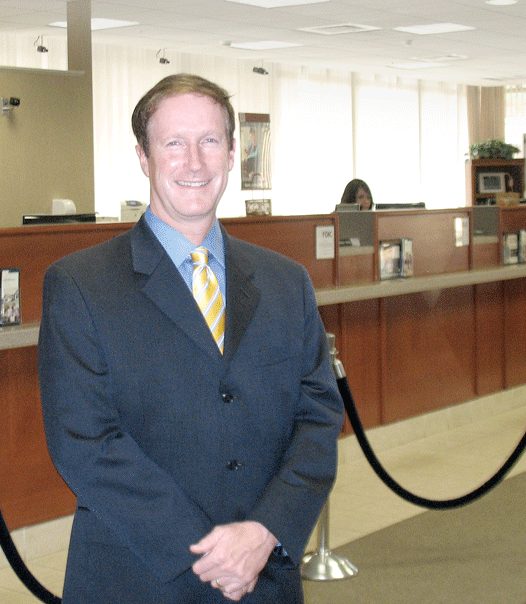
“I was contacted by a search firm to look at the possibility of a teaching hospital in another state and also Cooley Dickinson Hospital,” he explained. “I didn’t really know Cooley Dickinson or Northampton, and I was at a career stage where I was considering two paths to reach my ultimate goal, to be CEO of a major teaching hospital; one was to be the CEO of a community hospital first, and the other was to be the number-two person at a teaching hospital.
“There was something about Cooley Dickinson and the community that attracted me, and so I came here,” he continued. “I thought it would be five years, but once here, that attitude changed, because underlying all that was wanting to change the health care field, not just where I was working. I soon got the sense, from all that we were able to do, that you could develop a model community hospital that others could learn from, and change the field.”
Melin told BusinessWest that recruiters have contacted him countless times over the past 23 years to gauge his interest in other administrative positions, some at facilities several times the size of CDH.
They still call, or e-mail (the more common method of making such inquiries these days), but he said he hasn’t seen or heard anything that would take him away from CDH. When asked to elaborate on why, he said, in essence, that there is still considerable work to be done with regard to making Cooley Dickinson into that model community hospital. In short, he hasn’t finished what he started.
Which brings him back once again to his Ph.D. and that prospective work he’s doing with taking lessons from his site visits back to CDH. He said those visits have generated tremendous learning experiences and provided plenty of insight into the work he’s doing in Northampton — and how he might do it better.
“I’ve got a framework for how I think and how I lead,” he explained. “The experience of seeing other places has given me guidance on how to adjust that framework, because it’s always going to be different based on context. There’s a concept called realist evaluation that says that you need to look at the mechanisms of change in the context in which they occur, and then look at the outcomes.
“And where the process I’m talking about has five steps,” he continued, “we’re looking at five different mechanisms of change, but the question becomes, ‘how do you adjust them in different contexts, and what outcomes do you get?’
“Basically, it comes down to what works where, when, and why,” he went on, adding, once again, that his site visits have provided myriad talking points for his dissertation and plenty to think about at CDH. “Cooley Dickinson has a completely different context than those other places, and our outcomes will be different, but we can still ask the question, ‘how can we make that framework successful in our community?’”
And while his site visits have involved lengthy visits to CEOs’ offices, they’ve also included talks with physicians and quality-improvement staff and lengthy stints on the front lines, said Melin, adding that with each group came a unique perspective on the steps taken and, more importantly, why they were successful.
“This was a real learning experience for someone who’s a CEO,” he told BusinessWest. “When I talk to the CEO about what he or she has done to lead change, and then I talk to the front-line staff, they’ve experienced the change, too, and they know why it is they made the changes, but they might not be the same reasons as the leader thought.
“And as someone who’s in a leadership position, this was a great opportunity to see first-hand somewhere else that there is that disconnect,” he continued. “That doesn’t mean that what the leader did wasn’t really effective, because in each of these places it obviously was, but it wasn’t necessarily what they thought they did that caused the success at the front lines; it was something that happened within their organization because of the transitions they set in place.”

Degree of Progress
When asked what he does in his spare time, Melin smiled and said that, at this time in his life, there simply isn’t much of that precious commodity.
Indeed, between his work molding CDH into a model community hospital and work on his Ph.D., most everything else has been put on hold. He still finds time to visit the Connecticut shore with his wife, who operates a unique bed-and-breakfast in Northampton that features extended-stay programs. There will be more time for the beach when his doctoral work is completed, obviously, a day Melin is looking forward to seeing.
But while that work will eventually end, the more important assignment of applying what’s learned won’t. That’s because hospitals must seek to continuously improve, he said, adding that this is the real framework for a model community hospital.

George O’Brien can be reached at [email protected]

Commercial Real Estate Sections
Northampton Project Moves Off the Drawing Board

Northampton/I-91 Professional Center

Northampton/I-91 Professional Center

Development Associates, which has a portfolio boasting 1.5 million square feet of office and mixed-use facilities across Western Mass. and Connecticut, is adding a new facility to its product mix — a Class A office facility to be known as the Northampton/I-91 Professional Center. And as the name suggests, it promises access and a host of amenities.

Ken Vincunas says that considerable time and energy were devoted to coming up with a name for his company’s latest commercial real-estate endeavor.
And he considers it all very well spent.
Indeed, he believes ‘Northampton/I-91 Professional Center’ effectively conveys not only where his next project will take shape, but what it will become.
The two-building, 80,000-square-foot Class A office complex will be located in Paradise City and, more specifically, just off exit 18 off I-91, adjacent to the Clarion Inn and Conference Center, where it will be quite visible from the highway. Meanwhile, it is a facility being designed for professionals, and while the health care sector is certainly one target, he believes individuals and firms across several sectors will be attracted to this site’s combination of access and amenities.
And in time, the site will become a center of business activity, he predicts, noting that the location makes the complex accessible to points well north and south of that I-91 off ramp, and thus perfect for professionals that do business across the region.
“In the end, everyone involved thought this name captured the fact that it was in Northampton and on the highway, which are the two biggest features,” said Vincunas, president of Agawam-based Development Associates Inc., which is spearheading the project for the owner of the Clarion complex, Atwood Drive, LLC, which has assembled the needed acreage over the past several years. “There were options, incorporating phrases like ‘Mountain View,’ that were a little more touchy-feely, but we wanted to emphasize our strengths and what sets this project apart.”
He described his company’s latest venture as a ‘partial-spec project,’ meaning that work will not commence until commitments have been received for probably 60% to 70% of the available square footage. But there is some risk involved, he continued, adding that there are still some question marks concerning when and to what degree the economy will turn around in the months to come.
The professional center is the first undertaking by Development Associates in Northampton, and is the latest in a series of office and mixed-use ventures across Western Mass. The portfolio, which totals 1.5 million square feet in facilities stretching from New Haven to Greenfield, currently includes the 31,000-square-foot Agawam Crossing professional building, the 85,000-square-foot North American headquarters for Convergent Lasers in the Chicopee River Business Park, the 190,000-square-foot Greenfield Corporate Center, the headquarters for Seahorse Bioscience in Chicopee, and dozens of other single- and multi-tenant facilities.
Vincunas believes this will be a worthy addition to that portfolio and, more importantly, an economic driver for the Northampton area and the region as a whole.

Paradise Found?

Ken Vincunas

Ken Vincunas says that, in addition to location, his project would seem to have timing in its favor.

As he talked with BusinessWest about the Northampton/I-91 Professional Center, Vincunas said be believes this endeavor, the first Class A project to be built in Northampton in several years, has more going for it than an effective name and an attractive location.
Indeed, he’s also of the opinion that the timing is good, especially with regard to the laws of supply and demand. Elaborating, he said that, while the economy is still very much in recovery mode, there are certainly signs of progress and higher confidence on the part of business owners, including those in the health care sector.
“If we get the pre-leasing in place and get started soon, the timing could be perfect,” he said, citing what he considers a good amount of pent-up demand for such facilities within the health care sector and other professional groups. “We’d definitely be ahead of the curve because there’s not a lot of things being proposed for this kind of use.
“In the Northampton office market, while there is space,” he continued, “it’s mostly in the downtown where it’s hard to find parking and it can be challenging getting in and out of the center of town, traffic-wise. This gives people with a regional perspective a location that they can get to from all quarters very quickly. You can draw from all areas. You don’t have to be just a local office; you can be a regional office.”
Meanwhile, many of the office projects created for the health care market, such as a series of developments on Wasson Avenue in the North End of Springfield, near Baystate Health, are at or near capacity, said Vincunas, as are many of the rehabbed former mill buildings in Northampton, Florence, and Easthampton. And as the medical sector, one of the mainstays of the local economy, continues to grow, Class A space will be in demand.
The professional center has been on the drawing board for roughly two years ago, or since Atwood Drive LLC completed the task of acquiring additional adjacent parcels, including a former Mobil gas station and a small auto-repair venture, and assembling a parcel totaling just over four acres.
The timing certainly wasn’t as appropriate then, he noted, referring to both the economy as a whole and the fact that two major potential players, Baystate Health and Cooley Dickinson Hospital, were involved with other initiatives. Also, the project had not gone through the involved permitting process in Northampton, he continued, adding that the cart was essentially put before the horse.
“This time, we received the permitting first, so we know what we can offer,” he said, “and we know we can build it as soon as we’re ready.”
The center will consist of two buildings, one with 39,000 square feet of leasible space, and the other with 43,000 square feet. Full floors are approximately 12,000 square feet, and spaces as small as 1,000 square feet will be available.
The exterior of the buildings features a high proportion of glass, complemented by natural brick and EFIS (exterior insulation and finishing system) effects, said Vincunas, adding that the major entrances of the buildings feature a two-story glass lobby. Meanwhile, green materials and high-efficiency mechanical systems will be implemented throughout the project to reduce energy and improve overall quality.
Vincunas said marketing of the professional center has begun in earnest, and initial interest is solid and crosses several industry sectors. Pricing is currently being finalized on the shell and interior spaces, he continued, adding that these numbers will contribute to lease rates, which have not yet been determined.

Space Exploration
While Vincunas exudes confidence while discussing his latest endeavor, he noted that there are still many variables when it comes to the economy and its ongoing rebound, and that time will tell just how much demand there will be for this new supply of Class A space.
At this moment, though, he believes he has the right product in the right place at the right time.
And the name is pretty good, too.

George O’Brien can be reached at [email protected]