Daily News

NORTHAMPTON — The Best of Valley Voices Story Slam collaboration between the Academy of Music Theatre and New England Public Media will stage its eighth competition at the Academy of Music on Saturday, April 8 at 7:30 p.m. With storytelling as one of the oldest forms of entertainment, Valley Voices brings inspiring, comedic, and heartwarming true stories from members of the local community to the stage.

Audience members selected the top three storytellers from four slams performed at a variety of venues in the Valley between December and March, and now they will compete for the best of the best. Both novice and experienced storytellers will be sharing their five-minute, first-person narratives live on stage, and the audience will select the winner. Co-producers Lyrical Faith and Vanessa Cerillo, along with singer and songwriter Adam McElreath, will lead the audience along with the rules and voting tips.

For further information or to purchase tickets, visit www.aomtheatre.com or call (413) 584-9032, ext. 105, Tuesday through Friday from 3 to 6 p.m.

Daily News

HOLYOKE — Baystate Health and Lifepoint Behavioral Health, a business unit of Lifepoint Health, announced that Roy Sasenaraine has been named CEO of the new joint-venture behavioral-health hospital currently under construction in Holyoke. The 150-bed hospital, to be called Valley Springs Behavioral Health Hospital, is slated to open to patients in August.

“I am delighted to welcome Roy to the Lifepoint Behavioral Health team and know he will be the right leader for our new hospital in Holyoke,” said Russ Bailey, president of Lifepoint Behavioral Health. “With more than 20 years of experience in operations and financial management and, in particular, hands-on experience guiding operations in behavioral-health settings, Roy has evidenced a commitment to leading sustainable operations and delivering high-quality care to patients in a variety of emergent, acute, and outpatient settings. I am confident Roy is the right person to lead Valley Springs Behavioral Health Hospital into its first chapter here in the Holyoke community.”

Most recently, Sasenaraine served as vice president of Operations for the central region of Spire Orthopedic Partners, where he led new construction, patient-access initiatives, and acquisition and integration work for Spire’s nine locations in Connecticut.

Prior to his role at Spire, Sasenaraine served as vice president of Operations for Hartford Healthcare System’s East Region behavioral-health network. In this role, he oversaw 18 locations, including six school-based programs, two emergency departments, one inpatient psychiatric hospital, eight ambulatory locations, and one inpatient juvenile program. His leadership led to the implementation of a new care model for adolescent, pediatric, and adult patients in inpatient care along with the implementation of a new electronic medical record across all sites of care.

“Roy’s breadth of operational experience and his deep understanding of the behavioral-health setting make him the right leader for this new, state-of-the art facility that we are excited to open in the coming months,” said Dr. Andrew Artenstein, chief physician executive and chief academic officer of Baystate Health, president of Baystate Medical Practices, and regional executive dean of UMass Chan Medical School – Baystate. “We look forward to serving patients when Valley Springs Behavioral Health Hospital opens and know Roy’s leadership will be instrumental as we expand our behavioral-health offerings, bring on new tools and resources for our patients, and implement new quality-of-care models. We are excited to welcome Roy and his family to the Holyoke community, and we look forward to serving patients at Valley Springs Behavioral Health Hospital later this summer.”

Sasenaraine earned a bachelor’s degree in healthcare administration and a master’s degree in business administration, with a focus in healthcare administration, from Quinnipiac University in Hamden, Conn. He is a member of the board of directors for Health Assistance Intervention Education Network and previously served on boards for Advance Behavioral Health and Blue Ocean Healthcare LLC.

“I am honored to join Lifepoint Behavioral Health and support the team at Baystate Health as we expand critically needed inpatient behavioral-healthcare services to the community,” Sasenaraine said. “I am eager to get to work, and I know that we have an exciting road ahead of us. I look forward to serving patients in Western Massachusetts with safe, high-quality behavioral-healthcare services at Valley Springs Behavioral Health Hospital.”

Valley Springs Behavioral Health Hospital will feature 120 semi-private rooms and 30 private rooms for patients. The addition of this new facility will increase patient access in the community to Baystate Health’s specialty inpatient behavioral healthcare for adults, including geriatric patients, as well as adolescents and children, by more than 50%. Lifepoint Behavioral Health and Baystate Health broke ground on the new facility in March 2022.

Daily News

HOLYOKE — Holyoke Community College (HCC) will welcome Massachusetts Department of Higher Education Commissioner Noe Ortega to campus on Wednesday, March 22 as part of his orientation tour of state colleges and universities.

Ortega is expected to be at HCC from 10 a.m. to 2:15 p.m. to meet with students, faculty, staff, college administrators, and area officials, including former state Rep. Aaron Vega, director of Holyoke’s Office of Planning and Economic Development.

The Board of Higher Education hired Ortega as commissioner in August 2022. He is the former Education secretary in Pennsylvania and succeeded Carlos Santiago as commissioner of Higher Education in Massachusetts.

Ortega will begin his visit at 10 a.m. on the third floor of the Frost Building with a welcome from HCC President Christina Royal and other administrators. From there, HCC student Samya Robles, accompanied by Royal, will lead Ortega on a campus tour, with planned stops at the Thrive Student Resource Center and Food Pantry, Homestead Market (the first campus store in Massachusetts to accept SNAP benefits), the Marieb Building and its Center for Life Sciences, the Itsy Bitsy Child Watch (HCC’s free child-watch service for student-parents), and El Centro (HCC’s bilingual student suport and service center).

At 11:45 a.m., Ortega will meet in the Campus Center (Room 223) with Royal, Vega, and members of the president’s cabinet to talk about the commisioner’s priorities and college priorities, including regional partnerships.

At 12:15 p.m., Ortega will join students, faculty, staff, and trustees in the Campus Center Faculty and Staff Dining Room for a sit-down lunch and “The HCC Experience,” a presentation about what makes the college exceptional from different points of view.

Finally, at 1:30 p.m., Royal and Ortega will meet for a private discussion.

Daily News

AMHERST — UMass Amherst’s Department of Mathematics and Statistics is offering 30 three-year scholarships to a diverse cohort of students majoring in mathematics and statistics, thanks to a $1.5 million dollar grant from the National Science Foundation (NSF).

The six-year project, called Enhancing Underrepresented Participation in Mathematics & Statistics: Mentoring from Junior to Master’s, will welcome its first cohort this fall, and will support each student for their junior and senior years, as well as through a one-year master’s program. The program will accept applications for the 2023 cohort until April 1.

“I am deeply invested in trying to increase diversity in the fields of math and statistics. The big question is how,” said Maryclare Griffin, assistant professor of Mathematics and Statistics.

She points to national statistics — in 2020, for instance, only 30 out of 2,031 PhDs granted to U.S. citizens and permanent residents went to black scholars, according to the NSF — to underscore how persistent the lack of diversity in her field is. “I decided to focus in at home, to look at what might be contributing to a lack of student engagement, enrollment, and success.”

Griffin discovered that one of the biggest barriers is financial, as “students of color borrow more, at higher rates. If you look at who gets math and stats degrees, they tend to be people who don’t have to borrow as much.”

To begin to address this problem, Griffin has teamed up with four co-investigators at UMass Amherst: Adena Calden, senior lecturer of Mathematics and Statistics; Nathaniel Whitaker, interim dean of the College of Natural Sciences; Farshid Hajir, senior vice provost and dean of Undergraduate Education; and Inanc Baykur, professor of Mathematics and Statistics. Together, and in collaboration with many other professors in the department of Mathematics and Statistics, they designed a program that will award scholarships of $10,000 per year to academically qualified students who can demonstrate financial need.

To introduce the students to cutting-edge research in the field, each will also receive $4,000 per summer for two summers of additional research. Finally, the team will bring in experts from the Center for Minorities in the Mathematical Sciences to train UMass faculty in how to best support the success of historically underrepresented student populations.

Students will apply for the scholarship in their sophomore year and will be supported through their final two years of undergraduate study as well as through their pursuit of a master’s degree in math. “What we’re expecting is that students will hear about this early — even in high school,” Griffin said, adding that her colleagues are working to recruit students from UMass as well as from area community colleges.

Since the Bureau of Labor Statistics expects employment in math-related fields to grow by 27% by 2029, Griffin’s project blazes a path for diversifying not only the student body, but the wider profession as well.

“The Department of Mathematics and Statistics is striving to create an abundant, supportive, and diverse community,” Whitaker said. “I’m delighted to bring this opportunity to UMass students. Diversity, equity, and inclusion are important priorities for me; we must ensure that students feel like they belong and clear the barriers to success wherever possible. The S-STEM program is a critical step in making the mathematics and statistics field more accessible and diverse.”

For more information as well as a link to the 2023 application, visit people.math.umass.edu/~sstem.

Daily News

WESTFIELD — The Westfield Athenaeum and MOSSO (Musicians of the Springfield Symphony Orchestra) will present the third of a three-concert chamber music series, with Harmonia V performing on Thursday, April 20 at 7 p.m. This is the second year of MOSSO’s partnership with the Westfield Athenaeum. Guy McLain, executive director of the Westfield Athenaeum, will offer a pre-performance talk at 6 p.m., which is free to ticket holders.

The Connecticut-based Harmonia V, an innovative woodwind quintet, performs standard literature, seldom-heard treasures, and dynamic contemporary music. Members of the quintet include Springfield Symphony Orchestra and MOSSO horn player Robert Hoyle; Jennifer Berman, flute; Janet Rosen, oboe; Jim Forgey, clarinet; and Jackie Sifford Joyner, bassoon. The Harmonia V program, “April in Paris,” includes music by Fauré, Ravel, and Debussy. For information on Harmonia V, visit www.harmoniav.com.

Tickets for the concert cost $25 and must be purchased in advance at the Westfield Athenaeum during business hours, or online at www.westath.org.

Business Talk Podcast Special Coverage

We are excited to announce that BusinessWest has launched a new podcast series, BusinessTalk. Each episode will feature in-depth interviews and discussions with local industry leaders, providing thoughtful perspectives on the Western Massachuetts economy and the many business ventures that keep it running during these challenging times.

Go HERE to view all episodes

Episode 154: March 20, 2023

George Interviews Evan Plotkin, president of NAI Plotkin

Three years after the start of the pandemic, the world looks considerably different, with some of the most profound change coming in the commercial real estate realm. Remote work and hybrid schedules are here to stay. What does that mean for Springfield’s office towers and other places where people work? Evan Plotkin, president of NAI Plotkin, discusses all this and much more with BusinessWest editor George O’Brien on the next installment of BusinessTalk. It’s must listening, so tune in to BusinessTalk, a podcast presented by BusinessWest and sponsored by PeoplesBank.


Sponsored by:

Also Available On

Daily News

WARE — Country Bank announced that Erin Pope has joined its Innovation & Technology division in Ware. Before joining Country Bank, Pope worked at Digital Credit Union and American Tower.

“We are thrilled to welcome Erin to the Innovation & Technology team. Her experience in varying industries from start-up, defense, financial, and real estate — which expanded her knowledge and skillset to lead teams in supporting and implementing lean infrastructures and processes — makes her a perfect fit for Country Bank,” said Miriam Siegel, first senior vice president and chief culture and development officer, Human Resources. “We look forward to Erin’s enthusiasm and dedication representing Country Bank and supporting our iSTEP corporate values of integrity, service, teamwork, excellence, and prosperity, and we are pleased that she has chosen Country Bank to be her employer of choice.”

Pope holds a bachelor’s degree in electrical and computer engineering from Worcester Polytechnic Institute and received certification in Professional Scrum Master 1.

“At American Tower, I managed a network-operations team responsible for the global office and data-center infrastructure,” she said. “It was through working with this team that I learned the importance of strength and a diverse team. I am excited to join Country Bank’s storied history and contribute to its continued success. I hope to support the team by increasing engagement and innovation to support the business and its customers better.”

Daily News

SPRINGFIELD — Officer Curtis McGuire has become American International College’s (AIC) first graduate of the Western Massachusetts Police Academy. McGuire was among the members of the 65th recruit officer candidate class saluted in a graduation ceremony held at AIC on March 17. The newly minted officers marched to the music of a bagpipe into the Griswold Theater, where they were welcomed by family, friends, and fellow members of law enforcement.

AIC President Hubert Benitez offered a warm welcome speech to the graduates and joked about being in a room full of officers, saying, “I’ve never felt so safe.” Benitez told the graduates he has family members in law enforcement, and he holds police near and dear to his heart. “For AIC, this is a special day that we get to host this great event,” he continued, and thanked the officers for their service.

“I am absolutely overjoyed for Officer McGuire,” said Roberto Gonzalez, AIC chief of Police. “He will continue to serve with the AIC family, and his graduation from the academy, the first for the college, represents a great success.”

McGuire trained under the Campus Police for a year and a half before attending the academy, and now returns to AIC, where he will serve as a campus police officer. “I found a home here [at AIC] and intend to stay for quite a while,” he said.

For the 10-year Army veteran, graduation fulfills a lifelong dream to work in law enforcement. At 45, McGuire was the oldest graduate in the ceremony. “I delayed this for many years because my daughter, who is autistic and epileptic, needed our family’s attention,” he explained. “But when things at home were more under control, I was able to focus on becoming an officer.”

The event came at a time when many police departments around the country are struggling to recruit and keep officers. When asked if it was a difficult time to join the force, McGuire answered, “no … you’ve got to be the change you want to see. We bonded at the academy and learned how to work together to do good. I wouldn’t change a thing.”

Daily News

MONSON — BauerFinancial Inc., a leading, national bank-rating firm, announced that Monson Savings Bank has once again earned its top (5-Star) rating for financial strength and stability. Having earned Bauer’s 5-Star rating for 40 or more consecutive quarters, Monson Savings Bank has earned an even higher designation as an Exceptional Performance Bank. This marks the bank’s 53rd consecutive 5-Star rating.

Bauer rates every federally insured U.S. chartered bank with the same strict standards, and reported that Monson Savings Bank continues to outperform its peers.

“What does it mean when we say, ‘like having a friend in the banking business?’” said Karen Dorway, president of BauerFinancial. “It means loyalty and dedication. It’s a connection, one that you can rarely find in a big bank. But at Monson Savings Bank, it comes naturally. Not to mention, a local bank means local decisions, made by people just like you.”

Dan Moriarty, president and CEO of Monson Savings Bank, added that, “as a local community bank serving the financial needs of our area for over 150 years, all of us at Monson Savings Bank are incredibly proud of this 5-Star rating that recognizes our consistent performance in financial strength and stability. We work hard to remain well-capitalized and financially sound to ensure we are providing our customers and communities with the support that only a community bank can provide.”

Daily News

NORTH ADAMS — Massachusetts College of Liberal Arts (MCLA) will launch a four-year bachelor of science in nursing (BSN) program for the fall 2023 semester. This will be the first BSN program in Berkshire County and the only BSN program within an hour’s drive of the rural tri-state corner of Massachusetts, Vermont, and New York. This nursing-education initiative will help address the current and future rural nursing workforce shortages.

MCLA received final approval from the Board of Higher Education this month and received initial approval to launch a BSN in January from the Board of Registration in Nursing (BORN). The next phase of BORN approval is anticipated after MCLA graduates the first nursing cohort in 2027.

MCLA’s BSN degree can be completed over a four-year period. After accepting pre-nursing students this fall, the college will formally accept up to 25 students into the nursing major at the conclusion of their first year of study. Students must complete required pre-nursing courses in math and sciences during that first year for admission into the program. Transfer students may also apply to the nursing program during their first year of study at MCLA and transfer in non-nursing courses for consideration toward graduation. MCLA expects that the first BSN class will graduate in May 2027. At the conclusion of the program, students will be awarded a bachelor of science in nursing degree and be prepared and eligible to take the National Council Licensure Examination (NCLEX).

“Nursing care in rural and remote areas is uniquely complex and diverse, necessitating educational preparation at the baccalaureate level,” said Dr. Elizabeth Fiscella, associate dean of MCLA’s new BSN program. “Rural nurses need to know how to assess situations and manage client care with the resources available. They must be flexible problem-solvers who can prioritize alternatives to match resources, time constraints, and cultural expectations — skills that are especially well-served by MCLA’s strong liberal-arts foundation — while also meeting individual client-care needs, all rooted in evidence-based nursing practice. Increasing the number of baccalaureate-prepared registered nurses to meet the demands of residents living in rural and underserved areas of Northwestern Massachusetts is critical.”

MCLA President James Birge added that “MCLA has received overwhelming positive feedback as we prepare for implementation of a bachelor of science degree in nursing. We recognize the great demand right now for nurses in Berkshire County, and we look forward to helping meet this significant need right here in our community.”

In recognition of the importance of this degree program for the Berkshires, Berkshire Health Systems (BHS), the leading healthcare provider in the county, has agreed to help MCLA fund certain program startup costs.

“Our region is not unique in experiencing healthcare-staffing challenges,” said Darlene Rodowicz, president and CEO of BHS. “However, what is special about the Berkshires is our strong portfolio of programs designed to educate and train nurses. MCLA’s nursing bachelor’s-degree program rounds our region’s offerings, including an associate degree in nursing program (ADN) at Berkshire Community College (BCC), licensed practical nurse (LPN) programs at BCC and McCann Technical School, and a nursing assistant (NA) training program at BHS. We are grateful for this community’s dedication to training the next generation of compassionate, skilled healthcare workers right here in the Berkshires.”

Brenda Cadorette, chief Nursing officer at Berkshire Medical Center (BMC), added that “educational programs like this one at MCLA are critical to helping rebuild the workforce that cares for our community, and we are eager to partner with these bachelor’s-degree students, as we already do with the existing nursing programs, to offer clinical rotations and meaningful learning experiences at BMC.”

Additionally, MCLA announced three new scholarships available to qualified applicants pursuing bachelor of nursing degrees at the college. The Dion Family Scholarship provides $5,000 per year to students pursuing a BSN, the Lisa O’Brien Nursing Scholarship provides $2,500 to $5,000 to students pursuing a BSN, and the Brian and Vikki Fairbank Berkshire Community Scholarship provides up to $5,000 to students who reside in Berkshire County and are pursuing a BSN.

The BSN program will be funded in part through a two-year, $1 million grant from the Massachusetts Executive Office of Health and Human Services. The grant will allow for curriculum development that responds to the critical workforce needs within Berkshire County and across the Commonwealth. The funds will help support faculty, a simulation-lab coordinator, the purchase of nursing journals and textbooks, nursing testing software, and Accreditation Commission for Education in Nursing fees.

U.S. Rep. Richard Neal has secured an additional $620,000 appropriation for the MCLA nursing program as part of the federal spending bill passed in December 2022. In its pitch for funding, Neal’s office noted that 13,500 people work in the healthcare field locally, and said the project deserved support in part because of its importance to the region’s economy.

MCLA is now accepting applications for fall 2023. To learn more and apply, visit mcla.edu/nursing.

Daily News

SPRINGFIELD — O’Reilly, Talbot & Okun (OTO) recently announced nine staff additions and promotions: Jonathan Hermanson, Lori McCarthy, Caren Irgang, Lily Elkhay, Kaitlyn Sistare, Pierre Carriere, Elise Zalenski, Toby Simmons, and Christine Arruda.

Hermanson earned his bachelor’s degree in chemistry and environmental science. Before moving to Massachusetts, he worked in environmental consulting for five years in Kansas City. As an environmental scientist at OTO, he helps the team with Massachusetts Contingency Plan work and risk characterization, as well as environmental compliance. He also assists the asbestos and industrial hygiene team. Some of his latest achievements while at OTO are becoming a radon measurement professional and a certified hazardous materials manager.

McCarthy earned her bachelor’s degree in biochemistry. This degree taught her how releases of hazardous chemicals to the environment can have negative health effects to humans and animals nearby. She then went on to study a second degree in environmental sciences. With more than 20 years of experience in her field, she has worked on sites across New England, finding solutions to remediate the releases of oil and hazardous materials. At OTO, McCarthy was most recently promoted to associate and is the team leader for the environmental sector.

Irgang earned her bachelor’s degree in civil engineering at Rensselaer Polytechnic Institute and then went on to earn her master’s degree in civil engineering at Manhattan College. Irgang has experience in structural engineering from building and bridge engineering in New York City and performing construction inspections. Joining OTO as a Level II engineer, Irgang is performing geotechnical investigations and design and field oversight. She continues to utilize her structural engineering skills and provides an added perspective to our geotechnical projects.

Elkhay is earning her bachelor’s degree in marketing at UMass Amherst and brings her experience from her previous internship. As the marketing intern, Elkhay has posted on OTO’s social-media pages, created ads, and performed any other as needed marketing tasks.

Sistare is a 2022 graduate from Western New England University (WNE), earning her bachelor’s degree in civil engineering with an environmental engineering concentration. At WNE, she and her team’s senior project placed first in the civil engineering department. She primarily works with the geotechnical group at OTO as a Level I engineer, but also assists the environment group.

Carriere graduated from WNE in 2022 with a bachelor’s degree in civil engineering. During his studies, he gained experience in many areas, including surveying, technical writing, CAD, soil and materials testing, and collaboration skills. Joining OTO as a Level I engineer, he has become heavily involved in field work and working on site, as well as working on proposals, reports, and site plans in the office.

Zalenski earned her MBA in 2010 and has spent the last nine years developing her skills in office management, HR, IT, and bookkeeping. She has worked in residential and light commercial water treatment, which provided experience in site evaluations, water testing, treatment design, and reviewing EPA, DEP, and local board of health regulations and practices. As OTO’s office manager and executive assistant, she will be managing the day-to-day needs of the staff that may arise in the areas of IT, telephones, general building or parking issues, and scheduling events and vacations, along with providing support for OTO’s president, Ashley Sullivan.

Simmons has brought her 20 years of field-technician experience to OTO. As an environmental technician, she has taken on many field duties to make sure the job is done safely and efficiently.

Arruda has been with OTO for more than 25 years and has been part of the internal leadership transition taking place since 2020. As a result, she was promoted to associate this past year and serves on the company’s operations committee. With more than 20 years of experience as a both a certified indoor environmental consultant and Environmental Protection Agency-accredited and Massachusetts-licensed asbestos inspector, she manages and works on numerous types of indoor environmental issues, including asbestos, radon, HVAC, chemicals, and microbial contamination. She also is an National Radon Proficiency Program-certified radon-measurement professional who can perform single, multi-family, large-building, school-building, and water-radon-measurement services.

Daily News

CHICOPEE — Notch Mechanical Constructors announced the promotion of two employees to newly created executive positions.

Nick DePalma has been promoted to executive vice president. In this role, he will have overall responsibility for operations, quality, safety, and customer-base growth in alignment with the company core values. This promotion will allow Steven Neveu, president of the company, to focus more on the long-term strategic growth and vision for the company.

In addition, Nick Bernasconi has been promoted to vice president of estimating and project management. He will oversee all activities and initiatives related to the company’s accounts management, estimating, and project management.

Previously a family-owned business for 48 years, Notch transitioned to an employee-owned ESOP company in 2020. These new roles will be critical to breaking through to the next level as an organization and ensuring a strong leadership team into the future.

Daily News

EASTHAMPTON — bankESB invites customers and members of the community to two free shred days at local offices. The events will be held from 9 to 11 a.m. on the following dates and locations: Saturday, April 15, bankESB, 241 Northampton St., Easthampton; and Saturday, May 13, Home Depot parking lot, 350 Russell St., Hadley. No appointment is necessary.

Local residents can reduce their risk of identity theft by bringing old mail, receipts, statements or bills, canceled checks, pay stubs, medical records, or any other unwanted paper documents containing personal or confidential information and shredding them safely and securely for free. Valley Green Shredding, a professional document-destruction company, will be on site and can accept up to two boxes of documents per person.

Daily News

HADLEY — During the month of March, the Hadley, Northampton, and Springfield Mercy Medical Center branches of UMassFive College Federal Credit Union are holding a personal-care-items drive to benefit the pantries of the Amherst Survival Center, the Northampton Survival Center, and the Gray House. Items collected will be provided, for free, to neighbors in need.

“We know that many families face tough budgetary choices between the basic need for food and affording basic personal-care necessities,” said Cait Murray, Community Outreach manager at UMassFive. “Our goal in supporting the personal-care pantries of these organizations is to help ensure our neighbors don’t have to make those impossible choices.”

UMassFive welcomes the community to drop off donations of unopened shampoo and conditioner, shaving supplies, deodorant, toothpaste, toothbrushes, toilet paper, baby diapers, menstrual products, bed and bladder pads, and adult incontinence briefs through March 31. Items can be full-, travel-, or complimentary-hospitality-sized, and may be dropped off at 200 Westgate Center Dr., Hadley; 225 King St., Northampton; or 233 Carew St. (Rehabilitation Building Room 110), Springfield.

Banking and Financial Services

Branching Out

Oumkar Tobaran

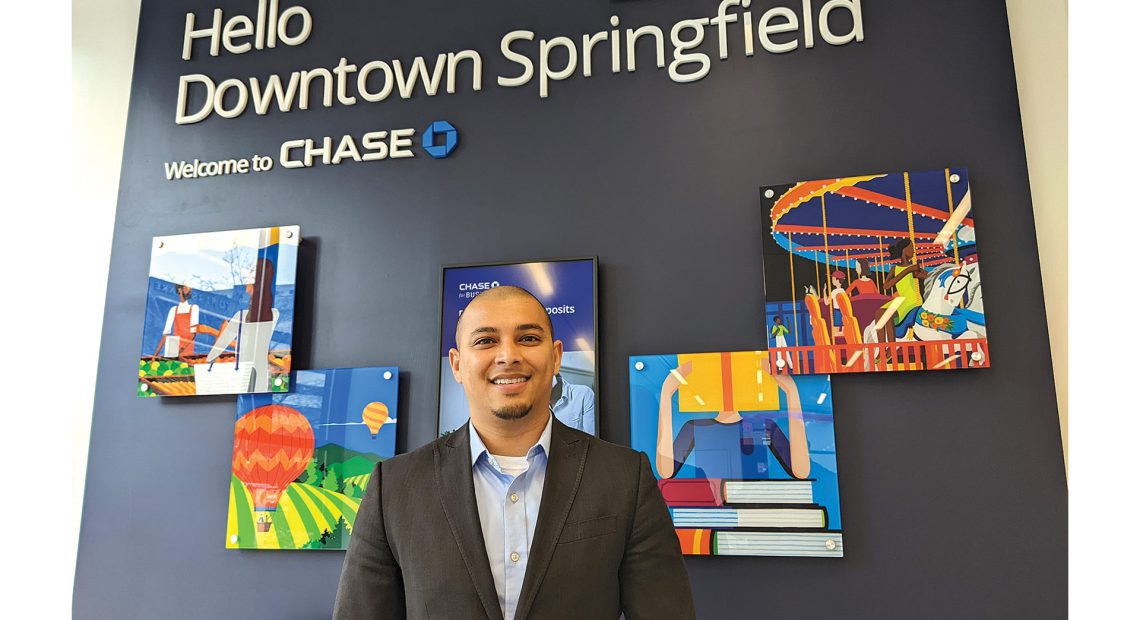
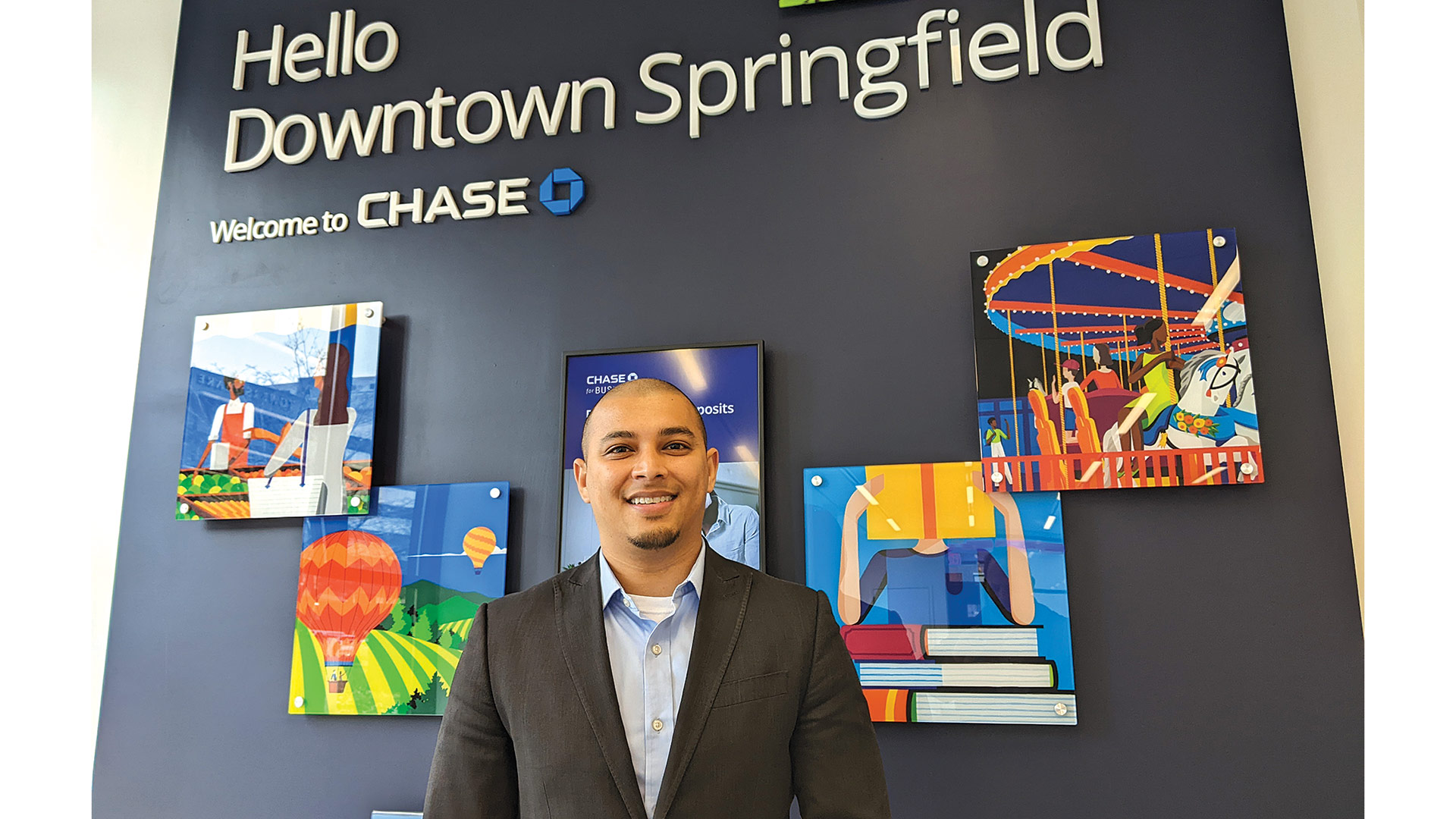
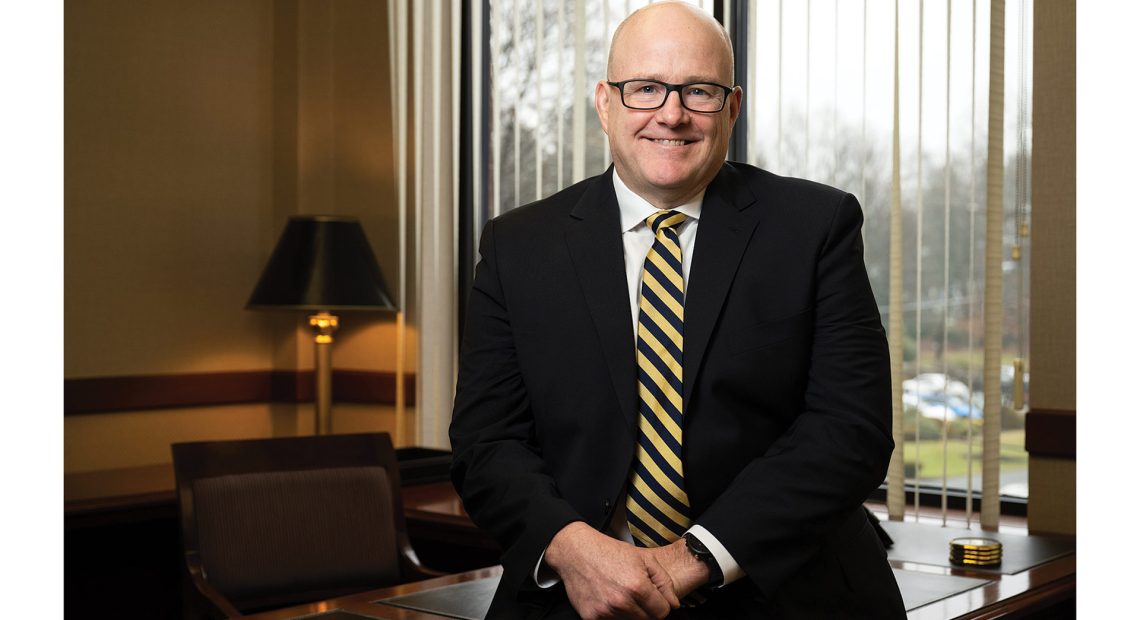
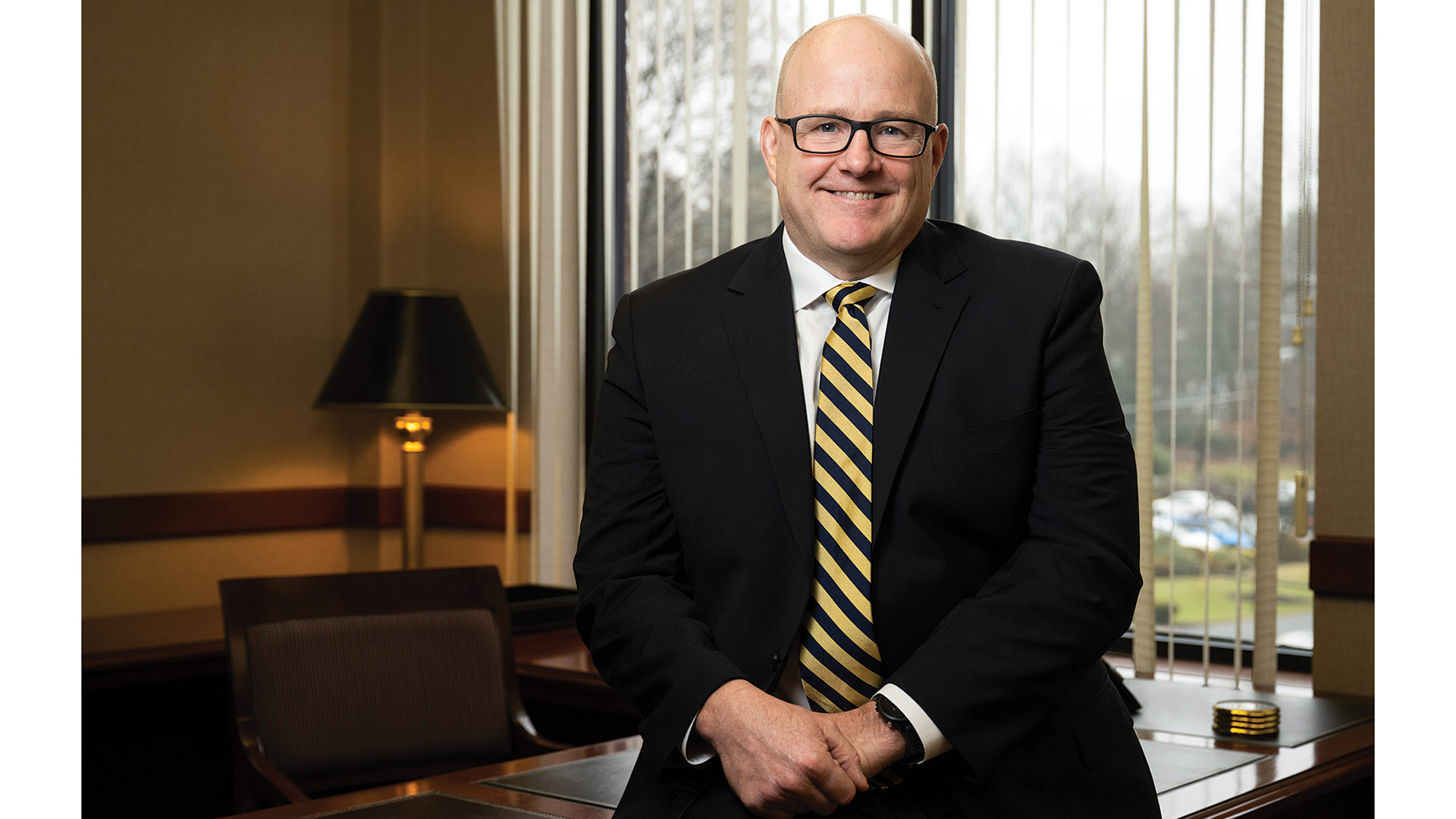
Oumkar Tobaran says the human element is critical in banking even amid the rise of online and mobile tools.

At a time when a bank’s customers can conduct business from anywhere with a few clicks, dramatic branch expansion may seem outdated.

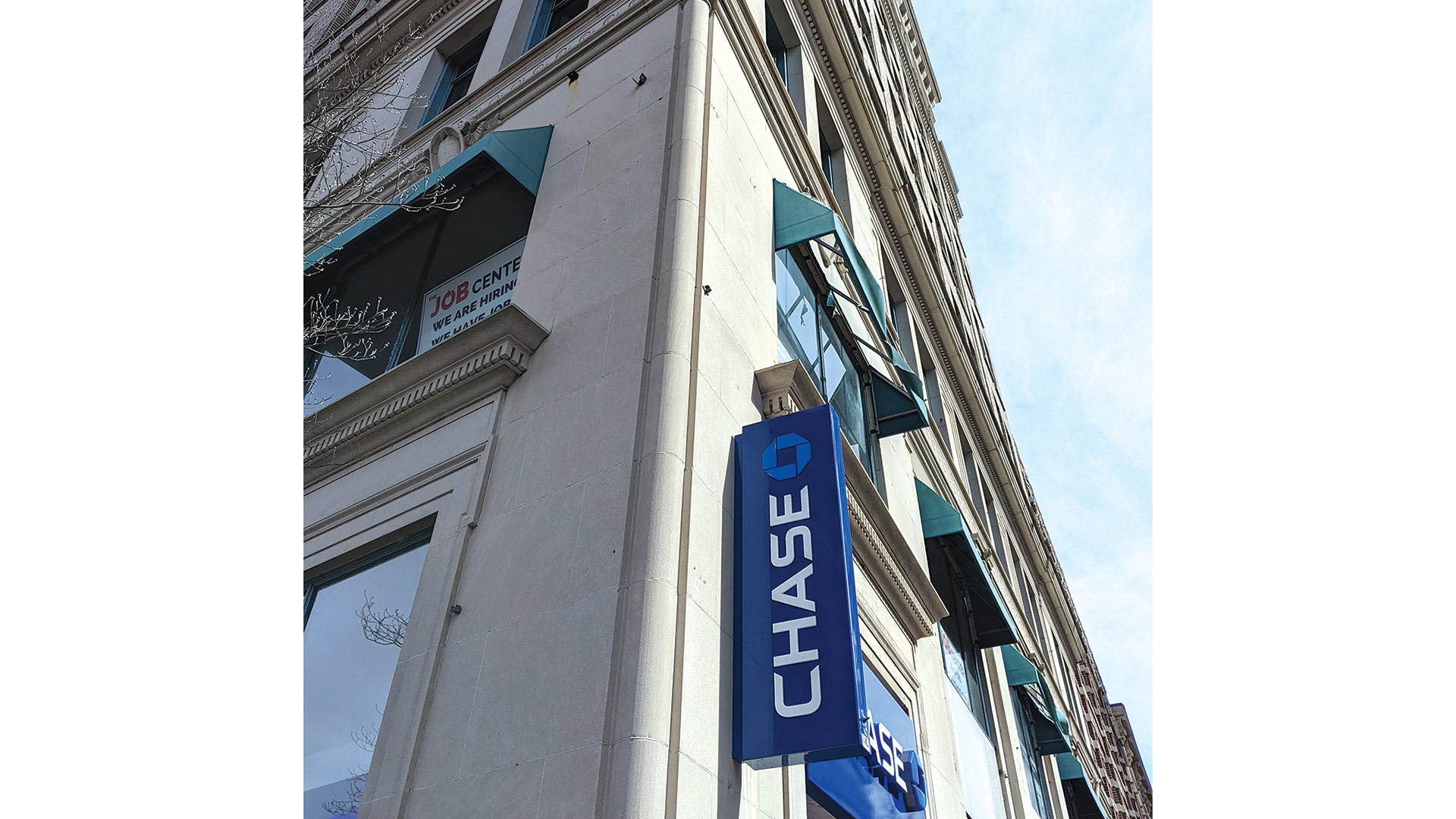
But it’s not, Ali Zaidi said, explaining why Chase Bank is looking to double its presence in Massachusetts over the next several years, starting with the opening of a downtown Springfield office on March 7.

“When you think about the important life events that customers go through, whether it be retirement planning, buying a house, or the birth of a child, people still have an appreciation for that face-to-face conversation. That makes an impact,” said Zaidi, Chase’s market director for Western and Central Mass. “And about 75% of our customers that have balances with us still come to the branches. So, clearly, the customers are telling us they would love to have that face-to-face interaction, especially with complex life events.”

Oumkar Tobaran, branch manager for the new location in Harrison Place — which has a long history of housing banks, including Third National Bank and, in recent decades, Bank of Western Massachusetts and People’s United Bank — said the human element is critical.

“With all the technology and innovation we have, think of the amount of things that we can go on our phones to do on a daily basis,” he told BusinessWest. “But the minute something doesn’t go right or the minute you need support or additional advice on something, we want to show that customer service matters, with a physical presence.”

The branch is Chase’s 38th in Massachusetts since opening its first Bay State location in Boston in 2018 — an impressive growth trajectory, and a number the institution is looking to double by 2025, including a location to open this spring in the former Silverscape Designs building on King Street in Northampton.

“This is a central point,” Zaidi said of downtown Springfield, noting that Chase has an office a few miles down I-91 in Enfield, but this is technically the first in Western Mass. “There’s definitely a rich history here on Main Street and its local businesses, as well as larger clienteles with MGM and the Hall of Fame. We’re serving clients of different demographics, and I’m very excited that we were able to secure this spot on Main Street.”

Tobaran said he expects plenty of foot traffic downtown, as well as visits from customers who may have been banking in Enfield or branches to the west, while Chase has been conducting outreach to build a larger base of business in the region.

“About 75% of our customers that have balances with us still come to the branches. So, clearly, the customers are telling us they would love to have that face-to-face interaction, especially with complex life events.”

“We wanted to make sure that we have a convenient place for them to visit because it’s important to be able to interact with the community,” he added. “There’s a lot of development happening in Springfield, and we wanted to be part of that momentum as well.”

Zaidi agreed. “Springfield is a key cog that gives us an entry point into expanding into Western Massachusetts and brings convenience to our customers. Springfield is being revitalized, and I feel we can be an integral part of that.”

He also feels there’s an opportunity to add customers who might already be familiar with Chase through its mortgage products and credit cards. “That’s what people know. So one of our consumer-banking priorities is to be a bank for all and make it easy for people to do business with us. And technology-wise, where customers were able to bank with us remotely, this now gives them a physical location to meet their diverse needs.”

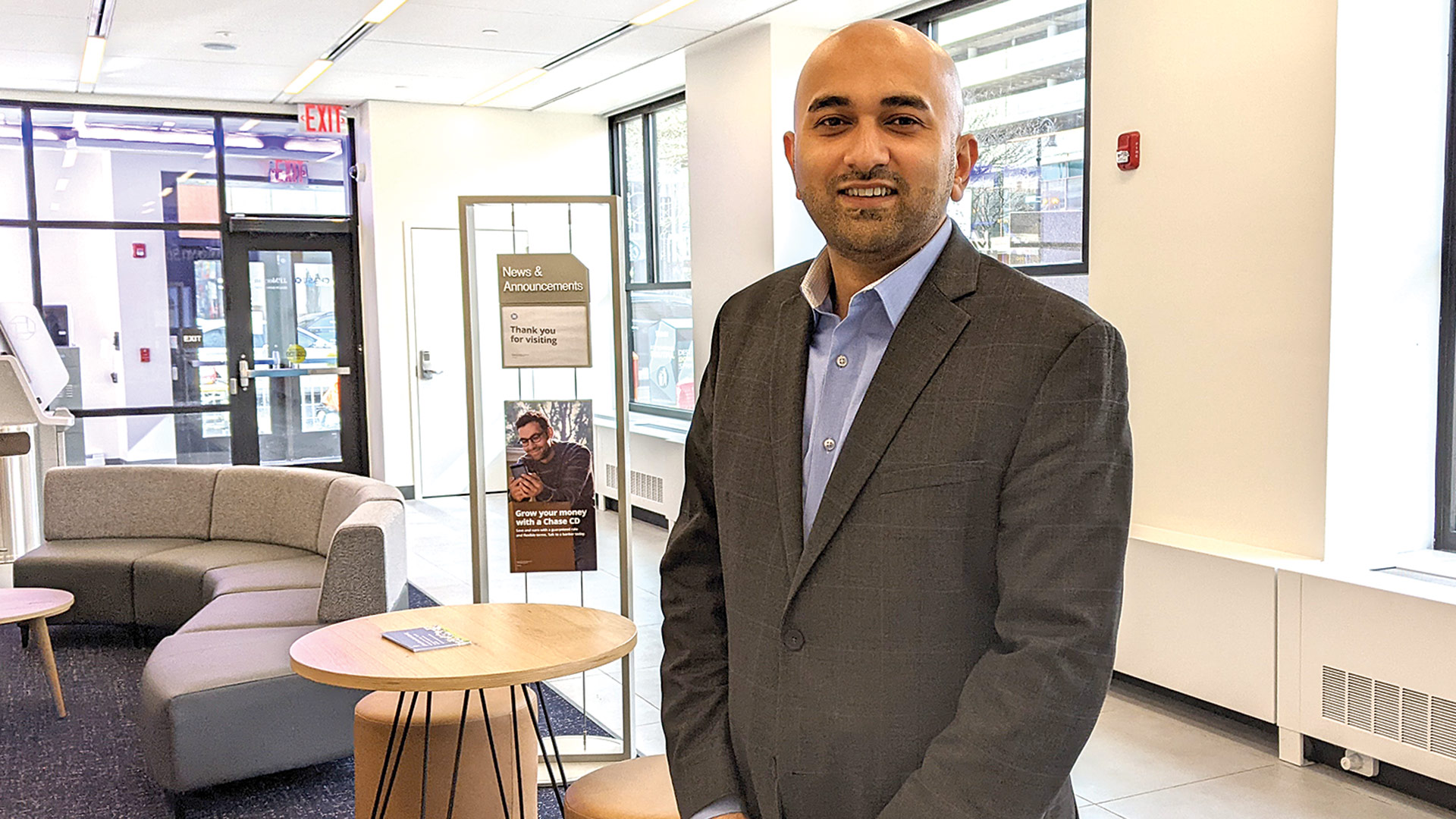
Ali Zaidi

Ali Zaidi says downtown Springfield is the first Chase branch in Western Mass. and the springboard to an eventual doubling of the bank’s branches in Massachusetts.

As he showed off the space at 1391 Main St., from the tellers and ITM machines up front to the various offices further back, Zaidi said the new Springfield branch can do all of that.

“We will help our customers with any needs, and we have more licensed specialist bankers to navigate those complex life events — retirement, financial planning, or just navigating your credit-history trajectory if you’re looking to purchase something down the road. We’re so excited to be providing that face-to-face value, and we’re looking forward to continuing the expansion.”


Set Up to Help

This first Western Mass. branch is about 3,000 square feet in size and features a modern, bright design with plenty of natural light, quiet meeting areas, and state-of-the-art banking technology, including those ITMs, which allow a higher withdrawal limit than traditional ATMs, as well as access to Chase professionals.

“For customers who have commercial or small-business banking needs, we have our team of experts, partners who will be working out of here and supporting other branches to connect customers. So it’s a one-stop shop.”

A dedicated Chase Private Client team provides premium banking services, personalized attention, and access to the expertise and investment capabilities of J.P. Morgan to help families reach their goals. Customers may also meet with financial and home-lending advisors and business-banking relationship managers.

“Our retail banking operations are here, and we have our licensed bankers to deal with client management,” Zaidi explained, “and for customers who have commercial or small-business banking needs, we have our team of experts, partners who will be working out of here and supporting other branches to connect customers. So it’s a one-stop shop.”

Tobaran said the open layout will help customers easily navigate what they need. “We will have associates in the lobby greeting clients, interacting with them. And then, depending on the transactions they’ll need to leverage, we can go back here and figure out what we need to help them with,” he explained, gesturing away from the front door toward the offices in back.

“But we equip a lot of our associates with tablets,” he added. “So in addition to helping them back there, however we can help support them face to face, sitting down in the lobby area, we will do that with the resources and tools we have.”

Besides banking business, Chase also wants to connect with Greater Springfield in other ways, Zaidi said, through financial-literacy programs and other types of community outreach.

“The idea is to have our branches be community anchors. So when we think about financial-literacy conversations, be it with young professionals or small-business owners, we want to host workshops and assistance in that space as well,” he explained, noting that Chase is working on several community-development efforts around financial literacy, including a partnership with Western New England University. “So this would serve as an anchor for us where we could do before- or after-hours seminars and events. It makes sense.”

Harrison Place

Harrison Place has been home to several banks in the past, from Third National Bank to the Bank of Western Massachusetts and People’s United Bank.

Tobaran added that the bank’s employees also reflect its region, as the branch hired locally, including people who hail from the Latino and Vietnamese communities, among others.

“We want some familiar faces to be representing Chase, saying, ‘hey, these are the resources we have to help you accomplish your goal.’ It was important for us to get local talent, people who had ties to the community, people who are passionate about giving back and who genuinely want to see Springfield succeed.”


Only the Beginning

Zaidi and Tobaran know Chase is making an ambitious surge into a region some have called overbanked, and where community banks have long dominated. But they say Chase is committed to local residents and organizations in much the same way locally headquartered banks are, while also bringing vast financial resources to the table.

“When you think about Chase, we have the resources of a large global corporation,” Zaidi said. “And our vision is, how do we take those resources and localize the solutions for our customers? Our technology and data analysis help us strategize and take a more targeted approach, because all the branches are going to operate differently based on the community-specific needs.”

One example is a partnership with Habitat for Humanity, one of the organizations that will be on hand on March 15 for the branch’s official grand-opening festivities.

“That’s one way Oumkar and his team have been making an impact in the community already,” Zaidi said. “We feel that we can be a valued contributor in that space among all the other banks. The competitive edge that we have is not only through our resources, but with the community aspect that we are trying to drive here.”

Banking and Financial Services

Details, Details

By Matthew Nash, CPA


The implementation of the Financial Accounting Standards Board’s (FASB) new lease accounting standard, ASC 842, presents a major challenge for companies that produce financial statements under Generally Accepted Accounting Principles (GAAP).

Matthew Nash

Matthew Nash

After almost seven years since the release of Accounting Standards Update (ASU) 2016-02 in February 2016, these organizations must now work toward implementing ASC 842 for the 2022 fiscal year. This article will provide an overview of the key changes that need to be made in order to ensure compliance with the new lease-accounting standard.


What Is ASC 842?

This standard intends to provide visibility on a company’s capital needs and obligations, improve consistency in financial-statement presentation, provide enhanced disclosures to the readers of the financial statements, and improve the comparability of lease practices across entities and industries.

Under the new standard, lessees are required to account operating leases with terms longer than 12 months on the balance sheet, resulting in the recognition of a right-of-use asset and the corresponding liability. Under the previous standard, ASC 840, the only leases that were required to be accounted for on the balance sheet were capital leases, which are now referred to as finance leases under ASC 842. Prior to ASC 842, operating leases required disclosure only in the notes to the financial statements.

Lessor accounting practices remain largely unchanged from ASC 840 to 842.


What Qualifies as a Lease Under ASC 842?

To better understand the new lease standard, you must first understand the definition of a lease. A lease is defined as the contract, or part of a contract, that conveys the right to control the use of an identified property, plant, or equipment for a period of time in exchange for consideration.

To simplify this definition, a lease is a physical asset that a company has the right to direct the use of for economic benefit. The most common examples of leases are office space, machinery, vehicles, equipment, and land.


What Steps Should Companies Take to Prepare?

To prepare for adoption of this standard, companies first need to account for all their existing leases and thoroughly review the contracts to determine whether they include an operating or a finance lease.


Do You Have an Operating Lease or Finance Lease?

If the lease meets any of the following criteria, it will be classified as a finance lease:

• Does the lease transfer ownership at the end of the lease term?

• Does the lease grant the lessee a right-to-purchase option that is lessee is reasonably certain to exercise?

• Is the lease term for the major part of the economic life of the underlying asset?

• Does the present value of the sum of lease payment and any residual value guaranteed by the lessee not reflected in the lease payments equal or exceed substantially all of the underlying asset’s fair value?

• Finally, is the underlying asset of such a specialized nature that it is not expected to have an alternative use to the lessor at the lease term end?

If the answer to all five of those questions is no, then the lease qualifies as an operating lease.


Lease Details

After concluding the lease type, it is time to dig into the lease details:

• When does the lease start?

• When does the lease end?

• Are there early termination or renewal options?

• Are there variable expenses related to the lease?

• What is the monthly cost of the lease?

The answer to all these questions is integral to the calculation of the asset and liability to be included in the financial statements. Once the total future lease obligation has been calculated, the obligation will be presently valued using one of three discount rate options. The newly recognized right-of-use asset and liability will then be amortized over the life of the lease, based on the lease type.

For income-statement purposes, operating leases will continue to be classified as lease expense, and finance leases will be split between amortization expense and interest expense.


Transition Methods

As part of the initial adoption of the new lease standard, there are certain practical expedients that can be adopted to help make the transition easier. Companies are not required to assess existing lease classifications. Existing operating leases with terms extending beyond 12 months will be included on the balance sheet effective Jan. 1, 2022, the date of required adoption. Existing capital leases will continue to be included with property, plant, and equipment, and will be amortized over the remaining life of the lease.


Financial-statement Disclosure Impacts

Aside from the impact on the balance sheet, the standard will also provide enhanced disclosures in the notes to the financial statements. The required disclosure will include qualitative and quantitative disclosures, including descriptions of the existing leases, disclosure of lease expenses as included in the income statement, cash paid for leases during the current year, new right-of-use assets obtained through operating and finance leases, weighted average of discount rate used to present value the lease obligation, and the maturity analysis disclosing the future obligations to be paid.


In Conclusion

The new lease standard is expected to have the biggest impact on those companies with a large volume of real-estate leases that have previously been required to be disclosed only in the footnotes to the financial statements. The overall expectation is that most companies with leases will see some impact related to the adoption of the new standard. Because the new standard has a balance-sheet impact, it is recommended that all companies review any financial covenants and proactively work with financial institutions to consider whether amendments to covenants may be required.

There are many intricacies within the new lease standard, and it will be a learning process for all of those involved in preparing their company’s financial statements. The best thing a company can do is take the time to make sure that they fully understand how each lease is written, and to have an open dialogue with their CPA.


Matthew Nash, CPA is a senior manager at the Holyoke-based accounting firm Meyers Brothers Kalicka, P.C.; (413) 536-8510.


Wealth Management

ESG Investing

By Josh Bedell, CFP, CIMA and Sylvia Callan, CFA


As with any new investment trend, a rise in popularity can give way to bad actors.

ESG (environmental, social, and governance) investing is not immune. Recent articles from the Economist, Barron’s, and the Wall Street Journal focus on the rise of ESG investing, and the perhaps predictable attempt by some to capitalize on this trend in a disingenuous and unscrupulous manner.

However, they leave investors who are socially conscious without a way forward in seeking to decipher the good from the bad.

The need couldn’t be more pressing, with ESG investing slated to rival traditional forms of investing in the next several years. With this potential surge in demand, concerns have arisen about how seriously the ESG criteria are being considered.

“Some mutual funds and portfolio managers have taken to slapping an ESG title on a fund or portfolio without doing much of anything to truly incorporate ESG factors into the investment process. This practice of attempting to woo well-intentioned investors, while not actually striving for change, has even earned a sardonic title: ‘greenwashing.’”

Indeed, some mutual funds and portfolio managers have taken to slapping an ESG title on a fund or portfolio without doing much of anything to truly incorporate ESG factors into the investment process. This practice of attempting to woo well-intentioned investors, while not actually striving for change, has even earned a sardonic title: ‘greenwashing.’

Josh Bedell

Josh Bedell

Sylvia Callan

Sylvia Callan

The good news is that the SEC has taken notice, and has proposed some rules that would create consistent standards and disclosure requirements. In addition, the Principles for Responsible Investing (PRI), a globally recognized institution for sustainable investing, tracks the development of regulatory policies in sustainable finance that support ESG investment principles. Over the past year alone, the PRI identified more than 200 new or revised policy instruments that support, encourage, or require investors to consider long-term value drivers in ESG — the main elements of socially responsible investing.

Understanding the evolving landscape in ESG can feel like a daunting task, especially if you have many other things on your plate, like a job, family, and normal day-to-day responsibilities. The good news is, there are some relatively easy steps investors can take to ensure their portfolio aligns with their values.

For starters, mutual-fund families that focus exclusively on ESG and/or socially responsible investment (SRI) funds are more likely to utilize stringent criteria than a traditional fund family that has added one or two ESG funds in recent years. Further, actively managed funds, which incorporate at least some degree of qualitative analysis, tend to evaluate companies more thoroughly than index funds, which simply track a list of ‘approved’ holdings from a third party, though there are exceptions.

Investors without the time or inclination to do this research on their own can turn to a trusted asset manager who takes ESG investing seriously. Dedicated ESG portfolio managers do extensive work in the field, often talking to mutual-fund managers directly, visiting corporate offices, analyzing lists of underlying holdings, and obtaining advanced credentials related to ESG investing.

Ultimately, it pays to have a healthy dose of skepticism. It certainly helped our firm when we decided to offer an ESG strategy for our clients. It required an added layer of scrutiny to ensure that ESG investment principles were clearly defined, closely monitored, and reported in a timely manner.

It could be an encouraging sign that increasing numbers of investors are seeking to effect positive change while also generating competitive — or possibly even superior — returns. A shift of this magnitude is bound to encounter some hiccups along the way.

Far from a reason to abandon the initiative altogether, greenwashing concerns offer an opportunity to further investor engagement, advance regulatory reform, and promote endeavors to improve ESG reporting and investing standards with the potential to benefit us all.


Josh Bedell is a financial planner and investment advisor, and Sylvia Callan is a portfolio manager, for Gage-Wiley. Callan has earned the CFA Institute certificate in ESG investing and leads the firm’s ESG efforts. Securities offered through St. Germain Securities Inc., a FINRA member. Gage Wiley is a d/b/a of St. Germain Securities Inc.

Wealth Management

It Shows That Our Pain May Be Followed by Some Gains

By Jeff Liguori


According to Google searches, the popularity of the term ‘inflation’ hit its highest peak in at least five years during the second week of August of last year.

Jeff Liguori

Jeff Liguori

For the sake of comparison, the term ‘stock market’ is one of the more popular Google searches. On average, ‘stock market’ is three times more popular than ‘inflation.’ For further comparison, the search for ‘Lebron James’ is regularly much higher than ‘inflation,’ but still not quite as popular as ‘stock market’ on average. Yet, in August of last year, ‘inflation’ bested both terms, by a wide margin.

Higher consumer prices are causing anxiety. The Federal Reserve, with its dual mandate of full employment and low inflation, has been working to ease prices through higher interest rates, which led to weak performance in both stock and bond markets in 2022 — a rare phenomenon when both markets sell off in tandem.

When the Fed raises the federal funds rate, an interest rate that banks charge to one another for overnight lending, it has a ripple effect, putting upward pressure on all interest rates, from mortgages to treasury bills. In turn, all assets get ‘repriced’; stock prices adjust lower (usually) because higher rates often mean profit margins for those businesses shrink, which equates to a lower valuation for that company’s stock price. The repricing of assets has wide-ranging implications and is often disruptive to an economy.

Is the Fed acting appropriately? Wall Street, with no lack of varying opinions, either believes the Fed has overstepped by tightening too quickly and too late, or the Fed should be more aggressive in the next two sessions and then be done. Finding an economist or strategist that thinks Jerome Powell and his crew are precisely doing the right thing is nearly impossible.

Instead of opining on the Fed’s actions — I’m not an economist, more of an ‘investment historian’ — let’s put the discussion in the context of past cycles of rising inflation and what it might mean for investors.

From January 1966 to August 1969, the federal funds rate more than doubled from 4.5% to 10.25%, in what was then seen as aggressive action by the Fed to tame inflation. In August 1969, the Fed reversed course, cutting interest rates as the economy slowed and the country faced increasing job losses. To safeguard the economy, the Fed quickly went from raising to easing interest rates, moving the effective rate back to about 5% in March 1971, as unemployment started to tick up.

But the story doesn’t end there. Inflation was persistent even with a slowing economy because of a burgeoning energy crisis. Once again, the Fed moved to a tightening stance, this time increasing interest rates by more than 300% from the spring of 1971 to the summer of 1973. Interest rates skyrocketed, and stocks suffered badly, declining by more than 40% in the 14 months following the start of that new tightening cycle, before bottoming in October 1974.

Interestingly, interest rates remained historically elevated throughout the 1980s, but stocks managed to do quite well. From the low in October 1974, the S&P 500 had an impressive run until the tech meltdown in 2001, appreciating 460% into late 2000. The data is compelling.

Following the Fed pause in 1974, in 21 of the subsequent 28 years leading up to the tech bubble, stocks generated a positive annual return. The worst year was 1977, when the S&P was down 11.5%, and the best year was 1995, when the S&P 500 generated a positive 34% return. There were eight years in that three-decade stretch when stocks increased by more than 25%.

To put things in perspective: the federal funds rate increased from 2.25% to a peak of 14.3% from February 1971 to July 1974, a total increase of about 230%, a slow and steady move higher in that 40-month period. Beginning in March of last year, the Fed raised rates from a historic low of 0.08% to 4.75%. That may seem milder as the overall level of interest rates is still historically low, but consider the Fed took this action in 11 months, increasing rates by more than 5,000%.

Overall, 2022 was unprecedented, both in the dramatic measures by the Fed and the performance of financial markets. Bond and stock markets haven’t generated a negative return in the same calendar year in almost 60 years. And there has only been one other year since 1960 when bonds had a decline in value of more than 10%, in 2009; however, the stock market appreciated almost 26% that year as the country emerged from the 2008 Great Recession.

So, what if the Fed — irrespective of Wall Street opinions — is doing exactly what needs to be done? And what if the economy avoids a recession? And what if stock and bond prices have already adjusted for a recession that doesn’t materialize (or is mild)? If history is our guide, financial markets can produce healthy returns even in inflationary periods, after some initial pain.

The answer may be as simple as to ignore consensus. Be a contrarian. The pain to our portfolios over the past 18 months may be the first step to higher returns in the near future.


Jeff Liguori is the co-founder and chief Investment officer of Napatree Capital, an investment boutique with offices in Longmeadow as well as Providence and Westerly, R.I.; (401) 437-4730.

Wealth Management

Don’t Let Your Gains Be Drained


Employment scams climbed to the second-riskiest in 2022, according to a new Better Business Bureau (BBB) report, while online purchase scams remained the riskiest scam type.

Employment scams rose from third-riskiest in 2021 to second-riskiest in 2022, according to a new report from the Better Business Bureau. Employment-scam reports submitted to BBB Scam Tracker rose 23.1% from 2021 to 2022. People also lost more money to this scam type in 2022, up 66.7% from 2021 ($900) to 2022 ($1,500). The median dollar loss for employment scams ($1,500) was significantly higher than that of $171 for all scam types.

Online purchase (shopping) scams remained the riskiest scam type in 2022. Online purchase scams comprised 31.9% of all scams reported to BBB Scam Tracker in 2022, with 74.0% of people reporting that they lost money.

Cryptocurrency scams dropped in 2022 from second- to third-riskiest due to a drop in reported scams, susceptibility (the percentage of those who lose money when exposed to a scam), and median dollar loss.

“Employment scams, which peaked at #1 on our list in 2019, are seeing a resurgence,” said Melissa Lanning Trumpower, executive director of the BBB Institute for Marketplace Trust, which produced the 2022 BBB Scam Tracker Risk Report. “This is a high-touch scam in which perpetrators spend more time with their targets in the hope of stealing more money from each target. Employment scams tied for the highest median dollar loss of all scam types. Home-improvement scams, #4 on our list of riskiest scams, also had a median dollar loss of $1,500.”

More people reported losing money when targeted by websites, social media, and email than other contact methods. Those who were targeted in person reported losing the most significant amount of money ($715), followed by text messages ($579) and phone ($550). Scams perpetrated by text messages increased by 39.6%, from 9.1% in 2021 to 12.7% in 2022.

Scams perpetrated online were more likely to result in a monetary loss than scams targeted via phone or in person. Credit cards remained the most reported payment method with a monetary loss, followed by online payment systems. The payment methods with the highest median dollar loss were wire transfer ($2,700), check ($1,277), and cryptocurrency ($1,135).

The riskiest scam type varied among age groups, with employment scams landing as the riskiest for ages 18 to 34. Online purchase scams were again the riskiest for ages 35 to 64. Home-improvement scams were the riskiest for ages 65 and up.

Military consumers (active-duty military, spouses, and veterans) reported significantly higher median financial losses ($238) than non-military consumers ($163). Active-duty military reported losing significantly more money ($490) than military spouses ($248) and veterans ($200).

The five most impersonated organizations reported to BBB Scam Tracker in 2022 were Amazon, Geek Squad, Publishers Clearing House, the U.S. Postal Service, and Norton.

For more report highlights, visit bbbmarketplacetrust.org/riskreport. Go to bbb.org/scamtracker to report a scam and learn more about other risky scams on bbb.org/scamtips.

BBB Scam Tracker is an online platform that enables consumers and businesses to report attempted and successful acts of fraud. The platform also enables people to search the scam reports to help determine if a scam is targeting them. The platform was upgraded in 2022 with support from Amazon and Capital One.


Architecture

Instilling an Entrepreneurial Mindset


Western New England University College of Engineering Professor Vedang Chauhan has been named an Engineering Unleashed fellow, a designation that recognizes leadership in undergraduate engineering education by the Kern Entrepreneurial Engineering Network (KEEN), a 50-partner collaborative whose mission is to instill an entrepreneurial mindset within undergraduate engineering students.

Chauhan is part of a select group of 21 individuals from colleges and universities across the country — and only two from New England — who have been named Engineering Unleashed fellows for 2022. Engineering Unleashed is a community of 4,000 faculty members from more than 350 institutions.

“KEEN supports teaching undergraduate students with an entrepreneurial mindset (EM) so they can create personal, economic, and societal value through their work,” Chauhan said. “I believe in KEEN’s mission and incorporate EM through my teaching. I design project activities for my students that help them develop an entrepreneurial mindset.”

“KEEN supports teaching undergraduate students with an entrepreneurial mindset (EM) so they can create personal, economic, and societal value through their work.”

Vedang Chauhan

Vedang Chauhan

Chauhan is a mechanical engineering professor with a wealth of experience in the field. He received his PhD in mechanical engineering from Queen’s University and has published numerou papers in prestigious journals, demonstrating his expertise in the field. He has also received several awards and grants for his research, which focuses on areas such as mechanics, materials, and manufacturing.

The nomination and fellowship naming process began with Chauhan’s initiative to participate in the Engineering Unleashed Faculty Development National Workshop Program. These workshops are designed and delivered by a collaborative group of subject-matter experts who serve as faculty members within the national network of partner institutions. The workshops attract faculty participants from across the country focusing on the development and application of an entrepreneurial mindset, whether it be in teaching, learning, research, industry, or academic leadership. Chauhan participated in the Integrating Curriculum with Entrepreneurial Mindset (ICE) 1.0 workshop, which connects problem-based active and collaborative learning to the development of entrepreneurial mindset.

“Students enjoy working on the projects and provide positive feedback on how EM activities foster curiosity, connections, and add value to their work,” Chauhan added. “I am thankful to KEEN ICE 1.0 workshop coaches, my fellow faculty members, and my university for all their support. I am happy to be a part of a Kern Entrepreneurial Engineering Network of like-minded educators.”

Working with the facilitators and then the coaches for up to a year, Chauhan completed the work and contributed to the Engineering Unleashed community through an online publication-sharing platform known as engineeringunleashed.com. The workshop coaches nominated a number of candidates, and an independent review committee from the KEEN partner institutions made the final selections.

To amplify the work of these fellows and advance the shared mission, awards are provided to the awardee’s home institutions through the Kern Family Foundation. As an ambassador for entrepreneurial mindset, each fellow will work on a project through their institution with a grant award of $10,000. In total, the colleges received $210,000 in support to recognize efforts in engineering education by their faculty.

The other 2022 Engineering Unleased fellow from a New England institution is Gbetonmasse Somasse, associate professor of Teaching at Worcester Polytechnic Institute.

Commercial Real Estate

This Is Not a Fire Drill

By Brion J. Kirsch and James F. Martin


Remember in elementary school when they would have a planned fire drill? The alarm would go off, and students lined up in an orderly fashion and walked single file to the nearest exit and out into the schoolyard. Inside, the school was completely empty.

Brion J. Kirsch

Brion J. Kirsch

James F. Martin

James F. Martin

Obviously, the circumstances are light years apart, but that’s essentially what occurred in office buildings in March 2020. One minute, every room is filled with people working at their desks; next thing you know, the entire place is vacant.

What would always happen after the fire drill — everyone was back at their desks in about 10 minutes — didn’t happen in office buildings. It’s been almost three years. Some are never coming back.

Remote or hybrid work is here to stay, and people’s habits and expectations have changed. As a result, the commercial real-estate market is facing challenging times. In Western Mass., for example, the vacancy rate for office space is of concern to landlords along with the reality of expiring leases for downtown office space. However, the more attractive rental price per square foot of class-A office space in Western Mass. serves as a significant advantage to retaining and attracting tenants when coupled with the lower cost of living in contrast to Eastern and Central Mass.

Thus, there are some reasons for optimism, and potential options for landlords and tenants alike.

The continuing development of multi-family apartment complexes in both the cities and the suburbs is a promising sign. And with the proliferation of shopping from home and consumer subscription services, industrial properties like warehouses and fulfillment centers are in high demand.


Options for Tenants

For employers who now have more workspace than on-site workers, subleasing is an interesting option that can both reduce expenses and boost revenue. This requires a conversation with the landlord, but if conducted in good faith, it can be a win-win situation.

With a landlord’s consent, a majority of commercial office leases allow subleasing and partial assignments. But finding an occupant to sublease part of your space is far from the final step; legalities and practicalities abound. The documentation must be specific and thorough as there’s an extra added layer of complexity in these situations.

Taking a contractual agreement between two parties and adding a third opens up room for all sorts of unexpected conflict and misunderstandings. The language in the agreement must be crystal clear.

“With a landlord’s consent, a majority of commercial office leases allow subleasing and partial assignments. But finding an occupant to sublease part of your space is far from the final step; legalities and practicalities abound.”

The biggest concern is historic and/or prospective liability. One party’s transgression may have a direct impact on the other party, even if there is fault on only one side. Something else to consider is the construction of a demising wall for the new tenant’s subleased space. To be up to code, this new area will also need proper access, exits, and restrooms, in addition to other possible requirements, such as a kitchen or metered utilities.

Depending on the terms of the lease, there may even be an express option that simply allows for the reduction in the total area being occupied and would prevent the need to sublease.


Options for Landlords

There’s an opportunity now for landlords to make a long-term play by allowing tenants to make modifications to their original lease. The value in this circumstance arrives in the form of an early renewal or extension of the current lease, in exchange for allowing the tenant to sublease a portion of their space or shrink their footprint.

As many business owners have discovered in other industries, incentives are becoming a more crucial part of attracting customers or, in this case, tenants. And just because a space was previously used for one purpose, that doesn’t have to remain the case. Repurposing is an exciting and risky but sometimes necessary option.

Taking an empty office building and converting it to multi-family apartments or mixed-use commercial space is a large undertaking. But the strong demand for housing seems likely to continue, while office space continues on a more uncertain path.

While interest rates and the cost of construction materials both remain high, supply-chain issues are easing, and real-estate profits from the past decade have some property owners’ war chests well-stocked. It’s also likely that property values will begin to fall in the coming months and years.

It’s anyone’s guess how the current confusing climate of high inflation, low unemployment, rising interest rates, and massive tech layoffs will shake out in the coming years. Some say a recession is inevitable; others are optimistic one will be avoided. One thing we do know for sure is that we’re not in elementary school anymore. And this is not a drill.


Brion Kirsch and Jim Martin are attorneys at the law firm Pullman & Comley, which has offices in Connecticut, New York, and Rhode Island, as well as Springfield. Kirsch co-chairs the firm’s real estate, energy, environmental, and land use practice and practices in both Massachusetts and Connecticut; Jim Martin is located in the firm’s Springfield office and is a recognized practitioner in the areas of commercial real estate and real-estate planning.

Daily News

NORTHAMPTON — Cooley Dickinson Hospital announced it has received a $250,000 gift from Smith College to support the expansion and renovation of Cooley Dickinson’s Emergency Department.

“We are honored and extremely thankful to Smith College for their extraordinary gift of support,” Dr. Lynnette Watkins, president and COO of Cooley Dickinson, said. “For many years, Smith College and Cooley Dickinson Hospital have had a strong partnership; this gift furthers our shared commitment to create a healthy community. Most importantly, their commitment recognizes the importance of providing Smith College students, faculty, and their family and friends with access to the region’s top providers and leading healthcare services.”

The gift from Smith College will support the $19.76 million expansion, reconfiguration, and renovation effort to allow Cooley Dickinson to meet the evolving emergency-medicine needs of the community it serves. To accomplish this goal, the hospital has embarked on an ambitious and comprehensive fundraising campaign. Approximately $6.4 million has been raised to date. The project is expected to break ground this spring.

“Equitable access to healthcare is an essential component of vibrant communities,” Smith College President Kathleen McCartney said. “We are proud to contribute to Cooley Dickinson, which has long offered important support to our students, faculty, and staff, as they expand their Emergency Department and create a specialized healing environment to manage the mental-health concerns prevalent in today’s society, and especially on college campuses.”

Smith College has been a long-time supporter of Cooley Dickinson. Significant donations to the hospital have included helping to fund the hospital’s North Building and Kittredge Surgery Center, as well as its Nurse Development program and comprehensive Breast Center.

Diane Dukette, Cooley Dickinson’s chief Development officer, sees the commitment of both organizations from the perspective of a hospital leader and a Smith College alumna. “It is moving to see two organizations with such similar commitments to the people they serve support each other to care for our communities,” she said. “And personally, as a Smith College alumna, I am so proud to see their investment in the critical, often life-saving work that is performed at the hospital every day. Once again, Smith College has demonstrated their dedication to our region’s health and well-being. We’re incredibly grateful.”

Cooley Dickinson is expected to serve approximately 40,000 Emergency Department patients this year. That care will be provided in a 1970s-era building that was designed for 17,000 patients annually and is currently 40% undersized. A shortage of space means some patients are treated in hallways. The Emergency Department also needs to expand its services to care for an aging population (three times the population from 10 years ago). In addition, the expansion will provide additional beds for people experiencing mental-health emergencies.

The two-year project calls for adding 7,500 square feet of space, including nine new patient rooms; two behavioral-health beds and two ‘flex’ beds to use as patient needs arise; and a family waiting area. When the project is completed, the Emergency Department will occupy more than 23,000 square feet. In addition, a computerized tomography (CT scan) machine, which provides timely access to diagnostic imaging, will be added to the Emergency Department.

“Our priority is to improve the care for those seeking emergency treatment,” Dukette said. “Patients will see a nurse when they arrive. Patients will be treated in single patient rooms that allow for privacy. A nurses’ station in the center of the department means they can respond better to patient needs. Overall, this is about making the Emergency Department as efficient and up-to-date as possible to enable our talented providers to take the best possible care of their patients.”

Daily News

PITTSFIELD — The Berkshire Black Economic Council (BBEC) is leading the Vibe North Street storefront recruitment grant program in collaboration with Downtown Pittsfield Inc. (DPI). The grant, which is funded by Mass Development’s Transformative Development Initiative (TDI), will offer businesses the opportunity to receive TDI Local funds in amounts between $7,500 and $25,000 to help cover the costs of relocating to currently vacant storefronts in the North Street district.

Businesses interested in moving to the North Street district can apply for the grant, which will be awarded to businesses that demonstrate the passion and capability to revitalize downtown Pittsfield.

“We’re excited to launch the Vibe North Street grant program in collaboration with DPI,” said A.J. Enchill, executive director of BBEC. “COVID has forced many businesses in our downtown to close. We believe that, by recruiting new businesses to North Street, we can create a vibrant downtown with diverse businesses that bring a new vibe to Pittsfield.”

Vibe North Street is part of a broader effort to fit out vacant storefronts with the proper equipment, fixtures, and furniture so storefronts are move-in-ready. With the program’s focus on attracting new businesses to the North Street district, BBEC and DPI are working to inspire new seasonal activities in order to work toward a downtown with businesses that complement one another throughout the year.

Click here for more information on the Vibe North Street storefront recruitment grant program. Click here for more info about TDI Local.

Daily News

LONGMEADOW — The Springfield Symphony Orchestra (SSO) will host its second chamber concert of the season on Sunday, April 2 at 3 p.m. at First Church of Christ, 763 Longmeadow St., Longmeadow. The concert will feature the Casey String Quartet, which is made up of Springfield Symphony Orchestra musicians.

Four Springfield Symphony Orchestra string musicians that make up the Casey String Quartet will perform, including cellist Patricia (Tish) Edens, violinist Miho Matsuno, violinist Robert Lawrence, and violist Martha McAdams. The chamber concert will feature works by Edward Elgar, Sergei Rachmaninoff, and Benjamin Britten, three composers whose works the Springfield Symphony Orchestra will be performing at its next concert at Symphony Hall on Saturday, April 15. The quartet will also perform a piece by Wolfgang Amadeus Mozart.

Tickets can be purchased by clicking here or by calling the SSO box office at (413) 733-2291. Tickets cost $30 for adults and $10 for youth ages 4-18.

For more information about the Springfield Symphony Orchestra and its upcoming performances, visit www.springfieldsymphony.org.

Daily News

SPRINGFIELD — Freedom Credit Union is again collecting cash donations at all its branches throughout the Pioneer Valley to benefit the Foundation for TJO Animals and the Franklin County Regional Dog Shelter. Donations will be accepted through Friday, March 31.

“Animal shelters deliver a vital service in our community,” Freedom Credit Union President Glenn Welch said. “They provide food, water, shelter, care, and medical services to approximately 6.3 million animals across the country every year, securing forever homes for more than 4 million. Last year, we raised more than $1,700, a total we hope to exceed this year.”

Freedom Credit Union employees and members, as well as the community at large, are encouraged to make monetary donations directly to local animal shelters or purchase a ‘pawprint’ for $1 or more at any Freedom branch, which will be displayed in the window.

The Thomas J. O’Connor Adoption Center provides animal shelter and adoption services for the cities of Springfield, Chicopee, and Holyoke. The Foundation for TJO Animals was formed to allow the group to better serve the shelter animals in its care through medical treatments and rehabilitation. This veterinary care allows pets to be brought to the adoption floor, where they will hopefully find their forever home.

The Franklin County Regional Dog Shelter is a volunteer-led group serving the communities of Franklin County. Its mission is to protect and improve the lives of stray, lost, and unwanted dogs by offering a welcoming facility, providing care, and finding good homes for each and every animal.

Cover Story

Survival Stories

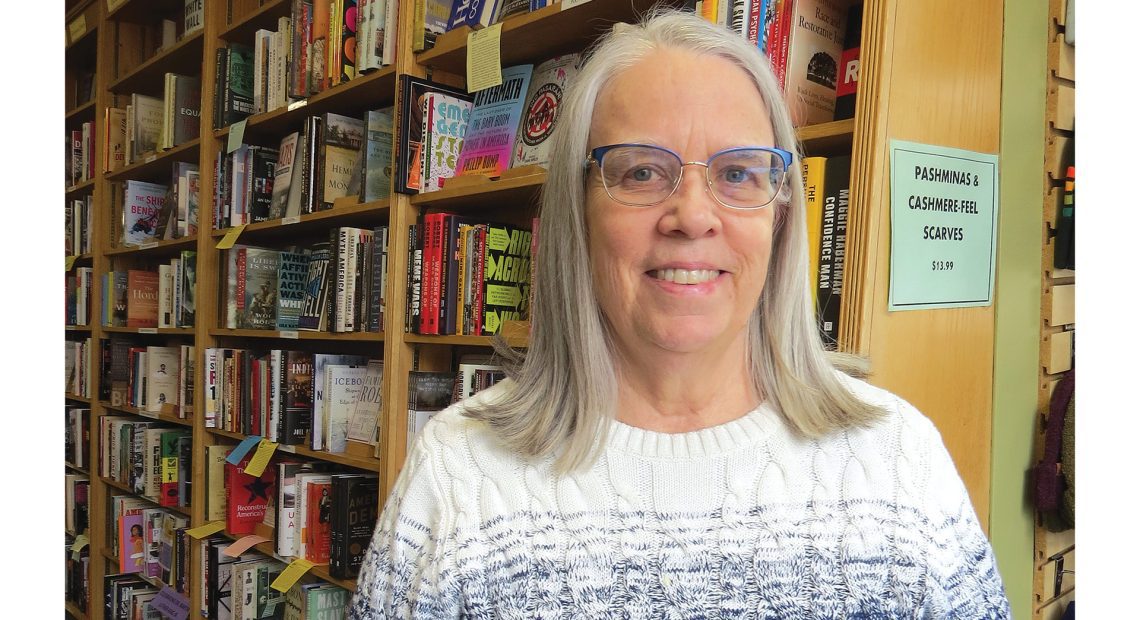
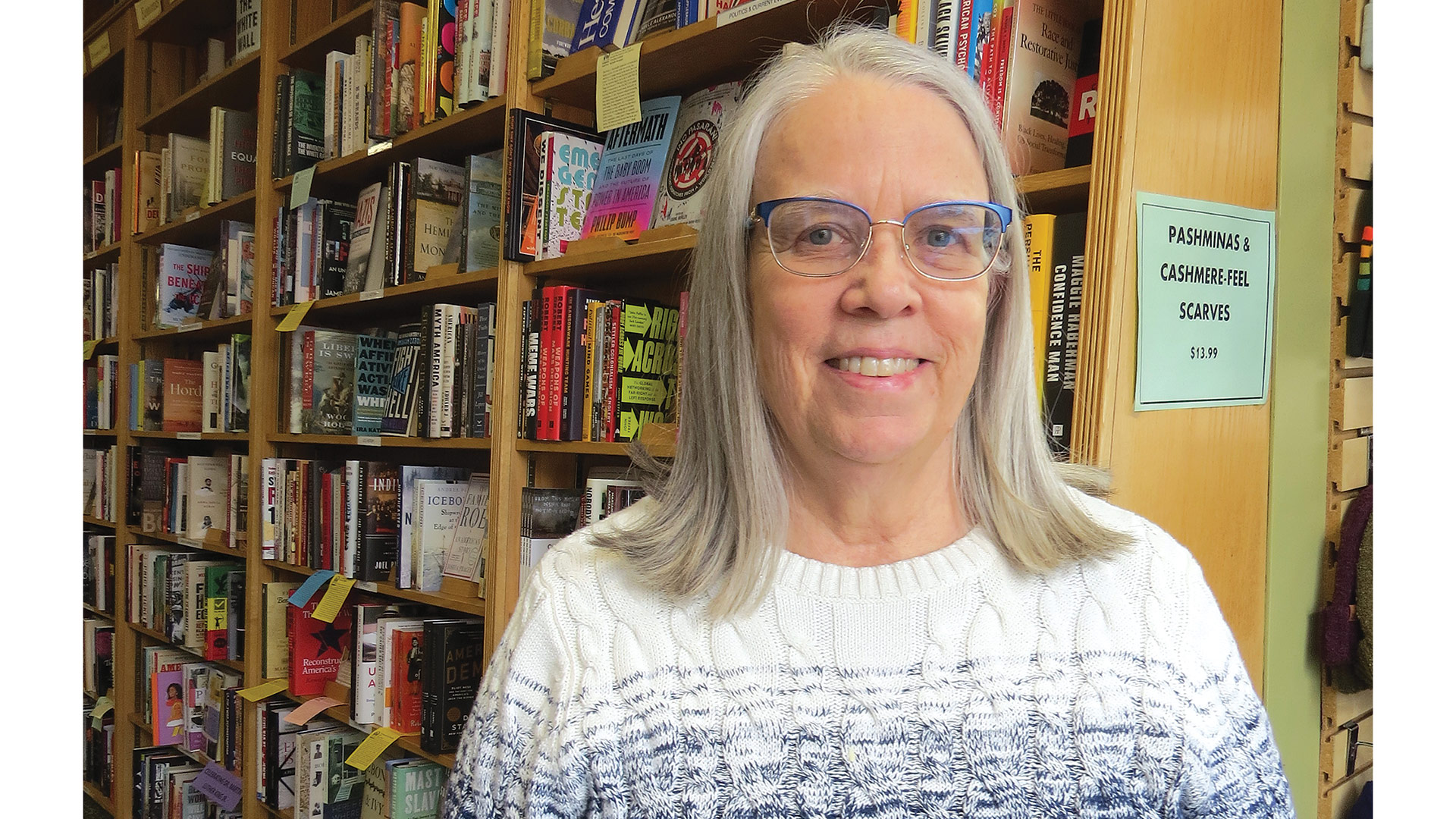
Joan Grenier, owner of Odyssey Bookshop in South Hadley

Joan Grenier, owner of Odyssey Bookshop in South Hadley

Joan Grenier called it “GoFundMe before there was GoFundMe.”

She was referring to a letter she sent out to friends in the South Hadley area almost 30 years ago. She couldn’t find a copy — although she believes she has one somewhere — but remembers the gist.

“I simply said, “I’m in trouble and I need your help,’” said Grenier, the second-generation owner of the Odyssey Bookshop in the Village Commons, noting that the missive was sent at a time when just about all small, independent bookstores were in pretty much the same boat she was.

The large chains were beginning to take over the book world and squeeze out their smaller competitors with their huge volumes of books, lower prices, and a maybe a latte to go with all that. Grenier — and she was certainly not alone in this exercise, to be sure — put out a call for help, asking people to support Odyssey and send money if they could.

She raised about $150,000, as she recalls, and it went a long way toward helping her navigate that whitewater and write new chapters in a story started by her father, Romeo Grenier, in 1963.

Then, in the early months of COVID, when bookstores — and most other stores as well — were forced to close their doors, Grenier launched an actual GoFundMe campaign to raise money to take the store through that time of extreme challenge and to a point where it can now celebrate its 60th anniversary.

So did Matt Tannenbaum, owner, for nearly 50 years now, of the Bookstore in Lenox, an institution that got its start in the mid-’60s in the living room of a small, rented house behind an alley that housed a café that came to be known as Alice’s Restaurant.

Tannenbaum raised more than $120,000 in a campaign that became subject material for a documentary, called Hello Bookstore, which is now streaming on Apple and Amazon Prime, and has been praised by critics as one of the best documentaries of 2022.

It tells Tannenbaum’s story, but it also tells the story of all owners of small bookstores across the country who have fought — for decades now — to keep the doors open.

“It’s a place that isn’t home and isn’t work. It’s a place where you can go and be. People come here to sit and read, they come to sit and work, students come here, professors come here to grade papers; a lot of books are written here.”

“It’s a lovely portrait of what we do here — that’s the best way to describe it,” said Tannenbaum, adding that the film portrays the bond that can, and should, exist between a community and its bookstore.

As the documentary chronicles, independent bookstores, including those in this area, have faced a continuing wave of challenges. And many have not survived, including institutions (that’s the only word for it) such as Johnson’s and Edwards in downtown Springfield, and, more recently, Big Bear Used Books and Café in Easthampton.

But overall, and to paraphrase one of the authors whose classics are sold in these landmarks, the death of the independent bookstore has been at least somewhat exaggerated.
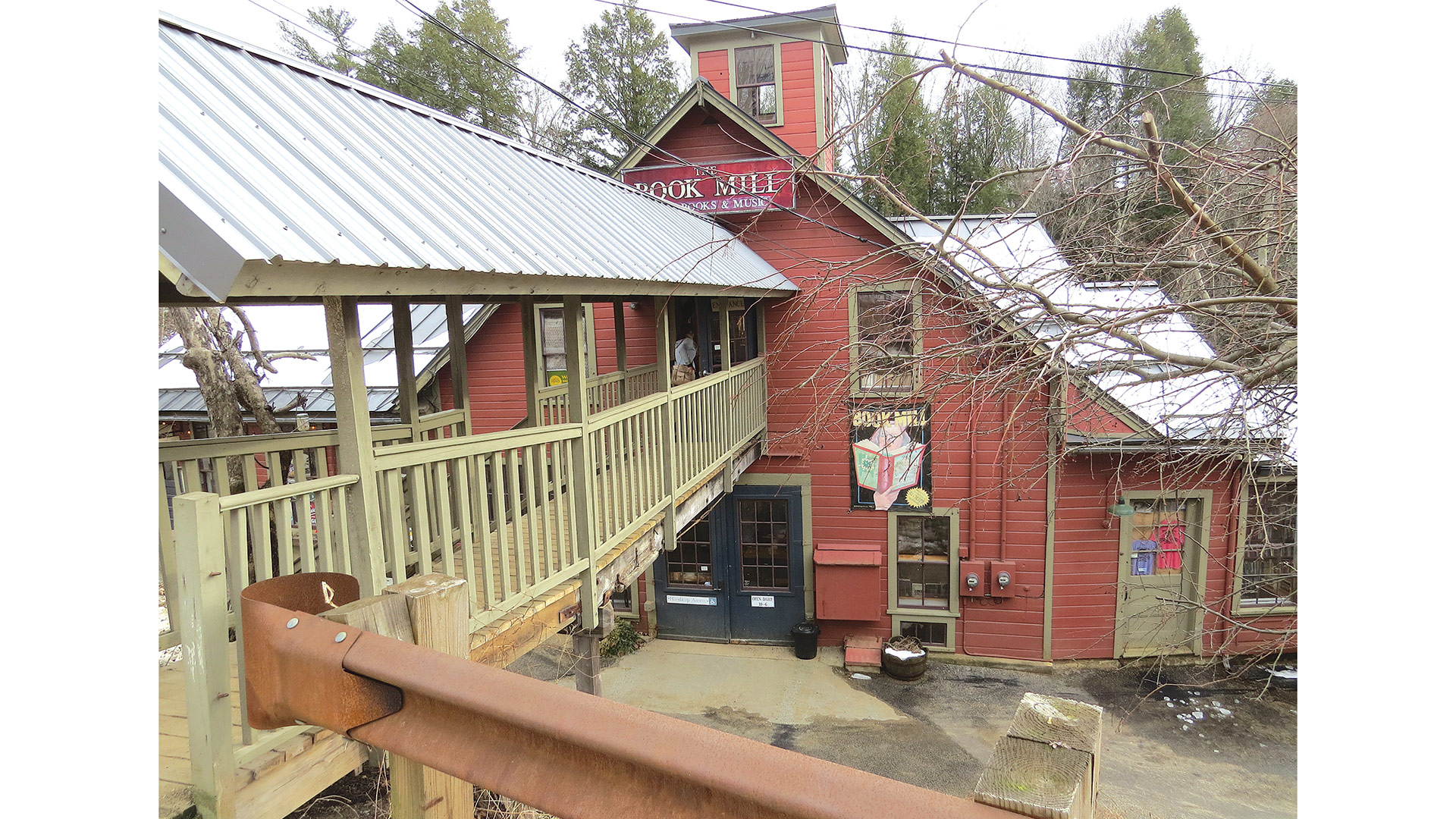
The Bookmill in Montague

The Bookmill in Montague operates under the slogan “books you don’t need in a place you can’t find.”

Indeed, many in this region are still … well, doing business. ‘Thriving’ might be too strong a word, but then again, most of these stores never really thrived, as Grenier and others will tell you.

But they have provided a decent living, while also providing an important service, one that is still relevant, to one extent or another, at a time when one can have the latest Louise Penny thriller delivered to their home a day after executing a few simple keystrokes.

They have survived, they said, by providing more than books on shelves — although that’s certainly a big part of it. They also provide, in many cases, a relaxing experience, an opportunity to meet authors, maybe a chance to sample a bottle of wine.

For the owners of these stores, they say what they do isn’t work as much as it is a passion, something that found them as much as they found it.

It was that way for Susan Shilliday, owner of the Bookmill in Montague, which specializes in used books and operates under the slogan “books you don’t need in a place you can’t find.”

She said she had no real intention of buying thus landmark, but then…

“It was a total, crazy fluke,” said Shilliday, who was a screenwriter before she took this gambit — Thirtysomething and Legends of the Fall are among her credits. “It was a joke with my daughters that all I really wanted in life was to come here one day and see a ‘for sale’ sign in front of the Bookmill.”

Instead of a sign, then-owner David Lovelace sent out an email in 2007 to a number of people letting them know that it was time for him to move on. One thing led to another, and Shilliday is now behind the cash register, carrying on a tradition.

For this issue, BusinessWest talked with these independent bookstore owners about the state of their business. And in the process, we get to tell some stories that are very intriguing in their own right.


It’s Not Home, and It’s Not Work

Shilliday told BusinessWest that, when she received that aforementioned email, she didn’t really know what to do with it at first.

She said she knew a lot about books, but very little, if anything, about retail or running a business. She ultimately decided that this was enough.

“It was the craziest thing I’ve ever done,” she said. “But it turned out to be one of those crazy things that turned out to be just the right thing.”

Elaborating, she said her daughter attended Hampshire College, and, following just a few trips to visit, she fell in love with the region and eventually moved here. One of her favorite things to do was visit the Bookmill, search for things to read, and, usually, settle into one of the comfortable reading chairs on site and read for a while. Make that a long while.
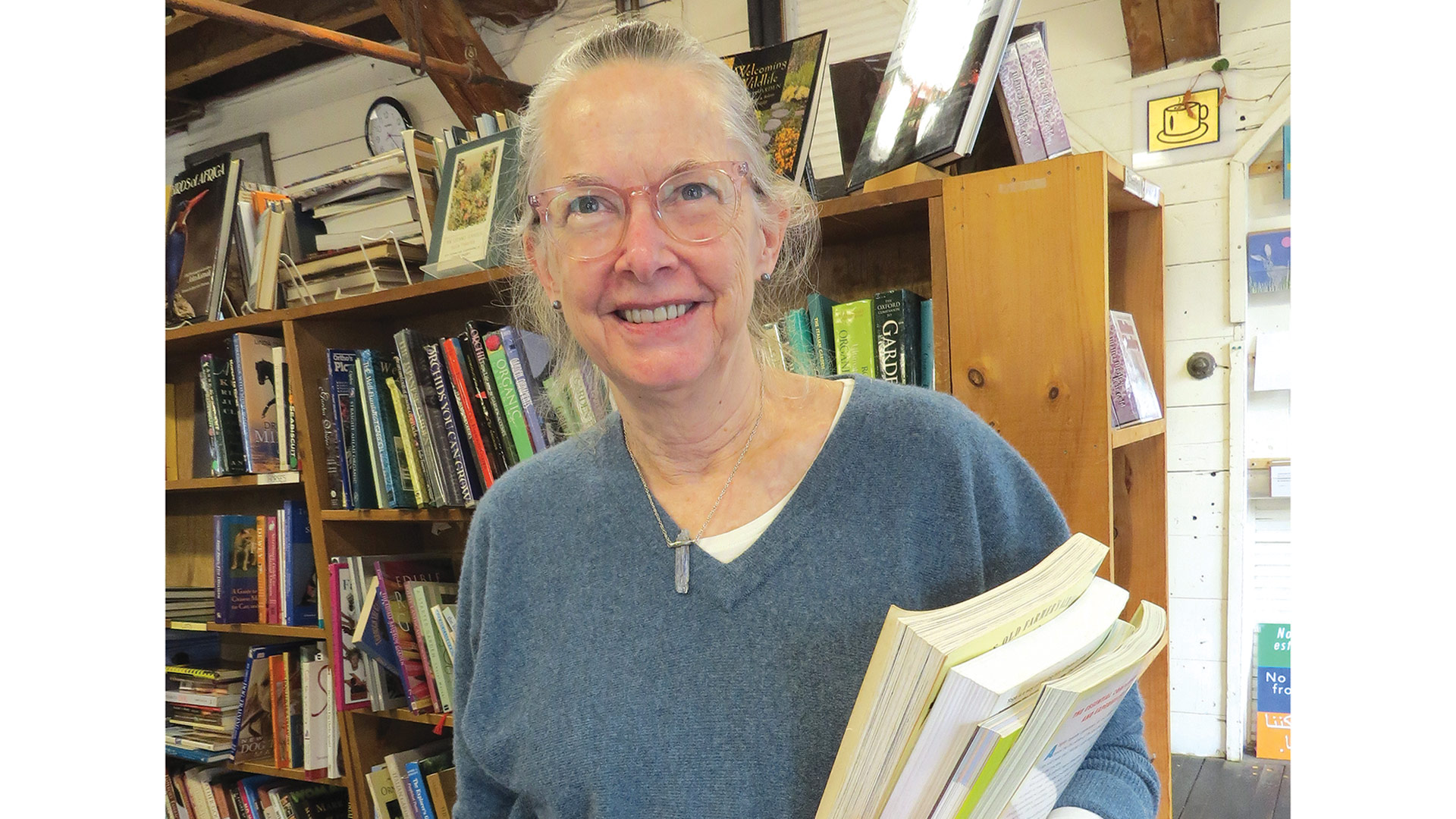
Susan Shilliday, owner of the Bookmill in Montague

Susan Shilliday, owner of the Bookmill in Montague, says her store — and those like it — are an escape for people.

It was a desire to let others enjoy that experience that prompted her take the plunge, despite her lack of experience.

As businesses go, this one has a pretty simple model, she noted; it takes in books from those who don’t want or need them anymore (by appointment only), and then it sells them. Retiring professors from the Five Colleges, all within a few dozen miles or so from the store, are among the best providers of titles for the shelves, she said, adding that, on average, there are roughly 30,000 to 35,000 books on the shelves.

While most bookstores focusing on new titles have had their struggles in recent years, the Bookmill has been able to stay on a generally smoother path, said Shilliday, noting quickly that the pandemic certainly presented a number of challenges, and customers were “thrilled” when the doors were able to open again.

Overall, there are steady streams of customers to the landmark, located in an old grist mill and, later, a machine shop that, among other things, would stamp the handles of Louisville Slugger bats.

Many patrons are students or professors from the area colleges or residents of area communities, but many tourists also find the store, despite what it says in that logo that adorns bookmarks, T-shirts, book bags, and other items.

“People from this area seek it out,” she said. “And we have a lot of tourists who come in, a lot of book lovers who come in … people drive up from New York, Boston, all over; there are a lot of people who make an effort to come here.”

And perusing the shelves for books is just one of the reasons they come, she said, and this explains why the Bookmill has been able to survive and thrive over the years, and why many other stores have as well.

Indeed, she said the pandemic might have helped reinforce the importance of not only books, but bookstores as well.

“People like the community aspect of this … meeting people, discussing books with other people. That’s what we can offer people.”

“It’s a place that isn’t home and isn’t work,” she said of bookstores in general. “It’s a place where you can go and be. People come here to sit and read, they come to sit and work, students come here, professors come here to grade papers; a lot of books are written here. And that was part of the model for the Bookmill from the very beginning; it would be a place where people could come and spend time.”

Elaborating, she said that most bookstores today have other things for people to do; many have a café — the Bookmill has a small café next door, a separate operation — or another value-added proposition that makes a visit to the store an experience, or even more of an experience, as the case may be.


Buy the Book

Grenier said she has also long understood the importance of creating an experience, and not just shelves with the latest titles.

That’s why Odyssey stages several events a week, ranging from book-club meetings to regular author appearances, including the “Evening with Bernie Sanders” event staged March 13, at which he talked about, and signed copies of, his new offering It’s OK to be Angry About Capitalism.

These events are ways to bring people to the store and generate interest in books and those who write them, said Grenier, adding that it has been this way pretty much from the start, and certainly since she assumed ownership from her father in the early ’90s, after the store was destroyed by arson for the second time in two years.

She remembers what he said as he was passing the torch: “I’m not sure if I’m giving you anything more than headaches, but if you want the insurance money, we can try again.”

She decided to accept that challenge, but the intention of doing it for “a little while.”

That little while has turned into a 37-year journey that has taken the store through those myriad challenges mentioned earlier.

“There’s been a lot of change and a lot of challenge,” she said of that time, adding that the store has been reinventing itself throughout that period, and especially during the COVID years, when people couldn’t come to the store for several months and instead ordered books from the store’s website.

Matt Tannenbaum

Matt Tannenbaum’s story became the subject of a highly acclaimed documentary film called Hello, Bookstore.

Much of this reinvention involves events, Grenier said, adding that they come in many varieties. There are several book clubs, she noted, including the Signed Editions Club, which has more than 200 members, and the Gift of Reading Club for children, as well as regular author appearances; overall, there are maybe 125 events a year.

Meanwhile, the store has become the outlet for Mount Holyoke College merchandise of all kinds, from apparel to drinkware to stationary. (Years ago, the store sold textbooks to Mount Holyoke students, but that business has changed dramatically, and it is no longer part of the equation.)

Such changes, and such evolution, are necessary, she said, because the landscape has changed, and it is harder for independent bookstores to be successful — not that it has ever really been easy.

The pandemic simply added new layers of challenge because people couldn’t come to the store, and, thus, there were no events for many months, she recalled. “The events went virtual, but it’s pretty hard to sell books at a virtual event.” What’s more, the college was closed, further reducing foot traffic. Through that GoFundMe campaign, federal assistance, and sheer perseverance, the store was able to make it through.

“If it wasn’t for the federal government, we wouldn’t be here,” she said, adding that, moving forward, the store will continue to innovate, evolve, and give people reasons to come through its doors.

“I’m very optimistic — I had to be optimistic to get through COVID,” she told BusinessWest. “People like the community aspect of this … meeting people, discussing books with other people. That’s what we can offer people.”


A Real Page Turner

Tannenbaum is equally optimistic, but then again, he always has been.

He said his store has long enjoyed what he called a “loyalty factor” that has enabled him to push through the many changes and challenges that have come to this sector.

Indeed, he recalls that, when a Barnes & Noble opened in the Berkshire Mall in Lanesborough (which closed in 2019), many of his customers responded by saying they simply wouldn’t shop there.

But he acknowledged that many in this sector have not been as fortunate because they haven’t had that same level of community support.

“We did have people who used to come in and say, ‘we used to have a bookstore like this in our town, but it closed,’” he told BusinessWest. “And we would have to bite our tongue because we knew that they did not support it, and that’s why it closed.”

He believes that community support stems from his ability to provide something other than just books. When asked to describe it, he said it’s an experience, a friendly atmosphere … something that consumers just can’t get when they order books online or when they visit the national chains.

“I like to say that Barnes & Noble sells books, but they’re not really a bookstore,” said Tannenbaum, who cut his teeth at the famous (and now-closed) Gotham Book Mart in Manhattan, adding that facilities that do fall into that category, like his, provide value in many different ways.

There are tangibles and intangibles, all of which come out in the documentary, and also in BusinessWest’s talk with Tannenbaum, during which he said nothing pleases him more than being able to connect a customer with a book.

He is still able to do that because of a GoFundMe campaign, which not only gave him the capital to remain open and actually expand his business, but generated more material for that documentary, which was originally inspired by Tannenbaum’s book My Years at the Gotham Book Mart.

Indeed, filming for that production continued all through the spring and summer of 2020, the height of the pandemic, he said, adding that it captures not just the struggles of trying to do business at that time, but the connection he had created between his store and the community — and that community’s refusal (that’s the best word to describe it) to let the story end there.

He added that the film has been good for business in many respects, but especially because it has put his store on the map.

“After the movie came out, I’ve had people visiting from all over the country,” he said. “I’m on the list of places to go; you come to the Berkshires, you go to the Norman Rockwell Museum; you come to New England, you have to go the Bookstore in Lenox, because they’re the ones they made the movie about.”


The Last Word

As she talked with BusinessWest, Grenier repeatedly flipped through a few file folders full of materials on the history of the Odyssey Bookshop — photos, newspaper clippings, and other archival material, including, she believes, a copy of that letter she sent out all those years ago — GoFundMe before GoFundMe.

She’s pulling all this together for 60th-anniversary celebrations that will begin around commencement time at Mount Holyoke and continue for the rest of the year.

There were many times during its history when a 60th anniversary seemed a long shot, and at times, maybe a really long shot.

But the store, which has certainly lived up to its name, has preserved, through fires, new and daunting competition, technology, and, yes, a pandemic.

When asked why hers wasn’t one of those bookstores that closed in the ’90s, or even more recently, Grenier said simply, “because my community supported me — people wanted a bookstore here.”

And it is this simple formula that will determine how many of these landmark facilities get to write new chapters in their intriguing stories.


Banking and Financial Services Special Coverage

Forward-looking Statements

Matt Garrity

Matt Garrity


Matt Garrity says it was a few years ago, when he was established in his role as executive vice president and chief lending officer at Premier Financial Corp. in Ohio, that he determined that the next logical career step would be to preside over his own bank.

As time went on, and the calls from recruiters started multiplying, the major questions to be answered concerning this ambition were … where, and what?

The ‘where’ involved geographic regions, and Garrity had his preferences, especially the Northeast — he grew up in Lee. As for the what … he desired to be at a bank with a long history, a solid track record, a strong growth pattern, and a plan to continue along that path.

Not long after being encouraged to consider succeeding Kevin Day as president and CEO of Florence Bank, he concluded that all of those boxes could be checked — with authority.

“It’s a perfect fit — this is such a great bank, and it’s got a terrific board,” said Garrity, adding that there many things that stood out about the institution. “From a financial standpoint, this is a very strong and well-positioned bank, and what also came across loud and clear in my conversations with the board was what a great culture this organization has; this is a very customer-focused, community-minded culture that we have here, and a very engaged workforce.”

Garrity, who arrived at the bank in January, takes the helm at a very intriguing time in its history. Indeed, the institution will celebrate its 150th anniversary this year — May 6 is the actual anniversary date. It will mark the occasion in a number of ways and over the course of the year, he said, adding that the planning process is well underway, and details will emerge in the coming weeks.

“We’ll look to continue to grow the bank in Western Massachusetts, looking for opportunities to grow not only in Hampden County, where the bank has started to grow in recent years — we’ll look to continue that strategy — but also with our commercial business within the bank.”

Meanwhile, the institution that started as Florence Savings Bank to serve that growing village has moved well beyond its roots, most recently with a push into Hampden County. Where the next steps in that progression will take place have yet to be determined, but they will likely be in that corner of Western Mass., said Garrity, adding that, like most institutions, Florence is eying controlled, orderly growth, not growth for growth’s sake.

“We’ll want to continue that growth pattern in Hampden County,” he said, noting that branches opened the past several years in Springfield, West Springfield, and, most recently, Chicopee. “That’s certainly on the drawing board for us.”

For this issue and its focus on banking and financial services, BusinessWest talked at length with Garrity about his new assignment and his vision — still very much in the formative stages — for the next 150 years for this Western Mass. institution.


Points of Interest

Garrity said he’s spent his entire career in financial services, most of it focused on the commercial-banking side of the spectrum. It was at Premier Financial Corp. that he started taking on additional responsibilities and work in areas “other than the one I grew in,” as he put it, which put him on a path to the corner office at Florence Savings.

Among these areas was residential lending, he said, adding that gaining traction in this and other realms created learning experiences on a number of levels, not just adding lines to a résumé.

“That was a real step in my career,” he said. “Being able to work effectively and work with the team and run that business successfully was something that was really important in my career development.

Florence Bank’s branch on Allen Street

Florence Bank’s branch on Allen Street in Springfield is one of three in Hampden County, where additional expansion is expected in the coming years.

“As careers go on their paths like they do, and your responsibilities begin to grow and you get exposed to new businesses that maybe you weren’t the subject-matter expert in, and you begin to show your ability to effectively manage those businesses and work with the people in those businesses, that’s when you start to think that you can do this on a broader level,” he said, adding that it was several years ago that he considered himself both ready and willing to consider those calls from recruiters asking him to consider bank-presidency positions.

And there were many of them in recent years, Garrity noted, adding that he was, in a word, selective about which ones to pursue.

“Not every bank CEO position was in a part of the country that my wife and I would be comfortable going to, or you really wanted to go to, since we had optionality,” he told BusinessWest. “We were somewhat selective about the ‘where,’ the ‘what,’ and the ‘who’ we would be working with.”

As noted earlier, Florence, now with $2 billion in total assets, checked many of the boxes on his list, especially financial strength, corporate culture, and a long history of service to, and involvement in, the community.

In recent years, that word ‘community’ has come to mean much more than Florence, he said, and its definition will continue to broaden in years to come.

As he talked about the bank’s growth strategy and the next steps in that plan, Garrity acknowledged that there is a great deal of competition in the region, and it comes with institutions of all sizes, from smaller community banks — Florence is still in that category — to very large regional and national banks, like Chase, which just opened a branch in downtown Springfield and will soon open another in Northampton (see story on page 18). But he also acknowledged that banks like Florence need to continue growing at a time when size certainly does matter.

Florence Bank’s branch on Allen Street in Springfield is one of three in Hampden County, where additional expansion is expected in the coming years.

“We’ll look to continue to grow the bank in Western Massachusetts, looking for opportunities to grow not only in Hampden County, where the bank has started to grow in recent years — we’ll look to continue that strategy — but also with our commercial business within the bank.”


Taking Things into Account

Florence currently has 12 branches, nine in Hampshire County and those three in Hampden County. Future growth will likely be within that footprint, Garrity said, adding that, while several area banks have ventured into Northern Connecticut, Florence has no immediate plans to follow suit.

“As we look to continue to build the franchise, we’ll be strategic about that and determine what makes the most sense for us, and where the Florence Bank story makes the most sense for the community and for the bank.”

Despite advances in technology and the ability of consumers to do much of their banking remotely, he added, there is still a place for brick-and-mortar branches, for reasons that include everything from quality of service to marketing.

“Branches are more than deposit-taking propositions,” Garrity noted. “Not only do they represent the bank out of the market, it’s a place for outbound activity, for a bank to get out in the community and to make its presence felt.

“I think branch banking is really evolving,” he went on. “For us, that doesn’t mean we need a branch in each and every town and on every corner — that wouldn’t be our model — but we’ll need more in Hampden County to get the most out of our network.”

Within this very crowded banking marketplace, Florence has what Garrity describes as some competitive advantages.
“It gets down to people,” he explained. “As we look at what our strategic advantages are as we compete in these markets, we have terrific people, and that’s always a big strength that we’re going to have. We’re also very locally focused; the deposit dollars that we take in from Hampshire County and Hampden County are being redeployed in Hampshire County and Hampden County, and from a philanthropic perspective, this organization is focused on these communities as well.

Florence Bank’s branch in Chicopee

Florence Bank’s branch in Chicopee is the latest addition to the portfolio.

“Over the past five years, this organization has donated to charitable causes in this region close to $3 million,” he went on. “So there’s a significant commitment that we have, and this is part of what helps us continue to be relevant over these past 150 years. One of the founding principles of the bank back in 1873 was ‘neighbors helping neighbors,’ and that’s as important to us today as it was back then.”
People, meaning the team at the bank, are also a key component in the growth strategy for the commercial-lending side of the ledger, said Garrity, adding that there is no shortage of competition in this realm, either.
“It’s the people that help you stand out, people and the ability to bring solutions. The advantage of working with a bank such as Florence Bank, given our size and what I’ll call our flat structure and local decision making, is we can get the right people around a table to make a good, common-sense answer for our client — a custom solution. That is a distinct advantage that we would have over some of our larger competitors that are more decentralized and a little more pigeonholed from a policy perspective.”

He noted that the commercial market was strong in 2022 because many businesses that were on the fence decided to move ahead before interest rates went up. They did rise, considerably, and these increases, coupled with uncertainty concerning the economy and other headwinds, has slowed the commercial market in recent months, he went on, adding that this is a nationwide phenomenon and one that bears watching in the coming months.

The same can be said for the residential market, which has slowed dramatically in recent months — a 28-year low nationwide, in fact — as a result of rising interest rates and low inventory.


Bottom Line

Garrity said he’s spent his first few months at Florence engaging with his team at the bank, looking for opportunities to engage in the community, and “learning the bank,” as he put it.

“I’m asking a lot of questions and listening for the answers,” he noted, adding that what he’s heard so far is that this institution is well-positioned to take advantage of the opportunities that will present themselves in the months and years to come.

“We have a great team, and we have a really good bank in a very good position,” he said. “And we’ll plenty of opportunity to continue to do great things here and great things for our customers, so I’m excited; 150 years is a great accomplishment for this organization — and for this community that has supported us. We have more than 50,000 customers that support this bank in the communities we serve, and we want to continue to serve them for another 150 years.”


Special Coverage Wealth Management

Learning Opportunities

By Barbara Trombley, MBA, CPA

One of my most frustrating issues with being a parent is the lack of school education regarding money and personal finance. My children were required to take history, trigonometry, English, and numerous other courses, but they were never required to take a class about personal finance. I would argue that this knowledge is just as important.

This oversight leaves the instruction about personal finance to parents, and many parents are not good with their own money, resulting in generational problems with financial matters.

How can we teach our kids to have good financial habits? What does that mean? Obviously, modeling good financial behavior is an obvious start. Have a budget and stick to it. Contribute regularly to a retirement plan. Do not be afraid to discuss money in front of your kids. Talk about your household income and household bills and how much of your paycheck goes to taxes, retirement savings, and your emergency fund. Discuss vacations, how much they cost, and how you are saving for them.

One of my favorite ways to involve my children in money talks was to take them with me to the grocery store. I would show them how to shop for generic items, compare unit costs and sizes of items, and use coupons. In general, we should take the stigma out of money discussions and make spending and saving discussions easier to have.

Discussions with your children are not the only way to teach them about good financial practices. Here is a list of eight ways to teach good financial habits.


• Let your teen earn money. They don’t need to get an actual job, although I would recommend this at some point. Your teen can work around the house, cut the grass, do odd jobs, etc. The idea is to get them used to managing their own money. Once they are regularly earning, you can teach them to set aside money for short-term saving (maybe to purchase a big item), long-term saving (maybe for college), and spending now. If they are receiving a paycheck, it is a great opportunity to discuss taxes and Social Security and Medicare withholdings.

• Open a bank account. It’s a great idea to have a child manage their own savings account. Many little ones start with a piggy bank for odd change. When the birthday or allowance money starts to accumulate, it is time for a bank account. Make sure to have access so that you can monitor the account. When the teen gets their first job, they can have their paycheck deposited in a checking account.

• Get a debit card. When your teen gets a checking account, it is the perfect time to get a debit card. They can practice using it and seeing purchases impact the account balance. Your child can get an online login to their bank account and learn to watch the activity.

• Help them set a budget. Teens are notoriously frivolous. Starbucks, dining out, shopping, video games — there are so many more ways for our teens to spend their money than we had as young adults. Discuss with your teens how many hours they would need to work to buy a grande Frappuccino at Starbucks. Talk about how long they would need to save to go to a big concert. If it is easier to illustrate, find an app for budgeting. There are many available.

• Consider credit cards. This is a tricky one. Each of my children was given an additional card on our account when they were 16. This card came with explicit instructions (from mom and dad) on how and when it was to be used, as my husband and I were ultimately responsible for the bill. Our kids understood that the card could easily be taken away if misused. This was a gentle introduction to credit and allowed them to establish a credit score (see the next tip). You could also start with a pre-paid credit card on which you put a certain amount. When each of our children were juniors in college, we helped them apply for their own credit cards. By this time, their money skills were good, and they understood the importance of paying the bill monthly.

“In general, we should take the stigma out of money discussions and make spending and saving discussions easier to have.”

Barbara Trombley

Barbara Trombley

• Explain credit score. Many teens and young adults do not understand the need to build credit. Emphasize that, by using credit responsibly, your teen will build credit and increase their credit score, which is imperative when it is time to finance a car or a house. Explain how people with the best scores are given the lowest interest rates when looking to make large purchases.

• Discuss compound interest. This topic can apply to both credit cards and investments. Explain to your teen how compound interest (paying interest on the interest from last month’s bill) can make a large credit card balance even bigger over time. Consequently, compound interest is your friend when dealing with investment accounts. Earning interest on the interest generated year over year is how many people grow their investments.

• Discuss paying for college. Another hot topic that too many parents avoid is who is going to pay for college and how. Teens need to be included in the discussion about college tuition and debt from an early age. If expectations are set about how much college costs and how much you can contribute, disappointment with a college choice can be managed. Also, one of the absolute worst financial mistakes a parent can let their teen make is to choose a college without regard to the financial burden on both the parents and the student. Letting an 18-year-old be unknowingly responsible for college debt can set them up for a lifetime of money troubles.

If your teen is really interested, find online classes that teach financial literacy. Also, look for books in your library. Particularly savvy teens can open investment accounts easily online and start investing with a minimum deposit. There are many ways to educate our children, and we need to take the responsibility for their financial education.


Barbara Trombley, MBA, CPA is a principal with Wilbraham-based Tromblay Associates; (413) 596-6992. Securities offered through LPL Financial. Member FINRA/SIPC. Advisory services offered through Trombley Associates, a registered investment advisor and separate entity from LPL Financial. This material was created for educational and informational purposes only and is not intended as ERISA tax, legal, or investment advice.

Home Improvement Special Coverage

The Surge Continues

By Elizabeth Sears

Dave Coyne

Dave Coyne (right) says the Home & Garden Show has been beneficial to his business.

A ‘COVID bump.’

That’s what some in the home-improvement industry call that surge in business that accompanied the pandemic nearly three years ago now.

“It’s been kind of amazing; I think the industry had a sort of bump when, sadly, people stayed home and conserved their money and their time outside of their home,” said Deb Kelly, staff designer at Modern Kitchens in Agawam, which specializes in start-to-finish kitchen and bathroom renovations.

“Then, maybe they looked around and thought their home was a little shabby, and they could pick some things up,” she went on. “Since they weren’t taking cruises or going out to dinner as much, they said, ‘let’s do these projects that we’d really love to accomplish.’ We’re still feeling the effects of that; we’re going into a strong 2023.”

Yes, the COVID bump, or whatever one chooses to call it, still has some legs to it, and this bodes well for area businesses across the very broad spectrum of home improvement, many of which are gearing up for the 68th Western Mass. Home & Garden Show on March 23-26 — and expecting to come away from that event with more prospective customers.

Tony Witman, owner of property-management company Witman Properties in Holyoke, said he recognizes that, despite these beneficial trends in this sector, services are not necessarily going to sell themselves — which is where the Home Show comes in.

“Since they weren’t taking cruises or going out to dinner as much, they said, ‘let’s do these projects that we’d really love to accomplish.’ We’re still feeling the effects of that; we’re going into a strong 2023.”

“Many of the services we provide are same-day or next-day, whether it’s plumbing, electrical, HVAC … and I don’t think homeowners get that level of service by just flipping through the internet calling people,” he said, noting that the event offers an immediate response to their inquiries from a professional contractor. “I think there’s value.”

Indeed, it seems the value of the Home Show goes beyond in-person contact. There is a unique human aspect to local clients brainstorming renovations with local home-improvement businesses. That’s where Home & Hearth Remodeling in West Springfield got its motto, “a craftsman who cares.”

“When I interview people, I just look at them and think, ‘is this person a craftsman, and do they care about their work? Do they care about doing a good job? Do they care about getting better in learning? Do they care about the customer who’s home? Do they care about the people they’re working with?’ Those are all important,” owner Dave Coyne explained. “We have a very low turnover, and we generally have pretty experienced people working for us — and they stick around.”

Coyne joined the Home Builders & Remodelers Assoc. of Western Mass. (HBRAWM) — which stages the annual Home Show — when he moved to the area, and said it has been a great resource. He began at the show as a solo practitioner, but as his company has grown, he’s added more staff, and now has “a proper business,” as he called it, and his company has increased its presence at the show, with its booth becoming “a little bit fancier” year after year.

Tom Cerrato

Tom Cerrato says the pandemic-fueled surge in home improvement is still going on.

“We still have just a single booth this year, which we are in the process of refurbishing,” he explained. “Next year, we’re contemplating actually getting two side by side to focus part of the home show on decks and outdoor work, and then the other part on the interior remodeling and additions.”


Captive Audience

It’s a plan that reflects the event’s flexibility and opportunities to showcase one’s offerings to an enthusiastic audience, many of them actively shopping for services.

And many vendors are still seeing that COVID (or, perhaps, post-COVID) bump.

“People are still thinking about staycations, right? That buzzword is still out there,” said Andy Crane, executive director of HBRAWM. “Even though COVID is in the rearview mirror, it made people rethink how they’re going to live. A lot of these companies did pretty well during the pandemic, during the height of it, because people were investing in their homes because they weren’t going away.”

And they’re still investing, said Tom Cerrato, branch manager at Kelly-Fradet Lumber in East Longmeadow. “When the pandemic started, we went back and forth on whether we’d even stay in business, but fortunately for us, it turned out to be a boom because there were so many people who stayed home, stopped traveling, and had those extra funds to spend, and fortunately spent it on an industry that benefited us — home improvement and building. It’s been very good for us the last few years.”

In the years Kelly-Fradet has participated in the Home Show, Cerrato said the event has created strong brand awareness among a receptive crowd.

“It’s a good-sized booth, and our presence gives us good branding locally. We get to be top of mind with customers in our market, and a lot of them are making large purchases for their home, decks, windows, kitchens, doors, a lot of stuff. So we like to be in front of them as they start their projects.”

“We get to be top of mind with customers in our market, and a lot of them are making large purchases for their home, decks, windows, kitchens, doors, a lot of stuff. So we like to be in front of them as they start their projects.”

First-time Home Show vendor Witman Properties, is exhibiting this year due to the visibility and tangibility of meeting potential clients, and making that personal connection that others described as being vital to good business.

“There’s so much online marketing, and I think people in general might be getting a little burned out from just looking at their screens and their phones all the time,” Witman said. “We figure it’s a really good chance to get in front of people. A lot of people see our trucks driving around, and they see our signs … but they don’t know who we really are. So it’s a good way to get out there and meet the local people in the communities we service.”

Crane can relate. “I have never bought anything off the internet. I will drive three hours on a Saturday morning to go see a safe in Rhode Island before I buy it off the internet.”

That’s one of the show’s main draws for a company like Eastern Security Safe in West Springfield, Crane explained. “What is the value? If I was Eastern Security Safe, I would say the value is people can touch and feel my safe. They feel the quality. They want to see my face; they want to talk to me and negotiate face to face. You can’t negotiate to a computer too well, and when nothing shows up or something is dented or scratched, you don’t even know who to talk to.”

That’s not to say technology is a hindrance to local businesses gaining customers; sometimes, it is a great help. With the availability of home-improvement inspiration online, clients often come to the Home Show prepared with ideas and visions of what improvements they would like to achieve.

“I think one unique aspect we have is this — a lot of times people have images in their head of what they would like their kitchen or bathroom to look like,” Kelly said. “Many will walk in with their phone starting to scroll and show me things they’ve researched, that they’d like to try to accomplish in their own home.

“That’s where we sit down with them and pull together all those puzzle pieces, and actually physically lay them out on the tabletop — ‘here’s your door, here’s your countertop, here’s the paint color, here’s your tile that we’re going to use,’” she went on. “It really allows them to pull the whole project together and turn it into more of a reality instead of just a pretty picture they found on their phone.”

She went on to note the large volume of contacts Modern Kitchens has made as a result of being a vendor at the Home Show over the years. The company has followed up with all of them, converting many into customers.

“We’ve met some really nice people who were at the Home Show with some project in mind,” Kelly said. “It’s like talking to qualified leads, really.”


Get Out There

Crane said the Home & Garden Show is a personal experience in another way: many attendees turn it into a social gathering with family or friends.

Before he was actually in charge of it, “we would go all the time to the Home Show, spend two or three hours, then go to some local restaurant. People consider it a social event.”

The vitality of the Home Show — booth sales are way up (see sidebar on page 33) — accurately reflects the booming prosperity of the industries represented at the show. However, substantial business often means substantial wait times, one downside to this ongoing surge. Clients may find themselves disappointed with long wait times before they see their renovation plans come to fruition — but so far, that hasn’t seemed to deter their willingness to book projects far in advance.

Over the past few years, Kelly said, “people were willing to wait; I think the industry was busy, so people could accept a timeline that was a little further out. When you want to do a project, you’re a little antsy, you make the decision — ‘yes, let’s move forward with this, we have the money, let’s do it’ — and many people who normally would want to have a start date within a couple of weeks have been willing to wait because the industry is busy.”

As a result, Modern Kitchens has been able to schedule a full year’s worth of business from the Home Show. Coyne echoed this experience, having also received large amounts of business from previous shows.

“I get enough business from the Home Show to carry me through the year. We always get plenty of good leads,” he said. “After this last Home Show … I’m not joking, we were probably still following up with leads four months or more afterwards. We have jobs that we are starting in April — we actually have a job that we just started today — that I think came from the Home Show last year.”

The 68th presentation of the Western Mass. Home & Garden Show will take place in the Better Living Center building at the Eastern States Exposition, with displays in the outdoor area. This year’s show hours are Thursday and Friday, March 23-24, noon to 8 p.m.; Saturday, March 25, 10 a.m. to 8 p.m.; and Sunday, March 26, 10 a.m. to 5 p.m.

General show admission is $10 for adults, and children under 12 are admitted free. A coupon reducing admission to $7 can be found on the show’s website. Active military and veterans will receive free admission on Thursday, March 23. Parking on the Eastern States Exposition grounds costs $5 per vehicle.


Home Show Has Evolved in Many Ways


As Andy Crane perused a list — a very long list — of vendors at the 68th annual Western Mass. Home & Garden Show, he made a point of picking out a bunch that may surprise some attendees.

A chiropractor. A healing and spiritual-development center. Gourmet food producers. Makers of jewelry and accessories.

“That’s a cool theme this year,” said Crane, executive director of the Home Builders & Remodelers Assoc. of Western Mass., which stages the annual show at the Eastern States Exhibition, slated this year for March 23-26. “It’s not just roofing and siding and patios. It’s home life.”

The annual event sees all types of attendees who visit for a variety of reasons, he noted. Attendees typically fall into one of several categories:

• People planning to buy or build a new home, who may visit with builders, real-estate agents, financial institutions, and sellers of component products, such as hardwood flooring, tile, and appliances;

• People planning to remodel or renovate, who may want to check in with all of the above, plus vendors of replacement components such as windows and doors, as well as appliances, wall treatments, and home furnishings;

• Yard and garden enthusiasts, who tend to be interested in lawn and landscaping services; wall, walk, and edging components and materials; and trees, shrubs, flowers, and seeds;

• Committed renters, who have no plans to own a house, but may be interested in space-conservation and space-utilization products, as well as home furnishings;

• Impulse buyers, who flock to vendors of home décor, arts and crafts, cooking and baking products, jewelry, and personal goods; and

• Lifestyle-conscious individuals, who like to check out trendy, high-tech, or time-saving products, as well as home furnishings and products focused on self-improvement, fitness, and health.

It’s those last two categories that many people don’t often think of when they consider who wants to set up shop at the show.

“The Home & Garden Show is really about taking care of you and your family in your home. Quality of life is a good way to put it.”

“B-Well and Thrive is one company that’s going to be very interesting,” Crane said of the Hampden-based wellness practice, which will feature bioenergetic testing, therapeutic crystal mats, and the expertise of holistic practitioner Colleen Mancuso at its booth, among other offerings.

Then there’s Adult & Teen Challenge Greater Boston, which will be on hand to talk about resources to treat addiction, a scourge that affects far too many families in Massachusetts.

“I feel terrible for any family that has to go through that. They often don’t know where to turn,” Crane said. “But here’s at least one company — and there are many more than one — that is addressing it publicly so that people will have someone to turn to.”

Or, on a lighter note, Own Your Own Arcade Game, a national company that … well, the name pretty much describes it: they sell full-size, stand-up arcade games for the home. “They realized they found a niche that works, and they’re buying a booth,” Crane said.

In all these cases and more, from personal health and wellness to just plain fun, vendors aren’t selling building supplies and home-improvement services, Crane added. “The Home & Garden Show is really about taking care of you and your family in your home. Quality of life is a good way to put it.”

Andy Crane

Andy Crane says the Home Show isn’t just about home improvement, but lifestyle improvement as well.

Fran Beaulieu, vice president of Phil Beaulieu & Sons Home Improvement Inc. in Chicopee — and president of this year’s Home & Garden Show — can appreciate the ways in which the event has evolved, as his company has been participating as a vendor for almost seven decades.

“The value has changed over the years,” he told BusinessWest. “Everyone has a smartphone, so they don’t necessarily need a home show, but we’ve noticed something over the past several years: in the early days, it was about generating leads because it was really hard to get in front of everybody. Nowadays, with such a huge customer base, we’re rekindling old relationships.”

He can cite many instances of meeting a former customer for, say, a roofing project, they get to talking, and by the end of the conversation, she’s ordering patio doors.

In fact, about 70% of Phil Beaulieu & Sons’ projects last year were repeat customers, and “we think the Home Show is huge for that because we get a lot of the same people coming back every year and buying something new — not to mention, we do a lot of work for people who have booths. Not everyone is in the roofing, siding, and windows business, so we do work for garage-door guys, and we cultivate those relationships.”

Fran Beaulieu

Fran Beaulieu’s company has been involved with the Home Show for almost seven decades.

Another category of show attendees are those who attend purely for fun, who may arrive without an agenda but often develop ideas for future purchases and home products. Not only might they make a connection on a traditional improvement project, but they might find something unique, in realms like home entertainment, security, and energy efficiency.

“A high point of this year’s show will be energy,” Crane said. “Everyone knows their energy bills have gone up, specifically electricity. Energy is a big buzzword; everyone’s talking about it, and the building industry has to react to it.”

Of course, many vendors are producing not high-tech innovations, but quality craftsmanship in time-honored fields, like American Rustic Woodworks of Spencer. “People are asking for that, too,” Crane said. “It’s beautiful stuff — and where do you go to get it?”

That, in the end, may be the one unchanging draw of the Home & Garden Show — bringing together, in one space, old and new disciplines in every possible aspect of home improvement and, yes, quality of life at home.

“Sometimes it’s hard to get all that on a computer,” Crane said. “Here, you can certainly talk to the salesperson, owner, what have you, and feel like you’re leaving with an answer.”


Architecture Special Coverage

Surveying the Landscape

Robert Ryan

Robert Ryan stands on the green roof of the John W. Olver Design Building.


It’s called Valley on Board.

The effort is part of a federally funded project by the Pioneer Valley Transit Authority (PVTA) that involves a comprehensive assessment and strategic planning of transportation routes, services, and facilities throughout the region, one that aims to inform the design of a sustainable transit system to support economic vitality across the Pioneer Valley into the future.

One goal of Valley on Board (VoB) is to develop a route redesign that will serve the PVTA and the Pioneer Valley for at least 20 years into the future while achieving goals such as increased ridership, improved efficiency, and enhanced accessibility and equity of the system.

Since the summer of 2021, graduate students under the guidance of Camille Barchers, assistant professor of Regional Planning at UMass Amherst, have been working with the PVTA on the VoB initiative.

“They did many, many public participation activities to get people’s feedback across the region about what they wanted, what’s working, what’s not working. And they also did mapping of routes to find what areas are served and what areas can be served better,” said Robert Ryan, professor and chair of Landscape Architecture and Regional Planning (LARP), the innovative, cross-disciplinary department at UMass whose graduates — and, often, current students — are impacting communities everywhere in disciplines like urban planning, sustainable living, climate resilience, transportation planning, and others.

“Landscape architects are licensed by the state to do work on designing landscapes — it could be with a building, without a building, campus-planning work, stormwater management, schoolyard design, streetscapes, large-scale open-space planning, that sort of thing,” Ryan explained. “Regional planning is for students who may want to work as municipal planners in the Commonwealth or with a regional planning agency or as a planning consultant; it’s similar to an urban planning degree.”

The Landscape Architecture and Regional Planning department provides professionally accredited degrees (MRP, MLA, BSLA); a sustainable community development degree that UMass touts as one of the most innovative sustainability-focused undergraduate degrees in the country; a skills-based, two-year associate of landscape contracting degree; and a PhD in regional planning. The department’s website claims that “we research, design, teach, and do community outreach to create sustainable solutions to complex problems.”

To that end, students have worked on greenway rail-trail projects in the region, new park and plaza design and redevelopment, residential design, office-plaza design, and public work for cities and towns, Ryan said, through entities like the UMass Design Center in Springfield, which engages in research and projects to create healthier, more sustainable, more walkable cities.

“That’s the landscape-architecture side,” he went on. “On the planning side, they might work on transportation planning, economic development, or land-use planning for a municipality. Certainly in this region, you often find you’re working in places that are built, so it might be a redevelopment project within a larger town or city.”

Students work on climate-change adaptation planning as well, Ryan said. “With the impact climate change is having everywhere, how can we adapt to that changing climate? And how do we sort of mitigate climate impacts by the development we’re doing?”

He said a combined Landscape Architecture and Regional Planning department may be uncommon in secondary education, but the projects and issues students and graduates tackle lend credence to the model. And those issues are only becoming more prominent.

“The way that municipalities approach this sort of thing has created an evolution of the program as well,” he told BusinessWest. “When you look at city planning these days, the importance of sustainability and some of the environmental focus have shifted in just the time I’ve been here. There are so many sustainability officers doing hazard-vulnerability plans for municipalities, doing climate-change vulnerability plans. I think cities are more attuned to that impact and how they should plan for it.”

Cities are particularly interested in alternative transportation, he noted, from bike lanes and enhanced train and bus service to creating more pedestrian access and walkable downtowns.

“The master planning for many cities is to make them more walkable and use more public transportation to make it more habitable. That’s an equity issue and a safety issue as well, because if you don’t own a car, or you can’t afford a car, and you need to take the bus and then walk to work or school, then you need a safe place to do that. There are a lot of federal funds and state funds to help cities do that.”


Evolving Picture

Graduates of LARP work in a number of intriguing fields, some of them centered on climate resilience.

“That’s what I’m most involved in,” Ryan said. “Green infrastructure is using natural systems to clean stormwater to provide climate-change adaptation to cool urban cities, to deal with water cleansing, that sort of thing. That’s a big issue in a lot of our cities that have EPA declarations; we have to clean the water up in the city, to kind of capture stormwater and treat it — instead of a catchbasin, using natural systems like ponds and pools to collect it, allowing sediment to drain out and cleaning the water before it goes into natural water bodies.”

The John W. Olver Design Building, which houses LARP (more on that later), is a good example, he explained. “There’s water that comes off our roof and adjacent parking lots, and then it’s treated in these rain gardens, these sort of swales around the building.”

Some cities are also making an effort toward urban greening, he added, planting more trees along streets to cool the city and make it more aesthetically pleasing for pedestrians.

Another specialized focus for LARP students is preservation of cultural landscapes, such as cemeteries, historic homes, and state parks. Students have been able to work with the National Park Service, the National Forest Service, and state historical groups on such issues.

“As landscapes change, trees grow, things fall down outside, so can you restore that landscape to something that might have been historically?” Ryan asked, pointing to recent efforts in Franklin Park in Boston as one example. “It was designed over 140 years ago. So there’s parts of that park that have changed over time. So which part do you preserve, and which part can you redevelop? Which parts do you change?”

Many students also develop a passion for biodiversity, he added.

“Can we change the design aesthetic of what’s been planted around our buildings and landscapes to plant more native plants and species that will then promote the biodiversity that’s native to the region? You can have your lawn, which is nice and beautiful, but doesn’t have a lot of biodiversity associated with it, or you can replace it with something that’s native plants and trees, and you can increase the biodiversity associated with that.”

The Olver Design Building reflects that priority as well; it’s a former parking lot that how boasts a green roof featuring native plants. But it’s much more than that.

Touted by UMass as the most technologically advanced cross-laminated timber (CLT) building in the country, the structure opened in 2017 to house three academic units: the department of Architecture, the Building and Construction Technology Program, and LARP.

Built of CLT timber and glue-laminated columns, the 87,000-square-foot facility saves the equivalent of over 2,300 metric tons of carbon when compared to a traditional energy-intensive steel and concrete building. It is one of just two buildings in North America using CLT for wind and seismic resistance.

The building has won numerous awards since its opening, from the WoodWorks Wood Design Awards, where it won Jury’s Choice for Wood Innovation, to the American Institute for Architecture’s (AIA) Committee on the Environment Top Ten Awards. Most recently, the AIA cited the building again with one of its 2023 AIA Awards for Architecture.

“The LEED Gold-certified building was constructed with a cutting-edge composite cross-laminated timber system, taking its cues from the Building and Construction Technology department’s research on mass timber,” the AIA noted. “It is the largest such building in the United States, demonstrating the university’s commitment to sustainability and innovation. The building’s envelope functions as a protective weather jacket that shields its wood structure. A durable rain screen enclosure composed of copper anodized aluminum panels and vertical windows suggest the patterns of historic tobacco barns and the region’s forests.”


Passion for Preservation

That language, again, reflects the balance of preservation, development, and sustainability at the heart of LARP studies — and the hearts of its students, who often see this work as mission-driven.

“Especially in our graduate programs, people are sometimes changing careers to come back to school via Landscape Architecture and Regional Planning,” Ryan said. “They’re really devoted to making the world a better place, which might include making cities healthier and greener, or dealing with degraded landscapes and healing them and bringing natural systems back. They could be promoting equity in our cities via more affordable housing or transportation. So there are definitely folks who have that passion to come in and do this sort of work.”

They’re also encountering a strong market for job seekers; Ryan says he posts job openings he comes across every day.

“All the firms I talk to are growing, and they can’t find the employees, so graduates are very sought after,” he added. “We do innovation here, but it’s also practical — when you graduate, you can work as a professional in a public or private office and do this work. And we have a lot of examples in our classes where you’re doing work with real clients, not just as an internship, but as a regular class.”

Like those graduate students working to improve transportation — and quality of life — close to home.

Commercial Real Estate Special Coverage

Art of the Matter

Evan Plotkin in the 1350 Conference Center.

Evan Plotkin in the 1350 Conference Center.

Evan Plotkin says he decided to call it the ‘Springfield Room.’

That’s because … most all of the paintings on the walls, courtesy of artist John Simpson and his students, depict well-known personalities who either live in the city or have strong connections to it.

It’s a diverse group that includes Herbie Flores, the long-time director of the New England Farm Workers’ Council, as well as philanthropist Lyman Wood, White Lion Brewery founder Ray Berry, and even Plotkin himself, who has become well-known for his work in recent years to being more people — and more vibrancy — to the city’s downtown.

The paintings, all of which are for sale, are just one of the selling points of this facility, part of what is now known as the 1350 Conference Center, one of Plotkin’s latest efforts to re-envision, and repurpose, the property at 1350 Main St., which he co-owns.

The center is located on the ninth floor, in space that had served as what Plotkin called “an informal art gallery and event space” that was used occasionally for fundraisers and other gatherings. It was not marketed or really open to the public, he said, adding that it has been given a facelift to bring another amenity to existing tenants, hopefully attract others, and bring new meeting space to downtown Springfield.

And Plotkin believes the timing is right for such an undertaking. After more than two years of COVID, he noted, gatherings of all sizes and types are becoming more prevalent as the region continues to move beyond the pandemic, even at a time when most meetings have at least some type of remote component.

“The artwork in here is spectacular, and combining an event space with a gallery made a whole lot of sense.”

“Most meetings are hybrid now,” he noted. “You have people who can attend the meeting live, and there’s an opportunity to bring in others via Zoom. With such formats, your meetings tend to be better-attended, but most groups are gathering in-person again.”

Plotkin acknowledged that there are several meeting spaces in the region, including others in downtown Springfield, but nothing quite like the one he has created.

Indeed, it is different because of the art, he said, but also the location, in the center of downtown, and the amenities, including state-of-the-art equipment and new furniture.

“The artwork in here is spectacular, and combining an event space with a gallery made a whole lot of sense,” he noted. “And the response I’m getting from social media and the tenants who have been up here has been very positive; people are excited about it.”

Meanwhile, the new conference center is not the only intriguing development at 1350 Main St.

Indeed, Plotkin said he has several new tenants coming in that will turn on the lights on floors that have been dark, or mostly dark, for several years.

art adorning the Springfield Room

Just some of the art adorning the Springfield Room at the 1350 Conference Center.

The long-vacant sixth floor is now home to lawyers and support staff with the Committee for Public Counsel Services. Meanwhile, the Department of Children and Families is poised to sign a lease to take the seventh and eighth floors and part of the 15th. In all, roughly 60,000 additional square feet will be under lease by the summer, he said, adding that these new additions should help bring more foot traffic to downtown businesses and help them make a full recovery from COVID.

For this issue and its focus on commercial real estate, BusinessWest talked with Plotkin about the new conference center and other developments, literally and figuratively, at 1350 Main St.


Drawing Interest

Plotkin told BusinessWest that he recently took a prospective tenant through the building for a detailed look-see. The last stop on the tour was the re-envisioned ninth floor.

“After going through, they said, ‘where do we sign?’” he recalled, adding that the business in question stages training programs on a regular basis and needs such a facility.

A desire to solicit such responses was one of the motivating factors for renovating the space, said Plotkin, adding that, overall, he believes there is room for additional meeting and event space in the region, especially something that falls into the category of ‘different.’

The art makes it so, he said, adding that the works currently on display are mostly from Simpson, a self-described painter, sculptor, muralist, and teacher, whose works can also be found throughout downtown Springfield, on museum and office-building walls and adorning the sides of buildings as well.

But new works from various artists will be rotated in and, hopefully, sold, said Plotkin, adding that the art gives the space a unique, always-changing look.

There are three rooms in the 1350 Conference Center, he said, listing a larger room ideal for presentations and meetings of up to 200 people, and two smaller rooms, including the Springfield Room, that are designed for smaller gatherings, training sessions, team meetings, and more.

“We’re still just moving the pieces around. We need to get some net gains in the downtown, and the region as a whole.”

The space can be used for a variety of different uses, including fundraising events, annual meetings, and even holiday parties, he went on, adding that he only recently opened the space to the public — the sign outside the entrance went up late last month — and has already had a number of inquiries.

“I’m ready now to get the word out to the public and offer it to organizations across the region as another option; I think it’s going to really take off,” he said, adding that the space will be free to tenants of the building, while there will a fee charged to for-profit businesses and a lower fee to nonprofits.

He expects interest to spread through word of mouth, and noted that the space is just one of several intriguing developments at 1350 Main St.

As noted earlier, three long-vacant floors — six, seven, and eight — will have new tenants. The Committee for Public Counsel Services, which includes the Public Defender division, Children and Family Law, and the Youth Advocacy division, will bring close to 100 people to the building. Meanwhile, the Department of Children and Families will bring an additional 200 people to that address.

As they do so, they will do more than activate some long-vacant space, said Plotkin, adding that these additions should help many downtown businesses that have been impacted by the pandemic and the accompanying trend toward remote and hybrid work schedules.

“We’re bringing 320 people downtown — that should make the restaurants happy,” he said, adding that history has shown the importance of the downtown office towers — especially when vacancy rates are low — to the surrounding business community.

With these new additions, 1350 will approach 70% occupancy, said Plotkin, adding that he is exploring all options for the remaining spaces, which include the 16th and 17th floors (the ‘penthouse’), which were occupied by Disability Management Services until last June, and several retail spaces on the ground floor, including the large space last occupied by Santander Bank.

As he goes about trying to fill those spaces, he reiterated his contention that what the city — and the region — need are positive momentum when it comes to absorption, and less movement by existing businesses from building to building.

“We’re still just moving the pieces around,” he said. “We need to get some net gains in the downtown, and the region as a whole.”


Imaginative Stroke

Talking in general terms about Springfield, the region, and its business community, Plotkin said there is an ongoing need to be creative and do more to bring people to Springfield and its downtown.

With the new 1350 Conference Center, he believes he’s doing both.

He considers this an exciting new addition to the landscape, event space that is a work of art. Time will tell if it generates the interest he expects it will, but this is certainly shaping up to be an intriguing brush stroke as he fills in the canvas that is 1350 Main.


Daily News

Analysis by Jeff Liguori

Silicon Valley Bank (SVB), a California-based lender, was taken over by the FDIC due to fears of insolvency. The process was one of the swiftest in history.

Silicon Valley Bank was a niche banking franchise founded in 1983 to fill a growing need in the financial-services marketplace. The primary customers of the bank were private equity firms and their principals. Typically, private equity firms (or venture capital, which is a subset of private equity) invest in startup companies, help those companies grow, and eventually, if successful, have those companies go public or get sold in a liquidity event. Liquidity events — or lack thereof — are a critical piece in the demise of Silicon Valley Bank.

As a banking partner to these firms, SVB routinely made loans to its portfolio companies. The bank filled a very specific need: extending credit to companies that were often in growth mode, and not profitable — a distinct customer base that generally could not get credit from traditional commercial banks. As a result, when those private companies either went public or were sold, loans were paid off, and deposits at the bank (proceeds from liquidity events) rose, which created a loyal customer base. And not only was SVB extending credit to these firms, but the bank also held the operating accounts for those growing businesses as well as accounts for its private equity firms’ investors. Balances on such accounts regularly exceeded the FDIC insured level of $250,000. SVB generally held a larger number of uninsured deposits than most banks.

From its founding in 1983 to the end of 2022, with a very narrow customer base, Silicon Valley Bank’s assets grew nearly 25,000%, and its stock price appreciated 7,000%.

What Happened?

Deposits are considered a cheap source of funds for banks. A customer deposits money into his or her account and earns a nominal amount of interest while the bank makes loans against that deposit at a higher interest rate to a borrower. The spread between the two, called the net interest margin, is a major source of revenue for a bank. Deposits are generally invested in a portfolio of bonds by the bank treasurer. Depending on the interest rate environment and the loan liabilities of its customers, a bank generally creates a bond portfolio that allows for an appropriate level of liquidity to fund loans, with minimal volatility. It is crucial to understand that bond prices are inversely correlated to bond yields: as yields rise, bond prices go lower, and vice versa.

In the case of Silicon Valley Bank, the overall level of the bank’s deposits has been highly correlated to IPO activity. From 2015 to 2019, on average, almost 210 companies per year went public, slightly higher than the previous five-year average. In 2020, even with the pandemic, the number of IPOs rose to 480, and in 2021, 1,035 companies went public, the highest number ever recorded in the U.S. Consequently, SVB’s deposit base grew rapidly, from $60 billion at the beginning of 2020 to a peak of almost $190 billion by the first quarter of 2022, an increase of more than 200%. For context, Bank of America’s deposits grew by about 44% in that same time frame.

Not coincidentally, deposits at Silicon Valley Bank peaked in March 2022. As the bank was flooded with deposits, those had to be invested into bonds. But here’s where it got tricky: the rapid rise in short-term interest rates by the Federal Reserve was particularly damaging to SVB’s balance sheet. When banks invest deposits, there are two tranches: securities deemed ‘available for sale’ (AFS) and those ‘held to maturity’ (HTM). AFS are the most liquid and least volatile, with HTM having a longer maturity because the bank doesn’t project those securities will be needed to fund loans.

In 2022, because of weak financial markets, initial public offerings decreased sharply. There were 181 IPOs, the fewest since 2016 and an 80% decrease from 2021. Private companies shelved their exit strategies. That meant many private companies needed to take on additional debt. SVB management greatly underestimated this dynamic. To fund loans, the bank was forced to not only use AFS securities, but HTM as well, which, because of a sharp rise in rates, generated a loss and a hit to their required capital levels. It was a negative cycle, whereby bank management was caught between making decisions based on the adverse effect to its profit margin (selling securities at a loss) to actual solvency as a financial institution as the deposit base shrank — an exponential negative impact to the bank’s capital that quickly spiraled out of control.

After the stock market closed on Wednesday, March 8, Silicon Valley Bank announced an offering to sell additional shares of its own stock to raise capital. The amount targeted to be raised — $1.2 billion — was unusually large considering the market value of the entire company was about $16 billion at that time. After market hours, the price of the stock was lower, but only by about 10%. Investors did not seem terribly worried at that point. When the market opened on Thursday, the stock was already down about 30%, eventually losing 60% of its value that day, which ended up being the last day the stock would ever trade. Unbeknownst to many, the bank run by SVB’s customers had started earlier in the week.

Panic ensued for many customers who had large, uninsured balances at SVB. As one chief financial officer of a private equity firm told me, it was common for him to move substantial sums in and out of the bank. Meanwhile, his firm’s portfolio companies spent last weekend worried about whether they would make payroll in the coming weeks, among other concerns.

At some point, we will know exactly what transpired. Expect as many shareholder lawsuits and congressional hearings as there were for the fall of Lehman Brothers or Enron. But the Silicon Valley story, based on available information, does not seem to be one of corporate malfeasance. Rather, it was a timing issue. Bank management clearly did not anticipate the speed at which rates would rise or the sharp decline in deposits. That dynamic was exacerbated last week as customers heard insolvency rumors and withdrawals accelerated en masse. Interestingly, withdrawals were almost completely done online, an unforeseen consequence of a digital world. Having to wait for a bank teller to make a withdrawal is almost nonexistent, which probably would’ve helped the bank slow the run in this case.

On Sunday night, there was a joint announcement by the FDIC and Treasury that all balances would be insured. Also in that announcement was the news that another financial institution, Signature Bank, was put into receivership by the FDIC. The regulators are probably working overtime to avoid another failure.

Silicon Valley Bank — seen as critical to entrepreneurs and innovators in the economy — was unique. The irony is that past bank failures were due to poor credit decisions. SVB had a duration mismatch of assets and liabilities with a narrow customer base, all of which was adversely affected by higher interest rates and weak financial markets. Bank management should be held responsible, but the difference from a 2008 Lehman or Washington Mutual type of failure was that both those institutions held incredibly risky, or toxic, assets on their balance sheets.

Market Impact

While the issues seem clear today, almost no one anticipated the collapse of Silicon Valley Bank. Reputable analysts had maintained ‘buy’ ratings on the stock. Goldman Sachs, as recently as three weeks ago, upgraded the company with a $312 price target (it was trading around $275 at the time). The insolvency of this institution was a surprise to nearly the entire investment community.

Silicon Valley Bank was about one-fifth the size of PNC Bank, one of the largest super-regional banks, and about 1/20th the size of Bank of America. It was approximately the same size as Citizens Bank or First Republic Bank in terms of total assets prior to last week. The failure of this institution seems idiosyncratic in nature and not a huge threat to the banking system. The additional insurance measures by the federal government seem appropriate. And now, for very good reason, bank balance sheets are coming under extreme scrutiny in the wake of this historic event.

In an interesting twist, the bond market has rallied and interest rates have gone lower since last Wednesday. The collapse of a meaningful financial institution has actually helped improve the health of many bank balance sheets across the country.

Jeff Liguori is the co-founder and chief Investment officer of Napatree Capital, an investment boutique with offices in Longmeadow as well as Providence and Westerly, R.I.; (401) 437-4730.

Daily News

NORTHAMPTON — State Rep. William Straus and state Sen. Brendon Crighton, co-chairs of the Western Massachusetts Passenger Rail Commission, announced the third of six public meetings held by the commission to examine how an expanded Western Massa. Passenger-rail network should be governed, while also considering potential, sustainable funding streams.

The third meeting is scheduled for Tuesday, March 21 at 1 p.m. at the Northampton Senior Center, located at 67 Conz St. Members of the public are invited to attend and offer testimony, either in person or virtually. A sign-in sheet will be available at the Northampton Senior Center for people who wish to testify in person.

A livestream of the hearing will be available by clicking here. Remote participants may click on the ‘raise hand’ icon, which will signify to the commission that they wish to be heard virtually.

Daily News

SPRINGFIELD — In honor of Women’s History Month, Springfield City Councilor Tracye Whitfield will join Phoenix Charter Academy and other local leaders to celebrate the school’s third annual GirlBoss event on Wednesday, March 15 from 5:30 to 8:30 p.m. at the Artist Café, 1365 Main St., Springfield.

The public event will feature a panel discussion composed of local women who have distinguished themselves in the fields of business and politics. These leaders — Whitfield; entrepreneur Sharaya Eaton; Nicole Polite, founder and CEO of the MH Group; and Mary Ivy Irrizary, owner of Ivy’s Events — will share their experiences navigating the professional world as women and the lessons they’ve learned while blazing their own trails.

Daily News

SPRINGFIELD — MGM Springfield announced the reopening of Indian Motorcycle 1901 on Thursday, March 16 at 11:30 a.m. With front doors located on the MGM Springfield Plaza, the store will feature a variety of merchandise from the iconic Springfield-born pioneers of the American motorcycle industry. For the first time, the venue will also sell items from the Springfield Thunderbirds.

Attending the reopening will be MGM Springfield President and Chief Operating Officer Chris Kelley; Springfield Mayor Domenic Sarno; Springfield Thunderbirds President Nate Costa, co-owner Paul Picknelly, and mascot Boomer; and other VIP guests.

Opinion

Editorial


Three years.

It seems like much longer than that, obviously. That’s because the pandemic years, at least the first two, seemed like dog years, each of them four or five years rolled into one.

That’s why so many people who were on the fence decided to retire, including a large percentage of the region’s college presidents and a good number of its nurses. Who could blame them? It was a difficult and, in many ways, exhausting time.

But as we’re set to mark the three-year anniversary of the day when everyone packed up their computer and went home (March 24 seems to be the consensus day), we have to say there is certainly some credence to that old saying — the one about how what doesn’t kill you makes you stronger.

We’ve said that before in regard to the pandemic and its aftermath, but it bears repeating.

First, though, we need to note that this pandemic did kill a lot of businesses in this region, many, if not most of them, in the retail and hospitality fields — businesses that saw people stop coming to their door and simply couldn’t adjust to that changing landscape.

Which brings us back to those that could adopt and did survive. They are better are off for it, and they are now even better able to withstand change, even rapid, profound change that alters how business is done forever. These businesses have learned to communicate better, to find new and often better ways of doing things, to work together to solve real problems.

Over the past three years, we’ve told countless stories about companies and nonprofits and how they battled through COVID. They are all different, but there are many similarities. Mostly, they involve people looking at a very difficult situation and simply getting creative.

They couldn’t do things the way they always did them, so they had to find other ways. They had to dig deep, overcome adversity, and create solutions. That’s what being in crisis mode — which is what colleges, hospitals, and, yes, many other kinds of businesses were in for at least two full years — is all about.

The challenge, and the opportunity, for businesses now is to continue to apply those lessons and maintain that spirit of problem solving and finding new ways of doing things even when the pandemic is essentially over. And from what we’ve observed, there seems to be a good bit of this going on.

Companies are not going back to the way they did things, because that doesn’t make sense anymore — be it with regard to technology, remote work, hours of doing business, recruiting talent from outside the 413 … all of these things and more. Instead, they are shedding that ‘this is how we’ve done it, so this is how we’ll continue to do it’ mentality.

And they are certainly the better for it.

Looking back, this is what the most successful businesses came away with from the pandemic — an understanding of not just how imaginative and resourceful they can be, but of how imaginative and resourceful they must continue to be moving forward.


Opinion

Editorial


Gov. Maura Healey presented her first budget a few weeks back, and it contains some proposals that could help the state navigate its way out of an ongoing workforce crisis.

Chief among them is something called MassReconnect, which would fund free community-college certificates and degrees to Commonwealth residents who are 25 years and older and have not yet earned a college degree.

Based on initiatives in Michigan and Tennessee, MassReconnect actually goes further than those programs by covering more than just tuition; it also covers mandatory fees, books, and various support services. It is designed to remove barriers to getting the college degree that is needed to succeed in most jobs today, and it holds significant promise to do just that.

So do some of Healey’s other proposed investments in higher education, including a 3% increase in public college and university base spending, as well as $59 million to stabilize tuition and fees at the University of Massachusetts and other public institutions.

But it is free community college that is getting the most attention, and rightfully so. In fact, Senate President Karen Spilka has been working on legislation to achieve just that, saying that reducing the cost of getting a degree will help close equity gaps and build a more educated workforce to meet the needs of important industries in Massachusetts..

Indeed, while the bottom-line cost of a community-college education is much lower than at four-year schools, it is still a burden to many and a roadblock when it comes to attaining not just a job, but a career. In that sense, this proposal could open doors to individuals who have seen them closed for one reason or another, while holding considerable potential to bolster the state’s 15 community colleges and the state’s economy as a whole.

Indeed, the Commonwealth’s community colleges, long considered a key component in any region’s economic-development strategy, and especially here in Western Mass., have been struggling of late, and for many reasons.

Smaller high-school graduating classes are just one of them. A strong job market has traditionally had the effect of impacting enrollment at community colleges — they thrived during the Great Recession, for example — and that pattern has held for roughly the past decade or so. Meanwhile, the pandemic certainly hasn’t helped.

This region needs its four community colleges — Berkshire Community College, Greenfield Community College, Holyoke Community College, and Springfield Technical Community College — and it needs them to be strong and vibrant if it is to create, and maintain, a strong pipeline of workers coming into fields ranging from healthcare to cannabis to hospitality.

Meanwhile, community college serves as a place to start one’s secondary education. Many graduates of these schools move on to four-year colleges and degrees that lead to a wider range of job, and career, possibilities. But first, students need to begin.

That’s why this proposal holds such potential. It is designed for non-traditional students, those who haven’t started in college, or who have started but haven’t completed, for one reason or another. These are the individuals who hold the most promise for bringing some real relief to the region’s ongoing workforce crisis, one that is impacting businesses in every sector of the economy.

The concept of free community college has its skeptics, and some will wonder where the money will come from and whether the state can afford to do this.

Looking at matters from an economic-development lens, however, one could argue that the state can’t afford not to do it.


Picture This

Email ‘Picture This’ photos with a caption and contact information to [email protected]


Reaching the Summit

Tonia Butler Perez

The Community College National Legislative Summit on Feb. 5-8 offered Springfield Technical Community College President John Cook and STCC trustees Jynai McDonald and Tonia Butler Perez (pictured at top left) an opportunity to speak with lawmakers about federal priorities, including reducing barriers to receive Pell Grants that help low-income students access higher education. Massachusetts featured a delegation of close to 40 people, including other community-college presidents and trustees as well as staff from the Massachusetts Assoc. of Community Colleges. Pictured at top right, from left: Cook, Butler Perez, U.S. Rep. Richard Neal, and McDonald.


Brainstorming Visit

American International College (AIC) welcomed representatives from Holyoke Community College (HCC) to its Springfield campus on March 2 to celebrate a transfer agreement they signed last summer and brainstorm ideas for future partnerships. HCC President Christina Royal and AIC President Hubert Benitez (pictured at left) and a cadre of faculty and staff from both colleges toured the AIC campus and then sat down to talk over lunch. Last June, the two colleges signed an articulation agreement to make it easier and less expensive for HCC students to transfer to AIC through the latter’s Direct Connect program.


Closer to the Goal

Last week, Girls Inc. of the Valley hosted a milestone event to provide campaign fundraising updates for its new location at 480 Hampden St. in Holyoke. Mayor Joshua Garcia, state Rep. Patricia Duffy, and (pictured, from left) campaign co-chairs Bernadette Harrigan and Cynthia Medina-Carson made remarks, and the fundraising thermometer sign was updated as the campaign has now reached 90% of its $5 million goal. PeoplesBank will be financing the project through a loan to Girls Inc. of the Valley, in addition to a tax-exempt bond from MassDevelopment. This campaign launched in 2018 with a mission to expand the physical footprint of Girls Inc. of the Valley and establish a permanent headquarters in Holyoke, allowing it to serve a larger community. 


Meeting Basic Needs

In partnership with Holyoke Community College (HCC), United Way of Pioneer Valley (UWPV) recently opened a pantry providing shelf-stable food for Holyoke residents in the Picknelly Adult and Family Education Center (PAFEC) at 206 Maple St. The PAFEC Cupboard is open on Thursdays from 11 a.m. to 1 p.m. by appointment. In a geographic area with significant need for food, this pantry opened just as extra COVID-19 SNAP benefits came to an end on March 2. UWPV also operates the Chicopee Cupboard at 226 Exchange St. in Chicopee, as well as the Springfield Cupboard at 1441 Main St. in Springfield.


Chamber Corners

1BERKSHIRE

(413) 499-1600; www.1berkshire.com


March 22: Go Fund U Session #2: “Communicating Your Story,” 5-7 p.m., hybrid event, hosted online or at Berkshire Innovation Center, 45 Woodlawn Ave., Pittsfield. It isn’t just about the money; it’s about building a community, establishing a following, projecting an identity, creating a buzz, and sparking a movement. Learn how to communicate your story effectively to the general public. Start building a community of folks who will come together to bring your project to life and who will be there with you for future endeavors as well. Register at www.1berkshire.com.

March 29: Go Fund U Session #3: “The Bandwagon Effect and VIPs,” 5-7 p.m., hybrid event, hosted online or at Berkshire Innovation Center, 45 Woodlawn Ave., Pittsfield. Create a bandwagon that other folks want to jump onto. Understand how to identify and communicate with your VIPs before launch to increase your chances of reaching your funding goal. In this session, we’ll also discuss setting your funding target, determining reward levels, and strategies for during and after your campaign. This is your opportunity to learn the secret recipe for crowdfunding success. Register at www.1berkshire.com.


AMHERST AREA CHAMBER OF COMMERCE

(413) 253-0700;
www.amherstarea.com


March 30: Margarita Madness, 5:30-7:30 p.m., hosted by Interskate 91 at the Hampshire Mall, 367 Russell St., Hadley. TommyCar Auto Group returns as presenting sponsor. Mix, mingle, and network at our largest signature event of the year. Enjoy an evening of tasty margaritas and vote for your favorite. Local restaurants showcase their fare, and there are dozens of raffles prizes donated by Amherst Area Chamber members. Cost: $35 pre-registered at www.amherstarea.com, $45 at the door.


EAST OF THE RIVER CHAMBER OF COMMERCE

(413) 575-7230; www.erc5.com

April 4: Coffee Hour Connections with ERC5, 8:30-9:30 a.m., hosted by Hillary Lynn Photography, 200 Center St., Suite 5, Ludlow. Join us as we gather to build relationships and Hillary shares more about the work she is doing with brand imagery that tells a story and connects with your dream clients. Register online at www.erc5.com.


FRANKLIN COUNTY CHAMBER OF COMMERCE

(413) 773-5463; www.franklincc.org


March 24: Chamber Breakfast, 7:30-9 a.m., hosted by Terrazza restaurant, 244 Country Club Road, Greenfield. Join us for breakfast at Terrazza as we hear from Ronald Bryant, president of Baystate Regional Hospitals, and learn how Baystate Franklin Medical Center, the sponsor of this event, is transforming the health of our community from the inside out. Cost: $20 for members, $22 for general admission. Visit www.franklincc.org to register.


GREATER CHICOPEE CHAMBER OF COMMERCE

(413) 594-2101;
www.chicopeechamber.org


March 23: Annual Meeting, 8-9:30 a.m., hosted by RiverMills Senior Center, 5 West Main St., Chicopee. This kickoff to our Salute Breakfast Series is presented by Florence Bank, which is celebrating 150 years. Meet our incoming board of directors and hear from Mayor John Vieau and chamber representatives about what’s new for the city and chamber this year. Cost: $23 for members, $28 for non-members. To register, visit www.chicopeechamber.org.


GREATER HOLYOKE CHAMBER OF COMMERCE

(413) 534-3376;
www.holyokechamber.com


March 29: After Hours and Ribbon Cutting at Fame, 5-7 p.m., hosted by Fame, 386 Dwight St., Holyoke. Join as we celebrate the grand opening of Fame with small, homemade bites; craft beer and cocktails; and connections. To register, visit www.business.holyokechamber.com/events.


GREATER NORTHAMPTON CHAMBER OF COMMERCE

(413) 584-1900;
www.northamptonchamber.com


April 4: Arrive @ 5, 5-7 p.m., hosted by Danco Modern, 10 West St., Hatfield. Our monthly networking get-together is the perfect place to expand your circle of connections in the business community. New to (or nervous about) networking? Join us at 4 p.m. for a Warm Welcome pre-party and get tips from our experts. Sponsored by Reider Media, Delap Real Estate, and Applied Mortgage. First Impressions sponsored by Finck & Perras. This is a free event. Register online at www.explorenorthampton.com.


GREATER WESTFIELD CHAMBER OF COMMERCE

(413) 568-1618; www.westfieldbiz.org

March 23: Morning Brew, 8-9 a.m., hosted by Shaker Farms Country Club, 866 Shaker Road, Westfield. Join us for a great networking opportunity. Introduce yourself and your business to the attendees. Everyone has a chance to discuss what their business does and what they are looking for to expand and improve.

April 5: Mayor’s Coffee Hour, 8-9 a.m., hosted by Armbrook Village, 551 North Road, Westfield. Mayor Michael McCabe will update the attendees on City Hall activities, and there will be an opportunity to ask the mayor questions. This event is free to attend. To register, visit www.westfieldbiz.org.


WEST OF THE RIVER CHAMBER OF COMMERCE

(413) 426-3880; www.ourwrc.com


April 4: April Lunch & Learn with ERC5, 11:30 a.m. to 1 p.m., hosted by Villa Rose, 1428 Center St., Ludlow. Learn from our panelists how to maintain and grow in 2023 and beyond. Hear valuable tips for making every penny count in your business and how to effectively use your dollars to your advantage. Cost: $25 for members, $35 for non-members. To register, visit www.ourwrc.com.