Daily News

CHICOPEE — Elms College will hold its second Rev. Hugh Crean Distinguished Lecture on Tuesday, April 20 from 4 to 5:30 p.m. This lecture is presented by the St. Augustine Center for Ethics, Religion, and Culture at Elms College, and, due to COVID-19 protocols, this event will be held virtually via Zoom.

The featured speaker will be David O’Brien, professor emeritus and Loyola professor of Roman Catholic Studies at the College of the Holy Cross, where he has been a faculty member since 1969. His talk is titled “Reflections on the Year of St. Joseph,” and he will address the significance of St. Joseph as patron of the church during the Year of St. Joseph.

This distinguished lecture series was established in 2019 to honor the late Rev. Hugh Crean, who was a professor of Religious Studies at Elms College from 1973 to 1979. He was a respected pastor and theologian who dedicated his life to pastoral care, spiritual leadership, and education at Elms and with the Diocese of Springfield.

Each year, a national leader in theology, ethics, or philosophy is invited to lecture on a topic that highlights the richness of the Catholic intellectual tradition. Last year’s lecture was cancelled due to the COVID-19 pandemic.

An historian of American Catholicism, O’Brien specializes in Catholic social and political thought and religion and politics. He is the author of several books, including The Renewal of American Catholicism, Public Catholicism: The American Church and Public Life, and From the Heart of the American Church: Catholic Higher Education and American Culture. He also was co-editor of Catholic Social Thought: The Documentary Heritage.

The free event is open to the public. Visit www.elms.edu/crean to register. A Zoom link will be sent to all participants prior to the lecture.

Daily News

WEST SPRINGFIELD — Freedom Credit Union recently welcomed Greg Landry as a mortgage loan originator in its West Springfield branch.

“We’re delighted to have Greg on our lending team,” Vice President and Chief Loan Officer Jeffrey Smith said. “In a way, it’s like he’s coming home, as he previously worked at West Springfield Federal Credit Union before it merged with Freedom in 2019. He has a long history in this community and is the perfect person to help our members in the area become homeowners.”

A graduate of Framingham State University with a bachelor’s degree in business administration, Landry has worked as a mortgage and home-equity loan originator for more than 24 years.

“I was born and raised in West Springfield and have lived in Hampden County for most of my life,” Landry said. “In addition, I’ve been a member of Freedom Credit Union for more than 30 years. That means I understand and love this city and this region, and I’m excited to be able to help others establish roots in our community.”

Mortgage loan originators help homebuyers understand their mortgage options and assist with free pre-qualifications and every step of the application process through closing. They also work with members who wish to refinance or take advantage of their home equity with a line of credit or fixed-rate home-equity loan.

Daily News

NORTH ADAMS — The Massachusetts College of Liberal Arts (MCLA) Division of Graduate and Continuing Education will hold a virtual information session on Tuesday, April 13 at 4 p.m. This information session will offer details about the college’s MBA program, graduate certificate in business administration, master of education program, teacher licensure programs, administrative licensure, Leadership Academy, and bachelor’s-degree completion programs.

Community members seeking to advance their educational credentials by attaining a bachelor’s degree, master’s degree, or educator license to become a teacher, principal, or superintendent are encouraged to attend. This information session is free and open to the public, and representatives from each program will answer questions related to academics, the application process, education timelines, and more.

For more information or to register, click here. Learn more about MCLA DGCE’s programming and how to apply at www.mcla.edu.

Daily News

SPRINGFIELD — Bulkley Richardson recently launched a Blockchain and Cryptocurrency practice group to provide solutions for businesses adopting blockchain technology in a complex and changing regulatory landscape.

The group’s attorneys have broad-based experience in key areas affecting blockchain technologies, including financial services and banking, intellectual property, securities regulation, emerging businesses, corporate law, mergers and acquisitions, taxation, and digital privacy and cybersecurity.

Blockchain technologies like cryptocurrencies and non-fungible tokens (NFTs) are changing the way businesses operate. The rise of the blockchain has spurred a wave of innovation that is disrupting the market and spawning new areas of the digital economy. As blockchain innovation continues to grow and evolve, so do the legal, regulatory, and business challenges.

The Blockchain and Cryptocurrency practice group includes attorneys Mark Cress, Dan Finnegan, Scott Foster, Bart Galvin, Lauren Ostberg, Ron Weiss, and Sarah Willey. With a cross-disciplinary approach, Bulkley Richardson aims to assist clients in capitalizing on new business opportunities and meeting the challenges in this rapidly evolving industry.

Daily News

SPRINGFIELD — All States Transport Inc. recently welcomed Bill Shibley, former president of Zip Carriers in Westfield. He comes to AST with 41 years of experience, including 26 years at Zip Carriers. When the owner of Zip Carriers announced his retirement early this year, Shibley was looking to merge the firm’s longtime client base with a local transportation broker, and AST was his first choice.

“We’ve been friendly competitors for years, and AST has always had a great reputation,” Shibley said. “They’re very well-established, and it’s a similar culture to Zip Carriers — family-run, with a focus on excellent customer service. I’ve had some of my clients for almost 30 years. I couldn’t drop the ball. I knew I could count on AST to provide the same level of support, service, and expertise that I’ve always delivered. At 66, it’s a little funny to be starting out at a new place, but so far, so good.”

All States Transport Inc. is a domestic freight broker and international freight forwarder offering customized shipping solutions across road, rail, ocean, and air.

“We’re thrilled to bring Bill and his clients aboard,” said Billy Kingston, president of AST. “He’s a real pro, and it’s a great fit. AST is very growth-oriented, and we’re excited to move forward with the strong addition of Bill and his client base.”

Daily News

WINDSOR LOCKS, Conn. — The Connecticut Airport Authority (CAA) announced the debut of non-stop service from Bradley International Airport (BDL) to Hartsfield-Jackson Atlanta International Airport (ATL) on Frontier Airlines.

“We’re delighted to announce new, non-stop service between Hartford and Atlanta,” said Tyri Squyres, vice president of Marketing at Frontier Airlines. “Our focus is delivering ‘low fares done right,’ and this new service represents our continued commitment to affordable flying and expanding travel opportunities for Connecticut flyers.”

The service will commence on June 11 and will operate four times per week. To view flight times and booking information, visit www.flyfrontier.com.

“We are excited to see Frontier Airlines expand their footprint at Bradley International Airport with the addition of new, non-stop service to Atlanta,” said Kevin Dillon, executive director of the CAA. “This added service strengthens our partnership with Frontier Airlines and builds on our commitment to offer more travel options to popular destinations on this renowned, low-cost carrier. As we join the aviation industry on the road to recovery, we thank Frontier Airlines for their continued vote of confidence in Bradley International Airport.”

With the debut of non-stop service to Atlanta, Frontier Airlines will now offer five non-stop destinations from Bradley International Airport this summer. The airline’s other destinations include Denver, Miami, Orlando, and Raleigh-Durham.

Daily News

HOLYOKE — Continuing a period of unprecedented growth, Pixel Health, a five-company, national healthcare-consulting ecosystem, appointed two seasoned IT professionals to fill new brand-level operations manager roles. Former Yankee Candle Chief Information Officer Dennis Shockro assumes the role of director of Operations at engineering consultancy VertitechIT. IT managed-services industry manager Jennifer Brown joins baytechIT as senior director of Operations.

“Pixel Health has almost doubled in size during the last year,” said VertitechIT President and Pixel Health Chief Operating Officer Gregory Pellerin. “Dennis’ experience as a senior IT leader with some of America’s most technologically savvy companies will allow him to assume a key leadership position within VertitechIT.” In addition to Yankee Candle, Shockro held senior operational roles at Brookstone and Northern Tool and Equipment.

Brown has more than 20 years of customer-focused and technical experience, both in the human-services and IT managed-services industries.

“BaytechIT is one of the country’s only healthcare-focused managed-service providers,” baytechIT President Patrick Streck said. “In addition to our hospital clients, we serve more than 150 medical practices, clinics, and nonprofits. As we continue to expand our MSP capabilities, we need someone with Jennifer’s experience to continue to optimize our data-driven processes and assure that we’re providing the best possible service through our U.S.-based call center and field-services operations.”

Pixel Health companies VertitechIT, baytechIT, Nectar Strategic Consulting, akiro, and Liberty Fox Technologies work with health systems, hospitals, clinics, and medical practices across North America. VertitechIT is the leading certified HIMSS Analytics INFRAM consultant in the world. Since the COVID-19 pandemic began a year ago, Pixel Health has expanded its overall workforce by approximately 40% across its U.S. operations.

Daily News

SPRINGFIELD — Springfield College announced that Beth Zapatka has been hired as the new vice president for Institutional Advancement, following a national and competitive search. Zapatka comes to Springfield College from Yale University, where she served as associate dean for Development and Alumni Affairs for the Yale School of Nursing. She will join the President’s Leadership Team on July 1.

“Beth will oversee all of our institutional-advancement efforts, including the departments of Advancement Services, Alumni Relations, and Development,” said Springfield College President Mary-Beth Cooper. “Beth will work closely with the President’s Leadership Team and our entire campus community to translate the passion for and loyalty to Springfield College into successful fundraising efforts and long-term alumni engagement.”

In a nine-year career at Yale, Zapatka held numerous roles that created a well-rounded set of experiences in institutional advancement that are directly transferable to Springfield College. In her most recent role in the School of Nursing, her accomplishments include securing significant new resources — nearly tripling contributions to the school — overseeing a rebranding campaign, building university-wide collaborations, broadening the use of social-media platforms, and reinvigorating the alumni and advisory boards.

“This is an important hire for the college as we prepare to publicly launch our campaign later this year,” Cooper said. “With a career spent in philanthropy, Beth’s leadership and experience are an excellent match for Springfield College. Beth also has demonstrated a keen ability to grow and develop a strong team of institutional-advancement staff and has a record of success in cultivating relationships that will advance the college’s mission and resource base.”

Daily News

SPRINGFIELD — American International College’s (AIC) 81st annual Model Congress will convene virtually on Thursday, April 15 at 6 p.m. In lieu of the traditional weekend conference, AIC’s Model Congress is hosting a free-to-attend Zoom emergency session.

Founded in 1940, AIC’s Model Congress is the longest-running continuous congress of its type in the nation, and one of the college’s oldest campus traditions. Every year since its inception, AIC’s Model Congress has brought high schools from throughout New England to campus to write, debate, and pass legislation in a simulated congress. The program, completely student-run from program development to the organization and facilitation of the legislative sessions, celebrated its 80th anniversary last year. With support from faculty and staff, AIC student leaders have kept the program thriving and secured its place as an educational opportunity for high-school students throughout the Northeast for eight decades.

In 2021, the tradition will continue, albeit differently. This year, AIC’s Model Congress will convene with an emergency session only. Due to the pandemic, the committee sessions typically held throughout the weekend-long event are suspended. Any high-school student can register to attend. Zoom information will be provided to all participants closer to the date of the event. Since this is an emergency-style debate session, participants will not know the topic of the legislation until minutes before the session begins to simulate a true emergency session in Congress.

Since the purpose of this event is to uphold the tradition of AIC’s yearly Model Congress and have fun, no awards will be presented this year. High-school students interested in participating are invited to visit aicmodelcongress.org to learn more and/or register, or e-mail [email protected] for additional information. The registration deadline is April 15 at noon.

Daily News

WETHERSFIELD, Conn. — VHB recently welcomed Andrew Harris as senior project manager and senior geologist for its Connecticut Site Investigation & Remediation (SI&R) practice and the Southern New England markets.

Harris brings extensive experience working with industrial and commercial clients to assess and remediate brownfield and legacy properties across the Upper Midwest, Mid-Atlantic, and New England. His environmental and redevelopment projects span the full project life cycle from initial due diligence and hazardous-building materials assessments, decommissioning, and demolition to remedial design, construction, and site closure. He has vast knowledge in assessing and remediating asbestos, lead, PCBs, petroleum, VOCs, and per- and polyfluoroalkyl substances.

In 2014, Harris was a member of the active working group for the Connecticut Department of Energy and Environmental Protection to develop the department’s Guidance Document on Calculating the 95% Upper Confidence Level.

“Andy’s multi-faceted experience with all aspects of the project life cycle will elevate VHB’s ability to provide our clients with a comprehensive understanding of their environmental remediation and assessment service needs,” said Glen Kirkpatrick, national director of Site Investigation and Remediation.

In addition to being a licensed environmental professional (LEP) in Connecticut, a professional geologist (PG) in New Hampshire, and a Leadership in Energy and Environmental Design 2.0 accredited professional (LEED 2.0 AP), Harris is also adjunct faculty at the University of Connecticut, teaching a class on how to conduct ASTM phase I and II environmental site assessments in Connecticut. He obtained his bachelor’s degree in geology from Ohio Wesleyan University and his master’s degree in geoscience from the University of Connecticut.

Daily News

SPRINGFIELD — United Way of Pioneer Valley (UWPV) announced its latest initiative to feed the hungry in the Pioneer Valley: a food pantry in downtown Chicopee. Called Chicopee Cupboard, it will offer food to those in need on Tuesdays and Thursdays between 11 a.m. and 1 p.m.

Chicopee Cupboard, located at 32 Center St., will open on Thursday, April 15 at 10 a.m. with a ribbon-cutting ceremony. People in need of food are welcome to call (413) 693-0213 to make an appointment starting on April 15 at 11 a.m.

“Last year, we surveyed our community partners, local businesses, municipal governments, and state officials on what the Pioneer Valley needs from its nonprofit sector, and identified that feeding the hungry is an area where we can do a lot of good in our community,” said Paul Mina, president & CEO of United Way of Pioneer Valley. “Chicopee is our first food pantry, and we have more plans to feed the hungry in the Pioneer Valley this year.”

More information can be found at uwpv.org/chicopee-cupboard, and donations can be made at uwpv.org/donate.


Daily News

BOSTON — As the battle to moderate COVID-19 continues, Massachusetts employers have become enthusiastic about the direction of the economy.

The Associated Industries of Massachusetts (AIM) Business Confidence Index surged 4.5 points in March to 60.9, its highest level since the pandemic and consequent business restrictions went into effect a year ago.

Confidence levels have increased 11.6 points since December as COVID-19 vaccines have raised hopes for an end to the crisis and the federal government provided a $1.9 trillion stimulus injection.

The March reading was 20.7 points higher than it was last year at this time, when the initial wave of the pandemic sent the Index reeling with its largest one-month decline on record.

Massachusetts employers created 14,000 jobs during February, and the unemployment rate dropped 0.7% to 7.1%. Nationally, the government reported Friday that U.S. employers added 916,000 jobs during March, nearly double February’s gain of 468,000.

“Employers certainly remain concerned about COVID-19 variants and rising case numbers, but they are clearly bullish about the underlying strength of the Massachusetts and national economies,” said Raymond Torto, professor at the Harvard Graduate School of Design and chair of the AIM Board of Economic Advisors (BEA). “Several companies told the March survey that commodity prices and domestic demand are both increasing, signaling tentative steps toward recovery.”

The AIM Index, based on a survey of more than 140 Massachusetts employers, has appeared monthly since July 1991. It is calculated on a 100-point scale, with 50 as neutral; a reading above 50 is positive, while below 50 is negative.

The constituent indicators that make up the Business Confidence Index were all higher for the third consecutive month in March. Every indicator is now well above 50 and resting comfortably in positive territory.

Employers’ confidence in their own companies rose 2.8 points to 61.8. It marked the sixth consecutive monthly increase for the Company Index.

The Massachusetts Index assessing business conditions within the Commonwealth rose 6.1 points to 60.6. The U.S. Index measuring conditions nationally surged 8.3 points to 58.7, almost 27 points higher than it was in March 2020.

The Current Index, which assesses overall business conditions at the time of the survey, was up 5.3 points to 57.1. The Future Index, measuring projections for the economy six months from now, reached its highest level since May 2018 at 64.8.

The Employment Index gained 1.2 points to 55.8, confirming the comments of many employers about the challenges of hiring and retaining skilled workers. The hiring issues come despite the fact that more than 300,000 Massachusetts residents remain without jobs more than a year into the public-health crisis.

Confidence among manufacturing companies climbed 3.3 points to 59.5 during March, leaving it 19.8 points better than its year-earlier level. Large companies (67.4) were more bullish than medium-sized companies (60.7) or small companies (54.6). Companies in Eastern Mass. (63.7) have a brighter outlook than those in Western Mass. (56.4).

Nada Sanders, distinguished professor of Supply Chain Management at Northeastern University and a BEA member, said the disruption last week at a company manufacturing the Johnson & Johnson vaccine, coupled with the resumption of lockdowns in key European countries, may moderate the optimism of employers.

“There are areas of the supply chain that were woefully unprepared for COVID-19. Retailers and suppliers, for example, built a supply-chain system that was too complex, in which the slightest crack down the line created a large ripple effect,” Sanders said. “Companies are now addressing those weaknesses, but the events of the past week, including the backup of the Suez Canal, may give employers pause.”

AIM President and CEO John Regan, also a BEA member, said the Massachusetts Legislature’s vote last week to freeze unemployment-insurance rates and create a tax benefit for small companies that received a forgivable loan through the federal Paycheck Protection Program represented significant commitments to the economic recovery of the Commonwealth.

“Add to that the fact that Senate President Karen Spilka told the AIM Executive Forum on Friday that she does not support tax increases this year, and House Speaker Ronald Mariano’s similar statements several weeks ago, and employers are encouraged that lawmakers will maintain a positive environment for business growth in 2021,” Regan said.

Daily News

SOUTH HADLEY — Associated Builders Inc. recently welcomed Dan Dodge, whose role will encompass business development, pre-construction planning and logistics, and project coordination. His extensive experience in the execution of large-scale commercial and industrial construction projects will increase the capabilities of Associated Builders to better serve the business community of the Pioneer Valley and beyond.

A South Hadley native, Dodge’s career spans more than 30 years of demonstrated achievements in commercial real-estate development and construction for major retailers and Fortune 500 companies. Previously, he served in progressive roles as manager of Land Planning, construction project manager, and director of Development at Berkshire Development LLC, followed by the role of managing director of Development at NAI Plotkin.

He has evaluated and conducted due diligence on more than 200 real-estate development projects, ranging from a 50,000-square-foot single tenant property valued at $5 million to a 300,000-square-foot, multi-tenant property valued at $40 million. His experience includes project coordination for national brand anchor stores including Dick’s Sporting Goods, Kohl’s, HHGregg Electronics, Staples, and Bed Bath & Beyond.

Dodge holds an unrestricted Massachusetts construction supervisor license, a certificate in construction project management and contracting, a certificate in AutoCAD, an OSHA 30-hour certificate, and a certificate in architectural and civil drafting and design. He is a Massachusetts-licensed real-estate salesperson and an FAA-certified drone pilot. He is a member of the International Council of Shopping Centers and a former South Hadley Planning Board member.

Daily News

SPRINGFIELD — The National Science Foundation (NSF) awarded Western New England University (WNEU) $649,111 for a five-year grant to offer scholarships to students. The target populations are students who are high achievers in high school whose family demonstrates they will benefit from financial aid. The grant will create a community-outreach program to increase the number of high-school and middle-school students entering and succeeding in STEM fields.

The grant, titled Sustainable Pathways to Success for Low-income STEM Students Emphasizing Research and Innovation, was awarded to Jingru Benner, assistant professor of Mechanical Engineering and a team of educators from the university including Dean Hossein Cheraghi, Michael Rust, and Anthony Santamaria from the College of Engineering; Raymond Ostendorf from the College of Arts and Sciences; and Bryan Gross, vice president for Enrollment Management and Marketing. Benner will serve as principal investigator and project director.

The project will increase the number of high-school students who have access to enroll in the WNEU Mechanical Engineering program. The grant provides funding for an annual need-based scholarship that will be added on top of each student’s WNEU merit scholarship and can be combined with the university’s Women in Engineering or FIRST Robotics Scholarships.

In addition, the grant will fund critical resources for students in the program to receive targeted support to help them successfully graduate. The resources will include mentored research with faculty, entrepreneurship development, community-service projects, the option for participation in learning communities, and expert guest presentations. Students will also have access to customized career consultations to begin early career planning.

“The world needs the best and brightest minds to solve the problems of today — and those yet to be imagined,” WNEU President Robert Johnson said. “This grant will help us to welcome more deserving and high-achieving students into our supportive community. We are grateful for Dr. Benner and the team’s efforts to bring this important National Science Foundation grant to WNE.”

The program will study the impact of immersed research experiences combined with entrepreneurial mindset training on student retention and degree completion. It is the first National Science Foundation S-STEM grant awarded to WNEU, now nationally ranked with a top-100 Engineering program.

“The premise is that the combination of research experience, to deepen the student’s technical knowledge, and entrepreneurship skill development, to train the students to identify innovative opportunities and integrate classroom learning to create value for society, will improve the pathway to success for STEM students in achieving their career goals,” Benner explained. “The strategy for implementation is carefully designed and will be used in conjunction with other student services on the WNE campus.”

Such an investment has the potential to not only transform individual lives, he noted, but those they will impact through their future careers.

“The NSF grant is a vote of confidence that this program will advance the understanding of the relationship between the proposed activities and student success,” Gross said. “The findings from this project will add new knowledge toward defining what effective curricular and co-curricular activities work to improve the persistence and success rate of college students from low-income communities in STEM fields.”

Daily News

WEST SPRINGFIELD — The Advertising Club of Western Massachusetts invites the community to apply for its 2021 Creative Awards. Applications will be accepted through Thursday, April 8.

The club has simplified the rules and eliminated physical entries entirely, due to COVID-19 restrictions. As always, Ad Club members will receive a discounted rate; members will receive a personalized discount code via e-mail. Participants will have the opportunity to virtually meet the agencies, marketing departments, and freelance artists behind the work. Award winners will be announced at the Ad Club’s Creative Awards show scheduled for Thursday, May 20.

Categories that qualify participants for entry include advertising, copywriting, design, interactive and web media, photography, video and motion, and student work. Visit www.adclubwm.org/events/creativeawards2021 for the guidelines and application form, or contact the Ad Club at (413) 342-0533 or [email protected].

“We are super excited to see all of the submissions for this year’s award show and are beyond excited for our virtual celebration to highlight and honor all of the hard work and dedication that went into projects of the past year,” said Susie Howard, Creative Awards co-chair.

Business Talk Podcast Special Coverage

We are excited to announce that BusinessWest, in partnership with Living Local, has launched a new podcast series, BusinessTalk. Each episode will feature in-depth interviews and discussions with local industry leaders, providing thoughtful perspectives on the Western Massachuetts economy and the many business ventures that keep it running during these challenging times.

Episode 59: April 5, 2021

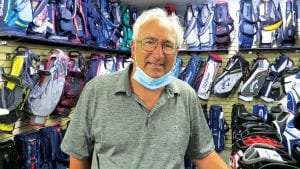
George O’Brien talks with Dave DiRico, owner of Dave DiRico’s Golf & Racquet

Dave DiRico

BusinessWest Editor George O’Brien talks with Dave DiRico, owner of Dave DiRico’s Golf & Racquet. The two have a lively discussion about everything from the state of the golf business in the wake of the pandemic — the sport has actually received a big boost from COVID — to how the federal government’s various economic stimulus programs are helping small businesses — like his — by giving people more buying power. It’s must listening, so join us on BusinessTalk, a podcast presented by BusinessWest in partnership with Living Local.


Also Available On

Daily News

SPRINGFIELD — The Connecticut Bar Assoc. (CBA) announced Professor Jennifer Levi as the 2021 Tapping Reeve Legal Educator Award winner. The award is presented to legal educators who have made significant contributions to the cause of legal education over a period of years and have distinguished themselves as legal educators of the highest quality.

Levi serves as a professor of Law at Western New England University (WNEU) School of Law. She has dedicated her career to fighting for the rights of women, children, the poor, and gay, lesbian, bisexual, and transgendered clients, and was a founder of the law school’s Center for Gender and Sexuality Studies, which is now part of the School of Law’s Center for Social Justice. In addition, she is a nationally recognized expert on transgender legal issues and the director of GLAD’s Transgender Rights Project litigating precedent-setting cases establishing basic rights for LGBTQ people.

Established in 2012, the Tapping Reeve Legal Educator Award is presented to a member of the Connecticut Bar Assoc. who is a member of the faculty, a clinical instructor, or an adjunct instructor at UConn, Quinnipiac, Yale, or Western New England University law schools, or a member of the CBA who has contributed greatly to the legal education of his or her colleagues. The recipient must have demonstrated sustained commitment and made significant contributions to the cause of legal education in the state and have distinguished himself or herself as a legal educator of the highest quality as a teacher, scholarly writer, or both.

Judge Tapping Reeve, the namesake of this award, was an American lawyer, educator, and jurist. He is recognized as founding a law school in Litchfield, Conn. considered to be the first formal school of law in the U.S. offering a vocational curriculum for future attorneys.

Levi will be formally awarded this distinction at the 2021 Celebrate with the Stars virtual event on Thursday, April 8.

Daily News

AMHERST — The Advanced Digital Design and Fabrication (ADDFab) facility at UMass Amherst will present a virtual TechTalk with Jason Lopes from Carbon3D on Wednesday, April 7.

Lopes has used 3D printing for more than 10 years at Legacy Effects to create visuals for big-name productions such as Avatar, Iron Man, and the Avengers series. He’s a fan of the Carbon materials and printing technology and will be sharing some of the ways university researchers have taken advantage of Carbon’s unique, high-quality elastomeric material to do research. He will also discuss many of Carbon’s industrial applications, including footwear, bicycle seats, and football helmets.

The event is slated for 3 to 4 p.m. Click here for the Zoom link. Click here to download the official flyer.

The next TechTalk is scheduled for Wednesday, April 21 from 3 to 4 p.m. with ExOne, which will present its water-based binder jet metal DesignLab printer.

Daily News

BERLIN, Conn. — Comcast announced the appointment of Colleen Cone as vice president of Human Resources for the company’s Western New England region, which is headquartered in Berlin, Conn. and includes more than 300 communities in Connecticut, Western Mass., New Hampshire, Vermont, and New York.

Cone will oversee the region’s human-resource functions, including talent management, career development, and training; benefits, with a focus on employee wellness; and employee engagement and recognition.

“Colleen brings a vast amount of valuable experience to this role during a critical time in our new work environment,” said Dennis Mathew, senior vice president of Comcast’s Western New England Region. “Her proven track record of successfully leading strategic human-resource initiatives with a focus on engaging employees at every level makes her the ideal person to ensure we exceed the current and future needs of our employees. I’m delighted to have her as part of our team.”

Prior to joining the Western New England region, Cone was the senior director of Human Resources for Comcast’s Greater Boston region, where she was responsible for employee engagement and other initiatives that addressed compliance and supported a strong and healthy workplace culture.

She also previously served as vice president of Talent and Culture for Skillsoft, where she was the senior leader responsible for employee engagement, internal communications, U.S. talent acquisition, and performance-management processes and recognition for a global workforce.

Cone holds a bachelor’s degree in business from Saint Anselm College in Manchester, N.H. and a juris doctor degree from Penn State University’s Dickinson School of Law. Named by New Hampshire magazine to its 2016 list of Exceptional Women in Business, she also serves on the board of directors of New Hampshire Tech Alliance and Families in Transition.

Daily News

CHICOPEE — The Office of Continuing Education at Elms College will host a week-long virtual Instant Accept Week event with students from seven area community colleges on April 6-10.

Elms College currently offers bachelor’s-degree completion programs at the following regional community colleges: Berkshire Community College (social work), Greenfield Community College (social work), Holyoke Community College (accounting, healthcare management, management and marketing, psychology), Mount Wachusett Community College (psychology), Quinsigamond Community College (RN to BSN), Springfield Technical Community College (computer information technology and security, computer science, social work), and Asnuntuck Community College (social work). Online programs include computer science, computer information technology and security, healthcare management, RN to BSN, and speech-language pathology assistant.

Students interested in being instantly accepted into one of these bachelor’s-degree completion programs are encouraged to register by clicking here.

From April 6 to April 9, individual virtual sessions will be held from 1 to 6 p.m. via Zoom. On April 10, individual virtual Zoom sessions will be held from 10 a.m. to 2 p.m. Elms College representatives will discuss program details, review official transcripts, and offer instant acceptance to qualified applicants.

For more information regarding the bachelor’s-degree completion programs at Elms, click here.

Daily News

SPRINGFIELD — On April 1, BusinessWest celebrated its Difference Makers class of 2021 with a virtual presentation and lively online networking event. The main event featured videos of the event sponsors, introductions of the honorees, and comments from the Difference Makers themselves. The entire presentation is now available for viewing by clicking here.

The 2021 Difference Makers include Kristin Carlson, president of Peerless Precision; EforAll Holyoke; Janine Fondon, founder of UnityFirst.com and professor at Bay Path University; Harold Grinspoon, philanthropist and founder of Aspen Square Management; Chad Moir, founder and owner of DopaFit Parkinson’s Movement Center; Bill Parks, CEO of the Boys & Girls Club of Greater Westfield; and Pete Westover, founder and partner at Conservation Works, LLC.

The sponsors for this year’s program are Burkhart Pizzanelli, the Royal Law Firm, TommyCar Auto Group, and United Way of Pioneer Valley. The Tom Cosenzi Driving for the Cure Charity Golf Tournament is a nonprofit partner.

Daily News

SPRINGFIELD — Maria Toyoda, currently the dean of the College of Arts & Sciences and professor of Political Science & Legal Studies at Boston’s Suffolk University, has been appointed senior vice president for Academic Affairs and provost at Western New England University, effective July 12.

President Robert Johnson announced the appointment, citing Toyoda’s successes in cross-disciplinary collaboration, commitment to student success, procurement of grant funding, modernization of processes, and mobilization of faculty as partners in the recruitment process at her prior institution.

“We are honored to have Dr. Toyoda join us at an important inflection point in the history of Western New England University,” Johnson said. “Currently, the WNE community is crafting a shared ambition to guide us through the next phase of our evolution. Her expertise and leadership will be instrumental as WNE stakes its position as a model for the new traditional university, one that provides an education grounded in professional studies, enhanced by the liberal arts, and renowned for mentored research that produces graduates who are work-ready and world-ready.”

Toyoda will be the university’s chief academic officer and oversee the academic integrity of all colleges, schools, and institutes on campus. The position is responsible for working with the deans and faculty to maintain the quality of current programs, develop new programs, and oversee the academic-appointment process.

“Institutions of higher learning have a responsibility to train active and civically engaged citizens who are discerning in both their consumption and production of information,” Toyoda said. “WNE’s aim of shaping future citizens imbued with personal values of integrity and accountability, tolerance and respect, and social responsibility aligns with my own ideals around education that emphasizes mastery, practice, creativity, perceptiveness, and personal growth.”

In her current role at Suffolk University, Toyoda oversees 18 departments with 200 full-time faculty and staff with responsibility for an undergraduate population of 5,000 students. On March 30, she was honored as one of Get Konnected’s 50 Most Influential People of Color in Higher Education. She received her PhD and master’s degree in government at Georgetown University and a bachelor’s degree in human biology from Stanford University with honors in values, technology, science, and society.

Toyoda succeeds interim Provost Curt Hamakawa, who will return to his previous position as professor of Sport Management. Hamakawa is also the director of the Business Study Abroad program, the Business Honors program, and the Center for International Sport Business in the university’s College of Business.

Daily News

EASTHAMPTON — Janice Beetle, a longtime writer and editor from Western Mass., has released her second book, Willful Evolution: Because Healing the Heart Takes Strength, through her own publishing imprint, Janice Beetle Books LLC.

In 2010, Beetle was laid off from her full-time job in the Valley, and her late husband, Ed Godleski, died four days later. Beetle tells the story of her grief journey in her first memoir, Divine Renovations, published in 2011. Her new book, Willful Evolution, is a sequel that tells the story of the past decade and how Beetle reinvented herself; revitalized her PR and communications business, Beetle Press; and also created Janice Beetle Books in 2019.

On more personal notes, the book shows how traveling, family, a series of adventures and bad turns, and exercise helped Beetle gain physical and emotional strength and survive online dating.

Willful Evolution is both poignant and funny, she said. “My hope is that readers will be inspired to find strength in their own lives, take risks, set new goals, and reinvent themselves.”

Beetle compares her book to Eat, Pray, Love by Elizabeth Gilbert, Love Warrior by Glennon Doyle, and Daring Greatly by Brené Brown.

Through Janice Beetle Books, Beetle also helps authors of all skill levels — as well as non-writers — carry a book idea through to publication. She also offers writing coaching services.

Beetle’s books are available at janicebeetlebooks.com, www.levellerspress.com/off-the-common-books, and on Amazon.

Daily News

LEE — Lee Bank is amplifying its longstanding community-reinvestment efforts with the creation of the Lee Bank Foundation, after a record year of contributions to the Berkshire nonprofit community.

In 2021, Lee Bank projects it will distribute $250,000 through the foundation, a more formal entity for community donations. In 2020, Lee Bank awarded $179,000 to community organizations, following several years of steady growth in funding.

“Lee Bank’s community contributions stretch back to its origins in 1852, but establishing Lee Bank Foundation sharpens our focus even further,” said Chuck Leach, the bank’s president. “The foundation also simplifies the application process for organizations doing meaningful work to support our Berkshire community.”

The foundation has its home at Marble House, a former residential property at 102 West Park St. in Lee. Purchased by Lee Bank in 2018, the building was recently renovated by Allegrone Construction. The property offers gathering spaces for community groups, bank staff, board meetings, and special events, and will also be home to a new financial-wellness service, for which hiring is under way.

In recent years, Lee Bank has typically set aside at least 5% of its annual net income for the support of area nonprofits. This giving has been on the rise: in 2020, the bank contributed nearly $179,000 to community nonprofits; in 2019, $145,000; and in 2018, $120,000. Last year, Lee Bank’s distributions included $50,000 to the COVID-19 Emergency Response Fund for Berkshire County.

The bank has supported more than 200 programs and organizations in recent years, including Greenagers, Community Access to the Arts, Berkshire Humane Society, Berkshire Immigrant Center, and others.

The foundation will be funded at $5 million by Berkshire Financial Services (Lee Bank’s parent company), with the goal of providing $250,000 in grants annually to nonprofits.

“The timing for creation of the Lee Bank Foundation could not be better,” said Jake McCandless, a foundation board member. “After a year of turmoil and uncertainty with COVID-19, nonprofits supporting our community and our neighbors will benefit from a streamlined process that supports their vital missions now and into the future.”

In addition to a 2021 grant goal of $250,000, Lee Bank’s employee-driven, branch-based sponsorships will continue as in the past, with a $70,000 projection this year. “In addition to foundation funding, our branch-based sponsorship awards are recommended by employees based on their awareness of local needs and activities in their branch communities,” Leach said.

Daily News

NORTHAMPTON — Viability Inc., a human-service provider, recently announced Project (VR)², a virtual-reality program dedicated to enhancing access to employment for all and inclusion and empowerment for people with disabilities and other disadvantages.

According to its creators, Project (VR)² is where vocational rehabilitation meets virtual reality (VR)². This first-of-its-kind project, deployed in the midst of COVID-19, will help people who are chronically underserved and marginalized build the vital skills required to advance their ability to gain and maintain employment.

(VR)² makes it possible for individuals to acquire essential interactive soft skills that make or break job success — communication, interviewing, adapting, and problem-solving — in a controlled, safe, and self-reflective virtual work environment. Partners of the virtual collaborative include Link To VR, Bodyswaps, Cleanbox Technology, and the Massachusetts Rehabilitation Commission.

The VR platform Bodyswaps offers a soft-skills simulator, much the same way companies like Boeing leverage flight simulators.

“Immersive VR learning provides access for individuals who are otherwise overlooked in the employment world,” said Kristin Rotas, Viability director. “Access to training and work experiences virtually builds confidence and readiness that will better equip participants to hold jobs that provide income along with a sense of purpose to individuals, a willing workforce for employers, and greater societal equity.”

The program also offers iPads for a 2D immersion into the virtual training and readiness environments.

Collaborating with Cleanbox and Link To VR allowed Viability to safely deploy the VR project in the midst of COVID-19. Cleanbox’s system utilizes UVC rays to eradicate 99.99% of viruses, bacteria, and fungi, essentially decontaminating the headset for reuse.

Viability’s vision for Project (VR)² expanded significantly when the Massachusetts Rehabilitation Commission provided assisted funding. Together, they are pioneering a new training initiative and encouraging states to bring about technological changes to their current rehabilitation efforts. To help manage the deployment, Viability called on Link To VR, a leading spatial computing company with offices in Boston.

“We were honored to take part in such a fantastic project which provides hands-on access to transformative technologies which help level a competitive employment playing field,” said Edward Zemba, CEO of Link To VR.

Viability is a community-based human-services agency providing employment services, vocational and life-skills training, and other supports to more than 4,000 individuals across five states. Viability partners with more than 600 employers and leverages community resources to overcome barriers with a mission of helping to build a world where individuals with disabilities and other disadvantages can realize their full potential.

To learn more about Project (VR)², e-mail Rotas at [email protected].

Daily News

AGAWAM — Starting on Tuesday, April 27 from 3 to 5 p.m., with continuing sessions on Wednesday, May 26 and Wednesday, June 30, the Employers Assoc. of the NorthEast (EANE) and its training partners from Protective Advanced Safety Services (PASS), will present a three-part training series at EANE’s Agawam training center for regional employers on workplace violence prevention.

Session topics include “Who’s Coming to Work,” “CALM: De-escalation Strategies,” and “Hire Right, Fire Smart.” All three sessions are designed to equip employers with the tools and knowledge they need to keep their workplaces safe from violence, including microaggressions, employee-relations escalations, and the worst-case scenario: an active shooter.

“With today’s volatile climate, we’re seeing people dealing with increased pressures like financial stress, domestic violence, increased drug and alcohol abuse, and mental illness. All of this creates the perfect storm for employers, and they need to be prepared that some of this stress will be coming to their workplaces,” said John Nettis of PASS. We’ve designed these trainings to support employers as they are welcoming staff back to their facilities.”

Space in this training series is limited to 10 participants as EANE is following state guidelines on social distancing and capacity limits. The cost for the program is $331.50 for all three sessions. Interested parties can reach out to Allison Ebner at [email protected] or call (413) 789-6400 for more information.

Daily News

SPRINGFIELD — Springfield College President Mary-Beth Cooper announced the college’s plans for the 2021 commencement ceremonies the weekend of May 14-16. The festivities will begin on Friday, May 14 with a virtual opening celebration streamed live starting at 6:30 p.m. Following Friday’s opening celebration, the college will host eight separate in-person ceremonies, four on Saturday, May 15 and four on Sunday, May 16, at Stagg Field on the Springfield College main campus. All ceremonies will be streamed live on springfield.edu, including the in-person ceremonies on Saturday and Sunday.

“After such a challenging year, these celebrations are something to look forward to and a wonderful way to celebrate the accomplishments of our students,” Cooper said. “Student input in these decisions has been important and helpful, including responses to the survey and student-leader involvement on the commencement committee.”

On May 15, the School of Health Sciences will hold its graduate commencement at 8:30 a.m. and its undergraduate commencement at 11:30 a.m. Also on May 15, the School of Arts and Sciences will hold its graduate commencement at 3 p.m. and its undergraduate commencement at 5 p.m.

On May 16, the School of Physical Education, Performance and Sport Leadership will hold its graduate commencement at 8:30 a.m. and its undergraduate commencement at 11:30 a.m. Also on May 16, the School of Social Work and Behavioral Sciences will hold its graduate commencement at 3 p.m. and its undergraduate commencement at 6:30 p.m.

Each ceremony is expected to be approximately 60 to 75 minutes in length. Graduates who have completed a degree application will receive an e-mail with instructions for registering guests, and those tickets will be valid for the specified ceremony only. No tickets will be available during commencement weekend.

“With the exception of Friday’s virtual event, the ceremonies will be in-person gatherings, designed to comply with the restrictions in place by the Commonwealth of Massachusetts, while retaining elements of commencement that are important to our students,” Cooper said. “Each graduate will be permitted to invite up to two guests to the in-person commencement ceremonies, something we know is important to our students and is made possible because of the commencement guidelines provided by the Commonwealth. The ceremonies will also be livestreamed on springfield.edu, but having some guests on campus is a positive step.”

In between ceremonies, the commencement and guest areas, including the chairs and stage, will be thoroughly cleaned and sanitized, and all graduates and guests will be required to wear face coverings at all times and adhere to social-distancing guidelines. All seating at Stagg Field will allow for appropriate six-foot social distancing between graduates and between guest groups.

In addition, the Springfield College main campus will be open to graduating students and their guests on May 15 and 16 to allow graduates to take photos with their friends and families at their favorite outdoor campus locations before or after their ceremony.

Daily News

NORTH ADAMS — On Friday, April 9 at noon, the Massachusetts College of Liberal Arts (MCLA) master of business administration (MBA) program will present a free virtual panel on entrepreneurship and small business in the time of COVID-19, as part of its “Friday Focus” panel series examining the pandemic’s impact on business and economic development.

Moderated by MCLA Director of Corporate Engagement and Strategic Partnerships Joshua Mendel, this series features local business leaders, MBA program alumni, and faculty from MCLA’s Business Department.

To register, visit mcla.edu/mba. All events will take place virtually and are free and open to the public. This event will also be streamed to the MCLA Facebook page and will be archived on the MCLA YouTube channel for later viewing.

MCLA’s MBA program is a part-time, accelerated program designed to meet the needs of the working adult learner. Most courses meet through a combination of online and face-to-face instruction and blend classroom experience with practical, hands-on fieldwork. In addition, the program offers diverse academic programming and provides a high return on investment. MCLA’s MBA program accepts applications throughout the year, and new students may begin the program in the fall, spring, and summer.

Daily News

NEW YORK — Laurel Road, a brand of KeyBank, unveiled Laurel Road for Doctors, a digital bank tailored to physicians and dentists with products and services designed to provide the financial help and peace of mind they need through each career stage. The goal of the new digital bank is to help ease the burden for doctors of paying down student debt, finding more balance between work and life, and planning for the future.

With Laurel Road for Doctors, Laurel Road and KeyBank expand on an existing suite of tailored digital banking and lending products and extensive experience, working directly with doctors to create a platform that meets the distinct challenges of this community.

“We believe in providing our customers with the choice to digitally fulfill their financial needs, especially when it makes their lives easier to do so,” said Chris Gorman, chairman and CEO of KeyCorp. “We acquired Laurel Road in 2019 with the intention of scaling this digital-born business. Through this new digital bank offering, we are able to provide a secure online experience and customized banking solutions to meet the special needs of physicians and dentists.”

Laurel Road for Doctors is launching at the right time for many, as two-thirds of doctors plan to be more financially focused in 2021 to benefit their career and personal financial security compared to 2020, according to a new survey of 750 U.S. physicians and dentists conducted by Laurel Road and the White Coat Investor, an online community for doctors.

“From our long-standing work with doctors, we know that many face financial-management challenges while navigating high debt and high-stress careers dedicated to caring for others, leaving them little time to balance personal and financial pursuits,” said Alyssa Schaefer, chief experience officer at Laurel Road. “With thoughtful tools and resources dedicated to supporting the financial health and life goals of physicians and dentists, we aspire for Laurel Road for Doctors to be a destination for all of their financial needs.”

Physicians and dentists can find more information about Laurel Road for Doctors at www.laurelroad.com/doctors.

Daily News

SPRINGFIELD — Since 2009, BusinessWest has been recognizing the work of individuals, groups, businesses, and institutions through a program called Difference Makers.

The 2021 Difference Makers include Kristin Carlson, president of Peerless Precision; EforAll Holyoke; Janine Fondon, founder of UnityFirst.com and professor at Bay Path University; Harold Grinspoon, philanthropist and founder of Aspen Square Management; Chad Moir, founder and owner of DopaFit Parkinson’s Movement Center; Bill Parks, CEO of the Boys & Girls Club of Greater Westfield; and Pete Westover, founder and partner at Conservation Works, LLC.

The 13th annual Difference Makers celebration will be a virtual event taking place today, April 1, from 6 to 8 p.m. This event, like our hugely successful Women of Impact celebration in January, be presented using the REMO platform, and will feature networking, videos of the event sponsors, introductions of the honorees, and comments from the Difference Makers themselves.

The sponsors for this year’s program are Burkhart Pizzanelli, the Royal Law Firm, TommyCar Auto Group, and United Way of Pioneer Valley. The Tom Cosenzi Driving for the Cure Charity Golf Tournament is a nonprofit partner.

Daily News

HOLYOKE — Holyoke Community College (HCC) is planning a virtual commencement for spring and preparing to welcome students, faculty, and staff safely back to campus for the fall 2021 semester.

HCC’s 75th-anniversary commencement will be livestreamed on Saturday, June 5 on the HCC website and the college’s social-media channels. The virtual commencement will celebrate the class of 2021 as well as the class of 2020. Because of the COVID-19 pandemic, HCC made the decision last year to recognize the class of 2020 with a virtual celebration in August 2020 and also invite graduates to participate in a more traditional graduation ceremony this year along with the class of 2021.

Planning for commencement begins months in advance, and HCC officials made their decision on this year’s ceremony based on conditions in February before new guidelines were announced allowing for limited outdoor and indoor ceremonies.

“Unlike the 2020 celebration, the 2021 ceremony will include traditional commencement moments with an emphasis on the elements our students told us matter most to them,” HCC President Christina Royal said. Those elements include having student orators from both classes and keynote speeches delivered by the 2020 and 2021 recipients of the Elaine Marieb Chair for Teaching Excellence, HCC’s highest faculty award. “We will also have a virtual procession and the traditional reading of names of graduates from both classes along with photographs submitted by members of each class.”

For the fall 2021 semester, which begins Tuesday, Sept. 7, HCC is offering a variety of class formats, including face-to-face, in-person, on-campus classes with a maximum of 10 students per classroom.

Following guidelines from the CDC and the Massachusetts Department of Public Health, the fall 2021 return-to-campus plan allows for maximum flexibility and adaptability, at all times prioritizing the safety and well-being of HCC students, faculty, and staff.

HCC will provide multiple course formats to suit different learning styles and personal preferences: on campus, blended on campus and remote, synchronous remote, and asynchronous online.

“HCC is paying particular attention to scheduling courses that will allow incoming students to maximize on-campus instruction if they so choose,” Royal said. “The plan provides us the flexibility to make adjustments as public-health conditions evolve over the months ahead.”

In addition to on-campus, blended, and remote offerings for fall 2021, HCC will continue to offer a full slate of fully online courses across the curriculum. As much as possible, administration offices and student services will also be open and staffed, while maintaining safe and social-distancing protocols, including mandatory mask wearing and plexiglass screens in areas where students and members of the public most closely interact with staff.

While campus offices and support services will be open to students this fall, HCC will also continue to offer services and support through online chat and Zoom for students who feel more comfortable accessing college services remotely.

“I really believe the pandemic has made HCC a better version of itself,” Royal said. “We have enhanced our support for students and have amplified student voices throughout every decision-making process, always placing students first. We have made equity a greater priority across the college, enabling us to truly and more deeply serve our community.”

Registration opens Monday, April 12 for summer and fall classes at HCC.

Daily News

WESTFIELD — The Westfield Starfires announced the addition of Annalise Eak to the staff as coordinator of Group Sales & Fan Experiences.

Eak, a Westfield native and graduate of Westfield State University, is pursuing a graduate degree at Bay Path University. For the last seven years, she has served as a marketing supervisor at Six Flags New England. She was a Starfires Game Day Operations volunteer at Bullens Field in both 2019 and 2020. She is vice president of the Westfield Babe Ruth board of directors and served on the World Series executive committee in 2019. She is a Westfield Centennial Lions Club member and Westfield Technical Academy sports volunteer.

“Annalise is a fixture at Bullens Field and a huge asset to the Starfires organization,” team owner and co-founder Christopher Thompson said. “We are thrilled to have her take on this expanded role within the front office.”

The Westfield Starfires are part of the Futures Collegiate Baseball League, which offers collegiate summer baseball to fans in seven New England cities. The Starfires joined the league as an expansion franchise for the summer of 2019 and play in historic Billy Bullens Field in Westfield. The 2021 schedule will be released in the coming weeks.

Daily News

SPRINGFIELD — “National Security Priorities in Biden’s First 100 Days” will be the topic of a discussion by Western New England University (WNEU) School of Law Dean Sudha Setty on Thursday, April 15 at noon. The cost for this virtual event, presented by the World Affairs Council of Western Massachusetts, is $10 (free for students).

Setty will discuss various national-security priorities of the Biden administration, including investigations into domestic terrorism, anticipated policy changes regarding targeted killings, and foreign-policy priorities.

Setty became dean of the School of Law in 2018 and has served on the faculty since 2006. She is the author of National Security Secrecy: Comparative Effects on Democracy and the Rule of Law, the editor of Constitutions, Security, and the Rule of Law), and has written dozens of articles on national-security law and policy.

She was recognized as part of the Massachusetts Lawyers Weekly Top Women in the Law in 2019, and the WNEU School of Law honored her with the Catherine J. Jones Professor of Year Award in 2009, 2016, and 2018. She was recognized in 2015 as a Trailblazer by the South Asian Bar Assoc. of Connecticut and received the 2017 Tapping Reeve Legal Educator Award from the Connecticut Bar Assoc. In July 2018, she was elected to membership in the American Law Institute.

The April 15 event is sponsored by Glenmeadow, Sir Speedy, and Wilbraham & Monson Academy. For more information and to register, visit the World Affairs Council of Western Massachusetts website at www.wacwestma.org.

Daily News

SOUTHAMPTON — DopaFit Inc., a Parkinson’s disease movement center, is known for helping people with Parkinson’s slow the progression of their disease with exercise and other non-pharmacological treatments. Those who suffer from Parkinson’s disease are often forced to stop doing the things they love. Many give up their passions, hobbies, and lose their sense of self. Limitless by DopaFit has been created to empower people with Parkinson’s disease to redefine their lives by giving them a chance to do something they once loved.

On Monday, April 5, Rick Burkhart, a current DopaFit fighter, will fly a plane with the help of Fly LUGU flight school at the Westfield Barnes Airport. Burkhart has not flown an airplane in more than 10 years since he was first diagnosed with Parkinson’s disease. Prior to his diagnosis, he was an avid pilot and owned a flight school at Westfield Barnes Airport. He often took cross-country flights, and even donated his time and planes to drop off much-needed supplies to remote areas of impoverished countries.

“Far too often, when people are diagnosed with Parkinson’s disease, they expect to be disabled within five years,” said Chad Moir, founder and CEO of DopaFit Inc. and the Limitless project. “This does not have to be the case. With exercise, eating healthy, and keeping a positive attitude, people with Parkinson’s disease can live a long and active life. Limitless by DopaFit is meant to help people with Parkinson’s continue to live their life without limits.”

DopaFit Inc. plans to offer the Limitless program on a quarterly basis and encourages people living with Parkinson’s disease to apply for their chance to live DopaFit’s motto, “Parkinson’s without limits.” For more information, visit www.dopafit.com or call (203) 828-7189.

Cover Story

Lessons Learned from COVID

It’s been said time and again that, for businesses large and small, the pandemic provided a number of learning opportunities. Companies learned new ways to do things — mostly out of necessity — while also learning that the ‘old’ way may not be the best way. Meanwhile, the pandemic provided opportunities that didn’t exist before — especially when it comes to hiring — and accelerated the pace of needed change. All that means the landscape has been altered for the long term.

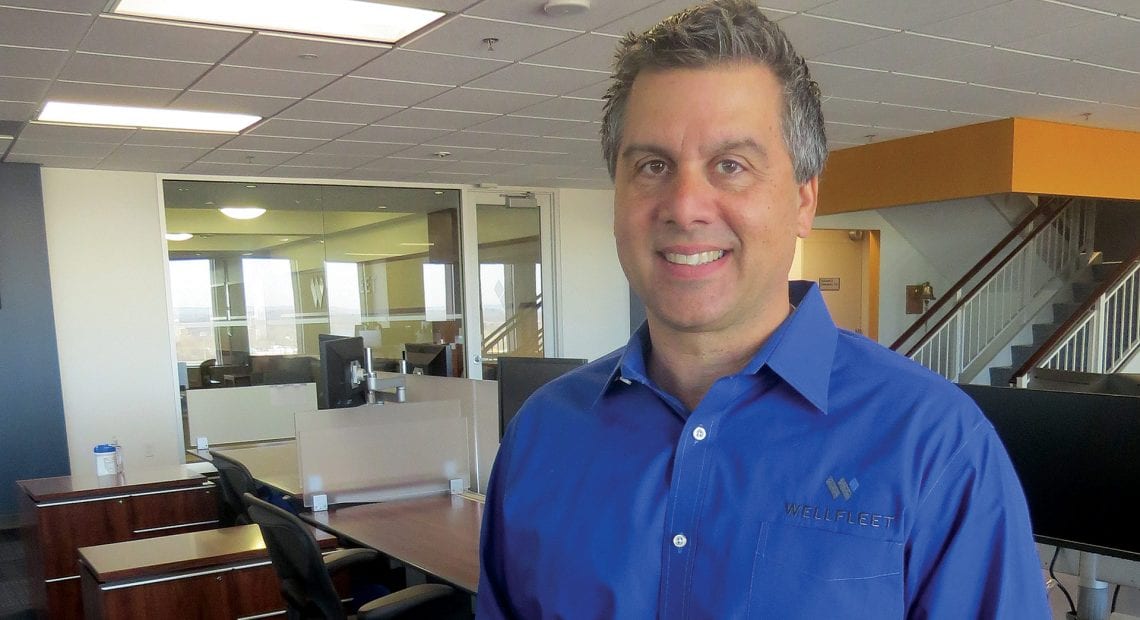
Drew DiGiorgio, president and CEO of Wellfleet

Drew DiGiorgio, president and CEO of Wellfleet, in the company’s mostly unoccupied space in Tower Square.

They’re called ‘insurance bibles.’

That’s the name those at HUB Insurance have attached to the large binders — some of them containing 700 pages or more, in the case of large commercial accounts — that tell clients everything, as in everything, about what’s in their policy, what’s covered, what isn’t, and on and on.

As he held one up, Timm Marini, president of HUB International New England LLC, noted that, prior to the COVID-19 pandemic, bibles only came in the printed variety. Now, if a client wants one — and some of them don’t — a digital file is sent, in part because a client can’t pick one up, and HUB can’t drop one off.

And, by and large, things will stay this way, said Marini, noting that COVID has shown those at the company that they don’t need to kill trees and use up expensive toner to provide a client with their insurance bible.

“Now, you can do it all electronically,” he explained. “And you probably could before COVID, but COVID made us do it more.”

This is just one of the many things companies large and small have learned during the pandemic, lessons that will carry over to the time when COVID is referred to in the past tense. Others involve everything from not having to scan documents for tax preparers to not necessarily limiting a candidate search to those living in the 413, to not having people travel to a conference on the other side of the state if they can instead take it in via Zoom.

“It’s a mix, but many certainly want to come back. They’re lonely … they actually want to work in more of a community setting.”

In a word, the pandemic has shown area businesses and nonprofits that they have more options than maybe they thought they had, when it comes to how and where people work and just how things are done.

For this issue and its focus on the modern office, we talked with a number of business owners and managers about what’s been learned over the past 12 months or so and how COVID has actually made companies more efficient and enabled them to reduce costs in some areas. The observations were telling.

“The audit side of our practice generally required teams of people here to go visit on site at other locations,” said Sarah Rose Stack, Marketing & Recruitment manager at the Holyoke-based CPA firm Meyers Brothers Kalicka. “Because of COVID, we learned we could do these remotely, which is something we’ve never done; this was a first-time experience not just for us, but for people in our industry. We’ve learned that it’s fine, it is efficient, and with some businesses, we’ll keep doing it this way moving forward.”
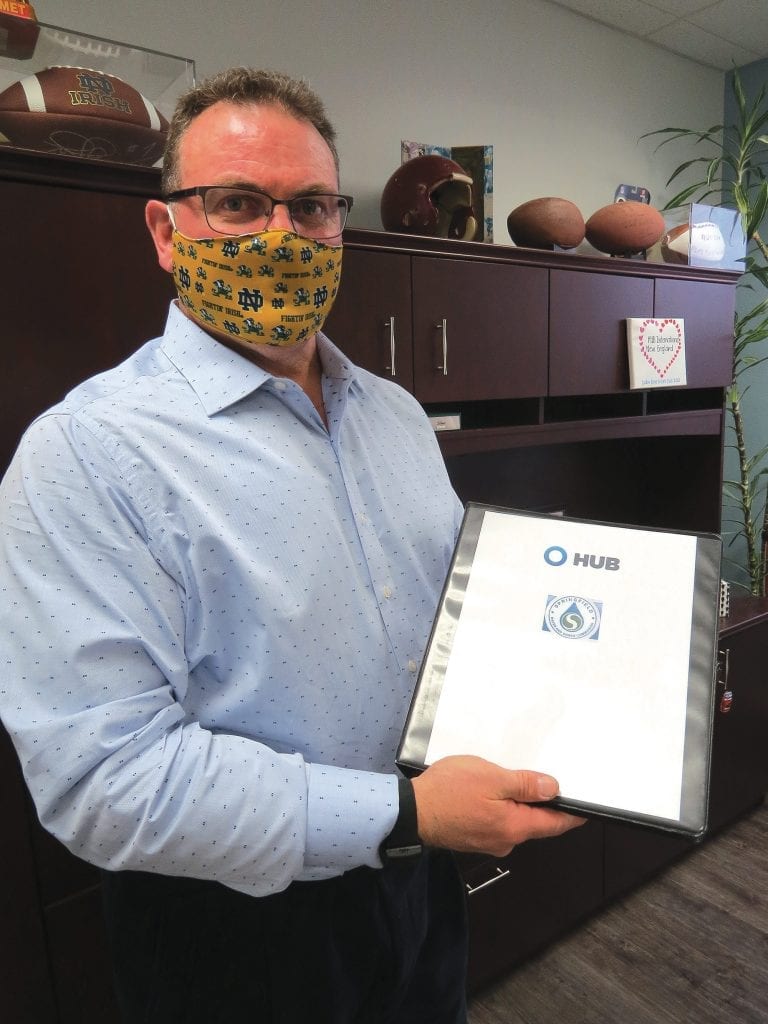
Timm Marini holds up an ‘insurance bible’

Timm Marini holds up an ‘insurance bible’ — the printed variety. Those at HUB have had to send digital documents during the pandemic, and that trend will continue into the future.

For Springfield-based Wellfleet, now with offices in Tower Square, the pandemic has provided ample evidence that employees in many positions can work effectively and remotely, and this enables the company to expand its horizons when it comes to hiring.

“You can expand your pool when it comes to workforce; we can hire someone not from the Springfield area and have them be successful with the tools that we’ve developed,” said Drew DiGiorgio, the company’s CEO, adding that the company has already hired some people from other parts of the country. Meanwhile, it is working on plans to have other employees work a hybrid schedule, with some days in the office and others remotely.

Chuck Leach, president and CEO of Lee Bank, said that, prior to COVID, HR Director Susie Brown and IT Director Drew Weibel were already hard on work on plans to position the bank to be more flexible with its workforce in terms of where and how it worked. The pandemic served to accelerate that process.

“Even though we’re Lee Bank, a lot of our employees come in from other markets,” he noted, adding that these lengthy commutes prompted talk and then creation of plans for remote work and hybrid schedules. “We were already thinking about it, and COVID forced us to be more deliberate in our approach and our policies and procedures.”

But even with these options in place and far more flexibility with work schedules than ever before, the bank is tilting strongly toward having people work on site — with some exceptions — and it’s also seeing most of its employees want to come back, which is another thing companies are learning as they work their way through COVID.

“It’s a mix, but many certainly want to come back,” Weibel said. “They’re lonely … they actually want to work in more of a community setting. They want to come back, but some find it easier to work at home until the school situation is worked out and their children are back in the classroom.”

Stack agreed. “When the shutdown first happened, everyone was excited to work from home, so a lot of people exercised that option, and some people have found they’re more efficient from home, cutting out that commute,” she said. “But while some still work from home, the majority of people, like 97% of the people at MBK, choose to come into the office every day because they don’t want to work from home.”

Work in Progress

DiGiorgio said it’s somewhat frustrating to walk around his company’s offices in Tower Square.

More than 200 employees moved into the well-appointed space covering three full floors in the late summer of 2019, only to see pretty much everyone pack up and go home to work in mid-March.

“We love it — we wish we could be in it more,” he said with a laugh. “It’s great space — open-floor design, all the things you probably don’t want with COVID. It will be great to get back to it.”

Indeed, that’s a lot of fairly expensive (for this market) downtown Springfield real estate that is not being used. But DiGiorgio doesn’t dwell on matters that are out of his control.

Instead, he’s more focused on what the future will look like — and applying all the lessons learned during the pandemic.

As for that real estate … he said this is a growing company that took three floors with the intention of perhaps soon absorbing a fourth. Need for that additional space is less likely now, he acknowledged, but the company will still need the space it’s now leasing because he fully expects most of his employees to be back in that space.

But not all will have to come back, he went on, and some, as he noted, will never have to sit at a desk there.

“We have, over the past year, hired people in Florida, Tennessee, Atlanta, Minneapolis, Upstate New York … we have a pretty remote workforce,” he said, adding that some of these hires took place before COVID because the tools were in place, but the pandemic has highlighted how effective people can be working remotely, and thus, as he said, broadened and deepened the talent pool.

“We have a billing person who’s in Tennessee. I feel more comfortable now that she can hire people in Tennessee or wherever she needs to; they may not need to be in Springfield, which is what our initial thought was. COVID has opened up our thinking to where we hire people.”

Marini agreed. “We have employees in Wisconsin who work for New England,” he explained. “We have people who decided to move to Florida and still work for New England. We had a little of that before COVID, but what we realized was that, with our ability to get our automation up and running, our digital offerings, that really expanded our talent pool; there have been some relocations during COVID and some new hires during COVID that are not Western Mass.-based. And we have some people in Western Mass. who work for some of our Eastern Mass. locations and even one in New York.”

COVID has reinforced this premise, as it has many others, while accelerating some trends and pretty much forcing companies to do some things they never considered before.

Like those virtual audits at Meyers Brothers Kalicka.

Stack said the firm’s teams have undertaken a number of them, while, in other cases, it has adopted a hybrid approach for some audits, going to the client site for some of the work while handing the rest remotely. Thanks in large part to COVID, there are now several options for handling such work, she said, adding that other lessons have been learned and other new ways of doing things revealed.

“On the tax side of our practice, we used to have clients in the building all day, every day, from February 1 through tax day, and now, maybe three people a day drop off their boxes of papers; the vast majority of people just e-mail us their material,” she explained. “They’re happy with it, it’s efficient, and it saves us a step. Instead of having to take tons and tons of paperwork and scan it into our digital system, it’s already coming to us in that format.

“We used to have to hire a scanner for tax season — a whole person whose job was to take all this paper that people would drop off and scan it,” she went on. “We didn’t have to hire a scanner this season, and that was definitely a positive change.”

Will Dávila, executive director and CEO of the Children’s Study Home in Springfield, said the pandemic has led to positive change in many forms at his agency and most all businesses and nonprofits. He echoed others when he said that COVID has served to heighten the awareness of how technology can be used to improve efficiency and save time, such as when traveling to conferences or meetings in other cities.
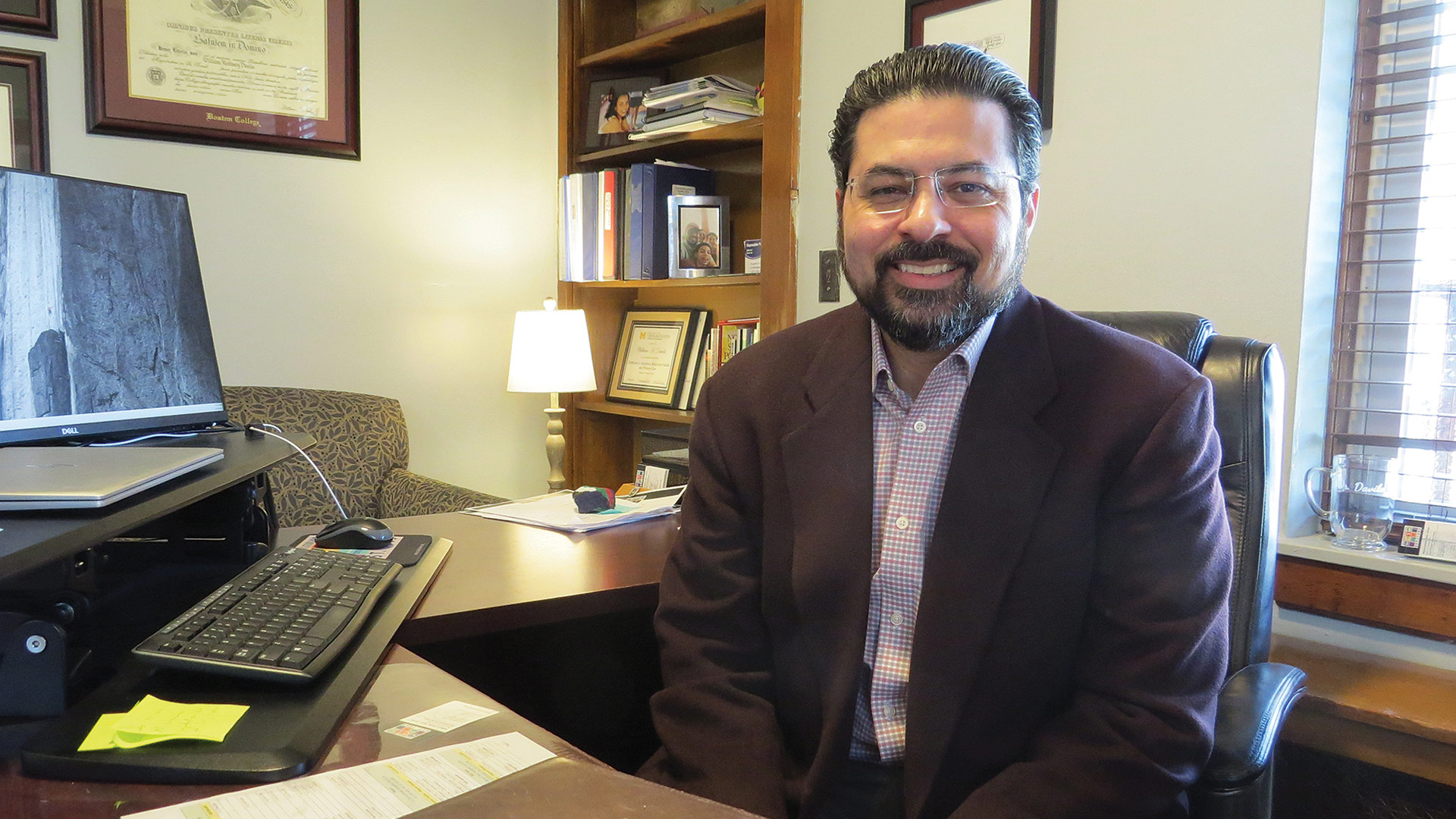
Will Dávila, executive director of the Children’s Study Home

Will Dávila, executive director of the Children’s Study Home, says his agency has learned a number of lessons during the pandemic, many of them involving better use of technology.

“We now have more of a comfort level with working remotely and working via Zoom,” he said, adding that this technology existed long before COVID, but few businesses took full advantage of it. “The lesson for us, and I’m not sure we have it completely figured out yet — it will likely take us some time — is that we can do more with technology than we thought we could before. I’ve been in places where we would talk about technology and teleconferencing and telehealth, and people would balk at it. And now, we’ve been forced to take another look, and we’ve embraced it.”

Looking ahead, he said that, while most people look forward to the day when they can gather and attend conferences and meetings in person, they know there are options — there’s that word again — and they won’t be hesitant to take full advantage of them if the circumstances permit.

Caution Signs

As he walked with BusinessWest through HUB’s headquarters facility on Shaker Road in East Longmeadow, Marini pointed to a number of unoccupied workstations, some of them marked off with the yellow ‘caution’ tape usually associated with crime scenes and construction sites. Such tape can be seen throughout the suite of offices, he said, noting that the space — which was occupied by just over 50 employees prior to the pandemic — has hosted around seven a day on average, with a high of 14, by his count.

Sectioning off such areas became part of life during COVID, he noted, adding that there are myriad ways the pandemic changed the landscape for the company. Overall, there’s been a huge shift; a place once teeming with employees and visiting customers now sees very few of either.

And that has brought challenges — and some opportunities, mostly in the form of learning how to do things remotely and without reams of paper. As he talked about these opportunities, Marini gave a nod — sort of, anyway — to an organization his business works closely with, obviously: the Registry of Motor Vehicles.

“Even the Registry of Motor Vehicles here in the Commonwealth of Massachusetts has become more digitized, more automated, and more flexible, and that’s something I never thought I’d see after 33 or 34 years of doing this,” he told BusinessWest, adding that, in some ways, his company has been inspired by the RMV, as it automates and digitizes many processes that once involved paper and in-person sessions.

As for the challenges, they came in waves, Marini explained, from equipping everyone to work at home, which was expensive and difficult logistically, to helping employees cope with everything from feelings of isolation to simply filling their days with work, even though they were home.
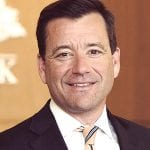
CHuck Leach

Chuck Leach

“Even though we’re Lee Bank, a lot of our employees come in from other markets. We were already thinking about it, and COVID forced us to be more deliberate in our approach and our policies and procedures.”

“We were too accessible when we were home, so there were no breaks for our people,” he explained. “We started having big conversations and hiring professionals to come in to coach us to make sure we took breaks and that there was separation between home and work.”

What will things look like several months from now, especially if the pandemic continues to ease? Marini isn’t exactly sure, but he acknowledged that he spends a lot of time thinking about it and working with corporate to prepare for that day.

He does know that more business will be handled virtually in the future, and there will be little, if any, need for those printed insurance bibles.

As for employees, like others we spoke with, he expected that they will come back, because the company wants them back, but also because they want to be back in that office setting.

Such sentiments were echoed by many of those we spoke with. They noted that it seem logical that, after getting a taste of working at home, many employees would prefer that option, but what employers are generally seeing is the opposite reaction.

“People are sick of remote everything,” said Stack, noting that Meyers Brothers Kalicka has a younger team within the audit department that could do its work from home, but instead it has reserved the firm’s huge boardroom for the past six weeks so the members can work together, but safely and well spread out.

“They have music playing on Spotify every time you walk in there,” she said. “They just want to be in the same space — they think they’re more efficient that way, and they can ask questions of each other faster and stay on track better because they’re all together. It’s not something we told them they had to do; they’ve chosen to do it.”

Dávila agreed, although he noted that he has some employees who are quite happy working at home, and are “working on it” when it comes to returning to the office. By that, he meant he’s offering some flexibility on this matter and not rushing anyone back who doesn’t want to rush back.

“I think it’s partly generational — people who have been in the field for 15 or 20 years or more and are used to those in-person interactions, they’re used to having that time by the water cooler when they’re getting a cup of coffee. I consider those valuable interactions that help with morale,” he told BusinessWest. “But we also have younger staff who are very comfortable with technology and embrace the idea of working remotely.”

But, ultimately, they will come back, probably by the end of the calendar year. “I don’t want to say absolutely not,” he said when asked about hybrid arrangements that offer a mix of remote and in-office work. “But my preference is that we get people back to a schedule where they can see each other and interact.”

Lee Bank’s Susie Brown agreed. “When it comes to Lee Bank, I think everyone enjoys being together,” she said. “We don’t have a lot of people who are unwilling to come back; those that are unwilling are those that have other challenges at home with their children.”

Bottom Line

COVID is far from over, and there are certainly more lessons to be learned as companies large and small continue to cope with an unprecedented challenge.

But it’s already evident that this battle has prompted changes that will live on long after the pandemic is in the rear-view mirror. As they were forced to do things differently, companies learned that, in many cases, these different ways are better than the old ways.

Like the insurance bible. Clients, at least some of them, will still need one. But they won’t need to thumb through 700 pages of printed material to find an answer.

COVID has changed all that — and it keeps on changing the landscape.

George O’Brien can be reached at [email protected]

Coronavirus Features Special Coverage

The Shape of Things to Come

With the arrival of spring, stimulus checks, and vaccinations for growing numbers of residents, continued recovery from the steep economic decline of 2020 is in the forecast. But like the weather, economic rebounds are difficult to predict. With this recovery, there is still widespread speculation as to what shape it will take — U, V, W, K, even the Nike ‘swoosh.’ Myriad factors will ultimately determine that shape, from the ongoing threat of inflation to uncertainty about when and to what extent people will gather again, to questions about just how willing Americans are going to be when it comes to spending some of the money added to their bank accounts over the 12 months that ended in January.

$4 trillion!

That’s the amount Americans added to their bank accounts over the past 12 months or so, a savings rate perhaps never before seen in this country, which has hasn’t been known for that trait.

It came about because of all the things that people couldn’t spend money on, or didn’t see the need to spend on — everything from summer camp to vacation cruises; celebratory meals out at restaurants to new dress clothes; Red Sox tickets to visits to their favorite museum. Granted, there was some spending going on, especially when it came to things like pools, new flooring, and new deck furniture for the home — or a new home itself, be it a vacation home or a bigger primary residence.

“I am pretty optimistic that people are just to their wit’s end with being isolated; they really want to get out, do things, and buy things. They just want to live a normal life again.”

But, for the most part, Americans were saving in 2020.

And now that there is light at the end of the tunnel, and it seems like people will be able to spend some of the money they saved, the speculation involves just how willing they will be to go back in the water, if you will, and do some of the things they had to forgo for a year.

That’s just one of many factors that will ultimately decide the shape of the recovery we’re now in, and how quickly the nation will get back to something approaching normal.

As several of the stories in this issue reveal, the world, or at least this part of it, is returning to a sense of normal. Hotels are booking rooms again, airports are busy (or at least busier), Tanglewood and Jacob’s Pillow will have seasons in 2021 — albeit different kinds of seasons — and, overall, the state has entered into what Gov. Charlie Baker calls stage 4 of his recovery plan. This final stage will allow indoor and outdoor stadiums to run at 12% capacity, the state’s travel order to be downgraded to an advisory that recommends people entering Massachusetts quarantine for 10 days, public gatherings to be limited to 100 people indoors and 150 people outdoors, and exhibition and convention halls to operate if they can follow gathering limits.

It’s a big step forward, but much will depend on how willing people will be to gather in these places, and how confident they will be to travel. Meanwhile, there’s all that money that people saved and the latest round of stimulus checks now finding their way into people’s bank accounts. Will people spend them, and what will they spend them on?

And what if there is a spending frenzy and economists’ fears of inflation, potentially the runaway variety, become realized?

These are just some of the questions hanging over the job market and this overall recovery, which will, at the very least, be unlike anything else the country has experienced. Indeed, it has bounced back from recessions, tech bubbles, a 9/11 downturn, wars, and more. But it hasn’t seen anything quite like this — a pandemic-fueled economic crisis that wiped out millions of jobs, followed by, and accompanied by, federal stimulus on an unprecedented level.

Mark Melnik

Mark Melnik

“Just because we hear, ‘get back in the water, everybody,’ it doesn’t necessarily mean that folks will. I think there’s reason to be bullish about the Massachusetts economy in the second half of 2021 and the early part of 2022 because of the pent-up demand. But so many of these issues are going directly to the comfort level that people are going to have psychologically.”

“I’m a little less cautiously optimistic than some, but I am pretty optimistic that people are just to their wit’s end with being isolated; they really want to get out, do things, and buy things,” said Bob Nakosteen, professor of Economics at the Isenberg School of Management at UMass Amherst. “They just want to live a normal life again.”

Mark Melnik, director of Economic and Public Policy Research at the UMass Donahue Institute, concurred, but offered some caveats.

“There’s a psychological element to the economy,” he told BusinessWest. “Just because we hear, ‘get back in the water, everybody,’ it doesn’t necessarily mean that folks will. I think there’s reason to be bullish about the Massachusetts economy in the second half of 2021 and the early part of 2022 because of the pent-up demand. But so many of these issues are going directly to the comfort level that people are going to have psychologically.”


History Lessons

As they have many times over the past year, experts pointed to Worlds War II as the only recent point in history that can in any way compare with the ongoing pandemic, and noted that the comparisons hold when it comes to what happened when it was all over.

“During the war, people couldn’t buy a car, and there was a great deal of rationing,” said Nokosteen, adding that, as a result, people were saving. And while there was a lull right after the war ended, during which some feared the country would actually sink back into the Great Depression that officially ended with the war, people soon started spending — big time.

“Everyone wanted to spend money,” he told BusinessWest. “And they had some money — people started cashing in the war bonds they bought, and soldiers came home to the G.I. Bill. There were a lot of things that spurred the economy on, and it came back quickly after that initial slump.”

Experts are predicting something along those lines for 2021 and 2022, but there are a number of variables that could determine the ultimate shape of this recovery.

“In many ways, this recession has been the most unequal we’ve ever seen. And it has really exacerbated existing social inequalities, both in Massachusetts and nationally. People who were vulnerable to begin with are just made more vulnerable.”

“Looking at what’s taken place after the real substantial decrease in the first half of 2020, which was historic in terms of just how fast the economy contracted, and with the third round of stimulus hitting people’s bank accounts, we seem to have avoided some of the worst-case scenarios, which would have been a U-shaped recession, where we dragged along the bottom for a long time before we took off, or a very sharp, V-shaped recovery, which also would have been bad because of worries about inflation,” said Karl Petrik, a professor of Economics at Western New England University. “We managed to have missed both of those, and I’ve almost come to the opinion that we have a check-mark-like recovery.”

Elaborating, he said the country did see a recovery starting in the second half of 2020, and the second economic-stimulus package in January helped continue that momentum. The third stimulus package, coupled with pent-up demand and the ability to do things one couldn’t do in 2020 (spring break in Miami was one good example), should enable the economy to keep chugging, he went on, with the rosiest of forecasts calling for 6.5% growth, with the least rosy being around 4%.

“Both of which would be very good,” he told BusinessWest, adding that the expectation is that there will be a return to the ‘trend’ growth rate, which, after the Great Recession, was about 2.5%.

“One of the worries when you’re coming out of recession is that you know you’re going to go back to your trend growth rate — that’s why it’s the trend,” he explained. “You just don’t want to go back too soon because it just prolongs the pain in terms of the economy having the ability to recover; that’s what we saw after the Great Recession. We never saw the real takeoff, just a slow, steady, gradual growth rate up to 2019.”

Such fears probably fueled anxiety about going too small with recovery packages, Petrick noted, adding that he believes the $1.9 trillion bill that ultimately passed is certainly big enough.

Karl Petrick

Karl Petrick

“One of the worries when you’re coming out of recession is that you know you’re going to go back to your trend growth rate — that’s why it’s the trend. You just don’t want to go back too soon.”

But questions abound about how this recovery will play out and who will benefit most. With that, Melnik talked about the growing sentiment that the recovery has been, and will continue to be, K-shaped in nature, with lines going both up and down, depending on which income bracket you’re in.

“We’ve definitely seen a bifurcation in terms of educational attainment in industry, wages, and who’s been able to work and who’s been more likely to be unemployed, and long-term unemployed,” he explained. “Those people who tend to have limited educational attainment who were working in face-to-face industries, service-type sectors, including food service, restaurants, and hospitality, and other services like barber shops, dry cleaners, nail salons, and auto-repair places … those kinds of industries have been hurt dramatically, and they really haven’t recovered many of the lost jobs.

“In many ways, this recession has been the most unequal we’ve ever seen,” he went on. “And it has really exacerbated existing social inequalities, both in Massachusetts and nationally. People who were vulnerable to begin with are just made more vulnerable.”

Looking ahead and to what course the recovery will take, Nakosteen and others said so much depends on how comfortable people will be to go back to what life was like pre-pandemic, if you will.

“How are people going to feel going out in public when the public isn’t wearing masks?” he asked, adding quickly that he doesn’t know the answer. But whatever that answer is, it will go a long way toward determining how quickly and how profoundly the country, and this region, are able to rebound.

“It isn’t just vaccinations and dealing with these new variants,” he went on. “A lot of what will determine if there’s pent-up demand and how it’s released is truly behavioral. There’s no economic reason for there not to be a sharp rebound; I think it’s behavioral, it’s epidemiological, it’s medical.”


What’s in Store?

As for spending … area retailers are obviously looking for the lid to come off, although in some cases, the lid wasn’t on very hard to begin with.

Dave DiRico, owner of the golf shop in West Springfield that bears his name, said that, after a very quiet early spring last year, there was a surge in spending on golf equipment and apparel as many people picked up the game, or picked it up again, because it was one of the few things people could actually do.

It’s early in the new year, but that trend is continuing, he told BusinessWest, adding that the store has been packed with players loading up for the coming year.

“We’ve been really, really busy, even for this time of year,” he said. “A lot of people have money to spend, and … they’re spending it. We’re seeing a lot of people coming in telling us they’re spending their stimulus money, and that’s a good thing. That’s what it’s for, when you get right down to it — stimulating the economy.”

Peter Wirth, co-owner of Mercedes-Benz of Springfield, expressed similar sentiments, noting that, after sales ground to a halt right after the lockdown of last March, they picked back up as stimulus checks came in, carmakers started offering almost unprecedented incentives, and consumer confidence picked up.

Granted, lack of inventory, fueled by supply-chain issues, slowed the pace of progress somewhat, but many consumers simply ordered vehicles and waited — sometimes for months — for them to arrive at the dealership.

“The main things for us is consumer confidence,” he noted. “If the consumer has confidence in the economy as a whole and in their own situation, where they don’t feel like they’re going to lose their job next week, that’s when they’re going to spend money. And that affects us just like it impacts any other business. And I think more and more consumers feel we’re going to come out of the woods on this year, this summer, whenever it is.”

The picture is improving when it comes to inventory issues, said Wirth, who expects the numbers of new cars on the lot to continue rising through the year. Meanwhile, manufacturers are keeping their foot on the accelerator when it comes to incentives. Overall, he expects 2021 to be another solid year — one comparable to those just before the pandemic in terms of overall sales and service volume.

“We feel pretty about this year,” he said. “One news story can certainly change that, but the outlook for now is good, and that line about a rising tide lifting all boats is true, and we hope that this rising tide will help those businesses in hospitality and other sectors that have suffered so much.”

One sector certainly looking for a different kind of 2021 is the clothing industry, specifically businesses focused on dress clothes. Many workers simply didn’t have to buy any in 2020, as they working at home or still toiling in the office, often with more casual dress codes to match those of people working from their kitchen table.

“As a business owner, 2020 was my most challenging year, bar none; I was faced with more struggles and complications and challenges and problems to solve and situations to fix than I’ve ever faced before,” said William Brideau, owner of Jackson Connor, located in Thornes Market in Northampton, adding that the store has managed to keep going through persistence — and a PPP grant. But the challenges have continued into 2021.

Indeed, the first quarter of this year has in many ways been his most difficult, he said, due to a gap between infusions of stimulus, when it became more difficult to pay the bills. As more support comes in, he’s feeling optimistic about 2021, but he needs people to start investing in new threads — and not just shirts that can be seen during Zoom meetings.

William Brideau believes many people are ready to get dressed up

William Brideau believes many people are ready to get dressed up, which bodes well for his store, Jackson & Connor, which suffered through a rough 2020.

“A lot of people aren’t going for pants or more formal things below the waist,” he noted. “A lot of shirts, sweaters, and sport coats — and things have certainly veered more casual.”

But he has observed a pendulum swing of sorts, with more customers coming in recently looking for suits and ties.

“One of our really good customers came in recently and said, ‘I’ve had it — I’ve been in sweatpants for months, and I’m sick of it. I need a sportcoat, I need a shirt and tie, I need trousers. I want to look like I used to look; I miss that,’” said Brideau, adding that he believes many more people harbor similar sentiments.


Bottom Line

Over the past 12 months, people have come to miss a lot of the things they once enjoyed. The extent to which they’ve ‘had it’ with these matters — everything from the clothes on their back to the restaurants they haven’t been frequenting — will ultimately determine not just the composite shape of the recovery, but how, and for whom, things bounce back.

As Melnik noted, just because the ‘go back in the water’ advisories are out doesn’t mean people will heed them. And if they don’t, more of that $4 trillion will stay in bank accounts. And that might ultimately push back the date when we can really say the pandemic is behind us.


George O’Brien can be reached at [email protected]

Construction Special Coverage

Building Momentum

The past year has been an unusual time for the construction industry — one marked by project postponements, soaring prices for materials, and the establishment of strict COVID safety protocols on job sites. But for most builders, it wasn’t a devastating year, and, in many cases, it led to a surprisingly promising 2021. After all, the need for projects to be completed hasn’t gone away, and the backlog is actually creating a surplus of projects to bid on. The aforementioned challenges still remain, contractors say, but the work rolls on.

Laurie and John Raymaakers

Laurie and John Raymaakers say there’s plenty of infrastructure work available — and that trend should continue in the coming years.


By Mark Morris


For Dan Bradbury, 2020 was “a year of pivoting and finding new ways to get the job done.”

As director of sales and marketing for Associated Builders, Bradbury saw a slowdown at this time last year as several projects that were scheduled to break ground were instead postponed indefinitely.

By including construction as an essential industry, Gov. Charlie Baker allowed job sites to stay open and keep workers employed while following pandemic protocols. While Bradbury appreciated the ability to keep projects moving, other slowdowns were out of his control.

“There are a lot of hurdles to get over in a large industrial or commercial project, and COVID hit the brakes on all of them,” he said, noting in particular the new challenges surrounding what in the past had been routine business with municipal governments.

“We already had some projects scheduled to start this spring, but, more importantly, we’re starting to fill our pipeline again with projects that will take us well into the fall of this year and potentially into 2022 as well.”

“Because municipalities had to move to fully remote meetings, they occurred less often, which made it difficult to get building permits, zoning-board approvals, and the other essential documents we need to start and finish a building project,” Bradbury said, adding that Associated has projects in the works in a number of different sectors. One example is a 30,000-square-foot building in Bloomfield, Conn., where a local chemical company will occupy part of the building and lease the remaining space.

His company’s experience isn’t unique. BusinessWest spoke with several area construction managers to discuss how their industry looks this spring compared to a year ago, when COVID-19 suddenly changed the world — and the main takeaway is one of optimism and promise.

A significant part of Houle Construction’s business involves interior renovations for medical facilities. Company President Tim Pelletier noted that, when COVID first struck, business came to a complete halt as medical professionals were dealing with rapidly increasing numbers of COVID patients. One year later, he’s optimistic about the increase in construction activity.

“It’s absolutely busier than last year,” he said. “We’re seeing more projects taking shape, especially with our hospital clients.” In the meantime, Pelletier has picked up renovation projects at organizations that offer hall rentals, such as the Masonic Temple in East Longmeadow.

“The temple has not been able to host gatherings for the past year, so they are using the downtime to make renovations for when they can open again,” Pelletier said, adding that it’s a way to take advantage of what everyone has gone through and find a positive side.

An aerial view of Worcester South Community High School

An aerial view of Worcester South Community High School, one of the many recent school projects undertaken by Fontaine Brothers.

Bradbury credits pent-up demand for the increase in projects his company has been taking on this year.

“As soon as the calendar page turned to 2021, our phones started ringing,” he said. “We already had some projects scheduled to start this spring, but, more importantly, we’re starting to fill our pipeline again with projects that will take us well into the fall of this year and potentially into 2022 as well.”

Dave Fontaine Jr., vice president of Fontaine Brothers, said his company has been fortunate to have several projects ongoing since before the pandemic hit. Many of his largest projects involve building schools, for which budgets are approved long before breaking ground, so funding for them was not affected by COVID concerns. Since the pandemic hit, Fontaine said some towns have delayed public funding approvals, but not as many as he had anticipated.

“In the last six to eight months, we’ve picked up more than $400 million in new work,” he noted. “Some of these projects are in pre-construction now and will start this summer.”

Among the projects scheduled to begin in June are the $75 million DeBerry-Homer School in Springfield and the $240 million Doherty Memorial High School in Worcester.

Infrastructure construction also experienced steady business last year. J.L. Raymaakers and Sons Construction specializes in installing water and sewer lines as well as site excavation for municipalities, airports, and private companies. After a busy 2019, co-owner John Raymaakers said 2020 was nearly a record year for his company, and he’s on pace to fill up the project list for 2021.

Associated Builders project in Bloomfield, Conn

In this Associated Builders project in Bloomfield, Conn., a local chemical company will occupy part of the building and lease the remaining space.

“It’s amazing the amount of infrastructure work that is out there for bid,” Raymaakers said, explaining that his company subscribes to a register that lists all the new public and private projects available for bid. Since the middle of last year, he has seen no slowdown in the volume of bidding opportunities. “Looking only at our category of construction, there were five to six new projects announced just last week.”

Raymaakers predicted bridge construction, another area of expertise for his company, will also see increased activity.

“In the next few years, I think we are going to see a lot of work on replacing aging bridges in New England,” he said, adding that this should happen even without a federal government infrastructure bill, citing two recent bridge-replacement projects his crews are working on in Stockbridge and Pittsfield. Still, he’s hopeful that some kind of infrastructure legislation passes, saying it would be “a huge boost to us and others in our industry.”


Help Wanted

While business activity is brisk for everyone BusinessWest spoke with, they’ve all faced recent challenges; some are unique to doing business in the COVID environment, and others are chronic problems made worse by the virus. The issue of having enough workers was a challenge on both fronts.

“We’ve definitely lost people from the workforce due to COVID concerns,” Fontaine said. “They might be taking care of a family member, or they might be in a group that has underlying health concerns.”

He added that managing COVID on the job site is also difficult. “Anytime someone tests positive for COVID, that individual and anyone in close contact with them has to go home and quarantine for the time period,” he explained. “That can result in a lot of labor disruption on a daily basis.”

COVID also exacerbated the long-running problem of fewer workers in skilled-trade and general-labor jobs. Raymaakers said finding help in construction is a constant challenge. Co-owner Laurie Raymaakers pointed out that heavy-equipment operators and construction laborers can make a good living.

“There’s a misconception that laborers aren’t paid well,” she said. “The pay and benefits at our company are pretty good; the reality is there are just fewer people who want to do this type of work.”

She added that it’s also misleading to suggest laborers are not skilled, pointing out that her company’s laborers are highly skilled at making sure pipes are situated properly and secured to withstand years of service.

“Our workers also put together fire hydrants, which require about 50 bolts that have to be tightened in a certain pattern. Hydrants are under constant water pressure, so if it’s not built correctly, parts of the hydrant will go flying in the air.”

As older craftsmen such as plumbers and electricians continue to retire, their ranks are not being filled by enough younger workers. With projects increasing, Bradbury said an already-competitive labor market gets squeezed even further.

Tim Pelletier, president of Houle Constrution

Tim Pelletier, president of Houle Constrution, at the Masonic Temple in East Longmeadow.

“Between the demand for commercial/industrial as well as residential, everyone in the trades is busy, and they can’t find enough workers,” Bradbury said. “On top of that, solar companies are hiring all the electricians they can find at a time when electricians were already in short supply.”

The biggest hurdle to doing business right now, according to Bradbury, involves managing enormous price increases for materials, in some cases rising by more than 100% compared to this time last year.

“Over a period of months, we’ve seen multiple price increases in steel and lumber products,” he said. “Those two create a trickle up that affects prices for every other building material.”

Bradbury noted that steel manufacturing has been affected by labor outages due to COVID, leading to product-supply shortages. He also pointed to increased demand for lumber, especially on the residential side, where housing starts are booming. In addition, his company and many others receive a great deal of lumber from Canada, where the U.S. still has tariffs in place on lumber.

Bradbury said COVID issues are not affecting project schedules because his firm will not start a job until it has a guarantee that materials are available. “We are also adding cost protections in our contracts as a way to guard against the constant increases in materials.”

It’s too early to determine what immediate impact the pandemic will have on building design, but Bradbury said clients from current and future projects have begun asking about air handling and filtration.

“For sure, air handling and using UV light to sanitize a space are areas where people have been putting more focus,” he said. “I think these requests will continue as there is an increased emphasis on clean air and other ways to keep facilities sanitized.”

At Worcester South Community High School, workers installed air-handling units that use bipolar ionization, or, as Fontaine described it, a system that cleans the air and removes many of the germs and bacteria from the building.

“The motivation to install this system was driven by COVID, but there are other benefits, too,” he said. “Systems like this provide a better environment for people with asthma and other health concerns.”


Spring of Hope

The arrival of spring and increased numbers of people receiving COVID vaccines gives all the construction managers we spoke to a sense of optimism about life and getting their projects done.

At press time, asphalt plants in the area had begun to open. Because the plants close for the winter, municipalities will not allow road construction because there is no access to repave the roads. So the plant openings are great news for companies like Raymaakers, which plans its water- and sewer-line projects around those openings.

Other managers look forward to a time when they do not have to socially distance their crews and wear masks all day.

“Masks are another nuisance to deal with,” Pelletier said. “If we can start to get distancing and masks behind us, it will speed things up on the job site.”

As part of planning for future business, Bradbury has begun to ask some fundamental questions about what lies beyond the horizon. “Where is the growth potential going to be as we come out of COVID, and which industries will still want to build and have the money to build?”

As he considers the types of industries that are prevalent in Western Mass. and Northern Conn., such as aerospace and manufacturing, he wonders if government spending will still drive those industries. He has also given some thought to the insurance industry.

“Typically, there has been a huge demand for office space for the insurance industry, and how they address that moving forward is a big question mark coming out of COVID.”

As the insurance industry reconsiders its needs, Bradbury added, there has been a sharp decline in demand for all office space. “We are definitely not building more office space anytime soon.”

But his and other firms are building — and that’s good news after a year of uncertainty and a pandemic that hasn’t yet gone away.

Special Coverage Tourism & Hospitality

Get Back Here

It’s called ‘revenge spending,’ or ‘vacation retaliation’ — the idea that people who were unable able to spend money on travel last year will go all-out this year. Surveys say it’s a palpable sentiment among Americans right now; the question is whether they will actually follow through on those plans, and how safe they’ll feel doing so. When they’re ready, area tourism and hospitality leaders say, Western Mass. will be an ideal destination, boasting the variety of indoor and outdoor experiences and affordability that travelers seek — an ideal answer to all that pent-up demand.

Gillian Amaral (left) and Stacey Warren

Gillian Amaral (left) and Stacey Warren, co-founders of Three Chics Hospitality.

Mary Kay Wydra learned a couple new phrases over the past few months.

“The buzz term is ‘revenge spending,’” the president of the Greater Springfield Convention & Visitors Bureau (GSCVB) said. “That is, ‘I’ll spend more on things I was denied because of COVID.’ Things like in-person entertainment, eating at restaurants next to people, and travel.”

The other buzzword making its way around the tourism industry is ‘vacation retaliation,’ and it means roughly the same thing.

She likes those phrases — or, more accurately, what those sentiments portend. “That bodes well for us as a region,” she told BusinessWest. “We are affordable and easily accessible — a destination with a lot to offer.”

Indeed, while COVID-19 has been far from a positive for the region, it did open many people’s eyes to what Western Mass. has to offer, particularly those who migrated here to escape New York City or Boston at the height of the pandemic. That’s evident in the surging real-estate market, but also in the optimism many in the tourism and hospitality sector are beginning to feel about what lies ahead.

It can be detected in Hampden County’s hotel occupancy, which was 39% in January — down from the 49% recorded a year earlier, but significantly higher than the statewide figure of 29%, and on par with national numbers.

“A great number of people are planning to travel, and Western Mass. is well-positioned to get summer travelers. We have that combination of indoor and outdoor attractions and all this green space for recreation.”

It’s also impacting surveys, like a recent ‘sentiment study’ conducted by American Express that found that 84% of Americans have travel plans in the next six months, the highest figure since the earliest days of the pandemic. And 69% of those intend to take advantage of ‘second-city’ destinations, Wydra noted — in other words, those outside of big cities and top tourist spots.

Places, she said, like Western Mass.

“A great number of people are planning to travel, and Western Mass. is well-positioned to get summer travelers,” she added. “We have that combination of indoor and outdoor attractions and all this green space for recreation.”

One more statistic from the survey: 61% of travelers intend to spend more than normal because they couldn’t go anywhere last year.

That’s music to the ears of Stacey Warren and Gillian Amaral, two veterans of the hospitality industry who recently launched their own enterprise, Three Chics Hospitality, which seeks to market its clients to group-tour operators.

“Our clients are group-friendly restaurants and attractions interested in having motorcoach groups come to their establishments or attractions; we offer consulting and marketing for them,” said Warren, who has worked in the hotel field for 17 years.

She called such connections “vital” to the region. “Every single bus that comes in may need 20 or 25 overnight rooms, then you have 20 to 25 dinners at different restaurants, attraction tickets … one bus is really a big impact on the economy.”

Amaral agreed. “Based on multiple tours we can bring in, the economic impact to the region will be huge,” she said. “And just based on conversations I’ve had with people, they’re ready to travel, they’re ready to get out, but they’re also ready to have someone else do that for them. People are like, ‘I just want to go on a tour; tell me where to go, make it easy for me, and take me there.’ That’s our business model. It just makes sense to be ready when the environment is ready for us.”

That moment isn’t far away, Warren added. “People are ready, and we want to be here to help the restaurants and attractions capture that business while they’re here.”

Jonathan Butler, president and CEO of 1Berkshire, noted in a message to that organization’s members last week that sentiment around travel is starting to turn in a way that promises to benefit Western Mass.

“A year ago at this time, we were headed into two or three months of lockdown where nearly all economic activity ceased. A year later, we’re mostly headed in the other direction,” he said. “Vaccinations are finally beginning to add up, public-health metrics have improved, and statewide capacity and operating restrictions continue to be eased on an almost-weekly basis. Out-of-state travelers from neighboring states are now only subject to travel advisories, and within the next couple weeks, even those should continue to be relaxed.”

Sensing a changing tide, Butler noted, organizations like Tanglewood and Jacob’s Pillow (see story on page 39) both recently announced a return to live performances for the upcoming season, and will be joined by other institutions like Barrington Stage Co., Berkshire Theatre Group, and Shakespeare and Co. in bringing performing arts — and, in turn, visitors — back to the region.

“When you combine this exciting news with the continued momentum of the outdoor recreation economy, and our other major cultural properties operating closer to full capacity — now having a year under their belt in learning how to best operate during this pandemic — 2021 starts to feel far more exciting than a year ago.”


Taking the Long View

As director of Sales for Hampton Inn Chicopee/Springfield, as well as president of Hampton Inns of New England, Warren has her finger on the pulse of hospitality in the region, as does Amaral, an assistant professor of Management at Bay Path University who also runs Events by Gillian LLC, specializing in event management and consulting, and whose past event experience includes stints at the Eastern States Exposition, MassMutual Financial Group, Enterprise Rent-A-Car, and the Basketball Hall of Fame.

The third ‘chic’ in their new enterprise’s name is, well, hospitality itself, represented by the image of a pineapple. And they feel like Western Mass. has become more of a household name in tourism and hospitality — with the potential for an even broader reach.

Mary Kay Wydra says Western Mass. is well-positioned

Mary Kay Wydra says Western Mass. is well-positioned to raise its profile in the tourism world.

“A lot of the tour operators that have been bringing groups here would just use this as a stopover because they’re from all over the country, and a lot of them just think of Boston and the Cape,” Warren said. “But they’re starting to think of Western Mass., too, and wanting to do things to add on, to offer new and fun ideas for their clients and keep them coming back.

“There are so many great things they can do right here,” she went on. “We can keep them here for a couple of days and reap the rewards, and have their clients leave here happy and wanting to come back.”

Amaral said the two of them have talked about building a business around this concept for years, and felt like this was the right time — even during a pandemic.

“We felt like there was a need. People would come to the Massachusetts area and always go straight to Boston, but what about us here in Western Mass.?” she asked. “Fast-forward to a pandemic we’re almost out of, and we thought, this is the time for us to be positioned for the influx of travel that will come with group tours.”

With their deep knowledge of the region’s tourism industry, she added, they’re able to craft itineraries tour operators can sell to clients, and it’s not too soon to start making those connections, even when the economy isn’t fully opened up.

“Every single bus that comes in may need 20 or 25 overnight rooms, then you have 20 to 25 dinners at different restaurants, attraction tickets … one bus is really a big impact on the economy.”

“Everyone is poised and ready at this point to just go — let’s hit the switch and move forward,” Amaral said. “That’s why now is the time to launch, versus in July, when things are opening up and people are feeling comfortable. At that point, you’re behind.”

Wydra agreed, noting that statistic about 84% of Americans with travel plans in the near future. “People are creating destination wish lists, and simply having a future trip planned makes people happy. We’re optimistic people are going to visit this year. We pushed pause on marketing last year, but hope to start spending again.”

She said the meeting and convention business will be slower to return, simply because large events are often planned years in advance, and an organization that cancels an event here may not be able to return for a few years. Last year, 164 groups canceled or postponed events in the region, with an estimated economic impact of $97 million going unrealized. However, about half those who canceled plan to come back in a future year, she added.

In the meantime, the GSCVB is engaging in some creative sales pitches for the region by planning virtual site visits at destinations like the Amazing World of Dr. Seuss Museum, MGM Springfield, and the Basketball Hall of Fame.

“We’re showcasing the attractions because these attractions set us apart,” she said, adding that the bureau is equally intent on highlighting the many different meeting spaces available. “We want to make sure Western Mass., as a brand, stays out there in front of meeting planners.”

Lindsey Schmid, vice president of Tourism & Marketing for 1Berkshire, recently told Berkshire Magazine about a multi-pronged marketing approach, promoting all there is to do virtually in the Berkshires, as well as continuing to feed travelers ideas and imagery that will inspire them to plan a Berkshire getaway now and more extensive travel later. Part of that message is the outdoor recreation opportunities that helped the region’s tourism sector stay afloat last summer.

It’s a widely understood selling point; U.S. News & World Report’s recent “Best States” feature ranked Massachusetts the ninth-best state in which to live, based on eight factors ranging from healthcare and education to public safely. In the category of natural environment, the Commonwealth ranked fourth.

“Our region leans on the combination of natural beauty and cultural offerings that serve as anchors to drive economic activity; right now, those anchors are preparing for big things in the summer of 2021,” Butler noted.

He added that “the pandemic has tempted us all to lean on pessimism when thinking about the future, but the progressing conditions around us truly call for more cautious optimism. We shouldn’t be so naïve as to think that the summer of 2021 will mark a return to pre-pandemic activity, but we should absolutely be preparing ourselves for a far more robust season than a year ago.”


Up in the Air

Certainly, optimism is in the air, although it’s still mixed with some uncertainty. Gathering limits are still a thing, most live performances remain firmly lodged in the future, and some attractions have given no definitive answers on when they’ll open, and to what extent.

For instance, Six Flags New England held a large hiring event last month to fill 3,000 seasonal positions, but the company has issued no definite opening date yet — though it is expected to decide soon, looking to state guidance and the realities of its own business model.

It will do so with heavily publicized safety protocols, like every other tourist destination — an element of the sector Wydra is particularly proud of.

“We’re climbing out of this with precautions still in place,” she said. “I’m very proud of our attractions, with all the protocols put in place, the cleaning and everything else they’re doing to keep visitors safe. You’ll see a lot of that continue.”

Warren said visitors will want to feel safe before the sector really opens up. “There are still some people who are nervous, but we’re able to show them what we can do — what plans the restaurants and attractions have in place to keep them safe when they come — and that’s making them feel very comfortable and ready to visit.”

Amaral cited research showing that people are more comfortable and apt to travel when adequate protocols are in place.

“Being knowledgeable about what to expect ahead of time puts them at ease,” she added. “And, of course, so many people being vaccinated is helping as well. The apprehension, even from six months ago, is much different than it is now. People are just ready to go — with caution, but nonetheless, they’re saying, ‘let’s go.’”

Wydra agreed. “There’s definitely some optimism as we move forward with the vaccines. We’re always hearing about new ones being introduced, and the government keeps making people eligible for it — that’s great news.”

Butler tempered that optimism with the other side of pandemic reality — which is, we’re not out of it yet, and people shouldn’t just abandon the common-sense behaviors that keep case counts down.

“Any increase in business needs to be done with public health and safety as the foremost consideration,” he said. “But all of the larger-picture conditions that have fueled growing visitor and economic activity throughout the past two decades are aligning well.”

Warren has been in the hospitality field long enough to ride a few economic cycles, but she’s never witnessed anything like last year — “and I never want to see it again,” she said. “I’ve never had to cancel so many groups and lose literally millions of dollars in revenue. So I’m looking forward to coming back strong this year and help everyone to bounce back.”

She’s heard from tour operators that they do, indeed, want to come back. But they’ll be returning to a changed tourist economy, and change isn’t always a bad thing, Amaral said.

“This has been a wake-up call to most businesses to think differently, which is exciting to me. Let’s not wait for a pandemic or tragedy to happen to think about a different way to do business or attract a target market or a different product line. If there’s anything we can take from this, it’s don’t get into the same rut. Think about different ways to improve your business.”

Amid the changes, of course, some normalcy is more than welcome.

“Who would have thought, a year ago, that we couldn’t go into a bar and have a drink?” Wydra said. “I want to meet friends after work for drinks. And I’m excited, because I think we’ve got some positive stuff happening in the future.”


Joseph Bednar can be reached at [email protected]
Modern Office Special Coverage

Weathering the Storm

Ned Barowsky

Ned Barowsky says flexible leases, as offered in the co-working world, will be more in demand in the future, and rigid, long-term leases less so.

Since launching Click Workspace a decade ago, Mary Yun has seen nothing but growth in one of the region’s first co-working ventures.

That growth led her to abandon her original 1,000-square-foot facility in 2015 and develop a 9,000-square-foot building in downtown Northampton, which, at its peak prior to the pandemic, hosted 80 members and a host of community arts and cultural events.

“That was a good number for us, where we could operate with a full-time member advocate and myself as executive director overseeing all the operations and also working on events,” she said. “We’re mission-driven, bringing in the community through art shows and music; that was my wheelhouse.”

With 80 members, all the private offices and dedicated desks were filled, as was the shared open space, for the most part, while a meeting room holding 24 people was regularly put to use by the community. In short, Click was … well, clicking.

And then COVID-19 arrived.

“We’re finding, now that the vaccine is being distributed and the sun is shining, so to speak, we’re getting a surge of new interest recently as people are starting to feel more comfortable coming back into the world. People are sick of working from home.”

“When the closures happened, we closed down like all businesses, and we still had members supporting us, paying their monthly dues for a while. We had members who were now working remotely from home,” Yun said.

But the erosion began almost immediately.

“We had always maintained a good number of members who had private offices that were being funded by their companies. At their businesses, they were the remote workers,” she went on. “But, because everything was now remote, that benefit went away for a lot of our members, so we lost a handful.”

When Click reopened at the end of May, around 55 members were still supporting the space, paying their dues, even though not everyone was coming in regularly — usually, no more than a dozen at a time through last summer. A few members actually joined during the pandemic — some with their career situations in flux, others who needed a place to work because their homes were suddenly too crowded by partners and kids working and learning remotely.

Mary Yun expects membership to rise to its former high levels

Mary Yun expects membership to rise to its former high levels after the pandemic fades, but it may be a gradual process.

But it wasn’t enough. “Right now, we’re down to less than 30 members, which is a huge drop in revenue,” Yun said. “Right now, our membership is lower than when we first moved into this building almost six years ago.”

The basic concept behind co-working is simple. It’s a workspace where people can share a table or an office; access fast internet service and shared resources like a copier, conference rooms, and audio-visual equipment; and make the kinds of connections that inspire further growth and success.

The pandemic has impacted the model in the short term, but the people operating area co-working spaces believe it’s a model with plenty of potential in the long term, and perhaps even more than before COVID-19.

“Like most businesses, we definitely lost some business,” said Jeff Sauser, who co-owns Greenspace CoWork in downtown Greenfield with Jeremy Goldsher. “No one knew what to expect, and we managed to be as flexible as possible with members; those relationships are important to us. We gave every opportunity to pause membership and make changes.

“We lost a chunk of memberships — not everybody; some stayed on, even though they weren’t coming as often — but we were able to stay afloat and survive,” he went on. “We’re finding, now that the vaccine is being distributed and the sun is shining, so to speak, we’re getting a surge of new interest recently as people are starting to feel more comfortable coming back into the world. People are sick of working from home.”

As a consultant for a Boston-based company that used to have four offices there and now maintains just one, Sauser sees first-hand the way workplaces are evolving — and in a way that may benefit co-working facilities.

“People don’t come into work every day anymore. We expect more people will have more flexible working arrangements with their employees.”

Yun agreed, noting that many of Click’s members left because their kids were learning at home — which is sure to be a temporary situation; in fact, many schools have already invited students back to campus. She believes an increase in membership at Click is inevitable, though it may take some time.

“People are saying, ‘I’m sick of living in the city and running the rat race. I can live where the living is good but keep my big-city job.’ I feel co-working spaces are an early indicator of trends that will benefit towns, especially towns with great, walkable downtowns.”

“I think what’s going to happen is, when kids go back to school in the fall full-time, parents will be like, ‘maybe I can make it work at home,’ and continue to work at home, and in a couple months, they’ll start to get lonely — professionally lonely — and start to come back, which is why they came here in the first place,” she told BusinessWest. “Really, I’m hopeful and optimistic.”

Stroke of Inspiration

Ned Barowsky was certainly optimistic when he launched a franchise of the national co-working company Venture X in Holyoke, right next to the Holyoke Mall.

He’s owned the retail and office complex at 98 Lower Westfield Road for 25 years, and faced a series of vacancies over the past couple of years the departures of Pier One Imports, Kaoud Oriental Rugs, and a series of mattress stores. For six months, two brokers assigned by a large, national real-estate firm had been trying to fill the vacancies, to no avail. That’s when Barowsky was inspired to by the co-working model.

“I had done a couple franchises in the past; I was familiar with franchising, so I started looking at co-working spaces,” he said. “I just knew that everything was being shut down, and when people come back out, they’re not going to go back to these five-year leases, 10-year leases. People aren’t going to do that anymore. They’re going to want flexible plans — ‘I want to be here for a month, three months, six months, a year, and with a smaller footprint.’”

When he started researching a few companies, he was “blown away” by Venture X, which tags itself “the future of workspace.”

“That’s our tagline, but it literally is the future of workspace. It’s flexible — you decide how many of each kind of office you want,” he said, noting that some franchisees opt to emphasize shared space, but his facility includes fewer shared stations and about 65 offices, in several sizes, to house any number of workers. “I wanted more offices, so that’s what I did — I put in more offices.”

Jeremy Goldsher (left) and Jeff Sauser

Jeremy Goldsher (left) and Jeff Sauser say robust co-working spaces can be economic drivers for communities.

Sauser sees the potential, too, in companies downsizing their space and offering more flexible arrangements to workers — partly because of what they learned during the pandemic, when they saw how productive employees could be while working remotely. And that has implications for entire communities.

“I think co-working spaces are very well-positioned to receive those people,” he said. “I’m an urban planner — I’ve been thinking about this stuff long before the pandemic hit. A lot of trends show that, if people can work more flexibly, and make decisions about where they live based on lifestyle and not where the jobs are, people can move where they want to.”

He pointed to surging real-estate sales in Western Mass. and in the suburbs outside large cities like Boston.

“People are saying, ‘I’m sick of living in the city and running the rat race. I can live where the living is good but keep my big-city job,’” Sauser said. “I feel co-working spaces are an early indicator of trends that will benefit towns, especially towns with great, walkable downtowns.”

A lot of towns in Western Mass. offer that already — Greenfield has a walkable downtown, with opportunities to work in a co-working space, so it can be more competitive attracting new residents,” he went on. “I think of it as economic development for communities, not just for businesses like ours.”

Several years ago, Sauser and Goldsher met at a Franklin County Community Development Corp. event and were soon talking about the co-work concept, which Goldsher had seen flourishing while living in New York City. They say members are attracted to co-working for a number of reasons, among them lower prices than traditional office rent, flexible leases, and shared resources ranging from a printer, projector, meeting space, and wi-fi to a kitchen with free tea and coffee.

The pandemic actually revealed new opportunities for co-working spaces, Sauser added, from remote workers who live in rural communities with poor broadband access to college students who needed the space when campuses were closed, to working parents who craved a break from their suddenly bustling house.

“And we were honored to see a lot of members choose to stick with us and extend their membership even when they weren’t using the physical space,” Goldsher added. “Before this, the concept of co-working was a novelty, but we brought an urban concept to a smaller community and showed the model does translate in a different way. Now a lot of other opportunities are presenting themselves.”

Bills, Bills, Bills

Yun had a broader vision as she grew Click — one centered around the arts as an economic driver, with gallery shows, music performances, literary events, and the like, to emphasize Northampton’s cultural heritage while exposing new faces to Click’s eclectic space. That aspect of the complex has been wiped out during the pandemic.

“It’s been a hardship for the people who have been coming in — there’s very little community left right now with so few coming in,” she said. “We’re eking by, but we’re going to make it. I think a lot of it is because we operate as a nonprofit, so we had reserves built up, and we’re dipping into those reserves now.”

PPP loans, a Massachusetts small-business grant, and rent reduction have helped, but the complex will eventually need to boost its membership back up.

“It doesn’t matter whether you have one person here or 50; you have all these fixed expenses,” Yun said. “There may be a little bit of give in the rent, but we have to pull in fiber-optic internet — that’s a huge cost for us, almost $900 a month. All the utilities are fixed. Last summer, I said to myself, we need to be able to sustain ourselves until the summer of 2022 because I felt like that was going to be when the recovery was in full swing for us.”

That timeline seems more accelerated now, but she feels like the return to normalcy will still be a gradual one. “Do all the former members come back? A lot have moved on, and co-working is such that people come and people go all the time.”

The pandemic saw an influx of residents from New York to Western Mass., but many of them have purchased large homes with home offices, so it’s unclear what effect that migration will have on co-working. “It seems daunting, but we’ve been open for over five years here now, and I feel like we’re here to stay. Who knew we’d have a pandemic?”

To counter that still-active pandemic, Click, like every other workspace, has launched a series of safety protocols, from requiring masks when moving about to regular sanitization to pumping in fresh air.

Air quality was a big concern for Barowsky at Venture X as well. “During COVID, I was very cognizant of air-filtration systems. I spent well over $100,000 on seven rooftop units,” he said, in addition to investments in touchless bathrooms, numerous hand-sanitizer stations, and a keyless entry system.

Greenspace takes safety seriously as well, Sauser said. “From a COVID safety standpoint, we follow all the state guidelines and have protocols in place — cleaning, masks, sanitizers.”

Goldsher added that the state’s rules early on made little sense, noting that Greenspace was not designated an essential business, but — unlike Click — stayed open throughout the pandemic anyway because one of the companies it houses was deemed essential, and had to continue using the space.

“While I think we proved that we are a very necessary asset in the community, there’s this strange dichotomy being open for essential business and not being considered an essential business ourselves.”

Here to Stay

But those who own co-working spaces in Western Mass. — other prominent centers include AmherstWorks, 734 Workspace in Longmeadow, and Cubit Coworks in Holyoke, to name just a few — say they are indeed an essential part of the 21st-century economy.

“I think the future of the workplace is very much up in the air. There’s no way to predict what the open concept will look like in five years time, but we have some good ideas,” Goldsher said.

Sauser agreed that the future of the workplace is in flux, but suggested that the office of the future might look much like co-work spaces of today, “where flexibility is the emphasis, in part because office managers and companies dedicate less space to individual employees when employees are not coming in every day.”

Yun added that companies have decisions to make about whether to extend their traditional leases or move toward more flexibility and smaller footprints. That, in turn, could drive the next surge of growth in co-working, and she welcomes more such facilities, because each new complex will raise awareness of the model and its benefits.

“We don’t know how all this will shake out,” she said. “But the more co-working spaces exist, the better.”

Joseph Bednar can be reached at [email protected]

Tourism & Hospitality

Big Steps Forward

The productions at Jacob’s Pillow

The productions at Jacob’s Pillow for the 2021 season will all be outdoors, many at the Inside/Out stage, seen here.

For Jacob’s Pillow in Becket, the nation’s largest and longest running dance festival, 2020 was a lost year in almost every respect.

That’s almost, and we’ll get to that silver lining, if it can be called that, shortly. First, all those losses.

Jacob’s Pillow lost an entire season of live performances and all the revenue that comes with it, forcing a 50% reduction in the budget, layoffs, and other cutbacks. It also lost some momentum when it comes to fundraising, especially for a much-needed renovation of its main stage, the Ted Shawn Theatre, or the ‘Shawn,’ as it’s known. Then, in November, the company lost its smaller, more intimate performance space, the Doris Duke Theatre, or the ‘Duke,’ to a fast-moving fire, the cause of which has still not been determined.

But from the ashes, figuratively but also quite literally, Jacob’s Pillow has plans to roar back in 2021, said Pam Tatge, executive and artistic director. It will be a different kind of year, one with performances in outdoor settings only and to limited audiences, but one in which the company plans to lay a solid foundation for its 90th birthday in 2022, and for the decades to come.

Indeed, ambitious plans are in place to modernize the Ted Shawn Theatre, add air conditioning and new ventilation, and enlarge and improve the stage. Meanwhile, plans are expected to emerge for a new Duke, one that will be conceptualized and designed with input gathered from audiences and artists alike.

“We’ve embarked on a research study to really understand what audiences and artists loved about the Doris Duke Theatre, what they want to retain, and also what artists need for works being made in the 21st century,” Tatge noted. “We’re building a space, hopefully, for the next 90 years.”

While doing that, Jacob’s Pillow will also put on a season of live performances, the pieces of which are still coming together. It will run from June 30 to Aug. 29 and, for logistical reasons and lingering restrictions on travel, feature mostly performers based within driving distance of the 220-acre campus.

Audiences will be smaller and spaced apart for safety reasons, severely limiting in-person attendance. Which brings us to what would be considered the one bright spot for 2020, a schedule of 38 performances from years past — with new pre- and post-performance talks — presented virtually and to huge, global audiences, a development that made it possible for people who could never before get to Becket to take in a performance at the ‘Pillow.’

“We realized an audience for our virtual festival that had thousands more people than we could ever accommodate on the Pillow campus,” Tatge explained. “And 80% of those people were new to us — they had not been on our list before, and that was a great revelation; people know of Jacob’s Pillow, but they haven’t been able to make their way here. So in terms of accessibility and reaching people of different economic means and physical abilities, this was an amazing way to have the magic and joy that we experience on campus at the Pillow shared far more widely.”

For the 2021 season, most performances will again have virtual access internationally, a step to broaden audiences that Tatge called a “a big experiment.”

“We’ll want to see if the audience engagement is as great — it’s summertime, and things are opening again, so we’re going to see,” she said. “But I know a virtual platform has been in Jacob’s Pillow’s mission delivery, and it will continue to be a way that we deliver our mission into the future.”


Staging a Comeback

Tatge was at her residence in Connecticut when she got the phone call early in the afternoon on Nov. 16, delivering the terrible news that the Duke was on fire. She raced north as fast as she could and arrived in Becket just as the last remaining portions of the wooden structure were being consumed by the flames.

The loss of the beloved theater that hosted smaller productions seemed to provide a surreal ending to a terrible year that was all too real, and all too painful.

Looking back on it, Tatge said the Pillow, like every other live performing-arts venue, was severely tested by all the pandemic bought with it.

“With the cancellation of the season, we lost all of our earned-income potential — 40% of our budget is ticket income,” she explained. “We had to lay off 35% of our staff. Ultimately, we ended the year OK because we received a PPP grant. Without that grant, we would not have made it through as successfully.”

For 2021, there will be a new, very tight budget, hopes for a second round of PPP, and some high fundraising goals, Tatge went on, adding that there are many unknowns and considerable challenges ahead even as the proverbial light at the end of the tunnel when it comes to the pandemic draws closer.

Ted Shawn Theatre

At right, the Ted Shawn Theatre, which will undergo an $8 million renovation this year. At left, the Doris Duke Theatre, which was gutted by fire in November. Input is being sought on a replacement, and an architect is likely to be chosen later this year.

“Because our performances are going to be shorter, we won’t have the earned-income potential to bridge the gap between expenses and revenues,” she explained. “So we really need a subsidy, and we really need our community’s support to invest in putting artists back to work — who must get back to work if our field is going to survive this — and bring audiences back together.”

Overall, though, there is considerable optimism moving forward, and Tatge said that, for her, it’s fueled by the tremendous response she’s seen from the community, a broad term she uses to describe constituencies ranging from performers to patrons who take in their work.

“What has been impressive to me is the range of people who have contributed to Jacob’s Pillow so far, from artists themselves, who don’t have much but want to share something with Jacob’s Pillow, to alumni, to our board members and our members,” she said. “Jacob’s Pillow members are a devoted bunch, and they have stepped up, and we’re going to need that to continue until we get to 2022.”

“Our first priority is to bring people back together safely, so we have rigorous protocols that are in place — for audiences, performers, and staff.”

Optimism also abounds concerning the 2021 season of performances, which, as Tatge noted, will take place outdoors — at the Inside/Out stage and other settings around the sprawling campus.

“Our first priority is to bring people back together safely, so we have rigorous protocols that are in place — for audiences, performers, and staff,” she explained, adding that these protocols are being developed in conjunction with — and will be shared by — other performing-arts institutions in the Berkshires, such as Barrington Stage, Tanglewood, and other venues.

This collaboration is in many ways unprecedented, but also quite necessary, she went on, if the the tourism-dependent Berkshires region is to battle back from an incredibly difficult 2020.

The schedule calls for all activities — performances, workshops, and pre-performance talks — to take place outdoors or under a tent, said Tatge, adding that, in addition to the Inside/Out stage, the Pillow boasts a number of other ‘natural stages’ around the campus that will enable visiting companies to stretch their collective imaginations.

“There are so many parts of our campus that we’re going to be inviting audiences to discover,” she told BusinessWest. “And artists are crafting works particularly for our site, and that’s exciting.”

These performances will also be filmed, as most have been over the years, and presented virtually — an opportunity, as she noted earlier, to greatly expand audiences.

While the shows will go on in 2021, the Pillow is also looking to make huge strides with efforts to modernize and renovate the Shawn, opened during the 1940s, and replace the Duke.

The former, an $8 million project, has been in the works for several years, she said, adding that the pandemic has only reinforced the need for air-conditioning and improved ventilation. And this simple reality helped convince the board of directors that, despite the difficult and uncertain times, the Pillow needs to push ahead with a capital campaign conceived to raise the remaining $2 million needed for the project.

Pam Tatge says the ‘Pillow’ has put a horrendous 2020 behind it, but stern challenges remain for this Berkshires institution.

“We quickly realized that the Ted Shawn Theatre will not be viable as a theater in a post-COVID world without a ventilation system and air conditioning,” Tatge said. “It’s not a viable space at present, and we made the decision to take the Shawn offline this summer so we could move ahead with the renovation, which actually began in January, with pre-planning.”

Ultimately, the plan is to have the renovated theater ready for that 90th-anniversary year in 2022.

As for the 30-year-old Duke, that research study she mentioned has been completed, with the next steps in the process being to research architects and ultimately select one, determine the full scope of the project, and pinpoint just how much money will have to be raised beyond what is covered by insurance.


The Next Act

Moving forward, Tatge is focused on 2021, obviously, and bouncing back in a big way from a dismal 2020.

But she’s also focused on the future — not just the 90th-anniversary celebrations that will dominate 2022, but the years and decades to come.

The Pillow is a National Historic Landmark and a tradition in Western Mass., and the ultimate mission for staff and board members is to make sure it can serve future generations.

The pandemic severely tested the mettle of this institution, in every conceivable manner. But it has been made stronger by that test and, hopefully, even more resilient.

In short, the Pillow is ready to take big steps forward in 2021 — on stage and in every way.


George O’Brien can be reached at [email protected]