
Home Archive by category Sections (Page 74)

Sections

Insurance Sections
Insurance Agencies Raise Their Profile Through Blogs, Social Media

In an industry as competitive as insurance, Maureen Ross O’Connell succinctly stated what must be the goal for every agency: “we want people to think of us when they think of insurance.”

Bill Grinnell

Bill Grinnell says social media is limited in how much business it can attract, but it’s still important to maintain an online presence.

But in an era when Americans, especially the younger crowd, aren’t reading as much print media as they used to — the striking decline of daily newspaper readership over the past two decades testifies to that trend — how do agencies reach out to potential new customers?

One answer is social media, from Facebook pages to LinkedIn listings to blog posts, said Ross O’Connell, president of Ross Insurance in Holyoke. But the messages and techniques used on these media are strikingly different than what might be considered traditional marketing.

“We don’t talk much about insurance on Facebook at all,” she said of the company’s lively Facebook page, which is updated virtually every day. In the weeks before this article went to press, Ross posted an article about a major airbag recall, but also one about how parents feel when their kids start driving and another about identify theft.

Meanwhile, the agency shared congratulations to the region’s high-school and college graduates, recognized National EMS Week, shared information on the Great New England Air Show, polled readers on favorite cookout foods, and solicited comments on Deflategate. In short, the page mixes helpful information — only occasionally touching on insurance-related topics — with a healthy dose of fun and human interest.

“People are not on social media to be sold to; they get annoyed when you try to sell to them on Facebook,” Ross O’Connell said. “We run contests, share relevant information, but we’re not trying to sell insurance on Facebook. They have an opportunity, if they’re so inclined, to request a quote off the Facebook page, but mostly, we just want to be part of the conversation.”

Meanwhile, Agawam-based Insurance Center of New England (ICNE) maintains its Facebook page with several posts per week. Recent topics range from auto safety and roadside emergencies to photos from the company’s recent Paint Craze Night to benefit the YWCA; from congratulations to clients that have won awards to an infographic about financial literacy in childhood. Meanwhile, several articles posted to the ICNE’s website delve into weightier insurance topics, from Affordable Care Act compliance to workers’ compensation.

“We definitely are embracing the tools — not to say we’ve mastered them,” said company President Bill Trudeau, noting that ICNE also engages with the region’s professional crowd through LinkedIn. “Our Facebook persona tends to be more community-oriented. We do put some things about insurance in there if it’s something of interest, like the windshield-wiper thing, using headlights when they’re in use. Or we might say something about fire-safety reminders. But it’s not filled with insurance stuff.”

The goal in posting any item on Facebook, he continued, is for people to read it and find it interesting — and hopefully keep coming back. Meanwhile, sharing news about local events and causes ICNE or its employees are involved in drives home their connection to the community. “We see it as a way to demonstrate what we’re all about, Trudeau said, “what we’re up to besides insurance.”

Bill Grinnell, president of Webber & Grinnell Insurance in Northampton, said his firm has focused increasingly on social media and online communications over the past two years, but the jury is out on what the agency gains from such activity.

“I am still unconvinced how we benefit,” he told BusinessWest. “We’re certainly doing it, but I don’t think it’s a silver bullet that will propel my business forward by any means.

“People just don’t go to insurance-company websites to hang out,” he added. “When we post something on Facebook, we want to make it interesting — but it’s not the most exciting business in the world. Obviously, we try to get people to follow us on social media, but that doesn’t replace old-fashioned ways of getting new business. Still, I do feel we are ahead of the pack in terms of our social media.”

Home and Oughta

Most effective, Grinnell said, is the company’s two online newsletters — the Guardian, geared to personal-line (home and auto) customers, and the Protector, which goes out to business clients, business prospects, underwriters, vendors, and other people the agency associates with. The contents of those newsletters then get posted to Facebook and LinkedIn.

“We do keep it somewhat relevant,” Grinnell said. “For example, in our personal-lines newsletter, we had an article over the winter with a lot of great information about ice dams — what causes them and how to prevent them. We also had a nice article on how your insurance company responds to water damage. We followed that up with what’s covered in flood coverage, seepage, and so on. That got good response from people.”

He’s currently drafting an article on how points affect auto-insurance premiums, and another on the pros and cons of different deductible levels and what kind of savings customers should expect. Meanwhile, the business-insurance newsletter recently featured a piece on workplace injuries and the impact they have on business income, business interruption, and insurance coverage.

“I went recently to an Employers Association meeting about employee engagement and got a couple of jewels from that on helping me run my business,” Grinnell went on. “Then I put an article in my newsletter; I took what I learned from it and shared it with my customers.”

Similarly, Ross O’Connell said the blog on her agency’s website — updated regularly by a full-time social-media architect, and featuring articles on everything from employee benefits to motorcycle safety to health-insurance plan options — is also geared to customers as well as prospects.

That architect, Krystal Carvalho, also writes for a second Ross blog, insurance-boss.com, which mixes hard information with lighter fare, like a piece on Easter desserts, and profiles of agency clients. But there is some crossover among the two blogs and the Facebook page.

“Everything changes in the social-media world,” Ross O’Connell said, “so much so that we’re shifting our philosophy and bringing our soft social stuff onto our website as well. So charity work, community events, that used to be all on insurance-boss.com, but the ultimate goal here is to drive people to our website. So our strategy is shifting a little bit now as we speak.”

To varying degrees, all the agencies that spoke with BusinessWest said social media can be a branding tool to keep a company’s name and community connections on people’s minds. Trudeau said this happens when ICNE posts a photo of a newly hired employee.

“We might stay more top of mind the next day,” he said. “And if someone asks them, ‘I don’t have a good agency; who do you use?’ hopefully they’ll think of us just a tiny bit more than if they had not seen anything.”

Social media has other practical uses, Grinnell added, noting that LinkedIn can be a solid recruiting tool. “We can communicate with all our LinkedIn friends about positions that are open and also look at individuals who might fit the job description. That has been useful to us.”

Brand Names

Trudeau said businesses that post regularly on social media have to strike a balance between being interesting and annoying; no one wants their feed clogged with material they have no use for.

Still, Ross O’Connell said, “it’s absolutely important to have a presence on social media — we have to be part of the conversation, branding ourselves.”

She added that the agency’s initial goal when starting to delve into social media was to reach out to the younger generation. “Of course, the average age on Facebook is now 55, but that was not the case when we started. We’re reaching a diverse audience.”

Trudeau also sees value in being part of the daily conversation on people’s news feeds.

“People have a lot of choices in the marketplace, where they can buy house and car insurance. If they see they can get competitive prices from someone who’s engaged in their community, we think people will choose to work with us as opposed to what we call a black box: ‘OK, time to get on the computer for a quote from State Farm, Geico, Progressive, or Allstate.’ You’re not going to run into those people at the local Red Cross board meeting; they don’t really have a specific presence in the Pioneer Valley.”

In short, the company’s pitch is that it represents many different carriers and can offer attractive products, he added. “But social media gets out the message that we’re engaged in the community, and here are some things we think are interesting and fun about us.”

Grinnell said there’s an element of client retention as well, and making sure customers are engaged with the agency and even expanding the relationship.

“It’s a very competitive world in the insurance business these days, and the insurance companies do most of the billing, most of the processing, so typically people don’t hear much from their agent unless they have reason to call them,” he told BusinessWest. “We felt it was important to get out in front of them and remind them who we are. We bring value to the table, and we try to bring value in that newsletters.”

As Ross O’Connell mentioned, however, the landscape is always shifting, so insurance agencies are constantly challenged to change with the times.

“We don’t always have all the time we need to do it,” Trudeau said. “It took a while to build those muscles, to have everyone remember, ‘hey, if you’re going to be at such-and-such event, get us some material.’

“We’re all students of social media,” he added, “and we’re doing what we can to do it better.”


Joseph Bednar can be reached at [email protected]

Insurance Sections
Insurance Is Personal — and Business, Too — at Moulton

By CLARK HOWELL

It has been exactly four years since tornadoes struck Western Mass. on June 1, 2011, an event that insurance agents remember well.

Cindy Moulton St. George (center), daughter Katie Gagner, and husband Roy St. George

Cindy Moulton St. George (center), daughter Katie Gagner, and husband Roy St. George represent the second and third generations of this family business.

Cynthia Moulton St. George, president of Moulton Insurance, recalls her employees climbing through downed trees and over debris to get to clients in the days following that unexpected disaster, which resulted in some $150 million in damages.

“We had gotten authority from our companies,” Moulton St. George said, “and they would refund our accounts. And we would just go and write checks … because people had nothing.”

She added that some people victimized by the twisters had everything “sucked right out of their house — if their house was even there.”

Katie Gagner, who manages the company’s Belchertown office — Moulton has additional offices in Palmer and Ware — added that “it was crazy” in those hectic first days of writing checks and consoling clients and residents after the disaster.

As a third-generation family business launched by Moulton St. George’s father in 1952 (Vice President Roy St. George is her husband, and Gagner is their daughter), they say they understand the needs of both families and businesses — a commitment put to the test by the tornadoes, but one in play every day.

“We are an advocate for our clients,” Moulton St. George said, adding that the image of agents sitting behind a desk is inaccurate, and that getting out into the community — though usually not scrambling over tree branches — is every bit as important as doing the paperwork of a claim.

Moulton St. George said it’s that personal connection to the community that sets independent agents apart from the large, national direct sellers of insurance.

For example, she went on, many auto service centers, and especially auto-body repair shops, won’t even do business with motorists who have direct-seller auto insurance. “They have signs right in the shops, many of them, that say, ‘if you have XYZ Insurance, don’t bother asking us to do your repairs.’”

Independent agencies like Moulton are different for many reasons, she said, but especially because they actively advocate for clients, particularly “when it comes to the claim, which is why you buy insurance.”

Setting Their Sites

When she and St. George sat down with BusinessWest, the company was both celebrating some recent successes and taking steps to further raise its profile.

Specifically, the agency had just received the Long Term Service Award from the Quaboag Hills Chamber of Commerce, and was preparing to launch a new, content-rich website.

The website — which will offer more information on business and commercial lines of insurance — is important, Moulton St. George said, because people don’t always associate the company with those areas of expertise, even after 63 years in business.

“Businesses may not look at Moulton Insurance as the go-to agency for commercial lines,” St. George said, but added that perceptions will change once people become aware of the extensive list of business and commercial products offered by their company.

However, he explained, auto, home, and life insurance will continue to play a vital role in the overall mix of products Moulton offers to residents of Massachusetts, Connecticut, New Hampshire, and Vermont.

A stronger web presence is important for an agency based in the Quaboag region that aims to reach across Western Mass. and beyond. St. George said the company probably could have better advertised its experience with commercial lines in the past, which is one reason the website is getting an overhaul.

“We can handle anything from a Main Street type business to a manufacturing facility,” as well as the fleet of vehicles associated with that company, he said, adding that Moulton represents more than 15 insurance carriers, both regional and national, to provide options should a situation require specialization.

St. George is equally proud of the employees representing those products. He noted that many agencies in Western Mass. have relatively low ratios of full-time licensed agents to total employees. In other words, an agency might have three licensed agents and a total number of 14 employees, meaning that the majority of employees can only handle administrative work, and not the actual work of determining the best insurance product for a given situation.

Of Moulton’s 16 employees, however, 14 are licensed agents, ranking in the top 20% of agencies in the region by ratio of agents to employees. Further, the agency boasts five certified insurance counselors (CICs), three in the commercial area alone.

The CIC designation, he explained, is a mark of distinction that represents a commitment to professional excellence and leadership within the industry. CICs are recognized as among the best and most knowledgeable insurance practitioners in the nation. The designation is earned by attending five intensive CIC Institutes: agency management, commercial casualty, commercial property, life and health, and personal lines. The formal training required to become a CIC includes 100 classroom hours and the successful completion of comprehensive exams in these five areas of expertise.

Moulton also boasts eight certified insurance service representatives (CISRs). These agents have gone through a program that offers additional learning opportunities in the commercial-lines and personal-lines arenas, as well as courses in health and risk management.

Earning Trust

However, St. George and Moulton St. George both stressed, knowledge of insurance products alone won’t make an agency a trusted entity within its region. That comes from years of dedication and service to a community.

“Our reputation is a big part of what we do,” Moulton St. George said, noting that her father, Charles Moulton, had the foresight in 1952 to start an insurance agency that strived to bring personal service and cost-effective insurance coverage to area customers. Since then, she said, the company’s agents have made deep connections to the community.

The new website, they say, is just one way of raising the agency’s profile and letting insurance shoppers know what Moulton can offer to protect against the storms of life and business. Sometimes literally.

Business Management Sections
Local Consultants Stress the Need for Succession Planning

George Miller was explaining how he came to be the owner and operator of the Magic Wings Butterfly Conservatory & Gardens in South Deerfield.

He said he would try to make a long story short, but acknowledged that this was probably not possible, and then proved his point.

Kevin, left, and Michael Vann

Kevin, left, and Michael Vann say too many business owners make the mistake of putting off key decisions on succession.

Indeed, it took some time to explain how Miller went from being the construction-company owner originally hired by a team of nine principals to build the unique facility in Deerfield, to eventually becoming one of two partners to create and open the tourist attraction in 1999, and then become sole owner a few years later.

In short, there was obviously a good deal of attrition concerning that original ownership team, Miller told BusinessWest, adding that some of them developed cold feet when they learned the actual price tag for this facility — “I gave them some numbers and then had to perform CPR on a few of them.” Others dropped out during what became a protracted battle with the town for the permits needed to make the concept reality.

“They thought the butterflies were going to eat Deerfield,” said Miller with a chuckle, adding that he was asked to come on as a partner, and eventually, he and the lone remaining original investor prevailed and opened the doors to the facility. But this was to be a short-lived partnership.

“We had different philosophies — I liked making money, and he liked spending it,” Miller said. So he bought him out and continued to operate Magic Wings as a family operation, with daughter Kathy Fiore and son George Jr. eventually taking leadership positions.

Fast-forward to early this year, and Miller decided it was time to move on from the enterprise. Actually, his wife provided much of the motivation.

“She said, ‘when is it going to be my turn?’” he told BusinessWest, a reference to how the venture had come to consume most of his time and attention and how she would like some of both.

So Magic Wings is now for sale, thus becoming one of myriad businesses across this region and around the country now dealing with the complex, often thorny issue of succession.

In many ways, Magic Wings is atypical, said Michael Vann, who, with his father, Kevin, manages the Vann Group, a Springfield-based consulting company now handling the sale, and a company that specializes in such transactions and the larger issue of succession.

Magic Wings is certainly unique — a butterfly conservatory is an unsual business and one that commands a distinct brand of passion from its owner, said Mike Vann, adding that, in this case, there were few, if any, options concerning succession; the next generation has no interest in taking over the venture, and a sale to other employees is not a possibility, leaving Miller to sell.

But in many ways, Magic Wings is typical in that it presents lessons in how succession is something owners must be thinking about and planning for; otherwise, the process can become more tedious and difficult.

It also demonstrates how there are many moving parts to succession planning and the many other issues — from estate planning to retirement savings — that older business owners face as they come to grips with deciding the fate of what many describe simply as “my baby.”

Kevin Vann likened the process to putting together a jigsaw puzzle with many pieces.

“I tell new clients to picture it this way: you take a puzzle box that has 500 pieces in it, and you dump them out on the table,” he explained. “And you try to fit all those pieces to the puzzle — their personal life, their business life, and all those offshoots like the retirement plan — together. And when we get started, we don’t know what it’s going to look like.”

These days, the Vanns are helping many business owners with their figurative jigsaw puzzles — Mike estimates that maybe 40% of the company’s revenues are succession-plan-related — and the numbers will only move higher as the Baby Boomer generation ages and business owners confront something they probably don’t want to confront — succession.

They have forged an alliance with the consulting firm ROCG, a multi-national corporation that specializes in business consulting and especially succession issues, and are thus adjusting their own business plans to acknowledge succession planning as a major growth opportunity.

For this issue and its focus on business management, BusinessWest looks at that opportunity and the many issues involved with succession planning.

Getting the Bugs Out

Mike Vann says the numbers tell the story when it comes to the issue of succession planning, why it’s important for business owners to start thinking and doing something about it, and also why it represents a strong growth opportunity for his company.

“Statistics from a study that MassMutual conducted show that 26% of businesses have done some kind of succession planing, and 74% haven’t done anything,” he explained, adding quickly that many, if not most, of the companies in the former category would be considered larger, more sophisticated enterprises, with dozens or hundreds of employees.

Thus, the number of small and mid-size businesses — the kind of ventures that dominate the Western Mass. economy — with a plan of any kind is much smaller, perhaps as low as 10%.

There are a number of factors contributing to those statistics, said the Vanns, including a reluctance to face the issue of succession (there are several reasons why), preoccupation with other matters, especially the day-to-day operations of the business in question, and the general attitude that there will be time to do succession planning ‘later.’

Magic Wings Butterfly Conservatory

Magic Wings Butterfly Conservatory in Deerfield is a unique business, but shares many of the common issues involved with succession.

While that’s true, later can sometimes be too late, said the consultants, adding that, ideally, business owners should be thinking about succession from the day they start their venture, but more realistically, they should give it strong consideration starting no later than 10 years before their projected exit from the stage.

Put another way, said Kevin Vann, business owners should put as much energy into how they’re going to exit their business as they do with how they’re going to start it.

Helping clients with these issues has become a steadily larger potion of the business portfolio for the Vanns, who also assist clients with sales of businesses (work that is often related to succession planning), mergers and acquisitions, organic growth opportunities, and strategic planning.

“We carry an inventory of six to a dozen succession-planning cases in different stages at any given time,” said Kevin. “It’s a part of our business that’s growing rapidly.”

When asked about those stages, he said there are several, starting with creation of an actual plan itself. This is followed by diligent updating of this document as time moves on and circumstances change. And then, there’s execution of the plan.

In many cases, companies will have a plan, but it will sit on a shelf neglected, said Mike, adding that this is a common mistake business owners make.

He cited the example of a local manufacturing company operated by two brothers who put a buy-sell agreement together.

“One of them’s 68, the other’s 63, and they have a buy-sell agreement in place,” he explained. “At that age, [the younger partner] doesn’t want to have to deal with buying out his brother, and there are no family members to take over. So it’s great that you have a buy-sell agreement, but it’s bad news if you’re the one who doesn’t die.”

Kevin agreed. “Succession and the many issues involved with it are a big problem today,” he told BusinessWest. “Over the past 20 years, the population has been conditioned to think, ‘let’s get our retirement planning done; let’s get our elder-care planning and our estate planning done.’ If you’re in business, succession planning has often been pushed off, and it’s catching a lot of people off guard. And we’re all living longer, so it’s easier to put it off.”

Flight Plans

Returning to the example of Magic Wings, Mike Vann said George Miller was not exactly caught off guard — he’s known for some time that neither of his children had an interest in taking over the business when he decided it was time.

But that time came up sooner than he might have anticipated several years ago, and he is now tasked with selling — with assistance from the Vanns — a business that requires a certain kind of owner, one with the requisite passion for its unique purpose, the ability to thrive in what is definitely a ‘people business,’ and one that can see past the many challenges to what Miller believes are solid opportunities.

And it may take some time to find such an investor.

For other business owners, there are different issues to be dealt with. And the list is even longer for those in family businesses, where succession-planning issues and estate-planning issues often collide at high speeds. In those cases, matters include which children will take over the business, on what terms, and with consideration to those children who are not involved in the business.

This crowded intersection of planning issues brings Kevin Vann back to that notion of a jigsaw puzzle. And what business owners need to keep in mind is that a succession is like a will in that it can’t sit on a shelf or in a safe as years and decades go by.

“Succession plans are constantly evolving because people are constantly evolving,” he said. “Someone gets sick, they suffer a health crisis, there’s a domestic problem, an issue with children, divorce … all these kinds of things.

“It’s not just about ‘gee, I’m getting old, I might die,’” he went on, referring to the thought pattern that often spurs one to action on a succession plan. “It’s about all those other things that are going on in your life all day long.”

And succession planning is not just about money — although that is a big part of it, he continued, adding that lifestyle issues often come into play.

“Many people want to stay active, stay productive — they don’t want to let go of their business,” said Kevin. “They have nowhere else to go, have no other vocations, no other hobbies. This is their baby, and they don’t want to let go. And they don’t want to be home with their spouse. These issues are all part of the planning process.”

Overall, succession plans are like snowflakes in that no two are alike, said Mike Vann. Therefore, each situation — meaning each business and the people involved with it — is unique. And there are many moving parts to each plan.

“There’s a big evaluation component to the business,” he noted while referencing where and how the process starts. “There’s a lot of analysis with the company and the people involved with it. We spend a lot of time coming to understand not only the business, but the personalities and the expectations of those individuals. You’re dealing with some very interesting nuances with business owners’ spouses; there’s a lot of discussion as to what’s next.

“There’s a recommendation component that addresses various options,” he went on. “You look at the estate plan that’s in place and what the individuals are doing from a financial-services component. It’s a holistic piece, and it needs to be, because, for many business owners, the company is the largest and most valuable asset they own.”

As for the execution phase, well, that comes complete with its own set of issues, said the Vanns, adding that it’s one thing to have a plan, but another thing altogether to carry it out — and the latter is often more difficult than the former.

“It’s not uncommon for us to get to a situation where we’ve completed a plan, there’s agreement on the plan, and no one wants to execute,” said Mike. “That’s because there are some hard conversations that have to come, probably some decisions on a family member that an individual doesn’t want to make, and many other things. It can get difficult.”

The Vann Group’s affiliation with ROCG will help in the process of helping clients navigate all that whitewater, said Kevin, adding that company has several offices in North America and provides access to resources and knowledge.

“If we want someone to look at an employee stock-ownership program, they have people who are experts on those,” he said. “The same with valuations and the many types of situations we encounter. There’s a wealth of knowledge and experience that we can tap into.”

Happy Landings

Looking ahead and at their own venture, the Vanns acknowledge that succession planning will soon become a huge source of business for a wide range of companies and individuals involved in consulting.

They believe they will have a leg up (or six legs up, in the case of Magic Wings) on all that competition thanks to their experience, affiliation with ROCG, and work putting together hundreds of those proverbial jigsaw puzzles.

Indeed, succession planning, like running a butterfly conservatory, involves hard work and, well, making sure things take off and land properly.

And they believe they have the perfect flight plan.


George O’Brien can be reached at [email protected]

Business Management Sections
How This Program Can Help You Effectively Manage Your Company

By CHRISTOPHER MARINI

Christopher Marini

Christopher Marini

Oftentimes, we rely on Excel to help us achieve a specific function or task, but do not look beyond our immediate needs, because the program can seem difficult or outright impossible to master.

While the depth of Excel’s capabilities is vast, there are a number of different tools that, with just a little education, can make an immediate and substantial impact on our day-to-day business activities. Here are five examples that may help you improve and optimize the operation of your company and better monitor your business to gain an inside edge. 


Track and Analyze Historical Data

One useful feature of Excel is its ability to track historical data and use this information to calculate changes and trends. Some functions in Excel that are helpful for this purpose are averages, dollar and percentage differences, and maximum and minimum values.

If a company is already using accounting software, many of these programs have the ability to export reports, such as income statements and balance sheets, directly to Excel. These reports can be generated for the current year and any prior periods for which data is available. Once the desired reports are in Excel, users can add columns and create formulas to calculate changes and trends. 


Budget-to-actual Comparisons

Another great business application of Excel is a budget-to-actual comparison.

This is a great way to track how well a business is able to control its costs relative to expectations that management has set. By exporting the actual results from an accounting program and creating a column of related budget figures, the user can calculate differences on an annual or monthly basis. Excel also has icon-conditional formatting that can automatically distinguish and visually present how close individual revenues or expenses are to their budgeted figures.


Make Future Predictions

Excel is also excellent at enabling the user to make predictions for future periods. By using the historical data and related trends as described above, business owners can apply an appropriate dollar or percentage increase to project future values.

For example, if expenses have risen by 3% in past years, management can assume that expenses will most likely increase by a similar amount this year.  Of course, some expenses are fixed, so Excel can be utilized to maintain the same fixed cost rates while applying the appropriate rate increase on any variable costs. By calculating projected expenses, business owners can make an educated estimate on how much revenue they will need to earn in order to be profitable. 


Perform a Scenario Analysis

One function in Excel that many users are not aware of is the ability to use the ‘goal seek’ option to explore hypothetical situations.

This is a great tool to use in conjunction with the setting of future expectations. For instance, if a sales-oriented organization needs to earn a certain dollar amount of revenue and is trying to determine what percentage revenues should increase by to reach that desired level, this function eliminates the guesswork and quickly computes the value needed. This function is especially useful in spreadsheets where there is substantial data and linking, and can help users save time by quickly arriving at a conclusion. 


Create Professional Graphs and Charts

Excel is an excellent program for creating insightful visual diagrams that business owners can use both for their own review as well as for presentations to staff or outside organizations.

While there are several other programs that enable users to create these graphs and charts, Excel is a clear frontrunner due to its ability to quickly interpret figures and adjust for any changes made. Some of the other programs rely on manual entries, which can be time-consuming and result in a higher margin of error.

The ‘pivot table’ feature in Excel can be refreshed to always effectively and efficiently present the most recent data. These tables can be customized in various visual ways to ensure that users can present their data exactly how they want. Additionally, Excel graphs and charts can be copied into other programs, and Microsoft Word even allows users to insert blank and editable Excel worksheets within the document.

Bottom Line

If you are already familiar with Excel, challenge yourself to adopt some of these methods to enhance the way you think about your business. If you are not yet comfortable with the operation of the Excel software, there are several learning opportunities available. Many free websites, such as excelexposure.com and gcflearnfree.org, offer step-by-step instructions on standard tasks. For a monthly fee, lynda.com has quality Excel video tutorials. In addition, many libraries or other local organizations will often offer live group learning experiences. If your task is more complex, some accounting firms offer advanced business Excel services as part of their management advisory and consulting services.

In the business world, knowledge is power, and the additional knowledge that can be obtained from custom-designed Excel spreadsheets can help business owners become more informed and aware of company performance. This increased awareness and financial insight can help give business owners the edge they need to stay ahead of their competitors and plan for the future.


Christopher Marini, MOS is an associate with the Holyoke-based public accounting firm Meyers Brothers Kalicka, P.C.; (413) 322-3549; [email protected]

Business Management Sections
Does Running Your Business Out of Your Home Actually Work?

By STEVE WHITE

Working out of your house seems like the perfect scenario for anyone who wants to start their own business, unless you want to repair cars and find the prospect of having a Chevy Malibu parked in your living room problematic.

But for a one-person show — especially if the job is driven mostly by sitting in front of a computer to ply your trade — the idea of not paying rent for an office, avoiding bumper-to-bumper traffic, and staying in your warm and fuzzy pajamas is most compelling.

When Baby Boomers started getting laid off from their jobs during the recent economic downturn, many of those 55-plus folks suddenly realized they had a big house because the kids had moved on to greener pastures. There now existed wide-open spaces to set up a home-based business. All they needed was an upgrade in their computer software, a shopping cart full of supplies from OfficeMax, and new business cards.

But they also soon found some items they didn’t need, like a well-stocked refrigerator in close proximity, a 55-inch HDTV and comfy couch in the next room, and a dog that must surely have some kind of bladder problem since it always needs to go for a walk.

These entrepreneurs also discovered something was missing in their business lives — people. We’re talking about the need for real-life, face-to-face interaction and the ability to bounce ideas off someone to get opinions, feedback, and even constructive criticism. Creativity doesn’t happen in a vacuum, and it certainly doesn’t happen via e-mails, texting, Facebook, and Skyping. (OK, Skyping is close, but the camera never seems to be positioned correctly, and the people you are talking to always seem to be looking at something over your left shoulder.)

But all that being said, maybe a home-based business is just the way it has to be for budgetary reasons, and you are content to brainstorm with others face-to-face over a turkey sandwich at Panera’s. If so, here are some tips to help make working at home work:

Get out of bed. It’s great that you now don’t have to leave your house in the early-morning darkness to avoid being stuck in traffic for an hour on Route 3, but that doesn’t mean you can sleep until 10 a.m. on a workday. Try to make sure you’re on your computer no later than 9 a.m.
Dress for success. Sure, no one is going to see your footie pajamas, but working in your PJs isn’t a good mindset. Dress like you are at work, and you will feel like you are actually at work, not at a sleepover.
The couch is your enemy. Designate a room in your house as your office so that you’re free from distractions. Do not sit on the couch watching TV while juggling a computer on your lap. Unless Ellen DeGeneres and the Kardashians are your clients, you don’t need to be hanging out with them while you are at work.
Eliminate distractions. Every day shouldn’t be ‘bring your kids and pets to work day.’ If your children are school age, use that window of solitude wisely. If they are preschoolers, find a reliable day-care service … and one also for Fido.
• Communicate with your team. Keep in touch with colleagues, clients, and prospects via the usual channels, like e-mail and phone. That is, when you can’t make it to Panera’s.


Steve White is the owner of Steve White Public Relations in Norwell, Mass; www.swhitepr.com.

Health Care Sections
BFMC’s Bradley Embraces a Demanding New Challenge

Steve Bradley

Steve Bradley says it’s his goal to place Baystate Franklin Medical Center in the top 10% of community hospitals nationwide.


Steve Bradley’s commute to what might still be considered his new job — he’s been at it about nine months now — is roughly the same, time and distance-wise, as the one to his old position.

But the destinations, not to mention the job descriptions, are worlds apart.

Indeed, from his home in Pelham he used to travel south and slightly west to Springfield, population 160,000, and the administrative offices of Baystate Health, one of the state’s largest health systems, which he served as vice president for Government, Community & Public Relations. Now, he travels north and west, to Greenfield (population roughly 18,000), and Baystate Franklin Medical Center (BFMC), part of the Baystate system and one of the state’s smallest hospitals with only 90 licensed beds. There, his name badge reads ‘president.’

“It’s a huge change,” said Bradley. “I went from one of the largest urban centers in the state to the most rural area in the Commonwealth; all of Franklin County only has about 80,000 people.”

But when one gets past the differences in population, demographics, and compass points, the challenges inherent with both jobs — and both healthcare providers — are quite similar, Bradley told BusinessWest.

“These areas are very different, except in a few very important regards,” he explained, starting with the overriding common denominator. “Poverty drives everything challenging in Springfield and in Hampden County, and poverty drives everything challenging in Franklin County.

“The poverty looks different, though,” he went on. “In Franklin County, it’s rural poverty, so a lot of it is hidden; this is the poorest county in Massachusetts.”

Meanwhile, the issues that create such poverty are similar as well, said Bradley, adding that educational attainment is an issue in both regions, limiting access to many technology-driven jobs, and, at the same time, many of the manufacturing jobs that would be described as low-skilled or moderate-skilled, have left both areas, leaving fewer alternatives.

But Franklin County has some additional and unique challenges, he went on, adding that the biggest are its remoteness and small population. Public transportation exists but it is quite limited, he said, and this impacts many aspects of everyday life, including healthcare.

Meanwhile, the rural nature of the county makes recruiting and retaining doctors — already a stern test statewide because of the high cost of doing business here — an especially daunting task for BFMC.

Improving access to healthcare, improving the overall quality of the services available at BFMC and its community health centers, and putting the hospital back in the black after years of operating in the red (something that was accomplished last year for the first time in many years), constitute Bradley’s unofficial mission since he succeeded Chuck Gijanto last July — and he credits his predecessor with creating considerable momentum in each area.

The official mission, or goal, is to move the medical center into the top 10% of community hospitals nationwide within five years.

This will occur through the addition of new facilities, such as the 50,000-square-foot surgical center now taking shape on the BFMC campus, said Bradley, who set that goal the day he arrived and knows he now has four years and three months to realize it, and also through new initiatives, such as ongoing efforts to integrate programs at BFMC with those at Baystate Medical Center and other facilities in the system (more on those later).

But mostly, it will come through what he considers a somewhat new attitude, or a renewed and heightened commitment to the people of Franklin County — and all areas served by community hospitals within the system — on the part of Baystate Health and its president and CEO, Dr. Mark Keroack.

“Baystate Health and our new CEO are making it clear that for the first time in a very long time, community hospitals are as important to Baystate Health as any other entity,” he explained. “And he’s backed up those words with resources, not only financial resources, but clinical resources as well. As a result, we’re living our mission in a more authentic way.

“Our mission for years has been to improve the health of the people of our communities every day with quality and compassion, but I don’t think you could really say that this is the way the people of Franklin County felt that Baystate Health was behaving,” he went on. “But under this leadership team, we’re talking the talk and walking the walk.”

For this issue, BusinessWest talked at length with Bradley about this intriguing change in his career path and also about his ambitious plans for this rural hospital.

Working in the Background

While Franklin County represents a new mailing address for Bradley, it’s a region he’s already quite familiar with, through his work at Baystate Health as well as career stops before that.

Indeed, Bradley spent more than four years as chief of staff for state Sen. Stanley Rosenberg, currently president of that body.

While his district includes Hampshire County’s major population centers, especially Northampton and Amherst, it also covers most of eastern Franklin County, including Greenfield and Deerfield.

“Franklin County was a big part of his district, and we were up here quite often,” he said. “I got to know a lot of people, and became familiar with the individual communities and their issues.”

Those years with Rosenberg were wedged between two decidedly different stints within the broad spectrum of healthcare.

Prior to that assignment, Bradley served as the first director of the Western Mass. region of the State Department of Mental Retardation. In that role, he established the department’s first Regional Competency and Diversity Initiative, helped lead the closing of the region’s only institution for people with developmental disabilities, and created a nationally recognized community-based system of services and programs for those individuals.

Baystate Franklin Medical Center

An architect’s rendering of the 50,000-square-foot surgery center now under construction at Baystate Franklin Medical Center.

At Baystate, Bradley saw his role expand and evolve over 15 years. He started as vice president for Government Relations, and eventually added community relations and public relations to his job description.

Over the years, he was involved in a number of high-profile initiatives both within the system and in the community.

Regarding the former, he led the team that gained state approval for Baystate Medical Center’s Hospital of the Future; he helped write the application for the what turned out to be the second-largest determination-of-need (DON) grant in the state’s history. He also helped lead efforts to get Baystate Medical Center added to the state Medicaid waiver.

As for the latter, he was involved with everything from Springfield Technical Community College (he was chairman of its Board of Trustees) to DevelopSpringfield, which he also served as a trustee.

But perhaps the work he’s most proud of has come with making Baystate a major player in an initiative called the Undoing Racism Organizing Collective, which he serves as a member of its steering committee.

Launched by Irene E. and George A. Davis Foundation President John Davis, UROC, as it’s called, stages two-day workshops and other initiatives to meet its mission to ‘organize, communicate, and provide resources to undo racism in our families, communities, and institutions.’

“It has a very narrow focus, which is to provide two days of high-quality education centered around understanding the effects of institutionalized white privilege on communities of color,” Bradley explained, adding that Baystate set aside $200,000 from its community benefits budget to help fund the work, which he considers critical to the region’s future.

“There’s a direct link between 400 years of institutionalized racism and economic status,” he went on, adding that since he arrived at Baystate he’s been working in various ways to stem this tide and its many effects on the health of individuals and a community, and the Davis initiative provided a way to take these efforts to a higher plane.

“Our goal is to help people who are not of color to understand what the differences are in day-to-day living,” he told BusinessWest. “White people don’t ever think about walking into a store and being followed, or being turned down for an apartment, or being stopped while they’re driving just because the police officer thinks he can stop you — and they need to think about these things.”

Bradley told BusinessWest that he greatly enjoyed the sum of all the parts that went into his job, and wasn’t exactly looking for another career challenge, especially the one he eventually accepted, when Gijanto approached him about succeeding him.

“I like to joke with my friends and associates that becoming president of a community hospital was not high on my professional bucket list,” he explained. “I loved the job I was doing, I’d been doing it for 14 years; but I will say that you can’t do the same job forever.

“I was asked by Chuck Gijanto to seriously consider the position; I was surprised and really honored, but I hadn’t given it any consideration,” he went on, adding that other administrators at Baystate encouraged him to apply. “Twenty-seven interviews later — well, I interviewed with 27 people, let’s put it that way — here I am.”

The Job at Hand

‘Here’ is a place far removed from Springfield and other Hampden County population centers in many ways.

Indeed, Franklin County is a mostly agricultural region, where the communities are very small, population-wise, with many of them home to fewer than 1,000 residents. BFMC is the only hospital in the county, and there is only one college — Greenfield Community College — as well. And there are only three major employers: GCC, BFMC, and Yankee Candle.

Since formally arriving in Franklin County, Bradley said he’s come to understand even more about the individuals who live and work there.

“This is a very individualistic county — people here don’t like to be told what to do,” he said, adding that he was speaking in generalities, obviously. “It’s also a very self-sustaining community; this county has taken the lead in addressing the opiod-addiction crisis, for example.

“That came out of grass-roots, community organizing, a very tight network of community leaders, political leaders, social service leaders, religious leaders, and healthcare leaders who identified the problem long before anyone else did,” he went on. “And rather than fighting over who was going to lead this effort, they came together in a coalition that has been extremely effective.”

Bradley is already getting involved with the Franklin County community. Indeed, he’s a member of the chamber’s board of directors, and he’s annual campaign co-chair for the United Way of Franklin County.

But most of his time and energy is focused on the medical center and meeting that lofty goal he set upon his arrival. And there are obvious challenges to meeting it, he said, listing everything from the remoteness of the county to the difficulty BFMC faces in recruiting and retaining doctors and other healthcare professionals.

“I think there’s two buses that run between Springfield and Greenfield each day,” he noted. “I’ve talked to many people who’ve said that if they have to go to Springfield for care, they have to take the whole day off from work — they take a bus in the morning, and they take a bus back late in the afternoon. They don’t want to take the whole day off, their boss doesn’t want them to take the whole day off, and they can’t afford to take off the whole day. But they must.”

So in many respects, the evolving strategy is to bring healthcare to the people of Franklin County, rather than bring them to the care, and to improve the facilities on the BFMC campus so area residents won’t be tempted to drive past it to pursue care elsewhere, Bradley explained.

“We’re brining a lot of care up from Springfield and having it delivered inside Baystate Franklin Medical Center,” he said, adding that there are many facets to the broad strategy being deployed.

A Cut Above

One of them has involved improvements to the emergency department, which actually led to a situation where there was a shortage of beds to accommodate those who required admission, a problem resolved by reopening a nursing unit that had been mothballed for eight years, when volume at BFMC had plummeted.

“It was mothballed because there just wasn’t the demand, and the hospital was losing between $2 million and $4 million annually, year after year,” Bradley explained, adding that the surge in emergency room volume was in some ways a good news, bad news situation.

Another step forward is the new surgery center, or the “surgery modernization project,” as it is also known, said Bradley, adding that the new facility rising on the campus is sorely needed to replace facilities that are half a century old and in most all ways antiquated.

“Our operating rooms are 48 years old,” he explained, “and when you’re out there nationally and internationally trying to recruit surgeons and skilled operating room nurses and technicians, and competing against brand new facilities such as the ones at Baystate Medical Center or Cooley Dickinson Hospital, that makes it much harder to compete.”

The new center will feature five operating rooms that are two or three times larger than the ones they’re replacing. Construction is due to be completed in the summer of 2016, and the facility should be operating by December of that year.

In addition to building new facilities, BFMC is also moving forward aggressively with plans to integrate its services with those at Baystate Medical Center and other providers within the system, a step that will improve quality, add needed depth and flexibility, and enable more people to receive care close to home.

“Down the road 40 miles, we have one of the top academic medical centers in the United States,” he said, referring to BMC. “And in the parent company, Baystate Health, we have one of the top 15 health systems in America. Plus, we have one of the top-rated heart and vascular programs in the state in Springfield.

“When you have that kind of expertise 40 miles away, and you’re part of that system, you need to take full advantage of that,” he went on. “What we’re doing is fully integrating all of our clinical service lines with Baystate Medical Center.”

At present, roughly 95% of surgical services are integrated, he continued, adding that rather than being an independent operation, as it has been historically, BFMC’s surgical services are now essentially part of a larger Baystate Health team, with day-to-day operations led by Baystate’s chairman of surgery, with shared governance.

“This will create what amounts to a seamless surgical program,” Bradley explained. “And what that does is get more surgeons who are specialists to actually come up and provide surgery here, rather than forcing the patients to go to Springfield. And the new surgery center will make it even more desireable for folks to come here, because we’ll have a state-of-the-art facility.”

Other clinical service lines will follow, said Bradley, adding that this work in progress will yield a facility far more capable of adequately serving the people of Franklin County than the one operating the past several years.

Bottom Line

And one that he expects will be in that top 10% of community hospitals nationwide.

“That’s our only goal here,” he said of that benchmark. “I think it’s going to take us the better part of the next four years to get there, because every other hospital is getting better too.

“But we’re going to a be a great community hospital,” he went on, “and there’ll be no reason for anyone to have to leave Franklin County to receive high-quality care.”

Becoming the administrator charged with backing up that statement isn’t a career move that Bradley could have envisioned 18 months ago. But it’s a challenge he’s willing accepted.

Indeed, he believes he’s certainly in the right place at the right time.

George O’Brien can be reached at [email protected]

Health Care Sections
Injectable Cosmetic Drugs Can Help Turn Back the Clock

Dr. Helen Perakis

In many cases, Dr. Helen Perakis says, people can feel the sting of the injections, but the pain is not much worse than plucking one’s eyebrows.

Many people would like to change the way they look, and over the past five years, women have spent more than $9.6 million on cosmetic procedures to do just that. Male cosmetic surgery increased by 43% during the same time period, and an increasing number of Americans are turning to plastic surgeons to subtract years from their appearance.

But new products have been created that reduce the need for surgery and offer people the opportunity to restore a youthful look without pain or lost time from work.

“Historically, cosmetic surgery was reserved for movie stars and the rich, and if they had procedures done, it wasn’t information they shared,” said Dr. Helen Perakis of Northampton Plastic Surgery. “But society has changed, and these topics are no longer taboo. People want to get things done that make them look and feel younger, and thanks to Botox and other injectable fillers, it’s possible today to rejuvenate someone’s looks without surgery.”

Dr. Glen Brooks agrees.

“Twenty years ago, the only cosmetic filler was collagen. But Botox was a game changer because it allowed us to relax muscles and reduce forehead wrinkles and crow’s feet around the eyes,” said the certified plastic surgeon at Aesthetic and Plastic Reconstructive Surgery, P.C. in Longmeadow. “It is not used around the eyelids, but it can also soften wrinkles beneath the eyes and around the mouth.”

He added that people call the cosmetic filler Juvederm Voluma “a liquid facelift. You don’t have to go under the knife, and it can be injected in one visit with no downtime. There may be a little bruising, but in experienced hands, it can result in a very natural look.”

Leah Kennedy told BusinessWest that cosmetic injections have moved past the point of merely filling in lines.

“We’re in an era where you can really bring back the look of a youthful face and rejuvenate a person’s appearance with them; people can achieve very good results in a single office visit,” said the physician’s assistant who works with Brooks. With 17 years experience, she travels across New England as a trainer in injection techniques for a major company that makes well-known cosmetic injectable drugs.

Although most people seeking injections tend to be older, physicians report people in their 20s are turning to them to prevent wrinkles.

“Most young people are happy with their appearance and want to maintain it,” said Dr. Melissa Johnson, a certified plastic surgeon at Pioneer Valley Plastic Surgery in Springfield. “They want to slow down the aging process and feel good about themselves, and wrinkling and bagging around the eyes can make someone look tired.

“By age 50 or 60, people have static wrinkles that won’t go away, but you can only see wrinkles in 30-year-olds when they animate,” she went on, “and younger patients want to prevent them from getting worse.”

The injections are almost painless, and a person can schedule a visit in the middle of the workday and return to their job immediately after receiving them. “It’s quite comfortable. Ice or a topical numbing medicine is used before the injections, and there is lidocaine in many products, which causes temporary numbness as soon as you begin to inject them,” Johnson said.

Perakis agreed. “The use of topical lidocaine takes a little of the sting away. People can still feel the injections, but the pain is not much worse than plucking your eyebrows,” she said.

Scientific Advances

Collagen plays a key role in providing support to the skin and giving the face its shape. But at about age 30, the body begins producing less of it, and the aging process can start to become visible.

Years ago, bovine collagen, which came from cows, was the only product available to fill fine lines or plump up the face, and people had to be tested for allergies before it could be injected.

But the first product to gain immediate popularity was Botox. It is made from botulinum toxin and temporarily improves the appearance of moderate to severe lines between the eyebrows in people aged 18 to 65, as well as diminishing wrinkles around the eyes by paralyzing the muscles that move when people squint or frown.

Dr. John Papale of Papale Eye Center was the first physician in the area to inject Botox for medical problems. However, when he began using it 30 years ago, the drug had not been approved for cosmetic improvements.

“It was used to treat hemifacial spasms and blepharospasms. People would come in with one side of their face or their eyes in spasm, but Botox was a miracle cure for these conditions,” Papale said, adding that the drug relaxes the muscles for about three months.

Dr. Glen Brooks

Dr. Glen Brooks says Botox was a game changer in the realm of cosmetic fillers, and patient options have only expanded since then.

At that time, no one knew it could reduce or eliminate wrinkles. But reports soon began surfacing that the injections caused wrinkles to disappear, and in 2002, Botox was approved by the U.S. Food and Drug Administration to treat fine lines on the face. Since that time, it has also been used for severe underarm sweating; spasms of the bladder, neck, and shoulder; cerebral palsy in children; and migraine headaches, although Papale said it is not a first-line therapy for that problem.

However, cosmetic use of the product is its most well-known application, and it quickly became so popular that, at one point, demand exceeded supply. Other products that contain botulinum toxin have been created since that time, but many people ask for Botox by name, and many doctors choose to use it.

Over the past decade, other facial fillers have been created that typically last about nine months. Most contain hyaluronic acid, and trade names include Juvederm, Restylane, Perlane, and Bellatero. But there is another family of fillers that use calcium hydroxapetite; these include the trade name Radisse.

“What the injector uses depends on the location they are injecting,” Perakis explained. “Hyaluronic acid is more likely to be used to fill nasal labial folds or marionette lines, while calcium fillers are injected in deeper spaces, such as the cheeks.”

Juvederm Voluma, an injectable hyaluronic acid that lasts two years and was designed to recontour the face and restore lost volume in the cheeks, cheekbones, and chin, has become very popular.

“If you augment the checks, it can draw the eye away from the neck and toward the upper part of the face,” Perakis said. “A younger person’s face is a top-heavy face, but gravity and aging leads to a jowly appearance, so cheek augmentation has become very popular.”

However, Kennedy stressed that injectors are not meant to create apple-like cheeks.

“As people get older, they lose volume in the bony support layer of their face along with soft tissue, and Voluma can replace it,” she said. “It gives people a beautiful, natural look that reflects light, so the face looks brighter after the person receives the injections.”

Johnson told BusinessWest that, when people think about the face, they need to think about the skin, muscles, underlying soft tissue or fat, and the bony structure, which all diminish due to aging. “The earlobes lengthen, and our nasal tip droops,” she said, adding that massive weight loss, cancer, and HIV can also cause people to lose volume in their face.

In addition, cosmetic injections can make a difference in the lips. “Hyaluronic acids can be used to outline the border of them and give them more definition,” Perakis said, adding that some people want their lips plumped up, and requests range from a pouty look to an overly full appearance.

The hands are another area that show aging, and injectable cosmetic drugs can add volume as the skin and bony structure thins and tendons and veins become more visble. Brooks said injections can be supplemented with broadband light treatments, which eliminate age spots.

Although fat is another substance that is sometimes injected, Brooks said it is typically done during other surgical procedures, such as tummy tucks or liposuction.

“It has become very popular; it’s stolen from anywhere in the body where it is not needed and added to various areas. It’s your own tissue and is a great compliment to a facelift,” he noted. “But Voluma can be used for the same amount of money or less.”

Checking Credentials

No matter what injectable cosmetic drugs are used for, physicians agree that it is critical to select someone with a full knowledge of anatomy before scheduling a treatment.

“It requires an underlying knowledge of facial anatomy, which includes the location of major nerves and blood vessels,” Perakis said. “It’s a procedure, so there are risks involved, and you want to make sure that the person you choose is qualified, trained, and does this for a living. Many people offer these injections, especially since it is a cash business, but you don’t want to end up with complications.”

Papale agreed. “Botox is a powerful drug,” he said. “In an experienced hand, it’s very safe, but if it is not administered properly, people can have problems with double vision or droopy eyelids, so it’s important to go to someone who does it all the time.”

Johnson explained that safety should always be an individual’s priority, and used the eyes as an example of a problem area. “Muscles elevate the eyelid, and it’s essential to know anatomy, because if you inject something in the wrong place it can cause the eyelids to droop,” she said. “Botox works great for what it was intended for, but you should not have anyone injecting it unless they can treat the entire spectrum of possible complications.”

Although these are rare, there are many things the injector must consider. “Different techniques are used in young patients than older ones, so it’s important to let the injector use their expertise so you end up with a natural, refreshed look rather than an overdone one,” Kennedy said.

Dr. Melissa Johnson

Dr. Melissa Johnson says most young people are happy with their appearance, but want to slow down the aging process and feel good about themselves.

Johnson agreed. “A little is good, but a lot is not always better. For example, high checkbones can be attractive, but if you put too much volume in them, it changes the look of the eyes.”

Choosing the right medical professional is also important because people sometimes request a cosmetic procedure that is not appropriate.

“I had one woman who wanted a chemical peel, but her main complaint was wrinkles that had formed as a result of movement, and the only way to fix that is with Botox,” Johnson said, adding that static wrinkles differ from dynamic wrinkles and are caused by factors such as genetics, lifestyle, and diet. “I examine the patient and listen to what bothers them before deciding what is best.”

Perakis concurred, adding that, in some cases, one product works better than others. “I had a patient who didn’t get the results she wanted from Botox, so I used another product that paralyzes the muscle, and it worked well.”

Brooks stressed that it’s important to find someone who is board-certified. His practice administered 1,800 injections last year, and he has seen patients with problems caused by injectors who are not highly qualified.

“Cosmetic surgery is a nebulous term. You need to ask about the person’s expertise, training, and how many injections they do,” he said, citing the forehead as an example of an area that can be problematic. “There are 28 muscles that support the eyebrows, and if an older person is injected with too much Botox, it could make their forehead tissue droop, especially if it is already sagging. The art comes in knowing how much to give each person. But no one is too old to benefit from these injections.”

Although there is no immediate fix other than time if Botox is administered incorrectly, if someone doesn’t like the way a hyaluronic-acid product looks, an enzyme can be used to dissolve it. But physicians typically start with a small amount, show the person how they look (since the results are immediately visible), then add more if needed to achieve the desired result.

Injectable fillers can also be molded right after they are injected and stay where they are put. “So it’s extremely rare for someone to want it removed,” Johnson said.

Botox injections typically cost between $150 and $600, depending on how much is used, and last three to four months, while fillers are more expensive, but last nine months to two years. For example, Voluma can cost between $800 and $1,500. However, many doctors’ offices subscribe to a loyalty program called Brilliant Distinctions, which provides points for different products that can be turned into cash.

Noticeable Improvements

Brooks says everyone ages differently, but the earlier people begin preventing lines and wrinkles, the less problematic they become.

“If you wait until you are 40, you will begin to develop permanent wrinkles,” he told BusinessWest. “They can be softened, but you won’t be able to completely get rid of them with injections.

“But injections are effective, and we use them in people from their 20s through their 80s; other people notice that they look better, but can’t figure out what they have done,” he continued. “A lot of people don’t want surgery, but are thrilled to have alternatives that make them feel good.”

Features
Natural-gas Issues Could Hinder Economic Development

Kenn Delude

Kenn Delude says businesses looking to locate in Western Mass. could be scared off by limited access to natural gas.

Rick Sullivan acknowledged the obvious: No one likes paying more for heating their home.

“It’s a very real pocketbook issue. The average resident saw what happened to their electric bill this winter; it went up drastically because of the availability and price of natural gas,” said Sullivan, president of the Western Massachusetts Economic Development Council (EDC). “Right now, natural gas is setting the price for power in this region.”

But, on a larger scale, it’s also setting back the region’s economic-development potential at a time when Western Mass. is starting to see signs of growth and recovery.

The issue is natural-gas capacity in Massachusetts. Simply put, demand for natural gas — among the cleaner and more plentiful fossil fuels available today — has begun to outstrip the capacity of the Commonwealth’s pipeline distribution system.

As a result, Columbia Gas stopped accepting new customers in Easthampton and Northampton at the end of 2014. Berkshire Gas did the same for new customers in Franklin County around the same time, and has since imposed a similar moratorium on Amherst, Hadley, and Hatfield. Similarly, National Grid has a moratorium in place on Cape Cod.

Kenn Delude, president and CEO of Westmass Development Corp., which works to attract new businesses to the region, said the natural-gas shutoff to those communities might hinder future development.

As an example, he cited American River Nutrition, a company that develops and produces natural products to stem age-related or degenerative disease states. The firm has been in the region for 17 years and recently signed a deal for 25,000 square feet of additional space in the Hadley University Industrial Park.

“They’re a local company, and they got trapped by the moratorium — shut off, if you will,” Delude said. “They were counting on — and all their permits and plans were approved for — natural gas. And now, because of the moratorium, they’re forced to find an alternative fuel source.”

That source is propane, which is much more expensive than natural gas, and requires outdoor tanks and truck delivery.

“Propane is not necessarily a good alternative,” Delude said. “It can certainly be very difficult and expensive and challenging to run an industrial plant on propane, especially one of any size. Propane is not the ideal substitute for natural gas.”

The impact, however, extends far beyond companies already established in Western Mass.

“We’re already in a region of the country where utility rates are very high compared to other sections of the country,” Delude said. “This is all about competition for businesses, competing with the Southeast or the Southwest or somewhere else that doesn’t have the same challenges.”

And in communities hit by the recent moratoriums — which are expected to last years — developers are going to be very restricted, he went on. “And it occurs at a very, very difficult time. We spent nearly eight years working through an economic downturn as a region, and we might be at the beginning of a recovery, where we’re starting to see growing businesses need to expand. With this situation where we don’t have any gas, we’re not going to be able to attract certain businesses — and it’s not a short-term problem.”

Outside the Lines

Sullivan, who was secretary of Energy and Environmental Affairs under Gov. Deval Patrick, said that administration was fretting over a growing natural-gas capacity issue three years ago.

“The Patrick administration was concerned about the growing demands for natural gas,” he said. “In the big picture, you’ve got a lot of newer generators going online with natural gas as the primary source of fuel, or converting over to natural gas. In combination with coal going offline and some of the nuclear generators going offline, there is obviously a need [for distribution].”

Rick Sullivan

Rick Sullivan says the state needs to find a way to balance pipeline expansion with continued development of renewable-energy sources.

That means pipelines. At issue has been the desire of energy giant Kinder Morgan to expand its pipelines from Pennsylvania into the Northeast, including New York, Massachusetts, Connecticut, and New Hampshire. Berkshire Gas supports that plan and insists that, without it, natural gas will remain unavailable — indefinitely — to new customers in communities affected by the current moratorium. If the Kinder Morgan pipeline is built over the next few years, the moratorium could be lifted by late 2018, the company claims.

“Our first and foremost responsibilities to our customers are safety and reliability,” Berkshire Gas President Karen Zink said in a statement earlier this year. “The only way that we can assure continued safety and reliability, given current circumstances, is to invoke an across-the-board moratorium. We are in the business of selling and delivering natural gas, and as such, be assured that a moratorium is the last option that we would consider. But reasonable system planning and operation requires that we do so at this time to assure continued reliability for our existing customers.”

She and others noted that inexpensive natural gas has never been more plentiful in the U.S., and that the ability to deliver it to customers is the only challenge.

“There’s no doubt there’s a need currently and going forward,” Sullivan told BusinessWest. “We need future additional generation and additional capacity. Some of that can be filled with true energy efficiency, some filled by renewable energy, but even with all of that, there’s still a need for some additional natural-gas capacity.

“Here in New England — Massachusetts specifically — the infrastructure is old, and it’s also built to a standard of years ago, that no longer meets the needs of today,” he added. “So we had the beginnings of discussions — six New England governors talking about the need to bring in some additional capacities, meaning pipelines. Also, at the same time, we talked about how we can build transmission lines for electricity to hook up to wind and renewable sources, mostly to the north, and also Canadian hydroelectric.”

Patrick supported a bill three years ago that would have paved the way for pipeline expansion, but it ultimately did not pass. For its part, Kinder Morgan has run into often highly coordinated opposition from land owners, conservationists, and other citizens concerned about running a pipeline 180 miles across Northern Mass. — even after the company shifted a long portion of the proposed route into Southern New Hampshire.

When the Franklin Regional Council of Governments asked Kinder Morgan why the pipeline couldn’t run along the Mass Pike, the company said routing lines along existing highway or road corridors presents several challenges.

“First and foremost is safety,” it noted. “Highway corridors generally already have existing utility infrastructure located in or around their corridors. By locating a pipeline in a separate corridor, there is much less likelihood that damage will occur to the existing infrastructure during construction, or that the new pipeline will be damaged by third-party construction or maintenance activities by other utilities or road crews. Separate corridors are also generally less populated as compared to road corridors.”

That doesn’t placate Northern Mass. land owners whose property would be disturbed for a pipeline, and Sullivan understands their concerns. “With energy, there’s never an easy solution, never anything everyone can agree on. For every good thing it can do, there is another side of the coin. To get increased pipeline capacity into the region means you have to build new or expand existing pipelines, and that means construction; that means disturbing rights of way. Everybody needs to understand what those impacts are.”

Then there’s the philosophical question of whether the state should build more capacity for fossil fuel or force additional conservation efforts and renewable-energy generation, such as solar and wind. It’s a question, he said, that must be answered eventually.

“We have concerns about being able to do economic development, particularly as we’re coming into a time of increased interest in Western Mass., either by expansion of existing companies or new companies moving into the region,” Sullivan explained. “Obviously, part of what they look at is, what is the reliability and cost of power? We cannot, from an economic-development point of view, be in a position to say, ‘sorry, we’d love to have you come, but we can’t hook you up to natural gas or supply you with power.’”

Waiting Game

Meanwhile, the ability of energy companies to supply natural gas to new customers — existing customers are not expected to be affected by the moratoriums — is dwindling.

“We have not yet issued a moratorium for gas customers; we have capacity at the moment,” said James Lavelle, manager of Holyoke Gas & Electric. “But we are close to the limit of what we can reliably serve; we don’t have a lot of room for large industrial growth. We can bring in the equivalent of a couple of large industrial customers; that’s what we can accommodate at the moment. But we would like to have much more room than that.”

Even without a moratorium, he said, customers have to deal with cost increases during peak periods as a result of capacity constraints.

“It is to some degree a waiting game,” he said. “The pipeline companies would bring additional capacity, but they have to get various approvals. There also has to be a funding mechanism in place. We’ve had discussions about whether pipeline companies are going to get secured contracts from gas-distribution companies like Holyoke Gas & Electric or Columbia. The other discussion is a tariff, through ISO New England, where the electric rate payers would potentially finance the pipeline.”

Lavelle agreed with Sullivan and Delude, however, that the natural-gas capacity problem is very much an economic-development issue.

“Without doubt there will be impacts,” Delude added. “You may not see most of them or hear of most of them. When word gets out that there’s no natural gas available, you won’t know when a site selector Googles an article or two about gas not being available, and decide they’re not able to give your site consideration.”

But the impact of those invisible decisions could be felt over time, he told BusinessWest, adding that the EDC benefits from the leadership of Sullivan, who is well-versed in economic development, energy policy, and the workings of municipal government, as former mayor of Westfield.

“Ultimately,” Sullivan said, “the responsible position, one the EDC has taken, is that we need more capacity, we support additional capacity, but we don’t necessarily pick which pipeline or how that line would be built or where it should go, specifically. The whole process needs to be honest and transparent, and needs to play out. Whatever the answer is, it has to bring some relief to the capacity issues in Western Mass.”

He added that any pipeline expansion doesn’t have to be overbuilt, and there’s no reason why the state can’t continue to move forward on developing new renewable-energy solutions at the same time. He understands, as well, the environmental concerns some people have about accessing the massive shale reserves from which companies like Kinder Morgan draw.

“Again, that’s another issue,” Sullivan said. “Many passionate people argue on the environmental side of things as well. There’s just nothing easy, or something absolutely everyone can agree on, when it comes to energy. It’s not an easy issue.”

But it could be a precarious one for the entire Western Mass. economy if it isn’t resolved soon, Delude said.

“Clearly, this is a broad-based challenge at a time when the region is beginning to show signs of recovery,” he noted. “Businesses have done a great job becoming more efficient, but at some point, you can only do so much with the space you have, and without gas, it’s going to be a challenge to expand and grow.”

Joseph Bednar can be reached at [email protected]

Community Profile Features
Great Barrington Gets Creative for Its Own ‘Big Dig’

Christopher Rembold and Jennifer Tabakin

Christopher Rembold and Jennifer Tabakin say construction hasn’t halted plans to transform the former historic Searles High School into a hotel and conference center.

Main Street in downtown Great Barrington has always been an interesting place with lots to do. These days, it still fits that description, but for many more — and quite intriguing — reasons.

A few weeks ago, for example, a crowd of people outfitted in western clothing, including cowboy hats, gathered in front of the coffee shop known as Fuel for what became a Wild West flash-mob gathering.

“Two large hitching posts had been planted in the dirt outside, and two horses, a wagon, and young calves were tied to them as if it was an old western tavern,” recalled Town Planner Christopher Rembold, adding that farmer Stan Stanton, who brought the animals to the site, gave people rides on the horse and buggy, while others enjoyed unlimited coffee on the dusty sidewalk.

Dusty, because the street and its sidewalks have been torn apart as part of a massive reconstruction project on the half-mile stretch of Main Street along which 20,000 to 25,000 vehicles travel each day.

That western-themed gathering was just one of many events and activities drawn up by the town, the Southern Berkshire Chamber of Commerce, and individual business owners to maintain vibrancy in a thriving downtown during a project that is long overdue and will yield long-term dividends — but is, at this moment, a huge pain in the neck.

“We’ve taken a proactive approach because we want to make sure our downtown remains vibrant, so we’re working with local businesses to increase the number of activities they offer,” said Town Manager Jennifer Tabakin, noting that, collectively, these efforts are part of something called the “placemaking” program (more on that later).

“Main Street is not just a road; it’s a place to be. It’s the cultural and commercial hub for all of Southern Berkshire County, and has become our community common,” said Rembold. “We recognized the construction could be disruptive before it began, so we needed to find a way to keep people coming downtown to gather, shop, and dine.”

But while the ongoing construction work is in many ways dominating day-to-day life downtown, there is much going on beyond those scenes, including progress with redeveloping some of the town’s better-known but long-idle landmarks.

For example, the former St. James Episcopal Church, which marks the southern gateway into town, will be transformed into a cultural performing space. Meanwhile, the former Methodist Church at the northern gateway into town, which had also been vacant for several years, was purchased last year by a local developer who just received the permits needed to renovate it.

And the privately owned former train station, just west of Town Hall, was turned into a dance studio last fall, and last year the former Searles High School was purchased by nationally known Iredale Mineral Cosmetics, whose headquarters are downtown.

“They’re working with local hotel owner Vijay Mahida, who owns the Fairfield Marriott on Stockbridge Road, to turn it into a first-class restaurant and conference facility. We hope to see the plans this summer,” Rembold said. “It will bring additional people downtown, as well as jobs.”

Officials say the combination of placemaking events, historic renovations, and infrastructure work will keep Great Barrington vibrant for the coming months — and the long term as well. For this, the latest installment of BusinessWest’s Community Spotlight series, we look at how the picture will likely come into focus.

The Real Dirt

Rembold said Main Street and its sidewalks have needed to be redone for many years.

“They were in very bad shape. We needed new storm-water drainage and a new natural-gas main, in addition to a complete reconstruction of the road and sidewalks,” he said, adding that town officials began planning for the $6 million project in 2009 when they paid Fuss & O’Neill to design a streetscape plan, which included new lighting and traffic signals. At the same time, they applied for state funding to pay for the initiative.

The actual construction began last July, but wasn’t too disruptive because the road had not been torn up. “But we knew this spring and summer would be difficult for businesses,” Rembold said, adding that, by the end of June, the blacktop will be laid from Castle Street to Elm Street, new traffic lights will be installed, and the sidewalks will also be finished. However, J.H. Maxymillian Inc., the firm handling the project, will not complete the work until December, with final aesthetics finished next spring.

That means several more months of Main Street as a construction site, and thus the need for more creative programming to keep downtown humming.

Knowing such initiatives would be needed, town officials last year hired the so-called Project for Public Spaces to conduct a workshop for elected and appointed leaders, the Southern Berkshire Chamber of Commerce, and Lee Bank. “We wanted to find out what they could teach us about what other towns have done during similar construction,” Rembold explained.

The next step was a brainstorming session with local businesses, and since that time, everyone involved has gotten quite creative; even Maxymillian has joined the effort.

“We banned single-use plastic shopping bags last year, so Maxymillian donated 1,000 bright yellow canvas bags with a logo that reads, ‘I Dig GB’ printed beneath the shovel of the arm of a large tractor,” Rembold said.

In an effort to keep people informed, Betsy Andrus, executive director of the chamber, pens a weekly construction update to let people know the status of the project and what Maxymillian, Verizon, and other companies will be doing on a day-by-day basis. Businesses receive notification via e-mail, and the information is posted on the chamber’s website, printed in the Berkshire Record, and read on WSBS radio.

“The town is still functioning, and the police are doing a phenomenal job keeping the traffic moving,” she told BusinessWest. “I drive down Main Street several times each day so I can time how long it takes, and it has never been longer than eight minutes.”

Businesses have also held ‘no sidewalk’ sales; the Farmer’s Market is relocating to a parking lot on Church Street, and the town hopes to stage outdoor movies downtown during the summer.

Another placemaker planned for June 1 involves a collaboration between restaurants that will host a GB Dig and Dine Event. “Picture 200 people dressed in white having an elegant dinner on tables with white tablecloths outside in the midst of the Main Street construction,” said Andrus, adding that the food will be provided by Allium, Castle Street Café, and Prairie Whale restaurants, while unusual, construction-related props will add to the fun.

She added that Barbara Watkins, who owns the Evergreen Fine American Crafts store, has been a lead organizer of the dinner and has gone door-to-door to businesses to generate excitement about the placemaking effort.

The multi-faceted infrastructure work should eventually make downtown Great Barrington an even better place to do business, for both existing ventures and several new concepts that will soon take shape in those aforementioned landmarks.

The former St. James Church, for example, sat empty for four or five years and was slated for demolition until Fred and Sally Harris purchased it to prevent that action. The town provided them with $150,000 of Community Preservation Act funding to support their $7 million investment, and the building is scheduled to open next spring and become a venue for concerts, lectures, and more. The first floor, Rembold noted, was attractively renovated to house a food pantry.

At the former Methodist Church, the developer has plans to place an 80-seat restaurant in the historic building, which Rembold described as “critical to Great Barrington’s identity.”

Progress is also being made at the former Leeds Cleaners. It is privately owned, but the town secured funding from MassDevelopment to conduct environmental testing to determine the cost of any contamination cleanup. “It’s been vacant for years, and there has been a lot of interest in it because it’s in an ideal location,” Tabakin said, adding the study results should help to make it more marketable.

In addition to these development initiatives, a number of new activities and programs are intended to bring people downtown and create more momentum for the central business district.

Paint the Town, for example, taking place at the end of July, will give people the opportunity to take painting classes at three or four outdoor locations. “Several organizations have donated easels, artists are donating their time, and we’re working with the stores to donate cookies and lemonade,” Andrus told BusinessWest. “They really understand it’s time to team up and work together.”

Another initiative, dubbed Decorate and Shade, is aimed at recreating the shade that was lost when the trees on Main Street were ripped up. New ones will be planted, but since they will take time to grow, businesses can purchase large planters shaded by 9-foot umbrellas and set chairs around them. “We’re encouraging them to be creative and use the planters to hold signs, flags, or balloons,” Andrus said.

Digging It

Despite all of the placemaking events and activity, it has not been easy for businesses to contend with the traffic backups and construction. However, some, including Alan Kalish, who manages the Vault Gallery, see it as an opportunity for growth. “We’ve doubled our space in the last two months. The town will be so beautiful when the work is done that we will get more tourists than ever before,” he said. “The construction gave us the impetus to want to do more business.”

Rembold said the investments and the collaborations taking place are significant and bode well for the future.

“Great Barrington may be small, but there is a lot happening,” he noted. “Everything here is getting better, and our downtown is being transformed.”

Great Barrington at a glance

Year Incorporated: 1761
Population: 7,003 (2012)
Area: 45.2 square miles

County: Berkshire
Residential Tax Rate: $13.72
Commercial Tax Rate: $13.72
Median Household Income: $50,882 (2012)
Family Household Income: $75,508 (2012)
Type of government: Open town meeting
Largest Employers: Fairview Hospital; Prairie Whale; Kutscher’s Sports Academy
* Latest information available

Education Sections
Banks, Schools, Colleges Team Up to Boost Financial Literacy

Roosevelt Charles

Roosevelt Charles says financial-literacy programs at STCC help level the playing field for students in need.

Janet Warren has seen the statistics, and met many of the people behind them.

“Thirty-five percent of households in Massachusetts have less than three months’ worth of savings, and 48% of Massachusetts consumers have subprime credit,” she said, citing a study conducted by the Corporation for Enterprise Development. “These statistics show that we have a real problem, and they illustrate the need for financial education.”

Furthermore, said Warren, vice president of marketing at Monson Savings Bank, “it’s worth noting how these statistics work together to create a cycle of debt and worsen financial insecurity. If someone with less than three months of savings faces an unforeseen expense, such as a broken-down car or a medical bill, they have to borrow to cover the tab. If that person also has subprime credit, the only option may be to take out a high-cost — often predatory — loan. It’s difficult for them to get a loan at an affordable rate.”

As a community bank, Monson has encountered many people in just that circumstance. While life’s circumstances are different for everyone, Warren said, many of them graduated from school and entered adult life without truly understanding the importance of credit, debt, savings, and many other facets of finance.

That’s why MSB is one of many area banks that have teamed with schools to reach young people with lessons in how to handle money.

“By teaching financial literacy in the schools, we can teach kids early how to become better savers, spenders, and money managers — so that, maybe, they won’t find themselves in that situation,” she said.

During the annual Statewide Summit on Financial Education — staged recently at the UMass Center at Springfield and sponsored by the financial-education coalition MassSaves — state Treasurer Deb Goldberg, the event’s keynote speaker, talked about how today’s students don’t grow up with the same exposure to financial education as she did, and how it needs to be reintroduced in public schools, as early as the primary grades.

“I believe we can embed into the curriculum financial skills that kids will need,” she said, recalling the bank passbook she received as a child. “Once in a while, my parents would drive me to an actual bank so I could see what’s going on. That’s how you learn. Kids today can program any iPhone, download any app, but ask them to look at these pieces of money and explain to me a penny, nickel, quarter, they can’t do that. It’s fascinating. My feeling is, let’s step back and start with the basics again.”

Polish National Credit Union has a well-established branch at Chicopee Comprehensive High School that doubles as a way to help students — both those who use it and those who work there as part of their education — learn about finance.

“We employ students — we go through the process just as if they’re going to apply here at the main office — and we train them,” said Jennifer Gallant, the credit union’s chief financial officer.

“Then, once the summer comes and the school branch is closed, we bring the employees over here as summer interns,” she continued. “A lot of the students who have worked at the school branch have enjoyed it and stayed on with us in a greater capacity when we’ve had openings at other branches. Some have even gone on to finance in college.”

Even for students who are casually exposed to the Chicopee Comp branch, she told BusinessWest, “it’s an eye-opener to how finance and banking works. I think it also helps encourage all of the kids in the school to at least look into a savings account, a checking account, what else the credit union has to offer, and how it benefits them — to get them on the right road economically.”

Between efforts like the summit — which drew representatives from many banks, schools, colleges, and financial-education organizations — and efforts by community banks and nonprofit entities to reach out to both students and adults, increasing focus is being placed on the broad issue of financial literacy.

After all, “when we talk about financial literacy and educating kids about what they need to understand these decisions they will be making, we are creating an economic foundation in the state that is stable, breaking down inequality,” Goldberg noted. “Through financial education, we see that, when we invest in people, we’re empowering people to invest in themselves.”

Education for Life

It’s not just happening at the K-12 level, said Kelly Goss, associate director of the Midas Collaborative, a statewide organization that focuses on financial literacy and connecting people with a range of financial resources.

“Our bread and butter is our matched savings account programs,” she noted, referring to a number of different programs that, in partnership with public and private organizations, provide low-income individuals with savings accounts and match their contributions. Clients generally use the funds for one of three purposes: home buying, small-business development, or post-secondary education.

Chicopee Comp students Chad LePage and Ludmila Kaletin

Chicopee Comp students Chad LePage and Ludmila Kaletin work as tellers in the school’s Polish National Credit Union branch.

One of those — a program being conducted at Springfield Technical Community College (STCC), Bunker Hill Community College, and Northern Essex Community College — establishes a savings account for participants, where up to $750 in savings is essentially tripled to $2,250 through matching grants by the college and the federal government. The resulting money must be put toward future post-secondary education expenses.

During the one- to two-year period of the matched savings program, the students also join peer groups, attend workshops, and participate in individual coaching sessions to build their financial skills, rectify financial issues, learn about the economy, and engage them in planning for the future.

“Students receiving the matched savings are required to take eight hours of finance education outside of their course work,” Goss said. “The school provides workshops — teaching them what is credit, what is debt, what is the significance of having a bank account? Some of these students have never had a bank account before.”

Roosevelt Charles, director of access and student services at STCC, said the college ramped up its financial-literacy initiatives — including its partnership with the Midas Collaborative — about a year and a half ago, when administrators noticed students dropping out for financial reasons, who didn’t have the knowledge to access different public benefits or navigate the financial arena, period.

“We’ve done a few other things to level the playing field as related to financial literacy,” he added. “We collaborate with Single Stop USA, a national community-college initiative that provides space on campus where students can go for a variety of public and community benefits. Students can apply for food assistance, housing, fuel assistance — all these benefits, all those resources, in one area. We do have a large percentage of students seeking those benefits.”

The school has also teamed up with MassMutual through that corporation’s LifeBridge program, which offers free term life insurance to families in need. These programs and others, Charles said, represent an effort to offer students both tangible financial resources and education and guidance in putting them to use.

“Once we get students talking about their knowledge — or lack thereof — as related to accessing resources, they realize there are other things out there — ‘did you know MassMutual is offering free life insurance?’ It’s amazing for us; we didn’t expect to get this granular in terms of community support. But, over past two semesters, these conversations have motivated us to go back out into the community and seek out additional resources to offer.”

On the state level, Goldberg said, the recently created Office of Economic Empowerment, led by Deputy Treasurer Alayna Van Tassel, is seeking to create more such partnerships between the state, schools, and businesses. Goals include expansion of Credit for Life fairs and more matched college savings accounts like those pioneered by Midas.

Goldberg said studies have found clear correlations between financial literacy at a young age and college enrollment, or vocational or technical training, after high school.

“Why is that important here in Massachusetts? Well, where is our economy? Biotech, high tech, higher education, healthcare — so we need to make opportunities available to kids,” she explained. “If we provide opportunities to educate, kids will seize upon it.”

Breaking Barriers

In short, Goldberg claimed, financial literacy may be the key ingredient to financial stability across Massachusetts, because it affects so many areas of life.

“All the work we do around teaching kids, teaching women, teaching veterans how to empower themselves is not a partisan issue; it’s an issue that creates opportunities for folks, and candidly, if we can empower people to take care of themselves, they don’t need [as many] safety nets,” she told the summit attendees. “Financial challenges impact every one of us — children to adults, students, teachers, advocates, and policy makers.”

MassSaves, which was created in 2011, complements its work in schools and colleges with financial trainings — “train the trainer” sessions, Goss called them — with the United Way and other community-based organizations that deliver financial-education services. But it all starts with those outreaches into schools.

“The reality is, we need financial education to be taught at every level,” she said. “We want to see it in the curriculum as early as possible, so people grow up with it as an early tool, like math. Why would you not? Particularly in this day and age, it’s really difficult to function without a knowledge of finance and access to a bank account. It’s certainly a barrier for those who don’t have that access.”

Warren, who serves on the steering committee of MassSaves, said Monson Savings Bank became a strategic partner with the organization a little over a year ago, in an effort to help members of the community become more financially confident and capable.

“Here at the bank, we do have people coming through the doors on occasion who can’t get a loan, who may not even be able to get a checking account because they have outstanding balances with other banks,” she told BusinessWest. “That’s why we’ve gotten involved in this. We’re a community bank, which means we’re here to help the community, and we want to help everyone who comes through our doors.”

Now, the bank can direct those customers to MassSaves, which can hook them up with a financial coach by phone, e-mail, or Skype, and connect them to other financial resources they might require.

“It’s definitely needed, and that’s why we’re working on this issue in this manner, in this broad collaboration with lots of different partners,” Warren said. “Really, the more, the merrier. Everything we do collectively is a positive thing.”

Starting with a child’s first introduction to pennies, nickels, and quarters.

Joseph Bednar can be reached at [email protected]

Cover Story Entrepreneurship Sections
VVM Accelerator Participants Continue the Quest for Traction

Jessica Lauren with some of her Olive Natural Beauty products.

Jessica Lauren with some of her Olive Natural Beauty products.

Traction.

Webster has many definitions for that noun, including ‘the adhesive friction of a body on the surface on which it moves’ — and that’s why it’s used frequently, and often with accompanying adjectives, by companies selling tires.

That’s also, although more loosely, why it’s part of the lexicon among those who launch new businesses — and, perhaps more importantly, those who sometimes help finance them.

Indeed, traction is a precious and often hard-to-calculate commodity in business. It is an inexact measure of how effectively a product or service is gaining acceptance, credibility, and, yes, sales.

So, in many ways, the first annual Accelerator Awards, staged recently by Valley Venture Mentors, represented a highly competitive contest of traction — which of the 30 companies in the first cohort of VVM’s Accelerator Program had it, and which ones could gain a lot more of it if they had some more capital to work with.

If the numbers written on the ceremonial checks handed out at the awards ceremony on April 30 are any indication — and most involved would say they are — then Jessica Lauren has certainly achieved some traction with Olive Natural Beauty Inc.

This is a venture that boasts a growing line of products that, as the name suggests, uses olive oil as its base ingredient, but separates itself from others that do the same by the all-natural quality of every item on the ingredient list.

Lauren won a check for $35,000, the largest amount handed out that night by a panel of judges, each of whom had, in essence, $20,000 to apportion and were free to dispense it any way they chose. Lauren intends to stretch those dollars about as far as humanly possible, allocating them for everything from more aggressive marketing programs to building inventory to taking on a strategic partner, as she seeks to take her company to the proverbial next stage.

“It costs money to run a business, and anything would really help push us to the next level,” she said, adding quickly that the amount on her check constitutes far more than ‘anything.’ “This is going to be huge for us.”

For this issue and its focus on entrepreneurship, BusinessWest talked at length with Lauren and others from that first cohort who successfully communicated a level of traction for their businesses to both their peers and those aforementioned judges.

Dave Waymouth, for example, took home a $32,500 check to advance his veture, PetSimpl, which markets a device — one he believes is a vast improvement over anything currently available — that can help pet owners keep track of their furry loved ones.

Lightspeed Manufacturing in Haverhill is now producing the so-called Pip, named after Waymouth’s terrier mix, which in many ways inspired this business (more on that story later).

Waymouth is taking orders, and he expects his product to officially hit the market this summer and be in several outlets in time for the holidays.

Meanwhile, Jake Mazar and his partner, Soham Bhatt, hit their highly competitive market with Artifact Cider roughly a year ago. They now have their product in 40 liquor stores and eight bars along the I-91 corridor, and intend to use the $20,000 they won to help pay for a part-time salesperson to increase their cider’s reach and strengthen its brand.

The accelerator project’s first cohort has 27 more stories like these. They are all different, but there are many common denominators, especially that quest for traction.

Getting a Grip

‘I love you guys, but … no way.’

That’s one of the qualitative assessments used in conjunction with actual numbers (1-9) on the score sheets employed by so-called ‘herds’ within that first accelerator cohort as the entrepreneurs judged their peers and fellow competitors in one of the early phases of the process that decided who received checks on April and how big they were.

Dave Waymouth

Dave Waymouth says his ‘Pip’ device, which helps pet owners find lost loved ones, is a vast improvement over what currently exists on the market.

That phrase obviously pertained to someone who would score a ‘1’ or ‘2,’ and thus it wasn’t used often, if at all, said Paul Silva, executive director of VVM, as he noted that the 30 companies chosen to be in that first cohort were clearly among the more promising startup ventures in this region — and well beyond, as things turned out.

Other assessments, used far more often, included ‘weak story and not enough customer validation,’ ‘somewhat agree/you got me onto the right side of the fence,’ ‘believable story but not enough customer validation,’ and ‘a rare unicorn of perfection,’ which would constitute a ‘9.’

The unicorn has become the unofficial symbol of VVM, and it was on display prominently at the awards ceremony. It represents an ambitious goal, something rare, but also (at least in the VVM universe) something real.

Finding a unicorn is the unstated mission of all the entrepreneurs involved with the accelerator program, said Silva, noting that these individuals went through a rugged period of learning and assessment designed to provide tough love, mentoring, and, for several ventures, very-much-needed cold, hard cash.

Those aforementioned herds were comprised of five entrepreneurs each, and the herds did not judge those in their own group, said Silva, adding that they gathered scores to six questions (statements, actually) — ranging from ‘the company has proven, in-depth understanding of their customers and the customers’ pains’ to ‘the company has a proven revenue model, logical pricing, and has an accurate handle on all applicable costs; they know what can kill them!’ — to effectively narrow the field to 12 finalists.

This smaller field was then assessed by the group of 14 judges, who are also investors, who heard 10-minute presentations from the finalists and then could follow up with more questions and input during a trade-show period before the awards presentation.

Lauren obviously impressed those judges, with both what she’s accomplished to date and the potential to soar much higher.

Like the others we spoke with, Lauren said her venture was born through a mix of necessity and both experience with other products on the market and frustration with them.

“Growing up in an Italian family, olive oil was an important part of our lifestyle in terms of being healthy and taking care of yourself and your skin,” she explained. “And when I went to college, I went to work for an apothecary, and that experience really opened my eyes to the cosmetics industry in the U.S., because there are literally no regulations — there are tons of ingredients that go into cosmetic products that are not regulated or tested or approved by the FDA or any other organization.”

What evolved over time, then, was a business focused on the many beneficial properties of olive oil and featuring the transparency and natural ingredients missing from most products made in the U.S.

She started with a lab in her kitchen, testing various products and providing them to friends and relatives, who started asking for more. And, as she said herself, “the rest is history.”

Explaining in more detail, she said olive oil has become, in many respects, a gourmet product. She is riding that wave, certainly, but in a unique way.

Her products have achieved traction in a number of ways, she said, noting that she’s sold more than 400,000 units to date (like a true entrepreneur, she got more precise, offering the number 404,000). The products are sold through 30 retailers in the U.S. and Canada, and Lauren is in serious negotiations with a major chain she opted not to name that will greatly improve that number if all goes well.

Perhaps most importantly, she’s getting some solid reviews, which are crucial because of the sheer volume of competition.

For example, Michelle Phan, founder of the website ipsy.com, which helps consumers wade through the myriad products on the market through reviews and recommendations, tried some of Lauren’s lip balm and discussed it glowingly in one of her online videos.

As part of that PR and marketing push toward which Lauren wants to direct some of her winnings, she’s striving to win some exposure in People, Good Housekeeping, and other publications with a strong focus on health and beauty and that feature companies making such products.

If all goes as planned — and she expects it will — sales volume, currently around $250,000, should eclipse $1 million in 2016.

A Breed Apart

Waymouth said Pip, his terrier mix, went missing early one evening a few years ago. As anyone who’s been through such an ordeal would understand, this was quite a traumatic experience.

“We live near busy roads, and he sees every car as something with a friend in it,” he explained, adding that, fortunately, the dog was found just a few hours later.

But the experience left Waymouth frustrated by the pet-protection products available on the market — and determined to build the proverbial better mousetrap. He calls it a “LoJack for your pet,” a reference to the vehicle-tracking system designed to help police recover stolen vehicles.

“I’m a big tech guy, so I assumed there were GPS trackers that did this,” he said of his thought process after Pip — now the company’s ‘spokesdog’ and the face of the venture, pictured on the business cards and website — was found safe. “But when I looked, everything was too big for him, or it had horrible battery life.”

At the time, he was enrolled in the MBA program at the Isenberg School of Management at UMass Amherst, and decided to enter a business-pitch competition and make his case for a more effective product. He finished third in that contest and then went through several more rounds where he flushed out the business model and came up with a way to make the product smaller and with longer battery life.

He eventually prevailed in the extended competition, winning a total of $30,000 to build a prototype. He was then accepted into MassChallenge, which helped create connections to Verizon and other strategic partners and make the concept reality.

The Pip uses mostly the same cutting-edge technology found in a smartphone to send a text message to the pet owner when the animal in question leaves a so-called ‘safe zone’ — the owner’s home and area around it, as well as a several-foot-wide area around the pet while it’s being taken for a walk, for example. With the press of a button, the owner gets turn-by-turn directions to locate the animal. When the pet is in that safe zone, the device stays in a low-power mode, Waymouth explained, thus greatly extending battery life.

The first manufacturing run will be for 1,000 of the devices, he said, adding that many orders came in through a Kickstarter campaign, and others continue to trickle in through the website. That will be followed by a run of 5,000 and perhaps another of that size if demand warrants.

The Pip will soon be available on Amazon, and Waymouth is expecting that it will become an in-demand item for the upcoming holiday season. The current sticker price is $99, with a $5 month charge for the cellular connection, or $199 for the ‘unlimited option.’ Over time, and as the technology improves, he expects those price points to come down.

While getting ready for the Christmas season, Waymouth is also in hard pursuit of capital for the venture, and is finding many interested parties.

“I’ve gotten more interest than I can really deal with, which is a great problem to have,” he explained, noting that negotiations continue on a first round of financing he expects will approach or exceed $500,000.

One of those interested parties is the Springfield Venture Fund, he said, adding that its participation will require him to move his headquarters from Northampton to Springfield (that’s one of the conditions of the fund, backed by MassMutual). Either way, the company fully expects to stay within the 413 area code.

“We’re planning on staying in this region,” he said. “We want to be a Western Mass. success story.”

Core Business

Those same sentiments were echoed by Mazar, who said his aptly named product is fast gaining that all-important traction in this area.

Elaborating, he gave a rather loose definition of an ‘artifact’ as something created by man, and from another era, that’s been discovered or rediscovered. Hard cider, he went on, was a popular and potent potable in New England a few centuries ago, primarily because the soil here was more suitable for growing apples than it was for cultivating the hops needed for beer.

Dave Mazar says Artifact Cider

Dave Mazar says Artifact Cider is establishing itself within the fastest-growing segment of the alcoholic-beverage market.

And cider remained popular until Prohibition, when many of the apple trees planted more than 100 years earlier were cut down, and in the time it took to grow new ones, many Americans had switched allegiance to beer, he said, continuing the history lesson. But over the past five years or so, hard cider has made a comeback, with a number of products occupying package-store shelves.

The Artifact Cider Project, as it’s formally known, is part of the wave, said Mazar, but the product differentiates itself in what is now the fastest-growing segment of the liquor market by the way it’s made — with local apples and unique blends.

The story begins, sort of, several years ago, when Mazar was diagnosed with celiac disease, an autoimmune disease of the small intestine caused by a reaction to gluten, which is found in wheat and similar crops, including hops.

“I couldn’t have beer, so, prompted by that diagnosis, I discovered cider,” he said, adding that this interest was shared by Bhatt, a friend since middle school whose aptitude in science, engineering, and culinary arts has effectively complemented Mazar’s background in business — he was a consultant for several years — and, most recently, farming.

“Local agriculture is my passion in life, so Artifact is a combination of our respective professional backgrounds,” he noted, adding that the venture was launched on a virtual shoestring in 2013, and the first cider was introduced in June 2014.

Today, the company has three brands, or blends: ‘New World,’ the first product; ‘Wild Thing,’ described as a “supremely tart, sessionable” cider; and ‘Colrain,’ named after the Franklin County town where the apples used to make it grow.

They come in kegs and 22-ounce bottles, or “bombers,” said Mazar, adding that the obvious goal moving forward is to sell more of them, and the $20,000 won through the accelerator program will certainly help with that assignment.

“One of the things we want to do with the money we received through Valley Venture Mentors is hire a part-time salesperson to help build the brand,” he explained. “We’re mostly focused on our existing accounts; we’re not trying to grow too quickly.

“Eventually, we’d like to get our cider into Eastern Mass. and Boston, but we’re really focused on the Pioneer Valley as our home base,” Mazar went on. “We want to be successful here before we expand too broadly.”

Two marketing interns, one from Smith College, the other from Mount Holyoke, will be working for the company this summer, he noted, adding that they’ll be handling, among other things, cider tastings and other events to introduce or reintroduce people to cider and the Artifact label.

Money Talks

Speaking for all those who took home ceremonial checks from VVM, Mazar said the money comes at an important time and provides needed fuel as the company looks to grow its brand.

“We’re a small company, so getting capital at this stage is going to change things quite a bit for us,” he noted. “We really bootstrapped this company — we started it with our own personal finances, and we’ve done everything on the cheap. We’ve made the money we started with go quite a long way.”

Such is life for the startup business owner looking to take an idea from drawing board to reality — and gain that precious commodity called traction.

The companies in this first cohort all have some of it. The challenge — and the mission — is to earn more.


George O’Brien can be reached at [email protected]

Architecture Sections
Dietz & Co. Marks a Milestone with Some Imaginative Initiatives

Dietz & Co. Architects owner Kerry Dietz

Dietz & Co. Architects owner Kerry Dietz in the lobby at the UMass Center at Springfield, which the firm designed.

Kerry Dietz says talk about what to do for the 30th anniversary of the architectural firm that bears her name started last fall, four or five months before the actual anniversary date.

There were discussions about some sort of party, she told BusinessWest, meaning one of those affairs with a deep invitation list including a wide range of clients, elected officials, and area business and economic-development leaders.

But those talks never got very far.

“You can have a party and get a caterer, and everyone can sit around and drink some chardonnay and eat some cheese; that would be cool,” she told BusinessWest. “And I love seeing all those people we’ve worked with over the past 30 years — it’s actually a lot of fun. But this just seems like a different place and time, and those kinds of parties…”

She never actually finished that sentence, but she didn’t have to. She’d already conveyed the message that the employees of Dietz & Co. Architects Inc. had decided to do something much more meaningful — and lasting — to mark a milestone that eludes many in this business, where one’s fortunes are tied inexorably to the peaks and valleys of the economy, and especially the latter.

Actually, they decided to do several things — starting with some much-needed work on the home of an 85-year-old resident on King Street in Springfield’s Old Hill neighborhood. As part of Revitalize Community Development Corp.’s annual Green-N-Fit Neighborhood Rebuild late last month, Dietz employees did some painting, cleaned out the yard, and repaired the decking on his porch, among other projects.

In June, employees will host a cookout for residents of the Soldiers Home in Holyoke and make a $5,000 donation for medical equipment. And later this year, they’ll fund $25,000 worth of needs identified by Springfield public-school teachers through the education-crowdfunding website donorschoose.org. That’s the same initiative to which comedian Stephen Colbert, in partnership with Share Fair Nation and Scansource, recently pledged $800,000 to fund every request made by South Carolina public-school teachers.

“We want to honor initiative … we’re about ideas; that’s what we do here,” said Dietz as she encouraged teachers to log on and submit a project. “We try and be a step ahead, and so we want teachers to be thinking about what kids need to know and what they need to do in order to learn.”

Finding the time to do all this will be a way of saying ‘thank you’ to the community, said Dietz, but it will also be an extreme challenge.

That’s because her team is quite busy right now as the company continues to recover and build its portfolio in the wake of the latest of many economic downturns Dietz has weathered over the past three decades.

“The recession hit us very hard, and it took a couple of years to pull out of that,” she told BusinessWest. “We had our best year ever last year, as in ever, ever, ever — off the charts ever — and I think this year looks to be similar based on our projections.”

Indeed, the list of ongoing and recently completed projects includes everything from the UMass Center in Springfield, which opened last fall, to the new, 21,500-square-foot senior center now under construction in Westfield and slated to open in September; from upgrades to several buildings on the campus of Worcester State University to the zero-net-energy affordable senior housing project in Williamstown known as Highland Woods; from a comprehensive building assessment of the historic Chicopee City Hall and its annex and planned restoration of its second floor to renovation of the Juniper Elementary School on the Westfield State University campus into the new home of the school’s Fine & Performing Arts Program.

As she discussed these and other projects, Dietz said the company has built a solid reputation over the past 30 years for work in a number of realms, in both the public and private sectors, and for meeting client needs — for ‘green’ design elements, more efficient workspaces, and everything in between.

Given its age and the depth of its portfolio, Dietz summoned the term ‘venerable’ to describe what the firm, now the largest in the region, has become, and it’s an adjective she and her staff wear proudly.

“We’re really busy, and I think part of the reason for that is we’ve been around for a long time, and all that experience comes into play,” she said. “People value that.”

For this issue and its focus on architecture, BusinessWest looks at how Dietz & Co. has drafted a blueprint for business success, as well as a working schematic for how to give back to the community.

Learning Curves

As she talked about her 30 years as a business owner and nearly four decades as an architect, Dietz said those in this field earn a good deal of their money — and hang most of those pictures of their work that dominate their lobbies and conference rooms — when times are good.

But it is the ability to slog through those times when things are far from good that often defines one’s career — and determines its ultimate path.

An architect’s rendering of Parson’s Village

An architect’s rendering of Parson’s Village, a zero-net-energy affordable-housing complex in Easthampton, and one of many projects in the Dietz portfolio.

To get her point across, she ventured back to the weeks and months just after 9/11. This was neither the longest nor deepest of the downturns she’s weathered — the one in the early and mid-’90s wins that first honor, and the Great Recession earns the latter — but it was perhaps the most frightening and career-threatening.

“I have never seen things dry up as quickly as they dried up,” she recalled. “Things just disappeared. People got scared; I’ve never seen fear like that.

“I remember meeting with my banker at one point,” she went on, “and basically saying, ‘here are the keys [to the business] — do you want them?’ Fortunately, he didn’t take me up on my bluff.”

Indeed, the company managed to weather that terrible storm and add several more pictures to the conference-room walls. The key to doing so was that aforementioned diversity as well as the diligence and sheer talent of the staff, she said, noting that the firm now boasts 20 employees and 10 architects.

That kind of success might have been difficult for Dietz to envision when she first decided to go into business for herself.

She started down that path after earning a master’s degree in architecture at the University of Michigan. Soon after graduating in 1977, she joined Architects Inc. in Northampton (see related story, page 31) and later became part of the team at Studio One in Springfield.

In addition to her architectural talents, though, she possessed an entrepreneurial spirit, and decided in late 1984 that it was time to put her own name on the letterhead and over the door.

“It seemed like the next logical thing to do,” she said with a touch of understatement in her voice. “It sounds like a rational decision, but it wasn’t, necessarily, nor was it a well-thought-out decision. I didn’t go read a book to see how you start a business, let alone an architecture business. I learned by doing.”

Fortunately, this was a time when things were good. The real-estate boom of the ’80s had just begun, and there was considerable work to be had.

“We rode the historic-tax-credit boom that ended when Reagan’s tax plans made it less lucrative,” she explained, adding that the firm enjoyed solid growth through the end of the decade, when the real-estate boom went bust and the well of projects dried up, offering a challenging, but nonetheless valuable, learning experience.

“I had no concept that things like that could happen,” she said of what turned out to be a lengthy downturn. “What did I know? We got through it somehow.”

There have been several ups and downs since as the company has amassed a huge portfolio of projects in sectors ranging from public housing to education to healthcare, said Dietz, adding that one thing she’s been able to learn by doing is how to read the economic tea leaves, try to anticipate the next downturn, and prepare for it to the extent possible.

“This is a very volatile business, and one of the things you have to have are some planning tools and some prediction tools in place, which I’ve developed over the years that allow me to look out a year and say, ‘oh, look, there’s no work in six months, what am I going to do?’” she explained. “So, every month, I’m doing an analysis of the future on both an accrual and a cash basis.”

Westfield’s new senior center

Westfield’s new senior center is one of two such facilities currently in the Dietz portfolio.

Looking ahead, she sees reason to be concerned about global instabilities and other factors such as national fiscal policies, but she believes the current period of modest growth and solid consumer and business confidence will continue for the foreseeable future.

Growth — by Design

This forecast is reflected, to a large degree, in the number of proposals for new projects being drafted by Ashley Soloman, the firm’s marketing coordinator, who puts the number at several a week on average.

It is also reflected in the current and recent projects list, which reveals not only the firm’s diversity and work across both the private and public sectors (especially the latter), but also current trends in building design and construction.

Indeed, several projects on that list involve new construction or renovation aimed at making the structures in question energy-efficient — or much more so.

One such project involves renovation of 209 units of elderly housing in the Boston suburb of Brighton that Dietz called “an energy monstrosity.”

“We’re looking at ways we can tighten this building up — strategies we can devise for decreasing energy use,” she explained. “Its claim to fame, if you can call it that, is that it’s one of the largest consumers of energy in MassHousing’s portfolio, on a cost-per-unit basis, and we’re hoping to reduce their status.”

Meanwhile, already under construction is a 40-unit, net-zero-energy affordable-housing project in Easthampton called Parsons Village, she went on, and the foundations were just poured for that aforementioned net-zero-energy elderly-housing project in Williamstown.

“Both of these are really exciting projects,” she told BusinessWest, because we sort of pushed the envelope, if you will, on envelope design, insulation levels, and looking at really sealing the buildings using good building-science technology.” Meanwhile, Chicopee City Hall is another intriguing project, said Dietz, adding that there will be a historic-renovation study to examine not only the exterior of the building, built in 1871, but also the feasibility of converting the long-unused meeting space on the top floor into a new chamber for the Board of Aldermen.

That study will also involve the historic stained-glass window in that room, which has been damaged amid deterioration of the ceiling.

Other work in the portfolio includes a series of projects at Worcester State University, said Dietz, adding that many of the buildings on the campus are now 30 or 40 years old and in need of maintenance and renovations aimed at greater energy-efficiency.

And while the company is being imaginative and cutting-edge in the field, it is doing the same, she believes, with its work within the community.

The company has had a long track record for giving back, said Dietz, and years ago, it decided to establish a donor-advised fund with the Community Foundation to help ensure that it could continue to be active, even during those downturns.

“We already had a fairly robust program for charitable giving,” she noted, “but this allows us to be even more … interesting and have a little more money to play with.”

An architect’s rendering of Highland Woods

An architect’s rendering of Highland Woods, a zero-net-energy senior-housing project in Williamstown, and one of many ‘green’ projects the Dietz firm has designed.

The company was to mark its 30th year — and celebrate its best year ever — by pumping $30,000 back into the community, she went on, adding that this number has since risen to $35,000. And the entire staff has provided input into how best to apportion those funds.

The projects eventually chosen reflect the company’s values, and in each case they also involve another of its strengths — teamwork, said Tina Gloster, the firm’s operations manager, noting that 25 employees and family members were involved on King Street, a large crew will be needed for the picnic at the Soldiers Home, and many individuals will be involved in deciding which school projects to support if requests exceed the available funds.

And they anticipate that there will be many to choose from.

The site donorschoose.org enables teachers in a given community to post a specific request, said Gloster, meaning materials or an activity that they cannot afford. Individuals and groups can go on the site and choose initiatives they want to support.

“Between August 1 and September 25, we’re making a big push to get Springfield public-school teachers to log onto this site and put their projects there,” she added. “And then we’re going to pick projects to fund in their entirety.”

There will likely be more projects than can be funded with $25,000, she went on, adding the company is encouraging other businesses and the community at large to get involved with the initiative, either in Springfield or other area communities.

“Rather than send us a plant and say, ‘happy 30th,’ we want people to fund a project,” said Dietz. “That’s a much more interesting way to help us celebrate.”

Drawing Inspiration

The actual 30th anniversary for Dietz & Co. came in February. As mentioned earlier, there was no party for clients, politicians, and friends.

More to the point, there wasn’t even anything small in-house for employees.

“We just couldn’t get our act together,” said Dietz with a laugh, adding that, roughly translated, this means everyone was simply too busy.

As in too busy with all those projects in the portfolio, and too busy with those initiatives within the community and the planning involved in making them happen. These are the things the company has managed to make time for, said Dietz, adding that the sum of these various parts constitutes a great way to mark a milestone and celebrate being “venerable.”


George O’Brien can be reached at [email protected]

Entrepreneurship Sections
Katie Stebbins Brings Unique Perspective to State Leadership Position

Katie Stebbins

Katie Stebbins says she brings the perspective of an entrepreneur to her state leadership position.

When Katie Stebbins talks with those involved in efforts across the state to create and expand what are coming to be known as ‘entrepreneurial ecosystems,’ she speaks with a good deal of perspective — and experience.
Indeed, the Commonwealth’s recently named assistant secretary for Technology, Innovation & Entrepreneurship, within the Executive Office of Housing & Economic Development, was intricately involved with one such effort as project manager for the Holyoke Innovation District. Meanwhile, she often worked to promote the interests of small-business owners, both individually and collectively, during her 10 years of service to the city of Springfield in planning and economic development.
But Stebbins says she can do more than speak the language of individuals working to inspire and cultivate innovation and entrepreneurship. She’s also lived the life of an entrepreneur trying to get a concept off the ground, and she counts that as perhaps the most valuable experience she takes to her new post every day.
“I have a deep, deep core appreciation for what it takes to be an entrepreneur and just how hard it is,” said Stebbins, who cashed in her municipal retirement account when she turned 40 four years ago to launch Your Friend in Springfield Consulting, a private economic-development and project-management consulting firm that later won the Holyoke contract. “And I think that’s something that’s really helping me in this job — a lot. If I hadn’t had the opportunity to be an entrepreneur, I don’t think I’d be as successful a bureaucrat as I can potentially be right now.”
In her new role with the state, Stebbins is tasked with assisting those providing services and various forms of support to those taking the same kind of leap she did. She works directly with those involved in such endeavors as co-working spaces, incubators, and accelerators, and also with those in higher education, to facilitate technology transfers and encourage and nurture entrepreneurship.
Summing it all up, she said the broad goal involves taking the explosion in innovation and entrepreneurship (much of it technology-related) that has altered the landscape in Boston and Cambridge in dramatic fashion, and essentially making it a statewide phenomenon.
Fulfilling that extensive job description has taken her to communities she’s had to look up on the map, and to initiatives that provide ample evidence that there is entrepreneurial energy on a potentially unprecedented level — and it is evident in virtually every corner of the state.
Over just the past few weeks or so, for example, Stebbins has been in Amesbury on the North Shore to visit that community’s innovation center and meet with the leader of an Israeli company interested in locating in Massachusetts; in Beverly to meet with administrators of something called the North Shore Innoventures Center, a clean-tech and life-sciences incubator space; in Waltham for a visit to the Verizon Innovation Center, which encourages new technologies to help people connect wirelessly; in Boston to meet with 10 leaders of that city’s startup ecosystem; and in Springfield to deliver one of the keynote addresses at Valley Venture Mentors’ first annual Accelerator Awards program (see story, page 20).
She said she came away from each stop smarter than when she arrived, inspired by what she’d seen and heard, and more determined to create more success stories.
For this issue and its focus on entrepreneurship, BusinessWest talked at length with Stebbins about her leadership position, the wave of innovation and entrepreneurship now washing over the Commonwealth, and her efforts to enable more communities and individuals to ride that wave.

State of Things
‘Tech, Trep, Inno.’
It doesn’t say that on Stebbins’ new business card, the one with the state seal in the upper left corner. But that’s the phrase some of her colleagues have started using to sum up what is printed there.
That’s bureaucratic shorthand for ‘technology, entrepreneurship, and innovation,’ and it doesn’t even cover everything in the job description, she said, adding the broad realm known as the ‘creative economy’ also falls under her jurisdiction — and all that definitely wouldn’t fit on the card.
Stebbins said she’s the first administrator to take on that long title — her predecessor, Eric Nakajima, was assistant secretary for Innovation Policy and was not heavily involved with startup ventures — and there is reason for all those additional words.
Indeed, she broadened the job description herself, with the blessing of her new boss, Jay Ashe, secretary of Housing & Economic Development, to reflect her talents and experience.
As she talked about her job description, she returned to that unofficial mission of replicating what’s happened in Boston, Cambridge, and Waltham throughout the state.
In many respects, that work is already well underway, with Springfield evolving into a perfect example of this movement through the work of Valley Venture Mentors and related organizations and facilities, such as TechSpring, devoted to promoting entrepreneurship and mentoring small-business owners. Holyoke is another success story, she went on, adding that there are many others that have mostly been flying under the radar.
“What I found in Holyoke is that innovation is happening everywhere, and entrepreneurship is happening everywhere,” she said. “And innovators and the entrepreneurs are using technology to advance themselves everywhere; part of my job involves developing ways we [the state] can be supportive to these lesser-known ecosystems and help them grow.
“We can tell a better story as a whole state if we know about more of these stories, and not just about what’s happening in the Boston ecosystem,” she went on. “The Boston story is amazing, and it’s one being watched around the world. But to make it a statewide story is even more powerful.”
As mentioned earlier, Stebbins brings a diverse résumé to the job now listed on the top line of that document; over the years, she’s been featured in BusinessWest for involvement in endeavors ranging from revitalization of Main Street in Springfield’s Indian Orchard neighborhood to amateur roller derby (she’s since retired from that sport).
She hasn’t retired from economic-development consulting work, necessarily, but has put it aside to seize an opportunity she said she simply couldn’t pass up — one she considers entrepreneurial in a somewhat non-traditional way, but in keeping with her character.
“I’m disposed to being an entrepreneur — even when I worked for city government, I was always the one inventing the new program or applying for the next grant or thinking up the next idea,” she explained. “So, for me, this is another experience; it’s jumping off another ledge into the unknown. And that’s OK — I don’t have a risk aversion to those kinds of chances.”
She met Ashe, the man who invited her to take this latest leap, while they were both involved with the Working Cities Challenge initiative launched by the Federal Reserve Bank of Boston — Stebbins with Holyoke, and Ashe with Chelsea, which he was serving as city manager.
They both led successful efforts to win grants through the program — Stebbins secured $250,000 for the SPARK (Stimulating Potential, Assessing Resource Knowledge) initiative — and, through those experiences, came away impressed with each other’s leadership abilities.
“Jay Ashe, to me, had always been this incredible politician and great city manager whom I just wanted to know more about,” she explained. “The opportunity to learn from him and be mentored by him was a big part of the reason why I couldn’t turn down this opportunity.”

Making It Happen
Stebbins told BusinessWest that there are many aspects to her new leadership position, one she describes as fast-paced.
In many respects, she noted, she acts as a liaison between the state and the business community, keeping the lines of communication between the often-disparate entities open and functioning properly.
“I work to make sure that the private sector feels supported and listened to, and that the government is well-informed of the challenges,” she explained. “Those are two really big worlds, and we don’t necessarily have efficient communication structures between the two.
“Before I got there, Boston had been working really hard on making that happen,” she went on, “and I’m fortunate to continue these efforts.”
As she mentioned, this work is providing her with lessons on state geography and quickly familiarizing her with the Commonwealth’s main transportation arteries, including Routes 495, 95, 2, and 128. More importantly, though, it is introducing her to more of those stories involving entrepreneurial ecosystems and the challenges they face moving forward.
Stebbins said considerable progress has been made in efforts to replicate the success of Boston and Cambridge in other cities and regions within the state, but there is a steep learning curve with such ecosystems, and many of those involved are still getting an education.
“Many mayors and local leaders are still catching up to what a startup economy looks like, what it needs, and how it can be supported,” she noted. “It’s a new model of economic development, and it has a high failure rate. But in that high failure rate, it has enormous amounts of creativity and entrepreneurship that you support, because what we find is that the businesses that might not succeed go right back at it and start something else. So you’re cultivating the person, and not necessarily the business.”
Springfield is moving toward the head of the class with respect to this learning curve, Stebbins told BusinessWest, and its recent successes with building an entrepreneurial infrastructure are being noticed — and recounted — in the State House and elsewhere in Boston.
“Springfield’s moving at a good pace — it’s growing this startup economy at a pace that’s sustainable,” she noted. “It’s building slowly, and it’s scaling at a sustainable rate, which any entrepreneur would do with their own business. When you look around the state, it’s definitely a bright spot.”
But there are many such bright spots, she added quickly, noting that Holyoke is making great strides, as are Worcester, Lowell, Lawrence, New Bedford, Fall River, and others.
Each community is different, but there are many common denominators, said Stebbins, who referred to what she called the ‘continuum,’ the journey a venture — or a group of them — takes from startup stage to being a mature company, and the need to support businesses at each step.
“You have lots of points in between these spaces that need to be supported,” she explained, “so I’m constantly looking for ways we, the state, can support these various stages of the continuum, and make sure that continuum is supported across the state.”

Work in Progress
Stebbins, whose husband is a member of the Mass. Gaming Commission, said she now commutes with him to the Hub a few days each week. Other times, she’ll go in herself, often on a 5:30 a.m. Peter Pan bus.
Through all that traveling, she has a new appreciation for just how long the Mass Pike is.
And while it is not her official job description, she said her role is to shorten the distance to Boston — not literally, and not in terms of highway miles, but in terms of the path to emulating that city’s historic success with stimulating innovation and entrepreneurship.
This job, as she said, is a bit of an entrepreneurial leap, but one that, given her background, she’s certainly not afraid to take.

George O’Brien can be reached at [email protected]

Education Sections
Springfield College Enhances Its Image with New Logo, Branding

SpringfieldCollegeMasterLogo0515Springfield College’s basic role hasn’t changed since the institution was established in 1885.
“Our mission has always been to educate young people in mind, body, and spirit for leadership in service to others,” said Stephen Roulier, the school’s executive director of Marketing and Communications, adding that this includes engaging in community service while enrolled at the school.
Indeed, the percentage of students who volunteer time and energy to a wide variety of local and national nonprofit organizations is a hallmark of the college that sets it apart from its competitors.
“Market research that was done by the branding and marketing agency Ologie a year ago showed that this is the tie that binds us,” Roulier told BusinessWest. The research, conducted in conjunction with the college, included roundtables, online surveys, and phone interviews with faculty, staff members, students, graduates, prospective students and their parents, and local business partners.
That research helped officials at the school conclude that this ‘tie’ is not effectively communicated in the college’s marketing and branding efforts, a shortcoming that might have historically hindered efforts to attract students with similar mindsets.
The school’s official seal has doubled as a logo and been used on everything from stationary to paychecks to promotional materials. But components on it, such as the lamp of knowledge, are used by other schools.
In addition, many people view Springfield College primarily as a place to get a sports-related education, due to its renowned reputation in that area, which means that many students interested in fields such as business or psychology may not consider it.
The combination of these factors led Roulier, who previously helped Western New England College rebrand itself as it became a university, to approach President Mary-Beth Cooper with the idea of creating an official logo and consistent branding message.
“I told her we needed to put out the right message so we could become more recognizable and broaden our recruitment reach,” he recalled. She was in agreement, and the work that has been done to develop new branding included the recent study by Ologie.
Since that time, a new logo has been created — a simple inverted triangle, without the words and outer circle that are part of the seal. “We retained the image as it speaks to balance in mind, spirit, and body,” Roulier said.
For this issue and its focus on education, BusinessWest takes an in-depth look at this rebranding effort and what it might mean for this venerable institution.

Altruism in Action
The college’s new branding will focus in part on the volunteer work done by students, who learn to live balanced lives long before they graduate.
“We want each department to showcase their strengths, but also align them with our greater mission,” Roulier said. “We’re all about teamwork, which is very important to the Springfield College student or graduate.”
He told BusinessWest that a large number of students participate in the college’s Humanics in Action Day, held each year during the fall semester. Classes are cancelled, and students sign up to volunteer at a wide variety of nonprofits. “It’s not mandatory, but close to 100% participate,” Roulier said, “and it’s a great experience for everyone because they work alongside staff members and coaches.”
Last year, noted Shannon Langone, program director for Americorps, students and staff worked on more than 100 projects during the day, which included reading to schoolchildren, removing graffiti from buildings, and cleaning the yards of more than 60 elderly residents as well as a number of vacant lots.
“What’s great about this is that the students are working with the community and its diverse population, and by utilizing their skills, they are much more prepared to go out in the world, get a job, and contribute to their neighborhood,” Langone said.

Steve Roulier

Steve Roulier says the new logo and unified branding message reflect Springfield College’s mission.

Last year, 49% of freshmen in undeclared majors chose to register for “First Year Seminar,” a one-credit, half-semester course in which they learn about the importance of community service while they decide what their focus of study will be. During the class, they visit a nonprofit with their professor, gain knowledge about it, and then engage in a service project.
Spring break is another time when students are given the opportunity to work with charitable groups such as Habitat for Humanity or the college’s Americorps program. “Some return year after year,” Roulier said. In addition, many academic departments incorporate experiential learning into the curriculum beginning in freshman year.
Langone said Springfield College boasts more than 3,000 students who perform some type of community service every year, which accounts for more than 97,000 hours of unpaid time. Another 400,000 hours are donated through unpaid internships and field hours.
As strong as this track record is, and as much as it is synonymous with the school, it is not accurately reflected in the college’s look and marketing efforts.
“There is a misconception about Springfield College. Some people believe if you are not interested in sports, you would not fit in here socially or academically. We are well-known for our physical education programs, but our struggle has been to let prospective students and parents know that we offer a wide variety of majors,” Roulier said, adding that, in addition to its main campus, the school has nine satellite campuses across the country. In the past, they offered only majors in human services, but beginning July 1, the program offerings will be expanded.
Meanwhile, he noted that past marketing efforts have used mixed messaging to promote the college.
“Some recruiters have touted Springfield as the birthplace of basketball or used that as a tagline,” Roulier said, citing an example. “But the study showed that students and staff members who come here really care about humanity, which identifies more about who we are than the majors we offer. I was really amazed when I took this job to find that students really live the mission; they not only know it, but live and breathe it.”
Roulier believes the school’s new look will convey that message and is hopeful that it will resonate in the same way that other corporate images do.
“Some people claim they smell french fries when they see the Golden Arches,” he explained, “and the Apple symbol is associated with high-quality technology.”

Brand New
Roulier expects it will take a year to create a consistent, unified branding message, which includes redesigning the college website to reflect it.
“But it will help admissions counselors recruit new students. In the past, they used different methods to promote the college, but now, everyone will be on the same page, although different departments will take different approaches,” he told BusinessWest.
Overall, the process of rebranding the school appropriately has been an eye-opening process. “We needed to discover what really makes our institution unique,” he noted.
The school’s leaders have done exactly that, and their hope is to become known, as Roulier said, as “a college community that cares deeply about its humanics philosophy: the importance of mind, body, and spirit and service to others.”

Architecture Sections
HAI Architecture Expands Well Beyond Healthcare Niche

Rick Katsanos and Don Hafner

Rick Katsanos and Don Hafner have parlayed strong relationships with regional institutions and municipalities into a diverse roster of projects.


When Rick Katsanos and Don Hafner met as freshmen at Penn State in the early ’80s, they couldn’t have foreseen someday co-owning an architecture firm two states away.
As it turned out, however, they were among a knot of architecture students who gravitated north after graduation to find work. Katsanos, a Wilbraham native, was hired in 1986 by Ed Jendry, who had launched Architects Inc. in Northampton in 1976. Two years later, Hafner, who had been working in Vermont, joined him at the firm.
Five years later, they launched a successful partnership at the helm of that company, now known as HAI Architecture.
“In 1993, Ed wanted to slow down, so Don and I bought the business from him. He still works for us, half days — which means he works 12 hours a day instead of 24,” Katsanos said with a laugh. “But the transition was fantastic.”
A few years before that, Jendry had spun off a sister company, Healthcare Architects Inc., to pursue work in the regional healthcare market — a decision that proved lucrative; the company has designed dozens of modern, high-tech spaces for hospitals, health systems, and physician practices across Southern New England.
“Ed basically found that was a good market,” Katsanos said. “Doing work for healthcare institutions provided a very solid workload. People knew we were capable in that area — they didn’t have to look far for somebody with that expertise.”
Hafner said he and Katsanos have enjoyed the challenges of that niche. “We’ve always been involved in those projects, which tend to be equipment-intensive. Rick and I are fairly engineering-minded, and we value the idea of being able to coordinate those disciplines.
“Some of the projects have been really fascinating,” he continued. “When we worked on our first linear accelerator, the gravel had to come from a single quarry in Canada. We found out a lot of unique stuff about medical technology. That was a really cool aspect of our jobs.”
Several years ago, however, the partners felt that the effort of maintaining two corporations outweighted the benefits, so they merged them into one company, called HAI Architecture. Architects Inc. disbanded, Katsanos explained, and Healthcare Architects — which survives for now, due to some outstanding federal contracts — will eventually go away as well.
The problem, he explained, was that the firm had become too well-known in the healthcare world. “People were asking, do you do other stuff? What had been an opportunity was now a problem.”
For this issue’s focus on architecture, Katsanos and Hafner sat down with BusinessWest to talk about their firm’s wide array of work, and how the architecture field continues to evolve in ways that present both new challenges and greater opportunities.

Regional Focus
The name change reflected the company’s broad palette of work, from civic and commercial projects to residential design and historic preservation. Because the company is so well-entrenched in the healthcare realm, Katsanos said, it continues to thrive there based on its reputation.
“We are always doing medical offices, up and down the Valley,” he told BusinessWest, adding that it’s heartening when large health systems tap local talent for their projects instead of larger, Boston-based firms. “We appreciate when Western Mass. businesses use Western Mass. companies. Our people live here and spend money here, and that helps keep the economy local and vibrant.”
But HAI has delved more heavily into the commercial market, he added, citing the new Florence Saving Bank branch in Hadley and the Palmer headquarters of Northern Construction as significant recent projects.
“We did restoration for First Churches of Northampton here,” Hafner added, with other area jobs ranging from the Dakin Humane Society animal shelter in Leverett to renovations to Forbes Library in Northampton; from the new Deerfield fire station to an adaptive reuse project in Florence that turned an 1860s sewing-machine factory into a medical office complex.
HAI has also been increasing its workload at area colleges, particularly Springfield Technical Community College. “Higher education has become a new sector for us,” Katsanos said, “which is natural, since we live in the Five College area.”
‘Green’ building has long been a buzzword in architecture and construction, but Katsanos said sustainable design — with an emphasis on ecological impact and energy efficiency — has become so ingrained in the region that it will eventually be taken for granted.
“The Massachusetts energy code became more stringent, and baseline building standards have become better,” he said. “But Don and I always talked to clients when about sustainable building. Our position is that good design should automatically be sustainable and green. We looked at the building codes and said, maybe we could go a little further, with the materials we put in building. That’s our approach — there should be no such thing as an unsustainable building.”

The new Florence Bank branch in Hadley

The new Florence Bank branch in Hadley is among HAI Architecture’s recent success stories.

Hafner agreed. “Codes have driven the industry this way. We’re seeing this whole cachet of ‘green’ being incorporated into all of architecture. And that’s what our philosophy has been about all the time.”
Katsanos said clients are willing to pay for such amenities. For example, “Florence Bank was very pleased, and we’re happy when the clients are happy. It looks wonderful; they made some smart decisions and didn’t just try to go for the cheapest solution. Being a financial institution, they know what money is worth, and they spent it wisely. That was a good group of people to work with.”
Hafner agreed, and said he and Katsanos have tried to build relationships — and repeat business — with clients they like working with. “We want to establish these relationships, so that people trust us and know we can meet their expectations.”
Those expectations, Katsanos said, are becoming more challenging to meet.
“We’re doing projects on tighter time frame,” he said, partly due to technological advances such as building information modeling, or BIM, by which architects and clients manage and share designs and project information in three dimensions and real time. Having come up in the industry in the era of two-dimensional drawings, they’re nostalgic about the craft of architecture, but have embraced the future — and the shorter schedules clients demand as a result.
“People are so accustomed to seeing the end product right away, they don’t always understand the process,” Hafner said, adding that, in the past, “we were taking a three-dimensional object and reducing it to two dimensions, then handing it to someone else to create in three dimensions. That’s an odd process. With building information modeling, we’re doing away with that, and allowing everyone to think three-dimensionally. That should be the wave of the future.”

Back to Basics
At the same time, Hafner said, HAI is strongly rooted in the traditions of garnering business through relationships and reputation, which is why the firm has not done a great deal of advertising in the past. “Our clients have always been happy with the work we’ve done, so they’ve called us back. For a long period of time, we didn’t have to worry about marketing.”
“We’ve run under the radar a lot,” Katsanos added.
However, Hafner went on, “we have started to elevate our marketing efforts. With the recent downturn we’ve seen in the economy, a lot of larger firms from Boston have started doing what we call downfeeding. Where we controlled a segment in the range of $200,000 to a couple million dollars, a lot of the larger firms in the state are coming over this way and moving down into that segment.”
What’s not changing is the collaborative way the HAI team works on projects, he added.
“We let everyone take part in everything, from design through construction administration,” Hafner said. “When we’re working on something, we start in the beginning at the table, and everyone gets a say in what things might look like. It doesn’t always translate to the project, but it lets everyone work together, and they develop a healthy respect for each other.”
Katsanos agreed. “We work with a good team,” he told BusinessWest, “and we work very collaboratively in this office. It’s not a trickle-down design process.
“A lot of us have been here a long time, but we always try to bring in someone new — either a summer intern or a staff person — because, what they lack in experience, they more than make up for in a fresh perspective,” he went on. “They don’t know not to ask dumb questions, and questions sometimes show that you’re on the wrong path. If you do the same thing over and over again, you can become complacent. It’s good to have someone asking, ‘why do that?’ It makes you constantly analyze what you’re doing.”
Which is — appropriately, for this firm — a healthy way of doing business.

Joseph Bednar can be reached at [email protected]

Banking and Financial Services Sections
Berkshire Bank Acquisition of Hampden Bank Becomes Official

Mike Daly

Mike Daly says the affiliation of Berkshire Bank and Hampden Bank is a marriage of similar cultures.

Berkshire Bank’s acquisition of Hampden Bank, which closed in April, will position the Pittsfield-based institution as the fifth-largest bank in the region in deposit market share. But Michael Daly said it’s more than a growth opportunity; it’s a marriage of cultures.

“We’re careful in selecting partners; we don’t acquire just to do acquisitions,” said Daly, Berkshire Bank’s president and CEO. “We have a set of core competencies here, and we look to develop relationships with companies that have the same core competencies and beliefs. We want to determine whether or not we can, as partners, make a bigger impact with what we do.”

Earlier this year, Berkshire Hills Bancorp and Hampden Bancorp signed a definitive merger agreement under which Berkshire acquires Hampden in an all-stock transaction valued at approximately $109 million. The deal, which recently received all necessary regulatory approvals, increases Berkshire’s total assets to $7.1 billion, including the $706 million in acquired Hampden assets.

Daly said the in-market merger will create efficiencies while expanding Berkshire’s market share, particularly in the Springfield area. “It’s always easier when you partner with someone in a market where you already operate, where you already know the lay of the land and have some commonality with the customer base and commercial lenders; those things are always very important,” Daly told BusinessWest, adding that the merger complements the bank’s recent expansion initiatives in Central Massachusetts and Hartford.

“Our acquisition growth is a result, not a cause,” he added. “When we do well organizationally in communities where we have a presence, and the bank continues to do well, we become a viable partner with other companies all around New England and New York who are looking for a cultural fit like the one we provide. We continue to operate on a day-to-day basis and do the best we can in our communities, and when an opportunity to partner with somebody arises and the cultural fit is good, we’ll act on that.”

Making Change

Berkshire’s acquisition of Springfield-based Hampden Bank means that, for the first time in generations, no bank will be headquartered in the City of Homes. But Berkshire leaders say customers and the community will both benefit from the merger.

Specifically, Hampden operates 10 branches in the Greater Springfield area and reported $508 million in net loans and $490 million in deposits as of Sept. 30, 2014. Berkshire operates 11 branches with $627 million in deposits in the same market area. Three branches — 977 Boston Road, Springfield; Tower Square, Springfield; and 475 Longmeadow St., Longmeadow — will close due to overlapping footprints.

“We have increased our branch count in the area to 18, and that starts to become the type of density that you need in order to serve an area. Increasing the number of branches is important,” Daly said. “Yes, we will have some overlapping branches, and three branches will close. But taking care of employees is one of the most important, if not the most important, thing for us. So we’ve actually been able to ensure that 100% of the people in those branches will have jobs in the company.”

When the merger was announced last fall, Hampden had 126 employees, and Sean Gray, Berkshire Bank’s vice president of retail sales, told BusinessWest that the organization’s priority was to make sure they all kept their jobs or similar positions, citing the bank’s acquisition of Legacy Bancorp in 2010, when it was able to do the same with the vast majority of that institution’s employees.

“People like to find fault with a bigger company,” Daly said. “But that’s one of the benefits of a bigger company — we have a lot of opportunities.”

Meanwhile, he hopes Hampden customers see very little impact on their day-to-day interactions with the bank, both now and when new signage and branding starts to emerge next month.

“Hopefully, as we’ve seen in other successful partnerships, there will be a positive impact on customers. They will see little change in who they deal with; they’ll still see the same faces in the branches they visit,” he noted, adding that they will enjoy what amounts to their current set of services “on steroids.”

“We’ll be able to bring a significantly more diverse and broader product set than the one they had when dealing with Hampden, in areas like insurance, wealth management, mortgage products, and consumer loan programs,” he said. “The only impact on customers ought to be a positive one.”

Allie O’Rourke, Berkshire’s vice president of investor relations, told BusinessWest that conversions to expanded product offerings are ongoing. “We’re working to introduce new products and service offerings, and enhance the customer experience, even though most of the branding won’t happen until June.”

BerkshireBankLOGODaly added that, while Hampden has done a “great job” in the commercial-lending arena, larger loans have sometimes proven difficult. “This gives them an opportunity to play in a bigger space.”

Specifically, he added, “as we talk about our commercial presence in the area, we’re now the number-one SBA lender in Western Massachusetts. We continue to push that hard and provide opportunities in the Springfield area, where small-business lending is so critical.”

Helping small businesses grow, he went on, is important to a city on the rebound — and he believes Springfield is certainly that. “A lot of people don’t believe Springfield can come back to where it was at one point. I’m not one of those people. I believe it can, and I want to be a part of what’s happening. There are issues in the Springfield area, but if everyone pulls in the same direction, Springfield could become an economic hub again.”

Size and Scope

While recognizing the value of community banks in Western Mass., Daly also makes an argument for banks with size and reach — and believes Berkshire can be both.

“The industry will continue to see consolidation because smaller banks have a more difficult time dealing with the additional costs that have come to bear in order to stay in business,” he said, noting that regulatory oversight, and the resources necessary to meet new reporting mandates, have both grown significantly since the financial crisis of 2008.

But he also emphasized Berkshire’s civic role, noting that Berkshire, like Hampden, boasts a culture of community involvement through both donations — $269,852 since 2013 — and employee volunteerism. Ray Smith, Berkshire’s assistant vice president of marketing, said “decisions about which local organizations to support, through grants and sponsorships, will be made by local committtees.”

In addition, “Berkshire Bank pays its employees for two full days of volunteer work in the community,” O’Rourke said, a figure that totaled 50,000 volunteer hours last year alone. “Hampden Bank employees will have that now.”

It’s one more example, Daly said, of how the two organizations match in terms of values and culture.

“They are a company that cares very deeply about its employees, cares very deeply about the communities that they’re in. They do everything they can to provide a high level of customer service. Those things are attractive to us — they are things that we also concentrate on. They are right up our alley.

“People ask us whether our shareholders believe the deals we do are good deals,” Daly went on. “I always say, if we deal with companies that share the values we do, companies that make a commitment to the community, our shareholders always benefit. This is one of those deals, and we’re excited about it.”


Joseph Bednar can be reached at [email protected]
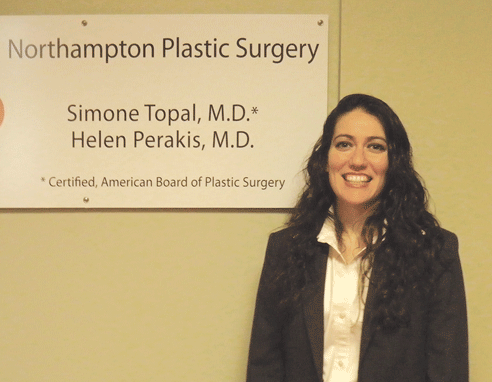
Restaurants Sections
Center Square Grill’s Partners Celebrate an Eventful First Year

Michael Sakey, left, and Bill Collins

Michael Sakey, left, and Bill Collins say the lively tap room turns regulars into friends.

Michael Sakey said restaurants often conduct a soft open with family and friends to work the kinks out before opening the doors to the public.

In the case of Center Square Grill, the East Longmeadow eatery he and business partner Bill Collins launched last spring, the soft opening got a little out of hand. Of the 600 or so people they invited, only 250 said they would come — but 450 showed up.

“By 8 o’clock, we were out of vegetables; then we ran out of proteins,” Sakey said.

Yet, they were enthused by the response to the food that was served — and they’re still excited a year later.

“Sometimes I have to pinch myself,” Collins said. “It’s been a great ride. We’re psyched with our numbers, and the reviews have been great — four and a half stars on Yelp.”

The pair partially credits their success to their chemistry in the kitchen and business, forged over a 15-year friendship, during which they worked for Claudio Guerra, the serial restaurateur behind Spoleto and a broad array of other establishments.

“Not only have we been great friends for a decade, but in business, we both bring different things to the table,” Collins said, recalling how a chance conversation over glasses of wine about 18 months ago turned into a plan to launch their own enterprise. “When we started talking about doing this, it just snowballed.”

Their success in getting off the ground startled them, but also gave them confidence, he added. “We raised the money to buy the place in two and a half weeks. Once we got a ‘yes’ from one investor, we were more comfortable in the next meeting, and the next. By the last meeting, we were like, ‘are you kidding me? Why wouldn’t you invest in our business?”

Opening the doors was a leap into the unknown, but entrepreneurship has suited them so far.

“When we were first talking about a concept we liked,” Collins said, “we thought, ‘wouldn’t it be great if we opened this place, and it didn’t go out of business? That would be really cool. Then, once we got a little more secure, we started to think we’d actually make it. It’s been a ride, going from being salaried employees, getting a paycheck every week, to making sure everyone else gets their paycheck every week.”

For its annual Restaurant Guide, BusinessWest sat down with Sakey and Collins to talk about wine, local produce, restaurant reviews, and the mentor they both credit with giving them the confidence to succeed on their own.

Career Moves

“I always joke that I was an accidental restaurateur,” said Sakey, adding that he studied theater in college. Even then, though, he was a restaurant veteran, having worked at pizza, sub, and coffee shops from age 14. In early 2000, he took a job with Guerra, who was opening Spoleto Express at the time.

“I went in thinking, ‘it’s just going to be for now, until I figure out what’s next.’ Over the next 12 years, it spiraled into spearheading the catering division, helping open many restaurants for Claudio, and becoming really good friends with Bill.”

He was also starting to sense a connection between food and his other passion. “Restaurants can be theatrical,” he said. “It’s kind of like throwing a party every night. If you can make them all happy, that’s something really unique, not like any other industry I can think of.”

Collins knew at a younger age where his career was headed. “I’m an un-accidental restaurateur,” he said. “I joke that I wish being a doctor ran in my family, but, no, my family owned restaurants and hotels in New York.”

He started working in those businesses from a young age and rose through the ranks. “I was the youngest restaurant manager ever hired by Applebee’s,” he told BusinessWest. “The head of HR met with me, tapped me on the shoulder, and said, ‘please don’t tell anyone you’re under 21; I might lose my job.’”

Local art

Local art — fitting for the fare served up at Center Square Grill — livens up the restaurant’s interior.

Collins met Guerra in 1999, when he was 19. While holding down his managerial job at Applebee’s, he worked as a waiter at Spoleto, just to get his foot in the door in a company he had long admired. He eventually became director of operations. “I wound up opening six concepts with him — and we closed some concepts, too. I got to see the good, the bad, and the ugly. He’s been my mentor in the business.”

Sakey recalls how one location Guerra owned morphed from a fine-dining restaurant to something with a pub feel, then to what is now his flagship Spoleto location. “To have three different concepts in one location and still come out on top … it really does take a unique individual to weather the storms of this industry and know when to change and admit to himself that, even though he liked a concept, it wasn’t working as a business.”

As for Center Square Grill, the partners have broken away from the Italian fare Guerra specializes in. “We call ourselves a creative American grill, but we pull from South America, classic French cooking, New Orleans, Jamaica — we even had some Asian dishes,” Sakey said. “We try to do many things well.”

Collins noted that there are about a dozen Italian restaurants in a 10-mile radius, and families tend to go to their favorite. So he and Sakey wanted to bring more variety to the table.

“My favorite thing about the menu is, if you want to come in and get a cheeseburger and an IPA, you can do that,” Sakey said. “If you want to take your wife out and have oysters and a filet topped with crab Oscar, you can do that, too. The menu runs the gamut, and the atmosphere does, too.”

Indeed, the restaurant features a few different dining areas, from a formal dining room to a small room for private events to a lively bar area. “The tap room is where we meet the regulars; they’re actually friends now,” Sakey said, recalling how one regular and her mother were sitting at the bar, talking about making homemade ravioli, and he joked that they should bring him a couple. “The next day, they brought in two platters — one for each of us — and said, ‘dinner’s on us tonight.’”

Guerra himself has visited the restaurant on several occasions, and the partners said he has been supportive of their new venture. “He taught me the culinary side,” Sakey said. “I made my first roux working with him — ‘no, you’re browning it too much, you want that nutty smell’ — but he also taught me front of house. For a guy in chef whites to be just as good in front, that’s incredible.”

Collins agreed. “The guy doesn’t miss a detail in front of house. He burned a lot of that into us.”

The employees have picked up on that sense of pride, Sakey added. “I can’t speak more highly about the staff. Front of the house, back of the house — they take such ownership of what they’re doing. It’s unique and amazing.”

On the Menu

Collins said that Center Square Grill has stayed true to its original core of steak, seafood, and pasta, but the menu offers many iterations on dishes in those categories, and others.

“We’ve tried to change the menu seasonally,” he added. “Most restaurants, out of the gate, don’t change the menu often, but we wanted to change with the season, and use local produce when it’s available, local meat when it’s available. We bought a whole lamb from a farm recently and used every single piece of it.”

Changing the menu also keeps people coming back to try new things, he added. But the regulars do have their favorites, including a crispy duck confit with house-made tomato jam, butternut squash risotto, and seasonal vegetables; seared Maine diver scallops over asparagus risotto and finished with a lemon thyme beurre blanc; Jamaican jerk chicken thighs marinated in a Caribbean rub and served over dirty rice with black bean corn salsa and chiptle aioli; and a slow-braised lamb shank with creamy polenta and seasonal veggies, finished with a twice-reduced port wine demi-glace.

Collins has been on a mission to create lamb converts with the latter dish, arguing that people who say they don’t like lamb are thinking of their grandmother’s gamy-tasting lamb topped with mint jelly. So he created a lamb-based amuse-bouche to give reluctant diners a taste. “I’ve converted every single one of them. I have people who said ‘I don’t like lamb’ ordering the lamb shank.”

Sakey takes particular pride in the restaurant’s impressive — and affordable — array of wine, beer, and cocktails.

“I think our wine program is one of the things that makes us unique. Bill and I know what wine costs, and when we go out and see a bottle of wine being sold for five times the cost, it’s hard to take the leap,” he told BusinessWest, noting that some restaurants mark up the price three or four times what he does. “We want people to be able to try more than the house wine and not worry about getting taken.”

Added Collins, “it’s a matter of inventory — do I want to sell wine, or do I really want to sell wine? It’s no benefit for me to sit on one case of wine for years.”

the restaurant’s outdoor patio

Warmer weather means ideal conditions to enjoy a meal or drinks on the restaurant’s outdoor patio.

To make sure the food keeps bringing people back, the restaurant recent hired Andrew Brow as head chef. “He was chef at a French bistro in North Carolina, but had moved up here to be closer to his family,” Collins said.

Brow took a job as director of operations for Rachael’s Smoked Fish, a division of J. Polep in Chicopee. But his passion for the chef’s life eventually took over. “We wanted him to come in one or two nights, to keep his hand in it, and eventually he left Rachael’s and came here full-time. We’re fortunate — he’s been in the food business all his life.”

Collins characterized himself and Sakey as foodies, noting that they visit other restaurants regularly, keeping abreast of what’s happening in their industry. That passion for food, however, is balanced by what they call a refreshing lack of ego. “It’s collaborative; if Mike has the better idea for a dish, it goes on the menu. If I have a better idea, or if Andrew has a better idea, that goes on the menu.

“I’d be lying if I said there wasn’t a little ego, but it’s ego about getting the best product on the menu,” he went on. “It’s a full-on collaboration. It’s a great process, and it keeps us all energetic about finding new ideas. You don’t want to be the one guy at the table without an idea.”

Star Struck

It has been, by any measure, a strong first year at Center Square Grill. “I don’t think we’re just lucky,” Collins said. “It’s taken a lot of hard work. But we’re fortunate in the way the outcome has turned out.”

As for that four-and-a-half-star Yelp rating, Sakey likes it just where it is, noting that it’s a reminder that he, Collins, and Brow can always aim just a bit higher. “Nothing’s ever perfect,” he said, “but we can be really good.”

Collins disagrees, saying he wants that extra half-star.

“The drive for five fuels my passion for food,” he said, saying it’s a constant obsession. One day, he was telling a friend about a conversation he had with his fiancée, Julia, while lying in bed, telling her about an idea for a new dish.

“Someone overheard me talking about that, and they said, ‘that’s your pillow talk?’ But I’m always thinking about what I’m going to do next, what’s going to be on the table the next day.”

Joseph Bednar can be reached at [email protected]

Restaurants Sections
The Alvah Stone Creates Cuisine for Every Palate

Howard Wein

Howard Wein says attention to detail has led to the success of the Alvah Stone.

Howard Wein is sitting at a copper-topped table positioned directly above the Saw Mill River in the Alvah Stone restaurant in Montague. The view of the waterfall rushing over a rocky surface below is mesmerizing, and the blues music that echoes softly throughout the historic, carefully apportioned structure was carefully chosen by him to enhance the atmosphere.

“We want this to become known as a community-based neighborhood restaurant that is also the best restaurant in the Valley,” said Wein, who opened his eatery a year ago. “But it’s not a special-occasion place. It’s very casual and very comfortable, and we are providing a service and resource to the community that didn’t exist. We are focused on appealing to different people for different reasons at different times of the week, which is why we have such a flexible menu.”

The restaurant is only one of Wein’s undertakings (more about that later). But it brings together everything he has learned in his career, which includes extensive experience in some of the most competitive markets in the restaurant and hospitality arenas.

“I’ve always wanted a brick-and-mortar business in the community, and this is my dream space,” he said. “You could put this restaurant anywhere in the world, and people would find the setting absolutely spectacular. It’s the most unique location within an hour in any direction.”

Preserving the Past

Wein conducted an in-depth study of the building’s history before renovating the interior, as he felt it was important to retain its character. It is one of several establishments in the historic Montague Mill, including the Montague Bookmill and the Sawmill River Arts Gallery.

“Many different things happened in this building,” Wein told BusinessWest. “In addition to being a grist mill, the logo for Louisville Slugger bats used to be stamped on them here, and it was once home to Martin Machine Shop. But the mill was built in 1834 by Alvah Stone, so I took his name for my restaurant.”

He also kept original machinery related to the gristmill’s operation, some of which is still embedded in the floor, and added a few other historic pieces. But he also injected a modern flair into the space, which can be seen in details such as the citron color of the drink menu, which was created to match the hue of the overhead light fixtures.

Wein also built a bar that serves fine wines and draft beer, including Alvah Stone Ale, made for the restaurant by Lefty’s Brewery in Greenfield, as well as a full stock of liquor.

The Alvah Stone was designed to appeal to a wide audience, and its menus include the best meat and produce that can be found in the region, Wein said. “We are very focused on using local ingredients that are produced close to us. Sustainable agriculture is very important to me,” he noted, adding that he doesn’t limit his business to farms labeled ‘organic’ because he knows the certification process is costly and there are many “very small, talented local growers in the area.”

The Alvah Stone’s outdoor patio

The Alvah Stone’s outdoor patio is set above the scenic Saw Mill River.

However, he takes great care with the menu, grouping the selections into several categories. People can stop in at the bar and get a homemade pretzel and a beer or hot dog on a brioche bun, share a few items with friends, or order a full meal prepared with ingredients grown in the area.

For example, the restaurant serves Wagyu sirloin, which is the American version of the renowned Japanese Kobe beef known throughout the world for its quality. “We get it from Royalton Farms in Vermont. They are the only producer east of the Mississippi that breeds this beef. It’s very, very rare,” said Executive Chef Dave Schrier, adding that the farm also raises highly sought-after Berkshire and Mangalitsa pork.

Schrier loves all types of food, and although the menu is strongly influenced by Southern and American dishes, there are also items with a bold Asian influence, such as soba noodles and bok choy. “We don’t label ourselves farm to table, but 95% of what we use comes from local farms,” he said, adding that the menu changes frequently.

Wein said local ingredients, including fresh juices, are used in many of the cocktails, and herbs such as sumac and pepper are infused into vodka and other spirits.

“We give everything we do here a lot of thought. The Alvah Stone is not about me; it’s about the experience people have here and the team who serves guests from the moment they enter,” he said. “It’s also about the colors we use, the music we play, and the way tea is served. Every single detail, including every word on the menu, matters.”

To that end, even the menus are in distinct colors: black and white for the food and citron for the cocktail selection. New drinks are created frequently with names that reference the area’s history, such as the Machine, Scotch Shagger, Old to Alvah, and Gristmill Grog.

Fusion of Knowledge

Wein’s illustrious career has come full circle at the Alvah Stone. He chose to leave a high-profile position in New York City four years ago to move his family to Leverett, which is a six-minute drive from where he established Howard Wein Hospitality LLC in 2011.

Everything on the menu at the Alvah Stone is made at the restaurant

Everything on the menu at the Alvah Stone is made at the restaurant, including the sausages, hot dogs, breads, hot pretzels, and pastries.

He met his wife, Jennifer, in 1993 when they were both students at Hampshire College, and after Wein graduated with a degree in culinary arts and business, he stayed in the area while she finished her studies. “I was cooking at Sienna Restaurant in South Deerfield and was also the executive director for food and beverage at Jacob’s Pillow,” he told BusinessWest.

But he wanted to own his own business, so he returned to school and earned an MBA from the Cornell University School of Hotel Administration, which launched him on an ambitious career path. “I took a job at the corporate office of Starwood Hotels and Resorts in White Plains, New York, and was responsible for 400 hotels doing $2 million of revenue in food and beverages alone,” he said.

His next stint was chief operating officer of Starr Restaurants in Philadelphia, where he grew the company from a $40 million operation with eight locations in the City of Brotherly Love to a $120 million business with 16 locations in three cities. “It was amazing, but it was also exhausting. I was working seven days and at least 120 hours every week,” he recalled.

Four years later, Wein took a job as senior vice president of restaurants, bars, and entertainment for the Morgan Hotel Group in New York City. He commuted back and forth from Philadelphia each day and traveled frequently, as the group has hotels in London, Las Vegas, New York, Miami, San Francisco, and Los Angeles.

But after his daughter was born, he and Jennifer decided it was time to move back to Western Mass., where they wanted to bring her up, so they left and bought a home in Leverett.

“My wife and I grow all of our produce and like being surrounded by an agricultural community,” Wein said. “This is a very liberal, intellectually-minded area, and people here are content with what they do and what they have.”

Shortly after, he opened Howard Wein Hospitality LLC, in the Montague Mill. He said the business has been very successful, with clients including Iron Chefs Geoffrey Zakarian and Scott Conant, who both regularly appear on the Food Network show Chopped.

But when the restaurant space next door became available, Wein was finally able to realize his dream of owning a restaurant business he cares deeply about.

Broad Audience

Wein is active in the community and serves on the Hampshire College board of directors. The institution was one of his clients before he became a board member, however, and he worked to connect the college’s food service with local farms.

As it has grown in popularity, the Alvah Stone expanded from a six- to seven-day operation. “This area is my home, and the restaurant is a big part of that. It’s an amazing place to work at every day, and we have built an amazing team and an amazing brand,” he said.

His statement is backed by positive reviews from both critics and patrons.

“This is a phenomenal place. It’s very calming and conducive to a fine dining experience,” said Nina Pollard from Hadley as she sat outside on a recent weekend and looked at the river rushing by.

Her dining companion agreed. “It’s a real retreat. The sights and sounds make it a moving oasis and work together to create a special ambience,” said Ann Kenny from Merrimack, N.H.

Wein is glad that people are enjoying his eatery and hopes it will grow and became a significant fixture in the Montague Mill’s history.

“We are trying to build something that will still be here in 50 years,” he said. “We are really committed to this, and everything we do is with a long-term vision in mind.”

Features
Plan for Progress Gets a 10-year Overhaul

PVPC Executive Director Tim Brennan

PVPC Executive Director Tim Brennan

Tim Brennan acknowledged that it was a loose analogy, but thought it worked effectively.

He was comparing the Plan for Progress — a document first drafted two decades ago by the Pioneer Valley Planning Commission (PVPC), which he serves as executive director — to an automobile.

“They both need regular maintenance, like oil changes,” Brennan explained, noting that the plan requires periodic fine-tuning to reflect changes in everything from demographics to economic-development strategies to government funding priorities. “And they both need major engine overhauls.”

For the Plan for Progress, those overhauls come every 10 years — less-involved updates are undertaken every five — which means the one announced May 4 is the second since the document was first inked in 1994.

And it stresses a number of priorities for this region moving forward, especially the all-important matter of workforce supply and creating more of it. Many Baby Boomers have retired, and tens of millions more will do so over the next 10 years or so, said Brennan, and the task of replacing them will severely test the region and pose a significant challenge for virtually all business sectors, from healthcare to manufacturing to the huge service industry.

This isn’t exactly a news flash, Brennan acknowledged, noting that the Plan for Progress and a host of other reports have sounded the alarm on this phenomenon for more than a decade. But the situation — which was in many ways helped by the Great Recession and its impact on retirement-savings efforts, which forced many Boomers to stay in the workforce longer than they planned — will soon reach a critical stage, if it hasn’t already.

That means the region will soon have to address the matter far more aggressively, and effectively, than it has, despite all those warnings.

“On the talent side, we’re having this whoosh,” he said, using that term to describe the Boomers who have left the workforce or soon will. “Talent is job one; the most important issue for economic development isn’t tax breaks or raw materials or land — it’s really talent now.

“This has been going on for a while,” he went on. “But it’s becoming more intense, and all the projections for the next 10 to 15 years are for labor shortages. We need to intervene.”

There are many other focal points, or so-called ‘decade declarations,’ within the 27-page report, titled “2015-2025: Building Strategies for the Region,” which is available for viewing at www.pvpc.org. They come in three forms — goals, key opportunities, and key challenges — and all of them are regional in scope and focus.

Improving flow in the talent pipeline obviously falls in that last category, where it is joined by “fragile infrastructure systems” and “retention and growth of existing businesses.”

The updated Plan for Progress

The updated Plan for Progress identifies a number of goals, opportunities, and challenges, all with a regional focus.

The key opportunities, meanwhile, involve “leveraging new connections that significantly enhance the region’s economic competitiveness” — a reference to everything from enhanced rail service to broadband networks; “leading the Commonwealth’s clean-energy transformation while moving the region toward a balanced and diversified energy portfolio”; and “harnessing the economic-development potential of the New England Knowledge Corridor.” That’s something Brennan says both Western Mass. and Northern Conn. have essentially failed to do since the corridor was conceptualized 15 years ago.

As for goals, well, there are four of them, which essentially encompass both those challenges and opportunities:

• Develop and maintain a globally competitive and regionally engaged talent pool;
• Foster an environment where established, new, and growing businesses and organizations can thrive;
• Implement and enhance the infrastructure that connects, sustains, and ensures the safety and resiliency of the region; and
• Conduct economic-development activities in a regionally responsible manner, prioritizing collaboration and engagement.

Of course, putting goals, challenges, and opportunities — all identified by a large Plan for Progress coordinating council over the past 16 months or so — down on paper is only one step in the process, said Brennan, adding that the report also identifies specific strategies for reaching those goals and addressing concerns.

As an example, he cited the plan’s last major overhaul, which, among other things, identified a critical need to cultivate young leadership in the region. Strategies to address that matter included creation of what came to be known as Leadership Pioneer Valley, which has created an extensive program to groom young leaders and familiarize them with the region.

Regarding the stated goal of developing a talent pool, the report recommends strategies ranging from bolstering early education to improving K-12 achievement and graduation rates, to enhancing career and workforce training initiatives.

For this issue, BusinessWest takes a look under the hood at the latest update of the Plan for Progress and the priorities it has identified.

Borderline Opportunities

Over the past 15 years, Brennan noted, the Knowledge Corridor, the region stretching from the Vermont border to New Haven, has become a brand. Just how well-recognized a brand it is, both regionally and nationally, is a subject for debate, he said, but added that it clearly hasn’t become much more than a brand.

Moving forward, however, it must do so, he went on, noting that, when it comes to economic development and attracting and retaining employers, there is obviously strength in numbers. The corridor has those, he said, citing a combined population of more than 2.7 million people. It also has more than 40 institutions of higher learning, several major healthcare providers, an international airport, and a host of other assets.

All of these must be exploited and effectively sold, he told BusinessWest, because promoting the Valley’s place in this broader region is perhaps its best hope for growth, given trends Brennan believes will only accelerate in the years and decades to come.

“That critical mass makes us the 20th-largest market in the country, and that’s not inconsequential,” he said. “Our future fortunes are tied to moving beyond this being a brand, and putting as much substance as we possibly can into this and working together.

“It’s a whole new economic ballgame out there; we have to put a different team on the field, and we’ve got to play differently than we did 10 or 20 years ago,” he said, adding that the two states and their leaders will have to put aside the parochialism that his existed historically. “Our nation is going to morph into about a dozen mega-metropolitan regions, and we need to be part of that. I remember one guy said, and I’ll never forget this, ‘you guys better watch out, or you’ll become a cul-de-sac in New England.’”

Harnessing the potential of the Knowledge Corridor is one of the opportunities identified by the report, said Brennan — and they are opportunities, he added, even if some people don’t necessarily recognize them as such. He puts the corridor, those aforementioned ‘connections’ — especially rail service — and the potential to lead the state’s clean-energy transformation firmly in that category.

Regarding rail service, which Brennan has long advocated as a potential economic engine, the emphasis moving forward must be on not only enhancing north-south connections — which have dominated the discussion and the progress made to date — but expanding east-west connections as well.

At present, there is one train a day (the Vermonter) running from Vermont to Springfield, and real potential to bring perhaps a dozen trains a day running between Springfield and New York. A Springfield-Boston connection is further from reality and will come with a hefty price tag, probably hundreds of millions of dollars, said Brennan, but there is considerable interest in one, there have been some signals of support from the Baker administration, and a 2024 Boston Olympics may provide the needed incentive to get the job done.

In the years to come, Tim Brennan says, the Knowledge Corridor must become much more than a brand.

In the years to come, Tim Brennan says, the Knowledge Corridor must become much more than a brand.

“We think this has a lot of benefit potential,” he said of rail service in any direction. “Wherever you have a place where trains land, whether it be at Union Station [in Springfield] or one of the platforms to the north, you get these sort of hotspots of development around it — a quarter-mile or half-mile around the station, you tend to get a development surge.

“If you have enough service and it’s reliable out on that rail line,” he went on, “young people and seniors tend to gravitate toward this kind of living situation more and more.”

He cited Boston as an obvious example, even with all the problems that visited the Massachusetts Bay Transportation Authority this past winter.

“We’re not arguing that we’re Boston, but we have a toehold on north-south connections to New York,” he explained. “And if we can offer good, robust, reliable service … we’re an affordable area, and people can commute from here. We think we can capture folks, and that’s one way to build the talent pool in the Valley.”

As for the movement away from fossil fuels, this could be an opportunity to create jobs, said Brennan, and also maneuver around what is becoming a growth-stifling problem with natural-gas distribution.

“I think there’s a transformation going on,” he said of what some call a nationwide trend toward greener sources of energy. “And those who lead it are going to be in a better situation to be economically competitive.

“The numbers seem to indicate that we’re a leader inside a state that’s a leader,” he went on. “So let’s keep that going.”

Going into Labor

While the report urges action on the many opportunities it identifies, the main thrust of the document is its focus on the talent pool — how to ensure there is a deep one for the years and decades to come, and the sense of urgency that must be attached to efforts to address this concern.

“One of our biggest assets in the Valley and the Knowledge Corridor is one of the most highly productive workforces in the country,” said Brennan. “But the question we’re facing is, how do we replace those men and women and keep that asset in place?

“On the supply side, we need lots of replacement troops,” he went on, adding that, while the situation hasn’t reached a critical stage (at least in some sectors) because many individuals are working longer than they anticipated a decade ago and others have embarked on what’s known as ‘soft retirement,’ where they’re still in the workforce but on a part-time basis, serious crunch time is fast approaching.

The emphasis isn’t solely on numbers, he said, adding that the accumulated talent must possess the skills required by businesses — and there will be many of them — with ‘help-wanted’ signs out. “On the demand side, you have lots of jobs that are opening, but do the bodies have the skills to fill those posts?” Brennan asked rhetorically, adding that, too often, the answer is ‘no.’ “So it’s a two-pronged problem.”

The region’s employers, not to mention workforce-related agencies such as the regional employment boards, have long recognized the existence of a skills gap, Brennan went on, and there have been efforts to address it.

Moving forward, there must be more initiatives such as Training & Workforce Options (TWO), created by Springfield Technical Community College and Holyoke Community College to assist employers with the challenge of training individuals for specific jobs, and Westfield Vocational Technical High School’s new program to train people for jobs in the aviation field.

“We need to intervene over the next decade,” said Brennan, “so that, by the end of this 2015-2025 period, we’re not wringing our hands about how we had a problem, we forecast it, and yet we didn’t do enough it to change it.”

Such intervention efforts must involve a number of players, including the workforce-development agencies and the region’s many colleges, he said, adding that the focus will be on everything from early childhood education to training and retraining those already in the workforce or on the outside looking in, to stemming the so-called brain drain.
“There’s a lot of talk about how we get more of the public and private colleges to offer internships in jobs that are in the career paths of young men and women, so they get a job as they come out with their degree,” he said, adding that the talk needs to turn to action. “The message has gotten through, but we need a lot of implementation out there to tackle this for the long term.”

But talent is only one of the issues facing area business owners and managers, said Brennan, noting that one of the updated plan’s goals is to foster an environment where established and new businesses can thrive.

Like efforts to grow the talent pool, meeting this goal will be a multi-pronged effort, he said, adding that there is a great deal of entrepreneurial energy in the region and thus a large number of startups and early-stage businesses. Likewise, there are a number of businesses led by Baby Boomers who will be retiring soon and are thus facing the many daunting issues involved with transitioning to the next generation — or deciding if there will be a transition.

These ventures will need assistance in forms ranging from capital to succession planning to, yes, talent, Brennan said, noting that the region must build on an already-significant support network.

“When we did a growth-business study with the Donahue Institute, they said the good news from the recession period was that most of the small businesses hung in there — we didn’t have an avalanche of closures; they sort of held their ground,” he explained. “And now, many of these companies are growing; what resources will they need in order to continue growing?

“Many of them need an infusion of capital, and some of them are so small that they can’t get away from the oven or the drill press to go look for help,” he went on. “We need to create ways to get information to these small businesses in a user-friendly way, and we need to make these services more seamless so they don’t have to go here for this and there for that.”

Driving Forces

Like the original Plan for Progress and the first 10-year update, this latest document is intended to serve as a road map of sorts, said Brennan, identifying preferred routes and speed bumps on the way to a more prosperous future for the Pioneer Valley.

With this latest overhaul, the region now has some directions to follow, he went on, adding that, if area leaders stay on course, they should reach the intended destination.

But the road ahead has a number of curves, he implied, and the region would be wise to heed both the speed limit and the many caution signs.

George O’Brien can be reached at [email protected]

Community Spotlight Features
West Springfield Focuses on Memorial Avenue

Mayor Ed Sullivan

Standard Plating on Main Street was devastated during the 2011 tornado, and Mayor Ed Sullivan says the city is working to clean up the property and market it.

West Springfield is a city on the move, Mayor Edward Sullivan says, and the Memorial Avenue corridor is exhibit A.

“We’re excited about the work that will be done and think there will be some great multi-purpose opportunities along the corridor,” he told BusinessWest. “It has needed work for years, and the redesign we’re planning will make it a pretty special place to own a business. It’s close to major highways, and the MGM casino in Springfield will increase traffic.”

Indeed, an increase in vehicular traffic is expected when the casino opens in Springfield’s South End, right across the Connecticut River, in 2017. While that’s not why the work is being undertaken, the casino has changed the scope of what will be needed, since pedestrian and bicycle travel are also expected to rise.

And one of the major projects is already underway. The rotary on the West Springfield side of Memorial Bridge, which contains two overpasses of Route 5 to the north and south, is being reconstructed by the state Department of Transportation under its Accelerated Bridge Program.

The rotary bridges were found to be structurally deficient several years ago (but still safe to drive on), and crews have been working since March to relocate major utility lines and perform other preliminary work. Phase 2 of the project will take place from May 29 to June 2, and officials anticipate the third phase will be completed over another long weekend, June 19-23.

“The bridges are being prefabricated offsite and will be handicapped-accessible. It’s important because some [pedestrians] have complained they can get on the bridge in Springfield but can’t get off it in West Springfield,” Sullivan said.

In fact, the project has been designed in accordance with the state’s Complete Streets program, with the goal of expanding mobility for all types of traffic, including pedestrians and bicyclists, while supporting a healthier environment and creating a stronger community.

Department of Public Works Director Robert Colson told BusinessWest that the state staged two public meetings in advance of the work, and its final design reflects concerns expressed by people who attended the sessions.

“MassDOT has taken the existing footprint of the rotary into account, and the new bridges will have protective curbing to delineate motorists from pedestrians and cyclists, very similar to what is on the Memorial Bridge,” said the mayor, adding that the sidewalks curving around the rotary will be eight to nine feet wide. “It’s important, especially during the Big E, because the fair generates a lot of foot traffic.”

The design includes flashing lights that pedestrians will be able to activate with the press of a button to alert motorists they will be crossing one of the junctions in the rotary that lead to Route 5, Memorial Drive, and Riverdale Street.

The rotary marks the gateway to the Memorial Avenue corridor from Springfield, while the gateway from Agawam lies at the other end of the roadway, and the entire 1.7-mile strip will be revamped. To meet that goal, the city signed a contract several weeks ago with Greenman-Pederson Inc. to create a design that will incorporate principles in the Complete Streets program. It will be paid for with $280,000 from the city’s capital-budget funding, which was set aside in previous years for the project, and $665,000 received from MGM as part of a compensation agreement to deal with the expected increase in traffic.

When the design for the corridor is finished, Sullivan said, the city will seek grant money from MassDOT and MassWorks to pay for work that will need to be done, which will include infrastructure improvements, such as new pavement and replacement of underground utility lines.

City officials hope they will be awarded funding for the project, but Sullivan said he met with the director and staff of MassWorks on April 15 and was told the grants are very competitive and they could not guarantee anything. However, Colson is cautiously optimistic that the project will be given a high-priority status.

“Normally, we would wait 10 years for a project of this magnitude to get on the list,” he said. “But we are very hopeful that the design by GPI will become a high priority because of the casino and the increase it will bring in traffic. We can’t just fix the pipes and pavement. We have to turn Memorial Avenue into a Complete Streets corridor; otherwise it could present a significant safety hazard.”

Sullivan explained that residents in the Merrick and Memorial neighborhoods in West Springfield will be closer to MGM than people in neighborhoods in Springfield, and those who get jobs at the gaming establishment may choose to walk to work, which would be an easy commute over the Memorial Bridge.

“Plus, the Big E is the number-one tourist attraction in New England, and the casino will be at the other end of the bridge,” he added. “There will be two main attractions at either end of Memorial Avenue, so we expect a real increase in pedestrian, bicycle, and vehicular traffic.”

Continued Progress

Although Memorial Avenue is built out, Sullivan said it’s possible to “take old space, rehab it, and make it new, and West Springfield will serve as an example of how it can be done.”

To that end, the city is working with the owner of Standard Plating to clean up the property that was demolished by the 2011 tornado, take ownership of it, then market and sell the site.

The city received $750,000 from the Community Development Block Grant – Disaster Recovery program to remove contamination at the brownfields site and raze the building, which sits on 964 Main St., within walking distance of the Memorial Avenue rotary.

“We’re in the process of studying the environmental hazards and coordinating efforts with the Department of Environmental Protection,” said Joe Laplante, director of Community Development. “We hope to have all of the work done by the end of the year and have a vacant lot available for development. It’s not only a good spot for a business, it’s an important part of the [Memorial Avenue] strip aesthetically as visitors come into West Springfield.”

Although the Memorial redesign has not begun, change is already occurring, and Sullivan believes infrastructure and aesthetic improvements will spur growth in the future. Footit Health Care Store is getting a facelift, and Fathers and Sons plans to demolish a number of its buildings and construct a new $3 million Audi showroom and service center along the thoroughfare.

Plans are also in place for the former St. Ann’s Church site that Colvest-West Springfield LLC purchased from the Diocese of Springfield. Sullivan said the developer hopes to build two retail storefronts and a bank with an ATM on the property, and its proposal has advanced through the site-planning review process and will be voted on during the second City Council meeting in May.

Special efforts are also being made to help new Americans in the Memorial-Merrick neighborhoods who want to start businesses, and SCORE of Western Massachusetts, which provides free services to entrepreneurs, has been working in conjunction with Tara Gehring, the city’s economic development coordinator and assistant planner, to facilitate their needs.

In addition, a collaborative effort is taking place between SCORE, the city, and Ascentria Care Alliance, which also provides services to help people who own or want to start small businesses. “We are working together to host a seminar on what it takes to open a business in West Springfield,” Sullivan explained. “We will guide participants through the permitting process required by the Health Department, Building Department, Planning Department, and License Commission so they know the steps they will need to take to obtain a certificate of occupancy and open the doors to a business. It will be an amazing event, and we will have interpreters to bridge language barriers.”

Meanwhile, the Community Development office and police substation recently moved into a 3,000-square-foot building at 389 Front St. that was purchased last year with $775,000 in Community Block Grant funds. The offices had been housed in rented space on Front Street, and the new location will double their space. “We are thrilled about our new home. It’s right next door to Alice Corson Playground, which is the only full-fledged playground in the neighborhood, and since it’s twice the size of our old facility, it’s a perfect place to share with the community,” Laplante said.

The building, which most recently served as a daycare facility for Sunshine Village, had been vacant for several years, and the owner approached the city when he was ready to sell it. “We thought it was a really good match for what we needed,” Laplante added.

The Parks and Recreation Department will have a satellite office and community room in the back of the building, and the community policing station will face the playground. The mayor said the interior has been completely renovated, thanks in part to in-kind donations from Home Depot. The city also plans to install new sidewalks and conduct targeted rehabilitation work on lower-income housing in the neighborhood.

Other renewal ideas will come to fruition in the second phase of the Merrick-Memorial Avenue Study, completed last year by the Pioneer Valley Planning Commission and reviewed by the Redevelopment Authority. It will serve as the master plan for Memorial Avenue, with suggestions including the enhancement of the River Street area by redeveloping the empty lot that formerly housed the Medallion Motel.

“The idea is to build a professional building there,” the mayor said, noting that the study proposes construction of a mixed-used structure with retail shops on the first floor and office space or apartments on the second floor that could help fill the need for multi-family housing in the city.

Bright Outlook

The MGM casino will not be completed for several years, but officials believe it will benefit businesses on Memorial Avenue. However, the city is determined to maintain the quality of life in neighborhoods that will be in close proximity to the gaming establishment. To that end, an overlay district was approved last July that prohibits the establishment of a wide range of businesses, including adult book stores, adult clubs that display live nudity, adult motion-picture theaters, check-cashing and pawn shops, hourly-rental hotels, and similar operations.

“It’s important to maintain and improve the quality of life for our residents and keep unwanted businesses out,” Sullivan said, noting that the district is bordered by the Westfield River to the west and south, the Agawam town line to the southeast, the Connecticut River to the east, and Park Street and Park Avenue to the north.

Plans are also being made to improve other areas of the city, and the state Interagency Permitting Board recently voted to accept portions of Front Street as a “priority development site,” including the former Southworth Paper Co. mill. Consultants have suggested using the main building, which contains most of the available space, for mixed-use development, and officials say having that area of Front Street designated as a priority development site will increase the likelihood of obtaining grant money and guarantee local permitting within 180 days, along with help from the state in marketing the site.

Sullivan said efforts are also being made to streamline the city’s permitting process via software that will allow people to do business online. “It will be in place by the end of the year, and we plan to open a kiosk in Town Hall where people can fill out applications for large projects and pay with a credit card.”

In addition, the Morgan Sullivan Bridge, which spans the Westfield River and leads from West Springfield into Agawam, is slated for reconstruction in 2017 and will also be redesigned according to the Complete Streets program.

“The projects we have planned are big and will take a few years to finish, but we are anticipating change,” the mayor said. “The potential is unlimited, and as we move forward into the 21st century, we believe Memorial Avenue will become even more vibrant than it is today.”

West Springfield at a glance

Year Incorporated: 1774
Population: 28,391
Area: 17.5 square miles

County: Hampden
Residential Tax Rate: $16.99
Commercial Tax Rate: $33.19
Median Household Income: $54,434
Family Household Income: $63,940
Type of Government: Mayor, City Council
largest employers: Home Depot; Interim Health Care; Mercy Home Care; Northeast Utilities

* Latest information available

Meetings & Conventions Sections
Smith College Conference Center Offers a Slice of Paradise

Smith College Conference CenterAddie MacDonald was offering a quick tour of the Smith College Conference Center.

He started in the front lobby and quickly moved on to the main meeting room, ticking off its various amenities — including a host of seating possibilities, state-of-the-art audio-visual systems, ample parking, and a slew of catering options — as he walked.

“And then … there’s that,” he said, gesturing out the huge windows covering one side of room.

‘That,’ of course, is Paradise Pond and the many views of it and the surrounding grounds that are perhaps the best selling point of this relatively new entry into the highly competitive local market for meetings and conventions.

Intriguing even in winter, the pond area is exceptionally beautiful in the spring and fall, said MacDonald, manager of the conference center, adding that the views — from the Paradise Room, as that aforementioned main meeting facility is called, to the deck nearby and many of the other rooms in this complex — certainly help explain why this facility has become an attractive option for groups of several sizes since it opened to the public only four years ago.

But there is more to this venue than what’s visible out the windows, or experienced up close if one chooses to venture outside during a break in the proceedings in question — which almost everyone does, said MacDonald.

There’s the location — downtown Northampton and, more specifically, the Smith campus, which boasts everything from century-old buildings to its famous botanical garden (designed by the firm headed by Frederick Law Olmstead, who also conceptualized Central Park), to the pond and its waterfall — which is something decidedly different among meeting venues. There are also the many catering options available, said MacDonald, adding that the facility’s kitchens have been used by many of the city’s renowned restaurants to prepare meals for clients.

Addie MacDonald

Addie MacDonald says the Smith College Conference Center is off to a good start because of its mix of scenery and amenities.

Addie MacDonald says the Smith College Conference Center is off to a good start because of its mix of scenery and amenities.
[/caption]Until very recently, these views and amenities could be enjoyed only by Smith faculty and invited guests. Indeed, the conference center, or at least the main building in the complex, was once the Faculty Club and then the College Club, said MacDonald, meaning it was open only to faculty and staff and was, as he put it, the “social epicenter for the academic mission of Smith.”

“For years, there is where faculty would come to wine and dine and entertain lecturers who would come from out of town, or interview potential candidates,” he explained, adding that the conference center is comprised of two buildings — the 1950s-era former Faculty Club, and a century-old building eventually acquired by the college that was believed to be the home of a buggy-whip manufacturing facility. “And this was ultimately a place where they could freely speak, exchange ideas, develop coursework, and invite other professors from local colleges.

“Over the years, it became more and more popular, and the college decided to open it up to the Northampton general public — and then well beyond,” he continued.

Mostly through word-of-mouth referrals, it quickly became the site for a wide array of functions — from weddings to corporate retreats; from holiday parties to meetings of the U.S. Fish & Wildlife Service.

“They do retreats, and once or twice a year they might meet here to discuss policy — I think they like looking at our pond because they can identify the various ducks that are coming and going from there,” MacDonald joked, referencing the fish and wildlife agency.

He told BusinessWest that Smith has become more aggressive in its marketing of the conference center in recent months, and it can certainly no longer be considered a hidden gem or best-kept secret.

It now stages more than 25 weddings a year, and the calendar, especially for those warmer months, fills up quickly.

“In many respects, this is like a classic startup business with a great infrastructure behind it,” he said of the venture. “And it’s gone well — we’ve picked up business even faster than we anticipated; the location has really attracted a number of people.”

For this issue and its focus on meetings and conventions, BusinessWest takes in the views at the Smith College Conference Center and examines why it has quickly become a venue of choice for many different types of groups.

Setting the Stage

MacDonald brings an intriguing background to his role as manager of the conference center.

Indeed, the Vermont native eventually settled in New York City, where he worked for years for the Directors Guild of America, handling a number of screenings and movie premieres in Gotham.

“It was the classic New York job in many ways — a lot of late nights and meeting many interesting people,” he explained, adding that there were several factors that motivated him to come back to New England and get this startup successfully off the ground.

The deck, with its views of Paradise Pond

The deck, with its views of Paradise Pond and the many forms of wildlife that inhabit it, has become a popular spot at the Smith College Conference Center.

“New England is in my blood, and my wife and I really knew that we wanted to find a place to settle down and find a community,” he explained. “We found all that in Northampton and Smith.”

But there are still quite a few of those late nights that he was in many ways hoping to leave behind, he went on, adding quickly that this is a good thing because it’s a clear sign that the conference center is off to a strong start in its bid to become a player in the region’s meeting and conventions market.

“We hit the ground running, because part of my charge here was to bring in new business, and people from Northampton and beyond, across Western Massachusetts, have always been eager to come to campus, utilize our facilities, and take advantage of the many resources we have here — and, quite frankly, impress their clients, because the view and this location are unparalleled.”

As MacDonald mentioned, the conference center, which was given a facelift in early 2014 — one that opened up the lobby area and gave it a new façade — is more than one room with a great view. Offering a more elaborate tour, he and Merrilyn Lewis, associate director of the Events Management Office at Smith, stopped at a number of smaller rooms that are appropriate for a number of different types of events.

There’s the Oak Room, which can accommodate 75 for a reception, 100 for theater-style seating, and 55 for a seated dinner. There’s the adjacent lounge, which can host 50 for a reception, said Lewis, adding that clients can book both rooms for a slightly larger event.

There’s also the so-called Directors Room, which can seat 15 for meetings, and Meeting Rooms B and C, which can accommodate six and 15 people, respectively. Meanwhile, the lobby and adjoining deck, which can accommodate 75 for a reception, has become a popular alternative, in part because it brings guests even closer to the beautiful surroundings and allows more of the senses to get some exercise.

“Everyone likes it out here, and it’s part of the attraction; not many venues have an outdoor location that’s this convenient,” said MacDonald as he stepped onto the deck, noting that various forms of wildlife often come into view, including some otters that recently established residence nearby and have put on some good shows for guests.

the conference center at Smith

Addie MacDonald says the conference center at Smith is much more than a room with a view.

The venue is a natural for weddings because of the facilities and surroundings, said MacDonald, adding that the center has booked several, some involving individuals, especially students, who have connections to Smith, but also many others who don’t.

And already, a number of businesses, nonprofit groups, and even government agencies have discovered the conference center, said Lewis, noting that Yankee Candle, headquartered in nearby Deerfield, has hosted a number of events there, as has Baystate Health, the Northampton School District, United Way of Hampshire County, and others. Some of those groups are based a few blocks or a few miles from the campus, but many others are headquartered in Springfield and points further south and east.

“Sometimes, when you’re staging a company retreat, it’s nice to hold it away from the office in a completely different setting, which frees up thinking,” Lewis explained. “And that sentiment has brought a lot of people here.”

And while the spring, summer, and early fall are easily the busiest months, the center books a number of corporate outings and annual meetings in the winter, and the venue has hosted a number of smaller holiday parties as well.

View to the Future

Looking ahead, the conference center’s obvious goal is to add more events to its calendar, said MacDonald, who told BusinessWest that he expects this will happen as more individuals and groups come to the facility for the first time.

This will lead to more word-of-mouth referrals, he noted, as well as repeat business — and there has already been a good amount of that.

“We’ve been very fortunate to have a number of repeat clients because of the convenience, location, and simplicity of it all,” he said, adding that a number of businesses and nonprofits have returned several times.

They obviously liked what they saw — both literally and figuratively.


George O’Brien can be reached at [email protected]

Features
Panel will decide for the Continued Excellence Award winner

Carol Campbell

Carol Campbell

Eric Gouvin

Eric Gouvin

Kirk Smith

Kirk Smith

With nominations now being accepted for BusinessWest’s Contined Excellence Award, three judges — Carol Campbell, Eric Gouvin, and Kirk Smith — have been chosen to study the entries and determine an inaugural winner.

The new award, sponsored by Northwestern Mutual, is an offshoot of BusinessWest’s 40 Under Forty program, which recognizes young professionals for their career accomplishments and civic involvement. The Continued Excellence Award will be presented annually to one former 40 Under Forty honoree who, in the eyes of the judges, has most impressively continued and built upon the track record of accomplishment that earned them 40 Under Forty status.

The award will be presented at this year’s 40 Under Forty Gala on June 18 at the Log Cabin Banquet & Meeting House. All 40 Under Forty winners from 2007 through 2014 are eligible. Nomination forms are available at businesswest.com and due by 5 p.m. on May 22.

For each application, the judges have been asked to consider how the candidate has built upon his or her success in business or service to a nonprofit; built upon his or her record of service within the community; become even more of a leader in Western Mass.; contributed to efforts to make this region an attractive place to live, work, and do business; and inspired others through his or her work.

The judges will first narrow the field of nominees to five candidates, who will be informed that they are finalists for the coveted honor — an accomplishment in itself. They will then choose a winner, the identity of whom will not be known to anyone but the judges until the night of the event.

The judges are:

Carol Campbell, the founder, president, and CEO of Chicopee Industrial Contractors Inc. (CIC), an industrial contracting company established in 1992, specializing in providing quality services in plant relocation, machinery installations and riggers, millwrighting, and industrial construction.

Campbell serves on the boards of Associated Industries of Massachusetts, the Greater Chicopee Chamber of Commerce, Health New England, Westmass Area Development Corp., and the Women’s Fund of Western Massachusetts. In 2014, she was honored as Woman of the Year by the Professional Women’s Chamber, and in 2002, CIC was honored by the Greater Chicopee Chamber of Commerce as Business of the Year. She was a judge of BusinessWest’s 40 Under Forty Class of 2009.

Eric Gouvin, dean of the Western New England University School of Law. A faculty member since 1991, he teaches in the areas of corporate and commercial law. He has published numerous law-review articles, has taught and presented papers around the world, and is a co-author of the treatises Blumberg on Corporate Groups and The Law of Corporate Groups: Jurisdiction, Practice and Procedure.

Gouvin is the founder of both the law school’s Small Business Clinic and the university’s Center for Innovation & Entrepreneurship. He has been involved in the Entrepreneurship Ecosystem Committee of the Economic Development Council of Western Massachusetts. He sits on the advisory board of the Entrepreneurial Initiative of the Harold Grinspoon Charitable Foundation and on the Kauffman Foundation’s eLaw website editorial board. He served as a judge of BusinessWest’s 40 Under Forty Class of 2011.

Kirk Smith, president and CEO of the YMCA of Greater Springfield. Smith grew up in a single-parent home with seven siblings in the largest ghetto in Cincinnati, a community that was crime-, drug-, and alcohol-infested. To stay out of trouble, he played sports at the Boy’s Club. Today, he helps other young people stay out of trouble and achieve success.

In addition to his role at the YMCA, Smith is an ordained minister and motivational speaker. He has been featured on several national and local television shows and in news publications and magazines discussing YMCA work in urban communities and professional staff development. He served as a judge of BusinessWest’s 40 Under Forty Class of 2012.

Meetings & Conventions Sections
Entrepreneur Resurrects Chicopee’s Fabled Kielbasa Festival

kielbasa is king at the K-Fest

In the event’s revitalized form — as it was in the ’70s and ’80s — kielbasa is king at the K-Fest.

Rich Kos says it was sometime in the early ’80s; he doesn’t remember the specific year.

What he does remember is meeting the professional wrestler Ivan Putski — known then, and probably still, as the “Polish Power” and “Polish Hammer” — as he made the rounds during Chicopee’s annual Kielbasa Festival.

“He was quite the hit as he walked around the grounds — kids, and grown-ups, kept running up to him,” said Kos, who was city solicitor then, and is now in his second go-around as mayor. “That’s just one of many memories I have from the old days.”

Seemingly everyone from Chicopee has a mental photo album crammed with snapshots from the festival and those ‘old days,’ meaning the ’70s and ’80s, when the K-Fest, as it was called, would draw north of 80,000 people to the rear parking lot of the old Fairfield Mall for its annual four-day run in September.

License plates from states half a continent away would dot the parking lot, and national and even international acts, including some of polka’s greatest legends, would entertain the throngs. There were rides, attractions, and the ‘world’s largest kielbasa’ contest, with the winner weighing in at several hundred pounds.

Alas, the old days eventually became solely the stuff of memories, as the K-Fest succumbed to many ills (more on all that later) in the mid-’90s and was discontinued.

And it might have remained a part of the city’s past if Tom Kielbania Jr. didn’t set about to create some new old days more than 18 months ago.

That’s when this serial entrepreneur of sorts — he’s been involved with everything from music (as drummer for the ’80s dance band Orange Crush) to real estate — decided the K-Fest could be revived, and it could succeed as a for-profit venture, even if there was no shortage of people telling him that was flawed thinking.

“There were a lot of doubters — some people told me I was crazy,” he told BusinessWest as he recalled how he brought back the festival roughly a year ago at Szot Park. He believes more than 16,000 attended that rain-bothered event, which did well enough in his estimation to convince him that he had made the right decision.

Year two of the ‘new’ Kielbasa Festival is set for Memorial Day weekend. Kielbania is expecting perhaps 40,000 people if the weather cooperates. They’ll be treated to a wide array of entertainment, including a host of polka banks and, yes, Orange Crush. There will be a wide assortment of kielbasa, Polish food, barbecue, and other menu options, as well as rides and other attractions.

“This will be a family event, like it was all those years ago,” he said, adding that now, as it was then, the K-fest will be a celebration of Chicopee as much as it is a celebration of Polish food and traditions.

For this issue, BusinessWest talked at length with Kielbania about why and how he resurrected this event once synonymous with Chicopee, and with others about what it all means for this community.

Spicing Things Up

The ‘new’ Kielbasa Festival, or K-Fest

The ‘new’ Kielbasa Festival, or K-Fest, as it’s called locally, drew solid crowds its first year, despite some inclement weather.

Steve Jendrysik is considered Chicopee’s unofficial historian. Thus, the retired social-studies supervisor at Chicopee Comprehensive High School can easily recite the life and times of the K-Fest, and has done so in many ways, including a regular column on Chicopee history he has written for the Republican since 1998 and as a major contributor to several of the Arcadia Publishing books on the city.

He told BusinessWest that, ironically, the festival was started not by a member of the city’s large Polish population, but rather by an Irishman, Neil O’Leary.

He owned a dry-cleaning business down the street from the main entrance to Westover Air Reserve Base, said Jendrysik, adding that it was O’Leary’s idea to create a community event centered around what was arguably Chicopee’s signature product. There were several shops producing kielbasa at that time, including Chicopee Provision Co., makers of the Blue Seal label for more than a century.

He pitched the idea to the Chamber of Commerce, and it eventually became the purview of that agency’s fund-raising arms, known as the Fireball Club (a men’s group) and the Super Cs (for women).

“This was a product of that era — in the ’70s, festivals were very big,” said Jendrysik, citing Wilbraham’s Peach Festival and the myriad ‘Tastes’ that became popular in the ’80s as other examples.

The festival started small, as a larger version of an event run by St. Stanislaus’ parish, he said, but eventually gained momentum — and much larger crowds — through the participation of big-name polka bands from around the country — including Jimmy Sturr’s Orchestra, Lenny Gomulka and the Chicago Push, and others.

The K-Fest, staged the week before the Big E and often featuring many of the same rides and attractions as the fair, enjoyed a mostly healthy 20-year-run, said Jendrysik, adding that there were several factors that eventually led to its demise in 1994.

Chief among them was simply fatigue on the part of organizers, he noted, adding that this was a volunteer-led effort, and there was quite a workload. But rising insurance costs also played a part, as did a lawsuit (one that threatened to push those rates considerably higher) stemming from an altercation during the festival and near one of its parking areas.

Over the ensuing years, there were some minor efforts to resuscitate the festival and some much smaller events launched in its wake, including something known as the Festiv-All. But there were seemingly too many obstacles standing in the way of a comeback.

Enter Kielbania, who by that time was looking for a new, additional outlet for his considerable entrepreneurial energy.

Orange Crush, which started performing as an R.E.M. tribute band in 1996, was and still is immensely popular — it has played at more than 250 colleges and in more than 20 states, and a few years ago it released an original album — but music is a difficult business and, in this case, not as lucrative as it once was.

Tom Kielbania

Tom Kielbania says the K-Fest has a great legacy in Chicopee, and he fully expects that the event will return to its past glory.

A Chicopee native, Kielbana knew of the K-Fest’s history and success decades ago, and began talking with friends and people in the promotions business about turning back the clock, figuratively speaking.

As he mentioned, the idea met with skepticism from those who knew of the event, its rise and fall, and with question marks from those who understood none of the above.

“My wife is from Northfield,” he noted. “When I got the rights to the festival, I was ecstatic — I knew about all the possibilities; I knew what it could be as a business — but she didn’t get it, because she didn’t know the history.”

Music to His Ears

After several long and quite stressful months of planning — Kielbania says he lost 30 pounds while putting it all together — the inaugural version of the reinvented festival was staged the week before Memorial Day to avoid the considerable competition that dominates the summer weekends.

Attendance was roughly 12,000 paid — young children are admitted free, he said, adding that the four-day festival itself was profitable, and the year-round venture as a whole broke even, a solid performance for events of this kind.

“For a new event, usually it takes five years to become profitable,” he said. “The fact that my event was profitable in the first year … no one expected that; all my promoter friends told me I was going to lose or, at best, break even. We did way better than break even.”

He’s taken that first year’s success and the momentum it generated to create a show for 2015 that will be bigger in every respect, in large part because that first year convinced people that Kielbania was serious and, more importantly, capable of pulling off an event worthy of its name.

“I had a lot of people who didn’t think it was going to happen, and I had a lot of people who didn’t think this was going to work, because they remember the old days,” he said, adding that many didn’t believe he could properly honor the event’s legacy. “They didn’t realize that there’s new blood in the mix. We’re a different generation; we get things done, and we can get it done.”

That first year’s performance has also led to more support from some of the players in the business community — an outcome resulting in part from Kielbania’s efforts to convince business owners that, despite the event’s for-profit nature, it gives back to the community.

“This year, I’m hoping to put $20,000 back into the schools’ coffers, to the PTOs, and several nonprofits,” he said, adding that, as in those often-mentioned old days, those groups are involved with the operation of the event.

“I’m not trying to push the event or stress why people should go to it,” he said in reference to his formal and informal marketing efforts. “Instead, I’m focused on how we can benefit the city and how we can get the city to help run it, using the nonprofit organizations.”

Chicopee Savings Bank is one of those businesses that has stepped up to sponsor the event. Its president, Bill Wagner, remembers the old days, and believes Kielbania has shown that he can potentially replicate them.

“It rained for two days last year, and they still had a lot of people there — I was surprised at how well they did,” Wagner said, adding that the bank has gone to a higher sponsorship level this year. “I never thought he’d make it work, but he did, and you’ve got to give credit where credit’s due.”

Kos, who regained the corner office a few months before the 2014 event, agreed. He said Kielbania talked with him about his plans and impressed him with his resolve.

“We talked about how this was quite an endeavor, and he said he was up for it,” the mayor recalled. “He showed that he was.”

Ivan Putski will not be making an appearance at this year’s K-Fest, but there will be plenty of star power in other forms. The entertainment list includes a host of polka bands, including the Chardon Polka Band from Ohio and the Chris & Ronnie Polka Band from New Jersey, as well as many other acts, from A Ray of Elvis to a slew of tribute bands.

Meanwhile, Kielbania says he’s addressed the three main complaints from last year — lack of a dance floor, a shortage of Polish food, and not enough options when it came to kielbasa — and especially that last one.

“I have my own ‘Tour of Kielbasa’ tent, where I’m bringing in different kielbasas from Poland, Chicago, Minnesota, New Jersey, New York, and lots of local guys,” he told BusinessWest. “I’m making it a kielbasa festival — I’m celebrating kielbasa.”

Food for Thought

Looking down the road, and not far down, Kielbania expects to take this business — meaning the staging of festivals and like events — to the next level.

He’s talking with a potential partner and is already mulling options for more events in Chicopee and well beyond, including a Kielbasa festival in the Berkshires and maybe another on the Cape.

At the moment, though, most of his energy is focused on bringing an end, or at least a sharp reduction, to talk about the old days and heightening attention on the present day.

And he’s already well on his way to doing just that.

George O’Brien can be reached at [email protected]

Meetings & Conventions Sections
Great New England Air Show Set for May 16-17 at Westover

The U.S. Navy’s precision flying team, the Blue Angels

The U.S. Navy’s precision flying team, the Blue Angels, will be one of many star attractions at the Great New England Air Show later this month at Westover.

As he talked about the Great New England Air Show set for later this month, his expectations for large crowds, and even the clock that counts down the days, hours, minutes, and seconds until the show on its official website, Bud Shuback came back repeatedly to the phrase ‘pent-up demand.’

It explains quite a bit in a very succinct way, he noted, adding that there hasn’t been a major air show in this region for several years.

And by ‘major,’ he means a show featuring one of the military precision flying teams that have captivated audiences over the past several decades. Those demonstration teams were essentially grounded — at least for civilian shows such as this one — by federal budget sequestration in 2012. And there were other factors that kept such teams from performing regionally, such as a major runway reconstruction project at Barnes Municipal Airport, which has hosted an air show on even-numbered years for some time.

“We haven’t had one of those teams at Westover since 2008,” said Shuback, president of the Galaxy Community Council, which stages the Great New England Air Show, adding that the 2015 edition, which will help mark the 75th anniversary of Westover, will more than make up for lost time.

Indeed, the show will feature both the U.S. Navy’s Blue Angels and the Royal Canadian Air Force’s Snowbirds, as well as a host of other acts, in addition to traveling warbirds, including a B-17 Flying Fortress and an original, World War II-era C-47 transport plane, and a number of static displays.

“We’re expecting some very large crowds if the weather cooperates,” said Shuback. “We haven’t had a show like this in a while; we have quite a lineup, and people are very excited about this show.

“The demonstration acts were halted by federal budget cuts,” he went on, “but they’re back in full force again to inspire the next generation of aviation enthusiasts — and show what the taxpayers are spending their money on.”

The Blue Angels were scheduled to be in Rhode Island in early May, said Shuback, and the group placed a call to the Great New England Air Show organizers to see if they could perform in Chicopee the following week.

That opportunity prompted organizers to move the show from its traditional late-summer date, said Shuback, adding that the May weekend comes complete with a host of challenges — there are several college graduations slated, and hotel rooms are scarce — but the opportunity to book the Blue Angels was too attractive to pass up.

The air show will officially kick off with a breakfast on May 15 at Westover that raises funds to offset the cost of the event. Expected to draw 600 to 700 people, the breakfast will feature a salute to Korean War veterans and retired Air Force Col. Charles Brown as keynote speaker. A former B-52 pilot who was a prisoner of war after being shot down in North Vietnam, Brown completed his military career at Westover, where he served as logistics group commander for the 439th Airlift Wing before his retirement.

Breakfast attendees will have the opportunity to meet some of the military and civilians scheduled to fly over the weekend and also watch arriving aircraft and practicing teams until noon. Tickets are $30, and may be purchased in advance by visiting the show’s website, www.greatnewenglandairshow.com.

Those who choose to stay at the base following the breakfast might get an intriguing preview to the main event as the planes continue to arrive. The lineup features aircraft that cover several decades of aviation history, including:

• The C-47, named “Second Chance,” which was transferred to the Royal Air Force prior to D-Day and saw action in both Operation Overlord (the Normany invasion) and Operation Market Garden in the Netherlands. Show organizers are raffling off a flight on the plane;
• The B-17, one of the later models of that famous bomber, named “Yankee Lady”;
• The B-25 bomber named “Miss Hap,” one of the oldest of the surviving medium bombers used before and during World War II; and
• Other World War II-era aircraft, including an FG-1D Corsair, a TBF Avenger, a P-51 Mustang, and others.

The performing acts include the Blue Angels, who will be making their first trip to Westover, and the Canadian Snowbirds, precision teams that perform a host of maneuvers with the jets only inches apart; the U.S. Army parachute team the Golden Knights; a demonstration of the F-22 Raptor, the U.S. Air Force’s newest fighter aircraft; a demonstration of the Canadian CF-18 fighter; the GEICO skytypers airshow team; a flight squadron of six World War II-vintage U.S. Navy SNJ trainers; and the Sean D. Tucker & Team Oracle stunt flyers; Tucker has been named one of the Living Legends of Aviation.

There will also be several planes on static display, including a B-52 Stratofortress, a C-17 Globemaster, an A-10 Thunderbolt, a C-5 Galaxy, an F-15 Eagle, a C-130 Hercules, and others.

The event is made possible by a host of sponsors who help underwrite the costs of bringing the teams and displays to Chicopee, said Shuback. The sponsors of the 2015 show include Big Y, GE Aviation, Pratt & Whitney, and a host of local companies.

Admission to the air show is free. For more information, visit www.greatnewenglandairshow.com.


— George O’Brien

Sections
Embracing the New Science of Medicine

By JACK COCHRAN and CHARLES KENNEY

Is healthcare in the United States entering a big-chill era?

Is it losing its warmth and humanity? Patients and physicians worry that computer screens wall them off from one another, thus transforming the flesh-and-blood patient into a digital construct as data override empathy.

While this point of view is not entirely unfounded, we believe it is a potential obstacle to medical progress in the digital age. Our country is in the midst of an awkward transition from the industrial age of healthcare to the math-based information age. While the transition will continue to be disruptive, the end result is greater access, quality, equity, and, perhaps most urgently, affordability.

The current transition period will also lead to another breakthrough era when data, technology, and artificial intelligence — thanks to the growing importance of mathematics as a foundational element in the healing arts — will advance patient care to a new level.

It is clear — though perhaps counterintuitive — that data and technology are leading to more personalized care than ever, liberating physicians from non-doctor work while enabling them to focus on more complex patients. Surgeon and author Atul Gawande observed some years ago that technology, “oddly enough, may be holistic medicine’s best friend’’ as it frees physicians “to embrace the humanistic dimension of care.’’

The data/technology combination covers both ends of the spectrum: enabling more comprehensive care for large populations of patients with chronic conditions while simultaneously facilitating more personalized care to individual patients’ unique needs.

Managing populations of patients with a particular condition such as diabetes can improve quality and length of life. Population management is limited by its broad brushstroke application of similar approaches to all patients. Data now enable physicians to target the individual needs of each patient within a population.

A burgeoning number of technology companies — ranging from tiny startups in Silicon Valley to IBM and GE — promise to turbocharge this work. Omada Health in San Francisco exemplifies many technology companies that are helping clinicians manage chronic conditions among large populations of patients. Ingestible sensors from Proteus Digital Health in the U.S. and Britain allow uninterrupted monitoring of patients’ medication levels 24/7.

Watson, the IBM supercomputer, has been developed as a cognitive system with advanced textual, image-processing, and visual-reasoning abilities that is able to gather information from across an enterprise and identify important elements in the data to help clinicians make decisions more quickly and effectively. In less than three seconds, Watson sifts through 200 million pages of research and provides a response at the point of care. Watson processed nearly 700 pages of medical records and images for a cancer patient at Memorial Sloane Kettering and, within seconds, recommended a drug treatment drawn from a two-week old article in an Israeli medical journal — an article the physicians might never have heard about.

When we look broadly at the imprint of this mathematical age of medicine, we are exhilarated by the power of data leveraged by aggregation and analysis. We see routine use of big data for risk stratification, decision support, and shared decision making. We see mathematical modeling augmented by genomic information.

The current transition period is difficult, but the medical community will maneuver through its challenges — sometimes awkwardly — to a new era when data and technology will support better population and individual care than ever before.

Dr. Jack Cochran is executive director of the Permanente Federation. Charles Kenney is author of several books on healthcare innovation. Dr. Paul Grundy, global director of healthcare transformation at IBM, and Dr. John Merenich, medical director of clinical informatics at Kaiser Permanente Colorado, also contributed to this article.

Employment Sections
United Personnel Engages in Professional Matchmaking

UnitedPersonnelDPart
Jennifer Atwater says partnerships are at the foundation of United Personnel’s 30-year history of success.

“We don’t just put bodies in jobs; we do much more than that. We take a proactive role and partner with our customers so both they and our job seekers can meet their goals,” said the company’s vice president of operations. “Employers often tell us they need a candidate who can hit the ground running, while job candidates can be so anxious to find employment, they say they are willing to take whatever we have available.

“But it’s important for us to talk to the employer in depth to get to the bottom of what they really need,” she continued, noting that these meetings often reveal that the position the customer wants to fill entails responsibilities not included in the job title or description. “It’s also important for us to extrapolate a job candidate’s strengths from their résumé, pare them down, and make sure the work environment will be a good fit for their personality and what they want to do.”

In 1984, Mary Ellen Scott and her late husband, Jay Canavan, opened the job-placement agency in Hartford, under the moniker United Temporary Professional and Industrial Staffing. Five years later, they moved to Springfield, where they quickly were recognized for their ability to provide local companies with staffing and employment solutions. Today, the business operates in three locations — the others are in Easthampton and Pittsfield — and continues to be run by family members.

Although Jay is deceased and Mary Ellen has retired (she serves as chairman emerita of the board), their daughter Patricia is president, and daughter Andrea also sits on the board of directors.

The company’s professional job-matching service has led to a bevy of long-time and new clients who include sole proprietors that need someone part-time, manufacturers in need of temporary employees throughout the year, and businesses seeking to fill permanent positions. And United has done well despite the ebb and flow of the economy over the past three decades. Business is currently booming in its offices, which employ a total of 30 people.

“As the economy improves and things pick up, many of our customers find they need an extra pair of hands, but are not yet ready to commit to a full-time employee,” Atwater told BusinessWest, adding that, over the past year or two, the number of companies using United to fill full-time positions has risen. Overall, the company placed and paid 2,700 employees last year, and 303 were hired full-time by the businesses where they were placed.

She noted that many companies don’t have a job recruiter, and the responsibilities of advertising, sifting through résumés, and interviewing job candidates often interfere with efficient operations when added to a busy employee’s schedule.

“It can also be difficult for businesses that need temporary employees to keep pace with ever-changing employment laws,” she said, noting that United’s commitment to staying knowledgeable and keeping clients informed about changing legislation sets them apart from other job-placement agencies.

Atwater cited progressive discipline as an example, and said firing temporary employees is not as simple as it was years ago.

“The mentality toward temporary staffing has changed. In the past, if the employer didn’t like a temporary worker, they could demand that the agency find someone else. But today, more goes into the equation; we don’t want to run into a situation where an employee feels they have been treated unfairly,” she told BusinessWest, noting that United makes sure laws are followed to avoid accusations or lawsuits claiming discrimination.

Complex Formula

United Personnel has grown considerably since its early beginnings.

The agency opened a second office in Northampton in 1994, then moved to Easthampton when it outgrew its space there. However, that branch will soon move back to Northampton in a building the company purchased on Brewster Court to accommodate its increasing client load.

A third office also opened in Pittsfield three years ago after Canavan contacted area business owners and determined there was a need for their services in Berkshire County.

In addition to finding temporary workers for employers who need to fill a position for a pre-determined period of time, the agency also does ‘temp-to-hire’ placements in which they put people in temporary jobs that can lead to full-time positions.

UnitedPersonnelLOGO“It gives the person a foot in the door so they can see what the climate of the company is like, and lets the employer assess the person’s skills and see whether they can fulfill the duties they need them to accomplish,” Atwater said.

United also provides direct hires, which range from administrative assistants to executive positions such as human resource managers, chief financial officers, and sales directors. “We do all the vetting and have a wide database of candidates to choose from,” she noted. “We advertise for the positions through our website, MassLive, and social media.”

However, after a preset, limited number of candidates are selected, the customer typically conducts its own interviews and makes the final determination as to who will get the job.

And United spends a considerable amount of time with each client before they search their database to find a qualified applicant. Atwater said company representatives visit customers and speak with them at length, as well as view the environment the new employee will be working in. “It’s important because not everyone wants to be in a cubicle or at a company with more than 20 people.”

The firm also delves deeply into what the employee will need to do on a daily basis. “Companies have called us saying they need someone to answer the phone, but when we meet with them, we discover the person also needs to be able to work with Excel and Outlook. We spend a long time at their business so we can fine-tune exactly what they are looking for,” she continued.

The selection process for job candidates begins when they fill out an application. After it is reviewed, they are contacted by phone, and if United feels they can help them find employment, an interview is scheduled at one of its branches to get more information about what the person does best, their job history, and what they are seeking.

“We also look for skills that are transferable because they may be able to transition into a new industry,” said Atwater. “For example, United has had great in-house success hiring people with sales backgrounds, as our jobs are fast-paced and customer-oriented.”

After a placement is made, United continues to solicit feedback from the customer to ensure things are going well, which can be especially important in manufacturing, where a diverse range of skills can be required.

Atwater said it’s reassuring for customers to know that United’s phones are manned 24 hours a day, seven days a week, to handle any problems that might arise. A staff member is available until 9 p.m., and after that, a live answering service takes over. If a temporary employee calls in sick, they are expected to call in and notify United as well as the firm they are working for.

Atwater added that it’s important for both the employer and employee to be happy. “If someone is going to spend eight to 12 hours a day in a position, they need to like what they are doing.”

Careful Screening

The partnerships United Personnel forms extend into the community. Indeed, its employees are actively involved in nonprofit organizations, and many serve as ambassadors at their local chambers of commerce or are members of Northampton Young Professionals or the Young Professional Society of Greater Springfield.

“Every employee also has a professional-development plan which they draw up with their manager. It insures that they continue their training,” said Atwater, adding that it is critical for them to keep up with changes in employment law, such as the Right to Know Act for temporary workers, which was passed last year and requires employers to give industrial job candidates specifics in writing that include their rate of pay, work location, and job duties.

Canavan is active in at least 11 local nonprofits, and the combined efforts of her employees allow the agency to stay in tune with local workforce needs while networking and solidifying relationships.

The agency also supports organizations including Girls Inc., the Women’s Fund of Western Massachusetts, and the Berkshire Community Foundation, and has sponsored events and nonprofits including the Outlook Legislative Luncheon, Go Red for Women, Dakin Humane Society, Springfield Bright Nights, Dress for Success, DevelopSpringfield, the Springfield Public Forum, and more.

Although the groups United Personnel works with have changed over the course of three decades, its services have always been in demand.

“When the economy is poor and our customers have to lay people off, they need temporary help because they still have to produce the same amount of product,” Atwater said.

Once the economy shifts into a higher gear, however, temporary employees may be able to transition into full-time jobs. “Our job is to work with customers, figure out their needs and provide them with the most qualified job candidates,” she continued. “We want everyone we serve to be happy.”

Which involves a very specialized type of matchmaking that requires knowledge and insight far beyond the skills listed on a résumé.

Employment Sections
Recent SJC Rulings Reject Efforts to Constrain Employers

By PETER VICKERY, Esq.

Peter Vickery

Peter Vickery

In April, the State Supreme Judicial Court (SJC) issued two important employment-law decisions. In both cases, the SJC rejected arguments that would have further constrained the ability of employers to run their businesses flexibly and efficiently.

The first relates to the Tips Act (M.G.L. c. 149, §152A) and should come as good news to restaurateurs and bar owners. The second case involves the independent-contractor law (M.G.L. c. 149, §148B), and, although it concerns the highly regulated field of Boston taxi cabs, the way the SJC interpreted the statute may help businesses in other fields rebut the legal presumption that any given individual performing a service is, by default, an employee.

The case about tips, Meshna v. Scrivanos, concerned a Dunkin’ Donuts franchisee that adopted a no-tipping policy. In Massachusetts, employers have to ensure that employees receive their tips by the end of the day or in their next paycheck at the latest. Violating the Tips Act can have drastic consequences: having to pay restitution plus 12% interest, and criminal penalties ranging from hefty fines to one year’s imprisonment (for a first offense).

To avoid both potential liability under the Tips Act and the administrative costs of dividing up tips among the employees, the franchisee adopted a policy of prohibiting tips altogether. In addition to telling employees not to accept tips, the employer put up signs for customers stating “no tipping” and “thank you for not tipping.”

Prior to the Meshna case, two Superior Court justices and one federal district court had ruled no-tipping policies lawful under the Tips Act. Nevertheless, some current and former Dunkin’ Donuts employees, all of whom earned at least the minimum wage, filed suit in Superior Court alleging that the no-tipping policy violated the law.

The Tips Act provides that no employer “shall demand, request, or accept from any staff employee, service employee, or service bartender any payment or deduction from a tip or service charge given to any such staff employee, service employee, or service bartender by a patron.” The employees and the Labor Relations and Research Center at UMass Amherst (which filed an amicus brief) argued that the words ‘deduction from’ are flexible enough to mean ‘prohibit’ — i.e. no employer shall prohibit an employee from receiving a tip.

Not so, said the SJC. When it enacted the statute, the Legislature’s intent was to bar employers from deducting or retaining tips that customers had given to the waitstaff. Making it unlawful for restaurant and bar owners to keep or skim tips is not the same as forbidding employers from trying to prevent customers from tipping in the first place. A no-tipping policy simply does not violate the statute. And so long as the owner clearly communicates the policy to customers, if they still leave money behind, the servers do not have the right to claim that money as theirs. The employer is not breaking the law by keeping it or giving it away.

The take-away for employers? If you have a no-tipping policy, make sure that you get the message across to your customer clearly.

In the second case, Sebago v. Boston Cab Dispatch Inc., the issue was whether licensed Boston taxi drivers were independent contractors or the employees of the defendants (taxi-cab license owners, radio associations, and a taxi-servicing garage). Three drivers, together with the Massachusetts AFL-CIO, argued that the separate defendants really constituted one monolithic industry, a sham designed to evade the strictures of wage and overtime laws.

The SJC disagreed, holding that the various entities were not all one and the same and that “distinctions in services within the taxi-cab industry as a whole are not illusory, but quite real.”

Much of the court’s decision revolves around the municipal rule that regulates taxis in Boston, namely Police Department Rule 403, which establishes four possible business models for cabs. One permissible model allows the owners of medallions (taxi licenses) to lease their medallions to drivers at a flat rate, not a percentage of the fares. This was the model at issue in the Sebago case: the drivers paid the medallion owners a fixed amount rather than a cut of their takings.

Rule 403 requires parties using that business model to sign a City of Boston Hackney Carriage Shift Lease Agreement, which includes an optional independent-contractor clause. Under the independent-contractor clause of the city-mandated contract, the drivers are free to operate anywhere they choose, and to pick and choose which radio dispatches to accept. As the SJC noted, drivers “may lease taxicabs and medallions from whomever they wish … each day of the week, they may lease from a different owner, each using a different radio association… earn as much as they are able and need not accept a single dispatch.” Moreover, the statutes governing workers’ compensation, unemployment insurance, and income-tax withholding all exclude taxi drivers operating under flat-rate leases from the definition of ‘employee.’

Nevertheless, the plaintiffs argued that they were employees. This is because, under Massachusetts default rule, the onus is on the defendant to rebut the presumption that an individual is an employee, and this can be done only by clearing three distinct hurdles. The defendant has to prove that:

(1) the individual is free from control and direction in connection with the performance of the service, both under his contract for the performance of service and in fact;
(2) the service is performed outside the usual course of the business of the employer; and
(3) the individual is customarily engaged in an independently established trade, occupation, profession, or business of the same nature as that involved in the service performed.

The Sebago case hinged on the second factor, i.e. whether the service that the drivers provide is outside the usual course of the defendants’ business. That depends on whether the service is necessary to that business or merely incidental to it. So is taxi-driving necessary or incidental to the medallion owners’ business? Incidental, said the SJC. The medallion owners are in the business of leasing medallions, something that is “not directly dependent on the success of the drivers’ endeavors.”

At first blush, this interpretation of the term ‘usual course of the [defendant’s] business’ may appear a stretch. How can cab drivers be merely incidental to — rather than necessary to — the business of a company whose sole raison d’être is the leasing of taxi licenses? After all, without the drivers, the medallions would be worthless. In fact, this was the approach that the Superior Court judge took in denying the defendants’ motion for summary judgment.

But the SJC said that the judge’s reasoning “proves too much.” Taken to its logical conclusion, it would mean that “all lessees would be deemed presumptive employees of their lessors.” Instead, the SJC stated that the second prong (the ‘usual course of the business’) does not include all aspects of the business.

The nutshell for business owners? First, Sebago arose in a unique regulatory environment involving city-prescribed contracts governing the leasing of city-issued licenses. Second, the courts remain vigilant for Rube-Goldbergian contractual arrangements involving several legal entities designed to evade the Wage Act. But with those two caveats, business owners operating several connected but distinct entities should remember that individuals claiming to be employees rather than independent contractors must establish — and not simply assert — that the several entities are merely alter egos.

If the companies are not organized as part of a ruse but are legitimately separate, the courts will be more likely to define the ‘usual course of the business’ narrowly, to the benefit of the business owner. So, while the Massachusetts independent contractor remains an endangered species, it is not yet extinct.


Peter Vickery practices law in Amherst; (413) 549-9933; www.petervickery.com

Employment Sections
Paternity Leave Becomes Law in Bay State — but Hold the Applause

By Valerie Vignaux, Esq.

Massachusetts has officially recognized the importance of paternity leave.

On April 7, the Bay State updated its Maternity Leave Act, expanding it to include time off for fathers. The new Act Relative to Parental Leave, with its more inclusive title, offers both men and women eight weeks of unpaid leave from employers with six or more employees. Such leave is available for the birth or adoption of a child, or for the placement of a child under the age of 18.

Qualified employees must be full-time workers and have passed their employer’s probationary period, not to exceed three months, and must provide two weeks’ notice of their intended leave. Two parents at the same job are limited to a total of eight weeks between them.

Employers, upon the new father’s return, must restore him to the same position, or one similar (with an exception if there is a similarly qualified individual who had been laid off). Employers may not reduce the father’s benefits because of leave taken — no reduction in sick time, vacation, seniority, or pay, for example — but that time off can be discounted in calculating such benefits.

Businesses may grant a longer leave. In such cases, these job protections cease at the end of eight weeks only if the employer informs the employee in writing before the leave is taken. Any violation of this act is a violation of Massachusetts anti-discrimination laws.

The Family Medical Leave Act (FMLA) remains in place with time off for mothers and fathers alike, but is applicable only to employers of 50 or more. This act provides for 12 weeks of unpaid leave for full-time employees of one year or more.

This extension of Massachusetts law to provide for fathers is a step in the right direction. Massachusetts, after all, has a reputation for being a state with progressive policies (e.g., it was the first in the nation to legalize same-sex marriage). Consider, however, the affordability of unpaid leave for the 99%. Whether eight weeks or 12, mothers or fathers, how many new parents have the luxury of forgoing a paycheck for any stretch of time?

California, New Jersey, and the District of Columbia stand alone in the U.S. for offering paid family leave to both men and women. Globally, the U.S. is an embarrassment: out of 185 countries, the U.S. is one of only three that do not offer national paid maternity leave (the other two are Oman and Papua New Guinea).

For perspective, Iran offers 12 weeks, the Democratic Republic of Congo offers 14, and the United Kingdom offers 40 weeks of paid maternity leave. The U.S. and Massachusetts offer none. Further, there are 70 countries that offer national paid leave. Iceland provides three months, Finland six weeks, and Kenya two weeks. The U.S. and Massachusetts offer none.

Some may laud Massachusetts for moving toward a more family-friendly policy, expanding the rights of new fathers, and protecting employees of small businesses. Certainly this movement is preferable to the status quo. But any celebration should be tempered until true progress is made, in this state and the nation, toward the support of an employee’s responsibilities at home.


Valerie Vignaux is an associate attorney with Bacon Wilson and a member of the firm’s Estate Planning and Elder Law team. She assists clients with all manner of estate planning and provides representation for guardianship and conservatorship matters. She has also served as Superior Court clerk to the justices of the Massachusetts Trial Court; (413) 781-0560.

Employment Sections
Do Employers Have to Tolerate Attendance Problems Under the ADA?

By ERICA E. FLORES, Esq.

Erica Flores

Erica Flores

Today, just about any physical, mental, or emotional ailment will likely qualify as a ‘disability’ under the Americans with Disabilities Act (ADA), giving rise to a growing number of requests by employees for workplace accommodations. And, increasingly, such accommodations implicate what is perhaps the single most fundamental requirement of any job — attendance.

So how can Western Mass. employers best position themselves for potential ADA litigation when considering an employee’s request for an attendance-related accommodation? A recent decision out of the U.S. Court of Appeals for the Sixth Circuit offers some helpful guidance.

Jane Harris worked for Ford Motor Co. as a resale buyer of raw steel for auto parts. At first, her performance was strong, but it quickly began to decline, and by her final year at Ford, she ranked in the bottom 10% of her peers. Harris’s poor performance was due largely to her poor attendance, which was related to her disability — irritable bowel syndrome.

Harris disclosed her condition to her supervisor, and Ford approved a series of accommodations. First, Ford granted Harris a flexible schedule, allowing her to work four 10-hour days per week and telecommute as needed. Despite this flexibility, Harris’s attendance was irregular and unreliable, and she failed to perform the core objectives of the job.

Ford next provided Harris with workplace reporting guidelines and then allowed her to telecommute both during and after core business hours. Harris’s attendance problems continued, however, and she finally requested permission to work from home permanently up to four days per week.

In response to the request, Harris’s supervisor and two HR representatives met with her to discuss the essential functions of her position. They identified 10 different essential responsibilities and discussed her ability to accomplish each of those duties from home. Harris admitted that she could not complete four of her duties from home at all — including attending meetings with suppliers, attending internal meetings, and creating price quotes — and Ford concluded that Harris also could not effectively perform four of her other duties from home.

Accordingly, Ford denied her telecommuting request as unreasonable, but proposed two alternative accommodations — moving Harris’s workspace closer to the restroom or transferring her to a position better suited for a flexible telecommuting arrangement. Harris declined these offers and instead filed a charge of discrimination with the Equal Employment Opportunity Commission, which took up her case and filed a lawsuit against Ford on her behalf.

Ford won the case both in the district court and on appeal before the U.S. Court of Appeals for the Sixth Circuit. The court agreed with Ford that a trial was not necessary, finding that regular and predictable on-site attendance was an essential function of Harris’s job, and the accommodation she requested was unreasonable because it would have eliminated that essential function.

Although Harris disagreed that her physical presence at work was necessary, the court noted that an employee’s definition of the essential functions of her position is not valid when it is based solely on her personal viewpoint and experience. Although Ford allowed other resale buyers to telecommute, those employees telecommuted no more than one set day per week.

And, finally, there was no evidence that improved technology eliminated the need for Harris to participate in face-to-face interactions. In short, regular, on-site attendance was an essential function of Harris’s job because it was “job-related, uniformly enforced, and consistent with business necessity”; there was no accommodation available that would have allowed her to perform that essential function; and Ford had acted in good faith by maintaining an interactive dialogue with Harris and trying to accommodate her illness.

The Sixth Circuit’s opinion provides useful guidance for employers who may face requests for attendance-related accommodations.

Most importantly, employers must be able to clearly articulate the essential functions of each and every job in their workforce, including the attendance requirements. Those essential functions should be documented in written job descriptions that are provided to new employees at the time of hire and updated as job duties change.

Additionally, employers who make flexible schedules, telecommuting, or other alternative attendance arrangements available (upon request or through a policy, for example) should consider developing specific eligibility or other criteria designed to ensure that such arrangements do not impede the effective performance of the other essential functions of each position.

If employers do this homework ahead of time, they will be in a good position to handle a request for an attendance-related accommodation and will be able to better assess whether that requested accommodation is reasonable, whether it would instead eliminate an essential attendance requirement, and whether any other reasonable accommodations might be available.

Erica E. Flores is an attorney at Skoler, Abbott & Presser, P.C ., which exclusively represents management in labor and employment matters. She has successfully defended employers before state and federal courts and administrative agencies. In addition to her litigation practice, she regularly advises clients with respect to day-to-day employment issues, including decisions regarding adverse employment actions and litigation avoidance. This article is not intended as legal advice related to individual situations. If your business is facing a specific legal problem, consult your labor and employment counsel for legal advice and planning; (413) 737-4753; [email protected]

Banking and Financial Services Sections
GSB’s New President Is Focused on Next 150 Years

John Howland

John Howland

John Howland says he recently had the opportunity to get in a photo with his three immediate predecessors as president of Greenfield Savings Bank — the recently retired Rebecca (Becky) Caplice, Joe Poirier, and Ed Tombs.

When asked what the occasion was, Howland, who took the helm roughly seven weeks ago, shrugged and said there really wasn’t one.

“They’re all around, they all live here — Ed is living in the same house he’s lived in for 40-something years … it doesn’t take much to get them together,” he told BusinessWest, adding that this fact reflects the stability, continuity, and community-centered flavor of this institution.

These qualities certainly helped pique his interest early last fall when an executive search firm called to gauge his interest in succeeding Caplice.

“This is an amazing institution, and positions like this — well, let’s just say it’s the kind of job you don’t leave,” Howland said, adding that by ‘this’ he meant positions leading institutions with long histories, stability, and a future that will look very much like the past and present — with some needed refinements to keep up with the times.

“They asked me when I was being interviewed if this was going to be a stepping stone to the next position,” he went on, adding, without any hesitancy in his voice, that he fully expects this to be the last line on his résumé. “I told them I’d love to be here for the rest of my career. I find it difficult to conceive of something materially better than what I have here.”

Of course, there soon will be another occasion to bring the former presidents — and many others — together. This will be the bank’s 150th anniversary, due to be celebrated some time in 2019.

The exact date of the festivities isn’t known, and hard planning is yet to commence, although discussions are certainly underway for what will be a momentous occasion in Greenfield.

Meanwhile, Howland considers it his unofficial job description to see to it that this institution can and will be around for another 150 years.

Fulfilling that mission is a simple yet critical function of doing what the bank has always done — meeting the many needs of the community it serves, and not attempting to be something it isn’t, or shouldn’t be.

Howland told BusinessWest that this strategy extends to the name over the door and the pocket of the shirt he was wearing.

Indeed, GSB is one of the banks left in this region that has kept the ‘S’ as part of its brand — many consider it somewhat anachronistic and not entirely reflective an institution’s full range of services — and he has no plans to lose it.

“I don’t have any interest in changing that,” he said with a dose of defiance, if it can be called that, in his voice. “I’m not embarrassed by that name … I’m about tradition in this organization, we’re all about tradition, we’re proud of being 150 years old in the same town with the same name, and I don’t see any reason to change it.”

For this issue and its focus on banking and financial services, BusinessWest talked at length with Howland about his new assignment and his outlook on the future.

Interest Bearing

Howland majored in physics in college, but soon determined that this wasn’t his calling and went into finance instead. He went to work for Merrill Lynch in New York City, working specifically with banks, especially small, community institutions, on investment-banking services.

But he soon decided he wanted to work for one of those institutions, not provide them with services.

“I consistently saw that people that ran banks like this seemed to derive significant personal and professional satisfaction from their positions,” he told BusinessWest. “Going back to the 1980s, I knew that this is what I wanted to do.”

So, in 2005, he accepted a position as executive vice president of the Bank of Southern Connecticut in New Haven.

The bank had some fairly significant regulatory issues at the time, said Howland, and he was hired to help clean up that mess. There was a father and son team ahead of him on the leadership ladder, but when the father retired and the son decided he wanted to do something else, Howland became president in 2008 and orchestrated a successful turnaround.

GreenfieldSavingsLogoThe bank was sold in 2010, and Howland interviewed for and then accepted a position as president of the First Bank of Greenwich, where a similar scenario unfolded.

“Greenwich was in very difficult shape with the regulators — it was under what was known as a consent order, which I tell people is the outer marker for failure at an institution,” he explained, adding that he was able to right the ship there and put the bank on solid ground.

He said he’d fielded a few calls from recruiters assessing his interest in other jobs, but wasn’t driven to pursue anything aggressively until the GSB presidency came onto his radar screen.

The job was appealing because, unlike his past two stops, this bank wasn’t troubled, it wasn’t destined to be sold to a larger institution, and it was, in many ways, part of the bedrock of Greenfield.

“Having come from two companies that were in a lot of trouble, this is an appealing change,” he explained. “There’s a reason this company is so strong — it has great people in the right positions.”

Moving forward, Howland says his basic strategy is not to fix anything that isn’t broken — and that covers just about all facets of this operation — and thus continue dealing from a position of strength.

Greenfield is a dominant player in the Franklin County market, he said, adding that the primary competition comes from Greenfield Co-operative Bank, which recently merged with Northampton Cooperative Bank, and several larger regionals and super-regionals.

GSB has a presence in Northampton and Amherst, where there is considerably more competition from mutual banks, he went on, but has a good franchise — “we have, for the most part, very well-positioned locations in the various markets that we serve, with seven branches and solid market share.”

Other branches are in Shelburne Falls, Turners Falls, South Deerfield, and Conway, he went on, adding that he sees little need to put more push pins on a map, even if many banks seem to be in a frenzy to add locations.

“Our decision to open in Northampton and Amherst was really more an accommodation to those customers who commute back and forth to those locations — people who live here and work there and vice versa,” he explained. “We’d have to look closely at things, but there’s no obvious expansion that would be an easy one and make sense to our franchise at this point.”

Change Agent

Still, one of the items on Howland’s to-do list is a long-range strategic plan, an undertaking that usually accompanies a change in leadership, and one that will commence shortly.

One of the focal points of that plan will be developing strategies — and there are few obvious ones other than increasing market share — for becoming more profitable in an ever-more-challenging operating environment for banks of all sizes. The biggest challenge at the moment involves historically low interest rates and the manner in which they are making margins razor-thin.

“The biggest risk that we face right now is interest-rate risk and what happens if rates change drastically,” he said. “We use one of the leading firms in the country to assist us with that endeavor, and we feel we’re well-positioned for changes in interest rates that will mitigate the impact on our bottom line as best as can be expected.

“It’s challenging that every time you get together and have a meeting with a professional to talk about the future of interest rates, it’s going to be two quarters out before the fed starts easing,” he went on.

“This makes it challenging for banks; it’s a tough, tough time for us, and in many ways, it’s like a person on a fixed budget,” he continued. “You have a pile of money, and 10 years ago you were making 5% on your money, and now you’re making 25 basis points — you lost 90% of your income. That’s the easiest way to look at what’s happened to banks and why their profitability has gone down so much.”

This tight squeeze on profits certainly helps explain the recent surge in mergers and acquisitions, said Howland, adding that acquiring banks, through efficiency efforts and economies of scale, can eventually bolster their bottom lines.

But GSB doesn’t see any critical need to expand at this juncture or go public, he noted, adding that it has plenty of capital and can better serve its customers by maintaining the status quo.

“I don’t see how going public is consistent with the notion of sticking around for another 150 years — it takes control away from the community and puts it in someone else’s hands, and we don’t want to do that,” he told BusinessWest. “The mission of this organization is not to expand and drive the bottom line; it’s to serve the community. How does raising capital help with that? If we start down that road, we’ll never be here for another 150 years.”

Photo Finish

Returning to that photo op with his immediate predecessors, Howland said there were a number of stories exchanged at that gathering, as well as a great deal of pride in the history and continuity of the institution.

This is something he certainly doesn’t take lightly.

Indeed, keeping GSB around for another century and a half isn’t a goal as much as it is a responsibility, one he takes very seriously.

Being around for that milestone was one of the motivations for taking this job, he said, adding quickly that the real reason was not to mark history, but to write more of it.


George O’Brien can be reached at [email protected]
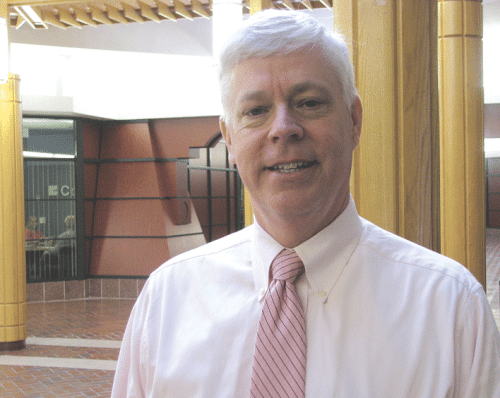
Banking and Financial Services Sections
Merchants Bank to Acquire NUVO Bank & Trust Co.

M. Dale Janes says customers won’t feel any impact when NUVO Bank & Trust becomes a subsidiary of Merchants Bank later this year — no negative impacts, anyway.

“From our point of view, this is an outstanding marriage, for us and Merchants,” Janes said of the agreement announced last week, in which Merchants plans to acquire Springfield-based NUVO for about $21.8 million in stock and cash, representing $7.15 per share.

“We’re a good bank; we’re growing, and we’re doing well,” said Janes, NUVO’s CEO, who will become regional president under the deal. “But Merchants has a wider array of products for businesses and consumers, like a trust division with investment-management options.

NUVObankLOGO“But, most importantly, we’re a small-business, mid-market lender, and this allows us to bring more capital and more loans to the community, and approach larger businesses,” he told BusinessWest. “Our legal lending limit is $3 million, and our in-house limit is $2.5 million. Their comfort level is around $20 million. That’s a big, big difference for us. They’re a great-performing bank, and they’re really good folks who understand community banking, and they want to be in Springfield and Western Mass.”

NUVO, which launched eight years ago, focuses on providing business loans, deposits, and cash-management services to small and medium-sized businesses and individuals in Western Mass. On Dec. 31, 2014, NUVO reported approximately $153 million in assets, $139 million in loans, and $134 million in deposits. Merchants had approximately $1.7 billion in total assets as of Dec. 31, 2014.

“Merchants is a 166-year-old community bank, and NUVO is not quite that old,” Geoffrey Hesslink, Merchants’ president and CEO, told BusinessWest, with more than a bit of understatement. “But it’s a very similar business. It’s a commercially oriented business, and we were impressed with their track record, impressed with their management team, and what they’ve done over the past eight years, while going through a tough economic cycle.”

When leaders of Vermont-headquartered Merchants and NUVO’s leaders, including Janes and President and Chief Loan Officer Jeffrey Sattler, sat down to discuss a possible partnership, “it occurred to us that, by joining forces, we could make NUVO, this great bank, even better, and grow it even faster in its core commercial business, but also add some ancillary business,” Hesslink continued. “It was really a cultural fit, and the management expertise was a major attractor for us — and, of course, the Springfield market has a breadth and depth that appeals to us.”

Michael Tuttle, president and CEO of Merchants Bancshares, added that the market has witnessed a great deal of change recently, but he too is impressed with the NUVO team and the growth opportunity presented by the bank’s market. “We plan to invest in and grow the NUVO team and business. While operational areas will be combined, the value created in this merger will be more attributable to revenue growth than expense reduction.”

The agreement has been approved by both institutions’ boards of directors. The closing is anticipated to occur during the fourth quarter of 2015, subject to approval by NUVO shareholders, receipt of required regulatory approvals, and other customary closing conditions.

NUVO’s chairman, Donald Chase, is expected to join the board of directors of Merchants Bank. In addition, Merchants has entered into employment agreements with Janes and Sattler. NUVO will remain a distinct brand and operate as a division of Merchants Bank.

“There is tremendous opportunity in our market, and we believe that we can best capitalize on it by leveraging the liquidity, expanded lending limits, lower-cost deposit base, and broader product range of a strong partner like Merchants,” Chase said. “Additionally, Merchants’ publicly traded stock and dividends will be attractive to our shareholders. We have admired Merchants for some time, and getting to know their team better has reinforced the fact that we share common values and a similar operating philosophy.”

While Janes becomes regional president, Sattler will be managing director and remain the bank’s chief lender in the Greater Springfield market. “But neither of us is concerned about titles,” Janes told BusinessWest. “All we’re concerned about is being able to continue to grow at a better pace, and we’re excited about that.

“There aren’t any negatives for customers,” he reiterated. “The lending team is staying in place, the leadership team is staying, and almost all the employees will be here. This is not a slash-and-burn acquisition; this is about growth.”

— Joseph Bednar

Features
Common Capital Program Helps Individuals Fuel Small Businesses

Common CapitalBeverly Weeks spent close to two decades as a librarian at West Springfield High School, so she understands the importance of researching matters thoroughly.

And that’s exactly what the now-retired Weeks did several months ago when she decided to reel in one of her investments, which she determined was too heavily focused on fossil fuels, and redirect that money toward something far more sustainable — and rewarding.

That research took her to Common Capital’s Community First Fund, which pools investments from people like Weeks and loans them to individuals trying to get a business off the ground or to that proverbial next level.

And that’s where her search ended.

“I was looking around for alternatives — I was searching for investments that would go back into my community, and this struck me as a good one,” she told BusinessWest. “I liked the fact that I would be making a loan that then makes it possible for a venture to get on its feet or add a new aspect or product to its business.

Claudine Baj

Claudine Baj says loans channeled to her through Common Capital have helped her expand her kitchen and bring in needed help.

“And I like the fact that it’s a loan, so the money keeps circulating,” she went on, adding that, as part of that extensive research she conducted, she read how Common Capital, formerly the Western Mass. Enterprise Fund, assisted some of those businesses crippled by the fire in a Hadley strip mall in the fall of 2013. “It’s rewarding to lend a helping hand — or a helping dollar, as the case may be.”

Such sentiments are exactly what administrators at Common Capital had in mind a few years ago when they decided to become part of what is now a national trend toward creating community loan pools to assist fledgling businesses.

Chris Sikes, Common Capital’s CEO, said this movement, if it can be called that, can be traced to New Hampshire, and it has quickly spread to many other areas of the country.

That’s because the concept is fairly simple, and — to the growing number of people who, like Weeks, desire investments that that can in some way be categorized as ‘sustainable’ — it’s also quite appealing.

Here’s how it works locally: the Community First Fund will accept donations of any size from $500 to $50,000 (the old floor was $1,000, but it was lowered to enable more people to participate). The loan term is three years with a 2% annual rate of return (better than most currently advertised CD rates certainly), with interest paid to participants semi-annually. Common Capital’s initial goal was to raise $500,000, but that has been passed — approximately $600,000 has ben amassed to date — and the new target is $1 million.

Contributions are pooled and placed in Common Capital’s general fund, where they are loaned to a diverse and growing roster of entrepreneurs who need some capital to make an important step forward, whatever that might be.

People like Claudine Gaj.

She started the Magic Spoon, a catering business, in 1998, and, over the ensuing years, has recorded steady if unspectacular growth. By early last year, she had come to a point most entrepreneurs reach, where she really wanted and needed to bring in help.

Jerry Zalucki, seen here with his wife, Suzanne

Jerry Zalucki, seen here with his wife, Suzanne, says that, when banks wouldn’t listen to his plans for his fledgling business, Common Capital would.

First, though, she needed to expand her facilities and add equipment, and to do that, she needed capital. She has found it through two loans facilitated by Common Capital and channeled through the Samuel Adams Brewing the American Dream loan program, launched by the Boston-based company’s founder, Jim Koch.

“I went to a Brewing the American Dream event, a meet-and-greet, and I got to meet Jim Koch,” Gaj recalled. “He said, ‘where do you want to be?’ And I said, ‘I really want to hire someone who has skills so I can get out of the kitchen, do more marketing, and be the boss, not the business.’

“He said, ‘what’s stopping you?’ and said, ‘I need to remodel my kitchen,’” she went on, adding that the second loan ($8,500) came through in January. She has, in fact, hired someone, and is “getting there” when it comes to bringing in more business.

Baj is, in many respects, the type of small-business owner that Common Capital assists, said Sikes, adding that the unofficial mission behind the Community First Program is to put more companies like Magic Spoon in the portfolio.

Thus, the program represents the quintessential win, win, win scenario. Donors win because they enter into totally safe investments (loans are secured by Common Capital) with a decent rate of return while spurring economic development and job creation in the region; loan recipients win because they secure financing they probably couldn’t receive from traditional sources; and the region wins because the fund is fueling a recognized surge in entrepreneurial activity.

For this issue, BusinessWest takes an in-depth look at the Community First Fund and the many different ways it can measure success.


The Ride Stuff

Jerry Zalucki was searching for the right words. It’s not that he didn’t know what to say — he certainly did. He just didn’t know how, at least without offending a large group of business professionals.

He was trying to describe the commercial-lending environment in early 2011, just a few years after the Great Recession, and, more specifically, what it was like to be on the other side of the table from those doing the lending — or not.

“Let’s just say … well, let’s just say … it wasn’t a good time to be out there for looking for a loan,” he told BusinessWest, adding that it was his misfortune to be seeking some capital at that time for a venture called Auto Custom Leathers, an offshoot of a larger enterprise that had been sold.

It specialized in after-market leather and vinyl auto interiors — its current marketing slogan is ‘cover your ride with our hides’ — and Zalucki was able to use his own money to get the business into what he would approximate as first, maybe second gear.

“We had about 1,000 patterns, and I had the know-how, the knowledge, and the market idea, and thought I could make a go of it,” he recalled. “I had a little bit of money and did what I needed to do to get it going — but I knew it wasn’t enough.”

Indeed, to gain any real speed, Zalucki knew he needed capital, but the banks weren’t bashful about saying no, without even really hearing him out, at least in Zalucki’s estimation.

“You know when someone looks like they’re listening, but you know they’re not really listening … that’s how I felt. I had an idea, I did the numbers, I crunched everything, but no one cared,” he recalled, adding that a friend put him in touch with Sam Ortiz, director of Lending at Common Capital, who not only listened, but asked a number of questions.

Fast-forwarding a little, Common Capital was able to award Zalucki a $100,000 loan and a $50,000 line of credit. He used that capital to buy some equipment and expand the venture. His workforce went from eight to 15, and to accommodate the new growth created by that expansion, Common Capital awarded him a second package totaling $225,000.

“If it wasn’t for them, there’s no way I would have continued, and no way all this would have happened,” said Zalucki, adding that, while he’s not exactly in the driver’s seat, figuratively speaking, he certainly has his business on the right road.

In essence, Common Capital was created to help people like Zalucki and ventures like Auto Custom Leathers, said Sikes, adding that the Community First Fund, which accurately reflects the agency’s mission statement, was launched so the institution could assist more ventures like this one.

“Our goal as a nonprofit and as a community lender is to create economic opportunity,” he explained. “And central to that is creating a local, sustainable economy, and one of our main strategies for doing that is getting the community involved in its own economy.

“We have the ‘buy local’ movement, and we have the ‘invest locally’ movement as well,” he went on. “The Community First Fund provides an opportunity for people to invest locally and see their loans go into local businesses, create jobs, generate more local goods and services, and provide area residents and businesses more opportunities to buy local goods and services. We see this as a multiplier effect.”

In many respects, the timing for the launch of the program could not have been better. Indeed, several forces are coming together to make the Community First Fund a vehicle for economic development — and an attractive investment.

First, Baby Boomers — and also the generations behind them — are coming into money, record amounts of it, noted Sikes, quoting statistics showing that the Boomers stand to inherit something north of $30 trillion through what’s known as the ‘great wealth transfer.’ Meanwhile, many Boomers have done pretty well themselves, he went on, adding that many are seeking not only places to put their money, but places that meet a growing sense of environmental and societal sustainability — and responsibility.

At the same time, there is a great deal of entrepreneurial energy in the region, said Sikes, citing the efforts of groups such as Valley Venture Mentors and others to encourage entrepreneurship and mentor small-business owners. Also, with the arrival of MGM Springfield, there may be opportunities to do business with the casino giant for those with the wherewithal to take advantage of them.

Inevitably, most small-business owners will need capital, he continued, and some will need to turn to what would be considered non-traditional sources to get it.


Generating Interest

Chris Sikes, CEO of Common Capital

Chris Sikes, CEO of Common Capital, says the Community First Fund enables individuals to get involved with the local economy.

Helping to provide such funding is rewarding for Community First Fund participants on a number of levels, said Sikes.

“For the investor, it’s a chance to really feel and know that, financially, they’re investing in the community,” he said. “And that has a psychological, social, and even emotional impact on people, so they’re more concerned about the community.”

Elaborating, he said that, in the larger scheme of things, $500,000 or $1 million is not a large amount of money. But when one is talking about small (often very small) businesses, such an amount can go a long way and make a huge impact in the life of an enterprise.

“What we’re doing at Common Capital is really exciting, and we’re going to need a lot more local capital moving forward,” he explained. “Public monies are going to be diminishing, and the private investments are going to be more and more important.”

Those sentiments, or words to that effect in literature introducing and explaining the Community First Fund, resonated with Marty Wohl.

A Northampton-based dentist, he was, like Weeks, searching for investments that would do more than earn a respectable return. And he was motivated by the opportunity to get involved in a meaningful way.

“This program piqued my interest because, living in a community for a long time, you support different activities, causes, and charities,” he explained. “And this seemed a little like providing a fishing pole instead of a fish. It just made sense to provide funds that can be returned, but also make a difference.

“In a sense, it’s like a municipal bond, but obviously without any collateral or security or insurance,” he went on, adding that he became a participant nearly two years ago. “But being so local, it’s very effective for community building. And there’s a recognizable need for this, and that’s satisfying as well.”

Sikes said Wohl is typical of many donors to the fund in that he’s a professional from the Northampton-Amherst area (the northern portion of the region seems to be embracing this concept more than the Springfield area to the south), has a strong sense of community, and was looking for a sound, safe, and sustainable investment.

Moving forward, Common Capital’s goals are to grow the fund through wider participation, eventually improve the rate of return to make it more attractive, and perhaps give investors more control over where funds are directed — such as to a specific region or economic sector, Sikes told BusinessWest.

To reach more potential participants, Common Capital will more aggressively market the concept; to date, it has relied on word of mouth and information on its own website, common-capital.org. And one of the most effective ways to market the fund is simply to tell the stories of business owners who have been supported by loans from the agency.

“We want to get people excited about this, because it’s helping us do some great things in the community,” he explained. “We want to grow this fund and give it a broader impact across the region.”

Wohl’s first commitment to the Community First Fund will run its course in roughly a year. He’s already thinking about re-upping — he considers that a strong possibility — and might opt for a larger investment.

“I’ll decide that when the time comes,” he said. “Right now, I see no reason not to participate again.”

Weeks offered similar sentiments.

“I think this is something I may do again,” she told BusinessWest. “I didn’t give a whole lot the first time, but it was enough to make a difference, I hope, and I like that part about this.”


Bottom Line

Like everyone else who has secured a business loan, Baj now has some dueling emotions.

She’s elated that she received the money and is excited about what it means for her and her venture. At the same time, she’s naturally a little apprehensive about paying it back and taking the step forward needed to generate that revenue.

“We’re going to do some additional marketing and do whatever else we need to do to get where we want to be,” she said. “I’m not a grow-by-leaps-and-bounds person; it’s through small, steady steps — that’s how I want to run my business, because I never want to be too far ahead of what I can really handle. This is an exciting time for us.”

The Community First Fund was created to place more people in such a state, said Sikes, adding that he believes the program will continue to grow, gain momentum, and help write more entrepreneurial success stories.

That’s because, as he said, there are multiple winners in this scenario, including people like Weeks, who want to lend a helping hand — and a helping dollar.


George O’Brien can be reached at [email protected]

Community Spotlight Features
State School Project Tops Belchertown’s Priority List

Douglas Albertson

Douglas Albertson says redevelopment of the former Belchertown State School — and other highly visible projects — are lending momentum to the town’s growth.

With equal amounts of anticipation and relief, officials in this Hampshire County community talked about how redevelopment of the former Belchertown State School campus is finally underway — at least in a way that’s visible to passersby.

“We’re obviously excited about it,” said Town Planner Douglas Albertson with a touch of understatement in his voice. “We just approved a site plan for an assisted-living facility that will be built by the Grantham Group LLC in Marlborough.”

The development will include 83 units, and 40 of them will be affordable housing, he went on, adding that the town has a large senior population and the project will be particularly advantageous to older people who need a place to live but can’t afford market-rate rents.

The three-story structure, which will be known as Christopher Heights of Belchertown, is expected to cost $15 million. However, the Grantham Group has applied for $5 million in federal tax credits and another $2 million in state subsidies. Albertson said the developer is also seeking $250,000 in Community Preservation Act funds from the town, and the Board of Selectmen will vote on the request in May.

“Town officials, MassDevelopment, and BEDIC [Belchertown Economic Development & Industrial Corp.] have all worked hard to facilitate this project,” he told BusinessWest, adding that MassDevelopment is in charge of overseeing the cleanup of the former state-school property.
The Grantham Group was chosen to build the senior-living facility from among three entities that responded after MassDevelopment issued a request of interest for the site.

“They’re known for their assisted-living communities, and ever since the school closed, residents have said they would like to see one built on the land there, so we are thrilled that this is happening,” Albertson said. “It has great potential to enhance the community.”

He said the Grantham Group has developed dozens of assisted-living facilities, including the $13.4 million Christopher Heights of Northampton, which is situated in the Village Hill neighborhood on the grounds of the old Northampton State Hospital.

Although the property has been vacant for decades, several studies have been conducted to determine options for its reuse. Albertson said the last one was completed in 2009, thanks to $100,000 the town received from the state after the campus was designated as a priority development site.

At that time, Belchertown officials hired RKG Associates to assess the land, buildings, and layout of the 85-acre campus. When they finished, Fuss and O’Neill, a civil and environmental engineering consulting firm, created a conceptual use plan based on RKG’s findings. The work was done in association with the Massachusetts Development Finance Agency, and although they came up with two uses for the property, mixed-use development was seen as the most viable option.

“Our strength is that we are a residential community,” Albertson said, adding that the report stressed that any new residential housing should be targeted to fill gaps in Belchertown’s existing housing inventory, which includes housing for seniors.

The report also concluded that the western end of the property was the most suitable location for residential housing, and advised a gradual transition to mixed-use buildings, then to businesses on the eastern end of the campus near the railroad.

“We’re still using their concept in our work with MassDevelopment,” Albertson said, adding the state agency is developing a master plan for the property.

The report also found the town had enough infrastructure to support dense development on the campus, and Albertson told BusinessWest that Belchertown officials have kept the property in mind over the years as they upgraded and expanded sewer and water distribution lines.

“Provisions have been made to accommodate expansion in that sector of town,” he said, adding that, after the buildings are razed to make way for the new assisted-living complex, the town will seek to bond up to $1.2 million for road construction and utilities over a period of several years.

For this, the latest installment in its Community Spotlight series, BusinessWest looks at developments in Belchertown and how the state school project is expected to create momentum on several levels.

School of Thought

Belchertown State School for the Feeble Minded opened in 1922, had a storied history, and was closed in 1992 due to multiple lawsuits that cited inhumane conditions and poor treatment of patients. In 1999, the state turned the property over to the town, and the Board of Selectmen created the BEDIC to manage it and appointed a board of directors.

Although town officials did their best to secure the buildings, Albertson said, the structures have been vandalized over the years. And although a number of proposals were put forth for the site, none of them ever came to fruition.

However, that has finally changed, and the first signs of new life at the old state school could be seen last month when Springfield-based Associated Building Wreckers started working on the three acres where Christopher Heights will be built. The company removed asbestos and other hazardous materials from the area and will begin demolishing buildings in the section known as Pad I this month.

“The work is being paid for with state funding,” Albertson said, explaining that the Commonwealth has released $4 million of $10 million approved to conduct a comprehensive cleanup of the state school campus.

The town also instituted a special type of zoning for the site late last fall, and its Business Neighborhood Center District plan design will provide aesthetic consistency with the surrounding neighborhoods, while encouraging economic development. It will increase possible uses for the property, but site-plan approval by the Planning Board will be required for each development in the district.

“The one thing that was excluded is single-family housing because we didn’t want to compete with local builders who are finishing up subdivisions in town or hope to create new ones,” Albertson explained. “However, we do want to encourage housing for single people, seniors, and artists or artisans who want to create a studio and live and work in the same place. We would also like to have enough density so that people can patronize businesses on the property and work there.

“And now that the economy is improving, things are getting busy in other areas of Belchertown again,” he went on, adding that economic development has gained real momentum over the last year and many home-based businesses are also thriving. “It’s a hidden economy in Belchertown, and some of these businesses do expand.”

Belchertown has two new restaurants that are doing well, he went on. Oneis Almeida’s Café, which was built on an empty lot last summer near the state school campus on Routes 202 and 21, “has been a real success,” Albertson said.

Antonio’s Pizza by the Slice has also gained a following since it opened late last spring in its newest location on 31 Federal St.; others are in Amherst, Easthampton, Rhode Island, Texas, and Illinois.

“The owners saw an opportunity for a sit-down restaurant here,” Albertson said, adding that the location was home to Saporito’s Pizza before it was purchased in the early part of 2014. “The parking lot was packed immediately after they opened, and they have been busy ever since.”

Nelson’s Barber Shop also opened on the first floor of a house on North Main St. that had been a poorly maintained rental property for decades. “The neighbors are happy about it,” Albertson said, noting that the upper story is still a residential rental, but the entire ground floor is occupied by the business.

In addition, Belchertown’s first tattoo shop opened in February in the same strip mall as Antonio’s Pizza, and Surner Heating Co., which provides fuel and service throughout Hampshire County, is expanding its Belchertown facility.

“They’re adding propane and putting in two large underground tanks; the city recently approved the site work, which began several weeks ago,” Albertson said, adding that the property includes a building that houses a mini-mart, several apartments, and a gas station on Federal Street. “Their heating-oil storage tanks are also at that site, and they lease one to Noonan Oil; the business expansion reflects the fact that fewer people want to heat with oil. Propane is another option, and many people like to cook with it.”

Looking Ahead

Town and state officials hope Christopher Heights will spark renewed interest in the Belchertown State School property.

“The redevelopment of the campus has been a long-awaited project, and we’re excited about it. When it is done, we anticipate growth in surrounding areas; we believe it could be a catalyst for the whole area,” Albertson said. “The campus has always been pretty, but it hasn’t been maintained — but that is about to change.”

He cited a small plaza across the street from the property as an example of a site with room for growth. “The complex could be expanded. Plus, there are several other parcels available nearby,” the town planner said, adding that Easthampton Savings Bank opened a branch last year at the entrance to the grounds of the former state school.

Christopher Heights will support 65 construction jobs and create 40 permanent positions, and when the assisted-living community is complete, a long-neglected area in Belchertown will finally begin to realize its potential.

“We believe that, once the Grantham Group develops a portion of the site,” Albertson said, “it will give others the confidence to follow.”

Belchertown at a glance

Year Incorporated: 1761
Population: 14,735
Area: 52.64 square miles

County: Hampshire
Residential Tax Rate: $17.89
Commercial Tax Rate: $17.89
Median Household Income: $52,467
Family Household Income: $60,830
Type of government: Open Town Meeting; Board of Selectmen
Largest Employers: Belchertown High School; Super Stop & Shop; Cold Spring School

* Latest information available