Home 2024 July (Page 3)
Daily News

SPRINGFIELD — The O’Dell Women’s Center Foundation announced that it will grant $250,000 to nonprofits serving low-income Springfield women.

Springfield’s first-ever women’s center will award grants of $5,000 to $50,000 to amplify the efforts of local nonprofit organizations that advance educational and career opportunities for low-income women. Nonprofit organizations that address obstacles facing low-income women, such as food insecurity and childcare access, will also be eligible for grant awards.

The application is available at odellwomenscenter.com/grants and must be received by Sept. 13. Applications will be evaluated based on innovation, feasibility, and potential impact, and grant award winners will be announced on Nov. 15.

“The O’Dell Women’s Center was founded with the mindset that low-income women in Springfield deserve greater access to opportunities that will help them earn a livable wage and create a path to financial stability,” said Keely Krantz, founder and president of O’Dell Women’s Center. “We are looking to partner and invest in forward-thinking community organizations that want to extend and increase their impact.”

The O’Dell Women’s Center is a philanthropic initiative founded in 2023 with a mission to help low-income women achieve financial stability through improved access to educational and career opportunities.

Located in the heart of Springfield, the O’Dell Women’s Center is a 10,000-square-foot facility that offers low- or no-cost ‘residencies’ and community collaboration spaces to nonprofit organizations that focus on improving the lives of low-income women. The first nonprofit residency has been granted to Dress for Success Western Massachusetts, an organization that empowers women to establish careers and advance within their careers through skill development, professional attire, mentorship, and other programming.

“Our goal with this grant program is to establish the O’Dell Women’s Center as a dedicated partner to the network of Springfield nonprofits serving low-income women,” said Margaret Tantillo, executive director of the O’Dell Women’s Center. “We believe that, together, we can create a future where every woman has the opportunity to succeed.”

Applicants are encouraged to attend a Zoom information and Q&A session on Wednesday, July 31 at noon. Registration information can be found at odellwomenscenter.com/grants.

Daily News

SPRINGFIELD — CET (formerly the Center for EcoTechnology) announced the launch of its Carbon Conscious Business accreditation, an initiative designed to recognize and celebrate businesses committed to reducing their carbon footprint through energy conservation, transitioning off fossil fuels, reducing waste, and other solutions. With commercial and residential buildings contributing 30% of U.S. greenhouse-gas emissions, decarbonizing this sector is essential to meeting CET’s climate goals.

CET notes that the latest report from the International Panel on Climate Change underscores the need for rapid, deep, and immediate greenhouse-gas emissions reductions across all sectors to limit global warming to 1.5°C. Every increment of warming exacerbates hazards such as human mortality, disease, mental-health challenges, flooding, biodiversity loss, and decreased food production. CET’s new accreditation aims to address these challenges by encouraging businesses to take actionable steps to decarbonize.

Decarbonizing offers numerous benefits: it mitigates climate change, potentially lowers operating costs and improves building comfort, and enhances reputation and brand value. Additionally, it ensures regulatory compliance, attracts purpose-driven employees, and improves public health and well-being by enhancing air and water quality.

To begin the journey toward being accredited as a Carbon Conscious Business, businesses will meet with CET energy and waste experts to identify existing and new decarbonization opportunities tailored to the business. CET will then develop a customized action plan that outlines relevant measures to reduce carbon emissions.

Throughout the implementation process, CET will support the business every step of the way, connecting it with necessary services. Once all measures have been completed, the business will be awarded a one-, two-, or three-star Carbon Conscious Business accreditation based on the extent of implementation. Regardless of the progress, CET will celebrate the participating company’s achievements with marketing opportunities, window decals, and table tents to showcase its commitment to sustainability.

CET facilitates no-cost assessments through partnerships with Mass Save, the Massachusetts Department of Environmental Protection, the Connecticut Department of Energy and Environmental Protection, and other entities.

The Carbon Conscious Business accreditation celebrates businesses’ efforts to combat climate change and embrace sustainability. “By fostering a community of carbon-conscious enterprises,” CET noted, “we can drive meaningful change and create a resilient, sustainable future for generations to come.”

CET is grateful to TD Bank for supporting this work. Learn more at cetonline.org/carbon-conscious-business-accreditation.

Daily News

SPRINGFIELD — United Way of Pioneer Valley announced the 2024 Stuff the Bus school-supply drive and is reaching out to the community to support its mission to provide essential school supplies to homeless children in the region.

“Every child deserves the opportunity to start the school year prepared and excited to learn,” said Megan Moynihan, president and CEO of United Way of Pioneer Valley. “However, for homeless children, this can be a significant challenge. We would not be able to do this without the generous support of Peter Pan Bus Lines. Every year, they provide a bus and driver to deliver the backpacks to all districts in need.”

Items being collected include elementary-age backpacks, spiral notebooks, composition books, looseleaf paper, crayons, index cards, pencil sharpeners, erasers, glue sticks, highlighters, and rulers. To order supplies through Amazon Wish List and have them delivered to United Way, click here.

New this year, the United Way is also collecting classroom supplies for teachers, who need paper towels, hand sanitizer, as well as dry-erase markers, to name a few items. Click here for the complete Amazon Wish List.

Supplies may be dropped off at any of the following locations through Aug. 2:

• AAA Northeast, 150 Capital Dr., West Springfield;

• AAA Northeast, 1891 Wilbraham Road, Springfield;

• Peter Pan Bus Lines (ticket counter), Springfield Union Station, 1 Peter Pan Way, Springfield;

• United Way of Pioneer Valley, 1441 Main St., Springfield; and

• Western Mass News, 1300 Liberty St., Springfield.

Daily News

Sarah Ouimette

NORTHAMPTON — D.A. Sullivan & Sons Inc. (DAS) announced the arrival of Sarah Ouimette into its leadership group, marking a significant milestone in the construction company’s history.

Ouimette takes on the role of chief financial officer, bringing a robust financial background and meticulous attention to detail to the DAS team. Her expertise promises to ensure the company’s financial health and strategic growth.

Founded in 1897, DAS has been committed to delivering exceptional service, fostering community development, and promoting sustainable building practices. As the company steps into the future, Ouimette’s inclusion as an owner and leader promises to further solidify its position as a premier construction firm.

Ouimette joins Mark Sullivan, Dennis Sullivan, Ryan Gagne, Cicely Hislop, and Andrew Fleming on the DAS leadership team.

Daily News

ORANGE — Mikael Pyrtel, until recently the director of Economic Development for the town of Orange, has joined the Orange Economic Development and Industrial Corp. (OEDIC) as executive director.

Pyrtel has a long history of successfully facilitating economic growth and development in key sectors of the economy at the local, regional, state, and federal levels and expects to transition the work he has been doing for the town seamlessly into his new organization.

“We believe Orange is positioned for growth,” Pyrtel said, citing the Orange Municipal Airport, a rail line, access to major roadways, proximity to the Boston and Springfield metropolitan areas, and nearby colleges and universities.

“There’s a proud tradition of innovation and entrepreneurship in manufacturing and agriculture that extends into our emerging sectors such as life sciences and Orange’s creative economy, an economic sector recognized by the United Nations,” he added. “The Rodney Hunt Company has been building sophisticated water control systems for almost 200 years here, and now we have businesses like Impact Nano, a key supplier to the silicon-chip industry. Seaman’s Paper is a leader in the forest products industry, which is a huge part of our local economy. We think our ability to support the growth initiatives of these types of businesses will lead to further success.”

OEDIC operates under Massachusetts General Law Chapter 121C, which empowers local development organizations to implement projects that increase employment and develop disused or dilapidated properties. The citizens of Orange voted last year to expand OEDIC’s footprint beyond industrial areas to include those zoned for business. Recent budget woes in town led to the defunding of Pyrtel’s position but created an opportunity for OEDIC.

“This is a new chapter for OEDIC and for Orange,” said Tom Sexton, chairman of the business group. “With the addition of Mikael, we’re building an organization that will basically be the local partner for business and developers that want to open up or expand here. Our goal is to streamline as much as possible the planning, permitting, financing, and construction of new projects.”

Sexton said OEDIC is building a digital presence to engage the business and development communities and expanding its involvement with partners, and expects to announce more activity soon.

Daily News

Tracy Sicbaldi

BOSTON — Berkshire Bank announced Tracy Sicbaldi has joined the bank as senior vice president, Government and Municipal Sales officer. In this role, she will be responsible for managing and expanding Berkshire’s government banking relationships in Massachusetts, Connecticut, and Vermont.

Sicbaldi has more than 30 years of experience in the financial-services industry with special expertise in cash management and government banking.

“With Tracy’s role, Berkshire is establishing a dedicated municipal banking team as part of our continued efforts to enhance our service to meet the specialized needs of government banking clients,” said Keara Piscitelli, managing director, Cash Management and Treasury Services. “Tracy’s extensive experience, her industry-leading expertise, and her relationships in the wider government community will ensure our government clients receive the highest levels of service and that we’ll continue to grow this important component of our portfolio.”

Before joining Berkshire Bank, Sicbaldi was vice president, Commercial and Institutional Banking at PeoplesBank in Holyoke. Prior to that, she served in town treasurer roles in Monson and Hampden and held other positions in the financial-services industry.

Sicbaldi is active in her community, serving on the board of directors for Dakin Humane Society, as board clerk for the East of the River Five Town Chamber of Commerce, and volunteering at WestMass ElderCare and Rays of Hope.

Daily News

BELCHERTOWN — Zonta Club of Quaboag Valley will host its 30th annual golf tournament on Saturday, Sept. 7. Golfers will tee off at 8:30 a.m. at Cold Spring Country Club in Belchertown for a day of fun, friendly competition, and making a difference.

Whether a seasoned golfer or just looking for a fun day out, everyone is welcome. For $120, participants will enjoy a round of golf, a box lunch, and the chance to win prizes. Proceeds will directly fund scholarships and grants that empower women and girls to overcome challenges and achieve their full potential. Zonta is working to end child marriage, domestic violence, and human trafficking, while also supporting climate justice, education equality, and women in decision-making positions.

Sign up at zontaqv.org/golf or call Mary Knight at (413) 323-4806. The organization also welcomes sponsorships from local businesses.

Daily News

SPRINGFIELD — American International College (AIC) announced that its master of science in criminal justice program has been approved under the Guidelines for Criminal Justice and Law Enforcement Academic Programs by the Massachusetts Board of Higher Education (BHE). This approval qualifies the fully online degree for the Police Career Incentive Pay Program, also known as the Quinn Bill.

The Massachusetts Legislature enacted the Quinn Bill to encourage police officers to earn degrees in law enforcement and criminal justice by providing educational incentives for full-time officers in participating cities and towns through salary increases.

This approval means that AIC’s master of science in criminal justice program meets or exceeds all quality standards established by the guidelines, making its graduates eligible for incentive pay increases.

“The curriculum helps students develop the necessary problem-solving skills to address contemporary and evolving problems in the field with innovative, ethical, and evidence-based solutions,” said Susanne Swanker, dean of the AIC School of Business, Arts, and Sciences.

AddedRegina Sanderson, assistant professor and coordinator of Graduate Criminal Justice, “we are thrilled that, by approving our program for the Quinn Bill, the state recognizes the hard work of our faculty in developing a comprehensive and rigorous curriculum that meets the needs of those in the field.”

By participating in the Quinn Bill, students who are full-time police officers in Massachusetts can receive significant salary increases upon graduation, providing a tangible return on their educational investment. This incentive not only encourages professional development, but also enhances the quality of law-enforcement services by ensuring officers are well-educated in the latest theories and practices in criminal justice.

The master of science in criminal justice program at AIC is designed to prepare graduates for the complex challenges of 21st-century law enforcement and other criminal-justice occupations. The program emphasizes rigorous academic inquiry, advanced research, and comprehensive coursework, equipping students with the knowledge, critical-thinking skills, ethical foundations, and practical insights necessary to navigate the complex landscape of criminal justice.

The curriculum includes six core courses and a selection of elective courses to satisfy the credit requirements for two tracks. The 30-credit, mid-career track is tailored for professionals with a bachelor’s degree and at least four years of experience in the field, while the 36-credit track is for those with a bachelor’s degree but less than four years of experience. Students can choose from four specializations: social justice and public policy, executive leadership, victim studies, or homeland security and intelligence studies. Each specialization can also serve as a stand-alone certificate.

Daily News

MONSON — Silver Bell Farm, located at 305 Silver St. in Monson, invites the community to its fourth annual Christmas in July on Saturday and Sunday, July 13-14, from 10 a.m. to 4 p.m. Guests can look forward to a weekend filled with holiday cheer, festive activities, and family fun.

On Saturday, Bruce Marshall from 97.7 FM will broadcast live from the farm from 11 a.m. to 2 p.m. Visitors can enjoy a variety of activities, including tractor-pulled wagon rides, visits and story time with Santa, face painting, ornament crafts, and an appearance by the Silver Belle princess.

This year, the farm will debut the Christmas in July Challenge, an outdoor adventure game for all ages. Other attractions include barrel-train rides, a bounce house, outdoor play areas, and more.

Plenty of food and sweet treats will be available throughout the day, including novelty ice cream treats, Grinch slushies, and frozen hot chocolate from the ice-cream truck, as well as lunch items like specialty grilled cheese, mac and cheese, and hot dogs from the concessions window. The City Sidewalk Cafe will also be open for iced coffee, festive baked goods, and homemade cider donuts.

Daily News

AMHERST — One of the challenges of creating realistic-looking and delectable plant-based meat is mimicking the marbled effect of animal fat that many carnivores expect and enjoy.

A UMass Amherst food scientist has a plan to tackle this quandary by developing new technology supported by a $250,000 grant from the Good Food Institute. The not-for-profit think tank promotes plant-based alternatives to meat, dairy, and eggs, as well as cultivated ‘clean meat’ grown from animal cells in a facility.

The technology proposed by Assistant Professor Lutz Grossmann “has the potential to revolutionize the plant-based meat industry, expanding its product offerings and appealing to a wider audience,” the institute stated in announcing the grant, one of 118 awarded in 21 countries, totaling more than $21 million, since 2019.

“The Good Food Institute has played a key role in supporting research for more sustainable food options, and UMass Food Science has been fortunate to receive funding,” Grossmann added.

In 2020, a team of UMass Amherst food scientists, led by Professor David Julian McClements, received a grant from the institute to develop a new approach for creating tasty, plant-based, protein-rich food that’s similar in texture to whole chicken, pork, or beef.

Grossmann, whose research focuses on designing holistic approaches to increase the consumption of plant- and microbial-protein-rich foods, aims to incorporate lipids into high-moisture extrusion processes, a technique used to replicate the juiciness, appearance, and texture of whole-muscle animal meat.

“While high-moisture extrusion has become a primary method for creating meatlike textures from plant proteins, it currently lacks the ability to generate lipid marbling, a key characteristic for replicating the appearance, flavor, and texture of traditional meat products,” Grossmann explained. “The challenges of incorporating lipids into high-moisture extrusion processes are mainly related to the lubricating effect of plant lipids that disrupt the protein melt within the extruder barrel.”

In addition, injecting lipids during the cooling part of the process — when the meatlike structure is finalized — results in uneven distribution, leading to suboptimal texture, he added.

To overcome these challenges and bridge the gap between plant proteins and lipids, Grossmann is developing and will implement a novel extrusion segment that will facilitate the creation of the marbled appearance and texture of plant-based, whole-cut meat products.

“The setup basically works like a piping bag that allows for making a two-colored swirl,” he said.

Daily News

SPRINGFIELD — In the spring of 2017, BusinessWest and its sister publication, the Healthcare News, created a new and exciting recognition program called Healthcare Heroes. It was launched with the theory that there are heroes working across this region’s wide, deep, and all-important healthcare sector, and that there was no shortage of fascinating stories to tell and individuals and groups to honor. That theory has certainly been validated.

But there are hundreds, perhaps thousands of heroes whose stories we still need to tell. And that’s where you come in.

Nominations for the class of 2024 are due Monday, July 29, and we encourage you to get involved and help recognize someone you consider to be a hero in the community we call Western Mass. in one (or more) of these eight categories:

• Patient/Resident/Client Care Provider;
• Health/Wellness Administrator;
• Emerging Leader;
• Community Health;
• Health Educator;
• Innovation in Health/Wellness;
• Collaboration in Health/Wellness; and
• Lifetime Achievement.

Nominations can be submitted at businesswest.com/healthcareheroes/nominations.

Daily News
Paul Scully

Paul Scully

WARE — On July 1, CEO Paul Scully announced his retirement after a career of 28 years at Country Bank and 48 years in the financial-services industry. His retirement will be effective on July 31.

Scully, who started his banking career as a part-time teller while attending Bentley University, previously served as senior vice president of Country Bank, was appointed president in 2004, and later assumed the position of CEO in 2005.

“Throughout my career, I’ve been guided by the belief that success is not just about growth in numbers, but about the positive impact we make in the lives of our team members, customers, and communities,” he said. “It’s been an incredible journey, and I’m immensely proud of what we’ve achieved together.

“As I retire, I leave with a deep sense of gratitude for the opportunity to serve as Country Bank’s CEO for the past 20 years and with the utmost respect of my successor, Mary McGovern, and the entire Country Bank team to continue the bank’s legacy of excellence,” he added.

McGovern, appointed president by the bank’s board of trustees on April 1, will assume the role of CEO effective Aug. 1. McGovern, who has been with the bank since 2011, previously served as executive vice president and chief financial officer before assuming the role of chief operating officer in 2023. With her extensive experience in the financial-services industry spanning more than three decades, she brings a wealth of knowledge and expertise to her new position.

“I am honored to have worked alongside Paul for the past 13 years,” McGovern said. As I assume the organization’s leadership, I am dedicated to the bank’s continued growth and supporting our customers, community, and team members. The bank is committed to providing best-in-class customer service; the latest banking services, safety and security; and ensuring Country Bank remains a trusted financial institution in our communities.

Country Bank’s board of trustees added that its members and bank employees “are deeply grateful to Paul for his exceptional leadership and unwavering dedication throughout his tenure. His visionary guidance has positioned the bank for continued success and growth. As the bank embarks on this new chapter, it looks forward to the leadership of Mary McGovern, who will undoubtedly build upon Scully’s legacy and drive Country Bank to new heights.”

Daily News

AMHERST — The Mill District and Herrell’s Ice Cream announced that Herrell’s Ice Cream will be opening soon in the Mill District’s North Square in North Amherst, first as a pop-up and later as a permanent location.

The Mill District’s North Square is located just a crosswalk away from Amherst’s busy Mill River Recreation Area, a short walk from Cherry Hill Golf Course, and near the recently renovated North Amherst Library. Herrell’s will join Provisions, Carefree Cakery, the Mill District General Store, the Closet, the Mill District Local Art Gallery, Soulful Pet Studios, Futura Coffee; 3 Amigo’s Restaurant; the Lift Salon; Big Basket International Market; Amherst House of Pizza, and Cowls Building Supply, to name a few enterprises already making a mark on North Amherst’s busy shopping and dining offerings.

“We’re building out an impressive ice-cream parlor between our beloved Carefree Cakery and Provisions fine foods and spirits,” said Arthur Haskins, Cowls’ real estate vice president.  “In the meantime, Herrell’s is popping up in the former Graze Craze space between the General Store and the Closet and Soulful Pet Studios at 83 Cowls Road.”

Added Herrell’s owner Judy Herrell, “we are thrilled about opening a pop-up location in the Mill District’s North Square in North Amherst because it has the mix of restaurant and retail, and we were looking for to expand. We expect it to be a delicious place to eat ice cream and frozen desserts of all kinds, plus a cool place to work and shop for all — pun intended.”

Daily News

SPRINGFIELD — The Springfield Boys & Girls Club announced that the KeyBank Foundation, the charitable foundation of KeyBank N.A., has awarded the Springfield Boys & Girls Club a $20,000 grant to support its Summer Brain Gain program.

This funding supports the administration of a comprehensive program run on one-week modules and fun-themed activities that are aligned with common-core standards, focusing on learning through discovery, creative expression, and collaborative group work. The program helps the club’s members avoid learning loss over the summer, ensuring they stay on track for the upcoming school year.

“The Springfield Boys & Girls Club is deeply grateful to the KeyBank Foundation for their generous support of the Summer Brain Gain program, said Vincent Borello, the club’s executive director. “With their help, the club will be able to provide even more resources and opportunities to the young people in our community.”

The vast majority of children being served by the Springfield Boys & Girls Club are from low-income families, with 65% of them raised in homes where English is a second language, putting them at a disadvantage in terms of reading, retention, and school learning.

“The Springfield Boys & Girls Club believes that every child deserves a safe and supportive environment where they can learn, grow, and thrive, and this grant from KeyBank brings us one step closer to achieving that goal,” Borello added. “We look forward to continuing our partnership and making a positive impact on the lives of young people in the community.”

Members of KeyBank presented a ceremonial check to Borello and members of the club on June 26, when local bankers conducted a Banking Basics financial-literacy course to about 40 teen members. In addition to philanthropic support through its charitable foundation, KeyBank also provides financial resources to nonprofits within the bank’s service areas that help students achieve academically, with a particular focus on minority and low- and moderate-income populations.

“Empowering teens with money-management skills is crucial for their future success,” said Abigail Gawron, the KeyBank personal banker who conducted the financial-literacy workshop. “It equips them with the knowledge to make informed financial decisions and avoid common pitfalls. At our bank, we believe that investing in the financial education of young people is an investment in the prosperity of our community.”

KeyBank has seven retail bank branches throughout Greater Springfield.

Daily News

SPRINGFIELD — To honor Dr. Mark Keroack’s 10 years on the board of directors of Health New England, the health plan is creating a $250,000 grant-making fund to help community organizations improve health equity.

Keroack, president and CEO emeritus of Baystate Health, retired at the end of June. As chair of the board of Health New England, a not-for-profit health plan owned by Baystate Health, he helped form a deeper, more collaborative relationship between the entities.

The Dr. Mark A. Keroack Health Equity Grant program will provide local nonprofit organizations with a one-time grant of up to $50,000 to advance health equity in healthcare over a one-year period.

Programs are required to promote health equity and include community collaboration resulting in improved health outcomes. Programs must target communities in Franklin, Hampden, or Hampshire counties and focus on one or more of these populations: children and youth, communities of color, individuals experiencing poverty or with low incomes, or older adults.

Nonprofit organizations can learn more or apply for the grant by Aug. 28 at healthnewengland.org/community/grantprogram.

The grant program focuses on health equity as that was one of Keroack’s passions. For example, one result of his tenure is the BeHealthy Partnership, a value-based care arrangement designed to address health equity — environmental and social factors that affect health — while providing direct medical care. The BeHealthy Partnership, an accountable-care organization, serves approximately 50,000 members who qualify for insurance through MassHealth.

“The BeHealthy Partnership and its success in whole-person healthcare is my number-one fond memory and my proudest accomplishment working with Health New England,” Keroack said. “I am so honored that Health New England has created this fund in my honor, and I am thrilled that it will benefit people from marginalized communities.”

Richard Swift, president and CEO of Health New England, added that “Mark helped lead Health New England during some of the hardest days: the COVID-19 pandemic. For that, we owe him our gratitude. I will always be grateful for Mark’s passion for helping those with fewer resources to access healthcare in a groundbreaking way. Health New England is proud to have partnered with Mark and the rest of the Baystate Health team in creating the BeHealthy Partnership, and we thank him for his inspirational leadership.”

Daily News

Oscar Mena De Leon

SPRINGFIELD — The Rotary Club of Springfield has installed Oscar Mena De Leon as its 2024-25 president.

Mena De Leon, who was born in the Dominican Republic and raised in Springfield, is the youngest person to serve in this role for the Springfield Rotary Club. Upon graduation from high school in 2014, where he was voted ‘most likely to succeed,’ he also received the Outstanding Vocational Student of the Year award signed by the state Senate for Roger L. Putnam Vocational Technical Academy.

He is an insurance agent with Comparion Insurance Agency, a Liberty Mutual Company, and is a first-time dad.

As president of the Springfield Rotary Club, Mena De Leon said he plans to concentrate on two of Rotary’s areas of focus — basic education/literacy and the environment — to help promote the well-being and success of youth in the community.

“Reflecting on my childhood — and this is bittersweet, as it’s my 10-year [high-school] reunion this summer — I want to make sure that the next generation has the support, resources, and habitable/sustainable community they need for a long, purposeful and healthy life,” he said. “We have a saying in Rotary: we are better together. I say, if not us, then who will?”

This promises to be an exciting year for the Rotary Club. Springfield Rotary, in cooperation with the Basketball Hall of Fame, sponsors the Service Above Self Luncheon to honor local and national figures for their charitable work. It has become the largest business luncheon in the area, and this year’s event will be held on Thursday, Dec. 12.

Springfield Rotary also offers monthly volunteer opportunities and distributes grants, averaging $10,000 per year, to local charities. To learn more about becoming an individual or corporate member, visit www.springfieldmarotary.org.

Daily News

SPRINGFIELD — The Pioneer Valley Riverfront Club (PVRC) and the Chinese Assoc. of Western Massachusetts are gearing up for the 10th annual Springfield Dragon Boat Festival on Saturday, July 20 on the Connecticut River, featuring dragon-boat races, food trucks, and Asian-themed crafts and entertainment from 8 a.m. to 4 p.m. at North Riverfront Park, 121 West St., Springfield.

The Dragon Boat Festival draws hundreds for people to the riverfront each summer and is free for spectators, who will observe dragon-boat races on the Connecticut River, enjoy food trucks such as the Thai Chili Food Truck and the PVRC Grille, and cultural performances from the Mountain River Taiko Drummers, Chinese Kung Fu Academy, and the Hong Tinh Duong Lion Dance Team. Opening ceremonies will begin at 8:30 a.m., with dragon-boat races commencing at 9 a.m.

Twenty-five teams from throughout New England are registered to participate in this year’s races. Community teams include Behavioral Health Network, the Chinese Assoc. of Western Massachusetts, as well as the defending champions, Springfield Pharmacy First Responders.

The Springfield Dragon Boat Festival, which has been hosted by the Pioneer Valley Riverfront Club since 2013, attracts hundreds of participants and spectators to the banks of the Connecticut River for a day of competition, festivity, and community support. The festival is an important fundraiser in support of breast-cancer survivors and community programming at the Pioneer Valley Riverfront Club.

The Breast Cancer Survivor Flower Ceremony will take place at approximately 3 p.m., a long-standing tradition of the PVRC Dragon Boat Festival.

“The festival’s ancient Chinese origins are a celebration of life and patriotism,” said Ben Quick, executive director of PVRC. “Today, that manifests as a day of community fun, free entertainment, crafts and activities, and the thrill of a sporting event as spectators watch high-level dragon-boat teams from throughout New England race on our waters.”

Hundreds of paddlers from New England participate in the festival races. A dragon-boat team is comprised of up to 20 paddlers who race against other teams in 200-meter races on the Connecticut River. Each race lasts about one minute, and each team races at least three times on the day of the festival. Dragon boating originated in China 2,000 years ago and today is one of the world’s fastest-growing team water sports. The festival makes it easy for anyone to participate and spectate.

Parking is available at 101 West St. and along Avocado Street. The festival can also be reached via the Connecticut Riverwalk Bikeway. More information can be found at www.pvriverfront.org or by calling (413) 736-1322.

Daily News

EASTHAMPTON — The Chamber of Greater Easthampton announced a contribution of $20,000 from Five Star Building Corp. toward its ambitious co-workspace project, WorkHub on Union. The donation will support the development of a vibrant and collaborative co-working space, providing valuable resources for entrepreneurs and businesses in the Greater Easthampton region.

“We were thrilled to be chosen as the general contractor for this project and even more pleased to be able to give back to support its success,” Five Star Building Corp. President Kevin Perrier said. “We know first-hand what it takes to turn a concept into reality, then grow, then thrive. So, for us, we see investing in startups and supporting small businesses as not only helping to drive economic growth, but also paving the way for the next generation of entrepreneurs like Five Star to transform industries and improve lives.”

WorkHub on Union — located at 33 Union St., Easthampton, and slated to open toward the end of the summer — aims to create an innovative and inspiring environment where entrepreneurs, freelancers, and small-business owners can converge and thrive. Through this partnership with Five Star Builders Corp., the Chamber of Greater Easthampton will be able to enhance the support and services offered to local professionals, fostering growth and stimulating economic development in the community.

“We are immensely grateful to Kevin and for Five Star’s generous contribution toward our WorkHub on Union initiative and for their continued commitment to our local community,” said Moe Belliveau, executive director of the Chamber of Greater Easthampton. “This donation is a significant step toward the needed funding that will enable us to provide professional workspace, as well as essential resources and entrepreneurial training, to individuals and small businesses, empowering them to succeed in today’s competitive market.”

In addition to offering a dynamic and flexible workspace, the WorkHub on Union will provide access to mentorship programs, networking events, educational programming, and other support services designed to accelerate the growth of startups and small businesses. Through this collaboration, the Chamber of Greater Easthampton and Five Star Building Corp. aim to empower entrepreneurs, foster innovation, and establish the Greater Easthampton region as a hub for business excellence.

Daily News

NORTH ADAMS — MCLA invites prospective students to tour the college campus and learn about the admission and financial-aid process during four Saturday preview days in July and August.

Preview days and campus tours are scheduled for July 13 and 27 and Aug. 3 and 17 from 10:30 a.m. to noon. The deadline to apply for the fall 2024 semester is Thursday, Aug. 15, with enrollment beginning on Aug. 22.

Daily campus tours and information sessions from 10:30 a.m. to noon are open for registration through Aug. 17. Tours of the nursing and/or radiologic technology learning spaces are available on select Wednesdays at 1:15 p.m. Anyone interested in touring these spaces should choose a tour on one of these days and check off the appropriate box when prompted. Register for preview days and daily tours at www.mcla.edu/visit.

Daily News

PITTSFIELD — Berkshire Film & Media Collaborative (BFMC) has been awarded a $200,000 Cultural Facilities Fund (CFF) capital grant from the Massachusetts Cultural Council (MCC) and MassDevelopment. BFMC will use this grant to begin build drawings for Kemble Street Studios (KSS), a new international film-education center proposed for the north end of the Elayne Bernstein Theatre complex on the grounds of Shakespeare & Company in Lenox.

“We are thrilled with the continued support we have received from MCC/Cultural Facilities Fund for the KSS project, first for the feasibility study, then for architectural drawings, and now to finish phase 2 of the project and to plan and begin the final renderings of the build drawings,” BFMC Executive Director Diane Pearlman said. “Their support has been significant in garnering interest and contributions from other individuals and organizations.”

Kemble Street Studios will be a mixed-use studio, lab, and classroom environment dedicated to education in the art and craft of filmmaking and media development. The center will offer hands-on learning for area young people interested in training in this burgeoning industry, as well as a resource for local nonprofits and companies to become video-literate and incorporate video in their branding, marketing, social media, and training. To date, BFMC has raised well over $500,000 for this initiative.

Daily News

SPRINGFIELD — MP CPAs announced the promotions of three associates to the position of senior associate.

Bryce Thompson started with the firm as an intern in January 2021 and transitioned to full-time in June 2022 upon his graduation from Western New England University with a bachelor’s degree in accounting. He provides tax and consulting services to a diverse group of clients including individuals, limited-liability companies, corporations, nonprofit organizations, and trusts. He is currently the chairperson of the firm’s learning and development committee and also takes an active role in the recruitment of students from local colleges and universities.

Kristina Bullock started with the firm as an intern in June 2021 and transitioned to full-time in January 2022 upon her graduation from Western New England University with a bachelor’s degree in accounting and finance. She supervises audits, reviews, and compilations of financial statements of employee benefit plans, nonprofit organizations (including yellow-book and single audits), for-profit businesses, and charter schools. She is currently the co-chairperson of the firm’s learning and development committee.

Brian Moss started with the firm as an intern in January 2022 and transitioned to full-time in January 2023 upon his graduation from Western New England University with a bachelor’s degree in accounting. He provides tax and consulting services to a diverse group of clients including individuals, limited-liability companies, corporations, nonprofit organizations, and trusts. He is currently the co-chairperson of the firm’s sunshine committee and also takes an active role in the recruitment of students from local colleges and universities.

MP CPAs is a full-service certified public accounting firm offering a wide range of accounting, tax, and consulting services to clients of all sizes.

Daily News

EASTHAMPTON — The city of Easthampton announced it has been awarded a $330,000 grant from the MassTrails grant program. This funding will be dedicated to critical improvements on the Manhan Rail Trail, enhancing safety and accessibility for all users.

The MassTrails grant program supports recreational trail and shared-use pathway projects across the Commonwealth of Massachusetts, providing grants for project development, design, engineering, permitting, construction, and maintenance of these trails, along with the amenities that support them.

The awarded project focuses on addressing the deteriorating pavement conditions caused by tree roots and other natural factors. The scope of work includes the removal of trees and roots that are heaving the trail and causing hazardous conditions. Specific pavement repairs will involve minor crack repairs and sealing, asphalt repairs through a mill and overlay, full-depth trench repairs with tree removals, tree-root removals, root-barrier installations, and other preventive measures to protect the trail surface.

Barbara LaBombard, chair of the Manhan Rail Trail committee, and Wendy Hammerle, president of the Friends of the Manhan Rail Trail, expressed their excitement over the grant, saying, “we are thrilled with the announcement of this award, which will help us continue our mission of providing a safe and accessible facility for Easthampton and surrounding communities.”

Daily News

AMHERST — While some governments have imposed a tax on unhealthy ingredients in processed foods, others have opted for an outright ban. A recent study led by UMass Amherst economists sheds new light on how these differing approaches affect consumers, creating a framework that can be used to assess policies aiming to improve eating habits.

Using microwaveable popcorn as a test case, the research found that a 35% tax on partially hydrogenated oil (PHO) and a complete ban of the ingredient, which is the source of added trans fat in foods, yield similar results in reducing trans-fat consumption to near zero. However, both policies produce an estimated reduction in overall consumer welfare by 24% to 26% in the form of higher prices and smaller product selection.

Debi Prasad Mohapatra, assistant professor of Resource Economics at UMass Amherst and a co-author of the paper, notes that a 10% tax on PHO can produce meaningful health benefits while cushioning the effects on prices and consumer choice. The research indicates this approach would cut trans fat consumption by 48% with only an 11% decline in consumer welfare.

“We chose to study microwaveable popcorn because it is ubiquitous and can easily be produced with or without PHO, but our model can be used to assess policies to reduce unhealthy ingredients in a range of products, from trans fat in other processed foods to sugar in soft drinks,” Mohapatra said.

The study estimated a model of demand and supply for microwaveable popcorn using household purchasing data from 2013 and 2014 to analyze 104 products from five leading popcorn brands in the U.S. Products with PHO as an ingredient accounted for approximately 39% of purchases.

PHO is an inexpensive additive that can improve the taste, texture, cooking performance, and shelf life of foods. However, as a source of trans fat, it can contribute to heart disease, stroke, and type-2 diabetes.

In the U.S., the Food and Drug Administration banned artificial trans fat in 2019. Other countries, including Ethiopia and several states in India, have taxed it instead.

“We are not taking a position on whether a PHO tax or ban is better,” said Christoph Bauner, assistant professor of Resource Economics at UMass Amherst and study co-author. “We have designed a framework to compare the pros and cons of different policies. It is up to medical experts and policymakers to decide the best course.”

He stressed that the research captures the market effects of curbing PHO and not the health benefits associated with reducing its use.

Emily Wang, associate professor of Resource Economics at UMass Amherst, and Nadia Streletskaya, associate professor of Applied Economics at Oregon State University, are also co-authors on the paper, which is published in the journal Economic Inquiry.

Daily News

MONSON — Monson Savings Bank recently donated $2,500 to the Martin Luther King Jr. Community Presbyterian Church Fire Fund.

In late December 2020, the historically black Martin Luther King Jr. Community Presbyterian Church in Springfield was set on fire by an arsonist. The fire caused an estimated $2.5 million in damages to the church, which was established in 1897. The church’s members have been forced to worship elsewhere but have not let this act of hate and destruction crush them.

“The acts of the arsonist who targeted MLK Church are despicable. As soon as my team and I heard the news, we were ready to stand with the church and help in any way we could. I urge others to do the same; no donation to the Fire Fund is too small,” said Dan Moriarty, Monson Savings Bank president and CEO.

“The response of the church to this situation has been truly inspiring. Their place of worship was targeted and horribly damaged, yet the spirit of the church has remained positive. They were able to quickly pivot, find a temporary place to hold their services, and organize fundraising efforts. Their response is truly admirable.”

To learn more about Martin Luther King Jr. Community Presbyterian Church and how to donate to the Fire Fund, visit www.mlkchurchma.org.

Daily News

John Williams

SPRINGFIELD — Fitzgerald Law, a business advisory law firm with four locations in Springfield, East Longmeadow, Worcester and Hartford, Conn., has announced a new hire to the firm, John “Jack” Williams.

Williams is a 2023 graduate of Western New England University School of Law, where he earned his juris doctor degree with a focus in transactional law. He earned his bachelor’s degree in management, cum laude, with a minor in criminal justice from Franklin Pierce University in Rindge, N.H., where he was a member of the men’s ice hockey team, including captain, for four years.

Williams brings experience as a law clerk and attorney at Susan M. Williams, LLC, where he focused on bankruptcy matters. He also previously interned at the Law Office of Bonnie Mangan, P.C. in South Windsor, Conn., and served as a legal assistant for many years.

“I am happy to join a firm that is recognized as the regional leader in serving businesses that now, more than ever, rely on legal services that are strategic and collaborative to help them grow,” Williams said. “Having grown up in the area, I have been familiar with the reputation of Fitzgerald Law that it has earned helping so many businesses, large and small, to thrive.”

At Fitzgerald Law, Williams will focus on transactional matters, including commercial real estate and finance, corporate governance, and business contracts. He is licensed to practice in Massachusetts and Connecticut.

“Adding Jack to our team improves the depth of our practice in serving businesses in our region,” Managing Shareholder Seth Stratton said. He has demonstrated leadership in college and success in law school and, as a young professional from the region and committed to building his career here, is well-prepared to serve our clients as well as our community.”

Daily News

LEE — The Lee Bank Foundation announced the allocation of $56,700 in grants to 10 organizations serving the Berkshire region, marking its second funding round of 2024. These grants, ranging from $1,000 to $10,000, will bolster local initiatives addressing critical community needs.

The following organizations are recipients of the Lee Bank Foundation grants: Berkshire Bounty, Berkshire South Regional Community Center, Big Brothers Big Sisters of Western Massachusetts, Blackshires, Community Access to the Arts, Elizabeth Freeman Center, Focus Is Our Children, Greenagers, Nonprofit Center of the Berkshires, and Roots Rising.

Nonprofit organizations interested in applying for the next round of funding can access the application and additional details by clicking here. The application deadline for the next cycle is Sept. 1.

Applicants must hold 501(c)(3) nonprofit status to qualify for grant consideration. The foundation prioritizes programs that aim to narrow income and opportunity disparities within the Berkshire community. Funding requests should align with the Lee Bank Foundation’s focus areas, which include education, food security, economic development, health services, and mentorship initiatives. Each organization is eligible to receive grant funding once within a 12-month period.

Established in 2021 to uphold Lee Bank’s commitment to community reinvestment, the Lee Bank Foundation has awarded a total of 150 grants amounting to $759,600 since its inception.

Daily News

NORTHAMPTON — The Willpower Foundation announced its annual golf tournament, set to take place on Tuesday, Sept. 3 at Orchards Golf Club in South Hadley.

The tournament is open to all golf enthusiasts, with a registration fee of $125 per person. Participants will enjoy a round of golf, lunch, and opportunities to win prizes. Proceeds from the event will support the Willpower Foundation’s mission to provide financial support to children and families affected by disabilities.

“We are thrilled to host our annual golf tournament once again,” said Sarah Aasheim, board president. “It’s a wonderful opportunity for the community to come together, enjoy a day of golf, and make a meaningful impact on the lives of those we serve.”

In addition to golfers, the Willpower Foundation is actively seeking sponsors to help offset the costs of the tournament. Sponsorship opportunities range from hole sponsorships to event sponsorships, each offering benefits and recognition. Sponsors will have the chance to showcase their commitment to the community and support a worthy cause.

For more information on registration and sponsorship opportunities, visit www.willpowerfoundation.org or email Hayley Procon at [email protected].

The Willpower Foundation is dedicated to empowering individuals with disabilities by providing financial assistance when insurance falls short. Through community events, grants, and advocacy, the foundation strives to enhance the quality of life for those it serves.

Community Spotlight

Community Spotlight

Mayor Mike McCabe, left, presents Westfield G&E General Manager Tom Flaherty

Mayor Mike McCabe, left, presents Westfield G&E General Manager Tom Flaherty with a proclamation marking the utility’s 125th anniversary.


Mike McCabe isn’t sure how or why Westfield hasn’t really been part of the discussion when it comes to stops on the planned — most believe we’ve moved past using the word proposed — east-west rail line.

But the city’s mayor is intent on changing that.

He’s been talking with the Massachusetts Department of Transportation and stating the city’s case for being a stop on the line, which is being touted as a way to level the playing field between the eastern and western portions of the state. And he believes it’s a strong case that involves everything from geography and the city’s size (roughly 40,000 people) to the fact that it already has a historic station that could turn back the clock and serve in that role again.

“We have an existing train station that Amtrak goes past every day, so I’m trying to encourage some real talk about getting Westfield on the east-west rail plan,” he said, adding that it’s been probably a half-century since a passenger train stopped in the city. “I don’t know why we weren’t in the game in the first place, but I don’t think it’s too late to get in the game.”

McCabe, re-elected to a second two-year term last November, believes a rail stop would bring more people, and more vibrancy, to a city that has been seeing progress on many fronts.

That includes its long-suffering downtown, which is seeing new life, as other area urban centers have, through a wave of entrepreneurship that has brought new businesses and especially restaurants specializing in everything from burritos to coffee to crepes, with more on the way.

“We’re not the old drive-through that we once were,” said Peter Miller, the city’s director of Community Development, noting that, in addition to new businesses, the downtown now has a new gathering place, or plaza, in the heart of downtown.

Located on the site of the former Newberry’s department store, which was destroyed by fire nearly 40 years ago and never replaced, the venue, named Elm Street Plaza, complete with a stage, will host concerts, food trucks, and other programs and happenings, making the downtown more of a destination while also going a long way toward solving that area’s biggest problem — a lack of parking, Miller noted.

Amanda Waterfield, who recently marked a year as executive director of the Greater Westfield Chamber of Commerce, agreed.

“One of the problems we’ve had in town has been parking,” she said. “And this park has added a lot of convenient parking in the downtown. And I know many of the merchants and businesses downtown struggled with that a little bit because the on-street parking is limited.”

Meanwhile, there is progress on many other fronts as well, from efforts to build a new police station to the highly anticipated arrival of the F-35 fighter jets, the next generation of planes to be flown and maintained by the Air National Guard’s 104th Tactical Fighter Group, based at Barnes Municipal Airport. Other developments include early-stage talks about replacement of the now 50-year-old Westfield High School; emerging plans for revitalizing the area just off Turnpike exit 41 (formerly exit 3); new, affordable housing in the old City Hall; and creation of new athletic fields and a track-and-field stadium at the high school, a $11 million project that will be funded essentially through larger in-lieu-of-tax payments by the city’s municipal utility, Westfield Gas & Electric.

Amanda Waterfield

Amanda Waterfield

“This park has added a lot of convenient parking in the downtown. And I know many of the merchants and businesses downtown struggled with that a little bit because the on-street parking is limited.”

The G&E, as it’s known, is marking its 125th anniversary this year, a milestone it is celebrating in many ways, from a fireworks celebration at a recent Westfield Starfires baseball game to an event with retirees in May to a blood drive in cooperation with Baystate Noble Hospital, something that will become a monthly happening.

It’s also marking the occasion with continued growth of what has become an intriguing business success story — Whip City Fiber.

The high-speed internet division of the G&E, which was formed 10 years ago, now boasts more than 17,000 customers in more than 20 communities across Western Mass., with more being added to the portfolio, said Tom Flaherty, general manager of the G&E.

Indeed, West Springfield, East Longmeadow, and Southwick are in the later stages of development of their networks, which will be built out by the G&E, which serves as their internet service provider, he said, adding that the G&E’s track record for success has led to communities from the other end of the state, such as Falmouth and Bourne on Cape Cod, reaching out to tap into that expertise.

For this latest installment of our Community Spotlight series, we turn the lens on Westfield, where progress is taking center stage downtown and elsewhere — figuratively, but also quite literally.


A New Flavor to Downtown

McCabe, as most locals know, served in the Westfield Police Department for 36 years, rising to the rank of captain, before deciding to change gears and seek the corner office in 2021.

He told BusinessWest he enjoys being the city’s CEO and most aspects of the job, especially work to conceive projects and bring them to fruition.

The new Elm Street Plaza

The new Elm Street Plaza, which will host concerts and other events, is one of many new additions to the downtown Westfield landscape.

There have been several such projects in recent years, including the creation of Elm Street Plaza, which, as noted, brought a successful end to talk that began in 1985 about what to do with the rather large hole in the downtown created by the loss of Newberry’s.

Funded with ARPA money, created at a cost of $1.2 million, and officially opened last fall, the plaza is already paying dividends, said the mayor, noting that, in addition to bringing people downtown for various gatherings, the space has created much-needed off-street parking in an area that has seen several new businesses open over the past few years — businesses that need parking.

“Downtown seems to be coming back together again — it seems more vibrant than in the past,” said McCabe, noting the addition of several restaurants that have brought a new flavor to the area — actually, several of them.

“There’s a lot of young entrepreneurs, a lot of new-American entrepreneurs, a lot of women entrepreneurs who are really taking a chance to pursue their passions and their businesses downtown, and it’s been inspiring.”

“We have an incredible variety of international flavors, whether it’s Polish pierogies or Ukrainian crepes or kabobs,” he said. “You can get any flavor you want downtown.”

The growing list of eateries includes everything from Ray Ray’s Café on Main Street to Two Rivers Burrito on Elm Street; from Crave Café, specializing in crepes, which recently opened at the corner of Elm and School streets, to Circuit Coffee, on the other corner of Elm and School.

Another important addition to that portfolio, Tribeca Gastro Bar & Grill, an upscale tapas bar, is set to open soon (a specific date has not been set) on the ground floor of the historic Lambson’s Furniture building on Elm Street, directly across from the plaza.

“They’re crediting the plaza project with their decision to locate downtown,” said Miller, adding that entrepreneurial gambits like Tribeca are fueling a resurgence downtown, one that has been decades in the making.

“It’s been a slog, certainly, and we can’t take credit for what’s been happening,” he said of efforts to breathe new life into a downtown that, like most others in the region, has been forced to reinvent itself over the past few decades amid dramatic changes in the retail landscape.
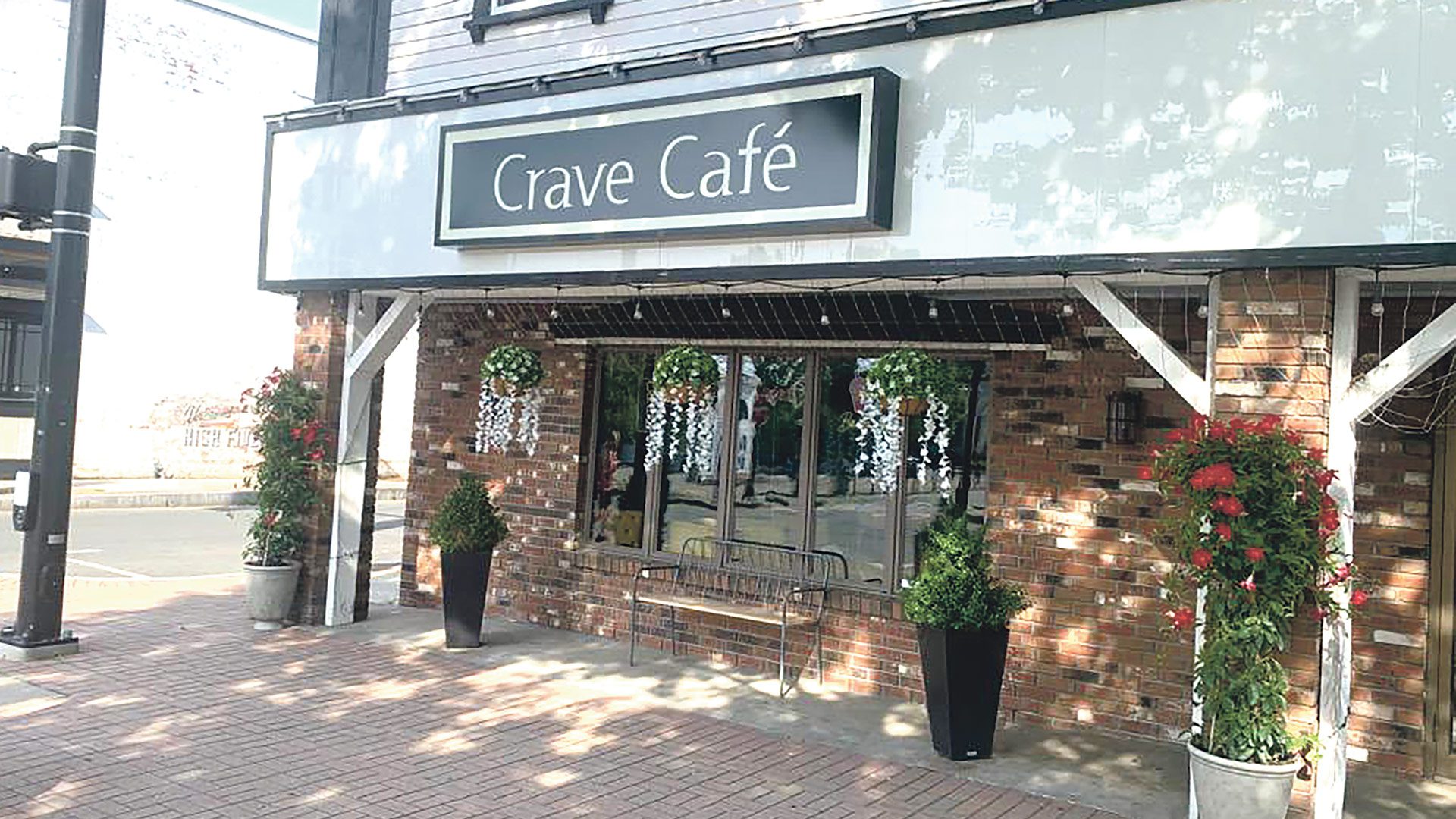
Crave Café

Crave Café is one of many new restaurants that are, collectively, making downtown Westfield more of a destination.

“The small-business community has been much more creative over the course of the past six to eight years,” he went on. “There’s a lot of young entrepreneurs, a lot of new-American entrepreneurs, a lot of women entrepreneurs who are really taking a chance to pursue their passions and their businesses downtown, and it’s been inspiring.”

Miller said he expects the downtown to benefit greatly from another ongoing initiative — a bid to create a cultural district in that area.

“We’ve applied to the Mass. Cultural Council for the designation of a cultural district on Elm Street, which we hope will provide us with a collaborative that will help to better market the downtown,” he explained, noting that the city had a business-improvement district doing some of this work, but it disbanded several years ago.

“We’ve seen these districts be successful in places like Easthampton, Great Barrington, and communities as small as Cummington, and we’re hopeful that putting together a group that’s focused exclusively on the downtown will help us to better market what we have here.”

Elaborating, Miller said this was the first time the city and its leadership have felt comfortable applying for creation of a cultural district, and the decision was sparked by the work of several nonprofit groups, including ArtWorks Westfield, formed five years ago, which has committed to an eight-week, Friday-night concert series in the new plaza, among other initiatives, including several art-walk events.


A New Gig

It was a desire to be part of this resurgence that prompted Waterfield to put aside work in print journalism — she was the owner and publisher of West Springfield Lifestyle magazine — and pursue the job as director of the Greater Westfield Chamber, which also represents Southwick and the hilltowns to the west of the city.

“It was a position that checked a lot of boxes for me,” she explained. “I’ve been a long-time Westfield resident, I love communications, I love community development, I’ve been an engaged member of the Kiwanis Club here, so I have a lot of interests here and decided to make the switch. And I’m very happy that I did.”

Westfield at a glance

Year Incorporated: 1669
Population: 40,834
Area: 47.4 square miles
County: Hampden
Residential Tax Rate: $15.97
Commercial Tax Rate: $31.39
Median Household Income: $45,240
Median Family Income: $55,327
Type of Government: Mayor, City Council
Largest Employers: Westfield State University, Baystate Noble Hospital, Mestek Inc., Savage Arms Inc., Advance Manufacturing Co.
* Latest information available

Since arriving, she’s been focused on building membership (she’s increased that number to roughly 235), meeting each member (she figures she’s about halfway there), developing a new strategic plan, and putting in place an ambassador program to help members, especially the newer ones, make the most of their membership.

Overall, she sees renewed vibrancy downtown, momentum that’s measured in various ways — from the steady number of ribbon cuttings for new businesses to the growing roster of events in the new plaza downtown.

“I love those ribbon cuttings because, to me, that shows an investment in our community,” she said, adding that the growing number of such ceremonies shows that more are willing to make that investment and thus become part of an ongoing story of revitalization.

The G&E has long been part of that story, providing comparatively lower-cost energy and, more recently, reliable, gigabit internet service to a growing mix of residential and commercial customers.

“We’ve seen these districts be successful in places like Easthampton, Great Barrington, and communities as small as Cummington, and we’re hopeful that putting together a group that’s focused exclusively on the downtown will help us to better market what we have here.”

As the utility marks 125 years, the emergence of Whip City Fiber has become one of the utility’s better success stories. As noted, it began 10 years ago with service to the Route 20 corridor in Westfield. Today, the business has expanded to communities near the Quabbin to the east and to the hilltowns and well beyond to the north and west.

“Whip City Fiber has diversified the Gas & Electric to not just be focused on natural gas and electricity with essentially zero growth other than potentially a handful of residential customers each year and a few new commercial customers,” Flaherty explained, adding that it has become a solid business that continues to grow each year.

The success of the venture can be attributed to manner in which the G&E becomes full partners with the communities it serves, he added, providing turnkey operations.

“We’re the network operator, which means we handle soup to nuts, everything involved with their network, from billing customer service to tech customer service,” he said. “We don’t touch their money; it goes right into the town’s account, but we physically do all of the management of their department for them.”

He noted that there is considerable competition, not just from the major players such as Comcast and Verizon Fios, but also from other municipal utilities, including those in Chicopee and South Hadley. The G&E’s main competitive advantages are size and proven capabilities, he went on.

“We’ve built out 20 communities outside of Westfield, so we know the process; we know what that takes,” he told BusinessWest, adding that this track record for success has helped bring on new partnering communities, including Southwick and East Longmeadow.


Bottom Line

Getting back to east-west rail, McCabe acknowledged that the city is somewhat late to this party, but hopefully not too late.

If he can manage to gain the ear of the state and make Westfield a stop on that line, that would bring another dose of momentum to a community that is seeing large amounts of it — on many different fronts.

 

Employment

Motivation Matters

By Nicole Polite


Quiet quitting is a term that has recently gained traction, describing a workplace trend where employees strictly limit their tasks to what is outlined in their job descriptions, refusing to work longer hours or overextend themselves. While these individuals fulfill their basic duties, they establish clear boundaries to preserve work-life balance and resist the notion that ‘work is life.’

This behavior does not necessarily indicate a lack of commitment or intent to leave the organization. Rather, it often highlights a need to manage workplace stress or dissatisfaction effectively. This type of withdrawal could also suggest that an employee is reevaluating their career path or actively seeking new opportunities.

The concept gained notability during the period known as the Great Resignation, a time when many individuals reflected deeply on their careers, salaries, and how they are treated in the workplace. The primary motives behind quiet quitting often include a lack of advancement opportunities, insufficient pay, and a feeling of being undervalued. This isn’t a new phenomenon; workers have been adopting this approach for years in response to issues like poor compensation, unmanageable workloads, and inadequate growth opportunities.


Signs of Quiet Quitting

Quiet quitting can manifest in various ways, some of which include:

• Not attending meetings;

• Poor attendance;

• Arriving late or leaving early;

• Noticeable reduction in productivity;

• Lesser involvement in team projects;

• Avoiding participation in planning or strategy meetings; or

• A general lack of enthusiasm or engagement in work.


Ripple Effects of Quiet Quitting

Increased Workload for Others: With some employees dialing back their efforts, their colleagues often face increased workloads, which can result in burnout and further disengagement, perpetuating a harmful cycle.

Compromised Reputation: Quiet quitting can take a toll on an organization’s external image. Internal problems can tarnish its reputation as a desirable workplace, making it challenging to attract and retain skilled personnel.

Loss of Competitive Edge: In competitive sectors, where innovation is key, the lack of initiative resulting from quiet quitting can severely disadvantage a company.

Increased Turnover: If issues prompting quiet quitting, such as poor recognition, inadequate compensation, or limited growth prospects, aren’t addressed, employees may eventually leave the company. This turnover is not only disruptive, but also adds significant costs to the organization in terms of replacement and training.


Strategies for Employers to Mitigate Quiet Quitting

Employers aiming to combat quiet quitting and enhance employee engagement should focus on improving the overall employee experience through several strategic approaches:

Open Dialogue: Regularly engage with staff to understand their needs and address grievances. Genuine expressions of appreciation can significantly impact morale and motivation.

Realistic Workloads: Ensure that goals set for employees are achievable and reasonable, maintaining clear boundaries to prevent feelings of being overwhelmed.

Regular Check-ins: Create a supportive atmosphere by routinely checking in on employees’ well-being in informal settings. This can help foster a sense of belonging and care within the company.

Autonomy and Creativity: Encourage autonomy in daily tasks and problem solving to enhance creativity and personal investment in work.

Mental Health Prioritization: Develop and implement wellness programs that encourage employees to focus on their mental health. Foster an environment where mental well-being is regarded as essential as physical health.

Career Development: Actively discuss and facilitate potential career paths within the organization. Assist employees with clear, actionable steps to achieve their professional ambitions, showing commitment to their growth and development.

By implementing these strategies, organizations can not only address the issue of quiet quitting, but also cultivate a workplace culture that respects and values employee contributions and personal boundaries. Such an environment can lead to a more engaged and motivated workforce, ultimately benefiting the entire organization and leading to better overall productivity and employee satisfaction.


Conclusion

As quiet quitting continues to be a topic of discussion in many professional circles, it’s crucial for leaders and managers to take proactive steps to understand and address the underlying issues that lead to such behavior. By fostering an empathetic and supportive workplace, companies can ensure that their employees feel valued and motivated, reducing the inclination toward quiet quitting and boosting organizational health and effectiveness.


Nicole Polite is CEO of the MH Group, a staffing and recruiting firm in Massachusetts and Connecticut specializing in placing professionals in various industries with client companies.

Employment

Investment in the Future


Dress for Success of Western Massachusetts (DFSWM), the area’s only workforce-development organization focused exclusively on the needs of women and gender non-conforming people, is expanding its programming to include a new women’s career center in downtown Springfield. The organization recently received a three-year, $133,000 grant from the Women’s Foundation of Boston to help fund this expansion.

Jess Roncarati-Howe

Jess Roncarati-Howe

“We are filled with gratitude for the Women’s Foundation of Boston and thank them for believing in our life-changing mission. Who better than a participant of each of our programs to spearhead this new phase of our programming?”

Currently, DFSWM supports the community through a continuum of workforce-development offerings that includes its suiting program, which makes available new and gently used professional attire to those who have interviews and need appropriate attire; Foot in the Door, a workforce-readiness program for those looking to enter or re-enter the workforce; the Margaret Fitzgerald Mentor Program, which offers one-on-one mentors to program graduates; and a Professional Women’s Group offering graduates ongoing mutual support and professional networking opportunities.

The new career center will supplement this programming by offering workshops and drop-in assistance with résumé writing, job-search strategies, interview preparation, financial literacy, and computer skills.

The career center will be managed by Takisha Mims, a DFSWM program graduate who will be promoted to the organization’s impact manager from her current position as administrative coordinator. In this new role, Mims will conduct a thorough listening tour, receiving feedback from program participants, other graduates, and local community members to inform the career center’s programming, which she will help to design.

Christina Gordon

Christina Gordon

“We are proud to continue working alongside fantastic organizations dedicated to serving and empowering women and girls through this grant cycle, setting them up for success now and in the future.”

“We are filled with gratitude for the Women’s Foundation of Boston and thank them for believing in our life-changing mission,” DFSWM Executive Director Jess Roncarati-Howe said. “Who better than a participant of each of our programs to spearhead this new phase of our programming? We are proud to have Takisha on our management team.”

The Women’s Foundation of Boston is a nonprofit public charity that creates, funds, and accelerates high-impact economic and leadership programs that equip Massachusetts women and girls to be financially independent and successful leaders. During its 2024 grant cycle, the organization awarded $2,173,000 to 10 nonprofits across Massachusetts.

“We are proud to continue working alongside fantastic organizations dedicated to serving and empowering women and girls through this grant cycle, setting them up for success now and in the future,” said Christina Gordon, co-founder and CEO of the Women’s Foundation of Boston.

Law

A Road Map to Fairness

By Elaine Reall, Esq.

Managers, supervisors, and overworked HR professionals all face the specter of a sensitive workplace investigation from time to time. Allegations of illegal discriminatory behavior, workplace harassment and/or bullying, hostile-workplace assertions, or just straightforward favoritism based on a workplace romance between employees all regularly confront employers.


When to Investigate

The first question that employers need to ask is, does a formal or informal investigation need to take place? Not all workplace gripes or groans warrant an investigatory response.

Elaine Reall

Elaine Reall

“The first question that employers need to ask is, does a formal or informal investigation need to take place? Not all workplace gripes or groans warrant an investigatory response.”

For example, mandatory overtime in understaffed healthcare facilities is the subject of numerous complaints. And while it makes good employee relations sense to address such an issue, nothing in such a scenario rises to the level of warranting an investigation. However, if a formal or internal complaint indicates the possibility or probability of illegal discrimination, physical or emotional abuse, criminal misconduct, retaliation for whistleblowing, or OSHA-related safety or health issues, an employer would be wise to seriously consider initiating an investigation.

If an actual complaint exists (as opposed to vague rumors), prompt investigatory action is best practice, as it preserves evidence, prevents fading of witness memories, and demonstrates employer credibility. Yet, in a situation where only rumors and secondhand observations abound, an employer must weigh the pros and cons of pursuing an investigation without an actual complaint serving as an investigatory road map.


Who Should Investigate

Employers should begin by assessing the experience and background of managers and HR professionals working for the organization. Do such individuals have training and experience with internal workplace investigations? How critical is the confidentiality of information? Is there a high likelihood of legal action?

When considering inside versus outside investigators, consider this quick checklist:

• Do legal issues of document protection and privilege exist?

• Will the workplace benefit from a factual/credibility determination by a disinterested party?

• Evaluate the need for a general versus detailed findings/report.

• What is the likelihood of administrate agency (MCAD, etc.) or court action?

• Consider the need for professional demeanor.

• What is the value of inside managers/HR professionals being trusted in sensitive situations?

As a general rule of thumb, an experienced investigator (regardless of internal or external status) will be the most cost-effective.


Timing of Investigation

Prompt investigations are better investigations. Hoping that issues will simply go away is a surefire way for an employer to torpedo a strong result. Timely investigations deal efficiently with issues such as fresh witness memories, existing documentation, and lack of employee turnover. Investigatory urgency also lends a certain energy to the findings or report.

Unfortunately, employees often delay reporting serious issues and incidents to an employer for a variety of reasons. Often, the first evidence of a pattern of sustained harassment comes from information gathered during employee exit interviews. The best way to avoid this result is to actively encourage employees to report problems or concerns while they are still small (and fixable). The use of IT tools to make reporting of employee concerns simple and non-confrontational is a great adjunct to the traditional open-door complaint process used by many organizations.


Strategy, Strategy, Strategy

Nothing is more vital than extensive planning before starting a formal workplace investigation. Take all, or most, of the following actions:

• Gather and review relevant workplace documents;

• Read personnel files of potential witnesses and ‘suspects’;

• Do a deep Google dive on relevant parties;

• Do initial assessment of the nature of the complaint;

• Obtain legal advice about whether the subject matter may be legally privileged; and

• Outline the who, where, and why of the investigation (best investigator, best location for interviews, format for witness statements).


Limit Scope of Investigation

Finally, the workplace is not a judicial setting. Narrow the scope of your investigation to factual determinations. Examples: did X do/ask/physically touch, etc.? Did X violate employer policy? Do not introduce legal jargon or conclusions into the investigation. Example: don’t ask if someone created a hostile work environment.


Written Reports

Where a written report is appropriate or necessary, plain but detailed language is best for an investigator’s notes. Witness answers plus the investigator’s impressions and observations (example: tone of witness, loudness of response, marked body language) should be detailed.

Include specifics in the notes and in the final report. Outside third parties will view such detail as evidence of due diligence on the part of an employer. And, lastly, don’t depersonalize the report’s language; include actual names and identifying information (dates and times, locations, witnesses, and interview format [in-person versus Zoom]).


Written Versus Oral Report

If it has been a significant investigation, an employer needs to create a separate, stand-alone written report. Tip: do not file such a report in a regular employee personnel file. A distinct investigation file should be created. Written reports should not attempt to draw legal conclusions.

Consider notifying the complainant(s) and accused party of the general outcome of the investigation. Failure to do this almost always leads to such parties looking for answers outside the workplace, including talking with a lawyer.

Last, but never least, strive for a proper investigatory behavior and demeanor:

• Learn the value of silence and open-ended pauses;

• Don’t rush through questions;

• Ask a question and then actively listen;

• Remember to include open-ended questions to encourage witnesses to talk;

• Maintain a detached demeanor (avoid emotionally charged statements); and

• Absolutely avoid promises or guarantees.


Conclusion

Following the guidelines outlined above will help you create a solid investigatory road map. If you have any questions or concerns about the above policies, it is prudent to contact a labor and employment attorney so that the best investigatory practices can be followed and you can, hopefully, avoid unnecessary litigation.


Elaine Reall is an attorney who specializes in labor and employment-law matters at the Royal Law Firm LLP, a woman-owned, women-managed corporate law firm that is certified as a women’s business enterprise with the Massachusetts Supplier Diversity Office, the National Assoc. of Minority and Women Owned Law Firms, and the Women’s Business Enterprise National Council.

Law

Sensible Move or Overreach?

By Meaghan Murphy, Esq. and John Gannon, Esq.

Meaghan Murphy

Meaghan Murphy

John Gannon

John Gannon

Non-compete agreements have long been the subject of intense debate. Some view them as a critical way to protect confidential and proprietary business information, while others view them as stifling the rights of workers to freely change jobs.

Taking the latter view, last year, officials at the Federal Trade Commission (FTC) proposed banning the use of non-compete agreements in the workplace. Because non-compete agreements prohibit workers from moving to or starting competing businesses for a designated period of time, from the FTC’s perspective, restrictions on employee mobility disadvantage workers who are seeking to change jobs, while at the same time harm businesses looking to hire employees. The net result, according to the FTC, hurts the economy overall and violates the Federal Trade Commission Act, which prohibits businesses from engaging in unfair methods of competition.

Just a few weeks ago, the FTC officially moved forward with its plan to eliminate non-compete agreements when it issued a final rule that will ban non-compete agreements nationwide starting Sept. 4, 2024. The new rule will impact an estimated 30 million workers — approximately one in five workers in the U.S.

“The rule does not impact non-disclosure and confidentiality agreements or non-solicitation agreements unless they prohibit a worker from, penalize a worker for, or function to prevent a worker from seeking or accepting work or operating a business.”

In this article, we take a closer look at what is required by the new rule, legal challenges to the nationwide ban, and strategies for employers who have non-compete agreements currently in place.


What Does the Rule Actually Say?

Here are the most important things businesses need to know about the new rule slated to take effect on Sept. 4 of this year.

Employers are prohibited from entering into or attempting to enter into a non-compete agreement with any employees. Also, with one limited exception (discussed below), employers will not be able to enforce non-compete agreements currently in place. Further, there is an affirmative obligation on employers to provide clear and conspicuous notice to workers with existing non-competes that those agreements will not be enforced against them.

There is a ‘senior executive’ exception: for senior executives, which are defined as those in “a policy-making position” earning more than $151,164 annually, it is unlawful to enter into new non-compete agreements after Sept. 4, but current non-compete agreements for senior executives will be allowed to stay in effect even after the effective date of the rule.

The rule does not impact non-disclosure and confidentiality agreements or non-solicitation agreements unless they prohibit a worker from, penalize a worker for, or function to prevent a worker from seeking or accepting work or operating a business. In other words, as long as those agreements are not worded so broadly as to essentially be non-compete agreements, they are safe.

As is often the case, there are some exceptions to the rule. For example, the rule does not apply to workers at nonprofits. Non-competes between franchisors and franchisees are exempted, so any such agreements remain lawful to have or enter into in the future. The same goes for non-competes between the seller and buyer of a business.


Legal Challenges

Business advocacy groups have taken issue with the non-compete ban from the get-go, arguing that the FTC’s actions are classic government overreach. The U.S. Chamber of Commerce — which touts itself as the world’s largest business-association advocacy group — announced its intention to file a lawsuit to block the rule months ago.

The chamber emphasized that non-compete agreements are — and should continue to be —upheld or struck down under well-established state laws and, further, that such a broad rule applied to all businesses across all sectors is not appropriate for the FTC to implement unilaterally.

In addition to the Chamber of Commerce’s lawsuit, a global tax services and software provider based in Dallas (Ryan, LLC) is challenging the rule in a federal district court in Texas. According to that company, non-competes are a valuable tool for firms to protect their intellectual property and foster innovation, and the FTC rule would upend businesses’ ability to do both.

Several motions have been filed in that case, and the court has suggested that it will issue a ruling on the legality of the FTC’s rule soon. Whichever way that court decides, employers can expect the losing party to appeal the decision to the Court of Appeals. After that, it’s possible the U.S. Supreme Court will weigh in.


What Should Employers Do?

Employers should collaborate with legal counsel to review all existing non-compete agreements and assess whether they will pass muster under the new FTC rule. If a business determines that most (if not all) of its non-compete agreements will be unenforceable come Sept. 4, management needs to craft a new plan aimed at protecting customer goodwill and shielding sensitive confidential information from disclosure.

As noted above, for the most part, non-disclosure and confidentiality agreements and non-solicitation agreements are not affected by the FTC’s non-compete ban. When properly drafted, these agreements can achieve the same goals as a non-compete without running afoul of the new FTC rule.

Businesses should also monitor the status of the FTC’s rule. We expect courts will issue important rulings in the FTC non-compete rule litigation very soon. If those decisions leave the rule in place in its current form, employers may need to issue notices compliant with the rule to those workers that fall within its protections, as well as refrain from requiring non-competes be signed by any workers in the future.


John Gannon is a partner with Springfield-based Skoler, Abbott & Presser, specializing in employment law and regularly counseling employers on enforcing restrictive covenants and protecting trade secrets. Meaghan Murphy is an associate with the firm and specializes in labor and employment law; (413) 737-4753.

Law

The Decline of the Nuclear Family

By Julie A. Dialessi-Lafley, Esq.


Historically, a nuclear family (also known as an elementary family, atomic family, cereal-packet family or conjugal family), was the traditional family structure which is defined as a family group consisting of parents and their children (one or more), typically living in one home residence.

Statistically speaking, this is no longer the norm. In fact, 80% of households in the U.S. have a non-traditional family structure. Family structures that may be considered non-traditional or alternative include, but are not limited to, single-parent families (a single parent raises a child alone), cohabitation (an unmarried couple shares a household), same-sex families (two individuals of the same sex raise a family), grandparenting (grandparents raising grandchildren), and polygamy (marriage among at least three people).

Julie A. Dialessi-Lafley

Julie A. Dialessi-Lafley

“In the Baby Boom of 1960, there was one dominant family structure, with 73% of all children living in a family with two married parents in their first marriage. By 1980, 61% of children were living in this type of family, and today, less than half (46%) are in households with two married parents.”

Gay and lesbian households increased from 540,000 to 980,000 post-legalization of same-sex marriages, and multi-generational households have increased from 7 to 26%, which represents a 271% increase over a decade. The change in the common family structure from traditional to non-traditional happened quickly, and the laws have not moved as quickly to keep up with the times.

To highlight the change and how quickly it has taken place, consider that in the Baby Boom of 1960, there was one dominant family structure, with 73% of all children living in a family with two married parents in their first marriage. By 1980, 61% of children were living in this type of family, and today, less than half (46%) are in households with two married parents.

The formation of the non-traditional family, and the children that may result, can bring complex legal issues such as custody, visitation, child support, property division, estate planning, and constitutional issues, to name just a few of the most obvious ones. These are the legal issues only and do not even touch on social and emotional issues, which exist due to lack of understanding and/or acceptance in a society still rooted in traditional values.


Planning Is Paramount

Given how quickly the nuclear family has become the non-dominant family structure, one would think the members of non-traditional families would have all the resources they need available to them to address all the legal issues we face in our increasingly more complicated modern family society. Unfortunately, due to lack of concrete guidelines, non-traditional families are often forced to resolve these legal issues in a court process due to failure to understand the unique issues of their family structure or a lack of legal process.

By way of example, it is the unfortunate reality that some laws may not support the same federal estate or tax benefits in non-traditional households versus traditional ones. Federal benefits and retirement may not pass to non-married partners or same-sex spouses without actions taken specifically to designate beneficiaries. Proper tax planning and asset planning should be a priority in these households and relationships; however, these are areas often overlooked when dealing with the daily challenges of managing life and household dynamics.

When considering that most households have more than one income, likely have purchased real estate, have commingled assets, and may have blended families with children from other parents, non-married partners, or multi-generational households caring for children, the need to plan for the distribution of assets upon death is of paramount importance.

However, there is no specific, cookie-cutter estate plan for all non-traditional families to abide by. To ensure that property passes to your non-married partner, same-sex spouse, or non-biological and/or biological children, proper estate plans need to be put into place. These plans may include a will and trusts to ensure that goals of asset distribution are met upon a death.

In the same way, plans need to be put into place and properly documented to make sure that lifetime decisions such as health decisions, personal financial decisions, and end-of-life determinations can be made by your partner if not married, or by any person you chose. In the absence of estate planning, things may not be carried out as you would want them to be or by the people you would have selected had you taken the time to put a plan in place.

The non-traditional family should consider cohabitation agreements, prenuptial agreements, custodial agreements (if recognizable in your home state), as well as formal estate planning in order to protect themselves and their families in the event of a breakup, divorce, dissolution of a household, or death.


Seeking Answers

It can be difficult for partners or single parents to protect their rights as a family. There is no definitive answer to these challenges with custody and parenting arrangements. Many of the outcomes are fact driven and left to the discretion of a court when agreements cannot be reached by the parents or caregivers. When relationships break down, parties are less likely to be able to put the best interests of the children at the forefront in order to reach an agreement.

Does a non-married person who has raised a non-biological child automatically have parenting rights? Are they financially responsible for the child(ren)? Do grandparents who have been a caretakers to a grandchild get visitation if the child returns to the care of the biological parent? The answers are not as clear and obvious as you would think or hope they would be when considering the relationships that may have existed between children and caretakers of any kind.

The law, again, is fact-specific and gives great discretion to the courts in reaching a decision when parties cannot resolve these issues among themselves. Thus, while many partners find informal custodial arrangements and other systems work well for them, the majority face issues when problems arise.

Frequently, mainstream advice is given with traditional families in mind, which undoubtedly creates confusion for unconventional arrangements. All family units of any structure, but especially for certain non-traditional families, should consult knowledgeable family-law attorneys and financial professionals to develop the plans that best meet the unique needs of their chosen life.


Julie A. Dialessi-Lafley is a shareholder with the law firm Bacon Wilson, P.C. and chairs the firm’s Family Law department. She is a certified family law mediator, a member of the Springfield Women’s Leadership Council, a member of the United Way of Pioneer Valley board of directors, and is licensed to practice law in both Massachusetts and Connecticut; (413) 781-0560; [email protected]

Cover Story

Current Events

Executive Director Ben Quick

Executive Director Ben Quick


Ben Quick recognizes that the Connecticut River, particularly the stretch that runs through Springfield, has what he calls a “checkered past” as … well, not the cleanest riverway, and perhaps a negative reputation in some corners, based on that past, that lingers today.

But those who actually use the river for recreation on a regular basis — and Quick, executive director of the Pioneer Valley Riverfront Club, certainly counts himself among them — tell a much different story.

“People who come to our riverfront here in Springfield for rowing or dragon boating and see what we have, between the quality of the water and the views and the infrastructure, say, ‘why aren’t there 10 clubs here? Why isn’t everybody out on this water? Why aren’t more people enjoying it?’” Quick said.

It’s a message he likes to share. “The mission of our organization is to bring guests, visitors, and residents of Greater Springfield to the riverfront for some healthy, outdoor, fun recreation. The river itself has got a checkered past, and part of our job is to enlighten people with proper information, safe experiences, and a positive takeaway, so they go home and tell their friends, ‘hey, you know what? The Connecticut River in Springfield is absolutely gorgeous, and there’s all kinds of fun stuff you can do there. Why not check it out?’”

“People who come to our riverfront here in Springfield for rowing or dragon boating and see what we have, between the quality of the water and the views and the infrastructure, say, ‘why aren’t there 10 clubs here? Why isn’t everybody out on this water? Why aren’t more people enjoying it?’”

The Pioneer Valley Riverfront Club (PVRC) was established by a small group of rowing enthusiasts in 2009 to promote river-based recreational activities, sporting activities, and river access in general.

“They got together on a patch of grass a little further downstream from us and organized as a rowing club,” Quick noted, adding that they put a proposal together to occupy what is now the club’s home, at North Riverfront Park on the river’s shore, in a building that dates back to 1901.

“Since then, we have grown our organization from a small group on a patch of grass to about 50 kids, about 60 adults, and hundreds of visitors every year who participate in our programs,” he told BusinessWest. “We started off as a rowing organization … in fact, PVRC originally stood for Pioneer Valley Rowing Club. But soon after we were organized, we expanded and offered dragon boating, which is the fastest-growing water sport in the world. And we realized that we had much more to offer than rowing. So that’s where Pioneer Valley Riverfront Club came from.”

Speaking of dragon boating, the 10th annual Springfield Dragon Boat Festival is coming up on July 20, and has become the club’s premier event (more on that later).

A dragon boat team navigates the Connecticut River

A dragon boat team navigates the Connecticut River in the 2023 event.
(Photo by D. John McCarthy)

“The rowing and dragon-boating programs have just blossomed,” Quick said. “They are kind of niche sports … not a lot of people know about these sports.”

But he considers it his mission to make sure more people find out every year.


Stern Challenge

Quick’s involvement in the PVRC began with a connection through one of his sons, who is 24 now, but discovered rowing while attending a Springfield middle school that had a connection to the club.

“One day, he came home from school and said, ‘Mom, Dad, my school has rowing, and I’m doing it.’ My wife and I were like, ‘this sounds great. Who knew we even had that?’ And as he started to get involved, we as a family got more involved too, saying, ‘this is a wonderful thing. More people need to hear about this.’”

At the time, the PVRC was volunteer-driven, with very few full-time, paid employees, and Quick and his wife, Julie, became active in the organization. A few years later, in 2015, when the club was looking for an executive director, he was encouraged to throw his hat in, and was offered the job.

“I think having a positive first experience certainly sets people on a trajectory that we’d like to see them continue on. And kayaking is the easiest way for us to help people have a fun time.”

“It was a big family decision,” he recalled. “I had no nonprofit experience; I had corporate-world experience, but no one could question my passion for the organization, my passion for the sport, and my passion for seeing the thing grow. And my family was behind me because, when you move from the corporate world to the nonprofit world, you’ve got to make some sacrifices. But for us, it was a great opportunity.”

The club has also become an ideal opportunity for people of all ages to get in the water and learn a new pastime.

A dragon boater paints the head of her team’s boat

A dragon boater paints the head of her team’s boat.
(Photo by D. John McCarthy)

“Kayaking is a wonderful first experience for on-water recreation,” Quick said. “For so many of the kids and adults from Springfield who come down here for kayaking, this is their first experience with a boat on the water, ever. And we’re super proud of that. I think having a positive first experience certainly sets people on a trajectory that we’d like to see them continue on. And kayaking is the easiest way for us to help people have a fun time.”

Kayaking is offered on Friday nights, Saturdays, and Sundays, and throughout this summer, kayak rental — normally $20 per hour — is free, thanks to a grant from the Massachusetts Department of Conservation & Recreation, though donations are accepted.

The club offers rowing programs, including one called SAFARI, which stands for Summer of Activity, Fun, and Rowing Instruction, which is for kids age 12 and up.

“It’s kind of like a summer camp, but only a couple hours a day,” Quick explained. “We get them out in boats, we teach them safety, we teach them instruction, and on a rainy day we’ll stay on land and play some games. It’s just a two-week program to get kids interested in rowing.

“From there, the sky’s the limit,” he added. “We have a competitive racing team comprised of a few middle schoolers and a bunch of high schoolers. They race in the spring and the fall athletic seasons, as well as in the summer. We travel as far away as Philadelphia to race other programs. It’s a really cool sport, and these kids learn things that no other sport is going to teach them. They say rowing is the ultimate team sport.”

Then, of course, there’s dragon boating.

“Dragon boating is a lot like canoeing, except you’re in a dragon boat with 19 other paddlers, plus someone steering and someone drumming. So it’s a party barge, but for canoeing,” Quick said. “And we can teach someone how to dragon boat pretty quickly. It’s a short learning curve, but it’s a lifelong pursuit toward perfection. We have a wonderful dragon boating team that meets in the evenings because it’s an adult program.”

The Springfield Dragon Boat Festival, which is free for spectators, draws hundreds of people to the riverfront each summer to watch teams race, while enjoying entertainment, food trucks, face painting, crafts, and other activities. Team registration (at pvriverfront.org) ends July 10, and this year’s event will be held Saturday, July 20.

“Anyone can do it. We had a group one year that was a family reunion,” Quick said, adding that teams of inexperienced dragon boaters — companies, organizations, families — compete in an all-neophyte division. “They get one practice session, and then we throw them in a boat.”

The other division is comprised of teams of people who compete in dragon boating as a sport. “They train all winter, they lift weights, they get strong, and then they hit the water and race each other. So you don’t have those teams competing against the community teams, but they are amazing to watch. The intensity of a race is incredible. They only last one minute — the fastest times on the race at our festival will be sub-60 seconds.”

The Pioneer Valley Riverfront Club offers rowing activities for all experience levels

The Pioneer Valley Riverfront Club offers rowing activities for all experience levels.

In addition to the races and family fun, Quick noted, “we have a cultural presentation because there’s a side of the festival that doesn’t get spoken about much, but we hope will get spoken about more, which is that a dragon boat festival is an important cultural holiday in China. It’s a celebration of patriotism, and of longevity, and of life. So there is a cultural aspect of the Dragon Boat Festival that is shared by our dear friends at the Chinese Association of Western Massachusetts.”


Pulling Together

The Pioneer Valley Riverfront Club presents other events as well, including youth and adult regattas, and recently, for the second straight year, it hosted the 1.2-mile swimming portion of an Ironman triathlon, which also includes a 56-mile bike ride and a 13.1-mile run.

“I was told that, last year, 40% of the participants were local, and I think, for 60% of the participants, it was their first time,” Quick said. “So let’s hope that trajectory continues. It’s certainly positive for the business community, for the economy here.”

He’s also gratified that the river’s health — and reputation — have come such a long way since the 1970s and 1980s, when raw sewage was regularly dumped into the water. These days, it’s much cleaner, he noted, and when sewage spills into the river after a storm, it’s generally safe to swim or row within a day or two.

“Every time there is a spill of sewage into the river, it gets reported. And that’s a wonderful piece of legislation — I think transparency is really important to improving quality. But we do have safety protocols, and we are aware of river quality. I give a lot of credit to the Connecticut River Conservancy for spending the money and providing the resources to do weekly water quality testing.”

Beyond enjoying a healthier river, Quick simply enjoys the tranquility of the pastime.

“When you’re on the water, even right here in Springfield, and you look to the shores, and all you see are green trees, and a few buildings poking over it, you could be in Vermont. It is amazing how tranquil the river is.

“I’ve been a lifelong athlete, but I haven’t been rowing for that long; I’ve been rowing for maybe 10 years. When I came to the sport with other men and women my age, I realized this is something we can do. You know, we don’t have to have been playing this sport since we were 4 years old in order to have a fun, competitive experience. So I realized, ‘hey, this is great.’”

It’s also a lesson in teamwork and pulling together toward a common goal, which is certainly a positive experience in these often-discordant times.

“If you are not moving in complete harmony with the person in front of behind you, you’re going to bump into each other. And that can lead to some aches and pains and bruises,” he added. “But if you work together, it is such a thrill. It is such a rewarding experience.”

Employment Special Coverage

Hire Expectations

Kevin Lynn

Kevin Lynn, executive director of the MassHire Springfield Career Center.


It was the spring of 2022, and Kevin Lynn was starting to think the job fairs conducted three times a year at the Basketball Hall of Fame by MassHire Springfield Career Center — which he serves as executive director — had run their course.

Attendance among job seekers, which had been running at roughly 300 pre-pandemic, had dropped to maybe 100, even though employers across the region and in virtually all sectors of the economy were seeking help — many of them desperately.

As for the job seekers themselves … the very generous unemployment benefits awarded at the height of the pandemic, when millions of jobs disappeared almost overnight, were all but gone. Yet, many people were still sitting on the sidelines, not at all anxious to enter the workforce.
“I didn’t know what was going on — nothing made any sense, really,” said Lynn, who has spent more than 20 years with the entity now known as MassHire Springfield Career Center, 10 as its director. People were still hunkered down, and people like me were asking, ‘how can these individuals not afford to work?’”

While waiting for an answer to that question — one that never really came — two things happened. The first is that the picture started righting itself with regard to people getting back to work. The second is that MassHire Springfield, in Lynn’s words, “started acting more like a business.”

By that, he meant the agency started to more aggressively market itself and its services, especially through digital platforms.

“We had to get our name in front of people and remind them of exactly what we do and how we do it,” he recalled. “Also, we had to pull in what I’ll call a new generation because we’d been on pause for the better part of four years. That natural flow that we had established since 1997 had been disrupted, so we needed to prime that pump again with our core constituency.”

Those efforts have succeeded in bringing the customer base back to pre-pandemic levels, as we’ll see. And roughly two years after he was thinking about retiring the job fairs, attendance is pretty much back to where it was pre-pandemic, said Lynn, adding that the program will actually be expanded this year from three fairs to four, with the fourth likely to take place at the agency’s facility on Liberty Street in Springfield.

“We had to pull in what I’ll call a new generation because we’d been on pause for the better part of four years. That natural flow that we had established since 1997 had been disrupted, so we needed to prime that pump again with our core constituency.”

“We think we need a fourth because of the demand,” he said. “We’ll see how it goes.”

As for the job market itself … Lynn said things have not exactly returned to normal — whatever that is — although he is seeing an overall softening of the job market, with many challenges remaining for those needing skills, older workers (over age 55), and other constituencies.

Most employers are still struggling to find good help, he said, adding quickly that, while some are willing to train and shape candidates who may not have the full package, others are holding out for the “fully formed” applicant, and sometimes losing out in the process.

Meanwhile, on the wage front, many employers are still not fully embracing the need to move the needle higher. Instead, they’re focusing on what they think they can afford, and not the proverbial big picture — meaning what they spend to hire, and then to hire again when someone brought in at a comparatively lower wage leaves after a few months, or a few weeks, because he or she can secure a dollar or two more an hour elsewhere (more on this later).

These are just some of the observations made by Lynn as he talked about his agency, the job market, and what could, and likely will, come next.


The Job at Hand

“Blocking and tackling.”

That’s what Lynn said MassHire Springfield is back to focusing on these days after what can only be called a turbulent period that includes the pandemic and its aftermath.

By blocking and tackling, he means work with both employers and job seekers to put people in jobs. Such work with job seekers includes training available through the agency’s upskilling program, workshops on everything from handling tough interview questions to helping mature workers prepare for today’s job-search process, job fairs, connecting individuals with resources, and much more.

job fairs

Kevin Lynn says the job fairs conducted in partnership with Audacy Springfield and the Basketball Hall of Fame are back to pre-pandemic numbers.

As for the pandemic and its aftermath, this was a difficult, stressful time, when the agency’s mission — connecting job seekers with employers and helping those job seekers garner the skills needed to not only land jobs, but secure careers — didn’t really change. But the overall need for it did — sort of.

“COVID killed our customer base,” he said matter-of-factly. “Customers weren’t coming in, and they weren’t even using us virtually.”

Quantifying the matter, he noted that, in fiscal 2019, prior to COVID, the agency served roughly 11,500 people over the course of the year. For fiscal 2020, which included the first several months of the pandemic, the number fell to 8,500. And for fiscal 2021, a full and very traumatic year of COVID, the number of customers tumbled to 4,300, roughly a third of the pre-pandemic total.

Why? There were several reasons, Lynn recalled. First, many were content to collect those generous unemployment benefits and not enter, or re-enter, the workforce, he said, adding that, during those times, people not actively seeking employment could receive unemployment benefits, something that wouldn’t happen in more ‘normal’ times. Meanwhile, many of those who had jobs were content to stay put given the large amounts of uncertainty that accompanied that environment — and a desire to work remotely.

“It was the devil you knew versus the one that you didn’t know,” he recalled. “Also, people were desperate to get working-at-home arrangements set up; everyone wanted to be remote. And if you were in a remote situation, and it was solid, you weren’t going to risk that by going to a new employer.”

Meanwhile, with the pandemic came the loss of day-care services for many, he went on, adding that some people had no choice but to quit their jobs — or not seek a job or a better job — so they could be home with their children. It was the same for many of those caring for elderly parents.

“A large section of the labor market just literally pulled back and chose not to work,” he said. “And that impacted us greatly.”

Indeed, the phone started ringing at a much slower pace, and there was a considerably quieter atmosphere at the career center, Lynn recalled, adding that, by the end of 2022, as the number of customers served rose slightly to more than 5,000 (still less than half the pre-pandemic totals), the agency responded by being proactive.

It launched a six-month advertising campaign, much of it digitally with Audacy Springfield (the agency’s partner on the job fairs), designed to raise awareness of the agency, its services, and those fairs.

“A large section of the labor market just literally pulled back and chose not to work. And that impacted us greatly.”

And for fiscal year 2023, the customer base jumped to more than 9,300, a 56% increase, he went on, adding that this was a byproduct of both those aggressive efforts to prime the pump and what he considers a softening of what had been a very attractive market for job seekers, with employers struggling to replace retiring Baby Boomers and simply handle the turnover that was impacting almost every sector.


Searching … for Answers

As Lynn explained, “if you have skills, you’re in a good spot in terms of being able to find job opportunities and get offers. But the job market has softened over the past few months; it’s not as strong as it was prior to this.”

Elaborating, he said the market remains challenging for many subgroups within the workforce and those looking to join it, including older workers, many of whom have skills but struggle to find employers willing to recognize and pay for them.

“They continue to have problems breaking through and getting jobs simply because of their age,” he told BusinessWest. “We see it all the time; you look at people, and they have a solid résumé, and you think, ‘this person is at least worth a conversation.’”

But often, they aren’t part of the conversation.

“Maybe the person isn’t right for the organization; I get all that,” Lynn went on. “But when you have people who have come to us, and they’re working very diligently and a lot of times working with our job developers even, and they’re trying to find work … it can be a tremendous struggle to come out on the other end.”

For those older workers who do come out on the other end with a job, their search will have been much longer than for those who are younger, as many employers are hesitant to look past someone’s date of birth and instead focus on what they might be able to bring to an organization.

Overall, and as noted earlier, Lynn said many employers are still looking for the full package, the “fully formed” applicant, as he called it, when hiring.

“They’ll vocalize that they’re not,” he said, noting that many will say or hint that they are willing to train. “But that’s not the case. They’re holding out for the fully formed applicant, and that’s a problem for the job seekers.”

Another problem is what he referred to as “ghost postings,” which are, well … what that phrase indicates they are: postings that aren’t exactly real.

“They may not have the opening, but they’re posting the job on the anticipation that they may have an opening,” he explained, adding that such phantom postings are prompting him to question the actual level of demand in certain fields and for certain jobs. Meanwhile, they are bringing new forms of stress to job seekers, who are investing time, energy, and emotion in pursuit of a job that may or may not exist.

Meanwhile, for those pursuing work, or a better job, the bigger challenge may not be finding a job, but finding one they can live on.

“It takes more diligence to find the right job,” he said. “Anyone can find a job; the issue is finding a job with a living wage — pay and benefits that you can live on. We see companies that post jobs that do not pay a living wage.

“My staff has conversations with employers on this topic; they’ll say, ‘we can post this job for you, but at the wage you are offering, you are not going to get any applicants,’” he noted. “If you’re at $17 or below, you’re going to have a tough time — a very tough time.”

He said most employers fully understand that a lower wage number shrinks the applicant pool. What they may not fully appreciate is that, even if they do hire someone, that lower wage serves to further increase turnover, bringing costs that will likely exceed a higher wage.

As for those job fairs, they certainly provide a window into what’s happening with the job market, he said, noting that the one in May drew more than 300 job seekers and 54 companies, a growing number of which were represented not by recruiters, but by decision makers — even the CEO.

Such was the case with Conval Inc., a Connecticut-based valve manufacturer. The president of the company was behind the table at the job fair and managed to not only talk with an applicant for a machinist’s position, but hire him on the spot.

“That made his night because he can’t find machinists anywhere,” said Lynn, adding that, while such on-the-spot hirings are quite rare, the goal of these fairs is for employers and job seekers alike to make connections, and these are, indeed, happening.

In short, the clock hasn’t been turned all the way back to 2019, but it’s looking and feeling more like those times.

Healthcare News Special Coverage

Achieving the Dream

Clockwise from top left: Kristen Racine Melendez, Faith Ackerman, Roxana Toledo, and Abby Candee.

Clockwise from top left: Kristen Racine Melendez, Faith Ackerman, Roxana Toledo, and Abby Candee.

For every individual who enters the nursing field, there’s a story. Sometimes, several stories.

They involve everything from the people and circumstances that inspired them to choose this profession to the challenges that had to be overcome on the way to earning their degree and then starting their first shift; from how the dream of becoming a nurse is often deferred, for any of myriad reasons, to how those dreams were kept alive and eventually fulfilled.

These storylines, and many others, are captured in the profiles of four recent nursing graduates presented in what is now our annual salute to nurses.

The profiles below, both intriguing and inspirational, involve women who got into nursing somewhat later in life, after experiencing other professions — everything from the military to paramedic work — and raising children.

Their stories are all different, but there are some common denominators, especially the ability to overcome challenges and make the dream of becoming a nurse reality — at a time when an influx of young nursing talent is more needed than ever.

Read Their Stories:

Kristen Racine-Melendez

Faith Ackerman

Abby Candee

Roxana Toledo


Law Special Coverage

Such a Move Could Bring Order to Cannabis Control Commission

By Scott Foster, Esq. and Johannah Huynh

For business and civic leaders in Springfield, the appointment in 2004 of the Springfield Control Board remains a watershed moment in the city’s fiscal history.

Regardless of how one felt about the city being plunged into receivership by the Legislature through the appointment of the Control Board, the results were unmistakable, as the city went from having an annual budget deficit of $41 million in 2004 to having cash reserves of $34.5 million when the Control Board was disbanded in 2009. Springfield has continued to enjoy the fruits of the newfound fiscal responsibility with an ever-increasing bond rating since 2009.

Bruce Stebbins, a longtime resident of Western Mass., but then a recent resident, was elected to Springfield’s City Council in the midst of the Control Board’s tenure and had a ringside seat to the Control Board’s temporary reign over the city. He continued to serve on the council through the end of the Control Board and then became become Springfield’s Business Development administrator, reporting to the city’s chief Development officer.

Scott Foster

Scott Foster

Johannah Huynh

Johannah Huynh

Stebbins’ experience engaging with the Control Board and helping bring the city to financial stability may prove immensely valuable if the Massachusetts Office of the Inspector General (OIG), the top watchdog agency in Massachusetts responsible for preventing fraud and waste and abuse of public funds, get its wish.

In a recent six-page letter addressed to the Commonwealth’s top elected officials, the OIG strongly urged the Massachusetts Legislature to immediately appoint a receiver to run the day-to-day operations of the Cannabis Control Commission (CCC) while the Legislature concurrently reviews the CCC’s statutory governance structure.

Over the past two years, the CCC has been plagued by internal turmoil, which the OIG suggested is partially a result of the CCC’s enabling statute failing to clearly define or delineate the duties and responsibilities of the leadership hierarchy. The OIG’s recommendations for the Legislature to overhaul the governance structure seek to address the root of the CCC’s problems.

“Not only might the temporary appointment of a receiver allow the Legislature to resolve the CCC’s governance structure, but it could also better promote the efficiency of a regulatory body, which would be a welcome development for the hundreds of businesses that rely on the CCC’s oversight.”

Since the enabling statute is, according to the OIG, “unclear and self-contradictory with minimal guidance on the authority and differing responsibilities of the CCC’s commissioners and staff,” it’s surprising that the CCC has been able to oversee $322 million in tax and non-tax revenue in the most recent fiscal year.

The OIG was also concerned that, despite spending $160,000 on mediation services since May 2022 to draft a governance charter, the commissioners have yet to release meeting minutes relating to the discussion of the charter, publicly release a draft charter, approve the new charter, or even provide assurance that the mediation process is complete. Even if a governance charter were adopted, the OIG emphasized, such a charter would not have the force of law — only binding the CCC to the extent the commissioners agree.


Internal Strife

Acting CCC Chair Ava Callender Concepion has pushed back on the call for a receivership by citing the commission’s recently proposed blueprint of a governance structure in its final stages of legal review subject to a public meeting.

The ongoing lack of an official chair of the CCC was also cited by the OIG as an area of concern. Amidst the suspension of CCC Chair Shannon O’Brien by the treasurer since Sept. 14, 2023, the commissioners have disagreed on who held the appropriate authority to appoint Callender Concepcion to the role of acting chair. Just last month, the CCC voted to relieve the acting executive director, Debbie Hilton-Creek, of her day-to-day responsibilities, leaving the CCC without a duly appointed leader to oversee the operations of the agency.

Even in the absence of clarity on who has authority to do what, the OIG notes that compliance with the Open Meeting Law, which prohibits two or more commissioners from discussing matters outside of a publicly posted meeting, is simply impractical with respect to a large state agency overseeing day-to-day operations.

With such decentralization of management and ambiguous authority at the CCC, the OIG has stressed the urgency of appointing a receiver with the authority to manage the day-to-day operations of the CCC. Specifically, the OIG recommended that the receiver should be expressly authorized to both carry out the daily administrative functions of the CCC and carry out said functions notwithstanding any assertion of by the chair, acting chair, or commissioners under Chapter 76.

If the Legislature were to heed the OIG’s findings, the appointed receiver would have unchallenged authority to carry out the CCC’s administrative operations until the Legislature has resolved the CCC’s governing structure.

In this context, for an agency responsible for bringing in approximately $322 million in tax and non-tax revenue in FY 2023 alone, a receiver that was statutorily authorized to do what the CCC cannot, per the OIG, would be in the best interests of the cannabis industry, its consumers, and ultimately the constituents.

Not only might the temporary appointment of a receiver allow the Legislature to resolve the CCC’s governance structure, but it could also better promote the efficiency of a regulatory body, which would be a welcome development for the hundreds of businesses that rely on the CCC’s oversight.


Scott Foster is a partner at Bulkley Richardson in Springfield, and Johannah Huynh is a summer associate at the firm.

Commercial Printing Special Coverage

Rolling with the Changes

Co-owners Greg Desrosiers (left) and Chris Desrosiers

Co-owners Greg Desrosiers (left) and Chris Desrosiers


Looking back on 2020 and 2021 — when business ground to a halt for many industries, then began to ramp back up way too slowly — Chris Derosiers is grateful that Hadley Printing Co. was able to weather the storm after clients of all kinds halted jobs and dramatically scaled back on the volume of orders.

And he’s equally grateful for 2022, a historically strong year for this more-than-125-year-old Holyoke mainstay, when much of that business returned.

But the lingering effects of the pandemic years — namely inflation that has impacted Hadley Printing’s own costs as well as the marketing budgets for many of its clients — has lent an unusual inconsistency to a flow of business that had normally been very predictable.

“You hear that whole cliche term in business, ‘pent-up demand,’ and that’s what 2022 was; it was a strong bounce-back year,” he said. “But from COVID, we launched right into inflation, and prices just started to escalate, and supply chains were not quite there. And that really forced pricing up everywhere. It was a challenge, not just in our industry, but every industry.”

Hadley’s business is split fairly evenly among the educational market, direct business, and ad agencies and designers, and all three client buckets have altered spending habits in this current inflationary era, he explained; both 2023 and 2024 started slow, but eventually picked up.

“We have months where it’s all hands on deck, and then we have months where we’re looking for work or we’re catching up on maintenance because there’s not enough work in the building.”

“Inflation has caught up with everyone, and I think people are just kind of waiting to see what develops in the year ahead,” Desrosiers said, adding that even the peak Great Recession years of 2008-09 had a lesser impact on business than the past few years because that crisis ended more quickly.

“We’ve still got great things happening here. The work that we do, 98% of it is repeat customers. We really have a great staff and a great group of customers that support us,” he told BusinessWest. “But inconsistent is the right word. We have months where it’s all hands on deck, and then we have months where we’re looking for work or we’re catching up on maintenance because there’s not enough work in the building. That’s the takeaway for me; that COVID time has created inconsistency in the market.”

It has also created an environment for shops to expand their reach. Vice President Greg Desrosiers, who co-owns the third-generation family business with his brother, noted that the company is competing with printers from as far away as Maine these days, which makes sense because Hadley has also broadened its reach.

“We’ve found ourselves having to branch out and go a little bit farther when it comes to acquiring new customers,” Chris noted. “We’re going a little bit more east on the pike, and we’re going a little bit more west, trying to supplement some of that inconsistency in our business model.

Hadley Printing

Hadley Printing has been in its current location on one of Holyoke’s historic canals for the past 48 years.

“That market in Worcester has been a good one for us because there are printers in Boston, but that Central Mass. area has fewer commercial printers,” he went on. “So we tend to do well in that market because we’re priced a little bit more economically than that Boston printer who’s also coming in.”


One-source Solution

Hadley Printing offers a range of services, including digital printing, offset printing, and mail services, to a wide variety of customers in New England. Chris Desrosiers noted that it’s been critical to keep investing in new technology, but also to never neglect the human touch and the value of strong service.

“We have constantly reinvested back into our business every year with new equipment to better serve our customers,” he said. “But the biggest thing that I’ve seen is that people are looking to get it done at a fair price, on time, and make sure they’ve got a good product.

“We have a lot of repeat customers here because we take a lot of pride in what we do and make sure that, when we deliver, we’re delivering on time, we’re delivering a superior product, and it’s at a fair price,” he went on. “There’s always going to be that customer that’s looking for a cheaper price, but usually you get what you pay for. Sometimes, if we have a customer who goes somewhere else for a lower price, they’ll do that once or twice, and then they end up back here. That’s not to say that we’re superior to everyone else, but we do put a high focus on quality and delivering for our customers.”

Another selling point, he said, is to be a one-stop shop for all types of jobs.

“Whether it’s something as simple as a business card or anything from small quantities to large quantities, we like to be that one-source solution so that we don’t have to say ‘no’ to a customer. So we have a lot of different equipment on the floor to be able to support all of our customer demands and requests, and it allows us to service the customer from top to bottom.”

Desrosiers noted that Hadley has two 40-inch Komori offset presses that service the higher-end, large-volume offset market, but the shop can also focus on the quick-turn, smaller-volume digital market. The business has also added mailing capabilities over the last five years.

“There’s always going to be that customer that’s looking for a cheaper price, but usually you get what you pay for. Sometimes, if we have a customer who goes somewhere else for a lower price, they’ll do that once or twice, and then they end up back here.”

“We found that, usually five times out of 10, the customer is looking to have a piece mailed as well. So that’s part of that whole one-source solution — a customer can come to us and have it printed and dropped in the mail stream; we can handle the whole process,” he explained. “We’ve also brought a lot of finishing techniques in-house. We do in-house foil stamping, embossing, and die cutting. That’s something that we’ve really expanded into in the past five years.”

As a result, he said, “for any account, no matter what they throw at us, nine times out of 10, we can say ‘yes, we do that.’ We do use outside vendors, but, decreasingly so in the last five to 10 years. We’ve really set up our company to be a one-source solution.”


Seeking Sustainability

Hadley Printing originated in South Hadley, but in 1976, it moved to its current location on Canal Street in Holyoke, a 32,000-square-foot former silk mill alongside one of the city’s historic canals.

“It’s been a good spot,” Desrosiers said. “Up until 2006, we were renting part of our space out, but we’ve now taken over the entire building, and we’re using every inch of it.”

Because of its location, at least 50% of its power comes from hydroelectric energy. “That’s obviously a selling point. A lot of customers are looking for that environmental factor, the green manufacturing. And we have two things going in our favor there: hydroelectric power, and we’re also an FSC-certified printer.”

Certification by the Forest Stewardship Council ensures that the products in a print job come from responsibly managed forests, and Hadley Printing, which has been certified since 2011, must undergo an audit each year to retain that mark.

“It’s about chain of custody, and it assures the end user that the product was manufactured in a sustainable, green way,” Desrosiers added. “For example, we just did the UMass commencement. We printed 20,000 programs, and on the back of that program, they’ve got the FSC logo that states that it was printed on FSC paper in a sustainable way. And then it’s got a message that encourages people to either recycle that program, archive it, or share it with others.

“That’s usually driven by the customer; what it takes is a customer that wants to print an FSC order. We do about 50 FSC orders a year; it’s just an added level of service that we provide. Most businesses out there are environmentally aware, and they want to print in a sustainable way.”

While the focus on sustainability has increased over the years, the number of commercial printers in the market has consolidated somewhat — though, as noted earlier, they’re competing for a shrinking, or at least more unpredictable, pool of jobs.

“It’s a very capital-intensive business as well,” Desrosiers said. “You constantly have to reinvest in equipment to be able to produce work in an economical way and be competitive. Some of the businesses that didn’t reinvest in new equipment on their floor have had challenges being able to meet customers’ demands.

“Putting a 40-inch commercial press on the floor is a big financial commitment, sure. And you’ve got to make sure you’ve got the volume of work to support it,” he added. “But once you do have that equipment, it allows you to produce work in a more efficient way. So it’s a double-edged sword. But not reinvesting in the business is where I think a lot of companies have fallen out of being competitive in this market.”

A more predictable market, as in the pre-pandemic days, would help all players in this field, but Desrosiers knows his industry not alone there.

“Whether it’s printing, whether it’s construction, whether it’s banking, everyone is just trying to ride the roller coaster,” he said. “But overall, we’re doing well. We’re adapting to those changes. And I think we’re well-positioned in this market going forward.”

Healthcare News

Her Son’s Strength in Battling Cancer Has Helped Her Persevere

Kristen Racine-Melendez

Kristen Racine-Melendez


As she talked with BusinessWest on a Tuesday morning late last month, Kristen Racine-Melendez was on the road, heading to the Dana-Farber Cancer Institute in Boston.

She had her GPS on because she was taking a different route this time, hoping to cut the travel time by a few minutes. She knows the regular route by heart, having made it dozens of times since her son, Chase, was diagnosed with leukemia on Aug. 12 last year.

That’s a date, and a discussion, that Racine-Melendez won’t ever forget. And it came just a few weeks before she was due to start her second year in the nursing program at Springfield Technical Community College (STCC). She thought about putting her studies on hold and devoting all of her time, energy, and emotion to Chase, but with some words of encouragement from her husband, Carlos Melendez, she decided to press on.

“Once we got of the ICU and started to get more answers about what was going on with Chase, my husband and I sat down and talked about it,” she recalled. “I said, ‘I don’t know if I should take this year off.’ And he told me, ‘no … you need to stay in now, more than ever. This is for our son now.’”

It goes without saying that her second year of nursing school — a challenge under any circumstances — become exponentially more difficult as she confronted a situation that no parent wants to face.

“Once we got of the ICU and started to get more answers about what was going on with Chase, my husband and I sat down and talked about it. I said, ‘I don’t know if I should take this year off.’ And he told me, ‘no … you need to stay in now, more than ever. This is for our son now.”

But she persevered, graduated in May, and is preparing to start work in the emergency room at Mercy Medical Center, a setting she knows well because she spent seven years as a tech there before deciding to fulfill a long-held dream and follow her grandmother and aunt into the nursing field.

She told BusinessWest that she was able to make it to the commencement ceremonies because of the support she received from Carlos, but also from faculty and other students at STCC. But mostly, she persevered because of the inspiration provided by Chase as he battled leukemia with strength that astounded all those involved in his care and treatment.

“He amazes me every single day,” she said. “He always has a smile on his face; he’ll throw up one second, and the next second, he’ll say, ‘mom, I want to do this, I want to eat this.’ He gives me my strength.”

And while the past 10 months have been extraordinarily difficult, they have also provided learning experiences on many different levels, said Racine-Melendez, adding that these have made her stronger and, by her calculations, better able to handle all that will confront her as an emergency-room nurse.

Kristen Racine-Melendez holds her son, Chase

Kristen Racine-Melendez holds her son, Chase, in a family photo with her husband, Carlos Melendez, and daughter, Kira.

Flashing back to last summer, Racine-Melendez said Chase, 4 at the time, started experiencing some problems. She eventually took him the ER, where a series of tests were undertaken to determine just what was wrong.

“They told me his bone narrow wasn’t working properly, and right from there I knew, and my heart just sank,” she recalled. ‘It was a very unexpected outcome; I didn’t really expect them to come out and say he had cancer.”

Chase’s diagnosis and subsequent treatment added several layers of challenge to her plans to enter the nursing field, the latest chapter in a career that saw her go from a seven-year stint with the National Guard to an equally lengthy run as a tech at Mercy.

Looking back on this past year, she said she powered through, caring not only for Chase but his twin sister, Kira, and persevered with the support of many others, starting with her husband. But the faculty and fellow students were also very supportive, she said.

“I decided to stay in and give it a try, and we made it work,” she said, adding that, following classes on Wednesday, Thursday, and Friday, she would travel to Boston Children’s Hospital, where Chase was admitted for two months, to relieve Carlos, who was with him the other days of the week.

“I feel like I was just in survival mode; I had my moments where I was knocked down, but I’d just get up and keep going,” she said of her last two semesters at STCC. “I got through it … somehow.”

She said Chase, who is in remission and receives evaluations and treatment at Dana-Farber three Tuesdays a month, is doing well.

“This week was a really good week,” she said. “His numbers were up; he was able to run and around and be a kid. It was nice to see him actually enjoy a little bit of childhood.”

As for Racine-Melendez, she said she’s doing well, too, looking forward to starting at Mercy, and also looking forward to putting the learning experiences of the past two years — all of them — to work.

“I feel like I was just in survival mode; I had my moments where I was knocked down, but I’d just get up and keep going.”

Indeed, she said caring for Chase gave her experience that went beyond what she encountered in the classroom and even her clinical rotations. Meanwhile, she learned first-hand what it’s like to be a parent getting devastating news about a child’s cancer diagnosis — and then experienced everything that comes after that diagnosis.

“I think this will help me; I can empathize with my patients and understand the aspect of the other side — what the parents are going through,” she explained. “I definitely would have preferred not to go through this, but I believe that everything happens for a reason. Everything I’m going through is just making me a stronger mother, a stronger person, and a stronger nurse.”


Healthcare News

Faith Ackerman

Faith Ackerman

Faith Ackerman


Faith Ackerman says her grandmother, Jean Ackerman, who worked as a psychiatric nurse well into her 70s and only stopped because she fell and broke her wrist, long encouraged her to enter that rewarding profession.

But until recently, she “just wasn’t ready” to start down that path, she told BusinessWest, noting that, instead, she first went into the military (more on that eye-opening experience later) and then worked as a technician in a few area veterinary hospitals in efforts to perhaps find what she wanted to do with her life.

Ackerman was helped in that decision, and ultimately became ready to follow her grandmother into nursing, when she became involved in her grandmother’s care as she battled everything from diabetes to an attack of shingles, with Ackerman becoming somewhat frustrated by the decisions made by some of the doctors.

“I stepped in and helped my grandmother as much as humanly possible and took care of her,” she recalled, noting that she became sick during COVID, needed home care, and died in the fall of 2020.

Inspired by these experiences, and also by her grandmother’s career, Ackerman enrolled in Holyoke Community College’s LPN (licensed practical nurse) program, worked as an LPN in hospice care, and recently completed her RN program at HCC.

“There was something that bothered me about having guns and being in dangerous areas and being sort of locked and loaded all the time. I was very sensitive to that, and I felt that my calling was elsewhere.”

In her last clinical rotation, she worked in a surgical trauma unit at Baystate Medical Center and “fell in love” with that type of nursing.

“It’s so hands-on, and these people are so beyond ill that they can’t even life-function,” she explained, noting that patients in this unit are the victims of car crashes, shootings, stabbings, and other traumatic incidents. “They’re very, very, very sick people.”

In many respects, Ackerman’s story reflects those of many people getting into nursing today.

Indeed, some are finding the profession after careers, or at least jobs, in other fields. And many have found inspiration from others in their lives — and from a genuine desire to help those in need.

Meanwhile, her story is indicative of how, sometimes, it takes years, maybe a decade or two, to find one’s true calling.

Ackerman wasn’t exactly expecting the military to be her calling, but her father and grandfather served, and there was a desire to follow suit. Meanwhile, in high school, she suffered from a lack of direction in her life, a rather large chip on her shoulder, and a shortage of money for college.

“I decided to join the military and thought that maybe I could straighten my life out a little bit,” she recalled, adding that she enlisted in the Army and served for 10 years in the Military Police.

Faith Ackerman says her experiences caring for her grandmother

Faith Ackerman says her experiences caring for her grandmother, who died in 2020, helped make her ready to pursue a career in nursing.

This was a learning experience on many levels.

“It wasn’t what I thought, and policing has changed. It was a difficult job, and I went to a couple of countries that were very poor, and it was very depressing and devastating,” she said, adding that a tour of duty in Panama was particularly disheartening.

“It was more that I didn’t like guns anymore,” she went on. “There was something that bothered me about having guns and being in dangerous areas and being sort of locked and loaded all the time. I was very sensitive to that, and I felt that my calling was elsewhere, especially when I was in Panama, where the children were sick, very poor, and there was no healthcare.”

After leaving the military, she found work as a tech in a few different veterinary clinics. She enjoyed that work and thought it might become a career. But then, as noted earlier, her grandmother became sick. And as Ackerman stepped in to help, her career aspirations changed again.

She thought she would make home care the focus of her career in nursing, until that last clinical rotation while completing the RN program at HCC, which opened her eyes to a different kind of care.

“I felt that this was my calling,” she told BusinessWest. “I loved home care, but I really loved taking care of very sick people, just like I loved taking care of very sick animals in the veterinary field.

“I like people and animals to feel safe, and I want them to feel cared for,” she went on. “I have a very genuinely caring heart, so I’m able to keep people calm and feeling that they can trust me. And I know how vulnerable the patients are, so it’s really important for me to build trust with them so I can care for them.

Elaborating, she said many of the patients in the surgical trauma unit, an ICU step-down unit, are on ventilators. Many have had major surgery or have multiple broken bones.

“They’re very task-oriented patients, and there’s a staffing ratio — one nurse to three patients — that I feel very comfortable with,” she noted. “And I’m also able to work with the families of the patients; a lot of them are very involved in the patient care because these patients are so sick, and I like that aspect of this work as well.”

She’s expecting to start at Baystate in July and is very anxious to launch this next chapter in a career that has taken her to many different work environments.

If there is a common denominator to her work to date, it is compassion and a desire to help those in need.

That’s especially true of that time during COVID when she was providing home care to her grandmother.

It was a time of challenge, but also a time of learning, as much as any she spent in the classroom or clinic. And a time to become ready to follow her grandmother into the nursing field.