Home Archive by category Sections (Page 65)

Sections

Business Management Sections

Pay Attention to This Measure

By John S. Gannon, Esq.

John S. Gannon

John S. Gannon

Earlier this month, Mass. Gov. Charlie Baker signed a new law aimed at strengthening pay equity for women in the Commonwealth.

The new law amends the state’s Equal Pay Act by imposing stringent equal pay obligations on employers. The purpose of the law is certainly commendable, but the legislation goes beyond pay-equity issues by prohibiting certain pay-related conduct that is routine in some workplaces, including asking job applicants about their wage history and requiring employees not to discuss compensation.

The new law will be enforced by the Mass. Attorney General’s Office, but it also allows employees to sue their employers in court. The law takes effect in 2018, but employers should start planning today for necessary compliance obligations. Employees who successfully sue under the new Equal Pay Act will be entitled to recover all unpaid wages, plus an amount equal to unpaid wages as liquidated damages, as well as attorney’s fees.

Equal Work v. Comparable Work

Under the existing Massachusetts Equal Pay Act, employers are required to pay men and women equally for comparable work. The current version of the law, however, does not define “comparable.” Some judicial decisions interpreting the “comparable” work language have suggested that comparable work is something equivalent to the “equal pay for equal work” standard applied in federal law.

The legislation signed by Gov. Baker — which was also passed unanimously in the state House and Senate — defines comparable work in a much broader fashion. The new law defines “comparable work” as work that requires “substantially similar skill, effort, and responsibility” and is performed under “similar working conditions.”

This “substantially similar” language is likely to open the door to more equal-pay lawsuits in Massachusetts because it is much less demanding than the “equal work” language used under federal law.

Look at it this way, consider how many employees truly perform “equal work?” Regardless of your answer, it’s probably safe to say many more employees perform work that is “substantially similar.” When the law takes effect in 2018, all employees performing “substantially similar” work must be paid the same, unless a permissible variation applies.

Permissible Pay Differences

Some variations in pay will still be permissible, even for employees performing “comparable” work. If the difference is attributable to one (or more) of the following factors, wage differential liability may be avoided:

• A seniority system;
• A merit system;
• A compensation scheme that measures earnings by quantity or quality of sales;
• Geographic location of the job;
• Education, training, and experience; or
• The amount of travel required.

Unfortunately, the new law does not provide any guidance explaining how these exceptions will work in practice, leaving many questions unanswered. For example, is a 15-mile difference in geographic location of the job sufficient to justify pay variances for comparable work? What about a 50-mile difference? Does a bump in pay after an initial 90-day introductory period constitute a legitimate seniority system? The Massachusetts Attorney General’s Office has the power to issue regulations interpreting the new law, so it is likely the agency will put out guidance helping to clarifying these terms.

One thing we do know is that employers may not reduce the salary of an employee in order to comply with the new law. Employers who have unexcused pay differentials will need to “level up” by bringing the pay of lower earners up to the pay of the highest earner doing comparable work.

More than Pay Equity

The new law goes beyond requiring equal pay for comparable work, because it also prohibits employers from engaging in several common wage-related practices. When the new law takes effect, employers will no longer be allowed to require applicants to provide wage and salary history on job applications or at any other time before an offer of employment is extended.

This means job applications and interview practices may need a refresher. The law also penalizes employers who require employees not to discuss compensation with coworkers.

There is one silver lining for employers. The new Equal Pay Act provides an affirmative defense to employers who complete a ‘good faith’ self-evaluation of their pay practices and demonstrate “reasonable progress” toward eliminating any wage differentials. This means that employers who adequately audit their pay practices may avoid liability under the new law. However, the employer’s self-evaluation must be “reasonable in detail and scope in light of the size of the employer.” Again, regulations from the Massachusetts Attorney General’s Office might shed light on what constitutes an appropriate self-evaluation.

Skoler Abbott will be partnering with Employers Assoc. of the NorthEast (EANE) on August 30, to present a webinar on the new pay- equity law. Skoler Abbott will also be hosting a Labor and Employment law symposium the morning of Sept. 20, at which attorneys from the firm will be discussing significant developments in state and federal law, including the Massachusetts pay equity law.

John S. Gannon is an associate at the firm Skoler, Abbott & Presser, P.C.; (413) 737-4753 or [email protected].

Features

Providing a SPARK

Since its launch nearly two years ago, SPARK Holyoke has become an important addition to the region’s growing entrepreneurial ecosystem, providing a learning-and-nurturing environment for a variety of business owners. To sum up its impact, one participant said the agency gave him the discipline to be “both a creator and a finisher.”

Farid Kheloco

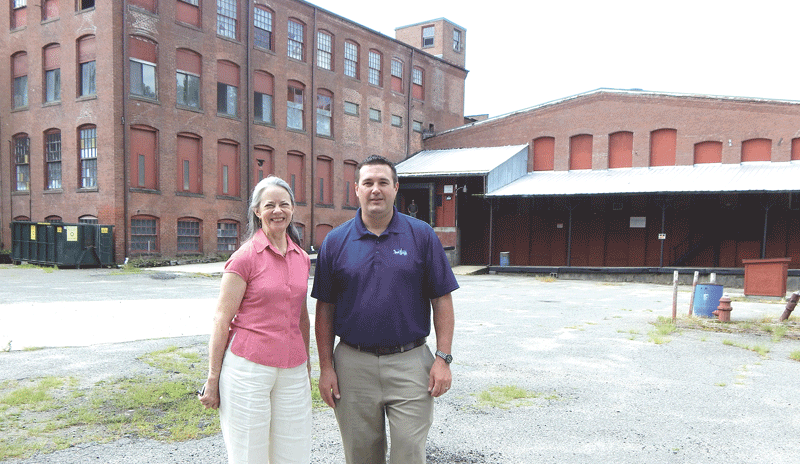
Farid Kheloco says SPARK was created to help start-ups get off the ground — and maybe help fill some of Holyoke’s vast supply of vacant mill space.

When asked to talk about the agency known as SPARK (yes, that’s an acronym, but not really; hardly anyone knows what those letters stand for) and how it’s helped her create, shape, and realize a vision for her company, Hot Oven Cookies, Sheila Coon found it necessary to do a little comparing and contrasting.

And the other subject in the discussion was a close cousin among organizations that are part of what is now being described as an ‘entrepreneurial ecosystem’ — Valley Venture Mentors, known for many things, but especially its high-octane, extremely intense accelerator program, with which Rivera also participated.

“VVM … I love it because I’m kind of a high-action person,” she told BusinessWest. “With VVM, you go the edge of the cliff, they hand you a prarachute, and tell you to jump. And as you go down, they tell you ‘jump this way’ or ‘jump that way.’ It’s very high-paced.

“SPARK, on the other hand … kind of has you sit back, and think, and analyze things slowly and more methodically,” she went on. “It gave me the opportunity to slow down and think things through. And it was very intimate — there were 10 people in the class; we had more time to think and talk things through. It was amazing.”

Though perhaps not intentionally, Coon used this exercise to not only point up the differences between the two organizations, but also spell out, in an effective manner, why SPARK Holyoke, which has the Hispanic community as one of its main focal points, has become an important addition to the entrepreneurial landscape in Western Mass.

In short, since being launched in late 2014 as part of a Working Cities Challenge grant, SPARK Holyoke has enabled a number of aspiring entrepreneurs to sit back, think things through, and, hopefully, go into business for themselves.

It does so through a 15-week course that, according to Executive Director Farid Kheloco, has a number of moving parts and objectives and is designed to help a wide range of individuals, from start-up owners to those who have been operating for several years and, for one reason or another, are trying to change how they do things. In other words, people like Coon.

“We want to hold your hand so you can take your idea and turn it into a bullet-proof business plan,” he said while smashing the mission down to a simple phrase.

The current series of classes started earlier this month, said Kheloco, noting that the one that ended during the summer featured 42 participants and 31 businesses.

Since it was launched, SPARK Holyoke has provided assistance to individuals involved with a wide variety of businesses, from cookie making to motorsports sales; from home remodeling to sock-manufacturing; from event planning to window-tinting.

Sheila Coon, seen here with her husband, David

Sheila Coon, seen here with her husband, David, says SPARK helped her create a vision, and a game plan, for her venture, Hot Oven Cookies.

Overall, SPARK is part of a series of initiatives undertaken by Holyoke Mayor Alex Morse and his administration to spur entrepreneurship, create jobs, and generate more interest in Holyoke, especially with the younger populations.

Those efforts have been successful enough to earn the city placement on Popular Mechanics’ list of the “most entrepreneurial” cities in the country.

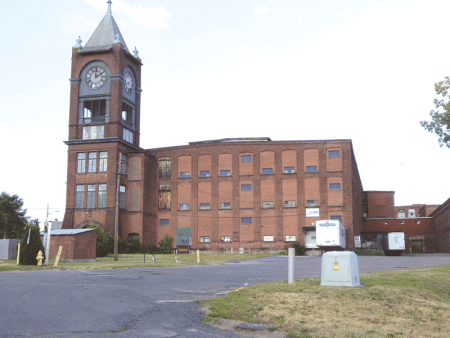
And while the goal is to encourage entrepreneurship and help businesses get off the ground, there is another, very practical element to the agency’s existence. That would be the roughly 2 million square feet of vacant mill space in this former industrial powerhouse, and a desire to fill it, said Kheloco.

He doesn’t expect SPARK to make a huge dent in that inventory any time soon, but the agency’s work can certainly be a factor in bringing more life to the old paper and textile mills that gave this city its identity and providing another spark (there’s that word again) to broad efforts to revitalize the city.

“SPARK is helping to put us (Holyoke) in the game when it comes to promoting entrepreneurship,” said Kheloco, as he spoke with BusinessWest in the Holyoke Chamber of Commerce offices (where the agency is housed) on High Street. “SPARK has a definite role in that perception of Holyoke, and that’s important for our city, because we have a lot of open space.”

For this issue, BusinessWest takes an in-depth look at SPARK Holyoke and how, despite the fact that it doesn’t issue parachutes to participants, it does help them get off their ventures off the ground.

Igniting Passion

For the record, SPARK is short for Stimulating Potential, Accessing Resource Knowledge. Kheloco and others involved with the program can probably recite all that (again, that’s probably) but most participants wouldn’t care to try.

But they do care about trying to take ideas they have a product or service and advancing them in the form of a new business. Or not, if they determine that said idea is not really viable, and SPARK Holyoke can help with that, as well.

It’s all part of that ‘thinking through’ concept that Coon mentioned, and while there is quite a bit that goes into it, the agency’s broad goals are to simplify the many matters involved with a business as much as possible, said Kheloco, who can speak with experience as he goes about working with aspiring entrepreneurs.

“I’ve been entrepreneurially minded my whole life, and growing up here I was told that you should leave the area if you want to be an entrepreneur,” he said, adding that while he works today to dispel such notions, at the time, he took that advice.

He went to New York and then Dubai, before relocating to the western part of this country and eventually for working for several different IT companies.

He returned to this area a few years ago, soon became program  manager of TechFoundry, and found himself immersed in the work of VVM and other agencies involved with entrepreneurship.

He was looking to launch his own venture — one that would produce wooden sunglasses — in Holyoke, but wound up launching SPARK instead.

“The market is pretty much saturated with wooden sunglasses,” he joked, adding that the opportunity to run SPARK — a career path recommended to him by Katie Stebbins, who was then overseeing Holyoke’s Innovation District and is now working in the Executive Office of House & Economic Development — sounded like much more of a winning proposition.

Felix Santana, owner of Northeast Motorsports

Felix Santana, owner of Northeast Motorsports, says SPARK has given him the discipline to be “both a creator and a finisher.”

Initially, his work centered around getting the agency started, honing its mission, and developing its curriculum, he said, adding that now, he spends more of his time getting the word out — in essence, filling seats for the classes — while also achieving sustainability; the grant that funds the program is three years in duration, and this is year 2 of the initiative, so new funding sources must be attained.

“We’re kind of in our teen-aged years,” he said of the organization. “We’ve identified a little of what we are, but we need to mold that and solidify what’s needed to survive for the long term.”

Kheloco’s various outreach efforts drive home the basic point that SPARK is a community organization to help what he called “every-day entrepreneurs.”

That’s certainly not a technical term, but one he summoned to describe “neighborhood projects” — small ventures, mom-and-pop operations that may or may not scale.

“We want to work with them to give them the guidance they need to get started,” he went on. “So we take a lot of the competition aspects out of the equation, and we take a lot of the business jargon out of it; we try to make it team-oriented and say ‘now you’re part of this group, the SPARK starters, and how are we going to help each and work together?’”

SPARK carries out this work with a host of partners, which include VVM, the chamber, SCORE, Holyoke Community College, Easthampton Savings Bank, and Nuestras Raices, a nonprofit group that seeks to promote economic, human, and community development in Holyoke through projects related to food, agriculture, and the environment.

“Predominantly, we deal with concepts, and we work on taking the idea and turning it into a business model,” he went on. “We like to say that we work with anyone’s who’s stuck.”

Getting Down to Business

‘Stuck’ might not be the best term to describe what Coon was when she encountered SPARK and its curriculum, but it’s in the ballpark.

To be more precise, she was at a crossroads of sorts, or transition phase, and in need of some guidance and perhaps technical help with regard to where she could and should take her venture — as well as ‘how’ and ‘when.’

Backing up a bit, she said Hot Oven Cookies was enjoying decent success and had developed a solid following (one fan called this the ‘Ben & Jerry’s of the cookie world’) with its 100 flavors — some staples, or “classics” and other varieties rotated in weekly — and a business focused on gifts and catering, all delivered.

“That keeps it fun,” she said of the large inventory of flavors. “It’s good for the customers, but it’s good for us, too — we get to keep creating.”

This first phase of the venture, as Coon described it, helped pinpoint demand and identify need, and with regard to latter, what emerged was a desire to enable customers to buy a cookie or two or three, and not a full dozen, the minimum she set for deliveries.

And this led to talk of putting a food truck on the road and bringing the product directly to consumers. It’s a big step and a sizable investment, and she credited both SPARK and VVM with helping her bring it all the fruition; the truck makes its debut next month.

She was in the second accelerator cohort, which wrapped up its work in the spring, and through that experience was introduced to Kheloco and SPARK Holyoke, and took part in both programs simultaneously.

She credits VVM with helping her take an idea off a napkin, as she put it, and take it forward, but she said SPARK provided that more-intimate, slower-paced environment that enabled her to stop and work things through.

“We talked through all of my phases,” she said of the SPARK experience, adding that the experience not only helped her conceptualize her ideas, but pitch them in a more-effective manner.

Felix Santana wasn’t exactly stuck, either. But he did need some help with his venture, Northeast Powersports, which seeks to become the largest provider of Chinese-made motorsports — primarily scooters, dirt bikes, and go carts — in the region.

The company has become an authorized dealer of Cao Cao products, offering both sales and service, he said, adding that he graduated from SPARK’s first class.

He said it provided him with both support, in the form of mentorship, and technical guidance.

“I went in there with a really solid business plan — it was a matter of getting the numbers and the data to back it up,” he explained. “They helped me get my business plan focused and connect with the right people, like SCORE, and get organized.”

He noted that he’s a serial entrepreneur of sorts, but one that doesn’t “finish,” as he put it.

“I was one of those entrepreneurs who was a really good starter, but when I got to the middle point, I never knew how to finish and would usually sell whatever idea I had at that point,” he explained. “SPARK helped give me the discipline to be both a creator and a finisher.”

Seeing the Light

Searching for more words and phrases to describe what SPARK Holyoke is and what it does, especially with regard to the proverbial ‘big picture,’ Kheloco said it acts as the glue that binds the many organizations and agencies promoting and facilitating entrepreneurship in Holyoke and the communities surrounding it.

And in that capacity, it is not only helping to create new opportunities in Holyoke and fill some of that vacant mill space, but also taking on an important role within a growing entrepreneurial ecosystem.

SPARK is technically an acronym, but mostly it’s both a noun and a verb, and as such, the word effectively describes what the agency is, and what it provides.

George O’Brien can be reached at [email protected]

BusinessWest White Paper Sections

Presented by Health New England

By Katie Bruno

K_BrunoHealth plan sponsored wellness programs – designed to help employees become more active, eat healthier, and take better care of their bodies — are not simply the right thing to do; they can also help companies save on health care costs.

It’s a simple fact that when people feel great, they are at their best. And that’s why, when it comes to wellness programs, there is, to borrow a term from the business world, measurable ROI (return on investment.)

Improvements in health can be seen in the results of biometric screenings, including measures like blood pressure, body mass index and cholesterol levels. For employers this translates to improvement in everything from absenteeism and productivity to overall company morale.

To be effective, though, these plans must be properly planned and administered. Businesses of all sizes need to really partner with their health plan as they consider offering a wellness program, when to undertake such an initiative, and, most importantly, how.

For many years now, Health New England has been that partner, providing needed direction on how to blueprint and administer a plan; how to set goals — for the program and individual participants; how to keep a program on track; and how to raise the bar when necessary.

Health New England provides a wide range of programs and specific benefits to address the wellness of its members and their families — at every stage of their lives. Our programs are free-of-charge for employer groups and are structured as follows:

• Basic wellness plan benefits, including an annual preventive well-visit; a yearly $150 wellness/fitness reimbursement; nutritional counseling with a certified nutritionist; and free help to quit smoking through Health New England’s smoking-cessation program;
• An Enhanced Healthy Choices Rewards Program that rewards members for being proactive about their health. Employers can opt-in to this free program, designed to help members gain a better understanding of their health and learn ways to better manage it. By completing a few simple health activities during the year, members can earn points toward raffle drawings; and
• A Customized Health Directions Employer Worksite Wellness Program, designed for those who want to partner more closely with Health New England. Companies and their employees receive an onsite kick-off event, including biometric screenings; various health activities, fitness challenges, educational seminars and webinars; access to the Healthy Directions web portal; and access to raffle drawings.

Health New England partners with employers and their employees to design wellness programs with a focus on goal setting, physical activity, healthy eating and preventative care. They can also help design incentive programs to reinforce health and wellness efforts.

Wellness programs are not just the right things for a company to do. They are very good for business. And Health New England can help make them part of your business.

Katie Bruno is manager of Health Management Programs for Health New England.

8.22 BusinessWestWhite


Community Spotlight Features

Community Spotlight

By Kathleen Mitchell

Mayor William Reichelt

Mayor William Reichelt says the $6 million Fathers & Sons auto dealership under construction on Memorial Drive will enhance the commercial corridor.

Mayor William Reichelt says West Springfield is a small town that in many ways assumes the character of a city, due in part to the popular retail establishments — stores and restaurants — that line its two main commercial corridors, Riverdale Street and Memorial Avenue.

Indeed, the traffic that passes along these stretches each day makes them such an ideal location that little commercial space remains. When parcels do become available, they move quickly, and right now, more than $34 million in new construction is underway along the two thoroughfares.

But that economic development has been balanced by efforts initiated by the new mayor: Reichelt, a member of BusinessWest’s 40 Under Forty Class of 2016, took office in January and has already streamlined the permitting process and formed new committees and task forces to ensure that the zoning is appropriate, traffic flow does not affect residential neighborhoods, and blighted properties are addressed.

“West Springfield is easy to get to for people coming from the north, south, east, and west, and we have become a cut-through community, so we’re trying to improve the quality of life for our businesses and residents,” he said, noting that the town’s roadways connect Springfield to Agawam; Westfield to Springfield and points farther south; and provide access to Riverdale Street and Springfield for residents of the hill towns.

Reconstruction of the Memorial Avenue rotary on the West Springfield side of the Memorial Bridge, which contains two overpasses on Route 5 to the north and south, was recently completed by the state Department of Transportation under its Accelerated Bridge Program.

It’s an important gateway, which is matched by another one to and from Agawam at the end of the 1.7 mile strip, and last year the town signed a contract with Greenman-Pederson Inc. to create a design that incorporates principles of the Complete Streets program and will accommodate the increased traffic flow expected to occur when the MGM Casino in Springfield is finished.

“Memorial Avenue is expected to become a pinnacle of the Complete Streets plan,” Reichelt told BusinessWest, adding that the Big E is also studying the traffic flow through its property, and efforts will be made to ensure that any work that is done meshes together well.

The cost estimate for the Complete Streets project, which includes repaving the corridor, adding a two-lane bicycle path, updating utilities, and adding new landscaping, is estimated at $15 million, and since it’s more than the town and MassWorks can pay for, officials are hoping the Transportation Infrastructure Program will help fund the project.

“Memorial Avenue is the first view people have of West Springfield when they cross the Memorial Bridge, and we want to make it more attractive,” Reichelt said, noting that two major multi-million-dollar projects are underway along the commercial strip that will further enhance its desirability and likely spark investments by other businesses.

For this, the latest installment in its Community Profile series, BusinessWest looks at what is going on in West Side and the measures being taken to strike a balance between commercial growth and the needs of the town’s residents.

Major Investments

Reichelt said Fathers & Sons is building a new $6 million, 50,000-square-foot Audi and Volkswagen automotive sales showroom and service center on Memorial Avenue. The company’s former Volkswagen showroom and Kia of West Springfield, which it had closed earlier, were demolished to make way for the new facility, which will include two large showrooms and a 23-bay, state-of-the art service area and waiting room with flat-screen TVs, leather couches, and Internet access.

The company expects the new service area to increase efficiency and reduce customer waiting time, and notes that the new Audi store will free up space at the Fathers & Sons dealership on 989 Memorial Ave., which will sell and service Volvo vehicles exclusively once the new facility opens.

The town has never undertaken a comprehensive review of its zoning, and we want to make traffic flow and the use of property in our commercial areas harmonious with the rest of the town.”

The project is expected to create 20 new jobs, and Reichelt noted that the city approved a five-year tax-increment-financing deal with Cartelli Realty LLC, which owns the Fathers & Sons site. It will provide limited tax breaks on the so-called growth portion of the assessed valuation of the property at 434 Memorial Ave., and town officials hope it will help enhance the corridor’s desirability.

“The new dealerships will bring more business to Memorial Avenue, and we hope it will help it to become the new Riverdale Street. Everyone wants to move their business there (Riverdale Street) because it gets so much traffic, but space along that corridor is expensive,” Reichelt said.

Work is also underway on the grounds of the former St. Ann’s Church, which was sold to the Colvest Group by the Diocese of Springfield about four years ago.

Colvest President Frank Colaccino said the company acquired and combined three parcels, which include the church property, the Bridge Street road closure, and a parking lot behind Clark Paint Factory on 966 Union St., and created a plan to build a one-story, 9,000-square-foot retail structure on the 1.5-acre site that has been approved.

Currently, utility lines on the property are being relocated, work that must be finished before construction can begin.

“It will be a good addition,”Colaccino said. “West Springfield is a great town which is well-perceived; and the new mayor is very capable and gets an A+.”

Colvest recently signed a lease with Florence Bank, which will become the anchor tenant in the new building. The new bank branch will have a drive-through window and ATM, and its current West Springfield offices will be moved into the structure when it is finished.

But it has taken years to ready the site for construction. “The church property was contaminated when we purchased it. The diocese was responsible for cleaning it up, and it has been a process to get it ready for a new building,” Colaccino said, adding that the company is in negotiations with several businesses interested in occupying the 65% of the building that Florence Bank does not need.

“It’s nice to see the church property being reused for a commercial purpose,” Reichelt said, adding that traffic along the roadway is also driven by the Big E, which attracts thousands of visitors every year and can help spur continued growth.

However, new investments are ongoing. McDonald’s held a ribbon-cutting ceremony several weeks ago to celebrate a complete renovation of its 429 Memorial Ave. eatery; and a Chipotle Mexican Grill is in the permitting process and hopes to open next summer in the former home of Jiffy Lube, which moved into a new facility on 788 Memorial Ave.

Growth is also occurring on Riverdale Street, where a new four-story hotel with 92 rooms is in the permitting stage; and scattered improvements are being made throughout the community. The Food Bag on 884 Westfield St. is being remodeled; Arrha Credit Union recently opened on 63 Park Ave. in the former home of Springfield Teacher’s Credit Union; and plans submitted to knock down the Cumberland Farms on Park Avenue and built a new one have been approved.

Helpful Measures

The town is rife with private investments, and Reichelt is doing his part to facilitate balanced growth; he immediately began taking action to address issues and areas of concern after he was sworn into office earlier this year.

He told BusinessWest that he heard complaints from some business owners about the length of time it took to navigate the permitting process, so in April he kicked off a new program. Today, meetings are held on the first and third Mondays of the month, and business owners and developers meet with a team that includes the mayor, the chair of the planning board, and 11 department heads, which helps iron out difficulties and streamlines the process.

A new, 13-member Zoning Review Committee is also being formed to take a close look at West Springfield’s zoning as well as the zoning in a variety of communities across the state. The group will begin meeting in September and will determine what needs to be done to facilitate growth, while protecting the quality of life in residential neighborhoods.

“The town has never undertaken a comprehensive review of its zoning, and we want to make traffic flow and the use of property in our commercial areas harmonious with the rest of the town,” Reichelt said, adding that the committee will also look at pedestrian crossings to make sure residents are safe.

He noted that to that end, the entire lighting pattern at the intersection of Park and Elm streets was revamped after the 2011 tornado, and new pedestrian crossways were added.

A Blight Task Force has also been formed to deal with the 100 or more vacant or derelict properties in town. Members include the building inspector, two health inspectors, and the town attorney; who take calls from residents in a centralized location about sites that need to be addressed. The mayor told BusinessWest that since the task force was formed, four homes have gone into receivership and three are being rebuilt.

In addition, action is being taken at the former Standard Plating Co. on 964 Main St., which has been vacant since 2011 when it was ravaged by the tornado that swept through the area.

The city worked with the owner to remove contamination at the brownfields site, which is within walking distance of the Memorial Avenue rotary. The building has been razed, and when the environmental cleanup is complete, the Redevelopment Authority will take possession and build a new commercial structure there.

West Springfield also plans to apply for a $1.5 million MassWorks grant for a new pumping station and an extension of the sewer lines along Route 5.

“There are five properties near the river, including a large car dealership, that have septic systems right now,” Reichelt said, noting that the pumping station was built when Riverdale Plaza consisted of a drive-in movie theater and airport, and the area occupied by Costco was farmland.

He added that Agri Mark on Riverdale Road is also building a new processing plant. “They’re making a $10 million investment in West Springfield,” the mayor said.

Continued Progress

Although a significant amount of new construction is taking place in West Springfield, balance is critical to the town’s future.

“If you leave the business corridors, you find neighborhoods and two schools in the Merrick section of town,” Reichelt told BusinessWest. “Union and Main streets are walkable areas that contain small businesses, and as you move up the hill you encounter the residential subdivisions that have grown up over the past 20 to 30 years.

“There are a lot of commercial projects underway, and we benefit from being the crossroads of New England, but the town is also a great place to live,” he said. “We’re community-oriented and have active groups that range from the Tree Committee to the Garden Club, so we are careful not to forget about our residents.”

Which makes West Springfield far more than an address for the Big E and two busy commercial strips that have become a destination due to the large number of retail establishments and eateries that flourish there.

It’s also a community that residents and businesses alike love to call ‘home.’

West Springfield at a glance

Year Incorporated: 1774
Population: 28,391 (2014)
Area: 17.49 square miles
County: Hampden
Residential Tax Rate: $16.99
Commercial Tax Rate: $22.21
Median Household Income: $54,434
Family Household Income: $63,940
Type of government: Mayor; Town Council
Largest employers: Eversource Energy; Harris Corp.; Home Depot; Interim Health Care; Mercy Home Care
* Latest information available

Sections

WILBRAHAM — The Gaudreau Group Insurance and Financial Services Agency announced that Judy Davis has joined its Employee Benefits team. Davis has more than 25 years of experience in the corporate employee benefits industry, with a focus on designing and implementing benefits plans and services for organizations large and small.

She joins The Gaudreau Group after having spent 11 years as Vice President of Sales in the Employee Benefits Division at Insurance Center of New England in Agawam.  Prior to her time at Insurance Center, Davis was Vice President of Employee Benefits at Banknorth (now USI) Insurance Agency in Springfield.

“I’m very proud to have joined an organization that exemplifies the same high standards of exceptional customer service and integrity that I have provided my clients for over 25 years,” says Davis.

Jules Gaudreau, President of The Gaudreau Group added, “Judy is a great addition to our industry-leading Employee Benefits division. With the largest staff in the region, robust compliance programs, and high-tech employer and employee software solutions on her side, Judy will deliver real, impactful results to our clients.”

Davis is the recipient of several accolades and awards, including the 2013-2014 Top Woman in Insurance in the “Top 25 Women to Watch” in Western Mass., as well as the 2015 “Friend of Stavros” award from Stavros Center for Independent Living in Amherst, MA.  She has served on several Chamber of Commerce boards and committees in the Western Mass. area.

Business of Aging Sections

Shock to the System

DBS treatment

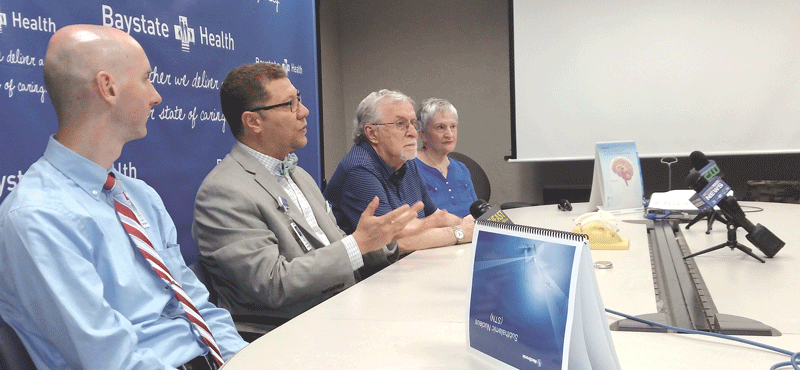
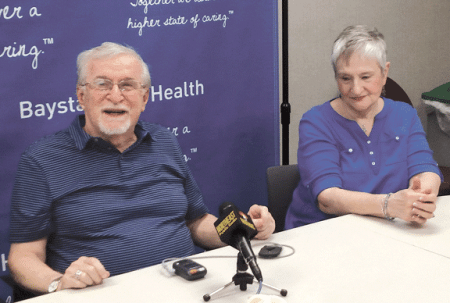
From left, Dr. Octavian Adam, Dr. Mohamad Khaled, and Paul and Kathie Schafer discuss the results of Paul’s recent DBS treatment at a recent press conference.

Paul Schafer’s wife likens it to “something out of Star Wars,” but it’s firmly in the realm of real-world science, and it holds the potential to change countless lives. It’s called deep brain stimulation, and for Schafer, who suffers from essential tremor, as well as many Parkinson’s disease patients, this treatment — now available at Baystate Medical Center — has opened a door to enjoying the activities of daily life most people take for granted.

Paul Schafer pressed a button on a small, handheld device, and started to shake.

The tremors were subtle at first, but within seconds his hands were shaking uncontrollably. When he picked up a plastic cup, the doctors sitting with him were grateful it was empty. When they handed him a pen to write his name, the scrawl couldn’t even be recognized as letters, let alone anything intelligible.

That was his life before his recent brain surgery, one of the first of its kind in the region. But when he pressed that button again — not without difficulty — the shaking stopped, and he was able, once again, to perform those simple activities.

That’s his life now.

“It changed my whole life,” said Schafer, 74, while sitting with his wife, Kathie, and the Baystate Medical Center doctors who facilitated that change. “All the mundane things you do every day, I wasn’t able to do without help — drink coffee out of a mug, brush my teeth, comb my hair, button my shirt … all the stuff everyone takes for granted. It was too challenging to do those things before the surgery.”

The procedure is known as deep brain stimulation, and it helps people like Schafer — who suffers from a common neurological movement disorder called essential tremor — as well as patients with Parkinson’s disease, dystonia, and obsessive-compulsive disorder, a chance at a normal life.

It changed my whole life. All the mundane things you do every day, I wasn’t able to do without help — drink coffee out of a mug, brush my teeth, comb my hair, button my shirt … all the stuff everyone takes for granted. It was too challenging to do those things before the surgery.”

The tremors caused by such conditions can be debilitating. But DBS, performed successfully — as Baystate neurosurgeon Dr. Mohamad Khaled did for Schafer — is opening up a dramatic new door to quality of life for potentially millions of sufferers.

The surgery — which involves drilling a small hole into the skull, under local sedation, and inserting electrical wires into the area of the brain where circuit errors are causing the tremors — may also hold potential in areas ranging from Alzheimer’s disease to severe depression, but those frontiers are still being studied.


Go HERE for a list of Skilled Nursing/PT Facilities in Western Mass.


The U.S. Food and Drug Administration approved the treatment for essential tremors and Parkinson’s in 1997, and it’s now recommended for patients with severe symptoms that don’t respond to medication anymore, or when the response isn’t sufficient, said Baystate neurologist Dr. Octavian Adam.

“Paul had symptoms for 15 years, and took a number of medications with some response; then the symptoms progressed and really affected his life in a negative way,” he went on. “He had difficulty using his hands — writing, holding a cup of coffee without spilling it, using a fork and knife to eat, brushing his teeth.”

Because the medications weren’t working anymore, the Schafers saw DBS as, well, a no-brainer.

“Dr. Adam was suggested by Paul’s previous neurologist, who said there may be something else we could look into,” said Kathie Schafer. “When we walked out of the building, we sat in the car, looked at each other, gave a big sigh, smiled, and said, ‘it looks like there’s a way — a better way of life.’ I think that was how we thought about the entire procedure.”

Finding the Sweet Spot

According to the National Parkinson Foundation, deep brain stimulation has proven to be an effective treatment for that disease’s symptoms, such as tremor, rigidity, stiffness, slowed movement, and walking problems, as well as similar symptoms present in essential tremor.

DBS does not damage healthy brain tissue by destroying nerve cells, the foundation noted. Instead, it uses a surgically implanted, battery-operated medical device called a neurostimulator to deliver electrical stimulation to targeted areas in the brain that control movement, blocking the abnormal nerve signals that cause tremors.

Dr. Octavian Adam, left, and Dr. Mohamad Khaled

Dr. Octavian Adam, left, and Dr. Mohamad Khaled say not everyone with tremors is a candidate for DBS, but those who are typically find the results dramatic.

The DBS system consists of three components: the ‘lead,’ an electrode — a thin, insulated wire — inserted through a small opening in the skull and implanted in the brain; another insulated wire passed under the skin of the head, neck, and shoulder, connecting the lead to the neurostimulator; and the neurostimulator itself, a sort of battery pack implanted under the skin, usually near the collarbone.

In the first phase of the procedure — called phase zero, because it doesn’t involve surgery — the neurosurgeon uses MRI or CT scanning to identify the area of the brain where the electrical nerve signals generate the tremors.

Phase one, as the next step is known, involves implanting the electrodes in the brain while the patient is under sedation. When the patient wakes up, Khaled asks him to point a laser at a target on the wall. As the doctor adjusts the electrical wires to target the appropriate circuit in the brain, the patient’s shaking hand slowly begins to stop shaking so that the laser is directly pointed in one location. That’s when Khaled knows he’s found the ‘sweet spot’ for the electrodes, and the patient suddenly is nearly cured of the tremors.

“The circuitry is in disarray, so you sort of shut that circuit down,” he explained. “Sometimes it’s like a radio dial — you need to dial it up or tune it down.”

After a few weeks of healing, a second surgical procedure is completed to make the changes permanent.  The wires are attached to a device implanted in the chest, which is programmed to send electrical impulses to the brain, which block the signals causing the tremors.

Not everyone with essential tremor or Parkinson’s is a candidate for deep brain stimulation, Adam explained. The best candidates have suffered from tremors for a long time and failed to find relief through medications, and the tremors have to be severe enough to impact their daily life in a significant way. “If those conditions are met, we consider surgery to treat them.”

That said, only about 10% of patients with essential tremor are good candidates, and 20% of those with Parkinson’s, though the calculation with Parkinson’s is a bit more complex, requiring at least some positive response to medications and a lack of other conditions, such as dementia, cognitive issues, and severe depression.

About 100,000 patients worldwide have undergone DBS since 1997. Previously, the closest hospitals in the Northeast that offered it are in Boston to the east, Albany, N.Y. to the west, Burlington, Vt. to the north, and New Haven, Conn. to the south. “So we had a big hole in the middle,” Khaled said.

That’s important, Adam noted, because patients with essential tremor or Parkinson’s are often unable to drive and may not have access to transportation, and the procedure is more than the surgical visits; many appointments are necessary in advance of the actual surgery. “Having it here makes it available to a lot of patients who would not have access to it otherwise.”

In Schafer’s case, he had hit the wall with medications; there was nothing else he could try. Despite the risks possible with any surgery, “I was very positive about the whole procedure.”

Still, the risks were minimal, Adam explained. In any brain surgery, the risk of bleeding or stroke is about 2%, and the risk of infection between 3% and 5%. “That’s pretty low. Ninety-five percent of the time, nothing happens. And this does not carry any extra risk compared to other brain surgeries; in fact, there’s less. The level of invasiveness is less. The electrodes are thinner than a spaghetti noodle.”

Science, Not Fiction

Schafer was also, naturally, curious about how long DBS would prove effective. Khaled and Adam explained that early response is always the strongest, and over time — perhaps a decade or more — some of the effect may start wearing off. But the device settings can be fine-tuned to provide better coverage and more control.

Paul Schafer

Paul Schafer speaks to the media about how DBS has allowed him to perform routine tasks that had become impossible.

In a Parkinson’s patient, the surgery’s effectiveness lasts between six and 10 years on average, but that disease’s symptoms are not limited to tremors, and those other symptoms progress regardless of the surgery. “So the management changes a bit,” Khaled said, “but studies show that quality of life with surgery is better than for those without surgery — that is, for the right candidates.”

Schafer knew he was one of those success stories when, right after the electrode began delivering signals to his brain, doctors handed him a flashlight, which he slowly — and accurately — lifted up to his mouth like a glass.

“We had tears in our eyes,” he said. “I wouldn’t have been able to do that with one hand.”

He shuts the system down to sleep — “when I turn it off, it’s a whole different world,” he noted — but restarts it in the morning and feels the tremors subside. He compares the feeling, when the neurostimulator switches on, to the tingle of a Novocaine shot, only throughout his whole body.

Today, he and Kathie say they understood both the potential and the risks — and there was really never any question.

“Of course, it does get a little scary, the idea that Dr. Khaled would drill into my husband’s head, but it needed to be done,” she said. “If there was a chance Paul could have a better quality of life going forward, then we were both very willing to give this a try.”

She’s glad they did, saying they’ve felt “nothing but happiness and wonderful excitement” as Paul rediscovered the ability to perform the tasks of everyday life with no difficulty. “We just keep smiling. It’s not without its risks or challenges, but to us, it was like something out of Star Wars. It was a miracle.”

Paul, now able to live a relatively normal life, plans to start a support group for people with essential tremor. “There are a lot of people out there with what I have,” he said, knowing that he can both share his experiences with those who might qualify for the surgery and at least bring together those who don’t. But he hopes more people fall into the former category than the latter.

“This has changed my life,” he said. “I strongly advocate getting the surgery done if you qualify for it. It makes so much difference.”

Kathie agrees. “He has a wonderful sense of humor, and he’s always been able to accept what happened with him and take it humorously and have everyone relax around him. But I knew it bothered him,” she said.

After letting Khaled, as she put it, drill into her husband’s head, “it’s made him 10 to 15 years younger in his attitude because now he goes out fully, completely aware of the fact that he can do whatever he wants to do, whenever he wants to do it.”

Joseph Bednar can be reached at [email protected]

Business of Aging Sections

Parental Guidance Suggested

Natalie, a Springfield mother

Natalie, a Springfield mother, is one of two women featured on murals for the “You’re the Mom” campaign.

Here’s a whopper of a statistic: according to the Centers for Disease Control and Prevention, about one-third of U.S. kids eat fast food every day.

But they’re not, for the most part, buying it for themselves; parents are making those choices.

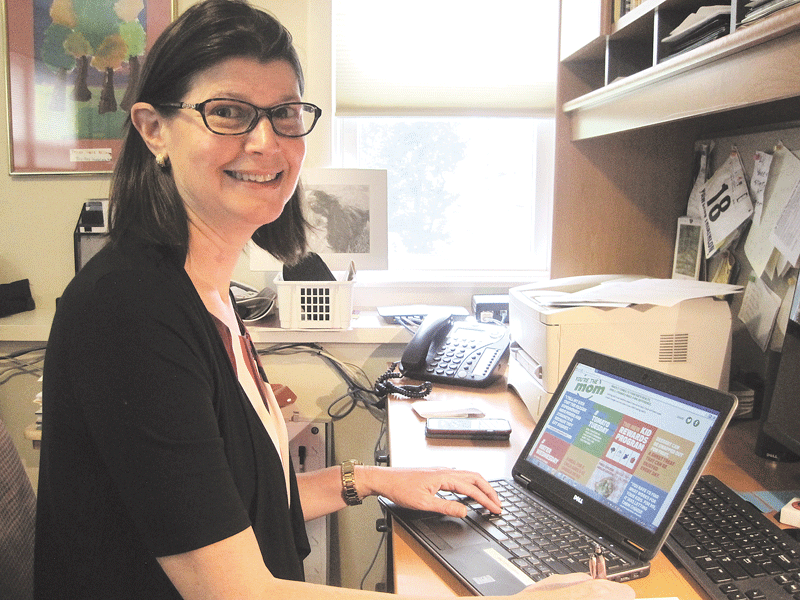
That’s the issue that “You’re the Mom,” a new public-health campaign launched by ChildObesity180 at Tufts University, seeks to address. The campaign offers an array of messaging through various media, with one goal: get mothers thinking about the nutritional choices they’re making for their kids, and hopefully make better ones.

“We’re looking to increase the supply of healthier menu options for kids and create more consumer demand for those options,” said Linda Harelick, director of operations and communications at ChildObesity180. “We have engaged the restaurant industry and restaurant brands, and we’ve learned that there have been changes to menu options. Things have gotten healthier in the fast-food setting.”

However, she went on, “parents aren’t always aware of it. They get into the habit of ordering the number 7, or have their kids order a couple items off the dollar menu. Nobody’s studying the menu. We want to make them aware there are healthier options to choose from.”

In short, she explained, “we want to celebrate moms for the people they are and the role they play in families and communities — and give them simple tips.”

Harelick knows the issue is a complicated one, especially in a city with many low-income families living in neighborhoods underserved by stores selling fresh produce and other healthy options — a problem echoed by Kristine Allard, vice president of development for Springfield-based early-education provider Square One.

We want to celebrate moms for the people they are and the role they play in families and communities — and give them simple tips.”

“Particularly here in Springfield, where so many neighborhoods struggle with being part of a food desert, we know it’s not always easy to access good, healthy choices, and some families make fast foods their only option,” Allard told BusinessWest.

For families on a budget — often living near the poverty line — a visit to a fast-food drive-thru is often an exercise in filling up their children quickly at little expense, she went on. “But if we can make changes to what they order — swapping water for soda, ordering apple slices instead of fries, downsizing, not supersizing — that can make a big difference.”

She’s under no illusion that fast food is the best option for kids, “but if we can make small changes — and, in the long term, they make smarter choices — we can help reduce childhood obesity. It just makes sense.”

Square One is among a number of local organizations, including Partners for a Healthier Community and Springfield Food Policy Council, that are partnering with ChildObesity180 on the campaign, which is being piloted in the City of Homes, with plans to roll it out nationally in 2017.

Harelick recognizes that too few parents are immune to the combined pressures of packed schedules and picky kids bombarded with marketing for less-healthy options. But she believes the “You’re the Mom” campaign can make a difference, one choice at a time.

The campaign includes billboards, radio spots, bus advertisements, a heavy social-media presence (its hub is yourethemom.org), and murals by artist Marka27 — at 1072 State St. and 461 Main St. — featuring real Springfield mothers and promoting the message, “you’re the mom; you make decisions about what your kids eat,” Harelick explained.

The issue is nothing new to Partners for a Healthier Community (PHC), which joined several other community organizations eight years ago to launch Live Well Springfield, a movement to promote physical activity in area youth and increase access to healthy foods, a two-pronged approach to slowing a trend that has seen childhood-obesity rates triple nationwide and locally over the past few decades.

“What Tufts is doing is implementing a communications campaign that is very specific to low-income families with children who frequently eat at fast-food restaurants,” said Jessica Collins, PHC president. “If you have to eat at McDonald’s, make a healthier choice for your kid. Don’t buy soda; get water or milk. Give up the fries and choose apple slices. It’s another strategy to educate parents.”

Menu of Programs

Since its inception, Harelick explained, Child Obesity180 has brought in public-health advocates, industry and government leaders, and other nonprofits to design, pilot, evaluate, and scale initiatives intended to reverse the trend of childhood obesity — a full 180 degrees, in other words — within one generation’s time.

“We have very aggressive goals,” she admitted.

To get there, the organization has taken a multi-pronged approach. Among its initiatives:

• Its Active Schools Acceleration Project aims to increase physical activity in U.S. schools by identifying innovative solutions and giving schools the tools and resources needed to replicate proven models. For example, the New Balance Foundation Billion Mile Race has challenged students to walk and run 1 billion miles. “Five thousand-plus schools are participating in the campaign, driving excitement and interest in walking and running programs,” Harelick said.

• The Healthy Kids Out of School initiative works with afterschool enrichment organizations, like Boy Scouts, Girl Scouts, 4H, and youth sports leagues, to promote three principles: drink right, move more, and snack smart.

“Kids are eating more junk food than they need and not moving as much as they should, even in youth sports,” she noted. “We found if we communicated these three simple principles, we could have an impact. It’s been very well-received by the CEOs of these organizations.

“What we have learned is, we have to tie into the organizations’ values and practices,” she went on. “Scouts are looking to develop future leaders, and to be a future leader, you have to develop a healthy lifestyle. We developed a special healthy-habits patch for Boy Scouts and Girl Scouts, and developed a short online training for sports coaches.”

• The Restaurant Initiative, which is where “You’re the Mom” fits in, takes a three-pronged approach to reduce excess calorie consumption when children eat at restaurants: Increase consumer demand for healthier children’s meals, inform restaurant-industry leaders of the positive outcomes of increasing healthy menu offerings, and continue to conduct and disseminate original research.

• Another effort, the Breakfast Initiative — which promoted a healthy school breakfast and evaluated its impact on several key measures for children, including obesity prevention — completed its work in 2014.

That’s an area Square One knows something about, said Allard, who noted that many of ChildObesity180’s programs fit well into Square One’s mission of promoting well-being in children — not just academically, but physically and emotionally as well.

Linda Harelick

Linda Harelick says restaurant menus have gotten healthier and nutrition labeling has improved, but parents aren’t always aware of these changes.

“We know that kids who are well-nourished do well in school, so helping in a campaign like this, helping moms make healthy choices for their kids, is very much in alignment with our mission,” she explained. “Teaching kids to read, write, and be ready for kindergarten and academic success are very important, but we know there are so many more pieces than simply handing them a book.

“For many kids in our program,” she went on, “we provide two meals a day — breakfast, lunch, and two snacks — so we know they’re getting those meals with us, and we make sure they’re balanced and nutritious. But when they go home, they don’t always have those types of options. Access is the issue here, and budget is a challenge.”

Likewise, Partners for a Healthier Community, through the Live Well Springfield collective, has been trying to enhance school nutrition, from the preschool sector on up; make higher-quality foods, especially fruits and vegetables, more available in the city’s neighborhoods; and enhance urban agriculture and community gardens.

Live Well Springfield has also partnered with the city and the Pioneer Valley Planning Commission on improving area riverwalks, and has a hand in the city’s Complete Streets program, which is putting more sidewalks and bike lanes on streets. “People have to move around, basically,” Collins said. “That’s a national best practice cities are trying to do.”

Food for Thought

Harelick welcomes the partnerships with organizations like PHC and Square One. “We call ourselves a multi-sector organization,” she told BusinessWest. “We believe childhood obesity is an issue that can only be solved if everyone participates.”

In the case of “You’re the Mom,” which admittedly takes a narrow focus, “we saw an opportunity to address the issue of kids consuming excess calories in restaurants and at the same time improve the nutritional quality of selected meals,” said Christina Economos, director of ChildObesity180. “Moms have an enormous amount of influence on their kids, but sometimes they don’t feel that way. We want to support them and remind them that making small changes can add up to a meaningful difference in their children’s health.”

Harelick has significant experience in several sectors that are part of ChildObesity180. After an early career as a registered dietitian, practicing in clinical and research settings at Massachusetts General Hospital and Brigham & Women’s Hospital, she spent 17 years at Kraft Foods, overseeing strategic planning and marketing for iconic brands such as Maxwell House coffee and Post cereal. Upon leaving Kraft in 2008, she returned to academia to earn a doctorate in public health policy and management.

Having taken so many different views of the nutrition issue, Harelick is optimistic that her current organization’s goal — a full ‘180’ on childhood obesity — is within reach.

“We really believe that,” she said. “When we look at the problem of obesity, it seems very complex, but very interconnected. If you can influence one aspect of a child’s life, it has a wave effect on other aspects. And the more kids hear these messages, the greater the influence — it’s an echo effect.”

Beyond that, she said, “if we can impact culture in terms of the restaurant industry, convince them to offer lower-calorie foods, more nutritional quality, they’ll become societal norms for kids. It will become the norm to drink water on the basketball court, baseball field, or restaurant.”

Leaders at Square One — which, beyond its emphasis on healthy meals, offers an after-school physical fitness program called LAUNCH — say the work of ChildObesity180, and its new campaign, are effective complements to what’s already happening locally. “Our LAUNCH program is a health and wellness program for kids,” Allard said, “teaching them that fitness is fun, and that healthy eating can be fun and delicious.”

Just as Square One moves beyond talking about nutrition and fitness and actually provides opportunities for both, so Partners for a Healthier Community continues working toward greater access to healthy foods in the so-called ‘food deserts’ that tend to plague cities.

“The campaign bolsters work we’ve been doing locally, which is create access for families,” Collins said. “We have to start somewhere. It has to be both educating families to make the right decisions and also providing them access; if you just educate people, they’ll turn around and say, ‘but there’s no place to buy something healthy.’ That’s why the other strategies are so critical.”

Still, Harelick said, change begins with education, and she’s confident “You’re the Mom” will prove impactful enough to become a nationwide call.

“By delivering these messages and then reinforcing these practices at home,” she said, “we can really have a snowball effect.”

Joseph Bednar can be reached at [email protected]

Sections Technology

Code Talkers

Blair Winans, president of Rhyme Digital

Blair Winans, president of Rhyme Digital

Blair Winans had forged a successful small business in website development when a larger company from across the state came calling. The acquisition that ensued brought more frustration than growth, and lasted just over a year. But it did generate lessons for Winans and his team, who regrouped in Easthampton, rebranded as Rhyme Digital, and refocused their efforts on not just designing websites, but helping clients understand how to get the biggest marketing bang for their money and time.

Blair Winans’ professional journey has weathered a few bumps. But those bumps have been valuable, he said, by teaching him what he and his Easthampton-based company, Rhyme Digital, do best.

When he launched his website-design firm in 2005, it was known as Winans Creative, and over the next several years, he built up a cadre of loyal clients and a small staff. Things were on the right track — he assumed.

That all changed three years ago, however, when Winans was approached by HB Agency, a much larger marketing firm in Boston, about a possible acquisition. The company lacked digital capabilities and wanted to offer such services to its clients, and they thought the expertise of Winans Creative would fit nicely into their business model. Winans agreed.

“We were excited about it, and a bit nervous,” he said, but he took the leap, acting as vice president of digital marketing in what was essentially HB’s Western Mass. satellite office. “But it brought all sorts of challenges. As a satellite office, it’s tough to merge cultures, which was a tough stumbling block. It also turned out that a lot of our existing clients didn’t fit in with this new company’s business model, and those clients were let go in favor of bigger ones. A lot of us were upset about it; that wasn’t part of the expectation.”

After a year, it was clear that the acquisition wasn’t bearing fruit for either side, and Winans was given the opportunity to take his firm back. And he did, in February 2015, bringing his five employees with him.

“It’s not a scenario where everyone looks back and says, ‘that was a fantastic time,’” he told BusinessWest. “But, in retrospect, we learned who we are and what we’re good at — and what we don’t want to be, which I think was a really helpful part of that process. Thankfully, we came out of it with all the same team; that’s one of the things that really helped us become stronger.”


Click HERE for a list of Web Development Companies in the regions


Taking the company back was also a chance to reassess the company’s direction, he went on. He and his employees wanted to stress the team aspect of the operation, hence the name change to Rhyme Digital. They also sensed increasing opportunity in not only building websites for companies, but teaching them how to turn their online presence into an effective marketing tool with measurable results.

“We were great at building and designing websites, and a lot of times clients think a website is the end-all, be-all,” Winans said. “But a lot of what we do revolves around helping people market themselves and build an online brand presence and sustain that over the long term. That’s where we shifted the focus — not just building these tools, but helping people understand the different pieces to it.”

That’s an issue today, he said, for companies that have websites and receive reports back from digital marketing firms that don’t really tell them anything. Rhyme’s goal is to track and clearly communicate not just a website’s hit count, but where the traffic is coming from, which campaigns potential customers are responding to, and what they’re doing on the website once they’ve arrived.

“We’ve had clients come to us saying, ‘I signed up for this digital marketing package, and I get reports of how many clicks are coming through my website, but not much more than that. Can you help me?’ We sit down and show them what’s happening once people come through. Once you make the connection, you can really put a dollar amount on the traffic coming onto your site.”

In other words, there’s a technical component to setting up a website and its features, but the end result has to bring return on investment, and ways to effectively measure it. “The question a client needs to ask,” he said, “is not ‘can you build me a website,’ but ‘I need my website to do x, y, and z.’ Or, ‘I need my website to be a lead-generating tool.’ We’re going to give you all the data to help your company continually improve what it’s doing online and in all its marketing.”

Come Back Home

After the failed acquisition, Winans said he was gratified — but perhaps not totally surprised — when Rhyme reached out to the clients it been forced to drop and was met warmly.

“The response was fantastic,” he told BusinessWest. “We’re really thankful we have a loyal client base; we’ve been working with some of them for more than 10 years. They see us as a partner and a resource. That always makes us feel good.”

The most successful relationships between Rhyme and its clients are the ones that have grown over time to the point where Winans and his team understand everything about the client and its marketing goals — both in online and traditional advertising.

Blair Winans

Blair Winans says constant advances in website coding, graphic design, and marketing strategy lends his work variety and keeps it fun.

Rhyme’s clients run the gamut from manufacturing to retail (both brick and mortar and purely online); from outdoor adventure sports (Zoar Outdoor is one of its longest-running clients) to publishing and nonprofits.

“We end up treating each client as its own specific case. We’re never going to be a one-size-fits-all solution,” Winans explained. “We do a bit of e-commerce development, and no e-commerce store does things the same way another one does; they have very specific differences and needs.”

Rhyme helps its clients consider the many possible facets of an online campaign — banner ads, search-engine optimization, Google AdWords, and, especially, landing pages with optimized content that gets visitors to take action, not just click on through. Then there are newer, cutting-edge tools such as radio-frequency identification and geofencing, which are used to target potential customers by location.

“The possibilities are enormous right now, better than they ever have been before, and we help clients set up these types of campaigns,” Winans said, noting that, for one of his clients, a publisher targeting first-year law students, he used geolocation to focus mobile pitches around college campuses. “One of the best things about digital marketing is that fluidity, and the ability to pivot based on the data that comes in.”

It’s also more cost-effective to test multiple messages digitally before deciding on the best one and launching it through larger, traditional-media campaigns, he went on. “We’re helping people make the most of their budgets, looking at how technology plays a role, and helping them figure out where they should be spending money.”

Websites weren’t Winans’ first career path, or even his second. He enrolled in college looking to be a lawyer, but then switched gears and transferred to the Boston University College of Communication to study advertising, marketing, and public relations. It was a field where he could put his graphic-art skills to good use, doing branding and design for a number of companies.

This was the late ’90s, a time when websites were first coming online, and he had a chance to play around with early marketing models, including working with Dunkin’ Donuts on its first website. “It’s kind of the equivalent to what’s happening now, with all these different technologies, seeing which ones are panning out,” he said. “I learned a lot of different stuff very early on; actually, I taught myself how to do it.”

In addition to leading a team that now numbers seven, Winans characterizes his day-to-day work at Rhyme as half coding, half design, and appreciates the variety offered by both — and the challenge of keeping abreast of the latest developments in the world of dynamic websites.

“For my development team, every week there’s a new platform or technology or script or language they need to be aware of,” he told BusinessWest. “We don’t just want to sell our clients a bunch of tools, but the right set for what they’re trying to do. It puts a lot on our shoulders — but it’s fun. We love learning about different types of technologies and seeing what these capabilities are. It’s an ongoing process.”

What makes it work here is, we’re all interested in the same thing: to make our work the best it can be and push each other — and in the process have fun. In our business, you never know what kind of work you’ll get on any given day. You could be coding something one day, working on the checkout process for an e-commerce site another day.”

But one, he said, made easier by the closeness and longevity of his team. “Everyone here is excited about coming to work every day, excited about who they’re working with and what they’re doing for clients. We’ve been through some ups and downs as a team as part of the whole process, but we’ve built something we feel is more than just a business. That’s important.”

There’s the Rub

That’s not to say website design and marketing it’s sometimes stressful, Winans added, but the team at Rhyme — based out of an airy space in the Eastworks complex — has created an environment where everyone encourages each other and helps each other out, and nobody is afraid to step up and ask for help.

“What makes it work here is, we’re all interested in the same thing: to make our work the best it can be and push each other — and in the process have fun,” he said. “In our business, you never know what kind of work you’ll get on any given day. You could be coding something one day, working on the checkout process for an e-commerce site another day.”

The reward, he went on, is seeing the sites go live.

“There’s a pretty big sense of excitement when we look at all the projects we’ve done and hear the way our clients talk about them, when they come back and tell us, ‘we get nothing but praise for our site now.’ A couple of clients go back 10 years, and they’re on the fourth iteration of their website, and you see the transformation. We have archives of sites we’ve done, and it’s fun to see the progressions in them. When we can help businesses utilize their sites to their fullest capacity, that’s what really makes what we do worthwhile.”

In other words, Rhyme Digital is certainly not going to the dogs — unless you count Winans’ two furry friends, a yellow lab named Butters and a pug named Flora, who join him at work every day. The other employees are encouraged to bring their dogs occasionally as well.

“They provide some comic relief,” he said. “When things get stressful or we’re under a heavy deadline, and Butters is upside-down on the floor, wagging his tail hard, you realize we’re not doing brain surgery. Sure, you’re dealing with deadlines, but there’s always time for a belly rub.”

For someone who’s been coding websites going on two decades and still finds excitement in the details, it’s a healthy perspective.

“You get to learn something new every day here,” he said. “It’s a good spot to be in.”

Joseph Bednar can be reached at [email protected]

Sections Technology

Small Businesses: Embrace Big Data

By John Costello

John Costello

John Costello

The term ‘big data’ is wearing out its welcome.

From Silicon Valley to Madison Avenue, big data has been in the collective conscious of the business community for the better part of the new millennium. At this point, it has been relegated to buzzword status in the minds of many eye-rolling small-business owners. The inability to see how big data can actually make an impact on the bottom line has led many to dismiss it rather than embrace it.

However, big data isn’t a term that deserves the disdain associated with hollow boardroom jargon. It’s time for big data to earn back the reverence it deserves.

Whether by texting our friends, posting a video to Facebook, or buying a product online, we’re all creating tons of data. IBM has noted that 90% of the world’s data was created in just the past two years. IDC predicted that, by 2020, there will be more than 44 zetabytes of data in existence. That number falls into a category alongside ‘infinity’ and other quantities that are large beyond human comprehension.

This data is driving more innovation and ingenuity than at any point in history. Researchers are poised to use big data to enable monumental scientific and technological breakthroughs that will uncover details about pre-human existence and explore the possibilities of artificial intelligence. Projects that have their roots in the scientific community are using an unfathomable amount of data to fundamentally alter the course of humanity and science. Small-business leaders need to take note of the science community’s devotion to big data.

The first and only non-human Jeopardy! contestant exemplifies big data’s crossover from scientific research to truly impactful business application. IBM Watson is a technology platform that uses artificial intelligence to reveal insights from large amounts of unstructured data. Most people think of data in the binary sense, but 80% of all data today is in the form of things like text, sounds, photos, and videos which computers could never easily read. IBM is using Watson to solve that problem and give researchers and businesses the ability to quickly extract insights, patterns, and relationships from this data. Its database consists of more than 200 million pages of documents taking up four terabytes of disk space. At one point, its database was home to a copy of Wikipedia in its entirety.

Watson has mastered big data and the necessary management of that data to search millions of documents to find thousands of possible answers, and redefine our understanding of the possibilities of artificial intelligence. Even if it yielded a couple of goofy incorrect responses on Jeopardy!

One key differentiator between the commercial and scientific approach to big data is that the scientific community has mastered the management of these unfathomably huge databases. But you don’t need to be an enormous enterprise with high-powered server farms and a staff full of STEM PhDs to make data work for you in the digital age. In fact, if you’re a small-business owner, you’ve probably already used the one tool that will help you embrace big data. You probably used it several times today.

Mary Shea, vice president of digital strategy at Springfield marketing agency GCAi, puts it simply: “the most powerful tool available to marketers is right at their fingertips: Google.” All that data that everyone is creating through their online habits is logged, categorized, and made accessible by Google. While it can’t tell you exactly who searched for what, it can aggregate data into highly targeted personas that can give marketers insight into what a specific segment of users tends to search for.

Google allows marketers to reach users based on their inferred interests and demographics. This is helping small businesses refine customer-acquisition strategies, pivot to new product offerings, and gain valuable competitive intelligence. Google even lets marketers advertise directly in its search platform. With all the data it has available, it enables a level of targeting and personalization that no billboard or 30-second TV spot could ever achieve.

It lets marketers and small businesses shift from a ‘spray and pray’ model of traditional advertising to reaching a precise buyer persona in a non-interruptive way that increases the likelihood of them making a purchasing decision. Google uses behavior and search history to categorize users as pet lovers, running enthusiasts, foodies, beach-bound travelers, political junkies, and more. Marketers are then able to use the platform to put the right ads in front of the right audience at the right time.

“While users browse websites, like JCPenney or Porter Airlines, Google stores an advertising cookie on the user’s browser to understand the types of pages that user is visiting,” Shea said. “For example, if a user views a lot of recipe pages or watches cooking videos, Google may put them in the foodie category and show them a more food-related ad.”

Terms like big data are used regularly in the media and in boardrooms, but small-business owners may not have realized how accessible data is and how much value they can extract from it. As more organizations learn to use data, it will be the most valuable currency in the coming years. Big data is truly one of the most significant and dynamic forces shaping the course of science, business, and humanity.

There’s no doubt that overexposure has caused the business world to grow numb to the idea of big data. But make no mistake, while big data as a descriptor is overused, big data as a practice is still vastly underrated by small-business owners and marketers — in other words, those who can benefit from it the most.

As an experienced public-relations professional working with global tech companies, John Costello has helped major brands and ambitious high-growth startups break into new markets worldwide with international launches, local market intelligence, and integrated marketing campaigns. In his current position as account executive at Boston-based Corporate Ink, he drives marketing and PR initiatives for B2B clients in enterprise IT, marketing automation, financial services, and supply-chain management; [email protected]

Sections Technology

Doing More with Less

By Steve Shaw

Steve Shaw

Steve Shaw

Now that we’ve begun the process of normalizing relations with our neighbors to the south, those of us in the IT world could learn a few things by talking with a Cuban auto mechanic.

Take a walk in Havana, and you’ll find dozens of pre-1960 automobiles looking shiny and new, but held together with duct tape and a tailpipe fashioned from a Cold War-era Soviet tank. For decades, Cuban mechanics have been forced by necessity to do more with less, compromising on features while focusing on efficient use of resources.

So what’s the tie to IT?

It’s no secret in just about every industry that seatbelts are being tightened. Increased government regulations, automation, the ‘Internet of things,’ and the ever-increasing threat posed by cybercriminals are putting downward pressure on IT departments to ‘make it work,’ but for less. IT budgets are leaking oil, and CIOs are finding it harder and harder to find the mechanic and the manual to fix it. The bottom line is that everyone is being asked to find ways to do more with less.

Here are a few ideas that may help.

“IT departments are inherently inefficient,” said Mike Feld, interim CTO at Baystate Health and CEO of consulting firm VertitechIT. “But if we simply looked at standardizing the tools we use, we could save time, money, and resources that would make even the most jaded bean counter sit up and take notice.”

Most large and mid-size businesses have literally hundreds of applications sitting on servers in data centers and cloud environments across their infrastructure.

The collection has grown organically over the years as software developers play the never-ending game of ‘can you top this?’ And while all may have their own unique qualities, many applications can perform many of the same functions (while we continue to use just a fraction of the features built into them). The result is more expense, more manpower needed to service them, and capital dependence to keep things current.

You may need to compromise on features, but reducing the number of vendors and making broader use of a smaller number of products can have a dramatic bottom-line impact. Feld suggests you “ask yourself if 95% of what I want from these 12 areas work with a couple of products, rather having a dozen different products fulfilling 95% of my needs.”

The standardization and weeding-out process can also have a trickle-down effect on personnel resources. More efficient programs and processes free up people to be redeployed to work on projects that have been neglected for lack of available time and manpower.

On the architecture side, standardizing computing, network, and storage on commodity hardware using software-defined methodologies will also offer up significant savings. Hyper-convergence makes your network more efficient (cutting storage costs in half by using virtual instead of traditional storage methods) and allowing for the elimination of personnel silos as teams of people dedicated to each area now work as one.  It also makes them more effective, reducing service provisioning and delivery time from days and weeks to, in some cases, just hours.

In Cuba, doing more with less is a way of life. There’s an IT lesson in there somewhere.

Steve Shaw, vice president of marketing & communications at Vertitech IT, has spent more than three decades in the marketing and communications industries; [email protected]

Features

A Job in Sales

Nancy Creed

Nancy Creed

As she takes the helm at the Springfield Regional Chamber of Commerce, Nancy Creed brings to the job a diverse résumé that includes work with nonprofits and in nonprofit management; in small businesses, large businesses, and her own business; and at the chamber itself. She believes these experiences have prepared her for the many challenges facing this organization — and all chambers.

Nancy Creed still remembers her first feature byline — and even the headline that went over the copy.

It was the fall of 1989. Creed was only a few months out of Syracuse University and, after briefly considering and then rejecting thoughts of trying to break into journalism in the Big Apple, had come back to her hometown of East Longmeadow to work for the Reminder as an assistant editor.

Her first feature story took her to Main Street — literally. Actually, it took her to the individual who had kept it clean — since Calvin Coolidge was in the White House — and was finally retiring.

“‘Street sweeper sees the end of the road’ — I was really proud of that headline,” Creed recalled. “He had been doing it for like 65 years or something like that; I interviewed about what he’d seen on the streets of East Longmeadow for six decades. His time had come, and I was there to write about it; that’s how I got started.”

She summoned similar wording — that ‘time has come’ part — to talk about a much different career milestone, specifically her ascendency to the role of president of the Springfield Regional Chamber of Commerce.

“I think it’s … my time,” she said with a solid dose of confidence in her voice, acknowledging that she might sound a bit cocky with that remark, but doesn’t intend to be. She implied that those words are merely what amount to the expression of an opinion — that she spent the 27 or so years since the street-sweeper profile preparing herself for such an assignment, and this one in particular. And now it’s time to put that accumulated experience to work.

“This is the logical next career step for me,” she noted. “Chamber work is in my blood.”

A quick look at her résumé would seem to bear this out. It includes work in journalism, marketing, and public relations; at small businesses, large businesses, and her own business; with nonprofits and as a nonprofit manager; and, perhaps most importantly, during two stints with the Springfield Regional Chamber, including the past three and a half years as vice president of Marketing and Communications.

Her first stint, as Communications director, came in 1999, when the name on the stationery was the Affiliated Chambers of Commerce of Greater Springfield. But so much more has changed over those years besides the name, and the sum of these transformations goes a long way toward explaining why ‘Creed’s time’ is, and will continue to be, an extremely challenging one for this chamber — and all chambers, for that matter.

The big challenge is to continue to provide value to the smaller businesses — they’re the backbone of this region’s economy.”

Indeed, the Affiliated Chambers took up considerably more real estate on the ground floor of what is now the TD Bank building back then, she acknowledged, noting that the staff was at least twice the size it is now. This contraction is a sign of the times, she said, adding that there are fewer members now, partly because there are fewer businesses that can be members due to a wave of consolidation that has enveloped banks, insurance agencies, healthcare providers, and more. But that’s only part of the story.

Another big part is the fact that chamber membership, once almost an automatic reflex action for someone new in business, is now anything but.

“Historically, joining the chamber was just the right thing to do; it’s no longer that way,” she said, adding that this is especially true with the younger generations. “So we have to figure out what people want to get out of the chamber — and provide it.”

Thus, chambers in general, and the Springfield Regional Chamber in particular, have come forth with new initiatives and programming designed to provide more of that all-important commodity — value.

As an example, Creed, who succeeds Jeff Ciuffreda at the chamber’s helm, pointed to new informational programs targeted for specific audiences (especially small businesses), such as the chamber’s Lunch ‘n’ Learn program, which has focused on topics ranging from social-media marketing to the new overtime laws.

“The big challenge is to continue to provide value to the smaller businesses — they’re the backbone of this region’s economy,” she said, referring to companies with 10 or fewer employees. “They make up 75% of our membership, so you really need to understand the issues and challenges they face and provide what they’re missing and need.”

But Creed’s time is challenging, and intriguing, for many other reasons as well, from the need to assemble almost an entirely new staff at the chamber (more on that in a bit) to the advent of what would have to be called the ‘casino era’ in Greater Springfield, to the groundswell of entrepreneurial energy sweeping the city and region.

For this issue, BusinessWest talked at length with Creed about, well, her time and the myriad components to that simple two-word phrase.

The Write Stuff

When asked what brought her to Syracuse, Creed offered a quick, one-word answer — “basketball” — before then elaborating.

“I loved college basketball, and I looked at all the big basketball schools,” she explained. “I didn’t really know what I wanted to do, so I thought, ‘if I’m not quite sure what I want to do, I might as well go to a college where I can enjoy a hobby.’”

And in the mid-’80s, if college basketball was your hobby, there was no better place than Syracuse, then one of the top teams in the soaring Big East Conference. But while attending games at the recently completed Carrier Dome, Creed was also finding a passion — for writing and marketing — and earning a degree from the prestigious S.I. Newhouse School of Public Communications.

The question, upon graduation, was what to do with it. As mentioned earlier, she considered, albeit briefly, trying to make it in the city that never sleeps.

“I thought about going to New York, but that probably meant living with eight other women in a studio apartment and earning $25 a story,” she said, adding that there were several things wrong with this picture, certainly enough to look elsewhere as she sought to follow her dream.

Eventually, home, and the Reminder, became the best option. She stayed with the publication for two years before taking the first of many career turns that would shape her diverse résumé.

She went to work for the Springfield-based law firm Robinson Donovan as assistant marketing director. There, she worked alongside one of the young associate attorneys, Russ Denver, who would later go on to direct the Springfield chamber.

MGM’s casino

Nancy Creed says helping area companies do business with MGM’s casino now taking shape in Springfield’s South End is just one of many challenges on her plate.

That connection would become a key storyline a few years later, when, after getting married, relocating to the Boston area, and serving as Communications and Public Relations coordinator for the nonprofit group Community Care Services Inc., she began searching for what would become the next line on her CV.

Denver was looking for a Communications director, and encouraged Creed to seek the job. She did, and prevailed in the search, eventually serving two years in that role before returning to big business as manager of Corporate Communications for Western Mass. Electric Co., now Eversource.

After more than four years in that role, her career took another sharp turn as she started her own business, N.F. Creed Communications, handling work for a wide range of clients, including two former employers, the chamber and Northeast Utilities, parent company to Western Mass. Electric.

But shifts in the economic winds, coinciding with the Great Recession and its aftermath, prompted many companies to bring marketing and PR work in house, Creed explained, thus prompting another career move — and a return to the chamber.

Over the past several years, she has been involved with a number of initiatives, from helping to coordinate a renaming and restructuring of the chamber to managing a host of events, including the chamber’s annual Outlook lunch, which draws nearly 1,000 people to the MassMutual Center and speakers such as Gov. Charlie Baker and former White House Chief of Staff Andrew Card.

But mostly, she’s been working with Ciuffreda and other team members to do something chambers have always had to do, but not with anything approaching the sense of urgency they face now: sell themselves.

She sees this as both her primary assignment moving forward and the professional strength she will most call upon.

“When you look at my past experience … I’ve led, I’ve been led, I have entrepreneurial spirit, I worked in small business, I worked in big business and for nonprofits, so I understand the various challenges,” she said. “I have a really broad range of experience, and I think that’s important.

“And Jeff built a really strong foundation for the organization,” she went on. “So my marketing skills are probably the most important, because now we’re going to take that, and we’re going to sell it.”

Getting Down to Business

And as she talked about this process of selling the chamber, Creed said the organization has to do what all businesses across every sector must do — provide products and services that people want to buy.

And this brings her back to some of the newer offerings introduced in recent years, and the philosophy that brought them about.

“We used to have programs that were broad-based; there was no specific target market, no niche,” she explained. “We then created events and programs and services for specific markets, specific segments of our membership, and those have really become popular.”

Perhaps the best example is the Lunch ‘n’ Learn series, which focuses primarily on sales and marketing and employment- law issues, and was blueprinted for smaller companies that don’t have large teams, or even dedicated individuals, handling HR and PR.

“We had a session on social-media marketing, and it was designed for a specific segment of our membership that maybe didn’t have a marketing department or where the administrative assistant was handling social media,” she explained. “There are many issues that small businesses are faced with that they don’t necessarily have the internal resources to deal with, so we can provide those resources.”

This will be the mindset moving forward, she went on, as the agency looks for constructive ways to answer the question, ‘why should I join the chamber?’

Even the traditional, time-honored chamber breakfast has to be educational and value-oriented, she explained, noting that members need a reason to take that hour and half out of their day and attend.

“We’ve gotten pretty good at providing what people want to see out of those breakfasts,” Creed explained. “We continue to do our salutes because they want to see the success of other businesses and learn more about them. But with speakers, we’ve learned that people want to learn something, but they also want to be entertained.”

The chamber’s success in listening to members and responding to what they’re saying is verified in attendance figures at events, she went on, adding that they’re up across the board over the past few years.

Beyond the all-important work to sell the chamber and provide more value to members, Creed faces other, even more immediate challenges.

The first will be filling the offices and cubicles in the chamber’s space within what’s still known as the Regional Economic Development Center.

She must replace herself as vice president of Marketing, but also hire a new coordinator of sales and member benefits as well.

“We’re building an almost entirely new team,” she said, adding that the chamber’s former administrative assistant has been placed in a recalibrated position focused on events and program administration.

Assembling a solid team is critical, said Creed, again equating the situation to what faces businesses on a daily basis; there must be quality products and services, as well as people to sell them, market them, and coordinate all of the above.

But there are other pressing issues as well, including the schedule for the coming year, work traditionally done over the summer, and getting out and visiting as many members as possible in the weeks and months ahead as part of that process of listening to their needs.

Then there are the ongoing issues involving MGM’s $950 million casino, now finally starting to take shape in Springfield’s South End, specifically the matter of helping area companies do business with the gaming giant.

“We’ll continue to find ways to work with MGM to benefit our members,” she explained, adding that the process of becoming a vendor is somewhat complicated, but the chamber has resources that can help those interested navigate those waters.

Moving forward, another priority is to build upon existing partnerships with a host of entities — from Associated Industries of Mass. to other area chambers, to various economic-development agencies.

That includes those involved with promoting entrepreneurship and helping startups get to the next level, she said, adding that the rising levels of entrepreneurial energy in the region present a great opportunity for chambers, and hers in particular.

“When you look at the success of a group like Valley Venture Mentors … they’re creating a pipeline of new businesses and startups,” she explained. “The next logical step for those entrepreneurs is the chambers; there’s a huge opportunity for us.”

In Her Blood

Creed told BusinessWest that she will bring to her latest career challenge what she has brought to all the others — energy, imagination, and experience gathered from the stops that came before.

That includes the time spent recently managing a nonprofit organization, in this case, Dakin Humane Society. Creed has long served on the board of that agency, and agreed to step in and serve as interim director last fall.

She described this stint as yet another learning experience, one that was rewarding and enjoyable.

“It was easy, because it’s a passion of mine,” she said of her work with animals, adding that she has many others, including college basketball (still) and writing.

And chambers of commerce. This work is in her blood, as she said. That won’t necessarily make this assignment easy, or even easier, but it will provide her an edge, as will all that accumulated experience since the street-sweeper profile.

As she noted, it’s her time.

George O’Brien can be reached at [email protected]

Features

A Focus on ‘Tomorrow’

WMassBusinessLogo2016

The Western Mass. Business Expo, produced by BusinessWest since 2011, has always put an accent on the future when it comes to programming and exhibits.

But this year, that emphasis will be taken to a still-higher level, said Kate Campiti, the magazine’s associate publisher. And this is out of necessity.

“Anticipating the future and preparing for it have always been stern challenges for all business owners,” she explained. “But now, these assignments take on even more urgency because the business world is changing rapidly and there are many powerful forces that will shape the competitive landscape in the years — and even the weeks — to come.

“These include everything from evolving technology, which presents a host of challenges and opportunities, to the emergence of younger generations, especially the difficult-to-read Millennials, in leadership positions, to a host of new social and employment issues that business owners and managers must face,” she went on.

All these focal points and more will take center stage at the Expo, set for Nov. 3 at the MassMutual Center in downtown Springfield. Details of the day-long event are still being finalized, but the broad themes have been identified, and organizers are now filling in the canvas. Here’s what we know:

• The Expo’s overriding emphasis will be on the future, meaning the short term, long term, and intermediate term, because business owners must keep their focus on all three.
• There will be a special accent on what would have to be called the ‘workforce of tomorrow,’ with emphasis on the issues facing all employers — those of quantity and quality.
• Education will again be one of the main stress points of the Expo, with three stages, or rooms, for informative seminars — one to focus on sales and marketing, another on emerging trends in the workplace, and the third on the younger generation now coming of age in the business community.
• Innovation will also be on display, and in many different forms, from robotics demonstrations to exhibitors on the cutting edge of technology and manufacturing.
• The Expo will again put the region’s business sectors in the spotlight. More than 150 companies of all sizes are expected to exhibit on the show floor, gaining the attention of more than 2,000 visitors.
• Also in the spotlight will be many of the emerging startups across the region — the Expo exhibitors of the future, if you will — that are taking full advantage of the services now available to them through a burgeoning entrepreneurial ecosystem.
• Networking, networking, networking: there will be opportunities for this most important of exercises at the day-opening breakfast, again presented by the Springfield Regional Chamber of Commerce; at a lunch presented by BusinessWest; on the show floor; and at the popular, event-capping Expo Social.

“Since BusinessWest began producing the Expo five years ago, the basic strategy has been the same — to provide a value-laden event that will help business owners and managers gain exposure and also gain insight that will make them ever-more competitive in this increasingly global economy,” said Campiti. “For this year, the mission is the same, and this is shaping up as the biggest, best Expo ever.”

For details on the Expo as they emerge, and for sponsorship and exhibitor opportunities, visit www.wmbexpo.com.

What: The 2016 Western Mass. Business Expo

When: Thursday, Nov. 3

Where: The MassMutual Center, Main Street, Springfield

Features: More than 150 exhibitor booths; educational seminars; breakfast hosted by the Springfield Regional Chamber of Commerce; lunch hosted by BusinessWest; day-capping Expo Social

Sponsors: Comcast Business (presenting sponsor); Express Employment Professionals; Health New England; Isenberg School of Management at UMass Amherst; Johnson & Hill Staffing Services; MGM Springfield; Wild Apple Design


Cover Story Sections Travel and Tourism

Instruments of Progress

Peter Salerno

Executive Director Peter Salerno on the steps of Symphony Hall

As it enters its 73rd year, the Springfield Symphony Orchestra does so knowing that, to remain relevant, it must be creative and willing to assume risks as it strives to cultivate new audiences, especially the younger generations. Peter Salerno, who has twice served as interim director of the SSO and took the helm on a permanent basis earlier this year, says the institution is more than up for that challenge.

Peter Salerno said the phone call seemed to come out of left field … or from the 20-yard line, as the case may be.

On the other end was someone from the New England Patriots’ marketing department. She wanted to know if the Springfield Symphony Orchestra, which Salerno was serving then as interim executive director, could have 50 or 60 of its musicians at Gillette Stadium in 24 days for a performance that would celebrate the team’s fourth Super Bowl victory, earned six months earlier, and usher in the 2015 season.

It was an extraordinary request on many levels, and Salerno, who has since dropped the word ‘interim’ from his title, knew he couldn’t say ‘yes’ at that moment, as much as he wanted to, knowing what this opportunity would mean for the venerable institution in terms of invaluable and incalculable exposure. Indeed, he would have to consult with Maestro Kevin Rhodes and other members of the team to see if this was even logistically feasible, and then get approval from the SSO board, because this was a venture far outside the orchestra’s traditional mission — and comfort zone, for that matter.

He got the nod from both parties and promptly called the Patriots back, thus setting the wheels in motion for perhaps the most memorable night in the orchestra’s 73-year history.

It was certainly the biggest stage, at least in a figurative sense. Indeed, while the actual performing area was a trifle snug, more than 70,000 people at the stadium and another 35 million watching NBC’s broadcast of the Thursday-night game against the Pittsburgh Steelers saw and heard the orchestra perform “O Fortuna,” the Patriots’ so-called tunnel song, and eventually shared the stage with the rapper T-Pain.


Go HERE for a list of Tourist Attractions in Western Mass.


“It was quite an upbeat moment for us,” said Salerno, using both wordplay and understatement to get his point across. “I recognized this is an opportunity for us to perform, and be relevant, in an area that we never thought we could before.”

In many respects, that performance at Gillette almost a year ago effectively speaks to the aspirations, goals, and challenges that define the SSO moving forward. It was a dramatic attempt to move beyond what would be considered traditional (in terms of both the venue and performing with a rapper), attract new and larger audiences, and greatly improve visibility beyond the confines of Symphony Hall.

There will be a lot more of that — although certainly on a smaller scale — in the months and years to come, as a look at the 2016-17 calendar reveals.

One of things I’m teaching, but also learning at the same time, is that our orchestra must respond to different genres of music to remain in the forefront of the people’s minds.”

In addition to the classical offerings — a Tchaikovsky Gala on opening night (Sept. 24), Brahms’ “Double Concerto” on Nov. 19, and Beethoven’s “Emperor Concerto” on Jan. 21 — the SSO will share the stage with the Irish Tenors two weeks before St. Patrick’s Day, and will wrap up the season on May 13 with something called Video Games Live!

As that name suggests, this will be an immersive concert that features the musical scores from the greatest video games of all time — as those games appear on large screens around the hall, with synchronized lighting and other special effects.

Those unique events, and especially the final one, are designed to draw more diverse audiences, particularly young people, a stern challenge now facing all arts institutions.

SSO and its conductor, Kevin Rhodes

Peter Salerno says the main challenge for SSO and its conductor, Kevin Rhodes (pictured), is audience development.

To meet this challenge head-on, the SSO must do something not exactly within its character, historically, and that is to be far more willing to take risks, said Salerno, adding quickly that the board has essentially greenlighted such an approach to business, and so has long-time conductor Rhodes and the rest of the orchestra’s team.

“One of the things I’m teaching, but also learning at the same time, is that our orchestra must respond to different genres of music to remain in the forefront of the people’s minds,” he explained, adding that this is the mindset driving the SSO and forging its schedule for the coming year.

For this issue and its focus on travel and tourism, BusinessWest takes an in-depth look at how the SSO is looking to expand its playing field, in all kinds of ways, and put every definition of the term ‘score’ into play.

Developments of Note

Looking back on the 24 days after that fortuitous phone call came in from Foxborough, Salerno used all kinds of descriptive phases to characterize them — from ‘long’ to ‘exhilarating.’

“Those were 60-hour weeks,” he said, smiling as he did so because, while the work was sometimes tedious — involving everything from drafting contracts with the Patriots and NBC to insurance matters and a mountain of logistics — it was also very exciting.

This was, after all, the proverbial opportunity of a lifetime, and the SSO was going to do everything in its power to seize the moment.

“This was a surreal moment for our orchestra, and it showed the versatility of our people,” said Salerno as he showed a video of the performance, with the SSO clearly visible to fans amid fireworks and low-lying fog, adding that perhaps the biggest obstacle was creating a sheltered performing area for the orchestra, something the Patriots organization pulled together. And demand for it was warranted because it rained in the hours leading up to the performance and stopped only moments before it was set to begin.

In many respects, dealing with cloudy forecasts and unsettled skies — in a figurative sense — has been a part of doing business for the SSO in recent years. Like all arts venues, it has seen its traditional audiences age, and with that demographic shift a need has emerged to embrace change and, as mentioned earlier, risk.

The Patriots performance was, again, a significant manifestation of this trend — this was believed to be the first time a full symphony orchestra had performed at such an NFL ceremony and perhaps the first time an orchestra of this type had appeared with a rapper — but there have been others, with more planned for the year ahead.

“We’re participating in the creation of new horizons for symphonic sound,” he said, adding that orchestras across the country are facing the same challenges. “And we’re going to keep pushing, and bringing world-class talent to the Springfield arena.”

Leading the orchestra through this intriguing period is Salerno, now 75 years old, who brings a wealth of experience in business, work with nonprofit institutions, and the SSO itself, having been a trustee for many years and serving not one, but two stints as interim executive director.

Described by many as a stabilizing influence to the operation, he succeeds Audrey Szychulski, who left the SSO in the spring of 2015 after less than two years at the helm.

Salerno brings a diverse résumé to the post, including everything from stints as COO of Providence Hospital and president and CEO of Brightside to work coordinating new retail stores for Taylor Rental Corp.; from a short stint running an operation that managed college bookstores to his own business, PTS Consulting, launched nearly a decade ago.

Over the years, he’s taught several graduate-level business courses at Bay Path University and Clark University in Worcester, with a focus on business strategies for nonprofit organizations, marketing, and finance.

In his latest role with the SSO, he’ll be applying the lessons that he teaches, especially as they apply to the most pressing challenge facing the institution — audience development.

Drumming up Interest

There are many components to this assignment, he said, listing everything from imaginative artistic events to new and different types of talent that will share the stage with the SSO, to a variety of touches that will make SSO performances true happenings.

With that, he took out a copy of the schedule for the coming year and started running his finger down the listings.

His first stop was the holiday concert, set for Dec. 3, although Salerno said ‘concert’ doesn’t go far enough, so the actual wording on the schedule is Holiday Extravaganza.

It was chosen to encapsulate the theme — “It’s a Wonderful Life” — and describe the sum of the activities and events, including a Christmas tree outside Symphony Hall, a visit from Santa, perhaps a reindeer if one can be secured, and more.

“We want to make coming to the symphony not just an event, but an entire presentation,” he explained. “We don’t want it to just be sitting in the audience for two hours.”

Elaborating, he said the SSO will again coordinate visits whereby ticketholders gather at spots in area communities, are then bused downtown for dinner at various downtown restaurants, and then taken to Symphony Hall.

“We’re trying to make it convenient for people to come to us,” he explained. “And we view this as an opportunity to attract more people to Symphony Hall.”

Kevin Rhodes is seen here with rapper T-Pain

SSO conductor Kevin Rhodes is seen here with rapper T-Pain at the performance last fall at Gillette Stadium to usher in the Patriots’ new season.

His next stop, schedule-wise, was several months later, in early March, when the Irish Tenors, well-known to PBS audiences, will take the stage.

Similar to the holiday performance, this will be more than a concert, said Salerno, adding that it will be more like a celebration of Irish heritage, one featuring many moving parts.

The full itinerary is still a work in progress, he said, but in the days leading up to the performance, there will likely be an Irish-style dinner featuring luminaries and elected officials of Irish descent, and other touches, such as a possible discussion of the 1916 uprising.

“We’re trying to build the activities and the service level to a higher plane than we have in the past,” he explained, adding, again, that the goal is to move beyond the music and create experiences.

That will certainly be the goal for the season finale, Video Games Live!, which is the most dramatic example to date of the orchestra’s efforts to attract young people.

“Some of our donors have expressed interest in efforts to create continuity with younger audiences and thus lower the demographic age of our attendees,” he noted. “And we determined that one of the areas where we could start making an impact was with junior-high and high-school students.”

To that end, the SSO will contract with a California-based organization to bring the music from video games, orchestral sound, and a host of special effects together in the same venue on May 13.

“There are so many opportunities to show off our talents, and this might be a good one,” he said, adding that the show, similar to others staged in other cities in recent years, should prove to be an impactful vehicle for introducing young people to the orchestra and beginning the process of turning them into life-long audience members.

The other performances on the schedule will bring some of these elements to the table, said Salerno, adding, again, that developing new audiences and remaining relevant in the years and decades to come will require the SSO to continue to push the envelope.

“The board has allowed us to take more risk in terms of encouraging us to look at new genres and new methodologies,” he said. “I think it’s essential that we take advantage of the strengths that we have and marry them to the interests of our population, while at the same time preserving the outstanding classical performances that attract people from all over.”

Reaching a Crescendo

Returning to that now-famous phone call one more time, Salerno acknowledged that he allowed himself to think about why the Patriots were calling the SSO, and whether this was the team’s first call.

But only for a brief moment, and not in a deep manner, he told BusinessWest, noting that doing so would be counterproductive at a time when the sentiment should be, ‘why not call the SSO first?’

“One of the things I’ve learned over the years is that you don’t look a gift horse in the mouth,” he joked, before taking the discussion to a much higher plane.

“If we ask that question — ‘why us?’ — we’re probably not thinking of ourselves as being as good as we really are, so I didn’t ask that question,” he explained. “Instead, I said, ‘let’s just make this happen.’ When they called us, I just assumed they wanted us number one; I believe in this orchestra.”

These sentiments — not to mention the ‘let’s just make this happen’ remark, which refers to far more than a performance at a football game — could only be described as a winning attitude, one where the orchestra is, quite literally, taking the ball and running with it.

George O’Brien can be reached at [email protected]

Community Spotlight Features

Community Spotlight

Susan Bunnell and Jeffrey Smith

Susan Bunnell and Jeffrey Smith say businesses that choose to open in the former Collins Paper Co. will find that Wilbraham has a streamlined permitting process.

When Brian and Tanya Miller walked into Building 2 at the former Collins Paper Co. in Wilbraham, they knew immediately they had finally found the perfect place to open their new business.

The couple is about to launch Movement Terrain LLC, which they describe as a “functional fitness obstacle-course gym,” and they spent a year looking at sites throughout Western Mass. before their visit to Wilbraham.

“We saw many standard buildings that would be great places to get fit, but we wanted a place that had real charm,” said Brian as he talked about the mill’s brick walls, its high ceilings, and the Chicopee River that runs alongside the property, which he envisions as a place where prospective clients can kayak and enjoy nature in a soothing surrounding.

The new facility will combine elements of mud run races and the type of competitive challenges seen on the CBS TV show American Ninja Warrior, which will allow people to get fit by helping each other overcome obstacles.

“It’s more fun than lying on a bench doing bench presses and builds camaraderie,” Brian told BusinessWest, adding that his wife is a yoga instructor and he came up with the idea for their new venture after taking part in a mud run with 20 people.

“As soon as we walked in, we loved everything about the building, and we’ll be happy if we can help with the mill’s revitalization. We hope we’ll become a catalyst for other businesses to move here,” he told BusinessWest, adding that their new venture is in the permitting stages, and they hope to open in January, but the mill property, which is being revitalized, would also be perfect for a yoga studio, coffee shop, or holistic-health service provider.

The Collins Mill redevelopment effort is at the top of the town’s list of intriguing development initiatives, but there are others. They include new green-energy-generating facilities, and Wilbraham has two new solar farms that will soon be operational. The first is a 925-kilowatt facility on the town’s capped landfill that is expected to reduce the municipal electric bill by $100,000 annually for the next 20 years, while the second is situated at Merrick Farm off Tinkham Road on a six-acre wooded lot that was damaged during the June 2011 tornado.

“It was an ideal site to develop,” said town Planning Director John Pearsall. “It doesn’t affect the existing farmland and will provide the farmer with a new source of income.”

Wilbraham is also building a new, $8.2 million, 16,000-square-foot police station at 2780 Boston Road to replace its current facility, which is located inside the oldest building in town and is grossly inadequate for today’s needs.

We’re welcoming and willing to be flexible, and because we are a small town, the boards tend to work well together and are willing go the extra mile.”

A groundbreaking ceremony was held in April, and the station is expected to be finished next March. It is adjacent to the fire station, which received a $2.4 million renovation in 2012 that expanded the building from 3,600 to 11,500 square feet.

Infrastucture work has also been taking place, and the East Street Bridge, spanning the Chicopee River between Ludlow and Wilbraham, has been closed due to structural damage. But requests for proposals recently went out for the $2.3 million project, and state officials expect work to begin in the late fall.

There has also been an uptick in new subdivision activity; 11 homes will be built in the Willow Bark Estates neighborhood on acreage that once housed Bennett Turkey Farm, while a six-home development on Sherwin Road is under review.

For this, the latest installment of its Community Spotlight series, BusinessWest looks at the mill project and other intriguing developments in this community that has long been known as a great place to live but is also becoming a more attractive option for those looking to do business.

Progress Report

Collins Manufacturing Co., which later changed its name to Collins Paper Co., was built in 1872. In its heyday, it was the primary employer in Wilbraham and was known for the fine writing paper it produced.

The mill officially closed in 1940, but continued partial operations until the 1950s. After that, it was used primarily for cold storage before becoming home to a number of small businesses and a plastics-manufacturing firm.

Doug Maxfield, who has maintained the property since 1972, said many Wilbraham residents and people who drive over the East Street Bridge in front of the mill don’t know it exists because it is hidden behind trees and underbrush and cannot be seen from the road.

But that is about to change, thanks to a new company called Wilbraham Land & Development, LLC, which purchased the property two years ago. Since that time, it has spent more than $500,000 to clean the interiors of the buildings, make needed repairs, and put a new roof on Building 5.

“The complex contains five main buildings and has 250,000 square feet of usable space,” said Wilbraham Land & Development Asset Manager Courtney Desmond, adding that three of the buildings are ready for tenants.

Renovations to Building 5, which contains 15,520 square feet on three floors, are complete; Movement Terrain LLC plans to occupy the 13,000 square feet in Building 2; and improvements to another structure with an elevator have been finished.

Desmond said architects and engineers were hired to work at the site shortly after the company took control of the property to identify areas that needed to be prioritized.

“It’s a very large project, and we’re approaching it on a step-by-step basis,” she explained, adding that space in the mill buildings can be customized to suit individual businesses.

Although she expects the revitalization to take a decade to complete, the mill is already attracting attention: a group of students from UMass Amherst filmed a movie there last summer, a number of businesses have approached her about moving in, and the Millers plan to open their fitness facility there.

“We hope to attract new businesses as our renovations continue,” Desmond went on, adding that the revitalization will bring new jobs to Wilbraham, and the vision for the future is to make the mill into a work/live space with residential units, retail operations, and a restaurant overlooking the river.

Maxfield says the mill is historically significant to the town. It produced its own hydroelectric power for generations thanks to its easy access to the Chicopee River, and at one time railroad cars carrying frozen foods traveled there frequently via a rail spur that was added to the main railway route for that purpose.

“The mill has had a number of owners and a multitude of tenants that included companies that built teepees and businesses that made casket liners,” he noted “It offers unlimited opportunities for the future.”

New Ventures

Part of Wilbraham’s appeal is the quality of education offered in its public schools and at Wilbraham Monson Academy, and improvements to that campus are made on a frequent basis.

“Right now, they are renovating Rich Hall, which is their anchor building, and they are also adding a new, multi-level dormitory for middle-school students,” said Jeffrey Smith, Planning Board chair.

Susan Bunnell, chair of the Board of Selectmen, says Wilbraham is an attractive place to live. “It is a great place to raise a family, educate your children, and retire in,” she told BusinessWest, adding that Wilbraham has also earned the reputation of being a business-friendly town. “We receive feedback regularly from developers, architects, and others that our professional staff and relevant elected and appointed boards work together to make the permitting process among the most efficient in the state.”

Pearsall agreed. “Wilbraham is very pro-business. We’re welcoming and willing to be flexible, and because we are a small town, the boards tend to work well together and are willing go the extra mile,” he said. “FloDesign recently requested that we approve a zoning change so they could purchase a small parcel next to them to expand their operation. It had been zoned residential, but the voters approved the change.”

Indeed, zone changes are not uncommon; another was recently made to enhance the desirability of the former Belli Restaurant site on 2451 Boston Road. The town took possession of the property in December through the tax title process and has plans to demolish the condemned building and clean up the overgrown lot to prepare the site for a new business.

However, Smith said the lot is too small to accommodate parking, so town officials approached the owner of the parking lot next door and asked him if he would be willing to sell it or lease it to the prospective owner of the new property.

“He agreed to the idea, but half of the land his parking lot sits on was zoned residential, so we changed the entire lot to a general business zone,” Smith explained.

Future Growth

Bunnell noted that Wilbraham offers myriad opportunities for new businesses.

“We have several properties available in prime locations: at least three in the town center and a number along the busy Boston Road corridor. And the former Collins Mill offers desirable space for everything from fitness centers to studios for artists,” she noted. “It’s an exciting time for Wilbraham, and the mill is ripe for innovative use.”

Brian Miller has begun collaborating with other business owners near the mill and recently visited a nearby taproom and grill, suggesting that once Movement Terrain LLC opens they could promote one another, which he says will also work well when other businesses are established within the mill property.

He noted that other revitalized mills throughout New England are flourishing, and he and his wife hope people will travel to Wilbraham to use their gym, which will offer people the opportunity to get in shape by joining together to overcome obstacles.

So while new members of Movement Terrain work to get fit, town officials and Wilbraham Land & Development LLC will do their part to help businesses overcome their own challenges as they look toward the future of one of the town’s most historic sites.

“It’s exciting and an enormous opportunity for Wilbraham. The space is an empty canvas and different from anything else we have to offer, so we hope it will bring in businesses that otherwise wouldn’t consider moving to the town,” Smith said. “And as new companies come here, it will only promote more and more growth.”

Wilbraham at a glance

Year Incorporated: 1763
Population: 14,484 (2016)
Area: 22.4 square miles
County: Hampden
Residential Tax Rate: $21.60
Commercial Tax Rate: $21.60
Median Household Income: $95,395 (2016)
Family Household Income: $107,715 (2016)
Type of government: Open Town Meeting
Largest employers: Baystate Wing Wilbraham Medical Center; Friendly Ice Cream Corp.; Big Y; Home Depot

Sections Travel and Tourism

Ready to Take Off

Aer Lingus

The Aer Lingus flights scheduled to begin at Bradley International Airport in September are expected to attract a mix of business and leisure passengers .

As they talked about the Aer Lingus flights set to begin at Bradley International Airport late next month, Kevin Dillon and Keith Butler used strikingly similar language as they discussed what the service means to their respective organizations.

Indeed, Dillon, executive director and CEO of the Connecticut Airport Authority (CAA), which manages Bradley, and Butler, chief commercial officer for the Dublin, Ireland-based airline, said the timing for this venture is ideal, that the flight represents a key component of their respective growth strategies, and that it could be a catalyst for more developments of this type.

And they were in agreement on something else, too: that a firm commitment from the region’s business community — with ‘region,’ in this case, meaning what has come to be called the Knowledge Corridor — is necessary for this venture to, well, get off the ground.

“The success of this flight relies heavily on business travel,” said Dillon. “We know that this is going to be an extremely popular route in the summer months — we’ll have a lot of leisure travelers on this flight — but in order to retain a flight, it has to be successful year-round.”

Added Butler, “we’re expecting good volumes of both leisure and business travel, but support from businesses will obviously be a key to success in Hartford.”

Looking ahead, both the airline and the airport believe they will get such a commitment, in large part because their research — and especially the CAA’s — tells them there is considerable demand for such a service (more on that later).

Kevin Dillon

Kevin Dillon

The Aer Lingus flight will depart Bradley just after 6 p.m., local time, and arrive in Dublin at 5:20 the next morning, meaning that someone could be in London (via a connecting flight) for the start of the workday there, said Butler. The return flight will leave Ireland at 2:20 p.m. and arrive in Hartford at 4:20.

“You can essentially do a day’s work in Connecticut, hop on a plane, and immediately the following day do a full day’s work in London — if that’s what you wanted to do,” said Butler.

The flights will be on a Boeing 757, with 12 business-class seats and 165 in economy. Those aren’t big numbers, but the impact of this flight could be enormous, said both Butler and Dillon.

For Aer Lingus, now the fastest-growing airline in the world in terms of trans-Atlantic business, the Hartford flights represent another spoke in the wheel when it comes to a broad growth strategy that has seen the company add flights in several U.S. cities in recent years.

“We’ve nearly doubled our trans-Atlantic capacity over the past five years,” said Butler, while quantifying the growth of Aer Lingus, now part of IAG, which also owns British Airways. “We’ve expanded our business model; we don’t just fly people between the U.S. and Ireland — we’re increasingly flying more people into Europe via Dublin, and we’re looking to continue to grow.”

As for Bradley, the impact could be even bigger, largely because of what Aer Lingus has done in terms of broadening its reach, said Dillon, noting that, while the airport is, indeed, an international airport, that term is narrow in scope and limited to this continent. With the Aer Lingus flight, the definition will become much broader.

Keith Butler

Keith Butler

Indeed, while the service will connect business and leisure travelers alike to the Emerald Isle itself — and there is ample demand for that — it will also bring convenient connections to dozens of other cities across Europe, meaning that travelers can begin their journey to those destinations by driving to Windsor Locks, not Boston, New York, or Newark, which represents a tremendous opportunity for the airport.

“Passengers from Hartford will be able to connect to at least 24 European cities,” Butler explained. “That includes London, Paris, Amsterdam, Madrid, Barcelona, Frankfurt, Munich, and many cities in Great Britain. Our flights won’t just connect people to Dublin, but all of Europe.”

For this issue and its focus on travel and tourism, BusinessWest takes an in-depth look at the Aer Lingus service out of Bradley, and at what it means for the airport, the airline, and, most importantly, this region.

Soar Subject

When asked for a timeline on the Aer Lingus service and a quick explanation of how it came about, Dillon ventured back to 2012 and the creation of the CAA, which brought what he called a “dedicated focus to aviation in this region.”

As part of this stated mission, the organization undertook extensive outreach to the Hartford-Springfield business community, with the goal of identifying ways to improve service to that vital constituency, said Dillon, adding that, while the results were not exactly surprising, they did provide the CAA with confirmation of what was wanted and needed, and thus a specific direction in which to move.

Actually, several of them, as things turned out. He noted that one of the stated desires within the business community was for non-stop service to the West Coast, a need addressed through a partnership with American Airlines, which in June began service out of Bradley to Los Angeles International Airport (LAX).


Go HERE for a list of Tourist Attractions in Western Mass.


“So far, it’s proving to be a very popular service,” said Dillon, adding that the flight not only provides business and leisure travelers with better, easier access to the West Coast, but also to Asia, which has become an increasingly popular destination for both constituencies.

But in many ways, the bigger stated priority was for trans-Atlantic flights, said Dillon, citing some eye-opening numbers gained through the CAA’s outreach.

“We worked with 23 companies representative of those across our catchment area,” he said, meaning the Hartford-Springfield corridor. “What we found is that those 23 companies were spending more than $43 million annually on trans-Atlantic travel. And we said, ‘if we could get just a piece of that, we could have a very successful trans-Atlantic route.”

Bradley has long sought such service as a growth vehicle and means to make it the proverbial airport of choice for people in this region. And it had such service nearly a decade ago, when Northwest Airlines introduced non-stop flights to Amsterdam, but that venture was doomed by poor timing — sky-high fuel prices and then the Great Recession — and the service ceased in September 2008.

Since then, Bradley and the CAA have been relentless in their quest to bring Europe back within its direct reach. But that sentiment hardly makes it unique.

“There are a lot of airports that are very hungry for European connections — the competition is actually quite fierce,” said Butler with a laugh, noting that Aer Lingus, now celebrating 80 years in business, has had many suitors, and many attractive options, as it has weighed proposals for continuing and accelerating its strong pace of growth.

Airports that want to prevail in that competition have to present opportunity in the form of a package of location, attractive conditions, ample opportunities to effectively market the service, and suitable demographics, meaning a mix of both leisure and business travelers looking for something more convenient than the available options.

Hartford presented just such a package, said Butler, adding that it became an attractive addition to the airline’s existing Northeast-corridor service in and out of New York (JFK), Boston, Newark, and Washington (Dulles), for many reasons.

“Hartford came about because it represented an opportunity to strengthen our position in the Northeast,” he explained. “It has strong cultural ties to Ireland, but also business relations. At the same time, we were also looking to try something different, and go into a secondary city.

“Bradley fits, and Hartford fits, into a broader plan we have for expansion,” he went on, adding that the airline has also recently added service to San Francisco, Toronto, and Los Angeles, among other destinations. “We’re growing quite rapidly.”

Indeed, the airline now flies to almost every major city in Europe — with 18 flights daily to London alone — as well as many destinations on this side of the Atlantic.

The timing for such additions is appropriate, he went on, adding that economic conditions globally have improved greatly since the recession, and that is especially true in Ireland, meaning more people are flying out of airports there for destinations on both sides of the Atlantic.

As for the Hartford flights, there will be four per week during the winter months, which Butler defines as October to March, and daily flights (all seven days) the rest of the year to accommodate greater leisure travel.

Dillon told BusinessWest that the initial response has been quite solid, and he expects demand to remain steady, because of the high level of connectivity to European cities that Aer Lingus provides, and also the airline’s ability to provide pre-clearance for its passengers heading back to the U.S., a service that could save them a two-hour trip in the line at customs.

The task at hand is to extensively market and promote the new flights and drive home to the business community the great opportunities that they provide.

“We’ve spent a significant amount of time out in the business community educating them about the flight,” he explained, “and trying to put them in touch with Aer Lingus to hopefully provide commitments to the airline for use of the service. Because if that support is not there, it’s going to be very difficult to make this flight work.”

Plane Speaking

As mentioned earlier, while they were talking from much different perspectives, Butler and Dillon used markedly similar language about the service set to start Sept. 28.

They both used the phrase ‘this makes perfect sense’ when talking about the flights, and for good reason. They add another dimension to the growth strategies for both organizations and open the door to new opportunities.

Not only to the airport and the airline — but the region and its diverse business community.

George O’Brien can be reached at [email protected]

Law Sections

Priming the Pump

Summer Legal Institute

From left, Summer Legal Institute student Zachary Fernandes consults with MassMutual attorneys David Allen and Bernadette Harrigan.

Bullying and cyberbullying are pertinent issues for teens today, and this summer 40 students in the Summer Legal Institute at MassMutual played the role of an attorney and presented arguments for clients during a mock court trial. Some won awards, but they all gained valuable insights into the law as they worked with local attorneys and were given opportunities to hone their networking, critical-thinking, and public-speaking skills.

Nia Major used to get really nervous when she met someone new and had to talk with them.

But after completing a week-long Summer Legal Institute session (SLI) at MassMutual last month, the 15-year-old from Sabis International Charter School in Springfield gained so much confidence that she was named a grand-prize winner in an oral-argument competition, where she played the role of a lawyer in a mock case that involved name-calling and cyberbullying.

“Now I can look new people in the eye and discuss things,” she told BusinessWest, adding that she was surprised at how well she did in the competition.

Major’s opinion of careers in the law field also expanded as a result of her participation in SLI, and although she wants to become a pediatrician, she now finds the legal profession an appealing option.

The teen was one of 40 students recruited from local schools to take part in the program last month, which is in its fourth year.

Since its inception, MassMutual has provided more than $100,000 to fund the SLI, which is free to all students. In addition, its attorneys have given more than 250 hours of their time to educate participants about the legal profession and help them hone their arguments for the annual competition.

Major and three winning peers will travel to Washington, D.C. this fall to take part in a national program held by Just the Beginning Foundation (JTB), a nonprofit that offers students free educational programming in hopes of increasing diversity in the legal profession and inspiring underrepresented, underserved, and at-risk students to attend college.

Mark Roelling told BusinessWest he decided to establish the Springfield branch five years ago after he met with Judge Ann Williams from the Fifth Circuit Court of Appeals in Chicago during a meeting of the National Bar Assoc.

Roelling is executive vice president and chief legal counsel at MassMutual, and Williams told him about the JTB, which she helped create in response to a speech by former President Jimmy Carter that celebrated the integration of the federal judiciary. Its programming includes summer sessions where students work with volunteers from the legal community in partnership with a university to introduce them to the practice of law.

The discussion led to the birth of the five-day MassMutual Summer Legal Institute. JTB provides the curriculum, which changes annually, and Western New England University and local law firms and judges help the students learn valuable information about the profession.

“I believe this program adds value to the community because it provides opportunities for young adults to see the benefits of going to college as well as the benefits of pursuing a career in the legal profession,” Roelling said. “It also adds value to the legal profession because people of color are underrepresented in the field of law, and it’s good for the volunteers as it gives them the opportunity to give back.”

SLI is open to students who will be high-school freshmen, sophomores, juniors, or seniors, and so far, 125 students from schools with diverse backgrounds have participated in the local program: 51% have been African-American, 20% have been Hispanic, 16% have been white, 8% have been Asian/Pacific Islanders, and 5% have multiple ethnicities.

Multi-faceted Curriculum

MassMutual Assistant Vice President and Counselor Patrice Sayach said the five-day SLI curriculum is intense and requires students to work at home in the evenings.

This year it began on Monday, July 11, and during the morning, students were introduced to the legal system and learned about a Supreme Court decision before they were presented with a fictional case and the facts that went along with it.

oral-argument competition

Patrice Sabach (far left) and Mark Roellig (far right) congratulate Nia Major, Jada Ficarra, Karissa Coleman, and Jerry Moore III on winning the oral-argument competition.

The case was important because each student was assigned to serve as a defense or prosecuting attorney and had to craft convincing arguments that they presented at the end of the week before mock judges in an oral-argument competition.

MassMutual attorneys served as coaches and met with them in small groups to help them understand what facts were relevant and how and why they could be used in the courtroom.

“We showed them this is the kind of thing lawyers do on a day-to-day basis, that they need to understand the law and how it applies to world situations,” Sayach said.

After lunch, they met with a panel of MassMutual attorneys who talked about their backgrounds and allowed the students to ask questions.

Tuesday was spent at Western New England University, where members of the Law department taught the group networking skills that included how to give an elevator pitch, how to introduce oneself, how to enter and leave a group in an appropriate manner, and how to follow up with people they met. There was also a session on financial literacy that focused on the college-admissions process and financial-aid resources.

In addition, the students traveled to the Bulkley, Richardson and Gelinas, LLC law firm, had lunch with the attorneys, and took part in oral-argument reviews.

The day included a seminar on professional etiquette, and each student was given their own business cards, which they used later during a networking session with seven judges, attorneys from local law firms, and top MassMutual executives and lawyers.

“The idea is for the legal community to work together to form a pipeline of diverse candidates who are underrepresented in the legal profession,” Roellig explained.

Wednesday began at the state courthouse in Springfield, where students observed a legal proceeding that dealt with juvenile abuse, which was followed by a panel discussion with three judges, facilitated by MassMutual attorney Dorothy Varon.

In the afternoon, they visited the federal courthouse, where Judge Mark Mastroianni presided over a mock trial. The students had prepared for it in advance, and some students served as members of the jury, one acted as the bailiff, while others played the role of witnesses or were assigned to teams of mock attorneys.

Sayach noted that all members of the jury agreed that the defendant was guilty, except for one student who was able to convince his peers that reasonable doubt existed.

“The students took the case very seriously,” she told BusinessWest.

jury as a hypothetical case

Students act as members of the jury as a hypothetical case is tried before them.

The day ended with a presentation by a U.S. marshal and additional small-group oral-presentation preparations and reviews.

On Thursday, the students went to Hartford, Conn., where they continued to work on their final oral arguments. After lunch, they visited Day Pitney LLC, where they met with attorneys who helped them polish and perfect their presentations and told them about the schooling required to pursue a career in law.

The oral-argument competition was held Friday at WNEU School of Law in a mock courtroom, and MassMutual attorneys served as judges. After the competition, the students toured the law school and attended a negotiating session before being divided into pairs and given a problem to negotiate.

At the end of the day, a graduation ceremony was held, and awards were presented, including a trip that four students won to fly to Washington, D.C. and participate in a day-long JTB event that will include a tour of the Supreme Court, lunch with a Supreme Court justice, a visit to a local law firm where they will network with lawyers in the D.C. area, additional programming, and some sightseeing.

Life Lessons

BusinessWest recently met with the winners of the oral-argument competition, who had high praise for the program.

“It was fun,” said Karissa Coleman, an incoming 10th-grader at Springfield Central High School, who noted that, although she has always been interested in a law career, the program made it even more appealing.

“This helped me come out of my shell, and I found that oral arguments came naturally to me. I didn’t know how much work lawyers put in before they went to court, and I learned they really try to look for little details that can make a big difference to help their client,” said the 14-year-old. And although she called the experience in the courtroom “nerve-wracking,” her rebuttal was so refined, it helped her win the award.

Jada Ficarra, who will enter 10th grade next month at Sabis International Charter School in Springfield, enrolled in the program because she took part in a model Congress at her school and likes to debate issues.

“It taught me a lot about law. It’s really a broad field, and I found out there are many different careers in the field to choose from,” she said, noting that she talked to real-estate, divorce, and corporate attorneys, as well as some who specialize in litigation.

The teen hopes to get a summer job next year from contacts she made, and although she wants to become an obstetrician, a legal career has become her second choice.

Fourteen-year-old Jerry Moore III took part in the program with his sister Simone last year, and returned this year to get more experience.

“I hope to go to law school after college,” said the Hampden Charter School of Science student. “Litigation appeals to me; it’s really interesting, and it gives you a thrill to get all of the evidence, present it to the jury, and try to convince them that your side is right.”

He was nervous about the networking session, but the experience made him comfortable with it as well as with public speaking.

“I did a lot of work at home, refining my arguments, reading about the law, and researching what it says. It was hard, but it was also a lot of fun,” he reported, adding that, although the side of the case he had to argue was not the side he would have chosen on his own, it taught him that, “by preparing a good argument, it’s possible to win a case.”

Tinsae Erkailo took part in the program two years ago. He won the annual trip to Washington D.C. and is working as an intern at MassMutual this summer.

The 17-year-old moved to the U.S. from South Africa several years ago and said he never would have had the opportunity to meet lawyers in top law firms and make contacts that may help him get into Stanford University if he hadn’t participated in the Summer Legal Institute.

“The program made me realize that I needed to become a good speaker so I can get across what I want to say,” said the incoming senior at Springfield Renaissance School, adding that honing that skill helped him secure his current internship.

“The program also helps people identify careers they want to pursue,” he added. “Right now I am exploring what I want to do in the future, but confidence is really important no matter what you choose.”

Sayach agreed. “Students in the program improve their critical thinking, public-speaking, and networking skills, which will help them to become successful in any profession they choose to enter.”

Law Sections

The ‘Tuition Claw Back’

By L. Alexandra Hogan, Esq.

L. Alexandra Hogan

L. Alexandra Hogan

If you find yourself financially struggling while you are paying for your child’s college education, filing for bankruptcy protection may have a greater impact than you might expect. The concern is a newer trend that may be employed by bankruptcy trustees called the ‘tuition claw back.’

The tuition-claw-back scenario looks something like this: you have an adult child in college, and you have paid some or all of your child’s tuition and other costs and expenses for a few years.  As time passes, you find yourself struggling financially because you have accrued a great deal of unsecured credit-card debt trying to make ends meet. You file for Chapter 7 bankruptcy protection to discharge your credit-card debt. As a bankruptcy debtor, your financial transactions within the recent years become a matter of public record, and the bankruptcy trustee appointed to administer your case learns that you have been paying tuition and related college costs, but not other creditors.

The trustee files a lawsuit against your child’s college demanding that the payments made over the last few years be returned to the bankruptcy estate to be distributed to creditors of the bankruptcy estate in accordance with the priority prescribed by the Bankruptcy Code. Your child still has one year of college left.

Concerns immediately come to your mind as a parent. Will the college allow your child to finish college if the college must pay the bankruptcy estate the tuition and cost payments it previously received? Will the college sue your child for the tuition and costs?

The concept of a tuition claw back is quite alarming and worthy of serious consideration if you are contemplating bankruptcy and have paid college tuition for a child in the past few years. This certainly does not seem fair to the innocent child or college.

While some commentators are critical of the seemingly unsavory actions of the bankruptcy trustee, the reality is that the bankruptcy trustee is required by law to pursue transfers that may result in recovery of assets for the benefit creditors of the bankruptcy estate. The public-policy argument in support of the tuition claw back is that it would be unfair for the adult child’s college to receive the parent’s payments to the detriment of the parent’s creditors, given that the parent is not legally obligated to pay for the child’s college and the parent does not receive any benefit from the child’s education.

The next logical question is, what is the legal basis of the tuition claw back? The theory is based upon a state’s ‘fraudulent transfer’ laws, utilized in conjunction with the Bankruptcy Code to avoid the monetary transfers and recover them for the bankruptcy estate.

The word ‘fraudulent’ can be a bit of a misnomer. Clearly, the parent in this scenario is simply attempting to act in the best interest of the child and not to defraud anyone. Nevertheless, when a debtor has transferred money at a time when the debtor is financially insolvent, or rendered insolvent as a result of the transfer, and the debtor has not received consideration for the transfer — as an example, reasonably equivalent value in the form of a personal benefit — the transfer falls under the scope of the statute and has been called ‘constructive fraud.’

Under the Massachusetts fraudulent-transfer laws, the trustee may avoid and recover transfers going back four years from the date of the bankruptcy filing. This could amount to significant recovery for the bankruptcy estate’s creditors.

Currently, the issues presented here have not been reported in any published decisions in Massachusetts. However, there is at least one case pending in Massachusetts against Sacred Heart University, and several other claims have been made by trustees but ended in a settlement prior to trial. There are numerous reported decisions from other states’ bankruptcy courts. However, there is a split in authority as to whether tuition payments may be avoided and recovered on the basis of non-economic consideration. For example, might love and affection or family obligation satisfy the consideration issue?

The question as to what constitutes ‘reasonable equivalent value’ has been the focus of these cases. In Pennsylvania, two bankruptcy courts have ruled that non-economic benefits are satisfactory consideration, and therefore the trustees could not recover the payments. In one case, the court held that payments were “reasonable and necessary for the maintenance of the debtor’s family.”

In the other case, the court held that the “payments were made out of a reasonable sense of parental obligation,” noting that “there is something of a societal expectation that parents will assist with such expense if they are able to do so.” Conversely, in Michigan, a court noted that the parents had no legal obligation to provide their adult child with a college education and allowed the trustee to recover the college payments because any value received by the parents must be a concrete and quantifiable economic benefit.

Many trustees, lawyers, debtors, and colleges are eagerly awaiting a Massachusetts bankruptcy-court decision to settle the law in Massachusetts and provide guidance. Until then, suffice it to say, those who find themselves in a similar situation should discuss the matter with qualified bankruptcy counsel, as strategic options or defenses may be available. u

Attorney L. Alexandra (Alex) Hogan is an associate with the Springfield-based firm Shatz, Schwartz and Fentin, P.C., and concentrates her practice primarily in business, litigation, and bankruptcy law;  (413) 737-1131; [email protected]

Education Sections

Study in Strategic Thinking

Ramon Torrecilha

Ramon Torrecilha

Ramon Torrecilha took the helm at Westfield State University in late January. Well before he arrived, he understood that the school and its many constituencies were poised to move forward and get to the next level. Since arriving, he’s only become more convinced that the institution is ready to make a positive leap. The challenge ahead is taking the ambitious goals that the school has put down on paper and making them reality.

Ramon Torrecilha recalls that, maybe 15 months or so ago, he was a candidate for a number of advertised college presidents’ positions in several states.

But upon visiting the Westfield State University campus and talking with members of several constituencies there, he decided to drop out of several of those other searches, including the one taking place at another school in the Bay State. When asked why, he started with a quick answer that required a lengthy explanation.

“It was that kind of institution,” he told BusinessWest, using that phrase to describe what he encountered as a student at Portland (Oregon) State University in the early ’80s. Like other schools at the time, it was suffering budget difficulties and undergoing staff reductions. The faculty that remained were dedicated and singularly focused on student success, he recalled.

“The relationship I was able to develop with faculty allowed me to have a transformative experience at Portland State,” he recalled. “And when I looked around here, I felt that Westfield State was very similar in that regard. You get a strong sense of community here.

“We’re student-centered; our faculty members are committed teachers, stellar researchers, and faculty that cares about student engagement,” he went on, clearly proud to shift the tense of his remarks to the present, and thus use terms like ‘we’ and ‘our.’ “So there was an alignment between myself and the kind of institution I was looking for, and Westfield State University.”

Beyond these characteristics, though, Torrecilha, who knew very little about the school before his first visit and was diligent in his “discovery process,” noted that there was something else about the institution that became apparent — and appealing — to him.


 Go HERE for a list of Colleges in Western Mass.


“The sense I got was that the institution was really ready to move forward — it was ready for the next stage,” he said, using a phrase with many applications.

For starters, it meant moving on from the controversy, and statewide negative press, that accompanied the ouster of his predecessor, Evan Dobelle, amid reports of extravagant and reckless spending practices — although Torrecilha believes the school has, by and large, already done that.

“There was an interim president in place [Elizabeth Preston] for two full years, and she did a tremendous job of stabilizing the institution,” he explained. “Westfield State is a very resilient institution; it has what we call good institutional bones. It showed to the higher-education community that it was much, much stronger than a hiccup in leadership.”

But that next stage also refers to a host of other initiatives at this school of roughly 6,000 students, from expanding programs, especially in healthcare, to broadening graduate programs and generating more momentum in regional and statewide efforts to get more people into college and then successfully on to completion of a degree program.

the state university

Ramon Torrecilha says he wants to make Westfield and the state university within it true destinations.

A sociologist by trade, Torrecilha will bring to his new position a deep understanding of multiculturalism and the issues confronting different demographic groups, but also his own opinions on how college presidents should approach their work, one forged through roughly a quarter-century in academia.

“When you think about it, presidents don’t run anything — presidents provide a sense of direction, identify priorities for the institution, and provide a vision and a map for how we’re going to get there,” he explained. “But it’s really the faculty and staff that run the place, so understanding how to do this and understanding the organizational psychology of the institution becomes really important in the presidency.”

For this issue and its focus on education, BusinessWest talked at length with Torrecilha about his decision to take his career 3,000 miles to the north and east, and how he intends to lead efforts to draft that road map for taking this 178-year-old institution to the proverbial next stage.

Course of Action

Visitors to the president’s office at WSU — and a host of other spots on campus, for that matter — can pick up some intriguing reading material if they are so inclined.

Indeed, in an effort to fully communicate what he has seen, heard, and learned since arriving on campus in January — and also to set a tone for what he wants to happen next — Torrecilha has printed a compendium that details it all.

It’s called the “President’s First 100 Days Report,” with the working subtitle “Vision for a Model, Comprehensive Public Institution.” And it includes everything from a detailed accounting of the new president’s meetings since he took the helm — 102 with direct reports, 84 with campus constituents, 11 with the Westfield State Foundation, and five at alumni events, for example — to the results of an extensive survey of students, faculty, and staff.

Torrecilha said the purpose of the report was to put down in black and white (and a host of colors as well) the sentiments he expressed about where the school is and where he and those various constituents want it to go, and also state the basic tenets of a new strategic plan for the school.

That plan will have a number of key bullet points, including stated goals common to all of the Commonwealth’s public schools — increasing retention, improving graduation rates, and decreasing the so-called ‘achievement gap’ among state residents of different demographic groups. But there will be some more specific planks as well.

Ramon Torrecilha

Ramon Torrecilha has been meeting with a host of constituencies since his arrival in January.

These include a broad push to strategically grow graduate programs, which will in turn provide financial and other sources of support for undergraduate programs; better engage alumni, many of whom go on to live and work in the Bay State upon graduation; and strengthening ties to the community, meaning both the host city and the region as a whole.

“Achieving student success does not come from just one mind,” Torrecilha writes in the report. “Currently, we possess the brushstrokes of a vision. But decisions about how we are going to achieve our goals is ongoing. The process is fluid and organic, and relies on collaboration from students, faculty, staff, and other partners.”

Roughly translating this passage, Torrecilha acknowledged that it’s one thing to put goals, aspirations, and visions down on paper. Making them reality is quite another.

“The next fiscal year will bring the hard work of taking ideas on paper and making them happen,” he explained, adding that the overarching goal, or assignment, is to make Westfield and the university there a true destination.

He believes the university’s ready — and he’s ready — to do just that.

And he’ll bring to the task a broad résumé of experience, one that includes everything from experience in the classroom to a host of administrative positions.

Our story starts at Portland State, where Torrecilha majored in sociology and became inspired by a faculty member to get the graduate degrees needed to teach that subject, which he did, with first a master’s at Portland State and then at the University of Wisconsin at Madison, which had one of the nation’s top programs in that field.

Achieving student success does not come from just one mind. Currently, we possess the brushstrokes of a vision. But decisions about how we are going to achieve our goals is ongoing. The process is fluid and organic, and relies on collaboration from students, faculty, staff, and other partners.”

His specific fields of study were demography, poverty, and socioeconomic developments, and this would shape his teaching, starting at Berkeley College in New York, where he taught, among other things, a course titled “Minority Groups.”

In the course of doing so, he essentially refocused it — on sociological concepts, rather than specific demographic groups. He eventually wrote a paper with a graduate student on how to redesign such courses nationally, and it caught the attention of the American Sociological Assoc.

“The next thing I knew, they called me and said, ‘come to Washington and help us think about how to fuse multiculturalism into the curriculum,” he told BusinessWest, adding that this began a stint as director of something called the Minority Fellowship Program and Minority Opportunities Through School Transformation.

From there, he went to the Social Science Research Council in New York, working specifically as director of the Public Policy Research Program on Contemporary Hispanic Issues, before shifting back to higher education and a stint first as director of Multicultural Programs at Mills College and then executive vice president of the Oakland, Calif. School.

He then served as provost and executive vice president at Berkeley College, before returning to Mills College and service in a variety of roles, including interim president. His most recent stop was as provost at California State University, Dominguez Hills.

By 1993, he said, he had made becoming a college president his stated goal, and he spent his career preparing himself for that eventuality.

“In academia, you have to sort of expose yourself to different things and have jobs in the many divisions that form a university,” he explained, “in order for you to harness the know-how and understanding of the different parts of the institution, and the sector.”

Which brings us back to last spring, and his decision to pull out of several presidential searches and focus on WSU.

Degrees of Momentum

Torrecilha said this choice came down to a word many use upon making a career decision of this kind: fit.

“In higher education, the question of fit, both from the standpoint of the candidate and the standpoint of the institution, becomes an important consideration,” he explained, adding that, in all matters that mattered to him, the fit was ideal.

He was looking for a school with a student-centered focus, and the school was looking for someone willing to make a substantial commitment to the school and the host city — and spent a year considering more than 400 candidates to find such an individual.

By commitment, Torrecilha said a stay that would be at least seven or eight years, out of necessity. “It takes that long for someone to really put some strategic initiatives down and then make them happen.”

As he talked about how he intends to go about meeting the goals set down in his first major communiqué to the WSU campus, Torrecilha said he will bring to the task an attitude, or mindset, far different than that of his controversial predecessor.

Summing it up, he said it comes down to putting the school, and especially its students, first — always. This sounds simple and quite obvious, he said, but some college and university presidents tend to forget this basic premise and make it about them.

“I want to serve as the president, but not be the presidency,” he said, choosing those words carefully. “It’s not about me, and as a sociologist I understand the differentiation.

“You bring to the job qualities that allow you to create that road map and enable you to work with members of the community,” he went on. “But you have to be able to put yourself on the side and think institutionally: ‘what’s the best thing for the institution?’ You have to remove personalities from that process.”

This is the approach Torrecilha says he will take to the various initiatives outlined in his “First 100 Days” report. These include efforts to expand and enhance graduate programs, thus making the school more of that destination he described, and for more types of students.

Ramon Torrecilha with the WSU soccer team

Ramon Torrecilha with the WSU soccer team

This strategic step will also help not only with broadening the school’s reputation — it has been known throughout its history as a teachers’ college, and more recently for criminal justice — but also in withstanding certain demographic shifts (something Torrecilha obviously understands) and especially smaller high-school graduating classes for the foreseeable future.

“Birth rates are declining, and the numbers of traditional college students are going down, and for this reason, most of our growth is going to come at the graduate level,” he said, citing, as one example, a new physician assistant master’s-degree program, the first of its kind for a public school in the state.

But those smaller high-school graduation classes means WSU, like all the other public schools in the Bay State, will have to become more diligent about helping students — traditional and non-traditional alike — enter college and then leave it with a degree.

This challenge explains many of the affiliation agreements between WSU and the area’s community colleges — programs that facilitate moving on to the four-year institution — and also why Torrecilha is a strong supporter of the state’s Commonwealth Commitment program, which incentivizes individuals (through rebates on tuition and fees) to enter a community college, graduate in two and a half years or less, move on to one of the state universities or UMass campuses, and wrap up a baccalaureate degree in no more than four and a half years.

When asked about the challenges WSU would face if a large number of students took the state up on its offer, Torrecilha replied simply, “that would be a really good problem to have.”

Applying Lessons

He was speaking about the state, the business community, and area cities and towns that would benefit from having a better-trained workforce. But he was also speaking about the state’s public schools and especially WSU, which embraces its role in training individuals for a global, technology-driven economy.

This is part of that ‘moving forward’ and ‘moving to the next stage’ vibe, for lack of a better word, that Torrecilha experienced when he first visited the campus on Western Avenue.

That vibe was a big factor in prompting him to take his name out of consideration for other presidents’ jobs and focus his sights on WSU. And it’s one he believes will take the school to the various destinations on the road map he’s helping to create.

George O’Brien can be reached at [email protected]

Education Sections

Building a Launchpad

Isiah Odunlami

Isiah Odunlami will be among the attendees at the first Startup Lean Weekend, staged by Elms College’s Center for Entrepreneurial Leadership.

Isiah Odunlami is an accountant by trade, currently handling audit and tax work for Springfield-based Moriarty & Primack. He enjoys the work, and, like most in this field, finds the ability to help clients grasp issues and solve specific problems quite rewarding.

But while he’s obviously an accomplished ‘numbers guy,’ ‘bean counter,’ or whatever else one chooses to call those in this field, he believes he has other talents — as a leader, role model, and motivator.

He’s done a few motivational talks, including some before young people in his hometown of Providence, R.I., and recently pieced together a video that enables him to put some of his thoughts, or messages, as he prefers to call them, before potentially much larger audiences.

“It still needs some work, to be sure,” he said of that video, adding quickly that many have already seen it and been moved by it — so much so that he is advancing and escalating thoughts of turning these talents into a business venture. And to do that, he knows he needs contacts, support, advice, direction, and some kind of affirmation that this is something he can sell.

His quest for all the above will bring him to the Elms College campus in Chicopee on July 29 for something called the Startup Lean Weekend (subtitled “Creating Customers and Value”), which is aptly named.

Indeed, this is a full weekend of programs, designed for people who are just getting started, and focused on the Lean Launchpad concept, which involves accelerating the traditional startup method of creating a business plan and then launching a venture from it.


 Click HERE for a list of area Colleges with MBA Programs


It is the first initiative of the Elms College Center for Entrepreneurial Leadership (CEL), which was created for … well, people like Odunlami. These are individuals and teams who are not quite ready for prime time as entrepreneurs and, therefore, a group like Valley Venture Mentors (VVM) and its accelerator program, designed for companies with developed concepts and, in most cases, already-established businesses.

But they do have ideas, said Amanda Garcia, CPA, director of the CEL and an associate professor of accounting at Elms, adding quickly that many don’t know whether that idea will sell, how it can be sold, and to whom. And they need to find these things out before they invest significant amounts of time, money, and sweat in that concept.

“Research shows that 42% of startups fail because of a lack of product-market fit,” she explained. “What the Startup Lean Weekend will help people do is flush out an idea and determine if there’s a market for it before they spend a lot of money.”

Amanda Garcia

Amanda Garcia says the basic mission behind the CEL is to help those with entrepreneurial energy “fail less.”

The program will feature a host of specific programs, which all take the form of learning opportunities, networking platforms, or both, said Garcia, listing everything from an “idea jam” to a business pitch competition to a networking dinner. By the time it’s over, participants — and the college is expecting about 30 of them — will have a much better idea of whether there is a market for their concept and how to take that idea forward.

Over the course of the next year, there will be other forms of programming, including a Lean Launchpad course, which will take participants down the pathway of building an idea into a venture, as well as other classes on subjects ranging from marketing to financial planning (more on all this later).

Both Garcia and Nancy Davis, business development specialist for the CEL and Elms’ MBA program, acknowledged that there is a great deal of energy in the region concerning entrepreneurship and educational programs focused on this subject. The emerging goal at Elms was to be part of this movement, while not duplicating any of the efforts taking place at other colleges and universities, or within organizations such as VVM and the Grinspoon Foundation’s Entrepreneurship Initiative.

With that goal in mind, school officials met with these various players, asking questions and listening very carefully to the answers. What emerged was a desire to meet noted gaps in programming, and, eventually, a vehicle for doing so — the CEL.

For this issue and its focus on education, BusinessWest takes an in-depth look at this initiative and how those at Elms believe it will be a valuable addition to what is becoming a bourgeoning entrepreneurial ecosystem in the region.

The Idea Is Ideas

As she talked about the CEL, Davis said the name was chosen carefully. It reflects a desire for this new program to focus on entrepreneurship, leadership, and how these skills are intertwined in many ways.

And this brings her back to those many discussions that were had, not only with other colleges and agencies like VVM, but also with those administering the region’s many leadership programs. What came out of those talks was a need for something that wasn’t a four-year degree program, but could help individuals (again, like Odunlami) who have some entrepreneurial energy and could use some help with tapping it.

Putting things another, more colorful way, Garcia said the CEL, and especially its Lean Launchpad weekend and course, will help individuals “fail less,” and save money in the process.

Elaborating, she reiterated that the Elms initiative is, as the name implies, a center for entrepreneurship. It features a full portfolio of programs, from degrees and certificates in entrepreneurship to workshops, to the Startup Lean Weekend (there will be four of them over the next year).

They are designed, said Garcia, for people who have an idea but not a business, or those who have a business and may want to expand it or take it in new directions and need to know if these plans have merit.

Nancy Davis

Nancy Davis says Elms created the CEL with the broad goal of bringing still another dimension to the region’s entrepreneurial ecosystem.

In addition to the Startup Lean Weekend, there will be a CEL Lean Program, an eight-week course focused on subjects ranging from keeping and growing a customer base to creating a revenue model, to defining one’s value proposition. There are also several CEL graduate-program tracks involving accounting and financial planning.

While Elms doesn’t want to duplicate the efforts of other groups involved with entrepreneurship, it does want to partner with them, and there should be plenty of opportunities to do just that, said Garcia.

“Some people aren’t ready for VVM and its accelerator, and this program would be great for them,” she said. “And there’s an opportunity for them to work through their idea and apply to the accelerator for further experience or launch. There are many opportunities for partnership — with us sending people to them, and them sending people to us.”

The solid response to the first Startup Lean Weekend is encouraging, said Davis, adding that it verifies the need for such programming. She said she doesn’t have a firm profile of those who have signed up yet, but knows there is strong interest among Elms alums (Odunlami is one of them) who have an entrepreneurial bent.

This includes many graduates of the school’s health programs, said Garcia, noting that many are looking to open or expand practices in various fields and could look to the CEL and its various forms of programming for help.

“I think that area will grow quickly for us,” she explained. “We have a master’s in nursing and a master’s in business, and there are a lot of entrepreneurial minds there.”

As for Odunlami, he knows there is a need for his motivational speaking and writings, especially when it comes to young people. “We need to nourish our youth — they’re the ones who are going to be running the world,” he explained. “And if we can give positive messages to these people, who’s to say how great our country, and this world, can be? It starts with one young person and continues from there.”

What he doesn’t know if he can convert his desire to meet this need into a successful venture. But he intends to find out.

Venturing Out

There’s a new billboard greeting motorists heading south on I-91, one with a simple message that sums up the CEL.

“Starting a Business? Start at Elms” is the headline in bold type, and it speaks volumes about how the school intends to become an important player in efforts to harness the entrepreneurial energy in the region and help those with ideas, well, fail less.

Elms has practiced what it now preaches; it did exhaustive research and determined that there was a need within the market and a desire for it to be filled, and it has launched what can only be called a business venture itself with great optimism.

That’s because there are many people like Isiah Odunlami, who need a better idea about whether — and how — their idea will fly.

George O’Brien can be reached at [email protected]

Sections Sports & Leisure

Strike Force

Jeff Bennett, general manager of AMF Chicopee Lanes

Jeff Bennett, general manager of AMF Chicopee Lanes, says there has been a seismic shift in the bowling industry in recent years.

Those who haven’t been in a bowling alley in decades probably wouldn’t recognize today’s centers. There are strobe lights and black lights, disc jockeys, and fine food. These are just some of the adjustments center owners have made to bring people to their doors and, more importantly, bring them back.

It is late Friday night at Shaker Bowl in East Longmeadow — or ‘Galactic Bowl’ time, as it has come to be called.

The lanes are lined with tiny rope lights, and bouncing colored-light orbs dance on the walls and floor as a disc jockey plays tunes and bowlers enjoy drinks from the bar or food from the recently expanded menu. There are also prizes awarded each night in the form of discount coupons for return visits.

“The people who are here come to hear the music and have a good time. It’s a different atmosphere – more of a nightclub feel,” said Justin Godfrey, general manager of the operation.

This scene, and Godfrey’s words, speak to just how much the business of bowling — not the game, really — has changed over the decades and especially the past several years.

Indeed, where once people came to bowl, and the only thing those who owned such establishments had to do to bring in business was unlock the front door, now there’s … Galactic Bowl and a whole host of initiatives like it. And they are the new reality.

Today, there are fewer bowling lanes in operation than even a decade ago, and those still in business would be somewhat unrecognizable to those who grew up on the game in the ’50s, ’60s, and ’70s. Now, the lanes have black lights and strobe lights. There are music videos or disc jockeys on weekend nights to appeal to young people looking for a place to socialize with their friends. Arcade games have become a staple, and food and beverage sales figure prominently as a source of income.

Bowling, it seems, is not the thing people come to do — it’s something else they come to do.

“There has been a huge shift in the bowling business,” said Jeff Bennett, general manager at AMF Chicopee Lanes, who has been involved with the industry since the ’80s.

He noted that AMF bowling centers represent the largest operation of its type in the world, and today, some are set up more like lounges and don’t cater to leagues, which were once the backbone of the business. “They’re designed for folks who want to make food and drink as much a part of their experience as bowling.

“Centers used to have double shifts on weeknights for league play; one would start at 6 p.m., and another would begin when the first league finished at 8:30,” he went on. “Years ago, many people bowled three to four times a week; they belonged to a men’s or ladies’ league as well as a couple’s league, and food and drink only accounted for 10 to 15% of a center’s revenue.”

Jon Roberts, left, and Jim Feeley

Jon Roberts, left, and Jim Feeley are committed to making needed adjustments at Agawam Bowl, one of the few remaining candlepin facilities.

Jim Feeley, who grew up bowling and watched it every Saturday on TV, made similar observations. “When I was a youngster and young adult, I was glued to the TV set when candlepin bowling was on,” said the manager of Agawam Bowl, a candlepin operation.

He bowled on a sanctioned team at Springfield Technical High School, and today he enjoys the sport with his son. But Feeley and others who have spent years in the business say people today are too busy to make long-term commitments to league bowling, and there are so many sports and activities for young and old alike that can be done year-round, that bowling no longer takes the lead when it comes to recreational pursuits.

“Owners have had to make big investments to improve conditions and the attractions they offer at bowling centers to stay in business,” Feeley said. “It’s not easy to do well today.”

But some operations are. These are the ones who have made the necessary adjustments — and the requisite investments.

For this issue and its focus on sports and leisure, BusinessWest looks at how the game — and the business — have changed, and the types of programs bowling centers have developed to attract patrons.

No Time to Spare

Erik Semb remembers when people used to line up at the door of French King Bowling Center in Erving, just east of Greenfield, in hopes of joining a bowling league.

Some of its busiest years were from 1987 to 1991, when 300 people bowled in leagues Monday through Friday. At that time, 80% of the business consisted of league play, and 20% was open play.

But today, those numbers have become reversed, not only at French King, but at all bowling operations, and Semb cites changing demographics, attitudes, and priorities as the main reasons why.

Three decades ago, all of the area factories, including Erving Paper Mills and Strathmore Paper Co., had leagues, he noted, but when those industries left town, went to swing shifts, or downsized, business began to plummet.

Meanwhile, today’s young professionals don’t have as much time for recreation as previous generations, or so the theory goes, and there is considerably more competition for what time they do have, he went on, listing everything from the Internet to ziplines.

“It’s a commitment, and people today are so busy today,” he said of bowling and especially league play. “The average person works longer and more hours than they did 20 years ago, and there are more women in the workforce.”

So, like most all bowling facilities, French King has made necessary changes, many of which have been successful.

These include everything from a focus on corporate outings — Dylan Chevrolet in Greenfield has hosted several there, for example — to leagues that play only every other week.

“We also have black-light bowling on Friday nights and all day Saturday and Sunday,” said Semb, adding that these steps are typical of what’s taking place across the industry.

“The industry is at a crossroads,” said Shaker Bowl’s Godfrey, noting that everything about the business is different, from how the game is presented to how it’s marketed to how operations are staffed.

Indeed, most bowling centers now have an event planner on staff, he said, adding that one is necessary to make sure that the many different types of gatherings that now take place are well-planned and well-executed.

“Marketing used to be mainly done for leagues, but now you need to invest in advertising just to get people in the door,” he told BusinessWest, citing another key change. “Arcade games are huge, and many centers are going after birthday parties or offering laser tag.”

“For most people, bowling is simply a night out and a social experience,” he went on, adding that only 5% to 10% of people who bowl do so competitively. “Our goal is to elevate the guest experience; we want to create memorable experiences for every guest on every visit; it’s become our mission.”

And it’s the mission for every bowling facility, because the game itself is not enough to bring people in.

Making the needed adjustments is difficult — and costly — and many operations simply haven’t been able to keep up, said those we spoke with.

There used to be about eight 10-pin bowling lanes locally, Bennette noted, but now there are only a handful, including AMF Chicopee Lanes. “There are none in Greenfield, one in Pittsfield and one in Great Barrington,” he said, adding that few candlepin bowling lanes exist in the area, and the ones that are still open are often small operations. “Their struggle is more mighty than the 10-pin centers.”

Candlepin bowling is almost strictly a New England and Canadian sport. The main difference between 10-pin and candlepin is that, in the latter form, each player uses three balls per frame rather than two; the balls are smaller, weigh less, and don’t have finger holes; the pins are thinner; and when they are downed they not cleared away between balls during a player’s turn.

Justin Godfrey

Justin Godfrey says aggressive marketing is necessary today to get people in the doors and attract new bowlers.

The average age of bowlers at AMF Chicopee Lanes is 25 to 45, and they usually bowl at least once a week. Many are there on weekend nights, when the average age is 25 to 35.

“We have music videos playing on screens over the lanes and black lighting. It’s a very upbeat atmosphere, and people are here for two to three hours, eating and drinking while they bowl,” Bennett said, adding that, generations ago, bowling centers were often empty on weekend nights.

AMF Chicopee has two men’s leagues on Friday nights that are very competitive and a few competitive women’s leagues, but they are the exception.

In general, there are very few men-only leagues, and the remaining women’s leagues are typically made up of senior citizens, although the number of mixed leagues has grown.

AMF Chicopee’s leagues have remained at the same levels they were at 15 years ago, but Bennett says that may be true because there are fewer centers today, and whenever one closes, many of its bowlers move to the remaining centers.

Knowing the Score

Jon Roberts purchased the building Agawam Bowl is housed in on April 1, and had no plans to continue the bowling operation, but decided to do so when he found how important it was to the community.

“There aren’t many candlepin lanes left, and one woman in the senior league has bowled here for more than 50 years,” he said, noting that candlepin centers in Westfield, Holyoke, and Springfield closed over the past several years; there were at least a dozen candlepin centers in Springfield alone decades ago.

His decision to keep the business going and make needed adjustments are steps reflective of those trying to make what amounts to a 7-10 split in this business.

He reconditioned the lanes and recently hired a marketing manager, he said, citing a few examples.

Agawam Bowl offers a number of summer programs, including a Friday Night Pizza League that people can join with no commitment — each person is assigned a handicap score, and each week teams are composed of bowlers who show up. At the end of the night, the top-scoring team gets free pizza courtesy of the other bowlers.

It also started a Summer Fun Bowling program; children have to rent shoes, but if they register, they can play two free games each week.

The program has been very successful: 1,400 young people are registered, and an additional 100 family passes have been sold.

Feeley said there has been a revival of interest in candlepin bowling in Eastern Mass., but owners everywhere have had to improve conditions and add attractions.

For example, the center in Wilmington, Vt., which that was rebuilt after it was devastated by Hurricane Irene, has added a restaurant and mini-golf course.

“We have had a pretty good summer and are trying to reestablish a youth group here, but have problems because so many kids have schedule conflicts,” he said, adding that they tried adding special effects such as lights and music, but it didn’t prove popular.

However, Agawam Bowl does host its share of corporate events and birthday parties.

“The game is not out of the woods, but I have hope for the future. There are people who want to continue to go bowling at a competitive level, but we need more families to start bowling,” Feeley said.

Bennett agreed. “The game’s inexpensive, and something people can do from age 2 to 102,” he said, adding that AMF Chicopee Lanes has an e-mail club that offers discounts several times a month and other special offers for people who sign up when they bowl.

“It’s a benefit for our loyal customers,” he went on. “Marketing has had to change to keep up with time and the demographics; today people can text and get coupons, so we run contests on Instagram, Twitter, and Facebook to keep in touch with young people. But our customer base is so broad that it takes a lot to keep in contact with people of all ages.”

Although the center used to target 25- to 40-year-olds, today, every age group has become a focus. There are ramps so people with handicaps can bowl, six-pound balls that can be pushed down the ramps by 3- and 4-year-olds (bumpers are put in the gutters to increase their chances of knocking down pins), and senior leagues with members in their 80s. “Millenials have fun here on Saturday nights, and we have programs that cater to all abilities and interest levels,” Bennett said.

AMF Chicopee is also the setting for many corporate outings and fund-raisers; it caters to eight to 10 groups a month and works with corporate planners to build special menus.

Semb says French King Bowling Center holds about two corporate events a month as well as a lot of Christmas and birthday parties. “When companies go out to dinner around the holidays, people usually only socialize with co-workers who sit next to them. But when they have a party here, everyone socializes with each other when they are not bowling,” he said.

Since it’s a candlepin center and the balls weigh only two pounds, six ounces, small children can enjoy it, and even preschool groups have gone to French King.

Next Generation

Although the scope of bowling has changed, many adults are introducing their children to the sport. Theresa Sherman was at Agawam Bowl with her two children, their friend, and her own friend Alicia Richter, who brought her 5-year-old daughter and 4-month-old to the lanes on a recent stifling hot day.

“My high school had a bowling program, and I came from a generation that bowled a lot and enjoyed it. My daughter is at a good age to start, so I definitely plan to bring her here more often,” Richter said.

Sherman recalled bowling lock-ins in high school, when students would spend the entire night in a center, bowling and eating pizza. “I bowl occasionally and came here when my son’s school sponsored a bowling night. We loved it and hadn’t known that there were candlepin bowling centers around here. But we discovered their summer program; the children love it, and it’s definitely a good family activity.”

Five-year-old Logan agreed. “It’s better than anything. The pins are like bad guys, and the balls are like power balls,” he said.

Indeed, although the reasons people bowl have changed, it’s still a sport and an activity which current and future generations can enjoy in a world where superstars and special effects reign.

Sections Sports & Leisure

Return to Nature

Ramblewild’s aerial adventure park

There are eight courses in Ramblewild’s aerial adventure park for people to choose from, accommodating beginners to experts.

Few people ever get the opportunity to play high in the treetops.

But at Ramblewild LLC in Lanesborough, children and adults of all ages and abilities can swing through the forest like Tarzan, climb rope ladders, and encounter a series of challenging obstacles as they make their way through a series of 15 platforms connected by bridge elements set 15 to 50 feet high in the treetops.

Program Director and Operations Manager Luke Bloom says Ramblewild’s aerial adventure park is the largest of its kind in North America.
“When we built this, our goal was to reintroduce kids to nature in an exciting way,” he told BusinessWest. “Technology has become an appendage that consumes so much of everyone’s life, and this is the first generation of children who will have to seek out the solitude of nature on their own. We want to get them excited about being stewards of the forest, and they can see the beauty and relaxation it can provide while they’re here; there is so much that can be learned from the forest.”

The focal point of the park is a central platform rising 15 feet from the ground called the Hub, which is the starting point for eight different adventure courses or trails that meander from tree to tree at various heights throughout the forest.

“We have something for everyone,” said Bloom, noting, however, that children must be at least 7 years old and 55 inches tall to enter the park. “We’re set up like a ski area and have two courses for beginners, two for intermediates, two advanced trails, and two for experts.”

They include elements that range from high wires to ziplines, balancing logs, rope ladders, cargo nets, suspended bridges, and more; four of the courses cross a ravine via ziplines that swing people 100 feet above its bottom.

Although the aerial park is decidedly the crown jewel of Ramblewild, it is far more than a place to have fun. Feronia Forests owns the 1,450-acre property, and the company has chosen not to follow the typical approach taken by most foresting companies, which involves evaluating the trees as a commodity and selling their wood for profit.

Bloom says there are no plans to harvest the trees at Ramblewild for the next 30 to 50 years, although some may be taken down to maintain the overall health of the forest. Instead, four avenues are being used to make the land profitable while sustaining its natural beauty.

platforms

Some platforms in the treetops are joined together by suspended bridges.

The first avenue is recreation, which is provided at the aerial adventure park and through an extensive network of hiking and snowshoeing nature trails that begin at the lodge and wind their way over Brodie Mountain, showcasing a wide variety of flora and fauna.

The second is education; many schools bring classes to Ramblewild to get hands-on lessons about science and history. Their programs are aligned with national STEM (science, technology, engineering and math) applications as well as the Massachusetts Common Core state standards for grades 3 to 12.

“We like to look at this as one of the largest living laboratories in the Northeast. Most classes are already studying what they come here for, and our programs are custom-designed for each teacher,” Bloom said. A 120-acre sugar forest with 6,000 taps provides the raw material for a commercial maple-syrup business, which is the third avenue of business and economic development, while the fourth is providing jobs and vocational opportunities for people in the area.

“These programs all support each other and make Ramblewild a workable, functional place where we can turn a profit without cutting down trees,” Bloom told BusinessWest, adding that wind turbines at the top of Brodie Mountain are a visible display of the power that can be generated from natural resources and also provide lessons in renewable energy.

Sustainable Projects

The philosophy and concepts employed at Ramblewild were the brainchild of Paolo Cugnasca and his daughter, Valentina Cugnasca, who are the principal investors.

“When Valentina was a student at the University of San Francisco she wrote a doctoral thesis titled ‘Tree Hugging Capitalism,’” Bloom said, explaining that the ideas that make Ramblewild successful stem from her work.

Education is a critical component, and it’s based on silviculture, defined as the art and science of controlling the establishment, growth, composition, health, and quality of forests and woodlands to meet the diverse needs and values of landowners and society on a sustainable basis.

“When school and camp groups come here, we explain how we manage our open space compared to other foresting companies, how we get the most of the forest with the least amount of damage,” Bloom noted.

Classroom lessons typically last six hours. A physics class could study the idea of bodies in motion by using the ziplines, and a fifth-grade teacher could use the course for a geology lesson because glacial scarring can be seen from the top of the mountain. There are also opportunities for natural-history lessons, and Bloom said a high-school English teacher brought a class to Ramblewild to inspire students to write poetry.

“We have a stage in the adventure park and had a high school collaborate with area jazz musicians to conduct free concerts in the forest,” Bloom noted. “The potential here is literally unlimited in terms of applicable lessons, and we make things as easy as possible for teachers.”

ropeFor example, a third-grade class might visit Ramblewild during maple-sugaring season and learn how much science is involved in tapping a maple tree, as well as how to care for it and what takes place from the root structure up to the cellular level.

“The students feel the tree, put a tap in it, and are able to taste the sap, which is the tree’s lifeblood,” Bloom said. “It’s like clear water, and we talk about the evaporation process needed to turn it into maple syrup, which many people don’t know about; they think it comes out of the tree as sweetened syrup.

“When we say we’re the largest living laboratory, what we mean is that the forest is a place to hammer home lessons taught inside the classroom,” he continued. “It is infinitely more powerful when you can see something, touch it, smell it, and taste it. Studies have shown that people only retain 10% of what they hear, 50% of what they see, and 90% of what they do, and we operate under that onus: we want people outside seeing, tasting, smelling, and feeling the forest.”

Ramblewild sells light, medium, and dark maple syrup, and this year it began working with Hillrock Distillery in New York to produce maple-bourbon syrup.

Bloom explained that Hillrock is one of few in the country that produces whiskey from farm to bottle on the premises. It ages its whiskey in white oak barrels to turn it into bourbon, and Ramblewild purchases the used barrels, fills them with maple syrup, and ages it for 14 weeks before filtering it into bottles.

A group of campers from Smith College recently visited Ramblewild, and after learning about its full forestry program, they went for a hike in the sugar bush and were taught about that operation.

Berkshire Wind Co-op’s wind power project on top of Brodie Mountain, which consists of 13 wind turbines located on Ramblewild propery, is another place where students of all ages can experience nature in a unique way.

“We take them to a place where they can stand underneath a 320-foot tall wind turbine and talk about how it works and how kinetic energy is turned into electric energy, which is then returned to the grid for use by the consumer,” Bloom said. “It’s one thing to learn about it from a book and another to stand beneath one of these giants and see it firsthand. It’s pretty incredible.”

Classes have lunch at Ramblewild, and afternoons are spent at the aerial adventure park, playing in the treetops.

There is also a nonprofit division of the corporation called Feronia Forward whose sole purpose is to provide funding to allow more schools and students to participate in Ramblewild’s programs.

“A percentage of the price of every bottle of maple syrup we sell goes into the fund. The proceeds are often matched by investors, and over the last two years we have given more than $100,000 to school groups,” Bloom noted.

Dedicated Mission

It took four years for Ramblewild to become operational: three to procure the land and obtain the necessary permits, and a year to build the aerial adventure park.

“We’re in our third season and expect to make a profit this year. We stay very busy from June until after Columbus Day and expect to get about 20,000 visitors this year,” Bloom said.

The operation has five full-time employees but adds up to 40 additional staff during their busy season, which fulfills the goal of providing vocational opportunities for people living within a 100-mile radius.

In addition, every product used at Ramblewild comes from local businesses, including the raw materials needed to create the buildings and the aerial adventure park.

Ramblewild has been named a ‘B corporation’ for the past four years, which is an elite recognition given to companies that use business for the higher purpose of solving society’s most challenging problems. Only a handful of firms have earned the environmental distinction, as the standards are very stringent.

“Our ultimate goal is to be a place where families, teachers, and anyone interested in the forest can come, a place where they can disconnect from technology and reconnect with family and friends in an effort to educate the next generation about stewardship of the forest,” Bloom said. “We want them to claim responsibility for the environment, as if they don’t, no one else will. It’s our sole purpose, and we are proud of what we have created.”

That would be another world, high in the treetops and on top of Brodie Mountain, where it’s easy to forget the pressures of the modern world and find the extraordinary peace that nature can provide.

Community Spotlight Features

Community Spotlight

John Flynn

John Flynn says Hampden’s new, $3 million police station will be finished next month.

John Flynn is extremely proud of Hampden — so proud he can’t help talking at length about the close-knit atmosphere he claims pervades every section of town.

“The word that best describes Hampden is ‘community’; it’s a place where people care about their neighbors,” said the chair of the Board of Selectmen. “I talk to people all the time who tell me they were surprised to find their neighbors went out of their way to meet them and bring them food when they moved to our town. It still happens here because we are all about community.”

Flynn added that the selectmen feel the same way about Hampden. “We can’t solve everyone’s problems, but each person is treated with respect,” he told BusinessWest.

Doug Boyd agrees. “Hampden is a great community with a lot of small businesses and self-employed people. The governance is very responsive to issues, and since everyone knows everyone else, communication is very easy,” said the co-chair of the Advisory Committee and member of the Community Preservation Committee.

“It’s what makes Hampden different from other cities and towns,” he continued, explaining that, although there has been a fair amount of development and a significant increase in the number of new homes in Hampden over the past 40 years, the town’s population has increased only slightly, and everyone has an equal voice in determining how tax dollars are spent.

But change has occurred, and the biggest project has been the $45 million conversion of the former Hampden Country Club into what the owners call a ‘lifestyle club’ called GreatHorse that features not only a championship golf course, but a plethora of offerings designed to appeal to families.

“The club was built in the early ’70s and has had four owners,” Flynn noted, explaining that it went up for auction in 2011 and was purchased for $1.4 million by the Antonacci family, which owns USA Hauling and a number of other business ventures.

Their original plan was simply to make improvements to the golf-course bunkers, but one improvement led to another, and it soon morphed into a major undertaking.

Today, the only thing that remains of the former course is the routing of its holes: everything else is new, including the irrigation system, tee boxes, fairways, greens, bunkers, and cart paths.

The old clubhouse was knocked down in 2013, and a new, state-of-the-art, 25,000-square-foot facility took its place. Amenities include two semi-surround simulators for indoor teaching, a fitness center, a salon, massage rooms, a barber’s chair, and an 185-seat dining area that has individual wine lockers and an adjacent horseshoe bar with seven TVs.

There is also an outdoor patio that boasts five TVs and a large, circular firepit; and family fun can be found in the 75- by 30-foot outdoor swimming pool, sprinkler play area, and bocce courts.

“The property was closed for almost three years while it was being rehabilitated, but today it is truly a showpiece,” Flynn said.

Boyd agreed and said the transformation represents a significant investment, one that benefits the entire community.

Public Projects

Residents recently voted to build the town’s third solar farm on two parcels of land that contain a capped landfill. Two other solar-photovoltaic, electricity-generating facilities were built on private property in recent years, and Hampden is waiting for permitting from the state for its newest farm, which will be built and operated by Amaresco Inc.

“It represents a substantial investment that will increase tax revenue without a corresponding increase in services,” Boyd noted, adding that, because Hampden has a unified tax rate, residents and businesses benefit equally when new sources of revenue are developed.

Flynn said the solar farm could generate $200 to $300 a year in taxes, and although that amount of money might seem negligible to some cities and towns, the majority of Hampden’s budget is paid for by property taxes, and small amounts add up, so officials are always looking for new ways to generate income.

“Money from the solar farm could be put toward a new dumptruck or another capital expenditure,” Flynn noted.

National Grid also made an $11 million investment in Hampden last year when it built a new substation that connects 6,500 customers in East Longmeadow, Wilbraham, Hampden, Monson, and Palmer to the larger Massachusetts power grid. The company says the new infrastructure increases its ability to supply backup power to the area, and not only will decrease the number of electric outages but will also improve restoration times when they occur.

“Hampden is where National Grid’s main trunk is located,” Flynn noted. “The new substation will generate $250,000 in tax revenue, and the company told us they plan to add to it every year.”

Hampden is also building a new, $3 million police station on Allen Street. The 5,000-square-foot building will be paid for with a 20-year bond, and is expected to be completed next month. It will replace the current, 900-square-foot station in Town Hall which is sorely inadequate and doesn’t allow for any privacy because other town offices share the same hallway.

Flynn said town officials explored the possibility of building a new station for more than a decade before voters finally cast ballots in favor of the project, but every effort was made to explore costs and viability before the concept was presented to residents at a town meeting.

“We assembled a building committee that went over every detail very carefully. The committee was made up of residents as it’s their money,” Flynn said, referring again to Hampden’s close-knit community and the way information is shared and decisions are made.

Continued Progress

Flynn said the town’s current focus is a half-mile strip on Main Street that needs revitalization. Opportunities for businesses exist there: Hampden Hardware is for sale, and a nearby Cumberland Farms property has been vacant for at least 15 years.

“Both properties overlook the Scantic River,” Flynn said, explaining that the Board of Selectmen recently sought help from state Sen. Eric Lesser to apply for a business-development grant to help bring new life to the area.

“But we take a team approach to everything we do; we hold frequent public meetings, and if we all don’t agree, a project doesn’t happen,” he noted.

In addition, the Community Preservation Committee has consistently spent money to acquire and preserve land, which is something town residents support.

The majority of properties Hampden has acquired were brought to the town’s attention by the Minnechaug Land Trust, a non-profit agency run entirely by volunteers who administer and maintain Minnechaug Mountain and Goat Rock Trail in Hampden, as well as two properties in Wilbraham.

Flynn told BusinessWest that the group coordinates with the state to put together packages that allow the town to acquire land for preservation and conservation.

“Although we don’t gain any tax revenue from these properties, they help to maintain the intangible character of the town,” he said.

Boyd noted that Memorial Park sits directly across from the vacant Cumberland Farms property, and the Parks and Recreation Department has spruced up the playing fields, built a new pavilion, replaced an old playscape, and built a thriving summer program around the spray park on the property.

“Usage is up, and a group of people would like to see the town improve that area of Main Street to keep the good things going that are happening at the park,” he said, adding that, thanks to the Minnechaug Land Trust, the town acquired two parcels of land adjacent to the park, and resident Charles Thompson has volunteered his time to blaze new trails, improve rudimentary ones that existed, and maintain them on a continuing basis.

Laughing Brook is also in conversation with the town to launch a capital campaign to build a new pavilion, and Flynn said the nature preserve continually expands its menu of programs and events.

Hampden is also making a significant investment in its infrastructure. Three years ago residents voted to spend $2 million over a five-year period to rebuild their roads; and Hampden and East Longmeadow recently joined together to submit a grant application to the state through the Pioneer Valley Planning Commission.

Any money gained will be divided between the towns, but Flynn said Hampden could use its share to install sidewalks, because there is only one existing sidewalk in the town.

Another development kicked off in 2014 when Bethlehem Baptist Church on 216 Allen St. acquired a parcel of land directly across from it. It built a new, $6 million, 35,000-square-foot church on the site that opened last fall; it seats 625 people and houses a café, activity center, children’s wing, adult-education wing, and section dedicated to middle- and high-school age youth.

Life Church purchased Bethlehem’s former building, and although it won’t bring in any new tax revenue, said Boyd, “it’s a productive use of the property.”

The key to Hampden is balanced growth, which officials and residents strive to achieve while maintaining the character of the town and strong sense of community that has been its trademark for generations.

“Our town is well-governed, efficient, and responsive, and if someone has a problem, it’s not difficult to find the right person to address it. And many, many residents, including myself, volunteer to help,” Boyd said. “It’s not always easy in today’s busy world to make the effort, but we have a lot of people willing to do it.”

Hampden at a glance

Year Incorporated: 1878
Population: 5,139 (2010)
Area: 19.7 square miles
County: Hampden
Residential Tax Rate: $19.36
Commercial Tax Rate: $19.36
Median Household Income: $80,751 (2013)
Family Household Income: $90,688 (2013)
Type of government: Board of Selectmen
Largest Employers: Hampden-Wilbraham Regional School District, Rediker Software Inc., Hampden Police Department
Latest information available

Environment and Engineering Sections

Sustaining Success

CET

From its inception in 1976, the Center for EcoTechnology has always responded to the needs of businesses when it comes to being more energy-efficient and reducing waste. But in many ways, the nonprofit has also been an innovator, introducing green-business concepts years before they would be considered mainstream. At a time when energy supply and climate change remain serious concerns, CET’s leaders believe the pace of change in this field will be even more intense over the next 40 years — and they’re helping to raise the next generation to meet those challenges.

In many ways, the 1970s was the birth of the modern environmental movement. The decade saw the first Earth Day, the creation of the Environmental Protection Agency, and legislation in the form of the Clean Air Act, the Clean Water Act, and the National Energy Act.

And, of course, it was the decade when Americans wondered when they would run out of gas.

“We were a reaction to the oil crisis of the ’70s,” said John Majercak, president of the Center for Ecotechnology (CET), the Northampton-based nonprofit celebrating its 40th anniversary this year. “Everyone was worried about energy security.”

Instead of just fretting over this new normal, CET’s founders had an idea: to examine technologies and practices that could improve energy efficiency for businesses and reduce their environmental impact, all while increasing profits and raising quality of life.

John Majercak

John Majercak

“We started in the time of the oil embargo, and dependence on foreign oil was a major concern,” said Associate Director Nancy Nylen, who has been with CET since 1982. “There were environmental concerns as well, but this was before the conversation about climate change. Yet, the solutions were very similar. From the start, we were finding an intersection between what’s helpful for the environment and what’s practical and affordable so it can be adopted.”

At first, CET focused on energy conservation, in particular partnering with utility companies on the relatively new concept of ‘energy audits,’ whereby a consultant visits a home or business to talk about ways in which their building or operation could be revamped to save on energy costs.

“We were right on the cusp of that happening across the country,” Nylen said. “In Massachusetts, CET was really the one that got that started, the concept of going through a building and assessing opportunities for reducing energy and identifying waste. That was a new concept, and it was educational for the people; they really appreciated it. I run into people who remember us coming into their building 30 years ago.”

Other early initiatives included the development of a passive solar greenhouse at Berkshire Botanical Garden and Project SUEDE, a program that taught solar energy, energy-conservation theory, and carpentry to unemployed people, who then installed 31 solar space-heating systems in low-income households.

“We were looking to help people and businesses reduce their reliance on fossil fuels, and right from the start we were providing this information in a technical-assistance role and through one-on-one workshops and information sessions,” Nylen told BusinessWest. “We were much smaller then — four people, just a tiny organization working on a couple of programs.”


Go HERE for a chart of Environmental Services in the region


CET still conducts energy audits, helping homeowners and businesses understand the value of sustainable systems and educating them on the incentives available to make changes. But the organization, which now employs some 75 people, has become much more, expanding its mission into a host of new opportunities, from composting and food-waste reduction to recycling building materials through its EcoBuilding Bargains store in Springfield, just to name a few.

“If you look at what’s happened over the past 40 years, the pace of change has really accelerated; the whole environmental space has blown up,” Majercak said. “It’s really exciting and creates a ton of opportunities. It also means we have to keep on our toes to make sure we’re working in areas of the most need. Looking at the next 40 years, the pace of change will be even faster.”

For this issue’s focus on environment and engineering, BusinessWest visits with the leaders of a nonprofit that has been a leader, innovator, and model for the growing green-business industry, and how they expect their work to continue to evolve.

CET’s fellowship program,

From left, Claire Cuozzo, Brittney Topel, Kelsey Colpitts, Coryanne Mansell, and Diana Vazquez, the 2015-16 cohort of CET’s fellowship program, spent 10 months gaining experience to help them prepare for a career in the environmental field.

Dollars and Sense

CET has long used the slogan “we make green make sense,” stressing the intersections between environmental awareness, good business sense, and positive community impact. That goal has always been shaped in part by events outside the Commonwealth.

Take the ‘garbage barge’ of 1987, the vessel that carried 3,168 tons of New York trash — originally headed for a methane-production project in North Carolina but then rejected by that state’s officials — along the Atlantic coast and Gulf of Mexico, with no place to land.

“With the garbage barge, waste management and recycling became a huge issue,” Majercak said. “It galvanized the media and policy makers and organizations like CET, who started saying, ‘let’s do something about it.’ We worked to get the first recycling bylaws in the city of Springfield, and we helped towns and residents set up their first recycling programs. We also started working with businesses around recycling.”

Those efforts have grown significantly over the years, including a program — funded by the state Department of Environmental Protection — called RecyclingWorks in Massachusetts, through which CET offers technical advice and assistance to companies regarding recycling and composting waste.

“We’ve worked with hundreds and hundreds of businesses across Massachusetts,” he said. “We help them set up or improve their recycling or composting programs.”

That work is more important after the state passed a law in 2014 limiting the amount of food waste businesses may dispose of. “We’ve done some award-winning work in Massachusetts in places like Big Y, Whole Foods, and Stop & Shop, as well as lots and lots of restaurants and food manufacturers,” Majercak said. “We’re now doing similar work in Connecticut and looking to take it across New England.”

Nylen referred to such efforts as “innovating and mainstreaming,” the effort to identify the next big need or trend in green business and help popularize it. For Lorenzo Macaluso, it’s more about showing companies how such practices benefit them and their customers.

“For businesses, we’re really adept at understanding their needs and adapting opportunities for them, and then being a neutral solutions finder for them, whether we’re talking about recycling, composting, or energy-efficiency work,” said Macaluso, CET’s director of Green Business Services. “We’re not there to sell them on a product — we’re not going to install a specific type of boiler; we’re not going to compost the food waste ourselves. What we will do is say, ‘here are your options, here are the business implications, the costs, and the incentives.’”

In doing so, CET has worked with companies ranging from small shops to large entities like Big Y and Titeflex.

Nancy Nylen

Nancy Nylen says CET was born from a desire to help people reduce their reliance on fossil fuels, and that goal is still a driving force today.

“We’ve been working with Big Y for over 20 years, way before it was cool,” Macaluso said. “They’re now recycling and composting at all their stores in Massachusetts and Connecticut, and when you factor in the avoided costs of trash disposal and a little bit of revenue from the materials they’re recycling, it’s like a $3 million annual boost to the bottom line. For them, that’s a big deal. They’re also able to take that information about their savings — how they’re not throwing things into the trash, how much greenhouse gas they’re saving  — and share it with their customers.”

That public-information aspect is important for many CET clients, who recognize the popularity of green practices in what has long been a very progressive region. “They want to share the good work of what they’re doing. They can use that to market themselves, or just market internally, sharing the information with their employees.”

The bottom line benefits in other ways as well, Macaluso added. Insulation upgrades, air-quality improvements, and other efforts can also improve employee comfort, which in turn helps with productivity.

“Green business is now half of what we do. There’s so much potential in the commercial space,” Majercak said. “It’s a benefit to their business, and something their customers and shareholders expect. This whole world of greening your business has become pretty much mainstream. Not every business is going green, but the idea that it should happen is pretty well accepted.”

Second Life

Another success story at CET has been EcoBuilding Bargains, which began life as the ReStore in 2001 before undergoing a move and rebranding five years ago.

In its first incarnation on Albany Street in Springfield, the ReStore dealt in recycled building materials, aiming to save builders and do-it-yourselfers money while reducing the burden on landfills. A move to Warwick Street in 2011 involved a $900,000 energy retrofit on the existing building on that site — an example of CET practicing what it preached.

Those improvements began on the exterior of the building, including a white roof to deflect heat, and insulated panels lining the building that interlock in a way that seals out all air leakage. EcoBuilding Bargains also ‘superinsulated’ its roof, using insulation donated from MassMutual when that company installed a solar array on its roof.

In addition, the 3 million-BTU, oil-fired boiler in the basement was replaced with a 500,000-BTU gas unit, while infrared tube heaters located throughout the structure heat building occupants but not the air. The efficiency extends to lighting as well; much of the store features sensor-controlled lights that maintain a low level when no one is around them, but become brighter when someone walks in.

CET4RestoreMost importantly, though, EcoBuilding Bargains has met an ambitious goal set when it moved, doubling the amount of materials it recycles (and keeps out of landfills). Over the next couple of years, it will seek to increase that figure by another 50%.

“There’s a lot of opportunity — lots of stuff being thrown away, a lot of people on a budget who want to fix their homes affordably,” Majercak said. “What’s different now is that reuse is becoming trendy. This new generation of homeowners in their 20s and 30s really like this style of ‘upcycling’ and believe in the mission of upcycling. So we’re getting the bargain-hunting, weekend-warrior type of shopper, but also the mission-style shopper, too.”

CET has also found success in its Go Green Campaign, a three-year effort (2014-16) to help 80,000 people take green actions, reduce energy usage equivalent to taking 40,000 homes off the grid, lowering carbon emissions equivalent to taking 100,000 cars off the road, and creating $100 million in lifetime energy and waste savings for residents and business owners.

“A number of years ago, we decided to focus on measurable impact, to see if we’re doing a good job or not, and also to get people excited about working with us,” Majercak told BusinessWest. “We’ll meet or exceed all these goals by the end of the year. People say, ‘does it really make a difference if I start up a recycling program or change the lights in my house?’ Yes, it adds up over time; it makes a huge difference. And we’ll have new goals at the end of the year.”

These numbers are important because demonstrating impact is the most effective way to build public support for CET’s work, he went on. “They want to know we’re making good investments, and this is one way we can make the case to the community that supports us.”

The center is also making an effort to raise up the next generation of green innovators, through a fellowship program it launched five years ago. Five fellows per year — recent college graduates from across the U.S. — are chosen to work with CET for one year and receive training in environmental science, energy efficiency, waste reduction, and other aspects of green business. They’ve gone on to work at similarly minded nonprofits, and also corporations looking to go green.

“We see it as a way to develop tomorrow’s leaders. This generation is actually going to be responsible for how we deal with climate change,” Majercak said. “They’re super-bright, super-motivated, and when you interact with them, it gives you hope for the future. It’s a very exciting program.”

Nylen agreed. “We started with them doing primarily education and outreach. But it became clear they were really interested in different aspects of what we were doing at CET, helping with green businesses, helping with EcoBuildingBargains,” she said. “We saw it as a way to bring a new set of eyes to our work and be a training ground for new leaders. It’s been quite rewarding.”

Greener Landscape

Majercak is gratified when he surveys the business landscape in Massachusetts and recognizes how ingrained environmental concerns and energy efficiency have become in the Bay State, in industries ranging from architecture and construction to healthcare and food service.

“We love working here. We’re very fortunate to be where we are, with the amount of community support we get and the participation in the things we offer,” he said. “It’s a really phenomenal business community here in the Valley and Western Mass., and Massachusetts and New England in general — very forward-thinking and supportive of our work and very actively engaged, and that’s important because organizations like us need to show it’s possible so our work can be replicated elsewhere. And that’s certainly happening; people call from all over the country.”

Nylen agreed. “We’ve been in an environment in Massachusetts where policy has been beneficial to promoting energy efficiency, and we help bring that to different target audiences, whether homeowners or businesses.”

Majercak knows there’s plenty left to do. For one thing, the next 20 to 30 years will likely see more building retrofitting than new construction. Then there’s the looming threat of climate change, which, if the direst models come to pass, will force everyone to move more quickly toward more sustainable practices.

“If we want to be in a place where we have a low-carbon or no-carbon economy, that’s going to take a lot of work, a lot of innovation,” he said. “It’s going to take not just technology or policy, but getting it to work in the marketplace, getting people to actually practice the behavior, get businesses to make the change.

“It doesn’t matter whether you believe in climate change, or care,” he added. “Everyone knows that wasting energy is not a good thing. Businesses care about the bottom line. Homeowners don’t want to spend too much money. We do a lot of work educating the public on what the benefits are.”

The changing needs of businesses when it comes to green practices lends Nylen’s work a certain freshness, even after 34 years with CET.

“I feel fortunate to do this work as my profession, and to work on each of our new initiatives as they come along. That’s kept me really interested,” she said.

“I’ve always felt we were relevant, but it seems the work we do now is more urgent than ever before,” she added. “Whether we’re reducing costs, reducing waste, or reducing impact on the environment, we can usually find something that addresses what people are interested in. We meet people where they are.”

Joseph Bednar can be reached at [email protected]
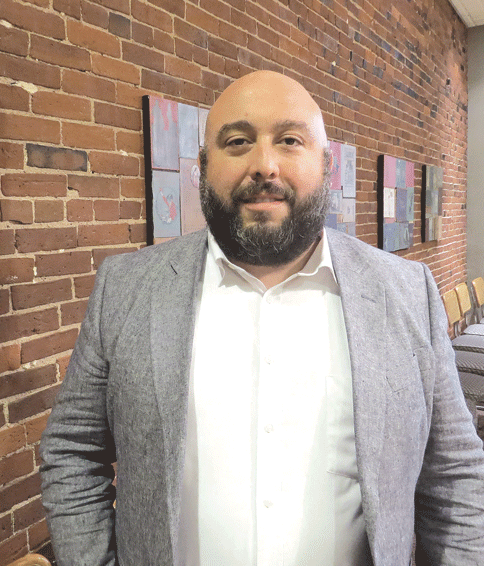
Commercial Real Estate Sections

Developing Interest

Eric Nelson

Eric Nelson

As Eric Nelson takes the reins at Westmass Area Development Corp., the agency’s ambitious Ludlow Mills project, which features economic-development opportunities on several levels, is entering an intriguing new stage. Meanwhile, Westmass is moving aggressively to answer the question ‘what’s next?’ — meaning everything from development of new sites to creation of a development-services arm to provide technical assistance to area cities and towns.

While he was pursuing his master’s degree in landscape architecture at UMass Amherst, Eric Nelson developed a keen interest in land planning and economic development, and eventually wrote his thesis on the adaptive reuse of historic mills.

Specifically, his work concentrated on the town of Uxbridge in the Blackstone River Valley south and east of Worcester, and several mills that had drawn the attention of the National Park Service, which would eventually create a national heritage corridor in the area marketed under the slogan “Birthplace of the American Industrial Revolution.”

One of Nelson’s focal points was the famed Stanley Woolen Mill in Uxbridge, which had a long history of manufacturing military uniforms, including those worn by Union soldiers during the Civil War. His work involved making recommendations to the park service on where and how to invest resources for this heritage corridor. It was rather involved work with many key considerations.

“You were looking at factors such as access, transportation, recreation, the integrity of the buildings, the opportunity for tourism, the opportunity for economic development, and much more,” he explained.

Fast-forward 25 years, and Nelson is tackling these very same issues again — this time on a much different stage and with much different stakes.

Indeed, as the recently named president and CEO of Westmass Area Development Corp., Nelson is overseeing a project with striking similarities to what he encountered in Uxbridge — the ongoing efforts to revitalize the Ludlow Mills, which Westmass acquired in 2011.

This initiative blends elements of economic development, which comes in many possible forms, as we’ll see, as well as access and recreation (a riverwalk is being created), and repurposing of a wide array of different buildings on the property.

“There are many similarities between the Blackstone Valley and Ludlow Mills — and a host of other mills in this region,” he explained. “In many instances, they’re on a river, and in a lot of cases, they’re brownfield sites; there are a great many challenges to reuse of these properties.”

But Ludlow Mills is only one piece of the Westmass portfolio, and one aspect of Nelson’s work to increase the agency’s presence in the region and its impact on overall economic development.

There are other properties to be developed, he told BusinessWest, including the Chicopee River Business Park, which has been a lingering source of frustration for Westmass and remains mostly vacant two decades after it opened. But Nelson sees reason for optimism.

“It’s a great location — it’s only two minutes from the Mass Pike, and it’s right off Route 291,” he said, adding that Westmass is considering a change to its strategic focus on the property, with a shift toward attracting potential suppliers to CRRC MA’s subway-car-manufacturing facility, now taking shape less than mile down the road.

aerial shot of Ludlow Mills

This aerial shot of Ludlow Mills shows the many different elements to this project — from mill redevelopment to river access to green acreage.

Beyond development of its properties, though, Westmass has become more aggressive, if that’s the right word, in efforts to become a resource for other agencies and entities involved in economic development, he noted.

As an example, Nelson cited the ongoing efforts to revitalize the property on Race Street in Holyoke known as the Cubit, because it takes that shape. This project has a number of players, he went on, including the state, the city, Holyoke Community College (which is relocating its culinary arts program there), and private developers. Westmass, and specifically now-former President and CEO Kenn Delude, has been lending technical assistance to bring the initiative together.

“We’re putting together what we call a development-services side of the house,” he explained. “A lot of area towns have resources, but they don’t have the staff; we can be of assistance to them with various development projects.”

For this issue and its focus on commercial real estate, BusinessWest talked at length with Nelson about his vision — for Westmass, Ludlow Mills, the Chicopee River park, and much more, and how he intends to bring it all into focus.

View to the Future

As he talked with BusinessWest in the conference room at the facilities housing Westmass at Westover Metropolitan Airport, Nelson paused to reference a stunning aerial photo of the Ludlow Mills project on one wall.

As he talked, his hand moved over various components of the project — from the land where the new HealthSouth Rehabilitation Hospital of Western Massachusetts now sits (the photo is several years old) to the mill that Winn Development will soon be converting into senior housing; from the so-called Clock Tower building, for which Winn recently announced an ambitious mixed-used project, to the dozens of small block houses, some of which have since been razed; from the intended path of the riverwalk to 47 acres of undeveloped land on the property that constitutes still another key component of the initiative.

The exercise was effective in communicating everything from the importance of the project to the region to what it represents as a career opportunity.

“This is an extremely interesting project with lots of elements and moving parts,” he said. “And it’s significant on many levels — for the town, for the region, for job creation … it’s great to be part of this.”

Nelson, who came to Westmass in 2011 specifically to move the Ludlow Mills project off the drawing board, brings to his new assignment a broad résumé of job experience, with stints in everything from education to landscaping.

He started as a public-school teacher in Amherst, a job he eventually lost to budget cutbacks, and then went into business for himself in landscape construction, specifically the installation of patios, walkways, decks, and other features.

It was that work that eventually took him to UMass and pursuit of his master’s degree. After earning it, he went to work for SVE (Southern Vermont Engineering) Associates, a professional consulting firm specializing in engineering, surveying, and landscape architecture, rising in the ranks to senior project manager and director of the Greenfield office.

He was attracted to Westmass, and a vice president’s position there, specifically by the Ludlow Mills project, which appealed to him on a number of levels, but especially the promise to exercise many of his passions — from landscape architecture to economic development — in one project.

“Westmass was looking for someone to carry the vision out,” he explained. “And the job requirements meshed well with my background, talents, and interests.”

As president and CEO of Westmass, Nelson will see his time and energy parceled in several different directions — geographically and otherwise.

Indeed, the agency owns industrial parks in Agawam, East Longmeadow, and Hadley that are full or mostly full, and Chicopee River, which remains a mostly blank canvas, but one Nelson believes could finally become filled in.

One area has already become home to a solar farm, he explained, and efforts to make a parcel near Route 291 more visible from the highway should generate some momentum.

“I think that will generate a lot of interest because people driving by there don’t realize they can site their building there,” he said of that site work. “And I think that if we can get one company in there, others will follow.”

But Ludlow Mills is getting most of the headlines — and the bulk of Nelson’s attention at the moment.

Winn’s Clock Tower building project comprised the main announcement at the recent Developers Conference staged by the Economic Development Council of Western Mass., and many other components of the project are coming together.

Mill-10-Interior-Before

These before-and-after photos show progress being made in the work to convert one of the Ludlow Mills structures into senior housing.

These before-and-after photos show progress being made in the work to convert one of the Ludlow Mills structures into senior housing.

The property is no longer a brownfields site from a technical standpoint — most all contaminants have been remediated — and extensive infrastructure work, including new water and sewer connections, have made the complex far more appealing to developers.

Overall, the site has enormous potential for many different kinds of development, from the senior housing already taking shape to manufacturing, office, and even retail, he explained, adding that, with its various structures and green spaces, it can handle the needs of growing enterprises.

“We have small spaces that startups can rent,” he explained, “and when they get to the point where they need a manufacturing facility, we have the opportunity to offer them a piece of property they can build on.”

Ludlow Mills is roughly five years into a 20-year redevelopment effort, said Nelson, adding that the ongoing challenge is to determine the best uses for various properties moving forward, and facilitating efforts to develop them.

As one example, he returned to the aerial photo and pointed to one of the mills, this one with low (seven-foot) ceilings, which will ultimately make redevelopment quite challenging. Perhaps the best course for that structure is to raze it and create parking for other projects, he explained, adding that this is one of many decisions that will have to be made in the years to come.

Building Blocks

As he talked about Ludlow Mills, Nelson said this project wasn’t yet on ‘auto pilot,’ a phrase he used to describe a point where most pressing issues have been resolved and matters come down to attracting the development community to the property.

But it’s getting close.

And that means more of the agency’s time and energy can be put toward the intriguing question of what comes next.

There are many components to that answer, said Nelson, who started by saying that this region will soon have more inventory of land and properties to develop.

That’s because absorption of existing buildings, a trend (one less expensive than building new) that emerged and then accelerated in the years following the Great Recession, has continued unabated. And that inventory is dwindling.

“The economics of building new were not going to pencil out, because people were able to go buy an existing building at a big discount,” he explained, adding that this fundamental shift in many ways inspired a change in strategies at Westmass, one that prompted a unique project like Ludlow Mills rather than additional industrial-park development.


Go HERE for a listing of available Commercial Real Estate properties for sale and lease in Western Mass.


But if the pendulum isn’t already swinging back, it’s apparent that it soon will, to one extent or another, he went on, adding that, while the green space at Ludlow Mills can address some of the additional demand that will emerge, more land will be needed, for projects of all sizes.

“We’re at a curve in the road,” Nelson explained. “We need to plan ahead, and we need to start aggregating sites and getting sites ready, knowing that it takes three years to get them ready for building.”

He didn’t give any specifics about where the agency is currently looking for land that could be aggregated, but did say the search is on, and, as in years past, it will be undertaken with diligence and imagination.

Meanwhile, another answer to what comes next is that aforementioned development-services arm, which Nelson believes holds vast potential — for Westmass, but especially the region and individual communities.

He circled back to the Cubit project, and Holyoke Community College’s request for Westmass’ support, as an example of what’s possible.

“The leaders at HCC do what they do well — they run a college,” he explained. “But this is not their area of expertise, so they turned to us for help in deciding which building to go into, finding an architect, negotiating a lease, and, more importantly, going for grant funding.

“This meshed well with our skills and talents, and it’s job creation,” he went on, referring to the opportunities awaiting graduates of the culinary arts program. “I see this as a model that Westmass can develop for towns that don’t have staff.”

Milling About

Nelson admits that he pretty much lost track of his master’s thesis subject, the Stanley Woolen Mills. He did some research, though, and reported that progress was being made in redevelopment of those landmarks for new uses.

He has his own project to keep tabs on now, one that is in many ways similar to those Blackstone Valley initiatives, and in all ways important to the future of this region.

What was once a project undertaken in pursuit of a degree is now essentially his life’s work, a project that is well, a textbook example of generating economic-development activity.

George O’Brien can be reached at [email protected]

Architecture Sections

Blueprinting a Growth Pattern

Robert Stevens

Robert Stevens

Tessier Associates has been in business since Warren Harding was in the White House and Prohibition was the law of the land. No architecture firm can survive that long — and through all those twists and turns in the economy — without being resilient and resourceful, and the Tessier firm has been both. In recent years, for example, it has been diversifying its portfolio, complementing a dwindling amount of public-school work with projects in higher education and other sectors, and now has a steady supply of work in the pipeline.

The photos, sketches, and blueprints adorning the front entranceways and conference rooms at architecture firms usually tell a story — or, to be more precise, a big part of the story.

Indeed, collectively, these images become a highly visible, although not always organized, chronicling of a company’s history, examination of its portfolio, and window into its past, present, and, in some ways, its future.

This is definitely true at Tessier Associates, the nearly-century-old firm that has long been doing business out of a large storefront on the second floor at Tower Square in downtown Springfield. The photos in the front lobby and hallway leading to the production areas speak to the company’s proud history, which has included everything from dozens of school projects to a number of new churches and a host of commercial buildings, including bank branches, which became a prolific niche for a number of years (more on that later).

The main conference room offers more of the same, but specifically a look at more recent history — and a very necessary diversification of the portfolio to reflect changing times when it comes to designing new public schools, additions, and renovations.

“It’s much more difficult to get school projects today. There are fewer of them out there, and the selection process is now out of Boston — the rules have changed,” said Robert Stevens Jr., long-time principal with the company, noting that, while local school systems once did the hiring of an architect for a project, now those decisions are the purview of the Mass. School Building Authority.


Go HERE for a list of Architecture Firms in the region


This explains why the conference room still features photos and drawings of some of the firm’s school projects — including Lenox Middle/High School, which actually dates back to the late ’90s, and Hampshire Regional High School, newer work but still more than a decade old — but far more wall and easel space is now devoted to work with area colleges and businesses, which have become a far larger and more reliable pipeline of projects.

There are several images, for example, of a new dining commons being planned by Western New England University. Curved, and featuring large amounts of glass and a host of different and unique dining areas, the structure currently taking shape on the drawing board reflects a heightened interest in food and food service at institutions of higher learning, said Stevens.

“Food is a big deal now, and it’s important when it comes to recruiting students — you have to be on the cutting edge of this,” he explained. “These facilities now require a lot of social space, a lot of dining opportunities, a number of seating arrangements, and some quiet space; there’s a lot that goes into these now.”

The walls tell of other recent projects at Bay Path University and Springfield College, and also the Big E, which is exploring possible renovations to several of its historic buildings, including the coliseum (see related story, page 6). Stevens noted that such private-sector work is both necessary and, at the moment, at least, steady enough to keep the firm busy and in a contemplative mode when it comes to expansion and bringing on more staff.

dining commons at Western New England University

One of the Tessier firm’s renderings of the planned dining commons at Western New England University.

Still, like many in businesses across virtually every sector of the economy, Tessier has some doubts about the staying power of the current expansion, if one chooses to call it that, and noted that there are risks to bringing on more staff, especially in a sector as vulnerable to swings in the economy as this one.

He believes the economy is improving, but, like most others, would like to see more solid evidence that the upswing is real.

“We could be hiring others, and we probably should be,” he explained. “When you’re leery about whether the economy is really improving, you tend to hold back, even when you think you need to hire.”

For this issue and its focus on architecture, BusinessWest takes an in-depth look at … well, the walls and easels at Tessier Associates and at what they reveal about where the company has been, and where it’s going.

Designs on Diversification

Tracing the history of the company, Stevens said it was started by Henry Tessier in 1923, who was still working part-time when Stevens joined the firm in the mid-’80s.

“Henry worked until he was in his mid-90s,” he recalled. “He obviously liked what he did — he was still coming into the office every day.”

Under the tutelage of Tessier and later his son, Bob, and fellow partners Doug Engebretson, who retired in 2012, and Stevens, the firm developed a number of niches within the broad realm of architecture, including everything from churches to those aforementioned bank branches.

The former remains a source of some work, said Stevens, noting that the portfolio includes several projects in this category, including the new Immaculate Conception Church in Holyoke, St. Patrick’s Church in Springfield, Nativity Church in Holyoke, and Holy Name Church in Springfield.

As for those bank braches, they were a solid source of work decades ago as area institutions sought to develop a presence in many of the emerging suburbs.

“There was a period of time just after I came here when we really did nothing but bank branches,” he said, noting that, in those days — and perhaps not so much now — architects could, and did, get creative with design of the teller lines and other elements of those structures to give them individuality.

But the firm’s main bread and butter starting in the mid-’80s was public-school projects, said Stevens. The portfolio includes initiatives across this region and beyond, with most of them in response to growing populations and/or a need to replace or modernize aging infrastructure. The list includes additions and renovations at Frontier Regional School in South Deerfield, Commerce High School in Springfield, and JFK Middle School in Northampton, as well as new construction at Quarry Hill Elementary School in Monson and Grafton Elementary School in Grafton, among many others.

But by 2004, the pipeline of school projects dwindled to a trickle as the state all but stopped funding schools and changed the formula for how such initiatives were funded. By the time conditions changed and money started flowing more freely, the selection process for architects had changed, adding another layer to the challenge of landing such projects. The last one the firm handled was Hoosic Valley Regional Middle and High School in Cheshire in 2012.

With school work dwindling and prospects for improvement in that realm dim, the firm has done what it has always done since Warren Harding was in the White House and Babe Ruth was leading the American League in home runs, said Stevens — create a diversified portfolio and adjust its focus to where the work happens to be at a given time.

Indeed, an architecture firm cannot survive 93 years and an untold number of economic twists and turns, including both the Great Depression and Great Recession, without being flexible, resourceful, and resilient, and the Tessier firm is deserving of all those adjectives.

Drawing on Experience

Recently, for example, the firm has garnered a number of projects in higher education, tapping into one of the pillars of the region’s economy.

“We’ve been relying mainly on private work in recent years,” said Stevens, “and we’ve been successful in getting some nice projects. We’ve done a lot of work at area colleges and universities.”

Perhaps the signature initiative in this realm is the $30 million Center for the Sciences and Pharmacy building on the Western New England University campus, undertaken in 2009. “That was a significant project for us, coming right after the recession,” Stevens explained.

But there have been many others, including several projects at Bay Path University, including, most recently, renovation to some of the science labs. There has also been work at Springfield College, Elms College, and other schools.

The Center for the Sciences and Pharmacy

The Center for the Sciences and Pharmacy building at Western New England University is one of Tessier’s signature projects.

Meanwhile, there have been other forms of commercial work, including an office addition and renovation project for UniFirst Corp., a Wilmington-based supplier of uniforms and provider of related services that has a facility in Springfield, as well as another site in New York that the Tessier firm is also working on.

Those projects and others have provided Stevens with a sense that the economy is improving, that business owners are becoming more confident about the immediate future, and that this scenario may continue for some time.

And this sentiment wasn’t present in the years immediately after the Great Recession, even when analysts were saying the economic picture was brightening and businesses in many sectors, including those in the broad realm of construction, should see some trickle-down.

“Things were questionable in the few first years after the recession ended — I would hear that the economy was improving, but we weren’t feeling it,” he explained. “But at this point, it seems like there’s more activity.

“We have backlog — you can see enough work out for a year or two,” he went on, “and that’s pretty unusual for recent years.”

This is what he tells builders who will call and ask him what he thinks and what he knows — calls that come often, because, historically, architecture has been an accurate barometer of the economy; when firms are busy, that’s a good sign, and when they’re not … well, no explanation needed.

“The climate is improving,” he said in conclusion. “I’m feeling much more optimistic than I was a few years ago.”

Lines of Business

Tucked in a corner of the Tessier firm’s conference room is an aerial photo of the Elms College campus, complete with the wellness center the company designed.

Stevens couldn’t pinpoint the date of that project, but did know that it was some time ago. That was an acknowledgement that what’s on the walls and easels of such firms don’t exactly (or always) reflect current events.

But those items tell a story, or, as noted earlier, the story.

In this case, it’s one of a history of creativity — both on the drawing board and in business itself — and resiliency.

In other words, Tessier has developed a blueprint for surviving and thriving in changing times.

George O’Brien can be reached at [email protected]

Health Care Sections

Out of the Darkness

HCNcoverART0616

For a decision of such finality, the choice to end one’s life has come easier over the past 15 years, according to both national and statewide statistics. The reasons for the increase in suicide rates are myriad — economic stresses, mental illness, social isolation, substance abuse, and too many others to mention — and the outward signs are often unclear. But resources are available across the region to stem the tide, if only at-risk individuals can be identified in time and steered toward the help they need.

It’s alarming enough, Melissa Perry says, that overall suicide rates, both nationally and in Massachusetts, are on the rise. But she is struck by some of the details that comprise the larger trend.

For example, suicides among girls ages 10 to 14 tripled over 15 years, from about 50 in 1999 to 150 in 2014 — a relatively small number compared to the general population, but a distressing statistic nonetheless. Perry, director of Behavioral Health Nursing at Holyoke Medical Center (HMC), suggests one factor behind this increase: the pervasiveness and incessance of bullying in the social-media age.

“When we were young, we were able to get away from the name calling and getting picked on in school, just by going home,” she told BusinessWest. “Social media has kicked it up a notch. Girls are picked on at school and then continue to get picked on every time they’re on social-media sites; it continues and never ends. I really think that plays a huge role in girls struggling. Even switching schools doesn’t solve the problem.”


 Click HERE to view a chart of Behavioral Health Centers in the area


According to a study released earlier this spring by the National Center for Health Statistics, it’s not just teen and tween girls at risk. After a period of consistent decline in suicide rates in the U.S. from 1986 through 1999, rates for the overall population have increased steadily from 1999 through 2014, the last year for which data is available. In fact, 42,773 people died from suicide in 2014, compared with 29,199 in 1999.

“That’s a significant jump,” said Nina Slovik, a social worker and clinic director at the Center for Human Development, before detailing some possible drivers behind the surge. “The economic climate is a very significant factor — job loss and financial insecurity. Social isolation is a factor, which can be seen in the rate of divorce and the increase in the number of people who are not getting married and might not be socially connected. And you certainly cannot discount the enormous increase in drug addiction and substance abuse.”

Nina Slovik

Nina Slovik says suicide triggers range from economic insecurity and social isolation to substance abuse and mental illness.

The bottom line is that suicide is now the 10th-leading cause of death in the U.S., and number two among the 15-24 age group. Slovik noted that African-American men are the only demographic group whose suicide rate is down, and the only age group to decline is men and women over 75.

“The problem is widespread across all the other age ranges,” she said, adding that people who feel disenfranchised, such as LGBT individuals, are at higher risk, while those who have made suicide attempts in the past are much more likely to try again in the future — about 40 times more likely, in fact, than those who have never done so.

“The causes can be complicated,” said John Kovalchik, HMC’s Outpatient Behavioral Health manager. “There’s a family history of violence, sexual molestation and abuse, a history of substance abuse or mental illness, being incarcerated, having access to firearms, things of that nature.”

Access to tools of violence don’t tell the whole story, however. While the share of suicides involving guns has declined since 1999 — from 37% to 31% — suffocation deaths, including strangulation and hanging, are up from less than 20% to about 25%, perhaps reflecting the fact that everyone has access to such means, while gun-ownership rates are down in some states.

The larger question, of course, is what to do about what Slovik characterizes as not just a psychiatric problem, but a full-blown public-health issue. The professionals who spoke with BusinessWest agree that suicide prevention and intervention resources abound in Western Mass., but identifying at-risk individuals and connecting them to help isn’t always easy. But through education and greater public awareness, they say they’re making strides.

No Boundaries

While financial struggles are rampant at a time when Americans hear the recession is over, yet many are still unemployed or underemployed; and while substance abuse is a growing issue in many states, including Massachusetts, the risk factors for suicide extend far beyond those timely factors, ranging from mental illness and a history of abuse to lack of an emotional support system to family disruptions like divorce and lawsuits, according to the Mass. Coalition for Suicide Prevention.

“Suicide doesn’t really have any boundaries; it’s one of those things that can occur in any population,” said Robert Reardon, who chairs the Pioneer Valley Coalition for Suicide Prevention, the statewide organization’s regional chapter. “We want to make sure the message we’re sending out about suicide prevention is as diverse as our communities in the Pioneer Valley.”

Reardon is also director of Outreach and Community Services for Tapestry Health, a regional network of public-health services that, as one part of its mission, links people to suicide-prevention services and offers workshops and educational programming aimed at making people more aware of the outward signs of potential suicide.

Those signs vary widely, but can include feelings of hopelessness; preoccupation with death; withdrawal from family, friends, sports, and social activities; drastic behavioral changes; depression, anxiety, and eating disorders; giving away possessions; taking unnecessary risks; lack of energy; inability to think clearly or make decisions; loss of interest in work or school; changes in appetite, sleeping habits, or personal appearance; and financial worries — just to name a few.

However, the Mass. Coalition notes, individuals also possess ‘protective factors’ — personal, familial, and interpersonal factors that help one cope with life. These range from a sense of humor to good problem-solving skills; from strong faith to good nutrition and regular exercise; from connectedness to family or church to a sense of purpose.

“Nobody is just one thing — a big mass of depression or mental illness or alcoholism,” Slovik said. “Everyone has particular strengths and skills. We have to look at the larger picture.”

Kovalchik said it’s important that people are able to recognize not only the warning signs of a potential suicide, but these resiliency factors, so they can help their loved one focus on them instead of their stressors.

Which means talking and asking questions when warning flags emerge. The coalition emphasizes that talking about suicide will not put the idea into someone’s mind; rather, most people will be relieved that someone has noticed their pain and are willing to help.

After all, the organization notes, people who die by suicide generally do warn others, and may be trying to get attention in order to get help — and they should be taken seriously.

“It never hurts to ask someone questions,” Slovik said. “Whether it’s a family member, friend, co-worker, whomever, if for any reason you think a person is at some risk, you won’t create a suicidal person by asking direct questions; that’s a myth, and it’s not borne out by clinical experience or data.

“Asking people about suicide does not increase the risk,” she went on. “In fact, it may decrease their sense of isolation, the feeling that nobody knows what they’re going through, that nobody has ever felt like they do. There’s a lot of shame and embarrassment associated with feeling suicidal, and if you can overcome that sense of isolation, that’s a good first step that can lead to a larger discussion.”

She doesn’t recommend giving clinical advice to someone who is suicidal, but it’s important to listen closely, express understanding, and suggest resources that might be able to help.

“There are often shame-based associations with being depressed, being anxious, being frightened, being bullied,” she told BusinessWest. “But if you can break down the barrier by getting them to talk about it, that can be very meaningful. Getting in the door is a big deal.”

Medical professionals are increasingly doing their part, Kovalchik said, by screening patients who arrive in emergency rooms for behavioral-health issues, substance abuse, and past trauma, to name a few signs. “It’s important that we don’t separate the body from the mind, as we have historically.”

Melissa Perry

Melissa Perry

The importance of speaking directly to someone suspected to be a suicide risk is often magnified when dealing with a teenager, Perry said, because this group tends to be more impulsive and often responds to a stressor more quickly than someone a bit older.

“If someone might be thinking about suicide, having that conversation — and then supporting them and offering them hope — is a big step,” Reardon said. “Then you can help that person seek help through other resources; there are a lot of mental-health services and organizations in the region that can provide support.”

Healthy Choices

For its part, Tapestry works with recovery learning communities, or RCLs, a program of the state Department of Mental Health to offer information and support to people struggling with mental illness, and that initiative’s Alternatives to Suicide peer-support groups.

“Those have been well-received by folks because they’re run by people who have attempted suicide or had long-standing thoughts of suicide,” Kovalchik said. “But you have to get someone to buy in and seek help. That is the tricky piece, I think.”

Meanwhile, the Mass. Coalition for Suicide Prevention, since its founding 17 years ago, has worked with the state Legislature to get more than $28 million allocated for suicide-prevention services targeting veterans, older adults, college and university students, youth and young adults, mid-life adults, and LGBT youth.

The coalition’s training efforts have reached nearly 31,000 advocates, teachers, clinicians, substance-abuse staff, elder advocates, and youth service organizations, among others, and the organization co-sponsors 14 Massachusetts Suicide Prevention Conferences, attracting hundreds of participants each year.

Efforts like these, and the programs operated by agencies like the Center for Human Development, are making a difference in the lives of those they reach, Slovik said, even though too many are still succumbing to suicide.

“The most significant approach to preventing suicide is getting people to find a place where they can talk about whatever is going on in their lives — that therapeutic relationship with somebody that can help engender a sense of hope,” she said. “Hope is really the most critical factor in preventing suicide. How do you instill hope in people? It’s relationship-based: talk to people, find out what their risk factors are, and focus on their protective factors.

“It’s a complex problem, and there are no guarantees,” she concluded. “We don’t kill anyone, and we don’t save anyone. If we’re lucky, we help people save themselves.”

Joseph Bednar can be reached at [email protected]

Health Care Sections

Thinking Outside the Pillbox

Dr. Christopher Keroack

Dr. Christopher Keroack

Dr. Christopher Keroack, like so many who grew up in the Northeast, recalls a childhood visit to Riverside Park in Agawam, now known as Six Flags New England. Back then, at the center of the grounds was a crowded area known as the International Plaza, connecting the north and south sides of the amusement park.

He was 7 years old on this particular visit, and his mother told him to hold her hand while crossing the plaza, so he did — he thought. “The density of the crowd resembled a New York nightclub, but I struggled through it and emerged holding my mother’s hand — only, when I looked up, I was shocked to find the hand wasn’t hers.”

He describes the feeling — still resonant decades later — of being lost and frightened, and his decision to go to the park’s magic show, a location he and his mother both knew well. He sat down in the front row and cried as the show began, but the plan worked — his mother intuitively found him there a short time later, and all was right with the world again.

Keroack, director of Pioneer Valley Weight and Wellness Center in Springfield, tells this story at the start of his new book, Changing Directions: Navigating the Path to Optimal Health and Balanced Living, and retold it recently while sitting down with BusinessWest. The point is that being lost as a child is an alarming experience, and returning to a place of safety and familiarity is a hallmark of finding one’s way again.

“Part of me believes this is what has happened in the medical field,” he told BusinessWest. “Once compassionate healers, our field has transitioned into protocols, ICD-10 code diagnoses, prior-approval paperwork, and endless uses of drugs.”

As a result, Keroack — and many of his colleagues, he believes — long for a return to the “golden years” of medicine, when one-to-one relationships with patients were richer, and when doctors were committed to healing and compassionate caring, not a sea of protocols and quick-fix prescriptions. “I believe,” he said, “that we can return to those days.”

His book, published earlier this year, is a primer on the philosophy of ‘functional medicine,’ which is, at its core, a blending of the ancient arts of medicine, including Eastern medicine, and the modern approaches of scientific, Western medicine. Having studied both, Keroack has crafted a practice in the Valley that incorporates elements of these two worlds and demonstrates to patients why they should — and do — work in tandem.

“It just fits into everything all physicians originally wanted to believe in,” he said. “We went into medicine for the purpose of helping and healing people.” The book — which he calls “a field guide to navigate the confusion of healthy living” — is an effort to help people understand these concepts and put them into practice.

He likens functional medicine to a tree. The roots of the tree — unseen but taking up as much space underground as the branches do above — are what nourish the tree, not the leaves. The leaves may show the outward signs of disease,  but the deeper problems originate in the roots. “Functional medicine,” he notes, “sees the roots and knows that, by nourishing the roots, the leaves will grow.”

Another metaphor, he said, sees the body’s systems as a flowing stream, one in which pollutants and chemicals from a factory upstream are contaminating the water, creating imbalance and toxicity. The ‘downstream’ approach of Western medicine is to put a water filter on the kitchen faucet — but what about the water in the dishwasher, shower, and washing machine? Ideally, the correct approach would be to remove or divert the pollutants and chemicals at the source. That, in a nutshell, is functional medicine.

At the Core

The core of this philosophy revolves around what Keroack calls the “fab five” — food, movement, stress, sleep, and relationships — and the way they intertwine to impact one’s overall wellness.

“If we ate the correct food, stayed up on hydration, went to bed on time, had our debts paid, had harmony in our marriages, and got out of the chair and moved around, we would be radically healthier. But we don’t do these things, because we rely on pills, potions, and lotions.”

One barrier, he said, is that Western physicians are trained in pharmacology and diagnosis codes, so they get locked into that pathway. “But I get to have real conversations with people about these foundational factors, and then they get better.”

KeroackCoverKeroack is board-certified in internal medicine and bariatric (weight-management) medicine, and originally built his practice around weight loss, moving gradually into a broader wellness focus, where patients lose weight as just one benefit of a total lifestyle shift. But in addition to his formal training, he has certifications from the Institute of Functional Medicine and the Cenegenics Education and Research Foundation for Age Management Medicine.

Beyond the ‘fab five,’ each personalized health and wellness plan takes into account five foundational imbalances: nutrition, metabolism, inflammation, detoxification, and oxidation. Together, he calls them the ‘star of wellness,’ noting that “all five aspects of your health are equally important. A problem in any one leads to imbalance with the others.”

According to the Institute of Functional Medicine, “functional medicine addresses the underlying causes of disease, using a systems-oriented approach and engaging both person and practitioner in a therapeutic partnership. … By shifting the traditional disease-centered focus of medical practice to a more person-centered approach, functional medicine addresses the whole person, not just an isolated set of symptoms.”

That’s why it’s important to spend time with patients, he explained, understanding their histories and considering the interactions of their genetic, environmental, and lifestyle factors that can influence chronic disease — in a way that goes far beyond mere diagnostic codes.

At the root of functional medicine, the book notes, is the idea that the body, given the right balance of food, movement, stress, sleep, and relationships, will take care of itself.

“It’s not that complicated, but it does require discipline and planning,” he told BusinessWest. “At the same time, you can find the necessary components at the supermarket, in the backyard, and in the bedroom.”

That’s not to say medications and technology don’t play a role in modern healthcare; they certainly do. The key word is balance — and it’s safe to say many doctors lean much further in the opposite direction, putting far less emphasis on elements like food, stress, and positive relationships than they do on a prescription.

“The Western-medicine approach to illness looks at things from the bottom up — once we get sick, we can do something about it,” he went on. “Functional medicine looks at things from the top down — what can we do not only to avoid getting sick, but to optimize your health? I’d like to think most people want that. Rather than just not having diabetes, they want to be in the best health of their lives.”

Keroack claims that most people eating correctly — say, a Mediterranean diet with plenty of fruits and vegetables from all the color groups — are getting the vitamins and minerals they need from their food, but dietary supplements are often helpful. But the average consumer gets overwhelmed going into stores that sell supplements because no one has explained what will work best for them.

“I had an elite hockey player in the other day. He wanted to take some performance-enhancing supplements, but the ones he was using were all turmeric and ginger, which are anti-inflammatories, which are fine afterward, but they don’t enhance performance; he needed carnitine and taurine. Somebody sold him the wrong thing, based on the chemistry of these botanicals. Just like I can’t play hockey at his level, he’s trusting people to give him the right stuff.”

Another patient, diagnosed with yeast overgrowth, was taking a supplement better suited for liver cleansing before Keroack steered her differently.

“She had spent her hard-earned money on something intended for something else,” he said. “If you pick the wrong things, spend your money, and get frustrated, you think, ‘that’s one more provider that has not helped me.’”

Guiding Hand

Keroack, on the other hand, wants to teach patients how to maintain their own health so they’re not as reliant on medications and other trappings of modern medicine.

“In Western medicine, we talk about diet and exercise, but we don’t explain how,” he told BusinessWest. “Studies show they have more impact on diabetes than medicine, but we don’t educate people — really educate them — in diet and exercise at all.”

The bottom line, he went on, is that the simple tenets of functional medicine can seem, frankly, too good to be true to a generation raised on pharmaceutical marketing. “But if you change your food, change your movement patterns, change your stress levels, you’ll get better. And it’s logical and intuitive that you would.”

Keroack’s father was an emergency-room physician decades ago, using much more primitive technology than doctors have available to them today — and he wouldn’t recommend a return to that. But why, he asks, not marry today’s capabilities with the sensibilities of yesteryear, a practice of medicine based on communication, understanding, and the doctor-patient relationship?

“I’m shooting to return to the golden age of medicine, just not using old-school technologies,” he explained. “I understand that technology has changed, but I’d like to see our policies and protocols match the information that’s available. There is legitimacy to the colors in fruits and vegetables, the inflammatory effects of gluten and dairy, the chemical effects of pesticides and herbicides and pollutants. There’s real science behind that. We don’t have to stop at lowering calories and walking 10,000 steps.”

In the end, when he thinks of how Western medicine has evolved, he returns to that story of a 7-year-old at Riverside losing — and then finding — his way.

“We think we’re holding on to a hand we trust, only to go through the journey and find it’s not what it was,” he said. “We’ve been disheartened, disillusioned. Patients are constantly telling me, ‘doctors have no time to spend with me and listen; all they have is pills.’”

Through his practice — and, now, his book — Keroack is doing his part to change that paradigm.

Joseph Bednar can be reached at [email protected]

Health Care Sections

Merciful Mission

Steven Marcus

Steven Marcus says many elders in nursing homes suffer from undiagnosed depression that can lead to death.

Steven Marcus folds his hands and leans forward as he talks about his mission in life.

It is profound, and centered on an issue few would attempt to tackle: finding people in nursing homes in Massachusetts who suffer from depression or mental illness and getting them the help they need.

It’s a subject close to Marcus’ heart, and an area in which he and his wife Renee have been highly successful. More than 15,000 people receive services every month from New England Geriatrics and its parent company, West Central Family Counseling in West Springfield, which they founded 22 years ago to realize his goal.

“We need to put the words ‘geriatric depression’ into people’s vocabulary. It’s not a dirty little secret; it’s a disease that kills,” he told BusinessWest.

Dr. Ricardo Mujica, a geriatric psychiatrist, addiction psychiatrist, and medical director of New England Geriatrics, says 20% of the elderly population have symptoms of mental illness that are not part of normal aging, but often go unaddressed due to medical or emotional biases.

For example, irritability is a sign of depression in elders, but many families wrongly attribute it to the aging process and think “grandpa is just a grumpy old man.” The problem is compounded by the fact that many physicians don’t have specialized training in geriatrics, so they are apt to miss or misdiagnose an elder’s depression or mental illness.

“Part of the definition of growing older is being a survivor,” Mujica said. “But the combination of multiple medical problems, frequent admissions to a hospital, and moves from one place to another can alter moods and coping skills and make it difficult for older people to stave off depression and anxiety. It’s very important to bring support to these people, especially if they are in nursing homes.”

He added that they are difficult places for anyone to adapt to, and this factor, combined with the fact that the person’s health is not optimal and they often need 24/7 care, put them at risk for anxiety and depression.

“But if their mood is stabilized and they begin to feel better, it becomes easier for them to cope with their situations,” Mujica said, noting that medication and psychotherapy can make a real difference, although antidepressants and related medications can affect elders differently than young people.

In addition, many elders have substance-abuse issues caused by loneliness and depression that their families don’t know about or don’t imagine possible. Mujica said women tend to turn to alcohol, while men take prescription drugs.

Jan Mitchell agrees that elders face a unique set of challenges. “As people age, they go through many transitions; their children leave home and move away, they develop medical problems, their friends pass, and their spouses die,” said the director of West Central Family Counseling, adding that any or all of these issues can lead to anxiety and depression. “Our goal is to assist them so what they are facing doesn’t become an all-encompassing issue which they feel they are powerless to change.”

Marcus became aware of the depression that troubles so many elders two decades ago. At the time, he was a seminarian, and although he loved bringing religious services to people in nursing homes, he noticed three things: the majority didn’t want to be there, they were rooming with someone they didn’t want to be with, and they disliked the food they were served.

The same complaints were voiced by prisoners he visited during a clinical rotation connected to earning his master’s degree in social work. The rotation took place at the former York Street Jail in Springfield after he left the seminary and took the advice of mentors Sheriff Michael Ashe and Springfield Technical Community College’s then-President Andrew Scibelli to continue his education in that field of study.

“People in both places were suffering horribly from loneliness and depression,” Marcus said, explaining that depression was not something people talked about at the time.

After he finished his degree program, he decided to turn his passion for helping elders into a business.

He and his wife Renee bought West Central Family Counseling from a psychiatrist and psychologist in Franklin and gave birth to New England Geriatrics, which operates under West Central at the same time.

Expanding Horizons

Marcus says it wasn’t until the Affordable Care Act took effect that Medicare and Medicaid were willing to pay to treat clinical depression at the same rate they did for other diseases.

“We worked tirelessly with young Congressman Patrick Kennedy of Rhode Island, who was the chief sponsor of mental-health parity,” he said, noting that the combination of medication and talk therapy results in a 95% cure rate.

The typical patient that New England Geriatrics treats today is an 85-year-old, white, widowed woman on 12 medications with a high co-morbidity rate.

“They are the sickest and frailest souls in the Commonwealth,” Marcus noted.

Referrals often come from nursing homes and prompt a comprehensive team response; a psychiatrist, psychiatric nurse, and psychiatric social worker are assigned to each patient. The nurse ensures that the patient receives the optimal level of care and there are no adverse drug reactions or interactions with their current medications or anything new prescribed by the psychiatrist, but Marcus says the practice is to “start low and go slow with medications because you have to be very, very careful with this population.”

The social worker works with the patient’s family, which is important since the majority of the company’s clients in 150 nursing homes across the state have dementia. A neuropsychologist also becomes part of the team if the person’s competency or ability to live independently is in question, and that determination is often critically important to families who struggle with the decision of whether a parent or loved one needs to be moved from their home into an assisted-living facility or nursing home.

“It’s not uncommon for a person to have a fall at home, break a hip, and be sent to a nursing home, which will call us,” Marcus said. Another instance is when a senior’s behavior undergoes a sudden, radical change, which can cause them to become violent and be admitted to a hospital.

Marcus told BusinessWest the reason for a pronounced change in behavior can include medical problems, such as a painless urinary tract infection. But many elders suffer from problematic drug interactions, are overmedicated, and need a psychopharmacological review.

“It’s important to figure out what is wrong with the patient,” he said, adding that an in-depth review of medications can result in reducing antipsychotic medications prescribed to curtail troubling behavior.

But this revelation wasn’t arrived at suddenly, and when Marcus realized patients in nursing homes were becoming combative for no apparent reason, he reached out to Dr. Mark Folstein at Tufts Medical Center, who was classified as ‘the father of geriatrics’ after he created the Mini-Mental State Exam, which takes less than 10 minutes to administer and assesses the degree of a person’s dementia.

For the next two years, Marcus sent 40 patients a month with sudden behavioral changes, from all over the state, to Tufts Medical Center, where they were kept for 10 days. Each patient met daily with a psychiatrist, geriatrician, social worker, nurse, and psychologist who came up with a diagnosis and created a simple plan for their release.

“It was literally life-changing for the patients and their families,” Marcus said, adding that, in many instances, changes were made to the medications people were taking.

Since that time, New England Geriatrics has opened four similar programs at Holy Family Hospital at Merrimack Valley in Haverhill, Baystate Wing Hospital in Palmer, Nashoba Valley Medical Center in Ayer, and St. Anne’s Hospital in Stoughton. They provide a total of 68 geriatric psychiatric beds to care for elders who have dementia and a psychiatric illness, such as depression. They are kept for seven to 19 days, and educating families is a vital part of the program, especially since Marcus said many don’t know that Alzheimer’s is a terminal disease.

“Our whole world consists of educating and journeying with our patients and their families,” he said, explaining that they give families information about how the disease progresses and what to expect.

Tireless Efforts

In addition to their business, Marcus and his wife have owned and operated three nursing homes and a hospice program. And although they have gone above and beyond achieving his initial vision, his focus is on the future.

He is concerned about the Baby Boomers who will retire in record numbers over the next decade, and wants to provide clinical services for them as he says depression and dementia go “hand in hand,” and white, widowed men have one of the highest suicide rates in the nation.

To that end, he plans to launch a new outpatient program in West Springfield focused on mental healthcare for elders, and a team of geriatric specialists has been hired to cater to their special needs.

“We want to identify problems before they become catastrophic and help any elder who is depressed, lonely, or withdrawn,” he said.

Mujica told BusinessWest there are three main predictors of healthy aging: being physically active, having a good social network, and having a sense of spirituality, which gives people hope and something to believe in.

But even if all of these factors are in place, aging can be difficult due to ongoing losses that people often need help coping with.

“When the life someone knew begins to slip away, it is our job to help them transition through their loss and develop a life worth living,” Mitchell said.

The new clinical services will make a difference, but it’s not enough for Marcus. He is on the board of directors at Westfield State University and has been instrumental in having courses in geriatrics added to the curriculum in the master of social work degree and new physician’s assistant program, which will start next fall.

“Roughly 10,000 people in this country will retire every day for the next 13 years, and geriatrics will become the next huge business,” he said. “But we need to address their issues early in the game. Families need to have a good, solid education about the problems their loved ones will face so we can stop their loneliness and depression.”

That’s both his passion and his quest: to bring hope, peace, and healing to a population whose suffering is sometimes overlooked — and often forgotten.

Construction Sections

Varied Landscape

David Fontaine Jr

David Fontaine Jr. says Fontaine Bros. has a good mix of new construction and historic renovation work lined up.

The building industry has travelled a tough road in its efforts to recover from the Great Recession, with mostly modest improvements in business volume amid ever-mounting competition for available work. But in recent months, the skies have become brighter, and most builders are expressing real optimism that the better times are real and have some staying power.

It’s easy to notice major commercial construction projects underway during the summer, and this year is no exception. Business is booming, and local companies say they are doing well — one is actually having a record year — but competition is stiff, and it takes a good track record to get hired in today’s market.

“Business has been very good,” said David Fontaine Jr., vice president of Fontaine Bros. Inc. in Springfield. “The market is very competitive, but we have gotten our fair share of business over the last few years. We’ve been consistently busy and have work lined up on the books that is a good mix of new construction and historic renovation.”

Eric Forish, president of Forish Construction Co. Inc. in Westfield, said his company has also been fortunate. “The past two years have been our best out of 70 years in business, and the forward momentum is continuing,” he told BusinessWest.

But he says it takes a lot to win a bid. “A company has to have a multitude of strengths and share the customer’s expectations; they want a safe job site, quality, and performance, and these things, coupled with excellent customer service, have been our priorities.”

Although Keiter Builders Inc. in Florence has been very busy and has a number of projects underway, it is also aware of the high level of competition and what it takes to prevail in a contest for a job.

“The bids have been very close on the last half-dozen jobs we won; we were within a few percentage points of our competitors,” said company President Scott Keiter. “The owners are creating their short lists of candidates based on reputation; then it’s all about the numbers.”

However, the firm deliberately searches for challenging and complex projects.

“We truly enjoy them, whether they involve creating an observatory or a new restaurant. We’re good at complex undertakings; they keep us on our toes,” Keiter said, adding that he started his business eight years ago in the depths of the recession, but has done well. “Everything keeps going in the right direction, we are proud of our work, and we’re growing.”

Stephen Greenwald, president of Renaissance Builders in Gill, says there is considerable work available across the board in residential, industrial, and commercial sectors.

“We’re busier than we were last year and have work through the beginning of next year,” he said, noting that it used to be like that 10 years ago, but hasn’t been that way for a long time.

The type of work the company handles varies; about 50% to 60% is commercial, 30% is residential, and 10% to 15% is industrial, although the numbers change from one year to the next, and Greenwald agreed that landing jobs is highly competitive and a number of factors enter into the equation.

“Margins are still slim, but one of the reasons is that materials continue to go up in price,” he told BusinessWest. “But since the recession ended, business has steadily gotten better.”

However, Forish networks with many local, regional, and national firms and noted this year is unusual: some contractors are busy, while others are not. He doesn’t know why, but noted that, “historically, election years create a degree of angst.”

Different Landscapes

Fontaine said his company is frequently hired to do construction management.

“We help throughout the design process and are involved long before the actual construction work begins,” he said, explaining that the firm works in conjunction with the architect and owners, helps with the budget, and makes sure the job starts on time and stays on budget.

Most projects are several years in duration, and landing them is no easy feat.

“There are a lot of really qualified large and small companies bidding on projects, and we’re definitely seeing more companies with a national reach coming into the area,” Fontaine said. “We focus on our relationships with our clients, and the success of our projects keeps us busy. But we live and die based on our reputation and our continuing results. In our business, you can’t take a day off. You have to consistently do your best to get and keep clients.”

Eric Forish

Eric Forish (standing) spends a moment with Michael Oakes at Super Brush in Springfield, where Forish Construction Co. is putting on a 12,000-square-foot addition.

Forish agrees. “We’re always looking to take on new work. You can’t sit on your laurels; we’re constantly challenged to find new opportunities and markets,” he said. “If you’re good at what you do, every day you’re completing work, so you need to find new jobs. You have to keep going; you can’t assume that things will stay steady in any industry.”

Fontaine Bros. has a number of projects that were recently completed as well as ones that are underway or in the planning stages. It recently finished a historic renovation of the 100,000-square-foot, $33 million Shrewsbury Public Library that involved keeping the front of the building and adding 40,000 square feet, and it’s finishing a new elementary school in Athol.

Local work includes the $55 million Pope Francis High School being built by the Diocese of Springfield on the grounds of the former Cathedral High School on Surrey Road in Springfield that suffered extensive damage during the 2011 tornado.

“The project is in the final design stages, and we expect to break ground in September,” Fontaine said, adding that many people have wondered when the work will begin and don’t understand how much has to be done behind the scenes before construction can start.

“It’s a great project for us, and will put a lot of local people to work. I’m happy to see the school being rebuilt,” he added. The undertaking will take two years from start to finish, and the school is expected to open in September 2018.

Fontaine Bros. is also working on the MGM casino parking garage in Springfield; construction is underway, and concrete was being poured at the time of the BusinessWest interview.

“We partnered with Tishman Construction, and it’s great to be included in the project,” Fontaine said. “We’re excited about being part of the revitalization of the city and appreciate the fact that Tishman and MGM sought participation from local contractors and tradespeople.”

The majority of work Fontaine Bros. handles involves ‘green’ building, and many of its projects are LEED- or Massachusetts CHPS-certified. The company has been ranked as one of the Top 100 Green Contractors by the Engineering News-Record for the past few years.

Forish has also been busy. Over the past year, the company completed the new Sarat Ford and Sarat Lincoln auto dealerships in Agawam and the Marcotte Commercial Truck Center in Holyoke, put on a large addition at Astro Chemicals in Springfield, and most recently completed the Curry Nissan dealership in Chicopee and a new $6.5 million senior center in Westfield.

Projects underway include the $3.5 million PVTA Pavilion in Westfield, a 30,000-square-foot addition to Hillside Plastics in Turners Falls, a 12,000-square-foot addition at Super Brush in Springfield, and a multitude of jobs at UMass Amherst.

Keiter has a varied portfolio that includes a number of residential construction projects, and the firm is putting additions on a number of homes and building a few new ones in the Northampton area. However, about 80% of its work is commercial, and the roster includes a number of jobs at Smith College. The work includes a large window-and-door installation on the president’s house, a large dormer addition on a classroom building, and a renovation to another building to accommodate a gluten-free kitchen.

The firm is also handling a major renovation of the Alumni Gym at Amherst College, which houses its athletic operations.

“We’re very diverse, and also have a site division that does a lot of earthwork, which is a fast-growing part of our business,” Keiter said, adding that the firm began doing excavation and site work about three years ago.

Last year the company also completed a number of jobs at Smith College. It finished a telescope observatory in McConnell Hall, put a new roof on the building, and made mechanical upgrades; repurposed space to create a scientific drone research room in Bass Hall for the Science Department; and did a good deal of office-renovation work. Is also handled a buildout for an attorney’s office in Northampton and created a new restaurant (ConVino) in the basement of Thornes Marketplace in Northampton, which required completely changing the layout of the space.

Renaissance Builders also has a large, diverse portfolio. Last year, the company completed a major church renovation in Greenfield, a significant renovation of an apartment building in Northampton, another major renovation of a food-distribution company’s warehouse in Hatfield, and an addition for a commercial cabinet maker in Northfield. And on the residential side, it built two new homes in Chesterfield and Montague.

“Earlier this year, we did a large historical renovation in downtown Turner’s Falls, and right now we’re doing a renovation in Gardner for a service company,” said Greenwald. “We’re also building a day-care center and doing renovations at a private school in Northfield, and renovating a chain of tire stores in multiple locations.”

Future Forecast

Forish attributes his company’s success to the dedication of his employees, but said the company’s longevity poses its own set of challenges.

“We have a supervisor and general manager who both have 30 years of experience who are retiring, a tradesman with 25 years who is retiring, and two others who were recently recognized for 40 years of service who could retire,” he said. “Being a strong, mature company has its advantages, but it also creates challenges when you need to replace people. We’re always looking for motivated individuals to join our Forish family.”

Although it’s impossible for commercial construction companies to predict what the future will hold, Forish and other company spokesmen say this year looks like it will be a good one.

“But it’s always difficult to tell how much is due to the economy versus the typical busy summer, so we’re always looking ahead,” Keiter said.

Still, Greenwald noted that the economy in Western Mass. seems to be holding its own. “Businesses are putting money into expansion and infrastructure improvements, which I interpret to mean they are doing well; we see it as a positive sign.”

One that should contribute to a stellar season as local commercial construction companies not only hold their own, but thrive in a competitive environment where attention to detail and reputation makes a world of difference.

Construction Sections

Finishing Work

Union Station’s Grand Hall

Union Station’s Grand Hall awaits the final touches to its restoration.

As he talked about the massive, $88.5 million Union Station redevelopment project, Richard Fairbanks made early and frequent references to its many stages, the critical sequencing of its various components, and the formidable challenge of handling this work while partnering with — and dealing with — a veritable alphabet soup of agencies and stakeholders.

They range from CSX, the transportation giant that runs trains through the facility, to the SRA (Springfield Redevelopment Authority), which owns the property, to MassDOT (Mass. Department of Transportation), which is essentially calling most of the shots.

“With most projects, you have a few agencies to deal with, but mostly it’s the customer, and things are much simpler,” said Fairbanks, project manager with Holyoke-based Daniel O’Connell’s Sons, which is handling the project, citing, as one example, the expansion of the Sr. Mary Caritas Cancer Center, which O’Connell built for the Sisters of Providence Health System. “Here, it gets really, really complicated with all those entities.”

‘Complicated’ is probably the best adjective to describe this project, which has been, in some respects, three or even four decades in the making — that’s how long the 90-year-old station, built by the Boston & Albany Railroad, has been mostly vacant — but is now approaching the proverbial end of the line.

Well, in most respects, as we’ll see.

Indeed, the 377-space parking garage has taken shape with interior infrastructure work still to complete; the bus-berth area (there will be 27 bays for inter-city and intra-city buses) is nearing completion; and the long-anticipated work to return the interior of the station, and especially the so-called Grand Hall, to its former glory is entering its final stages, with framing completed and work on the finishes set to start.

Richard Fairbanks

Richard Fairbanks says the Union Station project is complicated by its many stages and myriad stakeholders.

Meanwhile, work on the large commercial spaces above and around the Grand Hall is continuing, said Kevin Kennedy, Springfield’s chief development officer and long-time driver of the project, adding that these areas are approaching the ‘white-box’ stage, from which it can build out to suit tenants’ needs and desires.

“Everything is pretty much on track,” he said, borrowing terminology from the industry to describe the pace of progress. “Things are taking shape on schedule.”

But some of the work will not be done on schedule, due in large part to two more of those seemingly endless acronyms — in this case the ADA (Americans with Disabilities Act) and the FRA (Federal Railroad Administration).

The former requires six feet of space on either side of the so-called headhouse on a rail platform (the structure at the top of the stairway to the platform and the elevator), and the latter recently refused to grant a waiver for the renovated Union Station and its planned five and a half feet of space.

So it’s back to the drawing board in the real sense of that phrase, Kennedy said, adding that new designs, funded by MassDOT, will be drafted, and the platform should be completed about a year from now.

But the station itself and the complex’s many components, from the parking garage to the bus berths, will be completed on schedule by the end of this year, with the landmark due to celebrate what should be a grand opening — or reopening, to be more precise — next January.

Fairbanks, who succeeded Bob Aquadro as project manager earlier this year, has been with O’Connell for nearly 30 years, and has a number of large projects on his résumé, including the new courthouse in Taunton and work at Yale University, including a renovation of a music facility that is in many ways similar to the Union Station endeavor, right down to the terrazzo floor.

Most of his recent work has been in the 413 area code, including the cancer center expansion and an addition to the women’s correctional facility in Chicopee.

While he’s only been project manager on Frank B. Murray Way for several months, he knows the full history of the project, and said this initiative, which started more than four years ago, has been more complex than most because of its many stages, intertwined players at the local, state, and federal levels, and the unforeseen problems that come with working on a building opened a year before Charles Lindberg flew across the Atlantic.

“You try to capture everything on the drawings before the project is bid,” he explained, “but when you get on the job, you find things that weren’t on the drawings, and that leads to change orders.”

An architect’s rendering of the renovated Union Station.

An architect’s rendering of the renovated Union Station.

The primary challenge, though, is coordinating all the various steps in this project so that the work can proceed smoothly and without interruption, efforts that were helped by a mild, relatively snowless winter that enabled the parking garage to go up seemingly overnight.

“This is essentially five projects in one — there are a lot of steps,” he said, listing the terminal, platform, parking garage, bus berths, and the extremely complicated process of waterproofing the terminal and tunnel that connects it to the platforms.

“This is a difficult process because it all has to be sequenced,” he said of the waterproofing work, which began months ago and is ongoing. “The trains can never stop, so you can’t take all the tracks out at once.”

But there is light at the end of that tunnel — figuratively, but also literally — and light in the tunnel as well.

Indeed, as he walked and talked with BusinessWest while giving a tour of the construction site, Fairbanks pointed to the terrazzo floor in the terminal — perhaps the most celebrated original surviving element of the station (most of the original wooden benches that were due to be part of the restoration were reported stolen under mysterious circumstances).

“This will be the last stage,” he said, noting that a firm that specializes in the restoration of such floors will start its work when virtually everything else is done.

And it will be a fitting finishing touch, he said, noting that it will represent the capstone (at least when it comes to the terminal) of a project that has been historic in every sense of that word.

— George O’Brien

Community Spotlight Features

Community Spotlight

Brian Mannix

Brian Mannix says plans to transform the clock tower building into market-rate apartments, with retail and office space, could bring young professionals to the community.

Brian Mannix stood at the foot of Ludlow’s new riverwalk behind Ludlow Mills and talked about a future he could clearly picture.

“Think of what it would be like to clear away some of this greenery and have a restaurant with seats facing the river and boutique shops with benches outside,” said Mannix, chair of the town’s Board of Selectmen, as he spoke about Ludlow Mills, the projects underway on its campus, and the unlimited potential the property will hold for years to come.

Eric Nelson says Mannix’s vision may become reality. “We have one building now with the potential for a view of the river, and when we create Riverside Drive, which is on the comprehensive plan for the site, it will open up new vistas,” said the recently named president and CEO of Westmass Area Development Corp., which owns the site and is working to revitalize it. “Plus, we just knocked down two large structures with asbestos between the large mill buildings and the river, and the vistas from them are tremendous.”

The mills encompass a sprawling complex of more than 60 buildings set on 170 acres, and Westmass predicts that, over the next 15 years, more than 2,000 new jobs will be created and retained there, and more than $300 million will be spent in private investments.

Two years ago, HealthSouth Rehabilitation Hospital of Western Massachusetts opened a new, $28 million acute-care facility on the grounds, which marked the beginning of the revitalization of the largest brownfield mill-redevelopment project in New England and kept 75 to 100 jobs in Ludlow.

“HealthSouth was a big jump start,” said Lawrence Curtis, president and managing partner of WinnDevelopment, which specializes in housing and mill redevelopment and has two projects planned at the Ludlow Mills. One is a $24.5 million adaptive reuse of Mill 10 that will result in 63 one-bedroom units and 12 two-bedroom apartments for seniors.

Curtis said that project is fully funded and expected to be complete in the fall. “We’re transforming a vacant building with broken windows into a vibrant space that will contain subsidized and market-rate apartments with beautiful architectural features, including exposed beams and brick and large windows,” he said.

The ambitious second phase of the company’s work was announced at the recent Developers Conference in downtown Springfield, and involves the conversion and reuse of Mill 8, which features the town’s iconic clock tower. The plan is to turn the building’s 231,000 square feet across several floors into 100 to 136 market-rate apartments with commercial, retail, and office space on the first floor. The estimated cost is $60 million, and Curtis said significant funding needs to be secured before work can get underway.

But he considers it an ideal site.

“Ludlow Mills is a beautiful, intact complex situated in the center of town; it’s a great location, and Winn Development and the town of Ludlow are fortunate to have married to take advantage of the space there,” he said, adding that, in the past, many people wondered what would become of the property.

And indeed, the revitalization of the complex and the new projects will make a decided difference.

“The potential of what this will bring to the town is overwhelming,” Mannix said, noting that many fund-raisers have been held over the years to repair the clock tower, and the news that the building will remain and be put to new use makes many residents happy.

“The clock tower is a signature piece that people see when they drive into town, and we hope it will become the icon of the new project,” he continued, as he lauded Westmass and Winn Development for their efforts.

Westmass purchased the site five years ago, and since that time, it has attracted $75 million in public and private investment, outside the newly announced $60 million clock-tower building renovation.

“WestMass has a real desire and determination to use the mill property to put Ludlow on the map, and the redevelopment is a step forward in Ludlow’s future,” Mannix told BusinessWest, noting that the loft-style apartments planned for the clock tower could bring new, young professionals to town, hopefully followed by small boutiques and restaurants to enhance the site.

Nelson said the work that is complete, in progress, and in the planning stages speaks to the partnership that the town formed with Westmass.

“This is the fruit of all that has been done. When the comprehensive zoning and master plan were created, we envisioned these types of projects,” he said, explaining early public meetings with residents to determine what they wanted in terms of preservation and development, which included senior housing.

Progress Report

The majority of buildings that make up the heart of Ludlow Mills on State Street were built between the 1870s and 1920s by Ludlow Manufacturing and Sales Co. From the 1860s through the 1970s, it made cloth, rope, and twine out of Indian-grown jute, flax, and hemp, employing about 4,000 people in its heyday.

the historic clock tower building

Plans are on the table to convert the historic clock tower building into market-rate housing.

Although the property fell into a state of decline after the operation shut down, great strides have been made toward revitalization, thanks to public and private investments, including the one by HealthSouth, which paid tribute to the town’s history by using 100,000 salvaged bricks and planed wooden beams from old mill buildings in its new hospital. Today, the complex is a mixed-use district and home to many small manufacturing and design businesses that include Iron Duke Brewery, which opened in a 3,000-square-foot space in December 2014.

Mannix said the microbrewery has done so well, it plans to add an outside patio with entertainment in the near future.

Potential to build a new senior center also exists at the mill site, and the selectmen recently listened to a proposal presented by Council on Aging officials and Friends of the Senior Center who want the town to build a $10 million, 23,000-square-foot facility on a 4.4-acre parcel of land next to HealthSouth. “They did a lot of groundwork and had a great presentation,” Mannix said.

The mill property has also been enhanced by a riverwalk that officially opened several months ago. It starts behind the clock tower and ends at HealthSouth.

Mannix said the town just received a $429,500 MassWorks grant for the riverwalk that will be used to install new signage to educate people about the history of Ludlow and Ludlow Mills, as well as new lighting and markings that will help make it more accessible.

A great deal of needed infrastructure work has also been completed in the area.

“The water and sewer lines downtown were installed when Ludlow Mills was in its heyday, but were never mapped out. We needed to bring them up to code to have the ability to attract developers and all types of businesses,” Mannix said, noting that a $5 million sewer-separation project was just finished, and close to $4 million has been spent to upgrade the utilities on State Street.

In addition, new curbing, sidewalks, and lighting have been installed along a 1.5-mile stretch on East Street that runs from the bridge to Williams Street.

Although downtown vacancies were on the rise a decade ago, over the past few years new restaurants and beauty salons have been filling empty storefronts.

“We’re finally moving forward in the right direction. We’re looking to improve our downtown district and constantly looking for businesses that want to locate there,” Mannix said.

He noted that Cumberland Farms on West Street just expanded, and the one on East Street recently purchased a former restaurant next door, razed the building, and is building a new, expanded storefront.

A new solar farm is also in the planning stages. Mannix told BusinessWest that Ed Godin, who owns Ludlow Auto Salvage, has closed his decades-old family business and is turning it into a solar facility. It will be the second solar farm in town; several years ago, the Ludlow landfill was converted into a 2.7-megawatt facility by California developer Borrego Solar Systems Inc.

“All of the electricity generated at the landfill is sold to the town at a substantially reduced rate; it saves us $120,000 each year,” Mannix said, adding that he is happy the land owned by Ludlow Auto Salvage will be used to generate green energy.

A new public cemetery may also become part of the landscape; the town is in the process of purchasing 40 acres next to Ludlow Auto Salvage for that purpose. The site was once home to a driving range and has been unused for about a decade.

Mannix said the purchase is important because the town’s current public cemetery will be filled in two or three years, and the new cemetery, located off Center Street or Route 20, will be large enough to last for decades.

View to the Future

Nelson said the town vigorously supported Westmass after it purchased the property, and partnered with the state to secure enough state and federal funding to complete the cleanup of the brownfield site and get the needed infrastructure work done.

“Having these things complete makes it attractive to developers like Winn. Their projects are challenging enough, and having the infrastructure and cleanup completed allows them to do what they do best,” he said. “We’re starting to see people focusing not only on the mills, but on Ludlow itself.”

Indeed, the new HealthSouth Rehabilitation Hospital and work being done by WinnDevelopment are already bringing new life to the area.

“The community has been very receptive to what we are doing, and thanks to our track record, skill set, and interest from the town, a real transformation is happening at the Ludlow Mills,” Curtis said.

Mannix agreed. “The clock-tower project and the transformation of Building 10 will be a giant step forward for the future of the town,” he said, adding that Ludlow already has a lot to offer. “We have top-of-the-line schools and a sports complex behind the high school, our own golf course, a beach at Haviland Pond and a town pool on Whitney Street which both offer extensive youth programs during the summer, a community center, great services which include free trash pickup, a reasonable tax rate, and Lupa Zoo, which is a real asset as it constantly brings new people into town.

“Things are very positive, and a lot of it has to do with the Ludlow Mills and people like Ed Godin,” Mannix went on. “We are very pleased with the growth that is taking place.”

Nelson said every dollar invested in revitalizing a mill property multiplies and has a ripple affect in the community and region in general: contractors get work, there is a need for building supplies, and new jobs are created once projects are complete.

“If you throw a rock in a pond, it makes waves, and the largest waves are right where it lands,” he said.

With a view of the river that will be seen not only from the new apartments facing it, but from many businesses that occupy the property in the future, it’s not hard to see why officials can easily imagine a bright future for Ludlow.


Ludlow at a glance

Year Incorporated: 1774
Population: 9,872 (2010)
Area: 28.2 square miles
County: Hampden
Residential Tax Rate: $18.13
Commercial Tax Rate: $18.13
Median Household Income: $53,244
Family Household Income: $67,797
Type of Government: Town Council; Representative Town Meeting
Largest Employers: Hampden County House of Correction; Massachusetts Air National Guard; Kleeberg Sheet Metal Inc.; R&C Floral Inc.
* Latest information available

Banking and Financial Services Sections

The Feeling’s Mutual

Tom Senecal

Tom Senecal

Tom Senecal takes the helm at PeoplesBank at an intriguing time for the institution — and the industry. Competition is keen, and efforts to achieve growth are challenged by thin margins and stagnant, historically low interest rates. The bank has made a commitment to continue this fight as a mutual institution, a strategy Senecal believes will continue to bring a host of inherent advantages.

Tom Senecal called it “going from the back room to the front lines.”

That’s how he chose to describe his decision in 2001 to leave his position as controller at Holyoke-based PeoplesBank and join the commercial-lending team led at that time by future President and CEO Doug Bowen.

Looking back on that not-so-subtle and fairly unusual career move, Senecal said that, at that juncture, he understood it was a necessary move if he was to achieve what was an already-emerging goal — to move higher up the ladder in banking administration, and perhaps to the top rung.

“I knew, career-wise, that if I wanted to be … well, where I am today, I needed more exposure and experience than just an accounting background,” he explained, noting that Bowen’s career trajectory has become common in the industry today. “So I made a conscious decision to change careers and move to the front line of servicing customers.

“This was outside my comfort zone — I was 41 years old, moving from an accounting environment to a sales environment,” he went on. “But I knew I needed that experience.”

What Senecal — who was named president last August after prevailing in a search for Bowen’s successor a few months after he made his retirement plans known — didn’t know in 2001 but does know now, is that, while leaving the back room improved his chances to advance in this industry, working in both settings will better enable him to handle that position’s varied job description.

“My experiences, both on the financial side and in lending, brought something different to the table, and that’s important given the current banking environment,” he explained. “Both jobs enabled me to see how the bank operates, but from different perspectives.”

Senecal takes the helm at PeoplesBank at an intriguing time for both that institution and the banking industry as a whole. Indeed, he officially takes both the president and CEO titles (Bowen maintained the latter until late June) just as the bank, probably not coincidentally, announced it was taking its commitment to being a mutual bank to a higher level.

Specifically, the institution changed its bylaws in a way that will make any future conversion to a stockholder-owned company exceedingly more difficult. Before, a vote to take such a step would require a simple majority of votes among corporators to move in that direction; now, it will take a super-majority, or 75% (much more on all this later).

As for the industry in general, a trend toward consolidation and gaining all-important size and economies of scale continues unabated, with the recently announced merger of Westfield Bank and Chicopee Savings Bank being the latest in a lengthy string of such moves.

Senecal acknowledged the benefits of size in this era of rising regulatory costs and razor-thin margins, but said PeoplesBank will continue to address those challenges as a mutual institution, and with an operating strategy forged by his immediate predecessors and honed by Bowen during his 10-year tenure.

Tenets include everything from calculated territorial expansion, including a strong push into Springfield, to permanent residency on the cutting edge of new banking technology and an emerging niche in lending to ‘green’ business ventures.

Describing what might come next, Senecal started by implying strongly that there won’t be any attempts to fix anything that isn’t broken (and that’s most things). Getting slightly more specific, he said the bank will continue its efforts to grow the only way a bank can grow in this region and this banking environment — by gaining additional market share.

And this brings him back to mutuality and a commitment to retain that operating structure. As a mutual institution, the bank is not beholden to stockholders, he explained, and in this case, the word ‘local’ doesn’t refer to where commercial lenders live and play golf, but rather to where decisions are made.

“We believe that local decisions really do mean something,” he noted. “There aren’t many mutuals left, and that means people don’t feel comfortable that the decisions are being made in Western Massachusetts. I think that’s a big advantage for us.”

For this issue and its focus on banking and financial services, BusinessWest talked at length with Senecal about his career in banking, his attainment of that goal he set long ago, and what to expect — or not expect, as the case may be — from PeoplesBank moving forward.

Matters of Note

Summing up the progressive Doug Bowen administration at the 131-year-old institution, Senecal said his predecessor “set the bar very high.”

As he spoke those words, he was referring to awards and honors, specifically to the bank’s regular appearance on a host of regional and statewide ‘best-of’ lists. They include everything from the Boston Globe’s compilation of the best places to work in the Bay State to Boston Business Journal’s list of the top corporate charitable contributors, to MassLive’s Readers Raves.

Meanwhile, Bowen himself was honored in 2009 as one of BusinessWest’s first Difference Makers, and in 2011 as a Globe 100 Innovator for, essentially, creating an environment that fostered and facilitated all of the above.

But that reference to setting the bar high actually referred to much more than placement on lists and plaques for the front lobby. It was also a reference to overall growth (the bank crashed through the $2 billion barrier in total assets during Bowen’s tenure), territorial expansion in the form of six new branches, a ‘green’ philosophy (three of those branches are LEED-certified), innovation (the institution has created a Customer Innovation Lab and hired a so-called ‘data scientist’), and the bank’s strong commitment to mutuality and the many competitive advantages it brings.

Senecal will work to keep the bar where it is and hopefully raise it even higher, and he’ll bring to this task that aforementioned blend of experience in the back room and on the front lines.

A Coast Guard veteran, Senecal eventually decided the military would not become a career, and went back to school, earning a degree in business at the Isenberg School of Management at UMass Amherst.

Tom Senecal, seen with other members of the PeoplesBank

Tom Senecal, seen with other members of the PeoplesBank team, says the bank’s commitment to remain a mutual institution makes a strong statement.

He started his career in the financial-services sector with the Big 4 firm KPMG, as a senior manager and CPA. In that capacity, he provided organizational leadership and technical consulting expertise in the areas of auditing, accounting, tax compliance, and financial reporting for small to mid-sized banks in Massachusetts and Connecticut. One of the clients in his portfolio was PeoplesBank, which eventually recruited him to the role of controller.

As mentioned earlier, he drifted far out of his comfort zone a few years later and joined the commercial-lending team, where he remained until 2004, when he accepted an offer to join Florence Savings Bank as CFO and treasurer.

He returned to Holyoke in 2008 when Bowen, who took the helm at PeoplesBank a year earlier, encouraged him to take that same role with his bank.

“I looked upon coming back here as an opportunity,” he explained. “PeoplesBank is a larger, broader-reaching bank geographically that had a lot of opportunities for growth because of its name recognition and the marketability of PeoplesBank. Having had some conversations about the future with people here, I decided to come back.”

The search for Bowen’s successor, which began in the summer of 2015, eventually focused on two internal candidates, and Senecal prevailed.

Making a Statement

Since taking over as president of the bank, Senecal has put himself even closer to the front line — actually, right on it.

Indeed, he’s spent some time behind teller windows at several of the branches, getting an up-close look at what happens there, while also taking the opportunity to speak with some customers directly.

“I don’t think one of those branches is going to invite me back to scan checks, because I wasn’t very good at it — I think I kept the staff an extra hour,” he joked, adding quickly that those experiences were nonetheless fruitful and somewhat eye-opening. “As much as I can laugh about it now, that’s an example of understanding what the front line is really like.”

Beyond this time in the field, Senecal said he’s spent his first several months as president working toward that vote on mutuality and also developing a new four-year strategic plan. Dubbed Vision 2020, it will be presented to the board of directors in September.

When asked what’s in it, Senecal offered only generalities, and said it focuses on every aspect of the banking operation, including retail and commercial products and services, cash management, retail delivery channels, digital delivery channels, and more.

“We’re strategizing and looking at best-in-class products and services to compete with the larger institutions,” he explained. “Remaining as a mutual enables us to do that; we don’t have to worry about the next quarter’s earnings — we can make investments in these technologies and people and not worry about it. We’re in it for the long term.”

Elaborating, he said the bank changed two bylaws that will make converting to a public company far less likely. The first is the new requirement of a super-majority. The second is a so-called ‘protective self-enrichment clause,’ which prevents any director or senior manager from financially benefiting if that 75% vote from the corporators is actually obtained.

“Management and directors cannot participate in any initial public offering,” he explained. “This takes away all the financial incentive to convert; it requires senior management to focus on the long term and growing responsibly.”

Commenting on the decision to change the bylaws regarding mutuality, Senecal said he’s not sure such a step was necessary given that the bank hasn’t shown any interest in moving toward converting to stock ownership. But the vote does make a statement, and an important one, he went on, in terms of its commitment to the community.

“It was an opportunity to commit the institution and send a message to the community about who we are,” he explained. “I think it’s hard to deliver that message because most people don’t understand what mutuality is and how it affects them.

“Having been the CFO of two banks and having talked to other banks, I’ve gotten a real sense for what community banks do for our communities,” he explained. “You can talk to the big banks and the public banks, and they’ll tell you they’re committed and they’re creating foundations, but take a look at what they contribute to the community compared to what the mutual banks contribute, and you’ll see a huge difference.

“The public doesn’t see that,” he went on. “But on the inside, we see that.”

On-the-money Analysis

Still, despite the apparent advantages of mutuality, it does bring some competitive challenges, especially when it comes to size and its benefits, and capital (which ultimately determines how much a bank can lend) and how to attain it.

“Size is not overrated,” Senecal said, adding that it is the best method for coping with costs that continue to rise (compliance costs have nearly tripled for PeoplesBank over the past three years, from $1 million to $2.5 million, for example), while banks cannot recover them by adjusting rates for loans and deposits.

As for raising capital, public banks do so through stock offerings, he noted, while for mutual banks, the only source of capital is earnings, which are elusive in this era of those rising operating costs and in a region generally defined by the compound modifier ‘no-growth.’

But Senecal said there is room for growth in market share, and, as an example, he pointed to the residential mortgage market.

“We were a top-four mortgage lender in Hampden and Hampshire counties last year,” he explained. “There were probably 190 originators in our market, and we had 4% of that market. To me, there’s a lot of market share that can be acquired — and in many ways beyond bricks and mortar.”

This was a reference to emerging technology in the financial world and digital ways of doing business, a realm the bank has been on the leading edge of for years, Senecal noted — a trend he expects to continue.

Meanwhile, there is also room for growth in commercial lending, he said, adding quickly that the market remains highly competitive, despite the fact that the spate of mergers and acquisitions has actually created fewer players.

“There may be fewer banks, but there aren’t fewer lenders — this remains a very competitive environment fueled by historically low rates,” he explained, adding that area institutions are raising the already-high stakes by recruiting not simply individual lenders, but entire teams of lenders.

“I think the public institutions are feeling that they can steal market share by acquiring a group of commercial lenders,” he explained, adding that PeoplesBank has a different strategy, one focused on creating and maintaining relationships through stability.

“We’ve had very little turnover in our commercial lending area,” he explained, “and that has definitely helped us grow that part of our business.”

As for the overall growth strategy, Senecal said PeoplesBank has historically done it organically (it has never acquired another institution), and this trend will continue.

“When I arrived in 1995, this bank had $450 million in assets; today, we’re just about $2.1 billion,” he explained. “We did that through organic growth — putting branches in, increasing our loans, increasing our deposit base. We will continue to focus on that same strategy, although it’s definitely challenging.”

A Strong Bottom Line

When asked to compare and contrast work in the back room and on the front lines, Senecal said there are basic and very important differences.

“Having worked in the finance area, I’d say it’s very easy to make decisions looking at numbers and not understanding the customer impact,” he explained. “When you get to the front lines, you realize those decisions impact your customers, and they become more difficult.”

As he noted earlier, working in both environments will benefit him immensely as he goes about trying to move an already-lofty bar still higher.

He said he’s ready for the many challenges facing the banking industry today, and so is the institution he now leads.

In other words, the feeling is mutual — in all kinds of ways.

George O’Brien can be reached at [email protected]

Banking and Financial Services Sections

Focus on the Fundamentals

team members

John Howland, far right, with team members (from left) Mark Grumoli, commercial loan officer, Denise Coyle, chief operating officer, and Tom Meshako, treasurer and chief financial officer.

Blocking and tackling.

Those are the fundamentals of winning football at any level, or so most coaches would say. But John Howland uses that phrase often as he talks about banking.

He uses it, as those on the gridiron do, in reference to maintaining a keen focus on the basics, the things one has to do right in order to achieve success. And in the case of financial institutions, that list includes some things that most would consider obvious — everything from good customer service to attractive products and services; from having competitive rates on those products to giving back within the community.

But there are also many items that fall into the category of ‘fundamentals’ that are perhaps less obvious, said Howland, president and CEO of Greenfield Savings Bank, a position he took roughly 16 months ago.

In that category would fall such things as imaginative new products, such as GSB’s ‘express business loan,’ a name that pretty much says it all (more on that later), as well as efforts to stay on the cutting edge of technology. Also fitting that description is the bank’s recent hosting of a meeting of the Franklin County Young Professionals Assoc. and other efforts to help foster leadership, as well as a somewhat related philosophy, said Denise Coyne, GSB’s executive vice president and COO, one centered on the notion that taking care of employees is as important as taking care of customers.

Then, there was the recent Asparagus Festival in Hadley, the town famous for its production of that vegetable. GSB was a sponsor of that event, said Howland, noting this alone constitutes blocking and tackling by supporting a local tradition and helping it continue. But the bank went further, renting additional space beyond that traditionally given to sponsors and awarding some of it to commercial customers who could benefit from the exposure and foot traffic.

“They were able to show their goods and gain awareness,” said Coyne. “It was a great opportunity for them, and for us as well, to show we’re working with businesses like that.

“We continue to do the blocking and tackling of banking — looking at updating technology, continually refining the offerings we have for our customers, and facilitating and expediting the interaction between the customer and the bank,” he added in an effort to sum things up. “We’re committed to organic growth through customer demand — it’s as simple as that.”

But there’s nothing inherently simple about executing all of that, and for this issue and its focus on banking and financial services, BusinessWest talked with several leaders at GSB about how it’s accomplished by a focus on fundamentals — and the expansion of that term as it applies to banking.

Sticking with the Game Plan

As he talked about his first 16 months at the helm and the bank’s broad strategic plan moving forward, Howland interspersed those thoughts with observations — and commentary — about the bank’s hometown of Greenfield.

Where once its economy was in many ways dominated by large manufacturers that employed hundreds who filled the downtown’s restaurants and lunch counters, it is now characterized by smaller businesses, many of them in an emerging ‘green’ energy sector as well as the centuries-old and still-stable agricultural sector.

“Going back 40 or 50 years, there might have been 30 or 40 fairly good-sized companies headquartered here,” he explained. “Most of those have consolidated and been rolled up into large, national organizations.

“What we see now is the next generation coming through,” he went on. “And this is in many areas — food service, manufacturing, green energy. We now have a large number of small companies that make product here and ship it elsewhere; we’ve created a new economy.”

In many respects, GSB is well-suited to meeting the needs of this changing business landscape, he said, adding that very large manufacturers would likely do business with a considerably larger institution. Meanwhile, the bank’s lending sweet spot and small-business focus positions it to serve these emerging ventures.

“We have an opportunity to fuel some of this growth,” he explained. “We can be the institution that can lend to these people when they need a piece of equipment or buy a piece of land. We can be there to assist them.”

That’s just one of many reasons why Howland and his team are optimistic about the prospects for the future — when it comes to the community and the bank. Both are at intriguing junctures in their history.

When he talked with BusinessWest soon after his arrival early last year, Howland, who came to Greenfield from First Bank of Greenwich, described the institution, and the cities and towns it served, with terms like ‘stability,’ ‘continuity,’ and ‘community-centered flavor,’ and what he’s seen and heard since has only reinforced those sentiments.

“This is a wonderful area, not just Greenfield but all of Franklin County,” he said, noting that he and his family have relocated there. “It’s an incredibly close-knit community, and one of the things I really like about this area is that multiple generations can live together; I’ve lived in areas where we have more transient populations where people come and people go. But in this part of the state, it’s not unusual to see parents and children living next door to each other. And that makes for a very special community.”

Later in that discussion with BusinessWest early last year, Howland said the bank was well-positioned for continued stability and growth because of its firm roots in the community, expanding commercial-loan portfolio, and presence in a region that was not as heavily banked — or ‘overbanked,’ as many would say — as other areas in Western Mass.

And, again, his experiences to date have only added figurative exclamation points to all of the above.

For these reasons, Howland said GSB doesn’t have to become preoccupied with gaining size and scale — as so many other institutions across the region have, as witnessed by the spate of mergers and acquisitions and rash of new branch openings — and remains focused on growing organically.

“Growth through acquisition is not really our strategy,” he continued. “We would consider an acquisition if we felt that it made sense, but we really are focused on enhancing our position within the markets that we serve and complementing the services we provide to our customers to expand our relationships with them.”

Gaining Ground

Overall, GSB is focused mostly on maintaining the status quo and growing market share across the spectrum of product lines — through more of that blocking and tackling.

“Our strategy is pretty straightforward, and there’s no magic to it, really; it’s about providing the best service we can provide for customers, and attracting both loans and deposits,” he explained. “There are no silver bullets, and no rabbits you can pull out of a hat.”

But there is plenty of room for innovation and creativity, he went on, pointing to products like the express business loan. Through the program, said Mark Grumoli, senior vice president and commercial loan officer, businesses can get up to $100,000, sometimes in 24 or 48 hours.

Products like this one have enabled the bank to maintain strong market share in Franklin County but also move well beyond ‘dabbling’ in neighboring Hampshire County and especially Northampton, a term he said he would apply a decade ago.

“Over the past eight years, much of the loan growth, especially on the commercial side, has come in Hampshire County,” he said, adding that this has been achieved through a combination of awareness, direct presence (new branches in Amherst and Northampton), and a relationship-driven focus.

There’s also — and this is quite timely — ‘Buy in July,’ a program the bank has staged for a quarter-century now that encourages homebuyers to step up during what is a traditionally the busiest time for that market through incentives such as a 25-year, biweekly product that is fairly unique.

“It’s programs like this that really help the mortgage department,” said Coyne, adding that, for the past 14 years, the bank has been the top residential lender in Franklin County and has registered 38% growth in that realm within neighboring Hampshire County. “It’s because of programs like this that really help borrowers out.”

But this business of blocking and tackling goes beyond products and services, said those we spoke with, a philosophy that brings Howland back to that meeting of the young professionals and, more importantly, a commitment that goes beyond making the lobby available for a meeting.

“We believe that this group is very important to the future of Franklin County,” he explained. “A lot of the outlying areas in the state, those outside the urban areas, are suffering from an aging population; in Amherst, the fastest-growing segment of the population is 80- to 90-year-olds.

“So we’re trying to support, in any we can, the environment for younger people in Franklin County,” he went on. “And we’re doing the same in Hampshire County. This is the kind of basic stuff a community bank needs to do. I’m not expecting any transactions out of this; it’s about building community and making the community stronger.”

Scoring Points

As he continued to talk about continuity and a desire to continue doing what the bank has always done, Howland pointed to the name over the door and on the stationery as perhaps the most visible example.

Indeed, at a time when almost every other institution has dropped the word ‘savings’ for one reason or another, GSB has no plans to follow suit.

“We were Greenfield Savings Bank then, and we’re Greenfield Savings Bank now,” he said, adding that this consistency has a lot to do with history, tradition, pride, and mission.

But also, it’s not really something that needs to be done to propel the bank forward and generate growth.

That assignment comes down to blocking and tackling — and the bank has no intention of losing its focus on those fundamentals.

George O’Brien can be reached at [email protected]

Banking and Financial Services Sections

Proposed Rule Changes the Playing Field in Many Ways

By Charlie Epstein

CHARLIE EPSTEIN

Charlie Epstein

After a five-month comment period, four days of public hearings, more than 3,000 comment letters, some 300,000 petitions, more than 100 meetings with industry stakeholders, and nearly a year to the day that the Department of Labor (DOL) unveiled its ‘conflict of interest’ proposed rule, we ‘the people’ have a new fiduciary regulation.

The new rule is meant to move the needle when it comes to advice offered to the largest pool of retirement savings in America today — nearly $12 trillion in retirement assets and $7 trillion in IRA assets.

Depending on who you talk to and which side of the investment-advice-fiduciary industry you are in, this more than 1,060 pages of regulation by the DOL represents the best of times, the worst of times, or, more likely, something in between.

So, what’s in this final regulation — and what do you, as a consumer with an IRA or business owner offering a 401(k) plan to employees, need to know?

The ‘New’ Fiduciary

First of all, any individual (think of your current advisor, broker, or consultant) receiving compensation for making investment recommendations that are individualized or specifically directed to a particular plan sponsor running a retirement plan, plan participant, or IRA owner for consideration in making a retirement decision is now a fiduciary.

Prior to this rule, the majority of broker-dealers and wire houses refused to allow their brokers to be fiduciaries when providing advice to a retirement plan. The fact of the matter, is, in reality, in spite of what these organizations may have said about their brokers, it was the actions of their brokers that actually ‘deemed’ them to be fiduciaries, regardless of what their parent companies, legal departments, and executives may have said.

Someone is a fiduciary by their actions, not by who they say they are. This new rule was the path forward for the DOL to insure that any advisor, regardless of what they may say they are, will now be a fiduciary and will need to behave with the highest standard of care, prudence, diligence, and loyalty to 401(k) plan participants and IRA holders (more on this to follow).

Beginning in April 2017, if an advisor provides recommendations regarding any and all retirement accounts, such as 401(k), 403(b), IRA, etc., they will be a fiduciary under ERISA.

Being a fiduciary under the final regulation means an advisor must provide impartial advice in the clients’ best interest and cannot accept any payments creating conflicts of interest — this would be compensation that varies based on the recommendations — unless the advisor qualifies for an exemption to what would otherwise be considered a prohibited transaction (the BIC exemption).

Being a Fiduciary

Anyone who is a fiduciary must adhere to the following requirements:

• They must have a duty of loyalty to the person or persons they serve — think 401(k) plan participants or IRA holders;

• They must have a duty of prudence, acting with a standard of care, skill, prudence, and diligence and to act in the same way that someone ‘familiar with such matters would act’;

• They must disclose all the services being provided;

• They must disclose the fees and expenses for offering such services;

• They must make sure those fees are ‘reasonable’; and

• They must disclose and avoid any conflicts of interest.

Fiduciary Compensation

As already mentioned, anyone acting as a fiduciary can only receive ‘levelized compensation.’

For many advisors providing advice to the 401(k) and IRA industry, this will represent a significant change in not only how they offer their services, but how they will be compensated going forward. Many 401(k) plan providers pay both direct and indirect compensation to both brokers and the broker/dealers they work for. This indirect compensation may be paid as 12b-1 compensation from the mutual funds inside a 401(k) or IRA. It may be in the form of indirect compensation brokers receive from the companies they work for in the form of incentive compensation arrangements, trips, even seminar training and dinners. All of this ‘indirect compensation’ will be prohibited under the new standard of care.

Benefits to the IRA Consumer and Plan Sponsors of 401(k) Plans

Going forward, it will be much easier for consumers in IRAs and businesses that sponsor 401(k) plans to understand the services their advisor provides and the compensation they receive for those services. While the new rule does not require that a fiduciary to a 401(k) plan have a contract, this author believes it would be in the best interest of all parties that the advisor/consultant to a 401(k) plan have a service agreement (contract) that details the specific fiduciary and non-fiduciary services they will provide to the plan, the ‘level fee’ they will charge, and an industry fee-benchmarking report that demonstrates the ‘reasonableness’ of the fees being charged. In this fashion, the plan sponsor fiduciary will have a prudent and documented due-diligence process from their advisor to justify their services and fees.

The BIC

For advisors interested in preserving (or establishing) a variable compensation model, the DOL has paved a path, though one fraught with a number of complicated and potentially expensive disclosures. Known as the ‘best interest contract exemption’ (BIC), this exemption requires a commitment by the firm and the advisor to:

• Provide advice in the best interest of the client;

• Charge only reasonable compensation;

• Avoid misleading statements about fees and conflicts of interest;

• Adopt policies and procedures designed to ensure that advisors provide best interest advice; and

• Prohibit financial incentives for advisors to act contrary to the client’s best interest.

The Treasury Department and the DOL made it clear that advisors can continue to sell commission-based products (think variable annuities and indexed annuities) and that these products have a place in an individual’s financial plan, provided the advisor demonstrates they are in the client’s best interest and not the advisor’s. The DOL’s concern for many years has been that these are complicated products that most individuals do not understand and therefore may have been sold not in their best interest.

In addition, many in both the DOL and Treasury have long been concerned that, since these products are more expensive than non-guaranteed products (think low-cost index funds), and typically pay variable compensation to agents and brokers, it is harder to discern whose best interest they are being sold for.

The BIC exemption will allow advisors to offer these valuable products where they are and can be demonstrated to be in the best interest of the client. As Tom Perez, Labor secretary, stated during the announcement of the new fiduciary standard, not everyone should drive a Yugo.

Price alone, in the absence of value, is not and should never be the deciding factor for every consumer. The new regulation contains language that emphasizes that fees alone are not the only factor when making investment decisions.

Takeaways

1. A two-year phase-in of the new regulations. First, beginning on April 1, 2017, all advisors to any new 401(k) plan or IRA arrangements will be fiduciaries, and may only receive level compensation, unless they plan to qualify under the BIC exemption.

Second, beginning on April 2, 2018, all existing client-advisor IRA relationships will need to provide new disclosure to the investor.

All of this will require a massive undertaking by a significant segment of the investment industry in increased disclosure, compliance, and government oversight. Look for fees and expenses to the consumer to rise for the small consumer and shrink for the larger 401(k) and IRA accounts.

2. Exodus from the 401(k) business. It is the opinion of this author that 50,000 to 100,000 advisors and firms will exit the 401(k) business in the next two to five years due to increased compliance and litigation.

State Farm already has announced it will exit the 401(k) business and its advisors will not be allowed to sell 401(k) plans.

3. Increased fee litigation. There have already been numerous cases against 401(k) service providers for ‘excessive fees’ that have settled in the $30 million to $100 million range. One case has gone to the Supreme Court (see Tibble vs. Edision). Look for the number of cases to increase, and the size of the 401(k) plans that will be sued to decrease from $100 million plans down to mom-and-pop $1 million plans, as the legal community lines up to be the ‘enforcer’ of this new fiduciary enforceable standard of care. The reality is, the DOL does not have the legal power in the Constitution to enforce the regulation it writes; only the U.S. Treasury can.

The U.S. Treasury has already acknowledged it does not have enough auditors to investigate and enforce this new regulation. The DOL, knowingly and willingly, wrote this rule, all 1,060 pages, with the intent that the legal community would be the enforcer of the regulation.

In addition, five industry groups have already filed lawsuits to block the DOL’s fiduciary rule for the negative impact against consumer choice and government overreach. Look for these cases to accelerate over time.

For a lively and entertaining view of the ongoing fiduciary debate that will certainly continue for years to come, I encourage you to visit YouTube’s “Last week Tonight, John Oliver Retirement Plans” (HBO) and my “America’s 401(k) Coach Rips John Oliver over Retirement Plan Slam!”

Charlie Epstein is the author of two industry leading books — Paychecks for Life, How to Turn Your 401(k) Into a Paycheck Manufacturing Company, and Save America Save, the Secrets of a Successful Retirement Plan. He is the president of Epstein Financial Services, a fiduciary and registered investment advisory firm; [email protected]

Banking and Financial Services Sections

The Relationship Between Lender and Company Is a Key Factor

By Steve J. Schwartz, Esq. and David K. Webber, Esq.

Steve Schwartz

Steve Schwartz

David Webber

David Webber

In the May 13, 2013 issue of BusinessWest; we penned an article titled “A Primer on the ESOP.” This is an extension of that article that specifically focuses on financing an ESOP, or employee stock- ownership plan, and informs the reader of the lender’s concerns in making a loan as part of the structure of a leveraged ESOP.

In the prior article, we described an ESOP as follows: an ESOP is a qualified defined-contribution retirement plan established under §§ 401(a), 409, and 4975 of the Internal Revenue Code. Unlike other qualified plans, an ESOP is designed primarily to invest in shares of a closely held corporation, referred to in the code as ‘employer securities.’ The sponsor company may transfer the shares of common stock as a qualified contribution, or the ESOP may purchase shares from shareholders or the sponsor company. In a ‘leveraged’ ESOP, the company takes out a bank loan to fund the purchase, then lends the funds to the ESOP to finance the purchase of shares. A 100% sale of shares to an ESOP may require a series of smaller transfers because 100% bank financing is unlikely.

The selling shareholder may receive cash as partial or complete consideration for the shares. In the alternative, or in addition to cash, the selling shareholder may self-finance a portion by accepting a note as partial payment. As the note is paid off in installments, the plan trustee transfers shares to each of the employees’ accounts, eventually vesting all the stock in employee accounts in accordance with the terms of the plan.

The lender has its usual concerns in making the loan, which will eventually be used to purchase shares by the ESOP. The considerations do not vary much between financing an ordinary loan and financing an ESOP. The lender’s customary due diligence is utilized to assess the credit worthiness of a borrower. If the company is a customer of the lender, it will normally have a relationship with the current management.

If the ESOP is part of an exit plan and there will be a change of control, the lender will be concerned with the capacity of the new management team to manage the business. It is important that the new management team be involved in dealing with the lender in obtaining the loan. In the event there is not a change of control, it will also consider this issue for the future in case there is a change of control due to death or disability or part of a future plan to vest control in new management. Hopefully, the lender will have experience in dealing with an ESOP transaction.

It is important for the company to prepare a financial plan for the period of the loan so that its needs for financing are included in its request for financing. It is also important that working capital and other financial requirements are included in the request. The company’s request should consider any contingencies.

The lender will analyze the company’s financial circumstances, including the security for its loan and the ability of the company to make the loan payments. The lender will also consider the company’s other financing requests.

As part of the ESOP planning process, the company shall be required to engage an independent appraiser to determine the value of the shares to be sold as part of the ESOP.  The lender will review the appraisal carefully in its approval process. It will provide the lender with an independent view of the company and its prospects.

The terms of the loan should be keyed to the ability of the company to generate profits. However, there are limitations on the term. An ESOP is a retirement plan and must comply with applicable laws; the internal note and pledge agreement from the ESOP to the company will be subject to federal government scrutiny. A term that is too long, or an interest rate greater than market rate, is suspect because it could unduly favor the selling stockholder over the employees.

Shares are released to the employees’ individual accounts on the payment of the loan. A longer term would affect the release of shares to the ESOP participants: the longer the term, the slower the release of shares. The term and interest rate of the note should therefore be reasonably short (fewer than 10 years) in order to mitigate excess scrutiny from the IRS and Department of Labor.

The loan normally will be secured by all the assets of the company. It is not unusual for the lender to request the personal guaranty from the stockholders. Also, it may be necessary for the proceeds of the sale to be pledged as additional security for the loan. The lender may agree to reduce the additional collateral as the loan is repaid.

If the company has existing loans or new loans with the lender, there will be cross-collateralization, cross-default, and cross-guarantee agreements. If any loan is in default, the default will apply to all the other loans. In the event a stockholder is owed money by the company, the lender may require that the stockholder subordinate the obligation to the lender and restrict the payment terms of the obligation to protect the company’s cash flow. The lender may require life insurance on the management team to be assigned to the lender as additional collateral for the loan.

As with any loan, there will be annual reporting requirements, financial covenants, and other performance metrics. The terms should be clearly set out in the commitment letter. The lender may have other requirements such as insurance, landlord’s consent, mortgagee’s consent, and collateral control agreements if some of the assets are not on the premises of the company.

The loan from the company will be documented by a separate note and security agreement to be signed and delivered simultaneously with the loan to the lender. In addition, there will be a stock-purchase agreement between the ESOP and the seller(s) of the shares.

The lender will require that the proceeds of the ESOP loan must be used solely to purchase shares in the company.  The ESOP will be able to repay the note from company contributions to the ESOP or from dividends paid to the ESOP from the company.

In summary, the relationship between the lender and company is a significant factor in the establishment of the ESOP, financing the purchase of company shares and the future of the business.  Even if a lender is initially skeptical, the lender can become an invaluable part of the business-succession team once the plan has its blessing.

We want to thank Vicky Crouse and Frank Crinella of TD Bank, N.A. and L. Alexandra Hogan, Esq. of Shatz, Schwartz and Fentin, P.C. for their assistance in preparing this article.

Attorney Steven J. Schwartz, of Shatz, Schwartz and Fentin, P.C., concentrates his practice in the areas of family business planning, mergers and acquisitions, corporate law, and estate planning; (413) 737-1131; [email protected]. Attorney David K. Webber, of Shatz, Schwartz and Fentin, P.C., concentrates his practice in the areas of closely held business, corporate law, real estate, trusts and estates, and bankruptcy; (413) 737-1131; [email protected].

Sections Travel and Tourism

What Summertime Blues?

SummerHappeningsDPart

In the mood for some live music or theater? Or are art shows and antiques more your style? How about clambering through the trees or soaring on roller-coaster tracks? Whatever your taste, Western Mass. boasts plenty of ways to enjoy the summer months, making any day potentially a vacation day. Here are 25 ideas to get you started, in a region that’s home to many, many more.

July

> Berkshires Arts Festival
Ski Butternut, 380 State Road, Great Barrington
(845) 355-2400; www.berkshiresartsfestival.com
Admission: $7-$14; free for children under 10

July 1-3: Ski Butternut may be best-known for … well, skiing, of course. But the property also plays host to the Berkshires Arts Festival, a regional tradition now in its 15th year. Thousands of art lovers and collectors are expected to stop by to check out and purchase the creations of more than 175 artists and designers, as well as experiencing theater and music from local and national acts. Founded by Richard and Joanna Rothbard, owners of An American Craftsman Galleries, the festival attracts top artists from across the U.S. and Canada.

1Fireworks>Fireworks Shows Various Locations

July 1-4: Independence Day weekend is brimming with nighttime pageantry throughout the Pioneer Valley. The Valley Blue Sox in Holyoke kick things off with fireworks following its July 1 game. July 2 brings displays at Beacon Field in Greenfield, while on June 3, Michael Smith Middle School in South Hadley and East Longmeadow High School get into the act. July 4 will bring the spectacle to Riverfront Park in Springfield and McGuirk Stadium at UMass Amherst. And Six Flags in Agawam will light up the night on July 2, 3, and 4.

> Brimfield Antique Show
Route 20, Brimfield
(413) 283-6149; www.brimfieldshow.com
Admission: Free

July 12-17, Sept. 6-11: After expanding steadily through the decades, the Brimfield Antique Show now encompasses six miles of Route 20 and has become a nationally known destination for people to value antiques, collectibles, and flea-market finds. Some 6,000 dealers and close to 1 million total visitors show up at the three annual, week-long events; the first was in May. The Brimfield Antique Show labels itself the “Antiques and Collectibles Capital of the United States,” and — judging by its scope and number of visitors — it’s hard to disagree.

2GlasgowLands-2> Glasgow Lands Scottish  Festival
Look Park, 300 North Main St., Florence
(413) 862-8095; www.glasgowlands.org
Admission: $16; $5 for children 6-12; free for kids under 6

July 16: This 23nd annual festival celebrating all things Scottish features Highland dancers, pipe bands, a pipe and drum competition, animals, spinners, weavers, harpists, Celtic music, athletic contests, activities for children, and the authentically dressed Historic Highlanders recreating everyday life in that society from the 14th through 18th centuries. Inside the huge ‘pub’ tent, musical acts Enter the Haggis, Soulsha, Albannach, Screaming Orphans, and Charlie Zahm will keep toes tapping in the shade. Event proceeds benefit programs at Human Resources Unlimited and River Valley Counseling Center.

> Pioneer Valley Beer & Wine Festival
Look Park, 300 North Main St., Florence
(413) 584-5457; www.lookpark.org
Admission: $35 in advance, $40 at the door

July 30: Hungry — or thirsty — for something to do as the dog days of summer take hold? Look Park presents its first annual Beer & Wine Festival at the Pines Theater from noon to 4 p.m. Attendees (over age 21 with ID) will get to sample local beer and wine from the Pioneer Valley, live music, and food vendors including Local Burger, La Veracruzana, and Sierra Grille.

August

> Pocumtuck Homelands Festival
Unity Park, 1st Street, Turners Falls
(413) 498-4318; www.nolumbekaproject.org
Admission: Free

Aug. 6: This annual celebration of the parks, people, history, and culture of Turners Falls is a coordinated effort of the Nolumbeka Project and RiverCulture. The event features outstanding Native American crafts, food, and live music by Theresa ‘Bear’ Fox, Mohawk (Wolf Clan), ‘wave artist’ Mixashawn, the Medicine Mammals Singers, and Kontiwennenhawi, the Akwasasne Women Singers. Also featured will be the Black Hawk Singers, the Visioning B.E.A.R. Circle Intertribal Coalition Singers, a Penobscot hoop dancer, round dancing, elder teachings, craft activities, storytelling, and traditional dances. The Nolumbeka Project aims to preserve regional Native American history through educational programs, art, history, music, heritage seed preservation, and cultural events.

3SpringfieldJazz

> Springfield Jazz & Roots Festival
Court Square, Springfield
(413) 303-0101; springfieldjazzfest.com
Admission: Free

Aug. 6: The third annual Springfield Jazz & Roots Festival will offer a festive atmosphere featuring locally and internationally acclaimed musical artists, dance and theater workshops, local arts and crafts, and plenty of food. More than 5,000 people are expected to attend and enjoy the sounds of jazz, Latin jazz, gospel, blues, funk, and more. Featured performers include Taj Mahal, Eric Krasno Band, Joey DeFrancesco Trio, Terri Lyne Carrington Group, Samirah Evans and Her Handsome Devils, Rayvon Owen, Heshima Moja and Ofrecimiento, and Jose Gonzalez and Banda Criolla. The festival is produced by Blues to Green, which uses music to bring people together, uplift and inspire, and help build a more equitable and sustainable world.

> Agricultural Fairs
Various locations and admission costs; see websites
www.thewestfieldfair.com; www.theblandfordfair.com; www.3countyfair.com; www.fcas.com; www.belchertownfair.com

Starting in late August and extending through September, the region’s community agricultural fairs are a much-loved tradition, promoting agriculture education in Western Mass. and supporting the efforts of local growers and craftspeople. The annual fairs also promise plenty of family-oriented fun, from carnival rides to animal demonstrations to food, food, and more food. The Westfield fair kicks things off Aug. 19-21, followed by the Blandford Fair and the Three County Fair in Northampton on Sept. 2-5, the Franklin County Fair in Greenfield on Sept. 8-11, and the Belchertown Fair on Sept. 23-25.

September

> Stone Soul Festival
Blunt Park, 1780 Roosevelt Ave., Springfield
(413) 636-3881; www.ssfestival.weebly.com
Admission: Free

Sept. 2-4: Stone Soul began in 1989 as a community reunion picnic aimed at gathering together the Mason Square Community. It has since evolved into a three-day event, and New England’s largest African-American festival. Stone Soul aims to provide family-oriented activities, entertainment, and cultural enrichment, and is a vehicle for minority-owned businesses to display their wares and crafts. Entertainment includes gospel, jazz, R&B, and dance. Sunday’s free picnic includes ribs and chicken cooked by talented pitmasters, as well as barbecued beans, cole slaw, and more, with the backdrop of an afternoon of live gospel music performed by local and regional choirs.

4MattoonStreet> Mattoon Street Arts Festival
Mattoon St., Springfield
(413) 736-0629
www.mattoonfestival.org
Admission: Free

Sept. 10-11: Now in its 44th year, the Mattoon Street Arts Festival is the longest-running arts festival in the Pioneer Valley, featuring about 100 exhibitors, including artists that work in ceramics, fibers, glass, jewelry, painting and printmaking, photography, wood, metal, and mixed media. Food vendors and strolling musicians help to make the event a true late-summer destination.

> Glendi
22 St. George Road, Springfield
(413) 737-1496
www.stgeorgecath.org/glendi
Admission: Free

Sept. 9-11: Every year, St. George Cathedral offers thousands of visitors the best in traditional Greek foods, pastries, music, dancing, and old-fashioned Greek hospitality. In addition, the festival offers activities for children, tours of the historic St. George Cathedral and Byzantine Chapel, various vendors from across the East Coast, icon workshops, movies in the Glendi Theatre, cooking demonstrations, and a joyful atmosphere the whole family will enjoy.

> Fresh Grass
1040 MASS MoCA Way, North Adams
(413) 662-2111; www.freshgrass.com
3-day pass: $99 for adults, $89 for students, $46 for ages 7-16

Sept. 16-18: The Massachusetts Museum of Contemporary Art is known for its musical events, and the Fresh Grass festival is among the highlights, showcasing more than 50 bluegrass artists and bands over three days. This year, the lineup includes Old Crow Medicine Show, Glen Hansard, Ricky Skaggs & Kentucky Thunder, The Devil Makes Three, Rosanne Cash, the Infamous Stringdusters, and many, many more. Also on tap are new-artist competitions (with prizes totaling $25,000) and bluegrass workshops open to festival attendees.

All Summer Long

> Berkshire
Botanical Garden
5 West Stockbridge Road, Stockbridge
(413) 298-3926
www.berkshirebotanical.org
Admission: $15; free for kids under 12

Through Oct. 10: If the flora indigenous to, or thriving in, the Berkshires of Western Mass. is your cup of tea, try 15 acres of stunning public gardens at the Berkshire Botanical Garden in Stockbridge. Originally established as the Berkshire Garden Center in 1934, today’s not-for-profit, educational organization is both functional and ornamental, with a mission to fulfill the community’s need for information, education, and inspiration concerning the art and science of gardening and the preservation of the environment. In addition to the garden’s collections, among the oldest in the U.S., visitors can enjoy workshops, special events, and guided tours.

> CityBlock Concert Series
Worthington and Bridge streets, Springfield
(413) 781-1591
www.springfielddowntown.com/cityblock
Admission: Free

Through Aug. 25: Downtown Springfield’s annual Thursday-evening summer music series is again studded with a mix of national touring acts and local lights, starting with FAT on June 30 in Court Square. The shows then move to Stearns Square for the rest of the summer, and include Ricky Nelson Remembered (July 7), Forever Motown (July 14), the Machine (July 21), Natalie Stovall and the Drive (July 28), Terry Sylvester (Aug. 4), Max Creek (Aug. 11), Blessid Union of Souls (Aug. 18), and the Shadowboxers (Aug. 25). The presenting sponsor for the shows is MassMutual, and the series is presented by the Springfield Business Improvement District. See article on page 27 for more information.

> Crab Apple
Whitewater Rafting
2056 Mohawk Trail, Charlemont
(413) 625-2288; www.crabapplewhitewater.com
Admission: $110-$116 through Sept. 11; $99 after Sept. 11

Through Oct. 9: Wanna get wet? Crab Apple is a third-generation, multi-state family business that operates locally on the Deerfield River in the northern Berkshire Mountains of Western Mass. Its five separate rafting excursions range from mild to wild, full- or half-day runs, in rafts and inflatable kayaks. In short, Crab Apple offers something for everyone, from beginners to more experienced rafters.

> Hancock Shaker Village
1843 West Housatonic St., Pittsfield
(413) 443-0188; www.hancockshakervillage.org
Admission: $8-20; free for children 12 and under

Through October: In 1774, a small group of persecuted English men and women known as the Shakers — the name is derived from the way their bodies convulsed during prayer — landed in New York Harbor in the hopes of securing religious freedom in America. Nearly 250 years later, their utopian experiment remains available to the public in the restored 19th-century village of Hancock. Through 20 refurbished buildings and surrounding gardens, Shaker Village illuminates the daily lives of its highly productive inhabitants. After spending a day in the recreated town, visitors will surely gain a greater appreciation of the Shakers’ oft-forgotten legacy in the region.

JacobsPillowSuchuDance-BRuddick-2008> Jacob’s Pillow Dance Festival
358 George Carter Road, Becket
(413) 243-0745; www.jacobspillow.org
Admission: $25 and up

Through Aug. 30: Now in its 84rd season, Jacob’s Pillow has become one of the country’s premier showcases for dance, featuring more than 50 dance companies from the U.S. and around the world. Participants can take in scores of free performances, talks, and events; train at one of the nation’s most prestigious dance-training centers; and take part in community programs designed to educate and engage audiences of all ages. This year’s events introduce a quirky, charming company from Germany, the explosive footwork of South American gauchos, inspiring ballet companies from across the U.S., astounding flex dancers from the streets of Brooklyn, and 12 high-flying men from Algeria — plus, more live music than ever before. See article on page 25 for more information.

> Lady Bea Cruise Boat
1 Alvord St., South Hadley
(413) 315-6342; www.brunelles.com
Admission: $10-$15; free for kids 3 and under

Through Labor Day: If you’re in the mood for a scenic meander up and down the Connecticut River, consider the Lady Bea, a 53-foot, 49-passenger, climate-controlled boat operated by Brunelle’s Marina, which typically runs Thursday through Sunday between South Hadley and Northampton. If you don’t feel like sharing the 75-minute narrated voyage with others, rent the boat out for a private excursion. Amenties include a PA system, video monitors, a full bar, and seating indoors and on the sun deck — but the main attraction is the pristine water, sandy beaches, and unspoiled views along the river.

6Mahaiwe> Mahaiwe Performing
Arts Center
14 Castle St., Great Barrington
(413) 528-0100; www.mahaiwe.org
Admission: Varies by event

Year-round: The beloved Mahaiwe Theatre dates back to 1905 — continuously running programs since its opening — and underwent an extensive, $9 million renovation starting in 2003. Today, the theater seats just under 700 and hosts year-round arts programming, including music, dance, theatre, opera, talks, and movie classics. It’s leaders say Mahaiwe is a staple and a resource: its live performances inspire tens of thousands of audience members each year, its family and educational events are vital to the region, its embrace of modern technology supplements programming with live, high-definition satellite broadcasts from around the world, and its year-round schedule enhances the quality of life for those who reside in and visit the Berkshires.

> Nash Dinosaur
Track Site and
Rock Shop
594 Amherst Road, South Hadley
(413) 467-9566; www.nashdinosaurtracks.com
Admission: $3 for adults; $2 for children

Year-round: Walk where the dinosaurs walked, literally. It’s hard to believe that the first documented dinosaur tracks found in North America were on the shores of the Connecticut River, in 1802, near today’s site of Nash Dinosaur Track Site and Rock Shop in South Hadley. Over the years, thousands of dinosaur tracks have been discovered; many were sold to museums and private individuals all over the world, but many more can be seen due to the extensive work of Carlton S. Nash. Visit the site and learn about some of this region’s earliest inhabitants, and also about the geology of the area.

7PeacePagoda> New England Peace Pagoda
100 Cave Hill Road, Leverett
(413) 367-2202
www.newenglandpeacepagoda.com
Admission: Free

Year-round: A Peace Pagoda is a Buddhist stupa, a monument to inspire peace, designed to provide a focus for people of all races and creeds, and to help unite them in their search for world peace. Most peace pagodas built since World War II have been built under the guidance of Nichidatsu Fujii, a Japanese Buddhist monk. Fujii was greatly inspired by his meeting with Mahatma Gandhi in 1931 and decided to devote his life to promoting non-violence. In 1947, he began constructing peace pagodas as shrines to world peace.

> Ramblewild
110 Brodie Mountain Road, Lanesborough
(844) 472-6253; www.ramblewild.com
Admission: $69 for adults, $59 for youth

Year-round: Aerial parks are an outdoor activity in and among the trees that offer excitement, challenge, and personal growth for families and adventurists of all kinds. At Ramblewild, the focal point is a central wooden platform about 10 feet above the ground from which eight aerial obstacle courses originate, meandering from tree to tree at various heights through the forest. Each course consists of 15 to 17 elements (high wires, ziplines, balancing logs, rope ladders, cargo nets, suspended bridges, etc.) that meander through a pristine hemlock forest. These tree-to-tree challenge courses are designed to have a profound impact on visitors’ self-confidence — while having lots of fun, of course.

8SixFlags> Six Flags New England
1623 Main St., Agawam
(413) 786-9300
www.sixflags.com/newengland
Admission: $61.99; season passes $91.99

Through oct. 31: Continuing an annual tradition of adding a new major attraction each spring, Six Flags New England recently unveiled Fireball, a looping coaster, and rethemed Bizarro to its original Superman motif, adding a virtual-reality component (via goggles) to boot. Other recent additions include the Wicked Cyclone, the 420-foot-tall New England Sky Screamer swings, the 250-foot Bonzai Pipeline enclosed waterslides, and the massive switchback coaster Goliath — in addition to a raft of other thrill rides. But fear not: the park has attractions for everyone along the stomach-queasiness spectrum, from the classic carousel and bumper cars to the wave pools and lazy river in the Hurricane Harbor water park, free with admission.

> Valley Blue Sox
Mackenzie Stadium
500 Beech St., Holyoke
(413) 533-1100
www.valleybluesox/pointstreaksites.com
Admission: $4-$6; season tickets $79

Through Aug. 1: Western Mass. residents don’t have to trek to Boston to catch quality baseball. The Valley Blue Sox, members of the New England Collegiate Baseball League, play close to home at MacKenzie Stadium in Holyoke. These Sox feature a roster of elite collegiate baseball players from around the country, including some who have already been drafted into the major leagues. Frequent promotional events like postgame fireworks and numerous giveaways help make every game at MacKenzie Stadium a fun, affordable event for the whole family.

> Williamstown Theatre Festival
1000 Main St., Williamstown
(413) 597-3400; www.wtfestival.org
Admission: $40 and up

Through Aug. 21: Six decades ago, the leaders of Williams College’s drama department and news office conceived of an idea: using the campus’ theater for a summer performance program with a resident company. Since then, the festival has attracted a raft of notable guest performers. This season will spotlight a range of both original productions and plays by well-known lights such as Tennessee Williams (The Rose Tattoo) and Wendy Wasserstein (An American Daughter), as well as a number of other programs, such as post-show Tuesday Talkbacks with company members.

Joseph Bednar can be reached a  [email protected]

Sections Travel and Tourism

Choreographing a Game Plan

Jacob’s Pillow

Pamela Tatge says an invite to Jacob’s Pillow is a goal set by choreographers across the country and around the world.

There are 10 weeks to the season at the Jacob’s Pillow Dance Festival each summer, and two main theaters hosting productions. That means 20 dance groups get to appear during those extended weekends between late June and the end of August.

But that’s a tiny fraction of the number that would like to book a trip to the picturesque campus in the Berkshire County hamlet of Becket, noted Pamela Tatge, who said that to be chosen for one of those 20 spots represents what she called a serious “vote of confidence” for the troupe in question.

“This is a very powerful brand — to get to Jacob’s Pillow is a goal that choreographers across the country and around the world share,” said Tatge, who recently took over as director of ‘the Pillow,’ as it’s known, succeeding Ella Baff. “It is a gold standard.”

Choosing which groups get this vote of confidence is a team effort, but something at or near the top of a lengthy list of her job responsibilities, said Tatge, who arrived in April.

Others include everything from fund-raising to marketing; from preservation (this is a National Historic Landmark) to overseeing acclaimed education and residency programs; from so-called audience engagement (welcoming attendees to those aforementioned performances, for example) to working with the institution’s large board of directors to create a vision and set a tone, artistically and otherwise, for the Pillow moving forward.

And recently, there have been some additions to that list, or at least matters that have taken on a new sense of urgency.

These include efforts to work in greater collaboration with other Berkshire-area attractions and institutions to make the region an even greater destination, and work to develop new and different ways to diversify the audiences at those performances and, especially, engage more young people in dance, the Pillow, and the arts in general.

Tatge, who comes to the Becket campus from a lengthy stint as director of the Center for the Arts at Wesleyan University, embraces every line on that job description and the broad, overarching challenge of continuing a proud, 84-year-old tradition.

“I knew how precious this institution was,” she said while explaining this career move, “and what an incredible opportunity it would be to be invited to lead it.”

For this issue and its special Summer Happenings section, BusinessWest talked at length with Tatge about the Pillow, her vision for its future, and how she intends to carefully choreograph a game plan for this venerable institution for the decades to come.

The Next Steps

Tatge said she couldn’t recall how many times she had taken in performances at Jacob’s Pillow over the years, but made it clear she didn’t need directions to the Becket campus, located just off Route 20.

Created by Ted Shawn, one of the first notable male pioneers of American modern dance, in 1933, the Pillow has been not only a place to take in fine dance, she explained, but also a scholarly retreat, both literally and figuratively, in many respects, providing a window into the past, present, and, in some ways, the future of contemporary dance.

“Jacob’s Pillow has been in my consciousness ever since I was a dance presenter,” she said, adding that she considers her work with dance to be perhaps her signature accomplishment at Wesleyan. “It’s the place I looked to discover emerging artists, to see international work that I wouldn’t otherwise be able to see because I didn’t have the travel resources at my institution, and for its resources — the archives are so extensive and so important for dance curators like me to access.”

So when a headhunter called last fall inquiring about whether she would be interested in succeeding Baff, Tatge offered an enthusiastic ‘yes,’ thus setting the wheels in motion for what would become a much different kind of visit to the Becket campus.

Fast-forwarding to this past April, Tatge said that, upon arriving on campus, she set out to immediately fill the calendar with meetings involving a variety of stakeholders, from the staff to board members to the managers of other arts institutions in the Berkshires with which the Pillow collaborates.

She described them all as learning experiences that will be of great benefit as she goes about tackling all the responsibilities within that description.

She said her meetings with board members have been especially enlightening and eye-opening.

“They are palpably passionate about this dance form, and they are here all the time,” she explained, adding that she’s met with 21 of the 23 members. “I wanted to understand their connection, hopes, and dreams for the Pillow individually.”

Looking forward, she said she has a number of goals for the institution, and generally, they can be described as efforts to continue and strengthen traditions that have been in place for decades.

“I want to continue and deepen our investment in choreographers and the development of new work, using the campus at Jacob’s Pillow as a research site for artists,” she explained. “And think of the many ways we can leverage the assets we have at our magnificent site and our archives for the benefit of artists. I also want to continue our commitment to international work, making sure our audiences witness the world here, as they always have.”

Getting into greater detail, she said one of her goals is to continue work she described as cross-disciplinary.

Indeed, at Wesleyan, Tatge became known for work that brought different arts forms together in unique ways. In one, she brought a Japanese artist and a Wesleyan history professor together for a course on the history of the atomic bomb — the former through the work of artists in postwar Japan, and the latter handling the science and history.

Such work dovetails with initiatives already in place at Jacob’s Pillow, she said, listing, as just one example, a partnership with MASS MoCA in North Adams that brings dance and modern visual arts together.

“I’m fascinated by the intersection of art forms,” she explained. “And a lot of the work we will do at MASS MoCA will involve artists who are working at the crossroads of visual arts and dance, and I’m delighted to have that platform for that kind of work.”

Rallying the

Pamela Tatge

Pamela Tatge says she embraces all of the many lines on her very lengthy job description as director at Jacob’s Pillow.

Meanwhile, another priority will be work to broaden audiences — and the Pillow’s membership base — and draw more young people into the arts at all levels. This is not a challenge unique to the Pillow, she said, noting that arts institutions across the country face the same hurdle, nor is it a recent phenomenon.

Indeed, the Pillow has been engaged in a number of initiatives in this realm, everything from incorporating more live music into performances to taking its act (and acts) off site and into area communities.

As an example, she said the group scheduled to perform in mid-August, Brooklyn-based FLEXN, will conduct an advance visit to the Berkshire Museum in Pittsfield. It will include a dance-off (practitioners from across the region will be invited to participate), with members of the group taking part. The young dancers will be invited to take in one of the group’s performances in Becket.

“To engage new audiences, we need to leave our site and take dance into many different parts of our county,” Tatge explained, “as a way to expose audiences, on their turf, to what it is we do, and then invite them to come to our house after we’ve gone to their house.”

There are many other initiatives in this realm, she said, listing everything from visits to area schools to more intense use of social media to market the Pillow and its performances, to free admission to the so-called Inside/Out Stage, where groups beyond those chosen 20 perform each week.

As for that aforementioned work to decide which 20 groups get to come to Becket for a given season, Tatge said this is a challenging assignment as well, given the number of groups, or projects, wanting to get that vote of confidence she described, as well as the need to satisfy many different tastes for dance and its various genres, all while maintaining an international flavor.

She described the process of meeting that challenge with a single word — balance — and a commitment to creating it.

“I want to make sure that all of the appetites of our audience have to be taken care of,” she explained, adding that she is in the thick of creating the schedule for 2017 and is already thinking about 2018.

Elaborating, she said this assignment involves a mix of proactively seeking out choreographers and companies whose work represents “the intention and aesthetic I’m excited about for our audiences” as well as fielding entreaties from agents and groups about existing projects they would love to bring to Becket.

“What’s wonderful about the current Pillow program is how broad it is in terms of genre and geography, and I want to maintain that,” she told BusinessWest. “We’re a national center for dance, so we need to make sure that we’re being geographically represented when we’re considering U.S. artists, while continuing our commitment to international work.”

A look at the 2016 schedule, which includes groups from Stuttgart, Germany; Chicago; New York; Santa Fe; Seattle; and a host of other cities, reveals this geographic diversity, said Tatge, adding that this is certainly a tradition that will continue.

Beyond the Routine

When asked how she intended to make her mark, or put her stamp, on Jacob’s Pillow during her tenure, Tatge said one obvious answer would be the manner in which the schedule for those 10 weeks each summer is filled.

But from a larger-picture perspective, the answer lies in how, and how successfully, she addresses each of the many lines in her job description — from broadening the audience to creating those collaborations with other arts institutions, to securing a solid future for this eight-decade-old tradition.

When it comes to that assignment, Tatge has been given her own vote of confidence, and she intends to make the very most of that opportunity.

George O’Brien can be reached at [email protected]

Sections Travel and Tourism

The Sounds of Summer

Stearns Square

Each summer concert in Stearns Square may attract between 1,000 and 5,000 attendees, depending on the artist.

Chris Russell says the performers at this year’s CityBlock Concert Series will appeal to a wide variety of musical tastes.

“The outdoor concerts have been a popular event for many years, and we worked hard last year to diversify the offerings,” said the executive director of the Springfield Business Improvement District, or BID, which stages the series. “But we think we’ve done an even better job this year.”

The summer lineup includes a range of genres and showcases well-known groups whose music ranges from pop, rock, and folk to country, Motown, and blues.

“We offer regional and national acts that most people have to pay to see,” Russell told BusinessWest, noting that performances are held on Thursday nights in Stearns Square in the heart of downtown.

They begin at approximately 7:30 p.m., and Russell said area restaurants definitely benefit from the events: they are filled before and after the concerts, which is particularly beneficial because the summer is a time when business usually slows down.

“The restaurants get very busy on the nights of the performances. The concerts are one of the driving economic forces for their weeknight summer business, and they are very important to them. They report a big uptick during the events,” he noted, adding that the concerts attract about 20,000 people each season, with attendance varying from 1,000 to 5,000 each night, depending on the weather and what group is playing.

Word has spread about the free attractions, and the BID begins receiving requests as early as December from groups that want to be part of the concert series in Springfield.

“We try to get national touring acts, so putting schedules together can be challenging,” Russell noted, adding that, although the BID stages the events — which includes hiring the acts, taking care of all operations, and producing the series — the sponsors provide critical funding.

This year, MassMutual Financial Group is CityBlock’s presenting sponsor, followed by other businesses that include Williams Distributing, Sheraton Springfield, the Eastern States Exposition, and United Personnel.

Diverse Talents

Although all of the concerts feature well-known groups, a few are expected to be especially popular. They include the Machine Performs Pink Floyd, which will appear July 21.

“We’re expecting a very large turnout that night,” Russell said.

The Machine is the most popular Pink Floyd show in the nation and has been playing for 25 years. They employ elaborate stage displays and dramatic lighting and have appeared in theaters, large clubs, and casinos across North and Central America, Europe, and Asia, along with playing at many renowned music festivals.

The American country-music group Natalie Stovall and the Drive, which will appear July 28, is also expected to attract a large crowd.

Stovall began playing the fiddle professionally at age 10 and made her Grand Old Opry debut at age 12. She puts on about 200 shows every year and has performed at the White House as well as on the Oprah Winfrey Show, and supported non-country acts like Switchfoot, the Doobie Brothers, Styx, and Safetysuit.

The Springfield BID staged the first CityBlock Concert Series 15 years ago, and the annual events have continued since that time, boosting business downtown and bringing people to the city who might not otherwise visit on a weeknight.

BID ambassadors are stationed on a number of streets, and the architectural details of many historic buildings are highlighted, thanks to special lighting installed by the BID, which runs from the MassMutual Center along Main Street to Lyman Street.

Extra police details patrol the area during the concerts, although Russell says Springfield is one of the safest cities of its size in the region.

And although many communities offer free summer music events, Springfield’s CityBlock series differs due to the local and nationally acclaimed acts, which are made possible by the support of local businesses.

“The concerts take place rain or shine and are a big undertaking,” Russell said, adding that vendors offer food and alcoholic and non-alcoholic beverages to concertgoers, although many choose to frequent downtown restaurants before and after the shows.

The first concert will take place June 30 and will feature FAT, a rock band from Springfield that toured as the opening act for the Allman Brothers after their first album was released, and has sold out the MassMutual Center Ballroom.

“They’re a local favorite and always draw a huge crowd,” Russell said.

Their performance will be held in Court Square instead of Stearns Square, but there will be no street closures, and parking will be available in the Civic Center and 91 South garages, as well as on the street.

In addition to FAT, the Machine Performs Pink Floyd, and Natalie Stovall and the Drive, other concerts include:

• Ricky Nelson Remembered on July 7;
• Forever Motown on July 14;
• Terry Sylvester on Aug. 4;
• Max Creek on Aug. 11;
• Blessid Union of Souls on Aug. 18; and
• The Shadowboxers on Aug. 25.

Russell said the American rock band Max Creek is expected to draw a large and diverse audience. The group has been playing for more than 40 years, and its music incorporates rock, country, reggae, soul, jazz, and calypso, as well as their own songs. Guitarist Scott Murawski, keyboardist Mark Mercier, and bassist John Rider have been with Max Creek since the mid-’70s, and are accompanied by the drums and percussion team of Bill Carbone and Jamemurrell Stanley.

A performance by the Shadowboxers, which will mark the end of the season and is being paid for by the Big E, is also expected to bring large numbers of people to Stearns Square. Their first full-length album, Red Room, produced by Brady Blade (Dave Matthews, Emmylou Harris) was featured in the New York Daily News “Top 10 Picks in Music,” and the band’s cover of Justin Timberlake’s “Pusher Love Girl” attracted nearly 200,000 YouTube views as well as recognition on Twitter from Timberlake and Pharrell Williams.

In addition to the main acts, the Eastern States Exposition is sponsoring a weekly opening-act performance. These acts will be finalists in the exposition’s Masters of Music Competition, and the overall winner will perform at the Big E and receive $1,000 and a trip to Nashville for two band members.

“The concerts provide a fun night in the city,” Russell said. “But we have to give a lot of credit and thanks to our sponsors, and we are very grateful for their support.”

Community Spotlight Features

Community Spotlight

Mayor Richard Cohen and Marc Strange

Mayor Richard Cohen and Marc Strange say the new, $8 million Agawam High School sports complex will be completed in the fall.

Mayor Richard Cohen recently unearthed a 30-year-old newspaper article that said Agawam’s Walnut Street Extension area needed to be revitalized.

The story reveals just how long that area has been a target for redevelopment, and also how current efforts may finally produce headlines of a different nature.

Indeed, the mayor said it has long been his plan to transform the area into a walkable downtown where people want to live, work, and play — and that dream may be approaching reality.

“It will take time, effort, and money to achieve, but we are moving in the right direction,” said Cohen, adding that the area has been a primary focus since 2010.

The town’s efforts received a tangible boost on April 1 when David Peters of Site Redevelopment Technologies purchased the former Games and Lanes bowling-alley property at 346-350 Walnut St. Extension. It has been a highly visible eyesore since it closed in 2001 after a fire caused extensive damage to the 30,000-square-foot building, which sits on a 2.3-acre lot.

The property was owned by Standard Uniform Corp. from 1969 through the ’80s, and in 1989, widespread groundwater contamination was discovered that spread off-site in a northeasterly direction.

The former owner worked in partnership with the Mass. Department of Environmental Protection to clean up the brownfields and spent $1.5 million on the effort, but eventually gave up; the property has been vacant for 15 years.

In the past, developers shied away from purchasing it due to the unknown amount of environmental remediation that still needs to be done. But Peters didn’t view that as an impediment.

“I’m a purchaser of last resorts; I look for environmental disasters, and although they can be costly and time-consuming to clean up, this gave me an opportunity to rehabilitate the property and the neighborhood,” he said, explaining that his work as a chemical engineer led him to create Site Redevelopment Technologies, which specializes in purchasing, cleaning, and redeveloping environmentally impaired properties.

However, before making the purchase, he did want to know how far the pollution had spread. The town had received a $50,000 grant to study the property and completed the first phase of that investigation in 2014, and after Peters sent a letter of intent stating he was interested in purchasing it, the City Council approved an additional $12,000 for the study.

Peters spent a year working closely with town and state officials to get the results, and estimates it will take another year and cost about $300,000 to complete the cleanup. But the property is already on the market, and a developer has approached him about using it as an indoor recreation area that would feature go-karts.

“This project is like a pebble thrown in a pond,” noted Marc Strange, the town’s Planning and Community Development director. “It will have a ripple affect on the entire Walnut Street Extension area. It could become an anchor development that will drive traffic and new customers to the neighborhood, especially if it is coupled with new programs like a Taste of Agawam or a block party.”

Plans Unfold

The Walnut Street Extension area is home to about 30 service-oriented businesses, retail shops, and restaurants, with a loyal customer base.

But it was clear that improvements needed to be made to transform it into a town center, and last October, the town hired the engineering firm Tighe & Bond to create a design plan that would be inviting and attractive.

The company worked with landscape architect Andrew Leonard to create several conceptual designs, and Strange said two public meetings were held with property owners in the Walnut Street Extension area to gather input on their preferences.

The majority chose an outdoor market concept, which will be reflected in the final design that is anticipated in about a month. It will include the outdoor market area, a 12-foot-wide sidewalk and 12-foot-wide island with new trees and sidewalk furniture on one side of the street, a roundabout at the end of the road, and a 10-foot-wide bicycle and pedestrian lane. Parking will be maintained on the side of the street with the narrower sidewalk, and new spaces will be added on an adjacent street.

The town was also recently awarded a $10,000 Massachusetts Downtown Initiative grant from the Department of Housing and Community Development to provide support for businesses on Walnut Street Extension.

A portion of the money was used for a June 14 workshop conducted by Christine Moynihan of Retail Visioning titled “Best Retail Practices.” It was open to the public, and six Walnut Street Extension area business owners were selected for free follow-up, one-on-one sessions, along with $350 worth of improvements made on their behalf.

In addition, the reconstruction of the Morgan Sullivan Bridge, which spans the Westfield River and runs from West Springfield into Agawam, serving as a gateway to the nearby Walnut Street Extension, will also help to revitalize the area. The $13.3 million rehabilitation project will add new traffic signals to relieve congestion and prevent the traffic jams that occur daily during rush hour.

In addition, the former Food Mart store on 63 Springfield St., which was most recently home to the Agawam YMCA, has been put to new use.

Cohen said the nonprofit vacated the structure May 31, and the next day it reopened as the West of the River Family Community Center.

“The Y’s misfortune was our good fortune,” he told BusinessWest, explaining that the community center will offer an expanded menu of more than 100 programs and will help draw more people to the area.

“We’re moving in the right direction with our dream,” he reiterated, adding that the Valley Opportunity Council plans to open an office in the building and was very helpful with the transition.

Cohen said the town will continue to seek funding to help with revitalization efforts, and will apply for a $1 million MassWorks grant to help pay for the new streetscape project that is being designed in conjunction with the Complete Streets plan, which encourages the development of safe and accessible bicycle and pedestrian traffic lanes.

Ongoing Development

Efforts are underway to make Agawam into a ‘dementia-friendly community’ in conjunction with an initiative created by Dementia Friendly America to increase awareness about the disease.

Cohen said the idea of providing ongoing education was proposed by Melinda Monasterski, and he believes it is important.

She told BusinessWest that she put together a meeting with the mayor, Strange, and officials from the senior center, library, and home-health agencies with the idea of providing the public with more education and information about dementia.

“It can be difficult to know how to interact with people who have dementia. It’s also hard for families to understand and cope with the changes that occur in their loved ones, and it can be challenging for first responders to help people with the condition during a crisis,” said the director of Heritage Hall’s dementia program, citing studies estimating that 10 million Americans will be affected by the disease over the next decade.

As a result of Monasterski’s efforts, educational sessions and support-group meetings will be held in the senior center, library, and new family center, and informational videos will be shown on the town’s website and broadcast on the public-access TV channel.

Progress is also occurring at another gateway in town; last month, the Colvest Group purchased and razed the former Agawam Motor Lodge on the corner of Suffield and Main streets. Cohen said the company has plans to redevelop the entire corner, which will make a decided difference, as the motor lodge had become a public nuisance.

Another significant project kicked off in March at Agawam High School, where construction began on a new track and sports complex. The $8.1 million project is expected to be completed in September and will include a new synthetic track and multi-purpose artificial turf field, new bleachers and electronic signage, new lighting, eight lighted tennis courts, a new baseball field, a new basketball court, upgrades to the softball fields and added dugouts, a new concession stand with room for an athletic trainer, and handicapped-accessible bathrooms. Work will also be done inside the school and will include new locker rooms and state-of-the-art bathrooms. In addition, the grounds around the complex will contain bicycle and pedestrian walkways so people can easily access different areas.

The designs were created by Milone and Macbroom of Springfield and Caolo & Bieniek Associates of Chicopee, and the construction is being undertaken by Lupachino and Salvatore of Bloomfield, Conn.

“We haven’t had a track in well over a decade and were in desperate need of new tennis courts,” Cohen said. “When the work is finished, it will be a very impressive sports campus.”

A $2.2 million upgrade to School Street Park was also completed last year. The project was done in two phases and encompasses 50 acres.

Cohen said it was the largest park project undertaken in the state in the past 25 years and offers something for everyone of any age: it boasts a water-spray park, a band shell and stage, volleyball courts, a small playground, and an additional 200 parking spots, which were all paid for with Community Preservation funds and a $1 million PARC grant.

A new dog park, built on Armory Drive with a $250,000 grant, was also finished last year and has proved to be very popular.

Infrastructure improvements are also on the agenda, and this year’s budget contains money to hire a four-person crew to maintain and repair the town’s sidewalks, which went by the wayside for a few years due to a lack of funding. In addition, the town is working with SCORE to start programs for people who want to open businesses.

But even though development is taking place in many areas, Cohen noted the town has worked to maintain open space by putting restrictions in place to preserve farmland and prevent it from ever being developed.

Solid Framework

On June 3, the mayor received notification that Standard and Poor reaffirmed the town’s AA+ bond rating, and an accompanying report states Agawam has a strong economy and strong management team, and employs good financial policies and practices.

“I’m extremely proud of what we have done, what we are doing, where we are going, and our AA+ bond rating,” Cohen said, adding that, whenever a new project is planned, the impact on taxpayers is taken into careful consideration.

“We still maintain the lowest split tax rate in the area, offer full services including free trash pickup, and are committed to elevating the quality of life,” he continued. “I want Agawam to be a place that has a lot to offer where people can afford to live.”

Revitalizing the Walnut Street Extension area will go a long way toward realizing that goal, but the mayor noted that all of the projects that were recently completed, are underway, or are in the planning stages have a synergistic element.

“The pieces dance around each other, and we are trying to put them all together,” Cohen said. “There is a lot of positive change taking place in Agawam.”

Agawam at a glance

Year Incorporated: 1761
Population: 28,976 (2016)
Area: 24.2 square miles

County: Hampden
Residential Tax Rate: $16.18
Commercial Tax Rate: $29.98
Median Household Income: $63,682
Family Household Income: $72,258
Type of government: Mayor; City Council
Largest Employers: OMG Inc., Agawam Public Schools, Six Flags New England
* Latest information available