Home Posts tagged exclusive (Page 13)
Features
WNEU Polling Institute Is Making a Name for Itself

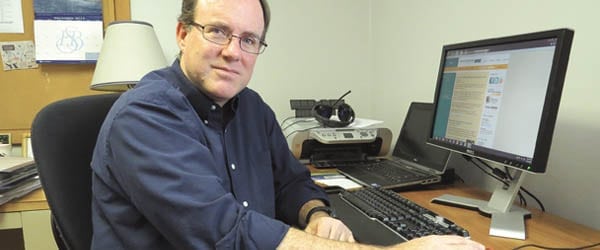
Tim Vercellotti

Tim Vercellotti says the Scott Brown-Elizabeth Warren Senate race in 2012 gave the polling institute some national exposure that helped put it on the map.

The high-profile 2012 U.S. Senate race between incumbent Scott Brown and challenger Elizabeth Warren was memorable for a number of reasons.
Start with the amount of money spent — $68 million, making it one of the most expensive Senate contests of all time. There was also the heated rhetoric, epic debates, and, perhaps most importantly, the stakes — most analysts said this race was about nothing less than control of the Senate.
But Tim Vercellotti will also remember it for something else.
He considers that race the moment when the Western New England University Polling Institute, which he has directed since 2008, came into the national spotlight — and essentially came of age.
Launched in 2005, the institute included questions concerning that Senate contest in more than a half-dozen polls between the spring of 2011 and the days just before the election in November 2012. The headlines on the press releases announcing the polls’ results essentially mirrored what was happening in that pitched battle, as Warren, well behind when the contest began, gathered steam and, with the support of those also backing President Barack Obama, triumphed on election day:
• “Brown Holds 8-point Lead in Massachusetts Senate Race” (March 4, 2012);
• “Senate Race a Toss-up as Warren Closes Gap on Brown” (June 2);
• “New Poll Shows Warren Leading Brown in Senate Race” (Sept. 16);
• “Warren Leads Brown by Five Points in Latest Senate Survey” (Oct.7);
• “Poll: Warren Maintains Four-point Lead in Senate Race” (Nov. 4)
She would eventually win by eight points, said Vercellotti, noting that 4% of those polled near the end were still undecided, and the poll had a margin of sampling error of plus or minus four percentage points.
“So we were right there; our polls were correctly indicating what was happening,” said Vercellotti, noting that, beyond the level of accuracy and its impact on overall credibility, the institute’s work during the closely watched race gained considerable national exposure, with mentions in the New York Times, the Wall Street Journal, the Washington Post, MSNBC, CNN, and other news outlets. “That was our high-water mark … I’m not sure when that kind of clash of the titans will happen again.”
In the meantime, the institute has been garnering public opinion on everything from economic confidence and expectations for holiday shopping (two subjects in the most recent poll, undertaken in early November); from casino gambling to the recent government shutdown and which party was more responsible for it; from the ‘death with dignity’ poll question on last year’s ballot to healthcare reform.
And, while doing so, it is making strides in the all-important work to establish a reputation for accuracy and transparency, a process that can take years and perhaps decades, he said, but one in which he believes the WNEU facility is making solid progress.
“The longer you’re in the field and the more successful you are at building a record of accuracy, the better off you are,” he said, adding that the Brown-Warren race certainly enhanced the institute’s scorecard. “But it only takes a couple of bad polls to undo all of that, and that’s why I take this very seriously and think long and hard about the surveys and how they’re written.
“One of the challenges is that, in politics today, people want answers, they want absolutes, and surveys are merely exercises in probability — that’s why there’s a margin of error,” he went on. “What you’re saying is that, ‘19 times out of 20, we think the answer in the population is within this margin of error. But one time out of 20, it’s not, and that’s life; that’s just how it works.’ But if that one time in 20 is your final pre-election poll in a major, high-profile race, you can talk about probability all you want, but the audience can be very unforgiving.”
For this issue, BusinessWest takes an in-depth look at the work being conducted at the institute and the intricacies involved with the often-misunderstood world of polling.

Questions and Answers
While effective polling is both an art and a science, Vercellotti told BusinessWest, it is mostly the latter.
Elaborating, he said that strict attention must be paid to everything from how the questions are phrased to the order in which they are asked; from how political candidates are identified to how their names are pronounced, in order to ensure that the results are reliable and accurately reflect the thoughts of those being asked the questions.
As one example, he pointed to the most recent statewide survey, which polled respondents on the economy, holiday spending, casino gambling, medical marijuana, and other topics.
There were several questions about the health of the national economy, respondents’ personal financial position, and when and if improvement was forthcoming, he said, adding that he was careful to ask them after the queries on holiday shopping so as not to influence replies to that specific line of questioning.
“There was concern that if the shopping question came after the questions about the economy and people were gloomy about the economy, that would shape how they would answer those holiday questions,” he explained, adding that such nuances are shaped by experience and large amounts of pre-testing with surveys.
As another example, he cited polls on specific political races. Those asking the questions don’t have to go in alphabetical order with the candidates, said Vercellotti, but they should change the order of the names on a systematic basis, because a percentage of respondents to such queries will simply favor the first name they hear. Likewise, party affiliation must be mentioned with each candidate (when applicable) because some respondents are inclined to favor candidates by party affiliation.
“You have to rotate the order of those names so that each name appears first half the time,” he explained. “And it’s important to put party label with the name, because we know from political-science research that the less-engaged voters will often default to that label; they won’t know much about the candidates, so they’re just going to go with the party.”
These are just some of the things Vercellotti has learned during a career that has blended graduate-school training in survey research and questionnaire design, work at another college-affiliated polling institute (this one at Elon University in North Carolina), teaching, and his current post. He came to WNEU in the 1990s and became director of the institute in 2008.
He said there was a lot of learning while doing at Elon, and the education process essentially continues with each polling assignment.
“Survey researchers write some clunkers of questions,” he noted. “And with almost every survey, I get to the end and say, ‘I should have asked this.’ You file that away and try to do that the next time.”
Tracing the history of the WNEU program, polling institutes at colleges and universities, and polling in general, Vercellotti said the practice of gauging public opinion dates back to the 1930s, when firms such as the one started by George Gallup would go door to door seeking answers to specific questions.
The telephone became the preferred polling method in the ’60s — when the percentage of households with one reached a critical level —  and it remains the best option today, he went on, although Internet polling, considered less reliable by many, is gaining some traction.
In recent decades, several colleges and universities have created polling institutes, he told BusinessWest, with the twin goals of raising the profile of the institution and generating data for a society that has developed an appetite for ever-increasing amounts of it.
The Eagleton Center for Public Interest Polling at Rutgers is one of the best-known of these facilities, but there are many others, including some in the Bay State at Suffolk University, UMass Lowell, and UMass Boston, said Vercelloti, adding that the WNEU model is based loosely on programs at other, smaller colleges, and especially Quinnipiac in New Haven, Conn.
WNEU started small, with 12 calling stations in a computer lab in the College of Business, said Vercellotti, adding that it has since grown to 23 stations, all staffed by thoroughly coached students.
Over the past several years, the institute has conducted two or three polls each semester funded by the university itself, he went on, adding that there have also been several projects — including many of those aforementioned Warren-Brown polls — undertaken in conjunction with the Republican and masslive.com.
There have also been a few contract assignments, including one commissioned by the West of the River Chamber of Commerce, which aimed to gauge the thoughts of Agawam residents on potential development of a large parcel on Tennis Road.
There is the potential for more of that kind of work, he explained, but the price tag — roughly $10,000 for an eight-minute, 24-question survey with 500 respondents — is higher than most inquirers expect and often beyond their means.

Numbers Game
As he talked about the polling institute and its work, Vercellotti made early and frequent use of the word transparency.
Such a facility simply must have it in order for the results it generates and then publicizes to have credibility, he said, adding that objectivity is another trait that a successful polling institute must possess, and this explains why he’s turned down a number of potential contract assignments.
“We have been approached for contract work on the casino issue, and from people on both sides — opponents of gaming and advocates for casinos — and I’ve turned down the work,” he explained. “It’s critical that we’re objective; we’re not going to take sides with an election issue. Candidates will sometimes approach us, including some who are alumni of this university, and I make the same point: we’re not here to be engaged in partisan politics or take one side of an issue.
“We’re extremely transparent about who hires us and the methodology we use,” he went on, adding that he’s a member of AAPOR (the American Assoc. for Public Opinion Research), has signed its code of ethics, and is part of an endeavor known as the Transparency Initiative. “The only way the audience can make an informed judgment about the credibility of polling material is to know how it was gathered.”
Overall, the process of reputation building, which affects both credibility and accuracy, takes years and is certainly ongoing, he said, adding that it takes multiple election cycles to establish that a program is reliable.
To date, the institute has amassed a fairly solid track record, or scorecard, said Vercellotti, adding that he does maintain a record of how well the surveys project what is to come. It has not projected the wrong winner in any political race or referendum question, at least when one takes into account the margin for error that accompanies each polling assignment.
That caveat is necessary with the ‘death with dignity’ question on the 2012 state ballot, he explained, relating the story of how public opinion on that measure changed dramatically between the institute’s first polling exercise on the subject and the last one just before the election.
“When we polled on it in the spring of 2012, it was way ahead, a slam dunk,” he recalled. “But I think that, in some ways, opinion on that question was very wide, but not very deep. And by the fall, opponents of that proposal had gotten organized, they started running some advertising, the Kennedys came out against it, the Catholic bishops came out against it.
“Our final pre-election poll, just five days before the election, had it passing by a two-point margin,” he recalled. “Therefore, I said it was too close to call, and it failed by two percentage points, but that’s within the margin of error.”
While the institute is still in its relative youth at only eight years old, it is, Vercellotti believes, gaining the respect from the many constituencies that are seeing and judging its work — from the general public to the press; from campaign operatives to special-interest groups, such as those on both sides of the casino issue.
And then, there are the growing numbers of bloggers, he said, who take polling data and analyze it — and usually aren’t shy about voicing opinions on the sources of that data.
“They’re the toughest audience of all, because they’ll take the time and go through the methodology and raise questions,” he said, adding that the emergence of this audience is a relatively recent phenomenon. “When I got into the business in 2001, there wasn’t that kind of audience, but now there is, and they’ve developed a level of expertise.”
Therefore, he pays attention to what the bloggers are writing. Summing up the reviews to date, he noted that many are positive, but some are what he called “dismissive,” a tone he attributes to the small size of the school and the youthfulness of the polling program.
Looking ahead, Vercelotti said that 2014 could be an intriguing and busy year for the institute. Indeed, the Deval Patrick era is ending — WNEU’s facility conducted its first poll on the coming contest earlier in the fall, headlining the release “Democrats Out in Front Early in Governor’s Race” — and there will be a race for the Senate seat captured in a special election earlier this year by Ed Markey after John Kerry became secretary of State. Meanwhile, there may also be some interesting ballot questions, including the possibility of another referendum on casino gambling.
But after that, things will likely get quieter, he said, noting that, while there is a presidential race in 2016, there won’t be another governor’s race or Senate race (unless someone else leaves office before their term expires) until 2018.
There may be some local, state, or regional issues to fill the void, he went on, adding quickly that, in an age when the public’s thirst for information only grows, there is unlikely to be a shortage of issues on which to conduct polls.

Making the Call
Referring back to all the science involved in polling, Vercellotti said it extends even to what time individuals are called — or should be.
He said the recent World Series, won by the Red Sox, posed some challenges; many were not happy about their viewing being interrupted by a pollster. Likewise, Patriots games add a layer of intrigue to Sunday afternoons, one of the times when those staffing the phones at the institute are most busy.
“I try to make the most of halftime — I make sure the callers are active then,” said Vercellotti, adding that mastering such nuances is all part of the process of making the institute successful — and respected.
Nearly nine years after it started soliciting opinions, this facility is well on its way to achieving those goals.

George O’Brien can be reached at [email protected]

Cover Story Economic Outlook Sections
Economy Gains Momentum, but There Are Still Some Hills to Climb

COVER1213b3As the director of Economic and Public Policy Research for the Donohue Institute at UMass, Dan Hodge has been involved in a number of initiatives in — and involving — Springfield.
He had a role in the post-tornado initiative called Rebuild Springfield, for example, and has been both a close observer and color commentator of sorts with regard to the many different types of development that have emerged over the past several years.
Summing up the mood, or attitude, he believes is taking shape in the City of Homes, he said, “people are asking, ‘when are things going to happen here?’”
The answer, he went on, is now, or very soon.
Indeed, 2014 could be a watershed year, especially for Springfield, but also for the surrounding region, he said, noting such initiatives as the long-awaited redevelopment of Union Station and the recent announcement that UMass Amherst will proceed aggressively with establishment of a so-called satellite center at Tower Square, a $25 million undertaking.
And then, there’s that casino project that MGM Resorts International wants to build in the city’s South End. It is, at the moment, the only bidder for the coveted Western Mass. casino license still on the table. If MGM’s plan wins the favor of the Mass. Gaming Commission, and if the entire gaming initiative isn’t delayed — or waylaid — by a statewide referendum question now picking up speed (two big ‘ifs’), then cranes could start appearing on Main Street by next fall.

Dan Hodge

Dan Hodge says 2014 could be a year when things start to pick up, not only in Springfield, where many projects are expected to get underway, but with the economy in general.

“I think we could move from hearing people say, ‘it’s never going to happen,’ to ‘I think it’s going to happen,’ to ‘hey, it’s really happening,’” he noted, referring specifically to long-discussed projects like Union Station, but also to the city’s recovery in general.
And in some ways, the same can be said for the economy itself, said Hodge, noting that after four and a half years of tepid — at best — recovery, this region, and the state as a whole, is poised for something more substantial.
In fact, things started to improve late this year, said Alan Clayton-Matthews, senior contributing editor for MassBenchmarks and an associate professor of Economics and Public Policy at Northeastern University.
Massachusetts gross domestic product (GDP) grew at an annual rate of 3.5% in the third quarter of 2013, nearly a percentage point higher than the country as a whole, he noted, adding that this improvement (the state grew at only 1.7% in the second quarter) was due to slow but better job growth, rising wages and salary incomes, and a higher rate of spending on items subject to sales taxes. A recovering housing market and more robust consumer and business spending are driving economic growth and providing much-needed relief from what he called “considerable fiscal drag” in the form of mandated sequestration spending cuts and higher payroll taxes than last year.
Fourth-quarter numbers won’t be out for a few weeks, but Clayton-Matthews expects those trends to continue into next year, for which he projects further improvement to the employment picture, which is the real driver of additional spending.
“There are positive signs that private demand is picking up, and there is some backlog in demand that is now being felt in the market because of improving employment and household incomes, and improving wealth in households thanks to rising home prices and rising stock markets,” he said. “The net effect is that the economy is growing, and that will probably continue.”
However, discussion of the state and national economy and projections for brightening skies have come with a host of caveats in recent years, and 2014 will be no exception, said Michael Goodman, co-editor of MassBenchmarks and associate professor of Public Policy and chair of the Department of Public Policy at UMass Dartmouth.
Such caveats include the global economy, which continues to be weak, with several European countries still struggling with massive debt issues, and especially that aforementioned ‘drag,’ which has the potential to become significant and slow the pace of progress, he said, before using some terms more suited for driving to effectively get his points across.
Michael Goodman

Michael Goodman says the ecomic skies seem to be brightening, but several forces — some of them well out of the state’s control — could impede progress.

“When it comes to monetary policy, we have the pedal to the metal,” he told BusinessWest, referring to Federal Reserve policies intended to fuel confidence, bolster the markets, and generate growth. “But with fiscal policy, we have the emergency brake on.”
Indeed, while a year that gave us the dreaded fiscal cliff, sequestration, and a government shutdown is drawing to a close, he noted, the turmoil, partisan politics, and what he called “brinksmanship” on Capitol Hill remain, and there will be more recovery-threatening decisions to be made in the weeks and months to come.
“So how far is that car going to go?” he asked, returning to his analogy. “Given the recent track record, which isn’t incredibly encouraging, I think more of the same is the most sensible outlook.”
For this issue, BusinessWest takes its annual year-end look at the economy and the prospects for the future. The consensus is that, while this region appears to be picking up steam, there are still some big hills to climb.

On-the-money Analysis
As he talked with BusinessWest about the economy, the ongoing but limited recovery, and the forces that will shape the foreseeable future, Goodman summoned that old Chinese proverb (some would call it a curse): ‘may you live in interesting times.’
Some would use a different adjective to describe this period, but that term works, he said, adding that this has certainly been an intriguing time in which to watch the economy, discuss developments in the classroom, and attempt to make projections about what will happen next.
Clayton-Matthews agreed, and set the tone for his analysis by saying, “this has been a nightmare of a recession.”
And by that, he meant both the actual downturn, the so-called Great Recession, which officially ended toward the middle of 2009, and the often-painfully slow recovery that followed.
In many respects, it has been like the recession of the late ’80s and early ’90s — noted in Massachusetts for the loss of an entire industry (minicomputers), multiple bank failures, a 12% reduction in GDP, and an equally long and slow recovery period — but in some ways, especially the force of the turbulence confronting progress, it’s been worse.
But is the nightmare over?
That’s the $64,000 question, said Clayton-Matthews, adding that there are definitely signs that it might be.
These include three consecutive months of payroll growth registered in August, September, and October, he said, adding that, while the gains were outwardly not significant (perhaps 1.5%), they are made more impressive by the “significant headwinds coming from the federal government,” as he called them, referring to everything from sequestration to the shutdown.
“Considering all that, it’s nice that we’re having any payroll growth,” he said. “This is much faster growth than I was expecting.”
Clayton-Matthews said the payroll figures contradict, to some extent, household-survey results, which indicate that that there are fewer Massachusetts residents working now than at this time last year, but overall, he considers the payroll numbers more reliable, and he believes they translate into improving confidence and increased spending.
“It appears that both the national and state economies have been growing — not at a rapid rate, but they’ve been growing,” he said. “And that has been resulting in higher levels of employment and, therefore, household income, and the ability to spend and the willingness to spend.”
Cliff Noreen, president of Babson Capital, which has more than $188 billion in assets under management, agreed, offering this broad summation: “the U.S. economy continues to heal, but is not yet healthy.”
Elaborating, he said he has a host of numbers he can summon that would seem to justify optimism about the economy and where it’s heading, but also give credence to his belief that the healing process is far from over.

Cliff Noreen

Cliff Noreen says the economy is healing, but is not yet healthy, although it is likely to get healthier in 2014.

Start with those concerning corporate profits, which have reached record levels — $1.83 trillion — and are outperforming a stock market that is up more than 25% for the year, although this growth is attributable far more to cost-cutting and other efficiencies rather than climbing revenues.
Meanwhile, government debt, which exceeded more than $1 trillion a year ago, is now down to $650 billion, he noted, adding that, while this number is still historically high, the drop is encouraging. Meanwhile, there was more good news in the November jobs report, which revealed that the economy is up 2.1 million jobs this year and unemployment fell to 7% for the first time in five years.
“It does seem like the economy is finally getting stronger,” he told BusinessWest. Every year, we sit here and we hear that the economy will be stronger next year, and it doesn’t get stronger. But this year, it appears the economy is actually strengthening, and we should be into a better economic environment in 2014.”
Looking ahead, based on data in the New England Economic Partnership forecast for Massachusetts, Clayton-Matthews expects employment growth to continue and accelerate through 2014 into 2015, largely because of those rising numbers for employment and income and the resulting trickle-down effect, and expectations that the drag from the federal government, while still a factor, will be less impactful.
By 2015, payroll growth in the Bay State is expected to hit 2%, he went on, adding that the growth will come across many sectors of the economy, but especially construction (especially as the housing market improves), professional and business services, leisure and hospitality, education, healthcare, and the ‘information,’ or technology, sector.
After 2015, payroll growth is expected to taper off, due mostly to the escalating number of retiring Baby Boomers (a phenomenon that presents another challenge for the Commonwealth and its employers), but the immediate future is looking more promising.

Work in Progress
But while the economic skies would seem to be brightening, there are many forces that could impede progress, said Goodman, adding quickly that many of these forces originate outside the borders of this state, and the country, for that matter.
And with that, he returned to what he called “ongoing political shenanigans” on Capitol Hill, and his analogy to hitting the gas at the same time the emergency brake is on.
“The Fed is doing everything in its power to encourage growth,” he said. “It’s keeping interest rates low, it’s making it more attractive to borrow, it’s increasing the monetary supply through quantitative easing … the Fed is just trying to snap us out of this by encouraging investment and sparking economic growth.
“But at the same time, we’ve been engaging in these austerity-related budget policies,” he went on. “We have sequestration, the inability of the federal government to even pass a budget, moving from continuing resolution to continuing resolution, which injects all kinds of uncertainty into important parts of the economy, and the periodic brinksmanship, which has had such a demonstrably negative impact on economic activity in the periods leading up to those moments of truth.”
Although the Senate eventually passed a budget last week, other challenges loom. In another eight to 10 weeks, the latest continuing resolution that allows the federal government to continue operating will come to an end, said Goodman, adding that the debt ceiling is also nearing its limit. Which means there are more moments of truth to come, and they make it extremely difficult to project what will happen nationally and regionally.
Meanwhile, the same is true for what’s happening — or not happening — overseas, he said, adding that the international economy remains weak, and its overall health is certainly something well beyond the control of state and national leaders.
But it bears watching because of the Bay State’s strong export economy and its vulnerability to adverse conditions in Asia and especially Europe, where more than 40% of the state’s exports wind up.
“That’s been a growth driver for the entire state, and it has allowed us to do, until quite recently, a bit better that the country as a whole,” he said, referring to what’s generally referred to as the ‘innovation economy.’ “We’ve grown a bit faster until very recently, and we’ve had quite a difficult time with employment, housing, and other areas, even though we’ve certainly had challenges.
“All of that is driven by businesses and consumer markets around the world purchasing our products and services,” he continued, listing everything from healthcare to computer technology. “All of these things have been driven by demand from around the world, and we don’t know what’s going to happen with that demand.”
Compounding this vulnerability is the general uncertainty, not to mention actual cutbacks, in federal spending resulting from sequestration and other austerity measures, he went on.
“The fuel for the innovation economy has been not just that international and national private demand, but also federal funds in the form of research dollars, government contracts, and government expenditures,” Goodman explained. “When we think about the Pioneer Valley and its precision-manufacturing base and its reliance on government funding, the changes that are taking place, with many of them resulting from government policy choices, are putting some downward pressure on demand and creating a lot of uncertainty.”
At the same time, there are some other forces at play with regard to the economy, he went on, noting, for example, that many of those aforementioned products and services being exported but also sold in this country are enabling businesses to effectively do more with less, meaning fewer employees, which is certainly contributing to tepid gains in employment.
Also, noted Hodge, Massachusetts is facing the difficult challenge of creating employment opportunities for those without a college education, who increasingly face the prospect of being left behind in this innovation economy.
Elaborating, he said the state’s unemployment rate is at essentially the same level as the rest of the country — 7%. But because this state has a higher percentage of people with college degrees than other states, its unemployment numbers are skewed toward those who are less educated.
“This is a big challenge for the state,” he said, adding that there are several initiatives being undertaken, and a workforce study involving the Donahue Institute and the Pioneer Valley Planning Commission has been launched in an effort to identify strategies for enabling more members of this demographic to enter the workforce and stay in it. “One of the things we keep hearing is that there are some good programs out there, but they’re just not reaching enough people.
“The unemployment rate in Springfield is still over 10%, and it’s the same in Holyoke,” Hodge went on. “And the longer people are detached from the workforce, the less they see a future, and the harder it’s going to be for them. This is a big segment of the population, and it’s a largely untapped resource.”

The Bottom Line
When asked if it’s difficult to make a projection for the future of the regional and state economies, Clayton-Matthews laughed.
“It’s not difficult to make a projection,” he said, responding to the specific wording of the question. “But it is difficult to make an accurate projection.”
That’s because, while many arrows are pointing up, there are those headwinds to consider, as has been the case since the recession officially ended and the recovery, such as it is, began.
If all goes well — or at least better than it has — then that emergency brake Goodman mentioned may finally be taken off, and if it does, then the economy might actually be able to pick up some speed.

George O’Brien can be reached at [email protected]

Autos Sections
Fathers & Sons to Expand, Reshape Facilities on Memorial Avenue

Damon Cartelli

Damon Cartelli is set to create the so-called terminal concept on Memorial Avenue.

It’s called the ‘terminal concept.’
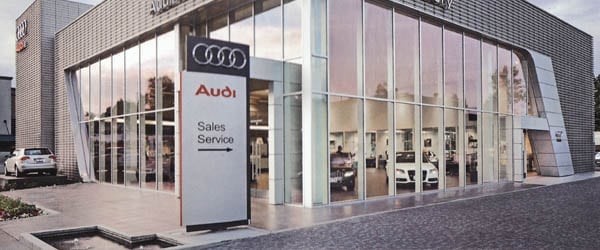
That’s the phrase Audi has attached to a relatively new design it is now requiring for the showrooms that will display its growing roster of models. In literature intended for dealers, the look — which, as the name implies, educes an airport terminal — is explained this way: “designed to evoke the racing history of the brand, support the operational needs of dealers, and represent Audi through innovative design and materials, the Audi terminal concept is another physical manifestation of the ethos ‘progressive, sporty, and sophisticated.’”
Damon Cartelli used fewer, less poetic, but still effective terms to describe it.
“It has a certain look; it’s very German … there’s lots of glass, lots of metal, it’s a clean look,” said the president of the Fathers & Sons chain of dealerships, who will be creating that look at a new facility to be built a half-mile or so down Memorial Avenue in West Springfield.
The facility where he spoke with BusinessWest, currently devoted to Audi, Volvo, and Porsche, opened its doors 12 years ago, carved out of the old Coliseum banquet house. Cartelli still considers it state of the art when it comes to dealership look, feel, and amenities, and if he had his druthers, he’d be selling Audis there for a few more decades. But the carmaker, like many others these days, is more or less demanding a dedicated showroom (one that will display only its product) and one that meets a number of design specifications, inside and out.
Thus, Cartelli is taking what he calls a business “leap of faith.”
“What people tell me is that there’s an increase in business any time you build a new facility — you get an inherent lift,” he noted. “But we already have a facility that I believe is high-end and representative of the brand. It’s a tough pill to swallow to build a new dealership, and I have my doubts, but I’m going to trust what the brand tells me and hope that if you build it, they will come.”
But that’s not all. This project is currently being called ‘phase one’ of an initiative that will change the face of a nearly two-block section of the north side of Memorial Avenue and possibly create some new business opportunities for this chain of dealerships.
Indeed, while creating the new Audi dealership on land currently occupied by a Midas muffler location, a tool-supply shop, and a few buildings housing various Fathers & Sons operations and inventory, Cartelli plans to create one and perhaps two other facilities, which on current blueprints are labeled ‘future dealerships.’
And there will be some options with regard to what carmakers’ names eventually go over the door, he said, adding that the list includes models sold at existing Fathers & Sons facilities on Memorial Avenue — Volvo, Porsche, Volkswagen, and Kia — as well as some nameplates not currently sold in Western Mass., including Mercedes-Benz, Infiniti, and Acura, among others.
Meanwhile, the new Audi dealership will provide an opportunity to perhaps better showcase one of the hottest car lines at the moment, one expected to gain additional momentum with new models in the A-3 series, a smaller, less-expensive line, said Cartelli.
“We’re currently selling roughly 20 cars a month,” he said of the Audi brand. “With the new A-3 series coming out, Audi’s projection is that we’re going to almost double that number.”
Demolition of existing buildings on Memorial Avenue will commence within the next month, ground should be broken on the new Audi facility by spring, and the dealership is expected to open its doors by the end of next year, he said, adding that, while this timeline is aggressive, it is also realistic.
For this issue and its focus on auto sales, BusinessWest takes an in-depth look at the plans that will give a new look to that section of Memorial Avenue — and write a new chapter in the intriguing history of this family business.

Driving Force

Audi dealership

‘The terminal concept,’ as seen in an Audi dealership in California.

Before talking about the future, Cartelli first referenced something now considered mostly a thing of the past in this business.
This would be the so-called auto mall, or facility that sells a number of different nameplates under one roof. There are still many operating, he said, including the dealership the Cartelli family fashioned from the Coliseum, which at one time sold four brands — Audi, Volvo, Porsche, and Saab, the last of which is no longer made.
Increasingly, though, automakers want a facility dedicated solely to their models, mostly to reduce (in theory, at least) the odds of a consumer eventually driving away with another carmaker’s product.
“Customers won’t have contact with the other brands, which is something the factory wants,” he explained while discussing the planned new Audi dealership. “It’s funny how this industry went from the auto-mall-type complex where you could stay inside and shop all the brands and compare and go from there, to the dedicated dealership, because the factories don’t want their models to be compared to the others, even though that’s going to happen anyway.”
This was just one of the dynamics that led to the commencement of discussions between Cartelli and Audi nearly two years ago, with the carmaker aggressively stating its case for both a dedicated dealership and that aforementioned terminal concept, and Cartelli agreeing, if somewhat reluctantly, to take that leap of faith.
Memorial Avenue was the logical place to build such a facility, with the existence of other company dealerships and the potential for economies of scale, said Cartelli, who commenced putting together a plan — one that would involve use of existing Fathers & Sons facilities and acquisition of other property with frontage on that street — and then executing it.
He acquired the Midas property last spring, and entered into a purchase-and-sale agreement on the tool-supply shop late last summer. He also hired an architect to work in conjunction with one commissioned by Audi to develop a design.
The emergence of a casino proposal for property in the southeast corner of the Big E complex that virtually surrounds the existing Audi, Volvo, and Porsche dealership added some intrigue to the planning process, and there were discussions with casino developer Hard Rock International about acquiring the Father & Sons site.
But the talks never advanced, and Cartelli, sensing that the casino proposal would be defeated in a referendum — which it was — proceeded with the mindset that Fathers & Sons would keep its existing facility and expand down the street.
Cartelli visited several Audi dealerships in New England that had created the terminal concept, and eventually adopted something similar to others — especially the Wallingford, Conn. store — but still unique in its own way.
Memorial Avenue

Damon Cartelli says the new Audi dealership is part of a bigger initiative that will change the face of a one-block area on Memorial Avenue and provide new opportunities for the company.

The planned 27,000-square-foot facility, not much smaller than the current home to three makes, will include a showroom big enough to display eight cars (the current Audi space can showcase five or six, depending on the models), an eight-bay service area, and a waiting area with most of the amenities that newer luxury-model dealerships boast, from a flat-screen television to leather couches to Internet access.
The new Audi store, which comes with a sticker price of roughly $3 million, will create both more space and flexibility at the existing facility, said Cartelli, adding that Porsche has been pressing for more showroom space there and will get it when the existing Audi showroom is apportioned to the other German automaker, doubling the number of cars that can be put on display. Meanwhile, the existing Porsche space on the lower level of the dealership will be renovated into a service area for Porsche and possibly Volvo.
As for the ‘future dealership’ notations on the early blueprints for the project, Cartelli said time will eventually tell how these will be colored in.
While it is possible that one of the existing dealerships (Volkswagen or Kia) will be expanded and updated into one or more of those slots, a model (or two) currently not sold in this region may emerge as a contender if the circumstances permit.
“You need some luck and the willingness of the factory to recognize that they need a dealership in this area,” he said, noting that, with some nameplates — Cadillac and Mercedes-Benz, for example — the nearest dealerships are in Hartford, and the manufacturers are currently content with that.

Into a Higher Gear
Looking ahead, Cartelli said he’s optimistic that the new dealership will do what Audi believes it will — bring more people to the showroom and, in the long run, sell more cars.
“I hope the building alone gives us some lift,” he told BusinessWest. “But what I’m really relying on is their products, what I see coming, what I believe is coming, the strength of the brand, and the direction they’re heading. All this leads me to make this investment, because if it wasn’t for what I believe is a very strong brand, I would just stay here and say, ‘thanks, but no thanks,’ and continue to sell cars out of this facility.”
As he said, this is a leap of faith, one that he hopes — and expects — will land him in a position to grow the business and drive more opportunities.

George O’Brien can be reached at [email protected]

Insurance Sections
Severe Storms Are Creating a Trickle-down Effect on Policy Holders

Jim Phaneuf

With past and future storm damage in mind, Jim Phaneuf says, the state attorney general and insurance commissioner are making sure that carrier premiums and rate increases are justified.

When Jim Phaneuf references the weather, he’s certainly not making small talk.
Rather, he’s discussing big business — the insurance business, which he’s been in for more than 36 years, enough time to see everything, or just about everything, in this industry.
Indeed, over the past several years — and one year in particular, 2011 — Phaneuf, president of Bell & Hudson Insurance Agency in Belchertown, and others in this sector have seen things they’ve never seen before in terms of weather calamities and the resulting impact on the companies that write the policies and the consumers who purchase them.
‘Historic’ is the word he and others have used to describe it all — meaning everything from 2011’s ice dams, tornadoes, hurricane, and freak October snowstorm to subsequent weather events such as Superstorm Sandy in the fall of 2012, and the general consensus that this part of the country will see more of the same in the years to come.
But instead of words, Phaneuf and others like to use numbers to get their points across.
“Between 1980 and 2012, there were 123 U.S. weather-related events that resulted in claims of over $1 billion,” he told BusinessWest. “In 2011 alone, there were 12 U.S. weather-related disasters with over $1 billion in claims, and that caused insurance companies to raise rates to attempt to recover their losses. Our experience has been that most home-insurance customers have experienced rate increases in the past two years, largely as a result of the storms of 2011 and 2012.”
Corey Murphy, president of First American Insurance Agency in Chicopee, agreed, noting that 2011 was a banner year for weather-related claims in this region and others, and the impact from those losses will be felt for some time.
“I knew the insurance companies were going to have to respond — it was a catastrophic year; we had pretty much every natural disaster you could have,” he said, noting that rates have escalated for business and residential policy holders alike, between 3% and 6% on average.
The numbers vary, he said, because in many instances, an agency can sometimes shop for and get a better price, even at a time when many carriers are still struggling to recover losses. Meanwhile, agents can work with clients to lower their insurance bills by making sure they’re buying only what they need, passing on what they don’t need, and employing strategies such as bundling policies, taking higher deductibles, and avoiding marginal claims that will nonetheless trigger premium hikes.
Corey Murphy

Corey Murphy and his staff have kept their commercial and residential rate increases from storm damage as low as possible by shopping their policy needs with a variety of carriers.

Overall, he said, this is a time for consumers to renew — and tighten — their relationship with their insurance agency, because if predicting the weather is difficult, if not impossible, so too is gauging and minimizing the impact of all that weather on one’s insurance bills.
For this issue and its focus on insurance, BusinessWest takes an in-depth look at what has become a perfect storm — in every aspect of that phrase — for insurance carriers, and a time of challenge for those looking to protect their assets and manage the cost of doing so.

Climate Change
Recapping recent events, meaning those of the past few decades and especially the past few years, those we spoke with said things have become more unsettled.
They used that word to refer to both the weather — which, in the opinion of many, is being increasingly impacted by global warming — and the fiscal health and well-being of insurance carriers.
Indeed, due to the recent spate of weather calamities, most insurance companies will not write polices for hurricane-prone coastal properties in the Carolinas, Georgia, Florida, and Texas, said Bill Grinnell, president of Webber & Grinnell Insurance Agency in Northampton. So the states have created their own insurance mechanisms and set up rules, collecting premiums from property owners and assessing surcharges to those insurance companies that do business in other regions of those states.
“There is a wide belief that these storms are caused by global warming, which makes the weather less predictable and insurance outcomes less predictable,” Grinnell explained. “As a result, more revenues are needed to create reserves to cover the potential for more disasters, so there’s definitely been an uptick in the cost of insurance.”
According to a 2013 report, “Inaction on Climate Change: the Cost to Taxpayers,” by Ceres, a nonprofit organization advocating for sustainability leadership, the total loss exposure of these state-run insurance plans in the past 20 years has risen by 1,550%, from about $40 billion in 1990 to more than $600 billion in 2010.  Additionally, the report says only 50% of the damages in the U.S. caused by extreme weather events are privately insured, which leaves the federal and state governments (the taxpayers) to pick up the remaining tab.
Insurance companies, said Grinnell, earn revenue in two ways: premiums, of course, and conservative, low-risk investments, primarily in the bond markets.
With the historically low rates of return on bonds, insurance companies are not earning as much as they have in the past, and at the same time, they’re seeing higher bills from their reinsurance companies after paying out billions for just the past two years’ worth of catastrophic storms.
“So the reinsurance companies that provide the insurance for your insurance carrier for big disasters have increased their rates to the carriers, and those rates have been passed right down to the policyholders,” Grinnell explained, adding that the regional carriers in New England that do business in Massachusetts weren’t directly affected by Hurricane Katrina or, to a great degree, Superstorm Sandy. “So the majority of the storm-related increases are due to more localized events.”
Locally, Phaneuf added, state Attorney General Martha Coakley and Commissioner of Insurance Joseph Murphy are making sure carrier premiums and rates are justified.
“The attorney general seems to have served as a watchdog with the insurance issue,” he said, “to keep insurance companies’ rising rates in check.”

Policy Statement

Bill Grinnell

Bill Grinnell says insurance carriers are getting hit with higher rates from their reinsurance companies and passing these increases down to policyholders.

In this changing climate — for both weather and insurance to cover the damage it causes — Grinnell said agencies need to work even more closely with clients to reduce the impact on premiums while making sure customers’ bases are covered, literally and figuratively.
For instance, when his staff sees a client’s premiums spike significantly, they will attempt to shop that business around to get similar coverage, but at a better rate.
“We try to find a better home for their insurance if we’re able to, which we can some of the time, but not all of the time,” he said. “It’s definitely worth the effort if the insurance is going up more than 7% or 8%.”
Murphy agreed, but noted that there is seemingly less room for negotiating between agency and carrier in this environment, adding that this is another sign of the times and a product of the more adverse conditions within the industry, even though the weather has been much calmer this year.
“There’s a lot less back-and-forth over the last year or two. Now, there’s a lot less room; they’re pretty firm on what their prices are,” he said. “This year, it was a pretty mild year, but there were predictions that storms would increase, so there were a lot of adjustments by carriers based upon that.”
Those adjustments, Murphy went on, have appeared as higher premiums and a much harder look at what policies companies will underwrite. He called it “getting tighter.”
When Murphy and his agents present a potential policyholder to an underwriter — the person at the carrier who will decide how much to charge on the commercial lines, or even if they’ll write it or not — they want a much clearer picture of what they are writing.
“So, as an agent, we’re trying to present the best possible picture of that potential client,” he added. “The more you can make an underwriter feel comfortable about what they are writing, the better they feel about doing it.”
Meanwhile, agents can work with clients in a number of ways to help control their insurance bills without reducing coverage, said Phaneuf, listing several possible ones, including a willingness to accept a higher deductible.
“They generally mean lower annual premiums, but more out of your pocket when you have a loss,” he explained. “Your agent will also make you aware that you can control premiums by bundling discounts for your home and auto and installation of alarm systems, renewing your policies with the same insurer, and maintaining a loss-free status.”
Elaborating, he said that going years without filing a claim can lead to attractive discounts, savings that could more than offset the long-term costs from filing a claim in an instance where the damage only marginally exceeds the deductible.
In addition, Murphy told BusinessWest, he and his agents make sure their business clients are updating their product inventory and specific elements that they need for doing business.
“Business owners have to understand what their business is rated on,” he noted, adding that some standard ratings are based on square footage, which doesn’t change unless there is an expansion or a move, but other things do change, like real-estate values, replacement costs, inventory levels (up or down), or an increase in sales, all of which accurately reflect the business’s exposure.
The First American staff helps educate their commercial clients about keeping up with the current state of their property and business.
“If you don’t respond to your carrier with any updates, then they assume that all remains the same, and you could be paying more when you shouldn’t have to,” said Murphy. “But you don’t want them to be caught underinsured.”

Batten Down the Hatches
Grinnell and others we spoke with said their background is in business and insurance, not climatology or meteorology.
Predicting the weather is more difficult than ever, he noted, adding that even those with degrees in those subjects can’t say what will happen next year or over the next decade. The best thing to do is be prepared as much as possible, and that philosophy extends to the realm of insurance.
Phaneuf agreed, adding that, when it comes to weather patterns that are predicted to cause havoc in the future, protection of one’s home or business is, now more than ever, a complex business transaction.
“It cannot be effectively and appropriately done in 15 minutes,” he said. “In spite of what some national insurance carriers would like to have you believe, it is not a simple transaction like buying laundry detergent or breakfast cereal. If you treat it too lightly, you may not have the protection that you need when you need it … at a time of great loss.”

Elizabeth Taras can be reached at [email protected]

Sections Technology
The Latest High-tech Devices Keep Users Connected

It wasn’t too long ago that Americans used their cell phones essentially to, well, make phone calls, and maybe send text messages and take the odd photo or two.
How times have changed. We live in an era of constant communication, where the phone is now a device for staying connected to social media, making financial transactions, playing games, and engaging in 100 other activities guaranteed to keep people staring downward.
They’re called smartphones, and they have evolved over the past five years from a useful tool to a ubiquitous part of the way people interact. According to the Pew Research Center, 56% of all Americans own one (91% own a cell phone of some kind), and that percentage is constantly on the rise.
And that’s why BusinessWest begins its annual feature showcasing the newest and best-reviewed high-tech tools with a few of the leading choices in smartphones.
iPhone-5SFor starters, Apple’s iPhone continues to lead the pack. Business Insider calls the latest iteration, the iPhone 5S ($199+), the top choice among 2013 models. “Yes, it looks nearly identical to last year’s iPhone 5. Yes, there are plenty of other smartphones out there that are just as good and can do a lot more things. Yes, the screen is relatively tiny compared to a bunch of the giant Android phones out there. But that doesn’t matter,” the magazine notes, because the phone boasts an ideal balance of power, useful features, and design.
The new model adds a fingerprint sensor called Touch ID that unlocks the phone without a passcode, as well as an improved camera with a dual LED flash that helps the phone take better photos in low-light settings, and a new slow-motion video feature. And the phone’s new 64-bit processor is about twice as fast as the processor in the old iPhone 5.
“For now, the biggest drawback for iPhone owners is going to be big-screen envy,” the magazine notes. “Unless you absolutely must have a giant screen, the iPhone 5S is nearly perfect.”
Samsung-Galaxy-S4For Android enthusiasts, Business Insider heartily recommends the Samsung Galaxy S4 ($649) and HTC One ($599). “This summer, Google partnered with HTC and Samsung to make new ‘Google Play editions’ of those two flagship phones,” it notes.
Why the hefty up-front costs? Instead of selling them through a wireless carrier, Google is selling the One and Galaxy S4 at full price, unsubsidized. With other phones, carriers typically subsidize the up-front savings through wireless-plan fees over a two-year contract.
In addition, the phones will receive software updates shortly after Google releases a new version of Android. “Historically, both HTC and Samsung have been pretty bad at getting new software updates out to customers because it takes a lot of time for them to modify Android,” the magazine notes. “And overall, Google’s clean version of Android is a lot better than the modifications you normally get from HTC and Samsung. There aren’t any preinstalled apps from HTC, Samsung, or your carrier.”
Business Insider gives a slighty edge to the One, calling it more attractive and fun to use than Samsung’s model. “These two phones are designed for people who don’t want to be locked down by carrier contracts and care about having the best Android experience you can get, all wrapped in excellent hardware.”

Consuming and Computing
iPad-AirSmartphones are only one aspect of this on-the-go culture of constant communication and media consumption. Tablets are another.
According to CNET, Apple’s iPad Air ($499-$539) delivers the best blend of performance and battery life in an attractive, thin, light package, with improvements in the front-facing camera and Retina Display. However, it lacks the Touch ID scanner available on the iPhone 5.
“Functionally, the iPad Air is nearly identical to last year’s model, offering only faster performance and better video chatting,” the site notes. “But factor in design and aesthetics, and the iPad Air is on another planet. It’s the best full-size consumer tablet on the market.”
iPad-Mini2Meanwhile, those looking for something smaller and cheaper might try the iPad Mini ($399), also with Retina Display, a speedy A7 processor, and improved wi-fi and LTE connectivity, with battery life that’s as good or better than last year’s Mini. It also lacks Touch ID. Still, CNET notes, “the new iPad Mini somehow shrinks down the iPad Air into an even more compact package, sacrificing nearly nothing.”
Kindle-Fire-HDX-8.9For media consumption alone, CNET calls Amazon’s Kindle Fire HDX 8.9 ($379) “a performance monster that speeds through websites and UI navigation at a frantic pace. Its screen is impressively sharp and its body amazingly light for a larger tablet.”
Despite the lack (for now) of a remote video viewing feature, no built-in storage expansion beyond the included 16 GB, and lack of Google Play access, meaning many apps still aren’t available, the device “isn’t just a great value, it sets the standard for a media consumption tablet.”
MacBook-Pro-13-inchLaptop computers continue to advance in speed and performance as well, and the best of the current crop, according to laptopmag.com, is the MacBook Pro 13-inch ($1,299), featuring an impressive 2560-by-1600-pixel Retina Display. “A fourth-generation Intel Core i5 processor and blazing-fast Flash storage drive make the MacBook Pro with Retina display a speed demon, while a lightweight, 3.46-pound chassis and 9.5 hours of battery life let you carry it all day.”
Pavilion-TouchSmart-11zFor consumers on a budget, the site’s top pick for 2013 is Hewlett Packard’s Pavilion TouchSmart 11z ($399), which combines a crisp, responsive 11.6-inch touchscreen with good battery life. While it’s not designed for heavy multitasking, offers narrow viewing angles, and is somewhat heavy for an 11-inch notebook, the speedy A4 processor, 320-GB hard drive, and 4 GB of RAM more than make up for those shortcomings, at least for the price.

Image Is Everything
Samsung-CLP-775NDPrinters come in a wide variety of price points, depending on the user’s needs for features and performance. Toward the higher side, Samsung’s CLP-775ND Laser Printer ($750) is the current favorite of PC World, which notes that “it breaks no new ground in output quality — photos are a challenge for it, as they are for most color lasers — but it’s fast and well-equipped, and its toner is economical.”
Standard features include automatic duplexing, a 500-sheet main input tray, a 100-sheet multi-purpose tray for envelopes and other thicker media, and a 350-sheet output tray, with room to add up to two more bottom-mounted, 500-sheet feeder trays. On the minus side, the transfer belt — a page-wide plastic band that helps convey toner from the cartridge to the paper — is fully exposed when the printer’s front panel is open, “just asking you to drop something on it.”
Still, with a 600 MHz dual-core processor and 384 MB of memory (expandable to 896 MB), the CLP-775ND posts a fast time of 18.1 pages per minute printing plain text, while color photos come out quicker than average, even though the quality of those pictures is pedestrian.
On the budget end of the printer scale, “the $300 range offers an interesting either/or choice: high-end color inkjets with full feature sets, for small-office or high-end home use, and very low-end lasers for small or home offices,” PC World notes. “But note that, while you can get a pretty nice monochrome laser for $300, a like-priced color model will be slow, lacking in features, and expensive to replenish.”
Officejet-Pro-8600-PlusThat said, the magazine’s top pick in this range is HP’s Officejet Pro 8600 Plus ($300), which boasts speed, at 13.2 pages per minute of plain text, and quick performance with printing photos, copying, and scanning. Meanwhile, features include universal automatic duplexing for copying, scanning, and printing, and full support of legal-size paper.
However, it can’t print on a CD or DVD, and its touch controls can be slow to react. Still, it does print from a smartphone or tablet, or from a remote location, through HP’s free ePrint service.
Fujifilm-X100SSpeaking of photos, digital cameras continue to evolve at a wide variety of price points. For those willing to foot the bill, PC Magazine highly recommends the Fujifilm X100S ($1,299), the follow-up to Fuji’s groundbreaking X100 digital camera.
The camera, like its predecessor, boasts a retro design, as well as a hybrid viewfinder system that can toggle between a big, bright optical view and an electronic viewfinder, as well as a fast lens with a 35-mm (full-frame equivalent) field of view. “The sensor has been upgraded to a 16-megapixel X-Trans CMOS design that is capable of producing some incredible results at extremely high ISO settings, and a notoriously sluggish autofocus system is now a reasonably quick one.”
Olympus-Tough-TG-2-iHSFor significantly less money, PC Magazine called the Olympus Tough TG-2 iHS a solid option at $379. Like its predecessor, the Tough TG-1 iHS — which the magazine described as “a compact shooter with a fast lens that could shoot deep underwater and survive drops, pressure, and extreme temperatures,” while taking great photos in all types of light — the new model makes a few modest upgrades at a lower price. “We haven’t seen another rugged camera that could challenge the TG-1,” it noted, making the TG-2 the logical choice for 2013.

Joseph Bednar can be reached at [email protected]

Restaurants Sections
Despite Challenges, Local Restaurateurs Have a Positive Outlook for the Holidays

Victor Bruno

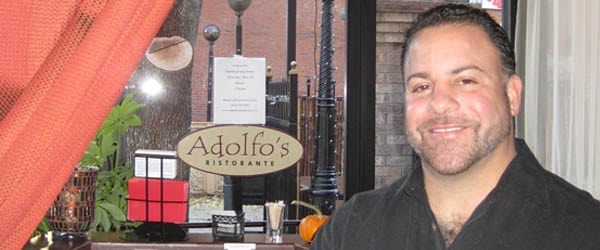
Victor Bruno has successfully paired meet-and-greet and food-sampling efforts to bolster his restaurant’s promotional card program.

Victor Bruno has never run from hard work.
As a young boy, he sold cans of soda at the Italian Festival in Springfield’s South End, making a nice profit for pocket change. Fast-forward 30 or so years to 2011, when he used the most basic form of grass-roots marketing — the meet and greet, and food sampling — to brand his barely year-old Worthington Street restaurant, Adolfo’s Ristorante, an homage to his late father.
Bruno and two of his employees spent four weekends in the West Springfield and Enfield Costco locations offering samples of his stuffed mushrooms to promote his new venture through the Costco discount gift-card program.
“I was there from when the store opened until I ran out of mushroom caps each time, and I met thousands, and I mean thousands, of people, and we would talk about the restaurant and downtown Springfield,” Bruno recalled.
He heard it all, and the most pervasive issue was the perception that Springfield isn’t safe anymore. “But I told them, it’s the entertainment district, and we have valet parking and good lighting; you’ll have a great meal — and I’ve seen thousands of those cards come back.”
Bruno knows the restaurant business is one barometer of how willing the public is to indulge in discretionary spending. With the all-important holiday shopping season just beginning, there is some cautious optimism among the restaurateurs that BusinessWest spoke with, although it was tempered with concern about what will be a short holiday shopping season.
“Sadly, this was the latest Thanksgiving possible; we’ve lost a week of shopping time, and that hurts all restaurants,” said Robert Luz, president and CEO of the Mass. Restaurant Association (MRA). “But we continue to extricate ourselves from the Great Recession, and generally speaking, we’re starting to come out of this, and consumers are a little bit more confident about spending dollars.”
Bob Luz

In spite of a shortened selling season due to a late Thanksgiving, Bob Luz says, consumers are more confident to spend.

Luz expects holiday sales to be flat or in the negative, mostly due to that lost week. His organization offers business assistance to restaurant-industry members — most importantly legislative advocacy. According to Luz, as restaurateurs get through this shorter holiday season, they have a potentially disparaging issue looming with a recent bill that just passed the Senate and is headed toward the House that could raise not only the minimum wage for all industries, but also the base of tipped wages for waiters and waitresses in the restaurant industry, increasing their minimum wages by 71% (more on this later).
For the restaurateur, food-price increases are only the beginning; city taxes, property insurance, workers’ comp, and liquor-liability costs are also increasing. “There’s only so much you can get from a stone,” said Bruno. “And all businesses have some of these costs, too. But in the restaurant business, we’re working with a profit margin of nickels and dimes.”
For this issue’s focus on restaurants, BusinessWest talked with some industry veterans about the holiday season ahead, as well as the much bigger picture — the challenging environment in which they’re operating and the prospects for improvement.

Main Menu

As if the Great Recession and recent food-price increases weren’t enough for local restaurateurs, a week before Thanksgiving, Senate President Therese Murray advanced a plan to raise the minimum wage from $8 to $11 per hour over the next three years. The Senate voted for that wage increase, and Luz of the MRA was prepared for that hike, which would certainly affect any business owner.
But in the same session, the Senate also voted to increase the minimum wage for tipped employees to half the minimum wage. With the tipped wage currently at $2.63 per hour, it would now force restaurateurs to pay them $4.50 per hour this year, a 71% increase, which will continue to increase over the next two years.
“It’s been frozen since 1999, because it works,” Luz said. “Over that time period, waiters’ and waitresses’ wages naturally increased because of menu inflation and because we educated our members’ employees to declare all of their tips.”
Technically, Luz said, employers have to meet the current minimum wage for those waiters and waitresses whose declared tips don’t equal current minimum wage, but that is rare because they usually do make solid tips. Waiters and waitresses in Massachusetts, he went on, are already paid the most in the country, as the U.S. Bureau of Labor Statistics reports that they earned an average hourly wage of $13.13 in 2012, when tips are factored in. Should this new increase for tipped employees pass, employers will be footing yet another increase for something that Luz said doesn’t need a separate increase.
The MRA offers its members information sharing, education and training, forums for networking, cost-cutting group-discount opportunities, and, most importantly, legislative advocacy.
“The restaurant business is highly labor-intensive, and when you affect wages like that, it’s dramatic,” Luz said. “We’re the entry-level point for a lot of jobs, but the business has a razor-thin bottom line.”
Luz added that the MRA is working to finalize a formal strategy to fight this matter in the Legislature.  But heading into the holiday season, there are significant issues that already exist for the network of Western Mass. restaurateurs.
For the past 14 years, Chris Brunelle has been the owner of Pinocchio’s Ristorante (formerly in Amherst, now in Three Rivers), and is also general manager of the new Bistro 21 at the Cold Spring Country Club in Belchertown. Through those two businesses, he’s come to the formal conclusion that there may be no bounce back to where things used to be pre-Great Recession.
“This is the new norm; the cost of doing business in the last year to two years for food alone has gone up 6% to 22%, and everybody is paying for the October snowstorm from two years ago because our insurance prices have gone up another 20%,” added Brunelle.  “That’s just the cost of doing business, and you can’t pass that cost down to your customer.”
Judie Teraspulsky, owner for the past 36 years of Judie’s restaurant in the center of the vibrant college town of Amherst, said her professional life revolves around when students are in town; she’s survived the Great Recession by streamlining every area that she can, and running the restaurant, from purchases to staffing shifts, with extreme efficiency.
“We are tight, tight, tight,” said Teraspulsky. “We don’t lay off employees, because they are the most important factor in our business.”
As hard as things get for Brunelle, his philosophy, year-round, is the same as Teraspulsky’s: he’s staying strong due to his allegiance to his employees, many of whom have families, and four specifically who have been with him for the full 14 years.

Gifting Limit
Rudi Scherff, manager of the Student Prince, a landmark eatery in downtown Springfield that just celebrated 78 years in business, is used to the ups and downs of the hospitality business. Scherff, who undoubtedly has one of the strongest and most affluent regular clienteles in the Pioneer Valley, said he’s getting the sense that, while there is apprehension and concern, people are a bit happier with at least the regional economic situation than they were a year ago.
Scherff told BusinessWest that the holidays are “huge” for his restaurant, which does a solid 20% of the year’s business from Thanksgiving to Christmas Eve, and half of the gift certificates sold are during that same time span.

Rudi Scherff

Rudi Scherff says the holidays are a very busy time, when half of the year’s gift certificates are sold for the Student Prince.

“We’re going to be busy this season, and the eight days before Christmas are as much as we can handle,” Scherff noted, adding that banquets and events, entertaining up to 90, are a big part of that equation.
While Teraspulsky may not be as straight out as Scherff this time of year, she still sees the holiday season as very important to her business.
“Where I shine during the holidays is that you can come in and do just a dessert or a popover, or one of our great cocktails,” she said, adding that her menu, from the beginning, has afforded her customers the ability to have whatever they want, when they want it.
Teraspulsky and her staff of 90 push the gift certificates hard to get that return that will pick up the cash flow once the 50/50 percentage of college students and traditional customers returns.
Bruno is also looking forward to this season, not only to see those Costco cards come back, but to sell more gift certificates in the restaurant, and he’s already booked early corporate parties in his private room upstairs, seating up to 45 people.
“There’s still that caution with spending,” said Bruno, recalling the days in his former restaurant, Caffeine’s, in the same location, where customers used to spend $100 on a bottle of wine.
“Now they’re only spending $25 to $30 on a bottle of wine, but at least they’re spending it here.”

The Garnish

The potential of a downtown Springfield casino complex in the years ahead provides holiday conversation and a giant question mark for many restaurateurs; while they are not sure if it will help or hurt them personally, ultimately, they hope that the pledge of far more people will materialize.
“We’re always optimistic come January, and for the [prospective] casino, during the construction phase — it’s going to be great for downtown,” said Scherff.  “And once it opens, it’s going to help some, hurt others, but hopefully it puts more feet on the street and gets more people down here.”
Bruno agreed, adding, “the perception of downtown is far, far worse than it actually is, but with a casino, there will be people, and people bring safety; my position has always been that we’ll be the safest downtown around.”
Until a decision is made, Bruno is doing everything in his power to overcome the challenges that all restaurateurs are facing this holiday season. His greatest compliments thus far have been from those who tell him that Boston’s North End, renowned for authentic Italian restaurants, has nothing on Adolfo’s.
“They tell me I should consider opening up another restaurant,” Bruno said, laughing as he explained, “because if you can make it in Springfield, you can make it anywhere.”

Elizabeth Taras can be reached at [email protected]

Holiday Gift Guide Sections
2013 May Be the First Healthy Holiday Sales Season Since Before the Recession

Joy Leavitt

Joy Leavitt is supporting locally owned independent businesses with a new nonprofit organization and educating consumers about buying local.

Walking into Kiddly Winks, a popular children’s toy store in Longmeadow, runs a close second to visiting the ‘real’ Santa’s Toyland at the North Pole.
Once in the store, customers are greeted by the cheery owner, Joy Leavitt, who easily takes on the role of a much younger Mrs. Claus with her warm smile and genuinely welcoming character. These qualities, combined with a spot-on toy selection, have made for a very successful business for the past 28 years, and allowed her to open a second store in Canton, Conn. in 2004.
Meeting the Kiddly Winks owner close to the holiday season is only heightened by her frequent use of the word ‘magical,’ which she uses to describe everything from the thousands of customers who have supported her two businesses to the growing popularity of the annual American Express Small Business Saturday — the day after Black Friday — to the nonprofit organization she started this year called Living Local (more on this later).
However, magic is exactly what retailers may need in this year’s sales season — defined by retail sales organizations, like the Retailers Assoc. of Massachusetts, as running from Black Friday to Christmas Eve — because there are six fewer shopping days than last year, including one less vital weekend for shopping, due to Thanksgiving being so late this year. Despite the loss of days, the Retailers Assoc. still predicts a 3.5% gain in sales ($15 billion) over last year, which is a shade less than the National Retail Federation’s projections for this year of 3.9%, which equates to $602.1 billion in total sales. It’s a progression that economists are calling ‘cautionary, slow growth’.
In the Western Mass. region, the independent retailers that BusinessWest spoke with seem to be relatively unconcerned about the shopping-week loss because the past year has shown steady growth, and for the first time since the Great Recession, they are viewing this sales season with anticipation, not trepidation.
“This year has been very, very good, and I do think it’s going to be an active holiday season,” said Dave DiRico of Dave DiRico’s Golf and Racquet in West Springfield. “The economy seems to be getting better, and people seem to be out shopping more.”
DiRico, a former club pro who purchased the well-known Fran Johnson’s Golf & Tennis from owner Cindy Johnson in March 2012 and reopened under his own name the following month, is looking forward to his second successful holiday season as a retailer, based on the success of last holiday season and his growth this year.
Kate Vishnyakov

Kate Vishnyakov’s clientele has already followed her boutique’s move from East Longmeadow to Longmeadow, proving that consumers are willing to support local business.

And while one might think that Kate Vishnyakov of Kate Gray Boutique should be nervous about this upcoming season since relocating her shop from East Longmeadow to Longmeadow this past October, she’s actually not. As she explained to BusinessWest, she launched her business six years ago at the beginning of the recession but is still going strong.
“The key is to adjust with the times,” Vishnyakov stated. “It got to the point where I didn’t have to depend on what was happening in Washington, or politics, or the economy; I built something that could support and sustain us.”
Her clientele has already welcomed her into town because, with a large percentage of customers coming from Longmeadow, Vishnyakov’s move has made it all that much easier to shop locally, which is vital to her existence. In fact, her sales in October, even being closed for 10 days for the move, were stronger than the same month last year.
Weather, economics, and tragedies can all affect the holiday shopping season, said Diane Merrick, owner, with her sister, Ann Marie Moloney, of It’s All About Me, a women’s boutique in Hampden.  But preparing in spite of challenges is a risk that is necessary because the sales of the past holiday seasons reflect what the inventory should be for the present.
“We can’t control people’s fears,” said Merrick. “All we can do is focus on being positive, listening to what customers say they want to see in the store, and provide those products with excellent personal service.”
While Leavitt uses the word ‘magical,’ Victor Ounduian, president of Lorilil Jewelers in downtown Springfield’s Tower Square, is cautiously optimistic. “There’s definitely more positivity this year, if that’s a word,” he said with a chuckle. (Indeed, the Merriam-Webster dictionary describes positivity as ‘the state of being positive.’)
For this issue’s focus on the upcoming holiday sales season, BusinessWest spoke with local business owners who are taking that positivity to heart, at the same time they acknowledge the unscientific nature of making holiday shopping predictions.

Local Shift
During the year, Leavitt sees a lot of young women enter her store to show off their babies.
“And they were my customers when they were little girls,” Leavitt said, smiling. “That’s the beauty of what a legacy business is all about.”
Leavitt is passionate about local businesses, many of which are run by the second, third, or fourth generation, and the reason that she created Living Local (www.living-local.net), a nonprofit organization of local independent business owners in Western Mass. and Northern Conn.
“Shop local has become a real trend in the U.S., and I looked around at our lovely communities, and we didn’t have one,” said Leavitt, referring to an organization that would promote such a philosophy. She worked with local media, and the first meeting brought more than 35 independent business owners just to hear what Leavitt had to say.
“The first story that I told was that, for every $100 that a customer spends in an independently owned store, whatever type it is, $69 of that stays in the community, through taxes, payroll, and other expenditures,” she told BusinessWest, adding that, for national chains, only $43 stays in the community, and worse yet, Internet shopping offers nothing for the local community. “But the real story is to educate the public that if they just shift they way they shop, even 10% of their shopping to shopping locally, they will positively impact local communities and our local tax base.”
After that April 2013 meeting, 20 local businesses signed up and paid the $100 fee to join that night. Now, 55 members of all sizes and counting — from Big Y to Merrick’s It’s All About You — can benefit from the group’s PR and in turn help educate the public about the importance of buying locally, Leavitt said.
The response has been magical (there’s that word again), she said; a recent week-long promotional event offering a $5 tote bag filled with members’ discount coupons sold out of the 500 bags in only six days, and a portion of those proceeds went to the Food Bank of Western Mass.

Dave DiRico

Business for the year to date has been very good for Dave DiRico, who is anticipating a busy holiday season for sporting-goods sales.

DiRico has high praise for Leavitt and her success with Kiddly Winks, having lived with his wife in Longmeadow for years. He is now benefiting from local shoppers, as she has done for years, due to the communities in Western Mass. and the Berkshires supporting his West Springfield sporting-goods store.
Another source of help for DiRico, Leavitt, and their fellow small-business owners is Small Business Saturday, which was launched in 2010 by American Express to promote its small-business customers and brand a special shopping day that could seize the momentum of Black Friday. The day allows card holders a percentage discount for all charges at participating local stores, and last year, Leavitt saw a 30% increase in American Express sales for that day.
“American Express really did that to grow their own company, but what they also did was to create something amazing and magical for small local business owners,” said Leavitt. “But a lot of people don’t even know that American Express started it or offers a discount; they just like to help out and shop locally on that special day.”
Regardless of why the day was created, American Express advertising alone is making it catch on nationally, and Leavitt said she and all the other local business owners are just happy that some light can shine on them, just as the holiday season is getting in to full swing.

Giftology
With no grandiose expectations, Merrick, a young widow with two small boys, took a risk and purchased her small boutique in 2004, offering eclectic yet affordable gifts, jewelry, women’s clothing, and accessories of all kinds. The venture took off, and she soon expanded to a 2,300-square-foot location and, in late 2010, opened a second location in Greenwich, Conn.
For Merrick, the 25% or more of annual sales in the month of December alone are worth all the shopping and researching unique vendors throughout the year.
One risk, she said, is purchasing large volumes of items that will theoretically appeal to a wide variety of customers. Miscalculations can leave the business owner with thousands of dollars of stock that sits, she noted, adding that such gambles should be taken only after considerable due diligence.
Lewis White, owner of A.O. White in East Longmeadow, a 4,200-square-foot men’s and women’s fine clothing and specialty shop since the 1940s, has been through three major recessions and has spent decades trying to figure out such challenging holiday inventory questions.
He credits his success to his buying standards, opting for fine-quality fabrics, styles, and brands that aren’t found at national chain retailers. And like Vishnyakov and Merrick, he relies on his customers to tell him what they like so his inventory can always remain fresh and unique. During the holiday season, White and his staff are monitoring stock daily and ordering by phone or online to keep up.
“We’re always projecting for increases; you can’t have too much or too little,” he explained. “And that’s the part of the business where you have to use your judgment.”

Perfect Fit
Having endured the economic downturns of the early ’90s, post-9/11, and more recently the Great Recession, Ounduian’s business has bounced back many times.
“Any non-essential item is what goes first — it happens to everyone,” said Ounduian, referring to how consumers change their habits during downturns. “But with this last recession, it didn’t bounce back as fast.”
But with the holidays approaching, Ounduian is using his judgment and banking on that positivity to sell his increased holiday inventory of branded names like David Yurman, Rolex, Mikimoto pearls, and Roberto Coin jewelry, which tend to be top sellers each holiday season.
Soon, he said, the male shoppers will start their shopping around the 12 days before Christmas, and especially the last two days before Christmas, which he expects will keep his store hopping.
“I think we’re going to have a busy season,” Ounduian added.  “It’s just a gut feeling — but a good gut feeling.”

Elizabeth Taras can be reached at [email protected]

Cover Story
Gulfstream’s Westfield Facility Is in Takeoff Mode

Fran Ahern

Fran Ahern, general manager of Gulfstream’s Westfield facility.

Fran Ahern acknowledged that the analogy isn’t perfect, but, for the most part, it works, and it helps him effectively tell the story of one of the region’s least-known — and least-understood — business success stories.
“We’re a service center for airplanes,” said Ahern, general manager of Gulfstream’s sprawling operation at Barnes Municipal Airport in Westfield. He would go on to draw a number of loose comparisons between his operation and the corner garage or auto dealership where one might bring their Buick for new tires, a tuneup, or an inspection sticker.
But as he did so, he noted that he and his staff of 230 are obviously working with much bigger vehicles — and numbers — of every kind.
Indeed, the Gulfstream G650, the latest model developed by this subsidiary of General Dynamics, costs roughly $65 million out of the box. It has a 100-foot wingspan, weighs roughly 40 tons when empty, and stands 25 feet high. Meanwhile, the various hangars at the Westfield operation cover more than 200,000 square feet of real estate. The latest addition, opened earlier this year as part of a $24 million expansion, spans 125,000 square feet and has a 50-foot-high ceiling and overhead crane.
Still, the comparisons to the corner garage are effective, said Ahern, noting that, in both situations, service — which in this case is provided to Gulfstream models as well as competitors’ aircraft — is king, word-of-mouth referrals are critical for attaining vital new customers, and retention is ultimately the most important ingredient in the formula for success.
“This is a relatively small business in that everyone knows everyone,” he said of the aerospace industry and especially the service component. “This facility has a good reputation in the marketplace, and that’s through the hard work of all the employees, but it’s also a business where it’s ‘what have you done for me lately?’ So you have to continue providing quality service.”
The Westfield operation is doing well in this close-knit environment, said Ahern, noting that it is near full capacity on a regular basis — there are ebbs and flows in this business, as with most others — and the new hangar and its amenities and equipment present opportunities to keep the service slate full.
Also, the company’s diversity of products and services has enabled it to expand its client list and do more for those already on it. Examples include an expansive shop where interior work — from re-upholstering seats to installing new cabinetry — takes place, as well as a mobile service, called FAST (Field & Airborne Support Team), which brings Gulfstream technicians to the planes needing work, instead of the other way around.
Gulfstream’s expanded presence in Westfield

Gulfstream’s expanded presence in Westfield has equated to roughly 100 new jobs and new opportunities for economic development in that area.

There have been challenges to overcome, certainly, especially in recent years, he noted. The sharp economic downturn impacted corporate travel significantly, with many corporations cutting back on this often-controversial expense item. Meanwhile, negative press about corporate fleets — especially those headlines about auto-industry executives taking company jets to Washington in the fall of 2008 to plead for bailout money — also impacted the industry.
“There were layoffs here and elsewhere as a result of those stories and their impact,” said Ahern, adding that some segments of the industry, especially the so-called ‘large-cabin’ planes, such as the G650 and other Gulfstream models, have rebounded from those setbacks.
And the skies certainly look brighter, he went on, as corporate travel rebounds in this country and expands in rapidly developing regions of the world such as Asia and South America, where Gulfstream is expanding its presence.
“We help make the world smaller,” said Ahern, referring to corporate air travel in general and Gulfstream in particular. “And that helps people get business done.”
For this issue, BusinessWest goes behind the scenes at a company where an intriguing kind of business is indeed getting done, and an operation is taking off — in every aspect of that phrase.

The Sky Is No Limit
Tracing the history of Gulfstream’s presence in this region, Ahern said the Georgia-based company’s name went on the sign outside the former KC Aviation facility at Barnes in 1998, a time of profound growth for the plane maker — and, thus, a need for facilities to build and service the aircraft. Gulfstream actually acquired three service centers from KC, with the others in Appleton, Wis. and Dallas, Texas.
That sign on the Westfield complex would be replaced by one that said ‘General Dynamics Aviation Services’ (the defense giant acquired Gulfstream in 1999) a few years later, Ahern went on, adding that this change was yet another illustration of how this business is very much like an auto-service center.
“The KC facilities were not only working on Gulfstream airplanes, but some of our competitors’ planes,” he explained. “And when Gulfstream acquired those facilities and put up Gulfstream signs, those other airplane owners didn’t think the facility would service those airplanes any more, so they stopped coming. “
The General Dynamics signs helped bring them back, he told BusinessWest, adding that the eventual strategy was to go back to Gulfstream signage, but with an intense marketing effort, one aimed at hammering home the point that the company was the only original equipment manufacturer (OEM) to service other OEM’s planes. Today, the facility at Barnes also services planes made by Bombardier, Dassault/Falcon, Cessna, Hawker Beechcraft, and others.
There have been few such instances of turbulence (another industry term) since Gulfstream came to Westfield as part of a broader effort on the part of the company to build service capacity across the country and, more recently, around the world, said Ahern.
The corporation, which first went into business with twin propeller jets in 1958, now has similar facilities domestically in Appleton; Brunswick, Ga.; Dallas; Las Vegas; Lincoln, Calif.; Long Beach, Calif.; Savannah, Ga.; Westfield; and West Palm Beach, Fla. It has also sites in Mexicali, Mexico; Luton, England; Beijing, China; and Sorocaba, Brazil.
These locations were chosen for strategic purposes, said Ahern, adding that they service geographic sectors and, especially in the case of the international locations, regions with strong growth in corporate air travel.
While the Westfield location, like all the others, handles what Ahern called “unscheduled maintenance” — planes based outside this area but which are in the Northeast and need service — the bulk of the aircraft in the hangars at any given time are based in New England and surrounding states such as New York and New Jersey. The Bay State’s sales-tax exemption on aircraft parts and maintenance, which has withstood several recent attempts to eliminate it, gives the Westfield location a competitive advantage that Ahern and others at Gulfstream certainly don’t want to lose.
The facility at Barnes specializes in everything from airframe maintenance to inspections; from avionics (instrumentation) services to that aforementioned interior work, which accounts for roughly 15% of the total volume. Much of the engine and airframe work is required, or scheduled, maintenance, he went on, adding that there are regular, hourly driven inspections for such aircraft.
The customer list is equally diverse, he continued, noting that it includes corporations, wealthy individuals, and commercial fleet operations such as Net Jets.
Ahern said the expansion completed earlier this year was driven by market demands for more capacity, and the simple fact that many of the latest large-cabin planes, such as the G650, were simply too big for the hangars at Barnes at the time.
To drive that point home, he pointed to the tail section of a G450 being serviced in one of the older hangars. There was probably less than five feet of clearance between the top of the tail and the ceiling, he said, adding that the G650 simply wouldn’t fit in that building.

Soar Subject
As he talked with BusinessWest in the new hangar at the Westfield location, Ahern pointed toward the back corner of the facility and something called a ‘tail dock.’
This is a moveable set of scaffolding, which, as the name implies, allows technicians easy and effective access to a plane’s tail assembly.

The new hangar at Gulfstream’s Westfield

The new hangar at Gulfstream’s Westfield facility provides the room — and opportunities — for continued growth.

And it represents a considerable improvement over the scissors lift that was used by crews before the expansion project, said Ahern, adding that there are many similar examples of how the facilities have not only been enlarged — in a big way — but upgraded and modernized  to improve efficiency, enhance service, and, hopefully, drive new business.
Another example is the overhead crane that was being used on this day for engine replacement on a G450, he noted, adding that, prior to the expansion, the facility would have to rent such equipment, an arrangement that was less efficient and less cost-effective.
Overall, the $24 million expansion project enables the company to add capacity — more and different kinds of jets can fit in the hangars — and also improve service to customers and broaden its impact on the community and local economy.
Elaborating on the service component, Ahern again referenced this tight industry sector where everyone knows everyone else, and noted that good experiences for customers lead not only to repeat business and word-of-mouth referrals, but also to some of those new models rolling out of Gulfstream assembly plants.
“You provide good service and a quality product to those customers with competitor aircraft, and maybe at some point, when they’re upgrading their airplane, they’re going to think about maybe upgrading to a Gulfstream,” he explained. “We have a saying around here: ‘product support sells new airplanes.’”
As for impact within the community, Ahern said it starts with the roughly 100 new jobs that have been added, many of which required technical skills and are good-paying positions. Meanwhile, with more planes in the hangars, the company can broaden its economic impact, he said, noting that the jets’ crews will stay in the area, often for several days, while they’re being serviced, staying in local hotels and dining at area eateries.
And from the economic-development standpoint, the state-funded expansion of Airport Industrial Road — one of the local and state incentives offered to induce Gulfstream to expand in Westfield — makes industrially zoned property at the airport more accessible for development, he noted.
Looking ahead, Ahern said, while the hangars are full many days, as they were when BusinessWest visited, there is always room for growth.
Elaborating, he said the company has to minimize those aforementioned peaks and valleys — to the extent possible — and move ever closer to what he called utopia: “100% loaded, 100% of the time.”
“Our goal is to get there, and right now, we’re pretty close,” he said, adding that, while the additional room and amenities in the expanded facilities, as well as programs like FAST and positive reviews in such industry publications as Professional Pilot magazine and Aviation International News will help close that narrow gap, ultimately, it’s quality of service that will eventually get it done.

Smooth Landing
While acknowledging that comparisons between service to the family mini-van and a $60 million jet aren’t perfect, Ahern said the principles of both business operations are essentially the same.
The tires may be a lot bigger on the jet, and the cost of the services provided to it will likely have a few more zeros, but in the end, it comes down to the customer’s experience, he noted, adding that Gulfstream has become an industry leader by understanding this and, more importantly, making those experiences positive.
And that’s plain speaking — or plane speaking, as the case may be.

George O’Brien can be reached at [email protected]

Features
This Veteran Goes to the Front Lines — of Home Healthcare

Nicholas Colgin

Nicholas Colgin is still climbing — both literally and figuratively — as a guide for blind individuals on summits, an advocate for unemployed veterans, and now as the owner of his own home-care business.

There have been a number of datelines attached to news stories involving Nicholas Colgin.
Many of them originated in the Tagab Valley in eastern Afghanistan, where, as a combat medic serving in Bravo Company for the Army’s 82nd Airborne Division, he saved the life of a French soldier shot in the head while facing enemy fire himself, an act of bravery that earned him the Bronze Star. It was also while serving in that remote region that others in his squad saved 42 Afghanis from a flooding river, an experience that he believes gave additional validation to his time serving in that conflict.
Later, though, there were stories out of Washington, first when he went to speak before Congress on the difficulties many veterans of Iraq and Afghanistan were experiencing as they sought gainful employment, and later when he was mentioned in speeches given by President Obama that outlined steps to combat the high jobless rates among what are known as the ‘9/11 generation’ of veterans.
Referencing Colgin, who, despite those actions that earned him a medal, couldn’t get a job as an EMT in Wyoming because he lacked the proper certification, the president said, “that isn’t right, and it doesn’t make sense — not for our veterans, not for the strength of our country. If you can save a life in Afghanistan, you can save a life in an ambulance in Wyoming.”
Fast-forward roughly two years from that speech in a former gun factory at the Washington Navy Yard, and the latest dateline for news on Colgin is, improbably, Springfield, Mass. Indeed, he’s not in an ambulance, nor in Wyoming, but instead in one of the many corner offices on the 12th floor of 1350 Main St., also known as One Financial Plaza. There, a map covering more than half of one wall identifies his territory — all of Western Mass. and some of Northern Conn. — as a franchisee for a national chain called Right at Home, which, as the name suggests, is a home-care agency.
There are a number of pushpins now on that map. They identify major healthcare providers in the Greater Springfield area as potential partners of sorts as Colgin looks to obtain market share in what is becoming a crowded playing field for home-care services.
Cultivating such relationships is now a major part of Colgin’s job description, although he noted quickly that there are many pressing issues as his gets this business off the ground, from interviewing candidates for caregiver positions to hiring an operations staff to staging an open house.
“We’ve had more than 300 applications in the past two or three weeks,” he noted, adding that the process of screening these candidates is ongoing. “They go through orientation, and we put a lot of time and investment into training to make sure we’re not sending someone into a person’s home that we wouldn’t let in our own grandmother’s home or parent’s home.”
How and where this entrepreneurial gambit came to be is an intriguing saga, one that says a lot about this determined individual, who overcame a number of injuries himself to put his name — which at one time he had trouble spelling because of a traumatic brain injury, or what those who’ve suffered one call a TBI — and the title ‘owner’ on his current business card.
Summing it all up, he said it has to do with mountains, or, more specifically, with climbing, and the need to keep doing it.
Elaborating, he divided returning veterans (and people in general) into three categories: ‘quitters’ — those who give in to their frustrations and often become substance abusers; ‘campers’ — individuals who come home and “relax for a while” (something he admits he did to some extent); and ‘climbers’ — those who “just keep climbing.”
“I decided I was going to be a climber,” he said, “and do it literally by taking blind people up mountains, and more figuratively by finding the next goal in life.”
ColginArmoredCar
Nicholas Colgin earned a Bronze Star for saving a man’s life in Afghanistan, but later was wounded himself, an experience that transformed a helper into someone who needed help.

Nicholas Colgin earned a Bronze Star for saving a man’s life in Afghanistan, but later was wounded himself, an experience that transformed a helper into someone who needed help.

For this issue and its focus on the business of aging, BusinessWest talked at length with Colgin, who has gone from being the face of unemployment among returning veterans to an individual now employing others in a venture with which he feels, well, right at home.

In the Line of Fire
Colgin was in the Peruvian Andes late last month, leading a team of 12 disabled veterans up 18,000-foot Mount Mariposa, when he received word that his franchise had secured the license necessary to operate in Massachusetts.
The juxtaposition of those happenings adds some poignancy to Colgin’s remarks about climbing, and also to the many facets of his life and the ways he measures success.
“I was going to do one last guiding trip before opening the business,” he explained. I submit the application and hop on a plane to Peru. I get one day in, and our application has been approved. It was a tricky place to be in — I’m in Peru, and now my business is open, and I’ve got to get back and hire employees.
“It’s been quite a journey, and this part of it is really just getting started,” he went on, before venturing back to another dateline in his life, the first.
That would be Chesterfield, Va., a small community not far from Richmond, where he spent several generally unhappy and challenging years.
His mother wound up in prison, and his father, with only a sixth-grade education, struggled to earn a living. Colgin said he was essentially raised by his grandmother, and by his senior year in high school, he was in many ways rudderless. It was a friend bent on joining the Army who provided inspiration and a compass point, but Colgin still had no idea what to do with himself — in the military or after his tour of duty was over.
“I signed on as a medic,” he said, following those words with a pause and shrug as if to indicate there was no profound reason for that choice. “I had never done anything in healthcare … when I went to sign up, I didn’t really know much about the military other than what you see in movies. I had just seen Black Hawk Down, and I said to them, ‘I want to be one of those guys.’
“They chuckled at me and said, ‘that’s not really a job,’” he went on. “They said, ‘you’re pretty smart … you can be this, or this, or maybe a medic.’ I said, ‘I’ll be a medic — that sounds like a job people really look up to.’”
He would eventually find out just how off he was in that reasoning — at least when it came to finding a job a few years later.
Fast-forwarding a little, Colgin passed the six-month training course to become a medic; two-thirds of those in his class did not. He worked in several facilities stateside, teaching medical classes, and was set to get out of the military without being deployed, but wound up volunteering for an assignment. “I figured, we’re at war; I might as well do my part,” he said, adding that a deployment he thought would last six months to a year instead stretched to 15 months.
He called it the “quintessential war experience,” one that took place mostly at Firebase Morales-Frazier. The highlight of his tour, if one could call it that, came in 2007 when he went to the aid of a French soldier hit by Taliban fire. The two were pinned down for about three hours, under constant fire, while Colgin administered care credited with saving the man’s life.
Colgin has several scattered memories of that experience, everything from being able to put whatever French he managed to retain from high-school classes to good use, to his own emotions as he offered care and counseling to the wounded soldier.
“You’re in Afghanistan, you’re getting shot at, people are getting blown up … you’re treating these people day in and day out, but you don’t really get scared; you just say, ‘this is just a job, this is what I’m here to do, treat it as a professional situation,’” he recalled. “But then I remember taking care of him. We’re in a small vehicle finally getting out of there, and his legs are on mine. I’m trying to tell him everything’s going to be all right. I was saying it confidently, but my legs just wouldn’t stop shaking, because I didn’t know if he was going to be all right. But I knew if he wasn’t going to be all right, it was not going to be because I slacked on my job and didn’t do all I could.”
Just a few months later, Colgin was driving a Humvee — something medics don’t often do, but he felt compelled to take his turn behind the wheel — when it took a glancing blow from a rocket-propelled grenade, or RPG. He said his head hit something, probably the steering wheel or windshield, breaking his nose and giving him what he called a “concussion of sorts.”
“One side of my body was numb, and I remember thinking that something wasn’t right,” he recalled. “We didn’t really know a lot about traumatic brain injuries at the time. I came home, had a lot of surgeries on my face — they rebuilt my nose — and needed a lot of treatment.
“I had been this helper overseas,” he went on, “and then I came home and needed help for the first time in my life. I’d never been in that situation before and didn’t really know anyone who had been in that situation before.”
And while he would eventually find some assistance, he essentially helped himself to a new career opportunity and that suite on the 12th floor.

Peaking His Interest
While serving in the Tagab Valley, Colgin, like many veterans, filled the idle time by reading whatever he could get his hands on. And increasingly, this meant books and especially magazines — because they weigh less and are thus easier to carry — about the outdoors.
“I was going to be an outdoor guide,” he said of plans he was making for life after military service, adding quickly that most of these were mapped out before he was injured. “I had never seen these huge mountains in person — I’d never really left the East Coast — and was just fascinated by that country.”
Upon returning home and “healing up” in North Carolina, Colgin would settle in Wyoming to pursue that dream, but he failed in his quest to graduate from the National Outdoor Leadership School due to lingering health problems, physical and mental — he would go back four years later and complete the program, though — and eventually shifted his career aspirations to healthcare, only to find more frustration.
“I had provided medical care in extreme situations — I’d saved someone who was shot in the head while I was getting shot at myself, in the middle of Afghanistan with limited resources — so I figured I shouldn’t have any problem doing emergency medicine, such as work as an EMT,” he told BusinessWest. “Unfortunately, I was wrong.
“And this is an issue that many people in the military are facing and that they’ve just started addressing in the past few years,” he went on. “Basically, you’re trained to do a job in the military, and you can do it in the military, but the certifications do not transfer to the civilian sector. I was trained as an EMT basic, sent to Afghanistan. I’m treating people who were shot in the head, I’m giving IVs and administering medications — and you can’t do that stateside.”
Those who drive trucks and service vehicles in the military face similar roadblocks, he said, adding that thousands of individuals have struggled with the task of turning experience with the armed forces into a job back home.
And this was the message Colgin wanted to bring to elected leaders and the civilian population as the dateline for his story shifted to Washington in mid-2011.
As a representative with Iraq and Afghanistan Veterans of America (IAVA), he spoke before Congress on his frustrations with finding employment in what he considered his chosen field, and made it clear that he was not alone in this predicament.
His comments caught the attention of many groups and individuals, including the commander in chief.
“I remember I showed up to work one day — I was interning for the IAVA — and someone said to me, ‘the White House called for you,’” he told BusinessWest. “That’s not something you hear all the time, and I thought they were joking with me, but they were serious.
“I called them back, and they told me the president was considering telling my story in a speech the next day,” he went on. “They weren’t sure he was going to tell it, but I had to get to D.C. I got a haircut, grabbed my suit, and hopped on a train to Washington.”
After the president’s speech, Colgin found himself in demand — with the media, at least. He did appearances on CNN, the Rachael Maddow Show, the CBS Early Show, and others, becoming adept at live interviews. This face time with the public brought him some job offers — “although not as many as you might expect with the president telling your story” — and eventually he took one, working as membership coordinator with the IAVA, and resettled in Manhattan.
That island is worlds away from Chesterfield, Va. in every respect imaginable, and Colgin liked being an advocate for veterans, working with Congress, and getting plenty of coverage in the media. But something was missing from the equation.
Actually, two things.
The first was an entrepreneurial venture that he could call his own, and the second was what he called “a community in the true sense of the word, a place where I could rest my head, then get up and really get involved in making a difference.”
He would eventually find both in Springfield.

Summit Meetings
Recalling the chain of events that led to his grand opening nearly a month ago, Colgin started with his decision to “step back,” as he put it, and take a sabbatical from his job with the IAVA. He took this opportunity to do some of the outdoor work he’d started dreaming about in Afghanistan, and eventually made acquaintances with Eric Weihenmayer, the first blind man to scale Mount Everest.
“He and I became good friends, and I ended up picking up a lot of skills to guide individuals up mountains and in the back country,” he recalled. “It was a great experience … I started guiding blind people up mountains. I came back to New York after my sabbatical and realized I had to make a change in my life.”
Coincidentally, he attended what he called a “business boot camp for veterans” in Boston, an intense, three-week program conducted in conjunction with Harvard that helped him discover latent entrepreneurial instincts and drive.
“I realized that what was inside me was stronger than anything in my way,” he told BusinessWest. “I realized that I could open a business; I left and started looking for investors.”
As that search for financial backing commenced, so, too, did the process of choosing what kind of business to get into, he went on, adding that he soon concluded that he would like to do something healthcare-related, and something that would make a difference in peoples’ lives. Discussions with a consultant specializing in linking individuals with franchise opportunities narrowed the search to a few national chains, and eventually to Right at Home, an Omaha, Neb.-based enterprise launched in 1995 that by that time had facilities in more than 40 states as well as in the United Kingdom, Brazil, China, and Canada.
It was not, however, doing business in Western Mass., and Colgin, with $250,000 from some investors, decided to seize that opportunity.
“It was just me and the dog, and I could go anywhere and do anything,” he said, referring to his English pointer, Dixie, whom he described as his rock. “I wanted to stay on the East Coast, and started looking at places and scheduling visits. I ended up coming to Springfield, and it looked like a place where I could put down roots. I moved around a lot with the military and never really had a family growing up, but when I came here, I got a sense that this was a place where I could grow.”
Colgin acknowledged that there is considerable competition within the growing home-care industry and that he has a lot to learn as he joins that crowded field of players. But he believes he has the basic ingredients to reach his goals, which he admits are still being set.
“The language of healthcare is pretty universal, and caring is pretty universal as well; if you can care for Afghanistan locals in the middle of a war, you can take care of anyone in the world,” he said, adding that Right at Home has a proven model and track record for success that he believes he can build on. “I care about helping people realize their dreams, and I care about doing the right thing, and at the end of the day, that’s what this is all about.
“They’re extremely innovative,” he said of the chain. “They have great brand management and amazing quality.”

On a Grand Scale
Based on all that has happened in his life since those initial, awkward discussions with Army recruiters nearly a decade ago, it would be logical to assume that Springfield probably won’t be the last dateline for news stories about Colgin.
As he said, he’s a climber, and he doesn’t intend to stop doing that.
For now, though, the climb has reached Western Mass. and a critical juncture in his career, and there are immediate goals right ahead of him.
The plan is to keep reaching higher — in every aspect of that phrase — but that’s something Colgin has been doing his entire life.

George O’Brien can be reached at [email protected]

Features
Chambers Respond to a Challenging New Environment

Jeff Ciuffreda

Jeff Ciuffreda says the ACCGS and Springfield Chamber have “retooled” when it comes to the services offered to members.

Roy Nascimento told BusinessWest that there’s a saying of sorts used within his industry, one that goes something like this: “when you’ve seen one chamber of commerce … you’ve seen one chamber of commerce.”
The president and CEO of the New Bedford Area Chamber and the incoming president of the Mass. Assoc. of Chamber of Commerce Executives (MACE) summoned that phrase to express the sentiment that, while many have a tendency to paint these institutions with one broad brush, they are in many ways very different from one another.
This is true with regard to everything from size to geography to the specific focus of programs and energy within each organization, he said, noting that his chamber, for example, leads a number of initiatives aimed at supporting and growing the New Bedford area’s $1 billion fishing industry.
But despite these apparent differences, chambers across this state — and around the country, for that matter — are facing some common, and formidable, challenges.
Chief among them is membership. It is down for almost all chambers, and by 25% or more at many of them from 10 or even five years ago, said Jeffrey Ciuffreda, president of the Affiliated Chambers of Commerce of Greater Springfield and executive director of the Springfield Chamber. That latter organization had perhaps 750 members five years ago, he said, and now counts roughly 520, a nearly 30% decrease that he described as “typical,” at least in his estimation.
There are several reasons for such drops, said Ciuffreda and others we spoke with. He and Nascimento both mentioned lingering effects from the Great Recession and a related, ongoing trend toward consolidation in many industries — from banking to insurance; from healthcare to the media — that has simply left fewer players to pay dues to a chamber.
But there are other factors, said Ciuffreda, listing everything from competition from other chambers and groups such as young professional organizations to some changing attitudes about chambers on the part of the mostly smaller businesses that now dominate membership rosters.
“Before, the larger, more established corporations joined the chamber because it was the right thing to do, and the chamber was looked upon as the chief cheerleader for that community,” he said. “Now, when you’re out there getting new members, you’re getting mostly smaller businesses that are looking to the chamber for more assistance, guidance, and some advocacy.”
Summing it all up, Ciuffreda described the current environment as “the changing face of chambers,” and said some organizations are reacting to it more quickly and more effectively than others. Overall, chambers are doing things they haven’t done recently, or much at all, he told BusinessWest, mentioning such initiatives as strategic planning, marketing studies, and deep introspection about mission, programming, and ways to bring more value to members and prospective members.
According to Kate Phelon, a relative newcomer to chamber administration — she took the reins of the Greater Westfield organization three years ago — while providing value has always been a key element in any chamber’s success, in this changed environment it is more imperative than ever to provide what amounts to ROI to members.
And this means all members, she said, adding that the Westfield Chamber has been working to identify the needs of specific sectors, or groups, and develop programs to meet them.
Kate Phelon

Kate Phelon says the Westfield Chamber is focused on finding ways to serve members across all business sectors, from manufacturers to nonprofits.

“Not all members have the same needs, nor do they all see the same value in their chamber,” she explained. “If you look at manufacturers, nonprofits, and very small businesses, those with three employees or fewer, they all see a different value. My manufacturing members will not get business coming to an after-5 event, but my nonprofits and small businesses love those events; it’s their bread and butter. Providing value to each one of these groups is a real challenge, but you have to meet it.”
Kathy Anderson, who segued from Holyoke City Hall, specifically the office of Planning and Economic Development, to the directorship of that city’s chamber 18 months ago, agreed.
She said the Holyoke Chamber has been aggressive in development of new programs, ranging from an ‘Ask a Chamber Expert’ initiative to an endeavor to spotlight the work of manufacturers based in the city, to something called SPARK (Stimulating Potential, Accessing Resource Knowledge), a venture aimed at “fanning the flame of entrepreneurship” (more on these efforts later).
They were all blueprinted, she said, to provide value-added services to different business groups, while also enabling the chamber to “keep changing and evolving, and providing something fresh and different.”
For this issue, BusinessWest takes an in-depth look at this changing face of chambers of commerce, and at what area organizations are doing to adjust to — and thrive in — this new environment.

Matters of Relevance
As he talked about the current climate for chambers and their leaders, Nascimento said there are both challenges and opportunities, and that the common denominator involving elements of each category is the term ‘relevance.’
He used it to describe what chambers must have at a time when they are smaller — at least in terms of membership — than they were years ago, but more is being asked from them, both in the community and from those members.
“Relevance is not a new term, but it is re-emerging within our industry,” he explained. “Is the programming relevant to our members? Is it adding value to our members? Is it providing value to our communities?”
Elaborating, he said that the chambers that are most effectively responding to the changing times are becoming involved in the many facets of economic development — from education to tourism to advocacy — and are becoming more focused on the communities they’re serving.
As examples, he noted his chamber’s work to support the fishing industry — it has helped create what’s known as a ‘seafood buyers mission,’ an event that last year recorded $12 million in sales — and also its work with other groups to revive the region’s convention and visitors bureau, thus bolstering another strong sector of its economy.
There are similar examples from across the state, he said, adding that proactive chambers are changing and getting more involved, again, out of necessity, to gain and retain members.
Indeed, the biggest challenge facing what Nascimento called the “chamber industry” is the same one confronting most all business sectors — ongoing consolidation.
“Our members are merging, they’re being bought out, they’re retiring, and all because of a number of factors — globalization, competition, and others,” he explained, noting that his chamber has seen membership drop from 1,200 to roughly 950 over the past decade or so. “The market out there for traditional members of a chamber are the stakeholders in the business community — your banks, your credit unions, insurance companies, printers, local media, hospitals — and all those industries are consolidating themselves.
“Since I’ve been here over the past seven years, we’ve seen several of our local community banks merge with other community banks that are members,” he went on. “And we’ve seen media merge; at one point, we had a daily newspaper in New Bedford, another daily in a neighboring community, a business publication, and a weekly newspaper in each of the towns. Now, there’s one company that owns them all.”
Similar developments have taken place within the insurance sector, where a number of smaller, family owned agencies have been merged into larger operations; the printing sector; and even office supplies, he said. “We used to have three or four office-supply companies in New Bedford, but they’re all gone — there’s one company, and it’s a regional company.”
This “shrinkage” within the marketplace, as he called it, has left chambers with little choice but to sharpen their focus on services to members and find new — or sometimes old — ways to be relevant.
Ciuffreda agreed, and said the ACCGS and the Springfield Chamber are responding to this challenge in many ways, but mostly a sharper focus on identifying needs and concerns among members — and in the community — and then addressing them.
“We’ve retooled a little bit,” he told BusinessWest, using a word he would come back to often. “When we look at the reasons why people join chambers, it’s clear that we’ve moved on from those days when it was the right thing to do. People are much more focused on services and what they can get out of being a member.”
And this goes beyond benefits such as programs that aggregate small businesses to provide savings on health insurance or discount pharmacy cards, he went on, adding that members are looking for more technical assistance, advocacy, and involvement in key issues.
He said the ACCGS, which has been “in and out” with regard to providing technical assistance to small businesses, will look to get back in if funding can be secured from the state and the private sector. Meanwhile, he said the organization is already more involved in such matters as education and closing the so-called skills gap that is impacting many sectors.
“We’re getting much more involved in education because we are hearing from businesses that want to expand that there is clearly a skills gap,” he noted. “We’re more involved with the school systems, the vocational schools, and the community colleges to try and close that gap.”

Getting Down to Business
The need to effectively identify member needs and tailor a roster of services to meet them is one of many motivating factors behind the ACCGS’s continued involvement in programs with marketing and business students at Western New England University, specifically those taught by marketing professor Janelle Goodnight.
She told BusinessWest that, on several occasions, her students have gathered research on the ACCGS, competing chambers in this region, and chambers in general, and then developed comprehensive marketing plans for consideration.
The latest of these plans will be ready by the end of the fall, she said, adding that, because the ACCGS is a client, she could not get into specifics about what will likely be in the document. But she did say that research conducted last spring revealed that many ACCGS members and prospective members did not fully understand the full range of services the chamber provides, and thus need an education through effective marketing.
Meanwhile, that research also revealed that the chamber’s membership is getting older — “members are aging out” was the phrase Goodnight used — and it is not as diverse, from a demographic standpoint, as the region it serves. Thus, moving forward, two obvious goals are to attract both younger business owners and minority business owners.
The need to more effectively serve members represents one of the many ways in which chambers are very much like the small businesses that dominate their membership roles, said Phelon. They are still coping with the lingering effects of the Great Recession, she noted, but also myriad other issues, ranging from the challenge of understanding and making effective use of technology to mastering the many nuances of social media, to simply finding ways to grow in an environment where it is difficult to do so.
“I have IT issues every day,” she said. “Things are changing constantly … should I get this piece of equipment? How am I going to swipe my credit cards? It’s very hard to keep up, and that’s just one challenge we’re facing.”
Some of the others give credence to Nascimento’s comments about each chamber being different. The Westfield Chamber, for example, serves 10 communities. Westfield and Southwick are home to most members, but the organization’s reach also extends to the small hilltowns (many with populations of 1,000 people or fewer) to the west.
Reaching out to the business owners in these communities, and then convincing them to take part in events and programs several miles down Route 20, can be difficult, she went on, but succeeding in those efforts not only helps the chamber, but it builds a stronger regional business community.
Phelon’s philosophy is summed up in the slogan she puts on the front of her membership packets: ‘The Power of Connectivity.’
She said it refers to the many ways in which the chamber can provide connections — from face-to-face networking events, which she still considers far more effective than social-media outlets, to simply providing information that can help a business owner solve a problem or seize an opportunity.
Phelon said the Westfield Chamber probably had between 400 and 450 members in the late ’80s, but is now roughly half that size, with about 215 at present. While it is not realistic to think the organization can again reach its high-water mark, she said there is certainly room for improvement, and it’s happening, thanks in large part to the hiring of a business development manager.
“Now, we’re actually growing,” she said, noting that, in recent years, new memberships have barely kept pace with the inevitable attrition chambers see each year. “And our ability to keep growing is related directly to our success with providing value to all our members.”

Value Proposition
As she talked about the many new initiatives at the Greater Holyoke Chamber, Anderson said they’ve been developed with several goals in mind. Providing more value to members is obviously one of them, she noted, but beyond that is a desire to help businesses with the challenges that are common to all of them — marketing, gaining new business, and saving money.
One of these concepts, called ‘Ask a Chamber Expert,’ has all these goals in mind.
Started last year, this series of workshops, as the title suggests, enables participants to ask a designated chamber member about some specific subject matter, which to date has included ‘How to Use Facebook to Promote Your Business,’ ‘How to Use LinkedIn as a Connecting Point,’ ‘How to Write a Business Plan,’ and even ‘How to Read a Blueprint,’ a requested program that was comparatively well-attended.
“I certainly learned a lot that day,” said Anderson, adding that the program brings benefits to both those asking the questions and those answering them.
“If I use my own members for these workshops and they become the expert in the room, this gets the people to network and know the businesses within our chamber organization,” she explained. “But it also gives low-cost [$10] advice to members, and if they want more help beyond that and want to hire that person to help them, they can do that.”
Meanwhile, another new initiative is aimed specifically at manufacturers, a constituency that, as Phelon noted, doesn’t directly benefit from many traditional chamber programs, such as after-5 events and breakfasts, where service-related businesses can more easily secure new customers.
The multi-faceted initiative is instead designed to build awareness of manufacturing facilities, said Anderson, noting that such exposure could help generate new business while also introducing young people to potential career opportunities.
“October was Manufacturing Month,” she said, pointing to a full slate of events and programs designed to celebrate and draw attention to that sector. “We had three different tours of manufacturing facilities, and they were open to the public because manufacturers want people to know what they do and what’s being made in the community.”
Another endeavor, in which the chamber will partner with the city’s Boys & Girls Club and, more specifically, with those involved in videography, will place three-to five-minute vignettes about Holyoke-area manufacturers on the chamber’s website.
“This is a value added for them, because they want people to know what they’re doing,” she explained, adding that businesses with specific needs may learn that a Holyoke business can make that part or product. “And down the road, we’re going to have a number of Baby Boomers retiring, and there are questions about who’s going to fill those positions. This program will allow these companies to show what kinds of great jobs there are in our manufacturing businesses.”
And then, there’s SPARK, which is designed to help people bring ideas to reality, said Anderson, by connecting individuals with resources and getting them the support they need. The program will offer mentoring, training, advising, tutoring, teaching opportunities, micro loans and below-market real-estate services, she noted, adding that the name was chosen in part to recognize those who have the ‘spark,’ or desire, to take their dreams to the next level, but need various forms of help to make them happen.
Like Phelon, Ciuffreda, and Nascimento, Anderson also mentioned efforts to partner with other chambers and various economic-development-related organizations to bring still more value to members and bolster the business community or specific sectors within it.
These efforts and the others chronicled above represent a response to the new landscape facing chambers, said Nascimento, adding quickly that the scene didn’t change overnight, and the necessary adjustments won’t come that quickly either.
“There are a lot of challenges for chambers,” he said in conclusion, “but there are also a lot of opportunities. This is an exciting time for chambers and our industry; we’re helping our members, and our communities, with many difficult challenges taking place out there.”

Joining the Fight
While Nascimento contends that if you’ve seen one chamber, you’ve seen just one chamber, these organizations are facing a number of common challenges in a climate seemingly far removed from the one that existed decades ago, when joining the chamber was simply the responsible thing to do.
Words like ‘value’ and ‘relevance’ were not recently added to the chamber industry’s lexicon, but they have certainly taken on new meaning — and importance.
And they will continue to be watchwords in the months and years to come.

George O’Brien can be reached at [email protected]

Features
A photographic look back at the Expo

IMG_2038The third annual Western Mass. Business Expo, produced by BusinessWest and again presented by Comcast Business, was staged Nov. 6 in downtown Springfield. More than 2,200 attendees passed through the doors at the MassMutual Center, and they had an opportunity to visit more than 120 exhibitor booths, take in a dozen educational seminars, and watch several special presentations on the Show Floor Theater. The day’s programming started with the ACCGS November breakfast, featuring Jim Koch, founder of the Boston Beer Co. and the Samuel Adams Brewing the American Dream Program. Other highlights included the Professional Women’s Chamber November Luncheon featuring Kathrine Switzer, the first women to run in the Boston Marathon, as well as a Pitch Contest and Demo Day presented by Valley Venture Mentors, the day-capping Expo Social, and the announcement of the winner of the Greater Springfield Extreme Website Makeover contest.

AM7J1177AM7J1218AM7J1258Far left, Kate Campiti, associate publisher of BusinessWest, looks on as Springfield Mayor Domenic Sarno welcomes the crowd and kicks off the Expo. Left, members of the Young Professional Society of Greater Springfield represented the nonprofit networking organization at the show. From left are Kristin Foley, senior employment coordinator at Human Resources Unlimited; Stephanie Killian, event coordinator/marketing assistant at Inspired Marketing; Ashley Clark, commercial services officer at Westfield Bank; Jill Monson, owner of Inspired Marketing; Claudine Gaj, owner of Magic Spoon Catering; and Jeremy Casey, assistant vice president/commercial services officer at Westfield Bank. Below left, Wendy Bryne, left, strategic sourcing manager at MGM Resorts International, speaks with Sophia Sarno, office manager and sales at WhiteStone Marketing Group, at the MGM booth.

AM7J1752AM7J1226AM7J1400More than 120 businesses and nonprofits exhibited at the Expo. Among those seeking the attention of attendees were (clockwise from far left): QualPrint in Pittsfield, represented by, from left, Karen Vosburgh, head estimator, Michael Lennon, account executive, and Audrey Procopio, director of Marketing and Human Resources; Comcast Business, represented by, from left, Adam Dubilo, sales leader, Tina Peel, business account executive, Tim O’Brien, client solutions engineer, Charlie Tzoumas, regional vice president, Stephanie Bedard, marketing communications and operations specialist; Jessie Horne, commercial technician, Tim Paige, business account executive, and Jody Hart, business account executive; and Bay Path College, represented by Sheryl Kosakowski, director of Graduate Admissions (left), and Heather Bushey, associate director of Graduate Admissions.

AM7J1419AM7J1362AM7J1350AM7J1320AM7J1358AM7J1448Left to Right from top left: Eric Harlow, broker relations manager with Health New England, speaks with Kyle Seesman, community relations at ProEx Physical Therapy, at the HNE booth; Jill Tower, associate at Johnson & Hill Staffing (left), and June Liberty, director of Operations for the company, meet Albert Rivers, employment specialist with the Department of Elder Affairs in Springfield; attorneys David McBride and Amelia Holstrom await visitors to the Skoler, Abbott & Presser, P.C. booth; Representing the Isenberg School of Management at UMass Amherst were, from left, Kyle Bate, academic advisor, Judith Miller, director of Undergraduate Online Programs, Jennifer Meunier, director of Business Development and Promotional Strategies for Professional Programs, and Trista Hevey, business development analyst; John Veit, marketing and recruiting coordinator with Meyers Brothers Kalicka, and Teresa Perkins, senior associate for the firm, talk with Susan Smith, director of Business Development for We Care Computers; Brendan Fontanello, promotions manager, and Christine Moauro, marketing and web advertising specialist, staff the abc40/FOX 6 Springfield booth.

AM7J1741SwitzerAM7J1267AM7J1210IMG_2117-7x5AM7J1522AM7J1291AM7J1135AM7J1238The Expo featured entertainment, informative seminars, special presentations, and other highlights that gave attendees plenty to see, learn, and do. Left to right from top left: Kirk Smith, CEO of the Greater Springfield YMCA, presents a seminar titled “The New Business of a Nonprofit”; Luncheon speaker Kathrine Switzer relates the story of how she was the first woman to run in the Boston Marathon; Hector Bauza, president of Bauza & Associates, presents a seminar titled “Effectively Reaching the Hispanic Community”; from left, panelists Audrey Morse Gasteier, deputy director of Policy and Research and director of Employer Policy at the Health Connector; Elin Gaynor, Esq., complaints and appeals manager at Health New England and leader of the company’s Affordable Care Act implementation team, and Marc Criscitelli, vice president at FieldEddy Insurance, lead a presentation titled “Understanding Obamacare”; Peter Ellis, creative director/vice president of DIF Design and organizer of the Springfield Extreme Website Makeover contest, presents a ceremonial $25,000 check to La Esperanza: The Hope of the Pioneer Valley Inc., an organization that provides comprehensive breast-health education and support services to Latina women in Springfield, Holyoke and Chicopee. Beside Ellis, from left, are Linda Cooper, a member of La Esperanza’s board of directors, Jeanette Rodríguez, the organization’s executive director, and Kate Campiti, associate publisher of BusinessWest; Alysia Cutting Cosby (above), a vocalist and actress from Dream Studios of Springfield, leads a group in a performance on the Show Floor Theater; John Maguire, president and CEO of Friendly’s Corp., talks about ongoing efforts to revitalize the company’s brand; Jim Koch, co-founder and chairman of the Boston Beer Co., the breakfast keynote speaker, uses some of his own product to gets his points across; Duane Cashin, president and CEO at Cashin & Co., presents a seminar titled “The Future of Sales.”

AM7J1699AM7J1705IMG_2098A special Pitch Contest & Demo Day showcased local entrepreneurs and those looking to get businesses off the ground. Left to right from far left: Dave (left) and Mike Mullen from KloudBook make their two-minute pitch. Bottom left: judge Ryan Walsh, operations manager from MassChallenge, makes some comments to one of the presenters. The other judges were Paul Peter Nicolai, principal of Nicolai Law Group P.C. (also pictured); Linda Peters, with the Isenberg School of Management at UMass; Stephen Davis, with the Irene E. and George A. Davis Foundation; and Joel Vengco, vice president and chief information officer, Information &  Technology, for Baystate Health. Above: the pitch contestants contestants included, from left, Daniel Ross of Mission Control, Mike Mullen from KloudBook, Kacey Clark from PeopleHedge, MJ Jang from Voncierge, Natasha Clark of Lioness magazine, Richard Stevens from Worksafe Technology, Diane Pearlman from Berkshire Film and Media Commission, Dan Koval from Worksafe Technology, Dede Wilson from Bakepedia, Marcie Muehlke from Celia Grace, Dave Mullen from Kloudbook, and Dino Larouche from KnowledgeWare21.

IMG_2129AM7J1883IMG_2132AM7J1893The Expo Social, the day-capping networking event, drew a large crowd. Left to right from far left: from MGM Resorts International, from left, Gerri Harris, director of Contract Administration, Frank Scharadin, executive director of Strategic Sourcing, Michelle Reichert, strategic sourcing manager, and Mark Stolarczyk, vice president of Global Procurement; from left, Kristi Reale, senior manager of Meyers Brothers Kalika, P.C.,Teresa Utt, senior account executive for Andrew Associates, and Joanne Haley, senior associate, and Anthony Gabinetti, senior manager, audit and accounting, both with Meyers Brothers Kalicka; from left, John Gormally, publisher of BusinessWest and owner of WGGB abc40/FOX 6 Springfield, Jeff Ciuffreda, president of the Affiliated Chambers of Commerce of Greater Springfield, John Garvey, president of Garvey Communication Associates and board member of Valley Venture Mentors, and Dawn Creighton, regional director of AIM; David Condon, owner of Northern Security Systems (left), and Jim White, co-owner of Go Graphix.

Cover Story
Honors College is Changing the Landscape at UMass Amherst

UMass senior and honors student Renee Barouxis

UMass senior and honors student Renee Barouxis

Dan Gordon says UMass Amherst has had an honors program since the early ’60s, and an honors college since 1999. What it didn’t have — at least to the degree that he and others would like — is what he called “an honors community.”
But now, it may have one of the best in the country.
The Commonwealth Honors College Residential Community (CHCRC), a $192 million, 517,637-square-foot complex across Commonwealth Avenue from the Mullins Center, opened its doors in August, and it’s already turning heads with a number of constituencies.
Indeed, the gleaming, seven-building campus within a campus is gaining the attention of other students at the university, high-school juniors and seniors weighing their options about where to pursue their undergraduate degrees, and other institutions looking to build an honors community of their own.
“I feel like a professional tour guide — that’s what I do,” said Gordon, interim dean of the Common Honors College, or the CHC, as it’s called, and a history professor, who told BusinessWest that he’s probably leading four or five visits a week.
There is plenty to show those who take the excursion — from the air-conditioned dorms to state-of-the-art classrooms; from the Roots Café, complete with a brick pizza oven, which is open 24/7, to the 200-seat, multi-function event hall. There’s even an art gallery, currently displaying photos from throughout the school’s 150-year history.
What’s much harder to show people, but is really the essence of the CHC, said Gordon, is that concept of community he mentioned. Tours don’t capture the honors students discussing leaders and intellectual innovators in a course called “Ideas that Changed the World.” Nor do they show the interaction between students and the two professors in residence at the CHCRC, or underclassmen pushing each other to reach higher.
Dan Gordon

Dan Gordon says the CHCRC is a “game changer” for the reputation of the honors college and UMass Amherst as a whole.

“We used to be an honors college with a list of academic requirements, but we really aspired to be an honors community, a living-and-learning community,” he explained. “We wanted a place where we can integrate what goes on in the student’s residence hall with their academic experience, where students could stay up late at night debating big ideas based on their readings in classes.
“It’s a dream come true,” he continued, “and a game changer for the reputation of the honors college and UMass Amherst as a whole.”
Indeed, it is this sense of community — as well as the amenities — that are making the Amherst campus more a “part of the mix,” or “part of the discussion,” when it comes to where top students will choose to pursue their degrees, said Wilmore Webley, an associate professor of Microbiology.
He said the CHCRC, as well as a number of other additions in recent years — from new sciences buildings to an integrated arts complex to a new academic facility taking shape in the center of the campus — have taken UMass from being a ‘safe’ or ‘fall-back’ school for students with other aspirations (something it was considered years ago) to being a school of choice.
Rebecca Spencer, an associate professor of Psychology in the school’s Neuroscience & Behavior Program, agreed, and said that at the same time, the new residential component is creating what she called “positive peer pressure among honors students.”
“You can already see it — people getting engaged in research early, getting engaged in the additional opportunities they have … and it becomes much more a lifestyle to be that high-achieving student here.”
The CHCRC, or at least its residential component, came a few years too late for Renee Barouxis, a political science major from Westfield who will graduate in May. But she said she can sense the feeling of community in this new campus, and believes it will be a tremendous asset for the university moving forward.
For this issue and its focus on education, BusinessWest joined the list of those taking a tour of the CHCRC. Those we talked with spoke enthusiastically about what’s been created on what used to be a parking lot and several tennis courts, and what it means for the school.

Grade Expectations
UMass Amherst Chancellor Kumble Subbaswamy said creation of the CHCRC is a reflection of an ongoing trend at large public universities to create honors residential communities.
There are facilities at the University of Michigan, the University of North Carolina at Chapel Hill, and especially Arizona State University that helped inspire the campus at UMass and serve as models for what would eventually take shape here.
And by getting into the game comparatively late, he went on, the university benefited from observing what other schools had done and learning from mistakes they had made, and, in the end, created a facility worthy of the phrase ‘state of the art.’
The Amherst campus had what was becoming an urgent need for more residential facilities, said Subbaswamy, noting that overall enrollment is up 22% from a decade ago, but also a desire to create that campus within a campus.
Students mulling top private schools with $60,000 price tags now have another big reason to consider the state university’s flagship campus, which, for in-state students, costs just over $23,000 annually, he said, adding that many top private schools are currently challenged by endowments diminished significantly the Great Recession and the fact that more students need help paying for a college education today.

Rebecca Spencer and Wilmore Webley, associate professors at UMass

Rebecca Spencer and Wilmore Webley, associate professors at UMass, say the CHCRC will make the school more competitive in its quest for top students.

“This gives an option to high achievers who have traditionally looked at the private colleges, and it provides an alternative that is much more affordable,” he said. “Many of those private colleges cannot support as many students as they used to.”
Tracing the history of the honors college at UMass Amherst, Gordon said it began in 1960 as a program that made honors courses available not only in the arts and sciences, but professional schools as well. By the late ’70s, there were 400 students enrolled in the program, a number that continued to swell through the ’80s and ’90s.
In 1996, the Mass. Board of Higher Education proposed the concept of an honors college for the Commonwealth, and accepted a model proposed by UMass Amherst. Commonwealth College, as it was called then, welcomed its first class in 1999. The college had requirements to be met for entry, including a minimum grade point average and class rank, he explained, and students were required to take a specifed number of classes and complete a senior honors thesis. The college staged a number of special programs and lectures annually.
While the college’s enrollment continued to grow, Gordon continued, its facilities didn’t, at least not proportionately. He described its offices as a series of cubicles in Goodell Hall, which served as the school’s library before the current 27-story tower opened in the early ’70s.
“There wasn’t even a sign in front of the building that said ‘Commonwealth Honors College’ — it was very cramped, and we were sharing space with many other programs,” he told BusinessWest, adding that, while honors students were encouraged to attend lectures at Goodell, many found the long trek from dorms located in remote corners of the campus inconvenient.
The limitations posed by the honors college’s location and facilities drove home the need for what could truly be called an honors community that would include residence halls, said Gordon, adding that long-time Honors College Dean Priscilla Clarkson, who died just weeks before the CHCRC opened its doors, led the drive to make it reality.
There are now roughly 3,000 honors students at the university, and about half of them live at the CHCRC, which consists of an administration building and six residence halls, all named after trees: Birch, Elm, Linden, Maple, Oak, and Sycamore.
The honors college, strategically located only a few minutes from most classroom buildings, also features nine seminar-style classrooms, two faculty members in residence, the events hall, an art gallery, a café, and the Bloom Honors Advising Center, which helps students maximize the opportunities available to them and plan their academic paths, especially that year-long senior honors thesis that remains a prerequisite for graduation.
And while the CHCRC is somewhat separated from the rest of the campus, it is very much an inclusive, rather than exclusive, community, said Gordon, who repeatedly summoned the word “permeable” to describe it.
He noted that more than 20% of the classes held in its classrooms are for courses open to all students, the Roots Café is open to all members of the campus community, and a roadway through the honors complex connects it to other areas on campus, especially a residential community called Southwest.
Still, the honors college and its new residential community have become something to aspire to, he said, adding that this phrase applies to students already on campus who can transfer into the honors program, and high-school students as well.

Course of Action
Gordon said there is already some evidence that CHCRC is making a difference and that the Amherst campus is become more of a viable option for top students. And it comes in the form of an informal statistic of sorts called “the melt.”
That’s not an acronym, but rather a term used to describe the sum of those students who get accepted at a school, say they’re attending, but then ultimately go elsewhere.
“The residential community has ratcheted up our competitiveness,” said Gordon, adding that there was recognizably less melt this past spring and summer (he didn’t have exact numbers), and he believes the CHCRC has something to do with that.
“We haven’t seen a big difference, but we will soon,” he said, noting, as others did, that the residential honors community is just one of many factors putting UMass increasingly into that aforementioned mix, or discussion.
“UMass is no longer the ‘safe’ school that some people used to consider it,” said Webley. “Every year, we see the average SAT scores moving up and the number of incoming students increasing, and with a community like this one, it will only continue to increase, because we’ll be able to attract the kinds of students with high academic standing that we’ve always said we wanted to attract.
“With the university putting this kind of investment into an academic facility, it’s saying, ‘we’re serious about this; we’re not just talking about this,’” he went on. “And that gets me excited as a professor.”
Beyond making the school more competitive when it comes to attracting top students, however, the new residential campus has created an intriguing learning environment, said Spencer, returning to that notion of positive peer pressure among those living and learning at the CHCRC.
“It takes those good students and puts them together, and they seem to have very quickly caught on to challenging each other,” she explained. “They hear in the hallway that one student’s already started their research as a freshman, so then they all feel they need to get their research started early, which is great for us.
“That’s one thing that Harvard probably has always had,” she went on, “and now we have it as well.”
Barouxis told BusinessWest that the honors college created this sense of community at something called ‘honors RAPs’ (residential/academic programs) on designated floors in some of the dorms spread across campus, but the new honors complex takes it to a much higher level.
“There was a sense of positive competition on my floor,” she said, noting that it was occupied by fellow political science majors. “I think the honors college saw how effective that program was, and that gave them even more inspiration to go about a project like this.”
Barouxis, who interned with U.S. Rep. Richard Neal’s office last spring and later worked on Elizabeth Warren’s successful campaign for the Senate, said she believes the honors complex and its many programs will not only inspire competition within the walls of its residence halls, but also inspire other students not currently in the program to reach higher and be a part of that community.
Webley agreed. “I take both honors and non-honors students,” he noted, “and my non-honors students are being challenged by the honors students, and they’re working very hard to improve their GPAs, because they hear the honors students talking about their experiences there. It’s a very positive thing.”
Added Spencer, “I’ve always incentivized students about what honors can do for them — there are opportunities that the honors college gives students that the general population doesn’t get, such as smaller class sizes and the opportunity to apply for small research grants.
“There are a lot of incentives beyond just the buildings,” she went on. “But what the buildings do is give a face to it — it gives that real distinct character to the honors college that it didn’t have before.”

Class Act
As he talked with BusinessWest about the CHCRC, Gordon repeatedly pointed out the windows of his office to the surrounding dorms, dominated by glass, brick, and attractive landscaping.
He did so to reference everything from the two faculty apartments to the complex’s proximity to academic facilities, to the view to the Holyoke Range to the south and west.
But he reiterated many times that it isn’t the air conditioning, the view, or the pizza oven (or, at least, not only those things) that make this facility special.
Instead, it’s that sense of community that has historically been missing from the equation, but is now there in abundance at a facility that may be setting a new standard when it comes to honors colleges. n

George O’Brien can be reached at [email protected]

Commercial Printing Sections
Commercial Printers Emerge Strong from Recession Years

Greg Desrosiers

Greg Desrosiers says adding digital services at Hadley has opened up significant opportunities with small-run projects.

While many industries are still feeling the aftereffects of the Great Recession, commercial printers are telling a different story.
“It’s been very strong,” said Greg Desrosiers, vice president of sales at Hadley Printing in Holyoke. “When the economy first started to tank, printers, as a whole, were among the first to feel it. We really felt it back in early 2009. We, along with many other printers, felt people were holding back on expenses they normally would not have held back on, because there was a lot of uncertainty.”
However, he told BusinessWest, “I can say all that is truly behind us. People are moving forward, and the past two years have been very, very strong from a production standpoint.”

TigerPress, which recently celebrated its 28th year in business and moved two years ago from Northampton to a larger facility in Easthampton, reports a similar surge in volume.
“We moved because we had expanded, and we had two different production facilities,” CEO Jennifer Shafii said. “We finally found a building where we could house both. It was very important to be under one roof.
“Our clients are kind of across the board,” she added. “Large clients, small clients — we take care of everyone. We do everything from offset-print magazines to business cards, to package printing on boxes and folded cartons. We have a very wide range of printing capabilities here. And it has been a good year. We’ve been growing steadily since our move to East Longmeadow.”
Stephen Lang, president of Curry Printing in West Springfield, has also enjoyed a strong year. He said his company has made a concerted effort to stay away from ‘commodity’ jobs — like business cards and postcards — that people can have produced just as easily on the Internet.

Jennifer Shafii

Jennifer Shafii says TigerPress has been a regional leader in environmentally friendly printing.

“We’re concentrating on specialized projects and tight-deadline projects, not commodity-type printing that’s more cheaply done if you’ve got the time to go online and do it. A lot of our work is time-sensitive and requires more human contact than just plugging things in online; that’s what’s keeping us busy.”
Curry has also thrived through diversity, as evidenced by its growing niche in large-format printing.
“The sign business is coming into its own. We’re doing more large-format digital stuff, more sign work, and more trade-show graphics,” said Lang. “A lot of times, someone going to a trade show not only needs cards but signage as well. We’ve become the one-stop shop, able to provide everything they need.”
Reflecting his store’s growth, Lang recently moved Curry from its longtime storefront on Elm Street to a larger facility on nearby Union Street, complete with 1,000 square feet of extra space and indoor bays to install vehicle graphics.
“We’ve always done vehicle graphics, but waiting for a nice day in New England is not always the best way to schedule an install,” he said with a laugh.
Steve Lang

Steve Lang says one key to success today is diversity of services, such as Curry’s niche in large-format printing.

The Internet has changed a print shop’s needs when it comes to visibility, he added. “When we first started, it was important to be on a main road and be easily found. But it has become less important with workflow the way it is now. A lot of people, instead of walking through the door, just upload their files.”

Lean and Green
Hadley Printing has changed with the times in some ways, too, said Desrosiers.
“We’re now closing in on our second year offering a digital print service — digital, short-run, high-end printing. If someone wants to do 1,000 postcards, instead of having to go on the printing press, we offer that digitally, and it’s a very economical avenue,” he explained. “It’s been a huge bonus for us and really opened a segment of business we struggled with for a long time — how do you fire up the printing press for 1,000 postcards?”
He noted that many clients would much rather order small runs of a product four times a year then order in bulk once a year, which clashed with Hadley’s focus on larger-run projects.
“It’s tough, because in printing, the commodities of scale are always there,” he said. “If you know you’re going to use 5,000 brochures in a year, it’s so much cheaper to just order 5,000 of them. But people fear something might change in the brochure — they might edit employee information, for example — so they feel more comfortable ordering in smaller batches. That’s where digital has its strengths. We’ve been marketing it just as we do offset printing, with all the same proofing and delivery to your door as with offset.”
While offset printing still represents 80% of Hadley’s business, Desrosiers said, he’s pleased that the company is now able to take on smaller jobs that don’t utilize offset technology. “One of the things printers struggle with is, how can you make it financially worth your while to produce 100 of this and 100 of that? But we’re doing it, and it’s opened up some really nice opportunities for us, some new avenues that were never there before.
“With the influx of digital printing,” he continued, “if someone only wants 25 of something, we can do it. Four years ago, I wouldn’t have been able to do that; we only did jobs of 500 and up. I don’t have to say that anymore, which is nice.”
TigerPress, meanwhile, has increasingly come to the forefront as a ‘green’ printer, Shafii told BusinessWest. Her husband, Reza, the company’s president, recently updated his book on the subject, Go Green on Your Next Print, and they both “take pride in being eco-friendly and being environmentally conscious,” Jennifer said.
The changes TigerPress has implemented over the years range from chemical-free plates to vegetable-based inks.
“We were one of the first printers to be eco-friendly,” she said. “We were the leader of the pack for green printing. I think it’s important, both for both me personally — I have kids, and we should all be responsible for the environment in every industry — and our customers appreciate it too.”
Shafii said offset printing has been more amenable to eco-friendly practices than, say, digital printing. “A lot of people feel that digital printing is green, but it’s not that green. With offset printing, we use vegetable ink as our house stock. We use chemistry-free plating systems, so we’re not putting chemicals into the environment. With digital, you’re very limited in paper stock, and you have to buy the toner, which is not green.”
Shafii said customer response to the company’s green image has been heartening, “but a lot of our success is due to the quality of our products and the quality of our service. We get a lot of repeat business because people are happy with the service they get at TigerPress.”

In Demand
To keep customers happy, Lang said, today’s printers are expected to adhere to much more rigid time demands. Part of the change has to do with companies that set deadlines for marketing campaigns or other types of projects, and when different stages of the project fall behind the timeline, the printer is expected to make up the difference. He understands that business reality, and has marketed Curry as a shop that will take on time-crunched — even same-day — jobs.
“What happens is that, in the planning stage, maybe printing is the last thing that has to be done,” he said, citing the example of, say, a playbill that has to be produced before a show opens. “We’re used to the tight deadlines, the drop-dead deadlines. We’re down at the end of a lot of planning, and we usually have to pick up the slack and make sure it gets done.”
And there’s no shortage of work out there to get done, Desrosiers told BusinessWest.
“There’s this whole buzz out there — is printing dead? is printing going away? — because of the whole digital world,” he noted. “If anything, it’s starting to show its value as a whole other channel. It has its strengths, its worth, and its place.
“As an example of that,” he said, “you can send out these e-mail blasts, but e-mail is becoming such a congested channel. If you look at it as a highway, it’s a congested highway. Yes, you can send it out, and there are economies to it, but people are not opening it and reading it because they’re getting so much in their box. With printing, you can send something to someone they can hold and touch and read when they want. It has value. And the more and more congested that digital arena becomes, the more valuable print will become.”
And not just the print products people can produce at home or in their offices, he added.
“When people are doing something in print, they really do want it done well, because it’s representing their corporation,” Desrosiers said. “When you print something off a personal desktop printer, if it doesn’t have that crispness and sharpness and classiness you get from a commercial printer, and that can really do your business more harm than good.”
He compared that scenario to a non-mechanic who tries to fix his own car, insisting that, just as skilled mechanics will always be in demand, so will high-quality commercial-printing services.
Shafii agrees. “Because of the recession, a lot of printers went out of business, sadly for them,” she said, noting that there was a proliferation of shops over the past two decades — probably too many for the regional market to sustain. “But we’re still going strong, and we have a lot of repeat customers, because they like what we do.”

Joseph Bednar can be reached at [email protected]

Commercial Real Estate Sections
Developer Edwards Says Springfield Is Poised for Rebirth

Harrison Place

Glenn Edwards wants to attract UMass to the Harrison Place block by touting a ‘campus’ of services students might need.

It’s no exaggeration to say that Glenn Edwards is bullish on Springfield.
“I love Springfield,” the real-estate developer told BusinessWest from his New York office. “My friends call it Glennfield because I talk about it so much — how beautiful my buildings are and how great the city is, with its museums and symphony and everything else.”
The buildings he refers to comprise the Main Street block between Harrison Avenue and Falcon Drive, including Harrison Place, the Johnson’s Bookstore Building, the Northwestern Mutual Building, and several other properties, which he acquired between 2005 and 2007.
That was just before the Great Recession struck, but Edwards more than weathered that storm, reporting more lease activity in the block over the past year than he’s experienced in a long time — at a time when Springfield’s downtown is on the rise, buoyed not just by a probable $800 million casino development, but plenty of other commercial activity, and possibly plans for a UMass satellite campus.
“For me, it’s a freak of nature that it’s not successful on its own because of its location,” Edwards said of Springfield’s accessibility to Boston, New York, Hartford, and Albany. “Yes, it’s had hardships downtown, but so did Harlem, Tribeca, Brooklyn, the Back Bay, the Fens — so many places can identify.”
But Springfield has plenty going for it, Edwards said, and it’s difficult not to put the casino — which MGM Resorts International has proposed to build in the South End of the city — at the top of that list, especially now that voters in West Springfield and, shockingly, Palmer have rejected casino projects in their communities. That leaves Springfield with the only proposal standing in Western Mass. mere months before the state’s Gaming Commission makes its decisions on where to issue licenses for the gaming palaces.
“How can someone turn down a billion-dollar venture?” Edwards said of the stunning defeat of Mohegan Sun’s casino proposal for Palmer. “But I was telling everyone from day one that Springfield was the logical selection. The city is in such need of this investment.”
He compared the city’s central business district to an ocean where a whale — MGM — might splash down, raising all boats. With MGM buying up properties and business tenants facing lease expirations, Edwards hopes other landlords in Springfield get the benefit of their relocations, rather than, say, Longmeadow or Northampton.
“If we take 200,000 square feet of retail and office out of the market, it immediately changes the demand equation for space in the city, and that is favorable, no matter what MGM does,” he explained. “If MGM never builds a casino but takes 200,000 to 300,000 square feet out of the market, the market would benefit. There’s an oversupply of space right now because the population hasn’t been growing in Springfield for 30 years.”
His vision is for other property owners to absorb the displaced tenants and use the influx of capital to further improve their properties, creating more demand to do business downtown. He has already been busy making improvements to his Main Street buildings, but his sense of optimism certainly needs no polishing up.
“The only thing that could get me really shook up is if MGM is not selected by the Gaming Commission — and that’s certainly not guaranteed; there are no guarantees in life,” he said. “Other than that, my outlook is very, very positive.”

Schools of Thought

Edwards says he has long been optimistic about Springfield, well before MGM was a factor. “Over the last year, we’ve had more activity — renewals of major tenants, new prospects looking, and new leases signed — than in any other year. And this is before the demand changes with MGM taking 14 acres and all the tenants to be displaced.”
He says companies are starting to look to Springfield for its reasonable real-estate costs, compared to other cities, and noticing the improvements being made by city officials in the business improvement district, which include everything from better lighting to an increased police presence. “The streets are much safer because of what the BID and Mayor Sarno have done, and all those things are laying the groundwork for a UMass or an MGM to look at Springfield seriously and say, ‘we want to be a part of this.’”
UMass? Quite possibly. Edwards was referring to the state university system’s recent investigation into whether Springfield might one day house a satellite campus.
“We applied for the UMass location,” he told BusinessWest. “When we did, what we said was, ‘we have a bank, we have a Fedex, a sports bar, a convenience store, a coffee shop, we’ll have a sandwich shop soon.”
That eatery will replace a B’Shara’s restaurant that recently closed in the Market Place alley behind the row of Main Street buildings. “We’ve actually turned down a few prospects; we want someone who has a good vision for it. We’re not going to take the first person; we’ll wait. We turned down startups that didn’t have the capital or the knowhow.”
In the upper floors of his buildings, he added, are tenants ranging from insurance and financial-services firms to a chiropractor and a dental office. “We are like a little city by itself. We’re trying to get UMass to embrace the downtown campus, so we’re promoting the Market Place where the street is closed off. It’s immaculate and safe, and cameras and plantings from the BID have changed the whole feel of that.”
Edwards said UMass responded positively to his properties and mix of tenants, but the most important goal is simply for the university to locate somewhere downtown.
“It’s not in our control. We hope and pray they follow through and move downtown; that’s the primary goal, that we end up with UMass taking up to 50,000 square feet downtown, whether they do that in my building or in two or three buildings. That would be an ideal situation for the city, to have all those students and faculty and visitors walking around the city from building to building. We’ll take any piece of that, or no piece, but it’s just so important to keep building on this Knowledge Corridor as one component to whatever else is going on downtown, from Union Station to the Paramount to MGM and sports and concerts. We hope it comes to fruition.”
Edwards has experienced some setbacks, like when the Dennis Group, a major tenant in Harrison Place, moved out in 2009 and relocated to the nearby Fuller Block. “That was the only major loss we had, and we didn’t lose them to going out of business or relocating out of Springfield. We just couldn’t supply them with enough space.”
And he said he wanted Cambridge College, which moved into Tower Square earlier this year, to locate in one of his buildings. But he also believes that success for any downtown landlord is a positive for all property owners, because it helps build overall momentum.
“I want everyone to do well downtown. If they do well, we’re going to do well,” he told BusinessWest. “We thought we had a great location for Cambridge College. But from a psychological standpoint, I’m just thrilled that they have a campus downtown. They didn’t select me, but life goes on. I hope that UMass comes downtown, that Union Station is filled; these are all very favorable things.
“Really, what it comes down to is, people want to go to a place where something is going on; they want their customers to come to a place where something is going on,” he continued. “And Springfield has something going on right now. If I was the only one getting tenants, and no one else was getting any tenants, eventually all my tenants would leave. I can’t do this alone. Kudos to the mayor, the City Council, all the people who are working very hard to make this happen.”

Looking Up
Meanwhile, Edwards said he’s poured hundreds of thousands of dollars into his buildings, often in ways that aren’t immediately noticeable, from elevator improvements to security cameras to high-tech wiring. “Now we’ll be spending on cosmetic things, to attract new tenants and enhance the experience of existing tenants. And I’m just one landlord. We’re all going to do this.”
It has often been a challenge to draw tenants to a downtown characterized by a shrinking population and too many commercial vacancies, but the tide might be turning; out of 260,000 square feet in Edwards’ Springfield properties, only 75,000 remain untenanted, and he’s currently negotiating over 30,000 of it.
He laughed when he mentioned his business partner, who’s 89 years old. “It’s hard to get him excited, but he’s so excited about Springfield. He calls me every day, asking, ‘what’s happening today?’ There is an excitement around this city you wouldn’t believe.”

Joseph Bednar can be reached at [email protected]

Features
Bruce Stebbins Relishes His Role with the State’s Gaming Commission

StebbinsBruce Stebbins doesn’t remember the exact wording of the letter from the search firm that came roughly 20 months ago and would eventually prompt an abrupt career course change and thrust him into the middle of the casino era in Massachusetts.
But he remembers the gist, and the key sentence or two that certainly caught his eye.
“It talked about how the firm was trying to find an individual or individuals to serve on the Massachusetts Gaming Commission,” he said. “I don’t recall whether it said ‘from Western Massachusetts,’ but it did say, ‘if you know of anyone, or if you yourself might have any interest, feel free to give us a call.’
“So I called them back,” continued Stebbins, who, at the time, was serving as business development administrator in Springfield. “And while I was really happy doing what I was doing for the city, I inquired a little more about the position and what it involved. I didn’t have any friend or colleague or someone I knew who I was going to recommend, but I just wanted to find out more about it. By the end of the phone call with the recruiter I’d made up my mind to send him my resume.”
Fast-forward just a few weeks (things were moving quickly because deadlines for filling the panel were looming) and he was being interviewed by the governor, attorney general, and treasurer — the three officials who would collectively decide who won this slot on the board — and eventually prevailed. Jump ahead another 18 months, and he and the other four members are closing in on some of the most anticipated decisions in recent state history, choices that will change the landscape of cities and regions, both literally and figuratively, and alter the fortunes of countless individuals and businesses.
At present, the commission is neck deep in the process of deciding the winner of the contest for the one slots parlor that was made part of the gaming legislation passed nearly two years ago. Three proposals are being reviewed, and a decision is due early next year, said Stebbins.
Concurrently, the board is also advancing the process of determining who will win up to three licenses for resort casinos; there are competitions being played out in the three designated regions for such licenses — the Boston area, Western Mass., and Southeastern Mass.
And while a decision is not due on those licenses until early next spring, the commission is already having a huge impact on the proceedings.
Indeed, when a suitability assessment by commission investigators raised questions about Caesars Entertainment, a partner in the bid to put a casino at Suffolk Downs in East Boston, the industry giant abruptly withdrew — at the behest of its partner — throwing the Boston area competition into something approaching chaos as a Nov. 5 referendum vote on the proposal looms and the Suffolk Downs team scrambles to find a new partner.
The startling turn of events prompted the Boston Globe to praise the commission for setting the bar high when it comes to the standards that casino companies will have to meet in the Bay State. And it also inspired Caesar’s President Gary Loveman to opine that the bar has been set too high.
“It’s going to be very difficult for sophisticated multi-jurisdictional operators to tolerate the environment this commission has created,” he told the press.
MGM

Mass. casino

Deciding the winner of the contest for the Western Mass. casino license — likely to be between MGM Springfield, left, and Mohegan Sun Massachusetts — will be one of many challenging assignments facing Stebbins and the other gaming commission members.

Deciding the winner of the contest for the Western Mass. casino license — likely to be between MGM Springfield, top, and Mohegan Sun Massachusetts — will be one of many challenging assignments facing Stebbins and the other gaming commission members.
[/caption]When queried about the Suffolk Downs development and, in general, the height of that aforementioned bar, Stebbins, obviously choosing words carefully and sounding a lot like Bill Belichick at one of his press conferences, said, “this is what the statute was intended to do; we need to be as thorough as possible, and our investigators have to be diligent and follow up every lead. We want to impress upon people that we want operators who have great business practices to be the ones operating casinos in Massachusetts.”
And when asked if he and his fellow commission members are feeling the pressure that will certainly accompany the decisions to come, Stebbins smiled broadly, implied that ‘pressure’ was probably too strong a word, but nonetheless verified the enormity of the moment.
“All five of us acknowledge that because there’s a limited number of licenses, we understand that we have one shot to get this done right,” he said. “We’re also buffeted by the fact that over half the states in the U.S. have done this before and there is a great working relationship with other jurisdictions.”
For this issue, BusinessWest talked at length with Stebbins about everything from his experiences on the commission to date to the factors he believes will ultimately decide how the casino licenses are awarded, including the one for the Western Mass. region.

Playing His Cards Right

Stebbins isn’t the official Western Mass. representative on the gaming commission, but that’s how he’s generally regarded.
He’s the only member from this part of the state, and he acknowledges that a desire on the part of those assembling the panel to create geographic diversity probably aided his cause. As did a quest for political diversity — Stebbins is a Republican, and one of the stipulations for this commission, he said, was that there not be more than two members for any one political party. (He assumes there are two Democrats and two Republicans, but isn’t sure of the affiliation of the fifth member; “we don’t wear our politics on our sleeves.”)
And he believes his work history, which includes a number of roles in business and economic development, might have turned some heads.
Indeed, Stebbins’ resume includes everything from a stint in the White House — as associate director of Political Affairs while George Bush the elder was in office — to two terms as a Springfield city councilor; from a short run as director of the Mass. Office of Business Development to a decade-long tenure as senior regional manager of the National Association of Manufacturers.
He said the experience gained at these various stops has certainly helped him with his current workload, but that his time with the gaming commission has also helped him grow professionally and sharpen existing skills sets.
“I think there are certainly skills and experiences I’m having that will help round me out as a professional and as an executive,” said Stebbins, who repeatedly compared his work on the commission — and its role in bringing the gaming industry to Massachusetts — to getting a startup business off the ground.
“I was intrigued by two things,” he said, when recalling what prompted this latest line on his resume. “Part of it was setting something up from the ground floor, albeit a government, regulatory agency. Taking something and building it from a piece of legislation — I thought that was a unique opportunity considering my years in public service. I’d never really had the opportunity to do that before; it was enticing.
“It’s not completely akin to a small business, because we came with an operating budget already in hand from the Legislature,” he continued, “but similar to a small company, we were building a way to do business, recruiting and building a team, and coming up with a mission statement, just like any business does, while at the same time learning about a business that was completely new to Massachusetts.
“The other intriguing part of this was the economic aspect,” he went on. “We’re introducing a whole new industry to Massachusetts and really focusing on the priorities of the statute, which are the job creation piece in difficult economic times, and the impact on tourism and small business — this was right up my alley when it came to my background and experiences.”
He said he took on the assignment expecting that there would be large amounts of travel and reading, and there have been both; he commutes to Boston four days a week, spending Friday in Western Mass., and the three slot parlor applications alone account for roughly 20,000 pages of material, although he acknowledged quickly that he doesn’t have to consume all of that.
Beyond that, he anticipated that it would be a learning experience on a number of levels, and it has been that as well.
When asked to elaborate on what he has learned, Stebbins listed everything from insight into just how competitive the gaming industry is, to lessons learned from the experiences of other jurisdictions, such as Atlantic City.
“New Jersey felt that by introducing casino gaming in an effort to revive Atlantic City there would instantly be jobs and opportunities for all the people living in that city,” he noted. “But the casinos came in, the people living in Atlantic City didn’t have the skills and the basic training assistance, and they missed out on the job opportunities that were created, and that’s why Atlantic City languished and some would say it continues to languish. It missed out on some opportunities.”

Odds and Ends

When asked if the decisions regarding the casino licenses were matters of objective or subjective analysis, Stebbins said there is certainly far more of the former, but there is certainly some of the latter.
Elaborating, he noted that proposals will be weighed in five categories — financial, building and site design, mitigation, economic development, and something he called ‘general overview of the project,’ and then described as the “wow factor.”
It is in that last category where there is some subjectivity, he told BusinessWest, adding that with the other four, analysis generally comes down to hard numbers, and lots of them.
“A good percentage of the information is very objective — ‘tell us the number of people you’re hiring,’ ‘show us the plans you intend to work with,’ ‘what’s your debt-to-equity ratio?,’ ‘what are your plans for implementing LEED gold design into your building?, ‘what are your plans for mitigating the impact on the lottery?,’” he explained, noting that for each of the five categories he mentioned applicants are given one of four ratings.
These are ‘insufficient,’ ‘sufficient,’ ‘exceeds expectations,’ and ‘outstanding,’ he went on, adding these ratings, as well as the answers to the 230 questions applicants must answer will be discussed in a public meeting before votes are taken on the specific licenses, including the one for what’s known as Region 2, Western Massachusetts.
When asked what may decide that competition, which will likely be an urban versus suburban matchup featuring MGM Springfield and Mohegan Sun Massachusetts in Palmer (a vote on the host-community agreement in that latter community is set for Nov. 5), Stebbins said it, like the others, will be determined by the tenets of the legislation — and perhaps by that ‘wow factor.’
“The purpose of the statute was to generate revenue for the Commonwealth and create jobs,” he explained. “A lot of the evaluation questions address the other requirements that were put in the statute.
“The general overview portion of this, the ‘wow factor,’ might well be more of a subjective answer,” he continued. “But backing all this up is that we want to know what these players’ track records are in other jurisdictions; have they met their promises? Have they done what they said they were going to do? How have those other facilities operated?”
Meanwhile, the commission will attempt to emulate the best practices of other jurisdictions and learn from what has gone right — and wrong — in other states, he went on.
“We’re all happy to share information and regulations,” he said of those other states. “They’ve been great to talk to; they’re candid and honest — they’ll say ‘we tried to do it this way and didn’t really work out that well. There are great opportunities to build on the best practices of other jurisdictions.”
While the pending decisions on the licenses are certainly the most pressing item facing the commission, its work certainly won’t end there, he told BusinessWest, adding there will be considerable regulatory work to finish, issues with the licensing process, and monitoring the progress of those companies who win the regional competitions.
“It shifts into a regulatory and oversight function,”he said, “but there will be a lot of important work to do.”

The Bottom Line
Stebbins said he’s just over half-way through a term that will last three years. It is possible that he will be awarded another, longer term and perhaps even two (commissioners can serve up to 10 years), but he acknowledged that there will be different people serving as governor and attorney general by then, and they may have some other ideas.
At the moment though, he isn’t focused on the future, but rather the present, and his large role in something that could only be described as historic.
Looking back on that letter from the recruiter that started him down this road, he said that what appealed to him initially — a chance to bring a new industry into Massachusetts and be part of a huge economic development initiative — continues to fuel his imagination today.
If his career gambit was a roll of the dice, he believes he’s thrown a 7.

George O’Brien can be reached at [email protected]

Law Sections
Royal LLP Helps Clients Get Down to Business

Amy Royal, founding partner of Royal LLP.

Amy Royal, founding partner of Royal LLP.

It’s an accepted trope that society has become more litigious, Amy Royal says, but not every business understands the implications of that fact.
“When someone loses a job, nine times out of 10, they don’t accept ownership or think it was anything they did, but it must be someone else’s fault,” said Royal, founding partner of Royal LLP, a Northampton-based, management-side labor and employment law firm.
“Unfortunately, our system makes it very easy for disgruntled employees to file claims against their former employer,” she continued. “You can go to a state agency and file for free. You can go to an attorney and engage their services without any real out-of-pocket costs. Because of that, numerous frivolous claims are filed every single day. A lot of people who may have engaged in misconduct are still able to take advantage of the system. It impacts everyone.”
Therefore, one service Royal provides its business clients is helping them to be proactive in a litigious world and develop practices that will save money and headaches in the long run.
“Documentation is key — and adequate documentation,” Royal told BusinessWest. “On the litigation end of things, when I get a case, I meet with the client and hear about how awful this employee was, stories of acts of misconduct, times they didn’t show up for work, and I think this is going to be a slam dunk. And I ask to see the personnel file, and there’s nothing in there to support that, or the documentation isn’t very good.”
So Royal teaches supervisors not only the importance of creating a paper trail, but how to write disciplinary actions that will stand up to scrutiny later on. “You’re writing it for the future — for courts, judges’ eyes, investigators’ eyes. What information do you want to put in there? It goes back to the journalistic principles of who, what, when, where … just stick to the facts.”
That’s one example of how Royal LLP aims to be a partner with its clients, not just a resource they turn to when they’re in legal hot water.
This month marks the five-year anniversary of the firm, which was launched first as Royal & Munnings — with Aimee Munnings, who now runs a large nonprofit organization in Washington, D.C. — and later as Royal & Klimczuk, with Kimberly Klimczuk, who currently works at Skoler, Abbott & Presser, P.C. in Springfield.
Since operating under her solo name, Royal has built a law firm of nine attorneys and has largely realized her initial goal “to create a pre-eminent management-side labor and employment law firm that would support the growth of women and minority attorneys.” Five full-time attorneys are women, and one is African-American.
“It’s really been my mission to provide these opportunities to women and minorities, primarily because, when I started my career, I didn’t see that support, or depth of support,” she recalled. “What prompted me in particular was a report that came out of MIT, around 2007 or 2008, that basically talked about the fact that women attorneys were leaving the private practice of law in large, startling numbers.”
She wondered why, then found the answer. “The women that MIT polled, who took part in the study, said there was no work-life balance in the law firms; they just didn’t support it. I thought, how can that be, especially with the technology today? With the way law firms are structured, a lot of the work can be done at any time, so why is that happening? There must be a solution.”
For this issue and its focus on law, BusinessWest takes an in-depth look at that solution and how this firm intends to stay on its current pattern of consistent growth.

Case in Point

Amy Royal (center, with Karina Schrengohst, left, and Tanzania Cannon-Eckerle)

Amy Royal (center, with Karina Schrengohst, left, and Tanzania Cannon-Eckerle) says she set a goal early on of establishing a law practice where women attorneys could succeed and still maintain a healthy work-life balance.

Royal said the economic downturn of the past few years caused many companies to scale back their budgets — in some cases, cutting out preventive work such as training, policy development, audits, and record keeping. But that’s not smart practice, she added.
“I’m a firm believer that, if you spend a little bit of money now, it goes a long way to prevent headaches later,” she said. “While I think I’m really good at putting out fires for clients and problem solving and coming up with innovative solutions immediately, from a business perspective, that’s not the way you want to operate. You don’t want to always be reacting.”
That applies to a wide variety of situations, not just dealing with disgruntled ex-employees.
“For example, fairly recently, I had a company that has always been union-free, and hopefully will continue to be union-free, but they’ve had some union chatter in their organization, and once that train gets going, it’s harder to stop.” So she worked with the client on strategies to reduce the risk of unionization.
“Obviously, there are steps you can take to prevent a union from successfully coming through the door,” Royal said, “but there are many steps you can take before they even arrive, and it’s so much harder to stop it once it’s already on that course than to think about the steps you want to take over the next year, two years, three years to prevent it from ever happening.”
The launch of her own law firm coincided with the financial collapse of 2008, and building a practice over the next five turbulent years has given Royal some strong ideas about what clients want.
“It got me thinking about the future of the law and trends in the law and the delivery of legal services,” she said. So, this year, the firm introduced a flat-fee system that can be structured in several different ways. “I do believe the trend is move away from traditional billable hours, because in what other field do you purchase a product without knowing what the price is going to be? It’s only human that people want certainty in their billing; they want to know what they’re paying for. So we’ve come up with different flat-fee programs; one is all-inclusive and encompasses litigation as well.
“Even some law firms that may be on the cutting edge and have decided to provide some flat-fee services, I don’t think they have done that in the context of litigation because litigation can be so unknown,” she continued. “However, since we have this niche in management-side labor and employment law, we’re able to predict the costs, and we’re able to provide a very reasonable flat-fee arrangement to clients, similar to what you get with insurance, where you share in the risk, so to speak.”

Navigating a Minefield
The risk for businesses comes in many forms, especially at a time when employment law is becoming more complex and tilting, in many ways, toward broader workers’ rights. For instance, the Americans with Disabilities Act of 1990 was amended in 2008 to define virtually anyone with any form of physical and mental impairment as ‘disabled,’ granting them added protection in the workplace.
“That has obviously created a lot of issues and uncertainties,” Royal said. “It’s also an area our state agencies and the Massachusetts Commission Against Discrimination have focused in on. They’ve taken the position that everyone is disabled, and therefore your company needs to be providing accommodations and engaging in dialogue with employees about what accommodations you can give them.”
Those issues can, frankly, be confusing for businesses, which often need a consultant like Royal LLP to train them in how to engage in that dialogue.
The training she and her fellow attorneys provide often takes the form of role-playing exercises with a company’s supervisory staffers, which can be a more effective learning tool than a dry lecture. “We’ve tried to make our trainings very practical and very interactive,” she said.
Other expertise the firm offers has nothing to do with litigation or employee grievance. For example, it helps companies create succession plans — not just for key executives, but for other critical staffers, such as a program manager for a nonprofit. “Do you have a plan in place to deal with the loss?”
The broad range of issues involved in employment law appeals to Royal, as do the long-term relationships she has built hammering out those issues for clients.
“We end up being their trusted business confidant, and that’s the really exciting thing,” she said. “We get to wear different hats — we get to be their advocate in court and litigate hard and aggressively for the client; we get to be their counsel that advises and helps them make plans that are both business-based and have legal implications; and we also get to be their educator, get to train them and their staff in how to stay out of trouble, or at least miminize their exposure to legal risk.”
The steps companies need to take might seem obvious, she told BusinessWest, but aren’t always followed in the day-to-day struggle to survive in a down economy.
“A lot of what I hear from management is there’s not enough time in the day to document issues, and I’m sensitive to that, because I run a business, too,” Royal said. “Again, if you go back to the training and the journalism approach of who, what, when, where, if you jot that down on a piece of paper, it’s not going to take you all that long, and it’s going to save you time in the long run, when you’re embroiled in litigation.”

Community Ties

As she builds the firm’s reputation in area communities — it has a second office in Springfield — Royal said it’s equally important to stay involved in civic life outside the workplace.
“Something I hope to instill in the other attorneys is being active in the community and giving back to the community,” she said. “It’s so important and so beneficial to everyone. So we do have a lot of our staff active in the community.”
Specifically, Royal serves on four different boards and chairs the United Way of Hampshire County, while the other attorneys are active on various boards or nonprofits. “It’s really important to me, and something that has really engaged the attorneys here and gets them to connect with our clients and the community in a different way.”
That’s the kind of work-life balance she knew was possible when she set out with a goal to establish, as she puts it, the pre-eminent labor and employment law firm in this region.
“I do expect additional growth, especially in the Connecticut arena,” she told BusinessWest. “Three of our attorneys are admitted to practice there, and I do have a Connecticut client base.”
Royal LLP has come a long way in just five years, but that doesn’t surprise its founder.
“That was my hope and my vision and my push. I’ve worked really hard to get the Royal name out there in every way I possibly could. So I’m really pleased, but I continue to make that push and want to continue to grow.”

Joseph Bednar can be reached at  [email protected]

Accounting and Tax Planning Sections
Effective Planning Now Can Lower Your Tax Burden

Kristina Drzal-Houghton

Kristina Drzal-Houghton

Tax planning is inherently complex, with the most powerful tax strategies often relying as much on clairvoyance as they do on calculations.
As 2013 begins to wind down, the need for a crystal ball lessens, and the ability to strategize with more certainty is upon us. This developing certainty provides opportunities for individuals and businesses to manage tax liabilities through tax-planning techniques.
Year-end tax planning has always been arduous, but early 2013 legislation complicated the tax structure by layering in new tax brackets and income buckets, bringing a multi-dimensional complication to tax planning this year.
In this article we focus on tax-planning techniques that can be executed during the remainder of 2013, but specific facts and circumstances may open up other opportunities or limit some of the tactics discussed.
Tax Strategies for Business Owners
Business equipment. Significant tax benefits remain available for business equipment purchases during 2013. A 50% bonus depreciation deduction is available for qualified property placed in service during 2013. The deduction is set to expire for 2014. To qualify for bonus depreciation, equipment must be new and placed in service by year-end.
Section 179 expensing rules provide full expensing for up to $500,000 of qualifying property placed in service during 2013. However, the full deduction is available only if the total amount of qualifying property placed in service in 2013 does not exceed $2 million. The Section 179 deduction limit is scheduled to be drastically reduced in 2014.
• Planning point: If you are planning to purchase a significant amount of machinery and equipment for your business in the next year or two, consider accelerating your order so the assets are delivered and placed into service by Dec. 31, 2013. To take full advantage of the Section 179 deduction, monitor total purchases to prevent its phaseout.
Deduction for qualified production activities income. Taxpayers can claim a deduction, subject to limits, for 9% of the lesser of (1) the taxpayer’s ‘qualified production activities income’ for the tax year (i.e., net income from U.S. manufacturing, production, or extraction activities; U.S. film production; U.S. construction activities; and U.S. engineering and architectural services), or (2) the taxpayer’s taxable income for that tax year, before taking this deduction into account. This deduction generally has the effect of a reduction in the taxpayer’s marginal rate and, thus, should be taken into account when making decisions regarding income-shifting strategies.
Net operating losses and debt-cancellation income. A business with a loss this year may be able to use that loss to generate cash in the form of a quick net operating loss carry-back refund. This type of refund may be of particular value to a financially troubled business that needs a fast cash transfusion to keep going.
There also are a number of different kinds of debt-cancellation or debt-reduction transactions that may generate taxable income in 2013 if not deferred until 2014.
Retirement Plans. Starting a small-business retirement-savings plan is easier than you think and offers significant tax advantages. Employer contributions are deductible from the employer’s income, employee contributions are not taxed until distributed to the employee, and investments in the program grow tax-deferred. Further, the tax law offers a small incentive of a $500-per-year tax credit for the first three years of a new SEP, SIMPLE, or other retirement plan to cover the initial setup expenses for certain small employers.

Individual Tax-rate Management
In prior years, the main concern was that, if you reduced your regular income tax too far, the alternative minimum tax (AMT) would step in to appropriate your hard-earned tax savings. There are now additional dynamics to consider, when certain thresholds are exceeded, in the form of a 3.8% net-investment-income (NII) tax levied on investment income, a 0.9% Medicare payroll tax levied on wages and self-employment earnings, and a multi-tiered, long-term capital-gains tax-rate structure.
These new taxes, beginning in 2013, apply when adjusted gross income exceeds certain thresholds ranging from $200,000 for single filers to $250,000 for married taxpayers. For these thresholds and most others mentioned in this article, married filing separate uses one-half the married threshold.
Additionally, the 39.6% tax bracket returns this year after a long hiatus for taxpayers above thresholds ranging from $400,000 of taxable income for single filers to $450,000 for married filers.
Net investment income tax. The 3.8% NII tax now applies to most investment income. For individuals, the amount subject to the tax is the lesser of (1) the net investment income; or (2) the excess of modified adjusted gross income (MAGI) over the applicable threshold amount.
NII includes dividends, rents, interest, passive-activity income, capital gains, annuities, and royalties. Passive pass-through income will be subject to this new tax, but non-passive will not. Self-employment income, income from an active trade or business, and portions of the gain on the sale of an active interest in a partnership or S corporation with investment assets, as well as IRA or qualified plan distributions, are not subject to the NII tax.
• Planning point: Weighing a decision about selling marketable securities to meet current cash needs? Consider using margin debt for replacement securities. The interest on the debt will be deductible, subject to the investment-interest limitation, which could reduce your NII for purposes of the new tax.
• Planning point: To the extent your NII is income from a passive activity, increasing your material participation in the activity between now and the end of the year can reduce the amount of income subject to the NII tax. Proceed with caution, though, because a change in participation level may impact other short- and long-term tax obligations.
• Planning point: As you near the applicable threshold, consider revising the timing of distributions from retirement plans to manage your net investment income. While the distributions themselves are not NII, the distributions increase your MAGI, which could subject more of your investment income to the NII tax.
Increased maximum tax rates on long-term capital gains. While avoiding or deferring tax may be your primary goal, to the extent there is income to report, the income of choice is long-term capital gain income thanks to the favorable tax rates available. The available rates differ depending on the taxpayer’s tax bracket.
Taxpayers in the 39.6% bracket will now pay a 20% long-term capital gains and qualified dividends rate. Additionally, those above the previously noted thresholds will pay the 3.8% tax in addition to the increased capital-gains rate.
• Planning point: The netting rules provide an opportunity to manage the net gain or loss subject to taxation, making it prudent to review your investment gains and losses before the close of year to determine whether additional transactions prior to year-end may improve your tax outlook.
Recognition of same-sex marriage for federal tax purposes. Beginning in 2013, legally married same-sex couples must file a joint or married-filing-separately return. The rules do not extend to cover domestic partnerships. The ruling is retroactive, opening up a refund opportunity in certain circumstances for those who were previously prohibited from joint filing. Amended returns may be, but are not required to be, filed for tax years still open by statute of limitations.

Year-end Timing Strategies
Managing the alternative minimum tax. The AMT applies when income, as adjusted for certain preference items, exceeds certain exemptions, but the rate applied to that income falls below the AMT rate, essentially acting as a tax-leveling mechanism. Residents of states with high income and property taxes, like Connecticut and Massachusetts, are more likely to be subject to the AMT because these state taxes are not deductible when computing AMT income.
The AMT exemptions are subject to phaseouts when AMT income exceeds $115,400 for single filers and $153,900 for married joint filers.
Delaying or prepaying expenses. As a cash-method taxpayer, you can deduct expenses when you pay them or charge them to your credit card. Payment by credit card is considered paid in the year the charge is incurred. Expenses that are commonly prepaid in connection with year-end tax planning include:
Charitable contributions. A tax deduction is available for cash contributions to qualified charities of up to 50% of adjusted gross income (AGI) and up to 30% (20% for gifts to private operating foundations) of your AGI for charitable gifts of appreciated property.
• Planning point: Consider contributing appreciated securities that you have held for more than one year. Usually, you will receive a charitable deduction for the full value of the securities, while avoiding the capital-gains tax that would be incurred upon sale of the securities.
State and local income taxes. Consider prepaying any state and local income taxes normally due on Jan. 15, 2014, or with the filing of the return if you do not expect to be subject to the AMT.
• Planning Point: If you expect to owe state and/or local income tax when you file your return for 2013, consider paying that amount before Dec. 31, 2013. Although you relinquish your cash in advance, the benefit from accelerating the tax deduction and lowering your current federal income tax could be significant. It is particularly powerful if the deduction could be lost through the AMT in 2014. Just be careful that your prepayment does not make you subject to AMT in 2013.
Real-estate taxes. Like state and local income taxes, real-estate tax levies due early in 2014 can often be prepaid in 2013. For real-estate taxes on your residence or other personal real estate, just be mindful of the AMT in both years. Real-estate tax on rental property is deductible whether or not you are subject to AMT, and it can be safely prepaid.
Mortgage interest. There are limits on your ability to deduct prepaid interest. However, to the extent your January mortgage payment reflects interest accrued as of Dec. 31, 2013, a payment prior to year-end will secure the interest deduction in 2013.
Other itemized deductions. Miscellaneous itemized deductions, like many deductions, are deductible only if you itemize your deductions and are not subject to AMT. Where miscellaneous itemized deductions differ is with the requirement that the total deductions exceed 2% of your AGI to be deductible.
Itemized deduction phaseout. After a three-year hiatus, 2013 marks the return of the phaseout of certain itemized deductions for higher-income taxpayers. For affected taxpayers, itemized deductions are reduced by 3% of the amount by which AGI exceeds thresholds ranging from $250,000 for a single filer to $300,000 for married joint filers.
However, deductions for medical expenses, investment interest, casualty and theft losses, and gambling losses are not subject to the limitation. Taxpayers cannot lose more than 80% of the itemized deductions subject to the phaseout.
Exemption phaseout. A personal exemption is generally available for you, your spouse if you are married and file a joint return, and each dependent (a qualifying child or qualifying relative who meets certain tests). In 2013, the exemption amount is $3,900, subject to a reinstated phaseout of the exemption for higher-income taxpayers. These phaseout thresholds begin at the same AGI limits discussed for itemized deductions above.
Retirement-plan distributions. If you are over age 59½ and your 2013 income is unusually low, consider taking a taxable distribution from your retirement plan, even if it is not required, to use the unusually low tax rate for the period. More powerful still, consider converting the funds to a Roth account.
• Planning point: If you expect to be in a higher tax bracket in the future, consider converting your traditional IRA into a Roth IRA during your lower-income years. You will be paying taxes early, but future appreciation of the assets in your account may escape income taxes entirely.
IRA distributions to charity. If you are over age 70½, you can make a tax-free distribution of up to $100,000 from your IRA to a qualified charity before Dec. 31, 2013. Under current law, this opportunity will not be available for 2014.
Note that this opportunity is doubly powerful beginning in 2013. In addition to prior tax benefits, now the IRA is not included in your MAGI, and thus this strategy may reduce exposure to the new 3.8% NII tax.
Worthless securities and bad debts. Both worthless securities and bad debts could give rise to capital losses. Since no transaction generally alerts you to this deduction, you should review your portfolio carefully.
• Planning point: If you own securities that have become worthless or made loans that have become uncollectible, ensure that the losses are deductible in the current year by obtaining substantive documentation to support the deduction.
Contributing to a retirement plan. You may be able to reduce your taxes by contributing to a retirement plan. If your employer sponsors a retirement plan, such as a 401(k), 403(b), or SIMPLE plan, your contributions avoid current taxation, as will any investment earnings until you begin receiving distributions from the plan. Some plans allow you to make after-tax Roth contributions, which will not reduce your current income, but you will generally have no tax to pay when those amounts, plus any associated earnings, are withdrawn in future years.
You and your spouse must have earned income to contribute to either a traditional or a Roth IRA. Only taxpayers with modified AGI below certain thresholds are permitted to contribute to a Roth IRA. If a workplace retirement plan covers you or your spouse, modified AGI also controls your ability to deduct your contribution to a traditional IRA. There is no AGI limit on your or your spouse’s deduction if you are not covered by an employer plan. If your modified AGI falls within the phaseout range, a partial contribution/deduction is still allowed.
• Planning point: If you would like to contribute to a Roth IRA, but your income exceeds the threshold, consider contributing to a traditional IRA for 2013, and convert the IRA to a Roth IRA in 2014. Be sure to inquire about the tax consequences of the conversion, especially if you have funds in other traditional IRAs.

Other Personal Tax-planning Considerations

Withholding/estimated tax payments. With higher rates in effect for 2013, more taxpayers may find themselves exposed to an underpayment penalty. Underpayment penalties can be avoided when total withholdings and estimated tax payments exceed the 2012 tax liability or, in the case of higher-income taxpayers, 110% of 2012 tax.
• Planning point: If you expect to be subject to an underpayment penalty for failure to pay your 2013 tax liability on a timely basis, consider increasing your withholding between now and the end of the year to reduce or eliminate the penalty. Increasing your final estimated tax deposit due Jan. 15, 2014 may reduce the amount of the penalty, but is unlikely to eliminate it entirely. Withholding, even if done on the last day of the tax year, is deemed withheld ratably throughout the tax year.
Losses from pass-through business entities. If your ability to deduct current-year losses from a partnership, LLC, or S corporation may be limited by your tax basis or the ‘at-risk’ rules, consider contributing capital to the entity or, in some cases, making a loan to the entity prior to Dec. 31, 2013, to secure your deduction this year.
• Planning point: If you anticipate a net loss from business activities in which you do not materially participate, consider disposing of the loss activity by Dec. 31, 2013. Assuming sufficient basis exists, all suspended losses become deductible when you dispose of the activity. Even if there is a gain on the disposition, you may still benefit from having the long-term capital gain taxed at 23.8% (inclusive of the NII tax) with the previously suspended losses offsetting other ordinary income.
American opportunity tax credit (AOTC). The AOTC for college costs has been extended for five years through 2017. A credit of up to $2,500 may be claimed during the first four years of college. The credit phases out for AGI in excess of $80,000 for single taxpayers and $160,000 for married taxpayers filing a joint return.
• Planning point: If your income is too high for you to qualify for the AOTC, consider gifting your children the funds necessary to pay the qualified education expenses, making them eligible to claim the AOTC.
Energy credit. The $1,500 credit for new windows and doors has expired, but a credit of up to $500 for residential energy property is still available if prior years’ credits were not taken.
Estate and gift taxes. For 2013, taxpayers are permitted to make tax-free gifts of up to $14,000 per year, per recipient ($28,000 if married and using a gift-splitting election, or if each spouse uses separate funds). By making these gifts annually, taxpayers can transfer significant wealth out of their estate without using any of their lifetime exclusion.
• Planning point: Consider making similar gifts early in 2014. Each year brings a new annual exclusion, and a gift early in the year transfers next year’s appreciation out of your estate.
• Planning point: Additional gifts can be made using the lifetime gift exclusion, which is $5.25 million ($10.5 million for married couples) in 2013. Future exclusions are indexed for inflation. The recent increases to the exclusion make it a good time to review any existing estate and gift plans to ensure they best meet your needs.
• Planning point: When combined with other estate and gift-planning techniques, such as Section 529 plans to help fund your children’s or grandchildren’s college education, the potential exists to avoid or reduce estate and gift taxes while transferring significant wealth to other family members.

Conclusion

The changes initiated during 2013 added layers of complexity to an already difficult tax system, but with a purposeful, informed plan in place, taxpayers can still reap significant benefits. Consult your tax advisor so they can best support you in building your plan for 2013 and beyond.

Kristina Drzal Houghton, CPA, MST is a partner with the Holyoke-based accounting firm Meyers Brothers Kalicka, and director of the firm’s Taxation Division; [email protected]

Health Care Sections
Navigators Guide Cancer Patients Along Their Journey

Jolene Lambert

Jolene Lambert (right) says HMC’s patient-navigation program has helped increase the hospital’s breast-cancer survival rate.

The five-year survival rate for breast cancer, nationally, is 89%.
At Holyoke Medical Center, it’s 95%. And Jolene Lambert believes she knows part of the reason why.
Lambert is HMC’s ‘cancer care navigator,’ working with breast-cancer patients from their initial diagnosis through the often-difficult journey of treatment and recovery. She has also spearheaded community-outreach efforts to persuade women to be screened for breast cancer in an effort to find early-stage disease before it spreads.
Since she took the position less than a year ago, Lambert has found striking success on both fronts. All the patients she helps as navigator are 100% compliant with getting to their medical appointments, taking the proper medication, and following other treatment recommendations — all of which enhances their long-term odds of beating the disease.
At the same time, the hospital has become more visible with community efforts to convince healthy women to get mammograms. “Some people are afraid to get it checked,” she said, “but the sooner you get it checked, the greater your chance of survival.”
The overarching idea, she explained, is that cancer is a frightening and often confusing subject, and helping women, well, navigate it will ultimately save lives.
“Patients absolutely require assistance navigating the very complicated silos of our healthcare system,” said Dr. Wilson Mertens, medical director of Cancer Services for Baystate Health. “I would consider navigation to be part concierge service and part rapid contact for patients, to help them manage their symptoms and side effects.”
Baystate offers navigation across a number of cancers, while Holyoke will expand its program beyond breast cancer early next year.
Yet, “I think this concept really started in breast centers across the country because of the complications associated with moving patients from a screening scenario to a biopsy and ultimately surgery, if that’s required,” Mertens said. “Moving through all those steps is complicated, and patients are bewildered when they have to arrange it themselves. They often don’t know how to take the next step, and care is increasingly fragmented.”
The idea behind a navigator, Lambert said, is to give a cancer patient a resource who will guide them every step of the way — in the case of breast cancer, from an abnormal mammogram through all treatments and follow-up. One of her roles is to ensure that the process moves quickly, because patients want answers.
“Patients who are seen in the women’s center meet with the navigator,” she explained. “If they have an abnormal mammogram, they are called on the phone right away to come back for more films, and if they need a biopsy, they are seen within two days for that. The biopsy results are then reviewed with the physician who ordered the mammogram, and they follow up within two days to schedule their surgery.”
But the navigator’s services don’t end there. “If they need rides to appointments, we can help them, or if they don’t understand what the physician is saying to them, we go with them to the appointments so we can explain to them in simpler terms what their care should be,” she told BusinessWest. “I start with the patient’s positive diagnosis and then follow the patient through her care — through surgery, through chemo, through survivorship — to make sure she’s making her appointments, following up, and not getting lost in our healthcare system.”
And it’s a trend becoming much more evident nationwide, she noted. “It is eventually going to be mandatory for all hospitals to have a navigator for cancer; we just happened to start a little early.”

Breaking Down Barriers
The concept of patient navigation was first developed by Dr. Harold Freeman in Harlem, N.Y., as an effort to reduce disparities in access to diagnosis and treatment of cancer, particularly among poor and uninsured people.
“During his practice, he realized he was seeing a lot of women who presented to him with stage 3 breast cancer,” Lambert said. “He felt there should be some way to get to these people because there is a cure for breast cancer if it’s detected early enough.
“So he devised a whole navigator program — not only following people through the disease, but getting out there in the community, getting people to their scheduled mammograms, offering them rides, and preventing barriers to getting mammograms, whether they don’t have insurance, they’re afraid, they don’t have transportation, or they don’t want to pay the co-pay, but would rather spend the money to feed their families. He helped them overcome the barriers to get the care they need.”

Dr. Wilson Mertens

Dr. Wilson Mertens says cancer patients should not be made to feel burdened with every decision.

In 2007, with a $2.5 million grant from the Amgen Foundation, the Ralph Lauren Center for Cancer Care and Prevention established the Harold P. Freeman Patient Navigation Institute to train organizations in patient navigation. The core principles of the institute — which Lambert has attended — include:
• Informing people about the need for recommended examinations and providing timely access to such examinations;
• Eliminating any barriers to timely care across the entire healthcare continuum, and
• Eliminating any barriers to timely diagnoses and treatment in patients who have abnormal or suspicious findings.
Lambert said Holyoke’s program takes seriously the concept of breaking down barriers to care. “If people don’t have insurance, we write to drug companies and get them free medications — anything we can do, we do. We’ve gone as far as buying shoes for patients.”
Traditionally, one of the major barriers to patient compliance has been frustrating lags between diagnosis and consultation. When Lambert became navigator, she reviewed every patient’s chart and noticed a lag time between finding an abnormal mammogram and the resulting biopsy or surgery — in some cases, almost four weeks.
Now, “breast cancer patients are usually seen in one or two days. Some patients who are anxious about their diagnosis have been seen the same day,” she said. “It’s a relief for the patient. I’ve had patients say to me, ‘this would have been my first appointment at a different institution, but here, I already have three treatments under my belt.’ We’re really trying to get people treated quickly.
“Imagine having breast cancer and waiting three weeks for an appointment, or even two weeks,” she added. “I want to be seen the next day.”
At Baystate, Mertens said, navigators tend to work with certain doctors, or the same type of cancer, and they are considered a critical part of the cancer-care team.
“Cancer care has become more complicated,” he told BusinessWest. “Every disease, every patient requires a different set of services and support. What a head and neck cancer patient might need in terms of surgery, chemotherapy, and radiation are very different from a breast-cancer patient, and a colon-cancer patient needs a whole different set of players and a different structure.”
Navigators who are well-trained in certain diagnoses are able to effectively answer patients’ questions and guide them to the right resources. “If we don’t provide that kind of support, the patients would be left to sort it out for themselves,” he continued. “But we don’t require patients to be their own physicians; we really need to be able to provide that to them.”
Meanwhile, navigation benefits physicians by making sure patients do what they’re instructed to do. Mertens used the example of someone whose primary-care doctor advises him to call a gastroenterologist to schedule a colonoscopy, but the patient decides to put it off. That’s just human nature, after all.
“Well, I can’t afford to have that with my patients,” he said. “If we need something arranged, we need to have it done. But I also think this is complicated enough that we need to own those arrangements.”

Community Minded
Lambert said no navigator program is complete without a public-outreach component that aims to identify cancers before they’ve advanced. She has distributed booklets throughout Holyoke, given several talks in the community, and recruited four physicians and two nurse practitioners for a free breast-cancer screening in March.
“We’re trying to reach all those people,” she said of such efforts. “In October, we’ll be at Stop & Shop booking mammograms on laptops.”
Once they’re in the system — particularly if a doctor detects early-stage breast cancer — she said patients are grateful that someone gave them the nudge to get checked. But she also deals with cultural barriers to care. “A lot of patients have certain religious beliefs, and think they have cancer because they’ve done something bad in their lives.”
Whatever the barrier, Lambert said, her job is to help break through it to get locals the help they need. After all, the mortality rate from all cancers combined has fallen to one-third what it was 40 years ago, and “immediate care and follow-up care are a big plus for these people.”
Patients are grateful for these targeted efforts to treat their cancer and keep them healthy, Mertens said. “They really appreciate the relationship. They spend a fair amount of time contacting the nurses, and the amount of information they receive is very robust.
“I think that it’s a great comfort for them,” he added, “and it’s a comfort for us on the physician side to know they have another healthcare professional with a deep, profound knowledge of what the patient is going through and can get the appropriate services they need.”
One challenge for the future, Mertens noted, is the still-unclear effect of healthcare reform, and new models of treatment like accountable-care organizations, on patient navigation. “There’s no specific payment for navigation, even though we think it’s critical and needs to be provided,” he said. “We’re not sure exactly what it’s going to look like.”
Still, the trend in oncology has been toward more navigation services, not fewer. And that’s bringing a measure of comfort to patients during some of the most difficult times in their lives.
“I had someone say to me the other day, ‘I don’t want to go to Holyoke; I had a bad experience there,’” Lambert said. “I said, ‘try it again; I’ll go with you.’ She said, ‘you would?’”
And she did just that, relieving the anxiety for one more woman in need. “If you don’t have a medical background nowadays,” she said, “you are lost — very lost.”
And when you’re lost, a navigator sure comes in handy.

Joseph Bednar can be reached at [email protected]

Sections Super 60
Depth, Diversity Define the 2013 List of Top-performing Companies

Super60logoJeffrey Ciuffreda says there are a number of encouraging signs to take from this year’s roster of Super 60 companies — the 24th compilation of the region’s top-performing businesses.
For starters, there are the numbers — for both revenue and revenue growth — posted by the winners, said Ciuffreda, president of the Affiliated Chambers of Commerce of Greater Springfield, which has presented the program since 1990. He noted that companies in the first category averaged more than $35 million last year and combined for more than $1 billion. Meanwhile, one-third of the companies in the revenue-growth category averaged in excess of 50% growth over the past three years, and the average for those 30 honorees was 49%.
These figures speak to how well the area business community has rebounded from the deep and lengthy recession that began in 2008, said Ciuffreda, noting that another positive sign is the diversity represented by this year’s list, which includes everything from colleges to technology companies; healthcare facilities to manufacturers; financial-services firms to retailers.
The number of small, and in some cases very small, businesses on the list is also encouraging, he noted, adding that perhaps the most noteworthy quality when it comes to this year’s roster is the number of first-timers; there are seven, the largest group of newcomers in several years.
“To get new folks on there shows that maybe over the past few years, when people had their heads down and were just surviving, there were some businesses that were experiencing pretty good progress,” he told BusinessWest, adding that their participation in Super 60 shows a desire to tell their story. “It’s a good sign for the economy when you can get new businesses that can exhibit that kind of growth.”
Still another source of encouragement is the large number of companies — 12 in all — that qualified for both categories, said Ciuffreda, noting that this stat indicates that some larger companies have been experiencing strong growth.
The 2013 edition of the Super 60 will be feted at the program’s annual luncheon on Oct. 25, from 11:30 a.m. to 1:30 p.m. at Chez Josef in Agawam. The event will feature introductions of the winners and include a presentation on a unique business venture in the region — Simple Diaper and Linen, a growing enterprise that has mastered the technique of eco-friendly laundering.
Principals Angie Gregory and Jessica Montagna will detail the company’s profound growth and unique business model, and thus continue a pattern of letting emerging entrepreneurs take center stage at the Super 60 lunch. In recent years, Paul Kozub, founder of V-One Vodka, and Stanley Kowalski, founder of FloDesign, have been keynoters.
Meanwhile, for this issue, BusinessWest spotlights the 60 winners (snapshot profiles begin on page 21) in both the total-revenue and revenue-growth categories.
Topping the former is Springfield College, led by new president Mary-Beth Cooper, followed by Noonan Energy Corp., a residential heating and cooling company, and Whalley Computer Associates Inc., a Southwick-based technology-solutions firm.
Whalley is one of six companies in the category to also qualify for the revenue-growth list. The others are Gandara Mental Health, Joseph Freedman Co. Inc., Maybury Associates, Millennium Power Services Inc., and Tighe & Bond.
Topping the revenue-growth category (where there are actually 31 winners)  is Mahan Slate Roofing Co. Inc., which specializes in slate and copper roofing for residential, institutional, and commercial structures, followed by Paragus IT, the Hadley-based outsourced IT solutions firm, and Troy Industries Inc., a U.S. government contractor that designs and manufactures small-arms components and accessories.
Troy was one of six in that category to also qualify for the total-revenue list. The others are ABLE Machine Tool Sales Inc., the Futures Health Group, LLC, NUVO Bank, Specialty Bolt & Screw Inc., and Titan USA Enterprises Inc.
To be considered, companies must be based in Hampden or Hampshire counties or be a member of the ACCGS, have revenues of at least $1 million in the last fiscal year, be an independent and privately owned company, and have been in business at least three full years. Companies are selected based on their percentage of revenue growth over a full three-year period or total revenues for the latest fiscal year.
For more information regarding the Super 60 or to make reservations for the luncheon, call (413) 755-1313 or order online at www.myonlinechamber.com.  Tickets cost $50 for ACCGS members and $70 for non-members.

Elizabeth Taras can be reached at [email protected]

TOTAL REVENUE

* Indicates company qualifed in both categories

1. Springfield College
263 Alden St., Springfield
(413) 748-3000
www.springfieldcollege.edu
Mary-Beth Cooper, President
Founded in 1885, Springfield College is a private, independent, coeducational, four-year college offering undergraduate and graduate degree programs with its Humanics philosophy — educating students in spirit, mind, and body for leadership in service to others.

2. Noonan Energy Corp.
86 Robbins Road, Springfield
(413) 734-7396
www.noonanenergy.com
Ted Noonan, President
Founded by Timothy Noonan in 1890, the fifth-generation energy company is now led by Ted Noonan, and installs, replaces, maintains, and upgrades heating and cooling systems throughout the Pioneer Valley.

3. Whalley Computer
Associates Inc. *
One Whalley Way, Southwick
(413) 569-4200
www.wca.com
John Whalley, President
WCA is a locally owned family business that has evolved from a hardware resale and service group in the ’70s and ’80s into a company that now focuses on lowering the total cost of ownership of technology and productivity enhancement for its customers. Whalley carries name-brand computers as well as low-cost performance compatibles.

Aegis Energy Services Inc.
55 Jackson St., Holyoke
(800) 373-3411
www.aegisenergyservices.com
Lee Vardakas, Owner
Founded in 1985, Aegis Energy Services is a turn-key, full-service provider of combined heat and power systems (CHPs) that generate heat and electricity using clean, efficient, natural-gas-powered engines. These modular CHP systems reduce a facility’s dependence on expensive utility power, reduce energy costs, and reduce one’s carbon footprint.

American International College
1000 State St., Springfield
(800) 242-3142
www.aic.com
Vincent Maniaci, President
The 128-year-old private, coeducational, liberal-arts school is interracial, interfaith, and international. One of the keystones of the AIC experience is the opportunity to interact with students from many different backgrounds. The college is organized into schools of Arts, Education, and Sciences; Business Administration; Health Sciences; and Continuing Education.

Associated Electro-Mechanics Inc.
185 Rowland St., Springfield
(800) 288-4276
www.aemservices.com
Elayne Lebeau, Owner/CEO
Associated Electro-Mechanics is a diversified, one-stop industrial sales and service center servicing the New England region and beyond, with a variety of industrial repair and rebuilding services.

The Association for Community Living
220 Brookdale Dr., Springfield
(413) 732-0531
www.theassociationinc.org
Barbara Pilarcik, Executive Director
For 60 years, the Association For Community Living has been creating opportunities, building relationships, and improving lives of children and adults with developmental disabilities and their families. The agency’s caring and experienced workforce empowers individuals with developmental disabilities to live with dignity, bringing fulfillment, community, and valuable relationships into their lives.

Baystate OB/GYN Group Inc.
2 Medical Center Dr., #206, Springfield
(413) 794-8484
www.bogg.com
dr. Howard Trietsch, managing partner
Caring for patients for more than 25 years, Baystate Ob/Gyn Group Inc. offers experienced care for pregnancy, gynecology, menopause, and surgical gynecology for women from teens through the elder years at four office locations in the region.

Braman Chemical Enterprises
147 Almgren Dr., Agawam
(413) 732-9009
www.braman.biz
Gerald Lazarus, President
Braman has been serving New England since 1890, using state-of-the-art pest-elimination procedures for commercial and residential customers. The company has offices in Agawam, Worcester, and Lee, as well as Hartford and New Haven, Conn.

Bridgeport National Bindery Inc.
662 Silver St., Agawam
(413) 789-1981
www.bnbindery.com
Bruce Jacobsen, Executive Vice President
A full-service bindery with on-demand book-printing capabilities, BNB offers a wide variety of binding styles and professional rebinding services, including binding for libraries, pre-binding, textbooks, editions, and conservation. The company also offers digitization, the process of reformatting a print item into an electronic format.

Charter Oak Insurance and Financial Services Co.
330 Whitney Ave., Holyoke
(413) 374-5430
www.charteroakfinancial.com
Peter Novak, General Agent
A member of the MassMutual Financial Group, Charter Oak been servicing clients for 127 years. The team of professionals serves individuals, families, and businesses with risk-management products, business planning and protection, retirement-planning and investment services, and fee-based financial planning.

City Tire Company Inc.
25 Avocado St., Springfield
(413) 737-1419
www.city-tire.com
Peter Greenberg, President
Brothers Peter and Dan Greenberg, the third generation of a family-owned business founded in 1927, have grown the business to 11 locations in Massachusetts, Connecticut, New Hampshire, and Vermont. The company offers one-stop shopping for tires of all shapes and sizes and a full complement of maintenance and repair services.

Commercial Distributing Co. Inc.
46 South Broad St., Westfield
(413) 562-9691
www.commercialdist.com
Richard Placek, Chairman
Founded in 1935 by Joseph Placek, Commercial Distributing Company is a family-owned and operated business servicing more than 1,000 bars, restaurants, and clubs, as well as more than 400 package and liquor stores. Now in its third generation, the company continues to grow through the values established by its founder by building brands and offering new products as the market changes.

The Dennis Group, LLC *
1537 Main St., Springfield
(413) 746-0054
www.dennisgrp.com
Tom Dennis, CEO
The Dennis Group offers complete planning, design, architectural, engineering, and construction-management services. The firm is comprised of experienced engineering and design professionals specializing in the implementation of food-manufacturing processes and facilities.

Environmental Compliance Services Inc.
588 Silver St., Agawam
(413) 789-3530
www.ecsconsult.com
Mark Hellstein, CEO
For more than 25 years, ECS has specialized in environmental site assessments; testing for asbestos, lead, indoor air quality, and mold; drilling and subsurface investigations; and emergency-response management.

Gandara Mental Health Inc. *
147 Norman St., West Springfield
(413) 736-8329
www.gandaracenter.org
Dr. Henry East-Trou, CEO
Focusing on the Latino/Hispanic community, Gandara Center provides substance-abuse recovery, mental-health, and housing services for men, women, children, adolescents, and families throughout the Pioneer Valley.

Joseph Freedman Co. Inc. *
115 Stevens St., Springfield
(888) 677-7818
www.josephfreedmanco.com
John Freedman, President
Founded in 1891, the company provides industrial scrap-metal recycling, specializing in aluminum, copper, nickel alloys, and aircraft scrap, and has two facilities in Springfield — a 120,000-square-foot indoor ferrous facility and a 60,000-square-foot chopping operation.

Delaney Restaurant Inc. / The Log Cabin
500 Easthampton Road, Holyoke
(413) 535-5077
www.logcabin-delaney.com
Peter Rosskothen, President
The Delaney House restaurant offers 13 private-themed rooms for any special occasion, with seating for up to 260. It offers two dining options — fine dining and the more casual Mick. The Log Cabin Banquet & Meeting House offers banquet facilities for weddings, showers, anniversaries, engagement parties, bar/bat mitzvahs, business meetings, holiday parties, and other events.

Marcotte Ford Sales
1025 Main St., Holyoke
(800) 923-9810
www.marcotteford.com
Bryan Marcotte, President
The dealership sells new Ford vehicles as well as pre-owned cars, trucks, and SUVs, and features a full service department. Marcotte has achieved the President’s Award, one of the most prestigious honors given to dealerships by Ford Motor Co., on multiple occasions over the past decade.

Maybury Material Handling *
90 Denslow Road, East Longmeadow
(413) 525-4216
www.maybury.com
John Maybury, President
Since 1976, Maybury Material Handling has been designing, supplying, and servicing all types of material-handling equipment throughout New England. Maybury provides customers in a wide range of industries with solutions to move, lift, and store their parts and products.

Millennium Power Services Inc. *
79 Mainline Dr., Westfield
www.millenniumpower.net
(413) 562-5332
Michael Pellegrini, President
Founded in 2000, Millennium Power Services is a full-service valve-repair shop and manufacturer of new valve parts. With a fleet of mobile machine shops, the company offers on-site service throughout the U.S., which allows customers to monitor their jobs, and also offers emergency valve service both at customer sites and in shops located in Massachusetts, Maine, and Florida.

PC Enterprises d/b/a Entre Computer
138 Memorial Ave., West Springfield
(413) 736-2112
www.pc-enterprises.com
Norman Fiedler, CEO
Entre assists organizations with procuring, installing, troubleshooting, servicing, and maximizing the value of technology. In business since 1983, it continues to evolve and grow as a lead provider for many businesses, healthcare providers, retailers, and state, local, and education entities.

Poly-Metal Finishing Inc.
1 Allen St # 218, Springfield
(413) 781-4535
www.poly-metal.com
Jason Kudelka, President
Poly-Metal Finishing Inc. has served the metalworking industry for more than three decades and specializes in providing the aerospace, military, and com­mercial sectors with complete anodic services: sulfuric anodizing, color anodizing, chromic, hardcoat, polylube pro­cessing, chemical conversion of aluminum, and pre-bond coatings.

Rediker Software Inc.
2 Wilbraham Road, Hampden
(800) 213-9860
www.rediker.com
Richard Rediker, President
Rediker software is used by school administrators across the U.S. and in more than 100 countries, and is designed to meet the student-information-management needs of all types of schools and districts.

Rocky’s Hardware Inc.
40 Island Pond Road, Springfield
(413) 781-1650
www.rockys.com
Rocco Falcone II, President
With locations throughout Massachusetts, Rhode Island, and New Hampshire, the family-run business founded in 1926 is a fully stocked, convenient source for not only typical hardware-store items but also a line of goods for the home, yard, and garden.

Sarat Ford Lincoln
245 Springfield St., Agawam
(413) 789-5400
www.saratford.com
Jeff Sarat, President
Founded in 1929 by John Sarat Sr., Sarat Ford has become the largest Ford dealership in Western Mass., and today, grandson Jeff Sarat leads the company. The full-service dealership includes a state-of-the-art body-shop facility, and a new, 10,000-square-foot expansion offers a 24-bay service center that houses a $1 million parts inventory featuring Ford, Motorcraft, Motorsport, and a variety of other specialty manufacturers.

Spectrum Analytical Inc.
11 Almgren Dr., Agawam
(413) 789-9018
www.spectrum-analytical.com
Hanibal Tayeh, CEO
For more than a decade, Spectrum Analytical Inc. has provided quantitative analysis of soil, water, and, more recently, air samples, as well as petroleum products. Consulting firms, industries, municipalities, universities, and the public sector are among the constituencies that make up the client list.

Tighe & Bond Inc. *
53 Southampton Road, Westfield
(413) 562-1600
www.tighebond.com
David Pinsky, President
Launched in 1911, Tighe & Bond specializes in environmental engineering, focusing on water, wastewater, solid-waste, and hazardous-waste issues, and provides innovative engineering services to public and private clients around the country and overseas.

United Personnel Services Inc.
1331 Main St., Springfield
(413) 736-0800
www.unitedpersonnel.com
Patricia Canavan, President
United provides a full range of staffing services, including temporary staffing and full-time placement, on-site project management, and strategic recruitment in the Springfield, Hartford, and Northampton areas, specializing in administrative, professional, medical, and light-industrial staff.

W.F. Young Inc.
302 Benton Dr., East Longmeadow
(800) 628-9653
www.absorbine.com
Tyler Young, CEO
This family-run business prides itself on offering a variety of high-quality products that can effectively improve the well-being of both people and horses with its Absorbine brands.

REVENUE GROWTH

* Indicates company qualifed in both categories

1. Mahan Slate Roofing Co. Inc.
P.O. Box 2860, Springfield
(413) 394-3513
www.mahanslate.com
John Mahan, Vice President
While Mahan Slate Roofing does not install asphalt shingle roofing or commercial flat roofing, they do specialize in beautiful and lasting slate and copper roofing for residential, institutional, municipal, and commercial structures. Mahan also has a full sheet-metal shop, which allows the company to produce a wide range of copper products including custom gutters and downspouts, and it designs snow-guard systems, often a much-needed accessory for slate roofs.

2. Paragus IT
84 Russell St., Hadley
(413) 587-2666
www.paragusit.com
Delcie Bean IV, President
While still in high school, Delcie Bean founded Paragus IT in 1999, first under the name Vertical Horizons and then Valley ComputerWorks. The name Paragus, short for asparagus, one of Hadley’s most famous agricultural products, has grown dramatically as an outsourced IT solution for area clients. From information technology solutions to CMR-17 compliance to EMR implementation, the Paragus experts in computer systems and information technology provide business computer service, computer consulting, information-technology support, and other proactive services to small and medium-sized businesses.

3. Troy Industries Inc. *
151 Capital Dr., West Springfield
(413) 788-4288; (866) 788-6412
www.troyind.com
Steve Troy, CEO
Troy Industries was founded on the principle of making reliable, innovative, over-engineered products that function without question when lives are on the line. All products are American-made and designed to perform flawlessly under intense battle conditions. The choice of special ops, law enforcement, and war fighters worldwide, Troy Industries is a leading U.S. government contractor that designs and manufactures innovative, top-quality small-arms components and accessories and complete weapon upgrades.

ABLE Machine Tool Sales Inc. *
800 Silver St., Agawam
(413) 786-4662
www.ablemts.com
Alan Lockery, President
ABLE Machine Tool Sales distributes some of the world’s finest machine tools, but it also offers clients the Able Metrology Tech Center, providing measurement tools to suit manufacturing-inspection requirements. ABLE’s experienced sales staff and service technicians are given extensive training, and the company is factory-authorized to assist with mechanical and electrical repairs, preventive maintenance programs, and employee-training programs.

Adam Quenneville Roofing and Siding
160 Old Lyman Road, South Hadley
(413) 536-5955
www.1800newroof.net
Adam Quenneville, CEO
Adam Quenneville offers a wide range of residential and commercial services, including new roofs, retrofitting, roof repair, roof cleaning, vinyl siding, replacement windows, and the no-clog Gutter Shutter system. The company earned the 2010 BBB Torch Award for trust, performance, and integrity.

Advance Welding
47 Allston Ave., West Springfield
(413) 734-4544
www.theperfectweld.com
Christopher Kielb, President
Since 1978, Advance Welding has served its clients with high-quality welding, brazing, and metal fabrication with state-of-the-art facilities and more than 100 years of combined welding experience. The company recently added 6,000 square feet of new facilities and actively participates as role models to young people who may someday seek a career in welding, by showing that the manufacturing industry still thrives in America.

Aegenco Inc.
55 Jackson St., Springfield
(413) 746-3242
Spiro Vardakas, President
Aegenco, an energy-conservation consulting firm, has grown steadily since its inception in 2005.

REVENUE GROWTH
* Indicates company qualifed in both categories

1. Mahan Slate Roofing Co. Inc.
P.O. Box 2860, Springfield
(413) 394-3513
www.mahanslate.com
John Mahan, Vice President
While Mahan Slate Roofing does not install asphalt shingle roofing or commercial flat roofing, they do specialize in beautiful and lasting slate and copper roofing for residential, institutional, municipal, and commercial structures. Mahan also has a full sheet-metal shop, which allows the company to produce a wide range of copper products including custom gutters and downspouts, and it designs snow-guard systems, often a much-needed accessory for slate roofs.

2. Paragus IT
84 Russell St., Hadley
(413) 587-2666
www.paragusit.com
Delcie Bean IV, President
While still in high school, Delcie Bean founded Paragus IT in 1999, first under the name Vertical Horizons and then Valley ComputerWorks. The name Paragus, short for asparagus, one of Hadley’s most famous agricultural products, has grown dramatically as an outsourced IT solution for area clients. From information technology solutions to CMR-17 compliance to EMR implementation, the Paragus experts in computer systems and information technology provide business computer service, computer consulting, information-technology support, and other proactive services to small and medium-sized businesses.

3. Troy Industries Inc. *
151 Capital Dr., West Springfield
(413) 788-4288; (866) 788-6412
www.troyind.com
Steve Troy, CEO
Troy Industries was founded on the principle of making reliable, innovative, over-engineered products that function without question when lives are on the line. All products are American-made and designed to perform flawlessly under intense battle conditions. The choice of special ops, law enforcement, and war fighters worldwide, Troy Industries is a leading U.S. government contractor that designs and manufactures innovative, top-quality small-arms components and accessories and complete weapon upgrades.

ABLE Machine Tool Sales Inc. *
800 Silver St., Agawam
(413) 786-4662
www.ablemts.com
Alan Lockery, President
ABLE Machine Tool Sales distributes some of the world’s finest machine tools, but it also offers clients the Able Metrology Tech Center, providing measurement tools to suit manufacturing-inspection requirements. ABLE’s experienced sales staff and service technicians are given extensive training, and the company is factory-authorized to assist with mechanical and electrical repairs, preventive maintenance programs, and employee-training programs.

Adam Quenneville Roofing and Siding
160 Old Lyman Road, South Hadley
(413) 525-0025
www.1800newroof.net
Adam Quenneville, CEO
Adam Quenneville offers a wide range of residential and commercial services, including new roofs, retrofitting, roof repair, roof cleaning, vinyl siding, replacement windows, and the no-clog Gutter Shutter system. The company earned the 2010 BBB Torch Award for trust, performance, and integrity.

Advance Welding
47 Allston Ave., West Springfield
(413) 734-4544
www.theperfectweld.com
Christopher Kielb, President
Since 1978, Advance Welding has served its clients with high-quality welding, brazing, and metal fabrication with state-of-the-art facilities and more than 100 years of combined welding experience. The company recently added 6,000 square feet of new facilities and actively participates as role models to young people who may someday seek a career in welding, by showing that the manufacturing industry still thrives in America.

Aegenco Inc.
55 Jackson St., Springfield
(413) 746-3242
Spiro Vardakas, President
Aegenco, an energy-conservation consulting firm, has grown steadily since its inception in 2005.

American Pest Solutions Inc.
169 William St., Springfield
(413) 781-0044
www.413pestfree.com
Robert Russell, President
For nearly 100 years, American Pest Solutions has been taking care of families and business owners to keep their properties free from ants, bedbugs, rodents, roaches, termites, and other harmful pest infestations. By utilizing products and pest-treatment solutions designed to minimize impacts on the surrounding environment, American takes an ecologically sensitive approach to pest control for the environmentally concerned client.

Axia Insurance & Affiliates
933 East Columbus Ave., Springfield
(413) 788-9000
www.axiagroup.net
Michael Long, CEO
“AXiA” translates from Greek to mean ‘value, capability, merit, and worthiness’; it’s Axia Insurance’s philosophy of doing business. Representing several carriers for commercial clients, Axia also represents other personal-insurance companies specifically for MassMutual employee services, but can service to anyone for personal lines.

Con-Test Analytical Laboratory
39 Spruce St., East Longmeadow
(413) 525-2332
www.contestlabs.com
Thomas Veratti Sr., Founder
Established in 1984, Con-Test provides environmental consulting and testing services to a variety of clients throughout Western Mass. The laboratory-testing division originally focused on industrial hygiene analysis, but rapidly expanded to include numerous techniques in air analysis, classical (wet) chemistry, metals, and organics, and has the capability for analyzing nearly all water, air, soil, and solid materials.

Dynamic Dock & Door Inc.
64 Lowell St., West Springfield
(413) 731-1114
www.dynamic-dock-door.com
Bret Leveillee, Vice President
Dynamic Dock and Door is a complete materials-handling company specializing in loading-dock equipment, overhead doors, storage systems, and energy conservation. Providing companies across New England and New Jersey for more than 20 years with quality overhead door and loading-dock equipment, installation, and service, the company has recently added installation, sales, and service of traditional commercial man doors to its product and service mix.

FIT Solutions
25 Bremen St., Springfield
(413) 733-6466
www.fitsolutions.us
Jackie Fallon, President
Since 2004, FIT Solutions has been partnering with clients, from small-business owners who have only a few IT needs to large companies that have small IT departments, to provide the best candidates for a variety of IT positions. Meeting with the hiring manager, FIT Solutions determines the exact qualifications and skills needed, as well as the personality traits desired in order to find candidates that fit an array of technology-based positions. FIT Solutions now serves both the Massachusetts and Connecticut markets.

Fletcher Sewer & Drain Inc.
824a Perimeter Road, Ludlow
(413) 547-8180
www.fletcherseweranddrain.com
Teri Marinello, President
Since 1985, Fletcher Sewer & Drain has provided service to homeowners as well as municipalities and construction companies for large pipeline jobs from Western Mass. to Southern Conn. From unblocking kitchen sinks to replacing sewer lines, this woman-owned company keeps up-to-date with all the latest technology, from high-pressure sewer jetters to the newest camera-inspection equipment.

The Futures Health Group, LLC *
136 Williams St., Springfield
(800) 218-9280
Peter Bittel, CEO
The Futures Health Group provides special-education and clinical services and management to 25,000 students and individuals. Bittel has more than 35 years of clinical and executive leadership experience in the areas of special education, rehabilitation, and developmental disabilities.

The Gaudreau Group
1984 Boston Road, Wilbraham
(413) 543-3534
www.gaudreaugroup.com
Jules Gaudreau, President
A multi-line insurance and financial-service agency established in 1921, the Gaudreau Group combines the traditional service philosophy of an agency with the talents of a dynamic marketing organization. With the expertise and resources that enable clients to respond to an ever-changing economic environment, the agency offers a broad range of insurance and financial products from basic life, home, and auto insurance to complex corporate services, employee benefits, and retirement plans.

GMH Fence Co. Inc.
15 Benton Dr., East Longmeadow
(413) 525-3361
www.gmhfence.com
Glenn Hastie, Owner
Serving the Western Mass. area for more than over 20 years, GMH Fence Co. is one of largest and most respected fence companies in the region. The fencing contractor offers quality service and fence installations from a selection of wood, aluminum, steel, and vinyl fencing that are durable and virtually trouble-free for residential, commercial, and industrial fencing requests.

Janice Yanni, DDS, PC
180 Westfield St., West Springfield
(413) 739-4400
www.yanniorthodontics.com
Dr. Janice Yanni, Owner
It’s never too early or too late to think about improving a smile, and Yanni Orthodontics has a mission to make all their patients smile. Dr. Janice Yanni specializes in orthodontic treatment for children, teens, and adults with offices in West Springfield as well as Tolland, Conn., using the latest in technology and a variety of treatment options, including Invisalign, Invisalign Express, Incognito, Six Month Smiles, and traditional braces.

Lattitude
1338 Memorial Ave., West Springfield
(413) 241-8888
www.lattitude1338.com
Jeff Daigneau, Owner
Executive chef and owner Jeff Daigneau opened Lattitude in 2007 and offers a unique, continually changing menu, based on local, seasonal product and his own classically trained talent for inimitable cuisine. The recent addition of a large outdoor patio-bar area for dining and live music will complement new interior expansions, including a new, 80-seat banquet room. Lattitude offers private, on-site events as well as off-site catering for 10 to several hundred people.

Market Mentors, LLC
1680 Riverdale St., West Springfield
(413) 787-1133
www.marketmentors.com
Michelle Abdow, Principal
A full-service marketing firm, Market Mentors handles all forms of marketing, including advertising in all mediums, media buying, graphic design, public relations, and event planning.

NetLogix Inc.
181 Notre Dame St., Westfield
(413) 586-2777
www.netlgx.com
Marco Liquori, President
NetLogix offers a wide range of IT services, including equipment sales; managed network services and remote monitoring; network design, installation, and management; network security and firewalls; disaster-recovery and business-continuity services; VoIP; wi-fi; and more.

NUVO Bank & Trust Co. *
1500 Main St., Springfield
(413) 787-2700
www.nuvobank.com
M. Dale Janes, CEO
Chartered in 2007, NUVO is an independent, locally owned bank that provides deposits, residential and commercial loans, and cash-management services for both personal-banking and business-banking needs.

O’Connell Professional Nurse Service Inc.
14 Bobala Road, Suite 1B, Holyoke
(413) 533-1030
www.opns.com
Francis O’Connell, President
For more than two decades, O’Connell Professional Nurse Service Inc., (O’Connell Care at Home and Healthcare Staffing) has grown to deliver a range of home-health and staffing services across the Pioneer Valley. Services range from nursing care and geriatric healthcare management to advocacy and transportation.

Powervestors, LLC
55 Jackson St., Holyoke
(413) 536-1156
www.aegisenergyservices.com
Spiro Vardakas, Owner
Powervestors provides services in power-generating equipment installation throughout the region.

R & R Industries Inc.
195 Rocus St., Springfield
(413) 733-2118
www.randrind.com
Bruce Robinovitz, President
Family-owned and operated since 1957, R & R Industries is a full-service metal and auto recycler serving Western Mass. and Northern Conn., providing recycling and container services to commercial, industrial, and residential customers.   The company also purchases all ferrous and non-ferrous metals at market prices and supplies hard-to-find auto parts for older models.

Robert F. Scott Co. Inc.
467 Longmeadow St., Longmeadow
(413) 567-7089
Leonard Rising III, President
Robert F. Scott Co. Inc. (known as Longmeadow Garage) is a locally owned and operated, full-service gasoline and automotive service station. Its staff includes ASE-certified technicians well-versed in all makes and models.

Specialty Bolt & Screw Inc. *
235 Bowles Road, Agawam
(413) 789-6700
www.specialtybolt.com
Alan Crosby, CEO
Founded in 1977, Specialty Bolt & Screw Inc. is a distributor of innovative fastener solutions. The company has engineering resources on staff to help determine the optimum fastener for each application, and utilizes state-of-the-art technology along with more than 30 years of experience to help clients achieve their objectives.

Titan USA Enterprises Inc. *
140 Baldwin St., West Springfield
(888) 482-6872
www.titanman.com
Ralph Colby, CEO
For almost four decades, Titan USA Enterprises has served industrial distributors as a manufacturer of premium-quality, solid-carbide, high-speed steel and cobalt cutting tools.

United Industrial Services Inc.
120 Almgren Dr., Agawam
(413) 789-0896
www.unitedindustrialinc.com
Tony Reopel, Vice President
From the simplest hand truck to the most sophisticated conveyor systems and in-plant racking layouts, United Industrial Services has been providing material handling solutions for every size of business for more than 30 years. The company supports sales, leasing, rentals, parts, and services for all forms of industrial mechanical needs, and offers OSHA experts to provide guidelines for safe operation of every machine sold.

Universal Plastics Corp. *
75 Whiting Farms Road, Holyoke
(800) 553-0120
www.universalplastics.com
Joseph Peters, CEO
Since 1965, Universal Plastics has been a leading force in the custom thermoforming industry. It specializes in precision custom thermoforming, a plastic-manufacturing process that converts a sheet of plastic into a highly detailed finished product with less tooling investment than other plastic molding processes.

Whalley Precision Inc.
28 Hudson Dr., Southwick
www.whalleyprecision.com
DAVID WHALLEY, PRESIDENT
Whalley Precision Inc. is a family-owned small business and full-service manufacturing company/FAA repair station founded in 1990. The company performs general fabrication, machining, and assembly. Its services include CNC/manual milling and turning; ID, OD, and surface grinding; jig boring; honing; MIG and TIG welding; metal forming; and robotic welding and assembly. In addition to carbon steel, the company routinely works with stainless steel, aluminum, space-age alloys and plastics, and materials such as Inconel and Kovar, as well as various other hardened materials.

Wright Architectural Millwork Corp.
115 Industrial Dr., Northampton
(413) 586-3528
www.wrightmw.com
Walt Price, President
Wright Architectural Millwork embraces current technology, blending digital technology and traditional craftsmanship for the highest quality of millwork solutions, which can be found in the facilities of some of the world’s best-known companies and institutions. The firm procures and works with non-wood materials (such as stone, glass, leather, fabrics, and architectural metals), integrating them into quality woodwork for complete, customized designs.vv

American Pest Solutions Inc.
169 William St., Springfield
(413) 781-0044
www.413pestfree.com
Robert Russell, President
For nearly 100 years, American Pest Solutions has been taking care of families and business owners to keep their properties free from ants, bedbugs, rodents, roaches, termites, and other harmful pest infestations. By utilizing products and pest-treatment solutions designed to minimize impacts on the surrounding environment, American takes an ecologically sensitive approach to pest control for the environmentally concerned client.

Axia Insurance & Affiliates
933 East Columbus Ave., Springfield
(413) 788-9000
www.axiagroup.net
Michael Long, CEO
“AXiA” translates from Greek to mean ‘value, capability, merit, and worthiness’; it’s Axia Insurance’s philosophy of doing business. Representing several carriers for commercial clients, Axia also represents other personal-insurance companies specifically for MassMutual employee services, but can service to anyone for personal lines.

Con-Test Analytical Laboratory
39 Spruce St., East Longmeadow
(413) 525-2332
www.contestlabs.com
Thomas Veratti Sr., Founder
Established in 1984, Con-Test provides environmental consulting and testing services to a variety of clients throughout Western Mass. The laboratory-testing division originally focused on industrial hygiene analysis, but rapidly expanded to include numerous techniques in air analysis, classical (wet) chemistry, metals, and organics, and has the capability for analyzing nearly all water, air, soil, and solid materials.

Dynamic Dock & Door Inc.
64 Lowell St., West Springfield
(413) 731-1114
www.dynamic-dock-door.com
Bret Leveillee, Vice President
Dynamic Dock and Door is a complete materials-handling company specializing in loading-dock equipment, overhead doors, storage systems, and energy conservation. Providing companies across New England and New Jersey for more than 20 years with quality overhead door and loading-dock equipment, installation, and service, the company has recently added installation, sales, and service of traditional commercial man doors to its product and service mix.

FIT Solutions
25 Bremen St., Springfield
(413) 733-6466
www.fitsolutions.us
Jackie Fallon, President
Since 2004, FIT Solutions has been partnering with clients, from small-business owners who have only a few IT needs to large companies that have small IT departments, to provide the best candidates for a variety of IT positions. Meeting with the hiring manager, FIT Solutions determines the exact qualifications and skills needed, as well as the personality traits desired in order to find candidates that fit an array of technology-based positions. FIT Solutions now serves both the Massachusetts and Connecticut markets.

Fletcher Sewer & Drain Inc.
824a Perimeter Road, Ludlow
(413) 547-8180
www.fletcherseweranddrain.com
Teri Marinello, President
Since 1985, Fletcher Sewer & Drain has provided service to homeowners as well as municipalities and construction companies for large pipeline jobs from Western Mass. to Southern Conn. From unblocking kitchen sinks to replacing sewer lines, this woman-owned company keeps up-to-date with all the latest technology, from high-pressure sewer jetters to the newest camera-inspection equipment.

The Futures Health Group, LLC *
136 Williams St., Springfield
(800) 218-9280
Peter Bittel, CEO
The Futures Health Group provides special-education and clinical services and management to 25,000 students and individuals. Bittel has more than 35 years of clinical and executive leadership experience in the areas of special education, rehabilitation, and developmental disabilities.

The Gaudreau Group
1984 Boston Road, Wilbraham
(413) 543-3534
www.gaudreaugroup.com
Jules Gaudreau, President
A multi-line insurance and financial-service agency established in 1921, the Gaudreau Group combines the traditional service philosophy of an agency with the talents of a dynamic marketing organization. With the expertise and resources that enable clients to respond to an ever-changing economic environment, the agency offers a broad range of insurance and financial products from basic life, home, and auto insurance to complex corporate services, employee benefits, and retirement plans.

GMH Fence Co. Inc.
15 Benton Dr., East Longmeadow
(413) 525-3361
www.gmhfence.com
Glenn Hastie, Owner
Serving the Western Mass. area for more than over 20 years, GMH Fence Co. is one of largest and most respected fence companies in the region. The fencing contractor offers quality service and fence installations from a selection of wood, aluminum, steel, and vinyl fencing that are durable and virtually trouble-free for residential, commercial, and industrial fencing requests.

Janice Yanni, DDS, PC
180 Westfield St., West Springfield
(413) 739-4400
www.yanniorthodontics.com
Dr. Janice Yanni, Owner
It’s never too early or too late to think about improving a smile, and Yanni Orthodontics has a mission to make all their patients smile. Dr. Janice Yanni specializes in orthodontic treatment for children, teens, and adults with offices in West Springfield as well as Tolland, Conn., using the latest in technology and a variety of treatment options, including Invisalign, Invisalign Express, Incognito, Six Month Smiles, and traditional braces.

Lattitude
1338 Memorial Ave., West Springfield
(413) 241-8888
www.lattitude1338.com
Jeff Daigneau, Owner
Executive chef and owner Jeff Daigneau opened Lattitude in 2007 and offers a unique, continually changing menu, based on local, seasonal product and his own classically trained talent for inimitable cuisine. The recent addition of a large outdoor patio-bar area for dining and live music will complement new interior expansions, including a new, 80-seat banquet room. Lattitude offers private, on-site events as well as off-site catering for 10 to several hundred people.

Market Mentors, LLC
1680 Riverdale St., West Springfield
(413) 787-1133
www.marketmentors.com
Michelle Abdow, Principal
A full-service marketing firm, Market Mentors handles all forms of marketing, including advertising in all mediums, media buying, graphic design, public relations, and event planning.

NetLogix Inc.
181 Notre Dame St., Westfield
(413) 586-2777
www.netlgx.com
Marco Liquori, President
NetLogix offers a wide range of IT services, including equipment sales; managed network services and remote monitoring; network design, installation, and management; network security and firewalls; disaster-recovery and business-continuity services; VoIP; wi-fi; and more.

NUVO Bank & Trust Co. *
1500 Main St., Springfield
(413) 787-2700
www.nuvobank.com
M. Dale Janes, CEO
Chartered in 2007, NUVO is an independent, locally owned bank that provides deposits, residential and commercial loans, and cash-management services for both personal-banking and business-banking needs.

O’Connell Professional Nurse Service Inc.
14 Bobala Road, Suite 1B, Holyoke
(413) 533-1030
www.opns.com
Francis O’Connell, President
For more than two decades, O’Connell Professional Nurse Service Inc., (O’Connell Care at Home and Healthcare Staffing) has grown to deliver a range of home-health and staffing services across the Pioneer Valley. Services range from nursing care and geriatric healthcare management to advocacy and transportation.

Powervestors, LLC
55 Jackson St., Holyoke
(413) 536-1156
www.aegisenergyservices.com
Spiro Vardakas, Owner
Powervestors provides services in power-generating equipment installation throughout the region.

R & R Industries Inc.
195 Rocus St., Springfield
(413) 733-2118
www.randrind.com
Bruce Robinovitz, President
Family-owned and operated since 1957, R & R Industries is a full-service metal and auto recycler serving Western Mass. and Northern Conn., providing recycling and container services to commercial, industrial, and residential customers.   The company also purchases all ferrous and non-ferrous metals at market prices and supplies hard-to-find auto parts for older models.

Robert F. Scott Co. Inc.
467 Longmeadow St., Longmeadow
(413) 567-7089
Leonard Rising III, President
Robert F. Scott Co. Inc. (known as Longmeadow Garage) is a locally owned and operated, full-service gasoline and automotive service station. Its staff includes ASE-certified technicians well-versed in all makes and models.

Specialty Bolt & Screw Inc. *
235 Bowles Road, Agawam
(413) 789-6700
www.specialtybolt.com
Alan Crosby, CEO
Founded in 1977, Specialty Bolt & Screw Inc. is a distributor of innovative fastener solutions. The company has engineering resources on staff to help determine the optimum fastener for each application, and utilizes state-of-the-art technology along with more than 30 years of experience to help clients achieve their objectives.

Titan USA Enterprises Inc. *
140 Baldwin St., West Springfield
(888) 482-6872
www.titanman.com
Ralph Colby, CEO
For almost four decades, Titan USA Enterprises has served industrial distributors as a manufacturer of premium-quality, solid-carbide, high-speed steel and cobalt cutting tools.

United Industrial Services Inc.
120 Almgren Dr., Agawam
(413) 789-0896
www.unitedindustrialinc.com
Tony Reopel, Vice President
From the simplest hand truck to the most sophisticated conveyor systems and in-plant racking layouts, United Industrial Services has been providing material handling solutions for every size of business for more than 30 years. The company supports sales, leasing, rentals, parts, and services for all forms of industrial mechanical needs, and offers OSHA experts to provide guidelines for safe operation of every machine sold.

Universal Plastics Corp. *
75 Whiting Farms Road, Holyoke
(800) 553-0120
www.universalplastics.com
Joseph Peters, CEO
Since 1965, Universal Plastics has been a leading force in the custom thermoforming industry. It specializes in precision custom thermoforming, a plastic-manufacturing process that converts a sheet of plastic into a highly detailed finished product with less tooling investment than other plastic molding processes.

Whalley Precision Inc.
28 Hudson Dr., Southwick
www.whalleyprecision.com
DAVID WHALLEY, PRESIDENT
Whalley Precision Inc. is a family-owned small business and full-service manufacturing company/FAA repair station founded in 1990. The company performs general fabrication, machining, and assembly. Its services include CNC/manual milling and turning; ID, OD, and surface grinding; jig boring; honing; MIG and TIG welding; metal forming; and robotic welding and assembly. In addition to carbon steel, the company routinely works with stainless steel, aluminum, space-age alloys and plastics, and materials such as Inconel and Kovar, as well as various other hardened materials.

Wright Architectural Millwork Corp.
115 Industrial Dr., Northampton
(413) 586-3528
www.wrightmw.com
Walt Price, President
Wright Architectural Millwork embraces current technology, blending digital technology and traditional craftsmanship for the highest quality of millwork solutions, which can be found in the facilities of some of the world’s best-known companies and institutions. The firm procures and works with non-wood materials (such as stone, glass, leather, fabrics, and architectural metals), integrating them into quality woodwork for complete, customized designs.vv

Construction Sections
Region’s Construction Activity Is a Mixed Bag

R.J. Chapdelaine

R.J. Chapdelaine says he’s busy with both remodeling jobs and new homes, like this one going up in West Springfield.

In the post-recession world of construction, when jobs are few and far between, diversity is a good thing.
“We’re on the upswing. It was a pretty solid year, a lot of phone calls,” said A.J. Crane, operations manager at A. Crane Construction in Chicopee. “It’s nice for us that we’re kind of diverse; we don’t specialize in any one thing. We’re interested in quality more than anything.
“A lot of guys do just kitchens and baths, or just additions, or just houses,” he continued. “But we had a really diverse year. We were all over the map — a lot of commercial work, a lot of residential work.”
The general consensus among the builders BusinessWest spoke with is that housing is rebounding from the recession faster than commercial building, but that’s not true for every contractor.
“We’re actually doing a little more commercial, which is different for us,” Crane said. “It’s typically like 60-40 residential, and it’s the other way around this year. It’s not that we’re doing less residential; we’re just doing more commercial. But it doesn’t matter to us who the property owners are — commercial businesses, government, homeowners — we’re interested in doing the work.”
Joe Marois, president of Marois Construction in South Hadley, said his workload picked up this year, but the near horizon is less encouraging.
“So far, we’ve survived the year,” he told BusinessWest. “We’ve been very busy, but we have very guarded profits we have to be careful about, because there’s not a whole lot of foreseeable work right now. Things have slowed down a little bit; my contemporaries are saying the same thing.”
Paul Ugolini, president of Western Builders in Granby, is one of them.
“We’re in the same predicament — we’re having a good year, not bad, we’re paying the bills, but it looks like it’s going to slump off,” he noted. “The way this market is, there’s just not much commercial work out there. It seems like the colleges and universities aren’t spending too much money these days, and that’s a problem for us.”
However, he noted, “we do have some housing backlog. We’re going to be doing four buildings in Holyoke, and there’s some housing in Easthampton we’ll chase — but you still have to land it.”
As for the commercial market, it tends to lag behind single-family homes, Ugolini noted, and builders hope activity starts to perk up soon. “The way this business is, it’s been rough the last few years. It’s just supply and demand — there are a lot of contractors, but not a lot of work.”

Moving Along
Crane said he’s gotten mixed messages from fellow builders. “From what we’ve heard, people are very busy or very slow — there aren’t a lot of guys in between.”
One rising trend has to do with next-generation housing, he noted — “older people moving back in with their kids, kids moving back in with their parents. We just finished one of those up.”
This is more than a localized phenomenon, according to Jed Kolko, chief economist for Trulia Trends.
During the recession, he notes at truliablog.com, fewer households were created than normal. Typically, 1.1 million new households are added each year in the U.S., mostly due to population growth. However, from the first quarter of 2008 to the first quarter of 2011, only 450,000 new households were created annually. “Slower household growth means less demand for homes, so annual construction starts dropped during this period from a norm of 1.4 million to below 600,000. Most recently, only 521,000 households were created between the first quarter of 2012 and the first quarter of 2013.”

Paul Ugolini

Paul Ugolini says his company has a residential backlog, but commercial projects remain frustratingly elusive.

A big part of this slowdown, he notes, is due to young people living with parents or doubling up with roommates rather than buying their own house. “Since most kids won’t live with their parents forever, these young adults represent pent-up demand for housing that the recovery should unleash. The problem is, the kids aren’t moving out yet.”
RJ Chapdelaine, president of Jos. Chapdelaine & Sons in East Longmeadow — which focuses largely on residential building and remodeling — said business is definitely on the upswing.
“Right now, we’re working on two new homes, and we’ve been working on quite a few additions and renovations,” he noted. “Our kitchen and bath renovations have been very solid, and we’re feeling as though things are heading in a more positive direction. We’re even anticipating starting a new 10-lot subdivision in East Longmeadow. We’ve had quite a lot of good feedback.”
Meanwhile, “I got three calls yesterday for new homes. That, to me, is a good sign — that people want to talk about new homes. It’s very refreshing. Hopefully, it’s a good sign; over the last few years, those calls were more rare, and the fact that we’re starting to get new-home calls and larger remodel jobs is nice.”
Chapdelaine credits a couple of colliding developments — an improving economy giving consumers confidence to make big purchases again, and still-low mortgage rates (and the fear that they won’t stay that low forever).
“I would say some of it is pent-up desire,” he said. “People have been sitting for awhile, and they’re starting to see the rates creep back up a little bit, and it puts them in a position where they feel they need to move because the rates are obviously still at historic lows, and they don’t want to see them creep up to where they were even two, three, five years ago. So they’re thinking it might be time to build or remodel.

Crisis of Confidence
Kolko notes, however, that the housing market has a long way to rebound, and it will — eventually.
“Jobs will help, but the job recovery for young people still has a long way to go,” he writes. “While more young adults are working now than a year ago, their employment rate is still much closer to the worst of the recession than to pre-recession levels. As late as mid-2008, 71% of adults ages 18-34 were employed. That dropped to a low of 65% in mid-2011 and has risen back only to 66.8%. But you don’t get a job one day and move out of mom and dad’s the next. It could still take years before young people have built up the savings and economic security to leave the nest.”
Meanwhile, the commercial sector is still feeling a distinct lack of security and confidence, Marois noted, partly driven by the chaos coming out of Washington, represented most recently by the federal shutdown, and lingering uncertainty over the Affordable Care Act, which will increasingly impact employers in 2014.
“You have to throw into the mix what’s going on in Washington,” he said. “The shutdown has had far-reaching effects, given the fact that we’ve got looming budget cuts, and the healthcare law is starting to look like it will be a problematic program to get initiated. I think it’s going to have an impact on everyone’s confidence going forward with projects. It’s affecting our psyche right now.”
All those factors, layered atop an economy that never returned to pre-recession levels, makes it difficult to generate building activity.
“I’m not too confident in the traditional way we used to do things,” Marois said. “Our way of thinking, running businesses and understanding the economy, seems to be different right now because it’s intermixed with uncertainty over new programs and new regulations. It’s a time like we’ve never seen before.”
In short, largely commercial builders are hoping that they soon begin to see the signs of life appearing in the housing-construction market.
“We’re pretty optimistic. Things seem to be a lot better than they were,” Chapdelaine said, echoing Crane’s perception as he added, “we hear there’s no middle ground; you’re either very busy or very slow. I’m glad to be on the busy side.”

Joseph Bednar can be reached at [email protected]

Sections Women in Businesss
How Anne Paradis Put a Charge into MicroTek

Anne Paradis

Anne Paradis

When Anne Paradis took the helm at MicroTek in 1987 — thus making an abrupt and significant career change, moving from human-services work to running a nonprofit manufacturing outfit — she ventured back to some of the exercises from her MBA program at UMass Amherst for help with the transition.
What she found is that what’s written in a book doesn’t usually — or easily — translate into what one will find on the shop floor.
“I had taken manufacturing courses as part of my MBA program, but it was nothing like what I encountered here,” she explained. “You learn how to schedule machine hours and go through all the production planning, and I can remember thinking at the time, ‘I can do this.’ But quite honestly, when I got in here and tried to apply those principles, it was very, very different, because you couldn’t plan productivity at a set level, and machine hours weren’t constant, and…”
Her voice trailed off as if there was much more, which there was. And she learned just about all of it, she said, by doing.
“I learned how to do every job in the place except soldering, which to this day I can’t do,” she said, adding that there are many roles at this company that produces cables and wire harnessing and touts its team members as ‘interconnect specialists.’ “I learned on the job. All the product knowledge and assembly knowledge I got, I learned from people who were working for the company.
“I sat and assembled cables with people,” she went on. “I asked questions; I made mistakes. In those days, it was all hands on deck, and if something had to go out the door and we needed another pair of hands, I would sit at the workbench and help to finish the job. The employees got a kick out of watching me join the production lines — and they still do.”
Such occurrences are rare, though, because Paradis spends most of her time now on the broad subject of growing revenue, an assignment that has many subplots, including everything from withstanding ever-increasing competition, foreign and domestic, to weathering three recessions, to building a new plant in Chicopee’s Westover Airpark West more than a dozen years ago.
She’s obviously fared well in her career transition, taking the company from roughly $750,000 in sales when she started to nearly $8 million, and from maybe 20 employees to more than 120, and placement on such lists as the Boston Business Journal’s ‘Top 100 Women-led Companies,’ Mass High Tech’s ‘New England’s 30 Largest Women-owned Tech Companies,’ and, most recently, BusinessWest’s compilation of the region’s largest manufacturers.
Meanwhile, she has continued and greatly enhanced the company’s standing as a leader in the hiring of individuals with developmental disabilities — with roughly 15% of its workforce falling into that category. This was the original mission of the company when it was created 30 years ago, she said, adding that, while MicroTek has evolved from a service program into a strategic business, its focus on providing employment opportunities for the developmentally disabled is one, but not the only, example of why the phrase ‘making connections’ refers to much more than the company’s product lines.
And her success with the many aspects of that phrase makes Paradis an intriguing subject for a new series in BusinessWest that will focus on women in business.
In the coming months, the magazine will profile individuals in a number of sectors to gain an appreciation for how far women have come in business and the specific fields that comprise it, but also for the work that remains to be done.
We start with a woman who still can’t solder — she said there are enough skilled craftspeople at the company to keep from even wanting to try — but has mastered many of the aspects of operating a business in today’s ultra-challenging climate, especially the most important: people.

Wired for Growth
As she gave BusinessWest a tour of the 24,000-square-foot MicroTek plant on Justin Drive, Paradis stopped at a number of the workstations where she learned this business and its specific products more than 25 years ago.
She explained the processes involved with specific parts, offered high praise for the workforce, and ended with some pointed commentary.
“This is a good example of how manufacturing is still a big part of our economy in Western Mass.,” she said. “People say this sector is in decline, and maybe it’s not what it once was, but what we’re doing here shows that manufacturing is very much alive and well.”
How Paradis came to be in a position to give such a tour, speak as one of the prominent voices in the region’s manufacturing realm, and lead her company to placement on those aforementioned business-magazine lists of the largest women-owned businesses is an intriguing story, one with elements of timing and circumstance, but also perseverance and entrepreneurial spirit.
It begins with Paradis’ decision to major in psychology and gravitate toward work in human services, specifically with the state Department of Mental Retardation, now known as the state Department of Developmental Disabilities.
She eventually took a job working in the development of community residential programs for adults with developmental disabilities in the wake of the closing of Northampton State Hospital, Belchertown State School, and other facilities. Specifically, she said she was involved with a pioneering concept that would enable individuals to remain in their residences on a permanent basis, rather than transition into different facilities as they gained more independence and their need for services and support diminished, which was the accepted model at the time.
“This was 30 to 35 years ago, and in those days, the community movement for people with disabilities was still in its infancy,” she explained. “And one of my first jobs was to help push the agenda of these more progressive program types.
However, he would soon become frustrated with the lack of progress with this movement, and especially with the funding restraints that soon emerged, and decided to make what would be her first career course change, pursue her MBA at UMass, and move into what she called the “business arena.”
Her first stop was at New England Business Associates in Holyoke, a management-consulting firm that assisted small businesses with the hiring of those with disabilities. One of her eventual clients was Microtek, which was created in the early 80s by human-services advocates working in conjunction with the University of Oregon, which was at the time researching models for employing people with disabilities. One of those models was to start a company where one controls the environment, provides the training, and brings in the work. In this case, the work — developed through a connection between one of the researchers at the University of Oregon and Hewlett Packard — was assembly of cables and wire harnesses.
When Paradis first started working for MicroTek, it was one of four operations — there was another in Orange, Mass. and two more in Virginia — for which she helped develop a marketing cooperative designed to generate new business and enable the participating companies to grow and eventually add more employees to the payroll.
While the other three ventures enjoyed success in this endeavor, MicroTek suffered from what Paradis called “poor management.” The company’s board eventually asked her to step in and run the company for a short time while a search for a new CEO was carried out.
That ‘short time’ has turned out to be 26 years — and counting.
“I came in to find problems a bit more complicated than the board realized,” she told BusinessWest. “I took a year’s leave of absence to run the company, and at the end of that year they made me an offer to stay.”
She accepted that challenge knowing that she had overcame what she described as a “lack of skills in certain areas.” Elaborating, she said her biggest challenges were learning manufacturing in general, and MicroTek’s line of products (custom wire harnesses and cable assemblies) in particular.
“I did not have an engineering background, and that made it challenging,” she noted. “But I was fortunate, because at the time, MicroTek was a very small company, and that afforded me the opportunity to learn on the job.
“I had a lot of strengths — managing staff, putting systems in place, and organizational development, because my undergraduate degree was in psychology — but I needed to learn this business,” she went on, adding that she completed much of this learning while serving as interim CEO, progress that gave her the confidence to accept the board’s offer and stay on.

People Power

Over the past 26 years, Paradis has coped not only with the everyday challenges facing all business and managers —  everything from cash flow to inventory control to finding qualified workers — but also more global matters, such as mounting competitors, especially from overseas operations, new-product development, and the worst economic downturn since the 1930s.
She described it all as a continuation that learning experience that began when she became interim CEO, one that is clearly still ongoing.
Indeed, while the plaques on the wall containing those business-magazine lists show that the company has clearly come a long way, there are some new challenges to face — and some old ones as well.
At or near the top of that list is mounting competition. While there have historically been some barriers to taking this kind of manufacturing overseas — including the high quality of work demanded and transportation costs — they have been coming down in recent years, said Paradis, noting that the company is facing intense competition from China, Mexico, and other countries.
It has responded by working to automate more processes in what is still a labor-intensive business, while also diversifying into some new product lines, specifically control panels built for customers in the security and medical fields.
The company, which suffered, as all manufacturers did, during the Great Recession, has rebounded, and growth has been steady over the past several years, said Paradis, adding that she has set an aggressive, but realistic, goal of reaching $12 million in sales over the next few years.
But the term ‘success’ has many meanings at MicroTek, she went on, adding that, while the bottom line is perhaps the most important, the company’s original mission is still an important barometer when it comes to that word.
And in this realm, more goes into this equation than simply hiring the developmentally disabled, she went on, adding that the company’s broader goal is to integrate such individuals, treat them as they would any employee, and make them part of highly successful and efficient teams.
One of the reasons for the company’s success has been its ability to do this by effectively giving these employees both the support and the tools they need to succeed, she told BusinessWest, adding that this is a philosophy that permeates the company and all aspects of its workforce.
“Everyone has the same benefits and the same access to company services, and people work on some part of all of the work that goes out of here,” she explained. “We have integrated teams, and the idea of partnering people with co-workers and providing them with the support they need extends well beyond the employees with disabilities, because we also employ a number of people who speak English as a second language and may have difficulty reading English.
“The transformation for the company over the years has been in this area,” she went on. “There were special supports and training that we started out using for the individuals with disabilities, and over the years, we’ve just adopted those as standard operating procedure for the company.”

Current Events
Paradis says that, while she’s quite proud of the plaques in the front lobby and what they represent in terms of both the company’s success and her standing as a woman in business, she’s more proud of the many ways in which MicroTek has become a role model.
Its success in the current, highly competitive environment provides evidence that manufacturing is still very much alive in the Bay State and this region. Meanwhile, its success with hiring, training, and integrating individuals with a wide range of challenges shows that ‘diversity’ can be much more than a buzzword.
These are among the many accomplishments for Paradis, who still can’t solder, but has developed a rare talent for making connections — and in a number of very important ways.

George O’Brien can be reached at [email protected]

Cover Story
Medical Marijuana Poses Business Opportunities — and Concerns

COVER1013bOne year ago, marijuana use was illegal in Massachusetts. Now, it falls under the category of economic development.
“It’s a business opportunity,” said Dr. Ronald Dunlap, president of the Mass. Medical Society. “In Maine, this is a more than $300 million industry, and that’s a small state.”

Those financial opportunities come in several forms. In January, the Mass. Department of Public Health (DPH) will choose up to 35 applicants — from a field of 158 — to open marijuana dispensaries for patients who have been certified by their physicians to use the drug.
At the same time, Internet entrepreneurs have been popping up as well.
“There are online services starting up where, if you pay $250, they will find you physicians who will certify you,” Dunlap said. “The people doing this are simply business people with money who are investing.”
But such activity poses issues with the medical-marijuana law, which was written to ensure that doctors can certify only patients with whom they have an established relationship.
And that’s just one point of confusion surrounding the new law, which is why at least 130 communities have placed moratoriums on marijuana dispensaries until they can work out the myriad zoning, housing, and public-health issues posed by such a sea change in the Bay State’s drug norms.
Helen Caulton-Harris, Springfield’s director of health and human services, explained that the city’s moratorium will give it time to develop a broad strategy for addressing the ancillary issues that have arisen with the legality of medical marijuana.
For example, “the law does not give immunity under federal law or obstruct federal enforcement of federal law,” she explained, nor does it supersede Massachusetts General Laws prohibiting the possession, cultivation, transport, distribution, or sale of marijuana for non-medical purposes. In addition, she noted, the new law requires no accommodation of the medical use of marijuana in any workplace or, in fact, accommodate smoking marijuana in any public place.
“The city must have the time to study the public-safety implications and whether additional resources are necessary,” she continued. “While I am appreciative of the thoughtful process of the state Department of Public Health and was a member of the state Public Health Council when these regulations were passed, the implications will directly impact our residents and perhaps our quality of life. In addition, on the local level, there must be a process to educate the residents about the potential impact of the regulations.”

Business Plans

Helen Caulton-Harris

Helen Caulton-Harris says Springfield needs time to grapple with the health, public-safety, and other issues that marijuana poses.

What is clear is that serious money is at stake, which is why the state has set significant financial barriers for entry into the marijuana market.
Specifically, a company that wants to open a dispensary would be subject to $50,000 in annual renewal and registration costs, as well as a yearly $500 registration fee for each of its employees. Applicants also had to make a $1,500 payment for the first phase of consideration, and a $30,000 payment for the second phase. In addition, the state is requiring potential business owners to have $500,000 cash on hand.
“This is a very competitive process, and we required applicants to meet high standards to advance,” DPH Commissioner Cheryl Bartlett said after the initial field of 181 applicants was trimmed by 23 earlier this month, mainly due to incomplete applications or insufficient capital. “We are fortunate that Massachusetts has a large field of serious applicants who are capable of making a significant investment to benefit qualified patients and safeguard communities.”
Each county in the state will be assigned at least one dispensary, but no more than five, with the total capped at 35 statewide. Twenty-two applicants are currently vying for sites in Hampden, Hampshire, Franklin, and Berkshire counties. Once licenses are approved early in 2014, it will take at least 120 days for a dispensary to open — hopefully giving cities and towns time to work out their issues and lift their moratoriums.
And those temporary moratoriums are now in place in at least 130 communities, including Agawam, East Longmeadow, Longmeadow, Ludlow, Hadley, Hampden, Hatfield, Palmer, Springfield, West Springfield, Westfield, and Williamsburg — and they typically apply to not only sellers, but home cultivation of marijuana, which will be permitted under certain circumstances for certified patients who lack easy access to a dispensary.
Unlike many of the other 19 states that allow medical-marijuana dispensaries, the Massachusetts law includes what’s known as ‘hardship cultivation,’ allowing certain individuals to grow their own marijuana — specifically, those who are physically unable to access reasonable transportation, demonstrate verified financial hardship, or lack a treatment center within a reasonable distance of their home.
“The city of Springfield needs to vet the potential impact of this section of the regulation on our residents as well as housing,” Caulton-Harris said. “Our thought process must include the impact on neighborhoods and mitigation strategies.”
To be assigned a dispensary license, entrepreneurs will have to prove to the DPH that their business plan is in compliance with all municipal regulations, ordinances, and bylaws. They are required to grow the marijuana they offer for sale, and they may also sell edible forms of marijuana.
The DPH noted that applicants will be evaluated on their ability to meet the health needs of patients, site appropriateness, geographical distribution of dispensaries, local support, and public-safety assurances.

Who Will Be Certified
?
Patient and physician eligibility rules run in the thousands of words, but at their heart, a patient may use marijuana for medical purposes only after receiving written certification from a doctor of a debilitating medical condition — defined as cancer, glaucoma, positive status for HIV, AIDS, hepatitis C, ALS, Crohn’s disease, Parkinson’s disease, multiple sclerosis, or another condition as determined in writing by the certifying physician.
‘Debilitating’ is defined as “causing weakness, cachexia, wasting syndrome, intractable pain, nausea, impairing strength or ability, and progressing to such an extent that one or more of a patient’s major life activities is substantially limited.”
As for physicians, they are required to conduct a clinical visit before issuing a certification, must complete and document a full assessment of the patient’s medical history and current medical condition, must explain the potential benefits and risks of marijuana use, and must have a role in the ongoing care and treatment of the patient.
In addition, physicians may not issue a certification for themselves or their immediate family members, and certifying doctors — as well as their family members and employees — may not have a financial interest in a dispensary, receive anything of value from a dispensary or any person related to the dispensary, or offer a discount to a qualifying patient for using a particular caregiver or dispensary.
If those standards are met, physicians may certify for up to a 60-day supply, which is defined as 10 ounces of marijuana. If a physician determines that a patient needs more than 10 ounces during that 60-day period, he must document the amount and rationale in the medical record and in the written certification.
It’s the language defining a bona-fide relationship that concerns Dunlap — or, rather, the potential skirting of that language, which the Mass. Medical Society (MMS) lobbied to include in the law.
“Let’s set aside the controversy over the indicators, and let’s assume there are five or six acceptable indicators,” he said, referring to medical conditions where marijuana would be an acceptable treatment. “People that I call Internet opportunists are essentially getting a doctor or list of doctors they feel will certify patients, and simply inviting patients to pay them money as a finder’s fee.”
Dunlap called it a “second level” of for-profit centers, which essentially say, “‘I will certify you, and you pay us $250.’ Most of it goes to the doctor, the rest to the center to find the physician.”
There are reasons why it’s important that a doctor and patient have an established relationship, he noted, the first of which is a knowledge of the patient’s medical history and the types of medications they’re already taking.
“That’s a big issue. If you wanted oxycodone and your doctor didn’t agree, we would have a problem with you going to one of the pill mills in Florida to get it. You’d be going around your primary-care physician to get a controlled substance,” he said. “There’s a lot of anxiety surrounding the fact that this is a parallel system to the treatment the physician might be aware of. We already have patients taking over-the-counter medications we don’t know about.”
Add to that the fact that marijuana has never gone through the rigorous clinical trials all other prescription drugs are subjected to — which is one of the reasons the MMS originally opposed the ballot question legalizing it — and it adds up to concern among doctors, not all of whom are expected to certify patients.
“Many doctors don’t feel there are indicators for marijuana and won’t want to certify patients, but there are doctors out there who will certify — if they have a real relationship with the patient,” Dunlap said. “If they don’t have that relationship, that will run afoul of the regulations we had adjusted.”
There is one other issue, he added, and that’s existing federal law, under which all marijuana use is still illegal. That affects its use, even medicinally, when federal funds are involved, such as in community health centers and government-subsidized housing.
“The federal government has not sued any physician in any state where marijuana has been legalized for medicinal purposes or medical use,” he said. “But it recently came to light that community health centers, which are federally funded, could lose their funding if they certify patients for marijuana. They have a conflict.”

Untangling the Knot
Conflicts, in fact, are at the heart of the moratoriums municipalities have set forth.
“The city itself has an internal team meeting on this,” Caulton-Harris said. “The Planning Department has issued a moratorium, and the Public Health Council has supported that moratorium, and we are going through the process now. We are thinking critically about some of the issues that might be before us as we think about dispensaries, as well as cultivation sites.”
Addressing all conceivable impacts — as well as the issues of fees, zoning changes, and municipal oversight — takes time, she added. For instance, while the law addresses the proximity of dispensaries and cultivation sites to schools, buildings that contain a doctor or pharmacy, motels, and hotels, other scenarios are less clear.
“While the regulations attempt to assure broad definition location exemptions, there are areas of concerns for the city of Springfield,” she noted. “For example, while we hope that all day-care facilities are licensed, we know that there are unlicensed facilities that exist with the city of Springfield. It is important that we have the time to think about and thoughtfully address those areas that are not covered in the regulations.”
She added that public-health officials have also expressed concern about the DPH’s strategy to inspect medical-marijuana treatment centers that dispense edible forms of the drug.
“The sanitary code does not currently have regulations in place to address inspection of medical-marijuana dispensaries,” she noted. “Depending on the number of centers in the city, additional staff may be required. The council felt it is critical that we are thoughtful about the implementation process as well as our responsibility to educate the residents about the potential impact of the legislation.”

Joint Concerns
When it comes to the Mass. Medical Society’s concerns about the health and legal risks of marijuana, Dunlap admits that ship has sailed, and today, he’s more focused on the role of physicians in the process.
“This is an opportunity to have a fast way to get marijuana to some people who need it, but they really would be better off just legalizing it as opposed to putting physicians in the pathway for potential liabilities,” he told BusinessWest. In short, he worries that some people — both doctors and business owners — might game the system.
“Again, we don’t have an issue if they have an existing relationship and the patient has one of the indicators,” he said of doctors issuing certifications. “But if you were the person who wrote 300 of those in your neighborhood, that will be an issue.”

Joseph Bednar can be reached at [email protected]

Features
Panoramic Reeds Landing Is Making a New Name for Itself

Dave Scruggs

Dave Scruggs says Loomis has invested heavily in not only improving life at Reeds Landing, but attracting more residents to the community.

Dave Scruggs says that, since Loomis Communities acquired Reeds Landing after the life-care retirement community filed for Chapter 11 bankruptcy in 2009, a number of changes and improvements have taken place.
For starters, the units are now more affordable, said Scruggs, who became CEO of Loomis Communities early this year. Also, there have been extensive renovations and catch-up on a large amount of deferred maintenance, he said, noting that more than $3.3 million has been spent to “bring the property up to Loomis community standards.”
And then, there’s Lake Massasoit, just a few yards from the property. It’s now much more visible — and accessible — thanks to some extensive tree and brush clearing and the creation of a few walking trails.
“It’s a much different facility than it was years ago,” said Scruggs, adding that one of his primary goals since arriving has been making sure that area senior citizens and their families are aware of all this.
He calls it a “reintroduction” process, and early on, administrators and board members at Loomis Communities thought a name change should probably be part of the equation.
That’s because many were still associating ‘Reeds Landing’ with the bankruptcy, high-priced units, or both, said Scruggs, who noted that coming up with a new name was an intriguing exercise that involved a number of constituencies, including residents, many of whom wanted to somehow keep ‘Reed’ — as in Rev. David Allen Reed, the founder and first president of nearby Springfield College — in the mix.
“Our original thought was just to name it Loomis Lakeside,” he recalled. “But after talking with the residents, we learned that there’s a lot of memories for people who live here — spouses who have died here, for example — and there’s a connection to Springfield College. There was very strong sentiment that we keep Reeds Landing in the name.”
Eventually, those tasked with this assignment arrived at Loomis Lakeside at Reeds Landing, a name that accomplishes many things, said Scruggs. It references the lake, a feature that he believes truly sets this facility apart from other senior-living facilities in the region. It also respects the history of the site by keeping Reed’s name, he said, and it brings the Loomis brand front and center, which is perhaps the most important consideration.
Lakeside at Reeds Landing

Dave Scruggs says Loomis Lakeside at Reeds Landing is making real progress in overcoming perception issues at the facility.

“In addition to changes in the pricing and the contract, we’ve bought what I’ll call the ‘Loomis Communities way’ here,” he explained, referencing the operating philosophy that prevails at the company’s other properties — Loomis Village in South Hadley, Loomis House in Holyoke, and Applewood in Amherst. “We have more than 100 years of experience in operating retirement communities, and our predecessors didn’t have that breadth of knowledge.
“We changed a lot of policies and procedures,” he went on. “And we retrained the staff to do things the way we wanted them to be done or thought they should be done.”
The new name — not to mention the host of improvements — was rolled out at a lunch and open house on Sept. 15. That event was just one component of a broad effort to reintroduce the facility to the region, said Scruggs, who said this property has always enjoyed a high success rate when it came to converting visits into sales. The goal moving forward is simply to generate more visits and let the facility and its community do the rest.
“The percentage of people who come, look, and buy here is much higher than the norm for the industry,” he explained. “And this was just further confirmation that there was an image problem out there had to be addressed.”
For this issue, BusinessWest talked at length with Scruggs about how he believes Loomis Communities is making that image problem a thing of the past, while also setting some very ambitious goals for the future.

A Shore Thing
Soon after prevailing in a nation-wide search for a successor to long-time Loomis Communities CEO Carol Katz, Scruggs started looking for a home in Greater Springfield.
He eventually settled on a new subdivision taking shape in South Hadley, but the home would not be ready for a few months after he started, so he commenced a search for temporary quarters.
He found them at Cottage 1022 at Reeds Landing, a unit chosen because of the size of his dog, Magnolia, an Australian shepherd mix, more than anything else.
“I spent a lot of time here talking with the residents; the conversations over the dinner were great, and the life stories that people at Reeds Landing have to tell are incredible,” said Scruggs, adding that he learned a good deal during his time at Reeds Landing about the “rhythm of the place.”
“I learned about the things that were important to residents; these were things I knew intellectually, but living it with them made a big difference to me,” he went on, adding that he also gained some additional perspective on the facility’s history and the challenges ahead for it. “The board wanted me to be here and really know the life of the place.”
Recapping the past several years, Scruggs said a number of factors came together to precipitate the facility’s decline into bankruptcy.
The onset of the Great Recession and its immediate impact on the local housing market certainly played a role, he said, noting that many potential tenants could not sell their homes, something most needed to do to pay the entrance fee at the facility. And as the occupancy rate soared, the facility fell further into debt, which exceeded $28 million at one point.
“Sales went downhill quickly, and the organization wasn’t able to keep up with the basic costs of running the facility,” he said, adding that Loomis, unburdened by the enormous debt carried by the previous owners, has been able to substantially reduce prices, from around $500,000, on average, years ago to the $200,000-$250,000 range.
But perception has also been a problem for Reeds Landing, said Scruggs, adding that, for some time, there was what he called a “hangover effect” from the bankruptcy, or the perception that the property was still in fiscal disarray. And while entrance fees are now much lower and contracts more favorable to tenants, many people continue to believe the facility is beyond their reach.
An old marketing campaign, one that featured television spots showing tenants and prospective tenants driving around in a vintage Cadillac, fueled the perception that Reeds was a very high-end facility, said Scruggs.
Also, the property was suffering from that aforementioned deferred maintenance and general neglect.
“It wasn’t falling down, by any stretch of the imagination, but there was a lot of catch-up work to do,” he explained. “We’ve spent the past three years bringing the property up to the standards that we would expect for a Loomis community.”
The company invested heavily in infrastructure, such as roofing and other areas that are not visible, he went on, and this year took on more cosmetic items, including everything from new carpeting and wallpaper to landscaping and those aforementioned walking trails. There were also extensive renovations to the 44-bed nursing home.
With these improvements and a targeted marketing campaign, Scruggs believes he and his staff can raise the current occupancy rate of roughly 75% closer to the industry average of 85% and then to the ultimate goal of 95%.

Lake Massasoit

Loomis leaders say Reeds Landing’s proximity to Lake Massasoit is a selling point.

Actually, the facility would be much closer to those latter numbers were it not for a much higher-than-average number of what are called ‘move-outs,’ or residents who have died or moved on to another type of housing or healthcare facility.
“Occupancy today is about what it was a year ago, but interestingly, we’ve doubled sales since last year,” he explained. “One of the vagaries of this business is that, if you have a lot of people move to healthcare or pass away in a given year, it doesn’t matter what your sales are; you’re going to have a decline. If we’d had a normal transition rate, we’d be at about 80% now.”
Moving forward, Loomis and a marketing firm specializing in this industry, Retirement Dynamics, will work to use the facility’s strongest assets — the location and the Loomis brand — to drive sales.
“Retirement Dynamics brought to us a cohesive marketing plan for the organization,” Scruggs explained. “Rather than looking at each of the four retirement communities as its own island to sell to a particular group of people within five or 10 miles around it, they helped us recognize the value of the Loomis brand.
“When they started selling here [Reeds Landing], they realized that, when someone came across the threshold to talk with a salesperson, the two things that sold this place were the Loomis experience and this location,” he continued. “Within that brand, we looked at what was unique about each of the four communities, and what clearly was unique about this property is that you’re sitting in an oasis; the lake gives it a very different feel.”

Optimistic Viewpoint
With the renovation work and efforts to create stunning vistas of the lake now finished, the primary task at hand for this property is simply getting the message out, said Scruggs, adding that he believes it will certainly resonate.
“The brand is Loomis, the property is stunning and gorgeous, and it’s a beautiful place to be within the city of Springfield — that’s the message,” he told BusinessWest.
And if it can be effectively conveyed, the property formerly known simply as Reeds Landing can make a new name for itself — in more ways than one.

George O’Brien can be reached at [email protected]

Cover Story
Mary-Beth Cooper Takes the Helm at Springfield College

COVER-BW1013aMary-Beth Cooper says her dog, Dakota, feels right at home on the picturesque Springfield College campus.
The 8-year-old yellow lab — now sporting a tag, a gift from some friends, that identifies him as ‘First Dog’ — has become somewhat of a fixture at the school only a month or so after moving into the President’s House, she said, adding that he’s making friends quickly, especially with students and faculty who appear willing to share their lunch or afternoon snack with him. “He loves it here; he’s very comfortable with the new surroundings.”
And the same can be said for his owner, the 13th president of the 128-year-old school and the first woman to hold that title.
She told BusinessWest she was comfortable with the institution long before she actually toured it, and even well before her first two interviews for the position, the first via Skype and the second at a hotel at Bradley International Airport — although those sessions and her subsequent visit certainly reinforced her opinion.
She liked the feel and the fit so much that she quickly terminated a quest for another college president’s position to focus all her energies on this one.
The primary reason why is the culture that pervades the school, one summed up by its motto (“Spirit Mind Body”), she said, noting that she was aware of it from work she had done, first as a volunteer and later as chair of the board, with the YMCA in the city of Rochester, N.Y., where she served as an administrator at both the University of Rochester and, later, the Rochester Institute of Technology.
Springfield College and the Y organization share a unique history, she said, noting that the college was once known as the International YMCA Training School, and there is still a strong relationship today. From that connection, she became familiar with the college’s humanics philosophy to educate the whole person.
But there were other factors that made her comfortable with the school located on the shore of Lake Massasoit, she said, listing, for starters, many similarities between Springfield and Rochester, and also between the work done within the community at both Springfield College and the Rochester schools she served.
Both cities are former manufacturing centers still trying to reinvent themselves, she said, noting that, while Rochester once boasted such industry giants as Kodak, IBM, and Xerox, its major employers today are those aforementioned colleges and a supermarket chain.

college and the community

Mary-Beth Cooper says she understands the relationship between a college and the community.

As for work within the community, she said the schools in Rochester and Springfield College have strong track records of caring that are part of the institutions’ fabric.
At SC, this tradition is perhaps best exemplified by the recent Humanics in Action Day, during which students, faculty, and staff (including Cooper) performed a day of concentrated community service throughout Springfield involving roughly 100 specific projects.
“Some people do service because they believe it’s an obligation,” she noted. “Students here are drawn to service because it’s part of who they are. And they go on from their experience here and become involved members of the community where they live.”
As she talked with BusinessWest just a few weeks after taking the reins at the school, Cooper noted that her predecessor, Richard Flynn, had registered some notable accomplishments in recent years — everything from increasing enrollment to significant building and renovation projects on campus, to several new academic initiatives, including an MBA program unwrapped in 2011. Meanwhile, he established and strengthened relationships with a number of constituencies, including the YMCA and Springfield City Hall.
“He did a lot of the hard work and left me in a good position,” she said with a laugh, noting quickly that there is still plenty to do in the months and years to come.
At the top of that list is raising the school’s profile, she said, adding that, while it is well-known regionally, the college is far more of an unknown commodity in other parts of the country. Also, while enrollment has risen, there is still room for improvement, and also a need to broaden the applicant pool for this school known for everything from its affiliation with the Y to its diverse degree offerings in health and fitness, to its strong graduate programs.
For this issue and its focus on education, BusinessWest talked at length with Cooper about her latest career challenge and how she intends to build on the progress recorded at this venerable Springfield institution.

Degree of Difficulty
Roughly five years ago, Cooper told BusinessWest, she decided that, from a personal- and professional-development standpoint, her next job in higher education should be as a college president.
However, her son, Calvin, was a sophomore in high school at that time, and she had basically already made another very personal decision — not to disrupt that important time of his life with a move to another part of the country, and to wait until he was at least a freshman in college to make such a career move.
Last fall, with Calvin firmly entrenched at the University of Delaware, she started looking at opportunities to lead a college campus, and was actually fairly deep into the process of applying for a job when friends and colleagues, including the director of the Greater Rochester Y, urged her to train her sights on the position at Springfield College she had seen posted in the Chronicle of Higher Education.
At the time, she was senior vice president of Student Affairs at RIT, a role she described as “responsibility for anything outside the classroom that doesn’t involve a transaction.”
That definition fits everything from sports — and she’s been involved with them for most of her career, and continues that pattern today — to what would be considered ‘town-gown’ activities and relationships.
Prior to that, she served as dean of students at the University of Rochester and vice president for Student Affairs at St. John Fisher College, also in Rochester.
This is not a traditional path to the president’s office, she noted, adding that many campus leaders today still come from the academic or development (fund-raising) realms. But she said her background has provided tremendous insight into how a campus functions and how a school can, and should, become involved in the community.
And she does have some background in academics, having taught as an adjunct professor at the University of Rochester’s Warner School of Education for many years.
Meanwhile, she has a strong track record of work within the Rochester community, working with both the YMCA and the United Way in that city, among other endeavors. In 2005, she was named one of the city’s “most influential women” by the Rochester Business Journal.
She said her work with the YMCA was particularly eye-opening, providing her with insight into the needs of a community and how an educational institution can help address them.
“As a member of the administration at the University of Rochester, I began to learn what that community needed,” she explained. “And for me, it was an opportunity to think about youth, families, affordable daycare, and the plight of a population much different than the students at the college. It was an interesting time for me, and it helped me understand the relationship between a school and a community.
“The core values at Springfield College could not have been a better match for me — it was a perfect fit,” she continued. “When I applied, I was hopeful that they would see it the same way.”
Obviously, they did, as she prevailed in what she called a “robust” search at Springfield College that involved more than 100 candidates, including some sitting college presidents.
She said she’s proud of being the first woman president at the school, and believes the choice represents another bit of progress when it comes to putting more women in the corner office on college campuses. But she contends that gender remains an issue in too many hiring scenarios.
“There are women in positions who are ready to take leadership roles,” she said. “Our workforce in higher education is like every other workforce; there are many people who are retirement-eligible, and when positions become available, you’ll see more and more female presidents. I don’t know how long it will take for real change to happen, but it will come.”
Since arriving on campus, she’s been very busy meeting with students, faculty, administrators, and other on-campus constituencies, and has met with Springfield Mayor Domenic Sarno to discuss the community and the school’s role within it.
She’s also taken in a number of Springfield College sporting events, including the recent gridiron triumph over Western New England University, attended the Basketball Hall of Fame induction ceremonies last month (the game was invented at Springfield College, and the first hall of fame was located on the campus), and has commenced a search for a running club to join.
“I’m not very fast, but I can run long distances,” she said, adding that she’s looking forward to getting out into the community in the months ahead and gaining a full appreciation of the challenges facing the region and the ways the college can help address them.
“People want my ear,” she went on. “So I’m trying to listen to our faculty, students, and staff and get their thoughts on what the college should focus on. And I’m trying to get out there.”

School of Thought
Since she first interviewed for the job — and especially since arriving on campus — Cooper said she’s been somewhat overwhelmed by the positive sentiments and equally positive energy that exists on campus, within the alumni ranks, and what could be called the Springfield College community.
“I’ve never been to a campus — and I’ve worked at several, big schools, small schools — where people speak so favorably about the institution,” she told BusinessWest. “Whether it’s alumni, parents, current students, staff, faculty … it’s almost unbelievable. And so something right must happen here in terms of what the experience is like.
“My hope is that I don’t become blasé about all this,” she went on. “My hope is that I continue to be amazed by the good will that goes on here.”
While it’s not her official job description, maintaining this steady flow of positivity is Cooper’s broad mission at the college. She said the philosophy she will take to this assignment is to resist resting on the accomplishments of the past several years and instead build on what’s been accomplished.
Efforts to continue growing enrollment are certainly part of this equation, she said, adding that, while she has no specific goals in mind, she believes there are opportunities to increase the numbers of both undergraduate and graduate students.
This can be accomplished through a combination of more aggressive marketing and awareness-building efforts, she said, adding that one of her priorities is to tell the school’s story through every vehicle available to do so, and especially ongoing efforts to anticipate the needs of both students and employers and then meet them through effective academic programming.
Elaborating, she said the school must maintain and sharpen its focus on properly preparing graduates for the rigors of the workforce and the specific challenges of their chosen fields.
And with that, she summoned the phrase “cross discipline,” which she used to describe the path higher education must take in the future.
Elaborating, she said that what students want — and need — today is the ability to couple study paths, such as a major and a minor, two majors, or a four-year degree with an additional one-year MBA, to enhance their odds of succeeding in a profession.
“The question is, what offerings do we provide for students that give them the most robust portfolio, a skill set to go out and be an entrepreneur, and understand the business side of a program as well as the content?” she said. “Cross discipline will be the key, and in fact, I’ve been blunt enough to stand in front of the faculty on my second day here and say, ‘the future of Springfield College really lies in your hands,’ because what we deliver for students is significant, and the experience we offer is stellar, and we must to continue to do that.”
And while focusing on what happens in the classroom, Cooper will also work to find new avenues to express that commitment to service that was one of the many factors that drew her to the school months ago.
“I’m going to examine our relationship with the community, and look at both what we’ve done in the past and what we might do in the future,” she said. “The community has incredible challenges, but so do so many other cities, in the Northeast in particular. We have to ask ourselves, ‘what is the role of this college, or any college, in dealing with these challenges?’”
Overall, she said, the challenge moving forward is to continually enhance what the the school can offer to students in terms of the “total experience,” but without eroding the traditions and programs the school is noted for.
“We have some terrific traditions,” she said, “and students embrace those, and they come here because of them.”

Tail End
Summing up her first month or so on campus, Cooper said it’s been a whirlwind of meetings, large and small, with a wide range of constituencies that, as she said, want her ear.
Through all that talking and especially listening, she’s become even more convinced that she, the school, and its culture constitute a perfect match.
“I’m really glad to be here,” she told BusinessWest. “I think this is going to be a great time for me and the school.”
Like the First Dog, she’s very comfortable in her new surroundings.

George O’Brien can be reached at [email protected]

Holiday Party Planner Sections
Holiday Business Looking Up for Restaurants, Banquet Halls

The wine-cellar room

The wine-cellar room is just one of several intriguing and festive settings at Chandler’s.

December is a cheerful time at Storrowton Tavern.
“The entire tavern is pretty much decorated from the day after Thanksgiving,” said Vinny Calvanese, executive chef of the restaurant on the grounds of the Eastern States Exposition in West Springfield. “And we have carolers — the same people we’ve had every year since we’ve been here. They go through the entire tavern and sing, room to room, which seems to be a big hit.
But, more importantly, the holiday season is an important time — not just at Storrowton, but across the dining and banquet industry, as companies of all sizes take a breather from the stresses of the year and set aside a night to celebrate with their employees.
“When the recession was in full swing back in December 2008, companies across the board were scaling back on holiday events in light of economic constraints, or cancelling them altogether, deeming the celebrations either needlessly extravagant or highly inappropriate in the wake of layoffs,” notes Lauren Matthews, a writer for event-planning website BizBash. “But last year, it seemed that the corporate holiday party scene was returning to normal.”
She cites a study conducted by executive search firm Battalia Winston, which reported that 91% of companies polled had a Christmas party last year, the highest percentage in the past six years, while a poll by the Society for Human Resource Management found that 72% of respondents attended a company celebration last year, up from 68% in 2011 and 61% in 2010 and 2009.
“For us, it’s always a busy time,” Calvanese said. “We have five function rooms, including one, the Carriage House, which can hold two functions at one time. The holiday season is basically always busy. We still have room, but it seems like a lot of people are booking more ahead than usual this year.”
Ralph Santaniello, general manager and proprietor of the Federal in Agawam, reports the same robust outlook. “We’re working on our 12th year here, so we have a lot of repeat business,” he said. “A lot of parties were booked the minute after last year’s party ended. We’re right on par with where we were last year.”
For this issue and it’s focus on holiday party planning, BusinessWest checked in with several area restaurants and banquet halls to get a feel for how holiday bookings are coming along. For the most part — at least compared to the peak recession years — companies are looking to celebrate the season, and in a wide variety of ways.

Ups and Downs
Not every facility is reporting the same level of sales. For example, “two years ago, we were fine, and everyone else was struggling,” said Sandra LaFleche, sales manager at the Castle of Knights in Chicopee. “Well, I’ve been here 21 years, and this year is the quietest year we’ve seen.”
Bookings remains solid for December weekends, however. “Right now, we have most of our Saturdays and Sundays booked around the holidays,” she noted, adding that weekday bookings have been somewhat more discouraging.
Amy Bombard, sales manager for Max’s Catering, which handles events at the Basketball Hall of Fame, paints a similar picture. “I think [business] is going to be a little less than it has been,” she said. “Last year was a good year, previous years were not so great, and this year it’s looking like a little less as well.”
Other facilities thrive off the holidays every year. “It’s a high-volume time for us,” said Kristin Henry, assistant general manager at Chandler’s Restaurant at Yankee Candle — a retail destination well-known for celebrating the Christmas season. “People are looking to book parties from November into January.”
January has, in fact, become an increasingly popular time for holiday parties, particularly for companies that are very busy around the holidays — the restaurant industry, for instance. “We have our own holiday party in February; it makes sense,” Santaniello said. “So we do see some of that, but the most important dates are always the weekends in December. The Fridays and Saturdays for the first three weeks of December are always the first to fill up.”
He noted that years when Christmas falls midweek (it’s a Wednesday this year) add an additional weekend to those much-desired dates, since companies tend to avoid throwing parties too close to the holiday itself.
As for the type of party customers are asking for, the sky’s the limit.
“We offer banquet-style dinners with plated entrees, and then we do dinner stations or a buffet, for lack of a better word,” Santaniello said. “We’re also doing a lot more cocktail-type parties; people want circulating hors d’oeuvres or stationary hors d’oeuvres. They want to have people moving around and mingling — that’s always fun. People want a less formal atmosphere, and a cocktail party gives you that.”
Calvanese said Storrowton offers a similar variety. “We have sit-downs, we have buffets … a lot of people, for the holidays, actually prefer to go the sit-down route, rather than the buffets. But we also do a cocktail menu, and hors d’oeuvres parties as well. Plus we do a lot of lunches for older groups, like church groups, people who like to come in during the day.”
Whether it’s large banquets or smaller dinners, “we’re pretty busy during December,” he noted, adding that repeat customers are a big part of the facility’s success. “One business, they actually booked with us the first year, and they rebooked 10 years ahead. They’re a rather large group, and they like a specific date, so they get the same Saturday every year.”

Festive Fun
Bombard is among those seeing a gravitation toward more casual events. “I think people are moving more toward cocktail receptions. We’re trying to make it a more social event as opposed to formal dinners.”
LaFleche said customers’ preferences at the Castle of Knights have been running about 50-50 between plated meals and buffets. “It’s a good mix across the board.”
Henry noted that Chandler’s boasts a number of different rooms to accommodate different sizes and styles of parties. “We have private rooms Thursday through Sunday, and we do section off parties in the main dining room, or sell out the entire dining room, for larger parties. And we have three smaller rooms in back of the restaurant: the wine-cellar room and two smaller rooms, the vineyard rooms, for people looking for private spaces.”
She said the restaurant has revamped all of its banquet menus and is offering new menus for the holidays as well. “We do cocktail parties, and we have stationary setups for food. Some [companies] do formal sit-down dinners, but have an open or cash bar for an hour or two prior so people can mingle.”
One of Chandler’s most prominent draws is the Christmas theming that Yankee Candle sets up year-round, but especially highlights during the actual holiday season. That includes Christmas trees in the main dining room and some of the smaller party spaces, as well as ribbons on the wall sconces and a host of other decorations.
“When you’re coming through the door, everything is candlelit, which really does set the stage,” Henry said. “At Yankee Candle, once October ends, everything is lit up at night. Santa is a huge presence here, and they expand the store hours so it’s open later.”
As for Chandler’s, “we also do a dinner with Santa here, where kids can come and eat with Santa. That has always been fun.” Meanwhile, “we’d like to showcase our patio this year in the evening, too, which we really haven’t been doing in the past,” she said, noting that the area is also decorated with holiday lights, while a chiminea provides some heat.
Calvanese said the holiday décor at Storrowton is something customers enjoy, and this year, it seems they’re getting in the mood early. “Normally people will wait, but this year, people want to make sure they get their space, so we’ve been getting calls for Christmas parties, even in the summer. It’s first come, first served with us — you book the date, you’ve got it — and some people who are waiting might not have an ideal night left.”

Scaling Back

A holiday party survey conducted last December by BizBash and food delivery website Seamless indicated that, as the economy slowly recovers, companies increasingly see year-end festivities as an important part of employee productivity and morale.
Of the 1,500 event-planning professionals who took the survey, 67% reported improved team dynamics as a direct result of office holiday parties, and 75% said such events help improve office friendships. “Still,” writes Matthews, “while many companies are hosting holiday gatherings again, the recession has effected a lasting change in what those events now look like, with hosts valuing smart spending over freewheeling excess and designing more thoughtful affairs.”
Santaniello can vouch for that. “I wouldn’t say people are going crazy with their budgets,” he said. “We took a huge hit in 2008 and 2009, but we’re seeing it come back a little bit now. Companies are coming back.”
Sounds like yet another reason to celebrate.

Joseph Bednar can be reached at [email protected]

Employment Sections
Website Offers Information on Healthcare Careers in Western Mass.

Peta Gaye Portee

Peta Gaye Portee says www.westernmasshealthcareers.org is updated frequently, making it an invaluable resource for people accessing the healthcare job market.

When most students think about jobs in the healthcare industry, they imagine working in a hospital.
But the reality is that only 30% of healthcare employees in Western Mass work in a hospital setting. The rest are working in the community — in nursing homes, doctor’s offices, diagnostic labs, home-care businesses, or ambulatory healthcare services.
“Most students can only name about five healthcare careers — there are a lot of positions they aren’t even aware of,” said Kimberly Slepchuk, academic and career advisor for the Foundations of Health program at Holyoke Community College, as she listed jobs that range from medical assistants in doctors’ offices to pharmacy technicians and sales representatives who specialize in medical equipment and supplies.
“And although many people cite nursing as a career, there are 110 different types of nurses, which range from camp and school nurses to neonatal nurses, which is why it’s really important to delve into the possibilities,” Slepchuk added. “Most of these jobs came about after World War II and are team-oriented. For example, surgical technologists assist in the operating room, and one of the newest jobs is a sterile processing technician.”
And opportunities continue to grow. In 2008, the U.S. Bureau of Labor Statistics projected that by 2018 there would be 3.2 million new wage and salary jobs in the healthcare field — more than any other industry.
It’s possible for people interested in a career change to discover these positions by perusing national websites, but there has always been a missing link, as these sites don’t provide information about the local job market in Western Mass. — what types of jobs exist and how much the average person here is paid. They also fail to provide a listing of local schools with programs that lead to specific healthcare careers.
But, thanks to a newly launched website, www.westernmasshealthcareers.org, all that has changed.
“The new website is very, very helpful and important, because while students could get data about jobs in Massachusetts before, there is a huge difference between what is available in the eastern part of the state and here in Western Mass. in terms of jobs and salaries,” Slepchuk said.

Supply and Demand
The website was developed as a result of a collaborative effort. It is an initiative of the Regional Employment Board of Hampden County (REB), which teamed up with members of the Healthcare Workforce Partnership of Western Mass., with the goal of strengthening the region’s healthcare workforce and enhancing the quality of patient care.
“The idea for the website was generated by employers, educators, and community-based organizations with the express desire of letting people know what types of healthcare jobs and careers are available in the Pioneer Valley and where they exist on the continuum of care,” said Kelly Aiken, director of Health Care Initiatives for the REB. “Employers want people to know what kinds of skills they are looking for as well as the places where people receive healthcare. The website tells them about the positions that exist in different types of job settings, as well as the education and training needed for a wide variety of occupations.”
She added that it’s important for people to be aware of the rapid changes occurring in the healthcare field and the requirements needed to enter or stay current in different jobs. “For example, the language in medical coding is changing, and people who are interested in moving from a job as a medical biller to a medical coder need to know this.”
In addition, having a regional resource helps parents, career advisors, and people interested in making a career change determine whether investing in education for a specific position is worthwhile.
“The idea is to provide people with a regional resource about our community; there are jobs that exist across the continuum, and we want people to know what is going on here,” Aiken said. “It’s especially important because there are jobs going unfilled because employers can’t find qualified job seekers. Our employers have told us this time and time again.”

Kelly Aiken

Kelly Aiken says jobs are going unfilled because employers can’t find qualified workers, and the new website will provide the kind of information needed to close that gap.

The website reflects an extraordinary amount of research.
“We hired Six-Point Creative Works in Springfield, and they interviewed myriad people in one-on-one sessions to find out what they were looking for,” Aiken said, adding that the interviewees ranged from high-school students to immigrants who had worked in healthcare in their countries and wanted to get back into the field, to adults looking to make career changes.
“Employers were also engaged in the website’s development,” she continued. “It was a very collaborative effort, and our partners have been very involved.”
The final result is a site that contains detailed information in sections that include ‘local careers,’ ‘career planning,’ ‘education and training,’ ‘news,’ and ‘partnerships.’
For example, a click on the button labeled ‘local careers’ gives people a choice of then clicking on more specific fields, including medical and dental, office and research, lab work and imaging, therapy and pharmacy, vision, speech, hearing, and diet.
Slepchuk said these groupings make it easy for people to learn about occupations available locally that match their interests, along with what the work involves and the time and/or money and education required for the positions.
A click on ‘medical, dental, and nursing careers’ shows that the highest rate of job growth is in home healthcare, that many of these positions involve working with the elderly, and as this population grows, medical, dental, and nursing professionals will need to understand the basics of geriatric care. It also highlights a growing focus on preventive and primary care and a move toward more patient-centered care.
Visitors also learn that strong science, math, and technology skills are needed to work in this career cluster and that it is becoming increasingly important for people in these positions to be able to relate to people of different cultures.
Aiken says this information is critical for students and job seekers.
“In addition, employers are telling us that they expect applicants to show a degree of professionalism,” she added. “Healthcare is all about customer service, compassion, and professionalism.”
The website also contains links to employer listings. “The idea is not to replicate resources, but to help people access career-planning tools,” Aiken said.
There are also ideas and information about how to finance education and where programs are offered.
“We just updated the medical-coding page to reflect current standards, and we also updated the medical-billing section to let people know about a new program being offered at Holyoke Community College,” said Peta Gaye Portee, program coordinator for the Healthcare Initiative Workforce program. “There is also information about foundation grants, state grants, Pell grants, and scholarships.”
Meanwhile, the news section keeps viewers up to date with breaking developments, such as a new partnership between Greenfield Community College and Endicott College, which will allow nurses with an associate’s degree to earn their bachelor’s degree without leaving Greenfield, as well as a new public health degree program being offered at American International College in Springfield.
There is also a ‘fast facts’ section, which Slepchuk says students find useful. For example, it states that there is a need for sterile-processing technicians and surgical technologists in this area.
Another facet of the website contains links to nationally recognized assessment tools and tests that people can take if they are exploring the idea of a career in healthcare.

Future Outlook
Aiken reiterated that the purpose of the new website is to introduce people to the types of jobs that exist, which ones are going unfilled in the area, and the training and education that local employers expect job applicants to have.
“People need to realize that healthcare is a 24/7 industry and understand the realities of jobs in the field,” she told BusinessWest, adding that logging on to www.westernmasshealthcare.org will give people a “flavor of what is going on in the region.”
Which is good news for anyone who wants to keep up with occupations, salaries, training, scholarships, and other opportunities in healthcare throughout the region.

Sections Technology
Innovative Business Systems and TechCavalry Simplify Clients’ Access to Information

Dave DelVecchio

TechCavalry, acquired in 2012 by Innovative Business Systems, allows Dave DelVecchio and his staff to assist small businesses and individuals with their IT issues.

Late one night at the University of Central Florida, young college student Dave DelVecchio was discussing the movie Ferris Bueller’s Day Off with his roommate, but the two couldn’t recall the first name of Ferris’ best friend.
Racking their brains at 2 a.m., the students did the only thing they knew how to do back in 1989: they called local radio DJs, and after a few attempts, they found one who knew the character’s name (it was Cameron).
Fast-forward 25 years. Just last month DelVecchio was at Fenway Park, and a friend asked where a particular player hailed from. Within 20 seconds, DelVecchio picked up his smartphone and found the answer on Google.
Google — a word that would have drawn blank stares in 1998 — is not only the name of the world’s most ubiquitous search engine, but also a verb; people spend major portions of every week ‘Googling’ answers to questions of various levels of importance.
DelVecchio’s college example of how much more information people have at their fingertips today is reflected in his favorite saying: “that’s why you have a data plan.”
As president of Easthampton-based Innovative Business Systems (IBS), a 23-year-old IT-solutions company — and the parent company of newly acquired TechCavalry — DelVecchio and his four partners are tasked with finding solutions for businesses and individuals to access data, at home or at work.
Through IBS specifically, DelVecchio and his team can provide expertise and resources to meet a client’s information-technology needs, or operate as the IT department’s best resource.

Offering examples, DelVecchio cited a local bank that IBS helped cut server recovery time from eight hours to 45 minutes, and a local nonprofit for which the firm helped move an underperforming peer-to-peer network to a server-based environment complete with mobility solutions.
Additionally, since acquiring Northampton-based TechCavalry in 2012, IBS has grown from 13 to 27 employees and, through that new entity, can provide individuals and smaller businesses (50 employees or fewer) with project-based IT solutions to retrieve their data and protect it cost-effectively.
“It was an opportunity for us to position TechCavalry to serve an underserved segment of the market,” said DelVecchio. “All these technology advances have provided new and sometimes far-more efficient ways to get access to information. It’s not about turning the screwdriver and fixing the problem; it’s about providing consultative analysis and weeding through all the options to make the smart choices for a business.”
For this issue’s focus on technology, BusinessWest talked with DelVecchio to learn more about how he and his team have grown IBS, and now TechCavalry, and how both firms help business owners and individuals cut through the advertising clutter to find the best data solutions.

Next Generation
DelVecchio was a marketing graduate fresh out of college when he landed his first marketing job in 1994 with Bill Tremblay, the former owner of IBS, and on the first day of work had to be shown how to use a mouse.
DelVecchio, who jokingly said he’s now mastered the mouse, often uses a quote from Tremblay, from whom DelVecchio and his four partners later purchased the company in 2003: “computer hardware is the necessary evil to run the software that runs your business.”
As he talked with BusinessWest, DelVecchio explained that Tremblay, an IT project manager at Kollmorgen, started a small software-development company in 1987 and incorporated in 1990. His philosophy was that the company was supporting not just technology, but the user experience.
After working under Tremblay for almost a decade, that user-experience vision is the same for DelVecchio and his partners, who include Vice President and Treasurer Brian Scanlon, as well as Scott Seifel, Ben Scoble, and Sean Benoit.
DelVecchio, who advanced from marketing assistant to president and owner, is not alone in his non-technical background. Most of the staff at both IBS and TechCavalry came from myriad backgrounds, which allows them to effectively relate to a wide variety of client businesses.
Having three of the five partners literally rubbing shoulders with customers and clients is one of the benefits of working with IBS and TechCavalry, said DelVecchio, which also quells one of the biggest complaints in the IT service industry — consultant turnover — due in large part to the fact that Seifel, Scoble, and Benoit are active members of the technical service team, and add a sense of stability to both companies.
“It also helps us to recruit and retain non-partners, because those that come in realize that we’re all in this together. If you want to say the inmates now run the asylum, we were once the inmates,” DelVecchio said with a smile.
As they grew IBS, they found that Western Mass. is home to many smaller companies that didn’t necessarily need smarter technology, but they needed things quickly. DelVecchio said businesses have fewer options for those emergency calls because most growing IT firms won’t handle the ‘little guys.’
Enter Jef Sharp and Jeff Hausthor — serial entrepreneurs who had created nine businesses in a little over a decade — who had launched TechCavalry in 2002 out of a small garage in Florence. With their other businesses growing simultaneously, both owners felt that they needed experienced assistance to manage their small firm, and DelVecchio was approached to consider management duties.
Like the cavalry whose presence is announced with brass fanfare, TechCalvary boasts a trumpet logo and the tagline, “PC troubles? Help is on the way!” That focus appealed to the five partners at IBS, who felt that TechCavalry had a solid niche in the personal-consumer market with excellent growth potential, but that both parties would be better served if IBS owned the business.
“One of the biggest values in TechCavalry was their name in marketing,” said DelVecchio.  “Who are you going to call when you need an emergency fixed? You’re going to call in the cavalry.”
In August 2012, IBS acquired TechCavalry and combined the two firms in its Easthampton location. Now, in one expanded headquarters, the company hosts IT user group meetings, lunch-and-learn events, and technology-showcase events, with potential for future expansion on site.

Customer Centric

It was just three years ago that the IBS team decided to segue away from Tremblay’s software-development focus and center on providing IT services and consulting through PC sales, data analysis, networking, hardware and software support, repair, and maintenance.
With the new Windows 8, iPhone OS5, and a thousand other bells and whistles that keep business owners wondering if and how they should invest in technology, IBS and TechCavalry help customers figure out the best fit for their business needs.
“A lot of companies put out a lot of technology because they’re trying to make a buck,” DelVecchio said. “What we do is determine which technologies might be relevant for our clients.”
Cost isn’t always the main factor, he added, noting that his firm has talked clients out of overly complex and expensive solutions as often as it has guided them away from inadequate ones.
The clients that understand the role of technology in business, he said, are the ones that yield the most positive outcome. As a real-world example, he cited a potential new client whose major grievance was the collective 90 minutes of productivity he was losing each day being interrupted by employee complaints regarding their own loss of time due to slow or inefficient technology.
“For him, it wasn’t about technology, and it wasn’t about shaving pennies; it was specifically about how we as a company could add value to their business by helping the owner regain that five to eight hours a week worrying about technology and focus on running the business,” DelVecchio said.  “Having a business owner who is an actively engaged participant — and wants the right technology and dollars to be spent in the right places — makes the engagement much easier, and they get real value out of their investment.”

Emerging Field
Where technology is going to lead the business world in the next 10 years isn’t fully defined, said DelVecchio. The challenge for business owners is to not get distracted.
“There is never a panacea that is your solution to every problem,” he added. “Ultimately, it’s about using the right technology for the right reasons.”
DelVecchio’s goal for both firms is to grow in organic fashion — slow and steady — to be able to maintain the deep time commitment clients require.
“All the advances of technology have provided new and sometimes far more efficient ways to get access to information,” he said, “and all we’ve been asked to do as a company, from day one, is to help provide that conduit.”

Elizabeth Taras can be reached at [email protected]

Cover Story
Bill Ward Has Spent His Career Focused on the Big Picture: Jobs

COVERart0913b
Bill Ward has a wide assortment of photographs adorning the walls and shelves of his office in downtown Springfield.
There’s one of him conferring with Sen. Edward Kennedy, for example, and also one that puts him in a group with, among others, Dick and Rick Hoyt, the father-son team famous for their exploits in marathons and triathlons. There are others featuring a host of local, state, and national political leaders, and even a framed copy of the story announcing him as one of the first winners of BusinessWest’s Difference Makers award.
But maybe the one he’s most partial to shows him sharing the podium with Herb Almgren and Ben Jones. They were the first two chairmen of an organization called the Private Industry Council (PIC) — which would later become the Regional Employment Board of Hampden County — and individuals who would set a tone for the important work that Ward and those agencies would undertake.
It was Almgren, the long-time president of Shawmut Bank, who aggressively recruited Ward to be the first director of the PIC in 1981, later convinced Jones (who wasn’t even on the board at the time) to follow him as chair, and worked tirelessly to convince other business leaders of the need for workforce-development initiatives.
“He was very persuasive,” Ward recalled. “Thanks to him, people got the message that this was important work.”
And it was Jones, then-president of Monarch Life Insurance Co., who gave Ward a line he’s repeated dozens of times over the course of his career. “He was the first one to say to me that ‘a job is the best social program you can put in place,’” Ward recalled. “And he was certainly right about that.”
While Ward, who is “transitioning his career to its next phase” — that phrase has become his substitute for ‘retiring,’ because he said the latter is not at all accurate — is looking mostly ahead these days, and to what will come next, both for him and the region, he was compelled by BusinessWest to look back.
Indeed, as he prepares to leave the REB, probably by the end of the year if a successor has been chosen by then, he was asked to reflect on his career, the progress he’s seen in the broad realm of workforce development, the changes that have come to this region and its business community, and the many challenges looming for Greater Springfield — and his successor.
He started by going back to his days working at the Hampden County Skills Center, later known as the Mass. Career Development Institute (MCDI), where, for more than two years, he conducted extensive assessments of people who came to that organization seeking assistance and a path to a better life through gainful employment through training programs.
“I personally interviewed 2,000 low-income individuals, mostly women and adults, to gain perspective on their aspirations and goals,” he said, adding that some had been laid off from jobs, but many had never been in the workforce. “What I got from that was an incredible sense of the human potential in the city that was going to waste in part because people were not given the educational foundation or the training opportunities to make a better life for themselves and contribute to the workforce.”
And while reducing this wasted potential was never his official job description, it nonetheless became his career’s work. And he believes he can measure — in one way or another — what amounts to tangible progress.

Bill Ward, at right

Bill Ward, at right, is seen at an early annual meeting of the Private Industry Council with Herb Almgren, center, and Ben Jones.

“From a strategic point of view, there’s been a true buy-in at all levels on the absolute importance of workforce development to economic and community development,” he noted. “It happened here [in Greater Springfield] first, almost more than any other place, as a wholly embraced principle of economic growth.
“There’s been a really focused effort by the business community, and a level of collaboration has developed on how to address these workforce issues,” he went on. “What I see today is a better, stronger alignment in efforts to build a workforce; that’s been a major accomplishment.”

Hire Purpose
Before addressing a single question from BusinessWest, Ward spent probably half an hour reflecting on the words, deeds, and advice of Almgren, Jones, and many other individuals captured in the photos on his walls.
He did so to illustrate that what has been accomplished over the past three decades hasn’t resulted from the work of one man, but rather from the contributions of a wide array of individuals — from staff members to elected officials to volunteer board members.
Among the many anecdotes he offered was one concerning Jones a few months after he became chair of what was still the PIC.
“He was a very busy guy, and I remember going to his office one time to talk about a problem … like literacy within the community,” Ward recalled, noting that he didn’t remember the specific challenge in this case. “We talked for a long time, and finally he said to me, ‘Bill, from now on, if we’re going to meet for a half-hour, I want you to spend a maximum of eight to 10 minutes on the problem, and then I want you to spend the next 22 minutes on proposed or possible solutions, and what business can do about it.’
“That’s an interesting formula,” he went on. “And it impacted me. It forced me, in life going forward as I worked here, to look at a problem and say, ‘let’s get it defined quickly, and then let’s spend more time identifying solutions.’ That way, you don’t get into that ‘ain’t it awful’ game all the time.”
Ward said that story and many others help him explain how his career has been a series of personal and professional learning experiences that have made him a better administrator and helped him, his staff, his board, and supporters achieve positive results in many aspects of workforce development.
These range from a successful summer jobs program for young people to efforts to bolster adult basic education programs; from broad efforts to train workers for the region’s growing healthcare sector to programs aimed at having a pool of workers ready for the casino that will soon become part of the Western Mass. landscape.
And it all began very humbly, he recalled, adding that Almgren and others recognized the work he was doing at the Hampden County Skills Center and saw him as the potential leader of a new, federally funded initiative called the Private Industry Council, which involved the business community in efforts to help individuals become part of the workforce.
“He [Almgren] sensed that I was a willing learner,” said Ward. “I wanted to understand the dynamics between business people and the community at large. When you’re a willing learner, sometimes the teacher sees that potential and draws it out, and that’s what he did.”
The PIC started with a budget of $60,000, one full-time employee in Ward, and a part-time secretary. Today, the REB has 25 employees and a $15 million budget.
Ward credits both Almgren and especially Jones with giving the PIC, and then the REB, credibility in the community and something ultimately more important, access to business leaders who could drive change and progress.
“It was never said this way, but people felt that if Ben was involved with something, it was important work and things would get done,” he told BusinessWest. “And if he asked someone to come on the board, the response was almost always ‘yes.’”

Work — Force
Over the past 32 years, Ward said, the PIC and then the REB have achieved real progress in the broad realm of workforce development, with much of it coming in the form of answers to a nagging and somewhat perplexing problem that has dogged the region for most of his tenure — the so-called ‘skills gap.’
As the name suggests, this connotes the gap between the skills employers are demanding and those possessed by those seeking employment. In some ways, the gap is exaggerated by employers, but, by and large, it’s real, said Ward, adding that it is particularly acute in certain industry sectors, such as healthcare, precision manufacturing, and financial services.
And some of the REB’s most intriguing success stories have come in those sectors, where collaborative efforts involving industry players, academic institutions (especially the area’s community colleges and UMass Amherst), and REB officials have produced tangible results.
“We coined a phrase — we called it ‘sector strategy,’” Ward told BusinessWest. “What we’ve learned is that bringing these collaboratives together and getting agreement on a common mission and ways to identify progress is critical.”
Through such programs, said Ward, the REB and its various partners have succeeded in taking that word ‘collaboration’ out of the category of buzzword and making it something people can comprehend — and aspire to.
And one of the real challenges moving forward, he went on, is to make these collaborations between industry, higher education, and workforce-development groups more impactful.
“We need to touch more people and forge collaborations that create more and better jobs,” he explained, “so that, at least in several key industries, jobs will not go begging.”
Taking a big-picture perspective, Ward reiterated that perhaps the most significant and positive development during his tenure at the REB has simply been broad recognition of the fact that workforce development is, in fact, economic development.
While this may sound simple and logical, he went on, convincing legislative, business, and academic leaders of this hasn’t historically been easy.
And some of the most significant progress has come in efforts to engage the county’s two community colleges – Holyoke and Springfield Technical — in workforce-development efforts, he said, adding that, in many respects, this region is ahead of the rest of the state in this regard.
“Years ago, schools like this saw the workforce-development system as the stepchild,” he said, adding that, until recently, most community colleges were more focused on transferring students to four-year schools than preparing them for the workforce. “That’s all changed, and they see the other piece now, and there’s a huge alignment there.
“The first college that I know of to ever hire someone as the director of workforce development was Holyoke Community College,” he went on. “Years ago, these colleges thought of workforce development as something that limited their role, which they thought was to educate people and give them degrees. Now, they fully embrace their role in workforce development.”

Work in Progress
One of the challenges moving forward, he went on, is determining how to capitalize on this phenomenon to get the most responsive training programs for a host of industry sectors.
“Those leading the community colleges would be the first to say that their work is far from done, but there have been pockets of success,” he noted, adding that programs involving the wide spectrum of jobs in healthcare have, collectively, been the most visible and impactful initiative.
There will be plenty of other challenges for his successor and others involved in economic development when it comes to putting people to work, said Ward.
He put the economy at the top of that list, noting that, despite the best efforts of the REB and other agencies like it, unemployment will persist if employers lack the confidence and wherewithal to hire individuals — or if they persist in their desire to search for what has come to be known as a ‘purple squirrel.’ That’s a metaphor used by HR recruiters to identify the unrealistic expectations of a client company for the type of employee they desire.
“I think the phrase was born in the IT industry,” said Ward, adding that it now crosses all sectors and is certainly a factor in why unemployment remains high. “There is no such thing as a purple squirrel, but you keep searching for one anyway. Sometimes employers want a perfect person, and if they think there’s one coming in the door tomorrow, they’ll wait, and wait, and wait.”
Technology is another challenge, he said. As it advances, jobs are sometimes threatened because companies can do more with less, meaning fewer workers. Still, businesses can’t be afraid of technology, he said, and must instead embrace it to allow themselves — and the region as a whole — to become more competitive.
And the casino that eventually comes to Western Mass. will obviously be a challenge as well, he said, noting that workers will have to be trained for that work — the community colleges have already put programs in place — and, in the meantime, existing employers must prepare themselves for what 2,000 to 3,000 new jobs will mean for the employment landscape.
As for his own employment status, Ward said he’s seen a number of business leaders he’s worked with over the years struggle with the concept of retirement, and these tribulations have become yet another learning experience.
And that’s why he uses the term ‘transition phase.’
Meanwhile, he doesn’t like ‘consulting’ or ‘consultant’ much, either, but those words approximate what he will do and become — most likely in the fields of education and workforce development.
He expects he’ll do some advising (the term he much prefers) perhaps 10 hours a week, while also doing some volunteer work and getting back to golf and especially tennis, two sports he once enjoyed but put aside, especially after knee-replacement surgery five years ago.
“I’m transitioning to a different style of work,” he said, adding that his preference would be project work and, more specifically, initiatives with a beginning and an end. “I’m certainly not ready to fully retire.”

Developing Story
Look closely at the photo of Ward, Almgren, and Jones, and you’ll see three people seemingly looking out together in the same direction.
That’s obviously a photographer they’re looking toward, but it might as well be the region’s future.
The three men, and countless others, many of them captured in other pictures in Ward’s office, came together over the past three decades and embraced his overriding philosophy that workforce development is economic development.
Or, as Jones so eloquently put it, ‘a job is the best social program you can put in place.’
Bill Ward spent a career proving him right.

George O’Brien can be reached at [email protected]

Creative Economy Sections
Easthampton Becomes a Mecca for Creative Businesses

Amber Ladley, left, and Macey Faiella

Knack, which Amber Ladley, left, and Macey Faiella recently opened at Eastworks, is just one of hundreds of creative businesses and artists that call Easthampton home.

On bustling Cottage Street in Easthampton — a corridor at the base of Mount Tom dotted with eateries, quirky retail shops, and scores of artists — sits Nash Gallery.
The shop — which showcases and sells work primarily by local painters, sculptors, and other creative folks — has called the address home for almost two decades, said its owner, Marlies Stoddard, or since her mother opened the gallery 18 years ago.
“She had no background in art, no retail background,” Stoddard told BusinessWest. “But she owned the building, and she was sick of tenants moving in, painting the place purple, and moving out after six months after paying only three months rent.”
At the time, her mother saw Easthampton as “an old mill town with empty storefronts,” but she did recognize the Cottage Street area as home to a growing cluster of artists, and saw potential in catering to that scene.
Through the intervening years, Stoddard said, as artists throughout New England were beginning to recognize the city’s creative scene, it remained under the radar for many locals. “Everyone else was looking in on Easthampton and saying, ‘wow, what a place you have; what a mesh of blue collar and the arts.’ But often, the local townie doesn’t necessarily see it.”
That image is gradually changing, however, as Easthampton is cultivating a reputation as a thriving cultural mecca, with artists and creative entrepreneurs at the forefront of a creative-economy sector that is benefiting businesses of all types.
Burns Maxey

Burns Maxey says municipal leaders and businesses have increasingly come to value what the arts bring to Easthampton.

Take, for example, Art Walk Easthampton, an event held the second Saturday of every month, when galleries — and many businesses normally unrelated to the arts — collectively open their doors to showcase visual-art exhibitions, live music, and other performances.
“We get an average of 350 to 500 people coming out for the art walk,” said Burns Maxey, coordinator of Easthampton City Arts+ (ECA), a quasi-public organization tasked with consolidating and promoting the local creative economy. “It started off as a way to bring people to the city, by having all the exhibitions open. Since then, we’ve added themes to each art walk.”
For instance, last month’s walk was subtitled “Sights & Sounds” and featured more than 15 musicians and performers busking on Union Street. The history-themed Oct. 12 walk is dubbed “Know Thy Past.”
“Some restaurants have exhibitions or gallery space, or host performances or musicians or readings, and it really activates the whole city,” Maxey said. “There’s a buzz about what’s going on.”
Stoddard said she was involved in managing the monthly walk before ECA took it over. “It was great because we transformed these non-traditional venues. If you’re a coffee shop or whatever, you can be an art venue for three hours and have fun getting people through the doors. If you’re an insurance agency by day, for three hours on Saturday, you could be a gallery. People had a lot of fun with the Art Walk, and it’s still really thriving.”
‘Thriving’ would be an accurate term to describe both the creative culture in Easthampton and the efforts of ECA to leverage them into an effective force for economic development. For this issue, BusinessWest sits down with Maxey and several local business people to discuss why this city’s arts scene is being held up as an example for other communities to emulate.

Grin and Bear It
Easthampton City Arts began in 2005 as a group of artists and business owners who recognized the impressive number of creative people working in Easthampton and saw opportunities for revitalization efforts stemming from promotion of the arts. The + was added to the name several years later to reflect increasing participation from neighboring Southampton and Westhampton.
Before ECA, Maxey said, “Easthampton had a lot of storefronts that didn’t have businesses in them. This was a potential economy they could tap into.
“A lot of things happened between that time and now,” she continued. ECA received an Adams Arts grant from the Mass. Cultural Council, which looks for projects that work toward community-revitalization efforts through the creative economy. A coordinator was hired, Maxey said, and one of the first things she did was map out the city’s creative assets. “And there was a lot going on under the surface.”
For example, more than 100 creative businesses, the vast majority of them solo artists, call the sprawling Eastworks complex home, and more than 60 others are located along the Cottage Street corridor.
“That was the starting point,” Maxey said. “They created a directory, and also an online directory, for all these artists and creative businesses. That was really the first stepping stone.”
Another key development was the success of Bear Fest in 2009, when life-sized, fiberglass bears were painted and otherwise decorated by a host of artists and displayed outdoors, throughout the downtown area, for public viewing. Another Bear Fest followed in 2012.
“Doing Bear Fest was huge because it showed not only that Easthampton has the potential for being a destination for people to visit, but businesses saw the impact of people coming to Easthampton. That was a major step,” she said.
“I think businesses questioned it, at first,” she continued, “but when they saw so many people — thousands of people came through the city the first day alone — they really saw the potential.”
Since then, Maxey said, that spirit has reverberated in many public events and projects centered on the arts.

Jean-Pierre Pache

Jean-Pierre Pache says the city’s growing profile as an arts mecca has attracted more businesses and residents.

Recognizing the economic-development potential of the arts, in 2011 Easthampton designated ECA a city committee. Today, it’s funded through the municipal budget, state grants, and private donations, and Maxey works out of the remodeled former town hall, along with a few other creative businesses.
Jean-Pierre Pache was the first tenant in the remodeled building, moving Eastmont Custom Framing — a business he started in 2001 — as well as a small art studio, to the historic property. As one of the more than 240 artists active with ECA, he said he has seen the town’s creative community boost more than just its own profile.
“I think what’s more important is that the whole city has changed,” he said. “The city has a different image, which attracts visitors, which attracts new businesses and even new residents.”
He insists that such progress has been greatly enhanced by ECA’s efforts to more prominently position the arts and the creative economy as one of the town’s core strengths.
“I’ve seen the differences; in 12 years, I’ve been able to witness a lot of changes,” said Pache. “It was happening before I got here, and it’s still happening now, but there’s a lot of momentum now. That’s one of the strengths of ECA, and I give them a lot of credit.”
He noted that Meri Jenkins, program manager of the state’s Adams Arts Program, has often held up ECA as an example to other fledgling groups of not only effectiveness, but longevity.
“Many [arts organizations] suffer from burnout, since they’re all volunteer-based,” Pache said. “But this keeps growing and reinventing itself and finding new energy. We’re very lucky to have this in our town.”
Maxey agrees. “My position is through the Planning Department, and it makes a huge difference when you have a person tasked with looking at the creative-economy efforts. It’s economic development, but a creative way of looking at it.”
Added Stoddard, “we’re really lucky the city is putting value in this. A lot of us have been working very hard, and Burns is very much our leader.”

Knack for Business
Former mill complexes like Eastworks and Paragon Arts and Industry, both located on Pleasant Street, as well as One Cottage Street, have become home to vibrant artist communities. Amber Ladley and Macey Faiella saw the potential of Eastworks when they conceived of Knack, the ‘creative-reuse’ store they opened in the complex over the summer.
“We’ve gotten an amazing, fantastic response. The community itself has been very welcoming,” said Ladley, noting that the pair met Maxey early on, and met other artists through networking events organized by ECA.
“Through all that, we knew we wanted to be in Easthampton or Northampton. We still looked all throughout the Pioneer Valley; we really wanted to have a convenient location with parking, and we looked all over the place. When we saw this space in Eastworks, we felt it was the right space, and that Easthampton would be a good area for us.”
Ladley and Faiella, each the mother of two boys, were Easthampton residents when they met about 10 years ago. When Ladley read an article about creative reuse, she and Faiella began talking about a business that deals in reusable, ‘upcycled’ materials for creative projects.
“I knew Macey is very thrifty, always finding fun stuff at the side of the road and decorating her house with it,” Ladley said. “We started chatting and loved the idea, so we kept going.”
Faiella said she was surprised that such a store — which caters to all ages, from young crafters and Pinterest-obsessed teens to idea-seeking teachers and senior citizens with creative hobbies — didn’t exist in the Pioneer Valley, with its emphasis on all things ‘green.’
“In such an artsy community, it seemed like a perfect fit,” she said. “Everything is donated, much of it from artists in the area — we’re lucky to be in an area where artists are everywhere. A lot of it is from people cleaning out their closets, moving on to different hobbies. A kitchen-remodeling company was going out of business and had tile samples they were going to throw away in the dumpster; we saw the potential for them.”
The shop simply oozes inspiration. When a registry of deeds donated some microfilm reels, they were turned into cupcake stands. One woman bought a collection of rusty wrenches with the intention of turning them into wind chimes.
“We have great things for kids to use, and when people walk in, even if they’re not a crafter or creative person, they’ll still find stuff they want to do,” Faiella said, adding that a recent Art Walk saw about 70 people stop by. “People are really craving that kind of thing and getting more involved in the arts and what’s available. It’s been a nice fit for us, and we definitely feel that vibe — that this is a town that supports that kind of thing.”
To bring more such life to Eastworks, the complex is partnering with ECA on an endeavor called MAP, or the Mill Arts Project. “We’re working together to offer space to artists or creative people or creative business owners who want to try out an idea for a month or two,” Maxey explained.
“It could be a pop-up shop, it could be a performance space or an exhibition space, and we give them educational tools for how to connect with businesses and how to market their work,” she continued. As part of the deal, “they have to be open a certain number of hours or have events open to the public. It’s really a learning tool, and hopefully it will show them the potential to perhaps open a business or continue their idea in the city, particularly in Eastworks.”

Cottage Industry
Meanwhile, the Cottage Street neighborhood continues to thrive with its eclectic mix of enterprises, from Luthier’s Co-Op, where patrons can buy stringed instruments, take in live music, and drink a local brew; to New England Felting Supply, which offers workshops inside its brightly colored walls; to Popcorn Noir, a restaurant, bar, and performance space that also hosts mixology classes.
“It’s interesting because there were so many empty storefronts in that location, but in the last couple of years, it’s filled up quickly,” Maxey said. “There’s an immense amount of art-making happening. These are people who have small businesses; they’re making money from it, but they’re not the typical businesses we’ve thought about for so long since the 1950, like shoe stores and investment companies — although those are there, too.”
Meanwhile, Stoddard is currently sponsoring the sixth annual Paint Out, a project for which local artists paint outdoor scenes from around Easthampton, which will be displayed and put up for sale.
“We have around 55 painters, which is really great,” she said. “It creates this snowball effect, where people driving by turn their heads and say, ‘what’s going on here?’ when they see four or five painters set up in the same field. It creates a sense of wonder. And we have such an incredible wealth of local artists.”
Successful events are springing up elsewhere as well, such as the second annual Art in the Orchard running through October at Park Hill Orchard, featuring temporary installations from 22 sculptors — and a schedule of music and dance performances — throughout the grounds during prime apple-picking season.
“The location is stunning, the art is compelling, and that appeals to a lot of different people, from toddlers to grandparents,” said Pache, who is organizing the event, adding that between 100 and 150 visitors stop by on a typical day. “The art is supporting the orchard, and the orchard supports the arts at the same time. It provides a very unusual setting for the artwork.”
Speaking of live performances, Maxey said ECA is trying to raise the profile of such events in Easthampton by building an online database of venues. “Anyone can come to it and research where to hold an event. We’re excited to put that together.”
She credits much of her organization’s success to the enthusiasm of the local arts community, noting that the 240 artists who call themselves ECA members are probably only a fraction of the total working locally.
“This is a tight-knit community, and people are excited about what’s going on here,” she told BusinessWest. “I moved here from Northampton in 2007 and immediately fell in love with Easthampton because of the community of people.”
Stoddard noted multiple reasons why Easthampton is an attractive landing spot for artists and creative business people. “We have endless real estate for studio space, and we have a large body of people who come here and appreciate their anonymity — and we respect that as well.”
Maxey added that “there is absolutely a buzz about what’s going on here. I think the quality of the artists in this location — in Easthampton and the Pioneer Valley as a whole — is immense. Go outside our area, and you can really recognize the quality of art made right here — that’s everyone from artisans to fine artists; performers to sculptors and installation artists. There’s a little bit of everything. We have a great community here.”

No Place Like Home
Stoddard said thriving business districts have a societal benefit that can be long-lasting, and creative enterprises have driven much of the recent growth in Easthampton.
“I have customers coming in with their kids and actively teaching them the values of shopping locally and supporting their local downtown,” she said. “That mentality has really changed — the appreciation for small businesses. I feel it all the time; I never feel slighted. I constantly have people coming in saying, ‘thank you for being here.’
“It’s a great feeling, and it makes being a business person in my hometown really rewarding,” she concluded. “I didn’t have that feeling back in 1995. When I was 18, I wanted to get out of here. But it’s a great place to come back to.”

Joseph Bednar can be reached at [email protected]

Banking and Financial Services Sections
FieldEddy Aims to Continue Its Impressive Growth — from Within

Sam Hanmer

Sam Hanmer says FieldEddy has switched gears from expanding by acquisition to growing organically.

FieldEddy spent much of the past decade growing a local insurance company into one of the industry’s top regional names.
EO Samuel Hanmer says he has no plans to stop growing, but the current strategy is much different than the game plan that saw FieldEddy acquire numerous small firms over the past 10 years, essentially tripling its sales volume.
“We’ve created a new five-year plan, which is to grow organically, as opposed to acquisitions. And that’s ongoing,” Hanmer said. “We’ve hired nine people — not all in sales, but primarily sales, because that’s how you grow an organization, with feet on the street.”
The firm looks much different today than it did when Hanmer came on board during the early 1990s, when the company was still known as Field, Eddy and Bulkley. His father was the majority owner, and Hanmer took a sales job with the firm. Over time, he also played a role on the financial side of the business, and when his father retired in 1995, he stepped into a leadership role.
Over the next several years, Hanmer formulated a growth strategy based on an industry trend — small insurance operations struggling to adjust to changes and technology and looking for exit strategies — and decided to grow the firm largely by acquisition. Starting in the early 2000s, FieldEddy acquired a number of such agencies, including the Curtis and Hodskins agencies in Monson, Aliengena in Palmer, LDS in Three Rivers, Meadows in East Longmeadow, BPI in Springfield, Remillard in South Hadley, Buckley Bridge in Windsor Locks, and Lawson, Marino & Bertera in Springfield.
“Back then, we had a five-year plan to double in size, and most of that was going to be through acquisition, along with some organic growth,” Hanmer told BusinessWest. “And we did better than double in those five years; we hit our goal and then some.”
Today, the agency that started as the Springfield Fire and Marine Insurance Co. in 1849 has grown to 70 employees, with offices in East Longmeadow, Monson, Ludlow, and South Hadley and a growing number of products for personal and commercial insurance lines and other financial services. And Hanmer expects more growth — although some of it might not be as visible as yet another acquisition target.

New Focus
Specifically, President Timm Marini said, “we’ve become internally focused a little bit more on process excellence,” which has included bringing in a human-resources director and a chief operations officer within the last year, as well as hiring people with specific expertise in areas like Affordable Care Act compliance, one of the major insurance issues on the horizon.
“We’ve also invested in our technology,” Marini said. “We’re revamping the website, and we’re building the physical hardware for new agency-management system software. It’s a whole one-year process to get everyone moved over. Like Sam said, we’ve grown significantly over the past 10 years, and now we’re piecing some of the parts back together.”
Hanmer said the agency is staffing up with a particular focus on three growth areas, or what he called “verticals.”
“One is health and human services; we’re going to get more aggressive around that,” he told BusinessWest. “Another is energy, which is another very strong and very fast-growing area — basically recycled energy, green energy, biomass. And the interesting part is, it’s taking us everywhere but Western Mass. — out to California, Chicago, Pennsylvania, New York, Tennessee. That’s very, very cool and a very interesting strategy for us.”
The third vertical, he noted, focuses on transportation-related businesses. All three have been targeted for their major growth potential, and FieldEddy is working on a revamped website to reflect these focus areas.
“We’re targeting niches,” Hanmer said. “We were very much generalists for years, so this is a big change, to be singularly focused on a few niches and be experts in those niches.”
Marini said some of the firm’s recent sales-staff additions are experts in those specific industries, who will then be able to provide mentorship within the company in those niches.
That’s not to say the personal (home, auto, life, and the like), commercial, and employee-benefit lines that have been the agency’s bread and butter won’t continue to grow as well. In addition, FieldEddy has expanded its financial-services offerings.
“A year ago, we hired a guy to do some financial services for us — 401(k)s, 403(b)s, life, high-end life insurance, variable annuities, buy-sell agreements, estate planning,” Hanmer said. “It’s kind of a natural transition for us. We had been resistant because of licensure aspects and oversight, but we got our arms around that.”
Added Marini, “it was very much something we always referred to others, but we came to a realization that, if we find the right people fit within our team, it could be a natural resource internally.”

Care Concerns
Like all insurance agencies, FieldEddy is well aware of the Affordable Care Act, or Obamacare, many provisions of which will come online and begin to affect employers over the next year.
“The challenge in the marketplace is responding to the Affordable Care Act,” Marini said, noting that many insurance companies have been scaling down their employee-benefit services because of uncertainty over how the law will be implemented and funded. “We’ve done the opposite and hired more support.”
Massachusetts may be less affected than other states, he added, because it went through its own health-insurance reform nearly a decade ago. In addition, FieldEddy belongs to United Benefit Advisors, a leading employee-benefits advisory organization and a key educational resource on the changing health-insurance climate. It’s the only agency in Western Mass. and one of just four in the Bay States to belong to UBA.
“It’s something we have to qualify for and re-qualify for every three years for recertification,” Marini said. “For us, it’s a huge leg up from an education standpoint and communication to our customers.”
Another intriguing development in the insurance industry centers on capacity, or the supply of insurance available to meet demand, and the way it has stayed surprisingly high in recent years, largely keeping rate increases at bay.
“We’re seeing a significant amount of capacity,” Marini said. “In the past, tough economic times saw a lot of consolidation of carriers and shrinking of capacity — folks not wanting to take risks, not wanting to insure. But even in this tough economy, we’re seeing a lot of carriers, a lot of capacity, which means they’re being aggressive.”
Added Hanmer, “there was a lot of talk industry-wide of rate increases, but because of capacity, we’re not necessarily seeing rate increases forthcoming.”
Customers regionally did see increases over the past couple of years stemming from the freak weather year of 2011, which began with damaging ice storms, followed by the June 1 tornadoes, a tropical storm in August, and a late-October snowstorm.
“We saw increases because [insurers] had significant losses,” Marini said. “Now we’re a couple of years away from the tornado; it affected all our business, both commercial and personal, but we’re seeing all of that kind of level off.”

Community Ties
Part of FieldEddy’s growing reach, Hanmer said, has been increasing involvement in the communities where it does business. That means supporting a host of agencies, including Cancer House of Hope, Holyoke-Chicopee Head Start, Human Resources Unlimited, the Ludlow Boys & Girls Club, and the YMCA of Greater Springfield, just to name a few.
The threads running through such organizations, Marini said, are health, education, and human services, reflecting the firm’s growing work in those sectors. “It makes sense. Those are our core values. You can’t serve those industries and not live them.”
He and Hanmer have been active on a number of boards, and they have also cultivated a culture where employees are encouraged to volunteer as well, even on work time.
“From museums to hospitals and clinics to Boys & Girls Clubs and YMCAs, we’re involved with a lot of these segments, and a lot of it started from our own volunteerism — kind of giving back and not forgetting our roots,” Marini said. “We’re local guys with a local business serving local people, and even as we branch out and do different things, we can’t forget the core of who we are.”
That culture of helping others is, in fact, a core value of the business itself, he said, crediting the team at FieldEddy with effectively communicating with clients about how they’re affected by the ever-shifting insurance landscape.
“We don’t get to execute these plans that Sam comes up with — sometimes in the middle of the night — without some talented folks on the team,” Marini told BusinessWest. “We don’t do anything alone.”
That kind of teamwork, Hanmer said, has helped guide FieldEddy to remarkable growth in the past decade, with more to come.
“There will be some acquisition along the way, but not as aggressive as we’ve been,” he said. “We doubled in five years, and our plan is to double again in five years, just in a different way, through organic growth.”

Joseph Bednar can be reached at  [email protected]

Architecture Sections
Demand for Architectural Services Grows in Private Sector

Siegfried Porth

Siegfried Porth says he has seen an upswing this year in additions, renovations, and new homes.

John Kuhn says the number of projects on his firm’s books has increased over the past year. However, “I don’t expect to go back to the glory days,” added the president of Kuhn Riddle Architects in Amherst, adding that clients today are more cost-conscious, conservative, and careful than they were prior to the economic downturn in 2008. “But, lately, business has been good.”
Walter Cudnohufsky of Walter Cudnohufsky Associates Inc. in Ashfield agrees, and describes the upturn in business as noticeable and positive. “We have a number of new residential projects,” he said, noting that the jobs are significant because work in real estate dried up for a long period of time. “Things began to pick up last year and have gotten better this year, and our work now also includes municipal and industrial projects.”
After weathering a difficult period, Tom Douglas of Thomas Douglas Architects Inc. in Northampton is also busy again. “Things started to even out about six months ago and really improve, and we have more work now than we can handle,” he said. “People are more willing to spend, and it seems as if access to money has become easier. It takes longer to get funding in place, but people are doing it. We’ve done design work for a lot of restaurants, and there has also been a significant increase in residential work.”
Siegfried Porth of Porth Architects in Easthampton concurred. “Right now I am straight out,” he said. “There has definitely been a big upturn in demand in the last year for new residences, additions, and reconstructions. And some of the jobs I have are major — $300,000 or $400,000 home additions. Ultimately, it’s cheaper to add on if you like where you live and have enough land.”
Bruce Coldham said that, although housing has always been his firm’s mainstay, jobs at local colleges have helped sustain the workflow over the last year. There have also been renovations of homes and office space, as well as projects requested by institutional investors who own multi-family dwellings and want to improve energy efficiency or stay in compliance with changing building codes.
“They are not all poster projects,” said the principal of Coldham & Hartman Architects in Amherst. “But business has been improving slowly and steadily, and we keep getting clients. Some of our colleagues were hit harder than we were, and many architects have had to move from one firm to another.”
Kuhn agrees. “Some people were hit worse than others,” he noted. “We felt the effects of the downturn, but not that severely. Work has been steady, but it’s very competitive.”

Staying Solvent
Indeed, the uptick in project volume hasn’t come about overnight. Several years ago, Porth said, there was so little work that 60% of the architects in Boston were laid off, and many firms went out of business.
And Douglas referred to 2009 and 2010 as “pretty lean times. We had to lay off one person and reduce some employees to part-time, but we had enough work to make ends meet. We were fortunate to get a few new jobs back then.”
One project, involving the renovation of three buildings in Greenfield, was made possible due to historic and new-markets tax credits. Others combined volunteer labor and paid work, including Northampton’s Academy of Music and Forbes Library. “I helped them raise money,” Douglas said.
His firm has also done much work at Smith College, although those jobs dwindled in 2009 and 2010. But the situation wasn’t disastrous, as Douglas used the time to renovate the building he purchased in 2009 that houses his business today.
In 2010, he was hired to design a renovation of the Garden Theater in downtown Greenfield. “Unfortunately, they were unable to pay the bulk of the fee,” Douglas recalled. “It was a very difficult year.”
The picture was similar across the board.
“It was like being on a rollercoaster,” said Douglas. “We would have an incredibly heavy workload for six months, then spend six months not knowing if we would get work. It was very, very difficult to project further than four to six months out.”
There were also an untold number of architects seeking employment. “They were willing to work part-time, and there was a lot of great talent out there. But it was very difficult to project how much work you would have,” Douglas said.
Cudnohufsky also suffered. He had to let several employees go and said it took “heroic efforts” to save his company.
Kuhn said the entire construction industry was hit, and in addition to the loss of any work in certain sectors, many projects were put on hold.

Tom Douglas

Tom Douglas says business is increasing, and so is the diversity of projects his firm is tackling.

Coldham said he is happy that he was able to retain employees, thanks to programs that allowed them to collect partial unemployment benefits. “It meant we could keep everyone until work resumed,” he said, adding that the extra time off allowed at least one employee to complete a graduate degree, and once things improved, he was able to add two people to his staff.
And although the outlook is brighter, many architects feel it is too early to project whether demand will continue to rise.
“But people are building and investing in their properties again,” Porth said. “Things didn’t look very good last Christmas, but this has ended up being a very fine year. Business has been slowly picking up, and right now I have 40 jobs in process.”
Douglas agreed. “The work is slowly starting to pick up,” he said, adding that his firm is now doing a lot of design work for restaurants and hotels.
Still, there are no guarantees. “There has been a definite improvement, but it is not meteoritic by any means,” Coldham said.
Kuhn concurred. “When people take a big hit, it takes years for confidence to come back,” he said.
“Everyone is a little more gun shy.”

Varied Workplace
Today, architectural services are being sought for diverse projects, another trend that bodes well for an industry that saw many sectors fall back or nearly shut down during the recession.
“We just bid on a renovation in North Adams for a group of railroad warehouses,” Douglas said. “We’ve also done three or four restaurant interiors in the past six months, and are wrapping up a new conference-center building in Hadley. We designed a new restaurant in Worcester, and are working on the renovation of a conference center for Smith College and a project for Northampton Arts Trust, which will include a new theater, performance space, and galleries in a building they are purchasing.”
Porth’s working portfolio includes projects in Holyoke and the conversion of an Easthampton tractor-trailer building into a multi-use structure. “We’re also converting an old warehouse into multi-use space and renovating a five-story factory building for commercial purposes,” he said, adding that the projects are large and include new walls, electrical, heating, and other improvements.
Porth is also the architect for the Eastworks Mill in Easthampton. “Half the residential units on the top floor are rented, and we’re starting phase 2,” he said, explaining that the units were designed as live/work spaces so entrepreneurs can operate home-based businesses in them.
Porth is also involved with ongoing projects for Open Square in Holyoke and has four major residential projects — additions and renovations — on the books as well.
“A lot of people are adding in-law apartments or family rooms, and we’re building a huge wine cellar in one home,” he said. “Plus, we just got work today on a new office building in Easthampton. There will be offices on the first floor and residential space on the second floor.”
Other jobs include designing a 160-by-120-foot metal building in Holyoke that will be used to service trucks and a new, two story office building in Florence.
Cudnohufsky is also busy. He began work on Main Street in Great Barrington in 2009, and that project has been ongoing. Other large regional projects include Monument Mills in Housatonic, which consists of several buildings totaling 250,000 square feet, and the design of a major structure in Fitchburg. He also has jobs in New York and Boston. “We have a whole range of work on historic properties, which gives us a really nice mix.”
Markets that have undergone a revival include the restaurant business. “We’ve seen a real upswing in people wanting to put money into them recently,” Douglas said.
And other sectors are growing as well, Porth said. “People are buying commercial buildings in Northampton, Westfield — everywhere in the Valley. Holyoke is up and coming, and people are buying mill buildings in Easthampton, so there is a lot of ongoing activity.”
Coldham’s firm tends to work with clients creating spaces heavily populated by people, such as schools, libraries, and offices. “If people like the space they are in, they tend to stay at their jobs longer and are more productive, which are benefits that come from high-performance buildings,” he said.
His company’s projects range from a new development with more than 20 homes to the transformation of a 100-year-old, five-story mill building in Lawrence into 60 residential units.

Moving Forward
Designs today almost always involve green-building concepts, and one noteworthy trend is the demand for reasonably sized, energy-efficient homes.
“The new generation wants to be green, and we are drawing a lot of smaller houses, due to the cost,” Porth said. “We used to design McMansions that were 5,000 or 6,000 square feet, but today the trend is to go smaller. People want energy-efficient homes that are no larger than 2,500 square feet.”
Cudnohofsky founded and ran the Conway School of Landscaping Design for 20 years and says his firm has always been at the forefront of sustainable ideas and projects. He told BusinessWest that green building has been fueled by revisions in building codes that keep the technology moving forward.
Douglas agreed, adding that salespeople tout how much recycled material their products contain or where their furniture was made. “Material suppliers volunteer the information. You don’t even have to ask about it.”
Kuhn said the combination of new stretch codes and people’s sensitivity to energy conservation has resulted in a new norm. “The standards keep getting much more stringent,” he said, adding that new developments have gone from LEED to net-zero building to the Living Building Challenge, which encompasses the most rigid green-energy initiatives that can be put into place. However, few projects that meet those standards have been done locally, because the work is complex and not financially feasible for most clients.
Coldham & Hartman has completed several co-housing projects and earned recognition for innovative work across the nation. It is one of the only local firms that has built zero-net-energy homes, which generate as much energy as they use. “We’ve done four or five of them,” Coldham said.
However, some jobs continue to be expansive as Baby Boomers seek modifications to their homes. For example, Porth designed a 2,000-square-foot addition for an aging couple who wanted a master bedroom on their first floor. “People are also putting in elevators so they can stay in their homes,” he said, noting that some families are selling their parents’ homes and creating space for them via renovations or additions.

Changing Climate
Kuhn believes changing trends will continue to shape the architectural industry. They include a focus on building within walking distance of downtowns, which has occurred in communities and cities such as Amherst and Northampton. “It’s a more green way to develop,” he said.
It’s also one that promises ongoing work for architects who have weathered the storm of the past few years and are now reaping the rewards for their perseverance and resourcefulness.
For a sector that feels the swings in the economy perhaps more than any other, times are better, and the arrow is pointing up — and firms are intent on making the most of their opportunities.

Commercial Real Estate Sections
Former Tambrands Complex Becomes Home to an Eclectic Mix of Businesses

the Palmer Technology Center

On the banks of the Chicopee River, the Palmer Technology Center hasn’t exactly lived up to its name, but it has become home to a wide array of businesses — and jobs.

Having grown up in Palmer, Lisa Murray lived in the shadow of the massive Tambrands plant, built in 1872.
It was the epicenter of economic development since as far back as she can remember. It kept the downtown of Three Rivers, one of four villages in Palmer, buzzing, especially at lunchtime. But when the plant closed for good in 1997, a few years of vacancy and stillness prevailed on Main Street, and the mill became another symbol of what once was in this blue-collar region.
Today, however, the sprawling, 325,000-square-foot complex is a different kind of economic driver, and small-business owners like Murray have become the face of the landmark — even if their faces are not seen by many people.
Several years ago, Murray’s company, Transportation Advisors, which offers nationwide consulting for trucking-industry compliance through Federal Department of Transportation regulations — specifically drug and alcohol testing — needed accessible, affordable space in which to grow.
She found all that and more at what is now called the Palmer Technology Center, a name that is somewhat of a misnomer — there are not many technology-related businesses in the complex — but that speaks to how the reinvention of the old mill has been a slow, steady battle that hasn’t exactly gone according to script.
Indeed, the original plan for the mill, said John Morrison, a former employee at Tambrands who later started his own construction and landscaping business and then acquired the mill, was to attract the technology-related businesses that were emerging in huge numbers with the dot-com boom. But while these intentions were good, the timing and location were not.
The Technology Park at Springfield Technical Community College was opening at the same time (1999), and it and other properties in urban centers such as Boston and Worcester were proving to be much more attractive locations than the former manufacturing town off exit 8 of the Turnpike.
Palmer native Lisa Murray

Palmer native Lisa Murray has made her growing transportation business part of the revival of the PTC.

So Morrison and his team widened their sights, and, over the past 15 years, the mill has become home to everything from a library-relocation service to a business selling caskets and urns to a chocolatier. And, for the most part, there is a decidedly local flavor — figuratively, and in at least one, literally — to this mix of ventures.
“It’s a great old building, and I’m a Palmer girl, so I like to keep it local,” said Murray, who became one of the first tenants on the fifth floor of the main manufacturing building and still lives in town. “There’s not a lot of industry left in the area, so if you have a business and you can hire people and house your company locally, it’s good.”
At present, there are 22 businesses in the mill that together employ more than 200 people, said Morrison, noting that, while this number represents a fraction of the workforce at Tambrands at the height of that operation, it is significant to a community that needs jobs, as well as a spark to support other service- and hospitality-related businesses in the community.
And the mill has become just that, said Lenny Weake, who wears two hats, one as the executive director for the Quaboag Hills Chamber of Commerce and the other as the owner of Alternative Options, Affordable Caskets and Urns in the PTC. He said the center has become a hub of economic development that is successful, even if it isn’t visible to many in the community.
“Because there isn’t a lot of retail here, the average person doesn’t even know all that’s going on, because you can’t see the parking lot from the road,” he explained, adding that the vibrancy at the mill has translated into new opportunities for Palmer and especially its rebounding downtown.
With less than 8,000 square feet of office space and 30,000 square feet of light warehouse space left to be leased, Morrison said, the mill complex is close to 90% occupied. That means the PTC has become a success story on a number of levels, especially when it comes to the property being referred to in the present and future tenses, instead of the past.
“We’re finally getting people to stop calling it the ‘old Tambrands building,’” he said with a laugh, noting that while ‘Palmer Technology Center’ doesn’t exactly roll off the tongue, it is gaining traction.
For this issue and its focus on commercial real estate, BusinessWest goes inside the PTC to chronicle the progress made there, and also to learn how this eclectic mix of business ventures has come together to create a unique success story.

Time and Space
Known originally as the Otis Mills, which processed cotton, the complex on the bank of the Chicopee River was home to Tambrands for 50 years, producing cotton products of a very different sort: tampons.
Procter & Gamble (P&G), Tambrand’s main competitor, purchased the corporation in 1992, ceasing the manufacturing operations, but converting the plant to its technical research and development center, which was eventually shut down in 1996.
“During Tambrand’s heyday, a woman could buy a box of tampons anywhere in the world, and it would say ‘manufactured in Three Rivers, Mass.,’” said Morrison. At that time, Tambrands had $662 million in global sales and just under 50% of the U.S. market.
Morrison’s knowledge of the building and the company’s history is understandable — they’ve both played a big part in his life, and his family’s. Not only did both of his parents work all their lives at Tambrands, but Morrison himself worked in the shipping department 25 years ago, before launching his landscaping company. He secured contracts with Tambrands for mowing, snow plowing, and scrap-metal collection, eventually evolving into a commercial and residential construction company.
It was that entrepreneurial spirit that caught the attention of P&G’s in-house broker; soon, Morrison was acting as the on-site broker for the corporation, showing potential buyers the mill complex.
And while he took a number of parties on tours, the building failed to generate much interest, despite roughly $20 million in renovations that were undertaken in the late ’80s. Frustrated by their inability to move the property at anything approaching their requested price of $3 million, P&G officials eventually reached out to Morrison and asked if he would be interested.
“I was just a landscaper, and I never say no to business, so I told him, ‘I’ll see what I can do,’” Morrison recalled, adding that he and some partners — Sid Covitch (now deceased), Len Jolles, and members of Covitch family — scraped together the capital to buy the complex for $685,000.
The original plan, as noted earlier, was to ride the tech wave sweeping through the nation and especially the Bay State. The thinking was that Palmer would be an ideal location because it was halfway between Springfield and Worcester. In reality, it turned out to be a little too far from both.
Meanwhile, the Technology Park at STCC had become a very visible, and formidable, competitor for the attention of tech companies.
“We had several come and look at the building because there was a lot of lab space, but they all had their eyes on either Worcester, Boston, or Springfield, and the STCC park was our main competition,” said Morrison. “We were trying to get the overflow from that, but people were very committed to Springfield at the time.”
So Morrison started keying in on more local businesses from a host of industry sectors. The common denominator was a need for accessible, affordable space, and, in many cases, large amounts of it. In meeting such needs, Morrison has been creative in putting specific facilities at the Tambrands plant to new uses.
For instance, the old kitchen of the Tambrands cafeteria is now occupied by Rogue Chocolatier, a small, award-winning cocoa-bean-to-bar manufacturer. Meanwhile, Alternative Options, Affordable Caskets and Urns is in the old computer-lab area, which has ramps that enable heavy caskets to be delivered and then shipped out.
Morrison’s two largest tenants are Mustang Motorcycle Products, which produces after-market motorcycle seats for all brands of motorcycles (it’s the second-largest venture of its kind in the world), and Wing Memorial Hospital’s Wing VNA and Hospice, specifically its billing department and file-storage facilities.
Filling the mill was a slow, sometimes frustrating process, said Morrison, who noted that confidence in his business plan eventually paid off.

John Morrison

When technology companies opted for Boston and Springfield, John Morrison said he targeted local businesses that would best fit the unique spaces in the old Tambrands mill.

“At one time, my partners didn’t have a lot of faith in it, but when I landed Mustang, things started to change,” he said, noting that the company recently moved its corporate headquarters from Connecticut to the PTC, signing a lease for the next seven years.
Other tenants include Tony Valley Entertainment, DJ services and guitar lessons; Halpern Titanium, precision manufacturers of titanium cutlery and other metal products; Palmer Monson Family Network, a nonprofit counseling network; the Learning Factory, a children’s day-care center; Stan-Allen Co., a steel-rule die maker for cutting plywood for board games; National Library Relocations, full-service movers; and Sunshine Village, adult day care for the mentally challenged.
That nonprofit’s clientele has recently doubled due to the closing of the nearby Monson State Hospital, and now occupies almost 13,000 square feet.
“You would think, with so many different types of businesses, it would be more difficult to manage the property,” said Morrison. “But it all works together.”

Milling About
One of the newest tenants at the PTC, Weake said he landed there for one reason.
“I looked all over the place, and in all honesty, it’s the price,” said Weake. “John had the best price for the space that I could find anywhere.”
Currently, Weake’s casket and urn business is on the second floor, and while he’d rather have the frontage of a first-floor Main Street location, his showroom and reasonable rent offers the low overhead he needs to grow a business that was spawned by what he perceived as a recognized need within the community.
“I had a death in the family, and I was stunned to see the prices for all the funeral costs,” said Weake.  “So I got into this business because I found that you don’t have to purchase directly from the funeral home; there is a Federal Trade Commission law that states that consumers have the right to shop for caskets and urns competitively.”
And while Weake is impressed with the success story unfolding within the old mill, he said the influence of those businesses extends beyond those walls and out onto Main Street and beyond.
“It’s very important from the chamber’s standpoint,” he said of the mill’s revival . “Palmer has a neat little downtown with New England charm. People are out and about, and if you think about it, in its heyday, 500 people were down here.”
Another unique business, EP Floors — which applies industrial seamless flooring for food-processing plants across the country, like National Fish & Seafood and King Cove Alaska — and its sister company, EPF Polymer Floors Electro Static Dissipating (ESD), which installs anti-static floor coatings for manufacturers of electronic items on concrete flooring, sought space in the mill for similar reasons.
“A dozen years ago, when it was pretty much empty, the office space drew us in because it was very affordable,” said Sean Mitchell, EP Floors and ESD operations manager. “And then there was the convenience of putting our shop here. We now have four offices and 5,000 square feet of shop space downstairs.”
Price and location were also paramount for Jim Hoag, president of Floormart Inc., a full-service flooring and installation business that was the first full-time business in the former mill. Now occupying 3,800 square feet, more than double the original footprint, Hoag cites the location, his family roots in the area, and the low overhead that the business and his headquarters afford him as reasons for his success.
“Word of mouth is a big thing in Palmer; people want to buy locally and not gravitate towards the big-box stores,” said Hoag. “I have a great local following and repeat customers.”
Morrison sticks to the ‘buy local’ theme by hiring as many of his tenants, like Hoag, as possible to provide their products and services to the PTC.
“To run the building, they use in-house people, and I do all the flooring here,” Hoag told BusinessWest. “He’s not going out and getting other contractors, and essentially that pays for my rent here; one hand washes the other.”

Room with a View
Like many of the repurposed mills in Western Mass., the PTC has not made people forget about the past. Indeed, this will still be the ‘old Tambrands plant’ to many, despite Morrison’s claims of putting that phrase to pasture.
And the businesses inside will likely never be able to match the employment activity at the former mill, which provided good jobs at good wages for generations of Palmer-area families, like Morrison’s.
But the technology center has brought a large dose of vibrancy back to an area that had lost thousands of manufacturing jobs and badly needed a spark. Murray summed up the development succinctly.
“Isn’t it wonderful that a building that was designed for one particular use back in the day to support the manufacturing of Tambrands has been recycled, and has all these great uses, and it’s really helping to revive the area?” she said. “Having grown up here and seeing all the empty buildings and manufacturing that has left, it’s nice that there’s something to replace it all with.”

Elizabeth Taras can be reached at [email protected]

Cover Story
Why Workplaces Must Nurture the Millennial

Charles Schewe

Charles Schewe says businesses need to harness the strengths of Millennials, from their idealism and confidence to their entrepreneurial bent and technological savvy.

Charles Schewe recalls a conversation he had with the head of a local bank, who told him about a recent interview with a young job seeker.
“He told me one of these guys came in, and halfway through the interview he said, ‘every day from 1:30 to 3, I go to the gym; I hope you can accommodate that.’”
That interviewee isn’t alone; the generation known as Millennials — who currently range in age from 13 to their early 30s — have a reputation for demanding work-life flexibility.
“Older people say, ‘what, are these people crazy?’” Schewe said. “There’s a sense that this is inappropriate, and we have to change them. But wait a minute — there are 72 million of them.”
Schewe, an author and professor of Marketing at the Isenberg School of Management at UMass Amherst, has been studying generational differences for more than 20 years. His most recent book — Defining Markets, Defining Moments: America’s 7 Generational Cohorts, Their Shared Experiences, and Why America Should Care — distills much of that research and applies it to the marketplace.
He says the Millennials — the second-largest generation in American history, behind the Baby Boomers — have arrived in the workforce with the baggage of a reputation for being lazy, entitled, narcissistic, and restless, perceptions that are, in many cases, exaggerated at best.
But whatever they bring to the business world, both positive and negative, Schewe said, their Boomer and Gen-X employers and managers had better learn how to incorporate their very distinct work styles. “Baby Boomers came up with casual Fridays; now it’s casual every day, and people at the top can’t change that. We need to learn to love them, not leave them, because they are the future of the workforce.
“The demographics are evident,” he reiterated. “There are 72 million of them marching into their 20s and early 30s, and they’re a force to be reckoned with, both in the marketplace and especially in the workplace.”

Tumultuous Times
The first step in dealing with Millennials, Schewe said, is understanding them and recognizing the factors that have shaped them. The term ‘cohort’ isn’t precisely a synonym for ‘generation,’ but a parallel to it, representing a group of people connected and shaped by common experiences.
“There’s a perception of Millennials out there — that they’re entitled, they’re lazy, they want everything but don’t want to give much, and so on. But that may not be true,” he told BusinessWest. “In the work I do and have done for the last 20 or so years with generational cohorts, there’s an understanding that what happens to us, what we experience from our environment and events — particularly hugely cataclysmic events when we’re coming of age, roughly 17 to 23 years of age — creates values that remain relatively stable in our lives.”
There are recent historical examples of this, he explained. “People in their 90s who experienced the Great Depression still save. The ones who went through World War II are still the most patriotic of any age group. Each group has different sets of values from the other groups, and yet there’s a cohesion of values within each group.”
The Millennials, who were born roughly between 1980 and 2000 — although some set the dates as far ahead as 1984 to 2004 — are, by either account, the second-largest cohort the U.S. has ever seen, trailing only the Baby Boomers. The earliest of them came of age during the rise of the Internet, and that has become perhaps their most important cultural touchstone.
“The introduction of the Internet changed everything,” Schewe said. Notably, it ushered in a brief moment of economic hope, followed by disillusionment, which then set the stage for the disappointments of the past decade.
“We didn’t know it at the time, but look back and see how different the world was in the late 1990s,” he said. “Young people all thought they would retire by 30 — they’d get an Internet company going and sell it off. But the [dot-com] bubble burst in 2000, then we had 9/11, then the wars in Iraq and Afghanistan.”
That was followed in short order by the global implosion of the financial markets in 2008 and the Great Recession, all of which has brought worry to a generation otherwise known for its confidence and high levels of education. But the Internet spawned something else as well — the sense of being connected to a global community, combined with a drive for technological advancement.
“The Internet has morphed into a constancy of change, and a media change — the life expectancy of a cell phone today is 18 months, and then we’ve got to get something new,” Schewe said. “We have this sense of constant speed. This sense of urgency and speed of change is a value Millennials have.”
Other factors — from the first African-American president to the scandals of Enron and Bernie Madoff; from the incompetence following Hurricane Katrina to the shootings at Columbine, Virginia Tech, and Newtown — have also coalesced into the Millennial generation’s unique mix of idealism and skepticism.

Workplace Revolution
But how does this youngest sector of the workforce interact on the job? That’s where executives and managers begin to wring their hands.
“I would say the cohort gap between Millennials and older managers is dramatic,” Schewe said. “There’s a huge gap and huge conflict between older managers who expect some sort of respect, and young people who come in and call the CEO by his first name; older people aren’t used to that. [Young workers] come in and dress the way they want to, and they expect that’s acceptable.”
They also have a reputation for casual irreverence that, as a professor, Schewe says is not completely unearned.
“I need to put on the syllabus that I prefer to be called Professor Schewe; they’ll call me Charles or Schewe, like, ‘hey, Schewe, when’s the exam?’ Or they’ll walk out the door to go to the bathroom in the middle of class — but they only do that once,” he told BusinessWest.
“They don’t have the respect for older people” that previous generations have shown, he continued. “We always thought wisdom, age, and experience had some sort of status … but that isn’t the way now. In part, it’s because they’re on top of things more than we are, particularly the technological advancements, and that gives them a sense of superiority over older people. In the past, there was some expectation of deference, but nowadays it’s just assumed we’re on an equal plane.”
The Millennial reputation for restlessness is also borne out by recent career trends. “On average,” he said, “a college graduate will have three career shifts by the age of 30. That’s not the way it was when this boy went into the job market. You were loyal to General Motors, and if you were lucky enough, you had a job all your life. Today, if they’re not happy, they’re likely to take your investment in them and go somewhere else.”
To slow down that revolving door — and avoid the costs of constantly recruiting, hiring, and training new employees — he said companies need to create a sense of community among their employees, as that’s something young workers crave.
“They’ve always been put in teams, even in school. They’re used to working with people,” Schewe said, noting that today’s forward-thinking companies are built much more around collaboration than in the past — and feature communal activities outside the office as well — because Millennials tend to be happier in such an environment. Again, he noted, if they’re not happy, they’ll jump ship.
Meanwhile, “they’re also extremely entrepreneurial, so give them challenges they can jump on, and they can take with them a sense of success, of being their own boss. That will make them more incentivized. And, of course, they’re multi-taskers, so give them multiple projects at the same time.”
The generation’s technological savvy can benefit the workforce in multiple, and often unexpected, ways, Schewe noted. For instance, it can become a sort of reverse mentorship, with Millennials teaching their managers about ways to incorporate new technology in the workplace.
That’s not easy for some older supervisors, who tend to look at employees below them in the managerial hierarchy as somehow lacking, he went on “when, in fact, they have skills and opportunities to guide managers above them. Companies should take advantage of that, and Millennials feel good about that. These people are far more creative and innovative in their thinking than prior generational cohorts.”
In addition, “they’re not going to be satisfied if they’re forced to do menial tasks; they need to be challenged,” he noted. “If, in their situation, they’re not being challenged, the company ought to think about moving them laterally — not down, because they’ll feel undervalued — but move laterally to find that sense of challenge.”

Changing Tides
Evidence suggests plenty of reluctance to embrace the Millennial way; recruiting firm Adecco found in a 2012 study that hiring managers were three times more likely to hire a worker over the age of 50 as they were to hire someone between 18 and 32. And 75% of managers in the survey said Millennials’ biggest job-seeking mistake was wearing inappropriate clothing to the interview, while 70% cited potentially compromising social-media content as a red flag to hiring.
But Schewe said Millennials bring plenty of positives as well, including their well-honed sense of idealism. While previous generations dreamed of working for a large company and making a large salary, today’s college students are just as likely to say they want to improve the world in some way. Others say money is less important than doing work that gratifies them or offers scheduling flexibility or work-life balance, so they have time to pursue their other interests.
“As an employer, how do you harness that? The answer is, you can shift the company — as any company should be doing anyway — in order to be more consistent with the marketplace, more into social responsibility, sustainability, even volunteerism. It’s unbelievable what my students do in terms of volunteering. It’s so pervasive at the university. They value that, and you as a company ought to tap into that,” he said, either by sponsoring programs or offering time off to pursue such activities.
The bottom line, he said, is that the career landscape will gradually be overtaken by a highly educated cohort — more than two-thirds of high-school graduates now go on to college, as opposed to 45% in 1960 — with much different ideas of how a workplace should operate.
Some Millennial habits seem odder than others — for instance, stories abound of young people bringing their helicopter parents to job interviews. And it’s not entirely predictable how the recent recession and a still-contracted job market will change the economic values of today’s college students.
Whatever the case, Boomers and Gen-Xers need to be ready, Schewe said.
“The point is, as an older cohort with a different set of values, you can’t just say, ‘they’ve got to bend to us; we’re not going to bend to them.’ There are just too many of them, and their values are too pervasive and too deeply embedded to be ignored.”

Joseph Bednar can be reached at [email protected]

Features
Bradley Sets Lofty Goals for Growing Passenger Volume

JetBlue

JetBlue, which will be introducing nonstop service from Bradley to Fort Myers and Tampa this fall, is one many airlines adding routes at the airport.

There was a good deal of pageantry at Bradley International Airport on Aug. 27 as an American Airlines jet rumbled down the runway on its way to Los Angeles.
Water cannons were spraying over the plane as it taxied for takeoff — a traditional sendoff in the aviation business — and before that there were speeches from Connecticut’s governor and officials from the airline. Balloons adorned the gate, and passengers walked over a red carpet to get on the aircraft.
The pomp and circumstance clearly indicated that this was not an ordinary flight, and, in most respects, it wasn’t. It marked the triumphant return of nonstop service from Bradley to the West Coast since airlines ceased such operations more than a decade ago, and Kevin Dillon is confident that this route has staying power.
He also believes that there will be many more ceremonies of a similar nature in the near future. In fact, some of them are no doubt already in the planning stages.
Indeed, in October, JetBlue will begin offering daily nonstop trips to Fort Myers and Tampa, Fla., joining Southwest Airlines in providing service to those cities out of Bradley. And Southwest is planning to add daily nonstop flights to Atlanta three days a week beginning in November, becoming a competitor to Delta in that service.
These new offerings are part of a multi-faceted strategic initiative being implemented by Dillon, executive director of the recently formed Connecticut Airport Authority (CAA), to boost passenger volume at Bradley and make it more of an economic force in the Hartford-Springfield region.
Like many medium-hub airports, Bradley suffered the loss of a number of routes in the wake of the recession, said Dillon, as airlines sought to pare expenses and become leaner operations. By adding more routes and creating competition with certain cities, such as Atlanta and Tampa, Bradley can bring down the cost of many tickets and provide more convenience to those it serves.
And these are just some of the many goals Dillon has set for Bradley. Others include everything from making the word ‘International’ in the facility’s name more meaningful — and accurate — by restoring service to Europe, which was discontinued after a very brief run a decade ago, to bringing more employers to the region by fully exploiting Connecticut’s new Bradley Airport Development Zone.
“This is an airport that has a whole lot of potential that has not been realized,” said Dillon, who took the reins at the CAA just over a year ago. “I think there’s a real opportunity to enhance the overall business. This is a great market area, not only geographically — halfway between Boston and New York — but also the relatively affluent population base, which lends itself to good air service. There is a lot of opportunity here.”
In a wide-ranging interview, BusinessWest talked with Dillon about his plans for Bradley, and how he plans to borrow lessons learned from a number of stops in a 38-year career in aviation and airport management as he goes about taking this regional asset to the proverbial next level.

Tracing His Routes
Dillon started his career with the Port Authority of New York and New Jersey, in its tunnels and bridges division.
“I quickly saw that the exciting line of business for the Port Authority was the aviation side, so I got myself transferred to aviation and started as a skycap supervisor,” he said, adding that he would go on to hold a number of positions at John F. Kennedy International and LaGuardia airports, including acting general manager at LaGuardia.
“Those years with the Port Authority gave me a good aviation background and education,” he said, “and really allowed me to achieve the things I’ve done within the industry.”
From there, he went on to serve as director of Aviation Operations at Logan International Airport in Boston for the Mass. Port Authority, and then became director of Manchester (N.H.) Airport, while also serving as chief executive of the city’s Aviation Department.
Subsequently, he served as the deputy executive director of Orlando International and Orlando Executive airports, and then served as president and CEO of the Rhode Island Airport Corp., beginning in early 2008.
At many of his stops, he’s been involved in large development initiatives. At Manchester, for example, he completed a $500 million capital-development program that included two terminal expansions, a parking garage, a new airport-entrance roadway, and extension of both runways. And in Boston, he was involved in the massive, $2 billion ‘Logan 2000’ initiative that included runway, terminal, and parking improvements.
He said the opportunity to lead the new Connecticut Airport Authority — and manage Bradley and the state’s five general aviation airports — represented an intriguing challenge.

The water-cannon salute was just part of the pageantry as American Airlines launched nonstop service from Bradley to Los Angeles last month.

The water-cannon salute was just part of the pageantry as American Airlines launched nonstop service from Bradley to Los Angeles last month.

“This is a real opportunity that most aviation professionals don’t have,” he explained, “meaning a chance to build a brand-new organization from the ground up. This is an exciting time for the airport system and a real challenge for me.”
While there are many aspects to his to-do list at Bradley, the primary assignment is to take the current annual passenger count, roughly 5 million, and move it incrementally closer to, and then hopefully beyond, the airport’s peak years just before the recession, when volume exceeded 7.5 million.
And the key to moving those numbers skyward, obviously, is routes, he told BusinessWest, adding that one of his primary goals is to officiate more ceremonies like the one on Aug. 27.
“When you think it through, every level of success at an airport depends on having healthy route structure,” he explained. “It generates passenger flow, and good passenger flow generates good revenues through the concessions, and good revenues at the airport generate the ability to build additional facilities.
“It really starts with good route structure,” he continued, “and this first year I’ve spent a lot of time analyzing the route structure and trying to enhance the opportunities, and I think we’ve had a good deal of success.”
Upon arriving at Bradley, Dillon told BusinessWest, he realized that, for the last several years, the state was not aggressively marketing the airport to airlines, and this resulted in stagnancy in the number of routes and passengers. One of the reasons for this may have been since-lifted restrictions on travel when it came to state employees.
“I don’t know how you could market the airport if you couldn’t travel and visit the airlines,” he said, adding that airport administrators have recently made up for lost time. “When I first arrived here, it became very clear to me that a lot of time needed to be spent talking to the airlines and convincing the airlines that there are good future plans for this facility.”
And this time and energy has generated results, he went on, citing American’s addition of the non-stop flight to Los Angeles, Southwest’s pending service to Atlanta, and JetBlue’s additional offerings to Florida. These new routes will heighten competition, which will ultimately benefit passengers.
“The more I can bring in competition, the better the price levels will be,” he explained. “There’s a strategy that goes into the route structure you have, because there are two things we’re trying to accomplish — add additional nonstop destinations that we don’t have today, but also bring in fair levels that will make this the airport of choice.”
Looking ahead, he said there are several areas of the country, as well as specific cities, for which Bradley would like to add nonstop service, or more such routes, as the case may be. These include the Texas market, other destinations in Florida, San Francisco, Phoenix, and others.

No Flights of Fancy
But another key to enabling Bradley to attain that ‘airport of choice’ status, of course, is the return of international service to Europe, said Dillon, noting that convenient trans-Atlantic service is vitally important to the local business community.
This was made clear in some recent research undertaken by their airport involving 23 area companies of various sizes. Among the questions put to these businesses were ones involving the size of their travel budgets and the frequency with which they used trans-Atlantic services. The results, said Dillon, were eye-opening.
“Just these 23 companies alone are spending about $40 million annually on trans-Atlantic service,” he noted. “That’s a significant number to take to an airline, combine with an airline-incentive program I’ve put in place here, and put together a great marketing package.”
The primary targets of such service would be London, Amsterdam, Frankfurt, and Paris, he went on, noting that connections can be made at those cities to virtually any city in Europe — and well outside it.
And officials at Bradley are currently putting their pitch together, he said, adding that, in addition to those impressive numbers from the business community, he can offer an incentive program that would waive airline-usage fees for a period of up to two years.
“That becomes a powerful selling point,” he said, adding that he is fairly confident that trans-Atlantic service can be returned to the airport. “Airlines know quite a bit about how much it would cost to operate out of Bradley Airport, but what they don’t have is that very detailed information about the demographics within the market. That’s where we can be extremely helpful to an airline in terms of convincing them to start service here.”
Beyond expansion of the route structure and building passenger volume, there are other immediate goals at Bradley, said Dillon, citing customer service as one.
Within that broad realm, there are plans to enhance not only physical facilities, but also what he called “empirical services,” with that latter category including everything from frequent-flyer programs to frequent-parker programs that will reward people for parking at the airport.
Plans are emerging for a frequent-flyer lounge, he told BusinessWest, adding that such an amenity would be another selling point in the effort to bring back trans-Atlantic service. Meanwhile, the airport is advancing plans for a consolidated transportation center that will house all of the rental cars that are currently scattered in and around the airport, and also handle bus service to the airport and, potentially, rail service that could become a component of enhanced commuter-rail operations between New Haven and Southern Vermont.
“There will be stops in Hartford and Windsor Locks,” he said of that rail-enhancement initiative currently underway. “At a minimum, I need to develop a high-frequency bus service back and forth between that Windsor Locks station and the airport, and who knows? If the volume is there at some point in the future, maybe that [transportation center] becomes a light-rail connection.”
As for the new rental-car facility, it brings a number of benefits for the airport.
“This is a great customer service in that the cars are now located in one convenient location that will be connected to the terminal facilities by a climate-controlled walkway,” he said, “but it will also free up all of this property that the rental-car companies are sitting on today for a higher and better use for economic-development purposes.”
Another goal for Dillon and the CAA is taking down the old, unused Terminal B, he said, adding that it has become a symbol of sorts of some of the downsizing and deterioration within the aviation industry.
“That terminal building is on the main entry to the airport,” he noted. “We want to demonstrate to people that this is a new day at Bradley, and we’re very anxious to take down that old terminal facility and start some new development.”
A third, very broad goal for the CAA is to enhance economic-development efforts at Bradley and the five smaller general-aviation airports in Connecticut, said Dillon, adding that the vehicles for growth will be economic-development zones created at each airport that feature tax incentives for those who locate or expand within them.
“What we would like to do is get out there and promote the availability of these zones, which provide tax incentives for relocation into those zones of businesses that are dedicated to either manufacturing or airport services,” he told BusinessWest. We want to make sure we’re making the best use of those as possible.”
With that, he summoned the term ‘aerotropolis,’ which is used within the industry to describe an airport-centered area devoted to economic development.
Such a facility already exists at Bradley, he said, noting that many manufacturing and airport-services business are located within a few miles of the airport. The goal is to expand that zone and bring more jobs that would benefit both Northern Conn. and Western Mass.

Soar Subject
As he mentioned earlier, Dillon expects that Bradley will be making extensive use of that red carpet rolled out on Aug. 27 at similar events in the weeks and months ahead.
The airport is being aggressive in its pursuit of new routes — and also new opportunities to better serve customers from across the Hartford-Springfield area.
And as it continues to add nonstop flights and amenities designed to make it easier for customers to reach their destinations, Bradley is ultimately clearing a way to get where it wants to go.
That would be status as the airport of choice.

George O’Brien can be reached at [email protected]

Sections The Business of Aging
JGS Strategic Initiative Continues a Tradition of Culture Change

Martin Baicker and Susan Halpern

Martin Baicker and Susan Halpern both used the word ‘transformational’ to describe Jewish Geriatric Services’ plans to adopt the so-called small-house model.

Martin Baicker calls it “the continuation of a journey that started years ago.”
That’s how he chose to describe a strategic initiative at Longmeadow-based Jewish Geriatric Services (JGS), which he serves as president and CEO, to adopt what’s known as the “small-house model of care” into some of its facilities.
The ‘small house,’ or ‘Green House’ model, as it’s also called, involves a more personal, home-like setting for elder care, one that represents the next iteration of ongoing culture change within the industry — and at JGS, said Baicker.
“This furthers a long tradition of caring and embracing culture change — our board is forward-thinking and has always wanted to be on the cusp of what is the latest thinking in terms of care for seniors,” he explained, adding that the ‘journey’ he mentioned started in the ’90s, with movement from the traditional nursing-home setting and operating philosophy to something known as the “neighborhood model.”
This was an effort to “de-institutionalize” nursing homes and make them more home-like, he noted, adding that it involved everything from incorporating carpeting and softer colors on the walls to adding amenities such as common areas, fish tanks, and solariums, to creating a sense of neighborhood by assigning facilities names, such as the ‘New York Unit,’ given to the short-term-care unit.
The small-house model goes further, and, as the name suggests, involves placing 10 to 20 private rooms in a setting that approximates a small house, he continued, noting that the private rooms would be supported by a central living room, or hearth, as well as a dining room and full kitchen.
“People will have their privacy in the rooms, but they can go out to the central living area, or hearth, to engage other residents, visit with family, to have activities — it’s like a home, it’s like a living room,” Baicker told BusinessWest, adding that the concept will first be adopted for a new short-term-care rehabilitation center, and will then be phased into the long-term-care facility, the Julian J. Leavitt Family Jewish Nursing Home.
But the small-house model involves much more than facilities design, said Baicker, adding that it also requires a change in philosophy and operational design that begins with self-directed work teams committed to providing services when and how residents want them.
“The small-house model provides flexibility and choice for each resident,” he explained, “with a personalized team of multi-skilled staff, along with an environment that encourages residents to be an active participant in their care and treatment.”
Susan Halpern, vice president of Philanthropy for JGS, agreed.
The JGS team

The JGS team, left to right: Marty Baicker (president and CEO), Susan Kline (chairman of the board), Susan Halpern (VP of philanthropy), Randy Locklin (JGS project manager), Martin Siefering (principal at Perkins Eastman and project director), Eric Dalen (architectural team leader at Perkins Eastman), Katherine Cienciala (project manager at Perkins Eastman), Paul Steidl (Perkins Eastman), Bob Petroff (executive vice president and administrator of the Julian J. Leavitt Family Jewish Nursing Home), and Karen Johnson (VP of human resources). Missing from photo: Ed Roman (JGS CEO).

“We feel that this is the most transformational thing that we’ve done here since we moved to our Longmeadow campus in the early ’70s,” she said, adding that the scope and potential impact of the initiative should resonate when JGS launches a capital campaign to fund the initiative in the near future.
For this issue, BusinessWest takes an in-depth look at the small-house model of care, and at JGS’s work to stay at what Baicker called the “cutting edge” of advances in the delivery of care in the nursing-home setting.

At Home with the Idea
Baicker said the decision to move ahead aggressively with adoption of the small-house model was one of many suggestions forwarded by a committee assembled by JGS called the Future Vision Task Force.
The group, comprised of board members, key constituents, and JGS staff, spent more than a year researching innovative ways of providing elder care and making recommendations to the full board, he went on.
These suggestions included movement into palliative care, expanding and enhancing technology, general campus-wide enhancements and improvements, and expanding the adult-day-health program with a dementia specialty.
Topping the list, however, was incorporation of the small-house model into both the nursing home and a new short-term-care rehabilitation center.
The small-house model differs from a traditional nursing home — designed much like a hospital with long corridors, rooms on both sides, and a central nursing station — in terms of facility size, interior design, organizational structure, staffing patterns, and methods of delivering skilled professional services, said Baicker, adding that units are designed from the ground up to look and feel like a real home.
“Our goal is to transform how care is delivered at JGS,” he said, adding that, while the model has been embraced in many areas of the country, it is still relatively new to Western Mass., with Mary’s Meadow in Holyoke, a facility operated by the Sisters of Providence Health System, being the only small-house facility currently operating in Greater Springfield.
Beyond the dramatic departure from traditional nursing-home design, the small-house model represents significant change in overall operating philosophy, said Baicker, adding that this evolution, if you will, is “about enhancing dignity and providing JGS residents with cutting-edge rehabilitation and long-term care.”
He summed up this evolving approach with the phrase “resident-directed model of care.”
“The small-house model provides flexibility and choice for each resident with a personalized team of multi-skilled staff, along with an environment that encourages residents to be an active participant in their care and treatments,” he said.
Elaborating, he said that, historically, and in the traditional nursing-home model, residents work around the schedule of the staff. In the small-house model, the staff works around the schedule of the residents.
“To me, it’s about dignity and choice,” he went on. “People can choose to wake up when they want to wake up, not when people tell them to wake up. They can eat when they want, bathe when they want … it’s a philosophical change that’s a work in progress; we want this to be like their home.”
There will be an organizational, or structural, change to accompany the philosophical change, he told BusinessWest, adding that at the heart of this development will be self-directed work teams that represent a dramatic departure from the traditional staffing hierarchy at nursing homes.
“What’s going to change in the small-house model is you’re going to flatten that hierarchy,” he went on, adding that certified nursing assistants (CNAs) will be providing most of the care. “We’ll create a cross-trained, multi-skilled position; these individuals will do traditional things that CNAs have done in the past — the personal care they’ve provided — but in our model, they’ll also do other things. They’ll provide some activities, they’ll do laundry, and in some models, they’ll cook.
“They will spend a lot more time with the residents because they’re in the house doing all these other tasks,” he continued. “The CNAs will spend the bulk of their time with the residents, which is important, because if their condition changes, they’ll notice it first.”
The small house will be a self-contained unit in every sense of that phrase, he said, adding that the self-directed teams will make their own schedules, and there will be much more engagement between the residents and the staff.
“This will be a great place for staff to work,” Baicker noted. “They’ll work in the same place every day and with the same residents every day. And when that happens, it’s almost like they become family members.”
To assist with implementation of these sweeping changes, JGS has assembled a team of experts to work with the staff. The company has selected the architectural firm Perkins Eastman, an international leader in the design of elder-care living facilities, and designer of several small-house facilities. Additionally, JGS has engaged Judith Rabig, one of the foremost experts on culture change and small-house design, to assist with the planning process. Rabig is a nurse and gerontologist who has created plans for more than 20 small houses across the country. She is also the director of the National Alliance of Small Houses.

Room for Improvement
Baicker and Kimball Halpern told BusinessWest that there are no timetables in place yet for the capital campaign or the start of construction, although the project has reached the design phase. And the overall price tag for the initiative has yet to be determined.
What is known is that GJS is committed to continuing a tradition of being at the forefront of change and innovation in elder care, and movement to the small-house format is merely the latest example of this philosophy.
As Baicker said, it’s simply the continuation of a journey.

George O’Brien can be reached at [email protected]

Environment and Engineering Sections
The Dennis Group Becomes a Leader in Food Engineering

DennisGroupSabraPlant

The 120,000-square-foot Sabra hummus plant near Richmond, Va., which the Dennis Group built in 2009, will double in size by 2014.

A large poster hanging in the stairway of the historic Fuller Block building in downtown Springfield effectively tells the story of the company now occupying most of that landmark.
Well, sort of.
The black-and-white image, affectionately titled ‘The Geeks’ by staff at the Dennis Group, presents what looks like three college students eating hamburgers, with some accompanying verbiage: “we were fascinated by food even before we become engineers.”
It all makes sense — if one is familiar with the company and the niche it has successfully cultivated over the past quarter-century. This would the field known simply as ‘food engineering,’ although that phrase is somewhat of a misnomer and certainly needs some clarification, said Dan McCreary, one of the firm’s four partners.
The company doesn’t actually engineer food, he noted, adding that it designs and builds specialized plants that process many of the convenience-based foods consumers buy every day, from prepackaged lettuce to energy drinks to frozen, ready-to-heat sandwiches.
“We’re actually architects and process engineers for the food industry,” McCreary went on, acknowledging that the latter term itself requires explanation.
And he provided one, noting that there is an elaborate process involved with building such facilities — from selection of a location (more on that later) to operations to energy efficiency, a subject of increasing importance as fuel costs rise and the desire to be ‘green’ increases.
By excelling in the art and science of helping clients navigate this process, the Dennis Group has witnessed explosive growth since it was launched by founder Tom Dennis in his attic. It now boasts nearly 200 employees in its Springfield headquarters (now spaced over four of the renovated Fuller Block’s five floors) and another 100 in satellite offices strategically located in Salt Lake City, San Diego, Toronto, and Atlanta.
Meanwhile, the client list has grown to include many of the household names from the food industry — Nestle, Dole, Tropicana, PepsiCo, and numerous others — and the Dennis Group now books projects totaling more than $500 million annually.
Some of this success can be traced to timing — specifically, an explosion in the popularity of convenience-based foods and the almost (that’s almost) recession-proof nature of the food industry, said McCreary, noting that “people have to eat.”
But beyond these realities, the firm’s remarkable growth can be traced to its relationship-building abilities — it has drawn repeat business from many clients as they have grown and expanded into new business opportunities — as well as an operating philosophy based on calculated risk taking and what often would be considered unorthodox thinking.
As one example, McCreary, who spoke for the company while Dennis was attending to business at one of the satellite offices, cited some aggressive action during the recent economic downturn.
At the height of the Great Recession, two of the firm’s $100 million projects were essentially halted, he noted, but Dennis’ response was not to trim staff and hunker down, but rather hire some of the the talent that was becoming available.
“He said, ‘we’ve often struggled to find the right people when the economy was good, and now, with the engineering, architectural, and construction industry being hit so hard, there’s talent out there,’” McCreary recalled. “So we went on a hiring spree.”
The bold move paid off for the company, he went on, because it was well-positioned to seize the opportunities that came about as economic conditions improved — and it did, adding a number of projects to the portfolio.
For this issue and its focus on environment and engineering, BusinessWest takes an indepth look at the Dennis Group, its appetite for growth, and its status as a true leader in the large and still-expanding realm of food engineering.

Salad Days
They’re called Uncrustables.
That’s the name Smucker’s has put on a simple yet fascinating product — a frozen, ready-to-eat peanut butter and jelly sandwich, one that comes, as that name suggests, without the crust.
“It’s every kid’s dream — they stamp out the center of the sandwich so there’s no crust,” said Tony Graves, another senior partner at the Dennis Group, noting that Smucker’s reached out to the Dennis Group to design and build what eventually became the largest automated bakery in the world, in Scottsville, Ky., to produce Uncrustables.
Smucker’s addition to the supermarket’s frozen-foods aisle is just one example of the direction the nation — and the food industry that serves it — is taking, said Graves and McCreary, noting that there is ever-greater demand for convenience products, including some that probably couldn’t have been imagined a decade or two ago.
Like packaged salad.
“It’s the simplest ideas that are amazing,” said McCreary, who was vice president of Finance for Dole when it ventured into the packaged-salad business more than 20 years ago. “I mean, how hard is it to make a salad? Who is going to buy this? But, as it turned out, everyone did.”
And this phenomenon is one of the many reasons why the Dennis Group has enjoyed steady growth for the past 26 years, said McCreary, who hired the firm (then with 20 employees) to expand Dole’s facilities in California to accommodate the new product lines, and then was recruited by Tom Dennis to join him in his growing venture.
McCreary said he was attracted to the Springfield-based firm by everything from its already-established reputation for excellence to its decidedly different operating philosophy, or culture.
McCreary described the style as “informal,” and as an example, he referred to his business card, which lists only his name and contact information.
“We don’t have titles … we have very little in terms of a management structure,” he explained. “We have 300 people, but we don’t have an employee handbook — not because we forgot or it’s too hard, but because we want people to use their own judgment.
“Our philosophy is that we hire bright, ambitious people,” he went on, “and if we trust an employee to handle millions of our clients’ dollars, then we trust them to know what a sick day is.”
But what ultimately attracted McCreary to the Dennis Group was its vast growth potential, which he recognized while the firm handled Dole’s expansion efforts.
Taking such a facility from the drawing board to reality is a lengthy, complicated process (there’s that word again), he went on, adding that the Dennis Group ultimately owes its sweeping success to its ability to effectively guide clients through the many steps involved.

The Complete Package
The firm’s full menu of services includes everything from design to construction management; from identifying and handling environmental concerns to waste disposal and energy consumption, he told BusinessWest, adding that the process usually begins with the all-important questions of what to build and, perhaps more important, where.
Indeed, geography is a key consideration in the food-production industry, McCreary and Graves explained, adding that location has an impact on everything from energy costs to distribution.
“With these large companies, if you’re trying to distribute a product nationwide, you want to be more toward the center of the country, rather than up in the corner in some cases,” McCreary said, pointing in the air to the Western Mass. region.
“The process begins with questions like, ‘where do your raw materials come from?’ ‘where do you distribute the product?’ and ‘where is the most beneficial location to meet those needs?’” he continued, adding that, once a preferred geographic region is identified, the Dennis Group works with the client to select a specific location.
And there are a number of factors that go into picking a site — from cost and availability of power (food-processing plants consume huge amounts of energy) to the ability of a given community to handle the large waste streams such plants generate.
“A lot of what we solve with a simple checklist of site needs is an educated guess for what the building size will be and how it can be laid out on the site,” said Graves. “It’s what we try to accomplish before the client makes a mistake.”
Ten sites that might be favorable for new building, he added, will quickly turn into only two sites, due to the complexity of the food-production processes and distribution needs.
With assistance on the economic-development side for regional tax-incentive financing, grants for employee training, etc., the Dennis Group is able to identify and design a purpose-built structure around a customized site, and provide construction management for production of a variety of foods and beverages.
In food engineering, as in most business sectors, success breeds more success, said Graves, who has been with the company for 21 years. He said the food industry, while large in terms of dollars, is much smaller in terms of players and the individuals managing them. In this environment, a good track record can help foster relationships that bring new additions to the portfolio.
“You run into the same people year in and year out,” he explained. “They move around within the industry and bring us along with them.”
One example of such relationship-building is the Sabra hummus company. The Dennis Group started working with it in 2009, when it was a $40 million enterprise that wanted to go national. Currently, the firm is leading a project that will double the size of a 120,000-square-foot plant for what is now a $500 million company.
While repeat business is a leading contributor to the firm’s continued growth, the need within the food industry to reduce energy consumption and retrofit aging plants so they are more efficient has also become a source of new business.
“In food, it’s ‘heat things up, cool things down,’ and you’re always cleaning things in these plants,” said Graves. “So that’s where all their energy usage is, and sometimes energy costs more than the raw materials.”
One of the firm’s recent projects, the Frito-Lay Sun Chips plant in Casa Grande, Arizona, is a net-zero facility, meaning that it has annual zero net energy consumption and zero carbon emissions; its energy is supplied by solar-powered facilities.

Food for Thought
Looking ahead, McCreary and Graves said the Dennis Group is well-positioned for continued growth in a number of respects, from those aforementioned relationships within the food industry to simple geography, especially in the form of its satellite offices in Salt Lake City and Atlanta, areas clients are increasingly targeting for new building and expansion.
Meanwhile, the nation’s consumers have a seemingly unlimited appetite for convenience food, and an imaginative and resourceful food industry continues to find new and different ways to meet that demand.
These trends and developments bode well for a company that has always had designs on being a business leader — in every sense of that phrase.
Those who don’t know the story of the Dennis Group probably won’t understand the relevance of that poster in the Fuller Block stairway.

Elizabeth Taras can be reached at [email protected]

Manufacturing Sections
Savage Arms Continues a Tradition of Entrepreneurship, Innovation

Al Kasper

Al Kasper says a passionate team focused on innovation and lean manufacturing is the key to success at Savage Arms.

Al Kasper says there are three business fundamentals that have made 119-year old Savage Arms, the world’s largest manufacturer of hunting rifles and shotguns, so successful since its well-documented recovery from Chapter 11 bankruptcy two decades ago.
The first is a dedicated and passionate leadership team, one that has been hand-picked over the past 20 years. The second is a focus on lean manufacturing that was decidedly missing for most of the ’70s and ’80s, one of the main reasons for the company’s financial turmoil. And the third is a practice of innovative product development, enabled by a company-wide philosophy of not only listening to customers and industry experts, but also responding proactively to what they’re saying.
Kasper — who took the helm as president and CEO after ATK, an aerospace, defense, and commercial-products company, completed its acquisition of Savage in June — said those traits were instilled by his predecessor, Ronald Coburn, who is credited with rescuing the company from bankruptcy.
And today, they are taking Savage to the top of a highly competitive shooting-arms industry, with more than $200 million in annual sales, said Kasper, adding that the lessons learned then still apply today.
“Ron, himself, went out and sold,” recalled Kasper, who joined Savage 1996 as Coburn was staging the comeback. “Coming out of bankruptcy, the company didn’t have a lot of resources, so he literally went customer to customer — Wal-Mart, Kmart, and others — and was successful getting our rifles into those stores at the time.”
The efforts brought much-needed revenue to the company and gave it the time and breathing room to create a culture defined by innovation and entrepreneurship.
Indeed, while fixing what wasn’t working from an operations standpoint, and putting the company on a sound fiscal footing, were Coburn’s primary missions at first, he later created — and continued to inspire — new-product development and continuous improvement in production efficiency that caught the attention of the world.
Looking back, Kasper pointed to the year 2001, what he called ‘the renaissance’ of Savage Arms, and what followed, which was the growing popularity of the model 110, the flagship rifle of the company, and important innovations such as the AccuTrigger and AccuStock (more on them later) — key developments in taking the company to where it is today.
While talk of more stringent gun-control measures is driving sales of guns and ammunition to new heights in this country, Kasper said the lessons learned years ago and the ability to stay on the cutting edge of innovation are the real driving forces behind Savage’s continued success.
For this issue and its focus on manufacturing, BusinessWest toured the cavernous, 350,000-square-foot Savage Arms plant in Westfield to get a first-hand look at how the entrepreneurial spirit that originally defined the company and then enabled its historic comeback is still very much in evidence.

Taking Their Best Shot

The famous Savage Arms Indian head logo

The famous Savage Arms Indian head logo is on display in the company’s museum-like front lobby. It was a gift from Chief Lame Deer to company co-founder Arthur Savage in 1919.

Tracing the company’s history, Kasper said the story begins with Arthur Savage, inventor of the model 99 hammerless lever-action rifle, and Joshua Stevens, inventor of the .22-caliber long rifle cartridge, two entrepreneurs who struggled to get their own ventures off the ground, but persevered and came together to launch the Savage Arms Company in Utica, N.Y.
“Arthur Savage was a prolific inventor — he started with a rifle and built the company from that point,” said Kasper as he showed BusinessWest the expansive front lobby at the plant, which serves as a museum of sorts, showcasing hundreds of rifles, handguns, and some of Savage’s other developments, including an upright washing machine invention and the world’s first motorized lawnmower.
By 1919, Savage and Stevens were manufacturing high-powered rifles, .22-caliber rifles, pistols, and ammunition. Their products caught the attention of Cheyenne Indian Chief Lame Deer, who struck a deal for lever-action rifles in return for Indian-reservation support and endorsement — as well as the imagery that became the Indian head Savage Arms logo, which remains in use today.
Savage passed away as World War II was beginning, but the company provided a variety of weapons for that conflict, including something called the Savage-Halpine torpedo, as well as machine guns for planes and ground forces.
The company moved to the Westfield location in 1959 and continued to grow, said Kasper, but between the early ’60s and late ’80s, several public and private corporations owned and sold Savage Arms.
“These owners were conglomerates and/or private-equity holders that just continually took cash out and put no cash in,” said Kasper, adding that the slide that ended in the Chapter 11 bankruptcy filing was a two-decade-long decline characterized by inefficient operations — to the point where the cost of making some products exceeded their sales price — and an overall lack of passion in the leadership of the company. With no new-product development and no advancement in equipment, the quality of the products plummeted, and the company fell on very hard times.
Enter Coburn as president and CEO in 1989. Kasper said he analyzed the production line and determined that the only product being made profitably was the lowest-volume product, the model 110 bolt-action rifle.
“Ron did a phenomenal job of taking the corporation from bankruptcy in 1988 and righting the ship, positioning the company to begin a growth path,” said Kasper. “He simplified the right products, stayed the course, and started putting a team together.”
Indeed, Coburn halted all production and, once his analysis was complete, began to focus on lean manufacturing of that one product.
By 1995, Coburn raised enough money to purchase Savage Arms and took it private, later hiring Kasper to assist him with the financials and operations of the company.
In the years to come, the company would put its name on a number of landmark innovations, including the SNAIL, a Savage-designed and patented environmentally friendly shooting-range system that has since been adopted by the NRA, FBI, numerous special forces, all major firearms manufacturers, police, military, and private shooting clubs in the U.S. and 14 other countries.
Meanwhile, in 1998, a hunting handgun called the Striker Rimfire was introduced through a newly acquired factory in Canada, and in late 2000, Savage developed the world’s first smokeless muzzleloader and introduced a number of short magnums to complement its Centerfire rifle series.
While Coburn may have started the rebirth of Savage Arms through independent retailers and national giants like Wal-Mart, in recent years, the rise of mega-specialty sporting-goods stores, like Dick’s, Cabela’s, and Bass Pro Shops, gave Savage even more effective points of sale. Featuring Savage Arms products in an atmosphere that is almost Disney-like for hunting and target-shooting enthusiasts, the manufacturer rose to prominence and caught the attention of ATK.
On June 24, ATK announced that it had completed the acquisition of Savage Sports Corp., allowing Savage’s products to be natural complements to ATK’s existing hunting and shooting sports ammunition and accessories business. Ron Johnson took over briefly as Savage’s CEO after Coburn’s retirement until the sale with ATK, then moved on to head up Savage’s BowTech Archery brand, which ATK did not acquire.
“The Savage acquisition adds tremendous capability to our hunting and shooting sports portfolio,” said Jay Tibbets, ATK Sporting Group president. “Their current offerings are well-positioned as affordable, high-quality products, and Savage Arms will help make us a more valued supplier to our customers.”
Kasper praised ATK’s flexible integration plan and its understanding that, with limited resources, and business being as healthy as it is, shipping products on time and keeping customer service at a high are main focuses.
The company now boasts 468 employees in the Westfield plant, and another 158 split between the Ontario, Canada plant and the Suffield, Conn. sales and marketing office.

High-caliber Innovation
Returning to the Coburn legacy, Kasper explained that the former CEO and the team he was building had no qualms about reaching out and seeking advice from experts and those who love hunting and target shooting, and this willingness to reach out has become another key element in the company’s success.
Bill Dermody, director of marketing for Savage, calls this practice “corporate humility,” while quickly acknowledging that this is his term for outreach.
“At Savage, if we want to get into a certain market — long-range target shooting, for example — we don’t assume we know everything,” Dermody told BusinessWest. “We’ll go out and find experts on that topic and bring them in and have them advise us on how that product needs to be.”
But simply soliciting feedback isn’t enough, said Kasper.
“It’s whether you listen to them or not that matters most, and we know our competitors are hearing the same things and seeing the same things in the marketplace,” he said.  “Yet, we’re the first to be there and address the issue with a particular product.”
In addition to calling upon experts, listening to customer opinions is a company policy, and commentary is solicited via e-mail and phone, and at more than 70 consumer events and 85 private gun clubs per year in the U.S. alone. Such outreach has been a driving force in the company’s new-product development, strategic plan, and pattern of innovation in recent years.
For instance, the model 110, the former staple of the company during the 2001 renaissance period, is now obsolete. “That gun today has no common components to what Ron was peddling in the ’90s,” Kasper said with a laugh.
The reason is the AccuTrigger.
It was developed by the company in early 2003, and it became the answer to a nagging problem within the industry — the need for a better, crisper trigger that would prevent discharge from jarred or dropped guns. The trigger problem was inadvertently supporting an already established, and quite aggravating, after-market industry of custom gunsmithing, known as ‘trigger jobs,’ that brought an additional expense to gun owners.
“So we looked at these things that gunsmiths were doing to customize rifles and said, ‘how can we do that on a manufacturing basis?’” said Dermody. “How do we give the end user what he wants right up front as a final product?”
The AccuTrigger did more than just solve a safety and accuracy issue for all rifles; it set a new standard in the industry and put Savage back on the map.
“AccuTrigger made people that had never considered buying a Savage want to pick up a Savage and check it out,” said Dermody. So significant was the development that it pulled customers from major competitors like Ruger and Remington.
“If imitation is the sincerest form of flattery, we’re the most flattered gun company out there,” Dermody added. “And it took everybody [competitors] about five to six years to figure out a way around the patent.”
Not content to rest on its laurels — another trait instilled by Coburn and his leadership team — the innovators at Savage looked for the next problem to solve. They found that, due to the market moving from wood stocks, which would scratch, warp, or dent, to synthetic stocks, which were lighter and less rigid, a new problem had arisen: heat and stress would cause the stock to flex ever so slightly, causing the bullet to fly off line.
The solution, eventually named the AccuStock, was an aluminum-rail system molded into the stock, engaging the action three-dimensionally along the rifle’s entire length.
Both the AccuTrigger and AccuStock are textbook examples of how Savage Arms has stayed on the cutting edge of technology in the industry and how its tradition of innovation has generated visibility and, more importantly, sales.
Today, Savage Arms offers more than a dozen gun models, but there are more than 1,000 SKUs to customize each product. The biggest seller now is the Axis bolt-action mounted rifle, designed and developed to be a low-cost, high-value, entry-level hunting and sporting rifle, offered in a number of calibers.

Triggering Results
The front lobby at Savage has always been a tribute to the past, and for a few decades, that’s all it was, because the past was all the company could celebrate.
But today, the pieces on display, including some of the innovations of the past few decades, are symbols of an ongoing tradition of excellence and innovation, and a clear indication that this company isn’t done with creating products that can change an industry.
“The most important part of Ron’s legacy is the team he built here,” Kasper said. “We’re not short on ideas; there are exciting opportunities that lie in front of us.”

Elizabeth Taras can be reached at [email protected]

Features
Despite Rough Start in Division I, Optimism Abounds for UMass Football

John McCutcheon

John McCutcheon says the move to Division I doesn’t come without risk, but the potential rewards are great.

One win, 11 losses.

That’s not a record many football teams would celebrate, but the UMass Minutemen see the 2012 campaign differently: as a floor from which there’s nowhere to go but up.

After all, this was a squad coming off a down year in 2011, then moving to the Mid-American Conference (MAC) and competing for the first time in the Football Bowl Subdivision (FBS), also known as Division I.

It was a move, John McCutcheon said, that was a long time coming.

“The level at which we participate in football has been talked about on this campus for probably 25 years,” said McCutcheon, athletic director at UMass Amherst. “Several studies were done, all of them, for the most part, saying the same thing: as the state’s flagship campus, UMass football should be positioned at the highest level, just like we’ve done with basketball, hockey, and other sports.”

To accomplish that goal, he went on, the school had to find the right conference, tackle some significant facility improvements which sent the team to Gillette Stadium in Foxboro for home games (more on that later), and put together a long-term financial model that made sense.

“As with any decision of this magnitude, many agreed with this — obviously, we presented it to the trustees, who supported it unanimously — and some didn’t,” McCutcheon said. “We understand that, and that’s a healthy process. There are folks following this who want to see how we are doing with this transition. We take that seriously. It’s a big move for us and does not come without risk. Our job is to make sure we manage this as efficiently as possible, and that’s what we’re trying to do.”

John Sinnett, assistant athletic director, added that UMass is widely known for its educational offerings and research prowess, and the rest of its athletic department is regarded at a similar caliber. “To have football stuck in the I-AA level wasn’t accomplishing much for the mission of the university.”

The move to Division I, he noted, offers income streams that don’t exist at the I-AA level, specifically bowl and television revenue. Meanwhile, “with all the conference realignment that has gone on, this move is also geared toward the next 20 years, not just right now. It could lead to an opportunity to be in a larger conference that has more financial benefits for the university. So this is a multi-layered, multi-decade project.”

McGuirk Stadium on the UMass campus

McGuirk Stadium on the UMass campus will be ready for Division I play in the fall of 2014, when home games will be split between Amherst and Foxboro.

Right now, however, Head Coach Charley Molnar’s team has more immediate goals, such as improving on that one-win season and drawing larger crowds to Gillette while the on-campus McGuirk Stadium continues to undergo extensive renovations. As BusinessWest discovered, hopes are high on both fronts.


Playing Catchup

Moving the Minutemen to the FBS made so much sense, McCutcheon said, that many casual sports fans thought they already played at that level.

“The irony is, outside of Massachusetts, most people in the country thought we were Division I already, and they were surprised when they learned we were I-AA, because of the perception of our men’s basketball presence. And being the state university for Massachusetts, it’s probably where we should have been.”

The team slated its non-conference schedule ambitiously, but regional rival UConn shut the Minutemen out 37-0 in week one, followed by 45-6 and 63-13 losses, respectively, to the Big Ten’s Indiana and Michigan, the latter a top-20 power. The games got more competitive during the MAC portion of the schedule, including a 22-14 triumph over winless Akron, but the final tally was still 1-11.

Sinnett noted that, while FBS universities can offer 85 football scholarships, compared to 64 in I-AA, the only players specifically recruited as Division I prospects were freshmen in 2012. Over the next few years, that number will rise, while each class of FBS recruits gains in experience, so, theoretically, the team should show marked improvement each year.

“You’re going to have a culture of athletes who understand what it takes, understand what the competition is like, who are better-suited mentally and physically to play at that level of competition,” he said. “But there’s still a learning curve.”

“Remember,” added McCutcheon, “those scholarships go to incoming freshmen. In football, it takes awhile for a freshman to mature physically and contribute on the field.”

He added that Molnar has made an effort to recruit from both inside and outside the Commonwealth.

“Charley has put great emphasis on recruiting the state of Massachusetts; he’s doing a great job keeping players close to home. But we know that, for any program to compete at the national level, you have to reach beyond the immediate boundaries. That’s true for all schools. Kids from New Jersey don’t necessarily want to stay in New Jersey, and Massachusetts kids don’t always want to stay in Massachusetts. Some recruits are looking for a more urban situation, and some, a more rural situation. We all have strengths and weaknesses, and for each recruit, we’re trying to match up with their needs.”

Sinnett said the program will do a better job meeting its financial projections this year as well, because for the first time, it will share in bowl and television revenue from the MAC, and road games against Wisconsin and Kansas State will reap the program $900,000 and $750,000, respectively. Other high-profile, big-payout road games have been scheduled for the next several seasons as well, including Penn State in 2014 ($850,000), Notre Dame in 2015 ($1 million), and Florida in 2016 ($1.25 million).

“Any time you do long-range forecasting, you have to make adjustments as you go along which reflect real life,” McCutcheon said, noting that TV and bowl revenues and the aforementioned road payouts will be higher than originally anticipated, while corporate support of the program has some room for improvement. “Our projections of increased revenues are significant, and I think that, overall, we have a very solid financial plan for the future.”


Travel Plans

Plans to improve home-game attendance, meanwhile, are equally crucial, if not moreso.

UMass struck a five-year deal with Gillette to host games there to accommodate the McGuirk renovations, which include a new press box, visitor boxes, training facilities, and handicapped-access upgrades, all required by the NCAA for Division I programs. McGuirk will be ready for action in 2014, and for that season through 2016, home games will be divided between Amherst and Foxboro.

“The concept was originally misunderstood by many,” McCutcheon said. “Some people thought we were leaving [McGuirk] and never coming back. That was never the intent.”

But playing home games 100 miles from campus posed real issues last season, when attendance at Gillette averaged under 11,000 per game. That’s a concern, because the NCAA requires FBS schools to average 15,000 spectators per home game at least once every two years; if it doesn’t meet that goal, the school is ineligible for a bowl game the following year and is placed on probation for a decade.

But there is reason to believe average attendance will reach 15,000 this season, Sinnett said. For one thing, UMass was stuck last year playing the day after Thanksgiving — a MAC tradition, but a tough draw. The Minutemen played in front of just 6,000 fans that afternoon, but they will not host a Black Friday game this year, which should boost their per-game average.

Also, he noted, “we have more name-brand teams — we’re bringing in Vanderbilt, an SEC team which went to a bowl game last year. People will be excited to see that. Maine will bring in a lot of people. And I think the team will be better this year, which helps.” Group sales, corporate partnerships, and season-ticket sales are all on the upswing, he added.

Looking down the road, “we feel pretty confident in future home games against UConn and BC. Those regional rivalries will help attendance,” Sinnett added. In fact, UMass would like to develop a tradition of playing non-conference games against those regional players, as well as New Hampshire and Rhode Island, to cultivate a culture of New England football that will benefit all the schools.

Meanwhile, McCutcheon praised the atmosphere and amenities at Gillette. “The facility itself is state-of-the-art; you’re not going to find a better venue. Also, it’s very close to a large percentage of our alumni base. More than 100,000 alumni live within a half-hour of Gillette, while 20,000 live within a half-hour of Amherst. We’re basically getting closer to our alumni.

“The challenge is, a lot of these folks haven’t been engaged with our program, being in the eastern part of the state, so we’re trying to make them more aware of what we’re doing, more invested in the program,” he continued. “It takes some time to get into people’s heads. We realize the Boston market is a tough market — it’s traditionally pro-oriented — and we’re going to have to pick away at it and carve out a niche.”

Sinnett agreed, noting that “people who went to games at Gillette really enjoyed the experience. People who sat in the club seats really loved that atmosphere.”

When the games start rotating in 2014, he noted, UMass football will be serving two distinct fan bases — Boston-area alums and fans who enjoy visiting Gillette, and students and fans in and around Amherst who love the pageantry of on-campus games and the tradition of McGuirk.

“Having that flexibility will really help us,” he told BusinessWest. “Say we have a big game against UConn or BC; we can do that at Gillette, and we can shoot for 30,000 to 40,000 fans. If it’s a midweek game on ESPN against a team from the MAC, we can play that at McGuirk. I think families in Eastern Mass. will love the games at Gillette, love the amenities, love the experience, while Western Mass. fans might not want to travel to Gillette, because that’s a long day. It adds a lot of flexibility for fans.”


Winning Spirit

McCutcheon repeatedly emphasized that, from a timing perspective, the move to the FBS was a good decision.

“An opportunity with the MAC came forward, Gillette solves our immediate facility needs, and we felt, looking at all those things, the financials made sense for us,” he said. “The road we are on now is more challenging. We never said football would be 100% self-supporting; no sports are. But we felt that it would be more self-supporting [in Division I] than it would be otherwise.

“We think it was the right move to make,” he concluded. “I still believe that 100% today. But it’s going to take some time and effort. Coach Molnar is making progress, but it takes a little time; it doesn’t happen overnight. There are no shortcuts. You have to stay committed, stay focused, but I do think, in the long run, it will be a great opportunity for our university.”

Joseph Bednar can be reached at [email protected]


Features
Expo Seminars to Identify Paths and Obstacles to Growth

Duane Cashin says the Internet has — or should have — changed the way people approach selling.

“These days, when people want to buy something, they enter that process with a ton of information,” said Cashin, owner of Hartford-based Cashin & Co. and a noted expert in the areas of prospecting, sales process, and sales management. “With the Internet, people can thoroughly research things — consumers are more informed than ever, and that impacts the way people should sell.”

This development is one of many that Cashin will discuss in a program he calls “The Future of Sales and the Adjustments You Need to Make” — although he acknowledged that, in many ways, the future is now.

His talk is one of a dozen seminars now on the slate for the Western Mass. Business Expo, set for Nov. 6 at the MassMutual Center in downtown Springfield, an event expected to draw more than 150 exhibitors and 3,000 visitors.

Other topics to be explored include everything from immigration law to cold calling; from the emerging workforce in this country to raising a company’s profile through YouTube.

And then, there are the “Emdees.” That’s the name that Amesbury-based McDougall & Duval Advertising Agency has given to a program — in the form of an awards ceremony — involving examples of the best and worst uses of social media.

“There are many issues and challenges involved with operating a business, large or small, today,” said Kate Campiti, associate publisher of BusinessWest, which is once again presenting the Expo. “And as we approached this year’s event and its educational component, which is an important part of the show, we wanted to address some of these challenges and give business owners and managers information they could take to the office or the plant the next day.”

The seminars, which will run from 9:15 a.m. to 4 p.m., are grouped into three tracks — Sales & Marketing, Social Media, and Business Management — and are designed to be as interactive as possible, said Campiti, adding that the roster of programs was compiled after careful consideration of several dozen submitted proposals.

The full schedule of seminars is currently posted on the show’s website, www.wmbexpo.com. The programs to be presented include:

• “How TV and Social Media Have Affected Media Consumption,” presented by representatives of Comcast Spotlight;

• “Beyond an Entrepreneur,” presented by Paul DiGrigoli, president of DiGrigoli Salons and a noted motivational speaker;

• “Make an Impact with Multichannel Marketing,” presented by Tina Stevens, president of Stevens 470;

• “Leading Change,” presented by Lynn Whitney Turner and Ravi Kulkarni, principals with Clear Vision Alliance;

• “Am I Wasting Money and Time Doing Social Media?” presented by Paul Stallman, owner of Alias Solutions; and

• “Branding Bootcamp,” to be led by Meghan Lynch, president of Six-Point Creative Works.

Campiti said additional components of the Expo program, including breakfast and lunch speakers and other presentations, are being finalized, and will be announced in future issues of BusinessWest and posted on the website.

The day-long event will conclude with the Expo Social, which has become a not-to-be-missed networking opportunity since it was first staged at the 2011 Expo.

Comcast Business is once again the presenting sponsor for the Expo. Other sponsors include ABC 40/Fox 6, Health New England, and Johnson & Hill Staffing Services. Additional sponsorship opportunities are still available.

Fast Facts:
What: The Western Mass. Business Expo
When: Nov. 6
Where: The MassMutual Center, Springfield
Highlights: Breakfast and lunch programs; keynote speakers; educational seminars; Expo Social; more than 150 exhibitors
For More Information: Visit
www.wmbexpo.com or call (413) 781-8600.