Home Posts tagged Technology (Page 21)
Sections Technology
Jeremiah Beaudry Colors in a Successful Story of Entrepreneurship

By MICHAEL REARDON

Jeremiah Beaudry

Jeremiah Beaudry took his youthful passion for computer repair and turned it into a successful business.

By the time Jeremiah Beaudry was 10 years old, he was building computers.
By the time he was 14, he was running his uncle’s computer repair shop, and by the time he turned 15, he had started his own computer business.
Call him a prodigy. Call him a wunderkind. The bottom line is, the owner of Bloo Solutions in Chicopee knew exactly what he wanted to do in life, and was very good at it from a young age.
“My uncle, Len Beaudry, had his own computer shop in Leominster called Computer HMO,” Beaudry told BusinessWest. “He would drop off broken computers at our house, and my Dad would put them in the basement, and I would go down there and play with them. They were like Lego sets to me.”
When he was 13, Beaudry worked summers repairing computers in his uncle’s shop. The next summer, he ran the business while Len was away. Beaudry mostly taught himself about computers, as he scoured the Internet for instructional videos and any other resources he could find.
“I broke things constantly,” he said. “I’d spend days figuring out what I did wrong. I learned by getting my hands on it and why I did what I did.”
At 15, he opened his business, initially called CBOS Computers, out of his basement at home.
“It was a silly name; it stood for Can’t Beat Our Service,” Beaudry said with a chuckle.
Beaudry, now 30, recently sat in his small computer shop on Grattan Street in Chicopee, surrounded by computers in various stages of assembly and repair, to talk about his business and his formula for success. He was relaxed in blue jeans and a T-shirt, and takes a genuine interest in other people, asking a visitor how he got started in his business.
The choice of the name Bloo Solutions, with the unconventional spelling of the word ‘blue,’ was simple. Beaudry loves the color and designed many websites using different variations of blue. When he went to register the domain name, he found another company called Blue Solutions existed, so he simply changed the spelling.
The venture has carved out a niche as a resource for small businesses throughout the region seeking information-technology solutions. Beaudry provides a wide range of services, including website design, repairs and troubleshooting, virus removal, network and security setup, and more.
He has also offered advice to clients on the right computer or entertainment center to buy, and even on how best to market their products or services.
“What I like most is solving problems for people,” Beaudry explained. “I like to know I’m doing something to make a positive difference in somebody’s business.”

Web of Intrigue
A native of South Hadley, Beaudry graduated from South Hadley High School in 2001. Before earning that diploma, though, he was earning a salary with his own business, one focused mostly on repairing computers owned by clients of his father, an independent financial manager.
“I learned a lot … they were patient with me,” he said, adding that having a father who worked for himself had a big influence on him. “Having flexibility is more important than having stability sometimes.”
In the beginning, Beaudry would make cold calls to area business owners trying to  grow his client roster. In 1999, he scored his first big website-design job when he was hired by Tekoa Country Club in Westfield.
“I got a $4,000 contract to do their website,” he said. “It was unbelievable to me. Since then, I’ve never advertised. Business has been all word of mouth. It’s grown organically.”
Beaudry took a break from the business to attend Bentley College in Waltham. While at school, he worked at a local Radio Shack, which he hated. Indeed, that experience only reinforced his resolve to work for himself and enjoy both the freedom and responsibilities that come with being an entrepreneur.
“I was working someone else’s schedule,” Beaudry said of his time at Radio Shack. “It was the same thing every day. I wasn’t helping anyone; I was just selling things. I probably lasted there only four to six months.”
Bentley College didn’t take either. Beaudry found a client in Hingham, a retail store called Beauty and Main, that was expanding and needed help with updating its computer system to accommodate the move.
“They expanded from one to eight stores, and my job was to install software in all of their stores all over New England,” Beaudry said. “They were 80% of my revenue. I had a couple of people working for me at the time, helping with that project.”
That’s when Beaudry decided to leave Bentley behind and move back to South Hadley. He worked out of his house for 10 years before getting married and starting a family. Beaudry, his wife Chelsea, and son Daxton, who was born in June, live just over a mile away from his shop.
“Having a home office did the trick for a long time,” he said. “But then you start a family, and the office becomes the baby’s room. Plus, I needed a place to meet clients or where they could drop off their computers.”
Bloo Solutions has been at the Grattan Street location for about three and a half years. Beaudry has one employee, his South Hadley High School friend, Joshua Charland, an IT consultant, and more than 100 clients, about 25 of them steady.
“We try to be a one-stop shop,” Beaudry explained. “We target small businesses. We can be their outsourced IT department; they can come to us with all of their questions.”
Chicopee attorney Robert Lefebvre of Gelinas & Lefebvre has been a client of Bloo Solutions for about 10 years, from the time he met Beaudry through a marketing group. At the time, his four-attorney office needed help replacing equipment and updating its system. Since then, Beaudry has been like the office’s own IT department.
“Jeremiah has provided many services for us,” Lefebvre said. “He’s been phenomenal in helping our practice.”
The services provided by Bloo Solutions to Lefebvre’s law firm have evolved over the years to everything from designing the website to updating equipment; from installing backup systems to online marketing, and more.
“Jeremiah is indispensible,” Lefebvre said. “I’ve referred him to many different clients and businesses, and they’ve gotten the same great results that we have. For what he does, you usually have to hire a larger company that would cost you much more money. He provides a unique service to small companies.”
According to Lefebvre, what really impressed him about Beaudry was his commitment to getting to know how the law firm was run so he could better determine exactly the kind of services it would need.
“He’s reliable,” Lefebvre said. “He would research what other, similar firms are doing on issues involving security, and he would come back with recommendations so he could adequately structure our systems.”
Another Chicopee client, A. Crane Construction, retains Bloo Solutions for several IT projects, including the redesign of the company’s website, social-media marketing, IT solutions, and other work.
“Jeremiah is extremely detail-oriented,” said A.J. Crane, owner of the company. “He’s very serious about his business, which is not a common trait among many young business people. He treats his business like we treat ours. He’s very personable, very respectful.”
If Beaudry doesn’t have the answer, he has other experts he can recommend to do the job, he noted. And he is willing to refer his clients to someone who can help with a problem that is out of his area of expertise.
“He always finds the solution for us, even if it doesn’t make money for him,” Crane said.

Technically Speaking
Beaudry told BusinessWest that he’s diligent about keeping up with the ever-changing high-tech landscape. Computer viruses and other destructive bugs are getting more sophisticated and stealthy, and that keeps him busy educating his clients and installing or updating preventative solutions.
“One of the biggest things we do is to make sure clients’ network and security protocol are consistent so viruses won’t infect their computers,” he said. “It’s important to put protections in place so that, if a virus gets into your system, you won’t have much downtime. Downtime costs money, so we try to minimize it so you’re up and running in hours, not days. Nothing is more vital than having backups to your computer system.”
By providing such solutions, Beaudry has kept his clients from feeling blue — or, in this case, bloo, which has become the color of success.
Company Notebook Departments

Rockville Financial, United Financial to Merge
WEST SPRINGFIELD — Rockville Financial Inc. and United Financial Bancorp announced recently that they have entered into a definitive merger agreement in a stock-for-stock transaction valued at $369 million, based on the closing price of Rockville Financial Inc. common stock on Nov. 14. The combination will create the largest community bank headquartered in the Hartford-Springfield market, with $4.8 billion in assets, more than 50 branches, and top-five deposit market share in each metropolitan statistical area. In the merger, United Financial Bancorp Inc. shareholders will receive 1.3472 shares of Rockville Financial Inc. common stock for each share of United Financial Bancorp Inc. common stock. Upon closing, Rockville Financial Inc. shareholders will own approximately 49% of stock in the combined company; United Financial Bancorp Inc. shareholders will own approximately 51%. The merger is expected to generate approximately $17.6 million in fully phased-in annual cost savings, or approximately 15% of the expected combined expense total. Additionally, the merger is expected to be approximately 30% accretive to the standalone 2015 earnings of both entities, excluding the impact of the potential revenue-enhancement opportunities. “We are very pleased to announce the combination of these two great community banks,” said William Crawford IV, president and CEO of Rockville Financial. “This merger is a significant step in our strategy to expand our footprint. Our complementary branch networks provide both greater market density and unique franchise scarcity value. The combined company will create a top-performing New England community bank that has the scale, product depth, and efficiency to compete effectively and deliver strong returns to our shareholders and an expanded product suite to our customers.” Added Richard Collins, United Financial Bancorp’s chairman, president, and CEO, “this transaction creates value for our shareholders, customers, and employees. We are uniting two strong community banks and creating a dominant player in the New England banking market with greater competitive strength, growth potential, and profitability. United Bank has a history of growth through mergers of equals dating back to our days as a cooperative bank. It is fitting that today we announce this merger of equals and celebrate the new United Bank.” The new company will be governed by a 20-person board of directors consisting of an equal number of Rockville and United directors. The leadership team of the combined company will be assembled from both organizations with Rockville’s Crawford serving as CEO, United’s J. Jeffrey Sullivan as president, and Rockville’s Eric Newell as chief financial officer. United Financial Bancorp’s Robert Stewart Jr. will serve as chairman of the board of directors, while Raymond Lefurge Jr. from Rockville will be appointed vice chairman. Other key executive positions will be drawn from the executive management teams of both organizations. Collins will retire and provide consulting services for one year. “I am excited to join Bill Crawford and the members of our combined management team to lead the combined company,” said Sullivan. “Individually we are each very good banks; together we have the critical mass to drive efficiency and growth, to take advantage of advancements in technology, and to deliver the best banking experience for our customers.” Upon closing, Rockville Bank will adopt the United name, and the holding company will be United Financial Bancorp Inc. Trading will continue on the NASDAQ Global Select Market under the symbol UBNK. The organization will be headquartered in Glastonbury, Conn. It will maintain regional offices in West Springfield and Worcester, as well as Enfield and South Windsor, Conn.

Boston Globe Names PeoplesBank a Top Place to Work
HOLYOKE — For the second year in a row and after an independent survey by WorkplaceDynamics, the Boston Globe has named PeoplesBank as one of Massachusetts’ best employers in its Top Places to Work magazine. “The companies on our Top Places to Work list foster productivity and innovation by investing in the happiness of their employees, which cannot solely be measured in dollars and cents,” said Boston Globe Business Editor Mark Pothier. The Boston Globe invited 1,746 companies to participate, more than 76,000 employee surveys were completed, and 125 were chosen as finalists. Douglas Bowen, president and CEO of PeoplesBank, credited his employees for the bank’s second Top Places to Work award, stating, “this award is really an affirmation from our associates. The Boston Globe named PeoplesBank a Top Place to Work, but their dedication makes it a great place to work.” PeoplesBank attributed its success in being named again this year to a high-performance culture that is focused on community service, environmental sustainability, and employee engagement. According to Janice Mazzallo, executive vice president of Human Resources at PeoplesBank, the bank has created a unique culture and set of values that focus on employee development, life-work balance, and community service. “In order for people to feel engaged, they need to feel as if the company cares about them. Our associates know that that we expect them to be effective and serve customers in a professional manner. They are also clear that we care about them, their families, and the community.” The Boston Globe also noted that, out of the 125 finalists, PeoplesBank was one of 11 that improved their scores the most over last year. The Top Places to Work magazine also highlighted the positive impact of the bank’s weekly farmers’ market. “We’re a local community bank, and for us to be supporting local agriculture, that’s just very important to us,” stated Susan Wilson, first vice president of Corporate Responsibility, in the article.

Chamber Corners Departments

ACCGS
www.myonlinechamber.com
(413) 787-1555

• Nov. 19: ACCGS Lunch with Governor Deval Patrick, 11:45 a.m. to 1:30 p.m. Hosted by Springfield Marriott. Join us for lunch with the governor as he talks about his administration’s efforts to promote growth and opportunity in the Greater Springfield region. Cost: $50 for members, $60 for general admission. Package pricing is available; purchase a reservation to this event and the Nov. 21 Government Reception for just $80 for members, $120 for general admission. Reservations may be made online at  www.myonlinechamber.com or by calling Cecile Larose at (413) 755-1313.
• Nov. 21: ACCGS Government Reception, 5-7 p.m. Hosted by Carriage House, Storrowton Tavern, West Springfield. A great opportunity to meet socially with your local, state, and federal officials. Sponsored by Columbia Gas of Massachusetts, Baystate Health, Comcast, Western Mass. Electric Co., and United Personnel. Cost: $50 for members, $70 for general admission, including complimentary beverages and hors d’oeuvres. Package pricing is available; purchase a reservation to this event and the Nov. 19 ACCGS Lunch for just $80 for members, $120 for general admission. Reservations may be made online at  www.myonlinechamber.com or by calling Cecile Larose at (413) 755-1313.
• Dec. 4: ACCGS Business @ Breakfast, 7:15-9 a.m. Hosted by the Colony Club, Springfield. Community Foundation of Western Mass. President Katie Allan Zobel will explore the value of philanthropy, report on the success of the inaugural Valley Gives, and provide a sneak peek at this year’s 12-12-13 event. Sponsored by Masiello Employment Services. Reservations are $20 for members, $30 for general admission, including complimentary beverages and hors d’oeuvres.  Reservations may be made online at www.myonlinechamber.com.
• Dec. 11: ACCGS Lunch ‘n’ Learn, 11:30 a.m. to 1 p.m. Hosted by La Quinta Inns & Suites, 100 Congress St., Springfield. The program, “The Power of E-mail Marketing,” is a comprehensive look at best practices and winning strategies for getting an audience to open, read, and act on an email. Presented by Liz Provo, authorized local representative for Constant Contact. Reservations are $20 for members, $30 for generation admission, including networking time and a boxed lunch. Reservations may be made online at www.myonlinechamber.com or by calling Cecile Larose at (413) 755-1313.

AMHERST AREA CHAMBER OF COMMERCE
www.amherstarea.com
(413) 253-0700

• Nov. 20:
Chamber After 5, 5-7 p.m. Hosted by Amherst Survival Center, 138 Sunderland Road, Amherst. Sponsored by SciDose LLC. Come explore the new Amherst Survival Center. Make new contacts, see old friends, eat, drink, and network. Cost: $10 for members, $15 for non-members.
• Dec. 11: Chamber After 5/Holiday Party, 5-7 p.m. Hosted by the Lord Jeffery Inn, 30 Boltwood Ave., Amherst. Sponsored by Amherst Laser & Skin Care. Make new contacts, see old friends, eat, drink, and network. Cost: $10 for members, $15 for non-members.

CHICOPEE CHAMBER OF COMMERCE
www.chicopeechamber.org
(413) 594-2101

• Nov. 22: CheckPoint 2013 Legislative Luncheon, 11:30 a.m. to 1:30 p.m. Hosted by Wyckoff Country Club, Holyoke. Economic development and emerging technologies are the focus of this three-chamber legislative luncheon, with keynote speakers Sen. Gale Candaras and Rep. Joseph Wagner. Both serve in leadership positions on the Economic Development and Emerging Technologies Committee that committee considers matters of commerce, casino gambling and gaming, the racing industry, industrial development, retention of science- and technology-intensive industries, innovation systems from research to development, networking, the Internet, data storage and access, communication, biotechnology, stem-cell research, medical technology, medical devices, and more. The mayors of Chicopee, Holyoke, and Westfield are invited guests. Cost: $35 for members, $45 for non-members. Sponsored by PeoplesBank, Holyoke Gas & Electric, Holyoke Medical Center, Westfield Bank, Chicopee Savings Bank, United Personnel, FieldEddy Insurance, Whalley Computer, and Dave’s Truck Repair.
• Dec. 5: Holiday Party, 4:30-6:30 p.m. Hosted by the Chicopee Chamber of Commerce, 264 Exchange St., Chicopee. Free for all members.
• Dec. 7: New York Bus Trip. Bus leaves the chamber parking lot at 7 a.m. and returns at 9:30 p.m. Enjoy a day on your own in New York City. Cost: $48 per person. For more information, contact the chamber at (413) 594-2101.
• Dec. 9: Gail’s Retirement Party, 5:30 p.m. Hosted by Castle of Knights, 1599 Memorial Dr., Chicopee. After years of hard work and dedication, it’s time for Gail Sherman, president of the Greater Chicopee Chamber of Commerce, to take a permanent vacation. Join us as we offer her best wishes in her retirement. Cost: $25 per person.
• Dec. 18: December Salute Breakfast, 7:15-9 a.m. Hosted by the Log Cabin, 500 Easthampton Road, Holyoke. Cost: $20 for members, $26 for non-members.

GREATER HOLYOKE CHAMBER OF COMMERCE
www.holycham.com
(413) 534-3376

• Nov. 20: Chamber After Hours, 5-7 p.m. Hosted and sponsored by Marcotte Ford, 1025 Main St., Holyoke. Join us at the showroom for an evening of fun and networking, including a 50/50 raffle and door prizes. Cost: $10 for members, $15 for the public.
• Nov. 22: CheckPoint 2013 Legislative Luncheon, 11:30 a.m. to 1:30 p.m. Hosted by Wyckoff Country Club, Holyoke. Economic development and emerging technologies are the focus of this three-chamber legislative luncheon, with keynote speakers Sen. Gale Candaras and Rep. Joseph Wagner. Both serve in leadership positions on the Economic Development and Emerging Technologies Committee that committee considers matters of commerce, casino gambling and gaming, the racing industry, industrial development, retention of science- and technology-intensive industries, innovation systems from research to development, networking, the Internet, data storage and access, communication, biotechnology, stem-cell research, medical technology, medical devices, and more. The mayors of Chicopee, Holyoke, and Westfield are invited guests. Cost: $35 for members, $45 for non-members. Sponsored by PeoplesBank, Holyoke Gas & Electric, Holyoke Medical Center, Westfield Bank, Chicopee Savings Bank, United Personnel, FieldEddy Insurance, Whalley Computer, and Dave’s Truck Repair. To reserve tickets or for more information, contact the chamber at (413) 534-3376.

GREATER NORTHAMPTON CHAMBER OF COMMERCE
www.explorenorthampton.com
(413) 584-1900

• Nov. 19: Art of Consulting Workshop, 8:30-10 a.m. Hosted by the Greater Northampton Chamber of Commerce, 99 Pleasant St., Northampton. Presenter Don Lesser has been a consultant and run a business that uses consultants for more than 30 years. He will share the guiding principles of consulting that sum up the lessons he has learned over the past three decades. For more information, contact the chamber at (413) 584-1900.
• Dec. 2: New Member Info Session, 12-1 p.m. This is a chance to tell us more about your business and how the chamber can best serve you, meet other new members, and learn how to make to the most of your chamber membership. A light lunch will be served. RSVP to (413) 584-1900 or [email protected].
• Dec. 4: Northampton Chamber Monthly Arrive@5, 5-7 p.m. Hosted by Thornes Marketplace. Sponsored by Keiter Builders, Johnson & Hill Staffing, and United Bank. Arrive when you can, stay as long as you can for this casual mix and mingle with colleagues and friends. Cost: $10 for members, $15 for non-members.
• Dec. 17: 2013 December Incite Breakfast, 7:30-9 a.m. Presenting speaker: Kathleen McCarthy, Smith College president. Series sponsor: United Personnel. Cost: $20 for members, $30 for non-members.

GREATER WESTFIELD CHAMBER OF COMMERCE
www.westfieldbiz.org
(413) 568-1618

• Nov. 22: CheckPoint 2013 Legislative Luncheon, 11:30 a.m. to 1:30 p.m., Wyckoff Country Club, Holyoke. Economic development and emerging technologies are the focus of this three-chamber legislative luncheon, with keynote speakers Sen. Gale Candaras and Rep. Joseph Wagner. Both serve in leadership positions on the Economic Development and Emerging Technologies Committee that committee considers matters of commerce, casino gambling and gaming, the racing industry, industrial development, retention of science- and technology-intensive industries, innovation systems from research to development, networking, the Internet, data storage and access, communication, biotechnology, stem-cell research, medical technology, medical devices, and more. The mayors of Chicopee, Holyoke, and Westfield are invited guests. Cost: $35 for members, $45 for non-members. Sponsored by PeoplesBank, Holyoke Gas & Electric, Holyoke Medical Center, Westfield Bank, Chicopee Savings Bank, United Personnel, FieldEddy Insurance, Whalley Computer, Health New England, Milone & MacBroom, and Dave’s Truck Repair. RSVP by Nov. 20. For more information or to register for this luncheon, contact Pam Bussell at the chamber office at (413) 568-1618 or [email protected].
• Dec. 2: Mayor’s Coffee Hour, 8-9 a.m. Hosted by Dunkin’ Donuts, 625 East Main St., in the Little River Plaza Center. Mayor Daniel Knapik would like your participation in the upcoming coffee hour by submitting any questions, concerns, or ideas for discussion. He will also provide updates and news about the city. To submit questions and to register, call Pam Bussell at the chamber office at (413) 568-1618, or e-mail [email protected]. The public is welcome to attend.
• Dec. 13: Holiday Breakfast 2013, 7:15-9 a.m. Hosted by Tekoa Country Club, 459 Russell Road, Westfield. Platinum Sponsor: Westfield State University. Silver Sponsor: Easthampton Savings Bank. More information to come on this annual event.

PROFESSIONAL WOMEN’S CHAMBER
www.professionalwomenschamber.com
(413) 755-1310

• Jan. 15: Table Top Expo. For more information, contact Cecile Larose at (413) 755-1310 or [email protected].

Departments Picture This

Send photos with a caption and contact information to:  ‘Picture This’ c/o BusinessWest Magazine, 1441 Main Street, Springfield, MA 01103 or to [email protected]

Ignite, Dream, Embrace
GrinspoonStuGrinspoon


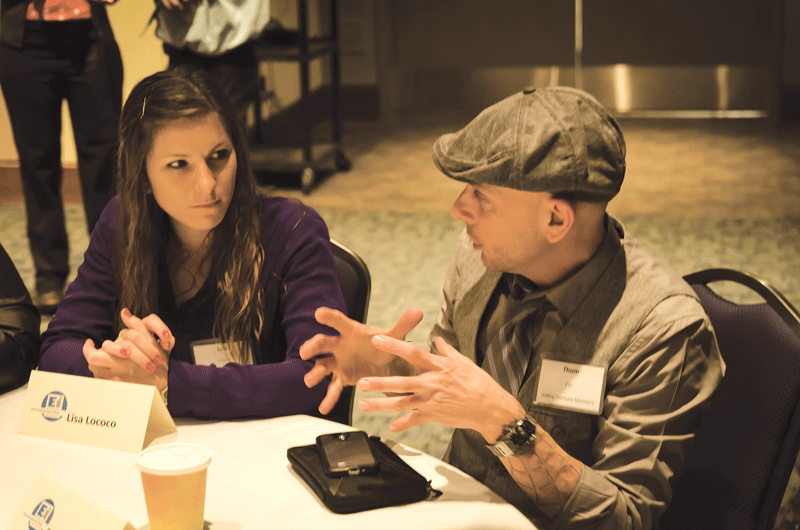
The 9th Annual Grinspoon, Garvey & Young Entrepreneurship Conference, with the slogan “Ignite the Dream, Embrace the Journey,” was staged Nov. 1 at the MassMutual Center. The day-long conference featured 500 faculty and students from 14 colleges and universities across the Pioneer Valley and included teamwork and breakout sessions that took a closer look at how one goes about starting, growing, and ultimately succeeding in an entrepreneurial venture, securing funding and support for a business, and product development. At left, Thom Fox, right, with Valley Venture Mentors and BrunoFox Group, speaks with
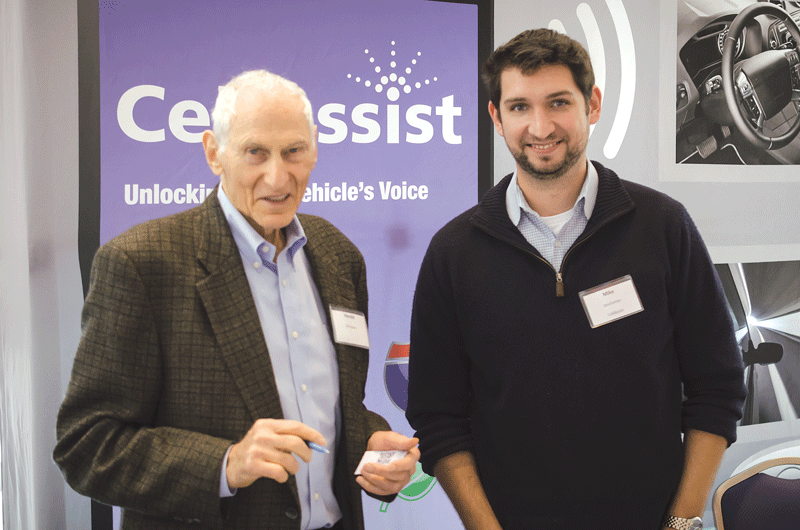
Lisa Lococo, also of Valley Venture Mentors and American Eagle Cycles Inc. At right, Harold Grinspoon (left), founder of the Harold Grinspoon Foundation, and former Grinspoon Award winner Mike Deschamps, from Cell Assist.

Valley Talent
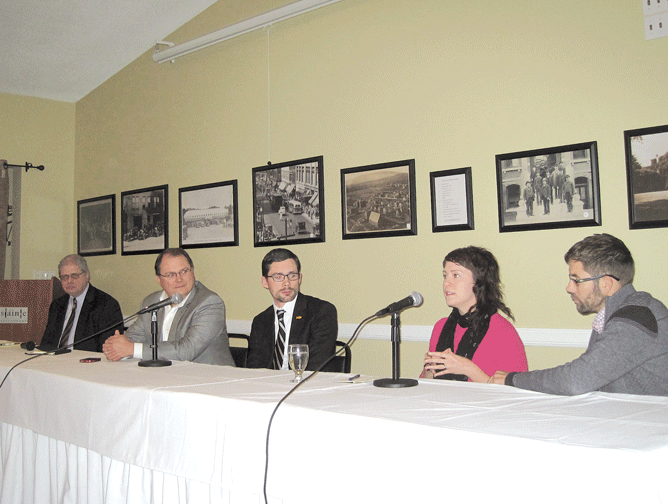
YPSpanelBusinessWest Editor, George O’Brien recently moderated a special Young Professionals of Greater Springfield (YPS) CEO Luncheon co-produced by YPS and Northampton Area Young Professionals. The event, held at Slainte! Restaurant in Holyoke featured local young entrepreneurs, and those that support them, as they discussed what steps the Pioneer Valley needs to take to foster entrepreneurship and cultivate talent. O’Brien, far left, is pictured with panelists (from left), Scott Foster, partner with Bulkley Richardson and co-founder of Valley Venture Mentors; Kara Martin Snyder, owner/chief coach, Vital Corps, Holistic Living for the Modern World; Delcie Bean IV, president, Paragus IT and Valley Technology Outreach; and Justin Pelis, owner, North Country Landscapes & Garden Center.

Education Sections
Square One Returns to Its Roots in the South End

Joan Kagan

After more than two years of turmoil, Joan Kagan says Square One is happy to be back home in Springfield’s South End.

Joan Kagan says she never really settled in to her office at what is now known as the Business Growth Center in the Springfield Technology Park across from STCC.
She made it comfortable, finding some non-matching office furniture from various sources — including a table to replace the cardboard box that her printer sat on for months — and securing a print depicting landmarks at her alma matter, Columbia University, that was intended to somehow fill in for the diplomas that were lost when a tornado tore down Main Street in Springfield on June 1, 2011 and essentially leveled Square One’s facilities there.
But the suites in the growth center that housed several administrators with Square One, an early-education provider with facilities in Springfield and Holyoke, were always intended to be temporary, said Kagan, adding quickly that she knew going in that this is, indeed, a relative term.
And as it turned out, the stay was less temporary than she hoped, a development forced by another calamity roughly a year ago — the natural-gas explosion that took out another of Square One’s facilities, this one on Chestnut Street — and difficulty securing a place to rebuild in the city’s South End, the institution’s long-time home, because of speculation and relative uncertainty regarding MGM’s bid to locate a resort casino there.
But in what would have to be considered one of the company’s rare instances of good fortune lately, space unexpectedly became available for lease at 1095 Main St. (the former Grape Vine liquor store), just a block or so from Square One’s former location. A few months ago, elaborate ceremonies were staged to mark the opening of the company’s Family Square center, a family resource facility, on the first floor of that three-story property, and by March, Kagan expects other programs and personnel to be moved into the renovated second floor.
The 14,000-square-foot facilities are not exactly what Square One leaders had in mind as they conceptualized plans for the next chapter in the institution’s history following the tornado, Kagan noted, adding that the preference was certainly for new construction and ownership of the eventual new home. But they represent a chance to return to the South End, which has been home since the late 19th century, and an opportunity to bring back together programs and employees that had been scattered after the twin calamities.
“It’s exciting to be back in the South End — that’s our home,” said Kagan, adding that relatively long-term leases (five years for the first floor and seven for the second) have been inked, giving Square One time and opportunity to determine what ‘home’ will be in the years and decades to come.
Much will be determined by if, where, and how the MGM facility — now the only casino proposal for the Western Mass. region still on the table — takes shape.
For now, though, Square One is focused on the immediate future and proving John Updike wrong when he wrote “you can’t go home again.”
Back in September, there was a different kind of literary look and feel to the grand opening at 1095 Main St. Indeed, students, in a nod to that classic line from The Wizard of  Oz, wore T-shirts that read “there’s no place like our new home.”
The ceremonies came a tumultuous 27 months after the June 2011 tornado changed the landscape on Main Street. The Square One facilities there were so extensively damaged that they had to be torn down.
Programs and personnel were then relocated to a number of sites, said Kagan, listing facilities on Wilbraham Road, the MCDI building on Wilbraham Avenue, and, eventually, the Technology Park at STCC, among others. “We put people anywhere we could find a desk and an office.”
After a short period devoted to stabilizing operations, preliminary planning for building a new, larger facility in the South End commenced.
This was complicated by delays in obtaining an insurance settlement, but moreso by MGM’s announced plans to build an $800 million casino in the South End, mostly on underutilized, vacant, or tornado-damaged property directly across Main Street from Square One’s former home.
“We had owned one piece of property, and we were looking to expand that piece of property,” Kagan explained. “But people were talking to MGM, and MGM was optioning some land; people were hoping that MGM would come to them and make them an offer. There were simply too many moving parts for us to do anything.”
Plans then shifted, with a new goal of finding property to lease, she went on, adding that it was serendipitous that the property at 1095 Main St. became available when a tenant slated to move in backed out of the deal.
In August, Square One opened its Family Square center, as well as one 20-student preschool classroom. The center houses a number of what Kagan called “parent education support services,” and also hosts a number of programs and services, such as a group for mothers of 5-year-old children.
There are also computers at the facilities, on which parents can search for jobs, she said, adding that the new location on Main Street enables Square One to expand services offered at the center and bring under one roof a number of programs and initiatives that were scattered across the city.
And with a new home secured, Square One officials can continue efforts to realize the growth that was anticipated in early 2011, but then essentially shelved due to the loss of facilities from the tornado and gas blast.
Elaborating, Kagan said the company had planned to bring an additional 200 children into its expanded facilities on King Street in Springfield, but that additional capacity was absorbed by the displacement of students following the tornado and gas explosion.
“Those events essentially blew my business plan out of the water,” she said, adding that process of rewriting that document is ongoing.
Growth opportunities will likely accompany an MGM casino in the South End, she said, adding that provisions for day care for the children of employees are part of the agreement between the city and the corporation, which has already had preliminary discussions with Square One about where and how to provide those services.
Meanwhile, possible expansion into Union Station, which is currently undergoing extensive renovations, remains a possibility, she said, adding that a child-care facility has long been one of the potential reuses of the station — because of its location and the public transportation that will be based there — and it remains an option for that landmark.
Looking down the road, Kagan said she’s not sure what Square One will do long term, again, because of the uncertainty regarding the MGM proposal, how it will take shape, and what additional property the casino giant may acquire.
But she says the company is committed to the South End, and to being part of that community. And as it goes about writing that next chapter, Square One will adhere to a philosophy that was actually in place long before the tornado roared down Main Street, but has been reinforced by the events of the past few years.
“We never gave up … we simply said, ‘this is what we’ve got, now how do we move forward given that this is the reality?” she explained. “One of our mantras has always been to be solution-oriented; there’s always a solution, and you just have to get creative and figure it out. But it’s there.” n

— George O’Brien

Commercial Printing Sections
Commercial Printers Emerge Strong from Recession Years

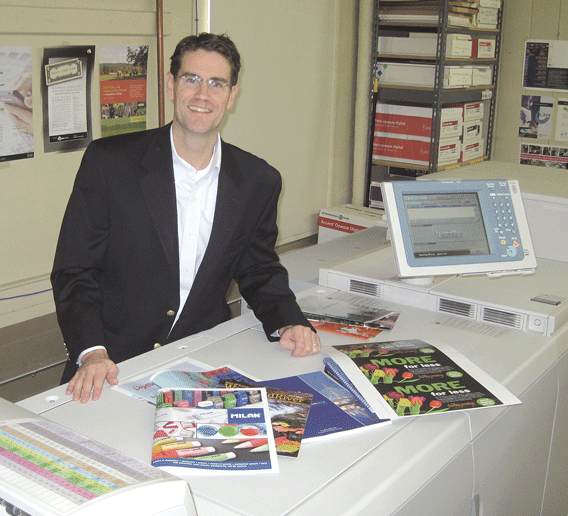
Greg Desrosiers

Greg Desrosiers says adding digital services at Hadley has opened up significant opportunities with small-run projects.

While many industries are still feeling the aftereffects of the Great Recession, commercial printers are telling a different story.
“It’s been very strong,” said Greg Desrosiers, vice president of sales at Hadley Printing in Holyoke. “When the economy first started to tank, printers, as a whole, were among the first to feel it. We really felt it back in early 2009. We, along with many other printers, felt people were holding back on expenses they normally would not have held back on, because there was a lot of uncertainty.”
However, he told BusinessWest, “I can say all that is truly behind us. People are moving forward, and the past two years have been very, very strong from a production standpoint.”

TigerPress, which recently celebrated its 28th year in business and moved two years ago from Northampton to a larger facility in Easthampton, reports a similar surge in volume.
“We moved because we had expanded, and we had two different production facilities,” CEO Jennifer Shafii said. “We finally found a building where we could house both. It was very important to be under one roof.
“Our clients are kind of across the board,” she added. “Large clients, small clients — we take care of everyone. We do everything from offset-print magazines to business cards, to package printing on boxes and folded cartons. We have a very wide range of printing capabilities here. And it has been a good year. We’ve been growing steadily since our move to East Longmeadow.”
Stephen Lang, president of Curry Printing in West Springfield, has also enjoyed a strong year. He said his company has made a concerted effort to stay away from ‘commodity’ jobs — like business cards and postcards — that people can have produced just as easily on the Internet.

Jennifer Shafii

Jennifer Shafii says TigerPress has been a regional leader in environmentally friendly printing.

“We’re concentrating on specialized projects and tight-deadline projects, not commodity-type printing that’s more cheaply done if you’ve got the time to go online and do it. A lot of our work is time-sensitive and requires more human contact than just plugging things in online; that’s what’s keeping us busy.”
Curry has also thrived through diversity, as evidenced by its growing niche in large-format printing.
“The sign business is coming into its own. We’re doing more large-format digital stuff, more sign work, and more trade-show graphics,” said Lang. “A lot of times, someone going to a trade show not only needs cards but signage as well. We’ve become the one-stop shop, able to provide everything they need.”
Reflecting his store’s growth, Lang recently moved Curry from its longtime storefront on Elm Street to a larger facility on nearby Union Street, complete with 1,000 square feet of extra space and indoor bays to install vehicle graphics.
“We’ve always done vehicle graphics, but waiting for a nice day in New England is not always the best way to schedule an install,” he said with a laugh.
Steve Lang

Steve Lang says one key to success today is diversity of services, such as Curry’s niche in large-format printing.

The Internet has changed a print shop’s needs when it comes to visibility, he added. “When we first started, it was important to be on a main road and be easily found. But it has become less important with workflow the way it is now. A lot of people, instead of walking through the door, just upload their files.”

Lean and Green
Hadley Printing has changed with the times in some ways, too, said Desrosiers.
“We’re now closing in on our second year offering a digital print service — digital, short-run, high-end printing. If someone wants to do 1,000 postcards, instead of having to go on the printing press, we offer that digitally, and it’s a very economical avenue,” he explained. “It’s been a huge bonus for us and really opened a segment of business we struggled with for a long time — how do you fire up the printing press for 1,000 postcards?”
He noted that many clients would much rather order small runs of a product four times a year then order in bulk once a year, which clashed with Hadley’s focus on larger-run projects.
“It’s tough, because in printing, the commodities of scale are always there,” he said. “If you know you’re going to use 5,000 brochures in a year, it’s so much cheaper to just order 5,000 of them. But people fear something might change in the brochure — they might edit employee information, for example — so they feel more comfortable ordering in smaller batches. That’s where digital has its strengths. We’ve been marketing it just as we do offset printing, with all the same proofing and delivery to your door as with offset.”
While offset printing still represents 80% of Hadley’s business, Desrosiers said, he’s pleased that the company is now able to take on smaller jobs that don’t utilize offset technology. “One of the things printers struggle with is, how can you make it financially worth your while to produce 100 of this and 100 of that? But we’re doing it, and it’s opened up some really nice opportunities for us, some new avenues that were never there before.
“With the influx of digital printing,” he continued, “if someone only wants 25 of something, we can do it. Four years ago, I wouldn’t have been able to do that; we only did jobs of 500 and up. I don’t have to say that anymore, which is nice.”
TigerPress, meanwhile, has increasingly come to the forefront as a ‘green’ printer, Shafii told BusinessWest. Her husband, Reza, the company’s president, recently updated his book on the subject, Go Green on Your Next Print, and they both “take pride in being eco-friendly and being environmentally conscious,” Jennifer said.
The changes TigerPress has implemented over the years range from chemical-free plates to vegetable-based inks.
“We were one of the first printers to be eco-friendly,” she said. “We were the leader of the pack for green printing. I think it’s important, both for both me personally — I have kids, and we should all be responsible for the environment in every industry — and our customers appreciate it too.”
Shafii said offset printing has been more amenable to eco-friendly practices than, say, digital printing. “A lot of people feel that digital printing is green, but it’s not that green. With offset printing, we use vegetable ink as our house stock. We use chemistry-free plating systems, so we’re not putting chemicals into the environment. With digital, you’re very limited in paper stock, and you have to buy the toner, which is not green.”
Shafii said customer response to the company’s green image has been heartening, “but a lot of our success is due to the quality of our products and the quality of our service. We get a lot of repeat business because people are happy with the service they get at TigerPress.”

In Demand
To keep customers happy, Lang said, today’s printers are expected to adhere to much more rigid time demands. Part of the change has to do with companies that set deadlines for marketing campaigns or other types of projects, and when different stages of the project fall behind the timeline, the printer is expected to make up the difference. He understands that business reality, and has marketed Curry as a shop that will take on time-crunched — even same-day — jobs.
“What happens is that, in the planning stage, maybe printing is the last thing that has to be done,” he said, citing the example of, say, a playbill that has to be produced before a show opens. “We’re used to the tight deadlines, the drop-dead deadlines. We’re down at the end of a lot of planning, and we usually have to pick up the slack and make sure it gets done.”
And there’s no shortage of work out there to get done, Desrosiers told BusinessWest.
“There’s this whole buzz out there — is printing dead? is printing going away? — because of the whole digital world,” he noted. “If anything, it’s starting to show its value as a whole other channel. It has its strengths, its worth, and its place.
“As an example of that,” he said, “you can send out these e-mail blasts, but e-mail is becoming such a congested channel. If you look at it as a highway, it’s a congested highway. Yes, you can send it out, and there are economies to it, but people are not opening it and reading it because they’re getting so much in their box. With printing, you can send something to someone they can hold and touch and read when they want. It has value. And the more and more congested that digital arena becomes, the more valuable print will become.”
And not just the print products people can produce at home or in their offices, he added.
“When people are doing something in print, they really do want it done well, because it’s representing their corporation,” Desrosiers said. “When you print something off a personal desktop printer, if it doesn’t have that crispness and sharpness and classiness you get from a commercial printer, and that can really do your business more harm than good.”
He compared that scenario to a non-mechanic who tries to fix his own car, insisting that, just as skilled mechanics will always be in demand, so will high-quality commercial-printing services.
Shafii agrees. “Because of the recession, a lot of printers went out of business, sadly for them,” she said, noting that there was a proliferation of shops over the past two decades — probably too many for the regional market to sustain. “But we’re still going strong, and we have a lot of repeat customers, because they like what we do.”

Joseph Bednar can be reached at [email protected]

Commercial Printing Sections
Pittsfield-based QualPrint Builds on a 50-Year Run of Success

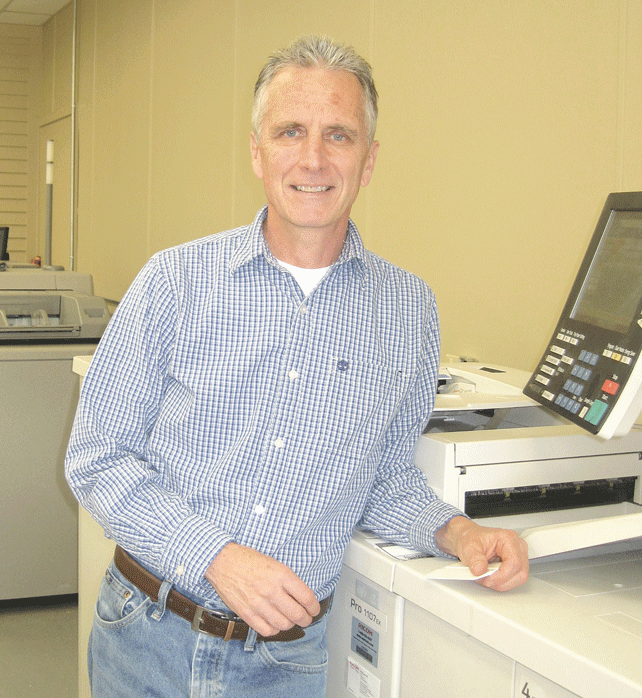
Nick DiSantis

Nick DiSantis says Qualprint has long maintained a commitment to staying on the cutting edge of new printing technology.

Nick DiSantis likes telling what’s become a long-running joke regarding his father, John, and the latter’s ‘retirement’ from the Pittsfield-based family business, Quality Printing Co. Inc., or QualPrint, as it’s branded.
John, still the CEO of the company (there’s the punchline, sort of), said he’d retire once he was able to get his hands on the highest award in the international graphic arts industry — the Benjamin Franklin Award, referred to those in the print business as ‘the Benny.’
As luck would have it, in 2011, Nick, who serves as vice president, received two Bennys for a project he oversaw, and that significant event presented him with the opportunity to hand the golden hardware to his father and gently nudge him out the door.
“But he said, ‘I wanted one, not two Bennys,’” DiSantis said, laughing. “So he’s still around.”
And like his father, also named Nick, the founder of the company, who never really retired until his passing in 1998, John believes he will always be on site.
“I guess the ink is in our blood,” added Nick, as he gave BusinessWest a tour of the 30,000-square-foot QualPrint plant, along the way offering family lessons and deep insight into this industry and its future.
He said it all started in 1963, when his grandfather ran what was — for a few years, at least — a one-man show with a single printer, an operation that billed just under $200,000 that first year. Now celebrating its 50th year in business, QualPrint billed roughly $8 million in 2012.
John took over running the company in 1981, and expanded operations into the current location in 1988. And after working in every position possible in the growing shop, Nick joined the company in 2007 after earning a degree in business administration from the University of Rhode Island and master’s in print media from the Rochester Institute of Technology.
The merging of what Nick calls his grandfather’s and father’s “old-school” knowledge of printing (and the world in general) with his “new-school” high-tech training and outlook is creating an interesting mix of calculated decisions that are serving the company well as this sector emerges from the Great Recession.
John and Nick have continued and built upon the founder’s attention to waste reduction and waste disposal — specifically, the effects of chemically treated products on the environment, a priority long before the words ‘green business’ or ‘recycled’ came into vogue. From solar panels covering the plant’s roof to a state-of-the-art vacuum system that captures pretty much every piece of scrap paper, QualPrint is making an eco-friendly stamp in an industry that has not been known for being green.
For this issue and its focus on the commercial printing industry, BusinessWest takes an in-depth look at this third-generation business that has seemingly always been ahead of its time and not afraid to take some risks to amplify its responsibility to the environment, while still providing a quality product at a competitive price.

Pressing Need
“In the digital age, people always say, ‘print is dying,’ and it’s not that way,” said Nick DiSantis. To provide evidence of this, he pointed to a section of QualPrint’s plant that is filled with glossy magazines, annual reports, postcards, posters, brochures, and direct-mail campaign pieces, in addition to the 15 million pieces of mail the company sends out per year.
With a wide array of clients, 98% of QualPrint’s work involves marketing materials, mostly for educational institutions — prep schools, colleges, and universities — as well as financial-services businesses and Fortune 500 companies.
He called the commercial-printing field a billion-dollar industry that, while growing at a snail’s pace, is growing nonetheless, and most of those that were able to ride out the Great Recession and embrace new technology are not only surviving, but thriving.
When he started full-time with the family business in 2007, the economic downturn was just getting started. He said the timing was actually a good thing, although the changing business climate was admittedly scary.
“It was a time where our company, like so many others, was seeing clients put on the brakes, and everyone had to act fast and act lean,” DiSantis said, adding that his father “sort of” joked back then that, when faced with a problem that big, you have to “forget about the arms and protect the core.”
To do so, the company mastered the art of doing more with less, which allowed QualPrint, and the younger DiSantis, to learn how to analyze the business in the toughest of times, and find its way through a housecleaning process to a new day of success. Thankfully, business started picking up in 2010.
Paying detailed attention to new technology in the marketing realm, DiSantis said QualPrint has carved out a niche as a firm that can “turn garbage into gold,” adding that the term ‘garbage’ doesn’t refer to the client quality at all, but is similar to that of an accountant receiving a shoebox full of receipts in early April. QualPrint will receive a dozen different lists of names and addresses in various file formats and make it all fit, essentially turning the company into not only an offset and digital commercial printer, but one that completes variable data, mailing, and fulfillment.
“People hand these projects off to us, and they don’t have to touch them; they just drop them off and forget about them because we’ve got the expertise in house to massage things and make then come out the way they hoped,” said DiSantis.
Offering digital services since 2001, the company spent a few risky years with a press that was too high-end for small-run client needs, but it now has an efficient and economical printer that offers saddle-stitching booklets.
DiSantis said QualPrint’s biggest challenge is keeping up with technology in an industry that is always trying to perfect processes, be more environmentally friendly, reduce expensive waste, and cut overall costs. All of that is capital-intensive.
The presses themselves cost millions of dollars — the company currently has three large off-set presses, one digital printer, and various inkjet proofing printers — and one of QualPrint’s competitive advantages, he said, is that it has always invested heavily to stay up-to-date with technology.
“Nothing in here is over five years old,” he said, adding that it’s a plus for the 48 employees who are working with, or on, the latest and greatest commercial-printing technology.
The company also recycles tons of paper on-site every month and collects scraps through a vacuum system that sucks up excess at each cutting station. Recycling continues with the aluminum printing plates, a practice that started in the ’60s with his grandfather, who refused to just throw out plates with chemicals on them or pitch used paper.
Always looking for the most environmentally friendly process with the least amount of energy consumption that is still economical and creates a superior product, QualPrint is testing a chemistry-free or ‘processless’ method of printing materials. But the current chemistry-free technology, available since 2007, is not yet up to QualPrint’s standards, said DiSantis, adding that clients like European carmaker Maserati, banks, and elite universities demand the highest in quality for their marketing materials.
One of the more expensive investments the company has made — the installation of 700 panels on the roof in 2009 — is now paying off, he noted.
“We’re unique among a lot of manufacturers and our competitors because a lot of companies will buy renewable energy — and they’re basically purchasing renewable energy ‘credits,’” he said, but not many of them actually produce renewable energy onsite. “We actually talk the talk with our solar panels, which produce about 30% of our electricity onsite.”

Stamp of Approval
With only 30% of QualPrint’s business from the Berkshire region — its market is literally the world — and certainly clients that appreciate a company that does business with a conscience.
“Today, the world is flat,” which has both benefits and drawbacks, DiSantis said. “It’s a good thing because you can compete anywhere in the world; it’s a bad thing because you’re now competing with the rest of the world.”
But this has never been a company afraid of competition, or of taking risks to position itself for continued growth and, not coincidentally, those two Bennys.
QualPrint’s been on a roll — in every sense of that word — for a half-century, and it has taken the necessary steps to make sure that continues well into the future.

Elizabeth Taras can be reached at [email protected]

Law Sections
Modern Technology Results in a Number of Novel Legal Issues

By KATHERINE McCARTHY
There is no question that communication has become more convenient and accessible due to advancements in technology. Computers, mobile devices, and other types of electronics play a significant role in much of our daily lives. But the everyday use of such modern technology has resulted in many complex and novel legal issues.
This article will highlight the particular issues the use of electronics presents in family-law cases, and what every spouse anticipating or involved in a divorce proceeding should know.

Electronic Evidence
Technology has changed the face of traditional evidence. Common types of electronic evidence attorneys routinely come across in their practice include information obtained from social-media sites (Facebook, Twitter, MySpace, LinkedIn, YouTube), global positioning system (GPS) tracking, text messaging, e-mail, blogging, files stored on a computer, and websites.
These types of electronic evidence are increasingly being introduced into family-law cases. For example, in the context of a highly contested divorce case, a family-law attorney is aware that a wealth of relevant information may be gleaned from the opposing party’s public Facebook or other social-media page. Too often, spouses do not realize the implications of posting comments and pictures on social-media sites. A spouse could easily damage his or her credibility in a divorce proceeding by posting questionable content on social media.
In a divorce case, custody is often an issue that is front and center. If, for example, a parent appears in pictures or makes comments on Facebook that suggest overindulgence in alcohol or other substances during his or her time with the parties’ child, this could negatively impact that parent’s request for custody. More generally, it is important to recognize that anything published on a social-networking site can resurface in litigation, and can have a negative impact on the parent or spouse’s credibility before the court.
Deleting a particular comment, message, or picture from a social-media site may not be enough. It is, perhaps, not surprising that technology exists that can resurrect information a person mistakenly believed had been successfully deleted from a website or computer hard drive. Similarly, changing one’s Facebook security settings to private is not enough because the user’s information could show up on the Facebook pages of those on their ‘friend’ list who have not made their pages private. Social-media account records can also be subpoenaed for use in a court proceeding.
Additionally, individuals should be aware that posting derogatory or negative comments about their spouse on a social-media site could have legal consequences. Such comments could result in an unnecessary defamation lawsuit, or, depending on the severity of the circumstances, a lawsuit for harassment or infliction of emotional distress.
The point here is that individuals involved in family-law disputes must be extremely careful before publishing anything on social media. As a best practice, spouses should refrain altogether from publishing any information about their pending case, their spouse, or anything else that could negatively affect his or her credibility before the court. If an individual has already posted such information, they should take the material down immediately to mitigate any potential repercussions that may follow.

Privacy Concerns
Another increasingly common issue in family-law cases concerns one spouse surreptitiously monitoring or spying on the other spouse. Emotions can run extremely high during a divorce, and some individuals have an inclination to spy on a spouse whom they suspect is behaving poorly, perhaps believing that discovered information may give the spying spouse an upper hand in a divorce. However, these individuals fail to recognize that their actions are oftentimes in violation of the law and could make them susceptible to serious ramifications.
It is true that privacy and wiretapping laws tend to vary from situation to situation. Even so, all too often spouses incorrectly assume that, because they are married, it is OK to log on to their spouse’s social-media and e-mail accounts or look at their spouse’s cell-phone content. It is important to understand what types of actions are potentially illegal.
In the electronic age, spying has become much more sophisticated. An increasing number of people are utilizing spyware technology to monitor their spouses’ online activity. Spyware is software that may be uploaded onto a computer, enabling a user to monitor and track the web activity of a specific person. Spyware software is available at retail stores and online for a modest cost. Once uploaded, the software is often difficult for the novice computer user to detect.
What many people do not know is that Massachusetts has adopted several protective privacy and wiretap laws that carry both civil and criminal penalties for violations. Uploading spyware software to a spouse’s computer, even if that computer is shared with the spouse, could run afoul of these laws. Further, just because one can purchase spyware online or at a retail store, that does not necessarily mean that the software may be legally used to monitor a spouse’s web or cell-phone activity. Illegally obtained evidence not only raises ethical considerations for the spying spouse’s attorney, but such evidence will likely be kept out of a court proceeding by a judge, rendering it useless.
Individuals also too often have the misconceived notion that it is permissible to secretly hack into their spouse’s e-mail, cell-phone and social-media accounts, and are surprised to hear that what they are doing could be illegal. A typical scenario a family-law attorney may encounter involves a client who feels strongly that, because they are still married, he or she is free to monitor the other spouse’s communications.
Similarly, because two spouses share a computer, one spouse may feel justified in monitoring the other spouse’s Internet activity. However, it is illegal under both Massachusetts and federal law to gain unauthorized access to a computer system. Individuals should be aware that logging onto their spouse’s online accounts and viewing his or her e-mails or messages without permission could subject the spying spouse to criminal penalties. This is especially true if the spied-on spouse maintains exclusive control over the device or if the account is password-protected. Further, as a general rule, secret video or voice recording of another person, even a household member, is illegal.
The current state of the law regarding unauthorized access to a spouse’s cell phone is less clear. Courts have recognized a diminished expectation of privacy between spouses, which means that what may be deemed an offensive invasion of privacy between non-married persons may not be recognized as such between spouses. But it is important that individuals are aware that the trend in Massachusetts courts is toward protecting the privacy of individuals, including individuals within a marriage. Hence, just because a spouse guesses or secretly learns the password to the other spouse’s cell phone does not mean that it is permissible to view its contents. Additionally, cell phones, particularly smartphones, are similar to computer systems. Courts could interpret the unauthorized access of a cell phone as falling within the purview of the law prohibiting the unauthorized access to a computer system, resulting in possible criminal liability.
Very often, information obtained by a spying spouse involves the other spouse’s extramarital affair. However, proof of adultery in and of itself does not hold much weight in a contemporary divorce action in Massachusetts. Hence, the risks simply outweigh the benefits in most cases.

What Everyone Should Know
Family-law cases are emotionally charged proceeding. Rational people may display seemingly irrational behavior in the midst of a highly contested divorce. That is why it is important for everyone who is party to a divorce to have a clear understanding from the outset of proper use of electronics and social media. Information about a pending divorce or child-custody issues simply should not appear on social-media accounts. Individuals should also avoid posting anything that may be harmful to their case.
And no matter how tempting it may be to secretly monitor a spouse’s e-mail, social-media accounts and cell-phone contents, doing so could expose the spying spouse to criminal or civil penalties. Anyone considering taking any such action should refrain from doing so and consult a qualified divorce attorney.

Katherine McCarthy works at Robinson Donovan, P.C., where she concentrates on domestic relations. She received her J.D. from Northeastern University School of Law in May; (413) 732-2301; kmccarthy@robinson-donovan

Health Care Sections
Surging Need Prompts Expansion of Sr. Caritas Cancer Center

This planned 20,000-square-foot expansion to the Sr. Caritas Cancer Center

This planned 20,000-square-foot expansion to the Sr. Caritas Cancer Center will allow Mercy Medical Center to offer more comprehensive cancer treatment.

When the Sr. Caritas Cancer Center opened its doors in 2003, the 16,000-square-foot facility effectively doubled the cancer-treatment capacity of Mercy Medical Center, the heart of the Sisters of Providence Health System (SPHS), and specialized in the growing field of radiation oncology.
There was probably little thought then that a major expansion, one that would more than double the current footprint, would be needed less than a decade later. But in the ever-changing realm of cancer treatment, much can happen in just a few years.
In this case, advancements in the field of medical onology have precipitated an explosion in need for those type of services. At the same time, Mercy has joined forces with medical oncologist Dr. Philip Glynn, in a venture that has brought both great opportunity and a stern challenge: a pressing need for more space.
The latter is being addressed with a $15 million, 20,000-square-foot expansion that will increase the number of chemotherapy treatment bays from the current 10 to 32, while also providing the room, and flexibility, to handle projected needs for years to come, said Dr. Scott Wolf, who serves as Mercy Medical Center’s senior vice president of Medical Affairs, chief medical officer, and chief operating officer.
As for the former, Wolf said Glynn’s decision to merge his growing practice with Mercy Medical Center’s medical oncology services provides the institution with an opportunity to achieve much greater balance in its efforts to provide the two major cancer-treatment modalities — radiation oncology and chemotherapy — and also take cancer-treatment services to a much higher level.
“Our goal is to establish ourselves as a center of excellence in comprehensive oncology care,” Wolf told BusinessWest. “Building on the already-existing expertise in our radiation oncology, and then adding modalities and surgical oncology and subspecialty medical oncology, we will elevate ourselves as a center of excellence.
Dr. Philip Glynn

Dr. Philip Glynn serves as the cancer center’s new director of Medical Oncology, and has helped expand Mercy’s chemotherapy services.

“This has been Dr. Glynn’s vision, beyond just his practice, for several years,” Wolf continued.  “He first came to me about two years ago about creating a foundation of a more comprehensive oncology service line.”
Soon after that conversation, Glynn merged his private practice, Murray Glynn P.C., with Mercy Medical Center in June 2012.
“Our group of medical oncologists came together because we felt that collectively we could provide a more effective service to our patients and to this community,” said Glynn, who is now the director of Medical Oncology through Mercy Oncology Services.
This development created an immediate need for more facilities at Mercy, which was met by establishing 10 temporary infusion bays at the nearby Weldon Center for Rehabilitation.
While this was taking place, MorrisSwitzer – Environments for Health, a Boston-based architecture firm that focuses exclusively on the healthcare sector, began designing an expansion of the Caritas Center.
Groundbreaking is slated for next spring, and the facility is expected to open in late 2015, said Wolf. Funding for the expansion will be derived through a variety of means, including a working capital loan from Trinity Health (the second-largest Catholic health system in the country), a forthcoming capital campaign, and future operating revenue from the new center.
While the architectural plans and the new expansion layout are complete, the bid requests for construction management will go out soon.
For this issue, BusinessWest takes an in-depth look at the plans to expand the Sr. Caritas Center, and also at what this development means for Mercy and SPHS as the system works to expand its presence in cancer treatment.

Supply and Demand
As he talked about the changes and developments that put the Caritas Center expansion plans on the drawing board, Mark Fulco, senior vice president of Strategy and Marketing for SPHS, started with some rather sobering statistics regarding cancer in this country.
He said that analysis of data provided by the state Department of Health, national statistics, and interviews with consumers and community leaders reveals that the demand for medical oncology services is expected to increase by 11% over the next 10 years.
The aging of the nation’s population is a big factor in these estimates, but there are other factors that point to heightened demand both nationally and especially in this region, he went on, citing a smoking rate of 23.8% in Greater Springfield, nearly double the national average of 14.7%.
While these numbers indicate that Mercy was likely to eventually need more space and facilities at the Caritas Center, the recent merger with Glynn’s practice certainly accelerated that process, Fulco noted.
Wolf concurred, noting that this consolidation more than doubled the number of medical oncology treatments at Mercy, from roughly 3,000 per year to more than 7,000. And the expansion is designed to accommodate 30,000 annually.
“Phil is an incredibly gifted physician, and due to his presence in this community, he has an extremely loyal following,” said Wolf. “Oncologists as a whole are a special group of physicians, just because of the nature of their business, but Phil takes it to another level.”
The planed expansion will feature two floors of medical oncology services adjacent to the current single-story facility on the eastern side of the Mercy Medical Center campus that houses radiation oncology.
But there is much more to the expansion than additional square footage and infusion bays, said Fulco.
“What we’re putting together to meet greater demand for services is a truly comprehensive cancer center with cancer diagnosis, treatment, and other modalities, like support and our spiritual-care team, all in one place,” said Fulco. “The physicians will be in close proximity to each other so that it will further enhance collaboration efforts, with cancer being treated through a team approach.”
Elaborating, he said the new, enlarged Caritas Center will bring together what he called a talented team of clinicians.
Glynn is now responsible for all aspects of the medical oncology program and its activities, such as cancer prevention, screening, diagnosis, state-of-the-art treatment, counseling, and rehabilitation.
Glynn and his seven-member oncology team will be joined by Dr. Neal Chuang, the new chief of thoracic surgery, who is trained on the da Vinci S Surgical System, the latest in minimally invasive robotic-assisted surgery; Dr. Mark Sherman, also a thoracic surgeon and a new surgical oncologist; and Dr. Julia Donovan, a specialist in female reproductive cancers. Within the existing radiation department are Dr. Catherine Carton, the full-time director of radiation oncology; and radiation oncologist Dr. Mary Ann Lowen.
“Dr. Glynn has a very clear and progressive vision for where cancer care and interventions are going,” said Fulco, adding that Glynn’s keen interest in pursuing new interventions that aren’t currently available at Mercy, or anywhere else, for that matter, will see those new modalities being developed and eventually in use at the center.
For example, 10 years ago, when the current center opened, two linear accelerators (used for external beam radiation treatments) and intensity-modulated radiation therapy (IMRT) were hyped in the press as advanced technology; today, the team is proud of the two Elekta Infinity intensity-guided radiation-therapy machines, which are advanced linear accelerators (see sidebar, page 17), and are the only two of their kind in Western Mass.
Casting the net even wider, the business plan written 18 months ago by Daniel Moen, president and CEO of SPHS, with Wolf, Glynn and others, demands that the team be consistently aggressive in seeking new technology, new treatment modalities, and new relationships.
To that end, Wolf said the team is in the early stages of identifying a tertiary partner, one that would offer access to clinical trials, second-opinion expertise, genetic profiling, and many other services that will be demanded of a truly comprehensive cancer-care facility.
Fulco said this represents the type of forward thinking that is a very important motivation for Glynn, who also assists with the development and implementation of new program initiatives, such as cancer survivorship, navigation, community outreach, and clinical research/clinical trial participation.

Progressive Vision
Fulco told BusinessWest that, when plans were first put on the drawing board for what would become the Sr. Caritas Cancer Center, the overarching philosophy was to create a facility that would drive home the point that area residents did not have to drive to Hartford, Boston, New York, or anywhere else to receive quality cancer treatment.
Over the past decade, the facility has gone a long way toward proving that point, and the planned expansion of the center will only make it easier to make that argument.
“Except for the esoteric type of cancer that requires specialists who are just as rare and requires experimental therapies, the modalities that we have available to treat patients here are equivalent to the very best in the world,” said Fulco. “You don’t need to go to Boston or New York to get a leading-edge treatment.”

Elizabeth Taras can be reached at [email protected]

Departments Incorporations

The following business incorporations were recorded in Hampden, Hampshire, and Franklin counties and are the latest available. They are listed by community.

AGAWAM

Local Yo Inc., 103 Lealand Ave., Agawam, MA 01001. Anthony Surrette, same. Sales of frozen yogurt, desserts, and beverages.

AMHERST

Vision Hope USA Inc., 177 Henry St., Amherst, MA 01002. Andrea Crenshaw, 17152 SW Villa Road, Sherwood, OR 97140. Provide international relief and development aid and support to people in need in developing countries.

CHICOPEE

Ministerio Adoradora En Espiritu Y En Verda, 60 Alvord Ave., Chicopee, MA 01020. Norma Rodriguez, same. To get involved with different churches to expand my ministry.

EASTHAMPTON

Muttersohn Enterprises Corp., 103 Oliver St., Easthampton, MA 01027. Laura Singleton, same. Provide services as a non-profit entity for future endeavors.

FEEDING HILLS

B4 Race & Event Management Inc., 193 Coyote Circle, Feeding Hills, MA 01030. Wayne Robert Ball, same. Organize and host local events and road races.

HOLYOKE

J. Savage Inc., 4 Open Square Way, Suite 215, Holyoke, MA 01040. Jay Savage, 589 Pleasant St., Holyoke, MA 01040. Women’s apparel and accessories.

NORTHAMPTON

Hygeniks Inc., 74 Bridge St., Northampton, MA 01060. Todd Marchefka, same. Supply and distribute equipment, services, and systems for the biotech and pharmaceutical industries.

Integral Builders Inc., 225 Nonotuck St., Northampton, MA 01062. James Harrity, same. Real estate.

PITTSFIELD

Grant Technology Corporation, 2 South St., Suite 340, Pittsfield, MA 01201. Michael McCool, 266 Allengate Ave., Pittsfield, MA 01201. Consulting, patents, technology innovation.

King City Forwarding USA Inc., 216 Fort Hill Ave., Pittsfield, MA 01201. Michael Hilburn, same. Freight forwarding.

Lambda Prime Corp., 777 West St., 4th Floor, Pittsfield, MA 01201. Matthew Stack, same. Software and hardware development.

SOUTH HADLEY

Akamnonu Associates Inc., 11 Pittroff Ave., South Hadley, MA 01075. Oliver Akamnonu, same. Produce and market unique literature.

SPRINGFIELD

Harmonia Celestial Corp., 156 Florence St., Springfield, MA 01103. Julio Edwards, same. Church

M.L. Schmitt Leasing Inc., 371 Taylor St., Springfield, MA 01105. Thomas Schmitt, same. Equipment leasing company.

MLS Management Inc., 371 Taylor St., Springfield, MA 01105. Thomas Schmitt, same. Management company.

Pet Care Assist Inc., 23 Spruceland Ave., Springfield, MA 01108. Henry Lingley, same. Financial assistance to pet owners to provide urgent medical attention for their pets.

Springfield Pulse Inc., 11 Pearl St., Suite 234, Springfield, MA 01118. Phoebe Stewart, 64 East St., Chesterfield, MA 01096. Free resource providing accessible space for artistic expression.

WEST SPRINGFIELD

No Casino West Springfield Inc., 1127 Amostown Road, West Springfield, MA 01089. Nathan Bech, 84 Summit St., West Springfield, MA 01089. Educate and increase public awareness of the adverse health and social costs of gambling and associated detriments to the greater West Springfield community of any such casino.

WESTFIELD

Dhanlaxmiji Corp., 358 Southwick Road, Westfield, MA 01085. Dhruval Amin, 419 Southwick Road, L53, Westfield, MA 01085. Grocery and variety store.

WILBRAHAM

Baystate Holistic Health Inc., 16 Iroguois Lane, Wilbraham, MA 01095. Manuel Esteves, same. Holistic health services.

Law Sections
Royal LLP Helps Clients Get Down to Business

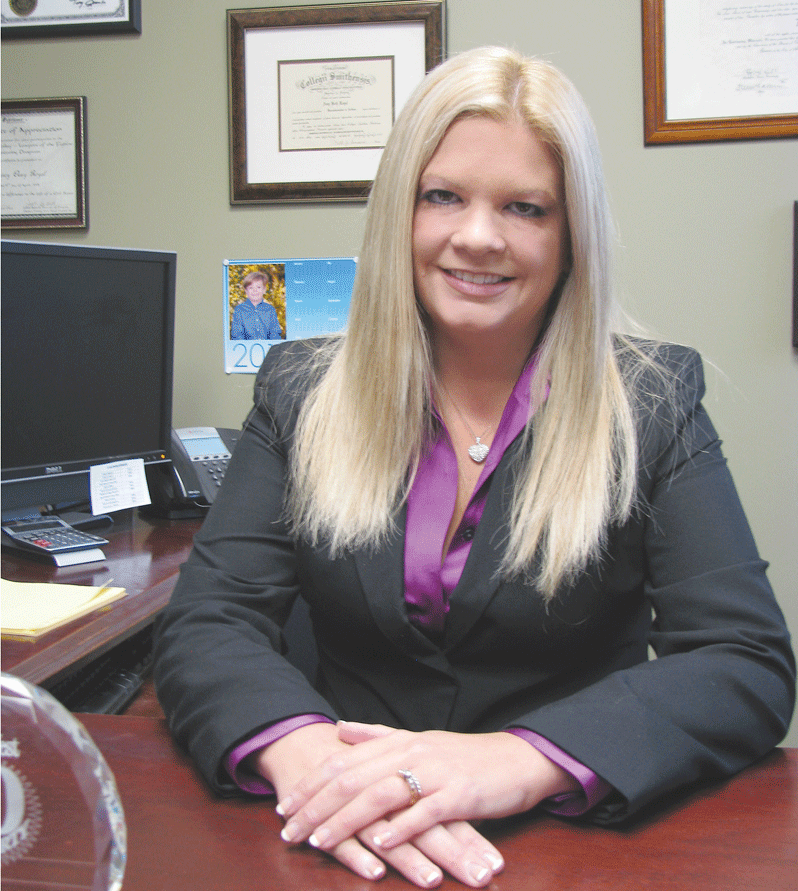
Amy Royal, founding partner of Royal LLP.

Amy Royal, founding partner of Royal LLP.

It’s an accepted trope that society has become more litigious, Amy Royal says, but not every business understands the implications of that fact.
“When someone loses a job, nine times out of 10, they don’t accept ownership or think it was anything they did, but it must be someone else’s fault,” said Royal, founding partner of Royal LLP, a Northampton-based, management-side labor and employment law firm.
“Unfortunately, our system makes it very easy for disgruntled employees to file claims against their former employer,” she continued. “You can go to a state agency and file for free. You can go to an attorney and engage their services without any real out-of-pocket costs. Because of that, numerous frivolous claims are filed every single day. A lot of people who may have engaged in misconduct are still able to take advantage of the system. It impacts everyone.”
Therefore, one service Royal provides its business clients is helping them to be proactive in a litigious world and develop practices that will save money and headaches in the long run.
“Documentation is key — and adequate documentation,” Royal told BusinessWest. “On the litigation end of things, when I get a case, I meet with the client and hear about how awful this employee was, stories of acts of misconduct, times they didn’t show up for work, and I think this is going to be a slam dunk. And I ask to see the personnel file, and there’s nothing in there to support that, or the documentation isn’t very good.”
So Royal teaches supervisors not only the importance of creating a paper trail, but how to write disciplinary actions that will stand up to scrutiny later on. “You’re writing it for the future — for courts, judges’ eyes, investigators’ eyes. What information do you want to put in there? It goes back to the journalistic principles of who, what, when, where … just stick to the facts.”
That’s one example of how Royal LLP aims to be a partner with its clients, not just a resource they turn to when they’re in legal hot water.
This month marks the five-year anniversary of the firm, which was launched first as Royal & Munnings — with Aimee Munnings, who now runs a large nonprofit organization in Washington, D.C. — and later as Royal & Klimczuk, with Kimberly Klimczuk, who currently works at Skoler, Abbott & Presser, P.C. in Springfield.
Since operating under her solo name, Royal has built a law firm of nine attorneys and has largely realized her initial goal “to create a pre-eminent management-side labor and employment law firm that would support the growth of women and minority attorneys.” Five full-time attorneys are women, and one is African-American.
“It’s really been my mission to provide these opportunities to women and minorities, primarily because, when I started my career, I didn’t see that support, or depth of support,” she recalled. “What prompted me in particular was a report that came out of MIT, around 2007 or 2008, that basically talked about the fact that women attorneys were leaving the private practice of law in large, startling numbers.”
She wondered why, then found the answer. “The women that MIT polled, who took part in the study, said there was no work-life balance in the law firms; they just didn’t support it. I thought, how can that be, especially with the technology today? With the way law firms are structured, a lot of the work can be done at any time, so why is that happening? There must be a solution.”
For this issue and its focus on law, BusinessWest takes an in-depth look at that solution and how this firm intends to stay on its current pattern of consistent growth.

Case in Point

Amy Royal (center, with Karina Schrengohst, left, and Tanzania Cannon-Eckerle)

Amy Royal (center, with Karina Schrengohst, left, and Tanzania Cannon-Eckerle) says she set a goal early on of establishing a law practice where women attorneys could succeed and still maintain a healthy work-life balance.

Royal said the economic downturn of the past few years caused many companies to scale back their budgets — in some cases, cutting out preventive work such as training, policy development, audits, and record keeping. But that’s not smart practice, she added.
“I’m a firm believer that, if you spend a little bit of money now, it goes a long way to prevent headaches later,” she said. “While I think I’m really good at putting out fires for clients and problem solving and coming up with innovative solutions immediately, from a business perspective, that’s not the way you want to operate. You don’t want to always be reacting.”
That applies to a wide variety of situations, not just dealing with disgruntled ex-employees.
“For example, fairly recently, I had a company that has always been union-free, and hopefully will continue to be union-free, but they’ve had some union chatter in their organization, and once that train gets going, it’s harder to stop.” So she worked with the client on strategies to reduce the risk of unionization.
“Obviously, there are steps you can take to prevent a union from successfully coming through the door,” Royal said, “but there are many steps you can take before they even arrive, and it’s so much harder to stop it once it’s already on that course than to think about the steps you want to take over the next year, two years, three years to prevent it from ever happening.”
The launch of her own law firm coincided with the financial collapse of 2008, and building a practice over the next five turbulent years has given Royal some strong ideas about what clients want.
“It got me thinking about the future of the law and trends in the law and the delivery of legal services,” she said. So, this year, the firm introduced a flat-fee system that can be structured in several different ways. “I do believe the trend is move away from traditional billable hours, because in what other field do you purchase a product without knowing what the price is going to be? It’s only human that people want certainty in their billing; they want to know what they’re paying for. So we’ve come up with different flat-fee programs; one is all-inclusive and encompasses litigation as well.
“Even some law firms that may be on the cutting edge and have decided to provide some flat-fee services, I don’t think they have done that in the context of litigation because litigation can be so unknown,” she continued. “However, since we have this niche in management-side labor and employment law, we’re able to predict the costs, and we’re able to provide a very reasonable flat-fee arrangement to clients, similar to what you get with insurance, where you share in the risk, so to speak.”

Navigating a Minefield
The risk for businesses comes in many forms, especially at a time when employment law is becoming more complex and tilting, in many ways, toward broader workers’ rights. For instance, the Americans with Disabilities Act of 1990 was amended in 2008 to define virtually anyone with any form of physical and mental impairment as ‘disabled,’ granting them added protection in the workplace.
“That has obviously created a lot of issues and uncertainties,” Royal said. “It’s also an area our state agencies and the Massachusetts Commission Against Discrimination have focused in on. They’ve taken the position that everyone is disabled, and therefore your company needs to be providing accommodations and engaging in dialogue with employees about what accommodations you can give them.”
Those issues can, frankly, be confusing for businesses, which often need a consultant like Royal LLP to train them in how to engage in that dialogue.
The training she and her fellow attorneys provide often takes the form of role-playing exercises with a company’s supervisory staffers, which can be a more effective learning tool than a dry lecture. “We’ve tried to make our trainings very practical and very interactive,” she said.
Other expertise the firm offers has nothing to do with litigation or employee grievance. For example, it helps companies create succession plans — not just for key executives, but for other critical staffers, such as a program manager for a nonprofit. “Do you have a plan in place to deal with the loss?”
The broad range of issues involved in employment law appeals to Royal, as do the long-term relationships she has built hammering out those issues for clients.
“We end up being their trusted business confidant, and that’s the really exciting thing,” she said. “We get to wear different hats — we get to be their advocate in court and litigate hard and aggressively for the client; we get to be their counsel that advises and helps them make plans that are both business-based and have legal implications; and we also get to be their educator, get to train them and their staff in how to stay out of trouble, or at least miminize their exposure to legal risk.”
The steps companies need to take might seem obvious, she told BusinessWest, but aren’t always followed in the day-to-day struggle to survive in a down economy.
“A lot of what I hear from management is there’s not enough time in the day to document issues, and I’m sensitive to that, because I run a business, too,” Royal said. “Again, if you go back to the training and the journalism approach of who, what, when, where, if you jot that down on a piece of paper, it’s not going to take you all that long, and it’s going to save you time in the long run, when you’re embroiled in litigation.”

Community Ties

As she builds the firm’s reputation in area communities — it has a second office in Springfield — Royal said it’s equally important to stay involved in civic life outside the workplace.
“Something I hope to instill in the other attorneys is being active in the community and giving back to the community,” she said. “It’s so important and so beneficial to everyone. So we do have a lot of our staff active in the community.”
Specifically, Royal serves on four different boards and chairs the United Way of Hampshire County, while the other attorneys are active on various boards or nonprofits. “It’s really important to me, and something that has really engaged the attorneys here and gets them to connect with our clients and the community in a different way.”
That’s the kind of work-life balance she knew was possible when she set out with a goal to establish, as she puts it, the pre-eminent labor and employment law firm in this region.
“I do expect additional growth, especially in the Connecticut arena,” she told BusinessWest. “Three of our attorneys are admitted to practice there, and I do have a Connecticut client base.”
Royal LLP has come a long way in just five years, but that doesn’t surprise its founder.
“That was my hope and my vision and my push. I’ve worked really hard to get the Royal name out there in every way I possibly could. So I’m really pleased, but I continue to make that push and want to continue to grow.”

Joseph Bednar can be reached at  [email protected]

Construction Sections
Baystate Dental, Craig Sweitzer & Co. Mark 30 Years of Growing Together

Dr. Kevin Coughlin (center), with Craig Sweitzer (right) and Sweitzer’s son, Michael

Dr. Kevin Coughlin (center), with Craig Sweitzer (right) and Sweitzer’s son, Michael, says a welcoming dental environment and state-of-the-art technology are both important elements in a dental practice’s design.

Craig Sweitzer’s company has built more than 75 medical and dental practices over the past 30 years. The first of those clients — Baystate Dental — is also the most recent.
BusinessWest recently sat down with both Sweitzer and Dr. Kevin Coughlin, owner of Baystate Dental, at the practice’s 10th location, which opened last week in a restored house in downtown Westfield. Craig Sweitzer & Co. has built the last nine of those offices, with two more planned for the near future, and the two men have shared what they call a rewarding professional partnership over the past three decades.
The story begins in 1983, when Coughlin was getting ready to take over Baystate Dental from its founders, Drs. Gabriel and Milton Auerbach.
“As they retired, I felt it was necessary to renovate and expand, and I knew what I wanted to do — I just didn’t know how it could be done and who could help me do that,” Coughlin said. At the time, Baystate Dental operated at just one site, on Main Street in Springfield.
“At the time, my dad, my father-in-law, and I attempted to renovate that initial practice, and realized we were out of our domain. We needed an expert contractor, someone we could trust and someone we could hopefully grow with over the years.”
He was introduced by a mutual friend to Sweitzer, who was in a similar position — that of wanting to broaden his business beyond residential projects and professional buildings.
“We did office renovations, and Kevin was the first medical job we did,” Sweitzer said. “It was fascinating. In a dental office, there’s so much plumbing and medical piping, mechanical piping, medical gases, X-rays — it’s so much more complex, and it keeps you thinking. It was a lot more fun — and it’s still fun 30 years later.”
He’s seen plenty of advances in medical-office construction over the years. “The equipment has changed. We no longer need to use lead-lined sheet rock, and everything is more gentle, more comforting for the patient, and less clinical-looking, although the technology has just advanced in leaps and bounds.”
Coughlin jokes that he might not have hired Sweitzer if he had realized just now inexperienced the builder was in the medical-dental field, but he’s glad he had no misgivings at the time.
“I immediately liked him, trusted him, and believed in him,” Coughlin said. “He set out with plans and designs to renovate that initial practice, with the goal that we wanted to give our patients not just a warm and wonderful atmosphere, but efficient, effective, state-of-the-art care in that welcoming atmosphere.
“With the combination of his building expertise and knowledge, and my knowledge of medicine and dentistry,” he continued, “we’re now pushing toward 12 dental practices in Western Mass.”

Family Ties
The history of Baystate Dental is the recent history of two families. When Joyce Mercadante was growing up in Agawam, her family befriended the Auerbach family; later, two of the Auerbach children, Gabriel and Milton, would go on to become dentists, and the Mercandante family became early patients of the new practice in Springfield.
Mercadante later married Ralph Coughlin and had two sons, whom the Auerbachs encouraged to enter the field of dentistry. After part-time and summer work in the Baystate Dental lab during high school and college, Kevin enrolled in the dental program at Tufts University School of Medicine. He returned to the region and the Auerbachs’ practice, gradually broadening his responsibilities, helping the practice expand into evening and Saturday hours.
After Coughlin took over the practice in 1983, he embarked on an ambitious expansion plan and, in 2003, added two partners in Drs. Gary Circosta and Matthew Haluch. The practice now employs 120 staff members, including 18 dentists, at its 10 locations, making it the largest private dental practice in the state.
Sweitzer’s emergence in the construction field started equally humbly. “I actually owned a furniture business before I graduated college — designing, building, and selling furniture in East Longmeadow,” he told BusinessWest. After that, he went to work for a general contractor for a couple of years before setting out on his own with small projects, mostly kitchens and bathrooms.
“That evolved to additions, which evolved to new homes,” he said. “That was fun, but after 15 houses, it’s just not as challenging anymore. And residential work is really susceptible to ups and downs in the economy.”
So he gradually moved into commercial work, particularly office construction, before trying his hand with medical facilities. Eventually, he left residential building behind completely. As a small company, “I really can’t do both and serve those customers. Building a house takes six months, and when a doctor calls us up and wants an office built, he wants it started next week, so we can’t say, ‘come back and see us in six months.’ So we went to all commercial.”

The new Westfield office

The new Westfield office is the first Baystate Dental practice to occupy a remodeled house.

His long-standing professional relationship with Coughlin has included building new dental facilities in Springfield, Belchertown, Chicopee, East Longmeadow, Longmeadow, Ludlow, West Springfield, Westfield, and Wilbraham. Baystate Dental’s other long-time partner is Patterson Dental, a national resource for equipment, supplies, and expertise in industry trends.
“With each project, we continue to find things to improve from the previous project,” Coughlin said. “And I trust him, so I don’t have to be there every week worrying, ‘is this getting done?’ It’s an enormous benefit to have that relationship, almost like a family member, where I don’t have to worry about it.”
Sweitzer agreed. “Our goal is to do the best possible project with the best possible products for the money. I know what Kevin wants; I don’t have to call him all the time. He trusts in me and gives me the confidence to make decisions I think are best for this practice.”
For example, at the new Westfield office, Sweitzer became concerned about the way the ceiling tiles in the operatories, or procedure rooms, reflected sound. Feeling that it created too loud an environment, he researched materials and softened the noise.
“I’m not always concerned about the best value or what’s easiest to build,” he said. In the case of the ceiling tiles, “we knew what we wanted, so it was easy for us to switch gears during construction without getting the architects or the designer involved in a big series of endless meetings.”

That’s a Mouthful
Coughlin said the dental public demands much more than it used to, both in technology and a pleasant practice environment.
“People want the best value, the best care, and the best service in the best surroundings,” he said. “But in the end, what they want is to trust their provider, and that comes from their first impression, what the facility looks like. Is it too glitzy, over the top, cold, and impersonal? Is it private?”
The look of a practice is just the beginning. “Thirty years ago, most practitioners wore no masks and gloves, no surgical scrubs. Infection control was almost non-existent,” he recalled. “Privacy matters, like with HIPAA, weren’t even an issue. Today, all of these things are not just important, but necessary.”
Sweitzer said the Westfield site reflects a commitment to both aesthetics and substance. “If you look in each of these operatories, the windows overlook a landscaped area, there’s soft music, everything is brand-new, extremely clean, extremely comfortable. Yet, behind the patient’s head is the most modern equipment imaginable — the most modern X-rays, medical gases … these operatories really do just about anything.”
Likewise, Baystate Dental has strived to do almost anything to get treatment to patients, providing services at home for non-ambulatory individuals and offering a broad range of sedation options even for routine treatments.
“Thirty-five percent of people refuse to see the dentist out of fear, and another 15% for financial reasons. That’s 50% of the marketplace that’s avoiding you,” Coughlin said. “By creating an efficient, effective environment and by offering these medical gases — oral sedation, inhalation sedation, intravenous sedation, or anesthesia — we can take these patients who have high anxiety and give them a level of care they don’t normally expect or get.”
He cited one boy with severe autism who was non-verbal and could not tolerate a normal dental setting and had to be sedated. “This young man hadn’t had dental care in 14 years. Who provides that care?”
But both Coughlin and Sweitzer couldn’t help but come back to the design of the new Westfield office — the first Baystate Dental practice in a renovated house, not a new building.
That wasn’t the original plan; the project was originally drawn up and approved as a new, three-story, 30,000-square-foot building with a footprint extending very close to Broad Street. But they decided a remodel of the original building was sufficient for the practice’s needs and blended much better with Westfield’s reconstructed downtown. “Everyone who goes by here, they love it,” Sweitzer said.
Added Coughlin, “I don’t think this detracts at all from the center of Westfield, and I think it actually adds to it. People know we could have done something else, but we took what I like to think is the higher ground.
“At least once a week,” he continued, “we get a nice personal letter from someone in this town I don’t know — hopefully they’ll become patients — who are thrilled with what we’ve done.”
“That’s where the fun of construction is,” Sweitzer added. “We’re not building a sterile high-rise with glass and concrete, but recreating something that you can really be proud of.”
Indeed, while state-of-the-art technology is critical, after 30 years and 10 offices — with more on the way — Coughlin doesn’t underestimate the power of a welcoming atmosphere.
“We have roughly 56,000 patient visits a year across all our locations, and we’ve never had anyone say anything but, ‘this is one of the nicest dental offices I’ve ever been in,’” he told BusinessWest. “That’s not just for the aesthetics of it, but the intangibles — the layout, the efficiency. I often get credit for it, but honestly, the credit should go to the construction company.”
As befits their mutually beneficial relationship, he and Sweitzer are happy to share the credit.

Joseph Bednar can be reached at [email protected]

Community Profile Features
Tourism, Nostalgia Help Stockbridge Thrive

Michele Kotek, right, and Stephanie Gravalese-Wood

Michele Kotek, right, and Stephanie Gravalese-Wood say Stockbridge brings tradition and nostalgia to life, but looks to the future as well.

It’s been called the most famous Main Street in America.
And there is little disputing that Stockbridge’s main thoroughfare has earned that distinction. It was cinched in the years and decades after the town’s most famous resident, Norman Rockwell, made it famous in his “Stockbridge Main Street at Christmas” painting, created in 1967.
“If people want to experience that classic New England Christmas, then Stockbridge is the place to do it,” said Stephanie Gravalese-Wood, marketing and communications manager for both the Red Lion Inn and the Porches Inn at MassMoCA in North Adams.
Indeed, that classic experience comes to life annually in a weekend event that takes the same name as the Rockwell painting and celebrates both the artist and the holidays through various family-friendly activities. This year’s 24th edition of the event, slated for Dec. 6-8, will include holiday readings, festive home tours, caroling, a luminaria walk, and the sold-out holiday concert at the First Congregational Church. All events lead to the weekend highlight: the closing of Main Street to recreate Rockwell’s scene, complete with 50 antique cars.
Michele Kotek, innkeeper for the Red Lion Inn, has also been involved with the Stockbridge Chamber of Commerce for the past several years; currently she is president of the board. She told BusinessWest that the annual event was launched to help invigorate the holiday season in Stockbridge, and the success is evident, especially for the Red Lion, which is sold out for that weekend a year in advance.
“We [the chamber] have obviously perfected the event, and if you are at all ‘bah, humbug,’ come to Stockbridge and see,” said Kotek, adding that, while the community isn’t shy about celebrating its past, this is definitely not a town where time stands still.
Indeed, the community — as well as those charged with promoting it — are in some ways changing with the times, said Barbara Zanetti, long-time director of the Stockbridge Chamber of Commerce, noting that everything from a recently updated chamber website to mobile apps are being used by the chamber and specific venues to make a number of audiences, and especially the younger generations, aware of all that Stockbridge offers.
Jeremy Clowe

Jeremy Clowe says myriad creative initiatives have helped put the Norman Rockwell Museum — and the town — on the map.

However, ever-advancing technology brings challenges along with opportunities. And one of those challenges is cell-phone coverage and GPS identity, said Town Administrator Jorja-Ann Marsden, noting that dead zones are common and GPS searches for many Stockbridge addresses lead to the wrong locations (more on this later).
But despite these difficulties, people are finding Stockbridge, in both a literal and figurative sense, said Jeremy Clowe, manager of Media Services for the Norman Rockwell Museum, where that famous painting of Main Street hangs, along with hundreds of others.
“People want to experience American history and values, and even the name ‘Norman Rockwell’ has become an adjective, as in ‘a Norman Rockwell moment,’” he said, noting that the artist’s work — and the town in general — resonates with younger audiences, and with people from across the country and around the world. “That’s what a lot of people are looking for when they come here.”
For this latest installment of its Community Profile series, BusinessWest turns the spotlight on Stockbridge, where tourism is the main economic driver, and nostalgia has long been the main ingredient in a recipe for success.

Culture Club
Zanetti said that, while most everyone knows that the official address for Tanglewood, the summer home of the Boston Symphony Orchestra since 1937, carries a Lenox zip code, far fewer know that perhaps 90% of the property is in Stockbridge.
And she and others in the community are not shy about reminding people of that.
“In some of the advertisements for Tanglewood, they’re now saying ‘between Stockbridge and Lenox,’ but we do like to get our name in there for sure,” said Marsden, who has worked for the town since 1985. She noted that Tanglewood — in whatever town people believe it’s in — is one of many venues in the Berkshires that make the area a truly regional attraction, with Stockbridge being a key part of that equation.
And the regional approach is certainly one of the strategic approaches being used by those charged with promoting the community and stimulating tourist activity, said Zanetti, adding that Stockbridge, like Lenox, Great Barrington, Lee, and other communities, certainly benefits from its proximity to other popular locations and the large number of true destinations within an hour of each other.
But Stockbridge itself has long been a major draw, said Zanetti, noting that the museum, Main Street, the Red Lion Inn, and, yes, Tanglewood are some of the many attractions that help bring up to 25,000 people to the town (population: 2,000) in the summer and fall.
And these visitors have helped keep Main Street and its small commercial district — just a few blocks in size — thriving, said Marsden. “Tourism continues to thrive in our small business area, and the few times a storefront has gone empty, it hasn’t stayed empty for long.”
Rockwell and the values ever present in his work play a huge role in the town’s vibrancy, said Clowe, noting that the license plates in the museum parking lot are from all over the country, not just Massachusetts, New York, and Connecticut, and there are bus tours bringing people from China, Japan, France, and other countries as well.
But while Rockwell still seems to resonate with all generations, it doesn’t hurt to have much more to offer the younger audiences, said those we spoke with, and the regional aspect of Berkshires tourism has been part of this equation.
Tanglewood has added popular talent that is drawing a much younger audience over the past several years, said Clowe, adding that the Solid Sound music series at MassMoCA (the Massachusetts Museum of Contemporary Art) in North Adams, featuring such bands as Wilco, has also brought more young people to the Berkshires — and to Stockbridge.
“I think it’s been some of these initiatives that have been really creative that are helping to get our name on the map,” he said. “People don’t always know where this [the Rockwell museum] is, but we’ve found new ways to market ourselves online and with mobile apps, and maybe it’s a combination of all these things making the younger generations aware.”
Overall, the younger generations are “a different type of person and traveler,” said Zanetti, adding that that individual destinations must adapt and create programming that will appeal to such audiences.
Clowe concurred, and cited, as one example, a recent exhibit at the Rockwell museum — “Snow White and the Seven Dwarfs: The Creation of a Classic,” which celebrated the 75th anniversary of the famous film. On display from early June until the end of October, the successful exhibit evolved from the personal friendship between Rockwell and Walt Disney and has drawn Disney fans of all ages from across the country.
“Everyone has to work harder and keep things fresh,” said Clowe, adding that, by doing so, Stockbridge and its individual attractions can make nostalgia just one of many selling points.

History Channel
Marsden told BusinessWest that Stockbridge’s problems with cell-phone dead zones (including some stretches of that famous Main Street) and GPS identity are real and somewhat frustrating, although carriers are looking to perhaps add another tower.
“I think it’s just a matter of time,” she said. “We’re continuing to talk to Verizon and AT&T and pushing for that cell service. While we may have a small year-round population, we’re a tourism destination, and our population swells, and for the people that travel here, we really need that cell service.”
But while it waits for that service to improve, Stockbridge will continue to focus on what enabled visitors of all ages to find — and eventually cherish — this community long before anyone knew what the acronym GPS stood for.
“A visit to Stockbridge and the Red Lion Inn is the classic New England experience,” said Gravalese-Wood. “And sometimes innovation is just keeping things the way they are.”
Stockbridge has continued to prove that point for more than a half-century now.

Elizabeth Taras can be reached at [email protected]

Company Notebook Departments

Berkshire Bank Ranked Among Most Charitable
PITTSFIELD — Berkshire Bank was recently named one of the state’s most charitable companies by the Boston Business Journal at its annual Corporate Citizenship Summit in Boston. Berkshire Bank ranked fourth for its employees’ volunteer efforts, with more than 22,000 hours of service, and ranked 36th for total cash giving, with more than $1.1 million donated in Massachusetts. Berkshire joined national and international companies honored at the event, including AT&T, IBM, Microsoft, New Balance, Verizon, and Walmart. The Top Charitable Contributor award recognized Berkshire Bank and Berkshire Bank Foundation’s employee volunteer program; its philanthropic investments in the community through its charitable grants, corporate giving , and in-kind donations; as well as as its Recycle, Reuse & Renew Technology Partnership Program.

Financial Partners Raises Funds for Open Pantry
AGAWAM — Financial Partners Inc. (FPI) in Agawam recently hosted its annual food drive to help raise money for Springfield Open Pantry. The 185 employees were able to raise $8,219. Each year, FPI employees come up with new and creative ways to raise money for Springfield Open Pantry. As a technology company that provides business support to farm credit associations from coast to coast, this year FPI stayed true to its agricultural ties by introducing ‘animal herds’ as a means of fund-raising. Employees donated money to have herds of stuffed animals placed on the desks of colleagues each morning. Along with ‘herding,’ employees also sponsored a variety of raffles, a bake sale, a pitch tournament, and even a ‘best beard’ contest.

MMWEC Earns A Ratings on Power Projects
LUDLOW — Three major credit-rating agencies have affirmed the A-level credit ratings of of Massachusetts Municipal Wholesale Electric Co. (MMWEC) power supply projects. The agencies — Fitch Ratings, Standard & Poors, and Moody’s Investors — cited the financial and competitive strength of MMWEC and its municipal utility project participants. MMWEC project ratings are all in the A category, reflecting a strong and stable financial profile for the nonprofit, joint action agency that provides services to the Commonwealth’s consumer-owned municipal electric utilities.

Gove Opens Solo Legal Practice
NORTHAMPTON — Attorney Michael Gove has announced the opening of his solo legal practice under the name Gove Law Office, providing services in corporate and business law, estate planning, real-estate matters, and special education law to clients throughout Western Mass. and Connecticut. A Western Mass. native, Gove has developed a diverse practice assisting businesses owners and families in planning for the future. Gove is a 2001 cum laude graduate of UMass Amherst, where he received a BA in political science. In 2004, he earned his JD from Boston College School of Law. He is admitted to the Massachusetts and Connecticut bars, and to the U.S. District Court in both states as well. He is a member of the American Bar Assoc., the Massachusetts Bar Assoc., the Hampden County Bar Assoc., the Hampshire County Bar Assoc., the Connecticut Bar Assoc., the Young Professional Society of Greater Springfield, and the Northampton Association of Young Professionals. In 2007, he was honored by BusinessWest as a member of the inaugural 40 Under Forty class, in part for his work with the Pioneer Valley Planning Commission. In 2007, Gov. Deval Patrick nominated him to serve as the Connecticut Valley representative on the Massachusetts Water Resources Authority, a position he held until 2012. He presently serves as a corporator of the Horace Smith Fund. Gove volunteers with the Hampshire County United Way and Cooley Dickinson Hospital, and previously served as president of the Advisory Board for Big Brothers Big Sisters of Hampshire County. In 2012, he was selected as a Massachusetts Rising Star by Super Lawyers, a professional achievement earned by no more than 2.5% of lawyers in Massachusetts.

Westfield Bank Rated Outstanding in CRA Exam
WESTFIELD — Westfield Bank, a wholly owned subsidiary of Westfield Financial Inc., received an outstanding rating as a large institution with total assets of $1.3 billion as of March 31, during the recent Community Reinvestment Act (CRA) exam conducted by the Office of the Comptroller of the Currency, the bank’s primary regulator. “The outstanding rating is the highest rating a bank can receive and represents the bank’s commitment to our communities in several performance areas, which includes lending, investments, and services,” said President and CEO James Hagan. The CRA is intended to encourage depository institutions to help meet the credit needs of the communities in which they operate, including low- and moderate-income neighborhoods. Some of the major factors that support the rating were the bank’s level of lending activity within its assessment area, the distribution of small loans to businesses and home-mortgage loans by income level of the borrower and geography, as well as community-development lending. The bank had an excellent level of qualified investments and donations totaling $7.4 million in the areas it serves during the timeframe and evaluation of the CRA exam, and exhibited excellent responsiveness to credit and community economic-development needs.

Education Sections
Bay Path Looks to Carve a Niche in Emerging Field of Cybersecurity

Larry Snyder

Larry Snyder says positioning Bay Path College as a hub of cybersecurity expertise is an ambitious, but attainable, goal.

Larry Snyder says his broad goal is to help position Bay Path College as a “hub of cybersecurity in Western Mass.”
That’s a somewhat ambitious but certainly attainable goal, he said, noting that there are many aspects to the process of getting there, starting with the school’s decision to create what is believed to be the first master’s degree program in cybersecurity management in New England, which will be led by Snyder and launched later this month. There is also the Cybersecurity Management Summit, which the college will host on Oct. 11, featuring Robert Milton, retired commander of the Metropolitan Police Service, or New Scotland Yard (more on that later).
And in the fall of 2014, the school will launch an undergraduate program in cybersecurity, said Snyder, who has held titles ranging from director of the CyberSecurity Research Center at Herkimer Community College in New York to manager of fraud operations at First USA Bank in Wilmington, Del.
If all goes as planned, he told BusinessWest, Bay Path could soon join schools such as UMass, Utica, the University of Maryland, Stonybrook, and Champlain College as recognized leaders in academic programs and research in the emerging field of cybersecurity.
More importantly, though, it will be training individuals for a growing number of jobs in this emerging field, and thus helping to meet one of the recognized challenges moving forward — making sure there is an adequate supply of talent to enable the business community and society in general to cope with a security problem that grows larger and more ominous each year.
And the new master’s program will address one of the more pressing and immediate needs, said Snyder, citing a documented lack of management-level individuals to lead programs and individuals in the fight against cyberthreats.
“This program grew out of the sense that there was an opportunity — something was missing,” he explained. “Cybersecurity had been around for a while — there are lots of technical cybersecurity programs in academia — but what was missing, at the master’s level, was this cybersecurity management focus.”
Bay Path’s new 36-credit, online program will address this void, he said, by training people for some of those positions he’s held — in both academia and business — and a host of others.
And there will be great demand for such individuals, he said, enough to give graduates choices and some clout.
“The really great part about this — and what I tell students when I meet with them — is that they can really write their own career path,” he noted. “Typically, you’d expect them to fall into that chief information security officer level, but you’ll also see them as compliance officer, senior auditor in an accounting firm, and many others. It’s so wide open right now, and it really depends on the industry you’re interested in.
“This is a great time to get into the field,” he went on. “It’s been a great time for about 10 to 15 years, and it’s going to be a great time for another 20 years, I expect. These graduates are going to be able to take this field in a whole new direction.”
For this issue and its focus on education, BusinessWest takes an in-depth look at Bay Path’s new master’s program and its broader efforts to take a leadership position in a field where the prospects are bright and the job opportunities are expected to be plentiful.

Technically Speaking
“Digital Forensics.” “Financing, Cost Control, and Project Management of Cybersecurity Organizations.” “Information Assurance Manage-ment and Analytics.”
These are just a few of the 12 courses currently planned for the Master of Science in Cybersecurity Management program, said Snyder, noting that about 10 students have signed up for the program, and he expects probably double that number by the time it is launched at the end of this month.
And these individuals come from a number of industry sectors, he said, listing everything from accounting to gaming; from banking to law enforcement. This diversity provides more evidence of both the scope of the issue of cybersecurity moving forward and its promise when it comes to jobs in this field.
“President Obama calls it one of the most serious economic and national-security issues we face as a nation,” said Snyder, noting also that some of the nation’s leading industries are vulnerable to the ever-expanding threat of online attacks, cybercrime, and digital espionage. “Our financial systems, power grids, telecommunications, water supplies, flight operations, and military communications are all online, making them vulnerable to this growing, global form of cyberwar.”
Snyder has been on the front lines of this war, as someone both fighting the threats directly and teaching those who will join the swelling ranks of those hired to keep their employers’ interests safe.
A former military police officer in the U.S. Army, he would later serve as loss prevention/operations manager for Jamesway/Ames in New Jersey, manager of Fraud Operations for First USA Bank, and senior information systems auditor for NBT Bank in Canajoharie, N.Y., before shifting into academia.
He’s served as an adjunct professor focusing on crime investigation and cybersecurity at Utica, but his more recent, and far-reaching, work came at Herkimer County Community College, where he received accreditation for a cybersecurity program from the Committee on National Security Systems (CNSS), developed a curriculum, and handled ongoing assessment of the program and individual courses to meet standards set by the industry, the State University of New York, and the Middle States Commission on Higher Education.
At Bay Path, his first assignment is the get the new master’s degree program off the ground and win accreditation for it. He described it as a much-needed vehicle for training individuals for mid-level management positions in a host of sectors that will “bridge the gap between upper management and technologists that will be working for them.”
But his broader mission is to make the school that “cybersecurity hub” he described.
And the upcoming Cybersecurity Management Summit is one of many initiatives being undertaken with that goal in mind.
Subtitled “The Human Side of Cybersecurity Management,” the event will feature thoughts from Milton about the global challenges associated with this emerging specialty, and provide first-hand examples of what he has learned about human nature and its relationship to cybercrimes and cyberterrorism in particular.
The summit will also include a panel featuring, among others, Snyder and Marisa Viveros, vice president of IBM Corp. and leader of something called the Cyber Security Innovation Initiative. She will discuss efforts to create a pipeline of talent in cybersecurity and encourage collaboration between industry, government, and academic institutions.
Meanwhile, the undergraduate program in cybersecurity, currently on the drawing board and slated to begin a year from now, will represent another step forward in the process of gaining regional and national prominence in this field of study.
That program will have two focal points, or majors, he explained. One will be in ‘cybersecurity and information assurance,’ which will involve computer programming, and the other will be in ‘digital forensics,’ an emerging field that holds significant promise for Bay Path because there are currently very few degree programs in this realm.
“Digital forensics involves treating the computer, cell phone, or other electronic device as a crime scene,” he explained, noting that there will be demand for people trained to do this work. “Students will learn how to conduct a search for evidence on that particular device, and process it in the same way they would if they were at a more traditional crime scene collecting fingerprints or blood.”

Keys to Success

Summing up his outlook — and his assignment moving forward — Synder said that, in time, and perhaps not much of it, Bay Path could become a center of academic excellence in cybersecurity.
“We want to make an impact in this area,” he told BusinessWest. “This is a new endeavor for Bay Path, and something not typically connected to the school — this is not a technical school. But the management focus really hits home; we have a good business program here, and a good criminal-justice program. This is going to be a real growth program for Bay Path.”
That’s because ever-improving technology has fostered new types of crime and breeds of criminals — and a steadily growing need for people to fight it.

George O’Brien can be reached at [email protected]

Departments Incorporations

The following business incorporations were recorded in Hampden, Hampshire, and Franklin counties and are the latest available. They are listed by community.

AGAWAM

Agawam Transportation Inc., 178 Regency Park Dr., Agawam, MA 01001. Elvan Ozcelik, same. Transportation services.

AMHERST

Green Cross Inc., 85 Whitney St., Amherst, MA 01002. Martin Moore, same. Provide service and support to nonprofit organizations.

BELCHERTOWN

H&D Trade Inc., 55 North Main St., #41, Belchertown, MA 01007. Zhuangping Yi, 96 Tianyao Xincun, Shanghai, SH, 200000. Videoconferencing and international trade.

CHICOPEE

Avia Whole Body Inc., 23 Hillside Ave., Chicopee, MA 01020. Donna Silva, same. Beauty salon.

Bloo Solutions, 621 Grattan St., Chicopee, MA 01020. Jeremiah Beaudry, 63 Ludger Ave., Chicopee, MA 01020. Information-technology support and service.

Elmadina Inc., 411 East St., Chicopee, MA 01020. Charlene Coelho, 203 Hannoush Dr., West Springfield, MA 01089. Restaurant, café, cabaret.

EAST LONGMEADOW

Eastern Seaboard Accoutrements Inc., 5 Ruffino Road, East Longmeadow, MA 01028. John Pantera, same. Clothing and apparel.

HOLYOKE

Holistics Specialty Care Inc., 54 North Canal St., Holyoke, MA 01040. Chirag Amin,  8447 Dunham Station Dr., Tampa, FL 33647. Civic, educational, benevolent activities per Mass. General Law, Chapter 180.

Iglesia Cristiana No Descuides Tu Salvacion Inc., 131 Sargent St., Suite 2R, Holyoke, MA 01040. Francisco Santiago, same. To help people and give services to all humanity and preach the word of God.

NORTHAMPTON

C Care Inc., 7 Armory St., Northampton, MA 01061. Donald Chase, 39 Timber Ridge Road, West Springfield, MA 01089. To promote and support activities for the treatment of debilitating medical conditions.

Farm House Compassionate Care Inc., 13 Trumbull Road, Northampton, MA 01060. Susan Stubbs, same. Healing and wellness.

Hampshire Health Inc., 58 Belmont Ave., Northampton, MA 01060. Brian Paul Foote, same. Furtherance of medical, educational, civic, and charitable purposes.

SPRINGFIELD

365 Freight Solutions Inc., 1 Florentine Gardens, Springfield, MA 01108. Cecilio Cunningham, 3543 Woodlake Road, Hephzibah, GA 30815. Transportation of goods.

AhmetAndersin Inc., 27-29 St. James Blvd., Springfield, MA 01104. Ahmet Citlak, 81 Bluebird Circle, Ludlow, MA 01056. Pizza and sandwich shop.

Changmu Corp., 1655 Boston Road, Springfield, MA 01129. Chang Ho Kim, same. Clothing retail.

Company Notebook Departments

Northeast IT Systems Expands to New Site
WEST SPRINGFIELD — Northeast IT Systems Inc. is celebrating its 10-year anniversary with a planned move to a larger space.
The business is relocating to 777 Riverdale St. in West Springfield to better serve clients. “We are currently in a 750-square-foot space with limited highway access,” said partner Joel Mollison. “Our new location offers more than 2500 square feet and easy parking, and we believe it is situated ideally at the crossroads for our customers from Worcester to the Berkshires, and Greenfield to Windsor, Conn.” Founded in 2003 by Joel Mollison, Northeast IT has grown significantly over the years, evolving by 2010 into a partnership with Brian Sullivan. Northeast IT aims to tailor technology solutions to specific client needs. Certified technicians manage technology and create unique solutions, alleviating stress while increasing productivity and return on investment. Learn more about Northeast IT Systems at www.northeastit.net.

Health New England Medicare Advantage Plan Ranks Highest in State
SPRINGFIELD — The National Commission for Quality Assurance’s (NCQA) Health Insurance Plan Rankings 2013-14 was released last month, highlighting NCQA’s rankings of the nation’s private, Medicaid, and Medicare health plans based on their combined HEDIS(r), CAHPS(r), and NCQA accreditation standards scores. Health New England (HNE) is the top-ranked Medicare Advantage HMO plan in Massachusetts and the 13th-ranked Medicare Advantage Plan in the U.S., based on the 2013-14 NCQA rankings. “HNE will continue to work hard on the measures that make up these rankings. HNE has a lot to be proud of, and these quality rankings are a testament to the high-quality care and service we provide our members,” said Peter Straley, HNE president and CEO. The Medicare annual enrollment period begins Oct. 15 and runs through Dec. 7. HNE expanded into certain areas of Berkshire County in 2013 and intends for the 2014 expansion to include all of Berkshire County.

Monson Savings Bank Wins Philanthropy Award for Post-tornado Work
MONSON — Monson Savings Bank recently won the Gold Community Champions Award in general philanthropy given by the New England Financial Marketing Assoc. (NEFMA). The award was specifically given for the bank’s community support following the tornadoes of June 1, 2011 and continuing through the recovery. Judging for the award was done by members of the PennJerDel Bank Marketing Assoc. in Pennsylvania, New Jersey, and Delaware. Community efforts by banks and credit unions across New England were considered. “This award belongs to the employees of Monson Savings,” said Steve Lowell, bank president. “When I accepted the award, I told the audience that, in times of need, it is easy to write a check, and we certainly did that, but what made the difference was our employees’ compassion and commitment to our customers and community. Our employees in every branch and division were involved in the recovery in so many ways, and they also served as sounding boards and sympathetic ears for customers for months after the tornadoes.” The award ceremony was held in Framingham on Sept. 26. Patti Mitchell, chair of the NEFMA awards committee, said that “the competition for these awards was strong, and the submissions were detailed and inspiring. The winners demonstrated exceptional work. We couldn’t be more proud of everyone involved.”

Wing Reaches Goal for Hospital Cleanliness
PALMER — Wing Memorial Hospital’s Environmental Services staff recently achieved its goal of being ranked in the 90th percentile in its patient satisfaction score related to cleanliness of the hospital environment. “We have been implementing and developing new techniques from the hospitality industry that continue to change the everyday patient experience in the hospital environment,” said Matthew Ashford, director of Environmental Services at Wing. “This is a huge accomplishment for the department; a team has been working very hard to hit this mark.” Wing Memorial uses the Hospital Consumer Assessment of Health Plans Survey (HCAHPS), a nationally standardized survey, to measure how patients perceive the care they receive at the hospital. HCAHPS includes a core set of questions that can be combined with a broader, customized set of hospital-specific items. “We have put specific emphasis on patient-centered care into their daily routine, focusing on making the patient room an extension of their home by spending quality time with every patient when we are in their room,” Ashford said. “We want our patients to know that the hospital environment is not only about décor and cleanliness, but also caring staff who are an active part of their healthcare team, and we are here to help.” Janice Kucewicz, Wing’s senior vice president, added that “being in the 90th percentile means we are amongst the best. We are incredibly proud of the Environmental Services Department and all of their efforts. They are a great example of the hard work taking place throughout all of Wing.”

Sections Technology
Innovative Business Systems and TechCavalry Simplify Clients’ Access to Information

Dave DelVecchio

TechCavalry, acquired in 2012 by Innovative Business Systems, allows Dave DelVecchio and his staff to assist small businesses and individuals with their IT issues.

Late one night at the University of Central Florida, young college student Dave DelVecchio was discussing the movie Ferris Bueller’s Day Off with his roommate, but the two couldn’t recall the first name of Ferris’ best friend.
Racking their brains at 2 a.m., the students did the only thing they knew how to do back in 1989: they called local radio DJs, and after a few attempts, they found one who knew the character’s name (it was Cameron).
Fast-forward 25 years. Just last month DelVecchio was at Fenway Park, and a friend asked where a particular player hailed from. Within 20 seconds, DelVecchio picked up his smartphone and found the answer on Google.
Google — a word that would have drawn blank stares in 1998 — is not only the name of the world’s most ubiquitous search engine, but also a verb; people spend major portions of every week ‘Googling’ answers to questions of various levels of importance.
DelVecchio’s college example of how much more information people have at their fingertips today is reflected in his favorite saying: “that’s why you have a data plan.”
As president of Easthampton-based Innovative Business Systems (IBS), a 23-year-old IT-solutions company — and the parent company of newly acquired TechCavalry — DelVecchio and his four partners are tasked with finding solutions for businesses and individuals to access data, at home or at work.
Through IBS specifically, DelVecchio and his team can provide expertise and resources to meet a client’s information-technology needs, or operate as the IT department’s best resource.

Offering examples, DelVecchio cited a local bank that IBS helped cut server recovery time from eight hours to 45 minutes, and a local nonprofit for which the firm helped move an underperforming peer-to-peer network to a server-based environment complete with mobility solutions.
Additionally, since acquiring Northampton-based TechCavalry in 2012, IBS has grown from 13 to 27 employees and, through that new entity, can provide individuals and smaller businesses (50 employees or fewer) with project-based IT solutions to retrieve their data and protect it cost-effectively.
“It was an opportunity for us to position TechCavalry to serve an underserved segment of the market,” said DelVecchio. “All these technology advances have provided new and sometimes far-more efficient ways to get access to information. It’s not about turning the screwdriver and fixing the problem; it’s about providing consultative analysis and weeding through all the options to make the smart choices for a business.”
For this issue’s focus on technology, BusinessWest talked with DelVecchio to learn more about how he and his team have grown IBS, and now TechCavalry, and how both firms help business owners and individuals cut through the advertising clutter to find the best data solutions.

Next Generation
DelVecchio was a marketing graduate fresh out of college when he landed his first marketing job in 1994 with Bill Tremblay, the former owner of IBS, and on the first day of work had to be shown how to use a mouse.
DelVecchio, who jokingly said he’s now mastered the mouse, often uses a quote from Tremblay, from whom DelVecchio and his four partners later purchased the company in 2003: “computer hardware is the necessary evil to run the software that runs your business.”
As he talked with BusinessWest, DelVecchio explained that Tremblay, an IT project manager at Kollmorgen, started a small software-development company in 1987 and incorporated in 1990. His philosophy was that the company was supporting not just technology, but the user experience.
After working under Tremblay for almost a decade, that user-experience vision is the same for DelVecchio and his partners, who include Vice President and Treasurer Brian Scanlon, as well as Scott Seifel, Ben Scoble, and Sean Benoit.
DelVecchio, who advanced from marketing assistant to president and owner, is not alone in his non-technical background. Most of the staff at both IBS and TechCavalry came from myriad backgrounds, which allows them to effectively relate to a wide variety of client businesses.
Having three of the five partners literally rubbing shoulders with customers and clients is one of the benefits of working with IBS and TechCavalry, said DelVecchio, which also quells one of the biggest complaints in the IT service industry — consultant turnover — due in large part to the fact that Seifel, Scoble, and Benoit are active members of the technical service team, and add a sense of stability to both companies.
“It also helps us to recruit and retain non-partners, because those that come in realize that we’re all in this together. If you want to say the inmates now run the asylum, we were once the inmates,” DelVecchio said with a smile.
As they grew IBS, they found that Western Mass. is home to many smaller companies that didn’t necessarily need smarter technology, but they needed things quickly. DelVecchio said businesses have fewer options for those emergency calls because most growing IT firms won’t handle the ‘little guys.’
Enter Jef Sharp and Jeff Hausthor — serial entrepreneurs who had created nine businesses in a little over a decade — who had launched TechCavalry in 2002 out of a small garage in Florence. With their other businesses growing simultaneously, both owners felt that they needed experienced assistance to manage their small firm, and DelVecchio was approached to consider management duties.
Like the cavalry whose presence is announced with brass fanfare, TechCalvary boasts a trumpet logo and the tagline, “PC troubles? Help is on the way!” That focus appealed to the five partners at IBS, who felt that TechCavalry had a solid niche in the personal-consumer market with excellent growth potential, but that both parties would be better served if IBS owned the business.
“One of the biggest values in TechCavalry was their name in marketing,” said DelVecchio.  “Who are you going to call when you need an emergency fixed? You’re going to call in the cavalry.”
In August 2012, IBS acquired TechCavalry and combined the two firms in its Easthampton location. Now, in one expanded headquarters, the company hosts IT user group meetings, lunch-and-learn events, and technology-showcase events, with potential for future expansion on site.

Customer Centric

It was just three years ago that the IBS team decided to segue away from Tremblay’s software-development focus and center on providing IT services and consulting through PC sales, data analysis, networking, hardware and software support, repair, and maintenance.
With the new Windows 8, iPhone OS5, and a thousand other bells and whistles that keep business owners wondering if and how they should invest in technology, IBS and TechCavalry help customers figure out the best fit for their business needs.
“A lot of companies put out a lot of technology because they’re trying to make a buck,” DelVecchio said. “What we do is determine which technologies might be relevant for our clients.”
Cost isn’t always the main factor, he added, noting that his firm has talked clients out of overly complex and expensive solutions as often as it has guided them away from inadequate ones.
The clients that understand the role of technology in business, he said, are the ones that yield the most positive outcome. As a real-world example, he cited a potential new client whose major grievance was the collective 90 minutes of productivity he was losing each day being interrupted by employee complaints regarding their own loss of time due to slow or inefficient technology.
“For him, it wasn’t about technology, and it wasn’t about shaving pennies; it was specifically about how we as a company could add value to their business by helping the owner regain that five to eight hours a week worrying about technology and focus on running the business,” DelVecchio said.  “Having a business owner who is an actively engaged participant — and wants the right technology and dollars to be spent in the right places — makes the engagement much easier, and they get real value out of their investment.”

Emerging Field
Where technology is going to lead the business world in the next 10 years isn’t fully defined, said DelVecchio. The challenge for business owners is to not get distracted.
“There is never a panacea that is your solution to every problem,” he added. “Ultimately, it’s about using the right technology for the right reasons.”
DelVecchio’s goal for both firms is to grow in organic fashion — slow and steady — to be able to maintain the deep time commitment clients require.
“All the advances of technology have provided new and sometimes far more efficient ways to get access to information,” he said, “and all we’ve been asked to do as a company, from day one, is to help provide that conduit.”

Elizabeth Taras can be reached at [email protected]

Banking and Financial Services Sections
Could Mobile Technology Change How We Use ATMs?

Imagine connecting a debit card to a smartphone app and ‘ordering’ cash from your bank at home, then driving to an ATM machine, scanning a QR code with the phone, and receiving the cash in seconds.
That day may not be too far off. ATMs that utilize customers’ mobile devices are already commonplace in Asia, and Americans increasingly rely on their smartphones and tablets for many daily activities.
In fact, according to the U.S. Federal Reserve, in 2012, 87% of mobile-phone users used their device to check an account balance or recent transactions, while 53% used it to transfer money between accounts, and 49% have downloaded their bank’s mobile app. The percentage of mobile users who received text-message alerts from their bank, made a bill payment with their device, or used it to locate an ATM all hover above one in four, while 21% have actually deposited a check using their phone’s camera.
“The explosion of mobile device usage and the burgeoning mobile payments scene may leave some wondering if there’s a need for a simple cash-dispensing device when more transactions are shifting to the digital form,” notes Gary Wollenhaupt, a contributing writer for ATM Marketplace, in a wide-ranging report titled “Five Ways Mobile Technology Will Revolutionize ATMs.”
Shifting delivery of some services to mobile devices, he argues, could cut operational costs, and Alan Goode, an analyst with Juniper Research in England, agrees.
“Data from the U.S. is already pointing to the fact that there is a slowdown in the physical ATM market, and it won’t be changed by the deployment of intelligent mobile ATM solutions that allow mobile users to get statements [and] make payments via their mobile phones,” Goode notes in a report called “Mobile: the ATM in Your Pocket.”
Wollenhaupt notes that major ATM manufacturers have already announced technology that integrates mobile devices with ATM functionality, in an effort to both boost the convenience of ATM use and address the security concerns raised by using a card and PIN code in a public place.
“In effect, the mobile device reproduces an ATM’s keypad and monitor and its ability to authenticate users,” he explains. “Pre-staging an ATM transaction on a mobile device leverages that fact. But is it a real way to make ATMs safer or faster, or is it a technology solution ahead of the marketplace?”
Manufacturers are taking different approaches, he continues. “For instance, the device may incorporate GPS technology to ensure the physical location of the mobile device. Also, systems may trigger a transaction with a bar code or a number sequence. The goal is the same: to provide a cardless, simple-to-use way to get cash at the ATM.”

Five Benefits
But does this get-cash-quick sector of banking need a revolution? ATM Marketplace sets out five specific ways in which mobile technology will change ATMs for the better:
• Pre-staging transactions. Pre-staging an ATM transaction on a mobile device, Wollenhaupt notes, provides a simple, cardless way to get cash at the ATM. For instance, with the software developed by ATM industry giant NCR Inc., bank customers may conduct cash withdrawals without the need for an ATM card, by using an app on a mobile device that’s linked to a bank account.
Well before approaching the ATM, the customer enters a password on the mobile device to initiate the transaction and elects the account and amount of cash to be withdrawn, then completes the transaction using a QR code on the ATM screen. In short, consumers receive cash within seconds without having to use a card or PIN number at the point of the transaction, and an e-receipt for the transaction is delivered by e-mail.
Other ATM manufacturers, including Wincor Nixdorf and Diebold, have also developed mobile ATM solutions.
• Contactless transactions. The ubiquity of such technology in the North American market is still many years down the road, Wollenhaupt maintains, but ATM manufacturers and banks are preparing for that change.
“Thinking further ahead, this kind of contactless technology at both ATMs and point-of-sale terminals may mean the end of plastic cards in a decade or two,” adds Mike Lee, CEO of the ATM Industry Assoc., writing at banknews.com.
• Serving the unbanked. Nearly 60 million Americans are either unbanked or underbanked, yet smartphones allow consumers to carry a virtual financial institution (FI) in their pockets, Wollenhaupt notes.
“The result is that the unbanked have options for many financial services without the need for an FI. However, they may still need ATMs. Prepaid card providers could offer mobile-enabled ATM transactions to give unbanked prepaid card users the same access to cash available to customers with traditional FI relationships.”
• Expanded ATM services. ATMs and mobile digital commerce can leverage technology to improve the customer experience, Wollenhaupt argues.
“Mobile is changing the entire banking landscape, meaning that more transactions are being done by mobile devices, hitting deployers’ margins. The answer to the increase in mobile-device transactions may be to look beyond cash dispensing at the ATM in order to increase ATM usage.”
Some examples, he notes, include lottery tickets, loading prepaid cards, content downloads, device-charging services, and buying prepaid phone minutes or money orders. “In a number of markets outside the U.S., ATMs offer an array of expanded services that provide a revenue stream in addition to interchange and surcharge fees.”
• Expanded ATM/mobile capabilities. “Mobile devices have radically altered consumers’ expectations of what technology can deliver to them,” Wollenhaupt writes. “They expect services beyond simply dispensing cash. FIs could lead the way in providing mobile technology that offers advanced services, as well as ATMs that can do everything from dispensing cash to processing loans.”

Securing Services

A recent report by Mondato, an advisory firm on mobile financial services, notes that mobile-based services at the ATM can hold a variety of benefits, from enhancing the convenience of transactions to reducing security risks related to lost or stolen cards. Meanwhile, entering passwords and other details on a smartphone, rather than on an ATM screen, may better protect the privacy of the user’s personal information.
In addition, “in some deployments, leveraging mobile can reduce the time spent waiting in line for an ATM. For instance, customers can prepare transactions on their phone while in the queue, and then simply scan their phone at the ATM to complete the withdrawal.”
Meanwhile, Mondato notes, integrating mobile channels with ATMs offers long-term advantages for financial institutions, particularly as they increasingly face competition from mobile and online commerce.
In addition, “ATM manufacturers also have an incentive to integrate mobile into their technology, with the rise of mobile cutting into existing revenue streams. For instance, adding mobile channels can enable ATM providers to expand their service offerings and keep up with new technology.”
Richard Bernstein, marketing director of Phoenix Kiosk, writes at Kiosk Marketplace that, while almost everyone carries their mobile phone everywhere they go, making consumer activity easier requires some type of additional hardware, and by integrating banking activity with a device that is already on the person, the problem of available hardware is solved.
“This technology is here and already exists in both hardware and software form. Standardization is the current bottleneck preventing these technologies from rapidly moving forward,” Bernstein notes. “By enabling payments via smartphones, the number of payment options increases.”
The Mondato report concurs. “For mobile technology to spur increased ATM usage, machines with this modernized technology must be ubiquitous across a given network. If this does not occur, consumers may become disillusioned by the entire concept and potentially shift their payment habits to electronic channels. As ATM manufacturers face an increasingly mature market and the rise of mobile payments, it will be in their best interest to support this technology and stay ahead of the curve.”
Added Bernstein, “it will not be too long before mobile payments are the norm in kiosk solutions. Companies should always be looking toward what the future holds and be one step ahead.”

Joseph Bednar can be reached at [email protected]

Company Notebook Departments

STCC, HCC Sign Articulation Agreement
SPRINGFIELD — Springfield Technical Community College (STCC) and Holyoke Community College (HCC) signed an articulation agreement Aug. 26 that will benefit students transferring from HCC’s medical billing certificate program to STCC’s medical coding and billing specialist associate degree program. Under the agreement, credits completed in HCC’s medical billing certificate program will transfer to STCC’s program, allowing students who may have initially decided to complete the certificate program to transfer seamlessly to a degree program. According to Leona Ittleman, dean of STCC’s School of Business and Information Technologies, both STCC and HCC have offered certificate programs in the medical billing and coding disciplines for nearly 30 years. However, Ittleman said the degree program at STCC was implemented nearly 10 years ago to address increasing national standards as well as local employer needs with more comprehensive knowledge of anatomy and physiology, human disease, and pharmacology, as well as computer technology. “This agreement allows both STCC and HCC to maximize limited resources while satisfying both student and employer needs,” she explained. This new agreement is just one of several joint initiatives the two community colleges have undertaken in recent years, including Training & Workforce Options (TWO), which provides training alternatives to area employers at both STCC and HCC.
“I’m excited to work with our colleagues at STCC to provide HCC students multiple pathways into jobs in a growing industry,” said HCC Vice President of Academic Affairs Matthew Reed.

Cover Story
Why Workplaces Must Nurture the Millennial

Charles Schewe

Charles Schewe says businesses need to harness the strengths of Millennials, from their idealism and confidence to their entrepreneurial bent and technological savvy.

Charles Schewe recalls a conversation he had with the head of a local bank, who told him about a recent interview with a young job seeker.
“He told me one of these guys came in, and halfway through the interview he said, ‘every day from 1:30 to 3, I go to the gym; I hope you can accommodate that.’”
That interviewee isn’t alone; the generation known as Millennials — who currently range in age from 13 to their early 30s — have a reputation for demanding work-life flexibility.
“Older people say, ‘what, are these people crazy?’” Schewe said. “There’s a sense that this is inappropriate, and we have to change them. But wait a minute — there are 72 million of them.”
Schewe, an author and professor of Marketing at the Isenberg School of Management at UMass Amherst, has been studying generational differences for more than 20 years. His most recent book — Defining Markets, Defining Moments: America’s 7 Generational Cohorts, Their Shared Experiences, and Why America Should Care — distills much of that research and applies it to the marketplace.
He says the Millennials — the second-largest generation in American history, behind the Baby Boomers — have arrived in the workforce with the baggage of a reputation for being lazy, entitled, narcissistic, and restless, perceptions that are, in many cases, exaggerated at best.
But whatever they bring to the business world, both positive and negative, Schewe said, their Boomer and Gen-X employers and managers had better learn how to incorporate their very distinct work styles. “Baby Boomers came up with casual Fridays; now it’s casual every day, and people at the top can’t change that. We need to learn to love them, not leave them, because they are the future of the workforce.
“The demographics are evident,” he reiterated. “There are 72 million of them marching into their 20s and early 30s, and they’re a force to be reckoned with, both in the marketplace and especially in the workplace.”

Tumultuous Times
The first step in dealing with Millennials, Schewe said, is understanding them and recognizing the factors that have shaped them. The term ‘cohort’ isn’t precisely a synonym for ‘generation,’ but a parallel to it, representing a group of people connected and shaped by common experiences.
“There’s a perception of Millennials out there — that they’re entitled, they’re lazy, they want everything but don’t want to give much, and so on. But that may not be true,” he told BusinessWest. “In the work I do and have done for the last 20 or so years with generational cohorts, there’s an understanding that what happens to us, what we experience from our environment and events — particularly hugely cataclysmic events when we’re coming of age, roughly 17 to 23 years of age — creates values that remain relatively stable in our lives.”
There are recent historical examples of this, he explained. “People in their 90s who experienced the Great Depression still save. The ones who went through World War II are still the most patriotic of any age group. Each group has different sets of values from the other groups, and yet there’s a cohesion of values within each group.”
The Millennials, who were born roughly between 1980 and 2000 — although some set the dates as far ahead as 1984 to 2004 — are, by either account, the second-largest cohort the U.S. has ever seen, trailing only the Baby Boomers. The earliest of them came of age during the rise of the Internet, and that has become perhaps their most important cultural touchstone.
“The introduction of the Internet changed everything,” Schewe said. Notably, it ushered in a brief moment of economic hope, followed by disillusionment, which then set the stage for the disappointments of the past decade.
“We didn’t know it at the time, but look back and see how different the world was in the late 1990s,” he said. “Young people all thought they would retire by 30 — they’d get an Internet company going and sell it off. But the [dot-com] bubble burst in 2000, then we had 9/11, then the wars in Iraq and Afghanistan.”
That was followed in short order by the global implosion of the financial markets in 2008 and the Great Recession, all of which has brought worry to a generation otherwise known for its confidence and high levels of education. But the Internet spawned something else as well — the sense of being connected to a global community, combined with a drive for technological advancement.
“The Internet has morphed into a constancy of change, and a media change — the life expectancy of a cell phone today is 18 months, and then we’ve got to get something new,” Schewe said. “We have this sense of constant speed. This sense of urgency and speed of change is a value Millennials have.”
Other factors — from the first African-American president to the scandals of Enron and Bernie Madoff; from the incompetence following Hurricane Katrina to the shootings at Columbine, Virginia Tech, and Newtown — have also coalesced into the Millennial generation’s unique mix of idealism and skepticism.

Workplace Revolution
But how does this youngest sector of the workforce interact on the job? That’s where executives and managers begin to wring their hands.
“I would say the cohort gap between Millennials and older managers is dramatic,” Schewe said. “There’s a huge gap and huge conflict between older managers who expect some sort of respect, and young people who come in and call the CEO by his first name; older people aren’t used to that. [Young workers] come in and dress the way they want to, and they expect that’s acceptable.”
They also have a reputation for casual irreverence that, as a professor, Schewe says is not completely unearned.
“I need to put on the syllabus that I prefer to be called Professor Schewe; they’ll call me Charles or Schewe, like, ‘hey, Schewe, when’s the exam?’ Or they’ll walk out the door to go to the bathroom in the middle of class — but they only do that once,” he told BusinessWest.
“They don’t have the respect for older people” that previous generations have shown, he continued. “We always thought wisdom, age, and experience had some sort of status … but that isn’t the way now. In part, it’s because they’re on top of things more than we are, particularly the technological advancements, and that gives them a sense of superiority over older people. In the past, there was some expectation of deference, but nowadays it’s just assumed we’re on an equal plane.”
The Millennial reputation for restlessness is also borne out by recent career trends. “On average,” he said, “a college graduate will have three career shifts by the age of 30. That’s not the way it was when this boy went into the job market. You were loyal to General Motors, and if you were lucky enough, you had a job all your life. Today, if they’re not happy, they’re likely to take your investment in them and go somewhere else.”
To slow down that revolving door — and avoid the costs of constantly recruiting, hiring, and training new employees — he said companies need to create a sense of community among their employees, as that’s something young workers crave.
“They’ve always been put in teams, even in school. They’re used to working with people,” Schewe said, noting that today’s forward-thinking companies are built much more around collaboration than in the past — and feature communal activities outside the office as well — because Millennials tend to be happier in such an environment. Again, he noted, if they’re not happy, they’ll jump ship.
Meanwhile, “they’re also extremely entrepreneurial, so give them challenges they can jump on, and they can take with them a sense of success, of being their own boss. That will make them more incentivized. And, of course, they’re multi-taskers, so give them multiple projects at the same time.”
The generation’s technological savvy can benefit the workforce in multiple, and often unexpected, ways, Schewe noted. For instance, it can become a sort of reverse mentorship, with Millennials teaching their managers about ways to incorporate new technology in the workplace.
That’s not easy for some older supervisors, who tend to look at employees below them in the managerial hierarchy as somehow lacking, he went on “when, in fact, they have skills and opportunities to guide managers above them. Companies should take advantage of that, and Millennials feel good about that. These people are far more creative and innovative in their thinking than prior generational cohorts.”
In addition, “they’re not going to be satisfied if they’re forced to do menial tasks; they need to be challenged,” he noted. “If, in their situation, they’re not being challenged, the company ought to think about moving them laterally — not down, because they’ll feel undervalued — but move laterally to find that sense of challenge.”

Changing Tides
Evidence suggests plenty of reluctance to embrace the Millennial way; recruiting firm Adecco found in a 2012 study that hiring managers were three times more likely to hire a worker over the age of 50 as they were to hire someone between 18 and 32. And 75% of managers in the survey said Millennials’ biggest job-seeking mistake was wearing inappropriate clothing to the interview, while 70% cited potentially compromising social-media content as a red flag to hiring.
But Schewe said Millennials bring plenty of positives as well, including their well-honed sense of idealism. While previous generations dreamed of working for a large company and making a large salary, today’s college students are just as likely to say they want to improve the world in some way. Others say money is less important than doing work that gratifies them or offers scheduling flexibility or work-life balance, so they have time to pursue their other interests.
“As an employer, how do you harness that? The answer is, you can shift the company — as any company should be doing anyway — in order to be more consistent with the marketplace, more into social responsibility, sustainability, even volunteerism. It’s unbelievable what my students do in terms of volunteering. It’s so pervasive at the university. They value that, and you as a company ought to tap into that,” he said, either by sponsoring programs or offering time off to pursue such activities.
The bottom line, he said, is that the career landscape will gradually be overtaken by a highly educated cohort — more than two-thirds of high-school graduates now go on to college, as opposed to 45% in 1960 — with much different ideas of how a workplace should operate.
Some Millennial habits seem odder than others — for instance, stories abound of young people bringing their helicopter parents to job interviews. And it’s not entirely predictable how the recent recession and a still-contracted job market will change the economic values of today’s college students.
Whatever the case, Boomers and Gen-Xers need to be ready, Schewe said.
“The point is, as an older cohort with a different set of values, you can’t just say, ‘they’ve got to bend to us; we’re not going to bend to them.’ There are just too many of them, and their values are too pervasive and too deeply embedded to be ignored.”

Joseph Bednar can be reached at [email protected]

Briefcase Departments

Yankee Candle Sold for $1.75 Billion
DEERFIELD — Last week, Yankee Candle announced its $1.75 billion sale to Jarden Corp., a consumer products company based in Rye, N.Y., boasting a diverse portfolio of more than 120 brands, including Coleman, Rawlings, Ball, Bicycle, Diamond, Mr. Coffee, First Alert, Oster, and Sunbeam. The move comes six years after Chicago-based Madison Dearborn Partners bought the iconic scented-candle brand for $1.6 billion. Dearborn put the company up for sale earlier this year with an asking price of $2 billion. Michael Kittredge II founded Yankee Candle in his parents’ garage in South Hadley in 1969 and grew it into a multi-million-dollar retailer and tourist destination in Deerfield, employing more than 6,500 workers year-round. Kittredge sold 90% of his shares in the company in 1998 for about $400 million, and the new management took the company public in 1999.

Westfield State Trustees Cheer Dobelle’s Spending
WESTFIELD — Westfield State University President Evan Dobelle received a strong vote of support from the school’s board of trustees following an accountant’s report detailing exorbitant travel and spending habits by university officials.
“When you are a visionary and want to do something great, you’re going to have detractors,” said board member Terrell Hall during the trustees’ recent meeting, which included an hour-long presentation by accountant David Diiulis of the O’Connor & Drew auditing firm, outlining repeated violations of travel and credit-card policies involving Dobelle and other employees that emerged during a five-month review commissioned by the trustees. Among the findings was that Dobelle reimbursed the school $68,000 for personal use of a university credit card between June 2008 and February 2013, in violation of school policy barring the use of WSU credit cards for personal use. In defending the findings, Dobelle acknowledged some bookkeeping errors but insisted that all expenses were for the benefit for the university. “In no small measure due to the travel and fund-raising you and I have undertaken with various other university representatives, faculty, and students in the few years since I began this job, we have accomplished game-changing successes,” he said, citing an overhaul of WSU’s international exchange program, the implementation of new academic programs, and capital improvements on campus. “Meaningful change does not occur without substantial investment of time and financial resources, and cultivation of support. I am deeply proud of what our university has accomplished in these past few years, and am eager to continue this trajectory toward even more significant successes in the years to come.” O’Connor & Drew found that Dobelle and other officials violated the school’s travel and credit-card policies while visiting San Francisco, New Orleans, Fort Lauderdale, Orlando, New York City, Washington D.C., and other cities. Despite lacking receipts and other documentation, university officials also charged expenses from Spain, Vietnam, Thailand, and China to the Westfield State Foundation, the school’s nonprofit fund-raising arm. In particular, the report criticized university officials for using school credit cards for personal expenses, regardless of whether the money was reimbursed; booking trips with little advance notice; changing or canceling flights; and running up excessive costs for meals and hotel rooms.

Palmer, Mohegan Sun Unveil Host-community Agreement for Casino
PALMER — The town of Palmer and Mohegan Sun announced a host-community agreement last month, revealing millions of dollars in mitigation payments and setting the stage for a referendum date so residents can vote on the casino proposal. The agreement features an annual mitigation payment of $15.2 million to the town, plus shares of gaming revenues, as well as an additional, one-time $2.94 million fee for public safety and streetscape improvements in the business and commercial districts. The agreement was signed by Mitchell Etess, CEO of the Mohegan Tribal Gaming Authority, and Palmer Town Manager Charles Blanchard. “This is way more than just a walk-in casino. It will have all the components of a resort destination that will bring people from miles and miles around,” Etess said. In the first year of the casino’s operation, the mitigation payment to the town would be $18 million based on gaming revenue. Mohegan officials asked for a referendum date of Nov. 5, which the Town Council approved last week. Mohegan Sun has proposed a nearly $1 billion resort casino on 152 acres owned by Northeast Realty across from the Massachusetts Turnpike exit 8. The plan faces competition for the sole Western Mass. casino license from MGM Resorts International in Springfield and Hard Rock New England in West Springfield. The state Gaming Commission is expected to award the license in April. In addition to the mitigation payments, the Mohegan Sun project is expected to generate an estimated $900,000 to $1.4 million in annual hotel-occupancy taxes and an additional $225,000 in annual meals taxes to the town. The agreement calls for more than $40 million in improvements to the town’s infrastructure system. The casino would feature 3,000 slot machines and 80 table games in an approximately 320,000-square-foot facility. Also included in the plan is a 250-room hotel and conference center, a casual-dining restaurant, and a fine-dining restaurant, as well as a 230,000-square-foot retail development featuring more dining options and other entertainment, and a second, 300-room hotel with a water park. More than 3,000 jobs are expected to be created between the casino, water park, and retail complex.

Mass. Medical Society Issues Guide to ACOs Targeted to Physicians
WALTHAM — The Mass. Medical Society has released a new publication for physicians and their practice managers, “MMS Guide to Accountable Care Organizations: What Physicians Need to Know.” The 49-page publication provides detailed guidance on the issues that physicians should consider whether they are currently participating in an accountable-care organization, forming or joining an ACO, or entering into an integration agreement with another healthcare organization. These issues include assessing the readiness of a practice to join an ACO, choosing the right ACO, how to approach an ACO, technology considerations, legal and governance issues, financial impacts, and achieving clinical integration. “It’s becoming more and more difficult for independent practices to compete effectively in today’s healthcare system,” said Dr. Ronald Dunlap, president of the Mass. Medical Society. “Many physicians are reassessing their role in this rapidly evolving system. For some, this means becoming an employee of a larger healthcare organization. Others may want to retain some of their professional autonomy, while integrating some aspects of their practice with an ACO. These are complex issues, and there is a great need for objective, third-party information. It’s our hope that this guide will help them in the decision-making process. The book was written for the MMS and its physicians by Chris Collins, a principal at ECG Management Consultants of Boston, and J. Mark Waxman, a senior partner in the Boston office of the law firm Foley & Lardner. It is available to MMS members at www.massmed.org/acoguide.

Company Notebook Departments

Springfield College Awarded Grant for School Partnership
SPRINGFIELD — Springfield College was awarded an $867,000 grant from the Mass. Department of Elementary and Secondary Education to fund a strategic partnership with Springfield Public Schools (SPS) to increase the number of teachers who are fully prepared and dedicated to meeting the challenges faced in high-need Level 3 and 4 SPS schools. The S3 (‘S Cubed’) program is designed to increase the pool of effective teachers in the hard-to-staff subject and specialty areas of mathematics and moderate disabilities (special education). The S3 program will serve a cohort of 25 SPS teachers who already hold their preliminary license. Teachers selected for the cohort will complete the Springfield College-approved initial licensure program to become fully certified. Grant funds will cover the cost of tuition for 24 of the graduate credits needed to complete the state licensure program. Springfield College will offer the balance of the coursework required for the master’s degree at a special rate of tuition. This innovative program includes the delivery of coursework that enables the cohort members to immediately put their learning into practice. S3 includes a value-added support system that provides each teacher with extensive, robust, on-site coaching. Springfield College Education Department faculty members will deliver coursework in the schools and provide on-site coaching to cohort members. “I am excited about being involved in this project because it enables Springfield College to strengthen its longstanding partnership with Springfield Public Schools to create a model program that has the potential to produce effective mathematics and special-education teachers who are committed to, and successful at, increasing student learning and academic achievement in the district for years to come,” said Linda Davis-Delano, Springfield College’s director of educator preparation, in describing the program. In addition to fostering more effective student learning in these priority fields, S3 incorporates elements of the district’s Springfield Effective Educator Development System, or SEEDS. This includes meeting the needs of all students, engaging families and communities, and developing professional learning communities, where teachers work together to help students achieve. “Both organizations, Springfield College and Springfield Public Schools, are deeply committed to the development and retention of highly effective, fully licensed teachers in high priority content areas and recognize the potential of the S3 Program’s innovative delivery model to support this undertaking,” said Davis-Delano.

Smith & Wesson Wins Bid to Produce Handguns for LA Police
SPRINGFIELD — The Los Angeles County Sheriff’s Department has selected Smith & Wesson’s M&P 9 pistol as its new department-issued duty handgun, the company announced recently. The contract is for five years. The LA County Sheriff’s Department is the second-largest law-enforcement agency in the country, with 9,000 sworn deputies and 8,000 professional staff members. It provides general-service law enforcement to 43 municipalities encompassing more than 3 million people. The department had been using the Beretta Model 92. According to the Smith & Wesson press release about the contract, the department picked S&W after “rigorous testing against a wide range of competitive products” and that “the M&P pistol delivered superior results in the areas of quality and reliability.” Besides the handguns, Smith & Wesson will provide professional expertise and training to officers and the department’s armorers charged with the maintenance and supply of the department’s firearms.

Zasco Productions to Provide Display Support for Events at Big E
CHICOPEE — KMJ Video, the exclusive video-production provider of the Big E, has chosen Zasco Productions LLC to provide large-format outdoor video displays on their behalf in the Xfinity Arena. The 17-day festival, which boasted more than 1.3 million attendees last year, will serve as the debut event for Zasco’s new high-resolution, highly versatile LED video display. The ‘big screens’ will be used to deliver KMJ’s video to fans at the festival. “This is one of the biggest events in New England, so it’s a natural home for such a big piece of display technology,” said Zasco President and Owner Michael Zaskey. “The Big E has given music fans a series of outstanding shows in the Xfinity Arena every year, but audiences are demanding bigger and better productions, so it’s exciting to be part of something that will really take the visual experience to an even higher level.” The lineup for 2013 boasts veteran acts like former Eagle Don Felder and country legend Kix Brooks. The large, open-air venue inside the festival has seating for more than 6,000. Large, vibrant LED displays will enhance the viewing experience and bring each spectator closer to the stars, said Zaskey. Last month, Zasco Productions announced the acquisition of an LED display system from Oracle LED Systems of Los Angeles. The Black Widow HD9 product is a high-resolution, high-brightness display that can be used to display stunning video or graphics in any environment. The display panels are the same type as those installed permanently at outdoor entertainment destinations in Las Vegas.

Sections The Business of Aging
JGS Strategic Initiative Continues a Tradition of Culture Change

Martin Baicker and Susan Halpern

Martin Baicker and Susan Halpern both used the word ‘transformational’ to describe Jewish Geriatric Services’ plans to adopt the so-called small-house model.

Martin Baicker calls it “the continuation of a journey that started years ago.”
That’s how he chose to describe a strategic initiative at Longmeadow-based Jewish Geriatric Services (JGS), which he serves as president and CEO, to adopt what’s known as the “small-house model of care” into some of its facilities.
The ‘small house,’ or ‘Green House’ model, as it’s also called, involves a more personal, home-like setting for elder care, one that represents the next iteration of ongoing culture change within the industry — and at JGS, said Baicker.
“This furthers a long tradition of caring and embracing culture change — our board is forward-thinking and has always wanted to be on the cusp of what is the latest thinking in terms of care for seniors,” he explained, adding that the ‘journey’ he mentioned started in the ’90s, with movement from the traditional nursing-home setting and operating philosophy to something known as the “neighborhood model.”
This was an effort to “de-institutionalize” nursing homes and make them more home-like, he noted, adding that it involved everything from incorporating carpeting and softer colors on the walls to adding amenities such as common areas, fish tanks, and solariums, to creating a sense of neighborhood by assigning facilities names, such as the ‘New York Unit,’ given to the short-term-care unit.
The small-house model goes further, and, as the name suggests, involves placing 10 to 20 private rooms in a setting that approximates a small house, he continued, noting that the private rooms would be supported by a central living room, or hearth, as well as a dining room and full kitchen.
“People will have their privacy in the rooms, but they can go out to the central living area, or hearth, to engage other residents, visit with family, to have activities — it’s like a home, it’s like a living room,” Baicker told BusinessWest, adding that the concept will first be adopted for a new short-term-care rehabilitation center, and will then be phased into the long-term-care facility, the Julian J. Leavitt Family Jewish Nursing Home.
But the small-house model involves much more than facilities design, said Baicker, adding that it also requires a change in philosophy and operational design that begins with self-directed work teams committed to providing services when and how residents want them.
“The small-house model provides flexibility and choice for each resident,” he explained, “with a personalized team of multi-skilled staff, along with an environment that encourages residents to be an active participant in their care and treatment.”
Susan Halpern, vice president of Philanthropy for JGS, agreed.
The JGS team

The JGS team, left to right: Marty Baicker (president and CEO), Susan Kline (chairman of the board), Susan Halpern (VP of philanthropy), Randy Locklin (JGS project manager), Martin Siefering (principal at Perkins Eastman and project director), Eric Dalen (architectural team leader at Perkins Eastman), Katherine Cienciala (project manager at Perkins Eastman), Paul Steidl (Perkins Eastman), Bob Petroff (executive vice president and administrator of the Julian J. Leavitt Family Jewish Nursing Home), and Karen Johnson (VP of human resources). Missing from photo: Ed Roman (JGS CEO).

“We feel that this is the most transformational thing that we’ve done here since we moved to our Longmeadow campus in the early ’70s,” she said, adding that the scope and potential impact of the initiative should resonate when JGS launches a capital campaign to fund the initiative in the near future.
For this issue, BusinessWest takes an in-depth look at the small-house model of care, and at JGS’s work to stay at what Baicker called the “cutting edge” of advances in the delivery of care in the nursing-home setting.

At Home with the Idea
Baicker said the decision to move ahead aggressively with adoption of the small-house model was one of many suggestions forwarded by a committee assembled by JGS called the Future Vision Task Force.
The group, comprised of board members, key constituents, and JGS staff, spent more than a year researching innovative ways of providing elder care and making recommendations to the full board, he went on.
These suggestions included movement into palliative care, expanding and enhancing technology, general campus-wide enhancements and improvements, and expanding the adult-day-health program with a dementia specialty.
Topping the list, however, was incorporation of the small-house model into both the nursing home and a new short-term-care rehabilitation center.
The small-house model differs from a traditional nursing home — designed much like a hospital with long corridors, rooms on both sides, and a central nursing station — in terms of facility size, interior design, organizational structure, staffing patterns, and methods of delivering skilled professional services, said Baicker, adding that units are designed from the ground up to look and feel like a real home.
“Our goal is to transform how care is delivered at JGS,” he said, adding that, while the model has been embraced in many areas of the country, it is still relatively new to Western Mass., with Mary’s Meadow in Holyoke, a facility operated by the Sisters of Providence Health System, being the only small-house facility currently operating in Greater Springfield.
Beyond the dramatic departure from traditional nursing-home design, the small-house model represents significant change in overall operating philosophy, said Baicker, adding that this evolution, if you will, is “about enhancing dignity and providing JGS residents with cutting-edge rehabilitation and long-term care.”
He summed up this evolving approach with the phrase “resident-directed model of care.”
“The small-house model provides flexibility and choice for each resident with a personalized team of multi-skilled staff, along with an environment that encourages residents to be an active participant in their care and treatments,” he said.
Elaborating, he said that, historically, and in the traditional nursing-home model, residents work around the schedule of the staff. In the small-house model, the staff works around the schedule of the residents.
“To me, it’s about dignity and choice,” he went on. “People can choose to wake up when they want to wake up, not when people tell them to wake up. They can eat when they want, bathe when they want … it’s a philosophical change that’s a work in progress; we want this to be like their home.”
There will be an organizational, or structural, change to accompany the philosophical change, he told BusinessWest, adding that at the heart of this development will be self-directed work teams that represent a dramatic departure from the traditional staffing hierarchy at nursing homes.
“What’s going to change in the small-house model is you’re going to flatten that hierarchy,” he went on, adding that certified nursing assistants (CNAs) will be providing most of the care. “We’ll create a cross-trained, multi-skilled position; these individuals will do traditional things that CNAs have done in the past — the personal care they’ve provided — but in our model, they’ll also do other things. They’ll provide some activities, they’ll do laundry, and in some models, they’ll cook.
“They will spend a lot more time with the residents because they’re in the house doing all these other tasks,” he continued. “The CNAs will spend the bulk of their time with the residents, which is important, because if their condition changes, they’ll notice it first.”
The small house will be a self-contained unit in every sense of that phrase, he said, adding that the self-directed teams will make their own schedules, and there will be much more engagement between the residents and the staff.
“This will be a great place for staff to work,” Baicker noted. “They’ll work in the same place every day and with the same residents every day. And when that happens, it’s almost like they become family members.”
To assist with implementation of these sweeping changes, JGS has assembled a team of experts to work with the staff. The company has selected the architectural firm Perkins Eastman, an international leader in the design of elder-care living facilities, and designer of several small-house facilities. Additionally, JGS has engaged Judith Rabig, one of the foremost experts on culture change and small-house design, to assist with the planning process. Rabig is a nurse and gerontologist who has created plans for more than 20 small houses across the country. She is also the director of the National Alliance of Small Houses.

Room for Improvement
Baicker and Kimball Halpern told BusinessWest that there are no timetables in place yet for the capital campaign or the start of construction, although the project has reached the design phase. And the overall price tag for the initiative has yet to be determined.
What is known is that GJS is committed to continuing a tradition of being at the forefront of change and innovation in elder care, and movement to the small-house format is merely the latest example of this philosophy.
As Baicker said, it’s simply the continuation of a journey.

George O’Brien can be reached at [email protected]

Opinion
The Tech Tax, from a Tech Firm’s Angle

By DELCIE BEAN

In July, Massachusetts imposed a 6.25% sales tax on ‘computer system design services,’ which means this state now has the highest tax on computer and software services in the country.
Large and small tech firms across the state are dismayed at the new tax’s potential effect on our businesses. We are confused by the vagueness of the tax — it’s unclear in many cases what services are to be taxed and what aren’t. The state Department of Revenue originally promised a clearer definition of what was and wasn’t taxable by October; however, it now appears to be backing off even that date.
Meanwhile, the tax still must be collected, all the way back to July 31, one day after the DOR first offered a definition of the tax. We feel ambushed by the 11th-hour manner in which it was pushed through, just before legislators’ summer break, with no allowance for consumer or business input.
One of the particular challenges of this law is that the staff of my company, Paragus Strategic IT, collectively records approximately 500 unique billable events each day and would therefore need to train its entire staff on how to make very complex assessments of whether each of the individual tasks they performed was taxable or not — using a definition so complex that the state can’t even define it.
Couple this with the fact that Paragus, like most IT companies, uses a ticketing system to keep track of the billable work it does for its clients, and that these systems were not designed to allow technicians to mark work as taxable or non-taxable. In order to properly manage these changes without compromising profitability and efficiency, six to 12 months would have been required. Instead, Paragus is faced with having an administrator spend 20 to 30 hours a month going through the billable work of all technical employees and identifying which work is taxable or not.
We are not alone. As reported in the Boston Globe, Springfield attorney Scott Foster, a partner with the law firm Bulkley, Richardson and Gelinas, LLP, has announced plans to challenge the tax in court, declaring it unconstitutional. This announcement resulted in Gov. Deval Patrick officially going on the record as saying he was concerned about the impact on the state’s efforts to expand its technology industry.
I started the company that became Paragus Strategic IT when I was 13 years old. What was once a one-man operation has turned into a company with 31 full-time employees and clients all over New England. For the past two years, we were named in the top third of Inc. magazine’s annual ranking of the 5,000 fastest-growing businesses. In 2012 we were named the second-fastest-growing outsourced IT firm in all of New England. Our growth has allowed us to add a staff member approximately every six weeks.
Like other local tech companies, we are doing what we can to bring jobs and economic vitality to the Pioneer Valley. This new tax isn’t making our job any easier.
In the near term, I am worried about how our clients will react to the new charges and how we will possibly become compliant in the very short period of time allotted. In the long term, I am concerned about the tax’s effect on one of the state’s major growth industries. This new tax is one more sign that Massachusetts might not truly be vested in the long-term best interests of the technology sector, making it harder to attract the biggest employers.
A 2014 ballot initiative is being filed to repeal the tax. Until then, we are doing what we can to operate under this new tax, to the best of our understanding, with as minimal impact to our clients as possible. We do encourage people to take a look at the tax and to think about the role of the tech industry in the Pioneer Valley, both now and in the years to come — and to think about whether there might be a smarter way to raise the extra revenue.

Delcie Bean is founder and president of Paragus Strategic IT.

Back to School Sections
Five Colleges Inc. Forges Partnerships Between Schools

Neil Abraham

Neil Abraham says the five colleges have been collaborating as long as they’ve existed, but they’re finding new ways to work together.

The knot of Hampshire County schools known as the Five Colleges — Amherst, Hampshire, Mount Holyoke, Smith, and UMass Amherst — boast tens of thousands of students who share much more than a region.

They’re also able to attend courses on each other’s campuses, access free buses between schools, share library and dining services, attend open theater auditions, and much more, thanks to Five Colleges Inc., the Amherst-based consortium that has been dedicated, since its inception almost 50 years ago, to fostering partnerships and shared resources among the five institutions.

But even at the consortium’s inception, the concept of cooperation was nothing new at the colleges.

“The campuses have been collaborating almost as long as they have existed, sharing one thing or another,” said Neil Abraham, executive director of Five Colleges Inc. “The consortium is a separate corporation, founded in 1965, but that’s not when collaboration started. There were major collaborative efforts prior to that, ranging from intercampus buses to students being able to take courses at each other’s campus to library purchasing collaboratives.”

The organization began life as Four Colleges Inc. — Hampshire College would be chartered a year later, spurring a name change — focusing initially on library collaboration and course cross-registration among the campuses. At first, Abraham said, the college presidents assigned faculty members to the consortium, taking time away from the classroom to think about opportunities for collaboration, but the effort eventually evolved into a quasi-independent organization with 38 full-time employees and a $10 million endowment — but still requires heavy involvement from the individual colleges.

“These employees help grease the collaborative endeavors,” Abraham said, “but there’s far more energy put in by people employed by the campuses than even those 38 who work for the consortium enterprise.”

Kevin Kennedy

Kevin Kennedy says the economic impact of the Five College Schools Partnership is significant, and far-reaching.

Kevin Kennedy, communications director for Five Colleges Inc., said that “it’s important to keep in mind the tremendous value our member campuses themselves receive by collaborating.” He cited several examples, including:

• Nearly 40 joint faculty appointments, individuals who teach on multiple campuses and allow campuses to cover curricular areas that they might not otherwise be able to afford if they had to pay the full expenses of a tenure-track faculty member;

• A course interchange that allows students to take most courses offered on any member campus at no additional cost. “Thus our campuses are able to offer a richer, more varied curriculum to prospective and current students,” Kennedy said, noting that almost 6,000 courses are taken through the interchange each year;

• Open borrowing through the libraries, making 9 million volumes available to students, many more than they could access in one library alone; and

• A combined compliance and risk-management office that saves the four liberal-arts colleges hundreds of thousands of dollars a year.

The consortium serves 35,000 students and 2,500 faculty members, also supporting two joint departments and a joint major, 15 interdisciplinary certificate programs, and those aforementioned cross-registrations.

That’s remarkable, considering the fact that these schools are also in competition with each other, Abraham said.

“Over the years, in the heat of the moment, there have probably been jealousies and competitive juices flowing in equal measure,” he said, but there’s also a shared recognition that some things can be accomplished — or, at least, achieved at a reasonable cost — only by working together.


It’s Academic

Take, for example, the Center for the Study of World Languages. Launched by Five Colleges Inc. in 1991, the program coordinates campus offerings in languages beyond the 15 or so commonly taught at the schools — 41 additional languages and dialects, in fact, not available at any of the colleges, from Afrikaans, Tagalog, and Zulu to Creole, Mongolian, and Xhosa.

“The interest level is too small for any college to hire a faculty member, but our center has developed curricula for students to have opportunities to study these languages,” Abraham said.

“Often, there’s a minimum cost to do something, such as a full-time salary,” he went on, but not enough interest on one campus to justify that salary. By creating and funding a program to meet that need, the consortium creates economies of scale. “Sometimes the best way to do things is to build larger communities where otherwise they would be painfully small, and that’s good for both faculty members and students.”

A similar program is the Five College Center for East Asian Studies, founded in 1976 and based at Smith. “This program is intended to improve how East Asian cultures are taught in our region’s middle and secondary schools,” Kennedy said, and does so by maintaining a resource library, publishing a monthly e-newsletter, and, most notably, conducting seminars, institutes, conferences, and workshops for college and pre-college educators.

The consortium also provides benefits to the community beyond the five colleges, he said. Take, for example, the Five College Schools Partnership, which has for several decades provided professional-development opportunities to K-12 teachers across the Pioneer Valley by pairing them with college faculty for real-world learning experiences.

“The Schools Partnership has led field trips to South Africa and Asia, to Civil War battlefields and Civil Rights battlegrounds,” Kennedy noted. “The program just completed a three-week institute on the Native Americans of New England that brought classroom teachers from as far afield as American Samoa — which I think is about as far afield as one can be and still be in America.”

The economic impact of the Schools Partnership is significant, Kennedy noted; in fact, the program has attracted some $6 million in funding over the years, which is mainly used to pay local teachers to participate in these activities.

Speaking of financials, each college contributes $1 million annually, and together, they provide another $1.4 million to fund the 40 joint faculty appointments. Five Colleges Inc. also takes in an additional $2 million in external grants each year, and typically spends close to $600,000 from its endowment, bringing its annual cash outlay to around $9 million.

In its annual report, the consortium’s board of directors praised the value proposition of the organization. “Through collaboration and cooperation, there are greater academic and intellectual opportunities for students and faculty members than could be offered at any single campus, greater efficiency in operations and administration, and greater opportunities for innovation. We should take advantage of these opportunities while remaining mindful and respectful of the differences that create the separate identity of each campus.”

As higher-education budgets come under increasing pressure, the board noted, the advantages of collaboration are more apparent than ever. “Five Colleges Inc. has a leadership role to play in demonstrating a model for higher education that is both pedagogically and financially sustainable.”


Moving Along

Because taking courses across campuses has become so popular at the colleges, the consortium had to come up with a strategy to transport students who don’t own cars. To that end, it has forged a relationship with the Pioneer Valley Transit Authority to facilitate that, Abraham said.

“For awhile, we had a private express bus service in the ’90s,” he explained. “A few years after the PVTA formed, we negotiated with them, and now we provide the additional funding needed for them to run buses frequently enough so there would be better regional transport that met the needs of students to get reasonably quickly from one campus to another.”

That partnership — and its promotion of public transit — is one example of how Five Colleges Inc. supports sustainability efforts on the campuses. In fact, that was the theme of the consortium’s efforts last year, with the colleges encouraged to contribute in various ways. To wit:

• Amherst College hosted the Thoreau Foundation-funded Workshop in Environmental Leadership, a course open to all Five College students;

• Hampshire College formalized its Sustainability Initiative, exploring opportunities for change in all aspects of campus life, and initiated the Food, Farm, and Sustainability Institute as a summer program for students;

• Mount Holyoke College established five environmental indicators to measure energy use, greenhouse-gas emissions, recycling rate, campus land use, and stormwater management, which will be presented to the trustees annually;

• Smith College unveiled the Building Dashboard, an interactive technology that enables students, faculty members, and alumni to view, from any computer, the level of energy and water use in campus houses and buildings; and

• UMass Amherst expanded its permaculture gardens project, winner of the White House Campus Champions of Change Challenge, to serve all four dining commons. Meanwhile, the UMass Student Farming Enterprise opened a farmers’ market in the Campus Center.

Other consortium initiatives are technology-related, such as the Five College Fiber Optic Network, financed by all five campuses and coordinated through Five Colleges Inc. Fifty-four miles long, reaching from Springfield up around the campuses and back down, the project was completed in 2007 at a cost of just under $4 million.

There are economic benefits to the initiative, Abraham said. In addition to providing several towns in the Pioneer Valley with high-speed access, Five Colleges Inc. recently signed contracts with Cooley Dickinson Hospital to provide Internet access to two of its facilities, and with Crocker Communications to provide access to some of its clients, including HitPoint Studios, the game company that recently moved to Amherst. “We have a little subsidiary company that leases the fiber we don’t need to others,” he explained.

Meanwhile, even in today’s increasingly wired — and wireless — world, the colleges’ library collaboration remains just as important as ever, emphasizing the continuing value of books on paper.

“Libraries coordinate on buying, so they think twice before buying an extra copy of something if they can borrow it from another library,” Abraham said. “They’ll also think twice before they get rid of something.”

That applies not only to books, but to academic journals. “Professional journals are now available electronically, so people can find the latest and earlier research on their computers, but it’s nice to keep a print copy in case the electronic copy has a bad photograph or you need a higher-resolution version of something.”


New Opportunities

Five Colleges Inc. has its hands in many other initiatives, from Museums10 — a marketing and programming partnership among the art museums at the colleges and five other regional museums — to multi-cultural initiatives and mentoring programs.

Abraham cited the instinctive nature of how such programs come to life. They often begin, he noted, with one or more people saying, “boy, if we had a little help we could do better.”

As he told BusinessWest, “many of these things happen from that level of interest, rather than from some visionary saying, ‘there ought to be a program; let’s do this.’ Instead, it comes from people who want it and will put some sweat equity into making it happen. ‘Organic’ is the right word for how it all comes about.”


Joseph Bednar can be reached at  [email protected]

Entrepreneurship Sections
Valley Venture Mentors Stays Focused on the Big Picture

VVMecosystemScott Foster says there are many ways to qualify and quantify the physical growth and escalating impact of Valley Venture Mentors (VVM) since it was launched more than two years ago as a unique support system for entrepreneurs looking to start a venture or take one to the next level.

For starters, there’s the rising number of applications for six-month mentorship programs — there are now more than 30 for the six to eight slots that will comprise this fall’s cycle — as well as the fact that many of these are from individuals and groups outside the 413 area code, “because they don’t have something like this where they are,” said Foster, a business-law attorney with the Springfield-based firm Bulkley Richardson.

Scott Foster

Scott Foster says VVM has drawn increasing interest from the region’s economic-development leaders.

There’s also the ever-greater interest being shown by economic-development leaders in VVM and its potential for spurring job growth in the region and state. Greg Bialecki, state Secretary of Housing and Economic Development, has described it as a “catalyst” organization in speeches he’s made. Meanwhile, representatives of the Economic Development Council of Western Mass. have been regular attendees of VVM’s monthly meetings.

And then, there’s acknowledgement among VVM’s leaders that this organization, like many of the ventures being mentored, is having some growing pains of its own. Indeed, said Foster, there are ongoing discussions about VVM hiring its first paid staff and moving into a permanent facility; it currently does most of its business in the spacious Bulkley Richardson boardroom.

Steve Willis, a VVM co-founder and mentor, and an entrepreneur who has launched several high-tech firms, said the organization is, in many ways, similar to the startups it serves.

“It has a small group of people who had an ambitious idea, and it was grown very carefully,” he explained. “It’s now ready for another round of financing to scale the business out. We have a set of ambitious plans in place, and it’s time to have a strategy and a business plan to grow this out.”

All of this is part of what Foster calls “creating an entrepreneurial ecosystem.”

And he used that phrase — which isn’t technically accurate, because ecosystems exist only in nature — to describe an environment in which entrepreneurship (and the economic development and jobs that ensue) is encouraged and given an opportunity to thrive.

“The entrepreneurial ecosystem in the region is nascent, and it needs to grow,” he explained. “There’s a lot of passion for entrepreneurialism in the Valley, both on the mentoring side and the entrepreneur side, and what there wasn’t before was a community that this spirit could tap into in a cohesive, consistent way.

“What we’ve heard back from people involved in the program is that VVM has created the right atmosphere,” he continued, “one that allows people to come out, allows them to interact with one another, and drives them to want to build the ecosystem and make it stronger.”

Jess Dupuis

Jess Dupuis says VVM has been instrumental in helping her map out plans for taking her beauty products venture to the next level.

Jess Dupuis is one of the many entrepreneurs expressing such opinions.

In 2010, she started a business called Olive Natural Beauty, which manufactures and distributes a line of olive-oil-based beauty products, now sold through 20 retail partners.

Dupuis said she applied to VVM earlier this year because, while her business seemed to be on the right path, she knew she needed to focus on the proverbial big picture, and needed some help doing so.

“Up to this point, I’ve been really flying by the seat of my pants in that I’m still a young business person and I’ve never been an entrepreneur before, so there are a lot of things I’m learning by trial and error,” she said, adding that what she’s received from her mentors and VVM as a whole amounts to real-time feedback.

“I wanted some guidance and feedback, especially on how to scale my business and take it to the next level, because up until now, it’s been 100% me,” she went on. “And it’s been an amazing experience; I’ve had the chance to speak with industry professionals and people who have gone through it.”

For this issue and its focus on entrepreneurship, BusinessWest looks at how VVM has grown and evolved since its creation, and to where the organization wants to go next as it works to create that ecosystem that Foster described.


Venturing Forth

When BusinessWest talked with Foster and VVM co-founder Paul Silva just after the initiative was launched in early 2011, they used a number of words and phrases to describe their organization, its mission, and its MO.

It was described as a “halfway house between the classroom and the real world,” a vehicle for providing “nourishment” to startups and next-stage companies, and a group dedicated to help entrepreneurs eliminate the “rookie mistakes” that often set a venture back or keep it from getting off the ground.

As she talked about her experiences with VVM, Dupuis said it has been all of those things. Elaborating, she told BusinessWest that her business is at a critical crossroads in terms of growth and development, with some important decisions to be made on everything from marketing to whether she needs to bring on a manufacturer and a distributor for her products.

“And before I take some of these steps, I wanted to talk with experts about what their thoughts are,” she said. “I want to be able to take those ideas and that feedback and use it as I put things down on paper into a formal plan.”

VVM’s entrepreneurial community

VVM’s entrepreneurial community provides what one of its mentees calls “real-time feedback.”

Here’s how the mentorship program works: first, VVM issues what amounts to a call for applications to what are now two cycles of mentorship, one in the fall and the other in the spring. Two tracks are now necessary, simply because the volume of applications has grown considerably, mostly due to the positive experiences of participants and word-of-mouth referrals.

“These individuals are talking about their experiences to other parts of the community — and by community, I mean beyond just the Pioneer Valley,” said Foster. “We’re getting applications from Providence, the Greater Boston area, Connecticut … people who are interacting with the program are going back and talking to other entrepreneurs, their friends, other mentors, and they’re realizing that this is unique in the way it’s delivering advice, the scope of the mentoring, and the openness of the community.

“We’ve structured something that allows an excellent exchange of ideas and support from the mentors, and also from the entrepreneurs to each other,” he continued. “The feedback we get from the teams that have been through it, and the mentors as well, is that it’s an excellent environment.”

The deadline for the next cycle is Sept. 1, said Foster, adding that there will be a “pitch camp” a few weeks later, followed by formal auditions later in the month. This multi-stage process, which will ultimately identify the six to eight ventures chosen for mentorship, was designed to create “good fits” — matches that work for both the companies and VVM.

And there are many reasons why an applicant may not constitute an effective fit, said Willis, listing such things as geography — a New Jersey-based individual or group might find it difficult to attend monthly sessions in Springfield — and the fact that some applicants simply might not be far enough along to benefit from mentorship.

“The fit is two ways,” said Willis. “Can we provide adequate service to them? And on their side, can they commit the time? Will they listen? Is this a good fit? It’s not necessarily about the business, but about the team and the people.”

Applications come in a number of flavors, said Foster, noting they range from “an idea that’s been well-thought through to a company that’s up and has a minimally viable product, and they’re looking to take it to the next level.”

When it comes to choosing applicants for participation, Foster said VVM and its mentors are what he called “generalists,” meaning they don’t focus on specific sectors, such as technology or the biosciences, and this quality has helped the initiative grow.

“There aren’t many generalist programs out there, and there are many advantages to having that quality,” said Foster, adding that ideas and business concepts that have come before the mentors have been both high-tech and low-tech, ranging from a complicated algorithm for engaging in currency hedging to a device that would monitor the natural gas entering a home or commercial building. “We’ve found that this leads to some great dialogue among the mentors and the teams that are there; they learn differently from each other, and they realize that, no matter what their sector is, they all have some similar challenges they’re going to have to face — how to hire people, how to staff up, how to raise money, how to communicate with people about your idea. Those are themes that reach across all the different kinds of businesses.”


Getting the Idea

Jess Greene’s venture is on the high-tech side of the ledger, but it also involves the arts.

In 2011, she created the website seekyourcourse.com, which is focused on “helping adults be more creative, and making it easier for adults interested in engaging their creative or artistic side in a class.”

Originally, the site, based on an advertisement-revenue model, was designed to host a database of educational opportunities for adults in the arts, she said, adding that it has undergone a host of changes since, and is now more focused on its blog, which boasts 26 regular contributors who post everything from tutorials to stories of their own creativity.

The venture remains a work in progress, a site devoted to engaging the strong online creative community, she went on, adding that the mentors at VVM have been instrumental in helping her shape a vision and business plan for what she called “seekyourcourse 2.0,” which will have more of a community focus and take the business concept to the next level.

She gathered ideas for this concept while on a four-month, 15,000-mile trip around the country, during which she met many of the people she communicated with online and welcomed their thoughts on what people might want and need from her site. And she’s shared that data with her mentors and also other mentees, like Dupuis. Through all those resources, she’s gained insight into everything from branding to revenue generation to driving traffic to her site.

“It’s great to suddenly have this community of people who have all this expertise,” she told BusinessWest while explaining how and why VVM has worked. “It’s a great environment.”

Dupuis agreed, and said VVM has been of considerable help with many aspects of her business, from hard financials to marketing to the challenging task of scaling a business and making it much bigger than it is.

Foster summed it all up by saying that VVM’s broad goal in her case was to make her a “smarter businesswoman,” and that this is the assignment with all the entrepreneurs it works with.

“No one is attempting to make these decisions for her,” he said, referring to business steps such as adding employees, ramping up or outsourcing production, or bringing on a distributor. “We just make sure that she has the information she needs to look at her business and figure out what makes the most sense for her as she tries to get to the next level.”

Dupuis cited proper branding of her line of products as just one of the many often-complex business-plan matters that VVM and its real-time feedback have helped her address.

“I graduated summa cum laude with a degree in marketing communications, so this is what I would consider my area of expertise,” she explained. “But VVM has really helped me hone in and think about how I want to brand these products. Do I want this to be a CVS-type brand, or is this a more luxurious brand that should be sold in Whole Foods? If you’re in one store, you may not be able to market to the other.”

Some important decisions will be made in the months to come, she went on, adding that VVM has given her plenty to think about.

Moving forward, the organization would like to do that with more individuals and teams, which brings Foster and Willis back to VVM’s own plans for taking itself to the next level.

Such ramping up could — and likely will — involve everything from hiring staff to establishing a physical presence with an office and meeting facility, to creating entrepreneurship competitions that will bring people to Greater Springfield and help strengthen that entrepreneurial community Foster described.

“This is moving from being an all-volunteer organization to one that will need staff,” he said. “We think we should be growing, and we’re still figuring out where our space should be in terms of an office and a co-working space that’s open to the teams. We know there’s a need for more educational programs, either offered by us or by others, that are targeted at this group of entrepreneurs.”

Funding will obviously be needed for all of this, he went on, adding that VVM is currently finalizing two grant applications that spell out the organization’s plans for growth and the many reasons why such development is important for the region. One is a response to a request for information from the Mass. Technology Collaborative, which has a mandate from the state to encourage mentorship programs across the Commonwealth, said Foster, adding that VVM was asked by that organization to submit information about its mission, programs, and successes to date.

“We’re making sure we have the right plan, and we’re looking at fund-raising,” he said, adding that the latter is going on mostly behind the scenes, but soon, the process of ramping up VVM will become much more public.


In Good Company

Looking at the present and possible future for VVM, Willis drew more analogies between the organization and the ventures seeking mentorship.

“We are, in a way, growing this the way we think startups should grow,” he explained, “and we have very similar issues to what small businesses are seeing.”

Coping with those issues is now a big part of that process of building an entrepreneurial ecosystem, an ongoing endeavor that is capturing the attention and imagination of economic-development leaders and business owners alike.

VVM has come a long way in two short years, and the future looks exceedingly bright for an organization that is getting down to business — in every way that  phrase can be used.


George O’Brien can be reached at [email protected]

Sections Technology
Understand the Dangers of Insufficient Backup Procedures

By SEAN HOGAN

Sean Hogan

Sean Hogan

Today’s businesses are operating at a blistering pace, and IT infrastructure has become the backbone of small to mid-sized businesses (SMBs) across the nation. The complexity and strain placed on networks has exposed these businesses to greater security threats than ever before.

Natural disasters, power outages, employee errors, and failed system upgrades all pose significant threats to the network, and failing to address these risks can cause severe network damage and immobilize a company for hours, days, or weeks. The best way to combat this dynamic is to understand the risks, address the problem, and make sure the proper precautions have been taken.

One of the risks most easily mitigated is when data simply hasn’t been backed up. Oftentimes, organizations fail to have a regular backup procedure in place, whether partially or completely, and having a data-backup program can help get around this issue.

According to Symantec’s 2011 SMB Disaster Preparedness Survey, “only half [of SMBs] back up at least 60% of their data,” meaning they would lose 40% of their data in the event of a disaster. In addition, organizations often fail to back up corporate PCs, or take an all-or-nothing approach if it can’t be all-inclusive. For example, of those surveyed, 31% don’t back up e-mail, 21% don’t back up application data, and 17% don’t back up customer data.

The biggest benefit to having a process in place is that employees never have to redo work. If data is ever lost, it can be recovered rather quickly and with minimal effort.

Another risk to address is failing to protect branch offices or telecommuters. ‘Out of sight, out of mind’ doesn’t exactly fare too well in the corporate arena. When businesses are subject to compliance or regulatory standards, they must ensure that all company endpoints are protected in an appropriate fashion. When there is a centralized IT support staff, they can often overlook users that are not primarily in the office, as in the case of salespeople, for example.

Failure to consistently back up company data is another common oversight. The benefit of having an automated or regularly scheduled backup is paramount. According to Enterprise Security Group, even with all the advancements in storage technology, only about 20% of backup jobs are successful. This is exactly why consistency and frequency are such key metrics in evaluating any backup solution.

Utilizing outdated equipment such as tape or disk media poses a threat in that these solutions are hardware, meaning they can be lost, stolen, or improperly stored. Any of those situations usually results in irretrievable data, therefore rendering that equipment useless when a recovery is most needed.

Today’s business continuity and disaster-recovery solutions address these risks and provide a software-based solution that virtualizes all data to the cloud. This enhances overall performance by providing greater accuracy, efficiency, security, and archiving functionality to a business’s disaster-recovery plan.

Simply put, technology has come too far for businesses to have to deal with the notion of losing important data and risking going out of business. With today’s powerful solutions and the assistance of a trusted IT advisor, SMBs can protect themselves, their employees, and their customers’ data from these threats.


Sean Hogan is president of Easthampton-based Hogan Technology, a business-technology company that specializes in increasing customer profitability and efficiency through the use of technology www.teamhogan.com

Autos Sections
Outlook Brightening for Auto Makers, Dealers

Mike Balise

Mike Balise says manufacturers are building more cars than consumers will buy, which will benefit car shoppers by deflating prices.

The highways are getting a little shinier.

The Great Recession hit many industries hard, and auto dealers were no exception. As consumers put non-necessary expenditures on hold and hung onto their clunkers a little longer, the average age of cars on the road soared past 12 years.

But they couldn’t put off those trade-ins forever, and with the economy showing signs of life and consumer confidence inching up, carmakers and dealers are reaping the benefits.

“New-car sales are hot,” said Mike Balise, vice president of his family’s regional chain of dealerships. “The overall trend in the industry is up; they’re making 16 million cars again.”

In fact, just five years ago, that was the standard number of vehicles rolling off North American assembly lines. But after dropping below 16 million in 2008 for the first time in 10 years, new-car production bottomed out at around 8 million a couple years later. The fact that manufacturers are producing with confidence again bodes well for dealerships in Massachusetts and everywhere else.

According to the Fabricators & Manufacturers Assoc., manufacturers have curtailed production and instead focused on keeping their operations lean while still meeting the rising demand for auto parts — another result of aging cars on the road. They note that the increased production, expected to top 16.7 million units in 2015, will result in higher employment in auto manufacturing as well.

It will also impact the used-car market, Balise said. “You saw used-car values peak in the spring, and they’re starting to come down faster than they normally would because the new-car manufacturers are coming on stronger; they’ll suppress the market in terms of transaction prices.

“As these manufacturers ramp up capacity,” he explained, “they’re building too many cars. They’re talking about building 16 million, and that is true, but they’re only going to retail 14.5 million. The other 1.5 million will go to Enterprise, Hertz, Avis, your fleets, and they only use them six to 13 months. So there are going to be lots of 5-, 6-, 10,000-mile current-year used cars going to auction.”

In short, he said, “new-car sales are brisk, prices are going down, because the capacity to make cars is still greater than the marketplace, and that will lower the prices of cars and lower the value of late-model used cars.”


Lease of Their Concerns

Gary Rome, president of the Hyundai store in Holyoke and the Kia dealership in Enfield that bear his name, said he has not yet experienced a huge spike in business stemming from the new manufacturer confidence. “But our service and our parts sales have increased dramatically — about 28%.”

Leases are soaring too, he added.

“That’s the other thing — we’ve seen an increase in leasing from a lot of folks,” he said, noting that, on average nationally, leases account for around 11% of all new-car transactions. At Gary Rome, the number currently approaches 35%.

“People are looking to get more car for less money, which they can do with a lease,” he said, noting that the popularity of the option tends to ebb and flow according to how aggressively car makers are pushing special lease programs. “When manufacturers have inventory and they want to move it, they’ll incentivize the leasing to make it more enticing for customers. And customers are responding to that — interest rates are lower, payments are lower, with little or no money down.”

Retail incentives to buy have steadily decreased since peaking during the heart of the recession, when 0% financing was all the rage.

“In general, the car companies have shown some restraint in discounting,” writes Jim Henry in Forbes. “In fact, average actual transaction prices hit a record [in May] of $28,921, according to J.D. Power and Associates. That is what consumers actually paid, net of incentives. In May 2008, that number was $24,404.”

What they want to pay for, Balise said, hasn’t changed much.

“Mileage, reliability, and safety tend to dominate everything,” he told BusinessWest, noting that gas has hovered close to $4 per gallon for so long that people have made gas mileage a permanent part of their car-buying priorities.

“I think it’s always in people’s minds; they’re always considering it. Even my friends buying things like Denalis and Explorers — one guy in particular tows a racecar, and he was very conscious about a three-mile difference between two choices. For most people, it’s very top of mind, and certainly the manufacturers are producing models with better mileage than ever, lots of great choices.”

That enthusiasm has not, however, crossed over to electric vehicles.

“In general, I think that the tendency toward electric cars is going at a very slow pace,” Balise said, noting that GM has lowered the price of its Volt about 20%.

“Those cars seem to be more peripheral. No one bought the Volt except a few people who wanted to be at the cusp of that technology.  Everyone else, if Chevy showed you a Malibu and a Volt and then showed you the price, 99 out of 100 people are going to choose the Malibu all day long.”

The U.S. government has attached tax incentives to electric cars, but Balise said consumers simply haven’t been responsive to them. “The government is trying to create a market that doesn’t exist. Who wants a car you have to recharge, and that takes three or four hours to recharge?”

Analysts have noticed the same trend. “Increased sales are in store for fuel-efficient cars and trucks, especially compact cars, subcompact cars, and hybrids. Despite fairly steady gas prices, consumers are finally ready to commit to these segments for longer than the length of a gas price spike,” noted Colorado-based Accurate Auto Body in its blog.

“They are not eager to commit to all-electric vehicles, though, so automakers will increasingly concentrate their efforts on plug-in hybrids and hybrids. And for those consumers desiring hybrid technology without the hybrid cost, additional hybrid features will be found in more economical conventional cars as manufacturers upgrade their efforts to meet the government’s corporate average fuel economy (CAFE) standards.”


Smart Shoppers

Meeting consumer demands has become more challenging at a time when shoppers are showing up at dealerships with more information and research than ever at their fingertips, Rome said. But he considers that not a negative, but an opportunity to meet their questions with knowledge and attentive service.

“We know that 90% of our customers are going on the Internet to do research, and our job is to provide them with efficient responses that are informative. It’s not unusual for customers to be on the lot at our dealership while using their smartphones to look elsewhere or verify information, to make sure they’re getting a good deal, to look at reviews, to make sure they’re doing business with the right dealership. It’s actually good to see.”

That’s because the Holyoke dealership recently won the Hyundai President’s Award for customer satisfaction, ranking sixth out of 812 dealers in the country. “We’ve seen stability, even in a down market, because of the way we treat our customers,” Rome said, which extends to the company’s charitable involvement in the community. “We have a mantra that we use here: people today come to expect more, so extraordinary is the new ordinary, and people have come to expect an extraordinary experience.”

Across the country, car buyers are increasingly seeking those experiences. According to more than 70 economists and analysts from business, academia, and government who participated in the Chicago Fed’s annual Automotive Outlook Symposium in May, the nation’s economic growth is forecast to be solid this year and strengthen somewhat in 2014; they expect that to translate to 15.3 million new-car sales this year and 15.8 million in 2014, after bottoming out at 10.6 million in 2009.

Truck sales are a particular bright spot. Kenny Veith, partner with Americas Commercial Transportation Research Co., noted at the symposium that, while heavy-duty truck sales are forecast to decrease from 278,700 units in 2012 to 262,300 units in 2013, they are expected to surge to 300,900 units in 2014, while medium-duty truck sales are projected to grow from 188,400 units in 2012 to 197,600 units in 2013 and 213,700 units in 2014.

“For domestic brands, rising pickup truck sales are expected to be another significant factor,” adds Henry in Forbes. “Pickup sales are an important sign of recovery in the housing market. They’re also big-ticket, highly profitable sales in a product segment where the domestic manufacturers still dominate. J.D. Power said it expects full-size pickups to account for 11.4% of industry retail sales, up from 9.7% in May 2012.”

Balise has seen that activity at his own dealerships. “It’s been a really good year for most manufacturers, and trucks are as hot as they’ve been in a long time,” he said.

Rome is confident enough in the industry outlook that he plans to renovate his Holyoke dealership, following a recent renovation of the Kia store in Enfield. “We’re going to reinvest,” he told BusinessWest.

In other words, he keeps rolling along — just like the industry as a whole.


Joseph Bednar can be reached at [email protected]

DBA Certificates Departments

The following Business Certificates and Trade Names were issued or renewed during the month of and July 2013.


AMHERST


Homespun Event Design/Catering, LLC

71 North Pleasant St.

Amanda Robertson


KS Dunn Associates

664 Main St.

Kathryn Dunn


Shoots to Roots Nursery

539 Market Hill Road

Elizabeth Riley


The Humble Baker

460 West St.

Brieta Goodwin


The New Salem Tea & Bread Company

460 West St.

Brieta Goodwin


Themis Vision Systems

16 Summerfield Road

Lin Tang


CHICOPEE


Good Vibrations Disc Jockey

62 Newbury St.

Henry Tessier III


Plaza Liquors

591 Memorial Dr.

Yogesh Patel


HOLYOKE


Almonte Market

549 South Bridge St.

Evaristo Almonte


RLS Construction Solutions

13 Roland St.

Robert Saunders


TWC Auto Body & Repair

56 Jackson St.

Jamil Roman


LUDLOW


Hair by Tami

322 West Ave.

Tamatha Seyler


Trademark Custom Installations

29 Barrett St.

Timothy Moir


NORTHAMPTON


Dalco Custom Works

91 North St.

David Collins


Hess Express

237 King St.

Richard J. Lawlor


Marinello School of Beauty

58 Pleasant St.

Rashed Elyas


Megan’s Treasures

150 Main St.

Nancy Oles


Pizza Amori

18 Green St.

Eyup Atmara


Shop Therapy Northampton

135 Main St.

Adam Hazel


Tapestry Health

16 Center St.

Leslie T. Laurie


The Hair Room

30 North Maple St.

Christina M. O’Dea-Grail


Viva Wonderland Designs

49 Market St.

Ramona S. Ingram-Guerra


PALMER


China House Restaurant

1240 Park St.

Alby Ngan


Kopek’s Auto & Truck Service

1219 Thorndike St.

Christopher Kopec


LaBonte’s at Route 67

19 Breckenridge St.

Raymond LaBonte


The Computer Wiz

1605 North Main St.

Glen Whitney


Wayne’s Truck Services

21 Wilbraham Road

Wayne Chapin


SOUTHWICK


24 Karat Audio

3 Sefton Dr.

Robert Jurach


K.P. Corporation

587 College Highway

Subhash Patel


Myette Trucking

16 Gillette Ave.

Joseph Myette


SPRINGFIELD


Hancock Used Tires

462 Hancock St.

Soraya Nolasco


Heart N’ Soule Miniatures

26 Martel Road

Catherine S. Mein


Hispaniola Express

432 Belmont Ave.

Ramon E. Espinal


J & T Auto Repair

1307 Worcester St.

Justine M. Cote


K & S Restaurant Group, LLC

699 Sumner Ave.

Sabino Joseph


Las Delicias Elias Restaurant

30 Fort Pleasant St.

Alba H. Elias


Luz Lopez Consulting

471 Dickinson St.

Luz Zenaida Lopez


M.R.B. Remodeling

25 Gardens Dr.

Clifton Medeiros


WESTFIELD


Connors Home Improvement

164 Bates Road

Greg H. Connors


Eye 4 Detail

158 Elm St.

Russell A. Pikell


Hess

310 East Main St.

Amerada Hess Corporation


Oleksak Home Services, LLC

31 Schumann Dr.

James Oleksak


Sabrina Dobosz

45 Meadow St.

Sabrina Dobosz


Smoke Detector Solution

265 Elm St.

Curt Gezotis


WEST SPRINGFIELD


Applied Construction

69 Braintree Road

Glenn M. Spadoni


Applied Software Technology

59 Interstate Dr.

Edward R. Garibian


Chinaqtee.com

737 Piper Road

Ricardo Sustache

Company Notebook Departments

Zasco Productions Makes Key Acquisition

CHICOPEE — In business for nearly 25 years, Zasco Productions has made yet another significant equipment investment. After an exhaustive search for the best manufacturer/partner, Zasco decided to make a large purchase of indoor/outdoor display modules from Oracle LED Systems of Los Angeles. With a large inventory of LED panels in its Chicopee warehouse, the Zasco team will have more than enough stock to create two massive, 16-foot-wide video-display walls. The panels can be assembled in virtually any size or shape that creative designers can imagine. Rated at a resolution of 9mm, the system is sharp for viewing even in intimate venues. The panels boast a brightness rating of 7,000 nits, meaning they have plenty of punch for outdoor events. They are also weather resistant. “We have absolute confidence in this product because it’s obvious that it was designed by people who understand the demands of the live-event industry,” said Michael Zaskey, owner and senior technical director. “We now own bright, high-resolution displays that we can present to our clients in a simple way: the best visual value that they can put before their audience.” The popularity of giant LED displays has exploded recently because they give event planners opportunities to display video, graphics, live social-media boards, and sponsorships without the cost of huge soft goods or the challenges of projection, such as the battle to be seen against high volumes of ambient light. “We fully expect that, once people get a look at this display, it will set the standard for events across New England,” Zaskey said. “Once again, we’ve got the best technology in the hands of our team of creative professionals. Whether clients need all of our services, or just cutting-edge displays, we are ready to deliver unparalleled options and excellence.” Zasco Productions was honored as the 2007 Business of the Year by the Chicopee Chamber of Commerce. The company provides turn-key production solutions that include video, audio, lighting, rigging, and design services.


Women Entrepreneurs Launch Female-focused Marketing, Design Firm

NORTHAMPTON — Meghan Rothschild and Emily Gaylord recently announced the launch of Chikmedia, a marketing and design firm focused on helping women-run organizations create comprehensive marketing strategies. The two partners seek to improve marketing campaigns, target messaging, and create designs that reflect individual business personalities. Rothschild and Gaylord met four years ago through their work with a local nonprofit and have been working together ever since. “Chikmedia is a brainchild born from a casual conversation we were having one day,” said Gaylord. “We were both assisting individual businesses with marketing, PR, or design and relied on each other for professional input on the work we were
doing.” Said Rothschild, “something clicked. We immediately knew this could work, as we are both very committed to exceeding expectations. And we’re both hilarious.” The two immediately got to work on a business plan, realizing that female-run organizations were of high priority. “Women running and owning their own businesses is becoming increasingly more common,” said Rothschild. “It’s important to remember that we are a small, female-run business, so we understand the importance of finding your voice in this economy.” The pair is already working with a variety of clients, including everything from local talk shows to area authors; community nonprofits to major restaurant chains. Chikmedia recently launched its website — www.chikmedia.us —along with a Facebook page (facebook.com/chikmedia) and Twitter account (@chikmedia).


Holyoke Medical Center Ranks No. 1 in State for Quality of Stroke Care

HOLYOKE — The Stroke Collaborative Reaching for Excellence (SCORE), a voluntary statewide quality improvement collaborative administered by the Mass. Department of Public Health (DPH), which supports primary stroke-service hospitals, has once again ranked Holyoke Medical Center No. 1 out of 58 hospitals in the state of Massachusetts, including large teaching facilities, for stroke care. Defect-free care is achieved when a patient receives the appropriate care based on clinical guidelines. “Holyoke Medical Center is proud that our hard work and passion for providing great care was recognized by this prestigious award from the DPH’s SCORE program,” said HMC Stroke Program Clinical Manager Angela Smith. “We strive to provide exceptional care to all of our patients. This award represents that every stroke patient that comes through our doors receives the highest quality of care.” The rating evaluated adherence to 10 stroke-consensus measures and required that each stroke patient receive all 10 measures. Holyoke Medical Center had the highest score in the state. This was one of several awards the medical center received at the annual award ceremony of the American Heart/Stroke Assoc. and SCORE. The medical center also received awards for being the highest performer on the National Institute of Health (NIH) Stroke Scale, and the American Stroke Assoc. Get with the Guidelines Gold, Gold Plus, and Target Stroke Honor Roll awards for consistently exceeding quality-care benchmarks for stroke and administering the clot-busting drug t-PA within 60 minutes of hospital arrival.


Opinion
Lessons from Detroit — and Springfield

The numbers are exponentially greater — well, more than exponentially: $19 billion as opposed to several hundred million — but there are a great many similarities between what happened in Detroit earlier this month and what occurred in Springfield nearly a decade ago.

Putting it simply, both cities just bottomed out. Like the elderly woman in that famous TV commercial, they had fallen, and they couldn’t get up, at least not without extraordinary measures — a union-crunching control board in Springfield and a record-setting bankruptcy in the Motor City. And neither development came about overnight; they were both a long time in coming.

Indeed, there are many reasons why these great cities wound up in those somewhat similar situations. Start with mismanagement — Detroit built what amounted to a monorail to nowhere and made promises to unions it knew it couldn’t keep, and Springfield simply spent far more money than it had for way too long. But there was also white flight and the demise of the middle class in both communities, rampant crime, and serious declines in tax revenue as both residents and businesses moved elsewhere.

But maybe the biggest reason why both communities hit bottom with such loud thuds was that what had been entrepreneurial cities — perhaps two of the most entrepreneurial cities in the nation’s history — more or less stopped being entrepreneurial. And this is a lesson that must be learned by communities across the country.

Detroit started with carriages and engines for boats, and eventually, people like Henry Ford started putting engines in carriages, and the fortunes of that city dramatically changed. By the 1950s, nearly 2 million people were calling Detroit home (the population is now down to 700,000) and the city was among the most prosperous in the country.

Springfield started with the Armory, and the spirit of innovation soon spread throughout the city. Entrepreneurs started businesses that made everything from revolvers to toys; ice skates to trolley cars; monkey wrenches to parking meters.

Only a few of those items are still made here, because much of the manufacturing in the Northeast went to southern states or overseas. And the jobs that went with those companies simply haven’t been replaced.

Why? There are many reasons, but a big one is that this region, and Springfield in particular, has put too much emphasis on trying to bring businesses here rather than build businesses here.

It all comes back to being entrepreneurial, a character trait that Springfield, Detroit, and many other struggling cities have lost. And that’s the lesson other former manufacturing centers, including some of the Gateway cities in this region, must learn.

One source of inspiration could be Holyoke, a city that suffered from many of the same problems as Springfield and Detroit, although it has avoided full economic collapse.

There, the city is using the new Massachusetts Green High Performance Computing Center and an emerging cultural community to begin the process of filling millions of square feet of old mill space with small, often technology-related businesses, related service businesses, apartments, and condos. It will be a slow process, but the outlook is quite promising.

Springfield will have to do something similar, even if an $800 million casino emerges in the tornado-ravaged South End, as MGM hopes it will. That’s because a casino won’t change the city’s fortunes — it will only help change its fortunes.

As for Detroit … well, bankruptcy will offer the opportunity to start over. What the city does with that opportunity remains to be seen, but whatever happens will certainly take decades to emerge.

That’s OK, because it took decades for Detroit, Springfield, and other old industrial cities to complete their fall and hit bottom.

That’s what happens when entrepreneurial cities stop being entrepreneurial.

Education Sections
Colleges Increasingly Rely on Social Media to Interact with Students and Alumni

Janet Garcia

If colleges aren’t active in social media, Janet Garcia says, they’re not on prospective students’ radar.

In the age of smartphones and social media, Janet Garcia says, people are constantly on the lookout for information. College students are no different; in fact, they might embody that cultural shift more than anyone.

“This generation of students is on the Internet constantly,” said Garcia, director of Marketing at Westfield State University. “If you’re not on the Internet, you’re not on their radar screen.”

No worry of that at WSU, however, which uses Twitter as an information-sharing resource, LinkedIn as an alumni networking tool, and Facebook for — well, just about everything else.

“These social-media tools, are tremendously valuable to me from a marketing perspective because we’re able to engage with audiences while letting people know what’s going on and what’s coming up more efficiently,” said Garcia. “For us, it’s a great value that adds to the scope of our marketing.”

But while traditional marketing, advertising, or recruitment efforts have historically been one-way conduits, social media is, by definition, a back-and-forth effort, she noted. And that has turned the way colleges communicate with their various constituencies upside down.

“One of the best things about social media is that it facilitates a dialogue among groups that wouldn’t easily be in conversation with each other — current students, prospective students, alumnae, parents, friends of the college,” said Laurie Fenlason, vice president for Public Affairs at Smith College. “That lends authenticity and immediacy, which helps students considering Smith get a full and vivid picture of what life will be like in college and after college.”

She, like Garcia, emphasized the concept of engagement in describing her institution’s active use of Facebook, Twitter, Instagram, LinkedIn, and YouTube, as well as its lesser presence on Tumblr, Pinterest, and Foursquare.

Nancy Farrell

Nancy Farrell says the Elms is active on many social-media channels, but the common denominator is engagement.

“At Smith, we have an active social-media program that engages all of our key constituencies,” Fenlason said, including alumni, current and prospective students, parents, faculty, and staff among those groups. “Our goals are not only to maximize our followers, but to create engagement and dialogue.”

For example, “a Tweet or Facebook post about a Smith graduate’s achievements can go a long way toward making the case for Smith to a prospective student and her family; they can see an actual, vivid example of the value of the education we provide,” she explained. “And videos or Instagram images give prospective students a sense of what it feels like to be on our campus — what it feels like to be a Smithie — even if they’re half a world away.”

Nancy Farrell, director of the Office of Institutional Marketing at Elms College, also used that word engagement in noting why her school is active on Facebook, Twitter, YouTube, and Instagram. “Each one serves a unique function in our messaging, but the one commonality they have is engagement, which is the whole concept behind social media.

“The really important thing to understand is the behavior of this generation of students,” she added. “They want things immediately. You have to instantly respond and stay connected to them — to operate where they are, and work in their environment.”

For this issue’s focus on education, BusinessWest logs on to the world of social media, and how colleges have increasingly come to rely on it to inform, stay in touch, and, yes, engage.


Click Like

Take, for example, WSU’s comprehensive strategy for Facebook.

“We use it in a lot of different ways,” Garcia said. “Our admissions staff has their own Facebook presence and use that for their own purposes, for prospective students, to keep them apprised of what’s going on, let them know deadlines, open houses, things like that.

“We also create pages for each incoming class. For example, the 2017 page was just created this year. We invite prospective students to join the page and communicate with them,” she went on, noting that the college helps with planning and tries to increase their comfort level. “Then they use that page for four years here to communicate with their classmates, share information, talk about classes, sometimes try to sell books, and talk about events they’re going to and try to get their friends to go. It’s a real communication tool.”

It’s one that continues after graduation, only as an alumni page, she added. Meanwhile, the athletic department manages a page to keep students and the public up to date on games and athletes, while individual academic departments set up pages based around those students’ interests.

And, of course, “the university has a general Facebook page to keep the public engaged,” Garcia explained. “We provide information about events and keep people engaged with what’s happening on campus — everything from infrastructure changes to a faculty member getting a grant, that kind of thing … anytime we’re in the news. We really have quite a Facebook presence.”

The Elms also encourages a vibrant Facebook culture, said Karolina Kilfeather, web manager. She said today’s college-age generation doesn’t respond to traditional messaging like their predecessors did, but are looking for something more sincere — and, again, communication that runs in both directions.

“So we’re careful about not policing what students say, even if it’s something negative,” she told BusinessWest. “We do keep our eye out for inappropriate things, like bullying or being wantonly aggressive. But beyond that, we do the best we can to respond to complaints or negativity, but never try to shut anyone off. We don’t discourage students from being honest, and because of that, they stay engaged with us.”

In short, she said, colleges need to realize there’s been a seismic shift in the way young people communicate. “It has become much more of a dialogue. The hardest thing to learn is coming down from the mountain. The audience wants a two-way channel now.”

It’s gratifying, Garcia said, when that audience spans generations. “It’s interesting because we’ll have alumni go to a class page to talk to current students about when they were here, things they did, how much things have changed. That cross-generational communication happens on Facebook a lot.”


Press Play

Kilfeather said the Elms has certainly recognized the shift, using social media to make sure people know what’s happening on campus. “It’s been very instrumental getting crisis information out, if we have potential snow days … students look for information on Facebook and Twitter. We’ve learned we get a quick response to questions on social channels.”

Meanwhile, she said, Twitter has been a positive place to engage prospects, while YouTube is useful to showcase some of the campus programs with short videos, including footage of a cafeteria flash mob and a music video created by the field hockey team.

“These were student-driven, their idea, they came up with it, and for the most part, they produced it,” said Doug Scanlon, publications manager at the Elms. “It was organic.”

Social-media moments like that are useful in projecting a different side of campus life than someone might encounter in an official college publication, Kilfeather said.

“We have a reputation for a serious image, and this is an opportunity to use a lot more humor and candor and a more conversational tone. People have responded positively to that; students look for content after events, they want to see more videos, they want to see more photos. It has changed the tenor of the relationship between colleges and students.”

And they’re not waiting until they get back to their rooms, but living in virtual connectivity 24/7, Scanlon said. “These students all have smartphones, and they’re always checking in. It’s something that’s a part of their lives now.”

Managed correctly, Kilfeather said, social media can definitely pay dividends for a college, and that includes making sure the college’s website is not only accessible from various social-media sites, but optimized for smartphones and tablets. “Facebook and Twitter are very proactive about making sure they are successful on mobile devices. No longer does somebody have to be at the computer to interact with your message.”

As a result, “our percentage of mobile traffic to the website has more than doubled every year for the past five years,” she noted. “We know we have to be available that way, to make it easy to access and share that way. Mobile devices are certainly not going away.”

Neither, most marketing professionals seem to agree, is social media, and the constant challenge is learning how to use it and what platforms to adopt.

“It’s not about putting information out the way a lot of companies do when they get on the social-media bandwagon; they think of it as just another way of pushing, pushing, the way we use traditional marketing channels. This is very different,” Farrell said.

“As technology advances and different forms of social media come out,” she added, “we have to be very cognizant whether it’s the right move for us. Just because it’s there doesn’t mean we have to use it. That’s probably our biggest challenge moving forward: to carefully choose channels that work for us as an institution.”

That’s a challenge worth undertaking at Smith, Fenlason said, because colleges that don’t take social media seriously will find themselves at a competitive disadvantage.

“It’s vital to meet prospective students where they are, on the channels and devices they value,” she said, “with content that is truly social — visual, immediate, engaging, and real.”

Joseph Bednar can be reached at [email protected]

Education Sections
Holyoke Catholic Survives Through Its Close-knit Community

Theresa Kitchell’s quilt

Theresa Kitchell’s quilt, which showcases previous homes for Holyoke Catholic High School, tells only part of the story of this resilient institution.

Theresa Kitchell says she’s been quilting for decades now.

And like other practitioners of this time-consuming pastime, she enjoys it because it provides relaxation, as well as the ability to tell a story through one’s artistic expression.

The piece hanging in her office at Holyoke Catholic High School, which she has served as principal for the past three years, certainly does that. It features images of many of the historic buildings that were part of Holyoke Catholic decades before that name was ever put over a door — and there have now been several doors that have had that honor.

The only landmark missing is the current mailing address, 134 Springfield St. in Chicopee, said Kitchell, noting that she created the piece before the move to that location in 2008. (The quilt was created to be a featured prize at a fundraising auction, was given by the high bidder to his mother, an alum, and was then gifted back the school after she passed away).

But the quilt showcases only physical structures, Kitchell went on, so it tells only part of a remarkable story. The far more important chapters involve the perseverance and vision required for this school to live on through several forced relocations (more on those later), and the dedication of an alumni base and a current generation of parents who value quality and tradition more than a modern gymnasium and state-of-the-art auditorium — although those may also become reality in the not-too-distant future.

“I think ‘resourceful’ is a great adjective for us because we’ve had to make do for so many years,” said Kitchell, referring first to a move to Granby and the former St. Hyacinth Seminary, and later a move to the current address. “We had to start from scratch, in everything, and the faculty has been incredibly willing to do whatever needed to be done, in whatever facility we found ourselves.”

Today, Holyoke Catholic, with annual tuition of $8,000, boasts an enrollment of roughly 300, with students from 30 area communities and several from China. That number has remained steady in recent years despite a deep economic recession and the latest of those aforementioned moves.

Kitchell and Liz Adzima, director of Advacement, attribute this consistency to recognition among parents that, while the school still lacks some amenities, it is synonymous with value and excellence.

These are exemplified in the price tag — well below what is charged at area private schools — but also in the award-winning STEM (science, technology, engineering, and mathematics) curriculum, multiple partnerships with neighboring Elms College, and strong performing-arts and internship programs, among other initiatives.

“Parents make that decision to send their children here because they know that the sacrifices to be made are well worth it for the quality of education their children will receive here,” said Adzima.

For this issue and its focus on education, BusinessWest turns the spotlight on Holyoke Catholic, which has a rich, intriguing history and — because of that aforementioned resilience and vision — is adding new chapters to the story told by Kitchell’s quilt.


Quite a Yarn

Some of the institutions that came together to form what is now Holyoke Catholic High School can trace their histories back to the late 1800s, said Adizma, noting that Holyoke once had many small parish elementary schools and high schools.

These schools weren’t large enough to field their own sports teams, she went on, adding that, by the middle of the 20th century, several, including Holy Rosary, Sacred Heart, and St. Jerome’s, were bringing their athletes together to compete under the name ‘Holyoke Catholic.’ And as it became increasingly difficult for those smaller schools to exist on their own, discussions intensified about taking the concept of Holyoke Catholic beyond the playing field.

“Through that on-field unity, people started seeing that maybe it was time to come together,” said Adzima, adding that Holyoke Catholic High School was formed in 1963 on the campus of St. Jerome’s, located in the heart of the city’s downtown.

Eventually, however, those facilities became overcrowded and, worse, structurally unsafe — a determination made by Thomas Dupre, bishop of the Catholic Diocese of Springfield, in 2002.

The search for what all agreed would be temporary quarters eventually focused on the 500-acre St. Hyacinth College & Seminary in nearby Granby, said Kitchell, adding that, while the location was not ideal, especially for families in Holyoke, the school managed to maintain consistent enrollment numbers.

And while there was an initial push to raise funds to build a new Holyoke Catholic, fiscal constraints brought a focus on retrofitting an existing educational facility, Adzima went on, adding that sights were eventually set on a former elementary school on Springfield Street in Chicopee, between the Holy Name and Assumption parishes, and only a few hundred yards from Elms College.

The process of retrofitting the facility was completed in the summer of 2008, and the new Holyoke Catholic opened that fall, said Kitchell, adding that the move brings a number of advantages for the school, ranging from accessibility to the natural connection with the Elms.

“The parents have been most supportive; they wanted their children to go to Holyoke Catholic, and they made the move to Granby, which was really inconvenient, and then they made the move here,” Kitchell told BusinessWest. “The move to Chicopee was certainly the most feasible economically, and there were other real pluses; first, we’d be back in an urban setting, and second, we’d be in close proximity to the Elms.”

Elaborating, she and Adzima said the new location, just minutes off interstates 91 and 391, makes the school not only affordable, but also quite accessible, especially to major population centers such as Chicopee, Springfield, and Holyoke.

As for the Elms, that institution brings facilities and collaborative efforts that greatly enhance the value of a Holyoke Catholic education, she said.


Sewing Seeds

The partnership with the Elms only begins with Sr. Mary Reap, the college’s president, who serves on the Holyoke Catholic board of trustees.

It extends to the institution’s library — which extends full privileges to Holyoke Catholic students, who can now take in a number of exhibits and programs, such as last year’s Holocaust exhibit — and the Veritas Auditorium, which has become home to the high school’s performing-arts programs.

However, and ironically, due to construction at the Elms, those programs are utilizing facilities at the former MacDuffie School in downtown Springfield. (MacDuffie relocated two years ago to the former St. Hyacinth’s Seminary.)

The drive to Springfield is somewhat inconvenient, but such headaches are certainly nothing new for loyal parents and alums, said Adzima, adding that the performing-arts program has enjoyed great success.

She explained that students, including incoming freshmen, work throughout the summer to produce the popular annual fall performance; recent shows (there are three a year) have included Hello, Dolly!, How to Succeed in Business Without Really Trying, and Godspell, and this year The Wizard of Oz is on the schedule.

While quality and high expectations are the foundation of the Holyoke Catholic curriculum, and, historically, the English department has been very strong, Kitchell is proud of recent recognition from the state for the science department, which recently earned the 2013 Secretary’s Award for Excellence in Energy and Environment Education.

The award is fitting, she added, since 10 faculty members and 10 students were involved last year in a ‘technology frontier experiment,’ during which teachers and students used iPads daily in all departments to deepen their knowledge of that form of technology in a school setting.

“The use of handheld devices, not just pen and paper, is coming; that’s their world, and we just have to figure it out,” said Kitchell. “Students and faculty have been learning, literally, from each other across the board.”

Another perk of the school’s proximity to the Elms is the college’s advanced-placement program, which allows qualified area high-school students to take up to three college credits each semester in their junior and senior years, graduating from high school with a possible 12 college credits. Offered at reduced-credit cost, the late-afternoon and evening courses are a convenient walk across the street for about 30 Holyoke Catholic students per year, said Kitchell.

In addition to that program, Holyoke Catholic requires every senior to undertake a 50-hour internship at an area business or nonprofit. To fulfill that requirement, they must write a paper about their experience and present to members of a faculty panel.

“This year, we had students in the operating room with a surgeon at Baystate Medical Center, in court with attorneys — one student actually dug into the research and helped solve a case — and they really get put to work,” said Adzima. “It lets them see what it’s like in the real world, and the more time and attention that they give to identifying the correct spot for them, the better experience they have.”


Common Threads

Looking ahead, Kitchell said the school is looking at ways to fill in some of the missing pieces from its bricks-and-mortar presence, including a performance-arts facility and a gymnasium.

Two parishes in that section of Chicopee have merged, she noted, and this development may create opportunities for expansion down the road if the fiscal health of the diocese permits.

In the meantime, the school will continue to carry on and make do, something it has become quite proficient at in recent years, displaying vast amounts of imagination and resilience, skills that are among the many it tries to impart to its diverse student population.

Thus, while Kitchell says there are no plans to add new segments to that quilt on her wall, there are certainly new chapters to be written in the history of a school that has found its place — in more ways than one.


Elizabeth Taras can be reached at [email protected]

Education Sections
LTL Program Brings Businesses and Schools into Partnerships

Washington School

Stephanie Fitzgerald, left, had her picture taken after a read-aloud assignment at the Washington School, which is being sponsored by Fitzgerald Attorneys at law.

Stephanie Fitzgerald called it a “pleasant surprise,” and then an “unexpected benefit.”

She was talking about the relationship, or partnership, that has blossomed since Fitzgerald Attorneys at Law, with which she is a partner, signed on last spring to sponsor the Washington Street School in Springfield as part of an ambitious program launched roughly a year ago by the nonprofit group Link to Libraries (LTL).

Sponsorship entails a donation of $1,200 per year for three years, with that money used to help provide the school in question with roughly 300 new books each year. But beyond the monetary donation, companies are also asked to become engaged with the school in some way, with the most common methods being donations of time and imagination for read-aloud work in the classroom.

However, in this case, the engagement process has gone well beyond reading, said Fitzgerald, who summed up what’s happened in four short months by saying simply, “that’s our school — that’s how everyone here feels. We’re not just donating books.”

Elaborating, she said that the firm and individual staff members have done everything from bringing in school supplies and snacks for students to fulfilling a request that landed at the top of a recently compiled wish list — some picnic tables that would enable outdoor activities at the century-old school in the city’s Forest Park neighborhood.

There are now more than 30 area companies using the phrase ‘this is our school,’ or words to that effect (one area bank can say ‘these are our schools’), said Susan Jaye-Kaplan, co-founder of Link to Libraries with partner Janet Crimmins, who noted that, in every case, the experience has been heightened because it involves much more than writing a check.

“Banks are providing lessons in financial literacy, a technology company [Paragus Stratetic IT] is teaching kids about computers, and professionals are talking about their careers,” she said. “People are tutoring, mentoring, providing kids with mittens and gloves and fruits and veggies … this goes well beyond books, but that’s where it all starts.”

Many of these relationships are in the developmental stages, including the one involving Holyoke Community College and the Morgan School, in the Flats section of the city.

Erica Broman, HCC’s vice president of Institutional Development, said the college signed on as a sponsor in late spring, but a number of reading assignments have been undertaken, including a few involving HCC President Bill Messner.

Looking ahead, she said the college will explore ways to deepen the relationship in the fall, with, among other things, field trips to the campus that will provide an introduction to higher education aimed at inspiring students to make that a life goal.

businesses sponsoring schools

Among the many businesses sponsoring schools is the Springfield Falcons AHL hockey team, represented here by Sarah Pompea, second adult from left, the team’s coordinator of Marketing & Promotions, and player Cam Atkinson.

Kaplan said LTL’s goal is to have at least 50 companies in sponsorship agreements by the end of this year. That’s ambitious, but doable, she noted, adding quickly that, while response to the program has been tremendous, there are still dozens of area schools — including more than 20 in Springfield alone — that need sponsors.

“There is still a great deal of need out there,” she said, adding that these links between businesses and schools do much more than fill bookshelves. “It’s important for businesses to get involved with these schools and nonprofits because there are rewards for all those involved.”

For this issue and its focus on education, BusinessWest talked with many of those taking part in LTL’s Business Book Link program to get a good read on the latest chapter in an ongoing and quite inspiring effort to connect children with books and create excitement for reading.


The Latest Word

Kaplan told BusinessWest that the book-link program was a natural extension of LTL’s efforts to stock area school and nonprofit libraries and get area students started on their own collections.

Since the organization was launched in May 2008, it has relied on grant funding and donations from area businesses and foundations, gifts that have helped enable it to donate more than 165,000 new books and 3,000 used volumes to area schools and nonprofits.

The concept of business sponsorships was embraced to enhance fund-raising efforts, and it has certainly done that, said Jaye-Kaplan, but there were many other goals as well, especially a desire to directly involve businesses with area schools, thus making them an integral part of the solution to a region-wide challenge — properly stocking school library shelves and generating enthusiasm for reading.

Dr. Susan Landry, a physician who has put her medical practice aside at least temporarily, accepted Kaplan’s invitation to serve as project director for the program. She described her assignment as linking businesses to schools, and said that, with this endeavor, there hasn’t been a high degree of difficulty.

“This program has taken on a life of its own — the response has been tremendous,” she said, adding that, once the pitch is made — usually following a lead provided by Kaplan or Crimmins — businesses quickly understand that participation amounts to a win-win proposition. “And from new business partners we’ll get names of other businesses that might be interested … it has really snowballed.

“The schools benefit, and of course the students directly benefit, but the businesses do as well,” she went on. “The check is nice — it helps buy the books — but what we were really hoping for, and what we’ve seen, is that the business feels like a part of the school.”

In many cases, businesses are sponsoring schools in the communities where they’re based. Monson Savings Bank, for example, has taken on a school in that community, as well as another in Ware, the location of its latest branch. Holyoke-based Meyers Brothers Kalicka, meanwhile, is sponsoring that city’s Sullivan School, Dave’s Pet and Soda City has embraced the James Clark School not far from the company’s headquarters in Agawam, and Springfield College is sponsoring the nearby Kensington School. Some businesses have chosen to sponsor area nonprofits, as is the case with FieldEddy Insurance, which has partnered with the YMCA of Greater Springfield.

Fitzgerald Attorneys at Law is based in East Longmeadow, said Stephanie Fitzgerald, but the Washington School is just over the line in Springfield, and is an institution in far greater need than the schools in East Longmeadow.

The extent of those needs became apparent as lawyers and employees of the firm became engaged with the school, she continued, adding that, for many, the experiences were eye-opening and inspiring.

“Everyone is involved — from Frank Fitzgerald [her father in law], whose name is on the wall, to the assistant office manager,” she explained. “Everyone loves to read, the kids are so much fun, and the questions they ask … it’s just been a great partnership for everyone.”

Fitzgerald said the firm signed on in March, well into the school year, but has been “making up for lost time” with twice-weekly reading assignments, on average (a pace needed to include every student in the school), and other initiatives, such as talking with students about careers in law and the hard work it will take to make one reality.

Steve Lowell, president of Monson Savings Bank, said his original career ambition was to be a schoolteacher, so he is partial to endeavors involving education, as is the bank. And when Kaplan and then Landry made pitches for a sponsorship, the institution, which had made a few monetary donations to LTL in recent years, was quick to embrace the concept — in two communities.

Monson, as home to the bank’s headquarters, was a natural fit, he explained, and the experience there inspired the decision to also take part in Ware.

“We saw this as a great opportunity for us to do something really positive in that community,” he explained, “and for us to get involved in a very meaningful way.”


Epilogue

Looking back over the past year, Kaplan said the response from the business community has been inspiring, if not exactly surprising.

“We’ve always had strong support from area businesses, and we knew that this wasn’t going to be a hard sell,” she explained, adding quickly that the program has enabled LTL to broaden its reach, while also giving area companies license to say ‘this is our school.’

And each time that happens, it adds another chapter to what has been one of this best region’s best success stories.


George O’Brien can be reached at [email protected]

DBA Certificates Departments

The following Business Certificates and Trade Names were issued or renewed during the month of and July 2013.


AGAWAM


Air Tatts

68 North Alhambra Circle

Ronald Roux


Blue Reis Pizza Restaurant

365 Walnut St.

Kamran Muradov


New England Stucco

15 Silver Lake Dr.

Eugene Ivanchenko


CHICOPEE


Birch Pond Farm

1709 Center St.

Marcy Reed


Brothers Home Improvement

22 Artisan St.

Steven Blanchett


Ehhas For Trade

660 Broadway St.

Esam Wahhas


Forbes Testing Labs

563 Center St.

Stephen Niec


Honeyland Farms

206 Newbury St.

Aftab A. Abari


Mr. Home

74 Cislak Dr.

Bill Sweeney


Soft Touch Autowash

1469 Granby Road

Joseph Larivee


GREENFIELD


Alliance ATM

13 Cedar St.

John Michelson


Kali B’s Wings & Things

76 French King Highway

Laurie Ellis


HOLYOKE


Dairy Market

1552 Dwight St.

Sagheer Nawaz


DJC Engineering

14 Ross Road

Daniel Cavanaugh


Nutricion Vibrante

343 High St.

Shawn Duncan


PALMER


Antique Junction

1294 South Main St.

Robin Lamothe


Beads of a Lifetime

1087 South Main St.

Chase Pelletier


Blue Bird Inc.

2004 Main St.

Malik Saghir


Kim’s Hair Care

2066 Main St.

Kimberly King


Paramount Pizza 3

1620 North Main St.

Ali Balak


S & S Food Mart

1520 North Main St.

Syed W. Hashmi


Tailgate Tavern

102 Central St.

Tim Burke


SOUTHWICK


Fair Shake

36 South Loomis St.

Matthew Frailey


Spotlight Graphics

9 Whalley Way

Diane Demarco


Valley Remodeling

79 Sam West Road

John Rock Jr.


SPRINGFIELD


Coamo Restaurant

2550 Main St.

Anibal Colon


Com-Wealth, LLC

36 Garland St.

Raymond L. Berry


Deranged Mindz Entertainment

1139 Sumner Ave.

Hector Emilio


Ecott Systems

177 Winton St.

Oliver F. Wallace


FT Pleasant Convenience

102 Fort Pleasant Ave.

Akif A. Khan


Grab Distributor

30 Cortland St.

Richard Lopez


Grit and Guts

146 Powell Ave.

Darby McLaughlin


The Creative Strategy Age

1350 Main St.

Alfonso Santaniello


WESTFIELD


Kings Cleaner

282 Southampton Road

Nham S. Yi


Paul’s Barber Shop

263 Elm St.

James L. Ahearn


Sean & Mari Photography

71 Steiger Dr.

Sean M. Fitzgerald


SI Map

71 Steiger Dr.

Sean M. Fitzgerald


Sweet Reveal

1 Overlook Dr.

Carla Kone


Two Rivers Burrito Company

36 Elm St.

Joseph Wynn


WEST SPRINGFIELD


Applied Software Technology

59 Interstate Dr.

Edward R. Garibian


ARS Restoration Specialists

480 St. James Ave.

Richard Piltch


Auntie Cathie’s Kitchen

217 Elm St.

Catherine A. Albrecht


Good Hands Construction

43 Belle Ave.

Viktor Krashov


RC Cleaning Services

261 Circle Dr.

Christine Corey


Willy Wheels

811 Memorial Ave.

William Bayton


Departments Picture This

Send photos with a caption and contact information to:  ‘Picture This’ c/o BusinessWest Magazine, 1441 Main Street, Springfield, MA 01103 or to [email protected]


That’s Cool!

AlexLemonNorthwestern Mutual Springfield Group recently teamed with Alex’s Lemonade Stand Foundation, a national fund-raising movement to raise money for childhood cancer research, by setting up a lemonade stand in front of the company’s 1351 Main St. offices in downtown Springfield. During the height of the heat wave, the public was invited to enjoy an ice-cold lemonade and offer donations. From left, Diane Barnes, recruiting and selection professional with Northwestern Mutual, receives a cold lemonade from Stephanie Killian, event planner and marketing assistant, and Jill Monson, owner, both of Inspired Marketing.

Photo by Ed Cohen


Teacher Report

TeacherQualityKate Walsh, president of the Washington D.C.-based National Council of Teacher Quality, recently addressed Springfield Business Leaders for Education and others at the Naismith Memorial Basketball Hall of Fame regarding a first-ever national report on teacher preparation. The report, developed in partnership with U.S. News & World Report, evaluated more than 1,100 colleges and universities throughout the U.S. that educate and prepare elementary- and secondary-school teachers, including 35 within Massachusetts. A panel discussion followed the presentation. The panel included, from left, Tom O’Brien, human relations administrator for Springfield Public Schools; Walsh; Paul Hyry-Dermith, interim assistant superintendent, Holyoke Public Schools; and Henry Thomas, president of the Urban League of Springfield.


Closing the Deal

PicThisClosingCooley Dickinson’s recent Closing Day marked the official start of the Northampton-based hospital’s system-wide affiliation with Massachusetts General Hospital. Pictured, CDH president and CEO Craig Melin, left, and Mass General President Dr. Peter Slavin sign off on the affiliation closing memorandum using telemedicine technology. The technology, already in place at Cooley Dickinson for telestroke and teleneurology consultations with Mass General physicians, is one way the affiliation will bring expanded services to the people of the Pioneer Valley. Noted Slavin, “Mass General and Cooley Dickinson have had a successful working relationship the past four years with the collaboration between the Mass General Cancer Center and Cooley Dickinson Cancer Care Program. We welcome the opportunity to build on that and other clinical services.”

Business Management Sections
Clear Vision Alliance Helps Businesses Focus on Tomorrow

Ravi Kulkarni and Lynn Whitney Turner

Ravi Kulkarni and Lynn Whitney Turner say many business leaders make the mistake of focusing on their day-to-day operations instead of seeking answers about what it will take to grow in this economy.

Ravi Kulkarni and Lynn Whitney Turner say great vision is a journey, and business owners who create compelling visions focus as much on their personal growth as they do on business growth.
The owners of Clear Vision Alliance not only do consulting, but also speak across the nation, telling people that organizations stop growing when their leaders stop growing. They were once competitors, but joined forces in 2007 to help executives learn how to create new visions and strategies for growth.
Their advice is based on statistics gleaned from their clients’ histories, coupled with relevant case studies pertinent to each industry, and they told BusinessWest they have seen many business executives so focused on their day-to-day operations that they fail to seek — and grasp — opportunities for the future.
“We have asked CEOs in large organizations to tell us what their vision is, and none of them were able to articulate it,” said Kulkarni. “And leaders of nonprofits are all about immediate needs. They are not driven by passion and don’t know what is possible, so they aren’t able to come up with innovative programs.”
Turner agrees, and says many clients tell them that they ‘hope’ their business will do well. “But hope is not a strategy, and if you put all of your eggs in one basket and the plan falls through, the business can fail.”
They added that many businesses get stuck when their revenues reach between $2 million and $10 million, which often happens after the founder’s original goal is achieved. “The owner had a vision, took it to that point, and may not have looked beyond it,” Turner said.
Kulkarni concurs, and says many companies get into a comfortable niche once they know they can survive. “Some have been in business for 30 to 50 years and they justify their stagnation by saying they have reached market saturation, or, in the case of manufacturers, that there is an excess of things being outsourced.”
In addition, the many nonprofits in Western Mass. experience problems because their services often overlap, and competition to raise money through fund-raisers such as golf tournaments is fierce. “Although most of them do an excellent job in providing services, many are always in survival mode,” Kulkarni said.
Change is possible, but may never occur until a crisis looms, they said. This happened to a nonprofit in Kansas that called upon Clear Vision Alliance to help reformulate its business model when it was nearing bankruptcy.
“After they changed their marketing strategy, they were able to expand into Pennsylvania, Arkansas, Iowa, and Washington D.C., and grew from four employees to 23 employees,” Kulkarni said.
The basis of the nonprofit’s operation was an activity program used in schools, and it turned things around when it began marketing it by using up-to-date research findings showing there is a correlation between a child’s learning, behavioral problems, and the amount of activity they engage in (more about that later).
“People come to us when they run out of ideas; most of them have made strategic decisions based on emotion and opinions, but we are data-driven,” said Kulkarni, noting that applying principles of neuroscience, combined with the latest technology and a global market analysis, can make a world of difference.

Changing Paradigms
Many firms hold annual weekend retreats for their executives that never result in change. Although team members may seem to be in agreement during these meetings, Kulkarni and Turner say they are actually in “artificial harmony,” since power struggles, individual insecurities, egos, and biases play into what happens when they return to the office.
Teamwork needs to be inspired, she went on, by competent executives who hold healthy and honest debates, do research into best practices, and employ strict discipline.
But Kulkarni says problems arise because these leaders lack “strategic humility.” In the past, he explained, executives believed they had to have all of the answers and worked in isolation to find solutions to problems, with no one to challenge their assumptions.
Although that course of action is not effective in today’s marketplace, many don’t know what it will take to grow their business beyond the point it is at and don’t ask for help.
If they do, however, the first step is to make them understand it is critically important to invest in their own education, and Clear Vision Alliance accomplishes this goal through a series of questions.
“We ask clients how they will survive over the next 10 years, but many don’t have an answer,” said Kulkarni. “They cite past knowledge and experience, but that really isn’t relevant to the future. Technology has generated a gap between what they did and the way consumers will buy in the future, and their plans are not based on current data.”
He added that formulating a plan for continued growth should be an ongoing process, but when executives are queried about how their company is doing, 90% of them answer, ‘we are busy,’ and when they are asked, ‘are you making money?’ the typical answer is ‘we hope so.’
Turner says the word ‘hope’ is simply wishful thinking. and means the company is not using the right metrics to measure its growth.
Most of Clear Vision’s clients haven’t seen their revenues change much in the past 10 years, and although they think they are doing fine, when they are told to superimpose an annual rate of 2% to 20% in inflation over the next 10 years, they realize they will lose money if they don’t increase their earnings.
“It’s a wake-up call,” said Kulkarni, adding that one company he and Turner worked with had been in business for a century, but called upon the consultants because they felt they had reached market saturation. “We created an educational process for them,” Kulkarni said, explaining that they gave the executive team Harvard case studies and other reading materials applicable to their situation, then had them debate the cases.
“One CFO told us that, when he first did the reading, he became angry, then realized he had been doing something wrong,” he continued. “And this year, the owner told us, ‘you made me very uncomfortable, and it was a good thing,’ while the entire executive team had similar comments. When people say they are comfortable, it means they are complacent.”
Turner said many firms get into a mode of doing business as usual, and don’t snap out of it until a crisis occurs. “We try to circumvent that process,” she noted.
When a crisis does hit, many think it occurred without warning, but it usually happens because leaders have not looked ahead and kept up with changes in technology and the economy.
Kulkarni gave the example of a local precision manufacturer that invested $6 million in new equipment, hoping to get $10 million in business contracts from the defense industry during a time when the government was cutting back on military spending. “A catastrophe is often in the pipeline, but people don’t see it coming,” he told BusinessWest.
He gave another example of an area manufacturer who makes home insulation from newsprint. When its leaders called upon Clear Vision Alliance for help, home building was on the rise, but print newspapers were declining, so the owner was sending trucks to Pennsylvania to purchase outdated books, even though the quality of the paper in them was inferior to newsprint. “I asked him how long he thought it would be before his sources dried up,” Kulkarni said.
Another problem occurs when business owners want to retire and discover that no one in their family is interested in taking over, and there is a discrepancy between what they think their business is worth and what a buyer thinks is a fair price. As a result, they often keep working. “Some want to get out, but they can’t because they are attached to their employees,” Turner said.

Different Focus

Although it’s easy to get caught up in solving daily problems, many of Clear Vision’s clients make the mistake of directing their focus internally with the goal of improving their systems and productivity.
“They haven’t looked at the world outside and how it will impact them, which will not help them long-term,” Turner said.
Kulkarni said one client they worked with told them he learned that “bad strategy with great execution will get you in the wrong place that much faster.”
He said the Kansas nonprofit mentioned earlier was able to reach new heights by coming up with an innovative plan. But in order to create that, the top executives needed to see what was possible.
To facilitate that, Kulkarni and Turner took the company’s leaders to visit nonprofits in Connecticut and Tennessee, where research in neuroscience, technology, and behavioral science was being applied to improve programs.
“It opened new doors for them,” Turner said. “Once their minds were open, they began doing research, and a top university connected with them to work on a project.”
By keeping up with the times, she added, the nonprofit became eligible for federal and educational grants as well as other new sources of funding, because it had differentiated itself from other nonprofits.
“Private corporations want to invest in research projects which lead to project development and new partnerships,” Kulkarni said.
Although some executives think reading will keep them up with the times, Turner says it is not enough. “When they actually see and experience something, they are able to see what they can apply to their own business,” she said. “We make them do homework beyond their current direct competition.”
However, formulating a plan to move forward isn’t easy. It requires using objective data pertinent to a target market. In addition, bringing new ideas to the team members who will be responsible for implementing change and getting them to carry them out require honed leadership skills.
“It’s very common in large corporations for people to agree during a meeting, even though they will not pull in the same direction when they leave the room,” Turner said, as she continued to talk about how top executives need to become group facilitators, as opposed to the person with all the answers, which involves examining their style of communicating and whether they make people feel comfortable enough to speak honestly.

Bottom Line
Kulkarni said organizations grow stagnant due to a lack of focus and direction on the part of their leaders.
“They have no vision, have become comfortable looking inward, and don’t have knowledge of the skills and changes they need to have an impact,” he said.
“Great vision is a journey,” he reiterated, and the path executives choose can either inhibit growth or allow them to keep pace with today’s global economy.

Banking and Financial Services Sections
Mobile Banking Is the Hot Trend in Personal Finance

MobileBankingDPartMore than ever, Susan Wilson says, people aren’t content to just get around. They want to get things done, even while moving from place to place.
“Everyone is on the go, and everyone’s got some kind of mobile device, whether it’s an iPad or an iPhone,” said Wilson, vice president of Corporate Responsibility at PeoplesBank. “Take a look out the window and watch people walking down the street.”
Indeed, smartphones and tablets have made it possible for individuals to e-mail and text friends, engage in social media, and play games while on the move. And, increasingly, get a little banking done.
“Right now, we have a mobile browser and mobile apps for both iPhone and Android,” said Mike Raposo, eChannel product manager at PeoplesBank. “They can use it for transaction history, transfers, and bill payments, and we have some graphs to track their expenses; these are the main components of the mobile app right now.”
Five years after introducing mobile products to customers, the bank has witnessed a dramatic rise in their use, he noted. “We typically see about 50% growth in mobile users each year, and that’s pretty consistent with what we’re forecasting going forward.”
Joan Klinakis, senior vice president of Operations at United Bank, said her institution also launched mobile banking about five years ago and has seen a steady increase in its use.
“It is definitely becoming more and more popular,” she told BusinessWest. “We have an app customers can use; you can find it in the iTunes app store or the Google Play shop if you have an Android.” Like most banks, United also has a text offering, where customers can text a code to check information like balance transfers.
The ubiquitous nature of mobile devices has most banks following suit, including Florence Savings Bank, which introduced what it considers a ‘basic’ mobile suite in March, said Becky Lynch, eproduct manager.
“The customer can either use the browser on their cell phone, use our app if they’re running iPhone or Android, and also do SMS texting to do basic functions like account history and transferring funds, as well as get the bank’s locations and that type of information.”

Becky Lynch says Florence Savings Bank will soon expand on its recently launched mobile platform.

Becky Lynch says Florence Savings Bank will soon expand on its recently launched mobile platform.

Increasingly, a smartphone culture is becoming more accustomed to moving functions once performed on desktops to the computers they carry in their pockets and purses. Rohit Sharma of Virtusa Corp., an information-technology consulting firm, recently wrote at banktech.com that mobile devices have already displaced desktop-based Internet access and will soon become the preferred vehicle for carrying out banking activities.
In fact, as far back as late 2010, according to research by Google, more consumers were using smartphones to access the Internet than PCs, and that trend has only accelerated. “As such,” Sharma said, “the tipping point for smartphones has already arrived.”
And banks, increasingly, are responding to that shift.

Smart Response
Klinakis said use of United’s mobile platform continues to grow every month, a direct result of people becoming more reliant on their smartphones and tablets. “That seems to be where everyone is going; we see a steady increase month after month in adoption rates.”
And the shift seems to be occurring across all age groups, not just the younger generations who were the first to embrace online banking a decade ago. “It doesn’t seem to be age-related any longer,” she told BusinessWest. “It may have started out that way, but these devices are popular across the board, and everyone is following suit.”
United is no stranger to technological change, having delivered online-banking options since 1997. “Back then, we still had to mail floppy discs to customers,” Klinakis said with a laugh. “I think mobile is still something that’s still up and coming; it hasn’t plateaued yet. It’s still moving in a forward direction.”
Raposo agrees. “As more and more mobile phones and tablets get in people’s hands, the age doesn’t really matter. Whoever has mobile devices use them for their banking,” he said. “Especially over the last few years, people are feeling more secure using mobile devices for everything.”
Data security is, of course, a concern, but it’s one that customers are less anxious about, according to the banks we spoke with.
In fact, “they say nothing. They just forge ahead and use these services,” Lynch said. “We have a level of trust with them. We consider mobile part of our online channel, even though it’s not Internet-based, because the service goes through all the same security reviews and risk assessment that our online banking does. Customers don’t ask about it because they know we’re securing their online banking session, and they think of them similarly.”
Wilson agreed, noting that, “based on our adoption rates, we would say it’s not a primary concern.”
Those rates, she added, have been strong. “We’ve seen tremendous growth. We started this journey in 2008 when we introduced the mobile app, and since then we’ve been adding to it. Last year we introduced the mobile triple play,” which is a combination of browser, app, and text services on one platform.

Joan Klinakis

Joan Klinakis says growth in mobile banking is largely related to Americans’ increasing reliance on their smartphones.

Although customers turn to mobile banking for a number of uses, Wilson noted, transferring funds seems to be one of the most popular, based on the bank’s internal statistics. “Sometimes people are making some sort of impulse purchase and want to transfer the funds to make sure they’re available.” Meanwhile, she added, mobile bill payment is on the rise as well.
Lynch said the majority of users of Florence Savings Bank’s mobile services check balances and transfer funds. “If you need to pay a bill, you can move money from one account to another to avoid fees. You can set up alerts based on low balance and any other kind of activity. You can move money into savings, that kind of thing.”

Making Connections
Chrissy Kiddy, eChannel specialist at PeoplesBank, told BusinessWest that even mobile users who don’t want to download an app can engage in commerce on their smart devices through a ‘responsive website.’
“In the past, PeoplesBank has always prided itself on offering customers the tools they need to be financially successful. In the case of mobile devices like smartphones and tablets, we’ve taken it upon ourselves to launch a new, responsive website that really optimizes to whatever mobile device you’re on, which makes navigation much simpler for our customers.”
The issue with many websites is that they’re optimized to be viewed on a PC screen, not on the smaller screen of a mobile device, but PeoplesBank has customized its website to be easily readable and navigable on any device.
“Whether they have a smartphone or tablet or desktop, they’re able to see all the information they need to see in order to make the transaction — do online banking, view products, view rates,” Kiddy explained. “No longer do customers have to pinch and zoom on mobile devices. Our customers are now able to receive accurate online information and view it on their mobile devices.”
She cited a report at mashable.com suggesting that many mobile users would rather use their browsers than an app, so providing both makes sense. “We’ve now optimized our website and app to cover all customer bases.”
Klinakis agreed that many customers still want to use a browser, and the banktech.com report suggested that online banking on desktops isn’t going away anytime soon.
“Smartphones are predominately used for transactional or quick access, such as looking up restaurants, products, or transit information. A consumer is more likely to use a tablet or a desktop for more analysis-based activity,” Sharma said. “In terms of banking, one can think of transactions being completed through mobile devices, but budgets or financial planning will still be done on desktops, potentially to be replaced by tablets.”
Klinakis added that more mobile features could be in the works, including the ability for customers to snap a photo of a check and send the image to the bank to deposit it. “That’s one of the key things I hear everyone moving toward. In general, customers seem to like that feature.”
As for Florence, it’s relatively new mobile platform won’t stay ‘basic’ for long.
“We will continue to enhance it, to offer solutions that will allow for some bill payments and mobile alerts — account alerts you set up yourself to deliver to your cell phone,” said Lynch. “You’ll eventually have the ability to deposit checks using the camera on your cell phone — what we refer to as ‘consumer deposit capture.’ That’s really kind of a next step. Big banks have been doing it for awhile. For us, we’re just trying to analyze risks and costs, and we’ll more than likely have more solutions soon.”

Rolling It Out
With only a few months under its figurative belt, Florence’s suite of mobile services are being used by only some 5% of customers, and the bank has tried to roll it out quietly as it evaluates user response and gauges what needs to be done next. But if the accounts of other banks hold true, the user rate won’t remain in the single digits for long.
“It really goes hand in hand with smartphone adoption, which isn’t surprising,” Lynch said. “If people are comfortable with a smartphone, they’ll want to get their banking done as well.”

Joseph Bednar can be reached at [email protected]

Banking and Financial Services Sections
Sumner & Toner Offers Generations of Insurance Expertise

The two generations of leaders at Sumner at Toner

The two generations of leaders at Sumner at Toner: From left, Warren Sumner, Bud Sumner, Bill Toner, and Jack Toner. Together, they’re charting a course for a company now 80 years old.

There’s an oversized postcard prominently displayed on the bookcase in the conference room at the Sumner & Toner Insurance Agency in Longmeadow. Its few words and accompanying photographs effectively tell the story of this enterprise and the recent history of the insurance industry in general.
Well, they begin to tell the story.
Pictured on one side of the missive is Warren Sumner, and on the other is William “Bill” Toner Jr. In between is a message, written in the form of a subtle warning: “Always treat your competitors with respect,” it reads. “You may end up sharing office space.”
That’s exactly what happened in 1998, when Sumner, a principal with the Sumner Spingler Insurance Agency, located on Williams Street, decided to join forces with Toner, a principal with Smith & Toner, located just a few hundred yards away on Bliss Road.
This merger, which came a few years after Richard Smith and Douglas Spingler both retired from the firms that bore their names, is typical of the many consolidation initiatives that have taken place in the insurance industry over the past few decades. Such unions have materialized with the knowledge that two companies can, theoretically, succeed better as one, with a shared office, computer network, telephone system — and philosophy about how to thrive in an increasingly competitive insurance landscape.
“We have me here, and Warren Sumner across the street,” said Toner, reflecting back on how and why the merger came about. “After three years of that, we said, ‘let’s merge.’ And when you put two businesses together, there are synergies — you don’t have to duplicate expenses.”
But what ultimately determines how successful such mergers are isn’t bottom-line savings on rent and utilities, said Sumner, but how well the new company melds the talents of the merged entities to effectively serve customers and negotiate the many challenges now facing those in a rapidly changing insurance industry.
And the company now known as Sumner & Toner — which sprung from an enterprise born 80 years ago — has been successful with this, Toner said, noting that his expertise in commercial products (especially with contractors’ needs), coupled with Sumner’s experience in personal lines and marketing, has given the company a competitive edge.
“There was and is good synergy between the two of us — we were able to bring our collective expertise to the table,” Toner noted, adding that the next phase of this process is greater use of social media to market the company and communicate with clients and potential clients.
And this is one of many assignments that will mostly fall to the next — and, in many respects, current — generation of leadership at the company, specifically Jack Toner (Bill’s son), and Bud Sumner (Warren’s son).
These younger principals have complementary skill sets as well, said the elder Toner, referencing Bud’s expertise in medical and professional offices on the commercial side of the ledger, and Jack’s work with younger individuals — both as an insurance executive and as current co-vice president of the Young Professional Society of Greater Springfield (YPS).
For this issue and its focus on banking and financial services, BusinessWest takes advantage of the recent milestone anniversary to offer an in-depth look at how Warren Sumner and Bill Toner came to be on that postcard, and what happens next for this enterprise, where things have certainly come together nicely, and in more ways than one.

Policy Makers
As he traced the history of the company, Bill Toner started with his transition from work within an insurance company to owning an insurance agency.
It’s a significant if not uncommon career shift, he said, noting that insurance companies, or carriers, assume the risk for the policyholder and pay the claim when something happens. The agency, or what he called the “intermediary,” helps to market the different insurance products and services of the insurance companies, selling on behalf of those corporations.
Toner said he was drawn to the agency side of the industry after working for one of the many large insurance companies in Hartford. After serving in the Army for three years, he acquired from his father the Angers Agency Inc., the Springfield-based entity founded in 1933 that the elder Toner purchased upon his retirement from the General Accident Insurance Co. in New York. (It is the 80th anniversary of that business venture that is being celebrated this year).
Bill Toner said he ran that agency for 14 years, before opting to merge with Smith in 1984, and then with Sumner in 1998.
Warren Sumner was a marketing and sales vice president for Milton Bradley for years, but, as with Bill Toner, the entrepreneurial bug was biting, and he decided to venture out on his own by purchasing the Spingler Insurance Agency in 1987. A few years later, he merged with his friendly competitor across the street to form Sumner & Toner.
“My father has the advertising, marketing, and sales background, which, with the product knowledge in insurance, makes him a great salesman and advocate for his clients when a claim arises,” said son Bud Sumner. Currently, the elder Sumner is starting to get a small taste of retirement by reducing his hours.
Bud Sumner, who started with Aetna but founded his own small agency in Needham, decided to merge that venture with Sumner & Toner in 2001, giving the company a foothold in Eastern Mass. and Rhode Island — geographical diversity that has benefited the company in a number of ways.
The current leadership team became complete when, after a brief stint as a leasing agent for a real-estate company directly after graduating from Georgetown University — his father’s alma mater — Jack Toner joined the company in 2007.
Together, the two generations of Sumners and Toners are doing what agency operators across the region are trying to do — maintain and ultimately grow market share at a time of change, heightened competition, challenge, and opportunity.
All of those dynamics come together amid the proliferation of online giants such as Geico and Progressive, said Jack Toner, adding that these companies present a challenge because their marketing pitches and promises of savings are alluring, and they essentially eliminate that intermediary role that agencies play.
But they also represent an opportunity, he went on, because those same agencies can let clients and potential clients know that they usually can’t click their way to solutions for their insurance needs. This is the message he’s imparting to many young professionals in YPS, some of whom are buying insurance for the first time.
“The product that we’re offering and the services that we promise to offer are sophisticated,” said Bill Toner, explaining his caution for online one-size-fits-all insurance products. “It’s a complex sale; people think that they can go online to buy auto and home insurance — and they can — but they don’t have the expertise to know what they are missing, and that sophistication of the sale brings us to the table because we can offer that advice.”
Bud Sumner agreed. “Anybody can save you 15%; just don’t call them when you have a claim, because all [national online companies] are doing is raising your deductible and lowering your limits.”
Or they’re taking away coverage, Bill Toner added. “We have the philosophy that we should take the time and labor, which is our capital, to invest in the relationship so that, six months to a year later, they’ll realize we’ve been something of value for them. That’s our general philosophy of business.”
The two terms ‘challenge’ and ‘opportunity’ could also be ascribed to other changes within the industry, said Bill Toner, specifically citing the deregulation of auto insurance in the Commonwealth in 2008, which allowed insurance companies to set their own rates, and agencies to offer package discounts for auto and home or auto and boat, Bill said.
“This was good for the consumer — they got discounts,” he explained. “But it was good for us because we were able to develop the entire account and develop relationships.”
But Sumner & Toner isn’t out to sell everything to everybody, he went on, noting that, with a client base that is 60% personal and 40% commercial, the agency would rather offer advice and good service instead of pushing what Bill calls the ‘horror-story’ campaign. That would be advertising by fear, as in, what would happen if someone came over to visit and fell down the stairs?
“Our proposition has always been a quality product and package that will fit into your financials, which you can afford and protects your assets,” said Jack Toner.
Still another challenge moving forward is creating a strategy for effectively using social media to promote the agency and its services and also communicate with clients and potential clients.
“That’s a whole other arena we’re entering into,” said Jack Toner. “I think that our industry has a place, or is finding a place, in social media, and while we’re not totally sure where we want to place ourselves, we’re very aware of it.”
Facebook, Twitter, blogging, and all the other forms of social technology have created new marketing avenues, but industry-wide, there is no clear consensus on how to best meld these vehicles, said Bill Toner, adding that the company is currently grappling with the question of whether to hire someone to devote specific time to social media.

Predicting the Future
Stating that he’s not an actuary or a meteorologist, Bill Toner explained that the future will only get more expensive for the consumer through property-insurance premium increases due to the many recent instances of Mother Nature’s wrath and the potential escalation of extreme weather globally.
“Obviously, the insurance companies set their rates contemplating catastrophic things, because no insurance company I know of went financially bankrupt or went out of business,” he said, referencing the recent past and its tornadoes, ice dams, freak October snowstorm, and more. “But they found that it was difficult and that, actuarially, they have to cover catastrophes like what we’ve all experienced, because they’re predicting scientifically that it’s going to happen moreso in the future.”
There is no crystal ball for Sumner & Toner to predict the weather, but putting clients together with the best products — and assisting them with their claims should catastrophes, large or small, happen — is the firm’s main mission.
And the effective way they’re varying that mission is proof positive of what’s written on that aforementioned postcard. Sometimes, companies do wind up sharing office space with their competitors, and, in this case, it brought together families, generations, and a shared formula for success.

Elizabeth Taras can be reached at [email protected]