Daily News

SPRINGFIELD — The 79th annual Model Congress at American International College (AIC), the longest-running continuous model congress of its type in the nation and one of the college’s oldest campus traditions, convened at AIC during the Martin Luther King Jr. holiday. Eleven high schools throughout the northeast came to campus to write, debate, and pass legislation in a weekend-long simulated congress.

The AIC Model Congress awards scholarship opportunities to its top delegates. This year’s top delegate is Rose McCaffrey from SABIS International Charter School, who will receive the Kathryn Mauke Scholarship, a full four-year tuition scholarship to AIC. Second- and third-place delegates are Althea Brennan and Pamela Mountain, respectively, from Chatham High School in New York, who receive a $10,000 and a $5,000 four-year scholarship to AIC.

In addition, Best Delegation and Best Bill awards are presented to the schools that submit the most outstanding legislation and demonstrate the highest level of participation. Best Delegation was awarded to Alexandria Barnard-Davignon, Bridget Bushy, Rose McCaffrey, and Michael Scoville from SABIS International Charter School. Best Bill was awarded to bill sponsors Chinaly Chanvong and Jada Ficarra from SABIS International Charter School.

“Model Congress is a proud tradition at American International College. Our students work tirelessly in preparation for the event, and the high-school students who participate demonstrate impressive critical thinking skills, debate savvy, and show us all that they are on the path to leadership,” said Matthew Scott, AIC’s dean of students.

Participating schools for this year included Agawam High School, Chatham High School, East Longmeadow High School, East Windsor High School, Longmeadow High School, Minnechaug Regional High School, Pope Francis Preparatory School, Poultney High School in Vermont, SABIS International Charter School, Southwick Regional School, and Suffield High School.

Daily News

CHICOPEE — Stephen Corrigan, of Mountain View Landscapes & Lawncare Inc., announced the recent acquisition of Amherst Landscape & Design Associates.

Since 1976, Corrigan has spent the last 43 years offering landscape-maintenance and construction services throughout Massachusetts, Connecticut, and surrounding states.

In 1979, Steve Prothers established Amherst Landscape & Design, providing the Pioneer Valley and beyond with creative design-build landscape installations. Focused on project development, Prothers will be dedicated to expanding the residential and commercial projects division of Mountain View Landscapes.

Mountain View Landscapes and Amherst Landscape & Design have always held a strong belief that their team members are the cornerstone of the work that is accomplished and the success they achieve, Corrigan said.

Daily News

WARE — Country Bank announced that Ryan Nauman joined its Commercial Banking division as vice president of Commercial Lending. Nauman brings 20 years of experience in the industry. His knowledge of business banking comes from his prior commercial-service roles and his passion for partnering with business owners to make their dreams reality.

Nauman has held various positions over the years as a credit analyst, portfolio manager, and, most recently, vice president, loan officer with Farmington Bank in the Commercial Real Estate department. He earned a bachelor’s degree in finance from Bryant College. He is a member of the Real Estate Finance Assoc. and the Hartford Community Loan Fund.

“Ryan is committed to his business customers and to building long-lasting relationships, which he has done for the past 20 years,” said Doug Gilbert, first vice president of Commercial Banking at Country Bank. “I am thrilled to have Ryan join our team and know that his extensive commercial-banking experience will be a valuable asset to the communities we serve and to Country Bank’s business customers.”

Nauman is located at the bank’s corporate office in Ware and will assist customers in the Western Mass. and Connecticut areas.

Daily News

GREENFIELD — Thanks to a recent Skills Capital Grant award from the Commonwealth, Greenfield Community College (GCC) will soon increase its capacity and upgrading its medical assistant certificate (MAC) program by offering additional training at its existing satellite location on the campus of Smith Vocational & Agricultural High School in Northampton. 

The Baker-Polito administration has awarded more than $52 million over the past three years through Skills Capital Grants across the Commonwealth. This round of grants focus on helping residents with barriers to employment, including those who are unemployed or underemployed, lack English proficiency, or do not have degrees or certificates and need new skills to obtain good-paying jobs. The grants cover a broad array of fields from construction and engineering to healthcare and hospitality. 

Greenfield Community College received $83,764 to purchase portable examination tables, patient simulation anatomical trainers, and medical instrument sterilization equipment. The expansion of GCC’s MAC program will provide greater access to technical education and training in Franklin and Hampshire counties to attract recent high-school graduates, incumbent workers looking to gain new skills, and displaced workers training for new careers in healthcare.

Since its inception five years ago, MAC has been one of GCC’s fastest-growing and most successful programs, said Brian Kapitulik, dean of Business & Information Technology, Professional Studies, and Social Sciences, noting that the college’s average annual pass rate on the national exam is nearly 95%, and both its graduate and employer satisfaction surveys consistently hit 100%. “Last year, 93% of our graduates found medical-assisting jobs, while the others continued their studies in related fields, especially nursing.”

Daily News

SPRINGFIELD — SkinCatering, LLC, an all-natural skincare brand with two spa locations in Springfield and Holyoke, announced it has been awarded the national WBENC Women’s Business Enterprise (WBE) certificate.

WBENC’s certification validates that the business is 51% owned, controlled, operated, and managed by a woman or women.

“We are making purposeful strides to create the foundation to allow women to own a franchise location of SkinCatering concept spas,” said Leanne Sedlak, owner, chief visionary officer, and lead massage therapist. “I believe this certification is important for any woman considering going into business with us and opening their own SkinCatering branch.”

According to Kim Brunton-Auger, vice president of skin care development and licensed aesthetician, “the most important aspect to have been certified by WBENC is that we have been vetted by this national women’s organization, and they have accepted us as one of their own.”

The application process was rigorous, including on-site visits, as the WBENC certification standard is the most relied-upon certification of women-owned businesses, Sedlak said.

“This group has incredible networking opportunities for us, and we are proud to be certified by them, and we do not take this lightly. The community should expect great things from us and expect to see us out and about in the near future, growing SkinCatering to a new level.”

Daily News

SPRINGFIELD — Following a lively skills competition that drew a sellout crowd of 6,793 hockey fans to the MassMutual Center on Sunday, the AHL All-Star Challenge will kick off tonight at 7 p.m.

During the skills competition — which featured players from across the AHL matching up in events like hardest shot, accuracy shooting, breakaway relay, and fastest skater — the Springfield Thunderbirds’ Anthony Greco set a new speed record in the latter event, but the West came out on top overall, 17-14.

Tonight’s All-Star Challenge is a three-on-three hockey event during which each of the four divisions will battle in a round-robin series of matches, with the top two teams facing off in the championship match.

Daily News

AGAWAM — Farmers in Western Massachusetts are invited to apply for Local Farmer Awards up to $2,500 toward equipment and infrastructure projects to help them complete in the marketplace. The Harold Grinspoon Charitable Foundation (HGCF), in partnership with Big Y and with the support of other funders, is entering the fifth year of the awards program, which has helped more than 125 farmers carry out a total of 188 projects.

The deadline for applying is Jan. 31. Interested applicants are encouraged to visit www.farmerawards.org for more information.

“Big Y has been partnering with and supporting local farmers since we began over 80 years ago,” said Big Y president and CEO Charles D’Amour. “Our partnership with the Grinspoon Foundation provides one more way we help the local growers to thrive in our community.”

Some examples of how the awards have been used include a high-efficiency vegetable washer, a walk-in cooler aging room, an egg washer, high tunnel irrigation, electric fencing, and a milkplan bulk tank.

“Farmers don’t typically ask for help,” said philanthropist and project founder Harold Grinspoon. “They are genuinely appreciative of these awards and use the money in creative ways for projects to help their businesses.”

To be eligible, farms must have gross sales of $10,000 or above and either be a member of Berkshire Grown or Community Involved in Sustaining Agriculture (CISA) or reside in one the four counties of Western Mass. Berkshire Grown and CISA share their passion for local farms by providing ongoing guidance and help with promotion of the of the Local Farmer Awards.

Daily News

ENFIELD, Conn. — Starting in March, Asnuntuck Community College is offering a new, free apprenticeship program that will provide employers an opportunity to both enhance their employees’ skills and receive wage reimbursements of up to $13,000 per participant. This two-year program has a $3,750 value per participant but will be entirely free for Connecticut businesses.

The time commitment will be three hours per week (Mondays from 6 to 9 p.m.), with breaks for holidays and summer, and classes will occur evenings at Asnuntuck Community College.

The Asnuntuck Advanced Manufacturing Apprenticeship will cover Applied Shop Math, Blueprint Reading (I and II), Geometric Dimensioning and Tolerancing, Overview of Mechanical Maintenance, Overview of Industrial Maintenance, OSHA 30 – General Industry, and Quality Control.

Businesses seeking more information on this opportunity at Asnuntuck may contact Gary Carra at (860) 253-3128 or [email protected].

Daily News

BOSTON — Berkshire Hills Bancorp Inc. reported GAAP net income of $14 million, or $0.31 per common share, in the fourth quarter of 2018. The non-GAAP measure of core earnings totaled $29 million, or $0.63 per share, during this period.

Both GAAP and core EPS totaled $0.70 in the prior quarter. The benefit of higher net interest income in the fourth quarter was offset by lower fee income and higher expense. Core EPS is net of non-core charges, which totaled $0.32 per share after tax in the fourth quarter and included merger-related expenses and other items, including costs related to the restructuring of the company’s banking systems provider relationships.

Fourth-quarter financial highlights included 2% loan and deposit growth, 3.41% net interest margin, 60.3% efficiency ratio, 0.17% net loan charge-offs/average loans, and 0.28% non-performing assets/assets.

“Core earnings for the year were in line with our original plan, and fourth quarter core earnings also met our expectations before the impact of the government shutdown on SBA-related fee revenue,” CEO Richard Marotta said. “During 2018, our teams made great strides integrating our Eastern Massachusetts acquisition and developing organic business across our footprint. Loan growth was consistent throughout the year, and deposit balances increased with the benefit of higher activity in the fourth quarter. Our internal capital generation supported our balance-sheet growth, and our credit performance and asset quality remain strong.”

The board of directors voted to increase the quarterly cash dividend by $0.01, or 5%, to $0.23 per common share to shareholders of record at the close of business on Feb. 14, 2019, payable on Feb. 28, 2019. The dividend equates to a 3.4% annualized yield based on the $26.97 closing price of Berkshire Hills Bancorp at year-end 2018. Effective on the same dates, the board also increased the quarterly cash dividend on preferred stock by 5% to $0.46 per share.

To read the full report, click here.

Daily News

SPRINGFIELD — Leadership Pioneer Valley (LPV) announced that Rosemary Manu has joined the LPV team as the LEAP program coordinator. She will hold various responsibilities in this position, including assisting in the planning, coordination, and execution of Leadership Pioneer Valley’s nine-month leadership-development program, in addition to helping recruit future LEAP program participants.

Manu returned to Springfield last spring after obtaining a master’s degree from George Washington University in international development studies with a concentration in energy. Prior to this, she earned her bachelor’s degree in international relations from the University of Connecticut. Most recently, she worked as a consultant for USAID Food for Peace, which provided her with monitoring and evaluation skills. She was responsible for evaluating and assessing the effectiveness of combining emergency assistance and resilience building.

Manu also comes to Leadership Pioneer Valley with an extensive background in the UN Women in Bangkok, Thailand, in the Disaster Risk Reduction Department. This experience expanded her research and writing skills and led her to become passionate about helping to develop communities and individuals.

Daily News

HOLYOKE — In its heyday, the Boys & Girls Club of Greater Holyoke was the boxing capital of Massachusetts. Its boxing program attracted seasoned and novice fighters as well as spectators from all over the Commonwealth, as well as Connecticut, New York, and other surrounding states. Some of the more prominent names even included Rocky Marciano and Mike Tyson.

After years of planning and six months of buildout, the Boys & Girls Club will host a grand opening of its new boxing program space. The new boxing space is equipped with a regulation, 20-foot boxing ring and a variety of punching bags and workout stations. The club will reintroduce the sport as a non-contact youth-development program for after-school and summer-camp members. All activities will focus on mentoring, character development, teamwork, and discipline. Coaches will include members of the Hampden County Sheriff’s Department, the Holyoke Police Department, and past club alumni.

The event will take place on Thursday, Jan. 31 at 4:30 p.m. Attendees present will be recognized for their outstanding contributions to the new boxing program, including state Sen. Donald Humason, state Rep. Aaron Vega, Lowe’s Home Improvement, and Hampden County Sheriff’s Department.

To learn more about the event, contact Eileen Cavanaugh, president and CEO of the Boys & Girls Club of Greater Holyoke, at [email protected] or (413) 534-7366, ext. 111.

Daily News

HADLEY — In light of the partial shutdown of the federal government and the financial uncertainty that workers may experience due to furlough or working without pay, UMassFive College Federal Credit Union is offering federal employees the opportunity to skip their next loan payment(s). This offer is for consumer loans only. UMassFive has offered this assistance to members in similar situations in the past to help ease some of the financial stress.

If members decide they would like to skip their next loan payment, need additional assistance, or have questions, they can contact the UMassFive Loan Servicing Department directly at (413) 588-5855.

Daily News

SPRINGFIELD — The Hampden County Bar Assoc. will hold a Legal Help Hotline in conjunction with Western New England University School of Law on Thursday, Feb. 7, from 4 to 7 p.m. at Western New England University School of Law, 1215 Wilbraham Road, Springfield.

The volunteers will provide legal advice on a variety of topics, including divorce and family law, bankruptcy, business, landlord/tenant issues, and real estate. Spanish-speaking attorneys will be available. Individuals needing advice should call (413) 796-2057 to speak to a volunteer.

Daily News

SPRINGFIELDBusinessWest is currently accepting nominations for the 40 Under Forty class of 2019. The deadline for nominations is Feb. 15.

Launched in 2007, the program recognizes rising stars in the four counties of Western Mass. Nominations, which should be detailed in nature, should list an individual’s accomplishments within their profession as well as their work within the community. Nominations can be completed online by visiting https://businesswest.com/40-under-forty-nomination-form/.

Nominations will be weighed by a panel of judges. The selected individuals will be profiled in the April 29 issue of BusinessWest and honored at the 40 Under Forty Gala on June 20 at the Log Cabin in Holyoke. 40 Under Forty is sponsored by PeoplesBank (presenting) and YPS of Greater Springfield (partner). 

Daily News

GILL — Travel Kuz, a motorcoach charter company based in Gill, will send some of its buses to the Super Bowl for the second consecutive year. Super Bowl LIII will be played in Atlanta on Sunday, Feb. 3.

Travel Kuz will send six of its ultra-luxurious coaches to Atlanta. The buses, and their drivers, will leave the company’s Gill headquarters on Monday, Jan. 28, and will return from Georgia on Tuesday, Feb. 5. The Travel Kuz buses and drivers will be used in Atlanta for VIP and dignitary transportation, which will include the special guests of each team and the athletes’ families.

In addition to last year’s Super Bowl LII in Minneapolis, Travel Kuz has also provided transportation services at Super Bowl XLI in Miami in 2007, and at the 2010 Olympic Winter Games in Vancouver, British Columbia.

F.M. Kuzmeskus Inc., doing business as Travel Kuz, is a fifth-generation family business that has been providing school-bus and luxury motorcoach transportation for more than 90 years. The company operates more than 150 vehicles employing 136 local residents in Franklin County and Southern Vermont.

Daily News

HOLYOKE — Holyoke Community College (HCC) secured a $35,000 grant to establish a hotel training lab on the second floor of the HCC MGM Culinary Arts Institute.

The award, announced by Gov. Charlie Baker and other administration officials, comes from the Massachusetts Skills Capital Grant Program, which funds the purchase of new equipment for educational initiatives linked to workforce needs.

The lab will be set up like a hotel reception area with front desk and adjoining guest room and equipped with up-to-date technology and software. It will be used for non-credit workforce-training programs as well as credit-based associate degree and certificate programs in Hospitality Management. The lab is expected to be up and running in February.

“Hospitality is a growing industry in our region,” said Jeff Hayden, HCC’s vice president of Business and Community Services. “The hotel lab will give students the ability to learn in a model hotel room and reception lobby, gain knowledge about key-card access systems, and understand point-of-sale technology. This is the kind of experiential training employers have been asking for.”

The competitive Skills Capital Grants require institutions to partner with local businesses and align the curriculum to meet industry requirements. HCC’s partners include the Log Cabin Delaney House, the Tower Square Hotel Springfield, and MassHire career centers in Holyoke and Springfield.

“The enhanced training will allow students to gain necessary hands-on skills for employment, transfer to a bachelor’s degree program, or advance their careers,” Log Cabin Delaney House President Peter Rosskothen wrote in a letter supporting the grant. “We look forward to working with HCC to increase our regional capacity to train students for the growing hospitality industry. The growth of a strong and qualified workforce will impact every hotel property in the Valley.”

Over the past three years, HCC has been awarded nearly $400,000 through the Skills Capital Grant Program, including $127,741 in 2016 to expand and enhance its EMT Training Program and $229,500 in 2017 for kitchen equipment at the HCC MGM Culinary Arts Institute, which opened in January 2018 on Race Street in the Holyoke Innovation District.

This new round of Skills Capital Grants mainly targets educational programs for people who may need help overcoming barriers to employment — those who may be unemployed or underemployed, lack English proficiency, or do not yet hold college credentials and want to develop new skills.

“These grants create important career pathways for both students and adult learners across the Commonwealth to support key industries,” Lt. Gov. Karyn Polito said.

Daily News

HARTFORD, Conn. — United Financial Bancorp Inc., the holding company for United Bank, announced results for the quarter ended Dec. 31, 2018.

The company reported net income of $12.2 million, or $0.24 per diluted share, for the quarter ended Dec. 31, 2018, compared to net income for the linked quarter of $16.3 million, or $0.32 per diluted share. The company reported net income of $9.5 million, or $0.19 per diluted share, for the quarter ended Dec. 31, 2017. Net income for the year ended Dec. 31, 2018 was $59.9 million, or $1.17 per diluted share, compared to net income of $54.6 million, or $1.07 per diluted share, for the year ended Dec. 31, 2017.

“In the fourth quarter of 2018, United Financial Bancorp Inc. delivered annualized linked quarter loan growth of 9% and deposit growth of 12%, while maintaining pristine asset quality and a strong balance sheet,” said William Crawford, IV, CEO and president of the company and the bank. “I would like to thank our United employees for their continued steadfast focus on serving the needs of our customers and communities.”

The complete report is available at www.unitedfinancialinc.com.

Daily News

HOLYOKE — John McAndrew, an Edward Jones financial advisor in Holyoke, has accepted an invitation to become a limited partner in the Jones Financial Cos., the holding company for the St. Louis-based financial-services firm. Edward Jones currently employs 45,000 associates in all 50 states and through its affiliate in Canada. This is the firm’s 17th limited-partnership offering in its 97-year history.

The Jones Financial Cos. was created in 1987 to enable the firm to expand into new business areas while allowing it to remain a partnership. The Jones Financial Cos. owns Edward D. Jones & Co., LP, which operates under the trade names Edward Jones, EDJ Leasing Co., the Edward Jones Trust Co., and its international financial-services subsidiary, Edward Jones Canada.

Edward Jones, a Fortune 500 company headquartered in St. Louis, provides financial services in the U.S. and, through its affiliate, in Canada. Every aspect of the firm’s business, from the investments its financial advisors offer to the location of its branch offices, caters to individual investors. The firm’s 17,000-plus financial advisors serve more than 7 million clients and care for $1 trillion in assets under management.

Marketing Tips

Courtesy of Liz Alton, Marketing Daily Advisor

Targeting technology is becoming more sophisticated across platforms. Major social media providers and search engines are implementing a wider range of targeting options that are letting marketers more efficiently target their campaigns to specific customer audiences. Here’s what marketers need to know about the different kinds of targeting available in marketing campaigns.

Demographics: One of the most common ways marketers understand their audiences is through demographics. These include factors such as age, gender, income, marital status, and more. Today, most platforms offer some level of demographic targeting and many will let you customize criteria with multiple demographic selections in mind.

Read more

Marketing Tips

Courtesy of www.appliedpsychologydegree.usc

Advertising has shaped our society. It has become part of the global culture and is deeply ingrained in our society. It’s the pretty pictures of happy families next to housing developments. It’s our favorite celebrities using new beauty products. We see household names selling cleaning products or food. Advertising is everywhere, and it is a large industry.

We might not know it, but the average American is exposed to a large number of commercials from various mediums in 24 hours. This includes radio, television, social media and print ads. If you use your phone a lot, it’s the ads that pop up when we browse through merchant stores and while we wait for a picture to load in a photography application. Since we are exposed to so much advertising, how do advertisers and marketers make sure their ads stand out?

Read more

Marketing Tips

Courtesy of Maddy Osman, Marketing Daily Advisor

In both sales and marketing, it is important to match the right personality to the right role. Before deciding on final placements within the company, determine the unique set of skills that each individual on your sales team has.

In sales, knowing the distinction between hunter and farmer can greatly impact business. Hunters are salespeople who love to chase new leads and sales. Farmers prefer to get more business out of their existing clients. There will always be debates as to which is better, but it ultimately depends on the type of product or service you’re selling.

Read more

Daily News

SPRINGFIELD — The board of directors of Big Y Foods Inc. announced the following changes to its senior leadership team, effective Jan. 1. These changes align with the enterprise’s expanding business activities and the dynamic shifts that are occurring within the supermarket, convenience, and retail liquor industries.

Donald D’Amour, current chairman and CEO, will transition out of his day-to-day responsibilities as CEO and will continue to serve as an advisor to the board in his new role as chairman emeritus. He was appointed to CEO in 1980 and in 1997 succeeded his father and co-founder, Paul D’Amour, as chairman of the board.

“Our company continues to grow and evolve, and we are always developing opportunities to better serve our customers in the communities where we operate,” Donald said. “Ushering in strategic change requires a dedicated group of professionals and leaders, such as this team, which is at the vanguard of the most innovative thinking in our industry. I’m proud of this seasoned, well-respected team that is well-poised to lead our company now and into the future.”

Charles D’Amour, son of co-founder Gerald D’Amour, will continue as president, a position he has held since 2006. In order to allow for a smooth transition, he has been appointed CEO and will be responsible for helping to drive the overall strategic direction of Big Y along with the company’s vision and mission. In addition to providing overall leadership and oversight, key departments of Finance, Legal, Real Estate and Development, Employee Services, and Information Resources Technology will report directly to him.

Michael D’Amour, grandson of Paul D’Amour and son of Donald D’Amour, was appointed to the position of executive vice president in 2014 and has added the role of COO, a position formerly held by Charles, to his roster of responsibilities. As COO, Michael will be responsible for all operating aspects of the company, including Sales, Operations, Distribution, and Supply Chain. He began his full-time career at Big Y in 1996.

Guy McFarlane, Big Y’s vice president of Fresh Foods since 2011, has been promoted to senior vice president of Sales and Marketing, where he will oversee sales and procurement, pricing, marketing, and data analytics. He will report to Michael D’Amour. McFarlane began his career at Big Y more than 23 years ago and has been in the supermarket industry for 41 years.

Richard Bossie, Big Y’s vice president of Operations since 2016, has been promoted to the new position of senior vice president of Operations and Customer Experience. Within this expanded role, Bossie will oversee all operational aspects of the company that impact the customer experience, including labor planning, inventory control and ordering, checkout and customer service, and retail asset protection, along with all operational aspects of Big Y Express Gas and Convenience Division and Table and Vine, Big Y’s flagship beer, spirits, and fine-wine store. He also will report to Michael D’Amour. Bossie began his career at Big Y more than 30 years ago and has more than 38 years of retail experience.

Nicole D’Amour Schneider, Big Y’s senior director of Store Operations (and granddaughter of Paul D’Amour and daughter of Donald D’Amour), has been appointed to the new position of vice president of Supermarket Operations, with specific focus on the daily operations of the supermarket division. Along with the five district directors reporting to her, she will continue to drive operational excellence throughout the chain. She reports to Bossie. She began her full-time Big Y career in 1999.

Daily News

HADLEY — Pride Stores will hold a ribbon-cutting ceremony today, Jan. 23 at 12:15 p.m. at its newest store, located at 25 Russell St. in Hadley.

The new store offers a wide range of services, including an expanded dining area, a café and bakery, fresh deli and grill, Subway, a convenient drive-thru lane, as well as a separate room for beer and wine sales. It’s the first Pride to offer Chester’s Chicken for fresh fried chicken and family meals. The site also includes 12 charging stations for Tesla vehicles.

“We’re excited to open our newest store in Hadley,” said Bob Bolduc, founder of Pride. “This Pride really displays the best of everything we have to offer: a clean, bright store with the best gas prices and the freshest, most delicious homemade food. The addition of Chester’s Chicken and the expansion of our dining area and grill, café, and bakery options really highlight all the ways we strive to provide the best value, exceptional service, and delicious food for our customers.” 

Pride will also be donate five cents from every gallon of gasoline purchased this week to the Hadley Library Fund, a local nonprofit that is raising funds to support the building of the new Goodwin Library slated to break ground this summer.

Daily News

HOLYOKE — Hazen Paper Co. is sharing a futuristic view of holography with its 2019 calendar, titled “Space – the Infinite Frontier.” Hazen Holography creates the illusion of motion and dimension on two-dimensional printed items by reflecting and refracting light at different angles. Revolving around the design concept of concentric circles, the calendar depicts a view of space from within a space capsule and a rocket launch.

The poster/calendar incorporates several new holographic effects, including circular pillars, which resemble a sun-like orb pulsating with prismatic color that appears concave or convex, depending upon the viewer’s perspective. It also features holographic radial burst, a ray of light beams that alternates from monochrome to a rainbow of colors. The 18-by-24-inch poster/calendar was created to showcase Hazen’s wide-format tableau. This capability enables production of materials up to 52 inches wide without recombine lines, providing designers greater creative freedom. The custom Hazen hologram on 10-point board, coated on both sides, was finished with four-color printing plus opaque white.

Hazen is known for the holographic stadium edition NFL Super Bowl program and the holographic enshrinement yearbook for the Basketball Hall of Fame. It is the most vertically integrated producer of holographic paper and film in the U.S., with a holographic lab and design studio on its Holyoke manufacturing campus.

To receive a calendar, e-mail [email protected] or call (413) 538-8040.

Daily News

AMHERST — Executives and entrepreneurs who participate in business peer groups report it is their most valuable activity for exploring solutions and shifting paradigms, says Ira Bryck, director of the Family Business Center of Pioneer Valley. A group that has been meeting for years, formerly as part of a global roundtable organization, is accepting new members and hiring Bryck as their facilitator and coach.

The Impact Executive Peer Group meets monthly for much of a day, and each member gets monthly, personalized coaching from the facilitator. The group will grow to include a dozen leaders from medium and larger companies roughly between Worcester and the Berkshires, and Hartford and Brattleboro. The format will include members discussing their challenges with questions and suggestions, as well as a speaker series, with topics and presenters relevant to the needs of the group.

Bryck has moderated roundtable groups for 25 years, and is taking on this project as part of the leadership succession the Family Business Center is undergoing.

Daily News

SPRINGFIELD — Teach Western Mass has been awarded a $250,000 grant from the Barr Foundation that will allow the education nonprofit to make investments in strategic planning and capacity-building efforts. Launched in 2015, Teach Western Mass is a nonprofit organization focused on improving the volume, quality, and diversity of teacher candidates in Western Mass.

“It is critically important to scale our impact in a sustainable manner that will lead to long-term success as an organization,” said Pema Latshang, founding executive director of Teach Western Mass. “We have hit a nice balance this past year of growing while not compromising on our commitment to deliver on all three prongs of our mission: to a​ttract, prepare, and support ​high-quality and diverse educators so that students in Western Mass. can achieve transformational outcomes. We’re especially thrilled about this grant because the Barr Foundation is so aligned with this vision.”

Teach Western Mass (TWM) leads regional teacher-recruitment campaigns in collaboration with school and district partners. As a result, it is the primary source of job opportunities for prospective teachers in Western Mass., while also offering a high-quality, diverse talent pool for partner schools. In the last two years, TWM partner schools have accelerated hiring timelines and increased the percentage of incoming teachers who self-identify as people of color to 40%.

Teach Western Mass also offers four innovative and regionally based teacher-training programs that seek to address persistent talent and hiring challenges faced by partner schools, which include both district and charter schools.

“The Barr Foundation looks forward to learning from the Teach Western Mass team as they and their partner districts and schools pursue a strategic planning process,” said Kate Dobin, senior program officer, education at the Barr Foundation. “We are confident that this effort will develop valuable insights into what it will take to achieve the vision of developing and sustaining a strong and diverse pipeline of educators for the students of Western Massachusetts.”

Daily News

LEE — MassDevelopment has issued a $2,646,000 tax-exempt bond on behalf of Patriot Armored Systems Holding LLC, a real-estate entity affiliated with glass manufacturer Patriot Armored Systems.

Patriot Armored Systems currently leases 45,000 square feet of office and manufacturing space at 100 Valley St. in Lee. The company’s real-estate entity will use bond proceeds to buy the building and construct a 7,500-square-foot addition, allowing Patriot Armored Systems to expand its manufacturing operations and hire 13 additional employees. Berkshire Bank purchased the bond.

“For more than 25 years, Patriot Armored Systems has been a leading manufacturer of protective glass systems, with an emphasis on quality craftsmanship, precise customization, and first-rate customer service,” said MassDevelopment President and CEO Lauren Liss. “We’re proud to leverage tax-exempt bond financing to help Patriot Armored Systems buy and expand its facility, a move that will allow the business to grow its operations and create jobs.”

Founded in 1992, Patriot Armored Systems manufactures laminated, customized protective glass systems by purchasing glass as a raw material and melding it with bonding compounds. The company specializes in bullet-resistant glass and security glazing and offers an array of glass types, including architectural, ballistic, and bullet-resistant glass. Patriot Armored Systems serves a broad customer base, manufacturing customized products for various military operations, law enforcement, government buildings, banks, hospitals, retail businesses, vehicles, and homes. 

“We’re grateful for MassDevelopment’s low-cost financing that is enabling us and many other manufacturers to grow in Western Mass.,” said Patriot Armored Systems CEO Tom Briggs. “With this support from MassDevelopment and Berkshire Bank, Patriot Armored Systems can now expand, hire additional employees, and further our mission of providing unique, customized products for our clients.”

MassDevelopment, the state’s finance and development agency, works with businesses, nonprofits, financial institutions, and communities to stimulate economic growth across the Commonwealth. During FY 2018, MassDevelopment financed or managed 384 projects, generating investment of more than $4.1 billion in the Massachusetts economy. These projects are estimated to create or support 10,994 jobs and build or rehabilitate 830 housing units.

Daily News

SPRINGFIELD — The Springfield Cultural Partnership (SCP) announced the return of Art Stop, a pop-up gallery/street festival hybrid, on Friday, April 26 from 5 to 8 p.m. The SCP is partnering with venues downtown to open galleries in unexpected spaces simultaneously.

Additionally, several existing Springfield art galleries along this year’s route will also participate as stops along the Art Stop. Between the galleries, which will have the typical artist talks and receptions, there will be street performances. Art Stop was designed to activate underutilized community spaces with colorful art, create economic opportunity for artists, and bring communities together.

“Guests who attended Art Stop in the past will be pleased to see both exciting new and prior year favorites during the spring 2019 Art Stop,” said SCP Director Karen Finn. “In response to the feedback of our audience and with incredible new revitalization projects within downtown, we’ve added new venues and increased street performances. We were also able to expanded the reach to local emerging artists by utilizing our new ‘artists of Springfield’ database, which can be found on www.springfieldculture.org.”

Galleries will all be located in downtown Springfield. Each individual gallery opening will have an reception with the artist on site to both sell and talk about their work. This year, the SCP has also partnered with several downtown restaurants that will offer a discount on food to Art Stop attendees who present their Art Stop ‘passport’ on April 26.

The SCP, along with organizing the curation of art in the pop-up spaces, is hiring unique buskers to encourage attendees to walk from place to place. Guides will be strategically placed to guide attendees along the Art Stop route. The performers will showcase an array of dance, music, and entertainment. All locations are within a walkable area.

Daily News

PITTSFIELD — Berkshire Theatre Group (BTG) announced it was the recipient of the Mass Cultural Council’s (MCC) Universal Participation (UP) Designation. The UP initiative seeks to break down barriers that prevent civic participation in the cultural sector of Massachusetts.

“It is our goal to open our theatre doors wide to make sure everyone feels comfortable and capable of making BTG their home for all things creative,” said BTG Artistic Director and CEO Kate Maguire.

The UP designation provides peer networking, leadership platforms, access to grants, promotional opportunities, and professional development for organizations demonstrating inclusive practices.

Through the MCC Innovation and Learning Network and the UP designation, the goals of the UP initiative are to support the growth and development of organizations that embrace inclusivity as core to their mission and recognize the power of design to anticipate and accommodate patrons, staff, volunteers, and students. 

BTG received this designation through providing training to the staff, board, and volunteers about inclusion; engaging users and experts to steward institutional needs to facilitate program and policy development; and implementing innovative accessible practices.

The MCC is a state agency that promotes excellence, inclusion, education, and diversity in the arts, humanities and sciences to foster a rich cultural life for all Massachusetts residents and contribute to the vitality of Massachusetts communities and economy. The council pursues this mission through a wide range of grants, initiatives, and advocacy for artists, communities, organizations, and schools.

Daily News

CHICOPEE — The School of Graduate and Professional Studies at Elms College will host an Instant Accept Day on Tuesday, Feb. 26 from 10 a.m. to 1 p.m. in the cafeteria at Berkshire Community College, 1350 West St., Pittsfield.

Interested students should bring their official transcripts to be considered for admission to bachelor’s degree completion programs in social work or early care and education. Elms College representatives will be on hand to discuss program options, review students’ educational histories, and offer instant acceptance to qualified applicants.

In this degree-completion program, classes are held Saturdays on the Berkshire Community College campus, taught by Elms faculty. By completing coursework in 10 eight-week sessions over a 20-month period, students can save thousands of dollars in completing a bachelor’s degree.

Marketing Tips

Courtesy ofAshley Lauwereins, www.swiftlocalsolutions.com

It can be hard to wear all the hats associated with successfully running your own business. When it comes to advertising, so many different opportunities exist. There are social media advertising options, digital marketing tactics, and a variety of print options. Magazines are an often-overlooked platform that can drive powerful results for your business.

In this post I will highlight why niche magazines are one of the best ways to advertise locally and explain the results you can expect to see when you advertise in these specialized publications.

About the Audience

Magazines resemble small businesses in that they target a niche target audience.

This is especially true for local special interest magazines. These publications are often run by local media companies and backed by demographic data about the local communities. The reader’s commitment to this unique brand experience results in unparalleled consumer engagement with magazine content be it in print or in digital format.

Read more

Cover Story

Form and Function

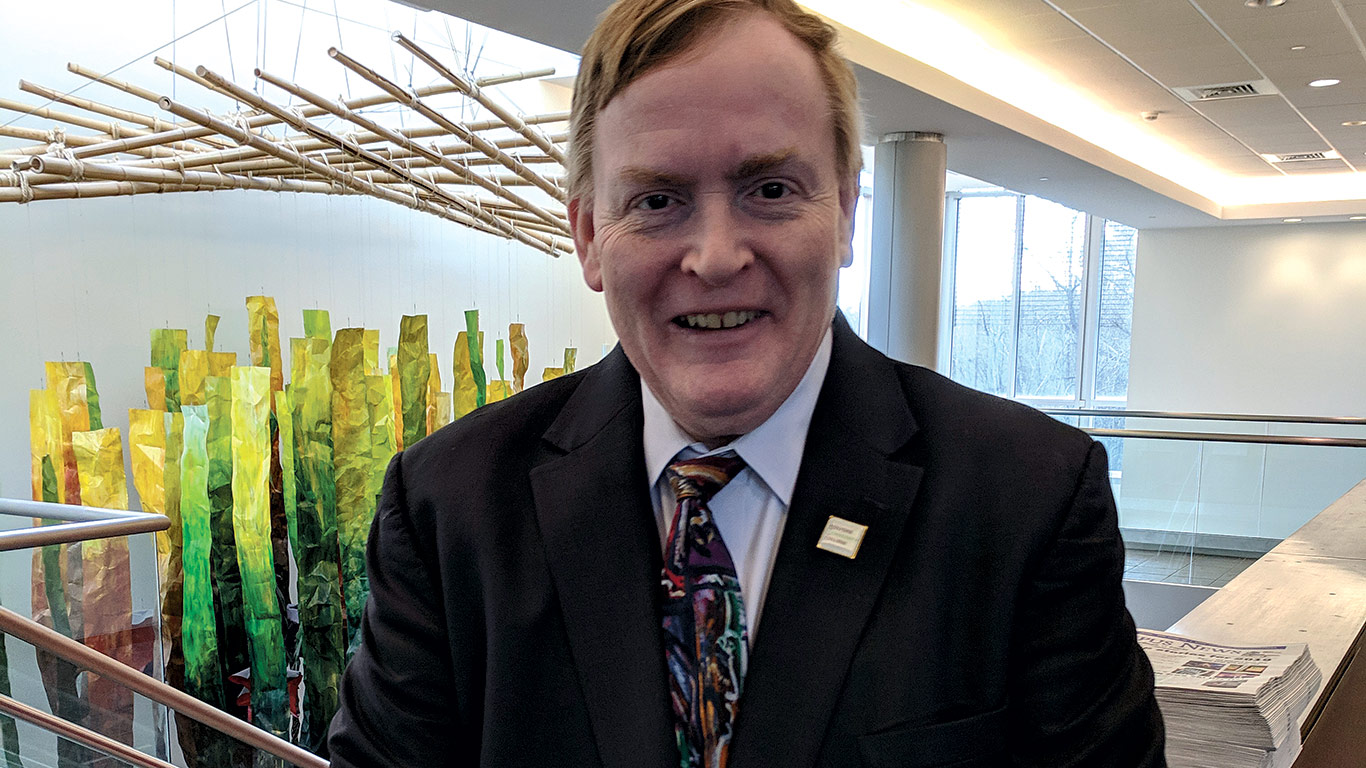
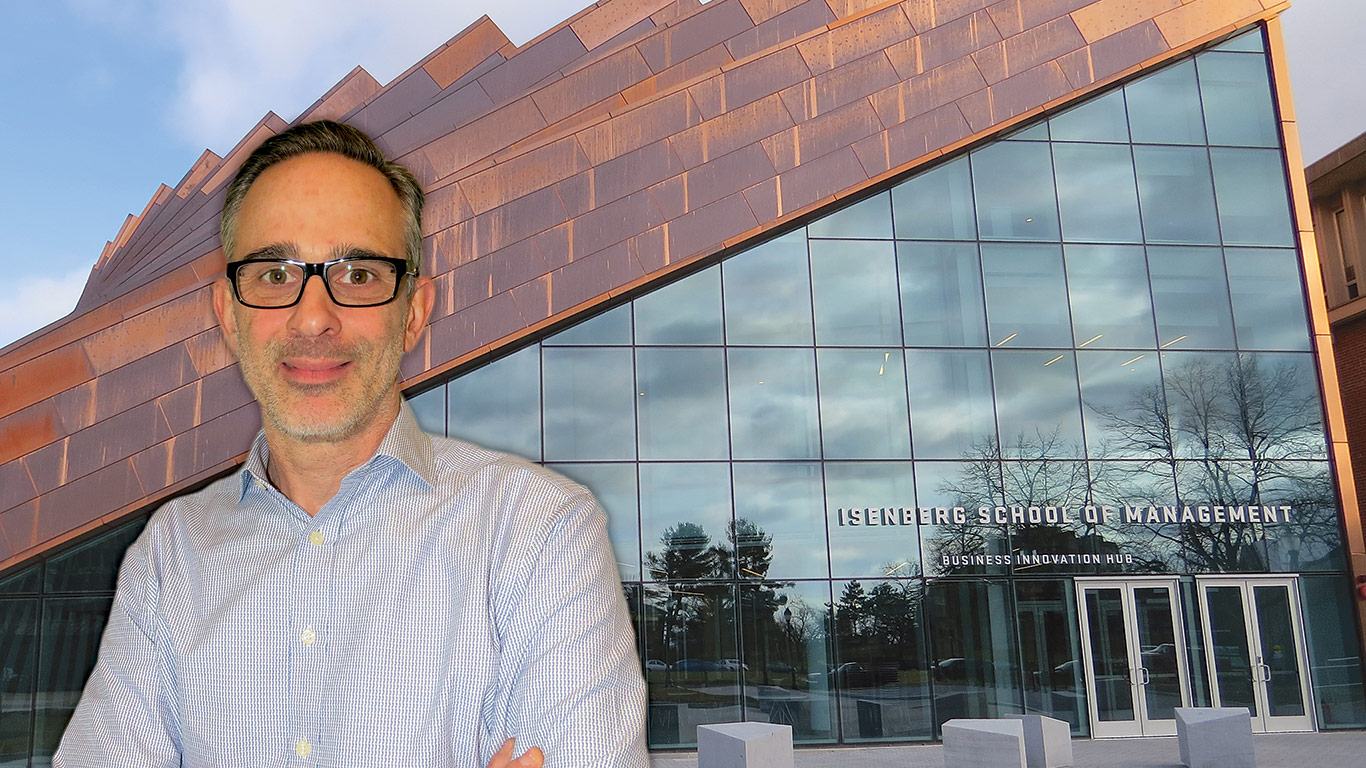
Interim Dean Tom Moliterno

Interim Dean Tom Moliterno

The Isenberg Innovation Hub, a $62 million expansion and renovation of the business school’s facilities on the UMass Amherst campus, will open its doors to students later this month. The building’s exterior design is stunning, and it gives a new face to Isenberg and perhaps the university, but the architects have made it functional as well.

Dramatic. Striking. Stunning. Powerful. Distinctive.

Those are some of the words that come to mind as one takes in the Isenberg Business Innovation Hub, a $62 million, 70,000-square-foot addition and renovation to the Isenberg School of Management at UMass Amherst, and its copper cladding, circular design, and falling-dominoes effect.

And those who conceptualized this project and then went about raising the money for it certainly had all those adjectives in mind when they went about hiring architects to create something that would effectively, and loudly, announce the Isenberg school’s ascension to the ranks of the best business schools in the country — and also help recruit the next generation of top students.

“Now that we are a top-20 business school, the students who are considering us are also considering a lot of other exceptional business schools. And one of the things that a student and his or her parents think about is the physical space.”

But that’s certainly not all they wanted — or demanded.

“Now that we are a top-20 business school, the students who are considering us are also considering a lot of other exceptional business schools,” said Tom Moliterno, interim dean at Isenberg. “And one of the things that a student and his or her parents think about is the physical space; there is a requirement, much like a football team needs good facilities, for facilities of a certain caliber in order to ensure that we get the best students.

The learning commons in the Isenberg Business Innovation Hub, like the building itself, has both a striking design and a great deal of functionality; it also doubles as event space.

The learning commons in the Isenberg Business Innovation Hub, like the building itself, has both a striking design and a great deal of functionality; it also doubles as event space.

“But there’s more to it than that,” he went on. “You need more than a pretty building; you need a building that’s designed to train students and to prepare students for careers in the 21st century.”

Elaborating, he said business schools today require space that is geared far more toward student collaboration, team working environments, distance learning, and career services than even a decade or two ago.

And all of this is reflected in what’s behind the flashy exterior of the Business Innovation Hub. Indeed, as he conducted his formal tour of the new facility, Moliterno seemed to be constantly pointing out places where people, and especially students, could come together and collaborate.
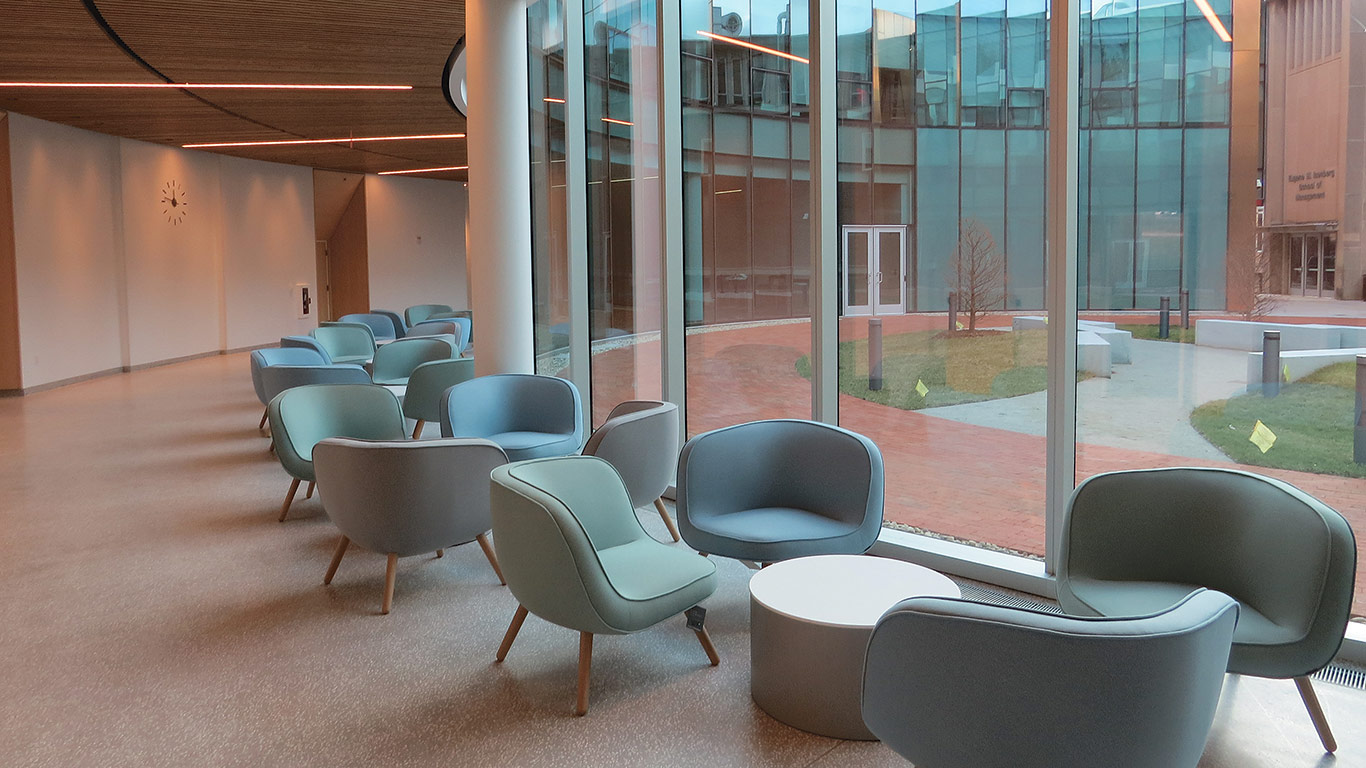
The hallways, like all the areas in the Business Innovation Hub, are designed to promote collaboration.

The hallways, like all the areas in the Business Innovation Hub, are designed to promote collaboration.

In the learning commons, which doubles as event space, there are dozens of soft chairs and small round tables at which people can gather; in the classrooms, the chairs have wheels, and for a reason — so they can be moved and maneuvered to face in any direction, toward the instructor in the front of the room or the student across the table; in the hallway outside the classrooms, there are more soft chairs and gathering spaces; in the courtyard, there are stone benches; on the grand stairway, there are wooden planks affixed to one set of the concrete stairs — again, for a reason.

“If you’re heading up the stairs and you see someone coming down that you want to talk to, you can pull over, sit down on the stairs, and talk,” said Moliterno, adding that the architects — Boston-based Goody Clancy, in partnership with the Bjarke Ingels Group (BIG) of New York and Denmark — went to extremely great lengths to inspire and facilitate collaboration, and this, perhaps even more than the stunning exterior and interior designs, is what the new addition is all about.

Roger Goldstein, the principal at Goody Clancy who headed the Isenberg project, agreed, and said the firm applied lessons from two decades of work designing college business schools and additions to the Isenberg initiative.
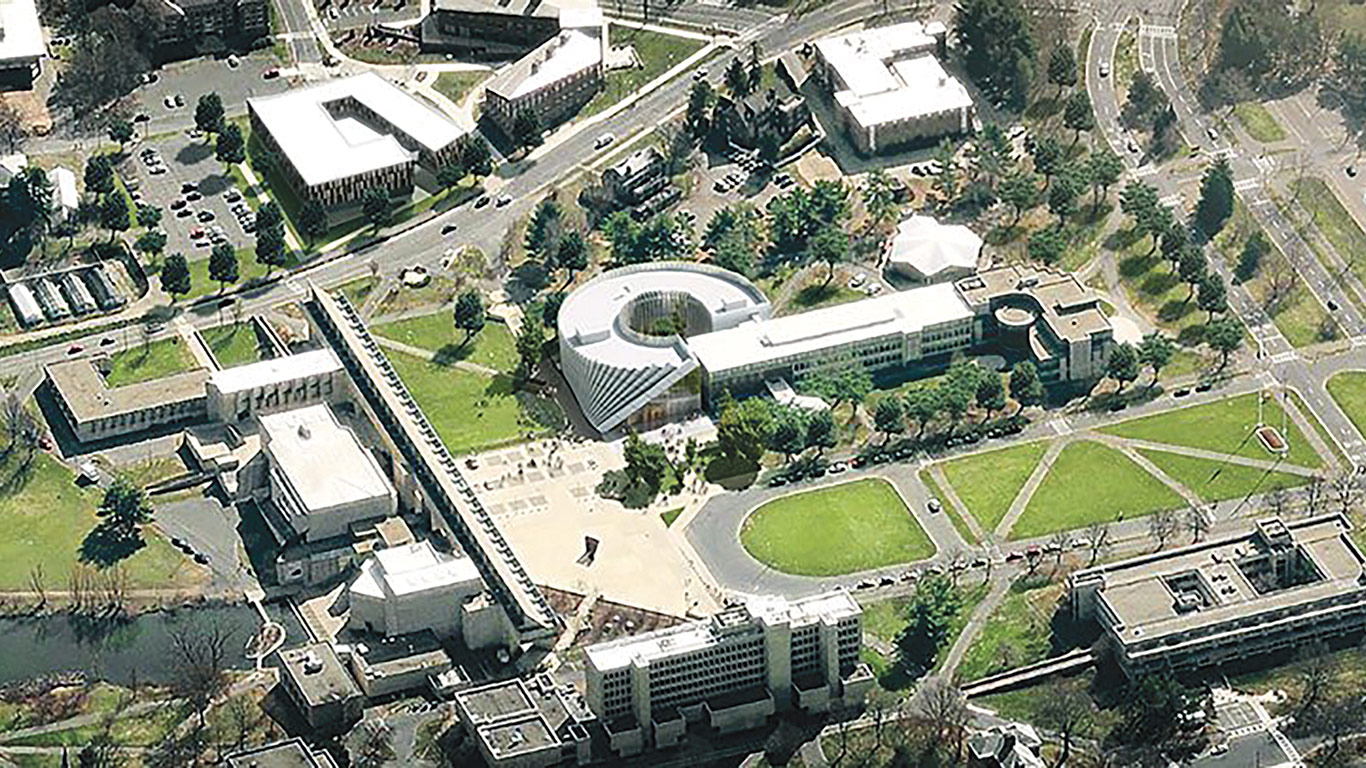
An aerial view of the expansion project

“Their aspiration was for something with real distinction — something that would be forward-looking and quite contemporary,” he explained, referring to Moliterno and Mark Fuller, the former dean of the Isenberg School and now associate chancellor at UMass Amherst. “But also a building that works really well and will stand up in the long run.”

Yu Inamoto, lead architect for the BIG group on this project, concurred. “One of the desires put forth by the dean, the faculty, and all the others we interacted with was to have a space that was not only impressive, but a place for gathering, and this is reflected throughout.”

Faculty and staff are currently moving into the new facilities, said Moliterno, adding that the building will be ready when students return to classes later this month.
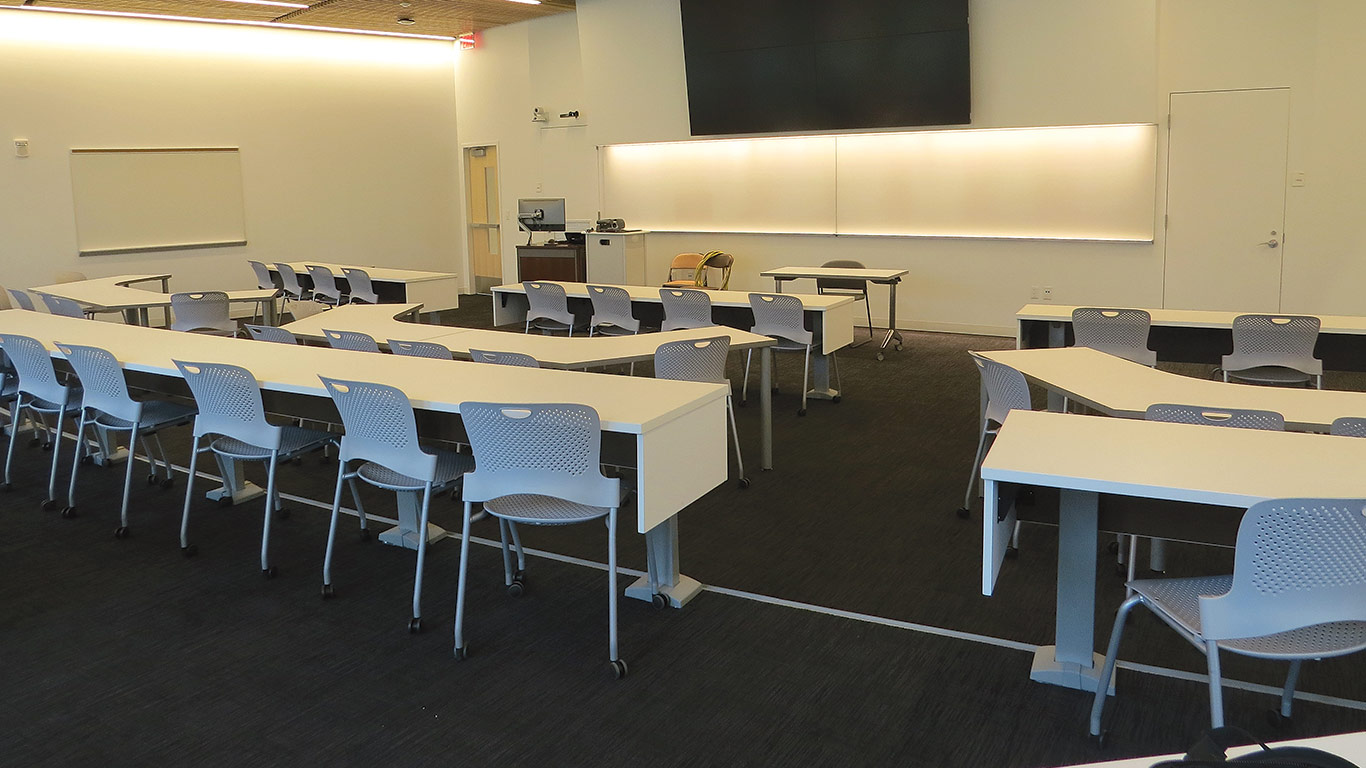
One of the state-of-the-art classrooms in the Business Innovation Hub.

One of the state-of-the-art classrooms in the Business Innovation Hub.

What they’ll find is a state-of-the-art, user-friendly facility that does a lot for Isenberg, and UMass Amherst on the whole.

It gives the business school — and perhaps the university itself — a bold new face. It also gives the school a powerful new recruiting tool and perhaps the ability to rise still higher in the rankings, something that’s difficult to do as it moves up the ladder.

For this issue and its focus on education, BusinessWest toured the Business Innovation Hub and learned how it blends form and function and punctuates the Isenberg School’s ongoing ascent among the nation’s top business schools.

Space Exploration

While obviously proud of the expansion’s ground floor, with its learning commons, courtyard, hallways crowded with gathering spaces, and generous amounts of glass, Moliterno was anxious for his tour to reach the second floor.

Because this is where more of that all-important functionality can be found. And it manifests itself in a number of ways, from greatly expanded and enhanced space for the Chase Career Center to separate lounges for students waiting to be interviewed and recruiters waiting to do some interviewing, to the small interviewing rooms that, when not being used for that purpose, can double as additional gathering spaces for students, thus maximizing each available square foot of space.

“Those rooms are sized and furnished to swing one way or the other depending on what the need is,” said Goldstein. “And that improves efficiency because you’re not creating spaces that have only one use and are empty half the time.”

Before elaborating on this mindset and what the Business Innovation Hub means for Isenberg, its students, faculty, the recruiters who will visit it to query job candidates, and other constituencies, Moliterno first went back to roughly the start of this decade, when the seeds for this facility were planted.

And they were planted out of need, he went on, which came in many forms.

The first was simply spacial. Indeed, while the original Isenberg building, built in 1964, was expanded with the so-called Alfond addition in 2002, by the start of this decade, and actually long before that, a growing Isenberg was busting at the seams.
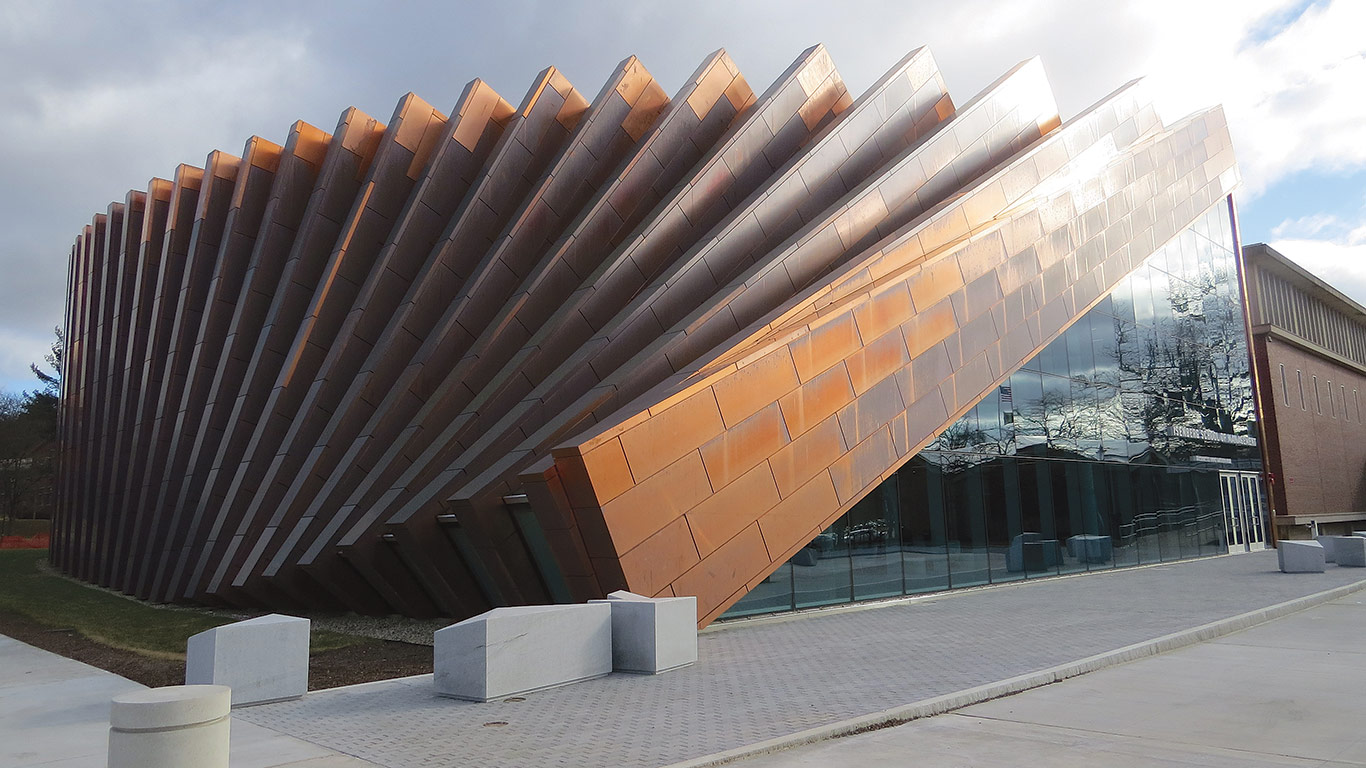
Architect Yu Inamoto says the copper used in the building’s exterior was chosen in an effort to give it a look that is “authentic and real.”

Architect Yu Inamoto says the copper used in the building’s exterior was chosen in an effort to give it a look that is “authentic and real.”

“What we used to say is that we were a family of eight living in a two-bedroom apartment,” said Moliterno, noting that undergraduate enrollment at Isenberg had risen from 2,500 in to 3,400 in just a few years earlier this decade.

Facilities were so cramped that some departments within Isenberg, such as Hospitality & Tourism Management and the Mark H. McCormack Department of Sport Management, were spread out in other buildings, said Goldstein, creating an inconvenience for students and faculty alike. The Business and Innovation Hub brings all of Isenberg’s departments and offices together under one roof.
Beyond the need for more space, though, Isenberg also needed better space, said Moliterno — space that reflected its climb in the rankings in the U.S. News & World Report listings of business schools — both public institutions (it’s now 26th nationwide and first among undergraduate programs in the Northeast) and overall (44th in the nation). And space that would help Isenberg compete for students applying to the other schools just above or below them on those lists.

“Relatively early in his tenure, Mark Fuller realized that the school was on a trajectory, both in terms of growth and in terms of quality, that was going to necessitate new physical space,” said Moliterno, adding that the first discussions and estimates on square footage required date back to 2010 or even 2009.

At this point, the project essentially “went into the queue,” as Moliterno called it, noting that there were a number of building projects being forwarded for consideration and funding. To move up in the queue — something deemed necessary as the school continued its torrid pace of growth as well as its ascent in the rankings — the Isenberg School took the unusual step of committing to provide 60% of the funding for the project, with the rest covered by the university.

This commitment translated into the largest ever made by a specific school for a campus building project, he went on, adding that this bold step did, indeed, move the initiative up in the queue. And in 2014, formal planning — including specific space requirements and preliminary cost estimates — began in earnest.

However, in the two to three years since the initial discussions and rough sketching were undertaken, construction costs had increased 50%, he said, bringing the total cost to $62 million.

While raising that sum was a challenge — met by tapping into a growing base of successful Isenberg alums — it would be only one of many to overcome.

Another would be fitting the building into that crowded area of the campus while also negotiating a veritable rat’s nest of underground utilities in that quadrant.

“There was this bowl of spaghetti of steam lines, electrical conduits, and high-speed data lines,” said Moliterno. “And one of the real design challenges was figuring out how to put a building on this part of campus given everything that was underground.”

Designs on Continued Growth

Creating a road map for navigating this bowl of spaghetti was just one component of the assignment eventually awarded to Goody Clancy and the Bjarke Ingels Group — a partnership that Moliterno called a ‘perfect marriage’ of an emerging force in the design world (BIG) and a company with vast experience in designing not only academic buildings, but business-school facilities.

“There was this bowl of spaghetti of steam lines, electrical conduits, and high-speed data lines. And one of the real design challenges was figuring out how to put a building on this part of campus given everything that was underground.”

Indeed, BIG has been on a meteoric rise, with a portfolio now boasting Two World Trade Center in New York, Google’s Mountain View, Calif. headquarters building, and several dozen other projects either under construction or in the planning stages.

As for Goody Clancy, as noted, it has spent the past 20 years or so developing a strong niche designing new buildings and additions for business schools, and the portfolio includes recent work at Harvard, Boston University, Georgetown University, Texas Tech, and the University of New Hampshire.

Development of this niche wasn’t exactly by design, to use an industry term, said Goldstein, but as often happens in this business, a single project or two can lead to additional opportunities.

And that’s what happened after the firm took on a project for Babson University, known for its programs in entrepreneurship.

“We then did a few more, and before you knew it, we had three business-school buildings, and we thought, ‘OK, this looks like a specialty,’” he told BusinessWest, adding that the company has another four or five business-school projects in various stages of completion, a reflection of the need for such institutions to keep up with the Joneses, if you will, so they can effectively compete for the best students.

“Business schools have wealthy donors and want to build buildings that will advance their brand,” he said. “They want something that will differentiate them.”

Inamoto agreed. “Schools definitely want to make a statement with these buildings,” he said, adding that the Isenberg addition is the first academic project taken on by the firm in this country, and thus it sought to partner with a firm with a deep portfolio in that realm.

As they went about designing the addition, the team of architects focused on both of their priorities — form and function. They conceptualized an exterior that would fit in — sort of — and respect the brutalist style so prominent in other buildings in that part of the campus, such as the Fine Arts Center and the Whitmore Administration Building.

The circular design, meanwhile, would create a dynamic look that would also connect, in dramatic fashion, with the existing Isenberg facility (as the aerial architect’s rendering on page 18 shows) and “close the loop,” as Goldstein put it.

As for the copper exterior, Inamoto said it was chosen — after aluminum was first considered — because the material, like the school itself, isn’t stagnant; it changes over time.

“As a firm, we like the look of copper, and we like to recommend naturally aging materials,” he explained. “The copper panels are already starting to weather; when they’re first installed, they’re a bright, shiny orange, and within weeks, that starts to become darker and brown, and over time, they’ll oxidize to a green copper look.

“Over time, the building weathers,” he went on. “And we didn’t want something that was too flat or too plasticky, if you will. That’s part of our design strategy; we try to select something that’s authentic and real.”

In designing what’s behind the copper façade, they started by gathering extensive feedback, via focus groups, from a number of constituencies, including Isenberg administrators and staff, students, faculty, and others. And they incorporated what they learned into the final design, said Moliterno, citing everything from a café to greatly expanded space for the career center and undergraduate advising.

“They brought in Career Services and said, ‘walk us through everything you do — what are your space needs? You have interviewers here — how many, and what do they need?’” he recalled. “And then, they had that same conversation with Undergraduate Programs and with a committee of faculty who talked about the classroom space.

“And they had the same conversations with students,” he went on. “And this is where we learned that students are often here from 8 in the morning until 10 at night, and thus they want a place to eat in the building, because if they leave the building, they break up their team process.”

As for the career center and undergraduate advising facilities, these are as important to the ultimate success of Isenberg students (and the school itself) as the classrooms, said Moliterno, adding that these facilities provide more services to far more students than they did even a few years ago.

“Students don’t just show up when they’re juniors and look for job postings,” he explained. “They’re working with the career services offices constantly in order to get internships, résumé review, and structure their social-media profile. The hands-on career prep, the number of hours one spends in career services, has grown dramatically over the years, and this is reflected in the design of this building.”

Seeing the Light

As he walked through the expanded career services office during his tour, Moliterno put the Business Innovation Hub and the chosen designs for it in their proper perspective.

“At the initial bid process, when I was speaking to all the architects who were bidding, I said, ‘I want to be clear about something: this might be the most beautiful building in the world, but if it doesn’t work for the students, if it doesn’t enhance and improve the student experience, it will be a failure — full stop,’” he recalled.

‘Most beautiful building in the world’ is a purely subjective matter for discussion, he went on, while the matter of whether a building works for students certainly isn’t.

He’s quite sure that this one does, and while that quality generally doesn’t warrant adjectives like ‘dramatic, ‘striking,’ ‘stunning,’ or ‘powerful,’ it probably should.

And it explains, even more than that façade, why the Isenberg Business Innovation Hub is such an important development for the school and the university.

George O’Brien can be reached at [email protected]

Features

Collision Course

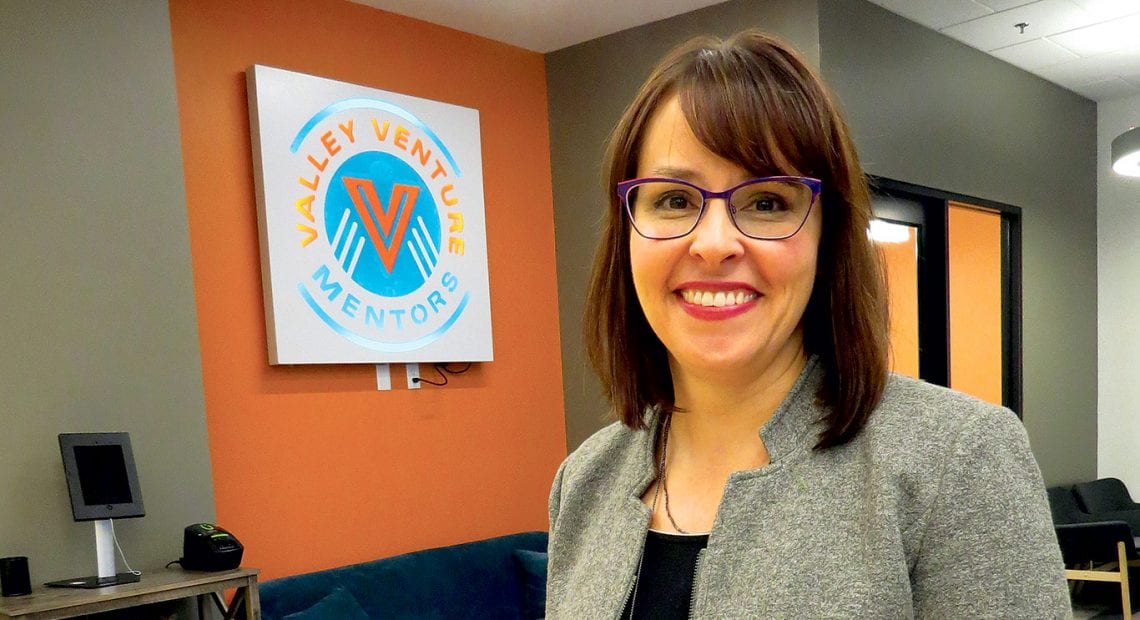
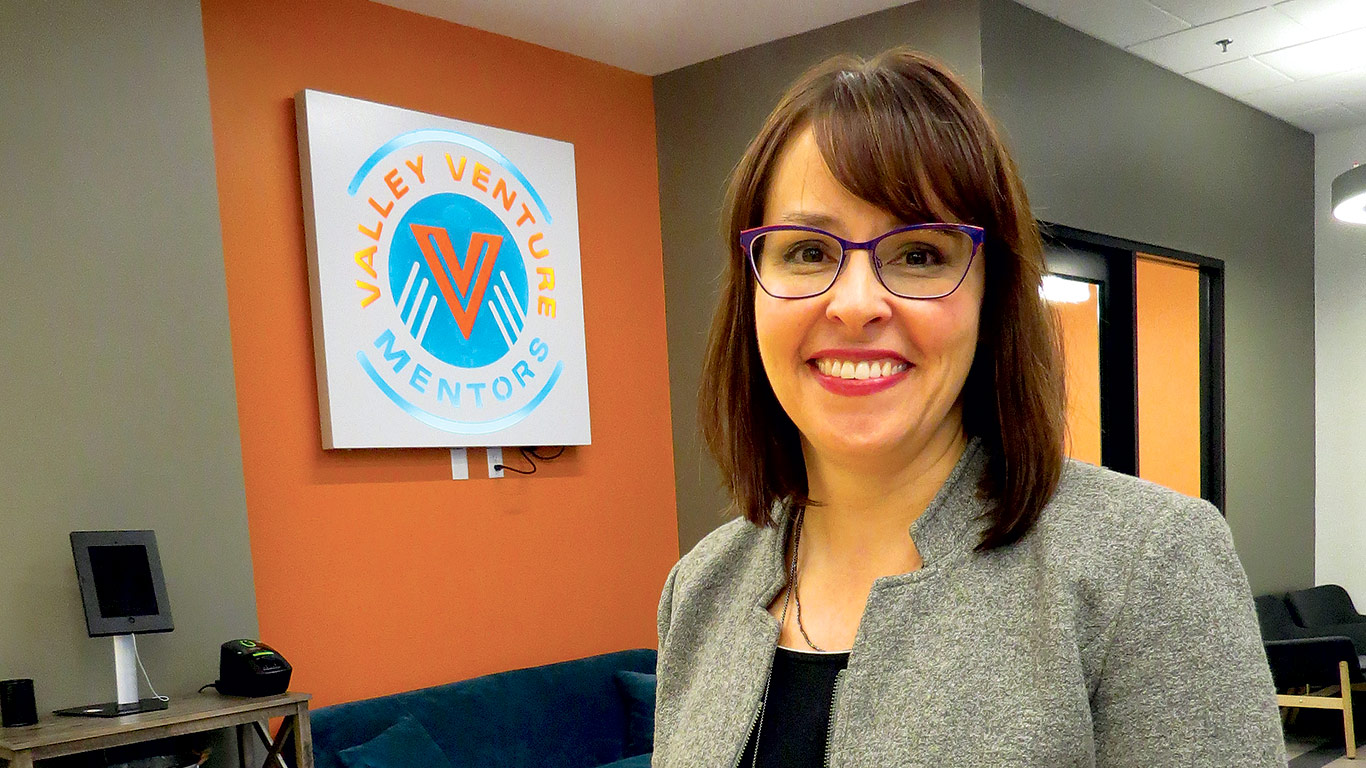
Kristin Leutz in VVM’s new space at Springfield’s Innovation Center.

Kristin Leutz in VVM’s new space at Springfield’s Innovation Center.

As Valley Venture Mentors completes its move into Springfield’s Innovation Center on Bridge Street, it is also moving into a new era in its history, one that is very entrepreneurial in nature — in keeping with its broad mission — and strives to continually expand and strengthen the region’s ecosystem for supporting and inspiring entrepreneurs.

‘Pivot.’

In the startup world, this term has become incredibly versatile, now serving as a verb, a noun, and an adjective. It has become the subject of lectures, books, and articles bearing titles that hint at its emergence — as in “The Art of the Pivot,” “Three Rules for Making a Successful Pivot,” “Five Steps for Pivoting into Entrepreneurship,” and countless others.

In simple terms, to pivot means to adapt, or to change the course or strategy of an emerging business based largely on customer wants and needs. Some of the most prominent companies in the world owe their success to a pivot, or several of them.

There are various methods of pivoting, as indicated by those article titles above, but the bottom line — both literally and figuratively — is for entrepreneurs to understand the importance of flexibility and the need to pivot, and to not be afraid to so.

Administrators and mentors at Valley Venture Mentors (VVM) have been preaching the need to pivot and showing people how since the nonprofit was launched eight years ago now. And these days, one might say it is practicing what it’s been preaching.

Well, sort of.

What VVM is engaged in now could be called a pivot, although its overall mission and strategy are not really changing. They are evolving, though, and being taken to a new and higher level as the organization completes its move into the long-anticipated, $7 million Innovation Center on Bridge Street in downtown Springfield.

“One of the barriers, especially in a region and city that smaller, like Springfield, is a lack of connectivity. Place-making is a foundational piece of that, creating a physical home for people to collide in and meet and have natural connection with each other across industry.”

The move began last summer, said Kristin Leutz, who assumed the role of CEO at VVM about the same time as the moving trucks started unpacking furniture. And it is ongoing, she said, as new furnishings arrive and new strategies emerge for making the best and most efficient use of the intriguing 10,000 square feet of space VVM now commands.

The agency will be using a small percentage of that space for its own administrative needs, with the rest devoted to revenue-producing, entrepreneurial-ecosystem-building endeavors, from signing on tenants for various co-working spaces and small offices to renting out the large, 175-seat auditorium that dominates the ground floor of VVM’s suite.

And this is where the pivoting comes in, said Leutz, adding that VVM is moving to a slightly adjusted, more entrepreneurial model, necessitated by the need to cover the expenses of what is, in many respects, a growing business in its own right.

These include the nearly $4,000 in monthly rent — a great bargain given the amount of space and the going rates downtown these days — as well as a growing staff and the myriad other costs of running such an operation.

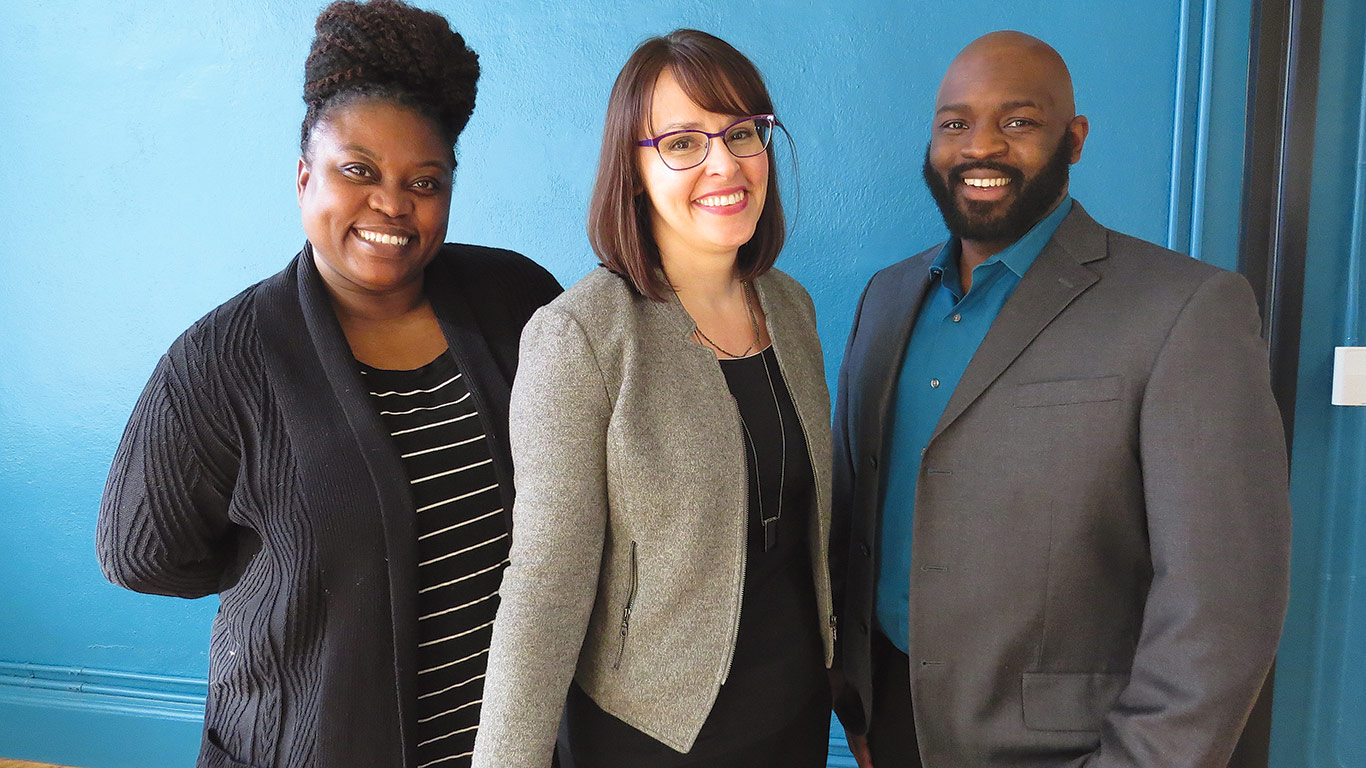
From left, Stephanie Kirby, VVM’s director of Mentorship; Kristin Leutz, CEO; and Ron Molina-Brantley, COO.

From left, Stephanie Kirby, VVM’s director of Mentorship; Kristin Leutz, CEO; and Ron Molina-Brantley, COO.

“This space represents a micro entrepreneurship venture of our own,” she explained, adding that, like the startups mentored and supported by VVM, it has a business plan and a strategy for executing it.

In simple terms, it involves making the Innovation Center not merely a revenue center, although it will become that as well, but an entrepreneurial hub and a place where collisions can and will happen — collisions between fellow entrepreneurs, business owners and mentors, entrepreneurs and potential investors, and more.

“When we think about how to introduce people from Springfield and Western Mass. to the entry point when it comes to entrepreneurship and remove any barriers that exist, we come back to the all-important concept of place-making,” she told BusinessWest. “One of the barriers, especially in a region and city that’s smaller, like Springfield, is a lack of connectivity. Place-making is a foundational piece of that, creating a physical home for people to collide in and meet and have natural connection with each other across industries.”

Summings things up, Leutz noted VVM’s working slogan (“Give. Get. Grow.”) and said the new location and all its facilities — from different kinds of co-working space to a nursing room for new mothers; from a shared kitchen to areas where startups and mentors can meet and collaborate — provide individuals, startups, and the entrepreneurial ecosystem as a whole with more opportunities to do all of the above.

For this issue, BusinessWest talked with the staff at VVM about not only the move into the Innovation Center, but the organization’s pivoting action and the next crucial steps in its history.

Right Place, Right Time

VVM will stage a grand-opening ceremony at its new space on Thursday, Feb. 7, when it co-hosts the annual State of Entrepreneurship Conference with the Economic Development Council of Western Mass. The invite list for that event, and the ribbon cutting to follow, is rather lengthy, said Leutz, noting that it includes representatives of a number of entrepreneurial ecosystem partners — from the Grinspoon Foundation to TechSpring to area colleges and universities — as well as a number of other constituencies, including elected officials, VVM alums, mentors, and long-time supporters.

“We’re checking our occupancy level to see how many we can have in here legally,” she said, adding that the agency will test the upper limit of that number, whatever it is.

Getting to this ribbon-cutting ceremony has been an adventure, she noted, and a long journey that started when she and many other representatives of this region toured the Cambridge Innovation Center and came back determined to create a similar place-making facility in this region, preferably in downtown Springfield.

Fast-forwarding somewhat — this story has been well-chronicled — the historic structure at 270-276 Bridge St. was eventually chosen, and a number of funding partners, including MassDevelopment, MassMutual, Common Capital, and others, were secured. The project got underway in 2017, but as work proceeded and walls were taken down, it became clear that the cost of the work would far exceed preliminary estimates — and the amount raised.

Work was stopped for several months before eventually starting up again last spring. Leutz recalled the occasion.

“It was like a reunion — we got the architects back together with the contractor, we were meeting weekly in the space, there were holes in the floor … there was drama, but we were doing it,” she said. “And things moved fast; we knew in June that we were going to fast-track this thing and get it open by January, and we did.”

But as work was starting up again, VVM was going through a transformation of its own, starting at the top, where Leutz, who joined the organization as COO in the fall of 2017, was chosen to succeed Liz Roberts as CEO.

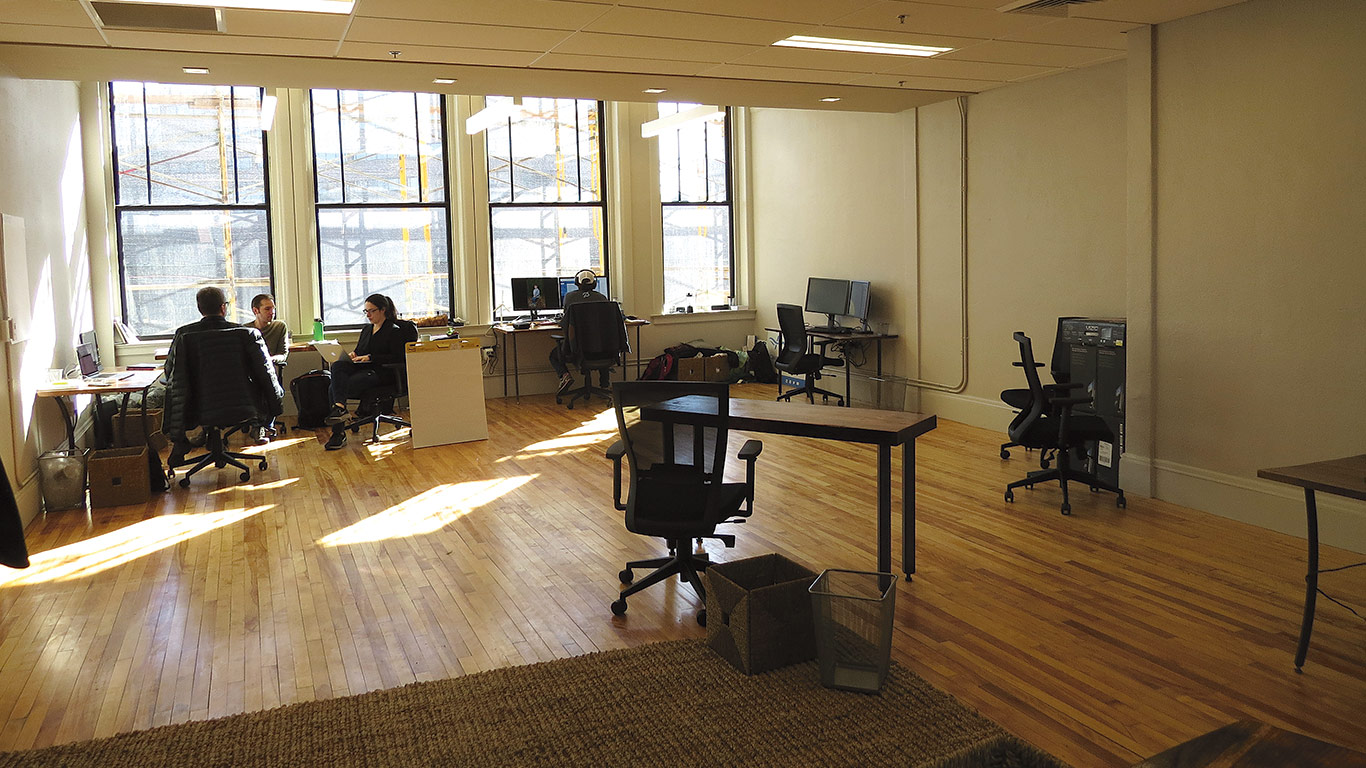
Kristin Leutz says VVM’s new co-working spaces, like the dedicated spaces for lease seen here, are “the beating heart of the startup community.”

Kristin Leutz says VVM’s new co-working spaces, like the dedicated spaces for lease seen here, are “the beating heart of the startup community.”

“I’ve always been a big fan of VVM,” said Leutz, who was a mentor with the organization in its earliest days and is perhaps best-known locally for the decade she spent as vice president for Philanthropic Services at the Community Foundation of Western Massachusetts.

She noted that, while at the Community Foundation, she helped VVM secure one of the first innovation grants awarded by that organization, a three-year commitment made to help launch its accelerator, among other programs. “I understood early on that this was something unique in Western Mass. and that it would really take off.”

And now that it has, she and fellow team members take on the assignment of plotting an ambitious course — and keeping it on the course, again, much like the startup businesses it helps mentor, she said, adding that when she came on board as COO it was to essentially help blueprint a new strategic plan for the nonprofit centered on its home and the new opportunities it offered, and she was intrigued by the assignment.

As was Ron Molina-Brantley, who joined VVM a few months before Leutz did and would eventually succeed her as COO.

Formerly an employee of the city of Springfield, working first in the Finance Department and then the Facilities Department as senior program manager — a perfect blend of skills for an organization moving into new space and also assuming new fiscal responsibilities — Molina-Brantley said he was looking to grow professionally, and VVM and the next stage in its development offered an intriguing challenge.

“VVM was the right place at the right time,” he told BusinessWest. “The environment and ecosystem they were trying to build really appealed to me; there was an instant love affair between me and VVM and the community. The atmosphere is amazing, the startups are amazing, and you just want to be part of it. It’s contagious.”

It was, and is, for Stephanie Kirby, as well, VVM’s director of Mentorship. An alum of the agency’s collegiate accelerator program, she started her own business (a music label) at age 14, and has continually honed and reshaped it over the years — so much so that she was known as the “pivot queen” when she took part in VVM’s first collegiate accelerator while attending Five Towns College in New York.

“I would pivot a lot within my business, and when you come to VVM, that’s what they teach you — how do you actually build your business,” she said, adding that she’s now working to help others master that skill.

Writing the Next Chapter

Together, these and other team members have taken on the assignment of moving VVM into a new era, if you will, one that poses some challenges for the agency, but myriad new opportunities for entrepreneurs and those mentoring them — and for strengthening the entrepreneurial ecosystem the region has built and that has gained considerable momentum in recent years.

To explain it in simple terms, Leutz said the VVM operation is in some ways similar in structure to a pyramid. At the base is the place — in this case, the Innovation Center — where things, meaning those collisions she mentioned, can happen. The next level in the pyramid is programming, which at VVM means mentorship and acceleration, specifically its two popular accelerator programs — a startup accelerator and a collegiate accelerator. And the top of the pyramid is what she called “an ecosystem builder,” meaning systems to support what others across the region, like the Grinspoon Foundation and the area’s colleges and universities, are doing.

VVM’s mentorship lounge, top, and the shared community kitchen are just some of the spaces carefully designed to promote collisions.

VVM’s mentorship lounge, top, and the shared community kitchen are just some of the spaces carefully designed to promote collisions.

“Within these realms, we hope to serve everyone, from the ideation stage, early, early, person-with-an-idea-on-napkin type of entrepreneur, to someone who has a venture and is on their way to raising their first round of capital or beyond,” she said. “It’s usually seed stage for us, and our programs are customized for that entrepreneur’s unique goals and challenges. What’s new for VVM, and what we’re really zeroing in on, is ‘how do we take a particular venture and uniquely help it to succeed?’

“Our big focus now is to think about 1,000 startups in the Pioneer Valley — what would that look like and how would that change the success rate, because we know a large number of startups fail,” she went on. “The more that you create, the greater chance you have for seeing transformational companies.”

And the Innovation Center and VVM’s new facilities are designed to help make that vision reality, she went on as she offered a tour that started on the ground floor, devoted to programming, and the auditorium, which is community space in every sense of that phrase.

“We encourage anyone and everyone to think about how to promote entrepreneurship in their industry, their business, or their community, and come talk to us, and we’ll make this space available,” she said, adding that the space was essentially created to showcase people’s ideas and their notion of entrepreneurship.

That first floor also includes a mentorship lounge, which represents a major upgrade from the spaces where mentors and entrepreneurs would get together in recent years when VVM was located in donated space in Tower Square. “We’ve never had a space like this; before, people were just hanging out on folding chairs in a big, open room.”

It also includes two private offices that can be rented out and café space as well.

The second floor, what she called the “beating heart of our startup community,” is where the co-working space is to be found. Half of the floor is dedicated to people who rent permanent spots on a month-to-month basis, she said, adding that three startups are currently doing so. There’s also the so-called ‘hot desk’ space — unassigned space that be rented for $25 a day, with other rates for more regular use — as well as a ‘brainstorming nook,’ a community kitchen, private phone rooms for entrepreneurs seeking some privacy, the private room for nursing mothers, and more.

Roughly 50% of the space that can be rented is now under lease, she said, adding that the goal is to get that number to 75% and perhaps 100% by the end of this year.

Describing the look and feel of VVM’s new home, Leutz noted that, while these spaces may have been inspired by similar facilities in other communities, they don’t look like those spaces.

“This space is meant to feel like it belongs in Springfield,” she said, adding that there is furniture made by local artists and the walls will feature what she described as ‘community-driven’ art. “It’s beautiful, and it’s aspirational, but it also feels like it’s home. It won’t feel like you’ve stepped into some place in downtown Manhattan, and it shouldn’t. It should feel like Springfield.”

Bottom Line

Summing up what’s been created on Bridge Street, Leutz went back to the goals put down on paper after the group visiting the Cambridge Innovation Center returned to Springfield and set about replicating what they encountered.

“This intention of this project was always to have it be a community-driven space focusing on the innovation economy and enlivening the economic activity downtown,” she said, adding that this is a broad mission, and, as noted, somewhat of a pivot for VVM.

An exciting pivot, for sure, and one that certainly bears watching in the months and years to come.

George O’Brien can be reached at [email protected]

Meetings & Conventions

Horse Sense

President and CEO Gene Cassidy

President and CEO Gene Cassidy.

When people think of the Eastern States Exposition, they often think immediately of the Big E, the 17-day fair that dominates the tourism landscape at the start of each fall. But Eastern States is much more than that, as reflected by its diverse array of events, both large and small, and the resulting economic impact on the region — not to mention its important mission of keeping its agricultural heritage alive for future generations.

Fifty-two years ago, notes Greg Chiecko, a local camping group set up shop at the Eastern States Exposition — and have come back every year since.

“That was our first non-fair event. They took the building for the whole month — it took that long to set up, do their show, and move out.”

How things have changed, said Chiecko, director of Sales. The Big E, the 17-day fair that has taken place each fall for more than a century, remains the ESE’s most famous calling card. But outside the fair, the grounds hosts more than 100 events annually, some small-scale, some much larger, like the camping and outdoor show that now crams hundreds of vehicles into three large buildings each February.

One of the many horse shows at the ESE.

One of the many horse shows at the ESE.

“The dynamics have changed substantially over the past 50 years,” Chiecko said. “They’ve been doing it so long, it’s amazing. They still take a little while to move in, but they do it with such accuracy, and they literally move out of all the buildings in a day.”

A quick look at the coming month’s schedule demonstrates the range of groups that present events here. February alone offers the Amherst Railway Society’s Railroad Hobby Show, the aforementioned Springfield RV Camping and Outdoor Show, the Springfield Sportsmen’s Show, and two dog shows. March brings the Old Deerfield Spring Sampler Craft Fair, Mark’s Northeast Motorsports Expo, the Antique & Modern Firearms Show, the Maple Harvest Day & Pancake Breakfast, the AMMO Fight League, a Massachusetts 4-H Blue Ribbon Calf Sale, and the large Western Mass. Home and Garden Show — not to mention two more dog shows.

“We call ourselves the flexible facility in the heart of New England, and we truly are,” said Chiecko, who will leave the ESE next month to become president and CEO of the Outdoor Amusement Business Assoc. “And every show is different. The Big E and the Fiber Festival are the only events we produce. We’re a landlord the rest of the year. Some of these are volunteer groups, some are professional promoters, some are associations … it runs the gamut. They produce the shows, and we offer services, like ticket takers, ticket sellers, security, and more. They can use our services or use their own.”

Greg Chiecko calls the ESE “the flexible facility in the heart of New England.”

Greg Chiecko calls the ESE “the flexible facility in the heart of New England.”

Gene Cassidy, president and CEO of the Eastern States Exposition, noted that the facility also offers services like advertising, sign manufacturing, banking, and other amenities that many venues don’t have in their portfolio. The result of this flexibility and roster of services results in a high retention rate, with groups that return year after year. In addition, he noted, “some staff people have been here for 40 years. So there’s a lot of institutional memory.”

The ESE’s consumer shows — home shows, gun shows, camp shows, sport shows, and the like — tend to be among its most popular offerings, Chiecko said. “We’re also the dog-show capital of the Northeast. In 2017, we had 36,000 AKC-registered dogs on our property, just from the AKC shows, not counting other groups. Dog shows are a big deal. And we love dog shows because they come on holidays: Easter, Thanksgiving weekend, Fourth of July weekend, times of the year when it would be difficult to fill our spaces.”

“In 2017, we had 36,000 AKC-registered dogs on our property, just from the AKC shows, not counting other groups. Dog shows are a big deal.”

EASTEC, the largest manufacturing event east of the Mississippi, returns to the fairgrounds this May for its biannual visit. “Exhibitors love it, and the area restaurants and hotels do great,” Chiecko said, adding that local trade shows, from the likes of J. Polep Distribution Services and Performance Food Group, also regularly host events. Meanwhile, clients book parties and weddings at Storrowton Tavern and the Carriage House, which managed by a private firm but owned by the ESE.

That’s far from an exhaustive list, but it does lend credence to Chiecko’s “flexible facility” motto.

“I’ve been here 24 years, and I’ve never heard a “can we do it?” inquiry that I’ve had to say ‘no’ to,” he said. “The facility is so flexible, and our crew is so flexible, we can do anything.”

Animal Attraction

Despite the myriad events the ESE presents each year, its heritage remains firmly rooted in animals and agriculture.

“We do 13 horse shows outside the three we do for the fair,” Chiecko said. “We do a sheep show, youth cattle shows, and we have a big poultry show coming up next month. And this past year, we had the National Rabbit Association. We had 18,000 rabbits here.”

“The joke,” Cassidy quickly added, “was that 18,000 rabbits came, and 36,000 left.”

The attendance level varies among these events, Chiecko noted. “A lot of the horse shows tend to watch themselves rather than anything else. But the rabbit show attracted a huge population from the general public.”

The annual Western Mass. Home and Garden show

The annual Western Mass. Home and Garden show brings attendees face to face with hundreds of local businesses.

However, when it comes to most animal events, Cassidy said, “I wish there were more people engaged. It’s our job to promote the breed or species, put it out there for the public to consume, and they’re free events. The fact is, if the Big E had more days or we had more acreage, more of those shows would take place during the course of the fair so we could get as many people from the public exposed to that. But we do our best to try to promote interest in it; we believe it’s important for agriculture. It’s mission-driven; we’re not making any money on that. That’s all stuff we promote and invest heavily in.”

Still, “the more shows we can put in during the fair, the more it helps us fund our agriculture program, most of which happens outside of the fair, in the other 49 weeks of the year,” he went on. “We make it available to the public so they can have the exposure. It’s tough in this day and age, when the youth in the general population are so disassociated from agriculture, and we deal with the hardcore animal activists, the people who have serious agendas against consumption of animals, and they influence public policy to the detriment of the greater good of society.”

That has affected the national 4-H program, which gets federal funding and is being influenced by people outside of agriculture, which results in regulation making it harder for children to be involved. Meanwhile, Future Farmers of America, a private nonprofit not under federal control, is going strong, Cassidy explained, noting that, no matter the vehicle, it’s important to keep engaging young people in agriculture and animal rearing. “Those are the kids that going to feed the world in the next generation.”

It’s one of the reasons why the Big E, which continues to set attendance records, is so critical, in that it helps fund the other 49 weeks of events while driving interest in animal shows; people are more likely to check out such shows once they’ve bought a ticket and are at the fairgrounds.

“At one time, we had four or five antique shows here. The Internet has almost eliminated antique shows because people can shop from the comfort of their own living room.”

“The fair is just a fundraiser. It’s like your church bazaar, except we just happen to run 17 days and are one of the biggest in the world,” Cassidy said. “It’s a fundraiser for us to drive stewardship into our mission. I wish more people were as excited about that mission as we are. I look down the road a generation, and we’ve got a lot of work to do.”

On the other hand, Chiecko said, the consumer shows are still strong because people enjoy events that reflect their hobbies and interests. But even there, the Internet has impacted certain shows.

“At one time, we had four or five antique shows here. The Internet has almost eliminated antique shows because people can shop from the comfort of their own living room, which is really too bad, because the quality of what people get isn’t nearly the same. It’s the same with craft shows. That’s the nature of the business cycle — we’re no different than a brick-and-mortar store dealing with Amazon.”

Living the Mission

Cassidy emphasized more than once during BusinessWest’s visit that the Eastern States Exposition makes a priority of its agricultural mission. “Not everyone relates to that mission. But if we can’t support agriculture, we can’t support everything else we support – and we support a lot.”

He’s not just talking about planned events. The fairgrounds has been a staging center for emergency situations as well. Northeast Utilities set up camp and fed its crews there during the famous October 2011 snowstorm. A few months before that, the ESE’s dorms housed hundreds of people suddenly made homeless by the tornado that struck the region. “We’ve hosted large RV rallies here,” Chiecko said. “If a cattle guy breaks down on 91, they might come here.”

So there’s a community impact in addition to the economic impact to the region — more than a half-billion dollars a year, he noted, with only part of that generated by the 17-day Big E. “Year-round operations play a big role.”

He believes its impact will only grow now that MGM Springfield has opened across the river.

“I think we have a good partnership,” he said, one that extends beyond parking cars for MGM during its first week of operation last summer. “They bring large conventions to town, which utilize rooms and banquet spaces downtown — well, we have 355,000 square feet of exhibit space. We’re hoping to see more city-wide conventions. It’s a tight-knit community here.”

Dog shows have become a surprisingly robust source of bookings for the ESE.

Dog shows have become a surprisingly robust source of bookings for the ESE.

For convention goers and people who attend events at Eastern States, MGM is another activity to take in while visiting Springfield, he added, while people who come to Springfield mainly for the casino might also take in an event at the fairgrounds — and everyone benefits.

“Because of the advertising campaign MGM launched, it put Springfield on the map in a bigger way, and I think our fair benefited from that,” Cassidy said of last year’s record attendance at the Big E, which took place a few weeks after MGM opened. “My hope is that, with the synergies we’ve developed in partnership with MGM, we can help bring more commerce to the city of Springfield in the form of non-fair events: trade shows, professional shows, manufacturing shows.”

With that in mind, he keeps plugging away at that year-round mission — because, simply put, the Eastern States Exposition is more than a center for events of all kinds. It’s a critical piece of the region’s tourism and economic picture.

“If this place ever went away, the impact on our economy would be devastating,” he said.

Which is why he doesn’t intend to let the ESE go to the dogs — well, except on those weekends when it does.

Joseph Bednar can be reached at [email protected]

Women in Businesss

Culture of Care

Karin Jeffers, CEO of Clinical & Support Options

Karin Jeffers, CEO of Clinical & Support Options

Karin Jeffers, the long-time CEO of Clinical & Support Options, knew she had a challenge on her hands when she took the reins at the struggling behavioral-health and social-services agency. But she’s never been one to shy away from a challenge, and has steadily grown the organization into the broad-based, community-focused force it is today. She’s done so by embracing constant change, a culture of learning, and a sensitivity to the unique experiences of each client who walks through the door.

As the daughter of teachers, helping and supporting people was in Karin Jeffers’ blood. How she eventually applied that idea, however, wasn’t exactly a straight line.

“I went to school at Springfield College for physical therapy and thought I had my life figured out,” she told BusinessWest. “That’s what I was going to do. But then I took an abnormal psychology class, and I was just fascinated. It was way more interesting than anything I was doing otherwise.”

After doing a bit of research and learning how mental-health professionals impact people’s lives, she was sold, and switched her major to counseling and psychology.

“That was probably three and a half years through the PT program,” she recalled. “That was a fun phone call home to my dad.”

Her career path has validated that decision in spades, however. After earning her master’s degree in psychology, Jeffers took a job with the Massachusetts Society for the Prevention of Cruelty to Children and, over the next 13 years, rose through the ranks there, from home family therapist to coordinator to clinical director to regional director.

“It can be challenging when working with children and families, but what I found immensely rewarding — and this holds to this day — is the resilience of kids and families and their desire for a better life.”

“It was a great organization; it really exposed me to a lot of the ways you can help people and make a change in an individual, a family, and a community.”

It was telling — and another validation of her shift away from physical therapy — that she found the work rewarding, even though the issues she dealt with on a daily basis could be sobering, to say the least.

“It can be challenging when working with children and families, but what I found immensely rewarding — and this holds to this day — is the resilience of kids and families and their desire for a better life,” she said. “That really drives me through what can sound like horrible stories, whether it’s abuse or trauma or whatever people have been through.

“You rarely meet somebody who wants to be in a bad place,” she went on. “You meet people who want to do better, but they may not have the tools or the resources or the supports to get where they need to be; the hope is that you can help people get closer to healing and recovery.”

Meanwhile, Clinical & Support Options was an agency founded as a child and family organization that had crept away from that mission somewhat over the years, Jeffers said. She arrived there in 2005 to become CEO of what was then a $4 million nonprofit behavioral-health enterprise with about 90 employees and just a handful of sites, mostly in Franklin County.

“I’ve always loved challenges, and at the time that I came to CSO, it was a much smaller agency,” she said. “They had been through several CEOs in the prior few years. They had a really good core mission and core group of people, but needed some leadership, so it was an opportunity for me to make my mark on a new agency and see if we could build something that would make a difference.”

That she has. Thirteen years into her leadership tenure at CSO, it has become a $40 million organization with more than 700 employees spread across five counties, with 15 office locations, and serving some 17,000 people annually.

“We really have the full spectrum of services, from crisis intervention to family support to prevention services to support and recovery services,” Jeffers said. “Our latest merger was with Friends of the Homeless, so now we’re able to add housing and shelter to it. The way we’ve been able to integrate and really blend all those services together, we can truly say that, if you need support or help, just come here, and we’ll help you figure out where to get it, as opposed to you having to know which number to call and where to go and what to ask for. We work very hard at that kind of integration and service.”

She has spearheaded that kind of growth and integration through a specific set of values and a nimble leadership style that embraces change, and encourages her team to do the same. And she’s certainly not done.

Dramatic Turnaround

The Clinical & Support Options that Jeffers joined in 2005 was saddled with what she called a bad financial picture, but a good core team that wanted to provide strong services — and needed strong leadership to do so.

“I’m a big believer in strategic planning and actually following that plan and executing it,” she explained. “Some of the growth has happened through partnerships or mergers or takeovers of other offices. We’ve actually had other behavioral-health agencies close down offices, then reach out to us at CSO to assume operation. So we were able to grow by picking up those services where they were needed and expand on them, really use it as a launch point to do even more.”

Some growth was driven by changes at the state and federal levels. The 2009 Children’s Behavioral Health Initiative, which aimed to expand and integrate children’s mental-health services in Massachusetts into a comprehensive, community-based system of care, wound up building up CSO’s roster of contracts. Meanwhile, it was one of only three agencies nationwide to win a federal grant from the Department of Justice to link victims of crime to mental-health and trauma services. Other grants followed, and the agency continued to grow.

“It’s been exciting; we’ve been able to find our niche,” Jeffers said. “There are larger agencies than us and smaller agencies than us, but we’ve really been able to find our niche in certain things and do them well, while also offering a broad range of services to the community, so people can access what they need when they need it.”

Part of meeting those needs is a strategic direction toward what she calls a “trauma-informed” culture, which is essentially a system-wide change, launched about five years ago, that emphasizes sensitivity to possible trauma in every person who comes to CSO.

“A lot of people think of trauma-informed care as just a modality, trauma treatment, and we really look at it as a much broader philosophy, which is that trauma affects way more people than you think,” she explained. “You never know who has been traumatized, so how you treat people and what culture you set and having a place where you respect choices and empowerment and safety — that’s different than just providing trauma treatment.”

To that end, CSO has embarked on a long-term culture shift that not only includes best practices in treatment, but also examines what the offices look like, how policies are received, and how people are treated.

“The end result has been an ongoing philosophy of embedding trauma-informed care and resilience throughout everything we do,” she went on. “We trained everybody, from clinicians to the janitorial staff to administrative staff and secretaries, right across the board, so that everybody had the same filter and philosophy and support in doing their jobs.”

She even enlisted people to walk through the various CSO offices, like secret shoppers, and report back on their experience. The feedback included everything from pictures on walls that might be triggering to how they were treated when they came to the front window, and that feedback was then used to initiate change.

“You never know who has been traumatized, so how you treat people and what culture you set and having a place where you respect choices and empowerment and safety — that’s different than just providing trauma treatment.”

As one example, the waiting room in the Springfield office used to have hallways on either side, and staff constantly walked through. But Jeffers heard that felt really intrusive, and bothered clients who were finally asking for help, but were being ignored by professionals in the office. So the waiting room was moved to a larger, quieter spot, where the first providers clients saw were there to help them, not walk past.

“We look at our staff from the client lens,” she said. “It really is about a culture shift, and that is ongoing. There really isn’t a start and an end. Well, there’s a start, but then it’s an ever-evolving process, and our goal is quality improvement.”

Knowledge Is Power

That training in trauma-informed care is just one reflection of an organization — and its leader — that value continual learning. In fact, CSO provides more than 500 hours of free training for staff per year, which makes it easier to promote from within; more than 48% of the management team (70 out of 145) have come up through the ranks.

“It is very much a learning culture. We do a tremendous amount of internal staff training, but we also do external training,” Jeffers said, noting CSO has trained more than 1,000 individuals in mental-health first aid (both youth and adult versions) and more than 1,100 community members in principles of trauma-informed care (TIC). That’s on top of training 820 employees in the TIC curriculum over the past four years.

“We’ve provided training to other agencies, police, schools, colleges, and community groups on trauma-informed care and the impact of trauma in the communities,” she explained. “For the lay person, a lot of the focus is on how to recognize what your role can be in helping somebody get to a better place. Stigma is still real; people are afraid of mental health, and they don’t know how to react to situations. So we’re really trying to break down that stigma and empower people and teach them what their role can be, whether it’s your family or neighbor or someone in line at the grocery store having a tough time.”

That community impact — not just in external trainings, but in the day-to-day improvement in people’s lives — is one of the things that keeps Jeffers motivated as new threats emerge, such as the opioid crisis that has become so prevalent in recent years.

“The state of Massachusetts is heading in some really exciting directions with their investments in behavioral health, so to be a part of that is really exciting,” she told BusinessWest. “We will continue to be good at what we do and then see what else we can do. We certainly don’t want to grow just to grow. We want to grow to meet the needs of our community, and I think there’s still a lot of work to be done.”

“People who work here know we’ve got to change and adapt,” she went on. “It’s not about doing the same old same old, but how do we constantly strive for better quality and better outcomes? That’s something that drives me, and it’s exciting to be a part of it.”

As a prominent female leader in healthcare, Jeffers is especially proud of the percentage of women in leadership positions at CSO, including 60% of the executive leadership team (six of 10), 73% of the senior leadership team (27 of 37), and 84% of the overall, agency-wide management team (122 of 145).

Still, at the end of the day — and some days are tougher than others — it’s all about meeting needs and creating change in the community.

“There are definitely challenges,” she said. “Challenges on the funding front, keeping up with demands, and creating a good place to work are tough. But it’s exciting to know we can impact the number of people we impact.”

Joseph Bednar can be reached at [email protected]

Construction

Home Free

Partners Stephen Ross (left) and Bob Walker

Partners Stephen Ross (left) and Bob Walker

Construct Associates has built a reputation for home renovation and restoration in Western Mass. over the past few decades, which is fortunate these days, since business is surging in that area. The reasons are myriad — among them, plenty of old housing stock in the Pioneer Valley, a generally strong economy, and the continued aging of America and the desire among the senior set to remain in their homes and age in place. It all adds up to opportunity, and Construct is making the most of it.

Stephen Ross says residential renovation is looking up — in more ways than one.

“We’re doing a lot of aging-in-place stuff — personal elevators, residential elevators, additions,” he told BusinessWest. “I like to say that an elevator costs probably 10 months worth of a decent retirement community. There, you’re not going to get that money back. But with an elevator, it’s equity toward your house.”

Ross and Bob Walker, the partners at Construct Associates in Northampton, say aging in place is a major trend in residential construction and renovation these days, with the Baby Boom generation continuing to swell the ranks of the over-65 age group, many of them loath to give up independent living.

“I saw a poll recently where 88% of people want to remain in their home, and a lot of them are trying to do just that,” Ross said, noting again that elevators, accessible showers, and other additions pay for themselves if they make the difference between staying there and moving to a retirement community. “I’ve got two of those in the works now. One is an in-law suite, where they’re making it accessible for the in-laws, and the other is a professional couple that wants to be able to utilize their whole house.”

Meanwhile, Walker is wrapping up a first-floor master suite in Northampton with an aging-in-place concept. “It’s an older home right in the middle of town, but all the bedrooms are upstairs. A couple years ago, they did a big kitchen remodel, and now they want a bedroom and bath and laundry on the first floor, where they can get to all of it. We’re putting in a curbless shower, in case of limited mobility.”

“We did a pretty serious job search back in the fall, but we we got a lot of people we felt weren’t qualified for the quality work we do. Sometimes you do get good people come in who are older guys. The labor pool is aging, and it would be nice to see a lot more young people coming into the field.”

Not only do older people want to age in place, Ross said, but the Five College area tends to have consistent rotation of housing stock, and new owners want to come in and put their mark on their new house. And many newcomers to the region arrive from pricier markets, so they’re getting relative bargains and have money left over for remodeling.

“We’re a high-end firm,” Walker added. “We’ll do the whole gamut of work, but our real money is in high-end residential remodeling. At this point, we really are working off our reputation, our referral base. I’m doing a major house remodel in Longmeadow now — four bathrooms, going through the house and upgrading. I have another major job like that, a big Victorian in town here with a high-end kitchen, a big master bath, upgrading mechanical systems, making it as energy-efficient as possible.”

New home building remains a quieter market, Ross added, so Construct is in the right place these days. “Kitchens and bathrooms are our bread and butter, and it always seems like weve got one or two, if not four or six, going on in the background.”

Innovative Idea

Walker and three other partners — Hobie Iselin, Bob Reckman, and Chris Dawson — launched Construct Associates in 1984 with a bright idea — and good timing.

The idea was to create a construction company based on the model of a law office, where the owners share space, marketing, and accounting, but are responsible for managing their own projects.

This residential addition in Northampton

This residential addition in Northampton features an elevator, an amenity that has become more popular in recent years.

The good timing had to do with the company’s home city of Northampton, which was growing quickly and had recently begun to capture the imagination of developers. Construct had a hand in shaping the commercial rebirth of the city, building or renovating the Northampton Brewery, the Hotel Northampton, the Calvin Theater, two Bart’s Ice Cream Shops, Bruegger’s Bagel Bakery, Pinch Pottery, Pleasant Street Video, Silverscape Designs, and other properties.

Other partners have come and gone over the years; today, Walker shares ownership with Ross, who first joined the company as a carpenter in 1988 and became a partner in 2006.

The workload has changed over the years; Construct Associates does far more residential work — mainly home-renovation projects — than it used to. But it still does some light commercial work, notably the recent renovation of New England Treatment Access, the marijuana dispensary a block away from its Northampton headquarters.

The firm’s design and construction capabilities cover everything from antique designs to modern styles, the partners note, but they specialize in older buildings, providing innovative designs and construction for kitchen and bathroom remodeling, renovations, and additions, as well as new construction projects.

“We do all our carpentry. We don’t sub out any carpentry because we have our in-house guys,” Walker said.

While the volume of work has been strong lately, he noted, the staffing issues that plague many contractors may be the only thing holding back further growth.

“We lost a few guys last year, and we’re trying to replace them. We did a pretty serious job search back in the fall, but we we got a lot of people we felt weren’t qualified for the quality work we do. Sometimes you do get good people come in who are older guys. The labor pool is aging, and it would be nice to see a lot more young people coming into the field.”

He said he hired a carpenter last year who recently graduated from Smith Vocational and Agricultural High School — one of only three students in the carpentry program at the time. That’s not surprising, as a decades-long emphasis on pushing kids into college has contributed to talent shortages in what are generally well-paying careers in the construction trades.

“The most interesting thing I see in vocational schools is the percentage that are going to college,” Ross said. “Back when we were kids, if you went to vocational school, that meant you were going into a vocation. I’m personally shocked at the kids going on to higher education.”

Walker agreed. “It’s interesting. You can make a really good wage doing this rather than try to come into the job market with some computer skill that every guy and his brother has.”

Smooth Sailing

Other than finding talent, the construction-industry landscape is looking strong in 2019, Walker said.

“One of my lumber-yard reps asked how we were doing because he was really surprised that, right after the first of the year, things are still hopping. He sees it because he supplies a lot of builders. Generally, you get to this time in January, and things kind of slow up, but they’re moving quite well.”

Part of that has been the mild winter — though at press time, shortly after this interview, a major snowstorm was expected to sweep through the Northeast.

“There are jobs where I might have pushed a little harder to get concrete in the ground had I known we would have had this mild weather,” Ross said, “but you had that first [November] snowfall that made you think winter was coming, and then it didn’t.”

He’s expecting a solid spring surge this year, though, once people get their tax refunds and the weather starts to get truly warm.

“One of my lumber-yard reps asked how we were doing because he was really surprised that, right after the first of the year, things are still hopping. He sees it because he supplies a lot of builders. Generally, you get to this time in January, and things kind of slow up, but they’re moving quite well.”

“People are funny,” he said. “They’ll call you in the spring when it starts warming up and want to do something right then, but in reality, some of them should be talking to us right now and planning ahead.”

At the start of 2019, though, the calls have been coming in, partly due to the lack of snow.

“With the weather being mild,” Ross said, “some of them are a little more anxious to get some projects started, when normally they would be hunkered down because they don’t want people tramping sand and salt into their house, and opening and closing doors. So we have more calls than we usually do this time of year, but winter will have to come sooner or later. It’ll be interesting to see what happens then.”

The desire to age in place, however, or simply to turn an old house into something fresh and modern, aren’t ideas subject to the season, and on that front, Construct Associates continues to make its mark on Northampton and the region.

Joseph Bednar can be reached at [email protected]

Community Spotlight

Community Spotlight

M.J. Adams says Greenfield’s status as a 4/20-friendly community is one of many forces driving economic development in the city.

M.J. Adams says Greenfield’s status as a 4/20-friendly community is one of many forces driving economic development in the city.

The phrase ‘4/20-friendly’ has been around a while now.

April 20 las long been an international counterculture holiday of sorts, when people gather to celebrate and consume cannabis. In recent years, it was also a day to call for legalization of the drug, and even more recently, as legalization spread, the term has morphed into a form of acceptance and, yes, business-friendliness when it comes to the many types of ventures within this industry.

Greenfield could now be considered 4/20-friendly, said M.J. Adams, the city’s director of Community Development and Economic Development, adding that there is already a medical marijuana dispensary, Patriot Care, located within the community, and it is poised to become a recreational dispensary next month. And there are many other parties expressing interest in establishing different forms of cannabis-related businesses within Franklin County’s largest community.

“Our zoning is pretty flexible, and we have the opportunity to issue eight [cannabis] icenses, and we already have nine entities that are interested in accessing those licenses.”

“We’ve had a lot of interest from people that want to grow and do recreational retail,” said Adams, noting that Greenfield’s efforts to build a cannabis cluster, if you will, are bolstered by its status as one of the 29 communities across the Commonwealth designated as “an area of disproportionate impact,” as defined by the state’s Cannabis Control Commission.

Such communities — Amherst, Springfield, Holyoke, West Springfield, and Pittsfield are among some of the others — have been deemed “disproportionately harmed by marijuana-law enforcement,” according the commission, and therefore, priority review is given to applicants who can meet several criteria involving these areas, including residency.

“We’re quite 4/20-friendly,” she went on, adding that this has become code for communities that are “pretty OK” when it comes to marijuana use. “Our zoning is pretty flexible, and we have the opportunity to issue eight licenses, and we already have nine entities that are interested in accessing those licenses.”

But cannabis and the prospect of more businesses in that intriguing industry is just one of positive forces shaping the picture in this community of 18,000 people.

Diana Szynal says Greenfield’s downtown is an attractive mix of new businesses and stalwarts that have been part of the landscape for decades.

Diana Szynal says Greenfield’s downtown is an attractive mix of new businesses and stalwarts that have been part of the landscape for decades.

Others include the opening of a long-awaited parking garage on the west end of downtown; the arrival of many new restaurants and clubs downtown, punctuated by the emergence of the Hawks & Reed Performing Arts Center as a force for attracting diverse audiences to Greenfield; emerging plans to expand the city’s industrial park amid heightened interest in space for manufacturing and warehouse ventures; some new ventures, including the conversion of a Roadway Inn into a 90-bed Marriott Grand Hotel and plans for UMassFive College Federal Credit Union to build a branch within the city; ongoing redevelopment of the former Lunt Silversmith property; and perhaps some forward progress in efforts to forge a new life for the long-dormant First National Bank building on the stretch known as Bank Row.

Meanwhile, from the big-picture perspective, the broad economic-development strategy for the city involves making the community, and especially its downtown area, more of a destination for many constituencies, including tourists, entrepreneurs and small-business owners, and families.

That’s the assignment for the city, but also for the Franklin County Chamber of Commerce, said its new executive director, Diana Szynal, who takes the reins in somewhat ironic fashion. Indeed, she succeeds Natalie Blais, who was recently sworn in as the state representative for the First Franklin District. Szynal, meanwhile, was the long-time district director for the late Peter Kocut, long-time state representative for the First Hampshire District, and was unsuccessful in her bid to win that seat last fall.

She inherits a chamber that will celebrate its centennial this year, and while a good deal of her time will obviously go toward marking that milestone, another priority will be helping to get the word out on all that Greenfield and Franklin County have to offer.

“One thing we have to do is spread the word about all the things that happen here and some of the opportunities that are here,” she said. “And Franklin County is a place that young people and young professionals just starting out and looking for a place to put down roots should consider; this is the perfect place for that.”

For this, the latest installment in our ongoing Community Spotlight series, BusinessWest takes an in-depth look at Greenfield and the many forms of progress being seen there.

Getting Down to Business

Szynal told BusinessWest that she worked in downtown Greenfield a quarter-century ago, and that moving into the chamber’s office on Main Street is like coming home again.

“I just came from lunch at Taylor’s [Tavern] and was at Wilson’s [department store] recently,” she said, mentioning two mainstays in the downtown for decades and noting that there are many more that fit that category. “Downtown has many of the same businesses it had years ago; it hasn’t lost its charm — it has that same old feeling.”

But there are also many new ventures in the city that are giving it a somewhat new and different feeling as well, she said, especially in the broad realm of hospitality and entertainment.

“There’s Indian food, there’s Thai food, there’s some fabulous Mexican food,” she noted. “So in a way, it has that perfect balance; things you can count on like Wilson’s, combined with new places.”

Building upon this balance and creating an ever-more diverse mix of businesses in the downtown is one of the main strategic initiatives for the city, said both Szynal and Adams, adding that that there are many components to this assignment.

“There are a number of properties that have remained vacant longer than we would have liked them to remain vacant, and one of my major goals for this spring is to get a handle on that and fill some of those spaces.”

They include everything from efforts to bring high-speed broadband service to more neighborhoods within the community — a prerequisite for attracting many types of businesses — to formal and informal efforts to help spread the word about all this city and this region have to offer; from making the most of that “area of disproportionate impact” designation when it comes to cannabis to making the First National Bank building a fitting final piece to the puzzle that has been Bank Row.

Indeed, while significant progress has been made in rehabbing and repurposing the buildings along that stretch across from City Hall — the so-called Abercrombie building, now home to the Franklin County district attorney, being the latest — the former First National Bank remains a stern challenge, said Adams.

So much so that the city applied for, and received, a technical-assistance grant from MassDevelopment that will fund a consultant charged specifically with blueprinting a reuse plan for the structure.

Greenfield at a Glance

Year Incorporated: 1753
Population: 17,456
Area: 21.9 square miles
County: Franklin
Residential Tax Rate: $22.36
Commercial Tax Rate: $22.36
Median Household Income: $33,110
Median Family Income: $46,412
Type of Government: Mayor, City Council
Largest Employers: Baystate Franklin Medical Center, Greenfield Community College, the Sandri Companies
* Latest information available

Built in 1929, the building has been essentially unoccupied for the better part of 40 years, said Adams, adding that the Greenfield Redevelopment Authority took ownership of the property in 2017 with the goal of determining the best reuse option.

“We’re waiting for the consultant that’s been assigned to us to come aboard, and we expect that to happen later this month, and have that individual work through this spring on a potential-reuse study of the building,” she said, adding that she expects this work to be completed by June. “We’re also spending some funding on some engineering to take a look at the building envelope — the structure, the fire-protection systems, and more — and then doing some preliminary cost estimates for getting a clean shell that can be developed.”

The project is important, she said, because the property has a prominent place in the city’s history and a prominent location as well. Its redevelopment could act as a catalyst for other investments and make the city more of a destination.

Speaking of catalysts, the cannabis industry could become one as well, Adams went on, adding that retail operations could help create still more vibrancy in the downtown, and the cultivation businesses could help fill various types of commercial properties, including old mill buildings.

Overall, the goal downtown, and just outside it, is to attract a diverse mix of businesses, said Adams, adding that, while there are have been some new arrivals, there are still many vacant storefronts in the central business district — more than city officials would prefer.

“We did an inventory about two years ago that looked at the properties downtown and especially the ground-floor retail spaces,” she noted. “There are a number of properties that have remained vacant longer than we would have liked them to remain vacant, and one of my major goals for this spring is to get a handle on that and fill some of those spaces.”

As for the chamber, as it celebrates its centennial, it will focus on a number of initiatives, including efforts to support and promote not only Greenfield but the entire county. One key to doing so is through collaboration with other entities involved in promoting business and economic development, said Szynal.

“There’s an active business association for Shelburne Falls, there’s one for Greenfield, Nortfield has a business association … there are several of these organizations,” she said. “One of my top priorities is to figure out how to work collaboratively to promote more business growth and keep our businesses strong county-wide.”

One challenge to overcome is enabling Greenfield, and the rest of the county, to shed its ‘best-kept secret’ status.

“We have some incredible outdoor recreation opportunities in Franklin County, and that’s something we’re looking to highlight in the coming year,” she said. “It’s a big part of the economy, and it can be even bigger; there are some people who don’t know that these opportunities are here in Franklin County and that you don’t have to drive far to experience them.”

Balancing Act

Reflecting upon her return to downtown Greenfield a quarter-century since she last worked there, Szynal said she is impressed by, and increasingly enamored with, its mix of old and new.

“To some extent, Greenfield is growing and changing, but it’s also staying true to its roots,” she explained. “There’s a familiar feeling as you walk down the street, but there is exciting change as well.”

Moving forward, the goal is to create … well, much more of that, and there has been considerable progress in that regard as well as the promise of more.

Some might result from being 4/20-friendly, as the saying goes, but the bulk of it will come from being plain old business-friendly and willing to take advantage of the opportunities that develop.

George O’Brien can be reached at [email protected]

Education

Reservoir of Talent

Ware High School graduates

Ware High School graduates, from left, Felicity Dineen, Jordan Trzpit, Valentina Towne, Joe Gagnon, Morgan Orszulak, and Seth Bourdeau with Michael Moran (right), president of Baystate Health’s Eastern Region, which helped fund tuition and textbooks for the students’ EMT training at Holyoke Community College’s satellite in Ware.


Seth Bordeau had no plans to become a paramedic, but a chance elective at Ware High School last year — “Introduction to Fire Science,” taught by Ware Fire Department Deputy Chief Edward Wloch — led him down an unexpected path.

“I was less than enthusiastic, but slightly interested in the fire-science class,” Bordeau said. “But after every class, I found myself more and more excited for the next. The subject of emergency services was fascinating, and as the year-long course was coming to an end and graduation grew closer, I knew I’d miss this class the most. I also knew that I wanted to pursue this career.”

Fortunately, the elective led to an opportunity to take an EMT class at the Holyoke Community College satellite located at the Education to Employment (E2E) site on Main Street in Ware. He and fellow Ware High students who finished the high-school elective are now contemplating a career in fire science and emergency medicine. Baystate Wing Hospital Corp., one of the E2E’s local business partners, provided a matching grant that covered half the tuition and textbooks for the EMT course for each of the students.

“When we took a step back and took a broader look, we realized there was a hole in the region — there really weren’t any institutions of higher learning past high school, very little if any public transportation, and a lack of resources for people looking for jobs and employers looking for qualified workers.”

“I signed up for the EMT course almost immediately and didn’t think twice about my decision,” said Bordeau. “The EMT course ran from June to August, the whole summer, and looking back, I wouldn’t have wanted the summer to be any different. I have completed the practical exam and passed, and I am now onto taking my written exam. Once that is completed, I’ve been offered a position as an EMT for the town of West Brookfield. I hope to further my career by looking into paramedic school.”

This career pipeline between Ware High School and HCC’s satellite in Ware is just one example of how E2E — initially forged as a partnership between the Quaboag Valley Community Development Corp. (QVCDC) and HCC — is building connections between higher education, local businesses, economic-development leaders, and the community to meet workforce needs, said Jeff Hayden, vice president of Business and Community Services at HCC.

“From an academic point of view, they’re really looking to provide hands-on training activities for students who maybe aren’t sure what they want to do, or aren’t as book-motivated as some students might be. The hands-on training is giving them experience in an actual occupation,” said Hayden, noting that Ware High School added a criminal-justice elective to its roster of project-based, career-focused learning in 2018, and will introduce a certified nursing assistant (CNA) course in the fall of 2019.

Those efforts are just the tip of the iceberg when it comes to E2E programming, which features a range of resources for employers looking for talent and individuals seeking jobs (and the skills needed to procure them), and even a transportation service, the Quaboag Connector, that helps people access these services across these lightly populated towns in West-Central Mass.

“E2E is really a unique and innovative facility to help meet the needs of folks in our rural, former mill-town communities,” said Sheila Cuddy, executive director of the QVCDC. Several years ago, she explained, her organization was looking at strategic planning in the 15 communities it serves.

Jeff Hayden said HCC meets a need in Ware and surrounding towns

Jeff Hayden said HCC meets a need in Ware and surrounding towns for students who might be burdened by a long commute to the nearest college campus.

“We had been meeting with educators and small-business people and larger employers about the disconnect in our unemployment rates in this region, which tend to be 1% to 2% above the state average,” Cuddy told BusinessWest. “At the same time, we had employers who had difficulty hiring qualified workers. When we took a step back and took a broader look, we realized there was a hole in the region — there really weren’t any institutions of higher learning past high school, very little if any public transportation, and a lack of resources for people looking for jobs and employers looking for qualified workers.”

After HCC came on board as the QVCDC’s higher-ed partner in E2E, Country Bank stepped up with class-A office space in downtown Ware it no longer needed, and a mix of business funders (including Monson Savings Bank), grants, and tax credits began to take shape. “Since then, it has mushroomed,” Cuddy said.

For this issue’s focus on education, BusinessWest takes a look at how Education to Employment has brought new levels of collaboration and creativity to bear on the persistent problem of matching job seekers with jobs — often jobs, as in Bordeau’s case, they had no idea they’d want.

Key Connections

In one sense, Hayden noted, the E2E center was created to provide a place where individuals could connect with the college, because a 45-minute commute could be an obstacle — in both time and money — to enrolling in college. “So if you had a place where you could get information, resources, and a study place, with technology there, that might be advantageous.”

Indeed, the roughly 3,000-square-foot center located at 79 Main St. in Ware includes two classrooms, as well as private study areas and office space. Computer workstations are available for community members interested in enrolling in credit classes at HCC as online students. Meanwhile, the center has offered non-credit classes in hospitality and culinary arts, manufacturing, and health careers. Staffers are also on hand to help people with résumé writing, job-interview and application advice, and soft skills that all employers seek.

“They might need help with a résumé, or they might need additional classes, either for college credit or workforce-training classes to get certification for a new job. Or there might be questions about how to apply for financial aid,” Cuddy said.

“We have several computers and robust broadband service,” she added. “It really has become what we envisioned it to be — an education-to-employment center. We’ve had several ServSafe classes to help people step into the hospitality industry, which also helps local restaurants. We did some training with the Mass. Gaming Commission to prepare for casino jobs. We’ve also done manufacturing training with MassHire folks from the Franklin-Hampshire region.”

In addition, local employers have come to E2E looking for skilled workers, and sometimes matches are made through job fairs, she said. “We also have a local veterans’ group that meets there once a month. It really has become a vibrant and vital community resource and a respectful place for people to come to learn.”

Hayden agreed, citing efforts like a business-led program aimed at instilling workforce training and soft skills in the 16-to-24 age group. “They’ve also done programs at the QVCDC where they help people save money to start businesses. They do computer classes, literacy classes, financial-literacy classes, and we’ve done some of that stuff as well out there. It has become very active.”

It’s all supplemented by the Quaboag Connector, a mini-bus system that brings people back and forth between Palmer, Ware, and the other Quaboag communities for jobs, classes, and other things, Hayden noted. “That’s been extremely effective. Oftentimes, we think of the poverty in the urban core of Springfield, Holyoke, and Chicopee, and we don’t necessarily think of the rural or suburban poor, especially in the communities out east, where the challenges of transportation, day care, and elder care are the same as in urban communities. Getting to work on time is a challenge without buses and vans to make it work.”

Baystate Health’s Eastern Region, which includes Baystate Wing Hospital and Baystate Mary Lane, is one of the Quaboag Connector’s partners, providing $90,000 in funding to the transportation initiative.

“The consequences of the lack of transportation and unemployment elevate the importance to invest in these local initiatives. Both provide good options for our young people,” said Mike Moran, Baystate’s Eastern Region president. “Baystate Health is strongly committed to the many communities in our region and will continue to work with our community partners to focus and grow programs and initiatives that promote wellness, education, and workforce development.” 

Natural Fit

Surveying the growing roster of programs run through E2E, Hayden said the partnerships forged among higher education, the business community, and other groups, all of whom are seeking similar outcomes when it comes to building a vibrant workforce, have come together naturally and organically.

E2E offices

Country Bank donated space on Main Street in Ware to the QVCDC for the E2E offices.

“It doesn’t feel forced at all; it feels like people really want to work together to make something happen,” he told BusinessWest. “The challenge is always financial resources. None of us singly have enough resources to make it work, and even jointly, it would be difficult to make some of these initiatives work, but we’ve all been working together to find those resources.”

The needs remain significant, Cuddy added.

“We have a number of manufacturers, small and large, based in our region that are facing the challenge of a workforce that’s aging out. I know a company with more than 100 employees, and within five years, 50% of those employees will be approaching retirement age. I know everyone is having difficulty finding people who are certified to be CNAs, especially as the population ages, and other healthcare careers are having the same issues — the aging of the existing workforce and training newer folks needed to take up these careers.”

That’s why Education to Employment makes sense, and is needed, she went on.

“These community partnerships really speak to Western Mass., whether it be out of necessity or creativity or a general spirit of neighborliness. Especially in the smaller communities, there’s a recognition that all of us working together accomplish a whole lot more than we could individually.”

Joseph Bednar can be reached at [email protected]
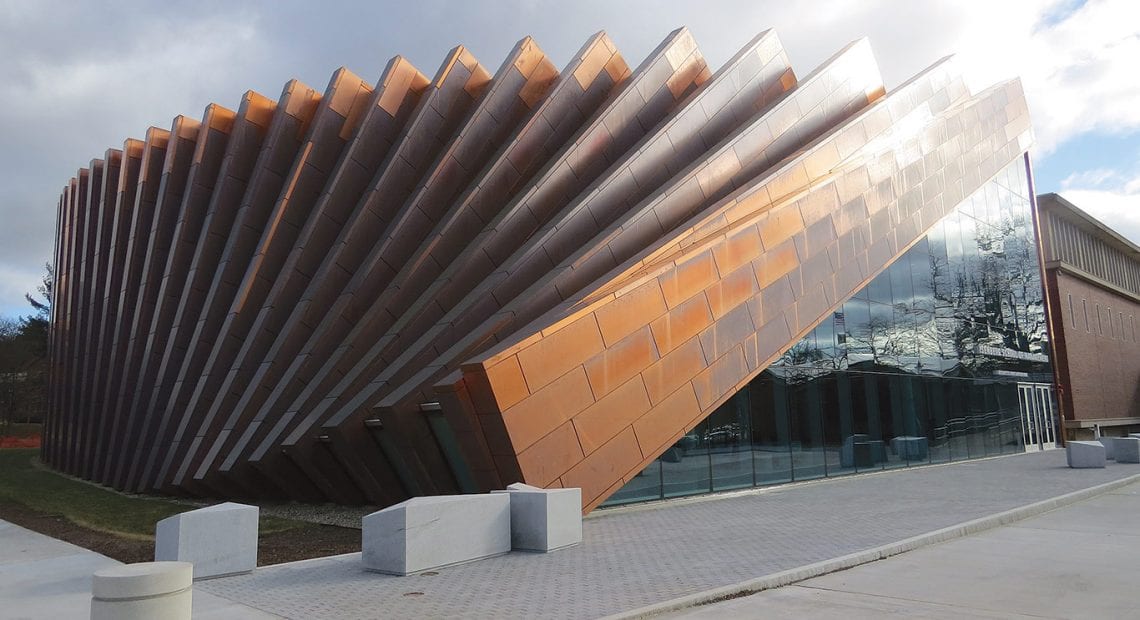
Construction

National Outlook

According to the 2019 Dodge Construction Outlook released by Dodge Data & Analytics, a leader in construction-industry forecasting and business planning, total U.S. construction starts for 2019 will be $808 billion, staying essentially even with the $807 billion recorded in 2018.



“Over the past three years, the expansion for the U.S. construction industry has shown deceleration in its rate of growth, a pattern that typically takes place as an expansion matures,” said Robert Murray, chief economist for Dodge Data & Analytics. “After advancing 11% to 14% each year from 2012 through 2015, total construction starts climbed 7% in both 2016 and 2017, and a 3% increase is estimated for 2018. There are, of course, mounting headwinds affecting construction, namely rising interest rates and higher material costs, but for now these have been balanced by the stronger growth for the U.S. economy, some easing of bank lending standards, still-healthy market fundamentals for commercial real estate, and greater state financing for school construction and enhanced federal funding for public works.”

One important question going into 2019 is whether deceleration is followed by a period of high-level stability or a period of decline, he noted. For 2019, it’s expected that growth for the U.S. economy won’t be quite as strong as what happened in 2018, as the benefits of tax cuts begin to wane. Short-term interest rates will rise, as the Federal Reserve continues to move monetary policy towards a more neutral stance. Long-term interest rates will also rise, reflecting higher inflationary expectations by the financial markets. At the same time, any erosion in market fundamentals for commercial real estate will stay modest. In addition, the greater funding from state and local bond measures passed in recent years will still be present, and it’s likely that federal spending for construction programs will increase.

“In this environment, it’s forecast that growth for construction starts will decelerate further, but not yet make the transition to the point where the overall volume of activity declines” Murray noted. “For 2019, total construction starts are forecast to hold basically steady at $808 billion. By major sector in dollar terms, residential building will be down 2%, non-residential building will match its 2018 amount, and non-building construction will increase 3%.”

The pattern of construction starts by more specific segments includes the following:

• Single-family housing will be unchanged in dollar terms, alongside a modest 3% drop in housing starts to 815,000. There will be a slight decline in homebuyer demand as the result of higher mortgage rates, diminished affordability, and reduced tax advantages for home ownership as the result of tax reform.

• Multi-family housing will slide 6% in dollars and 8% in units to 465,000. Market fundamentals such as occupancies and rent growth had shown modest erosion prior to 2018, which then paused in 2018 due to the stronger U.S. economy. However, that erosion in market fundamentals is expected to resume in 2019.

• Commercial building will retreat 3%, following 2% gains in 2017 and 2018, as well as the substantial percentage increases that took place earlier. While 2018 market fundamentals for offices and warehouses were healthy, this year, vacancy rates are expected to rise as the economy slows, slightly dampening construction. Hotel construction will ease back from recent strength, and store construction will experience further weakness.

“There are, of course, mounting headwinds affecting construction, namely rising interest rates and higher material costs, but for now these have been balanced by the stronger growth for the U.S. economy, some easing of bank lending standards, still-healthy market fundamentals for commercial real estate, and greater state financing for school construction and enhanced federal funding for public works.”

• Institutional building will advance 3%, picking up the pace slightly from its 1% gain in 2018, which itself followed an 18% hike in 2017. Educational facilities should see continued growth in 2019, supported by funding coming from numerous school-construction bond measures. Healthcare projects will make a partial rebound after pulling back in 2018. Airport terminal and amusement-related projects are expected to stay close to the elevated levels of construction starts reported in 2017 and 2018.

• Manufacturing plant construction will rise 2% following a 18% jump in 2018. The recent pickup in petrochemical plant projects should continue, and cuts in the corporate tax rate from tax reform should encourage firms to invest more in new plant capacity.

• Public-works construction will increase 4%, reflecting growth by most of the project types. The omnibus federal appropriations bill passed last March provided greater funding for transportation projects that will carry over into 2019, and environmental-related projects are getting a lift from recently passed legislation.

• Electric utilities and gas plants will drop 3%, continuing to retreat after the exceptional amount reported back in 2015. New generating capacity continues to come online, dampening capacity utilization rates for power generation.

Dodge Data & Analytics is North America’s leading provider of analytics and software-based workflow-integration solutions for the construction industry.