SPRINGFIELD — American International College (AIC) will host two information sessions on Saturday, Jan. 19 in the Admissions Office, DAR building, on the college campus located at 1000 State St. in Springfield.
The graduate information session begins at 9 a.m. and will provide insight into the application process, providing perspective students with an opportunity to meet with admissions staff members, program directors, and current students.
The Low Residency Program information session, which begins at 11 a.m., will provide an indepth review of the master of arts program in counseling psychology and higher education and doctor of education programs, in addition to a meet and greet with staff members, program directors, and current students. Lunch will be served during this session.
To learn more about graduate degree programs at American International College, visit www.aic.edu or call Director of Graduate Admissions Hannah Hartzsch at (413) 205-3700.
SPRINGFIELD — BusinessWest is currently accepting nominations for the 40 Under Forty class of 2019. The deadline for nominations is Feb. 15.
Launched in 2007, the program recognizes rising stars in the four counties of Western Mass. Nominations, which should be detailed in nature, should list an individual’s accomplishments within their profession as well as their work within the community. Nominations can be completed online by visiting www.businesswest.com, clicking on ‘Our Events,’ and then ‘40 Under Forty.’
Nominations will be weighed by a panel of judges. The selected individuals will be profiled in the April 29 issue of BusinessWest and honored at the 40 Under Forty Gala on June 20 at the Log Cabin in Holyoke.
HOLYOKE — Officials from Holyoke Community College (HCC) and Westfield State University signed a dual admission agreement this week that streamlines the process for students who want to continue their nursing educations at Westfield State after earning an associate degree in nursing at HCC.
The RN-to-BSN completion program partnership was announced during a ceremony at HCC’s Center for Health Education on Jarvis Avenue in Holyoke, home to the college’s RN (registered nurse) and LPN (licensed practical nursing) programs and medical simulation center.
“We’re delighted to be here today and excited about this new venture to expand our existing collaboration with HCC to offer a streamlined, efficient pathway to a bachelor of science in nursing degree for HCC students,” said Westfield State University President Ramon Torrecilha. “This is important because it underscores the values of both institutions — our commitment to accessibility and our commitment to affordability.”
By granting automatic admission, the new agreement simplifies the application process for HCC nursing students who want to earn a BSN at Westfield State — and can also significantly reduce the cost for that degree.
“We already have a really strong partnership with Westfield State, and this is an opportunity to enhance that partnership,” said HCC President Christina Royal. “It’s all for the sake of our students who need and want easier options as they move from their two-year studies to their four-year studies. Many of our students prefer Westfield State, so we want to make that transfer process as seamless as possible.”
Officials said the new program will consist mostly of online coursework with limited on-campus requirements. Applications are now being accepted for fall 2019 enrollment.
According to the agreement, graduates of HCC’s associate degree program can transfer up to 90 course credits into the BSN degree program at Westfield State. HCC students need 72 credits to complete the requirements for their associate degree in nursing.
“The total cost of the 30 nursing-degree credits for the completion program is $10,800, making the program one of the most cost-effective of its kind in the area,” said Shelley Tinkham, dean of the College of Graduate and Continuing Education at Westfield State.
Full-time students can complete the program as quickly as one year; students can also opt to complete the program on a part-time basis in 24 months.
According to the U.S. Bureau of Labor, employment of registered nurses is projected to grow 15% by 2026, significantly faster than the average for all occupations. Torrecilha said nursing professionals with BSN degrees will remain in high demand for the foreseeable future.
“This latest collaboration emphasizes both institutions’ commitment to growing this high-demand segment of the workforce, underscoring our mutual concern and interest in preparing future generations of nursing professionals,” he said.
Royal cited a recent report, the “Pioneer Valley Labor Market Blueprint,” that identified health sciences as a priority sector for Western Mass.
“It’s one of the economic engines that drive our region,” she said, “so for us to stay focused on providing opportunities like these that are going to lead to vibrant jobs in this community is just going to bolster that sector of the economy.”
SPRINGFIELD — Skoler, Abbott & Presser, P.C. announced that Attorney Amelia Holstrom was named a partner in the firm on Jan. 1. Holstrom, who has been with the firm since 2012, focuses her practice on labor law and employment litigation, including personnel policies and practices review, wage-and-hour compliance, and separation and severance agreements.
“Amelia is renowned statewide for her legal and professional skills,” said attorney Timothy Murphy, a partner at Skoler Abbott, noting that Holstrom was a Massachusetts Lawyers Weekly Up & Coming honoree in 2017, selected to the Super Lawyers Rising Stars list in 2018, and is a regular contributor to the Massachusetts Employment Law Letter. “She helps her clients make difficult employment decisions within their legal obligations. She provides counsel to management regarding strategies to avoid litigation, but is an experienced litigator prepared to vigorously defend her clients in court when necessary. We are thrilled Amelia has accepted partnership in the firm.”
Holstrom frequently speaks about employment-related legal topics for a wide variety of associations and organizations. She was selected by BusinessWest as a 40 Under Forty honoree in 2015 and received the Massachusetts Bar Assoc. Community Service Award in 2016. She is a member of the Massachusetts, Hampden County, and Connecticut bar associations; sits on the board of directors for Clinical & Support Options in Northampton and Girls Scouts of Central and Western Massachusetts; and is an ad hoc member of the personnel committee for the Food Bank of Western Massachusetts.
“I’m proud to be able to take on more of a leadership role for one of the region’s most vibrant, well-respected firms,” Holstrom said. “Growing up, I watched my parents, who worked in management at different companies, make challenging decisions about employees. When I took a labor law class in school, I was reminded of the myriad difficulties employers face and the laws that impact those decisions. That served as the basis for my legal career, while my work at Skoler Abbott has helped me finely hone my skills. I’m grateful for the opportunity to continue to grow with the firm.”
HAMPDEN — Andrew Anderlonis, president of Rediker Software, recently announced that Esther Rich has been hired as the company’s new director of Support. Rich brings more than 30 years of experience in customer support, with more than 10 of those years spent in a management position. Before joining Rediker Software, Rich was the Customer Support manager for Farm Credit Financial Partners in Agawam.
In her new role, Rich will lead and motivate her team to ensure they have the tools and skills required to provide the best customer service possible. She holds a business management degree from St. John’s School of Business.
“Esther brings us many years of call-center and customer-support leadership experience,” Anderlonis said, “and we are very excited to have her with Rediker to help manage our fantastic support team.”
AGAWAM — The statistics are alarming: 70% of Americans are living paycheck to paycheck. At work, stress over finances can take a toll on employee performance and impact productivity. Almost 10 years ago, OMG Inc. saw this as a factor limiting employee success and took action.
OMG used SmartDollar, the financial-wellness program created by money expert and best-selling author Dave Ramsey, to teach employees how to take better care of themselves financially. “This has been a game changer for us,” said Sarah Corrigan, vice president of Human Resources. “More than 300 employees have taken advantage of the tools we offer for free to create a financial plan for themselves and their families.”
Helping employees succeed financially is part of OMG’s overall wellness strategy. “Reducing the worry over money allows employees to focus on their work and, more importantly, on themselves and their future,” Corrigan said. Using SmartDollar, the average OMG participant pays off more than $8,000 in debt and saves more than $5,000. Collectively, participants have achieved a positive swing of almost $1 million through debt reduction and savings contributions.
As a result, SmartDollar recognized OMG as its 2018 Company of the Year. “Our team absolutely loved hearing about what’s happening at OMG,” said Brian Hamilton, vice president of SmartDollar. “They did it. They made the kind of behavior change it takes to change their lives and their family’s futures.”
Added Hubert McGovern, OMG president and CEO, “we’re very proud of what our employees have accomplished. There’s nothing more satisfying for us as a business than to help our employees succeed not only professionally, but personally as well.”
BOSTON — Massachusetts employers gave a big “bah, humbug” to the year-end economy as business confidence withered in the face of a government shutdown and the largest one-month stock-market decline since the Great Depression.
The Associated Industries of Massachusetts (AIM) Business Confidence Index lost three points to 58.6 during December, its lowest level since December 2016. Confidence readings have dropped five points during the past 12 months.
The retreat was led by an 8.6-point drop in employer views of the national economy, and a 4.7-point drop among manufacturing companies. Overall confidence remains within optimistic territory, but less comfortably so than earlier in 2018.
“The Massachusetts economy remains strong, with a 3.3% growth rate and an unemployment rate of 3.4%, but employers are increasingly concerned about factors such as financial-market volatility, a dysfunctional national political debate, and challenges such as the cost of providing health insurance to employees,” said Raymond Torto, chair of AIM’s Board of Economic Advisors (BEA) and lecturer at Harvard Graduate School of Design.
The AIM Index, based on a survey of Massachusetts employers, has appeared monthly since July 1991. It is calculated on a 100-point scale, with 50 as neutral; a reading above 50 is positive, while below 50 is negative. The Index reached its historic high of 68.5 on two occasions in 1997-98, and its all-time low of 33.3 in February 2009. It has remained above 50 since October 2013.
AMHERST — The U.S. Department of Energy (DOE) recently awarded biogeochemist Marco Keiluweit, assistant professor of Soils and the Environment in the Stockbridge School of Agriculture at UMass Amherst, along with his collaborators elsewhere, two grants to study how climate change affects the capacity of soils to remove carbon from the atmosphere and retain enough nutrients for food production.
In particular, the teams will investigate climate-change-related effects of drought and virus infection in plants, and their interaction with soils. Keiluweit and colleagues received $200,000 and $300,000 exploratory research awards from DOE’s Biological and Environmental Research program, which supports “high-risk, high-reward” research, the soil-chemistry expert says.
“It’s basic science to develop a better understanding of the processes that sequester carbon in soils to put us in a better position to predict how soils may respond to climate change,” Keiluweit explained. “Plant root-soil interactions are important for two crucial functions of soils — carbon storage and agricultural production — but we don’t really understand how they are being altered by climate change. For example, prolonged droughts or increased virus infections can severely impact plants, with unknown consequences for root-soil interactions.”
Keiluweit’s collaborators include Zoe Cardon at the Woods Hole Marine Biology Laboratory, the principal investigator on one of the grants, and Malak Tfaily at the University of Arizona, Carolyn Malmstrom at Michigan State University, and William J. Riley at Lawrence Berkeley National Laboratory.
Their drought-focused research will look at plants in an alpine watershed near Gothic, Colo., where root-soil interactions are key regulators of ecosystem carbon storage and downstream nutrient loadings, the researchers say. These areas have been shown to be particularly vulnerable to climate change, they point out.
For this work, Keiluweit says he and collaborators will make “very fine scale measurements of what is happening at the interface between roots and soil” in both greenhouse and field experiments. They want to explore what they call “elusive mechanisms” driving root-soil interaction, which may mobilize a “vast pool of organic matter that has been stabilized by associations with minerals for centuries or millennia.” Such mechanisms are missing from conceptual and numerical models of carbon cycling in soils, they note.
“Roots try to manipulate the soil environment to make it more habitable for themselves,” said Keiluweit. “They fix carbon from the atmosphere and send it to the root, where it is released as organic carbon compounds into what we call the rhizosphere — the soil surrounding the root — to reshape it to their needs for water, nutrients and minerals, and to attract beneficial microbes and suppress harmful ones.
“We’re learning more and more about the rhizosphere and the intricate interactions that take place between roots and microbes,” he went on. “We think there is a synergistic interplay that allows them to mobilize organic matter, which is rich in carbon and nutrients, from minerals. Micro-scale measurements will allow us to reveal more of this interplay and how it relates to soil carbon storage and fertility.”
SPRINGFIELD — Springfield Technical Community College will offer EMT classes beginning Tuesday, Jan. 22. Students can choose to take day or evening courses to complete the program. Training takes place three days a week between January and April. Day classes are held between 8 a.m. and noon. Night classes run from 6 to 10 p.m.
The program consists of 171 hours of in-class lectures and a minimum of 20 hours of online training, a field trip, and workshops to prepare for the state certification.
Based on the Department of Transportation curriculum for Basic Emergency Medical Technician, the program is approved by the Massachusetts Office of Emergency Medical Services. The course covers basic life-support skills and techniques, patient assessment, and transporting patients.
For more information, contact the Workforce Development Center at (413) 755-4225 or [email protected].
WASHINGTON, D.C. — As the partial government shutdown enters its fourth week, small businesses across the country are starting to feel the effects of the shutdown, resulting in unnecessary uncertainty at the start of a new fiscal year.
Keith Hall, president and CEO of the National Assoc. for the Self-Employed, the nation’s leading advocate and resource for the self-employed and micro-business community, called on Congress and the White House to work together to end the shutdown on behalf of America’s small-business community.
The Washington Post is now reporting that, as of Dec. 22, the Small Business Administration stopped processing new small-business loans due to the government shutdown. Thousands of small-business owners across the country are unable to receive critical funding to start and grow their businesses because of the partial government shutdown. Even when full funding is restored, a backlog is likely.
“The negative consequences of one of the longest shutdowns in U.S. history is now fully impacting our country’s small-business community,” said Hall. “From uncertainty around how the shutdown could impact delays in tax refunds small businesses were looking to invest from this year’s new tax law to the shuttering of the Small Business Administration impacting small-business loans, America’s small businesses are on the front lines feeling the adverse impact.
“The government shutdown has created additional uncertainty during a critical time when small businesses are starting a new fiscal year,” he continued. “Small businesses must continue to abide by their tax obligations, including paying quarterly tax estimates and adhering to all filing deadlines. However, the federal government is unlikely to keep their end of the deal by processing tax refunds on time and providing small businesses access to critical answers they may have to questions about filing for the first time under the new tax law.”
During the shutdown, about 12% of IRS staff are expected to continue working, according to the agency’s lapsed funding contingency plan. This will result in the inability of such functions as staff being available to answer questions for small businesses filing for the first time under the new Tax Cuts and Jobs Act law going into full effect this tax year. It could also negatively impact the ability of IRS staff to process tax refunds in a timely manner, resulting in delays.
SPRINGFIELD — The Valley Blue Sox announced that the sixth annual Western Massachusetts Baseball Hall of Fame induction banquet presented by Westfield Bank has been moved to Hadley Farms Meeting House, 41 Russell St., Hadley. The banquet will be held on Thursday, Jan. 31. Doors to the event will open at 6 p.m., with the program beginning at 6:30 p.m.
“With the immense amount of interest and support we have received from the local baseball community, it became apparent to our committee that a bigger venue was necessary to accommodate all interested attendees for the evening,” said Chris Weyant, general manager of the Valley Blue Sox. “We are very thankful to Westfield Bank and the Western Massachusetts community for their amazing support of this event, and look forward to another fantastic evening for baseball in the region.”
This year’s induction class includes Justine Siegal, Dana LeVangie, Karl Oliveira, Mike Laga, Jim Jachym, Mark Belanger, Candy Cummings, and the 2018 Pittsfield Little League team.
A limited amount of tickets for the banquet are still available. Prices are $50, or $450 for a table of 10. Dinner is included, and every guest will receive a pair of tickets to a 2019 Blue Sox home game. To purchase tickets, call (413) 533-1100 or visit valley-blue-sox.ticketleap.com/2019-hof.
SPRINGFIELD — The 2019 Springfield Leadership Institute will focus on core management and leadership skills for increasing personal and organizational effectiveness. The practical and applied program will equip participants with the knowledge and skills to take their leadership to the next level.
The Institute, which begins on Feb. 28, runs through June 6 on Thursdays from 1 to 4:30 p.m., and is directed by Robert Kleine III, dean of the Western New England University College of Business, and Associate Professor Stacie Chappell, who has a strong background in leadership development and consulting to a variety of organizations. The program is supported by the Irene E. and George A. Davis Foundation. All sessions will be held at the TD Bank Conference Center, 1441 Main St., Springfield.
Sessions will focus on managerial leadership, emotional intelligence and self-awareness, powerful communication, building high-performance teams, and leveraging conflict. Participants will actively explore best practices of leaders; analyze their own leadership, learning, and problem-solving styles; and experience the synergies that result from high-performing teams. The emphasis will be on experiential activities that provide opportunities to identify, develop, and refine skill sets for effective leadership. Participants will have the opportunity to apply and extend their learning through a practice-based team project. The program is designed for aspiring managers, new managers, and professionals interested in increasing their effectiveness and/or expanding their impact within or beyond their current role.
Upon successful completion of Leadership 2019, participants will be eligible to enroll in a free graduate course offered through the College of Business at Western New England University (subject to certain requirements). Applications must be received by Thursday, Feb. 14. Tuition is $885 per participant and includes a day trip to Beacon Hill and a graduation dinner. For questions about the program or the application process, e-mail Grace Szydziak at [email protected].
SPRINGFIELD — Hopping it up in the middle of winter makes sense for those who won’t be taking a tropical cruise any time soon. The Student Prince and the Fort will bring paradise home with an Island Hopper Beer Dinner on Thursday, Jan. 17 at 6 p.m.
Six food courses will be paired with six beers from breweries that are located coast to coast and off the coast. Beer selections will include Red Stripe, Ballast Point, Maui Brewing, Grey Sail, Port Brewing, and Oskar Blues.
Island-inspired fare will be created by Corporate Chef Zachary Shuman. The menu will include barbecue pork ribs with toasted sesame seeds, macadamia-crusted chicken with greens and toasted coconut, grilled shrimp with Thai chilis and vegetable slaw, skirt steak with salt and vinegar fries, chicken-fried steak with pepper gravy and creamy grits, plus desserts such as dark chocolate cake and coconut ice cream.
The price is $60 per person (tax and gratuity included). Reservations are recommended. Free valet parking is available after 5 p.m.
GREENFIELD — Baystate Franklin Medical Center announced it will offer the Stress Management and Resiliency Training (SMART) course beginning Monday, Jan. 28.
Developed by the Benson-Henry Institute for Mind Body Medicine at Massachusetts General Hospital, the SMART program helps participants achieve greater quality of life and an enhanced sense of well-being. The program teaches self-care practices that help buffer daily stress, making participants less emotionally and physically vulnerable to it.
Stress affects more than just mental health; an estimated 75% to 90% of all doctor visits are for stress-related issues. Stress is a factor in five out of the six leading causes of death: heart disease, cancer, stroke, lower respiratory disease, and accidents.
“The purpose of this program is to help participants develop self-care tools to manage stress,” said program facilitator Cheryl Pascucci. “The ultimate goal is to enhance the quality of life and reduce any medical symptoms that participants may have as a result of stress.”
Pascucci is a SMART-certified healthcare practitioner. She was trained at Mass General’s Benson Henry Institute as a facilitator in 2014 and is looking forward to sharing her expertise with the community.
“I have seen the positive effects that this program has, and I can speak from experience when I say that having the tools to manage difficult emotions can unlock the potential to live a healthy, fulfilling life,” she said.
Topics include techniques to improve eating, sleeping, and physical activity, as well as how to recognize an individual’s responses to stress and how to change though patterns.
SMART is an eight-week program that will be held in the hospital’s conference rooms on Monday evenings from 6 to 8 p.m. The cost is $150, which includes a workbook. Pre-registration is required. For more information or to register, call Pascucci at (413) 773-2741.
SPRINGFIELD — Bacon Wilson announced that Kathryn Crouss has been named the firm’s newest shareholder.
“Katie’s commitment to clients and community is perfectly in line with Bacon Wilson’s mission, and her record of success as an attorney speaks for itself,” said Managing Partner Kenneth Albano. “Wherever she goes, Katie’s intelligence and warmth always stand out. All of us here at Bacon Wilson look forward to working with Katie as our partner for many years to come.”
Crouss is a member of Bacon Wilson’s litigation team. She handles all aspects of employment law, including management-side representation, defending employers against discrimination and wage-and-hour lawsuits and routinely advising employers on matters related to compliance, official policies and procedures, and best practices. She also represents employees with regard to severance or employment agreements, worker’s compensation matters, as well as claims of discrimination against their employers. She also has extensive experience with both family-law litigation and alternative dispute resolution.
Crouss is a certified mediator, trained in collaborative law, an LAR (limited assistance representation) qualified attorney for Hampden County, and a trained conciliator for the Massachusetts Probate & Family Courts. She is also an adjunct faculty member at Bay Path University, where she teaches “Legal Environments in Business” to students of the university’s business department.
WINDSOR LOCKS, Conn. — The Connecticut Airport Authority (CAA) announced the debut in 2019 of new, non-stop service from Bradley International Airport to Raleigh-Durham International Airport and Orlando International Airport on low-cost carrier Frontier Airlines, as well as the addition of non-stop service to Pittsburgh on Via Airlines.
“We are excited to see Frontier Airlines’ expansion at Bradley International Airport, less than a month after we celebrated the announcement that they will begin operations at Bradley this year,” said Kevin Dillon, executive director of the CAA. “The nonstop flights to Raleigh-Durham and Orlando are a welcome addition to our menu of nonstop flights. We look forward to the low fares and convenience that Frontier Airlines’ growing presence at Bradley International Airport will bring to our passengers.”
The service to Raleigh-Durham will commence on April 30 on an Airbus A320. It will operate seasonally on Tuesdays, Thursdays, and Sundays. The service to Orlando will commence on May 1 on an Airbus A321. It will operate seasonally on Mondays, Wednesdays, Fridays, and Saturdays.
In addition, Dillon said, “we are excited to start the year on a high note by welcoming Via Airlines and announcing the continued expansion of our airline and route network. Pittsburgh is an important destination, especially for those traveling on business. This new non-stop, however, will bring benefits to both our business and leisure passengers by offering a cost-effective and convenient option to travel between the two cities. We look forward to our partnership with Via Airlines and their success at Bradley International Airport.”
The service to Pittsburgh will commence on July 22 on an Embraer ERJ145 with 50 seats. It will operate four times a week, on Mondays, Tuesdays, Wednesdays, and Fridays.
AGAWAM — The West of the River Chamber of Commerce recently welcomed Box Paper Scissors to the Agawam community.
Business owner Bryant Whitsett opened the store on Dec. 22, offering a wide variety of products and services, including key cutting, notary, DVD transfer, office supplies, conference-room rental, space to sell and promote local products and services, shipping, mailbox services, faxing and more.
A grand-opening celebration will take place Thursday, Jan. 17 from 4 to 6 p.m. The store is located at 1325 Springfield St. in Feeding Hills.
HOLYOKE — Holyoke Community College (HCC) will hold extended service hours to accommodate new and continuing students before the spring 2019 semester.
Beginning Monday, Jan. 14 and continuing through Friday, Feb. 1, HCC’s Admissions, Financial Aid, Testing, Advising, and Student Accounts offices on the second floor of the Frost Building will open at 8:30 a.m. and stay open until 7 p.m., Monday through Thursday. On Fridays, those offices will be open from 8:30 a.m. until 4:30 p.m. The spring 2019 academic semester begins Monday, Jan. 28.
“There is still plenty of time for students to register for the spring semester,” said Renee Tastad, dean of Enrollment Management and College Access Programs. “We know our students are very busy with jobs and families and life in general, so we try to make all the accommodations we can to make the registration process smooth for everyone.”
SPRINGFIELD — Western New England University (WNEU) announced plans for a comprehensive fundraising campaign designed to enrich the student experience inside and outside the classroom. Named the Campaign for Our Second Century, the philanthropic endeavor launched publicly on 1/9/19 — a nod to the university’s founding year of 1919.
Western New England University aims to raise at least $35 million in private support for a range of priorities that will build on the institution’s historic first century and shape its future progress. Those priorities fit into five overall fundraising objectives: growing scholarship aid, building and enhancing campus facilities, creating impactful opportunities for student life, boosting academic initiatives and experiences, and strengthening the President’s Fund for Excellence.
Current and future Western New England students will be the direct beneficiaries of the most ambitious fundraising effort in the university’s history. The number-one priority of the campaign is to increase student aid through donor-funded scholarships. In recent years, full-time undergraduate enrollment has grown to record levels, with more than 98% of students receiving financial aid through scholarships, grants, and loans.
The university has already secured more than $29 million in new gifts and commitments to advance Western New England during the campaign’s pre-launch phase, which began in 2016. Lead gifts were made by two of the university’s most ardent supporters — Kevin Delbridge ’77 and Janet Johnson Bullard ’69, both university trustees who are serving as the campaign’s honorary chairpersons. To date, more than 4,000 individual alumni, friends, and foundations have made commitments. Each gift made to WNEU during the campaign counts toward its goal.
“Diligent, thoughtful, and dynamic people have made Western New England the university that it is today,” said President Anthony Caprio. “As we continue to grow and evolve, their generous financial support, volunteerism, and ideas will help us to shape an even brighter future together.”
In addition to fundraising, the campaign represents an opportunity to tell the stories of the impact donors have at Western New England University while engaging the community in a culture of philanthropy that will accelerate the university’s progress into its next century.
This is Western New England’s second comprehensive campaign. Private philanthropic support is not intended to replace university sources of revenue, but rather provide the margin that enables greater access to scholarship support, state-of-the-art technologies, outside-the-classroom experiences, faculty development, and other critical learning services. For details about the Campaign for Our Second Century, visit wne.edu/campaign.
MONSON — For the ninth year in a row, Monson Savings Bank asked the community to help plan the bank’s community giving activities by inviting people to vote for the organizations they would like the bank to support during 2019.
“We are very pleased that this program continues to be something that people truly appreciate and how it really benefits the communities we serve,” said Steve Lowell, president of Monson Savings Bank. “We frequently get inquiries about when the community-giving initiative is going to kick off, so we started it before the holiday season this year to give people more time to rally participation. We were thrilled to hear from nearly 5,000 people this year.”
The top vote getters include Wilbraham United Players, Scantic Valley YMCA, the Women’s Empowerment Scholarship Fund, Rick’s Place, River East School-to-Career, Greene Room Productions, Boy Scouts of Western Massachusetts, Link to Libraries, Junior Achievement of Western Massachusetts, and Old Post Orchestra.
“Our communities voted for 281 organizations this year, and many of those had not been on our list in previous years,” Lowell added. “I have to say, it feels great to be part of such a wonderful community full of concerned, active, and committed citizens.”
LUDLOW — HealthSouth Rehabilitation Hospital of Western Massachusetts has unveiled its new name and brand as part of its management company’s name change and rebranding initiative. As of Jan. 1, the inpatient rehabilitation hospital is known as Encompass Health Rehabilitation Hospital of Western Massachusetts. It will continue to provide the same post-acute care for patients overcoming a variety of major illnesses and injuries.
“Our new Encompass Health brand reflects more than the change of our name. It reinforces our commitment to working together to continuously improve the care we provide our patients,” said John Hunt, CEO of Encompass Health Western Massachusetts. “With a focus on clinical collaboration and strengthening relationships, we will continue to play an important role in making a difference in the lives of our patients.”
Birmingham, Ala.-based HealthSouth Corp. launched its new name and brand on Jan. 1, 2018 and will be transitioning its 130 inpatient rehabilitation hospitals and 273 home-health and hospice locations serving 36 states and Puerto Rico through 2019. All of the company’s post-acute-care service locations in Massachusetts migrated to the Encompass Health name and branding last week.
SPRINGFIELD — BusinessWest is currently accepting nominations for the 40 Under Forty class of 2019. The deadline for nominations is Feb. 15.
Launched in 2007, the program recognizes rising stars in the four counties of Western Mass. Nominations, which should be detailed in nature, should list an individual’s accomplishments within their profession as well as their work within the community. Nominations can be completed online by visiting www.businesswest.com, clicking on ‘Our Events,’ and then ‘40 Under Forty.’
Nominations will be weighed by a panel of judges. The selected individuals will be profiled in the April 29 issue of BusinessWest and honored at the 40 Under Forty Gala on June 20 at the Log Cabin in Holyoke.
HOLYOKE — PeoplesBank announced the appointments of Colin Lacey as Village Commons South Hadley Banking Center manager, Clare Ladue as Hadley Banking Center manager, and Samuel Smith as East Longmeadow Banking Center manager.
In his new position, Lacey is responsible for identifying and providing personal and small-business customers banking options to achieve their financial needs, including depository services and lending solutions. He has six years of financial-services experience.
Lacey holds a bachelor’s degree in accounting from Saint Anselm College in Manchester, N.H. He is also a 2017 graduate of the Springfield Leadership Institute. He is a volunteer youth lacrosse coach in South Hadley.
In her new position, Ladue oversees and manages all aspects of a full-service banking center, including staffing, sales, operations, business development, and community relations. She has 24 years of banking experience.
Ladue earned commercial-lending certification from the Massachusetts Bankers Assoc. (MBA), and is a graduate of the MBA’s New England School of Financial Studies. Her volunteer service includes the Quaboag Hills Chamber of Commerce, where she served on the executive committee, as well as the Ware 250th anniversary committee, West Springfield Partners for Education, the Walk of Champions to benefit Baystate Mary Lane Rays of Hope, Junior Achievement, Rays of Hope, Lorraine’s Soup Kitchen, and Link to Libraries.
In his new position, Smith is serving the financial needs of both consumer and small-business clients. Utilizing technology, he is providing a consultative learning environment in order to educate clients around the various options for banking with PeoplesBank. He has 13 years of banking and financial-services experience.
Smith holds a bachelor’s degree in computer information systems with a minor in business management. He is also a certified business banker by Moody’s Analytics. He is also an active volunteer for Revitalize CDC and Junior Achievement.
EASTHAMPTON — Effective Jan. 1, Smith Brothers Insurance, with offices in Easthampton and West Springfield, and the Partners Insurance Agency, an independent insurance agency located in Vestal, Owego, and Waverly, N.Y., have merged together. This merger expands the Smith Brothers Insurance footprint into upstate New York, where the Partners will maintain local presence while leveraging the resources of Smith Brothers Insurance, one of the nation’s top 100 independent brokers.
Owners of the New York offices — Don Patterson, Bill Soprano, Phil Wiles, John Carlin, Michael Constantine, and Chris Hutchings — will stay fully engaged in client service and business development. Constantine will run the New York region, continuing to serve clients with the same team of insurance professionals who have also become employees of Smith Brothers Insurance.
“The Partners brings us presence in New York and allows personal and commercial clients of the Partners to gain access to additional carriers, coverages, and risk-management services. Those who own or operate a business will benefit from additional value-added services, such as human resources, employee well-being, safety, compliance, and financial services,” said Joe Smith, president and CEO of Smith Brothers Insurance. “Both agencies have strong ties to serve our clients and give back to the communities where we live and work.”
Added Constantine, “as we have gotten to know Joe and members of the Smith Brothers team, it is clear we share the same values. Smith Brothers’ commitment to exceptional client service, continued growth, and being a great place to work is so exciting to our team and aligns with our commitment to be the best we can be for our clients, partners, and the community.”
SPRINGFIELD — Florence Bank opened its second Hampden County branch at 1444 Allen St. in Springfield on Dec. 19, and a ribbon-cutting ceremony is slated for Wednesday, Jan. 16 at 9 a.m.
“We’re very pleased to be expanding our presence in Springfield,” said John Heaps Jr., Florence Bank’s president and CEO. “Our focus is on providing great customer service and helping to reinvigorate the community.”
Bank employees, customers, board members, and corporators will be present for the ribbon cutting, along with invited guests — among them Springfield business and civic leaders, including Mayor Domenic Sarno.
The Allen Street branch has an open floor plan with two teller pods and innovative technology for quick cash handling. The location will also feature a drive-up ATM with SMART technology for easy depositing and a comfortable waiting area inside with a coffee bar and free wi-fi.
Nikki Gleason serves as branch manager for the new location. “Springfield is my home, where I work, volunteer, and spend much of my time,” she said. “I’m thrilled to be able to provide local banking services to people in my community.”
Other employees include Candice Somar, assistant branch manager; Bianca Hyde, customer service representative (CSR) and teller operations manager; Mario Nascimento, CSR and senior teller; Magdalis “Maggie” Sierra, CSR and senior teller; and Carolyn Ware, community relations director.
In August 2017, Florence Bank opened its first branch in Hampden County at 1010 Union St. in West Springfield. The Springfield branch marks the second of several anticipated branches in the region.
“This is not just dipping our toe in the water. We’re here, and we’re going to be part of this community for a long time,” Heaps said.
Florence Bank has nearly 3,900 customers living in Hampden County, including 750 business customers, and Heaps said the bank looks forward to deepening its impact in the region and working with neighboring businesses.
HOLYOKE — #MeToo has galvanized a national reckoning about sexual harassment — but girls have been downplayed in the dialogue. “Speaking Out: For Women and Girls,” an event presented by Girls Inc. of Holyoke on Wednesday, Jan. 30 at the Delaney House, is doing its part to change the exchange.
The need is dramatic. Sexual harassment doesn’t begin in the workplace, but starts much earlier: studies show that seven of 10 girls are harassed before they leave high school, and one in four girls experiences sexual abuse and assault in childhood.
This is why “#GirlsToo: Respect Starts Young” inspired the night’s theme. #GirlsToo is a new viral media campaign launched by the national Girls Inc. organization that adds girls’ voices to this essential conversation.
“After witnessing a global year of women being brave enough to speak out, I think our ‘Speaking Out’ event is more timely than ever,” said Debra Vega, the event’s chair. “It’s just one of the ways we’ll continue striving to cultivate a world where women and girls can feel they can be heard.”
The moderator of “Speaking Out: For Women and Girls” is Victoria Ann Rodriguez, a litigation assistant at MassMutual and committee member of Springfield’s Puerto Rican Parade. The three featured local authors are Latoya Bosworth, Magdalena Gómez, and Crystal Senter-Brown. They have long advocated for women and girls and promise to present a lively, thought-provoking evening.
Bosworth is an educator, author, motivational speaker, self-esteem expert, and consultant. At age 21, she dubbed herself “Brenda’s Child,” in honor of her late mother, Brenda Kay. In her adult years, Bosworth has learned to reframe the tragedies and issues of her childhood through seeking out mentors, using writing as an outlet, and giving back. She has a Ph.D. in social services, and has consulted with the Department of Children and Family Services and the Department of Youth Services. Her latest book is The Right Amount of Sunshine: Cultivating Little Girls into Young Ladies.
Gómez is a teaching artist, performer, playwright, motivational speaker, workshop facilitator, and author. She is a recipient of the 2018 New England Public Radio Arts and Humanities Award. Her plays, performance poems, and monologues have been performed everywhere from UMass to Off-Broadway to the Puerto Rican Traveling Theater to Teatro Vida, Springfield’s first Latina theater, which she founded. She is also a commentator on NEPR, the author of poetry collections such as Shameless Woman, and the co-editor of an acclaimed anthology on bullying.
Senter-Brown is the director of Employer Relations at Bay Path University, an author, and a justice of the peace. She has written seven books for children and adults, led writing workshops in the community, spoken at local schools, and taught in the Women as Empowered Leaders and Learners program at Bay Path. One of her novels, The Rhythm in Blue, was adapted into an award-winning feature film. She was named a BusinessWest Difference Maker in 2018.
“Speaking Out: For Women and Girls” takes place from 5-7 p.m. Event tickets are $100 each and include an open bar and hearty appetizers. To purchase tickets, visit bit.ly/SpeakingOut2019. The authors’ books will be on sale at the event. All proceeds will benefit Girls Inc. of Holyoke.
A Breed Apart: Antonacci Family Continues to Bring Businesses to the Winner’s Circle
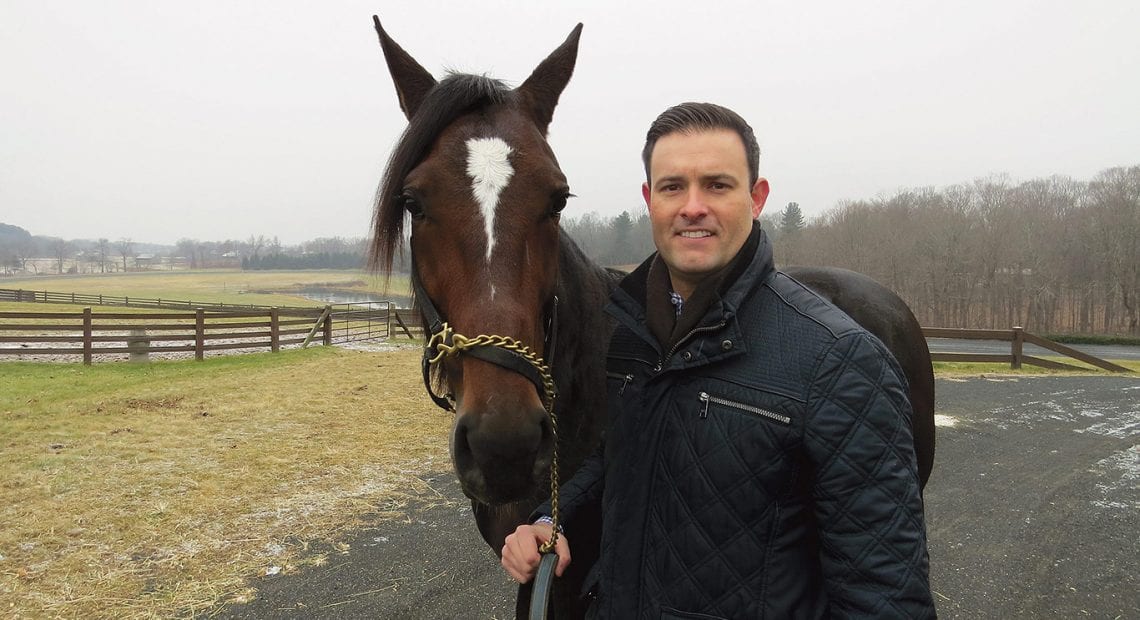
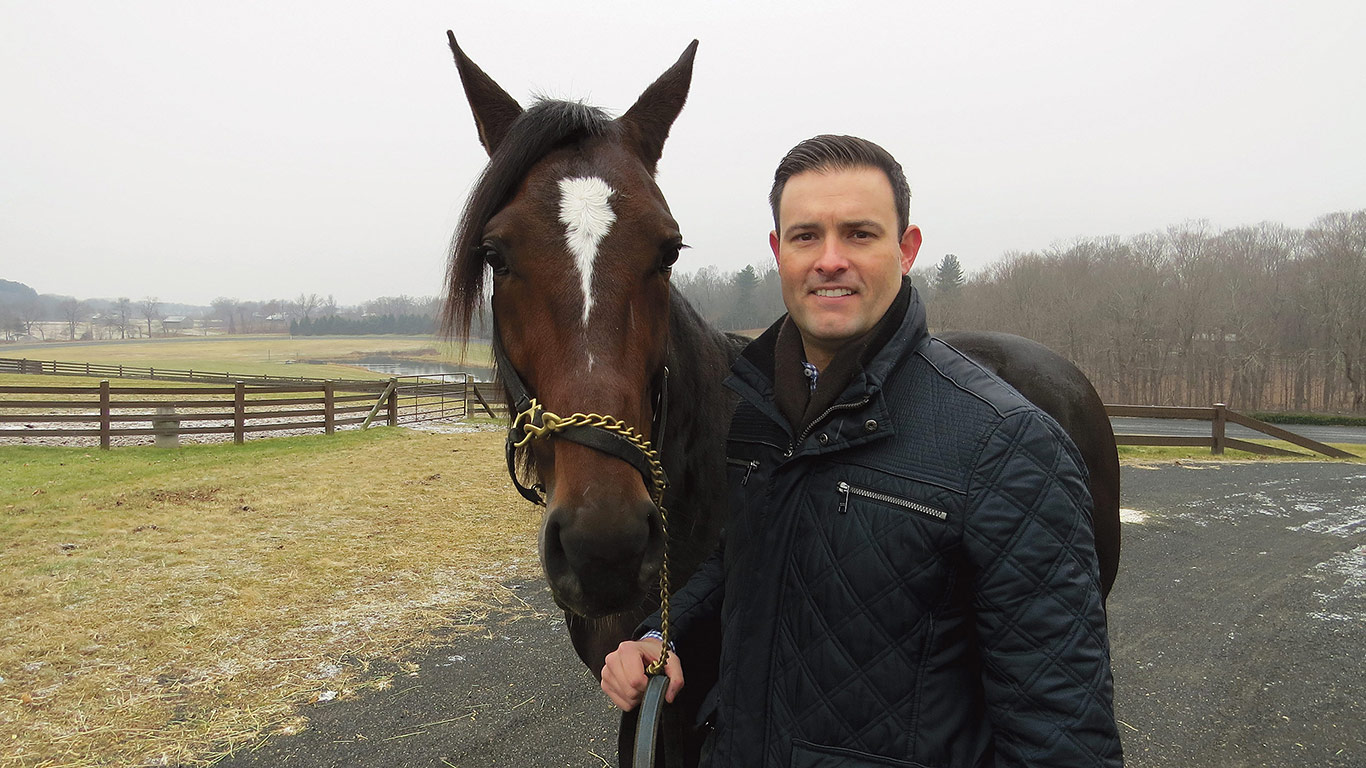
Frank M. Antonacci with ‘Lindy the Great.’
In the early 1950s, Guy ‘Sonny’ Antonacci started a sanitation business with a single truck. That venture has evolved into a diversified, multi-generational family business that includes a horse-racing farm, a family-entertainment facility known as Sonny’s Place, and a country club in Hampden known as GreatHorse. Each component of this conglomerate was the product of vision, entrepreneurial spirit, hard work (lots of that), and some luck. For their ability to breed winners — at the track and in business — the Antonacci family has been named BusinessWest’s Top Entrepreneurs for 2018.
Frank M. Antonacci was asked to talk about his grandfather, the late Guy ‘Sonny’ Antonacci, and put his life and entrepreneurial spirit into some kind of perspective.
It was a straightforward request, but Frank M. (the M is to distinguish him from his father, Frank A. — “I’m not a junior, and he’s not a senior”) paused and then struggled somewhat as he searched for the words and phrases to get the job done.
“He was … a special man,” he said finally. “He was a visionary; he was incredibly spiritual, but tough. He was incredibly kind, yet aggressive.”
Frank’s cousin, Guy, named after his grandfather, obviously, agreed, and also put the word ‘visionary’ to heavy use.
“He would see things 20 years before anyone else would,” he told BusinessWest. “He wanted to get in the bottled-water business in the ’70s with my father and uncle, but they asked him, ‘who’s going to pay for a bottle of water?’ He’s laughing up there now, that’s for sure.”
It was Sonny who started a trash business in New York, back roughly 65 years ago, with a single truck named the ‘Mary Anne,’ after his wife. With that one truck — more or less — he and subsequent generations would go on to build a number of successful, high-profile businesses, including the enterprise that sprang from the Mary Anne, USA Waste & Recycling, one of the largest companies of its kind in the region.
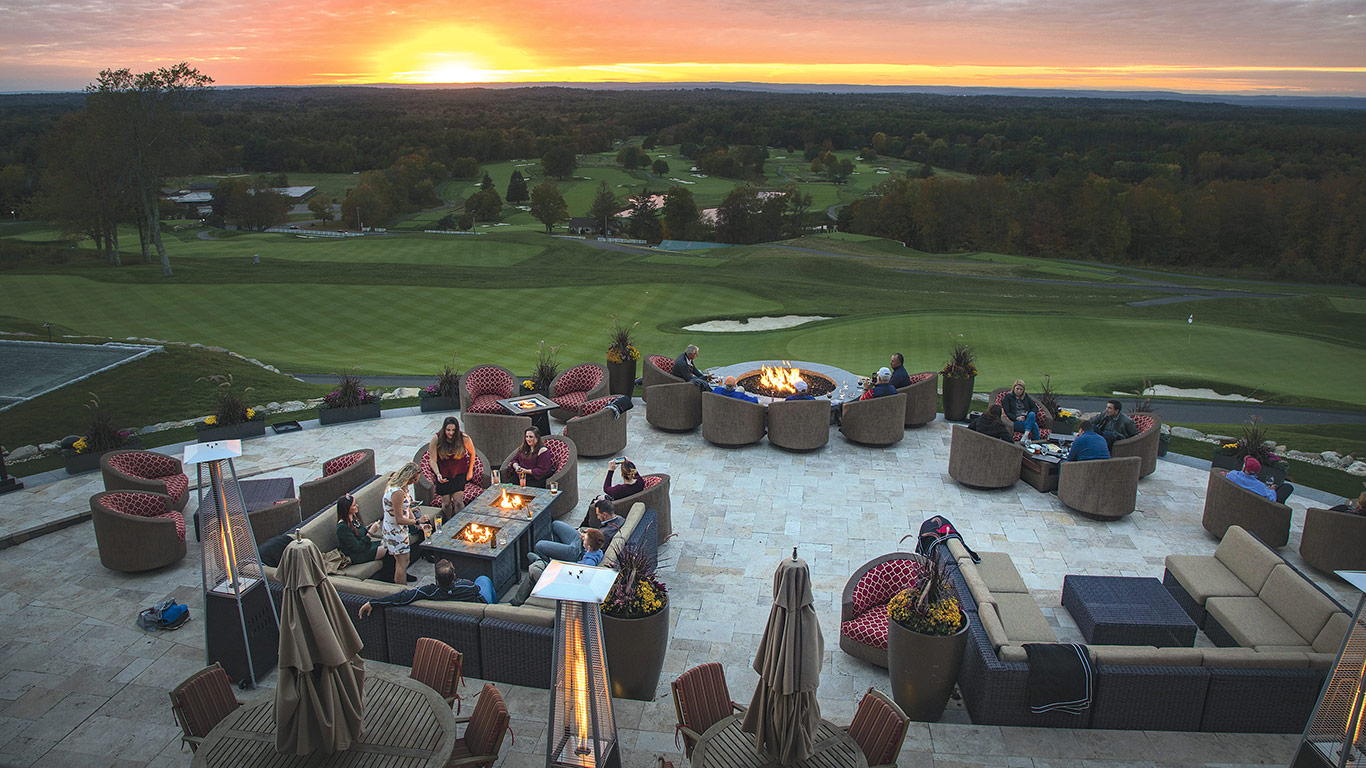
There’s also a horse farm, Lindy Farms in Somers, that has bred and trained a string of champion trotters; Sonny’s Place in Somers, named, obviously, after the patriarch, a huge and continually growing family-entertainment venue that now includes everything from miniature golf to ziplining to a century-old carousel (more on it later); and, last but not least, GreatHorse, the high-end private golf club created on the site of the old Hampden Country Club but looking nothing much like its predecessor; in a nod to Lindy Farms, there are horse references throughout, right down to the banquet hall, named the Starting Gate.
Guy, left, and Frank Antonacci stand by a photo of their grandfather, ‘Sonny,’ in the lobby of USA Waste & Recycling.
As we examine this stable of successful businesses (yes, that’s the first of many horse and racing terms you’ll read), we’ll start by going in the wayback machine to July 1969 and, more specifically, a Sports Illustrated article (printed in an issue with Vince Lombardi on the cover) chronicling the meteoric rise of a horse called Lindy’s Pride, bought for $15,000 by Sonny Antonacci and several cousins.
All of whom, the SI writer recalled, grew up working on ice trucks before they worked on garbage trucks, and struggled for many years to build the business.
“We’re still down to earth,” a different Frank Antonacci, Guy’s cousin, told SI as their horse was preparing to race in the prestigious Hambletonian, the number-one prize in harness racing, which he would win. “We’ve all been working since we were 13; we know what a buck is. Today … there’s not one of us who’s not successful. We’ve been lucky.”
Maybe. But in many respects, this family has made its own luck, and continues to do so today. Indeed while it’s easy to say that all of this — and ‘all’ means the horses, the go-karts at Sonny’s Place, and the country club — was born of New York trash. But in reality, it was all born of an entrepreneurial spirit and an ability to see something that wasn’t there before.
Indeed, Sonny’s Place was formerly a ramshackle driving range, said Guy Antonacci. “There were days when we’d see maybe a few people come in; it was like that driving range in Tin Cup, with a pink 1960 Volkswagen Beetle out front,” he recalled, making a reference to the popular movie starring Kevin Costner, who played a down-on-his-luck golf pro and operator of a range frequented by more armadillos than duffers.
And Hampden Country Club was essentially dying on the vine when the family bought it a decade ago and decided, eventually, after an initial attempt at a mere makeover, to transform it into the most luxurious, and exclusive, club in the region.
Sonny’s Place, the elaborate family-entertainment complex in Somers, now stands on the site of a little-used driving range likened to the one in the movie ‘Tin Cup.’
For their efforts over the past seven decades or so, the Antonacci family — and yes, that includes Sonny, his brothers, and cousins — have been chosen as BusinessWest’s Top Entrepreneurs for 2018. This amounts to a lifetime achievement award for the family — actually, several lifetimes.
Because today, as decades ago, members of this family stay humble and understand the meaning of a buck — and how to make one as well.
This becomes clear in an extensive interview with Guy and Frank M., chosen spokespeople for a family that knows what it’s like to breed winners — as in horses and business ventures.
Harnessing Entrepreneurial Spirit
There was a light snow falling on Christmas Eve morning, and it lent even more beauty to a place where it abounds — Lindy Farms.
There, Frank M. talked about the business and especially the large, handsome horse called Lindy the Great. A trotter, he enjoyed a successful 2018, winning several races, and on this morning was getting a brushing and some R&R before heading to Florida for the off season.
“We’re still down to earth. We’ve all been working since we were 13; we know what a buck is. Today … there’s not one of us who’s not successful. We’ve been lucky.”
Lindy the Great, 16.1 hands high (not 16.2 or 16.3), by Frank’s guess, is the embodiment — one of many, actually — of the multi-faceted businesses ventures that did, indeed, spring from New York trash.
Our story begins with that trash truck called the Mary Anne and the venture that became known as the South Shore Sanitation. While remaining a relatively small operation, it provided the wherewithal to venture into horses — and much more.
In 1974, Sonny, following a priest who had been reassigned to a church in Somers, moved his family there, said Frank, adding that, while he was ‘retired’ at age 40, he didn’t stay retired for long at all.
He and Mary Anne started Somers Sanitation, again, with one truck (this one didn’t have a name), and quickly grew the enterprise, which now stretches from the Vermont border to Southern Connecticut.
What was originally envisioned as a ‘makeover’ became the total transformation known as GreatHorse.
Today, it boasts five hubs and 16 transfer stations, serving a wide range of businesses and communities in Connecticut and Western Mass.
It was with profits from the trash business that Sonny Antonacci and several cousins ventured into horse racing. Their passion for the sport began when they attended races at Roosevelt Raceway on Long Island, and it went to a much higher and different level when they bought their first horse, named Galahad Hanover, and shortly renamed Lindy’s Pride, in 1967.
That horse would go on to win not only the Hambletonian, but the illustrious trotting Triple Crown, and essentially set a tone for Lindy Farms, named, sort of, after the town of Lindenhurst on Long Island, where the Antonaccis grew up.
Over the years, the operation, now in Somers, Enfield, and Hampden, Mass., has continued its winning ways and expanded on several fronts.
“Until about 15 years ago, it was focused on standardbreds — trotters and pacers,” Frank explained. “But in recent years, we’re expanded into thoroughbred racing, and we’ve had some success there, as well.”
Especially with a stallion called No Nay Never. “He might be the hottest freshman stallion in the world this year,” he said, noting that, as a 2-year-old, he won honors as ‘Thoroughbred of the Year’ in Europe.
The racing business, like the trash business before it, typifies how this family approaches business — by going all in. They don’t just want to be a player in an industry; they want to dominate that industry.
Indeed, horse breeding and racing has become a passion for three generations of family members, and the level of excellence attained becomes apparent in the number of trophies and awards on display at the offices of USA Waste & Recycling.
Sonny Antonacci is considered a visionary when it comes to breeding standardbred racehorses, said his grandson, Frank, and he bred more Hambletonian horses than any individual breeder. In 2001, Sonny, along with his cousin Frank, were elected to the Harness Racing Hall of Fame’s Hall of Immortals.
That racing tradition continued with the next generation, his sons, Jerry and Frank, who have remained active in promoting the industry. Frank is currently director of the Hambletonian Society, which oversees the development, administration, and promotion of the harness-racing industry throughout the country, and he’s also director of the U.S. Trotting Assoc., the governing body of the entire domestic industry.
And Frank M. (known as Frankie to family members) has taken up that mantle. He’s now the head trainer at Lindy Racing Stable and has been making a name for himself within the sport, winning the U.S. Trotting Assoc. ‘Breakthrough Award’ in 2010.
Positive Turns
While there are no trophies, ribbons, plaques, or prize winnings to quantify success in their other business ventures, the Antonaccis’ drive to take the lead — and keep it — in whatever field they happen to get into is clearly evident.
It can be seen with both Sonny’s Place and GreatHorse, which came to fruition the same way the trash and horse-racing ventures did — through vision and a lot of hard work.
And a conversation at the dinner table, said Guy, who vividly remembers this one regarding that old, run-down driving range the family acquired a dozen or so years ago and what might be done with it.
Previous Top Entrepreneurs
• 2017: Owners and managers of the Springfield Thunderbirds
• 2016: Paul Kozub, founder and president of V-One Vodka
• 2015: The D’Amour Family, founders of Big Y
• 2014: Delcie Bean, president of Paragus Strategic IT
• 2013: Tim Van Epps, president and CEO of Sandri LLC
• 2012: Rick Crews and Jim Brennan, franchisees of Doctors Express
• 2011: Heriberto Flores, director of the New England Farm Workers’ Council and Partners for Community
• 2010: Bob Bolduc, founder and CEO of Pride
• 2009: Holyoke Gas & Electric
• 2008: Arlene Kelly and Kim Sanborn, founders of Human Resource Solutions and Convergent Solutions Inc.
• 2007: John Maybury, president of Maybury Material Handling
• 2006: Rocco, Jim, and Jayson Falcone, principals of Rocky’s Hardware Stores and Falcone Retail Properties
• 2005: James (Jeb) Balise, president of Balise Motor Sales
• 2004: Craig Melin, then-president and CEO of Cooley Dickinson Hospital
• 2003: Tony Dolphin, president of Springboard Technologies
• 2002: Timm Tobin, then-president of Tobin Systems Inc.
• 2001: Dan Kelley, then-president of Equal Access Partners
• 2000: Jim Ross, Doug Brown, and Richard DiGeronimo, then-principals of Concourse Communications
• 1999: Andrew Scibelli, then-president of Springfield Technical Community College
• 1998: Eric Suher, president of E.S. Sports
• 1997: Peter Rosskothen and Larry Perreault, then-co-owners of the Log Cabin Banquet and Meeting House
• 1996: David Epstein, president and co-founder of JavaNet and the JavaNet Café
“There were days when we’d have one customer come and spend $8 on a bucket of balls, and we kept thinking, ‘what else can we do with this place?’” he recalled. “My brother and Frankie’s youngest brother were probably about 10, 11, or 12 at the time, and really looking for something that they could grow up having fun at. So we said, ‘everyone loves miniature golf; maybe we should try that.’”
They did, and from those humble beginnings — miniature golf and a food truck with ice cream — new additions have been added seemingly every year since. Go-karts and batting cages came next, followed by a full restaurant, an arcade, a pavilion, rock-climbing walls, laser tag, miniature bowling, virtual reality, live concerts, and more.
The facility has become a destination not just for families, but for a growing number of companies looking to host outings or team-building exercises. The business plan, unofficial in nature, has always been to continually build on the foundation and — in keeping with the tone of those original conversations — keep looking for new ways to utilize a large and highly visible tract of land.
The latest manifestation of this philosophy was the addition, in 2017, of a carousel with a long and proud history and, yes, a number of handsome horses.
Built by the Philadelphia Toboggan Company in 1925, the ride’s first home was Delaware Beach. It then had a lengthy stay at Lakewood Park in Waterbury, Conn., and then, after refurbishment, at Kiddieland Park in Melrose, Ill.
It was languishing in a storage container at Chicago Land when Guy’s father, Jerry, the main driver in the creation and continued growth of Sonny’s Place, found it and concluded that it was the next big piece in the puzzle.
“It’s a work of art, all hard-carved wooden horses and sleighs,” said Guy, noting that it opened for business last August. “We’re having it refinished now, and maybe a third of the 48 horses have been restored; it’s been a labor of love.”
The same can be said of Greathorse, which, like the carousel — and the old driving range itself — was a restoration effort that required some vision, and then some capital and a good business plan.
As Guy — who turned pro and played on a few of golf’s mini-tours before coming to the realization that the big stage was beyond his skill level — recalls the story, the family actually started looking for a golf course to buy nearly 20 years ago to further diversify the family business beyond trash and horses.
The search was put aside, especially as Sonny’s Place was being developed, and then taken up again at the start of this decade, with a number of options in play before settling on the former Hampden Country Club, then heading for the auction block.
“We could see that it had a lot of potential, but also a lot of scars to it,” he recalled. “What sold the place was the view, and we knew that, with some vision and some work, the place could be something.
“I’d be lying if I sat here and told you when we bought the place we had the grand vision of doing what we did,” he went on, noting that a mere facelift was the original plan. “But as we got into it … as Frankie has said, we really don’t half-ass anything; everything we do, we do to the best of our ability.”
Spring in Their Step
Frank M. says he can’t recall not being in business or entrepreneurial.
Indeed, while he was involved with the family businesses, in some capacity, since he was teenager, he was also looking to hang out his own shingle, and did, at age 15.
The venture — born from another of those Sunday afternoon conversations at the dinner table — was called College Bound Cleanups, a “concierge-type service for old ladies who needed their basement cleaned out, or their garage.
“It was a summer kind of thing,” he recalled. “I brought in a partner who was 16 — I needed someone with a driver’s license — and we had a little dumptruck and did cleanups. We had a little ad in the Reminder, and we did OK for ourselves.”
Like the generations that came before him, he added, noting that he eventually put his own venture aside and focused on horses and trash, sometimes in that order, sometimes the other. And there was, and is, always talk about new opportunities and paths to go down, like Sonny Antonacci projecting a need for bottled water.
“Business … it’s part of every conversation we have,” said Frank, referring to the family’s entrepreneurial DNA and a passion for finding and developing new business opportunities. And these traits have been passed down from one generation to the next. Frank can even see it in his young children.
“I drive around with my kids, we’ll go past various strip malls, and they’ll look to see if it’s the good guys or the bad guys picking up the [trash] containers,” he said. “I see it my older son [age 7] already; he’s trying to understand how business works.”
Within the Antonacci stable of enterprise, business works maybe a little differently than in most places, said the third-generation spokespeople.
“What people have a hard time understanding about our business and our family is that it’s different — I call it ‘sloppy,’” said Frank, who understood that he needed to explain that term and did.
“We’re not very structured,” he told BusinessWest. “The way we do things is a little unorthodox, and there isn’t the bureaucratic organization you see in other businesses or families. People will say, ‘what’s your title?’ or this or that. It’s a lot looser than that.”
‘Loose.’ ‘Sloppy.’ ‘Unorthodox.’ Whatever it is, it seems to be working, and in the traditionally challenging setting of a multi-generational family business, or set of businesses, to be more precise.
There are actually four generations still involved. Indeed, Frankie and Guy said their fathers, Frank and Jerry, have breakfast with their mother every morning. “And they’re probably running things by her every day,” said Frank M.
The second generation, as noted, remains passionate about all aspects of the business operation, but especially the horse breeding and racing, they said.
Meanwhile, there are many third-generation members involved, or soon to be involved, including Guy’s brother Matthew, 24, and Frank’s brothers, Chris and Phillip.
Overall, said both Guy and Frank M., the generations have worked well together, and each has been allowed to make their mark — and their own contributions.
“Our fathers and uncles have allowed us to follow our passions, expand the businesses, and bring our own look and feel,” said Frank. “And to this point, everyone who’s been involved in the businesses has helped them grow and prosper. Why change the formula?”
Why indeed?
At the Finish Line
‘Sonny’ Antonacci never did get into the bottled-water business, his sons having persuaded him that there was no future in it. That’s family lore, anyway.
“His famous line was, ‘you’ll see … bottled water will be more than a gallon of gas,” said Frank M. “And he was right — and that’s just one example.”
Indeed, while the Antonacci family never became part of the multi-billion-dollar bottled-water industry, it has certainly had far more hits than misses. In business, as in harness racing, it has found the winner’s circle far more often than most.
Having capital from the trash business has certainly helped, but so too has been the ability to see other opportunities where others did not, having true entrepreneurial spirit — and, yes, being kind but also aggressive.
‘Sonny’ had all those attributes, and so have the generations that have followed him.
That’s why this family is BusinessWest’s Top Entrepreneurs for 2018.
Manufacturing jobs have been hard to fill and qualified employees difficult to find –
While the manufacturing sector represents a robust 160,000 jobs in the state, the industry has a PR problem, especially with younger workers. The message of GOOD JOBS AT GOOD WAGES and a future career offering advancement in a growing company is just not getting through. And even with the state’s unemployment rate at 4.4% the industry struggles with recruiting, and needs potential workers to take a fresh look at manufacturing.
Introducing a new publication aimed at the workforce of tomorrow – A Guide to Cool STUFF Made in Western Massachusetts. STUFF is a cool, interactive publication and website profiling area manufacturers, showcasing what they make, who uses it, and what kinds of jobs/careers there are in each company. This special publication is an awareness and recruitment tool for western Mass. manufacturers like no other before it.
Print Distribution:
Students:
Copies went to trade and technical high schools, with additional distribution to all area
high schools through career fairs, guidance counselors.
Community Colleges, as well as career counseling offices in all the state’s colleges.
Through regional workforce groups, employment offices and other targeted workforce
development programs
Manufacturers & MA Business Leaders:
STUFF was mailed to top manufacturers – CEO’s and Sr. executives at the top firms across Western Mass.
Mailed to non-manufacturing employers in Western Mass.
To BusinessWest subscribers
Through manufacturing industry partners and at key manufacturing events throughout the year
For more information contact:
Kate Campiti 413.781.8600 (ext. 104) [email protected]
Kathleen Plante 413.781.8600 (ext. 108) [email protected]
As the name suggests, the UMassFive College Credit Union was launched to serve employees at UMass Amherst. But it quickly expanded its mission to the other schools in that region, and then beyond employees of those institutions. Today, the process of expansion and evolution continues, and touches many realms, from new branches to new technology to new member sponsors. In short, those humble beginnings have been left well behind.
Richard Kump has spent his entire career in financial services working for credit unions. That includes a lengthy stint at St. Mary’s Bank in Manchester, N.H.
This line on a résumé leads to a story he likes to tell and has told quite often.
“St. Mary’s was chartered in 1909; it was the first credit union in the country, but they didn’t call them credit unions then,” Kump explained. “It was built out of the French Canadian Catholic parish in the west side of Manchester serving the mill workers. They’ve held onto that ‘bank’ moniker without actually being one. It’s a bit of an identity crisis.
“The one bank in town was owned by the mill owners,” he went on. “They had practiced discrimination; if you were a French Canadian mill worker, you couldn’t get a mortgage from them, because they wanted you on their housing plan, which put you right next to the factory in terrible conditions. And that’s why the credit union was created — so those mill workers could pool their nickels and dimes and lend to each other so they could buy homes.”
While Kump likes relating the story of St. Mary’s, he quickly moved on to one he likes telling even more — the one concerning the institution he now leads as president and CEO — UMassFive College Credit Union, or UMassFive, as it’s known. And it’s a compelling story.
Founded in 1967 to serve employees at UMass Amherst, as the name suggests, it has moved well beyond its somewhat humble beginnings. In all kinds of ways.
Starting with the membership. Indeed, while the credit union still serves UMass employees, and those of the other institutions that make up the Five Colleges — Amherst, Hampshire, Smith, and Mount Holyoke colleges — it also serves their current students and alumni. Membership also extends to UMass Medical School in Worcester, where there is a non-traditional branch, and, most recently, Greenfield Community College.
And UMassFive has extended its reach far beyond what might be called academia, through both acquisition and the addition of several new ‘sponsors,’ as they’re called, including CISA (Community Involved in Sustaining Agriculture), River Valley Co-op, several area communities, and Mercy Medical Center in Springfield, where there is another non-traditional branch.
There are five branches in all, serving more than 43,000 members, said Kump, who became CEO last July. Meanwhile, assets, which totaled roughly $135 million when he arrived in 2000 to serve UMassFive as chief operating officer, are now approaching a half-billion; the institution expects to crash through that barrier this year.
Beyond these various forms of growth, a pattern mirrored by many credit unions over the past 20 years or so, UMassFive has changed in other ways, especially with regard to technology, said Kump, who likes to believe his institution is on the proverbial cutting edge in this realm.
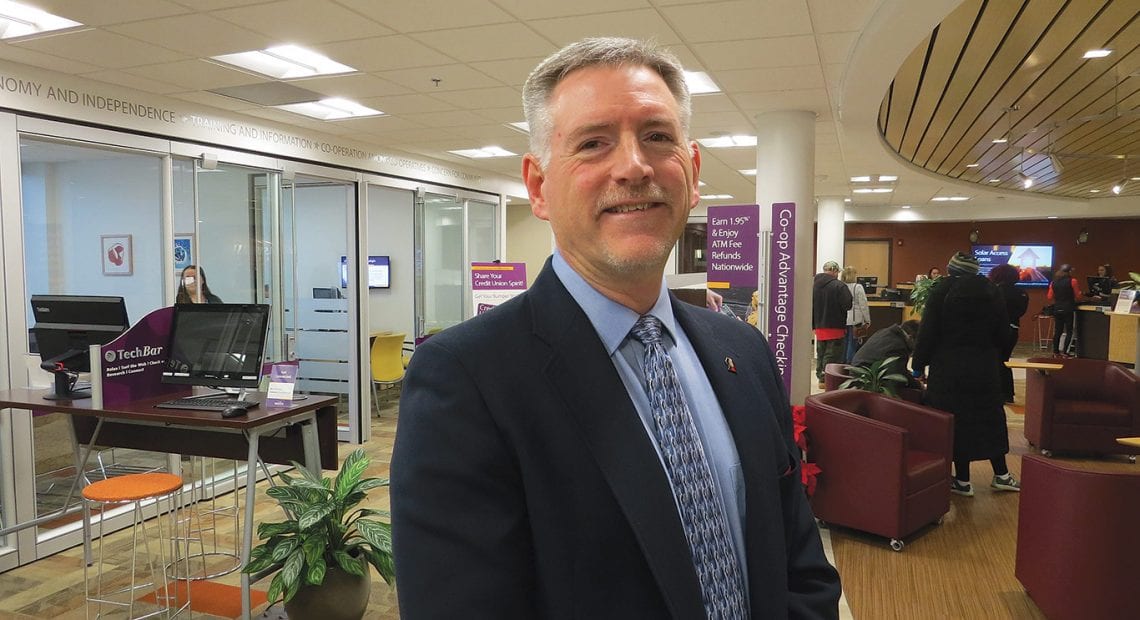
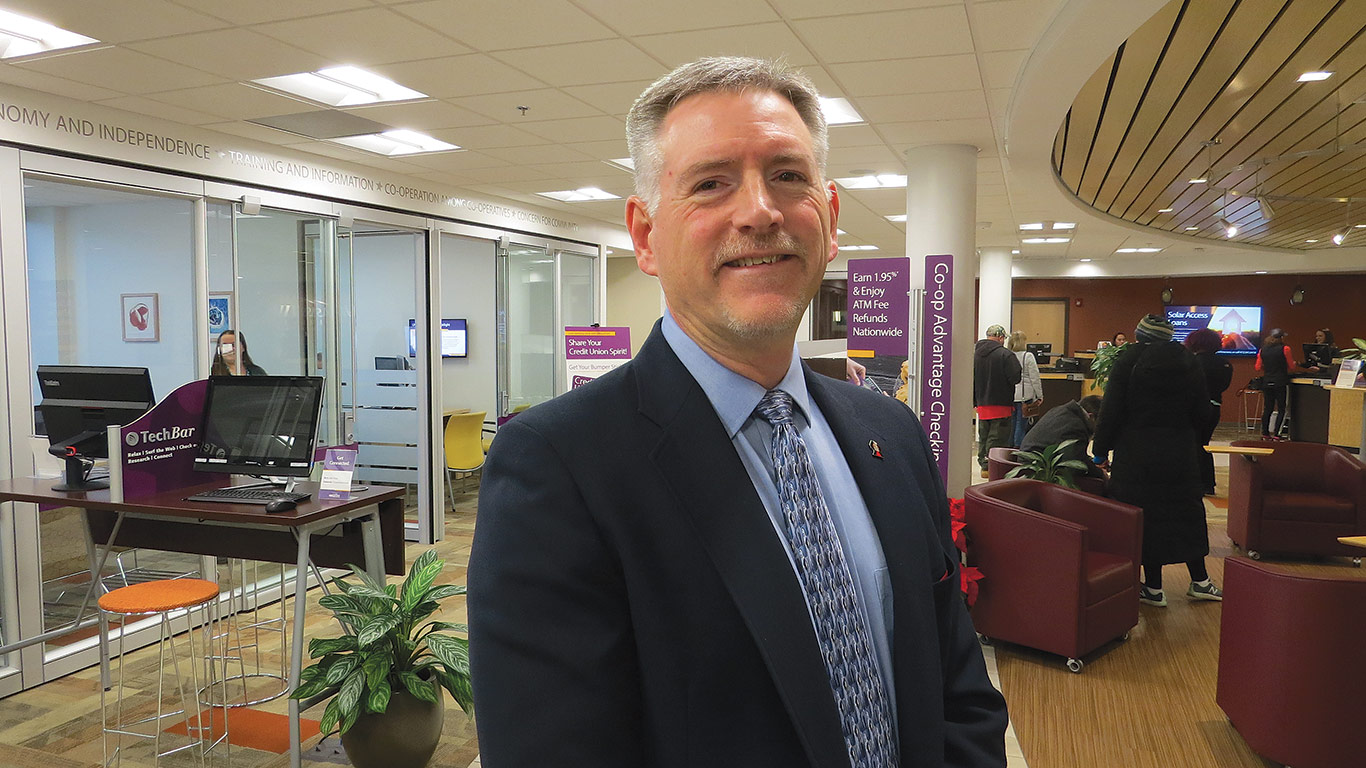
As an example, he pointed to the ITM, or interactive teller machine, in the lobby of the main office just off Route 9 in Hadley. The ITMs, which are becoming increasingly prominent in other markets and are just starting to make their mark in this one, essentially replace ATMs. Customers can use one to talk to a real person (hence the name), conduct a wide range of transactions, and get answers to questions.
“This was a time when many financial institutions were burying their heads in the sand and trying to ride out the recession. Instead, we got very aggressive. We took advantage of those times, and it put us on a very firm setting.”
Beyond the ITMs, the UMassFive lobby is distinct because there are no tellers, at least in the traditional sense, said Kump, adding that each location now has banking specialists who take on what he called the ‘universal agent model.’
These individuals can assist customers with a broad range of banking needs, he went on, adding that this requires additional training and higher compensation than traditional tellers, but these are steps UMassFive is taking to better serve customers in these changing, more technology-driven times.
“What we’ve focused on is a marriage of high touch with high tech,” he explained. “We want to be able to provide the convenience of doing everything at your fingertips; at the same time, a lot of folks need help getting that done, so we want to make sure we have the staff who can help someone who is not tech-savvy.”
Meanwhile, another form of growth has been expansion into commercial products and services and development of a unique and now quite strong niche — the financing of residential solar-energy projects (much more on that later).
And while the present tense is intriguing, when it comes to the UMassFive story, there are some new chapters soon to be written, including a new branch in Greenfield, slated to open later this year, and perhaps some additional acquisitions at a time when they are continuing to dominate the landscape with regard to both banks and credit unions.
For this issue and its focus on banking and financial services, BusinessWest talked at length with Kump about how UMassFive continues to build upon its strong foundation and grow its footprint, in every sense of that term.
Dollars and Sense
When Kump arrived at UMassFive in late 2000 after a stint at Cathedral Credit Union in Manchester, the institution was operating out of cramped quarters in a building next to the Hangar restaurant on University Drive in Amherst.
How cramped?
“My office was a supply closet — literally,” he recalled. “Because the roofs were pitched, to get to my desk I had to bend over to go around to the back of my desk.”
The inconvenience was rather easy to tolerate, he went on, because the institution was building its new home in Hadley at the time, and thus those crawls were to be a temporary nuisance.
The new facility would be the first of many positive developments in this century, one that has proven to be a good one for credit unions — at least those with the size, determination, and imagination to cope with many forms of change, from a host of new regulations to rapidly advancing technology.
As he quickly rehashed his own tenure at UMassFive, as well as that of his predecessor, Kathy Hutchinson, who served the institution for more than four decades, Kump said UMassFive, and all credit unions, for that matter, greatly benefited from both the Great Recession of a decade ago and the ongoing consolidation of the banking industry.
The ITMs installed by UMassFive allow customers to see, and interact with, an employee of the credit union.
Elaborating, he noted that, as the recession was escalating and the stock market was collapsing, individuals were looking for a safe place to park their money. And many found one in the local credit union.
“During the early part of the recession, we saw unparalleled growth; we had three consecutive years of double-digit asset growth, including one year with more than 20% growth,” he recalled. “There was a lot of money coming out of the market, and it needed go somewhere safe. Meawhile, there was a lot of national bank disenfranchisement — there were ‘close-your-bank-account’ days and people protesting in front of Bank of America.
“This was a time when many financial institutions were burying their heads in the sand and trying to ride out the recession,” he went on. “Instead, we got very aggressive. We took advantage of those times, and it put us on a very firm setting.”
While this was going on, UMassFive, which has what’s known as a multi-sponsor charter (instead of a single sponsor or employer), as opposed to the more common community charter, was also taking on new sponsors, such as CISA and River Valley Co-op, that have brought many new members — and opportunities — to the institution.
“Some of the sponsors we’ve taken on recently have really been formative to our plans,” he explained. “We’ve found more members through our relationship with CISA than we have through the University of Massachusetts over the last couple of years. That’s because people who can’t join the credit union any other way join CISA, and then they’re eligible for UMassFive.”
While growing membership, the credit union has also recently been expanding its portfolio of products and services, especially on the commercial side of the ledger, specializing in loans for equipment and commercial real estate. The move was a synergistic one, said Kump, noting that many members own businesses or commercial real estate, specifically multi-family housing, and it has created many new opportunities to grow the institution.
“It was symbiotic — we felt we could help our members who had those commercial needs with a level of service we felt could compete very favorably, especially with some of the larger regional and national financial institutions,” he explained. “And at the same time, it develops a wonderful asset for the credit union.”
By All Accounts
Echoing business owners and managers across virtually all sectors, Kump said the pace of change is too great, and the number of potential disruptors on the horizon way too high, for institutions like his to write a traditional five-year plan.
Three years is about the outside for any strategic plan these days, he went on, adding that the latest such document crafted by those at UMassFive doesn’t contain any real secrets — simply ongoing expansion of current initiatives and a focus on continued, sustainable growth, because in the financial-services sector today, size — for banks and credit unions alike — really does matter because of the economies of scale it provides.
The Greenfield branch, a traditional facility, like the one the institution operates in downtown Northampton, will be perhaps the most visible — and costly —avenue of growth, he said, adding that expansion into that Franklin County community is a natural progression for UMassFive and a vehicle for better serving customers such as those at GCC and those in or related to the agriculture sector sponsored by CISA.
“This move has been in the planning stages for some time,” he said, adding that, in recent years, the credit union has been focused on other infrastructure initiatives, such as renovation of both the main office and the Northampton branch. “Now, it’s a matter of looking outward a little bit more.”
This new branch will be like the others the institution operates, he said, referring to the leading of edge of technology.
“We don’t build cookie-cutter branches; we’ve gone through branch metamorphosis the past few years,” he said, referring not only to the ITMs — which are now in drive-throughs as well as branch lobbies — but the personnel staffing these branches.
“We eliminated all tellers more than two years ago, because fewer and fewer of the transactions are coming to the branches,” he explained. “People are using mobile, they’re using online banking … they don’t have a need to come to the branch. But when they do come to the branch, it’s for something important.”
Which brings him back to that ‘universal agent,’ a phrase he uses, although he admits he’d like some better terminology.
“We’ve created a position where the individual has the knowledge that a branch manager would have in years past,” he explained. “They can help someone regardless of what they’re looking for.
“To make all this work, our hiring practices are much different,” he went on. “More of our hires have no banking experience than have banking experience, and what we’ve found works very well for us is that we hire people who are outgoing and care — they just want to help someone else.”
With the changes in technology and hiring strategy has also come a deeper commitment to training, a necessity if the machines and the people are going to properly serve the members, he continued.
“We’ve tripled our professional-development budget over the past three years,” said Kump. “And that’s because we’ve put a big onus on the employee in the branches; they have to know so much. They’re not the specialist anymore.”
Meanwhile, the institution will continue efforts to expand on the commercial side of the ledger and the solar-lending realm as well, he said, adding that UMassFive has already created quite a niche with such transactions.
“In three years, we’ve become the highest-volume residential solar lender in the Commonwealth,” he noted, adding that UMassFive has written more than $45 million in loans covering roughly 1,400 residential, and now commercial, solar projects.
And they’re being written for members across the state, he said, adding that solar installers are recommending the institution to people well outside the 413, many of whom have become members through membership in CISA.
Past Is Prologue
Returning to Manchester, N.H. and the credit union called St. Mary’s Bank, Kump said it was formed 110 years ago to serve the underserved.
“Hopefully, there’s still a lot of that left in that industry,” he said, adding that there’s quite a bit of it at UMassFive.
The institution’s unofficial slogan, put into use by Hutchinson, is “every member, every day.” That’s where its focus is and where it will stay, Kump said, even as it keeps adjusting proactively to new challenges and constant change.
Mark Fulco in the ‘Mission Control’ room at Mercy Medical Center.
‘Lean.’ ‘Six Sigma.’ ‘Gemba walks.’ These are terms and phrases, used traditionally on manufacturing shop floors, in relation to continuous improvement initiatives and efforts to take waste out of processes. Today, they’re being heard more in the healthcare realm, and especially at Mercy Medical Center, where efforts are ongoing to improve efficiency without impacting quality of care.
The sign on the door says ‘Mission Control.’
That’s a play on words, obviously. There’s a definite nod to NASA and its famous control room, where decisions were made, and moonshots were choregraphed. But that word ‘mission’ takes on a different, higher meaning at Mercy Medical Center, part of Trinity Health Of New England. The hospital was founded more than 125 years ago by the Sisters of Providence, and its mission to care for the region’s population, and especially those who are traditionally underserved, has been paramount and in most ways more important than the bottom line.
But these days, the mission is being carried out in a different way, said Mark Fulco, president and CEO at Mercy, who recently marked a year at the helm. He noted that, in many ways, the hospital, and the Trinity system on the whole, are taking cues from the auto industry and other business sectors and taking a Six Sigma approach to healthcare — a lean approach, one that manifests itself in a number of ways.
But the major focus is on making the medical center more efficient in ways that will reduce costs without sacrificing quality.
“It’s been a watershed for us, because it has changed our work and has helped us focus on key metrics to drive efficiencies.”
“It’s been a watershed for us, because it has changed our work and has helped us focus on key metrics to drive efficiencies,” said Fulco, adding that the hospital’s efforts to become leaner are reflected in everything from reduced wait times in the ER to an increase in the number of discharges over last year by staffing up more beds; from reducing the overall cost of each discharge by roughly $1,100 to cutting back on travel by using videoconferencing technology.
Overall, Mercy and the Trinity system are eliminating waste whenever possible, creating efficiencies in every department, and constantly looking for ways to improve service without impacting quality of service.
This work extends all the way down to the medical center’s printers and copiers, the number of which has declined noticeably over the past year or so.
“We’ve gone very much paperless,” Fulco explained. “We had two big meetings this morning, and instead of printing out huge packets of information, we did it electronically and on large monitors.
“It’s unbelievable what a color copy costs these days, and when you produce lots of color copies with charts and graphs, it costs a lot of money,” he went on. “So we’ve actually taken printers away and put codes on some of our printers so departments are accounting for every color copy they make.”
This focus on lean practices and accountability brings us back to the room behind the door bearing the sign that says ‘Mission Control’ and its co-called ACE (achieving clinical excellence) boards that track progress in specific areas.
They are part of what is now known as the Trinity Health Management System, or lean daily management, an operating philosophy, if you will, that we’ll explore in greater detail later.
It also brings us to the large conference room, also known as the Patient Safety and Flow Room, a few hundred paces away. Here, each day at 8 a.m. (no one is typically late, because if they are, they have to walk into a room filled with people who were on time), as many as 50 people gather for what are known as ‘huddles.’
These are strategy sessions where issues are discussed, problems are identified, and solutions generated, said Fulco, who offered an example.
“We have several huddles every morning, and one of them is our ‘tier 3 huddle,’ where we bring together leaders from across the entire hospital,” he explained. “The very first thing we talk about is patient safety or problems that came up the night before, or safety catches — like if something was a near-miss — because we want to know, first and foremost, what we need to do to be better and keep patients safer.
“That’s our early-warning system,” he went on. “And at the meeting, if we have a detected infection, we report it, and then we talk about what we can do to prevent another case like that from happening.”
For this issue, BusinessWest looks at Mercy’s broad efforts to employ the principles of Six Sigma and become, in keeping with its mission, lean but certainly not mean, at least in a very literal sense.
Work in Progress
They’re calling it the ‘29-minute pledge.’
That number is significant because of its specificity, meaning it’s not the ‘30-minute pledge,’ a much rounder number to be sure.
It refers to the maximum time it will take for someone visiting Mercy’s Emergency Department to see a physician or physician’s asistant, and this pledge is due to be launched in the coming weeks and announced with billboards and other forms of advertising.
“We’re pledging a door-to-provider time, in our emergency room, of 29 minutes,” Fulco explained, adding that the program has essentially been rolled out already, but the billboards won’t be going up for another few weeks. “We chose 29 minutes because it represents an average of what we can hold out as a pledge; there are times when we’ve averaged 16 minutes.”
The 29-minute pledge is a another example of Mercy’s efforts to improve quality of service while also becoming more efficient and taking cost out of the equation, said Fulco, noting that it is one of many initiatives put in place during what has been a very intriguing and challenging (he would use that word early and quite often, and usually with at least one ‘really’ in front of it) first year at the helm — and year for all those who provide healthcare.
He would sum it all up, sort of, by saying, “I knew what I was getting into — I knew it was challenging; it’s just been more work than I expected — not in a bad way, but in a good way, because it’s been a labor of love.”
What he was getting into is a very demanding climate for not just Mercy but all healthcare providers, one in which reimbursements for services provided, especially from public payers including Medicaid and Medicare, do not really come close to covering the cost of those services.
This disparity is especially large in the broad realm of behavioral health, Fulco noted, adding quickly that, through its facilities at Providence Behavioral Health Hospital, the Trinity Health system is the region’s leading provider of such services.
And these are services that are, from a purely bottom-line perspective, losing propositions, again because the cost of care is not being met by those paying for it. And while Providence and the Trinity system have always been mission-driven, there comes a point where the losses being incurred cannot be sustained, said Fulco, adding that this reality explains why there were inevitable cutbacks at Providence, and in other departments under the Mercy/Trinity umbrella as well.
Mission Control is part of an effort to bring the principles of Six Sigma to Mercy Medical Center.
“We had to make some tough decisions — the status quo simply doesn’t work,” he explained, adding that among these decisions were staffing reductions at Providence (most employees were offered other positions within the system) and cutbacks within or elimination of some departments at Mercy, including the Hearing Center.
While the cutbacks and staff reductions garnered the largest headlines regarding the Mercy system in 2018, a considerable amount of work going on behind the scenes to make the system more efficient, more responsive, and, yes, leaner — efforts like the 29-minute pledge — were perhaps more newsworthy.
As he talked about them, Fulco said these initiatives accurately reflect a system-wide operating philosophy being implemented by Trinity Health Of New England’s recently appointed CEO, Dr. Reginald Eddy, a former emergency-room physician.
“He really gets it,” said Fulco. “He gets it from a care perspective, and he has a strong sense of urgency that he’s really instilled in us in terms of doing it right, doing it well, and doing it quick, not just from a patient perspective, but from a business sense.”
Tracking Improvement
As he talked about the Trinity Health Management System, Fulco said it is focused on quality metrics, or what he called ‘people-centered metrics,’ which are carefully monitored with an eye toward continuous improvement.
As an example, he cited the infection rate, a key issue — and major challenge — for all hospitals.
“Our infection rate has remained below target and below what’s expected for a hospital like Mercy, and is, in fact, one of the 20 lowest infection rates across all the 94 or 95 Trinity hospitals,” he said, using infections from urinary catheters as an example of how Mercy tracks issues and addresses problems.
“Our goal is to be an ‘A,’ and we’re not stopping until we get there, and then we have to stay there, which becomes progressively more difficult.”
Steps such as these have a trackable impact on quality, as measured in a number of ways and by a number of entities, said Fulco, noting that Mercy’s Leapfrog score — its rating based on surveys undertaken by the Washington, D.C.-based Leapfrog Group, improved from ‘C’ to ‘B’ in 2018.
“Our goal is to be an ‘A,’ and we’re not stopping until we get there, and then we have to stay there, which becomes progressively more difficult,” he explained. “But we’ve improved by one whole grade, which is a significant step forward.”
But while quality is certainly an important benchmark, so too is cost, said Fulco, adding that the ultimate goal is to not only improve the overall level of quality but reduce the cost of providing care as well.
“On the cost side, because we’ve been more efficient and we’ve tried to tease out unnecessary expense — and there are several buckets of expense, from labor to non-labor — we have reduced the cost per case by more than $1,100 from last November [2017] to this November,” he said. “And when you multiply that by the 1,400 or so discharges we had, that’s a savings of more than $1.5 million.”
With that, he went to his desk to retrieve the current average cost per discharge, $6,850, a number he had handy, and for a reason — it is carefully tracked, and its downward movement is a source of pride within the system.
It’s been accomplished through a number of means, he said, starting with staffing changes (none at the bedside) that result from consolidation in some areas, such as billing, that are made possible by synergies with the regional Trinity team, thus reducing overhead costs.
Further savings have been achieved on supplies, he said, returning to efforts to go paperless when possible, and also such things as travel expenses.
“We work with people; if they’re printing too much, we take steps to reduce that volume,” he said. “It doesn’t sound like much, but it adds up when you’re saving 50 cents or 75 cents on a print; it adds up over time. And it doesn’t contribute anything to patient care, so we’d rather put the money into patient care than into paper.”
As for travel, it has been cut back as well, he said, noting that meetings between the Mercy team and the system team are now staged electronically. “Instead of having our people drive to Hartford or their people drive here, we’re using technology,” he told BusinessWest.
Huddling Up
As he offered a tour of the Mission Control room, Fulco started by referencing several large charts, called A3 charts, on the wall. Each one outlines an individual’s primary strategic aims, and they are part of the hospital’s lean daily management system.
“An A3 is putting our key objectives and measures all on one page,” he said, referencing his own A3, while noting that the charts track progress toward meeting those specific aims and goals, as laid out in an action plan. “We track this every week; we look at this every week. Every member of the leadership team has one of these.”
And when problems arise at those huddles, as he noted several times, everything is measured.
That goes for efforts to address recognized problems or issues as well, he went on, referring to other charts and the four letters ‘P,’ ‘D,’ ‘C,’ and ‘A,’ which stand for ‘plan,’ ‘do,’ ‘check,’ and ‘act,’ the four stages of tackling a problem, as Fulco identified them.
“This is flowing constantly; it’s changing every day,” he said, adding that the PDCA cycle, as it’s called, was created to generate action on a specific matter and keep things moving.
From Mission Control, the tour moved to the Patient Safety and Flow Room, where there was a comparatively small huddle going on (this was late afternoon). For the 8 a.m. huddles, those assembled have an agenda and start with safety, and move on to a daily operating summary and then performance reports — how well the hospital is doing with patient satisfaction, for example. Next is a round-robin session, at which feedback is sought on problems that have been identified.
But the tier 3 huddle is actually the second step in the process, said Fulco, noting that there are huddles on the departmental level as well. Matters arising at those sessions then come before the larger group, and there is then a Gemba walk. That’s a Japanese term that translates, loosely, into going to the front lines to see what’s going on, to hear from the people involved and come to understand the problem; it is similar in many ways to the concept known as MBWA — managing by walking around.
“A Gemba walk is daily rounding — we’re not sitting in our office or around a conference-room table; where going to see things where they really happen. We’re talking to people who are doing the work, and we’re doing some accountability checks,” said Fulco. “From 8:30 to 9:30 we take that walk, and from there we go to the Mission Control room and do an accountability huddle.
“It’s about getting close to the people,” he went on, “and finding out how we, as leaders, can help them.”
To emphasize these points, he concluded the tour in the Emergency Department, where are charts similar to those in both Mission Control and the Patient Safety and Flow Room.
They track things like wait times and numbers of patients who left without being seen — presumably because the wait times were too long — said Fulco, adding that subsequent huddles and PDCA charts identified the causes of those problems and tracked the success of steps taken to address them.
Healthy Outlook
Gemba walks. PDCA cycles. Huddles. A Mission Control room. These names, acronyms, and places all help explain how, while the mission hasn’t changed at Mercy Medical Center and Trinity Health Of New England, the process of carrying out that mission certainly has.
The emphasis today is on continuous improvement and being lean — without impacting the quality of care being provided at the bedside. As Fulco said repeatedly, in this environment, everything is measured, or charted, and progress is marked daily.
There is considerable work still to be done — this process never actually ends, he said — but progress can be seen in the ER, on the bottom line, and on the charts in the Patient Safety and Flow Room.
It could be seen as paper as well — only they’re using much less of it these days. That’s just part of the process of running lean.
A team from Feeding Hills gets ready to put their robot to the test.
Seeing a group of middle-schoolers design, build, and program robots that perform specific, detailed tasks on cue is an impressive sight. But the impact of the FIRST LEGO League, which boasts teams in numerous schools throughout Western Mass., goes far beyond engineering training. It’s also teaching young people communication skills, teamwork, and confidence — all key traits to take into whatever career they choose, whether in the STEM fields or not.
As the robotic rover methodically navigated a landscape of obstacles, it relied on its programming to perform any number of tasks, from extracting core samples to angling a solar array to crossing a crater. If the programming — honed over months of diligent trial and error — failed, so did the robot.
That’s OK, though — this wasn’t a billion-dollar piece of outer-space equipment at stake, but a robot built from LEGO Mindstorm parts, and performing tasks on a colorful, space-themed table. And these weren’t astronauts or NASA engineers performing experiments, but area elementary and middle-school students showing off their prowess at the recent FIRST LEGO League Into Orbit Challenge at Western New England University.
Three dozen teams of students from Agawam, Brookfield, Chicopee, Greenfield, Holyoke, Longmeadow, Northampton, South Hadley, Springfield, West Springfield, Westhampton, and Wilbraham took part in the competition, reflecting a surge in growth for school-based robotics programs.
“It’s more than just the robots. Yes, the engineering is important — the math and the physics behind it — but more important than that is the teamwork, the critical-thinking skills, and the communication skills the kids develop.”
After competing head to head with each other, seven of those teams advanced to a statewide competition in Worcester a week later, and from there, the top teams moved on to championship events this spring.
“It’s all about taking your classroom lessons — the math, the science — and applying them in a real-world situation,” said Dana Henry, a senior mentor for the regional FIRST (For Inspiration and Recognition of Science and Technology) program, who first connected students with robotics in Agawam 18 years ago.
“It’s more than just the robots,” he told BusinessWest. “Yes, the engineering is important — the math and the physics behind it — but more important than that is the teamwork, the critical-thinking skills, and the communication skills the kids develop.”
The FIRST LEGO League challenges kids to think like scientists and engineers. During this year’s space-themed season, teams choose real-world problems to solve and then build, test, and program an autonomous robot using LEGO Mindstorms technology to solve a set of missions.
Last months’s event, the Agawam Qualifier, is in its 11th year, moving to WNEU this season after outgrowing its previous space at Agawam Junior High School, Henry noted.
Dana Henry says FIRST LEGO League competitors are applying classroom lessons to real-world problems, and gaining a raft of skills while doing so.
“We have four programs in Agawam, and we help other teams, at other school systems in the area, get up and running,” Henry said of his role with FIRST. “Western New England came in with the facility and some resources, and they are working with a couple of local teams themselves. It’s been a pretty great ride so far.”
Suleyman Demirhan, a science teacher at Hampden Charter School of Science in Chicopee who oversees that school’s robotics club, explained that the faculty coach’s role is to teach students the basics of building and programming the robot — and researching issues as they arise — but it’s important for students to learn how to accomplish their goals with minimal hand-holding.
“They learn a specific topic for their project, and how to design a robot and program it. The coach is there just to guide them, to provide the right materials and supplies for learning the robotics, and then we get to see their progress. We’re teaching them how to solve problems. It’s a learning process,” Demirhan said.
“Actually, they teach each other and learn from one another,” he went on. “I see it like working at a company, like being an engineer, but at the same time being a middle-schooler. They’re learning to solve all these engineering problems, and then they learn how to solve the programming problems.”
Values Added
The FIRST LEGO League, launched 20 years ago by inventor Dean Kamen and LEGO Group owner Kjeld Kirk Kristiansen, now boasts 320,000 participants and 40,000 teams in 98 countries.
At the cornerstone of the program are a set of core values, through which participants learn that friendly competition and mutual gain are not separate goals, and that helping one another is the foundation of teamwork.
According to the league website, those core values include discovery (exploring new skills and ideas), innovation (using creativity and persistence to solve problems), impact (applying what we learn to improve our world), inclusion (respecting each other and embracing our differences), teamwork (understanding that we are stronger when we work together), and fun (enjoying and celebrating what we do).
The student-designed robots are all different, taking myriad approaches to tackling similar challenges.
So the goal is more than learning robotics, engineering, and programming. But even the tasks themselves extend far beyond the robots. Each year, teams are mandated to research a real-world problem such as food safety, recycling, energy, etc., and then develop a solution.
As part of this year’s Into Orbit theme, teams considered the challenges humans must overcome to travel around the solar system — such as extreme temperatures; lack of air, water, and food; waste disposal and recycling; loneliness and isolation; and the need for exercise — and research and present a project, not unlike at a science fair, that aims to solve one of those problems.
“With this year’s theme, they designed a project that helps astronauts in space travel improve their physical conditions and mental health, or it could be anything that supports astronauts,” Demirhan said, noting that his school’s two teams took on the problems of growing food in space and designing an effective trash compactor.
The competition itself centers around the LEGO robots designed and built by the students, he went on. “Each challenge needs to be solved by a robot which is running autonomously. So the students program the robots and make specific attachments that work with different challenges. They don’t only design these attachments, but design and write the programs.”
If the programming is off by the slightest margin, the robot will miss its target on the table — and miss out on critical points needed to post a high score and advance.
“With each one of these challenges, they encounter difficult areas with the programming,” Demirhan went on. “Some programs might work in a specific environment and might not work in a different environment, and they’re trying to write the best program that can work in many different conditions. For example, light could be a factor — robots have light sensors, and the amount of light in the practice room could be different than in competition. So the student needs to solve this challenge and write a really good, efficient program that can run in both these environments.”
For students inclined to this type of work, Henry said, it’s a fun way to learn to apply STEM (science, technology, engineering, and math) concepts while developing critical-thinking and team-building skills, and even soft skills like how to talk to the judges about their robots in an engaging way — yes, they’re judged on that, too.
“Not only do they have to build a robot to compete on the table, but they’re also being judged on a project, and they have to adhere to all the core values throughout the FIRST program,” he added. “It’s about communication skills and critical-thinking skills. It’s much more than just robots.”
Time to Shine
Through the FIRST LEGO League, Kamen and Kristiansen always intended for young people to discover the fun in science and technology but also develop in a positive way as people. Henry said he has seen exactly that.
“We had one kid that came through the program who was very shy, ate his lunch in the corner all by himself at his junior high school, but he came into high school and absolutely bloomed. He got into college, and now he’s an engineer with NASA. I’m telling you, if he doesn’t go to Mars, he’s going to be one of the engineers that gets us there.”
Other students in the program have gone on to non-science fields, like teaching, music, and the culinary arts, he continued, but the lessons they learned about solving problems and working with others are applicable to any field.
For those who do aspire to a career in engineering or robotics, however, the FIRST program does offer a leg up, Demirhan said, both in the college-application process — schools consider this valuable experience — and gaining career skills at an earlier age than most future engineers do.
“They’re all doing real-world engineering. Once they go to an engineering school, they’re seeing problems like these and learning how to solve them. So this is really a tiny engineering program that has massive applications. We’re teaching real-world problems and coming up with good solutions to them.”
In short, students are creating ideas, solving problems, and overcoming obstacles, all while gaining confidence in their abilities to positively use technology. To Henry, that’s an appealing mix.
“The STEM part is important, absolutely, but it’s more than just that,” he said. “I can’t stress that enough. We’ve seen kids blossom in so many ways.”
Paul Bockelman (left) and Geoff Kravitz say Amherst benefits in many ways from its reputation as an academic hub.
Amherst is a community in transition, Paul Bockelman says — in some positive ways.
The most notable change, obviously, was the seating of Amherst’s first Town Council last month; 13 members were elected following a change in the town charter last March that included a move away from the town-meeting form of government.
“Some people who advocated for the charter change felt the representative town meeting wasn’t fully representative of the town and wasn’t nimble enough to address the issues that were facing the town on a daily basis,” said Bockelman, Amherst’s town manager. Other people, he added, were angry after the town meeting failed to fund a new school building.
Either way, he went on, “they’re building a government from scratch. Some really smart, thoughtful people are putting a lot of effort into this council, and every decision they make is going to be precedent-setting. A lot of issues were put on hold during the transition period. Now that the council’s in place, there’s this backlog of things people want them to do, so those will start pouring through the system during the course of the year.”
But that’s not the only way Amherst is changing, said Geoff Kravitz, the town’s Economic Development director. He cited activity in the restaurant scene, which has welcomed a number of new names, including Asian eateries Chuan Jiao and Kaiju, Jake’s at the Mill in North Amherst, Share Amherst, and Shiru Café, an intriguing coffee shop and study space that offers free coffee to area students in exchange for their personal information, which is sold to job recruiters and advertisers.
“Some really smart, thoughtful people are putting a lot of effort into this council, and every decision they make is going to be precedent-setting.”
“For college students, it’s an interesting model where they get a cup of coffee every hour,” Bockelman said. “It’s really designed for college students to hang out and do their homework, and the only requirement is that you give them some data that you otherwise would give to Facebook or Twitter.”
“It’s not just for marketing,” Kravitz added, “but for recruiting for jobs out of college. Recruiting is really the model.”
Other restaurants are on their way as well, he added, and vacant properties, especially downtown, don’t remain unfilled for long.
“It’s not a stagnant town; it’s a town of transitions, and not just because we have a new form of government,” Bockelman added. “It seems that every time a restaurant moves out, a new restaurant comes in.”
Building on Progress
There’s plenty more activity on the development front as well. In September, Archipelago Investments, LLC of Amherst opened One East Pleasant, a mixed-use project featuring 135 residential units and 7,500 square feet of commercial space.
“That whole complex rented up very quickly and is full,” Bockelman said, noting that Archipelago has developed a handful of other properties in Amherst, and is planning another mixed-use project at 26 Spring St., which will feature 38 residential units and 1,000 square feet of commercial space.
Meanwhile, W.D. Cowls Inc. and Boston-based Beacon Communities are moving forward with North Square at the Mill District, a mixed-use development under construction in North Amherst, which will feature 130 residential units — including 26 affordable units for people at or below 50% of the area’s median income — and 22,000 square feet of commercial space.
Amherst is also among the Western Mass. communities enthusiastically exploring the marijuana industry as an economic driver. That’s not surprising, considering the town’s voters favored the 2016 ballot measure legalizing recreational marijuana by a 3-to-1 margin. RISE Amherst, a medical-marijuana dispensary, is currently in operation, with three other businesses working their way through the local and state licensing process.
With 33,000 students attending UMass Amherst, Hampshire College, and Amherst College, the town has also worked on educational efforts around adult-use marijuana, and has also passed a number of marijuana-related regulations, including a 3% local-option sales tax, a ban on public consumption, and capping at eight the number of recreational-marijuana establishments in town.
From a municipal perspective, the town has long been studying the potential renovation of the North Common/Main Street parking lot, Kravitz noted.
“There’s been a parking lot in front of Town Hall since at least the ’70s, if not earlier, and we’re trying to redesign it from both a drainage and ecological perspective,” he explained. “It’s sort of sloped oddly, so when it rains, all the rain coming off the streets washes it out; that was the primary purpose of looking at it.”
What to do with the space will be one of the Town Council’s issues to tackle in 2019, Bockelman added. “The biggest question coming up relatively soon to the Town Council will be, do you want to work on this project or leave it as is?”
Meanwhile, the overall vision for Amherst has long involved arts and culture. The Amherst Central Cultural District aims to leverage the offerings of the Emily Dickinson Museum, Jones Library, the Eric Carle Museum of Picture Book Art, the Yiddish Book Museum at Hampshire College, the Mead Art Museum at Amherst College, and other cultural institutions, and some of those efforts bleed into the downtown area as events, such as ArtWeek, a statewide effort taking place from April 26 to May 5.
Amherst at a Glance:
Year Incorporated: 1759 Population: 39,482 Area: 27.7 square miles County: Hampshire Residential Tax Rate: $21.80 Commercial Tax Rate: $21.80 Median Household Income: $48,059 Median Family Income: $96,005 Type of Government: Town Council, Town Manager Largest Employers: UMass Amherst; Amherst College; Delivery Express; Hampshire College * Latest information available
“We want to create more excitement about being downtown,” Bockelman said. “Downtowns today are less about retail, brick-and-mortar shops and more about entertainment and cultural events. Some of them can be sponsored by the town, but a lot of them come from individuals.”
Many of Amherst’s museums and cultural institutions have statewide, even national reputations, and the Hitchcock Center for the Environment and the R.W. Kern Center at Hampshire College are two of fewer than two dozen ‘living buildings’ worldwide — structures that meet strict standards for hyper-sustainability and net-zero energy use.
All these factors, plus the colleges and UMass, create a buzz and energy that attracts both new businesses and families to Amherst, Kravitz said.
“From a business perspective, there are very few communities of our size that boast three institutions of higher education,” he told BusinessWest. “I think that we have an incredibly educated population. People want to be around other people who have big ideas, so I think that’s part of the draw for some of the businesses — to be around other smart people. You saw that happening in Boston and Cambridge, you saw it happen in Silicon Valley, and I think that all starts with the academic institutions, whether it’s Stanford or MIT or UMass here.”
It’s Academic
The recent mixed-use developments are a welcome start to meeting housing needs in a growing town, as there hasn’t been much residential development over the previous couple of decades. In fact, a 2015 study determined that Amherst could use some 4,000 more units.
Still, Bockelman said, “I think it really is a place where people want to come to raise their family, for lots of different reasons.”
Last week, he met with a man who teaches two days a week in Washington, D.C. “He says he can leave his house at 6:15 in the morning, be in Washington by 10, and stays overnight. When he comes back, he takes the 5:00 and is back home at 8 to put his kid to bed. He chose to live in Amherst because he wanted a multi-cultural community with people who care about education, with excellent schools and an academic environment, and he found all that, plus easy access to open space. So he’s willing to make that weekly commute from Bradley. That’s kind of amazing to hear.”
That’s why it’s heartening, he added, to see how UMass Amherst has raised its profile in recent years as an internationally recognized research institution.
“It’s a big economic engine; thousands of people come in every day to work there,” he said. “Amherst is the largest community in Hampshire County, but it doesn’t read that way because it doesn’t look like Northampton, like a city. And in terms of our population, some people say the students are inflating that, but they’re here eight to nine months a year. And what that number does not count is the number of people who come into town every day because they’re employed by the two colleges or the university.”
In short, he concluded, “it’s a very vibrant community, even though it retains a certain college-town atmosphere that so many people love about it.”
That characteristic is one he and Kravitz both expect to remain steady, no matter what other transitions Amherst has in store.
Matt Sosik says branches serve a different role than they used to, providing more value but less volume in the age of online and mobile banking.
In this era of rampant mobile banking, opening a physical branch is a different proposition than it used to be, Matt Sosik said. But it’s still an important one.
“At this point in the cycle of our industry, branching has fallen by the wayside a little bit,” said Sosik, president and CEO of bankESB, which recently opened its 11th branch on Sargeant Street in Holyoke — a move that, despite the declining emphasis on bricks and mortar, made a lot of sense.
“We feel we’ve been banking with the people of Holyoke for years and years, so Holyoke is a natural extension of our footprint,” he said, noting that today’s branches are smaller and more efficient than those built in the past, but still must emphasize customer service — something that Tiffany Raines, Holyoke’s branch manager, has said she will emphasize there.
Indeed, online channels do change the dynamics of a branch as a delivery channel, Sosik told BusinessWest, if only because branches simply serve fewer people in person than they used to.
“Customers, as they should, love that technology can improve their banking experience, and we really encourage our customers to use those online and mobile banking products; they’re so robust and provide so much to customers,” he noted. “That said, we’ll never lose our ability to interact with them face to face. We covet that, and when we get our customers in front of us, we certainly take advantage of that and provide guidance to them.”
“Actual in-person branch transaction volume is well off over the past 20 years, so it’s really about building the initial relationships with the customer; that’s what a branch does best in 2019.”
With that in mind, he said, the new Holyoke branch, like any new branch at most banks, is designed to provide value, not volume — a more personalized experience, in other words, for fewer customers each day.
“Actual in-person branch transaction volume is well off over the past 20 years, so it’s really about building the initial relationships with the customer; that’s what a branch does best in 2019,” he went on. “It’s more a source for originating the customer relationship than it is a delivery channel — more for acute problem resolution and consultative conversations.”
Yet, new branches also reflect growth, and bankESB is certainly growing, with $1.3 billion in assets across its 11-branch network in Hampden and Hampshire counties. Meanwhile, its holding company, Hometown Financial Group, also based in Easthampton, boasts $2.1 billion in assets and 24 branches across Western and Central Mass. and Connecticut, with further expansion to come (more on that later).
Banking today, Sosik said, is less about products and “more about how we deliver those products we’ve all become very familiar with.”
Take residential lending, for example. “The mortgage world has lent itself well to the online world, where we can efficiently process a transaction for somebody to buy what is arguably the biggest asset of their life, and we can do that almost entirely online for them — and very efficiently. That’s what technology has done — improved on products we’ve all come to know and love. That’s the difference between 2019 and, say, the 1990s.”
Dena Hall, the bank’s executive vice president and chief Marketing officer, noted that bankESB has the second-highest market share in Hampshire County at almost 22%, and the expansion into Holyoke follows growing name recognition in Hampden County, where it also maintains branches in Agawam and Westfield.
“We’ve seen an increasing level of awareness across the Pioneer Valley, up and down the 91 corridor, which is important to serve customer needs in this region,” she added. “Really, we’re all about meeting customers where they want to meet us. We want them to know we’re a viable option for them.”
Lending Thoughts
To understand the importance of face-to-face relationships in banking, Hall said, look no further than commercial lending, an increasingly important part of bankESB’s business and strategic direction. The institution added three new lenders to its commercial team in 2018, all from larger local banks, in an effort to add more resources to the division and demonstrate the capability to meet the commercial financing needs of businesses in the region. The team now has seven lenders under the direction of Executive Vice President Ryan Leap.
“When you think about how the customer has gotten physically away from us, that’s less so with the commercial business,” Sosik said. “Commercial lending has a lot to do with what we do best — customer service, face-to-face interactions, and building long-term, value-added relationships. For us, it’s a very natural customer-service direction in which to grow.”
The new Holyoke branch is a physical extension of business that bankESB had been doing in that city for many years.
That growth comes at a time when businesses continue to invest in capital projects, he added.
“We see a lot of things going on in the economy. The economy has such a long and slow build that it’s hard to see it in motion, but take a look back at the past year and years prior, and we’ve definitely seen continuous, slow, steady growth. Thankfully for Western and Central Massachusetts, we see that growth in small and medium-sized businesses coming in and taking advantage of the economy and improvements in commercial real estate.”
At the same time, Hall said, bankESB is building its consumer divisions. “Last year, we hired a new leader for the residential mortgage and consumer loan division with several years of experience in mortgage operations and origination, most recently with Peoples United Bank,” she noted.
In addition, after a year of developing its back-office processing and underwriting area, the bank recently added two new mortgage loan originators and upgraded its online mortgage application so that customers can apply how and when they want, either in person with a loan originator or online.
“With some banks in our market pulling back on their mortgage efforts, we’re excited to make more products and sales people available to the region,” she said.
Sosik agreed. “We continue to build the depth and breadth of the team to handle our growth. That’s generally been our strategic direction when it comes to community lending.”
That’s why developing both sides of the customer-service equation — a more robust online presence and also branches focused on customer service — are equally important, Hall said.
“A lot of customers are doing research online but close the deal in the branch, and we have people ready to serve them,” she told BusinessWest. “Clients want that face-to-face interaction, and we’ve hit a nice balance of being technologically savvy with mobile offerings and very customer-service-oriented, very customer-facing. That’s a perfect fit in this market.”
Mutual Successes
Hall noted that bankESB has received some key accolades of late. In June, it was named one of America’s best-in-state banks by Forbes in a nationwide survey; of the five banks selected in Massachusetts, bankESB ranked second, and was the only bank on that list headquartered in Western Mass.
Understanding the importance of building a bank’s name, its holding company, Hometown Financial Group, continues to grow its franchise and build a separate brand presence in each region. That means three separate banks will operate under the holding-company profile: bankESB, bankHometown, and Pilgrim Bank. The latter acquisition, based in Cohasset, closes this month and adds three branches and $263 million in assets to the Hometown family.
“We have a commitment to mutuality and building those local brands, building market share in each region, then we consolidate and make efficient the back-office and operation side. We think that’s a compelling business structure going forward,” Sosik said.
“Commercial lending has a lot to do with what we do best — customer service, face-to-face interactions, and building long-term, value-added relationships.”
“We’re big believers in our mutual structure,” he continued. “First and foremost, as a mutual company, we’re not owned by stockholders. We choose to be very entrepreneurial, and we run very much like a stock company would from the business side of it. But that mutuality gives us the ability to service customers and the community in ways that stock banks cannot.”
With so many community banks operating in Western Mass., he explained, that mutual structure helps set bankESB apart. “I think that’s a real difference maker for us, showing how much we are committed to mutuality and community banking.”
At the same time, Hall said, the company’s commitment to mutuality and its holding-company structure makes it an attractive partner for other like-minded mutual banks in its current market and beyond.
“We have some exciting transactions in the works, and we hope to be able to announce those transactions within the next 30 to 45 days,” Sosik added. “I think they’re compelling; there will be market interest there. We’re really moving our company forward in a number of ways. We’re excited about that. There’s a lot going on.”
Steve Conca says it can be difficult for people to ask for help losing weight and getting fit, especially if they’re discouraged by all the attempts that didn’t work.
It’s gratifying, Steve Conca said, when people ask for help managing their weight — especially if nothing has worked before.
“When people come to us, they have a laundry list, and sometimes we’ll even write it on the whiteboard — ‘tell me all the stuff you’ve tried that didn’t work,’” said Conca, who owns Conca Sport and Fitness in West Springfield.
“They go on and on about different things, whether it’s a training method or a diet — you name it, they’ve tried it, and it didn’t work. And we draw the line and say, ‘we don’t to be the next thing on that list of 15 things that didn’t work. It stops right here.’”
But that’s easier said than done, he told BusinessWest, because weight loss is more than a numbers game — even when the numbers seem so overwhelming.
“It’s a lifestyle change. It’s mindset, it’s accountability, it’s exercising the right way. It’s eating healthy again and not just counting points. You’ve got to take it one step at a time and get your mind right.”
“It’s a lifestyle change. It’s mindset, it’s accountability, it’s exercising the right way. It’s eating healthy again and not just counting points,” he said. “You’ve got to take it one step at a time and get your mind right — and make sure the effort and exercise you’re going to put in are designed for you specifically, and will work for your body and your metabolism.”
Even people who lose weight, whether through traditional diet and exercise or surgery, often have trouble in the months and years following their initial success, said Dr. Yannis Raftopoulos, director of the Weight Management Program at Holyoke Medical Center.
“The challenge is, how do they maintain this weight in the long run?” he said. “Most practices today aren’t looking to change the person. That’s what we do here, and we have a higher success rate and a better chance to maintain the weight loss. But that’s hard to do. We have seen great successes, but it’s labor-intensive, time-consuming, and a lot of resources are needed.”
And it starts with a decision to take that first step, Conca noted.
“When someone calls and says they need help, that’s a vunerable position they put themselves in. When they come in and sit down, that’s one more big step that can also be another vulnerable spot,” he said. “We take that very seriously that you’re looking to trust us with your health, fitness, and well-being. That’s a huge responsibility, and we take it seriously.”
Wrong Direction
It’s an important responsibility, too, in a country that’s been going in the wrong direction, fitness-wise.
“There’s something that’s dramatically not right,” Conca said. “As a people, we’re getting less active, and we’re eating a much poorer grade of food than we did 20 or 30 years ago.”
Those trends are starting at an early age. According to the latest data from the National Health and Nutrition Examination Survey, produced by the Centers for Disease Control and Prevention (CDC), the percentage of children ages 2 to 19 who are obese increased from 14% in 1999 to 18.5% in 2015 and 1016. In the Pioneer Valley, 25% of children are considered obese.
Dr. Yannis Raftopoulos says treatments for obesity are myriad, and crafted on a patient-by-patient basis.
“That means they have a body-mass index that puts them at increased risk as they enter adulthood for diabetes, high cholesterol, heart disease, gallbladder disease, asthma, and bone and joint problems. Already, we are seeing more and more youngsters developing type II diabetes, which is commonly developed by overweight adults,” said Dr. Chrystal Wittcopp, medical director of Baystate General Pediatrics, who oversees the Pediatric Weight Management Program at Baystate Children’s Hospital.
“The growing rate of childhood obesity in our country is alarming. Being overweight poses a serious threat to the health of America’s children, and as a society, we must make a concerted effort to decrease its prevalence not only in the Springfield area, but across the country,” she added, noting that obesity carries psychosocial consequences that can also hinder these children academically and socially.
Of even greater concern, there was a large increase in obesity — up to 14% from 9% — in the youngest population of those 2 to 5 years of age.
“My philosophy is, I try to change the patient’s lifestyle. If you want any chance to be successful, you have to change the logistics, how they operate every day.”
Conca sees it, too. “Overall, kids are moving not as efficiently as they were years ago. When we were growing up, kids were outside crawling, jumping, running around, and their bodies developed much differently than the kids now if they’re not forced into a structured activity. Instead, many of them are glued to a phone or a tablet. It’s a generational thing, and we’re seeing it not only on the activity level but the nutrition level as well. Kids don’t appreciate their bodies as much as they should because things like exercise and sleep and nutrition aren’t talked about.”
He recalled talking to an older woman whose infant grandchild’s first word was ‘Dunkin’ Donuts’ — which isn’t as odd as it sounds because the child’s parents were always making fast-food runs.
“She’s distraight about it because it’s not the way she wants her grandkids to be raised, but it’s something that, culturally, a lot of kids are embedded in. And they’re so impressionable at that age.”
When parents choose to eat right and be physically active, Wittcopp added, children are more likely to take note and make those same healthy choices. She said families could encourage each other by walking around the neighborhood together, going on a bike ride, or playing basketball at the park, while limiting time spent in front of the TV and video games, and cooking healthy meals with fresh vegetables, fruits, and whole grains.
“The severe consequences of obesity underscore the critical importance of children and teens to participate in physical activity and to engage in healthy eating habits,” she noted. “Childhood obesity is entirely preventable, and it is up to adults to encourage these healthy habits.”
Plenty of Options
For individuals who are well past those foundational years and frustrated by an inability to get fit, there are plenty of treatment options, Raftopoulos said.
“There are different levels of obesity, and different methods are available based on that,” he told BusinessWest. “For someone mild obesity, surgical options are usually not recommended, though there are some exceptions to that.”
Less drastic options range from classic diet and exercise to medications that restrict appetite, although Raftopoulos isn’t personally keen on those, as they can be expensive, come with side effects, and are not a long-term solution.
“My philosophy is, I try to change the patient’s lifestyle. If you want any chance to be successful, you have to change the logistics, how they operate every day.”
A more dramatic, yet still non-surgical, option is a gastric balloon that is swallowed, inflates, and suppresses the appetite until it’s removed after a few months. Holyoke Medical Center is currently involved in a clinical trial of a more advanced balloon that needs no endoscopic removal, but rather passes into the stool after it deflates.
Then there are the surgical options, specifically gastric bypass and sleeve gastrectomy, both of which drastically reduce the size of the stomach. But, no matter how effective a treatment is, whether surgical or non-surgical, patients face the same challenges afterward.
“Surgery will reduce the portion of the stomach and how much you can eat, but you can gain weight even with a small stomach,” Raftopoulos said. “If surgeons don’t provide the support to change the fundamentals of the patient — if they don’t help you change how you live your life — nothing will be very effective, and you can gain the weight back.”
For people who have struggled with obesity, he noted, there’s a psychological component to maintaining a healthy weight, and one that can be frayed by the stresses of everyday life, from work schedules to parenting obligations to caring for sick parents. That’s why his team works with patients on managing their entire lifestyle — through education and support services — to stay on the right path.
“The problem with how medicine is done today is not seeing the patients holistically,” he said. “Everybody is focused on one thing — ‘oh, your ear hurts? Let’s fix the ear.’ But the ear is connected to something else. And that fragmented mentality affects the patient’s results.”
But when something clicks, Raftopoulis gets excited — not just for that one patient, but for others who may be inspired by their example.
“The more practices do this the right way, and the better results they have, the more people will believe we can help them,” he said. “We need to have more practices do the right thing because there’s a great need.”
Reaping the Rewards
Conca understands the frustration of trying to make a change, and, after a few weeks of poor results, becoming discouraged.
“What they’re doing isn’t working, and after a few weeks, they’re tired and frustrated, and they quit again. Rightly so — if you’re doing something and not getting results, you’re going to stop doing it,” he said.
That’s why he touts his practice’s ‘Fit in 42’ program, an immersive, six-week experience that aims to change not just the number on a scale, but a mindset, through both serious exercise and an emphasis on accountability through activities like daily journaling and connecting with other members, both at the gym and on a private Facebook page.
“That sense of community and connection is so powerful — it’s more powerful than anything we could throw at them exercise-wise,” he went on. “So we have the community component, plus training that works, plus nutrition — there’s no diet, you’re just going to eat good, healthy foods for your body type — and then you see results. We have to show them results.”
It’s a great feeling, he said, when someone trusts him to make a change when nothing has worked before.
“When someone comes in, they have to have a why. From a business perspective, we try to preach that as well. Why are we doing what we’re doing?” he said, before answering his own question.
“People come in, and they’re down in the dumps and just throwing in the towel, saying, ‘I just want to play catch and not hurt, or just roll around on the ground with my kids.’ And it’s really cool to give somebody that. It’s really rewarding.”
Back nearly a quarter-century ago, BusinessWest launched a new recognition program — the first of what would become many: its Top Entrepreneur Award.
And that name pretty much says it all. It’s an award recognizing entrepreneurial spirit — the kind that made this region what it is today, business-wise. The kind possessed by people like Milton Bradley, Horace Smith and Daniel Wesson, Mike Kittredge of Yankee Candle, and Prestley and Curtis Blake, who were just 20 and 18, respectively, when they launched Friendly Ice Cream in 1935.
That kind of entrepreneurial spirit lives on today, and it needs to be recognized, because it is that spirit, as much as any effort to lure casinos or subway-car-building companies to the region, that is responsible for the economic vitality we enjoy in this region.
Indeed, BusinessWest now has a number of recognition programs, including the wildly popular 40 Under Forty competition and the Continued Excellence Award that emerged from it, Difference Makers, Healthcare Heroes, and Women of Impact. But the Top Entrepreneur Award may in some ways be the most significant in terms of its ability to recognize excellence and inspire others.
And entrepreneurship is inspiring, because it comes in many forms. There’s the more traditional variety — generally in the form of bringing new products and services to the market. And BusinessWest has recognized individuals who have done that over the years, such as Paul Kozub, creater of V-One Vodka. There are also serial entrepreneurs, like Peter Rosskothen, owner of the Log Cabin and several other businesses, and Bob Bolduc, founder of Pride, who continues to find new ways to expand and improve upon that brand.
There are generations of the same family who have taken an enterprise well beyond its original roots — the Balise family (auto dealerships) the Falcone family (Rocky’s Hardware), and the D’Amour family (Big Y) have been so honored.
And then, there are individuals and groups who would be considered non-traditional and honored because of the manner in which they have brought entrepreneurial thinking to an organization. There have been several winners in this category as well, ranging from former STCC President Andrew Scibelli to former Cooley Dickinson Hospital CEO Craig Melin, to last year’s honorees — the owners and managers of the Springfield Thunderbirds.
Actually, those who have resurrected hockey in Springfield fit into several of those categories, because they’re introducing new products and inspiring an organization to become entrepreneurial in everything it does.
And the same can be said for the Top Entrepreneurs for 2018, the Antonacci family. Indeed, its work also falls into several categories, of you will, especially that of the serial entrepreneur. The various generations have created everything from a waste-hauling operation to a horse-breeding and racing farm; from a family-entertainment complex to a high-end country club. But they have also worked continuously to find new and imaginative ways to expand those ventures and make them even more successful.
Younger generations of the family talked about their grandfather (Sonny Antonacci) as a visionary who could see opportunities where others didn’t — like bottled water during the 1970s, even though he didn’t actually get into that industry. But they possess the same trait themselves as they take GreatHorse, Sonny’s Place, Lindy’s Farm, and especially USA Waste & Recycling to new heights.
The Top Entrepreneur Award was created to recognize entrepreneurship, showcase the many forms it takes, and inspire those looking to follow in the footsteps of some of those now-famous names mentioned earlier.
In all those respects, the many members of the Antonacci family are certainly worthy recipients.
Associated Industries of Massachusetts (AIM) and its 4,000 member companies last week called upon the Legislature and Gov. Charlie Baker to end to the two-year assessment imposed on employers last year to close a financial gap at the state’s MassHealth insurance program for low-income residents.
AIM believes the assessment is no longer necessary because employers last year paid tens of millions of dollars more than anticipated under the levy. Businesses are on track to contribute some $519 million by the time the assessment sunsets at the end of this year instead of the $400 million envisioned under the 2017 legislation.
At the same time, enrollment in MassHealth has fallen as the Baker administration has initiated steps to ensure that only people eligible for benefits receive them. And state tax collections have exceeded targets over the past several months, putting the state on firmer financial footing.
“The conditions that led to the imposition of the surcharge no longer exist. Employers who have paid hundreds of millions of dollars in assessments believe it is fair to look at ending the surcharge in year two,” said John Regan, Executive Vice President of Government Affairs at AIM.
The Legislature passed the assessment in July 2017 minus a set of structural reforms proposed by Gov. Baker to place the MassHealth/Medicaid program on a firm financial footing. The assessment fell most heavily upon companies in which employees elect to use MassHealth rather than the employer-sponsored health plan.
An existing assessment called the employer medical assistance contribution increased from $51 to $77 per employee. Employers also were required to pay up to $750 for each worker who receives public health benefits.
Employers may request a waiver from the fees if they prove a hardship. Of 246 such waiver requests, administration officials said they have allowed 99.
Gov. Baker originally proposed a $2,000-per-employee assessment upon companies at which at least 80% of full-time worker equivalents did not take the company’s offer of health insurance, and that did not make a minimum contribution of a $4,950 annual contribution for each full-time worker. That proposal encountered significant opposition from the business community.
AIM member employers are proud to lead the nation in providing healthcare coverage to their employees. Sixty-five percent of Bay State companies offer health-insurance coverage to their workers, compared with 56% of employers nationwide. A full 100% of Massachusetts employers with 200 or more employees offer coverage.
Employers stand ready to work with policymakers to make long-term structural reforms to both the MassHealth program and the commercial insurance markets to make the financing of healthcare for Massachusetts residents sustainable.
Rick Lord is president and CEO of Associated Industries of Massachusetts.
More than two dozen students were recently recognized for completing a five-month ESOL (English for speakers of other languages) program for Puerto Rican evacuees at Holyoke Community College. The Puerto Rican New Arrivals Program started July 23 and concluded Dec. 20 with a recognition ceremony and feast at HCC’s Picknelly Adult and Family Education Center (PAFEC) in downtown Holyoke. The HCC division of Business and Community Services offered the free ESOL program specifically for residents of Puerto Rico who left the island after Hurricane Maria and relocated to Western Mass.
Maria Crespo Santos and Yamilette Gonzalez Caceres share a moment at the ceremony
Students, faculty, and staff from HCC’s Puerto Rican New Arrivals Program celebrate the completion of the program
Investing in Students
An “Introduction to Fire Science” elective class offered at Ware High School and taught by Ware Fire Department Deputy Chief Edward Wloch — one example of project-based learning at the high school — led to an opportunity to take an EMT-B class at the Holyoke Community College satellite located at the Education to Employment (E2E) site in Ware. Students who finished the high-school elective are now exploring careers in fire science and emergency medicine. Area business partners included Baystate Wing Hospital Corp., which provided a matching grant of $640 that covered half the tuition and textbooks for the EMT course. From left: Michael Moran, president of Baystate Mary Lane and Baystate Wing Hospital; students Valentina Towne, Morgan Orszulak, and Joe Gagnon; Wloch; students Seth Bourdeau, Felicity Dineen, and Jordan Trzpit; and Ware Superintendent of Schools Marlene DiLeo.
From left: Michael Moran, president of Baystate Mary Lane and Baystate Wing Hospital; students Valentina Towne, Morgan Orszulak, and Joe Gagnon; Wloch; students Seth Bourdeau, Felicity Dineen, and Jordan Trzpit; and Ware Superintendent of Schools Marlene DiLeo.
Another Act of Advocacy
The Advocacy Network, a local organization with a mission to promote and protect the health, human rights, and safety of people with developmental disabilities, recently donated $17,000 to Whole Children. The donation was one of the last acts of the group, which announced it is dissolving after more than 60 years of work. “We’re very pleased to support the programs and staff of Whole Children. We know we found the right place,” said Advocacy Network board member Ed Orzechowski. Whole Children was started in 2004 by a group of parents looking for after-school programs for their children with intellectual disabilities or autism. It joined with Springfield-based Pathlight in 2010 and has expanded to serve some 600 adults, teens, and children each year in a variety of recreation, performing-arts, and enrichment programs.
Launching a New Brand
Consolidated Health Plans (CHP), a Springfield-based accident- and health-insurance Berkshire Hathaway company, recently announced the launch of a new brand name and brand identity for three organizations: Consolidated Health Plans, Commercial Casualty Insurance Co., and Atlanta International Insurance Co. The organizations will be branded under the marketing name of Wellfleet, and the company names are changing to Wellfleet Group, Wellfleet Insurance Co., and Wellfleet New York Insurance Co., respectively.
Consolidated Health Plans President and CEO, Drew DiGiorgio, right, with company founder Kevin Saremi at CHP’s recent 25th anniversary celebration at the Basketball Hall of Fame. At left: from left, CHP employees Maureen Brunelle, Karen O’Connor, Susan Daley, and Amanda Noel.
The following is a compilation of recent lawsuits involving area businesses and organizations. These are strictly allegations that have yet to be proven in a court of law. Readers are advised to contact the parties listed, or the court, for more information concerning the individual claims.
HAMPDEN DISTRICT COURT
Shirley Mongeau d/b/a Triton Leasing & Rental Inc. v. Precision Realty, LLC
Allegation: Breach of contract; failure to return deposit: $17,500
Filed: 11/14/18
Montgomery Lyons v. Baystate Health Inc. and Baystate Medical Center Inc.
Allegation: Negligence; slip and fall causing personal injury: $6,660.91
Filed: 11/19/18
HAMPDEN SUPERIOR COURT
John Bickford v. Eastern States Exposition Inc.; H.C. Sims Farms Kentucky, LLC; Jeffrey Kaufman; and Kaye Kaufman
Allegation: Negligence causing personal injury: $10,793.83+
Filed: 11/6/18
Victor Pagan v. Green Valley Landscaping, LLC
Allegation: Negligence; slip and fall causing personal injury: $118,939+
Filed: 11/9/18
Heavy Metal Corp. v. Mittas Hospitality, LLC; DD Development, LLC; Rudra Realty, LLC; and SAI RAJ, LLC
Allegation: Money owed for equipment rental: $235,070
Filed: 11/13/18
Pascoe Workforce Solutions, LLC v. Gourmet Food Solutions, LLC
Allegation: Breach of contract, unjust enrichment: $26,221.60
Filed: 11/13/18
Mary A. White v. DA Scibelli, LLC and Scibelli’s Mobil Inc.
Allegation: Negligence; slip and fall causing personal injury: $24,541.66
Filed: 11/14/18
Shirley Basile and John Basile, individually and as husband and wife v. Bank of America Corp. and Stop & Shop Supermarket, LLC
Allegation: Negligence; slip and fall causing personal injury: $35,665.41+
Filed: 11/21/18
Yerica Santiago v. Caregivers of Massachusetts, LLC; George Kahi; and Willie Kangela
Allegation: Breach of contract, failure to pay wages: $30,000
Filed: 11/28/18
Shannon Wesson v. SRC Hampden Inc., WHC Hampden Inc., and Wingate Healthcare Inc.
Allegation: Breach of contract, failure to pay wages: $32,681.87
Filed: 11/29/18
Brian R. Quesnel, Donna Quesnel, and Armand Quesnel v. SRC East Longmeadow Inc.
Allegation: Negligence, medical malpractice, violation of regulations, and loss of consortium: $1,150,000
Filed: 12/3/18
Through Feb. 15: BusinessWest is currently accepting nominations for the 40 Under Forty Class of 2019. The deadline for nominations is Feb. 15. Launched in 2007, the program recognizes rising stars in the four counties of Western Mass. Nominations, which should be detailed in nature, should list an individual’s accomplishments within their profession as well as their work within the community. Nominations can be completed online by visiting www.businesswest.com, clicking on ‘Our Events,’ and then ‘40 Under Forty.’ Nominations will be weighed by a panel of judges. The selected individuals will be profiled in the April 29 issue of BusinessWest and honored at the 40 Under Forty Gala on June 20 at the Log Cabin in Holyoke.
‘A Case Study of a Successful Development Project’
Jan. 17: MGM Springfield is a multi-use entertainment, retail, dining, and resort complex that is transforming downtown Springfield. An upcoming seminar presented by the Massachusetts Bar Assoc. will take a case-study approach to examine some of the critical issues that were successfully handled during development and construction. The event will be held from 6 to 8 p.m. at MGM Springfield. The topics to be discussed include land acquisition, consolidation of parcels, and zoning; local and state permitting, including the interplay between the two; the use of G.L. c. 121A, Urban Redevelopment Corporations; coordination with the city of Springfield regarding logistics — access, transportation, and utilities; the nature and structure of contracts to build the complex; and the finished product, including an insider’s tour at the conclusion of the program. A reception will follow this program. Panelists will include attorneys Paul Lane. (program co-chair), Lane McNamara, LLP; Daniel Finnegan (program co-chair), Bulkley, Richardson & Gelinas, LLP; John Drost, Fitzgerald Attorneys at Law, P.C.; Seth Stratton, vice president and legal counsel, MGM Springfield; Jane Mantolesky, Fitzgerald Attorneys at Law, P.C.; and Edward Pikula, city of Springfield Law Department; as well as Brian Packer, vice president of Development, MGM Springfield. For more information and registration fees, visit bit.ly/2Ekx0yK.
Western Mass. Baseball Hall of Fame Induction Banquet
Jan. 31: Justine Siegal, the first female coach in the history of Major League Baseball, will be the keynote speaker for the sixth annual Western Massachusetts Baseball Hall of Fame induction banquet. She will also be inducted as part of the class of 2019, along with Dana LeVangie, Karl Oliveira, Mike Laga, Jim Jachym, Mark Belanger, Candy Cummings, and the 2018 Pittsfield Little League team. The ceremony, hosted by the Valley Blue Sox, will take place at 7 p.m. at La Quinta Inn and Suites, 100 Congress St., Springfield. Siegal is the president and founder of Baseball for All, a nonprofit organization that empowers women to play, coach, and lead in baseball. She earned her doctorate in sport and exercise psychology from Springfield College, where she served as an assistant coach for the baseball team from 2008 to 2010. She also coached youth baseball. In 2009, Siegal became the first female coach of a professional men’s team when she worked as the first-base coach of the Brockton Rox in the independent Canadian American Assoc. of Professional Baseball. In 2011, she became the first woman to throw batting practice to a big league team, the Cleveland Indians. She also has served as a batting-practice pitcher for the Oakland Athletics, Tampa Bay Rays, St. Louis Cardinals, Houston Astros, and New York Mets. In October 2015, Oakland invited her to serve a two-week stint as guest instructor in the instructional league in Arizona, making her the first female to coach in the major leagues. Siegal will be inducted into the Hall of Fame as part of the class of 2019. This year’s class is the sixth since the inaugural banquet in 2014. Since its inception, 35 individuals and four teams who have represented and served the baseball community of Western Mass. have been honored. Tickets for the banquet are $50, or $450 for a table of 10. Dinner is included, and every guest will receive a pair of tickets to a 2019 Blue Sox home game. To purchase tickets, call (413) 533-1100 or visit valley-blue-sox.ticketleap.com/2019-hof.
‘Building a Company People Crave to Work For’
March 12: The Family Business Center of Pioneer Valley is looking for business owners or key managers who would contribute to a presentation called “Building a Company People Crave to Work For.” Several years ago, Jack Stack, father of the Great Game of Business and open-book management, said, “build a great company — because a great company can’t help but make great products.” But what does it take to make a company great? The presentation will be made up of people from businesses with strong policies, attractive cultures, and impressive numbers of high potential employees rising through the ranks. Attendees will hear how they did it, and learn how to adopt anything that would work for their own companies. Get in touch at fambizpv.com.
• Jan. 15: CEO Power Hour Luncheon featuring Carla Cosenzi of Country Nissan/Hyundai, 11:45 a.m. to 1 p.m., hosted by the Collegian Court. A quarterly luncheon series where CEOs tell of how they rose to their positions. Series sponsored by Polish National Credit Union. Cost: $30 for members, $35 for non-members. Sign up online at www.chicopeechamber.org/events or call (413) 594-2101.
• Jan. 16: Salute Breakfast, 7:15-9 a.m., hosted by the Castle of Knights, Memorial Drive, Chicopee. Sponsored by Westfield Bank, Holyoke Medical Center, Polish National Credit Union, PeoplesBank, Spherion Staffing, and Insurance Center of New England. Annual meeting. Chief greeter: Kevin Kober of Polish National Credit Union. Keynote speaker: Cidalia Inacio of Westfield Bank. Cost: $23 for members, $28 for non-members. Sign up online at chicopeechamber.org/events or call (413) 594-2101.
• Jan. 30: Annual HR Update, 8:30-10:30 a.m., hosted by Hampton Inn, Memorial Drive, Chicopee. Join this presentation with attorney John Gannon of Skoler, Abbott & Presser, P.C., one of the leading labor and employment law firms serving employers in New England, for a discussion aimed to prepare you to enter the New Year with a better understanding of state and federal laws employers need to be aware of in 2019. Series sponsored by Westfield Bank. For more information, visit chicopeechamber.org/events or call (413) 594-2101.
• Jan. 31: Celebrate Success, 5-8 p.m., hosted by Northampton Country Club, 135 Main St., Leeds. Sponsored by Polish National Credit Union, Finck & Perras, and Taylor Real Estate. The event honors milestone achievers, salutes annual award recipients, and gives a preview of where the chamber will head in 2019. Cost: $40 per person, which includes dinner. Pre-registration is required. For more information and to register, visit www.easthamptonchamber.org or call the chamber at (413) 527-9414.
• Jan. 16: Business After Hours, 5-7 p.m., hosted by 110 Grill at Holyoke Mall. Get connected and help your business grow. Offering seasonal menus from the freshest ingredients, the 110 Grill is a comfortable and upscale-casual atmosphere. 110 Grill hosts its guests in an intimate setting with open kitchens, a large horseshoe bar, and a toasty fireplace. Stop in and see why we’re so excited about this new Holyoke gem. Light bites, cash bar, door prizes, and 50/50 raffle. Cost: $10 for members, $25 for non-members.
• Jan. 24: Legislative Leaders Reception, 5 p.m., hosted by Marcotte Ford, 1025 Main St., Holyoke. Sponsored by Marcotte Ford, bankESB, the Dowd Agencies, Holyoke Community College, Holyoke Medical Center, and the Republican. Build connections and network among the Greater Holyoke business community as well as local and state legislators. Featuring keynote speakers Timothy Brennan, executive director of the Pioneer Valley Planning Commission, and Denis Luzuriaga, managing partner at the Cubit. Hearty hors d’oeuvres and open bar. Cost: $40.
• Jan. 14: January After 5 Connection, 5-7 p.m., hosted by Roots Aquatics and Fitness Center, 217 Root Road, Westfield. Refreshments will be served, and a 50/50 raffle will benefit the chamber’s scholarship fund. Bring your business cards and make connections. Cost: free for members, $10 for non-members (cash or credit paid at the door). Sign up online at www.westfieldbiz.org/events. For sponsorships or more information, call the chamber at (413) 568-1618.