Home Posts tagged Insurance (Page 10)
Cover Story

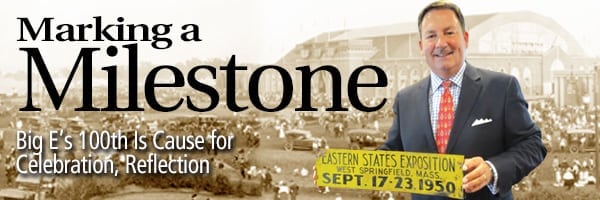
Marking a Milestone

Eugene Cassidy, president and CEO of the Big E

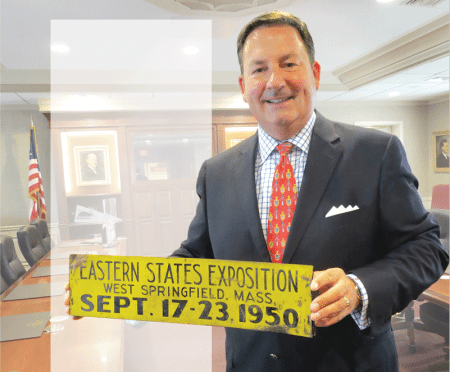
Eugene Cassidy, president and CEO of the Big E, with one of the many pieces of memorabilia collected from patrons of the fair.

The Eastern States Exposition turns 100 this year. For organizers of the 17-day fair every fall and a host of other events during the year, planning such a celebration comes easily. But the centennial is in many ways more than a party — it’s an opportunity to reflect on the Big E’s history, its place in the region, and the many challenges that stand in the way of continuing this tradition for the generations to come.

The request went out on various forms of social media a few years ago.

The Eastern States Exposition, long on history but admittedly somewhat short on older archival material and memorabilia concerning its century-long existence, was looking for the public’s help in rectifying that problem — and in telling an important story.

“When we moved here [the Big E fairgrounds] from our offices at 31 Elm St. in Springfield in 1950, we jettisoned a lot of our archives; we have our business records and our meeting notes, but we don’t really have a good archive,” explained Eugene Cassidy, the institution’s president and CEO. “So we spent the past several years collecting Eastern States memorabilia, mostly from people who are fond patrons of the fairgrounds. And a lot of fascinating stuff poured in.”

The donations include dozens of photographs, some of them going as far back as the 1920s, and many chronicling the horrific floods of 1936 and 1955; promotional posters, including one from 1925 that was found behind a wall by two sisters from Ludlow as they were relocating to Alaska; a framed copy of some of the early attempts to answer a request from some journalists to shorten the exposition’s lengthy name (yes, this was the origin of the term ‘Big E’); and a metal sheet detailing the dates of the 1950 exposition that was designed to wrap neatly around street signs.

“People couldn’t tell what street they were on, but they knew the dates for the exposition,” said Cassidy as he held up the well-preserved artifact, marveling at its purpose.
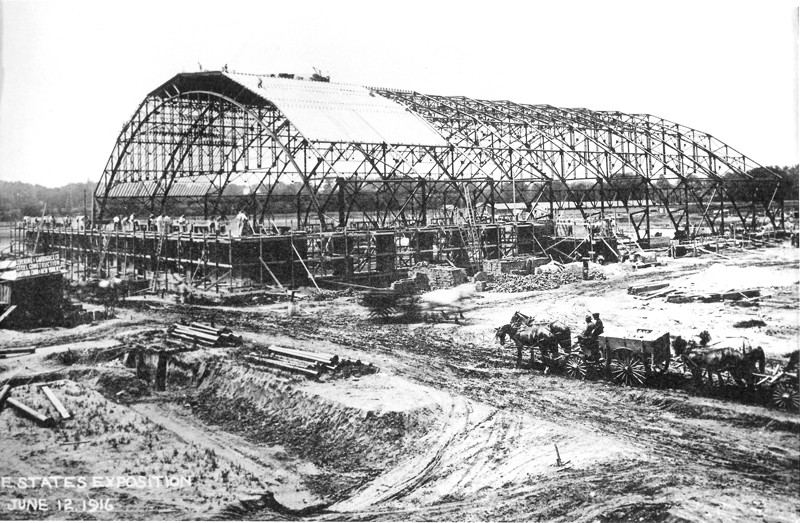
Construction of the coliseum commences in 1916

Construction of the coliseum commences in 1916, just months before the National Dairy Show was to come to West Springfield.

These items and countless others will be put on display during this year’s Big E, the 100th birthday celebration, which will commence Sept. 16. Collectively, they speak to the institution’s place — not only in the region, but in the hearts, and memory banks, of the millions who have visited the fairgrounds over the years.

In many ways, this is what will be celebrated during this milestone year, said Cassidy, adding that Big E administrators want to use the occasion to bring awareness to the institution’s long history, the manner in which it has become part of the social fabric of the region (in a figurative, but also quite literal, sense, as we’ll see) — and the fact that help, in many forms, will certainly be needed to preserve this tradition for future generations.

Indeed, the Big E is facing a number of formidable challenges as it stares down its second century, said Cassidy, now in his fifth year at the helm, listing everything from an ever-growing number of forces competing for the time and energy of families to the inexorable decline of agriculture in Massachusetts and the Northeast (the bedrock on which the exposition was built), and an aging exposition infrastructure that includes several buildings that date to the beginning in 1916, including the venerable coliseum.

“My goal is to raise awareness so that people in the greater community might take a step back and think about what Eastern States means to the region,” he explained. “This is an opportunity for people to refamiliarize themselves with Eastern States at hopefully a different level, and to take note of our resilient ability to remain successful in an environment that becomes increasingly more difficult to survive in.”

Elaborating, he said fairs of this type across the country are struggling mightily, but many have the support of their various states to fall back on.

“Gov. [Andrew] Cuomo recently gave the New York State Fair $55 million to rehabilitate a few buildings on their fairgrounds, and the Indiana State Fair gets 6% of the revenues from gaming in that state,” said Cassidy, adding that the Big E is certainly not likely to receive similar forms of support.

To fund needed capital projects and relieve the exposition of growing amounts of debt, other measures will be required, said Cassidy, noting that a capital campaign for the nonprofit organization is a distinct possibility.

For now, he wants to grow awareness and gain a full appreciation for the institution.

“My personal goal is for as many as possible in our Greater New England region to have a connection to, and a fondness for, the future of this organization, some respect for its history, and a desire to be a part of it moving forward,” he explained. “It’s going to take all of that in order to assure that this organization continues to have its incredible importance on the stage of national agriculture and food production, and to continue to have the economic impact it has.”

For this issue, BusinessWest takes a look at the Big E’s centennial, what is planned from a celebratory standpoint, and especially at what this institution must do after it blows out the candles for its 100th birthday.

Party Animals

Cassidy told BusinessWest that the Big E is used to throwing big parties — in most respects, that’s what it does for 17 days each fall — so a 100th-birthday celebration is, in many respects, no big deal.

Well, at least from a planning and execution perspective; again, this is what they do. From a historical and, yes, public-relations perspective, though, this is a very big deal, an opportunity that exposition officials intend to fully maximize.
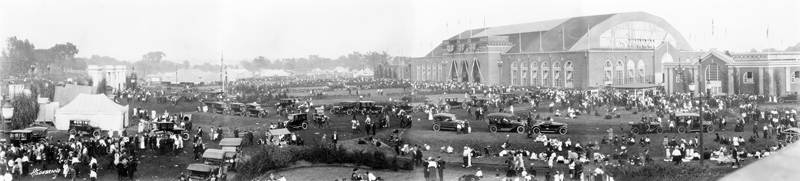
the Big E in the 1920s

This panoramic photo shows the Big E in the 1920s, when it was fast becoming a tradition in the region.

There will be a number of special touches, he went on, pointing to everything from the birthday-cake-like signage now adorning the administration building to the flagpoles now affixed to the coliseum (an attempt to recapture the look from 1916 and the ensuing decades); from the display of artifacts collected from the public to a spirited effort to bring back performers from the exposition’s heyday in the ’50s, ’60s, and early ’70s (the return of the Cowsills falls into that category); from a new/old logo, as well as coasters, buttons, and magnets with the number ‘100’ on them, to a special Big E tartan, a pattern bearing a mix of the primary colors of the Big E, the town of West Springfield, and the six New England states already woven into ties and scarves — the fabric of the community in a literal sense.

There will also be a commemorative book on the centennial, due to be released just before this year’s fair begins (one can already be ordered online).

Wayne Phaneuf, executive editor of the Republican, was the main editor for the book and one of those contributing content and selecting photos, the latter of which essentially tell the story of the past half-century.

Phaneuf told BusinessWest that he did some extensive research for the project and learned a number of things while doing so.

That list includes everything from the full roster of entertainers who appeared over the years — “I never knew Bob Hope came here,” he said — to insight into how the federal government essentially commandeered the fairgrounds during both World War I and World War II for use as a staging area and supply depot.

But mostly, that research merely reinforced what he already knew.

“As a kid growing up in this area, there were only two things kids really looked forward to,” he said while summing things up — “Christmas and the Big E.”

And that sentiment basically applies to people of all ages, he went on, adding that the book — and the 100th anniversary, really — is all about memories.

People from across this area and soon well beyond started collecting them in 1916, when Joshua Brooks, a prominent area businessman and lithographer by trade (his company printed bank notes, among other things), pulled off an unlikely coup and brought the prominent National Dairy Show to a once-muddy flood plain beside the Westfield River.

Actually, when he sold this region to the highly skeptical fair organizers during intense meetings in Chicago, that area was still mostly a swamp — but one for which Brooks had big plans.

Growing Concern

Two years earlier, he and 62 others listed as original incorporators launched the Eastern States Agricultural and Industrial Exposition. Its lengthy purpose was to “to hold agricultural and industrial expositions, and fairs within the county of Hampden, to engage in agricultural and industrial products and in livestock, to conduct races, sports, and general amusements, and to promote the agricultural and industrial development of the eastern states.” (No, there’s nothing in there about cream puffs or deep-fried … anything.)

Brooks’ ambitious plan was to launch the first exposition by bringing the National Dairy Show to the site. And to do that — again, against seemingly all odds — he essentially sold a promise: to build the roads, buildings, facilities, and amenities needed to stage that event, because none existed at the time.

To make a rather long story short, he delivered on that promise, raising more than $500,000 to get it all done.

A year after the successful staging of that event, the Eastern States Exposition and Dairy Show began, only a few months before the U.S. officially entered World War I. The first fair drew 138,000 people, roughly one-tenth what it does today.
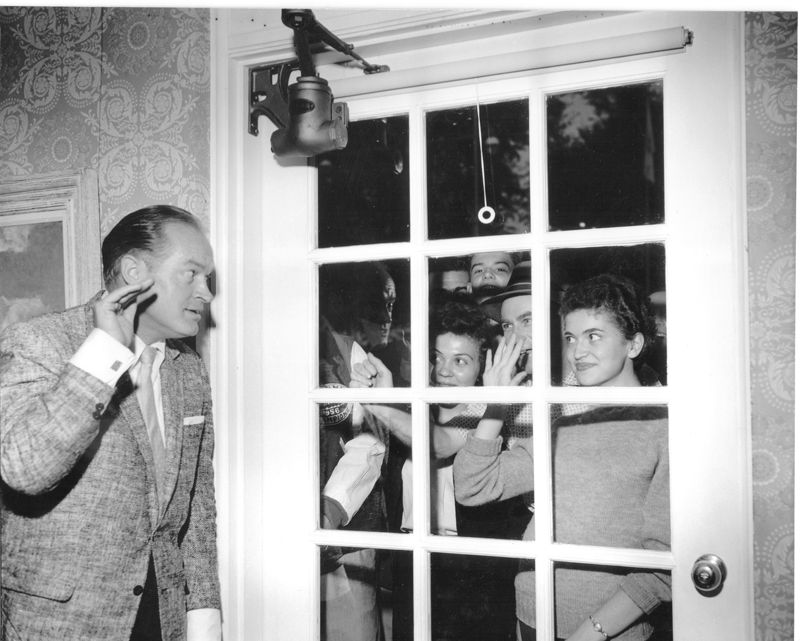

BigE-BobHope

the Big E was the undisputed entertainment hub

Until the mid-’70s, the Big E was the undisputed entertainment hub in the region, hosting entertainers such as Bob Hope (top) and sporting events like auto racing.

After the war, the Big E initiated a pattern of continued growth and expansion that would continue for decades — not simply in terms of infrastructure, but also in prestige, attendance, and prominence within the region and also well beyond it.

The Big E, and especially the fair each fall, would find a unique place in the region’s consciousness, while drawing celebrities and politicians, including a sitting president, Dwight Eisenhower, and his sitting vice president, Richard Nixon.

By the middle of the 20th century, the Big E — as it came to be known in 1967 amid complaints from the press that there were just too many syllables in Eastern States Exposition — became the undisputed center of entertainment in Western Mass. and Northern Conn., as well as a place for events of all types, because the coliseum was the largest venue of its kind in the region.

Indeed, the exposition was, for many years, home to professional hockey (the American Hockey League in the form of Springfield’s franchise, but also the parent National Hockey League when the Hartford Civic Center’s roof collapsed in January 1978, leaving the Whalers temporarily homeless). But it was also home to what is now CityStage (then StageWest) starting in 1967, as well as other entertainment facilities, including the Storrowton Dinner Theatre.

The list of those who have appeared in West Springfield is long and prestigious, and includes the likes of Fred Astaire and Ginger Rogers, Lionel Barrymore, Jackie Gleason, Bob Hope, Liberace, Arthur Godfrey, and countless others.

“We have a great, storied history for entertainment — we had the biggest names going back to the 1920s,” Cassidy said. “Anybody who was anybody played at the Eastern States. Buddy Hackett played here so many times that, in the late ’60s, the police chief gave him a key to the town of West Springfield. He loved the fair, and he loved his connection to us.”

The exposition also hosted all manner of events, including college and high-school graduations, a wide array of sporting events, and many political gatherings, including the 1964 state Democratic convention. (The state’s junior senator, Edward Kennedy, then campaigning for re-election, was injured and nearly killed as the plane taking him to that convention crashed in Southampton).

Survivor’s Story

But while the exposition’s history is replete with big names, big events, and big crowds, it is, in many respects, a story of survival, of overcoming challenge.

Those challenges have come in a number of forms — from two world wars to the Great Depression, which took a heavy toll in a number of ways, to the building in the early ’70s of the Springfield Civic Center, which took hockey, many school graduations, and scores of other events across the Connecticut River and actually prompted Big E officials to briefly consider a move to the Nutmeg State as a way to counter that threat.

Then there were the natural disasters, the floods, and especially the hurricane that visited Western Mass. in September 1938, just a few days after that year’s fair had begun.

Photos taken in the aftermath of the disaster told a story of complete devastation, with rides, tents, and structures crumpled, a situation compounded by a forced early closing and resulting loss of revenue as well as the lingering effects of the depression, which cast a large shadow over the prospects for recovery.

The situation was summed up poignantly in remarks, included in the centennial book, from Republican reporter Frank Bauer, who attended a meeting convened by Brooks that featured a host of area business leaders curious about what could, and would, happen next for the fair.

“The Eastern States Exposition, even then a venerable 22-year-old institution, was in danger of extinction, down and out from the big blow,” he wrote. “There was no treasury, no funds, and no insurance to begin to cover the damage and loss of revenue.”

Before that meeting ended, Bauer went on, Brooks and ally Harry Fisk asked for and received commitments from those in the room for funds to restore the fair.

While the situation nearly eight decades later is not as dire in most respects, there are some similarities, said Cassidy, noting that the Big E is facing a host of challenges — if it not to its survival, then certainly to its bottom line and many of its traditions, especially its agricultural roots.

Chief among them, perhaps, is the aging infrastructure at the fairgrounds and the ever-rising cost of restoring and modernizing buildings built decades ago.
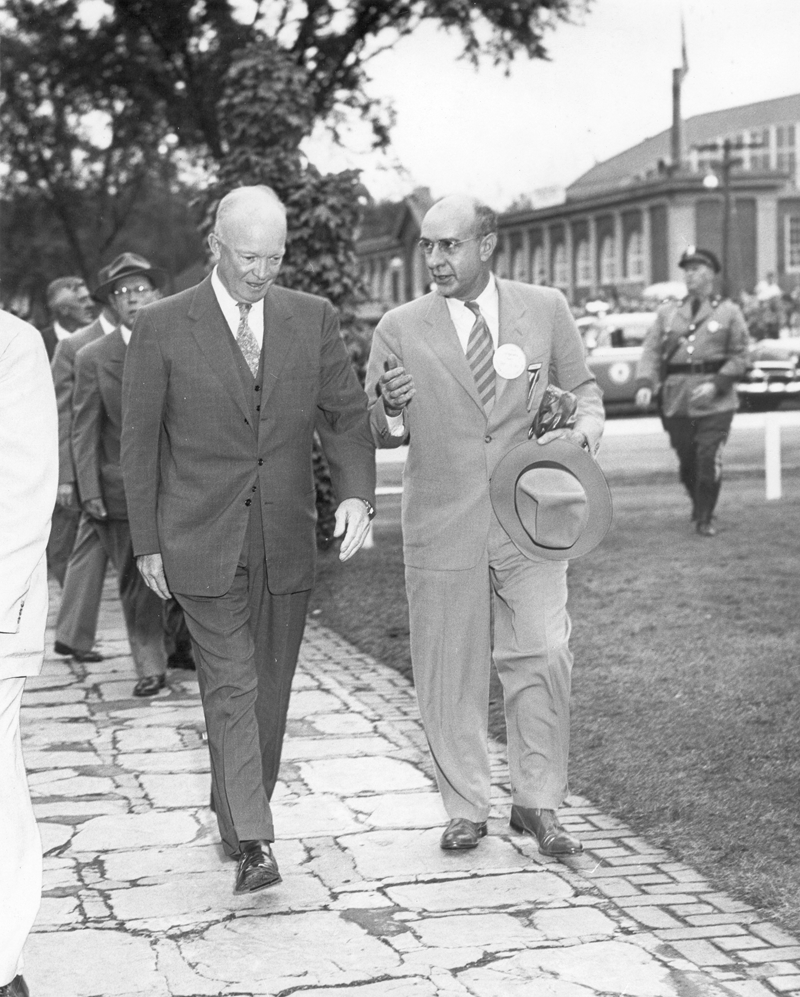
President Dwight Eisenhower

President Dwight Eisenhower, left, visits the Big E in 1953.

Fair officials have received some estimates, for example, that it would cost at least $40 million, and probably more, to completely restore the coliseum to its former glory and original look and make it suitable for many of the events it can no longer stage, said Cassidy.

“The coliseum is obsolete today — professional hockey moved out in the ’70s, and they stopped playing high-school hockey there in 1991,” he explained, adding that the facility is now used mostly for horse shows and the Shrine Circus. “The building is in need of a $50 million to $60 million investment to make it contemporary in this day and age.”

There are other facilities that need work as well, he said, pegging the total amount of deferred maintenance at more than $140 million.

To capitalize the needed work, the Big E, despite several very successful years recently, would have to revert to its old methods for raising money, he explained. Well, sort of.

“In the old days, when we had a rainy fair and lost money, Mr. Brooks would get on the phone and call everybody up and say, ‘I need you to write me a check for $16,000,’” Cassidy said, adding that those calls went to corporators, board members, and other prominent supporters of the exposition.  “And the money came in; it paid the bills, and it got us through difficult times.”

That model was actually still in place in 1978, when the Big E used it to finance the Young Building, Cassidy said, adding that, when Brooks’ son, J. Loring Brooks, died in 1980, that development strategy was essentially retired.

As a result, to fund its operation, the Big E has taken on increasingly larger amounts of debt, he explained, noting that the number has risen exponentially over the past few decades.

Thus, when the centennial celebration is over, the focus will shift entirely to the next 100 years, said Cassidy, adding that this includes development of a new strategic plan that will specifically address challenges and how to fund them.

“It will have a meaningful and robust development and fund-raising piece to it,” he said, adding that a likely step is a capital campaign, something the fair hasn’t done — at least in the modern sense of that term.

With those thoughts as a backdrop, Cassidy noted, again, that this Big E will, from a production standpoint, be business as usual, but it will also comprise a sincere effort to show just how important that business is for the region, and how challenging it will be to continue it into the future.

Fair Game

As he posed for a few photos with some of the memorabilia collected from area residents, Cassidy stopped at the large conference room in the administration building.

He wanted to show off the renovations to that facility, but also, and more importantly, make a point.

To do so, he started by gesturing to the photos of Joshua and J. Loring Brooks (they were both known as J.L.) at the far end of the room.

“Those used to be out in the hallway, where no one really saw them,” he explained, adding that, now, they’re almost impossible to miss.

In fact, the horseshoe-shaped conference table is set up so that each member of the board of directors will face those pictures, of the founder and the man who continued his work for several decades.

“So, in a way, while addressing the present and the future, we’re always reminded of the past and the need to preserve that history and those traditions,” Cassidy explained.

In many respects, that’s exactly what the 100th-birthday celebration is all about.

George O’Brien can be reached at [email protected]

Banking and Financial Services Sections

The Relationship Between Lender and Company Is a Key Factor

By Steve J. Schwartz, Esq. and David K. Webber, Esq.

Steve Schwartz

Steve Schwartz

David Webber

David Webber

In the May 13, 2013 issue of BusinessWest; we penned an article titled “A Primer on the ESOP.” This is an extension of that article that specifically focuses on financing an ESOP, or employee stock- ownership plan, and informs the reader of the lender’s concerns in making a loan as part of the structure of a leveraged ESOP.

In the prior article, we described an ESOP as follows: an ESOP is a qualified defined-contribution retirement plan established under §§ 401(a), 409, and 4975 of the Internal Revenue Code. Unlike other qualified plans, an ESOP is designed primarily to invest in shares of a closely held corporation, referred to in the code as ‘employer securities.’ The sponsor company may transfer the shares of common stock as a qualified contribution, or the ESOP may purchase shares from shareholders or the sponsor company. In a ‘leveraged’ ESOP, the company takes out a bank loan to fund the purchase, then lends the funds to the ESOP to finance the purchase of shares. A 100% sale of shares to an ESOP may require a series of smaller transfers because 100% bank financing is unlikely.

The selling shareholder may receive cash as partial or complete consideration for the shares. In the alternative, or in addition to cash, the selling shareholder may self-finance a portion by accepting a note as partial payment. As the note is paid off in installments, the plan trustee transfers shares to each of the employees’ accounts, eventually vesting all the stock in employee accounts in accordance with the terms of the plan.

The lender has its usual concerns in making the loan, which will eventually be used to purchase shares by the ESOP. The considerations do not vary much between financing an ordinary loan and financing an ESOP. The lender’s customary due diligence is utilized to assess the credit worthiness of a borrower. If the company is a customer of the lender, it will normally have a relationship with the current management.

If the ESOP is part of an exit plan and there will be a change of control, the lender will be concerned with the capacity of the new management team to manage the business. It is important that the new management team be involved in dealing with the lender in obtaining the loan. In the event there is not a change of control, it will also consider this issue for the future in case there is a change of control due to death or disability or part of a future plan to vest control in new management. Hopefully, the lender will have experience in dealing with an ESOP transaction.

It is important for the company to prepare a financial plan for the period of the loan so that its needs for financing are included in its request for financing. It is also important that working capital and other financial requirements are included in the request. The company’s request should consider any contingencies.

The lender will analyze the company’s financial circumstances, including the security for its loan and the ability of the company to make the loan payments. The lender will also consider the company’s other financing requests.

As part of the ESOP planning process, the company shall be required to engage an independent appraiser to determine the value of the shares to be sold as part of the ESOP.  The lender will review the appraisal carefully in its approval process. It will provide the lender with an independent view of the company and its prospects.

The terms of the loan should be keyed to the ability of the company to generate profits. However, there are limitations on the term. An ESOP is a retirement plan and must comply with applicable laws; the internal note and pledge agreement from the ESOP to the company will be subject to federal government scrutiny. A term that is too long, or an interest rate greater than market rate, is suspect because it could unduly favor the selling stockholder over the employees.

Shares are released to the employees’ individual accounts on the payment of the loan. A longer term would affect the release of shares to the ESOP participants: the longer the term, the slower the release of shares. The term and interest rate of the note should therefore be reasonably short (fewer than 10 years) in order to mitigate excess scrutiny from the IRS and Department of Labor.

The loan normally will be secured by all the assets of the company. It is not unusual for the lender to request the personal guaranty from the stockholders. Also, it may be necessary for the proceeds of the sale to be pledged as additional security for the loan. The lender may agree to reduce the additional collateral as the loan is repaid.

If the company has existing loans or new loans with the lender, there will be cross-collateralization, cross-default, and cross-guarantee agreements. If any loan is in default, the default will apply to all the other loans. In the event a stockholder is owed money by the company, the lender may require that the stockholder subordinate the obligation to the lender and restrict the payment terms of the obligation to protect the company’s cash flow. The lender may require life insurance on the management team to be assigned to the lender as additional collateral for the loan.

As with any loan, there will be annual reporting requirements, financial covenants, and other performance metrics. The terms should be clearly set out in the commitment letter. The lender may have other requirements such as insurance, landlord’s consent, mortgagee’s consent, and collateral control agreements if some of the assets are not on the premises of the company.

The loan from the company will be documented by a separate note and security agreement to be signed and delivered simultaneously with the loan to the lender. In addition, there will be a stock-purchase agreement between the ESOP and the seller(s) of the shares.

The lender will require that the proceeds of the ESOP loan must be used solely to purchase shares in the company.  The ESOP will be able to repay the note from company contributions to the ESOP or from dividends paid to the ESOP from the company.

In summary, the relationship between the lender and company is a significant factor in the establishment of the ESOP, financing the purchase of company shares and the future of the business.  Even if a lender is initially skeptical, the lender can become an invaluable part of the business-succession team once the plan has its blessing.

We want to thank Vicky Crouse and Frank Crinella of TD Bank, N.A. and L. Alexandra Hogan, Esq. of Shatz, Schwartz and Fentin, P.C. for their assistance in preparing this article.

Attorney Steven J. Schwartz, of Shatz, Schwartz and Fentin, P.C., concentrates his practice in the areas of family business planning, mergers and acquisitions, corporate law, and estate planning; (413) 737-1131; [email protected]. Attorney David K. Webber, of Shatz, Schwartz and Fentin, P.C., concentrates his practice in the areas of closely held business, corporate law, real estate, trusts and estates, and bankruptcy; (413) 737-1131; [email protected].

Company Notebook Departments

Newman’s Own Foundation Donates to Link to Libraries

EAST LONGMEADOW — Link to Libraries Inc., which has donated a half-million new books to children in New England, just booked a donation of its own — a $15,000 grant from Newman’s Own Foundation. The grant was initiated through Big Y  World Class Markets. “For all of us at Big Y, we are proud to continue to link the Newman’s Own Foundation with Link to Libraries in order to further the language and literacy skills of students within our marketing area,” said Claire D’Amour-Daley, Big Y’s vice president of Corporate Communications. “Our customers have also enjoyed being part of this yearly initiative.” An all-volunteer nonprofit with no paid staff, Link to Libraries serves 25,000 children in 400 sites in Connecticut and Massachusetts. The Newman’s Own Foundation grant will fund the purchase and distribution of thousands of books in the coming months. “Over 92 cents per dollar is used to buy books,” said Susan Jaye-Kaplan, president and co-founder of  Link to Libraries, which is based in East Longmeadow. “Thanks to this generous grant from Newman’s Own Foundation and our network of 209 volunteers, ranging in age from 5 to 81 years old, we’re well-positioned to deliver on our mission to to enhance the language and literacy skills of children of all cultural backgrounds.” Newman’s Own Foundation turns all net profits and royalties from the sale of Newman’s Own food and beverage products into charitable donations. To date, Paul Newman and Newman’s Own Foundation have given more than $470 million to thousands of charities around the world. Since its inception in 2008, Link to Libraries has donated nearly 500,000 new books, including more than 75,000 this fiscal year, said Jaye-Kaplan.

Berkshire Hills to Acquire First Choice Bank

PITTSFIELD — Berkshire Hills Bancorp Inc. and First Choice Bank announced that they have signed a definitive merger agreement under which First Choice Bank will merge into Berkshire Bank, and its subsidiary, First Choice Loan Services Inc., will become a subsidiary of Berkshire Bank in an all-stock transaction valued at approximately $111.7 million.
Berkshire’s total assets will increase to $8.9 billion, including the $1.1 billion in acquired First Choice assets.  This market-expanding merger provides entry into attractive markets with strong demographics, and includes six branches near Princeton, N.J., and two in the greater Philadelphia area. First Choice reported $436 million in net loans (excluding loans held for sale) and $906 million in deposits as of March 31, 2016. First Choice Bank is the second-largest community bank by deposit market share in Mercer County, N.J., an area with per-capita income well above national and regional averages. First Choice Loan Services is a leading residential retail and consumer direct mortgage originator serving borrowers across the U.S. Total mortgage production in 2015 was $2.5 billion. Berkshire will have a pro forma market cap of approximately $905 million and 101 branches, serving customers and communities across the Northeast. “We’re pleased to welcome First Choice customers and employees to America’s most exciting bank,” said Michael Daly, CEO of Berkshire Bank. “This partnership builds on Berkshire’s commitment to create a strong regional platform for serving our customers, while diversifying our revenue streams, improving profitability, and increasing shareholder value.  The First Choice franchise builds on markets where we presently manage commercial relationships, and adds a well-positioned deposit base, a best-in-class home-lending operation, and enthusiastic new teams that complement our current culture. After integration, the transaction is expected to be accretive to Berkshire’s earnings per share, return on equity and return on assets, liquidity, and capital. We have a strong track record of execution, and our collective teams are positioned to complete this integration flawlessly.”
Martin Tuchman, First Choice’s chairman of the board, commented, “we’re pleased to announce this combination with Berkshire and believe our customers, community, and employees will benefit greatly from this transaction. We believe Berkshire fits both the culture of our bank and our expanding mortgage operation. Their product suite and commitment to service will enable the combined company to better compete in this growing marketplace. With Berkshire’s attractive stock, I’m pleased to be a shareholder going forward, and our bank employees and mortgage-lending group look forward to joining the Berkshire team.”

OMG Hosts Students for Junior Achievement Job Shadow Program

AGAWAM — OMG Inc. hosted students from three Springfield Middle Schools recently as part of the Junior Achievement Job Shadow Program. OMG has served as a host for the job-shadow program for the past 10 years, and this year’s visits included 48 students from Balliet Middle School, Springfield Public Day Middle School, and M. Marcus Kiley Middle School. The premise behind JA Job Shadow is that, while in school, students don’t often have the opportunity to develop realistic expectations of their future career and lifestyle options. The job-shadow experience lets them see what professionals do in on a daily basis, and is meant to give the students perspectives on a professional and diverse work environment. “During their time at OMG, we introduce them to a few senior managers, take them on a tour, and let them know about our basic hiring requirements, such as the need for a high-school diploma or GED, and characteristics we look for, such as strong communications and time-management skills, and the ability to work well on a team,” said Sarah Corrigan, director of Human Resources at OMG. “We also make it fun and engaging by having the students complete a scavenger hunt of fun facts about OMG during their visit.” Hubert McGovern, president and CEO of OMG, agreed. “The most recent group from Kiley asked great questions,” he said. “They asked about the company’s success record, whether OMG offered benefits like life and health insurance, what percentage of the work force was represented by women, and what we do to help make our employees better. We were really impressed by their level of interest and the way they conducted themselves during the visit.” Headquartered in Agawam, OMG Inc. is North America’s largest supplier of specialty fasteners and products for commercial and residential construction applications. The company operates two business units: OMG Roofing Products and FastenMaster.

Academy of Music Installs New Audio System

NORTHAMPTON — The Academy of Music Theatre in Northampton recently acquired a new, state-of-the-art audio system, designed and installed by Jason Raboin. The hall had become increasingly busy with a variety of programming, from rock concerts to theatrical productions, literary arts to dance, youth programs to indie music, which would all benefit from an enhanced system, said a spokesperson for the Academy. Two challenges were identified for the project. First, the speakers needed to provide consistent coverage throughout the entire theater without interfering with sightlines to the stage opening or distracting from the architectural beauty of the 125-year old opera house, and second, the limited rigging options within the historic performing-arts center demanded compact, lightweight loudspeakers as part of a visually unobtrusive sound system. The installation centered around four Fulcrum Acoustic CX1595 speakers powered by Ashly nXp amplifiers. The speaker’s lightweight, compact, visually unobtrusive design provides consistent coverage throughout the entire theater without interfering with sightlines to the stage opening or distracting from the architectural beauty of the 125-year old opera house. Two compact, portable Fulcrum Acoustic Sub215 subwoofers provide concert-level low frequency for the historic theater while minimizing visual intrusion. Raboin, as a touring sound engineer (Joan Baez, Modest Mouse, Lake Street Dive) who had worked on a variety of audio systems in the field, said, “I have not heard anything that sounds better than Fulcrum Acoustics speakers. When you combine their fidelity with their lightweight and compact size, they really were the only choice for this installation. It was hard to believe that such a compact system would be able to cover the venue at the desired SPL, but the system exceeded our expectations and the theater’s design goals.” At mix position, a Yamaha Ql1 mixing console was chosen for its compact footprint as well as its ability to handle the wide variety of programming offered year-round in the theater.

Florence Bank Donates $25,000 to Cancer Center

FLORENCE — Florence Bank recently contributed $25,000 for use over a five-year period to the Sisters of Providence Health System (SPHS)to assist in the expansion of the Sister Caritas Cancer Center at Mercy Medical Center.
Springfield-based SPHS is a not-for-profit entity providing a range of special benefits to the community, such as programs to manage care for people with chronic diseases, health-education and disease-prevention initiatives, outreach for the elderly, and care for the poor and uninsured. Mercy Medical Center is conducting a capital campaign to support the $15 million expansion of the Sister Caritas Cancer Center at the hospital. Specifically, the funds will be used to consolidate all cancer services into a single unified space and meet the increased demand for outpatient cancer services. In the past two years, the number of patients receiving chemotherapy at the Sister Caritas Cancer Center has increased by more than 200%. By 2022, the need for outpatient cancer services is expected to grow by 26%. Gifts to the capital campaign will support the addition of new treatment spaces, including 32 new infusion bays, whose design will increase privacy for patients, as well as for family members and friends. The campaign will also support the consolidation of all cancer services, enhancing communications between oncology staff and facilitating ease of access to existing services for patients. “Florence Bank has steadily supported our programs for years,” said Diane Dukette, vice president, Fund Development, Sisters of Providence Health System. “We are grateful for their ongoing generosity and commitment to the people we serve. This significant pledge to the capital campaign will help further our efforts to create a unified area for patients to receive their cancer treatment in a truly collaborative clinical environment.” Florence Bank, a longtime supporter of Sisters of Providence Health System, is known for its many charitable contributions, including its annual $100,000 Customer’s Choice Community Grants program.

Chamber Corners Departments

AMHERST AREA CHAMBER OF COMMERCE

www.amherstarea.com

• July 18: 13th annual Golf Tournament at Hickory Ridge Golf Course, Pomeroy Lane, Amherst. Schedule: 10 a.m.: full-swing pro clinic; 10:30: registration, putting contest, light lunch; noon: shotgun start, scramble format; 5 p.m.: social hour, cash bar; 
6 p.m.: dinner, awards ceremony, live auction. Cost: $135 per player; $540 per foursome. Hole-in-one, longest drive, closest-to-the-pin contests.

GREATER EASTHAMPTON CHAMBER OF COMMERCE

www.easthamptonchamber.org
(413) 527-9414

• July 14: Networking By Night, 5-7 p.m., at the Oxbow Marina Sports Center, Old Springfield Road, Northampton. Cost: $10 for chamber members, $15 for non-members. Register online at easthamptonchamber.org or call the chamber at (413) 572-9414.

• July 29: 32nd annual Golf Tournament, 9 a.m. shotgun start, at Southampton Country Club, 329 College Highway. Cost: $125 per person, includes cart, gift, lunch, dinner. Register online at business.easthamptonchamber.org/events/details/32-annual-golf-tournament-july-2016-195 or call the chamber office at (413) 527-9414.

• August 13: 2nd annual Beach Ball, 5-10 p.m. Dance and dine under the stars at chamber’s annual Beach Ball, where a beach party and gala collide. Barbecue feasting by Outlook Farm, music by DJ Jay Pacluiga, full cash bar by Meyers Catering, bonfire on the beach, performance by the Oxbow waterski show team. Register online at business.easthamptonchamber.org/events/details/2nd-annual-easthampton-chamber-beach-ball-august-2016-196, or call the chamber office at (413) 527-9414.

GREATER HOLYOKE CHAMBER OF COMMERCE

• July 13: Chamber Coffee Buzz Morning Networking, 7:30-8:30 a.m., at Ruwac Inc., 54 Winter St., Holyoke. Jump-start the day with this opportunity to meet business and community leaders while enjoying coffee and a light breakfast at this world leader in industrial vacuum systems. If your schedule demands morning meetings or if you’re interested in maximizing your exposure, the Coffee Buzz is for you. This event is free to members of the business community and is sponsored by Lyon & Fitzpatrick, LLP.

GREATER NORTHAMPTON CHAMBER OF COMMERCE

www.explorenorthampton.com

• July 13: July Arrive @ 5 with NAYP, 5-7 p.m., at Cooley Dickinson Hospital. Sponsors: Brain Analysis & Neurodevelopment Center, Highview of Northampton, and the Healing ZONE Therapeutic Massage. Cost: $10 for members.

• July 14: Google Workshop: “Set Goals with Google Analytics,” 9-11 a.m., at the chamber office, 99 Pleasant St., Northampton. Presented by SCORE. No cost. What is Google Analytics? A free powerful analytics tool provides reports showing how visitors found your website and what they did when they got there. Measure the effectiveness of your online and offline marketing campaigns. To register, visit [email protected].

• July 21: Google Workshop: “Build Your Free Website with Google,” 9-11 a.m., at the chamber office, 99 Pleasant St., Northampton. Presented by SCORE. Learn how to create, customize, and publish your site, get a free domain name or use one you already own, and access and edit your site anytime. No cost, but pre-registration is required, and space is limited.
To register, visit [email protected].

• Sept. 7: September Arrive @ 5, 5-7 p.m., at Spoleto Restaurant. Sponsors: Webber & Grinnell Insurance, Applied Mortgage, BusinessWest, and Lia Honda. Cost: $10 for members.

GREATER WESTFIELD CHAMBER OF COMMERCE

www.westfieldbiz.org
(413) 568-1618

• July 14: Pancake Breakfast, 7-11a.m., at South Middle School, Westfield. Cost: $6 for adults, $5 for seniors, $3 for children under 12. Vendor tables available: $75 for members, $100 for non-members. You must bring your own table and chairs. For more information, to volunteer, or reserve a table top and/or sponsorship, call the chamber office at (413) 568-1618.

• July 18: After 5 Connection, 5-7 p.m., at Papps Bar & Grill, 110 Airport Road, Westfield. Network with the chamber this summer. Scholarship fund raffle: win an aerial, scenic view of Westfield. Cost: $5 for chamber members, $10 general admission. Includes refreshments and cash bar.

SPRINGFIELD REGIONAL CHAMBER

www.myonlinechamber.com

• July 28: Chamber Golf Tournament at the Ranch Golf Club, 65 Sunnyside Road, Southwick. Schedule: 11 a.m. to noon: registration/courseside lunch; 12:30 p.m.: shotgun start; dinner immediately following. Sponsored by MassMutual Center, VHB, Columbia Gas of Massachusetts, Florence Bank, and Chicopee Savings Bank. Cost: $600 per foursome, $160 per individual golfer. Reservations may be made online at www.springfieldregionalchamber.com.

WEST OF THE RIVER CHAMBER OF COMMERCE

www.ourwrc.com
(413) 426-3880

• August 15: Annual Golf Tournament at the Ranch Golf Club, Southwick. Schedule: 11:30 a.m. registration; noon: lunch; 1 p.m.: shotgun start/scramble format. Cost: $125 for golf and dinner. Register online at www.westoftheriverchamber.com. For more information or for tickets to this event, contact the chamber office at (413) 426-3880, or e-mail [email protected].

• Sept. 14: Multi-chamber Night of Networking, 5-7 p.m., at Cal’s Wood Fired Grill, Riverdale St., West Springfield. Cost: $10. Register online at www.westoftheriverchamber.com. For more information or for tickets to this event, contact the chamber office at (413) 426-3880 or e-mail [email protected].

• Sept. 22: Business Breakfast with Howie Carr, 7-9 a.m., Chez Josef, Agawam. Cost: $35 for chamber members, $40 for non-members. Register online at www.westoftheriverchamber.com.

Daily News

HOLYOKE — The Dowd Insurance Agencies announced the appointment of Chief Financial Officer Jon Lumbra. He will be responsible for directing the fiscal operations of the business and supervising the accounting department. In addition, he will assist in the planning, establishing, and maintaining of current systems and procedures.

“We are pleased to welcome Jon to the team,” said David Griffin Sr., executive vice president and treasurer of the Dowd Insurance Agencies. “He is an excellent strategic and cultural fit whose breadth and depth of knowledge will help strengthen our brand and provide the best service to our customers and employees.”

Lumbra brings nearly two decades of experience in financial services to the Dowd Insurance Agencies. His past experience includes working for Loomis Communities, the city of Holyoke, and Spectrum Analytical. He is a graduate of Southern Vermont College with a degree in criminal justice and minor in corporate espionage. He is currently working toward his MBA at the University of Southern New Hampshire.

“The Dowd Insurance Agencies is one of the oldest insurance agencies in Massachusetts, and its headquarters remain in the city of Holyoke, where the business was started 118 years ago,” said John Dowd Jr., president and CEO of the Dowd Agencies. “Making positive contributions to the success of our community has always been important to us, which is why Jon is a great addition to our business. He has demonstrated these shared values by volunteering his time to support many organizations — many of which are based in Holyoke, Jon’s hometown.”

Lumbra is president of the Knights of Columbus Council #90 board of directors, former executive board member of the Massachusetts Government Finance Officers Assoc., a member of the Holyoke Taxpayers Assoc., and a member of the Taxpayer Advocacy Panel Federal Advisory Committee. He is also immediate past chairman of the Holyoke Visiting Nurse Assoc. & Community Health Foundation, immediate past president of the Holyoke Rotary Club, and member of the Holyoke Medical Center board of directors.

Daily News

EAST LONGMEADOW — HUB International New England, a division of HUB International Limited, a global insurance-brokerage, risk-advisory, and employee-benefits firm, announced the hiring of two new employees in its East Longmeadow office. Monique Matz has joined as commercial lines service manager, and Jennifer Robinson as employee benefits account manager.

Matz joins HUB International with several years of underwriting and commercial-lines experience. At HUB International, her role is to provide service to medium to large commercial insurance accounts of moderate to high complexity. Acting as the primary liaison between the client and insurance carrier, she coordinates all facets of the clients’ needs from the initial setup procedures to audit processing to policy review. She handles day-to-day client requests while staying focused on meeting the needs of clients, carriers, and client executives.

Robinson has been in the insurance industry for many years and has experience in the customer-service and data-management fields. As part of the employee benefits team, she will work to help employers maintain their employee-benefits packages, and acts as a guide and reference tool for their HR managers. She handles client inquiries and works closely in assisting the producers with new business and sales initiatives.

Daily News

AGAWAM — OMG Inc. hosted students from three Springfield Middle Schools this month as part of the Junior Achievement Job Shadow Program. OMG has served as a host for the job-shadow program for the past 10 years, and this year’s visits included 48 students from Balliet Middle School, Springfield Public Day Middle School and M. Marcus Kiley Middle School.

The premise behind JA Job Shadow is that while in school students don’t often have the opportunity to develop realistic expectations of their future career and lifestyle options. The job shadow experience lets them see what professionals do in on a daily basis, and is meant to give the students perspective on a professional and diverse work environment.

“During their time at OMG, we introduce them to a few senior managers, take them on a tour, and let them know about our basic hiring requirements, such as the need for a high school diploma or GED, and characteristics we look for such as strong communications and time management skills, and the ability to work well on a team,” said Sarah Corrigan, director of Human Resources at OMG. “We also make it fun and engaging by having the students complete a scavenger hunt of fun facts about OMG during their visit.”

Hubert McGovern, president and CEO of OMG agreed. “The most recent group from Kiley asked great questions,” he said. “They asked about the company’s success record, whether OMG offered benefits like life and health insurance, what percentage of the work force was represented by women, and what we do to help make our employees better. We were really impressed by their level of interest, and the way they conducted themselves during the visit.”

Headquartered in Agawam, Mass., OMG, Inc. is North America’s largest supplier of specialty fasteners and products for commercial and residential construction applications. The company operates two business units: OMG Roofing Products and FastenMaster.

Employment Sections

For Good Measure

By Jeffrey J. Trapani, Esq.

Jeffery Trapani

Jeffery Trapani

Earlier this month, the Commonwealth’s House of Representatives began considering H.4323, titled “An Act Relative to the Judicial Enforcement of Non-competition Agreements,” the content of which reflects a compromise between parties advocating for and against the existence of such agreements.

The bill does not bar non-competition agreements, but places certain limitations on them. H.4323 provides that these agreements should be in writing and, regardless of whether the agreement commences before employment or during, that it inform the employee that he or she has 10 days to seek counsel. It limits such agreements to protecting trade secrets, confidential information, and goodwill.

The bill also limits the restrictive period to one year, unless the employee engages in certain forms of misconduct, in which case the restrictive period can increase to two years. The bill also requires that the restrictive area be reasonable in geographic reach and scope, and ties the reasonableness of these restrictions to a two-year look-back period.

During the one-year restrictive period, the former employee is not to be considered a former employee. The bill, however, provides a former employee with ‘garden leave,’ which requires the employer to pay 50% of the employee’s annualized base salary over the one-year restrictive period in the usual course and subject to the protections afforded under wage and hour laws (including treble damages if not paid properly).

The bill also makes non-competition agreements unenforceable against non-exempt employees as defined under the Fair Labor Standards Act (FLSA), certain students, employees who have been laid off or terminated without cause, or employees age 18 and younger. Also, unlike the present practice in the courts, which allows a judge to reform or modify a non-competition agreement so as to make it enforceable, H.4323 invalidates any non-competition agreement that does not strictly conform with the provisions of the bill. Finally, the bill, as presently drafted, would go into effect July 1, 2016.

H.4323 also addresses employers’ concerns about protecting their business information by adopting the Uniform Trade Secret Act (UTSA). The adoption of the UTSA brings Massachusetts in line with 47 other states, and by agreeing to adopt the act, legislators appear to be acknowledging that much of the concern about employee movement is inextricably linked to an employer’s interest in protecting its business information from competitors.

Thorny Issues

As of this writing, the House has not yet debated H.4323, and some of its provisions will be the focus of intense debate. First on this list is the garden-leave provision, which was first introduced to the conversation when House Speaker Robert DeLeo signaled his support in March 2016 for passing legislation restricting non-competition agreements. While DeLeo included it when describing the potential legislation, the exact terms of the provision were not known until recently.

Continuing with the plant theme, the House will also need to address the ‘tree line’ for employees who may be subject to non-competition agreements. The momentum for passing a bill was due, in part, to testimony from employees working in low-paying and seasonal jobs, such as camp counselors and fast-food workers, who were forced to sign non-competition agreements. In addition to precluding younger employees and students from signing one of these agreements, H.4323 eliminates non-competition agreements for employees classified as non-exempt under the FLSA.

Until recently, employees earning less than $23,660 could not be considered exempt from the minimum wage and overtime provisions of the FLSA. Recently, however, the federal government revised the regulations under the FLSA and doubled the salary amount to $47,476.  This means employees earning less than that amount cannot be considered exempt from the minimum-wage and overtime provisions of the FLSA. These regulations were also revised to automatically increase this threshold every three years. These changes under the FLSA will likely require that the House debate whether to continue to tie the prohibition on noncompetition agreements to the FLSA, to identify an independent threshold, or to exclude certain jobs.

Critics of H.4323 will also likely ask the House to revise the provision that requires courts to invalidate a non-competition agreement where the agreement includes, but does not strictly conform with, the law. This is a clear change from current precedent that could result in employers having no protections because of a non-material, technical error in the written agreement.

Broad Approach

When DeLeo signaled his support for passing legislation that would restrict non-competition agreements in Massachusetts earlier this year, employers and employees alike were put on notice that the end of a years-long debate was imminent. H.4323 takes a broad approach to addressing employers’ concerns about protecting their business information by adopting the UTSA and by retaining what many employers consider to be an effective way to prevent an employee from taking a business’ trade secrets or goodwill. The bill also appears to address what employee advocates and entrepreneurs see as abuses of the system.

While there is still much debate to be had on the more controversial aspects of the bill, the support of Speaker DeLeo shows a desire by at least the House to get these protections on the books sooner rather than later.

Jeffrey J. Trapani, Esq. is a partner at Robinson Donovan. He concentrates in civil litigation, including insurance defense, employment law, municipal liability, business litigation, and professional malpractice. He also represents landlords in summary process actions and housing-discrimination claims, and insurance companies in unfair settlement claims and coverage issues; (413) 732-2301; [email protected]

Accounting and Tax Planning Sections

Driving Home Some Points About This Intriguing New Business

AccountingDPlayersARTThe rise of Uber and similar transportation services like Lyft have been a boon for people looking to make some extra money on their own schedule. But they have also given rise to a number of taxation issues. For anyone looking to turn their personal vehicle into a part-time taxi service, here’s a handy guide to IRS rules for tax filing, expense deductions, and more.

By Sean Wandrei

You know your city has arrived when a transportation network company is operating in town.

Uber has been in the Springfield area for some time now. Uber has been in major U.S. cities since 2011 and is now in 66 countries and 449 cities worldwide. New companies, such as Lyft, are also popping up in these markets (Lyft is now in Boston). With the casino arriving in 2018, it is safe to assume that this industry could be expanding locally.

For those of you who do not know what Uber is, here is a quick crash course. Uber is a transportation service that allows passengers to connect with drivers in the area via a smartphone app. Prices are predetermined before the transaction occurs, and all fares are paid via the app with a credit card. Generally, no cash is exchanged. Uber is basically a taxi service where the driver uses his or her own automobile.

Of course, since transactions are occurring, there are tax ramifications for the driver. An Uber or Lyft driver is not an employee of Uber or Lyft. The drivers are independent contractors who are considered self-employed individuals. Drivers have to calculate their taxable income and pay federal and state income and self-employment tax on the profits.

Generally, drivers report income and expenses on Schedule C of IRS Form 1040. While most taxpayers will file as a self-employed individual on Schedule C, some may want to think about limiting the liability that they could be exposed to.

The taxpayer could file paperwork to make the entity a single-member limited-liability corporation (SMLLC). While there are additional costs (that are deductible) to create and maintain the SMLLC, it could be worth it for the liability protection in case of an accident or lawsuit. The IRS does not recognize a SMLLC for tax purposes, so a self-employed taxpayer would file Schedule C if it was an SMLLC or not.

Uber drivers earn revenues from the fares they collect from driving passengers. All the fares that a driver receives have to be reported as revenue even if no tax documents (1099-Misc or 1099-K) are received. As of this writing, Uber issues tax documents to all drivers no matter the fares earned. Lyft only issues 1099-K if the total fares are $20,000 or greater and there are 200 or more transactions (the minimum threshold set by the IRS).

Since most of these transactions occur with a credit card, form 1099-Misc would not be issued since that form is for cash payments in excess of $600. Any cash tips that are received should also be reported as a part of gross income. Ordinary and necessary business expenses, which are defined as common and accepted in the general industry or type of activity in which the taxpayer is engaged, can be deducted from the revenues to arrive at the taxable net income which is subject to both income and self-employment tax.

Driver Deductions

Let’s take a look at some of those expenses that an Uber driver could deduct. The first, and most obvious, expense is for the automobile driven. There are two deduction methods available for automobile expenses — the standard mileage method (the easiest to calculate) and the actual vehicle expenses. The taxpayer has a choice of what method to use.

Generally with expenses, you are going to select the method that will generate the largest deduction. One thing to note about the method choice: if the taxpayer elects to use the standard mileage method, he or she must do so during the first year the automobile is placed in service.  Under the standard mileage method, the taxpayer determines the expense by multiplying the business miles driven during the year by the standard mileage rate (54 cents per mile for 2016). The tax form that Uber issues lists the miles driven while on fare, but those probably would not be the total business miles driven during the year. There are miles driven while not on fare that would be considered business miles, such as miles driven searching for the next fare, which could be deducted.


Click HERE for a list of Accounting Firms in Western Mass.


Proof of these miles must be maintained in a daily log listing the business miles driven during the year. The other method for deducting automobile expenses, the actual vehicle expense, is more record-intensive. All actual business-use expenses incurred to operate the automobile during the year can be deducted. These expenses usually include gas, tires, repairs, maintenance, insurance, registration, and depreciation. Only the expenses directly related to the business can be deducted. The deductible costs are calculated by multiplying the actual costs incurred by the percentage of business use of the automobile.

Some other expenses that may be overlooked that could be deducted are car washes, USB and mobile-phone chargers, wireless plans, commissions paid, tolls, parking fees, floor mats, spare tire, flat-tire kit, jumper cables, AAA membership, supplies, music apps like Spotify, ice and snow scrapers, mobile routers such as a MiFi, and food and drink for passengers (limited to 50% deduction by law).

Only the portion of these expenses related to the driving business can be deducted. Any portion of an expense related to personal use is not deductible. Any expenses that are not listed above that are ordinary and necessary for the business could be deducted as well.

Some other expenses that could be deducted, which are not that common, include the home-office deduction and any health insurance paid for the driver and his or her family. The rule with deductions is that the taxpayer must prove the expenses were incurred, so all receipts from the expenses should be saved in case the IRS audits the tax return.

As sole proprietors, drivers are responsible for both income and self-employment tax on the profits. So it’s important to make sure all of the business deductions incurred are properly deducted.

While driving for Uber or Lyft can be a fun and easy way to make some extra cash, it is important to understand the tax issues that could arise from being a driver. As always, you should see your tax professional if you have any tax questions.

Sean Wandrei is a lecturer in Taxation at the Isenberg School of Management at UMass Amherst. He also practices at a local CPA firm; [email protected]

Company Notebook Departments

Delcie Bean Turns Over 40% of Paragus Stock to Employees

HADLEY — After more than two years of strategic planning, in a deal valued at approximately $1.6 million, Paragus IT announced that its employee stock-ownership plan (ESOP), which distributes ownership of 40% of the company to its 40-plus employees, is officially a go. “There has been a lot of celebration around here,” said Paragus CEO Delcie Bean. “While this is an announcement we have all been anticipating for over two years, the time seems to have only contributed to the excitement.” While there have been a few recent high-profile ESOPs, including Harpoon Brewery and Chobani Yogurt, they are still fairly uncommon. What makes the Paragus ESOP especially unique are the reasons behind it. ESOPs are traditionally formed after the company has fully matured and when a major shareholder is looking to exit. For Paragus, it’s about fueling future growth by giving everyone a direct stake and a personal investment in the future of the company. “I knew this was the right decision for myself and for Paragus because Paragus is a company that owes 100% of its success to the hard work of its incredible employees, or partners, as I like to call them,” Bean said. “As the only shareholder, I knew that anything I could do to further that spirit and attract new talent would be a sound investment. That’s why it made sense to give everybody some skin in the game. Now they aren’t just growing a company, they’re growing their company. Which means Paragus is here to stay, and we’re only getting bigger.” Added Dennis Schilling, quality assurance officer, “it’s always been about us at Paragus. It’s never been one person pointing and the rest following. With the ESOP, Delcie has made official what has always been true. It’s a beautiful thing that he has taken his company, his dream, and carved off such a sizable piece of it for all of us.” While Bean has no plans to step down, he has shaken up the management structure a bit. Just before the ESOP became a reality, he appointed former Paragus Operations Manager Jim Young to be president of the company. In his new role, Young is responsible for overseeing all day-to-day operations and making sure everyone on the leadership team and across the company is working together to realize Paragus’ vision. This allows Bean to focus exclusively on growth, acquisitions, and moving into new markets. “It’s a brand-new set of responsibilities and challenges for me,” Young said. “But these changes will enable each of us to contribute to the greatest extent possible while ensuring decisions are being made quickly by the people best positioned to do so.” Added Bean, “we don’t believe in growth for growth’s sake. Our growth is fueled by one singular objective that is bordering on an obsession — we are all completely committed to being the absolute best at what we do while simultaneously being the best place to work. Ask anyone here, and they will all tell you that nothing is going to stand in our way when it comes to our relentless pursuit of being the best.”

Elms, WNEU Establish Law School Agreement

CHICOPEE — Elms College and Western New England University School of Law executed a ‘3+3’ agreement this month that allows students to apply for admission to the law school and begin their legal education during their senior year at Elms College. This could shorten the time for students to earn both their bachelor’s and juris doctor degrees from seven years to six years. This agreement is not limited to criminal justice or legal studies majors — any undergraduate student, regardless of major, can earn credits toward law school under this program. “This is a significant opportunity for students in all majors who are interested in attending law school,” said Assistant Professor Kurt Ward, director of Criminal Justice and Legal Studies and director of ABA Paralegal Education at Elms College.

HCC Gateway to College Program Earns Award

HOLYOKE — Holyoke Community College’s (HCC) Gateway to College program, which in 2014 was ranked number one among all the Gateway programs in the U.S., is the recipient of the first-ever Gateway Program Excellence Award. The inaugural award from the Gateway to College National Network recognizes HCC’s program for exceeding all four of the network’s benchmarks for success in 2014-15: GPA, one-year persistence, two-year persistence, and graduation rate. “Recognitions like this make us feel more important and shiny,” said coordinator Vivian Ostrowski said at Gateway’s June 1 graduation ceremony in the Leslie Phillips Theater, “but we know, we so know, that these numbers really mean that some kids with complicated and messy lives decided time and time again to show up and do their work.” Gateway to College is a dual-enrollment program for students who have either left high school or are at risk for dropping out. Gateway students take classes at HCC, collecting transferable college credits while also earning their high-school diplomas. Since 2008, 204 Gateway students at HCC have graduated from high school, and more than half have continued on to college. Twenty-nine were enrolled at HCC this spring and HCC’s Gateway graduates have so far earned 19 associate degrees and three bachelor’s degrees. Twenty students from six school districts earned their high-school diplomas through HCC’s Gateway program his spring: from Springfield, Korcan Atmaca, Amena Cooke, Melinda Diaz, Deikwon Duke, Ciara Garcia, Jamilee Gomez, Denisse Rivera, Mercedes Robare, Elmer Rodriguez and Jonte Toro; from Belchertown, Casey Beaudry, Christopher Chaffee, Shauna Driscoll, and Summer McLauglin; from Westfield, Emma Cowhey and Jacob Hartley; from Holyoke, Alexander Escalante; from Palmer, Bailey McDowell and Dylan Tallman; and from Agawam, Sarah Wyckoff. Gateway to College was founded in Portland, Ore. in 2000. There are now 41 Gateway programs in 21 states. The spring 2014 report from the national Gateway network listed HCC’s Gateway program number one in both persistence, or fall-to-fall retention (87% compared to a network average of 53%); and graduation rate (80% compared to a 27% network average). “Holyoke’s program is poised to build on its successes and can serve as an example for the rest of our network,” Emily Froimson, president of the Gateway national network, wrote in a congratulatory letter to Ostrowski. “You have not simply made a difference for students in Holyoke, Massachusetts; the work that your school district and college partnership has accomplished is a model for how we solve these persistent problems as a nation.” Ostrowski will collect the award on behalf of HCC at the Gateway to College National Network Peer Learning Conference in Minneapolis on June 28.

Berkshire Bank Employees Volunteer More Than 4,500 Hours on June 7

PITTSFIELD — Berkshire Bank completed its Xtraordinary Day on June 7. This event marked the first year the entire bank participated in community-service events concurrently from 1 to 4 p.m., closing the entire financial institution as a united effort for community involvement. During Xtraordinary Day, 95% of the Berkshire Bank team, 1,161 employees, completed 56 projects. From painting of elementary schools and cleanups of local parks to financial-literacy lessons, they contributed more than 4,500 hours of service, a value of $128,000. The projects helped 54 different nonprofit organizations and directly impacted more than 100,000 individuals across the bank’s footprint. Berkshire Bank’s goal with Xtraordinary Day was to affect the communities that support it every day in a significant way, by being active and immersed in projects that would have a meaningful and lasting impact on these communities. “Berkshire Bank’s Xtraordinary Day was intended to create a sense of unity through all of our employees and within our communities,” said Tami Gunsch, the bank’s executive vice president, noting that the day’s projects benefited nonprofit organizations and communities in Massachusetts, New York, Connecticut, and Vermont. In Berkshire County, projects included painting at Stearns Elementary School, Egremont Elementary School, and Boys & Girls Club Camp Russell; downtown guide assembly at Downtown Pittsfield; cleanup of Pittsfield parks, Greenagers Housatonic River Walk, and Berkshire Athenaeum; a home build with Northern Berkshire Habitat For Humanity; tree measuring with Trustees of Reservations at Bartholomew’s Cobble; and fourth- to sixth-grade literacy at Farmington River Regional School. In the Pioneer Valley, projects included cleanup of Stanley Park, YMCA of Westfield, Southwick Rail Trail, West Springfield YMCA, Amelia Park Children’s Museum, Birthday Wishes, and Girls Inc. of Greenfield; a house build and restore for Greater Springfield Habitat for Humanity; a bike build at YMCA of Greater Springfield; administrative duties at Children’s Study Home; tree planting at ReGreen Springfield; and truck unloading at Community Survival Center.

GoodWorks Insurance Profiled in National Magazine

GREAT BARRINGTON — GoodWorks Insurance is booming while giving half of its growing profits to charities in Connecticut and Massachusetts, according to a profile in the May issue of Independent Agent, the national magazine for independent insurance agents. When Chad Yonker, a former minority investor, took over GoodWorks as CEO in 2011, it was struggling financially despite growing sales. He recapitalized the firm. “Since then, the agency has more than tripled in size,” the magazine notes. Based in Glastonbury, Conn., GoodWorks Insurance is an independent agency with additional Connecticut offices in Avon, Columbia, and New Milford, and Massachusetts offices in Great Barrington and Worcester. It’s marking its 10th anniversary this year. GoodWorks’ corporate charter requires that a minimum of 50% of operating earnings be distributed to nonprofits. Its community grants support local nonprofits that work in education, healthcare, public safety, and community development. They include medical clinics, fuel-assistance programs, visiting-nurse associations, special education, the YMCA, and more. GoodWorks’ 2015 sales were about $6 million, and the agency expects up to 50% growth for 2016. Yonker and the other agency owners decline compensation in order to boost the profit pool available for giving, according to the magazine. Its commitment to nonprofits has resulted in many growth opportunities. Besides insuring families and small businesses in general, GoodWorks has special expertise in nonprofits, fuel dealers, aerospace, manufacturers, and surety bonds. The full article can be read online at tinyurl.com/j9hua44.

HCC Expands Presence in Hampshire County

WARE — Calling it a great day for Ware and a great day for the region, business leaders, elected officials, and representatives from Holyoke Community College recently celebrated the opening of a new education and workforce-training center in downtown Ware. The center, called E2E, short for Education to Employment: Quaboag Region Workforce Training and Community College Center, is a collaboration between HCC and the Quaboag Valley Community Development Corp. “We are so thrilled to welcome Holyoke Community College to our community,” said Sheila Cuddy, executive director of the Quaboag CDC. “As a CDC, we are here with a focus on business development and to better our economic community. What better way to make that happen than to focus on giving the folks who live here the skills they need to become good employees for our local businesses?” More than 60 people attended the grand opening, ribbon-cutting and reception. HCC president Bill Messner told the crowd he was impressed by the persistence with which representatives from Ware courted the college to establish a presence there. “We’re delighted,” Messner said. “We’re Holyoke Community College, and we take the community very seriously, and you are part of our community, so we’re here. We’re here because of the efforts of a lot of people in this room.” Also speaking at the opening were John Carroll, chairman of the Ware Board of Selectmen; state Sen. Anne Gobi; state Rep. Todd Smola of Warren, a 2005 graduate of HCC; Vincent McCaughey, board chairman of the Quaboag Valley CDC; Paul Scully, president of Country Bank, who donated the space for the E2E center; Tracy Opalinksi of the Ware Business and Civic Assoc.; and Steve Lowell, president of Monson Savings Bank. The roughly 3,000-square-foot center located at 79 Main St. includes two classrooms, as well as private study areas and office space. Ten computer workstations will be available for community members interested in enrolling in credit classes at HCC as online students. The center is already offering non-credit classes in hospitality and culinary arts. The expectation is that course offerings will expand to include manufacturing and health careers. For some courses, classroom education will be supplemented by hands-on training at Pathfinder Vocational High School in Palmer. HCC will also offer academic-advising and career-counseling services. “This is a great day for Ware and a great day for our region, which has been lacking in sources of education beyond high school for so long,” Cuddy said, “so we could not be more pleased that HCC has shown the willingness to be our partner in this endeavor and to move the project forward.”

Departments People on the Move
Colin Leduc

Colin Leduc

Webber & Grinnell announced that Colin Leduc has joined the agency as an account executive. He brings insurance-agency experience to the firm, as well as knowledge gained during his many years as a recruiter for ADP. Leduc was raised in Longmeadow and grew up working in his father’s sheet-metal shop in Holyoke. This experience greatly contributed to his passion for protecting the assets of local, family-owned businesses — and his decision to move to Webber & Grinnell. “I spent my life watching my father work hard to provide for our family,” he said. “I was drawn to Webber & Grinnell because of their commitment to local businesses, as well as the work environment they provide for their staff.” Bill Grinnell, president of Webber & Grinnell, noted that “Colin has a very dynamic personality and is a very strong addition to the Webber & Grinnell family. He’s very dedicated to helping the firm grow, especially in the field of family business.”

•••••

Gary Schiff

Gary Schiff

October Mountain Financial Advisors announced it has appointed Gary Schiff as managing director of the firm, which provides client-centered investment-management, financial-planning, and trust-administration services to clients in Berkshire County and throughout New England. Formed earlier this year, October Mountain Financial Advisors is an alliance of Lee Bank and St. Germain Investment Management, based in Springfield. “We’re excited to welcome Gary to October Mountain Financial Advisors. As managing director, he will be leading our efforts in the Berkshires and our alliance with Lee Bank,” said Tim Suffish, senior vice president and head of equities at St. Germain Investment Management. “Gary joins us with over 30 years in the business of investments and banking, and a passion for delivering professional and accountable service to clients at the local level. It’s this consistency with our core beliefs, along with Gary’s experience in the industry, that will benefit all of our clients in the Berkshires and the region.” Schiff most recently served as vice president, senior investment advisor with the Private Client Group at TD Wealth in Pittsfield from 2001 to 2016. Prior to his position with TD Wealth, he joined Bank of Boston’s Berkshire Region senior management team in 1995, and through successive mergers leading to TD’s current ownership, held senior positions at the bank in marketing, communications, government, and public relations. Schiff is a graduate of Middlebury College, received his master’s degree from Harvard University, and has attended the Cannon Financial Institute Trust School. He holds FINRA Series 7 and 66 registrations. Schiff is presently a member of the Berkshire Funders’ Roundtable and serves as a corporator of the Massachusetts College of Liberal Arts Foundation, a member of the Congregation Knesset Israel Investment Committee, a member of the Berkshire County Estate Planning Council, and chair of the Jewish Federation of the Berkshires Investment Committee. He is a past director and president of the Berkshire Chamber of Commerce, past director of the Berkshire Economic Development Corp. and the Colonial Theatre, and a former member of the Lenox Planning Board, Berkshire County Regional Employment Board, and Berkshire Community College Business Advisory Committee. Along with Schiff and Suffish, October Mountain Financial Advisors’ principal team includes St. Germain Investment Management’s Michael Matty, president and director; Richard Bleser, vice president, portfolio manager; Matthew Farkas, vice president, portfolio manager; and Thaddeus Welch, portfolio manager. “I worked closely with Gary and Tim as portfolio managers with Banknorth Wealth Management. Together we served a significant number of individual, family, and institutional clients throughout Berkshire County and nationally,” said Chuck Leach, president and CEO of Lee Bank. “We’re all Berkshire residents, and October Mountain’s base in Lee enables us to again collaborate closely as a team that places the highest value on client relationships and locally made investment decisions.”

•••••

Marianne Fresia

Marianne Fresia

Chuck Leach, president and CEO of Lee Bank, announced that Marianne Fresia was named assistant vice president, private banking and trust services. She will focus on attracting, growing, and retaining Lee Bank’s trust clients, and will serve as liaison to October Mountain Financial Advisors’ team for clients interested in wealth management. October Mountain Financial Advisors, an alliance of Lee Bank and St. Germain Investment Management, was formed earlier this year. In her new role, Fresia will act as a conduit between retail banking, commercial banking, and October Mountain Financial Advisors to ensure that customers are aware of and have access to products and services from all areas. Fresia joins Lee Bank after serving for six years as a financial trust administrator at Berkshire Bank Wealth Management in Lenox. Prior to her position in wealth management, she held various roles at Berkshire Bank in Pittsfield. Fresia has completed coursework toward achieving the Certified Trust and Financial Advisor (CTFA) designation and will sit for the exam in August.

•••••

M. Susan Guyer

M. Susan Guyer

Springfield College Exercise Science and Sport Studies Chair M. Susan Guyer will be awarded both the Most Distinguished Athletic Trainer Award and the Gail Weldon Award of Excellence during the National Athletic Trainers’ Assoc. (NATA) annual conference in Baltimore on June 22-25. The Most Distinguished Athletic Trainer award recognizes NATA members who have demonstrated exceptional commitment to leadership, volunteer service, advocacy, and distinguished professional activities as an athletic trainer. Currently, Guyer serves as the NATA District 1 secretary and the vice president for governance for the NATA Research and Education Foundation. She also has held positions of public relations chair and president of the Athletic Training Assoc. of Massachusetts. “Dr. Sue Guyer is truly a gifted and talented teacher, mentor, leader, and serves as an amazing role model to women who would like to enter the profession of athletic training,” said Tracey Matthews, dean of the Springfield College School of Health, Physical Education, and Recreation. “Her passion and deep commitment for her discipline is unprecedented.” The Gail Weldon Award of Excellence recognizes one athletic trainer each year who has displayed an exceptional commitment to mentoring, professional development, and a balanced life for female athletic trainers or offered significant contributions to improve the healthcare of women. “We are very lucky to have such an amazing role model, faculty, and leader in athletic training at Springfield College,” Matthews added. “She continues to elevate the profession everyday. I can’t think of another person who is so deserving of these awards from the NATA.” Since arriving at Springfield College in 2001, Guyer has taught courses in prevention of athletic injuries, research methods and education, athletic-injury rehabilitation and therapeutic exercise, and human anatomy. She has been invited to speak internationally on the prevention of athletic injuries and concussions in China and at the European Society of Athletic Training and Therapy Conference in Jerzmanowice, Poland. In addition, Guyer has also presented at the Eastern Athletic Trainers’ Assoc. and the National Athletic Trainers’ Assoc. annual meetings and the NATA Educators’ Conference on issues relating to teaching and learning. She is also a manuscript reviewer for the Athletic Therapy Today Journal and the Journal of Athletic Training.

•••••

Bryn Nowell has been named a finalist in the BlogPaws 2016 Nose-to-Nose Pet Blogging and Social Media Awards. Her blog, A Dog Walks into a Bar (www.adogwalksintoabar.com), was selected by judges to compete in the Best New Pet Blog category at the BlogPaws Annual Conference in Phoenix on June 23-25. The first social-media network for pet bloggers, BlogPaws (www.blogpaws.com) hosted its first pet-friendly social-media and marketing conference in 2010, and has grown annually into the biggest social-media event and conference of its kind, drawing attendees from all over the world. Nowell was one of 48 finalists in 12 categories chosen by a panel of industry professionals. From these 48, 12 winners will be selected by judges based on creativity, expertise, and performance in their respective categories. “Our bloggers strive to be something at BlogPaws, not just to write something or create something,” said BlogPaws co-founder Yvonne DiVita. “It’s about learning, growing, and striving for excellence. BlogPaws rewards them with our Annual Nose-to-Nose Awards, sharing the 48 finalists leading up to our conference, then awarding the winners at a red-carpet ceremony at the close of our conference.” A Dog Walks into a Bar is a site that focuses on “paws, pints, and prose — all things dogs and drinking.” Nowell, the author and site designer, decided to focus on the two things she loves, dogs and adult beverages. As such, the page includes product reviews, DIY ideas, giveaways, and insights on both industries.

Court Dockets Departments

The following is a compilation of recent lawsuits involving area businesses and organizations. These are strictly allegations that have yet to be proven in a court of law. Readers are advised to contact the parties listed, or the court, for more information concerning the individual claims.

CHICOPEE DISTRICT COURT

Emmanuel Pena v. Fitness Associates Inc.
Allegation: Negligent maintenance and deficient inspection of equipment causing injury: $1,500+
Filed: 4/25/16

HAMPDEN SUPERIOR COURT

Kurt Bricault v. Brian Sarisley Construction
Allegation: Failure to perform construction job pursuant to a written contract: $40,000
Filed: 4/26/16

Ricky Shink v. Gigi Inc. d/b/a Shakago
Allegation: Negligence in ability to keep patrons safe and employees failure to act when plaintiff was stabbed by another patron: $275,558.34
Filed: 4/29/16

St. John’s Congregational Church v. PAR Church Builders Inc. and Aaron Burgess
Allegation: Breach of construction contract for services, labor, and materials in the design and construction of a new church: $25,000+
Filed: 5/24/16

HAMPSHIRE SUPERIOR COURT

Arabella Mutual Insurance Co., as subrogee of Davyn McGuire and Rebecca White v. Traditional Painting Co.
Allegation: Negligent disposal of cigarettes by employees causing fire and loss of home: $1,041,069.54
Filed: 4/21/16

Direct Capital, LLC v. First Transportation and Repairs, LLC
Allegation: Breach of master equipment finance agreement: $42,618.46
Filed: 4/12/16

PALMER DISTRICT COURT

Computer Optimization Specialists Inc. d/b/a Post Computer v. Visual Changes Inc. and Mark Maruka
Allegation: Non-payment for goods and services rendered: $10,105.13
Filed: 4/28/16

SPRINGFIELD DISTRICT COURT

Reallinx Inc. v. Spoleto Management Group Inc.
Allegation: Breach of contract for services rendered: $3,855.96
Filed: 4/28/16

WESTFIELD DISTRICT COURT

Ruth Dickinson-Burquist v. Ronald Albee Contracting
Allegation: Breach of home-remodeling contract: $10,000
Filed: 4/29/16

Jonathan Tooker v. C&M Builders and Real Estate, LLC
Allegation: Breach of contract: $3,034
Filed: 5/11/16

Daily News

HOLYOKE — The Dowd Insurance Agencies announced it will enter into a strategic alliance with a subsidiary of the Quincy Mutual Group. Through Quincy Perpetuation Partners (QPP), the new subsidiary, Quincy Mutual will invest in a 20% ownership position in the Dowd Insurance Agencies.

The Dowd Insurance Agencies, a full-service agency, has been helping people and businesses in Western Mass. with their personal-insurance, commercial-insurance, and financial-planning needs for more than a century. Established in Holyoke in 1898 by James Dowd, it is the oldest insurance agency in the Commonwealth, with operations and management under continuous family ownership. Today, under the stewardship of John Dowd Jr., president and CEO; David Griffin Sr., executive vice president and treasurer; and Robert Gilbert Jr., chairman of the board, the Dowd Insurance Agencies provides counsel and coverage from five offices in Western Mass.

“When Quincy Mutual Group shared their vision and goals for QPP — to help locally owned independent agencies grow organically and through acquisition — we were all ears,” Dowd said. “What QPP offers fully supports what Dave and I want to accomplish, which is to ensure that the firm continues as a growing, family owned, and regionally strong independent agency.”

Added Griffin, “our roots and core beliefs have always focused on providing our customers with the best possible coverage and prices through our established network of industry partners and carriers. These values have helped us grow and maintain our reputation for more than a century. These same values have sustained Quincy Mutual Group for over 165 years, and we are proud to have them join with us.”

Daily News

NORTHAMPTON — Webber & Grinnell announced that Colin Leduc has joined the agency as an account executive. He brings insurance-agency experience to the firm, as well as knowledge gained during his many years as a recruiter for ADP.

Leduc was raised in Longmeadow and grew up working in his father’s sheet-metal shop in Holyoke. This experience greatly contributed to his passion for protecting the assets of local, family-owned businesses — and his decision to move to Webber & Grinnell.

“I spent my life watching my father work hard to provide for our family,” he said. “I was drawn to Webber & Grinnell because of their commitment to local businesses, as well as the work environment they provide for their staff.”

Bill Grinnell, president of Webber & Grinnell, noted that “Colin has a very dynamic personality and is a very strong addition to the Webber & Grinnell family. He’s very dedicated to helping the firm grow, especially in the field of family business.”

Autos Sections

Revving Up for Success

Ray Smith

Ray Smith does a brisk business selling motorcycle accessories because most owners upgrade and customize parts on their bikes.

Ray Smith left his career as a homebuilder 14 years ago to live his dream.

“Motorcycles are my passion,” he told BusinessWest, as he recalled how he opened Cycle Stop, an independent motorcycle shop in South Hadley.

In 2104, he put on a 13,000-square-foot addition because he needed more room to display the pre-owned, low-mileage motorcycles, accessories, clothing, and parts that he sells and also needed to expand his thriving service department.

Smith has seen small and large motorcycle shops and franchises close their doors over the past decade, but his business has done well, and he predicts this year will be a good one not only locally, but for the industry as a whole.

Other dealers agree and say growth has been on a slow but steady trajectory for the past few years, and they expect the trend to continue.

“We sell fun and are on the road to success,” said Glenn Morin, sales and finance manager at Valley Motorsports in Northampton, adding that the company’s inventory includes cruisers, touring bikes, sport bikes, and adventure bikes, which have become very popular because they have both on- and off-road capabilities.

Sales at Valley Motorsports have risen 9% to 10% each year since the recession ended, and the goal for 2016 is to do at least slightly better than that. The company expects to reach it, because it has seven makes under their roof, the economy is rebounding, and manufacturers are introducing new, exciting models.

Owner Jerry Randall, who opened the business in 1973, said Valley Motorsports provides financing and does its best to make a purchase seamless, which helps boost its numbers. But although it carries models that include cruisers, touring bikes, sport bikes, and adventure bikes, he doesn’t think sales will ever return to the levels seen before the recession: in one year spanning 2004 and 2005, nearly 1.1 million motorcycles were reported sold in the U.S., compared to last year, when the Motorcycle Industry Council reported that 500,678 street bikes, dual-sport, and off-road motorcycles were sold.

“Things have been inching up over the past few years, but it has been a long, uphill struggle, and I don’t think sales will ever be as good as they were; motorcycles are still a luxury,” said Randall, noting that, in today’s economy, people think very carefully about assuming debt and how they spend their money, and motorcycle owners are keeping their bikes longer, which is a trend mirrored in auto sales, where the average trade-in is 10 years old.

But interest in racing and other forms of off-road cycling is picking up (more about that later), which adds to the fun, desirability, and, therefore, the motivation to buy a bike.

Indeed, spring is the season to take to the road. “People have been pent up all winter and are anxious to get out on their bikes,” Smith said, noting that most of his sales occur between March and June.

Jerry Randall, left, and Glenn Morin

Jerry Randall, left, and Glenn Morin say Valley Motorsports sells Ducati motorcycles, which are popular, but can be difficult to find because few dealers carry the Italian bikes.

Aaron Patrick, who owns Harley-Davidson of Southampton, projects a 20% increase in sales over last year, when the company sold more than 400 motorcycles.

“We expect to sell 476 new or used models this year; sales are always dependent on weather, but if we have the June that we are expecting, we will be about halfway to our goal,” he said, adding that, although they stay open all year, the bulk of their sales take place during an eight-month period.

The company’s worst year was 2012, when it sold 375 bikes, and during its best year, that number reached 600. “We hold our own,” he told BusinessWest, noting that Harley-Davidson is careful to keep the number of new bikes manufactured in line with supply and demand, and also has a number of marketing campaigns.

He promotes sales in a different manner that focuses on local riders, and sponsors the Pioneer Valley Harley Owners Group, which has more than 100 members who take part in charity rides and other events to help the community.

Catering to Customers

Harley-Davidson offers a mixture of traditional motorcycles and trikes, which are bikes with three wheels. Prices for new units start at $7,000 and reach above $40,000.

Patrick said the Southampton dealership spends a lot of time fitting its customers to the right bike, and the number of available models make it possible for people of any shape, size, or ability to enjoy riding.

“Comfort and fit are a big thing, so we have people sit on a lot of bikes, and if they have a motorcycle license, we allow them to take models on test drives,” he said.

The dealership boasts $15 million in annual revenue and holds special events that cater to the growing number of female riders. They include Ladies Nights and a Ladies of Harley group within the Pioneer Valley group that has about 15 members.

Sales Manager Rob Thompson says Harley has five families of motorcycles to choose from. Baby Boomers tend to like touring models, which can come equipped with saddle bags, storage space beneath the seat, a backrest for the passenger, and a windshield, and which appeal to people who ride up to 20,000 miles a year.

Boomers make up a large percentage of the client base, but manufacturers’ marketing efforts are geared toward raising awareness and demand for the brand among younger generations, and include buyer promotions and special financing deals, along with two new entry-level street bikes.

One has a liquid-cooled engine that makes riding in the summer cooler, and although Harley diehards don’t like the idea, Thompson said it appeals to many people, including first-time buyers of all ages.

“A Harley is no longer just a retirement gift,” said Patrick. “It can be a birthday or graduation gift, and younger people are getting more involved with them because of their comfort and ride quality.

“Harley-Davidson is a lifestyle, and more affordable than most people think,” he went on, adding quickly that new owners typically begin customizing their bike at the time of purchase or shortly after they get it home, which can add to the price.

Aaron Patrick, left, and Rob Thompson

Aaron Patrick, left, and Rob Thompson say that, although Baby Boomers are a major part of the customer base at Harley-Davidson of Southampton, their popularity is growing with younger people.

Indeed, selling accessories plays a vital role in annual revenue for many dealers, especially since styles wax and wane in popularity. For example, over the past five years, many Harley owners have chosen matte finishes on their wheels and exhaust systems instead of chrome, which requires considerable maintenance, and some models are built with the finishes.

Smith carries a large number of parts and accessories, and said the rise in sales over the last two years, coupled with solid jobs reports recently and an uptick in the economy, led him to project a 10% increase this year.

The service department at Cycle Stop is on track to meet that number, but so far sales are at a 4% to 5% increase, so he has throttled back his expectations in that arena.

But he also does a brisk business selling accessories and says it’s not uncommon for people to spend $500 to $600 on a new seat and $1,800 on an upgraded exhaust system with a computer and air- flow cleaner.

“Some customers want custom paint, and others want fancy wheels, seats, and handlebars,” he said. “We do Massachusetts state inspections, and I had a guy today whose headlights passed, but were dim. When I pointed it out, he immediately purchased a $500 LED upgrade because he saw the benefits in terms of safety and added value. And another customer purchased an $18,000 bike earlier this spring and immediately spent another $8,000 to customize it.”

Gearing Up

Valley Motorsports specializes in European and Asian manufacturers, including the Italian Ducati (its flagship brand, which Morin called their “bread and butter”), the Austrian KTM, and Japanese bikes manufactured by Honda, Kawasaki, and Yamaha.

Sales are higher this year than at the same time last year, and Morin says Ducati has introduced new models such as the Scrambler G2, which ranges in price from $8,000 to $32,000 for a fully equipped, race-ready model which can be ridden on the street and at the racetrack.

Indeed, race bikes that don’t have mirrors, lights, or blinkers are gaining in popularity and appeal to riders of all ages who want to race.

“They’re becoming very popular and have helped increase our sports-bike sales; people like to take their motorcycles on the racetrack because they can ride as fast as they want without having to worry about other vehicles or the speed limit,” Morin said, adding that some bikes can reach speeds of 186 mph. Valley Motorsports is sponsoring two race events this summer at New Hampshire Motor Speedway and Thompson Speedway in Connecticut.

Adventure bikes with touring capability on paved and unpaved roads are also gaining in popularity, and Randall says dirt bikes account for one-third of the overall business at Valley Motorsports. Although they appeal to a broad age range, most owners are in their 20s and 30s and enjoy taking part in competitive events held on a weekly basis.

“The evolution of technological advances over the past 10 years has given people the opportunity to use these motorcycles in a safe, controlled environment where they can enjoy their performance no matter what kind of bike they’re on,” Randall said.

A recently issued consumer report says the motorcycle industry is facing a number of challenges: motorcycles are rarely an individual’s primary vehicle, there is an aging core group of owners, and efforts to draw women into the market have been less effective than manufacturers hoped for.

But the influx of new racing bikes and the thrill of taking to the open road are certainly fueling optimism within the industry.

“It’s great to be able to feel the wind in your face,” said Smith. “You can clear your thoughts when you ride, and if you go to a place like the Quabbin Reservoir, you become aware of flowers, birds, hawks, and other things people don’t pay attention to when they are driving a car.”

Randall agreed. “Everyone here is a motorcycle enthusiast, and it’s fun for all of us,” he told BusinessWest, as he spoke about the fact that some bikes get good gas mileage and insurance is reasonable.

“You can cloak the reasons to buy a bike in the economy, but it’s really about having a good time and enjoying the wide, open road.”

Sections Technology

Hard Data

BankingITdpLayersARTYoung people studying information technology in college, or IT professionals seeking a career change, don’t always think about the opportunities afforded by the banking industry. But perhaps they should — banks are increasingly clamoring for top IT talent to support their digital platforms, maintain network servers, and tackle thorny cybersecurity threats. The challenge is wooing these individuals to a career path they may never have considered.

Steven Lowell occasionally visits high-school career days and speaks with students, so he knows how young people perceive banking jobs.

Steven Lowell

Steven Lowell

“Everyone thinks of the bank as either the teller or the loan officer,” said Lowell, president of Monson Savings Bank. Which is why students with an aptitude for information technology (IT) typically don’t think of the financial world as a viable career choice.

But they should, he said.

“Technology has come to the forefront and is a huge part of banking,” he told BusinessWest. “There’s definitely a lot of potential there for people who might be interested in a career.”

Indeed, opportunities have risen for IT talent in the era of online and mobile platforms — both to build and grow those platforms and in the broad realm of cybersecurity and data protection, for starters.

“From a cybersecurity perspective, there’s really a big push right now to make sure we have that talent on staff. It’s critical,” said Joseph Zazzaro, senior vice president and chief information officer at PeoplesBank. “People want their banking data as safe as possible. That’s what we strive to do. We all want that convenience, but it comes with a challenge from a security perspective. We’re always concerned with how to make things safer, always monitoring things, and you need the right people on staff to do it.”

The question, then, is how to attract those ‘right people’ to a field that doesn’t necessarily have cachet with young IT talent.

Joseph Zazzaro

Joseph Zazzaro says bank mergers often pose opportunities to hire another bank’s IT talent if their role is being phased out.

“If you have a technical hotshot and there is an option of going to a more traditional financial services bank or to Google, that’s a pretty hard sell for a financial-services company,” Judy Pennington, director of human capital in the financial-services industry for Deloitte Consulting LLP, told Payment Source.

Meanwhile, Bruce Livesay, chief information officer at First Horizon National Corp., told American Banker that “the banking industry has gotten so much negative publicity through the past several years, it has made it more difficult to recruit people. We’re seeing fewer people feeling motivated to get into banking.”

Financial IT leaders offer plenty of reasons why they should change that way of thinking, however, starting with the fact that banks don’t start and end with the teller and loan officer.

Multiple Paths

Gary Urkevich, executive vice president, Information Technology & Project Management and Berkshire Bank, ticked off a number of areas where banks need strong IT talent, with those roles including project managers, business analysts, program managers, systems analysts, developers, report writers, infrastructure engineers, help-desk support technicians, desktop support technicians, and information-security analysts.

Gary Urkevich

Gary Urkevich

Business analysts are a good case study, he said, in the way some finance professionals span the IT and business worlds.

“Typically, BAs are fairly technical, but, more importantly, they have a keen understanding of the line of business that they support,” he explained. “So a BA that supports mortgage lending would be expected to be well-versed in mortgage lending originations, operations, and compliance. This would be similar for BAs supporting insurance, finance, or deposit operations. Many successful BAs have transitioned to IT from long careers on the banking-operations side.”

Meanwhile, Urkevich went on, program managers own the IT oversight of a particular line of business, such as retail lending. Infrastructure engineers ensure that the e-mail, network servers, circuits, and phone systems are properly sized and working properly. Help-desk support technicians handle calls from users who have questions or issues accessing the banking systems. And information-security analysts work to ensure that the bank’s network, customer data, and company data are protected from malicious intrusion.

In short, that’s a long list of roles with widely varied responsibilities, but they all require some level of IT expertise at a time when computer technology is more critical to the industry than ever before.

To hear Lowell tell it, the recent technological evolution in banking is a direct response to what customers crave: convenience.

“Everyone wants to their bank to be more convenient, and the way to do that is through technology,” he said. “We’ve got people accessing us through all kinds of devices and through all kinds of different networks. We need to be able to serve all those needs.”


 Click HERE for a chart of Computer Network IT Services in Western Mass.


Banks access IT talent to develop applications that are easy to use, and also to offer live support to customers who have issues accessing them, he noted. On the commercial side, they help businesses interact with the bank’s systems efficiently.

Of course, the more robust the digital platform, the greater the need for security, Lowell noted. “That has become such a huge issue. You cannot afford to have a breach in your financial system, so that’s getting a lot of emphasis right now. We’re constantly testing out the network to make sure we don’t have any openings, so people can’t get in and steal information. Cybersecurity issues are huge now.”

Urkevich agreed. “Cybersecurity has become a critical area of focus across many industries, including banking,” he told BusinessWest. “We are routinely investing in staff and systems to ensure that our network is protected.

Zazzaro said one key to attracting and retaining customers is offering competitive, easy-to-use products, and to maintain those products, IT staff are critical.

“We need to have the right personnel in place, supporting the infrastructure for customers on many channels, from digital channels to voice service, the call center. People want convenience, but they want to be able to talk to someone.”

At a time when digital channels are only expanding, though, banks often struggle to make their case to career seekers with a techie bent. One factor is that people see banks constantly merging and fear their career won’t be a secure one. Millennials are also known for seeking employers they believe in on a philosophical level, and banks don’t tend to occupy that ground in their psyche.

Which is why banks often wind up drawing talent from other banks.

“Most of us network to an unbelievable degree, so there’s a great opportunity for us when a merger occurs,” Zazzaro said. “I network with people all over New England, and I’ve seen employment positions filled by a person who lost their job, or their position changed, or they were able to find another great opportunity in the banking arena.”

Lowell agreed. “It’s difficult to find good people. We have a very experienced IT person who worked at another bank, and we were able to hire him because he lives in Monson, and it was a great move for him.”

In most cases, he added, strong tech skills are more important in a potential hire than financial experience, because banks are willing to provide plenty of internal training in their specific processes. “It’s very specific, so we know they’re not always going to come in with that knowledge, but it is something they can learn, and we provide opportunities to do that.”

By All Accounts

Considering the opportunities for skilled IT talent in banks, and the fact that continuous training is a given, Zazzaro asked simply, why not seek a job in banking?

“It’s cutting-edge,” he said. “A lot of things go on with banking, whether in house to support greater efficiencies or what’s happening in the back office; whether it’s customer-facing, bricks and mortar, or on the mobile side. All these things are extremely critical. If a young person is coming out of school, a bank can be a great opportunity to further their career and gain additional training — not just for greater efficiency for the bank, but to help build their careers, too.

In the end, Lowell said, IT talent ranks right up there with regulatory-compliance experts as critical 21st-century needs for financial institutions of all sizes.

“If someone was looking at a career,” he concluded, “I think they’d be well-advised to consider a bank.” u

Joseph Bednar can be reached at [email protected]

Daily News

GREAT BARRINGTON — GoodWorks Insurance is booming while giving half of its growing profits to charities in Connecticut and Massachusetts, according to a profile in the May issue of Independent Agent, the national magazine for independent insurance agents.

When Chad Yonker, a former minority investor, took over GoodWorks as CEO in 2011, it was struggling financially despite growing sales. He recapitalized the firm. “Since then, the agency has more than tripled in size,” the magazine notes.

Based in Glastonbury, Conn., GoodWorks Insurance is an independent agency with additional Connecticut offices in Avon, Columbia, and New Milford, and Massachusetts offices in Great Barrington and Worcester. It’s marking its 10th anniversary this year.

GoodWorks’ corporate charter requires that a minimum of 50% of operating earnings be distributed to nonprofits. Its community grants support local nonprofits that work in education, healthcare, public safety, and community development. They include medical clinics, fuel-assistance programs, visiting-nurse associations, special education, the YMCA, and more.

GoodWorks’ 2015 sales were about $6 million, and the agency expects up to 50% growth for 2016. Yonker and the other agency owners decline compensation in order to boost the profit pool available for giving, according to the magazine. Its commitment to nonprofits has resulted in many growth opportunities.

Besides insuring families and small businesses in general, GoodWorks has special expertise in nonprofits, fuel dealers, aerospace, manufacturers, and surety bonds.

“We’re large enough to provide expertise and market access on par or even in excess of the large national brokers in our key areas of focus,” Yonker said. “We’re also small enough to provide the local, personalized service our customers expect.”

Besides the charitable mission, joint ventures and strategic partnerships with other service providers have spurred GoodWorks’ growth. “We also have won endorsements and endorsement expansions by trade associations in key areas of expertise,” Yonker said.

The most recent GoodWorks Insurance acquisition, Metayer Bonding Associates in Avon, is the largest surety-bond-only agency in the Northeast.

“It adds another critical tool to our specialized growth arsenal,” said GoodWorks Chief Operating Officer Paul Brian. “We’re making a big push to expand our contractor business in Connecticut, Massachusetts, New York, and nearby states.”

The full article can be read online at tinyurl.com/j9hua44. The agency’s website is www.goodworksinsurance.com.

Daily News

EAST LONGMEADOW — HUB International New England, a global insurance-brokerage, risk-advisory, and employee-benefits firm, announced it will host a free seminar on “ACA Compliance and Why Pharmacy Costs are Rising” on Thursday, June 16 at Mario’s Café Ambiance, 60 Shaker Road, East Longmeadow.

This seminar will feature Russell Denver and Marc Criscitelli, HUB employee-benefits specialists whose backgrounds give them a keen understanding of everything compliance and ACA-related. They will review reform regulations in order to help clients better understand the guidelines businesses face.

Also presenting at the seminar is MayLisa Hazelwood, pharmacist at Blue Cross Blue Shield. Her specialties include pharmacy operations and performing coverage determinations for the commercial and Medicare markets.

“HUB International is committed to educating our clients and prospects on key trending topics that currently may impact their insurance and risk-management needs,” said Timm Marini, president of HUB International New England, formerly FieldEddy Insurance. “This seminar will provide attendees with additional knowledge on ACA compliance, allowing them to have a better understanding of how to best prepare for such guidelines and to help [make] what can sometimes be an overwhelming process easier to understand and manage.”

This event is open to the public; however, prior registration is required on a first-come, first-served basis. To register, click here, visit www.hubinternational.com/upcoming-events,
or e-mail [email protected].

Daily News

SPRINGFIELD — Chase, Clarke, Stewart & Fontana Insurance in Springfield launched an annual scholarship fund for local high-school graduates to recognize academic achievement and volunteerism. The winner of the 2016 CCSF Scholarship is Jenna Mazza of East Longmeadow, who will major in early-childhood education.

“We would like to thank all of the students who applied for the 2016 CCSF Scholarship. You all are to be commended for your achievements at school and in the community,” said Lisa Clewes of Chase, Clarke, Stewart & Fontana Insurance.

To be eligible, students submitted essays introducing themselves and describing how extracurricular or volunteer activities helped them grow. For more details about the scholarship, visit chaseins.com/contact-us/ccsf-scholarship.

Daily News

EASTHAMPTON — The Greater Easthampton Chamber of Commerce, in partnership with event host Williston Northampton School, will welcome U.S. Rep. Richard Neal for the chamber’s second annual Speaker Breakfast on Friday, June 17 from 7:30 to 9 a.m. Attendees are invited to bring their concerns about energy, healthcare, workforce gap, and other issues that impact their business.

Other event sponsors include bankESB, Finck & Perras Insurance Agency, and Cooley Dickinson Health Care. Space is limited. To register, call the chamber at (413) 527-9414.

Meetings & Conventions Sections

Meeting Expectations

Mary Kay Wydra

Mary Kay Wydra

As news circulates concerning construction of MGM’s $950 million casino in Springfield’s South End, the region is finding itself a player in many more of the spirited competitions taking place to host meetings and conventions. That’s no coincidence, said area tourism officials, as well as those who plan such events. Because of the casino and other visible forms of progress, they note, the city is now in a different, higher bracket for such gatherings.

The planned gathering of the Independent Insurance Agents and Brokers of America — the so-called ‘Big I’ — in August 2018 certainly won’t be the biggest convention ever to come to Greater Springfield.

In fact, with 600 to 800 members of that group expected, this event will be roughly one-sixth the size of the 64th National Square Dance Convention, staged in the City of Homes in 2015. It won’t be a hugely visible group, either — again, unlike those square dancers.

Resplendent in their colorful, often handmade outfits, the dancers were easy to spot as they walked to and from various downtown venues. Dressed in civilian clothes, the insurance agents will blend in; most people visiting or working in the downtown won’t even know they’re here, unless they’re wearing nametags.

Still, the announcement that the insurance agents are coming to Springfield was a significant one for this region and its tourism industry as they enter what would have to be called the ‘casino era’ —for many reasons. They range from the list of cities Springfield beat out for the honor — tier-one stalwarts such as Atlanta, New Orleans, and Austin, as well as neighboring rival Hartford — to the comments made by those who compiled a list of finalists and eventually chose Springfield.

Indeed, consider these remarks made to BusinessWest by Jeff Etzkin, an event planner hired by the Big I to scout and then recommend sites for the 2018 show.

“The casino was definitely a factor in this decision — in fact, if it wasn’t for the casino, Springfield would not have been a consideration,” said Etzkin, president of Etzkin Events, adding that there was sentiment to bring the 2018 event to the Northeast, and Springfield emerged as the best, most reasonable option.

There was more from Etzkin. “It’s not just the casino, though,” he explained. “It really helps that Springfield is changing certain aspects of its downtown to be more amenable to events like this. It’s the restaurants, the tourist activities … the whole package.”


Go HERE for a list of Meeting & Convention Facilities in Western Mass.


And there was still more. “We looked at this as an opportunity to get there before everyone discovers Springfield and the prices go up,” said Etzkin, adding that, while there was a tinge of humor in his voice, he was dead serious with that comment.

When — and even whether — event planners really start discovering Springfield and the prices do start to rise in dramatic fashion remains to be seen. But there are some strong signs that Springfield is emerging as a more desirable destination for gatherings of various types and sizes — from jugglers to Scrabble players; rowing coaches to women Indian Motorcycle riders (all scheduled to come here over the next 24 months), and that news of the city’s progress, not just with the casino, will prompt more groups to put Springfield and this region in the mix.

“I think people are going to be giving Springfield a harder look given the fact that we’re going to have this massive new attraction right smack in the middle of downtown that’s getting a lot of press, be it the parking garage going up or the Gaming Commission coming to town, or churches being moved,” said Mary Kay Wydra, director of the Greater Springfield Convention and Visitors Bureau (GSCVB). “The press is shedding a lot of light on the city, and as these groups make decisions, many are going to be saying, ‘this is a really cool city to check out now.’”

MGM’s planned opening in the summer of 2018

MGM’s planned opening in the summer of 2018 played a key role in the decision of ‘Big I’ officials to bring their convention to Springfield.

Wydra said this region has always had — and always sold — what the bureau calls the three ‘A’s. These would be ‘affordability,’ ‘accessibility,’ and either ‘abundant attractions’ or ‘all those attractions,’ depending on who’s doing the talking. Now, it can add a ‘C’ for MGM’s $950 million casino and perhaps a ‘V’ for vibrancy.

And all those letters should put the city in a different bracket when it comes to competing for events.

“We usually compete against Des Moines or Little Rock or other third-tier cities if we’re talking about a national search,” she explained. “Now, we’re going head-to-head with Chicago and Atlanta; how great is that?”

For this issue and its focus on meetings and conventions, BusinessWest takes a look at some of those events on the books for Greater Springfield, and also at why all signs are pointing to much more of the same.

Show Time

Mike Sullivan says the International Jugglers’ Assoc. (IJA), which he currently serves as a site consultant, generally has no problem finding cities that have the various facilities and amenities it requires for its annual festival, including a large performance venue — the group prefers grand, Vaudeville-era halls, like the historic, 90-year-old Plaza Theatre in El Paso, site of this year’s festival. Likewise, it can easily find cities that would fit the broad description of ‘affordable.’

What is has long struggled with, however, is finding locales that can effectively check both boxes. But Springfield can, and that pretty much sums up why between 500 and 750 jugglers — professionals and hobbyists alike — will be descending on the City of Homes on July 18, 2018, although there is certainly more to the story.

Indeed, instead of the jugglers finding Greater Springfield, this region (and, in this case, the GSCVB) essentially found the jugglers. It did so as part of a broader effort to bring more sports-related groups and events to the area. (That initiative also explains why the U.S. Rowing Convention is coming to Springfield in December.)

As Sullivan relates the story, the IJA, as a member of the National Assoc. of Sports Commissions, posted its festival requirements to that group’s website. Sullivan also staged a webinar, during which he explained what it would take for a city to host the festival. Among those who took it in was Alicia Szenda, director of sales for the GSCVB, who quickly noted that Springfield fit the bill; she crafted a proposal that eventually became the winning bid.

But while strong outreach helped prompt the jugglers and rowing coaches to sign on the dotted line, it’s clear that more groups are discovering Greater Springfield — through referrals, hard research, news coverage, or some of those all-important local connections.

There were more than a few of the latter involved with the Big I and its decision, said Wydra, noting, in the interest of full disclosure, that Joseph Leahy, a principal with Springfield-based Leahy & Brown Insurance and Realty, is slated to be sworn in as chairman of the national organization at that 2018 convention.

But Leahy & Brown’s Allen Street address was certainly not enough by itself to tip the scales in favor of Springfield, said Etzkin, who returned to that ‘package’ he mentioned earlier, the broader Western Mass. region, one that offers attractive options for members who bring their families — and there are many of those.

Alicia Szenda

Alicia Szenda says many forms of progress in Springfield — from Union Station to new restaurants downtown — are making the city a more viable option for meetings and conventions.

Springfield’s ongoing efforts to revitalize its downtown helped bring the city into a discussion that usually involves much larger cities — including Chicago (where the convention will be held this year and next) and previous locations New Orleans, San Antonio, and Minneapolis — although smaller destinations, such as Savannah for 2019, have also been chosen.

But he made it clear that the casino was a huge factor in the decision, as evidenced by those earlier comments as well as his unique insight into the probable schedule for the casino’s opening (nothing approaching what would be considered official has been announced), which is very close to the chosen date for the start of the 2018 convention.

“There’s been talk of a soft opening and also a date for a hard opening,” he said, adding that all indications are the casino will be open when the Big I arrives on Aug. 22. “They were talking about September, but from what I understand, everything is moving along a little quicker.”

It Wasn’t a Toss-up

The casino did not play any significant role in the IJA’s decision to come to Springfield, said Sullivan, adding that, while his group was aware the city was soon to be home to such a facility and that it might be ready by the time they arrived, it did not really enter into the decision-making process.

What did, however, were some or all of those 3 ‘A’s Wydra mentioned, and especially the one that stands for affordability.

“No one gets paid to go to a juggling convention — everyone is spending their own money,” he explained. “We’re looking for very reasonable hotel-room rates, and we’re looking for rental rates on performance venues that would also be reasonable. A lot of cities that would be perfect for us, that have perfect facilities, and are very reachable by air, would also be perfect for lots of other groups, which means they’re busy, their rates are high, and we can’t afford them.

“We’re happiest when we’re in small cities where there’s a nice, small downtown with all the ingredients,” he went on, adding that, while the festival has been to large cities such Portland, Ore., Quebec City, and even Los Angeles, the IJA clearly prefers smaller communities such as Winston-Salem, N.C.

But the facilities certainly played a role in the decision, noted Sullivan, adding that Springfield Symphony Hall, similar in age and size to El Paso’s Plaza Theatre, fits the bill for the Las Vegas-style shows that are staged nightly during the festival/convention and are a big part of the gathering.

There are also seminars, open juggling 24 hours a day, competitions (attendees vie for the coveted gold medal and the accompanying $10,000 prize), and workshops, at which beginners and so-called hobbyists can learn from some of the most celebrated names in this entertainment genre.

“It would be like going to basketball camp and getting tips on your jump shot from Michael Jordan and Larry Bird,” said Sullivan, who has been attending the festival for a quarter-century now, adding that there are typically more than 100 of these workshops during the course of the event, some running several hours in length.

Wydra noted that the combination of attractive venues and affordability is a potent mix, one that, with the addition of the casino, should help Springfield turn more heads, especially those on event planners and convention schedulers looking to bring an event to the Northeast.

Both Sullivan and Etzkin said the groups they represented were definitely leaning in that direction, and as they mulled options in that geographic quadrant, Springfield emerged as an attractive option.

“We like to work the event into a location that’s convenient for people who want to attend the conference from a particular volunteer’s location,” said Etzkin, referring, in this case, to Leahy.

“Boston is a very expensive location, and Hartford, while it’s good from a flight perspective, it’s not exactly a great site for a conference,” he went on, using language that certainly bodes well for this region moving forward.

The Latest Word

Melissa Brown acknowledged that Scrabble is not exactly a spectator sport.

“It’s kind of like watching paint dry — some people will sit in on a match for a little while, but then they’ll get bored and leave,” she said, speaking, quite obviously, from experience gathered as a participant in events staged by the World Game Players Organization (WGPA).

The group will be taking its so-called Word Cup (yes, that is indeed a play on words) to Springfield in roughly 13 months, and while there won’t be many on hand at the Sheraton Springfield to watch, the competition, involving an anticipated 100 players, will be keen.

As was, in many ways, the contest for the right to stage this event, said Brown, a long-time member of that group and its current member liaison, who relocated to Wilbraham from the Midwest several years ago and was part of the team that chose Springfield to join cities such as Reno, Denver, and Phoenix (this year) as hosts for the event.

She said organizers were looking for some specific amenities — quiet spaces for the games and playing areas close to restrooms, because every minute counts (yes, players are on the clock for these games). But mostly, it was looking for a site in the Northeast as a way to help build membership there, and a location that was reasonably priced.

“We’ve had some smaller events in the Northeast, but this is the first time we’ve taken the Word Cup there,” she said, adding that she was the one who compiled the research given to those who made the final decision and chose Springfield over Detroit, Charlotte, and other contenders.

When asked what put the city over the top, she said it was a combination of factors, including everything from the cooperation of the GSCVB to the amenities at the Sheraton. “All around, it just seemed like the best option.”
It is the unofficial goal of the bureau to convince more groups to think in those terms, said Szenda, adding that a variety of forces are coming together to make this task easier.

These include more hotel rooms — new facilities have opened in Springfield and Northampton recently, pushing the number of ‘room nights,’ as they’re called, to 1,125 in Springfield and 4,000 in the region— as well as the casino and recognized progress in the region.

Together, these forces are getting Greater Springfield more looks, as they say in this business.

“The insurance group said they might not have looked at Springfield five years ago, and they’re not alone in that sentiment,” she said. “But because of what’s happening, not just with the casino, but with Union Station and the Chinese subway-car manufacturer and other things that happening, they are looking.”

Etzkin confirmed those observations, noting that, while Springfield still has a ways to go when it comes to having an A-list reputation within the galaxy of meeting and convention planners, perceptions of the city and region are certainly changing for the better.

“I was serious about getting there before the area gets too well-known and the prices go up,” he told BusinessWest. “That part of Massachusetts is beautiful, and people are going to want to go there.”

Staying Power

Despite Etzkin’s expectation that prices in Springfield may soon start to rise, Wydra believes that, for the foreseeable future, anyway, the city and region will be able to boast all three of those aforementioned ‘A’s.

And with the addition of MGM’s casino and growing vibrancy in Springfield’s downtown, the package that attracted insurance agents, jugglers, and Scrabble players should appeal to more of those who plan and stage events.

It won’t happen overnight, but it appears certain there will be, well, more overnights in the area’s future. And that means a new day is dawning for the region and its tourism and hospitality sectors.

George O’Brien can be reached at [email protected]

Company Notebook Departments

Report Cites HCC-UMass Relationship as Successful Transfer Pathway

HOLYOKE — The relationship between Holyoke Community College and UMass Amherst is highlighted in a national report as a model of a successful transfer partnership other colleges would do well to emulate. HCC and UMass were selected as one of only six pairs of ‘high-performing’ community colleges and partner universities in “The Transfer Playbook: Essential Practices for Two- and Four-Year Colleges” from the Aspen Institute and the Community College Research Center at Columbia University’s Teachers College. “We analyzed the practices at partnerships of community colleges and four-year institutions with high rates of transfer-student success,” said Davis Jenkins, senior researcher at CCRC and co-author of the report released Tuesday. “This report presents the evidence-based strategies that community colleges and university leaders can use to improve outcomes on their own campuses.” The free report is available online at as.pn/transfer1. It praises HCC for its “culture of commitment to transfer” and “the institution’s goal of improving transfer rates,” and cites President Bill Messner for regularly communicating “the importance of clear transfer pathways with UMass Amherst leaders.” The report cites collaborative grants that align degree pathways and support student success for HCC students who transfer to UMass; HCC’s learning-community courses that “provide the sort of rich and rigorous learning experiences that will prepare students for four-year college coursework”; the HCC Honors program, including a new transfer pact between HCC and the Commonwealth Honors College at UMass; the emphasis on dual enrollment for high-school students taking college classes; and regular visits to HCC from UMass transfer representatives. The report also notes the general expectation among faculty, staff, and advisors that students at HCC will transfer after earning a certificate or degree. “Everyone asks, ‘where are you going next?’” an HCC student quoted in the report remarks. Each year, UMass Amherst accepts and enrolls more transfer students from HCC than from any other community college in Massachusetts. For the fall 2015 and spring 2016 semesters, a total of 203 HCC students transferred to UMass Amherst.

90 Meat Outlet Opens Expansion on Avocado Street

SPRINGFIELD — Springfield Mayor Domenic Sarno joined officials from 90 Meat Outlet recently to celebrate the completion of its 15,000-square-foot expansion at 90 Avocado St. in the North End. Latino Food Distributors, an affiliate of 90 Meat Outlet, built the expansion and moved its headquarters to the Avocado Street site. The move relocated eight jobs from a temporary leased site in West Springfield. Under the five-year tax-increment financing agreement, the company invested approximately $1.5 million into the project, including renovations and equipment, and will create seven new jobs. The business will continue to pay current taxes on the 90 Meat Outlet building, and received an exemption on the new construction, beginning at a full exemption during the first year, and down to 20% by the fifth year. The exemptions result in a savings of approximately $45,600 for the company over a five-year period, and a gain of $30,400 in taxes for the city of Springfield. 90 Meat Outlet owner Jim Vallides has also pledged to donate $1,000 to fund the ShotSpotter public-safety initiative that covers the North End area of Springfield to the Chicopee line.

Center for EcoTechnology Wins Environmental Award

NORTHAMPTON — The Center for EcoTechnology was recognized recently at the 2016 Environmental Merit Awards ceremony of the U.S. Environmental Protection Agency’s (EPA) New England regional office. The Center for EcoTechnology was among three dozen recipients across New England honored for helping to improve New England’s environment. “I could not be more proud of the efforts of the Center for EcoTechnology in conjunction with our partners,” said President John Majercak. “We decided to make an active effort to reduce food waste, and it’s tremendous to see the impact that focus has had.” The Center for EcoTechnology was noted for being a leader and pioneer in food recovery in Massachusetts, most recently through its partnership with the state Department of Environmental Protection to offer RecyclingWorks MA. Wasted food makes up the largest component of our country’s municipal solid waste and accounts for the largest portion of its methane emissions, making wasted food a significant environmental issue. In addition, reducing food losses by just 15% could feed more than 25 million Americans each year, according to the National Resources Defense Council. Each year since 1970, EPA New England has recognized individuals and groups in the six New England states who have worked to protect or improve the region’s environment in distinct ways. “We’re proud to honor those citizens, businesses, and organizations who have gone the extra mile to help protect and preserve our region’s natural resources,” said Curt Spalding, regional administrator of EPA’s New England office. “These New England award winners are committed to making our towns, cities, and countryside of New England healthy, vibrant places with clean air, land, and water.” The Center for EcoTechnology, along with RecyclingWorks, has spearheaded collaborative efforts to address and divert wasted food by helping hundreds of food-waste processors, recovery agencies, haulers, and thousands of businesses divert wasted food and build a strong industry to comply with the state’s food-waste disposal ban. The center recently expanded its work to Connecticut to replicate strategies tested in Massachusetts. Since 2012, the Center for EcoTechnology has helped businesses divert 20,389 tons of wasted organics, including wasted food, annually.

ATC Audio Video Lighting Celebrates 30th Year

WEST SPRINGFIELD — ATC Audio Video Lighting recently celebrated its 30th anniversary. In 1986, the company started in a basement workshop. Due to a lack of space, it moved to its first brick-and-mortar retail location, which was a meager 400 square feet. After moving to three larger locations, ATC now resides in its 8,000-square-foot location on Myron Street. The company offers professional/commercial audio, video, and lighting installation, integration, design, and sales. ATC’s clients are in a wide range of industries, such as corporate, colleges and universities, public and private schools, government, hospitals, casinos, technology centers, houses of worship, theaters, sport facilities, DJs, musicians, and any organization that utilizes AV technology. ATC’s Myron St. location also houses one of the only walk-in retail stores of its kind in New England. The retail store offers over-the-counter sales and service of audio, video, and lighting equipment. Another major part of the company’s business is its rental and production inventory, giving the customer the ability to rent anything from simple items like a microphone up to major audio- and video-production equipment and technician services. “I remember working solo in the first store on White Street in Springfield,” said Tony Caliento, ATC owner and president. “We had 400 square feet, no air conditioning and heat that barely worked, but we didn’t care at the time; we just loved what we were doing. Once we were known to clients, we stocked more equipment, offered more services, and the 400-square-foot space filled quickly. Reflecting on the company’s growth since then, Caliento added, “our staff enjoys working for ATC and loves what we do for our clients.”

HUB International New England Awards Scholarships

EAST LONGMEADOW — HUB International New England, a division of HUB International Limited, a leading insurance brokerage firm, announced it will award scholarships to local graduating high-school seniors planning to attend an accredited college, university, junior college, or community college. The students must plan to continue their study of business and enter college the same year as their graduation from high school.
“There is such a wide range of young talent right here in Western Mass.,” said Timm Marini, president of HUB International New England. “We are delighted to recognize these students for their high achievements, hard work, and dedication to continuing their studies and pursuing their dreams.” HUB International has been providing scholarships to high-school seniors for 29 years. Scholarships are awarded based on the high school’s recommendation. Winners will be announced in the coming weeks.

Departments People on the Move
Michael Moran

Michael Moran

Michael Moran has been appointed president and chief administrative officer of Baystate Health’s Eastern Region. He had been serving in this role in an interim capacity since Jan. 29. “Since January, Mike has been deeply engaged with community members, seeking input as the Eastern Region evolves to meet the contemporary needs of patients in Ware, Palmer, and surrounding communities,” said Nancy Shendell-Falik, senior vice president, Hospital Operations, Baystate Health. “He is working with Baystate Health colleagues to bring more primary care and specialty care to the Eastern Region, has ensured the current level of emergency care in Ware will continue, and is building relationships with Eastern Region team members, local leaders, community groups, the region’s EMS services, and many others.”
Moran came to the Eastern Region from a health-system role as vice president for Clinical, Facilities & Guest Services. In his 14 years at Baystate Health, he has had a vast scope of responsibility, at one point overseeing 13 departments and more than 1,300 team members throughout the system. He has been responsible for a broad spectrum of services including cancer, behavioral health, neurosciences and rehabilitation, food and nutrition, facilities, and more. He is known for building high-performing teams, fostering engagement, and serving as executive leader for Baystate Medical Center’s complex cardiovascular and emergency-room facilities-improvement projects. He led the building of the orthopedic surgery and cancer centers in Springfield and the surgical center under construction at Baystate Franklin Medical Center. He has co-led the health system’s largest and most complex Lean project, which improved patient flow at Baystate Medical Center and resulted in efficiencies of more than $5 million.  The Baystate Health board of trustees and board members for the Eastern Region voted unanimously to make Moran’s appointment permanent. “Michael brings 27 years of experience in multiple industries, including the military, recreation, hospitality, education, and healthcare,” said Shendell-Falik. “His community involvement includes service to several boards and committees throughout Western Massachusetts. His skills and experiences are well-suited to fulfill the leadership needs of the Eastern Region.”

•••••

Robert Kleine III

Robert Kleine III

Robert Kleine III has been named Dean of the Western New England University (WNEU) College of Business, effective July 1. He succeeds Dean Julie Siciliano, who is retiring after 30 years at WNEU. Linda Jones, WNEU provost and vice president for Academic Affairs, announced the appointment, citing Kleine’s academic accomplishments and strong record of institutional leadership. “I am pleased to welcome Dr. Kleine as our new dean, and I look forward to working closely with him as we continue to develop new academic programs and to advance the College of Business and the university,” she said. Kleine was previously associate dean and James F. Dicke professor of Marketing at Ohio Northern University, where he served for 14 years. While there, he collaboratively led the creation of several programs, including a whole-campus entrepreneurial mindset initiative; the pharmaceutical business major, for which he served as coordinator for several years; and, more recently, a risk management & insurance major. Prior to that, he served as marketing faculty, with graduate faculty status, at Arizona State University, and served as a marketing consultant to the U.S. Army Recruiting Command. He earned a PhD in marketing from the University of Cincinnati and a bachelor’s degree in business administration from the University of New Hampshire. Kleine’s research, published in top marketing journals including the Journal of Consumer Research, Psychology & Marketing, and the Journal of Personal Selling & Sales Management, is widely cited and influential. He received the Ferber Award for best interdisciplinary article based on a dissertation published in the Journal of Consumer Research. The Marketing Science Institute recognizes his work as “essential reading in marketing.” Kleine is an accomplished educator and certified master teacher. In 2012, he received the Instructional Innovation Award, recognizing his innovative experiential curricular-development efforts. He is a member of Alpha Mu Alpha, Beta Alpha Psi, Beta Gamma Sigma, Gamma Theta Upsilon, and Phi Kappa Phi. “Western New England University generally, and the College of Business specifically, presents a great opportunity,” Kleine said. “The university is blessed with strong leadership, and the College of Business has an abundance of talented faculty and staff. As dean, I look forward to building on the college’s strengths, working collaboratively across the university campus to strengthen existing programs, and to identifying unique, high-value, differentiated new-program opportunities in ways that positively impact the college’s enrollment and reputation.”

•••••

Thomas McDowell

Thomas McDowell

Springfield Bishop Mitchell Rozanski has appointed Thomas McDowell Interim Head of School for Pope Francis High School. He will begin his position in late July or early August. Meanwhile, a national search for a permanent head of school has been undertaken. McDowell is a retired school superintendent, having served most recently as interim superintendent in Wethersfield, Watertown, and Tolland, Conn. He also has served as superintendent of schools in Plymouth, Conn., and in Westfield. He said he looks forward to the new interim position at Pope Francis High School. “It’s exciting, building something new,” he said. “I like the idea of having one school as a superintendent, with a smaller group of kids.” He said the advantage of serving a smaller group of students will be the opportunity for more communication and more presence in the school community. “What I miss most about being a superintendent is being close to students.” McDowell will oversee day-to-day school operations while Paul Gagliarducci remains on as executive director of the Pope Francis High School project, focusing on construction of a new facility as well as other elements regarding the creation of this new Catholic secondary school. In September, the students and staff of Holyoke Catholic High School in Chicopee and Cathedral High School in Springfield will officially merge, becoming Pope Francis High School in its temporary location on the present Holyoke Catholic campus. Construction of the new Pope Francis High School building on Wendover Road in Springfield is expected to begin later this year, with an anticipated completion date in 2018.

•••••

Jynai McDonald was recently hired as Regional Manager of the Training Resources of America Inc. (TRA)  Western Mass. offices located in Holyoke and Springfield. McDonald holds a bachelor’s degree in digital marketing and social-media management, an associate’s degree in business administration, and a paralegal program certificate in legal studies, all from Bay Path University. She brings significant leadership, supervisory, and job-development experience to her new position. Training Resources of America, headquartered in Worcester, is a private, nonprofit organization that has been providing quality education, employment, and training services in Massachusetts since 1975. Over the years, its efforts have enabled thousands of educationally and economically disadvantaged youth and adults to improve their quality of life by learning new skills, developing self-confidence, and finding pathways to self-sufficiency through education, employment, and training. It has training sites in Brockton, Fitchburg, Holyoke, New Bedford, Quincy, Salem, Springfield, and Worcester.

•••••

John Mieczkowski

John Mieczkowski

The Hampshire Mall management team recently welcomed Operations Manager John Mieczkowski. John has more than 20 years of both commercial and industrial construction experience. He is the longtime owner and operator of Arc Welding and has served as a firefighter for over 20 years, currently as a lieutenant with the Hadley Fire Department. He continues to reside in Hadley where he was born and raised, and is a member of the PTO, Young Men’s Club, and Firemen’s Assoc. “We are excited to have John join our team at Hampshire Mall. With his vast experience in construction and project management, he will be a valuable asset to us,” said General Manager Lynn Gray.

Agenda Departments

Beer and Wine Tasting

June 5: The Junior League of Greater Springfield will present its second annual Beer and Wine Tasting fund-raising event on Sunday, June 5 from 3 to 6 p.m. at the Holyoke Canoe Club. The event will include a silent auction, live music by Berkshire Hill Music Academy, and hors d’oeuvres by Lattitude. Proceeds from the event will support the Junior League’s scholarship fund. Every year, the Junior League awards a scholarship to a graduating high-school female who has exhibited exemplary leadership and community service. “There are many young women who demonstrate strong leadership skills and dedication to volunteerism,” said Shana Wilson, president of the Junior League of Greater Springfield. “We are proud to recognize one of them with a scholarship, and this event ensures that we can continue to support young female leaders for years to come.” The event is open to the public and sponsored by Sarat Ford Lincoln of Agawam and Commonwealth Packaging Corp. of Chicopee. Tickets cost $30 and can be purchased at www.jlgs.org/wine–beer-tasting-2016.html. “This event will help highlight the vitally important work the Junior League of Greater Springfield provides to the local community as well as reward a graduating high-school female for her hard work and service,” Wilson added.

‘Archetypes at Work’

June 7: The owner of both Cultivate and Nest and Beloved Earth will offer a free workshop geared toward the small-business owner or freelancer who wants to learn how to take his or her business to the next level. Terra Missildine will offer “Archetypes at Work” from 5 to 7 p.m. at Cultivate and Nest, 2 Bay Road, Suite 100, Hadley. The workshop will focus on discovering participants’ personality archetypes and exploring how they can use that knowledge more effectively in their branding and in attracting their ideal clients. “Participants will have fun and have a chance to be introspective while digging deep to discover who they really are in business and, more importantly, how they are perceived in the marketplace,” Missildine said. An experienced entrepreneur, she and her husband, David, launched Beloved Earth, a ‘green’ cleaning business, 10 years ago, and she founded Cultivate and Nest, a membership-based co-office space that incorporates a child-care component, in January. The workshop is free, but seats are limited. E-mail [email protected] to reserve a spot. For more information, visit cultivateandnest.com or contact Missildine at (413) 345-2400.

Cybersecurity Luncheon

June 8: Peritus Security Partners, Gaudreau Group Insurance Agency, and CMD Technology Group will present a cybersecurity luncheon from 11 a.m. to 1 p.m. at Center Square Grill, 84 Center Square, East Longmeadow. The event — designed for small to medium-sized businesses faced with threats to client and employee data — will present three key elements to building a solid foundation for managing cyber risk. Peritus Security Partners will discuss the importance of building proper policies, procedures, and controls to manage cyber risk and compliance. The Gaudreau Group will discuss the importance of using cyber insurance as a tool to manage risk that cannot be practically controlled through policy or technical controls. CMD Technology Group will focus on some practical technology solutions that help reduce the risks of a cyber attack. The event will culminate with a practical discussion on current and emerging threats and how businesses can use these three strategies to protect against a data breach. Reservations are required. To register, call (413) 525-0023 or e-mail [email protected].

Charles’ Angels Walk for Diabetes Education

June 11: Three years ago, Clara Thatcher, a Hampshire Regional High School student, organized an annual walk in memory of her father, who passed away from complications with diabetes. The fourth annual Charles’ Angels Walk for Diabetes Education will take place from 8:30 a.m. to noon at Hampshire Regional High School, rain or shine. Proceeds from the walk will benefit the Cooley Dickinson Medical Group Diabetes Center, a program of Cooley Dickinson Health Care. Clara’s father, Charles Thatcher, died in 2009. In his memory, Clara, her sister, Kayla Thatcher, and their mother, Mandy Caputo, established the first Charles’ Angels Walk for Diabetes Education fund-raiser in 2013. All proceeds support diabetes education through the Diabetes Center, which teaches those living with diabetes how to best manage their health through exercise, nutrition, medications, and follow-up care. For more information, visit charlesangels.weebly.com or e-mail [email protected].

Northampton Garden Tour

June 11: Come visit eight gardens on display for the 2016 Northampton Garden Tour, a fund-raiser for Friends of Forbes Library Inc. The event will be held from 10 a.m. to 3 p.m., rain or shine. The Garden Tour aims to inspire and educate everyday gardeners with plantings in a variety of appealing and unique landscaping styles and creative use of hardscape. In contrast to the 2015 tour that was localized in the center of Northampton, this year’s tour takes participants on a scenic and varied 18-mile route to the outer reaches of the community. Tickets come with directions to this self-guided tour of gardens within easy driving distance of the library. There is no obvious, easiest route, but suggestions will be available to make the tour both safe and expedient. At each garden, there are descriptions of the plantings, and garden guides will be on hand to answer questions. The terrain of this year’s tour broadly circles Northampton, making gardens accessible by car or a bicycle ride for the recreational peddler comfortable with 20-plus miles. Tickets for the tour are $15 in advance at Forbes Library, Bay State Perennial Farm, Cooper’s Corner, Hadley Garden Center, North Country Landscapes, and State Street Fruit Store. The cost is $20 on the day of the tour at the library only. The Garden Tour also includes a raffle to win organic compost, gift certificates, garden supplies, a landscape consultation, and more. Raffle tickets are available at Forbes Library through the day before the tour as well as at one of the gardens on the day of the tour. All event proceeds benefit Friends of Forbes Library to support programs, events, and projects for the library that could not otherwise be funded. For details: on the organization, visit www.forbeslibrary.org. For more information about the Garden Tour, call Lyn Heady at (413) 584-7041.

‘Leverage Technology to Do More with Less’

June 15: Comcast Business will present “How to Leverage Technology to Do More With Less,” part of the BusinessWest/HCN Lecture Series, at the Lyman & Merrie Wood Museum of Springfield History, 21 Edward St., Springfield. Registration will begin at 7:15 a.m., followed by breakfast and a panel discussion from 7:30 to 9 a.m. The panelists — influential minds in the IT field — will discuss issues that every business IT department is being forced to deal with, including rising demands to make changes to existing systems, increasing efficiency and improving security, and how budget restrictions impact IT. Panelists include Michael Feld, CEO, VertitechIT, and interim CTO, Baystate Health and Lancaster General Hospital; Frank Vincentelli, chief technology officer, Integrated IT Solutions; and Patrick Streck, director, IT Services, Baystate Health / Information & Technology. Admission is free, but pre-registration is required by June 7. To register, go HERE or call (413) 781-8600 for more information.

40 Under Forty

June 16: The 10th annual 40 Under Forty award program, staged by BusinessWest, will be held at the Log Cabin Banquet & Meeting House in Holyoke, honoring 40 of the region’s rising stars under 40 years old. An independent panel of judges chose the winners, and their stories were told in the pages of the April 18 issue. The event is sponsored by Northwestern Mutual and Paragus Strategic IT (presenting sponsors), EMA Dental, Health New England, Isenberg School of Management at UMass Amherst, Moriarty & Primack, United Bank, and the Young Professional Society of Greater Springfield. The event is sold out.

Sunbeam Social Club

June 20: Sunshine Village is introducing its Sunbeam Social Club, designed for people with memory loss and their family members. Sunshine Village has a long history of providing innovative programming for people with cognitive disabilities. Sunbeam Social Club will provide a safe, supportive, and engaging environment for people who often have fewer opportunities for socializing and fun. The debut of Sunbeam Social Club coincides with Alzheimer’s Awareness Day on Monday, June 20, the longest day of the year. The day is designed to shine a light on the millions of people living with memory disorders. The gathering will be held from 10 to 11:30 a.m. in the Community Room at the Emily Partyka Central Library at 449 Front St. in Chicopee. Group and individualized activities are planned, and refreshments will be served. Volunteers from Sunshine Village’s Community Based Day Program will be on hand, as well as local professional resources. “We are thrilled to introduce the Sunbeam Social Club,” said Sunshine Village Executive Director Gina Kos. “This program is intended to provide joy to both people with memory disorders and their care partners. People with vascular dementia, Alzheimer’s disease, and other memory disorders are all invited to attend with their family members.” For more information or to register for the June gathering of the Sunbeam Social Club, call Sunshine Village at (413) 592-6142.

‘Building Your Exit’

June 22, 23: The Vann Group and Epstein Financial Services will present “Building Your Exit: The Owner Succession Planning Process Defined,” part of the BusinessWest/HCN Lecture Series, on Wednesday, June 22 at the Student Prince/the Fort in Springfield, and Thursday, June 23 at Hadley Farms Meeting House in Hadley. Registration both days will begin at 7:15 a.m., followed by breakfast and a panel discussion from 7:30 to 9 a.m. One of the largest challenges facing business owners today is the question of how to get out of their business. These seminars will present a step-by-step breakdown of the succession-planning process and what to expect along the way, including the many benefits to transitioning business ownership. Panelists include Kevin Vann and Michael Vann of the Vann Group and Charlie Epstein of Epstein Financial Services and Epstein Financial Group. Admission is free, but RSVP is requested by June 14 for the first seminar and by June 15 for the second. To register, go HERE or call (413) 781-8600 for more information.

Court Dockets Departments

The following is a compilation of recent lawsuits involving area businesses and organizations. These are strictly allegations that have yet to be proven in a court of law. Readers are advised to contact the parties listed, or the court, for more information concerning the individual claims.

CHICOPEE DISTRICT COURT

Arnold’s & Eddie’s Foods Inc. v. Papps Bar & Grill and John P. Slattery
Allegation: Non-payment of goods sold and delivered: $1,568.05
Filed: 4/15/16

GREENFIELD DISTRICT COURT

Kathleen Tomaus Catering v. J.S. Builders and Jereck Smith
Allegation: Breach of contract for services: $7,000
Filed: 3/31/16

Robert Dash, in his capacity as President of Commons of Deerfield Condominiums v. Staelen’s Masonry and David Staelens
Allegation: Negligence in installment of sidewalk: $4,450
Filed: 3/25/16

HAMPDEN SUPERIOR COURT

Ernest Mungen v. Federal National Mortgage Assoc.
Allegation: Breach of contract: $40,000
Filed: 4/5/16

Kristina Pieczara v. CVS Health Corp.
Allegation: Failure to maintain safe environment for customers: $32,500
Filed: 4/12/16

Ryder Transportation Services v. Richard Kikule d/b/a Faith Tech Sound
Allegation: Breach of lease agreement: $19,493.65
Filed: 4/18/16

PALMER DISTRICT COURT

Christopher P. Shallow d/b/a Country Homes Construction Co. v. Joe Roth Contracting
Allegation: Non-payment for supplies and services: $5,154.50
Filed: 4/25/16

SPRINGFIELD DISTRICT COURT

Amica Mutual Insurance Co. v. CDA Roofing & Siding Contractors, LLC
Allegation: Breach of contract and cost of roof replacement: $9,500
Filed: 3/31/16

Pride Convenience Inc. v. Lansal Inc. d/b/a Hot Mama’s Inc. and Matthew D. Morse
Allegation: Non-payment of goods sold and delivered: $8,901.91
Filed: 4/4/16

Daily News

EAST LONGMEADOW — Peritus Security Partners, Gaudreau Group Insurance Agency, and CMD Technology Group will present a cybersecurity luncheon on Wednesday, June 8 from 11 a.m. to 1 p.m. at Center Square Grill, 84 Center Square, East Longmeadow.

The event is designed for small to medium-sized businesses faced with threats to client and employee data. This high-level discussion will present three key elements in building a solid foundation for managing cyber risk. Peritus Security Partners will discuss the importance of building proper policies, procedures, and controls to manage cyber risk and compliance. The Gaudreau Group will discuss the importance of using cyber insurance as a tool to manage risk that cannot be practically controlled through policy or technical controls. CMD Technology Group will focus on some practical technology solutions that help reduce the risks of a cyber attack.

The event will culminate with a practical discussion on current and emerging threats and how businesses can use these three strategies to prevent becoming the next poster child for a data breach.

Reservations are required. To register, call (413) 525-0023 or e-mail [email protected].

Business Management Sections

Getting to Know You

Ross Giombetti

Ross Giombetti, president of Giombetti Associates

Thirty years ago, Rick Giombetti developed a concept, called Performance Dynamics, that links personality with business productivity and potential. His Hampden-based company, Giombetti Associates, has grown significantly since then, helping hundreds of companies succeed by understanding personalities and building better leaders. His son, Ross, recently took the reins of the firm, but doesn’t expect much to change — least of all the passion he and his father share for making a difference in clients’ lives.

It’s not always easy, Ross Giombetti says, to be a client of his business-consulting firm, Giombetti Associates.

“We want to build the relationship and build the trust so clients know we care about the demands of their business, then deliver feedback that is true, real, and honest — tell them what they need to hear, not what they want to hear. And sometimes it stings,” said Giombetti, who recently succeeded his father, Rick — who co-founded the Hampden-based firm 30 years ago — in the president’s chair.

“I’ve certainly been called ‘direct’ before,” Ross went on, “but you’ll also find we back that up with support and compassion, so when we have to deliver a message you’re not going to like, you walk away trusting it, and knowing it’s what you needed to hear to make you and your organization better.”

That message varies wildly from client to client, as it always has; Giombetti Associates deals in leadership development and training, team-building, talent acquisition and recruitment, pre-employment assessment, and strategic executive coaching, among other roles.

“But the foundation of it all is building high-performance, world-class companies through people,” he explained — an idea he would return to several times during his talk with BusinessWest.

“There’s one constant in every business, regardless of size or industry — people, who have character traits that drive their behavior, and can cause issues and conflict,” he explained. “Our clients come to us to help them solve challenges related to personality and leadership. It could be they have a team that doesn’t get along really well or isn’t maximizing their potential or their results. There could be a talent gap in the organization that they want us to help solve, or it could be them wanting us to protect their business from making bad hiring decisions.”

The heart of Giombetti Associates is a concept called Performance Dynamics — a means of assessing personality and understanding how it affects behavior in the workplace — created in 1986 by Ross’s father, Rick, and his business partner, Paul Alves. At the time, the pair — former human-resources professionals who had struck out on their own — had virtually no money, and even scraping up enough to fly to Washington to visit the U.S. Patent and Trademark Office was a challenge.

But their idea paid off, and today, the company boasts hundreds of business clients worldwide — from mom-and-pop operations to Fortune 500 companies — helping them make hiring decisions, train executives, build leadership skills, handle office conflict, and perform a host of other interpersonal tasks.

Simply put, Performance Dynamics explores personality and applies it to leadership in business. Before quitting his job to become a consultant 30 years ago, Rick Giombetti used his human-resources experience and psychology education to develop personality-assessment exercises that companies could use to understand and manage their hiring and personnel issues. These assessment tools measure factors ranging from personality traits and mental maturity to overall understanding of leadership and how people cope with conflict.

“They’re validated and defined by major psychological think tanks,” Ross said. “We put them together in a trademarked process. My father and Paul Alves, they were well beyond their time, extremely progressive as it related to personality and leadership. That’s how it all started — with a dream and a philosophy.”

With clients boasting anywhere from five employees to 100,000, in industries ranging from landscape design to advanced manufacturing; from medical facilities to banking and insurance, the one common denominator is people, he went on. “That’s one reason why we work in all those different industries. You can change the function, change the geography, but people exist in every single one of them.”

Let’s Talk

When a company hires Giombetti, it should be ready to talk.

“Our work is a combination of things and involves a lot of fact finding, a lot of exploration, a lot of open-ended conversations in an attempt to get to know a person, a team, an organization, or an entire culture. That’s where we start,” he said.

That said, “we don’t take on new business without knowing what we’re walking into. They have to believe philosophically same things we believe. If they don’t, we’re not afraid to walk away from business. We’re not afraid to fire a customer.

“Once we know what we’re looking at,” he explained, “to really help develop an individual, a team, or a culture, we have a series of personality instruments we use that go really deep, identify the ‘why’ behind the ‘what.’ It’s not hypothetical, not conceptual; it’s concrete and real.”

A few of the team members

A few of the team members at Giombetti Associates, from left: Miklos Ats, Ross Giombetti, and Amanda Collins.

As one example, he cited a client in the Midwest founded on the core belief of purpose-driven products. “They don’t really care as much about the money they make or the success they have; they want their employees to wake up with purpose. So they’re founded on the right philosophy.”

However, Giombetti went on, the company’s leader was simply too nice and struggled with making difficult decisions, and that held his organization back.

“I’d like to think that, after working more than five years with them, his own leadership and the culture as a whole have gotten much stronger and better,” he said. “They now blend family and balance of life with accountability.”

After all, he continued, bosses can care deeply about their employees’ family time, work-life balance, and having fun at work, but at the end of the day, there has to be accountability and a focus on growing the business. Now, he said, “their organization is an example of an organization we would all want to work for.”

Another client — a local firm, Notch Mechanical Constructors in Chicopee — had a much different issue. It’s a company run by five siblings who balance their input well. “They maintain boundaries and keep each other accountable and grounded, and they make good business decisions,” Giombetti said. But they struggled with finding a strong financial leader.

“We have close to a 20-year relationship with this family, and we wanted to make sure they hire the right person. We went through a lot of due diligence, and it took us longer than we or they would like, but the story has a happy ending. We found somebody who is a great cultural fit — the same philosophy, grounded, humble, but tough and smart. They’re pretty happy with the decision we made. Sometimes making the right decision takes longer.”

In both cases — a company leader who had to change his way of thinking, and bringing in the right person from the outside for a key role — it all came down to the importance of people, he stressed.

“Great organizations believe that building a strong team with great people is largely what makes you successful. You can have a great product, you can have great service, you can have a great business model, but without the people, you won’t capitalize on your opportunities. You’ll have nothing.”

Smart Growth

Giombetti currently employs six people and is actively looking for a couple more to meet the needs of an expanding client base nationwide.

“But we’re careful about the business we take on,” he said. “We don’t take on business just for the sake of growing. That philosophy will never change as long as I’m tied to the organization. I learned that from my father, that bigger is not always better; better is better. I want to do it the right way, to continue to treat our clients like their business was ours, and I don’t want to lose touch with the close relationships we have with most of them. So we’re really careful about how we run our business.”

In part, that means running the business like that client in the Midwest who prioritizes his workers’ lives away from the office, saying he wants to do the same for team members like Miklos Ats, senior associate; Amanda Collins, office manager (who’s being groomed for a larger, human-resources generalist role), and Monica Childers, who doesn’t have a title beyond ‘protector’ and ‘boss of all of us,’ Giombetti joked.

“When I’m not working, I’d rather be spending time with my wife and three kids and a million hobbies,” he said. “I’d rather see Mik spend time with his lovely wife and go eat at more great restaurants. I’d like to see Amanda spend more time honing her trivia skills, and see Monica spend more time with her awesome husband, who recently learned how to make sushi, and their fantastic two boys. We believe in ‘work hard, play hard.’”

At the same time, he wants the firm to continue giving back to the community, through its efforts with Habitat for Humanity and other local organizations. Meanwhile, Giombetti coaches youth sports and launched a mentorship program at Minnechaug Regional High School in 2012 — efforts that, along with his business success, contributed to his selection to BusinessWest’s 40 Under Forty class of 2016.

“We’re passionate about developing young people,” he said. “Most students don’t know who they are or what they want to do, but if we can help them better understand who they are, they’ll have a lot less stress and anxiety in their young life and career.”

These efforts are just one more way Giombetti is committed to the Western Mass. region. “The Pioneer Valley will always be our home. I don’t have visions about moving our office into a big city to be closer to bigger business and more opportunities. I’m happy being where we’re at, doing what we do, supporting awesome clients and individuals.

“Philosophically, we treat our clients’ businesses like our own, and we’re going to protect that,” he went on. “Our clients trust us to know their people, know their culture, know their business, and protect it like it was our own.”

As for Ross’ father, Rick Giombetti may have relinquished his president’s title this year, but he remains active in some project work as a strategic advisor, which Ross appreciates. “His legacy will live on forever here. He’s a fantastic leader.”

One who has long been committed to building up the leadership potential of others, a passion he certainly passed along to his son.

“It sounds cliché, but I wake up every morning truly being motivated to inspire people and make a difference,” Ross said. “When students are coming out of college, when they’re asked the question, ‘what do you want to do?’ a majority say, ‘make a difference,’ but they don’t know what that means — and don’t know how.

“That is the passion I live every day,” he went on. “When I see somebody grow, develop, and become a better person, become a better husband or wife, become a better teammate or leader, that keeps me coming back for more.”

Joseph Bednar can be reached at [email protected]

Daily News

SPRINGFIELD — Robert Kleine III has been named dean of the Western New England University (WNEU) College of Business, effective July 1. He succeeds Dean Julie Siciliano, who is retiring after 30 years at WNEU.

Linda Jones, WNEU provost and vice president for Academic Affairs, announced the appointment, citing Kleine’s academic accomplishments and strong record of institutional leadership. “I am pleased to welcome Dr. Kleine as our new dean, and I look forward to working closely with him as we continue to develop new academic programs and to advance the College of Business and the university,” she said.

Kleine was previously associate dean and James F. Dicke professor of Marketing at Ohio Northern University, where he served for 14 years. While there, he collaboratively led the creation of several programs, including a whole-campus entrepreneurial mindset initiative; the pharmaceutical business major, for which he served as coordinator for several years; and, more recently, a risk management & insurance major. Prior to that, he served as marketing faculty, with graduate faculty status, at Arizona State University, and served as a marketing consultant to the U.S. Army Recruiting Command. He earned a PhD in marketing from the University of Cincinnati and a bachelor’s degree in business administration from the University of New Hampshire.

Kleine’s research, published in top marketing journals including the Journal of Consumer Research, Psychology & Marketing, and the Journal of Personal Selling & Sales Management, is widely cited and influential. He received the Ferber Award for best interdisciplinary article based on a dissertation published in the Journal of Consumer Research. The Marketing Science Institute recognizes his work as “essential reading in marketing.”

Kleine is an accomplished educator and certified master teacher. In 2012, he received the Instructional Innovation Award, recognizing his innovative experiential curricular-development efforts. He is a member of Alpha Mu Alpha, Beta Alpha Psi, Beta Gamma Sigma, Gamma Theta Upsilon, and Phi Kappa Phi.

“Western New England University generally, and the College of Business specifically, presents a great opportunity,” Kleine said. “The university is blessed with strong leadership, and the College of Business has an abundance of talented faculty and staff. As dean, I look forward to building on the college’s strengths, working collaboratively across the university campus to strengthen existing programs, and to identifying unique, high-value, differentiated new-program opportunities in ways that positively impact the college’s enrollment and reputation.”

Daily News

EAST LONGMEADOW — HUB International New England, a division of HUB International Limited, a leading insurance brokerage firm, announced it will award scholarships to local graduating high-school seniors planning to attend an accredited college, university, junior college, or community college. The students must plan to continue their study of business and enter college the same year as their graduation from high school.

“There is such a wide range of young talent right here in Western Mass.,” said Timm Marini, president of HUB International New England. “We are delighted to recognize these students for their high achievements, hard work, and dedication to continuing their studies and pursuing their dreams.”

HUB International has been providing scholarships to high-school seniors for 29 years. Scholarships are awarded based on the high school’s recommendation. Winners will be announced in the coming weeks in the towns where HUB offices are located: East Longmeadow, South Hadley, Ludlow, and Monson.

Daily News

AGAWAM — The Employers Assoc. of the NorthEast announced that Mark Snow has joined EANE as the new director of Learning & Development.

Snow describes his passion for learning and development as going beyond training, where performance is a process to measurable behavior or productivity changes. He has been a frequent speaker at major conferences and events on innovative subjects that embrace leadership-building, culture-enhancing, and engagement-measuring topics.

His workplace credentials include serving as a board member of the Institute of Management Consultants, where he was deeply involved in setting the course of national trainings. He spent 11 years at HRD Press, where he led a group of international management and HR consultants, working with organizations to optimize their workforce-development practices. He designed and delivered leading-edge business training for companies that included Wells Fargo, Aetna Insurance, Whole Foods, and other national organizations.

Snow earned a bachelor’s degree in English from UMass in 1998.

Daily News

CHICOPEE — The Greater Chicopee Chamber of Commerce will host its second annual Champions of Chicopee 5K Road Race and 2 Mile Walk on Saturday, June 18.

The race will begin at 9:30 a.m. with registration beginning at 7:45 a.m. at the Portuguese American Club, 149 Exchange St., Chicopee. Walkers or runners can register online at www.accu-specracing.com for $25, or $15 for kids 12 and under. Individuals may also call the chamber office at (413) 594-2101 to sign up or if they have additional questions.

The price includes the race fee with timed chip bib, T-shirt, lunch at the Munich Haus Biergarten after the race, and goodie bag. Part of the proceeds will benefit the Boys & Girls Club of Chicopee summer camps.

Last year, the event drew more than 100 participants, and the chamber hopes to grow that number each year. “This was such a fun event last year, and one of my favorites” said Lynn Morrissette, events coordinator for the Chicopee Chamber. “It is a great way for people to gather downtown in an organized and lighthearted atmosphere. It helps not only the chamber, but also a great cause like the Boys & Girls Club of Chicopee summer-camp program.”

Sponsors for the event include Munich Haus, Chicopee Savings Bank, Polish National Credit Union, PeoplesBank, Holyoke Medical Center, First American Insurance Agency Inc., Insurance Center of New England, and Spherion Staffing.

Daily News

SPRINGFIELD — The Independent Insurance Agents & Brokers of America Inc. announced that its 2018 Fall Leadership Conference will take place in August 2018 at the Springfield Sheraton Monarch Place and MassMutual Center.

According to the Republican, the event is expected to draw more than 600 insurance professionals to the city from around the U.S. and should generate about $1 million in local economic activity.

Anthony Abdelahad, a spokesman for the organization, said Springfield was chosen due to the major development coming to the city, including MGM Springfield and Union Station, and a local connection — Joseph Leahy of Springfield-based Leahy & Brown Insurance and Realty will be sworn in as the group’s chairman at the 2018 convention.

Banking and Financial Services Sections

Record Retention 101

By Patricia Murphy

Patricia Murphy

Patricia Murphy

All entities produce a variety of records. Maintaining these records is more than a matter of filing away a few important documents. A well-thought-out record-retention plan can benefit your company operationally, protect against litigation, and help ensure compliance with state and federal laws and regulations.

Over the past decade, the amount of electronic information has grown exponentially, and organizations are producing far more content than ever before. A significant amount of electronic data is produced and shared through various forms of unstructured data (e-mails, texts, social media). The ability to easily share information, while efficient, puts multiple copies of important documents in multiple locations. Many organizations don’t have systems in place to deal with this unstructured data, yet are liable for this content.

An effective records-management program will provide employees with the knowledge and tools needed to ensure paper and electronic files are properly managed. Establishing and following a record-retention schedule will go a long way to ensure your company keeps the vital records it needs (and doesn’t).

Tax Records

Although the actual tax returns should be kept permanently (including the cancelled checks from tax payments), the supporting documentation from previous years should be kept until the chance of an audit passes. The IRS generally has three years to examine your return, though the limit increases to six years if the agency believes you underreported income by more than 25%. No limit exists if you failed to file or filed a fraudulent return.

Special attention should be given to records connected to assets (i.e. residences, real estate, equipment, stock, etc.), which need to be kept longer. The tax consequences of a transaction this year, such as a sale of property, may depend upon events that happened years ago. Keep records relating to the property until the above period of limitations expires for the year in which you dispose of the property.

For example, to determine tax consequences of the sale of real estate, you must know your basis (the original cost plus later capital improvements). If you received property in a non-taxable exchange (like-kind exchange), your basis in the new property is the same as the basis of the property you gave up, increased by any additional money paid to acquire the new property.

You must keep the records on the old property, as well as on the new property. If stock is sold, you would need to maintain records of your basis of the stock, which includes your initial investment plus any reinvested dividends.

Accounting Systems

Audit reports and financial statements from accountants, trial balances, general ledgers, journal entries, cash books, charts of accounts, check registers, subsidiary ledgers, and investment sales and purchases should be kept permanently. Other records, such as payable and receivable ledgers, bank reconciliations, bank statements, and cash and charge slips should be retained for seven years.

For certain assets, typically you want to keep all of the statements, invoices, and purchase documents that substantiate cost for six years after the asset is sold. Depreciation schedules and asset-inventory records should be kept permanently.

Corporate Records

Small businesses that have a corporate structure also need to retain certain corporate records. All information for annual reports, articles of incorporation, stock ownership and transfers, bylaws, capital stock certificates, dividend register, cancelled dividend checks, and business licenses and permits should be retained permanently.

Employee Records

Small businesses that employ individuals other than the owner or partners should keep the employee records while the person is still employed with the company. The personnel files can then be disposed of after seven years, beginning after the date of termination. Payroll records should be kept as follows:

• W-2 forms, payroll-tax returns, and retirement-plan agreements — permanently;

• Worker’s compensation benefits, employee withholding exemption certificates, payroll records (after termination) — 10 years;

• Payroll checks, time reports, attendance records, medical/dental benefits, commission reports, accident reports — seven years;

• Employee benefit plans — six years; and

• Contractor information upon completion of contract, and tip substantiation — three years.

Insurance

Occurrence-based policies (which cover claims reported years after the policy expires, as long as the event occurred during the policy period) are essentially active forever and should be kept indefinitely. Property policies/claims-made policies (which cover claims reported only within the policy period) should be kept for six years. Workers’ compensation policies should be kept indefinitely, as claims could take years to develop. Life-insurance policies should be kept permanently.

Legal

Documents such as bills of sales, permits, licenses, contracts, deeds and titles, mortgages, and stock and bond records should be kept permanently, while canceled leases and notes receivable can be kept for 10 years after cancellation.

Document imaging (scanning) allows technology to convert paper documents to electronic images. Document imaging can provide major benefits, including reducing storage space, reducing paper purchased, improved employee productivity, and quick overall access to information.

With the threat of identity theft, it is a good practice to shred all the records you no longer need, especially those with personal information. Shredders are inexpensive in destroying small amounts of information; however, a personal shredding service should be considered with a large volume of shredding.

The suggested retention periods shown above are not offered as a final authority, but as a guide to which to compare your needs. If you have any questions or unusual circumstances, or wish to delve more into industry-specific practices, be sure to consult your CPA, attorney, or other industry professional before destroying any important legal, business, or financial paperwork.

If you have questions regarding electronic files, consider speaking with an IT professional in addition to those resources listed above.

Patricia Murphy is a senior associate at the Holyoke-based public accounting firm Meyers Brothers Kalicka, P.C.; (413) 322-3540; [email protected]

Health Care Sections

A Holistic View of Healthcare

Dr. Scott Wolf takes the reins at Mercy Medical Center and the Sisters of Providence Health System at an exciting time in the system’s history, but also a challenging era in healthcare overall — one in which its leaders must emphasize cost efficiency, yet focus on the patient experience and outcomes more than ever before. The key, he said, is to maintain a holistic, ‘360-degree view’ of a rapidly changing industry.

Dr. Scott Wolf

Dr. Scott Wolf says a background in direct patient care gives a physician leader an important perspective that helps him or her impact the operational aspects of care.

Dr. Scott Wolf says he brings to his job what he refers to as a “360-degree view” of healthcare.

That’s a phrase Wolf, the recently named president of Mercy Medical Center and the Sisters of Providence Health System (SPHS), would use early and often as he talked about his background, which blends direct care to patients — he’s a board-certified internist — as well as time spent working on population-health initiatives, the insurance side of the equation, and several roles within the broad realm of hospital administration.

Which means, he noted, that he can see matters from several different perspectives, including those who provide the care, as well as those who pay for it.

“I think every physician should spend a week in a managed-care office, just to understand what goes on beyond their practice,” he said of his time spent with Aetna as senior medical director of Northeast Patient Management. “It really gives the perspective from the payer.”

That was just one of several efforts he made to not only break down his diverse background in healthcare, but also explain its inherent value.

Here’s another one.

“When you think of how healthcare is transforming, with the growing focus on the patient experience, on outcomes, and as we emerge from a pay-per-service, business-focused approach to healthcare, and we evolve into this population-health era, these are the conditions where a physician-leader can excel,” he said, while explaining why more people with direct patient-care experience are now in senior management positions in healthcare. “Having a background in direct patient care really affords a physician leader the opportunity to have that perspective and be able to impact the operational aspects of care.”

Indeed, that full-circle view he described is enormously helpful, he told BusinessWest, because these are extremely challenging times for all those involved in the delivery of healthcare — a time of immense competition, a broad host of financial challenges, and an intense focus on the patient experience.

“All of my experiences have helped me develop a very 360-degree view of healthcare,” he explained, “and the challenge we face on a daily basis of providing the highest-quality care in a very cost-effective manner, while all the while providing an extraordinary patient experience.”

Wolf has the additional challenge of leading a hospital, and a health system, guided by a mission to deliver care to those who most need it, regardless of the circumstances when it comes to profit and losses.

But that mission is what makes SPHS, part of the larger Trinity Health system, unique and such a pivotal force in the Western Mass. region, he said, adding that working in such an environment is quite satisfying.

“That’s what makes the job so rewarding,” he explained. “Everyone in this organization feels a responsibility to carry on the legacy of the Sisters of Providence. They live out our values — caring for the poor and the most needed — and that’s what really grounds us.”

For this issue, BusinessWest talked at length with Wolf, who succeeded Dan Moen in his twin roles in January, about his new role at Mercy and SPHS, the challenging environment the system faces, and how that 360-degree view should help him as he steers the ship through some fairly treacherous waters.

The Big Picture

Traveling back in time to his days in medical school, Wolf recalled a period when was “teetering” as he pondered which specific path to take with regard to a career in healthcare.

“I was already accepted into a fellowship in pulmonary critical care,” he explained. “But I was developing an affinity for primary care, as opposed to subspecialty medicine, and as I thought about my future, I didn’t want to be restricted to one discipline; I really felt that my passion was in helping and addressing the needs of the whole person.”

Such a philosophy is likely a refection of his background — he’s an osteopathic physician, Wolf noted, adding that, while he’s had several employers during his career and a wide array of titles on his business cards, this desire to tend to the whole person has been what amounts to a constant throughout.

Chronicling those career stops, Wolf started with his stint at Hartford Hospital, where he was chief medical resident, as director of Clinical Operations in Ambulatory Medicine. In that role, for which he wore a number of hats, his accomplishments include development of a strategic plan resulting in the implementation of a primary-care model of healthcare delivery, with outcomes demonstrating improved patient care, increased practice efficiency, and improved patient satisfaction.

And it was during this time that Wolf, and the industry in general, began what has been a gradual shift toward population health, or “pop health,” as he called it. He became involved with research involving populations with asthma and diabetes, and the in the course of doing so was introduced to individuals working for Pfizer Health Solutions Inc., a subsidiary of the pharmaceutical giant, and this eventually led to his first serious career shift.

Indeed, after earning a public health degree in population health, Pfizer presented him with an opportunity to take on a leadership role in the design and implementation of disease-management programs.

“I made a bold move to leave clinical medicine and my comfort zone of dealing with patients and jumped into corporate America,” he explained, adding that his four years at Pfizer provided learning experiences on a number of levels — not to mention travel around the world — through his work as medical director of state initiatives, such as the “Florida: A Healthy State” program, which, over its first four years, improved the health of more than 190,000 Medicaid beneficiaries based on behavioral, clinical, and utilization metrics, while generating savings and investment of $139 million.

By 2004, Wolf was ready to significantly reduce his frequent-flyer miles and make another bold move, this one to yet another branch of healthcare, if you will — the insurance industry.

That aforementioned role as regional medical director with Hartford-based Aetna involved mostly a focus on healthcare-utilization services across the Northeast.

As noted earlier, he experiences in this realm were eye-opening.

“It was an incredibly enlightening experience,” he told BusinessWest. “It gave me insight into the business side of healthcare, from understanding utilization to understanding the many challenges payers face in helping to provide appropriate levels of care but do so in a cost-effective environment.

“When you’re sitting on that [managed care] side, you’re exposed to an incredible amount of waste that is delivered in our system,” Wolf went on. “There’s an extraordinary amount of duplication and superfluous tests that are done.”

Wolf said he considered such insight into that side of the business to be a prerequisite of sorts for effective service in the higher ranks of hospital management, so, three years after arriving at Aetna, he decided to go back to the realm where he was most comfortable and most satisfied.

It took just one visit in early 2010, by his recollection, for him to determine that Mercy Medical Center was where he wanted to continue his career in healthcare in the role of chief medical officer.

“From the minute I walked in the door and experienced my first day visiting with key members of leadership at the time, I knew right away that this was the place for me,” he explained. “The commitment to the mission was palpable. The commitment to each other, and just the reverence that was expressed in the hallways among colleagues and patients, was such that I knew that this was the place I wanted to be.”

Healthy Perspective

As he talked about the changes that have come to the healthcare field in recent years, and especially what would have to be described as an even sharper focus on the patient experience, Wolf summoned a name Millennials would probably have to Google to fully appreciate.

“I go back to the days of Marcus Welby,” he said, referring to the television doctor of the ’70s, “when the patient did whatever they were told, how they were told, and they were never in a position to question. What the doctor said was doctrine.”

Those days are long gone, he told BusinessWest, adding that patients are much better-informed than they were years ago, they’re emboldened to ask questions and challenge what they’re told, and their demands and expectations are much greater because of something else they didn’t have in abundance four decades ago: choice.

Scott Wolf says he welcomes the challenge of leading a hospital and health system guided by a mission to deliver care to those who most need it, regardless of the financial equation.

Scott Wolf says he welcomes the challenge of leading a hospital and health system guided by a mission to deliver care to those who most need it, regardless of the financial equation.

“In this new age of consumerism, the patient is becoming much more cognizant and aware and educated about the care and services they are receiving,” he went on. “And they have much more choice about where they seek care and services. Information is now all over the Internet in a very transparent way, so that patients have the ability to shop, if you will. It’s not that we’ve never paid attention to the patient experience before, it’s just now elevated to the point where the expectations of the patients are much greater.”

This new age of consumerism is just one of many elements in that broad, three-legged challenge he described earlier — providing the highest-quality care in a cost-effective manner, while providing the highest levels of patient satisfaction.

And it’s another example of why that full-circle view of healthcare is so valuable today, he said. “With the focus on the patient experience, it’s hard to be able to understand what that experience is like unless you’ve been in a position to deliver that experience.”

But the patient experience is just part of the equation. That experience must be delivered effectively and in a cost-efficient manner, he noted, adding that the constant and ever-growing challenge is to meet what he called the “triple aim.”

“We’re constantly driven to reduce operational expenses,” he went on. “But at the same time, we’re also challenged to hopefully realize operational revenues so we can reinvest in resources; you need to have a stream so you can reinvest in technology, human resources, capital requirements to maintain facilities, and more. It’s a challenge to keep your costs at a minimum, deliver care as efficiently as possible, and be able to generate a margin so you can keep reinvesting.”

In this environment, hospitals and healthcare systems must be responsive and, in a word, somewhat nimble, he said, adding quickly that they must also have the necessary resources to do all of the above.

Being part of Trinity Health gives the SPHS and Mercy the needed size and flexibility to function efficiently and compete in this changing healthcare landscape, he said, adding that the system has undertaken a number of strategic initiatives in recent months to better position it for growth.

These include everything from an affiliation (now being finalized) with Smilow Cancer Hospital at Yale-New Haven Hospital to the acquisitions of Hampden County Physician Associates and RiverBend Medical Group, the latter of which he described as a “true game changer.”

“This is huge in terms of our strategy to pursue our strategy of true population health,” he explained. “The fact that we’ll be on one common electronic medical record will allow for the seamless transfer of information, and we will be able to assure a seamless transition of care from the inpatient arena to a primary-care provider in our community.

“And this truly allows us an enormous foundation of primary care,” he went on. “And primary is really the core of population health.”

Coming Full Circle

Looking ahead, Wolf said the challenges confronting Mercy, SPHS, and all healthcare providers are only going to grow in severity as the population ages, technology improves, and patients become increasingly demanding.

To succeed, providers must be flexible and able to adapt to changes quickly and effectively, he said, adding that the system is now better-positioned to carry out that multi-faceted assignment.

He said his job description comes down simply to giving all those within the system the means and the tools to carry out their mission. And, as he said many times, having a 360-degree view of healthcare certainly helps with that broad task.

George O’Brien can be reached at [email protected]

DBA Certificates Departments

The following Business Certificates and Trade Names were issued or renewed during the month of April 2016.

AGAWAM

Euro Imports
325 Main St.
Martin Radwick

Feeding Hills Wellness Center
567 Springfield St.
Sarah Stiles

Greener Image Fertilizer
15 Melrose Place
Matthew Henry

Lularoe by Melissa Gilbert
21 Mulberry St.
Melissa Gilbert

New England Home Improvement
56 Randall St.
Ivan Smirnov

Ragno Restoration
15 Federal St.
John Ragno

Raw Face Graphics
775 Springfield St.
Shellie Spencer

HOLYOKE

Easy Pic Convenience
224 Lyman St.
Aizfa Shaikh

Emmanuel Jewelry Store
311 High St.
Tai Kang

First Choice Home Health
187 High St.
Benjamin Beaulieu

Piedmont Woodcraft
10 Roosevelt Ave.
Matthew T. Johnson

Real Clean Services
161 Lower Westfield Road
Shaun Texeira

NORTHAMPTON

D2 Investments
90 Conz St.
Paul DeBettencourt

Florence Farmer’s Market
90 Park St.
Maureen Dempsey

Spirit of the Heart
47 Market St.
Nancy Rothenberg

The Antiquarian, LLC
108 Main St.
William Youngworth

The Blue Marble
150 Main St.
Cathie Walz

The Foundry
24 Main St.
Sally Noble

PALMER

Kings Crown Hairstyling
1345 Main St.
Tracy Ogoley

Palmer Mapletree, LLC
21 Wilbraham St.
John Rottman

Sandy Hill Farm
25 Alan St.
Heidi Bara

SPRINGFIELD

Home City Housing Development
261 Oak Grove Ave.
Thomas Kegelman

House Max Home
892 Carew St.
Zeeshan Ali

Interstate Friendship
475 Sumner Ave.
Taran Tiwari

Janitze Springfield
1400 Main St.
Mark Dorsey

Little Store
285 Belmont Ave.
Mohamed Ahmed

Lularoe Danielle
91 Shawmut St.
Danielle Silva

Magic Hands Cleaning
69 Harkness Ave.
Paula Yearwood

Marie’s Haitian Specialties
189 Santa Barbara St.
Daniel Cherival

Mayes Insurance Agency
1102 State St.
Mia Mayes

Mike Langone Design
170 Hartford Terrace
Michael Joseph

Moe’s Pro Gardening
72 Melrose St.
Maurice Baker

Monster Music
54 Byers St.
Jesus Hernandez

Next Step Commercial
11 Elizabeth St.
Donald Sacco

Photography by Juhn Ciano
30 Springfield St.
Rodolfo Gutierrez

Powers Auto, LLC
420 Oak St.
Adam Powers

Princess Nails
1385 Liberty St.
Ken Ve

RJP Vending
15 Dewey St.
Ryan J. Pelletier

Santiago Tree Landscape
125 Arcadia Blvd.
Harry Santiago

Sciantics Group Business
34 Front St.
Michael Budnick

Smokin Deals
1285 Boston Road
Banaras Khan

WEST SPRINGFIELD

3D Motors
44 Exposition Terrace
Glenn Dmarco

Afterglow Auto Detailing
134 Orchard View St.
Michael Joseph

AMS Floors
158 Doty St.
David Minchuk

ATI Physical Therapy
124 Myron St.
Performance Inc.

Beautiful Beginnings
69 Van Horn St.
Eileen Stewart

BMW of West Springfield
1712 Riverdale St.
Clayton Gengras

Clean House with Jessica
31 Field St.
Jessica Dziewit

Ezee Mart
83 River St.
Javed Navqu

Hampton Inn
1011 Riverdale St.
Shawna McDaniel

Departments People on the Move
Arlene Rodriguez

Arlene Rodriguez

The Professional Women’s Chamber (PWC) announced that Arlene Rodriguez, Vice President of Academic Affairs for Springfield Technical Community College, has been named the PWC 2016 Woman of the Year. The Woman of the Year is presented to a woman in the Western Mass. area who exemplifies outstanding leadership, professional accomplishment, and service to the community. The award has been given annually since 1954 and is publically recognized as one of the most prestigious honors given to any citizen for distinguished service and selfless giving.

“We’re thrilled with this year’s honoree — a truly inspiring and accomplished woman like Dr. Rodriguez,” said PWC Board President Janet Casey. “She is a trailblazer amongst women and a staunch advocate for education, empowerment, and advancement, and her passion to help young people succeed is unparalleled.”

A celebration in her honor will be held on Tuesday, May 24 at 5:30 p.m. at the Carriage House, Storrowton Tavern, 1305 Memorial Ave., West Springfield. Reservations are $55 and may be made online at www.springfieldregionalchamber.com or by contacting Kara Cavanaugh at [email protected]. At STCC, Rodriguez oversees all faculty in the academic schools at the college, and formerly was the school’s dean of the School of Arts, Humanities and Social Sciences. She has also served as the Honors College coordinator and professor at the college, and is the first Latina vice president of academic affairs at the College.

Rodriguez grew up in New York City, spending each of her summers in Aibonito, Puerto Rico, a rural mountain town where her parents’ roots grow deep. Life in New York taught her an appreciation for an expansive, fast-paced city life with all peoples, cultures, and languages, while Aibonito showed her the importance of family, neighbors, and their stories. Born in the Bronx to parents who never finished high school, Rodriguez, the youngest of four, learned to read by reading articles aloud from the newspaper to her mother as she cooked breakfast every morning. At a young age, she developed a love for the written word, devouring everything from newspapers to magazines and classic literature. Rodriguez speaks English and Spanish, and longs to add Italian to that list. Her love of literature led her to earn three degrees in English, including her undergraduate degree from Fordham University, a master’s from Lehigh University, and her doctorate from UMass Amherst.

Rodriguez has been a journalist and a short-fiction writer. For more than 10 years, she taught English at Springfield Technical Community College. She has served as the college’s dean of the School of Arts, Humanities, and Social Sciences from 2005 to 2015, when she was then promoted to vice president of Academic Affairs, the first Latina to serve in that position. She was recently honored with the Springfield Women’s Commission Unsung Heroine Award, was named among BusinessWest’s 40 Under Forty in 2007, and was honored with the STCC Anthony Scibelli Endowed Chair in 2005.

She is a member of the YWCA Board of Directors, and serves on Springfield’s Rosa Parks Organizing Committee, the Springfield Ward 7 Democratic City Committee, the Springfield Armory Council, and the WGBY Board of Tribunes and Latino Advisory Board.

•••••

Florence Bank, a mutually owned savings bank serving the Pioneer Valley through nine branch locations, has promoted Kurt Shouse of to the position of Information security officer/cyber security administrator. Shouse joined Florence Bank in 2014 as a cyber security administrator. He earned a bachelor’s degree from UMass Amherst, as well as a master’s in cybersecurity, with a concentration in computer forensics and cyber operations. He also has earned a Global Essentials Security certification. Florence Bank President and CEO John Heaps Jr., said, “we’re pleased to promote Kurt to this expanded role with our bank. We take a very proactive stance where security and information security is concerned, and Kurt is someone whose expertise will continue to be of great value to our bank and our customers.”

•••••

Jean Deliso

Jean Deliso

Jean Deliso, CFP, from the CT Valley General Office of New York Life, recently joined a select group of agents who are authorized to offer AARP members a range of financial solutions through AARP life insurance, annuity, and long-term-care options from New York Life. To become part of this group of agents, Deliso followed a certification process established by New York Life, which includes extensive training on products and regulations, education on evaluating client needs, state licensing, and a commitment to service. AARP Services, AARP’s for-profit subsidiary, provides quality control over the certification process and training. Deliso is president and owner of Deliso Financial and Insurance Services, a firm focusing on comprehensive planning designed to help position clients for a solid financial future. Her extensive experience in several areas has helped lead to a reputation for certain specializations, such as assisting people in planning for their financial future, particularly in preparation for retirement as well as in times of transition such as divorce or widowhood. After graduating from Bentley University, Deliso spent seven years in the public accounting profession before transitioning to financial services, in which she has been working for more than 20 years. New York Life has been offering AARP-branded products to AARP members since 1994. Since then, the relationship has grown to include a portfolio of annuity products (added in 2006) and, most recently, long-term care options in 2016.

•••••

David Bohl

David Bohl

Garvey Communication Associates Inc. (GCAi) recently announced that David Bohl has been promoted to digital marketing analyst. GCAi also announced that Bohl is now the agency’s third Google AdWords qualified planner. Bohl started his career at GCAi in 2014 as a digital marketing intern. When he was hired as digital marketing assistant by GCAi in 2015, he began to develop e-mail marketing campaigns. Mr. Bohl now manages content marketing, e-mail marketing, and social-media marketing campaigns for GCAi and clients in entertainment, healthcare, financial services, manufacturing, and hospitality.

He also presented, along with Google, Carbonite, Corporate Ink, and Brandwatch, on e-mail marketing at the recent Digital Marketing Innovation Summit in Hyannis. As a Google AdWords qualified planner, Bohl is required to pass tests in the areas of AdWords fundamentals, search advertising, display advertising, and video advertising on a recurring basis. GCAi is the only agency in the region to hold the Google Partner status. Bohl is a magna cum laude graduate of Western New England University in Springfield, where he earned a bachelor’s degree in communications with a concentration in public relations. He is a member of the Advertising Club of Western Mass. and the Young Professional Society of Greater Springfield, and is an associate member of the Public Relations Society of America.

•••••

van Schouwen Associates, LLC (vSA) announced the addition of Todd Lucht as art director and web developer for its business-to-business marketing team. Lucht adds extensive graphic and interactive design and creative software engineering to vSA. As the head of creative for Sounds True, a Colorado-based multi-media publisher, Lucht most recently oversaw that firm’s art direction and brand management. Previously, he supervised the art department for mortgage broker Urban Lending Group and worked with Florida-based ad agency Provident Creative. “Todd’s interactive development and design skills will enhance our programs for our many business-to-business clients,” said Michelle van Schouwen, vSA president. “His experience producing digital assets will appeal to our clients as B2B and launch marketing rapidly continue to expand.” Lucht has a master’s degree in technology management from the University of Denver and a bachelor’s degree from International Fine Arts College. He has developed asset-management websites and applications, motion graphics, and online catalogs. In addition to his work in the creative and marketing industry, Lucht played professional hockey in Russia for four years.

Daily News

WARE — Recently, Country Bank sponsored its first Financial Literacy Fair for college students at Worcester Polytechnic Institute (WPI) in Worcester. This program was a partnership with WPI’s Student Aid and Financial Literacy Department.

The event featured the Next Step, a financial-literacy exercise where college students are asked to step into their very near future by visiting 10 financially informative booths to make real-world decisions.

“Students learn about many of the next steps that they will encounter after they graduate from college,” said Jodie Gerulaitis, the bank’s financial education officer. “They learn that the decisions they make today will affect their finances in the future, such as the unexpected expenses of owning a vehicle, saving for retirement, renting an apartment, or owning a home, and how location can be a deciding factor in their finances.”

The booths the students visit include credit, housing, student loans, insurance, budgeting, fraud prevention, transportation, savings and investing, career development, and employment benefits. The goal is for students to have a better understanding of their future fiscal responsibilities. They learn about balancing a budget and making educated choices about their finances. They also learn how one financial choice can greatly impact another.

Daily News

NORTHAMPTON — Philip Chandler, vice president of Investment Services for Gage-Wiley & Co. Inc., has earned a financial designation to better help affluent clients maintain wealth and well-being.

Chandler attended the College for Financial Planning and now holds the accredited wealth-management advisor (AWMA) designation, recognized by high-net-worth individuals as a mark of expertise.

Chandler, who holds a bachelor’s degree in business administration from Bryant University, joined the Plymouth office of Gage-Wiley & Co. in 2012. In his practice, he focuses on providing holistic wealth-management services to individual and business clients, including risk management, financial planning, portfolio management, and insurance planning. He leads Gage-Wiley’s insurance affiliate, GWG Insurance.

Gage-Wiley & Co., led by President Christopher Milne, is an independent, boutique firm serving the wealth-management needs of individuals, fiduciaries, nonprofits, institutions, and small businesses throughout New England.

40 Under 40 The Class of 2016

Associate Attorney, Doherty, Wallace, Pillsbury & Murphy, P.C.; Age 37

Jesse Belcher-Timme

Jesse Belcher-Timme


Jesse Belcher-Timme says that, long before he set out in pursuit of his juris doctor at New England School of Law, he envisioned himself joining the legal profession.

As for becoming a litigator and spending most of his time in the courtroom arguing cases before a judge and jury … well, that was another matter.

“I was always interested in the law,” he told BusinessWest, “but I was pretty sure I didn’t want to do trial work; it definitely intimidated me at the beginning — that public-performance aspect of it and being in front of a judge.”

But he said it’s his style to not back away from those things that intimidate him, and instead address them head-on. “That’s my response when I’m nervous about something — to bite the bullet and just do it.” And that’s what he did with his career, with some impressive results.

Indeed, he’s now a rising star at Springfield-based Doherty, Wallace, Pillsbury, & Murphy, P.C., handling cases across a broad spectrum of the law, from insurance defense to municipal issues to complex commercial disputes.

“Many lawyers practice in a subject matter, and they sort of get comfortable with that,” he said while explaining his work and why he enjoys it. “When you’re a trial attorney, your subject matter is going to court, so while the nature of the cases changes, what you’re doing is the part you know best — the process, the procedure, and the strategy; you’re always learning something new.”

And he now talks about litigation using phrases like this: “the more you do it, the more of a rush you get from that kind of performance, and that’s part of the draw at this point.”

While making a name for himself in courts across the region, Belcher-Timme has also been active in the community, especially the city he calls home — Easthampton. There, he serves as chairman of the Planning Board, representative on the Pioneer Valley Planning Commission, and trustee of the Hilltown Cooperative Charter Public School.

The rest of his time gets devoted to what he described as his two passions: these would be his family — wife, Becky, son, Jack (11), and daughter, Ella (9) — and the sport of hockey.

He played it at New York University, and still plays it in area men’s leagues, while also coaching it and directing the Nonotuck Valley Hockey Assoc.

So you might say that, both inside and outside the courtroom, he’s netting some real results.

— George O’Brien


Photography by Leah Martin Photography

Class of 2016 Difference Makers Features

Scenes From the Eighth Annual Event

2016 AwardMore than 450 people turned out at the Log Cabin Banquet & Meeting House in Holyoke on March 31 for a celebration of the 2016 Difference Makers, the eighth annual class of individuals and organizations honored by BusinessWest for making an impact in their Western Mass. communities. The photos below capture the essence of the event, which featured entertainment from Veritas Preparatory Charter School and the Taylor Street Jazz Band, as well as fine food and thoughtful comments from the honorees. This year’s class, chosen by the editor and publishers of BusinessWest from dozens of nominations, include Hampden County Sheriff Michael J. Ashe Jr.; the late Mike Balise, Balise Motor Sales and philanthropist; Big Brothers Big Sisters of Franklin, Hampden, and Hampshire counties; Bay Path President Carol Leary; and John Robison, president of Robison Service and advocate for individuals on the autism spectrum. Once again, the honorees received glass plates handcrafted by Lynn Latimer, representing butterflies, the symbol of BusinessWest’s Difference Makers since the program was launched in 2009. Photos by Leah Martin Photography

Sponsored by:

EMAdental
FirstAmerican
HNEnew
MBK
NorthwesternMutual
PeoplesBanks
RoyalPC
SunshineVillage

A chorus of young singers

A chorus of young singers from Veritas Preparatory Charter School in Springfield kicks off the evening’s festivities.

2016 Difference Maker Big Brothers Big Sisters

From 2016 Difference Maker Big Brothers Big Sisters (BBBS): from left, Angela Smith-LeClaire; her ‘little,’ Abby; Executive Director Danielle Letourneau-Therrien; and Kate Lockhart, all of BBBS of Hampshire County; and Ericka Almeida from BBBS of Franklin County.

Marisa Balise (left) and Maryellen Balise

Marisa Balise (left) and Maryellen Balise, daughter and wife, respectively, of Difference Maker Mike Balise.

Representing event sponsor Northwestern Mutual, from left: Nico Santaniello, Dan Carmody, and Darren James.

Representing event sponsor Northwestern Mutual, from left: Nico Santaniello, Dan Carmody, and Darren James.

Bill Hynes, Baystate Health Foundation

Bill Hynes, Baystate Health Foundation (left), and Hector Toledo, People’s United Bank.

Deborah Leone

Deborah Leone with 2013 Difference Maker James Vinick, Moors & Cabot Inc.

event sponsor Royal, P.C.,

Back row: from event sponsor Royal, P.C., from left: Julie Cowan, Sarah Reece, Shawna Biscone, Founding Partner Amy Royal, Tanzi Cannon-Eckerle, Joe Eckerle. Front row: from left, Amy Jamrog, the Jamrog Group; Dawn Creighton, Associated Industries of Massachusetts; Mike Williams, Royal, P.C.; and 2010 Difference Maker Don Kozera, Human Resources Unlimited.

From event sponsor EMA Dental

From event sponsor EMA Dental, from left: owners Dr. Vincent Mariano and Dr. Lisa Emirzian, Christine Gagner, Colleen Nadeau, Amy Postlethwait, Dr. Rebecca Cohen, and Dr. Colleen Chambers.

from event sponsor First American Insurance

Back row, from left: from event sponsor First American Insurance, Edward Murphy, President Corey Murphy, Chris Murphy, and Molly Murphy; and Jim Fiola, Westwood Advertising. Front row, from left: from First American Insurance, Amber Letendre, Jenna Dziok, Alicja Modzelewski, Dina Potter, and Noni Moran.

t sponsor Meyers Brothers Kalicka, P.C.,

From event sponsor Meyers Brothers Kalicka, P.C., back row, from left: Brandon Mitchell, Managing Partner Jim Barrett, Kristi Reale, Joe Vreedenburgh, and Jim Krupienski. Front row, from left: Howard Cheney, Donna Roundy, and Melyssa Brown.

Representing event sponsor PeoplesBank

Representing event sponsor PeoplesBank, back row, from left: Xiaolei Hua, President Tom Senecal, Meghan Parnell-Gregoire, Matt Krokov, Cindy Wszolek, and Mary Meehan. Front row, from left: Shaun Dwyer, 2009 Difference Maker Doug Bowen, Anna Bowen, and Matthew Bannister.

sponsor Health New England

From event sponsor Health New England, back row, from left: Dan Carabine, Steven Webster, Elaine Mann, Rosa Chelo, and Sandra Bascove. Front row, from left: Brooke Lacey, Aracelis Rivera, Sandra Ruiz, and Nicole Santaniello.

: Jill Monson-Bishop

Back row, from left: Jill Monson-Bishop, Inspired Marketing; Darren James and Nico Santaniello, event sponsor Northwestern Mutual; and Heather Ruggeri, Inspired Marketing. Front row, from left: Daryl Gallant, Joe Kane, Donald Mitchell, and Dan Carmody, Northwestern Mutual.

From event sponsor Sunshine Village

From event sponsor Sunshine Village, back row, from left: Jeff Pollier, Michelle Depelteau, Marie Laflamme, and Ernest Laflamme. Front row, from left: Colleen Brosnan, Richard Klisiewicz, and Executive Director Gina Kos from Sunshine Village, and Chicopee Mayor Richard Kos.

From event sponsor Meyers Brothers Kalicka, P.C.

From event sponsor Meyers Brothers Kalicka, P.C., from left: Joe Vreedenburgh, Jim Krupienski, and Managing Partner Jim Barrett.

Brenda Olesuk

Brenda Olesuk from Meyers Brothers Kalicka, P.C., an event sponsor.

David Beturne

David Beturne, executive director, Big Brothers Big Sisters of Hampden County, and his wife, Julie.

From left: Western Mass. Economic Development Council President

From left: Western Mass. Economic Development Council President and CEO Rick Sullivan, BusinessWest Associate Publisher Kate Campiti, and Springfield Mayor Domenic Sarno.

2016 Difference Maker John Robison

2016 Difference Maker John Robison, who could not attend the event, addresses the audience remotely.

Jack Robison

Jack Robison, son of 2016 Difference Maker John Robison, speaks about his father’s life and work on behalf of individuals on the autism spectrum.

Mike Balise

Mike Balise, honored posthumously as a 2016 Difference Maker, is memorialized by, from left, his children David and Marisa, and his wife, Maryellen.

Carol Leary

Carol Leary, honored as a 2016 Difference Maker, addresses the packed room at the Log Cabin.

 Michael J. Ashe Jr.

2016 Difference Maker Sheriff Michael J. Ashe Jr. takes in the evening’s presentations.