Daily News

HADLEY — The second report of a multi-phase project studying Pioneer Valley housing issues was released yesterday by the UMass Donahue Institute, Way Finders, the Community Foundation of Western Massachusetts, and the Metropolitan Springfield Housing Study Advisory Committee.

Phase 2 analyzed regional segregation and the important relationship between place and opportunity in area communities. The research also further examined the central role of affordable, accessible, quality housing in upward mobility and quality of life in the Greater Springfield region.

“Our analysis shows a regional housing market that is being increasingly inaccessible to people at various levels of income,” said Mark Melnik, director of Economic & Public Policy Research at the UMass Donahue Institute. “This was made worse by the pandemic and has important implications in terms of access to employment, services, and other critical amenities associated with place.”

Report highlights include:

• Affordability issues disproportionately impact the region when compared to the state. The Pioneer Valley has 10% of Massachusetts’ rental units but 15% of the state’s rent-income mismatch (when rental prices are higher than renters’ ability to afford them). Based on a calculation of income mismatch for rental housing, the region currently needs at least 17,000 more rental units at or below $500 a month. This is possible with federal and state funds flowing into the Pioneer Valley to help with recovery.

• The COVID-19 pandemic, along with being a public-health crisis that hit families and networks of frontline workers with elderly, immunocompromised, smoking, and diabetic members hardest, also dramatically worsened economic conditions for low-wage, service and marginal workers primarily through layoffs. Many of the workers who were laid off are people of color and women, who frequently bear the economic brunt of both layoffs and the markedly increased care needs of both children and ill family members.

• Housing prices were gradually rising before the pandemic, then rose dramatically (for both sales and rentals) during the pandemic due to limited housing stock and low-interest rates.

• Access to clean air, public transportation, high-scoring schools, nearby jobs, networks of people who are not in poverty, and high employer engagement (by hiring local residents) are some of the measurable critical amenities that make the specific place people live important to their chances in life. Economic and racial segregation in the Pioneer Valley could be addressed by a regional, coordinated, and intentional approach to housing production and supporting programs.

• Segregation exists both historically and in the present day in the Pioneer Valley. Housing costs, deficits, and regulations are reinforcing and continuing to perpetuate segregation across area communities. The approach of working regionally on cost and availability of housing were the primary solutions suggested to begin to change these trends.

• Rural, suburban, and urban areas face different pressing issues in housing development. Rural areas have high costs of adding infrastructure that isn’t yet present, while suburban areas often have restrictive zoning or other reasons limiting buildable lots, including neighbor resistance and being somewhat built out. Urban areas face high redevelopment costs for lots with existing structures and are sometimes more built out (fewer available lots with nothing on them). Thoughtful rural and urban development needs further political and monetary support to match demand and create possibilities where they are currently arising too slowly to cope with the natural growth and upkeep of the region.

Click here to read the full report.

“This Phase 2 study provides a richly detailed portrait of housing needs for communities large and small across our region, and a starting point for action,” said Keith Fairey, president and CEO of Way Finders and leader of the Metropolitan Springfield Housing Advisory Group. “With this data, we have a clear understanding of regional, cross-sector collaboration needed to make progress on these issues, and build a more accessible, affordable, and inclusive region for all our residents.”

Daily News

HOLYOKE — Pare Corp., a multi-disciplinary civil, structural, geotechnical, transportation, and environmental engineering firm, announced it is growing with the opening of its third office.

Strategically located in Holyoke to serve the greater Pioneer Valley and the central and western areas of Massachusetts and Connecticut, Pare’s office is in the Whitney Place Business Center, which provides easy access to the Mass Pike and Interstate 91, as well as accessibility to biking and local bus routes. From this location, Pare will be able to quickly respond to the many growing needs of clients and communities throughout the area.

Pare will provide a full range of engineering and consulting services from the Holyoke office. The firm is currently working on a variety of public- and private-sector projects, including the Belchertown State School Carriage Grove redevelopment, the Singing Bridge redevelopment project in Chicopee, traffic-light signalization and roadway improvements for Brightwood/Lincoln School in Springfield, and traffic-engineering design for Fort River Elementary School in Amherst. The office will also allow Pare to expand several growing practice areas, including its water and wastewater engineering, highway and bridge engineering, bike paths and recreational ballfields, and geotechnical and dam services.

Pare Vice President David Loring, who has managed and designed engineering projects in the region for more than 30 years, is the office manager for the Holyoke office. He currently serves as treasurer for the Massachusetts Tri-County Highway Superintendents’ Assoc. and is on the Western New England University College of Engineering industry advisory council.

“I have strong ties to the Pioneer Valley, so I look forward to introducing my colleagues to this picturesque region and getting them involved in the surrounding communities,” Loring said. “We are also excited to help our local clients with their planning, engineering, permitting, and construction-administration needs from our Whitney Place office.”

CEO John Shevlin, who grew up in Holyoke and maintains strong ties to the region, added that “this is one of several strategic initiatives for the firm to build internal leadership opportunities, develop our services, and expand our geographic footprint. As with our Lincoln and Foxboro offices, we will provide interdisciplinary project management from this location.”

Daily News

NORTHAMPTON — Colebrook Realty Services Inc. announced it has brokered the sale of 168 and 178 Industrial Dr. in Northampton.

The firm announced the sale of approximately 58,443 square feet of class-A industrial/flex space in the Northampton Industrial Park, along with a 12,000-square-foot R&D building and a 2.10-acre adjoining land site. Kissell Inc. and PVC West Inc. sold the properties to GMS Realty LLP.

The properties, which represent a significant portion of the park’s available industrial space, are highly strategic assets located along Interstate 91, with the Mass Pike interchange just 15 minutes south. The properties have been fully leased to strong local manufacturing and service companies for many years.

Mitch Bolotin and Ben Bolotin of Colebrook represented the seller of the property and sourced the buyer. “This is a well-cared-for class-A office, industrial, R&D portfolio,” said Bolotin, principal and vice president of Colebrook. “The new owners will continue the legacy of good stewardship and strong occupancy at the buildings.”

Inquiries about the sale of 168 Industrial Dr. and 178 Industrial Dr. may be directed to Bolotin at [email protected] or (413) 781-0066.

Daily News

SPRINGFIELD — Shannon Mumblo, executive director of Christina’s House, announced that Carolyn Martinez has joined the organization as program manager.

In her new role, Martinez will work closely with Christina’s House human-services professionals and direct service staff to ensure that mothers and their children who were homeless or near-homeless are developing vital life skills and are steadily working through the program with the goal of transitioning to stable housing and self-sufficiency.

Martinez brings first-hand experience to Christina’s House as a graduate of the program. She has worked in community healthcare settings for the past several years and has completed certificate programs in child behavioral health and community health. She is currently a student at Cambridge College working toward a bachelor’s degree in human services.

“As a graduate of the Christina’s House program, I am excited to work alongside Shannon to share the vision of the organization and continue to bring it to its fullest potential for the women and children that Christina’s House serves today and those families we’ll serve in the future,” Martinez said.

Mumblo added that “2022 has already been such an inspirational year. We have been able to hire four of our graduates to help us meet the needs of our expanding program. Three of our graduates help with per diem needs to support the program, and Carolyn was the perfect fit for the program manager role. She not only brings her experience in successfully completing the program, but also years of management and supervisory experience. It is such a fulfilling experience to see our graduates return to help encourage other families to reach their goals.”

Now in its 10th year, Christina’s House operates two houses in Springfield that provide transitional housing and social services for homeless or near-homeless mothers and children. The program educates, embraces, and encourages families as they develop the life skills needed to become self-sufficient as they transition from homelessness to stable environments. Through the program, women and their children participate in programs that include financial counseling, job-skills development, and building healthy eating and exercise habits.

Daily News

GREAT BARRINGTON — The Marketplace, known for its menu of specialty foods, will celebrate the grand opening of the Marketplace Specialty Food Shop, its newest location at 265 Stockbridge Road in Great Barrington, April 1-3.

Led by chefs David Renner, Kevin Schmitz, Douglas Luf, and Christopher Brooks, the Marketplace offers a variety of choices for breakfast, lunch and dinner, including a large section of prepared foods such as entrees, sides, soups, and chili. With a fully staffed pastry department, the Marketplace offers cookies, brownies, pies, custards, and cake as well as special-day custom cakes. The specialty shop also features artisan cheese. The full menu, specialty food offerings, catering options, and cafes can be found at marketplacekitchen.com.

“We are excited to offer familiar and beloved savory and sweet items as well as prepared foods that will be new to those familiar with our offerings,” Renner said. “We’re looking forward to greeting our regular customers and meeting new ones in our newly remodeled location.”

Luf added that “food is our passion. The best food starts from scratch, which is what our 20 talented chefs prepare every day for our customers using many local ingredients. Our goal is to be the community’s everyday source for takeout food and your first thought when you need catering for your special event. We love being a part of the community and are thrilled to continue our traditions in our new location.”

The 265 Stockbridge Road location is open Monday through Saturday from 9 a.m. to 7 p.m., and Sunday from 10 a.m. to 6 p.m.

Daily News

FLORENCE — Florence Bank is announced that Alissa Fuller joined the bank as assistant vice president, Compliance and CRA manager. She has more than 20 years of experience in retail banking, consumer lending, and compliance.

Prior to joining Florence Bank, she was a compliance specialist at a local community bank. Her duties included ensuring that the organization’s operations complied with relevant laws, regulations, and policies.

In her new role at Florence Bank, Fuller’s primary responsibilities will include the oversight of programs to ensure compliance with all federal and state laws that govern the bank’s operations. In addition, she will play a vital role in the encouragement and development of the bank’s Community Reinvestment efforts.

“I am excited to join the Florence Bank team,” she said. “It is known for its strong culture of caring for employees and the community. The opportunity to join and contribute to such a dynamic team is an honor.”

Fuller graduated from the New England College of Business and Finance in 2016 with an associate degree in business administration with a concentration in management.

“Alissa is an incredibly valuable addition to the Florence Bank team,” President and CEO Kevin Day said. “Her expertise in compliance and community reinvestment will serve as an excellent resource for us in those critically important areas.”

Daily News

EASTHAMPTON —  CitySpace launched its application for Pay It Forward, a pilot program for artists who live in Hampden, Hampshire, and Franklin counties. The program provides free venue access to CitySpace’s Blue Room, a performance and incubator space located in Old Town Hall in Easthampton. Applicants may apply at cityspaceeasthampton.org/pif through Friday, April 1 at 11:59 p.m.

CitySpace’s introductory program, Pay it Forward, invites artists of all kinds for short-term residencies and venue access for public performances and events. In addition, artists will receive a $500 payment for a public performance or event hosted in the Blue Room. Further, recipients will have access to artist-tailored workshops, peer-learning cohorts, or one-on-one coaching to deepen their practice, build new skills and relationships, and explore new ideas.

Pay it Forward is open to all artists (musicians, performers, dancers, and multi-media, literary, and visual artists) who live in Hampden, Hampshire, or Franklin counties. Priority will be given to artists who identify as BIPOC (black, indigenous, and people of color) and economically disadvantaged artists.

The Pay It Forward pilot is made possible by funding from the Community Foundation of Western Massachusetts and the Massachusetts Cultural Council.

Daily News

SPRINGFIELD — After a two-year hiatus, American International College (AIC) will continue its annual Desmond Tutu Public Health Awareness Lecture Series on Wednesday, April 6 from 11:30 a.m. tp 12:30 p.m. with “Can You Hear Me Now? Loneliness, COVID, and Social Connectivity,” presented by Dr. Robert Roose, chief medical officer and chief administrative officer for Mercy Medical Center.

Roose has been affiliated with Trinity Health Of New England since 2013, having also held the positions of chief of Addiction Medicine and Recovery Services and vice president of Behavioral Health at Mercy Medical Center. In his current role, he has led the health system through the COVID-19 pandemic, enhanced quality and safety, and facilitated operational improvements, demonstrated by achieving three consecutive ‘A’ grades from the Leapfrog Group, an organization advocating for patient safety and quality and transparency in healthcare.

“The School of Health Sciences at AIC is fortunate to have Dr. Roose accept our invitation to speak to our students,” Dean Karen Rousseau said. “While we often hear about the long-term physical effects of the COVID pandemic, healthcare professionals will also encounter the resulting long-term emotional and mental-health needs of patients. We are fortunate to have a tremendously adept individual in the community who can speak to these issues both as a physician and public health expert.”

During his time with Trinity Health, Roose spearheaded the expansion and renovation of opioid-treatment programs, developed new partnerships with community providers, opened a clinical stabilization service, and integrated addiction care into the hospital and Emergency Department with a goal of transforming care and improving operations to enable all people to receive high-quality care.

Previously, he served as director of Quality Improvement and medical director in the Division of Substance Abuse at Albert Einstein College of Medicine, Bronx, N.Y. Board-certified in family medicine and addiction medicine, he was named the 2013 Addiction Medicine Physician of the Year by the New York State Department of Health’s Office of Alcoholism and Substance Abuse Services.

While the in-person event is for AIC students in the School of Health Sciences, a Zoom link is available for members of the public-health community to attend remotely at no cost. To RSVP and receive the link, contact Kristi Gosselin at (413) 205-3565 or [email protected] by April 5.

Business Talk Podcast Special Coverage

We are excited to announce that BusinessWest, in partnership with Living Local, has launched a new podcast series, BusinessTalk. Each episode will feature in-depth interviews and discussions with local industry leaders, providing thoughtful perspectives on the Western Massachuetts economy and the many business ventures that keep it running during these challenging times.

Go HERE to view all episodes

Episode 106: March 28, 2022

George Interviews Julie Quink, managing partner of the West Springfield-based accounting firm Burkhart Pizzanelli, P.C.

On the next installment of BusinessTalk, BusinessWest Editor George O’Brien has a lively, wide-ranging discussion with Julie Quink, managing partner of the West Springfield-based accounting firm Burkhart Pizzanelli, P.C. It’s tax season, so the two talk about new tax laws and what they mean to businesses and individuals, but they also discuss what has been called the ‘never-ending tax season’ and the many challenges facing accounting firms today. It’s all must listening, so join us on BusinessTalk, a podcast presented by BusinessWest in partnership with Living Local and sponsored by PeoplesBank.


Sponsored by:

Also Available On

Daily News

WESTFIELD — Today, March 25, state Sen. John Velis will participate in a donation drive to support refugees and victims of the war in Ukraine at the Episcopal Church of the Atonement, 36 Court St., Westfield. From 3:30 to 5 p.m., Velis and volunteers will be collecting medical, nutritional, and hygiene products to be sent to Eastern Europe.

The donated items will later be transported to Full Gospel Church of Westfield for further delivery to organizations in Eastern Europe. Velis said he is extremely proud to coordinate with community members to offer his support to the people of Ukraine.

“It’s been devastating to see the horrific images from Ukraine over the past weeks and know what the people there are going through. While we may be far away, there is so much we can do to help as refugees flee Ukraine and the war wages on. I am proud to be part of a community that has always risen to the occasion to help those who need it most.”

Daily News

CHICOPEE — Phillips Insurance Agency Inc. announced the promotion of Chris McMasters to the role of vice president. He is an accredited adviser in insurance and has been with Phillips Insurance for more than eight years. He is a graduate of Springfield College.

“Chris has developed a strong clientele within the construction, hospitality, and manufacturing industries throughout New England,” said Joseph Phillips, president of Phillips Insurance. “His strong work ethic and creativity in developing risk-management strategies has set him apart.”

Phillips Insurance Agency Inc. was just named the 2022 Reader Raves Best Insurance Agency for the seventh year in a row. Established in 1953, it is a full-service risk-management firm with a staff of 31 professionals, and is the largest independently owned agency in Western Mass.

Daily News

HOLYOKE — For the first time, Holyoke Community College (HCC) will run its free, 10-week line-cook certification training course during daytime hours at the HCC MGM Culinary Arts Institute.

The course, taught by HCC culinary arts instructor and professional chef Tracy Carter, begins Monday, March 28, but prospective students can sign up and start anytime until Monday, April 4.

The line-cook training course runs four days a week, Monday through Thursday, from 8:30 a.m. to 12:30 p.m. until June 2 at HCC’s culinary-arts facility on Race Street in downtown Holyoke.

The program is designed for those already in the restaurant industry who want to upgrade their skills as well as unemployed or underemployed individuals interested in starting a new career in the restaurant industry. This is the first time HCC has offered its free line-cook training program during daytime hours.

“There was a demand for it,” said Maureen McGuinness, assistant project coordinator. “Some people can’t take classes at night because they work at night in restaurants, and that’s what we’re responding to. It’s kind of exciting. In the future, we will be alternating day and nighttime programs. It’s also a perfect option for anyone who loves cooking and wants to improve their kitchen skills.”

The program is being taught both online and in person at the HCC MGM Culinary Arts Institute. Participants will learn all the essential competencies they need to become successful line cooks: knife skills; how to prepare stocks, soups, sauces, desserts, poultry, fish, and meat; culinary math and measurements; moist/dry heat cooking methods; as well as workplace soft skills, such as building a résumé and searching for jobs.

Offered as part of HCC’s Business & Workforce Development division, the line-cook course is free to qualifying applicants. For more information or to register, call (413) 552-2500 or e-mail [email protected].

Daily News

WESTBOROUGH — The Massachusetts Cybersecurity Mentorship Program, an effort to grow and diversify the cyber workforce in Massachusetts, has reached several critical program milestones, eclipsing 100 students supported through the program, including 41 in the current session, an increase of 16 from the fall of 2021.

Launched as a pilot in fall 2020, the Cybersecurity Mentorship Program pairs diverse undergraduate students from across the Commonwealth with mentors from the state’s cybersecurity sector. Of the 41 mentors in the spring 2022 session, 18 are new to the program, representing 10 new organizations committed to the initiative.

“We’ve seen enthusiasm from both students and organizations interested in participating,” said Stephanie Helm, director of the MassCyberCenter. “This speaks to the real demand for diversity and inclusion in the cybersecurity workforce in the Commonwealth. This program is a great way to connect innovative and motivated young talent with cybersecurity employers.”

The program has hosted 101 total students during the four cycles of the program. The 41 students in the current session represent 18 Massachusetts two- and four-year higher-education institutions. This session, the program added students from six new schools, bringing the total to 28 institutions across the state that have participated.

Click here to find the names of the students and mentors participating in the spring 2022 session.

Class of 2022 Event Galleries Special Coverage

View the Video of 2022 Celebration Here

Presenting Sponsors:

It’s been well over a decade since the first Difference Maker award was presented by BusinessWest.

Much has happened since then, but the Difference Maker award remains a constant — and a symbol of excellence and dedication to improving quality of life in this region.

Since the very beginning, this recognition program has shown conclusively that there are a great many ways to make a difference. And the class of 2022, the program’s 14th, makes this even more abundantly clear, as the stories clearly show.

The 2022 Difference Makers

Click on each NAME to read their story!

Tara Brewster

Vice President of Business Development, Greenfield Savings Bank


The Community Foundation of Western Massachusetts


Heriberto Flores

President, New England Farm Workers’ Council


John Greaney

Retired State Supreme Court Justice; Senior Counsel, Bulkley Richardson

Ruth Griggs

President, Northampton Jazz Festival; Principal, RC Communications


Ted Hebert

Founder and Owner, Teddy Bear Pools and Spas


I Found Light Against All Odds and Its Founder and CEO, Stefan Davis


Roca Holyoke and Springfield

Click on each NAME to watch their Video!

Daily News

BOSTON — The Baker-Polito administration launched a new hiring and training grant program for employers. The program, HireNow, will help employers quickly hire and train new workers and get more people back to work. It provides eligible employers with a $4,000-per-employee grant, which can be used to cover training costs or as a signing bonus for new employees.

By providing employers with these flexible funds to facilitate quick hiring, the administration is focusing on addressing continued hiring challenges faced by employers and increasing labor-force participation. Employers can learn more about the program and apply at www.mass.gov/hirenow.

The program is open to all Massachusetts employers, including both for-profit and nonprofit entities, excluding federal, state, and municipal governments.

“Our administration is focused on supporting Massachusetts’ economic growth and getting more people back to work, and the HireNow program is one more tool at our disposal to meet employers’ workforce needs and grow our labor force,” Gov. Charlie Baker said. “The flexible funds from this program will be distributed to employers quickly to help them with training costs, tuition support, and other needs. We are grateful to our partners in the Legislature for allocating the ARPA funds necessary to make this program happen.”

HireNow aims to address hiring challenges faced by employers that have been brought about by the COVID-19 pandemic. According to a recent analysis of Bureau of Labor Statistics data, unfilled job postings are up 20% compared to pre-pandemic levels, and approximately 200,000 open jobs are available across the Commonwealth.

The HireNow program will provide resources directly to employers that make it possible to immediately hire new employees and provide them with necessary training to fill open roles. The program will be supported by $50 million in American Rescue Plan Act (ARPA) funds.

“We know employers are ready to grow and expand by hiring new workers, and we’re excited to deploy flexible dollars as part of the HireNow program to jump-start those efforts,” Lt. Gov. Karyn Polito said. “Massachusetts’s economic recovery from the pandemic is off and running, but we know there are still persistent workforce challenges that we must address. To boost our local economies, it is critical that we help both for-profit and nonprofit employers meet their workforce needs and get more people back to work. We appreciate the partnership of the employer community as we developed this program and look forward to putting these funds to work alongside our existing, proven job-training programs.”

Labor and Workforce Development Secretary Rosalin Acosta noted that “we are excited to add HireNow to our growing number of grant programs that aim to close job and equity gaps across the Commonwealth. We hope these funds will encourage employers to expand their hiring strategy to include those with potential for learning and growing on the job, over a direct-skills match, as this will widen the candidate pool and help both job seekers and businesses.”

Education Secretary James Peyser added that “HireNow will be an excellent complement to the Career Technical Initiative we launched two years ago, which expands access to high-quality vocational programs for high-school students and adults by creating three shifts, one during the regular school day for vocational students, one in the afternoons for students enrolled in their local high school, and one in the evening for adult learners looking to change careers or upgrade their skills. Employers will be able to recruit students from CTI programs and use the HireNow grants to offer deeper training for their employees.”

Daily News

SPRINGFIELD — Le Greque, a Greek Restaurant located in the Tower Square food court in downtown Springfield, will celebrate a grand reopening at 11 a.m. on Friday, March 25 — the date it opened 40 years ago. Husband-and-wife team Kyriakos ‘Kyri’ and Diana Varypatakis will be dishing up gyros and other Greek specialties for the first time in two years since closing before the start of the COVID-19 pandemic.

“If we are in business for 38 years, maybe they like the food,” Diana Varypatakis said. “I know most of my customers by their names, their kids, what they do for work, and I will be so happy to see them again.”

The pair said they are thrilled to return to serving the workers of Tower Square and downtown visitors.

Sara Smith, property manager of Tower Square, added that “we have been getting phone calls for these guys left and right, asking when are they coming back, not only from people in the building but from people in the community.”

Daily News

MILFORD — Milford Federal Bank announced that Jeremy Leap has joined the Bank as senior vice president, Commercial Lending. He will lead a growing team of commercial bankers, joining Anna Case, associate vice president, Commercial Credit officer, and Operations manager; Anita Carroll, Commercial Portfolio manager; and Stephanie Saraidarian, Commercial Credit representative.

“We couldn’t be happier to welcome Jeremy to our commercial banking team” said Paul Gilbody, president & CEO of Milford Federal Bank. “Jeremy’s depth and experience in commercial lending expands our capabilities significantly with this important growth area for Milford Federal. He brings strong relationships and familiarity in the communities we serve that will benefit our existing clients and future expansion of our lending portfolio.”

Leap has 16 years of experience as a commercial lender, including in the Western Mass. region at Country Bank in Ware and People’s United Bank in Springfield, and most recently at Savers Bank in Southbridge. He is involved with the United Way and Habitat for Humanity.

Daily News

HOLYOKE — Holyoke Community College (HCC) will present a three-hour, in-person workshop on Wednesday, April 27, focusing on life after retirement.

“Rewire: Finding Purpose and Fulfillment After Retirement” will meet from 6 to 9 p.m. in the Kittredge Center for Business and Workforce Development on HCC’s main campus, 303 Homestead Ave. The workshop will be facilitated by former career counselor Barbara Foster.

“Retirement is a major life transition, not unlike a major career change” Foster said. “People often fail to consider how they will find purpose and fulfillment in retirement. The average 65-year-old will remain active for 20 years or more after leaving a full-time job. The workshop will assist both pre-retirees and recently retired people to consider how they will spend the 2,000 hours a year they formerly spent at work. This could be volunteering, starting a new business, developing hobbies, seeking part-time work, or new learning experiences.”

The workshop will offer a series of exercises and self-assessments, as well as time to reflect, brainstorm with others, and develop goals and a vision for this new chapter of life. Participants will also leave with an extensive list of resources to explore.

Space is limited, so advance registration is required. To register, visit hcc.edu/rewire, or call (413) 552-2500 for more information. The cost is $39.

Proof of COVID-19 vaccination is required for all workshop participants, and masks must be worn in all HCC campus buildings.

Daily News

SPRINGFIELD — Since 2009, BusinessWest has been recognizing the work of individuals, groups, businesses, and institutions through a program called Difference Makers. The 14th annual Difference Makers celebration will be held at the Log Cabin in Holyoke tomorrow, March 24. More than 300 guests are expected, but tickets are still available. Tickets cost $75 and can be ordered online by clicking here.

The event will begin with a VIP reception for honorees and sponsors from 4:30 to 5:30 p.m. The doors will open to all other guests at 5:30 p.m., and the program will begin at 6:30 p.m.

The 2022 Difference Makers include Tara Brewster, vice president of Business Development at Greenfield Savings Bank; the Community Foundation of Western Massachusetts; Heriberto Flores, president of the New England Farm Workers’ Council; John Greaney, retired State Supreme Court justice and senior counsel at Bulkley Richardson; Ruth Griggs, president of the Northampton Jazz Festival and principal at RC Communications; Ted Hebert, owner of Teddy Bear Pools and Spas; I Found Light Against All Odds and Its Founder and CEO, Stefan Davis; and Roca Holyoke and Springfield. Their stories are told in the Feb. 16 issue of BusinessWest and at businesswest.com.

The sponsors for this year’s program are Burkhart Pizzanelli, the New England Farm Workers’ Council, the Royal Law Firm, TommyCar Auto Group, and Westfield Bank.

Daily News

WARE — Paul Scully, president and CEO of Country Bank, announced eight recent staff promotions.

Mary McGovern was promoted to executive vice president, chief financial and operating officer. She joined Country Bank in 2011 as the executive vice president and chief financial officer. She oversees the bank’s finance, operations, electronic delivery, information technology, retail banking, retail lending, facilities, and security. She holds an MBA in accounting and finance from Babson College and recently served on the board of the Baystate Health Foundation.

Miriam Siegel was promoted to first senior vice president, chief Culture and Development officer. She will continue to lead the human-resources and learning and development functions, and serves as the bank’s Diversity, Equity, and Inclusion officer. Joining Country Bank in 2018, she brought 26 years of professional experience as the senior vice president of Human Resources for United Bank. She serves on the board of Behavioral Health Network, the Baystate Wing Hospital board, and the Wilbraham Personnel Advisory Board.

Jennifer Bujnevicie and Laura Dennis, of the Retail Banking division, were promoted to vice presidents. Collectively, they contribute 36 years of experience at Country Bank; each began her professional banking career as a teller and has grown within the organization to oversee the Retail Banking division. Together, they bring a wealth of experience to the banking centers and are focused on providing the bank’s customers with exceptional customer service throughout its network. Both hold associate degrees in business administration and management from the New England College of Business and have attended the New England School for Financial Studies.

Alyson Weeks was promoted to vice president of Human Resources and Professional Development. She has been with Country Bank for 13 years, starting as a teller and working in various other roles in the Retail Banking division, including teller supervisor, Branch Operations manager, and Retail Operations manager, before joining the Human Resources team six years ago. She holds a bachelor’s degree in history from Worcester State University and a master’s degree in education from American International College.

Erin Skoczylas, assistant controller, was promoted to assistant vice president, assistant controller. She began her career at Country Bank 25 years ago as a part-time Operations clerk. Before transitioning to Accounting in 2008, she worked in various positions throughout the Operations department. She holds an associate degree in business administration from Springfield Technical Community College and a bachelor of business administration degree from Western New England University. She is also a 2017 graduate of the New England School for Financial Studies.

Tracey Wrzesien of Retail Banking, Wilbraham Banking Center was promoted to assistant vice president. She has been with Country Bank for 27 years and previously served as a Retail Banking officer. She is the vice president of the Wilbraham-Hampden Rotary Club and will take over as president in July. She is a graduate of the New England College of Business and holds an associate degree in science and business administration with a concentration in finance and is also a graduate of the New England School for Financial Studies.

Dianna Lussier has been promoted to assistant vice president of Risk Management. She has been with Country Bank for 18 years and previously served as the Risk Management officer. During her tenure with Country Bank, she has worked in various roles, including accounting representative and financial-reporting analyst. She holds a bachelor’s degree in business administration with a concentration in finance and accounting from Worcester State College and has attended the New England School for Financial Studies. She is currently attending the Graduate School of Banking and Wharton Leadership Program. She was also the recipient of the President’s Platinum Award in 2021.

“We are excited to announce these promotions, not just in recognition of these team members’ contributions to the bank’s success, but also because each individual’s history with the bank is a demonstration of the various career-path opportunities available in community banking,” Scully said. “We are committed to helping each team member identify their career goals and work with them to reach those objectives. Each of these team members are a great representation the bank’s corporate values of integrity, service, teamwork, excellence, and prosperity. Their commitment to these values contributes to the bank’s overall success, and we’re pleased to be able to promote these individuals for their dedication to the organization.”

Daily News

HOLYOKE — The Young Professional Society of Greater Springfield (YPS) will host its annual Great Golf Escape tournament at Twin Hills Country Club in Longmeadow on Monday, April 25.

YPS aims to engage the younger demographic in career development, networking, community involvement, recreational and social activities, and more. The cost for this event is $125 for YPS members, $500 for a YPS member foursome team captain, $135 for non-members, and $540 for a non-member foursome team captain.

Check-in begins at 9 a.m. There will be prizes and a poker challenge throughout the event. The first-place team will also be able to select a charitable organization to receive a donation from YPS. Registration includes lunch, post-golf dinner, and giveaways. Members can register for the event by clicking here.

This event is open to the public. However, YPS members will receive a free mulligan, entry into the door-prize raffle, and more. They’ll be offering golfers on-course hospitality, including ice-cream samples from Batch Ice Cream, sponsored by LiftTruck Parts & Service, and craft beer samples from Leadfoot Brewing.

Major sponsors for this event include PeoplesBank (presenting sponsor), F45 Riverdale, Marcotte Ford, and the John Glover Insurance Agency.

“This tournament is a wonderful way for the young professional community to connect, while enjoying a great day of golf,” YPS President Heather Clark said. “Now in its 14th year, YPS looks forward to continuing the Great Escape tradition for years to come.

Foursomes and sponsorships are still available by visiting springfieldyps.com/golf or e-mailing [email protected].

Daily News

SPRINGFIELD — New England Business Associates (NEBA) will host a community job fair in partnership with the Massachusetts Manufacturing Extension Partnership on Friday, March 25 from 1 to 3 p.m. at 66 Industry Avenue, Suite 11, Springfield.

The Hampden County area is home to more than 150 manufacturing companies, many of which are looking for hardworking talent willing to turn this opportunity into a career. Boasting a need for nearly 2,000 employees in the local area, manufacturing frequently offers entry-level workers above minimum-wage pay for full-time, benefited positions. This Learn to Earn job fair is exclusively for those looking for careers in the manufacturing sector.

NEBA CEO Jeannine Pavlak, who is recognized nationally as a subject-matter expert in disability employment, sees this as an opportunity. “Manufacturing is currently not viewed as a typical pathway to gainful employment for people with disabilities, and there’s no reason it can’t become one. Learn to Earn will give identified candidates the initial training and skills needed to succeed in a manufacturing environment.”

Daily News

SPRINGFIELD — Springfield Museums announced that Jenny Powers has been named director of the Springfield Science Museum. A science educator for 20 years and the family engagement coordinator for the Springfield Museums for six years, Powers is ready to take her knowledge of playful learning to the Science Museum in the form of interactive, immersive additions to the museum. She also takes inspiration from the last woman who directed the Science Museum, Grace Pettis Johnson, who led the way from 1910 to 1949.

Powers’ dynamic programing has filled the Museums on family-engagement days with exciting features such as bubble parties, high-fives with the Cat in the Hat, and Mount Crumpit derbies during Grinchmas. She has also been a regular guest on WWLP’s Mass Appeal, sharing hands-on science that families could explore together at home.

“The opportunity the Museums have to help our visitors expand their worlds with science is so important,” Powers said. “What makes our museum especially vital is that people of all ages can explore ideas together, teaching and learning from each other. Our museum can offer fun, entertaining information that will be helpful in the real world.

“I love that the Science Museum offers visitors chances for simple, positive interactions. This is when the most important learning happens,” she went on. “By ensuring that the science we present is relevant to our visitors’ lives, we can deepen their museum experience and know that they can use science to improve their lives and the lives of those around them.”

Powers said her overall vision is to always present the most up-to-date science. What this means is adding stations throughout the museums that are easy to change and update. “We want to be nimble because science changes as researchers look, discover, and understand more. We want to be a science museum that is relevant today and into the future — and we want to be fun.”

For Powers, fun means not only entertaining, but also barrier-free. “We want to make sure that every visitor feels welcome by including diverse stories and accessible spaces.”

Kay Simpson, president and CEO of the Springfield Museums, noted that “Jenny excels at engagement. As we move the museums forward as relevant, inspiring, interactive spaces, we could not have a better leader than Jenny, who makes science understandable, exciting, and accessible for all people whether they are new to the subject or experts. Jenny is highly knowledgeable about current museum practices, innovative in her approaches to education, and she is passionate about inclusion. She is just the visionary leader we need to bring our beloved Science Museum into the 21st century and beyond.”

Daily News

HOLYOKE — The Cannabis Education Center (CEC) at Holyoke Community College (HCC) will be running three cannabis-industry training programs beginning next month.

The CEC’s 12-hour, introductory Cannabis Core course will be held April 2-3 from 9 a.m. to noon and 1 to 4 p.m. each day over Zoom.

The Cannabis Core program provides an overview of the cannabis industry in Massachusetts and is geared for people looking for general knowledge as they consider a cannabis career. During four three-hour sessions, students will interact with cannabis experts and guest speakers in reviews of the plant, various cannabis products, the endocannabinoid system, laws and prohibition, growing and plant care, labeling, packaging, testing, employment considerations, and more.

The Cannabis Core program is a foundational course and a prerequisite for career track courses.

Cannabis Extraction Technician training also begins April 2 and runs through April 23. The course meets weekly on Wednesdays over Zoom from 10 to 11 a.m., supplemented by self-paced online instruction. In this course, students will learn the basic fundamentals needed to work in a cannabis extraction laboratory: how to extract useful molecular components from cannabis and hemp using various techniques, including both solvent and solventless methods. Topics covered include good lab practices, health and safety metrics, extraction techniques, winterization, and dewaxing.

Cannabis Culinary Assistant training begins April 19. Classes will meet in person on Tuesdays and Wednesdays through May 10 from 6 to 9 p.m. at the HCC MGM Culinary Arts Institute, 164 Race St., Holyoke.

Cannabis culinary assistants are responsible for cooking, baking, and infusing cannabis- or hemp-based products with extracts. The program is a 20-hour introductory course that provides an overview of cooking and baking techniques used to create edibles. The course reviews tools, equipment, food safety, standard recipes, and dosing, and provides discussions on infused oils, sauces, chocolates, ice cream, and more. Cannabis is not used in this program. Participants will be introduced to industry professionals, prepare for employment opportunities, and have the opportunity to earn SERV Safe certification.

The cost of the Cannabis Core training is $599. Industry-specific course training is $799. Scholarships may be available to those who qualify. To register, visit hcc.edu/cannabis-core.

Daily News

SPRINGFIELD — The Springfield Symphony Orchestra (SSO) announced it has hired Development and Grants Associate Heather Gawron and Audience Development Manager Annie Celdran.

Gawron has focused the past 10 years of her career on fundraising for community nonprofits in Western Mass. Most recently, she served as senior director of Development at New England Public Media (NEPM), where she focused on overseeing the nonprofit media organization’s fundraising efforts, including grants, on-air fundraising campaigns, and its planned and major giving programs, contributing to the organization’s overall budget of $10 million.

Prior to NEPM, Gawron spent years at American International College as executive director of Institutional Advancement. During her tenure at AIC, Gawron was an engine for growth, strengthening and expanding the college’s alumni-engagement program on a national scale. Her stewardship work with alumni yielded remarkable growth in engagement of the alumni base and landed one of the largest-ever single donations made to AIC. She also worked closely in supporting the grant director to secure Title III funding and developed scholarship funds to help AIC students continue their education.

Before AIC, Gawron worked for Alstom University, headquartered in Paris, and helped launch five international corporate university campuses across Europe and Asia.

“I am thrilled to be able to support interim Director Paul Lambert and the SSO board to breathe new energy, commitment, and excitement into the Springfield Symphony Orchestra,” Gawron said. “Promoting an organization that brings vibrant arts and culture into the city is so important as we come back to life after a long two years of COVID. It is my hope that we can continue to impact the forever fans of the SSO as well as educate and inspire our next generation of musicians and music lovers.”

Prior to joining SSO, Celdran most recently worked for New England Public Media as the New Voices Campaign manager. She communicated regularly with donors, visitors, and volunteers and worked closely with the president, chief operating officer, and Marketing and Development personnel on ambitious fundraising campaigns.

A Western Mass. native, Celdran spent some of her career in San Francisco, utilizing her client-services skills at Hanson Bridgett, LLP, a Bay Area law firm with a reputation for community engagement. At the firm, she managed the Client Concierge and Office Services departments, also bringing her creativity to various fundraising campaigns such as the firm’s annual Food From the Bar campaign in support of the SF-Marin Food Bank.

“I’m thrilled to be combining my passion for supporting local arts and community outreach and look forward to welcoming patrons and newcomers alike to the symphony,” Celdran said.

Lambert added that “we are excited to add these terrific and experienced professionals to our team as we get ready to again bring live SSO music to the stage with our spring concerts. Heather and Annie will also be instrumental in re-engaging the community as the SSO reemerges from the pandemic and we begin planning for the 2022-23 season. Together, and with the rest of our growing team, they will help us secure resources and sustain and build audiences to enjoy live symphonic music.”

Daily News

BOSTON — State Sen. John Velis and state Rep. Joseph Wagner were appointed to the conference committee tasked with resolving differences between the two different Soldiers’ Home governance reform bills passed by the House and Senate.

“It is absolutely paramount that we get these reforms right, for all the veterans who tragically passed away at our Commonwealth’s Soldiers’ Homes during the spring of 2020 and for all the future veterans who will resides in these homes for the years to come,” said Velis, who also chairs the Legislature’s veterans’ and federal affairs committee. “We passed a really great bill in the Senate that institutes a clear chain of command and maintains power at the local level. The House had a very deliberative approach, which resulted in some very good ideas as well, and I believe there is plenty of room for us to build on. It is so important that our final legislation ensures that there is a clear chain of command in the reporting structure, that the appropriate medical personnel are in place, and that each home’s local board has an indispensable role at their facility. I look forward to working with my colleagues on the conference committee to accomplish these goals.”

The House passed its version, H.4441, on Feb. 10, and the Senate passed its version, S.2761, on March 10. Conference committees meet privately to resolve differences and produce a final report. That legislation is then sent back to each branch and subsequently to the governor’s desk.

The other conference committee members appointed are state Sens. Mike Rush and Bruce Tarr and state Reps. Paul McMurtry and David DeCoste.

Daily News

The Springfield City Council is scheduled to vote tonight on a request to transfer $6.5 million from the city’s free cash reserves to cover cost overruns on a project to redevelop the former Court Square Hotel into market-rate apartments.

The councilors were informed recently that, because of the skyrocketing prices of materials and labor, the projected $51 million project will now cost closer to $64 million. The state has already said it is willing to cover half that additional cost if — and this is a big if — the city will pick up the other half.

Councilors were further informed that if the city doesn’t pony up the additional funds, and the project is stalled for any length of time, the property will likely deteriorate to the point where this project will simply not be feasible.

Some councilors have already indicated they are unlikely to vote for this request given other needs within the city and different uses for free cash, especially help to struggling taxpayers. We understand these sentiments, but believe it would be a costly mistake to let this project die on the vine.

These housing units could potentially play a key role in the ongoing revitalization of the city’s downtown and easing the city into what we’ll call the post-COVID world.

In that world, it seems certain that there will be fewer people working in the city’s downtown. If that area is to thrive as it did before COVID, there must be more visitors coming to the downtown district — and more people living there.

This project is not about restoring a landmark that has essentially stood idle for decades. It’s about creating opportunities to fuel more vibrancy in an area that was starting to rebound before the pandemic and needs an additional spark.

That’s why this vote is critical and why the council should approve this transfer and enable this important project to continue.

Daily News

SPRINGFIELD — Home City Development Inc. (HCDI) has signed a land disposition agreement with the city of Springfield to develop up to 40 for-sale residential units on the former Gemini site in the South End of Springfield. This townhouse development will serve low- to moderate-income households earning between 70% and 100% of adjusted median income.

The residential zoning change was approved in October, and Mayor Domenic Sarno signed the land disposition agreement in January. The team is working closely with funders to make sure the project is developed and managed appropriately to serve the community. The HCDI team continues to meet with the South End Citizens Council, receiving valuable input.

“We at Home City are excited by the opportunity to make a significant contribution to the creation of badly needed home-ownership opportunities for working families in our city,” said Thomas Kegelman, executive director of HCDI. “We are grateful for the confidence placed in us by the city to take on this important project. Many thanks to Mayor Sarno and all those who have helped us reach this important milestone.”

HCDI has received a preliminary commitment from MassHousing for the majority of the public financing necessary and has applied to the city of Springfield for the remaining funds. Once these funds are in hand, construction could start as early as the fall of 2022.

Designs are being finalized by Architecture Environment Life of East Longmeadow and Torres Engineering of Wethersfield, Conn.

Daily News

SOUTH HADLEY — When people move residences, they typically do a lot of purging before moving day. One common area to clean out is the pantry, resulting in large amounts of wasted food. Pioneer Moving is on a mission to use this practice to benefit to those in need though the company’s newly launched Pioneer Program.

The Pioneer Program collects non-perishable food from residents who are getting rid of items they don’t need and distributes it to shelters and food banks.

The program is 100% free to everyone involved and is simple to participate in. Consumers can obtain a Pioneer Program box from a real-estate agent, rental office, or another local business. The participants fill up their box with non-perishable, non-expired food. Then they can call the Pioneer Program to promptly pick up the box from them. The Pioneer Program team will distribute the food to a local food pantry or homeless shelter.

Pioneer Moving donates the boxes and labor time collecting and delivering the food.

Brian Clark, owner of Pioneer Moving, founded the Pioneer Program when he noticed a large amount of food being tossed in the trash by residents on moving day that could be donated. Knowing that people who are moving are typically rushed for time to get everything ready for the movers, Clark immediately recognized that residents would be more than happy to have someone help them easily get rid of items they no longer want or need.

“It just seemed like a no-brainer,” Clark said. “Most people in normal circumstances would not waste food like that or would donate it themselves. But moving is so stressful, with lots of things going on. Many times, the pantry is an afterthought, and they’ve run out of time to do anything else but throw everything away.”

According to American Community Survey data, for the past five years, just over 40 million Americans — about 13% of them — move each year. Even a small percentage of those households donating their unwanted food to a local food pantry would make a difference to the hunger problem in the U.S.

Clark’s vision is to engage residents as soon as possible in their moving process so the stress of pantry purging can be relieved early on. “If we could engage everyone involved in the home-buying, rental, and moving process in helping put this unwanted food to good use, we could make quite an impact in our community,” he explained. “Everything we do and everything we touch should be left better than we got it, and the Pioneer Program is part of that. Our goal is to help support local food banks and encourage others to do the same.”

Daily News

AMHERST — On March 2, the Berthiaume Center for Entrepreneurship kicked off its premier pitch event with the Innovation Challenge: Preliminary Round and announced the following winning teams:

• MicrobeBlaster: “MicrobeBlaster eliminates IV catheter-borne bacterial infections before they begin and will save hospitals thousands of lives and billions of dollars. Our anti-fouling technology will prevent bacteria from adhering to the catheter and overall prevent the formation of biofilms.”

• FUD: “FUD’s goal for restaurant-goers is to remove unnecessary wait times from their dining experience, allowing them to focus on the best parts of dining: family, friends, and food. FUD’s goal for full-service restaurants is to increase their revenue by maximizing their table turnover.”

• Campus Atlas: “A campus accessibility, engagement, and navigation guide designed by students, for students and the greater community, to facilitate the spreading of equal opportunity, engagement, and success. Combining modern technology with a user-first approach, we bring campus to your phones.”

• MIGCIP Innovation Labs AI-Visa: “We drive by an accomplishing motto of introducing the process and importance of the research work. MIGCIP aims to give you a reinforcing platform to connect, explore, write, and publish your own research work with the help of best-known professors making your work worthy and up-top.”

• SequesChar: “SequesChar is transforming brewers’ spent grains, the predominant physical byproduct of brewing beer, into biochar for carbon capture and soil amendment, as well as a renewable source of heat to support brewing processes.”

At the event, startups presented polished pitch decks and startup plans to a panel of judges, with the five winners moving on to compete for up to $65,000 in the Innovation Challenge: Final Round on April 13.

Competitor submissions included everything from a business model canvas and executive summary to prototypes and more. The five-minute presentations were followed by judges’ questions, and the competition was held in person at Old Chapel on campus.

Business Talk Podcast Special Coverage

We are excited to announce that BusinessWest, in partnership with Living Local, has launched a new podcast series, BusinessTalk. Each episode will feature in-depth interviews and discussions with local industry leaders, providing thoughtful perspectives on the Western Massachuetts economy and the many business ventures that keep it running during these challenging times.

Go HERE to view all episodes

Episode 105: March 21, 2022

George Interviews Sandra Doran, president of Bay Path University

Sandra Doran

On the this installment of BusinessTalk, BusinessWest Editor George O’Brien has a lively, wide-ranging discussion with Sandra Doran, president of Bay Path University. The two talk about the long-awaited return of the school’s Women’s Leadership Conference, what’s on tap for this year’s day-long event, and the importance of the conference to the region and its business community. It’s all must listening, so join us on BusinessTalk, a podcast presented by BusinessWest in partnership with Living Local and sponsored by PeoplesBank.

Sponsored by:

Also Available On

Environment and Engineering

Elevating an Industry
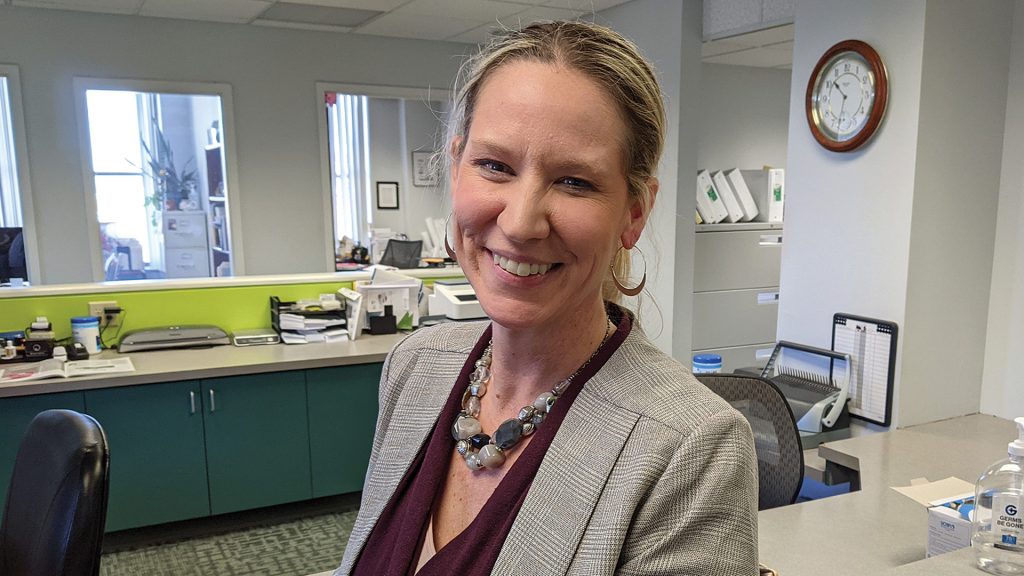
Ashley Sullivan

Ashley Sullivan says OTO’s workload is higher today than it was pre-pandemic.

When she was named president of O’Reilly, Talbot & Okun at the start of 2020 after two decades at the engineering firm, Ashley Sullivan knew she was in for a time of transition.

What she didn’t know was … so was every other business, thanks to a pandemic that shut down much of the economy for a time, and continues to reverberate today.

“You had to adapt; everyone did,” Sullivan told BusinessWest. “So I do think it was something that helped us work through so many things and put another name to the transition. There was an external reason for us to look at everything: what are we doing? Are we shutting down the office or not? What’s our COVID policy? How are we going to work remotely? And our services for some projects were deemed essential. That’s good, but how do we keep our people safe?

“In a way, I think that gave us time and a reason to move through our own transition and the change of leadership,” she went on. “We looked through our business practices, looked at our services, reconnected with clients … we had time to think of our culture and our brand and do some marketing, which we knew was going to be important. And how were we going to get to the other side of this? It was quite the ride.”

At the same time, “it was almost easier, in a way, to ask for help during that time because nobody knew what they were doing,” Sullivan added. And what she was hearing was, “‘hey, you need to keep marketing, you need to reach out to your clients … don’t stop those things right now because, when you get to the other side, you’re going to have to make sure all those investments into your company were happening, investments in your people.’”

Investing in people, and growing the team, is something Sullivan wanted to emphasize from the beginning, aiming to create a company where people would want to work, she said, listing her core values as respect, togetherness — “we found that people did want to work together; they do like to collaborate, network, and be on design teams” — and transparency. “We want to keep communication open and make people feel like they’re part of something bigger than any one individual.”

“It’s not about competition with the person next door, it is about elevating the whole industry. We believe in the services we provide. We believe in what we do.”

All that, she said, is in the service of elevating the industry, as the mission statement posted in the conference room attests: “We will elevate our industry to create and deliver the best solutions for natural and built environments.”

As she explained, “it’s not about competition with the person next door, it is about elevating the whole industry. We believe in the services we provide. We believe in what we do. I really enjoy working with other consultants. We’ve been able to do some master service agreements with other consultants where, if they don’t have capacity to do a job, we will help them, or vice versa. That came out of the pandemic, people helping each other. We saw a lot of helping.”

And to elevate an industry, Sullivan believes she must first elevate her people. “I’m so proud of this team and what they’ve done; they put some trust in me, and so many people have stepped up, and they did a lot of professional development. Now I’m seeing people I mentored who are mentoring the new people coming in.”

Ashley Sullivan performs a phase-1 dam inspection.

Ashley Sullivan performs a phase-1 dam inspection.

That workforce-development philosophy carries over to her role instructing the civil engineering capstone design course at Western New England University. There, she guides graduating students through a mock building project, and many of her peers join her in presenting practical technical knowledge, writing skills, and soft-skills training.

“I love that,” she said. “I feel like our industry should do a better job with mentoring, with creating the next generation of people to work. Again, it goes back to elevating the industry: are we doing all we can to show that we’re good at what we do?”


From the Ground Up

Before O’Reilly, Talbot & Okun’s three founders launched the firm in 1994, they were working together at an environmental-services firm in Connecticut. The Bay State had just developed the Massachusetts Contingency Plan, a law that tells people how to go about cleaning up spills of hazardous materials. As that program rolled out, the three saw an emerging need for people with their skills. So they started a company.

Over the years, OTO’s services have included testing commercial properties for hazardous materials and overseeing cleanup, asbestos management in schools and offices, brownfield redevelopment, indoor air-quality assessments, and geotechnical engineering, which may involve helping developers assess how much force and weight the ground under a proposed structure can stand, or determining the strength of an existing building’s foundation and surrounding topography.

“I feel like our industry should do a better job with mentoring, with creating the next generation of people to work.”

OTO’s early-pandemic experience — also Sullivan’s trial by fire in the president’s chair — mirrored that of many in the construction and engineering world.

“There was a time initially where we all went remote and some projects definitely stopped. Construction already in place before the pandemic typically kept going, so we had that work. Any new projects tended to slow down and stop.

“Also, in-person meetings, site meetings, that all stopped,” she went on. “So we really had to adapt and ask, ‘OK, how are we going to collaborate, how are we going to communicate?’ Our work definitely did slow down for a little bit, as we figured out how all this was going to work. Then some public jobs started coming back, and it was a real push to keep public work going.”

Most of the firm’s services continued at some level, though anything associated with property transfers stopped for a while. “Now property transfers have started up again; a lot of work has started up again. It went from the slowdown to this crazy pickup of a lot of work.”

As a result, the project load is busier now than it was pre-COVID, Sullivan said, adding that “anything on hold has moved forward.”

OTO’s certification as a Women Business Enterprise has also helped create new relationships and new opportunities. “We’ve been able to meet new clients, new architects, and get on more design teams and be brought into a lot of interesting projects. So we are very busy. There is a lot of work, and we’re actually trying to grow staff-wise, which is very hard to do right now.”

That’s true across the entire industry and, indeed, all sectors. That’s why companies that want to hire need to stand out, and one of the ways they can do that is through culture.

“One of my roles is to create a place where people want to work,” she said, noting that OTO has made three technical hires over the past two years. “I’m always on the lookout. It’s not easy, particularly with being a small company and competing with some of the bigger firms.

“We have found — and this is exciting for me — a lot of the people that we have hired have been referred to us: ‘go check out OTO; go speak with Ashley. That might be a good fit.’ And I try to do that for other people. When I come across somebody who does a technical service that OTO doesn’t provide, I’ll put them in contact with somebody I work with. But I think what you give off is what you get. You have to have your eyes open to opportunity and be a place where people want to work.”


Engineering Change

During the past couple years, OTO has renewed some sectors, such as industrial compliance, where some staff had retired but not been replaced. “But during this time, we looked at some professional development and said, ‘hey, maybe there’s not work in one service sector; what else can we renew?’ And we’ve been able to renew those services.”

Among the firm’s recent notable projects is the geotechnical and hazardous-materials assessment on the project that will replace the dilapidated Civic Center Parking Garage next to the MassMutual Center in Springfield.

“How can I not be enthusiastic for a project I can see out my window?” Sullivan said. “And their vision for it is just amazing for downtown. So that’s super exciting.”

Other local projects include a number of schools in Springfield, West Springfield, Gardner, and other communities, as well as work with Westmass Area Development Corp. on the ongoing Ludlow Mills redevelopment. “We’re a small piece of a lot of projects. Any one of us here probably has 30 projects at any one time.”

Because Massachusetts has done a good job cleaning up its largest contaminated sites, OTO focuses more on site redevelopment, as it’s tougher these days to find untouched land to develop in Massachusetts, Sullivan noted.

“We have to look at environmental implications for jobs. When we get involved early on, we can guide the design team in how to approach these projects and provide value early on.

“What we’ve been able to do more is actually couple our services,” she added. “On a redevelopment project, we’ve been able to offer our hazardous-materials compliance, our Massachusetts regulations compliance, and geotechnical engineering all in one, and we’ve been working a lot more internally cross-sector-wise. That’s sometimes harder to communicate internally than externally, but we’ve really worked on a lot of those skills and working together in teams, and we’re able to provide clients with cross-sector services.”

In short, O’Reilly, Talbot & Okun has emerged from two pandemic-dominated years in strong shape, but it took plenty of persistence and flexibility to get there.

“It’s been hard,” Sullivan said. “But as soon as things get overwhelming or challenging, I look around and see how everybody here has progressed and developed and stepped up and taken ownership. They’re why I’m here — and our clients. We work with so many wonderful and talented people.”

Looking back to those initial months of COVID — again, also her initial months in charge at OTO — she was surprised by the support she received from other local engineering players.

“I had so many people reach out to me from other firms, checking in: ‘how are you doing? Do you need advice?’

“There were so many people willing to help and come together, different leaders from other firms and other organizations,” she went on. “There were times I was blown away by how people really do want to help other people. I made some great relationships with other CEOs that, two years ago, I might never have called.”

In short, Sullivan isn’t the only one trying to elevate an industry, and that’s a good thing.

“A lot of people want other people to succeed,” she said. “That’s something I believe in, and that was really neat to see. It keeps me going.”


Joseph Bednar can be reached at [email protected]

Community Spotlight

Community Spotlight

Diana Szynal

Diana Szynal says the Franklin County Chamber of Commerce’s move to Deerfield will include a visitor center.


By Mark Morris


Deerfield is one busy town these days.

Residents there are engaged in 22 different boards and committees planning several ambitious projects to better the town. Still, while all that activity is admirable, it also invites confusion if anyone feels out of the loop.

A group of 15 residents who serve on several boards and committees in Deerfield were aware of the potential pitfalls and formed the Connecting Community Initiative (CCI) to improve communication among the various committees and with municipal officials. Denise Mason, chair of the CCI, said the initiative came about after increasing frustration among members of several boards and committees.

“Because we are all volunteers, people often don’t have the time to stay on top of activities that fall outside of their committee work,” Mason said. “We created the CCI to eliminate the silos in town so we can keep all our projects moving forward.”

The initiative started in November, with the group meeting eight times since then. Mason said they’ve been successful so far with keeping people informed and projects on track.

One big project involves renovating and repurposing the former Deerfield Grammar School to house the municipal offices. Part of the plan also calls for building an addition on the back of the building, where the town’s senior center would be located.

“These projects are part of a bigger objective, which is to create a walkable town campus in Deerfield,” Mason said, explaining that 45% of residents are over age 45.

Kayce Warren, Deerfield town administrator, strongly supports these plans and intends to use American Rescue Plan Act (ARPA) funds to develop a municipal parking lot centrally located in town.

“This is an opportunity for us to make Deerfield a more walkable community. With an aging population, a community’s walkability is a big part of helping people age better.”

“If there’s parking, people will come,” she said. “We’re looking to create a campus that provides walking access to the municipal offices, the senior center, and other resources, such as a small market and a bank.”

The walkable community idea doesn’t stop at the center of town. Work has begun on a municipal park on North Main Street, located past Frontier Regional School. Warren would like to see sidewalks extend from the center of town to the park, nearly two miles up the road.

“This is an opportunity for us to make Deerfield a more walkable community,” she said. “With an aging population, a community’s walkability is a big part of helping people age better.”


Location, Location, Location

Deerfield’s location along the Interstate 91 corridor makes it easily accessible from all directions. Many in town are hopeful the new Treehouse Brewery that opened in the former Channing Bete building will be a catalyst for drawing people to town. In her meetings with the brewery, Mason said Treehouse is cautiously developing its Deerfield location in three phases.

“Right now, they are working on the second phase, which calls for construction of a pavilion to stage outdoor concerts,” Mason said. “Once that’s up and running, hopefully this year, there is a big potential for other businesses to benefit as well.”

Among those businesses, Yankee Candle will likely benefit, as it has always been a big tourism draw for Deerfield. As Yankee and Treehouse are located close to each other on Route 10, Warren is hopeful they will create a working relationship to bring even more people to Deerfield.

It would surprise no one if the two entities were brought together by Diana Szynal. The executive director of the Franklin County Chamber of Commerce recently moved the organization from downtown Greenfield to Historic Deerfield. She said the move makes perfect sense because, prior to COVID-19, Historic Deerfield traditionally drew nearly 20,000 visitors a year.

“The rivers and mountains have always been here, but suddenly there has been a renewed interest in these resources.”

“We will be opening a visitor center, which will allow us to promote all the attractions in Deerfield and surrounding towns,” Szynal said. The chamber’s former visitor center was located in a corner of the Registry of Motor Vehicles in Greenfield, a location she said was never worthy of Franklin County. “With the visitor center in Historic Deerfield, thousands more people will be able to learn about all the fun things to do in Franklin County.”

While Szynal and her staff are still settling in from the move, which occurred in mid-January, their focus is on having the visitor center ready to go when Historic Deerfield begins its season on April 16.

Jesse Vanek, vice president of Development and Communications for Historic Deerfield, said 2022 is a tremendous opportunity to welcome back large crowds to the outdoor museum that depicts life in 18th-century New England. “Historic Deerfield is such a special place, and we’re hoping to see our in-person visits get back to pre-COVID levels.”

Deerfield at a Glance

Year Incorporated: 1677
Population: 5,090
Area: 33.4 square miles
County: Franklin
Residential Tax Rate: $15.17
Commercial Tax Rate: $15.17
Median Household Income: $74,853
Median Family Income: $83,859
Type of Government: Open Town Meeting
Largest Employers: Yankee Candle Co., Pelican Products Inc.
* Latest information available

Every year, the museum runs a full schedule of programs for visitors. Beginning in the spring, programs will range from Sheep on the Street, which explores heritage breed sheep and the role of wool processing in New England’s history, to a Summer Evening Stroll held on July 3 and themed on Deerfield during the American Revolution.


COVID and the winter season inspired Historic Deerfield to expand its program offerings online through virtual sessions. As a result, the museum now reaches audiences around the world. The winter lecture series included relevant topics such as understanding climate change from a historical perspective.

“We are fascinated with the response to our virtual programming,” Vanek said. “I believe it helps entice people to come visit us, which is good for our organization, the town, and the region.”


Out in the Open

Szynal has learned that people will travel long distances to take part many of the outdoor activities in Deerfield and Franklin County.

“We were shocked to learn how robust fly fishing is here,” she said. Indeed, whether casting a line into the Deerfield River or rafting in Charlemont, outdoor activities are a true resource for the area and bring in people who often stay for several days.

“The rivers and mountains have always been here, but suddenly there has been a renewed interest in these resources,” she said.

Warren is thrilled that Szynal and the chamber are now part of Deerfield.

“Diana has great ideas, and I think she can help us keep Historic Deerfield connected to the rest of the community,” Warren said, adding that, in a perfect world, Deerfield would provide more incentives for tourism, but ongoing infrastructure projects have stretched budgets to their limits.

Located between the Connecticut and Deerfield rivers, the town faces constant challenges with stormwater runoff and flooding issues. Bloody Brook, which also runs through town, maintains a higher-than-normal water table.

“We have a group of passionate volunteers who want to work together help the tow. They are engaged and willing to put in the time to keep these projects moving forward, and that’s so important.”

Deerfield was one of the first communities to qualify for the state’s Municipal Vulnerability Preparedness (MVP) program. MVP grants are awarded to cities and towns that build climate-change resilience into all their infrastructure plans. Warren explained that type of thinking applies to every project in town, from simple tree boxes designed for better stormwater management to larger projects like the school repurposing and sidewalk additions.

“We are linking everything together in terms of managing water issues, and we’ve set our sights on staying on top of this for the next 50 to 100 years,” Mason said.

As Deerfield’s many projects move forward with Mason and the CCI keeping them on track, Warren took a minute to appreciate the situation.

“We have a group of passionate volunteers who want to work together help the town,” she said. “They are engaged and willing to put in the time to keep these projects moving forward, and that’s so important.”

Home Improvement

Building Connections


By Elizabeth Sears


The home-improvement industry has gone through a dramatic increase in demand over the past few years, which has been challenging to fulfill at times due to product and labor shortages. Businesses and consumers alike have felt the resulting stress. The Western Mass Home & Garden Show on March 24-27, produced by the Home Builders & Remodelers Assoc. of Western Massachusetts, offers a solution — a diverse array of reputable vendors and a crowd of eager customers, all in the same building.

“As the Home Builders Association in Western Mass., we have had many conversations with homeowners that have expressed their frustrations and offered them support to navigate through the process,” said Andrew Crane, Home Show director and executive director of the association. “As we don’t see a decrease in demand in 2022, we know how essential the Home Show will be for these individuals to increase their opportunity to get in the queue for the upcoming building season.”

Andrew Crane

Andrew Crane

“As we don’t see a decrease in demand in 2022, we know how essential the Home Show will be for these individuals to increase their opportunity to get in the queue for the upcoming building season.”

A wide range of vendors are exhibiting at the show this year, running the gamut from builders, painters, landscapers, remodelers, cleaning services, HVAC services, and more. Oftentimes, people undertaking a home project need not just one service, but several different ones — and the Home Show is able to connect clients to all the services they may need, all at the same time.

“What I’ve found is that a lot of the people who come to the Home Show have more than one thing that they’re looking for,” said Christopher Grenier, owner and head painter of Christopher J. Grenier Painting & Finishing, LLC. “They’re not just looking for a painter; it’s part of a larger project, and of course, with all the different contractors that are there, they can find just about anything that they’re looking for.”

Grenier’s Chicopee-based business offers services like painting, wood finishing, wall repair, and ceiling repair, for both private clients and local contractors. This year will mark his fourth time exhibiting at the Home Show, and he expressed how much business vendors receive by exhibiting at the show, as well as how much they felt it when the 2020 show was canceled and the 2021 edition scaled down and moved to late summer, both due to the pandemic.

“Last year was an anomaly because of COVID, because of the rescheduling of the show. I still came out with 20 or more requests for follow-up,” he told BusinessWest. “The year before that was much higher because we weren’t in COVID. I think I came out year one with almost 90 requests for follow-up.”

There is certainly something to be said for the value of marketing to an audience of thousands at this show, as well as the cross-promotion and networking that occurs between the exhibiting companies. The ability to bring everyone together in person has shown itself to be an invaluable resource for both vendors and attendees throughout the years.

“Everybody just Googles everything now and buys on the internet,” Grenier said. “When you get people to the Home Show, they get to stand there and interact with the professional, touch the product, get feedback, get the right advice from whomever it is … actually being there in the physical space and not the metaverse has clear advantages. Anybody who attends the Home Show has an advantage to make their project more successful.”

Crane echoed this sentiment, emphasizing just how beneficial and convenient the Home Show is for attendees.

Christopher Grenier

Christopher Grenier

“Everybody just Googles everything now and buys on the internet. When you get people to the Home Show, they get to stand there and interact with the professional, touch the product, get feedback, get the right advice from whomever it is … actually being there in the physical space and not the metaverse has clear advantages.”

“This is such a time saver compared to traditional methods of calling and setting up individual appointments,” he said. “Many people feel more comfortable meeting with a few vendors before deciding, and doing this at the Home Show can save weeks and weeks of time.”

The annual show sees all types of attendees who visit for a variety of different reasons. Attendees typically fall into one of several categories:

• People planning to buy or build a new home, who may visit with builders, real-estate agents, financial institutions, and sellers of component products, such as hardwood flooring, tile, and appliances;

• People planning to remodel or renovate, who may want to check in with all of the above, plus vendors of replacement components such as windows and doors, as well as appliances, wall treatments, and home furnishings;

• Yard and garden enthusiasts, who tend to be interested in lawn and landscaping services; wall, walk, and edging components and materials; and trees, shrubs, flowers, and seeds;

• Lifestyle-conscious individuals, who like to check out trendy, high-tech, or time-saving products, as well as home furnishings and products focused on self-improvement, fitness, and health;

• Committed renters, who have no plans to own a house, but may be interested in space-conservation and space-utilization products, as well as home furnishings;

• Impulse buyers, who flock to vendors of home décor, arts and crafts, cooking and baking products, jewelry, and personal goods; and

• Those who attend the show purely for fun, who may arrive without an agenda but often develop ideas for future purchases and home products. “More than any other group,” the association notes, “these people are the ones who have come to rely upon our show on an annual basis and who perhaps have the greatest impact upon our vendors.”

No matter the reason someone has for attending, the Home Show prides itself on helping both attendees and vendors with an abundance of opportunities.

“Our objective is to provide a venue with multiple vendors and a robust representation of products under one roof,” Crane said. “This show will help homeowners minimize the time it can take to decide on the best products and remove frustrations that can come with trying to meet and decide on a home-improvement company.”

The 67th presentation of the Western Mass Home & Garden Show will take place in the Better Living Center building at the Eastern States Exposition. This year’s show hours are Thursday and Friday, March 24-25, 1 to 9 p.m.; Saturday, March 26, 10 a.m. to 9 p.m.; and Sunday, March 27, 10 a.m. to 5 p.m. General show admission is $10 for adults, and children under 12 are admitted free. A coupon reducing admission to $7 can be found on the show’s website. Parking on the Eastern States Exposition grounds is $5 per vehicle.

Home Improvement

Doors of Opportunity

Both at the Springfield store and online, EcoBuilding Bargains promotes itself as a way to save money and keep items out of landfills.

When Darcy Ratti was living in Southern Connecticut, she heard about EcoBuilding Bargains — shortly after she completely refinished her basement.

“I was so angry,” she recalled. “I would have saved so much money, and it would have looked so much cooler.”

These days, as store manager at the Springfield-based seller of reclaimed building materials, Ratti is sharing that enthusiasm with customers both near and, increasingly, far away.

“We get a lot of higher-quality materials now than we did four or five years ago as word has spread,” Ratti said, explaining how the store procures its ever-shifting stock of used building materials and also new items taken off contractors’ and wholesalers’ hands. “We’ve got brand-new Samson doors that have never been installed — an overstock. I’ve got a lot of brand-new windows that were a misorder.

“In general, people want to save some dollars here and there, and they want to buy something that will help out the environment a little bit,” she went on. “You can get better quality here for the price than you would at a big-box store. Instead of getting a pressboard cabinet set IKEA or Home Depot, for the same price, you can come here and get a full plywood set with all the bells and whistles.”

“People want to save some dollars here and there, and they want to buy something that will help out the environment a little bit.”

The Center for EcoTechnology (CET) launched EcoBuilding Bargains more than a decade ago as a way to repurpose materials that otherwise might be headed for landfills, but the past few years have seen the store expand beyond in-person sales and into an online presence, first on eBay in 2019 and then, last spring, onto its own e-commerce website (ecobuildingbargains.org), making it one of the few sellers of reclaimed materials with a national (and global) online platform.

“We started our e-commerce on eBay two and a half years ago, selling doorknobs, hinges, more of the antique, rare items that folks look for specifically,” Ratti explained. “Then we branched out with a broader range of items.”

Darcy Ratti

Darcy Ratti says she’s surprised at what people want to toss out — but her customers are the ones who benefit.

From there, the store launched its own web store last May. “Basically, anything that gets posted to our eBay store also gets posted to our web store, and vice versa,” she noted. “But we’ve expanded the types of stuff that people can buy online. You can buy cabinets online now. You can buy a door online and ship it. We’ve got an extremely large chandelier we’re selling to someone from Texas, waiting to be shipped. We’ve sold and shipped to every state, as well as places like Italy, Australia, and Japan.”

That’s a boon for people searching for very specific, hard-to-find items, and now don’t have to travel to Massachusetts for them. “Maybe it’s faucets you can’t find or brass hardware or an Anderson window sash that’s very specific to a certain model or a Velux skylight kit or a mid-century-modern Legomatic chair. We get into reclaimed items that are very specific. A customer who knows the exact model number can go online and type it in, and if we have it, we’re going to come up.”

An online store made even more sense during the pandemic, said Emily Gaylord, CET’s director of Communications and Engagement. “One, we wanted a safe way for customers to shop. Two, there was all this renewed interest in home spaces, and a lot of people had to make a home office out of nothing. Subsequently, we saw a lot of supply-chain issues. Honestly, I think, with the direction retail is going, online stores are inevitable.”

EcoBuilding Bargains also launched virtual shopping appointments for far-flung shoppers.

“Yes, you’re reducing your carbon footprint and helping us with our mission, but you’ll also find something you won’t be able to find anywhere else.”

“That was a really cool, important piece,” Gaylord said. “If you’re searching for a cabinet set, you can book a virtual appointment, send the measurements ahead of time, and we can walk you through them in a video call. Looking for a new front door? Here are six doors with the finish and size you want. Virtual shopping experiences are a huge time saver.”


Two Ways to Save Green

The clientele at EcoBuilding Bargains, both in person and online, has been broad, Gaylord told BusinessWest.

“We definitely get people who say, ‘I just need a window, something affordable; what do you have?’ And there are some people making sustainable choices, people who really care about their environmental impact and carbon footprint; they’re shopping with us as well. Then, over the last few years, the DIY space exploded, and we have trendy and unique materials for your space. We serve all those people.”

She noted that buying secondhand items has a sort of double environmental impact, keeping materials out of landfills while reducing the impact of what would have been made and purchased new instead.

Emily Gaylord

Emily Gaylord says the store has stocked newer and higher-quality materials in recent years.

“We’re dealing with some serious issues. We’re at a moment right now where people are understanding climate and environmental issues in a way they haven’t ever before,” Gaylord went on. “But making sustainable choices has so many benefits. Yes, you’re reducing your carbon footprint and helping us with our mission, but you’ll also find something you won’t be able to find anywhere else. Or you can have a much higher-quality item than you could otherwise afford. When you start thinking in a sustainable way, it’s not just for the earth, but for you as a business owner or homeowner.”

Items arrive in the store from a variety of sources, Ratti explained.

“We’re looking for the person who has that overstock or a contractor that has done a bunch of remodels, and they’re finding good, reusable materials and taking them to their shop or their garage and just hanging onto them because they know they’re good. We’re helping them defray the costs on their end so they don’t have to dispose of it, and they get a tax donation receipt.”

Homeowners are bringing in materials as well — after replacing an old vanity or lighting fixtures, for instance.

“What we saw during the pandemic was people coming up with unique ways to put together home offices, and they’d come in here for different pieces,” Ratti said.

She’s often surprised by the quality of items that wind up at EcoBuilding Bargains, like a striking, solid chestnut front door, nine feet tall and three inches thick.

“When you’re shopping more sustainably, you’re going to find better alternatives, not just your run-of-the-mill thing. You’re buying a door like that, and you’re spending less than you would somewhere else. We’ve got a marble mantel from 1867; it came out of a brownstone on Newbury Street in Boston. You’re not going to find that someplace else.”

Gaylord agreed. “It’s not a salvage yard; it’s high-quality materials. That’s really important for us and our mission; we don’t want to push stuff back into the world that’s not going to meet that mission. We want to make sure we’re selling good-quality doors, low-flow toilets, fixtures that don’t have any lead in them. We’re always thinking of the quality of the materials, not just the quantity.”

“We want to make sure we’re selling good-quality doors, low-flow toilets, fixtures that don’t have any lead in them. We’re always thinking of the quality of the materials, not just the quantity.”

Even the packing materials used to ship items are recycled, Ratti noted. “Here, you’re saving some money but also helping with the environment. By being a little more frugal, there’s less production happening in the world.”


City of Home Improvement

Gaylord feels like EcoBuilding Bargains, through its national presence online, is just one more way Springfield is being put on the map.

“To see our store in Springfield start to have a national reach, and people be exposed to us from all over the country, is amazing,” she said. “Springfield is really special, and our store is really special. Seeing people fall in love with it is great to see.”

And the reasons they are seeking out sustainable options aren’t going away.

“How we work and how we use buildings is in flux right now,” she told BusinessWest. “The world looks a lot different than it did two years ago. It’s really exciting to see our business in Springfield not slow down, but, in fact, innovate and grow. People are getting more exposed to the Western Mass. region through this. It’s more than just selling a reclaimed door.”


Joseph Bednar can be reached at [email protected]

Law

The EO on PLAs

By Alexander Cerbo, Esq.


Keeping his promise of being “the most union-friendly president in American history,” President Biden and his administration issued Executive Order (EO) 14063, which mandates project labor agreements (PLAs) on “large-scale construction projects.”

Alexander Cerbo

A project labor agreement is a collective bargaining agreement between a contractor and the building trade union. A large-scale construction project is one within the U.S. that has an estimated total cost of $35 million or more, and usually refers to construction, rehabilitation, alteration, conversion, extension, repair, or improvement of a ‘vertical public works’ project. Famous examples of large-scale construction projects that were governed by PLAs include Disney World, the Kennedy Space Center, and Yankee Stadium. The EO is estimated to impact more than 200,000 workers and $262 billion in federal funding. For those in the industry, you should become familiar with the PLA.

PLAs are negotiated before any workers are hired, and they establish the terms of employment on a project, including wages, hours, working conditions, and dispute-resolution methods, among other things. If a business is unionized, the PLA must coexist with the business’ existing collective bargaining agreement. Biden’s EO contains several additional requirements of PLAs going forward. For example, all contractors and subcontractors related to the project must be allowed to compete for work, unionized or not. In addition, these PLAs must contain mutually binding dispute-resolution provisions as well as provide alternative mechanisms for cooperation between labor and management.

But what does this mean for small businesses that are not unionized going forward? Maybe, not a whole lot of good. But that depends on your business model.

What is considered ‘small’ typically depends on what industry you are in, and could range from fewer than 500 employees or up to 2,500 employees, or even more. Essentially, you are a small business if you are a privately owned corporation, partnership, or sole proprietorship that has fewer employees and less annual revenue than a public corporation or regular-sized business. According to the Small Business Administration, the construction industry has one of the highest concentrations of small business participation, well over 80%. Some argue that PLAs put small non-union construction businesses at a disadvantage because they increase the cost of doing business. Considering the fact that most small businesses in the construction industry are non-union, PLAs put them at a great disadvantage.

“Some argue that PLAs put small non-union construction businesses at a disadvantage because they increase the cost of doing business. Considering the fact that most small businesses in the construction industry are non-union, PLAs put them at a great disadvantage.”

While PLAs are often applauded by many labor analysts for creating long-term project stability, opportunities to include minority contractors and small ‘mom-and-pop’ contractors, and better training for workers, PLAs also increase the cost of construction by requiring payment of union wages to non-union workers, something greatly detrimental to the financial interests of small businesses that wish to partake in these construction jobs.

In addition, PLAs generally require non-union contractors to pay employee benefits twice — once to their employees and once to the unions that oversee the project, often making it too costly for non-union businesses to compete for these jobs in the first place. Non-union contractors often must pay into underfunded and mismanaged union pension plans, of which their employees wouldn’t see the benefits unless they joined the union. A small business must look at these costs associated provisions, among other things, to assess the risks and costs of entering into this type of arrangement. All businesses at all levels should make sure to do the short-term and long-term math before deciding whether to get into one of these arrangements.

It is important to note that the Biden EO does not require construction companies to unionize and does not apply to construction projects controlled by local or state governments, even if they receive federal funding. Nevertheless, the PLA mandate could be catastrophic for many small businesses, often touted by many politicians as the backbone of the American economy.


Alexander Cerbo, Esq. is an attorney who specializes in labor and employment-law matters at the Royal Law Firm LLP, a woman-owned, women-managed corporate law firm that is certified as a women’s business enterprise with the Massachusetts Supplier Diversity Office, the National Assoc. of Minority and Women Owned Law Firms, and the Women’s Business Enterprise National Council; (413) 586-2288; [email protected]

Law

Risky Business

By Michael Roundy and Scott Foster


Michael Roundy

Scott Foster

Scott Foster

Running a business in the legalized cannabis space is something in which hundreds of owners around the Commonwealth are now engaged. On most days, the fact that cannabis remains illegal federally is not on the top of the minds of these owners. However, a recent decision by the First Circuit Court of Appeals reminds us that the cannabis industry is not entirely free of the risks of federal prosecution and provides useful guidance on how best to avoid those risks.

Maine legalized medical marijuana in 2009, subject to stringent conditions and governed by detailed regulations. While state law permitted the medical use of marijuana, the federal Controlled Substances Act does not. However, each year since 2015, Congress has attached a rider to its annual appropriations bill that prohibits the Department of Justice from using appropriated federal funds to prevent any of the states “from implementing their own laws that authorize the use, distribution, possession, or cultivation of medical marijuana.”

In United States v. Bilodeau and two related cases, the two individual defendants and the companies they owned operated sites in Auburn, Maine, where they grew marijuana purportedly for use as medical marijuana. The operations were carried out under the color of facially valid paperwork as a Maine Medical Marijuana operation, and state inspectors found the site to be in compliance with Maine’s law.

Following an investigation by federal law enforcement, the defendants were indicted for knowing and intentional violation of the Controlled Substances Act. The government asserts that the illegal marijuana-distribution operation merely used the Maine Medical Marijuana program as a cover for its illegal, black-market marijuana operations, which included distribution of marijuana to individuals in several other states who were not qualifying medical-marijuana patients under Maine’s law.

“On most days, the fact that cannabis remains illegal federally is not on the top of the minds of these owners. However, a recent decision by the First Circuit Court of Appeals reminds us that the cannabis industry is not entirely free of the risks of federal prosecution and provides useful guidance on how best to avoid those risks.”

The defendants challenged the prosecution on the grounds that the government was prohibited from using federal funds to prosecute them, because of Congress’s appropriations rider, and sought an injunction from the District Court. The court denied the request because the Maine medical-marijuana law did not authorize the sort of conduct alleged. The defendants appealed.

The Court of Appeals considered the arguments raised by both parties. The government advocated for a view of the appropriations rider that would permit any prosecutions unless the defendants were in full, strict compliance with the state’s medical-marijuana laws. Any minor non-compliance would bring the case outside the rider and permit the Department of Justice to prosecute.

The court rejected this approach, finding that federal prosecution would hang as a sword of Damocles over participants in Maine’s medical-marijuana market, ready to drop at the occurrence of any minor, “even tiny” non-compliance or unintentional violations, and would likely deter market participation, which might also lead the state to water down its regulatory scheme and otherwise serve to thwart the state’s implementation of its laws relating to medical marijuana.

The defendants argued that the rider should prevent prosecutions of those who have valid state licenses to participate in the state’s medical-marijuana industry. The court rejected this other extreme as well, concluding that Congress did not intend the rider to create a safe harbor for blatantly illegitimate activity outside the scope of the state’s own medical-marijuana laws, merely because the defendants possess facially valid documents.

The court thus rejected the approach advocated by both the government and the defendants. The court adopted a middle-ground approach and declined to define its precise boundaries. It found that the conduct in the case at hand was clearly aimed at supplying marijuana to persons “whom no defendant ever thought were qualifying patients under Maine law” and that the medical-marijuana licenses were façades for such unauthorized sales.

The court also noted that Maine’s own medical-marijuana law expressly criminalized distribution to those not authorized to possess marijuana (medical patients) under the law. As such, federal prosecution for such conduct was considered unlikely to have any unwelcome effect on Maine’s implementation of its medical-marijuana laws. The Appeals Court therefore affirmed the District Court’s denial of an injunction, and the prosecution is permitted to proceed.

What this decision does not do is provide sufficient clarity for Massachusetts operators or regulators, especially around the question of what degree of non-compliance with the Massachusetts regulatory scheme may expose Massachusetts operators to federal prosecution.

While it seems unlikely that mere technical violations would lead to federal prosecution, could an operator faced with a summary suspension order (which occurs when there is “an immediate threat to public health, safety, and welfare”) find that not only is their license suspended, but they now face federal prosecution as well? Hopefully the Cannabis Control Commission will take this potentially serious threat into consideration as they weigh future enforcement actions in Massachusetts.


Michael Roundy and Scott Foster are both partners at Bulkley Richardson and members of the firm’s cannabis practice.

Women in Businesss

Beyond the Numbers


Donna Haghighat

Donna Haghighat says the factors holding women back in the workforce must be fully understood in order to shift the tide.

The numbers speak for themselves. But more importantly, they demand a response.

According to a global study published in the Lancet, between March 2020 and September 2021, women were more likely to report employment loss than men during the pandemic (26.0% to 20.4%), as well as more likely to drop out of school or forgo work to care for others.

“The most significant gender gaps identified in our study show intensified levels of pre-existing, widespread inequalities between women and men during the COVID-19 pandemic,” the report reads. “Political and social leaders should prioritize policies that enable and encourage women to participate in the labor force and continue their education, thereby equipping and enabling them with greater ability to overcome the barriers they face.”

That’s exactly what the Women’s Fund of Western Massachusetts — and a broad network of like-minded partners — have in mind through an effort they’re calling the Greater Springfield Women’s Economic Security Hub.

“We felt as though the many ways society was looking at women’s economic security was too narrow of a lens,” said Donna Haghighat, CEO of the Women’s Fund. “So we created our own framework, where we considered the factors that affect some women’s economic security as more expansive than what other people might think.”

That includes a lack of unpaid caregiving. During the pandemic, that issue was the dominant factor in women dropping out of the workforce at an uprecendeted rate. The numbers have recovered somewhat, but not all the way, and the factors causing the workforce exodus remain problematic.

“We felt as though the many ways society was looking at women’s economic security was too narrow of a lens. So we created our own framework.”

“Women weren’t dropping out of the workforce because they wanted to stay at home and eat bon-bons, but because schools were closed or childcare centers were closed, and someone needs to be home with the children,” Haghighat said. “Oftentimes, because of pay differentials and so forth, it made more sense for women to drop out of the workforce.”

Then there are issues around transportation and internet access. “Prior to the pandemic, people didn’t realize how critical that was,” she went on, whether the problem was lack of online access altogether or having difficulty sharing devices or WiFi with other family members.

To create the research and action project it called the Women’s Economic Security Hub, the Women’s Fund began collaborating with key area partners, including Arise for Social Justice, Dress for Success Western Massachusetts, Springfield WORKS, and the Western New England University School of Law Social Justice Center.

This work will focus on women, mostly of color and living at or below the poverty line, to understand the myriad factors that make or break an individual woman’s ‘economic engine,’ thereby affecting family prosperity.

The UMass Donahue Institute developed a survey instrument that will be refined, implemented, and analyzed by the UMass Amherst Center for Research on Families, and the survey will delve into 12 interconnected determinants, to form a framework which will be used to survey women in communities that have historically faced disproportionate challenges to economic growth.

“We’ve portrayed a women’s economic engine as a bunch of interlocking gears,” Haghighat said. “Each of these things can have an effect on the other things.”


Obstacles to Success

Luisa Sorio Flor, a postdoctoral fellow at the University of Washington and lead author of the Lancet study, noted that “the pandemic has exacerbated gender disparities across several indicators related to health and other areas of well-being. Women were, for example, more likely than men to report loss of employment, an increase in uncompensated care work, and an increase in perceived gender-based violence during the pandemic, even in high-income countries.”

By partnering with the UMass Donahue Institute and surveying 200 area women, Haghighat hopes to localize those global trends to determine where the economic engine is jamming.

“Is it child and dependent care or job preparation or lack of a supportive network?” she asked. “We added ‘supportive network’ as one of the determinants we use, understanding that, when something goes wrong in a woman’s life, she might have a supportive network she can reach out to when things are going wrong, like a grandmother who can watch a child. But we realize that, oftentimes, women will lack that supportive network, which will obviously deter them from achieving economic security.”

“We’ve portrayed a women’s economic engine as a bunch of interlocking gears. Each of these things can have an effect on the other things.”

Another determinant is identification, which can be a serious barrier not only for undocumented women, but women emerging from incarceration.

“When you come out of incarceration, you don’t just get handed your ID. You have to re-establish your identification, which is mindblowing to me,” Haghighat said. “So many things these days require identification, so that’s a huge barrier to getting housing, getting paid to work, all those things.”

A report from UMass Amherst School of Public Policy (SPP), released last month, revealed some of the impacts that the first year of the COVID-19 pandemic had on Massachusetts households. Led by UMass Amherst economist Marta Vicarelli, the team from SPP’s Sustainable Policy Lab surveyed more than 2,600 Massachusetts residents from October 2020 to February 2021 to gather information about the challenges households faced due to the public-health crisis and its socioeconomic fallout, and the strategies adopted to address these challenges.

The survey covered a wide range of topics, including employment and financial strains, childcare and education, physical and mental health, substance use, and food security. Vicarelli said the team’s analysis devoted particular attention to women, children, and minority populations.

“Our results shed light on the socioeconomic and health impacts of the COVID-19 pandemic in Massachusetts households across different socioeconomic groups,” she wrote. “Many of these impacts have been persisting throughout the pandemic. Special focus is devoted to delays in children’s academic and emotional development, negative mental-health outcomes, and negative effects on women’s employment. If not addressed quickly, these socioeconomic impacts will have lasting, and possibly irreversible, implications for the United States. We hope that our results will inform the design of policies that address these impacts and support vulnerable groups.”

Notably, the survey found that 31% of respondents saw a decrease in overall income and savings, and women were more likely than men to report having become financially dependent on their partner due to pandemic disruptions. Echoing the global Lancet study, female respondents were also more likely to indicate substantial changes in their professional life to support the needs of their households, such as keeping their jobs but working fewer hours, taking unpaid leave, leaving their job, or changing jobs.

“There’s a real concern about lost stability for retirement purposes,” Haghighat told BusinessWest. “And who knows what’s going on with the Great Resignation? Hopefully, women who have more flexibility are taking advantage of a better labor market to make up ground in terms of their jobs and so forth. Over time, we’ll see how that plays out.”


An Ongoing Conversation

A 2019 Women’s Fund report called “Key Findings on the Status of Women and Girls in Western Massachusetts” highlighted the fact that women in Hampden County were underemployed and experiencing high rates of poverty. Since then, COVID-19 has complicated the issue, and the impact on women in Greater Springfield has disproportionately affected black and Hispanic women — often women concentrated in low-wage employment who were shut down for extended periods or were laid off entirely.

The 2019 report also emphasized barriers for formerly incarcerated women, positing that resources like affordable housing, debt relief, financial assistance, access to sober housing — especially for women — quick reunification with children and other family members, and continuity of therapy and recovery are greatly needed.

The next report will be a tale of how COVID impacted everything. That and the Women’s Economic Security Hub survey are necessary next steps in closing troubling gaps for women when it comes to economic security, Haghighat said.

“Who knows what’s going on with the Great Resignation? Hopefully, women who have more flexibility are taking advantage of a better labor market to make up ground in terms of their jobs and so forth.”

“And not just for us, but for area policy makers,” she added. “It’s important for them to take this lens to things — people quitting or not taking positions, not just because of pay, but because of hours, transportation, getting there. We want this framework for thinking about all the things affecting women. Then, employers can be more visionary about making sure the workplace or compensation package they’re creating really responds to the realities women are facing.”

She noted that federal lawmakers can get behind supporting physical infrastructure, like roads and bridges, but often balk at other forms of support, like a national early-childcare program that has come up for discussion in Congress before, but never went anywhere.

“I look at that as a huge missed opportunity,” Haghighat said — one of many that may one day be remedied as decision makers get a grip on the hard data that’s forcing too many women into hard decisions they shouldn’t have to make.


Joseph Bednar can be reached at [email protected]

Women in Businesss

Putting the Focus on Leadership


It’s called the CliftonStrengths Assessment.

And that name pretty much says what it is. Created by Gallup, it’s a 177-question assessment designed to identify an individual’s strengths when it comes to leadership.

There are 34 such strengths, as identified after years of research by Don Clifton, and they include everything from communication and consistency to focus and positivity, said Colleen DelVecchio, founder of Colleen DelVecchio Consulting.

But identifying strengths is merely the first important step in the process toward becoming a better, more effective leader, said DelVecchio, who will lead an experiential workshop called “Activating Your Leadership Strengths” at the upcoming sheLEADS women’s conference being staged by the Chamber of Greater Easthampton.

Indeed, one’s strengths need to be … well, activated, she said, adding that her program, which she delivers several times a week on average to a wide range of audiences, is designed to help individuals put strengths identified by the assessment to full and effective use.

“Our focus is on providing attendees tools and connections that they didn’t have when they walked in.”

“We’ll look at these strengths and talk about how to aim them at your job; how do you aim your strengths at the things you need to do to become a leader?” she said, adding that attendees should leave the room with a clearer understanding of their five greatest strengths when it comes to leadership and, more importantly, how to apply them.

DelVecchio’s program is one of several components scheduled for sheLEADS, the rebranded professional-development conference launched by the Easthampton Chamber and then sidelined, as so many similar initiatives have been, by the COVID-19 pandemic.

The half-day conference, with the theme “Bold, Brave, and Beyond,” will also include a panel discussion, titled “The Language of Leadership,” featuring Pia Kumar, chief strategy officer for Universal Plastics in Holyoke; Lynnette Watkins, president and CEO of Cooley Dickinson Hospital in Northampton; and Waleska Lugo-DeJesus, CEO of Inclusive Strategies.

It will also include a keynote address, called “Be Great Where Your Feet Are,” from Robyn Glaser, senior vice president of Business Affairs for the Kraft Group (owner of the New England Patriots), made possible by the event’s speaker sponsor, bankESB.

The sheLEADS conference is slated for Friday, May 20 from noon to 5 p.m. at the Bolyston Room in the Keystone Building, 122 Pleasant St., Easthampton. For tickets and details, visit www.easthamptonchamber.org/events.

Moe Belliveau, executive director of the Easthampton Chamber, said the women’s professional-development conference has become an important annual event, attended by women in virtually every sector of the economy. Over the past few years, it has been a virtual event, but the chamber decided that, with COVID subsiding and the number of cases declining, it was time to return to an in-person format.

The chamber is, in many ways, easing its way back in with the conference, opting for a half-day format, rather than full day, followed by networking at Abandoned Building Brewery. Roughly 100 attendees are expected, and they are being spaced out in a nod toward safety during the pandemic. There is also a virtual component to the conference, featuring the keynote address and panel discussion.

Like DelVecchio, Belliveau said the conference is designed for women looking to find their voice when it comes to leadership and learn from others how to be a more effective leader — in the workplace, but also in the community.

“This is a high-energy day filled with professional development, relationship- and leadership-building opportunities,” Belliveau said. “Our focus is on providing attendees tools and connections that they didn’t have when they walked in.”

Technology

A New Framework


The Internet of Things (IoT) is completely enmeshed in our daily lives, a network of connected laptops, phones, cars, fitness trackers — even smart toasters and refrigerators — that are increasingly able to make decisions on their own. But how to ensure these devices benefit us, rather than exploit us or put us at risk?

New work, led by Francine Berman at UMass Amherst, proposes a novel framework, the “impact universe,” that can help policymakers keep the public interest in focus amid the rush to adopt ever-new digital technology.

“How can we ensure that technology works for us, rather than the other way around?” asks Berman, Stuart Rice honorary chair and research professor in UMass Amherst’s Manning College of Information and Computer Sciences. Berman, the lead author of a new paper recently published in the journal Patterns, and her co-authors sketch out what they call the impact universe — a way for policymakers and others to think “holistically about the potential impacts of societal controls for systems and devices in the IoT.”

“How can we ensure that technology works for us, rather than the other way around?”

One of the wonders of modern digital technology is that it increasingly makes decisions for us on its own. But, as Berman puts it, “technology needs adult supervision.”

The impact universe is a way of holistically sketching out all the competing implications of a given technology, taking into consideration environmental, social, economic, and other impacts to develop effective policy, law, and other societal controls. Instead of focusing on a single desirable outcome — sustainability, say, or profit — the impact universe allows people to see that some outcomes will come at the cost of others.

“The model reflects the messiness of real life and how we make decisions,” says Berman, but it brings clarity to that messiness so that decision makers can see and debate the tradeoffs and benefits of different social controls to regulate technology. The framework allows decision makers to be more deliberate in their policymaking and to better focus on the common good.

Berman is at the forefront of an emerging field called public interest technology (PIT), and she is building an initiative at UMass Amherst that unites campus students and scholars whose work is empowered by technology and focused on social responsibility. The ultimate goal of PIT is to develop the knowledge and critical thinking needed to create a society capable of effectively managing the digital ecosystem that powers our daily lives.

Berman’s co-authors, Emilia Cabrera, Ali Jebari, and Wassim Marrakchi, were Harvard undergraduates and worked with Berman on the paper during her Radcliffe fellowship at Harvard. The fellowship gave Berman a chance to work broadly with a multi-disciplinary group of scholars and thinkers, and to appreciate the importance of designing, developing, and framing societal controls so that technology promotes the public benefit.

“The real world is complex, and there are always competing priorities,” Berman says. “Tackling this complexity head on by taking the universe of potential technology impacts into account is critical if we want digital technologies to serve society rather than overwhelm it.”