Home Posts tagged BusinessWest (Page 10)
Class of 2021

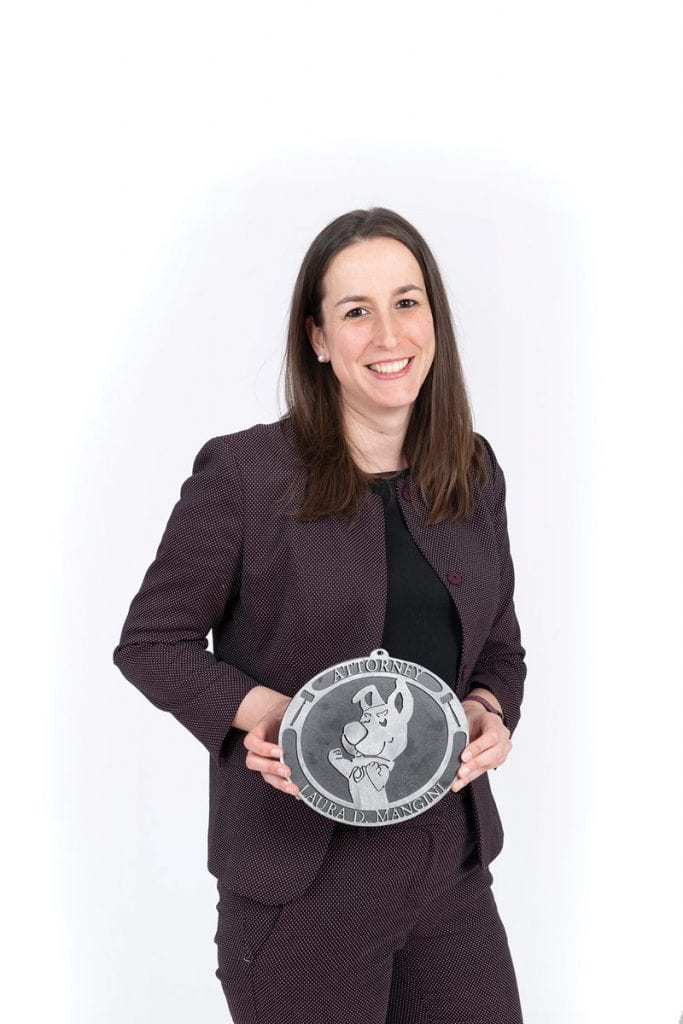
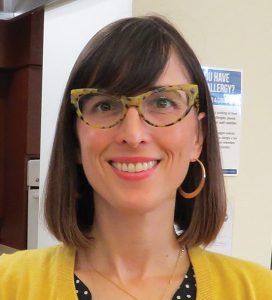
Partner, Alekman DiTusa; Age 32

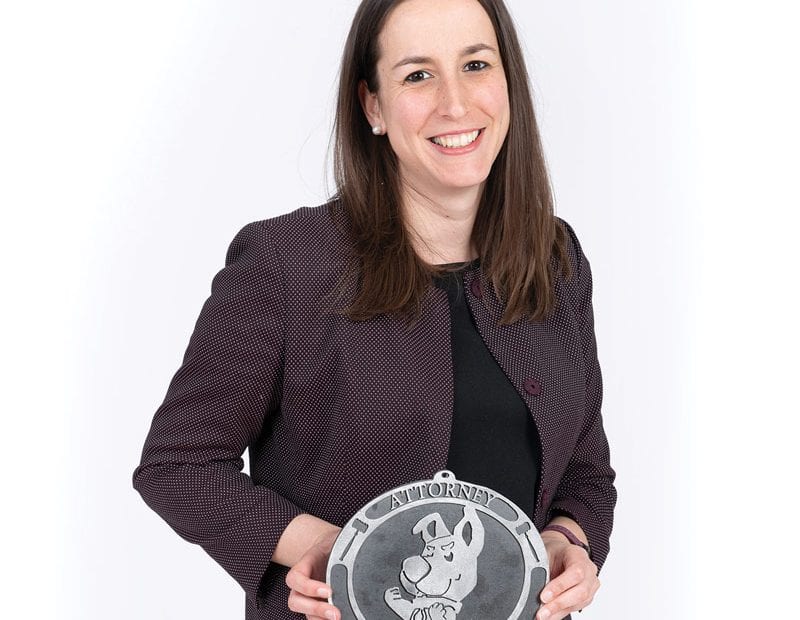
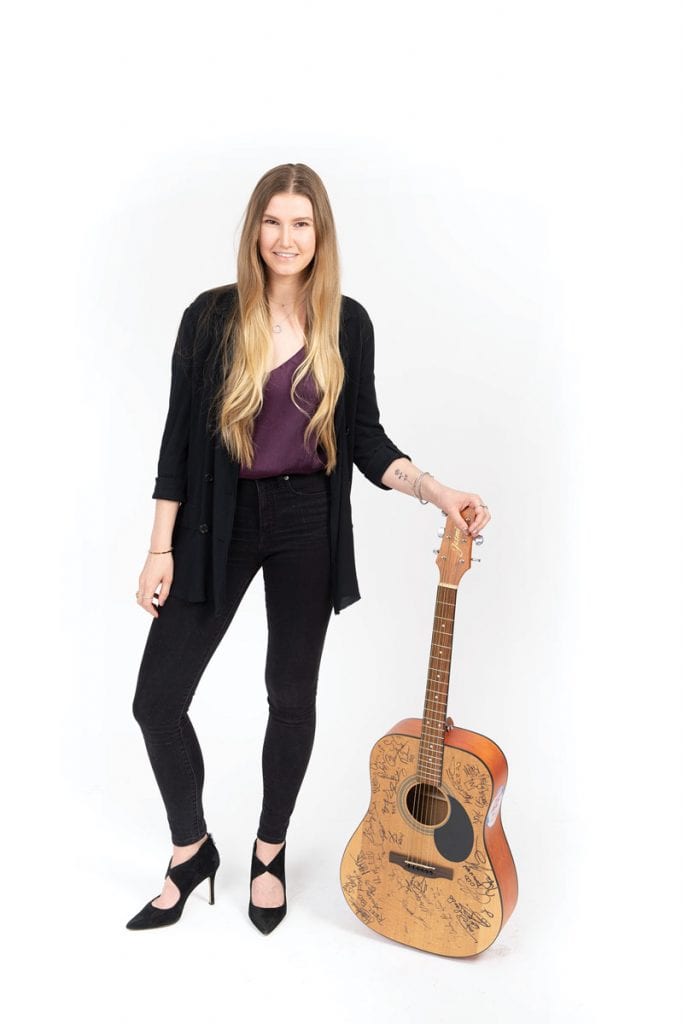
Laura Mangini is a huge fan of true crime.

Her podcast list is dominated by shows within that genre, and her bookshelves boast several selections from that broad category.

This has been pretty much a lifelong passion, or obsession, she told BusinessWest, adding that she entered Westfield State University’s criminal justice program with the intention of one day joining the FBI as a profiler.

Her career path changed when one of those CJ classes gave her an introduction to, and an appreciation for, the judiciary system. She attended law school at UConn and, upon graduation, soon joined the Springfield-based firm Alekman DiTusa, becoming a partner this past January.

She specializes in personal injury, and also representing victims of crime, sexual abuse, and sexual assault, as well as those taken advantage of by insurance companies. In one recent high-profile case, she obtained a $2.5 million verdict on behalf of a 28-year-old man from the Berkshires who was sexually abused by his mother’s live-in boyfriend as a child.

“I love litigating and the adrenaline that comes along with that,” she said. “But what’s rewarding is doing the work for the clients; especially in the crime-victims area, many of your clients are people who have been pushed aside, or no one has taken them seriously, or no one has stood up for them. The most rewarding part for me is to be that person who stood up for them.”

Mangini is active with a number of professional associations. She is currently co-chair of the Western Mass. Committee of the Women’s Bar Assoc., and has served on the board of the Hampden County Bar Assoc. since 2015. She is also a member of the Massachusetts Academy of Trial Lawyers, the National Crime Victims Bar Assoc., and the American Assoc. of Justice.

In the community, she volunteers her time with both the District Court and Housing Court Lawyer for a Day programs, and frequently participates in the Lawyer on the Line program, in which lawyers volunteer to provide free legal advice via a phone bank set up by the bar association. She is also active in her firm’s community-outreach efforts, volunteering for Revitalize Community Development Corp.’s annual GreenNFit Neighborhood Rebuild day each year.

When not working, she enjoys the outdoors, hiking, mountain biking, kayaking, and hanging out with her chocolate lab.


—George O’Brien

Class of 2021

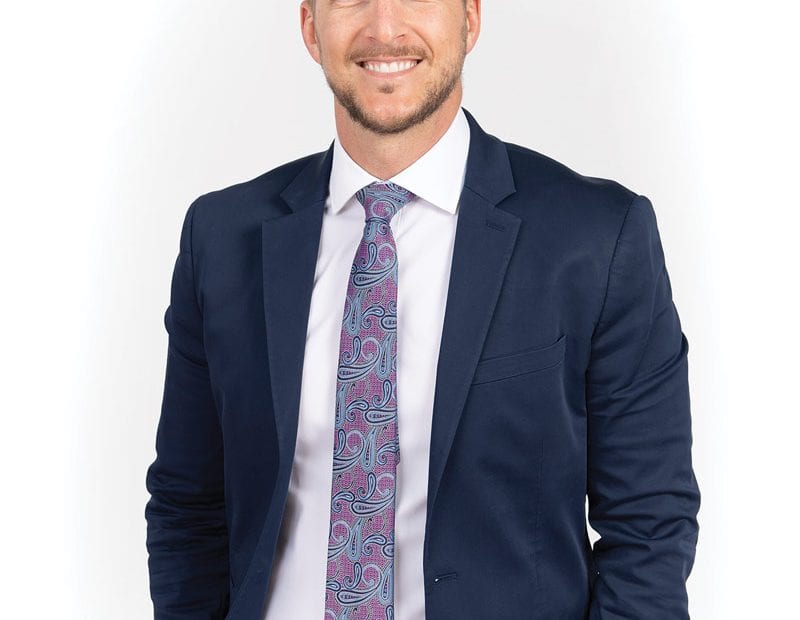
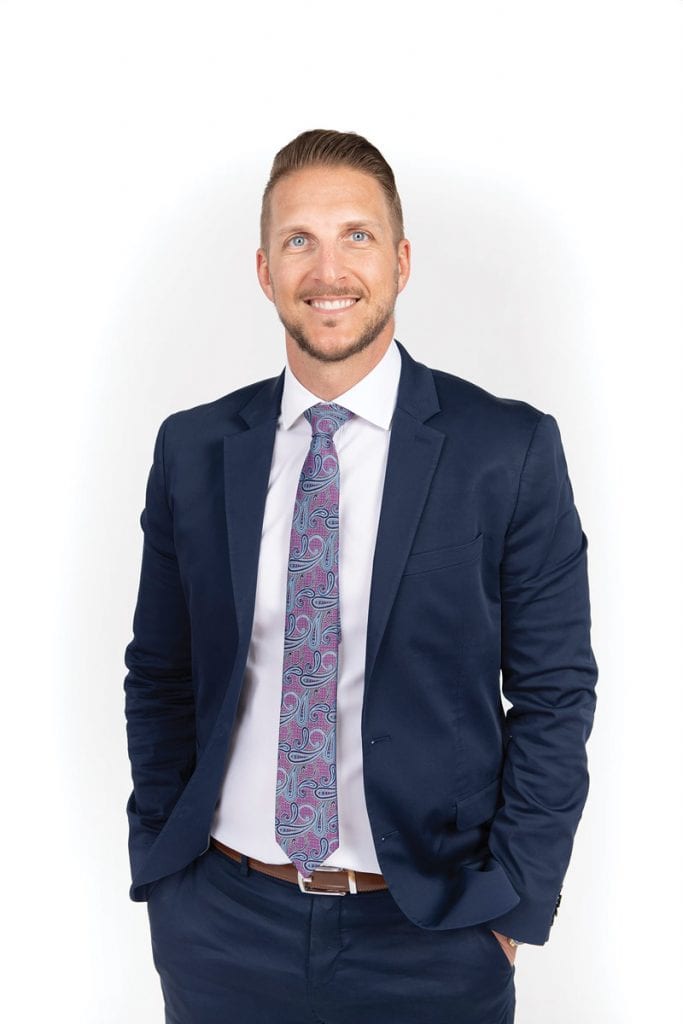
CEO, Secure Energy Solutions; Age 39

A fire wasn’t going to keep Kevin Mattson down.

Not even an electrical fire that destroyed the East Longmeadow headquarters of his company, Secure Energy Solutions, in 2016.

While neighboring Cartamundi offered temporary space, Mattson went to work finding a new home, and eventually bought the former Biolitec building just down the street. But he didn’t just rebuild larger; he decked it out with a veranda for lunches and cookouts, a gourmet kitchen, a free fitness center, and other amenities.

After all, he said, if employees are going to spend 40 or more hours in a place, why not create an environment that keeps them satisfied and focused?

“When team members are happy, they want to do better not only for the company, but for their own success and personal satisfaction,” he said, adding that he encourages employees to think of their jobs not as work, but as training, an opportunity to learn and grow.

There’s plenty to learn in the field of energy management. Since its inception in 2006, Secure Energy Solutions has helped commercial and industrial clients navigate the volatile energy markets and come up with strategies for electricity and natural-gas procurement, solar development, efficiency projects, sustainability planning, and more.

Mattson — who also co-founded a second company, Custom Homes Development, in 2012 — has grown Secure Energy Solutions to more than 50 employees in East Longmeadow and a second office in New Jersey, but says the sky is the limit. “We’re expanding every year, but I feel we haven’t really accomplished anything yet.”

Meanwhile, he quietly helps the community in different ways, such as financing new sod and soil for local ballfields — and rolling up his sleeves to help repair them. “I don’t have a tremendous amount of time, but any time I do have, I like helping kids. They’re our future.”

Mattson got a real scare — and a dose of unlikely inspiration — when his parents survived the B-17 plane crash at Bradley International Airport in 2019 that killed seven of the 13 people on board.

“Both of them survived by jumping out the window; for me, that was the most inspiring thing in the world,” he said. “I try to teach my kids, and the people I work with, that you’ve got to be resilient; you’ve got to be prepared for absolutely everything that might get thrown your way.”

Again, this isn’t someone who backs down from a fire.


—Joseph Bednar

Class of 2021

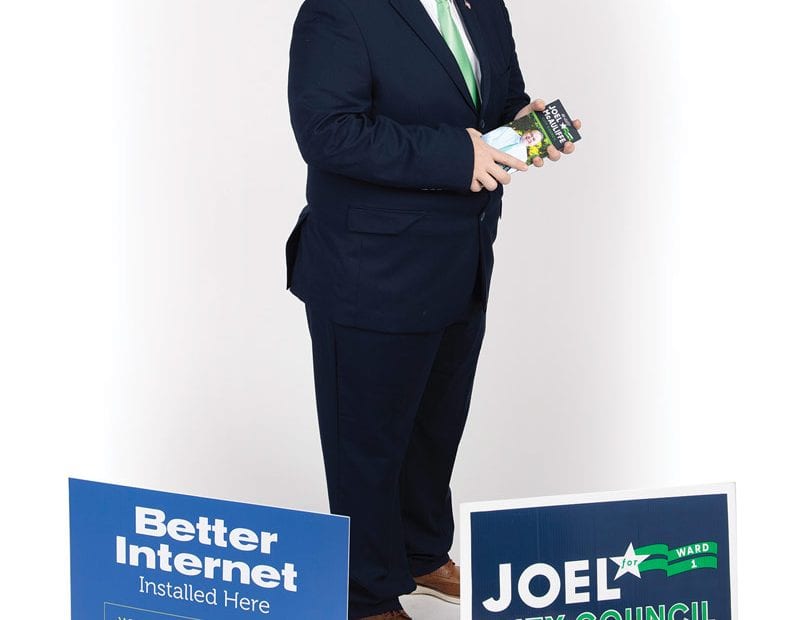
Deputy Chief of Staff for State Sen. Eric Lesser; Chicopee City Councilor; Age 29

Joel McAuliffe can’t remember a time when he wasn’t in public service. Well … he can, but he has to go back to his high-school days, and even then, he was involved in politics and looking for ways to become more so.

He first ran for a seat on the Chicopee School Committee when he was 18 and tried again when he was 20. Neither run was successful, but he was eventually hired as the Communications director for Mayor Richard Kos in 2014, a stint that lasted three years and only served to whet his appetite for public service.

Indeed, he ran for City Council in 2017 against a long-time incumbent. He remembers hearing from supporters that he should “wait for his turn.” But he decided this was his turn, and he triumphed in a hard-fought race. He’s still on the Council, working hard for the residents of Ward 1, near Westover Air Reserve Base, and, overall, to “keep the city affordable.”

Meanwhile, he also serves as deputy chief of staff for State Sen. Eric Lesser, himself a member of the Forty Under 40 class of 2015. That role is the latest McAuliffe has held in a seven-year stint with Lesser, calling himself a “jack of all trades.”

Both jobs keep him quite busy, but he has many other things on his plate as well. He got engaged last August and is currently planning a wedding and house hunting in the city that isn’t just a home, but a passion. He’s currently involved with a project to bring the city’s residents municipal broadband service, one of the many initiatives aimed at improving quality of life in Chicopee and positioning it for growth and vibrancy in the years and decades to come.

“Chicopee is at a crossroads,” McAuliffe said. “We have a tremendous opportunity in front of us … we’re primed for success in a post-COVID world that will be filled with people working remotely and relying on technology.”

When asked about his ultimate ambition when it comes to public service, he gave an answer that speaks volumes about what he’s done already — and what might come next.

“Whatever is it that I do, politically, civically, professional work-wise … I want to be doing something that, in my opinion, gives back to the community and elevates the people who don’t have a voice.”


—George O’Brien

Class of 2021

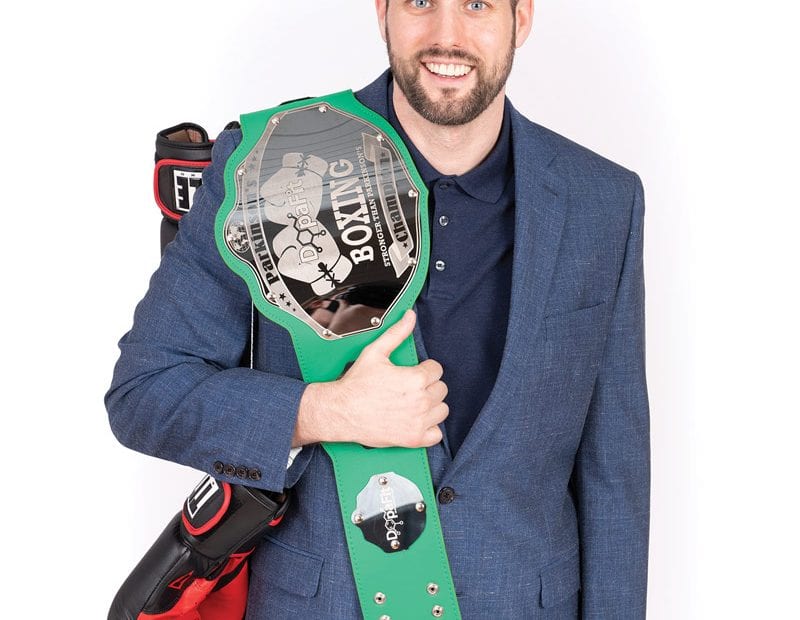
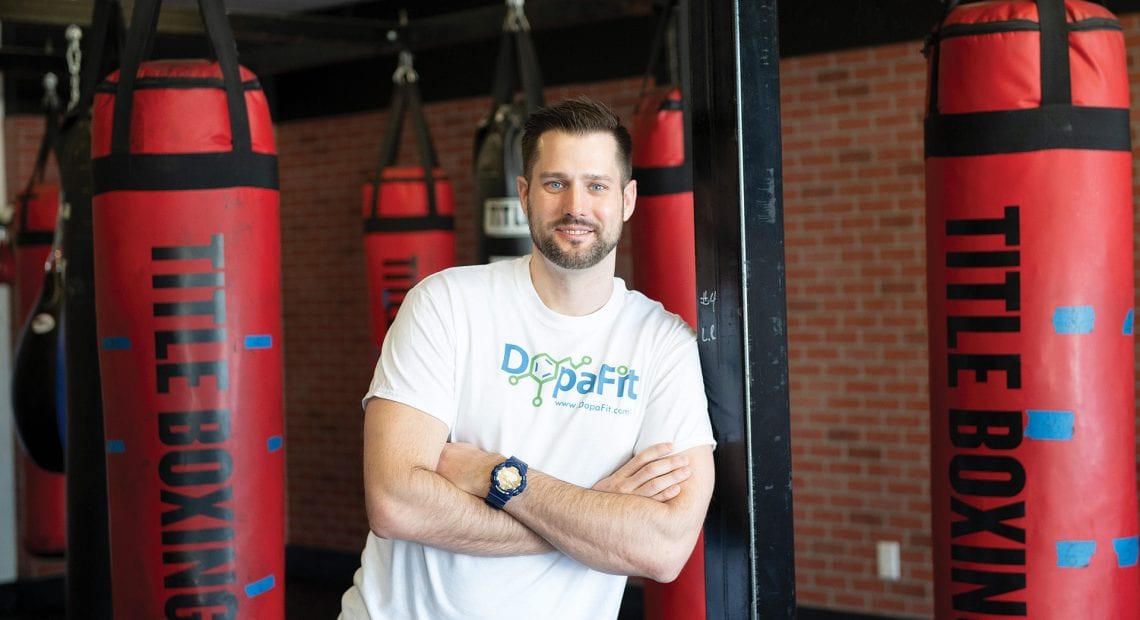
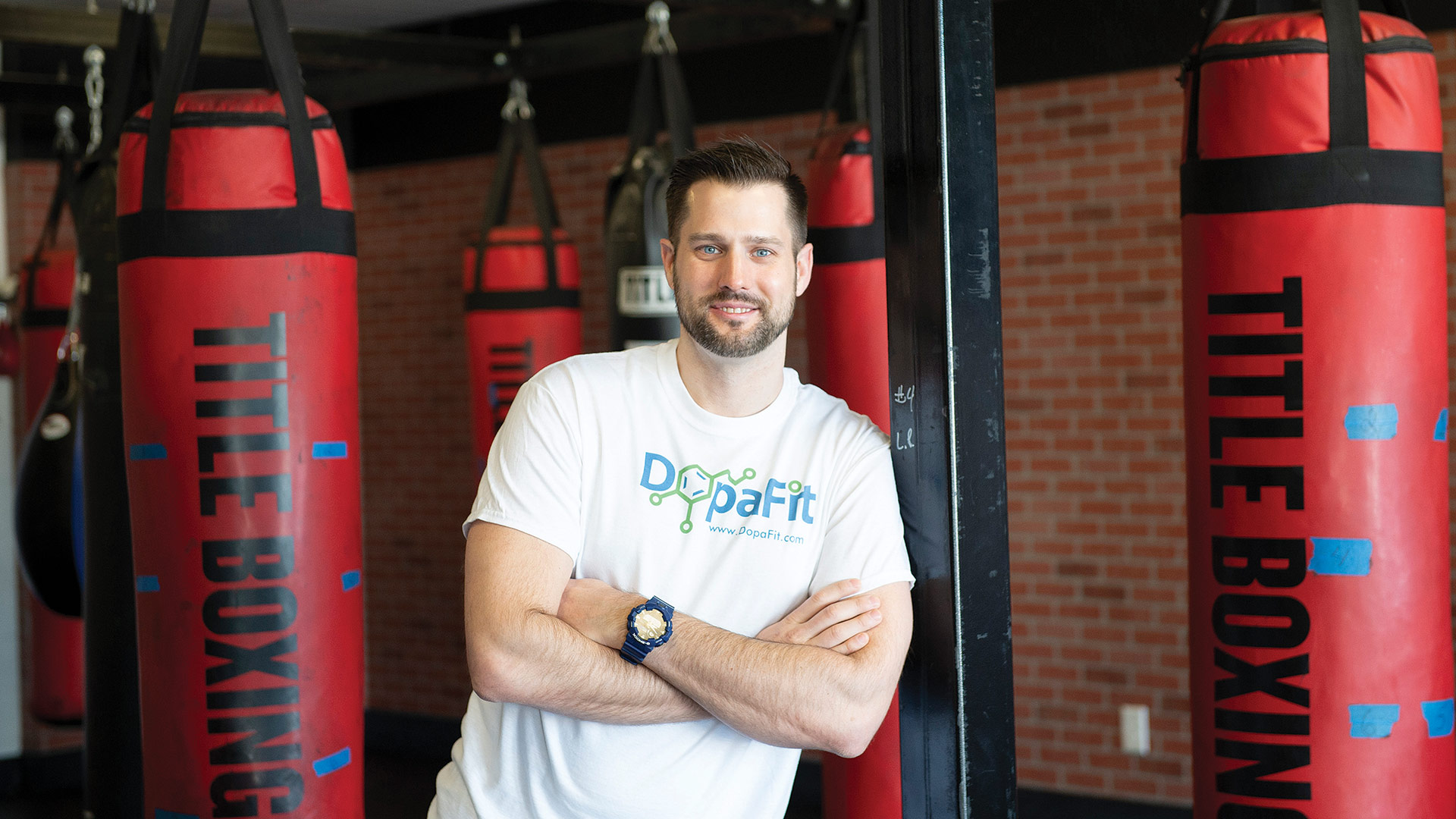
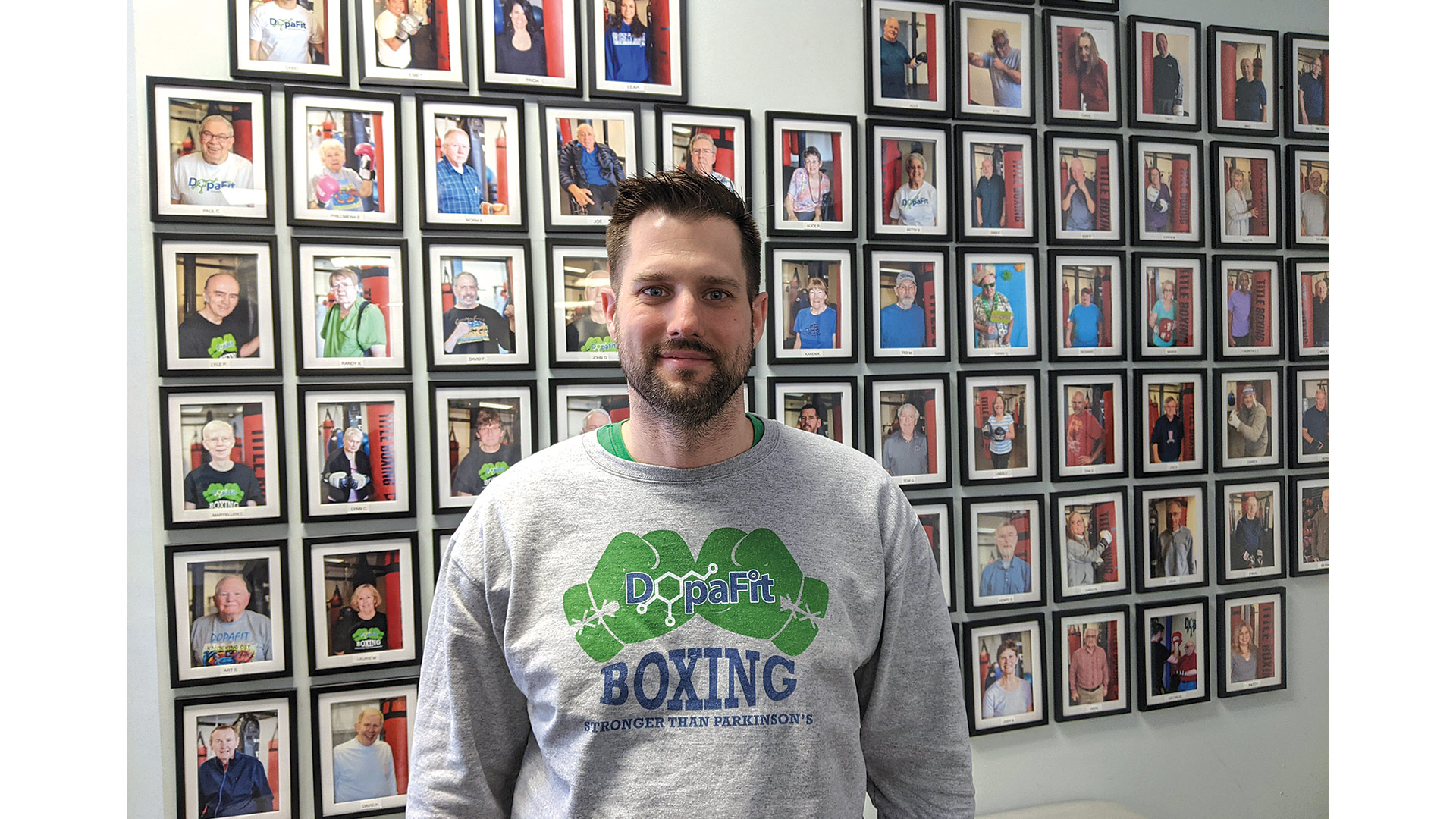
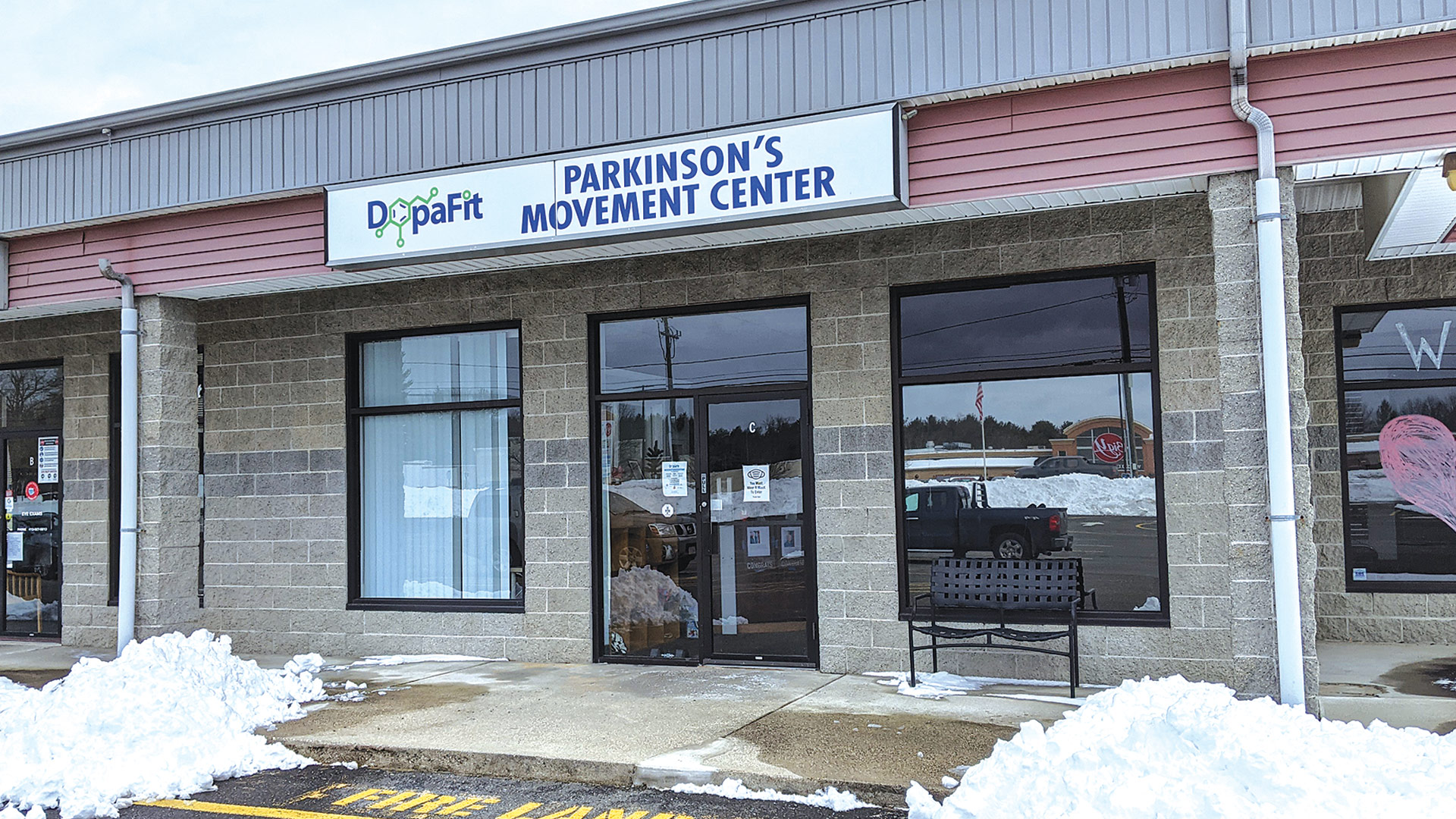
President and CEO, DopaFit Parkinson’s Movement Center; Age 36

When someone who is afflicted with Parkinson’s disease meets Chad Moir, he asks if there is any activity they did before their diagnosis that they wish they could do again.

Moir uses exercise programs to help people stop or slow down the progression of Parkinson’s, a neurodegenerative disorder that increasingly robs the body of dopamine, which is released during exercise. Moir chose DopaFit as the name of his company to suggest improving a person’s dopamine fitness.

“Parkinson’s wants to make a person small — crunch down and take small steps,” he said. To counteract that, exercises for his clients are overexaggerated, featuring big body movements. “Applied to someone’s daily life, the exercises we work on in class will correlate to them having a normal walking pattern.”

Moir became involved in the Parkinson’s community when his mother became afflicted with the disorder and eventually died due to complications from the disease. “The love she gave me for many years is the same love I have instituted into DopaFit in helping people with Parkinson’s disease,” he said.

Because high-intensity exercise works so well for Parkinson’s patients, boxing is a centerpiece of the activities at DopaFit.

“Boxing elevates your heart to a rate almost equal to running around the block, without putting the stress on your knees and joints that you would get from running,” Moir said, adding that, in addition to the physical benefits, there are big mental-health payoffs, too. “It’s so cool for our clients to say they’re going to boxing class instead of they’re going to therapy. It really lifts their spirits.”

The most satisfying part of his work is when people can return to activities they enjoyed before being diagnosed with Parkinson’s. For example, one client went skiing for the first time in three years. “Another client who used to be a pilot hadn’t flown in 10 years because of Parkinson’s. We recently got him in the cockpit for the first time, and he was able to fly again.”

Moir — who was also recently honored as one of BusinessWest’s 2021 Difference Makers — said he’s happiest when he is helping others, taking inspiration from the Muhammad Ali quote, “service to others is the rent you pay for your room here on earth.”

In other words, he added, “I just want to leave the earth a little better than when I got here.”


—Mark Morris

Class of 2021

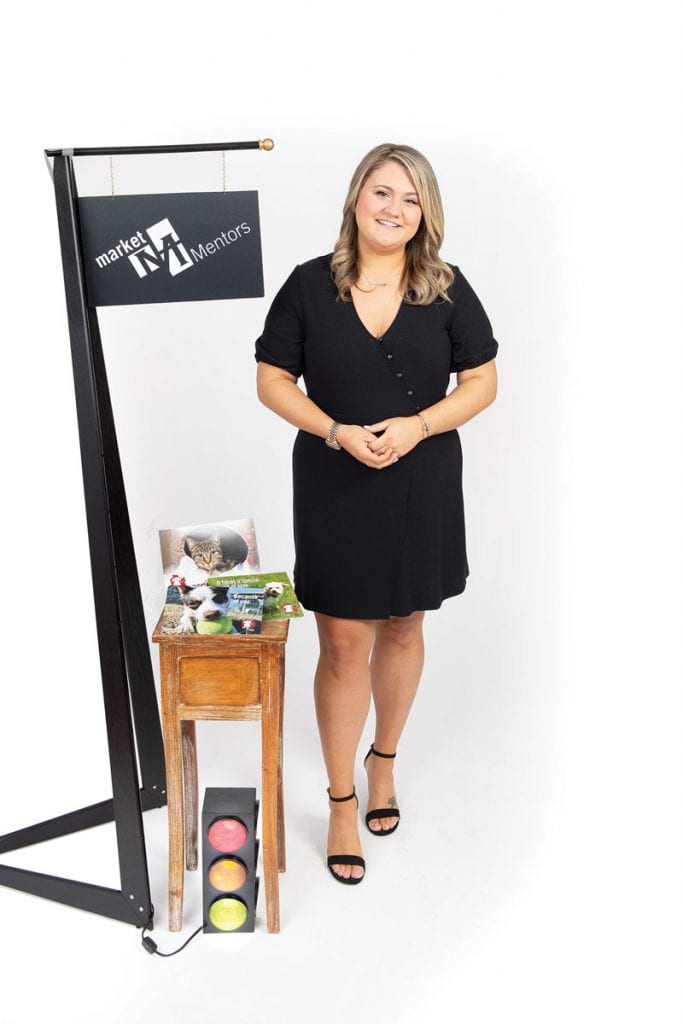
Client Relationship Manager, Traffic Manager, Market Mentors, LLC; Age 27

Sarah Murphy went to college just outside Boston — at Lasell University in Auburndale — and was thinking about a summer internship in the Hub between her junior and senior years. But the city is expensive, and she quickly determined it was too expensive, so she opted to come back home to Agawam for summer break.

With some guidance from a friend, Bob Greeley, owner of R.J. Greeley Co., she readjusted her sights for an internship and started by talking with Michelle Abdow, owner of Market Mentors. That talk led — eventually — to the start of a career in the marketing business, and an intriguing job with many moving parts.

That’s eventually, because Murphy later interned in Boston for a large marketing firm and had to make the decision about which side of the state to work in. She chose Springfield, and Market Mentors, and has never looked back.

“In Boston, it felt like I would have been a little fish in a big pond,” she explained. “In coming here, I feel like I’m making more of an impact being with a smaller agency — and that spoke volumes to me.”

That impact, as she called, it, can be seen both in the agency and within the community.

Indeed, Murphy is now relationship manager and ‘traffic manager,’ a new position in which she handles a number of responsibilities and builds on experience gained while working her way up the ladder.

“I’m the liaison between the account executives and the other departments at the agency — I’m the middle person between our AEs and our copy and design, digital, and web departments,” she explained. “And I manage the deadlines for all of our projects. You might say I’m the hub for the agency; all the workflow goes through me.”

As noted, she is also quite active in the community, continuing a pattern that started in college, when she traveled to Uganda for two months with the Shoulder to Shoulder program and assisted seventh-grade school children by teaching science. Today, she’s an involved board member for the Foundation for TJO Animals, which supports the Thomas J. O’Connor Animal Control & Adoption Center.

With TJO, she helps lead many of its fundraising and outreach events, such as the Ride Like an Animal Motorcycle Run and Car Show. She also volunteers additional time at the adoption center, providing companionship to the shelter’s numerous animals.


—George O’Brien

Class of 2021

Attorney, Bulkley Richardson; Age 35

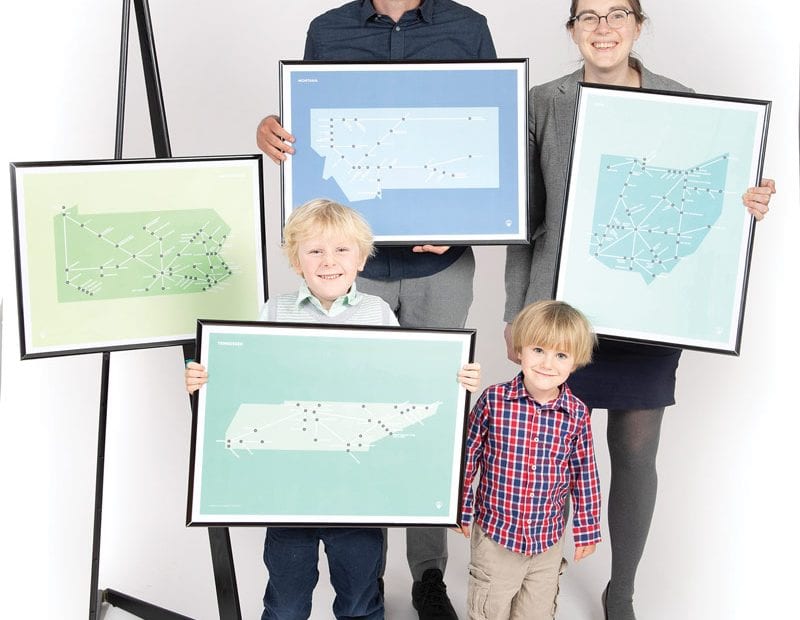
Lauren Ostberg took a winding road to Western Mass. — as one can see from the maps she and her husband and two sons are holding up in the accompanying photo.

Indeed, she’s also lived in Ohio (she grew up there), Vermont, Tennessee, Pennsylvania, Montana (“it’s delightful — and cold — there, but there are no speed limits in most places”), and also Argentina for a short time.

She and her husband came to Western Mass. for a variety of reasons, and here, she’s found not only a home, but a professional niche, if you will — one she wasn’t necessarily thinking about when attending law school at Vanderbilt: cybersecurity.

Indeed, Scott Foster, co-chair of Bulkley Richardson’s cybersecurity practice (and a 40 Under Forty honoree in 2011), describes her as the “heart and soul” of that group, and one of the driving forces in its creation.

In this role, she has been instrumental in the launch of a well-respected series, CyberSafe, an in-person seminar turned virtual (because of COVID-19) that focuses on topics like preparation, implementation, and response to ensure that businesses and organizations are aware of their legal obligations; safeguards to stay protected; and what to in the event of a breach.

She has delivered cybersecurity presentations to large groups on a variety of topics, including WISPs (written information security programs), and contributed to articles on this broad subject for publications including BusinessWest.

“It’s a lot of fun, both intellectually and in terms of the work on the ground,” she said of cybersecurity law. It’s fun intellectually because the law and its applicability are always changing — even the definition of ‘personal information’ is constantly changing.

“And you also get some of the adrenaline you get from litigation,” she went on, “in responding to potential breaches for clients, like writing notification letters to attorneys general, crafting notices to consumers, counseling people on whether or not to pay the ransom … it’s all really interesting stuff, and very important.”

When not helping clients keep their businesses safe, Ostberg, who started her career as a freelance journalist and creative writer, is a regular participant in New England Public Media’s Valley Voices, with one of her stories taking the runner-up prize in the 2019 Valley Voices Championship. She is also active in the community, co-managing an annual fundraising campaign for the United Way of Pioneer Valley and also serving on Easthampton’s Cultural Council.


—George O’Brien

Class of 2021

Vice President, Pioneer Valley Hotel Group; Age 39

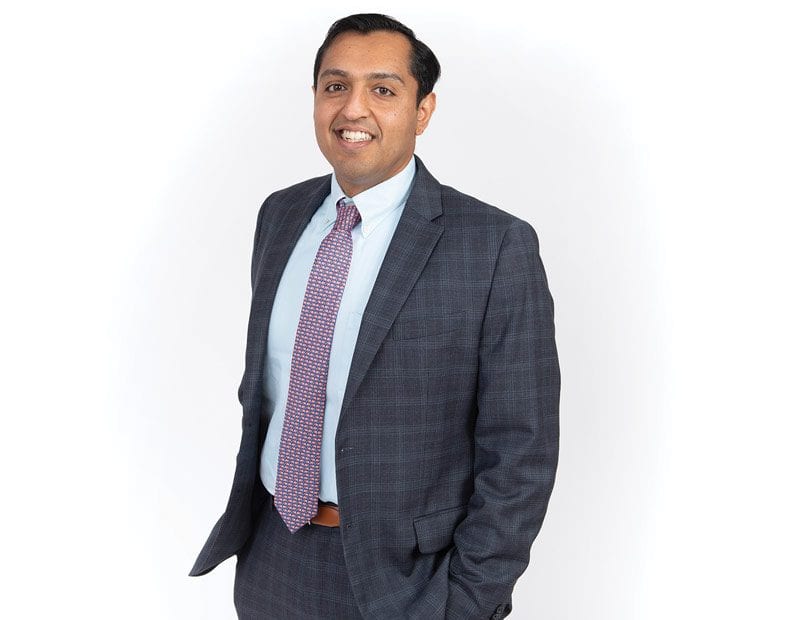
Kishore Parmar takes pride in finding distressed hotel properties and returning them to greatness in the community.

He does so as vice president for Pioneer Valley Hotel Group (PVHG), his family’s business, which manages the largest number of hotel rooms in Western Mass.

For example, nearly a decade ago, Parmar oversaw the revitalization of La Quinta Inn in downtown Springfield, which had suffered years of neglect.

“We always knew La Quinta had good bones and was something we could build on,” he said. “We also saw things were happening in Springfield, so we thought it was the right time and the right place to make the investment.” Since the rehab, La Quinta has been a successful business and received accolades from the state for contributing to Springfield’s economic growth and revitalization.

As a family business, Parmar said the emphasis is on family, which includes the 75-plus employees who work for PVHG.

“We have employees who have worked with us for decades and have dedicated their professional careers to our company, and they are like family to us,” he said. “My family is blessed to have these people, and that’s why we’ve succeeded.”

In 2020, the impact of the pandemic on hospitality and tourism brought the industry to a near-standstill. After robust growth years in 2018 and 2019, PVHG entered what Parmar labeled “the ice age of COVID.” The most heartbreaking impact of this time, he said, was the need to reduce some of the workforce. “As the ice age starts to thaw, I’m looking forward to bringing people back and getting our properties fully staffed again.”

Meanwhile, as an executive board member with the Amherst Area Chamber of Commerce, Parmar is helping to lead the effort to start envisioning a post-COVID tourism economy.

“There will be long-term changes in the hospitality industry,” he said. “One area we are studying looks at how to market tourism in our area. I’m looking forward to seeing what we learn.”

The arrival of spring has sent occupancy rates slightly upward, and Parmar remains hopeful the trend will continue into summer, traditionally the busiest months for PVHG.

“We predict some growth this year, but the real momentum will be next year and 2023,” he said. “The foundation is in place for us to really take off in the next few years, so I’m excited.”


—Mark Morris

Class of 2021

Co-owner, Mellowship Entertainment, LLC; Age 28

Like many Western Mass. natives, Anne-Alise Pietruska always loved the Big E and looked forward to it every year.

So she was thrilled to be able to intern there while in college and later land a full-time gig, splitting her days between marketing — with roles ranging from social-media strategy, copywriting, and website design to community outreach — and coordinating entertainment alongside John Juliano, who has been booking talent at the Big E for more than 30 years.

“JJ at that point was a one-man band and didn’t think he needed me,” Pietruska said. “But soon, he learned about how passionate I was for music and the ideas I had.”

Eventually, she and Juliano began talking about starting their own company. That enterprise, Mellowship Entertainment, launched in 2017. It provides services ranging from program and event management and production to talent buying, consulting, and artist representation.

While the Big E remains a major part of Mellowship’s work, during a typical year, Pietruska and Juliano are also responsible for more than 1,000 shows; one fair might offer 30 events in a single day. They’re also heavily involved in the automotive entertainment industry, not only representing major shows, but establishing their own Collector Car Live brand.

But note that phrase ‘during a typical year.’ Because the past year has been anything but typical.

“It was March 12 or 13, and we were on a plane to Arizona,” she recalled. “We got to our layover, and my phone was blowing up.”

Within hours, cancellations snowballed, and within a matter of days, nothing was booked through June; before long, the entire year — and beyond — was lost to live events. But Pietruska didn’t just retreat; she joined the RESTART initiative to support the live-event industry, and Mellowship is also working with the biodefense company Synsexis, the security and health monitoring system PatriotOne, and the COVID-19 screening program Virified to help relaunch clients’ events in 2021.

The entertainment industry has been battered, she said, but it is resilient, and people will come back.

“I love creating live experiences; some of my best memories are from attending concerts and festivals,” she said. “The thrill of a live show and the communal power of music has had such a lasting impact on me, I want to create those memories for people. That’s why I think I have the best job. It can be stressful, but I love what I do.”


—Joseph Bednar

Class of 2021

Project Manager, Tighe & Bond; Age 30

Joe Popielarczyk always liked math and science, and became exposed to the world of engineering in high school and as a student at UMass Amherst. But it was his uncle, a civil and environmental engineer, who helped him narrow his interest.

“I chose civil engineering and enjoyed it right from the beginning,” he said, adding that he interned at Tighe & Bond as an undergrad and joined the firm full-time upon earning his master’s degree.

Since then, his contributions to the region’s quality of life have included design and construction services for water-system improvements along College Highway in Southwick, design of a wastewater treatment plant conversion in Northampton, improvement design for a wastewater pumping station in West Springfield … the list goes on, really, each project building on — and growing — his expertise.

“I’m a total people person,” he said. “I really enjoy personal interactions, whether it’s with clients, co-workers, or regulators. I enjoy the personal aspect of engineering. And in my role at Tighe & Bond, I’m always learning from people.”

Popielarczyk says he’s fortunate to be in a field where he can constantly learn and grow, but he’s especially grateful for the impact his work has on entire communities.

“I love the idea that it’s helping people, even though it’s not something that gets recognized,” he said, adding that people often don’t think about why they have clean water, reliable sewer service, and streets that don’t flood during rainstorms, the same way shoppers buying food in a grocery store don’t often think about the farming, production, and transportation behind getting it there. “We’re not in the public eye, but we do impact a tremendous amount of people.”

His impact extends outside of work as well, including as a mentor to young people considering a career in engineering. After graduating from UMass Amherst, he returned for several years to speak with the student chapter of the American Society of Civil Engineers, and he regularly volunteers as a judge at local high-school science fairs, taking time to speak with teenagers about his career and where their STEM interests might take them.

“There’s always something to learn at Tighe & Bond, and a lot of great people willing to pass on their knowledge,” he said. “I take the same perspective with mentoring. It’s an opportunity to pass along what I know and pay it forward.”


—Joseph Bednar


Class of 2021

Staff Attorney, Central West Justice Center; Age 32

Growing up in Los Angeles, Claudia Quintero saw plenty of disparities — by class, race and ethnicity, gender, and more — and wanted to do something about it.

“But I was undocumented,” she said. “So I didn’t know if I could go to college, much less law school.”

In high school, though, she met a lawyer who helped her attain legal status. “I was so inspired by this attorney — who was also a Latina, and was very kind and very effective in her advocacy — that I wanted to go to law school and do for others what she had done for me.”

That law school was at Western New England University, where she knew she wanted to focus on social-justice work. Fittingly, she landed a job with Central West Justice Center immediately after achieving her juris doctorate. “It seemed like the right fit … like work I was meant to do.”

As a subsidiary of Community Legal Aid, Quintero explained, “we provide legal civil services to indigent clients, people who can’t afford lawyers for things like eviction defense, state and federal benefits law, family law, wage-and-hour claims, immigration … that’s just a smattering of the different projects we have.”

Central West’s migrant seasonal farmworker project, her area of focus, provides holistic legal advocacy to farmworkers across Massachusetts on housing, work conditions, and other protections, while advocating for these workers on the state level. “A lot of farms are located in rural parts of the state where the workers might not even know we exist,” she noted.

The performing and visual arts are a big part of Quintero’s identity; she’s a classically trained pianist, was a Mexican folkorico dancer for 15 years, and is an amateur photographer. The work she performs today at Central West has become a critical part of that identity as well — and a continuing tribute to her journey and those who helped her along the way.

“It’s a really gratifying job. I feel like it’s kind of my responsibility, since I was given such an amazing opportunity getting legal status in the United States,” she explained. “That’s not an easy feat; not everyone is eligible to become a lawyer in the United States, and even to be a legal citizen is such a huge privilege for me. So I know I have to do something worthwhile. I know it’s an opportunity I shouldn’t squander.”


—Joseph Bednar

Class of 2021

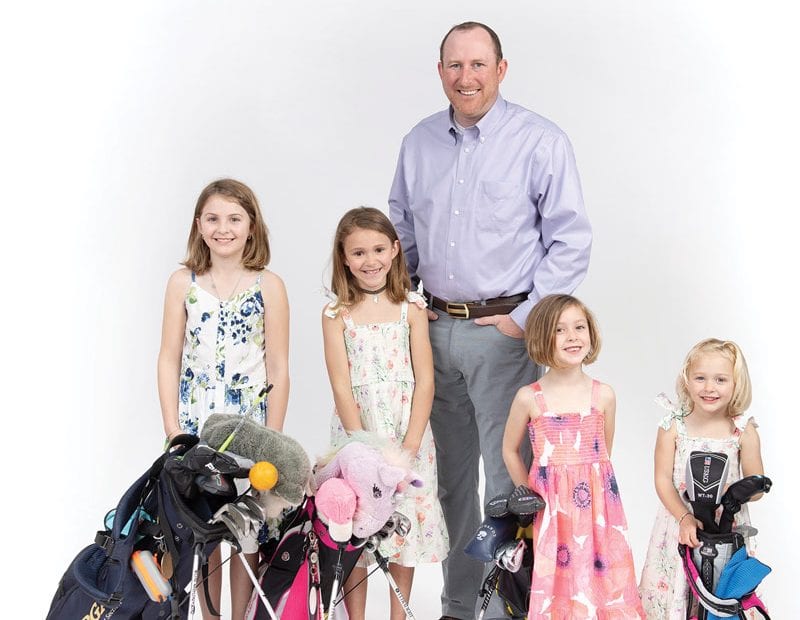
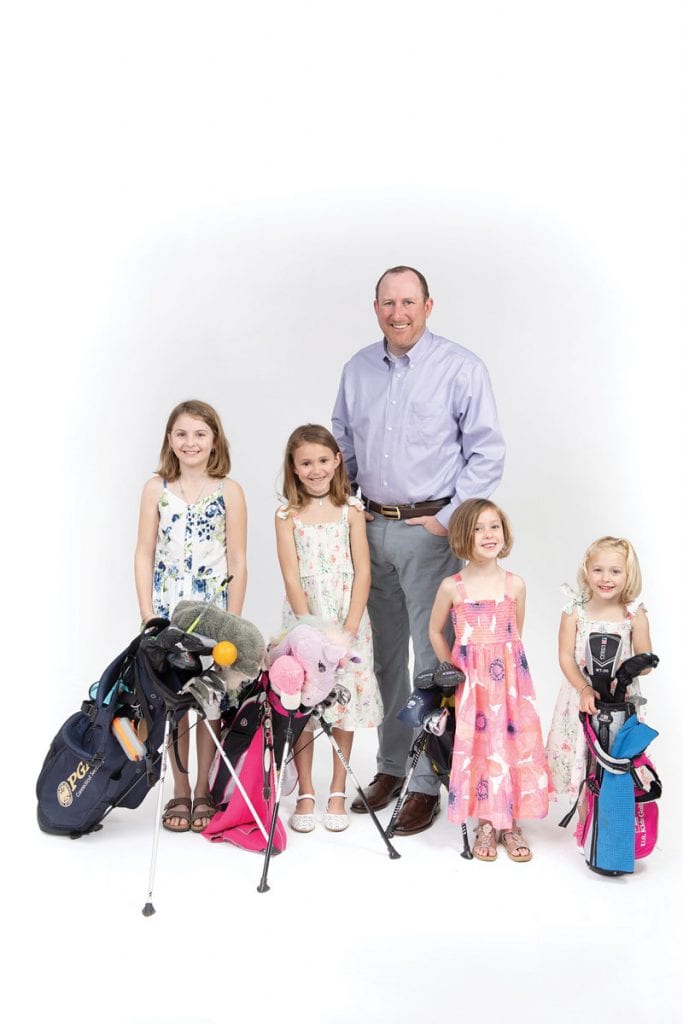
Owner and President, Clayton Insurance Agency; Age 38

Integrity means a great deal to Michael Regan.

As an insurance professional who had been steadily growing in his career, Regan was ready to pursue his next business goal: to run his own agency. He had heard that Martin Clayton, longtime owner of the Clayton Insurance Agency in Holyoke, was looking for a young person to carry on the legacy of his business.

While he appreciated Regan’s 10-plus years of experience with Goss and McLain Insurance Agency, Clayton was particularly impressed that the Greater Holyoke Chamber of Commerce had honored Regan with the Henry A. Fifeld Award for Voluntary Service to the Chamber.

“It turns out Clayton knew Fifeld and told me, ‘if you won Hank’s award, you must be a pretty good citizen,’” Regan recalled, adding that the conversation was a key step toward eventually acquiring the agency.

Once he settled in as the new owner at Clayton, he admits he felt some pressure to uphold the integrity of the firm and to make sure customers receive the same quality service they always have.

“I gave Martin my word that I would continue the legacy of the agency,” Regan said. “I work very hard to always keep my word.”

He had the option to change the name of the agency or add his name to it, and Clayton even encouraged it. But Regan decided he didn’t need his name on the sign. “The Clayton Insurance Agency has such a good reputation, I didn’t feel the need to mix that up and add my name. It’s not about me, it’s about continuing the agency and taking care of employees and customers.”

Since Regan took the helm in 2019, the agency has grown by just over 30%, a trajectory he hopes to continue for years to come.

“We’re looking to bring on more staff in the next couple of years and to keep the agency moving forward,” he said.

Regan is extremely community-minded, from funding scholarships to running food drives; from collecting donations for youth sports in Granby to volunteering with the First Tee program to teach inner-city kids about golf, a sport he’s also introduced to his four daughters.

Meanwhile, he hopes to continue the legacy of his agency until he’s ready to pass it along. “Fast-forward 50 years, I want to look back the same way Marty did and find a successor who can continue the Clayton Insurance Agency even further.”


—Mark Morris

Class of 2021

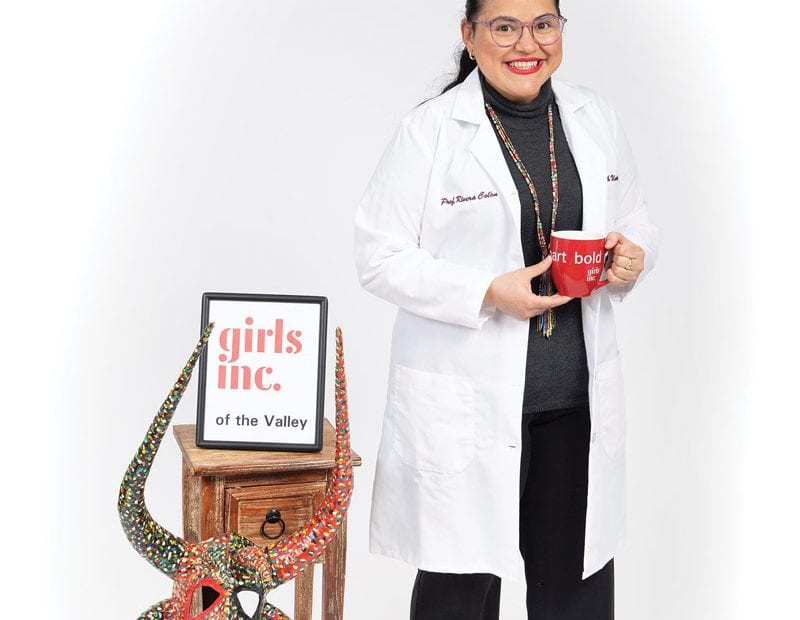
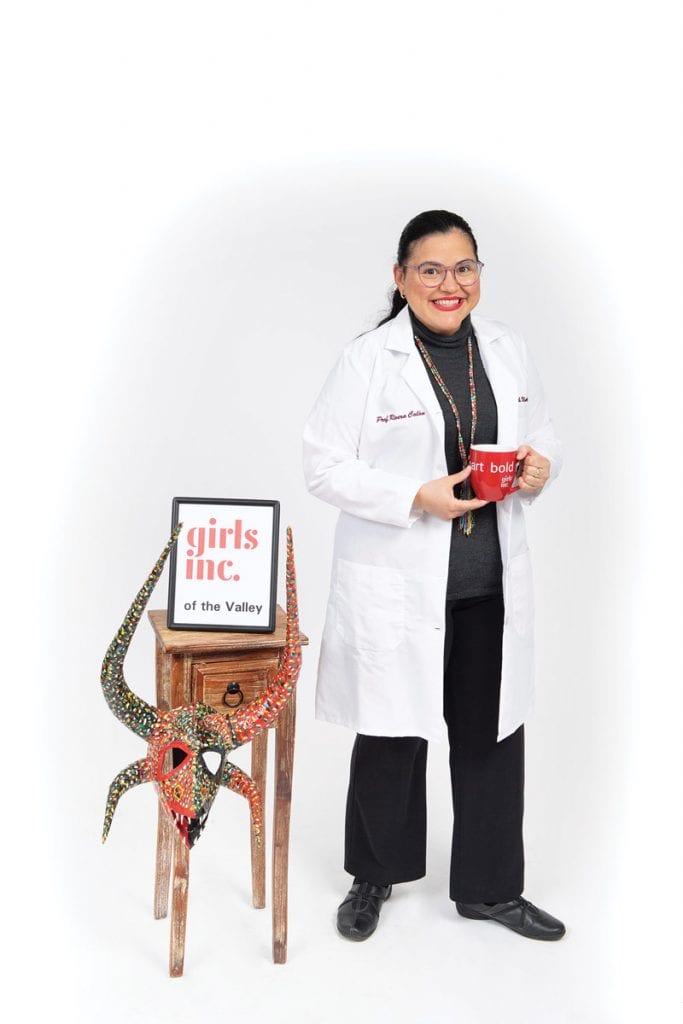
Assistant Professor of Biology, Undergraduate Science Program Research Coordinator, Bay Path University; Age 35

It may have taken Yadilette Rivera Colón a while to find her passion — but she’s certainly been a force in helping other young women find theirs.

Growing up in Puerto Rico, she first enrolled in a nursing program, but soon decided she’d prefer to become a medical doctor. After a tough first semester of study, she worked at a dental office but found the work tedious.

Then she interviewed for a summer internship with Craig Martin, professor of Chemistry at UMass Amherst. The program was already full, but he saw something in her and brought her on anyway. As it turned out, she recalled, “he had wanted to be a dentist, too, and realized it wasn’t for him, and he thought I should have a backup plan.”

Rivera Colón was hooked when she helped conduct and publish research through the program, experiencing the thrill of sharing new knowledge with the world. “I gave everything else up to go into research,” she said, and eventually earned a doctorate at UMass in molecular and cellular biology.

Her role at Bay Path is multi-faceted, and her impact extends well beyond campus. In addition to helping students navigate a path to careers in science, her outreach in the community, especially in Holyoke, helps young people, especially women of color, discover the possibilities of STEM.

“It’s a leaky pipeline,” she said, partly explaining why women remain underrepresented in the sciences. “They don’t always have the support and resources in place. Or they hear, ‘you’re not good at math,’ or ‘you’re not good at science.’ But it’s a skill — you can get better, and I’m going to show you how.”

Rivera Colón creates bridges in other ways, too. She co-advises the Women in STEM organization at Bay Path and co-organizes its speaker series, and also facilitates training sessions that focus on diversity, equity, and inclusion in the STEM field. Through volunteer work with Girls Inc. of the Valley and the Latino Scholarship Fund of Western Massachusetts, she helps girls pursue their college and career goals. And she has led anti-racism trainings for colleagues and students at Bay Path, as well as for staff at MassHire Holyoke.

In short, she’s passionate, and it all started with finding that initial spark. “I tell girls, ‘if you decide to pursue a career in science, you’ll never be bored.’”


—Joseph Bednar

Class of 2021

Litigation Paralegal, MassMutual; Age 30

When Victoria Ann Rodriguez says she likes to stay busy, she’s not kidding.

In addition to her work as a litigation paralegal for MassMutual, she chairs the Puerto Rican Parade Committee, serves on the board of the Springfield YWCA, and on nights and weekends helps clients find their dream homes as a part-time real-estate agent.

Back when she was looking into colleges, Rodriguez considered majoring in criminal justice with the hope of eventually becoming an FBI agent.

“Once I realized there was blood and other things involved, I was no longer interested in the FBI,” she said with a laugh. Instead, she decided to pursue legal studies and has just begun studying for the LSAT exam. “I love the law, and I hope to one day become an attorney.”

Passionate about giving back, she formerly chaired the community responsibility subcommittee for the Assoc. of Latinos at MassMutual and Allies, and she’s heavily active with the Girl Scouts as a decorated alumna, troop leader, and tireless advocate. Before COVID-19, she served as a mentor to students from her alma mater, the High School of Commerce, in weekly sessions at MassMutual.

“We taught them skills such as budgeting, how to prepare for an interview, and how to draft a résumé,” she recalled. “I enjoyed the sessions because I saw myself when I was in high school and would have loved to be part of this type of program.”

The Rodriguez family has always been civically active. In fact, two decades ago, Victoria’s mother was chair of the Puerto Rican Parade Committee.

“I remember helping out my mom when I was younger, and now here I am, 20 years later, as the chair of the parade committee, so it’s come full circle,” she said.

With the pandemic still lingering, the committee is weighing its options for the next parade, always with the safety of the community in mind. But she can hardly wait to step off once again. “The parade draws folks from all ethnicities, and everyone is so excited on that day. I just love it.”

The idea of persistence motivates Rodriguez; when times get tough, she calls on her courage and strength to keep “leveling up.” And through it all, she still appreciates the journey.

“Sometimes I can’t believe I’m here,” she said. “I have my own place, my own car, I even have my own dog. I’ve grown up. It’s crazy.”


—Mark Morris

Class of 2021

Project Manager and Estimator, Chicopee Industrial Contractors Inc.; Age 32

Liz Sauer says she’s getting used to it. Sort of. At least in some respects.

She’s referring to her responsibilities in a field — rigging, moving machinery, and related work — still heavily dominated by men, and, more specifically, to the annoying questions she gets, almost exclusively from men.

“They’ll ask how long I’ve been doing this kind of work,” said Sauer, adding that the implication is that she hasn’t been doing it very long, and thus her credentials are in question. “And they’ll ask if my father owns the company.”

Sauer says she never wants to appear fazed or upset with those questions, and has worked overtime to make sure she isn’t. Better still, she has developed an intriguing response mechanism, one that essentially turns the tables on those questioning her.

Indeed, while she says she hasn’t become “sassy enough” to ask any of her inquisitors if their father owns the company they work for, she will ask them how long they’ve been doing what they’re doing.

“The responses often lead to lively conversations and relationship building in a business — and industry — where that’s very important,” said Sauer, who is now a proud member of an all-female leadership team at Chicopee Industrial Contractors, one that has steered the company through the many challenges presented by COVID-19.

But there is much more to her résumé than her duties at CIC. Indeed, Sauer is the founder of Route to Rise Yoga and currently offers classes at a Windsor, Conn.-based studio called Wabi Sabi Yoga & Wellness Center. She also advocates for yoga and wellness in the workplace at the Eversource Health and Wellness Fair, and facilitates small-group active workplace chair yoga for the Commonwealth Care Alliance.

Sauer, who holds a master’s degree in fine arts from the University of Florida, is also a mixed-media artist with a strong emphasis on fiber arts, sculpture, and figure drawing. Meanwhile, dance has been a constant passion throughout her life, and, with her partner, Gregg Todd, she offers workshops involving yoga, dance, and couples connectivity through shared movement. Both professional dancers, the duo perform a fusion of Latin-inspired modern dance.

When asked how she finds time for all that, she said she makes time — somehow — while also saving a few moments to offer a defiant ‘no’ when asked if her father owns the company.


—George O’Brien

Class of 2021

Chief, U.S. Attorney’s Office, Springfield; Age 39

Deepika Shukla always savors the moment in court when she states her name and declares her representation of the United States of America.

“I don’t just rattle off my name because for someone like me to stand up and represent the United States is a real honor,” she said.

A naturalized citizen who was born in Canada and lived in Chelmsford before moving to Western Mass., Shukla is chief of the U.S. Attorney’s Office in Springfield — the first woman of color to run the Springfield office and the youngest to attain the chief’s position.

In a normal legal setting, a lawyer’s job is to always try to win a judgment for the client. Working for the Department of Justice had a strong appeal to Shukla because a U.S. attorney takes a different approach to the law.

“At the DOJ, your objective is to pursue justice,” she said. “It’s not about winning, it’s about doing the right thing.”

Shukla oversees eight U.S. attorneys and five staff members in the Springfield office, which covers the four counties of Western Mass. While many cases involve prosecuting federal crimes, the Springfield office also brings civil-rights actions against various entities. Shukla takes a special interest in these cases.

“I have experienced discrimination in my life, and I feel that’s an important perspective to bring to the job,” she said, adding that she has also successfully prosecuted hate-crime cases.

While in college, Shukla became a U.S. citizen, calling it one of the greatest days of her life. The day was September 6, 2001, when she and a roomful of people all rejoiced in becoming Americans. The sense of elation was short-lived when, five days later, the tragic events of 9/11 took place.

“Suddenly, I found that people who look like me and my family were being targeted as victims of hate crimes because of the way we looked and just for being ourselves,” she said — an experience that motivated her to give a voice to people who are not often heard from in the justice system.

“Injustice anywhere is a threat to justice everywhere,” Martin Luther King Jr. once declared, a quote that resonates strongly with Shukla.

“Wherever we see injustice, it’s our job to correct it,” she said. “If we let it go, it becomes a threat to our whole justice system.”


—Mark Morris

Class of 2021

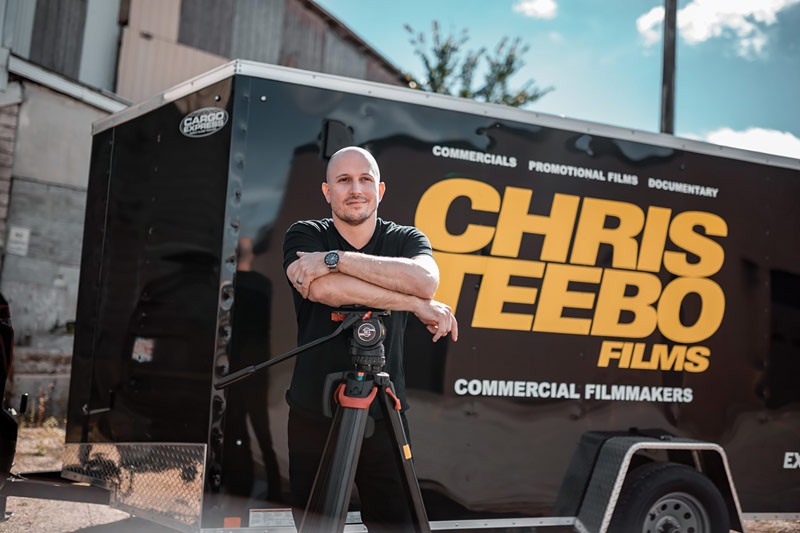
Owner, Filmmaker, and Director, Chris Teebo Films; Age 38

“His camera was his paintbrush, and his canvas his screen.”

That’s how Judy Matt, president of the Spirit of Springfield, chose to sum up the life and work of Chris Thibault, who created some stunning videos for the agency and its Bright Nights holiday lighting display in Forest Park. As she did so, one could sense the pain of having to use the past tense — a pain felt by all who came to know him, even if only for a short while.

Thibault is BusinessWest’s first posthumous 40 Under Forty honoree. He passed away in February, during the nomination period, and the many who nominated him felt firmly that, because of his body of work, his professionalism, the manner in which he touched those he worked with and for, and the way in which he took a long and difficult cancer battle public and inspired countless people in the process, he earned a place within the class of 2021.

And they’re right.

Thibault was an entrepreneur, launching his production company, T-Bo Productions, in 2004. But while he was a businessman, he was, to most, an artist — one who took ideas and goals and turned them into video works of art. Over the years, he worked with a number of area clients, including Spirit of Springfield, Big Y, Mercedes-Benz of Springfield, the Greater Springfield Convention and Visitors Bureau, Health New England, and many others.

There were no small projects in his mind, said his wife, Missy, and he approached every project with passion and energy.

“Some people can immerse themselves in their work, and it can have a negative effect — like it was too much,” she explained. “With him, it seemed like a very natural balance. He put everything he had into each and every project. That’s how he did things.”

He kept doing things that way even as cancer ate away at his body and made it more difficult to work and create, and this was just one of the many ways he inspired others. Another was the way he and Missy shared their cancer battle with the world.

“That just came naturally to us because we love to document,” she explained. “He always said, ‘the story is king,’ and he had a story of his own that he felt he had a responsibility to tell.”

By telling it, he took his already-considerable talents as an artist to an even higher level.


—George O’Brien

Class of 2021

Vice President, Chief Financial Officer, and Treasurer, North Brookfield Savings Bank; Age 34

“There’s no place like home” is more than a sentiment for John Thomasian. The North Brookfield native was 3 years old when his parents opened a savings account with North Brookfield Savings Bank. Back then, no one could have predicted he would return someday as the bank’s chief financial officer.

Representing the fifth generation of his family to live in town, Thomasian joined North Brookfield Savings last March. “The opportunity to come back to my hometown savings bank was just too good to ignore,” he said.

During his career, Thomasian appreciates what he’s learned from working closely with successful CEOs, but his biggest inspiration comes from days spent with his late grandfather, longtime North Brookfield Chief of Police Harbig Thomasian.

“I remember driving around with him and seeing how everyone liked and respected him,” he said. “I thought I could carry on his legacy and the family name by coming back to town.”

The return to his hometown is not simply nostalgia, but, rather, a look ahead. After a decade in the financial industry in roles of ever-increasing responsibility, Thomasian understands that banking business models of the past will not work going forward, so he has brought a data-driven approach to North Brookfield Savings.

“Since joining the bank, I’ve implemented several new strategies that will put us in a position to succeed in the future,” he said.

Along with innovative approaches, he also understands the importance of the personal touch. “I’ve had the chance to reacquaint myself with lots of old friends. That’s good for the bank because people like to do business with someone they know and can trust.”

Thomasian also made clear there are no limits to his ‘banker’s hours.’

“My cell-phone number is on my business card, and I tell people they can call me personally any time of day,” he said. “If a customer has an issue with any of our products or services, I want to be the first to know.”

It’s always a good situation for a bank when its customers are, literally, friends and neighbors, Thomasian said, adding that returning to his hometown is more than just business — it’s personal. “North Brookfield has always had a special place in my heart.”


—Mark Morris

Class of 2021

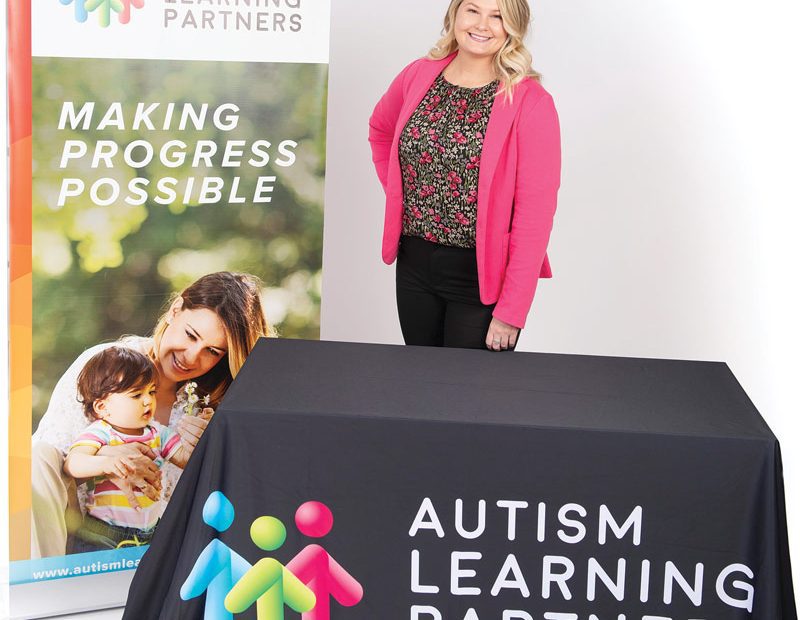
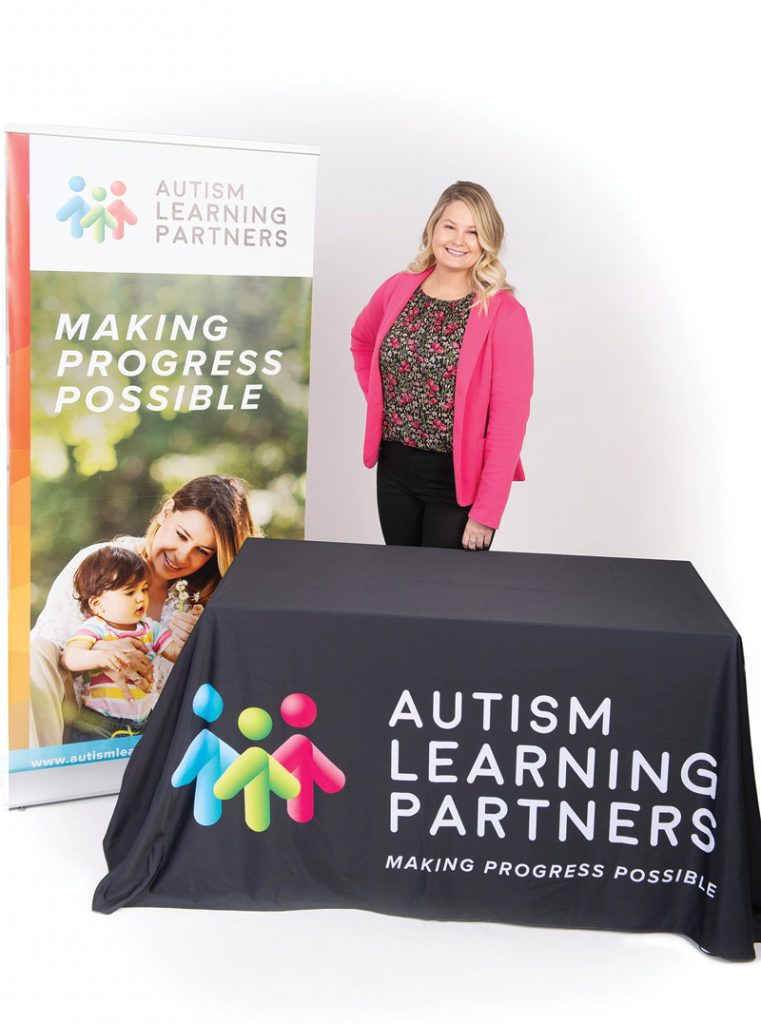
Clinical Director, Autism Learning Partners; Age 35

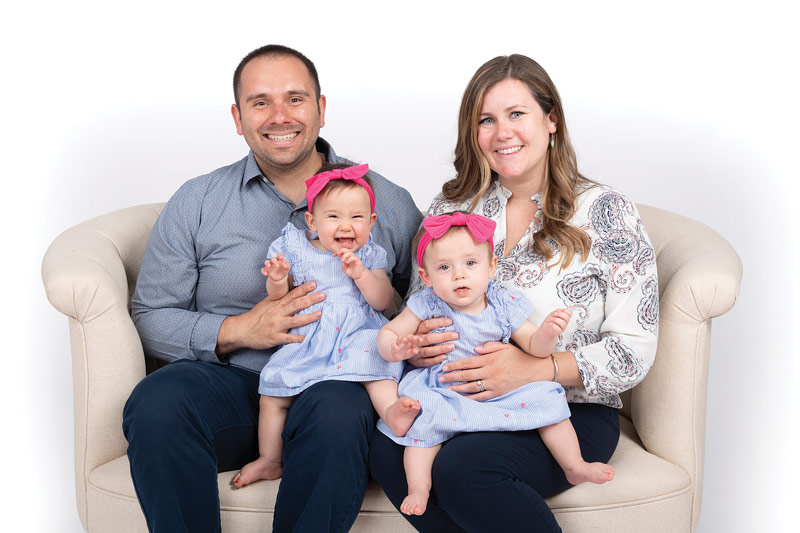
To hear Erin Zwisler tell it, working with autistic children every day is challenging and, at the same time, very satisfying.

“Every day is different,” she said. “The children are teaching us just like we are teaching them.”

She joined Autism Learning Partners in 2018 and has been credited with growing its clinician team and client base, as well as expanding the group’s locations into Connecticut, with offices in Hartford and New Haven.

Within the Western Mass. autism community, Zwisler is known as an ally and an advocate for families. In that role, she has forged dynamic and diverse partnerships in the larger community.

As a board-certified behavior analyst, she was drawn to her career choice by a fascination with applied behavior analysis (ABA), a scientific approach to behavior proven to work well with autistic individuals. Unlike other approaches, she noted, ABA helps those with autism to achieve at higher levels.

“Let’s say we want to encourage a particular behavior from a child,” Zwisler said. “We look at the environment to understand what barriers they are facing, then change one thing in the environment, and we begin to see progress.”

As an example, if a child sees a toy on a shelf and expresses they want it by crying, a clinician will help the child communicate what they want and model how to say it.

“So, the next time the toy is out of reach, the environment you’ve set up and the prompts you’ve exposed the child to make it possible for them to request it on their own,” she said.

COVID-19 presented a challenge to Zwisler and her staff because so much of their services are provided in the home. In addition to nervous parents who feared letting outsiders in, the children suddenly saw clinicians wearing masks and could no longer give high-fives or hugs.

But she said her team treated living with COVID like any new skill they teach their clients. “We meet them where they are, then slowly and surely increase the demands and provide positive reinforcement as they achieve each step in what they’ve learned.”

Zwisler remains passionate about her work because every small success helps build behaviors to promote independent living in the long run.

“A child’s progress can be amazing,” she said. “From holding a fork to speaking their first words, we see big accomplishments from them.”


—Mark Morris

Opinion

Editorial

When everyone gathered on Main Street that hot August day back in 2018 to mark the opening of MGM Springfield, no one really knew what to expect or what the future would bring.

Certainly, no one could have predicted what the scene would be like two and half years later.

Indeed, the COVID-19 pandemic took a resort casino that was ‘ramping up’ — that’s the phrase we kept hearing over and again from past and present leaders — and knocked it completely off the ramp. The casino was shuttered for several months, and when it reopened, it was only at a fraction of its full capacity. Until very recently, the hotel and most of the restaurants were closed, and the event venues were quiet and dark.

These days, the capacity is not quite half and destined to keep inching higher. The hotel is open on weekends, and the sports bar has reopened its doors as well. But huge question marks surround just when and under what circumstances the casino complex will again be able to host concerts, shows, and other large-scale gatherings.

In some ways, we’re all back where we were almost 32 months ago … wondering what will happen and just what the casino will mean for Springfield and this entire region. That’s where we are as MGM Springfield tries to get the ramping-up process back to something approaching the plane it was on before the world stopped almost exactly a year ago.

We’ve said this before, and we’ll say it again … this region needs MGM to make a solid comeback from all that COVID has tossed at it. It needs to come, well, roaring back and play an important role in restarting, if that’s the right word, the renaissance that Springfield was enjoying before the pandemic made Main Street a quiet, almost depressing, place to be.

And a lot will have to go right for such a comeback to happen. First, people will have to regain the confidence needed to gather in large numbers. In other parts of the country, and especially Las Vegas, where the casino business is coming back to life, the signs are quite positive. ‘Pent-up demand’ is the phrase we’re hearing a lot these days, and the hope — the expectation — is that there will be large quantities of it.

But Springfield’s casinos — and all the state’s casinos — could use some help as they proceed back up the ramp. And the state Legislature could deliver some in the form of sports betting.

Lawmakers have been dragging their feet on this issue for years now, and we cannot understand why. Sports betting, if done right, would provide another, potentially huge revenue stream for the state’s casinos at a time when they really need it.

New Hampshire and Rhode Island now have sports betting, and Connecticut is poised to join the fray. Much-needed tax dollars are going to other states or the illegal-betting arena, and Massachusetts simply cannot afford to keep sitting on the sidelines. To borrow still another sports phrase, it needs to get in the game, and soon.

Reflecting once more on that day in August 2018, the expectation among many was that MGM Springfield would not solve all the region’s ills and would not magically transform the region overnight. Instead, it would be a player — a large and important player — and an economic engine.

The pandemic has certainly altered the timeline, but hopefully it hasn’t changed those expectations, or the probability they can be realized.

Business Talk Podcast Special Coverage

We are excited to announce that BusinessWest, in partnership with Living Local, has launched a new podcast series, BusinessTalk. Each episode will feature in-depth interviews and discussions with local industry leaders, providing thoughtful perspectives on the Western Massachuetts economy and the many business ventures that keep it running during these challenging times.

Episode 56: March 15, 2021

George O’Brien talks with Vince Jackson, executive director of the Greater Northampton Chamber of Commerce

Vincent Jackson

BusinessWest Editor George O’Brien talks with Vince Jackson, executive director of the Greater Northampton Chamber of Commerce. The two have a lively discussion about the deep toll the COVID-19 pandemic has taken on Paradise City, and how that community’s strong, eclectic business community has responded with determination, imagination, and perseverance. The two also discuss how the pandemic has challenged all chambers, including his, while also changing their roles to some extent and making them even more vital to area small businesses. It’s must listening, so join us on BusinessTalk, a podcast presented by BusinessWest in partnership with Living Local.

Also Available On

Cover Story COVID-19

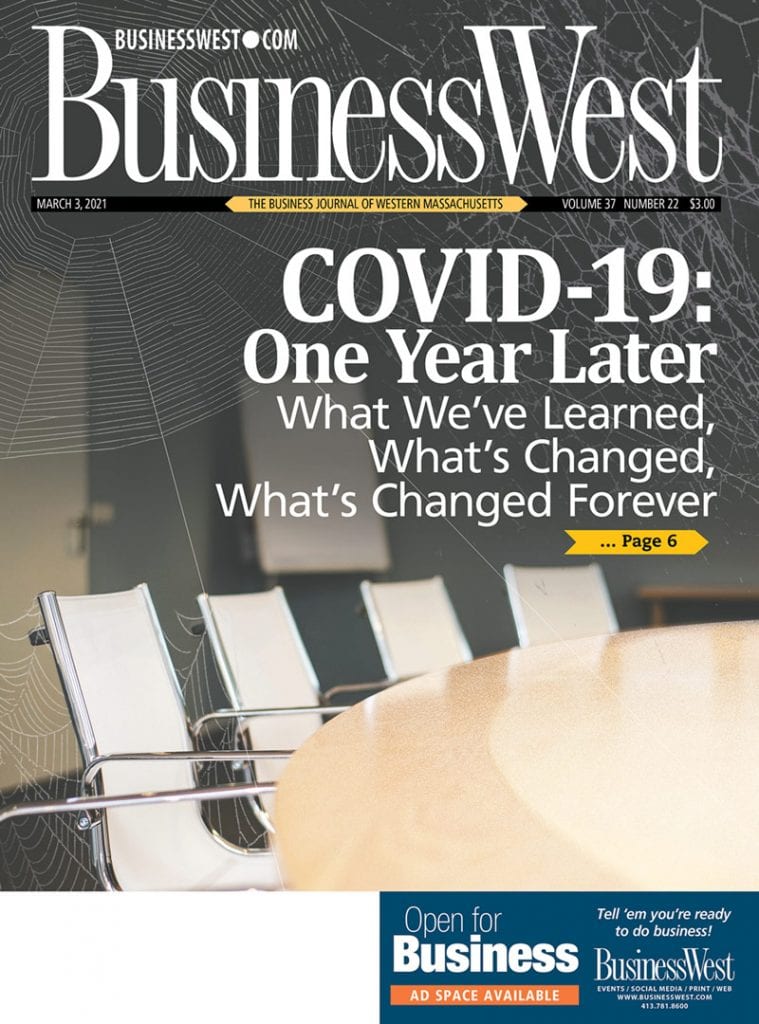
What We’ve Learned, What’s Changed, What’s Changed Forever

One year ago, the world, or at least our little corner of it, stopped. Completely.

Well, almost completely. Better to say that it paused — big time. The COVID-19 pandemic had arrived in the 413 and elsewhere, and life as we knew it had given way to something else. Something much different. Something the likes of which we had never seen or dealt with before.

The cover of the March 16, 2020 issue of BusinessWest captured it perfectly. Above a set of empty conference-room chairs was the headline “Life in Limbo.”

Almost exactly a year later … the chairs in the conference room are, for the most part, still empty. In some cases, they haven’t moved or been sat in since last March. They sit, waiting for people, and normalcy — whatever the heck that is — to return.

The fact is, we don’t know what ‘normal’ will be moving forward. In many respects, we don’t know exactly how COVID will reshape the landscape and the workplace, higher education, and the medical center down the street. We don’t know how it will impact the delicate work/life balance moving forward, and we don’t exactly know how it will permanently change how we work, network, gather, and interact with others.

But we can certainly talk about, and for the one-year anniversary of COVID (nothing to celebrate, that’s for sure), we did. BusinessWest gathered leaders with six area businesses and institutions to talk about the many ways COVID has changed our work and our lives, how it is impacting the workplace (and will for years to come), and even how it is has made them all different and, in their view, better managers.


They’re calling it the ‘Zen room.’

That’s an apt name for an area being set aside at Mercy Medical Center at which employees can decompress and, hopefully, remove some of the stress from their lives, at least for a while.

“We want to offer space that’s extremely tranquil — it will have massage chairs and soothing color schemes,” said Deborah Bitsoli, the hospital’s president, noting that it should be ready for use soon. “It will literally be Zen-like; it’s a best practice, and it can actually be brought across different industries.”

This Zen room wasn’t created because of the pandemic, necessarily, but rather because of the way it helped crystalize the large amounts of stress people are under even in normal times, and how they need rooms like this. And it is just one example of how the pandemic has brought about change in the workplace and change in society in general.

Other examples include that same hospital offering what it calls ‘resiliency training’; a local bank interviewing — and strongly considering — a job candidate living in Florida who has no intention of moving here; and employers spending considerable time and energy on the questions involving whether employees come back to the office, when, how, and under what circumstances.

These are some of things we learned during a lengthy virtual roundtable involving six area business leaders: Bitsoli; Mary-Beth Cooper, president of Springfield College; Robert Johnson, president of Western New England University; Jennifer Rymarski, a partner with the regional law firm Morrison Mahoney; Tom Senecal, president and CEO of PeoplesBank; and Paul Stelzer, president of Holyoke-based Appleton Corp., a property-management firm that has many elder-care facilities in its portfolio.

This was a Q&A, but also a lively discussion, with the dialogue focused on not only what’s happening today, but what will happen moving forward because of what we’ve experienced, what we’ve learned, and what we’ve changed over the tumultuous and very difficult past 12 months. Here’s a somewhat condensed version of how it went.


BusinessWest: The phrase we’re hearing over and over and over again is that there is light at the end of the tunnel when it comes this pandemic and all that has come with it. Are you seeing that light, and, well, how much tunnel do we still have to go through? What are you seeing in your business?


Bitsoli: These are challenging and unprecedented times, and at Mercy, we’ve really tried to adapt to a new norm. We have many new processes and structures that, as someone who has dedicated their life to healthcare since the age of 16, I never thought I’d see. We’ve also opened our doors to give vaccines to the public based on the Department of Health criteria; to see tears in people’s eyes as they get a vaccine is something I’ll cherish for many, many years.

We’ve balancing the needs of the community and keeping people safe, but we’re also looking to the future and how we can more provide enhanced services to the community. We’re trying to balance the present and the future.


Cooper: This is our third semester in the pandemic, and we’re adapting. We are back on campus, we’re fully residential, and we had our first athletic contest recently — the men’s gymnastics team played Cal. So, yes, we are seeing some light at the end of the tunnel. When we thought about the pandemic and what we needed to do, we had to pivot, just like healthcare; we didn’t imagine going online as quickly as we did, but we made it happen. The biggest takeaway for me thus far, and moving forward, has been the resiliency our faculty and students, in particular, have demonstrated.


Johnson: We’re in good shape for the shape we’re in, and like others, we do see a light at the end of the tunnel. As for what’s changed for our organization, we’re future-focused; we’re looking at how we want to come out of this. We’ve been planning for the next five years at Western New England since last September. We have not taken the bunker mentality of waiting for the storm to pass and then figure out what we want to do. We’ve created a vision; we want to be a ‘new traditional university,’ a phrase we’ve coined here and that we’ll define in the upcoming weeks and months to come, and imagine the possibilities.

That’s because higher education, like healthcare, has been turned upside-down; we’re reimagining ourselves, and we think the best is yet to come. It’s tough, though … we’re in a very tough environment.


Rymarski: We all have our own struggles, and the law is not immune to it. The biggest impact has been access to the courts and how the courts have adjusted — a lot of litigation is driven by the court schedule, and having the courts shut down for a period of time has had an impact. Also, we’ve gotten a lot of calls on the employment aspects of this pandemic — small businesses, and all businesses, for that matter, are struggling to deal with smaller staffs, how a PPP loan impacts them, what they’re going to do under the Family First or CARES Act, how they’re going to get employees back, and how they implement policies and procedures across the board that are going to be fair but also abide by all of the regulations.


Senecal: When this whole thing started right around March 9 — I remember that date vividly — I think I stopped breathing sometime in the middle of March, and I was resuscitated sometime in June, because it looked really bad from my perspective. June came around, summer came along, and things started to look a lot better. Then fall came around, and as cases picked up, that started to have an economic impact on a lot of our customers.

To put things in perspective, we had probably $300 million in loan balances involving customers in that first month asking, ‘can we not pay you?’ And we responded like most community banks and said, ‘yes, no problem; let’s revisit in 90 days.’ I think we’re down to $70 million, which allows me to start breathing again, and most of that $70 million is in the hospitality industry — transportation, restaurants — which is still struggling. I’m not sure where the light is at the end of the tunnel for those industries, because they’re hanging by a thread, and I’m not sure how they’re going to come back. From our banking perspective, we’re operating in a different world; we had to pivot, we had to send 180 people home, and that’s hard to do in retail banking. And if any of you have done your banking, I apologize for us — and I know our competitors are the same way — that the drive-ups are ridiculously backed up. Overall, things are going OK, but it doesn’t feel very good.

Tom Senecal

Tom Senecal

“I’ve flip-flopped on this throughout the year, but, yeah, we’re coming back. The social-interaction part of this is lost with people working at home; you can’t create a corporate culture from a remote location.”


Stelzer: At Appleton, we’ve morphed from emergency-response protocols in March to highly organized COVID-19 protocols in our elderly/senior/multi-family apartment communities and in our commercial portfolio that we manage, which is about 2 million square feet. In short, we’re operating at high levels; we’re able to do that even with a chunk of the workforce being remote. All of our employees have had to learn a new COVID language and new COVID protocols amid all the important tasks they already do.

Overall, there’s a lot of good news coming out, but how we’re doing is still a daily question; while the vaccine rollout is encouraging, it’s still going to take some time. But, yes, there is light at the end of the tunnel.


BusinessWest: During the pandemic, people have worked remotely, and successfully. As we all look toward the day when something approaching normal returns, how will, or should, companies approach work and the question of bringing people back to the office?


Senecal: We have 350 employees, and about half of them are working from home. I’ve flip-flopped on this throughout the year, but, yeah, we’re coming back. The social-interaction part of this is lost with people working at home; you can’t create a corporate culture from a remote location. Beyond that, there’s the human connection — staying home is not good for mental health. But I’m for some sort of balance; if your job allows it, you can work from home — we’ve proven that. I do think the outcome of this is that there will be a balance. From a workforce perspective, we’ve had a hard time recruiting people for some key positions, and we’ve re-evaluated to say, ‘no, you don’t have to be in the office.’ We’re interviewing someone today who lives in Florida who may be able to work from home for us; we’ve never, ever considered that before, and we are.


Cooper: When it comes to students … there were some questions pre-pandemic about the value of higher education. And I would say to you that our students are saying loud and clear that they want to be in person, face to face, they want to play sports, they want to interact with mentors like faculty members and staff members. We’re studying this … we’re looking at what the future will look like and how we bring people back safely. Some people never wanted to work at home, and now some of those same people want to stay where they are. That’s a risk to our business model; we need to have the interaction between students and mentors that shape them moving forward to be strong employees in the fields we have represented on this panel. The synergy of having people together, the opportunity to come up with ideas and piggyback on them together, and just the joy of being in the workplace, it’s difficult to get all of that on a call or on Zoom.

Mary-Beth Cooper

Mary-Beth Cooper

“The synergy of having people together, the opportunity to come up with ideas and piggyback on them together, and just the joy of being in the workplace, it’s difficult to get all of that on a call or on Zoom .”

Johnson: One of the things I’ve been big on over the past decade is preparing students for the future of work and making sure they had the essential skills that could not be replicated by robots. This pandemic has put us in a place where we, as employers, with our employees, have to do the same thing. I don’t think it’s an either/or when it comes to Zoom or face to face. The question is, ‘how do we use that technology to complement our ability be more efficient in the workplace?’ On college and university campuses, we need to be face to face and on the ground, but I can now give my employees some flexibility; it’s not 8 to 5. If they have a soccer game or child care doesn’t show up that day, we’ve shown that that we can get work done with people working from home. As managers, we have to teach people how to work with their teams and their staffs to give them that work-life balance. Overall, I think the pandemic has merely accelerated what was inevitable anyhow.


Rymarski: I agree with the others when they say that synergy, flow, and the social and cultural aspects are missing when people don’t come to the office. I think about the new employees who came on board just before the pandemic, and not having them in the office and having them shadowing someone every single day for a week or two to learn what needs to be done. I think that has impacted them. At the same time, this pandemic has, indeed, accelerated a process that was inevitable. I think the challenge is handling all this; we’ve basically condensed down what we need to do to a very short time, and employers are struggling to manage the expectations of every person.


BusinessWest: From what’s been said so far, it seems that the pandemic has brought the issue of work/life balance into the forefront as perhaps never before. Talk about if and how this crisis has provided more impetus for employers to help their employees with this challenge and cope in general.


Cooper: The need to be compassionate and caring for your employees has never been higher. These employees are dealing with losses — children that they haven’t seen, aging parents that they can’t see … the human toll is very high.


Johnson: I would agree with that wholeheartedly. We talk about work/life balance, and we’ve been talking about it for a long time. One of the things we’ve learned is that, before, managers would have said, ‘you can’t have that work/life balance; you have to be here all the time when you’re supposed to be here.’ But when we had to flip on a dime and make this thing work, it’s amazing how resilient we really are. The human toll that this is taking on people is huge, and we have to give our employees some time to breathe when this is all said and done. I know eight people who have died since last March. When I said that on a Zoom call, people started tearing up, because they’ve had those same kinds of experiences and no way to grieve. Part of this equation is that we have to figure out in our organization what that grieving process looks like, and what is the path forward.


Stelzer: What I think is really important going forward in the work/life balance issue is not only their own personal situations, but how do you get people to understand that they don’t need to work 14 hours a day at home? A lot of people dove into their work because they could. I’ve talked with a lot of tenant companies, service providers, attorneys, CPAs, whatever, and they’re all working longer hours than they ever were before. This is something we have to keep on the radar moving forward; if you’re going to remain in a quasi-remote-work environment, how do you find balance and work 9 to 5? (Or 9 to 7 — no one really works 9 to 5.) How do you shut it off?

Jennifer Rymarski

Jennifer Rymarski

“I think about the new employees who came on board just before the pandemic, and not having them in the office and having them shadowing someone every single day for a week or two to learn what needs to be done. I think that has impacted them.”

Bitsoli: The one thing that we all have in common is that our workforce is our most precious asset; it’s what makes us able to do the things we do. And these people are hurting right now. Last Friday, I came in early in the morning and was rounding in the ICU; there was a nurse who had just lost a COVID patient. She was relatively young, and she was weeping. We need to allow people to grieve in these unprecedented times because we haven’t seen this in our lifetime. People need the ability to express themselves. On the mental side, we need to allow them to talk, and we need to listen. And we need to support our management team and train them on how to do that.

The other thing that’s very unique about this is that many people have aging parents who are in nursing homes, and there’s social isolation — they can’t visit their parents. So not only do they have child-care issues, they are so concerned about their aging parents, and yet they can’t get in to to see them. But beyond the mental, there’s also the physical, and that’s why we’re opening the Zen room, where people can go for 15 minutes and just decompress.


BusinessWest: You’re probably all very tired of hearing that phrase ‘new normal’ by now. But please try to project what the new normal will be in your industry and in business in general.


Johnson: The new normal in higher education is that we have to rethink and reimagine our business model so that we are financially viable while also meeting the needs of our students. Also, before, we used to be able to operate with 80% or 90% of certainty and 10% or 20% of ambiguity. The new normal is … we’re going to be in a world of ambiguity where it’s more like 50-50 for years to come. The new normal for us also in our industry will be, how do we address and deal with the mental-health challenges of our current students, our future students, and our employees?

And let me really focus on future students — students who will be enrolling in our institution two or three years from now will have spent their freshman and sophomore years [of high school] basically learning remotely, and that B+ or A- in Calculus in their junior and senior year won’t be the same B+ or A- it was four or five years ago. So students will be coming to us with academic deficits, emotional deficits, anxiety deficits, and we’re going to have to think about how to retool and restructure ourselves to meet their needs on our campuses. And we all have to be focused on the future of work in terms of educating this next generation of students for jobs that don’t exist, utilizing technologies that haven’t been created, to solve problems that haven’t been identified.

Robert Johnson

Robert Johnson

“The human toll that this is taking on people is huge, and we have to give our employees some time to breathe when this is all said and done.”

Cooper: Moving forward, we have to focus on the 4 Vs of higher education, and any not-for-profit, caring organization. Value — you need courageous leaders who are thinking not only about work-life balance, but the human element. Virtual — we’re going to have a hybrid mix. We’ve seen that in all the trends, and that’s good; there’s demand for it, some students really like it, and some faculty like it. Virtuous — we’re going to need to continue to be people-centered. For us to move forward, the colleges and the universities that will survive are the ones that are student-centered, that continue to be students at the forefront. And we have to go Viral — we have to find a way to tell our story, whether it’s through discussions like this, through social media, or through our students and faculty.

From my perspective, it’s all about leadership, virtual presence, telling the story, and staying close to your mission.


Senecal: The new norm in the banking business? I don’t want to get too granular, but the future of our business is very different. There are a little under 5,000 banks in this country — I project that in five to seven years, there will be fewer than 2,500 banks. It will be a digital world. I think you’ll see far fewer branches — you’ll see more and more branches closing.

And from a workforce-development perspective, technology is going to be a huge piece of what we do, and certainly on the mental-health side, I see employers having to be more flexible and understanding with their workforce. PeoplesBank has done that very well over the years; we’re just going to have to adapt a lot more quickly. Workforce skills are going to have to adapt tremendously for all our industries; we’re moving toward a more technology-driven world. It’s already changed for us — we’ve seen a huge change in the last nine months. Our numbers in the digital perspective and how people utilize their banking services has shifted 20% to 30% utilization that is totally digital. If you weren’t there before the crisis, you’re going to fall behind from an industry perspective. My perspective is that things are going to change; things are going to be very different than they are now.

Deborah Bitsoli

Deborah Bitsoli

“The one thing that we all have in common is that our workforce is our most precious asset; it’s what makes us able to do the things we do. And these people are hurting right now.”

Stelzer: ‘New normal’ is an interesting phrase, but there’s nothing normal about this. As we stabilize, as more vaccine gets out, I agree with the panel — resiliency is huge. In our industry, specifically our senior/elderly portfolio, you’re going to see a lot more ‘healthy housing’ initiatives, as we’re calling them, which is a combination of telehealth for seniors and more on-site clinics for seniors. You’re going to see a whole difference in the way legacy elderly/senior property providers handle their air flow, their air circulation, and keep any inflection to a low level.

Also, on the digital side … think about how we stood the country up on the backs of broadband — it’s nothing short of amazing in all of our industries, from higher ed to telehealth to property management and banking. And we couldn’t have done that 20 years ago. My one concern there is the digital divide. What happens next with broadband becomes a very important discussion; there’s already discussion in the State House about making broadband a normal utility and not a private service.


Bitsoli: On the healthcare front, we need to continue to have a laser focus on the resiliency and well-being of our colleagues and our employees — they’re the most valuable asset that any of us has. And as this virus evolves, as there are variants, and as there are future viruses, there is a daily drive here around clinical excellence and patient safety and quality where we may have to continue to adapt that clinical model.

I never thought I’d see the day when 100% of the patients are being swabbed for a virus … so, for me, looking at the clinical excellence and keeping the public safe with high-quality care, and how this virus evolves, we’re going to have to be able to adapt to whatever the future holds for us to keep the community safe.”


BusinessWest: Much has been made about how to manage, and manage effectively, in a time of crisis. How has the crisis tested you? What have you learned about yourself, as a person and a manager? And has this made you a better manager?


Cooper: Let me say, my patience has been tested, certainly, since last March, and I’m working hard at meeting people where they’re at and listening and trying to slow down. And I’m also trying to be a good role model — not having Zooms on Sunday and carving out time for family. To lead during this turbulent time, you have to be self-aware, and you have to take care of yourself. Whether it’s morning exercise or carving out parameters for when you will or will not be available — people are looking for you to role-model that.

Paul Stelzer

Paul Stelzer

“People recognize fake really quick, so you’ve got to be genuine, you’ve got to be honest with them, you’ve got to tell them how it is.”

Stelzer: The key word for me is empathy. All of us have had to really dig deep for the non-traditional ways of providing support — all kinds of support — to our people and managing and being empathetic to the extent that you can and still run your business. It’s critically important — people recognize fake really quick, so you’ve got to be genuine, you’ve got to be honest with them, you’ve got to tell them how it is. And I agree with Mary-Beth — you have to take care of yourself. We’ve all walked the halls of our houses and condos from 2 in the morning to 4 in the morning trying to figure out the next move. We’ve all been there.


Senecal: I agree with Paul; empathy is a great word to describe the difference between managing now and managing pre-COVID. We’re all living this horror, so to speak, and realizing that we all have different issues in our lives, between family members getting sick, or trying to work at home with kids at home trying to do schoolwork, with technology issues … pre-pandemic, we glossed over these things. During the pandemic, this home life is hugely important in people’s lives. I’ve come to listen more, but empathy is the word that comes to light; I’m trying to understand how to manage people.


Johnson: I would add another word in there, and that’s humanity. I’ve come to realize the importance of helping us all understand that we’re part of something bigger than ourselves. Mary-Beth spoke earlier about how, among the college and university presidents, it has been the most collaborative environment that she’s ever seen; I’ve been in the Commonwealth for 11 years, and I’ve never seen anything like this, either. As CEOs, we tend to think that we’re at the center of the universe, but we’re not; we’re only as good as the people around us. And I understand what Mary-Beth means when she talks about patience. I generally don’t have much of an impacting gene, but it has developed since March of last year in ways I couldn’t have imagined.


Bitsoli: I’ve recognized just how precious life is, and I’m really stopping and forcing myself to be in the moment, to listen and engage, and slow down. But just as important is demonstrating that to my management team so that I’m also walking the talk in terms of saying to them, ‘life is precious; let’s have a better way of approaching our work life and recognize that life is very, very short and we have to respect and really take care of each other as colleagues.’


Rymarski: Patience, empathy, and flexibility are all words that come to mind. But also fairness. From the legal perspective, one of things that’s important as employers and managers is that we want to have a fair playing field, or as fair a playing field as we can. What you may have to do for one might be different than what you have to do for another, but there needs to some semblance of not only empathy, but also fairness and some structure to keep the organization together so that employees don’t become disgruntled with one another.


Bitsoli: Not only has this made me a better manager, it has made me a better person, and I think others on this panel would agree. I think I learned a lot about myself and about society, and, again, about the value of life. As a society, there are quite a few of us who have reflected in this way, and we’re better people overall.


Business Talk Podcast Special Coverage

We are excited to announce that BusinessWest, in partnership with Living Local, has launched a new podcast series, BusinessTalk. Each episode will feature in-depth interviews and discussions with local industry leaders, providing thoughtful perspectives on the Western Massachuetts economy and the many business ventures that keep it running during these challenging times.

Episode 54: Mar. 1, 2021

George O’Brien talks with Aaron Vega, the former state representative who is now director of Planning and Economic Development in the city of Holyoke

Vega

BusinessWest Editor George O’Brien talks with Aaron Vega, the former state representative who is now director of Planning and Economic Development in the city of Holyoke. The two discuss the city’s efforts to recover momentum lost to the pandemic, and zero in on efforts to expand a budding cluster of cannabis-related businesses in this former mill town. New operations are opening soon, said Vega, and many more are on the drawing board. It’s must listening, so join us on BusinessTalk, a podcast presented by BusinessWest in partnership with Living Local.

Also Available On

Class of 2021 Cover Story Difference Makers Event Galleries

Did you miss our 2021 Difference Makers event?

View the virtual event recording!

Congratulations to the Class of 2021 Difference Makers! Thank you to our sponsors and everyone who helped to make this event possible. We appreciate you all!

Thank you to everyone who participated in the #EverydayDifferenceMakers social media campaign. We had an overwhelming number of submissions and are extremely excited to share the good work being done in #the413 during our Difference Makers event!

View the 2021 Difference Maker Honoree Videos:

The 2021 Difference Makers

Kristin Carlson
President, Peerless Precision

Janine Fondon
Founder, UnityFirst.com; Professor, Bay Path University

Harold Grinspoon
Philanthropist; Founder, Aspen Square Management


Chad Moir
Founder and Owner, DopaFit Parkinson’s Movement Center

Bill Parks
CEO, Boys & Girls Club of Greater Westfield

Pete Westover
Founder and Partner, Conservation Works, LLC

EforAll Holyoke

Presented by:

Non-profit Partner:

Media Partner:

Sponsor Videos

Agenda

Virtual Town Hall to Discuss Baystate Mary Lane Closure

Feb. 23: Baystate Health will hold a virtual town hall at 5 p.m. to discuss the closure of the Baystate Mary Lane Outpatient Center in Ware and future plans for patient care. All are welcome to attend. Baystate Health’s goal over the next several months is to work collaboratively with the Baystate Mary Lane team and engage with the community in developing an orderly transition plan for programs and services to Baystate Wing. In June, the emergency facility will close, and cancer care services will be transitioned to the D’Amour Center for Cancer Care. Over the next two years, imaging/3D mammography and rehabilitation services, as well as ob/gyn and pediatric medical practices, will relocate to Baystate Wing. Cancer patients who receive care at Baystate Mary Lane will be offered transportation at no charge following the transition of care to Springfield. To support access to outpatient appointments at Baystate Wing Hospital when the two Baystate medical practices at Baystate Mary Lane transition over the next two years, Baystate will look to the foundation it has built with the Quaboag Connector and, if feasible, will further invest in this resource. More information will be forthcoming as needs, services, and transportation options are evaluated. To register for the virtual town hall, visit baystatehealth.org/easternregion.


40 Under Forty Nominations

Through Feb. 26: BusinessWest is currently accepting nominations for the 40 Under Forty class of 2021. The deadline for nominations is Friday, Feb. 26. Launched in 2007, the program recognizes rising stars in the four counties of Western Mass. Nominations, which should be as detailed and thorough as possible, should list an individual’s accomplishments within their profession as well as their work within the community. Nominations can be completed online at businesswest.com/40-under-forty-nomination-form. Nominations will be weighed by a panel of judges, and the selected individuals will be profiled in BusinessWest in May and honored at the 40 Under Forty Gala in late June. Event sponsorship opportunities are available.


Institute for Trustees

Starting April 7: Berkshire Taconic Community Foundation (BTCF) announced it is partnering with the Essex County Community Foundation (ECCF) in presenting the 2021 Institute for Trustees, an annual conference inviting nonprofit leaders to gather together for educational workshops and networking opportunities. Building on the success of BTCF’s 2018 Board Leadership Forum and designed for board leaders and executive directors, the event features 24 virtual workshops from leading nonprofit experts and opportunities to connect with hundreds of peers equally committed to their leadership roles. This partnership is part of a broader effort between BTCF and ECCF to leverage resources in support of building capacity and leadership within the nonprofit sector, given the challenges facing organizations due to the pandemic and its economic consequences. The Institute for Trustees kicks off on April 7 with a keynote address by Phil Buchanan, president of the Center for Effective Philanthropy, titled “Leading for Nonprofit Impact Amid Unprecedented Challenge.” Beginning April 9, workshops and opportunities to connect with fellow attendees through topic-driven, informal peer discussions will be spread over the course of four weeks. Workshop topics include racial equity, endowment building, crisis planning, governance, advocacy, finance, and much more. To register for the program, visit eccf.org/ift. Registrations will be accepted at a discounted early-bird rate of $110 until March 7. After that, registration will cost $130 and will close April 7.


Springfield Partners for Community Action Scholarships

Through April 23: Springfield Partners for Community Action announced it will award a number of $1,000 scholarships that can help recipients with tuition and alleviate the cost of going back to school and investing in bettering themselves. All applicants must be Springfield residents, and income-eligibility guidelines may apply. Scholarships will be awarded to those attending accredited/licensed schools in Massachusetts. Applications must be received by April 23. Late entries will not be considered. If selected, recipients must be available to attend an awards event (most likely virtual) in June. Visit www.springfieldpartnersinc.com/whatwedo/scholarshipsprogram for the application form and information on how to apply.


Opinion

They’re All Making a Difference

Since BusinessWest started its Difference Makers recognition program in 2009, we’ve told dozens of stories involving individuals, groups, and institutions that are positively impacting life in the 413.
Each one is different, although there are some common threads, and each one is inspiring. And this is the point of this exercise, if you will — to tell these amazing stories, because they need to be told, and to inspire others to find their own way to make a difference in their community.
The Difference Makers class of 2021 certainly continues this tradition. The stories beginning on page 22 convey, in a single word, the passion that these individuals and groups have for helping those in their communities and improving quality of life here. And they all go about it in a different way:

• Kristin Carlson, by becoming the face, or the new face, of manufacturing in this region. And a new voice as well, one that works overtime (that’s an industry phrase) to educate people, and especially young people, about the many opportunities in this field. Her efforts are already reaping dividends, as evidenced by her own shop floor, which now boasts a number of women in machining positions;

• EforAll Holyoke, by becoming another powerful force in the region’s entrepreneurship ecosystem. Through its accelerator programs, mentorship initiatives, and other ongoing forms of support, this nonprofit is helping many people, especially those in the minority community, realize their dreams of owning their own business;

• Janine Fondon, by being a constant source of energy and ideas, through initiatives ranging from UnityFirst.com, a national distributor of diversity-related e-news, to programs like On the Move, which bring women, and especially women of color, together for forums that are designed to engage, educate, and inspire;

• Harold Grinspoon, by being a successful business person, but especially by being a philanthropist who has never stopped asking about how he can help. Over the years, he has launched initiatives to support entrepreneurship at area colleges and universities, assist the region’s farmers, celebrate excellent teachers, and improve Jewish life and culture;

• Chad Moir, by creating the DopaFit Parkinson’s Movement Center, inspired by the experience of his late mother, to help those suffering from this dreaded disease live healthier, more confident lives through various forms of exercise that have proven to slow the progression of symptoms;

• Bill Parks, by not only helping young people and their families access critical programs through the Boys & Girls Club of Greater Westfield, but by using his own experiences to show them that their dreams and goals really are possible. His club’s programs not only impact young people’s lives today, but help them take charge of their future; and

• Pete Westover, for working tirelessly to help preserve and protect this region’s open spaces through a remarkable, decades-long career that featured a lengthy stint as conservation director in Amherst and ongoing work as managing partner of Conservation Works, which is involved in a wide range of preservation, trail-building, and other types of projects across the Northeast.

We salute these members of the class of 2021, and encourage others to read their stories and become inspired to find new and different ways to make a difference here in Western Massachusetts.

Opinion

An Appreciation for Chris Thibault

Filmmakers are storytellers. That’s what they do. They tell stories, and they help others tell their stories.

That’s what Chris Thibault did, and he was very good at it. He started Chris Teebo Films, and he worked with businesses and institutions across this area — from Spirit of Springfield to BusinessWest and its many award recipients and program sponsors Mercedes-Benz of Springfield — to help them communicate and get their messages across.

In recent years, though, the most compelling story Chris told was his own — specifically his long and difficult battle with cancer, which ended this week when he died at age 38. Starting from when he was first diagnosed with breast cancer, Chris used his talents and his desire to help others to take his battle public, through short films, blog posts — including one titled “How to Run a Production Company While Living (or Dying) of Stage 4 Cancer” — and more.

In the course of doing so, he became an inspiration to many, and in a number of ways. It was more than Jim Valvano’s famous ‘don’t give up, don’t ever give up’ messaging — although there was some of that. His message was more along the lines of never letting cancer run his life or tell him what he could or couldn’t do.

And there was still more to this story. Indeed, even though he was dealt a very bad hand and had every reason to say ‘why me?’ or bemoan his fate, he didn’t. He accepted what was happening to his body, and he never stopped trying to be upbeat, optimistic, and even humorous.

Indeed, when he talked with BusinessWest about that aforementioned blog post and the subject matter involved, he said simply, “I haven’t figured that one out yet … and to be honest, I wrote the title to get your attention so you would actually start reading the thing.”

Like all good filmmakers, he did grab your attention, and he held it.

His story certainly did not end the way he or all those who loved and admired him wanted, but it was one that left us even more thankful for the time we had with him — and more appreciative of the time we have on this planet. Period.

We thank him for that, and we thank him for the way he inspired us to live life to the fullest, even when serious roadblocks are put in front of us.

The best story he told was his own.

Class of 2021

She Has in Many Ways Become the Face of Manufacturing Locally

Leah Martin Photography

Kristin Carlson calls it the ‘Boston Marathon bomber story.’

Because … it’s about Dzhokhar Tsarnaev, one of the two brothers who perpetrated those heinous crimes almost eight years ago now. More to the point, though, it’s about the role her company played in eventually apprehending him.

Indeed, Tsarnaev was found hiding in a boat in a backyard in Watertown, and he was discovered through the use of a thermal-imaging camera in a police helicopter flying over the area. Carlson’s company, Westfield-based Peerless Precision, makes several components for that camera, including one for the cryogenic cooling system that ensures that the camera doesn’t overheat during use.

As she held one up for BusinessWest to see, she said just showing people the part isn’t nearly as impactful as trying to explain what it’s used for — or, in this case, how it can play a significant role in writing history.

That’s why she tells the Boston Marathon bomber story often, although she admits that its days might soon be numbered. That’s because she usually tells it to young people in the hopes that they might be intrigued enough by it to perhaps pursue a career in precision manufacturing. And by young, she means high-school age, and preferably middle-school age. And those in that latter category are now, or soon will be, too young to really remember the 2013 bombing and its aftermath.

“I want to make sure that kids, and adults who are looking for another career option, are aware of what we do in Western Mass., and they know about the viability of a career in manufacturing and what it has to offer.”

But Carlson has other stories — perhaps not as dramatic or crystalizing. All of them are designed to show what precision manufacturing is all about, and also how companies in this area provide parts for helicopters, fighter jets and bombers, the Space Shuttle, medical devices, automobiles, submarines, and so much more. She often borrows the line used often by Rick Sullivan, now the president and CEO of the Western Mass. Economic Development Council but formerly mayor of Westfield, who would say that, if you saw a plane flying over the city, there’s a good chance that tens of thousands of dollars worth of its parts were made in the city.

Other stories talk about how someone manufacturing these parts can make a very good living and have a job with real security — yes, even in the wake of a global pandemic. And she tells them often, too.

Kristin Carlson holds up one of the parts her company

Kristin Carlson holds up one of the parts her company, Peerless Precision, makes for thermal-imaging cameras, like the one used to locate one of the Boston Marathon bombers.

And then there’s her story — a 38-year-old woman now managing this precision manufacturer. We’ll get to that one in a minute. These stories help explain why Carlson has been named a Difference Maker for 2021. Indeed, while she has helped grow the company since she took over for her father, Larry Maier, as he battled and eventually succumbed to cancer, she has made an even bigger mark — on a regional and now national stage — in the ongoing effort to educate people about what gets made here and also about careers in manufacturing, thus addressing ongoing issues involving workforce and a skills gap.

“I want to make sure that kids, and adults who are looking for another career option, are aware of what we do in Western Mass.,” she said, “and they know about the viability of a career in manufacturing and what it has to offer.”

In a field where complaints about these issues have been going on for decades involving generations of shop owners and managers, she has distinguished herself by going beyond complaining. Well beyond. In fact, in many ways, she has become the face of manufacturing in Western Mass. — a much different face than has ever been associated with this sector locally.

“Instead of sitting idly by and talking and complaining, I wanted to do something about it,” said Carlson, who was recently appointed to the state’s Workforce Training Advisory Board and also sits on the National Tooling and Machining Association’s AMPED (Advanced Manufacturing Practices and Educational Development) Board.

And while there’s still much work to be done, she has, indeed, done something about it, and that’s why she’s a Difference Maker for 2021.


Making Her Mark

Despite everything you’ve read already in this piece about manufacturing, what a good career it is, and how Carlson has thrived in it, she readily admits she had to be talked into coming back to this this region and Peerless Precision after her father got sick.

And it took a lot of talk.

She was living in San Diego at the time, working for a fire-alarm contractor, handling everything from inside sales to building websites to being the runner to go to City Hall and get the fire-alarm building permits for new construction.

In 2009, her father was diagnosed with colon cancer. “At the time, he asked me … if something ever happened, would I come home from California and help my mom either decide to keep the company or sell it,” she recalled. “My dad always wanted me to be doing what I’m doing now, and I was pretty much in a place at that point in my life where I needed to decide what my path was going to be on my own; I didn’t want someone else to define that for me.

“Because he was stubborn and I’m just as stubborn as he was, I fought what he wanted tooth and nail until it came time for me to make that decision,” she went on. “So when he asked me if I would come home if something happened, I said ‘yes.’”

Kristin Carlson, seen here with Peerless Precision machinist Kaitlyn Fricke

Kristin Carlson, seen here with Peerless Precision machinist Kaitlyn Fricke, says progress has been made to inspire women to enter the manufacturing field, but more work must be done.

Something did happen. After undergoing surgery and chemotherapy and eventually earning a clean bill of health, her father’s cancer not only returned but spread to other parts of his body. And Carlson kept her promise to her dad, even if he didn’t remember her making that promise.

That was in 2012. Since that time, Carlson has verified the faith her father had her, establishing herself not only at the company — transitions such as these are rarely seamless — but also in the industry, and especially in the broad realm of helping to educate people (and especially young people) about precision manufacturing as a career path.

Such efforts have been going on for decades, and Carlson notes that, in many respects, she is simply carrying on the work of her father, who was extremely active with workforce initiatives in this sector. Indeed, the two of them share what could only be called a passion for such work.

Much of her work involves debunking myths, or at least long-standing beliefs. There are many of them, and they range from those concerning the death of manufacturing in this region (it’s not what it was 30 or 40 years ago, to be sure, but it’s not dead) to the presumption that women can’t or shouldn’t get into this field, to the opinion that one has to go to college to succeed in life.

“I was pretty much in a place at that point in my life where I needed to decide what my path was going to be on my own; I didn’t want someone else to define that for me.”

Carlson, who went to college because she was told she needed to, is working on all these fronts simultaneously. She confronts the problem with statistics, with stories — like the one about the Boston Marathon bomber — and sometimes just by showing up in a room.

Indeed, as a woman not just in this industry, but one leading a company and sitting on regional and national boards, she has become an effective role model, or ‘exhibit A,’ if you will, when it comes to everything she talks about. As in everything.

“For a kid whose father had bought a machine shop and was pushed to go to college when I’m better at hands-on things … I wish I had been given different options,” she told BusinessWest. “My parents told me that I couldn’t make anything of myself if I didn’t have a college degree; that’s not a good message, but it’s also the message that was being pushed across the board back then — and still, today.”

Like her father, Larry Maier, before her, Kristin Carlson has made workforce development a passion and a big part of her life and work.

While the pandemic is keeping people from touring the facilities at Peerless Precision in person, there are still virtual visits, where young people can meet not only Carlson, but her pit bull, Bruno. They can also see six women on the manufacturing floor (years ago, they would only have seen them in the front office or shipping and receiving). And they can see parts like the one that goes into the thermal-imaging camera that captured Dzhokhar Tsarnaev in that boat.

“My parents told me that I couldn’t make anything of myself if I didn’t have a college degree; that’s not a good message, but it’s also the message that was being pushed across the board back then — and still, today.”

And they can hear Carlson talk about other things made in this region — from toys at LEGO and Cartamundi to ketchup bottles at Meredith Springfield to coolers at Pelican Products. Overall, it’s a powerful message, she said, but one that needs to be reinforced and told to new audiences every year, several times a year, if possible. That’s because those old myths, those old perceptions, die hard.


Parts of the Whole

Before ever telling the Boston Marathon bomber story, Carlson wanted to make sure she had her facts straight.

“When I saw our customer’s logo on that camera shot, I called him right away and said, ‘do you think there’s a possibility that that part in the camera that found the bomber is from our shop?’ — and he said ‘absolutely,’” she recalled, adding that additional research verified what she suspected.

She’s told the story many times since, because it conveys what many people don’t know, but should — that the precision-machining sector in this region is making a difference in the lives of people across the country.

Likewise, Carlson is making a difference as well, carrying on the work of her father in so many ways, and, as noted, becoming the face — or at least one important, perhaps unexpected face — in a sector with a rich history and, thanks to her efforts, perhaps an equally rich future.


George O’Brien can be reached at [email protected]

Class of 2021

This Nonprofit Ensures That Entrepreneurs Won’t Have to Go It Alone

Tessa Murphy-Romboletti, executive director of EforAll Holyoke.  (Leah Martin Photography)

“If your dreams don’t scare you … they are not big enough.”

That’s the quote, attributed to Ellen Johnson Sirleaf, Liberian president, economist, and Nobel Peace Prize winner, that is stenciled onto one of the walls at EforAll Holyoke’s headquarters on High Street, in the heart of the city’s downtown.

Tessa Murphy-Romboletti, executive director of this nonprofit since its inception, chose it for many reasons, but mostly because it resonates with her and also because it accurately sums up entrepreneurship in general, as well as the work that goes on in that facility.

In short, she said, dreams of running a business should scare someone, because there is nothing — as in nothing — easy about getting a venture off the ground … and keeping it airborne.

“Entrepreneurship is so terrifying,” she said. “And when our entrepreneurs come to us, they often don’t have the support of friends or families or big networks telling them to go for these dreams. That’s why we’re here — to tell them that they’re not alone … and that you have to be a little crazy to be an entrepreneur.”

Helping turn dreams into reality is essentially what EforAll is all about. This is a statewide nonprofit with offices in a number of cities with large minority populations and high unemployment rates — like Holyoke. Its MO is to blend education in the many facets of business with mentorship to help entrepreneurs navigate the whitewater they will encounter while getting a venture off the ground, to the next level, or even through a global pandemic (more on that last one later).

It will be many years, perhaps, before a city or a region can accurately gauge the impact of an agency focused on inspiring entrepreneurship and guiding entrepreneurs, but Murphy-Romboletti believes EforAll is already making a difference, especially with the minority population.

“The difference we make is very tangible for people who are seeking new sources of income for their families and themselves, and when you’re an entrepreneur who’s just getting started, it’s really hard to navigate where to go, who to talk to.”

“The difference we make is very tangible for people who are seeking new sources of income for their families and themselves, and when you’re an entrepreneur who’s just getting started, it’s really hard to navigate where to go, who to talk to,” she told BusinessWest. “The model that we use, providing really close mentorship, makes such a difference — you don’t have to go through the process alone.”

Her sentiments are backed up by some of those who have found their way to EforAll and been part of one of its many accelerator cohorts. People like Sandra Rubio.

Years ago, she started baking cakes for family members because she wasn’t happy with the quality and price of what she found in area stores. Soon, she was making cakes and other items for friends, neighbors, and even total strangers who had been exposed to her work. And her success promoted her to launch Totally Baked 413, which will soon open a location in the Holyoke Transit Center on Maple Street.

Sandra Rubio credits EforAll and its director, Tessa Murphy-Romboletti

Sandra Rubio credits EforAll and its director, Tessa Murphy-Romboletti, with helping her get her venture, Totally Baked 413, off the ground.

She credits EforAll with helping her make the leap from part-time activity to full-time enterprise — but not leap until she was ready and not make too big a leap too soon. She also credits her mentors and Murphy-Romboletti with getting her through those times when she was tempted to let the dream die.

“There were times when I just wanted to give up, say ‘forget it,’ and go back to work,” she recalled. “But then, I would meet with my mentors, meet with my class, and it got me right back on track — it gave me the push I needed to press on.”

And people like Jailyne Torres, who launched Shyguns, a creative clothing brand and seller of vintage clothing. She said she took part in the Spanish-speaking accelerator, called EsparaTodos, and credited EforAll with helping her gain consistency and take a concept she conceived when she was only 16 years old and make it into a business.

“I always had the idea, the concept, but I never really knew how to make it actually make it a brand,” she said. “But EsparaTodos helped me with all that.”

Such comments explain why EforAll, while still small and emerging, if you will, like the businesses it mentors, is already a Difference Maker in the community it serves.


Dream Weavers

As she talked with BusinessWest at EforAll’s facility, Murphy Romboletti said being there elicited a number of different emotions.

Indeed, while she said it always feels good to be in that space, COVID-19 has made the visits far more infrequent, and it has brought what is often an eerie quiet to a place that was always full of people and energy. The co-working space is now unused for safety reasons, and there are far fewer meetings and activities taking place there, with most programs carried out virtually. All this is made more frustrating by the fact that it took more than a year of hard work to secure the space and get it ready for its opening in the fall of 2019, only to have the world change and the space go mostly dark just a few months later.

“For those first couple of weeks when I would come back, it was like, ‘oh, man, this is tortuous — this is a hard pill to swallow,’” she noted before quickly taking the conversation in a different, more poignant direction. “The irony is that’s exactly what so many of my entrepreneurs were feeling; a lot of them, especially those in the cohort that we graduated that March, were just coming into the world as new entrepreneurs, and the world said, ‘hold on … we’ve got some other plans.’

“So, during the pandemic, we kind of became therapists for a while, listening to people’s concerns and what they needed help with, and trying to connect them with all the resources that were out there,” she went on. “But at the end of the day, there was so much that was out of our control; we tried to be as supportive as we could and continue to provide a community for them so they could survive this.”

COVID has changed some things, certainly, but when you get right down to it, EforAll Holyoke has always been about providing a community and helping entrepreneurs not only survive, but thrive.

Jailyne Torres says EforAll has been instrumental

Jailyne Torres says EforAll has been instrumental in helping her take Shyguns to the next level.

Launched five years ago as SPARK, the agency quickly became an important part of the region’s growing entrepreneurship ecosystem. In 2018, it affiliated with EforAll, short for Entrepreneurship for All, a network that now boasts eight offices across the state, including the most recent, in the Berkshires.

Like many of the other offices, the one in Holyoke now conducts accelerator programs in both English and Spanish (EsparaTodos), and graduates four cohorts of entrepreneurs each year, two in the spring and two in the fall.

Like most accelerators, these XX-week programs are designed to educate participants on the many aspects of starting and operating a business — everything from writing and updating a business plan to working with the media — while also connecting them with mentors who can impart their wisdom and first-hand experiences.

When asked what it’s like, Rubio said simply, “intense.” By that, she was referring to everything from the classwork to the back and forth with her mentors. And that intensity helped her persevere through the challenges of getting a plan in place, finding and readying the site for her bakery and café, and getting the doors open.

“So, during the pandemic, we kind of became therapists for a while, listening to people’s concerns and what they needed help with, and trying to connect them with all the resources that were out there. But at the end of the day, there was so much that was out of our control; we tried to be as supportive as we could and continue to provide a community for them so they could survive this.”

“Every time I was close to saying, ‘I’m done,’ they would say, ‘you’re on the right track; keep going,’” she recalled. “And we would keep going.”

Likewise, Carlos Rosario kept going with his venture, Rosario Asphalt, which specializes in residential driveways and repairs.

Rosario, speaking in English that is, like his bottom line, improving consistently from year to year, said EforAll has helped him make the big leap from working for someone else to working for himself.

He told BusinessWest that those at EforAll helped connect him with sources of capital, including banks and Common Capital, to secure loans that have enabled him to buy the equipment needed to handle more — and larger — jobs, including a trailer and a truck. And he’s hired his first employee, a truck driver.

“If it wasn’t for EforAll, I wouldn’t be where I am today,” he said, adding that the agency and the mentors assigned to him have helped with all facets of running a business, but especially with making those all-important connections to professionals, capital, and potential clients.

Torres agreed. She said EforAll has helped her with aspects of her business that people don’t think about when they’re focused on an idea and maybe a brand. Things like data entry, pricing, marketing, and “allowing transformation to happen.”

“When I started the project, it was based on the creative clothing part,” she explained. “And then, I was able to add second-hand clothing, and not limit what the future might bring.”

That’s certainly another colorful and poignant way of summing up what EforAll does for those who participate in its programs.


Scare Tactics

Here’s the full quote attributed to Ellen Johnson Sirleaf: “The size of your dreams must always exceed your current capacity to achieve them. If your dreams don’t scare you, they are not big enough.”

Most people have the capacity to dream as big as Johnson Sirleaf believes they should. But not everyone has what it takes to make those dreams become reality. Those who have entrepreneurial ambitions and spirit are among those who can.

But even such driven individuals can’t go it alone. EforAll exists to make sure they don’t have to. And that’s why it’s a true Difference Maker in Holyoke — and beyond.


George O’Brien can be reached at [email protected]

Class of 2021

By Highlighting and Supporting the Under-recognized, He’s Changing Lives

Leah Martin Photography

For almost three decades, Harold Grinspoon has built an impressive network of philanthropic endeavors by asking a key question: who deserves more help and recognition than they’re currently receiving?

The most recent major piece of that network, the Local Farmer Awards, are a perfect example.

“Farmers have a really hard time making a living, and they work so hard,” he told BusinessWest, citing, as an example, a farmstand he frequents in the Berkshires, whose proprietor once told him about her difficulties getting water from a nearby mountain to her farm.

“Selling corn at fifty cents an ear doesn’t leave too much extra for a pipeline,” he said. “She gave me an idea — what can we do for the farmers? Farmers need help. Farmers never ask for help. They’re the most humble, hardworking people in the world. And this idea came to me to help them with capital improvements.”

Since the 2015 launch of the Local Farmer Awards, the Harold Grinspoon Charitable Foundation (HGCF) has given 375 awards — of up to $2,500 — to about 200 farmers in Western Mass. to aid with capital projects. In doing so, the foundation and its team of corporate partners has invested more than $885,000 in local farming.

“Farmers need help. Farmers never ask for help. They’re the most humble, hardworking people in the world. And this idea came to me to help them with capital improvements.”

“We don’t do anything alone,” said Cari Carpenter, director of the Local Farmer Awards and the Entrepreneurship Initiative, two key programs of the HGCF. “Big Y came on board right at the start because they’re such advocates for local products and wanted to support the local farmers.”

Other program partners — Baystate Health, Ann and Steve Davis, Farm Credit East, HP Hood, and PeoplesBank — have signed on over the years as well, making the Local Farmer Awards an ideal representation of what Grinspoon tries to accomplish with each of his charitable programs (and we’ll talk about several of them in a bit). That is, partnering with like-minded individuals, foundations, and businesses to not only support worthy causes, but stimulate philanthropy across the region.

In other words, making a difference shouldn’t be a solo performance.

“From my point of view, if you made the money in the Valley, you’d better give it back to the Valley,” he said. “You have to give back. This is where you made your living, and these are the people you need to support.”

In the case of farmers, that support is more critical now than ever.

“To show you just how significant the need is, we just closed out our application cycle on January 31, and we had 170 applications,” Carpenter said. “These are 170 unique projects in our region, and when you read through them, the words ‘COVID’ and ‘pandemic’ were repeatedly mentioned, and how they’ve really had to change their whole strategy of ‘how do I even deliver products to customers?’

“We just feel we’ve met a need in good times, and it’s even more of a need now during this pandemic,” she went on. “We really want to help the farmers reach their full potential. It’s a hard business, and by giving them these awards to help them purchase a tractor implement or netting to cover their blueberry bushes so birds won’t get at them, or whatever the project is, it’s to help the farm reach their full potential.”

Harold Grinspoon congratulates honorees at the Local Farmer Awards (top) and the Excellence in Teaching Awards.

Harold Grinspoon, now 91 years old, has been helping people — and communities — reach their potential in myriad ways for decades now. He’s a Difference Maker not only for where he directs his money, but for the thought and passion he puts behind each initiative — and for planting the seed for others to get involved, too.


Giving Back

Grinspoon made his fortune as a real-estate entrepreneur, founding Aspen Square Management almost 60 years ago and watching the company bloom into a nationally recognized housing group managing more than 15,000 properties across the country.

In 1991, he established the Harold Grinspoon Foundation, focused on enhancing and improving Jewish life and culture. The Harold Grinspoon Charitable Foundation, which raises funds and awareness for a number of educational and entrepreneurial activities in the Western Mass. region, followed soon after.

As he worked his way up in real estate, he told BusinessWest in a 2008 interview, he developed a great sense of appreciation for the average blue-collar worker, and for the opportunities this country has afforded him, and felt a real responsibility to give back.

“I always knew, if I made it, I was going to give it away. I didn’t want to spend the entirety of my life making money,” he said at the time. “Philanthropy has, in many respects, set me free.”

Perhaps the best way to examine his collective impact is through his foundations’ individual programs, such as the Grinspoon Entrepreneurship Initiative, a collaboration among 14 area colleges and universities.

Behind Harold Grinspoon are photos

Behind Harold Grinspoon are photos of his large, colorful sculptures created from dead trees, many of which can be seen around the region.

Since 2003, the program has recognized and awarded more than 1,000 students for their entrepreneurial spirit and business ideas, while its entrepreneurship education, competition, and celebration events have reached well over 10,000 students and members of the community.

“That’s very close to my heart,” he noted. “Every college and university in the Valley is involved with that.”

The program actually offers four awards each year, each aimed at a different stage of the startup experience: elevator-pitch awards for compelling ideas, concept awards for startups in the pre-revenue stage, Entrepreneurial Spirit awards for companies that have begun to generate revenue, and alumni awards for later-stage successes.

“Elevating the stature of entrepreneurs has been incredibly impactful among these college students,” Carpenter said. “It gives them the sense this could be a viable career option. On top of that, it recognizes the importance of creative thinking — one of Harold’s beliefs — to help people realize the importance of being curious and using their creativity, and that’s what these entrepreneurs are doing.”

The Pioneer Valley Excellence in Teaching Awards debuted the same year, and with the same idea: to recognize, inspire, and help a critically important group of people.

“Financially, because I’m a businessman, I can afford to financially give. But I know people who are very humble financially, but are very giving of their time and energy and their spirit, and their legacy is so important to them.”

“To be a great teacher is amazing,” Grinspoon said. “They’re molding children at a very impressionable age, and we’re recognizing them for the outstanding work they do. I think someone should stand up and applaud the teachers.”

Applaud he does, at three separate banquets each year, to accommodate all the winners and the friends, families, and colleagues who come out to support them.

“If you know anything about Harold, he wants to recognize under-recognized people,” said Sue Kline, who spearheaded the Excellence in Teaching Awards for many years. “He thinks of his own path and the difference that teachers made in his own life, and he saw an opportunity where not enough was being done.”

These days, the program recognizes more than 100 teachers each year from about 45 school districts. “Like everything he does, it has evolved over time,” Kline said, noting that, in addition to the $250 cash prize, each honoree has the opportunity to apply for a Classroom Innovator Prize to bring some form of project-based learning into the classroom.

Harold Grinspoon in his art workshop

Harold Grinspoon in his art workshop with fellow artist Alicia Renadette.

“This isn’t really intended for teachers about to retire, although districts can nominate anyone they feel is outstanding,” Kline said. “It’s meant to encourage mid-level teachers who want to do more. That’s what the project-based learning part does — to help them do something they’ve always wanted to try.”

It’s an extra touch that separates these awards from other recognition programs, just as the Local Farmer Awards ceremony invites each winner to bring $50 worth of products, to create ‘harvest swap bags’ that all guests receive at the end.

“These things represent his own creative thinking, his own energy — the way he cares about children and teachers, or about farmers not being well-supported,” Kline said. “That depth doesn’t come from every ordinary philanthropist, but it is reflected in everything his foundation and his charitable foundation do.”


Global Impact

Though Grinspoon, understandably, wanted to focus his recent interview with BusinessWest on the local efforts of the charitable foundation, the Harold Grinspoon Foundation — the arm that focuses on Jewish life — has quietly become a powerhouse across the country and around the world. For example:

• JCamp 180, launched in 2004, helps build the capacity of nonprofit Jewish camps through mentorship, professional-development opportunities, and challenge grants;

• PJ Library (2005) connects people to a colorful world of Jewish history, tradition, and values by delivering Jewish-themed books to hundreds of thousands of children and their families around the world each month;

• Voices & Visions (2010) is a poster series eliciting the power of art to interpret the words of great Jewish thinkers;

• Life & Legacy (2010) helps Jewish day schools, synagogues, social-service organizations, and other Jewish entities across North America build endowments that will provide financial stability; and

• PJ Our Way (2014), the ‘next chapter’ of PJ Library, provides tweens (ages 9-12) the gift of Jewish chapter books and graphic novels.

Several years ago, Grinspoon’s vast array of work attracted the attention of Warren Buffett, who invited Grinspoon and his wife, Diane Troderman, to join the Giving Pledge, a commitment by the world’s wealthiest indivduals to dedicate at least half their wealth to philanthropy.

“I met some fantastic people through the Giving Pledge,” he said, and reiterated why he was already well on his way to fulfilling the pledge even before joining it. “I don’t understand how people with wealth don’t give it back. It’s foreign to me. And I’m not just talking about giving serious dollars; I’m talking about giving your time and energy.”

These days, Grinspoon has more time to work on his art — his large, colorful sculptures created from dead, reassembled trees can be seen throughout the region — while he enjoys seeing decades of work in philanthropy take root in other, very real ways.

“For me, it’s about developing your legacy,” he said. “Who do you want to be known as? Financially, because I’m a businessman, I can afford to financially give. But I know people who are very humble financially, but are very giving of their time and energy and their spirit, and their legacy is so important to them.”

In other words, anyone can be a Difference Maker — just look to Harold Grinspoon for inspiration, and get to work.


Joseph Bednar can be reached at [email protected]


Class of 2021

He Helps People with Parkinson’s Disease Live Healthier, More Confident Lives

Leah Martin Photography

Chad Moir calls his mother his greatest teacher.

“She really, truly lived by the mantra that you never look down on someone, and that you always stick your hand out to help them,” he said. “I’ve been lucky enough to be put in a position where I can help people while honoring my mother, and I can do it in a fun and exciting way.”

He’s referring to DopaFit Parkinson’s Movement Center, the business he started six years ago as the culmination of a tragic event — the premature passing of his greatest teacher, who was stricken with an aggressive form of Parkinson’s and was gone five years after her diagnosis.

Moir took his mother’s death hard. “I fell into a bit of a depression,” he told BusinessWest when we first spoke with him two years ago. “I hated Parkinson’s disease and everything to do with it. I didn’t even want to hear the word ‘Parkinson’s.’ But one day, something clicked, and I decided I was going to use my resentment toward Parkinson’s in a positive way and start to fight back.”

Today, DopaFit members, all of whom are at various stages of the disease, engage in numerous forms of exercise, from cardio work to yoga; from spinning to punching bags, and much more. On one level, activities are designed to help Parkinson’s patients live a more active life by improving their mobility, gait, balance, and motor skills.

“It has been proven through science that, when you do vigorous exercise while living with Parkinson’s disease, your symptoms won’t progress as quickly, and sometimes they are halted for a while as well. We have seen people whose symptoms have regressed.”

But research has shown, Moir said, that it does more than that: exercise releases the neurotransmitter dopamine into the brain, slowing the progress of Parkinson’s symptoms.

“Exercise is the only proven method to slow down the progression of Parkinson’s disease,” he told BusinessWest. “It has been proven through science that, when you do vigorous exercise while living with Parkinson’s disease, your symptoms won’t progress as quickly, and sometimes they are halted for a while as well. We have seen people whose symptoms have regressed. The goal is for people not to progress, or progress slowly, but if we can reverse some of those symptoms, that’s a big win.”

Members are typically referred to Moir from their movement-disorder specialist, neurologist, or physical therapist. “A lot of times, for our older members, it can be one of their kids who finds us; their parent was diagnosed with Parkinson’s disease, they want to do anything they can to help, and they come across us online.”

Whatever the case, Moir and his team will meet with the individual and often a family member and discuss symptoms, their story, and how DopaFit might help.

“We have about a 99% success rate of people who try it and stay,” he said. But getting in the door — or online, as the case may be in this challenging time — is only the beginning.


Recognizing a Need

Moir’s own beginnings in a career focused on this deadly disease was a half-marathon in New York City to raise some money for the Parkinson’s Disease Foundation. He ended up collecting about $6,000, and started to think about what else he could do for the Parkinson’s community.

Chad Moir says membership was climbing

Chad Moir says membership was climbing steadily before the pandemic, and it has been a challenge to keep everyone engaged, whether in person or virtually, over the past year.

While attending classes at American International College, he saw a need for a Parkinson’s exercise group in the area. “There is a lack of Parkinson’s services in general. I really, truly believed that if I built it, they would come. That was our motto, and I stuck to that motto through the hard times, and it certainly has brought us here. We thought there was a need, and we’ve proven there was a need.”

He started working with individuals in their homes, then opened the first DopaFit gym in Feeding Hills in 2015. He moved to the Eastworks building in Easthampton a year later, and then to the current location, at the Red Rock Plaza in Southampton, in 2018 — a site with more space, ample parking, and a handicapped-accessible entrance. He also launched a second, smaller DopaFit location in West Boylston.

When they first arrive at DopaFit, members undergo an assessment of where they are physically and where they would like to be in six months. Then they’re assigned to one of two exercise groups. One includes people who don’t need assistance getting in and out of chairs and can move about freely with no assistive equipment, like canes, walkers, or wheelchairs. The second group requires a little more assistance.

“With the group-exercise portion, that’s where we have to be very imaginative and come up with fun and different ways to work with you because there are different levels of disease progression,” he explained.

Programming has continued to expand. “Our goal is to provide every non-pharmalogical therapy that you can in one place for people with Parkinson’s disease,” Moir said. “So we have yoga, tai chi, our exercise classes and movement program, and the Art Cart.”

That latter piece, a nationally recognized creativity and movement program for individuals with Parkinson’s disease, was launched by Moir’s wife, Saba Shahid, who nominated him for the Difference Makers award.

The Southampton center is DopaFit’s third Western Mass. location, but Chad Moir envisions a larger space down the line, with more Parkinson’s treatment services in house.

“Chad is truly the definition of a Difference Maker,” Shahid wrote. “He has provided countless hours of free educational services for patients and assisted-living and nursing centers that provide support to people with Parkinson’s, and has spoken at a variety of seminars with the simple goal of spreading awareness about Parkinson’s and the importance of exercising for disease management. His dedication and love for others is seen in his daily efforts.”

Moir is always open to new modalities as well, such as a recent addition, ‘laughter yoga.’ A member brought the idea to him, and it turned out one of the practice’s leading instructors lives in East Longmeadow, and was happy to teach a class.

“Everybody loved it,” Moir said. “People said it made a difference that day, and in the days after, to be able to laugh again.”

Indeed, the past year has brought unforeseen stress to the lives of everyone, including business owners like Moir and the folks with Parkinson’s disease he serves.

“We had been growing exponentially prior to the pandemic; we had a little over 100 members, and we’d see about 80 of those members every week, at different sessions,” he recalled. And when COVID-19 shut down the economy, including DopaFit’s facilities, Moir had to pivot — fast.

“Yes, we do exercise, but we also educate, and then we empower. So we had to move the education online as well. Even though we couldn’t be in the space, we were able to support them physically and mentally.”

He quickly moved to an online model, starting with prerecorded exercise videos, daily e-mails, and phone calls. Zoom classes followed, which were more engaging and interactive than the videos, and trainers could work with members to make sure they were doing everything correctly.

“We did our best to keep our members engaged,” he added, through efforts like webinars with movement-disorder specialists to make sure members stayed current with the latest information. “Yes, we do exercise, but we also educate, and then we empower. So we had to move the education online as well. Even though we couldn’t be in the space, we were able to support them physically and mentally.”

While the West Boylston facility remains shuttered and programs are run completely virtually, DopaFit’s Easthampton site opened about four months ago to small, scaled-down classes — two groups of no more than four people each — who work out separated by distance and dividers, and all surfaces and equipment are sanitized between each use.

“People who come say they feel 10 times safer here than they do going to the grocery store,” Moir said.

Through it all, he had his worries about surviving such a difficult time.

“The rent didn’t stop. The space was closed, but the bills were still here. But we’re blessed with a tremendous community,” he said, noting that local groups ran fundraisers to support DopaFit, and he was able to keep the business in operation and pay employees through the pandemic. “You truly see the impact when it’s taken away. Even people who don’t come here but know what we do wanted this service to stay available to the people in this community.”


Moving Ahead

Through it all — the expanded membership, and then the obstacles posed by COVID-19 — DopaFit’s outreach in the community has only grown, Moir said. “We’ve made some great connections with the local physical therapists and neurologists in the area, which has helped tremendously. We are now well-known as a very viable and necessary option for someone with Parkinson’s disease.

“When it comes to being innovative and trying new things, that is something we will always do,” he added. “The world is ever-changing, and there are so many great people who do so many great things that can help someone with Parkinson’s disease.”

With that in mind, the next goal is a larger, standalone building that offers not just a big exercise room, but plenty of rooms for other services, from education to support groups to social work. In short, Moir wants to take what he’s learned in the past six years and build a truly one-stop destination for people with Parkinson’s disease to access the resources they need.

Some things he’s learned have been unexpected — like mastering Zoom.

“I helped so many people navigate Zoom, many of them older people,” he said. “I figure, if this doesn’t work out, I can go to Zoom and work for their technical support. I’ve got that down.”

Fortunately for so many, his day job seems to be working out just fine, despite the recent challenges. And he’s grateful his members have a place where they can come and, well, just be themselves.

“It pains me to hear someone stopped talking to their friends because ‘I don’t want them to pity me.’ Or, ‘we used to go out to dinner every Thursday, but I stopped going because I shake too much and don’t want people looking at me.’

“But after spending time here with other people with Parkinson’s disease, they come back and say, ‘you know what? I felt confident to go out and have dinner with my friends, and I felt better than I’ve felt in 10 years,’” he said. “So the exercise is a beneficial part of this; it can physically make someone better. But being able to feel better and be more confident gives them so much empowerment in other ways.”

That’s yet another difference Moir wants to make in people’s lives, as he continues to honor the legacy of one great teacher.

“Knowing that I can make a difference in someone’s life, just a little bit of difference, means the world to me,” he said. “It’s the fuel that keeps me going through the day. And that we’ve been able to figure out how to do it on a bigger scale is just very exciting.”


Joseph Bednar can be reached at [email protected]

Class of 2021

When It Comes to Land Preservation, He’s Been a Trailblazer

Leah Martin Photography

Pete Westover says his appreciation of, and passion for, outdoor spaces traces back to a family vacation trip to, among other places, Rocky Mountain National Park in Colorado, or Rocky, as it’s called, when he was 12.

The park, which spans the Continental Divide, is famous for its grand vistas, high alpine meadows, and dramatic walking trails, some of them at elevations of 10,000 feet or more. And, suffice to say, the park made quite an impression on the young middle-school student.

“There’s bighorn sheep and mountain goats and all kinds of great wildlife and flora,” he noted, adding that he’s been back several times since. “The road goes well over 11,000 feet, so you’re up there among the peaks.”

It was this trip that pretty much convinced Westover he wanted to spend his working life outdoors. And if he needed any more convincing, he got it while working in a hospital just after high school, at a time when he was still thinking about going to medical school and following in the footsteps of his father, who became a doctor.

“I realized, there’s no way I want to spend my time in time in a hospital or a clinic,” he told BusinessWest, adding that he instead pursued a master’s degree in forest ecology at the Yale School of Forestry and Environmental Studies.

“Pete has dedicated his entire career to conserving land and creating trails — the Valley’s forests and farms simply would not be as intact as they are today if Pete Westover hadn’t been a prime champion for their protection.”

Thus, as they might say in what has become his line of work, he took a different trail than the one he originally envisioned. Actually, those who know him would say he’s blazed his own trail — in every aspect of that phrase.

It has led to an intriguing and highly rewarding career that has included everything from work on a helicopter forest-fire crew in Northern California when he was in college to a 30-year stint as conservation director for the town of Amherst, to his current role as founder and partner of Conservation Works, a conservation firm involved with open space and agricultural land protection; ecological and land-stewardship assistance to land trusts, towns, colleges, and other entities; and other services.

Described as a “legend” by one of those who nominated him for the Difference Maker award, Dianne Fuller Doherty, retired executive director of the Massachusetts Small Business Development Center Network’s Western Mass. office (and a Difference Maker herself in 2020), Westover has earned a number of accolades over the years.

These include the Valley Eco Award for Distinguished Service to Our Environment, in his case for ‘lifetime dedication and achievement’; the Governor’s Award for Open Space Protection; the Pioneer Valley Planning Commission’s Regional Service Award; the Massachusetts Assoc. of Conservation Commissions’ Environmental Service Award; and even the Millicent A. Kaufman Distinguished Service Award as Amherst Area Citizen of the Year.

Pete Westover, center, with fellow Conservation Works partners Chris Curtis and Elizabeth Wroblicka

Pete Westover, center, with fellow Conservation Works partners Chris Curtis and Elizabeth Wroblicka in Springfield’s Forest Park, where the company is currently working on several projects.

And now, he can add Difference Maker to that list, a title that certainly befits an individual who has preserved thousands of acres of land, created hundreds of miles of trails, and even helped innumerable parks and other open spaces identify and hopefully eradicate invasive species.

“Pete has dedicated his entire career to conserving land and creating trails — the Valley’s forests and farms simply would not be as intact as they are today if Pete Westover hadn’t been a prime champion for their protection,” wrote Kristin DeBoer, executive director of the Kestrel Land Trust, a partner and client of Conservation Works on many of its projects, in her nomination of Westover. “The number of conservation areas and protected farms that Pete has been involved with are too many to name.”

While justifiably proud of what’s been accomplished in these realms over the past several decades, Westover stressed repeatedly that this work has never been a one-man show. Instead, it’s always been accomplished through partnerships and teamwork, especially when it comes to Conservation Works.

“This is such a great valley to work in,” he told BusinessWest. “There are so many dedicated people in our field; we’re just lucky to be in a place where there are so many forward-looking people.”

Westover is certainly one of them, and his work (that’s a broad term, to be sure) to not only protect and preserve land, but educate others and serve as a role model, has earned him a place among the Difference Makers class of 2021.


Changing the Landscape — Or Not

It’s called the Robert Frost Trail, and it’s actually one of several trails in the Northeast named after the poet, who lived and taught in this region for many years.

This one stretches 47 miles through the eastern Connecticut River Valley, from the Connecticut River in South Hadley to Ruggles Pond in Wendell State Forest. Blazed with orange triangles, the trail winds through both Hampshire and Franklin counties, and includes a number of scenic features, including the Holyoke Range, Mount Orient, Puffer’s Pond, and Mount Toby.

And while there are literally thousands of projects in Westover’s portfolio from five decades of work in this realm, this one would have to be considered his signature work, first undertaken while he was conservation director in Amherst, but a lifelong project in many respects.

Indeed, those at Conservation Works are working with Kestrel on an ongoing project to improve the trail. But the Robert Frost Trail is just one of countless initiatives to which Westover has contributed his time, energy, and considerable talents over the years. You might say he’s changed the landscape in Western Mass., but it would be even more accurate to say his work has been focused on not changing the landscape, and preserving farmland and other spaces as they are.

And even that wouldn’t be entirely accurate. Indeed, Westover said, through his decades of work, he hasn’t been focused on halting or even controlling development, but instead on creating a balance.

“When I worked with the town of Amherst, our philosophy was, ‘we’re not trying to prevent development; we’re trying to keep up with it,’” he explained, adding that this mindset persists to this day. “For every time you see a new subdivision go up, it makes sense to address the other side of the coin and make sure there are protected lands that people can have for various purposes.

“When you see real-estate ads that say ‘near conservation area,’ or ‘next to the Robert Frost Trail’ … that’s important to the well-being of a town or the region to have that balance,” he went on, adding that it has essentially been his life’s work to create it.

Top, Conversation Works partner Dick O’Brien supervises volunteers at Lathrop Community in Northampton in bridge building on the Lathrop Trail off Cooke Avenue. Above, several of the company’s partners: from left, Fred Morrison, Dick O’Brien, Molly Hale, Chris Curtis, and Laurie Sanders.

Tracing his career working outdoors, Westover said he started at an environmental-education center in Kentucky, where he worked for three years. Later, after returning to Yale for a few more classes, he came to Amherst as its conservation director, a role he kept from 1974 to 2004. In 2005, he would partner with Peter Blunt, former executive director of the Connecticut River Watershed Council (now the Connecticut River Conservancy) to create Conservation Works. Blunt passed away in 2010, but a team of professionals carries on his work and his legacy, and has broadened the company’s mission and taken its work to the four corners of New England and well beyond.

But over the years, Westover has worn many other hats as well. He’s been an adjunct professor of Natural Science, principally at Hampshire College, where he has taught, among other courses, “Conservation Land Protection and Management,” “The Ecology and Politics of New England Natural Areas,” “Ecology and Culture of Costa Rica,” “Geography, Ecology, and Indigenous Americans in the Pacific Northwest, 1800 to Present,” and, most recently, “Land Conservation, Indigenous Land Rights, and Traditional Ecological Knowledge.”

He’s also penned books, including Managing Conservation Land: The Stewardship of Conservation Areas, Wildlife Sanctuaries, and Other Open Spaces in Massachusetts, and served on boards ranging from the Conservation Law Foundation of New England to the Whately Open Space Committee.

“When I worked with the town of Amherst, our philosophy was, ‘we’re not trying to prevent development; we’re trying to keep up with it. For every time you see a new subdivision go up, it makes sense to address the other side of the coin and make sure there are protected lands that people can have for various purposes.”

But while he spends some time behind the keyboard, in the lecture hall, or in the boardroom, mostly he’s where he always wants to be — outdoors — especially as he works with his partners at Conservation Works on projects across New England and beyond.

The group, which now includes seven partners, handles everything from conservation of open space and farmland to the development and maintenance of trails; from invasive-plant-management plans to what are known as municipal vulnerability-preparedness plans that address climate change and the dangers it presents to communities.

And, as Westover noted, teamwork is the watchword for this company.

“One of the things that attracted me to Conservation Works is that all of the professionals have very unique skills, and we all complement one another,” said Elizabeth Wroblicka, a lawyer and former director of Wildlife Lands for the Massachusetts Division of Fisheries and Wildlife. “Land conservation is multi-faceted, from the acquisition to the long-term ownership to the stewardship, and with the wildlife biologists we have, the trail constructors, boundary markings … I do the contracts, but we all have a piece that we excel in.”

Chris Curtis, who came to Conservation Works after a lengthy career with the Pioneer Valley Planning Commission as chief planner and now focuses extensively on climate-change issues, agreed. He noted that, in addition to land preservation, trail-building and improvement, and other initiatives, the group is doing more work in the emerging realm of climate resiliency — out of necessity.

“We’ve been working with the town of Deerfield for four years,” he said, citing just one example of this work. “We’ve helped it win grants for more than $1.2 million worth of work that includes a municipal vulnerability-preparedness plan, flood-evacuation plans, a land-conservation plan for the Deerfield River floodplain area, and education programs, including a townwide climate forum that was attended by 200 to 300 people.”

Such efforts to address climate change are an example of how the group’s mission continues to expand and evolve, and how Westover’s broad impact on this region, its open spaces, and its endangered spaces grows ever deeper.


Seeing the Forest for the Trees

Reflecting back on that trip to Rocky, Westover said that, in many ways, it changed not only his perspective, but his life.

It helped convince him that he not only wanted to work outdoors, but wanted to protect the outdoors and create spaces that could be enjoyed by this generation and those to come. As noted, he’s both changed the landscape and helped ensure that it won’t be changed.

He’s not comfortable with being called a legend, but Difference Maker works, and it certainly fits someone whose footprints can be seen all across the region — literally and figuratively.


George O’Brien can be reached at [email protected]

Cover Story Top Entrepreneur

Golden Opportunities Maintains a Torrid Pace of Growth, Diversification
From left, Golden Years principals Brian Santaniello, Mary Flahive-Dickson, and Cesar Ruiz Jr.

From left, Golden Years principals Brian Santaniello, Mary Flahive-Dickson, and Cesar Ruiz Jr.

Cesar Ruiz Jr. describes the business plan for Golden Years Homecare Services as “a living, breathing document.”

That intriguing phrase was chosen to convey many things all at once — especially movement, flexibility, seemingly constant change, and a certain ambitious tone.

Indeed, while every business plan is fluid and most are written in pencil — figuratively speaking, anyway — this one has been altered countless times since it was first drafted more than eight years ago, and the new lines on the page reflect why Ruiz, the company’s president, and the entire leadership team at this East Longmeadow-based venture have been named Top Entrepreneur for 2020 by BusinessWest.

Indeed, since being launched in 2016, this company, which started with home-care services, has expanded in every way imaginable. That includes its geographic footprint — it has moved well beyond its Greater Springfield roots and into Central Mass. and Northern Conn., with a new satellite office in downtown Boston set to open later this year. It also includes services; sensing opportunities, the company has expanded into behavioral health and will soon open a staffing component as well. And with a planned acquisition that Ruiz said is now “on the 2-yard line” — which means he can’t talk about it in any real detail, as much as he would like to — Golden Years will expand the portfolio to skilled care in the home.

There’s also been seemingly constant expansion of the facilities in East Longmeadow, with a buildout now in progress for the staffing and behavioral-health pieces of this ever-changing puzzle. And, looking ahead, plans are taking shape to franchise some of the services, expand into many more states, and perhaps take the company public to raise the capital to fuel all this expansion.

“The exciting thing is that we’ve only scratched the surface.”

Like an artist’s canvas, Golden Years is taking shape — and changing shape — quickly and dramatically, with those holding the brushes not exactly sure what the picture will look like when they’re done — or what ‘done’ will mean.

“We’re beginning our fifth year of operation, and it’s said that when you hit that fifth year, that’s when you really lay down that foundation,” said Ruiz. “We have grown by leaps and bounds in terms of our census, not only with our clients, but also with our caregivers; overall, we’re an organization that’s now managing more than 1,000 people, including administrative, caregiver staff, and clients.

“And the exciting thing,” he went on, “is that we’ve only scratched the surface.”

Not even a global pandemic has been able to slow this company down.

The sign on the property in East Longmeadow’s center announced the arrival of the Golden Years Behavioral Health Group, one of many indicators of growth at this company.

The sign on the property in East Longmeadow’s center announced the arrival of the Golden Years Behavioral Health Group, one of many indicators of growth at this company.

OK, it did slow it down a little. Last spring, as the virus invaded the region, some of the company’s home-care clients became understandably concerned about bringing people into the home and canceled or suspended services, and some caregivers decided they no longer wanted to be in that line of work, said Mary Flahive-Dickson, the company’s chief operating officer and a 30-year healthcare veteran, adding that the virus also slowed the pace of expansion into the Central Mass. market.

But, ultimately, opinions concerning homecare during this pandemic changed, she said, adding that many came to view that option as being far more attractive than a nursing home or other types of long-term-care facility, places that saw outbreaks of the pandemic and, in some cases, large numbers of deaths.

This change in attitude is reflected in the growing numbers of clients in the Greater Springfield area, she said, adding that the census is now approaching and perhaps over the 500 mark, representing roughly 20% growth over the past year — again, in the middle of a pandemic.

“Having been in home care for more than two decades, and in healthcare for more than three, the home is far less of a risk, with the pandemic protocols that are going on now, than a facility,” she said, adding there is growing sentiment within the healthcare profession that this trend, or movement, if it can be called either, could have a degree of permanence, especially at a time when some are warning that COVID-19 will certainly not be the last deadly virus to threaten the world’s population.

Meanwhile, the pandemic and its impact on the overall mental health of area residents certainly played a role in propelling the company into the behavioral-health realm, said Ruiz.
Cesar Ruiz Jr. projects that Golden Years could again double in size

Cesar Ruiz Jr. projects that Golden Years could again double in size over the next five years as the venture expands into new markets and new service areas.

That division of the company, if you will, was launched roughly a year ago, but the pandemic has certainly elevated the level of need and validated the decision to again rewrite that business plan and move into this field.

“Even though there’s a lot of agencies in the behavioral-health realm, we still felt there was an opportunity for us,” said Ruiz, noting that this division provides an array of services, including alcohol- and drug-addiction services and counseling to frontline workers such as police and firefighters.

For this issue, BusinessWest talked with the principals of Golden Years about how far this company has come in five short years, and just what Ruiz meant when he said they had barely scratched the surface.


Shining Examples

“We don’t look at ourselves as competitors — that’s a word that we don’t use here. We’re creators — we create our niche. And we do that by telling our story and emphasizing our services.”

That’s what Ruiz told BusinessWest when we talked with him roughly 14 months ago. That was his answer to a question concerning the home-care market in the Greater Boston region (and this one, as well), the many players already on that field, if you will, and his thoughts on why he thought there was room for one more.

His reply speaks to the confident operating tone at this venture, and offers, all by itself, some insight into why the company’s principals have been chosen for the prestigious Top Entrepreneur award, launched in 1996, and join an elite group of honorees (see chart, page 19) that includes college and hospital presidents, tech-startup founders, and many others.

“Over dinner, we realized that we had the same thoughts of creating a company that would satisfy a recognized need. We thought we could do better; we knew we could do better.”

Indeed, at Golden Years, they do look for niches, they really enjoy telling their story (we’ll get to it in a minute), and they put the emphasis on services. And, as Ruiz said, they don’t view themselves as merely another competitor in whatever field they happen to be entering, but as creators … of opportunities and, yes, niches.

That was true in homecare and in staffing, and it’s also true in behavioral healthcare, as Tracy Mineo, executive vice president of Golden Years Behavioral Health Services, explained when she was asked essentially the same question Ruiz was asked — about the playing field and why Golden Years saw opportunity within it.

“There are a lot of fine agencies operating in this region,” she said, noting that she worked for many years at one of them — Behavioral Health Network. “But even the bigger agencies … there is only so much that they can handle, especially during this time of COVID, when people are isolating; the agencies can only take on so many clients.

“So I think there’s more than enough room for these services,” she went on, adding, again, in the same fashion that Ruiz and others talk about the home-care side, that it is not merely about which services are being provided, but how.

And this brings us back to the Golden Years story. There are several, but this one is about Ruiz and his grandmother, who became the real inspiration for this venture. She needed home care in Florida more than 15 years ago, and Ruiz recalled for BusinessWest not only how poor that care was (he said family members generally provided the care for her), but also his resolve to create something much better.

That something better would eventually become Golden Years. That’s eventually. The timing and the setting were not exactly right for a new venture back then, he recalled, adding quickly that, after he relocated to this region, and especially after his father died in late 2016, he picked up the dream where he had left off.

Partnering with Lisa and Vincent Santaniello, who had similar experiences with caring for loved ones in the home, he launched Golden Years in early 2017.

“Over dinner, we realized that we had the same thoughts of creating a company that would satisfy a recognized need,” he explained. “We thought we could do better; we knew we could do better.”

Lisa Santaniello, executive vice president of Golden Years Homecare Services, agreed, noting that, from her first-hand knowledge, she understands the importance of home-care services to those suffering from a chronic condition, a devastating injury, a debilitating illness, or even loneliness, and that such individuals would certainly benefit from companion services.
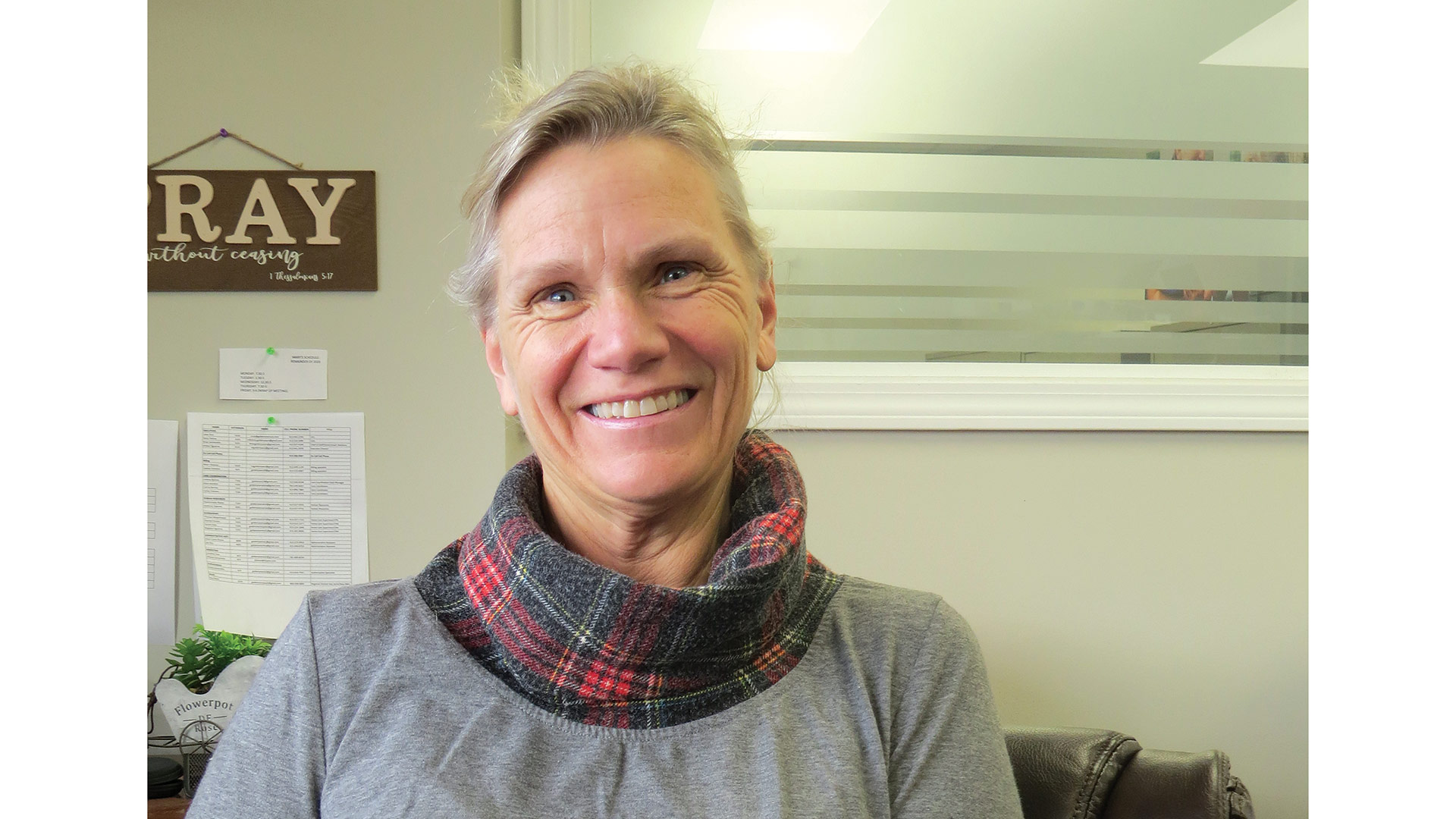
Mary Flahive-Dickson says the pandemic initially forced many to cancel or suspend home-care services.

Mary Flahive-Dickson says the pandemic initially forced many to cancel or suspend home-care services. But as time went on, many came to see the home as a safer alternative to nursing homes and other facilities.

“When chronic care is needed or a medical crisis occurs, I am very aware the entire extended family is affected along with the patient,” she told BusinessWest. “Lives are turned upside-down; schedules are disrupted. Sometimes, needed care is short-term; the patient will recover, and normalcy will be restored. Other times, health conditions are far more long-lasting, and improvement does not occur.

“My own mother suffered from a debilitating and chronic disease. She had the benefit of a large, extended family who could assist in coordinating care and provide the services she needed,” Santaniello went on. “Many people aren’t that fortunate; that’s where Golden Years comes in. We provide necessary home-care services to the patient, while also providing respite for their weary caretakers.”

Business was slow to start — Ruiz recalls that it was weeks after opening before the phone really started ringing — but it picked up quickly.

Flahive-Dickson, a long-time healthcare consultant and educator focusing on healthcare management, joined the company in 2019 to essentially take the home-care component to the next stage — or stages. These include expansion within this market and also into other regions, starting with Central Mass. She said her role has evolved over time and now includes elements of operations, development, and strategic planning.

Her comments about why she joined the venture speak volumes about the ambitious mindset that prevails and the entrepreneurial nature of the company.

“I saw a wonderful vision and a throwback to the way care was provided,” she explained. “My dad was a physician in the Springfield area, and his care was real and positive and forward-thinking care, and I felt that same feeling when I first came here.”


Showing Their Metal

While the home-care operation has become a regional success story, to be sure, there have been some growing pains, and the pandemic certainly created a number of challenges.

As for the growing pains, they involve everything from finding adequate numbers of caregivers — a challenge for every player in this business — to breaking into established markets with large numbers of competitors, like Worcester and Boston, and, to a lesser extent, Northern Connecticut.

Finding adequate numbers of caregivers has been a constant challenge, said all those we spoke with, but an array of factors, from what had been historically low unemployment rates to the pandemic-induced anxiety about going into others’ homes, to the company’s torrid pace of growth, has only exacerbated the problem.

And the company has responded in what can only be called an entrepreneurial way, with creation of its own education program and a collaborative initiative with the city of Springfield to help train young, homeless individuals and bring them into this profession.

Meanwhile, the pandemic has created more hurdles, said Ruiz, listing everything from those initial fears about bringing people into the home — he estimates that between 60 and 80 clients suspended service for some period of time last spring — to what to do with caregivers sidelined by those suspensions of services (they kept them on the payroll); from the need to secure PPE for staff and train them in how to use it, to paying what became exorbitantly high prices for that PPE.
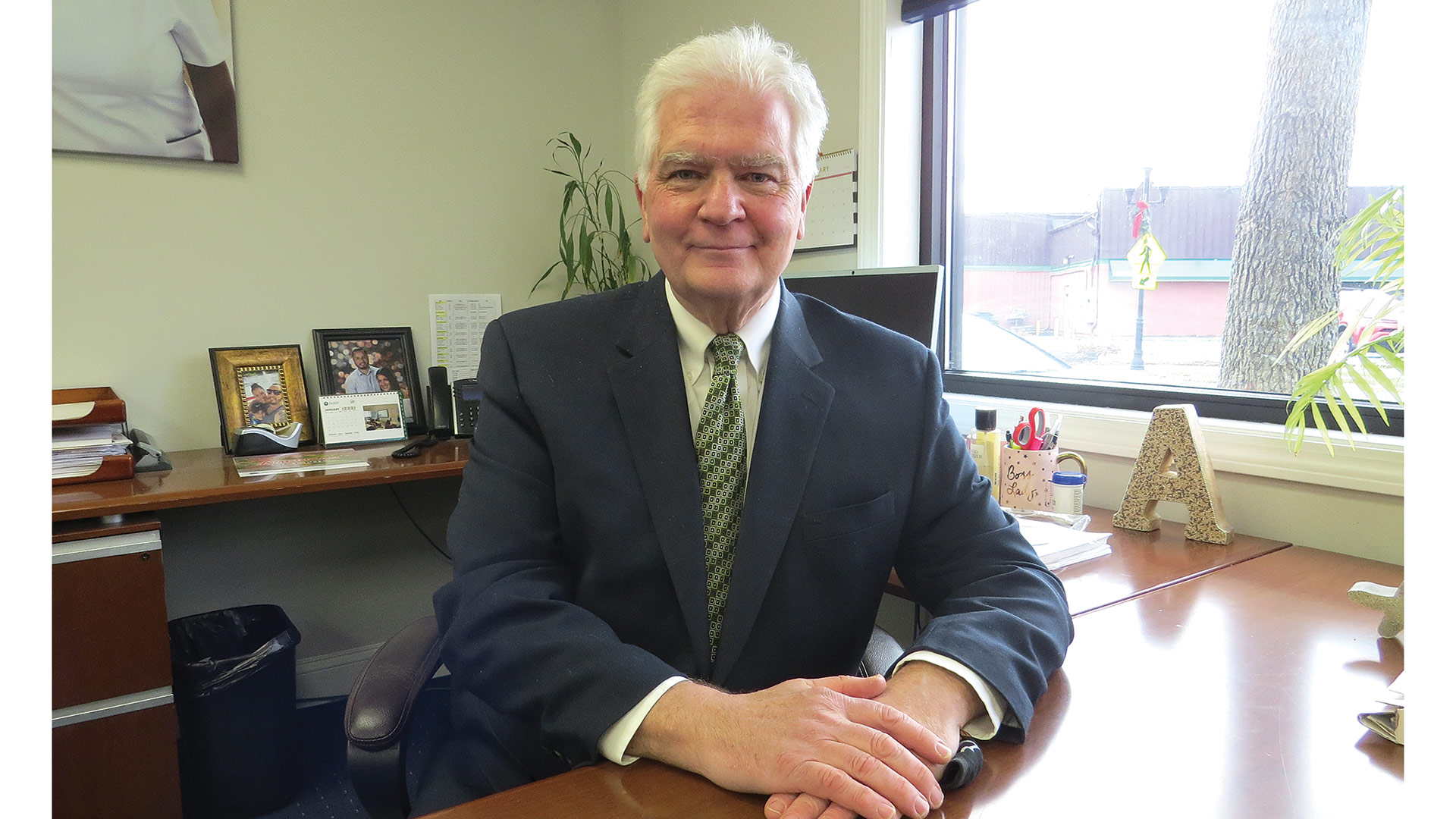
Brian Santaniello, chief of staff at Golden Years

Brian Santaniello, chief of staff at Golden Years, says the pandemic, and its broad, negative impact on mental health, validated the company’s expansion into behavioral-health services.

“We were experiencing the same problem everyone else was encountering — where to buy it,” he recalled. “And if we could find it … it was a terrible experience; things that we were paying 30 cents for were now costing us $1.25 or $1.50. The N-95s that were costing us 95 cents or a dollar … we were now paying $4.50 to $6 per mask.”

Flahive-Dickson agreed, and said procuring the needed supplies became a “24-hour mission” that involved all those at the company. But elements of that experience were rewarding, and even uplifting, she went on, citing volunteer efforts to not only make masks for some of the home-care providers, but also donate supplies to other institutions that were having issues, as well as gift bags to seniors and veterans.

But despite the pandemic, and in some ways because of it, the company has been able to maintain its strong pace of growth.

As Flahive-Dickson noted, attitudes about bringing people into the home — at least when viewed through the lens of a nursing home or similar facility being the most logical alternative — have certainly changed.

“We were getting calls all the time — the phone was ringing off the hook,” she said. “People were taking their loved ones out of facilities and saying, ‘now I need help.’

“There are many reasons why the home is now a safer haven than a facility, with the most obvious being that, if you’re having someone being taken care in the home, you have less than a handful of people taking care of that person,” she went on. “It’s the same person or the same team, and they are fully equipped with PPE. And they see only that one person, rather than going from room to room to room.”

These changing perceptions, along with a contract with the Commonwealth Care Alliance, one if its largest providers, and a growing relationship with the Veterans Administration, should help the company as it now moves forward with its expansion into Central Mass. — it now has a small number of clients in the Worcester area and a satellite office in Marlboro — and also into Boston, with another satellite office to open soon on Cambridge Street, said Brian Santaniello, the company’s chief of staff and a stakeholder.

“One of our primary goals for 2021 is to expand in those markets,” he said, adding that the company has a toehold in Worcester and Northern Connecticut, and is still in the infancy stages of its push into Boston, but expects the market share to grow steadily in all three regions over the next few years.


Forward Thinking

Moving forward, Golden Years is advancing plans to provide home care in multiple states, and that’s just one component of a larger expansion strategy.

Indeed, Ruiz and his team are preparing to unveil a staffing component, and it has already launched its behavioral-health division, one that was, as noted, partly inspired by the pandemic and the dramatically rising need for behavioral- and mental-health services, and likewise driven by recognized need for such services among the home-care clientele.

Indeed, Ruiz estimated that at least 15% to 20% of the company’s 500 clients are receiving some type of counseling service. With their entrepreneurial mindset, the company’s leaders began asking the question, ‘are these services that we can and should provide ourselves?’

The answer that came back was a resounding ‘yes,’ he went on. “We didn’t want to leave anything on the table; this was an opportunity for us to provide these kinds of services to our existing clients.”

Previous Top Entrepreneurs

2019: Cinda Jones, president of W.D. Cowls Inc.
2018: Antonacci Family, owners of USA Hauling, GreatHorse, and Sonny’s Place
2017: Owners and managers of the Springfield Thunderbirds
2016: Paul Kozub, founder and president of V-One Vodka
2015: The D’Amour Family, founders of Big Y
2014: Delcie Bean, president of Paragus Strategic IT
2013: Tim Van Epps, president and CEO of Sandri LLC
2012: Rick Crews and Jim Brennan, franchisees of Doctors Express
2011: Heriberto Flores, director of the New England Farm Workers’ Council and Partners for Community
2010: Bob Bolduc, founder and CEO of Pride
• 2009: Holyoke Gas & Electric
• 2008: Arlene Kelly and Kim Sanborn, founders of Human Resource Solutions and Convergent Solutions Inc.
• 2007: John Maybury, president of Maybury Material Handling
• 2006: Rocco, Jim, and Jayson Falcone, principals of Rocky’s Hardware Stores and Falcone Retail Properties
• 2005: James (Jeb) Balise, president of Balise Motor Sales
2004: Craig Melin, then-president and CEO of Cooley Dickinson Hospital
• 2003: Tony Dolphin, president of Springboard Technologies
• 2002: Timm Tobin, then-president of Tobin Systems Inc.
• 2001: Dan Kelley, then-president of Equal Access Partners
• 2000: Jim Ross, Doug Brown, and Richard DiGeronimo, then-principals of Concourse Communications
• 1999: Andrew Scibelli, then-president of Springfield Technical Community College
• 1998: Eric Suher, president of E.S. Sports
• 1997: Peter Rosskothen and Larry Perreault, then-co-owners of the Log Cabin Banquet and Meeting House
• 1996: David Epstein, president and co-founder of JavaNet and the JavaNet Café

Santaniello agreed. “This pandemic is having a tremendous negative impact on mental health and drug addiction, and we see the need,” he said. “And we’re going to meet that need.”

The company hired Mineo and also Deborah Rodrigues, now the clinical director, and gave them equity stakes in the venture.

Mineo, as noted earlier, said there is clearly unmet need in the region that this new division will meet. And the division is starting with outpatient services, including addiction, mental-health, and behavioral-health services for those 18 and over, with priority populations being seniors, pregnant and postpartum women, IV drug users, and first responders, a constituency that has been traditionally been underserved, in her view.

“We had identified that there are so many services going on in the community, including our local police departments, but no one is really providing services for our first responders,” she explained. “This includes the police officers, the EMTs, the fire departments that are right on the front line.

“With this pandemic, the civil unrest that’s going on, and everything else … all this is traumatizing and retraumatizing people on a daily basis,” she went on. “This is an unmet need in the community.”

As for that acquisition that was on the 2-yard line and that the team couldn’t talk much about, Flahive-Dickson, who likened it to a VNA, said it will broaden the client portfolio by 150 or so, add to the staff, obviously, and broaden the roster of services provided in the home.

“It’s home healthcare, not home care,” she explained, adding that this will be an important addition to the portfolio, one that provides both synergies and growth opportunities.

Looking further out, Ruiz, when asked where he expects this company to be in five years, said he expects to continue the current pace and effectively double in size. He also expects to be in many more states and possibly have franchises of the Golden Years operation — or operations, to be more exact.

That expansion will come in a number of forms, he went on, listing both organic growth and additional acquisitions, with the latter becoming more feasible, and practical, as many smaller ventures, many of them operated by Baby Boomers approaching retirement, face succession issues and other challenges.

“On the home-care front, some of the individuals that have started now want to step back,” he explained. “And because of our vision, we have a larger appetite.”

Meanwhile, Ruiz and other company leaders are in the exploratory phases of perhaps franchising the concept and even going public, to provide the capital for such steps.

“Franchising is part of our thought process; it’s part of our business plan,” he noted. “And there’s also a public initiative. Those conversations have been ongoing, and now, in 2021, they will escalate, because those things take time to structure.”

Elaborating, he said the company has hired a CPA firm and a legal team with those plans in mind and with the goal of being ready when the time and opportunity are right to move quickly and decisively.

And, in many important ways, that has been the MO from the very start.


Good as Gold

When asked to sum up what has enabled Golden Years to get off to such a fast and dramatic start, Ruiz said it comes down to two words: culture and teamwork.

The culture rests in an attitude Ruiz has instilled, one where he treats each client as if the individual was his mother or father — a culture that has resonated with Flahive-Dickson, Mineo, and others who have joined the company.

“We’ve communicated that throughout the system — we’ve built it in,” he explained. “And I think that makes a big difference. We’re hands-on, and every caregiver knows, every admin, every director here knows, how passionate I am and how serious I am; this is the collaboration of a team.”

It’s also the byproduct of an ambitious, ever-changing business plan, one that really is a living, breathing document.


George O’Brien can be reached at [email protected]

Cover Story Economic Outlook

Question Marks Dominate the Horizon

Entering a new year, there are always question marks about the economy and speculation about the factors that will determine just what kind of year it will be. For 2021, there are far more questions — and fewer definitive answers — and the speculation comes in layers. A great many of them. Much of this speculation involves the pandemic and, with vaccines becoming available to ever-greater numbers of people, whether we are truly seeing light at the end of the tunnel, the beginning of the end (of the pandemic), or any of those other phrases now being used so frequently. But there are other things to speculate about as well, including what the landscape will look like when and if things to return to normal, or a ‘new normal,’ another phrase one hears a lot these days. Will the jobs that have been lost come back? Will people pick up old habits regarding going to restaurants, the movies, the doctor’s office, or sporting events? Will businesses return to their offices? And will their offices be the same size and in the same community? Another phrase you’re hearing — and will read in the stories that follow — is ‘pent-up demand.’ Many businesses, from eateries to colleges and universities to medical practices, are counting on it, but will it actually materialize? These are all good questions, and for some answers, we turned to a panel of experts for a roundtable discussion, without the roundtable. Collectively, they address the question on everyone’s minds: what is the outlook for 2021?

The Big Picture >>

Economist says pent-up demand will be the key to any recovery

Education >>

School presidents project multi-year emergence from pandemic

Banking >>

This CEO says some habits are changing, but are they permanent?

Accounting >>

This CPA is advising clients to keep the seat belt buckled

Healthcare >>

A Q&A with Baystate Health President and CEO Dr. Mark Keroack

Fitness >>

Business owners grapple with an industry battered by restrictions

Restaurants >>

Owner of large, regional group says it’s survival of the fittest

Technology >>

IT expert says it’s time for businesses to move from survival to growth

Retail >>

Big Y’s Charlie D’Amour reflects on 2020 — and the year to come

Business Talk Podcast Special Coverage

We are excited to announce that BusinessWest, in partnership with Living Local, has launched a new podcast series, BusinessTalk. Each episode will feature in-depth interviews and discussions with local industry leaders, providing thoughtful perspectives on the Western Massachuetts economy and the many business ventures that keep it running during these challenging times.

Episode 44: Dec. 21, 2020

George O’Brien talks with Sheila Coon, co-owner, with her husband, Dan, of Hot Oven Cookies

BusinessWest Editor George O’Brien talks with Sheila Coon, co-owner, with her husband, Dan, of Hot Oven Cookies, one of the more intriguing stories of entrepreneurship playing out in the region.  The two discuss how, in the middle of a pandemic, the company has greatly expanded its footprint and has even more ambitious plans for the future. They also talk about the constant challenges confronting entrepreneurs, and how they have multiplied during these difficult times. It’s must listening, so join us on BusinessTalk.

Also Available On

Cover Story Healthcare Heroes

Presenting Sponsors

Partner Sponsors

Presenting Sponsor Videos

Since BusinessWest and its sister publication, Healthcare News, launched the new recognition program known as Healthcare Heroes in 2017, the initiative has more than succeeded in its quest to identify true leaders — not to mention inspiring stories — within this region’s large and very important healthcare sector.

The award was created to recognize those whose contributions to the health and well-being of this region, while known to some, needed to become known to all. And this is certainly true in this year of the COVID-19 pandemic.

Several months ago, the decision makers at the two publications knew that, during this very difficult time, our healthcare community was challenged as perhaps never before, and had to summon its collective strength, imagination, and dedication to clear a seemingly endless list of hurdles and continue to provide needed services to the residents of this region.

We knew that a sector already heavily populated with heroes would have even more individuals worthy of that term. So we invited people to nominate these heroes for the award we created, and the judges tasked with scoring them were impressed and, in some ways, overwhelmed by the stories generated by these nominations.

Overall, everyone who was nominated this year is a hero, but in the minds of our judges, 10 of these stories stood out among the others. The Healthcare Heroes for 2020 are:

The 2020 Healthcare Heroes

Meet the Judges

Harry Dumay

Harry Dumay

Harry Dumay is president of Elms College in Chicopee. Prior to becoming the 11th president of Elms in 2017, Dumay was senior vice president for Finance and chief financial officer for Saint Anselm College from 2012 to 2017. He formerly served as chief financial officer and associate dean at Harvard University’s Paulson School of Engineering and Applied Sciences, associate dean at Boston College’s Graduate School of Social Work, and director of Finance for Boston University’s School of Engineering.


Cristina Huebner Torres

Cristina Huebner Torres

Cristina Huebner Torres is director of Research and Wellness at Caring Health Center in Springfield and a winner of the Healthcare Heroes award in 2019 in the category ‘Innovation in Healthcare.’ With more than 15 years of experience in public-health research, her work is guided by theoretical frameworks from social epidemiology and medical anthropology focused primarily on social determinants of health, health disparities, and health equity as they shape chronic illness prevention and management among ethnically diverse, urban, low-income populations.

Kathy Wilson

Kathy Wilson

Kathy Wilson is the retired president and CEO of Behavioral Health Network (BHN) and winner of the Healthcare Heroes award in 2019 in the category of ‘Lifetime Achievement.’ She served in her role at BHN for more than 30 years, growing it into a $115 million network of behavioral-health programs with more than 2,000 locations and more than 40 locations, ranging from detox centers and step-down facilities to 24-hour crisis-intervention centers and developmental- and intellectual-disability services.

Cover Story

A Turnaround Story

Nick Morin, founder of Iron Duke Brewing

Nick Morin, founder of Iron Duke Brewing, in the old stockhouse at Ludlow Mills that will remain home to his venture.

Nick Morin says he and his team are looking forward to the day when they can devote all their time and energy to just brewing beer and working on the business plan.

They’re getting closer all the time.

Indeed, after several years of court battles involving their lease at the Ludlow Mills complex and another legal fight Morin is trying to avoid involving Duke University and the name currently over the brewery — Iron Duke — there appears to be light at the end of the tunnel.

“We’re looking forward to taking all that money we were spending on lawyers and putting it back into the business and creating an experience here that’s unlike anything else in Western Mass.”

And it is certainly a welcome sight.

“We’re looking forward to being less legal-focused and doing all the fun things for our business here and out in the world that we’ve been wanting to do for years,” he told BusinessWest. “We’re looking forward to taking all that money we were spending on lawyers and putting it back into the business and creating an experience here that’s unlike anything else in Western Mass.”

It’s been more than eight years since Morin, a mechanical engineer by trade who made brewing beer his hobby and then decided to make it his vocation, started walking along the banks of the Chicopee River with his wife after relocating to Ludlow and remarking how the mostly vacant Ludlow Mills would be the ideal place to start and then grow his business.

The Iron Duke name

The Iron Duke name will have to change soon in an effort to avoid another legal battle — this one with Duke University — but the bootprint, and the mailing address, won’t.

He’s now there, expansion plans are on the table and on his computer, and the brewery is positioned to be a permanent, and important, part of the landscape. But getting to this point didn’t exactly go according to plan.

Not even close.

Instead, as mentioned, what seemed like a good story on every level turned dark in many ways as Iron Duke and landlord Westmass Area Development Corp. first had a disagreement over terms in the lease, and then fought for 18 months in court over just what the language in the contract meant.

When a judge eventually ruled that Iron Duke could finish out its lease, which expired earlier this month, what that did was eventually buy everyone some time and allow them to write what two years ago would have seemed like a very unlikely story.

Long story shorter, the two sides came to an agreement whereby Iron Duke would not only stay, but be a vital cog in the ongoing efforts by those at Westmass to make the mills not simply a home for small businesses — and residents as well — but a destination of sorts.

How did this stunning turnaround happen? Morin sums it up this way.

“We found that, although the lawyers served their purpose, just having a person-to-person conversation and understanding where each party was coming from was huge; we found some common ground,” he explained. “It was a kind of a Hail Mary, and it was a tough negotiation because there was a lot of bad blood between the two organizations at that point. But we actually had more in common with our visions than we thought.”

Jeff Daley, who was named executive director of Westmass roughly a year ago and picked up these negotiations from Bryan Nicholas, who served as interim director after the sudden passing of Eric Nelson in the spring of 2019, agreed.

“There were some bitter feelings, but Nick and I quickly agreed to operate without rear-view mirrors,” Daley explained. “We put the seatbelts on, moved forward rapidly to get them in there long term, and have an understanding that we’re going to work together to get the best for the tenant and the landlord.”

As he talked with BusinessWest, Morin grabbed his laptop and clicked his way to an architect’s images of a two-story, permanent structure that will reside where a tented beer garden, erected last summer, now sits. He expects work to start soon and be completed by next spring or summer.

As for Duke University, Morin is in the final stages of changing the company’s name to avoid another expensive court fight, this one with a university with very deep pockets and the willingness to protect its brand — that word ‘Duke’ — from any and all infringement (more on that later).

About the only thing standing in the way of Iron Duke now is COVID-19. And while it poses a series of challenges and has reduced draft sales of the company’s products by roughly 70% because bars and restaurants are not open or have cut hours way back, Morin believes the company can ride out that storm as well.

For this issue, BusinessWest takes a look back at what has been a rough ride for Iron Duke — and ahead to what promises to be, as they say in this business, a smoother pour.


Ale’s Well That’s Ends Well

As he talked with BusinessWest at the bar in Iron Duke’s taproom on a quiet Wednesday, Morin, a safe six feet away, referenced the one place at that end, officially outlined with blue tape, at which one could sit because of social-distancing measures forced by COVID-19.

“That space over there is too close to those tables,” he said, gesturing with his hand to another portion of the bar. “And this space here is too close to people sitting over there; it’s a no-fly zone. This is only place you can sit at. It can be a little lonely, I guess, but people still like it.”

The fact that this conversation was taking place where it was — and that there were lines of blue tape all over the bar — could be considered remarkable. And maybe 18 months ago, it would have been, well, pretty much unthinkable.

Back then, it seemed as if what started as a good marriage was going to end up in a messy, very public divorce, with Iron Duke brewing beer in Wilbraham, and Westmass looking to fill a vacancy and move on from what had become a public-relations problem.

And then … things changed.

As we retell the story of how we got here, and where we go from here, we need to go back a little further, to those walks Morin had with his wife along the river.

“My wife and I started a family about a half-mile from here,” he noted. “We used to walk our dog back here and talk about — as most in Ludlow did at the time — how it was a shame that this whole property was in the shape it was. When we put together our business plan, it just made sense to grow it here, in the town where we lived and close to our house.”

Iron Duke Brewing has added a food truck

Iron Duke Brewing has added a food truck and tented beer garden at its Ludlow location, and soon will commence work on a permanent, two-tiered beer garden that will overlook the Chicopee River.

He initiated talks with the previous owner of the sprawling complex in late 2012, and discussions accelerated after Westmass acquired the property, because with that purchase came ambitious talk of redeveloping the mills into a multi-purpose destination that would include residential, business, healthcare, and other uses.

“We wanted to be part of it because we had big plans for our small business,” said Morin, adding that what would eventually become a highly scrutinized and much-debated seven-year lease agreement was inked in late 2013.

What followed was a year and a half of construction in one of the many so-called stockhouses on the property, the century-old, high-ceilinged, 6,000-square-foot facilities in which raw materials — jute plants — were hung and dried for production in the mill complex.

The brewery officially opened on Thanksgiving Eve in 2014.

“We hit the ground running — that first year is a bit of a blur,” he recalled, noting that he quit his job that month as a mechanical engineer and made brewing his vocation — and his passion. The company steadily grew, drawing customers to its taproom in the mill and also putting its various products in cans and bottles, which were available at bars, restaurants, and some package stores.

Things were going pretty much according to the script laid out in the business plan until 2015, when the company started hitting some speed bumps, as Morin called them.

They came in for the form of differences of opinion regarding just what the lease allowed at the premises.

“We found ourselves being backed into a corner regarding our business and a disagreement over what we could do here and what we were doing here at our Ludlow location,” said Morin. “That’s how lawyers got involved — the interpretation of the lease itself.”

Elaborating, he said it all came down to one paragraph and its two sentences regarding the use of the premises and consumption of beer on and off the property. Cutting to the chase, he said Westmass held the view that such consumption would be limited — or at least more limited than what Iron Duke had in mind and needed for its venture to succeed.

“It was a kind of a Hail Mary, and it was a tough negotiation because there was a lot of bad blood between the two organizations at that point. But we actually had more in common with our visions than we thought.”

“That escalated from a conversation to litigation once the lawyers got involved,” he went on, adding that the court fight lasted from January 2016 to the summer of 2017. Westmass wanted Iron Duke evicted from the property, a fate that would have effectively scuttled the business, Morin said.

“We had already leveraged everything we had to open here in Ludlow the first time around,” he told BusinessWest. “We’re self-financed; myself and my family, we put everything we had into this. To build a brewery once was everything we had — to build it twice was something we couldn’t afford.

“We were only left with closing or fighting this thing out to save our business, so that’s what we did — we fought for a good chunk of time,” he went on, adding that the protracted and very expensive legal fight pushed Iron Duke to the very brink financially, and it only survived because of the strong and constant support from its customers.


Lager Than Life

That fight ended with a judge ruling that Iron Duke could essentially ride out its lease operating as it was, Morin recalled, adding that, not long after that decision, he bought property in Wilbraham with the intention of moving the company there when the lease expired — right around now, actually.

Instead, the company is staying put in Ludlow. After the passing of Nelson in the spring of 2019, discussions ensued with his immediate successor, Nicholas, who was with Westmass when Iron Duke originally signed its lease in 2013 and played a role in those negotiations. And those talks continued with Daley.

They weren’t easy negotiations, Morin said, noting that there was still considerable baggage to contend with. But, as noted above, both sides concluded they had more to gain by coming together on another lease than they did by parting ways and letting the next chapters of this story develop in Wilbraham.

“We came to common ground realizing that we’re better off with each other than we are apart,” Daley said. “It’s a great relationship now, and I think it’s going to be an even better relationship going forward; I’m excited for their future, and I’m glad they stayed at the Ludlow Mills.”

Morin agreed. From the beginning, he noted, the company wanted to be an integral part of the growth and development of the Ludlow Mills complex, and this mission, if it can be called that, had been somehow lost in the midst of the protracted legal battle.

“We always had envisioned ourselves as a showcase of what they could do with the old property here, and a lot of that, through the litigation and the filtering of what we do through other parties, just got lost,” he explained. “And once we had the opportunity to show them the plans that we had — we were going to spend millions of dollars in Wilbraham to build a showcase facility — both sides started asking, ‘why not just stay where we are?’”

So now, the company is just about at the point where it always wanted to be — focused entirely on business and its expansion plans.

“We always had envisioned ourselves as a showcase of what they could do with the old property here, and a lot of that, through the litigation and the filtering of what we do through other parties, just got lost.”

There is still the matter of Duke University and its demands that the brewery change its name. Morin has decided that, even though he has a good amount invested in ‘Iron Duke’ — literally and figuratively — this is not a fight he’s willing to wage at this time.

“It’s a common thing among these universities that they protect their mark,” he said with some resignation in his voice. “So there’s not a lot of negotiation on that front.”

So instead, he will rebrand. He’s working with a firm to come up with new name, and expects to announce it within the next several weeks. While offering no other hints, he did say the word ‘Duke’ could not be part of the equation, but he expects to be able to work the company’s very recognizable bootprint logo into what comes next.

Meanwhile, since the start of this year, the company has essentially doubled its space within its stockhouse by taking down a wall and expanding into square footage that had been unused since the mid-’90s — something it has long desired to do but couldn’t because of the litigation.

Ongoing changes at the site

Ongoing changes at the site will essentially transform it from a tasting room to more of a full-service brewpub and restaurant.

It also erected the tented beer garden and added a food truck, said Morin, noting that construction of the permanent, two-tiered beer garden, which will overlook the river, is set to commence this coming winter.

“There will be a nice concrete patio, along with the food truck we purchased in June,” he noted. “All this will enable us to essentially transform from just a tasting room to more of a full-service brewpub and restaurant.”

COVID-19 has certainly thrown the brewery some curve balls — the business was closed to on-premise business during the shutdown last March and relied entirely on distribution, delivery, and curbside purchases of its canned products until July — but Morin believes that, after all the hard fights this company has been through, it can handle a pandemic as well.

“We’ve found that, because we’ve been through so much in the past six years, we’re able to handle these larger problems pretty effectively,” he said. “We’ve got a nice, hard callus around us, and we’re pretty flexible about our business.”


What’s on Tap?

At the height of the legal battle that ensued between Iron Duke and Westmass, the brewer put out a product called Eviction Notice IPA (India Pale Ale).

It became an immediate hit and one of its best sellers — in part because it was a quality ale with good flavor, but also because drinking it became a way to show support for the company in its quest to stay where it always wanted to be.

“We bring it back every now and then because it is a crowd favorite, but it’s not as bitter of a beer as it once was,” he explained. “It’s a fun beer to tell our story, but we always try to finish off the story on a positive note, rather than a negative one.”

Only 18 months ago, few would have thought this story could possibly sound a positive note, but things changed quickly and profoundly — and both sides seem poised to benefit from this collective change of heart.


George O’Brien can be reached at [email protected]

Business Talk Podcast Special Coverage

We are excited to announce that BusinessWest, in partnership with Living Local, has launched a new podcast series, BusinessTalk. Each episode will feature in-depth interviews and discussions with local industry leaders, providing thoughtful perspectives on the Western Massachuetts economy and the many business ventures that keep it running during these challenging times.

Episode 40: Nov. 23, 2020

George Interviews Eugene Cassidy, president and CEO of the Eastern States Exposition

Eugene Cassidy

BusinessWest Editor George O’Brien talks with Eugene Cassidy, president and CEO of the Eastern States Exposition. The two discuss the pandemic and its impact not only on the Big E, but the region’s large and very important tourism and hospitality sector. They also discuss ways businesses like the Big E have pivoted and created new revenue streams, such as the Big E’s hugely successful Golden Ticket campaign. It’s must listening, so join us on BusinessTalk.


Also Available On

Opinion

A Chain Reaction of Impact

Back in 2007, BusinessWest launched its 40 Under Forty recognition program to celebrate the achievements of the region’s rising stars. A couple years later, it created Difference Makers, which recognizes individuals who are, well, making a difference in their communities. The Healthcare Heroes awards followed three years ago, recognizing high achievers in that important sector.

Clearly, we love identifying and writing about people and organizations that deserve the attention; we’re as inspired writing those stories as you (hopefully) are when you read them.

Plenty of women have been honored by all three programs — in many years, in fact, women comprise a majority of winners. So why did we launch the Women of Impact program in 2018? Is it really necessary?

In a word, yes. First of all, while there are many women of achievement in this region — and have been for a long time — not enough of them have received the recognition they are due.

But another reason, one that has become more clear over the first three cohorts of Women of Impact, is that this program spotlights ways in which honorees not only shine on their own, but help other women do the same.

In this year’s class alone, you can read about Carol Campbell, president of Chicopee Industrial Contractors, who has not only personally mentored many women over the years, but cultivated a management team entirely made up of women — in an industry still dominated by men.

And Pattie Hallberg, CEO of the Girl Scouts of Central & Western Massachusetts, who has devoted her professional life to understanding the issues and challenges facing women and girls, and finding proactive ways to address them.

And Christina Royal, president of Holyoke Community College, who understands how critical an affordable college education is to women, including low-income women, women of color, and working mothers, many of whom have been thrown for a loop by the pandemic and recession, and rely on HCC’s support to stay on their degree path.

The stories go on, in many cases echoing the honorees’ desire not only to succeed in life, but to make sure women following behind them have the tools they need to do the same and, in turn, inspire the next generation.

This is not the easiest time for women in the workforce. In fact, in September, about 617,000 women stopped working — about eight women for every man who dropped out, in fact — partly due to competing demands from home, especially young kids who need support with remote learning.

Even during more, well, normal times, BusinessWest has long told the stories of not only women who are helping their peers navigate challenges, but organizations like the Women’s Fund of Western Massachusetts, Dress for Success Western Massachusetts, Girls Inc. of the Valley, and so many more who’ve made it their mission to help women succeed, now and in the future.

In short, women in this region are making an impact every day. We’re honored to be able to tell some of their stories.


Company Notebook

UMass Donahue Institute Receives $32.5 Million from Head Start

HADLEY — The UMass Donahue Institute has been awarded a new five-year, $6.5 million per year cooperative agreement to direct the Head Start National Center on Program Management and Fiscal Operations (NCPMFO), a role it has filled for the past five years under an earlier award. Under the new cooperative agreement, the institute will continue to work in collaboration with its partners: Family Health International 360, Zero to Three, and the UCLA Anderson School of Management. NCPMFO will continue to disseminate clear, consistent guidance, materials, and trainings on Office of Head Start priorities for the development and implementation of sound management systems and strong internal controls in Head Start programs across the country. NCPMFO’s work addresses topics such as risk management, governance, data collection and analysis, budgeting, management of multiple funding sources, and leadership, including the annual Head Start Management Fellows Program conducted at UCLA. NCPMFO’s work reaches approximately 1,700 grantees of Early Head Start and Head Start programs located in all states, including those programs serving American Indian and Alaska Native tribes and migrant and seasonal workers. NCPMFO is one of four national center cooperative agreements recently awarded. The others address early childhood development, teaching, and learning; early childhood health; behavioral health and safety; and parent, family, and community engagement.


Thunderbirds Foundation Donates $15,000 to Rays of Hope

SPRINGFIELD — Springfield Thunderbirds President Nathan Costa presented a check for $15,000 to the Baystate Health Foundation for Rays of Hope from proceeds raised by the sale of specialty pink jerseys worn at the 2020 Pink in the Rink night in March. Each year since the team’s inception, the Thunderbirds have held a Pink in the Rink night to benefit Rays of Hope, complete with participation by breast-cancer survivors, pink ice, and pink specialty jerseys. The event has sold out each of the past four seasons, and has become a signature event in the area to raise awareness. This past season’s event took place on March 7, and was again sold out, with a capacity crowd of 6,793. The Thunderbirds Foundation has contributed more than $80,000 to the Baystate Health Foundation and the Rays of Hope through the proceeds of specialty jersey auctions from the annual Pink in the Rink night.


Davis Family Establishes New Scholarship Fund in Honor of Mary Walachy

SPRINGFIELD — The Davis family has established the Joseph F. and Helen C. McGovern Scholarship Fund at the Community Foundation of Western Massachusetts in honor of the Irene E. & George A Davis Foundation’s recently retired Executive Director Mary Walachy. Walachy retired in June after serving 23 years as executive director of the family foundation, and the fund is named after Walachy’s parents, both strong advocates for education. Walachy’s father, Joseph McGovern, was an entrepreneur who owned and operated Notion Thread, a manufacturing company in West Springfield. Walachy’s mother, Helen, also worked with her husband at the company. The scholarship fund will provide resources for successful applicants studying education or social work. It will be awarded through the Community Foundation’s scholarship program, which awards approximately 1,000 scholarships to 800 students annually. The program considers academic merit and financial need in its applicant reviews. Walachy earned a master’s degree in social work and, prior to joining the Davis Foundation, served as CEO of the Mental Health Assoc. Walachy was hired in 1997 as the first executive director of the foundation. Under her leadership, the foundation created several signature programs, including Cherish Every Child, the nationally-recognized Reading Success by 4th Grade initiative, and the Funder Collaborative for Reading Success, as well as the establishment of Springfield Business Leaders for Education and the launch of Educare Springfield.
 

Berkshire Theatre Group Awarded $1 Million Gift

PITTSFIELD — Berkshire Theatre Group and Artistic Director and CEO Kate Maguire announced a generous gift of just over $1 million from the family of the late Mary Anne Gross in honor of her lifetime love of both theatre and the Berkshires. This award also recognizes the tireless efforts of Berkshire Theatre Group in producing the first live Actors’ Equity-approved musical in the U.S. this past summer, following the shutdown of live performing arts due to the onset of the COVID-19 pandemic in March. The Gross family will also award just over $1 million to Pittsfield’s Barrington Stage Company. The Gross family gift will support payroll and basic operating costs for the next six months in order to ensure there are no furloughs or layoffs while the theater continues to raise funds in support of future artistic programming. A portion of the gift is structured as a matching grant to leverage additional donations for 2021. In July, Berkshire Theatre Group’s musical, Godspell, the first musical in the U.S. approved by the Actors’ Equity Assoc. (AEA) during the COVID-19 pandemic, opened a five-week run under a tent outside of the Colonial Theatre. Due to popular demand and critical acclaim, the run was extended for two weeks. The musical ran from Aug. 6 to Sept. 20. Berkshire Theatre Group has just been approved once again by AEA and will present Truman Capote’s Holiday Memories outdoors at its Stockbridge campus from Nov. 20 to Dec. 20.
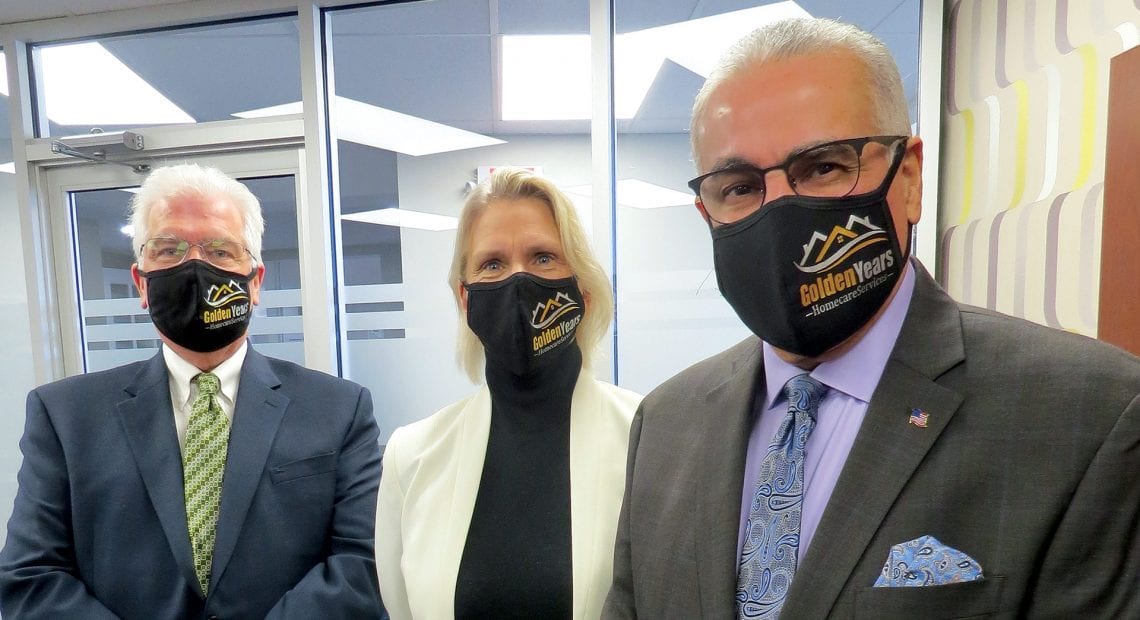
 

Home City Development Wins Funding for Elias Brookings Apartments

SPRINGFIELD — Home City Development Inc. (HCDI), a Springfield-based affordable-housing development organization, was awarded resources from the Department of Housing and Community Development (DHCD) to adapt and rehabilitate the former Elias Brookings School into 42 affordable rental housing units, to be known as Elias Brookings Apartments. The award includes $1 million in low-income housing tax credits (to generate more than $9 million in equity), $4.4 million of soft debt, and project-based rental vouchers. Other funds for the project include state and federal historic tax credits, city of Springfield HOME and Community Preservation Act funds, and construction and permanent loans. MassHousing will provide the permanent first mortgage loan and a subordinate workforce-housing loan. HCDI plans to begin construction in early 2021 and complete the work in 12 months. The project will serve a range of incomes, including extremely low-income households, low-income households, and workforce housing. Select apartments are reserved for clients of the Department of Mental Health, people with disabilities, and homeless households. HCDI will offer a variety of supportive services to all residents. The property will be managed by Housing Management Resources, an organization with extensive experience managing comparable properties. Built as the Elias Brookings School in 1925, the building was severely damaged in the June 2011 tornado and was closed. This redevelopment aims to contribute significantly to the revitalization of the of the Maple Hill, Six Corners, and Old Hill neighborhoods, which were heavily impacted by the tornado. HCDI is working with Davis Square Architects, development consultant Gerry Joseph, Allegrone Construction, Klein-Hornig LLP, and Shatz, Schwartz, and Fentin, P.C., as well as many other partners on this project.


Mercedes-Benz of Springfield Wins Community Service Award

CHICOPEE — The Amherst Area Chamber of Commerce announced that Mercedes-Benz of Springfield was chosen as its Community Service Award recipient. This award honors a business, nonprofit, or individual which has benefited the lives of the Amherst-area community through their work and outreach. The Driven by Community platform officially launched in March, although it has been implemented at the dealership since the doors opened three years ago. Since then, Mercedes-Benz of Springfield has partnered with more than 250 local organizations, raised more than $20,000 when COVID-19 impacted local businesses, and hosted numerous fundraising and charity events at the dealership — most recently, a drive-in movie night with proceeds donated to the Urban League of Springfield to support its mission. The virtual A+ Awards Show will be livestreamed from Hadley Farms Meeting House on Thursday, Nov. 12.


Wellfleet Partners with binx health to Keep College Students Safe

SPRINGFIELD — Wellfleet Insurance has teamed up with binx health to offer college clients access to easy at-home/in-dorm sample collection for COVID-19 testing using binx’s enterprise solutions for population health screening. The ‘binx boxes’ are showing up in dorm rooms of thousands of students on Wellfleet’s college client campuses, offering school officials a quick, easy way to test a campus population, with oversight and test ordering by on-site university clinicians. The model amplifies the power and reach of university administration in their efforts to test, track, and trace the COVID-19 infection status among students, faculty, staff, and vendors. Students ‘activate’ binx boxes online, complete sample collection in their dorms or at home, then drop off completed kits at centralized locations for lab processing. Results are rapid, often under 24 hours from sample receipt. Wellfleet, one of the nation’s leading student health-insurance carriers, worked with binx on behalf of client colleges and universities to deliver a first-of-its-kind platform that makes population testing a reality for the nation’s college campuses. The testing platform offers a unique, modular approach enabling tailored rollout and customized deployment based on university population needs. Serving as a ‘digital hub,’ binx enables seamless linking of patients to university administration via clinician ordering tools, global logistics, at-home/in-dorm sample collection, viral trend analysis and reporting, rapid lab testing, contact tracing, and live customer service and support, all offered at an affordable, per-test fee by university. In addition to introducing clients to tailored COVID-19 testing solutions, Wellfleet has also adapted policies to help members, including helping to ensure student members aren’t saddled with out-of-pocket costs related to COVID-19, and enhanced coverage for telemedicine visits.


Bradley Recognized by Condé Nast Traveler Readers as Eighth-best U.S. Airport

WINDSOR LOCKS, Conn. — The Connecticut Airport Authority (CAA) announced that Condé Nast Traveler released the results of its annual Readers’ Choice Awards, with Bradley International Airport recognized as the eighth-best airport in the U.S. The awards are the longest-running and most prestigious recognition of excellence in the travel industry. Bradley International Airport was recognized as a top-10 airport for the fourth consecutive year. “This award is a tremendous honor during a challenging year for the travel industry, and we are proud to once again be recognized among our nation’s best airports,” said Kevin Dillon, executive director of the Connecticut Airport Authority. “We thank the travel community for their continued vote of confidence in Bradley International Airport and for underscoring the value of traveling through a smaller airport. Now more than ever, Bradley Airport stands out by always offering a clean, safe, and convenient travel experience.”


MCLA Adopts Test-blind Policy Through Fall 2022

NORTH ADAMS — In support of Massachusetts College of Liberal Arts’ ongoing commitment to diversity, equity, and inclusion, and in recognition of the public health crisis brought on by the COVID-19 pandemic, the MCLA Office of Admission will be waiving the SAT/ACT testing requirement for students who apply for fall 2021 and fall 2022. MCLA will also pilot a test-blind/test-free policy for fall 2021 applicants. National and institutional data point to high-school work being indicative of student success in college and a more equitable means of assessment than standardized-test scores. For many years, research studies have found that wealthy students have significant advantages through the college-application process. A 2013 study from researchers at the University of Pennsylvania and University of Southern California, for example, found that the difference in SAT scores between high- and low-income students was twice as large among black students compared to white students. MCLA’s application is free, and students are considered for merit-based scholarships at the same time as they submit their application. MCLA has an early-action deadline of Dec. 1. Those who apply must submit their official high-school transcript, including first-quarter senior grades and any transcripts for college-level courses taken, as well as a personal statement/essay. To find out more, visit mcla.edu/apply.


AIC Hosts Mural Honoring Mason Square Resident

SPRINGFIELD — American International College (AIC) recently honored a Springfield individual known to residents in Mason Square as Preacherman with a mural on the college’s maintenance building located at the corner of State and Reed streets. Born Randolph Lester, he was a well-known community member who was given the Preacherman moniker as he was often seen walking around the Mason Square area carrying a Bible. Collaborating on the construction of the mural was Britt Ruhe, the founder of Fresh Paint Springfield, a creative initiative in 2019 that invited artists to paint building walls downtown. Ruhe is the director of Commonwealth Murals and manages the Community Muralist Institute, featuring individual mural installations that meaningfully engage and uplift communities. AIC alumnus Andrew Cade, president of the Springfield Cultural Council and senior vice president of the Urban League of Springfield, supported the project with a grant from the Springfield Cultural Council and other resources to assist with the mural. The artist, Greta McLain, has has extensive mural-making experience and created the “Home, Here” mural on the Chestnut Towers parking garage on Dwight Street.


Summerlin Floors Awarded Woman-owned Business Certificate

AMHERST — Summerlin Floors has been awarded the official woman-owned business certificate from the Women’s Business Enterprise National Council (WBENC), the largest certifier of women-owned businesses in the U.S. and a leading advocate for women business owners and entrepreneurs. Summerlin Floors has been busy during the COVID-19 pandemic, completing the certification process and reaching its goal of achieving the woman-owned business certificate, along with announcing a new scholarship that will be awarded to a woman of color. To achieve WBENC certification, woman-owned businesses complete a formal documentation and site-visit process administered by one of WBENC’s 14 regional partner organizations. The WBENC certification gives woman-owned businesses the ability to compete for real-time business opportunities provided by WBENC corporate members and government agencies. To give back to the community and future generations, the company launched a new scholarship last month, awarding a $2,500 scholarship to a woman of color pursuing a degree in business at Greenfield Community College (GCC). For more information and to apply for this scholarship, contact the GCC Admissions Office at www.gcc.mass.edu/admissions or (413) 775-1801.


Excel Dryer Supports Square One’s Adopt-a-Classroom Initiative

SPRINGFIELD — For the fourth consecutive year, Excel Dryer has committed an annual gift of $5,000 to support Square One’s Adopt-a-Classroom initiative. The gift comes at a critical time as Square One recently expanded its early-education program to include full-day remote learning support for children in kindergarten through grade 5, in addition to its traditional preschool classrooms and family childcare offerings. The funds will be used to offset expenses associated with classroom supplies, meals, and professional development. Square One’s Adopt-a-Classroom program is part of the agency’s Campaign for Healthy Kids, a multi-year fund-development initiative focused on the agency’s commitment to providing healthy meals, physical fitness, social-emotional well-being, and a healthy learning environment. Square One currently provides early-learning services to more than 500 infants, toddlers, and school-age children each day, and family support services to 1,500 families each year, as they work to overcome the significant challenges in their lives.


Incorporations

The following business incorporations were recorded in Hampden, Hampshire and Franklin counties and are the latest available. They are listed by community.

BRIMFIELD

Infinite Granite Inc., 116 Little Alum Road, Brimfield, MA 01010. Cody Langlitz, same. Granite construction.

CHICOPEE

Save Our Youth, Inc., 6 Ralph Circle, Chicopee, MA 01020. Luiz Nevarez, same. Said organization is organized exclusively for charitable, religious, educational, and scientific purposed, including, for such purposes, the making of distributions to organizations that qualify as exempt organizations under 50 1(C)(3) of the internal revenue code, or corresponding section of any future federal tax code. Specific purpose is to provide assistance and resources to inner city/underprivileged youth, so they have a safe after-school program and better opportunities for the future.

YAAD Food Bar and Grill Inc., 66 Cabot St., Chicopee, MA 01013. Orlando Roberts, 199 Fargo St. Springfield, MA 01119. Restaurant and bar business.

EAST LONGMEADOW

Visit Madhesh Nepal, Inc., 7 High Meadow Circle, East Longmeadow, MA 01028. Pramod Sarraf, same. Travel and business promotion.

GRANBY

Mandolin New England, Inc., 117 Amherst St., Granby, MA 01033. Adam Sweet, same. We are a musical organization that puts on free concerts for the needy throughout New England, but specifically in Western Massachusetts and Rhode Island where our principals are based.

GILL

Renaissance Repair Inc., 390 Main Road, Gill, MA 01354. Douglas A. Edson, same. Maintenance/repair of commercial vehicles and equip.

HOLYOKE

Crossover Corporation, 522 Maple St. Holyoke, MA 01040. Elisandro Cuevas, same. Holding company.

LONGMEADOW

Nubeco, Corp., 82 Canterbury Lane, Longmeadow, MA 01106. Brian Newburn, same. Restoration.

Trusted Caregivers Inc., 123 Dwight Road, Longmeadow, MA 01106. Tonia Giggs, 931 North St. Suffield, CT 06078. Home care.

NORTHAMPTON

Organization of Biological Field Stations, 5 Chapin Dr., Northampton, MA 01063. Christopher N. Lorentz, Ohio River Biology Field Station 8309 Mary Ingles High California, KY 41007. The purposes of Organization of Biological Field Stations Inc. include the following: to facilitate the highest quality environment for scientists, students, teachers and the public to pursue research and education, and to enhance biological and environmental understanding.

PALMER

Lowmat, Inc., 3012 Thorndike St., Palmer, MA 01069. Gary Buelow, same. Develop and operate software app.

San Mac Medical Inc., 1199 South Main St., Palmer, MA 01069. Mark Borsari, 2 Sutton Place East Granby, CT 06026. Manufacturing of medical supplies.

PITTSFIELD

Kanoa, Inc., 11 Westview Circle, Pittsfield, MA 01201. Cristina Oncken Cook Dubin, same. Consulting services.

SPRINGFIELD

Ekmalian Tools Inc., 355 Trafton Road, Springfield, MA 01108. James G. Ekmalian Jr., same. Retail sale of tools and equipment.

Ken G Transport Inc., 37 Tiffany St. Springfield, MA 01108. Edith Nunez, same. Transport.

WESTFIELD

McCabe and Son Home Improvement Inc., 15 May St., Westfield, MA 01085. Samantha Galvin, same. Home remodeling.

WEST SPRINGFIELD

Blackhorse Transportation Inc., 425 Union St., Room 16 West Springfield, MA 01089. Ruvim Rakhubenko, 41 Irving St. West Springfield, MA 01089. Trucking.