Home Posts tagged exclusive (Page 10)
Environment and Engineering Sections
The Goat Girls Offer a Green Solution to Invasive Plants

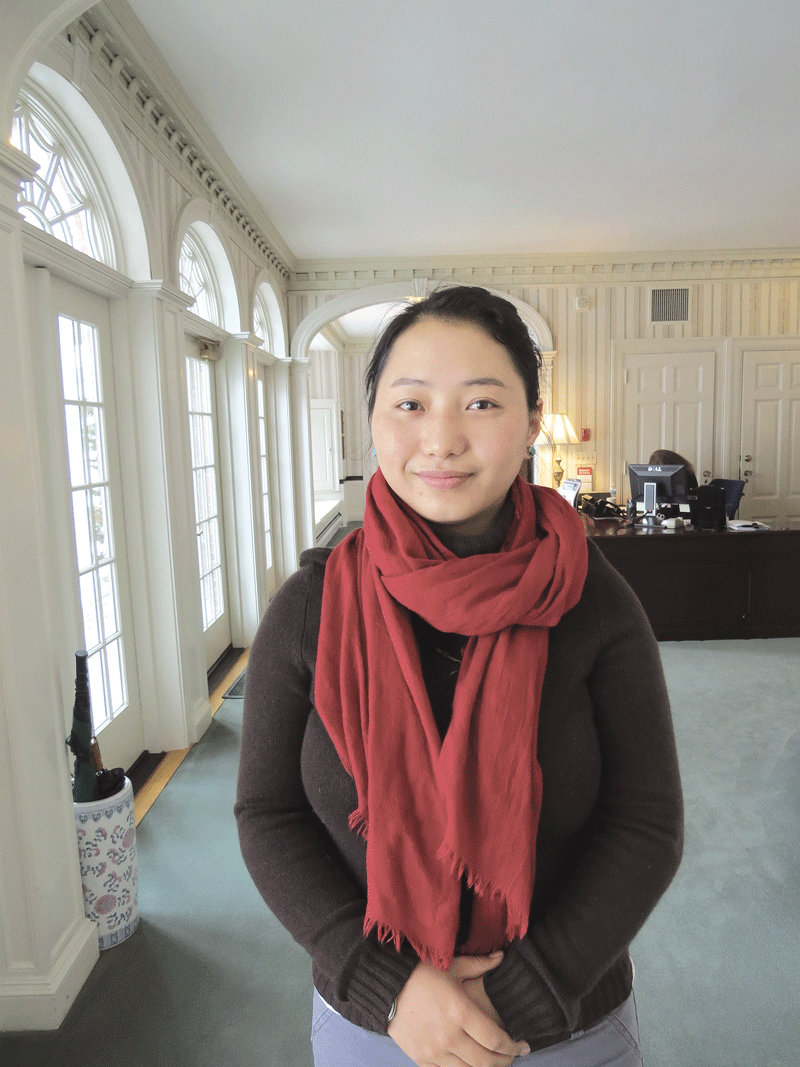
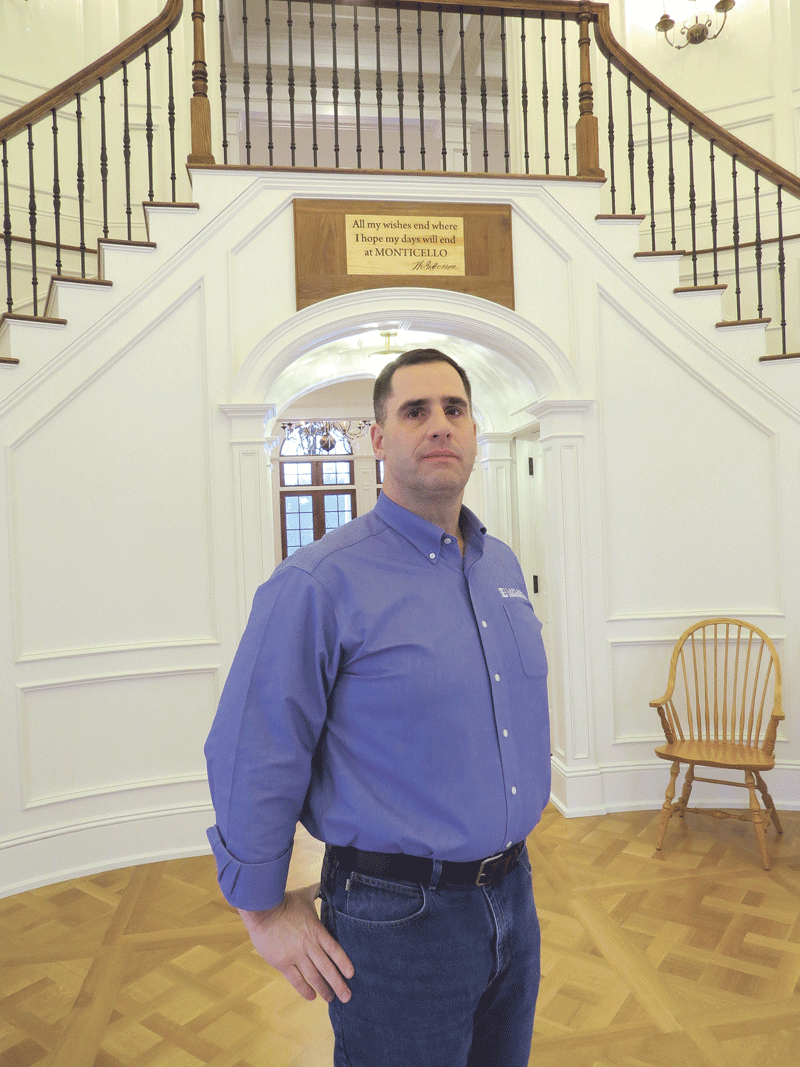
Hope Crolius, seen here with Dan

Hope Crolius, seen here with Dan, says the goat business came with a steep learning curve.

Hope Crolius remembers that it all started … well, quite organically.

She had left a career as a writer — she started as a reporter with the Daily Hampshire Gazette and later freelanced, working for several area colleges — and was doing well with her next entrepreneurial venture, known as Artemis Garden Consultants, LLC, what she described as a “garden-revival company.”

The customer inquiry that changed and enriched her life in several ways came in 2010 from a landowner in Shutesbury who had a barn and pasture that hadn’t been visited by grazing animals in some time and was starting to fill in with what Crolius called “early-succession woody plants” — red cedar and certain kinds of cherries.

“I said flippantly — I wasn’t serious, but in a way, I was — ‘you should really just get some sheep,’” she recalled. “And he took me up on it — he said, ‘go for it,’ and I went for it.”

Actually, before going for it, she did a little research and quickly discovered that what this landowner really needed were some goats, not sheep, because the former ‘browse’ while the latter graze, an important distinction. And she went about getting some — not for him, as it turned out (although she didn’t really know it at the time), but for her.

“I was driving by a farm in Amherst and saw a herd of goats wandering around the farmyard,” she recalled. “I knocked on the door and said, ‘would you ever be interested in selling any of these goats?’ and she said, ‘I’d definitely be interested; we have too many of them.’”

Crolius eventually acquired three mixed-breed ‘mongrels’ that would form the foundation of an enterprise known now as the Goat Girls.

It’s known not only throughout this region, but across the state and in other parts of New England. That’s because there aren’t many operations like this in the Northeast — they are more popular in other regions — and also because there is a rapidly growing constituency that, like the landowner in Shutesbury, would prefer to clear brush and invasive plants in a decidedly green fashion.

Indeed, while this is definitely the off season for the venture’s 19 goats — who are spending their time enduring the cold (something they do rather easily) while dining on a large supply of donated Christmas trees, among other things — the spring’s schedule is filling up, and fast.

And it’s been that way almost from the beginning.

“Right away, the phone started to ring; people would say, ‘I hear you have goats to rent,’” she told BusinessWest. “This thing just happened, and it just took off.”

The Goat Girls’ 19 goats

The Goat Girls’ 19 goats are currently feasting on hay and Christmas trees, but soon they’ll have tastier fare, such as poison ivy and bittersweet, to munch on.

Today, teams of goats (usually six or seven to a team) are dispatched to jobs large and small, at a rate that averages $575 per week. Clients have ranged from homeowners looking to clear a portion of a two-acre lot to the administrators of the 64-acre Boulder Brook Reservation in Wellesley, who hired the goats and their herders to clear the poison ivy, wild grape, and bittersweet that started invading the premises after crews for a nearby landowner cut down nearly 100 trees in 2011, letting the sunshine in.

There is no five-year plan for this venture or something approaching a firm, long-term strategy, but there is already talk of expansion and perhaps even licensing or franchising the operation. Meanwhile, one new, and popular, twist is an intensive training course the company offers to those from outside its service region who may want to start something similar.

It all sounds easy, but there was actually a steep learning curve involving everything from pricing to goat maintenance and veterinary care; from the ins of outs of electrified fencing to simple math — how many goats does it take to clear a certain amount of acreage?

For this issue and its focus on environment and engineering, BusinessWest takes a look at that learning curve and how the Goat Girls, even though it remains a very small venture, has became a rare breed of business success story.

Branch Offices

While quite proud of what she’s done with the Goat Girls, Crolius stressed repeatedly that this concept is certainly nothing new or imaginative — at least not the part about goats doing the work of lawnmowers, pruners, and herbicides.

Indeed, she said goats are second only to dogs in terms of the origin of their domestication, and there are those who say they actually predate canines in that regard. Meanwhile, goats have been used to clear brush and unwanted plant species for centuries; during World War II, when gas was heavily rationed, homeowners, golf courses, and park superintendents used sheep and goats to keep their grounds in order.

More recently, goats have been used in forest-fire-prone states like California to clear the undergrowth that can fuel such a blaze and extend its life, and sheep now patrol a number of landmarks in Paris as an alternative to lawnmowers.

What is relatively new — again, at least in this region — is the notion of goats as a viable, profitable business, said Crolius, stressing the importance of both those adjectives.

This brings her back to that learning curve she mentioned, because, in her estimation, it took probably three years to “figure all this out” and enable this subsidiary to finish a year in the black.

By ‘all this,’ she was referring to everything from goat diet and nutrition to determining how much the animals could clear in a day, week, or month; from understanding good goat working conditions (they don’t mind heat or cold, because they’re essentially desert animals, but really don’t like rain or wind) to determining how many times a crew would have to return to a site to effectively subdue a patch of poison ivy (three or four, by her count).

There were also lessons in worker productivity (only females and spayed males, known as wethers, are used, to make sure the help is focused solely on their work).

The process of learning these and other things began not long after that Shutesbury landowner said ‘go for it,’ said Crolius, adding that her foray into goats was a natural extension of what she was doing at the time.

And that was fulfilling an entrepreneurial urge that took her far afield from journalism, quite literally.

“I gave up writing for something more physical, and also to have my own time,” she explained. “Of course, I learned that going into business for yourself does nothing of the sort — a 9-to-5 job looks positively luxurious right now.

“But I still wouldn’t trade what I’m doing for a 9-to-5,” she went on, adding that Artemis Garden Consultants specializes in what she called “non-mechanical dimensions of landscape care — anything but mowing and blowing,” with a heavy accent on weeding, edging, and mulching.

The Goat Girls

The Goat Girls venture now has a wide array of clients, each one looking for a ‘green’ solution to their landscaping problem.

“If someone’s yard is tired and overgrown, or they don’t have time to take care of it, we’ll come in and prune small trees and shrubs,” she noted. “We’ll weed … we give definition to things.”

Over the years, she had built up a large portfolio of residential and commercial clients, most of them in Hampshire and Franklin counties, and wasn’t exactly looking to diversify into four-legged brush clearing, but, as they say, opportunity knocked, even if she didn’t realize it at the time.

Crunching the Numbers

The goats Crolius purchased from that farm owner back in 2010 went for roughly $100 each, or a fraction of what a purebred Labrador retriever puppy might run.

But while the animals, at least the mixed-breed varieties, certainly won’t break the budget, the overall startup costs, though light compared to some other businesses, are not insignificant, she told BusinessWest. One must factor in housing for the animals — she’s renting about a quarter-acre within a large farm in East Amherst and built an elaborate pen/office complex on it — as well as transportation to get the goats to and from a job; the electrified fencing that keeps them focused on their assignment and not the roses, hostas, or geraniums that they will also eat; and other factors.

But there is certainly enough demand for ‘green’ landscaping services, not to mention the frequent requests for goats for children’s birthday parties, festivals, and other occasions, to recover those costs, said Crolius, adding that the key to profitability is analyzing the numbers, making smart decisions with resources, and creating a workable model, which, as she said, took some time.

Dan Green, president of the Green Internet Group, who helped Crolius get the operation off the ground and expand it, and currently handles the Goat Girls website, agreed, saying this amounts to a new business sector, one where the entrepreneur has to learn by doing.

“If you want to start a dry-cleaning operation or a photo studio, you have many other ones to compare benchmarks to so you can figure out where that curve should be,” he explained. “There are not a lot of comparison-shopping opportunities for a goat business.”

Over time, Crolius calculated that a team of seven goats could clear a quarter-acre in a week, or an acre a month, performance that varies with the density of the brush and the frequency of fence moving. This allowed her to effectively price and allocate her services for what usually amounts to a 28-week season.

But as she became more experienced, Crolius, like all successful business owners, learned new ways to become more efficient and, therefore, more profitable.

For example, she realized a few years in that she could reduce expenses significantly, and make customers even more happy (in most cases, anyway), by leaving the goats with a client for the duration of their assignment (they hang in a portable pen), rather than dropping them off and picking them up every day, along with their herders.

“You instruct the client on how to take care of them, and believe me, the clients can’t get enough of them; they change their water, they talk to them … they hate to see them go,” she said, adding that, because most clients have gardens, they’re even grateful for what the goats leave behind after all that munching.

While making her foray into goats profitable, Crolius has, along the way, taken a number of steps to make it more rewarding personally. One is an extension of what she called an apprenticeship program at Artemis Garden Consultants that enables young people to join the venture as interns and gain invaluable experience toward a variety of different careers.

“My joy in life is hiring young people and giving them the opportunity to have hands-on, on-the-job field training,” she told BusinessWest, referring to her gardening business while noting quickly that she has taken that same passion to the Goat Girls.

Indeed, as she was saying those words, as if on cue, Emilie Rabideau, a pre-veterinary-science major at nearby UMass Amherst, arrived to help tend to the goats.

“It’s a really good résumé builder,” she said, “as far as experience and learning how to manage a business at the same as you work with the animals.”

As for the training program, set to commence in a few weeks, Crolius stressed that she is not breeding competition, but rather creating opportunities for more goat businesses and, therefore, more ‘green’ landscaping.

Over the course of two intense days, attendees can learn about everything from field work to care for the animals to marketing their goat venture, said Crolius, noting that there are three sessions slated for this spring, and a great amount of interest has been shown.

Looking ahead, but not that far, because that’s difficult to do in this business, Crolius said expansion is possible, although there comes a point where simply adding more goats is not cost-effective. Meanwhile, licensing the concept is an option that’s being explored.

For now, she’s focused on honing that business model, providing opportunities for young people to learn while doing, and making the region more green while also making some overgrown areas, well, far less green.

Brush with Fame

As she wrapped up her talk with BusinessWest, Crolius went to assist Rabideau with letting the goats into the front portion of their pen for a late-afternoon meal of hay.

Before doing so, she issued a recommendation — more like a warning, actually — to steer clear, because the goats will not go around anyone who happens to be standing in their way once the gate is opened.

It was a warning well-heeded.

Soon, the extreme energy the goats exhibited as they raced for their dinner will be directed toward the eradication of brush and invasive plants of all types and at all manner of venues.

Spring is almost here, which means it’s time for the goats to shine and give a new definition to the phrase ‘green business.’


George O’Brien can be reached at [email protected]

Class of 2015 Cover Story Difference Makers
Difference Makers Will Be Celebrated on March 19 at the Log Cabin

DiffMakers2015Web

Sponsored By:
SixPointLogo200x130pxFathersSonsLogo200x130pxFirstAmerLogo200x130pxHNElogo200x130pxMBKlogo200x130pxRoyalLogo200x130px
Photos by Denise Smith Photography

While each of the first six classes of Difference Makers was diverse, and effectively showed just how many groups and individuals are worthy of that phrase, the group being honored this year probably sets a new standard.
It includes the region’s only Fortune 100 company, three nonprofit agencies — one committed to fostering and nurturing entrepreneurship, another focused on improving quality of life in Greater Springfield through a host of family-centered events, and the third created to raise funds for childhood cancer facilities in the name of a spirited 11-year-old who succumbed to the disease — and an assembled team of entrepreneurs that kept Springfield’s most iconic restaurant open for future generations to enjoy.
“The stories that start on page A4 are all different, and they show what those of us at BusinessWest knew when we started this program back in 2009,” said Kate Campiti, the magazine’s associate publisher. “And that is that there certainly are a number of ways that people can make a difference in the community.”
The honorees, to be feted on March 19 at the Log Cabin Banquet & Meeting House are:

Katelynn’s Ride: Created in 2011 to honor the memory of Katelynn Battista, who lost her courageous battle to leukemia at age 11, the K-Ride, as organizers call it, raises money for both Baystate Children’s Hospital and the Dana Farber Cancer Institute through the Jimmy Fund. Locally, some of the funds awarded to Baystate have gone to support a new position, a nurse practitioner who acts as a liaison between the families of cancer patients and the teams of specialists that provide care.
Meanwhile, those who participate in the ride say the event itself has become a Difference Maker by providing camaraderie and a forum in which they can fight cancer together and honor both those who have survived their battles and those who have lost, and the ways in which those individuals inspire others.

Judy Matt, president of the Spirit of Springfield: For more than three decades, Matt has been at the forefront of coordinating family-focused events for the residents of Springfield and surrounding communities. That list includes Fourth of July fireworks, the annual pancake breakfast (once touted as the world’s largest), the Big Balloon Parade, and Bright Nights, the holiday lighting display that is on many national lists of must-see attractions.
Those who have worked with Matt praise not only the depth of her work, but the energy and imagination she brings to it, and the way in which she has brightened some very dark days for the city. Said Bill Pepin, president of WWLP and the first board chair of the Spirit of Springfield, “Judy has been a true champion of Springfield, a real believer, especially during the tough times, when a lot of people were saying, ‘if you’re the last one to leave, turn out the lights.’

MassMutual: The financial-services giant is being honored not simply for the depth of its philanthropy or community involvement, but the strategic nature of such endeavors. Focused in three areas — education, economic development, and ‘community vitality,’ the company’s many contributions are long-term in focus, with the goal of strengthening the community and building a quality workforce.
Said Springfield Mayor Domenic Sarno, “from the beginning, this city has always been able to count on MassMutual. It’s been a source of jobs, a force on economic development, and a philanthropic monster. And it should never, ever be taken for granted, because not every city has a MassMutual — and every city would love to have one.”

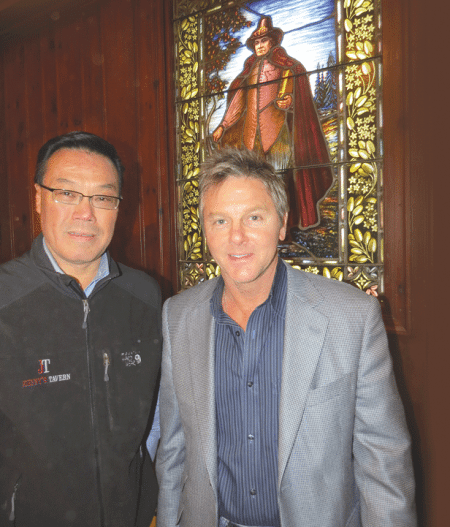
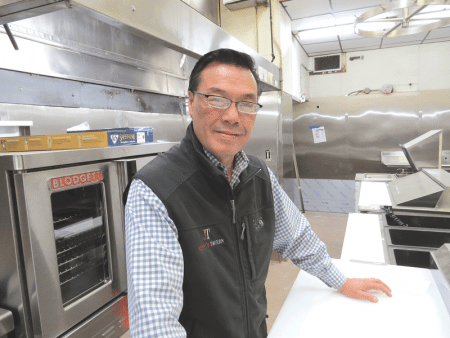
The new ownership team of the Student Prince and the Fort: Last summer, Rudy Scherff, second-generation co-owner of the Springfield-based institution known as the Student Prince and the Fort, announced that, if new ownership could not be found, the iconic restaurant and tavern would likely close amid falling profits and rising expenses. Into the breach stepped a somewhat unlikely group — Peter Picknelly, owner of Peter Pan Bus Lines; the Yee family, owners of the Hu Ke Lau in Chicopee and other restaurants; and Kevin and Michael Vann, father-and-son consultants who have worked with a number of restaurateurs over the years.
When they announced their intentions to give the landmark a facelift and a slightly altered menu and reopen the day before Thanksgiving, they not only saved a part of Springfield’s fabric, said Sarno, they gave the entire city a shot in the arm.

Valley Venture Mentors: While only a few years old now, Valley Venture Mentors, an agency tasked with mentoring entrepreneurs and fostering entrepreneurship, is already making a difference in the broad realm of economic development.
Through a host of initiatives ranging from monthly mentoring sessions to shared-workspace initiatives, to a new accelerator program which just welcomed its first cohort of 30 companies, VVM is, according to many observers, making real progress in creating an entrepreneurial renaissance in Springfield and the region as a whole.

The March 19 event will feature butlered hors d’ oeuvres, lavish food stations, a networking hour, introductions of the Difference Makers, and remarks from the honorees. Tickets are $60 per person, with tables of 10 available.
For more information, or to order tickets, call (413) 781-8600, ext. 100, or go HERE.

Previous difference makers

2009
• Doug Bowen, president and CEO of PeoplesBank
• Kate Kane, managing director of the Springfield office of Northwestern Mutual Financial/The Zuzolo Group
• Susan Jaye-Kaplan, founder of GoFIT and co-founder of Link to Libraries
• William Ward, executive director of the Regional Employment Board of Hampden County
• The Young Professional Society of Greater Springfield

2010
• The Irene E. and George A. Davis Foundation
• Ellen Freyman, attorney and shareholder at Shatz Schwartz and Fentin, P.C.
• James Goodwin, president and CEO of the Center for Human Development
• Carol Katz, CEO of the Loomis Communities
• UMass Amherst and its chancellor, Robert Holub

2011
• Tim Brennan, executive director of the Pioneer Valley Planning Commission
• Lucia Giuggio Carvalho, founder of Rays of Hope
• Don Kozera, president of Human Resources Unlimited
• Robert Perry, retired partner/consultant at Meyers Brothers Kalicka
• Anthony Scott, police chief of Holyoke

2012
• Charlie and Donald D’Amour, president/COO and chairman/CEO of Big Y Foods
• William Messner, president of Holyoke Community College
• Majors Tom and Linda-Jo Perks, officers of the Springfield Corps of the Salvation Army
• Bob Schwarz, executive vice president of Peter Pan Bus Lines
• The Women’s Fund of Western Massachusetts

2013
• Michael Cutone, John Barbieri, and Thomas Sarrouf, organizers of Springfield’s C3 Policing program
• John Downing, president of Soldier On
• Bruce Landon, president and general manager of the Springfield Falcons
• The Sisters of Providence
• Jim Vinick, senior vice president of investments at Moors & Cabot Inc.

2014
• The Gray House
• Colleen Loveless, executive director of the Springfield chapter of Rebuilding Together
• The Melha Shriners
• Paula Moore, founder of YSET Academy and a teacher at Roger L. Putnam Vocational Training Academy
• Michael Moriarty, attorney, director of Olde Holyoke Development Corp., and supporter of childhood-literacy programs

Employment Sections
TWO Program Is Honored for Closing Workforce Skills Gaps

WorkforceDPart“The economic imperative for aligning the workforce needs of Massachusetts with the needs of students attending community colleges is powerful and growing. Massachusetts is at a crossroads in its capacity to compete — and the ability of its residents to fully participate in the current economy and the rewards that employment brings. For the Commonwealth to flourish going forward, a high priority must be placed on training the workforce that is needed by the industries that are driving the Massachusetts economy. That responsibility falls squarely on the Commonwealth’s public higher-education system, most predominately the 15 community colleges.”

That was one of the more hard-hitting bits of analysis and commentary contained in a blistering 2011 report issued by the Boston Foundation, a document that essentially called out the state’s community colleges for not doing enough to help train a workforce to meet industry needs, while making some controversial suggestions about how to bring about change, such as a centralization effort that would do away with local boards of trustees at the schools.

Bill Messner — now, as then, president of Holyoke Community College — remembers his reaction to that report. His initial response was that its authors didn’t do enough research — at least when it came to the schools west of Worcester — and missed some key evidence that community colleges in the 413 area code were, in fact, being imaginative and somewhat effective in efforts to close so-called skills gaps within the workforce.

Bill Messner

Bill Messner says the Boston Foundation report in 2011 caught the attention of area schools and prompted initiatives like TWO.

Still, Messner and others, like his counterpart at Springfield Technical Community College, Ira Rubenzahl, chose not to shoot the messenger — although they were highly critical of those suggestions to centralize the community-college system and put it under one board — and heed calls from the Boston Foundation, as well as the Commonwealth Corp. (which issued its own report with similar findings at that time) to do more to partner with businesses and workforce-development agencies to properly align their training programs with the specific needs of industry sectors.

So it was with a large dose of pride that HCC and STCC learned that, together, they had won the first Deval Patrick Award for Community Colleges, named after the former governor and funded by the Boston Foundation, for work undertaken through a program called TWO (Training & Workforce Options), an acronym that is now resonating throughout the local business community.

The cash prize, to be split by the schools, is $50,000 — a small amount, especially when budget cuts of nearly 10 times that number were announced by the Baker administration for both schools the same week the award was presented. But the rewards go well beyond the money (which will go into both schools’ general operating funds), said both Messner and Robert LePage, vice president of Foundation and Workforce Training at STCC and the school’s TWO point person.

Indeed, the award will bring recognition to the program, said LePage, adding that with that exposure might come support from other state agencies as well as more participation among area businesses and thus more progress in combatting regional workforce issues.

“Recognition from a group like the Boston Foundation is the kind of endorsement that can get others to invest in you — I hope this is something we’re able to leverage,” he explained. “People want to see a good return on their investment, so I’m hopeful that this will bring some eyes to Western Mass., prompt others to appreciate the work we’re doing here, and cause people to say there are things happening here that they can adopt.”

In many ways, the Boston Foundation report validates TWO’s mission and underscores the success stories authored in its first three years, said LePage, adding that there have been many of them.

For example, TWO has partnered with Baystate Health to create a regional ICD-10 (medical coding) incumbent worker training academy and is working with regional employers to launch an advanced hospital medical coding academy that will prepare workers for the many changes coming to that important realm within healthcare. Meanwhile, it has worked with MassMutual and a host of other employers to develop a new advanced call center and customer service certificate, a program that has succeeded in placing a number of individuals in jobs within that emerging sector.

Meanwhile, TWO has taken the lead in training individuals for the gaming industry that will soon become a force in this state through the creation of the Mass. Casino Careers Training Institute.

For this issue and its focus on employment, BusinessWest looks at how TWO has managed to impress far more than the Deval Patrick Award judges and, in the process, has enabled more individuals to join the workforce and helped area businesses thrive.

Work in Progress

Increasingly, Messner noted, groups such as the Boston Foundation are creating cash awards, like those attached to the Deval Patrick Award, as incentives to prompt groups and individuals to respond to their various initiatives and calls for action.

And in many instances, such tactics are working, he said, adding quickly that, with the Patrick Award, there was little fanfare, and many administrators at the state’s community colleges, himself included, were not even aware of the award until a call for applications was issued last fall.

The much more profound incentive to respond to the 2011 report and others like it, said Messner, was a recognized need for a regional response to a skills gap that goes a long way toward explaining still-high regional unemployment rates at a time when many businesses are struggling mightily to fill key positions — a phenomenon that has in some ways stifled economic growth.

“While we didn’t agree with everything in the report, it certainly got our attention,” said Messner, using ‘we’ to mean both community colleges. “And we responded accordingly with TWO.”

Slicing through the 2011 Boston Foundation report and summing up its main points, the authors’ main contention then was that the state’s community colleges were not working collaboratively (or working enough) with employers, industry groups, and workforce-development-centered agencies to identify needs, close skills gaps, and create opportunities for those challenged in their attempts to enter the state’s knowledge-based workforce.

So TWO, which was already in its formative stages when the report came out, was designed to change that equation, create a host of partnerships, and incorporate a far more proactive approach to workforce issues and challenges than what existed prior to the program’s existence.

TWO’s mission — and its operating philosophy — are summed up nicely in this passage from the joint application submitted by HCC and STCC for the Deval Patrick Award:

“Prior to community college reforms, the two colleges often worked in a reactive form and in competition with one another,” the application authors wrote. “This often led to an inefficient and duplicative approach to workforce development and employer engagement in Hampden and Hampshire counties. With the formation of Training and Workforce Options, the two colleges have formed a cohesive and proactive sales and training approach and have effectively broadened the reach of both colleges. TWO has provided HCC and STCC a stronger and unified voice and further positioned the colleges to provide a deeper and wider leadership role in serving regional workforce needs that serves as a catalyst to support economic-development success.”

It has assumed this leadership role through engagement with the business community and agencies ranging from area Regional Employment Boards to one-stop career centers to economic-development-related agencies to identify needs and develop programs to address them.

Through its so-called ‘business-discovery model,’ LePage said, TWO has met with more than 200 businesses in five key industry sectors — financial services/customer service, healthcare, hospitality and culinary, IT, and manufacturing — to validate employer needs.

Bob LePage

Bob LePage says the Deval Patrick Award will garner recognition for TWO, prompting more participation and attempts to emulate its success.

And program partners run the gamut, from major employers such as MassMutual, Baystate Health, Smith & Wesson, Six Flags, and MGM to smaller operations such as Mustang Seats, the Three Rivers-based company that makes replacement motorcycle seats for Harley Davidson, Honda, BMW, and other brands, and Ludlow-based Chemi-Graphic, which manufactures nameplates, labels, and other products for a wide range of customers.

Input from these businesses has helped spawn several direct responses in the form of new programs and training initiatives.

At Chemi-Graphic, for example, TWO has provided a host of services, from assessing workforce needs to direct training programs to advice on how to secure state workforce-training grants, said LePage, adding that the manufacturer is in many ways representative of the businesses TWO was created to assist.

“They’re the kind of company we’re looking for, because they have 50 to 60 employees, so they’re not large enough to have a training arm, per se,” he explained. “And they have a niche business, one that’s doing well, but is now facing the retirement of all those Baby Boomers, and they need to replace those workers. They’re really what we’re looking for — we want to help as many of those small and mid-size companies as we can because they are the heartbeat of this region.“

Answering the Call

Overall, TWO’s most profound impact has been with closing those aforementioned gaps between the skill sets that the current workforce possesses and the skills that are needed within certain industries and for specific jobs.

Two of the better examples of how TWO has operated are the ICD-10 incumbent worker training academy and the advanced call center and customer service certificate.

ICD-10, as that name would suggest (at least to those in the industry), is the 10th revision of the International Statistical Classification of Diseases and Related Health Problems, or ICD, said Jason Pacheco, a senior workforce-planning consultant for Baystate Health. And it represents a significant change from ICD-9.

“ICD-9 has around 9,000 or 10,000 codes, while ICD-10 has roughly 60,000 codes,” he explained, adding that this nearly exponential increase is projected to generate a decrease in productivity — primarily because it already has in countries where ICD-10 is being used. As a result, said Pacheco, healthcare providers and medical practices will either have to bring on more employees or outsource more work.

To widen the pool of potential job candidates, TWO is partnering with Baystate, the Regional Employment Board of Hampden Country, and other players on worker training initiatives that have, to date, involved more than 50 companies.

“The concept to fill the gap in the labor pool was to come up with a development program,” said Pacheco. “What Training and Workforce Options has been able to do is work with those two community colleges to help align the students and their curriculum toward flexible workforce arrangements that meet employers’ needs.”

And that’s just one example, he said, of how Baystate and others in the healthcare sector have partnered with TWO to identify and close gaps involving several specific positions, including sterile-processing technicians, medical lab technicians, pharmacy technicians, and others.

That list includes call-center employees, he went on, adding that Baystate is one of many area employers, large and small, that have participated in the Advanced Call Center & Customer Service Training program.
To date, three cohorts of students have produced more than 55 graduates, with roughly 80% of those individuals placed in companies like MassMutual, PeoplesBank, Health New England, and many others, thus meeting a growing need for such specialists.

“There are quite a few call centers in the region if you start to add them up, and they’re across many sectors of the economy,” said Nick Fyntrilakis, vice president of Community Involvement for MassMutual, which has hired several of those graduates. “And a growing challenge for everyone with a call center was finding qualified applicants; different companies have different needs, but there are some foundational pieces that run across the whole spectrum.”

TWO, working in conjunction with those employers and the Regional Employment Board, developed a curriculum, identified solid candidates for the program, established a call-center simulation center, and developed a formal employer-engagement process to improve student placement, he went on, adding that these various steps have all helped ensure success and sum up what the program is all about.

“To us, that’s the kind of work that community colleges were designed to do,” said Fyntrilakis. “That’s what they were built to do — to plug into the workforce needs of the community and tailor programs that identify people that have a skills gap or require additional training or education, and then help connect them to those careers.”

And that’s exactly the type of work that the state’s community colleges were not doing, at least according to the Boston Foundation.

Bottom Line

Messner told BusinessWest that, while he had confidence in the joint submission for the Deval Patrick Award, he wasn’t exactly expecting the two Western Mass. schools to prevail in that competition.

“I was more than a little surprised by this, because we assumed that the Boston Foundation, being a Boston foundation, might be inclined, especially for this first award, to stick closer to home,” he said, adding quickly that, beyond geography, he wasn’t surprised by the choice.

That’s because of TWO’s quickly amassed track record and the promise to add to its portfolio of success stories.

The Deval Patrick Award might help with all that, and, as Messner, LePage, and others mentioned, that’s a far bigger prize than a pair of $25,000 checks.

George O’Brien can be reached at [email protected]

Cover Story Sections Technology
Video Specialist Chris Thibault is Focused on Growth

Teebo-DPartChris Thibault was asked to pinpoint why he believes his work — everything from television commercials to instructional videos on deck screws — stands out in a field crowded with competitors.

He kept coming back to the word ‘edgier,’ as in “some people think my style’s a little edgier than what you would get from a corporate video-production company. When they’re looking for something to connect and be sharable and be cool, for lack of a better word, people come to me.”

When pressed for more specific definitions of what amount to technical terms — ‘edgier’ and ‘cool’ — Thibault, founder and president of Chris Teebo Films (he says that spelling makes his name easier to pronounce and his company easier to find), struggled somewhat, as might be expected, because of the subjective nature of those words.

“Anyone can make a pretty picture,” he told BusinessWest before a lengthy pause as he searched for more words. “I just try to bring my own style into it and not base anything off a template.”

With that, he decided that the best way to get his points across was to play a shorter version of what eventually became a promotional video and television commercial he produced a few years ago for something called the Great Bull Run — a series of events that, as the name suggests, brings the Spanish tradition of running with the bulls to this country.

“I like to take risks — that’s what they teach you in art school starting on day one, to take risks when you can,” he said as he rolled the footage, which showed close, detailed shots of individuals running alongside 1,500-pound bulls, an effect created with several cameras, including one strapped to one of the runners (christeebo.com/portfolio/the-great-bull-run). “You can cover this like a news story, and there’s nothing wrong with news, but we wanted to get right into the mix and capture what this is about. People who run with bulls, or might run with bulls … they want something edgier.”

Teebo’s ability to create that intangible has helped him grow his now-Springfield-based company dramatically in recent years, with a 60% increase in revenues in 2014 alone, and add to his portfolio of work.

For example, it now includes several Big Y commercials featuring New England Patriots nose tackle Vince Wilfork, a promotional video for the Spirit of Springfield’s Bright Nights lighting display (produced for its 20th anniversary), television commercials for political candidates such as recently elected state Sen. Eric Lesser, and much more.

Some of these works are edgier than others — political office seekers, not to mention Big Y, tend to be fairly conservative, while the Bright Nights video was shot from the perspective of a young child and is thus quite compelling — but together, they have helped Thibault meet the ongoing challenges of gaining word-of-mouth referrals and generating business from that marketing tool known as the Internet.

And he hopes an upcoming project — a promotional video of Springfield being financed by its Economic Development Department with the goal of showcasing current initiatives and inspiring more of them — will create more momentum in efforts to build his brand and get involved in Springfield’s comeback.

“I’m really excited about this project,” he said. “I’m going to knock it out of the park with that one.”

Looking ahead, Thibault, as he said, wants to not only help promote Springfield through that video now in the planning stages, but be part of the city’s turnaround. He recently relocated to a office in 1350 Main St., and is conceptualizing plans to develop what he called “shared creative space” in the city.

Such a facility, a large studio, would become workspace for a host of creative professionals, including photographers, videographers, audio engineers, and even musicians, he explained, adding that there are models for such a development in New York and Boston that he hopes to emulate.

In the meantime, his more immediate goals are to expand the portfolio with more ‘edgy’ work, add additional employees, and grow Chris Teebo Films into a regional force within this industry.

For this issue and its emphasis on technology, BusinessWest talked at length with a young business owner focused (there’s another industry term) on creating images that get results, no matter how the client chooses to measure them.

Setting the Stage

Like most individuals in this business, Thibault can trace his interest back to his high-school years. In this case, it was a 10th-grade class in video production at Springfield’s Sci Tech that got him hooked.

“I thought this was the coolest thing ever,” he noted. “It combined all the aspects that I loved. I was always an artistic kid — I would always draw, mess around with music and sound — and I thought video combined all that, so I fell in love with it.”

image from a video

This image from a video produced for the Great Bull Run displays what Chris Thibault calls an “edgier” style that defines much of his work.

Finding ways to express this affection became more difficult when his family moved to West Springfield. The city’s high school didn’t have video production classes, so he created some.

He bought a Sony handycam, began filming the school’s sports teams, and created seasonal highlight videos that garnered both revenue and acclaim.

“They would play them at the year-end banquet, and the video would get a standing ovation,” he recalled. “These weren’t huge events, but everyone would stand up and clap, and that was a great feeling.”

Thibault was accepted at the prestigious School of Visual Arts (SVA) in New York City, starting classes there just a few days before 9/11 — an event, like many others, that produced learning experiences far outside the classroom that have stayed with him to this day.

“New York City is a school unto itself,” he told BusinessWest, adding that, while attending SVA, he lived in Brooklyn Heights, in the shadow of the Brooklyn Bridge, and watched tens of thousands of people stream over than span from lower Manhattan on the morning of the terrorist attacks, most all of them covered in a gray dust.

He didn’t know exactly what was going on, but his artistic tendencies compelled him to buy a small disposable camera and grab a seat on the only operating subway line still bringing people into Manhattan.

“I was probably 15 blocks from the towers,” he recalled, adding that when the American Express building, also known as Three World Trade Center, fell, the ground shook, and he knew something serious was going on. Perhaps the most unforgettable moment, though, involved a news reporter he remembered seeing on television.

“There was a woman coming back with a baby covered in soot, she was walking up the street,” he recalled. “This newswoman started yelling to the cameraman, ‘get her!’ She kicked over a trashcan, the cameraman got on top, filmed her, then jumped off, and the newswoman got the lady on camera to do a story.

“It was just a New York mentality — ‘let’s do it.’ There was no fear,” he went on, adding that this philosophy manifests itself in some of his current work.

But it would be awhile before Thibault could really start expressing himself artistically.

Indeed, he would soon leave SVA, in part for financial reasons — “New York is great, the school was great, but it’s very expensive out there” — but also because he felt a need, and desire, to get working.

That work, however, involved mostly wedding and event videography while he also drove a truck for his father.

“I did cheerleading events, dance competitions, anything like that; anything that had to do with video, I would take the job,” he said, adding that he did so to pay off the camera he purchased and build a name for himself.

“At the end of the day, my heart wasn’t really in it — filming weddings is not my passion,” he went on, adding that, as his skills improved and his reputation grew, he eventually started doing work for commercial clients and never looked back. “It’s tough to break into commercial video when you’re doing events, and at one point, I just said, ‘I’m finished with this,’ and stopped taking down payments for weddings, even though it was tough to do so, because I was trying to build a business.”

Thibault said his big break, if one could call it that, came when he pitched an idea to the owners of the Springfield Armor, the NBA Developmental League team that came to the city in 2009, to do a promotional video and build excitement for the team before it actually arrived in the City of Homes.

“I felt a buzz around Springfield when they were coming in, and I just wanted to do something great for the city as well as the team,” he recalled as he played that video, which showed people of all ages and persuasions playing hoops, a young man dribbling a basketball over the Memorial Bridge, the unveiling of the Armor name and logo, and other scenes designed to build interest in the Armor and the sport. “It was a commercial about the team, but without the team — they weren’t here yet — and it was cool.”

The spot was originally designed for the web, but it was so well-received, it started airing on area TV stations, said Thibault, adding that he was later approached by a marketing firm representing a Developmental League team in Texas to do something similar.

On-the-spot Analysis

With the Armor video and other works now in his portfolio, Thibault had more to show marketing firms and prospective clients, and work started to come his way, as both director and producer of content through Chris Teebo Films and as a freelance director of photography.

Indeed, as the latter, he’s been involved with projects ranging from promotional shoots for office supplies giant Staples and motor oil maker Castrol to part of an episode for TLC network’s Sex Sent Me to the ER, a show that has actors re-enacting real-life accidents that occurred during sex.

“It’s a terrible show … but there was a couple in Connecticut, and they were looking for a studio closer than New York, and the producers out in L.A. hired me for that segment,” said Thibault, adding that it was shot in his studio in the cavernous Cabotville Industrial park in Chicopee.

He rarely does freelance work these days, primarily because Chris Teebo Films has secured enough work to keep him quite busy. And it comes from several sources.

For starters, there’s the commercials he’s shot for Big Y featuring Wilfork, the Springfield-based grocery chain’s main spokesperson. He’s now done five spots spotlighting the 350-pound lineman as pitchman for pizza and sandwiches, including one that aired during the recent Super Bowl.

Chris Thibault

Chris Thibault, seen here on location for a Big Y commercial featuring Vince Wilfork, has gained a number of new clients in recent years.

Thibault has also added a number of other commercial clients in recent years, including political candidates such as Lesser, who captured his seat last fall, and Mike Bissonnette, who served several terms as Chicopee’s mayor, as well as regional companies and nonprofits ranging from Doctor’s Express (a new client) to Spirit of Springfield; from United Way of Pioneer Valley to FastenMaster, a subsidiary of Agawam-based OMG Inc. that specializes in deck and trim screws and other products.

One wouldn’t expect deck screws to be the subject of video productions defined with the word ‘edgier,’ but Thibault said he’s managed to do just that.

To demonstrate, he went back to his computer and called up a video featuring Gary Daley, owner of America’s DeckBuilder, LLC, using FastenMaster products, one of several spots Teebo has produced in a series that has taken him all over the country.

“They’re showcasing pros that use their products, and it’s become a very effective way of promoting the brand,” he said, adding that he also creates “tips and tricks” videos for the company. “I think FastenMaster is brilliant in doing this; they’re creating content for this industry that doesn’t exist, and they’re giving people something to watch and something to aspire to.”

Overall, Thibault said his goal is to produce videos that, like the one for the Great Bull Run, get not only shares and likes on Facebook and YouTube (although those are important), but also results for the client.

In the case of the Great Bull Run, for example, his video was used by organizers of the event when they appeared on Shark Tank, and, Thibault believes, it helped them secure $1.75 million in funding from shark investor Mark Cuban.

“Barbara Corcoran [one of the show’s ‘sharks’] actually said, ‘what a great video’ right on the air, which is cool,” said Thibault, adding that he plans to put that footage and commentary on his revamped website.

To get results, Thibault says he has to trust his instincts, take risks when they’re appropriate (there are many times when they are not), and work with the client without being limited by its imagination.

“I try to create whatever I see in my mind without letting even a client hold me back,” he told BusinessWest. “Because, while I value clients’ opinions — they help me do my job better — sometimes they don’t know exactly what they want, and they’re using some kind of template as a model.”

That’s a Wrap

Looking ahead, Thibault said this industry moves too quickly and unpredictably for five-year plans, so he’s moving in much shorter increments.

His immediate goals are to continue building the portfolio, hiring additional staff (there is currently one full-time employee with others hired on a freelance basis), and advance those aforementioned plans for shared creative space.

“There’s some great creative talent in Western Mass., but people initially think they have to leave and go to New York or Boston to pursue a career,” he said. “My goal is to help keep some of that talent here.”

While doing that, he plans to go on taking risks, producing video with an edge to it, and focusing on the big picture, figuratively and quite literally.

George O’Brien can be reached at [email protected]

Commercial Real Estate Sections
Former Auto Dealership Is Transformed into a Unique Retail Facility

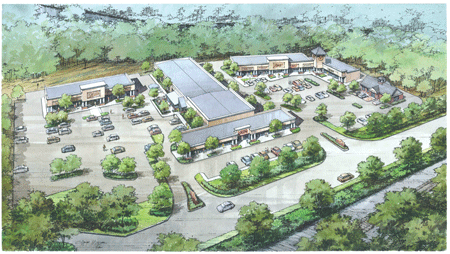
architect’s rendering

This architect’s rendering shows current initiatives as well as future plans for the former Balise Ford dealership on Route 20 in Westfield.

The Balise Ford dealership on Route 20 in Westfield closed its doors in 2007, and as the years went by, it remained vacant, becoming somewhat of an eyesore in the city, visible to everyone traveling along that busy thoroughfare.

But while most saw a troubled property beset with challenges when it comes to reuse, Nabil Hannoush developed a far different view. The Westfield resident, vice president of the Hannoush Jewelers chain and serial entrepreneur, saw it as an ideal location for a retail plaza and home to many separate but nonetheless synergistic businesses that he and his wife, Julie, had created or were planning.

Today, thanks to that vision and a determination to make it reality, the 11-acre property is being transformed into a center that now houses several retail enterprises, many of them health-related, including a restaurant, a baseball-and-softball training center called Extra Innings, and fitness facilities. And there could be many more added in the years to come as the Hannoushes advance plans to expand the plaza through new construction.

“I drove by the property every day for years and always thought it was a great location,” said Nabil, adding that it is positioned at the gateway to the city near the border with West Springfield and is easily accessible.

Talk about the property turned to action last year when the Hannoushes closed on the former dealership. They soon relocated the Extra Innings franchise they had acquired in Agawam into the facility and commenced buildout for an eatery they would call ShortStop Bar & Grill, which opened late last fall. The couple is also renovating space in the building to house Expert Fitness Health Club, which they acquired three years ago and is currently located further west on Route 20, and has plans to move still another business they own, East Longmeadow-based All Team Apparel, onto the site.

The various enterprises will support one another, and in some cases they already are, said Nabil, noting that sports teams and family members coming to watch them train are supporting the restaurant, and those teams will likely patronize All Team Apparel. And this base of retail establishments should attract other businesses to that location for other phases of its development.

Overall, Hannoush envisions five phases, with two, Shortstop and Extra Innings, already completed. Phase 3 is the new Expert Fitness, while phase 4 will involve erecting a new, 6,000-square-foot retail center on the east side of the property, while phase 5 will see another 18,000-square-foot retail facility on the west side of the site, plans that have been approved by the city.

Hannoush hopes phases 4 and 5 will include health- and wellness-related businesses and possibly a bank branch.

For now, though, the Hannoushes are focused on driving business to the existing enterprises and continuing to find imaginative ways to repurpose the space that once housed a showroom, service bays, a parts department, and other features of an automobile dealership.

Indeed, the existing building held some unusual challenges, including a dozen oversized garage doors, built to allow vehicles to enter and exit the auto dealership and repair bays.

Hannoush’s original plans were to gut the interior, remove the doors, and fill in the space. “But one night, I thought, if kept them, we could have an indoor-outdoor facility that would allow people to walk through the building and enjoy the outdoors,” he said. “Teens and young people playing baseball or softball could enjoy the breeze when the doors were open or go outside and play catch or practice.”

Nabil Hannoush, seen here with his daughter, Monica

Nabil Hannoush, seen here with his daughter, Monica, the executive chef of ShortStop Bar & Grill, says the facility is not a typical sports bar.

So the garage doors remain, and last summer, parents were able to watch their children practice while they waited outside.

“My hope was to build something that Westfield and Western Mass. can be proud of,” said Hannoush. “But I had to keep thinking outside the box because I wanted to create something that is different.”

Driving Force

Barry Wadsworth, director of operations for the complex and general manager of ShortStop Bar and Grill on the property, said the project is an exciting venture that compelled him to get involved.

The founder of the Holyoke Blue Sox met Hannoush after selling 51% of the team, and was captivated by his plans.

“Nabil’s vision is very exciting because he wants to make this a place the entire community can enjoy,” Wadsworth said, adding that it was the ideal location for the Hannoush family to expand its health-related businesses.

“Expert Fitness has more than 2,500 members; they needed a bigger location, and this building is a perfect fit,” he explained. “It allowed them to consolidate the gym, batting cages, and sporting-goods store associated with Extra Innings into one location.”

The new, 10,000-square-foot Expert Fitness has been under construction for some time on the west side of the building and is expected to open March 1. However, the Cage, a facility housing programs that fall into the category of extreme fitness, is already operational in a different area of the building, and a protein-shake bar is being built outside the indoor entrance to the gym, a few steps away from the entrance to the restaurant.

“The Cage holds hardcore classes that include indoor and outdoor boot camps, spinning, and group fitness,” Hannoush said. “It is one of the first of its kind in the country, and from April to November, we have what we are calling ‘Muscle Beach Westfield,’ a weightlifting station outside.

“It’s something different,” he went on, as he alluded again to his efforts to “think outside the box.”

That phrase can certainly be used in conjunction with ShortStop, which opened Dec. 19. It is technically a sports bar, but one with a decidedly different look and feel.

A fireplace burns brightly as diners relax in a cheerful room with rich, mahogany furniture and three walls of enormous windows. And although 36 flatscreen TVs are placed strategically above the tables in the bar and dining area, Nabil said Julie designed it to be welcoming to women.

“Typical sports bars are not doing well throughout the country because they are not female-friendly; they are often too loud,” Nabil explained, adding that the décor was carefully chosen and the atmosphere is suitable for families. The menu, meanwhile, includes everything from filet mignon to burgers to a wide array of healthy choices, including different types of salads, along with gourmet desserts created by executive chef Monica Hannoush, the owners’ daughter.

The sound of bats striking baseballs and softballs can be heard within ShortStop, at least when the doors are open, because it is separated from Extra Innings by a 2,000-square-foot area known informally as Ball Park Seating.

It contains a 10-by-15-foot flatscreen TV with eight speakers, smaller flatscreens on another walls, and tables that overlook the batting-cage tunnels. Some families choose to eat there and watch their children practice, and it is the setting for live entertainment on Friday nights.

“The area was packed on Super Bowl Sunday,” said Wadsworth. “Groups of 10 and 12 came here to watch the game.”

Barry Wadsworth

Barry Wadsworth says Extra Innings offers a wide array of sporting goods for baseball and softball players.

ShortStop opened with little fanfare, and it has not done any advertising, but word has spread quickly, and business is brisk.

“Parents come here while their children are practicing and have lunch or order food to take home,” said Wadsworth, adding that Extra Innings provides a fairly steady stream of customers, and the new Expert Fitness is expected to do the same. “Many are here so frequently, we know their names.”

The sports bar features a bump-out with an 1,300 additional square feet that was added to the building to create the dining room. Garage doors that remain will open onto the patio, which is surrounded by a wrought-iron fence.

A new, 1,800-square-foot banquet room is also under construction to accommodate requests from teams. One side features the oversized doors, which will allow the room to be opened to the outdoors in the summer.

“We plan to use every inch of the 38,000 square feet in the building and have added an additional 2,500 square feet in the restaurant and patio,” Wadsworth said.

All Team Apparel will soon move into the building, creating more synergy, he noted. “Teams who come here to practice will be able to get shirts and uniforms. This will become almost a one-stop shop for youth leagues due to the sporting-goods shop associated with Extra Innings.”

Gearing Up

One of the primary goals the Hannoushes have set is to have the property become a gathering place for the community, a setting for everything from more big games like the Super Bowl to fund-raising events; from youth birthday parties to summer concerts that can take place on a stage being built in the ShortStop’s patio area.

And Wadsworth believes it can and will become just that.

“I want the community to think of this place first when they are trying to raise money for a good cause; we want to use the facility to help people, and the sheer numbers that drive by on Route 20 are huge,” he said. “Everyone who comes here has a really good time. It’s a lot of fun, and people meet each other when they are using the batting cages or eating in the restaurant. It’s becoming a destination.”

Not many people could have imagined such a fate for the old Ford dealership, but the Hannoushes certainly did.

And their vision has become not only reality, but an inspiration.

Features
Author, Economist Andrew Zimbalist Says Olympics Are a Bad Deal

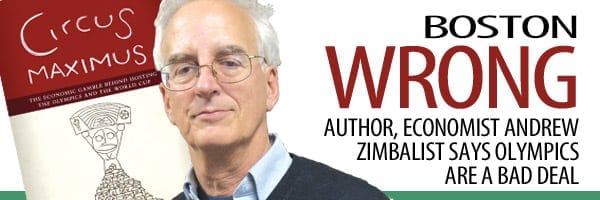
OlympicsAuthorAndrew Zimbalist shakes his head at the prospect of the Summer Olympics coming to Boston in 2024. While the U.S. Olympic Committee paints a rosy picture of gleaming new construction, increased tourism, and long-term economic growth, Zimbalist argues that Olympic host cities almost never see these benefits.

As one of the world’s foremost sports economists, he should know. In fact, the Smith College professor of Economics recently published a book, Circus Maximus, on this very topic.

“In theory, the Olympics aren’t bad,” Zimbalist told BusinessWest. “In practice, there’s virtually no evidence that the city benefits. There may be some short-term benefit if everything goes well, in terms of volunteerism, pride, and togetherness. People feel good for a couple of months, then that fades away.”

“But,” he continued, “is it worth $5, $10, $15 billion to have that experience? The city ends up getting saddled with debt, and many times saddled with stadiums that are underutilized. Because of the cost to build and maintain them, we call them white elephants. And the presumed benefits of increased tourism, increased trade, and increased foreign investment are now borne out empirically; these things don’t increase over the trajectory they were already on.”

In short, if your city is chosen to host the Olympics, it probably didn’t need an image boost to begin with. And it certainly doesn’t need the debt. For a return of some $5 billion or $6 billion, the cost of staging the Summer Olympics were an estimated $16 billion in Athens in 2004, $40 billion in Beijing in 2008, and nearly $20 billion in London in 2012 — much of this investment tied up in infrastructure projects that may not be useful going forward.

Zimbalist argues that the Olympics are sold to the public as an economic boon when it’s just the opposite, a catalyst for tourism when evidence suggests it’s not.

“Whether it’s congestion, terrorism, or other fears, not one of these things necessarily makes people want to come to your city and trade with your city,” he said. “Even when the Olympics are pulled off well, are there really people around the world who haven’t heard of Boston and say, ‘hey, let’s travel to Boston’? Probably a few. It’s fair to say there are some feel-good benefits, but they’re very evanescent, very ephemeral. And for the economy, the benefits are illusory.”

Frankly, he continued, the Olympics are an opportunity for special interests to line their pockets at the long-term expense of the host city and the public. In a broad, candid interview with BusinessWest, he explained several reasons why the bidding and organizing structure encourages that outcome, and why the system isn’t likely to change anytime soon.

The Price Isn’t Right

If the bidding process were rational, Zimbalist argues, local organizing committees would understand how much their city stands to gain, and then cap their bids below that level.

The problem is that local committees are dominated by private business interests — contractors, construction unions, architects, investment bankers, and lawyers, to name a few — which individually stand to gain from the massive construction required by the International Olympic Committee (IOC).

“Boston 2024 is a committee of private executives, largely from the construction industry. Some other industries are represented as well, but construction benefits more than any other industry,” he explained, adding that the construction contracts to be handed out are essentially “other people’s money.”

“Some of it comes from the Olympic Games, some from taxpayers, some from corporate sponsors, but it’s not their money. And they’re going to get the contracts; why wouldn’t they love the Olympics? They get to do all this massive construction in a relatively short period of time. Meanwhile, a lot of contracts get rushed and get charged higher costs than normal.”

The model suffers from what economists call a “principal/agent problem,” Zimbalist explained. The city (the principal) is not properly represented by the local organizing committee (the agent). So the more extravagant the bid, the more the committee members personally benefit, and they don’t think about (or care about) the public benefit versus the public cost — hence, the massive overbidding.

In his latest book, Andrew Zimbalist

In his latest book, Andrew Zimbalist makes the case that the Olympics saddles host cities with debt while bringing few long-term benefits.

“The most problematic aspect about the structure is that you have one organizer, the International Olympic Committee, that, in essence, auctions the right to host the Olympic Games. You have multiple cities around the world competing against each other and one monopoly seller,” he said.

“That situation almost always ends up with an overzealous overcommitment for extra funding, extravagance, and frills. Imagine six or seven cities all wanting to get this; five cities think it’s worth $4 billion, but one city thinks it’s worth $5 billion. That city is the outlier, the one that can’t agree with everyone else, and they’re the ones that end up winning.”

Will Boston approach its bid differently? Not if it wants to win, Zimbalist said.

“We keep hearing about how frugal and bare-bones Boston is going to be. They’re going to be building, they say, an Olympic stadium with a 60,000-seat capacity that doesn’t have any luxury boxes, club seats, or catering facilities, among other things. And when the games are over, they’ll take it apart.

“Other than the fact that, in my mind, it makes no sense to spend $500 million on a stadium that exists for 17 days,” he continued, “the problem is, Boston’s going to be competing against cities like Paris, Rome, either Berlin or Hamburg, Melbourne, Doha (capital of Qatar), and Johannesburg, and they’re not all going to put forward bare-bones plans. At the end of the day, the IOC will take the plan that most honors them and their traditions, and that’s going to be the most extravagant plan.”

In short, he said, “meeting the committee’s demands for infrastructure and facilities makes it impossible economically to get a reasonable return. That’s the most difficult thing Boston or any other city has to overcome.”

Tourist Trap

But what about the long-term gains a city might realize in increased tourism? It’s an attractive idea, Zimbalist said, but the publicity generated by the Games themselves is not guaranteed to be positive. Just ask the organizers of Olympics plagued by disorganization (London, Sochi), pollution (Beijing), corruption (Salt Lake City, Nagano), or terrorism (Atlanta).

“The publicity you get is not necessarily good publicity,” he went on. “Mexico didn’t get good publicity when they had to kill 2,000 students demonstrating, or when the African-American athletes raised their fists on the medal stands to protest race relations in the States. Munich didn’t get good publicity when 11 Israeli athletes were killed by terrorists. Montreal didn’t get good publicity when budget overruns were nine times over the initial bid price.”

Even during the Games, evidence suggests that the influx of Olympic tourism is offset by locals moving away for three weeks and tourists who would otherwise visit the city staying away as well. “In the short run, a lot of tourists decide they don’t want to deal with the high prices, congestion, and security issues, and tourism goes down in net terms.”

The best way to promote tourism is word of mouth, and that doesn’t translate to the Olympics, he added.

“Normally, when a tourist goes to Boston, he goes home and talks to friends and relatives: ‘Boston was great! We went to the Boston Garden, we saw the U.S.S. Constitution, we visited the Museum of Fine Arts, we heard the symphony’ … on and on. And people say to themselves, ‘hey, I want to go to Boston, too.’ But an Olympic tourist goes home and says, ‘I saw a terrific 50-meter dash, really exciting hurdles, a great relay.’ That’s not going to promote tourism in Boston. You lose the word-of-mouth effect.”

Zimbalist admits there have been exceptions. Barcelona, which staged the Summer Games in 1992, is often held up as a model for the Olympics bringing long-term benefits to the host city.

However, “Barcelona was a complicated story with many elements to it,” he explained. “Barcelona and Catalonia had been neglected regions for many years. When Franco died in 1975, the people of Barcelona said, ‘we’ve got to rebuild our city.’” That effort involved razing a warehouse district that separated downtown from the sea and a series of other development initiatives, all underway long before the Olympic bid.

“When they won the games, they had been building anyway. They started with a vision and an actual plan to change their city, and they folded the Olympics into that,” Zimbalist said. “They reversed the usual order, where there is no coherent plan, and the IOC tells you it needs 33 venues, and you contort your city to fit their plan.

“Barcelona was a gem of a city, largely undiscovered, with spectacular architecture, interesting culture, good climate, and a great location,” he said. “It was a city waiting to happen, and the Olympics gave it the spark.”

The Case for Reform

Boston, Zimbalist argues, does not need that spark, and neither do most countries bidding for the Games. In fact, the money they will spend over decades for that 17-day extravaganza would be better invested in needed infrastructure improvements, reduced rates from the national airline to boost tourism, multiplied trade missions, and a host of other efforts with tangible, long-term benefits.

Barcelona ran up a $6 billion debt to host the 1992 Summer Games, but the resulting image boost and surge in tourism continues to this day. Still, he said, the city is an outlier among all the other recent hosts still saddled with debt and rusting hulks of unused metal that once housed two weeks of sporting events.

Critics have floated ideas to reform the bid system — for example, choose a handful of rotating sites around the globe with permanent venues, which would dramatically reduce infrastructure costs.

“You could do a continental rotation system,” Zimbalist explained. “Every four years, a different continent would be the host, and the continent could choose one venue. It would ensure you wouldn’t have to rebuild the Olympic stadium. I think that makes a lot of sense. But the cities not chosen would say that’s not fair.”

Meanwhile, the IOC is starting to feel the heat for its debt-generating ways in the form of caution from potential host cities, particularly in the lower-profile Winter Games. Cities such as Oslo, Stockholm, Munich, and Davos all bailed out of 2022 bids, leaving only Beijing and Almaty, Kazakhstan currently in the running.

“Both are autocratic countries, and neither is ideal for hosting,” he said. “The extravagance, the gigantism, the grandiosity has gone so far that cities have started becoming leery about bidding.”

Will the International Olympic Committee change its ways? Zimbalist doesn’t think so.

“The IOC is reportedly making the case for other cities to bid,” he said. “They’re trying to gin up interest in the Olympics again so they can resume their traditional competitive bidding and extravagance.”

In other words, business as usual. Boston has been warned.

Joseph Bednar can be reached at [email protected]

Law Sections
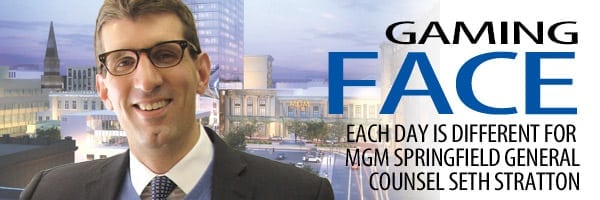
Each Day Is Different for MGM Springfield General Counsel Seth Stratton

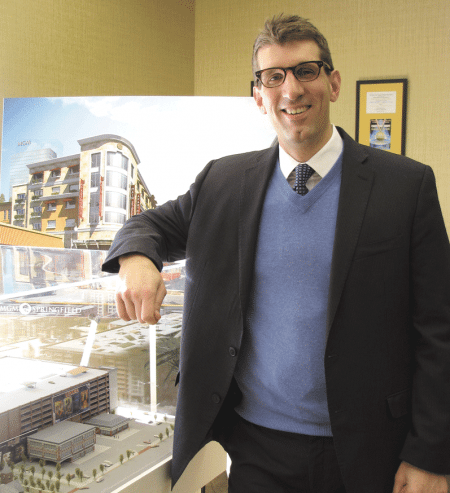
Seth Stratton
Ask Seth Stratton for his job description, and he’s likely to respond, “which day?”

“I don’t know the answer, and that’s the exciting part of this job,” said Stratton, who was recently named vice president and general counsel for MGM Springfield, making him only the company’s second full-time hire, after President Michael Mathis.

“This is a unique development,” Stratton said of the $800 million resort casino expected to open in 2017. “Western Massachusetts has never seen this type of development, and the statute [legalizing casinos] poses legal questions that haven’t been addressed yet in Massachusetts. My job description is to oversee legal affairs and government relations. But what that means day to day is the exciting part.”

Technically, Stratton’s job is overseeing legal affairs and government relations for MGM Springfield — an extension of work he had been performing with the company while working at Fitzgerald Attorneys at Law in East Longmeadow. But as the casino project moves forward, his job will shift often.

“Last week, we were making sure legal notices go out to the tenants of the buildings that comprise the project parcel. They’ll be vacating a lot of those buildings, and we need to make sure we prepare the legal notices they need in a way that’s informative but complies with the law,” he explained.

“We were also in Boston last week, in front of the Gaming Commission, dealing with a few issues that were required under statute — implementing some monitoring of electronic gaming and an affirmative diversity plan for hiring; MGM is committed to that,” he continued.

“That was last week. And I think a good part of the development period will be like that. It’s going to be an ongoing development project, and there are going to be a whole lot of legal issues — in construction, as we start to roll out our hiring, and making sure we’re complying with gaming statutes and regulations. As things start to normalize, we’ll have a better sense of what the average day for the general counsel of MGM Springfield is like.”

Before being hired away from Fitzgerald, Stratton worked with MGM Springfield for almost three years, negotiating agreements with the city of Springfield and surrounding communities as well as advising on permitting and real-estate acquisitions, all the while becoming a familiar face at the Massachusetts Gaming Commission, presenting on legal issues relevant to the casino project.

Now that role has expanded, and Stratton understands the complexity of navigating a project that will eventually employ some 3,000 people in an industry making its debut in the Commonwealth.

“We’re working with outside counsel in Las Vegas, making sure that an enterprise this size is complying with all the laws and regulations,” he told BusinessWest. “A lot of it is working with the Gaming Commission on regulatory and statutory compliance to gaming laws and regulations, as well as local compliance issues. We have an agreement with the city of Springfield, they did a great job in the interests of the city, and they’re very clear they will hold our feet to the fire on all these issues.”

In other words, bring on the myriad challenges.

“That’s the reason I jumped at the opportunity to take this job,” he said. “It’s really a cool opportunity where the job description changes on a weekly basis based on what’s going on at the moment.”

Coming Home

Stratton is, for lack of a better term, a Springfield guy, through and through.

“I was born and raised in East Forest Park,” he said. “My parents were both born and raised in Springfield. My wife and both her parents were born and raised in Springfield. I went to Cathedral.”

proposed $800 million casino

Seth Stratton says the proposed $800 million casino is a “unique development,” one that will certainly keep him busy in his role as general counsel.

However, armed with a bachelor’s degree in political science from Colgate University and a master’s in public affairs from UMass Boston, he couldn’t find a suitable job in Springfield, so he went to work for state Sen. Brian Lees at the State House. After earning his law degree from Suffolk University Law School, he took a job as a litigation associate at Brown Rudnick in Boston.

When his first child was born, however, he and his wife decided they wanted to live near their families in Western Mass., so they moved back to Longmeadow.

“There was nothing really comparable to what I’d been doing in Springfield, so I took a job with a similar firm in Hartford,” he said, referring to his counsel position in the Financial Institutions Litigation Group at Bingham McCutchen in Hartford. “But I felt disconnected form the community I lived in; I didn’t feel connected to the business community here.”

That’s when an opportunity opened up at Fitzgerald, where Stratton took on a diverse litigation and dispute-resolution practice focusing on a wide range of corporate, commercial, and personal disputes. “They were looking for a litigator, and I knew of their reputation, so I went to work there. That way, I worked five minutes from where I live, and I could be involved in the legal community in Western Mass.”

Within a month after taking the job, the casino legislation passed, and MGM eventually came poking around Springfield, and hired Fitzgerald to handle legal and governmental matters.

“We were essentially the local counsel for MGM in connection with local matters,” Stratton said. “About two years ago, I really started getting busier and busier; there was a lot going on, and I really became enmeshed in the project. I worked directly with Mike Mathis. We have similar backgrounds. He’s a lawyer by training, a former litigator, so we worked very well together. And I started getting more involved in these issues.”

One of his first roles involved negotiations of the host-community agreement with Springfield and surrounding-community agreements with neighboring cities and towns.

“That was a lengthy process. Under statute, we had to reach out to the surrounding communities and negotiate with them, and that involved knowing who the players were and knowing what the communities are all about. That’s where my local experience, being local and involved in local politics, helped me to negotiate and handle arbitrations in front of the Gaming Commission.”

He worked extensively on the West Springfield and Longmeadow deals, and though both towns prevailed in arbitration, “we were satisfied with the results, which were consistent with the statute’s intent. We eventually ended up with surrounding-community agreements with all the communities abutting Springfield.”

As he became more involved with MGM through Fitzgerald, he worked on regulatory aspects and compliance issues with the Gaming Commission, and on the host-community agreement with Springfield.

“I worked pretty closely with the city solicitor on a number of items,” Stratton said. “I think it was helpful that folks I was dealing with in the city, and in the surrounding communities, knew I’m from the city, I have local roots, and I think that gave me credibility in these discussions that an outsider with a similar legal background may not have had. And MGM recognized that as a benefit.”

Added Mathis, “from day one as one of our local counsel, Seth has been a steady sounding board for the entire MGM Springfield team. We feel fortunate that he is not only a respected lawyer, but also cares deeply about the future of this area and the city of Springfield. His advice is always informed by his concern for local issues.”

Stratton praised Mathis equally effusively. “He’s a dynamic, young leader in this industry — very bright, very energetic, very demanding. Working with him over the last couple years has been very exciting. I truly have been impressed with the quality of professionalism and work ethic from all the individuals I’ve dealt with at MGM. To become a part of that culture is something I really appreciate.”

Bringing Springfield Back

Stratton also has a vision for his home city’s future, with MGM Springfield at the center of the revival.

“It sounds a little colloquial, but I grew up off Sumner Avenue and Allen Street, and I remember Christmas Eve, my father doing last-minute shopping at Baystate West. I remember hopping on the PVTA bus from Sumner Avenue to downtown and going to Johnson’s Bookstore,” he recalled.

“I love the idea that there could be more of those opportunities for people hoping to go to entertainment venues in downtown Springfield. For people living in these neighborhoods to go to MGM Springfield, not only to the casino but for some of the retail and restaurants, that would be exciting to me.”

While the city’s downtown has generated momentum lately with a growing number of businesses and colleges setting up shop, Stratton didn’t sense much excitement in the area around the time the gaming legislation was passed.

“I didn’t have the impression things were happening,” he said. “But right away, I realized this project had the opportunity to be the spark Springfield needed. Springfield does have its challenges. I’m not under the impression that MGM Springfield will be the hero, but I definitely think it has a catalyst ability, to be the spark that gets people excited about reinvesting in downtown.

“The idea that my wife and I can hop in the car and go to dinner and a show and then be home in five minutes, that’s truly exciting to us as a family,” he continued. “There are so few of those opportunities. When we do have time to go out to dinner, we’ll drive to Northampton, but it’s never been on our radar to go to Springfield. That’s going to change, and that’s really exciting for us.”

For now, though, Stratton continues to press his legal expertise and local knowledge to help bring that vision to reality. He expects his role to continue expanding, encompassing federal issues as well as state-level regulations, as groundbreaking, construction, and hiring and training strategies all move forward.

“It all changes day to day,” he said. “And that just makes the job more interesting.”


Joseph Bednar can be reached at [email protected]

Autos Sections
Area Auto Dealers Expect Sales to Accelerate in 2015

Carla Cosenzi

Carla Cosenzi says people who visit an auto dealership are often surprised at the advanced technology available in today’s models.

Carla Cosenzi doesn’t mince words when she talks about 2015 and her expectation that it will be a great year for auto sales.

“The economy continues to gain strength, interest rates remain low, and there are a lot of exciting new models coming out, so the outlook is really positive; the auto industry is predicting a record year,” said the president of TommyCar Auto Group, adding that sales have been on the rise in the past few years and the company was confident enough to build brand-new Hyundai and Volkswagen dealerships in Northampton over the past few years.

Jeb Balise agrees that sales are moving in a forward direction. “The industry is predicting a phenomenal year, but we had our best year ever last year,” said the chairman and CEO of Balise Auto Sales. “We sold just under 25,000 units, so any growth will be a bonus. But we are pretty excited about the future and continue to add new stores.”

Mike Marcotte said Marcotte Ford saw a 9% increase in new-car sales last year. “Sales were really strong, and we are hoping to be at 10% this year. We’ve hired new employees and ramped up our commercial sales department,” the company president told BusinessWest.

Such optimistic projections are in line with national forecasts. In fact, on Jan. 21, analysts at the American Financial Service Assoc. Vehicle Finance Conference in San Francisco said they expect the numbers to continue to grow in 2015 for the sixth consecutive year.

TrueCar and J.D. Powers are also optimistic and predict that sales of new vehicles should hit 17 million this year for the first time since 2005, a 3% increase over last year.

A number of factors are playing into the equation. Consumer confidence has risen, many vehicles can be purchased at low or 0% interest, gas prices have dropped dramatically, and consumers are impressed by the new features, gas mileage, and technology offered by manufacturers today, who find themselves in a highly competitive market with lean margins.

The reduction in gas prices has fueled the growth of SUVs and trucks, which slowed considerably nationwide when prices at the pump increased a few years ago.

Local dealers also noticed the trend. “People are very reactive to current circumstances, and we are already seeing sales of trucks and SUVs increasing because of low fuel prices; when gas prices went up, customers gravitated to hybrids,” Balise said. “But now, sales of mid- and full-sized SUVs and trucks are growing at a particularly fast rate.”

He believes the trend is exacerbated by the fact that construction jobs are increasing in the area, and with projects accelerating in Springfield, contractors and people in related businesses are buying the trucks they need to run their businesses. “There is a real demand for pickups again,” Balise said.

Marcotte concurred, and said the timing is serendipitous for Ford, due to its new, full-sized F-150 pickup, which has an all-aluminum body; redesigned Explorer and Edge SUVs; and a wide range of other new vehicles.

“We saw people trading in their big trucks for smaller cars three years ago,” he told BusinessWest, “But due to better gas mileage and the price of gas, there has been an upswing in sales of trucks and SUV’s.”

Marcotte Ford bulked up its inventory of 2014 F-150s last year to take advantage of the increase in demand, with the game plan of being able to offer attractive prices when the 2015 model came out. “There are great incentives for the 2014 models,” Marcotte said.

But the biggest factor in any sale is affordability, which has been a common denominator that is motivating people to purchase new vehicles.

“Transportation is less expensive today than it has been just about anytime in the past,” said Balise. “Low interest payments have exacerbated the advantages of new vehicles, and we are often able to offer people a lower payment than they had for their last vehicle.”

Jeb Balise, left, and Ken Maffia

Jeb Balise, left, and Ken Maffia say that providing exceptional service is a key component in repeat business.

Industry analysts say that, although people are borrowing more than they did in the past for a new vehicle, the fact that they are spreading payments over longer terms at low or 0% interest rates makes payments especially alluring. Experian Automotive reports the average new-car buyer financed approximately $27,799 in the third quarter of 2014, and although that was an increase of about 4% over the year before, their average monthly payment was only about 2.6% more.

“When people get a loan at 0% interest, it allows them to get more features and keep their payments the same,” Marcotte said.

Drumming Up Business

Auto dealers say that, although some people still trade in their vehicles every two to three years, most are keeping them for longer periods of time. “The average is 11 years, and the trade-ins we see have about 100,000 miles or more,” Marcotte said.

Balise agreed. “We’re seeing trade-ins with up to 270,000 miles. There are plenty with well over 100,000 miles that range between 175,000 and 205,000 miles, which is something we rarely saw prior to 2008.”

However, dealers say the fear of taking on new debt that existed during the recession has led to pent-up demand. “It’s greater today than it has ever been,” Balise said, adding that many people who put off purchasing new cars for several years are eager to buy again.

And since many haven’t entered a dealership for some time, they are wowed by what is being offered.

“Ford makes major changes every three years,” said Marcotte. “And people who visit a dealership for the first time in years are surprised by the technology and safety features in the vehicles.”

He told BusinessWest that Ford introduced two models that can be run on gas or electricity — the Fusion and the C-Max hybrid — to the market about three years ago. “People can plug into charging stations at dealerships and travel about 1,000 miles before they have to recharge. There are more options than ever before, so vehicles can really be tailored to suit people’s needs.”

Cosenzi agreed and noted that Volkswagen’s E-Gulf was named Motor Trend Car of the Year, and that vehicle, along with Nissan’s Leaf, another electric model, not only qualify for large state and federal rebates, but also ensure that buyers will never have to purchase gas again.

“We have a quick-charging station that fully charges a vehicle in under an hour, and more places are adding fast-charging stations so people can stop along the way when they want to take a long trip,” she continued, adding that customers who visit TommyCar’s dealerships often look for the latest safety features, including the BlueLink by Hyundai and Car Care by Volkswagen, which are similar to the OnStar system, which provides an emergency-response system, navigation, and diagnostics.

“BlueLink allows people to set a mileage parameter that alerts them if the driver goes outside of it or the speed limit, as well as step-by-step navigation. It also alerts them whenever the vehicle needs maintenance,” Cosenzi told BusinessWest. “But these features aren’t driving traffic, and people are not buying because they want the latest technology. They are just impressed by it when they come in.”

Balise agreed. “People are smart shoppers and more frugal than they used to be when it comes to options,” he explained. “They only want them if they see their value and know they will use them. They are more pragmatic and less emotional about purchases than they were in the past.”

Dealers are in agreement that most buyers know what they want when they enter the dealership because they have done research online. But they want to touch and feel the vehicle as well as test drive it, Cosenzi said.

However, due to fierce competition, they also know there is flexibility in pricing, and Balise said what used to be a painful transaction is now something that can be pleasant for the buyer.

“We’ve streamlined the process and discount vehicles in a forthright way with full disclosure so the customer is in control,” he said. “When they arrive, they are well-educated due to the Internet, so it behooves dealers to live up to the knowledge and understanding they have. Our success is based on high volume, so we are able to make transactions at low prices.”

Repeat business is important and is measured by manufacturers, and because the service people receive while they own a vehicle weighs heavily in their choice of where to go when they are ready to purchase a new model, dealerships are doing everything possible to make visits easy and pleasant.

“Manufacturers and dealers go to extremes to provide a great experience,” Balise said, adding that his dealerships’ customer-retention and loyalty rates are very high.

Marcotte explained that the trend of keeping vehicles longer than in the past led his dealership to outgrow its existing number of service bays. “So we are building new bays for commercial vehicles,” he said, adding that he will break ground next month on a new building with 16 bays. It will be positioned next to Quicklane on 933 Main St. in Holyoke, which services any make or model and was built by Marcotte six years ago.

He added that the dealership’s service department is open until midnight, and people who buy from Marcotte Ford can take advantage of its 150 free loaner vehicles. “We want to make things as convenient for customers as possible,” he noted. “We also offer breakfast catered by the Log Cabin Restaurant on Tuesdays and Saturdays so people can have a nice meal; some customers schedule visits at these times just because of the free meal.”

Balise said offering exceptional service is no longer an option, but a necessity. “Being good is not good enough today. Our growth is based on being customer-focused and is driven by that more than anything else. Standards have continued to rise over the last 10 years, and we are maniacal about being the absolute best in class.”

Optimism Prevails

Overall, Cosenzi said, consumers are more confident than they were a few years ago.

“Sales in the second half of 2014 really accelerated for us, and we are coming into our good months. Sales typically start to increase in February, and the outlook is really positive,” she noted, mentioning President’s Day specials and tax season because buyers who get large refunds often use them as a down payment for a new vehicle. “Plus, there are a lot of new models coming out.”

Balise concurs and said the company completed construction on four new dealerships last year and now has 19 in Massachusetts, Connecticut, and Rhode Island. “We are predicting a 2% to 4% increase in sales this year and feel pretty confident we will sell more than 30,000 units,” he told BusinessWest.

If interest rates and gas prices stay low, and the economy continues to improve, the numbers should add up to a good outcome for consumers and dealers alike.

Features
Will Falling Gas Prices Be Good for Business?

The downward trend in fuel prices has delighted consumers, but businesses have mixed thoughts when assessing the long-term impact.

The downward trend in fuel prices has delighted consumers, but businesses have mixed thoughts when assessing the long-term impact.

In 2008, as gas prices hit $4 per gallon, the blame game heated up as well, with Congress berating oil-company CEOs for profiteering during an economic slowdown, and the execs sniping at Congress for restricting drilling and refining at home, contributing to a dependence on oil-rich but often-unfriendly foreign governments.

Caught in the middle of that exchange were average Americans, who — already buffeted by an economic crash that bled jobs and drained retirement portfolios — increasingly found themselves diverting money from other household needs in order to fill up the gas tank.

At the same time, businesses of all kinds were forced to make tough decisions, from retail stores pondering whether to pass hefty shipping surcharges to customers, to construction firms seeing profits shrink as the cost of fuel and supplies far outstripped what they had anticipated during the bid process.

Now that gas prices have reversed course and plummeted, even dipping below $2 for regular at many stations in Massachusetts, one would expect those trends to be reversed, giving businesses some reprieve from six years of sky-high rates.

Not so fast.

“What I’ve found funny is that a lot of our paper suppliers — paper companies and different media outlets that make deliveries here — put on a gas surcharge,” said Steve Lang, president of Curry Printing in West Springfield. “But it never seems to come off. When we’re dealing with UPS, they’ll add their little surcharge in there for high gas prices, but it doesn’t come off when the prices come down.”

In fact, some analysts say the plunge in global oil prices will eventually affect small businesses in negative ways. Expected cutbacks and layoffs in the oil industry could be felt in related industries, such as the housing market in areas where petroleum companies operate, as well as restaurants and retailers that rely on oil-industry workers as their customers, Rohit Arora, CEO and co-founder of Biz2Credit, wrote in Inc.

“Lower oil and gasoline prices have many, many benefits for consumers and will likely help vitalize auto-industry sales and the spending of newly found disposable income,” he noted. “This is good news for small-business owners, of course. However, prices that are too low could eventually have serious negative implications longer-term.”

In short, while consumers are pleased with more money in their pockets, the impact on businesses of all kinds remains mixed, and uncertain.

Food for Thought

Retail businesses are anticipating that more disposable income will trickle down as increased sales. But so far, that hasn’t happened at Big Y, said Claire D’Amour, the chain’s vice president for corporate communications.

“Right now, it’s hard to tell, I think,” she told BusinessWest. “Low gas prices means there’s more disposable income, more cash in people’s wallets, but whether that’s translated into opportunities for higher sales, well, we haven’t seen anything specifically pointing to that this year.”

In reality, she noted, “after 2007, people changed their shopping patterns; they became more thrifty. With more money in their wallets now, will we see that change? We did have robust sales for the holiday season, which we’re happy about. But is that a reflection of gas prices? It’s hard to be sure.”

In fact, consumers aren’t seeing lower prices at food stores, for reasons that extend far beyond the retail sector. According to the U.S. Department of Agriculture, recent food-production challenges include a cattle herd that’s been much smaller than normal, which affects beef prices, and poor weather in the West that has hindered certain crops. High wheat production, on the other hand, has kept cereal and bread pricing relatively stable.

Still, the U.S. Department of Labor reports that the Consumer Price Index (CPI) for all items rose just 0.8% over the past 12 months, the second-lowest rise in the past 50 years, exceeded only by 2008, the year financial markets — and the economy in general — spun into crisis. The 2014 CPI has much to do with energy costs, which fell 10.6% over the year, with gasoline falling 21%.

The drop is due mainly to the highest global oil production since 1989, but industry analysts differ when it comes to how long this period might last.

“Most of us in the industry are surprised that it’s fallen as hard and fast as it has,” Ryan Lance, CEO of ConocoPhillips, said at a meeting of the Center for Strategic and International Studies. “I don’t know that I have a real good answer to that question, other than it doesn’t feel like the fundamentals would support that kind of fall.”

Instead, Lance predicts oil prices will rebound faster than anticipated, as they did in 2009, on the heels of the Great Recession. “People were worried about the global economy, and prices went to $30, $40 a barrel, and just a matter of months later, it was back to $100 a barrel,” he said. “And that’s the kind of volatility we’re in.”

After a strong holiday season, Big Y executives are unsure how gas prices will affect consumer behavior heading into 2015.

After a strong holiday season, Big Y executives are unsure how gas prices will affect consumer behavior heading into 2015.

On the other hand, Larry Zimpleman, chairman and CEO of Principal Financial Group, told the Wall Street Journal that he predicts the era of relatively tight supplies controlled by OPEC, and resulting high energy prices, to be coming to an end.

The reasons why are numerous, including continuing sluggish growth in both emerging and developed economies, reducing the demand for oil; new technologies, such as fracking, making previously shuttered oil fields productive once again, increasing the volume of oil coming onto the market; and continued incremental improvement in alternative sources of energy, like wind and solar. “Thus,” he said, “I think pressure is likely to remain on oil prices for an extended period.”

That’s good news for general contractors, said Craig Sweitzer, president of Craig Sweitzer & Co., a construction firm in Monson with seven employees.

“It’s absolutely huge,” said Sweitzer, who has seven gas-powered vehicles in his fleet. “We’re lucky, because we decided to upgrade and give everyone a truck last year, which we’d never done before. Add in insurance and taxes and fuel, and it was a huge windfall to have gas prices go down. We drive big trucks that consume a lot of fuel; it’s a very big part of our expenses.”

He noted that some contruction-related industries — like road pavers, which use oil in their asphalt products — have clauses built into their contracts that protect against sudden increases in fuel prices, “but we’re the little guys, and people don’t typically do that with us. The airlines, for instance, pre-buy on their contracts, but we’re completely prey to the market.”

Moving On Down

The drop in energy prices is equally welcome at other businesses that use a lot of gas, like commercial movers.

“In our case, there are two parts to our company,” said Rod Sitterly, president of Sitterly Moving & Storage in Springfield. “One would be local household and commercial moving. Gas prices have very little effect there because everything is local; the truck sits there for five hours, then goes two miles to its destination. So, for the local household and local commercial jobs, there’s very little effect. Some moving companies were charging a fuel surcharge for those moves, but we never did.

“The long-distance moves, that’s a totally different story,” he continued. “Obviously, fuel is a bigger segment of the cost. The major movers, the major van lines — we’re with Atlas, for example — for the moment, they have an 8% fuel surcharge that has been as high as 14%, so there has been a significant decline in that.”

He noted that this environment stems from the days when industry rates were regulated by the Interstate Commerce Commission, and companies were allowed to tag on fuel surcharges to reflect rising gas prices.

“Since deregulation, you can charge whatever you want, and over time, a lot of charges have gone away — but the fuel surcharge never did,” Sitterly said. “For long-distance moving, obviously it has a big effect. Even people moving themselves to Florida or someplace long-distances often don’t consider how much they’ll pay to get to their new location.”

Big Y, with more than 50 stores across the region, saw its fuel surcharges on produce trucked from California and other distant locales increase by $1 million in just six months in 2008, when oil prices shot up. While those fees are not an issue right now, D’Amour said, the company is not yet benefiting in other ways one might expect now that energy prices have fallen.

“In terms of our utilities, a lot of utility rates get locked in, so they’re not fluctuating,” she said, adding that the chain has also seen little decrease in production costs — say, for canned goods — passed down to retailers. “We’re not seeing reductions, but there’s a huge lag time.”

As for how less-expensive gas might change customer spending habits, she reiterated that Big Y, like other businesses, are still waiting for positive signs.

“There were lots of lessons learned from 2008 in terms of how people buy — ­whether they might splurge here or there [with extra cash] or pay off another credit card. Right now, it’s hard to tell.”

For others, like Sweitzer, the benefits are clear and immediate — and come with a political upside.

“Now that America is one of the largest oil producers, you feel good buying gas; it’s a win-win economically and culturally,” he told BusinessWest. “Everyone feels it. I’m sure a lot of people had a better Christmas because of the extra money in their pockets.”

Joseph Bednar can be reached at [email protected]

Cover Story
Area Colleges Step Up Efforts to Recruit International Students

COVERo115bMichelle Kowalsky’s business card declares that, among other things, she is the director of International Admissions at Western New England University.

She’s the first person in the 95-year history of the school to take the title, and that fact speaks to a rather large movement within higher education — and education in general.

Indeed, while schools in this region and across the country have always admitted international students, they have not pursued them in anything approaching the aggressive manner that they are now — for several reasons.

For starters, many schools, WNEU among them, have made it part of their strategic-planning initiatives to become more culturally diverse, because of the many benefits that such a quality brings (more on all that later). Also, there are simply fewer domestic students to pursue as high-school graduation rates continue to decline and schools scramble to fill seats while keeping academic standards high.

And there is an important practical consideration as well. In many cases, the parents — or the government — of the student being recruited is ready, willing, and able to pay full price for the privilege of being educated in the U.S.

Add it all up, and people like Kowalsky are racking up frequent-flyer miles and mastering important phrases in several languages as they engage in what those we spoke with described as a spirited, heightened, but mostly friendly competition for students from China, Saudi Arabia, Central and South America, Japan, and other spots on the globe.

Michelle Kowalsky

Michelle Kowalsky recently added the title ‘director of International Admissions’ to her business card, and she is one of many to do so in recent years as the competition for foreign students has heated up.

Spirited, because the stakes are somewhat high. For those reasons listed above, international recruitment is now much more of a necessity than a stated goal, said Kowalsky. And friendly, because schools in this region at least are not necessarily pursuing the same international students.

And often, they’re traveling in groups to various countries or working together through initiatives like Study Massachusetts, a consortium of Bay State colleges that promotes and guides international students to study within the Commonwealth, which Kowalsky currently serves as chair.

A quick look at some numbers shows that various schools’ efforts to recruit internationally are bearing fruit — and changing the dynamic on their campuses in the process.

Bay Path University, which had eight international students in 2012, now has 30 (some undergraduate, but mostly graduate), said Jill Bodnar, who also recently acquired the title of director of International Admissions and now works for the school full-time.

Meanwhile, at Springfield College, which has always had a steady, if small, population of international students because of the school’s historic relationship with the YMCA, has seen its numbers rise to include more than 20 nationalities, said Deborah Alm, director of the school’s Daggett International Center.

At UMass Amherst, administrators realized several years ago that, with international enrollment at roughly 1% of the student population, the school lagged well behind other state universities, which were usually at 5% or higher, said James Roache, assistant provost for Enrollment Management. The university set a goal of 3% by 2014 and surpassed that mark, he noted, and expects to hit 5% (roughly 230 students) this year.

Dawazhanme

Dawazhanme, who came to Bay Path University from Tibet, says she found the school through a Google search, and liked the small size of the campus and the classes.

And at WNEU, the number of international students has climbed from two or three a decade ago (students, said Kowalski, “who just happened to find us”) to the 30 who were on campus for the start of this spring’s semester.

Anastasia Ilyukhina is among them.

She was a student at Moscow State University and doing some interpreting for Kowalsky and others at a recent conference in that city when she mentioned to the WNEU administrator that she was interested in studying in the U.S.

Fast-forward a few months, and she was on the school’s campus in Sixteen Acres, majoring in International Studies, and enjoying, among other things, the vast variety of foods in this country and a level of interactivity in the classroom between student and teacher that is, well, foreign to her.

“Teachers here are like your friends — you can talk with them after classes or sit with them in the cafeteria and talk about life,” said Ilyukhina, who has designs on one day working in an embassy as a diplomat or interpreter. “It’s not like that in Russia, and that’s one of the reasons I like going to school here.”

For this issue and its focus on education, BusinessWest looks at how and why more people like Ilyukhina are able to enjoy such experiences, and why, for the schools that are hosting them, international recruitment is becoming an ever-more-important part of doing business.

A World of Difference

She is from Tibet, specifically the village of Dzongsar. Her parents are, among other things, yak herders — although there are fewer yak to herd these days, and that’s another story. She found Bay Path University as a result of a Google search for business schools in the U.S. She makes documentary films (she’s done one on yak, for example) and when she returns to Tibet she wants to help her parents and others create new business opportunities.

All of this helps explain why people like Dawazhanme (in her culture, one name is generally used) are now populating campuses like Bay Path’s, and also why schools want to recruit people like her.

“She has a fascinating story … she’s very talented, and she brings so much to the Bay Path community,” said Melissa Morris-Olson, the university’s provost and also a professor of Higher Education Leadership. “Having students like her on campus has certainly helped expand the horizons of our other students.”

The desire to bring people like Dawazhanme to the Longmeadow campus is part of a broader strategy to “expose students to the broader world,” said Morris-Olson, noting that there are several components to this assignment.

“Roughly 60% of our undergraduate students come from first-generation families,” she explained. “Many of those students, if not most, have never been on an airplane; they’ve never been out of the region. We do have study-abroad experiences, but a lot of students don’t have the money to do that, so bringing students here from other places becomes particularly important as one way of internationalizing the curriculum and the campus and exposing our students to students of other cultures.”

Those same sentiments are being expressed by college administrators across the state and across the country, and they certainly help explain what would have to be called an explosion in international recruitment efforts among area colleges.

“Most schools are recognizing that, as the world gets smaller, we need to expose our students to other cultures, and therefore we welcome international students into our classrooms and living places with our students, which enriches all of us,” said Alm, echoing Morriss-Olson and others we spoke with.

But there are many reasons for this phenomenon.

Chief among them is a strong desire among foreign governments and individual families in those countries to send young people to the U.S. to be educated. The reasons why vary and include the comparatively high quality of the education to be found here, as well as a shortage of quantity in the countries in question.

In many cases, these efforts have become organized and sophisticated, and they involve students of all ages, even grammar school.

In China, for example, there are now myriad education agencies, large and small, that exist primarily to link families and students with educational opportunities in the U.S. and elsewhere, said Bodnar, who spent 15 years in China on various business endeavors, including work with a developer to open health clubs for women, and developed a number of contacts on the ground there.

“China was really exploding in every industry, and as that was happening, Chinese families became increasingly interested in their children coming to the U.S. to be educated,” she said, adding that this sentiment exists even though those who do attend a university in China do so free of charge.

Meanwhile, in Saudi Arabia, the government there has stepped up its efforts to send young people stateside to be trained in a number of fields, from healthcare to engineering, said Bodnar, adding that Bay Path wasn’t necessarily targeting young people in that country, but an opportunity presented itself through an education agency similar to those in China.

“We got an e-mail from someone at the agency saying he worked with Saudi students to look for graduate programs in the U.S. and wanted to know if we were interested,” she explained. “We answered in an e-mail, asked for some more details, and it it just took off from there — we were flooded with applications.”

Textbook Examples

To be part of this international-recruitment movement and bring that coveted diversity and other benefits to their campuses, area colleges and universities must be more aggressive in their recruiting, build name recognition for their institutions, forge relationships with those aforementioned agencies and other entities created to facilitate study here — and do all of this within a budget.

Indeed, travel is very expensive, and schools are being creative, and prudent, in when and how they undertake it.

Jill Bodnar, left, and Melissa Morris-Olson

Jill Bodnar, left, and Melissa Morris-Olson noted that Bay Path University has gone from a handful of international students to more than 30 in just a few years.

At Springfield College, for example, Alm took an open seat (the college’s president, Mary-Beth Cooper, took another) when the school’s basketball team traveled to Japan for an exhibition on the occasion of the 100th anniversary of the introduction of the sport in that country. She used the opportunity to visit some YMCAs and build visibility for the school.

Overall, said Morriss-Olson, schools must take their commitment to international recruitment to another plane, which Bay Path has done by hiring Bodnar and taking other steps to become a player on the international stage.

“The establishment of Jill’s position really does reflect somewhat of a turning point for us at Bay Path,” Morriss-Olson explained, noting that, while the school has always had a handful of international students on campus — it has long had an exchange program with Ehwa University in South Korea, for example — like other schools, it has dramatically increased those numbers and intends to continue that trend.

At UMass Amherst, the school now recruits from a number of countries, including India, South Korea, and Saudi Arabia, but most of its time and energy is focused on China, said Kregg Strehorn, assistant provost for International Recruitment, who, when asked to describe the school’s overall strategy, summoned the phrase ‘reverse engineering.’

“We’re lucky enough to have been a popular school to attract international students for decades, and what I basically did was gather as much data as a I could about who we were getting applications from, and then really drilling down to find out where we were already popular and why,” he explained. “And then, we’d drill down further into those cities, districts, and those schools to find out why were getting 20 or 30 applications from this one school in Southern China.

“Then, we took it further to find out where we already had students from, and reverse engineered that information,” he went on. “I reached out to those schools and said, ‘we have two students from your school; I’d love to tell you how they’re doing here,’ and by doing that, I was able to develop relationships with individual schools. And that strategy has been very successful — it’s low-maintenance, and it gave us a quick way to jump into the market.”

At WNEU, said Kowalsky, the school’s administration has made a formal commitment to international recruitment, which has manifested itself in a number of ways, including her new title and changed responsibilities (international recruitment was once a minor component of her work; now it occupies roughly 90% of her time) — and a much larger travel budget.

Kowalsky said she’s made several trips in recent years, sometimes by herself but usually as part of a group, to a number of different countries. In recent years, she’s had her passport punched in several Asian countries, but also Brazil, Ecuador, Colombia, and the Dominican Republic.

Her most recent junket was to Guangzhou, China, to attend the China-U.S. Principals Forum for Internationalization of High School Education. The gathering brought together Chinese principals and guidance counselors from 43 high schools across Northwestern China to meet and consult with several U.S. university representatives, with the goal of helping the Chinese educators better guide their students through the U.S. college-application process.

Overall, she said, progress for WNEU in the international forum has come slowly but steadily. It certainly wasn’t something that happened overnight.

“I had said to the higher administration that, if they wanted me to do this, we would need to invest three to five years minimum in order to see any kind of results, because we’re not a brand name; we’re not a household name,” she told BusinessWest. “We needed to really get out there and continuously brand ourselves to reap the benefits down the road. And we’ve definitely seen that, and I’m happy that the administration supported that idea.

“On my first trip, they weren’t looking for me to come back and we’d suddenly have 20 applications or even 10,” she went on. “After that first trip, I don’t think we had even one new student that I could directly tie to that trip. It was more of a continual branding and building of those important relationships.”

Study in Creativity

Patience, commitment, and diligence are all-important qualities in efforts to recruit internationally, said all those we spoke with, because, while this competition is mostly friendly, as mentioned earlier, it is still a competition.

And one that is becoming more intense with each passing year.

Indeed, in the course of her many travels, Kowalsky has seen the number of schools hitting the road escalate and the ranks swell to include Ivy League schools, including Harvard, which enjoy tremendous brand recognition and strong reputations for excellence.

“The landscape has become much more competitive because everybody wants a piece of the international pie, basically, and a lot more schools are traveling,” she explained.

“Until recently, I had never seen Harvard on the road, but this fall I was traveling with a small group of five universities, something we put together ourselves,” she went on. “We were visiting a couple of high schools, and the Ivy League schools were there, which was shocking to me because I had never seen that before. But it’s understandable, because they’re out there competing against each other for the best of the best.”

As they compete against schools across the country, area colleges and universities have some advantages, and some obstacles as well. Clearly, the reputation of the Northeast, and especially Massachusetts, as a place where the world goes to be educated certainly helps, said Morriss-Olson. However, the relative anonymity of schools like Bay Path, WNEU, and Springfield College can be a disadvantage.

Alm noted that, while Springfield College is certainly well-known within the YMCA community and also for programs such as those in the health sciences and rehabilitation, it is not considered an established brand.

“And so we do have to educate the people we talk with about our many other programs and all that we have to offer,” she said, adding quickly that she must often also educate those she meets about the word ‘college.’

In many countries, especially those that were once part of the United Kingdom, ‘college’ translates roughly into ‘high school.’

“In the mindset of parents, ‘college’ is not yet higher education,” she noted. “Explaining what it means in this country is just part of the education process.”

Strehorn said he and others at UMass have had to do their fair share of explaining things as well. Those duties encompass everything from defining phrases like ‘flagship campus’ and ‘university system’ — “there is no translation in Chinese for the word ‘flagship,’” he noted — to making students, parents, and school administrators understand why the top-ranked public school in the region is not located in Boston.

And geography can also be a factor within this competition, Alm went on, noting that, for some in Asian countries, the East Coast is not only much further away than the West Coast, and therefore more difficult and more expensive to travel to, it is also more of an unknown quantity.

While in some respects it is difficult for schools in more rural settings like Bay Path to compete with major urban settings such as Boston, New York, and San Francisco, Bodnar said, many of the students they’re recruiting don’t come from big cities and would rather not go to college in one.

Dawazhanme told BusinessWest that she also looked at Dartmouth, the University of Oregon, and University of Texas in Austin, among others. She was ultimately attracted to Bay Path by the small size of the school and its classes. There were also corresponses with Bodnar that added an attractive personal touch to the process.
“She would write to me almost every month,” she explained. “That gave me a chance to really get to know about the university and the people here.”

Overall, schools will take full advantage of any edge they can get, said Kowalsky, adding that WNEU has an usual one.

“These kids all know The Simpsons, and so they all know about Springfield, and I’m fine with that,” said Kowalsky, noting that, while the show doesn’t identify its host city as being in the Bay State, it doesn’t really matter. “As far as they’re concerned, Springfield is one place in the United States, and if our banner says Springfield and they make an association because of that, I’m fine with it.”

Meanwhile, at UMass Amherst, the school’s name resonates thanks to solid U.S. News & World Report rankings, which are a big factor overseas (the university was recently ranked among the top 30 public schools in the country), as does its celebrated food-services department, ranked first or second in most national polls, said Strehorn.

“My family and I eat in the dining commons once a week — my kids love it, they think it’s a five-star restaurant, and for all intents and purposes, it is,” he told BusinessWest. “Ken Toog (executive director of Auxiliary Enterprises) for the university) has brought an international flavor to it — we serve international food. Last year, I had a bunch of colleagues from China come to visit, and one I’d never met before told me this was the best Chinese food she’d ever had outside of China.”

Course of Action

Kowalsky said that her travels have taken her to a number of intriguing spots on the globe, from Beijing to Rio de Janeiro to Hong Kong, but she hasn’t had many opportunities to take in the sights.

“There’s never really time — when I’m visiting a city, I’m not there long — and besides, I’m not there on vacation,” she said, adding that there is important work to be done, and time and resources must be allocated prudently.

This is a new and different time for colleges across the country, a time to make the planet smaller and bring it to their campuses and classrooms. The race for international students is indeed a competition, but it also represents a world of opportunity — in more ways than one.

George O’Brien can be reached at [email protected]

Construction Sections
Recreation of Monticello Was A Project for the Ages

S. Prestley Blake takes a photo of the replica of Monticello he had built in Somers.

S. Prestley Blake takes a photo of the replica of Monticello he had built in Somers.

Bill Laplante remembers the phone call like it was yesterday.

That’s because it seemingly came out of nowhere, and also because it marked the unofficial start of easily the most intriguing — and also one of the more challenging — endeavors in his long career as a home builder, and what he would repeatedly call “the opportunity of a lifetime.”

On the other end of the line was S. Prestley Blake, the then-98-year-old co-founder of Friendly Ice Cream and admirer of both Jefferson and the Laplante company’s work — it built the home his daughter and son in law now reside in, and also the new residence for the president of Springfield College (erected a dozen years ago), for which Blake developed a deep appreciation regarding both its design and workmanship.

“He said ‘Bill … I’m thinking about building a replica of Monticello in Somers,’” said Laplante, president of the East Longmeadow-based firm launched by his father, Ray. “He said he wanted me to come over and assess the property, take a look at things, review the site plans … that’s how it all started.”

It all ended just a few months ago, with a black-tie party that was combination early 100th birthday bash and open house attended by more than 250 people at what would have to be called ‘Blake’s Monticello,’ although it’s highly unlikely that he’ll ever spend a night in it.

This Monticello, slightly smaller than the original, Thomas Jefferson’s home in Charlottesville, Va., is what Blake, reached by BusinessWest in Florida, called, alternately, a “gift to the community,” his “swan song,” and “something I’m doing for posterity, not profit.”

Indeed, he expects to certainly lose money on the home currently on the market with a sticker price of $6.5 million, roughly $1 million less than what it cost to buy the land, raze what was on it, and build the landmark. There have been a few inquiries, and those interested will have to eventually impress Blake, who has the final say on this sale and insists he’ll only sell to someone who has both the requisite financial wherewithal and the same commitment to the community that he does.

As for Laplante, his crews, and lead design consultant Jennifer Champigny (not to mention Prestley Blake and his wife Helen) the endeavor quickly became a labor of love, a project no one really wanted to see end, although everyone involved was firmly committed to getting things done before Blake became a centenarian last November. Overall, the huge undertaking was completed in an impressive 14 months, more than three decades less than it took Jefferson to complete the original.

“The whole project, from start to finish, was a lot of fun … everyone who worked on it, from day one, thoroughly enjoyed it,” said Laplante. “It truly was a once-in-a-lifetime opportunity.”

The building process, began in the spring of 2013, soon after Blake closed on the nine acres of land off Hall Hill Road, just a few hundred yards from the Massachusetts border, and the structures built on it (owned then by the estate of the late Big Y co-founder Gerry D’Amour and his wife Jeanne). It was preceded by a visit to the original Monticello by Laplante and his father.

They took hundreds of photographs, made volumes of notes, and purchased the book Monticello in Measured Drawings, which soon became invaluable.

Bill Laplante

Bill Laplante, standing in the foyer at the
Somers Monticello, called the project the “opportunity
of a lifetime.”

Using these resources, the Laplante company built an almost exact replica of the exterior of Jefferson’s home, and an ultra-modern, luxurious — and ‘green’ —interior. Both elements can certainly turn heads.

“I think this is the most prominent private house in the country,” Blake told BusinessWest in reference to his creation, noting that this assessment is based on aesthetics and the model that inspired it, not sheer size or features. “The White House is the most prominent house in the country, but that’s owned by the government. This is a private house I built on my own.”

For this issue and its focus on contruction, BusinessWest takes an in-depth look at why Blake’s Monticello came to be built and how. In the course of doing so, it became clear why those who view the house use the same word to describe it as those called upon to recount the building process: memorable

Landmark Decisions

They eventually dubbed it ‘Monticello Highway.’

That was the name given to the path that Blake had carved between the site of the Somers Monticello and his own home, just a few hundred yards away (the properties abut).

Blake would take that path on his small, four-wheel-drive motorized vehicle called a ‘Gator,’ said Laplante, adding that he was at the construction site by 7:30 a.m. almost every day he was in this region to observe, take photos, and offer both suggestions and commentary — mostly the latter, because he gave great latitude to the builders.

What the Blakes saw emerge on the gently rolling parcel is one of the few replicas of Monticello in this country — there’s a bank modeled after it in Monticello, Ind., and a chiropractor’s office in Paducah, Ky., for example — and certainly the most extensive and expensive.

The Monticello in Somers has a number of things the one in Charlottesville doesn’t, including:

• A three-car garage;
• A tiled patio atop the three-car garage, which was a very popular gathering spot during the party in October;
• An elevator;
• Laundry rooms on the first and second floors;
• A wine chiller;
• Wolf and Sub-Zero appliances;
• A pantry with floor-to-ceiling cabinets, a so-called library ladder to reach those heights, and leathered granite counter tops;
• Five full baths complete with walk-in showers, towel warmers, and other amenities;
• Coffee stations in most of the rooms and a second-floor kitchenette; and
• Geothermal heating and cooling.

It does, however, have many of the same exterior features, including the white columns, roof ballustrades, and signature dome at the front of the structure (or the back at the original Monticello; the back entrance was the main entrance in Jefferson’s time), and some interior elements as well, including a tea room, a lavish foyer (although the one in Somers has a double staircase), ornate hard-wood floors, and so-called great room.

DownHallRooms

At top, the dining room in the Somers Monticello, and above, the bathroom off the master bedroom.

At top, the dining room in the Somers Monticello, and above, the bathroom off the master bedroom.

Retelling the story of how it all came about, Laplante said Blake was never particularly fond of the large estate built by the D’Amours, and has always been enamored with Monticello, architecturally and otherwise, and conceived a project to replace one with the other and, in the process, build something memorable and lasting.

As Blake was finalizing his purchase of the site, he was also engaging Laplante on the undertaking to come.

The trip to Charlottesville was educational and therefore quite helpful, said Laplante, adding that this was his first visit to the landmark.

“We met with the people giving the tours of Monticello, we toured the entire facility, and took a number of photographs, including many detailed photographs,” he explained. “We were focusing on the exterior of the building, because the original plan called for building a replica of Monticello, especially with regard to the exterior façade, but make it into a modernized single-family home on the inside — something that someone would be interested in purchasing and living in.”

Monticello in Measured Drawings became a valuable resource, he went on, adding that it was assembled by an architectural group that recreated scaled drawings of the original.

“It was very difficult, because there were areas that were 1:32 scale, because of the size of the house and obviously the size of the book,” Laplante explained. “We were dealing with very, very small scale, but it was very helpful having that, as well as the photos we took of the original and the tours we took.”

Glory Details

Beyond the basic mission of reproducing the original Monticello’s exterior, the Blakes’ only real instructions to the builders were simple, said Laplante, adding that he was told not to spare any expense, to build a replica as exacting as possible, and, inside “to make every room spectacular.”

And by all accounts, he and his crews followed those instructions to the letter.

Attention to detail can be seen in many aspects of the recreation work, including the brick used. Bricks in the original were hand-made made on-site in Virginia, said Laplante, adding that those used in Somers were also hand-made and cast to look like what was used in the early 19th century.

The decision was made early on to place the dome at the front of the house, the side facing Hall Hill Road, said Laplante, adding that the ‘front’ façade of the replica is, by his estimation, 98% accurate to scale.

One of the main differences between the two Monticellos is that the one in Virginia has an open porch, complete with arched-brick openings, on the left side, while the one in Somers has an enclosed hearth room, located just off the kitchen, in that location.

Also, Jefferson’s Monticello had a room inside the dome, while the one in Somers does not, and the second-floor windows in the replica are larger than those in the original to meet modern building codes.

“Working around the windows was perhaps the biggest challenge in designing this, because we were designing an interior around an exterior that was built 200 years ago,” he said, adding that both the original and replica (at least from the ‘front’ view) are two-story homes that don’t look like two-story homes.

The kitchen in the Somers Monticello is certainly different than the one in Thomas Jefferson’s original in Charlottesville, Va.

The kitchen in the Somers Monticello is certainly different than the one in Thomas Jefferson’s original in Charlottesville, Va.

And while creating a modern interior within a two-century-old shell came complete with many challenges, that assignment gave the builders and designer plenty of opportunities to stretch their collective imaginations.

“From the beginning, the Blakes said, ‘we want every room we walk into to be spectacular,’” said Laplante. “But they didn’t micro-manage the design and the details; they let us come up with what we thought should be done.”

Some of the details were taken from the original, he went on, citing such things as floor patterns (although slightly different wood species were used), but the interior obviously bears little resemblance to the one in Charlottesville.

The kitchen in Jefferson’s Monticello was a simple facility in the basement. The kitchen in Somers is massive, with the most modern appliances and quartz countertops. The Monticello in Virginia had five outdoor privvys; the one in Somers has nine baths, many of then featuring Carrara marble.

The biggest difference between the two landmarks, however, is the ‘green’ nature of the replica. Jefferson heated with wood. The Somers home features geothermal heating and cooling equipment (which Laplante said is becoming increasingly popular due to attractive tax credits). It also has LED lighting, energy-efficient windows and doors, and icynene spray foam insulation. Meanwhile, raw materials from the site, including oak and cedar trees and red stone harvested from the parcel were used in the construction.

Overall, the buildings are worlds apart in terms of building materials and processes and creature comforts, but they look remarkably similar in large, framed photographs hanging side by side in the wood-paneled garage.

History in the Remaking

In addition to the party in October, the Blakes had a small gathering in the Somers landmark just before the holidays.

For the event, dubbed ‘Christmas at Monticello,’ the Blakes actually borrowed a few pieces of furniture and had some tables placed in the great room, said Laplante, who was among those invited.

The scene was a little strange, he recalled, but understandable because while the Blakes built the home, technically, it’s not theirs.

Soon, if the right buyer and right price come together, it will belong to someone. But it many respects, it will always belong to the community, said Blake, adding that, like the original, it was built to last and built to inspire.

And it is already doing just that.

George O’Brien can be reached at [email protected]

Sections Women in Businesss
Lanie Delphin Brings Couples Together with Mass Match

Lanie Delphin

Lanie Delphin

Lanie Delphin met her husband, Bud, through a dating service 16 years ago. And that got her thinking about how lucky they were.

Actually, that’s the wrong word; Delphin doesn’t believe relationships are built on luck — or fate, for that matter — but on solid, common-sense matches. And she decided she wanted to be a matchmaker.

“At the time, we realized there were just no good ways to meet people,” she told BusinessWest. “Internet dating was just taking off. I always believed I’d find someone, but it’s very hard to find people in this culture. People typically don’t want to meet at work, friends typically don’t want to fix you up, many people don’t go to religious institutions anymore. And if you do meet someone randomly, you don’t know if that person is looking for someone — or even single.”

Fascinated by the dating business, she bought a license in 2002 from a national company called Single Search and launched the online dating service Single Search Western Mass.

“We started the business as a way to help people find the success we had found,” she said. “When we started, I had never run a business, so I was grateful for the help I got being a licensee of this company; I wouldn’t have known where to begin.”

But she was less enamored of the computer-matching algorithms that Single Search — which no longer exists — employed. “They had a computer program that matched people; that was the original model. I very quickly learned I didn’t like the matches the computer made. I went over every single match — it was very time-consuming — and most of them didn’t make sense to me. So after that, I decided, if I’m claiming to be a matchmaking service, I need to meet people. I completely changed the model. I changed the name; I changed everything about it.”

A few years after first dipping her toe into the matchmaking business, Delphin was meeting personally with 99% of her clients, and the company — now operating as Mass Match — was attracting hundreds of members and generating success stories.

“It’s interesting — Match.com and some of these other dating sites are, from what I’ve been told, plateauing in terms of business, so now they’re offering some of these boutique services, hiring matchmakers in many cities. They came to understand something I knew from the beginning, which is, how do you match people if you haven’t met them?

“The difference between them and personal dating services like mine is that they charge thousands of dollars,” she went on. “We’ve held true to our mission from the beginning to provide a personal, private, and affordable way to meet. I have not raised my prices in five years. The economy’s been bad, but even so, I don’t want to gouge people.”

Customers pay an annual $295 fee, not a monthly rate, which they appreciate, Delphin said, because it allows them to relax and avoid the temptation to rush into a serious relationship (more on that later).

“Most of the money I make goes back into advertising,” said Delphin, who runs the day-to-day operations of Mass Match herself. “It feels important work for me to do. You may find the love of your life; many have. But you might not. I want to keep the price fair. The business needs large numbers of people, so I don’t want to charge too much money.

“If I could guarantee everyone the love of their life, the value of that would be incalculable,” she added. “But nobody can do that — not even the people charging thousands of dollars. But I want everyone to be able to take a chance.”

Personal Touch

The process of signing up for Mass Match is simple, but it’s not for people who want to meet their next love solely from a PC screen.

“Most people sign up online, and I send them information in the mail and set a time to meet up,” Delphin explained. “The form asks about their age, education, some interests, politics, religion, marital status, kids, and some of the same things about who they’re looking for — what interests them, what’s important to them.

“I tell everyone they shouldn’t take more than a couple of minutes online filling this out because, when we meet, we redo it,” she went on. “I get to know them and their story. When we meet, we go over their past, what worked and what didn’t work, what kind of person they’re looking for. I give them a lot of advice I’ve learned over the years that I believe makes for a healthy relationship. A lot of people have told me, even if they didn’t find anybody, the advice I gave them set them off in the right direction, and that was worth the price alone.”

When Delphin makes a match, both parties receive an e-mail with contact information. If neither is interested enough to reach out, that’s fine. But if one party responds, she requires the other to write back, if only to politely decline, because that’s simply a civil way of interacting.

“They don’t have to meet, but they do have to answer politely,” she said. “The Internet is full of rude behavior. Some people think saying nothing is better than saying ‘I’m not interested,’ but I don’t agree with that.”

Clients appreciate the fact that Delphin’s personal involvement screens out much of the outright deception prevalent on dating websites, and they’re often willing to take a chance on someone they might not have considered based on a questionnaire alone. “Sometimes I think outside the box because I think two people are a good match.”

Members range in age from their 20s to their 80s and represent all religions, political persuasions, and sexual orientations, she added. “One thing they all have in common is they are serious about meeting someone, but they don’t want to meet someone at a bar. Some don’t want marriage, but they’re looking for a long-term relationship.”

Once the matches start flowing, she considers herself an on-call relationship coach. “To me, giving personal service is key. I’ve been at an opera, on vacation, at a movie theater, watching TV, and I have answered people.”

The advice begins on that first meeting, when Delphin shares some of her personal philosophy about relationships.

“I tell everyone to slow down and date,” she said, putting an emphasis on that last word. “I’ve met thousands of people in 13 years, and the biggest mistake is rushing it. It takes a lot longer to get out of a relationship than get into one, and often people hunker down and stay with someone for the wrong reasons.”

In fact, she encourages people to give it three to five casual dates before getting serious, and even advises going on dates with other people during that time, believing that if a match has potential, it will survive a cautious approach.

Delphin repeats a mantra of four ‘Cs’ that she believes is the key to any relationship. The first is chemistry. “Nobody has to be reminded of that; it means you look forward to seeing them at the end of the day. They don’t bore you.”

The second is communication, which means being willing to address conflicts that arise. “Obviously, abuse isn’t good, but neither is avoiding conflict completely.”

She doesn’t, however, advise filling up the first dates with too much baggage. “The mistakes include sharing too much personal information; sounding negative, bitter, angry, or sad; or sounding too busy to date. I advise a Buddhist mindset of living in the present tense and getting to know people slowly.”

The third and fourth Cs — character and compatibility — are far more important, she said. “If you both have good character and you’re compatible with each other, all will be well. If not, all will not be well. It can take a long time to see. But if you have a character problem or a compatibility problem, get out.”

Of course, there is one flag to look for right from the first date. “Notice how they treat the waitstaff.”

Be My Valentine

Delphin is understandably proud of the hundreds of relationships — and marriages and children — that have grown from her initial match.

“Widowed couples are finding love the second time around, and people who never had a relationship are finding love. Many people are divorced and finding the right person the second time around. We’ve had so many happy couples, and many people are still looking, like you’d expect.”

Still, she sees Mass Match as a way to not only bring people together, but to encourage their personal growth.

“One of the most gratifying things to me is the educational component — I have a master’s in education, after all,” she told BusinessWest. “Seeing people change their mind about something, or open their mind, is as gratifying as finding the right person. It’s when they figure out it’s not going to be how tall someone is, or how much they weigh, or how rich they are — it’s going to be who they are. It’s never going to be the objective things; age differential isn’t why things don’t work out for people.

“When people figure out it’s the subjective things, who that person is,” she added, “they start thinking outside their own box, that’s an amazing accomplishment.”

Valentine’s Day is coming up, which Delphin obviously sees as an opportunity for Mass Match, yet she encourages people not to put too much stock in the social expectations of one day on the calendar, and to keep their eyes on the long term.

“Those who are single need to remember that, for the first time in history, more than half the adult population is in the same boat they are. And many married folks are not in healthy relationships, so it is best not to romanticize or sentimentalize anyone else’s situation,” she noted. “It would be a big mistake to rush into something just so you can receive candy and flowers, only to pay a huge price for them down the road.”

Instead, she stresses that being single is a valid choice, too, and Valentine’s Day shouldn’t put any extra pressure on.

“I would advise people who just started dating to make light of the whole notion of Valentine’s Day. We tend to couple off too fast anyway, long before we have time to see if the person we are with really makes sense for us,” she reiterated. “If everyone is putting their best foot forward — because, as Cupid knows, positive energy attracts — then by going slowly and meeting and dating different people, we can use our heads and figure out which of their little quirks we learn about down the road are cute, which are merely annoying, and which are downright unacceptable. Over time, we will figure out who makes the most sense for us.”

Knowing that half the adult population is single, however, doesn’t make it easier for people who long for love. And Delphin is ready to sit down with them and talk all about it.

“There are no good ways for anybody to meet, so they’re stuck,” she said. “And they’re tired of Internet dating; they often tell me it’s like looking for a needle in a haystack, trying to figure out who’s real and who isn’t. They tell me they’re done wasting their time.”


Joseph Bednar can be reached at [email protected]

Cover Story Sections Top Entrepreneur
Paragus Founder Reflects on Life in the Very Fast Lane
DelcieEntrepreneur2014DPartYou know you’re getting somewhere in life when your first name is all anyone really needs to make an identification.

That was the case with people named Elvis, Ringo, and Tiger (OK, his real name is Eldrick). And, to a lesser extent, it’s working for the 29-year-old that BusinessWest has chosen to be its Top Entrepreneur for 2014 — Delcie Bean.

Or just ‘Delcie,’ because that’s all that’s generally required when he becomes the subject of conversation. That’s true in part because, well, let’s face it, there are not many Delcies out there. But it’s also because Bean, in just a few years, has become a dominant force in the business community — and also with regional initiatives in the broad realm of economic development, education, and even office design.

By now, most everyone knows the story of how he first started selling things, like Creepy Crawlers and Ozark Lollipops, to classmates in the second grade, and started his own computer-repair company at age 14, when he was too young to drive but had no shortage of clients willing to pick him up and drive him to their home or business.

Most also know that he shaped what was named Valley Computer Works and later renamed Paragus Strategic IT (after asparagus — well, sort of) into one of the fastest-growing IT firms in the country, a fixture on Inc. magazine’s lists of the nation’s fastest-growing private companies, now boasting $4.25 million in annual sales.

They also know that he was the driving force behind Tech Foundry, a nonprofit, launched last year and still in the midst of a one-year pilot program, with the goal of training unemployed and high-school-age individuals and matching them with the precise needs of area companies. It’s an undertaking that’s drawn the praise of local and state officials alike for addressing one of the business community’s most perplexing, and persistent, problems — the dreaded skills gap.

Some might also know that Bean is a principal with a second business venture. Called Waterdog, it’s what he called a “tech-distribution company,” which partners with companies that make technology products and helps them find markets for those products. The enterprise, based in downtown Springfield, is closing on a $500,000 angel-investment round involving the Springfield Venture Fund and River Valley Investors, and is expected to add another 10 employees over the next year.

But less is known about what drives Bean and fuels his many passions. During a wide-ranging, quite enlightening interview, it became abundantly clear that Bean is very serious about:

• Entrepreneurship and fostering more of it;
• Careful and precise allocation of what has become a precious commodity — his time;
• A business philosophy that goes way, way beyond simply making money;
• Work-life balance;
• Getting unplugged much more than most could imagine given his success, his line of work, and the age we live in; and
• Playing a very significant role in the revitalization of Springfield and this region as a whole.

In short, his answers to BusinessWest’s many questions were quite revealing, and what emerged from this Q&A was a sentiment that Bean wants to be, and in many respects already is, a leader on several fronts, but especially when it comes to the growth and maturation of this region as a center for innovation, entrepreneurship, and jobs, something it was a century or more ago — and that he believes it can and will be again.

“If I can serve any benefit to inspiring others to get stuff done and to get motivated, then to me, that’s what’s ultimately worth it,” he said. “We have to continue to prove to people that you can do stuff, and that these things are possible. And I think the more people that have that positive spirit and get in the right perspective … that’s what’s going to change the Valley and bring us back to the glory days. Springfield was one of the biggest cities in the Northeast at one point, and there’s no reason why we can’t return to those days, just in a different way.”

In Good Company

As he settled back into one of the comfortable chairs in the conference room at Paragus’ recently opened, ‘outrageous green’-dominated headquarters in Hadley, Bean started the conversation by relating an exercise he recently undertook with some colleagues.

“We started talking about all the things that happened just in 2014,” he explained. “Within about 12 hours, I’d thrown up this website called springfield99.com where we started listing all the things that happened just in Springfield and just in 2014. And it’s amazing just how many things happened in this one year alone, some of which I was part of, some of which I would have loved to have been part of, but all of which I’m just proud to say are going on in the Valley.”
Delcie Bean

Delcie Bean says that a vibrant Springfield “is something I really want to play a role in.”

When asked for a list, he mentioned everything from the formal launching of Tech Foundry to the success enjoyed by Valley Venture Mentors; from TechSpring, the initiative launched by Baystate Health to foster entrepreneurship within the healthcare spectrum to the innovation center being built downtown; from Barbara Walters speaking at Bay Path University’s annual leadership conference to an American Pickers episode taped in the city that involved old Indian motorcycles.

“We got to item 45, and then we remembered that MGM got approval to open a casino,” he went on. “It was so cool to see that there was so much going on that isn’t necessarily in the shadow of the casino; it’s not a footnote to the casino — the casino is just part of this movement that’s going on.”

Before elaborating on the many aspects of that movement, BusinessWest first asked Bean about his various business ventures and what’s likely to happen next.

We started with Paragus, the IT-solutions company that now boasts more than 40 employees. The coming year shapes up to be an intriguing one, with Bean initiating an employee stock-ownership program (ESOP), and the Paragus team eyeing a host of avenues for expansion — in a variety of forms.

BusinessWest: Talk about the ESOP. It’s a big step, and there are risks involved. Why take this step now, and what does it mean for Paragus for the short and long term?

Bean: “In a lot of ways, this transition to an ESOP is a gamble on my part. I’m betting that the company will grow even faster and net even bigger returns in the hands of the employees than it would have if I had continued to remain as 100% owner.

“The employees will own 51% of the company, and I’ll own 49%, and the hope is that, by being owners and thinking and behaving differently, they will drive better results. It has to not only happen, but it has to happen at a multiple big enough to offset the growth I would have gained on my own if I had retained 100% of the shares.”

BusinessWest: How are you preparing your employees for what will be a dramatic shift in their role — and also in their outlook about the company and where it can go?

Bean: “We’ve spent that past 18 months preparing employees for that transition, because it is a big change. I led a class recently called ‘What Does it Mean to be an Owner?’ and we went through the process together of defining what are the characteristics of a truly great owner. I then challenged them to identify one characteristic that they had room to improve upon, and work with me one on one to develop an action plan for how they could make progress on improving on that characteristic.”

BusinessWest: Talk about your own role moving forward. Will it change, and if so, how?

Bean: “One of my goals and objectives is to create businesses that are not dependent upon me. Another way that I define success is getting people to be self-reliant, or empowered, or in a position where they’re not dependent on me. Every day, Paragus is less and less dependent on me personally, and that’s a huge mark of success.

“It means that we have a strong leadership team, it means that we have empowered employees, it means that we have good systems and processes. It means we have a healthy business. It’s great seeding companies and getting them started, but then empowering and finding just the right people, the right mix, and the right plan so they can grow and thrive and succeed on their own.”

BusinessWest: What is your long-term vision for the company, and how does the ESOP affect that? Is this a company that you envision someday being sold to a much larger entity?

Bean: “I decided a few years ago that Paragus was never going to be that company — it was never going to be the company that we grew to sell externally, and the ESOP is putting a nail in that coffin. By making an ESOP, we’re very publically saying, ‘this is a company that’s going to remain here in the Valley, owned by the Valley, and here to support and contribute to the Valley.’

“But that doesn’t mean that they don’t have big, aspirational goals. They want to look at some acquisitions, they want to open up some other offices, they want to expand into some other markets. They want to make this company big, and they want to be the ones who own it and do it. We don’t want to grow it to sell it.”


BusinessWest: Can Paragus meet all those lofty goals you mentioned by remaining a Western Mass. company, or just a Western Mass. company? There are some competitive disadvantages to being in this region, and it can’t be easy to recruit top talent to this region. Will Paragus still be a fixture here in five, 10, or 20 years?

Bean: “I think Paragus can always be here and will always be here. But if Paragus wants to continue to grow at 30% a year, as it has for the past five years, at some point, and probably not too far from now, they’re going to have to expand their market, and that might mean opening up a Paragus in another market. But that won’t mean leaving Western Mass.

“I can’t imagine a future where Paragus abandons Western Mass., but I can imagine a future in which we have a branch anywhere from Denver, Colorado to Hartford, Connecticut. In fact, there has been a lot of talk, probably just because people love the area, about Denver — it’s a really cool city going through some exciting times, and a place where the Paragus team members can see themselves having a lot of fun. There’s been nothing serious, but there has been some talk about how maybe, someday, that would be a cool place to put some new roots.”

Bean says the employee stock-ownership program

Bean says the employee stock-ownership program he’s initiating should enable the company to grow even faster and net bigger returns than if he remained sole owner.

The Future Is Now

BusinessWest: Let’s switch gears and talk about your participation in economic-development-related initiatives and your thoughts on Springfield and the region as a whole. If we were doing this interview 10 or 15 or 20 years from now, what would you like to have said you’d accomplished beyond success with your businesses?


Bean: “Right now, I have become so excited about the prospect of a revitalized, rejuvenated Springfield that I’d like to be able to say that, not only has Springfield accomplished that, but some actions that I took part in contributed.

“What that looks like is so hard to define, but I think it’s one of those things where you know it when you see it, whether it’s the energy or the excitement or the pure quantity of people on the street. But a vibrant Springfield is something I really want to play a role in.”


BusinessWest: You sound quite upbeat about the Valley’s prospects. What is the basis of that optimism?

Bean: “Things are coming together in many ways, especially in Springfield. Through Valley Venture Mentors, the innovation center, the accelerator program, and other initiatives, we’re creating entrepreneurial energy, and the possibilities are very exciting.”


BusinessWest: Beyond Tech Foundry and its mission of helping to create a large, talented workforce, what are some of the other ways you’ve become involved in economic-development efforts?


Bean: “I sit on two EDC [Economic Development Council of Western Mass.] boards, the Entrepre-neurship Committee and the Homefield Advantage Committee, and I really enjoy that work. I also get involved in other ways, such as mentoring entrepreneurs.”


BusinessWest: Mentoring entrepreneurs? Do you do a lot of that?

Bean: “I do, either through a program like Valley Venture Mentors or separately on the side. I also take phone calls … I don’t know how I got signed up for this, but people will come to me and say, ‘hey, I’m thinking of moving to the Springfield area, and someone gave me your name as somebody I should talk to before I move there.’ I’ll give them an idea about jobs and positions and what I think the economic landscape looks like and how awesome and exciting it is to be here right now. Maybe once a week I’ll get a call like that, and it’s great to know that, once a week, someone’s thinking about moving back here.”


BusinessWest: Many economic-development leaders are bullish about improved rail service between Vermont and Southern Connecticut. Do you believe such service can change the equation in this region, and if so, how?

Bean: “The Tofu Curtain drives me crazy, and I’m hopeful that maybe Northampton, Holyoke, and Springfield start working better together. Maybe the ease of getting from one place to another because we don’t have to deal with the car … maybe it makes the communities more connected and work more synergistically.

“That’s my most aspirational hope for this train; we call it ‘the Valley,’ but it’s really two very distinct sections, and you could argue there’s three because of Franklin County. Look at Holyoke and Springfield — it is amazing how little those two cities work together, and they’re so much alike; they’re both Gateway cities within a stone’s throw of each other with similar problems and similar challenges, and they’re not working collaboratively as they should be, and I’m hoping one stop on the rail line changes all that.

“I’d love to see the Valley function as one neighborhood, and if you look at Silicon Valley and so many other parts of the country, they’re the same size as our valley, but we’re so much more insular. And people complain that it takes 20 minutes to get from Northampton to Springfield. Look at Boston — it takes 20 minutes to get anywhere, and they’re doing just fine.

“That’s my hope, that maybe this rail service gives us one less excuse to not do business with each other, or have lunch together, or have meetings together and not fight about whether it’s in Northampton or Springfield.”

BusinessWest: What about the casino? This is not exactly innovation, but it is economic development and jobs. Will this be a positive force in the city and the region?

Bean: “I have very positive feelings about the casino’s impact and what it’s going to do for the city, but I think’s it’s important that it doesn’t define us — and it doesn’t sound like it is. It sounds like we’re defining ourselves.”

Time and Space

BusinessWest: Considering the many types of demands on your time, you have probably become adept at how that resource is allocated. Talk about how you distribute the hours in your day and find time for everything you want to do.

Bean: “It’s definitely challenging. There are a lot of things competing for my time, and I’m one of those people who has a hard time saying no to things I’m passionate about or that I think are good and worthy. But there are plenty of things I do say no to; for example, I’m not an advocate for long meetings where there’s no clear purpose and the dialogue isn’t going to result in any clear action items. I’ve been to more than a few of those, and I’ve learned my lesson; those meetings do have a purpose, just not a purpose that I’m able to contribute much to, so I’ve learned that they’re not a good investment of my time.”


BusinessWest: Talk about those occasions, and those causes, for which saying ‘no’ is not an option.

Bean: “There are three different buckets that I put my time into right now, and maybe one sub-bucket. For starters, there’s Paragus and Waterdog; I work from 6:30 a.m. to 6:30 p.m. most days, and in that 12-hour span, Paragus gets six of those hours, and Waterdog probably gets two of those hours. But what’s nice is that still leaves me with four hours a day, and that’s where I would put my outside interests or economic-development interests, or giving back, or however you want to classify that.

“A big piece of that goes to Tech Foundry, but that still leaves plenty left over to be a speaker at various events, to attend different meetings, to mentor entrepreneurs, to go to city planning meetings, and a lot of other things.”

BusinessWest: Time management is a critical assignment for all business leaders. Talk some more about your approach to it and how you get the most out of each hour in the day.

Bean: “I have a very, very full calendar — every minute is booked between 6:30 a.m. and 6:30 p.m., and two nights a week I work late, and that usually means I have some event I need to attend. That’s where I’m really selective; there are so many great events in the Valley to go to at night, and I only pick two a week. And if I’m going to do a late night, I’ll try to do two or three things that night.

“I live an hour and 15 minutes away in New Hampshire, and a few years ago I hired a driver, so I use my commute time to do all my e-mail so that during the day I don’t even look at my computer — I just go from meeting to meeting as my phone instructs me to, and then I have two hours at the beginning and end of each day to catch up on e-mails, get proposals, or correspond with people.

“Hiring a driver was an economic decision. I ran the math and looked at how productive I could be with an extra two hours a day and what it cost to pay someone for those four hours, and decided it made perfect sense. This gives me a guaranteed two or two and a half hours a day when no one can walk into my office, call me on the phone … it’s just a guaranteed two hours of e-mail and going over proposals.”

Investments in the Valley

BusinessWest: You must get a lot of requests to serve on boards and take part in economic-development-related initiatives. How do you decide where to put your time and energy?

Bean: “We get a lot of those requests, and they all go to Margie, my assistant. She’s gotten to know really well what I’m passionate about, what I’m interested in, and what I’m not, so she will vet them, send me to ones that she thinks are worth me at least looking at, and then I’ll figure out what the commitment is going to be.

“For example, I’ve been very good about not getting on the boards of nonprofits, only because there are so many of them, it would be hard to choose, and I have my own nonprofits for which I’m president of the board, and I don’t want to distract from those energies. But there was an opportunity that came along where an organization is going to be forming a charter school in Springfield, and that organization, Up Academy, has a track record that’s just mind-blowing. It will take over an existing Springfield middle school, serve the same students and use the same money, but run it privately.

“I started hearing about that, and I started researching the track record and learning more about that organization, including the work they did in Lawrence, the work they did in Boston. It was so impressive that I did agree to join their founding board because I feel that education in Springfield has got to be a priority, and what it needs right now are some new, fresh perspectives, some new minds, and some new thoughts. So this was one where I broke my own rule and got involved.”

BusinessWest: You also get a number of requests to speak to different groups and offer keynote addresses at events. First, do you like public speaking — is it something you’ve become good at? And, second, how do you decide which speaking requests to accept?

Bean: “Speaking is always something I’ve enjoyed, and it’s always something I thought came naturally to me. I don’t know; I’ve never sat in the audience, so I don’t know how I come off. But it’s never something that’s made me nervous or uncomfortable.

“And what I really like about public speaking is having the opportunity to use that platform to energize an entire group of people at one time around a thought, an idea, an interest, an excitement level, and really get people to leave that room thinking differently and feeling differently. If I accomplished that, then I’m thrilled.”

BusinessWest: What have been some of your recent assignments, and did you feel you’ve been able to energize the room, as you mentioned?

Bean: “One of the most exciting ones I got to do recently was the Grinspoon Foundation entrepreneurship dinner, where they asked me to be the keynote speaker. What I liked about it was that here were 300 to 400 college kids who had a demonstrated interest in entrepreneurship, and were asking themselves those questions in their heads: ‘can I do this? Is this right for me? How would I even get started? Am I really cut out for this?’ And being able to share my story with those kids and talk to them about my experiences and my perspective on the situation and give them the confidence and encouragement to go off and do it … I certainly left that night feeling energized and excited.

“At least when compared to when I spoke at the Massachusetts Developers Conference. That was certainly fun and exciting, but I don’t think I changed a lot of hearts and minds that day. It will be the same when I speak at a Federal Reserve Bank event in Boston in January. That will certainly be fun, and it will be a great audience, but I don’t think I’ll change a lot of hearts and minds. Hopefully I will, because that’s when I really enjoy it — when I get a bunch of people really excited.”

Managing Expectations

BusinessWest: Let’s talk about your management style, your thoughts on running a business, and your opinions on what makes a true business leader. And maybe the logical place to start is by asking if you’ve had any mentors or any business owners you’ve borrowed from or tried to emulate.


Bean: “I personally like to draw on the best of everybody, so I have a handful of mentors, and there are things about them that I emulate and maybe things about them I’m not so keen on. I try to pull the best characteristics from everyone I know. But if there was one person I had to point to … I really like what [Zappos founder] Tony Hsieh has done, not just with that company, but his philosophy, his mindset, his personality.

“He’s someone who’s really gotten the economic-development bug and is trying to rebuild the entire city of Las Vegas, which was worse off than the city of Springfield was, and turn it into a vibrant, functioning city again. And that’s inspirational, because it’s rare that somebody with that much money, where there’s so little that he’s going to gain from this personally, is so passionate about a city and its revitalization. To see him dedicate his time and energy to that project definitely gives me encouragement to know that’s there’s nothing wrong with not spending all of your time trying to make money.”

BusinessWest: Can you elaborate on that thought, because making money is what has driven most entrepreneurs throughout history.

Bean: “There are some people who go from one enterprise to the next one to the next one, and it’s always about ‘how big can I make the coffers?’ There’s nothing wrong with that — that’s capitalism — but there’s a lot of room for also making sure you understand what makes you happy, what you enjoy, and for me, that’s seeing things happen. And if I can make things happen, even if those things don’t directly correlate back to some financial interest of mine, I get joy from the act of seeing them happen.

“Seeing Tech Foundry launch … maybe it helps Paragus someday with workforce — maybe. But there are many things I could do that are a lot less expensive and a lot less time-consuming, but seeing it happen, seeing those kids show up, seeing the impact on the community, that, to me, totally justifies the time, the money, and everything else.”


BusinessWest: Who else inspires you, enough for you to want to emulate them?

Bean: “There are so many people, it’s hard to narrow it down. I’m certainly inspired by (long pause) even Bill Gates to a certain extent. It’s a tough one — he’s very controversial; there are a lot of things you can say about him. But I’ll say I’m inspired by the fact that, despite all the money he’s made, he’s dedicated so much of his time to giving it away — but not just by writing big, fat checks.

“He’s trying to figure out how to make a meaningful impact on the world, whether it’s through the malaria work they’re doing or … he’s got a project where he’s trying to use spent nuclear rods to create clean electricity. It’s so much easier for him to write a check, but for him, as it is for me — not that I’m comparing myself to Bill Gates — he’s taking his time, his energy, and his passion and using it for more than creating wealth for himself.”


BusinessWest: Anyone in this region who has been a mentor or a source of inspiration?

Bean: “There have been many. The Davis Brothers [John and Steve, former third-generation owners of American Saw, now Lenox] are a good example. Those are guys who don’t have to be here; they can be doing a lot of other things, but they’ve chosen to spend their time, money, and energy impacting the community that they’re in, and in ways that are really inspirational.

“They could be doing financial investing in areas that are probably going to net them better returns, but they’re committed to everything from for-profit investment to not-for-profit investment, but also giving their time. The fact that Steve Davis is chair of the Entrepreneurship Committee, and John Davis has his Springfield Business Leaders for Education, another group I decided to join, shows they’re dedicating more than their time; they’re here every day, they’re giving their money, their effort, and they don’t have to be. And that’s inspiring. Watching them almost makes me feel obligated; if they’re doing it, how could I not do it?”

BusinessWest: You’re 29 years old, but you’ve been the boss your entire life. Most people have the opportunity to learn and grow by watching and drawing out those on the higher rungs on the ladder. You’ve never really had that opportunity; do you feel that maybe you missed out on some learning opportunities?

Bean: “That’s a good question. ‘No’ is the short answer. I had never been taught that who you learn from are the people above you in your own organization, because I’d never been in an organization big enough to do that. I was naive in the sense that I didn’t know that’s how it’s supposed to work.

“So I learned from everybody. I learned from my clients, from my vendors, from my banker, my lawyer, my accountant — I wouldn’t just let them do stuff for me, I’d make them explain it to me; I’d look over my accountant’s shoulder while he’s doing my tax returns and my books, asking him mind-numbingly boring questions, because I really wanted to know, and I needed to see the big picture.
“I learn from my staff, I learn from community leaders, and I read a lot. I’ve learned a lot from the books I’ve read; I can’t understate the amount of knowledge I’ve accumulated from reading some phenomenal business books.”

Hanging in the Balance

BusinessWest: We’ve talked about business, economic development, mentoring, community service … what do you do when you’re not doing any of that?

Bean: “When I’m really not working, I love just being with my family. We moved to New Hampshire because I love the outdoors and I love being in a rural environment. I’ve got two young kids — a 3-year-old and an 18-month-old — and I love just being out with my wife and kids.

Delcie Bean, seen here with his wife, Julia

Delcie Bean, seen here with his wife, Julia, and sons Delcie Bean V (Jack), left, and James, says he values work-life balance and has a strict no-work policy on weekends.

“We live on 16 acres that abut 16,000 acres of state land, and so we just love going on hikes in the woods — endless trails where you can never walk the same path twice. I love that stuff. I love just being at home with my family, just taking it really easy and relaxed.

“One of the reasons I moved up there is I spend so much time around people all day long, so it’s really nice being up somewhere where the only thing you can hear are the birds and the trees; it’s so quiet and peaceful up there.”

BusinessWest: Can you really just put aside the various kinds of work you have like that?

Bean: “I don’t really have much choice. It’s also very unplugged up there — we barely have Internet; I have a crappy DSL connection. Even if I wanted to work. it would be miserable.”

BusinessWest: Somehow, you don’t seem like the type who could be unplugged for very long.

Bean: “You’d be surprised. I work almost a 12-hour day, but then when I do get home, especially on the weekends, I have a very strict no-work policy. That time is for me and for my family. It takes a lot of energy to do what I do, and I need to kind of recharge and regroup, and part of that is being unplugged and not being ‘on.’

“When my wife and I go on vacation, we go to these really, really secluded destinations where we don’t do anything — we’re just vegetables where we just spend time with each other and there’s no other people.”

BusinessWest: Where do you go?

Bean: “My favorite place … there’s this villa in Jamaica on the other side of the island from where everyone else goes, in a tiny little fishing village. We rent it out, and the only people there are a cook, a maid, and a pool guy; those are the only three people you see the entire time you’re there. They make all your meals for you, and you live in this beautiful house with your own private beach and your own swimming pool. You can completely just unplug and relax; there’s no Internet, no TV. I just read and read and read, and enjoy disconnecting.”

BusinessWest: Where else do you go?

Bean: “I make a clear distinction between vacationing and traveling. We try to commit to a system where every other trip we travel — we’ll go to some city and walk around, like we just got back from Quebec City this past summer — and the alternating trip is what I call vacationing, where we don’t do anything.”

BusinessWest: Do you think you have a proper balance between life and work?

Bean: “I do, and that’s because I work hard at it. I decided to hire a driver around the time I had my first kid. It allowed me to get home an hour earlier because I wasn’t staying at work that extra hour doing my e-mail. So, except for those two nights I work late, those other three I make it home in time to put the kids to bed, and that’s important to me.

“And two days a month I go into work late so I can drive my kid to school. I really enjoy it, and it means a lot to him. Finding a balance was tough, and I’m very fortunate that my wife is able to stay home with the kids; that has helped a lot. And my no-work-weekend policy makes a huge difference, because those two days are 100% about being with the kids and the family.

“And that also speaks to my point earlier about how one of my objectives is to create businesses that are not dependent upon me. That gives me the flexibility to go to that Little League game when my kids get a little older, or that school play, and not feel like the whole world revolves around me being at my desk. I don’t want people so dependent on me I’m handcuffed.”

He Gets IT

To say that Bean has been successful in remaining un-handcuffed would be a huge understatement.

By carefully managing time, empowering people, and putting effective systems in place, he’s found the hours, the energy, the will, and the freedom to be a force in the Pioneer Valley on a number of levels.

And at 29, and with a firm commitment to remain at the forefront of efforts to both grow his businesses and be a part of the efforts to revitalize the region economically, he’s certain to be a force for years and decades to come.

Stay tuned.

Previous Top Entrepreneurs

2013: Tim Van Epps, president and CEO of Sandri LLC
2012: Rick Crews and Jim Brennan, franchisees of Doctors Express
2011: Heriberto Flores, director of the New England Farm Workers’ Council and Partners for Community
2010: Bob Bolduc, founder and CEO of Pride
2009: Holyoke Gas & Electric
2008: Arlene Kelly and Kim Sanborn, founders of Human Resource Solutions and Convergent Solutions Inc.
2007: John Maybury, president of Maybury Material Handling
2006: Rocco, Jim, and Jayson Falcone, principals of Rocky’s Hardware Stores and Falcone Retail Properties
2005: James (Jeb) Balise, president of Balise Motor Sales
2004: Craig Melin, then-president and CEO of Cooley Dickinson Hospital
2003: Tony Dolphin, president of Springboard Technologies
2002: Timm Tobin, then-president of Tobin Systems Inc.
2001: Dan Kelley, then-president of Equal Access Partners
2000: Jim Ross, Doug Brown, and Richard DiGeronimo, then-principals of Concourse Communications
1999: Andrew Scibelli, then-president of Springfield Technical Community College
1998: Eric Suher, president of E.S. Sports
1997: Peter Rosskothen and Larry Perreault, then-co-owners of the Log Cabin Banquet and Meeting House
1996: David Epstein, president and co-founder of JavaNet and the JavaNet Café

George O’Brien can be reached at [email protected]

Banking and Financial Services Sections
Farmington Bank Makes Its Move into Massachusetts

John Patrick Jr., president and CEO of Farmington Bank

John Patrick Jr., president and CEO of Farmington Bank

John Patrick Jr. says Connecticut-based Farmington Bank’s foray into the Western Mass. market, starting with a commercial-lending office and two anticipated branches, wasn’t exactly planned.

By that, he meant this decision to cross the border — which is becoming far less of a boundary seemingly with each passing year or quarter (more on that later) — was definitely not a line item on a detailed strategic plan penned years or even months ago.

Rather, it was “an opportunity seized,” said Patrick, the institution’s president and CEO, who has presided over a number of well-planned and executed initiatives, including everything from taking the now-$2.5 billion bank public in 2011 to an elaborate territorial expansion effort marked by 10 new branches over the past three and a half years.

Elaborating, he said the merger of equals between United Bank and Connecticut-based Rockville Bank eventually left Farmington with an opportunity to hire a number of seasoned commercial lenders who know the Western Mass. market and have served customers here for years, if not decades, and establish what amounts to a foothold — specifically a small commercial-lending office on Memorial Drive in West Springfield.

“I’d be a fool if I said I knew everything that was going on in Springfield, and that we could manage that market from this area,” he told BusinessWest, referring to Greater Hartford. “That’s why it was important for us, when the opportunity came, to hire the team that we did. We hired a team that lives in Western Massachusetts, grew up there, and has worked for a long time there.”

The bank intends to move forward from its beachhead with branches in West Springfield and East Longmeadow, said Patrick, adding that these locations were carefully chosen — the former for its central location and proximity to major highways, and the latter because of the community’s rapid growth rate, proximity to other high-income towns, and location next to the Connecticut border.

While acknowledging that these specific communities, and the region as a whole, is likely overbanked, Patrick believes there is certainly room for another player, especially one with Farmington’s size — at $2.5 billion, it’s large enough to handle most deals but small enough to be more personal than the regionals and super-regionals — and track record for customer service.

Summing it up, he employed three words that he would return to often — people, technology, and franchise — and said the bank’s recent organic growth has come about directly from investments in each of them.

And he firmly believes that the name of the small Connecticut town (population roughly 25,000) will not be a hindrance to gaining market share in Western Mass., where some brands have been in existence for more than a century.

“Look at TD Bank — most people don’t even know that stands for Toronto Dominion and that this is a Canadian bank,” he said, using that $220 billion institution to get his point across. “It’s not the name on the bank that matters; it’s the people behind it, and we’ve got great people.”

For this issue and its focus on banking and financial services, BusinessWest examines Farmington’s foray across the border while explaining Patrick’s confidence that the move will be another positive step forward for the institution.

FarmingtonBankLogoBlueGreenHoriz

Branching Out

Patrick said Farmington Bank can trace its roots back to 1851. For most of its existence, its footprint was Farmington — an affluent suburb of Hartford that is home to Otis Elevator and Carrier Corp., among other major businesses — and surrounding communities.

Patrick joined the institution as president and CEO in the summer of 2008, just as the nation’s economy was heading into freefall and the financial-services industry was entering a period of profound change and challenge.

“I joined the company the day after Bear-Stearns collapsed,” he said, referring to the Wall Street investment bank whose demise and government-backed sale to JPMorgan Chase triggered several months of turmoil and bailouts for the banking sector and the start of a new era for institutions of all sizes.

“During that time, we were in the beginning throes of a very significant financial crisis,” he told BusinessWest. “We recognized, as an organization, that the world had changed, not because of anything we had done, or that community banks had done with regard to subprime lending and those types of things. But things had changed dramatically; liquidity in the markets dried up, and it was a very challenging time.

“I thought that, in order for banks to be relevant in the marketplace, or at least in the marketplace that we were playing in, size mattered,” he went on, “and that it was important for us to have a growth strategy, and the board thought the same thing.”

Elaborating, he said it became clear that the bank, then with roughly $950 million in assets, needed to diversify its customer base and expand geographically beyond those roots in Farmington.

As part of that strategy, the bank went public in 2011, raising roughly $180 million in capital, which it has used for what Patrick called smart, controlled growth aimed at making the bank “an economic driver” in the communities it served.

“We recognized that, if we were going to make these investments we needed to make, especially in technology, you need capital — it’s the key to success, especially on the regulatory side of things” he said, while explaining the move to go public. “But we also wanted to make sure we were raising capital for the right reasons — to take that capital and invest it back into loans and the marketplace, which we did.

“We’re not growing just for the sake of growing,” he went on. “The core of our business of lending has to be good assets because, at the end of the day, that’s one thing that can really crater a bank.”

Overall, Patrick said Farmington’s growth strategy will be the same in Western Mass. that it has been in Connecticut, meaning that the goal is to not merely to have a presence in a community or market, but to be that economic engine he described.

“We want to be a good community player — we’re not up there to take; we’re up there to be a partner in the marketplace,” he explained. “I’ve reached out to several leaders and asked how we can do that. I’ve said, ‘tell us how we can help and be a significant partner with you in the market. How can we make a difference in that market?’”

Points of Interest

As he talked about Farmington’s foray into the Western Mass. market, Patrick said it is similar in almost all ways to the bank’s expansion efforts in the Nutmeg State.

Over the past several years, the bank has essentially extended its reach on both sides of the Connecticut River, with 22 branches that reach about 20 miles south from its original base in and around Farmington, he explained. The bank’s latest gambit will effectively do the same, except the direction is north and across a state line that has been all but erased over the past decade or so as institutions on both sides of the border have ceased viewing the state line as a stopsign.

“There’s a border 20 miles to the north of where our headquarters are here,” he explained. “If I go 20 miles to the south, I’m still in Connecticut, and it’s just another geographic and economic region of our state that is contiguous to where we are in Hartford County. There’s no reason in my mind why I can’t think of Western Massachusetts as the same kind of thing.

“To go to West Springfield and Western Massachusetts, I don’t look at that as necessarily another state type of thing,” he went on. “I look at it as being contiguous to our market; that market is very similar to ours.”

That said, Patrick acknowledged that Western Mass. has its own personality, for lack of a better term, and its own business community, and serving it effectively requires knowledge of the market and its players.

And this brings him back to that notion of seizing a unique opportunity— specifically, the hiring of local commercial lenders and other banking professionals well-versed in this market and also with deep portfolios of clients they’ve served, and could potentially serve in the future as representatives of Farmington Bank.

The new additions include Mike Moriarty, senior vice president of Commercial Lending, Joe Kulig, vice president of Commercial Lending, Joe Young, vice president of Commercial lending, Catherine Turowski, vice president of Cash-management Services, Candace Pereira, assistant vice president and commercial loan officer, and all previously with United.

“The professionals we have on board with us have been imbedded in the community and the marketplace and have a tremendous reputation in that marketplace,” he explained. “And their ability to help their customers day to day, provide value-added service for those customers and businesses, and understand where they are today and what their objectives are for the future … those are things that will enable us to be successful.

“They don’t need me telling them who to call, how to do business up there, or those types of things,” he continued. “What I do is reach out to the community to get an understanding of where and how we can be a good community partner and be an economic driver in those marketplaces, in the same way that we’ve been doing it down here.”

And as he surveys the scene in Western Mass., Patrick believes the timing is good for a move into this region.

He noted that, while the planned $800 million casino to be built by MGM in Springfield’s South End and has garnered most of the attention and the press in recent months, there are other encouraging developments across the region.

“There are a lot of positive things happening in Western Massachusetts,” he said. “Set aside the casino piece; there are still a lot of things that are happening there relative to business expansion. It might not be double-digit growth, but there are still positive things taking place.”

The phrase ‘good timing’ also relates to the state of the Western Mass. banking community, said Patrick, noting that recent spate of mergers and acquisitions, including the announced acquisition of Hampden Bank by Berkshire Bank, should create opportunities, especially for smaller community banks.

“Obviously there is some disruption in the market up there, and that’s OK if we are the beneficiary of that disruption — that works,” he said. “Also, we have four new team members who have been entrenched in lending with some of the same borrowers for 10 or 15 years in that marketplace. And, in many cases, borrowers and businesses follow their lenders, as long as the organization they’re working for gives them the tools to succeed.”

Patrick said locations for the first two branches are still being scouted and should be finalized later this month. He said these initial branches will provide solid opportunities to introduce the bank, exemplify its commitment to the market, and begin the process of gaining market share.

“You don’t just throw some people in an office and say, ‘we’re open for business.’ If we’re really committed to the community and committed to the marketplace, we’re going to make other strategic investments,” he said. “We’re going to invest in a physical plant and start out with two hub branch offices, in West Springfield and East Longmeadow, and then grow around those as the marketplace dictates where the growth opportunities can be.”

Patrick said it’s difficult to project if, how, and where Farmington Bank will expand within the Western Mass. market in the years to come. For now, his focus is on the present and building a firm foundation for growth.

“We need to earn our stripes, and we need to prove ourselves; that’s the first order of business,” he told BusinessWest, adding that the institution has been quite successful at doing that within its broader footprint in Connecticut, and he believes that same pattern can be duplicated north of the border.

Although, as he said, it’s not really a border, or boundary, any longer.


George O’Brien can be reached at [email protected]

Sections Security
Companies Need to Stay Vigilant Against Hackers

Charlie Christianson

Charlie Christianson says small companies should not assume their size protects them from hacker attacks.

It turns out Target wasn’t the only … well, target.

A year ago, Target announced that hackers had stolen personal information from some 110 million customer accounts. A handful of similarly high-profile breaches followed, including the breach of some 83 million JPMorgan Chase accounts in August and financial data from 56 million Home Depot customers in September.

Other high-profile victims of cybercrime in 2014 included Staples, Healthcare.gov, Neiman Marcus, and, of course, Sony, which endured the release of e-mails that strained relationships across the entertainment industry.

But those are major corporations, household names. The smaller companies that dot Western Mass. don’t have to worry about such attacks, right?

Think again.

“Small to medium-sized businesses tune out because they think, ‘I’m just too small; no one’s going to want to attack me.’ The reality is, attacks on soft targets are going up astronomically every day,” said Charlie Christianson, president and CEO of Peritus Security Partners and CMD Technology Group.

“We want businesses to understand that there’s no magic bullet, no one product or solution that’s going to eliminate all the security risks,” he added. “Defenses need to be layered, and you have to include your people in the process. You’ve got to educate the people using your systems and make sure the culture in your organization is security-centric, and that everyone understands the risks that are out there.”

James Baker, lead security consultant for Peritus, agreed.

“Those are extreme cases,” he said of cases like Target and Sony, “but people shouldn’t have the attitude that ‘it won’t happen to me.’ A lot of hackers go after low-hanging fruit; they’re not focusing on a specific company or organization. Maybe your firewalls are misconfigured, and someone’s doing a scan, looking for certain ports open, and all of a sudden you pop up. It can be done fairly easily. It’s not a direct attack on your organization — it’s about low-hanging fruit, and your fruit is exposed.”

Although awareness is growing of the threats, he added, smaller companies often figure it’s not worth investing scarce resources into hiring a full-time cybersecurity professional or using a consultant.

“They think, ‘we don’t find a significant need for this. Why would we want to budget money on something we don’t feel we need?’” Baker told BusinessWest. “But once people do get compromised, they become very reactionary. Target did not have a CISO [chief information-security officer]; they did not have a security representative in the executive organization. Since this happened, they hired a brand-new CISO and compliance officer, who have that voice in management.

“But at smaller companies, where budgets are tight and personnel are overworked, they just go to the IT person whose responsibility is to keep the organization running, thinking, ‘he understands security.’

“We see that a lot,” Christianson added, “especially in small companies, where one person in the house has a little tech savvy and they’re the guy or woman who handles everything, who wears a whole bunch of hats. They put out the fires as they exist, and although they give it their best shot, security is not what they do. They don’t understand what the best practices are; they don’t understand all the things you need to do to secure an organization.”

For this issue’s focus on security, BusinessWest explores the reasons why that mindset is changing at many companies — sometimes, unfortunately, after the damage is done.

Head in the Cloud

One major change that has complicated cybsersecurity is the fact that so much data is stored in the cloud and shared among remote devices, said Dave DelVecchio, owner of Innovative Business Systems in Easthampton. He believes companies need to take a hard look at how data is shared and where, with the goal of “letting the good guys in and keeping the bad guys out.”

For example, “if you’re a 40-, 50-, or 100-person company, whether you have an internal IT department or outsource to a company like us, what are the appropriate safeguards to put in place if you want to allow remote access on company-owned devices?” he asked. “Now that employees have more technology in their hands, and they want to store their calendars and contacts on their smartphone, what if a device is stolen or falls into the wrong hands?”

Mark Jardim (right, with James Baker)

Mark Jardim (right, with James Baker) says that, when it comes to remote access, companies must strike a balance between employee convenience and protecting data.

The question companies need to ask is what benefit they’re getting from allowing remote sharing of data. “I think it’s important to go back and see what people are trying to accomplish. The goal of working with technology in any business is to improve efficiencies and be able to get more done with less. That goal hasn’t changed in 40, 50 years, since ENIAC, in fact,” he said, referring to the first computer, built in the 1940s.

“Ultimately, what really matters is providing a secure and stable user environment to allow users access to technology to allow them to do their jobs,” he went on. “Employers need to decide whether allowing sensitive data on [remote] devices helps them achieve those efficiencies, and if so, they need to make sure employees understand how to protect that data.”

Baker agreed. “Years ago, there was a perimeter around your infrastructure to protect you. But that perimeter is gone. With the cloud and mobile devices and the need for businesses to virtualize and have information in the cloud, the idea of having a perimeter around your infrastructure to protect your assets is going away,” he told BusinessWest.

More important, he said, is the human element — educating employees in best practices to protect data, whether that’s creating strong passwords and storing them properly or restricting company-wide access to certain records. “Whether they work for a hospital dealing with patient records or they’re handling credit-card information, your employees have got to understand the data they’re working with, how to protect it, and what are the tools in their repertoire to assist in that.”

Mark Jardim, lead engineer for CMD, said companies can’t secure data without knowing where it is. “We see laptops out in the field, and they have Dropbox, and the person is saving all his stuff there, maybe synching the laptop to work, and it’s not encrypted. Now he has all this data, not encrypted, not backed up. What happens if someone steals or hacks the computer?”

One common hacker ploy is to break into a device, encrypt important data, and extort the victim for money — often hundreds or thousands of dollars — to unencrypt it. “A police department in Massachusetts got infected with malware and actually paid the hacker money to get the data back,” Jardim said.

Christianson said his company recently tested a client’s employees by creating an e-mail that looked like it came from an internal source but was actually a faux phishing scam. “When they clicked the link, it took them to a bogus webpage that looked like the organization’s webpage, where they were asked to enter their name and password.” Thirty percent of the recipients gave up their data.

“People opened the e-mail thinking it was from a trusted resource,” Baker said. “That is where education and awareness come into play. You can explain to them what happened and how they were tricked and how they can protect themselves in the future.”

Because of the sophistication of hackers and phishing scams, Jardim concedes that today’s environment is much more of a minefield for companies. “Before, you had a firewall, and everything was behind the firewall. Now you have data everywhere, and you have to find a good balance between user convenience and protecting that data.”

Compliance and Common Sense

DelVecchio noted that companies in regulated industries, like finance and healthcare, face a strict regulatory environment that guides their cybersecurity decisions and, in many cases, forces them to employ compliance and security personnel. But for other types of business, it’s a gray area.

“The industry is a big determining factor in how they define their security and remote-access plan,” he said. “But for any business, regardless of industry, there should be a plan. If you fail to plan, you plan to fail — it’s an old, silly line, but it’s true in this case.”

Even with the Sony hack, which didn’t necessarily threaten regulated data, “they got into sensitive e-mails,” Christianson said, “and now all these stars are getting this information about what people are saying behind their backs. It affects contract negotiations and all kinds of things.”

Jardim said the fundamentals are still strong passwords, strong firewalls, and lots of education. “The easiest way to get a lot of the risk out is to have good practices in place. When JPMorgan recently got hacked, basically, one of their servers didn’t have two-factor authentication. What’s scary is, JPMorgan spent $250 million on secure systems. But, because of one small mistake, they got violated. Best practices were overlooked.”

Christianson agreed, noting that the security of an entire system is only as good as the weakest point.

“Security companies have to be right 100% of the time,” Baker added. “A hacker only has to be right 1% of the time.”

And the threats come from everywhere, he noted. “Somebody from Canada can hack you as easily as a 15-year-old in the Philippines practicing his hacking skills, or the guy next door. There are no boundaries. And to think you can call some sort of law enforcement to assist in this is a bit naïve. If you’re a Home Depot where billions of dollars are involved, the federal government will get involved, but otherwise, it’s not significant enough in cost. They have much bigger fish to fry.”

For the hacked organization, however, it’s a very big deal. The Target attack cost the company $148 million and affiliated financial institutions $200 million. In Home Depot’s case, those figures were $62 million and $90 million, respectively. For small companies, the cost of cleaning up a breach can be even greater, even though the numbers are much smaller, because budgets are already stretched thin.

“The culture starts at the top, with management or the board of directors,” Baker said. “They play a key role in this. They need to realize this is an important aspect of their organization, that there are consequences if you don’t protect sensitive data.”

In other words, don’t make yourself a target.

Joseph Bednar can be reached at [email protected]

Features
Tattoo Shops Thrive as Industry Gains Acceptance

Tattoo Afterlife co-owners Timmy Barnes and Matt Olivieri

Tattoo Afterlife co-owners
Timmy Barnes and Matt Olivieri

When Timmy Barnes was busy drawing on his friends in high school, he never considered making a career out of tattoos.

But it wasn’t long before he was making a more permanent impression, tattooing customers out of his basement. Licensed in Massachusetts since 2005, he’s now known widely — internationally, actually — as Timmy B, and co-owns Tattoo Afterlife in Northampton.

“Most people get tattooed for the same reason they buy a certain type of clothing or get plastic surgery: it’s an expression of themselves,” he told BusinessWest. “When you see a tattoo, you instantly know a little more about that person without them having to say anything.”

At the custom shop he opened with business partner Matt Olivieri, customers don’t pick images from a book; the artists who work there, in a converted auto garage on Pleasant Street, are aiming for something more unique.

“You come in and tell us what you like, things about your life that you want to showcase, and we will make you something we feel best represents you,” Barnes said. “This is a shop that people seek out, rather than walk in and wing it.

“A lot of people can mimic what we do, but it’s not the same,” he added. “It’s like a pair of shoes you really like — you’re not going to pay for a knockoff; you’ll pay for the version you really want. There is a difference.”

Olivieri, who also owns a line of organic skin-care products (more on that later), isn’t a tattoo artist himself, but has long loved the craft.

“I’m somebody who gets tattooed because I like the art. Some of mine have personal meaning, but I’d say 80% don’t. I like to get tattooed by friends, people I trust, and I let them run with the art. Then again, some people only want something on their body that has meaning. It’s really all about you and how you want to express yourself.”

Scot Padgett, the resident artist at Living Art Studio on Main Street in Northampton, has been practicing body art for decades, and has seen attitudes toward tattoos shift dramatically over the years.

Scot Padgett

Scot Padgett, whose work is seen here, says custom tattoos have become increasingly popular as clients have become more savvy.

“Make no mistake, there was a lack of social acceptance years ago,” he said. “Today, if you walk down the street here, it’s not unusual to find arm sleeves and body pieces and even people with work on their faces, which a lot of us in the businesses don’t necessarily agree with. There is a level of social acceptance now. For that reason alone, there’s a whole additional clientele who, maybe 20, 25, 30 years ago, wouldn’t have even considered it.

“We used to deal with the 18-to-25, male demographic,” he continued. “Today, the median age is around 40, and 70% female. Before, people were covering stuff up so they wouldn’t give their mother a heart attack; now they’re coming in with mom — or grandma. I definitely think there’s been a lessening of the social stigma.”

Mary Bowen, shop manager of Off the Map Tattoo in Easthampton, sees the same, ever-widening range of customers.

“We have lots of 18-year-olds getting their first tattoos, and 75-year-olds getting their first tattoos … someone working on a full body suit to someone pretty committed to getting just one,” she said.

Bowen recalled a three-generation appointment, where a woman came in with her mother and her 89-year-old grandmother for matching tattoos. “When we say you’re never too old, we mean it literally.”

Padgett welcomes the new openness to tattoos, which first became legal in Massachusetts in 2001. “People ask how long I’ve been doing this, and I say, ‘since before it was cool,’” he said. “When I got into this, you were just as likely to be ostracized by your own family members than by the community at large.”

Moving the Needle

Padgett tattooed in Connecticut for more than a decade before the Bay State came calling in 2001, and he worked with Northampton’s Board of Health on the language regulating tattoo shops, which vary from community to community.

“Unlike many states, there’s no statewide regulation,” he said. “I think there should be a federal mandate that, if it’s legal in one state, it should be nationwide. Not only is that not the case, but our state has put the onus on individual municipalities.”

Like Barnes, he emphasizes custom tattoos, a philosophy that has gained a significant foothold in the industry.

“In the old days, you’d have what was known in the vernacular as ‘flash’ on the walls,” he said, referring to stock art that tattooers would reproduce on clients. “There would be commercially available flash that people would buy and sell and circulate around the industry. When you’d go into a shop, you’d see the same designs hanging on the wall, and typically people would come in and choose from the commercially available product. It was not unusual to see the same eagle or sailing ship on other people — hundreds of people.”

Not only are custom tattoos more gratifying for him, they also allow the customer to fully embrace the experience, which results in fewer regrets.

“You’re less likely to make an error in judgment if you take the time to think about it, make an appointment, show up for the appointment, talk about it, as opposed to walking in off the street on a whim and pointing to a piece of art,” Padgett said, noting that he emphasizes the education and information aspect of his trade. “I’d rather you call me Tuesday and say, ‘I’m not sure about Wednesday’s appointment’ than call me Thursday and say, ‘I’m not sure about Wednesday’s appointment.’”

After all, he added, “it’s not like getting a bad haircut.”

Padgett, a widely recognized artist, recently tattooed a customer from Iceland, and attracts repeat business from far-flung tattoo enthusiasts. “I have clients from all over the place. That’s not a ‘hooray for me’ thing; it’s just that people have a comfort level for certain people. We try to provide an experience. I think that’s what brings a lot of people back.”

Tattoo Afterlife is a much newer presence in Northampton, having opened just five months ago.

“Business has grown every single month,” Olivieri said, adding that the shop will soon offer the services of six artists. The other side of the business is Tranquillity Massage, with two full-time massage therapists offering five types of massage, for customers who want to relax before getting inked. “We try to take care of our clients, make it a whole experience for them. We want them to feel as comfortable as possible while they’re here.”

Tattoo Afterlife has also made connections with local businesses — a hotel, restaurants, a neighboring bar — to offer discounts to customers, especially those traveling to Northampton from far away. And many do — the weekend before speaking with BusinessWest, Barnes tattooed clients from New Jersey and Australia, who had come specifically to seek him out.

“It’s a huge thing, with people from all over the world seeking out their favorite artists and turning appointments into vacations,” Olivieri said. “At the end of the day, it’s permanent, so if you’re going to fly across the world, you might as well check out the scenery and what’s going on locally. We try to be a part of that whole process when people come to town. We want to bring something to the table.

“At the end of the day, this is a service industry,” he added. “We’re all about customer service.”

Global Outlook

Gabriel Ripley, who opened Off the Map nine years ago and has since expanded it to shops in Oregon and Italy, got into the field via a different type of customer service: by using his computer-programming expertise to launch tattoonow.com, which develops and designs websites for tattoo artists. From there, he branched out by opening a tattoo shop, which features seven artists in Easthampton alone.

Mary Bowen

Mary Bowen says today’s tattoo enthusiasts often seek out favorite artists, and appreciate the fact that Off the Map brings in guest artists regularly.

“We’ll also bring in guest artists regularly — from all over the country and overseas as well,” Bowen said. “It’s great for the tattoo artists here because everyone can continue to learn from each other, and it’s great for the clients, who get access to these artists close to home. As custom tattooing is becoming more popular, people are becoming collectors of tattoo artists. The old-school way was to buy from the same person forever; now people seek out a specific style for each tattoo.”

She said the people have myriad rationales for wanting body art. “Oftentimes it’s a celebration, or people get a memorial tattoo to deal with life changes, whether it’s dealing with grief or getting a new job or getting divorced. Everyone has their own personal catalyst.”

Olivieri tells a similar story. “The other day, we had a guy who fought in Vietnam, 60 years old, who had never gotten a tattoo but was intrigued by it. Timmy has tattooed rock stars, medical doctors, and kids who turned 18 and just wanted a tattoo. It used to be that, if your were tattooed, you were looked at as a certain genre of human being, but that has now vanished. It’s now mainstream and socially acceptable to get tattoos, so all those people who were on the fence all those years are making appointments. They know they won’t be frowned upon or looked at differently.”

Bowen agrees. “They might have been thinking about this for years, if not decades. But reality shows have brought tattooing to the forefront, and it’s become more socially acceptable; at this point, it’s almost more unusual to meet someone who doesn’t have a tattoo.”

Still, she added, it’s a decision that shouldn’t be rushed. “It’s important for people to look at websites, do some research, check out the quality of the work, call the studio or stop in. I’ve gotten comments here like, ‘you’re nicer than I expected; you’re not scary at all!’ There’s this old-school perception of bikers in leather and jeans, smoking cigarettes and doing tattoos.”

Though the reality, in most cases, is far more pleasant — and sanitary — “the anxieties about getting a foot in the door are pretty significant for people,” she continued. “It’s a lifelong choice, so we don’t want them to feel pressured.”

That said, “we’re definitely growing. We’ve officially maxed out our space. Most of our artists are booked out weeks, if not months, ahead of time. A lot of times, it’s the guest artists who take walk-ins. We have a large clientele and huge support in the Valley,” Bowen said, citing several best-of citations in Valley Advocate reader polls. “It’s wonderful to hear that positive reinforcement. And we’re certainly not slowing down.”

Piece in the Valley

Olivieri and Barnes opened their first venture on Long Island, but weren’t happy with the lifestyle there, so they opened Tattoo Afterlife in Northampton, not far from Barnes’ hometown of Belchertown, and put the custom nature of the shop’s art front and center.

“You can’t come in here with a photocopy and say, ‘put it on my body,’” Olivieri said. “Every single person here is an artist. Tattooers understand the trade and can take anything and put it on your body, but here, everyone has an art background; they strive to give you something 100% original and custom, one of a kind. They’re trying to create art every single day.”

Olivieri focuses most of his energies on running the business end of the shop and selling products, particularly Redemption Aftercare, an organic, vegan, petroleum-free balm designed to be applied during and after a tattoo. A New Yorker named Bili Vegas created the formula, and he and Olivieri own and market the product. He also sells tattoo and skin-care products from other companies, including Eternal Ink and Stencil Stuff.

Redemption Aftercare, Olivieri said, “is the only balm in the world that’s USDA-certified organic and contains no chemicals and no petroleum — both things that stop the healing process. There’s a huge niche for us, as people are starting to become more aware of what they’re putting in their bodies.”

That’s particularly true in progressive Northampton. “It’s a very liberal town, and it’s open to new ideas,” he said. “And, frankly, there are five colleges with 65,000 students within a 15- to 20-mile radius. With tattooing becoming more popular, kids want to get tattooed, and lot of kids here are well-off. It’s a very good market for what we do.”

Northampton, Barnes added, “has everything you want from a big city, but mom-and-pop versions of it. All the businesses know each other, and all the employees downtown know each other. It’s an easy place to market and cross-promote. Everyone is on each other’s team.”

In that spirit, Barnes wants Tattoo Afterlife to become known for more than body art, as he and Olivieri plan a series of community events and fund-raisers to boost the profile of their craft.

“Tattooing has always had this stigma, but it’s getting harder to stereotype us,” Barnes said. “How can you call us a bunch of gnarly drug addicts and bikers when we’re raising money for children’s charities? I want to take this thing to the next level, to push the boundaries. We’ll always do tattoos, but what else can we do?”

Cost and Effect

Bowen admits that tattoos can be a significant financial investment, but added that enthusiasts are willing to pay the artists they admire. “You have to keep your budget in mind, of course. But the choice shouldn’t be made solely on price; if someone is very inexpensive, there’s probably a good reason why.”

The other big anxiety, beyond price and permanence, is pain.

“Lots of people get nervous about the pain; it’s not a pain-free process,” Bowen said. “A lot of times, people have nerves, but in the end, it’s not nearly as bad as they thought it would be. The mental is often far more significant than the physical pain of it.”

Usually, a glass of water or coffee is enough to calm a new customer’s nerves, Olivieri said, but for others, “we have a good rapport with the bar across the street. If they need a couple of hours to think about it, they can go there and have a drink. There’s no pressure here. Our job is to make the client feel as comfortable as possible.”

That said, “people are more excited than nervous,” he noted. “Timmy has a six-month waiting list, and some customers have been waiting years to see him, so when they get here, it’s like Christmas morning. They say, ‘you don’t know how long I’ve waited,’ and we say, ‘no, we get it.’”

Bowen likes to quote Ripley, her shop’s owner, in explaining that kind of excitement.

“One of the phrases Gabe uses is ‘making the world better, one tattoo at a time.’ We hope, by creating art, we’re positively impacting people’s lives — helping them move their lives in a more positive direction.”

Making art, in other words, that’s much more than skin deep.

Joseph Bednar can be reached at [email protected]

Features
HitPoint Studios Brings Gaming Innovation to Downtown Springfield

The white rabbit in Fablewood

The white rabbit in Fablewood, a social game played on Facebook, is a fan favorite, says Paul Hake.


Aaron St. John says there are “three legs of the stool” that make a region fertile ground for businesses — and entire industries — to take root: access to talent, quality of life, and access to capital.

Until recently, he said, the perception among high-tech firms was that the Pioneer Valley had the first two in spades, but would always be trounced by the likes of Cambridge, New York, and Silicon Valley when it came to capital.

That perception is changing, he told BusinessWest, and HitPoint Studios is exhibit A.

The video-game-development company that he and Paul Hake started in 2008 has grown exponentially from its humble beginnings and now employs about 35 people. Based first in Greenfield, then Hatfield, and most recently in Amherst, the firm relocated to downtown Springfield last week, thanks to a commitment of $1.25 million by area investors to keep HitPoint local at a time when Boston and California were calling.

“Our entire round of funding is from the Valley,” St. John said. “We’ve had access to talent and good quality of life in this region — it’s a good place to live. But access to capital has been a challenge for this area. So I think it’s really encouraging that we didn’t need any outside funds.”

These investments in HitPoint’s future — about 40% of it from MassMutual’s Springfield Venture Fund and the rest from members of River Valley Investors — is a sign that the Valley’s reputation in this regard might be changing. The Venture Fund requires recipients to base their operations in Springfield, but regardless, St. John believes the city’s downtown is a natural spot for HitPoint to grow.

Aaron St. John

Aaron St. John says Springfield’s location, amenities, and rising profile make it an ideal place to grow HitPoint.

“Seeing all the entrepreneurship taking place in Springfield is very encouraging in a business where we rely on being innovative and finding creative solutions,” he said. “Being engaged by a city in that way, we got the feeling of an open door, of Springfield rolling out the red carpet, and asking, ‘what can we do?’ We felt this would be a good place for HitPoint.”

As they packed up boxes for the big move to the City of Homes, St. John and Hake talked with BusinessWest about what the move means for their company — and for the gaming industry in general.

Roads Taken

HitPoint’s founders traveled different roads to their eventual partnership. St. John’s older brother was an executive at Microsoft who introduced him to some of the big names in the game industry, and by age 16, he could see that making games — something he was passionate about — could be a viable career.

While still a teenager, on summer break from Earlham College in Indiana, St. John found himself interning for Monolith, a then-fledgling game company which is now one of the biggest online game portals. The company solicited game ideas from its people and got more than 100 back; of the three ideas deemed best, two were submitted by St. John. He was quickly hired on full-time.

That experience led to the development of Sanity: Aiken’s Artifact, which was brought to market by Fox Interactive. Later, St. John returned to his native Bay State to finish his degree at UMass Amherst; he launched his own design company, Golden Goose Games, soon after.

Hake, on the other hand, didn’t grow up playing video games; in fact, he wasn’t allowed to play console games at home. But he got hooked on computers after his father brought home an IBM PS2 and started teaching him how to program. Soon after, the family got another computer and a few PC games, and he played them all the time.

At UMass, he got more into gaming — not just playing them, but making them, using his programming background and the classes he was taking to build his skills in that arena. When the results of one assigment — he created a scrolling game with flying and shooting features — was particularly well-received, he decided this was what he wanted to do with his life.

So, after college, Hake landed a contract position with the Tiger Electronics division of Hasbro Toys. Eventually, he gained enough experience and contacts developing games that he was able to launch his own company, Paul Hake Productions, in 2004.

Having both attended UMass for a spell, the pair worked together casually from time to time and decided to go into business together in 2008. They began with eight employees — four from each company — but soon saw their enterprise take off.

HitPoint has long specialized in four lines of business: branded entertainment, which are games designed for companies’ Websites; casual games, which are also typically work-for-hire projects; social games, typically played through Facebook; and independent games, which the company designs and distributes on its own — a niche St. John and Hake have been working to expand.

Not that partnering with other companies hasn’t been lucrative.

“We were a first-party partner with Microsoft, one of two they chose to work with. We were developing their strategic titles for launch of Windows 8; we did about 12 titles for Microsoft, all featured in the App store, all top-grossing and top-ranked,” St. John said. “Then, just this past year, we worked on a product with Dreamworks to promote How to Train Your Dragon 2, a map-based explorer game, where you fly a dragon over a real, updating GPS map.”

In addition, HitPoint boasts several social games on Facebook — including Fablewood, Seaside Hideaway, and Jane Austen Unbound — with another set to release soon.

Facebook games and many mobile games are free to play, but are often monetized with ‘punch points’ in the game where there’s a significant time investment to get to the next level — and an option to get past those punch points faster by paying. The biggest hits of the genre can be extraordinarily lucrative. And with most people now playing games on their phones, mobile platforms represent an area of the gaming market that’s only expected to continue its surge in popularity.

Nuts and Bolts

Designing and developing each game is a painstaking process involving programmers, gameplay designers, graphic artists, sound specialists, and others. To coordinate them, St. John and Hake adhere to a software-development process known in the industry as ‘scrum,’ in which phases of a project are broken into short ‘sprints’ with specific goals. It’s the reason HitPoint can keep upwards of 15 projects in the air at one time.

Each must undergo a process of risk assessment and profit projection before being greenlit, which involves determining what’s achievable in the amount of time available and whether a project complements the company’s strategic goals — goals that will now turn heavily to independent projects, starting with a new product set to launch in the second quarter of 2015; they’re hush-hush on the details right now.

“We want to be focused around our own titles,” St. John said. “We work with other companies — we’re continuing our relationship with American Family Insurance, with one of the biggest insurance-based games, and we have relationships with some of the larger companies in the industry, like EA and a large Japanese company. But most of our effort is spent on games we’re launching and maintaining ourselves, where we own the game and the infrastructure.”

They’ll be entering this new phase in downtown Springfield — One Financial Plaza, to be exact — during a time of bustling activity in the neighborhood, with class A tenancy rates up in the towers; investments by a host of companies as well as UMass, Bay Path University, and Cambridge College; and, of course, the $800 million MGM Springfield casino set to open in 2017.

It definitely represents a more jarring change than HitPoint’s last move, from a retrofitted barn in Hadley to digs on University Drive in Amherst.

For that last move, “we mostly wanted to get out of the barn,” Hake said with a laugh. “It was getting a little old and crowded, and during the past few years, we’d been building up our own properties, including the suite of games on Facebook that we own and a couple of games on mobile as well.”

Then, starting early last year, he continued, “we discussed raising capital to continue our independent growth, and as part of that, we’re making this move to Springfield.”

St. John said there’s no reason why Springfield can’t be an attractive spot for companies such as his. “There’s easy access to [Bradley] airport, and we have several people that live close to Boston, who have much easier access to the office. I’m excited about all that. With the new-product innovation we have planned, we expect to grow quite a bit out of Springfield over the next two or three years.”

St. John has always been loath to look beyond Western Mass. as HitPoint’s headquarters, saying the the region’s colleges provide a solid pipeline of talent.

“We’ve gotten a lot of mileage out of being in Western Massachusetts,” he told BusinessWest. “Frankly, the game industry is pretty competitive, especially the competition for talent. We don’t have a warehouse, we don’t even have physical goods that we sell; the value of this company is in the people who work here. And the kinds of people we have to attract find the Valley a phenomenal place to live.”

He recognizes that being among the biggest players on the regional game-development block gives HitPoint, access to some of the top talent graduating from the region’s colleges and universities, but he also believes that, should the Valley become a hub for game developers as he believes it can, there will be plenty of talent to go around, because out-of-staters will be drawn by the quality of life. “We’ve found people who want to live here, people willing to move from California, New York, Texas.”

Downtown Dreams

The question, though, is can Western Mass. realistically become that video-game hub?

“That’s certainly my hope,” St. John said. “We’re hoping we can engage other entrepreneurs in area schools to look at the gaming industry, start game companies, and make their own games.”

He said HitPoint has been active with area colleges, and hosted two ‘game jams’ last year, at which students, with the help of faculty and HitPoint staffers, designed games for 24 hours straight.

“We saw a lot of talent and actually hired some people from those events; we’ve seen a few of them start their own projects on Kickstarter, things like that,” he noted. “It’s our hope — assuming we’ll be a successful presence in the area — that we’ll see a change in the perception students have about this area.

“That was certainly my perspective,” St. John continued. “I grew up in Amherst, and all I wanted to do was play games. We want to change people’s perceptions locally, but also change the industry perception, so people say, ‘why not Western Mass.?’”


Joseph Bednar can be reached at [email protected]

40 Under 40
The Search is on for the Forty 4o Under Forty Class of 2015

40under40threeinches-LOGO2013When she was chosen to judge last year’s 40 Under Forty nominations, Meghan Rothschild didn’t fully appreciate how challenging the task would be.

“There were so many deserving candidates to choose from that it was really difficult to rate everybody,” said Rothschild, co-owner of the marketing firm chikmedia and a member of the 40 Under Forty class of 2011.

“No two candidates are the same; everyone has different strengths or some sort of leadership role that’s a personal cause, or has done something different from the rest, so it was really tough having to assign a numerical score,” she added. “We had a lot of candidates who were involved in a half-dozen things, serving on committees, where someone else wasn’t as involved in local committees, but had one leadership role that was huge and super impactful in the community. How do you balance that?”

That’s just one question this year’s judges HERE will ponder as they sort through nominations for the class of 2015. Coming off a record number of applicants (more than 150) in 2014, the 40 Under Forty program shows no signs of slowing down as it enters its ninth year.

BusinessWest launched the program in 2007 as a way to spotlight the accomplishments of younger professionals throughout Western Mass. — not only their on-the-job achievements, but their often-extensive volunteer work with organizations that benefit their communities.

There were many motivations for creating the program, said BusinessWest Editor George O’Brien, listing everything from a desire to identify rising stars to encouraging individuals to get involved in the community and, in short, do the things necessary to become a 40 Under Forty winner.

“Within just a few years, 40 Under Forty became a brand, as well as a goal for many young people in the business community, nonprofit sector, and public-service realm,” said O’Brien. “It’s become a benchmark, if you will, a symbol of excellence that, above all, identifies someone as a leader.”

Over the years, the program has highlighted individuals from a wide range of businesses and industries, including nonprofits. In addition, a healthy number of honorees each year are true entrepreneurs, individuals who have taken risks, developed their own business plans, and built companies that in turn create jobs.

“It was very exciting for me to see a ton of people I had never heard of, people who had started businesses,” Rothschild said. “I had a very exciting and positive feeling reading about these talented individuals who choose to make Western Mass. their home. It resonated with me as a small-business owner. It was really inspiring.”

Who’s Next?

That process begins with individuals nominating the people who inspire them, either online HERE or with a nomination form found in this issue and subsequent issues.

Jim Sheils, partner at Springfield-based law firm Shatz, Schwartz and Fentin, also judged last year’s bumper crop of nominations, and was as overwhelmed — in a good way — as Rothschild.

“It really was a difficult process because all the applications we went through were pretty stellar,” he said. “It was so encouraging to see the type of young talent we have here in the Pioneer Valley, who will be up and coming in the business community. But it was also very difficult to go through them all and figure out who were 10s and who were less than 10s. Winnowing them down, I must have gone through the pile four times to make my final cut.”

In the end, Sheils said, “I was very pleased with the final 40. We’re very fortunate to have the level of talent and dedication we have in the community.”

With competition expected to be just as fierce this year, nominators have to raise their game, said Kate Campiti, BusinessWest’s associate publisher. “That’s where it starts, with the nomination. It needs to be complete, it needs to be thorough, and it needs to essentially answer the question, ‘why is this individual worthy of a 40 Under Forty plaque?’”

The nomination form requests basic information, said Campiti, and can be supported with other material, such as a résumé, testimonials, and even press clippings highlighting an individual’s achievements in their profession or service to their community. Nominations must be received by the end of the business day (5 p.m.) on Feb. 6. The five judges will then score those nominations, and the winners will be notified by mail by the end of the month.

The chosen 40 will be profiled in the magazine’s April 20 edition, then toasted at the annual gala reception on June 18 at the Log Cabin Banquet & Meeting House in Holyoke.

“The gala has become a happening, a not-to-be missed gathering that is also the year’s best networking opportunity,” said Campiti, adding that those who wish to attend must act quickly, because the gala traditionally sells out weeks before the event.

Hit Send

Before people clamor for tickets, though, they tend to get excited about the nomination process, which, again, is fully underway.

“When I was a judge last year, people called me, messaged me, sent me e-mail — ‘did you see my application? I heard someone nominated me. I really want this award,’” Rothschild recalled. “It’s become this goal that professionals in the community strive toward. This is a huge event, a huge award, and I think anyone somewhat tapped into Western Massachusetts wants to put it on their résumé.”

Sheils agreed, and said he’ll be excited to read about the class of 2015.

“The qualifications of people applying, they cross all the fields — people starting businesses, people who have been with large businesses for a number of years, people with social-service agencies, who are very dedicated to what they’re doing and making a terrific impact on the region,” he said. “The talent pool is not going down; it’s going up. We haven’t exhausted it by any means.”

Joseph Bednar can be reached at [email protected]

Cover Story Law Sections
New D.A. Anthony Gulluni Makes His Case

COVER1214cAnthony Gulluni says he was in Boston recently for a meeting of the state’s district attorneys and district attorneys-elect — he’s in that latter category, having won the position in Hampden County in September.

And he noted that he was subjected to more than a few not-unexpected cracks about his age.

“Someone said I brought down the median age by 20 years, or something like that — there were quite a few jokes,” said Gulluni, who turned 34 in October, looks even younger, and is believed to be one of the youngest district attorneys — if not the youngest — in the state’s history.

While he takes the ribbing in stride, he makes it clear that he intends to have people talking about something other than his age — and soon.

Indeed, Gulluni, who will be sworn in early next month and has been hard at work on transition matters for several weeks now, has some ambitious plans for his office. Specifically, and repeatedly, he talked about fighting crime not only in the courtroom, where he intends to be much of the time, but outside it as well.

“We have a fundamental obligation to work with police departments and prosecute cases in the courtroom and keep people safe,” he explained. “But it’s a two-phase approach; there’s prevention, education, and addressing core issues such as mental health and substance abuse. But there’s also performing that fundamental function of the D.A.’s office — promoting public safety by prosecuting cases.”

Elaborating, he stressed that the D.A.’s mission to serve the public means working to assist not only the victims of crimes, but, when possible and when appropriate, those committing them as well.

“I see this as a position in which I’m serving the public; I’m serving the people of Hampden County and promoting public safety and ensuring criminal justice,” he explained. “There’s a great responsibility with that criminal-justice part, where serving people means serving the defendants that come into that courthouse.

“It’s very often overlooked that we have such impact on those people’s lives — and very often they’re repairable lives,” he went on. “All but a very, very small percentage of these defendants are people we’re not looking to save in some way or improve. And this goes into the job of being a district attorney and being a prosecutor, especially at those lower levels in Juvenile Court and District Court, where the focus should be, and often is, on rehabilitation.”

Gulluni told BusinessWest that he has a number of priorities for the months and years to come. They include everything from lobbying the state’s elected leaders for funding he said would be commensurate with the size of the county’s courts and their volume levels (more on that later) to creation of a new position, one dedicated to what amounts to public relations and telling the mostly unknown story of what the D.A.’s office does within, and for, the community.

And he will place heavy emphasis on stemming the tide of gun violence in the county and especially its two largest communities, Springfield and Holyoke.

“I’ve handled a lot of gun cases, and I think it’s the scourge of urban America,” he said. “Very literally, guns are necessary components in the street violence and many of our murders. An emphasis has been placed on prosecution of defendants with illegal guns, and this emphasis will continue. It’s a major problem, especially in Springfield, and there’s a trio that often travels together — guns, drugs, and gangs — and this is manifesting itself in the deaths of a lot of young people and the destruction of countless lives.”

For this issue and its focus on law, BusinessWest talked at length with Gulluni about his new position, the philosophy he brings to it, and his goals for his office and the diverse county it serves.

Law and Order

When asked why he joined the D.A.’s office and later chose to try and lead it, Gulluni started by talking about his father, Frank, and the legacy he left in public service.

“My father worked very hard for many, many years to help people, essentially, and was a public servant in the truest sense of the word,” he explained, noting that his father founded and then managed the Mass. Career Development Institute (MCDI) for roughly a quarter-century, until the late ’90s. “That record of service certainly influenced me. He helped thousands and thousands of people; I really learned a lot from that, and this passion for public service was ingrained upon me as a young person watching him help so many people.”

Anthony Gulluni

Anthony Gulluni says he intends to fight crime both in the courtroom and in the community.

That fondness for public service is reflected in his career path following graduation from Western New England University School of Law. After first serving as a law clerk in the Springfield Law Department and then as an assistant city solicitor, he joined then-District Attorney Bill Bennett’s team as an assistant D.A. in June 2009.

He said that both Bennett and his successor, Mark Mastroianni, served not only as mentors, but, like his father, as individuals who embodied the importance of public service.

“I had great mentors in that particular job,” he told BusinessWest. “But once I started in that office, I realized a love for the job because of the work, particularly the trial work, but moreso the public-service side of it and the impact that we as prosecutors have on individuals, particularly the individuals who come into the courthouse and those whose cases we prosecute, and those victims who are involved in the cases we prosecute.

“And because I live in the county and especially a place like Springfield, I also realize the impact that the office has collectively, and that we have individually as prosecutors, on the communities we serve in Hampden County,” he continued. “That was a source of great pride; I had opportunities to leave, and thought about it, but ultimately I stayed because I loved what I was doing.”

Soon after Mastroianni was appointed to a federal judgeship, Gulluni announced he would seek to succeed him as the region’s top prosecutor. He said his triumph over three opponents in the Democratic primary in September (there were no Republican candidates) was verification that he made the right career decision.

“If I lost, I think that would have shown that I was wrong in seeking the office at this time,” he said. “To win by a resounding margin in a four-person race really answered the question of whether I chose right, whether my sense was right, and whether my reasons were right.

“The way in which I ran my campaign was a manifestation of my reasons for running,” he went on. “And that was to show people that I care about the community. I’m a lifelong Forest Park resident, and I’ve been in the county my whole life, I was educated in this county, and I have a familial background in public service.”

As an assistant under Bennett and Mastroianni, Gulluni said he gained invaluable experience in the courtroom — which was another motivation for making that career transition — but also developed an appreciation for the many kinds of rewards that come from assisting the victims of crimes.

“Those are the cases I remember, the ones where someone was victimized and who was looking to me, the prosecutor, to bring some sense of satisfaction, maybe, or some sense of wholeness or repair for what happened to them,” he noted, adding that this category of crime includes everything from gun offenses to many OUI cases, to instances of breaking and entering. “That’s a solemn responsibility I always took very seriously. But in some cases, you let people down or you could never really satisfy them, which is understandable.

“However I could help that person in the healing process was always of great satisfaction to me,” he went on. “Sometimes you do let people down — maybe they’re unsatisfied with the sentence, or the case could not go forward — and that’s an inevitable part of the system, but I always worked as hard as I could to make people happy and give them a sense of closure.”

Bullet Points

Looking ahead, while also surveying the county and assessing the issues confronting it, Gulluni expects his office and its staff of 160, including 65 lawyers, will be busy not only assisting victims and providing that sense of closure, but also working to limit and perhaps reduce their numbers.

And, as he stated earlier, a critical piece of this assignment is work to rehabilitate, or save, the defendants in such cases.

“My focus is going to be especially on people who are suffering from mental and substance-abuse issues,” he told BusinessWest. “We need to address those core issues and give these people a hand. Very often there’s some punishment that goes with that, and this goes with the territory, but we’re looking to help some of those people we can help and who have issues — with crime being an outgrowth of those core issues.

“And if we can address those core issues, we’re acting in that humanitarian way by trying to help those people,” he continued. “But we’re also being fiscally prudent as well, understanding that the initial investment in these people hopefully will prevent future expenditures in terms of prosecution, probation, and incarceration if things were to continue in that way.”

As an example, he cited the national, and regional, problem of opiate addiction. The numbers of those who become addicted to painkillers and potent drugs such as heroin are rising at alarming rates, and with this surge comes criminal activity on many levels as individuals struggle to feed their addiction.

“We have to fight this inside the courtroom and outside it,” said Gulluni. “It comes to us as a criminal-justice issue, but it’s really a health issue. These people dealing with mental-health and substance-abuse issues are coming to us with the outgrowth of their problem — the commission of a crime — but that underlying issue is a health issue. Whether we’re equipped to our not, we have to deal with this issue and make a difference through whatever means we have. It’s going to be my obligation to better prepare and treat those issues through cooperative arrangements with nonprofits and outside agencies, but also with the trial court and the probation department.”

To this end, a so-called Veterans Court is being established through a pilot program to deal with individuals suffering from post-traumatic stress disorder and other issues, he said, and, likewise, a drug court is being considered to identify and handle cases where there are no real victims of the crimes in question, other than those suffering from addiction, and such individuals do not have a significant criminal history.

Such facilities, similar to a mental-health court already in existence, would enable prosecutors to take such cases out of the mainstream criminal-justice system and deal with them in a specialized way, Gulluni went on, adding that a drug court has been discussed for some time now, and he intends to make it a priority of his administration.

There are other priorities, as well, and Gulluni and has transition team have been addressing them since the end of what the D.A.-elect called a “time to rehabilitate” and then a “thank-you tour” that followed the election.

One of the first matters to be considered is personnel, said Gulluni, adding that the process of assembling his team is ongoing and will continue for some time.

Meanwhile, another priority is forging relationships with elected officials, with the goal of communicating the need for more funding and, hopefully, seeing that need addressed.

“We’re going to work hard to bring in as much money as we can,” he noted. “For fiscal year 2013, we were the fifth of the 11 districts in the Commonwealth in terms of funding, and our Superior Court during that time period disposed of the most cases of any district. Our District Court is among the busiest in the state; the volume is there, but the funding is not commensurate with the work that we’re doing.”

While funding is indeed tight, he will strive to find room in his budget for a professional to work with the media to better tell the story of what the D.A.’s office does, how, and why.

“We haven’t had such a person in a long time, and we need one,” he explained. “It’s a positive thing for us and a positive thing for transparency, most importantly. We’re accessible — this is essentially the people’s office, and we’re prosecuting on behalf of the people of Hampden County, and I’m beholden to them, so being able to communicate readily with members of the press is very important.

“Whether you’re in business or in the public sector, you want to get your message out,” he went on. “You want to show people what you’re doing and show them that what you’re doing is positive and impactful. It’s not just putting a face on the office — it’s preventing crime.”

Beyond greater exposure, Gulluni wants the D.A.’s office to be more visible and more active in the community, especially when it comes to young people and keeping them from taking the wrong path.

“We need to get in front of young people and send a message that there are things they have to avoid, especially in the urban atmosphere,” he said. “If we can get to some kids before they fall into that trap of crime, street violence, gangs, guns, and drugs, we might be able to keep them from getting into trouble.”

Bottom Line

When asked if he thought he’d be in the D.A.’s office long enough to be on the other end of jokes about 30-something prosecutors, Gulluni laughed before explaining that he’s focused now on the weeks and months ahead, not a few decades down the road.

He said he expects to serve in this office for at least two four-year terms, and hinted that his stay might be considerably longer.

At the moment, his only commitment is to the people of Hampden County and his pledge to fight crime inside the courtroom and out.

George O’Brien can be reached at [email protected]

Architecture Sections
Caolo & Bieniek Associates Has Designs on Innovation

Curtis Edgin

Curtis Edgin, principal with Caolo & Bieniek Associates.

It’s not easy being green, but for today’s architects, it’s necessary.

“We’ve definitely had a mix of sustainable-design projects,” said Curtis Edgin, one of the principals of Caolo & Bieniek Associates in Chicopee, noting that some of them have been certified by the LEED (Leadership in Energy and Environmental Design) program, but not all.

“Some of our clients seek to pursue that,” he added, “but whether or not they go for that official recognition, they tend to pursue the same design practices.”

LEED, a federal program that lays out stringent, and often costly, guidelines by which new buildings can earn ‘points’ toward different levels of sustainability, has been a driving factor in making construction and renovation projects more environmentally friendly. It involves everything from air quality to the paints and furniture used; from ventilation to energy efficiency, and much more.

The emphasis on green design has seeped so thoroughly into the design and construction industries that even developers who aren’t seeking LEED status are demanding many similar elements, and this is certainly true for Caolo & Bieniek, which is no stranger to sustainable design, including the new Easthampton High School, which features bigger windows to maximize daylight, a photovoltaic array on the roof to harvest solar power, and LED lighting.

“Codes are getting more and more stringent, and continue to evolve,” Edgin said. “Plus, people are more concerned about energy use and will take a long view of things — sometimes pay a little more to have a more cost-effective building throughout its life. That’s what sustainable design is all about. It’s not just about recycling materials and conserving energy; there’s a whole list of things we can do that utilize those defining practices in all our projects.”

Caolo & Bieniek will celebrate 60 years in business next year, providing architecture, planning, and interior-design services across the Pioneer Valley. And Edgin understands the need to stay ahead of the curve when it comes to trends like sustainable design.

“It’s a more long-term view, rather than what’s cheapest on bid day,” he said. “Energy use is the first thing people think of, but it’s much more than that. You can insulate, insulate, insulate, but you still need to get ventilation into it, get fresh air into a very tight envelope.”

Then there’s long-lasting LED lightbulbs, which have become standard practice, replacing fluorescent bulbs. But green design and building extends to the work site itself, from efforts to reduce water runoff from the site to how materials are disposed of.

“When you’re doing demolition, does the debris end up in a landfill, or does it get separated?” Edgin said. “It used to be that everything got pushed off and sent to a landfill. Nowadays, we’re much more careful about what’s going on with these projects. Steel is sent off to be recycled, and maybe masonry is crushed and used for fill.”

The UMass police facility

The UMass police facility, designed by Caolo & Bieniek, was the first LEED-certified building on campus.

In theory, he added, a project like Easthampton can even turn its green features into an outdoor learning experiences, teaching students about bioswales and solar energy. “You can put a lot of technology into the building.”

For this issue’s focus on architecture, Edgin sat down with BusinessWest to talk about the going-green movement and also other challenges and opportunities posed by what has become a fiercely competitive, fast-moving industry.

Broad Palette

Although it has remained active in private development, Caolo & Bieniek wins about 75% of its work in the public sector, which includes plenty of public school construction and renovation. Besides the completed Easthampton project, Edgin said, “the old Chicopee High School is converting to a middle school, and we’re working with the Mass. School Building Authority on that. We also have a project with Phoenix Academy, a charter school in Springfield, up at the Tech Park, and a handful of smaller school projects for various communities.”

In addition, the firm has long been active with area municipalities, from the ongoing construction of the West Springfield public library to a number of public-safety jobs. “Police, fire, public safety … we have several projects ongoing, some in the study phase, some in the early construction phase,” he noted. Area colleges, including UMass, Westfield State University, and STCC, have also been a reliable source of work, from the UMass police station — the campus’s first LEED-certified project — to renovation and repair work on residence halls.

“We’ve also done projects for local public-housing authorities, and also some private, multi-family development in the Northampton area,” Edgin said. “And we’ve been keeping busy with work for financial institutions — banks and some investment companies.”

The sheer diversity of Caolo & Bieniek’s workload is a hedge against recessions, but Edgin admitted that the scale of the average project has decreased slightly over the past several years. That means more, smaller jobs, “which keeps you very busy meeting schedules, juggling multiple projects, and serving clients. We were very blessed to stay busy over the past 10 years. We attribute that to a good staff and good service. We continually strive to satisfy our clients.”

Caolo & Bieniek has taken jobs as far away as Ohio for a Veterans Affairs hospital, and conducted some far-flung work for the U.S. Postal Service, but most of its signature projects have been in or not far from the Pioneer Valley — from the aforementioned schools and colleges to work for MassMutual, Spalding, Raymour & Flanigan, Polish National Credit Union, Rocky’s, Boys and Girls Club of Chicopee, Subway, IHOP, and many others.

“We don’t go long distances away — generally within an hour or hour and a half radius,” Edgin said. “You can’t give good service in the car, so we stay close to home, and wind up seeing clients in the supermarket, in the hardware store, or out to buy a cup of coffee.”

The auditorium inside Easthampton High School

The auditorium inside Easthampton High School, a recent Caolo & Bieniek project with many ‘green’ features.

The firm has also performed historic-preservation work, which comes with two distinct, and often competing, challenges: restoring buildings according to a client’s demands, or working with a client who doesn’t care about a structure’s historical elements, but local and state historical commissions do.

“Phoenix Academy has been reviewed by the National Park Service, the Springfield Historical Commission, and the Mass. Historical Commission,” Edgin said. “Some of the challenges with these projects is getting everyone on the same page. It’s often about balance, what’s practical.”

Older buildings pose myriad questions, he added. “What are the requirements of the building code in order to reuse or renovate historic properties? What is the use? It may have been built at a time when the code requirements — what the building has to withstand from a seismic perspective, especially — were much different than what they are now. And, of course, what does it cost? There are a lot of noble gestures you can make, but somebody has to fund them.”

Issues with historic buildings have come to the forefront at a time when renovation is more popular than new construction, and investors are taking a hard look at older properties they can rehab, as opposed to building from the ground up. “Not everyone wants new construction or can afford it,” Edgin said. “Sometimes there’s value in older buildings, but you have to weigh the cost of meeting present needs, and that goes back to building codes and what the long-term cost is going to be.”

Old and New

Architects and contractors have long told BusinessWest that clients are more demanding than ever before, and time windows are often compressed. On the other hand, technology has improved project planning and communication.

“With the computers these days, the visualization tools we can use now, we’re no longer showing just flat plans. People often can’t read two-dimensional plans, but now we’re showing them three-dimensional images, what it will really look like,” Edgin said. “But you have to keep up with the technology and the new software, and so does your staff.”

It helps that most of Caolo & Bieniek’s 10 employees have been with the firm for many years, bringing consistency to operations. The same goes for customers. “A lot of our clients are long-standing. Even cities and municipalities, we’ll do multiple projects — it might be a school, a public-safety project, and a library project in the same city or town.”

Customer loyalty is critical at a time when firms from Boston and Connecticut are raiding the Pioneer Valley for work, a trend that has developed and intensified over the past 10 to 15 years.

To keep those clients happy, “you have to plan ahead. Everything moves so much faster these days, but you still have to allow time for the process. It doesn’t just happen. If you want a successful project, sometimes it takes years of foresight, and hopefully clients are thinking in the long term, too, rather than just today, what the present need is. Ultimately, that should shape your decision making.”

That forward thinking is one driving force behind sustainable building, but Edgin said it’s important in any project.

“You have to manage expectations, understand what’s possible and what’s not; you have to be honest,” he added. “People have very lofty goals, but cost is often the driving factor. You try to bring your experience — communicate your knowledge and understanding of the process — as early as possible to the client to determine what the end result will be.”

The goal, of course, is something everyone can live with — both literally and figuratively.

Joseph Bednar can be reached at [email protected]

Features
White Lion Brewing Is Making a Name for Itself

Ray Berry Jr.,

Ray Berry Jr., seen here at a display of White Lion at Table & Vine, says his company’s mission is to build a great brand and help revitalize a great city.

Not long after graduating from American International College with a degree in finance, Ray Berry Jr. went to work for a nonprofit agency called Mason Square Development Corp., which, as the name suggests, was dedicated to helping small-business ventures off the ground in that low-income Springfield neighborhood.

Summing up the now-defunct agency’s mission, Berry said it was created to help entrepreneurs understand the risks of a business venture and overcome their fear of accepting those risks, assist them with forging business plans, and guide them with the task of developing the connections and relationships needed to succeed.

“I think it’s important for any entrepreneur to map and frame out their ideas, utilize the networks that are in the community, and not be afraid to take advice along the way,” said Berry, who served the MSDC as deputy director. “There are individuals out there who have a tremendous amount of proven experience in establishing companies and moving them forward. If you have a vision or dream, and once you get through that fear of risk and get over that hurdle, you utilize the resources available and push your dream forward.”

Today, Berry is definitely practicing what he preached 15 years ago as he pushes his own dream forward.

It’s called White Lion Brewing Co., a venture he launched just a few months ago — after nearly four years of planning — with some working capital, an imaginative brand, an intriguing mission statement, and that aforementioned willingness to accept risk.

And in that short time, he has enjoyed what could only be called a roaring start while making White Lion “Springfield’s beer,” even though it’s not brewed here — yet.

As it states on the bottom of the six-pack container that features many of the city’s landmarks, “Springfield is our home. We share the city’s pride in its legacy of innovation and ingenuity. We intend to serve as a catalyst for Springfield’s renaissance. One that celebrates diversity and urban vibrancy. We have a dual mission: Build a great brand. Revitalize a GREAT CITY.”

The first component of that mission is still a work in progress, but Berry believes important strides have been made. The second? Well, he intends to be a big part of the renaissance he sees coming for Springfield by bringing the brewing operation to the city, and with it, jobs and a renewed sense of pride that in some ways is already evident.

“The city of Springfield does not have a product that folks can rally around, and it was important to me to create one,” said Berry, who by day is vice president of Administration and Finance for United Way of Pioneer Valley. “We want to be a game changer, a difference maker, part of the community fabric, part of the legacy that moves the city of Springfield forward.”

As for the brand … the white lion, a color mutation of the African lion, found in South Africa and zoos around the world but mostly in Europe, has nothing to do with Springfield. Or everything to do with it, if you listen to Berry.

“Folklore will state that it’s an extension beyond race, color, creed, or gender,” he explained, noting Springfield’s diverse population. “It doesn’t matter who you are, what economic status you come from, a white lion is a symbol of good in all mankind. It goes on to say that, if you’re in the presence of a white lion, you will be sanctified with infinite prosperity.”

Already, a strong connection is being forged between the city and the brand.

Indeed, when Gov.-elect Charlie Baker paid a visit to Springfield the day after the Nov. 4 election, Mayor Domenic Sarno had a six-pack of White Lion pale ale waiting for him as a gift.

That highly visible bit of marketing and public relations is only one way in which White Lion’s fast start has manifested itself. The company’s two products — there’s also a cream ale, with more on the way in 2015 — are now in more than 120 locations (liquor stores, bars, and restaurants) in Western Mass. and just beyond, and Berry has ambitious plans to grow those numbers and make his brand a household name.

For this issue, BusinessWest looks at his multi-phase strategy for making White Lion both a player in the craft-beer universe and a major player in Springfield’s future.

Mane Attraction

As he talked with BusinessWest after posing for some photos beside a rack of his products at Table & Vine in West Springfield, Berry used the opportunity to provide an education in the craft-beer industry and quantify and qualify its explosive growth.

“There are nearly two full aisles of craft beers here now, and new ones arrive regularly — there are more than 2,000 craft-beer establishments across the country,” he said while walking through one of them, pointing out a seemingly endless array of imaginative names — Smuttynose, Dogfish Head, Otter Creek, and Magic Hat, among others — and colorful packages. Some of these brands are local in origin, such as Berkshire Brewing in South Deerfield, Paper City in Holyoke, Fort Hill in Easthampton, and Iron Duke in Ludlow, while others are regional powerhouses like Samuel Adams and Harpoon.

WhiteLionBoxArtEntering such a crowded field would seem like a risk not worth accepting, but Berry thinks otherwise, and he started coloring in his entrepreneurial canvas roughly four years ago.

He did so after analyzing the market and noting one important point — there was no craft-beer product attached to Springfield, a city with a history of brewing operations, most of which didn’t outlast Prohibition; those that survived didn’t live long after it was repealed.

“The concept goes back at least four years; that’s how long I’ve been having general conversations with friends in the Valley around craft beer, their growing popularity, and the fact that there wasn’t a local product here in Springfield,” he explained. “But, like any entrepreneur with an idea, sometimes they come and go, so this idea came and went, I would sit on it, time would pass, and I would revisit it. I did that off and on for a three-year period.”

What eventually enabled him to break that cycle was research into the various options of getting a craft beer off the ground, including a contract-brewing business model, but also a growing sense that one of the ways he could have an impact in the region, and especially Springfield, was through entrepreneurship.

“I would sit with friends, especially after college, over the past 15 to 20 years and brainstorm about what we could do to make a difference, beyond what we were already doing with our volunteer work and our 9-to-5 jobs,” he told BusinessWest. “And it always gravitated back toward an entrepreneurial spirit.

“What I tell folks now is that we always had great ideas, but there was hesitation because we knew there was always risk associated with taking that step from idea to reality,” he went on. “And I think that probably held us back for some time, but it got to the point where we felt that now was the time to make a difference and be part of that ongoing change in the region.”

He used that collective ‘we’ to refer to those friends he conversed with and various team members he’s recruited since moving White Lion off the drawing board. These include brewmaster Mike Yates, who oversees the brewing of White Lion at Mercury Brewing in Ipswich; distributors Williams Distributing (Hampden and Hampshire counties), Quality Beverage (Central Mass.), and Girardi Distributors (Franklin and Berkshire counties); and warehousing partner R.M. Sullivan Co. in Westfield.

Berry told BusinessWest that success in the highly competitive craft-beer industry comes with being creative, not only with what goes inside the bottle (although that’s obviously important), but also with the name on the bottle, the packaging, the marketing and public-relations work, even the tap the bartender pulls to fill a glass with your product.

And he believes he’s effectively expressing his creativity, especially with the brand White Lion.

“We wanted to think outside the box,” he said, “and cause the consumer to, at a minimum, pause and ask the questions, ‘why that name? Where’d the name come from?”

People are now asking those questions across Western and Central Mass., said Berry, adding that the next pushes will be into the eastern part of the Bay State and Northern Conn.

Coming to a Head

Creating a brand, hiring a brewmaster, outsourcing brewing operations, and forging relationships with a warehouse operator and distributors are just some of the many components of what Berry called phase 1 of his entrepreneurial venture.

Others include launching a website, use of various social-media vehicles to gain visibility, and creation of imagery and packaging that can compete with all those offerings seen in the aisles at Table & Vine, assignments being handled by the Springfield-based companies DIF Design and TSM Design, respectively. There’s also the tasks of building a portfolio of locations that will offer White Lion products and getting the word out about those products.

With the former, Berry has forged relationships with a number of liquor stores and bars, and also with several restaurants in and around the city, including the recently reopened Fort, Max’s and Max Burger, Nadim’s, Plan B Burger, and others. And there have ben discussions with MGM about making the products available in the $800 million casino to be built in the South End.

Meanwhile, the products have gained exposure through a number of events and public-relations efforts, including Baker’s visit to the mayor’s office, but especially a launch event on Oct. 21 at the Lyman & Merrie Wood Museum of Springfield History that drew more than 300 people. Berry has also been telling the story to area Rotary clubs, chambers of commerce, and other groups.
But there is other work to be done as well, he said, and much of it echoes the advice and services provided to entrepreneurs by Mason Square Development Corp., he said, adding that many of these assignments fall into the categories of relationship building and tapping into resources that can help a venture grow.

Ray Berry Jr. says he has a product — and a name — that will stand out in the crowded craft-beer market.

Ray Berry Jr. says he has a product — and a name — that will stand out in the crowded craft-beer market.

As one example, he cited White Lion’s success in becoming one of the 30 ventures chosen to comprise the first cohort of the accelerator program created by Valley Venture Mentors and funded through a grant from MassMutual.

There are substantial cash awards for ventures that fare well in what amounts to a four-month learning experience, mentoring exercise, and competition, noted Berry, but the bigger reward is the ability to tap into the knowledge and resourcefulness of those leading the accelerator program.

“Teams such as White Lion are going to be in front of a multitude of individuals who are there to provide advice for startups,” he said. “It’s going to be a great opportunity for all these companies.”

As another example, he cited a relationship forged with AIC to bring two or three interns each year into the White Lion operation, giving the company access to young talent and potential future employees, while providing those students with real-world experience with a growing enterprise.

“This partnership will enable three seniors majoring in marketing to get hands-on experience and be part of this new startup,” Berry explained, “all while having the principles they learned in school applied to real-life scenarios.”

As for phase 2 of this operation, that entails bringing the brewing operation, as well as other components of the company, under one roof in Springfield, preferably in or near the central business district, and then taking the brand into new markets in the Northeast and eventually beyond.

Berry said he’s engaged in discussions with city officials with the goal of identifying 8,000 to 10,000 square feet of manufacturing space to house brewing equipment, a bottling line, and possibly a canning line. His planned timeline is to have such a facility in operation by late 2016, but there will be challenges to meeting it, especially the need to raise the estimated $1 million to $1.5 million he’ll need to create his operations facility through what he expects will be a mix of debt and equity financing.

Berry is hoping that his ongoing efforts to create exposure, as well as participation in VVM’s accelerator program, will open the eyes of not only beer drinkers, but potential investors as well.

In the meantime, he intends to foster controlled growth and carefully manage the company’s progression.

“We’re a very, very young company, and we have to be very careful not to overextend ourselves,” he explained. “Everything will be well thought out prior to making any major decisions. Every step has been well planned, and our placement has been right on target. The future of White Lion will follow suit.”

Ale’s Well That Ends Well

Looking forward, Berry said there are many directions his venture might take.

He noted, for example, that, as the craft beer industry continues to take market share from industry giants such as Miller and Anheuser Bush, those larger players are responding by acquiring some of those much-smaller rivals in deals that feature large numbers of zeroes.

Such a fate might await White Lion, he said, adding quickly that, for now, he’s simply focused on building exposure for his product, expanding its footprint, verifying its sustainability, and making real progress with phase 2.

The company has indeed enjoyed a roaring start, but Berry knows that this is in all ways a marathon and not a sprint — and he’s in it for the long haul.


George O’Brien can be reached at [email protected]

Cover Story Economic Outlook Sections
Region’s Economy Gets a Jolt of Vibrancy

EcoOutlookDPartSince the end of the Great Recession in 2009, economic expansion in Western Mass. — and many other parts of the country as well — has been, in a word, limited.

And these limits have resulted from a host of factors that have stood in the way of more profound recovery. They include everything from lackluster hiring trends to high energy prices and their impact on businesses and consumers alike; from economic turmoil abroad, especially in Europe, to political chaos in Washington, as with the so-called fiscal cliff of early 2013; from a floundering housing market to a persistent lack of confidence among business owners.

But as the new year approaches, say experts we spoke with, much of this whitewater seems to be giving way to smoother conditions that are much more conducive to progress. The coast isn’t clear, they imply, but it is much clearer.

Indeed, Bob Nakosteen, a professor of Economics at the Isenberg School of Management at UMass Amherst, told BusinessWest that he sees positive signs almost everywhere he looks, something he hasn’t been able to say for at least the past seven years.

That includes the latest employment statistics for the Bay State, which show unemployment in Springfield at 8.4% (down from 10.6% a year ago), which he considers a bellwether.

“What’s happening now is that the economic recovery is actually permeating Western Massachusetts, something you couldn’t say over the past several years,” he noted, adding that Boston, Cambridge, and other communities have enjoyed a far-more-robust recovery. “If you look at the employment numbers, we’re adding jobs in this part of the state, and that’s a really good development.”

That also includes the gas pump, where the prices for regular are now below $3 a gallon in all but a few of the 50 states and below $2 in a few (Oklahoma, for example). By all indications, they should stay at those levels, or drop even further, in the weeks ahead.

“And this simply puts money in people’s pockets,” Nakosteen explained. “When you pay for gas at the gas station, most if that money leaves the state — some of it stays, but most of it just goes away. Now, that money is staying in people’s pockets, but hopefully not for long; there are some estimates that people will spend at least half of what they save at the pump, and that goes to local businesses.”

The positive trends also include the housing market, the balance sheets of both businesses and families (both are carrying less debt), and consistently rising numbers when it comes to business confidence.

And then, there’s that $800 million casino project in Springfield’s South End. It isn’t officially underway yet — at least in terms of demolition or construction — but it is already generating excitement, movement within the long-stagnant commercial real-estate market, and talk of opportunities in many forms.

“We’ve had two vendor fairs, and they were very well-attended by small and medium-sized businesses who are looking at the possibility of doing business with the casino, and that’s a real positive sign,” said Jeff Ciuffreda, president of the Affiliated Chambers of Commerce of Greater Springfield, noting that there is anticipation with regard to jobs — both construction and permanent — and the casino’s vast potential for bringing more meetings and conventions to the city and region as a whole.

Meanwhile, the announcement that Changchun Railway Co. will be building subway cars in the former Westinghouse site has spurred anticipation of more than 150 well-paying manufacturing jobs as well as hopes for further growth within the region’s once-prominent manufacturing sector.

Despite all this welcome news, there are some points of global economic concern, said Cliff Noreen, president of Springfield-based Babson Capital Management LLC. He cited everything from a slowing growth rate in China to falling bond rates in many European countries to the fact that, while corporate profits are soaring, that wealth is, by and large, not being shared with employees.

The $800 million MGM Springfield

The $800 million MGM Springfield, due to start taking shape in Springfield’s South End, is one of many sources of optimism across the region.

“In the third quarter, U.S. corporate profits were up 9% on revenue growth of 4%,” he explained. “And this results from a very intense focus on managing expenses, which is to the detriment of employees; wages as a percentage of GDP have dropped to 43%, the lowest level in years.”

But, overall, Noreen and others are generally optimistic about the year ahead, so much so that the adverbs ‘guardedly’ and ‘cautiously,’ which have preceded that term since the recession officially ended nearly six years ago, have been generally dropped from most commentary.

“I do think that the mood of small-business owners is positive — I sense a better buzz, a better feel now than I have in the past several years,” said Ciuffreda. “Some of this is downtown-centric, with UMass here, the progress at 1550 Main Street, NPR’s new facilities, new tenants in 1350 Main St. … the feeling is a lot better; the city is more positive than I’ve ever seen it.”

Fueling Speculation

Like Nakosteen, Noreen called falling gas prices a form of economic stimulus, and he offered some eye-opening numbers to get his point across.

“Every penny that gas drops results in $1.3 billion of additional money or funds for consumers and business in the United States — discretionary spending,” he explained. “Gas has dropped approximately 55 cents from the beginning of the year, which should result in a savings of $73 billion, which is effectively stimulus, which comes out to about four-tenths of 1% of GDP.”

Nakosteen cited estimates that the average family will save perhaps $60 a month due to the falling gas prices. “And if you do the arithmetic, take half that and add that up over a whole lot of households, that’s really money being spent in the region,” he said. “And from all I’m reading, this decline in fuel prices is not going to be short-lived; it’s going to last for a while.”

This windfall — unexpected but in some ways not surprising, given the explosion in the production of shale oil in this country — is just one of many reasons, large and small, for rising optimism regarding the economy, even as those numbers are tempered by the damage done to the energy sector when oil falls to below $70 a barrel.

Nakosteen said the improving employment numbers are equally important, if not moreso.

Cliff Noreen

Cliff Noreen says that, despite general optimism about the economy, there are many factors, here and abroad, that could impact the pace of growth.

Elaborating, he noted that, for the most part, whatever recovery this region has enjoyed over the past several years has been generally of the jobless variety. But recent employment reports show that perhaps that scenario is changing.

“It’s been really a slow slog,” Nakosteen said of employment in the four western counties and especially Springfield. “Maybe the recovery is really gaining traction in this part of the state, and recent developments are only going to help.”

With jobs come disposable income and a resulting trickle-down, said Noreen, noting quickly that optimism does need to be kept in check by the fact that many jobs being created, not only in Massachusetts but nationwide, are part-time in nature, and with wages that are not keeping pace with inflation.

“More than 321,000 new jobs were created on a net basis in November,” he said, citing the most recent jobs report. “Our concern, and we’ve been saying this to clients all year, is that the quality of jobs is not what it used to be, and many of these jobs are part-time jobs, they’re in service-type industries that are very low-wage, and many of the jobs are being taken by workers over 55 years old, either because they want to work or they need to work.”

But, overall, the job growth is being seen as a positive sign for the region’s economy, as is the growing confidence among business owners, said PeoplesBank President Doug Bowen, who cited not only the Associated Industries of Massachusetts’ monthly business confidence index and its recent steady improvement, but also trends and activity he’s noticed locally.

“The Massachusetts economy is on track to strengthen, with solid economic growth, and add more jobs in 2015,” he said. “We have a positive outlook for Western Mass. Companies in our portfolio, in general, are doing well and showing moderate growth. Some of these business owners are selectively investing in capital equipment and, to a lesser degree, new facilities.

“But we are seeing growth,” he went on. “We’re seeing some that are adding additional shifts, which always precedes the actual physical construction of new space.”

One of the sectors where he’s seeing such movement is aerospace, or machine shops, which he considers a positive sign because those jobs are generally well-paying. But he’s also witnessing growth in other manufacturing, healthcare, hospitality, and IT.

He said that most of these expansions are resulting not from speculation, but rather from current backlog and existing orders, which leads some to speculate on how long this might continue. However, Bowen noted that he’s seeing generally forward movement and, overall, less hesitation when it comes to additional hiring.

If there are speed bumps down the road for the region’s and nation’s economy, they will likely result from action — or inaction, as the case may be — in other corners of the globe, said those we spoke with.

“Japan is struggling, the Russian ruble has declined substantially, and China is growing at less than people thought,” Noreen explained, adding that these factors and others add up to less demand for U.S. products and commodities such as oil, iron ore, and concrete, which may eventually slow the pace of growth in this country.

“Over the past three years, China used more concrete than the U.S. used in the last 100 years,” said Jay Leonard, a director with Babson Capital Management. “That’s a stunning number, and it helps explain why, with China’s slower rate of growth, oil prices are down, copper prices are down, and steel is getting crushed.”

Meanwhile, Europe continues to be the biggest disappointment on the global economic stage, said Noreen, pointing to bond rates on 10-year government yields (2% in Spain, 1% in France, and 0.77% in Germany) that he called shockingly low.

Industry Terms

As 2015 approaches, those representing several economic sectors anticipate that this will be a year of change, but also challenge and, in many cases, opportunity.

For the long-suffering construction industry, one of the sectors hardest-hit by the recession and the lackluster recovery that followed, change is almost certainly good, said Dave Fontaine, president of Springfield-based Fontaine Brothers.

Doug Bowen

Doug Bowen says confidence among business owners is growing, and many are making investments in their ventures.

He told BusinessWest that, while 2014 has not been a banner year for his company — “we had work, but it was all booked in 2013” — there has been some improvement in several areas within construction, from home building to infrastructure work (roads and bridges). And the consensus is that 2015 will be better because of what he called “pent-up frustration.”

But easily the greatest source of optimism within the industry is the approaching start of work on the casino.

While the general contractor for this massive project will certainly be a firm from well outside the 413 area code, undoubtedly one with several casino projects in its portfolio, Fontaine said, there will be a trickle-down effect, with many area subcontractors and individual tradesmen (all unionized) in line to win much-needed work.

Just how much work remains to be seen, obviously, but Fontaine expects the project to have a deep impact on the sector and its workforce.

“The casino project is going to be good for the general trades, because I know that, for bricklayers, carpenters, and laborers, their hours were down significantly this past year,” he said. “These types of projects certainly employ a lot of people, and they employ them quickly and for a lot of hours, but then they’re done.”

What the sector will have to guard against, to whatever extent possible, is a shortage of manpower for other projects because of the attractiveness of the casino work in terms of hours, wages, and the opportunity for overtime.

“There’s the potential for some manpower shortages, because everyone would want to be down at the casino because they’re getting overtime and six days a week and whatnot,” Fontaine explained. “But our group of tradespeople that work for us, I don’t see them packing up and abandoning us to give their life to the casino for two years.”

Change is also expected in the banking sector, where Bowen believes the recent spate of mergers and acquisitions will give way to a more stable environment.

Indeed, 2014 saw the completion of the merger of equals between United Bank and Connecticut-based Rockville National, and the announced acquisition of Hampden Bank, the last institution based in Springfield, by Pittsfield-based Berkshire Bank.

“To a large extent, it’s pretty much over,” he told BusinessWest. “There may be one or two more organizations that come into play, but the organizations that positioned themselves for merger or acquisition have pretty much achieved their objective.”

These mergers present opportunities in several forms, especially for community banks like PeoplesBank, said Bowen, noting that, whenever such acquisitions take place and management of the acquired bank shifts away from Greater Springfield, commercial and consumer accounts will be moved to small institutions. Meanwhile, such unions generally result in downsizing, which enables banks to recruit talented individuals that already know the local market.

“As an independent, mutually owned bank with no shareholders, we often become the bank of choice for customers who have experienced some disruption in their banking experience,” he said. “This year alone, we’ve increased deposits by more than $100 million; a typical year might by three-quarters that amount.”

Another sector that bears watching in 2015 is healthcare, which is still struggling to cope with the changes brought on the Affordable Care Act (Obamacare) and the ongoing shift from a fee-for-service system to one focused much more on population health.

Such a shift requires providers to make significant investments in equipment, systems, and personnel, said Dennis Chalke, Baystate Health’s chief financial officer, treasurer, and senior vice president of Community Hospitals, adding that these investments come at a time when reimbursements for care are flat or declining and inpatient stays, a major source of revenue, are falling.

Thus, it’s becoming increasingly difficult to make them, especially for stand-alone hospitals, he said, which explains why North Adams Regional Hospital closed in 2014 and why Stewart Health Care System announced that it was shuttering Quincy Medical Center, the largest hospital closing in the state in more than a decade.

“Right now, Medicare is penalizing people if their readmission rates are too high,” he explained. “That means you have to now invest in tools and other things to decrease readmissions, so when patients leave the hospital you have to make sure they follow up with physician office visits and they that they are adhering to their medications and so forth — and that takes investments in things you wouldn’t traditionally invest in.

“That’s a good thing,” he went on. “But we’re not getting paid to do that. We avoid losing dollars when we do that; it’s almost like a negative incentive. And that’s the biggest challenge facing the industry moving forward.”

As for the casino, Ciuffreda said that, overall, apprehension about the gaming facility is diminishing, at least within the business community, and it is generally being replaced with optimism, although some concern remains about its long-term sustainability.

“The mood is very positive — the only slightly gray cloud hanging over the casino is its sustainability 10 years out or so,” he said. “About 95% of the people feel very comfortable about the next five years, and 75% are comfortable about the next 10 years, but some questions start to creep in about what happens after that.”

Money Talks

Challenge and opportunity. Those two words sum up the outlook for each sector and the regional economy as a whole.

But, overall, the emphasis this year seems to be more on opportunity, as it pertains to jobs, growth through additional discretionary spending, expansion, and the many forms of trickledown anticipated from the casino.

As Nakosteen said, it appears that the economic recovery is actually permeating Western Mass.

And it’s about time.

George O’Brien can be reached at [email protected]

Environment and Engineering Sections
UMass Takes Leadership Role in Clean-water Innovation

David Reckhow

David Reckhow says state and federal investments in his department’s work may lead to breakthroughs in the way water is treated worldwide.

David Reckhow says water treatment is ripe for innovation.

“We’re working with technologies that are about a century old. We haven’t really advanced all that much over the past 100 years,” said the professor in UMass Amherst’s College of Engineering. “Think about biotechnology or information technology, and all the advances that have been made over the past century. Now imagine what our lives would be like if we had 100-year-old information technology.”

But that’s what water-treatment workers must deal with. Admittedly, one reason is that the processes in use have worked remarkably well at keeping people safe.

“Most of the water treatment being done in this country uses what we call conventional technology, which is fairly simple,” he told BusinessWest. “It involves simply adding a coagulant to untreated water, which allows particles to settle. We send the particulates through a filter, add chlorine as a disinfectant, and we’re done. That technology was developed around the turn of last century, and it’s been in use for 100 years. And it’s been great, because it’s controlled cholera and protected us from other waterborne diseases.”

However, other problems have emerged over time, such as a possible link between long-term chlorine exposure and increased risk of bladder cancer. “It tends to result in elevated levels of some carcinogenic compounds and can cause chronic diseases,” Reckhow said. “So, we’ve solved some acute-disease problems, but now we have some chronic-disease problems.”

That’s one example of why Reckhow’s leadership of the Environmental Engineering and Wastewater Resources Group, a division of the university’s Department of Civil and Environmental Engineering, is so important.

“We’ve been doing research on water for the 29 years I’ve been here,” he said. “We have a very active group — one of the leading groups in the country in this field — but we’ve been a well-kept secret. Not many people outside the field know about what we’re doing. But when something like this happens, people take notice.”

‘This’ refers to a $4.1 million grant Reckhow recently garnered from the U.S. Environmental Protection Agency, which will fund a national center for drinking-water innovation on the Amherst campus. That comes on the heels of Gov. Deval Patrick’s recent signing of a water-infrastructure bill earmarking $1.5 million from the state Department of Environmental Protection for water innovation.

The federally funded center will be one of two national research centers — the other is in Boulder, Colo. — focused on testing and demonstrating cutting-edge technologies for drinking-water systems. The Patrick administration, through the Mass. Clean Energy Center (MassCEC), supplemented the federal investment with a $100,000 grant for other water-innovation projects on campus.

In short, UMass is tapping into significant state and federal resources to move water research and treatment well forward into the 21st century — a time when rising global population and other factors threaten to make drinkable water the pressing issue across the planet.

Particle Man

In a tour of his department’s laboratories, Reckhow showed BusinessWest several high-tech pieces of equipment, including a $650,000 Xevo liquid chromatograph mass spectrometer manufactured by Waters Corp. in Milford, and used to identify the type and amount of chemicals present in a water sample.

“We got a grant for $700,000 to buy this thing, and we’re getting it up and running; we’re just about there,” he said. “We’ve been slowly outfitting the lab, so we probably have the best water-engineering testing laboratory in the country.”

The $4.1 million EPA grant will expand this work, funding the creation of the WINSSS, or Water Innovation Network for Small Sustainable Systems. The EPA intends to use this center and the one in Colorado to test and refine emerging water technologies for the betterment of the water utilities across the country.

“The EPA center is charged with developing technologies that are most appropriate for all drinking-water systems,” Reckhow said, adding that the work will be aimed at improving small treatment systems, which typically don’t have the resources of larger systems to solve their own problems. In addition, 97% of drinking-water systems in the U.S. are considered small.

engineering labs at UMass

The $4.1 million EPA center will be built near the engineering labs at UMass (pictured), where the Environmental Engineering and Wastewater Resources Group conducts its research.

“It’s really challenging — they’re just overwhelmed,” he added. “Often, very small operations in small communities don’t have the budget to hire people focused only on water. What they really need is help in having access to technologies that are inexpensive, that are green, that don’t require a lot of energy, don’t require a lot of attention and maintenance. These are some of the characteristics we look for; even big utilities would like that. Our task is to develop these technologies to the point where we can hand them of to another entity to carry them to the market.”

That could be one role for the New England Water Innovation Network (NEWIN), which has been working with UMass on ways to move early innovations into pilot tests and into use by the public and private sectors. Having traveled with Patrick to Israel and Singapore to see model water-innovation networks first-hand, Reckhow wants to help the campus create similar infrastructure for Massachusetts.

He noted that the industry faces a barrage of challenges, from the regulatory environment and increasing competition for water supplies to contamination and climate change. So they want to develop partnerships designed to foster a constant back-and-forth between innovators, researchers and end users.

One ongoing area of research involves ferrate, a compound produced by mixing iron salt with chlorine before it is used to treat water. The process eliminates much of the chlorine and has proven comparable to chlorine as a disinfectant, without the side effects.

“Ferrate may help us back off the chlorine a little bit and reduce the concentration of some of the carcinogenic byproducts we get,” Reckhow said. “It’s a green chemical because it doesn’t use chlorine, and we make it on site; there are various ways of making it.”

That’s only one of many promising efforts, however. “Before we received the grant, we identified 16 projects representing different technologies we’re going to work with,” he told BusinessWest. “The technologies we’re developing will ultimately help to alleviate some of those problems, especially if we can come up with better ways of taking used water to make it reusable.”

Singapore, for instance, is one country which has instituted water reuse. “Singapore has to do it because it’s a small land mass, and they’re at the mercy of their neighbors to get supplemental water beyond what falls as rain on that small country,” he said. “They have been forced to deal with this issue, but we think there are better ways to do this.”

As the governor noted at the press conference announcing the grant, “all over the world and right here at home in the Commonwealth, water challenges are threatening the environment and the economy. Investing in the development of water-innovation technologies not only protects precious natural resources and public health, but creates high-quality local jobs.”

Trial and Error

Among the projects UMass and NEWIN are collaborating on is the development of physical facilities for entrepreneurs in water-testing technology. One of those is a university-owned parcel of land adjacent to the Amherst Wastewater Treatment Plant, where UMass had built a wastewater pilot testing plant during the 1970s.

“It’s old and outmoded and not used, but we’re trying to get money from the state to rebuild it, so it’s a facility that can be used by companies making water-technology devices — startups or established companies or, for that matter, someone who just has a really good idea,” he explained.

“This is perceived as a real need in the industry, holding Massachusetts — and the whole country, in some respects — back a little bit: the lack of existing facilities. It’s expensive to do this. We have an earmark in the environmental bond bill to rebuild this pilot plant so it could be made available to anyone in the community — in reality, anyone in the country.”

WINSSS will focus on bringing early innovations to where they can be pilot-tested, an initiative that could spur the economy, Reckhow said, considering that the global water industry is estimated to generate as much as $600 billion annually. With about 300 institutions in Massachusetts involved in water technology, NEWIN was formed to connect these players and help convert their ideas into workable products.

“The EPA center will be focused on early-stage development of technology, and the mandate is to work on technologies that are most appropriate for small drinking-water systems,” he said, adding that those technologies often carry over into larger systems, particularly wastewater. Meanwhile, the restored testing plant will focus primarily on small to medium-sized wastewater systems, generally later-state development. “Together, they mesh nicely.”

He noted that the MassCEC grant will pay for a mobile pilot unit — a 35-foot trailer fitted with high-tech equipment — that will bridge that gap between early-stage and late-stage innovation and allow UMass to test treatment devices on site in the Commonwealth and beyond. Meanwhile, a recent grant from the National Science Foundation has helped fund the latest, most sensitive equipment for measuring contaminants in drinking water and wastewater.

It’s an issue of particular concern in areas like Cape Cod, which has been dealing with a growing problem of contaminants leaching from wastewater to groundwater to residential wells — just one of the public-health concerns being monitored in Reckhow’s laboratories.

“Providing safe, clean drinking water is critical for maintaining the health and security of the Commonwealth,” said UMass Amherst Chancellor Kumble Subbaswamy. “Researchers here at UMass Amherst are on the front lines of efforts to make sure that clean water is a reality for all our communities and citizens.”

Global Resolve

Reckhow and Patrick have been involved with the Massachusetts-Israel Innovation Partnership (MIIP), launched in 2011 after the governor participated in a trade mission to Israel. During that 10-day mission, a coalition of the state’s leading business executives and senior government officials explored growth opportunities of common interest for Massachusetts’ and Israel’s innovation industries.

One of those interests was safe water — and concern over this issue is only expected to increase in the coming decades.

“They talk about water being the next oil,” Reckhow said. “We’re running out of quality water. There’s plenty of water on the planet, but most of it is not usable; the water in the ocean is not usable, or, at least, it’s very expensive to use. So, as we move forward, there’s going to be more conflict over existing high-quality water sources. We have seen it in the Middle East for a long time, but it’s going to be more widespread.

“It’s an issue of national security around the world,” he added. “Israel has made some good strides. And we’re addressing some of these issues here in Massachusetts.”

Joseph Bednar can be reached at [email protected]

Cover Story
Collaborative Seeks to Grow the Film, Media Industry in Western Mass.

WMassFilmDPartDiane Pearlman says Massachusetts looks like a lot of places — in this country and around the globe.

“Maybe it doesn’t look like the Sahara Desert, but it can look like most of the rest of the world,” she told BusinessWest, adding that this is one of many reasons why the Bay State is becoming increasingly popular with filmmakers at all levels.

Massachusetts, or at least the Franklin County community of Shelburne, looks enough like rural Indiana — the setting for the story behind The Judge — to become the chosen location for the shooting of most scenes in that recently released film starring Robert Downey Jr. and Robert Duvall, said Pearlman, executive director of a nonprofit called the Berkshire Film and Media Collaborative.

Bringing more high-profile pictures like The Judge, not to mention the many types of economic opportunities they represent, to Western Mass. is a part of the agency’s reason for being, said Pearlman, adding quickly that this challenging assignment falls much more to the Massachusetts Film Office (more on that later).

The Berkshire Film and Media Collaborative, whose name is somewhat of a misnomer because its work encompasses the four counties of Western Mass., is instead tasked with shaping film and media production into a greater economic force in this region, one that she believes might keep more young people from leaving this area code.

“Our focus over the past year and a half has been more on job training, education, and addressing the need to attract and retain young people here,” she explained. “And we really believe that film and media is an industry that can do that in Western Massachusetts.”

The collaborative’s core objective is to facilitate film, television, and media projects by providing assistance to production outfits with everything from location scouting to permitting, to finding local crew and equipment. At the same time, the agency works to help individuals attain and hone the skills needed to work in the industry.

Pearlman said the BFMC, formed in 2009, is committed to:

• Nurturing its community of film and media professionals through educational courses, lectures, and seminars;

• Creating job opportunities in the film and media sector through adult workforce-development courses;

• Networking area professionals and introducing them to local businesses in need of film and media services; and

• Marketing the region’s film and media professionals and undiscovered locations to national and international film and television markets.

Diane Pearlman

Diane Pearlman says the film and media industry can be an economic engine in the Pioneer Valley, and the collaborative is committed to making it one.

Most of these facets of the agency’s mission came together in late October at the inaugural Western Mass. Film & Media Exchange, staged at the Baystate Health Conference Center in Holyoke.

In addition to keynote speaker Douglas Trumbull, a filmmaker and special-effects pioneer whose film credits include everything from Close Encounters of the Third Kind to Blade Runner, the event featured a number of workshops and lectures, as well as a networking social.

Among those in attendance was Michail Charalampidis, a recent Hampshire College graduate who wasn’t quite ready to return to his homeland of Greece after commencement and chose instead to pursue opportunities within the film industry in Western Mass. — or wherever else he could find them.

He’s landed a few minor positions with some productions, and is currently working with Trumbull at his studio in the Berkshires. More importantly, thanks to Trumbull, Pearlman, and others, he’s meeting people, learning about the business, and making all-important connections.

“Diane put me in touch with the visual-effects producer of Game of Thrones, and I could be working for them starting in January; maybe not, but I’m touch with him,” said Charalampidis. “I’m also in touch with the visual-effects producer of Interstellar, who’s starting a new movie in January, and they put me in touch with people working on the new Avengers, so I could go work for them.

“All of these are up in the air,” he went on, “but I’ve become part of this chain where you get involved in conversations. People say, ‘do you want to work on The Avengers?’ and I say, ‘of course.’ Diane and her people have really helped me connect.”

That one word probably best sums up the mission of the collaborative, said Pearlman, adding that, in many ways, Charalampidis’s story personifies the ongoing work of the BFMC.

“Film is a word-of-mouth industry,” she explained, adding that the collaborative’s overarching goal is to generate word-of-mouth referrals for individuals, companies, communities — and the region as a whole.

For this issue, BusinessWest looks at how the agency goes about doing just that.

First Take

It was called ‘Get a Grip.’

That was the name attached to a program dedicated to helping individuals eventually attach their name to that often-recognized but mostly misunderstood position listed within the credits at the end of a movie — the ‘grip,’ maybe even the ‘key grip.’

“These are essentially the stage hands on a film set — if you needed to put a cameras on a dolly where you built track and push the cameraman, a grip would do that; they operate camera cranes, they do everything but the lights,” said Pearlman, adding that 25 people took the class, staged last March.

And additional courses are in the planning stages, she went on, adding that the next one may focus on another profession within the industry — gaffer, an electrician — or cinematography.

Such programs constitute one of the many ways the BFMC carries out that aforementioned mission, said Pearlman, adding that training new talent is just part of the equation.

Indeed, the region already boasts a number of talented individuals, including some who have won Academy Awards, she noted, adding that the collaborative wants to bring more work to them and help their businesses succeed and grow.

And it does this by attracting more projects, making constituencies, including the business community, more aware of that existing talent, and providing education to small-business owners in this broad sector, such as the workshops at the Film & Media Exchange.

“Many of the panels we did were about how to better run your business, because filmmakers are artists, and we want them to be able to ask the questions, know how to set up their businesses, and know how to market their businesses,” she explained. “We also invited local companies, because they need video. Whether it’s for a conference or for the web, more and more businesses need video, and they don’t know where to go. A lot of times, they’ll call their brother in L.A. or their cousin in New York and say, ‘how do I get this video done?’ They don’t know that they have all the talent they need right here.”

The BFMC’s work began in 2009, said Pearlman, and, as the name suggests, the initial focus was on the Berkshires, which, during the ’90s, was home to a number of special-effects houses, including Lenox-based Mass.Illusions, which she served as executive producer and general manager, supervising a workforce of more than 200.

That Mass.Illusions facility was eventually closed in 1998, when the parent company shifted production work to California, she went on, adding that other shops in that area have closed as well, in part because large production houses are not needed as much as they were years ago.

“You can work on Game of Thrones from your house,” she explained, adding that there a number of sole proprietors and small outfits based in the 413 area code.

Michail Charalampidis

Michail Charalampidis says the Berkshire Film and Media Collaborative has enabled him to make invaluable connections as he searches for work within the industry.

And not all of them are in the Berkshires, she went on, adding that the collaborative’s work became more regional in nature— and the words ‘of Western Massachusetts’ were added to the title — years ago.

Today, the collaborative works with a host of partners, including the Economic Development Council of Western Mass., Berkshire Creative, and colleges across the region to grow the film and media sector in the Pioneeer Valley and, in the process, create opportunities for individuals, businesses, and communities like Shelburne.

“We want to keep the dollars in Western Mass.,” said Pearlman, who brings more than 25 years of experience in media creation and production, including work as an independent entertainment producer, studio executive, and business owner.

She came to the Berkshires to work with Trumbull at his studio. Later, at Mass.Illusions, she was involved with a host of films, including The Matrix and What Dreams May Come (both of which won Academy Awards for best visual effects), Starship Troopers, Evita, Eraser, Die Hard with a Vengeance, Judge Dredd, and others. Her résumé also includes everything from work producing television commercials and feature-film title sequences to a stint as production manager for the creation of a web-based health initiative for Canyon Ranch in Lenox, to work as a partner, producer, and lead writer in KinderMuse Entertainment, a developer of children’s and family entertainment.

She is currently producing two independent films, a screen adaptation of Edith Wharton’s novel Summer, written and directed by feature-film art director and production designer Carl Sprague, as well as a film based on a short story by Carson McCullers that is being written and directed by actress Karen Allen.

But the collaborative now demands a good amount of her time, she told BusinessWest, adding that she and others stayed in the Berkshires because of the region’s high quality of life. She believes there are many in that category, and their numbers could swell — if there are solid career opportunities.

Setting the Scene

Pearlman said Massachusetts currently has many things going for it when it comes to being the setting for major motion pictures.

For starters, there’s an attractive 25% tax credit, initiated in 2005, available to those outfits that reach certain production-spending thresholds. There have also been some intriguing Bay State-based stories that Hollywood has decided to tell, including those involving South Boston gangster James (Whitey) Bulger (Black Mass was shot this past summer) and Lowell boxer Mickey Ward (The Fighter was released in 2010), among others.

Meanwhile, some Bay State natives and notable transplants, including Ben Affleck, Matt Damon, and Mark Wahlberg, like shooting here, and have brought many major productions to the Boston area.

And then, there’s the Mass. Film Office and its executive director, Lisa Strout, whom Pearlman credits with making the business of shooting films here a fairly smooth and easy process.

However, with a few exceptions, such as The Judge and Labor Day, parts of which were also filmed in Shelburne, the wealth hasn’t been spread equally across the state.

“By 2008, $350 million had been spent in the state, and a bunch of us looked at each other and said, ‘why is it all going to Boston?’” said Pearlman. “We have some great locations and talent … they should be coming here.”

If they did, a number of businesses would benefit, she said, listing everything from hotels to hardware stores; caterers to rental car agencies.

But while bringing more major films, like The Judge, is certainly among the BFMC’s goals, Pearlman said the collaborative wants to attract production work of all kinds, including smaller independent films, special-effects projects, television commercials, fashion shoots, training and promotional videos for businesses, and more.

Achieving that goal is a multi-faceted process, she said, one that includes everything from raising awareness of the talent and locations for shooting in the region to assembling and promoting a talented workforce. The desired effect from such efforts is to bring work to this region rather than have it go elsewhere because people are not aware of the talent and resources available.

“The big films are great, but there are many other aspects to the film and media industry,” said Pearlman. “We want to focus on all of them.”

Meanwhile, Charalampidis, while keeping his options open, is nonetheless setting his sights high.

As he mentioned earlier, he doesn’t know what he’ll be doing next month or even next week — a byproduct of working in the field, one further complicated by the fact that he’s in this country on a work visa, one with an expiration date that could be extended, but only if the right opportunity, or opportunities, present themselves.

“I’m getting to the point where I’m going where there’s good and interesting work,” he said, adding that this could be in the Pioneer Valley, New York, Los Angeles, or elsewhere. “I’m past being at the bottom of a very small production, and now I’m going after interesting projects, ones that are educational — and big.”

What he does know is that the collaborative has put him in a better position to possibly seize such opportunities.

“The collaborative can help students get out there faster and move through the low jobs more quickly and then start working for bigger projects that will help them move their career forward faster,” he explained. “You need to come out of college with a lot of skills that colleges just don’t teach you, and the collaborative has certainly helped me in that regard.”

Roll Credits

When asked what it is about Shelburne that is attracting the attention of Hollywood, Pearlman said quickly and succinctly, “it’s a great little town.”

There are many more like it across the region, she said, adding that one of the collaborative’s goals is to acquaint people in the industry with them. To that end, photos of various potential filming sites — everything from parks to farms; churches to college buildings — have been placed on the BFMC’s website.

Overall, though, the collaborative is focused on the big picture — growing this sector, creating jobs, keeping young people in the region, and spurring economic development.

That’s quite a production, but Pearlman and others believe they have a hit in the making. n

George O’Brien can be reached at [email protected]

Accounting and Tax Planning Sections
Careful Planning Can Lessen Your Tax Burden

By KRISTINA DRZAL HOUGHTON, CPA, MST

Kristina Drzal-Houghton

Kristina Drzal-Houghton

U.S. taxpayers are facing more uncertainty than usual as they approach the 2014 tax-planning season. Many may feel trapped in limbo while Congress has been preoccupied with the November midterm election and its results — leaving legislation that could alter the current tax picture up in the air.

Since D.C. lawmakers are unlikely to pass, extend, or modify tax provisions anytime soon, tax planning may seem pointless. But, actually, careful planning is wise regardless of the situation and even more important during uncertain times.

Even though the federal tax laws haven’t changed much from last year, your circumstances may have changed. And some rules that expired on Dec. 31, 2013 may yet be restored, even retroactively, to Jan. 1, 2014. It could be the perfect time for you to get a fresh perspective.

To make sure you’re taking all the appropriate steps to minimize your individual and business taxes, you should anticipate possible changes with the informed guidance of your tax professional.

Tax Strategies for Individuals

Before you can make wise planning decisions about your individual taxes, you need to be aware of your current tax situation.

Can you control when you receive income, or at least determine when deductible expenses are paid? If you can control timing, you have a valuable planning tool that can enable you to reduce your taxable income and tax liability.

Maximize your tax strategies by forecasting income-tax positions for 2014 and, to the extent possible, subsequent years. Evaluate not only the amount of your income but also the types of income you anticipate generating, your marginal tax bracket, net investment income, wages and self-employment earnings, and capital gains and losses.

Before deciding to accelerate or defer income and prepay or delay deductible expenses, you need to gauge the possible effect of the alternative minimum tax (AMT) on these tax-planning strategies. Having a number of miscellaneous itemized deductions, personal exemptions, medical expenses, and state and local taxes can trigger AMT.

The opportunity to take advantage of income timing exists particularly for taxpayers who are:

• In a different tax bracket in 2014 than in 2015;
• Subject to the AMT in one year but not the other;
• Subject to the 3.8% net investment income (NII) tax in one year but not the other; or
• Subject to the additional 0.9% Medicare tax on earned income in one year but not the other.

The 3.8% NII tax and the 0.9% Medicare tax apply when your modified adjusted gross income exceeds threshold amounts. Net investment income includes dividends, rents, interest, passive activity income, capital gains, annuities, and royalties. Passive pass-through income is subject to the NII tax.

The NII tax does not apply to non-passive income, such as:

• Self-employment income;
• Income from an active trade or business;
• Portions of the gain on the sale of an active interest in a partnership or S corporation with investment assets; and
• IRA or qualified plan distributions.

Remember that the additional 0.9% Medicare payroll tax applies to earnings of self-employed individuals and wages in excess of the thresholds in the table above.

After analyzing your specific tax situation, if you anticipate that your income will be higher in 2015, you might benefit from accelerating income into 2014 and possibly postponing deductions, keeping the AMT threat in mind.

On the other hand, if you think you may be in a lower tax bracket in 2015, look for ways to defer some of your 2014 income. For example, you could delay into 2015:

• Collecting rents;
• Receiving payments for services;
• Accepting a year-end bonus; and
• Collecting business debts.

Also, if you itemize deductions, consider prepaying some of your 2015 tax-deductible expenses in 2014. The following expenses are commonly prepaid as part of year-end tax planning:

• Charitable contributions. You may take a tax deduction for cash contributions to qualified charities of up to 50% of adjusted gross income (AGI). When contemplating charitable contributions, consider contributing appreciated securities that you have held for more than one year. Usually, you will receive a charitable deduction for the full value of the securities, while avoiding the capital-gains tax that would be incurred upon sale of the securities.
• State and local income taxes. You may prepay any state and local income taxes normally due on Jan. 15, 2015 if you do not expect to be subject to the AMT in 2014.
• Real-estate taxes. You can prepay in 2014 any real-estate tax due early in 2015. But you should keep in mind how the AMT could affect both years when preparing to pay real-estate taxes on your residence or other personal real estate. However, real-estate tax on rental property is deductible and can be safely prepaid even if you are subject to the AMT.
• Mortgage interest. Your ability to deduct prepaid interest has limits. But, to the extent your January mortgage payment reflects interest accrued as of Dec. 31, 2014, a payment before year end will secure the interest deduction in 2014.
• Miscellaneous itemized deductions. These include unreimbursed employee business expenses, tax-return preparation fees, investment expenses, and certain other miscellaneous itemized deductions that together are in excess of 2% of AGI.

The amount of itemized deductions you can claim on your 2014 tax return is reduced by 3% of the amount by which your AGI exceeds the thresholds, which began as low as $152,000. However, deductions for medical expenses, investment interest, casualty and theft losses, and gambling losses are not subject to the limitation. Taxpayers cannot lose more than 80% of the itemized deductions subject to the phaseout.


Know Your Tax Rates, Exemptions, and Phaseouts

A personal exemption is usually available for you, your spouse if you are married and file a joint return, and each dependent (a qualifying child or qualifying relative who meets certain tests). The personal exemption for 2014 is $3,950.

But the total personal exemptions to which you are entitled will be phased out, or reduced, by 2% of the amount that your AGI exceeds the threshold for your filing status. The threshold amounts for the personal-exemption phaseout are the same as for itemized deductions.

Even when federal income-tax rates are the same for you in both years, accelerating deductible expenses into 2014 and/or deferring income into 2015 or later years can provide a longer period to benefit from money that you will eventually pay in taxes.


Beware the Alternative Minimum Tax Trap

As mentioned previously, determining whether you are subject to the alternative minimum tax in any given year figures prominently in tax planning.

Every year the IRS ties, or indexes, to inflation the AMT exemption and related thresholds based on filing status. If it’s apparent that you will be subject to the AMT in 2014, you should consider deferring certain tax payments that are not deductible for AMT purposes until 2015. For example, you may defer your 2014 state and local income taxes and real-estate taxes, except taxes on rental property, which are not subject to the AMT. Also consider deferring into 2015 your miscellaneous itemized deductions, such as investment expenses and employee business expenses.

However, if the AMT will not apply to your taxes in 2014, but could apply in 2015, you may want to prepay some of these expenses to lock in a 2015 tax benefit. Just be careful that your prepayment does not make you subject to AMT in 2014.

If you do not expect to be subject to the AMT in either year, the age-old strategy of deduction ‘bunching’ could apply. If this is expected to be a high year for miscellaneous itemized deductions, consider accelerating next year’s expenses into this year.

Or, if this is a low year for these deductions, try to defer these expenses for the rest of the year into next year. This method helps you maximize the likelihood that these deductions will result in a tax benefit.


Exploit Long-term Capital Gains

While avoiding or deferring tax may be your primary goal, to the extent there is income to report, the income of choice is long-term capital gain thanks to the favorable tax rate available. Short-term capital gain is taxed at your ordinary income tax rate.

If you hold a capital asset for more than one year before selling it, your capital gain is long-term. For most taxpayers, long-term capital gain is taxed at rates no higher than 15%. But taxpayers in the 10% to 15% ordinary income-tax bracket have a long-term capital-gain tax rate of 0%.

Taxpayers whose income exceeds the thresholds set for the relatively new 39.6% ordinary tax rate are subject to a 20% rate on capital gain.

If the long-term capital-gain rates of 0%, 15%, or 20% are not complicated enough, keep in mind that special rates of 25% can apply to certain real estate, and 28% to certain collectibles. Also, gains on the sale of certain C corporations held for more than five years can qualify for a 0% rate. Talk to your tax adviser before you assume the long-term capital gains rate that would apply.

Remember that you can use capital losses, including worthless securities and bad debts, to offset capital gains. If you lose more than you gain during the year, you can offset ordinary income by up to $3,000 of your losses. Then you can carry forward any excess losses into the next tax year.

However, you should be careful not to violate the ‘wash sale’ rule by buying an asset nearly identical to the one you sold at a loss within 30 days before or after the sale. Otherwise, the wash-sale rule will prevent you from claiming the loss immediately. While wash-sale losses are deferred, wash-sale gains are fully taxable. It’s important to discuss the meaning of nearly, or ‘substantially,’ identical assets with your tax adviser.


Contribute to a Retirement Plan

You may be able to reduce your taxes by contributing to a retirement plan. If your employer sponsors a retirement plan, such as a 401(k), 403(b), or SIMPLE plan, your contributions avoid current taxation, as will any investment earnings until you begin receiving distributions from the plan. Some plans allow you to make after-tax Roth contributions, which will not reduce your current income, but you will generally have no tax to pay when those amounts, plus any associated earnings, are withdrawn in future years.

You and your spouse must have earned income to contribute to either a traditional or Roth IRA. Only taxpayers with modified AGI below certain thresholds are permitted to contribute to a Roth IRA. If a workplace retirement plan covers you or your spouse, modified AGI also controls your ability to deduct your contribution to a traditional IRA.

If you would like to contribute to a Roth IRA, but your income exceeds the threshold, consider contributing to a traditional IRA for 2014, and convert the IRA to a Roth IRA in 2015. Be sure to inquire about the tax consequences of the conversion, especially if you have funds in other traditional IRAs.

In addition to the SIMPLE IRA, self-employed individuals can have a simplified employee pension (SEP) plan. They may contribute as much as 25% of their net earnings from self-employment, not including contributions to themselves. The contribution limit is $52,000 in 2014. The self-employed may set up a SEP plan as late as the due date, including extensions, of their 2014 income tax return.

An individual, or solo, 401(k) is another option for the self-employed. For 2014, a self-employed individual, as an employee, may defer up to $17,500 ($23,000 for age 50 or older) of annual compensation. Acting as the employer, the individual may contribute 25% of net profits, excluding the deferred $17,500, up to a maximum contribution of $52,000.


Withholding and Estimated Tax Payments

If you expect to be subject to an underpayment penalty for failure to pay your 2014 tax liability on a timely basis, consider increasing your withholding between now and the end of the year to reduce or eliminate the penalty. Increasing your final estimated tax deposit due Jan. 15, 2015 may reduce the amount of the penalty but is unlikely to eliminate it entirely.

Withholding, even if done on the last day of the tax year, is deemed withheld ratably throughout the tax year. Underpayment penalties can be avoided when total withholdings and estimated tax payments exceed the 2013 tax liability or, in the case of higher-income taxpayers, 110% of 2013 tax.

Tax Strategies for Business Owners

The main tax issue to keep in mind if you’re a business owner is that a number of tax provisions, such as 50% bonus depreciation, expired at the end of 2013. In addition, the Section 179 deduction has been limited significantly.

Congress may pass legislation to renew or modify these tax breaks — perhaps retroactively. Of course, you can’t count on that possibility, so if you have used these provisions to reduce your taxes in the past, it might be advisable to adjust your withholding and estimated tax payments for 2014.


Special 50% Bonus Depreciation

Through 2013, businesses could use the special bonus depreciation to deduct up to 50% of the cost of such assets as new equipment, computer software, and other qualifying property placed into service by year end. The 50% bonus depreciation did not apply to used equipment. Unless Congress acts, it will not be available at all in 2014.


Section 179 Deduction

Under Section 179 of the IRS Tax Code, businesses could expense the full cost of new and used equipment, including technology, in the year of purchase instead of over a number of years. They still can. However, the amount they can expense has dropped from an upper limit of $500,000 in 2013 to $25,000 in 2014 — a sizable difference. If your company has nearly reached the $25,000 expensing limit, you may want to postpone further purchases until 2015.

The 2014 limit on equipment purchases qualifying for Section 179 treatment is $200,000. After a business reaches the maximum amount, the available tax deduction phases out on a dollar-for-dollar basis. In other words, once a business buys $225,000 of equipment, the deduction is reduced to zero. You should monitor your company’s total purchases to prevent the phaseout.


Repair Regulations

The IRS and the U.S. Treasury have issued final tangible property regulations (TPRs) that become mandatory for tax year 2014. These TPRs will likely require most businesses to file additional tax returns and supporting statements and/or include in their returns certain annual elections. Those new, additional returns are referred to as IRS Form 3115, Change in Accounting Method.

If you have multiple trades or businesses, more than one building, or leasehold improvements, whether or not these are contained in separate legal entities, such as LLCs, or disregarded entities, we may have to prepare numerous, separate Form 3115s, as well as make numerous TPR annual elections. Since the changes required by the TPR are so widespread, starting on the various analysis prior to year end is highly suggested.

While the preparation of the IRS form 3115 will be done, in the majority of cases, by this 2014 tax-return filing, certain new annual elections related to the TPRs are anticipated to be required and/or chosen for every income-tax filing subsequent to your adoption of the new TPRs.

You should discuss with your tax adviser the TPR elections choices. While they will certainly advise you on the alternatives or choices that are available for you regarding these TPR annual method elections, please remember the final choices are yours to make. The three common annual method TPR elections are the following:

• The de minimis safe harbor for writeoff of property acquisitions and non-incidental material and supplies costing less than your book writeoff policy, such as items costing less than a certain dollar amount (for example, less than $500 per item);
• If applicable, the safe harbor for small taxpayers, where you can elect not to capitalize improvements or repairs on eligible building property (i.e., your buildings with depreciable basis less than $1 million per building; and
• The partial asset disposition elections under §1.168(i)-8(d)(2). This election is made annually to enable you to apply this section to a disposition of a portion of a prior asset that you have replaced with a subsequent improvement. An example of the application of this method is where you replace a roof on one of your buildings, and you are then able to write off the remaining depreciable basis of the prior roof. You’d make this election to avoid a situation where you will depreciate two roofs at the same time, instead of recording a loss on the disposition of the original roof.

In addition to filing these changes in accounting methods, and the making of the annual TPR elections outlined above, your internal processes that may have to be modified include:

• Accounting for ‘non-incidental’ material and supplies; and
• Establishment of a capitalization writeoff policy dictating a certain writeoff amount (e.g., “our policy is that we are going to expense all purchases under $500”). If you do not, you may be limited to a $200 per item write-off policy, including the creation of an internal writing of what actions, expenditures, or items would require capitalization (such as improvements, acquisitions, restorations, betterments, adaptions, etc.), as opposed to expenditures that would be categorized as repair and maintenance expenses.

If you do not currently have a written and communicated capitalization policy, we advise you that, in order to take advantage of the annual de minimis writeoff safe harbor described above, you must create and execute that writing and communication before Jan. 1, 2015, if you desire to employ the writeoff policy in next year’s tax returns, since the policy needs to be adopted prior to the beginning of the effected tax year. Also, review your depreciation schedules to see what assets on that list may qualify for writeoff in the 2014 tax year.

In preforming the analysis for these changes, you may find that, in applying the TPRs, your business can benefit from an additional deduction in 2014.


Conclusion

As the 2014 tax season approaches, taxpayers have a lot of questions. Will expired tax provisions be reinstated? If so, will they apply retroactively to the beginning of the year? Will they be altered? Will new tax laws make it through the legislative process?

Most importantly, how will these decisions affect your taxes?

These are legitimate concerns. Unfortunately, no one can predict the future. But we can suggest that you and your tax professionals should diligently watch the tax landscape for pending legislation that could have an impact on your taxes. Your safest course of action in the midst of uncertainty is to remain in close communication with your tax adviser for the latest guidance.


Kristina Drzal Houghton, CPA, MST is a partner with the Holyoke-based accounting firm Meyers Brothers Kalicka, and director of the firm’s Taxation Division; [email protected]

Education Sections
Report Urges Action to Increase Number of College Graduates

StateGradsUrgencyDPartRichard Freeland says the numbers don’t lie. If anything, they’re conservative, which should be cause for alarm or — preferably, in his view — decisive action.

He was referring to projections contained the latest Vision Project report released recently by the Mass. Department of Higher Education. Titled “Degrees of Urgency: Why Massachusetts Needs More College Graduates Now,” the report uses rhetoric, but mostly numbers to explain that thesis.

Starting with 72%. That’s the percentage of Massachusetts jobs that will require some college education by 2020, said Freeland, the state’s commissioner of Higher Education. That number is the highest in the country, he added, and a reflection of the high-tech jobs that are now dominating the state’s economy.

But there’s also 55,000 to 65,000 — that’s the projected shortfall in the number of college graduates the state will experience by 2030, according to the report. Then there are 6:1 and 17:1, the current ratios of job openings to recent bachelor’s degree recipients in the fields of healthcare and information technology, respectively. And finally, there’s -9%. That’s the projected drop in Massachusetts high-school students graduating annually between 2009 and 2020.

Add all these numbers up, figuratively, and the state is facing what Freeland calls a “perfect storm,” one that could seriously threaten or slow its high-tech economy.

“The Massachusetts workforce has become heavily dependent on the graduates of public higher education,” he said. “And unless we raise the level of our game, we’re not going to have the workforce we need.”

This is a message that should resonate with incoming Gov. Charlie Baker and the Legislature, he said, adding that the state’s ability to compete with leading technology states such as California, New York, and New Jersey will be imperiled unless steps are taken.

Richard Freeland

Richard Freeland

“Degrees of Urgency” recommends three: boosting college-completion rates; closing achievement gaps, especially those involving the African-American and Latino populations; and attracting and graduating more students from underserved populations.

None of the above constitutes rocket science, and these steps have been the basic goals spelled out in the Higher Education Department’s Vision Project, said Bill Messner, president of Holyoke Community College, who said the problem outlined in the report and the solutions to it appear relatively simple. In reality, though, they are not.

“We have to get more people into college, and we have to get more people through college — it’s as simple as that,” he said, adding quickly that changing demographics across the state and especially in the Pioneer Valley (more on them later), current funding levels for the state’s public institutions, and those projections of falling numbers of high-school graduates will make these stern challenges.

What will help, said Freeland, is a broader commitment from the Legislature to fund public higher education at a level well above the current one, which is, in every sense of the word, average, in terms of national statistics.

“Massachusetts still ranks very much in the middle of the pack among the states in terms of per-student investment in public higher education,” he said while explaining his department’s call for an additional $475 million over five years that would be spread out over the state’s community colleges, state universities, and the many campuses of the University of Massachusetts. “We still haven’t made a commitment to investing in genuine excellence in public higher ed, and that’s the point of this report; Massachusetts can’t get by with an average system of public higher education and an average level of investment.”

Such a boost will make the state’s public schools more affordable and, thus, more attractive to those challenged by the cost of higher education, he said, and also to the comparatively high number of high-school graduates who feel compelled to leave the Bay State to attend college.

Overall, recent funding increases for public higher education have essentially restored what was lost in the fiscally trying years following the Great Recession, Freeland said, adding that a greater investment is needed to build on recent momentum and enable the public colleges to meet the additional burden they’ve been asked to absorb.

For this issue and its focus on education, BuinessWest takes an in-depth look at the “Degrees of Urgency” report and the suggested steps for possibly clearing the skies.

Course of Action

Messner told BusinessWest that the gathering storm outlined in the report is already much in evidence at HCC, in the form of recent enrollment figures.

In 2009, the year after the Great Recession began, there were 7,400 students enrolled, he noted. By 2011, the number was down to 7,100. In 2013, it was 6,700 (down more than 5%), and in 2014, it was 6,600. And another 1% to 2% drop is projected for 2015.

Bill Messner

Bill Messner says falling high-school populations, coupled with demographic changes, have impacted enrollment at Holyoke Community College.

Behind these statistics is declining high-school enrollment, Messner acknowledged quickly, but there’s much more to it than that, especially changing demographics.

“Whatever bubble was moving through has come and gone,” he said of the high-school population. “Meanwhile, the demographic mix in our region is changing, and that’s no surprise — we’re seeing it at HCC, and other people are seeing it as well.

“We have more first-generation, low-income students coming to us, and that reflects the population as a whole,” he went on. “We have fewer college-educated students moving into the area, and more non-college-educated people moving in, which results in more first-generation college students.

“The other way of saying that,” he continued, “is that the only growth population in Western Massachusetts tends to be immigrants, and the large majority of these immigrants do not have a college education, and they’re not coming from cultures where a college education is necessarily the priority it is here in the United States.”

But while enrollment is down, the number of graduates has not changed appreciably, Messner went on, noting that, in 2011, the high-water mark, there were 1,128. In 2013, there were 958, and in 2014, there were 1,105, a nearly 15% increase. These numbers clearly show that the college is becoming more successful in moving those students who do enroll through to graduation.

And these real-time developments add some exclamation points to the “Degrees of Urgency” report and those three steps outlined to put more students into the pipeline, see them through to the other end, and make them part of a qualified workforce, said Messner, adding that, while the report talks mostly about conditions projected for down the road, many of the anticipated changes in numbers are already taking place.

“Community colleges are pretty good canaries in the coal mine, so to speak,” he said. “If you look at our enrollment — and our enrollment is no different than any other community college — it peaked in 2008 and has been on a steady decline since then, and there’s little to indicate that this will change.”

Messner noted that, while there has been progress in closing achievement gaps and improving graduation rates, as his statistics show and the report states, there is considerable work to be done.

Completing His Thoughts

Freeland agreed, and returned to what the “Degrees of Urgency” report calls the “Big Three” strategies to increase the number of students graduating with degrees or certificates.

He said declining high-school enrollment is a reality the state will have to live with, and, given those numbers, there must be a commitment to improving completion rates in general, attracting more students from underserved populations to the public colleges and universities, and closing achievement gaps.

Included in that ‘underserved populations’ category are adult students (those ages 25-65 who have some college credits but not a degree), military veterans, and high-school graduates heading to out-of-state colleges.

Massachusetts has more individuals in that third category than most states (it ranks 29th in that category), said Freeland, listing as possible causes everything from the small size of the Commonwealth — “if you want to get away, as many students do, you almost have to leave the state” — to a lack of awareness, or appreciation, when it comes to the public higher education system here.

“Public higher education in Massachusetts has never enjoyed a strong reputation,” he explained. “You have students leaving Massachusetts to attend public colleges and universities in other states. Staying in state and going to one of the public schools doesn’t have a lot of cache among high-school students, although UMass Amherst may be beginning to acquire that.”

Changing this equation won’t happen quickly or easily, he went on, adding that the quality of education being provided and its cost are two big factors that could be addressed through a greater investment in public higher education in this state.

As for those adult students, they most aspire to jobs that require a college degree or certificate, but they are not yet ready for college-level work, said Freeland, adding that, in addition to the challenge of getting them enrolled or re-enrolled, these individuals must also confront competing job and family pressures.

Thus, they embody two components of the report’s three-pronged strategy — getting into college and then getting through it.

As the report states, there have been some improvements in graduation rates, such as those logged at HCC, but additional efforts, encompassing everything from mentoring to making more enrollees ‘college-ready,’ will be needed.

“We have been working very hard on what we call ‘student success,’ which is shorthand for retaining and graduating more students, and we’re not peculiar in that — everyone’s working on that,” said Messner, adding that this hard work, coupled with more emphasis on attaining a degree, rather than taking certain courses and attaining a certain number of credits for transfer, is at least partially responsible for that rise.

But there are still many challenges ahead, most of them manifesting themselves in those lower enrollment figures he relayed.

As he talked about ways to stem that tide, he focused on one of the big problems — poor high-school graduation rates in many area cities, especially Springfield and Holyoke — while relaying some comments he made at a recent United Way meeting on that subject (see related story on page 27).

“I told people, ‘this is not a problem for the Springfield School Department or the Holyoke School Department — anyone who hires people from the local workforce is going to be impacted by this,’” he recalled. “If we don’t increase our high-school graduation rates, we’re going to see a dramatic decline in the number of college graduates, and that doesn’t bode well for our economy.”

The Bottom Line

Looking ahead about six months, Messner said the final tally for the number of graduates at next spring’s commencement ceremony will be very telling. And right now, he’s not at all sure what to expect.

“If it’s up or even close to the number we had for last spring, it will be a really good sign that something positive is going on,” he said, adding quickly that, whatever the number is, stern challenges remain for those looking to put more students in the pipeline — and hire them if and when they graduate.

Freeland concurred, and noted that all those numbers in the Vision Project report add up to an ominous forecast — one for a perfect storm.

It probably won’t miss this region, he noted, and, in fact, it will hit harder than most others. But with appropriate steps, the state can weather it.

George O’Brien can be reached at [email protected]

Features
Casino Project Generates Challenges, Anticipation

A panoramic view of the section of Springfield’s South End that will be transformed into MGM’s $800 million casino complex.

A panoramic view of the section of Springfield’s South End that will be transformed into MGM’s $800 million casino complex.

Thirty-three months.

That’s how long MGM Resorts International has to complete construction on its $800 million casino complex in Springfield’s South End, according to the host-community agreement inked early this year.

That means August 2017, if you haven’t already done the math.

Kevin Kennedy, Springfield’s chief development officer, said the city (or MGM) might eventually erect one of those digital displays that counts down the months, days, hours, minutes, and seconds until something starts, as cities hosting the Olympics have done. But even without such a device, everyone involved will know that the clock is ticking — and that time, as that old saying goes, is money.

That’s why MGM didn’t put this project aside during the four months between when it was announced that a measure to repeal the state’s gaming law would appear on the election ballot and when it was soundly defeated, said Mike Mathis, president of MGM Springfield.

“There was a mandate from our chairman, Jim Murren, and our president, Bill Hornbuckle, an attitude that ‘we’re going to win this on Nov. 4, so let’s keep the intensity up so we don’t lose that time,’” said Mathis, adding that work pressed on with everything from final design to workforce-development issues to the overall timetable for what will easily be the largest construction project in this region’s history.

In some ways, this initiative will look like one of those 1960s-style urban-renewal projects, said those we spoke with, noting that several buildings, many of them damaged by the June 2011 tornado, will be torn down within the 14.5-acre site, and a number of businesses will be relocated to make way for the casino project. But it will also be different in many respects.

Indeed, this will be a private project, one that won’t bulldoze an area, but rather preserve many buildings within it, including historic 101 State St. — the original home of MassMutual — as well as First Spiritual Church and the façade of distinctive 73 State St. And instead of taking taxpaying properties off the rolls, as many of those massive urban-renewal projects did, this one will raise the amount of taxes generated within those 16 acres from $634,000 at present to $17.6 million when the casino opens its doors.

Mathis, who has been involved with several MGM casino initiatives, in this country and abroad, said the Springfield project presents some distinctive challenges — and opportunities — with its urban setting, its location in a state that has no experience with gaming at this level, and its so-called inside-out design.

“They’re all unique, but this is particularly unique, because of the integration with the existing downtown environment; this is not a greenfield project,” he explained. “There’s no template in our portfolio for a project like this, but that said, we’ve built in challenging environments at major scale, so this is certainly within our wheelhouse.”

Mike Mathis

Mike Mathis says MGM’s Springfield casino complex is unique in many respects, and thus it presents a number of challenges.

Mathis said work has already commenced on the site, with some soil testing underway, as well as surveying and preliminary work to attain excavation permits. The first component of the complex to take shape will be a 3,500-car parking garage that will sit on the site of the tornado-damaged Zanetti School, said Mathis, noting that the casino project will take a number of existing surface parking spaces offline in the South End. He expects that facility to be completed over the next 12 to 14 months.

Next will come the hotel tower, which will incorporate the façade of 73 State St. into its design, as well as other components on what Mathis called “parallel tracks.” These include retail areas, a projected 50 units of market-rate housing near the casino site, and other facilities. Many of those components will be preceded by demolition of existing structures, including the school, the Western Mass. Correctional Alcohol Center on Howard Street, and a retail complex on Main Street, among others, and the relocation of roughly 20 businesses.

Meeting that 33-month mandate will be challenging on many levels, especially if the planned I-91 viaduct reconstruction project takes place at the same time, as expected. But all parties involved — MGM, the city, and the state — have no shortage of incentives to meet that timetable.

For this issue, BusinessWest talked with Mathis, Kennedy, and others about what the next 33 months might be like. The words heard most often were ‘challenging’ and ‘exciting.’

The Suspense Is Building

Kennedy, who has played a role in several development projects — from the new federal courthouse to significant improvements to State Street to Union Station — in his current role and also as aide to U.S. Rep. Richard Neal, said the casino will be like those initiatives in some ways, but there are important differences that might actually make the MGM complex a smoother, easier undertaking.

“The scale is obviously much different than anything we’ve ever done here in Springfield before — there haven’t been any $800 million projects,” he told BusinessWest. “However, the nature of the projects and how a project gets done … they’re all pretty similar in terms of permitting, demolition, and all the things that will happen here.

“But in terms of complications, while this is the largest economic-development project we’ve undertaken, the complexity of it, from a government standpoint, is actually less than either the U.S. courthouse and State Street,” he went on. “On the courthouse, not only did we have to make deals with property owners, tear down a portion of Technical High School, and move the Alexander House, but this was a three-tiered governmental project — there was federal, state, and local involvement, and everyone has their regulatory issues. And when you’re redoing 3.2 miles of State Street, we were two years in the planning process alone.”

But the casino project will undoubtedly have its challenges, said Kennedy, adding that one matter of particular concern is infrastructure and, more specifically, old and deteriorating water and sewer lines in that part of the city.

“When we had our negotiations with MGM, we talked to them extensively about these infrastructure issues, and they are very much on board for this because they can’t afford to have a water or sewer problem,” Kennedy noted. “And we don’t want them to have a breakdown, either, because some of our funds are attached to their ability to do business.”

The Western Mass. Correctional Alcohol Center

The Western Mass. Correctional Alcohol Center on Howard Street will be one of the buildings demolished to make way for the casino.

Overall, the keys to keeping the project on schedule and free of problems are organization and communication, said Kennedy, who was preparing last week for the first of what will be regular meetings “between our team and their team” (MGM).

“We’ll start to scope out what the issues are, how we’re going to do this, and who needs to be assembled on either side of the table in order to coordinate this and deliver the project by August 2017,” he explained.

Mathis acknowledged that building an urban casino — and building one in a heavily regulated state like Massachusetts — will be a different experience for himself and MGM, but lessons learned during other projects will serve the company well.

“We’ve built City Center, an 18 million-square-foot project in Las Vegas, one of the largest private developments at that time in the entire country, so we know how to do sophisticated construction in tough environments,” he said. “So we’re confident we can hit our time period. But it takes a lot of work, it takes a lot of preparation, and our group recognizes that.”

Meanwhile, all the principal parties involved — MGM, the city, and the state — have plenty of motivation to help this project proceed on schedule.

“The great thing is that the state is our partner on this, as is the city,” said Mathis. “We all have the common goal to get this facility up and start generating revenue and putting people to work.”

Overall, he said he hopes to harness the considerable energy present at a gathering at the Basketball Hall of Fame on election night to move the casino project from the drawing board to reality.

“The energy in the room was palpable — everyone wanted to be a part of this,” he told BusinessWest, adding that this level of support and enthusiasm should help the company navigate the many kinds of challenges that will present themselves over the next 1,000 days or so.

Placing Their Chips

Indeed, while the transformation of the site in the South End will be the focus of most of the region’s attention over the next three years, there are many other matters to address to ensure a successful opening in the summer or fall of 2017, said Mathis, adding that MGM and its many types of partners in this region are already working on some of them.

Relocation of businesses to be displaced by the casino complex is one such matter, said Mathis, noting that uncertainty in the wake of the referendum vote has delayed this process somewhat and has now generated a new sense of urgency (see related story, page 43).

“One of the things that we negotiated with the city was to provide incentives — we’ll pay the moving costs for tenants if they relocate in the downtown Springfield area,” he explained. “For those who take us up on that offer, we’ll be happy to subsidize that move and keep the energy downtown. We’re already talking with other commercial property owners about space that they can make available that we can provide a pre-agreed group rate to and make this transition as easy as possible.”

Meanwhile, MGM is preparing to close on roughly $35 million worth of real estate it has acquired in the South End for the project, he went on, adding that designs for the project, while not final, are close, and at this moment they do not require any additional acquisitions.

As designs are completed, the company will also go about hiring a general contractor for the massive project, he went on, adding that there are a number of developments happening simultaneously.

“We’re excited about our preparedness to move forward with the project with our different contractors and suppliers,” he said, adding that workforce development is another focal point moving forward. And there are challenges in this regard, Mathis told BusinessWest, because gaming is new to the Bay State, and thus there is no trained workforce in place, as there would be in Las Vegas, Atlantic City, or Macau.

“There is a significant amount of training that needs to take place in a market like this that doesn’t have casinos or gaming,” he said, adding that MGM is working with a host of parties, including the area community colleges and regional employment boards, to identify and then train a workforce.

Another partner is the American Red Cross and its Boots to Business program. As part of that initiative, several area veterans will go to Las Vegas to be trained on table games. After eight months of training and honing their skills, they will return to this region and train others who have been identified as good candidates for those positions.

Other priorities for MGM and various partners are to develop a comprehensive marketing strategy for MGM Springfield — one that focuses on the Bay State as well as surrounding states with competing casinos — and work to sell Springfield (and its new casino) as a destination for meetings and conventions.

“A casino is one of the things that meeting planners look for, but they also look for the things that come with a casino, like four-star hotel rooms, which this market doesn’t have. They look for high-end restaurants and diverse entertainment experiences,” he said, adding that MGM’s complex will make this region that much more attractive to those booking conventions.

“We’re one of the largest convention-space operators in the world — our Mandalay Bay events center is the fifth-largest convention facility in the country — so we know as much about conventions as we do about gaming,” Mathis went on, adding that MGM has a huge database of current and potential clients, including some groups that are too small to consider Las Vegas, but would find Springfield a good fit.

Mary Kay Wydra, director of the Greater Springfield Convention & Visitors Bureau, said that, with the defeat of ballot Question 3, Springfield and the region as a whole can now market themselves as the future home of a gaming complex, a considerable addition to the current list of amenities.

“If we can capture a fraction of their [MGM’s] national and international database and get the regional groups that those entities represent, those will be obvious targets as the building opens and the casino comes online,” she told BusinessWest. “They’re already familiar with MGM — they know what that brand stands for — and they know its quality and what they’re going to get. We’re excited about starting our work with them in that matter.”

Not Hedging Their Bets

That excitement, coupled with large doses of anticipation, should make the next 33 months an intriguing time for the region, one that will test the imagination — and sometimes the patience — of all those involved.

“It would not be wise to think that we’re not going to have some challenges as we go through this,” Kennedy told BusinessWest. “There will be some bumps in the road. We have a partnership with MGM, and any partnership will have some tension built into it. There will be some issues as we move through this process.”

But as all those we spoke with noted, there is more than enough incentive to get through those issues and clear those bumps.

August 2017 will no doubt arrive quickly, and the countdown has already begun.

George O’Brien can be reached at [email protected]

Banking and Financial Services Cover Story Sections
Banks Navigate a Rapidly Changing Chess Board

BankLandscapeDPartIn assessing the many ways banking in Massachusetts has changed, Dan Forte summons two numbers: 338 and 175.

The first, said Forte, president of the Mass. Bankers Assoc., is the number of banks with offices in the Bay State in 1990. The second number is the same tally at the end of 2013.

“That’s a 48% drop, which, annualized, is a 2% drop per year,” Forte said. “There have been some periods where the consolidation was slower, while in some periods, it has been a little faster. We’re coming out of an economic trough, albeit slowly, and as the economy gets stronger, you’ll see mergers pick up over the next few years.”

Indeed, after a few relatively — but never totally — quiet years on the bank-merger front, 2014 has brought a rush of movement, most recently Berkshire Bank bringing Hampden Bank under its banner (see sidebar, page 19).

“It’s a combination of things,” Forte said, noting that the region’s most recent big moves — Berkshire’s in-market acquisition of Hampden, the interstate ‘merger of equals’ between United Bank and Rockville Bank a year ago, and Connecticut-based Farmington Bank’s plan to expand into Massachusetts — are very different from each other.

“The community banks are going to remain strong, but, like every other industry, there’s going to be a lot of change, and this is part of the change,” he said. “It’s really nothing new.”

Or, as Brian Corridan put it, “we have a lot of very good banks here in Western Massachusetts. But the world is changing, and the checker game in banking has become a chess game.”

Corridan, a local expert on the financial-services industry and president of Corridan & Co. in Chicopee, emphasized that not only are mergers and consolidations par for the course these days, they’re not the biggest story.

Hampden Bank

Berkshire Bank leaders are discussing whether to retain, consolidate, or close Hampden Bank branches that overlap Berkshire branch footprints — including Hampden’s headquarters in downtown Springfield.

“The reality goes far beyond the larger banks in our area merging with the smaller banks. We are now banked internationally right here in our Valley,” Corridan said, citing Citizens Bank, an affiliate of the Royal Bank of Scotland; TD Bank, part of Toronto-Dominion Bank in Canada; and the most recent entry, Spain-based Santander, which acquired Sovereign Bank in 2009.

“Look around — people have accounts at Citizens, TD Bank, and Santander. We’re not just talking about regional banks anymore, but foreign banks. They see the value of retail banking in our area,” Corridan said. “And it’s just the tip of the iceberg; there’s a lot of consolidation to come as banks look for economies of scale.”

That’s one of the reasons offered by Sean Gray, Berkshire Bank’s executive vice president of retail sales, in explaining why his institution is “doubling down on Springfield,” where Hampden Bank is headquartered, and where Berkshire already has a significant presence.

“Ultimately, there are economies of scale that come with larger size,” he said. “We believe we have to be big enough to do all the things larger institutions can do, but we feel we need to keep our roots in local decision making, and stay active in foundations and volunteerism and all the things you want a community bank to do at the end of the day.”

When it comes to making moves on this massive chessboard, how does a bank become more efficient, more profitable, and offer expanded services and a broader range of loans, while also maintaining the community involvement and high-touch environment long valued by retail customers in Western Mass.? For this issue’s focus on banking and financial services, BusinessWest examines how creating this balance has become, for banks large and small, the name of the game.

In the Red Tape

Ironically, much of the recent movement among banks to grow larger, quickly, has come as a result of new regulations in the wake of the 2008 financial collapse — a crisis in which the largest banks shouldered much more blame than smaller community banks.

“Since Obama came to town, it’s been a regulatory jungle, and the departments within individual banks experiencing the highest growth rate are the compliance departments,” Corridan said. “In response to more complicated regulations, the federal government is demanding more reports, and that rocks your bottom line. If you have to put $400,000 to $500,000 into your compliance department, that may upset the balance of whether you had a profitable balance or you’re in the red.”

Forte agreed, citing the way ‘call reports’ — the condition reports banks issue to regulators at the end of each quarter — have become much more onerous.

“The costs of doing business are clearly increasing,” he told BusinessWest. “As of 2012, there were 1,995 items in a call report. In 1990, there were 569 items. And the regulations coming out of Dodd-Frank are going to increase them even further; they’re looking now at increasing the number of reporting requirements by 63 elements. Every item takes time and costs money, and the risk of not completing these forms correctly is significant.”

Therefore, he said, banks aren’t just expanding their brand when they merge; they’re spreading these regulatory costs over a larger footprint.

For William Crawford IV, CEO of Rockville Bank, the decision to merge United with Rockville was about investing smartly in an aggressive growth plan.

“Getting to $5 billion in assets, getting to that scale, was very important,” he said. “We’re seeing a lot of small banks seek out strategic partners, much as we saw with Hampden, simply because the economics of being a very small community bank — say, under $1 billion — is very difficult when you look at the interest-rate environment out there. It makes it very difficult to lend money, and, unfortunately, we may be in this environment for an extended period of time.”

Still, he emphasized the importance of maintaining community ties, particularly in the realm of long-established charitable and volunteer efforts.

“Both companies, United and Rockville, have significant foundations that will continue to invest here as we always have,” he said. “And because of our increased size and scale, we have more resources to do those things. So, from a community perspective, two companies coming together is definitely a plus.”

While customers might occasionally feel disoriented by changes in bank ownership, Forte noted that banks have been contracting nationally at a 3% annualized rate, putting Massachusetts behind the U.S. pace. Some of that has to do with the fact that 70% of the banks in Massachusetts are mutual banks, which are limited in how they can merge.

“It requires the right alignment of planets — the board, management, succession timing, etc.,” he said. “Clearly, the trend from this year is a little faster than three years ago, which is not surprising, given all that’s been going on economically.”

The loosening of state laws across the U.S. governing interstate banking, starting around 30 years ago, created a much more nurturing environment for mergers, leading to the remarkable contraction in Massachusetts-based banks since 1990, Forte said.

“State lines are fairly arbitrary; you’re looking more at economies. That’s why interstate banking is so critical; it gave banks large and small the ability to expand geographically, regardless of state boundaries.”

Cache and Carry

Forte emphasized, however, the vigilance with which merging banks protect their reputation as local institutions.

“Community banks are a vibrant sector of the economy, and they help their local communities,” he said. “Their biggest strength is being high-touch. If they can maintain the high-touch aspect and be quick followers of technology and keep costs down going forward, they will continue to confound the pundits who have long predicted their demise.

“I believe there will continue to be a strong community-bank sector of the industry, and we’re not going to become like Canada, with six large banks and 100 credit unions that serve as the local banks,” he added. “We have vibrant community banks here in Massachusetts.”

That said, Corridan noted, “we’re down two publicly traded banks in the Pioneer Valley — Chicopee and Westfield. Look back 25 years, when we had BankBoston, Shawmut, Bank of New England, Baybank … we had smaller banks, and dozens of them.”

With their gradual fade, he predicted that the next 10 to 15 years will see a rapid ascent in credit-union membership. “If you want to bank locally, you’ll see credit unions get stronger, because they’re going to be the local banking entity.”

Springfield resident Morriss Partee, creator of EverythingCU.com, an online source for credit-union information and advocacy, hopes that’s the case, but admitted progress toward that goal has been gradual at best.

“Consolidation in banking has been going on for a very, very long time, and people always say the credit unions stand to benefit from that, and they certainly have to some extent,” Partee said. “At the same time, it’s surprising that they haven’t benefited even more than they have.

“The option of banking locally is just not that important to a lot of people,” he continued. “Of course, it’s important, but a lot of people don’t think deeply about their bank relationship. They say, ‘OK, I have checking; I have a big bank with lots of ATMs around; I can be functional in society.’”

Partee says there’s still plenty of untapped potential for credit unions, but they have to convince people it’s easy to switch over. EverythingCU.com has long offered a ‘switch kit’ to make that task easier and, in recent years, help people do it online. “People hear about credit unions from their friends or see representatives at a trade show and say, ‘OK, your credit union sounds great, but it’s not worth the hassle of moving.’”

Partee, who has been a vocal opponent of a Springfield casino, puts large national and international banks in the same category — businesses, he says, that want to benefit from Springfield but who, at the topmost levels, don’t care about detrimental effects on the community because they don’t live here.

“When lending decisions are made locally, that’s going to help the local community,” he said. “There are still local community banks that are staying local, and a lot of people feel just as passionately about their local community bank as they do about their credit union. With the largest banks — the internationals, especially — it seems like doing business with them is not necessarily helping the local economy; they’re not as responsive to entrepreneurs or people who don’t fit into neat little boxes they can check off in their system.”

Pittsfield-based Berkshire Bank, for its part, has been careful to characterize its acquisition of Hampden as a way of doubling its commitment to Greater Springfield, not uprooting a locally headquartered bank with a 162-year presence.

“We are keeping local leadership and local decision making right here,” Gray said, noting that Hampden Bank President Glenn Welch will remain the combined bank’s regional president for the Pioneer Valley. “We are the largest bank headquartered in Western Mass., and when we look at our overall investment in the region, Springfield has to be a part of that. We are very committed to Glenn and his leadership and his commitment to this region.”

Checking the Landscape

Partly because of the economies of scale produced by the merger, Gray said the combined institution would grow more quickly than the two would have separately. The fate of individual branches, some of which now have overlapping footprints, is still being discussed, though Berkshire is determined, he added, to keep as many current Hampden employees in place as possible.

That brings up a common concern in the industry — overbranching. Strikingly, while the number of banks in the Bay State has been cut in half over the past 25 years, the number of total branches has risen by 12%. “You’ve got a lot more branching,” Forte said, “as well as more services that provide easier access to customers, like remote deposit capture, online banking, and mobile banking.”

Considering these trends, and the fact that real-estate is the second-highest cost for banks after personnel, one would expect banks to start closing branches, rather than open more, he noted. But that hasn’t happened yet.

“New England is overbanked in terms of the number of branches per household,” Crawford said. “And it’s higher than it needs to be. Look at the transaction levels, and look at how frequently people conduct business inside a branch, versus using a mobile device for bill pay, or even a call center. The reality is, there are probably too many bank branches right now, and that structure can’t be supported by the way customers do their banking these days.”

Perhaps that’s the next phase of what has become an intriguing and unpredictable game.

“Think of how much change banks have gone through, and imagine what they will look like in three years, seven years, or 10 years,” Crawford told BusinessWest. “We need to have leadership that can figure out what’s working and work with vendors to get there — and do it in a way that’s attractive to customers and cost-competitive with much larger players. That’s the challenge.”

Berkshire Hills Acquisition of Hampden Bank Creates $7B Institution

Berkshire Hills Bancorp’s recent acquisition of Hampden Bancorp — bringing Hampden Bank under the Berkshire Bank banner — means that, for the first time in generations, no bank will be headquartered in Springfield. But Berkshire leaders say customers and the community will both benefit from the merger.

“This in-market partnership will create a strong platform for serving our combined customers, while producing attractive returns for both our existing shareholders and the new shareholders from Hampden joining us in this transaction,” said Michael Daly, president and CEO of Pittsfield-based Berkshire Bank. “This merger complements our expansion initiatives in Central Massachusetts and Hartford, a combined market area that is the second-largest in New England.”

Berkshire Hills Bancorp and Hampden Bancorp have signed a definitive merger agreement under which Berkshire will acquire Hampden and its subsidiary, Hampden Bank, in an all-stock transaction valued at approximately $109 million. Berkshire’s total assets will increase to $7.1 billion, including the $706 million in acquired Hampden assets.

Sean Gray, Berkshire’s executive vice president of retail banking, said the move “deepens our investment and commitment to the marketplace. We’re already in Springfield and the surrounding communities, so this gives us better economies of scale in that marketplace, which allows is to do more, and we’re excited about that opportunity.”

The in-market merger is expected to create efficiencies, strategic growth, and market-share benefits for the consolidated operations of the two banks in the Springfield area. Hampden operates 10 branches in the Greater Springfield area and reported $508 million in net loans and $490 million in deposits as of Sept. 30, 2014. Berkshire operates 11 branches with $627 million in deposits in the same market area.

“We will move into the top-five position in deposit market share,” Daly said, “and plan to use this opportunity to further capitalize on our strong product set and culture of customer engagement.”

Gray echoed the concept of culture. “I think we started with like values. We believe that a community bank has a responsibility to the community, and I think Hampden Bank thinks about it the same way. There’s a mutual respect there,” he said, adding that “our CEO has a great relationship with their CEO, and they both felt that the time was right.”

He also noted that Berkshire, like Hampden, has a culture of community involvement through donations — $269,852 since 2013 — and employee volunteerism.

Glenn Welch, president and CEO of Hampden Bank — who will become Berkshire’s regional president for the Pioneer Valley — said he is “delighted to be joining the Berkshire franchise. Our two banks share rich histories, consistent core values, and a strong commitment to customers and communities. I’m proud of our 162 years of serving customers in our markets and believe the combination created by our two companies will benefit our clients, communities, and shareholders.”

Under the terms of the merger agreement, each outstanding share of Hampden common stock will be exchanged for 0.81 shares of Berkshire Hills common stock. The merger is valued at $20.53 per share of Hampden common stock based on the $25.35 average closing price of Berkshire’s stock for the five-day period ending Nov. 3, 2014. The $20.53 per-share value represents 133% of Hampden’s $15.49 tangible book value per share and a 6.0% premium to core deposits based on financial information as of Sept. 30, 2014.

Gray conceded that the merger could lead to closings where Berkshire and Hampden have an overlapping branch presence, but nothing has been decided yet.

“Right now, we’re in the evaluation process,” he said. As for employees, “obviously, there will be some redundancy in jobs. But Hampden has 126 employees, and Berkshire right now has 102 openings. Will each of those employees map directly to these openings? We don’t know yet, but we do have a track record here.”

Specifically, he referred to Berkshire’s acquisition of Legacy Bancorp in 2010. “We were able to retain a good majority of those jobs. We put a lot of emphasis on that part of the evaluation process.”

Meanwhile, “from a customer perspective, they will have more branches,” Gray said. “We’ll be looking at what makes sense moving forward, but at the end of the day, the customers of this region will have enhanced services and more total branches.”


Joseph Bednar can be reached at [email protected]

Health Care Sections
Physicians Get Back to Work After HCPA Bankruptcy

Dan Moen understands that the closing of Hampden County Physician Associates (HCPA) is a big story in the region, but it’s just a part of a much larger story going forward.

“Physicians are concerned their reimbursement has been reduced by payers over a period of time, and their overhead, the cost of keeping up with all the administrative complexities, is also going up,” said Moen, president and CEO of the Sisters of Providence Health System (SPHS).

In short, he added, “I think physicians, to some degree, are feeling squeezed — not to say there aren’t some very successful physician groups out there, but in general, physicians are feeling they need to be part of a bigger entity, one that might have the resources to help them bridge that gap.”

The new building that houses several SPHS services, including physicians formerly affiliated with HCPA.

The new building that houses several SPHS services, including physicians formerly affiliated with HCPA.


That’s why Moen believes taking on 19 doctors from four former HCPA practices, in the wake of the physician group’s bankruptcy filing and closure late last month, is a win-win for both the doctors involved and SPHS itself.

“We had a long, positive working relationship with Hampden County,” Moen said of the now-disbanded physician network. “When we heard from them that they were concerned about their future, we said, ‘this is too important to this community to let it just go away.’”

Thus, a month-long effort commenced to bring the doctors, plus two physician assistants and six nurse practitioners, into the SPHS-owned Mercy Medical Group, headquartered on the Mercy Medical Center campus in Springfield. Three business days after the bankruptcy proceedings forced all HCPA offices to close, the four practices that joined Mercy were back online in the same locations, in Springfield, East Longmeadow, Ludlow, and Feeding Hills.

Dan Moen

Dan Moen, president and CEO of the Sisters of Providence Health System

“Everyone was professional through the whole situation,” Moen said, “and the end result is that the patients get to see their physicians, and none of that continuity was interrupted.”

Similar negotiations ensued throughout October at Noble Hospital, which decided to take two HCPA practices into the Noble Medical Group. Two physicians who practiced in Westfield have moved to the Noble campus in the city, while five based in Southwick, along with a physician assistant and a nurse practitioner, will remain in their existing office.

“The decision was made for us,” said Noble President and CEO Ronald Bryant, speaking not literally, but in terms of the importance of physician access in his community. “Hampden County Physician Associates, by their dissolving, left a void in our market for primary-care physicians. Southwick and Westfield were already in our market, so not only was picking them up the right thing to do for our community and our patients, but it’s also the right thing for the physicians and staff, who will remain in the community for their patients.”

Other pieces on the board shifted as well. The Southampton Road office in Westfield, abandoned by the doctors who moved to Noble, was taken over by Mercy and will reopen in the spring, offering specialties including wound care, cardiology, hyperbaric therapy, and vascular medicine.

Meanwhile, allergists who had been part of Hampden County Physician Associates established their own practice, Allergy and Immunology Associates of New England, on the campus of Baystate Medical Center in Springfield. HCPA doctors who had practiced in nursing homes have also launched their own practice, Pioneer Continuing Care Providers. Finally, pediatrician and internal-medicine specialist Dr. Naomi Rosenberg has started her own practice.

Dr. Scott Wolf, senior vice president of Medical Affairs and chief medical officer at Mercy, said SPHS acquired the assets and equipment of the four practices as part of negotiations with HCPA. “Our primary goal from the outset was making sure nothing would change for patients, their relationships with their physicians would remain intact, and physicians would eventually welcome new patients into these practices.”

Bigger Pond

In its initial bankruptcy petition on Sept. 29, HCPA claimed it had lost doctors and was unable to recruit replacements. At the time, the physician group claimed $3.3 million in assets and $5.4 million in liabilities, while gross income across its network of practices had fallen from $39 million in 2013 to $25 million through the first nine months of 2014.

“There’s still a huge shortage of primary-care physicians in the area; we know that,” Moen told BusinessWest. “We’re seeing a lot of this happening these days across the country, where physicians are aligning themselves more closely with hospitals and health systems.”

The reasons have much to do with economies of scale and access to a fuller range of resources, he continued.

“Instead of working on their own, this gives them a bigger entity to work with. For example, we’ve got an IT team here at Sisters of Providence. That’s an automatic savings; they probably had to spend some dollars with an outside vendor and consultant, while we can do it inside.

Ronald Bryant

Ronald Bryant said Westfield’s need for primary-care doctors practically made Noble Hospital’s decision to take seven former HCPA doctors into its network.

“Another thing is, we’re part of the second-largest nonprofit healthcare system in the country,” Moen added, referring to Catholic Health East. “Because of the size and scope of the system we’re part of, we’re able to drive down their malpractice costs — something even a 20- to 30-physician practice wouldn’t be able to do.”

Wolf agreed that physicians will enhance their current practices by being part of a medical system. “They can coordinate care and leverage the infrastructure we have as a comprehensive health system, which will help us achieve the goal of overall population health, and will keep patients in their primary-care environment, where care should be delivered.”

He noted that a hospital with Mercy’s community demographics should average about 50,000 emergency-room visits per year, but the hospital actually averages about 80,000, partly due to a shortage of primary care. It’s also important for physicians to be more closely aligned with hospitals in this era of accountable care, a model that requires close coordination among hospitals, doctors, and other medical professionals.

“We’re moving away from fee-for-service,” Moen said. “People are starting to move toward risk-based contracts, flat-rate contacts, where the incentive is going to be for physicians and hospitals and other providers, like home care, to work even more closely together and be available to move patients along a continuum of care in the best possible fashion — to keep people well and out in the community. So it makes sense for physiciants to be more involved with hospitals in this care.”

Back to Work

Though most of the HCPA practices continued operations within a few days of the Oct. 31 shutdown, the group’s West Springfield office was shuttered, and doctors who worked there transferred to Mercy or the Feeding Hills practice. Meanwhile, the group’s urgent-care center in East Longmeadow was closed for the time being, its fate currently undecided.

Overall, though, Moen praised the transition that brought 19 new doctors into the Mercy Medical Group with minimal shutdown.

“We knew we’d keep this going,” he said. “It’s a great group of physicians and practitioners, and we never thought we wouldn’t make this move in some form or fashion.

“It’s just too disruptive for patients not to have their appointments,” he continued. “Simple thing like prescription renewals are so important. People booked these appointments months ago; it’s not like there are lots of openings in the schedule going forward. So we didn’t want more than a day or two of those schedules being interrupted. This is a talented group, in spite of the financial challenges, and we’re happy to have all of them get back to work doing what they love to do, which is taking care of patients.”

There were practical considerations for Mercy, too. “We knew we couldn’t afford to have this big gap in service for patients. We didn’t want them to look elsewhere for care. So this has been a success, from my point of view.”

Both SPHS and Noble stressed that patients would experience no insurance changes in the ownership transition. In fact, Wolf said, in some instances coverage will be expanded because of services provided under the Sisters of Providence umbrella.

Meanwhile, the system has been busy contacting some 60,000 patients to let them know how to find and contact their providers, and has set up a ‘coordinated care center’ telephone line to help patients navigate the changes. “This will be a transparent and seamless transition for patients as they maintain access to their physicians and other providers,” Moen said.

Wolf agreed. “All appointments are going off as scheduled, all practice sites up and running, our waiting rooms busy, and the physicians are busy seeing patients.”

Bryant reported an equally smooth transition of care, and said his biggest concern was making sure residents of Westfield, Southwick, and the environs were able to continue accessing the services they need.

“From our standpoint, the more important thing is that we’re here to provide care for the community,” he said. “These doctors were already located here in our market, so it’s a natural transition to join the hospital. There was minimal downtime and minimal glitches in the transition. They’re seeing a full schedule of patients.”

Eyes on the Future

Wolf noted that the 19 physicians who joined Mercy Medical Group already practiced at Mercy Medical Center, so their practices were never impacted that much. But their affiliation with the medical group helps Mercy build a foundation of primary care — a larger footprint, so to speak — and boosts its profile in recruiting efforts.

“This truly gives us an opportunity to recruit additional primary-care physicians in an area where they’re so desperately needed,” he said. “I think, with the reputation of the Sisters of Providence and Mercy Medical Center, it gives physicians comfort to be part of a bigger system and have access to the resources of that larger system.”

Moen agreed. “This gives us a base to recruit additional physicians. Having an established group, one that has a relationship with a strong hospital — that’s the kind of opportunity primary-care physicians are looking for, and we hope to be able to alleviate the primary-care shortage for the community.”

Doubling its primary-care pool from seven to 14 certainly won’t hurt Noble’s efforts, Bryant said, but “we did a pretty good job recruiting to begin with. What this allows us to do is enhance patient services. It makes it easier for them when they access our healthcare system; we’re able to provide a continuity of care, from primary care to specialist to the hospital, that might not have been present before. So I think it enhances the customer experience more than anything.”

In other words, the doctor is still in.


Joseph Bednar can be reached at [email protected]

Commercial Real Estate Sections
Casino Vote Spurs Movement in Real-estate Market

Main Street between Harrison Avenue and Falcons Way

The buildings along Main Street between Harrison Avenue and Falcons Way are among those expected to draw interest from businesses to be displaced by the casino.

Kevin Jennings called it “an election-night hangover.”

That’s how he chose to describe the relative — and unexpected — quiet on the morning of Nov. 5, maybe a dozen or so hours after it became clear that ballot Question 3 was going to be defeated and that the casino era had officially begun in Springfield.

“But then on Thursday, the floodgates opened,” said Jennings, president of Springfield-based Jennings Real Estate, in reference to the volume of phone calls to his office, most of them from business owners who will be displaced by the $800 million gaming complex to be built by MGM Resorts International in the city’s South End.

And he expects the calls to keep coming in the weeks and months to come as the dust only begins to start settling from this momentous development, one that has the potential to lift the local real-estate market from the general doldrums that have characterized it for the more than a decade now.

“My expectation is that we will be busy, and the whole trickle-down from this will be fantastic,” he told BusinessWest. “It will involve not only the real-estate brokers, but the lawyers, the phone companies, the contractors, the rug companies, the movers, and many others.

“The trickle-down will be significant and exciting,” he went on. “For the first time in I don’t how long, the landlords in Springfield who have slugged it out for the past 15 years will finally see some rent appreciation.”

While he was somewhat more reserved in his tone, Doug Macmillan, president of Macmillan & Son Inc., said essentially the same thing as he speculated on what will certainly be an intriguing time for the downtown real-estate market.

“I don’t think we’ve ever seen anything quite like this — it’s a dynamic change,” said Macmillan, who came into the business started by his father just as the real-estate bust of the late ’80s was gaining steam and has seen a number of economic cycles since. “This is certainly going to be interesting.”

73 State St

The stately building at 73 State St., part of which will be used for the casino’s hotel, is among those whose tenants must find new homes.

And the relocation of businesses to be displaced by the casino is only one of the reasons why.

Indeed, while many tenants in buildings along State, Main, and other streets in or near the South End will have to be moved to make way for the casino and MGM’s operations, there are others who will want to be near that $800 million complex — or away from it, as the case may be. Meanwhile, Macmillan has started getting calls from some parties concerned about the casino and I-91 reconstruction projects happening simultaneously, and the possible negative impact on their business.

“We’ve seen a fair amount of people who are actively contingency planning for how all this construction for the casino and the viaduct might impact their business downtown,” he said. “They’re wondering if customers are going to be able to get to them and if employees are going to be able to get to work. They’re thinking about whether they should set up a satellite office or do something different. It’s created a lot of … not pandemonium, but certainly uncertainty.”

MGM is offering incentives to businesses to be displaced by its complex — $3 per square foot for those who stay in Springfield and $4 per square foot for those who remain in the central business district.

And while the downtown market has tightened up somewhat in recent years, with new businesses and organizations ranging from MassLive to Bay Path University moving in, there is still plenty of space available in many different categories.

One full floor and many smaller spaces are available in 1350 Main St., also known as One Financial Plaza, said Bill Low, a broker with NAI Plotkin, which is leasing agent for the top 12 floors in that building. There is also some space in both Tower Square and Monarch Place, Macmillan noted. Meanwhile, considerable square footage is available in Harrison Place and other buildings along Main Street between Harrison Avenue and Falcons Way, noted Jennings, who is handling those properties for owner Glenn Edwards.

Jennings said he’s already had a few soon-to-be-displaced business owners sign on the dotted line, and he expects several more in the months to come as the project moves forward.

“Our goal is to be 100% occupied,” he said of the properties along Main Street. “That’s ambitious, but we’re optimistic.”

1350 Main St.

One Financial Plaza, a.k.a. 1350 Main St., is another property expected to draw interest from displaced businesses, including many law firms.

For this issue and its focus on commercial real estate, BusinessWest takes an in-depth look at this exciting time for the local market and at how this unique opportunity might play itself out.

New Lease on Life

MacMillan told BusinessWest that he didn’t care to speculate on how many businesses will be displaced by the casino and MGM’s day-to-day operations and how much square footage is represented by those pending relocations. “I really have no idea, and if I guessed, I’m sure I’d be way off.”

Jennings said he’s heard some numbers, such as 250,000 square feet, in reference to the amount of real estate involved — meaning property to be demolished or made part of the casino complex.

Whatever the figure is, it adds up to an unprecedented opportunity for area landlords and brokers to fill space that in some cases has been vacant for more than a decade.

And, in many ways, movement to seize that opportunity began months ago.

Indeed, Edwards has invested a significant amount of money in capital improvements to the properties along Main Street in anticipation of the casino moving forward, said Jennings, adding that his firm has been proactive with regard to marketing the space, opting not to wait until after the vote on Question 3.

“We put together a strategic list of properties that we have both for sale and lease in Springfield,” he explained, “and knocked on doors.”

And there are many to knock on within the 14.5-acre area in which the casino will be built, he said, noting that there are many lawyers and other professionals in both 95 State St. and 73 Main St. — located just a block or two from the Hampden County Hall of Justice — which will both become part of the casino complex.

Meanwhile, there are several retail operations along Main Street and other service businesses within the casino site that will have to be relocated.

Some will move out of that area and perhaps out of the city, but Jennings and Macmillan believe many will opt to stay downtown.

And some of these business owners are being proactive themselves when it comes to finding a new address, opting not to wait until the votes were counted on Nov. 4 to consider some options.

“The day after the election, my phone did ring a little louder and a little longer than it normally does,” said Macmillan. “But a lot of these people have been forward-thinking enough to understand that they need to be proactive about this, because they’re only going to have X amount of time to find a new home.

“We’ve been working with some groups for more than a year now,” he continued, “because they’ve recognized this eventuality and wanted early on to identify where they thought they might like to be.”

However, some waited until after the vote, said Low, and now they’re making up for lost time.

“There were some people who didn’t bother calling — they just showed up at 1350 Main St. and asked to see space,” he told BusinessWest, adding that a few businesses have made verbal commitments to take space there. “You hardly ever see anything like that.”

He noted that the building is attractive to the law firms and solo practitioners that will be displaced by the casino because of its proximity to the courthouse and the flexible nature of the available space.

Jennings said he’s brokered some deals for smaller spaces, 2,000 square feet and under, and also a few in the 2,000-to-4,000-square-foot range. And since Question 3 was defeated, the volume of inquiries has increased exponentially.

They come during a time that Macmillan described as a “resurgence of interest in downtown,” a period during which UMass Amherst has opened a center in Tower Square; Bay Path, MassLive, and Thing5 have moved into 1350 Main St.; New England Public Radio has relocated into the Fuller Block; and Accountable Care Associates has taken a full floor in Monarch Place; just to name a few developments.

“There’s been a renewed interest in downtown that is unrelated to the casino,” he explained. “We’ve been extremely busy leasing an awful lot of downtown office space for the past two years. Some of them are new tenants, some of them expanding; there’s been a lot of activity, and we’ve done a number of deals.”

The “shuffling of the deck,” as he called it, that will result from the casino projectg — and is, in many respects, already underway, will further tighten and stabilize the market, and likely push lease rates higher.

“With all this interest we’ve seen in downtown before the casino, the downtown market has tightened up; there’s still a fair amount of space, but there’s not the same amount that there was two years ago,” Macmillan said, speculating that perhaps 80% of the Class A space and 70% of the Class B space downtown was occupied.

Jennings said the surge of interest is already impacting rates in some of the properties he’s representing. At Harrison Place, he noted, space that was quoted at $11 or $12 per square foot is now being quoted at $17, and there have been similar increases at other properties along Main Street.

Low said the asking prices at 1350 Main St. may soon be rising, adding that those who wait to begin the process of finding a new home will likely pay more for that square footage.

Building Momentum

As he talked about the recent history of the downtown commercial real-estate market, Macmillan said there have been a number of “fits and starts” over the past few decades, small gains that have been slowed or reversed by economic declines in the early ’90s, just after 9/11, and the Great Recession.

The dawn of the casino era presents the opportunity for something far more substantial and lasting, he said, although the overall impact of this massive development is still difficult to predict.

What is known is that this situation presents a rare opportunity, one that all those involved are committed to take full advantage of.

George O’Brien can be reached at [email protected]

Events Features WMBExpo
Scenes From the Fourth Annual Event

IMG_0169
The fourth annual Western Mass. Business Expo, produced by BusinessWest and again presented by Comcast Business, was staged Oct. 29 at the MassMutual Center in downtown Springfield. More than 2,000 attendees passed through the doors, and they had the opportunity to visit more than 150 exhibitor booths, stroll the new Retail Marketplace, take in more than a dozen educational seminars, and watch several presentations on the Show Floor Theater, ranging from a discourse on overcoming one’s fear of public speaking to an update on the next-generation space telescope. The day’s programming started with a keynote address from Gov. Deval Patrick at the ACCGS kickoff breakfast. Later, Patricia Diaz Dennis, retired senior vice president for AT&T, presidential appointee to the Federal Communications Commission, and member of the MassMutual board of directors, was the keynote speaker at the luncheon program presented by the Professional Women’s Chamber. The day was capped off with a pitch contest by Valley Venture Mentors and the popular Expo Social. Below is a photographic look back at the Expo. Watch the video here.

Thank You to Our Sponsors

WMBExpoSponsors2014WEB

All names left to right:
AM7J6653Tim Paige, Stephanie Dumont, Laurie Deyette, Paul Salvos, Matt Strong, Robert Cortes, Charlene Johnson, and Kyle Wills from presenting sponsor Comcast Business;
AM7J6616
Dolly Werenski of Hampden Bank and Jamina Scippio-McFadden and Dr. William Davila of UMass Springfield;
AM7J7000
the Expo Retail Marketplace;
AM7J6962
Rachel Elliott from Baystate Children’s Hospital photographs Laurie Deyette from Comcast Business with Mr. Potato Head;
AM7J6763
Amanda Gagnon and Anita Bird from MGM Springfield greet visitors to the company’s booth;
AM7J7053
Tia Allen, Sharon Marshall, and Tim Steffen of Northwestern Mutual chat with Ryan Bouvier of Pioneer Valley Indoor Karting and Wilder Gulmi-Landy and Justin Roberts of American International College.

AM7J6932
Barbara Perry of Envision Marketing, Dawn Creighton of Associated Industries of Massachusetts, and Kristi Reale of Meyers Brothers Kalicka, P.C.;
AM7J6833
Jennifer Meunier and Judith Miller of the Isenberg School of Management at UMass Amherst with Mychal Connolly of Stinky Cakes;
AM7J6943
Trecia Marchand of Pioneer Valley Federal Credit Union chats with Andrea Hill-Cataldo, Jill Tower, and Peggy Popp of Johnson & Hill Staffing Services;
AM7J6955
Glenda DeBarge and Eric Harlow of Health New England share a moment with Alysia Cosby from the YMCA of Greater Springfield;
AM7J6937
Alfonso Santaniello of Creative Strategy Agency with Ed Nunez, Meaghan Parker, and Bill Russo-Appel from Freedom Credit Union;
AM7J6969
Kenneth Anderson from HazCommpliance, LLC and Joanne Gruszkos from MassMutual Financial Group.

The Expo featured a wide range of seminars and special presentations on the Show Floor Theater, as well as lively breakfast and lunch programs that gave attendees plenty to see, learn, and do.
AM7J6581
Jeremy Casey, vice president of Small Business Banking at First Niagara, presents a seminar “The Path to Building Name Net Worth.”
AM7J6534
From left: Gov. Deval Patrick, the breakfast keynoter, with BusinessWest Publisher John Gormally and his son, Hunter;
AM7J6565
Peter Rosskothen, co-owner and president of the Log Cabin Banquet & Meeting House, gives his Show Floor Theater presentation titled “The Entrepreneurial Process”;
AM7J6792
Carla Cosenzi, president of TommyCar Auto Group, presents the seminar “How to Delegate and Empower Your Management to Drive Employee Success”;
AM7J6674
Thom Fox, business advisor, philanthropist, and host of The Engine on NewsRadio 560 WHYN, gives his Show Floor Theater presentation titled “Nope, No Way, Never! How to Overcome Your Fear of Public Speaking.”
AM7J6684
Isa Deloge, area director of Best Buddies Massachusetts, presents a seminar titled “What Does Your Billboard Say”;
AM7J6805
Dana Barrows, JD, CLU, ChFC, AEP with Northwestern Mutual, presents his talk titled “Essential Strategies for Business Owners in the Current Environment”;
AM7J6589
Meghan Rothschild, co-founder and director of PR and marketing for chikmedia, presents a seminar titled “Public Relations 101: How to Get Your Message Heard”;
AM7J6711
Delcie Bean, founder of Paragus Strategic IT, presents a seminar titled “Win-Win Thinking”;
AM7J6876
Patricia Diaz Dennis, retired senior vice president for AT&T, presidential appointee to the Federal Communications Commission, and member of the MassMutual board of directors, presents the keynote address at the luncheon program presented by the Professional Women’s Chamber.
AM7J7061
Brian Comber, NASA thermal engineer, gives his Show Floor Theater presentation titled “NASA Is Alive: Building the Next-generation Space Telescope.”
AM7J6920
Kirk Smith, president and CEO of the YMCA of Greater Springfield, gives his Show Floor Theater presentation titled “Righteous Leadership.”

Valley Venture Mentors and BusinessWest invited VVM alumni and members of the current class to apply for a spot in the second annual Pitch Contest and Demo Day. The participating startups — Artifact Cider Project, Caswell Communications, CloudContacts, Nudger, and Piddx — made two-minute pitches to a panel of judges who offered immediate feedback.
AM7J7161
VVM Executive Director Paul Silva speaks at the event;
AM7J7207
contestants (left to right) Jake Mazar, Jan Caswell, Ian Ricci, Spiro Marangoudakis, Mike Mullen, and Brian Lobdell;
AM7J7179
Pitch Contest winner Jake Mazar, developer of Artifact Cider Project.

Plenty of folks stuck around for the annual Expo Social (all names left to right):
AM7J7248
Sarah Calabrese and Darcy Fortune of ABC 40 / Fox 6 with Mike Sarage of Valley Venture Mentors;
AM7J7246
Evan Plotkin of NAI Plotkin, Justin Roberts of American International College, Alfonso Santaniello of Creative Strategy Agency, Jeremy Casey of First Niagara, Peter Ellis of DIF Design, and Tim Steffen of Northwestern Mutual;
AM7J7210
Mike Mullen chats with Dianne Doherty of the UMass Small Business Development Center;
AM7J7223
Amanda Gagnon and Kelley Tucky of MGM Springfield, Seth Stratton of Fitzgerald Attorneys at Law, and Ed Marin and Mark Stolarczyk of MGM Springfield;
AM7J7241
Harry Georgiades and Bob McNamara of McNamara Waste Services with Chris Thompson of the Springfield Falcons.

View all the photos from the 2014 WMBExpo below:
Features
Springfield Welcomes a New Industry — and a Brighter Economic Outlook

SubwayPage6DPA few hundred new jobs in Springfield is always cause for celebration. But city leaders are thinking much bigger than that.

For instance, David Cruise recalled his first meetings with representatives of CNR Changchun Railway Vehicles, the Chinese-based rail-car manufacturer that announced a $565 million deal last month to build at least 284 new subway cars for the MBTA, and to base its operations at the former Westinghouse site in Springfield.

“We were very excited about the opportunity to have CNR Changchun here in the area — it’s a very unique opportunity to bring sustaining wages and career opportunities to people of all ages,” said Cruise, president and CEO of the Regional Employment Board of Hampden County (REB). “We believe they’re very, very committed — not only to fulfilling this contract with the MBTA, but using that contract to expand their business in other parts of the country, while keeping their corporate offices and manufacturing facility here in Springfield.”

Kevin Kennedy, Springfield’s chief development officer, said he and Mayor Domenic Sarno have the same idea.

“In our discussions, what really intrigued the mayor and me the most is that they immediately said to us, ‘we want to make this our American manufacturing headquarters,’” Kennedy told BusinessWest. “Their goals went well beyond the MBTA contract, and it says to us that they plan to have prolonged growth, sustained growth, both from a jobs point of view and and from an ecomomic-development point of view … from every point of view we could think of.”

In other words, the world’s largest rail-car maker setting up shop in Springfield could represent far more than the expected initial 100 to 125 construction jobs and 225 to 250 jobs at the plant.

David Cruise

David Cruise says he was impressed with CNR Changchun’s commitment to growing in Springfield.

“They are very serious about getting into the American rail-car market,” Kennedy continued. “After the original contract, they’re looking at other opportunities, and we could see significant job growth. And I think the key right now — the thing everyone in political and private life is talking about — is jobs.”

Sarno agreed. “The impression I get from them is, this is really going to blossom for them,” he said. “Increased jobs are going to come from this — good-paying jobs, hundreds of jobs — and will solidify and strengthen the tax base. But I think this is something even bigger. This will be their North American hub; they’re already looking at secondary projects in the Springfield area.”

In other words, CNR Changchun’s decision to set up shop in Springfield, catalyzed by the MBTA’s decision to award the company the contract to manufacture almost 300 new cars, could lead to many more economic benefits down the road — or the track, as the case may be.

Mass Appeal

The saga that eventually brought CNR Changchun to Springfield began late last year, when the MBTA first announced the project.

“We’re always looking for different opportunities, and when we came across the MBTA advertising for the bid, we contacted them and got the list of bidders who had taken out bid specs, and we contacted all of them to talk about Springfield, how Springfield would be very receptive to them coming here,” Kennedy said. “As it turned out, potential bidders had already looked at Springfield. We ended up with two that already had half a stake down in the ground here, and we met with both over a period of months.”

Those companies were CNR Changchun — which bought the former Westinghouse site from Pinnacle Entertainment — and Hyundai Rotem, which aimed to build a plant on Progress Avenue. Both companies met extensively with city officials and learned about potential workforce-training initiatives involving Springfield Technical Community College, Holyoke Community College, Western New England University, and Roger L. Putnam Vocational Technical Academy, as well as the region’s two one-stop career centers, CareerPoint and Future Works, and entities like the REB and the Economic Development Council.

“One of my first questions for the CNR folks, when they indicated they had taken an option on the property from Pinnacle, was ‘why Springfield?’” Kennedy said. “They said to me, ‘you’ve got a great workforce, a great location, great transportation system. We think this would be a really good place for workforce development and for our employees to work.’”

The city’s appeal would only be heightened, he added, by the MGM Springfield resort casino to be built in the South End if a ballot measure aimed at barring casinos in Massachusetts is defeated this Tuesday. “A number of Millennials are interested in quality-of-life issues, and we’re not talking about gambling; we’re talking about entertainment.”

Meanwhile, the entire Page Boulevard corridor around the Westinghouse site could see a bump in quality of life, Sarno added.

“The restaurants in that area are ecstatic. Now we’re going to get spinoff businesses — people are going to want to eat, get their hair cut, need this, need that,” the mayor said. “We also have great housing stock there. Someone may say, ‘hey, I work here; if I buy a house in the area, I can walk to work.’ There’s tremendous potential there for the long haul.”

Cruise also used that term ‘long haul’ when describing his interactions with CNR Changchun over the past several months.

“We would have been pleased with whomever was selected if they were coming into the area, but we’re particularly pleased by this selection,” he said. “In the discussions we were part of, it was pretty evident to us that this company was committed to being in the area for the long haul — that the MBTA contract to provide rail cars in Boston was critical to them, but they were going to use this as a platform for additional business around the country.”

In addition, “our impression was that they were committed to making certain that local residents were hired for their production and assembly positions, and that was really important to us,” Cruise said. “Their reputation as the largest builder of railway cars in the world certainly wasn’t lost on us. I was impressed by a number of things they had to say. This could be very, very significant.”

Sarno said the company appreciated the way the city seamlessly brought together players from the business, political, and workforce-development realms to craft a vision of what the city and its environs could offer.

“They really liked the red carpet we rolled out for them here in Springfield,” the mayor said. “CNR Changchun is very good with grassroots, with reaching out, and had meetings with Putnam, WNEU, workforce-development people, the media, vendors, the employment base. They really wanted to touch every base they could here in Springfield, and we helped facilitate that.”

Added state Sen. Gale Candaras, at the recent press conference where Gov. Deval Ptrick announced the MBTA deal, “their level of engagement with people here was amazing. Right from the beginning, they wanted to be here; they were committed to this site.”

Engine for Growth

Like Kennedy, the mayor said the city’s greatest appeal to CNR Changchun — which will do business here under the name CNR MA — is its worker pool and, more importantly, the infrastructure already being built to train it for what are expected to be well-paying precision-manufacturing jobs.

For the REB’s part, Cruise explained, it will take a three-pronged approach. It will coordinate with the CareerPoint and Future Works career centers, the Department of Veterans Services, and area vocational high schools to identify existing candidates for jobs; help develop training programs at Putnam, STCC, and WNEU to increase that pool; and work closely with labor unions whose members have the required skills associated with rail-car assembly, as well as the REB’s network of advanced-manufacturing firms to connect CNR MA with area companies that can manufacture required parts and components.

“When trying to build a workforce of this size, you have to have educational outreach programs to make certain the community as a whole is aware of the positions that will be available — primarily production opportunities, but I suspect some in the corporate office in Springfield as well,” Cruise told BusinessWest.

“It’s critical that companies assist CNR in their efforts to get the workforce,” he continued, “but also make certain, as the workforce is selected, that we have an infrastructure in place to continue to provide skills to their incumbent workforce. In my opinion, this area has the educational infrastructure to be able to respond to workforce needs, which is not something you find in too many areas. I suspect one of the reasons CNR chose Springfield as a location for their facility was that they saw the resources available here, and I think that was important to them.”

CNR MA expects to break ground on its new, $60 million plant sometime in 2015, just as planned worker-training programs begin to gear up. The initial project to build 152 Orange Line cars and 132 Red Line cars — replacing vehicles that have been in use for between 35 and 45 years — is set to continue until a planned delivery date of 2021, but by then, the company is hopeful that an expanded workforce will be busy with other projects well into the future.

“This is huge,” Cruise said, “not only for the whole issue of job creation, but also for some of the smaller companies, sheet-metal companies, and the labor unions here in the area, who can be suppliers and partners in this work.

“We think it will have a ripple effect on other companies,” he continued. “Whenever you bring a manufacturing facility of this magnitude in the area, there will be some spinoff for some of the smaller companies that provide goods and services to them. That’s critical.”

Richard Davey, secretary and CEO of the Mass. Department of Transportation, recognized the importance of this project to the people of Springfield.

“The governor has talked about transportation not being about just trains and buses, but lifting communities, about jobs and economic development,” he said.

Added Patrick, “they’ve been thoroughly vetted; they’ve constructed these kinds of cars all over the world, and they’re very well-respected. One condition of this deal is that they do the assembly and manufacturing here in Western Mass., and they have chosen to do that right here in East Springfield.”

Springfield Bound

Sarno suspects that most people didn’t consider his city a front-runner, yet, after CNR Changchun officials visited about 50 sites along the Northeast corridor, it settled on Springfield.

“Even though the region’s manufacturing base has eroded since the old days, dating back to the ’70s, it’s still a hotbed for precision machining,” he told BusinessWest. “And they liked what they saw here. They liked the supports from the city and state, they liked the workforce development we have here, our farm system, and they really loved the property.”

The mayor also believes the rise of a new industry in Springfield could be a catalyst to attract other manufacturing firms of all types. “I think it’s the best advertisement to come to Springfield.”

Kennedy said a manufacturer of this size and reputation locating in Western Mass. is unheard of these days, but in a way, it fits in perfectly with the other positive changes happening in Springfield, from MGM Springfield and Union Station to the area colleges procuring a presence downtown and the development of an innovation district plan.

“All these pieces of the puzzle are coming together — it’s happening,” he said. “There’s certainly enthusiasm happening in the business community, recognizing what’s happening here. What we need now is to translate this into a real marketing effort for Springfield, so the general public can see it.”

And other businesses, of course.

“We really are at a pivotal moment in the city’s history,” Sarno said, citing not just potential new jobs, but planned improvements in public safety and education. “We’re moving in the right direction, though obviously we always want to do more.

“I’m bullish on Springfield,” he concluded, “and I think people are starting to be bullish on Springfield as well.” Including, in CNR Changchun, one more large firm that’s betting big on the City of Homes.

Joseph Bednar can be reached at [email protected]

Sections Super 60
Program Marks 25 Years of Honoring the Top-performing Companies

Super60logoIt started a quarter-century ago.

The program was smaller — it was known as the Fabulous 50 back then — and was conceived as a fund-raising event for what is now the Affiliated Chambers of Commerce of Greater Springfield (ACCGS), and also as an opportunity to celebrate the top-performing companies that characterized the region’s diverse economy.

Along the way, it has become a fall tradition, and the phrase ‘Super 60 company’ has become a bragging right for businesses large and small, said ACCGS President Jeff Ciuffreda, as he referenced the class of 2014.

It will be celebrated on Nov. 14 at Chez Josef in Agawam, which has traditionally been sold out for the Super 60 luncheon, and should be this year as well.

And, as in the previous 24 years, the Super 60 lists are characterized by diversity — in a number of forms (see snapshots below). First, geographically. Nearly 20 cities and towns in Western Mass. are represented by the companies in the Total Revenue and Revenue Growth categories, including both the larger cities, such as Springfield, Holyoke, and Westfield, but also the smaller towns, such as Ware, Belchertown, and Southwick.

There’s also diversity in terms of the industrial sectors represented on those lists. There are winners from the financial-services sector, retail, manufacturing, education, healthcare, technology, service, distribution, construction, and the region’s large nonprofit realm. And there’s diversity in terms of size, with some of the region’s largest employers on the Total Revenue list, and some of its smaller rising stars on the Revenue Growth compilation.

Add it all up, and this year’s winners provide ample reason for optimism as the region continues to battle its way back from the prolonged recession that began in 2007.

“Small business is the backbone of our region,” said Ciuffreda, “and the success of this year’s winners is a clear indication that our regional economy is strong.”

This strength is reflected in the numbers posted by this year’s winners. The average revenue of the companies in the Total Revenue category exceeded $35 million, with combined revenue of more than $1 billion. Meanwhile, one-third of the companies in the Revenue Growth category posted growth in excess of 50%, with the average growth of all honorees in that category at more than 49%.

Topping the Total Revenue category is West Springfield-based Balise Motor Sales, which now boasts more than 20 facilities (new- and used-car dealerships, collision-repair shops, and car washes) in Massachusetts and Rhode Island. Placing second is the Stavros Center for Independent Living, with NUVO Bank & Trust Co. placing third.

In the Revenue Growth category, Springfield-based City Enterprise Inc., a woman-owned commercial and residential builder, finished on top, followed by Troy Industries Inc. and Chemex Corp.

Also, 16 companies qualified for both categories. They include the Dennis Group, Gandara Mental Health, Joseph Freedman Co., Maybury Associates, M.J. Moran, Northeast Treaters, NUVO Bank & Trust Co., PC Enterprises (Entre Computer), Pioneer Valley Concrete Services, Premier Source Credit Union, Tighe & Bond, Troy Industries, Universal Plastics Corp., and Whalley Computer Associates. Each was placed in the category where it finished highest.

The winners will be saluted at the annual luncheon, which this year will feature Friendly Ice Cream President and CEO John Maguire as keynote speaker.

Maguire is credited with engineering a strong turnaround at the company, which began with a single shop in Springfield in 1935, grew into a regional powerhouse, but struggled through the ’90s and the first part of this century, eventually filing for bankruptcy.

The celebration luncheon is presented by Health New England and sponsored by Hampden Bank, Zasco Productions, and WWLP-TV22.

Reservations for the luncheon are required and can be made online at www.myonlinechamber.com or by e-mailing Sarah Mazzaferro at [email protected]. Tickets are $50 for ACCGS members, $70 for non-members. The deadline for reservations is Nov. 7.

Fast Facts:

What: The Super 60 Luncheon
When: Nov. 14, 11:30 to 1:30 p.m.
Where: Chez Josef, Agawam
Keynote Speaker: John Maguire, president and CEO, Friendly’s
For more Information: Visit www.myonlinechamber.com

TOTAL REVENUE

1. Balise Motor Sales
122 Doty Circle, West Springfield
(413) 733-8604
www.baliseauto.com
Jeb Balise, President and Dealer
Now one of the largest retailers of new and used automobiles in New England, Balise Motor Sales, which traces its roots back to 1929, operates more than 20 dealerships, collision-repair shops, and car washes in Massachusetts and Rhode Island. Brands sold and serviced include Buick, Chevrolet, GMC, Ford, Honda, Hyundai, Lexus, Mazda, Nissan, Scion, Subaru, Toyota, and Volkswagen. The company now employs more than 1,000 people at its various facilities.

2. Stavros Center for Independent Living
210 Old Farm Road, Amherst
(413) 256-0473
www.stavros.org
Jim Kruidenier, Director
The Stavros Center for Independent Living, founded in 1976, is one of the oldest independent-living centers in the country. It is the goal at Stavros to give people with disabilities the tools to take charge of their life choices, act on their own behalf, and overcome situations that reduce their potential for independence. The company operates three offices, in Amherst, Springfield, and Greenfield. Offerings include deaf and hard-of-hearing services, housing services, building services, options counseling, a transition-to-adulthood program, personal-care-attendant services, and many others.

3. Nuvo Bank & Trust Co. *
1500 Main St., Springfield
(413) 787-2700
www.nuvobank.com
Dale Janes, CEO
NUVO Bank is a locally owned, independent small-business bank located in downtown Springfield. NUVO provides loans, deposits, and cash-management services for personal-banking and business-banking needs.

The Assoc. for Community Living
220 Brookdale Dr., Springfield
(413) 732-0531
www.theassociationinc.org
Barbara Pilarcik, R.N., Executive Director
For 60 years, the Assoc. for Community Living has been creating opportunities, building relationships, and improving lives of children and adults with developmental disabilities and their families. The agency’s caring and experienced workforce empowers individuals with developmental disabilities to live with dignity, bringing fulfillment, community, and valuable relationships into their lives.

Charter Oak Insurance and Financial Services Co.

330 Whitney Ave., Holyoke
(413) 374-5430
www.charteroakfinancial.com
Peter Novak, General Agent
A member of the MassMutual Financial Group, Charter Oak been servicing clients for 127 years. The team of professionals serves individuals, families, and businesses with risk-management products, business planning and protection, retirement planning and investment services, and fee-based financial planning.

City Tire Company Inc.
25 Avocado St., Springfield
(413) 737-1419
www.city-tire.com
Peter Greenberg, President
Brothers Peter and Dan Greenberg, the third generation of a family-owned business founded in 1927, have grown the business to 11 locations in Massachusetts, Connecticut, New Hampshire, and Vermont. The company offers one-stop shopping for tires of all shapes and sizes and a full compliment of maintenance and repair services.

Commercial Distributing Co. Inc.
46 South Broad St., Westfield
(413) 562-9691
www.commercialdist.com
Richard Placek, Chairman
Founded in 1935 by Joseph Placek, Commercial Distributing Co. is a family-owned and -operated business servicing more than 1,000 bars, restaurants, and clubs, as well as more than 400 package and liquor stores. Now in its third generation, the company continues to grow through the values established by its founder by building brands and offering new products as the market changes.

The Dennis Group, LLC *
1537 Main St., Springfield
(413) 746-0054
www.dennisgrp.com
TOM DENNIS, CEO
The Dennis Group offers complete planning, design, architectural, engineering, and construction-management services. The firm is comprised of experienced engineering and design professionals specializing in the implementation of food-manufacturing processes and facilities.

Environmental Compliance Services Inc.
588 Silver St., Agawam
(413) 789-3530
www.ecsconsult.com
MARK HELLSTEIN, PRESIDENT AND CEO
For more than 25 years, ECS has specialized in environmental site assessments; testing for asbestos, lead, indoor air quality, and mold; drilling and subsurface investigations; and emergency-response management.

Gandara Mental Health Inc. *
147 Norman St., West Springfield
(413) 736-8329
www.gandaracenter.org
Dr. Henry East-Trou, CEO
Focusing on the Latino/Hispanic community, Gandara Center provides substance-abuse recovery, mental-health, and housing services for men, women, children, adolescents, and families throughout the Pioneer Valley.

Joseph Freedman Co. Inc. *
115 Stevens St., Springfield
(888) 677-7818
www.josephfreedmanco.com
John Freedman, President
Founded in 1891, the company provides industrial scrap-metal recycling, specializing in aluminum, copper, nickel alloys, and aircraft scrap, and has two facilities in Springfield — a 120,000-square-foot indoor ferrous facility, and a 60,000-square-foot chopping operation.

Kittredge Equipment Co. Inc.
100 Bowles Road, Agawam
(413) 304-4100
www.kittredgeequipment.com
Wendy Webber, President
Founded in 1921, Kittredge Equipment Co.is one of the nation’s leading food-service equipment and supply businesses. It boasts 70,000 square feet of showroom in three locations — Agawam, Williston, Vt., and Bow, N.H., making it the largest total showroom in New England, with in-stock inventory of equipment and smallware consisting of more than 7,000 different items. The company also handles design services, and has designed everything from small restaurants to country clubs to in-plant cafeterias.

Marcotte Ford Sales
1025 Main St., Holyoke
(800) 923-9810
www.marcotteford.com
BRYAN MARCOTTE, PRESIDENT
The dealership sells new Ford vehicles as well as pre-owned cars, trucks, and SUVs, and features a full service department. Marcotte has achieved the President’s Award, one of the most prestigious honors given to dealerships by Ford Motor Co., on multiple occasions over the past decade.

Maybury Associates Inc.*
90 Denslow Road, East Longmeadow
(413) 525-4216
www.maybury.com
John Maybury, President
Since 1976, Maybury Associates Inc. has been designing, supplying, and servicing all types of material-handling equipment throughout New England. Maybury provides customers in a wide range of industries with solutions to move, lift, and store their parts and products.

Northeast Treaters Inc./Chemical Wood Treaters *
201 Springfield Road, Belchertown
(413) 323-7811
www.ntreaters.com
David Reed, President
Northeast Treaters, founded in 1985 in Belchertown, is a manufacturer of pressure-treated lumber. In 1996, an additional facility was added in Athens, N.Y. to produce fire-retardant treated lumber.

Quabbin Wire & Cable Co. Inc.
10 Maple St., Ware
(413) 967-6281
www.quabbin.com
Paul Engel, President
Quabbin Wire & Cable Co. is a privately held corporation that manufactures a variety of thermoplastic shielded and unshielded cables that are sold through distribution. Cable applications and markets include local area networks (LANS), industrial LAN systems, telecommunications systems, control and Instrumentation, process-control interconnect, computer peripherals, low-capacitance data, point-of-sale equipment, sound and audio instrumentation, fire alarm and security systems, medical devices, and custom-designed signaling applications.

Rediker Software Inc.

2 Wilbraham Road, Hampden
(800) 213-9860
www.rediker.com
RICHARD REDIKER, PRESIDENT
Rediker software is used by school administrators across the U.S. and in more than 100 countries, and is designed to meet the student-information-management needs of all types of schools and districts.

Sarat Ford Lincoln
245 Springfield St., Agawam
(413) 789-5400
www.saratford.com
Jeff Sarat, President
Founded in 1929 by John Sarat Sr., Sarat Ford has become the largest Ford dealership in Western Mass., and today, grandson Jeff Sarat leads the company. The full-service dealership includes a state-of-the-art body shop, and a new, 10,000-square-foot expansion offers a 24-bay service center that houses a $1 million parts inventory featuring Ford, Motorcraft, Motorsport, and a variety of other specialty manufacturers.

Specialty Bolt & Screw Inc.
235 Bowles Road, Agawam
(413) 789-6700
www.specialtybolt.com
Kevin Queenin, President
Founded in 1977, Specialty Bolt & Screw (SBS) is a full-service solutions provider of fasteners, vendor-managed inventory (VMI) programs, and c-class commodities. Based in Agawam, it has locations in Valcourt, Quebec; Juarez, Mexico; Queretaro, Mexico; Rovaniemi, Finland; and Kaohsiung, Taiwan.

Spectrum Analytical Inc.
11 Almgren Dr., Agawam
(413) 789-9018
www.spectrum-analytical.com
Hanibal Tayeh, CEO
For more than a decade, Spectrum Analytical Inc. has provided quantitative analysis of soil, water, and, more recently, air samples, as well as petroleum products. Consulting firms, industries, municipalities, universities, and the public sector are among the constituencies that make up the client list.

Springfield College
263 Alden St., Springfield
(413) 748-3000
www.springfieldcollege.edu
Mary-Beth Cooper, President
Founded in 1885, Springfield College is a private, independent, coeducational, four-year college offering undergraduate and graduate degree programs with its Humanics philosophy — educating students in spirit, mind, and body for leadership in service to others.

Tighe & Bond Inc. *
53 Southampton Road, Westfield
(413) 562-1600
www.tighebond.com
David Pinsky, President
Having celebrated its 100th anniversary in 2011, Tighe & Bond specializes in environmental engineering, focusing on water, wastewater, solid-waste, and hazardous-waste issues, and provides innovative engineering services to public and private clients around the country and overseas.

United Personnel Services Inc.
1331 Main St., Springfield
(413) 736-0800
www.unitedpersonnel.com
PATRICIA CANAVAN, PRESIDENT
United provides a full range of staffing services, including temporary staffing and full-time placement, on-site project management, and strategic recruitment in the Springfield, Hartford, and Northampton areas, specializing in administrative, professional, medical, and light-industrial staff.

University Products Inc.
517 Main St., Holyoke
(413) 532-3372
www.universityproducts.com
John Magoon, President
University Products is one of the nation’s leading manufacturers and suppliers of materials for conservation, restoration, preservation, exhibition, and archival storage. The company’s catalog includes thousands of paper and plastic enclosures, specialty tapes and adhesives, preservation framing supplies, and archival storage boxes. In addition, it distributes furnishings, tools, equipment, chemicals, and other materials that contribute to the field of preservation.

Valley Fibers Corp.

75 Service Center Road, Northampton
(413) 584-2225
www.yarn.com
Steve Elkins, CEO
Valley Fibers Corp., operating as Webs Amera’s Yarn Store, was founded in 1974, and ships products for knitters, weavers, and spinners in Alaska, Hawaii, Canada, the continental U.S., and internationally. Products consist of all forms of natural and man-made fibers for clothing and accessories in addition to crochet accessories, tools, and more.

Valley Opportunity Council Inc.

35 Mount Carmel Ave., Chicopee
(413) 552-1554
www.valleyopp.com
Stephen Huntley, Executive Director
The Valley Opportunity Council (VOC) is the largest and most diverse community-action agency in the region. It has a network of support and collaborative services that include energy assistance, nutrition, early education and childcare, adult education, senior services, housing, money management, and transporation.

WestMass ElderCare Inc.
4 Valley Mill Road, Holyoke
(413) 538-9020
www.wmeldercare.org
Priscilla Chalmers, Executive Director
WestMass ElderCare is a private, nonprofit agency with a mission to “to preserve the dignity, independence, and quality of life of elders and disabled persons desiring to remain within their own community.” The agency offers a variety of services for elders, their families and caregivers, and persons with disabilities. Programs and services include supportive housing, home care, options counseling, adult family care, nutrition programs, adult foster care, and group adult foster care.

Whalley Computer Associates Inc. *
One Whalley Way, Southwick
(413) 569-4200
www.wca.com
JOHN WHALLEY, PRESIDENT
WCA is a locally owned family business that has evolved from a hardware resale and service group in the ’70s and ’80s into a company that now focuses on lowering the total cost of ownership of technology and productivity enhancement for its customers. Whalley carries name-brand computers as well as low-cost performance compatibles.

YMCA of Greater Springfield
275 Chestnut St., Springfield
(413) 739-6951
www.springfieldy.org
Kirk Smith, President and CEO
The YMCA of Greater Springfield, established in 1852, is the fourth-oldest Y in the world, second-oldest in the country, and third-oldest in North America only to Montreal and Boston. The Y provides services annually to more than 115,000 members, and the program participates in 14 cities and towns across the region. Facilities include the Downtown Springfield YMCA Family Center, the Scantic Valley YMCA Family Center in Wilbraham, the Agawam YMCA Wellness & Program Family Center, and the Dunbar YMCA Family & Community Center in Springfield.

* Indicates company qualifed in both categories

REVENUE GROWTH

1. City Enterprise Inc.
38 Berkshire Ave., Springfield
(413) 726-9549
www.cityenterpriseinc.com
Wonderlyn Murphy, president
City Enterprise Inc. offers skilled general-contracting services to the New England region. The company prides itself on custom design and construction of affordable, quality homes and the infrastructure surrounding each project.

2. Troy Industries Inc. *
151 Capital Dr.,
West Springfield
(866) 788-6412
www.troyind.com
Erhan Erden, president
Troy Industries is a leading U.S. government contractor that designs and manufactures innovative, top-quality small-arms components and accessories and complete weapon upgrades. Many iconic firearms manufacturers incorporate Troy products into their weapons, including Smith & Wesson, Sturm Ruger & Co., Viking Tactics, POF-USA, LaRue Tactical, LWRC International, Noveske, and HK Defense.

3. Chemex Corp.
11 Veterans Dr., Chicopee
(413) 331-4460
www.chemexcoffeemaker.com
Liz Grassy, president
The Chemex coffeemaker was invented in 1941 by Dr. Peter Schlumbohm. Made simply from non-porous, borosilicate glass and fastened with a wood collar and tie, it brews coffee without imparting any flavors of its own. Chicopee-based Chemex Corp., a family-owned company, manufactures Chemex coffeemakers, bonded filters, handblown water kettles, and accessories for worldwide distribution.

American Pest Solutions Inc.
169 William St., Springfield
(413) 781-0044
www.413pestfree.com
Robert Russell, president
For about a century, American Pest Solutions has been taking care of families and business owners to keep their properties free from ants, bedbugs, rodents, roaches, termites, and other harmful pest infestations. By utilizing products and pest-treatment solutions designed to minimize impacts on the surrounding environment, American takes an ecologically sensitive approach to pest control for the environmentally concerned client.

Boys & Girls Club Family Center Inc.
100 Acorn St., Springfield
(413) 739-4743
www.bgcafamilycenter.org
O’Rita Swan, executive director
The Boys & Girls Club Family Center, featuring a regulation-size gym, a full-size indoor swimming pool, and rooms where kids study and play, is devoted to the idea that children need a place where they are nurtured, protected, and loved. The center offers a variety of activities for children and teens, at all times of the day and early evening. Open year-round, its programs include a pre-school program, after-school program, teen drop-in program, and summer camp.

CanAm Fibers
100 State St., Ludlow
(413) 525-9018
www.canamfibers.net
Peter Meuiner, president
CanAm Fibers has established itself as a well-known and highly respected supplier of varied and specialty-grade paper products to export markets, particularly third-world countries, a segment that allows CanAm to offer domestic suppliers a feasible and economically advantageous avenue in which to dispose of excess material.

Convergent Solutions Inc.
9501 Post Office Park, Wilbraham
(413) 509-1000
www.convergentsolutions.com
Arlene Kelly, CEO
A healthcare billing solutions provider founded in 2006, Convergent Solutions provides hardware and software products that help eliminate human error in medical billing processes, thus helping bring down the cost of healthcare.

Dietz & Co. Architects Inc.
17 Hampden St., Springfield
(413) 733-6798
www.dietzarch.com
Kerry Dietz, CEO
Dietz & Co. provides a full range of architectural services in the public and private sectors, including work in housing, education, healthcare, commercial facilities, historic preservation, and sustainable projects. The firm seeks to bring the benefits of integrated design into all its projects, from individual buildings to entire neighborhoods.

FIT Solutions, LLC
25 Bremen St., Springfield
(413) 733-6466
www.fitsolutions.us
Jackie Fallon, president
Since 2004, FIT Solutions has been partnering with clients, from small-business owners who have only a few IT needs to large companies that have small IT departments, to provide the best candidates for a variety of IT positions. Serving both the Massachusetts and Connecticut markets, FIT Solutions determines the exact qualifications and skills needed, as well as the personality traits desired, in order to find candidates that fit an array of technology-based positions.

The Gaudreau Group
1984 Boston Road, Wilbraham
(413) 543-3534
www.gaudreaugroup.com
Jules Gaudreau, president
A multi-line insurance and financial-service agency established in 1921, the Gaudreau Group combines the traditional service philosophy of an agency with the talents of a dynamic marketing organization. With the expertise and resources that enable clients to respond to an ever-changing economic environment, the agency offers a broad range of insurance and financial products from basic life, home, and auto insurance to complex corporate services, employee benefits, and retirement plans.

GMH Fence Company Inc.
15 Benton Dr., East Longmeadow
(413) 525-3361
www.gmhfence.com
Glenn Hastie, owner
Serving the Western Mass. area for more than over 20 years, GMH Fence Co. is one of largest and most respected fence companies in the region. The fencing contractor offers quality service and fence installations from a selection of wood, aluminum, steel, and vinyl fencing that are durable and virtually trouble-free for residential, commercial, and industrial fencing requests.

Haluch Water Contracting Inc.
399 Fuller St, Ludlow
(413) 589-1254
Thomas Haluch, president
For 30 years, Haluch Water Contracting has served the region as a water-main construction and excavation contractor specializing in water, sewer, pipeline, and communications and power-line construction.

Hampden County Career Center / CareerPoint
850 High St., Holyoke
(413) 532-4900
www.careerpointma.com
David Gadaire, executive director
Since 1996, Hampden County Career Center Inc., d/b/a CareerPoint, has been serving the workforce and economic-development needs of individual job seekers, social-service agencies, and the business community throughout Hampden County and beyond. The center transforms the maze of complex, bureaucratic employment and training programs into one seamless service-delivery system for job seeking and employer customers alike.

Holyoke Community College Foundation Inc.
303 Homestead Ave., Holyoke
(413) 552-2546
www.hcc.edu/the-hcc-foundation
Erica Broman, executive director
The Holyoke Community College Foundation was created four decades ago to help the college meet the needs of the region’s citizens and workforce, by raising both funds and awareness and supporting programs and activities in keeping with the mission of the college.

Innovative Business Systems Inc.
161 Northampton St,. 
Easthampton
(413) 584-4274
www.for-ibs.com
Dave DelVecchio, president
For a quarter-century, IBS has provided information-technology solutions designed to meet the stated business objectives of its customers through a process-oriented, consultative approach, with services including exchange conversions, data-replication solutions, disaster recovery and business continuity, and much more.

Janice Yanni, DDS
180 Westfield St., West Springfield
(413) 739-4400
www.yanniorthodontics.com
Dr. Janice Yanni, owner
Dr. Janice Yanni specializes in orthodontic treatment for children, teens, and adults with offices in West Springfield as well as Tolland, Conn., using the latest in technology and a variety of treatment options, including Invisalign, Invisalign Express, Incognito, Six Month Smiles, and traditional braces.

M.J. Moran Inc. *
4 South Main St., Haydenville
(413) 268.7251
www.mjmoraninc.com
James Moran, CEO
The M.J. Moran company was formed in February of 1978 and has steadily grown in size. Services include plumbing, HVAC systems, process piping systems, high-pressure gas and steam systems, medical-gas systems, design/build services, and mechanical construction management. Repeat customers include Top Flite/Callaway Golf, Milton Bradley, Suddekor, Smith College, Mount Holyoke College, Amherst College, Eaglebrook School, Northfield Mount Hermon, and the Cooley Dickinson Hospital.


Market Mentors, LLC

1680 Riverdale St., West Springfield
(413) 787-1133
www.marketmentors.com
Michelle Abdow, principal
A full-service marketing firm, Market Mentors handles all forms of marketing, including advertising in all mediums, media buying, graphic design, public relations, and event planning.

Netlogix Inc.
181 Notre Dame St., Westfield
(413) 586-2777
www.netlgx.com
Marco Liquori, president
NetLogix offers a wide range of IT services, including equipment sales; managed network services and remote monitoring; network design, installation, and management; network security and firewalls; disaster-recovery and business-continuity services; VoIP; wi-fi; and more.

Northeast Security Solutions Inc.
33 Sylvan St.,
West Springfield
(413) 733-7306
www.northeastsecuritysolutions.com
George Condon, president
Northeast Security Solutions takes a unique, integrated approach to security by bringing together locks, access control, alarms, safes, camera systems, and door-replacement systems to enhance clients’ security.

O’Connell Professional Nurse Service Inc.
14 Bobala Road, Holyoke
(413) 533-1030
www.opns.com
Francis O’Connell, president
For more than two decades, O’Connell Professional Nurse Service has grown to deliver a range of home-health and staffing services across the Pioneer Valley. Services range from nursing care and geriatric healthcare management to advocacy and transportation.

Paragus Strategic IT
84 Russell St., Hadley
(413) 587-2666
www.paragusit.com
Delcie Bean IV, president
While still in high school, Delcie Bean founded Paragus IT in 1999, first under the name Vertical Horizons and then Valley ComputerWorks. Under the Paragus name, it has grown dramatically as an outsourced IT solution for area clients. From information technology solutions to CMR-17 compliance to EMR implementation, Paragus provides business computer service, computer consulting, information-technology support, and other proactive services to businesses of all sizes.

PC Enterprises / Entre Computer *
138 Memorial Ave., West Springfield
(413) 736-2112
www.pc-enterprises.com
Norman Fiedler, CEO
PC Enterprises, d/b/a Entre Computer, assists organizations with procuring, installing, troubleshooting, servicing, and maximizing the value of technology. In business since 1983, it continues to evolve and grow as a lead provider for many businesses, healthcare providers, retailers, and state, local, and education entities.

Pioneer Valley Concrete Service Inc. *
66 North Chicopee St., Chicopee
(413) 534-8171
Dan Smith, owner and president
Pioneer Valley Concrete Service is one of the largest open-shop concrete contractors in New England with experience in warehouse, industrial, institutional, foundation, flatwork, and mass concrete construction, with single-limit bonding capacity in excess of $12 million and aggregate bonding capacity in excess of $20 million, and more than 80 field personnel in addition to a fully staffed office.

Premier Source Credit Union *
232 North Main St.,
East Longmeadow
(413) 525-2002
premier-sourcecu.com
Bonnie Raymond, CEO and president
Premier Source Credit Union (formerly Kelko Credit Union) was founded in 1941 by the employees of Kellogg Envelope Co. Kelko merged with Twin Meadows Federal Credit Union in 2000, with Spalding Employees Credit Union in 2001, and with Embeco Credit Union (Hasbro Games) in 2006. Combining the resources of these credit unions has allowed it to continue providing personal attention, while expanding its products and services.

Topato Corp.
14 Industrial Parkway, Easthampton
www.topatoco.com
Jeffrey Rowland, president
Topato Corp. is a widely recognized online retailer of webcomic and related merchandise established around 2004 by artist Jeffrey Rowland. Its services are exclusively for established, original, independent Internet creators with a proven record of solid updates and a considerable existing audience.

Universal Plastics Corp. *
75 Whiting Farms Road, Holyoke
(800) 553-0120
www.universalplastics.com
Joseph Peters, CEO
Since 1965, Universal Plastics has been a leading force in the custom thermoforming industry. It specializes in precision custom thermoforming, a plastic-manufacturing process that converts a sheet of plastic into a highly detailed finished product with less tooling investment than other plastic molding processes.

V&F Auto Inc.
443 Springfield St, Agawam
(413) 789-2181
www.vfauto.com
Frank Palange, owner and president
Since 1988, V & F Auto Inc. has been a local, family-owned and -operated auto-repair center servicing Agawam and neighboring areas. As an approved AAA auto-service shop, its ASE-certified technicians have years of experience working on both domestic and import vehicles of all makes and models and can work with customers to find cost-effective repair and maintenance alternatives.

Valley Home Improvement Inc.
340 Riverside Dr.,
Florence
(413) 517-0158
www.valleyhomeimprovement.com
Steven Silverman, owner
Valley Home Improvement has specialized in home improvement, renovations, and remodeling service in Leeds, Hadley, Amherst, Sunderland, Florence, and Northampton since it was founded in 1991. Home-improvement and remodeling services include kitchen design, bathrooms, additions, sunrooms, screen porches, basement finishing, weatherization/insulation services, garages, and custom cabinetry and countertops.

Westside Enterprises Inc.
1004 Shoemaker Lane, Agawam
(413) 786-1414
www.westsideenterprises.com
Gary Mitchell, president
With a proven track record for project management and superior craftsmanship, Westside Enteprises is a general contractor offering project management, consulting/site management, project estimating, contract negotiations, quality-control management, subcontractor coordination, material purchasing and handling, site work, interior fit-up, and in-house craftsmen. Other specialties include all types of landscaping, retaining walls, snow removal, and emergency construction.

* Indicates company qualifed in both categories

Cover Story
New Owners Change the Face of a Landmark

Andy Yee, left, and Peter Picknelly

Andy Yee, left, and Peter Picknelly, two of the partners resurrecting the Student Prince.

Andy Yee remembers hearing his phone ring, recognizing the number as Peter Picknelly’s … and then grabbing a chair.

That’s because he had a pretty good idea why the chairman and CEO of Peter Pan Bus Lines was calling, and therefore he also knew that this was unlikely to be a short conversation.

He was right.

By the time it was over, the two business executives and serial entrepreneurs hadn’t actually finalized a deal to become partners in a plan to reopen and revitalize the Student Prince restaurant (a/k/a the Fort) in downtown Springfield, whose owners, the Scherff family, had announced their intention to close and hopefully sell the establishment. But they were well on their way.

It would take only a few more meetings to seal a deal that would eventually involve some other players as well, said Yee, a principal with the Bean Group, which operates three establishments in the area, most notably the Hu Ke Lau in Chicopee. And this was because all those involved recognized the importance — to them personally, but also to the region — of bringing back a restaurant that they described not with that noun, but instead with a host of others, including landmark, institution, icon, and ‘home.’

“The Fort is just a part of Springfield’s DNA,” said Picknelly, finding yet another phrase to describe the property at 8 Fort St. “I’ve been going there since I could walk, and now I bring my kids, and I want them to be able to continue going there.”

He now owns 50% of the business, with the other half split between Yee and Kevin and Michael Vann, the father-and-son principals of the business consulting group the Vann Group, who became involved early on in the process of sizing up if and how the Fort’s fortunes could be reversed — and by whom.

In interviews with the media just after it was announced that he would lead a team to acquire the Student Prince and reopen it, Picknelly used the word “tweak” early and often to describe what needed to be done with regard to everything from the décor to the menu.

But as Yee and Picknelly looked more closely at matters, they decided that tweaking wasn’t going to be nearly enough.

The partners are planning a major overhaul, but one they insist will not change the character of the establishment, but merely make it more appealing to a wider and deeper audience, especially the younger generations.

“We’re enhancing the charm of the Fort,” he said, adding that the beer-stein collection will remain — and be expanded — while other qualities of the landmark, such as the carolers during the holiday season, will be preserved. “Our design team says we’re bringing back old Germany, we’re bringing back old Boston, we’re bringing back old New York. The wonderful work that that the Scherff family did for eight decades will only be enhanced and improved upon.”

Student Prince

An artist’s rendering of the layout of the bar area at the new Student Prince.

The partners are putting in a new kitchen, tearing down the wall between the two bars that existed previously and installing a new one, and putting in new furniture, among other steps. But mostly, they say they’re opening things up and “connecting people” in ways the old configuration couldn’t.

As they discussed what’s happened since they got started with the project in late summer, both Yee and Picknelly said it’s been a labor of love for them, one that has revealed to all those involved just how revered the Student Prince was and how no one wanted to see talk of it restricted to the past tense.

They told BusinessWest that constituencies ranging from Springfield city officials to beer distributors to individuals they passed in the aisle at the supermarket have praised their efforts and said, in essence, ‘what can we do to help?’

“I was at an event recently, and I got surrounded by people saying, ‘thank you for saving the Student Prince,’” said Yee. “It’s been great hearing those kinds of comments — the message of us saving this brand is huge, not just in Hampden County, but Hampshire County as well.”

Picknelly agreed. “There’s an enormous sense of pride in bringing this iconic restaurant back. As I told my wife, it’s the right thing to do.”

For this issue and its focus on entrepreneurship, BusinessWest talked with those involved with revitalizing the Student Prince about their efforts and the passion that drives them.

Art of the Deal

As he searched for ways to explain the importance of the Student Prince to his family — and the region as a whole, for that matter — Picknelly decided that he could best tackle that assignment by recalling a question — and especially the answer to it — that he put to his father, Peter L. Picknelly, on his 70th birthday, just a few years before he passed away.

“I asked him, ‘what are some of the most memorable things in your life?’” he recalled. “And one of the first things he mentioned was getting off the train after the Korean War and walking down Main Street toward the bus terminal, which was on Bridge Street back then. He came up to Fort Street, looked down, and saw Ruppert [Rupprecht Scherff] standing there. And he said, ‘I knew I was home.’

“I don’t know why he took the train instead of the bus,” he went on with a laugh, adding that he still gets emotional when he tells that story, which he has often over the past five months, since Scherff’s son, Rudy, told him his family — including his brother, Peter, and sister, Barbara Meunier — were looking to sell and asked whether he knew someone who might be interested in taking over.

Scherff made similar calls to others who had been friends and long-time customers, including Steven Roberts — president and CEO of F.L. Roberts and, like all the others involved in this project, a long-time patron of the Fort — who would help set in motion a chain of events that would bring a new ownership team together.

“I always saw the Fort as a symbol of Springfield,” said Roberts, who recalls going to restaurant shows with both Rudy Scherff and his father, Ruppert. “There were businesspeople that I had relationships with who came to Springfield once a year at least, to go the Fort restaurant — they loved it.

“I saw the possible disappearance of the Fort as an arrow in the heart of Springfield and its sex appeal, and I could not imagine that happening,” he went on. “I had to do something to help Rudy out of his dilemma.”

Roberts said his primary contribution was suggesting people that Scherff might turn to for assistance, and one of the first names he gave him was Kevin Vann, a consultant to many in the restaurant sector who described himself as a “first responder” in this rescue effort.

“Steve knows us and knows our history with hospitality and restaurants as far as consulting and business advice, and asked if I would take a peek under the hood,” Vann told BusinessWest, adding that he talked at length with Scherff about the situation at the Fort and gained a full appreciation of the financial situation.

Vann didn’t get into any specifics or provide any numbers, but summed things up this way: “Rudy sensed it was time for the Fort to get some help.”

So Vann and others set about getting him some.

With Picknelly ready to step in, the search commenced for a restaurant-sector veteran with whom he could partner to orchestrate the turnaround effort. One of Vann’s first calls was to the Yee family to gauge its interest in expanding its hospitality-sector influence into downtown Springfield.

“The Vanns had been counsel to the Yee family for many, many years,” he noted. “We looked around and wondered who we could bring in that knows how to operate restaurants, plural, successfully, and I thought of them immediately. Before you know it, we were all sitting at the table; it was kind of meant to be.”

Andy Yee stands in the new kitchen at the Fort

Andy Yee stands in the new kitchen at the Fort, one of many steps taken to revitalize the Springfield landmark.

The Yee family brought more than a half-century of restaurant experience to that table. It was Andy’s father, Johnny, who started the Hu Ke Lau on Memorial Drive in Chicopee in 1965. He would eventually go on to operate several restaurants around the country before selling them off one by one.

Andy Yee and his siblings, Anita, Edison, and Nick, as well as several of their children, now operate three establishments — the Hu Ke Lau, Johnny’s Tavern in Amherst, and Johnny’s Bar & Grill in South Hadley (the latter two named after Johnny Yee, who passed away in 2003).

In all three establishments, the family has learned how to cater to the needs of various audiences, including the younger generations, said Yee, adding that this is a skill set that will be needed at the Fort.

Landmark Decisions

When asked about what he thought happened to the Fort over the past several years, Picknelly chose his words carefully, not wanting to be critical of the family that kept the landmark open all those years.

He said, in essence, that the establishment had not kept up with the times and was not doing all it could to appeal to younger audiences. “They were not as agile as they needed to be,” he explained.

Bringing much more agility — and responsiveness to the wants and needs of younger constituencies — is the unofficial mission for the new leadership team, and Picknelly and Yee said they will carry out that assignment in a number of ways.

Indeed, as they talked about their plans moving forward and a slated reopening on the night before Thanksgiving, Picknelly and Yee noted that there is considerable work to be done at the Student Prince — starting with replacing the hundreds of items that grew legs between the time Rudy Scherff announced his intention to shutter the restaurant and when the doors actually closed.

“People took beer mugs, they took silverware, they took plates — at least a third of their plates are gone; people were putting them in their pocketbooks,” said Picknelly, referring to long-time patrons who wanted to bring a piece (or several pieces) of the Fort home with them when they left for what some felt might be the last time. “They were coming out with plastic utensils toward the end because they had no silverware left.”

Turning serious, the two said the task they’ve undertaken is to maintain the restaurant’s character, or “what made the Fort the Fort,” said Yee, while also modernizing it, creating that aforementioned connectivity, and making the landmark a preferred venue for the younger generations who have not supported it to the extent their parents and grandparents did.

Inside, the partners are giving the Fort a new, more open, more contemporary look, while still maintaining the old-world charm that patrons coveted.

Steps include a new kitchen, the revamped bar area, improved traffic flow for patrons and staff alike, new woodwork and chandeliers, and a much larger ladies room, something Picknelly mentioned as a real priority.

Meanwhile, there will be some changes to the menu as well.

“German food is very heavy,” said Yee, adding that many people, especially the younger generations, prefer lighter fare, and the new Fort will respond accordingly.

The key to long-term success — the partners, and most observers, are expecting a very strong start and holiday season — is getting the younger professionals to make the Fort one of their destinations, said Yee.

“We want to make sure that young professionals are frequent fliers at the Student Prince,” he told BusinessWest. “This has always been a venue for conducting business — personally, I’ve made a number of deals at those tables — and now we want this to be a place where these emerging young professionals can do business.

“We want them to come and see for themselves, and we’re going to be accommodating to their palates,” he went on. “They have certain likes that we’re attuned to and that we’ll provide.”

Fare Game

As they relayed memories of visits to the Fort decades ago, both Yee and Picknelly recalled the restaurant’s legendary glassware known as a boot — because that’s what it was shaped like.

A boot held nearly 30 ounces of beer, said Yee, adding that is now illegal to dispense brew in such quantities.

However, the partners say they will likely introduce a smaller, street-legal version of the glass, something that will honor the traditions and the charm of the landmark, but also work in this different era.

In a way, that’s what’s happening with every aspect of this turnaround effort, from the design of the bar to the items on the menu.

If it all meshes as Yee, Picknelly, and the other partners believe, then this critical part of Springfield’s DNA will have a chance to write much more history and create many more memories.


George O’Brien can be reached at [email protected]

Features
Hadley Fire Victims Maintain an Entrepreneurial Spirit

VietnameseOwner

Jorge Sosa and his wife, Dora Saravia

Chuong Son, left, and Jorge Sosa and his wife, Dora Saravia, are among those who have overcome myriad challenges and gotten back in business.

A year later, Chuong Son remembers each of the many emotions he experienced that fateful night when he learned that the Norwottuck Shoppes, the Hadley strip mall that housed his Vietnamese restaurant, was ablaze — and also those that characterized the weeks and months to follow.

The first was an intense fear that he might have been the one responsible for this conflagration that lit up the night sky and displaced a dozen small businesses.

“I remember it like it was yesterday. A friend of mine called me … he was driving down the road and said, ‘there’s smoke coming from where your store is at the back of the building; did you leave something on?’” said Son, who emigrated to this country in 1989 from Vietnam. “We got scared and nervous and made the drive right down there.”

Later, he would learn, from one of the firefighters who responded to the blaze, that the prevailing theory was that it started in the laundromat located within the mall, news that brought a sense of relief, to be replaced later by a feeling of relative calm rooted in the belief that his business was insured for $1 million.

This was followed by disappointment and anxiety, however, when he was informed that his insurance involved two fewer zeros. And over the next 10 months, there would be gratitude, frustration, resolve, and finally pride and controlled euphoria as he reopened Banh Mi Saigon, a Vietnamese sandwich shop he operates with his wife, Mung Pham, on Main Street in Northampton.

The emotions Son felt during his long climb back were common among the other business owners victimized by the blaze — especially the frustration and resolve.

The fast-moving fire

The fast-moving fire quickly raced through the strip mall, displacing 12 small-business owners.

The former resulted from fights with insurance companies over coverage and, especially, large amounts of confusion and misinformation that characterized attempts to secure support and loans from agencies such as the Small Business Administration. And the latter defined the efforts to overcome all that and get back in business.

Not all of them have made a full recovery, but as the anniversary of the Oct. 27 blaze approaches, one of the many themes of this multi-tiered story has been the ability of several business owners to overcome various forms of adversity and continue to demonstrate a strong entrepreneurial spirit.

Consider the case of Jorge Sosa and his wife, Dora Saravia, owners of Mi Tierra, a popular Mexican restaurant leveled by the blaze. After struggling through a period when simply paying his mortgage and the loan on a box truck he had recently purchased for his business became a stern challenge, Sosa secured a loan from the Samuel Adams Brewing the American Dream program, in conjunction with Common Capital. He used that money to acquire a $54,000 tortilla-making machine and become a partner in a Springfield-based venture called Estelita’s Taqueria, which supplies tortillas to a number of local clients.

Meanwhile, thanks in large part to the cash flow created by that venture, he is ready to reopen Mi Tierra on the site of a former Japanese restaurant further west on Route 9. As he talked with BusinessWest about the past 12 months — as well as what lies ahead — he was putting some finishing touches on the new eatery with the goal of making a statement by opening one year after the tragedy.

“It’s been a long nightmare,” he said, using that word for the first of many times. “It’s been very difficult for many of us to make it back. But here we are.”

Three other businesses destroyed in the fire — a bakery, a dry cleaner, and a karate studio — have reopened almost across the street in the former Registry of Motor Vehicles plaza, while for others, the recovery is still a work in progress.

Overall, it’s been a trying ordeal and a learning experience, not only for the business owners, but for the agencies that have provided various forms of assistance.

Len Gendron, chairman of the Western Mass. chapter of SCORE (the Service Corps of Retired Executives), said that agency, which eventually provided assistance to several of the displaced business owners, will likely be more proactive the next time such a crisis occurs.

“Ordinarily, we don’t go straight to the victims in such cases — we do solicit, but we don’t go out and touch them,” he explained, adding that things changed when a news accounts indicated that, nine months after the fire, many business owners were having problems getting any real assistance.

“We reacted to that, approached the victims, and said, ‘how can we help?’” he went on, adding that SCORE set up meetings with the SBA and local banks and later assigned mentors to those who attended the meeting. “This was a good experience, and it opened our eyes to what these disaster victims go through, and we’ve decided, as a chapter, that, should we get another business disaster like this, we’re going to step up very early and offer our assistance.”

From the Ground Up

Like Son, Sosa is able to recall many moments, and emotions, both during that fateful night and then over the next several months.

He remembers being at work that evening when one of the bartenders on duty alerted him to “some kind of fire on the roof.”

He recalls going outside to investigate and seeing nothing emanating from his kitchen. He went back inside, saw growing amounts of smoke, and directed patrons to leave. He stayed, with the goal of finding out what had happened — but for too long.

“I started to get scared — the smoke was starting to get really, really thick,” he noted. “I was trying to see where the fire was coming from and if there was any way to stop it; the police started screaming, ‘get out,’ and that’s when I realized I couldn’t breathe anymore and just got out.”

He also recalled a question from his 8-year-old daughter a few days later. “She said, ‘are we going to lose our house because we don’t have a job?’” he told BusinessWest, adding that while he gave a resounding ‘no,’ deep down, he wasn’t entirely sure.

Such sentiments help explain that, while the fire was a fast-moving conflagration that started near the middle of the strip mall and worked its way to both ends, devouring everything in its path, this was in many ways a slow-moving ordeal that tested the patience, and the will, of those involved.

Son remembers help coming from many directions — from monetary donations collected and distributed by the Amherst Area Chamber of Commerce soon after the fire, to assistance from representatives of U.S. Rep. Jim McGovern’s office, to direct support from Common Capital and SCORE more recently. And he was grateful for all of it.

“We come from a place where people are very reserved; culturally and traditionally, people keep to themselves and don’t open up in terms of receiving help from the public,” he explained. “Going through this situation, we found out that there were people who didn’t even know us but took the time to send encouraging e-mails and donate their hard-earned money to help us rebuild.

“People came out of nowhere and said, ‘how can we help you?’” he went on. “Coming from where we’re from, it’s difficult to open up to receive that help, so just the initiative from all these people saying ‘we can help you’ helped us in terms of being more open. We did all that we could to reopen just because of strangers who helped us out.”

But while there was support from the community and many agencies, there were also large amounts of confusion, miscommunication, and, as it would turn out, misinformation, that would frustrate and delay comeback efforts.

Gendron told BusinessWest that many problems were related to SBA loans, who was eligible for them, and what they could be used for.

“The real problem wasn’t a lack of information, because there was a lot of it being provided, but it was conflicting information,” he explained. “These folks were reaching out to everybody, and everybody told them something different.”

Elaborating, he said the governor had declared the area an economic disaster, but his administration didn’t fully explain that this designation, and the support it creates in the form of loans, is not related to rebuilding, as most fire victims assumed, but for paying bills that were due at the time of the disaster and for carrying forward.

“The victims started calling around and even reached an SBA representative down south, who basically told them they weren’t qualified, which was true — they weren’t qualified for rebuild loans. They started reaching out to absolutely everybody, and everybody had a different answer. It got totally confused, and they didn’t get the information they needed.”

Len Gendron

Len Gendron says the fire and its aftermath have provided a learning experience on many levels — for the victims, but also for the agencies that worked to help them.

Meanwhile, victims faced another challenge. While the Norwottuck Shoppes sat on heavily traveled Route 9, considered a prime location for commercial real estate, business owners there were generally charged rents far below what others in that area were paying — and far below what they were being quoted for possible new sites they could call home.

“They had more affordable rents for a prime location like that than you would find in downtown Northampton or downtown Amherst,” said Dan Crowley, who covers Hadley and some other towns for the Daily Hampshire Gazette. “To recreate that tenant/property-owner relationship from scratch somewhere else was going to be difficult — it was going to be more expensive for them.

“And a lot of them really liked being where they were, in the center of Hadley,” he went on. “In listening to them, I got the impression that this was working for them and appealing to them. And some of them had been there a long time — they had established clienteles and relationships with customers that develop over 10, 15, or 20 years.”

It was one of Crowley’s stories recounting the challenges and frustrations of the victims that caught the attention of those at SCORE, which later scheduled meetings, assigned mentors, and helped link victims with needed support from banks and agencies such as Common Capital.

Recovery Mission

Sosa told BusinessWest that the fire occurred at a time when things were really coming together for Mi Tierra.

The couple had recently purchased tortilla-making equipment and was supplying them to a steadily growing list of clients. Meanwhile, the restaurant and its recently opened bar were drawing a steam of regular and new customers.

Things all changed in a matter of those few chaotic minutes when he realized the building was on fire.

And if there was chaos that night, there would be more in the months to come, as the couple would wrangle with insurance providers and struggle to get their various business operations back up and running.

“It’s been a long, very difficult year,” said Sosa, adding that the financial support from Common Capital and the Samuel Adams Brewing the American Dream program have been instrumental in creating needed cash flow, momentum, and resolve to reopen Mi Tierra.

He acknowledged that there is a good amount of risk with this new venture — the footprint is much larger and the rent considerably higher than what they were paying — but he believes it is worth taking on.

“People have supported us over the years, and we believe they will continue to support us here,” he said. “We can offer a lot to our clients. It’s going to be difficult, but we can make this work.”

Son used similar language to describe his comeback. He told BusinessWest that, while the fight to get back on his feet has been long and difficult, he drew needed inspiration from the many forms of support he has received, and has been driven by his desire to be in business for himself.

He arrived in Amherst after a long, twisting journey that took him from Vietnam to Thailand and then Camden, N.J. He worked for many years in the food-services operation at UMass Amherst, but long desired to start his own venture. Realizing that there were no Vietnamese restaurants in the region at the time, and sensing there was a need for one, he opened Banh Mi Saigon, complete with just 20 seats, in the Norwottuck shops in 2012.

It took some time to build a clientele, primarily because few were familiar with Vietnamese food and the company had little, if any, money for advertising. Slowly but surely, however, the venture established a firm footing.

As he watched the fire quickly consume the wood-framed strip mall, Son knew he would soon have to start over. But little did he know how difficult that would be.

“We thought we were covered for $1 million, so we went to sleep saying to ourselves, ‘I think we’ll be all right; we can rebuild easily with $1 million,’” he told BusinessWest. “But then we called the insurance company and found out we were only covered for $10,000, and it took all our savings, $100,000, to build the place.

“We didn’t know what to do or who to ask for help, and we didn’t think we could do it again because we didn’t have the capital,” he went on, adding that, through the help of SCORE and his mentor, Dan Healy, he was able to secure a $50,000 loan from Common Capital, the Holyoke-based nonprofit loan fund, to relaunch Banh Mi Saigon.

After the fire, Son originally desired to stay in Hadley, but he eventually set his sights on the Northampton location — the former home, ironically enough, to a failed Vietnamese restaurant — because he thought that made more sense and offered more potential to help him grow the venture.

He said business was slow at the start (he ropened in late August), but it has picked up via word of mouth and repeat business. (He is closed Mondays, the day BusinessWest visited, but several people came to the door in the belief that he might be open).

He is optimistic, but also realistic, and understands that he must drive more volume to his venture if he is going to pay rent that is roughly five times higher than what it was in the Norwottuck Shoppes.

The Bottom Line

Summing things up for his family — and no doubt all the others impacted by the fire — Sosa again reached for the word ‘nightmare,’ but quickly added that it’s been one with countless instances of people, often perfect strangers, reaching out to help the victims of this tragedy realize new dreams.

“We’ve gone through every emotion,” he said. “Many times we cried because of our situation, and many times we cried out of happiness for what friends had done for us.”

And a full year later, with their business once again open, they will likely cry again.


George O’Brien can be reached at [email protected]

Sections Sports & Leisure
Hot-air Balloon Pilot Rises to the Occasion

chief pilot Lisa Fusco

Pioneer Valley Balloons owner and chief pilot Lisa Fusco gets ‘Teddy Bear’ ready for takeoff.


As Lisa Fusco’s pickup truck approaches an elevated, wide-open space in Hadley called Sylvia Heights, this writer has the music from that scene near the end of ‘The Wizard of Oz’ — the one where the wizard and Dorothy are getting ready to take off in a hot-air balloon — playing in his head. And he can’t get it out. This is regrettable, but there is simply nothing else to regret on this Sunday afternoon during Columbus Day weekend. It is sunny and warm, and the winds are calm, almost negligible. Fusco, owner and chief pilot of Northampton-based Pioneer Valley Balloons, would spend the next few hours wearing out the phrase ‘perfect conditions for a ride,’ as she not only talked with BusinessWest about her venture, but showed what it’s all about.

Lisa Fusco is colorful, witty, and direct. She doesn’t mince words.

“People who do this … they don’t give up their day jobs,” she said of what would have to be called the hot-air-balloon business. And with that quick assessment, she spoke volumes about her 16-year-old entrepreneurial venture, for which things are looking up — literally, but certainly not figuratively.

Indeed, these are not the best of times for this industry, if one could call it that. The economy is still somewhat sluggish, and riding in a hot-air balloon (Fusco usually charges $250 per person for an hour-long ride) is an activity that epitomizes the phrase ‘discretionary spending.’ Also, there have been a few high-profile accidents in recent months, including a mishap in Virginia that cost three people their lives.

But even when times are better, this business is extremely fickle. Balloons can only take off in certain conditions, and this is New England, where the weather isn’t great to begin with can change in a matter of minutes, easily wiping out a day’s or weekend’s worth of revenue. And, in general, this is an activity most people do only once.

But Fusco, who also owns a bar in Easthampton called Casey’s Big Dog Saloon as well as some rental properties, and was at one time part-owner of Northampton Airport, isn’t in this for the money — not just the money, anyway.
“I absolutely love being part of so many people’s memories,” she said when asked what she likes about this business and why she got into it.

balloon rides

Lisa Fusco says balloon rides provide memories for those in the air and on the ground.

And she provides such memories to a wide range of individuals — from people who have had this activity on their bucket list since long before that movie came out, to couples who get engaged 1,000 feet in the air; from young people (and many who are not so young) on the ground who look up in wonder at the 75-foot-high balloon and follow it until it lands, to the property owner who looks out the window to see that balloon in his back yard — and gets a bottle of champagne as a gesture of thanks.

She even provides rides to people who know they are nearing the end of their lives and covet a chance to do something they’ve always dreamed of doing.

“We’ll get people who are going in for surgery, and it might be pretty serious, so they’ll say, ‘well, I at least want to do this before the unknown happens,’” she said. “We also get people who just survived cancer and people who are terminally ill; we had one woman who was given a month to live, and this was one of the things she wanted to do before she died. She was absolutely delighted and had a fantastic time.”

Soon after arriving at Sylvia Heights, Fusco and several assistants begin getting things ready for takeoff. The blue and black balloon, once sponsored by Teddy Bear Pools & Spas and named, appropriately enough, Teddy Bear, is unpacked and stretched out on the ground. Fusco then directs cold air through a large gas-powered fan into the open end, and the balloon very quickly takes shape as it is attached to the 450-pound wicker basket. With a long blast of heated propane, the balloon reaches its full dimensions and the air temperature needed to lift off, and, along with the basket, it is eased into an upright position. As Fusco yells instructions, the three ‘passengers’ jump in and prepare to leave terra firma behind.

While transporting her balloon, basket, passengers, and support staff to the liftoff spot in Hadley, Fusco revealed that she has a fairly serious fear of heights.

“I would never climb onto a second-story roof,” she told BusinessWest, adding quickly that she is completely at peace piloting a balloon several hundred feet in the air. “You get used to what they call the sight picture up there; you get used to being off the ground and what it looks like.”

How Fusco attained this comfort level, and grew a business while doing so, is an interesting story.

It begins with an episode when she was an Environmental Police officer. She was investigating a report of someone doing some shooting near Northampton Airport in 1996 when she met the facility’s owner, Dick Giusto. As they talked, eventually the subject of ballooning came up (Giusto was and still is a balloon pilot), and Fusco, an entrepreneurial sort looking to start some kind of business, became intrigued.

Despite that fear of heights and the fact that she’d never been in a balloon, she aggressively pursued what she saw as a real opportunity.

“It took about a year of really not doing anything else,” she explained. “When he [Giusto] was flying, I was either ground crew or I was getting a lesson. One time, we waited six weeks to get a flyable day.”

She eventually attained her balloon pilot’s license — one has to have a certain number of hours in the air and meet several other requirements to get one — and started Pioneer Valley Balloons in 1998.

When the economy was better, Fusco could book close to 100 flights a year; this year, she’s logged a fraction of that number.

She flies year-round, but early fall, when the foliage is at its peak, is the most popular time. Conditions are actually at their best in October and November, she went on, because the air is clear, there is less humidity, and it takes less fuel to gain altitude (balloons rise when the air inside them is warmer than the air around them).

“Balloons like cold weather,” said Fusco, adding quickly that passengers generally do not, so she books few flights during the winter. But there will be some, most involving couples getting engaged or celebrating an anniversary.

The UMass Amherst campus

The UMass Amherst campus — and the balloon’s shadow — provide some of the many forms of scenery for passengers on this ride.

While they like cold weather, balloons don’t like many other forms of weather, including high humidity, rain, or winds gusting about at more than 8 knots (roughly 12 mph), said Fusco, meaning that there are many days when she can’t go up.

It’s not unusual to have a flight rescheduled several times because of uncooperative weather, she said. “And that’s when you have to build a rapport with passengers, because you want them to hang in there and not give up on this.”

Few do give up, because a hot air balloon trip is a common wish-list item, and the Pioneer Valley, especially the pocket in and around the Amherst-Hadley area, is one of the best places for a ride because of the scenery and an abundance of wide-open spaces that are ideal for taking off and landing.

As the balloon begins to lift, one gets the sensation of being in a glass elevator. It rises quickly, and if one looks to the side, he or she could see its large shadow on the field below. Once airborne, the balloon is completely controlled by the wind. Only, on this day, there isn’t much — if any. A full 15 minutes after lifting off, the balloon has moved only a few dozen yards to the west. It almost feels stationary 500 feet in the air, providing breathtaking views of the UMass campus to one side, the Holyoke Range to another, and Mount Sugarloaf to yet another. Four other balloons can be seen to the south. Recognizable to Fusco by their colors and patterns (Giusto is piloting one of them), they are nearly stationary as well. Fusco tries to find some wind by taking the balloon higher and then lower by alternately heating and cooling it via the amount of propane burned (longer and more frequent blasts take the balloon higher; shorter, less frequent bursts take it lower; and a steady amount will keep it level). In between the very loud and extremely hot blasts of propane, she talks some more about the business of making memories for her customers.


Fusco said there’s been one wedding in her balloon. It was a cozy ceremony, obviously, for which she used a larger basket that can hold six people.

“The justice of the peace was a riot — we had a really good time,” she recalled, adding that engagements are far more common and equally memorable. She said she generally knows when someone is going to pop the question, and will give a signal when the conditions are just right. She can’t recall anyone ever saying ‘no,’ which is good when the parties are 500 feet in the air.

Also common are flights to mark round-number wedding anniversaries, said Fusco, adding that she’s handled many 30th and 40th celebrations, and even a few 50th anniversaries. She’s had a 93-year-old woman up for a ride, and gets a number of people in their 70s and 80s who have waited years, or decades, to draw a line through this item on their to-do list, but eventually got around to it.

“This and skydiving — those are still big ones for a lot of people,” she said, adding that, in addition to the flight, there is usually a get-together for passengers and crew after the balloon lands, complete with champagne and appetizers.

But the memories are not reserved only for those in the basket, she went on, adding that they’re created for those on the ground who are seeing a balloon up close for the first time, and especially for the individual whose property becomes a landing spot.

Tradition holds that the balloonist awards that person with a bottle of champagne, said Fusco, and most of the time, the property owner is well aware of this.

“Sometimes people will come running out of the house saying, ‘where’s my bottle of champagne?’ she noted, adding that she’s put down in a backyard on numerous occasions and has never had anything approaching a problem. “Usually it’s a big thrill for them to have a balloon come down in their yard; they take pictures and come out and talk with us, and they learn something about ballooning.”

Overall, landowner relations are very important, said Fusco, adding that, if the balloon has to put down in a field and crops in that field are damaged, every effort is made to find the landowner and make appropriate compensation. Doing so is only common courtesy, but it’s also good for business.

“It doesn’t happen often, but when it happens, word will get out,” she said. “And you don’t want to be that person who never had the consideration to go talk to the landowner, because if we don’t have cooperation from them, we don’t have anything.”

The relative calm in the basket is interrupted as Fusco yells (even though she doesn’t have to in such close quarters), “look … a hawk!” And there, just to the northeast, roughly halfway between the balloon and ground, is a large red-tailed hawk circling and looking for dinner. Humans don’t get to see birds fly from above like this (except on NOVA), and it is quite an experience. So, too, is watching the people below. Hot-air balloons are a common sight in this picturesque part of the state, but Fusco says they never fail to draw a crowd. As the balloon hovers above, families come out of their homes, stand in their yards, and wave. And cars pull over to the side of the road, and their passengers jump out to catch a look.

As she talked about the science of flying a balloon, Fusco reiterated that pilots can only take them higher or lower; the wind determines where they go, how quickly they travel, and, in many respects, where they will land. “Sometimes, you can travel eight miles; other times, just a few hundred yards,” she explained.

But there is a high degree of skill involved with the many nuances of this activity, from takeoff and landing to avoiding power lines to providing an enjoyable experience for passengers.

BusinessWest Editor George O’Brien

BusinessWest Editor George O’Brien is back on the ground safely with chief pilot Lisa Fusco and some of her support team.

“I’ve seen the weather change quickly over the course of an hour, and I’ve had some tricky landings when the wind has picked up,” she said. “Safety is always your first priority.”

She noted that a fellow balloonist recently set down in the breakdown lane of I-91 in Whately due to some type of malfunction. There were no injuries and minimal inconvenience to motorists, she noted, but the incident still resulted in some bad press that is certainly not needed at this time.

Indeed, there’s been plenty of that over the past year or so. A balloon drifted into power lines at a Virginia festival in May, resulting in a fire that killed three people. And in February 2013, 19 people were killed when a balloon crashed near Luxor, Egypt, in the deadliest ballooning disaster in history.

Fusco said she doesn’t know the cause of either mishap, but speculated that in one or both, the culprit may have been complacency, something she doesn’t allow to happen when she’s flying.

“You can’t say, ‘I’ve done this a million times before’ — you have to be methodical,” she explained. “You have to follow that mental checklist and go over everything and double-check it. I never taken any flight for granted and say, ‘we’ve taken off from here before, we’ll probably land over here, we’ve landed there before.’ You can’t take that attitude; you have to accept that every flight is going to be different and has its own set of challenges.”

With about an hour of daylight left, Fusco decides it’s time to land. After making sure she is well past some power lines, she sets the balloon down in a field maybe 100 yards behind a home on Mount Warner Street. Soon, several people who have been watching the balloon come over to greet its occupants. A couple from Texas, in town to visit their daughter at Hampshire College, say they’ve been carefully following the balloon in their car for the past half-hour. A mother and her young daughter arrive, and Fusco invites them to get a look in the basket and then help pack up the balloon. Fusco makes her way over to meet the home’s owner and ask if she can drive her pickup onto his field.

Walter Sadlowski has had a few balloons land on his property — enough to know that there’s a bottle of champagne coming his way.

After accepting it and listening to advice from Fusco to serve it very cold, he had a few words for BusinessWest.

“This is just a great thing — they can land here anytime,” he said. “It’s fun to see the look in people’s eyes and hear the excitement in their voices. To have a balloon come down in your backyard … that’s something pretty special.”

Such sentiments help explain why Fusco got into this business, and why she’s stayed in it despite its many challenges and the vagaries of the economy and weather.

While she can’t count on either one, she can rely on her balloons to provide views that people have never experienced — and moments they’ll never forget.

George O’Brien can be reached at [email protected]

Holiday Party Planner Sections
Restaurants, Banquet Facilities Anticipate Busy Holiday Season

Ruby Meng

Ruby Meng says many companies pulled back on holiday parties during the recession, but they’re coming back now.

It was clear to Erin Corriveau that the corporate holiday party was back when a past client called to book a December get-together — in April.

“The days fly off — there are only so many Thursday, Friday, and Saturday nights” between Thanksgiving and the New Year, considered prime holiday-party season, said Corriveau, catering and events manager at Lattitude in West Springfield. “We had a few people book very early — but you can never actually book a date too early. They do run out quickly.”

In fact, Corriveau said, Lattitude’s new banquet room — which opened last November and allowed the restaurant to handle much larger parties than before — was completely booked two months ago for every Thursday, Friday, and Saturday evening in December.

“A lot of companies have been with us for many years — well over 10 years — and they tend to book year after year,” added Ruby Meng, director of sales at the Hotel Northampton, which has also experienced robust holiday-season reservations this year.

“We’re booked pretty solid on weekends, and weekdays are starting to get close. People are looking to do gatherings and holiday parties, and they’ve also inquired about holiday brunches, a little earlier in the daytime. It’s a creative way to capture more of their employees, who may be busy in the evening or on weekends.

“We’re doing pretty well,” she added, noting that many businesses pulled back on entertainment budgets during the Great Recession, but most are returning. “Companies are bouncing back. A few years back was tough, but we are seeing more companies opening up and being more generous, doing giveaways, raffles, things like that for their employees.”

Robin Ann Brown, director of sales at the Lord Jeffery Inn in Amherst, said holiday gatherings are popular, but not always under that moniker. “A lot of companies are calling them ‘annual events’ or ‘awards banquets,’ versus an actual holiday party.”

She said the industry hasn’t completely recovered from the drop in sales during the recession, simply because many companies that cut parties from the budget haven’t put them back in, even though times are better.

Still, according to Jennifer Marion, assistant director of events for the Willits-Hallowell Center at Mount Holyoke College, business has picked up this year, and companies are starting to spend more money.

“One party with a menu already confirmed for December is doing clams on the half shell, baked stuffed lobster … they’re definitely choosing more elaborate menus that, in the past, their budgets wouldn’t have allowed them to do.”

What’s also changing is what style of party companies are seeking out. For this issue’s focus on holiday party planning, BusinessWest looks into the current trends, and why this season has so many restaurants and banquet facilities feeling merry indeed.

Stand or Sit?

Most area facilities are reporting a definite shift away from sit-down dinners in favor of cocktail parties, food stations, and passed hors d’ouevres, which encourage people to mingle and interact.

“One of the trends we’ve been seeing is stations instead of a true-sit down — chef carvings, high-end hors d’ouevres, passed wine, passed hot cocoa with peppermint Schnapps,” Brown said. “And a lot of people are doing more chamber music or jazz bands than dancing music.”

“We’re getting both,” Meng said. “More people are starting to inquire about station packages, moving toward a cocktail style. People are getting a little more creative, too, maybe bringing in a comedian or activities to keep people entertained. And, of course, bands and dancing, those are a given.”

Added Marion, “we can do either a long cocktail party with a lot of hand-passed hors d’ouevres or stations, or do a bigger, full sit-down meal. Buffets are most popular right now; they give people more choices. But, if it’s a more formal group, they tend to go more with a served meal.”

Corriveau said it’s important to be flexible because of all the different party preferences in the business world — and at Lattitude, that flexibility extends to the site of the party.

“A lot of business parties are held on site, but we also do off-site deliveries and catering,” she noted, adding that the day and location of business parties often depends on the size of the company. “Monday through Wednesday, the crowd tends to be smaller businesses, versus the larger companies that tend to take up the weekend dates. Or, if businesses want a typical potluck lunch but don’t feel like getting dressed up and going somewhere, we can bring a holiday party to them on company premises.”

Like others we spoke with, Corriveau has seen a shift away from formal, seated dinners. “We used to do more sit-down affairs, and businesses can certainly do that, but more companies that are booking parties want their employees to enjoy themselves, to mix and mingle and socialize. We do a lot more of the social, passed-appetizer type of party. When you’re home having a Christmas party, everyone is moving around, and that’s the feel they’re going for. We’re still doing sit-down parties, but people seem to be moving away from that.”

Companies are also increasingly moving away from Saturday nights and asking for Thursday and Friday reservations, Brown said. “Family time is limited, so a lot of companies choose not to do it on weekend nights, so people can spend time with their families at home.”

Creating Traditions

With many of these trends consistent across the industry, how do the area’s many banquet facilities set themselves apart among fierce competition? In the Lord Jeff’s case, it’s emphasizing the facility’s embrace of the holiday season and its traditions.

“People gravitate toward the Lord Jeffery Inn because we’re an historic inn, and holidays have that historic tradition about it. The Lord Jeff speaks tradition,” Brown said, citing, as examples, a Sunday brunch with Santa, high tea on Saturdays, and carolers on Friday nights.

“Those are the traditions the inn has put in place since we renovated, and people have been very receptive. During the holidays, we’re extremely busy.”

The inn can accommodate both large and small gatherings, she added. “A lot of companies don’t have large holiday parties, so for parties of, say, six to 12, we’ll do smaller events in our beautiful greenhouse room, where you can see it snowing right on the roof, and fireplaces all around. When companies don’t want to spend money on large events, the greenhouse room holds up to 18.”

She said the nostalgic holiday appeal of the facility is reflected even in its twinkling seasonal lights, which are visible from the Commons in downtown Amherst, making the Lord Jeffery Inn an attractive option for parties of all sizes.

“Even if companies are not going to do a full dinner, they might take out the board of directors or top employees for a dinner for 20,” she explained. “They like the carolers on Friday, and the high tea. People drive over an hour to come to high tea; again, it’s a holiday tradition.”

Lattitude believes its new banquet facility is fast becoming a regional tradition.

“Prior to the banquet room, we had a smaller room, and we’d certainly get smaller holiday-party requests,” Corriveau said. “But since adding the banquet room last year, we’ve had our share of larger parties. We were full every Thursday, Friday, and Saturday in December two months ago. People were calling early. We even had somebody book a holiday party this past April.”

The new space boasts a private bar, sandblasted brick walls, and steel beams, and is “very much a reflection of the restaurant,” she said, adding that it holds about 120 seated and up top 150 standing.

“A lot of people are just learning about it. It’s literally where Memo’s used to be in this building,” Corriveau said. “Unless they’re walking in it, they don’t realize it’s there. All of a sudden, they walk in and ask, ‘what is this?’ We do a lot of business parties, weddings, bridal showers, rehearsal dinners, bereavements, a lot of events. It’s warm and inviting. That’s the number-one thing people say when they walk into that room.”

Easy Pickings

Jen Marion

Jen Marion says the Willits-Hallowell Center can provide any type of party setup, but buffets are most popular right now.

Inviting is certainly a trait banquet facilities are aiming for, but so is convenience.

“We’ve done parties for a church group, insurance companies … parties ranging in size from 30 people to as many as 100,” Marion said of her facility on the scenic Mount Holyoke campus. “We have holiday packages, including hors d’ouevres, dinner, dessert, and coffee, and we’re happy to customize that for people with select menus and décor. You pick a menu and let the guests know, and we do the rest. It makes it easy in terms of planning. Usually one consultation appointment with me, and it’s over.”

Well, except for the actual party, that is. The season for celebrating is only beginning.

Joseph Bednar can be reached at [email protected]

Cover Story
Family Business Center Marks 20 Years of Dispensing Insight

Director Ira Bryck

Director Ira Bryck

There’s a small sign in front of a parking space near the front door of Notch Mechanical Constructors in Chicopee declaring that it is reserved for Roger Neveu, who founded the company 41 years ago.

He has rarely parked there in recent years, said his son, Steve, one of five siblings now managing the venture, noting that his father stops by once in a while, but considers himself fully retired. The parking space, he said, is a way to recognize the past and the elder Neveu’s vision and drive, and, in a way, it serves as a symbolic bridge between the generations — a way of saying that, while the company’s creator isn’t physically there most of the time, he still has an important place in the enterprise.

Of course, the process of building an actual bridge between the generations managing a business is much more difficult than creating a designated parking space, and this concept of having a ‘place’ is quite complicated as well. And it was these simple realities that helped drive the creation of what is now known as the UMass Amherst Family Business Center, which this month will celebrate 20 years of helping businesses like Notch achieve successful transitions — and also negotiate countless problems that arise when several people with the same last name are running an operation.

The center’s executive director, the colorful Ira Bryck, said the agency was founded through the inspiration of a number of professionals and business advisers, many of whom still serve as strategic partners, and was also part of a movement in the early and mid-’90s to establish university-based education programs for family businesses.

“It became clear to a lot of expert advisers that they needed a sort of safe-harbor environment to be able to talk with business owners about a lot of issues that they normally would not be able to talk with them about if they were just doing their taxes or helping them with some legal issue,” said Bryck, adding that the center has certainly filled this role effectively over the years.

And this is one of many reasons why, two decades or more after many family business centers were established, the UMass facility is one of a relatively few that are, well, still in business.

Other reasons include Bryck’s persistence and imagination when it comes to creating value for members, and his ability to enable the center to evolve over the years and broaden its scope. For example, the center is no longer exclusively for family businesses — it also assists closely held operations — and has extended its main focus to all that it takes for a business to succeed in a changing and challenging climate.

It does so mostly through the many dinner meetings staged annually, during which speakers with a wide range of backgrounds provide insight on the myriad issues facing businesses today, and attendees are given some thoughts — and inspiration — on how to take these lessons back to their plants and offices and implement them.

Roger Neveu, who founded Notch Mechanical Constructors

Roger Neveu, who founded Notch Mechanical Constructors and later was bought out by five of his siblings, sought out the UMass Amherst Family Business Center for help on succession issues.

But it’s also done through a new weekly radio program called The Western Mass. Business Show with Ira Bryck, blogs and other forms of social media, and a host of other media. Summing it all up, Bryck likes to borrow the phrase “marketplace of ideas.”

And it’s a unique marketplace, he went on, because membership crosses virtually all business sectors, from manufacturing to retail to technology, and while these industries have their unique challenges, there are issues and concerns common to all ventures.

“There have been many good conversations where people have gained a broader perspective because they’re talking to people who are not in their industry,” he explained. “Everyone would like to think that they can think outside the box, but what’s really helpful is to talk to someone who’s not in your box.”

Kent Pecoy, founder and owner of West Springfield-based Kent Pecoy Homes, and a long-time member, agreed. He told BusinessWest that he enjoys the diverse nature of the membership and the perspective provided by business owners facing similar issues.

Pecoy said he’s probably years away from dealing with succession issues at the company, but there are still plenty of matters for which he can use that aforementioned safe harbor, many of them involving his son, Jason, who has worked at the company since he was in high school and has been going to work with his father for as long as he can remember.

“Working with my son all the time is a blessing, but it’s not without its challenges,” he said with a laugh.

For this issue, BusinessWest pauses at the center’s 20th anniversary to discuss with Bryck and others how this organization has made an important difference within the local business community.

Public Relations

By now, most in this region know about Bryck’s background, and specifically the many years he spent working beside his parents at the children’s clothing outlet called Barasch’s Kids Store on Long Island.

Kent Pecoy

Kent Pecoy, a long-time member of the Family Business Center, says working with his son, Jason, is a blessing, but is “not without its challenges.”

What was supposed to be one summer at the family business turned out to be closer to 17 years, said Bryck, who has imparted lessons from his experiences at the store and with family businesses in general to center members — and a host of other audiences — in a number of ways.

These include the writing of three plays — A Tough Nut to Crack, based on his time at Barasch’s, as well as The Perils of Pauline’s Family Business and Wait Till Your Father Gets Home — which are still performed on occasion.

But while Bryck became proficient as a playwright, his greater talents have been selling the center to the region’s business community, connecting members with resources, and implementing change within the agency when necessary to maintain relevance.

Retracing the history of the center, Bryck reiterated that it was part of a national trend to create programs focused on family businesses and the issues facing them. MassMutual was at the forefront of that movement, eventually becoming involved with more than 50 centers, and one of its financial advisers, Charlie Epstein, president of Epstein Financial Services, was instrumental in getting the center off the ground.

Epstein’s company remains a strategic partner, along with First Niagara Bank, Giombetti Associates, the law firm Bulkley Richardson, the accounting firm Meyers Brothers Kalicka, and Touchstone Advisors. These partners provide financial and advisory support, as well as input on the center’s mission and the process of carrying it out, said Bryck.

Ross Giombetti, a principal with Hampden-based Giombetti Associates, which provides employee assessment, leadership training, recruitment, and other services, has been a strategic partner from the beginning. He said the center has been successful in fulfilling the safe-harbor role, and in providing a unique forum in which business owners can learn from each other and, in the process, often avoid costly missteps.

“We needed a forum where family business leaders — siblings, husbands, and wives — felt comfortable talking about their issues and the dynamics of operating their business,” he explained, “and also where they could learn from other successful family businesses and professionals, do things better, and perhaps avoid some of the mistakes they made.”

The center hosts six dinner forums each year as well as several workshops and roundtable discussions focused on strategic questions, said Bryck, adding that this year the schedule will include a 20th-anniversary party on Oct. 14 at the Log Cabin Banquet & Meeting House.

There will be much to celebrate at that event, said Bryck, adding that the center remains vibrant, with more than 60 member businesses, including several that have been involved from the beginning, and it continues to evolve and expand its role.

In fact, there was talk a few years ago of changing the name to the UMass Family and Closely Held Business Center, said Bryck, adding that a consensus emerged that the family business was still an effective niche, and the main point of emphasis. However, a new slogan — “a continuing resource for family and closely held businesses” — was adopted to drive home the broader mission, which has come about out of necessity in many ways, he said.

Elaborating, Bryck told BusinessWest that many operations that were family businesses — concerns run by multiple generations or several members of the same generation — are now sole proprietorships or concerns with one owner, with managers who still need the type of support and services the center has provided.

“There were a lot of family businesses that became non-family businesses,” he explained, adding that he’s not sure how national or global this phenomenon is, but does know it’s a pattern regionally. “There are still a lot of multi-generational families in business, but around here, parents retired or passed away, the kids took over … and sometimes the siblings or cousins in business realized that it wasn’t the same and they didn’t get along that well since the parents left. So a lot of family businesses went back to sole owner.

“So we said, ‘are all of these people who are suddenly sole owners or have brought in partners who are not family no longer our concern?’” he went on, adding that all those quickly determined that he answer to that question was ‘no.’ “There were many people who were still interested in what we do, so we started focusing more on the issues of small and medium-sized businesses in Western Mass. and what they needed to succeed.”

Mostly, what they need is insight into coping with the many challenges of doing business today, Bryck noted, adding that members get this through both the speakers he brings to the dinner forums and the other members in the room.

“A business owner or key manager who comes to the meetings gets as much out of the program from discussing issues with other business owners in the room as they might get from the presenter,” he explained, adding that, while speakers will devote most of their time to dissecting an issue, they will leave some for interactive discussion about how attendees can apply what they’ve learned to their operation.

“We’re working more and more on how companies are actually going to implement what they’ve learned, because someone could come in with a grand theory of some kind, and a very practical owner of a small or medium-sized company is going to say, ‘I could use this or that piece of it,’” said Bryck, adding that he’s considering an additional set of roundtable programs or follow-up workshops devoted to the process of implementation.

Not Child’s Play

Notch Mechanical Constructors had been a member for several years, and is now ‘member emeritus,’ a more limited type of membership, said Steve Neveu, who serves as president, adding that the center has played a significant role in what he described as a smooth transition in ownership from his father to the five siblings that take titles ranging from vice president to ‘crew leader.’

“It’s a nice division of labor,” he told BusinessWest, adding that all five worked in their business while their father was running it and they get along, two attributes that certainly help in the challenging environment that is the family business.

“We’re a close family,” he noted. “Like any set of partners, you don’t always see eye to eye on things, but we manage to work things out cleanly and get to the bottom of issues.”

Neveu doesn’t remember the specific circumstances that led to Notch joining the center — whether Bryck reached out to his father or vice versa, or whether a consultant recommended joining — but he can clearly recall a number of occasions when the agency, through its various programs, provided valuable insight to the family, not only about succession, but on a host of other issues as well.

“This was about the time when my father was starting to consider how to pass this on to the next generation and how to do that well,” he recalled. “I had been talking with him about it — I was his president, and he was CEO — and we thought joining the Family Business Center made sense on many levels.

“I have an MBA, but one of things you find is that they don’t talk about these kinds of issues in school,” he went on. “The center offered a unique forum, a way to learn about this whole process. We were a well-functioning family business at the time, but it’s different when you have one owner.”

Neveu said the center, through the speakers at its dinner forums, focused on issues both broad and specific, and in many cases, the subject matter involved something not covered in a textbook or in business school — such as the issue of whether to make siblings not involved in the family business shareholders.

“A lot of companies do that, but I remember a speaker at one of the dinner meetings saying that such a scenario is fraught with difficulty,” he recalled. “When a parent has two children in the business and two outside the business and gives them all equal shares, you can create a division there because there will be different perspectives, and you open up an area for complications when you do that.

“I remember meeting with my father and taking about it, and we decided it made sense to keep the business with those in the business,” he went on. “It was an understanding of what’s healthy, and example of how you really need to think things through when you make important decisions like that.”

Another matter the center has been helpful with is something Neveu called the “hat concept.” Elaborating, he said the owners of a family business like Notch will wear many hats representing their various roles — as employees, board members, and shareholders — and it’s important to remember to keep them straight.

“People need to know which hat they’re wearing and understand the authority and responsibility that goes with each hat,” he explained.

Neveu said speakers at the center’s meetings rarely provide direct advice, but they will explain the parameters of a specific issue and, thereby, help members make smart decisions.

Pecoy agreed, and told BusinessWest that, unlike most other business groups he belongs to or serves as a board member, such as a homebuilders association, the Family Business Center has members across a host of industries, all facing similar issues and challenges in an ever-more-competitive global economy. This mix, and the interactive dialogue it creates, has helped nurture a unique learning environment, one that provides attendees with both perspective and insight.

“This is more widespread and diverse,” he said of the center, “and you get to see how similar all businesses are. It doesn’t make any difference whether you’re in manufacturing or construction — it’s amazing how similar the issues are, and this has been a great takeaway from our involvement.

“And our employees get an entirely different take on things,” he continued, adding that several will attend the center’s dinner meetings over the course of a year. “They begin to see how difficult it is for a business owner and the many challenges he or she faces. It’s a great forum for them to listen to other business owners, which is important, because they see it on some level within my organization, but when you hear other business people in different organizations talk about the same thing, it solidifies it or brings more credibility.”

The Bottom Line

While Pecoy, 56, jokes that it might be 20 years or more before he gets around to transitioning his business to the next generation, he admits that he thinks about succession all the time, primarily because it is one of the main focal points for many of the center’s speakers over the years.

“One of the best lines I’ve heard goes something like, ‘when the owner of the business walks out, no one even hears the door close,’” he told BusinessWest, adding that this colorful wording refers to a completely seamless transition.

These rarely happen in business, but because of the Family Business Center and its informative programming, that complicated matter — and countless others — have become easier for dozens of businesses to negotiate.

George O’Brien can be reached at [email protected]