Home 2020 (Page 38)
HCN News & Notes

NORTHAMPTON — Community behavioral-health agency Clinical & Support Options is proving a local nonprofit can make a positive social impact while also employing the best in business practices at the same time.

Clinical & Support Options (CSO) has again achieved national accreditation through the New York-based Council on Accreditation (COA). CSO prepared for a year to earn the four-year reaccreditation, which was originally awarded to the agency in January 2016.

COA accreditation is a sought-after benchmark among human-service organizations. It demonstrates implementation of best-practice standards in all aspects of programming, service, management, and administration.

“It’s validating to have a highly regarded accreditor come to CSO, spend days and weeks scrutinizing all our policies, procedures, services, and locations, and then come to the final determination that CSO conducts business ethically and responsibly,” CSO President and CEO Karin Jeffers said. “Our job is to provide the very best service we can to our individual and family clients. Our commitment to best practices and quality improvement is reflected in this reaccreditation, and I’m very proud of our entire staff.”

Clinical & Support Options, originally founded in Greenfield in 1954, now has 16 locations throughout Western and Central Mass. and employs more than 750 local staff. CSO offers a full range of behavioral-health services, including crisis evaluation and stabilization, outpatient therapy, family and community supports, emergency shelter, substance-abuse services, and more. For the last eight years, CSO has developed a ‘trauma-informed care’ model that takes a holistic approach to understanding, recognizing, and responding to the effects of all types of trauma.

COA evaluated 811 different standards, covering all aspects of CSO’s programs, services, management, and administration.

 “COA accreditation is an arduous process, but well worth it,” Jeffers said. “It proves our organization is accountable, reliable, and consistent. CSO is well-coordinated, culturally competent, and employs evidence-based, trauma-informed processes.”

Daily News

SPRINGFIELD — The Community Foundation of Western Massachusetts’ (CFWM) Innovation Grant Program has awarded a total of $341,000 to three change-making nonprofit organizations to continue creating innovative solutions around critical issues facing the region. CFWM’s Innovation Grant Program was launched in 2016 to encourage nonprofits to develop and execute novel ideas in partnership with other entities, as well as allow organizations to construct inventive solutions with measurable impact.

In January 2018, CFWM awarded first-year funding to Five Colleges Inc., the Food Bank of Western Massachusetts, and Pioneer Valley Habitat for Humanity to implement innovative projects that were refined and tested during a planning period in 2017. Now entering their third year of funding, these grantees are seeing the tangible impact of their work. Twenty paraprofessionals of color are making their way toward receiving their licensure to become a full-fledged teachers, food-insecure patients are being identified and referred to healthy-food opportunities, and small homes have been built and are being occupied by first-time homebuyers.

Five Colleges Inc. will continue to develop its “Paradigm Shift” initiative and bring in new partners. This initiative is focused on creating a more diverse teacher workforce in Western Mass. by helping para-educators of color overcome obstacles to obtaining licensure to become teachers in area schools. More than 25 member organizations that make up the Paradigm Shift Coalition have laid the groundwork for breaking down barriers that para-educators face, including identifying the steps involved in obtaining licensure and the types of individualized support participants need, helping enroll para-educators in courses in local colleges, and providing mentoring and tutoring for MTEL tests. The coalition has also been able to offset costs associated with these steps to help make it affordable through its partnership with local colleges.

A key success in 2019 was Paradigm Shift’s convening of 113 district and school administrators from Holyoke and Springfield for a day-long professional-development opportunity to gain knowledge and skills for building a diverse teacher workforce, such as recruitment and hiring practices. Paradigm Shift currently has 33 participants enrolled in the program, and it is on target for graduating at least 20 by the end of 2020, and the remaining 13 in 2021.

The Food Bank of Western Massachusetts will spend its third year expanding and analyzing the impact of its Food Insecurity Screening and Referral Initiative that conducts and tracks food insecurity screening and social-service referrals at the Holyoke Health Center and its Chicopee location. Additionally, it will partner with WestMass ElderCare and Springfield Senior Services to address the food needs of patients who screen positive for food insecurity and have a specific medical condition.

With a simple in-person questionnaire, the initiative screens for food insecurity at adult and pediatric practices, and then connects patients with food-assistance resources — and, equally important, referrals to additional resources that patients may need, such as housing, employment, and education. These referrals are tracked in a database which allows for follow-up with patients to identify any changes in behavior and additional needs.

Pioneer Valley Habitat for Humanity will continue with a third year of its “Big Enough: the Small Home Revolution in Western Mass.” initiative, which aims to launch more individuals and families into the middle class by empowering them to become first-time owners of small, simple, affordable, energy-efficient homes. The organization’s work brings together partners such as local banks to conceive creative financing, cities to implement new zoning regulations, and builders to design small, innovative, energy-efficient housing concepts, as well as to pilot modular construction and alternative land use models.

The first two years of funding allowed for three low-income families to become homeowners in Hampshire County, a dream that likely wouldn’t have been possible within the current housing market. Over this third year, two more sites will be developed in Northampton and Pelham, and Habitat will share what it has learned so other areas can look at adopting these innovative strategies.

Daily News

SPRINGFIELD — For the third consecutive year, the Beta Gamma Sigma (BGS) Chapter at Western New England University earned the “highest honors” designation for its campus engagement and programming for the 2018-19 academic year.

According to Beta Gamma Sigma CEO Chris Carosella, earning highest honors “is indicative of a campus where academic excellence is highly valued and where the faculty and chapter leaders work diligently to enhance Beta Gamma Sigma’s stature on campus.”

One indicator of this engagement is participation at the annual Global Leadership Summit (GLS), which chapter President Tessa Wood and Secretary Kathryn Wells attended last year. The GLS enables delegates to participate in professional-development workshops and share best practices with student leaders from other BGS chapters worldwide.

Marielle Heijltjes, chair of the Beta Gamma Sigma board of governors, extended her congratulations in a letter to College of Business Dean Sharianne Walker. In response, Walker said she is “delighted to see the students’ efforts recognized for all their hard work. I’m so proud that the WNE chapter has maintained its high level of engagement deserving of this recognition.”

BGS is the international honor society of AACSB-accredited business schools. Students who rank among the top 10% of their undergraduate class and top 20% of graduate programs are eligible for lifetime membership.

Daily News

SPRINGFIELD — Junior Achievement of Western Massachusetts has been awarded one of Junior Achievement USA’s highest honors: the Five Star Award.

The purpose of the award is to recognize staff and boards of JA areas that meet Junior Achievement’s national standards in operational efficiency and through strong representation of the JA brand. Recipients must demonstrate growth in student impact and superior fiscal performance. Achievement against these criteria is certified through JA USA and audited financial statements.

Junior Achievement of Western Massachusetts, which serves more than 13,000 students throughout Western Mass. and Vermont, will be presented with the award in July at Junior Achievement USA’s National Leadership Conference in Colorado Springs, Colo.

“These Star Award winners represent the best Junior Achievement has to offer,” said Jack Kosakowski, president and CEO of Junior Achievement USA. “They set the standard by which Junior Achievement’s success is measured at the local level. Their commitment and dedication to young people is reflected in their achieving this honor.”

As an organization, Junior Achievement understands that its effectiveness depends on how well JA areas deliver the organization’s financial-literacy, work-readiness and entrepreneurship programs in local communities.

“We are thrilled to receive the Five Star Award,” said Jennifer Connolly, president of Junior Achievement of Western Massachusetts. “We thank our more than 470 classroom volunteers and corporate partners who joined with our board of directors and staff to empower thousands of young people to own their economic success, plan for their future, and make smart academic and economic choices.”

Daily News HCN News & Notes

HOLYOKE — River Valley Counseling Center (RVCC) held a training titled “Understanding, Assessing, Managing, and Preventing Suicidal Behavior” at Holyoke High School’s North Campus on March 2.

RVCC therapists attended the event, along with school counselors, psychologists, and nurses from 14 local school districts. The training reviewed the spectrum of self-destructive behavior, differentiated suicide from non-suicidal self-injurious behavior, reviewed suicide assessment and intervention, and discussed sitting with misery and self-care. 

The presenter, Barent Walsh, has written extensively and presented internationally on the topic of self-destructive behavior. According to Walsh, “the field of suicide prevention is evolving with important new empirically supported theories and interventions.” The author of Treating Self-Injury: A Practical Guide, Walsh is the executive director emeritus of Open Sky Community Services, a human-service agency headquartered in Worcester. He is also a lecturer on Psychiatry at Harvard Medical School at Cambridge Health Alliance.

Alexa Mignano, director of School-Based Clinical Services at RVCC, brought forth the idea of the training in response to an increase in self-harming and suicidal behavior among students in the Pioneer Valley.

“As the premier provider of school-based therapy services, it was imperative for RVCC to offer this training in response to the school districts’ concern of increased self-harming behavior and suicidality amongst students,” she said. “Besides providing school districts with clinicians in the schools, we also try to support school administrators and their staff with tools they can utilize to support their school community.”

RVCC partners with local school districts to offer comprehensive clinical services during the school day, providing families with access to therapy by removing barriers such as long waitlists, transportation, insurance-coverage problems, and scheduling conflicts. RVCC currently partners with school districts in Holyoke, Chicopee, Easthampton, Hadley, Hatfield, Amherst, Granby, Springfield, and East Longmeadow. It also has an office on the campus of Springfield Technical Community College, providing counseling services to students.

HCN News & Notes

BOSTON — The Massachusetts Department of Public Health (DPH) announced 15 new presumptive positive cases of COVID-19 on March 8, bringing the total number of confirmed or presumptive positive cases in Massachusetts to 28. All 15 cases had a direct connection to the Biogen employee conference in late February, and they include eight men and seven women from Suffolk County, Middlesex County, and Norfolk County.

With this announcement, 23 of the presumptive positive cases of COVID-19 identified in Massachusetts are associated with the Biogen employee meeting. All 15 new presumptive positive cases are isolating at home.

The risk of COVID-19 to the general public in Massachusetts remains low at this time. Specimens from presumptive positive cases will be sent to the Centers for Disease Control and Prevention for confirmation.

The Department of Public Health is providing daily updates on the number of confirmed and presumptive positive cases at mass.gov/info-details/covid-19-cases-quarantine-and-monitoring.

As of March 4, 719 people have been subject to self-quarantine in Massachusetts because of COVID-19. Of those, 470 people have completed monitoring and are no longer quarantined, while 249 are currently quarantined. This information is updated online each Wednesday.

For more information on COVID-19, visit mass.gov/2019coronavirus.

HCN News & Notes

SPRINGFIELD — Baystate Health is taking preemptive measures to protect the health and safety of its patients, the community, and its healthcare workers by initiating a new visitor policy for all of its hospitals.

Under the new policy, only one visitor per patient is allowed at a time, and people experiencing symptoms of fever and/or cough should not visit.

The new policy is in effect at all Baystate Health hospitals, including Baystate Medical Center and Baystate Children’s Hospital in Springfield, Baystate Wing Hospital in Palmer, Baystate Franklin Medical Center in Greenfield, and Baystate Noble Hospital in Westfield.

Additionally, for Baystate Children’s Hospital, no visitors under the age of 12 are allowed.

Baystate Health’s visitation policy during this time is designed to reduce patient and employee exposure to illness. Visitation is at the discretion of Baystate Health.

Marketing Tips

Courtesy of WordStream.com

Marketing is not about pitching to customers; it’s about communicating with individuals. It’s understanding what resonates best with them and why, and delivering value on those terms. It’s not asking them to buy, it’s building trust so that when the time comes for them to make a decision, they willingly choose you.

Digital marketing is no different; it’s just that the dialogue occurs over electronic platforms. While the soft skills required for marketing have not changed—communication, curiosity, empathy, for example—the hard skills for digital marketing are slightly different.

Read more


Daily News

AMHERST — For the fourth year in a row, the online MBA offered by the Isenberg School of Management at UMass Amherst topped the rankings of U.S. programs — and came out number three in the world — in the Financial Times survey.

Isenberg has offered an AACSB-accredited MBA degree program entirely online since 2001, making it one of the most well-established and robust online degrees in the country. Currently, more than 1,100 students are enrolled in the program.

“Isenberg’s pioneering online MBA program is an outstanding representation of a flexible, cutting-edge graduate degree,” said UMass Amherst Chancellor Kumble Subbaswamy. “Online education has become an essential part of any major university’s offerings, and the success of Isenberg’s MBA program is a great example of how such degrees can serve students from a variety of professional backgrounds and geographical locations on their own schedules.”

In addition to its overall position in the 2020 Financial Times ranking, the Isenberg online MBA also stood out in a number of data areas, based on information collected by the publication from members of the 2016 graduating class. It ranked first in the world for salary increase, with alumni reporting that they earn 46% more now than they did when they graduated from the Isenberg MBA program; second in the U.S. for average current salary ($168,046); and first in the U.S. for value.

“The online MBA was a revolutionary idea when the school created the program almost two decades ago,” said Isenberg Dean Anne Massey. “It’s thrilling to see the repeated recognition the degree has received from the Financial Times, confirming again that our investments in faculty, curriculum, and technology support a program that’s known to be a game changer for mid-career professionals.”

Daily News

HOLYOKE — PeoplesBank has found a new way to celebrate its founding on St. Patrick’s Day in 1885, its deep Holyoke roots, and its support of the Holyoke St. Patrick’s Road Race and Parade: a new local beer called PeoplesStout.

The bank partnered with Holyoke Craft Beer to produce PeoplesStout, an Irish stout featuring the traditional warm, roasty character one would expect in a traditional Irish stout, with a subtle twist. It is brewed from mostly local ingredients, including barley from Valley Malt in Hadley.

“When you see the beer and the label with all the shamrocks on it and the name PeoplesStout, it represents PeoplesBank, the city of Holyoke, and Holyoke Craft Beer,” said Matthew Bannister, first vice president of Marketing and Innovation at PeoplesBank. “It’s great for us to all come together and have a toast to the city and the success of small businesses in the city.”

Holyoke Craft Beer has been in business for just over a year. Through help from the program EforAll Holyoke, owner Mike Pratt was able to turn his passion into a business and open his doors in Holyoke.

“When Matt approached us back in October with this idea of brewing a beer in honor of St. Patrick’s Day, I thought it would be unique to collaborate on a beer with a bank,” Pratt said. “Having the opportunity to work with PeoplesBank gave us the opportunity to run our first canning batch, so I’m very thankful for their support and partnership.”

A release party is planned for today, March 6, at 4 p.m. at Holyoke Craft Beer, located in the STEAM Building at 208 Race St., Holyoke. Matt O’Connor will help kick off the event with the playing of his bagpipes. BarRated Trivia will start at 6:30 p.m.

“This partnership shows that there are community members and stakeholders who are invested in Holyoke and want to support local startups, and being able to celebrate St. Patrick’s Day, it’s a perfect match,” said Tessa Murphy-Romboletti, executive director at EforAll Holyoke.

PeoplesStout will have a limited quantity and will be available at the brewery and at events during parade weekend.

Daily News

SPRINGFIELD — Bulkley Richardson continues its CyberSafe series on Wednesday, March 11 with a discussion on legal, technical, and law-enforcement responses to common cybersecurity incidents. “There Has Been a Security Breach. Now What?” will take place from 4 to 5:30 p.m. at Bulkley Richardson’s office in downtown Springfield.

This will be an interactive, scenario-based discussion, providing a unique opportunity to understand causes and consequences of these thefts and key lessons learned: from the CEO of a company that has twice been the victim of cybersecurity crimes; from the head of an IT company that was responsible for uncovering and responding to those and hundreds of other events (and who will include a demonstration of the depth of the dark web); from a national law-enforcement official responsible for investigating these crimes locally, but in a national and international context, and who is keenly aware of the issues of timing and cooperation; and from a cybersecurity attorney who will discuss what should — and should not — be done to fulfill associated legal responsibilities.

Speakers include attorneys Jim Duda and Lauren Ostberg of Bulkley Richardson’s Cybersecurity Group, Delcie Bean of Paragus Strategic IT, Julie Cowley of the FBI, and Eric Hagopian of Pilot Precision Products.

A networking reception will follow the program. Registration is required by e-mailing [email protected].

Daily News HCN News & Notes

NORTHAMPTON — After a months-long project-planning review process, officials at Cooley Dickinson Hospital received approval from the Massachusetts Department of Public Health (DPH) to begin renovation of the hospital’s Childbirth Center.

The construction, which begins Tuesday, March 17, will take place in seven phases over approximately 70 weeks; the Childbirth Center will remain open during the project.

Once completed, the Childbirth Center will offer expanded services in its newborn nursery and more home-like surroundings for patients and families. Other improvements, such as the addition of a dedicated tub room for laboring and more comfortable beds for partners, will be completed earlier in the process so more patients can experience the benefits of the renovation project.

“For many months, staff at the Mass Department of Public Health have been involved in reviewing all aspects of our construction plans to meet their stringent safety requirements,” said Vice President of Operations Anthony Scibelli. “The DPH will continue to be involved as each phase of construction is completed and a new one begins.”

Scibelli says the renovation of the Childbirth Center includes refurbishing all patient-care areas and most support areas to make the space more comfortable for patients and families, as well as creating a warmer, more home-like environment. In addition, the newborn nursery will be upgraded to a Level 1B nursery to provide special newborns with extra care and attention before they are discharged from the hospital. Once renovations are complete, Cooley Dickinson will be the only Level 1B nursery in Western Mass.

“Now that the DPH has given us the green light, we are poised to make our vision for the Childbirth Center a reality,” Chief Development Officer Diane Dukette said. “We are grateful to those who have given. We hope to inspire others to support this center, which is so critically important to our community.”

Dukette noted that community members have already donated $1.7 million to underwrite the cost of the Childbirth Center renovation project, which has been named “Breathing New Life.”

Because the Childbirth Center will remain open during the project, staff will work to minimize noise and distractions as much as possible. Working with the construction company, staff will take the necessary steps to mitigate noise within the site. For example, renovations will be phased so the rooms that are under construction will be worked on as far away from patient care as possible. Noise-cancellation machines will be installed to help with noise reduction, and best-practice construction techniques are planned to ensure dust and debris are well-contained.

“As compared to home or commercial construction sites, hospital construction sites use specially designed construction barriers,” Scibelli said. “These are hard, airtight, temporary walls with a double set of temporary doors that workers pass through on their way in and out of the area that is under construction.”

The architect and construction firm have experience in healthcare, both at Cooley Dickinson Hospital and in the field of healthcare construction in general.

The Childbirth Center was last renovated in 1998. Nearly 600 babies are born in the center each year.

HCN News & Notes

LONGMEADOW — Glenmeadow will hold a ribbon-cutting ceremony on Thursday, March 12 at 3 p.m. to officially open Fraser’s, a new haven for residents living with dementia that will enhance their sense of purpose.

The space on the second floor of the life-plan community was created to support residents living with dementia or other cognitive loss and is designed for them to engage with staff in activities tailored to their specific interests. Made possible by a gift from two brothers whose mother was a Glenmeadow resident, the space is dedicated to peace, tranquility, and restoration and will also be open and available for staff and all residents seeking a quiet place to decompress and rejuvenate.

An overview on the goals of the room will be presented at the ceremony, and a demonstration will be offered on the use of the room’s resources. Visitors from the public will learn about opportunities to volunteer with residents at Glenmeadow.

Glenmeadow is located at 24 Tabor Crossing, Longmeadow. Guests should request an escort to the room at the front desk in the main lobby.

HCN News & Notes

GREENFIELD — LifePath will hold its next free community learning session, “Getting Started with Social Security and Medicare,” on Wednesday, March 25, from 1:30 to 3:30 p.m. at its offices in the Greenfield Corporate Center, 101 Munson St., Greenfield.

Sabrina Feliciano, Public Affairs specialist at the Social Security Administration, will present on Social Security benefits, retirement, planning for the future, and COLA. Lorraine York-Edberg, SHINE regional program director, will present on the basics of Medicare and the options available.

Fifty-five people attended LifePath’s most recent community learning session on Jan. 29, which was intended for older adults and caregivers concerned about protecting themselves from financial risks, including fraud, scams, and financial exploitation.

The session, called “Avoiding Fraud in the New Year,” featured three presenters. Dean Lagrotteria, LifePath’s Elder Protective Services regional director, explained what financial exploitation is, how to avoid it, and how to report it when it’s suspected. Anita Wilson, Consumer Protection case coordinator at the Northwestern District Attorney’s Office, and Rachel Senecal, Elder & Persons with Disabilities Unit coordinator, explained how to recognize the tricks scammers use to steal money or personal information and how people can protect themselves.

That session can be viewed online by clicking here.

Marketing Tips Uncategorized

Courtesy of WordStream.com

You own a small auto shop in Worcester, MA. Things are going well, but you can’t shake the feeling that you could be growing fasterReferral marketing isn’t bringing you as much business as it used to, and you don’t have the time or the resources to run a commercial on local TV.

So, you decide that it’s time to get serious about digital marketing. To get a high-level sense of where you currently stand, you do a quick Google search for your shop’s name. Much to your chagrin, you find this on the search results page:

Read more

Daily News

SPRINGFIELD — Bacon Wilson announced that, in honor of its 125th anniversary year, the firm will donate $25,000 to various community organizations throughout the Pioneer Valley. Bacon Wilson will make five contributions of $1,250 for each quarter of 2020.

Originally founded in 1895, Bacon Wilson’s community involvement and connections stretch back over a century. As the firm worked on a plan for the 2020 milestone, there was no question that contributing to the community would be the most important element of the anniversary celebrations. The only question was how.

The answer became clear after the firm’s managing partner, Kenneth Albano, attended a fundraiser for Michael’s House, a sober-living group home in Ludlow. As he later reported back to his colleagues, Albano found himself moved by the work of the volunteers and residents at Michael’s House, and steered the firm toward the notion of giving to organizations that had not formerly been on Bacon Wilson’s radar for the firm’s regular annual contributions.

After gathering suggestions from members of the firm, first-quarter contributions of $1,250 were awarded to:

• Michael J. Dias Foundation, which provides aid and education for individuals and families on substance abuse, and help for those battling the disease of addiction;

• All Out Adventures, which promotes health, community, and independence for people with disabilities, seniors, veterans, and their families and friends through outdoor recreation;

• Amherst Survival Center, which connects people to food, clothing, healthcare, wellness, and community, primarily through volunteer efforts;

• Our Community Table: Westfield Soup Kitchen, a 100% volunteer organization dependent upon donations to provide a clean and safe environment to serve those in need; and

• Treehouse Foundation, an intergenerational community neighborhood where adoptive families and their children, older youth, and elders invest in one another’s health, dreams, and futures.

Bacon Wilson will be announcing recipients for the firm’s remaining quarterly giving in June, September, and December.

Daily News

SPRINGFIELD — Springfield Technical Community College (STCC) named Thomas Robitaille an instructor in Mechanical Engineering Technology.

Robitaille is the third generation in his family to join this field after his father and grandfather. A STCC graduate with an associate degree in mechanical engineering technology, he has been working as a CNC machinist and programmer at MTG Inc. in Westfield since October 2016.

While at STCC, he was a peer tutor for mechanical engineering technology. He also taught a fall 2017 lecture and lab course in the program, which prepared him for this teaching position.

Prior to coming to STCC, Robitaille was a non-commissioned officer in the U.S. Marine Corps Infantry from 2009 to 2014, stationed out of Camp Lejeune, N.C. While enlisted, he served two combat tours in Afghanistan in support of Operation Enduring Freedom.

Daily News

GREENFIELD — Grab your bell bottoms, spritz your beehive, and get ready to groove as you slide back to the ’60s at Big Brothers Big Sisters of Franklin County’s biggest fundraiser of the year.

Bowl for Kids’ Sake will take place on Friday March 27 at Shelburne Falls Bowling Alley and Saturday, March 28 at French King Bowling Center in Erving. This year’s theme, “Slide Back to the 60’s,” will feature a life-size plinko game, 60’s dance instruction, a newlywed-themed photo booth, era-themed music, costume contests, bowling, and much more.

“This event is so important to our agency,” said Ericka Almeida, Development director for Big Brothers Big Sisters. “We started 2020 off with more youth on our waitlist than ever, despite making and supporting a record number of mentoring matches in 2019. The need for mentors is great in this community and continues to grow.”

There is no cost to attend the event, but fundraising is strongly encouraged. “We have a goal to raise $45,000 over the two-day event, which will help get some of the 76 kids off our waitlist and into caring relationships with adult mentors,” Almeida said.

Big Brothers Big Sisters programs are provided at no cost to the children or children’s families, nor to the volunteer mentors. It is a 100% donor supported nonprofit that has been serving the youth of Franklin County for 53 years.

For more information about the event or to register to attend, visit www.bbbs-fc.org or call (413) 772-0915.

Daily News HCN News & Notes

LONGMEADOW — Today, March 5, Sara Kendall and Kim Lee of the Mental Health Association Inc. (MHA) will be on the Bay Path University campus at 7 p.m. to talk about how to ask for help around mental health, and also how to support others who may need help, but aren’t asking for it.

Their simple approach of ‘ask, support, and recommend’ is geared towards individuals who want to be able to reach out and support others, but aren’t trained counselors and may not feel prepared to do so.

This event, which is free and open to the public, will take place in Breck Suite in Wright Hall at Bay Path University, 588 Longmeadow St., Longmeadow.

HCN News & Notes

BOSTON — Gov. Charlie Baker, Lt. Gov. Karyn Polito, Health and Human Services Secretary Marylou Sudders, and Department of Developmental Services (DDS) Commissioner Jane Ryder joined advocates, legislators, and family members of individuals with developmental disabilities yesterday for a ceremonial signing of An Act to Protect Persons with Intellectual or Developmental Disabilities from Abuse, also known as Nicky’s Law.

Administration officials were joined by Nancy Alterio, director of the Disabled Persons Protection Commission; Leo Sarkissian, executive director of the Arc of Massachusett; family members of the law’s namesake, Nicky Chan; and other advocates and legislators to celebrate the enactment of the law, which establishes a new abuse registry of caregivers in Massachusetts.

The registry will be administered by the Disabled Persons Protection Commission (DPPC), the agency tasked with protecting adults with disabilities from the abusive acts or omissions of their caregivers, which will maintain the registry’s list of any providers or caregivers with histories of substantiated abuse. Effective Jan. 31, 2021, any individual listed on the registry cannot be hired or work for DDS or any of its licensed or funded providers throughout the state.

“Protecting individuals with intellectual and developmental disabilities is vitally important, and I want to thank the family members, advocates, and our legislative colleagues for their work to pass this bill,” Baker said. “The new registry established in Nicky’s Law will provide an additional safeguard against abuse and further improve the safety and quality of services provided to some of the Commonwealth’s most vulnerable residents.”

Currently, candidates who apply to DDS or one of its licensed providers must undergo a criminal offender record information (CORI) and national background check screening before they can be hired. The creation of this registry will provide an additional resource against which DDS and its providers must conduct comprehensive background checks on candidates interested in working with those served by the department.

“The safety and well-being of those we serve is paramount across health and human services,” Sudders said. “We will continue to work with DPPC and the many advocates like the Arc of Massachusetts, who were instrumental in passing this bill, to keep identifying ways we can protect and safeguard individuals from harm or neglect.”

DPPC will maintain the registry and oversee all functions, including notification, decision appeals, and requests to remove a name from the registry. The law takes effect on Jan. 31, 2021, and will include only the names of individuals with substantiated cases of abuse after that date.

HCN News & Notes

SPRINGFIELD — Benchmark Senior Living will host a CEU breakfast presentation on Tuesday, March 24 from 8:30 to 10 a.m. at La Quinta Inn & Suites, 100 Congress St., Springfield.

Caroline Bixby, a social worker with Bill Johnson Staffing and Consulting, will present “Managing Difficult Behaviors: an Integrative Approach.” All behaviors have meaning, but what is the individual trying to say? And how do healthcare staff manage those behaviors while providing treatment and care? Bixby will review behavior-management principles and techniques for working with problematic behaviors in healthcare settings in the context of regulatory compliance.

Social workers and nurses will receive one CEU for attending. This free event is open to the public, and breakfast will be provided. Individuals interested in attending must RSVP no later than Wednesday, March 11 to Allison Baker at (781) 530-7850 or [email protected].

Marketing Tips

Courtesy Customer Contact Advisor

Email marketing is generally considered one of the most effective advertising strategies for businesses, but did you know that around 77% of consumers prefer receiving emails as well? In Sarah Cloutier’s “119 Facts You Don’t Know About Email Marketing,” the article’s infographic lays out statistics on everything from the open rate of personalized emails to the reasons why consumers choose to unsubscribe.

Read more

Daily News

SPRINGFIELD — American International College (AIC) has again been named a Military Friendly School.

VIQTORY, a service-disabled, veteran-owned small business that connects the military community to civilian employment and educational and entrepreneurial opportunities, has released the 2020-21 Military Friendly​​ Schools list, providing a comprehensive guide for veterans and their families using data sources from federal agencies, veteran students, and proprietary survey information from participating organizations in order to help them select the best college, university, or trade school to receive the education and training needed to pursue a civilian career.

Institutions earning the Military Friendly​ School designation are evaluated using both public data sources and responses from a proprietary survey completed by the school. This year, fewer than 800 schools nationwide earned this prestigious designation.

“American International College is proud to be recognized as an institution that assists men and women who serve our country,” President Vince Maniaci said. “The college appreciates the value of the many educational and leadership experiences that occur in the Armed Forces and the excellent foundation that military experience provides. In turn, we give veteran students transfer credits for service in the U.S. Army, Air Force, Navy, Marines, and Coast Guard, helping service members and veterans get a head start on earning their degrees.”

Methodology and criteria were determined by VIQTORY with input from the Military Friendly​ ​Advisory Council of independent leaders in the higher-education and military-recruitment community. Final ratings were determined by combining the individual institution’s survey scores with the assessment of its ability to meet thresholds for student retention, graduation, job placement, loan repayment, persistence (degree advancement or transfer), and loan default rates for all students and, specifically, for student veterans.

The entire 2020-21 Military Friendly Schools list is available online at militaryfriendly.com. More information about AIC’s commitment to attracting and supporting military students can be found online at aic.edu.

Daily News

WESTFIELD — World-renowned political activist, professor, and author Cornel West will speak today, March 4, from 5 to 7 p.m. at Westfield State University’s Woodward Center. His talk, “The Power of Deep Education,” is expected to challenge audience members to explore humanity as a point of departure for thinking about the context of race, citizenship, love, and leadership.

A professor at Harvard University’s Divinity School who has also taught at Princeton, Yale, and New York universities, West will speak to how “servant leadership” and “deep education” are needed for “self-interrogation and social transformation at the heart of service.” The talk is free and open to the public.

“Dr. West brings a lifetime of scholarship, public discourse, and activism to the goals of the Anti-Racism Education (ARE) Project in Westfield State University’s Education Department,” said Andrew Habana Hafner, associate professor of Education. “The ARE Project aims to introduce a critical, multi-cultural perspective for the WSU Education Department community that is rooted in the intentional aim of dismantling racism, and its role in intersectional forms of oppressions.

A social critic and intellectual, West’s work focuses on the role of race, gender, and class in American society and the means by which people act and react to their “radical conditionedness.” He frequently appears on television shows (such as The Colbert Report and Real Time with Bill Maher) and has been featured in more than 25 documentaries and movies. He has recorded three spoken-word albums, collaborating with Prince, Jill Scott, Andre 3000, Talib Kweli, KRS-One, and Gerald Levert. He has a passion to communicate to a variety of people to keep alive Martin Luther King Jr.’s legacy of telling the truth and bearing witness to love and justice.

West has written many books, including the influential Race Matters (1993) and Democracy Matters (2004). He will sign his books tonight after his talk and question-and-answer period. Books will be available for purchase.

To reserve a seat, click here.

Daily News

SPRINGFIELD — Bulkley Richardson announced that Betsey Quick, executive director, was named the “Excellence in the Law” honoree for Firm Administration and Operations by Massachusetts Lawyers Weekly.

Quick joined the firm in September 2017 and, during her short tenure in this role, has made a significant impact, including increasing the firm’s productivity, implementing policies, and advancing the overall mission of the firm.

Massachusetts Lawyers Weekly honors individuals in the categories of Firm Administration and Operations, Alternative Dispute Resolution, Marketing, Paralegal Work, Pro Bono, and Up & Coming Lawyers. Quick will be recognized at a reception on Thursday, April 30 at the Marriott Long Wharf Hotel in Boston.

Daily News

EAST WINDSOR, Conn. — The Collins Companies, one of the largest industrial distributors of pipe, valves, and fittings and engineered specialties serving the Northeast, announced a change in executive management roles. Owner and President Brian Tuohey has assumed the role of CEO and has promoted Vice President of Sales Paul Andruszkiewicz to President.

“My decision was prompted by how quickly things are changing today, in both our world and our industry,” Tuohey said. “It has become clear to me that we have to be aggressively embracing and pursuing the changes that are occurring every day in our industry while still running a highly successful day-to-day business. Paul has over 30 years of service with Collins and truly understands what it takes to run a successful business day in and day out. This will free me up to be able to think big and pursue larger initiatives that will propel our business into the next decade.”

Added Andruszkiewicz, “I am honored to be trusted with the role as president and look forward to the challenges ahead. We have always been lucky to have high employee retention, which only means that I have an amazingly talented team of professionals to help me.”

In addition to these changes, Dave Shepard, branch manager of the Haverhill sales office, will lead the Collins sales team as director of Sales. He has more than 25 years of experience in the industry, first purchasing for Atwood and Morrill and then in sales for Power House Supply before Collins acquired Power House in 2015.

Headquartered in East Windsor, Conn., the Collins Companies is comprised of Collins Pipe & Supply Co., Collins Controls, Niagara Controls, Collins Niagara, Power House Supply Co., and International Valve and Instrument, with nine locations throughout New England and Upstate New York.

HCN News & Notes

PITTSFIELD — Berkshire Health Systems (BHS) announced that Dr. James Lederer Jr. has been appointed to the position of chief medical officer/chief quality officer (CMO/CQO).

“Dr. Lederer has over 20 years of experience in leading innovative, patient-focused, high-quality care initiatives in settings spanning acute-care hospitals, health systems, and physician practices,” said David Phelps, BHS president and CEO. “He has shown to be a proven leader and will help our team to further advance the patient safety and quality initiatives that have placed us among the national leaders in patient care.”

Lederer most recently served as vice president for Clinical Excellence at Allspire Health Partners in Conshohocken, Pa., where he was responsible for setting clinical priorities and establishing best practices for member organizations. Prior to that, he was the CMO/CQO and vice president for Quality and Safety at Saint Alphonsus Health System in Boise, Idaho, where he coordinated all clinical and safety efforts, including graduate medical education, population health, clinical-improvement activities, and physician-leadership programs.

His previous senior leadership roles were at Novant Health in Winston Salem, N.C., including vice president of Clinical Improvement, medical director of Novant Health Corporate, and senior vice president for Medical Affairs at Novant’s Forsyth Medical Center.

Lederer is board-certified in internal medicine and adult infectious diseases. He received his medical degree from the University of North Carolina School of Medicine in Chapel Hill and completed his residency in combined medicine/pediatrics at the University of Tennessee, as well as a fellowship in infectious diseases at St. Jude Children’s Research Hospital in Memphis, Tenn.

HCN News & Notes

LONGMEADOW — Willie Ross School for the Deaf announced the appointment of Joel Skelton to the newly created position of coordinator of Community Engagement at the school.

A native of Dallas, Skelton is a graduate of the Rochester Institute of Technology, earning a bachelor’s degree in professional and technical communication and a master’s degree in communication and media technologies.

In his new position, Skelton will be responsible for creating greater awareness of the school and its brand through various forms of outreach, including a greater presence on social media. He will also handle fundraising and development, grants, and event planning.

Skelton, who has a central auditory processing disorder, was denied access to deaf-education resources when in school. He later received the appropriate deaf services and the use of an interpreter, which helped him to excel academically. That experience helped prepare him to promote the philosophy of Willie Ross School for the Deaf.

“What appealed to me about joining the Willie Ross School is its commitment to its total-communication model of educating deaf and hard-of-hearing students, which emphasizes a range of communication methods that are best suited for each child that might include oral communication and sign language,” Skelton said. “My own story of being denied access to appropriate deaf-education resources has made me aware of the need for schools for the deaf, like Willie Ross, and the importance of having the resources to appropriately meet students’ needs.”

Added President and CEO Bert Carter, “we welcome Joel to our staff in this new position as a way to share the message about Willie Ross and the work we do more broadly through events, social media, and grant requests. Joel’s experience and background make him uniquely qualified to raise our profile and help us engage current and new audiences around the important work we do with students.”

HCN News & Notes

PALMER — Baystate Health’s Senior Class will hold a free seminar on Thursday, March 26 titled “Abdominal Pain, Gallbladder, or Hernia.” The event will take place from 6 to 7:30 p.m. in the Snow Conference Room at Baystate Wing Hospital, 40 Wright St., Palmer.

Baystate Wing Hospital Surgeon Dr. Zeling Chau will lead the discussion, which will focus on causes and symptoms of abdominal pain.

“Just about everyone at one time or another will get a bellyache,” Chau said. “Most symptoms of abdominal pain will resolve fairly quickly, often without any treatment at all. However, in some cases, chronic or severe abdominal-pain symptoms can be an indicator of a more serious underlying health problem that requires medical attention.”

Susan Fontaine, senior coordinator of Loyalty Programs at Baystate Health, added that “many people suffer from various types of abdominal pains they think are diet- or stress-related when, in fact, it could be a hernia or gallbladder problem that is easily treated. Dr. Chau will explain the early warning signs you should know to prevent a simple hernia or gallbladder issue from becoming a more critical health risk. And there will be plenty of time for questions and answers.”

Baystate Health Senior Class is a free loyalty program dedicated to health and wellness, offered exclusively for men and women ages 55 and over.

The “Abdominal Pain, Gallbladder, or Hernia” seminar is offered at no cost, and a light dinner will be served. Registration is required by calling (413) 794-5200 or visiting abdominalpain.eventbrite.com.

For more information on Baystate’s Loyalty Programs, including Baystate Health Every Woman and Senior Class, visit baystatehealth.org/loyalty.

Daily News

HOLYOKE — Holyoke Medical Center’s leadership team, recognizing the increased need for behavioral-health inpatient beds in Western Mass., has been planning for approximately one year to identify a way to address this need. This process has produced a proposal for a new, state-of-the-art, standalone inpatient facility.

In addition, in September, 2019, Holyoke Medical Center partnered with Signet Health Corp. to assist the hospital in the delivery of behavioral-health services by providing high-quality management and consulting services.

The current inpatient behavioral-health unit at Holyoke Medical Center has a capacity of 20 beds. The proposed new facility would have approximately 100 beds, including the 20 existing beds currently on the fifth floor of the main hospital building. It is designed to provide best-in-class care in a purpose-built facility specifically tailored to accommodate the needs of behavioral-health patients with all of the modern requirements, including secure outdoor space.

A letter of intent has been signed with the Leo Brown Group, a full-service healthcare real-estate development and solutions company, to design and build the facility. Holyoke Medical Center has identified a suitable location on the main hospital campus for the proposed building. In addition, the hospital will continue to work with Signet Health for management services within the proposed facility.

The conversations with appropriate stakeholders, including the Department of Mental Health, the Department of Public Health, and the Executive Office of Health and Human Services, will begin shortly and will continue in the following weeks as the hospital seeks to obtain local and state approval to move forward with the project.

“Holyoke Medical Center is eager to have conversations at the state level to expand the much-needed behavioral-health bed capacity in Western Massachusetts. This proposal is fully in line with the Commonwealth’s goal to increase investment in behavioral-health services,” said Spiros Hatiras, president and CEO of Holyoke Medical Center and Valley Health Systems.

It is estimated that, once approved, the new facility will take 18 months to complete and become operational.

For the past six years, Holyoke Medical Center has been growing and expanding services through recruitment and retention of doctors and advanced-practice providers, Hatiras noted, and the proposed project is aligned with the mission of the health system.

Daily News

HOLYOKE — Girls Inc. of the Valley announced plans for major expansion and the launch of its new campaign. The organization is in the early stages of an ambitious, comprehensive campaign, “Her Future, Our Future,” with three primary goals: to develop a permanent Girls Inc. home in downtown Holyoke; to expand school-based programming in Holyoke, Chicopee, and Springfield; and to extend the Eureka! STEM education program.

To that end, it has received $500,000 in support from the Kendeda Fund, a private grantmaker based in Atlanta. This transformative gift will support the expansion of Girls Inc. of the Valley’s programs and create a stronger network that encourages girls to achieve. Girls Inc. of the Valley is launching this campaign to offer more girls fundamental support and research-based programming. These programs are designed to empower girls and present them with opportunities to navigate barriers they face in school and beyond. More than 85% of the girls who participate in Girls Inc. of the Valley’s programs say they view their future positively and plan to go to college; most will be the first in their families to do so. Girls Inc. hopes the positive and lasting effects of its programs on girls who participate will grow substantially.

A rigorous, comparative study by the American Institutes for Research found that Girls Inc. girls have an advantage over their peers in more than 20 key areas. The findings demonstrate that girls not only thrive at Girls Inc. of the Valley, but they are also more likely than other girls to see themselves as leaders, with the skills and capabilities of influencing and improving their local communities.

While there are more women today in key leadership positions than ever before, there is still a pervasive gender gap in top leadership. The need for qualified science, technology, engineering, and math (STEM) professionals in the workforce continues to grow, and women — particularly women of color — continue to be underrepresented in these fields. At the heart of Girls Inc. of the Valley is a comprehensive approach to whole-girl development that equips girls to navigate gender, economic, and social barriers and grow up healthy, educated, and independent. The “Her Future, Our Future” campaign is a bold initiative designed to positively influence generational change and provide tangible opportunities for girls in the region to achieve academic and personal success.

“We are so appreciative for the Kendeda Fund’s belief in the importance of girls’ growth and development,” said Suzanne Parker, executive director of Girls Inc. of the Valley. “Simply put, we couldn’t have made this happen without an incredible, devoted team of volunteers and staff. This gift has fueled all of us in the early stages of our campaign.”

When the campaign is complete, Girls Inc. of the Valley will serve more than 1,000 girls per year — nearly 5% of the combined female population of the Holyoke, Chicopee, and Springfield public school systems — and be positioned to advance policy initiatives, structures, and best practices to address the unique challenges that await girls, equipping them with the skills and tools to achieve their goals and take charge of their futures.

Daily News

BOSTON — The University of Massachusetts President’s Office recently announced the launch of its Unified Procurement Services Team, a shared-services project expected to save UMass more than $16 million in administrative costs over the first 12 to 18 months.

The newly established Unified Procurement Services Team (UPST) is the most recent step in the university’s ongoing efficiency and effectiveness (E&E) program that is allowing the university to direct more funds to student financial aid, academic programming, and deferred maintenance. The E&E program was first launched in 2012 to improve services while reducing overall costs. Not including the UPST initiative, the E&E program is projected to save $124 million through 2024.

“The savings realized through this program will allow us to continue making targeted, high-impact investments in the programs and facilities that benefit our students, and ultimately the Commonwealth,” UMass President Marty Meehan said. “This work is always critical, but especially so during a time of disruption across the higher-education landscape. As we ask families, the Commonwealth, Congress, and donors to do their part in supporting UMass, we have an obligation to do ours through innovative and collaborative management.”

The UPST consolidates multiple procurement operations into one single unit, reducing administrative payroll and leveraging the university’s purchasing power while increasing collaboration across the Amherst, Boston, Dartmouth, Lowell, and UMass Medical School campuses and improving service delivery.

The UPST is being led by David Cho, the university’s new chief Procurement officer, who joined UMass last fall after serving as chief Procurement officer of BlackRock, one of the world’s largest asset-management firms.

The savings realized through the E&E program are achieved through a combination of cost-reduction and cost-avoidance strategies. Since 2012, UMass has initiated 145 projects that are projected to result in more than $124 million in avoided and reduced costs by 2024, not including the projected $16 million in savings from the launch of the UPST.

For example, in 2019, UMass completed a comprehensive review and evaluation of the system’s banking services, resulting in annual savings of approximately $300,000, with a cumulative five-year savings of approximately $1.5 million. UMass also awarded and implemented a new janitorial-supply contract estimated at $3.5 million annually, a projected cost reduction of $580,000. In addition, energy-supply costs have declined, as have related carbon emissions per student and building square footage.

Daily News

SPRINGFIELD — The Hampden County Bar Assoc. is apologizing to those who attempted to call the Legal Help Hotline that was scheduled for Feb. 27. Due to technical difficulties, the phones were not working properly and did not ring. The Hampden County Bar Assoc. and Western New England University School of Law have rescheduled the Legal Help Hotline to Thursday, March 12 from 4 to 7 p.m.

The volunteers will provide legal advice on a variety of topics, including divorce and family law, bankruptcy, business, landlord/tenant, and real estate. Individuals needing advice should call (413) 796-2057 to speak to a volunteer.

HCN News & Notes

HOLYOKE — Holyoke Medical Center’s leadership team, recognizing the increased need for behavioral-health inpatient beds in Western Mass., has been planning for approximately one year to identify a way to address this need. This process has produced a proposal for a new, state-of-the-art, standalone inpatient facility.

In addition, in September, 2019, Holyoke Medical Center partnered with Signet Health Corp. to assist the hospital in the delivery of behavioral-health services by providing high-quality management and consulting services.

The current inpatient behavioral-health unit at Holyoke Medical Center has a capacity of 20 beds. The proposed new facility would have approximately 100 beds, including the 20 existing beds currently on the fifth floor of the main hospital building. It is designed to provide best-in-class care in a purpose-built facility specifically tailored to accommodate the needs of behavioral-health patients with all of the modern requirements, including secure outdoor space.

A letter of intent has been signed with the Leo Brown Group, a full-service healthcare real-estate development and solutions company, to design and build the facility. Holyoke Medical Center has identified a suitable location on the main hospital campus for the proposed building. In addition, the hospital will continue to work with Signet Health for management services within the proposed facility.

The conversations with appropriate stakeholders, including the Department of Mental Health, the Department of Public Health, and the Executive Office of Health and Human Services, will begin shortly and will continue in the following weeks as the hospital seeks to obtain local and state approval to move forward with the project.

“Holyoke Medical Center is eager to have conversations at the state level to expand the much-needed behavioral-health bed capacity in Western Massachusetts. This proposal is fully in line with the Commonwealth’s goal to increase investment in behavioral-health services,” said Spiros Hatiras, president and CEO of Holyoke Medical Center and Valley Health Systems.

It is estimated that, once approved, the new facility will take 18 months to complete and become operational.

For the past six years, Holyoke Medical Center has been growing and expanding services through recruitment and retention of doctors and advanced-practice providers, Hatiras noted, and the proposed project is aligned with the mission of the health system.

HCN News & Notes

SPRINGFIELD — Mercy Medical Center’s fourth annual Caritas Gala will be held on Saturday, March 21 at MGM Springfield. The gala, with its theme of “A Magical Night in Monte Carlo,” will raise funds to benefit the greatest needs of Mercy Medical Center. These areas include the Pathway to Care initiative addressing the opioid crisis, the new Mandell Comprehensive Multiple Sclerosis Center, as well as improvements to the Emergency Department.

Honorary chairpersons for the event include Daniel and Jill Keenan and Dr. Robert and Heather Roose. The annual Caritas Awards will honor Nicholas Cocchi, Hampden County sheriff, and Anthony Gulluni, Hampden County district attorney. A posthumous Caritas Award will also be given to the family of Carolyn Meuse, who was Complex Care coordinator at Mercy Medical Center.

The Caritas Gala will begin at 6:30 p.m. with a cocktail reception, live entertainment, dinner, silent auction, a Hannoush Jewelry drawing, and dancing. Pre-registration is required. For more information or to purchase tickets to the gala, visit www.mercycares.com/caritasgala.

HCN News & Notes

SPRINGFIELD — Health New England is launching its “Where Health Matters” grant program as part of its Community Benefits Program for the third year in a row. The grant application process runs through April 27.

The “Where Health Matters” grant program is designed to advance the health and well-being of vulnerable population groups living in Central and Western Mass. Health New England will award five $50,000 grants to community nonprofit organizations, for an annual total of $250,000. The grant program focuses on three areas of health and social factors that influence health: built environment (such as access to healthy foods and places to exercise), transportation, and care coordination.

“We are pleased to continue our grant program in 2020 and acknowledge the importance of giving back to the community to help support the health needs of our most vulnerable community members,” said Marion McGowan, president and CEO of Health New England. “We look forward to partnering with five local organizations that have strong community relationships and are committed to improving the health outcomes of our at-risk residents.”

The grant program will award both one-year and multi-year grants to eligible non-profit organizations, with current IRS-designated 501(c)(3) status, that manage innovative, community-based programs benefiting underserved residents of Berkshire, Hampden, Hampshire, Franklin, or Worcester counties of Massachusetts, with a particular focus on Greater Springfield. Preference will be given to programs that focus on mental health, substance use, chronic health conditions (obesity, cardiovascular disease, diabetes, asthma, cancer), and the need for increased physical activity and healthy diet.

Health New England’s “Where Health Matters” Grant application process begins with a letter of intent. Organizations meeting the request for proposal (RFP) criteria are encouraged to submit a letter of intent online by 5 p.m. on Monday, March 23. Complete grant RFP applications are due by 5 p.m. on Monday, April 27. For additional information, visit healthnewengland.org/community/grantprogram.

Cover Story Meetings & Conventions

Nothing but Net

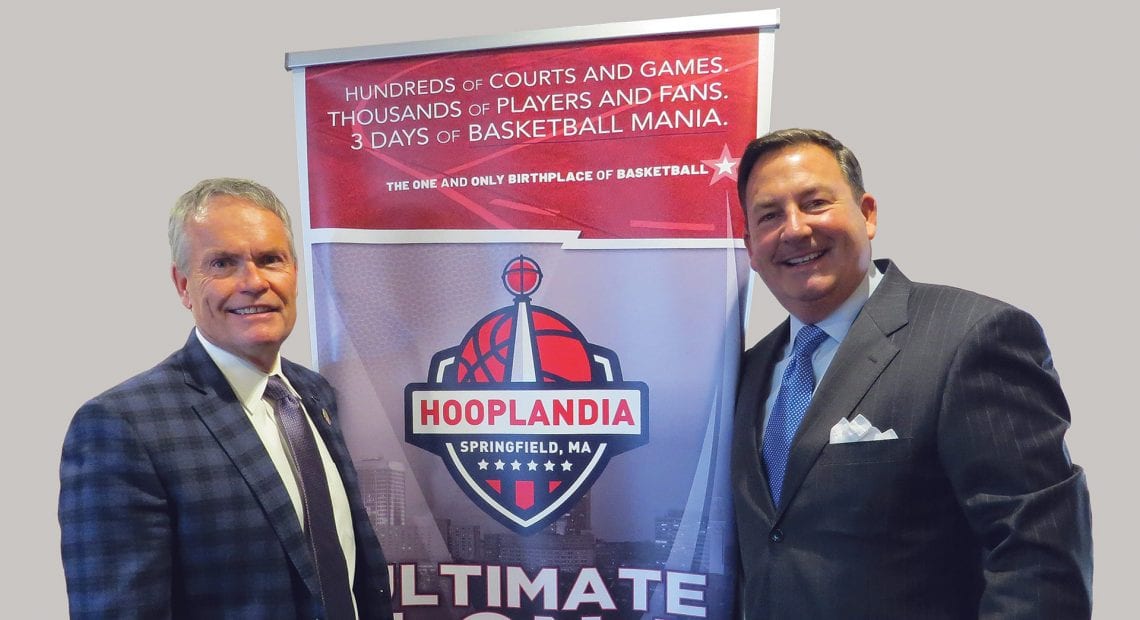
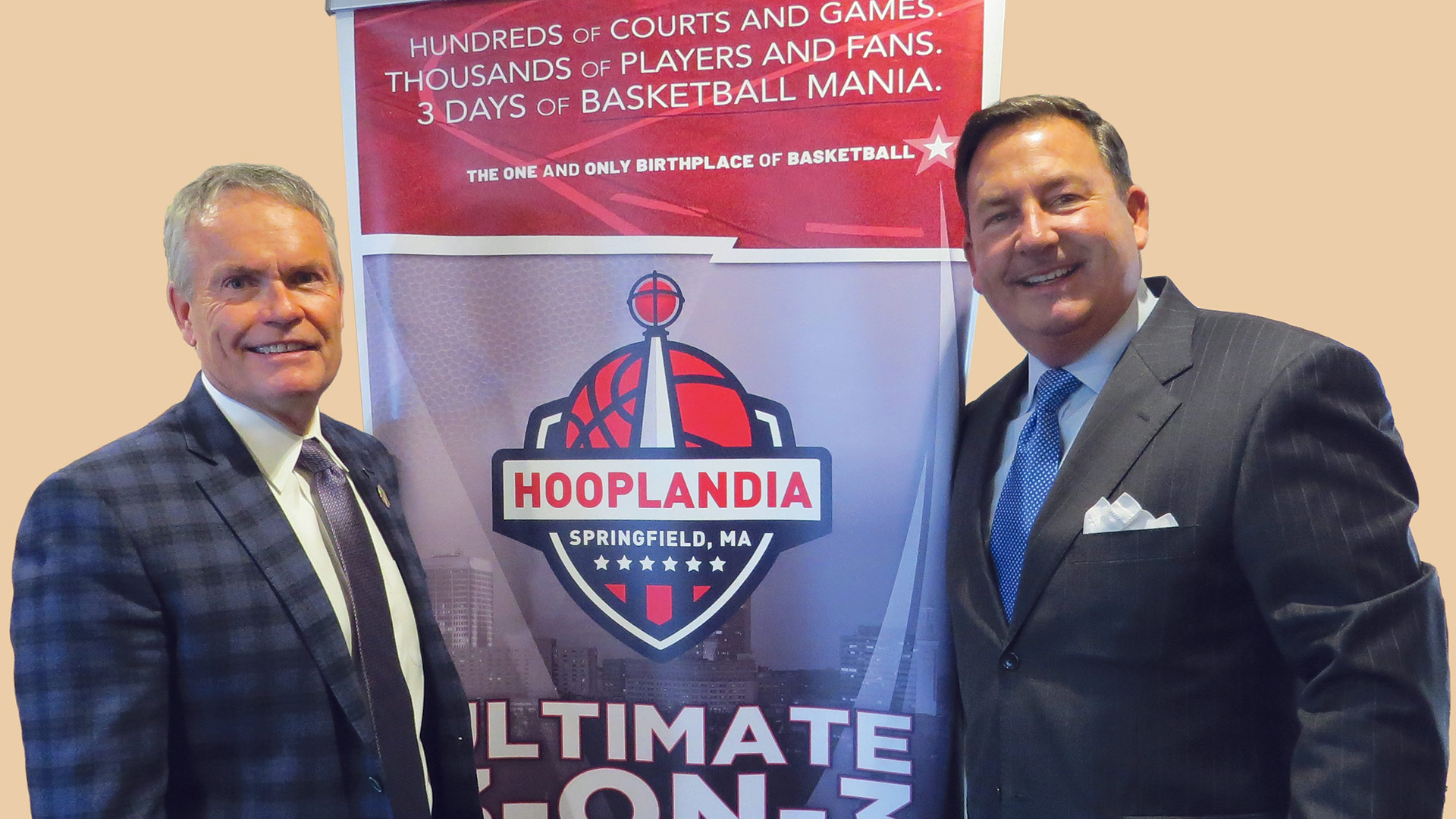
John Doleva, left, and Eugene Cassidy say Hooplandia could have a huge economic impact on the Greater Springfield region.

One observer referred to Hoopfest, the giant 3-on-3 basketball tournament in Spokane, Wash., as a ‘phenomenon,’ and the adjective fits. The event consumes 40 blocks in the downtown and literally takes over the city each June. Inspired, a group of organizers are looking to do something similar — although Springfield won’t be taken over — in just four months. The event is called Hooplandia, and it’s already being hailed as a slam dunk for the region.

Mark Rivers called it “an a-ha moment.’ Then he quickly amended the phrase in a poignant manner.

“It was an ‘aha/duh!’ moment.”

He was referring to his visit last summer to the giant 3-on-3 basketball tournament in downtown Spokane, Wash., called Hoopfest. And by giant, we mean giant. Indeed, it is billed as the largest event of its kind in the world, and no one doubts that claim. It annually draws more than 7,000 teams, or 28,000 participants (four people to a team on average), and total visitation for the tournament, staged the final weekend in June, approaches 200,000‚ which is roughly the city’s population.

While taking in Hoopfest and marveling at its size and the manner in which it has become synonymous with Spokane, Rivers, an event promoter by trade who has developed strong ties to both the Basketball Hall of Fame and the Big E, had that aforementioned ‘moment,’ during which he concluded that this event, or something like it, would be an even more natural fit in the birthplace of basketball.

“I was thinking, ‘why isn’t there an event like this in Springfield?’”

“I was thinking, ‘why isn’t there an event like this in Springfield?’” he recalled, adding that not only is the city home to the Hall of Fame, it’s located in the heavily populated Northeast, whereas Spokane is in decidedly rural Central Washington.

“It just seemed to make a whole lot of sense,” he went on, adding that what also made sense was to stage the event in the wide-open spaces of the Big E, which has all the needed infrastructure, and also at the Hall of Fame and its Center Court, which would be a special place to play games and act as a magnet for teams around the world.

Fast-forward eight months or so, and Hooplandia, the name chosen for this event, is moving on a fast train toward its June 26-28 debut. Such speed is attainable because of the partners involved — especially the Big E, where most of the games will be staged, and the Hall of Game, which is, indeed, proving to be a strong selling point.

Mark Rivers, seen here at a recent press event announcing Hooplandia, says the gathering has the potential to be a legacy event for the region.

“I’ve already had inquiries from teams in Russia, Belgium, Slovakia, Latvia, Poland, and Brazil,” Rivers explained. “I don’t know if we’ll get teams from all those countries, but we’ve had inquiries — a lot of these teams have expressed an interest in playing in the hometown of basketball and increasing their profile with games in the U.S.”

The goals for this first edition of Hooplandia — and specifically the one for participation (2,500 teams) — are ambitious, said Eugene Cassidy, president and CEO of the Big E, but they are also attainable — and sustainable.

“I firmly believe that, first year out of the box, we can be the second-largest 3-on-3 in the country,” said Cassidy, who experienced Hoopfest while visiting Spokane for a fair-association meeting a few years ago and had the same reaction as Rivers. “And my goal is to supersede Spokane within three to five years.”

Even if the first-year goals are met, or even approached, then Hooplandia could well wind up being one of the biggest single events (the 16-day Big E aside, obviously) the region has seen.

That becomes apparent in the projections for overall economic impact, a formula with a number of factors, including hotel stays, restaurant meals, rental cars, and many others, that Mary Kay Wydra, executive director of the Greater Springfield Convention and Visitors Bureau, describes this way:

“It’s an industry standard, and we use it for all our conventions. We populate different data fields, like the average daily rate they’ll pay, how many people are coming, how many rooms they’ll be utilizing … we put that into the calculator, and it spits out a number for us.”

However the number is derived, for this first edition of Hooplandia, the projected total is roughly $7.3 million. For some perspective, the recently staged Red Sox Winter Weekend, which brought a host of star players, past and present, fans from across the broad Red Sox nation, and a horde of media, was projected to bring in $2 million (the final numbers are still being tabulated). Meanwhile, the AHL All-Star Classic weekend, staged just over a year ago, brought in $2.8 million, according to Wydra, and the much-publicized square-dancing convention in 2015 that brought 4,000 people to Springfield for eight days brought in $2.3 million.

“I firmly believe that, first year out of the box, we can be the second-largest 3-on-3 in the country. And my goal is to supersede Spokane within three to five years.”

“This is certainly about basketball, but it’s also about economic development and tourism,” said John Doleva, president and CEO of the Hall of Fame. “It’s about filling hotel rooms and having people come to the Hall and the Seuss museum and the Armory and local restaurants … this is a multi-day event, and people will stay for the duration and perhaps longer.”

For this issue and its focus on meetings and conventions, BusinessWest takes an in-depth look at Hooplandia, what it can become, and what it might mean to the region.

Court of Opinion

Rivers calls it “getting the plane off the ground.”

That’s an industry phrase of sorts for launching an event of this magnitude. It’s never easy, he said, but with Hooplandia, there are a number of factors contributing to make it somewhat easier.

Especially the ability to stage this huge event at the Big E, a place — and a business — that’s well-versed in hosting large events, everything from the fair itself to a wide range of shows and competitions that fill the calendar.

To help explain, Rivers first referenced Hoopfest, which, essentially takes over downtown Spokane for three days, shutting down roughly 40 blocks in the heart of the city, a logistically difficult and expensive undertaking.

“Typically, when an event like this comes together, you do have a hard time getting the plane off the ground because your first expenses are renting port-a-potties, tents and road barricades, permits, shutting down streets, and doing all those things,” he went on. “You won’t have to do any of those at the fairgrounds, so it just seemed like a natural fit.”

Indeed, the majority of Hooplandia’s thousands of individual games will take place on the roads within the Big E’s 39 acres, although some will be played in its historic Coliseum, said Cassidy, adding that there is infrastructure in place to effectively handle the teams, spectators, media, and anyone else who descends on the area.

“We can handle large numbers of people; we have the capacity to host huge events — it’s what we do,” he said, adding that he has always viewed the Big E as an economic driver for the region — again, not just with the annual fair but all the events staged there — and Hooplandia provides another opportunity to build upon that role.

At the same time, the event provides an opportunity to further leverage basketball for the benefit of the region’s economy.

“It occurred to me that basketball should be an economic growth industry for Springfield,” he noted. “Hooplandia can help drive attendance to the Hall, drive awareness, and build the brand of basketball in the city where it was invented.”

Planning continues for the event, which, as noted earlier, has the ambitious goal of attracting 2,500 teams. And these teams will cover a broad spectrum, said all those we spoke with, adding that this will differentiate this tourney and festival from some others like it and add to its already strong drawing power.

Mark Rivers says the Big E’s vast spaces and deep infrastructure will help ‘get the plane off the ground’ when it comes to Hooplandia.

Indeed, there will be divisions for youths, high-school and college players, professionals, first responders, veterans, military, wheelchair, Special Olympics, and more, said Rivers.

There will also be an under-8, or U8, division, for which entrance fees will be waived in honor of the late Kobe Bryant, the former NBA superstar who died in a recent helicopter crash (and wore number 8 in his playing days).

In addition to the hoop tournaments, a number of other activities are on the agenda, many to take place the Friday night before the playing starts in the Coliseum, said Doleva. These include slam dunk, 3-point shot, free throw, full-court shot, dribble course, and vertical jump competitions.

To date, several partners have signed on, including Chevrolet, the first national-level sponsor, as well as USA Basketball, Springfield College, and Boys & Girls Clubs, which Hooplandia has designated as its charitable partner, offering financial support and playing opportunities for boys and girls in the region. For more information, visit www.hooplandia.com.

Overall, in the opinion of those now planning it, this is the right event at the right time, and the right city (or region), and we’ll address each of those in turn.

Actually, the first two go together. The event is 3-on-3 basketball, and the timing could not be better, because the sport — already described as the largest urban team sport in the world in one study — is enjoying a surge in popularity, said Doleva, with new leagues such as Big3, a league founded by Ice Cube featuring mostly former NBA stars.

And it will almost certainly enjoy another growth spurt after the Summer Olympics in Tokyo, where 3-on-3 basketball will make its debut as an Olympic sport.

“3-on-3 has become sort of the hot segment of the sport, and for a bunch of reasons,” said Rivers. “The Olympics is part of it, but beyond that, 3-on-3 makes the sport more accessible because you only need six players, and you only need half a court; it’s particularly hot in Europe, and many of the best teams come from former Soviet Bloc countries — that’s where a lot of the great ball is being played.”

As for the place, as Rivers and others noted, Springfield, and in this case Greater Springfield (the Big E is across the river), is a natural location.

Not only it is the home of the game and its Hall of Fame, but it’s located in the Northeast, two hours from New York, 90 minutes from Boston, and well within reach of a number of large metropolitan areas.

And, as noted, some of those great teams from Europe — and individuals from across the country — are already expressing interest in playing on what could truly be called the sport’s home court.

A Slam Dunk

This brings us back to those projections about overall economic impact. The numbers are still being crunched and there are a number of factors that go into the final projection, said Wydra, but at the moment, the number is $7 million.

That’s based on the assumption that, while many participating teams will be local, meaning they will drive to and from the Big E each day to compete, a good number — again, just how many is not yet known — will have to travel into the region and stay a few nights.

At the moment, the projected number of hotel-room nights is 1,500, said Wydra. Again, to put things in perspective, there were 840 room nights for Red Sox Winter Weekend and 4,666 for the square-dance convention, and for Hall of Fame induction ceremonies, the number varies depending on who is being inducted, but the 2019 edition had 850.

And for Hooplandia, these room nights will be coming at an important time for the region’s hospitality-related businesses, she went on, adding that the college-graduation season will have ended, but summer won’t be in highest gear.

“I love the timing — school is just out, and people have the ability to travel,” she said. “The other good thing about the June weekend is that Six Flags is up and running, and we have a lot of things for people to do when they’re not at the event. You bring people in for specific purpose, but if we can expose them to other things, we have the ability to bring them back again as a leisure visitor, and that’s very important.”

Wydra said that a now-former member of her team had a chance to observe and absorb Hoopfest first-hand — and somewhat by accident.

Coincidentally, Spokane was hosting the square-dance convention mentioned earlier the year before Springfield was scheduled to do so — and on the same weekend as Hoopfest. The GSCVB had someone on hand to observe the dance gathering and promote the following year’s edition.

But while doing so, she got a good taste of the reach — and the deep impact — of the 3-on-3 festival.

“I remember her calling in and us asking about the square-dance event, and she said, ‘the city’s been taken over by this massive basketball event, and everywhere you look there’s basketball courts, traffic’s been rerouted … it’s huge.”

It won’t be quite like that in Greater Springfield because the event will mostly take place at the Big E. But the impact will be significant, and the region — and especially its hospitality sector — will know that there are thousands of people in the area to play 3-on-3 basketball.

And organizers say it has the potential to not only reach the size of Hoopfest in terms of teams and visitation, but perhaps match it in terms of impact and providing an identity for the region — which would be saying something given what the Spokane event has become.

“Hoopfest is truly part of the culture of that community,” said Rivers. “Hoopfest is to Spokane what the Tournament of Roses is to Pasadena — it’s the fair-haired community phenomenon of that region, and it’s wonderfully done.

“With Hooplandia, I believe we have the makings of a true legacy event, something that could last for decades, much like Hoopfest,” he went on. “I think it will have meaningful, long-lasting economic impact, and I also think that, over the years, it will become a week in June that will be about more than basketball — it will be a week-long celebration of the sport.”

Cassidy agreed. While in Spokane, he saw and heard that the city referred to itself as ‘Hoop Town USA,’ and has trademarked that brand. “Quite honestly, I was offended by that,” he told BusinessWest, noting that Springfield should have that designation. With Hooplandia, hopefully it will — trademark aside.

Getting a Bounce

Returning to Spokane one last time, figuratively, anyway, Rivers described it as a “phenomenon.”

“It’s unbelievable … you can’t get a hotel room, you can’t get a rental car, you can’t get a dinner reservation,” he said. “It’s exciting, and it’s fun.”

Whether Hooplandia can approach that same kind of impact remains to be seen, but all those involved believe it has the potential to be, as they say in this sport, a slam dunk.

Or, as Rivers and others said, a legacy event for this region.

George O’Brien can be reached at [email protected]

Features

Blast from the Past

Todd Crossett and Sonya Yetter

It’s a small business, but it might just be a big part of a significant movement. Granny’s Baking Table, which opened just a few months ago, speaks to a different age in Springfield’s history, when small, locally owned businesses dominated Main Street and the roads around it. And in many ways, it operates in a way consistent with that age — there’s no wi-fi and, instead, a focus on conversation. It’s a blast from the past, but those behind it hope they represent the future.

Todd Crossett remembers how it all started — and especially how his chapter in this story began.

Then a faculty member at the Isenberg School of Management at UMass Amherst, he was making beignets, a French pastry featuring dough and powdered sugar, as a hobby more than anything else. His son told him they were so good that he could sell them from a bicycle.

So he did. In downtown Springfield.

“There were a lot of motivations for that, starting with the fact that downtown Springfield was kind of boring at that time, and I complained about it a lot,” he told BusinessWest, noting that he’s lived in the Mason Square area for more than 25 years. “But then I thought, ‘what am I going to do about it?’ So I thought, ‘this is my contribution, a funky bicycle and beignets that people swoon over; that will be my part.’

“But it didn’t end that way, did it?” he went on, with a hearty laugh, gesturing to his current business partner.

That would be Sonya Yetter, who, While Crossett was selling his beignets on his bike, was in business for herself with a soup and sandwich shop in the Forest Park section of the city.

After years spent cocktail waitressing, bartending, and other assorted jobs, she decided to attend culinary school in Europe. Upon returning to the States, she lived and worked in Maryland and Florida before returning to her hometown of Springfield.

“There were a lot of motivations for that, starting with the fact that downtown Springfield was kind of boring at that time, and I complained about it a lot. But then I thought, ‘what am I going to do about it?’ So I thought, ‘this is my contribution, a funky bicycle and beignets that people swoon over; that will be my part.’”

Through a series of circumstances that will be detailed later, the two have come together in a new venture called Granny’s Baking Table, a name that reflects what goes on there, but doesn’t come close to telling the whole story.

Granny’s is a blast from the past, and in all kinds of ways, as we’ll see. It’s a nod to a day when the streets of downtown Springfield were teeming with small, locally owned businesses like this one. And it’s a nod to the small bakery, with this one combining the baking traditions of the American South and Northern Europe.

It’s all summed up — sort of — in this line from the eatery’s website: “It is our mission to create a space and products that harken to simpler times, when baking was from scratch and the table was for gathering and conversation.”

The menu, like many other aspects of Granny’s Baking Table, is simple, direct, and a nod to the past.

That table — and there is, for the most part, just one large one that sits in the middle of the room — is indeed just for those purposes. There is no wi-fi, so one could do some work, theoretically, but if they wanted to read the morning paper, they would likely have to do it the old-fashioned way and crack open the print edition.

Speaking of old-fashioned, there’s more of that on display at this venue, from the simple menu displayed on a chalkboard — items include the ‘Oh Lawdy’ to the ‘Goodness Gracious’ to the ‘Not Too Fancy,’ a phrase that describes pretty much everything in the place — to the pictures on the wall; some are of family members, others of random individuals that reflect the diversity of the city and its downtown being celebrated at this establishment, to the holiday cookie exchange staged in mid-December (more on that later)

Overall, Granny’s is a nod to the past, and so far, to one degree or another, it seems to be working. The partners acknowledge that, three months after opening, they’re seeing both newcomers and repeat customers, and a good supply of both. But they acknowledged that it’s difficult going up against national chain coffee shops and other forms of competition. And they also acknowledged that times have indeed changed, and operating a business based on small-batch baking is far from easy.

The scope of the challenge they’re facing is reflected in the skepticism they encountered as they went about securing a site, putting a business plan in place, and getting the doors open. It came from family, friends, and even the broker that showed them the property.

“People didn’t like our concepts; they didn’t like the one table, they didn’t like the no wi-fi — there was so much that people were averse to,” Crossett explained. “But we believed in what we were doing, and we still believe in it.”

For this issue, BusinessWest takes an in-depth look at this unique new venture and how its principals are undertaking a noble but nonetheless daunting assignment — bringing the past into the present and making it work.

To-Dough List

Returning to the story of how these two came together — a story they share often because they’re asked often — that chapter really began when Crossett was serving as food-vending recruiter for the Springfield Jazz Festival, and knocked on the door to Yetter’s business in Forest Park.

He successfully recruited her for the event, and they kept in touch. “And here we are,” she said while bypassing several subsequent chapters as the two talked with BusinessWest at that large table in the middle of the room — actually, it’s several smaller tables pushed together.

Filling in the gaps, Crossett said he was looking for a space in downtown Springfield — specifically some square footage in the Innovation Center taking shape on Bridge Street — a from which to sell beignets and other items. Unbeknownst to him, Yetter, a UMass graduate who grew up Springfield, had signed a lease for the property almost across the street — one that had most recently been home to the Honey Bunny’s clothing store but had seen a number of uses over the decades — as a second location for her business.

The Innovation Center plans essentially fizzled as the development of that property changed course, Crosset recalled, adding that he left the last discussions on those plans quite dejected. He was on a cross-country tour with his son when he started thinking about how he and Yetter would not be in competition with one another, so maybe they should become partners.

Some of the pastries available at Granny’s Baking Table.

“He texted me and said, ‘we should talk,’” Yetter recalled, again zooming through subsequent steps for another ‘and here we are.’

That text was sent roughly a year ago; the months that followed were spent converting the space into a bakery — ceilings had to be raised, and a kitchen had to be built — as well as overcoming the skepticism of others around them and getting the venture off the ground.

They were fueled by the desire to make downtown less boring and to be a part of ongoing efforts to restore the vitality that Yetter remembers from her childhood.

“I grew up here, so I remember what downtown once was,” she told BusinessWest, adding that she was in one of the last classes to graduate from Classical High School, which closed in 1986. “I spent a lot of time in Johnson’s Bookstore and Steiger’s — it was a booming, booming town.”

By the time she returned to the city, it was no longer booming, she said, adding that she believes the large shopping malls, now struggling mightily themselves, sucked much of the life out of the central business district. The best hope for the future is small businesses moving into the downtown, she said, adding that Granny’s is part of that movement.

“My hope, and my belief, is that there are more people who are interested in becoming small-business owners now and perfect a craft they might have,” she said. “It’s my hope that this will revitalize the downtown area.”

The communal table, designed to stimulate conversation among patrons.

Today, Yetter splits her time between the Super Sweet Sandwich Shop in Forest Park and Granny’s, with more time at the latter because it’s just getting off the ground. Both she and Crossett said they are off to a solid start and they expect to gain momentum as more people find out about them and perhaps change some eating habits — specifically getting away from fast food, not only at lunch but breakfast as well.

Granny’s features an array of pastries — each day the lineup is different — that include danish, scones, sticky buns, muffins, beignets, and more. The lunch menu, as noted, is rather simple and focused on the basics; for example, the Not Too Fancy is pulled pork with homemade barbecue sauce, the Oh Lawdy is sweet-tea-brined fried chicken with pimento cheese and spicy peach jam served on a biscuit, and the Goodness Gracious is a mustard-infused, buttery croissant with black forest ham and smoked cheese.

Thus far, there’s been a lot of grab and go, especially with the businesspeople working downtown, said Crossett, but there have been many who have sat down to eat as well.

“It is our mission to create a space and products that harken to simpler times, when baking was from scratch and the table was for gathering and conversation.”

Which means that most have had to adjust some other habits as well, the partners acknowledged, noting again that there is no wi-fi here, and there is that ‘communal table.’

“We have a space where we want people to come in and talk and have a conversation,” Yetter explained, “and hopefully get to know anyone else who’s at the table with them — that’s our goal.”

It’s a goal that’s being met in many respects.

“Sometimes you’ll see a full table, and other times you’ll see a few people there,” said Yetter. “What we’ve noticed is that they talk to each other now, which is what we wanted — getting people to talk that normally wouldn’t.”

What’s Cooking

When asked about the success formula to date, Crosset said there are some interesting ingredients.

“We got into the space together, we both have a good sense of humor, we’re both patient, and we’re both really, really finicky about our product,” he explained. “And those things hold us together.”

Yetter agreed, and said another big factor was successfully creating “the feel and the vibe” they were looking for — which together speak to another age, another time, as reflected in that mission statement on the website and the reference to simpler times and baking from scratch.

Time will tell if the skeptics were right or if these somewhat unlikely partners can actually turn back the hands of time. But for now, they seem to be taking some of the boring out of downtown and giving people something new to talk about — whether it’s at that communal table or back in their office.

George O’Brien can be reached at [email protected]

Home Improvement

Age of Automation

The design trend known broadly as home automation comes in many forms, from a command to Amazon’s Alexa to turn off the lights to a smartphone app that controls door locks and room temperature — and a dozen other functions — from across the country. This technology is attractive, says one local expert, because it solves problems in a very individualized way — and people like technology that makes their lives easier.

When people think of home automation, what comes to mind? Heat controls and security cameras, for sure. Maybe the TV and music, or door locks, or window blinds.

Bill Laplante also thinks of his shower.

“I have a digital control panel in my shower,” said the president of Laplante Construction in East Longmeadow, noting that he inputs a ‘user profile’ that gives him the exact temperature and flow he wants. “My wife has a different profile, so hers is four or five degrees cooler, and a different shower head. A lot of this stuff is pretty cool.”

It’s stuff that’s becoming more common in the modern home, as the rise of what’s known as the ‘Internet of things’ has people connecting any number of household functions to the Internet and controlling them from smartphone apps.

“Take lighting systems. We changed our bulbs, and now the lights are controlled by cell phone,” Laplante told BusinessWest. “I’ve gotten pretty lazy with the technology — instead of getting up to turn on the lights, I just grab my phone.”

But he’s not just enjoying smart-home technology at his own house; he’s building homes for customers who increasingly demand such features themselves. He works with EPOS Systems in West Springfield — a company whose motto is “Your future home. Today.” — on whole-home automation systems that run off one app, known as Control4. But people can take an a la carte approach as well.

Bill Laplante says homeowners have many options when it comes to automation, but many today are opting for full-home systems that run off a single app.

“I see a combination of both. Some people, usually in the higher-end homes, will want a whole-house smarthome system that’s controlled by one app and can do multiple things with lighting, television, heat, cameras, all of that stored on one app,” he explained. “And then there are other people who want less expensive options, who have multiple apps that do different things, but it’s not necessarily controlled by one central program.”

The uses for such a system are myriad.

“When you’re away for vacation and you forgot to turn your heat down, you can do it remotely. Even the door locks — you can send a code from your phone to unlock the door for someone cleaning the house or someone coming over to watch your kids,” Laplante said. “Control4 is really a home-management system, a technology-management system. You can create lighting scenes, you can control television, music, security, garage-door cameras — virtually everything that could link together, you can link through this central system.”

The popularity of so-called ‘smart homes’ is only expected to increase as more people experience it and costs continue to drop. According to Forbes, the value of the smart-home device market will grow from $55 billion in 2016 to $174 billion by 2025.

Dan Crouss says home automation is about solving problems — and quality of life.

Dan Crouss, owner of EPOS, said homeowners have many points of entry to choose from.

“Sometimes you start out small, but then we tie in the music and the TVs and all that stuff into one app. You kind of piecemeal it as you go — start small and work your way up over the years. Some people do it all at once when they build their house, but usually it’s small increments.”

And it’s not as foreign a concept as some people may think, he added.

“Everyone’s got some type of automation from their phone, even if it’s just Siri or Alexa controlling the lights. What we do is take it a step further, put it into one app instead of having 15 apps. Everybody’s got a little bit, but we’re able to tie it all into one interface.”

Problem Solvers

EPOS was launched in 2007, the merger between two companies, Perfect Sound and Olympic Electric. Its services have evolved considerably since then, both because technology is always advancing and because people are attracted to products that make their lives easier, Crouss said.

“Home automation can start out as a simple Alexa that turns on lights. Then door locks and heat are two things people usually do. Being able to unlock your door for somebody when you’re not home is a big deal. And with heat, I can save a lot of money. I get home at random times because of my job, so, if I’m getting home at 5:30, I can log on at 4 and pump up the heat a little bit, so when I get home, it’s nice and warm, but I saved a lot of money during the day.”

Then homeowners may add options from there, he added, from window shades — which can be adjusted or programmed to bring some extra sunlight into the house during the winter or keep it darker and cooler in the summer — to strategically placed cameras, both for outdoor security and to monitor the interior of a home when residents are away for the winter.

“Sometimes you start out small, but then we tie in the music and the TVs and all that stuff into one app. You kind of piecemeal it as you go — start small and work your way up over the years. Some people do it all at once when they build their house, but usually it’s small increments.”

“You can get a notification on your phone if you have movement at the front door,” Laplante said. “And you can pull up the camera view and pull up the audio and say, ‘can I help you?’ and do it all remotely. You can be on vacation and you’re answering your door, essentially. There are all types of things like that that are pretty cool, and most manufacturers now are incorporating things like this into their own apps and making everything as seamless as possible.”

As he noted earlier, many people opt for buying individual devices, such as one that manages the garage door.

“When your car pulls into the driveway, it will automatically open the garage door rather than actually pushing a button. You can also let somebody in your garage door remotely with your app. So you have individual products like this, with their own apps, which create the, quote-unquote, ‘smart home,’ or you can have a central control system that controls all of the various components of the house.”

The whole-house system can be preset for any number of situations, from delivering the exact heating and lighting arrangement upon waking up in the morning to creating a variety of ‘lighting scenes’ in the kitchen, such as for cooking, dining, or hosting a party — or telling the Christmas tree when to turn on and off every day.

“Basically, what home automation does is solve people’s problems, and everybody’s got different ones to solve,” Crouss said. “When my kids were growing up, they’d get off the bus and would put in their [front door] code, and I would get a text to let me know my daughter was off the bus. Or let’s say cleaners come to your house, who bill by the hour. There’s a time stamp when they put in the code and a time stamp when they lock the door.”

As another example, “people with oil tanks have smart sensors that automatically e-mail you when the tank is getting low, or e-mail people who deliver the oil. A lot of people with vacation homes show up, and the oil is way down. This is a way to avoid that problem.”

Price and Promise

In Forbes, Bernard Marr, a futurist, author, and business and technology advisor, recently noted a few developments on the horizon when it comes to smart homes. One is increasing standardization, as manufacturers of smart-home devices are increasingly ensuring their products and services will work on platforms provided by Amazon, Google, Samsung, and Apple to capture the broadest customer base.

He also sees smart homes actually becoming smarter over time as they make use of machine learning, computer vision, natural language processing, and other technologies that are capable of making decisions and learning. Smart thermostat systems from Nest and Honeywell already use machine learning to adapt their behavior to the inhabitants of a house, based on observing and then replicating their habits, and that trend should accelerate to other devices as well.

Finally, the global rollout of 5G, as well as improved wi-fi technology, mean smart-home devices will be linked by faster, more powerful networks, meaning better access to data and processing resources in the cloud.

“The smart-home technology has come way, way down in price,” Laplante said, especially when it comes to buying multiple devices. “The Control4 system is nice because everything runs through one app. But people have multiple apps on their phones for multiple things anyway.

“There are many different components,” he added. “The cost depends on how much you bring into the system. The big advantage to having a one-hub system is that everything runs through that system, so you’re going to one app.”

EPOS continues to introduce new services, Crouss said, like ‘smart outlets’ that can reboot cable or Internet if it goes down, rather than having to deal with physical plugs and wires. In fact, those devices can now send a signal on their own and be rebooted automatically when a problem is detected.

“Most of my customers want this technology, want to be able to do those things,” Laplante said. “Especially when you’re going away, you want to be able to control things, you want to keep an eye on the house. If you go away for the winter, you want to be in contact with your home, to monitor the temperature and see if there are any issues.”

Not to mention that much of this technology — whether it’s changing the music coming out of the ceiling speakers or stepping into a perfect shower — is just, well, fun.

“It’s something the average person today is expecting — especially the younger generations,” he said. “They grew up with technology, and they expect it. And it is kind of neat.”

Joseph Bednar can be reached at [email protected]
Business of Aging

Shifting the Balance

Visiting Angels Director Michele Anstett

When Michele Anstett opened a Visiting Angels franchise with her husband in 1999, it was only the ninth branch of a home-care company that now boasts more than 500 locations in the U.S. and overseas. Home care in general had yet to proliferate; maybe a dozen agencies were offering such services in the Pioneer Valley.

The law of supply and demand meant there were more caregivers than jobs, which was great for companies, she noted.

“We had more control, and they were more willing to do what we said. Because there were fewer agencies for these caregivers to go to, they had less choice. They were easier to hire back then — you could find a well-trained one easily because there was a deeper pool, and they were more experienced. The pay was lower — like $7.50 an hour when we started. And more of them were willing to work full-time. They were more likely to take whatever you could give them.”

These days, that balance has shifted, to say the least. Home-care services, both small independents and national chains, now dot the region, and workers are in demand.

“Now, it’s not us with the control,” Anstett said. “They have the control. They can pick where they want to go. They can choose how many hours they want to work. They’re less willing to take whatever you want to give them.”

It helps, she said, that her Visiting Angels franchise, now celebrating its 21st year, is a known name with deep roots in the community.

“You don’t have someone down the hall where you can yell, ‘hey, can you help me?’ This can be a challenge for some nurses, but the nurses we have appreciate meeting with a patient exclusively, being able to develop relationships they often don’t have time for in an acute-care setting.”

“When we first started, there were only a few businesses like this. It was just emerging, and it was something that was really needed,” she told BusinessWest. “Our model was based on what people wanted. We matched the caregiver to the client. We weren’t telling people, ‘we’ll come here at this time.’ We made it all about the client. But we also matched them with a caregiver, and they could meet their caregiver and say, ‘yes, this works,’ or ‘no, this isn’t a good fit.’ There’s a lot of work in matching a personality, skill level, schedule — it’s really challenging.”

That philosophy hasn’t changed over the years, but the challenge has become more intense with increased competition for certified nursing assistants, home health aides, and personal-care assistants.

Also more challenging is the level of care many patients require, in an era when hospital stays are shorter and Americans are living longer than ever before.

“I was a home-care nurse fresh out of nursing school in the early ’90s, and compared to the patients we saw then — even compared to five years ago, really — the patients are much higher acuity, much more complex, and they really need a lot of care coordination and are on so many medications,” said Priscilla Ross, executive director of Cooley Dickinson VNA & Hospice.

“One of the biggest roles of the home-care nurse is reconciling those medications, because medication errors are one of the most common reasons for rehospitalization,” she went on — for example, people often don’t follow instructions, or aren’t aware of certain drug interactions, or are mixing pharmacy prescriptions with mail-order drugs. “Things are so much more complex than years ago, with hospitals focused on shorter stays, and there’s pressure on skilled-nursing and rehab facilities for shorter stays as well, so people are coming home with more needs.”

Michele Anstett (second from left) with some of her team at Visiting Angels, from left, Julie Dewberry, Helen Gobeil, and Natali Pilecki.

For this issue’s focus on the business of aging, BusinessWest spoke with several home-care professionals about what’s appealing about this critical work, what’s challenging, and why those challenges are only increasing as the senior population in the U.S. continues to swell.

Return to Form

The VNA has a sizable clinical staff, as many of its clients have been in and out of hospitals or acute rehab settings. But the focus isn’t on the illness itself, Ross said, but returning people to functional status in the short term. “They want to get back to making dinner, doing the laundry, taking care of grandchildren. With nursing and rehab, that process can happen much more quickly.”

She noted that the national shortage of non-medical home health aides may be more pronounced than the shortage of nurses, but it’s a struggle for organizations to recruit both. For nurses, not only is the pay scale less than in, say, a hospital setting, but some nurses don’t like the autonomy and independence that home care requires; they’d rather work in a team setting. Of course, other nurses desire the opposite, and relish the idea of focusing on one patient instead of several at a time.

“You don’t have someone down the hall where you can yell, ‘hey, can you help me?’ This can be a challenge for some nurses, but the nurses we have appreciate meeting with a patient exclusively, being able to develop relationships they often don’t have time for in an acute-care setting.”

Julie Dewberry, marketing and recruitment specialist for Visiting Angels, agreed. “They like the one on one,” she said. “They don’t have the pressure of one person with five different patients. Some come from nursing homes and say they don’t want to do that.”

Helen Gobeil, staffing supervisor for Visiting Angels, said determining who will be a good care worker is as much art as science.

“It’s a mother’s instinct — you’ve got to feel it,” she said about sitting with prospective staff. “You see they’re caring, they want to work, they really enjoy elders. They don’t call them old people; they respect them. I have to feel it.”

That ‘feel’ can be as simple as whether the interviewee makes eye contact, Anstett said. “What’s their demeanor? Are they a warm and caring person? If they’re warm, caring, and compassionate, that’s the basis, and we can move on to skill.”

That skill can be reflected in many ways — their degree, their experience, perhaps a referral. Sometimes, the agency will bring on someone whose only experience was taking care of their grandmother. “If they have good character, we’ll put them on a companion case, with a mentor, and help them get more education. We didn’t do that before. Now that the pool is lower, we’re trying to find ways to bring in more people.”

One way is to offer more training to staff. In addition, Visiting Angels has done well bringing on nursing students from area colleges, who are able to supplement their income while gaining on-the-job experience. “They’re very good workers,” she said.

The shallower pool of talent is only one growing challenge; a tougher financial climate is another. Wages are higher — Anstett said her goal is to keep what she pays workers above Massachusetts’ minimum wage as it creeps toward $15 over the next few years — as well as higher recruiting costs and expanded paid medical and family leave in the Bay State.

Finally, as noted earlier, workers increasingly eschew full-time work and often make home care one of two jobs, and they increasingly resist set shifts in favor of flexible schedules.

“We are a known name with deep roots, but it is a challenge,” she said. “We do well, though — we’re finding people of quality. Because of our experience, we understand what makes a good caregiver and who wouldn’t make a good caregiver, and how to screen them properly.”

Constant Mission

Roseann Martoccia, executive director of WestMass ElderCare, says her 45-year-old organization’s goal has long been in line with the goals of the home-care industry.

“From the beginning, our mission has been constant: to help people remain at home with the supports they need,” she said, noting that most people, as they age, want to remain in their homes, with some measure of independence.

To help them achieve that goal, WestMass ElderCare offers a broad range of supports, not just home care, aimed at helping seniors live independently. These range from nutrition services — it delivers about 1,400 hot meals daily in seven communities — to adult foster care; from housing support to personal-care management, helping people with chronic conditions or disabilities direct their own care by hiring and supervising personal-care attendants.

In the realm of home care, the goal is similar to other agencies: to help transition people from rehab settings into the home, and to maintain their function there.

“Our goal is to provide compassionate care and guidance so people can live in their homes and communities,” Martoccia said. “When we visit the home, we’re setting up a plan of care. What is your family doing? What do you need help with? What do you want help with? What’s most important?”

“Generally, people have chronic conditions, and their family may be at a distance, or they may not have a lot of family supports,” she continued. “In that case, we might be providing more services to them, helping them with many things they may not be able to accomplish on their own.”

WestMass focuses on the needs of family caregivers as well as patients, she added — people who have to work or raise families, but still want to make sure their parents or grandparents are OK.

“A lot of times, we hear caregiver stories about how what we do helps them and gives them peace of mind,” she said. “They may be checking in daily or weekly, but they know services will be coming.”

Cooley Dickinson VNA & Hospice has a different model than home-care agencies that focus on non-clinical assistance, often over the long term. Instead, it hires nurses and physical, occupational, and speech therapists, among other team members, to help clients transition from an acute or rehab setting to home life over a shorter term. Involving family caregivers in the process is often critical.

“We offer things your average person can’t provide without some training — wound care, IV therapy, or teaching about disease processes and how to manage an illness and manage medications,” Ross explained. “We’re teaching family members how to do wound care, how to provide care at home.”

The other side of the company is hospice care, which can be a longer-term engagement for people who are grappling with terminal illness and the decisions that come with it.

“What matters to you? What are your goals? How do you want your care to play out? It’s really hard to have that conversation, introducing that sense of taking away hope from people,” Ross said.

“But often, when you open those conversations, you’re relieving a burden for the patient and their family, and giving them an opportunity to actually talk about the elephant in the room — and that can lead to earlier access to care,” she went on. “Studies show that the earlier patients get on hospice, the better they do in the course of their terminal illness and the better the family does in the bereavement process.”

Giving Back

There’s a large, framed photograph at Visiting Angels of an aide with Anstett’s mother-in-law, who required home care due to Alzheimer’s disease around the time she and her husband opened the franchise; she passed away a few years ago. It’s a reminder that these services hit close to home for many people, and they’re important.

And not just for the clients, said Natalie Pilecki, the company’s administrative specialist. For workers in this field — at least the good ones — it’s more than a job.

“Spending time with the elderly is always nice,” she told BusinessWest. “The hours are good, the flexibility is always good, and they enjoy socializing with the elderly. Every day is different — it’s different every time you walk into their house.”

A good work experience starts with the employer, though, Anstett said. “I think we all have to value our workforce. We did a survey of our caregivers, about what’s most important to them. They put the highest value on how they’re treated. Pay was second, and benefits third. We listen to our caregivers, and those are the things we work on.”

She noted that one client has been with the company for 13 years, just one of many long-term connections being made.

“You develop a relationship with clients and their families. It’s about giving, and when you give, people respond. The job gives back.”

Joseph Bednar can be reached at [email protected]