Home 2023 (Page 17)
Daily News

HARTFORD, Conn. — KeyBank announced that Dennis Breitrick has joined the bank as senior Business Banking relationship manager for its Connecticut and Western Mass. market. In his new role, he will provide customized financial solutions to improve cash flow, such as commercial lines of credit, SBA financing, equipment financing, cash management, merchant services, commercial real-estate financing, and more to businesses with sales revenues between $3 million and $50 million annually.

A graduate of Fordham University, where he earned a bachelor’s degree, Breitrick joins KeyBank from M&T Bank (formerly People’s United Bank), where he served as a business relationship manager since 2019. Previously, he spent 10 years with JPMorgan Chase Bank in similar roles serving business clients.

Breitrick reports to Allison Standish-Plimpton, Business Banking sales leader for Connecticut, Massachusetts, and Maine. “Dennis is an experienced business banker with proven lending and relationship-management expertise,” she said. “His knowledge of the local business market and successful track record meeting clients’ financial needs will add value to our team, and we are thrilled that he has decided to bring his career to Key.”

Daily News

HOLYOKE — Holyoke Community College (HCC) will hold Registration Express for the fall 2023 semester on Saturday, Aug. 19, and Monday through Friday, Aug. 21-25, in the HCC Campus Center at 303 Homestead Ave.

During Registration Express, prospective students can apply for admission, take the college placement test, meet with an academic adviser, register for classes, and set up financial aid — all in one day.

“Enrolling in college can feel overwhelming,” said Mark Hudgik, HCC’s director of Admissions. “Registration Express puts all of the resources new students need in one place.”

The Aug. 19 Registration Express event will be held from 9 a.m. to 1 p.m. Students who can’t attend on Saturday or need additional time to finish their steps can also return when Registration Express continues Aug. 21-24 from 8:30 a.m. to 6 p.m., and Aug. 25 from 8:30 a.m. to 4:30 p.m.

Full-term, 14-week fall classes begin Tuesday, Sept. 5. HCC has two additional fall flex start dates: Sept. 25 for 12-week classes, and Oct. 30 for seven-week classes.

Those who can’t make it in person during Registration Express week will be able to connect with registration advisers via Zoom or visit campus another day. Outside Registration Express, the HCC Admissions and Advising offices on the first floor of the Campus Center are open Monday through Friday from 8:30 a.m. to 5 p.m. (4:30 p.m. on Fridays).

For more information and instructions about accessing Registration Express via Zoom, visit the Registration Express pages at hcc.edu/regexpress or contact HCC Admissions at (413) 552-2321 or [email protected].

Daily News

Analysis by Jeff Liguori

Is Washington, D.C. broken?

The global rating agency, Fitch, certainly believes so. On Aug. 1, the company downgraded the credit of the United States one notch, from AAA to AA+. It is only the second time in history that our nation’s credit has been downgraded, the first in August 2011 by S&P. In its explanation, Fitch stated that the downgrade “reflects the expected fiscal deterioration over the next three years, a high and growing general government debt burden, and the erosion of governance relative to AA- and AAA-rated peers over the last two decades that has manifested in repeated debt-limit standoffs and last-minute resolutions.”

The move came as a surprise despite the agency hinting in May that the inability of Congress to effectively deal with the debt ceiling could lead to a downgrade. Once legislation was passed to raise the U.S. government debt limit, Fitch Ratings said the United States’ AAA credit rating would remain on negative watch. President Biden, Treasury Secretary Janet Yellen, and others in the administration have criticized the move as bizarre and arbitrary, careful to point out that the timing made no sense given the bipartisan effort to avoid a default in June.

The reaction by financial markets was somewhat mild considering the nearly unprecedented — and alarming — nature of the downgrade by Fitch. Bond prices went lower as yields continued higher, and the S&P 500 sold off about 1.3% — overall, a negative response. But 2023 has been a healthy year for investors thus far, with stocks up nearly 20% prior to the Fitch downgrade and a bond market about flat on the year, a stark contrast to 2022, when both markets were down double digits, an historical anomaly. So, what is the impact of a AA+ versus AAA rating for our government’s debt?

When S&P downgraded the U.S. government debt rating in 2011, global stock markets plunged and bonds rallied, driving interest rates lower. Typically, a downgrade in credit equates to higher — not lower — interest rates. But the uncertainty surrounding that downgrade pushed investors into safe-haven assets, namely U.S. treasuries, which illustrates that the move by S&P had no real implications for buyers of U.S. debt. It was a slap on the wrist, a consequence of massive accommodative fiscal measures intended to shore up a weak economy as the nation emerged from the greatest financial crisis since the Great Depression.

The rating agency was signaling that the U.S. had to get its fiscal house in order and Congress needed to come together to address the burgeoning debt. Like today, S&P had signaled to the Obama administration and U.S. Treasury that there was a risk of a downgrade about a month prior to the move. Stock markets lost roughly 10% of their value in the 30 days preceding the downgrade.

Fitch’s recent actions are consistent with its close competitor, S&P, in 2011. The U.S. debt, as a percent of gross domestic product (GDP), rose from 65% at the end of 2007 to 92% prior to the downgrade then. Before COVID locked down the economy, debt to GDP was just above 100%, ballooning to 135% by the middle of 2020. Currently, our debt is running at nearly 120% of GDP. And as interest rates rise, the situation worsens. (Growth in GDP can ameliorate this ratio, but the economy is not keeping pace with inflation presently.)

Similarities from the first downgrade to today are limited. Yes, the nation was emerging from crisis in 2011, the economy was flooded with stimulus spending, and Washington, D.C. was also unable to address our long-term fiscal issues. But the similarities end there.

Economically, global bond yields were falling prior to the downgrade in 2011, and central banks were still easing, dealing with the aftermath of the Great Recession. The unemployment rate was around 9%, high from a historical standpoint, but trending lower as the number of job openings were on the upswing. Debt to GDP was still under 100%, with most economists optimistic that further economic growth would remedy that dynamic. U.S. household debt had decreased about 8% and was also trending lower. The interest rate on a 30-year mortgage was about 4.5% and, again, trending lower.

Today, central bankers continue to fight persistent inflation, aggressively raising interest rates and tightening monetary conditions. The job picture remains sanguine, with the unemployment rate at 3.5%. Job openings, however, are now on the decline after sharply increasing from COVID lows. Household debt is on the rise, with total credit-card debt projected to hit $1 trillion for the first time ever. And housing affordability is at its worst level since the late 1980, according to the National Assoc. of Realtors, as the rate on a 30-year mortgage bumps up against 7%, an increase of 114% since the beginning of 2022.

There may be no economic adjustment to the rating downgrade by financial markets. Stocks have been incredibly resilient this year. The message by the Fitch agency is more about the United States having the willingness to pass legislation to deal with our debt burden, and less about the ability to pay our borrowers.

It is not an issue solely for the U.S.; after the Federal Reserve and U.S. government accounts, the largest holders of our debt are Japan, China, and the UK (in that order). The snowball effect of a default would be catastrophic. Almost every analyst and economist voicing an opinion on the downgrade, however, knows that an actual default is such a remote possibility for the largest economy in the world that it isn’t worth mentioning. And there’s no new information that brought on the downgrade.

It is a warning, nonetheless, and emblematic of our long-term political issues, which continue to hamper constructive fiscal progress.

Jeff Liguori is the co-founder and chief Investment officer of Napatree Capital, an investment boutique with offices in Longmeadow as well as Providence and Westerly, R.I.

Daily News

SPRINGFIELD — The African Hall Committee of the Springfield Museums announced the recipients of the 2023 Ubora Award and Ahadi Youth Award, which will be presented at a ceremony at the museums on Saturday, Sept. 16 at 6 p.m.

Lisa Green, a distinguished professor at UMass Massachusetts Amherst, is this year’s Ubora Award recipient, and Catherine Thompson, a 2023 graduate of Springfield Central High School who is headed to Johns Hopkins University, was chosen for the Ahadi Youth Award.

Named for the Swahili word meaning ‘excellence,’ the Ubora Award has been awarded annually since 1992 to an African-American adult who has demonstrated a commitment to Greater Springfield and has exhibited excellence in the fields of community service, education, science, humanities, or the arts.

Green is an expert in syntax and African-American English (AAE). She founded the Center for the Study of African American Language at UMass in 2006 and has directed it ever since. She is also the author of two books and is working on a third, all published by Cambridge University Press.

She as passionate about community service as she is about her academic specialty, according to Joe Pater, chair of the UMass Linguistics department, who nominated her for the award. She is an active volunteer and mentor with the Greater Springfield Chapter of Links Inc., the Western Massachusetts Chapter of Jack and Jill of America, and the Xi Xi Omega Chapter of the Alpha Kappa Alpha Sorority. And since 1996, she has been running a children’s summer reading program that she started at a church in her hometown of Lake Arthur, La.

“I could not believe that I had been selected” for the Ubora Award, Green said, “especially because I was very familiar with a number of previous recipients and simply could not see myself even approaching being in such amazing company. It is an incredible honor.”

Thompson had a similar reaction to her selection as the Ahadi Youth Award recipient, given since 2009 to an African-American student (age 19 or younger) who embodies the Swahili word for ‘promise’ and excels both in academics and service to the Greater Springfield community.

“When I heard the news, I was amazed, joyful, and honored to have been chosen as the recipient among Springfield youth,” she said. “I am proud to say I was born and raised in Springfield. I am still beyond grateful to be recognized at this level.”

An outstanding student who graduated sixth in her class, Thompson is also passionate about community service, especially with regard to social justice. For instance, at the Pioneer Valley Project, she worked on getting teens to pre-register to vote; as a teen-advocacy board member for Girls Inc. of the Valley, she attempted to increase awareness of racial justice, mental health, equal rights, and sexual- and domestic-violence issues. She was also actively involved in myriad clubs and organizations throughout high school, including the Key Club, the National Honor Society, student government, and the varsity tennis and soccer teams, to name a few.

“Catherine’s drive to learn and master things is strong and powerful and comes from within,” said guidance counselor John Szymczyk, who nominated her. “She has repeatedly demonstrated the depth of her maturity, which in turn has strengthened her own moral commitment as it relates to social justice. Her eyes are wide open; she’s aware and sharp, bright and interested in the world.”

The African Hall Committee of the Springfield Museums is a volunteer group comprising educators, businesspeople, and leaders from the Black community. In 2022, the recipients of the Ubora Award were Dr. Gerald Cutting and Carol Moore Cutting, and Kayla Staley was the recipient of the Ahadi Youth Award.

Sponsored by Baystate Health and the Urban League of Springfield, the 2023 Ubora and Ahadi Awards ceremony is open to the public. Click here for tickets ($20 per person, $15 for children under 12), or to make a donation to the Ahadi Scholarship Fund.

Daily News

EASTHAMPTON — Legacy Counsellors, P.C. recently welcomed its newest associate attorney, Heather Iampietro. She focuses her practice on real-estate transactions and estate planning.

Iampietro received her juris doctorate from Western New England University School of Law in 2021 as a part-time student, while working full time in commercial and residential real estate as a paralegal at local firms. As a paralegal, she gained experience in all aspects of the real-estate process from inception through closing. She received her bachelor’s degree in legal studies and a certificate of advanced paralegal studies from Bay Path University in 2016.

Daily News

SPRINGFIELD — Springfield Thunderbirds General Manager Kevin Maxwell announced that Jeff Jordan has been promoted to manager of Hockey Operations. Previously the Thunderbirds’ video coach and Team Services coordinator, Jordan will continue his work with the coaching staff in the video department during the 2023-24 season.

“Jeff has deservedly earned this promotion through hard work, loyalty, and his dedication to the Thunderbirds on both the hockey and business side,” Maxwell said. “He is a tireless worker with a wonderful personality, making him a terrific conduit between players, management, and the front office. We look forward to seeing him continue to excel in the future.”

Jordan joined the St. Louis Blues’ AHL affiliate in 2019 when he was hired by the San Antonio Rampage as the team’s video coach. Before starting his professional career, he served as an assistant coach with the Ontario Hockey League’s Ottawa 67’s in 2014-15 and 2015-16.

Daily News

PITTSFIELD — The Berkshire Black Economic Council (BBEC) announced four grant awardees for the Vibe North Street storefront recruitment grant program, in collaboration with Downtown Pittsfield Inc. This grant program, funded by MassDevelopment’s Transformative Development Initiative (TDI), aims to revitalize downtown Pittsfield by supporting businesses relocating to the North Street TDI district. The awardees are:

• Guelce Collaborative Marketing, which specializes in website development and management services for small businesses. It will use its grant award to establish a physical presence in the North Street district and expand its digital and marketing expertise to downtown Pittsfield by providing social-media management, advertising, and recording and editing support;

• BB’s Hot Spot LLC, which brings the flavors of Caribbean barbecue and jerk to the Berkshires. BB’s Hot Spot will bring its eatery to downtown Pittsfield and add a unique culinary experience for local foodies;

• Dolce Rose Beauty Supply, formerly operated online and vended at pop-up events, which will now open the only Black-owned beauty-supply store within a 40-mile radius. The funding will enable the company to establish a brick-and-mortar presence, bringing diverse beauty products to the local community; and

• Brazzucas, a Brazilian market that will bring the tastes, colors, and culture of Brazil to the heart of Pittsfield. With the grant award, Brazzucas will move onto North Street in the former General Store.

“These businesses exemplify the vibe we wish to bring to North Street, and it’s our honor to pay it forward,” said A.J. Enchill, president and executive director of BBEC. “More importantly, this grant program reflects both passion and transformations in Pittsfield. Congratulations to all the recipients and those who have supported their applications.”

Daily News

SPRINGFIELD — Doherty, Wallace, Pillsbury and Murphy, P.C. (DWPM) announced that Kathryn Crouss, who became a shareholder at the firm in January, was named the 78th president of the Hampden County Bar Assoc. (HCBA).

Crouss continues a long legacy of DWPM attorneys to serve in the role of HCBA president, dating back to 1943 with Dudley Wallace, one of the founding members of the law firm.

Crouss joined the firm in May 2022 and became a shareholder at the start of this year. With extensive experience in both family law and employment matters, she is a certified mediator and represents family-law clients both in court and through alternative dispute resolution.

Continuing the tradition after Wallace, in 1961, Frederick Pillsbury, another founding member of the firm and an associate justice of the Superior Court, also served as president of the Hampden County Bar Assoc. Philip Callan Jr. followed Pillsbury in 1994. He was a member of the HCBA executive committee for nine years and recently received the William T. Walsh Longevity Award from the association.

In 2004, David Martel, who joined DWPM in 1981, served as president of the Hampden County Bar Assoc. Most recently prior to Crouss, Barry Ryan served in the role of president in 2013. Ryan continues his service to the local bar by serving as an ex officio past president on the HCBA board of directors.

In addition to her service as president of the Hampden County Bar Assoc., Crouss also serves on the board of Community Legal Aid and has chaired the its Access to Justice fundraising campaign for the past two years. She has served on the board of the Hampden County Bar Assoc. since 2018.

Daily News

CHICOPEE — Elms College named Julie Beck its new dean of the School of Nursing (SON). Beck’s appointment was effective Aug. 1.

“We are excited that Julie Beck is the next dean of the Elms College School of Nursing,” Elms College Vice President of Academic Affairs Walter Breau said. “I look forward to working with her on the strategic direction of the SON and seeing her lead our highly regarded nursing program.”

Beck joins Elms from Wilson College in Chambersburg, Pa., where she recently served as director of Nursing and Health Sciences. The author of the book The Meaning of Voice to Experienced Nurses in Magnet Hospitals, Beck has more than 20 years of higher-education experience in nursing and holds a doctoral degree in adult education from Penn State University. She also holds an MSN in nursing education from Villanova University and a BSN from Bloomsburg University in Pennsylvania.

Reporting to Breau, Beck will be a key member of Elms’ leadership, bringing a new strategy and vision that will reinforce the strengths of the School of Nursing. The Elms SON degree programs include bachelor of science in nursing, master of science in nursing, and doctor of nursing practice.

“I am committed to excellence in nursing education with an emphasis on knowledge, compassion, and presence,” Beck said. “I am thrilled to be joining the Elms College team and look forward to working with the Elms community to advance the profession of nursing.”

Daily News

SPRINGFIELD — Beginning Wednesday, Sept. 6, the Realtor Assoc. of Pioneer Valley will host a 40-hour, 14-class sales licensing course to help individuals prepare for the Massachusetts real-estate salesperson license exam. The course will be completed on Oct. 5. Tuition costs $425, including the book and materials.

For an application, call the Realtor Assoc. of Pioneer Valley at (413) 785-1328 or visit www.rapv.com.

Daily News

GREENFIELD — To help bring equity to the forefront of the workforce in the region, Greenfield Community College (GCC) has been chosen to participate in the Community College Workforce Transformation & Implementation cohort by New America.

GCC is one of just 15 community colleges in the U.S. and the only institution in New England chosen to participate in the cohort by the national public-policy think tank. The selection gives GCC’s Workforce Development office unique access to best practices, tools, research, and experts to implement innovations in workforce equity.

“We’re honored to have been selected to join this impressive cohort. Our inclusion means a lot to our own equity efforts at GCC but means even more to the region as GCC can become a leader in building a more equitable workforce throughout Franklin and Hampshire counties,” said Kristin Cole, vice president of Workforce Development. “Working closely with regional employers and community partners like the MassHire Franklin Hampshire Workforce Board, GCC is laser-focused on accelerating the development of high-quality and affordable workforce-training programs with credentials that will lead to quality jobs and careers for all members of our community.”

GCC President Michelle Schutt added that “being selected into the Community College Workforce Transformation & Implementation cohort with New America is a momentous accomplishment for Greenfield Community College. Intentional focus on workforce equitability will benefit the entire Pioneer Valley.”

The work, which will take place over the next 18 months, will assist GCC in implementing innovative policies to better align workforce and economic development, modernize college-wide data infrastructure, and diversify the financing of workforce programs to better serve the residents and employers of Franklin and Hampshire counties.

Daily News

GREENFIELD — Greenfield Cooperative Bank (GCB) announced that Jane Wolfe, executive vice president of Residential Lending, successfully completed the inaugural American Bankers Assoc. (ABA) Wharton Leadership Lab at the University of Pennsylvania last week. She earned an ABA Wharton Executive Leadership Certificate, a prestigious credential that demonstrates her excellence in leadership and strategic planning.

The ABA Wharton Leadership Lab is a rigorous, immersive program that challenges executive bankers on the reality of leadership in today’s world at an Ivy League level. The program, which included 42 students, covers topics such as creating and sharing a vision, goal setting, managing talent, driving innovation, and sustaining meaningful relationships.

Wolfe is a valuable member of GCB’s senior leadership team and a leader in the residential-lending industry, with more than 20 years of experience providing service and solutions to the bank’s customers and partners. Her participation in the ABA Wharton Leadership Lab reflects her commitment to continuous learning and professional growth.

“Jane is an outstanding leader at GCB,” said Tony Worden, Greenfield Cooperative Bank president and CEO. “We are thrilled that she completed this prestigious program and earned this well-deserved recognition. We congratulate her on this achievement and look forward to her continued success.”

Daily News

FLORENCE — Florence Bank recently presented its 2023 Community Support Award to Tim Deshaies, director of Retail Operations at the bank.

The Community Support Award was established by the bank in 1997 as a means of formally recognizing employees who are active in the community and give their personal and professional time to local nonprofit organizations.

Each year, the award recipient can select an organization to which the bank will donate $500. Deshaies has chosen the Therapeutic Equestrian Center, citing the work the organization does with horse-assisted therapy for people in the community.

Deshaies came to Florence Bank in 2007. He holds a master’s degree in business administration from Western New England University. He is active in the community, serving as treasurer of the Therapeutic Equestrian Center and the Wistariahurst Foundation, vice president of Black Horse Trust, and director of Mansir Trust.

“We are pleased to shine a spotlight on Tim because we are proud of all the important work he does in the community,” said Matt Garrity, president and CEO of Florence Bank. “Tim well-deserves the Community Support Award.”

Daily News

GREENFIELD — FootCare by Nurses, a Greenfield-based foot-care business, is growing. Kate Clayton-Jones, founder and CEO of the company, announced this week that three new contracts will allow FootCare by Nurses to expand its services in Central Mass., the city of Springfield, and some towns in Connecticut.

FootCare by Nurses aims to redefine elder care by making evidence-based foot care central to general health, she said. “Our mission is prevention, and our passion is caring. Feet are literally the foundation for our body; they allow us to be mobile, they pump blood back to our hearts, and they connect us to the world. Any fault in feet affects the whole body, just like faults in a foundation affects the entire structure. Yet, feet are too often ignored or neglected while their care and well-being are essential.”

A contract with the Program of All-Inclusive Care (PACE) in Springfield will allow Serenity Care case workers to refer clients to FootCare by Nurses. The PACE program is centered on the core belief that, given a choice, most elders, the disabled, and their families would choose to receive care in their homes and communities rather than in a nursing home.

A contract with Tri Valley Elder Services will expand FootCare by Nurses’ services into the area south of Worcester. Additionally, FootCare by Nurses will take on former clients of Connecticut-based Pedi-care.

FootCare by Nurses has grown from three employees when it became an LLC in 2016 to 40 at this time. “This expansion and continued growth means adding close to 1,000 new clients and $300,000 in new revenue, which will trickle in slowly as referrals for foot care come in. We are adding two administrative positions ansd 10 nursing positions, and we are hiring for them now,” Clayton-Jones said, adding that “our nurses and the staff at FootCare by Nurses believe everyone deserves great evidence-based foot care. We have built a world where the patient-nurse relationship has trust extending beyond standard care.”

Specially trained FootCare nurses meet patients in their homes or at clinics without judgment. People can become embarrassed by neglected feet and neglect them further, Clayton-Jones noted.

“FootCare nurses literally sit on the floor at the patient’s feet and examine the feet and legs. They look for circulation problems, sores, and calluses, and release tension in the toes that can limit flexibility and lead to falls. They check the fit and lacing of shoes and make recommendations about socks,” she explained. “All our work is designed to improve quality of life. This is an alternative pathway for foot care from typical podiatry or nail salons that most people know.”

For those who would prefer going to a clinic to a home visit, FootCare by Nurses has offices in Greenfield, Lenox, and Fitchburg.

Daily News

SPRINGFIELDBusinessWest, the business journal of Western Massachusetts, is now accepting nominations for the sixth annual Women of Impact awards.

In 2018, BusinessWest created the Women of Impact program as a way to honor women in the region who are making an impact and creating positive change.

Women of Impact was chosen as the name for the program because, while nominees can hail from the world of business, they can also emerge from other realms, such as the nonprofit community, public service, law enforcement, education, social work, the mentorship community, a combination of these — in short, we’re recognizing inspirational women on any level.

Nominations for the class of 2023 are due by Tuesday, Sept. 5 at 5 p.m., and the honorees will be announced in the Oct. 16 issue of BusinessWest.

Nominations should be written with one basic underlying mission: to explain why the individual in question is, indeed, a woman of impact. Visit businesswest.com/women-of-impact-nominations for addional information and a nomination form.

For more information, call Melissa Hallock, Marketing and Events director, at (413) 781-8600, ext. 100, or email [email protected].

Daily News

NORTH BROOKFIELD — The North Brookfield Savings Bank board of directors announced that Kaz Borawski has been appointed president and CEO, effective immediately.

“The board and I have been impressed by Kaz’s extensive and varied banking experience, and we look forward to continuing to work with Kaz to grow North Brookfield Savings Bank,” said Donna Boulanger, chairwoman of the bank’s board of trustees. “The board of directors has been impressed by his commitment to the bank, our employees, and the community.”

Borawski has more than 26 years of experience in industries including retail banking, investment banking, wealth management, and technology and operations at organizations such as JPMorgan Chase and MassMutual Financial Group. He has spent the last 13 years in community banking with United Bank, Merchants Bank, and Holyoke Credit Union before joining North Brookfield Savings Bank in February 2022 as chief financial officer.

Borawski holds a certificate from the New England School for the Financial Studies at Babson College, an MBA with a major in finance from Manhattan College in New York City, and a bachelor of business administration degree with a major in accounting from Baruch College, also in New York City.

“I would like to thank the board of directors for this opportunity to lead North Brookfield Savings Bank,” Borawski said. “Our bank has a valued team of employees who are dedicated to helping our customers with their financial needs, and I am proud to be the leader of this team. I look forward to building lasting relationships with our customers. North Brookfield Savings Bank is important to the communities we serve, and it has a long-standing tradition of excellence in customer service. The bank has enjoyed strong growth over the years and has a very strong capital position. I’m committed to continuing that legacy.”

Daily News

SPRINGFIELD — The Royal Law Firm recently welcomed attorney Katy Malouin to the team. She has more than 10 years of experience in commercial insurance defense work, primarily focused on contract analysis and legal research and writing.

After obtaining her undergraduate degree, Malouin worked as a human resources information systems assistant, verifying the accuracy of professional licensure and compliance with union contracts. While in law school, she worked as a law clerk and also participated in a small-business clinic, assisting local individuals with setting up their businesses. She is passionate about diversity, equity, and inclusion and has previously been involved in advising in the areas of disabilities in the workplace and neurodiversity in the workplace.

Malouin holds a dual bachelor’s degree in paralegal studies and business administration from Elms College, a master’s degree in business administration from Western New England University, and both a juris doctorate and an master of law degree in elder law and estate planning from Western New England University School of Law.

Daily News

EAST LONGMEADOW — PIP East Longmeadow has been recognized as a top-10 franchise based on sales revenue for the nationwide PIP franchise network. The award was presented at the annual PIP Convention and Vendor Show held July 12-15 in Kansas City, Mo.

Owned by Robert Pelzek, the business ranked sixth in the network based on 2022 sales. It also received industry recognition as a top-100 commercial printer in the U.S. by What They Think/Printing News, a prestigious honor in the printing industry. Along with the East Longmeadow location, this PIP business also has centers in Waltham and Hartford, Conn.

“Our top 10 franchisees are innovators who set an example of excellence for the entire network. They adopt new products and services to consistently fulfill their customers’ needs, and they deliver exceptional customer service,” said Richard Lowe, president and COO of Franchise Services Inc., parent company of PIP. “I congratulate Bob and his fellow staff for this outstanding achievement.”

Business Talk Podcast Special Coverage

We are excited to announce that BusinessWest has launched a new podcast series, BusinessTalk. Each episode will feature in-depth interviews and discussions with local industry leaders, providing thoughtful perspectives on the Western Massachuetts economy and the many business ventures that keep it running during these challenging times.

Go HERE to view all episodes

Episode 174: August 7, 2023

George Interviews Matt Flink president of  Appleton Corp.

These are interesting and challenging times for commercial real estate and property management, and an equally intriguing chapter in the career of Matt Flink, who took the reins as president of Appleton Corp. last year and seeks to steer the firm, one of the venerable O’Connell Companies, into continued growth. On the next episode of BusinessTalk, Matt joins BusinessWest Editor Joe Bednar for an energetic, wide-ranging conversation about what goes into effective property management, the leadership skills he’s honed from both his past roles and coaching youth sports, the ways in which the post-pandemic world is changing the way people work … and much more. It’s must listening, so tune in to BusinessTalk, a podcast presented by BusinessWest and sponsored by PeoplesBank.

Sponsored by:

Also Available On

Education

Strong Foundation

Professors Warren Hall and Jennifer DeForge

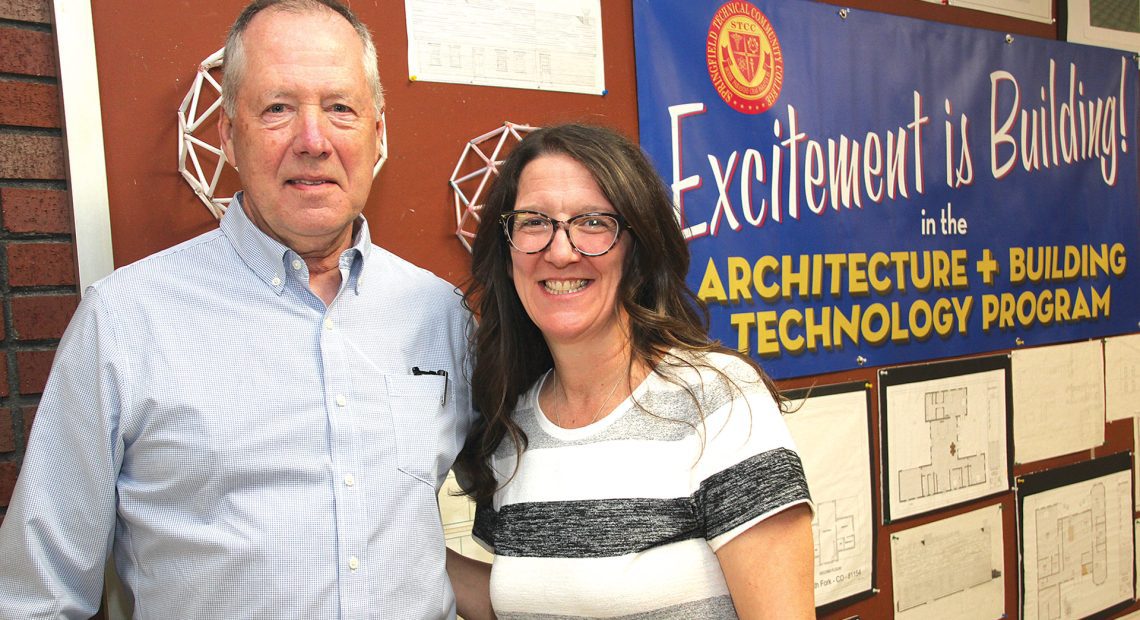
Professors Warren Hall and Jennifer DeForge of the Architecture and Building Technology program at STCC.

Warren Hall calls April 23, 2013 — the day the Massachusetts Board of Higher Education approved architecture and building technology as a two-year associate-degree program at Springfield Technical Community College — “a great day.”

“We were approved after a seven-year process,” said Hall, a professor in the program at STCC. “Creating programs is something I love to do. I like to figure it out and find out how to get people through the door.”

As of commencement this past May, the degree program boasts more than 200 graduates who hail from the Greater Springfield region and beyond. Students enroll in the program — the only one of its kind in Western Mass. — to acquire skills that prepare them for careers in architectural design and construction-related fields. Some students can start their careers after graduating from STCC, while many transfer to four-year colleges and universities.

STCC has agreements with UMass Amherst and other state colleges and universities that provide for a smooth transition into a bachelor’s degree program.

The program drew interest from Nathalia Hermida, who was living in Colombia in 2013 and considering colleges in the U.S.

“I always wanted to go for architecture,” she said. “I started looking for universities with my mom. She found out about a program at UMass Amherst, but the cost was too high for us, especially coming from Colombia. So, lucky for us, we found out that STCC had a program that would transfer into UMass’s architecture program. We looked into that. As a community college, it seemed like a really good program and was more affordable for us, so we decided to go with it.”

She earned her degree from STCC in 2016 before transferring to UMass and earning a bachelor’s degree in sustainable community development. Today, Hermida works at Uncommon Architectural Places, founded by Alfonso Nardi, an adjunct professor in the STCC architecture program.

“I’m lucky enough to share my design and building experience with them and watch them move onto some incredible positions in the building industry and continuing their education in architecture and building technology.”

In addition to professors Nardi and Hall, the program’s faculty includes Jennifer DeForge, now the program coordinator, who graduated from STCC in 2009 with an associate degree in civil engineering technology and is working on her second master’s degree.

“Working in the architecture and building technology program has been one of the best career decisions I could have made,” DeForge said. “Every day, I work with our students and fellow colleagues, who are some of the most driven individuals I have met, and I’m lucky enough to share my design and building experience with them and watch them move onto some incredible positions in the building industry and continuing their education in architecture and building technology.”

Hermida plans to pursue her architecture license and a master’s degree. STCC provided a solid foundation for her continuing education, she said. “I was really impressed about how complete the program was. They packed a lot into two years.”

The program has drawn other international students. Obed Otabil and Asra Afzaal both graduated in 2018. Otabil hails from Ghana, while Afzaal grew up in Pakistan.

Otabil attended UMass to earn his bachelor’s and master’s degrees. He is taking time off to raise a child, but hopes to work at an architectural firm and own his own firm one day.

“All the training I received from Springfield Tech was very helpful,” Otabil said. “Having the basic knowledge about architecture actually helped me sail through the undergrad program pretty smoothly.”

Afzaal left Pakistan to pursue educational opportunities in the U.S. She entered the U.S. educational system as an 11th-grader in high school and then found the STCC architecture and building technology program. Like Otabil, Afzaal went to UMass and received her bachelor’s degree in building and construction technology. In March 2023, she moved to Texas to work for an architecture, planning, and design firm as the space planner and project planner.

“STCC was the base, the foundation. And then on top of it, I laid the layers,” she said. “My basics were so strong that I was able to build on it and learn more and more. And I am so grateful that I was in the architecture program at STCC.”

Michael Caine, a 2016 graduate of the architecture and building technology program, later earned his master of architecture professional degree from the University of Pennsylvania School of Design. He also earned a bachelor’s degree in architecture from UMass Amherst.

Today, he lives in Philadelphia and works as a lead conceptual designer for an architectural firm that focuses on multi-family residential projects. He describes his conceptual work as “the dream job of architecture.”

Caine enrolled at STCC in part because the college is the most affordable in Springfield. He didn’t know what he would major in when he started, but later discovered the architecture and building technology program was a good fit.

“It is really unique to have an architecture department at a community college,” he said. “Having the exposure to architecture at such an early stage in an academic career of higher ed is really beneficial. It allows that barrier of entry to really be demolished.

“It was really beneficial for me to get the exposure and the breadth of knowledge to be career-ready at such an early stage. For me, that was really beneficial. After my first semester at STCC, I was able to win an internship, and from there, just learning both the technical side at school, but also the practical side during work while going to school, was the one-two punch.”

Caine said he is proud to call himself a graduate of STCC’s 10-year-old architecture and building technology program, and he recommends it to anyone interested in a career in building construction or design.

“It’s a super-unique program,” he said. “The way that professors Warren Hall, Jennifer DeForge, and Al Nardi have shaped it over the years is really something special. When I transferred to UMass, I had all these skills they weren’t even teaching over there until later down the road.”


Technology

Early Connections

The Markens Group

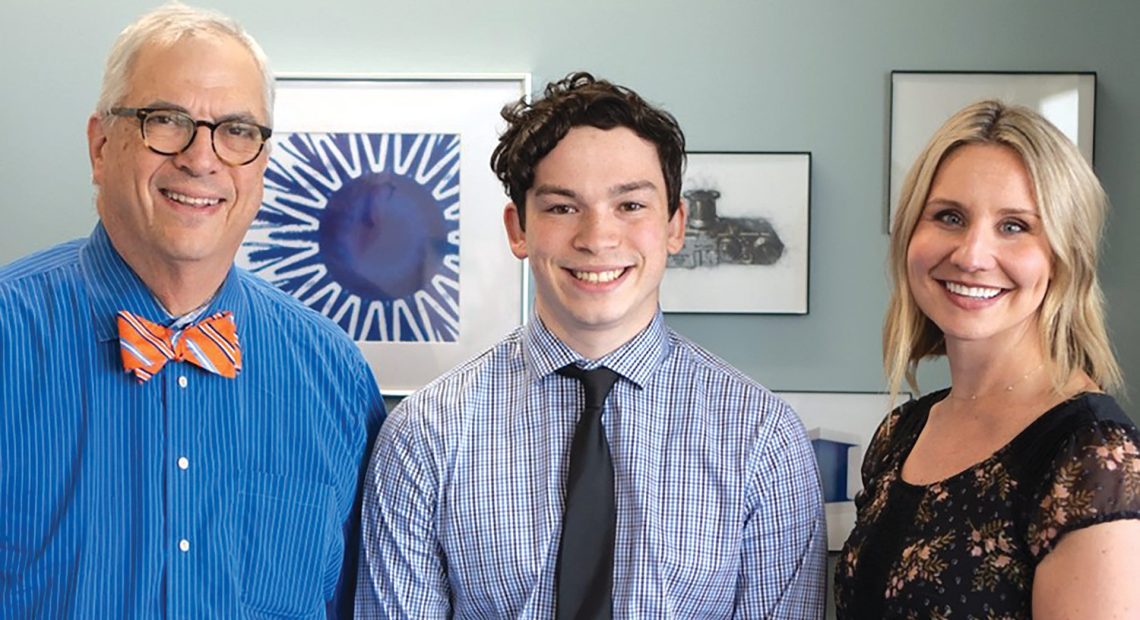
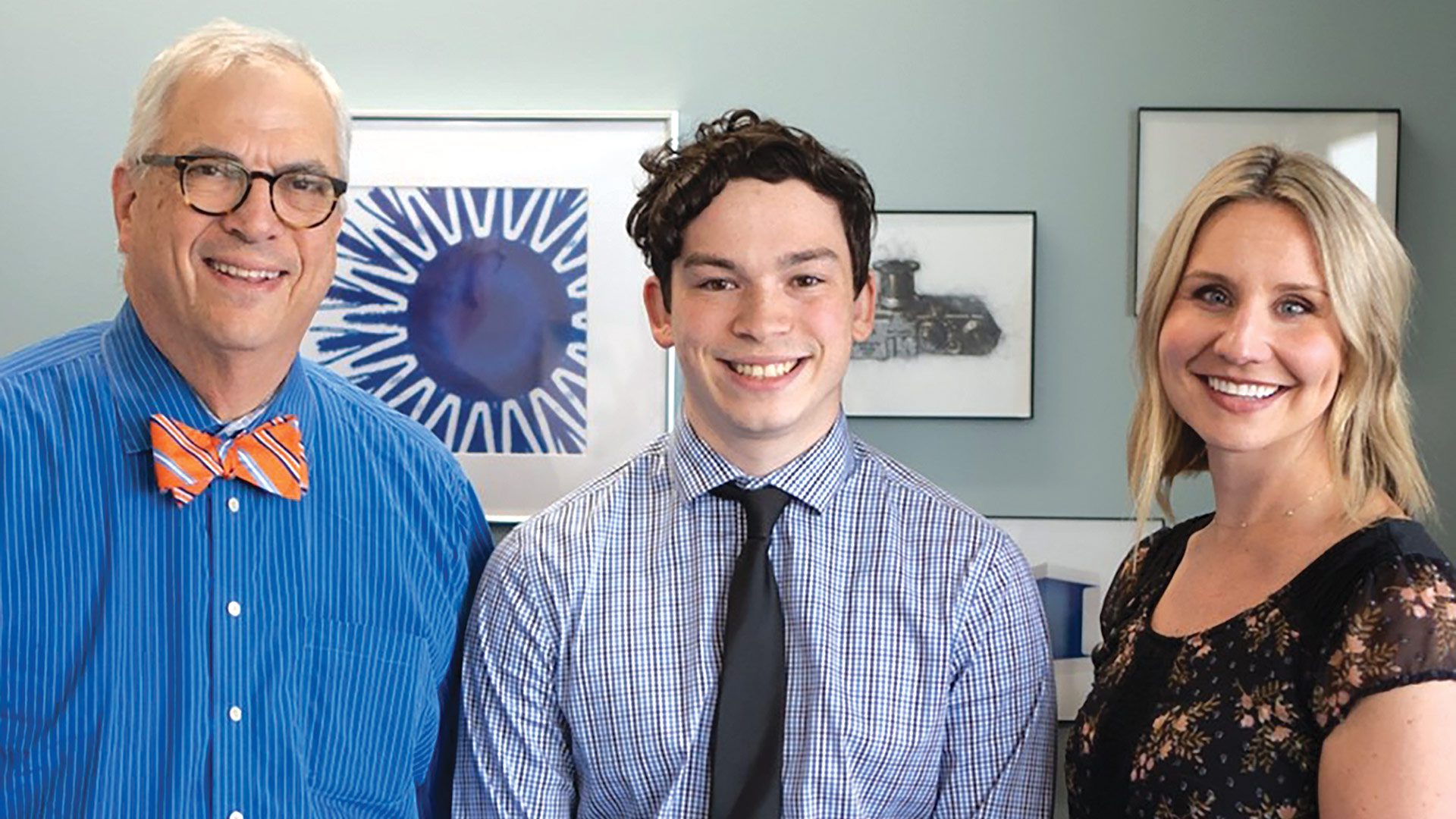
The Markens Group’s iCons summer intern, Bobby Murray (center), with Ben Markens and Emily Leonczyk.

The Western Massachusetts Economic Development Council (EDC) and the UMass Amherst iCons program, under the umbrella of the iCons Industry Consortium, recently joined forces to provide UMass iCons students with internship and career opportunities in the Western Mass. region.

iCons is a certificate program focused on real-world problem solving in biomedicine/biosystems and renewable energy, catering to students in science, technology, health sciences, engineering, math (STEM), and business. The program engages students in addressing real-world challenges alongside industry partners and faculty members from a range of STEM and business disciplines.

“By bringing together exceptional students and local businesses, this collaboration creates a win-win situation, fostering mutual growth and development.”

Now, with the support of the EDC, UMass iCons students majoring in science, technology, engineering, math, health sciences, and business have access to internship opportunities with local businesses, with the goal of bolstering the regional economy as well as their own experience.

“We’re excited to partner with UMass Amherst to showcase the advantages of living and working in Western Mass.,” said Rick Sullivan, president and CEO of the Western Mass EDC. “ By bringing together exceptional students and local businesses, this collaboration creates a win-win situation, fostering mutual growth and development.”

The iCons program has already successfully placed students in internships at three member organizations of the Western Mass EDC: the Markens Group, US Tsubaki Chicopee, and the Community Foundation of Western Massachusetts. These experiences have provided iCons students with valuable exposure to real-world work environments and have allowed them to contribute to the success of local businesses.

The Markens Group recently welcomed Bobby Murray as an iCons summer intern.

“We are thrilled to have Bobby join us at the Markens Group this summer,” said Emily Leonczyk, the company’s executive vice president and chief operating officer. “Bobby is taking advantage of the opportunity to cultivate his skills, gain invaluable real-world experience, and lay the foundation for a successful future. Bobby has already added immense value, he is sharp and enthusiastic, and our team is stronger with his contributions. We are dedicated to supporting next-generation talent like Bobby and fostering professional development in our region.”

“This partnership exemplifies our commitment to building community and empowering local talent.”

According to its website, iCons “prepares our best undergraduates to be problem solvers, leaders, and innovators in science, technology, and business. iCons recruits quality students across a diverse range of science, engineering, and business disciplines to identify global problems and find cutting-edge solutions. The iCons program positions students for high achievement in graduate school and in their careers.”

Scott Auerbach, Mahoney Family Sponsored Executive Director of iCons, noted that the program’s mission can be boiled down to three words: “add real value.”

“Our excellent partnership with the Western Mass. Economic Development Council and terrific member organizations like the Markens Group provides powerful opportunities to accomplish this important mission,” he said.

Through this collaboration, the leaders of the Western Massachusetts EDC and the iCons program say they want to pave the way for talented students to excel in their academic and professional pursuits while driving economic growth in the region. By nurturing the next generation of leaders and problem solvers, they add, this partnership will leave a lasting impact on both the students and the community as a whole.

“The Markens Group firmly believes in the power of community,” President and CEO Ben Markens said. “Beyond our association-management services, we actively engage in initiatives that foster growth, build relationships, and strengthen the region. This partnership exemplifies our commitment to building community and empowering local talent.”

Nonprofit Management

Streams of Assistance


Call it a flood of support at a critical time.

On July 20, the Healey-Driscoll administration and the United Way of Central Massachusetts (UWCM) announced the Massachusetts Farm Resiliency Fund, a partnership between philanthropic organizations and private foundations intended to support Western and Central Mass. farms impacted by recent flooding and strengthen farm resiliency in the long term. Officials made the announcement at Mountain View Farm in Easthampton, which had much of its crop destroyed by flooding.

Megan Burke

Megan Burke

“We seek to ensure that this coordinated effort provides immediate relief that works for farmers and addresses longer-term food-security issues for vulnerable residents of our region.”

The Massachusetts Department of Agricultural Resources estimates at least 75 farms have been hurt by flooding, with about 2,000 acres in crop losses at a minimum value of $15 million. That number will likely climb as more damage is assessed and the longer-term impacts set in.

“As the lieutenant governor and I have visited farms across the state, we’ve been deeply moved by the devastating impacts we’ve seen and heartbreaking stories we’ve heard. We’re grateful to our philanthropic and private partners for quickly answering the call to action and creating this fund to deliver relief directly to farmers,” Gov. Maura Healey said. “This is about team Massachusetts — where we come together to support farmers and their livelihoods, build resilience for our farms and food supply, strengthen our economy, and create a stronger future for our children and families.”

Lt. Gov. Kim Driscoll added that “Governor Healey and I have heard firsthand from dozens of farmers who are grappling with the aftermath of extreme flooding and trying to figure out how they’re going to make ends meet and keep their farms. We’ve been inspired by their resilience and the pride they take in their businesses, which play an essential role in our state’s food supply and economy. The Massachusetts Farm Resiliency Fund will be a lifeline for so many dedicated farmers and their families.”

Several nonprofit leaders were quick to commit to supporting farmers through the fund.

“In light of the devastating impact of recent floods, the Community Foundation of Western Massachusetts is committed to supporting the Massachusetts Farm Resiliency Fund,” CFWM President and CEO Megan Burke said. “We seek to ensure that this coordinated effort provides immediate relief that works for farmers and addresses longer-term food-security issues for vulnerable residents of our region.”

Philip Korman, executive director of Community Involved in Sustaining Agriculture (CISA), added that “this month’s rains and floods, occurring in the middle of the summer harvest, will have a bigger impact on our farms than Hurricane Irene. It has been heartening to see the community rally around our local farmers, the very people who feed our families. The newly created Massachusetts Farm Resiliency Fund is a powerful example of what can be created when government, foundations, businesses, and nonprofits like CISA work together. The fund will be an essential piece of helping farms recover and will serve as part of the safety net to future climate change events.”

Sen. John Velis

Sen. John Velis

“The flooding has decimated folks’ businesses, jeopardized their livelihoods, and has had a tremendous impact on our Commonwealth’s agricultural sector and our food supply as a whole.”

Meanwhile, Mark Gold, director of the Harold Grinspoon Charitable Foundation, praised the administration for addressing flood relief in a timely manner. “Our foundation remains committed to providing support to those farms impacted by the recent floods along the Connecticut River Valley and others to which we and our partners have provided support over the past nine years.”

Local legislators were quick to praise the joint effort between government and philanthropic community.

“Farms throughout Western Massachusetts have been devastated by the recent flooding in our region, and the full scale of damage is unfortunately expected to grow even more,” state Sen. John Velis said. “The flooding has decimated folks’ businesses, jeopardized their livelihoods, and has had a tremendous impact on our Commonwealth’s agricultural sector and our food supply as a whole. I am grateful to the Healey-Driscoll Administration, UWCM, and all the philanthropic and private foundations for their fast work in creating the Farm Resiliency Fund and for their commitment to helping our farmers get back on their feet.”

State Rep. Natalie Blais agreed. “Following the devastation caused by recent rains and flooding, the Healey-Driscoll administration stood with us, in our fields, to hear directly from farmers,” she said. “I am profoundly grateful to our community for coming together to support farms across the state, and for Governor Healey’s commitment to the long-term sustainability of agriculture and our local food systems.”

Tim Garvin, president and CEO of United Way of Central Massachusetts, called the new fund “a most beautiful demonstration of real partnership, united in compassion and united in purpose to support and assist our farmers,” adding that he is hopeful that many will be inspired to contribute.

“As someone who sees the devastating impacts of the recent flooding every day, I am extremely grateful for the quick efforts of the Healey-Driscoll administration and the United Way of Central Massachusetts to put the Massachusetts Farm Resiliency Fund in place,” state Sen. Jo Comerford said. “We must continue to take concrete steps to help the farmers who so desperately need our quick action and sustained efforts to help in their recovery.”

Comerford also praised the state Senate the following week for passing a $513 million supplemental budget for FY 2023 that includes $20 million in assistance for farms throughout the Commonwealth impacted by recent severe weather events.

“These public funds will go out as direct grants,” she explained. “That’s money in the pockets of farmers who have experienced a massive hardship in the wake of the extreme flooding earlier this month and the frosts and freezes this past spring.”

Other organizations have stepped up to help as well, such as UMassFive College Federal Credit Union, which recently announced a donation to aid local farms impacted by the flooding, including Natural Roots Farm, Mountain View farm, Pepin Farm, Community Care Apothecary, Song Sparrow Farm, Stone Soup Farm, New Community Farming Cooperative, World Farmers’ Flats Mentor Farm, and the Grow Food Northampton Community Farm.

“We are deeply connected to our community and our members, and we understand the critical role that local farms and local food play in our lives,” said Craig Boivin, vice president of Marketing at UMassFive. “Our donation to the local farms impacted by the floods is an expression of our gratitude and commitment to helping our neighbors in their time of need.”

As for the Massachusetts Farm Resiliency Fund, all funds will be distributed rapidly by the United Way through a deliberate selection process. More information about the fund can be found at unitedwaycm.org/farmfund.

“For generations, our farms have been part of our cultural heritage and the fabric of our local communities,” Massachusetts Department of Agricultural Resources Commissioner Ashley Randle said. “As heartbreaking as it has been to see our farming community hit hard, I’m truly inspired to see the community step up and rally around our farmers with this partnership that will bring much-needed relief.”


Daily News

SPRINGFIELD — Springfield Technical Community College (STCC) and the MassHire workforce system have partnered to offer no-cost training that can open the door to a career in advanced manufacturing.

Funded by the Massachusetts Technology Collaborative, the training begins Sept. 11 at STCC. Participants will learn to operate CNC (computer numerical control) machinery in the state-of-the-art lab at Springfield Technology Park. The training, which runs through Dec. 19, is open to those who are unemployed or underemployed (working part-time or making less than $17 per hour). Classes are scheduled Mondays through Thursdays from 5 to 8 p.m.

Participants must be 18 or older and have a high-school diploma, GED, or HiSET completion, among other requirements. Two-week prerequisite training is required before starting the program. For more information, including full applicant training requirements, visit stcc.io/cnc.

“This no-cost training program provides an excellent opportunity to learn the fundamentals to begin a career pathway that can lead to becoming a CNC machinist or toolmaker,” said Larry Martin, director of Labor Market Research and Business Services for the Hampden County Workforce Board.

Gladys Franco, assistant vice president for Workforce Development at STCC, added that “we are excited to partner with MassHire to help people get trained for in-demand jobs with competitive wages and benefits. The CNC training will help people get a foot in the door. Springfield-area advanced manufacturing businesses have positions available, but they often tell us they need us to help candidates learn the skills required to get hired.”

Participants will train on CNC machines used in manufacturing and also in STCC academic programs. STCC offers a two-year associate degree program in mechanical engineering technology and a one-year certificate in CNC operations.

STCC faculty will teach the classes offered at no cost this fall. Trainees will learn blueprint reading, shop math, precision-measuring tools, and how to operate CNC machinery.

“This is a terrific opportunity for people who are unemployed or underemployed because the labor pool is dry right now,” said Thomas Minor, a professor and coordinator of the MET program. “The MET program has more job opportunities than we are able to fill with our day and night students. These aren’t just jobs; they are high-paying careers with benefits and upward mobility.”

Upon completion of the 15-week training, participants must actively seek full-time employment. Participants might consider enrolling in an STCC program while working, Minor said. “Some of our students work full-time while pursuing a degree or certificate. We offer flexibility in our programs to help them succeed.”

Daily News

SPRINGFIELD — A new date for the ninth annual Dragon Boat Festival has been set for Saturday, Oct. 14 on the Connecticut River. The event will feature dragon-boat races, food trucks, and Asian-themed entertainment from 9 a.m. to 1 p.m. at North Riverfront Park, 121 West St., Springfield.

The festival was originally scheduled for July 29 but postponed due to unsafe water conditions resulting from recent flooding. Admission to the festival is free for spectators.

Twenty-four teams from throughout New England are registered to participate in this year’s dragon-boat races. Community teams include Behavioral Health Network, CRRC-MA, as well as the defending champions, Springfield Pharmacy First Responders. With the new date set, registration will be reopened at www.pvriverfront.org for additional teams to sign up to race on Oct. 14.

The Springfield Dragon Boat Festival, which has been hosted by the Pioneer Valley Riverfront Club (PVRC) since 2013, attracts hundreds of participants and spectators to the banks of the Connecticut River for a day of competition, festivity, and community support. The festival is an important fundraiser in support of breast-cancer survivors and community programming at the Pioneer Valley Riverfront Club.

According to Ben Quick, executive director of PVRC, “we are happy to have found an alternative date for the Dragon Boat Festival, which has become a staple of our offerings on the riverfront. With the additional time, we are opening registration for teams, and a fall dragon-boat experience on the Connecticut with colleagues and friends can be spectacular. We look forward to welcoming dragon boaters and fans of this fun and exciting event.”

Hundreds of paddlers from New England participate in the festival races. A team is comprised of up to 20 paddlers who race against other teams in 200-meter races on the Connecticut River. Each race lasts about one minute, and each team races at least three times on the day of the festival. Dragon boating originated in China 2,000 years ago and today is one of the world’s fastest-growing team water sports.

The festival makes it easy for anyone to participate and spectate. Free parking is available nearby at 77 West St. or along Avocado Street and on property abutting and behind the new Starbucks store adjacent to the Riverfront Club. The festival can also be reached by the Connecticut Riverwalk Bikeway. More information can be found at www.pvriverfront.org or by calling (413) 736-1322.

Daily News

AGAWAM — The Better Business Bureau (BBB) of Central New England announced the recipients of the 2023 Marketplace Excellence Awards, naming Braman Termite & Pest Elimination the winner of the Western Massachusetts Award for Marketplace Excellence, Mid-sized Business.

Based in Agawam, Braman serves residential and commercial customers across Southern New England, with additional Massachusetts locations in Auburn, Hampden, Lee, and Waltham, as well as Bloomfield, Conn.

“Our success was founded in 1890 on three key principles: pride, honesty, and quality,” said Jerry Lazarus, the third-generation owner and operator of Braman Termite & Pest Elimination. “These are the ideals we live by. While any business can say this, this recognition by the BBB underscores our commitment to these values.”

The BBB award recognizes both high standards of behavior toward customers, employees, and suppliers and a history of ethical business practices and community involvement.

Braman is a member of the National Pest Management Assoc. and has earned the association’s QualityPro and GreenPro designations. Its pest-control technicians are all licensed, certified, insured, and trained to observe all relevant federal, state, and local regulations pertaining to the services they provide.

Daily News

SPRINGFIELD — Throughout the month of June, Freedom Credit Union collected cash donations at its branches throughout Western Mass. to benefit Griffin’s Friends, a volunteer-led group dedicated to providing relief and support to children with cancer and their families, raising a total of $1,400.

“Over the years, Griffin’s Friends has earned a special place in our hearts because of the passion its volunteers have for preserving the memory of Griffin Kelleher through generous acts of kindness,” Freedom Credit Union President Glenn Welch said. “There is a kind of magic in honoring the spirit of a child by providing joyful experiences that impact children and families on such a personal level, and at a time when they are needed most.”

Griffin’s Friends was founded in 1994 in Springfield and is named for Griffin Kelleher, who passed away from cancer when he was 14 months old. This group is his legacy, uniquely supporting children in treatment for cancer and their families by providing small acts of joy.

Examples of the types of experiences offered by Griffin’s Friends include trips to stage performances and sporting events, in-hospital and outpatient entertainment, massage therapy, and activities such as art, computers, and games. To contribute, visit griffinsfriends.com. All funds donated go to the Griffin’s Friends Children’s Cancer Fund at Baystate Health Foundation Inc.

Senior Planning

Distributing Tangible Personal Property Can Cause Conflict

By Hyman G. Darling, Esq.


Very often in preparing an estate plan, issues arise over the tangible personal property, also known as ‘the stuff.’ This may include cars, collectibles, the dining-room furniture, Waterford china, and basically any other item in a house that is not attached to the walls. These tangible personal property items are often dealt with separately from other assets, such as stocks, bonds, real estate, cash, etc.

Unfortunately, when the client has not provided enough detail in listing the distribution of assets, the tangible property becomes a major issue. Arguments may ensue, and often, the family brings the case to litigation to argue about all these items. In some cases, the family has significant assets to be distributed, but these tangible items become contentious and cause the estate to be litigated and prolonged.

Hyman G. Darling

Hyman G. Darling

“Arguments may ensue, and often, the family brings the case to litigation to argue about all these items.”

There are several ways in which this matter may be resolved, but the clients need to take the time to prepare properly for the distribution. The first way would be to have a complete listing of the items that may have either sentimental value or material value. The client can either list these items in the will, in which case they may have to be probated, or in other cases, the client can sign a memorandum.

The memorandum is fairly new in Massachusetts, as determined in the Uniform Probate Code, which was enacted in 2013. A client may now make a listing of assets and the individuals to receive the assets, which may be memorialized in writing and signed by the client, and then merely referred to in the will. In this manner, if the client desires to change the memorandum, they may merely write up a new memorandum and have it signed and dated and placed with the will, as opposed to having the entire will rewritten.

It is very important in this memorandum to be clear about what items are listed. For example, a mention of a ring or a watch may not be clear enough; perhaps the ring should be listed as the engagement ring with two small diamonds, and the watch could be listed as the Timex watch with rhinestones.

If there are items that are to be identified more clearly, they also should be listed, so that a painting or picture should state the setting or picture, as well as where it may have been hanging in the house, such as in the den above the piano.

Some clients have made lists and put stickers on the back of items or underneath them with identifying colors such as a yellow sticker for daughter Susie, a white sticker for son John, and green stickers for all the grandchildren. This is acceptable so long as the stickers are still on the items at the time of the client’s death and if someone doesn’t get to the items and move the stickers to different items.

In cases where the client was not clear, there are several alternatives to litigation. The first would be to have all parties make a list of the items that are important to them and then allocate an item to each person from their lists, taking turns between the beneficiaries. In some cases, clients have had to draw straws in determining who makes the first selection. Once they are finished choosing all of the items, they can then do their own ‘horse trading’ between themselves, but at least some of the beneficiaries will receive some of the items they want.

If this does not work, it may be necessary to gather the lists of the desired items by the family and engage the services of a mediator to attempt to resolve the differences. The problem then becomes whether the items are more valuable in terms of material value or sentimental value. If the sentimental value isn’t as great as the material value, then a client might decide to choose a larger, more valuable item and hope to trade it later for the more sentimental item.

If the resolution is not able to be made voluntarily, then an inventory of all items will have to be filed with the court, and perhaps an appraiser or two will have to be hired by the estate to value all the items. Some items without much value may be included in a ‘lot,’ which will be valued as a commingling of these items and valued as such.

Once these are all valued and listed on the inventory, one party might have to petition the probate court to determine the proposed distribution of these items, which is unfortunate, as they will be utilizing valuable court time merely to divide the tangible items. The court has the discretion to appoint a master, who will be an experienced lawyer, to hold the hearing at the expense of the estate, and then each party will also be paying their own lawyer to argue over who will receive what items.

In many cases, when this matter is over and resolved, none of the parties are pleased with the result, which means it was probably a fair and equitable decision.

Very often, clients are convinced that the children will have no problem distributing the assets and dividing the items; the client will merely state that nobody will want anything, as they have their own items. This is not always the situation; when a person passes away, not only do the children have a say in what will be distributed, but their spouses may wish to intervene and strongly suggest what their spouse should take. It is usually helpful to keep these in-laws (often called out-laws) out of the decision-making process, as this only causes more people to be involved and greater dissent between the parties.

When completing your own estate plan, consider the potential use of the memorandum with specific detail for the items you wish to distributed. Be careful in considering and discussing these issues with the children since, if you ask them all what they want and they all state that they want the same items, you will then be faced with the decision of having to tell some of them they will not be getting certain items. This can easily cause conflict, and family dinners and holiday occasions may prove to be less than pleasant.


Hyman G. Darling is a shareholder and the head of the probate/estates team at Bacon Wilson; (413) 781-0560; [email protected]

Senior Planning

Ten Tips on How to Approach a Difficult Topic


By the AARP Foundation


The reality is that some conversations are just plain difficult — even with the people to whom you feel the closest. When preparing to discuss a difficult topic like senior care needs, it helps to follow the ground rules below to ensure that everyone’s feelings are respected and viewpoints are heard. To help make the conversation as productive and positive as possible:


1. Try not to approach the conversation with preconceived ideas about what your loved ones might say or how they might react. “Dad, I just wanted to have a talk about what you want. Let’s just start with what is important to you.”


2. Approach the conversation with an attitude of listening, not telling. “Dad, have you thought about what you want to do if you needed more help?” — as opposed to “we really need to talk about a plan if you get sick.”


3. Make references to yourself and your own thoughts about what you want for the future. Let them know they are not alone, that everyone will have to make these decisions. “Look, I know this isn’t fun to think about or talk about, but I really want to know what’s important to you. I’m going to do the same thing for myself.”


4. Be very straightforward with the facts. Do not hide negative information, but also be sure to acknowledge and build on family strengths. “As time goes on, it might be difficult to stay in this house because of all the stairs, but you have other options. Let’s talk about what those might be.”


5. Phrase your concerns as questions, letting your loved ones draw conclusions and make the choices. “Mom, do you think you might want a hand with some of the housekeeping or shopping?”


6. Give your loved ones room to get angry or upset, but address these feelings calmly. “I understand all this is really hard to talk about. It is upsetting for me, too. But it’s important for all of us to discuss.”


7. Leave the conversation open. It’s OK to continue the conversation at another time. “Dad, it’s OK if we talk about this more later. I just wanted you to start thinking about how you would handle some of these things.”


8. Make sure everyone is heard — especially those family members who might be afraid to tell you what they think. “Susan, I know this is really hard for you. What do you think about what we are suggesting?”


9. End the conversation on a positive note. “This is a hard conversation for both of us, but I really appreciate you having it.”


10. Plan something relaxing or fun after the conversation to remind everyone why you enjoy being a family. Go out to dinner, attend services together, or watch a favorite TV program.

These are just a few suggestions of things you, your loved ones, and other family members can do to unwind after a difficult conversation.

Daily News

AGAWAM — Brittany Yvon, credit manager for OMG Inc., has been named as a Rising Star by HBS Dealer magazine in its annual Top Women in Hardware & Building Supply listing. She was selected from among a record-breaking number of nominations of up-and-coming and high-performing leaders who are making an impact in the hardware and building-supply industry.

Since 2020, HBS Dealer and industry partners have promoted the role of women in the hardware and building-supply industry. Individuals are nominated by their peers and selected by a panel of judges based on their contributions and attributes that go above and beyond the call of duty. Professionals receiving the Rising Star designation have been identified as women with the potential to make a significant, positive difference both within their company and within the industry for years to come.

“It is a great honor to be recognized among this group of outstanding industry leaders,” Yvon said. “Collectively, the women named as Rising Stars will potentially make some very significant differences in our industry, and I’m very proud and humbled to be part of the class of 2023.”

Yvon has been with OMG for seven years and was promoted to credit manager in 2021, where she is responsible for overseeing OMG’s Accounts Receivable department, including researching customer credit reports, creating credit scoring models to predict risk, monitoring customer balances, and preparing end-of-month reports and reconciliations. She is a member of the National Assoc. of Credit Management, a certified international credit professional through the Finance, Credit, and International Business Assoc., and a credit business associate through the National Assoc. of Credit Management.

Yvon and the other award recipients will be honored at HBS Dealer’s annual Top Women in Hardware & Building Supply convention on Nov. 15-16 at the Sheraton Grand Chicago Riverwalk Hotel.

Daily News

MONSON — Monson Savings Bank President and CEO Dan Moriarty was named Board Member of the Year at the East of the River Chamber of Commerce (ERC5) 2023 annual breakfast.

“We are grateful for Dan’s strategic vision, leadership, and exceptional service and commitment to the communities we serve, and the board,” said Grace Barone, executive director of the ERC5. “We are thrilled to honor him for his exceptional service and contributions to the chamber and our community.”

Moriarty, who has been a member of the ERC5 board of directors for more than four years, said he was surprised to receive the award.

“I’m incredibly honored to have received this award and grateful to be a part of the ERC5. I am proud to be a member of the board of directors for an organization that strives to bring members and businesses of our community together the way the ERC5 does. I look forward to what the future has in store.”

In addition to the work he does with the ERC5, Moriarty is involved with several other community organizations. He is a strategic council member of Springfield nonprofit I Found Light Against All Odds- Lighthouse Home for Homeless Teen Girls, a board member of the Monson Home for the Aged, and a member of the Links to Libraries board of directors. He also is on the Baystate Health community benefits advisory council, a member of the Monson Free Library finance committee, and co-chair of the Monson Savings Pro-Am. He co-chairs the diversity, equity, and inclusion council of the Massachusetts Bankers Assoc. and he serves on the finance committee and as a confirmation teacher at St. Patrick’s Church in Monson. Additionally, he is a former volunteer grant scholarship reviewer for the Community Foundation of Western Massachusetts and a past co-chair of the Brightside’s Golf Classic.

At the end of his brief, impromptu acceptance speech, Moriarty shared some inspiring words. “Surround yourself with people who are smarter than you and always try to do your job with love and kindness; that is what truly matters in this world. Every day, I strive to do these things, and I truly believe it helps me be a better person than I was yesterday.”

Daily News

WEST SPRINGFIELD — LiftTruck Parts & Service Inc., a local, family-owned business, recently launched a fundraiser to benefit the Dakin Humane Society.

For 35 years, LiftTruck has been a family-owned business providing cost effective forklift sales, rentals, parts, and service experience to the Massachusetts, Cape Cod, Connecticut, and Rhode Island areas.

The company invites the community to contribute with monetary donations to Dakin Humane Society through its team fundraising page (click here). Dakin will also be collecting items daily from 10 a.m. to 3 p.m. outside its Springfield Animal Resource Center. Click here for a list of accepted items. Every dollar raised through LiftTruck’s fundraising page will improve the lives of animals in need and the people who care about them.

“We are so excited to partner with Dakin Humane Society on this event,” said Kara Sotolotto, vice president of LiftTruck Parts & Service. “At any given time, there is usually a dog in our administrative offices greeting our team members; we are a big animal-loving community.”

Daily News

SPRINGFIELD — The Zoo in Forest Park will host its Kindergarten Kickoff, an event for incoming Springfield kindergartners, on Saturday, Aug. 12 from 10 a.m. to 1 p.m.

The free event, presented by Teddy Bear Pools & Spas, will not only include free entrance to the zoo for Springfield kindergartners and one caregiver, but it also offers a chance for children to practice skills needed to succeed in their first year of elementary school.

Community partners such as the Springfield Public Library and the Connecticut Science Center will be in attendance to help the children practice essential skills, such as writing their name, cutting a shape, and identifying colors. At the start of the event, all children will receive a free backpack. After completing each skill, they will collect a school item to fill their new bag. At the end of the event, children will leave with a backpack full of school supplies and the confidence to head into the new year.

Pre-registration for Kindergarten Kickoff is required to attend, and spots are extremely limited. Attendees must show proof of Springfield residency upon check-in with either a valid ID or a welcome letter from their child’s school. Admission for additional guests can be purchased at a discounted rate. Registration is available at www.forestparkzoo.org/kko23.

“This event encourages students to explore skills they will perfect in the upcoming school year while hopefully washing away the worry of starting kindergarten,” said Caroline Cay Adams, director of Education at the Zoo in Forest Park. “We are so grateful to our amazing community partners for their dedication to this event and cannot wait to meet these young scholars on Aug. 12.”

Cover Story

Working in Tandem

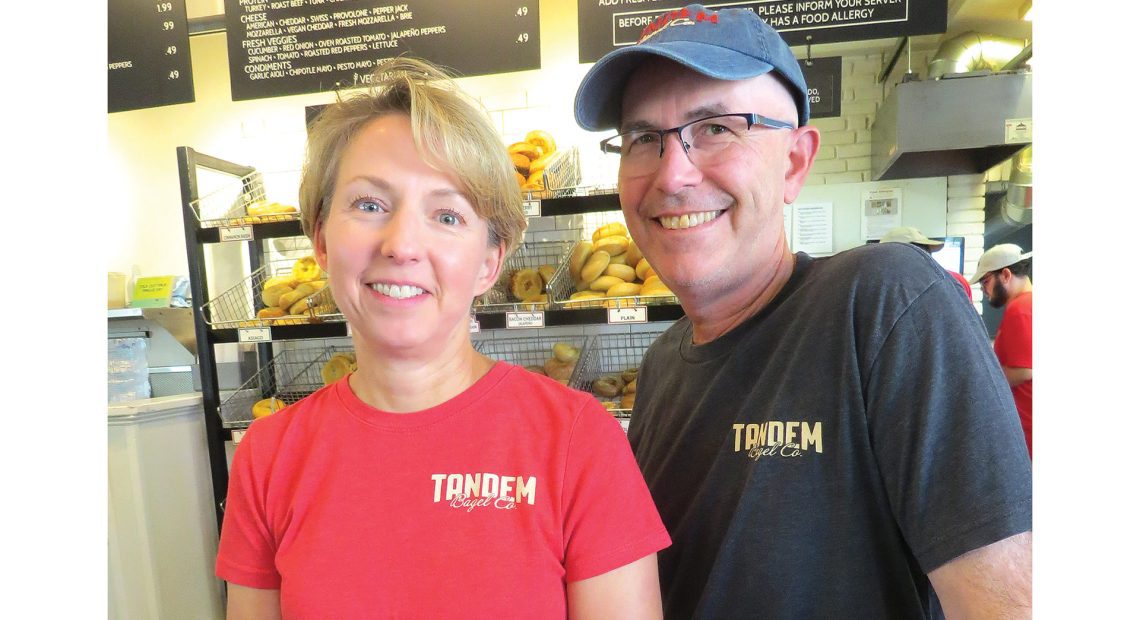
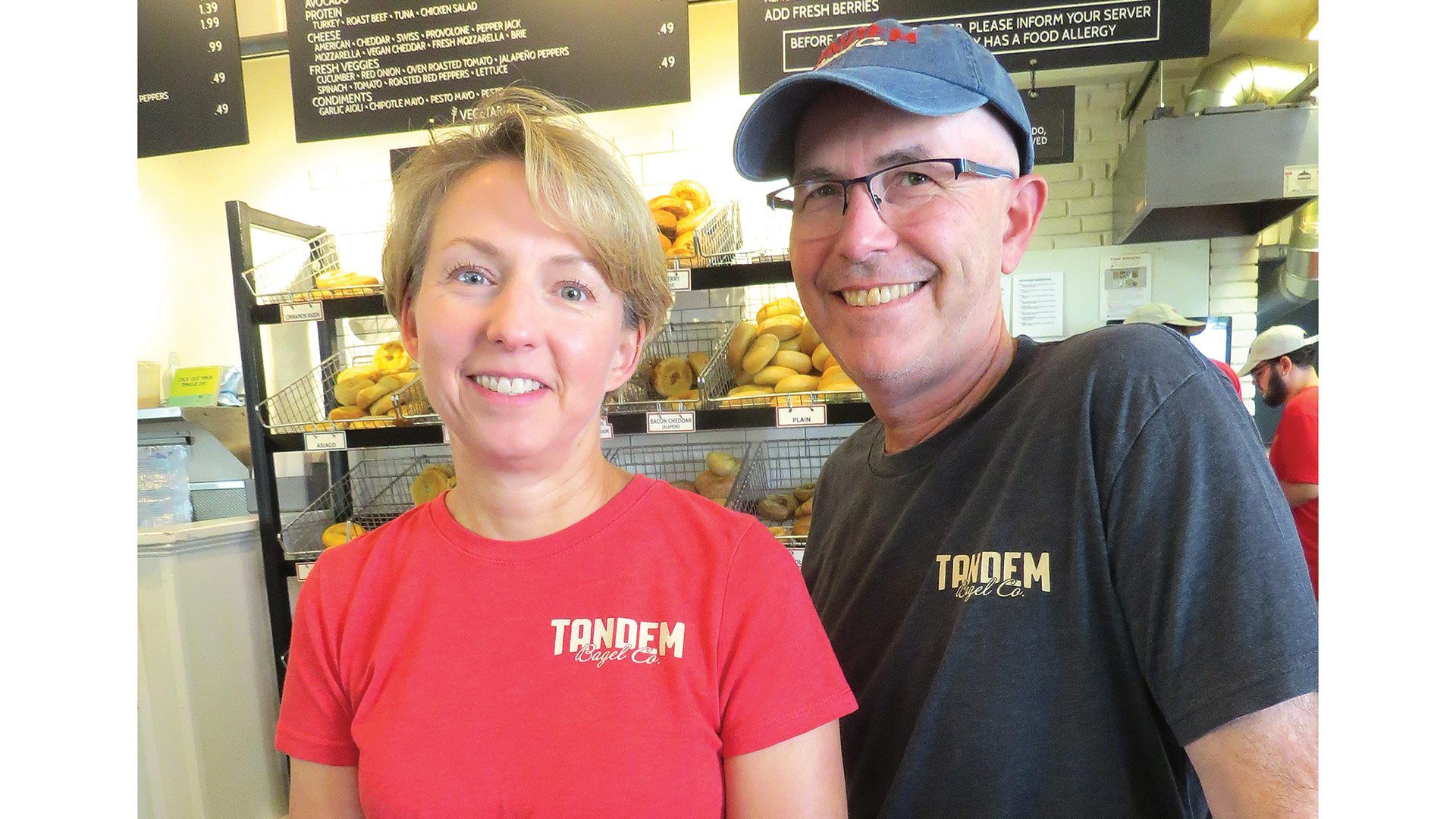
Chris and Andrea Zawacki

Chris and Andrea Zawacki

As he talked about the business venture and the name that would go on it, Chris Zawacki said a good deal of thought went into the selection process.

The bagel shop would be located in the old railroad depot in the center of Easthampton. That’s right next to the bike path, he said, so there was considerable talk concerning bicycling terms. Meanwhile, Zawacki and his wife, Andrea, were entering into this venture with another couple, Brian and Shannon Greenwood.

Somewhere along the way, the word ‘tandem’ was tossed out, and because it has at least two meanings that were relevant to the conversation, it stayed in play, and was eventually chosen.

A little more than a decade later, Tandem Bagel Co., and even simply ‘Tandem,’ has become an ever-larger part of the lexicon — and the landscape, with additional locations in Northampton, Hadley, West Springfield, and Florence. The Hadley location also houses a central baking operation, with the bagels made there and then taken in vans to the various locations.

“It became a meeting place and a co-working space. We have several writers who come in and get some writing done during the day.”

Indeed, what started as a single bagel shop is now a thriving enterprise with multiple locations. Zawacki doesn’t like the word ‘chain’ and laments that many — as in far too many — people think Tandem is a national chain. It isn’t.

Not yet, anyway.

It’s a local business that offers bagels of all kinds, with names and flavors ranging from Snickerdoodle to Wild Cheddar to French Toast, but also breakfast and lunch sandwiches, salads, smoothies, coffee and iced coffee — a billboard promoting the company displays that product and invites people to “beat the heat” — and a lot more.

Indeed, its locations have become a place to gather and also a place to get some work done. Meanwhile, at least a few of the locations, especially those in Easthampton and West Springfield, have had a significant impact on economic development and overall vibrancy in the communities where they’re located.

It all started with the goal of replicating the model — and success — of a bagel operation that Zawacki, an Easthampton native and mechanical engineer by trade, had observed while living for a time in the state of Washington. That goal has already been achieved, he said, adding that the question he hears, and answers, most often is, “where do we go from here?”
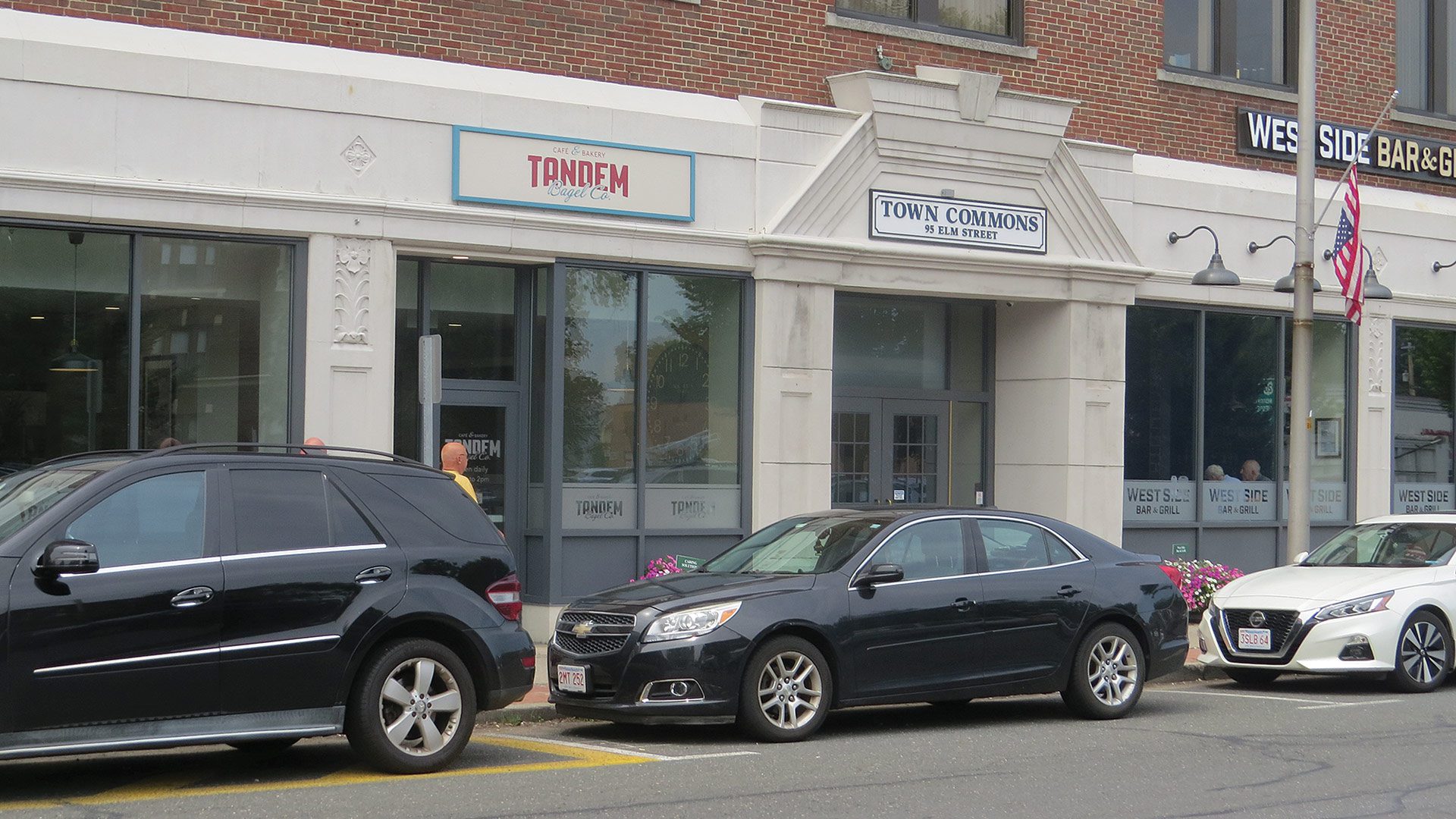
The West Springfield Tandem Bagel location

The West Springfield Tandem Bagel location was a key contributor to the redevelopment of the Town Commons complex downtown.

Continued growth is certainly in the forecast, he said, adding that he and others are considering several potential landing spots, especially Westfield, where many visitors to the Easthampton and West Springfield locations are from, as well as Springfield. He has looked at several locations in downtown Springfield but isn’t ready to pull the trigger just yet.

Overall, the company is focused on smart growth and expansion that makes sense, he said, adding that Tandem won’t grow for the sake of growth. And, overall, he’s not really sure where he wants this brand to be in five, 10, or 20 years.

“It took a lot to get where we are, so it will take a lot to get the next level,” he explained. “Things are going well, and for our employees, getting to that next level puts a lot of pressure on people. If we can go at a steady pace, treat our employees well, and expand in slow fashion that works for all, that’s fine with me.”

For this issue, BusinessWest looks at how Tandem Bagel has become a brand in the region as well as a force when it comes to economic development and helping to transform communities into destinations.


Spreading the Wealth

As noted earlier, Zawacki was working in Washington State in the late ’90s when he became acquainted with an individual who had retired and started a venture called Sunrise Bagels.

“We frequented it with our kids,” he recalled. “We thought he had a good product, a product that was different than what we had here. It was a neat business model — he had a lot of different varieties, 25 or 30 of them any given day.

“I got in touch with him and stayed in touch with him,” he went on. “I was thinking that, at some point, maybe I would give up my engineering career and open up a bagel place.”
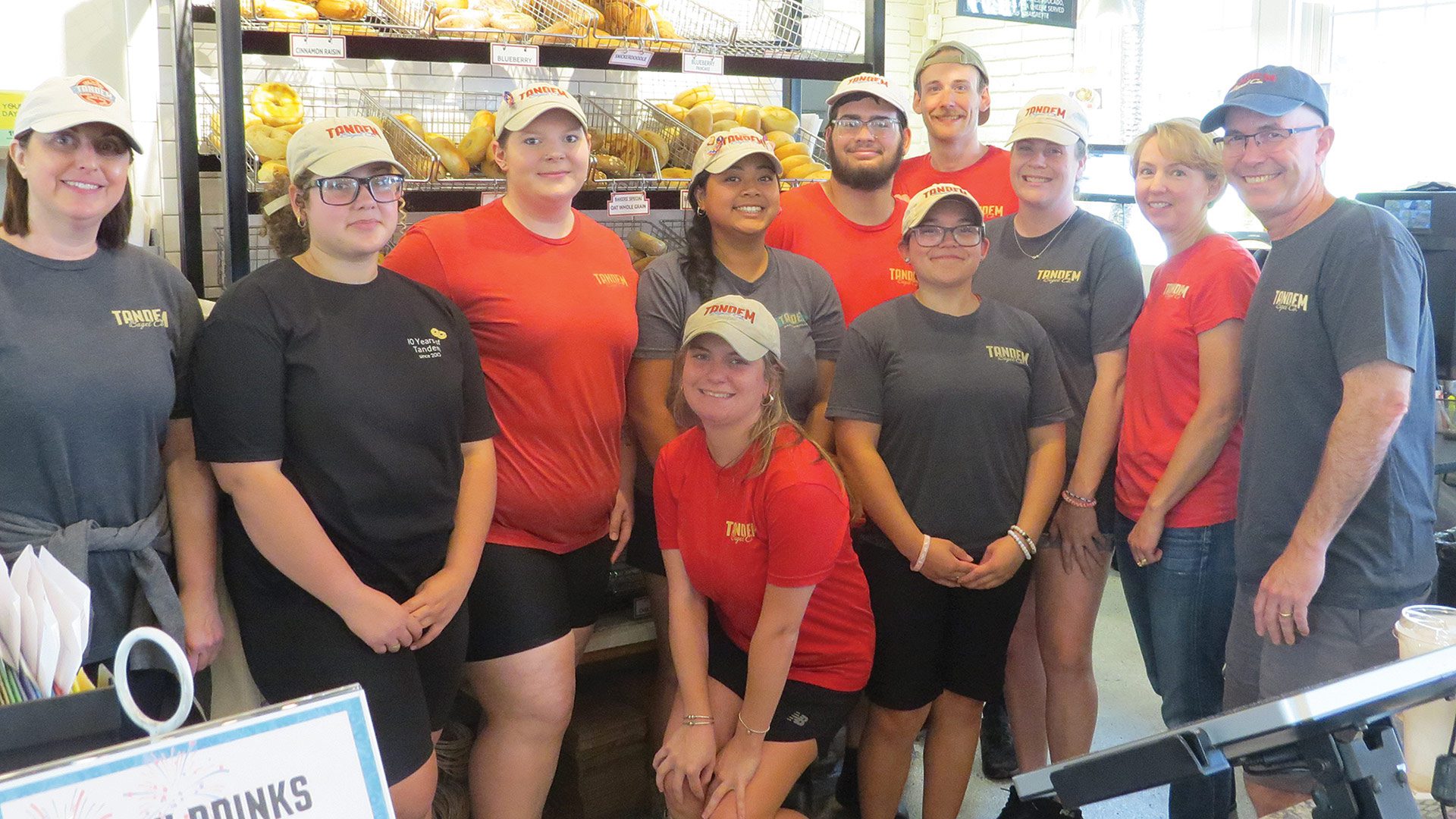
The team at the Easthampton location

The team at the Easthampton location, where it all started.

This blueprint, if that’s what it can be called, took a while to become reality, he told BusinessWest.

Indeed, the Zawackis looked at a few possible locations that didn’t work out, and then, in 2012, some friends suggested the old railroad depot in the center of Easthampton, owned by Williston Academy, a landmark with an intriguing history.

In 1854, Samuel Williston, a button manufacturer and founder of what is now Williston Northampton School, established the Hampden Railroad Co. with business partner Joel Hayden and purchased the now-extinct route of the Northampton-New Haven Canal, according to willistonblogs.com. After completing the 24 miles of railroad, they also constructed a small depot to go along with it.

Built in 1871, the station included a waiting room, a baggage room, and an office for the stationmaster. After rail service ended in the 1950s, Williston Academy purchased the property with the intention of using it as a maintenance building. Years later, it housed art studios and, eventually, became home to a painting teacher, Marcia Reed. Upon her retirement in 2012, the building was put up for lease again.

The Zawackis approached the school about leasing the property, and a concept that had been on paper and in the works for more than a decade was soon to be on … well, the fast track.

Actually, there were extensive renovations that had to be undertaken, said Zawacki, adding that Tandem Bagel officially opened in late March 2013.

Over the past decade, it has been a key player in the transformation of the city from a mill town to a destination characterized by a diverse economy, a thriving arts community, a burgeoning restaurant and hospitality scene, and a growing cannabis sector. Indeed, the bagel shop has drawn customers, and many regulars, not only people living and working in the mills, attending Williston Academy, and visiting the city to take in its many attractions, but also people from several neighboring communities willing to drive for a Snickerdoodle bagel. Or a Cheesy Garlic. Or a Hot & Spicy.

“I’ve looked everywhere, from Westfield recently to Longmeadow and Springfield; we’ve also looked at Greenfield. We’re just looking for the right space.”

“We helped get people downtown,” he said, adding that, while some pick up a bagel and breakfast sandwich to go, many tend to stay a while and even get some work done.

“It became a meeting place and a co-working space,” he said. “We have several writers who come in and get some writing done during the day.”


Toast of the Towns

The success of the Easthampton shop eventually led to talk of expansion, Zawacki said, adding that, almost from the beginning, the goal was to create multiple locations.

The company first expanded into neighboring Northampton, opening in the Northampton Athletic Club in 2014. This was a small location, and as Zawacki put it, “it took a number of years for people to find us.”

But eventually, the location, like the one in Easthampton, developed a strong following, and this past April, the company moved into a new and much larger space in the Stop & Shop plaza on King Street.

After Brian and Shannon Greenwood relocated to Maine several years ago, the Zawackis bought them out and later continued their course of expansion. As they did so, they recognized the need for a larger bakery space and found one in the former Sears franchise location on Route 9, space that also became home to a small bagel shop as well.

That location opened in 2020, just a few weeks before the pandemic hit, Zawacki went on, adding that the next several months were, obviously, a time of challenge for the company. But the business model and product lines enabled Tandem to effectively ride out the storm.

“After the initial six months of chaos and everybody not knowing what’s going on, we were able to get our menu going,” he explained. “We already had online ordering, so we were able to stay above water and keep our business going based on our menu. It was simple, it was online — sandwiches, coffee; everyone still wanted their coffee. It’s a good to-go business, so it worked out, and we were able to withstand the pandemic.”

And as COVID eased somewhat, the company was able to continue on its course of expansion, he said, adding that the next landing spot was Florence in early 2021, specifically the site of the former Freckled Fox Café on North Main Street, a relatively easy move because the site was nearly turnkey, having been a café.

Later that year, the company expanded into West Springfield, another location has sparked greater vibrancy in an area that’s considered West Side’s downtown.

Indeed, Tandem has become one of the linchpins in the success of redevelopment of the former United Bank building on Elm Street into a mixed-use complex called Town Commons. It features a number of offices, but also another restaurant and several other tenants.

Zawacki said that location has worked out well, with many workers in City Hall, just around the corner, becoming regulars. And if he could do again, he would — he’d just try to take a little more space.

“I wish we’d made the space a little bigger,” he said with a laugh. “We could use more seating — it fills up quickly.”

By expanding to five locations and a centralized baking facility, the company has created some economies of scale, obviously, but also a larger operation and some logistical challenges — buying vans and hiring drivers among them — as well.

And hiring became increasingly challenging as the workforce crisis continued and talent became more scarce, he said, adding that, by and large, the company has been able to weather that storm as well.

Moving forward, he said additional expansion is certainly in the business plan, with several communities and locations currently under consideration.

“We’re always looking,” he said, adding that, with others now handling most of the day-to-day operations of the various locations, he is free to focus on the proverbial big picture and especially what comes next for Tandem. “I’ve looked everywhere, from Westfield recently to Longmeadow and Springfield; we’ve also looked at Greenfield. We’re just looking for the right space.”

Elaborating, he said that, unlike large, national chains — and, as noted, many people believe Tandem is one of those — the company relies more on instinct and what it can see and feel at its current locations, rather than analytics and traffic flow, to determine where it could and should go next.

“We can map where our customers come from,” he explained. “So we know that a lot of customers come from Westfield and the Westfield area. We know the population of the city — we just have to find the right place with the right traffic flow and parking.”

As for downtown Springfield, Zawacki noted the presence of Starbucks and Dunkin’ Donuts, but said there is room for Tandem Bagel as well — if the right location can be found.

He has looked in Tower Square, the TD bank Building, and other properties, and said the search is ongoing. “We’re under no pressure to grow,” he said in conclusion. “But if the opportunity is there, we’ll definitely take advantage of it.”

 

Senior Planning Special Coverage Special Publications

Inside This Year’s Planner

When BusinessWest and the Healthcare News first started publishing an annual Senior Planning Guide, the idea wasn’t to create a roadmap to the end of life, though it could, in some sense, be described as such.

The goal is to make sure you get your plans in order — from where you or your loved ones will live to how finances will be distributed — so you don’t have to worry so much, and instead enjoy the senior years to the fullest, or to help your aging parents enjoy them.

After all, the retirement years should be an enjoyable time, highlighted by special moments with family and friends, the freedom to engage in a range of activities, maybe even a chance to develop new interests and hobbies.

But to make the most of that time, proper planning — estate planning, financial planning, plans for care — is critically important. According to the U.S. Census Bureau, the number of Americans age 65 and older — which was 35 million in 2000, just 12% of the population — will reach 73 million by 2030, or 21% of U.S. residents. That’s a lot of people. And a lot of planning. And a lot of living left to enjoy.

Achieving your goals — and your desires for your loved ones — requires careful thought, and that’s where our annual Senior Planning Guide, presented by UMassFive Financial & Investment Services, comes in. So let’s sort through some of the confusion and get those conversations — and the rest of your life — started.

View this  year’s digital Senior Planning Guide HERE

Wellness for Life

Sharing a Life

Journaling Is a Therapeutic Exercise — for All Those Involved

Savvy Seniors Freeze It

Nutrition-minded Older Adults Should Heed These Tips

The Emotional Bank Account

How Seniors Can Maintain Mental Wellness

A Whole Year of Fun

Older Adults Have Plenty of Ways to Stay Physically Active

Estate & Financial Planning

Estate Planning: An Introduction

Goals, Strategies Can Vary with Each Stage of Life

Creating an Estate Plan

The Process Begins by Understanding the Key Documents

Decisions, Decisions

How to Choose a Medicare Plan

Preparing a Will

It Can Be a Dreaded Task, but It’s an Important One

A Task Better Left to a Professional

Being in Charge of an Estate Can Be Unsettling for All Involved

Roadblocks to Equality

LGBTQ+ Elders Face Unique Planning Challenges

Let’s Not Fight over This Stuff

Distributing Tangible Personal Property Can Cause Conflict

Caregivers & Adult Children

A Gentle Reminder

Don’t Lose Yourself in Caring for Others

Reading the Signs

Six Indications It Might Be Time for Memory Care

Having the Talk

Ten Tips on How to Approach a Difficult Topic

Four Steps to Emotional Wellness

Caregivers Must Understand the Importance of Self-care

It’s Not About Dying

How Hospice Care Supports the End-of life Journey

Senior Resources

Education Special Coverage

Embracing Differences

Harry Dumay

Harry Dumay says some race-conscious policies have benefited both colleges and students over the years, even if Elms College doesn’t employ them.

Harry Dumay said he was disappointed, though perhaps not surprised, when the U.S. Supreme Court struck down the use of race-based criteria in college admissions on June 29.

At the same time, he said the ruling wouldn’t change anything at Elms College, where he serves as president.

“We do not use race-conscious policies in admissions,” he explained. “The way we go about having a diverse student body — and we are very satisfied that our student body has been increasingly diverse — is by projecting the idea that we are a campus where everyone is accepted, everyone is embraced, and everyone belongs.”

Elms recruits heavily from Greater Springfield and the broader Western Mass. region, as well as Connecticut, areas that are already demographically diverse, he noted. “We attract those students by creating an atmosphere on campus where every student feels this is the place where they’re valued and where they belong, so all students can benefit from the additional educational advantages of being in a diverse campus environment.”

“We sought legal counsel on whether we should be changing our practices, and also whether this would hamper us in achieving our mission of having a diverse student population, and it doesn’t.”

When the SCOTUS ruling came down, Dumay added, “we sought legal counsel on whether we should be changing our practices, and also whether this would hamper us in achieving our mission of having a diverse student population, and it doesn’t. We will continue to have a campus where all people, faculty, students, and staff feel that they belong, and feel the diversity that they bring is embraced.”
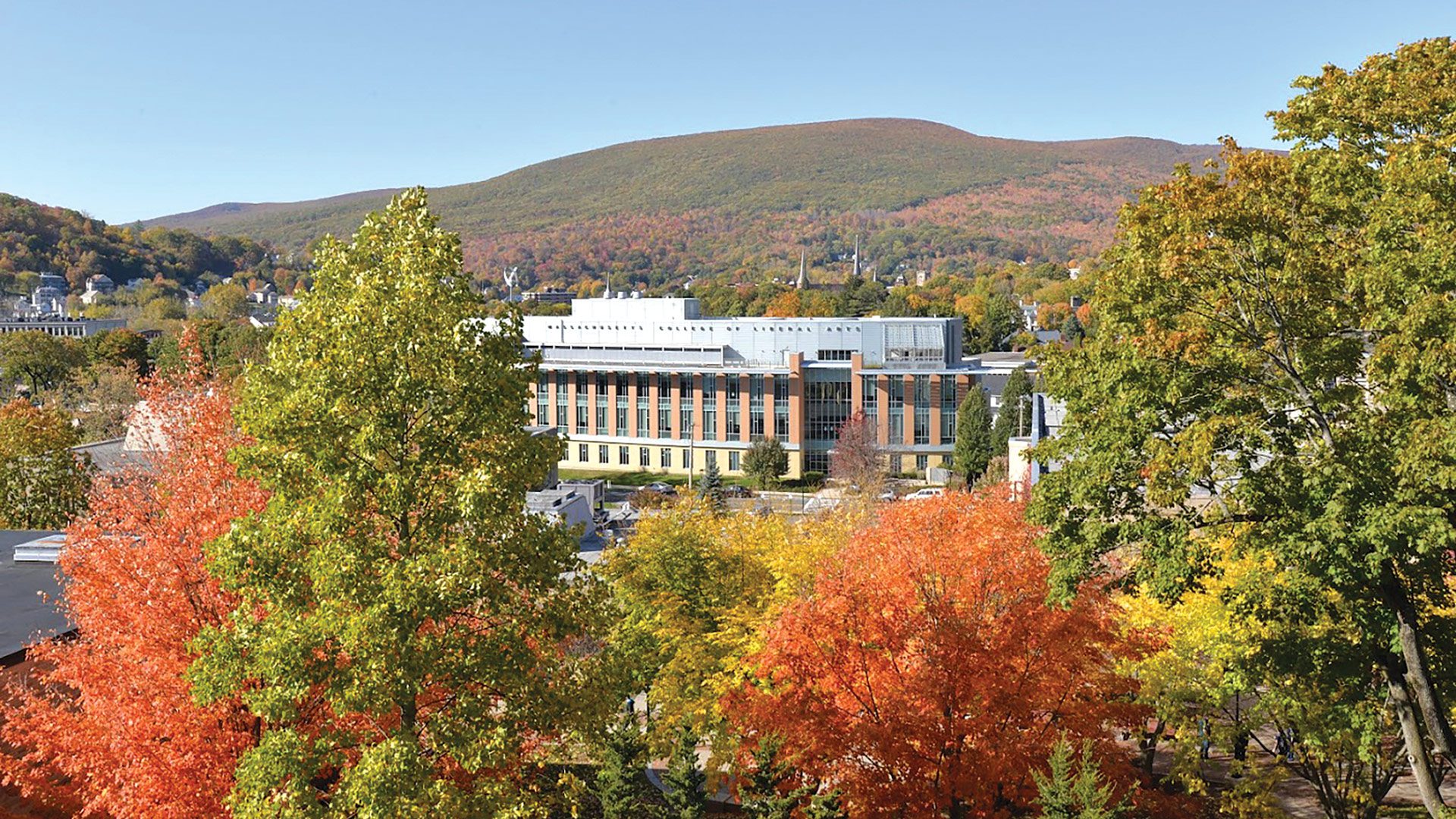
His sentiments were reflected across the region by college and university leaders who felt the court’s ruling was creating barriers to opportunity — affirmative action began in the 1960s as a tool to prevent discrimination at selective institutions, and has been used as an admissions tool ever since — but stressed that their own policies would continue to promote a diverse student body in lawful ways.

“While we have been anticipating and preparing for this outcome for some time, the court’s decision dismantling affirmative action in college admissions marks a historic and challenging moment for all of higher education, including institutions such as ours that are deeply invested in inclusive education,” said Kumble Subbaswamy, outgoing chancellor at UMass Amherst. However, “while the court may require us to change our methods, it cannot change our mission.”

Kumble Subbaswamy

Kumble Subbaswamy

“While the court may require us to change our methods, it cannot change our mission.”

Noting that university leaders will work closely with the UMass Office of General Counsel to ensure the admission process continues to reflect those values while operating within the boundaries of the law, he also cited the campus mission statement, which reads, “we draw from and support diverse experiences and perspectives as an essential strength of this learning community and accept for ourselves and instill in our students an ongoing commitment to create a better, more just world.”

To achieve this end, Subbaswamy explained, the admissions process has, for the past decade, employed a holistic approach that considers the entirety of an applicant’s life experiences. “Holistic admissions, which does not use race as a determinative factor, has served us well. Since 2011, the percentage of students of color in the incoming class has grown from 21% to 37%.”

Dumay, like most college presidents in Western Mass., was among more than 100 leaders from higher education, advocacy organizations, and the Massachusetts Legislature who signed a letter on June 29, the day of the SCOTUS decision, criticizing it.

“Massachusetts will always be welcoming and inclusive of students of color and students historically underrepresented in higher education. Today’s Supreme Court decision overturns decades of settled law. In the Commonwealth, our values and our commitment to progress and continued representation in education remain unshakable,” it reads. “We will continue to break down barriers to higher education so that all students see themselves represented in both our public and private campus communities. Massachusetts, the home of the first public school and first university, will lead the way in championing access, equity, and inclusion in education.”

Kerry Cole

Kerry Cole

“This doesn’t actually change our fundamental admission structure. But there are changes I think the industry can make to stop putting up additional barriers for certain populations of students.”

Even if the ruling doesn’t change practices at Elms, Dumay told BusinessWest, he is concerned about the broader higher-education sector.

“Studies have demonstrated the value of diversity,” he noted. “Studies have demonstrated that, without some race-conscious policies, elite institutions are not succeeding at recruiting a diverse student body. In the broader higher-education sector in general, one has to be concerned about the Supreme Court decision, but at Elms, we’ll continue to fulfill our mission to make sure that we have a very diverse and inclusive campus.”

American International College President Hubert Benitez released a statement following the ruling that struck a similar balance between concern over the ruling and a conviction that AIC doesn’t need affirmative action to be diverse.

“The Supreme Court’s decision will have minimal impact on AIC, as the college has always operated based on core values that prioritize access, opportunity, and diversity,” he noted. “Given our student demographic, diversity naturally thrives at AIC, and we must continue to serve this diverse population.”


Evolving Legacy

Kerry Cole, AIC’s director of Admissions, reiterated to BusinessWest that the college’s process will not change. “We have a holistic admissions process. We naturally have diversity within the student body, and we’re very fortunate, and we embrace that. So this doesn’t actually change our fundamental admission structure. But there are changes I think the industry can make to stop putting up additional barriers for certain populations of students.”

One of those, she said, is for colleges to start moving away from legacy admissions, which historically have not benefited minorities. Another is to recruit in all geographic areas, including low-income areas, because successful students can be found in all types of communities. “We heavily recruit in Hampden County, followed by Hartford County, and those are areas that are extremely diverse.”

Hubert Benitez

Hubert Benitez

“Given our student demographic, diversity naturally thrives at AIC, and we must continue to serve this diverse population.”

Over the past decade, Subbaswamy noted, UMass Amherst has significantly broadened its recruitment efforts across every demographic. “Since 2012, our Admissions team has recruited and received applications from underrepresented students from 66 additional high schools in Massachusetts alone. We have also partnered with more community-based organizations to help us recruit and enroll a more diverse class, including lower-income and first-generation students. We will also continue to work with our partners in the state and federal government to develop funding for pipeline programs and advocate for financial-aid investments.”

UMass and other institutions are doing this because of a shared belief that a diverse campus creates a sense of inclusion and belonging, which in turn promotes a healthy environment for everyone.

“We will continue to implement data-driven initiatives and procedures to ensure students of all backgrounds experience a strong sense of belonging and inclusion in our community,” Subbaswamy said. “We want every prospective student, no matter their background, to see their values reflected across the institution and recognize UMass as a place where they will thrive.”

Even absent the SCOTUS ruling, he added, “our commitment to upholding our values of diversity, equity, and inclusion would drive us to deepen our investments in recruiting and welcoming students from diverse backgrounds.”

Dumay agreed, arguing that a diverse student body reaches into the community, creating a more robust Western Mass., and the Supreme Court’s ruling only strengthens Elms’s resolve to enhance representation of all kinds.

He conceded that the ruling mainly impacts colleges that admit only a small percentage of their applicants. At Elms, which admits all students who have demonstrated they can do the work and succeed there, diversity efforts are a matter of attracting more applicants, as opposed to making tough decisions to admit or reject equally qualified students. “If you can do the coursework, regardless of race, you are admitted. We do not use any race-conscious policies in our admissions.”

However, he emphasized that the court’s ruling narrowly focused on the use of race in admissions at Harvard University and the University of North Carolina; it did not reject the importance of campus diversity itself, only certain means to achieve it.

“That is a great comfort to us because diversity is part of the Elms College mission statement,” Dumay went on. “The statement says that Elms serves a diverse student body in a nurturing educational environment. That is part and parcel of our mission: to foster an atmosphere that is diverse.”

Benitez added that AIC’s mission is to educate next generation of a diverse regional workforce, making a diverse campus an issue of economic development.

“What do we want in a student body? What do we want our classes to look like?” Cole added, noting that AIC recently launched a guaranteed-admissions initiative to qualified students, designed to ensure a fair and transparent admissions process for students who meet eligibility requirements.

As opposed to race-based admissions practices, AIC assures that all prospective freshmen applying to AIC will be admitted, provided they fulfill certain academic requirements. “We bring more transparency to the process,” she noted. “We at AIC don’t have the same challenges as some institutions, but it’s really important for us to show transparency.”


New Ways Forward

Late last month, the U.S. Department of Education drew more than 100 academics, government officials, and administrators to a National Summit on Equal Opportunity in Higher Education, where discussions touched not only on the post-affirmative-action landscape, but whether there should be change in the practices of legacy admissions and preferences for family members of donors.

According to the New York Times, attendees discussed the importance of developing and expanding tools to achieve diversity beyond race-based admissions, including recruiting through academic-enrichment programs for talented low-income students; improving financial aid; initiating direct admissions, or automatically admitting students who have met certain threshold requirements, as AIC has done; bringing disadvantaged students to campus to generate interest; and making it easier for community-college students to transfer to four-year colleges.

“We’re very committed to access, opportunity, and diversity as the foundation of the institution — it’s who we are,” Cole said. “We’re always making strategic decisions as an institution to make sure we’re able to maintain that, and to support all students moving forward.”

After all, people learn more amid different perspectives than in a homogenized environment, she said, and that goes for more than just students.

“I’ve been at AIC since January 2014. I learn things from the student body every year, even every day. It’s really important for folks to learn from each other and have a diverse campus like AIC,” she told BusinessWest. “We’re constantly learning, using different lenses when we looking at problems and issues. There’s a huge benefit to diversity on campus.”

Special Coverage Technology

Creating Collisions

While the pandemic was a time of upheaval in higher education, not all the changes that occurred were negative.

Indeed, Gina Puc said colleges and universities have seen higher education transformed in some ways, with a new sensitivity to innovative models of learning.

“We took a close look at how we were serving students in this new environment,” said Puc, chief of staff at Massachusetts College of Liberal Arts in North Adams. And one good example is MCLA’s new partnership with the Berkshire Innovation Center (BIC) in Pittsfield on an MBA program to enhance and expand experiences and career connections to prepare graduates for innovation-driven careers in the Berkshires and beyond. 

This fall and spring, BIC will host students from MCLA for 10 Saturdays as part of their MBA program, which will be taught online and on-site at BIC in a hybrid format. Applications for the fall 2023 program are due by Aug. 18.  

Puc said the partnership is reaching students who may not have thought about getting their MBAs pre-pandemic, but are drawn by this innovative, experiential model. “We’re meeting students at this moment in time through the collaborative nature of this MBA program.”

The BIC has been an intriguing story in its own right. With the approval of more than 80 regional stakeholders in the private sector, government, and academia, the Massachusetts Life Sciences Center awarded the city of Pittsfield a $9.7 million capital grant in May 2014, with the goal of developing a 20,000-square-foot innovation center in Pittsfield’s William Stanley Business Park, the former site of General Electric.

These days, the BIC, which officially opened in 2020, provides regional manufacturers and STEM businesses with advanced research and development equipment, state-of-the-art lab and training facilities, and collaboration opportunities with BIC’s research partners, as well as internship and apprenticeship programs for local students.

A relationship with Berkshire County’s only four-year public college just made sense, said Dennis Rebelo, BIC’s chief learning officer.

“BIC’s three pillars are community, technology, and learning, and innovation is most likely to be robust and have a likelihood of succeeding at the interaction of those [pillars],” he explained, noting that such interactions can range from hyper-localizing the supply chain of building a new product to technology workshops that teach companies — from hundred-year-old firms like Crane Currency to much newer entities like Boyd Biomedical — how technology can be a tranformative agent in ways they might not have considered.

Gina Puc

Coming out of the pandemic, Gina Puc says, higher education was being transformed, and colleges were taking a hard look at serving students in more innovative ways.

“There are different ways technology can be a catalyst in economic growth and development,” he said. “When we saw what was happening with MCLA, we started exploring how they could be more embedded in our world and how we could serve them. It made sense to host their MBA program as partners; we’re now referring to it as an innovation-based MBA.

“An MBA student does a capstone — maybe it’s building a new product, like an advanced car seat, maybe a therapeutic device, or maybe something like SolaBlock,” he went on, referring to the Easthampton-based developer of solar masonry units. “They can have coffee with an industry leader and talk about clean tech. They have access to all these organizations.”

MCLA President James Birge, a BIC board member, added that “it’s incredible to see two major Berkshire County institutions come together to leverage the growth of MCLA’s programming with the BIC advancement opportunities. I’m looking forward to the networking and educational opportunities this will provide for our MBA students and the collaborations with industry leaders at the BIC.”


Innovative Model

Through this partnership, MCLA aims to contribute to the BIC’s efforts to foster growth within the life sciences, advanced manufacturing, and all regional technology and innovation-based sectors. 

“To explain an MBA influenced by innovation … you could substitute the word innovation for creativity. What we’re able to do by having the classes at the BIC is that we’re allowing students to be adjacent to the creative process,” Rebelo said. “To be able to spark additional thinking that conjures up new ideas that can also be socially responsible is a big win. You may think about technology as anti-human, but we think about it as really serving humanity … we think about things more from a humanitarian standpoint.”

Dennis Rebelo

Dennis Rebelo

“When we saw what was happening with MCLA, we started exploring how they could be more embedded in our world and how we could serve them.”

Josh Mendel, associate dean of Graduate and Continuing Education at MCLA, agreed. “The possibilities are really limitless for our students to embrace and be a part of the future of advanced technologies,” he said, adding that this partnership allows the college to fulfill the critical needs of the advanced-manufacturing industry in Berkshire County to grow and enhance the future of the county’s workforce, and that partnering with BIC in this way was a logical next step in the MBA program.

“We needed to be at this hub of innovation, advancement, and opportunities for students to grow and support a critical sector in the Berkshires,” he explained.

Mendel said he expects applicants to the program to be a blend of recent MCLA graduates with a passion and desire to stay in the Berkshires and want to be part of the energy happening at BIC, and also working professionals who have an interest in getting their MBA to get to the next pay grade or promotional opportunity.

“Some are about to become entrepreneurs; we’ve had several students in the past couple of years start their own business organization,” he said. “So this made so much logical sense — our mission is to support critical growth sectors in the Berkshires, and what better partner than BIC?”

The Feigenbaum Center for Science and Innovation

The Feigenbaum Center for Science and Innovation at MCLA, which prepares students to enter the research pipeline and STEM careers.

The Berkshire Innovation Center’s programming includes the BIC Manufacturing Academy, an industry-led training collaborative designed to address persistent challenges facing the manufacturing economy in the Berkshire region by closing the gap between local supply-chain capabilities and the needs of larger manufacturers through ongoing education, training, and technology assistance. Another program is the BIC Stage 2 Accelerator, a 30-week, hands-on, results-oriented program designed to serve early-stage tech startups that are building a physical product and moving toward the manufacturing phase.

Josh Mendel

Josh Mendel

“We needed to be at this hub of innovation, advancement, and opportunities for students to grow and support a critical sector in the Berkshires.”

There’s also a robust slate of ‘learning series’ — for students, BIC members, community members, and executives — some of which MCLA’s students will be able to access. But beyond the specific programming, Rebelo said, the BIC is also a space that will excite students about learning, not only through classes and panel discussions, but through day-to-day conversations with people doing innovative work.

“They’ll have access to resources and ‘collisions’ — and the collisions they make in the café could lead to some of the most valuable outcomes of these innovative relationships,” he noted.


Staying Connected

Drawing on the ‘systems thinking’ philosophy of Peter Senge, a pioneer in organizational development, Rebelo noted that, “if we’re going to be a learning organization that thrives in the 21st century, MCLA and BIC have to be in constant conversations about the systems we’re creating together and strive for mastery of the educational experience of the adult learner.”

In addition, Mendel told BusinessWest that MCLA draws many students from outside the Berkshires, and connecting them to a hub like BIC could be a factor in keeping young talent within the region.

“It’s very important to us to connect these students back to these companies and organizations and job opportunities and internships, so they stay and grow and raise families and have full-time careers here in the Berkshires.”

Puc agreed. “We’re in a rural community, and I can’t think of another hub like BIC that serves a rural community they way they are. That speaks to the efficacy of our educational programs and the innovation of BIC, in the way we serve learners in a rural community.”

Nonprofit Management Special Coverage

Building on a Legacy

aerial photo shows the former Square One property

This aerial photo shows the former Square One property, at lower right, the day after the tornado ripped through Springfield’s South End in 2011.
Photo by John Suchocki The Republican

While early-education provider Square One has a presence in several Springfield neighborhoods and serves residents city-wide, it has always been associated with the South End.

That’s where it’s been headquartered since the beginning, in 1883, when it was founded as Springfield Day Nursery by Harriett Merriam, the daughter of Charles Merriam, of Merriam-Webster dictionary fame, to meet a critical need for childcare among the city’s working families, said Dawn DiStefano, the agency’s president and CEO.

“We’ve always been anchored in the South End,” she said. “And it doesn’t take too much effort to walk into the South End and see that it is in woeful need of some attention.”

The bond with the South End was — and is — so strong that, when the agency’s facilities at 947 Main St. were heavily damaged by the June 1, 2011 tornado that devastated a large swath of that neighborhood and eventually razed, then-President and CEO Joan Kagan quickly pledged that the agency, which soon started leasing space at 1095 Main St., would rebuild in that section of the city.

But fulfilling that pledge has proven to be an enormous challenge.

“We’ve always been anchored in the South End. And it doesn’t take too much effort to walk into the South End and see that it is in woeful need of some attention.”

Indeed, although other options were looked at early on, it quickly became clear that, if the agency was going to rebuild in the South End, it would have to be on the property it owned, DiStefano said. And this property is fraught with challenges because of its small size, odd dimensions, contamination in the wake of the tornado, and other factors.

But, in a measure of its commitment to the South End, the agency is taking on all those challenges and moving forward with plans for a 26,000-square-foot, $12 million, three-story facility that will be built on the east end of the property that fronts Main Street.

Dawn DiStefano

Dawn DiStefano stands at the site on Main Street where Square One had a facility — and will again.

Plans call for erecting a Butler-style building on the property, one that features a number of pre-fabricated elements, which serves to reduce the overall cost of designing and building a structure, DiStefano said.

“We’re savings millions of dollars because we’re not doing a traditional brick-and-mortar building,” she explained, adding that the agency is working with One Development & Construction LLC in Westfield, which specializes in Butler-style construction, on the project.

The current timetable calls for construction to begin late this year, probably November, with the new facility slated to open its doors in the fall of 2024.

The agency is in the early — also known as the ‘quiet’ — stage of a capital campaign for the new building, with nearly $3 million committed to date — $950,000 from the city in the form of ARPA money, and a $2 million commitment from the state.

DiStefano said early indications suggest a strong measure of support for Square One’s initiative, and she expects the nonprofit will be able to open its facility with little, if any, debt.

“It’s all achievable … but we’re not working with 10 acres here. We ultimately determined that we could do something with this site.”

“The most enjoyable, and most encouraging, part of this project has been how many people and institutions are compelled to give or have shown promise,” she explained, adding that the agency undertook a feasibility study on the campaign, one that surveyed 42 individuals and companies and revealed “100% intent to support the project.”

For this issue and its focus on the region’s nonprofit sector, BusinessWest takes an in-depth look at Square One’s building plans and how they reflect a nearly century-and-a-half-old commitment to a city and especially one of its proudest, and neediest, neighborhoods.


Building Momentum

As she talked about the many challenges with building a new home for Square One, DiStefano said it’s good to keep things in their proper perspective.

Indeed, while there has been nothing easy about this building project, and it has a long way to go, the overall degree of difficulty pales in comparison — in most respects, anyway — with coming back from the twin disasters of 2011 and 2012 — and coping with the pandemic of 2020, for that matter.

The agency was completely displaced by the 2011 tornado; staff, teachers, and students were forced from the building and never allowed to return before engineers determined that it had to be demolished. In 2012, a natural-gas explosion downtown extensively damaged another Square One learning facility, to the point where it had to be abandoned. And early in the pandemic, Square One was forced to close its childcare facilities, as well as its operations on Main Street, before having to completely revamp operations after it was allowed to reopen to meet a huge need for childcare services.

Square One’s facility

An architect’s rendering of Square One’s facility to be built in Springfield’s South End.

The agency managed to push on and meet its broad mission — it provides early-learning services to more than 500 infants, toddlers, and school-aged children, and also offers an array of support services to more than 1,500 families each year — through all of that, DiStefano said, adding that the ability to do so offers strong testimony to the imagination and resiliency of its staff.

Those same qualities have been necessary for this building project, she went on, adding that, while rebuilding in the South End has always been the goal and the promise, it has proven to be a daunting challenge.

Indeed, the property that was ultimately destroyed by the tornado in 2011 was wedged into a narrow but deep lot, said DiStefano noted there was an administration building fronting Main Street and a two-story, L-shaped school building that extended eastward a few hundred feet. In a perfect world, or at least in a neighborhood with several alternatives when it comes to buildable lots and available property, Square One almost certainly wouldn’t rebuild on its former site, she added.

But this isn’t a perfect world. And Square One is building here only because there are few if any other options, she said, adding that she tried to purchase the brick property adjacent to former home of the agency, a move that would have provided considerably more frontage on Main Street, but was unsuccessful in that effort, just as her predecessor was unsuccessful in her efforts to secure other lots on which to build.

So the agency then focused its attention on building on its former home — an undertaking made challenging by the size and shape of the property as well as contamination from the demolition of the structures that once occupied the site.

“The bricks and all the materials from the homes that were razed obviously have asbestos and lead and other chemicals that have now seeped into the ground,” the explained, adding that the agency is currently working with a remediation company to determine just what is in the ground and what needs to be done to make the property ready for its intended use — as a home for programs for children.

Before even getting to that point, though, the agency had to conduct some due diligence to make sure it was feasible to build what it wanted to build on that parcel.

“This land is so awkward and small and weird that we didn’t want to buy it if we couldn’t build a building on it,” she explained, adding that Square One engaged in discussions with One Development to determine if its plan, its dream, was, in fact, doable.

Brad Miller, senior project manager with One Development, said that he and others ultimately determined that the answer to that question is ‘yes.’

“It is a challenging site because of its narrowness — it’s wedged between Hubbard and Williams streets,” he explained. “We only have so many options as far as the building footprint goes. The agency also needs a certain number of parking spaces, which we have to find a location for on that site, as well as a playground. It’s all achievable … but we’re not working with 10 acres here. We ultimately determined that we could do something with this site.”

The plans, still to be finalized, call for those parking spaces to be located on the Main Street end of the property, with the playground and building located toward the rear of the site, on a combination of the original site and a few smaller parcels acquired by the agency, DiStefano explained.

The planned structure will give the agency far more space than it has presently in the South End, she said, adding that the facility destroyed by the tornado had more classrooms than the currently facility.

Miller described what is planned for the site as a ‘Butler-hybrid’ building, a combination of conventional steel structure, with Butler components on the interior.

“This will a be steel-framed building with insulated metal panels on the outside, as well as some masonry on the first floor of the building,” he explained, adding that it will have a glass entranceway.

This pre-engineered building will ultimately save on design costs, he went on, adding that this is a design-build project, with One Development managing a large portion of the design as well as the construction.

While work continues on design aspects of the building project, Square One is proceeding with its capital campaign to raise funds to build the new facility.

As noted earlier, the agency has entered the quiet phase of the campaign, focusing on major grants from foundations and other donors, DiStefano said, adding that, by the start of 2024, she anticipates the process will enter the public phase.


Bottom Line

Returning to that feasibility study on the capital campaign and the resounding support it revealed, DiStefano said those results validate the agency’s determination to clear a long row of hurdles and ultimately build in the neighborhood where it was founded back when Chester A. Arthur was patrolling the White House.

“Those results make it enjoyable — that pushes you when you’re ready to say that this piece of land is too difficult to build on and it’s going to cost too much to do this,” she said, adding that this vote of confidence provides another dose of determination.

And even more commitment for Square One to build on a legacy that’s been 140 years in the making.


Community Spotlight

Community Spotlight

Moe Belliveau

Moe Belliveau says the WorkHub initiative is an example of how the Easthampton Chamber is evolving into more economic development.

It’s called WorkHub on Union.

This is an ambitious project to create co-working space at the Easthampton Chamber of Commerce facility on Union Street.

WorkHub will create space for solopreneurs and emerging business ventures, and also provide access to mentorship programs, networking events, educational programming, and other support services designed to accelerate the growth of startups and small businesses.

In addition to all that, Moe Belliveau, executive director of the chamber, categorizes the project as a not-so-subtle shift in the direction and overall mission at the chamber — one that moves the agency away from the traditional networking events that have defined such agencies, and more into the realm of true economic development.

“This is part of the evolution of this chamber,” she explained, adding that other examples (as we’ll see later) include more emphasis on professional development and educational programs on topical issues such as artificial intelligence.

WorkHub, for which Belliveau is actively trying to raise $500,000 to make it reality, is one of several positive economic developments in a community that has been making headlines mostly for the wrong reasons in 2023.

“Housing, housing, housing … that’s our biggest need right now.”

Indeed, a school-superintendent search that has gone terribly awry — the leading candidate had his job offer rescinded, in part, over his use of the term ‘ladies’ in an email to the School Committee chair — has brought national and even international attention, and not the kind this community would want, as well as resignations among school-board members and even a bid within the community to recall Mayor Nicole LaChappelle.

An interim school superintendent has been hired, and a search for a permanent successor will resume later this year, said a defiant LaChappelle, who responded to the recall effort in June by saying, “I will continue to do what I have been doing for five and a half years — working to give all of Easthampton the best quality of life possible.”

As noted, aside from the controversy surrounding the superintendent search, there have been generally positive developments in this community. It continues to build on the considerable progress made over the past few decades in transforming itself from a mill town to a destination, one with a strong arts community, a growing number of restaurants and other hospitality-related businesses, such as Tandem Bagel, an emerging cannabis sector, and scores of old mills that have found new uses as everything from artists’ studios to event spaces; cannabis dispensaries to condos and apartments.

Specific initiatives range from CitySpace, the nonprofit group tasked with creating a flexible arts and community space in Old Town Hall (Burns Maxey, CitySpace’s board president, was honored by BusinessWest as one of its Difference Makers for 2023), to the ongoing and very ambitious One Ferry Project to renovate several mills on Ferry Street; from the chamber’s WorkHub on Union project to expansion of the renamed public library into the former Bank of America building on Park Street.

Moving forward, LaChappelle said that perhaps the city’s greatest need is for more housing because the community is in vogue, and in addition to being a great place to work or start a business, it is increasingly viewed as a desirable place to live.

One Ferry Project

The One Ferry Project remains a work in progress, with several renovated mills and some still waiting to be reimagined.

There are several housing projects in various stages of development, including redevelopment of three former city school buildings, she said, but the need for more is constant.

“Housing, housing, housing … that’s our biggest need right now,” she said, adding that, while it’s a good problem to have in some respects, it’s a stern challenge for which her administration continues to seek solutions.


Work in Progress

As she talked with BusinessWest about plans for WorkHub on Union, Belliveau said the initiative was conceptualized to address that growing part of the community’s business community that visitors and residents can’t see — and they can see plenty.

These are ventures that people are operating in their basements, home offices, and dining-room tables, she said, adding that such businesses existed before the pandemic, but mushroomed during that time.

“This year’s topic focus is going to be resilience and collaboration, but collaboration with technology, and specifically around AI. We want to help people move from fear and panic to ‘how is this tool going to benefit my business?’ There will be some hands-on experimenting and learning with AI.”

“These are businesses, but they’re informal as opposed to formal,” she explained, adding that her goal is to take these ventures out of the basements and onto Main Street — or Union Street, as the case may be.

“We want to help these businesses become more sustainable and more resilient,” she explained, adding that there are probably hundreds of these ventures in and around Easthampton.

Recognizing the existence of, and the need to support, these businesses and those behind them, the chamber applied for and received a seed grant from MassDevelopment to conduct a feasibility study for the WorkHub facility. The results of that study verified the need and essentially confirmed that this was the project for the chamber at this time in its history and the city’s history, said Belliveau, adding that the chamber’s board voted to raise funds for the initiative and get the ball rolling.

The total price tag is roughly $500,000, which includes construction, a website, branding, and marketing, she noted, and to date, the chamber has raised $180,000 for the venture, with a $50,000 contribution from Sourcepass, an Easthampton-based IT-solutions company being the latest gift. There has also been a $100,000 ARPA earmark, as well as a $25,000 donation from Easthampton Savings Bank and $5,000 from Greenfield Savings Bank.

Easthampton at a glance

Year Incorporated: 1785
Population: 16,211
Area: 13.6 square miles
County: Hampshire
Residential Tax Rate: $14.65
Commercial Tax Rate: $14.65
Median Household Income: $45,185
Median Family Income: $54,312
Type of Government: Mayor, City Council
Largest Employers: Berry Plastics Corp., INSA, Williston Northampton School, National Nonwovens Co.
* Latest information available

Belliveau said WorkHub will provide more than physical space for as many as 18 small businesses following a complete renovation of the chamber’s space. Indeed, she said the goal is to position it as an educational hub as well to help entrepreneurs succeed, thus creating a “vibrant, lively, healthy local economy and regional ecosystem.”

She said the facility would be ideal for artists, freelance writers, consultants, and ‘digital nomads’ — those who travel from job to job but still might need a home base of sorts. It will include workstations, a conference room, private spaces (she called them ‘phone booths’) for phone calls and teleconferencing, and light administrative support. There is really nothing like it in Easthampton, she emphasized, and it should receive a strong response.

As noted earlier, the hub represents the latest and most visible evidence of ongoing evolution at the chamber, Belliveau said, noting that it is moving more toward economic development and professional development than the pure networking that has characterized this and other chambers in the past.

Other examples include the women’s professional-development conference called sheLEADS, the latest installment of which was staged in June, and Ignite, a two-day professional-development conference scheduled this year for Nov. 15-16 at Abandoned Building Brewery. The working title for the event is “Humanification in the Age of AI.”

“This year’s topic focus is going to be resilience and collaboration, but collaboration with technology, and specifically around AI,” Belliveau explained, adding that she hopes to have 50 to 75 people in attendance. “We want to help people move from fear and panic to ‘how is this tool going to benefit my business?’ There will be some hands-on experimenting and learning with AI.”


Getting Down to Business

The chamber’s WorkHub project is one of many initiatives designed to help spur new business development and create more vibrancy and jobs, said LaChappelle, adding that, in the post-COVID area, businesses still need support, but often different kinds of support than they did at the height of that crisis.

“During COVID, I thought our city’s response when it came to economic development and what I call Main Street jobs and concerns … I was proud of the job we did; we all pulled together,” she explained. “Now, our task is … ‘we’ve made it through; how do we keep the new things going, and how do we help the people who were always there?’

“We’re not back to the walking traffic on Union Street and Cottage Street that we had pre-COVID,” she went on. “What are we going to do to support those businesses? You rise to the challenge in a crisis, but resiliency is the long game.”

Elaborating, she noted that, to create this resiliency, the chamber and city need to work together to build into the ecosystem long-term educational and capital support. Such work is ongoing, the mayor said, adding that WorkHub is just one example of providing needed support to businesses and entrepreneurs to not only help them maintain what they’ve built, but get to the proverbial next level.

Such initiatives to build resiliency are needed, she said, because over the past few decades, Easthampton has succeeded in inspiring and nurturing entrepreneurship and growing and diversifying its economy.

That includes a cannabis cluster, if you will, that is adjusting to a new reality in the form of more competition — in this state and from other states — as well as falling profits and even tighter margins, creating a survival-of-the-fittest environment.

“The ones who got in early, and the ones who had the strongest business plans, are fine,” she explained, putting INSA, the Verb is Herb, and others in that category. “And the ones who came in because they had the biggest dispensary somewhere else and thought they’d put a branch here … they’ve closed or have chosen not to expand.”

Beyond cannabis, the cultural economy continues to thrive in Easthampton, LaChappelle said, noting that many of its old mills have become home to artists and art-related ventures, and to residents as well. Meanwhile, the city has been working with property owners on initiatives to improve the mill district.

“We’ve been successful in getting grant money to re-envision and design that mill district and make it friendlier to the immediate neighborhood and see what we can do for walking traffic and safety,” she explained.

“All of the mill owners have been great partners,” she went on, citing the Ferry Street project, which has seen several of the long-abandoned Hampden Mill buildings re-envisioned and repurposed, as the latest example of the old mills that gave the city its character finding new life.

Easthampton was able to channel $3.9 million in MassWorks public-infrastructure grants for improvements at Ferry, Pleasant, and Loveland streets to support the One Ferry mixed-use development initiative, she said, citing this as one example of the city, state, and mill owners working collaboratively to achieve positive change in the mill district.

Today, the city is working with developer Mike Michon, who also developed Mill 180, and One Industrial Lofts LLC to determine the best course for what’s known as Mill 7, the largest of the eight mills still standing on the property (many have been razed) moving forward.

“It was to be a mixture of apartments and some affordable housing, and other uses, but the affordable-housing process is now years behind,” LaChappelle said. “So he’s looking at some other solutions and mixed use, and we’re helping him do that.”

Housing, as she noted earlier, is the most pressing need within the community. And while there are several projects planned or already underway — from a new apartment complex on Cottage Street to the 180 units planned for a mixed-used development at the former Tasty Top site on Route 10 (a project called Sierra Vista Commons), to redevelopment of three city school buildings into roughly 70 apartments — there is certainly a need for more, she said.

But clearly, despite its challenges, Easthampton has become a hub of positive activity and progress, in every sense of those words.

Senior Planning

Journaling Is a Therapeutic Exercise for All Involved

Liz Berezin, who recently completed a journal for John Scalia

Liz Berezin, who recently completed a journal for John Scalia, described the experience as one that was rewarding on many levels.

Lisa Berezin acknowledged she was moving out of her comfort zone.

“Completely out of my comfort zone,” actually.

Indeed, she had never done anything remotely like the assignment she agreed to take on. But when her good friend, Susan Jaye Kaplan, asks for help with something, it is her policy to say ‘yes.’

In this case, she was agreeing to a request to create a journal chronicling the life and times of one of the residents at Ruth’s House, an assisted-living facility in Longmeadow. For Berezin, who earned a degree in elementary education before segueing into business, and someone who had volunteered mostly with young people, this was a going to be an exercise in learning while doing, but she was willing and able.

So was John Scalia, a 64-year-old resident whose life has been dominated by four passions — his family, his friends, his love of music (especially doo-wop), and an obsession with the New York Yankees. Family comes first; after that, it’s a toss-up between the other three.

The journal makes that clear.

While Berezin fashioned a cloth cover for Scalia’s journal, one dominated by Yankees logos and pennants, his large family is arguably the focal point of this document. It is dedicated to his mother, Lucy; father, Joseph Sr.; brother, Joseph; and sister-in-law, Michelle with a note expressing that he wouldn’t be where he is today without them.

“The process itself works different parts of the brain — the memory part and the creative part can be very healing if you have any conflicts or things you need to resolve as you’re speaking them out, working them out … it can be very healing in that way.”

Capturing passions and letting others know all the many moments and memories that go into a life is just one of the broad goals behind journaling and this particular project, said Kaplan, known to many in this region as the founder of the nonprofits Go FIT and Link to Libraries.

Others include a desire to have the subjects of these documents open up to people, exercise their memory, and simply talk about what is important to them.

Berezin agreed.

“The process itself works different parts of the brain — the memory part and the creative part can be very healing if you have any conflicts or things you need to resolve as you’re speaking them out, working them out … it can be very healing in that way,” she said. “John was very excited to share his memories, and I think he was so happy to be part of this project and have someone who really and truly cared and listened, and asked questions back. And what made John happy was so contagious for me; John’s like a happy pill for me.”

As for John, he said this was a fun experience, one in which Berezin’s questions, and prompting, brought back many great memories and made him even more appreciative of all that he’s been able to experience. “She asked all the right questions, and I tried to answer as best I could,” he said, noting that he moved to Ruth’s House with his mother several years ago and helped take of her until she died shortly after they arrived there.

Kaplan’s husband, Steve, is a resident of Ruth’s House, now four years into a courageous battle against brain cancer. And it was while creating a journal for Steve — an eye-opening experience on many levels, she said — that she decided that more people should be sharing in the process of creating these living documents — and enjoying the final product.

Susan Jaye Kaplan, left, and Delia Jones

Susan Jaye Kaplan, left, and Delia Jones say the journaling project at Ruth’s House has been a learning experience for all those involved.

So she put out a call for volunteers on Facebook, and eventually saw more than a half-dozen area residents, including Berezin, sign up to be part of this initiative.

Most of the journals are still works in progress, she said, adding that the work to compile them is as important as the final document.

It is here where the resident and the volunteer meet several times over the course of a few months to talk, learn about each other, and, most importantly, forge a friendship, said Delila Jones, Life Enrichment director at Ruth’s House, adding that, in a word, journaling is therapeutic for all those involved.

“Journaling is about voicing yourself — your identity, your mind, your heart — and just giving it a voice,” she explained. “Journaling is bringing it out of your mind and putting it down on paper.”

Berezin agreed, noting that, because of the journaling project, she has made a friend in John, and has also become committed to Ruth’s House and its patients. Indeed, she now volunteers for Wednesday trivia and other programs, and volunteered her husband, Mark, a pianist, to play on Fridays at the facility. And he, in turn, volunteered Lisa to lead a sing-along.

That’s one example of how journaling has not only enabled someone to become involved in telling a life’s story, but become more involved in the lives of others in general.

And that’s a big part of what this project is all about.


Pride in the Yankees

As she put her journal of Scalia’s life together, Berezin used words, pictures, and even some numbers, such as $12.6 million.

That’s the amount a 1952 Mickey Mantle baseball card fetched at an auction several years ago, making the card the most valuable sports collectible in the world.

Mantle has always been one of Scalia’s favorite Yankee players, as is the case with many who grew up when he did. Others include Reggie Jackson, Thurman Munson, Don Mattingly, and, more recently, Aaron Judge.

These insights are a few of the many references to the Yankees in this journal. Others include everything from Scalia’s bobblehead collection to his recollections of five-time Yankee manager Billy Martin, to memories of visits to both the old and new Yankee Stadiums.

“He’s the biggest Yankees fan you’ll ever meet,” Berezin told BusinessWest. “He can tell you what positions people played, what years, who their managers were … and on and on.”

These many and different references to the Bronx Bombers help explain how the journaling exercise yields what could be called the ‘essence’ of a person, said Berezin, adding that what came through with Scalia were both general themes — family, the Yankees, and doo-wop — and small bits of information that, together, tell a story.

In Scalia’s case, these small but significant bits include the fact that he worked at Stop & Shop in Enfield for 40 years — and wasn’t particularly thrilled with the company when it didn’t recognize his four decades of service. And the fact that he met Whitey Ford at the store one day — the Yankee legend pulled up in a limo — and got his autograph.

They also include his fondness for Mel’s Diner in Naples, Fla. and its barbecue ribs, as well as the long list of TV shows he has enjoyed over the decades, from Leave It to Beaver to the original Charlie’s Angels (yes, he had that iconic Farrah Fawcett poster on the wall in his bedroom when he was young), to a slew of cop shows including Columbo, Kojak, and Police Woman.

They also include memories of his grandmother, who would pick grapes off the vine and grind them up to make wine, and his mother, who would discipline him by saying simply, “wait ’til your father gets home.”

Summoning such memories — and Scalia has many of them, not just of his mother and grandmother, but also his Uncle Tony, a restaurant owner, and his Aunt Louise and Aunt Ann — is why journaling is such good therapy for those taking part in this exercise, Jones said.

“It’s important for the senior to participate in this because it’s giving them a voice — the opportunity to share who they are, their situation, what they grew up with … sharing their life,” she said. “For the person who facilitates this … they’re giving us access to another world, another perspective, another vision. It’s like reading a book; it’s like listening to another life and gaining a perspective that’s not yours, and that’s a privilege, because humans need to see beyond themselves, and this provides that opportunity.”

Kaplan agreed. She said she created a journal for a Ruth’s House resident more than 20 years ago, an experience that opened her eyes to the importance, and value, of such an experience.

“I didn’t know the resident very well; I just knew the family,” she recalled. “The family was on vacation. I brought a notebook with me and started asking some simple questions, and it opened a flood of memories, everything from where she grew up as a child to who her siblings were and what she remembered about growing up with them.

“I was amazed; she had beautiful stories to share — some happy, some not so happy,” Kaplan went on. “And she was willing to open up to me, a virtual stranger. She was so delighted to share a little about herself, and I found it was a win-win for me as well because I gained a wealth of knowledge about so many things and learned about this remarkable woman.”

Rob Whitten, president of JGS Lifecare, said this journaling project has yielded learning experiences on many levels.

“This is a program that opens people up and allows them to make connections that they otherwise might not have made,” he told BusinessWest. “JGS Lifecare has always had a strong track record for volunteer engagement, and this is just another example of this; it’s a wonderful program that is really by volunteers and family members … and it connects people together.”


The Last Word

Berezin said she received a wonderful and very sincere thank-you note from Scalia’s family after she presented him — and them — with the journal.

She was touched by the gesture, quickly adding that, in many ways, she should be sending one to them as well. That’s because, while this experience, this document, is beneficial for him and his family, it has been beneficial to her as well. It has given her insight into not just one life, but many, and a new appreciation for all the things that make a life special.

As she said, the best part is that she made a good friend in the process.

That’s what journaling is all about.