Daily News

SPRINGFIELD — Six Flags New England recently held a diaper drive to support the children and families served by Square One. Thousands of diapers were donated by Six Flags patrons, and, in exchange, donors were given free admission to the theme park.

“We are so grateful to the team at Six Flags for constantly thinking of creative, fun ways to support Square One and so many other community organizations,” said Kristine Allard, chief Development & Communications officer for Square One. “We are overwhelmed by the generosity of the Six Flags leadership and members of the community who donated diapers to help us continue to serve families in our programs.”

More than 300 cases of diapers will be picked up at the Six Flags offices by Square One staff today, Oct. 11 at 11 a.m. and delivered to the Square One Family Center at 1095 Main St. in Springfield at approximately 11:45 a.m.

“Six Flags New England is thrilled to support nonprofits throughout Western Massachusetts. Each year the park supports over 3,000 nonprofits with charitable donations and collections drives,” said Six Flags New England Communications Manager Jennifer McGrath. “Square One is committed to supporting children and families throughout the area and aligns with the Six Flags philosophy on community outreach. We will continue to assist Square One and a variety of other initiatives throughout the area to better our surrounding community.”

Daily News

HOLYOKE — Holyoke Community College will host its annual Transfer Fair today, Oct. 10, from 10 a.m. to 12:15 p.m.

Hundreds of area community college students are expected to meet with representatives from more than 50 four-year New England colleges and universities to discuss opportunities for continuing their educations. The transfer fair, always one of the largest such events in the region, will be held in the PeoplesBank Conference Room on the third floor of the HCC Kittredge Center for Business and Workforce Development.

At the same time, in recognition of Hispanic Heritage Month (Sept. 15 to Oct. 15), the college will be holding Expo Latino 2018, a celebration of Latino food, culture, music, and art right outside the Transfer Fair in the HCC Courtyard. With Latino enrollment now at about 28%, HCC is a federally recognized Hispanic Serving Institution, or HSI.

Daily News

NORTHAMPTON — One of the many challenges employers face in today’s business world is the ever-present impact of technology. At a seminar on Thursday, Oct. 25, Tim Netkovick, an attorney with Royal, P.C., will discuss the impact of employees’ social-media accounts on the workplace, and employees’ right to privacy in e-mail and internet communications.

The seminar, slated for 8 to 9:30 a.m. at Royal, P.C., 270 Pleasant St., Northampton, will cover topics such as using social media during hiring, conducting an effective interview, dealing with confidentiality issues, and taking action on potentially harassing posts on social media. Human-resources professionals, CFOs, CEOs, and anyone in a management position, responsible for overseeing and/or hiring employees, may be interested in attending.

The cost is $30. For more information and to register, call Heather Loges at (413) 586-2288.

Daily News

SPRINGFIELD — Hair salons are helping to make a difference in the fight against bullying, one haircut at a time, during the month of October, which is National Bullying Prevention Month. The salons will donate proceeds from haircuts, blowouts, and styling to Unify Against Bullying. Some salons will even offer temporary pink hair color — pink being the signature color of Unify Against Bullying.

Event participation ranges from a portion of proceeds from a one-day event to the whole month of October. Contact these participating salons for more information: Gasoline Alley, 250 Albany St., Springfield, (413) 788-4078; Posh Studio, 1372 Allen St., Springfield, (413) 301-7476; Salon Sage, 1325 Springfield St., Feeding Hills, (413) 276-0428; Siciliano Salon, 1362 Westfield St., West Springfield, (413) 746-4641; and Vivid Hair Salon, 99 Elm St., Westfield, (413) 564-0062.

Unify is also grateful to the following salons for making a one-time donation: New Decade Hair Designers, 375 Franklin St., Melrose; and Professional Barbers of Lowell, 103 University Ave., Lowell. Their donations were matched by LTI Business Solutions in Boston.

This year, Unify also announced that the following Paul Mitchell Salons in New York will be participating; Adam & Eve Beaute Centre, 1089 Main St., Leeds, N.Y., (518) 943-4461; and Revelations Design Studio, 115 Packetts Landing, Fairport, N.Y., (585) 223-9485.

“It’s a fun event for a great cause, and everyone leaves the salon feeling and looking fabulous, each in their own unique way,” said Christine Maiwald, executive director of Unify Against Bullying. “We love how each salon is embracing Unify Against Bullying and being creative in their vision for the Cut-a-thon.”

Unify Against Bullying is a tax-exempt organization whose mission is to end bullying through the celebration of true diversity. The funds raised provide grants for anti-bullying initiatives that benefit youth in schools and communities. Its annual all-inclusive fashion show and Selfie Challenge raise awareness globally of the silence associated with bullying. Through Unify, high-school students are educating younger students by giving presentations focused on what bullying is and how it impacts the person being bullied. To learn more about the organization, visit www.unifyagainstbullying.org.

Daily News

SPRINGFIELD — The second annual class of Healthcare Heroes will be honored at the Starting Gate at GreatHorse in Hampden on Thursday, Oct. 25 from 5:30 to 8:30 p.m.

Healthcare Heroes, a recognition program involving the Western Mass. healthcare sector, was launched last spring by HCN and BusinessWest. The program was created to shed a bright light on the outstanding work being done across the broad spectrum of health and wellness services, and the institutions and people providing that care.

This year’s honorees include Mary Paquette, director of Health Services and nurse practitioner, American International College; Celeste Surreira, assistant director of Nursing, the Soldiers’ Home in Holyoke; Peter DePergola II, director of Clinical Ethics, Baystate Health; Dr. Matthew Sadof, pediatrician, Baystate Children’s Hospital; TechSpring; the Consortium and the Opioid Task Force; and Robert Fazzi, founder, Fazzi Associates. The seven winners were profiled in the Sept. 4 issue of BusinessWest and the September issue of HCN, and will be feted at the Oct. 25 gala.

Tickets cost $90, and tables of 10 are available. To order tickets, call (413) 781-8600, ext. 100, or visit www.businesswest.com. Healthcare Heroes sponsors include American International College (presenting sponsor), Baystate Health/Health New England (presenting sponsor), National Grid (partner), and supporting sponsors Renew.Calm, the Elms College MBA program, Bay Path University, and Mercy Medical Center/Trinity Health Of New England.

Daily News

CHICOPEE — The Center for Law & Justice at Elms College will host a lecture by Sarah Stein of the Center for the Resolution of Unresolved Crime on Thursday, Nov. 1 from 6 to 8 p.m. in the Alumnae Library Theater.

Stein, a forensic and behavioral analyst who works with law-enforcement agencies as a consultant and investigator on cold cases and death investigations, will give a talk titled “Cold Cases and the Politics of Murder.”

She has been involved in the case of Joanne Ringer of Clarksburg, who had been missing for over a year before her remains were found in Hatfield earlier this year. She also was involved in the case of Molly Bish, who had been missing for three years before her remains were found in Hampden County in 2003.

Stein earned her Ph.D. in criminal justice from the University of Southern Mississippi and her master’s degree in forensic science (with a concentration in advanced investigation and a certificate in computer forensics) from the University of New Haven. She also developed her own bachelor’s degree in the victimology of pedophilia (a combination of criminal justice, sociology, and psychology) at American University in Washington, D.C. She has taught at Clayton State University, Western New England University, and Fitchburg State University.

Stein began consulting on cold cases during her time at the University of New Haven, under the direction of the Henry C. Lee Institute. Since that time, she has consulted independently for numerous law-enforcement agencies and families on cold-case homicides, missing-persons cases, and child-abduction homicides. Currently, she provides both training and case-consultation services to law enforcement.

Daily News

HOLYOKE — The Chicopee Savings Bank Charitable Foundation donated $50,000 to Holyoke Community College (HCC) for the benefit of students preparing for careers in the culinary-arts and hospitality industry. 

Bill Wagner, president of the foundation, presented a check for that amount to HCC President Christina Royal and officials from the nonprofit HCC Foundation during a brief ceremony on Oct. 2 at the HCC MGM Culinary Arts Institute. The $50,000 donation will go toward programs, equipment, maintenance, instruction, and student services at the institute, which opened in January at 164 Race St. in downtown Holyoke. 

“The foundation is pleased to lend its support to HCC’s remarkable new Culinary Arts Institute,” said Wagner, an HCC alumnus from the class of 1971. “It’s quite an impressive facility unique in Western Massachusetts that we can be proud of for generations to come. With HCC’s expansion into this state-of-the-art facility, our region’s growing hospitality industry will directly benefit from well-trained chefs and hospitality staff. HCC has a rich history of providing quality education in Western Mass., and we couldn’t be prouder to stand behind them.”

During the ceremony, a plaque recognizing the donation was unveiled outside the institute’s general purpose lab, which is the teaching kitchen used for HCC’s non-credit culinary and workforce-training programs. 

“We are honored to name a space here in recognition of the generosity of the Chicopee Savings Bank Charitable Foundation,” said Amanda Sbriscia, HCC’s vice president of Institutional Advancement. “This investment will allow us to continue to enhance our culinary-arts training and professional development for the benefit of our students and the community. We are incredibly grateful for this leadership support and especially pleased that it gives us a chance to thank Mr. Wagner, an HCC alumnus, for his continued commitment to our mission.”

Daily News

SPRINGFIELD — Robinson Donovan, P.C. announced that Jeffrey Trapani, a partner with the firm, has received appointments from the Hampshire County Bar Assoc. and the Supreme Judicial Court, effective Sept. 1.

“We are thrilled that Jeffrey is being recognized with these appointments,” said Partner James Martin. “Jeff strives to provide the very best advocacy for his clients, and both of these committees will benefit from having his legal mind involved in the decision-making process.”

Trapani was unanimously approved to fill the upcoming vacancy on the Joint Bar Committee on Judicial Appointments for the Hampshire County Bar Assoc. The Joint Bar Committee is an independent, non-partisan entity comprised of two dozen attorneys from across Massachusetts, including three members each of the Massachusetts and Boston bar associations.

The Supreme Judicial Court appointed Trapani to the Standing Advisory Committee on the Rules of Civil and Appellate Procedure. As part of the committee, he will assist in reviewing and recommending amendments to the Massachusetts Rules of Civil Procedure and the Massachusetts Rules of Appellate Procedure.

Trapani concentrates his practice in civil litigation, including insurance defense, employment law, municipal liability, business litigation, and professional malpractice. He also represents many landlords in summary process action and housing-discrimination claims, and insurance companies in unfair-settlement claims and coverage issues.

In addition to trial work, Trapani also represents clients in mediations and arbitrations. He is a member of the Defense Research Institute and the Massachusetts Defense Lawyer Assoc. and holds associations with the Massachusetts, Hampden County, Hampshire County, and federal bar associations. Since 2008, he has been selected to the Super Lawyers Rising Stars list.

Daily News

WEST SPRINGFIELD — Due to high demand, DiGrigoli School of Cosmetology on Riverdale Street in West Springfield will begin offering an evening program starting Tuesday, Nov. 6.

“We’re very excited to add this night program to our school,” said owner Paul DiGrigoli. “It’s great for those who have always wanted to pursue cosmetology but couldn’t due to conflicting work schedules or childcare. Just because life gets busy doesn’t mean you should throw away your dreams. Now is the perfect time to join the DiGrigoli School family.”

The program will run Monday to Thursday from 5:30 to 9:45 p.m. and will be available to all new and current students. Those interested in either the day or evening programs should contact admissions at (413) 827-0037, ext. 28 or visit www.digrigoli.com/school for more information. Financial assistance is available for those who qualify.

Daily News

EASTHAMPTON — Girls on the Run of Western Massachusetts will host a FUNdraiser at Mill 180 Park in Easthampton this Saturday, Oct. 6, from 7 to 10 p.m. Attendees will enjoy a fun night with appetizers, silent auction, and cash bar while supporting the work of Girls on the Run.

The organization’s mission is to inspire girls to be joyful, healthy, and confident using a fun, experience-based curriculum which creatively integrates running. All proceeds from Saturday’s go toward scholarships so more girls can participate in this life-changing program. Last year, Girls on the Run served 1,200 girls in Western Mass., and 54% received financial assistance. This year, the organization expects to serve more than 1,500 girls. 

Tickets cost $30 per person or $50 for two. Tickets can be purchased at www.girlsontherunwesternma.org or at the door.

Daily News

AMHERST — On Tuesday, Oct. 16, at the Delaney House in Holyoke, the Family Business Center of Pioneer Valley will host Sheila Heen, best-selling author of Thanks for the Feedback: The Science and Art of Receiving Feedback Well. Heen teaches at Harvard Law School and in the Harvard Negotiation Project. Also, Ross Giombetti of Giombetti Associates will explain why and how companies would benefit from a “users manual of YOU.”

The Family Business Center will also present a morning event on Friday, Oct. 19 from 9 to 11:30 a.m. at the MassMutual Learning and Conference Center in Chicopee. This spirited conversation between Delcie Bean of Paragus IT and Charlie Epstein of Epstein Financial Services will delve into how future technologies will be disruptive in a way that cannot be ignored, now or then.

To register for either event, contact Ira Bryck at [email protected] or (413) 835-0810.

Daily News

SPRINGFIELD — NAI Plotkin, an office of NAI Global, a leading commercial real-estate brokerage firm, announced it has sold 1492 Boston Road, which consists of a 9,697-square-foot commercial building, formerly the Smokey Bones Restaurant, and an adjacent 20,585-square-foot commercial building, currently occupied by Namco.

The asset was sold to Restoration Worship Center/Centro de Restauracion Adoracion for $2.2 million and includes a total of 6.1 acres of land next to the Lowe’s shopping plaza. Bill Low and Stephen Picard teamed up to sell the property, which was on the market for years with several real-estate companies.

“We are excited to have had the opportunity to get the former Smokey Bones property sold within a six-month timeframe to Restoration Worship Center, Low said. “The Boston Road area is a prime retail location and has seen quite a lot of changes over the last decade. While the retail market in this area has changed with the closing of stores like Macy’s and now Sears, we still have had a successful track record of sales and lease transaction in this area. With the opening of the new MGM Springfield, we have seen a spike of energy in commercial real estate, and we are excited to be part of bringing new business and opportunities into the Western Massachusetts market.”

Daily News

CHICOPEE — Elms College now offers two new educational grants to help incoming first-year students offset tuition costs. The Urban Education Grant and the Catholic Education Grant each award new students $2,000.

Students attending Springfield, Chicopee, or Holyoke public schools in Massachusetts are eligible for the Urban Education Grant, which is open to students attending a Catholic high school anywhere in the country. To qualify for either grant, students must be currently enrolled at their respective public or Catholic schools at the time of their application to Elms College. All qualifying students will be automatically considered for these grants when applying to Elms; no separate application is needed for this funding.

These new awards can be paired with other merit-based scholarships and financial aid offered by the college, but not with each other.

“Elms is proud to expand its financial-aid options for students from local urban school districts and Catholic high schools nationwide,” said Walter Breau, vice president for Academic Affairs. “These grants show our continuing commitment to make an Elms education accessible and affordable to students.”

Daily News

SPRINGFIELD — The second annual class of Healthcare Heroes will be honored at the Starting Gate at GreatHorse in Hampden on Thursday, Oct. 25 from 5:30 to 8:30 p.m.

Healthcare Heroes, a recognition program involving the Western Mass. healthcare sector, was launched last spring by HCN and BusinessWest. The program was created to shed a bright light on the outstanding work being done across the broad spectrum of health and wellness services, and the institutions and people providing that care.

This year’s honorees include Mary Paquette, director of Health Services and nurse practitioner, American International College; Celeste Surreira, assistant director of Nursing, the Soldiers’ Home in Holyoke; Peter DePergola II, director of Clinical Ethics, Baystate Health; Dr. Matthew Sadof, pediatrician, Baystate Children’s Hospital; TechSpring; the Consortium and the Opioid Task Force; and Robert Fazzi, founder, Fazzi Associates. The seven winners were profiled in the Sept. 4 issue of BusinessWest and the September issue of HCN, and will be feted at the Oct. 25 gala.

Tickets cost $90, and tables of 10 are available. To order tickets, call (413) 781-8600, ext. 100, or visit www.businesswest.com. Healthcare Heroes sponsors include American International College (presenting sponsor), Baystate Health/Health New England (presenting sponsor), National Grid (partner), and supporting sponsors Renew.Calm, the Elms College MBA program, Bay Path University, and Mercy Medical Center/Trinity Health Of New England.

Daily News

HOLYOKE — Rock Paper City, a new nonprofit organization in Holyoke, will host Children’s Business Fair, an educational and fun event, on Saturday, Oct. 6 from noon to 4 p.m. at Heritage State Park, 221 Appleton St., Holyoke. The event is part of Celebrate Holyoke, which runs from Friday through Sunday at Heritage State Park.

“The Children’s Business Fair will consist of several kid-run pop-up shops,” according to Lhea Destromp, founder of Rock Paper City. “The event is designed to teach kids about being an entrepreneur, including having them plan how to pay back their parents who helped them purchase supplies and register for the event. It’s a real-world introduction for kids to the risks and rewards of running a business, set in a fun and supportive environment that will get them excited about being in business for themselves.”

Rock Paper City is planning additional Children’s Business Fair events, with the next one planned for December at Mill 180 Park in Easthampton.

For additional information, including how to register for a Children’s Business Fair, call Lhea Destromp at (413) 277-5844 or visit www.childrensbusinessfair.org/pioneervalley.

Daily News

TURNERS FALLS — Mayhew Steel Products (Mayhew Tools) has selected Lam Nguyen to fill the role of plant manager at the company’s Basque Plastics Division in Westminster. With more than a decade of manufacturing leadership and operational expertise, Nguyen will oversee the plant’s daily operations while simultaneously improving overall operational efficiency and productivity.

Nguyen, whom will report to Mayhew Tools President John Lawless, has a proven track record for implementing lean operational techniques that result in significant cost savings while increasing yield and quality. His managerial responsibilities will include, but not be limited to: production, workflow, automation, quality control assurance, purchasing, raw materials management, assembly, maintenance, and strategic planning.

“We are thrilled to welcome Lam to our team,” said John Lawless, president of Mayhew Tools. “His field-proven success, lean operational practices, and leadership expertise will play a pivotal role in ensuring our Basque Plastics Division runs smoothly and efficiently.”

Before joining Mayhew Tools, Nguyen spent seven years as vice president of Manufacturing for Advanced Cable Ties Inc. Prior to that, he was plant manager and general foreman for same Gardner-based company, spending more than 18 years there overall. Nguyen holds an associate degree in business management from Quinsigamond Community College and boasts several certifications, including Six Sigma, CSP600 Lean Manufacturing, JIT, Industrial Electric, Project Management, and Scientific Injection Molding, to name a few.

“I am very excited to be joining the Mayhew Tools team,” Nguyen said. “I know quality and craftmanship are synonymous with the Mayhew brand, and I look forward to ensuring those characteristics are upheld throughout the plastics-manufacturing operations and a valuable part of our team’s culture.”

Daily News

PITTSFIELD — Berkshire Bank announced the promotion of Deanna Markham to first vice president, Retail Distribution manager. In her new position, she will maintain a strong leadership presence and community involvement as she remains local to the Berkshires, working from the company’s Pittsfield office. 

Markham has held many positions throughout the company since her start with Berkshire Bank in 2006 as a branch manager in Lee. In her 12 years at the bank, she has advanced in the company, including promotions to AVP branch manager; vice president, regional manager in Berkshire County; and, most recently, vice president, Sales and Delivery in 2017.

“Deanna has been instrumental in leading and executing sales, incentive, and service initiatives that have supported the success of the bank’s retail banking division,” said Heather Lashway, senior vice president at Berkshire Bank. “In 2018, Deanna has taken on high-level projects and has been an integral part in developing and building out our relationship-management approach.”

In 2016, Markham graduated from the American Bankers Assoc. Stonier Graduate School of Banking and is a Wharton Leadership Certificate recipient. She attended Marist College, where she received a bachelor’s degree in business administration with a concentration in marketing and a minor in fashion merchandising. Committed to giving back to her community, Markham is a Porchlight VNA and Homecare finance committee member and active in the Berkshire Bank employee volunteer program.

Daily News

SPRINGFIELD — The management of Big Y Foods Inc. announced three new appointments at area Big Y World Class Markets. Samarra DeJesus was named bakery sales manager in Southwick, Trista Sabin was named deli sales manager in Lee, and Thomas Christensen Jr. was named meat/seafood sales manager in Rocky Hill, Conn.

“At Big Y, we are committed to providing the tools and training necessary to support our employees in their development,” said Michael Galat, vice president, Employee Services. “We look forward to their growth in the pursuit of excellence as they personally develop their own skills in order to take on these new levels of responsibility.”

Daily News

SPRINGFIELD — One of America’s largest mechanical contractors achieves a new milestone this month as Harry Grodsky & Co. Inc. officially celebrates its 100th anniversary. The family-owned firm will pay tribute to both the old and the new with its centennial event on Friday, Oct. 19 at MGM Springfield.

“We are excited to share this significant occasion with our customers, project partners, employees, and their families,” said co-owner Jeff Grodsky. “The MGM casino was a signature project for our organization, and for the city of Springfield, so it’s the perfect place to celebrate our past and look ahead to the future.”

The Grodsky story began in 1918, and for four generations the company has remained focused on solving complex problems. “Our reputation is built on professionalism, experience, and taking care of our customers,” said co-owner Scott Grodsky. “For 100 years, we’ve formed relationships in the communities where we build, and those relationships position us for continued success going forward.” 

Grodsky’s 100th-anniversary event will highlight various stories that comprise the company’s history and culture, including noteworthy projects, past and current employees and business partners, and its ongoing commitment to the Pan-Mass Challenge.

Through the years, Grodsky has played an active role throughout New England, including major projects at top hospitals, universities, and large financial and manufacturing facilities in Western and Central Mass., Connecticut, and Rhode Island. The company continues to broaden its portfolio with ongoing work in Boston, Vermont, and New York.

Daily News

CHICOPEE — The student-athlete advisory committee at Elms College is partnering with Special Olympics Young Athletes to offer budding athletes a sports and play program focusing on fun activities important to mental and physical health.

This free program will run from 9 to 10 a.m. for six Sundays, starting on Oct. 14, in the Maguire Center gymnasium and athletic fields (weather permitting) at Elms College. This is a chance for young people, ages 2 to 7, to be introduced to sports and the world of Special Olympics. Participants will have the opportunity to learn from and play with Elms student-athletes and coaches from a variety of the college’s athletic teams throughout the six-week session. 

Elms College has a well-established partnership with Special Olympics, having offered Special Olympics Community Games for years. The next Community Games will be held in February.

“This is an extension of our relationship with Special Olympics,” said Michelle Proulx, head coach of the women’s basketball team at Elms. “We have never done a program for young athletes before. This is the first one they have ever run in Western Mass.”

For more information or to register, click here.

Daily News

SPRINGFIELD — The Springfield College School of Social Work will hold an open house for prospective students on Thursday, Oct. 11 from 4 to 6 p.m. at the Brennan Center, 45 Island Pond Road, Springfield, and at Saint Vincent Hospital, 123 Summer St., Worcester.

The School of Social Work offers multiple programs for students, including a full-time, two-year, weekday master of social work program in Springfield, and a part-time, three-year, weekend master of social work program in Springfield and Worcester. There are also options for graduates of Council on Social Work Education-accredited bachelor of social work programs to choose either a four-semester weekend or three-semester weekday advanced-standing program. The combined master of social work/juris doctorate is a four-year, full-time program in conjunction with Western New England University School of Law. Students also can work toward a post-master’s certificate in trauma-informed practice with children and adolescents.

“The number of active social workers has been growing steadily. Between 2004-05 and 2014-15, the number of practicing social workers grew by 15.5%, according to the Bureau of Labor Statistics. The Bureau of Labor Statistics projects that social-work jobs will grow by 11.5% between 2014 and 2024,” said Springfield College School of Social Work Dean Francine Vecchiolla. “Our master of social work program offers a single advanced generalist concentration, which is ideal preparation for direct practice, group work, community development and organization, and administration in a wide variety of settings, including child and family agencies, schools, hospitals, veterans’ services, senior centers, prisons, mental-health clinics, military-support programs, public social agencies, hospice care, and corporations. The school is student-centered, community-focused, and committed to diversity and cultural competence and to promoting continuous learning.”

At the open house, prospective graduate students will hear from a panel of faculty members, current students, field-education faculty, and admissions staff. Refreshments will be served. Advance registration for the open house is available by calling the admissions coordinator at (413) 748-3060, or prospective students may RSVP online by clicking here.

Daily News

SPRINGFIELD — American International College (AIC) served as the host site for the African American Female Professor Awards Celebration on Sept. 27, with the college’s School of Education Interim Dean Sylvia Mason delivering the welcome address.

The annual event recognizes African-American female professors and encourages African-American female educators to pursue advanced studies with a goal of changing the landscape of professors across higher education. 

While congratulating the award recipients, Mason also challenged them, “you are being held to a higher standard, and your work doesn’t stop here. Regardless of circumstance, support one another; lift each other up. Let nothing extinguish your spirit. If you face a mountain, go through it, not around it. Allow no one to take away what you bring to the table. Ensure the academic community knows that African-American women and women of color are a force to be reckoned with.”

Faculty awards were presented to Rhoda Smith, Springfield College; Decorti Rodgers-Tonge, Bay Path University; and AIC alum Linda Belton, Springfield Technical Community College. Azanda Seymour and Joan Fuller of the Urban Education Program at Westfield State University received the Alumna Award, while Adrienne Smith, dean of the School of Engineering Technologies and Mathematics at Springfield Technical Community College, was honored with the Inspiration Award during the ceremony.

Daily News

HOLYOKE — Girl Scouts of Central and Western Massachusetts (GSCWM) announced the recipients of the second annual ToGetHerThere Awards. According to the organization, the five recipients have a shared vision of creating a culture of creativity and caring, where young women feel confident in their ability to work hard, dream big, and face with courage any obstacle that stands in the way of making their dreams come true. The winners have affected hundreds of lives and serve as role models and mentors for the next generation of women leaders while inspiring them to be part of changing their communities for better.

“The ToGetHerThere Award winners embody Western Massachusetts’ spirit of courage and tenacity,” said Pattie Hallberg, CEO of GSCWM. “These individuals remind us that we all hold the power to create hope and build up communities as we advocate for the respect of all young women and their right to practice everyday leadership. We are humbled and impressed by their efforts. We all can be a force for good.”

The 2018 ToGetHerThere Awardees were selected from five categories by a panel of business, community and civic leaders. They are:

• Entrepreneur: Laurie Flynn, president and CEO, Link to Libraries;

• Financial Literacy: Kate Kane, managing director, Northwestern Mutual;

• Health & Wellnes: Dr. Sarah Perez McAdoo, co-leader, Capstone Project, UMass Medical Center at Baystate Health;

• Man Enough to Be a Girl Scout: Edward Zemba, president, Robert Charles Photography; and

• STEM: Thomas Gralinski, STEM outreach coordinator, Clark Science Center and the Jandon Center for Community Engagement, Smith College.

Girl Scouts of Central and Western Massachusetts will honor the winners at the ToGetHerThere Awards Luncheon on Friday, Nov. 2, at MGM Springfield. Tickets are $55 each or $500 for a table of 10.

To order tickets and for more info on each awardee, visit the Girl Scout website, www.gscwm.org/en/events/special-events/TGHTA.html, or contact Melanie Bonsu at (413) 584-2602, ext. 3623, or [email protected].

The event is sponsored by BusinessWest and HCN, Chicopee Savings Bank, Balise Auto Group, Gaudreau Group, Monson Savings Bank, and People’s United Bank.

Daily News

SPRINGFIELD — Michael Ostrowski, president and CEO of Arrha Credit Union, recently introduced Jacquelyn (Jackie) Guzie as Arrha’s new Springfield branch manager. Guzie has more than 18 years of banking experience and been recognized throughout her banking-industry career with several promotions at Rockville Bank. Since 2007, she has been a branch manager, most recently in the Suffield Branch at First National Bank of Suffield.

A graduate of the New England College of Business and Finance in Boston, Guzie is also an emergency medical technician volunteering at Suffield Volunteer Ambulance Assoc.

“I am excited to be part of the Arrha Credit Union family and serving the Springfield community and its members,” she said. “I look forward to providing caring service, offering rewarding membership benefits to existing and new members, and growing these relationships.”

Daily News

BOSTON — Business confidence in Massachusetts declined slightly during September as employers balanced optimism about economic fundamentals with concerns about tariffs and new state regulations.

The Associated Industries of Massachusetts (AIM) Business Confidence Index lost 0.6 points to 62.6 last month, leaving it almost even with its level of a year ago. The Index has been moving for most of 2018 within a narrow range that is well within optimistic territory.

Raymond Torto, chair of AIM’s Board of Economic Advisors (BEA) and lecturer at Harvard Graduate School of Design, said the steady business-confidence readings may reflect the lack of any significant economic or political changes that threaten the nine-year-old recovery.

“The underlying direction of the state and national economies remains positive. The Massachusetts economy grew at a staggering 7.3% annual rate during the second quarter, and unemployment remains near historic lows at 3.6%,” Torto said. “At the same time, employers remain wary of raw-material price increases brought about by new tariffs. The September survey was taken prior to the announcement Sunday of a new trade agreement between the United States, Mexico, and Canada, so it will be interesting to learn whether that deal affects employer attitudes moving forward.”

The AIM Index, based on a survey of Massachusetts employers, has appeared monthly since July 1991. It is calculated on a 100-point scale, with 50 as neutral; a reading above 50 is positive, while below 50 is negative. The Index reached its historic high of 68.5 on two occasions in 1997-98, and its all-time low of 33.3 in February 2009. It has remained above 50 since October 2013.

The constituent indicators that make up the overall Business Confidence Index were mostly lower during September. The Massachusetts Index assessing business conditions within the Commonwealth ended the month at 64.5, falling 0.2 points for the month and 0.9 points for the year. The U.S. Index lost 1.1 points to 63.6, leaving it 3.8 points higher than in September 2017.

The Company Index measuring employer assessments of their own operations declined a half-point to 61.6, down 0.7 points from September 2017. The Employment Index gained 0.3 points during September, while the Sales Index lost 0.5 points to 60.5.

The Current Index, which assesses overall business conditions at the time of the survey, fell 1.8 points last month to 64.3. The Future Index, measuring expectations for six months out, gained 0.6 points. The Current Index rose 1.4 points during the year, while the Future Index lost 1.1 points.

Manufacturing companies (63.3) were more optimistic than non-manufacturers (61.8), reversing a long-term trend in the confidence survey. Companies in the eastern part of Massachusetts (64.4) were more bullish than those in Western Mass. (60.2).

Michael Goodman, executive director of the Public Policy Center (PPC) at UMass Dartmouth and a BEA member, noted that the persistent shortage of skilled workers appears to be exerting upward pressure on wages.

“Wage and salary income in Massachusetts grew at a 19.2% annualized rate in the second quarter, while nationally, U.S. workers saw their biggest pay increase in nearly a decade during the 12 months ending in June,” Goodman said.

AIM President and CEO Richard Lord, also BEA member, said the solid level of employer confidence during the past year bodes well for job growth in the months ahead.

“Confident employers hire new workers, invest in capital equipment, develop new markets, and expand their plants and offices,” Lord said. “It’s particularly encouraging to see year-over-year gains in both the Manufacturing Index and the Employment Index. Jobs and economic opportunity are, after all, the ultimate benefits of a strong economy.”

Daily News

HOLYOKE — Holyoke Community College is offering Rape Aggression Defense training for women beginning Oct. 15.

The five-class series runs on Monday nights from 6:15 to 8:15 p.m. until Nov. 12 at HCC’s Bartley Center for Athletics and Recreation. Kellie Cournoyer, a veteran campus police officer with more than 20 years of law-enforcement experience, will teach the course. 

The Rape Aggression Defense program, also known as RAD, teaches basic self-defense techniques to women of all ages who may find themselves in unsafe situations. The program veers from most self-defense systems to emphasize avoidance strategies more than physical contact. 

Participants will learn easy and effective self-defense and martial-arts techniques as well as additional training, including the use of aerosols. The $25 course fee includes a free lifetime return and practice policy.

For more information or to register, visit hcc.edu/bce or call HCC Community Services at (413) 552-2324.

Daily News

SPRINGFIELD — The second annual class of Healthcare Heroes will be honored at the Starting Gate at GreatHorse in Hampden on Thursday, Oct. 25 from 5:30 to 8:30 p.m.

Healthcare Heroes, a recognition program involving the Western Mass. healthcare sector, was launched last spring by HCN and BusinessWest. The program was created to shed a bright light on the outstanding work being done across the broad spectrum of health and wellness services, and the institutions and people providing that care.

This year’s honorees include Mary Paquette, director of Health Services and nurse practitioner, American International College; Celeste Surreira, assistant director of Nursing, the Soldiers’ Home in Holyoke; Peter DePergola II, director of Clinical Ethics, Baystate Health; Dr. Matthew Sadof, pediatrician, Baystate Children’s Hospital; TechSpring; the Consortium and the Opioid Task Force; and Robert Fazzi, founder, Fazzi Associates. The seven winners were profiled in the Sept. 4 issue of BusinessWest and the September issue of HCN, and will be feted at the Oct. 25 gala.

Tickets cost $90, and tables of 10 are available. To order tickets, call (413) 781-8600, ext. 100, or visit www.businesswest.com. Healthcare Heroes sponsors include American International College (presenting sponsor), Baystate Health/Health New England (presenting sponsor), National Grid (partner), and supporting sponsors Renew.Calm, the Elms College MBA program, Bay Path University, and Mercy Medical Center/Trinity Health Of New England.

Cover Story

Innovative Course of Action

Yves Salomon-Fernandez

Yves Salomon-Fernandez

Yves Salomon-Fernandez became the 10th president of Greenfield Community College this past summer, succeeding Bob Pura at the helm of a school that enjoys some of the highest retention and graduation rates in the state. Her primary goals moving forward are to build on the momentum generated over the past several years, set the bar higher, and then clear that bar. Salomon-Fernandez is confident in her abilities, and, like the school itself, she says she’s “innovative and entrepreneurial.”

Yves Salomon-Fernandez remembers many things about her first interview as a candidate for the presidency at Greenfield Community College — especially the cold.

It was early April, and she recalls that morning being particularly cruel as she arrived at the Deerfield Inn for that interview session. It was so cold, and she appeared so uncomfortable, in fact, that Robbie Cohn, chair of the school’s board of trustees, felt inspired to give her his gloves, and for an attending student representative to give up her shawl.

“I was freezing, and as a measurement expert, I said to myself, ‘this is going to interfere with my performance if I’m distracted by the thought of being cold,’” she recalled. “With those gloves and that shawl, I thought I could give them a better glimpse of who I was and what I can do.”

Whether it was the additional layering or not, Salomon-Fernandez warmed up enough to sufficiently impress those interviewing her to become a finalist for the job. And, continuing in this vein, it would fair to say that the rest of the campus would soon warm to her.

Indeed, several weeks later, she would be named the school’s 10th president and the successor to long-time leader Bob Pura, who retired this past spring after 18 years at the helm.

When asked what she told those quizzing her, Salomon-Fernandez condensed it all down to a few words and phrases that would also set the tone for this interview with BusinessWest.

“I said I was very innovative, entrepreneurial, and like to think outside the box,” she recalled, adding that, in many respects, those traits are shared by the GCC community as a whole, which is another reason she was attracted to the school.

Entrepreneurial? Yes, entrepreneurial.

While some in her position would be hesitant to say out loud that a college is very much, if not exactly like, a business, she isn’t. Only, the phrase she uses is ‘academic enterprise.’

“Considering the challenges we’re facing in higher education, I think we really need to look at the model comprehensively and say, ‘how can we change this model to be sustainable over time?’” she said, adding that she’s looking forward to that specific assignment.

Salomon-Fernandez, 39, a native of Haiti who emigrated to the U.S. when she was 12, brings a diverse résumé to the Greenfield campus, including a stint as interim president of MassBay Community College, followed by her most recent assignment, president of Cumberland County College (CCC) in New Jersey.
Late last fall, it was announced that CCC would be merging with another institution in the Garden State and that her job would be eliminated.

Having already moved with her family several times over the past several years, she wasn’t looking forward to doing so again, but did so (although her husband and children will remain in New Jersey for a year) to keep her career on an upward trajectory — specifically in another college president’s position.

She told BusinessWest she was quite discriminating in her search for the right job opportunity. She applied for a few positions, but quickly set her sights on GCC, the only college in decidedly rural Franklin County.

“This is the one job I wanted — this is really a match made in heaven,” she said. Elaborating, she noted that, while she likes just about everything about the region — from Berkshire Brewing’s lagers to ziplining — she was really drawn in by GCC’s mission, important role in Franklin County, intriguing mix of programs, high transfer rate, and especially the art (much of it courtesy of students enrolled in the highly acclaimed program there) adorning walls, lobbies, and tables across campus.

“The values of GCC and the Pioneer Valley are very consistent with my own and my family’s,” she explained. “The commitment to renewable energy, sustainable agriculture, and rural living are all things I’m very passionate about and enjoy; this is a lifestyle that’s conducive to raising kids and a lifestyle that’s grounded.”

But fit also involves the size and nature of the challenge — in this case, a school that has been put on a solid foundation by Pura, but one that still has growth opportunities and challenges to be met.

“I’ve always been a risk taker,” said Salomon-Fernandez, summing up her mindset professionally, adding that, moving forward, her primary assignment is to continue and build upon the momentum generated in recent years under Pura’s stewardship. “GCC had the highest retention rates and the highest graduation rates in the state; that said to me that this is a very stable institution. I want to build on that.”

For this issue and its focus on education, BusinessWest talked at length with Salomon-Fernandez about her latest assignment in higher-education administration and how she intends to grow and diversify this unique ‘academic enterprise.’

Course of Action

As noted earlier, Salomon-Fernandez brings a diverse background, a host of skills, and many forms of experience to her new role.

For starters, she speaks four languages — English, French, Haitian Creole, and Spanish — and has consulted with the United Nations and the Bermuda Ministry of Education, taught as an adjunct professor for many years, held a number of research positions, and spoken and written on subjects ranging from women’s leadership to workforce development.

Her career in education began as a data analyst working on the No Child Left Behind project and continued on an upward trajectory to the college president’s office.

After serving as interim president at MassBay, in Wellesley, and then at Cumberland County College, she found herself looking for the proverbial next challenge. And in the parking lot of the Deerfield Inn, she was looking for a way to take the chill out of her fingers and toes.

She has another anecdote from her early visits to the GCC campus, one that speaks volumes about why she warmed to the campus so quickly and why she made this the focus of her job search.

She had been visiting the art gallery at the school the day before her interview, she recalled, and she was trying to remain ‘incognito,’ as she put it.

GCC campus, as a whole, is innovative and entrepreneurial

Yves Salomon-Fernandez says the GCC campus, as a whole, is innovative and entrepreneurial, and she shares those personality traits.

“I was looking around, and a member of the janitorial staff came up to me said, ‘if you like the artwork, I can show you some more — it’s throughout our entire building,’” she recalled. “My doctorate is in measurement — statistics, cycle metrics … that’s my field. I tell people I see the world as one big structural equation model, and that was the first evidence of the culture here. I’m aggregating different data points and different kinds of data, quantitative and qualitative, to get a picture in my mind of what this place is and what it might be like to work here.”

Finishing the story, she said the janitorial staff member asked a few questions and eventually commented that GCC was a nice place to work and that a few faculty positions and even the president’s position were open. She remained incognito through all of that, but came away even more convinced that this was where she wanted to land professionally.

“For me, I was looking for a place where I could get that kind of professional satisfaction and where the faculty, staff, and educators and engaged in local issues, regional issues, national issues, and international issues,” she went on. “It’s an intellectually vibrant college, and that was huge for me — people who are deeply engaged in their discipline and who care deeply about the human potential and the world in which we live. And also a place where discourse is valued; we may not always agree, but we agree to talk about things and to find a common ground.”

Salomon-Fernandez said that, in many ways, Cumberland N.J. and Greenfield, Mass. are very much alike. While much of the Garden State is urban and densely populated, Cumberland County isn’t. It’s also the poorest county in the state — just as Franklin County is in Massachusetts — and one battling issues ranging from a lack of high-speed Internet access to opioid addiction to job creation and providing individuals with the skills they need to succeed in a changing workplace. Again, just like Franklin County.

That’s another reason this challenge was attractive to her, adding that still another has been GCC’s response to those issues.

“What I really admire about GCC is that the college has been very innovative in terms of finding ways to meet students where they are and addressing their many challenges,” she said. “For example, in our library, we rent laptops to students and Internet routers to students; we lease bikes to students and even telescopes. There are many things the college does to make the school accessible and possible, and enhance student success.

“We were the first college in the country to have a food pantry,” she noted, referencing a facility where students, many of them non-traditional in nature, can not only get a snack but shop for their whole family. “There are a number of things the college has done under Bob Pura’s leadership that are cutting-edge and forward-thinking.”

Looking ahead, she wants to continue that pattern of innovation while carrying out a vital role as the only community college in the county.

Grade Expectations

Elaborating, she said that GCC, like all community colleges, has a diverse student population comprised of both traditional students right out of high school and non-traditional students who joined the workforce after high school and are now looking to enhance their skill sets to create new career opportunities.

That latter constituency (roughly 15% of the student population) is the fastest-growing segment at GCC, and Salomon-Fernandez sees ample opportunity for further growth in that realm.

“In a county like Franklin County, where the attendance rate for higher education is so low, we have the opportunity to make college and professional preparation and workforce training accessible to many more people,” she explained.

Elaborating, she said that one of her goals moving forward is to do even more outreach — the school already does a good deal of that — within the community to help it reach those who might think that college is beyond their reach or not for them.

“They may not understand that the mission of the community college is to help them in ways that a traditional college may not,” she explained. “So spreading the word and really doing outreach, working with our partners to get the word out, is a priority for us.”

Yves Salomon-Fernandez says the enterprise model within higher education must evolve if it is to remain sustainable.

Yves Salomon-Fernandez says the enterprise model within higher education must evolve if it is to remain sustainable.

And getting people into higher education will be critical moving forward, she said, noting that the world of work is changing and the Bay State’s economy is truly knowledge-driven.

“We know that artificial intelligence, automation, computerization, all of those things are becoming more and more prominent,” she noted. “And that has implications for the careers for which we’re preparing students, and also for the pedagogies that we use. So we’ll be becoming much more interdisciplinary as a college, and there’s already a history of that here.”

Meanwhile, the enterprise model within higher education must evolve to remain sustainable, she went on.

“We have to look at whether this model is a financially sustainable model as it is,” Salomon-Fernandez told BusinessWest. “We have a number of contradictions; we hear people say the tenure model is antiquated, and at the same time, we have legions of adjuncts operating in the gig economy without health insurance, without benefits, and without pensions.

“And in some ways, as a higher education, all that is hypocritical, because we teach our students that people should be compensated fairly, and there’s some basic human rights and access to services that they should have,” she went on. “Yet, we struggle to provide that for the very people who are educating the current students.”

Overall, she notes, a school known for being entrepreneurial must be even more so in the years to come, given limited resources for the state and a growing role within the county.

“We have to look at what we can do to supplement those resources from the state because we know they are not sufficient to provide our students with the experiences we want them to have,” she said. “So what are some of the ways we can think entrepreneurially? What are some of the unmet needs within our college and within the market that we can help meet to create value, create revenue, and create experiences for our students?

“We have to think differently,” she said in conclusion. “We’re very committed to reinventing the academic enterprise model here at GCC, there is an appetite for it, and we want to do in a way that remains true to our values.”

Soar Subject

As she talked with BusinessWest on a Friday morning late last month, Salomon-Fernandez said that weekend ahead was packed with activity, including her first encounter with ziplining.

In recent weeks, she’s also had a behind-the-scenes look at Mike’s Maze, the famous cornfield attraction, gone swimming in the Connecticut River, and visited Brattleboro. She’s taking scuba lessons at UMass Amherst and is learning how to fly a drone.

In short, she’s settling into Franklin County and all that it has to offer. She’s also settling in GCC, which, like the country surrounding it, is a perfect match for her.

Like the school itself, in her estimation, she is innovative and entrepreneurial, talents that will be needed to build on the momentum that’s been generated over the past two decades and take the school to even greater heights.

George O’Brien can be reached at [email protected]

Business Management

The Forces of Change

“People don’t change unless the pain of not changing becomes greater than the pain of change.” That was one of many observations made by those presenting the latest installment of BusinessWest’s Future Tense series late last month. The more important point made: by the time companies get to that point, it might just be too late to change.

‘Burn the boats.’

That’s supposedly what the Vikings did before entering into battle — a bold indication that there would be absolutely no turning back from a particular course of action — and the phrase has become heard with increasing frequency in boardrooms across this country and in many others.

And Mark Borsari, president of Palmer-based wire-brush manufacturer Sanderson MacLeod, made it one of many phrases (and takeaway strategies) he offered as co-presenter of the latest installment in BusinessWest’s ongoing and appropriately titled Future Tense series.

Borsari shared the podium with Jim Barrett, managing partner at Holyoke-based Meyers Brothers Kalicka, and advice not to be afraid to burn the boats was among the many messages they passed along to audience members during a program titled “Change Considerations: An Examination of Lean Process, Market Disruption, and the Future of Your Business.”

The two focused on every phrase within that long title, but especially that one word ‘change.’ Like others who presented in this series before them, they noted that change is coming at business owners at an unprecedented pace and scale. And while there are some changes that cannot be foreseen or remotely planned for — Barrett summoned the example of the city of Westfield, a buggy-whip manufacturing hub that was one of few communities worldwide economically devastated by the invention of the automobile — there are things business owners can and must do.

Over the course of their talk, Barrett and Borsari listed several — from embracing new technology to being ultra-diligent when it comes to investing in it; from watching the horizon for imminent changes to recognizing emerging new trends in workforce skill sets; from embracing lean practices (whatever your business sector), to, yes, being fully prepared to burn the boats when it comes to all or most of the above.
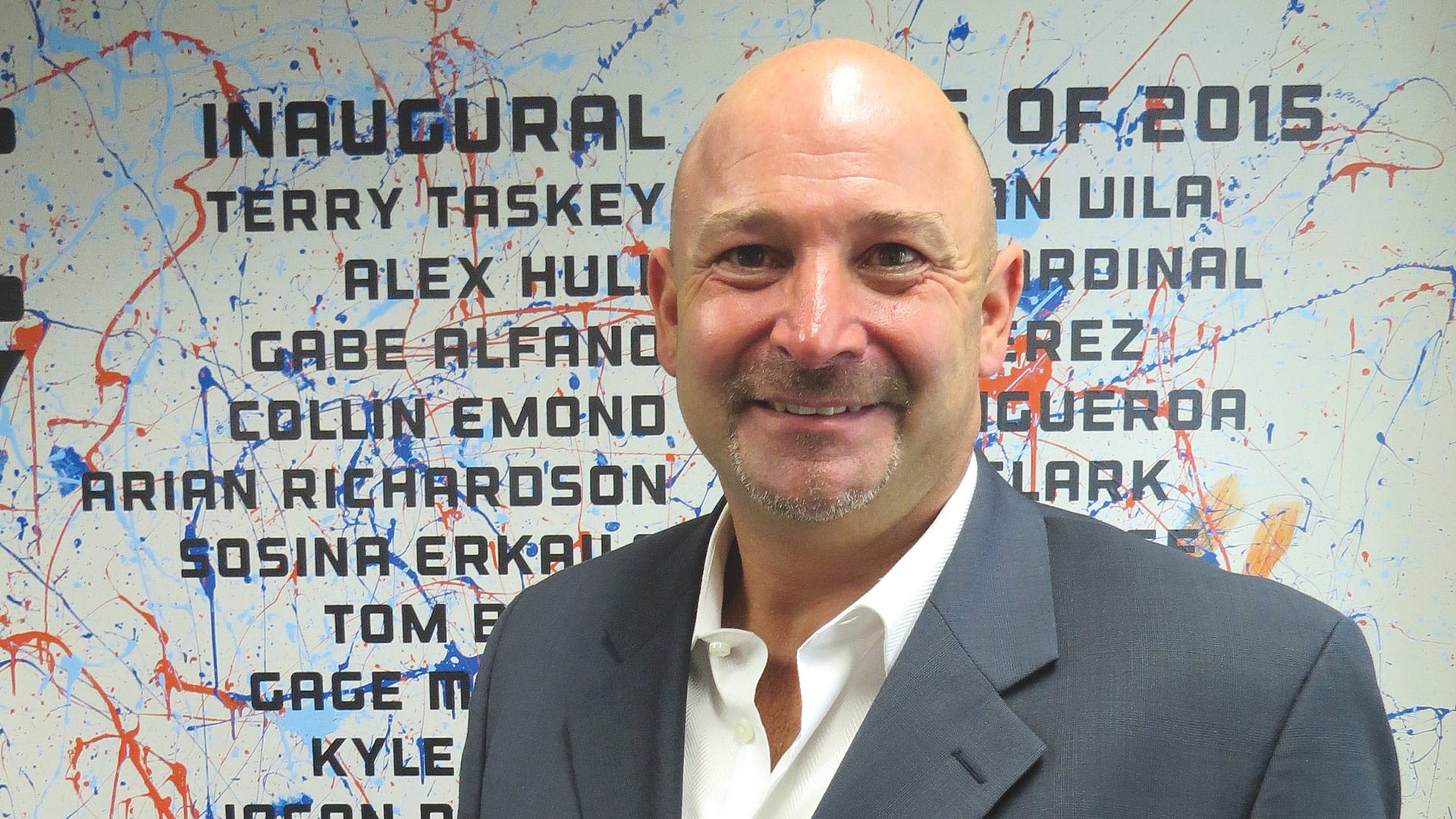
Mark Borsari says his parents used the wet-facecloth method to get him up in the morning

Mark Borsari says his parents used the wet-facecloth method to get him up in the morning, and now he manages his company with the same mindset.

“You need to have confidence in what you’re doing,” said Borsari, noting that many lean initiatives and investments in new technology fail because leadership lacked the confidence to ride out the inevitable early questions and problems that accompany change. “If you’re a leader, stick with it; you have to burn the boats.”

One also has to keep his head out of the sand, he went on, referencing a business he was once in — the making of dentures — to get his points across.

“If you’re a leader, stick with it; you have to burn the boats.”

“That technology had not changed, until about 2004, in 150 years,” he explained. “You’d go to the dentist, the guy would put that big plastic thing with a bunch of goop in your mouth, make an impression, and send it off to a dental laboratory to a dental technician who would, by hand, make teeth; they were getting $120 to $130 a unit on average.”

By 2006 or so, intra-oral scanning had completely changed the landscape, he said, adding that a milling center in a dentist’s office can now make a tooth in hours instead of days and for a fraction of the cost.

“That is technology that is absolutely disruptive; if people in that industry were watching, they would have seen what was coming, but they missed it,” he noted. “Now these technicians have milling centers in their laboratories, and they’re making $40 a unit. You go from $120 to $40 with inflation — that’s the stuff that scares you to death.”

Barrett agreed, and for another example of not recognizing what in hindsight, or even careful foresight, seems obvious, he recalled Jim Keyes’ now-infamous quote from a decade ago: “Neither Redbox nor Netflix are even on the radar screen in terms of competition; it’s all Walmart and Apple.”

“Two years later, Blockbuster files for bankruptcy, and today, Netflix is worth about $62 billion. That’s how fast change can happen, and if you don’t anticipate the disruption, chances are you’re not going to make it,” said Barrett, adding that the business landscape is littered with similar examples of companies moving too slowly, or not moving at all, to anticipate change and get ahead of it.

How and why does that continue to happen?

“People don’t change unless the pain of not changing becomes greater than the pain of change,” said Barrett, adding that companies and business sectors are going to keep doing what has made them successful until it becomes more than obvious that they can no longer do that.

But at the rate change is happening, that won’t be possible in the near future. By the time the pain of not changing exceeds that of changing, it may be too late to change.

For this issue, BusinessWest recaps the third segment in its Future Tense series, a presentation that brought home the need for business owners and managers to prepare for and be able to withstand what can possibly come at them in the months and years to come, rather than be a buggy-whip maker in the age of the automobile.

Brush with Fame

Rosie Noble worked at Sanderson McLeod for a half-century, Borsari told those gathered at Tech Foundry for this installment of Future Tense. Her job — no, make that her domain — was a specific wire brush, or stylus, made for the healthcare sector.

“Rosie walked seven miles a day, 14 feet at a time, for 50 years — she has 2% body fat,” said Borsari as he attempted to draw a picture of how these brushes were made. “You are not going to find another Rosie Noble working for Sanderson MacLeod, walking seven miles a day, making brushes for the rate we were paying. And Rosie wants to retire; what do you do?”

The answer was the Rosie 2, built with her input. It’s the world’s first (and only) fully automatic twisted-wire stylus machine — technology that does essentially what its namesake did starting when Lyndon Johnson was in the White House. Ultimately, Borsari said, the company didn’t build this machine because it wanted to, but because it had to to remain competitive.

“People don’t change unless the pain of not changing becomes greater than the pain of change.”

The Rosie 2 is a great example of a company adapting to change, embracing and utilizing technology, and finding better and more efficient ways to do things, he noted, adding that, moving forward, it’s incumbent on all business owners and managers to write their own Rosie stories.

Jim Barrett

Jim Barrett says that, while lean practices are most commonly associated with the factory floor, this is a strategy, and mindset, that all business sectors must embrace.

There are many factors involved in this equation, said the presenters, starting with the world of work and the rapid pace of change of pace in that realm, most of it driven by technology.

To sum it all up, Barrett talked about this country’s new Lockheed-Martin F-35 fighter jet, a plane that uses artificial intelligence to self-diagnose its needs in term of fuel, parts, maintenance, ammunition, and more. Those servicing the plane don’t have to accumulate that data, as they did with past models, because the plane provides it for them.

Emerging technology does essentially the same for business owners across virtually all sectors, he went on, adding that, in the future (and even today, for that matter), employees, especially those involved in finance, won’t be needed to gather or even analyze information — again, because technology, like Blockchain, will do that for them.

“Today, a large part of the financial function is data analysis; 60% to 80% of the time is spent gathering data and making that sure that data is compatible, either between years or sets or whatever metric you’re trying to measure to: ‘do we have the right data? Is it good data? Is it compatible?’ — 60% to 80% of the time!” he said. “Moving forward, that’s largely going to be automated out of existence, all that time is going to be freed up, and that’s going to be a huge disruption to the financial function of industries.”

Instead, one of employees’ primary functions is to take the information available to them and help management decide what to do from a strategic standpoint. And to do that, they’ll probably need different skill sets than they have now, said Barrett, adding that they’ll need to do everything from “help the company make smart bets,” as he called them, to making sure the business is using the right data and the right metrics.

Instead of counting money in the cash drawer and figuring out where it came from, the retail finance employee of the future (or today) will need to be able to help answer questions like, ‘should we open a new store or close a store?’ ‘Do we go online?’ ‘How much does that cost?,’ said Barrett.

“And that’s a whole different skill set than the finance function of the past,” he went on, adding that employers and human-resources professionals need to be aware of these changes as they create their workforces.

“What people in the finance function need to understand is they need to adapt to this information, because what made them successful in the past is not going to make them successful or, like the buggy whip, relevant in the future,” Barrett noted. “If you’re still counting cash, your competition is way ahead of you.”

Investments in the Future

Borsari agreed, and said that knowing what to do with both data and emerging technology is the biggest challenge facing business owners and managers today.

With that, he clicked to a PowerPoint slide with two images — one of a palm tree, the other of an iceberg — and kept it there for a few moments as he talked about the immensely difficult and far-reaching decisions business owners face when it comes to investing in technology.

“Those of you who run businesses or run companies or organizations and have to make these decisions know that it’s exhausting — absolutely exhausting,” he said. “Our job, when you get right down to it, is to be on the bow of a ship looking out and seeing what’s on the horizon long before it gets there. It’s either an iceberg that’s going to put a hole in the side of the ship and sink you, or a pretty place you might want to take the company and go sailing.

“What people in the finance function need to understand is they need to adapt to this information, because what made them successful in the past is not going to make them successful or, like the buggy whip, relevant in the future. If you’re still counting cash, your competition is way ahead of you.”

“And it’s exhausting because you’re getting bombarded from all sides,” he went on. “Our challenge is, ‘how do we look at the palm trees and the icebergs and sort out what is the technology we think is relevant, what we think works for us, and what doesn’t?’”

Elaborating, he said the place companies must start is with a basic question: what is the technology for? And until it’s answered, the checkbook should certainly stay in the drawer. The goal, he went on, is to embrace and choose technology that enhances that which already separates you in the marketplace.

“Understand what the value-driver is for your customer,” he told his audience. “What do they come to you for? Then determine if technology is going to help you, neutralize you, or put you at a disadvantage. Once you buy it, you own it.”

Borsari noted that Palmer-based Sanderson MacLeod is not going to make wire brushes less expensively than companies in China, or almost anywhere else, given the high cost of doing business in this state.

“So why do people buy from us?” he asked rhetorically before answering that question for the audience.

“Our feeling is that our customers have to think that they’re either with us or that not being with us is a competitive disadvantage,” he said, adding that the company is known for its innovation and making products that stand out in the marketplace.

“These are the things that we think about when we consider technology,” he explained. “Is it going to help us with this, or does it make us more of a commodity?”

This discussion of technology and investments in it led naturally to another of those phrases in the program’s title — lean process.

Lean, the science of taking waste out of the process, can help drive decisions on technology investments, said Borsari, who cited the ‘5 Ms’ of waste — man, machine, method, materials, and money — and the need to identify which one (or ones) are the target of new technology.

“What are you buying the machine for?” he said. “Sometimes you think you’re chasing something, and you realize that’s not what you’re really chasing.”

What all companies are chasing are greater efficiencies and better ways of doing things, said Barrett, adding that a great misconception in business today is that lean is just for the manufacturing floor.

That’s a very limiting attitude, said Barrett, adding that Meyers Brothers, and the financial-services sector as a whole, is starting to embrace lean — out of necessity more than desire. But there are hurdles to be overcome, he said, primarily because these businesses are “dealing with people, not machines, and people are resistant to change.”

“We’re great at analyzing data — we made a career analyzing data — and people love to sit at their desks and play with spreadsheets,” he explained. “But that’s not valuable anymore; people are going to continue doing what made them successful over the past 30 years, even though times are changing.”

That’s why, said both Barrett and Borsari, what a company ultimately needs to change through lean isn’t equipment, technology, or even processes — but the culture.

The Naked Truth

Borsari called it ‘wet-facecloth management.’

And, obviously, he needed to explain that.

“When I was a kid, my parents didn’t like me sleeping in,” he noted. “They’d come in the first time and say, ‘you’ve got 10 minutes to get up.’ If I didn’t get up in 10, they’d say, ‘you’ve got five minutes, then we’re coming up with a wet facecloth.’

“It is impossible to not deal with reality when you’re facing a cold facecloth in the morning,” he went on, adding that the tactic almost always worked, and today, he more or less runs Sanderson MacLeod the same way. Reality, in this case, isn’t having to get out of bed, but to operate with the full knowledge that a few mistakes, or even one big one, can make your company the next Blockbuster or the next Kodak, a venerable institution that just didn’t position itself for the advent of digital photography.

With that, he said ‘wet-facecloth management’ means avoiding certain attitudes, including putting a company’s collective heads in the sand, as the dental technicians obviously did at the start of this century.

“Their heads were in the sand; there’s no question that there was technology coming up that would make a tooth faster than layering porcelain by hand,” he said. “You have to question yourself, and you have to have people in your organization who are empowered to challenge you on that.

“You want them reading, and you want them not feeling that if they come to you with an idea that’s a little out of whack, they’re not going to have your ear,” he went on. “But you have to make sure you don’t get your heads in the sand when it comes to technology, because if you do miss a major one, that will shut the doors.”

Another mindset to avoid is ‘magic-bullet thinking,’ he went on.

“This is where someone goes to a presentation, comes back, and says, ‘we have to buy this thing; it’s unbelievable,’” he said. “That’s dangerous; there are no magic bullets. There are things that will help you, but there are no magic bullets. I’ve bought magic bullets. They don’t work.”

Still another mindset to avoid, said both Borsari and Barrett, is the thinking that all the answers have to come from inside the company.

The proper mentality is to ‘get naked,’ as Borsari called it.

“I encourage people to get out and see other companies, and to have people come and pull you apart,” he explained. “Bare what you have; you want an idea that can come through and change things, but don’t get into thinking that you have everything covered, because you don’t.”

Barrett agreed, and said one of the bigger challenges facing businesses in all sectors is changing the culture of an organization and inspiring people to think lean, avoid magic bullets, and get their heads out of the sand.

What’s needed is a compelling message, he told BusinessWest.
“To stand in front of people and tell people they need to be more efficient because if we’re not more efficient and we’re not doing it better, we’re going to be out of business — that’s not really motivational to a lot of people,” he explained. “You need to find some way to engage them.

“In our business,” he said, “that might be to say, ‘yes, you might lose 60% to 80% of what you used to do, but if you understand that, you can now spend your time going out to customers and trying to help them with their business, and you can do better stuff that, A, they value, and, B, they’re going to pay more for, and you can have a better feeling when you leave that you helped somebody, as opposed to reading spreadsheets.’

“The message can’t be, ‘we have to be lean because we don’t we to be the next Blockbuster,’” he went on. “The message has to be, ‘we have to be lean so we can do better, higher-value stuff that’s more rewarding for us and more valuable for our customers.”

Bottom Line

‘Wet-facecloth management?’ ‘Burning the boats?’

These are not phrases you would probably hear in the boardroom 20 years ago, or even a few years ago.

But you hear them now, because the times (maybe you’ve heard this) are changing. And change is coming quickly and profoundly, and companies need to be aware that they have to change attitudes and change the way they do things.

As Barrett so aptly put it, businesses, and especially those who lead, simply can’t wait around until the pain of not changing becomes greater than the pain of change.

George O’Brien can be reached at [email protected]

Berkshire County

Changing the Narrative

Created through the merger of several economic-development-focused agencies, 1Berkshire has a broad mission statement, but it can be boiled down to making this unique region a better place in which to live, work, and do business.

Jonathan Butler says he grew up during what was, in most all respects, a down time for many communities in the Berkshires.

This was a period — a few decades in length, by most estimates — when General Electric in Pittsfield and Sprague Electric in North Adams were slowly disappearing from the landscape and taking roughly 25,000 jobs with them.

Butler told BusinessWest that he’s heard countless stories about what it was like when those huge employers were in their heyday and the downtown streets were clogged with people on payday — and every other day, for that matter — and seemingly everyone who wanted or needed a job had one.

“But that’s not part of my narrative,” he said, adding that he grew up on the other side of all that, when the downtowns were populated largely by empty storefronts and jobs were much harder to come by.

“The good-old-days stories are actually getting quite old,” he went on. “That’s because a few generations have grown up not knowing them.”

Instead, there are new stories being told, said Butler, involving everything from ziplining to craft beers; from health spas to new and exotic eateries; from communities’ populations getting larger to populations getting younger.

Indeed, the best stories involve people — a lot of them just like Butler — who grew up during those darker times, left the area (because that’s what they thought they had to do), and are now coming back to enjoy all of those things mentioned above.

Jonathan Butler

Jonathan Butler

“The good-old-days stories are actually getting quite old. That’s because a few generations have grown up not knowing them.”

“We’ve really changed the narrative around what it’s like to live in the Berkshires,” he noted. “People my age that grew up here, went away, and have had the chance to come back, whether it’s to live here or visit family, are shocked at what they see.”

This changing of the narrative was and is the unofficial mission statement for 1Berkshire, an economic-development-focused organization that resulted from the merger of four agencies — the Berkshire Chamber of Commerce, the Berkshire Convention and Visitors Bureau, the Berkshire Economic Development Corp., and Berkshire Creative, a support organization for entrepreneurs and those involved in the arts.

Housed in an historic former firehouse called Central Station in downtown Pittsfield, 1Berkshire’s employees are focused on a number of strategic initiatives collectively aimed at advancing the region’s economy and making this a better place to live, work, visit, and operate a business.

“We spend a lot of time and energy bringing visitors to the Berkshires, but we also spend significant time and energy promoting this as a place for families and for people to relocate to,” he explained.

The ‘visit’ component has always been a huge part of the equation, said Butler, noting that tourism has long been the primary economic driver in the Berkshires. That’s still true today, but visitation is becoming more diversified, or “rounded out,” as he termed it.


“We have an extremely robust visitor experience here,” he noted, adding that that tourism spending, up 30% over the past decade ago, now averages about $500 million a year. “There’s the performing arts, the visual arts … but we’ve also become established as a food economy — dining in the Berkshires is great, for the foodie audience but also the more traditional audiences.

“There’s a farm-to-table component of our economy — there’s a lot of agritourism — and there’s also the recreational economy: hiking, biking, adventure sports, scenic rail, and more,” he went on. “People have always come here for nature and culture, but what’s catching up is the recreational economy and the health and wellness economy.”

But those other parts of the puzzle are equally important, he went on, adding that 1Berkshire is also committed to bringing people here to live, work, and start and grow businesses.

Overall, the agency was conceived as a “better way to do economic development,” said Butler, and to date, the evidence, both qualitative and quantitative in nature, would show that it’s succeeding in that role.

“Over the past 15 to 20 years, the Berkshires have been re-energized, but there are still a number of challenges,” he said, adding that the largest involves ongoing efforts to attract young people and lower the age of the region’s population, a vital component to overall vitality and economic sustainability.

For this issue and its focus on Berkshire County, BusinessWest talked with Butler about 1Berkshire and how it has gone about helping to change the narrative in this unique corner of the Commonwealth.

New Breed of Economic Development

‘The Year of the Dog.’

That was the name attached to the 63rd annual Fall Foliage Parade, staged on Sept. 30 in downtown North Adams. When asked, Butler was more than willing to explain, and started by noting that an elementary-school class in that community has the honor of coming up with a name to accompany the much-anticipated event, which draws thousands to that town.

“This is the Chinese Year of the Dog, and they recently opened a dog museum in North Adams,” he noted, referring to the facility located in the former Quinn’s Paint & Wallpaper Co. on Union Street. “So … it all makes sense.”

There was a huge banner at the top of the 1Berkshire website hyping the parade, he said, adding that the promotional support for such traditional gatherings is just one of many functions carried out by the agency.

There’s also something called simply ‘the jobs thing.’ This is a job-posting site on that same website (1berkshire.com). All positions listed (and there is a fee for such postings) must be for jobs in Berkshire County and come with a salary of at least $40,000. Those doing some browsing can search by field (they range from administrative and clerical to hospitality and tourism to sales and advertising) and by experience (entry-level, mid-level, and senior-level).

1Berkshire also has an events calendar filled with a host of programs, including a youth-leadership program and Berkshire Young Professionals events; a ‘relocation’ button on its website that enables visitors to explore every community from Adams to Windsor; and ‘featured opportunities,’ such as a ‘Get Mentored’ program that pairs selected entrepreneurs with experienced mentors. Applications are being accepted now for the winter session.

“We’ve really changed the narrative around what it’s like to live in the Berkshires. People my age that grew up here, went away, and have had the chance to come back, whether it’s to live here or visit family, are shocked at what they see.”

Then there’s the Berkshire Blueprint, a detailed strategic plan for the region — similar in many ways to the Pioneer Valley Planning Commission’s Plan for Progress — that was first drafted in 2007 and is now being updated.

All of these are examples of how 1Berkshire is carrying out that aforementioned assignment — to find a better way to do economic development, said Butler, who was hired to lead the Berkshire Chamber four years ago, and spent much of the next 18 months working out the merger of the chamber and the convention and visitors bureau into 1Berkshire.

Overall, two years after the all the components of this agency came together, the venture is proving to be much bigger than the sum of its parts.

Going back those four years, he said several of the smaller economic-development-related agencies were doing good work but struggling to keep the doors open financially. Discussions commenced on the many potential benefits from bringing them together under one roof and one administrator, he went on, adding that this somewhat unique economic-development model became reality.

That uniqueness is matched by the region itself, he went on, adding that, while the Berkshires is part of Western Mass., or the 413, as many call it, in many, if not all, respects, it is more than just one of four counties.

“We’re a little bit of our own place,” he explained. “We have our own identity, our own brand. People actually know the Berkshires of Massachusetts on a national level, and even internationally, as a destination. But we’re small — only 135,000 people, with about one-third of them living in Pittsfield.”

That small population is matched by a small economy anchored by a few large employers — General Dynamics and a few banks, for example — and dominated in most ways by tourism.

There are many benefits to living and working in the region, Butler went on, adding that 1Berkshire exists primarily to educate people about them and encourage them to take full advantage of it all.

Right Place, Right Time

To carry out its multi-faceted mission, 1Berskshire, with an annual budget of roughly $2 million, relies on revenue from a number of different streams.

They include membership dues — there are currently about 1,000 members — as well as larger donations from so-called ‘investors,’ major employers such as Berkshire Bank, Greylock Federal Credit Union, and General Dynamics. There is also revenue from website advertisements (a spot hyping a Harry Potter-inspired Halloween party at the Blantyre is among those on the site now), the jobs initiative, and other programs; there are actually two web sites — berkshires.org, the primary visitor portal for the region, and 1berkshire.com.

And there is state money, because the convention and visitors bureau is part of the mix and is funded in part by the Commonwealth, and also because the agency is a regional economic-development council.

As noted earlier, a primary function of the agency is to drive visitation to the region, because tourism has a very broad impact on overall vibrancy in the region.

“With visitation, there is a ripple effect that goes well beyond the traditional visitor-stakeholder economy,” Butler explained. “It has an impact on the quality of our downtowns. We have much more vibrant downtowns today than we did 20 years ago, whether it’s Pittsfield, Lee, or Great Barrington. Those communities have benefited from visitor activity, which has made them a better place to live. It’s had a ripple effect into downtown housing projects, new restaurants and eateries, and things to do.

But there are many other aspects to the mission, he went on, listing everything from advocacy for members to the all-important work aimed at bringing new residents to the area, not just tourists.

Tracing his own career, Butler said that, after earning a graduate degree, he went to work for the Commonwealth in economic development and later for state Sen. Ben Downing in the State House.

He “worked his way back” to the Berkshires, as he put it, and worked as town manager for the city of Adams for six years before becoming director of the chamber.

Now, in his new role, he and his staff are working to encourage others to work their way to the Berkshires, or discover it for the first time, not as a place to leaf-peep or hike or ski — although they can do all of that — but as a place to live.

And this is important work, he said, because so many young people of his generation did in fact leave, in part because so many jobs disappeared, leaving communities demographically older and less vibrant.

But many are returning because what they see now is not the Berkshires of their youth.

“There are so many stories of people who choose, after they get their careers started, to come back to the Berkshires,” he explained. “The dialogue for them when they were kids might have been that they needed to get their college degrees and go off somewhere where there was lots of opportunity and be successful.

“Now, that dialogue is starting to shift to ‘go out, get your degree, experience the world, and why not come back to the Berkshires?’” he went on. “That’s important — that’s really important — and we’re seeing more and more of it.”

Good ‘New’ Days

Getting back to those stories about when the major manufacturers like GE were humming, Butler said they’re getting so old, they’re not really worth telling anymore.

That was a different Berkshires region, and so was the one he grew up with in the ’90s.

The Berkshires of today is not like either of those Berkshires. It is different, vibrant, diverse, and always changing — in short, it’s a different narrative, he explained.

Creating that narrative and making the story known is what 1Berskshire is all about, and four years after its formation, it is thriving in that all-important role.

George O’Brien can be reached at [email protected]

Accounting and Tax Planning

Five Hot Tax Topics

The Tax Cuts and Jobs Act represents a seismic shift within the broad realm of accounting and tax planning, and some of the aftershocks may not be felt, and fully understood, for some time. But some things are known, and individuals and businesses should understand their implications.

By Teresa Judycki

For better or worse, the Tax Cuts and Jobs Act was the most significant tax-law overhaul since the Reagan Administration, and there’s potential for more change on the way. With the breadth and depth of this law, it can be hard to determine what might be meaningful to you and your business.

This article will highlight five hot tax topics that may be particularly meaningful for this tax year.

Qualified Opportunity Funds

Taxpayers with large gains from sales of property to an unrelated person should be aware of Qualified Opportunity Funds. Enacted as part of the Tax Cuts and Jobs Act, a new Opportunity Zone program encourages investment in low-income community businesses.

Terri Judycki, CPA, MST

Terri Judycki, CPA, MST

The program allows individual and corporate taxpayers to defer tax on gains from the sale of stock or other assets by investing in an Opportunity Fund, which invests in businesses in Opportunity Zones. The tax is deferred until the earlier of Dec. 31, 2026 or the date the new investment is sold. To defer a gain, the taxpayer must invest within 180 days of the sale.

For example, if a taxpayer sells appreciated securities for $1 million at a $700,000 gain, tax on the $700,000 could be deferred until Dec. 31, 2026 (or earlier if the investment is sold prior to that date) by investing $700,000 in a Qualified Opportunity Fund within 180 days of sale. Capital gains on the new investment are exempt from tax if the investment is held for more than 10 years. Opportunity Funds may be a multi-investor fund or a single-investor fund established by a taxpayer to invest in projects he or she selects.

While there are a few multi-investor funds, many are hesitant to promise tax deferral until the IRS issues proposed regulations in this area, but September news is that the proposed rules are being reviewed and should be issued soon.

Foreign Accounts

For taxpayers with unreported income from foreign accounts, the Streamlined Filing Procedures (SFP) are still available. The Offshore Voluntary Disclosure Program ended Sept. 28, 2018.

Under SFP, taxpayers who can certify that the failure was non-willful can file amended returns and pay a reduced penalty. The IRS also has procedures in place for filing delinquent information returns reporting the existence of a foreign account when there has been no unreported income.

For example, a life-insurance policy with Sun Life may have a cash value that’s now increased to more than $10,000. That is a ‘foreign account’ that must be reported or could be subject to penalties. Consider reviewing any asset that is a foreign account and ensuring that tax filings are current, because penalties are confiscatory and may include criminal penalties.

The civil penalties for willful violations are capped at the greater of $124,588 or 50% of the amount in the account.

Employee Parking

I hoped to be able to provide you with specifics related to employee parking, but that guidance has not been issued as of the date of this writing. Perhaps there will be guidance by the time you are reading this article.

As a reminder, the Tax Cuts and Jobs Act provides that no deduction is allowed for the expense of a qualified transportation fringe, which includes van pools, transit passes, and qualified parking. Qualified parking is parking provided to an employee on or near the business premises of the employer or on or near a location from which the employee commutes to work by commuter highway vehicle or carpool. Tax-exempt organizations are subject to tax on the expense. But what is the ‘expense’ of qualified parking? At the 2018 AICPA Not-for-Profit Industry Conference, a speaker said that guidance had not yet been issued, because those in Treasury could not agree on the meaning of the law.

The cost of a parking permit is easy to quantify, but the law encompasses all expenses of providing parking. There are some practitioners who think a portion of depreciation on a parking lot owned by the business could be disallowed. Some others think the IRS may require apportioning office rent if the lease entitles the tenant to a certain number of parking spaces. As the law applies to amounts paid or incurred after Dec. 31, 2017, it affects computation of taxable income for entities with fiscal years ending in 2018. There are many practitioners hoping for retroactive repeal or postponement.

State and Local Tax Itemized Deduction

In August, the IRS issued proposed regulations in response to state legislation intended to circumvent the $10,000 limit on the state and local tax itemized deduction. A few states have enacted or considered enacting programs permitting state residents to make contributions to state agencies or charities in exchange for state and local tax credits that could be applied to income or property taxes.

In the proposed regulations, IRS restates the general rule that charitable deductions must be reduced by anything of value received in return for the charitable donation. The proposed rules, applicable to contributions made after Aug. 27, 2018, provide that, if a taxpayer receives a tax credit in return for a donation, the tax credit is a benefit to the taxpayer that must reduce the charitable contribution deduction.

It is important to note that these rules apply to programs created in response to the Tax Cuts and Jobs Act as well as to pre-existing programs, such as the Massachusetts program that provides tax credits in exchange for gifts of conservation land.

There has been no response from the IRS to the Connecticut strategy; Connecticut now imposes tax on a pass-through entity instead of on the individual partner or shareholder, which should result in shifting the deduction away from the individual who is subject to the $10,000 limit. The shareholder or partner should now be able to report his or her share of the entity’s income net of the state tax.

Trusts that pay taxes are also subject to the $10,000 limit, but a trust does not have to share the beneficiary’s $10,000 limit, providing a potential benefit.

Alimony

Finally, for those who will be divorced soon, the tax consequences of alimony differ for payments under instruments finalized after Dec. 31, 2018.

Before the Tax Cuts and Jobs Act, alimony was deductible by the payor and taxable to the payee. This resulted in shifting income from the higher-earning spouse paying the alimony to the former spouse who may be in a lower tax bracket. Alimony payments finalized after Dec. 31, 2018 will no longer be deductible by the paying spouse and no longer included in the income of the recipient spouse. There are some workarounds such as division of property where the spouse in the lower tax bracket receives property with the greatest unrealized gain or by using a Qualified Domestic Relations Order to shift retirement assets (along with the tax burden) to the lower-income spouse.

While this change will not affect pre-2019 alimony instruments, it may apply if the parties modify the pre-2019 agreement and state in the modification that the new rules are to apply. If this law change will impact you, be sure to discuss its effects with your attorney.

If you have any questions about the material featured in this article or how it might apply to you specifically, be sure to consult your tax professional or CPA.

Terri Judycki is a senior tax manager with Holyoke-based public accounting firm Meyers Brothers Kalicka, P.C.; (413) 322-3510; [email protected]

Home Improvement

Serving Up Style

Karen Belezarian-Tesini (left) and Sarah Rietberg

Karen Belezarian-Tesini (left) and Sarah Rietberg are selling plenty of white and gray tiles these days.

Professional designers can often walk into a house and tell what decade it was built in by the styles of certain rooms, and the kitchen is definitely high on that list. From the high-gloss look of the ’80s to the more neutral ’90s; from a shift back to color at the turn of the Millennium to the current embrace of whites and grays, kitchens do seem to reflect their time. But one trend of the past generation isn’t likely to change — the increased perception of the kitchen as a home’s main hub of activity.

The economy wasn’t the only thing that went flat a decade ago. So did kitchen colors.

“When the economy tanked in 2007, 2008, everything became very flat. Color was gone, along with texture, pattern, flowers. Everything became industrial and cold — no frills. And that’s how the economy was, too,” said Karen Belezarian-Tesini, manager of Best Tile in Springfield. And she’s not the only one who noticed the coinciding trends.

“It’s funny how the economy dictates the colors,” said Frank Nataloni, co-owner of Kitchens & Baths by Curio in Springfield, recalling how many kitchens of the late ’80s featured high-gloss surfaces and plenty of black and red, but when the recession of the early ’90s hit, it was all earth tones. By 2000, color had come back, but around 2008, neutrals took over again. “I don’t know what that means, but when you look back, you can clearly see it.” That decade-ago shift has stuck, however, and even intensified, he added. “Everything now is white and gray.”

While taupe is making a comeback, said Belezarian-Tesini — “I love that more than gray because it gives you an option to go either way, warm or cool” — she’s seen the white-and-gray trend intensify over the years. But better financial times might be causing a subtle style shift.

“Now that the economy is picking back up, it’s getting a little warmer — softer edges, a little more color in glass mosaic or patterns,” she said.

That would be just fine by Lisa Lindgren, designer with Kitchens by Chapdelaine in East Longmeadow.

“The most popular kitchen is white — white on white. So whenever I get a client who wants some color and wants to do something a little different, I get excited,” she told BusinessWest. “People tend to be so scared of color. A lot of it is about sellability, but we tend to encourage people to go for what you like. It’s your house.”

Frank Nataloni

Frank Nataloni says styles shifted away from bold colors when the economy tanked, and have largely remained muted since.

R.J. Chapdelaine, owner of the company, an offshoot of builder and remodeling firm Joseph Chapdelaine & Sons, agreed.

“Whenever you have someone who comes in with a little imagination, wants to have a little fun, it gets exciting,” he said. “And why not? That’s where people want to spend their time. Kitchens are getting bigger, and other living spaces are getting a little bit smaller.”

For this issue’s focus on home improvement, BusinessWest visited a few companies that deal in kitchen design to get a read on some of the hot styles — only to find that the hottest is a decidedly cool white. But they offered plenty of other food for thought as well.

What’s Your Style?

Take countertops, for instance, where white- and gray-colored quartz surfaces are in, both Lindgren and Nataloni said.

But they’ll find contrast in other places, Lindgren noted, like weathered driftwood for accent pieces or a dark wood floor — or, more commonly these days, porcelain planks designed to look exactly like wood. “That’s the most popular floor. You can’t even tell it’s not wood. It’s pretty fascinating.”

“That seems to be what everyone’s looking for right now,” Nataloni added. “With some of them, it’s amazing how much it actually looks like real wood. You can even feel the texture. That’s what people are looking for.”

And homeowners aren’t stopping in the kitchen, Belezarian-Tesini said. “When I sell those planks, I might sell 2,000-3,000 square feet at a time. They’re doing their bedrooms, they’re doing the whole house. It’s just incredible. People say, ‘oh my gosh, I love that,’ and when we tell them that it’s porcelain, they look again and say, ‘are you sure? Really?’ ‘Yeah, really.’”

In addition to the move away from tile floors into wood and wood-like porcelain, Chapdelaine noted that shiplap walls — in both vertical and horizontal patterns — are popular as well, perhaps driven by their ubiquitousness on HGTV.

As for cabinetry, while painted white tops the list right now, Nataloni said, he was working with someone recently who wants a black cabinet with a rubbed-off type of finish so there’s some wood coming through. Still, those neutral shades provide plenty of flexibility.

R.J. Chapdelaine and Lisa Lindgren say it’s fun to work with customers who have a design vision not necessarily bound by what’s currently fashionable.

R.J. Chapdelaine and Lisa Lindgren say it’s fun to work with customers who have a design vision not necessarily bound by what’s currently fashionable.

“With a white or gray cabinet, we can make it look very formal or casual in the scheme of things,” he said. “I haven’t sold a cherry kitchen in over a year, but at one time, that was probably 60% of our business. Some woods remain relatively popular, though, including walnut. “That’s the fashion part of the business, and it changes depending on who walks through the door.”

Sarah Rietberg, showroom manager at Best Tile, said all these trends amount to people seeking a clean, uncluttered look in their kitchens, which is why subway-style tile backsplashes are still common, but with a twist — different sizes, something with a little texture to it, or even lines that aren’t perfectly straight.

“Those things can add some oomph to subway tile,” she said. “People want a little movement, but nothing too crazy. They don’t want to take away from the other things going on.”

In addition, a well-placed accent color can be striking amid a sea of white, Chapdelaine said. “We just did one all-white kitchen with a hale navy blue island, and it’s a striking look.”

Indeed, Belezarian-Tesini said, many customers complement the dominance of white and gray with mosaic tile backsplashes; where once a mosaic pattern broke up the solid color of the rest of the backsplash, now it’s being used across the entire backsplash to break up the white of the kitchen.

Sometimes it’s hard to predict the next trend, she added. “If you asked me 10 years ago if glass would still be here, I’d have said no, but glass is hotter than it’s ever been. It’s the medium of choice now. People still use ceramic, and porcelain has really come up the ladder. But glass has become the decorative. It’s a 10-year trend for sure, and it’s probably going to last longer than that.”

Meanwhile, she sees metallic tile coming into its own. “As technology gets better, you’re going to see more things within the glazing. You’re even seeing crystals in the glazing, little pieces of metal, to create a true, realistic metallic. So technology advances, and the tile changes.”

Good, Better, Best

The upside of so many options in kitchen surfaces is that there’s typically something for every budget, Nataloni said.

“We have to have a good, better, and best product selection,” he told BusinessWest. “We have a product for people flipping homes that’s very current with the trends, reasonably priced, good quality, with a quick turnaround time. Then we have a semi-custom type of product that offers a lot of selection and is a little quicker than the higher-end product. That means a lot if someone is doing a home renovation, because a kitchen is not an inexpensive proposition. If you know where to save money, you can get more bang for your buck, and that’s our skill.”

Some customers arrived with a vision in mind for their kitchen, he explained, and his job is to refine it. “Then there are other people who come in and don’t have a vision, and they’re looking for me to help them create the vision. That’s why we have to be flexible in meeting the need of whoever is coming to us.”

To help people envision the end product — quite literally — Nataloni uses a virtual-reality device called ProKitchen Oculus, which uses Oculus VR goggles to allow people to walk around in the environment Nataloni has programmed into the computer.

“For people who have a hard time visualizing, it really solves that problem for them,” he said. “We create a basic floor plan in 3D, and you’re actually in the room, so you can look and walk around. They literally see what they’re going to buy, or as close as possible to what it’s going to be like.”

For example, one customer was having trouble envisioning the soffit Nataloni suggested for the top of their cabinets. “Then I showed it to them on the Oculus, and their response was, ‘oh, now I understand what you were talking about.’ For those type of people, it really helps tremendously.”

Chapdelaine also sees a healthy mix — about 50-50 — of people who know exactly what they want and customers who need a little more guidance. “And that guidance can occur through Lisa, or through decorators. We see clients occasionally bring in a decorator to help them make decisions on color, cabinetry, and tile.

Most of those are typically renovating their whole house, Lindgren added. “It doesn’t tend to happen just with a kitchen, but with a broader scope.”

Whole-home renovations are common these days, said Chapdelaine, who noted that the remodeling business has been outpacing new home building for some time. His grandfather, who first hung out a shingle in 1925, saw the value of remodeling work early on, and evolved the firm in that direction after originally focusing on new construction.

“That became an integral part of our business,” he said. “You have to evolve. I see people who just build houses or just remodel, and I’d find that difficult. You can go from building three, four, five houses at a time to building one or maybe none, and doing all remodeling.”

Open Wide

He and Chapdelaine’s father also recognized perhaps the most prominent shift in kitchen design, and one that remains dominant today — the open floor plan.

“They were building compartmentalized houses, but they rolled into a more open floor plan on the single-story executive ranches,” he recalled. “Now, there’s very little compartmentalized building. Everything is wide open, with less formal living spaces.”

Nataloni said homeowners prefer a free flow of traffic through the kitchen, and islands are desirable if they can be put in. “Gone are the days of the U-shaped kitchen or a peninsula only, unless it’s necessary. Everyone is looking to have cabinetry that creates the outside shell of the kitchen and then some kind of an island in the middle, whether it’s with seating or without.”

That’s also the style potential homebuyers prefer when they’re visiting open houses, which is one reason why hot trends — like that white and gray — remain so dominant once they take hold; people design the room not only for their own comfort, but with resale in mind.

“For many people, this is where they’re staying, but we do have a lot of people coming in saying, ‘look, I want to fix up the kitchen, and we’re not going to be here forever, so I want it saleable,’” he noted. “We get probably more of the people who are staying for the foreseeable future, and they want to enjoy it. That’s the majority of our business.

Belezarian-Tesini said most of her business at Best Tile contractor-driven — either builders putting up or remodeling houses, or homeowners shopping for product, then hiring a professional to do the work. The do-it-yourself crowd is much smaller — perhaps because the kitchen is such a critical part of 21st-century home life that people don’t want to get it wrong.

That said, “business has been fantastic,” she noted. “I’ve seen a lot of new construction over the last few years. When I started here 23 years ago, it was all new building. Then it went to remodeling, and now it’s coming back again to new construction, which is nice to see.”

So, for the foreseeable future, she’ll continue to track the design trends and help customers design the kitchen of their dreams — usually with an open concept.

“It makes for easy living, and really great entertaining,” she said. “After all, the kitchen is the heart of the home.”

Joseph Bednar can be reached at [email protected]
Community Spotlight

Community Spotlight

Folks in Western Mass. know they’re often dismissed by residents out east, Lisa Stowe says. So how does a city like Westfield make its case as a vibrant destination for a business looking to plant roots?

By working together.

That’s exactly what a handful of partners — municipal leaders, Westfield Gas + Electric (WG+E), Whip City Fiber, the Greater Westfield Chamber of Commerce, and corporate sponsor Westfield Bank — have done by launching Go Westfield, a still-evolving engine to encapsulate what makes this city a desirable landing spot, and, more importantly, tell people about it.

“We worked on this for six or eight months,” said Stowe, marketing and communications specialist for WG+E. “We want to use this opportunity to highlight what makes Westfield unique and a good place to do business. So many people think Massachusetts stops at 495, but there are a lot of things that are not so great about living in that part of the state — cost of living, high traffic, the cost of buying a piece of land. We wanted to draw attention to the things that make Westfield really attractive for people who are looking to relocate.”

The partners in Go Westfield had been doing that, to varying degrees, in their own ways, she added, but a focused partnership allows them to broadcast the message more efficiently.

“If you’re a site selector, we check a lot of boxes,” Stowe said, citing not only the city’s access to Mass Pike, an airport, and rail service, but its strong inventory of developable land — not to mention the municipal utility.

“If you’re a commercial customer, you pay 18% less than the state average for electricity, and 13% lower for gas rates than the state average,” she added. “If you’re an organization doing manufacturing, that’s significant. We feel that’s a good piece of the story to tell.”

Kate Phelon

Kate Phelon

“We really want to promote our city and the positive aspects of it. It’s an ongoing joint effort to drive the message that businesses should come look at Westfield to develop. We have quite a bit of developable land, but how do you get the word out to a company in Texas or Minnesota?”

So is Whip City Fiber, a division of WG+E that now reaches 70% of residences and businesses with high-speed internet. “The fiber project is a big deal,” she said, noting that customers like not only the speed, but the fact that service comes from a local company, not a national behemoth. “We’ve easily met the targets we had set in the business plan.”

Kate Phelon, executive director of the Greater Westfield Chamber of Commerce, said early meetings with the Go Westfield partners focused on how to promote the economic-development landscape in Westfield.

“We wanted a way to really persuade businesses to come to Westfield,” she told BusinessWest. “There are the usual assets everyone knows, like the turnpike exchange, airport, and rail, but we wanted to get a group of stakeholders together and come up with a marketing plan for all of it. We’re very excited about this initiative. There’s a local component to it, but the bigger initiative is a push outside the region to get companies to look at Westfield for commercial developments.”

The group has been discussing marketing strategies as well as ideas like industry-specific focus groups.

“We really want to promote our city and the positive aspects of it,” she said. “It’s an ongoing joint effort to drive the message that businesses should come look at Westfield to develop. We have quite a bit of developable land, but how do you get the word out to a company in Texas or Minnesota?

Westfield also boasts strong schools, a state university, and proximity to numerous other colleges, she added, as well as a chamber of commerce that continually strives to keep businesses informed of state and national trends and developments that could affect them.

In short, the Whip City has a lot going for it, and Go Westfield is just starting to broadcast that message far and wide.

Heart of the City

Meanwhile, the Elm Street Urban Renewal Plan, approved in 2013, focuses on revitalizing 4.88 acres in a two-block area in the heart of downtown Westfield running along both sides of Elm Street, the city’s main commercial thoroughfare. The city has also directed funding to revitalize the so-called Gaslight District adjacent to it.

One recent success story is the $6.6 million Olver Transit Pavilion, which opened in April 2017. The transit center was designed to both catalyze related economic development and increase the use of public transportation. The state-of-the-art center includes parking space for four buses with bicycle racks, as well as a bicycle-repair station, which speaks to the proximity of the Columbia Greenway Rail Trail only a block away.

The Westfield Redevelopment Authority also demolished a former bowling alley near the transit center, with plans to create a multi-story, mixed-use building with retail, restaurants, office space, and market-rate apartments. The city recently issued a request for proposals for the project, taking advantage of the area’s designation as an ‘opportunity zone,’ a state program that provides tax relief for people willing to invest in certain neighborhoods in need of economic development.

“The PVTA project was the first phase of renewal,” said Peter Miller, Westfield’s director of Community Development. “We’re looking for private development to get some mixed-use retail space on the ground floor, and residential space on the top floors.”

Joe Mitchell, the city Advancement officer, noted that Millennials in particular are drawn to urban, mixed-use living, one reason why such projects have popped up around the region in recent years.

“A three-bedroom house and a white picket fence on a half-acre is not what young people are looking for,” he said. “They want a coffee shop downstairs and a bike rack, and being part of a tight-knit community where there’s activity going on right at their doorstep.”

Another $25,000 in state money will soon fund a wayfinding project for downtown, not just to point visitors to destinations off the main thoroughfare but to help them access parking as well. “We have sufficient parking in our downtown, but people don’t always know where it is,” Miller said. “This infusion of money from the state will allow us to better direct people to where the parking is.”

Phelon noted that the city recently switched all on-street parking, which had been a mix of one-hour and two-hour time limits, to two hours across the board — a small change, maybe, but a good example of how quality-of-life issues can be communicated and remedied across departments.

The momentum downtown has spurred some organic growth, too, Mitchell added, noting that Myers Information Systems is relocating there from Northampton, bringing 20 software-development professionals and renovating 110 Elm St., which used to be a restaurant with industrial space above it.

“They’re moving from an urban, walkable space they’ve outgrown in Northampton to buying one of our old buildings and investing private dollars here,” he added. “It was an extremely underutilized building, and they’re converting it into modern office space. They have a real vision for it.”

He doesn’t think Myers will be the last to make that move. “One of the reasons to relocate to Westfield is that we’re at the cusp of something, and people want to be a part of it.”

Back to School

Phelon says Westfield has accomplished more in recent years because of its culture of collaboration. One example is the Westfield Education to Business Alliance, which connects the city’s schools, where students are beginning to contemplate their career paths, with companies that are eager to mine local talent.

At a time when the state is looking for public schools to forge more meaningful pathways to economic development, she added, the alliance puts the Whip City at the forefront of an important trend.

Westfield at a glance

Year Incorporated: 1669
Population: 41,552
Area: 47.4 square miles
County: Hampden
Residential Tax Rate: $19.36
Commercial Tax Rate: $36.82
Median Household Income: $45,240
Median Family Income: $55,327
Type of Government: Mayor, City Council
Largest Employers: Westfield State College, Baystate Noble Hospital, Savage Arms Inc., Mestek Inc., Advance Manufacturing Co.
* Latest information available

She said the next phase could be an adopt-a-classroom program in which area businesses could engage repeatedly with a teacher and his or her students. “I also think we need to get students and teachers into the business world on a regular basis. The work environment is changing so rapidly, with technology and robotics and social media.”

Because of this, she went on, it would benefit teachers to see what employees at area companies do on a day-to-day basis, and how. “That’s what they need to be teaching, so they need to see that.”

The Westfield Education to Business Alliance also facilitates a career fair at Westfield High School that gives students exposure to the types of career opportunities available at local companies — and, more important, what skill sets they will need to take advantage of them.

The goal of the next career fair will be to attract 75 companies, up from 51 last time, to interact with the 500 or so students who show up.

“It’s not a job fair; it’s a career fair,” Phelon stressed. “The message is twofold: for students to see what companies are here, and see that they can go away to college and come back here and get good jobs. It’s also good for these students to talk to these employees about their hiring practices, what degree do I need, should I expect a drug test or a CORI check, what are your procedures. And they could talk to students about internships and co-ops.”

The alliance one of many examples of how Westfield continues to bring people and organizations together to raise the fortunes of all.

“The mayor [Brian Sullivan] has been very supportive of these collaborations,” Miller said. “He made building bridges his theme. That’s how we’ll get the most out of the assets we have — not by operating in silos.”

Phelon agreed. “We have our individual purposes and missions, but there’s a bigger picture of working together and collaborating. It’s such a great city, and we’re fortunate to have the assets we have.”

Now it’s time to let everyone know it.

Joseph Bednar can be reached at [email protected]
Berkshire County

Creating an Ecosystem

State and local officials joined with stakeholders in the Berkshire Innovation Center to break ground on the project last week.

State and local officials joined with stakeholders in the Berkshire Innovation Center to break ground on the project last week.

Steven Boyd isn’t just the president and board chairman of the Berkshire Innovation Center; he’s a true believer that the $13.8 million facility will be a game changer for the region’s manufacturing and life-sciences economy.

“From a broad perspective, I’d say the center aims to support the legacy manufacturing base that has a long history of innovation here in the Berkshire region,” he told BusinessWest. “We’re an innovation center that is equal parts research and teaching institution and programming for private-sector businesses.”

State and local officials gathered last Tuesday at the William Stanley Business Park of the Berkshires in Pittsfield to break ground on a project that has been in the planning and fundraising stages for a decade, and is expected to open by the third quarter of 2019.

The two-story, 20,000-square-foot workforce-development center will include training facilities, lab space, clean rooms, and office and event space for small- to medium-sized companies, just to name a few amenities, with the collective goal of boosting economic growth, employment, and private investment in the region.

“The center aims to support and accelerate growth and innovation by providing access to state-of-the-art equipment like 3D printers and a microscopy suite, as well as conferencing and teaching facilities,” Boyd said, adding that the center will also be the centerpiece of the mostly underdeveloped, 52-acre business park it calls home.

“The building will have all these types of spaces combined into a very cooperative, shared maker-space type of environment,” he went on, with one goal being to bring ideas and inventions from colleges and research institutions, even those from the eastern part of the state, together with local manufacturing knowhow and the resources needed for commercialization.

“One of the things that makes Cambridge so vibrant is all the new technology that’s being researched or commercialized as a result of all the ideation happening at places like MIT,” Boyd said. “So, as part of stimulating the economy in the Berkshires, we want to promote more of that ideation and commercialization here.”

Gov. Charlie Baker said as much at last week’s groundbreaking. “Our administration is focused on boosting the Commonwealth’s thriving life-sciences sector in every corner of the state,” he noted. “Investing in the Berkshire Innovation Center will help expand the capacity and capabilities of this region’s entrepreneurial community to drive job creation, retention, and outside investment in Western Massachusetts.”

Boyd, who is also CEO of Boyd Technologies in Lee, said the Baker administration has been focused on creating a network of innovation in manufacturing and the life sciences that encompasses the entire state, and the Berkshire Innovation Center (BIC) will be a key part of it.

“They recognize all the momentum going on in Boston and see the opportunity to provide efficiencies by creating a statewide ecosystem,” he noted. “In the Berkshires, we have available space and facilities at lower cost to provide that type of efficiency. It can be invented at MIT and commercialized in the Berkshires, and you don’t have to get on a plane and fly halfway around the world to make something that’s truly innovative.”

Nearly 5,000 jobs in Berkshire Country are in the manufacturing sector, making it the fifth-largest industry in the region.

With that in mind, Housing and Economic Development Secretary Jay Ash noted that the center will serve as an anchor institution for region, “strengthening connections between the life sciences and advanced-manufacturing industries and education institutions, creating jobs, and shaping the next generation of home-grown innovators.”

Precision Endeavor

At the start of the summer, the BIC board brought on Consigli Construction Co., one of the largest general contractors in the Northeast, to oversee construction at the former General Electric site. John Benzinger, a senior project manager for Skanska USA Building Inc. of Springfield, will serve as the owner’s project manager. Skanska recently served as the project manager for Union Station in Springfield.

Resources inside in the innovation center, when it is completed, will include:

• Precision measurement and reverse engineering utilizing the BIC’s flagship platform, the Hexagon Metrology 121510 CMM with touch probe, laser scanner, camera module, and ROMER Arm;

• A rapid prototyping center featuring cutting-edge 3D printing capabilities in plastics and metals;

• Precision analysis and microscopy with the Zeiss Axio Imager 2 platform, for both life-sciences and materials research;

• Clean-room lab space to conduct research or pilot production for nanotechnology, life sciences, or other applications requiring a clean environment; and

• Wet-lab space to conduct collaborative life-sciences research or start up a biotechnology company. The lab will feature sinks, DI water, fume hoods, biosafety cabinets, autoclave, centrifuge, incubators, deep freezer, glass washer, ice machine, and lab supplies.

The center will also offer customized training programs for advanced manufacturing, access to Berkshire Community College’s engineering technology classes, and the space for companies to conduct their own proprietary training in technology-loaded classrooms.

In addition, BIC members will be able to collaborate on research with UMass Amherst, Rensselaer Polytechnic Institute, UMass Lowell, and SUNY Colleges of Nanoscale Science & Engineering, as well as develop training and internship programs with Berkshire Community College (BCC), McCann Technical School, and Taconic High School.

This broad coalition of academic partnerships sets BIC apart from other facilities, like the Institute for Applied Life Sciences at UMass Amherst, that provide cutting-edge resources for manufacturers and commercialization opportunities for innovators, Boyd said.

“When we started thinking about the business plan, we felt this area is underserved in terms of business-class conferencing and teaching areas,” he told BusinessWest. “Of course, BCC has wonderful classrooms and teaching facilities, and many companies around here have their own conference rooms, but not a place to host larger-scale strategic meeting or annual board retreats. I think it would be nice to have a local facility that allows third-party distance learning and access to state-of-the-art conferencing that is otherwise not available here.”

Steven Boyd

Steven Boyd

“We’re an innovation center that is equal parts research and teaching institution and programming for private-sector businesses.”

In fact, it’s the workforce-development aspects of the facility that have Boyd as excited as the cutting-edge technology.

“Specifically, we envision training that is very germane to industry, and at the same time we want to provide a provide a place for our fundamentals to be available for incumbent workers,” he said. “BCC will play a very central role in training — in manufacturing fundamentals, LEAN manufacturing concepts, STEM-related programs — but we also will bring in subject-matter experts to talk about things like sensors and actuators that relate to automation systems and things that provide deeper lifelong learning for the workplace out here — and, of course provide a steady stream of talent.”

Next Generation

That last aspect is key, he added — the idea that partnering with area high schools and colleges on training and internship programs will boost the pipeline of young talent into fields like biotechnology and precision manufacturing that desperately need it.

“It’s self-serving for businesses in that way,” Boyd said. “We’re preparing kids in schools today for careers that may start with a local company but end with a long career in biotech. Our point is, if you are qualified in this space and engage in a growth mindset and lifelong learning, you will have the opportunity for upward mobility, both at your specific company or at another one in the industry at large.”

Plans for the Berkshire Innovation Center were launched about a decade ago, when the city of Pittsfield received a $6.5 million earmark in then-Gov. Deval Patrick’s $1 billion life-sciences bill to construct a facility in the William Stanley Business Park. When the project moved forward in 2014, the Massachusetts Life Sciences Center provided an additional $3.2 million.

However, construction, originally scheduled to begin in 2015, was delayed after the original bids came in $3 million higher than expected. Since then, a coalition of state, local, and private-sector funding sources raised the difference, with the state coming through with the final $2.3 million earlier this year. Boyd was elected the BIC’s first president and board chairman in 2015, while Rod Jané, president of New England Expansion Strategies in Westborough, was hired as the BIC project director.

While planning the facility, the BIC has already begun developing and launching its programs, such as a speaker series that, since 2015, has conducted more than 10 speaking events on topics relevant to advanced manufacturers in the region. The featured speakers for these events have included executives from the medical-device industry, advanced equipment manufacturers, researchers from leading research universities in the region, workforce-development leaders, and career-center directors from colleges and universities.

“If you are qualified in this space and engage in a growth mindset and lifelong learning, you will have the opportunity for upward mobility, both at your specific company or at another one in the industry at large.”

Meanwhile, BIC workforce-training programs were launched in 2016, and have featured all-day training seminars on topics such as lean manufacturing and continuous improvement, thermoplastics for medical devices, and medical-device regulations. That same year, the first wave of advanced R&D equipment, acquired through grants by Berkshire Community College, and training for employees of BIC member companies on the advanced equipment has been ongoing.

Taken as a whole, Boyd said, the innovation center will essentially cast a net to attract and train the next generation for some of today’s most intriguing careers — and, in some cases, careers that haven’t even emerged yet. What is clear, he added, is that modern manufacturing jobs are a far cry from long-outdated stereotypes about factory floors.

“You don’t get dirty on the production floor,” he said. “Quite the opposite, at Boyd Technologies, they’re the cleanest spaces in the building. They’re precise and clean-room controlled and certified as such, and people that work there are mainly using computers. Of course, there are materials and all types of processes and actual manufacturing, but it requires statistics and technical reading and understanding of biocompatibility and sterilization methods. All these are things the workforce of today have to be cognizant of.”

The Berkshire Innovation Center promises to not only build that awareness, but provide the resources and partnerships to make the Berkshires a key part of a high-tech ecosystem that is no longer the exclusive domain of Boston and Cambridge.

Joseph Bednar can be reached at [email protected]
Accounting and Tax Planning

New Rules of the Road

By Julie Quink, CPA

Tax-IncentivesIn 2018, nonprofit organizations face implementation of the first major overhaul of accounting standards in two decades. The goal of the overhaul is to improve the communication of financial results for donors and other outside stakeholders and to emphasize transparency in financial reporting.

With these changes, nonprofit organizations can expect significant changes in financial reporting practices. Donors and outside stakeholders can expect enhanced information on liquidity, access to cash and endowments.

What are the significant financial reporting changes for nonprofits?

Some of the major changes in the new standards encompass net asset classification, liquidity and availability, investment returns, reporting of functional expenses, and presentation of statement of cash flows.

Net Assets

The new accounting standards focus on the existence or absence of donor restrictions as opposed to the type of restriction. The new rules provide for two classes of ‘net assets’ — with donor restrictions and without donor restrictions. Previously, nonprofits have reported three required classes of net assets — unrestricted, temporarily restricted, and permanently restricted.

Julie Quink, CPA

Julie Quink, CPA

For underwater endowments, in which the fair value of the endowment at the reporting date is less than the original gift or the amount required to be maintained by the donor or by law, the cumulative amount of losses is netted in assets with donor restrictions under the new classifications. Previously, the accumulated losses were included in unrestricted net assets.

Disclosures relative to underwater endowments now encompass the aggregate amount of original gifts required to be maintained, endowment spending policies, and discussion of actions taken or strategy relative to the underwater status of the endowment. For the nonprofit, a concern may be that the status of and strategy of managing underwater endowments is highlighted in the new financial-statement disclosures.

The goal of the change is to simplify tracking and reporting of donor restrictions and also to enhance disclosures on the nature, amounts, and types of donor restrictions.

Liquidity and Availability

Quantitative and qualitative information is required under the new standards relative to liquidity and availability of liquid assets, which are typically cash and investments.

The qualitative disclosures require analysis of how the organization manages its liquid assets to meet cash needs for expenditures within one year of the statement of financial-position date. The quantitative information regarding the liquid assets and their availability to meet the current-year needs can be presented on the face of the financial statements or in the notes to the financial statements.

Donors, grantors, creditors, and other stakeholders want to understand that these nonprofit organizations that they are evaluating have adequate financial resources to meet obligations as they become due. For the nonprofit organization, a concern is that this liquidity information can highlight potential liquidity shortfalls, which may affect future donations and grants.

Investment Returns

Investment income is to be reported net of internal and external investment expenses. This has been an optional presentation under current standards. The requirement to disclose investment expenses net in investment income has been removed. The netting of fees against income does not suggest that nonprofits should not still manage and monitor investment fees, but assists in eliminating the burden of trying to identify embedded investment fees.

Functional Expenses

Currently, only health and welfare organizations are required to report expenses by function. Under the revised standards, all nonprofits must report expenses by function and must disclose the methodology used for the allocations to program and overhead expenses in the notes to the financial statements.

Nonprofit organizations should have been allocating expenses to programmatic and administrative expenses even though not required to detail the expenses by function. The requirement for functional reporting and disclosures may require nonprofits to review their allocation policies for consistency.

Statement of Cash Flows

The new rules continue to allow nonprofits to choose the method, direct or indirect, by which they present operating cash flows. The new guidance does eliminate the need to add an indirect reconciliation if using the direct method in presenting operating cash flows.

By streamlining the requirements, it is believed that the statement of cash flows will be a more useful statement and result in a reduction of costs to the nonprofit to prepare the financial statements.

Conclusion

The new accounting and reporting standards are intended to provide more transparency to donors and other stakeholders. These changes may, however, have a significant time and financial impact on nonprofit organizations as they implement the new requirements.

Julie Quink, CPA is the managing principal of Burkhart, Pizzanelli, P.C., specializing in the accounting and consulting aspects of the practice. She is also a certified fraud examiner.

Education

The New College Try

Diane Prusank

Diane Prusank

Diane Prusank says Westfield State University is a few years behind the other Massachusetts state schools in adopting the so-called ‘college structure’ for its Division of Academic Affairs.

In most respects, that’s a good thing, she told BusinessWest, because it has provided the 180-year-old institution with an opportunity to learn from what those other schools have done and shape a system that reflects what amounts to best practices. And that’s important, because going from 25 academic departments to four colleges is a significant change for students and faculty alike.

“It takes time for people to see how this works, time for people to talk with those at other institutions and say, ‘how did this go for you?’” said Prusank, who last spring was named WSU’s provost and vice president for Academic Affairs. “So, in some ways, coming later than our sister institutions was really beneficial.”

Elaborating, she noted that the delay, if it can be called that, in adopting this structure resulted from, among other things, apprehension that it might create silos at the university at a time when greater collaboration between the departments was and is the goal, as well as an additional (and perhaps unwanted) layer of bureaucracy.

But over the course of a 15-month planning period — one that included examination of what’s happened at the other state universities and other institutions of higher learning after they adopted the college system — it was determined that these fears were mostly unfounded.

In fact, that review showed the college structure fostered greater communication among faculty members within various programs, and also new collaborative efforts.

Jennifer Hanselman

Jennifer Hanselman

Juline Mills

Juline Mills

Emily Todd

Emily Todd

Once you place faculty essentially in proximity to each other in the kinds of meetings and events that colleges put together, they create a chemistry with each other that you don’t see when they’re spread out across 25 different departments,” said Prusank, who joined the university in 2008 as dean of Academic Programs and Accreditation.

“When there are eight of them in the room, they start to talk about things they have in common,” she went on. “And they start to create connections. Sometimes people worry that when you create the college system you’ve made silos, that these colleges will separate themselves from each other. But the truth is that those deans have conversations with other, and they make connections.”

Under the new system, WSU now has four colleges — the College of Graduate and Continuing Education, the College of Mathematics and Sciences; College of Education, Health, and Human Services; and College of Arts, Humanities, and Social Sciences.

Three new founding deans were also appointed in June: Jennifer Hanselman, former chair of the Department of Biology, was appointed interim dean of the College of Mathematics and Sciences; Juline Mills, most recently a professor in the College of Business at the University of New Haven, was named dean of the College of Education, Health, and Human Services; and Emily Todd, former chair of the Department of English at WSU, was named interim dean of the College of Arts, Humanities, and Social Sciences.

As for Prusank, she brings a great deal of experience to her new role as provost and vice president of Academic Affairs — and the process of bringing the college system to fruition.

Before coming to WSU a decade ago, she served as a faculty member, associate dean, and assistant provost at the University of Hartford. At Westfield State, in addition to her work as dean of Academic Programs and Accreditation, she’s served as dean of Undergraduate Studies, chair and faculty member in the Department of Communications, and chief of staff in the President’s Office.

Thus, she brings a number of different perspectives to the shift from 25 departments to four colleges. And from the lens of both a faculty member and administrator, she said it brings with it considerable promise for enhanced collaboration and innovation, as well as greater operational efficiencies.

“You get a lot of points of sharing that you didn’t have before,” she said, referring, again, to what happens when you bring the chairs of eight departments together for meetings of the individual colleges. “You get a lot of synergy, a lot of collaboration, and a lot of sharing. And that’s great for our students because it opens up more opportunities for them.”

Elaborating on the nature of these opportunities, she said they come in many different forms, from greater collaboration on curriculum and potential new programs of study to creation of new events, to the broadening of existing events, such as alumni gatherings, which might now involve graduates of several different (but related) programs instead of one.

“You get a lot of points of sharing that you didn’t have before. You get a lot of synergy, a lot of collaboration, and a lot of sharing. And that’s great for our students because it opens up more opportunities for them.”

“There’s synthesis and collaboration that opens doors for students that might not have been there before,” she explained.

Prusank told BusinessWest that a shift to the ‘college’ format is something that’s been under consideration at the university for some time.

“Westfield State has had this conversation periodically over the past few decades, as most institutions have,” she explained. “Eventually, the college structure found its way onto college campuses across the country.”

Discussions were ongoing when Ramon Torrecilha took the helm as president in 2015, she went on, adding that he essentially took the conversation to a higher level, asking the advisory committee on academic planning to research the college format, talk with campus constituencies, look at what other schools had done, and make a recommendation on what should be done moving forward.

The eventual recommendation was to take this step, she said, adding that what followed was a lengthy implementation period involving work to determine, among other things, how many colleges would be created and the composition of each one (the specific departments). When that work was completed, searches were conducted for the deans that would lead each college, as well as for the provost and vice president of Academic Affairs.

While there will be a period of adjustment to the new system, Prusank said the many types of benefits are becoming increasingly apparent to students and faculty alike. Chief among these benefits for students is greater access to assistance when its needed.

“With the older structure, when we had a dean of Undergraduate Studies, students who had academic issues or problems would have to go to that dean, and there are 4,500 full-time undergraduate students looking for one person,” she explained. “Now, with the four-college structure, there are four different points of access; it’s easier to get that individual quicker.”

There are many other benefits to this system, she told BusinessWest, adding that, while WSU may be the last school in the state system to embrace this structure, it is already making up for lost time.

— George O’Brien

Home Improvement

Sparking Success

Jay Peloquin says gas fireplaces are especially popular at a time when natural gas is inexpensive.

Jay Peloquin says gas fireplaces are especially popular at a time when natural gas is inexpensive.


Jay Peloquin remembers the heady days for pellet stoves, back in 2008, when oil surged to more than $100 a barrel.

“When oil prices were skyrocketing, we couldn’t keep these things in stock,” he recalled. “We had people lining up out the door just to order stoves because it would save them so much money over their regular heating bills.”

Oil prices have come down significantly since then, he said, but pellet stoves remain popular, particularly for people who otherwise heat their house with electricity or propane. “For people in the right situation, it’s still a great investment — it pays for itself within a few years, and you’re using a clean energy source.”

For Fireside Designs, a family business that dates back 40 years, those economic trends have occasionally impacted sales, said Peloquin, the West Springfield store’s general manager. But more important has been a continual focus on what products — in the categories of fireplaces, heating equipment, and grills — customers want most.

In the realm of fireplaces, that tends to be gas-burning units, in addition to pellet stoves. In addition, “if you have an existing brick-and-mortar fireplace used for wood, and if you want to convert it to gas to make it more efficient and get more heat out of it, you can do a gas fireplace insert, because natural gas is one of the cheapest ways to heat right now.”

As for new construction, Fireside receives a number of calls from consumers who want a higher-end fireplace rather than the one that came with the house.

“A lot of times, builders will spec in a fireplace for a customer, and if they’re building, say, a $400,000 house and putting in a $1,000 fireplace, something doesn’t add up,” Peloquin said. “So that’s when they come to us and see what’s available for their budget and the style they want, whether they want contemporary, traditional, or something in between. Some higher-end builders do tend to spec in some of the fireplaces we carry, because we definitely are on the higher end.”

Whether a large wall unit or a smaller fireplace installed above the TV, he said, there are plenty of options for customers who want to bring the heat home.

Tools of the Trade

When Peloquin’s father, Jean, launched the company 40 years ago, its product line was a far cry from what it is today.

Back then, the elder Peloquin sold tool sets, which evolved into a small retail store on Brookdale Street in Springfield, mainly focusing on tools and glass doors. From there, around the mid-’80s, he moved into selling and installing stoves, before relocating to Riverdale Street in West Springfield, not far from the store’s current location on that same road.

“We found that during our off season, we needed to keep busy. So that was when we got into the grills, which keeps us busy during the spring and summer.”

In 2004, Jay came on board, and has seen the store grow consistently since then. But he had a long path to his leadership role of today.

“When my father brought me in, he said, ‘go sweep the warehouse. Go stock the shelves,’” Peloquin recalled. “I wasn’t treated with kid gloves by any means. My father was very hard on me, but 14 years later, I can say it was worth it. Because I started at the bottom — from stockboy to installer to salesperson to general manager — it’s been a gradual path to where I’m confident, and the employees feel confident that I can lead them, and my father feels that way as well.”

During his tenure, Fireside saw a major shift to outdoor grills as a significant part of the inventory because people weren’t seeking out home-heating products during the warmer months of the year.

“We found that during our off season, we needed to keep busy,” he said. “So that was when we got into the grills, which keeps us busy during the spring and summer, even though during that time we’re still putting in fireplaces for new constructions and additions.”

Besides the Napoleon line of grills, Fireside sells the Big Green Egg, a versatile charcoal grill that does anything a regular grill or oven does, in addition to its capabilities as a smoker, he explained.

“Those are very popular as well. They have more of a cult following, whereas they don’t advertise nationally, but if you try the food off of them once, you’ve got to have one. It’s that good,” Peloquin said. “On the internet and YouTube, you’ll find people cooking new recipes, and we have customers who come in and say, ‘this is one of the best things I’ve ever bought,’ and they use it every day.”

Grill islands are becoming more popular as well, he noted, due to the growing prevalence of outdoor entertaining spaces. “Napoleon makes modular products, and you can put in, say, a sink or some cabinets for an outdoor kitchen. It’s something that’s relatively new for us, but something we’re definitely moving toward doing more of.”

As for the wintertime work, that’s the prime season for pellet stoves — Fireside is the number-two Harman dealer in the country — and gas fireplaces and inserts. “We’re starting to expand and getting into the commercial side of fireplaces as well, and we’re working with builders that are building senior citizens’ homes and resorts,” he said.

“There are things in my father’s 40 years of experience that I haven’t experienced, so I still need to learn from him. But also with all the new products that come out, we learn together,” he went on. “Every day, it’s a new thing — it’s learning, it’s evolving, not just in terms of products, but your advertising and who you’re marketing to.”

Take social media, for instance; Fireside has a robust Facebook presence, and highlights not only products, but informational links like safety tips.

“That’s the thing about social media — it isn’t necessarily about ‘come in and see our sale and buy this,’” Peloquin told BusinessWest. “If you engage people enough to where they want to read about something that goes on in their everyday lives, I feel like that’s brand building.”

Hot Takes

Because Fireside Designs has been around a long time, there aren’t many companies with the Peloquins’ experience in the field, he noted. That’s also a long time to develop good word of mouth and repeat business, which is something the team relies on.

“We can advertise all we want, but especially in this day of social media, if you’re not treating your customer right from A to Z, you’re not going to survive,” he said. “I’m taking over [leadership] gradually, and I want to make that a priority.”

Part of that reputation is shouldered by Fireside’s in-house technicians, he noted. “If you buy something from us, you don’t have to go somewhere else if something breaks. That’s the advantage of buying from a company like ours, a fireplace specialty store, as opposed to buying fireplaces online. People go to Home Depot and buy a fireplace, and then when something happens, they come to us for service. When you buy something from us, if anything goes wrong, we take care of our customers, and we service everything we sell.”

That’s just part of being a small business with deep community roots, he added.

“As a family business, we do appreciate when customers keep their business local. That’s helped us get to where we are today. Hopefully consumers realize that when you keep your business local, it supports the community.”

If Jean Peloquin set his son to sweeping floors 14 years ago instead of a cushy job he hadn’t earned, perhaps it was a way to determine whether he had a passion for this business. As it turned out, a fire was lit — both literally and figuratively.

“I don’t really consider this a job; I consider it what I do,” Jay said. “I consider this my future. I work every day not as a 9-to-5 thing, but to improve the business as a whole. I enjoy what I do, and I enjoy the fact that my experiences — from sweeping the floors to being an installer to what I do now — all of that together has made me a leader here. And I have employees that trust me — great employees that I look forward to keeping around for a long time.”

Joseph Bednar can be reached at [email protected]
Opinion

Editorial

Sept. 17 was a huge day for Springfield and this region. It was, as they say, a ground-breaking moment, both literally and figuratively.
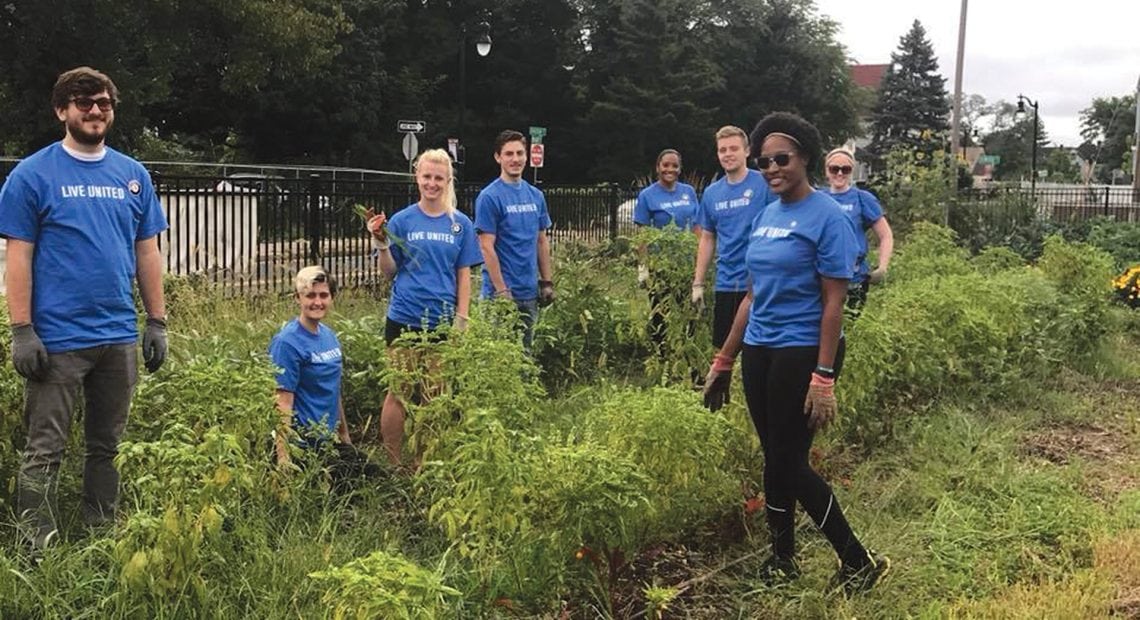
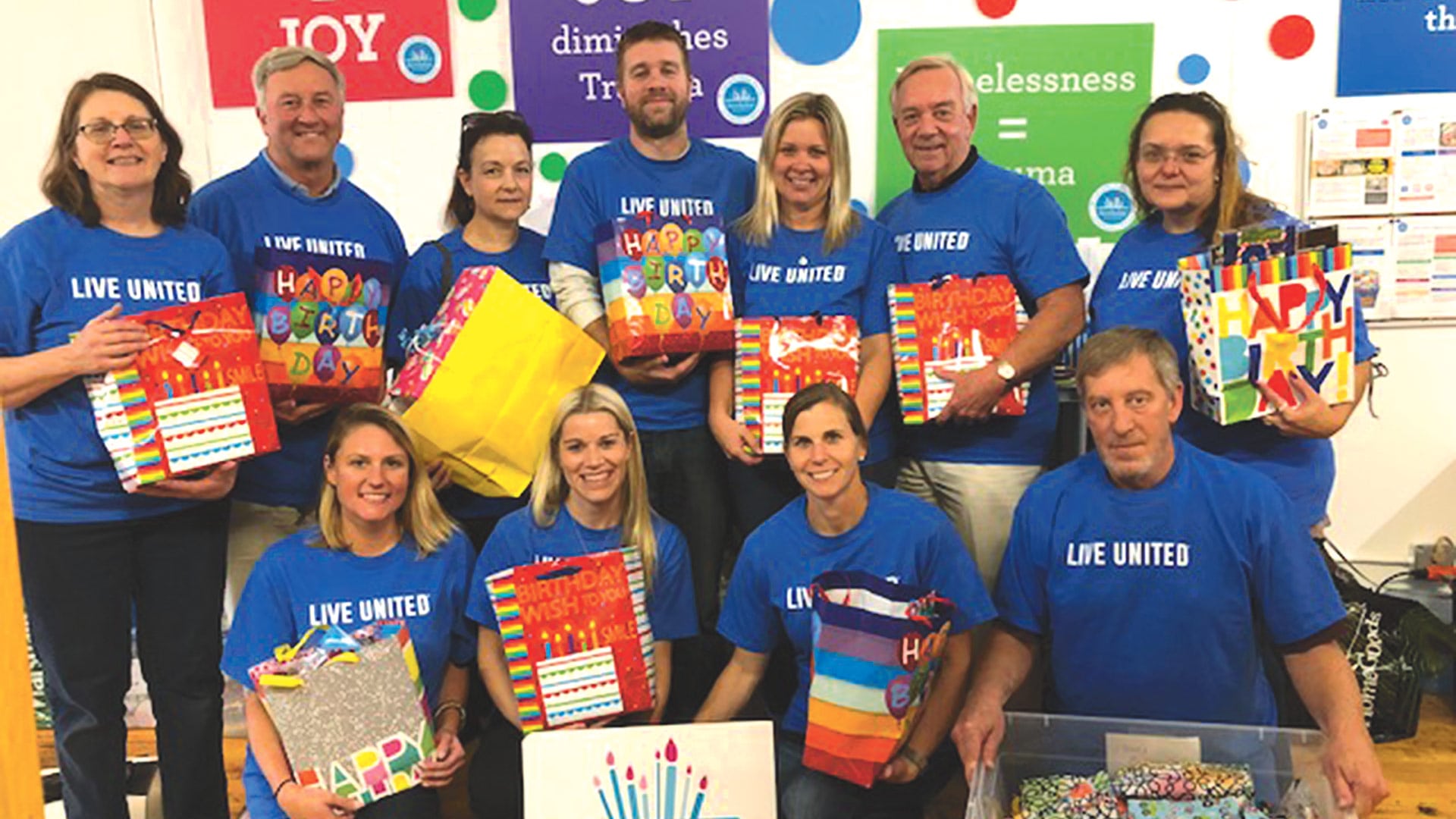
As for the literal part of that equation, ground was broken for the $14 million Educare early education school to be constructed adjacent to the Brookings School, on land provided by Springfield College, and operated by Holyoke, Chicopee Springfield Head Start. This is the 24th Educare School to be built in the United States and the only one in Massachsetts. This was a typical ground-breaking ceremony with a host of local and state leaders, including Lt. Gov. Karen Polito.

As for the figurative part, this development is potentially ground-breaking on a number of levels. Educare represents what is truly cutting edge when it comes to practices in early education, and Educare Springfield represents an enormous opportunity for city residents to help break the cycle of poverty that has existed for decades.

Educare, which represents a national collaboration between the Buffett Early Childhood Fund, Ounce of Prevention Fund, and hundreds of other public-private partners across the country, offers an early education model designed to help narrow the achievement gap for children living in poverty. This model, which involves a full-day, full-year program for up to 141 children from birth to age five, incorporates embedded and ongoing professional development of teachers, intensive family engagement, and high-quality teaching practices, and utilizes data to advance outcomes for students in the program.

In other words it focuses on all three of the critical elements involved on the early-education process: Children, their families, and their educators. And all are equally important.

The students? Their participation in this program is obvious. Study after study has shown the importance of early education in setting young children on a course for life-long learning and providing them a far better chance to stay on that course. The year-long, all-day model translates into a more comprehensive — and more impactful — learning experience.

As for families, they are also an integral part of the early education process. Parents must become invested in the process and in their child’s education, and the Educare model ensures that this is the case.

And the educators? They are often the forgotten piece in this equation. Historically underpaid and seemingly underappreciated, early education teachers have a vital role in putting young children on a path to life-long learning. Ongoing professional development is an important component in this process.

Irene E. and George A. Davis Foundation, a long-time supporter and advocates for early education, played a lead role in making the Educare center a reality. But there were many other supporters as well, including the the Gage Olmstead Fund and Albert Steiger Memorial Fund at the Community Foundation of Western Massachusetts; the MassMutual Foundation; Berkshire Bank; MassDevelopment; MassWorks Infrastructure Program at the Massachusetts Executive Office of Housing and Economic Development; the Early Education and Out of School Time Capital Grant Fund through the Massachusetts Department of Early Education and Care in collaboration with the Community Economic Development Assistance Corporation (CEDAC) and their affiliate, the Children’s Investment Fund; the George Kaiser Family Foundation; Florence Bank; Capital One Commercial Banking; and anonymous donors.

All these businesses and agencies understand the importance of early education, not only to the children and to the families, but to the city of Springfield and the entire region. As we’ve said on many occasions, early education is an education issue, but it is also an economic development issue.

And that’s why this is a ground-breaking development for this area, in all kinds of ways.

Opinion

Opinion

By Kathleen Scoble

This November, voters will make one of the most critical decisions regarding the future of patient care in the Commonwealth of Massachusetts when they vote on Question 1, which would institute government-mandated nurse staffing levels at all hospitals statewide. On the surface, it might appear that using legislation to set registered-nurse-to-patient ratios would benefit patients, nurses, and hospitals, but that is not the case.

If approved, the law would require every hospital to adopt rigid registered nurse-to-patient ratios at all times — without consideration of a hospital’s size or location, and regardless of individual patients’ specific care needs. If this legislation is enacted, the impact will be devastating to hospitals, to the quality and safety of patient care, and to the much-respected role of the professional nurse.

Legislating nurse-staffing ratios is an illogical, unproven approach to providing nursing care to hospitalized patients. In essence, this practice broadly assumes that professional nurses and their nursing leadership are incapable of determining and providing the levels of nursing care required by the patients in their care at any given day or time. It also assumes that lawmakers know better how to care for patients than the professionals to whom these patients entrust their lives.

A far deeper concern is that, if nurse staffing ratios are enacted, nurses will be rendered powerless to step in and do what they know is right — what they know is needed — in caring for patients. A nurse will not be permitted to exceed the legislated nurse-staffing level by assuming the care of another patient arriving on the unit, even if the nurse determines that it is feasible and necessary to do so. How can that be considered safe or high-quality care?

Professional nurses are prepared and committed to coordinating and providing the care of seriously ill patients. I hope to give voters the assurance that nurses do not need a government-regulated staffing ratio to provide excellent care. As the dean of a long-standing and well-respected nursing program, I can confidently report that nurses are educated to be flexible, quick, and competent thinkers, and are capable of independent decision making based on the immediate situation and the circumstances presented.

Finally, it is projected that legislating staffing ratios will drive up costs, which would force hospitals to make deep cuts to critical programs, close patient-care units, and in some cases close down. This legislation could be especially devastating for communities with small hospitals, especially in rural locations where resources are less accessible. Patients in these areas might be forced to travel farther and wait longer for medical care. Again, how can that be considered safe or high-quality care for the citizens of the Commonwealth?

Your vote on this is critically important. I ask you to join Massachusetts nurses, hospitals, and leading healthcare organizations in opposing this costly and unproven proposal. Please vote no on Question 1.

Kathleen Scoble, Ed.D., MA, M.Ed., RN, is dean of the School of Nursing at Elms College.

Picture This

A photo essay of recent business events in Western Massachusetts / October 1, 2018

Email ‘Picture This’ photos with a caption and contact information to [email protected]

Cutting-edge Experiences

Kristen Boyle, a senior psychology and neuroscience major works in the Nuclear Magnetic Resonance facility at IALS.

This summer, the Institute for Applied Life Sciences (IALS) at UMass Amherst launched its first summer-intern program through its core facilities. This program creates hands-on experiences that prepare students for successful careers. Interns worked on tasks like 3D printing and laser cutting; human physiological, biomechanical, and behavioral studies; and cell testing. Many of the students are continuing on with their work throughout the current academic year. Pictured: Kristen Boyle, a senior psychology and neuroscience major works in the Nuclear Magnetic Resonance facility at IALS.

Day of Caring

The United Way’s Day of Caring brought together more than 1,000 people on Sept. 14

The United Way’s Day of Caring brought together more than 1,000 people on Sept. 14 to complete community-service work throughout the region. Many area companies use this day of service as an opportunity to engage employees in team-building and morale-boosting activities. The United Way connects local volunteers to nonprofit organizations and schools to complete tasks such as landscaping, painting, gardening, and other tasks. Pictured, top to bottom: a team from Collins Pipe volunteer at Birthday Wishes, representatives from Springfield College Americorps and BusinessWest volunteer at Gardening the Community, and employees from Belt Technologies spend the day working at the Chicopee Child Development Center.

Beyond the 9-to-5

Square One announced it is expanding access to child care to all hours of the day, to support working parents with second-shift, third-shift, and weekend jobs

Square One announced it is expanding access to child care to all hours of the day, to support working parents with second-shift, third-shift, and weekend jobs. Strategic funding partners include MGM Springfield, Baystate Health, Smith & Wesson, the Center for Human Development (CHD), FOCUS, and LENOX. Funds from these employers were matched by philanthropist Lyman Wood of Hampden. Collectively, more than $100,000 was raised to launch Square One: Next Level. “Square One has a long-standing reputation for strategically responding to the evolving needs of our community,” said Joan Kagan, Square One president and CEO. “We heard from our business leaders and from parents in our community that the lack of child care during evenings and weekends was making it difficult for employees to be successful in their careers and employers to be successful in running their businesses.” Pictured, from left: Lori Nesci of CHD; Annamarie Golden of Baystate Health; Wood; Kagan; Alex Dixon of MGM Springfield; Hannah Butler of LENOX; and Dan McDonough of Smith & Wesson.

Seeding the Future

The National Science Foundation (NSF) awarded two separate grants to Springfield Technical Community College

The National Science Foundation (NSF) awarded two separate grants to Springfield Technical Community College to enhance education in cutting-edge internet technology and advanced photonics, U.S. Rep. Richard Neal announced. The college received $599,388 to develop the Internet of Things Education Project and $551,202 to develop a program called Problem-Based Learning in Advanced Photonics Manufacturing Education. Both grants are designed to support three-year projects that will prepare and inspire students to enter careers in growing science, technology, engineering, and mathematics (STEM) fields. STCC has degree and certificate programs that prepare students for these careers. Pictured at the announcement, from left: Gary Mullett, co-chair of the Electronic Systems Engineering Technology Department at STCC; Neal; and Nicholas Massa, department chair for Optics and Photonics Technology at STCC.

Helping Kids Overcome

Springfield will be home to the first Educare early-education school in Massachusetts

Springfield will be home to the first Educare early-education school in Massachusetts. The groundbreaking for the $14 million school took place on Sept. 17 on Hickory Street, adjacent to Brookings School, on land provided by Springfield College. Lt. Gov. Karyn Polito was joined by Springfield Mayor Domenic Sarno; Educare officials; Janis Santos, executive director of Holyoke Chicopee Springfield Head Start; local leaders in philanthropy and project funders; representatives of Springfield College and the Old Hill Neighborhood Council; elected officials; and other community members for the ceremony. The center is expected to open in late 2019, offering an early-education model designed to help narrow the achievement gap for children living in poverty. Funding for the project comes from a variety of local, state, and national sources. Pictured at top: state, local, and elected officials, as well as representatives of Educare, Head Start, the Davis Foundation, O’Connell Development Group, and others break ground on Educare Springfield. At above: Polito holds up signs made by Head Start children.

Linking the Community

Link to Libraries recently held an event at Mercedes-Benz of Springfield to recognize its Business Book Link sponsors

Link to Libraries recently held an event at Mercedes-Benz of Springfield to recognize its Business Book Link sponsors. Pictured top: From left, Michael Matty, president and director of St. Germain Investment Management, Peter Wirth, co-owner of Mercedes-Benz of Springfield, and William Trudeau, president and CEO of the Insurance Center of New England. Above: Amy Rediker and Andrew Anderlonis of Rediker Software, and Laurie Flynn, president and CEO of Link to Libraries. (Photos by Sarah Gallagher)