2015 Regional Philanthropic Opportunities
Click HERE to download the 2015 Giving Guide PDF flipbook!




Click HERE to download the 2015 Giving Guide PDF flipbook!



These two renderings, one from 2013 (top) and the other from this fall (bottom), show the dramatic change in design for MGM Springfield, which has been a source of recent controversy.
BusinessWest: Back in March, MGM staged an elaborate groundbreaking ceremony in the South End. There were several hundred people there, lots of excitement, and great anticipation that this project was going to start changing the landscape. That hasn’t happened, obviously. Can you talk about what appears to be a false start, why the South End looks the same as it did nine months ago, and why the timetable has been pushed back to late 2018?
Mathis: “We certainly expected that the groundbreaking in the spring would roll into demolition of the Zenetti School, which was the backdrop for the groundbreaking, and then new construction. But shortly thereafter, we started to hear rumblings about the viaduct project and the new timelines related to that. We heard the rumblings that it would be delayed past our late September [2017] opening, to the tune of 12 months or so.
“As a result of that, we started thinking about our own schedule over the spring and summer of 2015. There’s an inner relationship between the viaduct project and our project; I have to be careful with percentages, but about 90% of our arrivals will come off 91, so the viaduct is a crucial part of our business plan. When we realized that project would be delayed past our opening, we spent a good deal of the spring and summer trying to understand the new schedule, the performance history of the contractor, and the nature of MassDOT’s history on delivering on projects.
“And, no matter how good you felt about their ability to do it, we wanted to build in a little bit of conservatism. For a very long time, the project showed a late-2017 completion, and in many ways that made us nervous because there wasn’t much opportunity for slippage … we heard that there might be a new timeline associated with letting that contract out by the state, and we just reacted to it.”
BusinessWest: As it turned out, that change in your schedule was just the beginning when it came to emerging doubt about MGM’s commitment to Springfield and this project, which culminated in several press conferences and project updates this fall, where you and others with the company reaffirmed that commitment. Can you talk about what transpired and why?
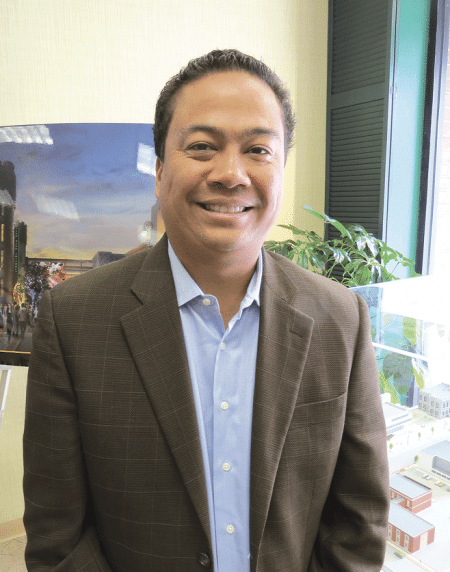
Mike Mathis says he believes MGM has put concerns about the company’s commitment to Springfield and the South End project in the past.
“I personally made the decision, and it was supported by the local team, that it’s a mistake to continually deny something that has no rationale in it. So we went quiet when people were saying ‘this is a signal’ and started talking about MGM’s lack of commitment. That void allowed some of the naysayers to get out there and talk about how this was the first shoe to drop, whether it be the schedule extension or the proposed design changes.
“When you really talk to a lot of people who were concerned, it was less about those specific items or the substance of those specific items; it was concern that it was the beginning of something else.”
BusinessWest: What has been the basic strategy when it comes to quelling these concerns, with both the public and elected officials?
Mathis: “Just getting information out to people, information that we believe shows that we are committed to Springfield.
“It didn’t help that some of this news dropped during the last six weeks of a municipal election cycle, because I think everyone’s looking for their issue to rally around, and for whatever reason, painting MGM as the bad guys that were going to be held to their promises was something that certain elected officials thought was a rallying call for their constituents. I didn’t understand it, I still don’t understand it, but I like to think we’re past it.”
BusinessWest: Certainly part of that perfect storm you described was the decision to scrap the hotel tower in favor of a six-story facility. Can you talk about that decision and why you think it became such a lightning rod for criticism and doubt?
Mathis: “Personally, I knew the tower was significant visually, because we touted it in a lot of our materials. So I expected to have a dialogue about it, I expected people to ask questions, and we were prepared to answer those questions. Early on, we had the support of the mayor, and his architectural consultant called the change brilliant, said it energized Main Street, and was more consistent with what we were doing with the rest of the project.
“We knew people would feel strongly about the tower, and some people would feel strongly in favor of what we were doing. But I think we were expecting a little more deference as the world-class developer to the changes we proposed. What surprised me and what surprised the team was the lack of trust that some of the public had in our expertise in this area.”
BusinessWest: Does the lack of a tower put MGM Springfield at any kind of competitive disadvantage, in your opinion?
Mathis: “We really don’t believe the tower is a competitive factor. Part of this road show I’ve been on explaining all these changes is explaining to people that the tower is the least compelling part of our project. And some of the comments we got during the evaluation process, by both the city and the state, back that up; the tower was actually called out, and analysts said it was the least attractive part of the project in terms of what we’re trying to do downtown.
“One of the things I’ve been saying to people is that ‘you can’t see the tower from Hartford.’ The power of our project is the MGM brand, the marketing, the outreach, the programming you put at the MassMutual Center in terms of entertainment. In multiple-jurisdiction markets, you have the competition of the neon across the street; it’s the ‘hey, look at me’ factor. So you need something very visual.
“Foxwoods has a tower, Mohegan has a tower, but a tower doesn’t distinguish the project. If anything, the low-rise we’re proposing is a cooler feature; being on Main Street is a more unique experience.”

Mike Mathis says MGM does not believe that scrapping the hotel tower for a six-story facility will present a competitive disadvantage.
Mathis: “What’s unique about Massachusetts and the Springfield project is that we’re doing it under so much public scrutiny. So much of it is in different venues, be it the city or the Gaming Commission. And we knew coming into this opportunity that this was a privileged license, and as a result, the public feels, and rightfully so, that they have an ownership stake in the project.
“I can’t think of anything in the MGM portfolio where we’ve come into a process like this; in Las Vegas or Macau, and in multiple-license jurisdictions in general, they tend to be more pro-development, and it’s development as a right, as I describe it. And because of that, we joke around in the office these days to never take for granted the days when we could go down to Clark County, which is the jurisdictional body in Las Vegas, and pull a permit; you pull a permit, and three years later we see you at the grand opening. That’s oversimplifying it, because they do have some control over some of the program and design, but generally it’s development as a right.”
BusinessWest: So has this been a learning process in some respects?
Mathis: “It has been. For MGM, this has been a pretty unique, sort of sole-license jurisdiction bid, and I don’t think we were quite ready for the kind of scrutiny that came with this.
“But in fairness to the public and some of the folks we’ve been dealing with through this process, much of this has been self-inflicted by MGM because we made some significant changes in the design, and but for those changes, I think we’d be well on our way — not from a scheduling standpoint, because that was outside of our control, from our view, but from a design and momentum standpoint, we feel we’d be in a different position if we didn’t need to make some of the changes we proposed.
“But this isn’t unique. We make some of those kinds of changes with our other projects all the time, and you wouldn’t notice, much less feel it from the public like we have. Things are exponentially simpler in Las Vegas and some of the other jurisdictions we’ve worked in because there’s already an established procedure for these kinds of projects. They care about parking, and they care about certain architectural elements — how far is the building set back, what are the heights, some really objective criteria. And once you check those boxes, you’re generally good to go.”
BusinessWest: How close is MGM to being good to go with its Springfield project? Do you believe you’ve put doubts about the company’s commitment to Springfield and this project behind you?
Mathis: “The quick answer is ‘yes.’ If we hadn’t earned trust back in 2012, 2013, or 2014, I think we earned it with this last round of discussions. What I’m hoping is that, if or when there’s an issue, next time we get a little more of a benefit of the doubt from the public.
“I hope there’s a sentiment that we’re not leaving town, we’ve made a substantial commitment, and every day that goes by, our commitment grows. And I hope that elected officials give us the time to work through an issue, knowing that we have the best interests of the city in mind.”
BusinessWest: Certainly the doubts about MGM’s commitment to Springfield have been fueled by the rumors that Foxwoods and Mohegan Sun, with the support of the state, will be building another Connecticut casino close to the border with Massachusetts. If that third casino becomes reality, how does that impact your plans for MGM Springfield?
Mathis: “If that competition comes, and it comes across the state line — which is not the best thing for Connecticut or Massachusetts, because there are other opportunities in Connecticut that aren’t in our backyard that would be better for MGM but also better for Connecticut — it won’t impact our project other than to potentially increase the investment we’re going to make.
“That’s because we’re going to have to be that much more attractive a destination. From what I’ve understand, what they’re talking about in Connecticut is a slots facility, $300 million or so, which represents about a third of what we’re investing here. It’s tailored to the convenience gambler, and on the edges that will hurt our business, but what I think will be really important in my mind, as leader of this venture, is that it will simply raise the bar for what we have to do in Springfield and make it that much more worth it to go the extra 20 minutes to get to our facility.”
BusinessWest: Looking back over the past nine months or so, what could, and what should, MGM have done differently?
Mathis: “That whole process of going from where we had a large amount of support from the public to having things devolve into putting out fire after fire is one of those situations where the more you refute something, the more you legitimize it, and that’s something we tried to avoid early on when some of the naysayers came out and questioned our commitment. I don’t know if there’s ever a right way to handle something like that because it’s not completely rational.
“We’ve done what feels like a postmortem on the past six months, trying to think about how, if we had to deal with some of these same issues again, we might do things differently, we might handle them differently. I think part of the challenge we’re always going to have is being transparent with the public in sort of real time. And that doesn’t lend itself to perfect or full information.
“We’re always going to err on communicating a problem and then finding the solution. Maybe we could have done a better job of letting people know that ‘this is the problem, and we’re working on a solution.’”
George O’Brien can be reached at [email protected]


Dan Flynn calls it “soft confidence.”
That simple, two-word phrase goes a long way toward explaining the current state of the local and national economy and the general attitude concerning it among business owners.
Elaborating, Flynn, executive vice president and chief operating officer of Wholesale Banking for West Springfield-based United Bank, said many of the institution’s commercial clients are doing well — not as well as before the so-called Great Recession that started in 2008, but performance has been solid. Some even recorded their proverbial ‘best year ever’ in 2015, he noted, adding that most saw at least improvement over 2014.

Dan Flynn says many area businesses had a solid 2015, but the question moving forward is whether that performance can be sustained.
But — and this is an important ‘but’ — these business owners are not at all sure that such performance is sustainable given a host of factors that are almost all well beyond their control. These range from global and domestic violence to still-spiraling healthcare insurance costs to extreme uncertainty about who will prevail in the 2016 presidential election — and what he or she might do after getting elected.
Thus, existing confidence is, well, soft.
“For most business owners, their inventory backlog or their job backlog is building, but they don’t have the confidence that this will sustain itself in 2016 or 2017,” Flynn explained. “They think it will, but it’s not like that flat-out ‘we’re confident, we’re going to hire a couple of extra people, we’re going to add a second shift.’ They’re not that confident.”
John Patrick agreed. The CEO of Farmington Bank, which recently made a foray into the Western Mass. market with locations in West Springfield and then East Longmeadow, said there is some optimism about the year ahead, but there are also serious doubts, enough to keep confidence from becoming deep or profound.
“The economy, especially the local economy, is all about confidence,” he noted. “And I wouldn’t say there is strong confidence in the marketplace relative to everything that’s happening around them.”
And by ‘everything,’ he meant factors ranging from terrorism in Paris and California to the ever-rising cost of health insurance.
Bob Nakosteen concurred, summoning another word to describe the current picture and outlook for 2016: ‘fuzzy.’
He would go into much greater detail, obviously, but Nakosteen, professor of Economics at the Isenberg School of Management at UMass Amherst and co-editor of MassBenchmarks, the quarterly publication devoted to analysis of the Bay State economy, said that one word pretty much does the job.
Indeed, the outlook is fuzzy, as in not sharp, not clear, and, for the most part, not predictable.
“The picture is fuzzy, and through the fuzziness, we see a lot of positives, but we also see some risk,” he explained. “There’s a lot of internal strength in the U.S. economy, and it is going to overcome various weaknesses, and that means this state is going to do well. It’s a mixed picture, but the overall trend is positive. But do I have 100% confidence in what I just said? Absolutely not.”
That’s soft confidence personified.
“We’re in the middle of a slowdown … it’s not anywhere near a recession, but we’re definitely seeing some slowing,” Nakosteen went on. “The economy has been growing at 2% or a little less, and that’s not vibrant.”

John Patrick says a number of area manufacturers have seen exports impacted by the weakening of many foreign currencies.
Moving beyond ‘fuzzy,’ Nakosteen, like Flynn and others we spoke with, said there are a number of factors impacting the state and national economy — everything from a weak Canadian dollar, which is hurting exports to that country, to the fact that most Americans are not putting the money they’re saving at the gas pump back into the economy, to impressive job growth in the Commonwealth (if not Greater Springfield). Together, they make predicting what will come next an even more difficult assignment than it generally is.
Most observers are expecting growth to remain right around that 2% level, but it could go higher or lower depending on how matters evolve, especially that critical confidence level among business owners.
As he talked with BusinessWest about 2015 and what will likely happen in the year ahead, Nakosteen said there are certainly plenty of reasons to look at the glass and declare it at least half-full.
“Within the lack of clarity that we’re seeing, there lies a solid core of economic strength,” he explained, adding that the Bay State continues to match or outperform the nation overall, but it is very much dependent on the relative health of this country, as well as international markets, for its success.
As evidence, he cited some recent data showing that Massachusetts is experiencing an economic expansion in many ways reminiscent of the late ’90s, though without the impetus of the tech bubble that drove that cycle, meaning that this one is more well-rounded.
Gross state product is growing robustly, he went on — 7.1% for the second quarter compared to national GDP growth of 3.7% — and employment growth is steady, although limited geographically. The unemployment rate remains low by historical standards, and has been below the national rate since — and even before — the Great Recession.
“The current expansion appears to be on firm footing — the economy in the state has slowed down recently, but it’s still been a really good year,” he said while offering the global view.
“We’re expecting strong growth over the year or so,” he went on, using ‘we’ to mean the editors at MassBenchmarks. “It might be as strong as what we had up to the second quarter of this year, but pretty solid growth. How much of it makes its way out to the western part of the state remains to be seen.”
Flynn agreed.
“Overall, clients performed better over the past 12 months than the previous three to four years,” he said while generalizing the comments of business owners within the bank’s portfolio. “As a whole, they’re not seeing the same rate of return as before the recession, but they’re doing better than they were a year ago.
“And it’s across the board,” he went on. “You can take retail, manufacturing, wholesalers … generally, companies are performing better than they had.”
Given all that, though, the question looming over 2016 is whether that performance — by individual companies and the economy as a whole — can be sustained. And strong doubts about whether it can have led to heavy use of phrases such as ‘soft confidence,’ ‘fuzzy picture,’ ‘mixed signals,’ and the always-popular ‘cautiously optimistic,’ which Flynn said he’s heard repeatedly.
That’s because most all of the factors that will decide the fate of 2016 come complete with ‘ifs,’ ‘buts,’ question marks, and both points and counterpoints.
Take the jobs picture, for example. The nation’s economy added another 211,000 jobs in November after a gain of nearly 300,000 in October, a solid boost by most accounts that exceeded almost all expectations and propelled the stock market to a more than 2% gain the day the figures were released.
But do those numbers and the stated 5% national unemployment rate reflect real progress in what’s happening locally? The short answer is ‘no’ or ‘probably not.’
“I was in New York recently, and I heard a nationally respected economist who said that, if you really take a look at the numbers, unemployment on a normalized basis is closer to 9% when you take into consideration all the people who are unemployed and those working part-time who would prefer to be working full time,” said Patrick.
Like others, he noted that, overall, many employers have not yet reached — and likely won’t reach for some time — that threshold of confidence needed to add back some of those employees trimmed during extensive efforts during and after the recession to become more efficient and rightsize.
“Businesses are a little apprehensive about continuing to make significant investments in people, technology, and franchise, because they’re just unsure about what’s going to happen,” Patrick told BusinessWest. “And there many businesses that, because of the cost of healthcare, don’t want to go over that 50-employee number, and they’re trying to manage their business accordingly.”
Meanwhile, Nakosteen said, despite the start of work on the Springfield casino and a host of other construction projects across Western Mass., the employment needle has “barely budged” in the city of Springfield, meaning the jobless rate is still hovering around 9%, in sharp contrast to what’s happening elsewhere in the Commonwealth.
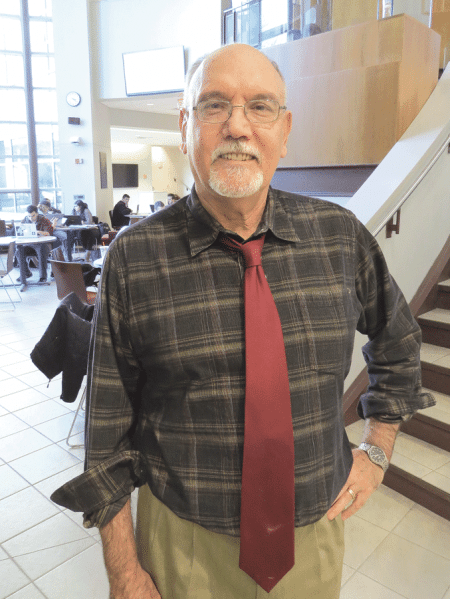
Bob Nakosteen says the Bay State added jobs at an impressive clip in 2015, but by and large, those gains did not extend to Western Mass.
“Employment in the state has really grown at an amazingly fast clip over the past year to 18 months, but it’s not the same in Western Mass., as is usually the case,” he explained, adding that the Bay State has added 50,000 to 60,000 jobs over the past year, most of them in technology-related sectors, although healthcare and education remain solid contributors to such growth.
“A different picture emerges out here,” he went on, talking from his office on the UMass Amherst campus. “Springfield has added a few jobs but not many — at least it hasn’t gone down. The picture is better in the larger metropolitan area, but all the construction is in Springfield, so that’s where it should be recorded, but so far we’re not seeing it.”
Another factor that is contributing to uncertainty is the stronger U.S. dollar. It certainly benefits those traveling overseas and has provided a huge boost for airlines and cruise lines, but overall, a strong dollar hurts exporters, including the many precision manufacturers that call the Knowledge Corridor home.
“I think many of the manufacturers in this region got off to a good start in 2015 and had good backlogs,” said Patrick, referring to companies on both sides of the border. “But companies within that corridor are usually producing a product that has export potential, and because of the strong dollar internationally, they’ve seen a lot of the orders slow down and some of them put on hold, with the buyer saying, ‘what we’ll do is wait for the dollar to drive down in value a bit.’”
There was some movement in that direction in early December, he noted, but overall, the dollar remains quite strong against all other currencies, and until a pattern of weakness occurs, exports will continue to suffer.
Nakosteen agreed, and said one country often overlooked when it comes to currency rates is Canada. It is a big trading partner, and at the moment that country’s dollar, also known as the ‘loonie,’ is in a hard spiral fueled by a host of factors, including falling energy prices and questionable monetary policy.
“Canada is our most important trade partner; a year ago, it was about one U.S. dollar to one Canadian dollar; now, a Canadian dollar is worth about 70 cents,” he explained. “What that means is for Candians, U.S. products are much more expensive, and you can see it in the export numbers — they’ve really dropped over the past year.”
As for falling oil prices, which analysts say will remain low for the foreseeable future, they are not producing a surge in consumer spending, as some had predicted, and in the meantime, they are taking a hard toll on the energy industry, which is having a ripple effect, in this country and elsewhere.
“We have not seen the surplus from lower gas prices turn into consumer spending — it’s going into savings or to reduce debt,” Nakosteen said. “It has not created the bump that was expected by everyone, including me.
“From everything I’m reading in the energy industry, low gas prices are here for a while,” he went on. “So it will be interesting to see if, over time, consumers start behaving a little differently and take this surplus and spend it.”
Still another factor is interest rates, which, after that strong November jobs report, are almost certain to rise after roughly seven years of stagnancy. The projected 0.25% increase, though minor, will finally bring some measure of relief to investors who have focused on low-risk options, such as bonds, which have yielded marginal returns. But the hike will also make borrowing more expensive, and this may slow the economy somewhat.
Cliff Noreen, president of Springfield-based Babson Capital, told Bloomberg News Radio recently that he welcomed the U.S. interest rate hike — “I think it’s about time; it’s been seven years, and we’ve been living with manipulated rates for that long, and we should go back to a more normal rate environment.”
“I think the biggest victims today are retirees — they retired with the assumption five or 10 years ago that they would earn a risk-free rate of 4%, 5%, or 6%; now, the risk-free rate is zero,” he told Bloomberg. “So they have to take more risk to make their return to live on, and they’ve been forced to invest in higher-risk assets like high-yield bonds and stocks, and they’ve had to adjust their asset allocation to make up for the zero-percent rate environment we’re in globally.”
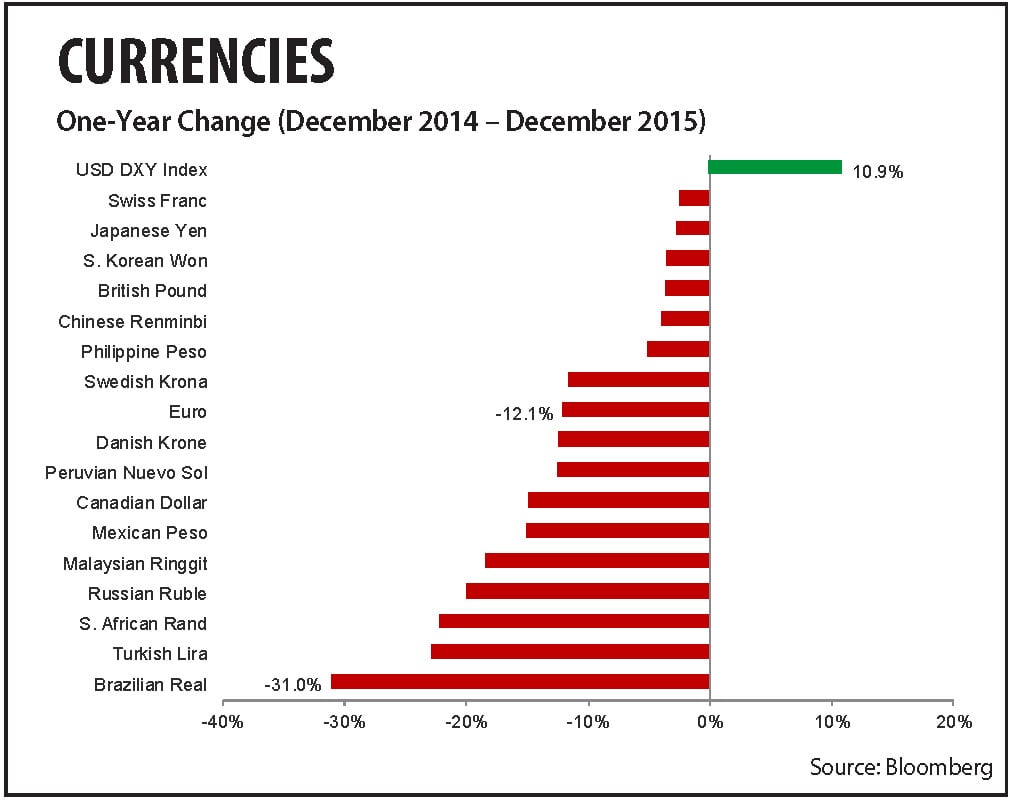
 Overall, Noreen said there were several surprises in 2015 — from falling commodities prices to spiraling foreign currencies (see charts) to gasoline prices that could have fallen further than they did — and all signs point to these conditions (and the negative impact and uncertainty they bring) continuing into 2016.
“We expect lower-than-normal investment returns for all asset classes,” he noted, “and slow economic growth globally, although things have been stabilizing, and continued very, very low interest rates that are in the process of rising.”
And there are still other factors to consider looking ahead, said Noreen, listing everything from a slowing of the growth rate in China to slowing corporate-profit growth in this country, and historically low yields on bonds, with many European countries, including Germany, France, Belgium, and the Netherlands, gaining status in what Noreen called the “negative-rate club.”
As for the upcoming presidential election, Nakosteen noted that, while elections themselves typically don’t have an impact on the economy and individual presidents don’t often dictate fiscal policy, elections do generate anxiety, which has its own trickle-down effect.
Speaking from experience, Patrick agreed, noting that the one commodity business owners dislike the most is uncertainty.
And because there is no lack of it at the moment — not just because of the election but all those other issues mentioned above — there is a corresponding shortage of perhaps the most important element for at least the short-term health of the regional and national economy: confidence.
There is confidence that the progress measured in 2015 can be sustained, but, as Flynn noted, it is soft confidence.
And as long as that condition remains, the picture for 2016 will remain fuzzy.
George O’Brien can be reached at [email protected]

Kate Preissler says she wants history to come alive for Wistariahurst visitors.
Throughout its history, the property now known as Wistariahurst Museum has been referred to as one of the “showplaces in Holyoke.”
Indeed, during the holidays, the former home of silk manufacturer William Skinner and his wife, Sarah, is truly a sight to behold with its enormous curved stairway draped with holiday garland and Christmas trees twinkling throughout its 22 spacious rooms where lofty ceilings and elaborately detailed architecture speak to a bygone era.
Tickets were sold out weeks in advance for performances of “Nutcracker & Sweets” staged by the Massachusetts Academy of Ballet, which ran Dec. 11-13. The annual event captures the magic of the holidays in the spacious Music Room that Belle Skinner, daughter of William and Sarah, built to house a collection of musical instruments after her parents’ deaths.
“This season’s performance of the Nutcracker was set in Holyoke, rather than Russia, and there were references in it to the city’s history. The father figure was cast as William Skinner, and his daughters Belle and Katharine were also depicted,” said Museum Director Kate Preissler.
Although the event is extremely popular, December is actually a quiet time for Wistariahurst, which stages a plethora of programs throughout the year that appeal to children, families, adults, and people of varying interests.
“The Nutcracker is our biggest holiday event, but we’re owned by the city of Holyoke, and our mission is preserving the history of Holyoke and inspiring an appreciation of history and culture through educational programs, exhibits, and special events,” Preissler told BusinessWest, adding that, over the past decade or so, those events have shifted from museum tours and formal affairs to a wide variety of offerings.
For example, last month Holyoke Wellness Coordinator Julia Wilkins began holding strength-training classes for city employees in the Music Room, while a few weeks later an elegant event called Winter Festivitea was held in the same space, and guests sat at elegantly decorated tables and sipped tea while they were entertained by live music.
“We are complex and use the physical space to provide as much value as we can,” Preissler said, as she conducted a tour through two of the home’s three stories, including a visit to the Leather Room with its leather wallpaper, a noteworthy library, Belle’s bedroom, the conservatory where a stained-glass peacock window is believed to be a Tiffany original, the dining room next door with two fireplaces, and the grand, sweeping staircase Belle added to the home.

“We hold a wine tasting here in February, and our annual gala takes place in June in the gardens,” Preissler noted. “It’s our primary fund-raising event, and people come outfitted in period dress and dance to live music in Belle’s Music Room. Last year it was held on a beautiful night at sunset, and you could see people throughout the garden in ’20s clothing who were probably imagining what it would have been like when the Skinner family lived here.”
The museum greets 12,000 to 14,000 visitors a year, and most come for events, rather than tours of the home. About 15 wedding ceremonies take place in the Music Room each year, and some couples hold their receptions in tents on the manicured grounds.
“We’re an exclusive venue for people looking for a historic place to get married in; Wistariahurst offers an intimate and beautiful setting,” Preissler said, adding that photos are often taken on the grand staircase, and harpists, classical guitarists, and pianists have been hired to play before and after ceremonies.
There are also seasonal holiday teas and a Mother’s Day Tea, which Preissler said give people an opportunity to have fun in the museum.
“Last fall we held a Mad Hatter Tea which was really popular. It attracted a lot of people who had never been here before, and many came in costume,” she noted. “They enjoyed a formal tea in the Music Room, played croquet on the lawn, and did crafts. It was a multi-generational event that was meant to be a way for kids and families to relax and enjoy themselves here.
“There is always the feeling of being in a historic home where Belle Skinner entertained her guests, but it’s important for our visitors to have fun,” she went on, repeating the word that she used frequently to describe what goes on inside Wistariahurst today.
Curator and City Historian Penni Martorell said William Skinner emigrated to the U.S. from England in 1874. “He was a skilled silk dyer and established a silk-manufacturing and dyeing business on the Mill River in Haydenville,” she noted.
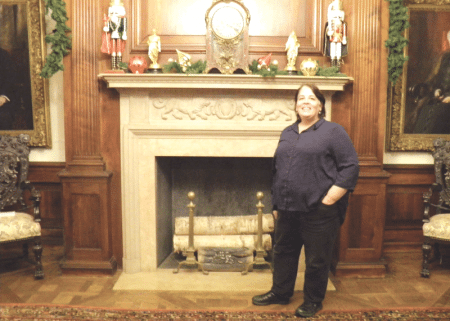
Penni Martorell says Belle Skinner took a real interest in the gardens of Wistariahurst and added a rose garden and Japanese tea house.
The business was destroyed when the river flooded following a dam breach in 1874, and Skinner relocated the operation to Appleton Street in Holyoke. He also relocated his Haydenville home, which had been designed by William Fenno Pratt, who also designed Northampton City Hall and other noteworthy structures. “Skinner had the home dismantled and moved to Holyoke,” Martorell said.
His second wife, Sarah, was an avid gardener, and although photos from 1875 show the home surrounded by barren grounds, her letters and diaries are filled with references to the plantings and trees she established on the site, which include the renowned wistaria vines that still bloom profusely every May.
They became widely acclaimed for their beauty, and their flowering was reported in local papers, which eventually led to the home’s name.
After William and Sarah died, their two unmarried children — Ruth Isabelle (“Belle”) and her brother William — inherited the home and used it as a summer residence.
“They entertained quite frequently, and Belle added onto the home,” Preissler said, including the addition of a sweeping staircase so she could make a grand entrance at parties, as well as the magnificent Music Room to house her collection of antique musical instruments.
“Belle’s collection was well-known and contained a spinet reputedly owned by Marie Antoinette and a Stradivarius violin,” Preissler added. “It was donated to Yale University and resides there today.”
The home and grounds remained in the family until 1959, when Katharine Skinner Kilborne, the youngest child of William and Sarah Skinner, and her heirs donated Wistariahurst to the city of Holyoke for cultural and educational purposes.
It operated as a museum under the auspices of the Holyoke Public Library for many years, but today a private foundation called Historic Holyoke at Wistariahurst supports its programming, events, and communications.
“The annual operating cost is $200,000, and the city pays $170,000 of that amount, while the remainder comes from fund-raisers, membership programs, and donations,” Preissler said, adding that the facility has two full-time employees, three part-time employees, and a large, dedicated staff of volunteers.
Martorell said a lot goes on behind the scenes.
“We have a docent program, and the collections we house are an important part of Holyoke’s history. They include letters, photographs, records of businesses, the Skinner family’s collection of correspondence, and records for Skinner and Sons Manufacturing, as well as the Carlos Vega Collection of Latino History in Holyoke,” she told BusinessWest, adding that the Vega collection was established in 2012 and is significant because nearly 50% of Holyoke’s population is Latino.
The museum also houses a textile collection containing many Skinner silk and satin wedding gowns and period clothing, and the archives are used by the Five College community and local genealogists.
“We want to use the past to inspire residents and visitors and give them new perspectives on life,” Preissler said. “History doesn’t have to be boring. People understand it better when it is presented in a way that allows them to be active participants, and our goal is to have them leave feeling that they want to come back and experience more.”
To that end, a Pumpkin Glow was held in October. Teens from the city and professional artists carved faces and designs on a large number of pumpkins, which became an outdoor exhibit that was viewed by about 250 people.
“The pumpkins were lit in the gardens at dusk, and a lot of families and people who had never been here before came to see them,” Preissler said. “It’s the combination of activities that gives us our identity, and we try to provide opportunities for different interests. For example, we hold a historical lecture series as well as Family Fun Days.”
Concerts are staged inside and outside Wistariahurst on its beautiful grounds that have been restored over the past decade. “They provide a lot of green space that is open to the public at no charge from dawn to dusk,” Preissler continued. “The gardens were inspired by designs created by Sarah Skinner and the three acres contain a beautiful rose garden, an azalea garden, 53 types of trees, 43 types of hosta and our signature wisteria, which was planted in the 1880s and grows up the side of the house. People come here to read books or walk the grounds; families bring picnics and we have had kids playing tag in the roses. It’s a particularly magical place for children where they can run around, feel safe and have fun.”
Martorell said the museum also houses a gallery that exhibits works by local artists that change every two months. In 2016 the facility will host a landscape show staged by Holyoke Art League and a spring program titled ‘Nuestras Abuelas de Holyoke,’ which is Spanish and translates to “our grandmothers.”
It will include photos and oral histories of residents and will be put on by curator Waleska Santiago and invited guests, she noted. “There will also be an exhibit by students from Holyoke Community College and a Rotary collection that will put on display from our archives.”
Preissler noted that Wistariahurst wants to become known as a premiere cultural venue, so it strives to hire exceptional musicians and performances.
“We’re planning a curated music series for next year and have brought musicians here that have a distinct sound that is new and fresh in the area,” she said, adding that performers have included jazz musician Michael Sheridan, gypsy music from the Roma culture performed by The Bohemian Quarter, and banjo music played by Cynthia Sayer.
“We are supported by the community, so it’s important for our programs to improve the quality of life and involve things that people can enjoy and respond to,” she added.
Preissler said the programming at Wistariahurst has evolved in conjunction with events held at other historic homes and museums. “There is a realization that we need to have more participatory experiences where visitors are actively engaged,” she noted.
Next year a member of the board of directors, a grandson of Katherine Skinner and the last living descendant to live in Wistariahurst as a child, will give a number of guided tours. In addition, there will be plenty of fun-filled events to round out the agenda.
“We will continue work to engage our audiences in new ways,” Preissler continued.
Which is exactly what Belle Skinner did when she built rooms in Wistariahurst to house her collections and entertain guests in a grand style.
So, the tradition of transforming Wistariahurst to bring it into the present will continue long after the holiday season is over in a home resplendent with history that sits quietly right in the heart of Holyoke.

Editor’s Note: This is the latest in a series of stories exploring a surge in entrepreneurial energy across the region and the startup companies that are defining this renaissance.
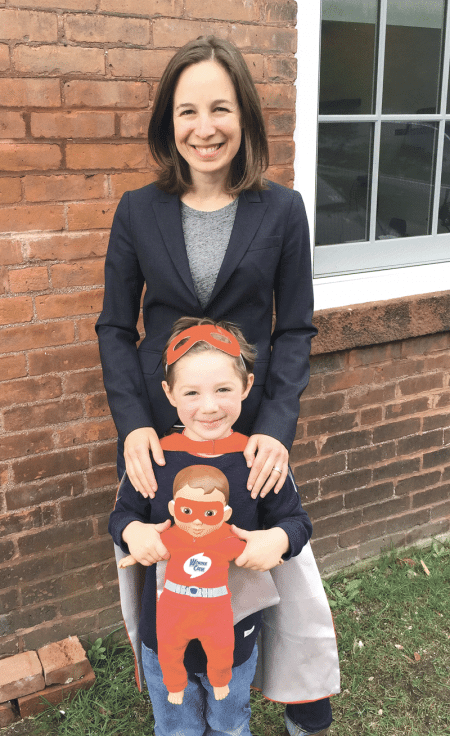
Laurel Wilder with her son, and ‘Will.’
Laurel Wilder says her entrepreneurial adventure started with the note that came home from preschool with her son nearly two years ago.
“It said, literally, that boys aren’t supposed to cry,” said the Northampton-based psychotherapist, who told BusinessWest she was floored by the missive.
“We’re in Northampton, and we talk all about emotions in our household — it’s a completely OK thing to express them,” she went on, adding quickly that, while she was certainly angered by the message, she was forced to conclude that such sentiments are, unfortunately, pervasive. “It’s out there, no matter what environment you bring your child up in … the message is that boys ought to be strong and self-reliant and not vulnerable.”
Her anger and resignation eventually turned to resolve — entrepreneurial resolve — in the form of Wonder Crew, 15-inch-high, soft-bodied dolls that have been created to help give boys the opportunity to build emotional intelligence and creativity.
In that respect, they meet what Wilder described as a long-unmet need, one that society, and toymakers, either didn’t recognize or weren’t in any hurry to address.
Indeed, for decades, if not longer, society has focused on girls and play as a means to build social skills, responsibility, and creativity, and dolls have certainly been at the forefront of that, Wilder maintains. Boys? Well, not so much with any of the above.
“The feeling’s been that the boys are all right,” she said, using that phrase to refer to the status quo when it comes to toys for them — action figures, cars, trucks, sporting goods, and the like — and the attitude that, when it comes to boys, toys don’t have to help build social and emotional skills, connection, empathy, and nurturing.
Wonder Crew starts with a different attitude about play, she said, describing her product as a cross between, or combination of, American Girl doll, action figure, and favorite stuffed animal.
“Action and adventure meet friendship and teamwork — that’s Wonder Crew,” she explained.
In other words, this is something unique, said Wilder, who believes there is nothing quite like Wonder Crew on the market, and because of that, her concept has enjoyed success on a number of levels this year — everything from sales from virtually every corner of the country to winning $27,500 for her enterprise at Valley Venture Mentors’ first Accelerator Awards last spring; from a ton of press fueled by a surge in interest in boys and dolls to talk of a television cartoon show involving Wonder Crew characters.
“In the toy industry, that’s a pretty incredible opportunity — it gets Wonder Crew’s message out, but it’s also really dynamic marketing,” said Wilder of the TV production, acknowledging that, usually, toys are born from shows, not the other way around, and that this potential development is more evidence of how intriguing the Wonder Crew concept is.
The dolls hit the market earlier this year following a Kickstarter campaign that netted $40,000, enough to create a prototype and commence production.
And as the holiday shopping season enters its final weeks, Wilder is well-positioned to capitalize on the media attention given to her product, and that larger issue of boys, play, and dolls. She’s in several local stores already, and early sales have been positive.
For this issue, BusinessWest continues its intriguing series on the wave of entrepreneurial energy in the region and surge in startups with a look at a unique toy born from a desire to take play to a higher, more important level, and remove the stigma attached to boys and dolls.
Wilder noted that, while the name on the product’s box is ‘Superhero Adventure Crewmate,’ her creation is not at all like action-hero figures — everything from GI Joe to the Caped Crusader — that parents could have purchased for boys over the past many decades.
‘Will’ — that’s his name, and its stems from the character ‘William’ from the book Free to Be … You and Me (who wanted to play with dolls and was ridiculed for it) — is not about guns and muscles. Instead, he’s about … well, whatever the child who opens the box decides he’s about, which is one of his primary reasons for being — to spark imaginative play.
But there are many other motivations as well, chief among them those words and phrases Wilder uttered early and quite often in her interview with BusinessWest: empathy, connectivity, and responsibility, things that just haven’t been emphasized with boys.
“People are wanting more for their kids, and there’s been a lot of focus, and rightfully so, on bringing science, technology, engineering, and math to girls,” she went on. “But no one has really taken a look at boys, and the assumption is they don’t have to. The attitude is, ‘men have the upper hand in the world; why would we look there? That’s not where the problem is.’
“But if you look at happiness studies and depression, men need a lot of help in this area,” she went on. “And we’re not really doing anything for our boys, who then turn into men, if we don’t teach them to connect, nurture, and be empathetic.”

Creator Laurel Wilder says Wonder Crew is a combination American Girl doll, action figure, and favorite stuffed animal.
Retelling the story of how ‘Will’ came to populate store shelves in an effort to stem this tide, and will occupy many more in the months and years to come, Wilder said she’s always considered herself entrepreneurial — to maintain a successful psychotherapy practice, one must be, she noted — and has long been interested in creating something beyond that practice.
“I guess I’ve always been interested in building something; I just wasn’t sure what, although I thought it would be something outside the box,” she explained. “Sometimes, if you have this drive to create something different that doesn’t align with everything else out there, you can get pushed into an entrepreneurial endeavor.” And in this case, the push was that infamous note that came from school with her son.
As mentioned earlier, it elicted a range of emotions, including anger and frustration. But it also triggered a desire to do something that would help young boys effectively channel emotions while being masculine at the same time.
And her thoughts soon turned to play as the source of an answer.
“Play actually impacts child development in a fairly significant way — that’s exactly how kids learn,” she told BusinessWest. “I started to look at the toys marketed to boys and found that there were no toys out there that encouraged empathy, kindness, connection, really any kind of emotionality.”
There were plenty of toys that fit that description in what Wilder called the ‘pink aisle,’ the one set aside for dolls and other girls’ toys, but nothing for boys — a situation she soon set about changing, but not before doing some extensive research on what, exactly, was needed, and how that need could best be met.
Indeed, she said she would eventually talk, or consult, with more than 150 people — a constituency that includes parents, educators, children, psychologists, and toy-industry executives — before commencing the work that created a Wonder Crew prototype, if you will.
“I got it in my head that I wanted to somehow merge the adventure of an action figure with the emotional connection of the favorite stuffed animal, and I came up with Wonder Crew,” she explained, adding that she contracted with a few artists to formalize a concept for the marketplace.
From there, she built a prototype and “shot them out” to various schools and families to see how parents and especially children responded.
“Kids loved them — boys, girls, everyone,” she recalled of the initial reaction. “Teachers were like, ‘what is that? This is really awesome.’ It was a very positive response.”
And it generated enough confidence for Wilder to proceed with her Kickstarter campaign last March, a drive that generated more than 500 pre-orders. “This proved that there was a market out there for this, and it essentially launched the product.”
The ‘Superhero Adventure Crewmate’ ($49.95 online) comes complete with superhero cape, mask, and a matching piece of adventure gear for the child to wear. There is also what Wilder calls the ‘builder’ accessory, or adventure package — a hard hat and shirt with a bulldozer and tool belt on it.
In both cases, the child playing with ‘Will’ can really stretch his imagination, which is the general idea, or at least one of the ideas.
Another is to help foster relationship building, something that has always been done with girls, but not with young boys, said Wilder.
“Harvard did a study that followed men for 80 years, a happiness study,” she noted. “I don’t remember the intervals they checked in on, but there were several, and they kept asking, ‘what’s making life most full or happy?’ and at each one, it was relationships. But we don’t foster relationships for our boys like we do for our girls.”
The first shipment of 2,000 Crewmates arrived from the factory in South China in September, said Wilder, and sales, many of them conducted online, have been steady since — more than 700 Crewmates and roughly 300 of the adventure packs.
She has managed to secure shelf space with a number of retailers in time for the holiday shopping season, including A2Z in Northampton, the Gifted Child in Lenox, and the Toy Orchard in Wilbraham, which is an important development and not an easy feat given the scarcity of that shelf space and the rigorous competition for it.
“We made it in about 10 stores pre-holiday, which is tough because most of those stores shop a year or more in advance,” she explained. “It’s start, and a pretty good start; the retail stores have been reporting that they have sold a few and that they feel good about that.”
Looking ahead, Wilder obviously wants to build on that solid start, with more Crewmates and more outlets for the products, and there appear to be many opportunities to do so.
She will have an exhibit at the huge Toy Fair 2016, and has appointments booked with some major retailers, such as Target, Toys R Us, Barnes & Noble, and others.
She is using the $27,500 she won through the VVM Accelerator program — she also won the Pitch Contest at the recent Western Mass. Business Expo, earning a chance at $70,000 infor the first run of the Crewmates, new prototype development, and marketing, the majority of which is being done online, and comes at a time, as Wilder said, when this subject is very much in the news and on the minds of parents, who are thus plugged in.
“Dolls for boys are all over the media right now,” she said, noting that one story that went viral involved a mother who crafted an American Girl doll into something for her son because she couldn’t find a suitable equivalent in the boys aisle.
Meanwhile, she went on, Mattel, the maker of Barbie, recently released the first commercial featuring a boy playing with that iconic toy.
“It’s an interesting time, and I think it’s the right time to be launching this product,” she said, hitting on two of the basics of entrepreneurship — timing, and having the right product for those times.
Wilder is realistic enough to know that son won’t be the last young boy to be sent home with a note talking about how boys shouldn’t cry. As she said, those sentiments are pervasive.

Laurel Wilder says Wonder Crew was created to take the stigma out of boys playing with dolls.
But there is more than hint of a movement that maybe someday they will be far less so, and she wants to be part of that movement.
In Wonder Crew, she believes she has some of the answer, and early results show that, perhaps, she’s right.
Indeed, where there’s a ‘Will,’ there’s a way.
George O’Brien can be reached at [email protected]


Louis and Kathy White say holiday shopping started early at A.O. White, and they have boxes and bags filled with items that have been gift-wrapped and are waiting to be picked up.
’Tis the season to be shopping, and local retailers say consumers began their annual holiday shopping for friends, family, and loved ones — and themselves — right after Halloween.
“Shoppers aren’t waiting until the last minute anymore,” said Nicole Sweeney, marketing manager for Eastfield Mall, adding that it seems that people are buying a few things each week after they get their paycheck.
“The old metric of measuring sales from Black Friday to Christmas is no longer accurate, and retailers have responded to the growing trend of people shopping early. Old Navy has had a sale almost every day since late October, and most of the national chain stores offered pre-Black Friday sales,” she told BusinessWest.
Lisa Wray agrees. The marketing director for Holyoke and Hampshire malls said their unofficial season kickoff took place on Veterans’ Day, as many people had the day off. “We’ve definitely seen an uptick in traffic since then, and a lot of stores started holding sales early, rather than waiting for Black Friday,” she said.
Louis White of A.O. White in East Longmeadow believes shoppers may have been inspired by the fact that the big-box stores put up Christmas decorations in October and held pre-holiday promotions in October. “It’s one thing we can thank them for,” he said. “People have been buying gifts here for weeks, and we have boxes and bags filled with items that we gift-wrapped and are waiting to be picked up and taken home.”
Kathy White agreed. “We’re seeing a lot of positive energy, and I think it will be a good year for specialty stores because of the service we provide and the uniqueness of our merchandise,” said Louis’s wife and business partner. “People are looking for novelty this year more than ever.”
Indeed, all signs point toward a very healthy sales season. The National Retail Foundation (NRF) expects sales in November and December (excluding autos, gas, and restaurants) to total $630.5 billion, which equates to an increase of 3.7, significantly higher than the 10-year average of 2.5%. Average spending per person is expected to reach $805, and surveys show that nearly 57% of people celebrating the holidays started buying gifts in early November.
“The window between Thanksgiving and Christmas is shorter this year, so retailers are offering really good deals,” said Carolyn Edwards, general manager for Lee Premium Outlets. “Our sales have been very promotion-driven. They started before Black Friday and will continue throughout the holiday season.”
Joy Leavitt, who owns KiddlyWinks in Longmeadow, says the store held two special events long before Black Friday to kick off the holiday season. The children’s toy store sent 12,500 catalogs to customers on a mailing list and invited them to attend an Adult Shopping Night that included hors d’oeuvres and raffles. More than 100 guests showed up and enjoyed the evening; and it was followed by a Wake Up with KiddlyWinks morning that attracted 50 shoppers who received discounts and free gift wrapping, along with coffee and donuts.
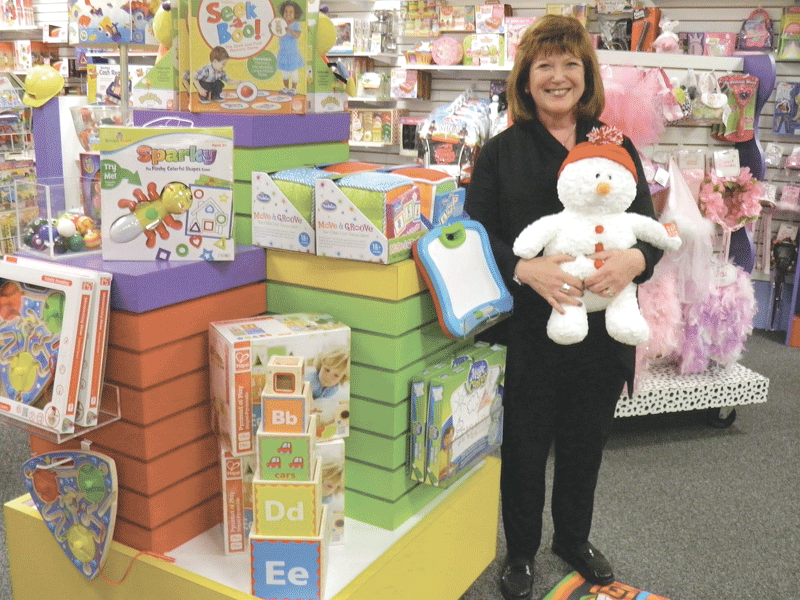
Joy Leavitt says the holiday season is off to a great start at Kiddly Winks, and the response to two November sales promotions was fantastic.
Louis White said A.O. White also offered incentives to its good customers. “We want to reward them around the holidays, but we are not sales-driven,” he noted. “We have generations of people who have shopped here and we really like to think we are a destination for special things.”
Edwards said footwear and apparel account for a significant portion of the gifts purchased during the holiday season at Lee Premium Outlets. “And we are anticipating a large sale of gift cards. They’re always our number-one seller, and as we get closer to Christmas, we always see an uptick in demand for them,” she told BusinessWest, explaining that they make an ideal gift, as the shopping season doesn’t officially end until Jan. 1, and many people crowd stores the day after Christmas to take advantage of post-holiday sales.
Wray said electronics are expected to be the winner this year when it comes to gifts. “People are buying tablets, iPhones, and mobile devices. We don’t have the actual data yet for sales, but they seem to be the hot gifts.”
Although the NRF says Americans plan to do almost half of their holiday shopping online this year, and one in five will use a smartphone to purchase holiday merchandise, local retailers say the joy of holiday shopping is an experience that can’t be duplicated by ordering remotely.
“Every single business has been affected by online shopping; it has changed the world. But we hope people make some of their purchases at local businesses and family-owned stores. We are the tapestry of the community and are so appreciative of the business,” Leavitt said, adding that KiddlyWinks looks for the hottest and best toys for children from February until September in advance of the holiday season, and when people shop locally, the tax dollars stay in the community.
Edwards believes people often go online to find what they want to purchase and compare pricing. “But nothing compares to seeing something, trying it on, and feeling the merchandise, so I don’t think online shopping will ever replace the experience of shopping in a store,” she said, adding that, when people are buying for others in a retail store, they often purchase something for themselves.
Indeed, the NRF says 54% of shoppers treat themselves during the holiday season. “People often come in with a shopping list and leave with a few things for themselves,” Louis White noted.
Although it’s too early to determine exactly how much people will spend this holiday season, the owners of local stores have done all they can to attract the growing number of people shopping early, as well as those who wait until the last minute. Weather can affect business and prevent people from going to their stores, but it has been an unseasonably warm fall, and they are optimistic about the 2015 holiday season.
“We’re thrilled, energized, and excited about this season,” Leavitt said. “I can’t predict anything yet, but I have a feeling it will be a very, very positive year.”
Louis White concurred. “We are off to a good start at ground level,” he said. “We merchandised and planned for an increase in sales, and since our biggest nightmare is that we will run out of items, we continue to reorder until the week before Christmas.”
Edwards said last holiday season proved to be a very good one at Lee Premium Outlets, and this one looks equally bright. “We have had a very busy fall, and we expect the momentum to continue.”
And Wray expects stores in the Holyoke and Hampshire malls to meet the NRF’s prediction of an increase of 3.7%.
All of which should add up to a very merry season for retailers and shoppers beginning their annual quest to find the perfect gift for everyone on their list.


Advantage Sales and Marketing never wanted to be a test case for medical marijuana, but that’s exactly what the Foxborough company has become.
It likely won’t be the only battleground, either.
The issue began when Cristina Barbuto, who suffers from Crohn’s disease and is prescribed marijuana to deal with painful flareups, applied for a job at Advantage.
“She told them, even before the pre-hire drug screening, that she was going to test positive,” said Timothy Murphy, an attorney with Skoler, Abbott & Presser, P.C. in Springfield, noting that her marijuana use, typically during the evening, was a doctor-directed strategy to deal with her condition.
She was hired. Then fired the next day.
“They brought her on, but when they got the test result, they said they had a zero-tolerance policy, and she had tested positive,” Murphy said. When Barbuto, who is now suing Advantage, reminded the company she had been upfront about her marijuana use, he went on, “they said, ‘sorry, but this is our policy.”
This type of confusion, he explained, is due to what seems to be conflicting language in the statute that legalized marijuana for medical reasons after Massachusetts voters approved it in a November 2012 ballot question.
On one hand, the law states that any person who meets the requirements for medical marijuana — which include suffering from a qualifying medical condition (such as cancer, glaucoma, HIV/AIDS, Crohn’s, Parkinson’s, multiple sclerosis, and others) and being prescribed the drug by a physician — may not be penalized under state law or “denied any right or privilege” for such activity.
On the other hand, nothing in the statute requires employers to accommodate marijuana use in the workplace or requires health-insurance reimbursement for its use.
The grey area — what about employees who use medical marijuana at home, then come to work the next day? — is proving to be vexing for employers worried about crafting drug-use policies that protect their rights under the law. Because the law, so far, is largely silent on the matter.
“When it comes to this language, no one knows what it means,” Murphy said. “A registered user can’t be denied any rights or privileges, and [Advantage] is going to be a test case.”
While the medical-marijuana law says employers don’t have to accept marijuana use in the workplace, “that’s not really the question,” said Karina Schrengohst, an attorney with Royal LLP in Northampton. “The question is whether you can make employee decisions based on marijuana use outside the workplace and whether you need to make a reasonable accommodation.”
Barbuto seems to have some standing based on the federal Americans with Disabilities Act, which prohibits workplace discrimination based on a disability and requires employers to make a “reasonable accommodation” for that employee if it would not pose an “undue hardship” on the operation of the business, as long as the employee can perform the essential functions of the job.
“We have our own state anti-discrimination law which largely tracks the federal ADA,” Murphy said. “Under that law, discrimination against disabled employees is unlawful, and employers can’t take any negative actions against employees because of a disability.”
But Massachusetts employers have rights as well, and medical marijuana isn’t even legal under federal law, and … well, it’s easy to see why confusion reigns right now.
On the wording of the Bay State’s medical-marijuana statute regarding rights and privileges, “does that mean medical-marijuana use is protected, and employers can’t take any adverse action against employees who use it?” Murphy asked. “Nobody is entirely sure.”
However, cases like Barbuto v. Advantage Sales and Marketing and others winding their way through the Massachusetts courts should begin to add clarity to the issue. That clarity, Murphy said, can’t come soon enough.
The law does seem clearer, he noted, when the position in question involves issues of safety — say, truck drivers and forklift operators.
“Obviously, it’s an employer’s responsibility to ensure a safe workplace for all employees, and that’s important. The use of marijuana can impact an employee’s job. It’s a legitimate concern for employers … similar to alcohol use.”
Employers have a dilemma, he said. On one hand, Murphy said, “they probably want to be empathetic and understanding to medical marijuana users because they’ve been dealt a bad hand; they’re not in a good place with their health. Most employers tend in that direction, but at the same time, they’ve got to maintain safety for everyone.”
On-the-job impairment, regardless of the cause — whether it’s marijuana, other prescription drugs, alcohol, or illegal narcotics — and workplace safety should be the central piece of any substance-abuse policy, he said.
However, Schrengohst noted, many positions don’t involve issues of safety.
“Often this question comes up when employers are balancing workplace safety against this new law. On the issue of workplace safety, preventing workplace injuries, for people like factory workers and forklift operators, I’m going to advise clients to require drug tests because of a legitimate safety interest,” she told BusinessWest. “But in an office setting, there’s more confusion. Obviously, you don’t want your receptionist, as a face of the business, to be under the influence, but the safety issue is the clearer one.”
And what constitutes ‘under the influence?’ The argument Barbuto makes, Murphy said, is that her nighttime use of marijuana does not affect her daytime performance. “She’s saying, ‘I have this disability, and you have a responsibility to accommodate my situation, as long as I’m not impaired at work.”
In short, he went on, “does an employer in Massachusetts have to accommodate an employee who is a medical-marijuana user? That’s the question.”
It’s a question other states are dealing with as well. In Coats v. Dish Network in Colorado, the plaintiff is a quadriplegic who used medical marijuana outside working hours, a registered user who took the drug in a manner according to the state statute authorizing medical-marijuana use.
Yet, the Colorado Supreme Court upheld his firing earlier this year because marijuana is classified as a schedule 1 drug, illegal under federal law. In other words, he couldn’t be arrested for using medical marijuana, but he could be fired.
“The court said the termination did not violate the employee’s rights. That’s really been the trend throughout the country,” Murphy said, citing two California cases: James v. City of Costa Mesa, in which the U.S. Court of Appeals for the Ninth Circuit held that the ADA doesn’t offer job protections for medical marijuana, and Ross vs. RagingWire Telecommunications, which held that the state’s medical-marijuana law does not require an employer to accommodate the use of otherwise illegal drugs for chronic back pain.
Those cases date back several years, however, and are no indication of how Massachusetts courts will view similar complaints, Murphy said.
“We need more regulations as well as more guidance through case law,” Schrengohst said. “The cases I’ve looked at in other states inform this, but they’re not binding in Massachusetts. Those cases have ruled in favor of employers, but the bottom line is, our statute and regulations don’t actually address all the issues, so I’m going to deal with it on a case-by-case basis — whether workplace safety is an issue, what the risks are going to be, and how we think a court might look at it. It’s a hard question right now.”
“In the context of workplace safety,” she went on, “employers really struggle to balance a safe workplace with this new legislation that doesn’t provide clear guidance. The explicit statement that you don’t have to accommodate it in the workplace at first seems great, and then it’s not, really.”
That’s partly because of the potential for dishonesty.
“When you drug test someone, it’s not like when you do a breathalyzer when someone is drinking,” she said. “With a positive drug test, everyone is going to say, ‘weeks ago’ or ‘after hours.’ No employee is ever going to say, ‘that was during my shift yesterday.’ I think employers are concerned, and obviously they’re worried that they’re going to be faced with litigation. It’s new, and we don’t know what to expect. It’s a really interesting topic.”
Murphy noted that the medical-marijuana statute makes an effort to protect employers, even if some of the specifics get blurry.
“It’s now well-understood that employers don’t have to excuse employees from performing the essential functions of their jobs, and don’t have to exclude employees from following their other types of policies, whether attendance-related or other standards of conduct,” he said.
As for drug testing, Schrengohst said companies with well-understood safety concerns are on firmer ground.
“I want to know what the facts of the situation are, what the industry is. If you want to have a drug policy and you want to drug test, why? What are the reasons behind this? Like I said, it’s a lot clearer when you have employees where safety is really important — someone who’s driving or operating equipment, and they have to be focused.”
Meanwhile, Massachusetts also faces the possibility of changing winds on the federal side, a question that vexes many physicians concerned about prescribing patients a drug that is technically illegal.
“Marijuana use remains illegal under federal law, but Obama’s administration has basically said, ‘we have bigger fish to fry, and we’re not going to be enforcing our medical marijuana and drug laws; we’re not going to punish marijuana users,’” Murphy said. “But that could change. There’s obviously going to be a change in the White House. Is the next president going to take a different view that could impact things? Or will the federal law be changed to allow for medical-marijuana use? That’s probably far less likely than state-by-state changes in laws.”
Massachusetts has progressed in this issue like many states, gradually changing its marijuana laws, Murphy noted. In 2008, the law was changed to decriminalize very small amounts of the drug. In 2012, voters ushered in the era of medical marijuana in the Bay State. In 2016, could full legalization follow, as Washington and Colorado have done?
“I expect there to be further efforts next year to liberalize our marijuana laws, and with each legislative step, maybe the picture gets clearer for employers,” Murphy said. “Advocates have tried to get the Legislature to pass it, but there doesn’t seem to be much appetite in the Legislature to do that. And, often, when the Legislature won’t act on things, people feel, ‘well, we’ve got no choice but to bring it to the voters.’”
Which would lay a whole new set of questions at the feet of employers already struggling to balance their employees’ rights and privileges with their own.
Joseph Bednar can be reached at [email protected]


More than 125 exhibitors and 2,500 attendees packed the MassMutual Center in Springfield on Nov. 4 for the fifth annual Western Mass. Business Expo, presented by Comcast Business and produced by BusinessWest and the Healthcare News. The event featured 16 educational seminars; corridors dedicated to robotics, healthcare, and retail; the annual Pitch Contest staged by Valley Venture Mentors; a Business Support Center offering myriad resources to business owners; breakfast and lunch programs; the day-capping Expo Social; and more.
no images were found
When Supreme Court Justice Sonia Sotomayor spoke at the MassMutual Center on Sept. 9 as part of the 2015 Springfield Public Forum series, there were more than 2,500 people in the hall.
A good number of them represented the area’s many colleges and universities, including students, faculty members, administrators, distinguished alums, and supporters. Springfield College, for example, had roughly 40 people in attendance, and prior to Sotomayor’s talk, most of them were gathered at a reception in unique community space set aside for tenants and their guests on the third floor of 1350 Main St., just across the street from the convention center.
The college wasn’t officially in the building yet, said its president, Mary-Beth Cooper, but lease papers had been signed for space on the second floor just a few days before Sotomayor came to Springfield, so the school took full advantage of a huge opportunity.
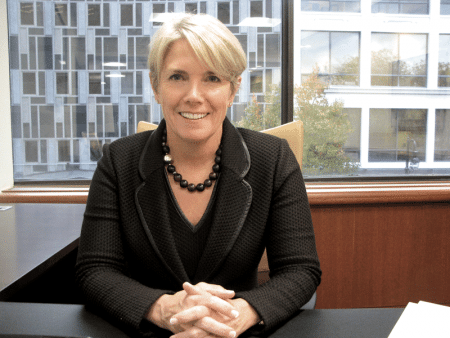
Mary-Beth Cooper says Springfield College leaders wanted to be part of the downtown revitalization in the city, so an address in the central business district made sense.
“I called and asked if we could we use that space,” said Cooper. “There’s a deck, it’s right across the street … we had a nice reception.”
Gaining the ability to host such a party wasn’t the reason why Springfield College became the fourth area institution of higher learning to add a downtown Springfield mailing address over the past few years.
But it may well have been one of the reasons.
There are myriad others, said Cooper, who told BusinessWest that, to make a somewhat long story short, the college wanted to support the city it is named after, and, perhaps more importantly, it wanted to be part of what’s happening downtown — be that a revitalization, comeback, renaissance, or whatever term may be deemed appropriate.
Thus, Springfield College is now part of what would have to be called a movement involving higher education and Springfield’s central business district.
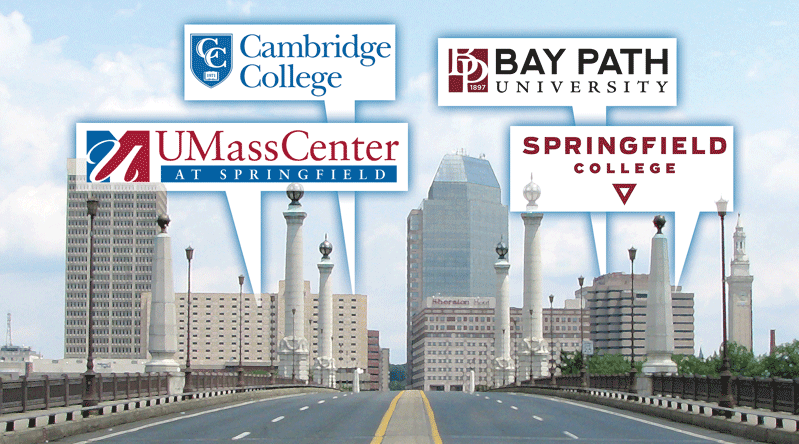
It all started in 2012, when Cambridge College, looking for a replacement for tired and insufficient facilities for its Springfield Regional Center in an industrial building on Cottage Street, settled on long-vacant retail space on the ground floor of Tower Square. Two years later, Bay Path College, bursting at the seams on its Longmeadow campus and in search of a home for its American Women’s College, chose the spacious seventh floor of 1350 Main St. from several appealing options.
And in September of 2014, The University of Massachusetts opened the UMass Center at Springfield, a 26,000-square-foot facility on the mezzanine level of Tower Square that is now hosting classes involving roughly 700 students this fall.
By comparison to those other facilities, Springfield College’s investment is small by any measure — its offices total less than 2,000 square feet, and only a few people are actually in those offices at any given time.
But there is room for growth, and in the meantime, this latest addition only adds to what Springfield Mayor Domenic Sarno called an infusion of “positive energy and brainpower.”
“Eds and meds are an important part of economic development,” he said, using the term to connote the education and healthcare sectors. “And when you couple what’s happening with the colleges downtown with efforts to promote entrepreneurship, the innovation district we’re building, and the efforts of groups like Valley Venture Mentors, it generates additional momentum.
“Years ago, people laughed at us when we said we were going to bring colleges and universities into the downtown,” he went on, adding that no one is laughing anymore.
Instead, they’re undertaking some speculation and analysis — on the impact of all this proliferation of colleges along Main Street, and about how and in what ways this momentum can be built upon.
Lynn Griesemer, assistant vice president of Economic Development at UMass and executive director of the UMass Donohue Institute, has been doing some analysis herself. She told BusinessWest that what’s developing downtown could certainly be termed an “education hub,” one that has the potential to attract additional businesses, non-profits, people, and vibrancy to the area.
“It’s starting to create a magnet,” she said, emphasizing those words ‘starting to.’ “With patience and ongoing support from the community, the city, and the state, I think that you could see this magnet growing into something that brings a lot more vitality into the downtown.”
For this issue and its focus on education, BusinessWest looks at how this hub, or magnet, came to be, and also at what its potential forces of attraction might become.
Hot Table restaurant on the ground floor at Tower Square is now open until 8 p.m. on weekdays, several hours later than its old closing time.
Teresa Forte, director of Cambridge College’s Springfield Regional Center, located just a few dozen feet away, knows that prodding from her and many of the students who attend classes into the early evening played a big part in that decision.
Overall, she believes that’s only one relatively small example of the impact that Cambridge and the other colleges are having downtown, an influence she described with the same phrase Greisemer summoned.
“Whether we call it that or not, the downtown is becoming an educational hub for Springfield,” she told BusinessWest. “I’m proud that Cambridge College started the trend; the true benefactors are the students who can now use downtown as a one-stop shopping zone when they are considering educational opportunities.”
Looking back over how this hub came together, it becomes clear that, while the schools involved had somewhat different motivations and goals behind their respective decisions, the common denominator is that they reached a decision that they wanted — and in many respects needed — to be downtown.
Retracing the steps that led to Cambridge becoming urban pioneers, if you will, or at least next-generation pioneers, Forte said the school looked at a number of options as it went about the task of replacing the Cottage Street facilities, which it called home for more than 20 years.
At the time, the school wasn’t really focused on being part of a revitalization effort — although that was certainly part of the equation — as much as it was centered on making a move that simply made sense from the perspectives of visibility and convenience for all constituencies involved, and would enable the school to ultimately grow enrollment, she explained.
“I described us as the best-kept secret in higher education in Springfield — even our sign didn’t light up,” she said of the Cottage Street facility. “Our lease was up, and the decision was made to search for a new, upgraded location. After many months and many visits to locations all over Springfield, it became clear that the best options for us were in downtown.
“It would not only provide us with better transportation options for our students — on a bus line and close to 91 — but also give us an opportunity to become a stronger contributor to the Springfield community,” she went on. “The search was narrowed to three locations in downtown, and Tower Square was chosen for a few very important reasons. First, it had the street-level site available, which was important for signage. Second, it was one of the most secure locations in all of downtown.”
Elaborating, she said Tower Square has a very responsive security staff which conducts patrols on the hour both inside the mall and outside the perimeter of the building, and there are also cameras everywhere, including the garage. Meanwhile, in terms of parking, students are given the option to park in the Tower Square garage, meaning they can take the elevator to class.
With that package of amenities, Cambridge thought it could grow its Springfield Regional Center, she continued, and in reality, that’s exactly what has happened.
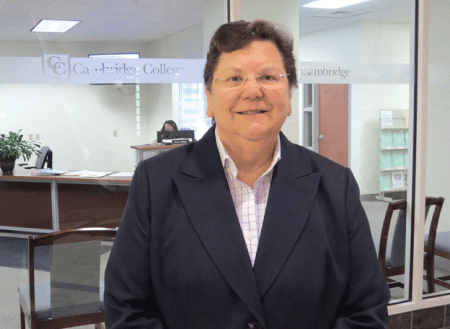
Teresa Forte says Cambridge College’s location in Tower Square — which offers students solid security, parking, and transportation amenities — has spurred an increase in enrollment.
“Cambridge College has a very unique mission — we cater to a diverse population of students for whom educational opportunities may have been limited or denied; we were one of the first colleges to specialize in assisting non-traditional students,” she explained. “And the interesting trend that has happened since we moved downtown is that we seem to be attracting a larger number of traditional students who have never been to college before. We’ve been in downtown for almost three years, and our enrollment in Springfield has been steadily rising for the past five years.”
For UMass, meanwhile, its arrival downtown, while certainly part of ongoing efforts to become more of a factor in Greater Springfield economic-development efforts, was actually sparked by a statewide study of potential growth opportunities for the university apart from its five campuses, said Griesemer.
That analysis identified several such locations, she went on, including Brockton, Southeastern Mass., Springfield, and the Marlboro area in the eastern part of the Commonwealth.
“There is a whole wedge in that area that has no higher-ed institutions — it’s between Routes 128, 495, 2, and 90,” she said of what amounts to Greater Marlboro, adding that most of the sites identified were in so-called Gateway cities (many of its existing campuses are in different ones) such as Springfield, and the university decided, after an in-depth market research study, to first pursue a project in the City of Homes.
What eventually emerged was the UMass Center at Springfield, which was announced in the fall if 2013 and opened less than a year later. It now hosts classes for several UMass Amherst programs, including the College of Nursing, the Isenberg School of Management’s part-time MBA program, the University Without Walls, and others. It also hosts programs offered by or in conjunction with UMass Boston, Springfield Technical Community College, Holyoke Community College, and Westfield State University.
Griesemer didn’t have a specific number when asked how many people are at the Springfield facility on a given day, but pegged student enrollment alone at between 600 and 700, a number that has gone up each semester.
As for Bay Path, its move downtown in the fall if 2013 was generated by a basic need for additional space for the online American Women’s College, said President Carol Leary.
“We spent a good amount of time looking at various locations, but Springfield was at the top of our list because we have our roots there going back to 1897,” she said, adding that school administrators fell in love with the culture at 1350 Main St.
And by culture, she meant everything from its focus on the arts — there are several galleries there — to its eatery to its eclectic mix of tenants.
“You have a feel, when you enter this place, that it’s more than an office building,” she explained, adding that the 11,805 square feet now in use hosts roughly 40 full-time employees.
And they are certainly contributing to the health of the local economy, said Leary, who attended college in Boston, understands and appreciates how higher education adds vibrancy to a city, and enjoys being part of that equation locally.
“I love the energy of a city, so I’ve enjoyed it, and our staff enjoys it,” she noted. “And we’re definitely pumping some money into the economy.”
Cooper said Springfield College’s ties to the City of Homes obviously run even deeper, and they certainly played a part in the school’s decision to lease some space at 1350 Main St.
She said she was having lunch downtown with trustee vice chair Jim Ross, when the discussion turned to the city, it’s central business district, and the many things happening there. “We talked about MGM, the rebirth of the city, transportation … everything,” she recalled, adding that the conversation eventually evolved into a discussion about if and how to become part of it — or a bigger part.
Actually, Cooper says she’s been asked several times since she arrived in the fall of 2013 about the school establishing a presence downtown. She was intrigued by the questions, in part because, in many ways, she thought the school was already downtown.
It is only a few miles as the crow flies from Main Street, she acknowledged, adding quickly that, through her lunch talk with Ross, she came to the conclusion that a direct presence in the CBD was an appropriate step.

Bay Path University President Carol Leary says the school’s space at 1350 Main St. has plenty of room for expansion.
Fast-forwarding a little, Ross and the college are now essentially sharing space on 1350’s second floor. The former conference room for a bank has been converted into a conference room and two offices, one for Cooper and one for Ross.
It’s not a big presence, certainly, and its specific uses have yet to be determined, but the college is now a part of what is becoming an increasingly larger and more impactful whole, said Cooper, who, when asked what she has in mind for the space besides receptions, told BusinessWest the same thing she told her board.
“I want people to think about the possibilities,” she said, listing everything from candidate interviews to leadership team sessions to subcommittee meetings involving the many boards she’s on.
But she wants that’s phrase ‘think about the possibilities’ to extend well beyond how the school’s physical space may be used.
Indeed, she said the expanding higher-ed presence downtown may well inspire and facilitate additional collaborative efforts involving a host of area schools, and eventually generate more opportunities to pair area students with downtown businesses through internships and other programs.
“Part of my agenda is to facilitate a move toward collaboration between the colleges and universities,” she said. “I think that would be good for individual schools, better for all our students, and better for the community.”
As she gave BusinessWest a quick tour of the Bay Path suite of offices, Leary, who spends two full days a week downtown, stopped at the spacious kitchen. It is very well-stocked and outfitted with every necessary appliance.
There are also several round tables and chairs arranged café-style. They get a decent amount of use, said Leary, but many of those working at the downtown location prefer to eat out, and do so quite regularly.
Many are also members of the gym upstairs, she went on, adding that membership was paid by the landlord the first year (another perk of tenantship), but several employees are staying on even though the cost has shifted to them.
Meanwhile, Hot Table’s hours have expanded; the store that UMass operates on the ground floor at Tower Square, the UMass Marketplace, has expanded its food offerings; and Griesemer said there have been more than a few conversations lately about the lines at most downtown eateries getting longer — and how that’s a good thing.
But the more serious talk is about how the proliferation of colleges downtown will have a much deeper impact than a bottom-line bounce for downtown dining establishments.
Indeed, those we spoke with talked about the potential for more and deeper collaborations and of that aforementioned ‘magnet effect.’
Griesemer relayed some recent discussions that more than suggested that the schools are helping to foster an environment that may draw more draw more employers — and employees — to the central business district.
“We’ve had a few nonprofits say to us, ‘we’re interested in moving into downtown Springfield because you have,’” she said. “There are already several in the tower and room for many more.”
Sarno agreed, and noted that the critical mass of students, employees, and administrators created by the movement of higher education into the downtown area will only facilitate efforts to create more market-rate housing there, which is considered one of the keys to generating more vibrancy and additional retail.
“I think this will help in our push for market-rate housing,” he explained. “And the more pedestrian traffic you can have matriculating from the North End to the South End, the more beneficial it will be to bringing in spin-off businesses.”
When asked if there was a model for a larger, more sophisticated education hub that Springfield could aspire to, she said there are several, including Phoenix.
“There are examples of places where you had a single higher-education institution put down a footprint and others followed, like Arizona State,” Griesemer explained. “There is still room for considerable growth in Springfield when it comes to this hub.”
While the current picture is one defined by enthusiasm, and there is considerable optimism about what might come next, the immediate forecast is at least somewhat clouded by two concurrent, and massive, construction projects that will certainly impact access to the downtown — MGM’s South End casino and reconstruction of the I-91 viaduct.
“We absolutely are concerned about that,” said Forte, noting that accessibility is a key factor in the success of the downtown location. “But we’re also hopeful that the city and highway department will be considerate of our population and create traffic alternatives that will not cause great impact for us.”
Sarno said the city — not to mention the contractor handling the I-91 work — is certainly incentivized to do just that, and also get the project done on time.
“So far, so good — communication has been great, and they’re ahead of schedule … and there are 9 million reasons why this contractor wants to get phase one done ahead of time,” said the mayor, citing the bonus put in place by the state for accomplishing that feat. “This had to be done, and we’re hoping to keep the disruption to a minimum.”
As she wrapped up her tour of Bay Path’s facilities, Leary spent a few moments in the cluttered, currently unused space on the seventh floor into which the school could, and likely will, expand.
“I can see us filling all of this someday,” she said, sweeping her arm across the area. “We’re not done yet down here.”
With those sentiments, she spoke for seemingly everyone that is now part of this education hub in the central business district.
In fact, by almost all accounts, those within this key sector are just getting started.
George O’Brien can be reached at [email protected]


Chattanooga’s recovery has included a cleanup of its riverfront.
In the 1960s, Ron Littlefield says, no one needed GPS to find Tennessee’s fourth-largest city.
“You could tell when you were getting close to Chattanooga because you could smell Chattanooga; it stunk,” said the former mayor, who served from 2005 to 2013. “It was an old foundry city. And when you had stormy weather, you had inversions, because we have mountains and valleys, and it would trap the smoke, and you would literally be eating smoke when you walked outside.”
City leaders were mortified when, in October 1969, Walter Cronkite came across a recent EPA study, sat down behind the news desk, looked into the camera, and declared Chattanooga “the dirtiest city in America.”
“It was so bad that people had to change their shirts in the middle of the day,” said John Bridger, executive director of the Chattanooga-Hamilton County Regional Planning Agency. “They were tough times — but tough times create opportunities.”
In truth, Bridger continued, many residents put up with the pollution because the manufacturing sector was chugging along, but Cronkite’s report jarred them out of complacency. “If not for those challenges, I don’t think we would have changed, because we were comfortable. We were the dynamo of Dixie — why change what we were doing if we were making money? But that report created an impetus for change; it brought a new perspective.”
Still, Chattanooga was no overnight turnaround. Even after efforts to clean up the waterway and better connect the riverfront with the downtown area, a downturn in the region’s manufacturing base led to mass flight from the city, which lost more than 10% of its population during the 1980s. But, as current Mayor Andy Berke points out, it was the only American city with that level of population loss during the ’80s to actually gain residents in the 1990s.
“It took a long time — a lot of people over a great period of time — to make it happen,” he said. “And it started with real investment in the core of our city.”
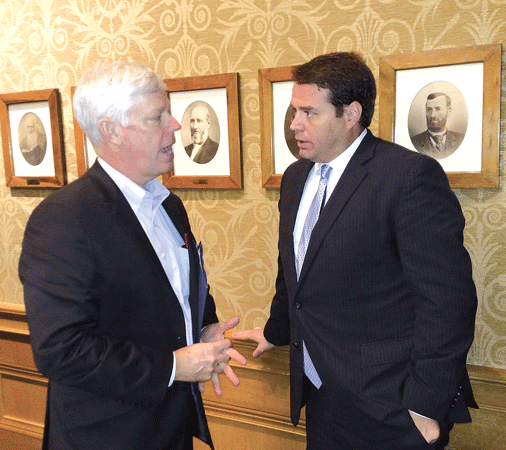
Rick Sullivan, left, president of the Western Mass. Economic Development Council, chats with Nick Wilkinson, Chattanooga’s deputy administrator of Economic and Community Development.
Today, Chattanooga is a growing city (population just over 173,000, about 20,000 more than Springfield) riding a wave of entrepreneurship and high-tech innovation, and touting itself as the Gig City after building a broadband network (known as ‘the Gig’) able to connect every home and business to the Internet at 1 gigabit per second, or 50 to 100 times faster than the average U.S. Internet connection.
As part of the City2City Pioneer Valley program, 30 economic-development, nonprofit, and community leaders from Greater Springfield visited Chattanooga late last month to hear the story of how a stinking foundry city transformed itself into a beacon of innovation.
In doing so, they learned that this community on Georgia’s northwestern border is no utopia; it still faces serious education, workforce-development, and racial-gentrification issues, to name a few. But it’s also proving to be an example of how public, business, and nonprofit interests can work in concert to produce and then fund real solutions.
“There seems to be one goal with all these organizations we’ve met. They’re all doing their own things, but they’re all on the same page and have the same goal, and that’s to help all these spinning wheels move the city forward,” said Alfonso Santaniello, president of the Creative Strategy Agency in Springfield, who values his company’s downtown presence and wanted to visit a growing city with a similar emphasis on building up its central business district.
“Springfield needs to find a way to get everyone on the same page and push forward from there,” he went on. “That’s one of our biggest issues; everyone is doing great things, but why are we not doing them together?”
Chattanooga’s striking collaboration culture (more on that later) is one reason why the Gig City label is, in fact, not the top storyline there, but a way to draw national notice to everything else that’s going on.
“The technology is great,” said Enoch Elwell, founder of Co.Starters, a Chattanooga-based entrepreneuship program that has expanded nationally, including into Holyoke earlier this year. “But its biggest impact is as a rallying cry for our community, something that brings us together and draws the world’s attention.”
The City2City contingent from Massachusetts was certainly listening.
Littlefield recalls a time when Chattanooga manufacturers treated the Tennessee River like a sewer, dumping garbage directly into the waterway. “But in the ’70s, we cleaned up our water, and we began to clean up our act.”
From an ecological perspective, it actually helped when the foundries started to close, but it posed economic issues, he went on, which were partially remedied by attracting industries from the north, like textiles and automaking, with the promise of cheaper labor. But that wasn’t a sustainable strategy, and a steady population drain ensued.

“Ultimately, it’s not just about transportation, it’s not just about economic development, it’s not just about the natural environment — it’s about how all those things work together to create place,’ said John Bridger.
“When you lose jobs, you also lose hope, and when you lose hope, you lose your children,” he said. “They grow up and get an education and go somewhere else. We began to say, ‘we have to change this community in ways we’ve never changed it before. We’ve got to change our attitude, our way of thinking.’”
The first step was the creation of the Tennessee Riverpark Master Plan to transform the riverfront and downtown area, but only after many hours meeting with residents — many of whom had felt disenfranchised — and incorporating their concerns into the process. As Littlefield recalled, one woman told him, “this is the first time, when I said something, that someone wrote it down in my own words.”
Municipal leaders also visited other cities (notably a 1981 trek to Indianapolis) to find ideas and inspiration.
These information-gathering efforts led to the creation in 1986 of River City Co., a nonprofit tasked with implementing the master plan, a 20-year blueprint for the riverfront and downtown, initially capitalized with $12 million from local foundations and financial institutions.
“We did visioning before visioning was cool, and we found that it actually works,” Littlefield said. “So we set about to create quality of life, and that started with the river.”
Bridgett Massengill, executive director of Thrive 2055 — a more recent coalition of economic leaders tasked with creating economic opportunity in a tri-state, 16-county region surrounding Chattanooga’s Hamilton County — detailed how four area foundations took the first step to fund River City Co., and called it typical of the way the city has operated in the past 30 years.
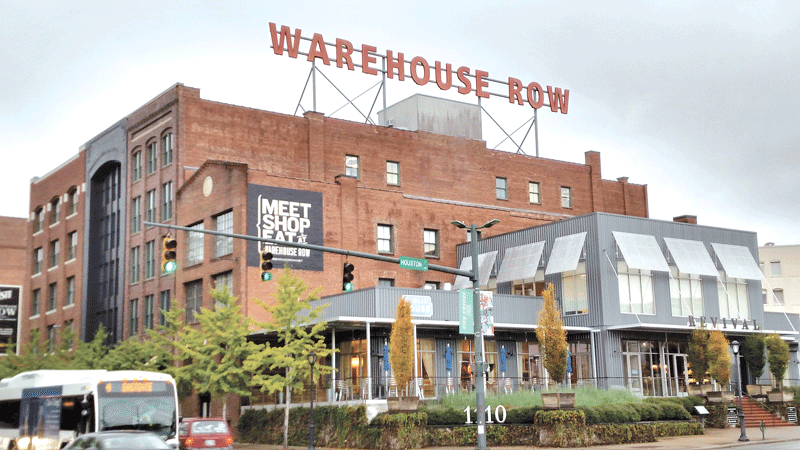
The conversion of former industrial buildings to retail and business space echoes myriad Pioneer Valley developments like Eastworks and Open Square.
“I have been blown away by the collaboration in this region, the way we come together, roll up our sleeves, and make it happen,” she said. “There was a will that we were going to proceed with or without federal dollars.”
That caught the attention of Katie Allan Zobel, president and CEO of the Community Foundation of Western Massachusetts.
“The success in Chattanooga has grown from public-private partnerships,” she told BusinessWest. “They keep saying how foundations have played a role in these partnerships, and it seems to me that’s something Springfield and surrounding regions should be exploring with more focus.”
She first thought, upon hearing of the role of the region’s foundations, that they must be larger and better-capitalized than those in Western Mass., but was surprised to find that wasn’t the case. “We can always do more together, and Chattanooga has been proving that for the last 25 years.”
The tax structure in Tennessee — property and sales taxes but no income tax — is a challenge for economic development, officials note. That’s why the public-private partnerships that have sprung up to support development are so noteworthy, said Beth Jones, executive director of the Southeast Tennessee Development District. “Typically, we don’t start with how much money an initiative will cost. We ask, ‘is this a good idea?’ and then we bring people together to raise the money.”
That’s part of the so-called “Chattanooga way” cited by many of the people who met with the City2City contingent. Kim White, president and CEO of River City Co., said the term essentially refers to the way leaders “get a diverse group of people together and really plan.”
The city’s successes included a complete overhaul of the riverfront, including the privately funded Tennessee Aquarium, the nation’s largest freshwater aquarium, and the pedestrian-only Walnut Street Bridge; as well as an innovation district downtown aimed at attracting both high-tech giants like Amazon (which has a presence in the city) as well as a raft of intriguing startups.

Chattanooga’s recovery has included the establishment of a high-speed broadband network known as ‘the Gig.’
Despite the successes of the Tennessee Riverpark Master Plan, the planning process had never focused specifically on entrepreneurship or technology until the city’s power company, EPB, tapped into federal stimulus money in 2009 to launch the Gig, said Ken Hays, president and CEO of the city’s Enterprise Center and Innovation District, which followed in the wake of the massive fiber project.
Since then, an accelerator program for startups has graduated 67 companies that have raised $3.1 in combined capital. In 2012, a nonprofit called CoLab launched GigTank, an annual, 14-week summer entrepreneurship program; 40 participating companies have raised $4.37 million in capital to date. CoLab’s “Will This Float?” startup pitch competition, launched five years ago, has attracted 47 participants, and the five winners all continue to grow, with $5.5 million in capital raised to date. Then there’s Tech Goes Home, a computer-education program aimed at everyone from preschoolers to the elderly.
Chattanooga has plenty of traditional industry, of course, none more prominent than Volkswagen, which employs about 2,400 people at its only North American plant and is planning an expansion — even amidst controversy over its diesel engine — that will bring production of a new SUV to Chattanooga and boost its workforce by another 2,000, including 200 in research and development, a first for the area. Other giants, like Coca-Cola and Little Debbie, dot the landscape as well.
But economic-development leaders are focused on the Innovation District and the cultivation of small businesses that may one day grow to be the next Coca-Cola or Amazon. Efforts to do so range from Startup in a Day, a commitment to streamlining business permitting on a 24/7 basis, to the Growing Small Business program, a financial incentive offered to companies with fewer than 100 employees that hire at least five workers in a 12-month period.
“If we can subsidize their next hire and keep them afloat for another couple of months, that’s what we want to do, and it’s been pretty successful,” said Nick Wilkinson, the city’s deputy administrator of Economic & Community Development.
With the type of 21st-century businesses attracted by the Gig, however, comes the need for a culture change, or at least a greater focus on the quality-of-life issues that matter to a young, hip, tech-savvy worker base, Bridger said. In addition, the population has shifted from one dominated by two-parent families with children in 1970 to one with mostly single-income households, and that affects the type of housing — smaller and closer to workplaces — that needs to be built in the city.
“Place matters,” he said, noting that IT workers aren’t tied to their workplaces like people in more traditional industries. “So, if you want to compete economically, they’re thinking place first, jobs second. Ultimately, it’s not just about transportation, it’s not just about economic development, it’s not just about the natural environment — it’s about how all those things work together to create place.”
That’s where quality-of-life improvements like the revamped riverfront and growing arts and recreation initiatives come in. The city is obviously doing something right, with $4 billion in business investment since 2008. Now leaders are trying to keep the momentum going by developing more housing in the city — an expected 160,000 new units by 2055, in fact — and touting the success of amenities like the free downtown shuttle (cheekily known as the Choo Choo) and an extensive network of bike lanes, all to support a Millennial population that doesn’t necessarily want to rely on automobiles.
The task isn’t easy when 97% of the downtown workforce drives in from the outside, and only 1.2% of downtown zoning is mixed-use. Regional passenger rail service may be 20 years away or more simply because the surrounding counties don’t have the population density of, say, Western Mass. to support it.
“Our focus is on how to create that housing density that makes us a more 24/7 city,” White explained, noting that the next two years will see the addition of 1,500 apartments downtown, more than doubling the current number, in addition to 500 more hotel rooms and 1,300 more student units to support the 12,000-student University of Tennessee Chattanooga, which skirts the downtown area. “If you come back in three years, this will be a completely different city.”
Some of those changes are more pressing than others. The City2City tour came in the shadow of a recent, searing report by Ken Chilton, a Public Administration professor at Tennessee State University, on the city’s ongoing racial gentrification and the challenges minorities face overcoming poverty, violence, and poor health.
The 23-page report, “The Unfinished Agenda,” examines how investment and development in certain downtown neighborhoods has come at the expense of low-income African-American families that used to live there but have been forced out by rising costs.
For example, in 1990, the downtown white population was 2,402, while the black population was 3,720. In 2013, those numbers were reversed, with 4,880 whites and 2,358 blacks living downtown. In effect, African-Americans are increasingly being pushed into poorer neighborhoods and schools mired in violence and chaos and not seeing the type of investment that characterizes the downtown and riverfront, Chilton writes.
Because some of these neighborhoods have more adult high-school dropouts than college graduates, many are forced to rely on low-paying jobs instead of the white-collar jobs that have defined the downtown renewal. As a result, 36% of blacks in Chattanooga live in poverty, compared with 14.5% of whites. In the 11 lowest-income neighborhoods in Chattanooga, where the population is 73% African-American, the average poverty rate is 63.5%. Bridger told the City2City contingent that, while the city’s unemployment rate is 5.5%, it’s about double that in the black population.
James McKissic, director of Chattanooga’s Office of Multicultural Affairs, agreed that gentrification is a problem, noting that certain neighborhoods have indeed become unaffordable for lower-income residents. But he added that several housing developments are in the works over the next few years, targeted at different income levels, in desireable neighborhoods. “We don’t want to be the next San Francisco or Austin; we want people from various income levels to live together.”
Still, he added, the heart of the issue is poverty — and the need for initiatives that will improve education and provide economic opportunity for people of all races and income levels.
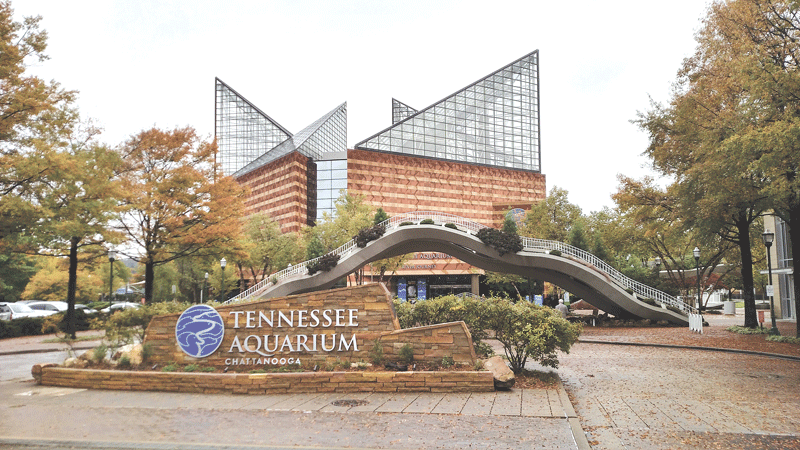
The country’s largest freshwater aquarium, a privately funded project that was mocked by some residents as a “fishtank” when it was proposed, is now one of the highlights of Chattanooga’s revamped riverfront.
However, public education — which is operated on the county level — hasn’t made enough strides to satisfy Chattanooga officials, a situation detailed in a 2013 Ochs Center for Metropolitan Studies report, again written by Chilton, affirming that the system’s poor, majority-black schools lag far behind schools in more prosperous — usually whiter — neighborhoods.
To compound matters, Tennessee finishes 49th in the nation in per-pupil education spending, according to the U.S. Census Bureau, but Hamilton County spending fell between 2007 and 2012, even compared to the state as a whole. Adjusted for inflation, the county spent about $321 less per pupil in 2012 than in 2007. In those years, the Hamilton County Board of Education cut about $44 million to balance budgets in the face of rising costs in health care, utilities, and salaries. “There’s a disconnect between the school system, the state Board of Education, and the real world,” Berke said.
Added Bridger, “public education is not where it needs to be, and it’s becoming a job-recruitment problem.” He noted that the rural counties surrounding Chattanooga fare even worse when it comes to graduation rates. “We’re not getting enough qualified employees to work in the jobs.”
After all, the city’s manufacturing base hasn’t disappeared; it’s just that many of today’s manufacturing jobs are high-skill, high-paying positions. Much like the situation in the Pioneer Valley, plenty of openings exist, but the Hamilton County region grapples with a skills gap between what employers require and the level of education that job seekers bring to the table. Unfortunately, Jones noted, applied-technology classes at local community colleges struggle with empty seats and a lack of interest in manufacturing as a career.
“We’ve basically taught people throughout the South and throughout the country that manufacturing is dirty, it’s not cool, it’s a sweatshop, it doesn’t pay well, the whole nine yards. I still hear that from our young people,” Jones said. “We’ve got to do a better job educating our young people that there are good jobs out there, and you can get them with certain certifications and certain degrees, and you can make more a whole lot more money than I’ve been making all my life with a four-year degree.”
Ruth Thompson, communications and outreach manager for Thrive 2055, agreed, stressing the importance of education. One notable initiative, called Tennessee Promise, pays for two years of community college, in an effort to narrow the skills gap.
“The majority of the country has about 8% of their economy driven by manufacturing. If you hear us talking a lot about advanced manufacturing, it’s because, in our region, it’s 22%. We still have a very, very heavy manufacturing base,” she said. “But previously, a 16-year-old from Trenton, Georgia could drop out of school, go work in a hosiery mill, and have a good job the rest of his life. We know that’s no longer the case. So as we work on changing the culture, we’re working in partnership with the community colleges and four-year universities to change that mindset that you don’t have to go to school.”
However, “we have other problems on top of the skills gap,” Jones added, noting that substance abuse — in another parallel to Massachusetts — keeps many people out of the workforce, while Tennessee (unlike the Bay State) ranks near the bottom of the 50 states in health metrics such as obesity and type 2 diabetes.
“We’re starting to have that culture change; people are starting to realize that education and health are both economic issues,” she said. “Before, people kept them in their separate silos. And as a state, we didn’t value education, but we’ve started moving in that regard.”
The city’s current mayor, however, chose to highlight some positive statistics, noting that property crime is down 22%, and violent crime down 5%, since last year, though well-known pockets of crime tend to skew perception. “It’s frustrating for us that people don’t feel safe.”
Berke also noted that, despite Chattanooga’s position along two major interstates, which makes it an attractive corridor for drug trafficking, the city is no worse off than others of its size. “We have drug crimes, and we have drug-related violence, of course, but nothing you’d say is unsual for similar cities.”
Meanwhile, “Thrive 2055 is trying to change the culture, helping us manage the changes that are happening to our region,” Thompson said, noting that the project is built on the pillars of economic development, natural treasures, transportation, and education and workforce.
All are important in their own way, she added; the region is, after all, a biodiversity hotspot, with the highest concentration of different freshwater fish species in the world — but also one of the top 10 shipping corridors in the U.S., leading to ‘pinch points’ of daily congestion along Interstates 24 and 75. Juggling such disparate resources and challenges is a major part of the Thrive effort.
As for the Gig, it hit a goal of 40,000 subscribers — the mark needed to achieve profitability — two years after its launch, and now boasts 75,000. It’s now the centerpiece of the city’s marketing efforts — signs at the Chattanooga’s airport greet visitors with the message ‘Welcome to Gig City’ — but, as Elwell noted, is only one part of the story.
“Some people have taken it for granted; they’ve forgotten how hard it was,” said Charles Wood, vice president for Economic Development for the Chattanooga Area Chamber of Commerce, referring to the entire 45 years of changes since Walter Cronkite’s paradigm-shifting report. “As a chamber, how do we make sure we don’t get complacent?”
Scott Foster thinks the city’s culture of collaboration will guard against exactly that.
“The emphasis from the private sector, the nonprofit sector, and the the public sector is on collaboration,” said Foster, an attorney at Springfield-based Bulkley Richardson and chairman of Valley Venture Mentors. “Sometimes the city takes an interest in something and the foundations come and support it, while other times, the private-sector guys say, ‘this is important, so we’re starting it, and we’ll see if anyone wants to join in with us.’
“That’s great,” he went on, “because you’ve got these three legs of the stool, and all three keep saying, ‘I’m going to experiment with this, and if it works, I know you guys will come along.’ There’s a trust there, and an openness to trying new things. It doesn’t matter whose idea it was; it matters that it’s a good idea, and if it’s a good idea, in Chattanooga, they’re all behind it.”
That’s an example, Foster went on, that public officials, businesses, nonprofits, and foundations can learn from in Greater Springfield and the Pioneer Valley, where much good work is happening, but not always in concert.
“If somebody’s got a good idea, let’s celebrate it and support it, not tear it down, not say, ‘well, it doesn’t quite work,’ or ‘it conflicts with what another group is doing.’ OK, fine — they can do it too. There’s no such thing as too much entrepreneurship or too much economic development. When we get to that point, then we’ll figure out that problem. But we’re not at that point.”
Littlefield recalled how, when Volkswagen had to choose between Chattanooga and another city to locate its U.S. plant, the competing financial incentives were largely a wash. “But they told us, ‘We came here for the intangibles, because, at a certain point, the intangibles become tangible. And you can’t put a price on that.’”
The greatest benefit Chattanooga has seen during its impressive recovery, the former mayor continued, has been a new, prouder, more confident attitude.
“After we visited Indianapolis, someone said, ‘wouldn’t it be great if, someday, people came to Chattanooga to see how we did it? And now, here you are — and you’re one of many. We don’t claim any special knowledge, any magic — just people coming together saying, ‘we all live here, and we’re going to make sure this is a city where our children will want to raise their children.”
Joseph Bednar can be reached at [email protected]


Apple Watch OS2
In an increasingly connected world, mobile technology continues to advance in ways both predictable and surprising, with the final market potential still unclear.
Take the newest iteration, the ‘wearable tech.’ A recent Forbes study reported that 71% of 16- to 24-year-olds either use or want wearable tech, which includes the Apple Watch, the Fitbit, and the Microsoft Band. Those products are where BusinessWest begins its annual look at the most popular and best-reviewed technology available, with a focus this year on mobile devices.
Apple is banking on continuing demand by improving its Apple Watch OS2 ($339), which Digital Trends calls “a piece of wearable tech that feels friendly and has a little bit of quirky character about it. It’s not without its issues, but they’re not too bad. The effort to learn the interface feels worth it to us.”
CNET calls the product, which packs the apps of a smartphone into a small package that fits on the wrist, “a beautifully constructed, compact smartwatch. It’s feature-packed, with solid fitness software, hundreds of apps, and the ability to send and receive calls via an iPhone.” However, it continues, the battery doesn’t last much more than a day, and the interface can be confusing.
Still, Digital Trends notes, “the world of wearable tech has been crying out for a product that engages people — something that operates as a companion device to our phone, but also goes a step further. For Apple, that step was using it to connect people in unusual, fun ways.”
As Apple Insider explains, initial response to the Apple Watch has promoted competition in the marketplace from upstarts like Pebble, which is offering a new model starting at $250 — almost $100 cheaper than the Apple Watch — in addition to models above and below that price point.
Many consumers love wrist-worn devices for their health-tracking capabilities, a category currently dominated by Fitbit. “I think back to when fitness wearables first emerged — devices like the Fitbit — and wonder, what made them so great? Why did people get so excited?” CNET’s Scott Stein asks. “Was it really the fitness, or was it the idea of turning fitness-based into something fun?”
He noted that the devices counted steps like their pedometer predecessors, but made a game of it — hit a goal, get a reward; share progress with friends and compete. “Gamification, a catchphrase a few years ago, is exactly what these [devices] provided: they’re carrots on a stick to motivate exercise.”

Fitbit Charge HR
That said, he likes what he sees in the Fitbit Charge HR ($139), which adds heart-rate tracking to the mix and syncs all data to the user’s smartphone. “The more expensive $250 Fitbit Surge does practically the same things, but adds a larger watch display and can track runs via standalone GPS.”
But, while $150 for the Fitbit Charge HR is a good price for a full-featured device, Stein adds, “in practice, something about the Charge HR feels a step short of exciting. It’s how Fitbit handles heart rate. It’s how it feels to wear. And, it’s how useful — or not — I found the addition of heart rate to be in my daily routine. It’s one of the best wrist-worn heart-rate trackers out there, but it’s not the complete slam-dunk fitness band I expected it to be. It is, however, the best Fitbit band currently available.”

Microsoft Band 2
Microsoft is a player in this field as well, and Yahoo’s David Pogue calls the just-released Microsoft Band 2 ($250) “a smartwatch with more sensors and fitness-monitoring capabilities than anything else you can buy,” from original features like a GPS antenna to track runs or bike rides, a heart-rate monitor, UV light detectors, and a skin-temperature sensor, to new additions including a barometer for measuring elevation (a bonus for hikers and climbers) — 11 sensors in all, in fact.
It’s not for everyone, however; Pogue declares the Band the winner for serious exercisers, but says the Fitbit Charge HR is better for the all others — those who aren’t hardcore about exercise but could benefit from gentle reminders and motivators.
Of course, smartphones remain the go-to mobile device for most Americans, with 64% of all adults and a whopping 85% of the 18-29 age group among their users, according to the Pew Research Center.
PC Advisor notes that fierce competition in the smartphone market means there’s a quality device for everyone at just about every price point — and consumers are typically happiest with the operating systems they are comfortable with.
“Although there are others around, it’s best to stick with the big names, including iOS, Android, Windows Phone, and potentially BlackBerry. If you’re already using one, then it might be best to stay in that camp — especially if you’ve invested time and money in its apps. However, it’s not difficult to switch, so you should consider them all.”
Design will come down to personal taste, the site adds, and most of the top smartphones now have a very thin and light chassis. “The best smartphones typically use premium materials like glass, aluminum, or even steel, and on this front you’re best off trying a phone out in the flesh to see whether it feels good for the size of your hand.”
Despite the greater competition, most of the tech press still places Apple’s iPhone and Samsung Galaxy atop their lists of best phones.

Samsung Galaxy S6
For example, TechRadar calls the Samsung Galaxy S6 ($499) “a brilliant phone that shows Samsung still has what it takes.” An improvement from the Galaxy S5, the latest edition boasts improved camera performance and audio quality, and the sharpest video display on the market.
In addition, “the design is finally something we’re pleased to hold in our hand, rather than the plastic cheapness of last year,” TechRadar notes, and “it’s actually extended its lead at the top thanks to some amazing price drops — so you can now get the best phone on the market for an incredibly low price these days. A no-brainer.”
PC Advisor piles on the praise as well, calling the Galaxy S6 the best Android phone of 2015. “It’s fast, it’s well built, it has a gorgeous screen, and the software isn’t overly intrusive. The fingerprint scanner is vastly improved, the heart-rate scanner a potential draw for some users, and the wireless- and fast charging welcome inclusions.”
But Apple’s iPhone 6S Plus ($499) tops many rankings as well. CNET praises the latest version’s improved speed, better camera, always-on Siri, pressure-sensitive display, longer battery life, and bigger, higher-resolution screen — all improvements over the 2014 model. In fact, the screen size has grown so much that some people might consider it too bulky. “The iPhone 6S Plus has a few key advantages that give it an edge for serious iPhone users, but its big body may not fit for a lot of people.”

iPhone 6S Plus
Meanwhile, Phone Arena says it’s not surprising that the iPhone 6 is the world’s bestselling smartphone, citing the 3D Touch display and Live Photos as desireable improvements, as well as an improved system chip and better battery life.
“Put in simple words, the new iPhone has a much faster processor and memory. It also comes with a new, 12-megapixel camera that now is able to capture a more detailed images than before and records video in the trendy 4K resolution, plus it supports new slo-mo options. Add to this the rich iOS ecosystem that continues to secure the best apps and games first, and one starts to understand the huge appeal of the iPhone 6s.”
Still, Apple and Samsung have some competition in the market. PC Advisor offers praise for Sony’s Xperia Z5 ($349), which comes with an aesthetically improved rear cover and adds a fingerprint scanner, but keeps much of its previous design.
“Once again, the camera is great, but it’s tough competition out there, and arriving late in 2015 means rivals are now available for a decent chunk less,” the site explains. “Once the price drops, which it will, this will be a great option for those of you looking for a waterproof flagship with a Micro-SD card slot.”
Smartphones are far from the only tech battlefield, however. The tablet market continues to be hotly contested as well. According to TechRadar, Apple still tops the game with its iPad Air 2 ($599) — a remarkable improvement over even the “remarkable achievement” that was the original iPad Air.

iPad Air 2
“It’s even thinner and lighter than last time around, and to a noticeable extent. The screen is better, with more vibrant colors, it’s more powerful thanks to its A8X processor, and the battery life holds up just as well. It even benefits from Touch ID and Apple Pay, and while these features aren’t as exciting here as they are on phones, they’re still nice to have. In short, the iPad Air 2 really is the complete package, and while you can always find things to niggle about, there are no significant flaws.”
As always, however, Apple has competition. PC Magazine touts the Samsung Galaxy Tab S2 ($399), calling it an improvement over its predecessor in every way, including a thin and light design, upgraded performance, and better-quality camera.
“Do tablets matter anymore?” the site asks? “Samsung would like you to think so. Despite releasing some very large phones recently, the company still believes there’s a home for tablets in a market crowded with enormous phablets. And Samsung’s latest offering, the Galaxy Tab S2, definitely makes the case that, yes, tablets are still very much relevant.”
It’s the same story told in many different ways — Apple continues to set the pace, but its main competitors keep closing the gap. That’s healthy for consumers, no matter which device they prefer to take on the go.
Joseph Bednar can be reached at [email protected]

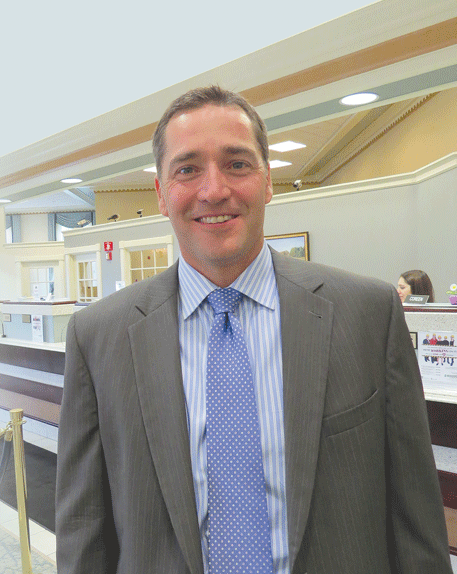
ESB President and CEO Matt Sosik
When asked to describe the current strategic plan for Easthampton Savings Bank (ESB), Matt Sosik, the institution’s president and CEO, said it’s fairly simple, really.
“I want this bank to be here 30 or 40 years from now, and we’re a little myopic about that,” he told BusinessWest. “We’re focused on making sure that this a community asset decades from now.”
“We’ll be gone — maybe we’ll be pushing up daisies, who knows?” he went on, referring to himself and Tom Brown, ESB’s executive vice president Retail Banking who’s already logged 30 years with the institution, and was sitting beside him. “We want this bank to be here; it has a necessary place in the long-term future of the communities we serve.”
Such talk might have seemed melodramatic decades ago, or even a few years ago, he acknowledged, but the times have changed, and mere survival is no longer the foregone conclusion it once was, as evidenced by the number of institutions that are now referred to only in the past tense, said Sosik, who arrived at the bank roughly 15 months ago after a lengthy stint as CEO at Oxford, Mass.-based Hometown Bank.
Indeed, the cost of business is soaring, and margins, dramatically impacted by plummeting interest rates, are razor thin. In this environment, size certainly matters — not in terms of bragging rights, but simply the ability to function properly, and profitably, in a changed landscape.
“We’re never going to measure ourselves by our asset size — we’re going to measure ourselves by how successful we are,” said Sosik as he described a general operating philosophy that was in place long before he arrived at ESB. “But in banking, community banking especially, size continues to a be an incredibly important metric; efficiencies are borne by spreading them over a broader base of assets. Period.”
That’s why most banks have embarked on territorial expansion efforts in recent years, which have taken them to corners of the Bay State far removed from their home bases, and into other states, especially Connecticut, as well. Such efforts have also led to an explosion in new branches, and significant over-banking in communities such as East Longmeadow, Amherst, Northampton, and others.
But in addition to seeking size, banks have also become driven in their quest to become more efficient and create economies of scale. This has been achieved largely through mergers and acquisitions, an ongoing trend that has changed the banking and business landscapes in many ways.
ESB has been part of these trends, said Sosik, as witnessed by its acquisition earlier this year of Citizens National Bank in Putnam, Conn., a move that, as mentioned earlier, gives the institution a broader geographic footprint while also growing its asset base.
But the bank is also being creative in its growth-and-survival strategy, as evidenced by the announcement in late September that ESB and Hometown will form a strategic partnership through the merger of the institution’s holding companies, a transaction that will yield a $1.7 billion entity, and thus the size needed to remain competitive in today’s changing financial services landscape.
However, this somewhat unique union — creation of the so-called multi-bank holding company is becoming more common but is still rare for this market — enables both institutions to operate independently, maintain their names, identities, and operating systems, and thus avoid some of the headaches that accompany typical mergers.
Another benefit of the holding-company-merger model is that it can expanded, said Sosik, adding that other institutions can become part of this larger entity. And he’ll entertain such entreaties, as long as they constitute good fits.
For this issue and its focus on banking and financial services, BusinessWest takes an in-depth look at ESB’s strategy for adding several decades to its 145-year track record of service to the community.
As he talked with BusinessWest about the merger of holding companies, how it came about, and the many advantages to such a growth vehicle, Sosik said that banks such as ESB may still have a proverbial five-year plan — although most documents have a shorter duration because of the fast pace of change in this industry.
But the overall outlook must be for a much different timeframe, he said, adding that community banks must take a long view — as in 30 or 40 years — and create strategies that will ensure the current name is still over the door after that much time has past.
The strategic plan at ESB is not necessarily focused on acquisitions, said Sosik, adding that rather, it is framed by what he called “well-defined metrics that we wanted to obtain” that are monitored on a regular basis (more on them later).
“But at the end of that business plan, we talked about an acquisition strategy that we thought we could put into practice,” he went on. “And it gets back to that notion that size is a path to efficiency, and for us, if we can drive our overhead ratio, which is simply our non-interest expenses as a ratio of average assets, to 2%, we feel we can be successful over a very long term.
“For us, this is about scale, it’s about efficiency,” he continued, “and it’s about producing a business plan that can stand the test of time.”

Tom Brown says traditional organic growth will not be enough to enable ESB to create the size it needs to compete in a changing financial services landscape.
As he talked about how this strategic plan has unfolded to date, Sosik said that ESB, like most banks facing similar challenges, is constantly looking for opportunities to achieve that aforementioned scale and efficiency, but in ways that certainly make sense for the institution.
One such opportunity was the recently finalized merger with Putnam, Conn.-based Citizens National, another mutual bank, an acquisition that, when completed, provided the institution with $1.3 billion in assets (Citizens was a $333 million bank when the deal was announced) and a brand network of 15 full-service offices.
“That might not have made a lot of sense to some of our competitors, but it made a great deal of sense to us,” he said, referring specifically to the geographic distance between the two banks’ headquarters. “It stood on its own financially … it made good financial sense, it was creative to our bottom line, and it was a great return on investment.”
The acquisition represented a distinct departure from the way the bank operated through its first 144 years of existence, said Brown, adding quickly that it was a change brought about by necessity.
“We got to this point through normal branching over time — kinder, gentler economic times to be sure,” he told BusinessWest, referring to the past 30 or 40 years in particular. “We had a lot of organic growth, but we can’t continue to grow in that way; I see this strategy as an opportunity for us to ensure that we can carry out our mission of mutuality well into the future.
“We have 200 families that rely on us for their livelihood,” he went on, referring to the bank’s current workforce. “We take that responsibility very seriously.”
Sosik agreed, adding that traditional organic growth is not going to get the job done in the current banking environment, one that seems destined to become increasingly challenging with time.
“To get the scale we think is necessary, you can no longer rely on a de-novo branching strategy,” he explained. “There’s a bank on every corner, there’s a branch on every corner … there’s no way to achieve real growth in that environment. And that’s why you look at acquisitions as a way to geographically diversify and continue to grow that base of assets that provides that needed efficiency.”
It was this search for effective, practical, and, yes, imaginative, acquisition strategies, that led ESB to pursue talks with Hometown, an institution that Sosik was obviously quite familiar with.
Those talks picked up in intensity several months ago, he said, adding that when finalized — the merger has been approved by both banks’ boards but is awaiting regulatory approval — this deal will yield a bank that will approach $2 billion in assets and $14 million in annual earnings at the outset.
“It will be a powerful, financial, community-driven machine,” he said, adding that it will cover nearly all of the territory between and including the Pioneer Valley and northern Worcester County.
Under the terms of the deal, Hometown Community Bancorp will merge into ESB Bancorp, and Sosik will serve as the merged company’s CEO, while Michael Hewitt, president and CEO of Hometown Bank, will serve as its president. Both Sosik and Hewitt will continue as CEOs of their respective banks. The merged parent holding company is also planning to change its name to Hometown Financial Group to better reflect its strategic positioning as a multi-bank holding company.
Efficiencies will be created through the simple elimination of redundancies, said Brown, adding that the new entity will need only one department for human resources, compliance, auditing, purchasing, technology, marketing, and others, where now there are two.
That doesn’t necessarily mean there will be immediate and dramatic reductions in force, he went on, adding that there will be a sharing of resources undertaken slowly and methodically, with staff consolidation attained mostly through attrition.
But while these efficiencies are being created, there are decidedly fewer of the serious headaches and inconveniences to customers that have resulted from most of the recent mergers, in which one bank is essentially absorbed into the other, Brown went on.
“If you’re focused on community, employees, and customers — if that’s the focus of your mission — then you shouldn’t be able to screw up a merger,” he told BusinessWest, adding that ESB and Hometown are committed to those fundamentals.
As he explained how it all works, Sosik grabbed his copy of the press release announcing the deal and drew a simple schematic on the back. The top half showed two mutual holding companies (MHCs) with a single line to the banks they control. The bottom half had one MHC, representing a multi-bank holding company, with two lines connected to boxes marked ‘ESB’and ‘HB.’
“There’s room for more lines here,” said Sosik, indicating that further expansion of the new holding company is possible, if the fit, or fits, are good ones.
“We’re basically recreating the mission of the MHC to become a multi-bank holding company,” he noted. “And we believe that we can be attractive to other like-minded mutuals who are thinking the same things we’re thinking about size, efficiency, and long-term viability, and are worried about those things. We think we can bring them into a multi-bank holding company that is philosophically attractive to them.
“We’re not in any rush to do that, though,” he went on, while deciding not to speculate on what institutions may fall into that category, other than to say the desired partners would obviously be small- to mid-sized mutual banks.
“We’re taking about institutions that, like us, want to be serving their respective communities 30 or 40 years from now,” he went on, “but don’t have a way of ensuring that on their own. If together, we can put some certainty to that, then we may have something that will work.”
As he talked about his institution and its strategic plan, Sosik speculated that at some other community banks, the thought process may be about how to navigate the next five years or that they simply can’t plan past 10 years because they don’t know what the future will bring.
At ESB, the thinking is different, more proactive, he went on, adding that the focus is on three or four decades from now, when someone else is occupying his office and downtown Easthampton looks much different.
And it’s about shaping the future much more than it is about dreading what it might bring.
George O’Brien can be reached at [email protected]
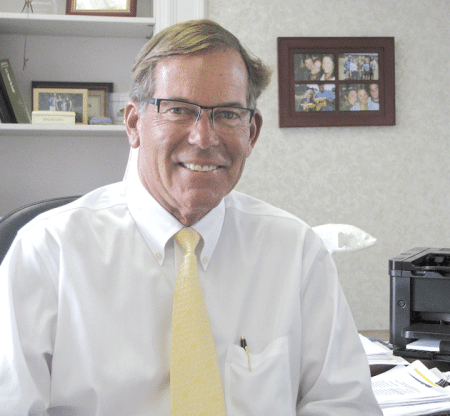
CCSF President Bob Stewart
Bob Stewart says that when it comes down to the fine print, there’s not a lot of difference in the cost of insurance policies from one company to the next.
“It’s all about relationships,” said the president of Chase, Clarke, Stewart & Fontana (CCSF), an independent insurance agency with deep, 144-year-old roots in Springfield. “Any insurance purchaser can go down the street and find another policy that may be a few dollars less than the policy they have. But it’s not all about being the lowest price on the street; it’s about providing the best coverage and providing the best service you can for your clients.”
He said his firm isn’t unique in that respect; in the era of managed competition, a time when large, national insurance chains have flooded the market with marketing campaigns focused on bottom-line promises, independent insurers have been forced to focus on the personal touch, or, as he called it, “servicing the heck out of it.” Fortunately, he added, that’s long been key to the culture at CCSF.
“That’s how we keep business — return the phone calls, answer the e-mails, go see clients,” he went on, noting that house and office calls make even more sense as downtown Springfield prepares for three years of construction hassles related to the MGM casino and the I-91 viaduct reconstruction.
“With what’s going on downtown, the parking is horrible, so we don’t encourage any of our clients to come into our office; we will go out and see them. We’re always hopping in the car; that’s just routine. We’d rather go see our clients in their office or home and talk to them there. That’s part of the service aspect, too.”
And those clients are diverse, Stewart said.
“We don’t necessarily specialize in any one thing; we do an awful lot of personal-lines insurance — homeowners, auto insurance — but we do a large amount of commercial insurance as well, a lot of professional liability, medical liability, social-service-agency liability, lawyers’ liability. I have a small program of accountants’ professional liability, with clients all over, from Boston to Pittsfield. My brother [Jim Stewart] runs a church program; he’s a broker for a national church organization, the United Church of Christ.”
Jim Stewart is one of three vice presidents, along with Dan Fontana and Raymond Lukas, and they all bring different types of expertise to the table, Bob explained. “We’re all over the map. Ray is a financial planner by trade, so he’s done a lot of life insurance, employee benefits, and financial planning, so any stuff we need done on that end, that’s always his bailiwick.
“It really is a fun business,” he went on, “and I wish we were able to attract more younger people into the field because it’s a great business. It might not have all the glitter of a Wall Street job, and we are in downtown Springfield, which doesn’t appeal to a lot of people. But it’s a wonderful business, and we’ve been very successful over the years. I’ve thoroughly enjoyed it.”
For this issue and its focus on insurance, BusinessWest sat down with Stewart to talk about why he’s a believer not only in his industry, but in Springfield itself, and why he’s still excited after 42 years in the business about helping people and businesses protect what’s important to them.
Since William Fuller opened an insurance business in downtown Springfield in 1871, that firm has never been headquartered more than a couple blocks from where it sits now, on the corner of State and Main streets.
“We’re probably the oldest independent agency in Springfield — maybe in Western Massachusetts,” Stewart noted. “Basically, our history is a series of mergers and purchases over the years.”
Fuller’s agency was later acquired by Samuel Sherwood and William Cone, growing under their leadership and then with Sherwood’s son, Malcolm. Raymond Redfield then added the business to his own agency, along with the Oppenheimer Agency, which had started around 1880. In 1957, Redfield invited the Russell D. Chase Agency and the Arthur H. Clarke Agency to merge together as Redfield, Chase & Clarke.
Meanwhile, another agency had been thriving in Springfield — the Lewis J. Stewart Insurance Agency, started by Stewart’s grandfather just after World War I and later run by his son, Robert Stewart Sr. In 1966, that agency joined with the growing Chase agency, which was renamed Chase, Clarke, Stewart. Bob Stewart came on board in 1973, followed by Jim in 1980.
But the consolidation process was far from over. In 1995, the agency merged with the R.J. Fontana Agency — bringing Dan Fontana into the fold — forming Chase, Clarke, Stewart & Fontana.
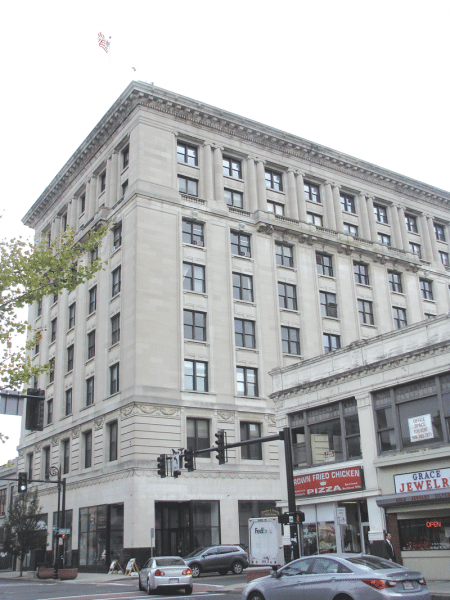
CCSF, located in the office building on the corner of State and Main Streets, has had a presence in downtown Springfield for nearly 150 years.
In 2000, the company purchased the Mutual Insurance Agency of Springfield, whose history dates back to 1827. Finally, in 2004, CCSF purchased the Lukas Insurance Agency of Springfield.
Through it all, the commercial-lines business has changed little over the years, save for occasional shifts in rates, but the same can’t be said of personal lines.
“That has changed drastically since what they call managed competition,” Stewart said. “Take auto insurance — back in the ’80s, we had probably about 12 insurance carriers writing auto insurance in Massachusetts, and not the big ones. No one wanted to come in because the state set the rates and said, ‘this is what you’re going to charge.’ Insurance companies were bound by those rules, and most of them felt they couldn’t make money in Massachusetts.
“But then the gloves came off and managed competition started,” he went on. “Insurance companies could set their own rates within certain parameters, so the field is much more wide open now. We’re now competing with the big insurance carriers from all across the country.”
Before this new era, he explained, independent agents wrote some 80% of auto policies, which was unheard of across the U.S.; that figure was closer to 40% or 50% in most states.
“That market share has dropped, and we knew it was going to,” Stewart went on. “And it has caused the insurance carriers we do business with, the independent-agency carriers, to really come up with some unique and unusual coverages and pricing to compete with some of the big companies that have come into the state. They’ve been very responsive. They’ve stepped up to the plate when they needed to compete from a pricing standpoint or from a coverage standpoint, by enhancing policies.”
Marketing has changed in some ways as well, particularly with the emergence of social media, which CCSF has put to effective use with a blog, where it shares information with various types of clients — for example, an article about cybersecurity for business customers, about insulation for homeowners, and about child car safety for motorists, just to name a few recent entries.
“That’s one way to stay in touch with them, let them know what’s going on in the industry, what kinds of things they can do to lower their premiums, protect their properties, and lower their risk,” he explained. “We’re been fortunate to have a young woman in the office who is really versed in social media. I’m kind of old-school, but everyone says it’s beneficial, so we’ll continue to do it.”
Stewart is just as pleased to see the changes emerging in Springfield — not just the casino, but a surge of activity and new business in the central business district that give him hope for the city’s future.
“When I started here in 1973, it was an entirely different downtown area. We had Steiger’s, Forbes, A.O. White, Johnson’s Bookstore — all sorts of stuff down here,” he told BusinessWest. “We went from that to seeing not much of anything in downtown Springfield. But I’m positive about the changes that are proposed and are happening. I they will benefit the city as a whole, not just downtown. I’m very positive about it. For those of us who work right in the center, what’s going on now in construction is inconvenient, but it’s an inconvenience that will be short-lived.”
Three years of construction and traffic snarls may not seem short-lived to some business owners, but with his company’s history sprawling back 144 years, he finds it easy to take the long view. Besides, there’s always someone new to get in the car and visit.
“For me, it’s really all about the people I deal with. We have a tremendous staff in our office, it’s fun to deal with them, and it’s fun to deal with all my clients — I really enjoy talking to people, going out to see them. That’s what makes it interesting. If I had to sit behind my desk all day, every day, I’d probably be miserable.”
Stewart is also gratified by a job where he helps people protect themselves against the worst, or at least mitigate hardships when they do strike.
“One client I’m dealing with now, his house was badly burned — a very extensive, very serious loss,” he said. “I talked to them a few times the last few weeks, and things are going smoothly, and the checks are getting cut. It’s good to see that what we’ve provided for them is actually going the way it’s supposed to, and things are being put back together without any further issues.”
At its heart, he concluded, “all we’re selling as an insurance agency is a promise, so we’d better be able to deliver on that promise when the time comes.”
Joseph Bednar can be reached at [email protected]


Noah (left) and Seth Goodman left their family’s paper recycling business to establish Northstar Recycling and fill a void in the marketplace.
Noah Goodman scrolls through photos on his smartphone, searching for a picture of a whiteboard.
It was taken before he and his brother, Seth, opened Northstar Recycling, and showcases the first step they took in establishing their company: Creating a set of core values.
The list includes, “We Do First Things First”; “We Count on Each Other for Help”; “We Do Our Personal Best Today”; “We Do the Next Right Thing”; and “We are Impeccable With Our Word.” But the final item, which is underlined and was written in capital letters, reads “WE HAVE FUN!”
It’s a principle they both subscribe to, and although making sure employees have a good time at work is hardly a priority for many business owners, these partners attribute their accelerated growth and success to the combination of these core values and the atmosphere they have carefully crafted in their East Longmeadow facility.
They say it has helped them attract graduates from prestigious schools such as Princeton — they actually have five Ivy Leaguers on the payroll — as well as employees from large urban centers such as New York City, who joined their firm because they want to work in a place where their well-being is a primary consideration.
In fact, that premise recently earned the company accolades when Fortune magazine ranked Northstar Recycling as one of the top places for women to work in the U.S.
Teresa Chamberlain graduated from Lehigh University last year with a degree in environmental engineering and environmental studies and moved from Ohio to work at Northstar. Her story, and remarks, are typical.
“It’s a relaxing, professional environment,” said the client development executor, who takes a proactive stance in her job. “I’m not micromanaged and because the responsibility to get my work done is my own, I am empowered to do things well.”
The Goodmans told BusinessWest that Northstar is filling a need in the marketplace, and has experienced phenomenal growth. “Four years ago, we had 11 employees. Today, we have 34,” Noah said. “We’ve grown so quickly that we are doubling our space in January and taking over the entire 8,000 square foot building we are in.”
The interior of their space also reflects attention to detail. The entranceway is dominated by a soothing, 9-foot waterfall with Northstar’s logo imprinted on the rock surface beneath the flowing water. The ceilings are lofty and a hallway with an arched faux metallic-patterned silver ceiling leads to spacious offices and a break room, which is kept well stocked with free food and snacks.
There is a picnic area outside with a barbeque grill and patio tables with umbrellas; they are installing a horseshoe pit; employees are treated to a meal each week at the local Coughlin’s Place restaurant, can bring their dogs to work, and get free haircuts, courtesy of their employer, at Ace Barber Shop in the building.
And of course, they have their own composter. “We are a zero- waste-to-landfill office,” said Noah, explaining that Northstar’s purpose is to create recycling programs for national manufacturing firms and other businesses, and materials they deal with include cardboard, plastic, metal, wood, and organics.
“We partner with companies and manage their recycling, because they typically have environmental goals they have to achieve by a certain date and time,” Seth noted.
Noah explained that the company’s clients can’t find outlets for their raw materials, so Northstar does that for them in a way that creates a revenue stream, an important goal in addition to achieving sustainability and their environmental goals.
It’s an arena Northstar not only excels in, but one in which it is pushing the boundaries of what can be accomplished (more about that later). It also makes sure the recycling takes place as close to the manufacturing firm as possible.
“We’re always looking to reduce the distance where materials are recycled; a lot of things today are being sent to China and India in overseas containers,” Noah explained. “Recycled paper is the largest item exported out of the U.S. by volume.”
As a result, they work hard to find local recyclers wherever their client has a facility. “We make it as easy for the manufacturer as possible,” Seth said. “We coordinate everything, including the containers they use and the trucks and trailers that transport materials.”
The Goodman brothers are fifth-generation entrepreneurs. “Our great, great grandfather was a peddler in Western Mass., and he and our great grandfather had a scrap metal recycling company on Ferry Street in Springfield,” Seth explained.
Their father and uncle joined the business in the ’60s, but changed its focus and turned it into a private paper-recycling firm. “It grew to be one of the largest paper recyclers in New England, and we both worked in the business for 20 years,” Noah said, adding that these experiences helped them develop strong work ethics and they “did every job there that anyone could do.”

Seth Goodman says Northstar has employees whose only job is to continuously improve recycling programs at clients’ manufacturing plants.
However, five years ago the brothers developed a different vision, and made the decision to branch off on their own. “We felt there was a real need to help companies reduce what they were putting into landfills and increase what they were recycling,” Seth recalled.
Noah told BusinessWest they realized that U.S. companies had begun to take sustainability seriously and knew that large Fortune 500 firms didn’t have the expertise to meet stringent standards, which require them to reduce their carbon footprint as well as the amount of material they put into the trash.
They said the U.S. produces more than 50 millions tons of waste every year (more than any other country in the world), and more than half of it is dumped into landfills, contaminating water supplies and polluting the air with dangerous amounts of methane gas, which is 23 times more potent than carbon dioxide.
This factual information, coupled with their shared values and relationship — “we’re best friends and very much in tune with each other; we communicate openly and honestly and defer to whoever is the most passionate about something, which means there is harmony at the top,” Noah said, — led them to launch Northstar Recycling in 2011 with 11 employees.
Their core belief was simple: Waste has value, and it is damaging to the planet and financially irresponsible to send reusable resources to a landfill. And from that their mission statement was born — to help businesses recycle more and send less to landfills.
“We felt we had the experience and know-how to help companies and saw a huge future in it,” Noah said.
But before they started, they spent time designing the culture of their future workplace.
“We wanted to create a workplace where people felt emotionally safe; where they could speak up openly and have their opinion heard and considered,” Seth said. “We also wanted our employees to have fun and care enough to really want to help us succeed.”
The brothers each have three young children, and because spending time with them is a priority, they felt it was only fair to provide employees with the same luxury.
“So, if someone has to leave work for a family issue, the first thing we ask is: ‘Is everything OK?’ and the next is ‘What can we do to support you?’” Seth said.
“Every decision we make day-to-day is in line with our core values — they are what and who we are as human beings,” he went on. “It’s also what drives our business and our culture, which are the foundations for our success. We have a great strategy and execute really well, but we couldn’t do it without our values; the people who work for us really want to see us succeed because of the environment we’ve created.”
In addition to those in East Longmeadow, the company has three employees in New York, two in Philadelphia, and one in Cincinnati.
However, everyone is brought to East Longmeadow on a quarterly basis, and after working together, they enjoy a fun-filled evening activity.
“We’ve staged a scavenger hunt in Springfield; a square dance with a professional caller and country western band; a team-building event; and a painting party,” Seth recalled. “And every year, everyone goes on a two-to four-day trip. Last year we saw Broadway shows. We have also gone to Mohawk Mountain (in Connecticut) to go horseback riding, and our sales marketing team (which goes on different trips) has gone to a dude ranch in Montana, skied in Jacksonville, Wyoming, gone white water rafting in West Virginia, and visited South Beach in Miami.”
Noah said the perks are important. “We want our employees to be happy, because if they are happy and healthy, they are more productive. So although we do have hourly weeks, we aren’t clock watchers,” he noted. “And everything that has happened in the last four years has exceeded our expectations.”
Seth said that when Northstar goes into a company for the first time, it conducts an initial assessment, which includes looking at areas where trash is generated.
“We typically find they are throwing away material that is recyclable,” he said.
At that point they assign two teams to work with the client. One of their primary roles is to find outlets for material that is being discarded, but could be diverted. Items often include stretch film, plastic strapping, and cardboard, which is frequently not all recaptured, even if attempts have been made to recycle it.
A Northstar team also creates a set of internal standard operating procedures for the client, because in many instances even if the company has established these measures, they are not efficient or inclusive enough.
“We have people whose sole job is to work at manufacturing sites to continuously improve their recycling programs,” Seth said.
The Goodmans are proud that their business has a positive impact on the environment and say the potential for growth is unlimited.
“There is a lot of opportunity because many companies have set goals to be more environmentally proactive. In fact, one of the nation’s largest fast food chains told all their suppliers if they want to continue to do business with them, their manufacturing facilities have to be ‘zero waste to landfill’ by a certain date,” Seth told BusinessWest. “Our business is being driven by large consumer-product companies throughout the country.”
Clients are visited on a frequent basis, and in addition, the home team constantly looks for new, innovative ways to recycle items traditionally considered non-recyclable. Success stories include selling textile scraps to a company that is using them to make bow-and-arrow targets.
“We also work with a large pet food manufacturer who used to send all its wet scraps to a landfill; now they go to a composter,” Seth said, noting that Northstar’s employees think creatively or out of the box.
“We research everything scrap items could possibly be used for, and are creating markets where there weren’t markets before,” he went on. “For example, we have a client that produces the film used to package coffee; it’s made of three layers of plastic and one layer of metal, and the scraps were going into the trash. But we found a company that turns them into a reusable packaging product.”
Noah said it’s a plus when consumer product firms can state in advertisements and literature that they are a sustainable company and all their manufacturers are zero waste to landfill.
“Northstar becomes a resource for these major corporations, and in many cases they refer their vendors to us; if they are having trouble meeting their goals, we can help,” he noted. “They realize they can devote a lot of time, energy and resources to the issue or bring their problem to us as we have a proven track record of getting the job done.”
The Goodmans are proud of their company and what they have accomplished.
“When we began, we realized there were not enough nimble companies to help national corporations reach their goals,” Noah said. “There was a void in the market and we bet our financial livelihood on the belief that we could fill it, which we have done.”
They are also happy to continue their family tradition of entrepreneurship.
“Our company is located in East Longmeadow and our family has been in the area for five generations, so we’re proud to be able to help revitalize the business community in Western Mass. and are really excited to be bringing new jobs to the area,” Seth said. “But it all goes back to our core values.”

The big day is almost here.
And by big, Kate Campiti, associate publisher of BusinessWest, means big. That’s the easiest and perhaps the best way to describe the fifth edition of the Western Mass. Business Expo, produced by BusinessWest and HCN.
It will be big in terms of size and scope — more than 2,500 attendees are expected, and there will be more than 125 businesses exhibiting — and also in its impact when it comes to showcasing the region’s business community and providing the invaluable insight needed to thrive in an increasingly competitive global economy.
And, as always, it will be very big with regard to creating networking opportunities.
“We like to say this show is all about creating connections,” said Campiti. “And connections come in many forms. People can connect with other business owners, they can connect with local and state agencies that provide needed assistance, and they can connect with concepts about how to become better at what they do.”
 Go HERE to view the 2015 WMBExpo Show Guide
The show, which will kick off with the Springfield Regional Chamber’s November breakfast, featuring keynoter Dan Kenary, CEO and co-founder of Harpoon Brewery, will feature more than eight hours of programs that will be informative, educational, and inspirational, and will bring together popular elements from Expos past and introduce some new ones.
In that first category, will be informative seminars, more than dozen of them, in tracks ranging from sales and marketing to ‘hottest trends’; a popular retail corridor; a pitch contest staged by Valley Venture Mentors; and the event-capping Expo Social, one of the region’s best networking events.
In that latter category will be a multi-faceted focus on the region’s precision manufacturing sector and the workforce challenges facing it. That focus includes robotics and machine tooling demonstrations; exhibits created by area vocational students on the various tools or their trade and ongoing efforts to forge partnerships with area manufacturers; and a luncheon program featuring Alison Lands, senior manager in Deloitte’s Strategy & Operations practice.
She served as a co-author and editor of the New England Council and Deloitte’s recently published report, Advanced to Advantageous: The Case for New England’s Manufacturing Revolution, and her talk will be focused on that document.
This year’s pitch contest will have a new and intriguing twist. This year’s event, which represents a partnership between VVM, the Economic Development Council of Western Mass., the Small Business Administration, and entrepreneur sponsor Meyers Brothers Kalicka, will feature the debut of the InnovateHER pitch competition.
The InnovateHER Challenge is a national prize competition aimed at unearthing products and services that impact and empower women and families through local business competitions. The winner of the Nov. 4 VVM Pitch Contest will advance to the next round of the national InnovateHER competition, with a chance to compete for $70,000 in prize money.
The five contestants at the VVM competition, who will have booths at what’s known as Startup Row and thus can be visited throughout the day, and will stage a preview of their pitches on the Show Floor Theater from 1 to 1:30 p.m., are:
• AuthenFOOD, which enables customers to order food online and reviews local chefs and bakers;
• Bhlue Publishing, LLC, which provides career guidance for young people that focuses on success without a four-year degree;
• Do+Make Business District, an online community and school for what it calls “solopreneurs escaping the 9-5”;
• Hot Oven Cookies, which promises to “deliver comfort in a cookie”; and
• Wonder Crew, a toy company that “offers boys a more expansive play experience, one where they can be strong and emotionally connected.”
Expo attendees will have the opportunity to choose which of those five they think will prevail in the competition. Those who guess correctly will win a beverage for the social.
The region’s healthcare sector will be prominently displayed at the Expo, with a designated corridor. It will be populated by Holyoke Medical Center, HealthSouth, MedExpress Urgent Care, Porchlight VNA/Home Care (which willk be offering flu shots), Ex Physical Therapy, and many other area companies.
A returning feature will be the Retail Corridor, which made a popular debut in 2014. It will feature a host of area companies featuring holiday gift items in a range of categories, from therapeutic massage to chocolate; cosmetics to jewelry; fruit baskets to Springfield Falcons tickets.
Meanwhile, new this year is the Business Support Center, which, as that name would suggest, features a number of exhibiting economic-development-related agencies that exist to support business owners and managers.
Participating agencies include the Economic Development Counsel of Western Mass., the Mass. Office of Business Development, the Kittredge Center at Holyoke Community College, the Mass. Export Center, the Holyoke Innovation District, and the Mass. Small Business Development Center, among many others.
The Expo will again be presented by Comcast Business, which has been the show’s lead sponsor since HCN and BusinessWest began producing it in 2011. Director-level sponsors are Health New England, Johnson & Hill Staffing Services, MGM Springfield, and Wild Apple Design Group. The Isenberg School of Management at UMass Amherst is the education sponsor, 94.7 WMAS is the media sponsor, Peerless Precision, Smith & Wesson, the NTMA, and the Larry A. Maier Memorial Educational Fund are the Robotics and Manufacturing sponsors, and Meyers Brothers Kalicka is Entrepreneur sponsor.
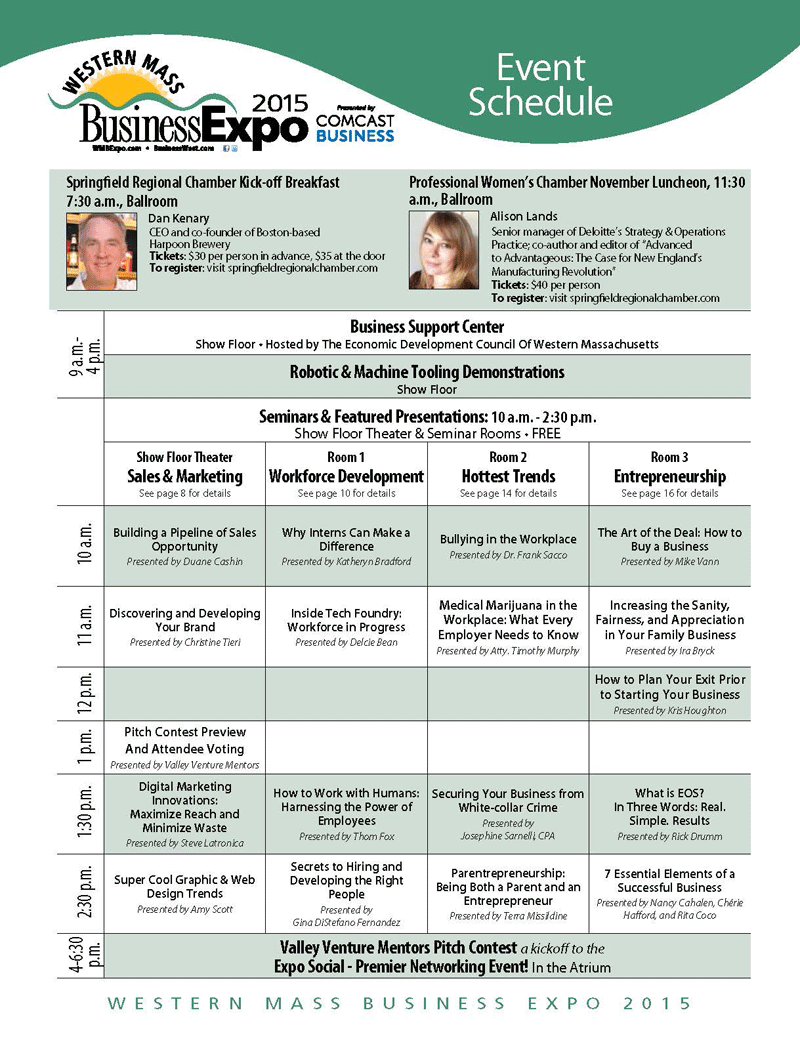
Since it was launched in 1984, BusinessWest, known back then as the Western Mass. Business Journal, has been on a mission — not only to hold up a mirror to the region’s business community, but to serve it through editorial content and programming that’s informative, thought-provoking, and often entertaining.
The process of fulfilling that mission has changed with the times, and involved new avenues for communicating with, and engaging, the business community of Western Massachusetts. Examples of this evolution include everything from doubling the magazine’s frequency from monthly to bimonthly to launching a separate publication, the Healthcare News, devoted entirely to that sector; from putting content online to launching recognition programs, including 40 Under Forty and Difference Makers.
The latest step in this evolutionary process came in 2011, when BusinessWest determined that, despite ample evidence to the contrary, the era of the large-scale, business-to-business trade show wasn’t over.
Rather, we decided it was time to enter a new era — one where the show would become bigger, broader, and even more focused on providing value for exhibitors and attendees alike. Thus, BusinessWest created the Western Mass. Business Expo, and has spent the past four years refining and enhancing a quality product.
The fifth edition of the show reflects these efforts. The day-long event is crammed with programming designed to promote awareness of the depth and breadth of the region’s economy and help business owners and managers better navigate the myriad challenges they face.
The day will get off to an entertaining start with the Springfield Regional Chamber’s October breakfast and keynote speaker Dan Kenary, CEO and co-founder of Harpoon Brewery, who will engage in a “casual conversation” with BusinessWest Editor George O’Brien.
Later, at the luncheon hosted by the Professional Women’s Chamber, Alison Lands, senior manager in Deloitte’s Strategy & Operations practice, will present a program based on a report she co-authored and edited titled “Advanced to Advantageous: The Case for New England’s Manufacturing Revolution.” She will discuss the challenges facing this resilient, innovative sector, particularly a persistent skills gap and a lack of brand awareness, and how they present real opportunities for workforce development in New England. If you’re invested in manufacturing, you’ll want a seat at this event.
Throughout the day, there will be informative seminars across four tracks: Sales & Marketing, Workforce Development, Hottest Trends, and Entrepreneurship. Also slated are robotics and machine-tooling demonstrations, a Technology Corridor, a Business Support Center, the ever-popular Pitch Contest staged by Valley Venture Mentors, the day-capping Expo Social (always a great networking opportunity), and much more.
This show was created for you, the hardworking people who shape the region’s business community. We hope you will join us for what will be a memorable day.
George O’Brien, Editor
John Gormally, Publisher
Kate Campiti, Associate Publisher
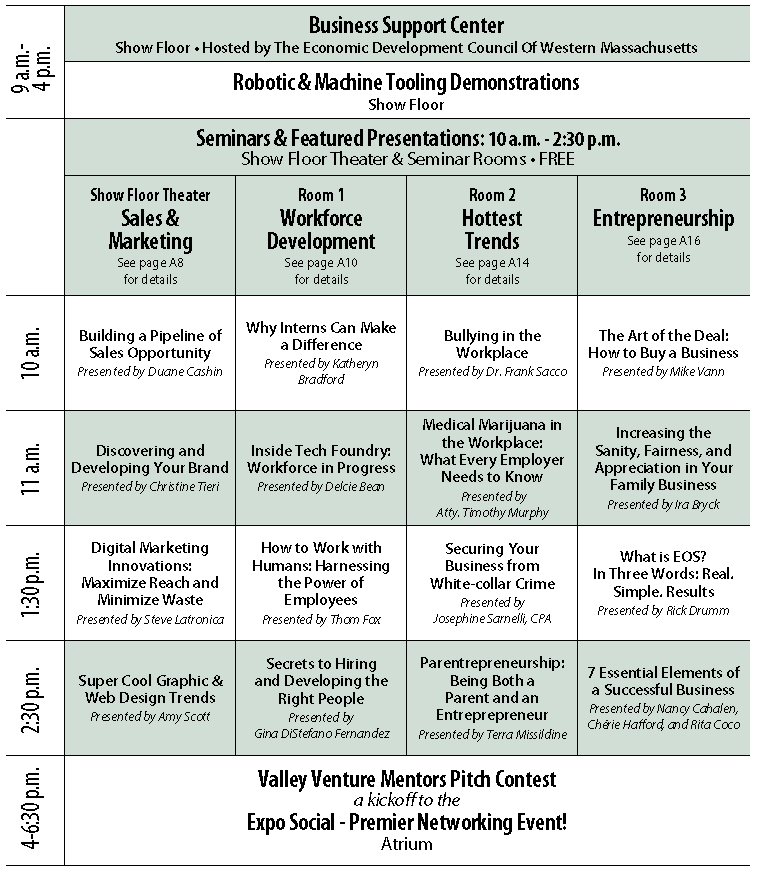

Dan Koval
Four years ago, Daniel Koval was working in a London hotel room when the cleaning attendant arrived. Although most people leave while the job is being done, he stayed and continued to work.
“But I could tell that the woman’s back was hurting from the way she was moving,” Koval recalled, adding that it led to a conversation he found profoundly intriguing.
“She told me she had just returned to work after taking nine months off for a back injury incurred on the job,” he said. “When I pushed, she told me the hotel group had paid $40,000 for her surgery, the insurance company had offered her more against further claims, and all of her colleagues had either been injured on the job or were out with similar work-related injuries.”
Koval had spent the majority of his career in product development, and the room attendant’s story presented a challenge he couldn’t forget. “I realized everyone was losing — the woman would suffer back pain the rest of her life, and, in addition to costing the company money, they lost a good employee for nine months. There are other costs associated with hiring a replacement, so, I thought, ‘why not try to crack this?’”
At the time, the serial entrepreneur was running another business, so the idea was relegated to the back burner. But it simmered until it got his full attention and he took steps to determine the scope of the problem.
Koval had a team of product designers and ergonomists visit hotels in London and in the U.S., where they met with union representatives and discussed the incidence of job-related injuries. “We quickly found it was a global problem,” he said.
“Room attendants are the coal miners of the hospitality industry. Their work is taxing and physically demanding; they have to kneel, bend, and put their wrist in positions that can cause carpal-tunnel problems, and they do this eight hours a day, five or six days a week. It can affect their knees, shoulders, wrists, and back,” he explained. “One study found that 91% of room attendants experience pain at work, and 66% take pain medication just to be able to go to work.”

The Duop system employs a ball-and-socket mechanism that allows the mop to pivot 360 degrees.
The next step — which eventually led Koval to leave Europe, move back to the U.S., and start a new business called Worksafe Technology Inc., whose first product is a mop system designed to solve the problem — was to have experts shadow room attendants. However, they also looked at other industries and found that window washers and people who cleaned hospitals, restaurants, office buildings, and homes that provide temporary or long-term care had similar issues with their necks and shoulders.
“We looked at the tools they were using, studied what was wrong, and decided to focus on creating a new mop. Traditional mops are designed to clean floors, but there was no tool that could clean the back of tub walls, baseboards, windows, and mirrors — in other words, both vertical and horizontal surfaces,” Koval told BusinessWest as he demonstrated repetitive body positions required to clean these surfaces in a small space, which include kneeling, squatting, and balling up a rag and repeatedly rubbing it with a bent wrist to clean a mirror. “The problem with traditional mops was the hinge, and they all used the same system.”
At that point, the concept for the Duop system was born.
The name comes from the idea of having a ‘dual mop,’ as the head of the product can be removed and used by hand, which leads to better ergonomic, hygiene, and cleaning results, Koval said.
However, the Duop took time to develop, and many adjustments were made based on feedback culled from London hotel-room attendants who tested a variety of prototypes. Changes were incorporated that included the size of the handle grip and the ability to move it easily from room to room, which Koval said is important, as many upscale hotels are doing away with unsightly cleaning carts, instead having room attendants carry the supplies they need.
“It took five to seven rounds before we got something that worked. But we kept fine-tuning the product with advice from our ergonomists,” he noted.
Today, the mop has been perfected. It employs a telescopic pole that can be adjusted and locked into a three- to five-foot length, depending on the job that needs to be done. “Most mop handles are four feet, but having one that is five feet allows the person to stand up much straighter. Plus, it can be extended to clean the ceiling,” Koval told BusinessWest.
However, the revolutionary part of the tool is found at the end of the pole. It contains a unique ball-and-socket mechanism that can pivot 360 degrees when the ball on the head is snapped into the socket, which allows it to be used for a variety of tasks, such as cleaning shower walls and ceilings or dusting baseboards.
The heads come in three sizes, and a variety of microfiber cloths — one designed for dusting, another for scrubbing, and a third for general mopping — can be attached to them with Velcro, although one type of head allows a cloth to be folded into its edges, then flipped over and reused.
“The room attendants’ biggest considerations were speed and quality of cleaning. What we gave them had to allow them to clean faster and better because they are under such pressure to meet their quotas,” Koval said.
Those goals have been realized, he went on. “Using the wide face to clean a mirror instead of a crumpled cloth allows the job to be done five times faster and is more hygienic, as the microfiber picks up microscopic particles.”
Koval and his associates were surprised by the response to the prototypes. “They told us they wanted to keep them and use them at home. It made us realize the Duop is not just a commercial product, but something that can help the consumer clean easier and faster.”

Dan Koval says the Duop mop is the first of what he hopes are many products his company develops to help reduce injuries and promote workplace wellness.
In 2012, Koval created a company known as Worksafe Technology Inc. to market the Duop System. Its goal is to eliminate causes of frequent and recurring workplace injuries by combining expertise in product design, development, and technology.
“We are just rolling the Duop out on the market,” he said, explaining that it took so long partly because he worked on it only part-time. “Our patent was filed about a year ago and is still pending, but we brought the mop to commercial trade shows for professional cleaners, industry shows for housekeepers, and the Chicago Housewares Show, and the response has been amazing.”
Large, professional cleaning organizations have expressed interest, and at the consumer show, companies ranging from QVC to Bed Bath & Beyond and Amazon shared their enthusiasm. “There was also interest by international companies, and we are negotiating an agreement with partners in Japan, Taiwan, Holland, Germany, and the U.S.,” Koval said. “The product was just launched in the past month, and so far, we have sales of more than $100,000 pending.”
The cost of the mop will range from $25 to $40, and getting to that figure was critical, as Koval said ergonomic products are often priced too high to compete with standard products. “But our goal is to help as many people as we can.”
The mops will be marketed to the general public via Worksafe Technology’s website in about two months. “We have developed e-commerce packaging, but still have to develop consumer packaging, and that requires being able to explain what the mop does in about three seconds,” he noted. “But I’m very excited about this. It’s rare to come up with something so simple that has the potential to help so many people.”
Koval began his career with a degree in marketing. “But I always wanted to be in product development. It excites me,” he said. Although he grew up in Western Mass., after graduating from college he was hired by GE, who sent him to London, then Hungary. He worked in sales and international business development, then as a product manager for GE Lighting.
After earning an MBA from INSEAD in France and working as a consultant, he knew it was time to branch out on his own, and he established a gift company called Heads Up Design that manufactured cuckoo clocks featuring farm animals. He sold that business to a German company, but continued to develop items that ranged from clocks to candles. “We made about 30 different products,” he said.
Koval was living in Budapest when he began conducting the research required to create the Duop mop. When he moved back to the U.S. in 2012, his gift business became secondary, as he felt the potential for the Duop was unlimited and the need for it was greater here than in Europe.
“The U.S. doesn’t have socialized medicine, so our initial belief was the cost of an injured employee was higher to insurance companies and businesses here. But we are finding there is a huge demand for the mop in Europe. It turns out that it’s not only the cost of healthcare, it’s about the cost of losing a good employee, which makes it universal,” he told BusinessWest. “And consumers want anything that will help them clean faster and better. The drudgery of cleaning is the same everywhere in the world.”
Although Koval returned to Western Mass. to establish Worksafe Technology, he thought he would have to relocate again to a larger city like Boston to stay competitive. But he is happy to report he and his family will be able to remain in the Berkshires, thanks to his involvement with Valley Venture Mentors (VVM), an entrepreneurship-mentoring program based in Springfield.
“I had moved to Europe in 1989 and spent almost my entire career there, so I didn’t have any business contacts here,” Koval said. “But I heard that VVM was organizing a bus trip to Boston, and after I met some of the members and got involved, I realized there was an entrepreneurial ecosystem right here in Western Mass.” He added that VVM has been extremely helpful, and co-founder Paul Silva introduced him to the company that will become his partner in the U.S. market.
The Duop system is Worksafe Technology’s first product, but the company will continue to seek ways to reduce injuries in the workplace. “Now that we know what to look for and how to design these products, we will to try to solve other healthcare-related problems,” Koval continued.
The inspiration for the Duop system came from watching a woman work despite obvious discomfort. But Koval said the pain the mop can prevent is both literal and figurative.
As to the figurative, well, that enters the picture in terms of healthcare expenses and the cost of replacing and training new employees, even if it’s on a temporary basis. “In 2010, workers’ compensation programs cost employers $71.3 billion, and the cost of an average injury is estimated at over $20,000, so the benefits of eliminating them is immense,” Koval said.
But the reward for preventing pain — the ability to work in an occupation known for repetitive stress injuries without fear of incurring one — is priceless, and affects the physical, mental, emotional, and financial realms.
And he has already seen the effects. “I got a big hug when I gave one woman our mop. She had been a housekeeper for 20 years and was so happy with it,” he recalled. “Another said, ‘it’s too late for me because I already have an injury. But this could really help young people from getting hurt on the job.’”
Which is exactly what Koval anticipates the Duop will do.
“It’s great from a design aesthetic,” he said, “but I hope it will bring a smile to people’s faces who work in the cleaning industry, and also cause businesses to smile for a different reason — no more painful costs.”

 The Springfield Regional Chamber’s annual Super 60 lists have consistently reflected the depth and diversity of the region’s economy, and the Class of 2015 is no exception. Ranked by Total Revenue and Revenue Growth, this year’s honorees reflect the vibrancy of sectors ranging from healthcare to manufacturing; retail to financial services — and much more.
A quarter-century after its inception, the Super 60 program continues to document not only the growth and sustained success of area businesses, but the vitality of the local economy.
The Springfield Regional Chamber — formerly the Affiliated Chambers of Commerce of Greater Springfield — has been issuing annual lists of its largest-revenue and fastest-growing members since 1990, documenting, over time, the businesses that keep the region running.
“There’s a reason we break it down by Revenue Growth and Total Revenue,” said Jeffrey Cuiffreda, Springfield Regional Chamber president. “I think it shows we have a lot of mature industries on the largest-revenue list, and to get to that level, you have to be around a long time and have a stable base, and that shows the good foundation of our economy.
“At the same time,” he went on, “we’re finding newer and newer companies that come along, and that’s oftentimes where the growth comes from. There’s usually a good cross-section of industries there, which shows the diversity of the growing companies that add to our employment base.”
Being named to the Super 60 has also become a bragging right for businesses large and small, and a highly anticipated fall tradition. The Super 60 companies will be honored at a luncheon on Friday, Oct. 23 from 11:30 a.m. to 1:30 p.m. at Chez Josef in Agawam, presented by Health New England and sponsored by Berkshire Bank, WWLP-TV22 News, and Zasco Productions.
To be considered, companies must be headquartered in Hampden or Hampshire counties or be a member of the Springfield Regional Chamber, have revenues of at least $1 million in the last fiscal year, be an independent and privately owned company, and have been in business at least three full years. Companies are selected based on their percentage of revenue growth over a full three-year period or total revenues for the latest fiscal year.
“Small business is the backbone of our region, and the success of this year’s winners is a clear indication that our regional economy is strong,” Ciuffreda said, adding that, while all winners in the Total Revenue category had revenues in excess of $4 million, one-third exceeded $30 million. The Total Revenue winners combined for more than $1 billion in revenues.
In the Revenue Growth category, all winners had growth in excess of 20%, while one-third had growth in excess of 65%. In addition, 11 companies in the Total Revenue category also qualified for the Revenue Growth category, and 19 companies in the Revenue Growth category also qualified for the Total Revenue category. Each was placed in the list where it ranked highest.
Topping the Total Revenue category is NUVO Bank & Trust Co. in Springfield, followed by Whalley Computer Associates Inc. in Southwick and Sarat Ford-Lincoln in Agawam. In the Revenue Growth category, Springfield-based City Enterprise Inc., a woman-owned commercial and residential builder, finished on top for the second straight year, followed by Aegenco Inc. in Springfield and Holyoke Community College Foundation Inc.
Emily and Oliver Rich, founders of Tea Guys, will keynote the Oct. 23 Super 60 luncheon. Founded in 2002, Tea Guys has steadily expanded, tapping into the strong consumer demand for superior tea products. The company has expanded its online platform to include a brick-and-mortar location in a 10,000-square-foot retail store and production facility in Whately. Boasting more than 120 blends, the company offers its blends as loose teas, K-style cups, and a tea beverage concentrate product for the hospitality industry, and are sold nationwide.
Luncheon reservations are $50 for Springfield Regional Chamber members and $70 for non-members. To reserve tickets, visit www.springfieldregionalchamber.com or e-mail Sarah Mazzaferro at [email protected].
TOTAL REVENUE* Qualified for both lists 1. Nuvo Bank & Trust Co.* 2. Whalley Computer 3. Sarat Ford-Lincoln Associated Electro-Mechanics* The Assoc. for Community Living Baltazar Contractors Inc.* Bay State Elevator Co. Braman Chemical Charter Oak Insurance & Community Enterprises Inc. Cutchins Programs for The Dennis Group* Environmental Compliance Filli, LLC d/b/a Con-Test Gandara Mental Health Inc.* Holyoke Pediatrics Kittredge Equipment Co. Inc.* Marcotte Ford Maybury Associates Inc. Poly-Metal Finishing Inc. Rediker Software Inc. Riverside Industries Inc. Specialty Bolt & Screw Inc. Tighe & Bond Inc. Troy Industries Inc. United Personnel Services Inc. Valley Opportunity Council Inc. W.F. Young Inc. WestMass ElderCare Inc.* Westside Finishing Co. |
REVENUE Growth* Qualified for both lists 1. City Enterprise Inc.* 2. Aegenco Inc.* 3. Holyoke Community College Foundation Inc. Aegis Energy Services Inc.* CanAm Fibers* Chemex Corp.* Detector Technology Inc.* East Baking Company Inc.* Fletcher Sewer & Drain Inc. The Gaudreau Group Grand Prix International Inc.* Hampden County Career Hayden Corp.* Human Resources Unlimited Inc.* James J. Dowd & Sons Kielb Welding Enterprises Lancer Transportation & Logistics* Ludlow Heating & Cooling Inc. Market Mentors, LLC* Northeast IT Systems Inc. O’Connell Professional ONsite Orthotics & Prosthetics Labs Inc. Paragus Strategic IT* PC Enterprises d/b/a Entre Computer* Pioneer Valley Financial Powervestors II, LLC Squier Lumber & Hardware Inc.* Universal Plastics Corp.* V&F Auto Inc. |

 For companies large and small, the annual holiday party is a highly anticipated event — a chance to reward employees while celebrating the season (and another year in business). It’s also a massive opportunity for restaurants and banquet halls, which report a very healthy pace of bookings for 2015. The style of party varies from one event to the next — with lunchtime and January bookings up along with more traditional times — but all are aimed at providing good food, relaxation, and healthy profits for the area’s culinary industry.
After a year of dedicated service to their employers, a holiday party isn’t too much to ask for, is it?
Increasingly, companies are agreeing, and with the holiday-party-booking season in full swing at area restaurants and banquet halls, 2015 is shaping up to be a particularly strong year.
“We have maybe one or two days left on weekends to book events,” Abaz Cacunjanin, manager of Terrazza at Country Club of Greenfield, said of his December schedule, adding that each holiday season since opening the restaurant — this will be its third — has been better than the last for bookings. “Last year was one of the best for the restaurant industry, and we’re doing well this year.”
Erin Corriveau, catering and events manager at Lattitude in West Springfield, has become accustomed to a holiday rush — a rush that often ends in disappointment for late callers.
“I started booking holiday parties last year; some companies, at the end of their party, sealed the deal on the date for the following year,” she said. “I booked a few more in February and March, and by early August, every single Thursday, Friday, and Saturday in December was booked for holiday parties on site, and we were booking into January as well. Right now, we’re working on filling up the Mondays, Tuesdays, and Wednesdays and the few Sundays that are left.
“People call in the summer and say, ‘I know I’m early, but I want to get ahead,’” she went on. “But you’re not early, even though it’s 90 degrees out and no one is thinking about Christmas. Companies that want a particular date are upset if they can’t get it, and one actually booked with us for December 2016 instead, which is incredible. You can never be too early in thinking about your holiday party.”
Joe Stevens, owner of Hofbrauhaus in West Springfield, also knows the value of repeat business around the holidays. “A lot of people come year after year after year,” he said. “They want a certain Friday, or a certain room. They’ll change their menus on occasion, but for the most part, they come back every year, or every two years. Others come in because we’ve won them over at the restaurant.”
That said, “the holidays are always good here,” he added. “The place decorates so well. I’ve been here 21 years, and we look forward to the holiday season every year. We’re going strong with party bookings this year, like we do every year.”
For this issue’s focus on holiday party planning — which also features profiles of three restaurants in unique settings — BusinessWest visited several establishments across the Valley to talk about what is turning out to be a merry season indeed.
Terrazza is one of the newer establishments in the region, opening in 2013 after a fire destroyed the clubhouse at the country club two years earlier. Cecunjanin and his brothers, who had previously operated Bella Notte in Bernardston, brought their Italian culinary sensibilities to the new eatery and opened it to the public for both regular dining and events.
“People don’t have to be so fancy here; it’s somewhere in the middle between fine dining and a nice restaurant you can go anytime,” he said. “We serve filet mignon along with wraps, sandwiches, and burgers, so it’s appealing to many people. A lot of people said an Italian restaurant would not be able to succeed here, but I beat my own expectations and certainly everyone else’s.”
Terrazza, which hosts gatherings from under 20 people up to 180, welcomes events ranging from weddings and class reunions to corporate events and holiday parties, he went on. “Much of my business is repeat. And, personally, I don’t take them for granted. We want to make a living through good food and kind service. We’re very people-oriented.”
That serves him well during the holiday party season, which introduces many first-timers to the restaurant, a benefit for any facility that welcomes company gatherings.
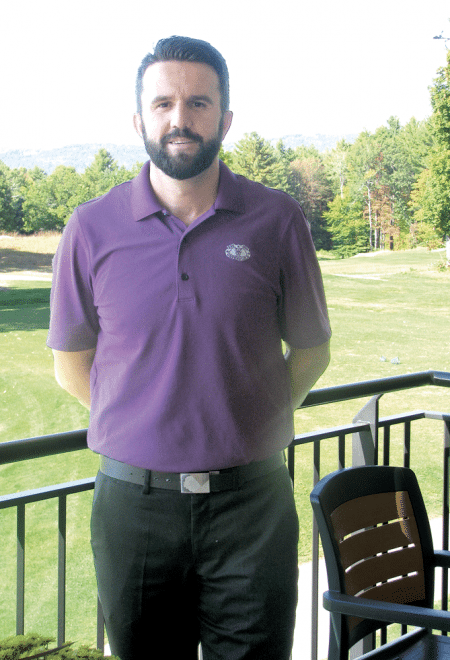
Terrazza’s Abaz Cecunjanin says holiday bookings were strong last year and remain healthy in 2015.
That’s also true at Hofbrauhaus, where the party trend is toward sit-down dinners, which begin with a cocktail hour and passed hors d’oeuvres, followed by a three- or four-course meal and wine, then dessert, Stevens explained. “Some of them have gift giving; there are a couple of companies I really look forward to because their gift giving is so much fun. It’s a very festive atmosphere with music.”
At other establishments, like Lattitude, the trend is toward stand-up events.
Go HERE for a listing of the region’s banquet facilities
“Last year, we had a lot of plated events. This year, we’re booking a lot of cocktail stations with fun food, and employees are not necessarily sitting down for a formal dinner,” Corriveau said. “They want food stations and passed hors d’oeuvres and signature cocktails. For one green-energy company, we created a green cocktail. The trend is fewer formal sit-downs and more cocktail stations. It’s fun.”
That said, she added, buffets have become passé unless a company has a party catered on their premesis, in which case they’re more common.
One growing trend has seen restaurants host one event for numerous companies, giving small businesses an opportunity to experience a big-party atmosphere, with copious food choices and entertainment, on an affordable budget.
“That’s a great way to go for small businesses, and that’s what we mostly have around here,” said Deborah Snow, co-owner of the Blue Heron in Sunderland (see story, page 40), which hosts such a party each holiday season, in addition to individual gatherings for large and small groups in its various rooms.
“Most businesses in the Valley don’t have huge budgets for parties; they’re Yankees, and they’re frugal, which is great,” Snow said. “But business owners still want to give something to their employees in the way of a big holiday party, and this is one way to do it. We’ve also gone to other people’s locations to cater parties; that’s a big part of our success, too.”
Corriveau said Lattitude also brings the party to companies that prefer not to leave the office, or find it difficult to agree on a time for everyone, but still want to celebrate the season.
Erin Corriveau says Lattitude’s prime December party dates were largely booked by August.
In addition, “a lot of people can’t do evenings or weekends, so they’re booking lunches, taking the staff out to lunch. They’ll either close early or take a big chunk out of the day to celebrate with staff,” she explained. “Work-life balance is a big thing, and a nighttime event might not work for all employees; they’re taking those needs into account and making a party work for as many people as possible.”
At their heart, Corriveau said, company holiday parties are a way to express gratitude.
“A lot of employers want to celebrate with employees and thank them,” she told BusinessWest. “Typically, the holiday season is considered the year end, so they’re thanking them for a job well done and their hard work throughout the year.”
For Cecunjanin, who took a chance on a new restaurant in 2013, the concept of gratitude takes on a different meaning — a more personal one — as he heads into a busy holiday season.
“You can work as hard as you want,” he said, “but any business needs a little luck, and so far, we’ve had luck on our side.”
That’s as good a reason as any to make merry.
Joseph Bednar can be reached at [email protected]

Bob Cummings, CEO and managing principal
Bob Cummings calls it his “acronym glossary.”
It’s aptly named, and those in his industry, known as benefits administration solution providers, really need one. Actually, it’s their clients that do, so Cummings and others at Northampton-based American Benefits Group, which he serves as CEO and managing principal, always have some on hand.
Comprehending what all those letters stand for will go a long way toward at least better understanding conversations involving benefits these days, he said, noting that there are no fewer than 60 acronyms listed on the two-page sheet.
They range alphabetically from AD&D (accidental death and dismemberment plan) to WHCRA (Women’s Health and Cancer Rights Act), with an alphabet soup of agencies, acts, products, and services in between.
There’s COBRA (Consolidated Omnibus Budget Reconciliation Act), EOI (evidence of insurability), HDHC (high-deductible health coverage), MSA (medical savings account), POP (premium-only Section 125 cafeteria plan), PCE (pre-existing condition exclusion), and PWBA (Pension and Welfare Benefits Administration), which, as everyone knows, is now called the EBSA (Employee Benefits Security Administration), which is obviously listed earlier in the glossary, in the ‘E’ section.
Got it? Of course not.
And Cummings and his team members, who collectively serve as benefits consultants, or advisors, understand that. They also understand that knowing what those letters and phrases, such as ‘Cadillac tax,’ stand for isn’t what’s really important. Rather, it’s being able to decipher which products add up to the best, most practical options for a company’s employees.
And because it excels at that basic mission, American Benefits Group (ABG — that acronym’s not in the glossary) is enjoying a period of profound growth and expansion of an already diverse portfolio.
“This is a really exciting time for us — we’re enjoying a major growth spurt,” said Cummings, who segued into benefits work in the mid-’80s after running a small insurance agency. “Hardly a day goes by that I’m not sending out new client proposals.”
Cummings attributed this growth to an intriguing blend of services — including ‘360-degree benefit-solutions packages’ and account administration — and operating traits that together add up to solid, dependable service that he categorized through early and frequent use of the phrase ‘customer-centric.’
The recipe calls for equal and generous portions of personalization, innovation (meaning investments in what the company calls enabling technology), creativity (more about what that means later), and knowledge, all of which translates into a single word (no acronym required): value.
To help explain his points on innovation and technology, which has been a staple of the company since the beginning in 1987, Cummings held aloft the so-called American Benefits Group Benefits Card, which was created in response to one of the most significant and far-reaching additions to that acronyms list, the FSA, or flexible spending account.
“This has been a real game changer,” Cummings said of the card, roughly 30,000 of which are now in circulation, a number that could rise 25% by year-end. “I can go use it at the doctor’s office, the hospital, the pharmacy, the dentist, the vision provider … it won’t work at a restaurant or a gas station — it’s a specially programmed card — but it will work at the MBTA [Massachusetts Bay Transit Authority] to buy my transit pass, and I can pay for my parking with it, too — any eligible merchant.”

Bob Cummings, seen here with Clodagh Parker, director of Flexible Compensation Services, and Herb Mayer Jr., director of Operations, says ABG is experiencing explosive growth.
For this issue, BusinessWest talked at length with Cummings and others at the company about the constantly and profoundly changing landscape of employee benefits, as reflected in that glossary, and how this firm has come to be a star performer on a highly competitive playing field.
As he talked about the current benefits landscape, Cummings said it would be prudent to first turn the clock back nearly 30 years, when he first entered this field, and not long before he started writing a column on insurance benefits for a recently launched publication known as the Western Mass. Business Journal (WMBJ), now known as BusinessWest (no accepted acronym, although BW is gaining ground).
The benefits world was much different back then, of course, he said with a laugh, citing as evidence the $3 co-pays levied upon health-insurance policyholders, the emerging phenomenon known as the HMO (health maintenance organization), and the MS-DOS (Microsoft Disk Operating System) platform on the office’s computers.
“In those days, I was one of a handful of people who were actually doing group benefits and group health insurance,” he recalled, noting that he first set up shop on King Street in Northampton and chose the name American Benefits Group because he liked to think big and thought that brand reflected this philosophy. “And I can remember when group health insurance was less than $100 a month for the premium, and people paid $5 for an office visit and $3 for a prescription, so nobody thought twice about going to the doctor when they needed to. That was the world we lived in in 1987.”
That world soon changed, however, as the cost of health coverage increased in double-digit increments on a seemingly annual basis, and new products began to emerge along with yet another acronym that would eventually dictate the course of an industry — CDHC, or consumer-driven health care.
“By 2002, we saw the creation of health savings accounts [HSAs] and health reimbursement arrangements [HRAs],” Cummings went on. “Of course, no one knew what they were, just like no one knew what a flexible spending account was in 1988. I knew what a flexible spending account was in 1988, and said, ‘no one knows what this is, but I have the feeling that eventually, every employer will want to offer these to their employees.’
“So in 1988, in the MS-DOS world, I put my big toe in the water — actually, I put everything in the water, and I started administering flexible spending accounts,” he went on. “And I was one of the first people in New England, maybe on the East Coast, to do that.”
He started with a handful of clients based in and around Northampton — Florence Bank, Hampshire College, Mount Holyoke College, AAA of Pioneer Valley, among others — and gradually built the portfolio.
Before he could administer a company’s plan, however, he had to educate the employer — and the employees — about the specifics of the plan and its many benefits. It was a huge part of the equation, and it remains so today.
Indeed, while technology, products, the amount of the deductibles on the health plans, and much more have changed exponentially since Ronald Reagan patrolled the White House, the basic assignment for companies like ABG hasn’t, he went on.
Indeed, success still comes down to those four qualities listed earlier — personalization, innovation, creativity, and knowledge, said Cummings.
The company’s customer-centric approach, along with all that aforementioned technology, including cloud-based systems, has in many ways leveled the playing field when it comes to TPAs, or third-party administrators.
This phenomenon, coupled with the company’s partnership with NFP (National Financial Partners), one of the nation’s largest distributors of financial-services products, has enabled ABG to greatly accelerate its growth pattern over the past decade or so.
Over that time, the company has expanded the portfolio of FSA administration from 40 employers and 1,200 participants to hundreds of employers and more than 30,000 participants, said Clodagh Parker, ABG’s director of Flexible Compensation Services, adding that the firm has gone from four or five employers to more than 30 in that period.
That portfolio is diverse, she went on, noting that it includes major employers across several sectors, including carmakers Fiat, Mitsubishi, and Ferrari North America (she jokes that Ferrari let her sit in one of its vehicles once), and Wall Street giant Cantor Fitzgerald.
But its core business, its sweet spot, if you will, is smaller companies with dozens of employees, rather than hundreds. Such businesses usually don’t have large human-resources departments (or even an HR person) and, thus, do need a partner and benefits-solutions provider and, quite often, an FSA administrator.
“I know that every small-business owner is majorly challenged today with just trying to figure out what they’re supposed to do,” Cummings said. “The average small-business owner needs help — they don’t have a full-time department to do all this stuff. If they have a bookkeeper or office manager, he or she is also wearing the double hat as the defacto HR person. These companies generally need to know not just what they’re supposed to do, but how they’re supposed to do it. And that’s been the biggest change from what I guess I would call the good old days.”
The process of serving these companies — and all other clients, for that matter — begins with that aforementioned 360-degree benefits solution, said Cummings.
“It includes strategic analysis for the client and helping the client design a program that’s going to meet their cost objectives and diverse employee needs,” he told BusinessWest. “It also includes providing all of the communication and the carrier negotiations — the pricing-market negotiations with insurance carriers; providing the technologies for the administration of the program, including the web-based, paperless enrollment and communications technology for the employees; and the administration services we offer on a national level, with the FSAs being the biggest.”
Elaborating, he said many of the clients the company has added over the past several years already offered benefits, obviously, but didn’t believe they were getting adequate value when it came to what was being offered and the prices being paid.
With the advent of mandated healthcare coverage, first in Massachusetts and then nationwide, there is considerably less room for negotiation on price, he went on, so the value comes in finding the right set of products for the employee group in question.

Bob Cummings calls the American Benefits Group Benefits Card a “game changer.”
“We would look to first develop a strategy in terms of the benefits program and looking at the existing benefits program and doing an audit,” he said. “Compliance is a very big issue these days — there’s so much more compliance today than at any other time in history, and it just got much, much bigger. In many cases, employers don’t even know about the regulations, let alone how to comply with them.”
In a nutshell, ABG analyzes a client’s data, needs, budget, and more, and comes up with a solution in the form of what Cummings called an “employer benefits HR web portal,” a platform solution called Employee Navigator, which eliminates paper and provides considerably more efficiency when it comes to enrollment, communication, and other facets of effective plan administration.
Summing up all that’s happened over the past three decades or so, Cummings said long gone are the days when companies in this industry were called upon to do little more than get quotes on insurance coverage.
“The bar has certainly been raised for insurance brokers and people working in the employee-benefits marketplace,” he explained, adding that companies aren’t looking for quotes, they’re looking for comprehensive, cost-effective solutions.
By becoming proficient at providing them, ABG is enjoying a period of profound growth triggered by still another acronym it’s been providing from the beginning: ROI.
And every business owner and manager knows what that stands for.
George O’Brien can be reached at [email protected]


Marcelia Muehlke displays one of the many fair-trade weddings dresses her company now offers.
Emily Cohen admits she didn’t know a whole lot about wedding dresses and the process of finding one when she informally launched her search at the start of this year, roughly four months after she and Ted Eiseman announced their engagement.
In fact, she told BusinessWest she was surprised to learn it would likely take several months to choose a dress and fulfill an order, a reality that provided a new sense of urgency to the matter as January turned to February.
And it was to be compounded by feelings of frustration as she visited various shops and mulled the myriad, almost universally unappealing, options presented to her.
“I went to three or four local wedding stores, and it was just not a good fit for me,” said Cohen, an acupuncturist by trade. “Everything was factory-made, polyester, made in China, with a lot of it catering to a real Disney-princess-slash-Barbie-doll look. I’m more oriented to natural fibers, and because of what I do, I’m into holistic things. I was having trouble finding something that was flattering and well-made and suited my tastes.”
These were just some of the sentiments she was expressing to a friend when that individual put her on the path to an eventual solution.
“She said, ‘I babysit for someone who has a fair-trade wedding-dress company — her dresses are beautiful; go take a look online,’” said Cohen, adding that she followed up on that tip, met Marcelia Muehlke, founder of Celia Grace Wedding Dresses, and was eventually fitted for a silk dress known as the ‘Jane.’
That’s short for Jane Goodall, the British primatologist, anthropologist, leading expert on chimpanzees, and one of several pioneering women for whom Muehlke has named her various creations.
There’s also the ‘Teresa’ (Mother Teresa); ‘Eileen’ (Eileen Collins, one of the first female astronauts); ‘Eleanor’ (crusading first lady Eleanor Roosevelt); ‘Maya’ (poet and author Maya Angelou); ‘Amelia’ (aviator Amelia Earhart), and many others.
Putting women like Cohen on a first-name basis with all those first names is one of the many challenges Muehlke has confronted while launching and developing one of the more unique of the many new entrepreneurial ventures unfolding across the region.
Indeed, she said most women have never considered the concept of a free-trade dress (one produced in a country and manner that respects human rights and environmental sustainability), know that such a dress exists, or know that Muehlke’s the reason one exists.
The process of changing all that and moving the business well beyond the ‘friend-of-a friend’ stage in terms of how awareness is generated — although that still happens, obviously — has been a learning experience, and one that is ongoing for Muehlke and partner and dress designer Alix Kivlin.
Summing up her first three years in business, Muehlke says the venture has gone from concept to what she called a “nationally acclaimed brand,” with the ‘Jane,’ ‘Teresa,’ and others now sold in shops in or just outside several major cities, with Brooklyn and Washington, D.C. being the latest additions.
“We’ve built a stable, ethical, international supply chain, which is ready to grow with us,” she explained. “We’ve earned coverage in eight of the top 10 online wedding magazines, we’ve developed 20 bestselling styles, and we have two thriving sales channels, in stores and direct, that gives us full coverage of North American and Europe. That’s pretty good, especially in such a slow-moving industry.”
Looking forward, she plans to continue what has been a very controlled pattern of growth (more on the importance of such a pace later) and thoughtfully move the company in several potential-laden directions.
The evolving strategy includes adding shops in more markets — both in this country and eventually abroad — as well as expansion into other product lines (everything from mother-of-the-bride dresses to First Communion outfits, all worthy of the label ‘free trade’), and exploration of new revenue streams, such as the emerging trend of wedding-dress rentals, rather than purchases.

Emily Cohen — seen here with her husband, Ted Eiseman, after their wedding this summer — was sold on every aspect of the ‘Jane’ dress.
Photo by Darlene DeVita Photography
For this, the second installment in its series on emerging entrepreneurial ventures across the region, BusinessWest looks at an enterprise blending concepts that are old, new, borrowed, and, well, you get the idea.
As she talked with BusinessWest about her venture and what comes next, Muehlke was involved with the many aspects of preparation for New York International Bridal Week. In fact, she had just finished up some calls with bridal-shop owners to set up appointments.
The three-day, biannual spectacle, to be staged Oct. 10-12 at Pier 94, is, in many respects, this industry’s Super Bowl, with hundreds of exhibitors, many of them wedding-dress makers, looking to catch the attention of thousands of retailers and wholesalers from across this country and around the world.
Muehlke, who will patrol booth #262 (there are nearly 1,000 of them), said that, during the last show, she and Kivlin were able to essentially cinch a deal with another prominent bridal shop (this one just outside Boston) and make countless new introductions — connections that will hopefully pay dividends down the road.
The goal for this year’s show is simple — more of the same, she said, adding that, while relationship building is a key to success in any business sector, that’s especially true in the wedding industry, a roughly $50 billion business.
That’s because, while styles can change profoundly with one royal wedding (Kate Middleton’s dress brought back sleeves and lace, for example), overall, this industry moves slowly compared to most components of the fashion business, and those who sell the dresses devote money and valuable showroom space to new makers only after careful consideration and confidence that the product will sell.
“Bridal shops buy the dresses — usually one of the most popular styles in a size 12 — and then they place orders off those dresses year-round,” she said while explaining how most of her dresses are sold. “So it’s a fairly deep initial cost for them, especially when it’s a fairly new line like ours. And it’s a risk, because they need to know that we’re going to deliver every single dress on time and in perfect condition.
“It takes a while to build that trust,” she went on. “They want to get to know us personally and as a business, and that can take a while. Some shops will say, ‘I love this idea’ and pick you up, but, generally speaking, it takes some time to earn that trust; it took one of our shops more than two years to go from first contact to buying the collection.”
New York International Bridal Week is a time for advancing that process, she said, adding that she enjoys the show for many reasons, including the fast pace, tremendous energy, high stakes, and those opportunities to make an impression.
But there’s something else.
“I think my favorite part is being surrounded by so many smart, savvy, interesting businesswomen,” she explained. “The bridal industry, as you’d expect, is dominated by women and women business owners, so it’s just really neat to get together with all these women of different ages and from different states and countries, all coming together to make their businesses successful.”
While she’s still rather new to the industry, Muehlke certainly seems worthy of those adjectives she used to describe her peers, although she readily admits she’s still learning by doing.
Muehlke said that, like many business ventures, this one was born of necessity — she desired a free-trade dress for her own wedding, and when she couldn’t find one, she decided to not only make one, but also fill the void for others. Indeed, after completing her MBA at UMass Amherst, she traveled to Asia and set up a supply chain that would create high-quality garments that she and others could wear with pride.
She began working with women in a sewing group in Cambodia, contracted with a designer in New York, and got her venture off the ground and on the runway.
She’s won a number of awards and accolades for her early success — everything from a Grinspoon Entrepreneurial Success Spirit Award in 2011 to membership in BusinessWest’s 40 Under Forty Class of 2015 (she’s only 31).
More importantly, she’s made considerable progress with not only selling dresses, but selling a concept.
She defines ‘free trade’ as a global, social movement that leverages trade, instead of monetary aid, to help people in the world’s poorest countries. In her case, she partners with shops in Cambodia and India that pay a living wage, do not use child labor, and ensure safe, healthy, and empowering work conditions.
“We trust those people to use that money to better themselves, better their families, and better their communities in ways they see fit,” she explained, adding that the shops employ mostly women. “And research has shown that, when you put money in the hands of women, they are more likely than men to invest in the health and education of their children. So it has a much more positive ripple effect when you’re investing in — and empowering — women.”
Cohen said she didn’t really know she wanted a fair-trade dress until she was introduced to the idea. And her only regret is that she didn’t know about such a dress sooner.
“I didn’t know such a thing existed,” she told BusinessWest, adding that she was attracted not only by the quality, but also the fact that the dress was made from silk, which made her dress both comfortable and meaningful.
“Once I picked out the dress, tried it on, and ordered it, Marcie sent me pictures of the women making the dress in Cambodia,” she explained. “They’re in this beautiful, light-filled space … it looked like they were having a good working experience. It makes me feel good to spend my money that way.”
The ‘Jane,’ a.k.a model 1504, features a “wonderful fit-and-flair shape that helps the body in all the right places, so it and provides a comfortable and flattering fit,” said Muehlke, adding that it is made from something called ‘heirloom eco-silk,’ which is hand-woven on wooden looms that use no electricity, thus carrying on a centuries-old tradition.
“Jane has clean and elegant lines, thanks to a timeless sweetheart bodice accented with vintage-inspired floral lace and a gently flared slim A-line skirt that can’t wait to be danced in,” reads the description on the company’s website. “The finishing touch? Delicate straps and a low, dipping back with covered buttons beautifully showcase a feminine back.”
The model, which sells for about $2,600, which is toward the higher end for a wedding dress, has caught and passed the ‘Teresa’ as the most popular of the dresses now offered, although others are enjoying success as well.
Overall, Muehlke’s business plan, one that continues to undergo alterations (yes, that’s an industry term), calls for continued but very controlled growth.
Indeed, moving too quickly and expanding too broadly is an unwise course not only in the wedding industry, but the free-trade genre, if you will, as well, she said.
“In the bridal world, if you miss a deadline and you miss a wedding, that’s terrible both for the shop and for your brand, and something we can’t let happen,” she explained. “And in the fair-trade world, if we do a 10-fold increase in our orders, we need to make sure that our supply chain can handle that without doing crazy things and making their workers work terrible overtime hours and cancel their vacations or pay them improperly for that.

A view of the back of the ‘Teresa,’ named after Mother Teresa, one of the most popular options in the Celia Grace collection.
“So we are slowly and gradually building our supply chain in two ways,” she went on, adding that the company is building capacity with its existing partners — two in India and one in Cambodia — by working with them to add seamstresses and capacity and create more time on their schedule for Celia Grace production. At the same time, it is adding producers, including one in Nepal, another candidate in Cambodia, and other groups under consideration.
“We’re onboarding them slowly, getting to know them, and putting them through their paces,” she noted, “so, as we grow, we’re able to bring them online.”
Growth could come in several ways, she said, adding that, while there is still plenty of room for new designs (and first names) in wedding dresses, there are other avenues as well. These include other types of fair-trade clothing, such as mother-of-the-bride dresses and options for other occasions.
Meanwhile, the company looks to broaden its reach internationally and add shops in other countries.
“Europe, Australia, New Zealand, and Canada are quite a bit ahead of us in terms of eco- and ethical weddings,” she explained. “So that’s the next big frontier for us — getting shops to carry us in those countries.”
Meanwhile, another important challenge is simply to raise awareness of the concept of the free-trade wedding dress, something that would greatly facilitate efforts to reach and surpass some of those expansion goals.
“There are so many brides out there who would love the concept if they even knew it was an option,” Muehlke explained. “We have to figure out how to find those brides who have a big heart, but don’t know that their wedding dress can be so much more meaningful.”
Emily Cohen was found in time, and she sees some poetic justice in that eventuality.
Indeed, she told BusinessWest that she was hoping to have her grandmother, a dressmaker, fashion something for her wedding, but she passed away just a few months shy of her 100th birthday, well before the big event.
A Celia Grace wedding dress was easily the next best thing, Cohen went on, adding that the values it represents echo those that dominated her grandmother’s life.
“She was in my heart and in my mind as I was searching for a dress, because she really cared about those things, and I felt that she would have been proud to have me wear that dress,” Cohen said.
Her story helps explain how this entrepreneurial venture has managed to weave its way to its success, and why women are finding its products are such good fits — in so many ways.
George O’Brien can be reached at [email protected]

Charlie Epstein
Charlie Epstein calls them “blind squirrels” and “two-plan Tonys.”
These are just some of the colorful names he has for individuals and firms who don’t handle a lot of retirement plans — hence it’s a ‘two-plan Tony’ — but can still manage to sell themselves and their services to employers looking to save a few bucks, cut a few corners, or do a favor for an old friend.
“They have a couple of retirement plans, they’re overcharging fees, there’s bad investments … there’s no process in place for monitoring anybody; nobody’s sitting with the employees and helping them, guiding them,” Epstein, president of Holyoke-based 401(k) Coach, LLC, told BusinessWest. “Even a blind squirrel finds an acorn once in a while, but…”
He didn’t finish that sentence, but didn’t really have to; the implication was clear. Most of the time, the blind squirrel doesn’t find the acorn.
That’s why employers large and small looking for someone to manage the retirement plan they’ve created for their workers should look upon two-plan Tonys with a very wary eye, said Epstein, adding that this isn’t just his opinion or what most would consider sage advice.
Instead, it’s what he called a “duty” that employers share, and, even more importantly, it’s the law, as a number of recent court cases have shown.
It’s all spelled out on page 51 of Epstein’s relatively new book (it came out several months ago) titled Save America, Save! The Secrets of a Successful 401(k) Plan. It’s a how-to book of sorts, and while writing it, Epstein probably broke the ‘m’ key on his computer while repeatedly typing out the word ‘must.’
“If you’re an employer and you sponsor a 401(k) plan, you have a fiduciary responsibility to do what’s in the best interests of your employees,” he writes in a chapter titled “Your Role as a Fiduciary.” “Employers must remember that a 401(k) plan is established under ERISA (the Employee Retirement Income Security Act of 1974) for the exclusive purpose of providing benefits to participants and their beneficiaries.
“As a plan fiduciary, you have a duty of loyalty and a duty of prudence,” he went on. “You must be loyal to your participants and their beneficiaries, and avoid any conflicts of interest or prohibited transactions. You must act prudently in managing the plan and the plan’s investments. That means you must have a repeatable process to monitor the plan’s investments, and to fire and hire the managers if they are not performing to certain metrics.”
He explains those metrics in great detail in a book that is his second on the broad subject of the 401(k) but would not be considered a sequel. In fact, Epstein calls them “bookends.”
Indeed, while Paychecks for Life: How to Turn Your 401(k) into a Paycheck Manufacturing Company, published in 2012, was, as that title implies, intended for the employee, Save America, Save! was written for the employer, spelling out those obligations and ‘musts.’
It differs from Paychecks for Life in a few other respects as well. Epstein’s first book took him three and a half years and two ghostwriters to complete — he says he wound up rewriting 90% of their contributions — while the second was penned over a weekend, by his estimation. And while the former was intended for sale ($22.99 is the listed price) and has sold more than 15,000 copies, the latter is essentially being given away to all who want and need to read it.
What’s more, Epstein is committed to helping financial advisors like him across the country to write their own version of the same book.
“I’m now in the author business, and I’m helping advisors across the country become authors,” he explained, adding that he’s partnering with his publisher, Advantage Media Group, to put similar works in print and thus add another element to his coaching activities.
He admits that this strategy seems nonsensical to the casual observer, but to him it makes all the sense in the world, because his ultimate goal is not only to have employees commit themselves to creating paychecks for life, but also to help employers make sure the job gets done. And that means sharing the wealth, or, in their case, the insight, into not only 401(k) management, but how to write the definitive book on that subject.
For this issue and its focus on retirement planning, BusinessWest talked at length with Epstein about his book, but especially the larger issue of effective plan management and how it doesn’t happen by accident.
As he talked about his book, why he wrote it, and the growing sense of urgency attached to the matter of the responsibilities incurred by plan fiduciaries, Epstein borrowed the famous quote attributed to the prolific bank robber Willie Sutton.
Only, he didn’t know it was Sutton who, according to lore, when asked by a reporter why he robbed banks, said, “because that’s where the money is.”
Epstein deployed the line as he explained the importance of the case known as Tibble v. Edison, in which the Supreme Court ruled that fiduciaries have a continuing duty to monitor the investments in a retirement plan, the service providers, the fees, and more — and why he believes there will be many more suits like it in the years to come. (Actually, others are already winding their way through the courts.)
“There have been numerous ERISA lawsuits, and there will be a lot more,” he explained. “Why? Simply stated, the lawyers sued the tobacco industry, they sued the pharmaceutical industry, they sued the asbestos industry, and now that we have $4 trillion or $5 trillion in retirement-plan assets, the lawyers are licking their chops.”

Charlie Epstein says his new book is designed to help business owners with the task of enabling employees to do as the cover suggests.
Edison International, a holding company for a number of electric utilities and other energy interests, provided a 401(k) plan serving 20,000 employees that was valued at $3.8 billion during the litigation. Epstein said his book wasn’t really written for those kinds of companies — although he admits that maybe their top executives should read it anyway — but was intended for employers dealing with plans involving two or three fewer zeroes.
Such companies don’t have large departments handling their 401(k) plans, and, more to the point, the entrepreneurs behind them need to be more focused on running their venture than on administering a retirement plan.
“A plan sponsor fiduciary’s roles and responsibilities are very clearly spelled out under ERISA,” he noted, “but in the small and mid-sized workplace, business owners are not professional fiduciaries — they’re running businesses; they’re making widgets.”
But, as he said, regardless of the size of the company, the basic responsibilities with regard to managing a plan are the same, as are the many forms of trouble a company can run into if those responsibilities are not met, as evidenced by what happened to another, now much-better-known energy company.
“Along came Enron a few years back, which woke everyone up and had people thinking, ‘what is a fiduciary?’” he told BusinessWest. “Enron taught us all the bad things that bad people can do as fiduciaries to their participants, and that set in motion where we are today.”
And by ‘today,’ he meant, among other things, the Supreme Court ruling in Tibble v. Edison. The corporation tried to argue that the statute of limitations had run out and it didn’t have to continue monitoring certain investments (those initiated more than six years earlier, to be specific).
“But the judges said ‘au contraire,’” noted Epstein, “because the laws used in a retirement plan are trust laws, and under trust laws, a fiduciary’s duty never ceases.”
So what does the court’s ruling mean? “It means people need to read this book,” said Epstein with a laugh, noting that its 130-odd pages comprise “a compilation of everything that I have taught and preached for the last 30 years — but in simple terms.”
He said he wrote it because there are, indeed, two parts to the equation when it comes to whether employees can effectively save enough for retirement, and both are equally important. Actually, the employer’s role is more so.
“Even if the employee does everything I say in this book,” said Epstein, holding up Paychecks for Life, “if the employer screws it up…”
The book has five parts, each with its own set of ‘action steps.’
Part one is titled “Our Savings Crisis,” which, as those words suggest, outlines why there is a crisis when it comes to retirement savings and how it can be stemmed. It includes sections on the very uncertain future of Social Security and the emergence of the 401(k) as the “best place to save.”
Part two, meanwhile, is called the “Power of Auto5,” and deals with, among other things, the five automatic features in a plan — enrollment, QDIA (qualified default investment account), escalation, re-enrollment, and something called the ‘stretch match,’ designed to incentivize employees to save a greater percentage of their pay.
While there are detailed references to these automatic features in Paychecks for Life, Epstein said he revisits them here to drive home the point that employers need to be proactive when it comes to helping their employees save.
“Employees, left to their own demise, won’t get it done,” he explained, “so there are some things that I think employers need to do automatically with their retirement plan, such as automatically enroll and automatically increase the contribution.”
Part three is titled “Your Role as a Fiduciary,” and goes into great detail about all those ‘musts’ listed earlier. Part four is called “Creating Smart Savers,” and the concluding section is titled “Measuring Employees’ Success.”
Throughout, there are formal industry terms such as ‘safe-harbor match,’ and far-less-formal phraseology, such as ‘the green-bathrobe effect,’ an anecdote designed to show the folly of taking unnecessary risks with OPM (other people’s money). It would take too long to explain in this space (there’s another reason to get the book).
Overall, the book is designed to create a world of better-informed fiduciaries, said Epstein, adding that, with that knowledge, plan managers can help foster an appetite for more — and more effective — retirement-savings activities, and avoid common mistakes, such as hiring blind squirrels, not monitoring investments, and failing to benchmark those investments.
And that brings him back to that new wrinkle — helping other financial advisors write their own book on the subject.
Already, three advisors he’s working with — in Idaho, New Jersey, and Colorado — are writing their own versions, he told BusinessWest, and there are roughly eight more in the pipeline.
On the inside of the book jacket for Save America, Save! Epstein writes, “are you doing everything you can to ensure your employees feel confident that they will have enough money to retire and pay for all they desire to do someday? Save America Save! reveals the ‘secret strategies’ that will significantly impact retirement-outcome results for you and your employees.”
By publishing the book, Epstein is making sure those strategies are no longer secret, and that’s exactly what he wants.
Instead, he wants them to be common knowledge. If that goal can be reached, fiduciaries can stay clear of trouble, and, far more importantly, this country can retire that word ‘crisis’ when it comes to retirement savings.
George O’Brien can be reached at [email protected]

Amy Scott, Eric Belliveau, and Rory Hurlburt offer a next-generation model of marketing, expressed in their tagline, “Marketing Agency, Evolved.”
The little critters are called Worry Eaters.
Their names are Betti, Bill, Flamm, Polli, Enno, Saggo and Schnulli, and more than 2.5 million of the plush characters, with zippered mouths that allegedly ‘eat’ a child’s worries when they are written down and fed to them, have already been sold in Europe.
“Let us carry your worries so you don’t have to,” they shout on their newly developed website, which includes a video in which a worry eater banishes a little girl’s fear that a monster is lurking under her bed.
The website launched earlier this summer, and purchases can be made on an e-commerce shopping cart, thanks to Wild Apple Design Group in Wilbraham, which was hired earlier this year to introduce the toy to the North American market by the Haywire Group, a Springfield-based game designer and manufacturer.
The result is not only endearing, it earned the company marketing awards from the Advertising Club of Western Massachusetts. Wild Apple was recently feted as a Silver winner for consumer-product website design in the Summit Creative Award competition for its work on the Worry Eaters microsite, and received a Summit Creative Bronze for website redesign for its work for Kino West Media, a cinematic videography company in Palmer. In addition, that website redesign earned Wild Apple a Silver Creative Award.
Overall, the firm is known for its unusual creativity, and founder Amy Scott says that, although clients don’t expect it, there is always an element of “surprise and delight” in their finished product.
“Our major goal is to create a relationship with our clients that is transformational, rather than transactional,” said the director of project management and business development. “We want to listen to them, learn about their goals, then surprise and delight them by exceeding their expectations.”
This stems from work done by Rory Hurlburt, Scott’s brother and the company’s creative lead, art developer, and senior designer.
“Clients usually have no idea that we will do something fun,” Hurlburt said. “But we’re a modern marketing agency, and these things make someone want to watch a video or talk about what they have seen.”
However, the lure of an attractive site has to be backed by technical expertise, and that’s where Eric Belliveau enters the picture.
“There are many considerations and elements that go into a website and digital marketing; for example, it requires science, analytics, and technology to get someone to add something to an e-commerce shopping cart, then complete the sale,” said Wild Apple’s director of operations, technology, and Internet marketing, who explained that Worry Eaters are sold at a number of retailers, and creating the e-store was an important piece of the development process.
“It had to be responsive, which means it was built so the different characters could be viewed on smartphones,” he told BusinessWest. “But this all takes place behind the scenes, and the user is completely unaware that the intersection of more than one technology is required.”

Amy Scott says her company was one of the first in the area to design responsive websites, which work on multiple platforms.
Hurlburt says creating such a finished product is neither quick nor easy, and it requires not only technical acumen, but a complete understanding of the clients and their needs.
“I live, eat, and breathe the project I’m working on at any moment in time,” he noted. “I want to understand as many facets of the business or organization as I can, and also seek to learn who the client is, and how that personality can shine through the company or organization.
“But technology is behind everything we do; we’re experts at leveraging it and provide outstanding designs with a ‘wow’ factor,” he went on, adding that data is brought together into a visual design that represents the brand they are working on.
Scott said that’s important. “Almost every company has a website. But they often have an unfulfilled dream to convey their business digitally in a way that draws more prospects and tells their story.”
Scott says she cut her teeth in marketing during a stint in the garment-manufacturing industry.
“I was the buyer, not the provider, but always felt there was so much room for improvement in leveraging the multitude of services required to drive successful marketing campaigns,” she said. “I was driven to create them.”
That drive compelled her to embark on a career change, and in time, her vision, energy, and success in graphic-design artistry inspired her to open Wild Apple Design in 2000, focusing on print marketing.
However, Scott occasionally collaborated with Belliveau. He began working in the field of web development in 2000, shortly after the dot-com crash, and eventually opened his own web-design and development company, which included consulting services.
Scott also called on her brother for help with a number of projects. Hurlburt was working as a freelancer and started his career with the idea of pursuing comic-book illustration, but soon found he enjoyed layout and design. “I spent 15 years designing for everything from web to print, which taught me that being well-equipped with information and strategy increases the value and viability of any well-designed art,” he said.
Although the trio had worked together on an occasional basis, their collaboration morphed into something much larger in 2009, after it became clear that the combination of their honed talents and expertise made them a unique team.
At the time, ABC decided to film an episode of the popular show Extreme Makeover: Home Edition in Suffield, Conn. Scott was hired to do the publicity, and after being told she needed to create a website, she contacted Hurlburt. Coincidentally, Belliveau got in touch with her and asked her to create a logo, explaining that he had a few clients serving as vendors for Extreme Makeover.
The trio ended up working together for ABC, and after overcoming a multitude of challenges, they decided to do another project together.
Eric Belliveau says it requires science, analytics, and technology to get someone to add something to an e-commerce shopping cart, then complete the sale.
She rented space in Post Office Park in Wilbraham and was joined by Hurlburt and Belliveau, who left his business, then religiously began evaluating every available technology.
Today, he focuses on digital marketing and the complex mechanics involved with setting up and maintaining websites. Meanwhile, Hurlburt is responsible for the creative-design work, and Scott focuses on marketing.
It’s all come together nicely, but when they first joined forces, their new, combined venture was a gamble.
“We felt we could do better and more business together, but it was an investment that involved blood, sweat, and tears; when we moved into this building, we were not sure if it would pay off,” Hurlburt said. “At the time, our goal was simply to survive.”
Fast-forward to 2015, and the company has not only survived, it is thriving. Rows of awards line the walls, and a year ago, Wild Apple created the tagline “Marketing Agency — Evolved,” which is indicative not only of its success and the wide range of services it offers, but the risks it has taken, which includes a foray into the world of responsive websites.
“We were one of the first to adopt the technology. When mobile traffic started to increase, it only involved an avenue or two and was an innovative area,” Belliveau recalled, explaining that, four years ago, sites were built either for desktops or mobile devices and typically didn’t function for both.
“But today, it’s becoming standard; all sites need to be responsive and function on tablets, smartphones, desktop computers, Kindles, and tablets,” he said, noting that the smartphone is usually the first point of contact.
“Roughly 40% of a website’s traffic will be on a mobile or handheld device; it’s also the place where most people access their e-mail,” Belliveau continued, adding that responsive websites need to be tactile, which means they can be manipulated by swiping or touching the screen, then clicking on an option.
The firm’s entry into this arena resulted in a world of experience, and today Wild Apple is able to deal with the entire ecosystem of marketing, which can include a responsive website; e-mail; social media; print, TV, and radio advertising; and a logo, branding, and identity design.
When the firm gets a new client, Scott conducts an in-depth interview to unearth its specific goals, needs, and vision for its products and services.
Once she has gathered all the information she needs, Hurlburt puts pencil to paper and begins sketching, and typically comes up with three or four ideas.

Rory Hurlburt takes pride in the creativity he brings to websites developed by Wild Apple Design Group.
Since about 35% of their clients are schools, creating surprise and delight can mean showcasing their colors, mascot, or “whatever their pride and joy is, in a unique way,” Scott continued.
For example, she discovered that the mascot for Cross Schools in South Carolina was a stingray, but they weren’t using an image of one. So Hurlburt took that information and created a happy little sea creature which has been imprinted on the students’ uniforms as well as the school’s signs, website, and marketing materials.
However, Belliveau’s expertise is also critical to the development process. “I’m in the forefront of emerging technologies such as responsive mobile website design and deploying the next generation in content-management systems,” he said. “I keep the team up to speed with the latest and greatest technologies so they can articulate what’s new or, in some cases, what’s changed in the ever-evolving landscape of web-based software.”
This work is ongoing for many clients as well as those who come to Wild Apple for an initial visit. “They want our critical eye on their brand. It’s about how it will hold up in a mobile environment, which involves more than aesthetics,” Hurlburt said. “And that’s what makes us different: we have design, marketing, and technology well in hand.”
Thanks to that winning combination, the company’s clients are unlikely to need to unzip the mouth of a Worry Eater and feed it to banish their marketing fears.
Mike Balise
Mike Balise has always been a huge New England Patriots fan.
He’s had season tickets since 1988, but was attending games — the 1985 AFC championship tilt against the Dolphins in Miami that sent the Pats to their first Super Bowl is one he fondly remembers — long before that.
Speaking of Super Bowls, he’s been to four now, including last February’s classic Patriots triumph in Phoenix (more on that adventure later). Meanwhile, through his business — several players and coaches buy or lease cars from the family of dealerships Mike serves as co-owner and vice president — he’s on a first-name basis with several people within the Pats’ organization, including its iconic head coach.
So when Judge Richard Berman freed Tom Brady earlier this month by vacating the four-game suspension imposed by the NFL, Balise was naturally in a celebratory mood.
Well, sort of, but not really.
Mike Balise, seen here with Patriots coach Bill Belichick, says he’s focused on not letting his stomach cancer dictate his life.
More to the point, he had just started a new chemotherapy regimen, and he was still dealing with the accompanying physical and emotional issues. Meanwhile, the pain that had retreated for the better part of six months was back with a vengeance and had reached what he considered a new level of severity.
“When that decision came out, I couldn’t have cared less about anything,” he said.
And there were still other, more pressing matters on his mind — such as the nagging question about what to do about his mother if and when that chemotherapy leads to serious hair loss, as the doctors are telling him it probably will.
Indeed, Viola (Vicky) Balise doesn’t know that her 50-year-old son, the youngest of her six children, has been diagnosed with incurable stomach cancer and continuously impresses those same doctors by the simple fact that he’s still alive.
And she’s not about to find out any time soon.
Balise said the news that reaches his bedridden, 88-year-old mother is censored, for lack of a better word, and family members are extraordinarily careful about what they say and do around Vicky to keep the diagnosis from her.
As for the impending hair loss and how to explain it away, Mike has a solution. His plan is to stage a promotion — details of which are emerging — whereby he will auction off one of his two season tickets to raise money for cancer research and treatment, attend the game with the high bidder, shave his head, and paint whatever image that companion wants on his bald scalp.
And if the hair should not grow back quickly or profoundly? “I’ll just tell her I like it that way,” said Balise with a laugh.
Various forms of creativity and humor have been Balise’s best weapons since he was first given his diagnosis in October 2014 and told bluntly that people who get this form of cancer generally don’t live more than nine to 12 months after reaching stage 4, which he already had.

Mike Balise says one of his priorities now is spending time with his family, including, from left, daughters Nicole and Marisa, a dog named Brady, son David, and wife Maryellen.
While making jokes about that diagnosis, Mike has also asked a lot of hard questions. Among them: what’s the longest anyone has ever lived after reaching stage 4 with this cancer? “The doctor checked with some other hospitals, came back, and said, ‘I think 20 months is the longest anyone’s lasted.’”
Doing the quick math in his head, Balise said 20 months for him would be roughly next May. He’s determined to not only get there, but somehow keep going and, through modern science, set a new longevity mark for people with his condition.
More importantly, he’s focused on living life as he would otherwise, and make the very most of whatever time he has left. That means considerable time on his boats, with his family, at Gillette Stadium, at the Balise headquarters taping radio commercials, and bringing attention to the need for more cancer services in this region.
He said 2015 has been both the most difficult year of his life and, in many respects, also the best. “Overall, I found more meaning this past year than at any other time in my life.”
For this issue, he consented to talk with BusinessWest about all that he meant by that statement, and how he copes with a very uncertain future through a “strategy for life” that he and his loved ones created together.
Balise told BusinessWest that the first 49 and a half years of his life were marked by very few health concerns of note, with the biggest issue, quite literally, being a bathroom scale that at times posted the number 335 or more when he stepped on it, but generally read between 235 and 245 in recent years.
“I was a gym rat — a weightlifter and a cardio nutcase,” he explained. “I grew up kind of fat, but I never had any real problems.”
So he wasn’t overly concerned when, in July 2014, he started feeling discomfort in his stomach. But anxiety increased as the pain continued and worsened.
When asked to describe it, Balise, who was at the time sipping a Diet Coke, said it would be like consuming an extremely large amount of that product and having it collect without burping.
“It was like an airy, gassy feeling — it’s a little hard to describe,” he recalled. “It started out mild, and then it got uncomfortable pretty quickly.”
Balise eventually went to seek medical attention, thus beginning an odyssey that has summoned every emotion and challenged him in ways he couldn’t have imagined.
And he could imagine plenty, especially after the colorful analysis provided by his local internist as he assessed and explained the information given to him following an endoscopy Balise endured early last October.
“He said, ‘you’re about to step into the ring with Mike Tyson … and you’ve never been to the gym before,’” Balise recalled, adding that doctors would soon tell him, “‘we don’t cure this kind of cancer; we can make it so your quality of life is better and extend your life, but we don’t cure this cancer.’”
As he talked about how this bout has unfolded, and what lies ahead, Balise said he was doing so somewhat reluctantly. He stressed repeatedly that there are many people in this region waging similar fights alone, and there is nothing extraordinary about his other than perhaps the severity of his cancer and the fact that his name, face, and voice are well-known within the community.
He said he consented to do this interview and a few others over the past year or so to shed some light on the myriad physical and emotional issues confronting all those who are battling cancer or will fight it someday, and to drive home the fact that those numbers continue to climb as the population ages and advancing science permits longer and, often, more successful fights against the disease. And more resources will be needed to help people wage those fights.
To get his points across, he summoned memories of visits to the Dana Farber Cancer Institute in Boston, where he was taken aback by the sheer volume of people engaged in their own battles.
“It’s standing room only there all the time,” he said with seriousness in his voice mixed with a strong dose of concern. “You go there for your ‘labs,’ and you get there at 7 in the morning and you won’t leave till 5. There’s elderly people, individuals who are really sick, who don’t have a place to sit while they’re waiting, sometimes for 45 minutes, for their name to get called before their labs are done.
“There are people clamoring to get in that building,” he went on. “And when I talk to people I know who have been treated for cancer here in Springfield … it’s clear there’s a complete lack of capacity to handle the cancers out there.”
His own fight, as well as those images from Dana Farber and other facilities, no doubt played a role in the Balise family’s decision to make a $500,000 donation recently to the capital campaign to expand the Sr. Mary Caritas Cancer Center on the Mercy Medical Center campus.
“We might have done it anyway, but this …” he told BusinessWest, using that word to describe the sum of everything he’s experienced and witnessed since being diagnosed, “made it a no-brainer.”
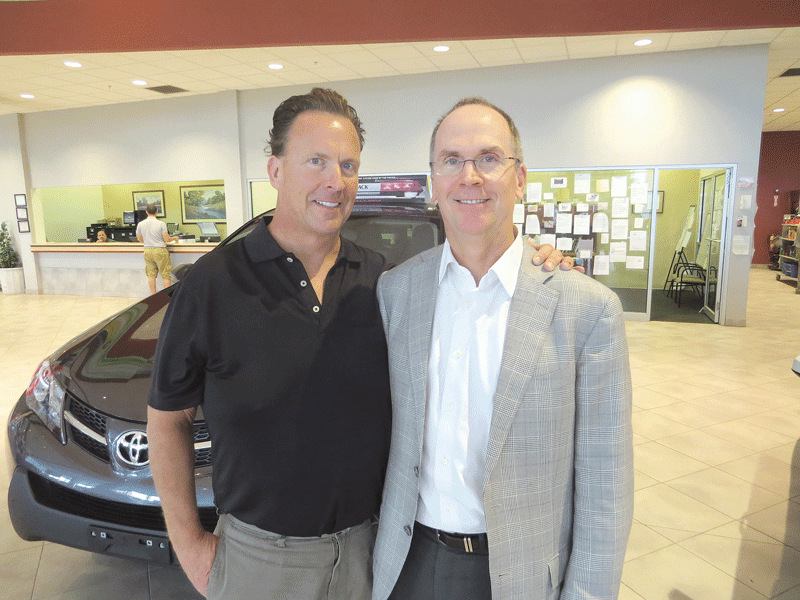
Mike Balise says he hasn’t enjoyed a better, stronger relationship than the one he’s had with his brother, Jeb.
He had input in the Caritas Center donation, Jeb went on, but kept what would be considered a low profile, especially with regard to the dollar amount.
“He didn’t want to make it seem that, because he had cancer, we were giving this money,” Jeb explained, adding that, throughout this ordeal, his brother has worked very hard to see to it that things are not about him.
Instead, Mike’s been focused on making a difference, or more of a difference, Jeb continued, adding that, while he’s always been active within the community and with causes such as autism — he recently took a 7-year-old from his neighborhood with that condition to see Pats coach Bill Belichick as he delivered a new car to him — the cancer fight has provided more opportunities to do so.
“His tonic is being able to make a difference,” said Jeb. “Certainly he’s been an inspiration, and we’ve gotten a lot of feedback from other cancer survivors and people going through the same thing, and that’s tonic for Mike. He’s not really trying to save himself — he doesn’t have false expectations — but whether it’s raising money for the cancer cause or just helping the individual person with whatever their situation might be, that’s his biggest motivator.”
Turning back the clock a little more than a year, Mike Balise recalled that it took doctors some time to figure out what was causing that aforementioned pain in his stomach.
The discomfort started in July, and by September, he had seen a few doctors, who couldn’t find anything. Jeb, who had watched a colleague in the car business succumb to stomach cancer nine months after being diagnosed, grew increasingly concerned and prodded his brother to seek attention.
“I had a terrible feeling — I didn’t like what he was saying,” Jeb recalled.
Mike, meanwhile, was thinking that it was an ulcer, and as his 25th wedding anniversary and a planned weekend on Mount Washington approached, concern mounted.
“I said to Maryellen, ‘I’m going to go up there, and this ulcer’s going to rupture, and I’m going to be six hours away from a crappy hospital,’” he recalled, adding that the trip was eventually canceled amid his vow that he would make it up to her.
A few days later, though, an endoscopy rendered that pledge irrelevant and turned their world on its end.
“The procedure probably lasted about 30 seconds, and when it was over, they knew I was in pretty big trouble,” Mike told BusinessWest. “The guy said, ‘we found a tumor, and you should go to Boston’ — and that’s all he said.”
His internist, Dr. Rodney Larson, provided far deeper insight in the form of that Mike Tyson analogy. But it would be another week before the news became official, for lack of a better word.
“The doctor was looking at a screen, and it looked just like the TV in the movie Poltergeist,” said Balise, using more humor to relate the chain of events. “It had no distinguishable pattern or anything; it was just a fuzzy TV screen.
“He said, ‘do you see this?’ and I said, ‘you’ve got to be kidding me, doc — I don’t see anything.’ And then he replied, ‘you’re right; I forgot that you didn’t spend 15 years in medical school,’” he went on. “Then he said, ‘if we don’t get you on chemo this week or next week, your odds of survival will go down a lot.’”
There were more inquiries from Balise, and more humor. “My first question was, ‘how many stages are there?’ They said, ‘four.’ I go, ‘can you make a fifth?’” he recalled, adding that, when he asked how long he had to live and the doctor balked at answering, he insisted on knowing and issued what amounted to a threat.
“The doctor said, ‘well, we really don’t like to get to into prognosticating like that; it just confuses the patient more — people can obsess on that,’” he recalled. “I said, ‘cut the bullshit, doc; if you don’t tell me how long I’ve got, I’m going to leave and do whatever I need to do to get an answer.’
“So he looks at his screen, thinks for second, looks at the stage — I was stage 4 — and says, ‘80% of the people who get this will be dead in nine to 12 months.’”
Thus commenced a tortuous period that Balise likened to being a rat in a cage.
“The rat doesn’t accept that he’s in a cage,” he explained. “He wanders around the cage, poking at every nook and cranny repeatedly, looking for a way out. I was the same way.”
On a good night, Balise said, he could muster perhaps a few hours of sleep, a pattern that continued until he and loved ones came up with what he called a “strategy for my life, not just for my illness.”
On the first page of that figurative document was dealing with the “dirty stuff, the painful stuff, the uncomfortable stuff,” meaning the broad task of putting his affairs in order, an important and challenging process, especially since he has an autistic 18-year-old daughter.
“We made the hard decisions, set up trusts, did all the paperwork,” he said, adding that, for this work and so many other aspects of his fight, he has leaned heavily on Jeb.
“I’ve never had a greater relationship with a human being in my life than the one I’ve had with my brother,” he told BusinessWest. “The trust factor is 100% there; in many of the cases where I would have to think through a lot of details, I just give Jeb durable power of attorney, and he can make any decisions, or my wife can.”
Jeb, deflecting attention away from his own contributions to the process, said simply that such financial work is “one of my strong suits.”
He said his brother has many as well, including the ability to use humor and other elements of his personality to not only navigate the physical and emotional whitewater from this ordeal, but also put others more at ease as they cope with the unfolding developments.
“Mike’s a warrior,” said Jeb. “He’s one part politician, one part Saturday Night Live character … and he’s a pretty smart businessman, too.”
But while Mike’s humor and other sentiments during this battle have been real, Jeb went on, he has used these various defense mechanisms to hide some of the many types of pain he has experienced during the ordeal.
“He really has done well, but he certainly masks much of what he has gone through,” he told BusinessWest. “His seemingly nonchalant attitude about all this is hard to put into words, but I think Mike really has focused on the quality of life every day instead of dwelling on the inevitable — and for all of us. He tries to focus on, ‘hey, what can I do today that’s meaningful and makes a difference?’”
Indeed, with that hard stuff behind him — and even during that challenging process — Balise said he went about, well, living life as he would have and not letting his diagnosis get in the way.
In some respects, that hasn’t been too difficult, because until recently, the pain that triggered this story had been absent from his life. Still, the chemo treatments, although less of an ordeal than he anticipated in some respects, have nonetheless packed a wallop, impacting everything from his energy level to his sense of taste, with the latter causing particular dismay.
“It’s been delightful compared to what I always heard it that would be — it’s been very kind to me,” he noted. “It changes … even though it’s the same medicine, the experience would be different every time I had it.”
Meanwhile, there have been many adjustments to make and new realities to accept when it comes to his body and what he can and can’t do.
“For years, I would bench-press 135 pounds 10 times, 185 pounds 10 times, and then 225 between four and eight times, and that was after doing all kinds of other warmups,” he explained. “Now, I do 100 pounds, one set, and I’m lucky if I can get 15 in.
“I don’t look that much different or worse,” he went on, adding that he currently weighs about 225 and hasn’t drawn too many questions from his mother about his waistline. “But things are different in terms of what my body can do and from a strength standpoint, but not from a flexibility standpoint or a million other standpoints.”
There have been changes in his workload as well, with Balise working a fraction of the 60 to 80 hours he traditionally put in during a work week years ago, with his duties now focused on coaching, mentoring, and continuing to be the voice of the company.
Those changes have resulted in part from his condition, but also due to some needed succession planning and realization that the company is much larger and more complex than it was years ago, said Jeb, adding that the company hired a COO roughly a year ago, and very recently added a vice president of sales, who handles many of Mike’s former responsibilities.
For the most part, though, Balise said he has kept cancer from dictating his life, and his fight would be only one of many figurative headlines used to capture the news of the past year.
Indeed, he said the most tears — and they resulted from a hard mix of emotions — came not from anything related to his condition, but rather on the day he and Maryellen took Nicole, their 18-year-old autistic daughter, to a school outside Boston, where she will spend more than 10 months a year.
“Until then, she had never spent a night away from home,” he noted. “On January 5th, she started a residential program in Boston, which is great for her. Still, that was one of the teariest days of my life; she can’t talk, but if she could, that day she would have said, ‘mom and dad, drag your asses out of here — I’ll be fine … I’m so sick of living at home with you.’ She did much better than her father that day, believe me.”
There were also plenty of memories from last February’s Super Bowl, for which Mike, his family, and several of the company’s dealers who prevailed in a competition boarded a leased corporate jet.
Jeb, who admitted to being far less of a Pats fan than his brother — “frankly, I’d rather watch paint dry than a football game” — watched the contest with Mike’s children, and said the Pats’ historic comeback and the game’s unlikely ending took on added significance because of Mike’s condition and thoughts that this might be his last Super Bowl.
Looking back on the past several months, though, Mike said he hasn’t dwelt on his own mortality and has instead been focused on living for the day, and even the moment.
He said there’s been only one occasion when he momentarily allowed himself to think, ‘this might be the last time I do this,’ and that was at Christmas, spent at the family’s home in Florida.
“I had a great Christmas Eve and then woke up Christmas Day with my kids in my house in Florida, and I just felt really despondent, thinking, ‘this is going to be the last Christmas, the last this, that, and the other thing,’” he recalled, adding that this funk was broken by a joke told by Rock 102 personality and close friend John O’Brien, who was visiting him at the time.
“I was in a fit of laughter that lasted three days,” he went on. “I would have wrestled myself out of it anyway, but it took him six seconds, and it was a joke to my wife that I overheard.”
And such negative thoughts have not returned. He doesn’t know if they will, but he’s committed to fighting such urges.
Life has gone on in most all respects, including that recent visit to Gillette Stadium, when Belichick taught the youngster how to grip a football and spent some time hanging with the child.
“He’s always gracious, and even though it was a really busy time, he met with the kid and spent some time with him in the middle of the work day,” said Balise as he grabbed his phone to proudly show some photos from the day. “He’s as real as you can get.”
The trip to Gillette, however, also coincided with a visit to Dana Farber for what Balise believes is the fourth CAT scan he’s had since he was first diagnosed. He didn’t know at the time exactly what the scan revealed, but said this simple fact means there is probably more bad news coming.
“What they’re looking for is not so much the cancer in my stomach, but the cancer in my lymph nodes and how that’s developing and if it’s hit any major organs yet,” he explained. “My doctor, who I think the world of, and he’s bright as hell and a really nice guy … he didn’t bring up the scan. So the kind of guy I am, I’m thinking, ‘you didn’t bring up the scan, so that means we’ve got bad news on the scan.”
Balise didn’t need the scan to tell him something was wrong. The pain that returned in July grew in its intensity, and as the calendar turned to August, it was with him 24 hours a day.
Still, he remains optimistic, notes that he’s never stopping hoping that a cure might be found, and hopes the new chemotherapy and other forms of treatment might buy him some time, meaning quality time — and more.
“This new chemo that I’m on could have the effect that it knocks this thing on its heels for a year, like my doctor said optimistically,” he said. “And when and if this one fails, there’s one other type of chemo that I might try. Doctors could be wrong; there might be a miracle, I might get hit by a bus … who knows what could happen?”
He does know that he plans to keep matters in perspective, and recalled a few of those visits to Dana Farber as he explained how he does that.
“You never see a child there — maybe once in a while, if they get a little slack and they bring me to one of the hospitals next to Dana Farber like Brigham & Women’s, I’ll see a kid with no hair,” he explained. “It’s only happened twice, because they really keep the kids separated, which is a good thing. But let me tell you … if you want to get your head out of your ass real quick, get a look at a 10-year-old kid who’s going through this stuff. That’ll do it.”
Looking ahead, Balise said he has a number of wishes and hopes for the future, starting with the Patriots. “I want to see Tom Brady finish the season,” he said, adding that, like many other fans of the team, he believes Deflategate will become a motivating factor for the Pats and their quarterback and possibly inspire another title run.
Meanwhile, he desperately wants to outlive his mother, a sentiment she would share under any circumstances, although he joked that none of his siblings may accomplish that feat at the rate she’s going.
He also wants to bring greater attention to the need for more cancer services — everywhere, but especially here in Western Mass. — and plans to continue using his still-high profile and ongoing fight to be part of that effort.
What he doesn’t want is for anyone to feel sorry him — he’s packed a lot into his 50 years, and has certainly enjoyed the many trappings of wealth — and cites those and many other reasons why.
Overall, he wants to spend as much time on the water and with his family as possible and be relentless in his efforts not to let cancer dictate the terms of his life.
He’s not sure when or how this figurative bout with Mike Tyson will end, but he does know he’s not ready to be counted out yet.
He’s still got plenty of living to do.
George O’Brien can be reached at [email protected]


Above: an architect’s rendering of a renovated Building 19. Below left: a late-19th-century shot of the structure, which served primarily as a warehouse for the Armory.
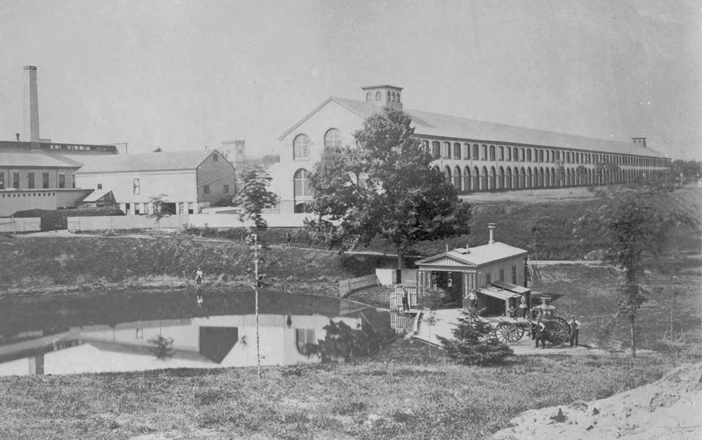
Springfield Technical Community College President Ira Rubenzahl likes to say the school moved into the historic Springfield Armory site back in 1967 … “and it’s been moving in ever since.”
Elaborating, he said the process of converting former Armory manufacturing buildings, office space, officers’ quarters, and other structures into classrooms, administration areas, and assorted other academic facilities hasn’t really ceased since it first began back when Lyndon Johnson patrolled the White House.
And the latest, and perhaps most ambitious, example of this phenomenon in the college’s nearly-50-year history is the planned conversion of the structure known as Building 19, which was once a warehouse that held more than a half-million rifle stocks at any given time, into the home for a host of facilities ranging from the library to the financial-aid office to the bookstore.
“It’s going to be the centerpiece of the campus,” said Rubenzahl, who took the helm at the school in 2004 and has overseen several projects involving reuse of old Armory buildings. He noted that, while there are still some hurdles to clear, especially final appropriation of the $50 million this undertaking will cost, the project is rounding into shape.
Gov. Charlie Baker visited the region late last month to announce $3 million in state funding for what amounts to final designs for the project, which will make use of all 660 feet of this intriguing structure, which is historically and architecturally significant, said Rubenzahl.
Indeed, Building 19 is the only standing structure in this country that can be called a caserne, a French term for a combination military barracks and stables, although it was never actually used for that purpose. From the beginning, which in this case means 1846, when the first of four sections of the building was completed, it has served primarily as a storage facility.
“It wasn’t used as a stables, but it looks like one,” he explained, “because it’s built on the model of a caserne, which had the cavalry horses on the first floor and the cavalry officers living above them. It’s not a replica; it’s the U.S. Army’s version of what this might look like in the United States.”
The building’s ground floor has dozens of arched entrances, or openings, which will allow for a great deal of creativity when it comes to design of the spaces inside while dispensing a huge amount of natural light, said Rubenzahl. Meanwhile, the second floor features an equal number of large, slightly curved windows, which can be used to shape unique, desirable working and studying spaces.
“We’re told that 40% of the exterior walls are entrances, which is very unusual,” he said. “We have all these arches, so you can make an entrance anywhere you want. And then you can do some nice things with light; it’s going to be very dramatic.”
The renovation of Building 19 is likely to commence sometime next year, said Rubenzahl, and while it won’t be ready for the 50th anniversary celebrations in 2017 that are now being blueprinted, it should be open for business the following year.
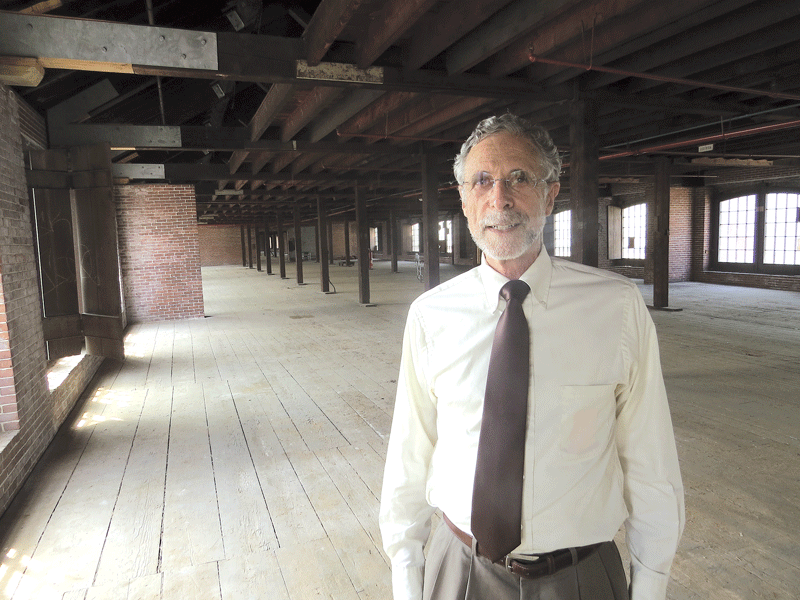
STCC President Ira Rubenzahl says that, if renovated as planned, Building 19 would become the new center of the campus.
“This will help organize the campus in a way that it’s never been organized before,” he explained. “From the beginning, the college took this space, then it took that space, and said, ‘we need something for this … we’ll put it over here.’ There was never a master plan to organize the functions in a coherent way that would help the students.
“That’s what we’re doing with Building 19,” he went on, “and it will be a huge step forward.”
For this issue and its focus on education, BusinessWest looks at the ambitious plans for Building 19, and how they would change the landscape at STCC — in every sense of that word.
In recent years, Rubenzahl told BusinessWest — actually, since the day the college opened — students could spend their entire time at the school and never really notice Building 19, as large as it is, other than to walk by it on the journey from the parking lots off Pearl Street to the classroom buildings in the center of the campus, constructed in the ’80s on the site of former Armory buildings.
All that will change if funding is approved and construction starts as scheduled, he went on, and by September 2018, the structure would be the undisputed hub of the campus.
This startling transformation has been decades in the making, he went on, adding that discussions concerning what to do with Building 19 have been ongoing — at different levels of intensity, to be sure — since the college’s earliest days, when it was known as the Springfield Technical Institute (STI).
That was in the fall of 1967, roughly three years after U.S. Defense Secretary Robert McNamara announced that the federal government would decommission the Armory, built in the late 18th century on a site chosen by George Washington, and about 18 months after city officials lost a pitched battle to keep it open.
Soon after those efforts failed — or years and even decades before that, depending on whom one talks to — officials began eyeing the site as a possible home for a college, especially the west side of Federal Street, with its long brick buildings and large courtyard.
In those early days, STI and the Armory actually co-existed as the latter was decommissioned, with the school gradually occupying more of the Armory buildings in the years to follow. Building 16, as it was called, the Armory’s main administration building, served the college in that same capacity, and eventually became known as Garvey Hall in honor of the school’s first president, Edmond Garvey.
Meanwhile, Building 27 became home to the school’s library; Building 20, one of the youngest structures on the property, dating back to the 1940s, would house most health programs; and a series of buildings on the east side of Federal Street, first home to GE and then Digital Equipment Corp., became the Technology Park at Springfield Technical Community College, now home to dozens of businesses and, most recently, a charter school.
As for Building 19, well, it has been used almost exclusively for storage, said Rubenzahl, adding that, over the decades, all manner of equipment and supplies have wound up there — and remained there for years.
Indeed, as he offered BusinessWest a tour of the facilities, he walked past everything from long-obsolete computers to rusting air conditioners to an old phonograph.
“We’re a state agency, and that means we’re not allowed to throw things out,” he explained, adding that disposing of all equipment or identifying other potential users is a laborious, time-consuming process that certainly helps explain why such items accumulate.
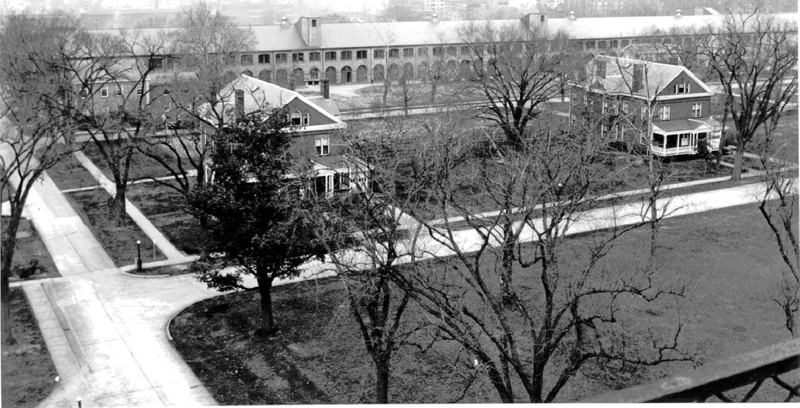
Building 19, seen in the background in front of Armory buildings torn down to make way for new classroom buildings, has historical and architectural significance.
As he talked about it on a hot summer’s afternoon, Rubenzahl walked the length of both floors and pointed to the third, a windowless, loft-like area, talking about how each will be repurposed.
The ground floor, with those arched entrances, will become home to a number of offices, including admissions, registration, financial aid, and others, and also the bookstore, currently located in Building 20, he said, adding that the space throughout the building is dominated by columns, which makes it far more suitable for offices and student uses than for classroom space.
The second floor, meanwhile, will house the library and other student services, he said, adding that facilities will be placed toward the center of the spaces, generating maximum benefit from all those windows.
Overall, the building is in good condition, he noted, and while the older structures pose challenges, they were in many ways overbuilt because of their intended uses, and have stood the test of time.
“They were built by the Army, they were built for weapons storage in some cases, and they’re just very solidly constructed,” he explained. “Structurally, these buildings have great integrity, so in many ways, they’re good buildings to renovate.”
When the renovation project is complete, Rubenzahl said, the campus will have tens of thousands of square feet of space to repurpose — in Building 16, the library, and other structures — and these developments create opportunities for the college, the Commonwealth, and perhaps the community as well.
Meanwhile, there are other projects to tackle, including Building 20, the largest structure on the campus, which is partly in use (the first three floors are occupied), but there are a number of infrastructure issues.
A master plan is being developed for the entire campus, said Rubenzahl, adding that the Armory complex offers a wealth of opportunities but also myriad challenges.
And that explains why the college that moved in 48 years ago is still moving in.
George O’Brien can be reached at [email protected]


Kevin Perrier, on the roof of Parsons Place.
Kevin Perrier called it a “calculated risk” — but he liked the odds of success.
He was standing in the 5,200-square-foot penthouse of Parsons Place, a high-end apartment complex that opened earlier this month inside the former Parsons Street School in Easthampton. That penthouse — considerably larger than the building’s other 14 units — recently became the final space leased.
In other words, the risk paid off.
“I don’t think there’s anything like it in the area,” said Perrier, president of Easthampton-based Five Star Building Corp., which gutted the school and converted it to living space in just four months. Perrier’s other company, Norwich Properties, purchased the property from the city in late 2014 for $10,000.
“It was certainly a calculated risk. It hadn’t been done, but we felt strongly it could be done,” he told BusinessWest. “Based on the feedback we heard, what people were looking for, we were confident we could find 15 families willing to pay a little more in rent to get an awful lot more in amenities. So we were very confident it would be leased in a timely manner.”
Part of the property’s appeal, Perrier said, is a regional dearth of high-end apartments such as these. “It’s more like what you might find in Boston — all high-end cabinets, mahogany floors throughout most of the units, 12-foot ceilings, central air, all-tile bathrooms, high-end appliances … even little touches, like fridges with ice makers and mosaic tile backsplashes.”
Within four weeks of availability, the 14 regular units, measuring 950 square feet, had been leased, while the penthouse was claimed a few days after a recent open house, and residents started moving in at the start of September.
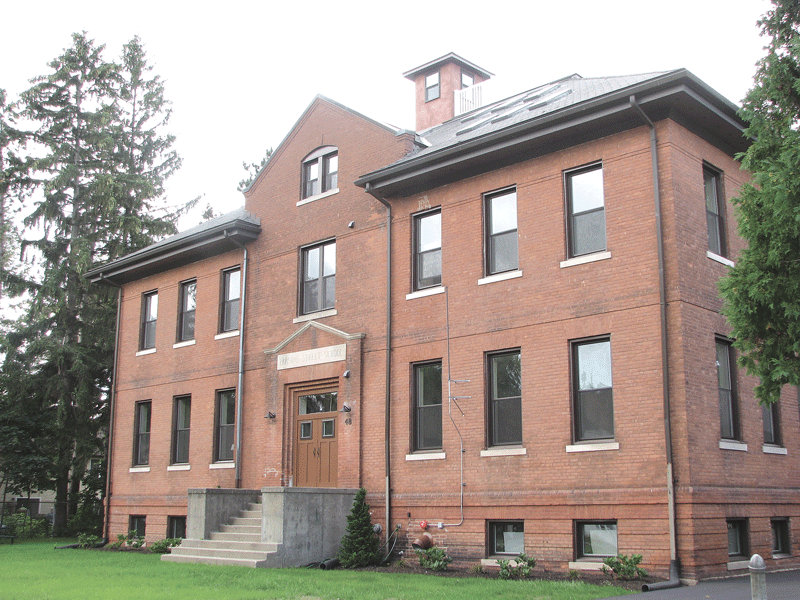
From the front, Parsons Place still looks like a century-old schoolhouse, complete with a false door that’s actually now someone’s bedroom wall.
“We are very pleased with the amazing renovation of this school building that sat vacant and unused for several years,” Easthampton Mayor Karen Cadieux told BusinessWest, adding that the city is pleased the property is back on the tax roll, while the renovated building and grounds will enhance the neighborhood values and esthetics.
That’s something neighbors were not saying about the development of Parsons Village. But Perrier said a much more positive vibe surrounded Parsons Place, lending a sense of fun to what was a very ambitious schedule. “We had a great crew. We started April 6 and finished August 6. That’s for a complete gut and 25,000 square feet. That’s an aggressive timeline. Everyone stepped up to the plate for us. The original goal was occupancy by November; we beat that by two months.”
When the city issued an RFP last fall for the former Parsons Street School, potential developers were charged with preserving the historic character of the building, along with the usual compliance with land-use boards and commissions, Cadieux said.
“Additional considerations were given to proposals that offered to provide barrier-free handicapped-accessible and/or adaptable residential units,” she added. “We received only one proposal.”
That was Perrier, who saw no hurdles meeting the goals of historical preservation and accessibility. In its finished state, Parsons Place includes one ADA-compliant unit, but all apartments may easily be adapted as such, having been designed with wide hallways and interior spaces.
“The city had quite a few … not restrictions, but strong suggestions about what they wanted and didn’t want,” he said. “One mandatory one was that the building be saved. We tried to meet as many requirements as possible when we put in a proposal, and as it turned out, we were the only bidder on the project.”
Still, “the City Council and the mayor seemed excited about what we wanted to do,” he went on. “No one wanted an affordable-housing project, which this neighborhood just endured; that project wasn’t received favorably by the neighbors. This neighborhood was looking for something other than affordable housing, and we saw an opportunity for a high-end project.”
The idea, he said, was to tap into the segment of renters who might consider Northampton, by offering units comparable to what might be found there, but with more amenities for the price. The penthouse costs $3,500 a month, while the other 14 units are being leased at $1,400.
“It was clear there was a need and a demand for high-end products, things you can’t find in any units around here — dishwashers, central air, stainless appliances, high-end cabinetry, that kind of thing,” Perrier said. “You might hit one or two of those points in rental properties here, but you usually won’t get all of them.”
When tackling the conversion of the school, Perrier said, it helped that it isn’t technically a historic building, and isn’t subject to the restrictions of being placed on such a registry. The elementary school was built in 1902 and expanded in 1908; it closed in 2011.
“We tried to maintain it as much as possible,” Perrier said of the character of the red-brick building, which still looks very much like a century-old school at first glance. “It had storefront glass doors, and we took those out and replaced them with historically accurate doors. In the elevator shaft, we could have gone the less expensive route with cement siding, but we did it with brick instead.

This 20-foot spiral staircase connects the penthouse living room with a roof deck.
Those amenities and the quirky aesthetics of the school drew renters from well outside the region, including Vermont, New Hampshire, Connecticut, and Eastern Mass., some of whom work in the Valley and sought a shorter commute.
The penthouse — which has direct elevator access with a key card — is especially striking, with its 32 skylights, three bedrooms (the other units feature one or two), two and a half bathrooms, 17-foot ceilings, a large tub and walk-in shower, higher-end appliances and light fixtures, and in-suite laundry (other renters share a laundry room on the lower level). Then there are dramatic touches like the dark exposed beams and a dramatic, 20-foot spiral staircase connecting the living room with a rooftop deck, offering views of Mount Tom and well beyond.
The project stands in stark contrast to Parsons Village, a project originally rejected by the Planning Board in 2011 after objections from neighbors, but eventually approved in 2012. But city officials have long emphasized the need for all types of housing in a city that has seen incomes and property values rise in recent years but has retained an eclectic, arts-driven vibe as well.
“There’s nothing like this around here,” Perrier reiterated, standing in the kitchen of Parsons Place’s recently leased penthouse. “I’m not even sure you can get something like this in Northampton right now.”
Joseph Bednar can be reached at [email protected]


Kevin Kennedy stands at the site of the former Chestnut Junior High School in Springfield’s North End. Below left: the school during demolition.

Kevin Kennedy says that, before Chestnut Junior High School was essentially destroyed by fire in 2013, Springfield had what amounted to a development opportunity in the city’s North End.
It just wasn’t a very solid opportunity, Kennedy, the city’s chief development officer, went on, as evidenced by the fact that at least three requests for proposals (RFPs) involving that property over the past decade or so — he admits to actually losing count — failed to yield a workable project.
The reason was simple: the cost of repurposing the school or demolishing the structure, built in 1901 and vacant since 2004, and then remediating the four acres it sat on, made redeveloping the site financially prohibitive.
And there were other issues as well, said Kennedy, adding that the building was listed on the Massachusetts Register of Historic Places, thus limiting what could be done with the building and even making demolition a stern, time-consuming hurdle to overcome.
But the fire changed the dynamic in many ways by essentially removing all those obstacles.
Amid safety concerns, the city demolished the four-story structure, and, to apply a lesson it learned from what it did (or, more to the point, didn’t do) following a fire at the former Gemini manufacturing complex in the South End, it remediated the site, including removal of the foundations, said Kennedy.
“This site is now highly developable,” he told BusinessWest, adding that, while the price tag for razing and cleaning the site exceeded $1.5 million, the city may well come to consider that bill a sound investment rather than an aggravating expense.
Thus, like other recent calamities in Springfield — most notably the 2011 tornado and 2012 natural-gas blast — the suspicious fire at the Chestnut Street school has created an intriguing development opportunity.
But, as with those other opportunities spawned from disaster, this one comes wrapped in challenges, the biggest being the fact that those four acres lie in what is statistically one of the poorest neighborhoods in the Commonwealth, a possible stumbling block when it comes to some of the possible strategies for redevelopment, including retail.
But that area is rich in other ways, said Kennedy, adding that it lies in the heart of what city economic-development officials have come to call the Medical District.
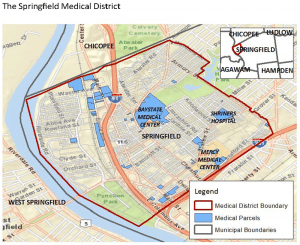
The former Chestnut Junior High School is at the center of this map showing Springfield’s Medical District.
Indeed, Baystate Medical Center, Mercy Medical Center, and Shriners Hospital for Children are all within only a few hundred yards of the school site, he explained, adding that a number of other medical facilities, many under the Baystate umbrella, are now located just off Main Street in the so-called Wason section of the North End.
More than 10,000 people, many of them in well-paying positions, work at facilities considered part of the Medical District, said Kennedy, adding that the numbers add up to some compelling opportunities, ranging from the broad spectrum of retail to the creation of market-rate housing for some of those workers, including the hundreds of young doctors in residence at Baystate.
For this issue and its focus on commercial real estate, Kennedy laid out some of the possibilities for this potential-laden blank canvas in the North End’s Memorial Square neighborhood.
The deadline for responding to the RFP for the Chestnut Street site was Sept. 14, said Kennedy, adding that it will be extended to Oct. 5 (with questions due by Sept. 25) to give the development community more time to consider options.
“We’ve had a number of calls, and for that reason we think there’s a bit of interest,” he noted. “And that’s why we’re going to extend it and give people a few more weeks.”
At the very least, he is expecting a far more energetic response than when the 82,000-square-foot school was still standing, with its hundreds of windows boarded up, a state it had been in for several years.
“We had some proposals,” he said, referring to those RFPs issued while the imposing school was still standing. “But when the developer actually got down to brass tacks and put pencil to paper, it didn’t pencil, and all those RFPs went for naught.”
The shovel-ready nature of the property distinguishes it from most not only in Springfield, but also neighboring communities, he went on, as does its close proximity to so many prominent healthcare facilities.

The fire that engulfed the Chestnut Middle School in 2013 has in many ways created a better development opportunity.
Indeed, the North End has been the site of a number of new developments in recent years, topped by Baystate’s massive $270 million expansion formerly known as the Hospital of the Future. But it has also been a source of speculation about what could — and should — happen next.
So much so that the city commissioned the UMass Amherst Center for Economic Development to undertake a study of the area. That document, “The Springfield Medical District: An Analysis of the Medical Industry and Its Workers,” was completed in 2012.
The report’s authors identified opportunities and challenges in equal abundance.
“The concentration of the medical industry in the district offers many opportunities for commercial and residential development,” they wrote. “However, the city must overcome considerable barriers if it wishes to realize this potential; there is a large potential market for additional shopping, eateries, and other services that cater to medical workers and clients — although few such opportunities currently exist.”
Expanding on those challenges, the report’s authors list everything from I-91, which slices through the North End and creates what they call a “spatial barrier to pedestrian circulation within the district,” to the low-income nature of the residential neighborhood, which is currently home to a very small percentage of the medical personnel working in the district.
The report implies that, if the city could create more attractive housing in the area and, overall, make it a more sought-after place to live, it could capture a large amount of purchasing power it is currently losing to surrounding communities.
“There is a fairly consistent trend — the more one earns, the further away they live from the district, with the highly paid physicians and administrators living the furthest away,” the authors note. “We estimate roughly $400 million in aggregate purchasing power of employees who live outside the city. This means that Springfield fails to capture the indirect economic benefits of its medical industry — the jobs and businesses that are supported by the spending of households.”
Click HERE to download the latest list of available commercial properties in Western Mass.
The Chestnut School site won’t change this dynamic on its own, certainly, said Kennedy, noting quickly that market-rate housing on the site could keep some employees not only in Springfield, but in the North End.
“We’ve had conservations with both hospitals,” he said, referring to Baystate and Mercy. “And they both have a need for housing for both employees and trainees. Baystate, for example, is a teaching hospital, and you have residents who aren’t looking for permanent housing, but may need something.”
But there are several options for the property, which is currently zoned residential, he went on, adding that there are several potential opportunities within the broad realm of retail.
The Memorial Square area lacks a major supermarket and other types of shopping, he noted, adding that the parcel is large enough for a supermarket or a chain pharmacy such as CVS. Inquiries to date have reflected an interest in both commercial and residential developments, he went on, adding that the city doesn’t really have a preference.
“We don’t want to presuppose anything,” he told BusinessWest. “We want to see what we think the best deal is and talk with the residents of the neighborhood to see what they want, and then balance the economics with those preferences.”
Looking at the Chestnut Street opportunity and the circumstances that created it, Kennedy mixed optimism with some philosophy.
“Oftentimes, as we’ve seen several times in Springfield in recent history, when something bad happens, something good can come of it,” he said, adding that the tornado’s path of destruction certainly contributed to MGM’s choice of the South End for its $800 million casino project.
Whether a similar, smaller-scale success story can be written a few miles to the north in another challenged neighborhood remains to be seen.
But Kennedy believes that fateful fire may have set the stage for another landscape-altering development.
George O’Brien can be reached at [email protected]
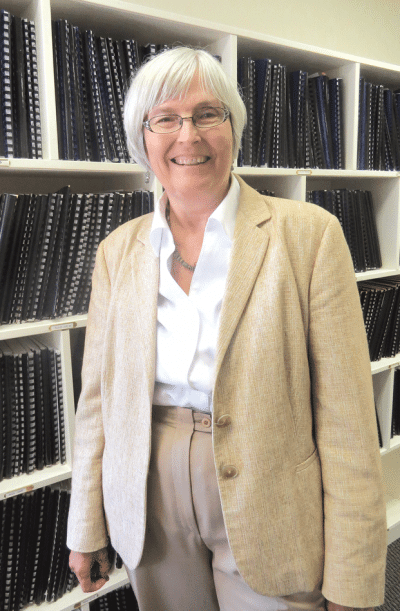
Julie Pokela
Julie Pokela says it was already shaping up to be a busy summer for Market Street Research (MSR), the firm she helped lay the groundwork for nearly 40 years ago. And then, some additional work start pouring in.
Funneled by the Wallace Foundation, started by the founders of Readers Digest, as part of an ongoing initiative concerning the arts, these projects involve several noted institutions — the Seattle Opera, the Pacific Northwest Ballet, and the New York-based Alvin Ailey American Dance Theater — that want some insight into how to grow their audiences.
A major focal point of these analyses will be the Millennial generation, members of which now statistically outnumber the Baby Boomers, said Pokela, and remain a point of fascination — and mystery — for businesses across all sectors.
“People are trying to figure out how to tap into this generation,” she said, adding that these arts-related projects will utilize focus groups and a host of other methodologies to gain some insight.
When asked to speculate on what these studies may reveal about the Millennials and their attitudes about the arts, Pokela thought for a second and said, “I don’t know … we’re going to find out.”
‘Finding out’ has been the simple two-word answer to the question of what this company does since Pokela and partner Nancy Mihevc joined together in a venture called the Research Group in 1978 (more on the company’s history later). They’ve been finding answers for clients ranging from political candidates to regional and national banks; from private colleges to major medical systems; from retail chains to nonprofit agencies.
The specific questions to which they’ve sought to find answers have varied, but the common denominator has essentially been market share and the universal goal of improving it.
Today, achieving that goal involves successfully marketing to and then serving several generations, each with distinct attitudes and preferences, said Pokela, adding that the Millennials are proving to be particularly challenging for many sectors.
“Banks are really interested in this subject,” she noted. “And we do a lot of work with independent schools and colleges to help them figure how they’re positioned among the students and parents looking at colleges — and how to grow their enrollment.”
Over the years, the size and composition of MSR’s client base has changed, said Pokela, noting that, in the ’80s, the company did considerable work with banks, and later put a heavy focus on healthcare, specifically hospitals and medical systems that wanted insight into what the public thought of the services they were providing.
While the company still serves both those sectors, its overall strength has been diversity, said Pokela, adding that this trait has enabled it to survive the many economic downturns over the past four decades.
The business itself has also evolved. Years ago, MSR employed those who would do the actual data collection for the research projects. Now, those services are outsourced, noted Pokela, adding that, while laying off dozens of employees constituted the most painful moment of her career, the resulting entity is smaller and more manageable, and enables her to spend the vast majority of her time doing what she likes most — research and interpreting what it means.
For this issue and its focus on women in business, BusinessWest talked at length with Pokela about her company, the intriguing world of research, and the art and science of ‘finding out.’
Tracing the history of her company, Pokela said the intriguing story began when she was pursuing her doctorate in communication at UMass Amherst, studying under, among others, Mihevc, who taught political communication.
One of Mihevc’s other students at the time became involved with Ed McColgan’s campaign to unseat Congressman Silvio Conte, and she asked Mihevc to conduct some research for the candidate.
She agreed, and asked Pokela if she wanted to assist with the polling, which she did.
Those efforts didn’t succeed in getting McColgan elected — he triumphed in the Democratic primary, but was buried by Conte in November — but they did get the attention of other candidates, who recruited the two for similar polling.
“Eventually, a business person with one of the campaigns asked if we could do some market research for his company,” said Pokela, “and from there, an advertising agency asked if we could do marketing research for their clients.
“We got to the point where Nancy was coming up for tenure, and I was looking at finishing my Ph.D., and had to decide — do we want to start a company or continue with our expected lives of being academics?” she went on. “We decided that it wouldn’t hurt anything to start a company, so we did.”
Given a boost by some work they did for the Center for Human Development in Springfield, which received a grant to conduct a telephone survey on community attitudes toward foster parenting, the pair enjoyed success early on, working mostly on political campaigns and projects for ad agencies.
The recession of the early ’80s nearly took them out, though, said Pokela, adding that she and Mihevc turned to the Mass. Small Business Development Center and then-Director Merwin Tober for some assistance on how to position the company for growth and sustainability.
Tober came up with the idea of generating a recurring form of income — or several of them — rather than being solely what amounted to a job shop. And from that suggestion, the two partners eventually conceptualized something they would call the “Quarterly Bank Survey.”
As that name suggests, the initiative surveyed area residents on a quarterly basis about their banking habits and preferences, said Pokela, adding that most all area banks bought the reports.
“It ended up being a great product and a solid source of regular, predictable income — we did it for maybe 10 years,” she said, adding that this effective niche was substantially weakened by a wave of consolidation that swept over the industry in the late ’80s and other consequences of a deep and prolonged recession that took a severe toll on the financial-services sector.
But, while bolstering its portfolio with banks, the company — which became known as Market Street Research in 1986 after Pokela and Mihevc parted ways and the former joined forces with Elizabeth Denny — was doing the same with the healthcare industry.
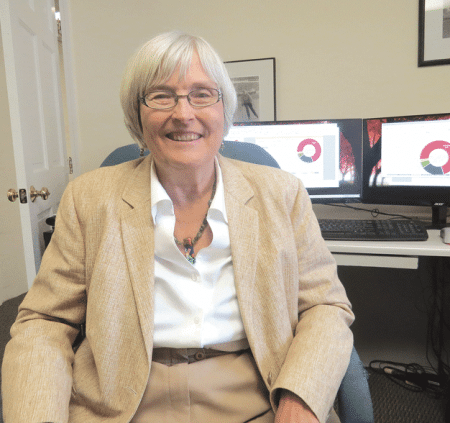
Julie Pokela says there are businesses across many sectors that want to know what the Millennials are thinking — and how they’re spending.
The company started with a hospital survey similar to the one produced for banks, she said, adding that, by the late ’80s, most healthcare providers were ratcheting up their marketing efforts in response to changes within the industry, especially a shift from inpatient to outpatient care and the resulting increase in bed capacity.
“Length of stay was greatly reduced, and as a result, hospitals had all this excess capacity for inpatient beds,” Pokela explained. “So they started looking at the edges of their markets and saying, ‘where can we pick up more patients in areas that we haven’t traditionally looked at?’ So hospitals learned how to compete very quickly.”
This phenomenon has generated a steady source of revenue for the company ever since, she went on, noting that MSR has a number of prominent hospitals in its portfolio, including Mass General, NYU Langone Medical Center, the Cleveland Clinic, Dartmouth Hitchcock, and many others.
Most are steady, repeat customers that require in-depth marketing studies at least every two years, and often on a more frequent basis.
The nature of the work varies, but much of it comes down to two key issues in this sector and most all others — awareness and image.
“If you look at the process by which someone makes a decision to use any kind of organization, it starts with awareness — people are more likely to use an organization they’re aware of,” she explained. “So we track what their awareness levels are, and ask people, ‘when you think about hospitals in your area, which ones come to mind?’”
Overall, the company tailors its questions and surveys to meet the specific needs of clients and business sectors, and the ability to help companies in a host of industries has driven solid growth over the years and enabled MSR to weather the economic downturns in recent years.
The firm has clients in healthcare, financial services, the nonprofit arena, governmental agencies, retail, technology, manufacturing, and, especially this summer, the arts, which Pokela has identified as a potential source of growth for MSR.
In higher education, for example, the company has worked with a number of institutions, including Bryn Mawr College, Mount Holyoke College, Smith College, Western New England University, and UMass Amherst, with research focused on a number of areas, including:
• Satisfaction of faculty, staff, and students with the services the school provides;
• Effectiveness of communications, including marketing and promotional materials; and
• Satisfaction of alumni or alumnae regarding services for alumni and communication with their alma mater.
The company also works with private elementary and secondary schools and also public school systems and school boards, in matters ranging from attracting and retaining high-caliber students to communicating information and specific strengths to the community.
In retail, meanwhile, the company has provided services for national chains, mom-and-pop stores, and entities that fall in between. It helps those clients with everything from assessing awareness (there’s that word again) to customer satisfaction, site-location selection, market feasibility of new products, and more.
Increasingly, those in each sector want to know what the members of each generation are thinking and what they’re looking for in terms of products and services.
She joked that those in healthcare are not yet fascinated by the wants and needs of the Millennial generation — “young people don’t get sick” — but just about everyone else is, including those arts institutions that have recently become clients.
“They want to know how to get the next generation interested in the arts,” she explained. “They want to know how to get them interested not only in going to see these groups, but also interested in becoming subscribers and then eventually donors.
“At the focus groups I’ve been going to with people in their 20s and 30s who are going to the arts — they’re very passionate about it,” she went on. “That’s very exciting to see. The question is how to translate the passion exhibited by the people who are going, to the people who are not going.”
As for the answers to that question … the reports commissioned for those arts institutions should be completed by this fall, she went on, adding that there may be some answers there.
Looking ahead, Pokela said the company’s primary goal is to continue to log steady, manageable growth.
She believes it can continue to do so because, overall, it scores well in those areas for which it gauges results for its many customers — awareness, quality of service, and image. And, especially, because it continues to raise and clear the bar in that one realm for which it was formed, a service that has become both an art and science: finding out.
George O’Brien can be reached at [email protected]
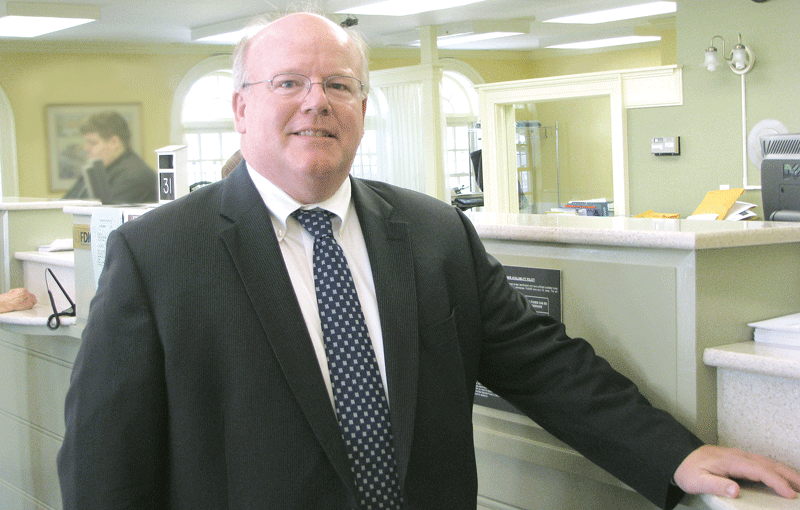
Greenfield Cooperative Bank President and CEO Michael Tucker
For 36 years in the banking industry, Michael Tucker has weathered plenty of changes, so the recent merger of Greenfield Cooperative Bank — where he has served as president and CEO since 2002 — and Northampton Cooperative Bank was far from a first.
“I’ve been through four of these, and I’ve been on both sides,” he said, referring to being the larger or smaller bank in mergers and acquisitions. “My first one was 30 years ago, when the old Nonotuck Savings Bank merged with SIS. They made sure Nonotuck looked like SIS on day one, and they lost half their customers within a year.”
It’s a lesson he hasn’t forgotten, which is why customers at the two recently merged co-op banks — announced 15 months ago and made official on April 1 — were met with a much more seamless transition. “Here, our goal was to make it transparent for customers. We aren’t closing offices or laying anyone off.”
The overall entity — which now boasts about $525 million in deposits, more than $60 million in capital, 10 branches, and 98 employees — is officially called Greenfield Cooperative Bank, taking the name of the larger institution.
But, while the six Franklin County branches that have been operating under the Greenfield name — two in Greenfield and one each in Northfield, Sunderland, Shelburne Falls, and Turners Falls — will continue to do so, the four Hampshire County branches, two each in Northampton and Amherst, will continue to operate under the Northampton Cooperative Bank name their customers are used to, as a division of Greenfield Co-op.
Click HERE to download a PDF listing of Banks in Western Mass.
“We committed to using the Northampton Co-op name in Hampshire County, for existing branches and any that might open in the future,” Tucker said, noting that no physical expansion plans are on the drawing board yet, as bank leaders want to first make sure the current branches are running smoothly.
“Why give up all that history, all that goodwill, for either brand?” he continued, noting that Greenfield Co-op dates back to 1905, and Northampton Co-op to 1889. “Early on, people said, ‘let’s come up with a new name for the combined bank.’ I’ve seen that done elsewhere, and people just ask, ‘now, what bank was that?’”
William Stapleton, formerly president and CEO of Northampton Co-op, now serves as CEO of Greenfield Bancorp, MHC, and chairman of the combined bank, with Tucker remaining as president of the holding company and president and CEO of the combined bank. Both of them cited expanded customer access, improved economies of scale, and more efficient operations as reasons for the deal.
“A $100 million bank would have trouble surviving today, because of the expenses,” Tucker said, referring specifically to increased regulatory and compliance costs for banks in today’s environment. “My commitment when I came here was to stay mutual and make sure I handed this bank off to the next generation healthier than when I found it. I think this merger helps us to ensure that. Now we spread those expenses over a bigger base.”
That’s not to say Greenfield Cooperative wasn’t already growing, having increased its deposits by an average of 5% to 6% annually in Tucker’s 13-year tenure, effectively doubling that figure from $175 million to $350 million.
“When we looked at where we might grow next, we were looking at Hampshire County,” he told BusinessWest, adding, however, that a merger with a similar organization made more sense than building more Greenfield Co-op branches there. As it turned out, he found a sympathetic ear in Stapleton.
“We had a lot in common with Northampton Cooperative Bank,” Tucker went on. “Bill and I had been talking off and on for a number of years. That happens a lot in the industry.”
With the approval of each bank’s 11-member board, the merger underwent the normal regulatory processes and became official on April 1, just over five months ago. As for the directors, the banks simply merged them into one 22-member board, which will be whittled down through impending retirements to something more manageable. Board meetings are typically held in Deerfield, between the bank’s two namesake cities.
“There will always be a few bumps, but it’s been pretty smooth,” Tucker said of the merger, noting that the two institutions already used the same Connecticut-based financial-technology service, COCC, and there was no duplication of account numbers, allowing Northampton Co-op customers to keep their checks and debit cards. Those customers also have access to new financial services and low-cost Mass Save energy loans through Greenfield Co-op, as well as programs like IDSafeChoice, an identify-theft protection service Greenfield partnered with a decade ago.
Meanwhile, the merged institution is finding efficiencies and cost savings in pending retirements. “I had three senior officers scheduled to retire this year. After our merger, I only had to replace one; for the other two, we used people in Northampton.”
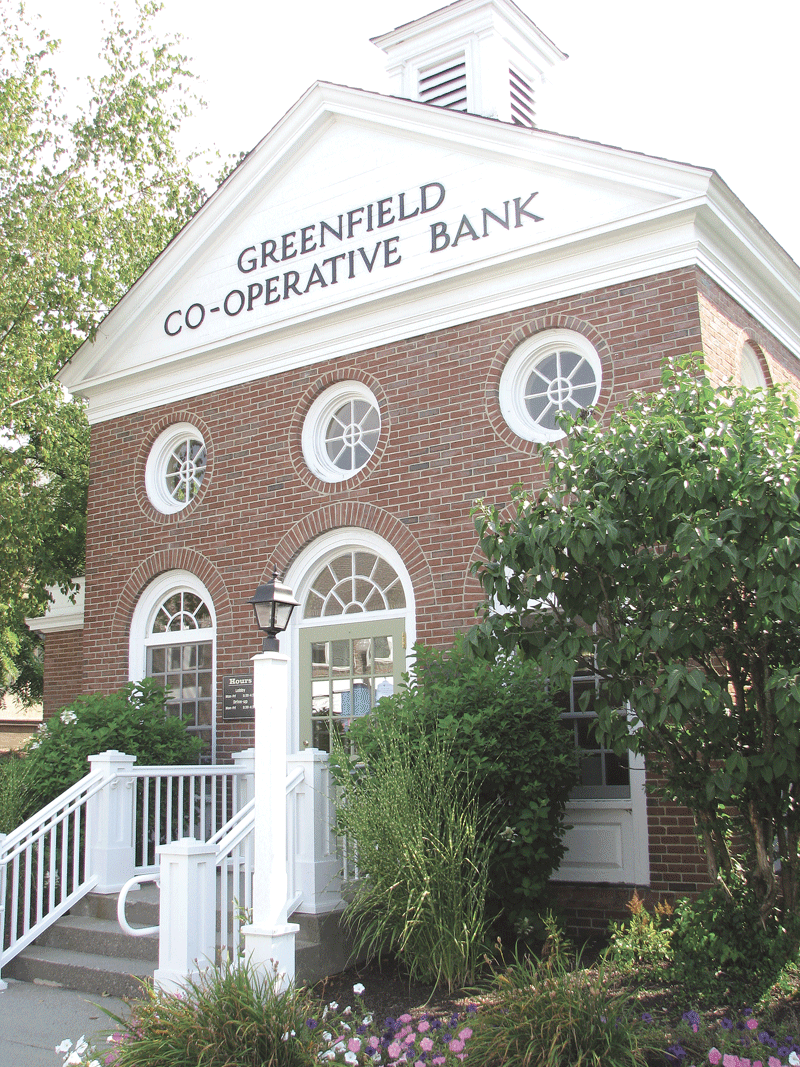
Greenfield Co-op has been headquartered in the same location since the 1940s, while both it and Northampton Co-op boast histories spanning well over a century.
At the same time, Tucker said, “a lot of our customers are happy they can do business in the Northampton-Amherst neck of the woods. We’ve added commercial-lending capabilities down there; they really didn’t do commercial loans, but we hired two new lenders to service the area, and stationed one of our investment-services guys, from Florence, in Northampton.”
Moving from $39 million in capital to more than $60 million after the merge also allows Greenfield Co-op to offer larger loans, including SBA loans. “Our lending house limit was 10% of capital, so that goes from $3.9 million up to $6 million. Sometimes customers outgrow you; it’s nice keeping pace with our customers.”
Employees have already taken advantage of new career opportunities as well, with some already moving to branches closer to where they live. “It gives a broader career path for some people,” Tucker said. “I think that will continue as we grow.”
Tucker spent 20 years at SIS before moving to Easthampton Savings Bank in 1999 as senior operating officer and in-house counsel, spending three and a half years there before Greenfield came calling.
A lawyer by trade, he never planned on advancing that far in the banking world when he started out as an SIS teller in 1979 while attending law school at night. “I was planning to be there four years, then go on to my own practice, but the CEO of SIS back then was a lawyer who had started doing real-estate closings back in the ’50s. He encouraged me, and I ended up staying; by the late ’80s, I got my master’s in banking law.”
The dual expertise served him well as he rose to higher positions, and he has never lost his passion for learning more about his industry — especially at a time when online and mobile banking platforms have changed the way banks interact with their customers.
“There will always be a place for brick-and-mortar customers who want to be able to talk to a person,” he said. “That’s the local edge; otherwise, you might as well bank with Capital One out of Ohio. But, at the same time, some customers never come into the bank. I remember when teller lines were out the door to cash Social Security checks, but that’s all direct deposit now. There are still lines, but it’s to socialize and update their passbook and see the tellers, who are also their friends. You don’t have to come into the bank anymore, so branches are smaller now.”
Although he foresees working about seven more years before retirement, the rapid changes in banking — both regulatory and technological — help drive Tucker’s involvement with organizations like the Mass. Bankers Assoc., which he chaired until last year, and the Federal Reserve Bank in Boston, where he currently serves on the board of directors. “Part of that, for me, is continuing to learn, staying active in the industry. And it’s an industry, I think, where we do a lot of good for people — and it’s fun.”
He says he’s acutely aware of the roles community banks play in the business fabric of Western Mass., from philanthropy and civic involvement to loan support for families and businesses.
“We are lucky to have this many healthy community banks in the region,” he told BusinessWest. “It’s competition for us, with literally a branch on every corner. But if I’m a local customer, and I think of the dollars contributed, the volunteerism … that’s something irreplaceable, it really is.”
For example, the bank recently donated money to both Baystate Franklin Medical Center in Greenfield and Cooley Dickinson Hospital in Northampton, gifts that, Tucker noted, aren’t totally altruistic, in the sense that healthy individuals comprise healthy, vibrant, attractive communities. “We want people to buy homes here, start businesses, send their kids to school — all the things that make a community a community.”
As Greenfield Cooperative Bank seeks to grow in its expanded footprint, Tucker continues to seek input from customers on how to improve their experience.
“My door is open, unless I’m in a meeting, and customers come in all day and make comments, good and bad, but mostly good,” he said, adding that he regularly visits each branch to chat with staff and customers. “If this was Bank of America, it would be physically impossible for the CEO to do that.”
He recognizes that not every interaction with a bank is positive — the rare foreclosure being one example. “But we don’t want to own homes; we want to keep people in their homes. We help finance homes, finance businesses, help pay for college or a new car or home improvements, help people plan for retirement or plan for their kids’ college — all pretty fun things.
“We get to interact with people on a lot of positive things,” Tucker concluded. “That’s part of the reason I fell in love with the industry. I didn’t think I’d like it as much as I do.”
Joseph Bednar can be reached at [email protected]


Before Mark McDonald jumped into fantasy football, he’d watch the Patriots on Sunday, and not much else. But now?
“It has dramatically changed my viewing habits,” said McDonald, a professor of Sport Management at UMass Amherst. “Games between horrible teams, games that once meant nothing to me, now I want to watch to see how my fantasy team is doing. I like that sense of control — I’m the general manager, controlling my own team, and watching other players to see who I might pick up. It changes your view of football. Even Thursday nights are must-watch.”
McDonald started playing GM four years ago when fellow faculty members at the Isenberg School of Management invited him into their league. He’s been hooked ever since, and was preparing for drafts in two different leagues the week he spoke with BusinessWest.
He’s not alone. The number of people participating in fantasy sports — football, baseball, basketball, hockey, even golf and auto racing — is expected to reach 56.8 million this year, a staggering increase of 37% from 2013, according to the Fantasy Sports Trade Assoc. (FSTA).
The vast majority play in season-long leagues, going head to head with a different team’s owner each week. But, increasingly, ‘daily’ fantasy sports, played for real money — FanDuel and DraftKings are the two giants of this industry — are becoming more popular. At the end of 2014, the two online services posted a combined $920 million in entry fees from 1.3 million paying users — numbers this year’s participation is expected to far surpass.
“It gives fans another connection point,” said Janet Fink, another UMass professor and chair of the Department of Sport Management. “Fantasy football is much more widely popular than any other fantasy sport, but they’re all growing. And now you have these day-to-day, week-to-week leagues getting more popular as well.”
Indeed, fantasy sports has come a long way from its 1970s origins, when hardcore baseball players played something called Rotisserie, drafting players at the start of the season, then tracking their statistics, by hand and with calculators, and translating those stats into a scoring system. Today, the data is instantaneous, meaning owners can sit on the couch with a smartphone and watch the points roll in.
And, by the tens of millions, that’s exactly what they do.
Andrew Zimbalist, a professor of Economics at Smith College and one of the world’s foremost sports economists, has observed the impact of fantasy sports on American life, which goes well beyond that annoying guy in the lunchroom on Tuesday complaining about losing by a point because Julio Jones dropped an easy touchdown Monday night.
“It’s something that increases the avidity of fandom and, in some cases, extends fandom,” he explained. “People who are involved in fantasy sports are paying much more attention to the game. They subscribe to more online services and satellite services.
“The other effect they have, to some degree — and it differs by sport — is more generalized fandom,” he went on. “If I’m a Red Sox fan living in Massachusetts, without the fantasy-sports component, I’m following the 25 people on the active Red Sox roster. But if I have Mike Trout in my fantasy-baseball league, if I’ve got Joe Mauer on my team, I’m not only into the Red Sox games, but Angels games and Twins games, etc.”
That sort of changed behavior is something sought after and prized by professional sports leagues, Zimbalist added.
“Football, for a variety of reasons, has long been a national sport; even though fans have a team they follow and support, true football fans will watch two games, and might stay around for Sunday evening,” he explained. “But in the other leagues, like baseball — say you’re a Padres fan living in San Diego. You’re going to watch the Padres games; you’re not going to watch the Giants or Diamondbacks. But some of the fandom becomes nationalized when you have fantasy sports leagues. That is a very valuable component — and it’s a growing fandom.”
No wonder, then, that ESPN hosts the most popular fantasy platform (Yahoo! is the second-largest), while DraftKings recently secured $300 million in funding from Fox Sports, Major League Baseball, the National Hockey League, and Major League Soccer. In return, the company plans to give away $1 billion in prizes this year, more than triple the $300 million it awarded in 2014.
Meanwhile, the larger play-for-cash entity, FanDuel, which pays out more than $10 million in prizes every week, recently raised $275 million from investors, including affiliates of Google, Comcast, and Time Warner.

Janet Fink
McDonald is familiar with DirecTV’s Red Zone channel, which jumps, all Sunday long, between teams on the cusp of scoring — a fantasy maven’s dream. He noted that his league’s owners get together twice a year for Sunday viewing parties, but they don’t watch the Patriots; they watch Red Zone. “One aspect to fantasy that’s a bit negative is how it impacts viewing your favorite team.”
Fink has read studies showing that, while some fantasy hobbyists remain more interested in their home-state team, others come to identify more with their fantasy players and seek them out on TV instead. “But in most cases,” she added, “it’s probably a very complementary relationship.”
Speaking of relationships, McDonald believes fantasy football has strengthened connections between the people he works with at Isenberg.

Mark McDonald
Advertisers covet the fantasy-sports market, according to the FSTA, which reports that team owners are mostly college-educated with an average household income topping $75,000. At last measure, 66% of participants were male, and 34% female, but those figures have been steadily moving toward each other in recent years.
However, the daily and weekly games at FanDuel and DraftKings remain almost exclusively the domain of men. Meanwhile, a survey of more than 1,400 players by Eilers Research found that more than 40% of these players have reduced the amount of time they devoted to traditional fantasy leagues.
“Everyone I know is pretty much in it for season-long fun, low-stakes games. But I am concerned that our students are increasingly drawn to that world,” McDonald said of the high-risk sites, saying they’re occupying a role that online poker recently dominated.
But — because of the obvious risk involved — is it legal? The Unlawful Internet Gambling Enforcement Act (UIGEA) of 2006, intended to regulate the financial institutions that act as the monetary link between gamblers and Internet casinos, seems to say yes.
While some states — Arizona, Iowa, Louisiana, Maryland, Montana, and Vermont — have enacted their own laws muddying the waters around this issue, the vast majority of states, including Massachusetts, have not.
That leaves the UIGEA as the go-to authority, and the federal law specifically does not regulate games in which “all winning outcomes reflect the relative knowledge and skill of the participants and are determined predominantly by accumulated statistical results of the performance of individuals (athletes, in the case of sports events) in multiple real-world sporting or other events.”
In other words, in the eyes of the law, fantasy sports are considered games of skill, not luck.
McDonald, again noting the excitement of a weekly draft, worries about their appeal and the potential for addiction and financial trouble, no matter how shrilly FanDuel and DraftKings shout about millions in winnings on their ubiquitous radio ads.
“It’s so exciting to redraft and select your team every week,” he told BusinessWest. “They may think the way we old guys play is slow and boring. If you have injuries early in the season, it can kill you. But with the weekly games at DraftKings and FanDuel, you get away from that, and every week is a new opportunity to make choices.
“But,” he went on, “people do put a lot of money at risk, and I think it’s addicting. It’s like crack to fantasy sports players. It’s a weekly high, and in a sport like baseball, it could be a daily high.”
For now, McDonald considers himself firmly in the camp of more than 55 million people who have become amateur GMs not for big payouts, but for the fun, the challenge, and the camaraderie.
“It’s a social thing that enhances the viewing experience,” he said. “For me, personally, putting money at risk would take some of the fun out of it; I think it would be very stressful.”
After all, trash talk is stressful enough.
Joseph Bednar can be reached at [email protected]

Bill Bither, co-founder of Machine Metrics, on the shop floor at Valley Steel Stamp in Greenfield.
They call it “being in the green.”
And that short, simple phrase has become a huge part of the lexicon at Valley Steel Stamp (VSS) in Greenfield — and with good reason.
To explain why, Rico Traversa, the company’s operating manager and a manufacturing engineer, took BusinessWest to the so-called war room, what those at this rapidly growing precision manufacturer of parts for the aerospace industry, major arms makers, and other customer groups call the operations center, located just off the shop floor.
There, on one wall, are two large, digital display boards, or dashboards, as they’re called, an integral part of a performance-monitoring system created and installed by Northampton-based MachineMetrics. One dashboard shows 11 circular graphs, or rings, that essentially chart the execution of each machine tied into the system and each production shift — in real time.
It is 2:05 p.m., so the second shift has just started, and therefore all but one of the rings are green, meaning the machines are operating at or above the desired performance levels. One is orange, which means it is operating slightly below that level. If one should happen to turn red, it means what that color usually means — trouble.
But because of the dashboards and other elements of this system, that trouble can be identified, and dealt with, much sooner and more effectively than previously possible, said Steve Capshaw, president of VSS, who spoke about Machine Metrics with an enthusiasm that was clearly evident.
“This is an absolute game changer for us,” he said, adding quickly that it could also be considered one for the precision-manufacturing industry as well, a sector that has for years been starving not only for big data, but, more importantly, a way to effectively digest it.
Capshaw said the MachineMetrics system has yielded a roughly 20% increase in efficiency since it was implemented about a year ago, a huge number in this industry. When asked to qualify and quantify what that meant, he said this improvement will not only accelerate the company’s already-ambitious growth projections — Capshaw said VSS has tripled in size, from $3 million to $10 million over the past five years, and expects to reach $20 million in another five years — but enable it to navigate this industry’s most pressing, and perplexing, problem, a deep talent shortage, far more effectively.
“If you can put out 20% more parts per year, that directly lands on your bottom line,” he explained. “MachineMetrics will allow us to negate roughly $2 million in capital expenditures in the next five years as we double the size of the business. If you’re less efficient, you have to buy more machines.”
This simple arithmetic means that Bill Bither, Eric Fogg, and others involved with MachineMetrics seemingly have the right product at absolutely the right time.
Eric Fogg says the MachineMetrics system analyzes performance in real time and sends alerts to clients when production falls behind.
Indeed, with successful stories being scripted at VSS and a handful of other clients, the company is poised to greatly expand its customer base and geographic reach. Fogg, whose business card declares that he is vice president and “chief evangelist” of this venture, was readying for a trip to Colorado when he spoke with BusinessWest, and was expecting to advance and perhaps close a significant deal.
Bither said the company recently closed on a round of venture-capital funding that exceeded $1 million. That infusion will be used to help scale up the venture and “prove out the sales model,” thus broadening the company’s customer portfolio to manufacturers of all sizes.
“Right now, it’s about product development and making sure we have the capability of selling this to many types of manufacturers that have different types of needs,” he said, adding that, while the company has shown it can serve a relatively small shop like VSS, it must shape the model to accommodate corporations with billions in sales and thousands of machines.
As he talked about the MachineMetrics product, Capshaw noted that the precision-machining industry generally runs at least five years behind other sectors when it comes to advances in IT and, especially, the interpretation of big data.
That’s primarily because the equipment being used on shop floors today is quite complex, and IT is generally applied to those machines long after they are up and running.
“We can generate and consolidate vast sums of data,” he explained. “That’s great, unless you can’t do anything with it, which is where this industry was until only a few years ago.”
What was needed, he went on, was a standard language by which the controls of machine tools could export common information for which applications could be written.
The machine-tool industry eventually came together to create that language, called MTConnect, said Capshaw, adding that what has followed could best be described as attempts to harness that language. Overall, advances have come slowly and marginally — until MachineMetrics.
“Five years ago, we went to the International Machine Tool Show in Chicago, a huge show that comes every two years, and looked at machine-monitoring software,” he explained. “There was basically one company there that did it; they didn’t use the MTConnect standard, and the system was clunky. It’s like, if you were looking for a computer today, you knew what you wanted, you went to a store, and all they had was a Commodore 64 or Apple IIe.
“So we decided to wait a few years,” he said, adding that the next Machine Tool Show featured perhaps 20 vendors with monitoring software, with most of the products still lacking in one or more ways.
Machine Metrics wasn’t one of those companies, because it hadn’t yet been incorporated, but the seeds were being sown for a system that could potentially change the landscape.
The principals would bring to the table experience in entrepreneurship, software development, problem solving, and precision machining. Indeed, by that time, both Bither and Fogg could already be considered serial entrepreneurs.
Bither, a member of BusinessWest’s first 40 Under 40 class in 2007, founded the enterprise software company Atalasoft, which he later sold to Kofax, now Lexmark. Prior to that entrepreneurial episode, he worked in aerospace engineering — he was a design engineer at Hamilton Sundstrand for several years — and knew Capshaw from his work in that field.
Fogg, meanwhile, began his career in a machine shop in his hometown of Brattleboro, Vt. He started out packing boxes and washing parts, and eventually worked his way up to programmer.
He later started his own machine shop, Greentech Engineering, in Holyoke, which, as that name suggests, specialized in the engineering and prototyping of green-technology products, including mounts for solar panels and prototype wind turbines.
To make ends meet, he took on some aerospace work at night, he said, adding that the recession that started in 2008 put a rather large dent in both aspects of his business, prompting a shift into consulting work that focused on his strengths in precision manufacturing and ‘green’ product development.
Fogg said he met Bither at a Valley Venture Mentors meeting soon after he sold Altalasoft, and the two began looking at challenges they could undertake together. Their knowledge of the precision-machining field made them keenly aware that there would be a huge opportunity awaiting those who could develop software that could effectively monitor and record the performance of machines and people, and they set out to create it.
Rico Traversa, operating manager at Valley Steel Stamp (left), and MachineMetrics co-founder Bill Bither stand near one of the dashboards on the VSS shop floor.
Together, they brought MachineMetrics to the market using VSS as a pilot company — one that has seen results far exceed expectations.
As he discussed what the MachineMetrics product means to manufacturers, Fogg related what sounded like a not-so-hypothetical situation involving that machine shop he worked for years ago.
“My boss would come down and say, ‘I need to ship 300 of these parts, and we’re already a week late,’” he recalled. “I would say, ‘well, there’s only 60 of them complete.’ He would get angry and say, ‘what went wrong?’
“The thing about manufacturing, and probably a lot of other industries, is that I could have given him the top 10 reasons why that job was behind, and it wouldn’t have constituted 5% about why it was actually behind,” Fogg went on. “There’s so much stuff that can happen, so many discrete things that can go on, that there’s really no way you can sit down with your boss and explain why a job is behind. So I would come up with some cop-out answers like ‘we’re having some trouble with second shift’ or ‘maybe there’s trouble with materials,’ and he would nod his head and go upstairs to call a soon-to-be-angry customer and eat crow.”
Machine Metrics was designed to make such discussions a thing of the past, said Fogg, adding that the software can not only pinpoint what what wrong, when, and where, but it can alert supervisors to potential problems before they happen and keep shop owners from having to make phone calls like the one mentioned above.
“There are thousands of pieces of data that can be pulled from any discrete machine tool every minute, and all that data has value,” Fogg explained. “That data can tell you about loads on tools or about problems with any part of the manufacturing process.”
Effective retrieval and analysis of that data has enabled VSS to improve what’s known as OEE (overall equipment effectiveness) from around 70% to roughly 90%.
While visiting the war room at VSS, Bither explained just how the software works.
“Each ring represents a shift,” he explained while motioning toward the dashboard. “As the ring fills in, that’s indicative of how many parts are created; when the ring is completely closed, the goal is met for the shift. There’s a white dot that moves around the ring, and it’s essentially a rabbit that you’re chasing. If you’re ahead of the white dot or on it, it’s green; if you’re behind, then it’s orange or red.”
The system tracks performance in real time, said Traversa, adding that this represents a vast improvement over the conditions that existed before the software was installed.

The MachineMetrics system has made the phrase ‘being in the green’ — as most all of the machines at the company are at this moment in time — part of the lexicon at VSS.
Capshaw, who spoke with BusinessWest by phone while vacationing on the Cape, said the system allows him to see what’s happening at the shop on a host of devices. He noted that productivity at VSS has increased 10% not from really doing anything with the data specifically, but simply from having it and making sure employees know they have it.
Employees simply have to look up at the dashboards on the shop floor to track how the machines they’re assigned to are performing, he went on, adding that no one wants to see the color red appear, and everyone wants to stay firmly in the green.
Roughly another 10% improvement has come from going back over data, identifying issues, streamlining production, and improving maintenance, he went on.
“We look at how efficient we are shift by shift and product by product, and see where we need to improve,” he explained. “The result is that we can more finely tune our training programs for employees, which is typically the reason for downtime, or improve our maintenance system so we have more uptime on our machines.”
Thus, benefits come in a number of forms, he said, listing everything from enhanced productivity to improved morale, especially among third-shifters, who seemingly toiled in anonymity.
“We had employees come up to us after we put up the boards,” said Capshaw. “They worked third shift, and they said to us that, if they did a great job, they never got a pat on the back. But they said having this is like getting a pat on the back — they work to get back in the green, and we see that, and we e-mail them and congratulate them.”
Perhaps the biggest benefit, though, is some reduction in stress when it comes to the nagging issue of finding enough talent as a result of that improved efficiency.
“Instead of having to recruit and hire 40 employees, we’ll have to hire 30,” he said. “We’ll still have to hire a lot of people, but it will relieve that bottleneck, which allows us to expand quicker.”
Moving forward, the obvious goal for the principals at MachineMetrics is to scale up their venture, and the recent infusion of capital will be used for the many aspects of that assignment.
Fogg said one of the company’s major challenges, not unlike the one confronting its customers, is finding talent.
“We have a lot of customers who are interested in this product, but one of the difficulties is integrating it into the machines,” he explained. “That’s something I know how to do, but it’s very difficult to find people who know machine integration; we’re actively trying to hire people like that, but we can’t even find them, let alone give them offers for jobs.”
Overall, the potential for growth is immense, said Bither, adding that the market for performance-monitoring software in the precision-manufacturing sector will reach into the billions of dollars.
Just how big that number will get, he doesn’t know, but he does know Machine Metrics should be well-positioned to seize considerable market share.
“There are a few competitors, but this is fairly new technology, so there isn’t one company that’s out there dominating,” he explained, adding that a company in Germany and another based in Silicon Valley are gaining some traction in the industry, while others are struggling in their attempts to do so.
“Production-monitoring technology is still in its early stage,” he went on. “But there is a lot of opportunity, because these companies are recognizing that measuring data is critical to staying competitive; they have to be efficient to win these deals.”
Throughout business history, company owners have made it their mission to both keep out of the red and be in the black. For precision manufacturers, there is now a third mantra — ‘being in the green.’
As mentioned earlier, this is now an informal mission statement and both a spoken and unspoken rallying cry at Valley Steel Stamp.
Just how prevalent that phraseology becomes in this industry remains to be seen, but from all accounts, MachineMetrics seems poised to turn out some solid growth patterns of its own.
And it also appears destined to be part of the wave of entrepreneurial energy sweeping over the region.
George O’Brien can be reached at [email protected]
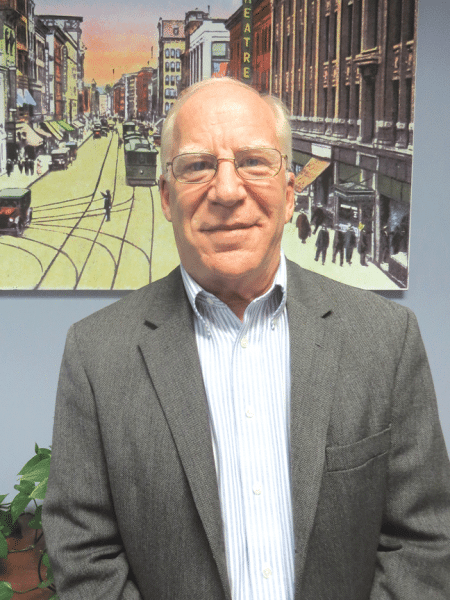
Jeff Ciuffreda says the ‘affiliated’ model for chambers is outdated, and the regional concept being proposed is more efficient.
As he talked about what amounts to a long-discussed — and in many ways long-overdue — reorganization plan and renaming of the Affiliated Chambers of Commerce of Greater Springfield (ACCGS), Jeff Ciuffreda, president of that organization, used several methods to explain why this move was deemed necessary.
Easily the most effective came as he recounted a meeting of the Springfield Chamber of Commerce’s board of directors last year, and, more specifically, a discussion of that entity’s finances.
“Four or five board members said, ‘wait, I thought I was a member of the Springfield Chamber,’” he recalled. “When I said ‘you are,’ they said, ‘well, how come my money goes to the ACCGS?’ After 20 minutes of discussion, I said to myself, ‘if the board doesn’t understand this structure, then how is the member on the street going to understand it?’”
To bring an end to this confusion and put in place what Ciuffreda believes is a more efficient and sustainable model of chamber organization and management, the ACCGS and the Springfield Chamber will be effectively merged into something called the Springfield Regional Chamber of Commerce.
A formal vote on the proposal involving members of those chambers has been slated for Aug. 24, and Ciuffreda is confident of passage for several reasons, but especially his belief that the merger makes sense — on several levels. Overall, it will eliminate unneeded layers of bureaucracy and create a more efficient chamber, with more resources flowing directly to member services, all while maintaining and also enhancing a regional emphasis, while maintaining a focus on the region’s business, civic, and cultural hub.
“In the old, affiliated model, you had separate boards with separate bylaws, with all the powers, if you will, that they had to set rates and act on their own,” Ciuffreda explained. “Now, you’ll have one board that’s centered on Springfield but focused on the entire region; there will be one board, one set of bylaws.
The reorganization amounts to an acknowledgement that the ‘affiliate’ model of chamber organization, popular decades ago, and in place in Greater Springfield since the mid-’90s, has essentially run its course, said Ciuffreda.
Within that model, he noted, the umbrella organization acts unofficially, and even officially, as a management company, taking a large percentage of dues paid by the members of affiliates in exchange for providing a variety of services.
In this different, regional format, dues — the entire amount — are paid directly to the chamber in question, said Ciuffreda, adding that this puts more money to work for members.
Meanwhile, the two words in the new name are both important.
Indeed, Springfield, the area’s largest city and business hub, will be a focal point of its events and involvement with business-related issues (as it is now with the ACCGS), but there will be regional emphasis as well. And that term works better, he believes, than ‘Greater,’ which has ben attached to most area cities’ chambers, and even Franklin County’s.
“Members may not necessarily see that it’s a better-operating entity,” Ciuffreda noted, “but they will see more clarity, and if I’m a member from Agawam, I’d feel a little better that I’m part of the Springfield Regional Chamber, rather than the Springfield Chamber.”
He added that members of the renamed organization should feel more empowered by that word ‘regional.’
“I think this [name] gives members not from Springfield a clearer voice in the region,” he said. “They joined that chamber because they obviously felt they needed to be connected to Springfield. But now, when they join, I think they’ll be a little more active in our programming because this will be known as the Springfield Regional Chamber; I think this will give them more of an ownership stake.”
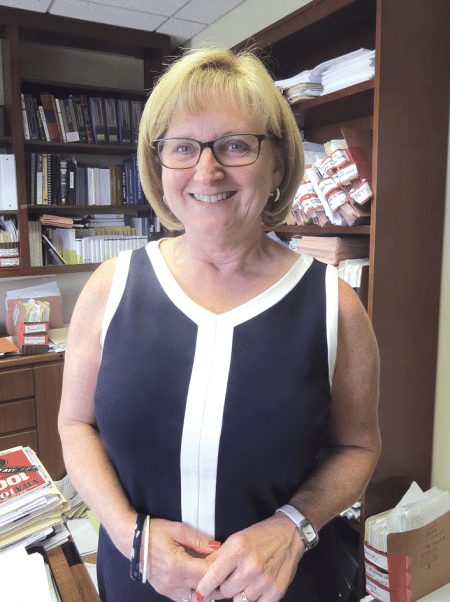
Ellen Freyman says the reorganization plan will reduce confusion — and several unneeded layers of bureaucracy.
The board of the other ACCGS affiliate, the East of the River Five Town Chamber of Commerce (ERC5), composed of businesses primarily in East Longmeadow, Longmeadow, Hampden, Wilbraham, and Ludlow, has voted not to merge into this new regional chamber, said Ciuffreda, adding that it will become a separate entity, and members will no longer have access to the full benefits and services offered through the new Springfield Regional Chamber. However, under an existing service agreement, ERC5 members in good standing can continue to receive services, but only through their current membership term.
For this issue, BusinessWest looks at the chamber’s reorganization plan and what it means for the region and its business community.
Ciuffreda told BusinessWest that discussions concerning a reorganization have been ongoing for several years now.
They picked up in intensity in the spring of 2013 as part of an elaborate strategic planning process — undertaken with the assistance of a facilitator — that was designed to create a blueprint for the next several years.
That planning process examined the current state of organization and prospects for the future, while also researching and benchmarking other models, said Ellen Freyman, chairman of the ACCGS board of directors since last year.
Freyman would eventually appoint a committee to more closely examine the structure of the ACCGS, explore options, and ultimately make a recommendation for the best course moving forward.
“We looked at best practices, talked to the leaders of several chambers, and came up with a regional chamber concept that would essentially have one chamber serving many communities,” said Ciuffreda, adding that the committee completed its work and submitted its recommendation roughly four months ago, based on a model adopted by the chamber in Jacksonville, Fla., among others.
“This structure,” he added, “would result in a clearer and strengthened vision, provide for stronger collaborations, better reflect the regional thinking of the membership, and enable the chamber to grow so that its members could as well.
“The affiliation model was put in place here several years ago, and many chambers looked at that model,” he went on. “But it never really caught on, and, quite frankly, for us, I think the board thought it had outlived its usefulness.”
The vote to reorganize continues a pattern of evolution concerning the chamber of commerce landscape over the past few decades, said Ciuffreda, adding that, only a few years ago, most area communities had their own chambers, which provided both a source of pride and identity.
Only a decade ago, Agawam had its own chamber, he explained, as did West Springfield and Ludlow. Hampden and Wilbraham shared a chamber, as did Longmeadow and East Longmeadow. Each of these entities existed as an affiliate of the ACCGS, while chambers in other communities, such as Chicopee and Holyoke, considered becoming affiliates but ultimately chose not to. Westfield became an affiliate for several years, but eventually went back to being a separate entity and remains one today.
A number of factors, from operating costs to declining membership in chambers nationally, resulted in consolidation and formation of the West of the River (Agawam and West Springfield) and East of the River Chambers, Ciuffreda went on, noting that the former severed its ties with the ACCGS in 2011 and became a separate entity.
Many of those same factors — especially cost and bureaucracy — played roles in the planned reorganization to the Springfield Regional Chamber, he said, adding, again, that the new structure should enable more resources (in the form of membership fees) to be channeled directly into member services.
He used the example of a company paying fees to the current Springfield Chamber of Commerce as an example.
“The ACCGS is really the management corporation; all the services are provided for by the ACCGS, and it had all the expenses,” he explained. “But some of your dues would always go back to the Springfield chamber.
“So if you paid $360 as a member, the Springfield chamber would keep $60, and $300 would go to the ACCGS,” he went, using a hypothetical situation to keep things simple. “Now, all of the funds will be kept by the Springfield Regional Chamber, so we think we’ll be able to provide more services; before, the Springfield chamber could keep part of that money, but they had no expenses to cover.”
Beyond the financial shortcomings of the affiliated structure, there was also considerable confusion — as evidenced by that Springfield Chamber board meeting referenced above — concerning the various entities, their roles, their finances, and more, said Freyman.
“Who can tell you what the Springfield Chamber or the ACCGS is and how the structure works?” she asked. “With this new model, there is much more clarity concerning mission.”
While some things will change with the reorganization, said Ciuffreda, most things won’t.
For starters, membership in the new regional chamber will approximate the size of the current Springfield Chamber, which has roughly 525 members, he said, adding quickly that he anticipates this number will grow. And it will mirror the current demographic breakdown of that organization, he went on, adding that eight to 10 zip codes are currently represented by the membership.
Most importantly, though, the chamber will still be a regional entity, he said, adding that it works with elected officials in communities that have their own chambers, and takes a regional approach to matters ranging from the I-91 reconstruction project to casinos to advocacy on behalf of military bases such as Westover Air Reserve Base and the Air National Guard Base at Barnes Municipal Airport.
But it will have more power to operate effectively on a regional basis because the new structure provides it with that authority, Cuiffreda noted, adding that, in the current structure, more power lies with the affiliate members.
The Springfield Regional Chamber will also continue to collaborate with other area chambers on a host of initiatives, including efforts to promote and inform area businesses, he said, adding that the new model will also make it easier to partner with other business-related groups, such as Northampton Area Young Professionals, because of its more regional focus and reach.
Ciuffreda told BusinessWest that, while the single-chamber theory of the universe, or at least Greater Springfield, has long made a good deal of sense, efforts to make such a change have been challenged by fears that those in some communities would feel left out or overlooked if they were in a chamber with the name ‘Springfield’ in front of it.
Thus, the affiliated structure lived on, despite its shortcomings and layers of bureaucracy. But he believes the times, and the conditions, are right for a much-needed change.
“As our economy changed, as our region changed, the mayors of other cities like Agawam and West Springfield would say, ‘as Springfield goes, so goes the Valley, so goes the region,’” he explained. “So it was time to finally say, ‘we need to make the chamber reflective of how we’re operating, which is regionally.’”
Time will obviously tell if this was the right move, but Ciuffreda is confident that the new organizational structure will be a win-win for all those involved.
George O’Brien can be reached at [email protected]

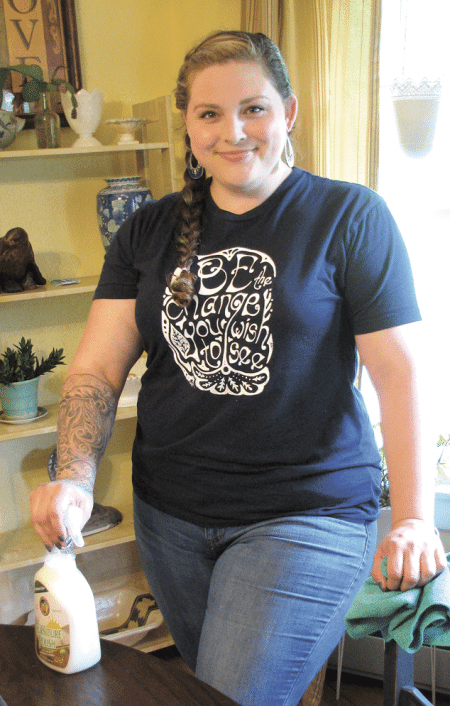
Terra Missildine, owner of Beloved Earth
Terra Missildine says she had a passion for sustainable living long before she heard that phrase or knew what it meant.
“I had a nature-based childhood,” she told BusinessWest. “My dad and mom had a family campground in upstate New Hampshire — completely off the grid, no running water. It was an old trapping cabin from the early 1900s with an outhouse and gravity-fed plumbing; we had to hike down and grab spring water to fill the tank.
“I had a lot of respect and admiration for my parents, and I was always interested in natural ways of things,” she went on, adding that she and her father later launched a project raising heritage breed sheep. “It occurred to me, as I became more and more interested in healthy and humane care of animals, why shouldn’t I be just as concerned about people?”
That question led her, a decade ago, to study sustainable living at UMass Amherst, where she learned about the chemical sensitivity and allergies many people have to harsh household cleaning products, which can cause them severe health reactions. So she and her newlywed husband, David — who had experience with a cleaning company — had an entrepreneurial idea. And that’s how Northampton-based Beloved Earth began in 2005.
“We’d only been married a couple of months, and we were looking for something we could do together,” Missildine explained. “We combined his experience with my passion for sustainable living — and the creating organic movement in the area — and launched the first ‘green’ cleaning company in Western Massachusetts; the only other one in the state at the time was in Cambridge.”
Unfortunately, at the time, there were few commercial products available for people who suffer from such sensitivities, and the ones that did exist were prohibitively expensive. So the couple made their own from items like lemon oil, vinegar, Borax, and baking soda.
“They work, but they often take a lot of elbow grease,” she laughed. “We were coming in with alternatives that didn’t exist yet in the beginning. Really, the green aspect of our business was a value-added service to people who just needed cleaning. We were competitive pricewise, very friendly, and passionate about what we were offering. In the beginning, part of our job was to educate people as to why green was better.”
Customers liked what they heard, and Beloved Earth took off — first mostly in homes, but soon in the commercial arena as well, which now accounts for about 60% of the company’s clientele –— and grew to 12 employees and counting.
“We didn’t even have competition in green cleaning until 2008, maybe 2009,” Missildine said, noting that others have since jumped on the trend. “I love the idea of tons of competition in this area; it means everyone is making better choices, and all boats rise with it. I would rather all companies were choosing green practices.”
Indeed, she noted, “there are a lot of great, efficient, green cleaning products now,” to complement the ones she makes. “Really, there’s no reason to use conventional, toxic alternatives.”
And while businesses need to employ professional cleaning services, plenty of families appreciate what Beloved Earth brings to their home as well. “As people get busier, their families are growing, they may be working two jobs, it’s difficult to keep up with things like housework,” she added. “It’s easier to delegate household tasks and free up time for other things you’re better at or feel more passionate about.”
It’s clear where Missildine’s passion lies — and she’s turning it into a noteworthy success story in the Valley.
Missildine likes to break that passion for sustainability down to three Ps, what she calls here “triple bottom line”: People, planet, and profit.
 Obviously, being exclusively a green, sustainable cleaning company, we only choose things that are good for the planet — organic, not chemically fragranced — and we also choose to back companies with our purchasing dollars which make better choices for the environment and have a commitment to sustainability, rather than purchase the ‘green’ line of products from Clorox,” she explained. “So we purchase from companies like Shaklee or Seventh Generation, which have committed to the environment and aren’t just capitalizing on the wave of sustainability.”
But her belief in sustainable living extends far beyond cleaning supplies.
“We really try to practice it at the bottom line,” she said, noting that Beloved Earth pays its workers 30% to 50% higher than the industry norm. “Our employees are not disposable commodities for us. We compensate them very well. We value them and recognize them. We don’t necessarily compete on price in order to be sustainable in other ways. We need to make money and compete on quality, and the people coming into homes and businesses are happy, loyal, well-paid, and well taken care of. That’s one of our core values.”
The company hasn’t gone out of its way to market that fact, she went on, stressing that the green aspect of Beloved Earth is really its calling card and strength when it comes to search-engine presence. “We don’t do it as a marketing tool. But as customers have conversations with our staff, find out they make very good wages, they feel like they’re respected and taken care of, and it’s definitely a loyalty-building piece of information.”
But growing a staff for the long term has been an often-challenging process.
“Because we like to have super-high-quality, loyal, long-term staff, it’s harder to fill those positions than for some of my competitors who just consider it a cost of doing business to have high employee turnover; they pay minimum wage, expect three to six months from each employee, and constantly funnel them in and out,” Missildine said.
“We are the opposite model; we really want to incentivize and attract people to be with us long-term. One of our challenges is keeping our staffing on pace with the demand for our services. I do employ a professional business strategist to help figure this out, and we have a waiting list of clients who want to work with us. We’re getting there as we staff up and train the right people to match up with them.”
Still, she considers herself fortunate to have become a regional innovator in green cleaning at the right time, just as awareness of green cleaning began to pick up.
“We came in at the perfect time,” she said. “It was a very quickly growing movement, and we started having enough client support to spend more capital on products, which were very expensive; now there are a lot of other, more affordable products. We did ride the wave of the green movement; it was very good timing, with awareness of green living in general just skyrocketing, and products to help people make those choices becoming more readily available.”
In short, things were humming along smoothly for Missildine and her husband, as they were able to pour all their time and energy into this entrepreneurial venture.
But then, last year, baby made three. And the birth of their daughter got Missildine thinking about another aspect of sustainable living — specifically, how to balance a successful business with equally successful parenting.
To that end, she has been working with SPARK, the Holyoke-based economic-development organization, to create a co-working space in that city with integrated child care, so that startup entrepreneurs, remote workers, and others in need of a workspace could share space, resources, and brainpower — and bring their preschoolers along, to a day-care center staffed by an early-childhood specialist.
Click here to download a PDF chart of Area Resources for Entrepreneurs
“I have a toddler myself, 18 months old, but before that, I was a full-time, driven entrepreneur, and that side of you never shuts off,” she told BusinessWest. “I was available 24 hours a day for the business before starting a family and trying to become the mother I want to be and, with my husband, the couple we want to be.
“So I took on the challenge of creating a space with shared resources and collaboration with other people in the similar stage of life, a place you could bring your child and get uninterrupted work time,” she went on. “Paying for full-time child care is very cost-prohibitive for a lot of workers. Even worse, some people feel like they can’t work out of their homes, so they have to pay for child care and pay for a professional work space. Hopefully, this will mitigate that for a lot of people with kids. They’ll have a lot more amenities, a lot more resources, and also be able to cross-collaborate with other professionals.”
Many details are still being discussed, including where the space would be located, and whether to package the child-care component and collaborate with an existing co-working space in the area or launch a new entity. What it won’t be, Missildine emphasized, is a padded room where kids are dumped off to play safely but mindlessly. Rather, it will be a creative, enriching, curriculum-driven program “so your child can feel just as good about you going to work as you do. And during your downtime, after getting your work done, you can actually spend lunch with your baby.
“I’m committed by the end of the year to having something available for these folks,” she added. “I know I don’t want to be away from my daughter all day; I want pockets of time to be super productive, but other times, I want to be there. My baby will only be my baby for a short time. The driving force behind this is, I don’t think it’s acceptable to make people choose between having a thriving business and having a happy family life. You shouldn’t have to choose one or the other. This is an epidemically underserved portion of life that no one is thinking about.”
Until her co-working plan comes to fruition, Missildine will have to be content with growing a successful business that began with a simple idea and a lot of passion — the type of story, in other words, that is becoming much more common across the Pioneer Valley’s burgeoning entrepreneurial culture.
And, in a region rife with resources for entrepreneurs, assisting with everything from funding to staffing to training, she encourages others to do the same.
“My words of advice are to go with the flow, go with where your inspiration is, and remember, you don’t have to quit your day job to start something new,” she said. “If you have a decent job that can pay the bills while try something new on the side, then you can test the water without all the risk, without jumping in all or nothing.
“Entrepreneurship is very rarely easy,” she added. “The times you see someone’s meteoric rise and have no idea how it happened, there was usually a lot of personal sacrifice to get to that, quote-unquote, ‘overnight success’ — a lot of blood, sweat, and tears.”
And, sometimes, a lot of non-toxic cleaning supplies.
Joseph Bednar can be reached at [email protected]


Gina Barry says the demand for estate plans is on the rise, and, as just one form of evidence, she noted that Bacon Wilson, P.C., the Springfield-based firm where she’s a partner, has had to add two paralegals and two new attorneys to its Elder Law and Estate Planning department in the last five years due to the influx of business.

By Gina M. Barry, Esq.
Michael Simolo, a partner in estate planning and probate at Robinson Donovan, P.C. in Springfield, says his firm is also extremely busy. “We’ve added one associate and are thinking about adding more; our calendars are filled,” he told BusinessWest, noting that estate planning can be as simple as leaving everything to a spouse or involve creating a variety of trusts if there are complex issues such as a child with special needs or federal tax issues.
Elizabeth Sillen, a partner at Springfield-based Bulkley Richardson, LLP, agreed.
“There are many reasons why people come to us; some people are dealing with a parent’s estate and want to replicate what they did right or avoid what they did wrong, while others want to know when they should retire or collect Social Security,” said Sillen, who concentrates in estate planning, explaining that the estate-planning attorney’s role is to protect assets and does not involve financial planning.
Questions pertaining to the latter are typically answered by financial advisors, but timing is important because today’s retirees want to be active, travel, and take advantage of all the world has to offer. “We are the glue,” said certified financial planner Patricia Grenier, who co-founded BRP/Grenier Financial Services in Springfield. “Someone has to coordinate everything, and there are often big pieces missing when people go to estate planners.”

Attorney Michael Simolo says estate plans should be flexible and amended to reflect changes in one’s life.
“There more than 8,000 strategies for couples to use when they collect Social Security, and many people don’t even know what their pension options are; these are bases that need to be covered before someone visits an attorney,” Grenier said. “When I meet with a client, we discuss their lifestyle, their income, where and how their money is invested, and their other assets. Health costs are a big issue, and so are family dynamics.
“I ask people how they plan to care for themselves, because there comes a point at which everyone needs help. A lot of decisions need to be made, and it’s a very emotional process, but our job is to make the meeting with the estate planner efficient and effective and coordinate what needs to happen,” she went on, noting that she has accompanied clients to an attorney’s office to do estate planning.
Simolo agrees that the decisions are difficult. “Estate planning is something people tend to put off. It’s not pleasant to think about, but you are not planning for yourself; you are planning for those you are leaving behind — and it’s not as painful of a process as people think,” he said. “Plus, putting off decisions doesn’t make it any less difficult, and planning gives you the option of extending a hand beyond the grave. If you have an estate plan, you can control your money to some extent after you die.”
One of the primary goals of a plan is to avoid probate. “However, probate is a lot easier than it used to be, and sometimes it’s easier to go through it than to retitle everything and put it in a trust,” said Simolo. “It depends on family dynamics, how much you own, and what you want to do.”
Limiting estate taxes is also critical: in Massachusetts, payment is due once an estate hits the $1 million mark, while the amount in Connecticut is $2 million. Federal taxes start at 40% if an estate totals $5.43 million or more, and although that seems like a lot, the number includes everything a person owns, including real estate, investments, bank accounts, and life insurance.
But experts agree that most people don’t reach that mark because the majority of Boomers have failed to save enough to retire in comfort.
“The biggest risk is that they will outlive their money, so it requires careful planning and strategizing,” Grenier said.
Generations tend to differ in how they want to allocate their assets, said those we spoke with.
“Folks from the Depression era are not as inclined to gift as Boomers because they fear they won’t have enough to last throughout their lifetimes; they are much more frugal and want a sense of security and know that there is enough to take care of them until they die,” Barry said, explaining that strategies used in tax planning can require a loss of control of assets, which is frequently not palatable to Boomers.
“The majority want to leave money to their kids, but some would rather have their heirs pay taxes than lose control,” she went on, adding that the state tax on $2 million is about $89,200, which could be avoided entirely.
Siller agrees. “Some Boomers don’t care if their heirs will have to pay estate taxes because they have no appetite for complex plans. But there is definitely a generational difference. People from the Depression era tended to be thrifty, live moderately, and save money. Boomers may live moderately, they are a lot more consumer-oriented,” she explained, noting that there is a lot more to buy today, including devices such as cell phones and computers that are necessary to keep pace with technology.
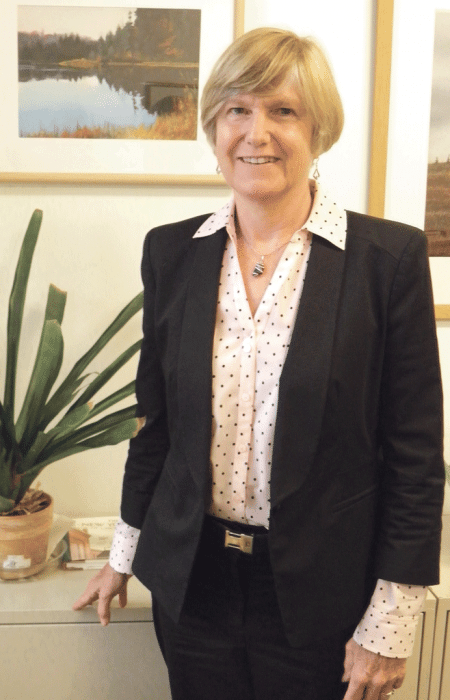
Attorney Elizabeth Siller says children from a first marriage may feel resentful if a second spouse inherits everything, so it’s important to find ways to divide things in a way that doesn’t cause family problems.
Grenier agreed. “The person in that role has to be qualified to handle it. You want someone who has the time and ability to carry out your wishes.”
Long-term care also has to be considered. Although it’s prudent in some cases for the person to take out insurance, it doesn’t always make sense. And although estate plans can be altered if circumstances change, many people never update their plans. “They are lulled into a sense of security once a plan is created, but it’s imperative that they return to their attorney if they inherit a tremendous amount of wealth,” Barry said.
Siller concurred, and said estate planning involves many factors. “Estate planners provide people with options that are very concrete after they learn everything they need to know about their situation. But the process is complex and requires specificity,” she said, adding that considerations such as putting assets in a child’s name include whether he or she may get divorced, go bankrupt, or is in a high-risk profession and could be sued. Meanwhile, Boomers with grandchildren may want to set up college plans for them.
“If Boomers do some advance planning, they may be able to give their children all of the benefit of the income they inherit without imposing a tax burden on them,” Siller said. “But everyone’s situation is different, so we build a plan for each client that suits their needs. It’s a satisfying process.”
The demand for business-transition planning is another area that is undergoing rapid growth.
“A lot of small-business owners want to retire, but it can be challenging. The business is often like their child, and it’s important to them that it continues to thrive,” said Siller. “And if one child is really interested in taking over, they need to navigate continuity along with fairness to other children, which can be tricky.
“It’s a whole world unto itself,” she went on, adding that, in some cases, life insurance is used as a way to equalize the value of the business, while in others where the building sits on land that is owned, the parcel is transferred to non-participating children, and the child who takes the helm of the business pays rent on the land to their siblings.
Barry says many factors enter into the equation, and it’s critical to know how much the business is worth on the open market.
“I can’t tell you how many business owners have never had their firm properly evaluated by an accountant,” she explained. “They think they know its value or what they could sell it for, but they have no idea of its actual value.”
That figure can be pivotal, said Simolo, who noted that a business may constitute the majority of the value of an estate.
“Succession planning for businesses poses a unique set of circumstances which are different for every family and every business. It’s a matter of fulfilling the intentions of the owner to the greatest extent possible, while protecting its future,” he told BusinessWest.
Another weighty consideration involves planning for children with special needs, and estate-planning attorneys say more clients are coming to the table with this challenge.
“Some children are receiving benefits or are incapable of managing their own funds,” Barry said. “There is a great increase in the number of people addressing these needs.”
Siller concurred, and said special consideration needs also to be made if children have addiction problems or are in relationships the parent is unhappy about.
Meanwhile, second marriages can be another tricky area to navigate.
“Kids from a first marriage often feel resentful if a second spouse inherits the bulk of the estate, so it’s important to find ways to keep the peace,” said Siller. “We try to have conversations and get the person to think about what they want to do before we come up with a plan.”
But leaving everything to a spouse, even in a first marriage, can be challenging if the deceased had always handled the finances.
“Sometimes we create a trust to ensure the remaining spouse will have plenty of money,” Siller said, adding that issues also arise if the spouse is not a citizen. “And if there is a second home, people worry about how their kids will share it. Sometimes a trust is put in place with a management structure that gives children the ability to buy out their siblings or sell the property, as there is often one primary user. Some parents endow a vacation home to preserve memories, but there are a lot of variables.”
Single people have their own dilemmas to contend with. “Their estate plans can be more complicated than a married couple’s,” Siller explained. “They need to think carefully about things because there are fewer tools available to them to reduce taxes.”
But even after all of these variables are accounted for, the work is not done.
“The drafting of documents is only half of the estate plan,” Simolo said. “The other half is making sure assets are properly structured so the plan works. Sometimes assets are made joint or taken out of joint ownership, and beneficiary designations must be properly named.”
Grenier concurred, noting that it’s not uncommon for people to fail to take the necessary steps to make the plan viable.
“Many never follow through with financial planners or investment advisors after their plans are set up; if a trust is created to protect assets, it has to be funded,” she said. “The accounts and real estate that will go into it have to be retitled, and beneficiaries have to be titled appropriately to match the plan. You can have the best attorney in the world, but if there is no follow-through, the plan won’t work.”
The bottom line is that estate planning and elder law is a complex manner, and although some people use the Internet to create what Barry calls “a will in a box,” such a strategy can lead to problems down the line.
“In most cases, there is an error because the person doesn’t understand the language or know what’s missing,” she said, adding that a simple estate plan, which typically costs less than $1,000, takes every facet of the individual’s situation into account and puts language in place to ensure their intentions will be carried out.
“Some people don’t think they have enough to warrant putting together a plan, but it’s never true,” she went on. “And it’s far better to plan your estate when you are not under pressure. Doing the work is much more enjoyable if you are not faced with a catastrophic event.”
Grenier concurs. “It is a daunting task that involves a lot of decisions,” she told BusinessWest. “But people need to make sure they have everything lined up, then finish the circle by following through and having things moved into trusts and taking care of other details.”
Whether they do or not, the transfer of wealth will continue, and future generations will bear the brunt — or reap the rewards — of what the people who go before them have left behind.
“If you don’t have a will,” Simolo said, “the state will create one for you — and it may not match your intentions.”


As new laws go, this one is causing employers to feel … well, a little sick.
“I would say many are confused and anxious,” said Mark Adams, director of HR Services for the Employers Assoc. of the NorthEast (EANE), when asked about member reaction to Massachusetts’ earned-sick-leave law, which took effect on July 1.
“They’re frustrated as well, in the sense that many of our members who have been doing the right thing, that already have paid sick-leave benefits, have had to unwind many aspects of that to come into compliance with some of the finer points of the law. There are some components built in that have given employers pause.”
At its heart, the law requires businesses with 11 or more employees to offer 40 hours of paid sick time per year. Companies with fewer than 11 employees must still provide 40 hours of sick leave, but it can be unpaid.
“We’ve done a number of briefings to educate companies, and for a lot of them, especially for companies that operate in multiple states, this has been particularly challenging,” Adams said, noting that many businesses with existing sick-leave policies must revamp their payroll systems and handbooks — mid-year, no less — to comply with the new law.
“They’ve provided this benefit all along, with favorable feedback from employees, and it costs time and effort to retool to meet the requirements,” he went on. “Then, you look at things being put forward on the federal level that would apply to federal contractors, a potential executive order that might require federal contractors to pay sick leave. If that ever comes to fruition, it would make it even more complicated to try to comply with both federal and state law, and you’re creating this ever-evolving patchwork of regulations on a benefit that, for many companies, they apply across the board. It makes it harder for many businesses that have been trying to do the right thing all along.”
Attorney Susan Fentin, a partner with the Springfield-based employment-law firm Skoler, Abbott & Presser, P.C., agreed with that assessment.
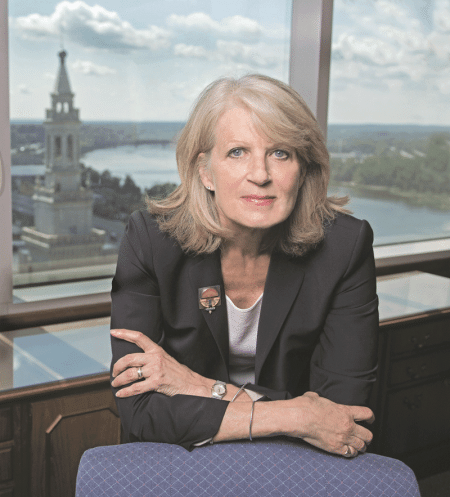
Susan Fentin says employers worry about the potential of employees abusing the new law, especially because workers are protected from employer retaliation for asserting their right to paid sick time.
“So it’s an added burden,” she went on. “Perhaps a justifiable one, given the demands of society; individuals do have family members who are ill and need medical attention. But it’s nonetheless a burden on the employer.”
Attorney Olga Serafimova, an associate with Royal LLP, said the Northampton-based employment-law firm was peppered with questions leading up to July 1, as many clients were scrambling to adjust their policies, but it has been “dead silence” since, as though employers are holding their breaths and hoping they’ve instituted the changes correctly.
“Really it was smaller businesses that didn’t have leave policies previously that were affected the most,” she said. “A lot of those businesses fluctuate between 10 and 11 employees or around that number. For them, it’s an added expense.”
The attorney general’s office, she noted, did address many employer concerns in its final regulations, tightening up rules concerning sick-time accrual, employee justification for time off, and other details. “Of course, many businesses still feel it’s way too broad, way too generous, and a financial burden. And for smaller employees, this will have more of an impact.”
That issue of justification for time off — in other words, the doctor’s note — is one element of the law that has employers on edge, because of its potential to breed abuse. The draft regulations stated that employees are not required to produce proof of illness until the time off exceeds 24 hours.
“For a part-time employee, that could mean more than a week, depending on how long the shifts are,” Serafimova said. “In the final regulations, it was changed to 24 consecutive hours or three consecutive days, even for part-timers. That was something the attorney general’s office picked up on and adjusted.”
The three-day rule, however, promises to be irksome to many employers, Fentin said.
“Previously, if an employee had an unplanned absence, the employer might have said, ‘I need a doctor’s note for that.’ Now the employee isn’t required to get a doctor’s note until, at minimum, a three-day absence.
“We represent management, so we’re always a shade cynical,” she went on. “The potential for abuse is pretty high with this law, the way it’s been drafted. Some changes to the draft regulations made it a little more palatable. For instance, now, the minimum amount of time you can use is an hour, so you can’t walk in 15 minutes late and say, ‘I was sick.’
“Of course,” she noted, “you can walk in an hour late and say, ‘I was sick.’ The employer would just have to forgive that. Frankly, somebody could take every Friday afternoon off all summer long because of so-called ‘medical appointments.’”
Serafimova noted that some employers might opt to provide 40 hours of sick time right at the beginning of employment, instead of having it accrue gradually, so they don’t have to change their payroll systems. “But that goes to the question about abuse. Giving one week up front creates the possibility for people to use it up and move on to the next business.”
This is especially true for employers with seasonal or temporary employees, she added. “As much as it sounds like it would make things simpler, [front-loading sick time] wouldn’t be a benefit for many employers. It saves them some money in adjusting their payroll systems, but they may end up paying anyway to people who are only there for a short period of time and take their sick leave, then give their notice. The requirements are so broad, there’s little limitation on how you can use sick leave. Businesses have had to really think about what is the better option.”
Click HERE to download a PDF chart of the region’s Employment Agencies
On top of that, Adams said, the law might turn out to be an employee-relations minefield for businesses that had existing sick-leave policies in place.
“Many companies are dealing with employees who might have false expectations based on what they’ve heard in the media, who think they’re getting more benefits than they’re accustomed to, when really, that’s not the case,” he explained. “These companies have already been providing fair and competitive benefits, but now they’re dealing with angst from employees who aren’t getting anything additional — but, frankly, never asked for it.”
Serafimova agreed. “Some employers who had a paid-time-off policy in place opted to reduce it and make 40 hours of it sick leave,” she said. “So people who were previously offered three weeks vacation time, saw that changed to two weeks vacation and one week sick leave. Unfortunately, while that keeps the expenses of the employer the same, the perception in the workforce is that they lost a benefit, and that creates discontent and morale issues. A lot of businesses are struggling that that decision.”
It’s just one way, Adams said, that “a law aimed at a small segment of businesses has created burdens for a large number of them.”
A large number indeed, to hear Fentin tell it.
“The way this is written, it’s the most generous, but, from an employer perspective, the most draconian, most burdensome sick-leave law in any state in the country — including California, which says a lot.”
Where it becomes dangerous for employers and not simply burdensome is in the law’s anti-retaliation language, and the potential for lawsuits if an employer tries to infringe upon a worker’s leave rights — or even the perception of infringement.
“They said they would not come down on employers for a while, give everyone some time to work out the bugs,” she said, regarding communications from the attorney general’s office. “That was encouraging. How long that lasts, we don’t know. All it takes is a couple of employees filing complaints.”
Serafimova said her clients, too, are anxious to see how issues play out.

Olga Serafimova says the attorney general’s final regulations addressed some initial concerns about the sick-leave law, but many businesses still find the measure burdensome.
“We’re going to wait and see how that plays out because, again, it is enforced by the Attorney General’s Office, and if there’s any basis [for a complaint], they will proceed to investigate. On one hand, that’s good for someone who’s fighting over their sick time at work. But, at the same time, it opens the proverbial floodgates for anyone who’s not happy with their employer for any reason.”
And while defending against a complaint could be expensive for an employer, it’a free for the employee, she added. “Ultimately, it falls on the employer to defend against a meritless claim, because there’s absolutely no barrier to filing a claim, not even a $5 filing fee.”
That’s why it’s important that human-resources staff train managers in how to handle leave requests in this new environment, Serafimova said.
“If I come up to the employer and say, ‘I’m not feeling well today. Can I go home?’ I have asked for job-protected sick leave,” she explained. “Now, if I am late three times in one week, or say, ‘I’m not feeling well, can I go home?’ an untrained manager might say, ‘oh, not again, I’m going to discipline you.’ But, with the job protection this law provides, you can’t do that anymore. If people aren’t properly trained, it could lead to trouble for the employer.”
Fentin has been sharing similar advice. “We like keeping clients out of trouble; that’s much easier than defending them when they get in trouble,” she told BusinessWest. “We want them to do the right thing. We’re all on the same page.”
Still, she added, “we’re really in the weeds here. This is going to be a problem for employers for a long time going forward. Although a lot of my clients have made changes, they’re waiting to see what happens.”
That’s true with EANE members as well, Adams said. “Eventually, it will become easier to manage, but until we get through this transition, we’re going to see considerable frustration and confusion for the foreseeable future as companies continue to come to grips with the law.”
Joseph Bednar can be reached at [email protected]
 Since launching White Lion Brewing Co. in Springfield last fall, Ray Berry had a feeling that organizing a beer festival would be a good way to showcase his brand, and craft brewing in general. But what has become abundantly clear, with the help of a diverse group of local partners, is that Valley Fest, slated for Aug. 29, is also a celebration of what they consider a city and region on the rise.
When Ray Berry launched White Lion Brewing Co. in Springfield last October, he planned from the start to create a regional beer festival within the first two years. As it turns out, he didn’t want to wait that long.
“I didn’t know whether it would be year one or year two, but with the momentum of the company and awareness of our brand, we felt comfortable enough to bring the fest in year one,” he said.
Specifically, White Lion will present Valley Fest on Aug. 29 in Court Square in downtown Springfield, expecting to draw some 2,000 beer enthusiasts to sample more than 100 different offerings of beer and hard cider made by more than 50 craft brewing companies from throughout the region — and well beyond.
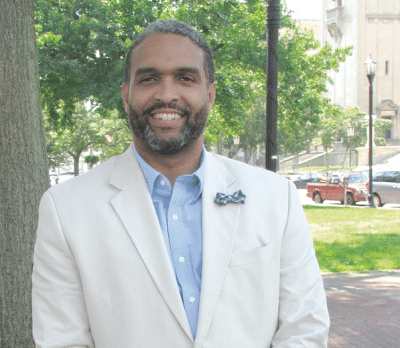
Ray Berry calls Valley Fest a way to “bring together a cohesive conversation” about what’s happening in the region — with craft brewing and in other ways.
“This is about the city of Springfield, about the region, but it also revolves around craft beer,” Berry told BusinessWest. “Western Massachusetts is starting to see a tremendous amount of momentum around craft beer — new brewhouses, new enterprises, new products on the market.”
White Lion is actually the first one of those brewers based in the City of Homes, and Berry hopes the festival — which will also feature culinary fare from local restaurants, live music, and a home-brewing contest — will create a buzz, so to speak, that raises the profile of the city and region.
“Springfield was a little late to have its own product — White Lion being that — and we thought it was important to showcase White Lion, but also to bring together a cohesive conversation regionally,” he went on. “We didn’t know at the onset that this would be bigger than Western Mass., but we’re covering the spectrum with local, regional, and national brands participating, which is exciting.”
But this isn’t just the story of craft beer, or a day-long, late-summer party. It’s about a number of individuals and businesses coming together to showcase what they call a city on the rise.
The first of those was MGM Springfield, which got on board as the event’s presenting sponsor.
“From the company’s standpoint, showcasing Springfield was obviously important,” said Seth Stratton, MGM Springfield’s vice president and general counsel, noting that the company presented last year’s Downtown Dinner Table event to bring some energy to the casino’s future neighborhood.
“We were all surprised how amazingly successful that event was, and it hammered home to MGM how important it is to bring people downtown,” he added. “If people not used to coming to the city are coming for an event like that, that is a perfect event. We want people to be accustomed to being out in this vibrant city, and making it a destination by showcasing its food and beverage assets, which are a huge part of our business. There’s a synergy between events like this and what our goals are with our project.”
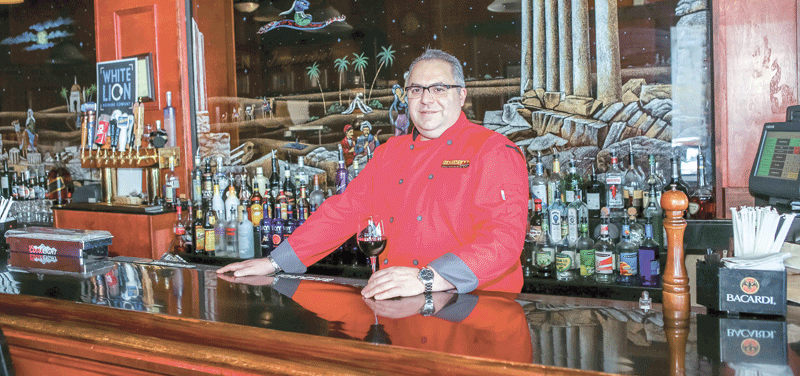
As a downtown restaurant owner, Nadim Kashouh wants to be part of efforts that make Springfield more of a destination, and considers Valley Fest to be just that.
Like Stratton, Nadim Kashouh — owner of Nadim’s Mediterranean Restaurant and Grill downtown — is invested in developments that make Springfield a destination. He’s one of several area restaurateurs to sign on for the event, citing the event’s potential to showcase Springfield and, by extension, its culinary offerings.
“Ray and I have become good friends, and we were interested in being there at this event,” he said. “Springfield is flourishing right now, and we want to be a part of anything that shows that.”
Still, before soliciting sponsors and partners for what would become Valley Fest, Berry first approached Jeff Goulet, who has organized the Worthy Brew Fest in downtown Springfield each spring since 2011.
“We didn’t want our fest to conflict with the other fest, but, rather, to bring a positive impact and awareness of craft beer to Springfield,” Berry said.
Goulet, however, is fully on board — as Valley Fest’s brewery coordinator.
“June was our most successful year by far. It came close to a sellout,” Goulet said. “Our focus has been to have a boutique beer fest, limit it to 1,000 people, with very specialty beers, one-off beers.”
So, when Berry told him about the more wide-open concept of Valley Fest, he felt it was a strong complement to what Worthy Fest has been bringing to the table. He also noted that many of the participating breweries have their own local fan bases, who will then travel to Springfield to take in the festival.
Even after winning Goulet’s support, Berry said a successful event wouldn’t have been possible if not for the support of MGM Springfield. “When they locked in up front as the primary sponsor, that was the key that started the ball rolling.”
Other partners soon followed, all of whom see events like this, as well as Worthy Brew Fest and the second annual Jazz and Roots Festival that landed in Court Square last weekend, as ways to continue the city’s momentum generated by not only MGM Springfield, but a host of new development and business activity downtown.
“Ray came to us and shared his vision for the Valley Fest and asked us to work with him to create the brand narrative,” said Deb Walsh, creative director at TSM Design, which had previously designed the White Lion brand logo, and signed on to create visual and narrative elements to promote the event.
“TSM is very committed to Springfield — and beer,” she said with a laugh. “So we happily joined in and created a look that celebrates the craft, celebrates the location and the history, and emphasizes fun, too, making it an event that people will want to attend.”
Meanwhile, Creative Strategy Agency is developing digital communications and marketing to promote Valley Fest, said President Alfonso Santaniello. Among those efforts is a video introducing the sponsors and vendors and trying to get them to engage with each other well before the event — as well as during it, with the use of the #valleybrewfest hashtag. “This has been a team effort, not just the Valley Fest, but the social site.”
Jill Monson-Bishop, president of Inspired Marketing and Valley Fest’s event planner, said she and other business owners are excited about momentum in the downtown district, whether it’s a company moving into one of the office towers or an event with the promise of becoming an annual attraction.

Jill Monson-Bishop says she and other downtown business owners are looking for “sparks of revitalization.”
“As a downtown business owner, I can say these are the sparks of revitalization we’ve all been waiting for. It’s kind of a renaissance,” she said, adding that she was involved with MGM in the Downtown Dinner Table last year. “That reminded me of back in the days of Taste of Springfield, which brought thousands of people to our downtown without blinking or whining.”
She said it was important to make the event about more than beer, however. That’s why Nadim’s will be joining Plan B Burger Bar, Palazzo Café, the Student Prince, and Sheraton Springfield to deliver an array of food, while live music, including dance-party band Orange Crush and rock act Maxxtone, will spice up the Fest, which Monson-Bishop positioned as an age-21+ event that’s friendly and relaxed.
In addition, Mark Stroobandt of Belgium, an internationally acclaimed beer sommelier, will be on hand for a cooking demonstration. Meanwhile, the second of the event’s two sessions will include pourings from 10 home brewers competing for the title of Valley Fest’s Best Home Brewer, a custom tap handle from East Coast Taps, and, of course, bragging rights.
As a way to give back to the community, Berry said a portion of the event’s proceeds will be donated to the American Cancer Society and Dakin Humane Society, two prominent nonprofits.
Susan Alston, director of development and marketing at Dakin, noted that Berry participated in the PAWSCARS in February, Dakin’s largest annual fund-raiser, and they formed a bond over their concern for animals.
“Every year, more than 6,000 of them need medical attention or new parents,” she said. “Our Dakin facility moved downtown in 2009, and we serve thousands of people who adopt our animals every year within a 50-mile radius. We were lucky to be invited to share the proceeds of this event.”
The partners promoting Valley Fest stressed that many other entities will support the event in different ways, from Ace Taxi providing free service to those who need it to Sheraton Springfield offering reduced room rates for anyone who wants to turn a day of beer sampling into a safe weekend stay downtown.
“This is a community event,” Santaniello said. “We’re all from various backgrounds and specialties, putting on an event with our community. It’s an opportunity to let people see what can be done when we come together for one great event. People need to realize, it doesn’t have to be one person doing things — people and businesses are here to help, and these events just have to find the right people.”
Berry agreed. “The response from the community — and surrounding communities — has been overwhelming,” he said, noting that those sponsors number around 25, including primetime sponsor MassMutual Financial Group and partnering sponsors the Dennis Group and Williams Distributing. “A number of sponsors stepped up early, believing not only in the festival, but in Springfield in general.”
Berry emphasized that Valley Fest is an important showcase not only for White Lion — which has released three beer selections since last fall and has promoted its efforts in venues all over Massachusetts and other New England states — but for a region ready for a stream of good economic news. “People who are complaining are only reading the headlines. They need to dig deeper.”
Kashouh said MGM and other developments downtown have started to create that buzz, which promises to bring new life to the city.
“I know I find myself investing in renovating, putting more money into the restaurant, waiting for the day when MGM opens up. It’s three years out, but I want to be ready. The beer festival, the jazz festival, these things bring people downtown. People are trickling back. It won’t happen overnight; it’s one store at a time, one restaurant at a time. But we believe in Springfield.”
Stratton stressed that the casino project is not the end-all, be-all, but that each new event or company relocation downtown serves as a catalyst for others.
“I think this is a good example,” he went on. “If you look at the sponsor list, it’s a who’s-who of businesses in Springfield. We’re naturally aligned and interested in having people come down and drink beer and have fun; there’s a natural synergy to what we do. For other businesses, it may not be as immediately apparent. But as people see new, exciting things in Springfield, it’ll eventually be a catalyst for the entire business community, not only those who have a natural interest in this event, like we do.”
That’s a refreshing thought indeed. So cheers, Springfield.
Joseph Bednar can be reached at [email protected]

U.S. District Court Judge Mark Mastroianni
Mark Mastroianni was talking about the start of the process that eventually led to him being named a federal judge in Springfield.
To describe it, he used the phrases “completely unexpected” and “perhaps even unwelcome.”
He said it was the former mostly because at that time, early 2014, he was more than halfway through his first four-year term as Hampden County district attorney and thinking about the next one, not a new career challenge.
As for the latter, he chose it because he wasn’t simply serving as DA. He was, as he put it, “just hitting my stride,” and in many ways he actually resented what the ensuing search process represented — an extremely difficult decision he would have to make about his career, or another difficult decision, to be more precise.
“I was three years in the district attorney’s office; I was getting my feet under me and really developing my sense of confidence,” he explained. “And it’s really at the point when you develop a sense of confidence doing anything that you become your most effective. I had things to do — I had things I knew I could do in the district attorney’s office that were important for me as professional accomplishments and for the people I was serving.
“I really took to that, and was serious about what I wanted to do,” he went on. “And when I say ‘unwelcome,’ I say that because that search came about right when I got moving.”
But there was more to this than the opening on the federal bench coming at what Mastroianni would consider the wrong time career-wise. Indeed, he possessed vast experience as both a prosecutor and defense lawyer at that time, and frankly couldn’t imagine himself spending at least the next 15 years (a federal judgeship is a lifetime appointment) being neither.
To get that point across, he put his passion for such work in perspective that only people who have been there could appreciate.
“There will be nothing like — at least, I haven’t experienced anything that looks like it will be the same as — the adrenaline rush in a capital murder case in the minute or two minutes when you’re waiting for the verdict,” he said while comparing his current job to his previous ones. “The jury comes in, the jury stands up, and the verdict form is handed to the clerk … I can’t explain to you what that’s like, really. Every trial I’ve taken, it’s been remarkable to me that I’ve been able to even stay on my feet; your heart is beating so fast, you just think that physically you’re not going to hold up.”
One doesn’t reach that state, emotionally or physically, as a judge, he went on, adding quickly, though, that adrenaline comes in many forms, and he experiences it now — granted, on a much lower level — when one of his rulings is cited by a lawyer when making an argument.
Adapting to this new standard for adrenaline rush is part of an adjustment period Mastroianni says is still ongoing, although overall, he says he’s quite comfortable in his new skin, or robe, as the case may be. He acknowledges that reaching this state wasn’t easy, but in most ways easier than he anticipated.
“I have been so happy and relieved at how I’ve adjusted, because I thought that I was going to really struggle with not being in the courtroom,” he said, referring, obviously, to the seats in front of the bench, not the one behind it. “I have really enjoyed and adjusted to still being part of the trial-litigation criminal process; I take a different seat now than the one I’m used to sitting in, and my decisions are from a different perspective, but I’ve adjusted, and continue to adjust.”
For this issue and its focus on law, BusinessWest looks at that adjustment period, and how it represents one of many career gambles Mastroianni has not only taken, but embraced.
When asked about whether he had any regrets about taking the federal judgeship, Mastroianni answered in a way one might not expect from someone in such a lofty, respected, and sought-after position.
“Of course I have regrets,” he said, implying that some of his earlier comments would have made that clear. But he went further, and in a manner that once again suggested just how much he liked being DA — and a defense lawyer, for that matter.
“I’ve had regrets from every job I’ve left,” he explained. “If you don’t have regrets from the last job you’ve left, that means that didn’t love your job and didn’t do it with everything you had.”
Mastroianni has left a few positions in his career knowing that there would be not only regrets, but serious doubts from colleagues, friends, and relatives about whether he was doing the right thing, career-wise and otherwise.
There were such sentiments expressed when he left a position as assistant district attorney under William Bennett to go into private practice. He had started a family and purchased his first house, and while prosecutors were poorly paid at the time (and still are today), the job represented a safety net.
He heard them again when he launched a bid to succeed Bennett as DA running as an independent, a campaign for which for which the adjective ‘long shot’ would be considered a serious understatement.
And they were uttered again when Mastroianni became a candidate for the federal court, a position usually placed in that category of ‘opportunity of a lifetime.’
“Every friend and family member expressed the concern that it would be something I might not enjoy or become frustrated with,” he noted. “I had that same concern.”
Mastroianni said he made these various career moves after careful consideration of those expressed concerns, but also what the next challenge would mean for him personally and professionally.
“These were not reckless decisions,” he explained, using that phrase repeatedly with his latest change especially. And as he talked about them, he would reference a need to continually seek new challenges because “there was more for me to do.”
Our story begins at Cathedral High School in the early ’80s, where Mastroanni was mostly unmotivated and anything but a standout student and rising star. In fact, he would say that American International College “took a chance on me when they accepted me.”

“I’m adjusting, I very much like what I’m doing, and the forecast looks good.” – U.S. District Court Judge Mark Mastroianni
He made the most of that opportunity, though, majoring in English and political science and contemplating careers as a writer or journalist while doing so. But he chose a different tack — one encouraged by his grandfather — and enrolled at Western New England University School of Law.
Upon graduation from WNEU in 1989, he found himself in a tough job market as a recession that would last the better part of half a decade settled in on the region. He borrowed money from some family members and opened a private practice in the same building in Springfield’s Court Square that his grandfather practiced from.
But the phone didn’t ring much, and he eventually sought to fill an opening on the staff of then-Hampden County District Attorney Matty Ryan. That assignment lasted only six months, as Ryan’s eventual successor, Bennett, did not keep him on after assuming office.
However, Bennett later rehired him, and he worked five years as an assistant DA, cutting his teeth on a number of high-profile cases, including several murder trials. Despite his success in that role, he sought another challenge — and potentially much larger paycheck — and returned to private practice.
He would remain there for 17 years, enjoying success on the other side of the legal system — defending clients — and on the all-important business side of the equation as well.
Eventually, he became as passionate about defense work as he was with his prosecutorial skills, and when pressed to compare and contrast the two, said that he found the former in some ways as rewarding professionally as the latter.
“What I like in both of them is high-level, high-profile, difficult cases,” he explained. “There’s an enormous sense of satisfaction that comes with successfully prosecuting a case and helping victims. But, quite frankly, I think that feeling is rivaled, and perhaps equaled, by the sense you get in the successful defense of a case and being the person who stands between one individual and the government, the prosecution, and the resources of that prosecution.
“With the murder cases I handled, there were primarily appointed cases — it’s one individual who’s been deemed to be indigent; we’ll appoint you a lawyer, and there you go, good luck with that,” he continued, explaining, in more detail, that sense of satisfaction he enjoyed from helping clients prevail in such matters. “You have a limited budget and limited resources, but there’s no limit to energy and effort you can put in.
“The satisfaction is not of ‘I want to help someone get away with something,’ or ‘I want to pull one over on someone,’” he went on. “The satisfaction is working within the system and making the system work; our system means nothing if there’s not vigorous defense work forcing the government, be it the Commonwealth or the federal government, to meet their burden of proof. Every good defense makes the next prosecution better.”
He said that, if he were ever put in a position of having to choose between the two, that would be a very difficult decision. So it’s fortunate, perhaps, that circumstances now mean he won’t have to make such a choice — at least until he turns 65.
As he talked about his career and the many twists and turns it has taken, Mastroanni referred early and often to the notion of timing, and how certain events — from a recession to the retirement of a federal judge — have played a big role in shaping his many difficult decisions.
One such point in time was Bill Bennett’s decision to not seek another term as DA in 2010 after 20 years in that office.
Mastroanni admitted he was already thinking about pursuit of new and different challenges at the time, but Bennett’s decision in some ways forced his hand — again, amid concerns from collegaues and family members that he might be making a big mistake.
“The question from friends and family was, ‘why? What are you doing? … you can’t walk away from this,’” he said, referring to the very successful private practice he had built. “At that point, it was something inside me professionally — a need to do more. It was this reflection, this self-examination of where I was, where I wanted to be, and what I wanted to be doing that led me to run.
“I wanted a challenge, I wanted a change, and I really felt I could do a good job as district attorney,” he went on. “I had very specific ideas about the criminal-justice system and how it could work better.”
But while he had the will to seek the post, he wasn’t exactly dealing from a position of strength, at least to most observers.
Indeed, while the DA’s position is non-political by nature, the processing of winning is quite political, and Mastroanni, upon entering the race, also decided he would wage his fight as an independent. That choice would impact everything from his participation in scheduled debates to raising money, but he stuck to his guns and eventually prevailed.
In the winter of 2011, he settled into the job — or at least the part he wanted to settle into.
He admitted that he had no real appetite for what could be called the operations side of the office — the budgetary matters and many aspects of managing 150 people and several offices. So he effectively delegated — something he says isn’t easy, and is an art form unto itself.
“That was like running full-speed into a brick wall when I encountered that administrative setup at the district attorney’s office,” he told BusinessWest. “You have a lot of employees, an IT team, a state police squadron assigned to you … so I delegated. I had to choose what to delegate, and I chose not to delegate the trial work; I thought I was certainly more qualified and competent as the trial lawyer who could take on the big case than I was as the person who would walk in and take care of the budget.”
Thus, he focused on trying cases (one of his first involved a successful prosecution in the murder of Cathedral High School student Conner Reynolds) and myriad other aspects of a very broad job description.
That list included everything from making progress with a large list of cold cases to going out into area classrooms and providing lessons on how the judicial system worked.
“We opened new units — we opened an unsolved-crime unit and a DNA unit, and we made really big advances in some cold cases that had not been worked on in some time,” he explained. “We solved several cases that were 20 years old and more. I developed a way to use drug-forfeiture money to essentially pay for the overtime so police officers could work on these cold cases.
“Springfield has so many unsolved cases, and one of the reasons they’re unsolved is because new cases keep flooding in every day,” he went on, adding that he developed a process by which trained individuals could devote the needed time, energy, and imagination to such cold cases. And many wound up being solved.
“That program was cranking,” he continued. “Meanwhile, our community outreach was just unprecedented; we were in the schools with all kinds of programs … it was wonderful, challenging, stressful times at the district attorney’s office. That’s a difficult job, and I was really enjoying all the progress we were making.”
It was at this point that the unexpected and “perhaps even unwelcome” search for a successor to the retiring Judge Michael Ponsor commenced in late 2013.
Then-recently elected U.S. Sen. Elizabeth Warren was placed in charge of the process of selecting a new federal judge, said Mastroanni, who said he had no intention of pursuing the post until he was encouraged to do so by members of the Gertner Committee, a panel appointed by Warren to solicit, interview, and comment on applications for federal District Court vacancies, and so-named because it was chaired by former District Court Judge Nancy Gertner.
Although he entertained those entreaties to become a candidate, Mastroianni admitted to feeling what amounted to a sense of relief that he missed a posted deadline of Jan. 31, 2013 for submitting a formal application.
“In my mind, how a lot of things work is that I’ll put things off as long as I can, and if I just put it off long enough, it will just take care of itself,” he explained. “I put that into practice with my judicial application. Before I knew it, the deadline had come and gone, and I didn’t get my application in, and I said to myself, ‘that’s too bad … I’ve been so busy as district attorney, I didn’t have a chance to fill this out. It’s just not right; I’m too busy as D.A. This is obviously where I should be.’”
As fate would have it, though, the deadline was extended, and Mastroianni would apply and eventually get the nod after many strenuous rounds of interviews.
When asked to analyze that result and how it came about, he would theorize that Warren was seeking diversity from the next federal judge, not only in the context that one might think, meaning racial or gender diversity.
“I think they thought my political affiliation — choosing to be an independent — as well as working at the highest level on both the prosecution side and the defense side gave me a rather unique perspective and view of the world and the legal system.”
With that perspective — and that résumé detailed above — Mastroianni entered his new role and adjustment period with that degree of trepidation he noted. But he has, in fact, found a comfort zone.
“I knew during my first couple of trials that the adjustment was going to be OK — I wasn’t feeling the need to look at the case that was developing in front of me as the trial lawyer,” he said, adding that he anticipated that being able to do so would be a sizable challenge. “I was not substituting myself for the lawyer in question; I was appreciating the art of trial work, and I do consider it an art.
“I found the challenge of presiding over that and watching how it develops to be so exciting, and so new,” he went on, adding that, while he’s observing and analyzing what the lawyers handling the case are doing, those opinions don’t manifest themselves in words or actions in the courtroom.
“I’m perfectly happy and content with thinking in my mind about what that lawyer does and saying to myself, ‘how could you have done that? What you really needed to do was this,’ or watching a lawyer do something just perfectly and thinking, ‘that was well-done.’ For me to interrupt lawyers and try to make arguments for litigants and try to control how a case goes, that would be going overboard and not being well-suited to be in my position.”
The period of adjustment has other aspects to it, he said, noting, for example, that most of the cases that come to him are civil in nature, while most of his direct experience is with criminal matters.
Overall, though, while Mastroanni had some concerns about whether he could make an easy adjustment to a life of hearing arguments rather than presenting them, he was confident (there’s that word again) that he could do the job and do it well.
“I knew that I could rise and meet the challenges of this job knowing that I would have regrets,” he said. “But I’m adjusting, I very much like what I’m doing, and the forecast looks good.”
He’s even making the time to go into area classrooms and provide lessons on the legal system, as he did when he was DA, and will begin teaching a class in civil law at his alma mater this fall.
As for adrenaline, well, he still gets to experience those rushes, only in much different ways.
“I’m getting an enormous amount of satisfaction from seeing cases that I take develop, crafting the law as I see it applying to facts, and ultimately doing justice in terms of doing the right thing,” he said in conclusion. “That’s really what we do, and that sense of satisfaction from seeing a case come in, taking it from the beginning, working with it, and leaving here having made law, effecting law in a way that other cases that come after you are going to cite … that’s not the same kind of adrenaline rush I described while waiting for a jury to return a verdict, but that’s a satisfaction and type of rush that’s very, very rewarding.”
While Mastroianni maintains that he’s successfully adjusted to life on the bench, he nonetheless wishes he could somehow keep this job and experience all those emotions he mentioned when talking about that moment when the verdict is read by the jury foreman.
“I would absolutely love and welcome if there could somehow ever be a setup where I could try a case again,” he told BusinessWest. “That would be like the fantasy football league for me; that would be absolutely it.”
Such a setup isn’t possible, though, and Mastroianni understands that he’ll have to wait until he’s at least 65 to even think about being back on the other side of the bench.
For now, though, he’s focused on that new standard for adrenaline rush and finding new ways to experience it.
As he said, this is an adjustment period that is still ongoing.
George O’Brien can be reached at [email protected]

David Cruise says employers consider the partnership a good way to find quality workers, among other benefits.
Dramatic changes are expected to take place in the field of healthcare and the way it is delivered over the next five years. But graduates from local colleges should be well prepared to fill the needs of regional employers, thanks to the Healthcare Workforce Partnership of Western Mass., an arm of the Regional Employment Board of Hampden County, or REB.
“Our partners come together to think through strategies to respond to ever-changing workforce needs,” said David Cruise, the REB’s president and CEO. “Part of the challenge is to be forward-thinking, innovative, and able to anticipate and balance supply versus demand within the healthcare workforce sector.”
The partnership has two divisions: the Western Mass. Nursing Collaborative, composed of employers and nursing school deans, directors, and faculty members; and the Allied Health Committee, which includes employers, educators, training providers, one-stop career centers, and project managers and personnel. They have each collaborated on a number of new programs and initiatives that Cruise believes are making a difference in educating, attracting, and retaining qualified healthcare professionals.
One of the workforce partnership’s current projects is an on-the-job training program that allows new hires to earn while they learn, and provides them with the knowledge or skills needed to succeed in their specific position. It’s funded through a two-year grant, and reimburses employers 50% of the workers’ salaries during a pre-set training period that cannot exceed 20 weeks.
Cruise said the first year was spent developing the program with employers. And although the wage reimbursement offsets the cost of the additional training the program provides, employers say it’s a secondary benefit.
“They believe it’s an efficient way to find good candidates and regard the reimbursement simply as a value added,” Cruise told BusinessWest as he talked about the process of selecting and presenting employers with a pool of qualified job applicants.
They come from a variety of venues, and a significant number are referred by local colleges. Others come from the one-stop career centers (FutureWorks and Career Point) which conduct assessments before choosing candidates, while the remainder apply directly for advertised positions in a traditional manner.
However, a large percentage have some clinical experience, because the grant can only be used to fund training for nurses or people in allied healthcare fields, and each employer has to provide the REB with a monthly progress report on their new hires.
Although the grant limits what professions are eligible for reimbursement, the program was enhanced in late June by a $25,000 grant from Bank of America that does not specify what jobs it can be used for.
“It will offer us greater flexibility and can be cobbled with other grants,” Cruise explained. “The REB is matching the $25,000, and the money will provide reimbursements for 10 new employees in nursing, medical assisting, health information technology, medical billing/coding, and other positions that include pharmacy technicians and community health workers.
“We’re trying to shorten the recruitment period for employers with this program,” he went on. “They have complete authority over the final hires, and this is putting people to work and giving them opportunities.”
The Healthcare Workforce Partnership works on many fronts, but has prioritized its goals, said Cruise.
They include creating more workforce diversity in Hampden, Franklin, and Hampshire counties; educating more advanced nurse practitioners and physician assistants; the formation of a Career Pathways Initiative that brings together high schools and community colleges to create industry-specific programs that align education, training, and employment opportunities for today’s youth; support for new graduates as they transition into jobs; and education that promotes team-based healthcare.
Cruise said Chicopee Comprehensive High School and Holyoke Community College are piloting a Pathways to Prosperity Health Sciences program that is similar to a grade-9-to-14 career path model that was launched several years ago at West Springfield High School to fill jobs in the precision manufacturing sector.
The impetus began after Cruise contacted Kenneth Widelo, Comp’s career and technical education director, and explained the grade-9-to-14 model, then met with officials from Holyoke Community College (HCC) and set up a meeting between the two schools.
“It quickly became obvious that a program could be mutually beneficial, and although there wasn’t any funding to create a healthcare model, they felt it was so important that they cobbled resources to make it work,” said Cruise.
Widelo said they had several meetings with representatives from HCC to create an appropriate curriculum before the program was launched. “We had researched healthcare-delivery systems used by other vocational technical schools, but they all put students into one very specific track, such as working as a certified nursing assistant,” he told BusinessWest, adding that their goal was to offer a broader range of options.
The pilot program kicked off two years ago with 10th graders, which allowed the high school to make refinements to the curriculum. It has been highly successful, and allows students to earn 21 credits at HCC before they graduate high school.
“After they matriculate, they can transfer to the community college or attend a four-year college and go into nursing, work to become a doctor, or pursue a degree in healthcare business management,” Widelo said, noting that internships are part of the curriculum.
However, both schools are looking forward to the fall semester, which will mark the first class of incoming freshmen in their newly created Medical Science Academy, which is in line with the grades-9-to-14 career pathway they set out to establish.
Wideo said recruitment efforts for participants involved a variety of measures. Students from the city’s two middle schools completed a career-assessment survey, and two career counselors talked with them, then worked with the middle school guidance departments to identify interested candidates. They were interviewed, and a group of 40 graduating eighth-graders was selected and will begin their course of study this month in HCC’s science laboratory.
“We’re really excited about the program,” said Widelo, adding that students had expressed interest in healthcare careers in the past before the track was created.
Cruise said the students are enthusiastic and understand that the program will help them jumpstart a career.
“The academy has a rigorous academic program that has been aligned with the demands students need to satisfy in order to move seamlessly into an associate-degree program,” he told BusinessWest, noting that the five college courses they take in high school will save each student approximately $3,000 in tuition.
“It’s a model we think could be used by other schools, and once we get the template down, there is no doubt that it could be replicated,” he went on. However, it will require willing partners and involvement by the private sector, which could include summer jobs that bring the students’ academic studies to life.
The Western Mass. Nursing Collaborative, meanwhile, is also doing its best to guarantee there will be enough well-educated nurses to fill a growing need in Western Mass., which is especially important because registered nurses represent the largest segment of the healthcare workforce.
“They’re working from a set of priorities and updating their strategic plan by setting specific goals,” Cruise noted. “We have more than 40 very active educational institutions and employers who are members, and it’s important to provide a forum for them because the healthcare landscape is changing rapidly. The needs are so dramatic that they have to be innovative and responsive as they make plans to move forward and meet the workforce needs of the future.”
Their priorities include increasing the diversity of the nursing workforce, ensuring that nurses have the competencies and full scope of practice needed to meet the changing health needs of the community; increasing the number of nurses with a bachelor’s degree or higher; increasing the supply and diversity of nursing faculty in area programs and the retention of new nurses in all care settings; and sustaining the partnership.
Patricia Samra, a registered nurse and director of Clinical Workforce Planning and Finance for Baystate Health, said the Western Mass Nursing Collaborative was formed in 2006, thanks to a three-year grant, and was initially called Partners Invested in Nursing. “It focused on workforce initiatives and marked the first time that major healthcare providers and educators in the region convened,” she said, explaining that they included all area schools of nursing along with employers that ranged from hospitals to long-term care providers, who have been working steadily to make sure there is a pipeline of qualified nursing students who are supported after they graduate and get jobs.
The support is imperative, because approximately 30% of nurses leave the profession less than two years after they begin working.
“They burn out due to a lack of confidence,” said Samra, adding that Baystate has created a program to lower that rate.
It brings newly hired nurses together monthly to share emotions as well as clinical challenges, and they are given a case study to analyze, which involves discussing best practices and allows them to reflect on their own experiences.
“They may go into our simulation lab and practice techniques, but the goal is not to gain clinical experience, it’s about critical thinking at the bedside centered around quality care and patient safety,” said Samra, noting that their retention rate has risen significantly since the program began.
Karen Rousseau, director of the Division of Nursing at American International College, says the school works closely with Baystate, and some of its staff members are clinical instructors.
The school also has alliances with other employers, because nursing students have to complete a designated number of clinical hours, which is done in a variety of settings.
“One of the biggest projects our students have been involved with in the past two years is helping patients transition from an acute-care setting to their homes,” said Rousseau, noting that they have shadowed nurses from visiting nurse associations, then worked with the nurses to identify gaps to improve care.
AIC is also a partner in the Health Inter-professional Educators of Pioneer Valley, which seeks to promote communication between students in areas such as ethical dilemmas.
Baystate’s Patricia Samura (left) and AIC’s Karen Rousseau say the Western Mass. Nursing Collaborative has forged strong bonds between hospitals and nursing schools.
The programs created by the Healthcare Workforce Partnership of Western Mass under REB’s umbrella ensure that communication takes place between schools, training facilities, and employers. “It’s a challenge to meet the headwinds we are facing, but there is a growing demand for healthcare professionals both at the patient level and away from the bedside,” Cruise noted.
As a result, the collaborations that are formed are taken seriously by members.
“We all believe the partnership is very valuable,” said Samra. “The REB helps get organizations to the table for two to four hours each month, and even though we are all busy, full-time working professionals, it’s worthwhile because it adds value to all of our programs.”
And it also helps ensure a steady flow of workers in the pipeline to meet the growing healthcare needs of this region for years to come.


Gene Cassidy buys groceries just like everyone else, but he doesn’t look forward to it.
“I’ve said this before: There are very few places to work, places you can establish yourself as a professional, where your patrons look forward to supporting you,” said Cassidy, CEO of the Eastern States Exposition (ESE). “Don D’Amour [CEO of Big Y] is a good friend of mine, but, as much as I like Don, I hate grocery shopping. But people want to come to the fair. So we have to work 24/7/365 to make sure this stays relevant in people’s minds and they come to support us.”
That year-round effort — which is intensifying this month as the Big E, the ESE’s flagship, 17-day agricultural fair, prepares to open on Sept. 18 — has resulted in record-setting attendance figures every year since Cassidy, who has been with Eastern States since 1993, took the reins from Wayne McCary in 2012.

Gene Cassidy says record-setting attendance for the past three fairs is a result of year-round planning.
And they do, he continued. But it’s fun with a purpose.
“We’re geared toward families and geared toward fun, but we have a mission,” Cassidy told BusinessWest. “We are stewards of a nonprofit organization that’s charged with the promotion of agriculture and industry for the six New England states.”
Cassidy reveres the fair’s founder, Joshua L. Brooks, an industrialist so concerned that agriculture was losing ground in New England at the turn of the last century — with so much being produced out of the Midwest and South Central states — that he persuaded the National Dairy Show to move its annual event from Chicago to West Springfield in 1916, christening the new event the Eastern States Agricultural and Industrial Exposition.
“That name was so cumbersome that, in 1923, Mr. Brooks shortened it to Eastern States Exposition,” Cassidy said. “But he was an industrialist; he wanted to make sure we pay attention to industry in our region, and that’s something that’s easily lost in translation to the average fair patron. Even residents of West Springfield may not associate Eastern States with industry, but we play a significant role in supporting educational endeavors to that end.”
As treasurer of the Regional Employment Board of Hampden County (REB), Cassidy has long been involved in efforts to meet the workforce needs of area industries by supporting education and training programs. “We need to make sure we have the resources to keep building a workforce for the future.”
He noted that trades aren’t taught in high schools like they were 25 years ago, having been replaced by an emphasis on preparing students for a liberal-arts education in college, and that shift has contributed to a skills gap area companies grapple with today.
From Maine lobster to Rhode Island chowder to anything that can possibly be deep-fried, the Big E offers food for every taste.From Maine lobster to Rhode Island chowder
The Big E has long played a role in raising awareness of industry in the region, but that has become an increasingly difficult task.
“We’ve struggled with that,” Cassidy said. “There was a time at the fair when there were more elements of industry; we had big trucks and combines, machine-tooling equipment on display. In this age, there are now trade shows that satisfy those specific markets, and they advertise on the Internet.”
Years ago, he explained, companies like Westinghouse and General Electric would introduce new products at the Big E, and Nash Motors would put brand-new models on display. “In this contemporary age, fairs don’t fill that need anymore; there are other means by which companies communicate with customers.”
To fill that gap, Cassidy and his team bring as many niche trade shows as possible to the fairgrounds throughout the year, but the Big E itself has had to evolve past its industry-centric roots. No worries, though — there’s still plenty on tap.
Agriculture, for instance.
“The lion’s share of our revenue goes to supporting best practices in agriculture production,” Cassidy told BusinessWest, and it’s an effort that extends throughout the year.
“Because of the way agriculture has changed over the past 100 years, our reach goes way beyond New England,” he added. “Last week, we had a youth sheep show that attracted people from 20 states, including Michigan, Missouri, and Oklahoma.
“Our agriculture schedule takes place all year,” he went on. “Obviously, it’s very important for us, as it was to our founder. We play a material role in subsidizing the horse-show industry. Two of the oldest horse shows in the country are produced during our fair. It’s historically important — a part of our DNA.”
But Cassidy admitted that plenty of people attend the Big E for the wide array of food.
“We’re always searching for new food products, and that search goes on every day,” he said, noting that the recent food-truck festival held on the fairgrounds — which featured 41 trucks and attracted almost 30,000 attendees, double the expected turnout — reflects how important food offerings are to the success of the fair. “And nowadays, the food trailers have incredible technology; they can cook virtually anything.”
Still, he added, “it’s not easy to get into the Big E. We’re very, very concerned about people’s health. We work very closely with the town of West Springfield’s health inspector, and we also have an independent health inspector on our own payroll to make sure the food products are second to none,” he said, noting that, for example, all frying oil must be changed daily, where restaurants might reuse a batch for two or three days.
In a time when an incident can spread across social media with viral speed, the Big E takes its reputation seriously.
“Food safety is extremely important to all of us,” he added. “All you need is one person to get sick, and that’s the end of you. You’ve got to be diligent with refrigeration. It’s not inexpensive to be a food purveyor on the fairgrounds because we insist on high standards.”
The animal shows and competitions also feature much more behind the scenes than patrons realize, he added.
“We have very high ethical standards on our agricultural programming; in fact, the code of ethics at Eastern States has been copied by other agricultural entities across the country. If you’re competing at that level, people will drug their cattle, so we have to do a lot of animal testing. Just like with steroids in baseball, we make sure they’re not chemically tampered with.
“We take that stuff seriously,” he went on. “Just this week, the headlines in the agriculture industry were that all the people showing cattle at the Indiana State Fair last year were stripped of their ribbons after it was determined there was some drugging going on. We wouldn’t want our cattle show to be compromised. That’s our frontline reputation, same as if someone got sick with salmonella at a food stand.”
This year has brought another threat — breakouts of avian flu, which is lethal to poultry.
“The avian flu is a big issue for us. That’s why this is the first year in maybe 60 years we won’t have a chick hatchery,” Cassidy explained. “We just can’t take a chance of contributing to the spread. It doesn’t harm humans, but we don’t want to take any chance of spreading avain flu to other birds.
“People won’t like that,” he said regarding the hatchery closing. “They do look forward to it. But we’ll have an exhibit about poultry, educating people about avian flu.”
Musical entertainment has been a staple of the Big E for generations. But every year, Cassidy noted, it has become more expensive to book top acts, so several years ago, the Big E started charging for a top musical act or two while charging fair attendees nothing for the rest.

The midway lined with carnival rides is typically a big hit with the younger set at the Big E.
“Now, as we speak, in the early weeks of August, we’re really focused on 2016,” Cassidy said, adding that John Juliano, the Big E’s long-time special-events director, is already working on securing entertainment contracts for next fall. “He’s constantly building his contact network so we’re able to attract good-quality talent. So much of our ability to promote ourselves is connected to these big names.”
He added that the Big E has a strong reputation in the entertainment industry for managing talent, which is critical. “We make it so these people have a great experience here, so we can attract the next batch. And we have to be really good at it, because we’re competing in a very difficult marketplace.”
It’s a constant battle, he went on. “Within three days of the fair closing down, John is in Nashville, meeting with talent agents, and the management team from Eastern States will be fully engaged, out at national conventions, looking for exhibitors and vendors. It’s a lot of fun, but it’s a lot of work. You have to get 2016 booked up; if you don’t have everyone lined up by May 1, you’re in trouble.”
There’s plenty at stake when planning a successful fair, he noted. According to a report the ESE produced last year, the 17-day Big E, plus all the other events that take place on the fairgrounds each year — which feature exhibitions for animal lovers, car enthusiasts, gun owners, campers, and dozens of other groups — benefit the region with an annual economic impact of $479 million.
The tax revenues alone include $3 million in income tax, $1.4 million in sales tax, $427,000 in hotel tax, and $3.3 million in food and beverage tax. More significantly, events generate $299 million in gross regional product and account for 3,000 jobs in Hampden County that generate $91.9 million in personal income. The exposition’s impact on the rest of New England and New York include 2,000 jobs generating $134 million in personal income. In all, 2.5 million visitors stop by the fairgrounds each year, well over 1 million for the Big E alone.
“A lot of my time is dedicated to discovering more non-fair events, trying to draw people to the region year-round with trade shows and other stuff,” he said. “It’s a means by which to promote the region, get more people here to our hotels, drive people to our airports, and create a mechanism for commerce.”
Of course, most of the staff’s attention is acutely tuned to the Big E — everything from the big picture to the smallest details.
“We’re making sure the fairgrounds are tuned up,” Cassidy said. “Everything has to be tested — door locks, fire suppression, make sure the drains are clear. We do a lot of maintenance during the year, but this is the time everything gets tested.
“If we didn’t start setting up the fair until very late, we’d have way too many people working way too many hours, and mistakes would happen,” he added. “So, right now, we’re a steam locomotive going downhill.”
That preparation mingles with a healthy dose of hope — mostly for favorable weather, as a weekend of steady rain can wreak havoc with revenues. But weather isn’t the only challenge. As Cassidy mentioned, the entertainment market has been crowded in recent decades by the two Connecticut casinos (and more to come in Massachusetts, including MGM Springfield right across the river in 2017), civic centers, and other venues.

The annual fair also provides a showcase for local talent from schools and clubs.
That casino might not open until 2018, however, thanks to a major highway reconstruction project that will shut down a portion of I-91 in downtown Springfield for more than two years.
“The highway job scares the hell out of me; it really, really does,” Cassidy said. “This could extend beyond two fairs, and it’s something we have very serious concerns about. Frankly, everyone in the region who is in business needs their awareness raised about this. Once it’s done, it will be a marvelous thing, a terrific improvement. But between now and then, it’s going to tax businesses — and the ability of facilities such as ours to attract people.”
But, when it comes to such challenges, he’s accustomed to planning ahead, because that’s how a century-old institution remains vital in the public’s mind.
“In a 100-year-old organization, I have to be thinking 25 years out,” he said. “This place has got to be as relevant in 2040 as it is in 2015. Mr. Brooks, when he conceived of this place, he was thinking way into the future.”
The fairgrounds have seen plenty of change; Cassidy recalled how the site was once an ice-hockey mecca before the rink was eliminated in 1992. And he showed BusinessWest detailed plans for how the Big E grounds might have been used for several Olympic events in 2024, including cycling and cross-country — plans that are now defunct, obviously, since Boston is no longer competing to host those Games. But the effort demonstrates how Eastern States Exposition leaders need to think outside the box to remain relevant in the next 100 years.
“We have a responsibility to families to maintain ourselves as a place that provides a family environment an outlet for socializing and learning about agriculture and industry, and I think those things won’t change; those are staples of American society,” he said. “There’s a sense of community at Eastern States, and fewer and fewer places have that sense.”
Joseph Bednar can be reached at [email protected]

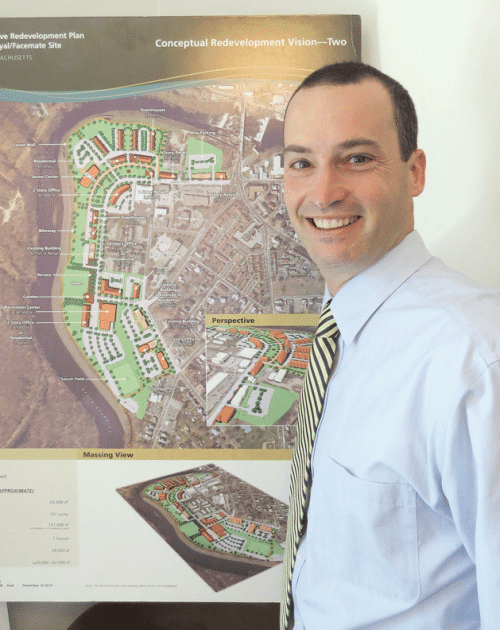
Mike Vedovelli
In April, Mike Vedovelli found himself in a place he wasn’t expected to be — the market for a new job. But just as the Baker administration has gone in a new direction with the Mass. Office of Business Development, which Vedovelli served as Western Mass. liaison, he has gone in one as well. He’s the new director of the Community & Economic Development for Chicopee, and believes he’s in the right place at the right time, from a career-challenge perspective.
Mike Vedovelli says he was taken somewhat by surprise in March when he was told that his services to the Mass. Office of Business Development (MOBD) were no longer required.
But he added quickly that he always understood that the job he held for more than seven years existed at the whim of whoever was governor, and when it came to the MOBD, the Charlie Baker administration decided it wanted to go in a different direction.
The ensuing, and unexpected, job search was undertaken with a mix of trepidation — Vedovelli said he had never been unemployed before — but also a certain dose of confidence that resulted from the experience amassed and contacts made while with MOBD and also while working for nearly a decade in the Community Development office in Westfield.
Together, those resume stops provided skills he considered salable to both the public and private sectors, and as things turned out, he was right. There were several intriguing calls, he noted, adding that the one that stood out came from Tom Haberlin, an economic development consultant for Chicopee, who wanted to know if Vedovelli had any interest in running the department that he once headed for more than 15 years.
To make a somewhat long story short, he did.
And in mid May, Vedovelli became director of Community & Economic Development, a relatively new title in Chicopee and a job with a wide range of responsibilities.
Discussing the sum of those parts, Vedovelli said his new assignment puts him in the right place at the right time from a career-challenge perspective. This is the area’s second-largest metropolitan area, one of the state’s so-called Gateway cities, and a former manufacturing center — everything from tires to bicycles; from golf balls to military uniforms have been produced there — that is in many ways trying to reinvent itself.
Among the projects in various stages of progress are efforts to redevelop the former Uniroyal site and the area surrounding it — a problem that has challenged officials in City Hall (including a half dozen mayors) for roughly 35 years; continued revitalization and reshaping of the Memorial Drive retail sector; efforts to resurrect a long-moribund downtown; and plans to build another industrial park near Westover Air Reserve Base.
Overall, though, Chicopee faces the same basic economic development mission as other area communities — retaining existing companies, attracting new ones, and creating more of what has become the region’s most precious commodity — jobs.

Mike Vedovelli says redevelopment of the former Uniroyal facility has been a challenge in Chicopee for more than three decades, and it remains a top priority.
Thus, he intends to call on those experiences, as well as those in Westfield, where one of his primary duties was overseeing deployment of community development block grants, as he takes on his new position.
“This position was attractive because I’m from Springfield, I know this area, I’ve done this kind of work before in Westfield, and I’m versed with local issues and matters such as community development block grants,” he explained. “And my seven years with the state enables me to bring the connections and the business relationships that I have, both on the state side, but also with commercial lenders, commercial brokers, and national and local developers.”
For this issue, BusinessWest talked with Vedovelli about his new assignment, the many issues confronting Chicopee, and the unique perspective he brings to his latest career stop.
Arriving at the Crossroads
As MOBD’s Western Mass. liaison, Vedovelli had a large and diverse territory to cover — essentially everything from Worcester west.
Initially, he needed a GPS system to find some of the communities he was assigned to and businesses with growth issues that needed resolution. He said he eventually figured out the lay of the land, a phrase that, as he applied it, meant more than just geography.
“It was a terrific learning experience,” he said of his time with MOBD. “I learned a lot about the issues businesses are facing and what they need to reach their goals. Working with them to find ways to stay in Massachusetts and grow their ventures was very rewarding work.”
And in the course of doing it, he made a number of contacts on the local, regional, and state levels, and came to understand the value of public-private partnerships when it came to creating economic development opportunities.
When his time with the state abruptly ended, he put out some feelers, and got some phone calls and e-mails back. Some of the correspondences involved opportunities that might develop down the road, while others were more immediate and thus more intriguing.
And it was the chance to lead Chicopee’s various development initiatives that most appealed to him.
“This city is in an interesting place in its long history,” he explained. “It’s a Gateway city, and it’s facing the same issues that those other Gateway cities are facing — job creation, redeveloping old mill buildings, revitalizing once-vibrant downtowns — but it has some unique challenges as well.
“But this city has enormous potential,” he went on. “Look at a map and you’ll see that all the major highways run through it. This is truly the crossroads of the region.”
And the city has reached a crossroads in a figurative sense as well, he went on, adding that while there is some land for development — such as the Chicopee River Business Park on the border with Springfield — city officials need to ready more property for development, a reality that puts an exclamation point behind such efforts as the proposed new industrial park and efforts to repurpose the Uniroyal site.
While he has a great deal of learning still to do when it comes to Chicopee, its players, opportunities, and challenges — he’s spent considerable time in recent weeks meeting with business owners, chamber leaders, and elected officials — Vedovelli was already quite familiar with the city when he took over the large office in the space the city leases on Center Street.
Indeed, he had worked with several individual companies in his capacity at MOBD, and from those experiences came to appreciate that ‘crossroads’ quality the city possesses, something that made it very attractive to companies looking to locate — or relocate — within Western Mass.
Perhaps the best example is Menck Windows, the German manufacturer that settled on Champion Drive in Chicopee as home to its first U.S. operation.
“I had been working with the principals of that company for a while when they were trying to zero in on an area,” Vedovelli explained. “And Chicopee just hit all the right buttons.
“One of the key assets that the city has is Chicopee Industrial Light and the cost advantages they bring,” he went on while listing the many factors that went into Menck’s decision process. “Things like that are very attractive to private industry, and Chicopee has many assets like that — location, access to major highways, an inventory of desirable buildings in the industrial parks that businesses can move into, attractive commercial property tax rates compared to other cities in the area; it’s an attractive package.”
And it has appealed to other clients as well, he said, listing other companies he worked with, such as Lymtech Scientific, which landed on Westover Road, and Chemex, the coffee-maker manufacturer that relocated to the city from Pittsfield last year.
Selling Points
Meanwhile, Chicopee, Holyoke, and Westfield have long been part of the same consortium when it comes to federal housing funds, and the communities are in the same economic target area, he explained, adding that he has experience working with officials in all three cities.
“Long before the buzzword collaboration started getting tossed around back in the early 2000s, we were already collaborating with each other,” he explained.
Looking ahead, Vedovelli said his informal job description is to forge more of those collaborative efforts, and do more hard selling of all Chicopee’s many assets, but from a different office.
He said there are a number of economic development issues facing the city, none larger, more complex, or more historic (in every sense of that word) than the Uniroyal project.
The complex of buildings once dominated the area near the Chicopee River in the Chicopee Falls section of the city, and in many ways, it still does. Some of the factory buildings have been torn down, others are in the process of demolition, and still others, especially the administration building, are targeted for possible reuse.
Since Uniroyal announced it was closing the massive plant in 1980, the city has been involved in an ongoing saga involving everything from taking control of the property to clearing it of hazardous materials; from demolishing the various buildings to devising redevelopment plans; the site was even proposed as a possible site for a new Catholic high school (it was eventually rejected).
It’s been a complicated, frustrating, and very expensive process, said Vedovelli, adding that it is now in the critical phase where the city will attempt to address the question ‘what comes next?’
There are many possible answers, he told BusinessWest, noting that while the new Pope Francis High School is off the table (it will be built on the site of the old Cathedral High School in Springfield) most everything else still is.
That includes the possibility of senior housing or another form of residential development in the former Uniroyal administration building, which is still in good shape and fit for redevelopment.
“There’s a lot of moving parts with this initiative — it’s a work in progress,” he said, adding that a request for proposals will likely be issued for the administration building this summer, and other RFPs will follow for other parcels.
Another priority moving forward is downtown, said Vedovelli, noting that while Chicopee’s central business district is less defined — and was never as robust — as those in other communities, it has potential to become more of a destination.
“The Munich Haus has become a real draw, it brings people downtown,” he said of the German restaurant on Center Street. “We’re looking at attracting another restaurant so they can feed off one another. But overall, we need to look at the storefronts, determine what’s working and not working, and make the area more attractive.”
One possible key to progress in that area is creating more foot traffic through new housing developments, he went on, adding that while there has been little progress with regard to the massive Cabotville Industrial Park and reported efforts to convert some of its space into apartments or condos, there is more promising news on the vacant John R. Lyman mill off Front Street.
“There’s a developer who wants to place 50 to 70 live-work lofts there, which would be a really nice addition to the downtown.” said Vedovelli, adding that a larger population of people living in that area would create a need for additional service and hospitality-related businesses.
Progress Report
As 2015 got underway, Vedovelli could not have envisioned himself tapping a pen on an aerial photo of the Uniroyal plant five months later while discussing possible options for the site’s future. Nor would he have imagined himself mulling strategies for bringing that desired foot traffic to downtown Chicopee.
But circumstances changed the picture in a hurry, and instead of driving across a four-county region hoping to spur economic development, he’s doing essentially the same job on a smaller, yet dynamic playing field.
It’s an abrupt change in the course of his career, one that has taken him to a crossroad — literally. It is not a challenge he sought, necessarily, but one he fully embraces.
George O’Brien can be reached at [email protected]