Home 2019 (Page 29)
Daily News

LUDLOW — Community-based financial advising firm PV Financial Group recently welcomed the newest member of its senior leadership team, Cheryl Hoey, CPA. Hoey will serve as PV’s chief financial officer, providing high-level support for the firm, overseeing company finances, creating and managing budgets, as well as forecasting trends.

With more than 28 years of experience working within various accounting positions for businesses across Massachusetts, Hoey will help PV’s financial advisors better serve clients with her expertise in tax preparation and auditing.

“Cheryl brings extensive accounting, financial, and operational experience to our firm. This, combined with her careful attention to detail and commitment to community, will make for a significant contribution to the clients we serve,” said Ed Sokolowski, managing partner. 

Having worked at several private companies, as well as large firms including Merrill Lynch and the Unum Group, Hoey has honed her skills in the areas of investments, tax preparation, international accounting, and financial risk.

Daily News

GREENFIELD — Michael Tucker, president and CEO of Greenfield Cooperative Bank, announced that the board of directors has approved the promotions of Colleen Bugbee, Mary Rawls, and Jane Trombi.

Bugbee was elected senior vice president and treasurer. She is responsible for the bank’s treasury functions, including managing the bank’s investments, asset/liability process, and annual budgeting. She has 40 years of experience in the financial-services industry, having started with the former Monarch Capital. She has been with the bank since 2006. Bugbee received her bachelor’s degree from Syracuse University and her master’s degree in accounting from Western New England University. She is a volunteer at Horizon for Homeless Children and is chairman of the finance committee at Trinity United Methodist Church.

Rawls was elected senior vice president – Compliance, and co-CRA officer for the bank. She has more than 25 years of experience in banking, joining GCB in 1994. She is responsible for ensuring bank compliance with the numerous banking and consumer laws and regulations. She also coordinates various regulatory and compliance examinations for the bank. Rawls is a graduate of the New England School for Financial Studies at Babson College and has held a variety of roles in the branch and operations areas as well throughout her career. She is a long-time volunteer and active with American Cancer Society and 4-H Club. She is also on the board of Big Brothers/Big Sisters of Franklin County.

Trombi was elected senior vice president – Residential Lending and co-CRA Officer. She joined GCB in 1999 and has more than 21 years of experience in banking and residential lending. She is based in Greenfield and is responsible for the management of the residential and consumer lending department of the bank. Trombi is a graduate of the University of New Hampshire and tthe New England School for Financial Studies at Babson College. She is active in several community causes, including the United Way board, Big Brothers/Big Sisters, and the Women’s Way.

Daily News

GREENFIELD — Greenfield Community College (GCC) has been awarded $17,000 from the Commonwealth Corp. as part of an Executive Office of Labor and Workforce Development initiative to improve workforce outcomes among individuals returning to their communities after incarceration. The Program Design Capacity Building Grant is part of the Commonwealth Corp. Re-Entry Workforce Development Demonstration Program.

The goal of the grant is to design a manufacturing workforce pipeline in Franklin, Hampshire, and Hampden counties that helps meet unmet manufacturing labor needs. The project aims to prepare returning citizens for careers in manufacturing by addressing systemic barriers to gainful employment for individuals post-incarceration. In order to achieve this goal, GCC will partner with manufacturing businesses, state and community agencies, and Holyoke Community College.

“GCC is proud to lead these efforts to build on and expand our strong tri-county partnerships to reduce recidivism through educational programs and pathways that lead to employment with sustainable wages,” said Alyce Stiles, dean of Workforce Development and Community Education.

Grant partners include four manufacturing businesses; Peerless Precision Inc., Sisson Engineering Corp., Deerfield Packaging Service Inc., and Sanderson McLeod Inc. Partner agencies include the Franklin County Sheriff’s Office, the Hampshire County Sheriff’s Office and House of Corrections, the Hampden County Sheriff’s Department, MassHire Franklin Hampshire Career Center, MassHire Franklin Hampshire Workforce Board, MassHire Hampden County Workforce Board, Community Action Pioneer Valley, and Holyoke Community College.

“Advanced manufacturing is booming and showing no signs of slowing down,” said Kristin Carlson, president of Peerless Precision. “We are growing and consistently seeking skilled individuals to bring in to our team. Peerless Precision Inc. is proud to support GCC’s efforts in growing the pipeline for skilled workers in manufacturing in the Pioneer Valley.”

Daily News

HOLYOKE — Holyoke Medical Center (HMC) Chief Financial Officer Michael Koziol has been named a 2019 recipient of the Healthcare Financial Management Assoc. (HFMA) Founders Medal of Honor for his contribution and support to the HFMA and the healthcare-finance profession. Koziol will receive the recognition from the HFMA Massachusetts-Rhode Island Chapter on Thursday, May 9 at the Downtown Harvard Club in Boston.

“We congratulate Mike on this honor and for his dedication to sharing best-practice strategies of successful healthcare-finance operations at a local and national level,” said Spiros Hatiras, president and CEO of Holyoke Medical Center and Valley Health Systems.

The Founders Medal of Honor is a prestigious award recognizing individuals who have reached the highest level of involvement and volunteer service to the HFMA. Koziol was nominated for the Medal of Honor for his involvement in the organization, which included more than six years on the annual conference planning committee and many years on the physician practice subcommittee. He has been a member of the HFMA since 1982.

“I am honored and humbled to be recognized with the Founders Medal of Honor. It was a real surprise for me,” said Koziol. “The HFMA is a great association that has benefited me throughout my career. I am always learning something, and it has been an organization that has grown with me through different hospital and healthcare finance roles.”

Koziol joined Holyoke Medical Center in April 2017. His previous experience included executive-level finance positions with Southcoast Physicians Group in Fairhaven; MaineGeneral Health in Augusta, Maine; South County Hospital Healthcare Systems in Wakefield, R.I.; Massachusetts Eye & Ear Associates in Boston; Rhode Island Hospital in Providence, R.I.; and Memorial Hospital of South Bend, Ind. He received his bachelor’s degree from Illinois State University and completed his MBA at the University of Illinois.

Daily News

HOLYOKE — More than 100 local leaders from across the region will assemble on Thursday, May 9 for a Pioneer Valley Smart Growth Summit to discuss strategies for thriving in an era of climate crisis and inequality.

The conference, to take place at Gateway City Arts, 92 Race St., Holyoke, will be hosted by the Massachusetts Smart Growth Alliance (MSGA) and the Pioneer Valley Planning Commission (PVPC) with the goal of helping cities and towns build cross-cutting teams to manage growth and development in an era of complexity.

“Emerging issues around extreme storms, flood hazards, heat, and a changing environment require communities like ours to be more thoughtful about planning and development,” said Holyoke Mayor Alex Morse. “If we’re going to achieve a prosperous community for everyone, we need to look at creative solutions.”

Other speakers will include Easthampton Mayor Nicole LaChapelle; Rick Sullivan, president and CEO of the Economic Development Council of Western Massachusetts; Liz O’Gilvie, chair of the Springfield Food Policy Council; Elisabeth Hamin Infield, professor of Regional Planning at the School of Landscape Architecture and Regional Planning, UMass Amherst; Agawam Town Engineer Michelle Chase; Laura Marx, forest ecologist with the Nature Conservancy; Sarita Hudson, director of Programs and Development at the Public Health Institute of Western Massachusetts; Sandra Sheehan, administrator at the Pioneer Valley Transit Authority; Wayne Feiden, Northampton’s director of Planning and Sustainability; Gerry McCafferty, Springfield’s director of Housing; Marcos Marrero, Holyoke’s director of Planning and Economic Development; PVPC Executive Director Tim Brennan; and MSGA Executive Director André Leroux.

“In 2017 alone, there was an estimated $307 billion in damage to real estate in the United States from storms and natural disasters, and poor communities were the hardest hit,” Leroux said. “Strengthening those neighborhoods now will save money down the road.”

Catherine Ratte’, PVPC’s principal planner and Land Use & Environment section manager, added that “the Pioneer Valley was the first region with a regional climate-action and clean-energy plan, which speaks to our commitment to building sustainable and resilient communities, and this summit promises to further catalyze us into action. We’ve got to work together to make sure our cities and towns will be built smart and strong for the next generation.”

To accomplish this, residents, engineers, planners, businesses, and politicians will have to create new ways of collaborating and decision making. Where and how they build matters, she said, and there are opportunities to use the natural and built environment to solve complex problems. 

The innovative format of the summit is designed to encourage issue experts to build relationships and talk to each other across communities.

Elements of the program will include opportunities to network, lessons learned from the natural-gas disaster in the Merrimack Valley and the tornado recovery, along with a series of rapid-fire presentations to present thought-provoking ideas. The centerpiece of the day will be a discussion with local experts challenging each other and offering creative solutions.

Members of the public are welcome. The cost is $25 for the half-day program. To register and see a program, visit www.great-neighborhoods.org/pvsummit. Planners (AICP members) can earn 2.0 Certification Maintenance (CM) credits for this activity in full. More information about AICP’s CM program can be found at www.planning.org/cm.

Daily News

SPRINGFIELD — Springfield Technical Community College (STCC) named professors of Physics and Nursing as its 2019 endowed chair award recipients.

The college selected Barbara Washburn, department chair and professor of Physics, as the 2019 Anthony M. Scibelli Endowed Chair, and Deborah Jacques, professor of Nursing, as the 2019 Joseph J. Deliso Sr. Endowed Chair.

Each year, STCC faculty are nominated by their colleagues and then invited to apply. An award-selection committee, made up of faculty and staff, reviews applications, and the STCC Foundation executive committee selects winners.

STCC President John Cook announced this year’s recipients and congratulated Washburn and Jacques during a meeting with faculty and staff on April 18.

The pair received monetary awards — $3,000 each — and wooden chairs with plaques inscribed with their names. They can apply $1,500 to professional development and $1,500 to their academic department.

Lisa Fugiel, STCC’s Director of Nursing, cited Jacques’ commitment to student success. “Dr. Jacques is an exceptional educator whose willingness to engage every learner in a manner that empowers diverse learning styles has led to tremendous student pass rates in the nursing program. This speaks volumes to her commitment to students.”

Richard Greco, dean of the School of Liberal and Professional Studies, said Washburn is a popular instructor who has brought engaging initiatives into the classroom. For example, Washburn invited STCC students to work with high-school students on a renewable-energy project. The students built ‘solar suitcases’ that can be used by health workers and schools in developing nations to provide light and electricity. “She is a productive and imaginative colleague,” Greco said.

Jacques earned a doctor of nursing practice degree from UMass, and a master’s degree in nursing education and a bachelor’s degree in nursing from Russell Sage College. She worked as a staff nurse at Baystate Medical Center before joining STCC as a professor in 2007.

“I love teaching at a community college because I am able to have a significant impact on students who may be the first one in the family to ever go to college,” she said. “I could not be prouder when that student walks across the stage and earns their nursing pin, and I know that this is a future colleague and peer.”

Washburn holds a master of education degree from the University of Connecticut and a master’s degree in electrical engineering, laser optic engineering, from Tufts University. She earned her bachelor’s degree in electrical engineering from Western New England University. She joined STCC as a professor in 1996.

“I left the engineering world to teach at the community-college level over 25 years ago, and I am blessed to have a job I am so passionate about,” Washburn said. “My passion is teaching. My passion is being an ambassador of knowledge for students. I lead the way for learners to learn. I never give up on the student. I give them different ways to regain their footing when they fail or make mistakes.”

Funded through the STCC Foundation, the awards are named for two of the college’s founders. The college established the Anthony M. Scibelli Endowed Chair in 1992 to recognize and foster faculty excellence. As a member of the state House of Representatives, Scibelli sponsored and pushed through legislation approving funding and authorizing the transfer of 35 acres of Springfield Armory to the state as a location for STCC.

In 1993, the Deliso family established the Joseph J. Deliso Sr. Endowed Chair at STCC in recognition of excellence in teaching. Appointed the first chairman of the STCC advisory board, Deliso, an industrialist, served from 1967 to 1981. He then became first chairman of the STCC board of trustees, serving through 1985.

Daily News

HADLEY — During the month of May, the Hadley and Northampton branches of UMassFive College Federal Credit Union are holding a personal-care-items drive to benefit the pantries of the Amherst and Northampton survival centers. Items collected will be provided, for free, to neighbors in need.

“Supplying our local survival center pantries is a cause we believe in because, during tough times, support from the pantry may help people avoid making difficult tradeoffs,” said Cait Murray, Community Outreach manager at UMassFive. “Nobody should have to choose between food and toilet paper.” 

Donations of unopened shampoo and conditioner, shaving supplies, deodorant, toothpaste, toothbrushes, toilet paper, feminine hygiene products, as well as baby and adult diapers will be accepted through Friday, May 31. Items can be full, travel, or complimentary/hospitality sized, and may be dropped off at 200 Westgate Center Dr., Hadley, or 225 King St., Northampton.

Daily News

HOLYOKE — Providence Ministries is partnering with Gary Rome Hyundai on Friday, May 10 to host its second annual fashion show fundraiser, “Fashion with Compassion.” Local ‘celebrities’ will be walking the runway to show compassion for their community and their appreciation for the good work Providence Ministries does. 

The models were carefully chosen, as they are model partners in Providence’s work to end hunger and homelessness. They include Holyoke Mayor Alex Morse, state Rep. Aaron Vega, Holyoke Community College President Christina Royal, Springfield City Council President Justin Hurst, Springfield School Committee member Denise Hurst, Gary and Jane Rome, and many more.

Guests will also enjoy a raffle, wine pull, live auction, tasting stations, and dancing. This event will be held at Gary Rome Hyundai from 6 to 10 p.m. Tickets start at $40 and can be purchased at www.provministries.org/fashion-with-compassion.

All proceeds will benefit the work of Providence Ministries, a nonprofit organization founded in 1980 with a mission to assist those most in need in the community with life’s basic needs of food, clothing, and housing. In 2012, the organization expanded to include job and life-skills training.

Daily News

SPRINGFIELD — Meri Clark was named the recipient of the Excellence in Teaching Award at Western New England University (WNEU). Winners of the prestigious award are nominated by students, faculty, and administrators for outstanding contributions as educators and advisors.

During the review process, current and former students praised Clark as somebody who possessed a “brilliant teaching manner” and a “champion of learning and understanding.” Students added that “her passion for history radiated throughout the classroom” and “she saw each student as a unique person with their own story, and she wanted to get to know that story.”

Clark is a professor of History and coordinator of the Global Scholars program for the College of Arts and Sciences. She has taught Latin American and world history at the university since 2005. Her research specializes in the history of 19th-century Latin America, with particular attention to the themes of education, nationalism, gender, race, and ethnicity in Colombia. 

After earning her bachelor’s degree in history from Reed College (Phi Beta Kappa), Clark researched in Colombia under a Fulbright scholarship. She then earned a master’s degree and Ph.D. in history from Princeton University.

Daily News

SPRINGFIELD — Baystate Health’s Every Woman program will hold a special evening titled “Turn Up the You and Quiet the Critic” on Wednesday, May 15 at 5:30 p.m. at 121 Club at Eastworks, 116 Pleasant St., Easthampton.

Keynote speaker Pam Victor, president of Happier Valley Comedy, will discuss “Five Techniques for Quieting Your Inner Critic,” and there will be live music, food, women’s health information, and shopping with local vendors.

Is there a voice inside your head that sometimes tells you you’re not good enough? It might also give you negative messages like, “that idea is no good” and “don’t say that because people will think you’re foolish.” Professional improv comedian and author Victor calls that voice the “Evil Mind Meanie” — it’s the internal voice of unhelpful judgment that keeps folks from tapping into their most creative, productive, authentic selves. Through wise and wise-cracking stories and easy-to-do, fun, interactive exercises, Victor will provide practical techniques for “swiping left” (quieting) the inner critic.

Victor is a professional improviser, facilitator, teacher, and the founder and president of Happier Valley Comedy, the first improv theater and training center in Western Mass. She directs the three branches of the company: the comedy-training center, regular shows, and the Through Laughter program for professional and personal development. Victor is also the author of several books.

The cost for the event is $15. To register, visit turnuptheyou.eventbrite.com. For more information, call (413) 794-5200.

Daily News

CHICOPEE — Elms College President Harry Dumay has been appointed treasurer of the executive committee for the Assoc. of Colleges of Sisters of St. Joseph. 

Dumay became the 11th president of Elms College in 2017. He has served in higher-education finance and administration at senior and executive levels for 19 years. He holds a Ph.D. in higher education administration from Boston College, an MBA from Boston University with a graduate certificate in corporate finance, and a master’s degree in public administration from Framingham State University. He earned his bachelor’s degree, magna cum laude, from Lincoln University. 

Prior to assuming the presidency of Elms College, Dumay was senior vice president for finance and chief financial officer for Saint Anselm College from 2012 to 2017. He formerly served as chief financial officer and associate dean at Harvard University’s Paulson School of Engineering and Applied Sciences (2006-12), associate dean at Boston College’s Graduate School of Social Work (2002-06), and director of Finance for Boston University’s School of Engineering (1998-2002). In addition, he served as an adjunct faculty member at Boston College for nine years.

Dumay currently serves as a commissioner, treasurer, member of the executive committee, and member of the Annual Report on Finance and Enrollment for the New England Commission for Higher Education, a member of the board of directors for the Assoc. of Independent Colleges and Universities in Massachusetts, a member of the student aid policy committee for the National Assoc. of Independent Colleges and Universities, a board member for Pope Francis Preparatory School and the Boston Foundation’s Haiti Development Institute, and a former member of the board of directors and a current member of the investment committee of the Catholic Medical Center in Manchester, N.H.

J. Michael Pressimone, president of Fontbonne University, was tapped to be the committee’s chair, and Ann McElaney-Johnson, president of Mount Saint Mary’s University, was named secretary.

Daily News

SPRINGFIELD — Leadership Pioneer Valley (LPV) and Tech Foundry partnered together for a leadership-development curriculum for the students participating in the 14-week IT-training program.

At no cost to the students, Tech Foundry prepares a cross-section of the population to step into a sustainable career in the information-technology sector. The program provides a comprehensive computer-science curriculum that gives students the fundamental knowledge needed to work with a variety of programming languages, computer hardware, networking solutions, and more.

Partnering with Leadership Pioneer Valley, Tech Foundry was able to offer leadership development and skills to the students.

“We were thrilled to be able to work with the students at Tech Foundry,” said Lora Wondolowski, executive director of LPV. “It was rewarding to be able to adapt our expertise to a new audience and see how beneficial it was for their students.”

Tech Foundry initially reached out to Leadership Pioneer Valley to design and deliver a customized leadership-development program for participants to help prepare them for new careers in IT.

“I can definitely say that, as a result of working with LPV, our students’ skill sets and confidence increased by leaps and bounds. Lora was thoughtful and responsive from our first planning meetings designing the curriculum to establishing the schedule, to securing trainers and delivering the workshops to meet our unique program needs,” said Dara Nussbaum-Vazquez, executive director of Tech Foundry. “Interactive and engaging LPV sessions with Tech Foundry ranged from students creating an elevator pitch on video to team exercises building towers out of spaghetti and marshmallows, to a creativity and problem-solving session rooted in improv-comedy techniques. We would highly recommend LPV to other nonprofits and companies, and look forward to a longstanding partnership.”

LPV is also currently seeking applications for its LEAP Class of 2020. Emerging leaders, mid-career professionals with leadership potential, and those looking to better the Pioneer Valley are encouraged to apply. The deadline for applications is Monday, July 1. Applications and further information can be found at www.leadershippv.org.

Daily News

SPRINGFIELD — The Pioneer Valley Planning Commission (PVPC) recently released its 2019 Comprehensive Economic Development Strategy (CEDS) and Pioneer Valley Plan for Progress Five-year Update, a blueprint for economic development in the region.

The CEDS features a description of regional economic-development conditions and sets forth goals and objectives for the future, as well as a list of projects seeking the U.S. Department of Commerce’s Economic Development Administration Public Works funding in the next year.

The report highlights the region’s continued decrease in unemployment, an improved workforce-talent pipeline, and increased early-education enrollment and high-school and community-college graduation rates, among others, as metrics illustrating the overall progress being made.

The CEDS also lists many major committed projects of regional significance, such as the Naismith Memorial Basketball Hall of Fame renovations in Springfield, North Square at the Mill District in Amherst, and the One Ferry Street mixed-use development in Easthampton.

A full digital copy is available by clicking here. Hard copies are also available upon request. 

Daily News

HOLYOKE — MassHire Holyoke Career Center will host a workshop titled “How Will Marijuana Affect the Workplace In Massachusetts” with attorney Erica Flores from Skoler, Abbott & Presser. This free event will take place on Tuesday, May 14 from 8 to 10 a.m. Coffee and light refreshments will be provided.

Seating is limited, so attendes are encouraged to reserve seats early. Register for this free workshop by contacting Yolanda Rodriguez at (413) 322-7186 or [email protected].

Flores will discuss the current state of the law regarding marijuana use by employees for both medical and recreational purposes, including employers’ obligations to accommodate marijuana use by disabled employees; proposed legislation that would prohibit employers from discriminating against employees who use recreational marijuana and how this rule would affect employers’ current rights in the workplace; and the importance of reasonable-suspicion testing in this new legal climate and strategies for implementing and enforcing such testing programs.

Daily News

SPRINGFIELD — More than 350 professionals from throughout Western Mass. will gather on the campus of Western New England University on Wednesday, May 22 from 7 a.m. to 5 p.m. for the 37th annual Social Work Conference.

The keynote speaker will be Jen Falcone, director of Businesses Against Human Trafficking. A survivor of child sexual abuse and trafficking as an adolescent, she will discuss her experiences and how utter devastation kick-started the healing that drives her life choices and professional work. Falcone will focus on launching a movement within the Springfield-area business community to address human trafficking.

Frank Sacco will be honored with the Jim Quinn Human Service Award at the conference. In addition to a celebrated career nationally and internationally in the fields of social work and psychotherapy, Sacco has spent his life researching and authoring books and articles on bullying, teacher bullying, and building a successful anti-bullying structure within a school. He consulted for the FBI after the 1999 Columbine shooting as well as internet sexual exploitation and domestic violence.

The day-long conference, sponsored by Western New England University’s Bachelor of Social Work Program, the Social Work Advisory Council, and the Office of Enrollment Management, will also feature more than 30 exhibitors from throughout the region.

The conference fee is $150 until May 7 and includes registration, luncheon, and six credit hours for full (100%) attendance. Registrations received after May 7 will have a fee of $165. Lower student rates are also available. To register online, visit wne.edu/prodev, or call (413) 796-2173.

Daily News

SPRINGFIELD — The Springfield College AmeriCorps Program will receive $1,133,274 in AmeriCorps funding spread out over the next three years from the Corporation for National and Community Service (CNCS), the federal agency responsible for AmeriCorps and other national service programs.

Springfield College is one 26 Massachusetts-based organizations that received federal funding, supporting 6,611 AmeriCorps members in their efforts to tackle ongoing challenges in early-childhood education, job readiness, and environmental conservation.

For 22 years, the Springfield College AmeriCorps program has provided the city of Springfield and its public schools with student-support and academic-support specialists. Its staff and student volunteers provide mentoring, counseling, social-emotional reinforcement, direct interventions, and identification of risk factors that lead to dropping out of school. The Springfield College AmeriCorps program is the largest in Western Mass., with 56 total members.

The AmeriCorps member experience can be summed up by the words of Nick Fouche (a three-year veteran member), who said, “we wake up every morning knowing that there is more to give. So we throw on our name badge and our quarter zip. The ‘A’ we wear on our chest is no scarlet letter. It’s something that we should be proud of — it says we make the world better.”

Springfield College AmeriCorps members have provided an average of more than 44,000 hours of service to more than 16 of Springfield’s public schools leading to student academic success in English and math, and improved results in early literacy skills, attendance, and behavior.

AmeriCorps’ unique model means that the latest grants will leverage an additional $70,155,026 from the private sector, foundations, and other sources to further increase the return on the federal investment. CNCS will provide an additional $19,902,265 in Segal AmeriCorps Education Awards for the AmeriCorps members funded by these grants. After completing a full term of service, AmeriCorps members receive an award of up to $6,000 that they can use to pay for college or to pay off student loans.

Both Springfield College undergraduate and graduate students are encouraged to apply to the Springfield College AmeriCorps program, as well as community members and retired educators. Both half-time and quarter-time positions are available. Members receive a modest living allowance and, upon completion of their service, they earn Education Award funds that can be applied toward tuition or qualified student loans. For more information about the Springfield College AmeriCorps program, visit springfieldedu.americorps or e-mail [email protected].

Marketing Tips

Courtesy of orbelo.com

If video marketing is the future, then the future is here. You’re at the right place if you’ve been wondering whether it’s worth putting your mind and money into video marketing. Do you have enough resources to create videos? Are enough people in your target audience interested in videos? And in the end, will it be worth the effort? In short: yes.

In this article, we will cover some of the key video marketing statistics for 2019 that will help prove to you that the right time for video marketing is now. Use these quick and easy video marketing statistics to help guide your video marketing strategy for 2019.

Before we get started with the video marketing stats, let’s quickly go through the types of video content that you can create to market your business. One of the main video content types that businesses use is explainer video which is a short video explaining products or services. Other popular types of video content include vlogs (video blogs), video interviews, video presentations, tutorials, product reviews, product demos, recordings of live streams, video testimonials, and video ads.

Read more

Marketing Tips

Courtesy of CampaignDrive.com

In an increasingly digital world, print marketing is still popular. Brands haven’t forgotten about the power of print to engage and excite their consumers. In fact, top multi-location brands use print — whether direct mail, billboards or good old newspaper ads — to drive local engagement and sales.

“Marketers have a plethora of tools to choose from, whether they decide to use a solely digital strategy or incorporate a blend of both traditional and digital tactics,” says Larry Myler, contributor at Entrepreneur.” [1] More importantly, brands need to begin thinking like their customer and understand how their target markets are accessing information and consuming content.”

Read more

Marketing Tips

Courtesy of sharpspring.com

Any industry that relies heavily on technology has major changes year after year. Marketing is one of those landscapes that changes so quickly, it’s challenging to keep up with the best practices.

Here are 10 tips to optimize your marketing strategy this year, based on the latest trends:

1. Look for Opportunities to Diversify
Most marketing budgets today don’t allow businesses to pursue every distribution channel at once. You need to carefully select channels that are most likely to bring strong returns from your investment. So look for opportunities to diversify your strategy by first researching your audience. Identify niche sub-channels where you’re able to cut through the marketing noise, such as on YouTube, social media groups, etc. Then you can diversify your strategy knowing the payoff will be worth the investment.

Read more

Daily News

GREENFIELD — Michael Tucker, president and CEO of Greenfield Cooperative Bank (GCB), announced that the board of directors has approved the promotions of Christopher Wilkey to MIS officer, Adam Baker to vice president – commercial loans, Janet Rosenkranz to vice president and senior credit officer, and Erin Tautznik to assistant vice president and branch officer.

Wilkey is responsible for administration of the bank’s internal network and assisting staff in technology issues. He has been with GCB since 2007 and has been lead technology specialist since 2014. He attended the accounting program at Greenfield Community College.

Baker has more than 11 years in banking, primarily in commercial credit. He is a graduate of UMass Amherst and received his MBA from Southern New Hampshire University. He is based in the King Street office of Northampton Cooperative Bank, a division of Greenfield Cooperative Bank. He is responsible for developing new commercial-loan business in the bank’s market area, with a focus in Hampshire County. He is active in Horizons for Homeless Children, the Special Olympics, and Lighthouse Holyoke.

Rosenkranz has more than 23 years in banking and has been with GCB since 2016. She is a graduate of UMass Amherst with a degree in economics. She is based at the 62 Federal St. office of GCB and is responsible for managing the bank’s commercial credit-analysis staff and assisting in managing the overall bank loan portfolio. She is active with the American Cancer Society, the Food Bank of Western Massachusetts, and Safe Passage.

Tautznik has more than 14 years of banking experience. She is responsible for managing the 67 King St., Northampton office of the bank. She joined the bank in 2004 and has attended Holyoke Community College and numerous banking seminars and courses. She is also a volunteer with the JFK Middle School’s after-school program.

Daily News

SPRINGFIELD — American International College (AIC) will launch AIConversations, a discussion series highlighting important topics featuring members of the campus community, today, May 2, at 6 p.m. in the Stinger Pub on campus. The inaugural event will feature Lina Racicot, AIC’s director of Graduate Psychology, who oversees the forensic psychology and clinical psychology master’s-degree programs as well as the educational psychology and mental health counseling doctoral offerings for the college.

Racicot has decades of experience as an educator, author, researcher, clinician, and advocate. Further, she has been invited to work on a Substance Abuse and Mental Health Services Administration grant investigating medically assisted treatment for opioid addiction.

AIConversations will include discussion of Racicot’s recently released novel, Living with the Little Devil Man, which is based upon her own experiences with a loved one’s struggle with mental illness and addiction.

“The opioid public health crisis has led to such senseless loss for so many,” she said. “Whether it be the addicted losing everything, including their own identity, or loved ones losing them to the addiction, it’s essential to open the dialogue with healthcare providers to help recognize the comprehensive needs of each unique individual that comes their way.”

In addition to her role with the college as an advocate for at-risk youth, Racicot partners with the Juvenile Detention Alternative Initiative to identify rehabilitative opportunities in lieu of imprisonment for non-violent offenders. She also works with the Hampden County Sheriff’s Department researching the efficacy of post-incarceration services.

AIConversations is free and open to the public. For more information, visit [email protected] or call the Office of Institutional Advancement at (413) 205-3520.

Daily News

AMHERST — The U.S. National Academy of Sciences (NAS) announced the election of 100 new members to the academy in recognition of their distinguished and continuing achievements in original research. They include Lila Gierasch, distinguished professor of Biochemistry and Molecular Biology and Chemistry at UMass Amherst.

The NAS is charged with providing independent, objective advice to the nation on matters related to science and technology. Scientists are elected by their peers to membership in the NAS for outstanding contributions to research. Gierasch’s research focus for decades has been protein folding — that is, how amino-acid sequence determines the three-dimensional structure of a protein. She is particularly focused on how proteins fold in the cellular environment and the role of molecular chaperones in ensuring high fidelity in the folding process.

“I am thrilled by this honor,” she said. “The recognition of one’s contributions over a career by colleagues is truly gratifying.”

Added John McCarthy, UMass Amherst provost and senior vice chancellor for Academic Affairs, “this is a richly deserved honor for one of our stellar faculty members. Lila Gierasch is part of what makes this university great.”

The National Academy of Sciences (NAS) is a private, nonprofit society of distinguished scholars charged with providing independent, objective advice to the nation on matters related to science and technology. Scientists are elected by their peers to membership in the NAS for outstanding contributions to research. 

Gierasch’s honor is the latest in a recent series of recognitions she has earned from research peers and professional societies. Last year, for example, she received the American Chemical Society’s Ralph F. Hirschmann Award in Peptide Chemistry for “her seminal contributions to peptide structure and function, peptide models for protein folding and function, and roles of peptide and protein aggregation in disease.”

In 2016, she was elected to the American Academy of Arts and Sciences. That same year, the American Society for Biochemistry and Molecular Biology named Gierasch editor in chief of the Journal of Biological Chemistry, the society’s flagship journal, for a five-year term.

In 2014, Gierasch was named to the National Institutes of Health Council of Councils, established to advise the NIH director on policies and activities of the Division of Program Coordination, Planning and Strategic Initiatives, which includes making recommendations on research that represents important areas of emerging scientific opportunities, rising public-health challenges, or knowledge gaps that deserve special emphasis or would otherwise benefit from strategic planning and coordination.

Most recently, she was recognized for her “outstanding contributions to peptide science” by the American Peptide Society. She will formally receive its lifetime achievement honor, the Merrifield Award, at a ceremony at the society’s annual meeting in Monterey, Calif. in June.

Daily News

HOLYOKE — The largest healthcare IT managed-services provider in Western Mass. is expanding its leadership team with the appointment of David Rooks as director of Operations. A seasoned IT and telecommunications industry leader, Rooks previously served as manager of the Project Management Office at VertitechIT.

“In our nationwide search for the right person to oversee our expanding field services and call-center staff, we realized that the most qualified and dynamic management candidate was literally sitting right across the hall,” said baytechIT President Patrick Streck. “David has successfully managed complex technology projects ranging from office moves to the implementation of new unified communications platforms for baytechIT clients through his position at our parent company, VertitechIT. Placing him in charge of our entire technical staff creates a sense of continuity for our clients and staff alike.”

Headquartered in Holyoke, baytechIT serves more than 155 healthcare clients and manages and monitors more than 16,000 end-point devices. Since its founding in May 2018, the company has worked to fulfill its mission to meet the increasing demand for diverse healthcare IT services by hospitals, medical practices large and small, clinics, and social-services agencies.

Daily News

HOLYOKE — Holyoke Community College (HCC) will welcome Massachusetts Attorney General Maura Healey to campus today, May 1, to tour the campus and discuss current issues with students and faculty.

Healey will meet with students studying criminal justice, human services, and nursing from 2 to 3 p.m. in the PeoplesBank Conference Room on the third floor of the HCC Kittredge Center for Business and Workforce Development. She will give a brief talk followed by a question-and-answer session moderated by HCC Criminal Justice Professor Alex Sanchez. The event is free and open to the public.

“This is an extraordinary opportunity for our students to hear from and talk to the top law-enforcement official in Massachusetts about issues that directly relate to their studies here at HCC, particularly on the subject of opioid addiction,” said Sanchez. “We’re looking forward to her visit and hearing her opinions on the subject, especially as it relates to the lawsuit the attorney general filed earlier this year against pharmaceutical industry giant Purdue Pharma.” 

Prior to the discussion, Healey will meet with HCC president Christina Royal, members of the HCC board of trustees, and Holyoke Mayor Alex Morse. HCC students will also lead Healey on a brief tour of HCC’s Thrive financial-success center and food pantry, the new Center for Life Sciences, and the HCC Campus Center now in the final phase of a $43.5 million renovation.

“HCC has a long history as a leader in providing young people with the tools to succeed,” Healey said. “Their work is vitally important to our economy here in Massachusetts, and I am looking forward to speaking with students about the critical issues our state is facing.”

Daily News

LAS VEGAS — MGM Resorts International reported financial results for the quarter ended March 31, 2019. Consolidated net revenues increased 13% compared to the prior year quarter to $3.2 billion.

MGM Springfield earned $9.38 million on $77.9 million in net revenue. That figure represents adjusted earnings before interest, tax, depreciation, and amortization, or EBITDA.

“The first quarter came in slightly better than our expectations with consolidated net revenues up by 13% and adjusted EBITDA up 5%,” said Jim Murren, chairman and CEO of MGM Resorts International. “Our Las Vegas resorts experienced broad and diversified customer demand. Our non-gaming revenues grew by 4%.”

Net revenues increased 21% to $804 million, including $78 million in contributions from the opening of MGM Springfield in August and $37 million in contributions from the acquisition of Empire City Casino in New York in January.

“We remain focused on achieving our 2020 targets of $3.6 billion to $3.9 billion in consolidated adjusted EBITDA and significant growth in free cash flow,” Murren said. “Our strategy to achieve these goals includes the continued ramping up of MGM Cotai [in Macau], Park MGM [in Las Vegas], and MGM Springfield, and the implementation of the MGM 2020 Plan. MGM 2020 is a company-wide initiative aimed at leveraging a more centralized organization to maximize profitability and lay the groundwork for the company’s digital transformation to drive revenue growth. We are creating a streamlined, nimble organization that empowers leaders to make faster decisions. We are excited about our targeted growth opportunities in Japan, sports betting, and interactive initiatives. At the same time, we are maintaining a disciplined approach to capital allocation and creating long-term value for shareholders.”

Daily News

EASTHAMPTON — Hogan Technology recently received Technology Assurance Group’s (TAG) top award at the 19th annual TAG Convention held in Orlando, Fla. TAG, an international organization of independently owned managed-technology service providers in the U.S. and Canada, selected Hogan Technology as the winner of the TAG Champion Award.

The award is based on the company’s ability to drive fellow TAG members’ growth and advancement. Hogan Technology offers an array of IT networking, voice, and video solutions all designed to increase customers’ profitability and productivity. The TAG Champion Award was accepted by Sean Hogan, president of Hogan Technology.

“Our company’s goal is to always strive to be on the leading edge of technology,” Hogan said. “Through TAG, we learn best business practices for the betterment of the customers we serve. We believe in giving back to the members that have helped us along the way. We’re proud to have won this award among such a sophisticated group of managed-technology services providers.”

Brian Suerth, president of TAG, added that “Hogan Technology continues to stand out as an exceptional TAG member. It was no surprise that they received this award. They are committed to continually educating their clientele on the latest advancements in technology. They have shared what they learned with their peers. As a result, they have helped raise the bar of customer service and satisfaction of our industry as a whole. This is why they deserve to be recognized as the best provider in our industry.”

Daily News

SPRINGFIELD — Time is running out to submit a nomination for BusinessWest’s fifth Continued Excellence Award. The deadline is this Friday, May 3. The winner of the award will be unveiled at the magazine’s 40 Under Forty gala on Thursday, June 20.

Four years ago, BusinessWest inaugurated the award to recognize past 40 Under Forty honorees who had significantly built on their achievements since they were honored.

The first two winners were Delcie Bean, president of Paragus Strategic IT, and Dr. Jonathan Bayuk, president of Allergy and Immunology Associates of Western Mass. and chief of Allergy and Immunology at Baystate Medical Center. Both were originally named to the 40 Under Forty class of 2008. The judges chose two winners in 2017: Scott Foster, an attorney with Bulkley, Richardson and Gelinas (40 Under Forty class of 2011); and Nicole Griffin, owner of Griffin Staffing Network (class of 2014). Last year, Samalid Hogan, regional director of the Massachusetts Small Business Development Center (class of 2013), took home the honor.

“So many 40 Under Forty honorees have refused to rest on their laurels,” said Kate Campiti, associate publisher of BusinessWest. “Once again, we want to honor those who continue to build upon their strong records of service in business, within the community, and as regional leaders.”

Candidates must hail from 40 Under Forty classes prior to the year of the award — in this case, classes 2007-18 — and will be judged on qualities including outstanding leadership, dedicated community involvement, professional achievement, and ability to inspire. The award’s presenting sponsor is Health New England.

The nomination form is available by clicking here. For your convenience, a list of the past 12 40 Under Forty classes may be found here. For more information call Bevin Peters, Marketing and Events Director, at (413) 781-8600, ext. 100, or e-mail [email protected].

Daily News

WEST SPRINGFIELD — As part of its community partnership with Junior Achievement of Western Massachusetts, the United Bank Foundation Massachusetts announced it unanimously approved a $5,000 sponsorship of JA’s 100th-anniversary gala, “The Roaring ’20s Are Back!” The Great Gatsby-themed event will be held on Saturday, May 4 from 5:30 to 10 p.m. at MGM Springfield.

In addition to the $5,000 sponsorship of the centennial gala, United Bank’s Massachusetts charitable foundation approved a total of $15,000 in recent years to bring financial literacy, work readiness, and entrepreneurial programs to K-12 students in Western Mass. The programs teach students concepts related to budgeting, saving, and money management with the intent of promoting good financial habits.

Also, United Bank employees have been longtime active volunteers in Junior Achievement, enthusiastically investing their time and expertise to help teach financial literacy in area schools.

“Over the years, United Bank and our employees have been dedicated partners in helping JA of Western Mass. make a real and meaningful difference in the financial well-being of so many young people and their families,” said Dan Flynn, president of the United Bank Foundation Massachusetts and executive vice president and chief operating officer of Wholesale Banking at United. “Our $5,000 sponsorship of JA’s centennial celebration on May 4 is just another way of joining so many other generous individual and corporate supporters in honoring, recognizing, celebrating, and sustaining 100 years of empowering youth in Western Mass.”

Daily News

NORTHAMPTON — Coldwell Banker Upton-Massamont Realtors announced the addition of Realtor Melissa Brunt to its roster of professional real-estate agents in its Main Street, Northampton office.

Brunt, who grew up in Brimfield, currently resides in Southampton, where she has lived for the past 18 years. “I fell in love with the beauty of the landscape and the kindness of the people in the Valley,” she said. After working in the hospitality industry for a number of years, she decided to make the switch to residential real-estate sales.

“I am pleased to have Melissa on our team of Realtors in our Northampton office,” said Coldwell Banker Upton-Massamont Realtors broker Christine Aubrey. “Her background in hospitality has always made customer service her first priority, and her career in real estate will be no different. She is focused on giving her clients the very best experience.”

Brunt is a member of the Realtor Assoc. of the Pioneer Valley, the National Assoc. of Realtors, and the Massachusetts Assoc. of Realtors. As a Realtor with Coldwell Banker Upton-Massamont Realtors, her primary focus will be residential real estate in Hampshire and Franklin counties.

Daily News

SPRINGFIELD — Leadership Pioneer Valley (LPV) is now accepting applications for enrollment in the LEAP class of 2020, a nine-month, regional leadership-development program that engages the Pioneer Valley’s most promising emerging leaders through learning and exploration. Participants are trained in leadership skills by experts in a classroom setting. They also attend in-depth field experiences across the region where they meet with local leaders and explore the region’s economy and culture. The LEAP program runs September through May.

In its seven years, nearly 300 individuals representing more than 90 companies, organizations, and municipalities have participated. The program has filled a critical need for a leadership program that builds a network of emerging leaders to address the challenges and opportunities of the region. Fifty-three percent of alumni have a new leadership role at work, 64% have joined a new board of directors, and 99% made new meaningful connections.

“It’s exciting to see the growth of the individuals during the course of the LEAP program,” said Lora Wondolowski, executive director of LPV. “Our program continues to grow to meet the needs of the community, and we are super excited for the new class.”

LPV is seeking applicants all over the Pioneer Valley, including Hampden, Hampshire, and Franklin counties in different sectors. The program is made for those in nonprofits, businesses, and government who are eager to increase their leadership skills and take action to better the region.

Applicants are considered in a competitive application process that prioritizes diversity by employment sector, geography, race, gender, and sexual orientation. Emerging leaders, mid-career professionals with leadership potential, and those looking to better the Pioneer Valley should consider applying. Those who apply by June 1 will be eligible for $100 off of their personal tuition, and companies with three or more applicants by June 1 will receive 50% off one participant. The deadline for LPV class of 2020 applications is July 1. Applications and further information can be found at www.leadershippv.org.

Daily News

SPRINGFIELD — Christopher Johnson, chair of the Springfield Technical Community College board of trustees, will be the featured speaker at STCC’s 52nd commencement on Thursday, May 30 at 6:30 p.m. at the MassMutual Center.

Johnson, a lawyer, currently serves as president of the Agawam City Council. He served as the town’s first mayor from 1989 to 2000 and as Agawam city solicitor in 2008 and 2009.

Born and raised in Agawam, Johnson is a graduate of the Agawam Public Schools, American International College, and the Western New England University School of Law. He initially practiced law in Northampton with Wilhelm, Hamilton & King. He currently is a partner with Johnson, Sclafani & Moriarty in West Springfield.

Johnson was appointed to the STCC board of trustees in 2006. His term is set to expire in 2019, making him one of the longest-serving community-college trustees in the Commonwealth.

“We are grateful to Chris Johnson for the many years of leadership, dedication, and outstanding service he has given to Springfield Technical Community College,” said STCC President John Cook. “With his keen insight of public higher education, including affordability considerations and the STCC mission, Chair Johnson truly has made a meaningful and lasting difference in the lives of so many students.”

Added Johnson, “I am both honored and thrilled to speak at the STCC commencement. The Greater Springfield area is fortunate to have such an outstanding place of learning. STCC truly transforms the lives of its students, both the traditional college-transfer students and those taking advantage of our fantastic technology and health programs.”

40 Under 40 Cover Story The Class of 2019

Announcing the Honorees of the 13th Annual 40 Under Forty

40under40-logo2017a

A panel of judges was kept quite busy over the past few weeks, reading, evaluating, and eventually scoring nearly 200 nominations for the 40 Under Forty Class of 2019.

Yes, that’s a record, and it’s a clear indication of how coveted that designation ‘BusinessWest 40 Under Forty honoree’ has become within the 413 — and how much young talent this region boasts.

Submit Nominations for Next Year HERE!


40 Under Forty Class of 2019

Photography for this special section by Leah Martin Photography

Presenting Sponsors

Sponsors

Partner

Exclusive Media Sponsor

Features

The Stars Were Aligned

A high-resolution image of the black hole at the center of the galaxy known as M87.

A high-resolution image of the black hole at the center of the galaxy known as M87.

The image of the black hole in the center of the galaxy known as M87 that was released earlier this month was a groundbreaking development in many respects. It was the first direct visual evidence of a black hole, and it validated Einstein’s century-old theories of relativity. But it also put the spotlight on astronomers at UMass Amherst and a telescope, known as the LMT, that the university operates in partnership with the Mexican government.

Gopal Narayanan wasn’t totally sure, but he recalls that his gut told him “that we had … something.”

‘We’ is the collective that Narayanan, a research Astronomy professor at UMass Amherst, used to describe both his team stationed in April 2017 at the LMT (Large Millimeter Telescope) erected atop a 15,000-foot-high volcano in southern Mexico, and teams at seven other telescopes around the world. And the ‘something,’ as the world now knows, was what would become the first direct visual evidence of a supermassive black hole and its shadow.

Indeed, after a series of new conferences staged around the world announced the breakthrough on April 10, media outlets published what many would call a ‘photograph’ (see above) of the black hole at the center of Messier 87, or M87, as it’s called, a massive galaxy in the Virgo galaxy cluster, some 55 million light years from Earth.

It’s not a photograph in the traditional sense of the word, said Narayanan, but rather, as he’ll explain later, what amounts to a mathematical interpretation of data retrieved from those eight radio telescopes, known collectively as the Event Horizon Telescope, or EHT, a name that denotes the point at which light, matter, and other energy fall into a black hole.

From left: Aleks Popsefanija, Gopal Narayanan, and Peter Schloerb, members of the team at UMass Amherst that helped capture that first image of a black hole.

From left: Aleks Popsefanija, Gopal Narayanan, and Peter Schloerb, members of the team at UMass Amherst that helped capture that first image of a black hole.

While most of the world’s focus has been on that image, what it shows, and what it means — essentially validation of Einstein’s theories of relatively forged nearly a century ago — the collaborative effort that produced that image is an equally compelling and far-less-known story.

As is the large contribution made by UMass Amherst astronomers and the LMT, a facility the university operates jointly with Mexico’s Instituto Nacional de Astrofisica, Óptica y Electrónica (INAOE).

The LMT, at 50 meters in diameter, more than half a football field, is the world’s largest single-dish, steerable, millimeter-wavelength telescope in the world, said Peter Schloerb, UMass Amherst’s LMT principal investigator professor, and early on, those working to create the EHT recognized that it could play a vital role in those efforts.

Specifically, an initiative to create what would be become, in effect, a telescope the size of the planet, Schloerb went on, adding that, by combining results from large telescopes scattered across the globe, those searching for a black hole could create a virtual telescope some 9,000 kilometers in diameter.

“It’s quite rare to get eight telescopes scattered around the world in completely different geographic locations — northern and southern hemispheres, east and west — to all have good weather for a stretch of several days, which we did. And you also need to have all the telescopes working technically well, which we did. It took a lot of doing, and there was a lot of preparatory work that had to be done for this campaign.”

“Such a telescope would have the resolution power to detect an orange on the surface of the moon or read the words on a quarter held up in Los Angeles — from Washington, D.C.,” said Schloerb, adding that getting this global telescope network in sync is a huge feat.

Narayanan agreed, noting that, to eventually create that image broadcast to the world earlier this month — nearly two years after the data was actually collected — all eight telescopes had to be operating in perfect weather and with all instrumentation functioning properly, a difficult assignment, especially for the four-day window that was needed.

“It’s quite rare to get eight telescopes scattered around the world in completely different geographic locations — northern and southern hemispheres, east and west — to all have good weather for a stretch of several days, which we did,” he explained. “And you also need to have all the telescopes working technically well, which we did. It took a lot of doing, and there was a lot of preparatory work that had to be done for this campaign.”

In many ways, the image of the M87 black hole justifies decades of hard work at the LMT, a facility located in a challenging environment that has seen its share of struggles over the years, noted Narayanan, adding that the project puts the full potential of the facility on display.

“This is a fantastic validation of all the effort we have put in on the LMT,” he said. “It shows that the telescope works and that it can do ground-breaking science.”

The LMT (Large Millimeter Telescope) in Mexico

The LMT (Large Millimeter Telescope) in Mexico is operated jointly by UMass Amherst and Mexico’s Instituto Nacional de Astrofisica, Óptica y Electrónica.

And the LMT will certainly play a large role in what will hopefully happen next when it comes to capturing images of black holes, said Narayanan. This includes attaining similar images of the black hole at the center of the galaxy known as Sagittarius A* — data is still being collected on it — and it might also include what he called a movie of a black hole — again, not one in the traditional sense (more on that later).

For this issue, BusinessWest talked at length with Narayanan, Schloerb, and astronomy graduate student Aleks Popsefanija about the black-hole project and what will likely come next.

It’s All Relative

Returning to the subject of those observations captured by the EHT, Narayanan said they reveal the image of a black hole and the event horizon surrounding it.

The bright yellow and gold colors seen in the bright ring, which results from the incredible pull the black hole exerts on nearby matter, are not real, he told BusinessWest. They were chosen to convey the intensity of the emissions.

“Typically, astronomers use orangish-red hues to show when things are hot,” he explained. “These are super-hot objects around the black hole.”

This image has been literally decades in the making, he went on, adding that, while scientists have long coveted visual proof of a black hole to validate long-held theories on these mysterious and massively powerful objects, until recently, attaining one was merely a pipe dream.

The key to making it reality is the EHT and an earth-sized telescope it creates, said Popsefanija, an Amherst native who told BusinessWest that, after earning a degree in physics at Carnegie Mellon University in 2014, he was looking for a job, and his search took him the Astronomy department at UMass Amherst. Just a few years later, he would be part of the team at the LMT that made history.

And part of a larger team that would work in sync to gather and coordinate the data from those eight telescopes, which was, as noted, as almost herculean feat.

At the heart of it all is a 1-millimeter-length receiver built for the LMT that would be used to collect the EHT data. Essentially, this receiver, what Narayanan called a “super-conducting mixer” not built specifically for this purpose, takes signals from the black hole, brings them to lower frequencies, digitizes the signals, and sends them on to data recorders.

This same work was being done at the other seven telescopes simultaneously, he went on, adding that synchronizing the telescope network was an exercise in extreme precision, to say the least.
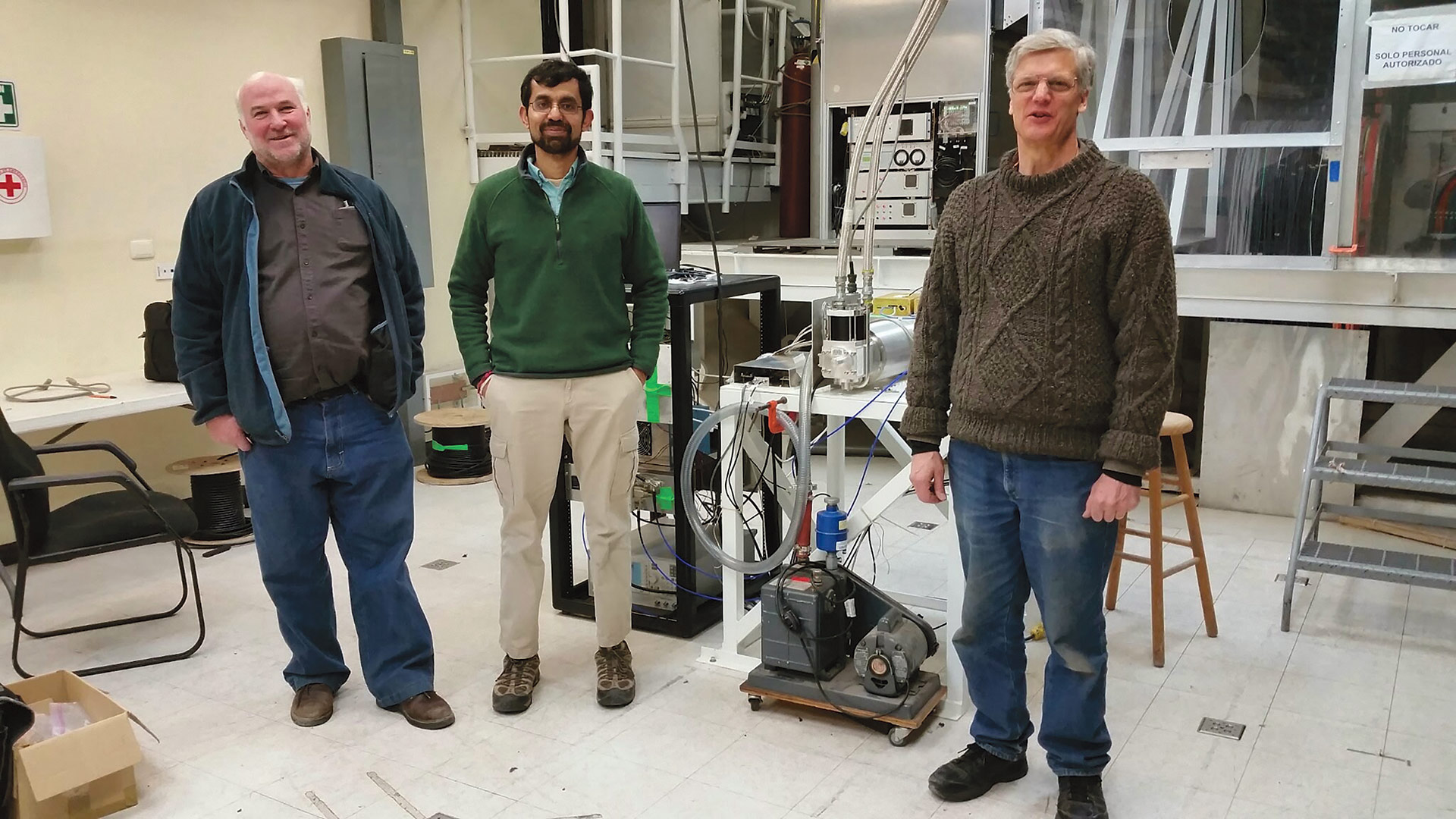
The engineering team responsible for building the 1-millimeter receiver that was installed on the LMT and used for the EHT campaign

The engineering team responsible for building the 1-millimeter receiver that was installed on the LMT and used for the EHT campaign. From left to right, Joe Crowley (MIT Haystack), Gopal Narayanan (UMass), and Ron Grosslein (UMass).

“We had to have very accurate timing in the collection of data,” he explained. “We had to know when the signals arrived at each telescope to a precision of a nanosecond, which is one-billionth of a second.”

So, to get the image that was eventually shared with the world earlier this month, the stars have to be aligned, in every sense of that phrase, said Narayanan, from the weather to the instrumentation. And those weren’t the only challenges to be faced.

Indeed, at 15,000 feet, the view from the LMT is spectacular — for telescopes, as well as the people working at one — but it’s difficult working at that altitude, said Narayanan, adding that one can remain at that elevation for maybe a dozen hours because there is far less oxygen than there is at sea level.

“Every step you take is hard, and thinking is hard, because your brain lacks oxygen,” he explained, adding that these conditions necessitated the need for two teams that would work in shifts at the telescope. “You always question any action you take, and it’s very strenuous work. At the same time, driving up the mountain and seeing the entire world beneath you, seeing the clouds beneath you, is a wonderful and emotional experience as well.”

Through all of that, Narayanan had that gut feeling that the teams working at those telescopes around the globe had ‘something.’

“I had a great deal of confidence that we had collected great data,” he explained, adding that this data then had to be analyzed and vetted, a lengthy, nearly two-year-long process during which astronomers had to keep quiet about their groundbreaking discovery.

Coming into Focus

With that, Narayanan explained how the image was attained. As for what it shows — that asymmetric ring-like structure around a central dark region — this is equally groundbreaking.

Indeed, the findings, as laid out in six papers published in a special issue of the Astrophysical Journal Letters, essentially support Einstein’s theories of relativity and confirm what scientists have long theorized about black holes without actually ever seeing one.

“Professor Einstein’s work has stood the test of time,” he said. “It’s been nearly 100 years since he came up with the two relativity theories — a special theory of relativity dealing with traveling near the speed of light and a general theory of relativity to do with gravitation. Black holes are direct predictions from his GR, general relativity theory, and multiple experiments show the theory works, and works in extreme regimes.

“But this particular regime, a 6-million-solar-mass black hole, was thought to be a place that would really test the limits of that theory,” he went on. “Our big hope was that we would obtain an image that would conclusively prove there is a black hole, and that was without a doubt the case, and that’s the sweet part of this.”

Part of the team in front of the LMT. From left, Gopal Narayanan, Aleks Popstefanija, Sandra Bustamante, Antonio Hernandez (Crya, Morelia, Mexico), David Sanchez, and Lindy Blackburn.

Part of the team in front of the LMT. From left, Gopal Narayanan, Aleks Popstefanija, Sandra Bustamante, Antonio Hernandez (Crya, Morelia, Mexico), David Sanchez, and Lindy Blackburn.

This is uplifting in many respects, said Narayanan, before adding quickly that he would likely have been equally excited, if not more so, if the evidence didn’t support those long-held theories.

“Perhaps if we had found something that violated the predictions of Einstein’s theories of relativity, we would come up in new, uncharted territory that makes us rethink the theories,” he told BusinessWest. “And that’s the way we basically make progress.

“You make a model of the universe and go out and observe to see if that model can be validated by actual observations, which is reality,” he went on. “And then you find out that the theory is not quite right because the observations belie the earlier predictions; that’s how you make progress. That’s not to say we didn’t make any progress — we made a lot of progress.”

And in a many different ways, he said, adding that the M87 project has certainly laid the groundwork for further developments in the search for — and study of — black holes.

And also in the emergence of the LMT. UMass has been involved with that facility for 20 years now, said Narayanan, who offered a quick history lesson.

He said UMass was one of the birthplaces of the pioneering field known as millimeter-wave astronomy back in the 1970s. As part of that effort, the university’s Astronomy department built a 14-millimeter radio telescope just north of the Quabbin Reservoir called the Five College Radioastronomy Observatory, which it operated until roughly 10 years ago, providing training for a few generations of students.

Years ago, it became apparent that the department had achieved about all it could with a facility of that size and commenced a search for a larger telescope. That search led to a partnership with the Mexican government and specifically the INAOE, and eventually the construction of the LMT, which saw what the industry calls ‘first light’ in 2010.

The first receiver built onto it was designed not to look at black holes, but rather the first galaxies to be created after the Big Bang.

The chosen site, the Sierra Negra volcano in the Mexican state of Puebla, brings many benefits, including location (close to the equator), that made it a pivotal piece of the EMT puzzle, said Narayanan, adding that its performance in that project bodes well for the future.

And that includes more work on black holes, including the one in Sagittarius A*, a much smaller black hole than that at M87, with a 4 million solar mass. Astronomers are still collecting data on that object, said Narayanan, adding that there many additional challenges (on top of those already mentioned) when it comes to observing and studying a black hole in the center of our galaxy.

“It’s a smaller black hole, so things move around faster,” he explained. “Also, looking through our galaxy itself produces some scattering of the light coming from the center of our galaxy. But we’re working through the data, and we should produce some results soon.”

As for that movie he mentioned, that may also become a reality through efforts to expand and enhance the EHT process through additional telescopes and other additions.

“We can make multiple images and stack them together to make a movie, as it were, of how things vary around a black hole,” he explained. “And that has fantastic scientific implications that will tell us a lot of things about black holes and the structure of our universe.”

Bottom Line

The image of the black hole at M87 that sped across the globe soon became the star of the show when it came to the groundbreaking discovery — pun intended.

But, in reality, there were many stars, including the teams of astronomers who collaborated on the project, and the LMT itself, a facility that, as Narayanan noted, has put its full talents on display.

Moving forward, the challenge — and the opportunity — lies in building on this breakthrough.

And the stars seem aligned for that to happen as well.

George O’Brien can be reached at [email protected]

Berkshire County

Creating Impact

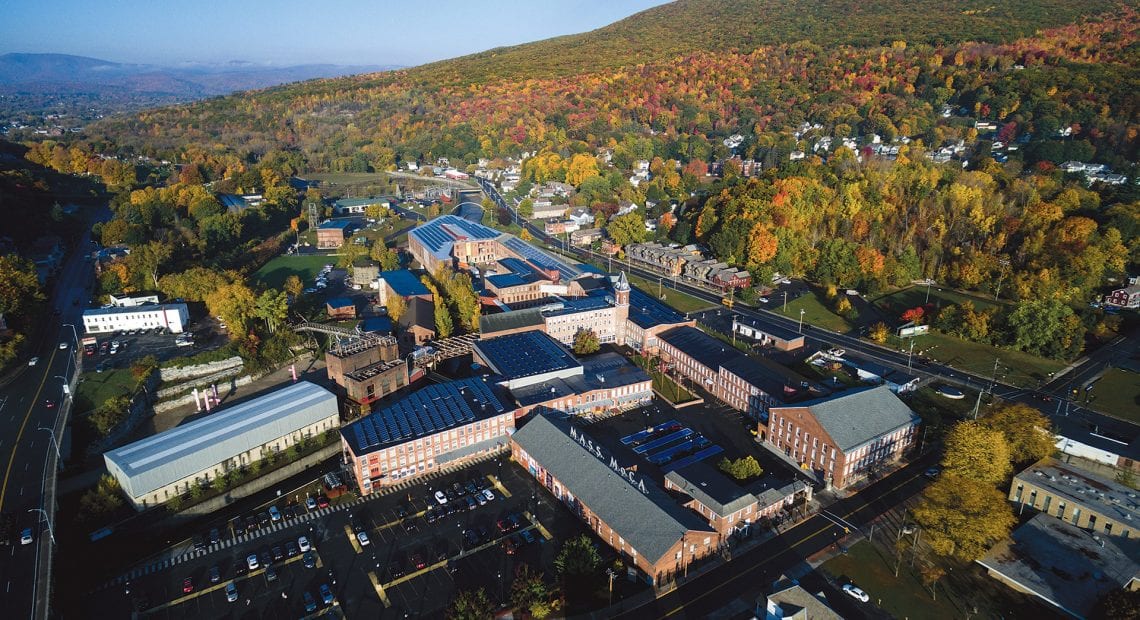
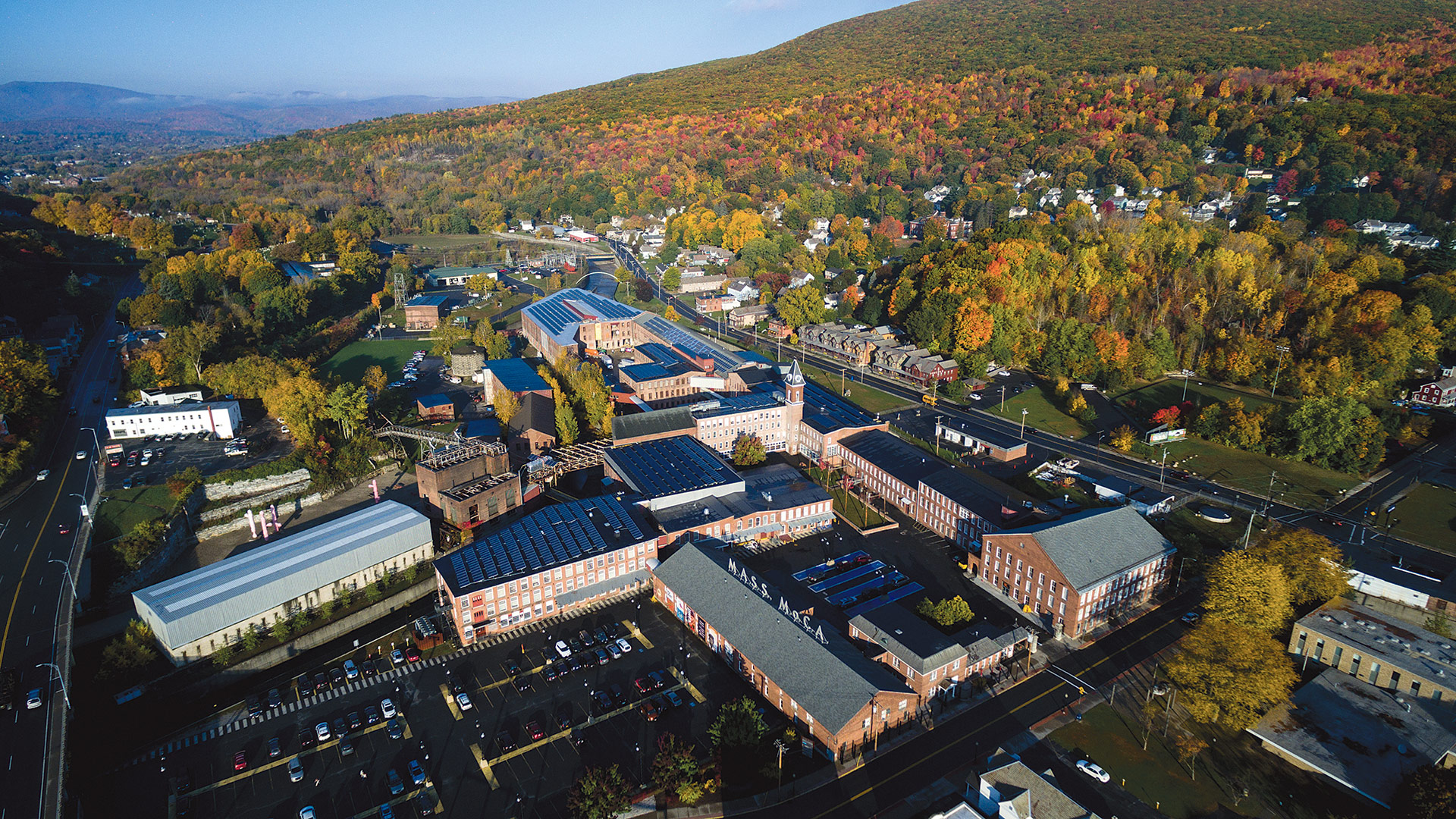
An aerial shot of the sprawling, 26-building campus of MASS MoCA.

An aerial shot of the sprawling, 26-building campus of MASS MoCA.

Anyone who hasn’t been to the Massachusetts Museum of Contemporary Art in the past decade might be surprised at how different it is from its early days. From a near-doubling of art space to a growing array of long-term exhibits to a robust music, theater, and festival business, MASS MoCA has become a true driver of Berkshire County’s creative economy — and that’s by design.

Jodi Joseph understands the challenges of drawing visitors to a museum in — well, it’s not the middle of nowhere, exactly, but it’s also a far cry from Boston or Manhattan.

“We have 13,000 residents in town. We bring over 200,000 people to the galleries every year. That’s a hard thing to do,” said Joseph, director of Communications at the Massachusetts Museum of Contemporary Art, or MASS MoCA, in North Adams.

But it’s an important thing, she added — not just for the museum, but for the entire region’s creative economy.

“People from 75 miles or more from here know this is a place to see art. Within 75 miles, more people know us as a place to see music and performing arts,” she told BusinessWest during a recent visit. “We are finding more ways to draw connections between the performing and visual arts — to let those visual-arts people know we have this dynamic performing-arts program year-round, and get our performing-arts audience into the galleries to see everything here.”

That’s because more time spent here means more money spent in the northwestern corner of the state.

“Overnight visitors spend six times as much money as day visitors,” Joseph went on. “Part of our economic-development agenda is getting people to understand there’s so much to do at MASS MoCA, and we’re just one of several institutions up here. So if you want to come see us and the Clark [in nearby Williamstown], you’re going to have to spend a night, maybe two nights, to get it all in. Every admission here is good for two days. So stay awhile — there’s so much to see.”

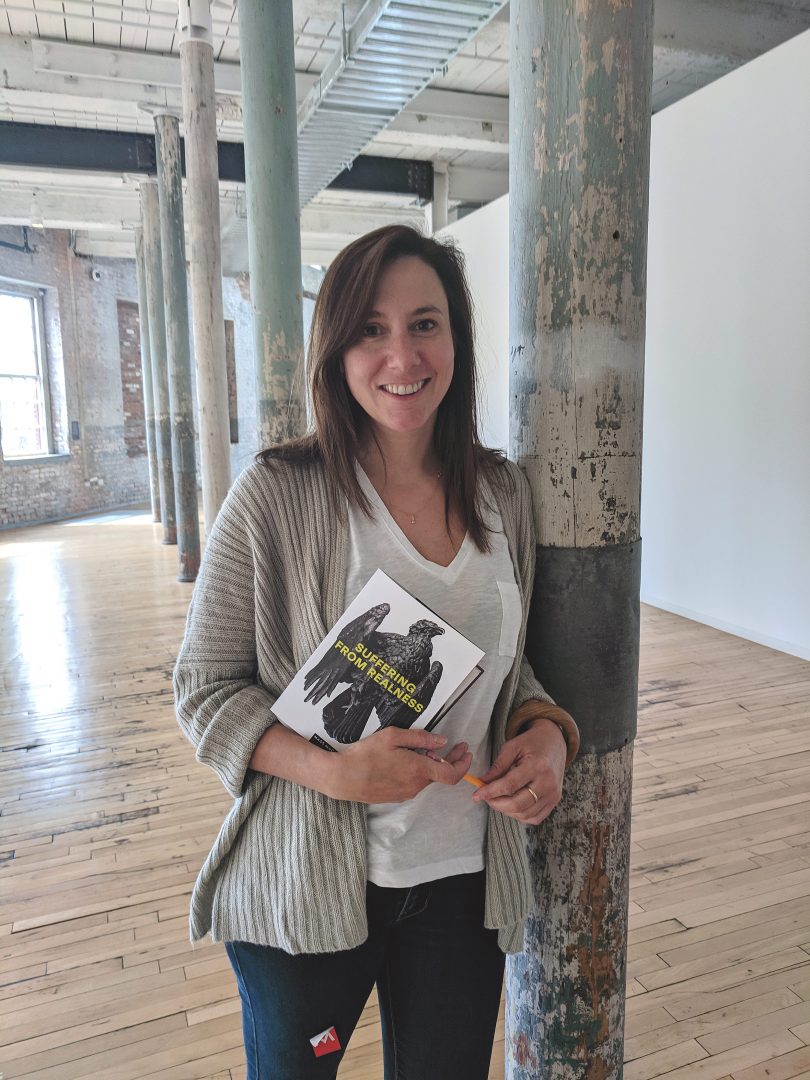
Jodi Joseph, director of Communications at the museum.

Jodi Joseph, director of Communications at the museum.

Much more, in fact, than when the museum opened 20 years ago, or even 10 years ago, for that matter. Growth has been a constant in MASS MoCA’s second decade, with the addition of a robust performing-arts and festival business and a massive expansion of floor space to accommodate something unheard of in the early years: permanent exhibits.

Much credit for the former goes to the Chicago-based rock band Wilco, which, a decade ago, became enamored of Western Mass. and saw it as a place to establish a residency and work on side projects. They couldn’t make a connection with Tanglewood work, but when they visited MASS MoCA, they knew they had something. In 2010, the museum launched Wilco’s first-ever Solid Sound festival, a celebration of music and art now held every other summer.

“Thus began MASS MoCA’s foray into a pretty serious concert-festival business,” Joseph said. “It opened the idea of MASS MoCA, this campus, being a destination for music. It was such an exceptional marriage — the fanbase their music attracts was our target audience. There are many other bands we could say that about, but certainly Wilco is in the top 10.”

Today, MASS MoCA presents more than 75 performances year-round, including contemporary dance, alternative cabaret, world-music dance parties, indie rock, outdoor silent films with live music, documentaries, avant-garde theater, and an annual bluegrass festival known as Fresh Grass.

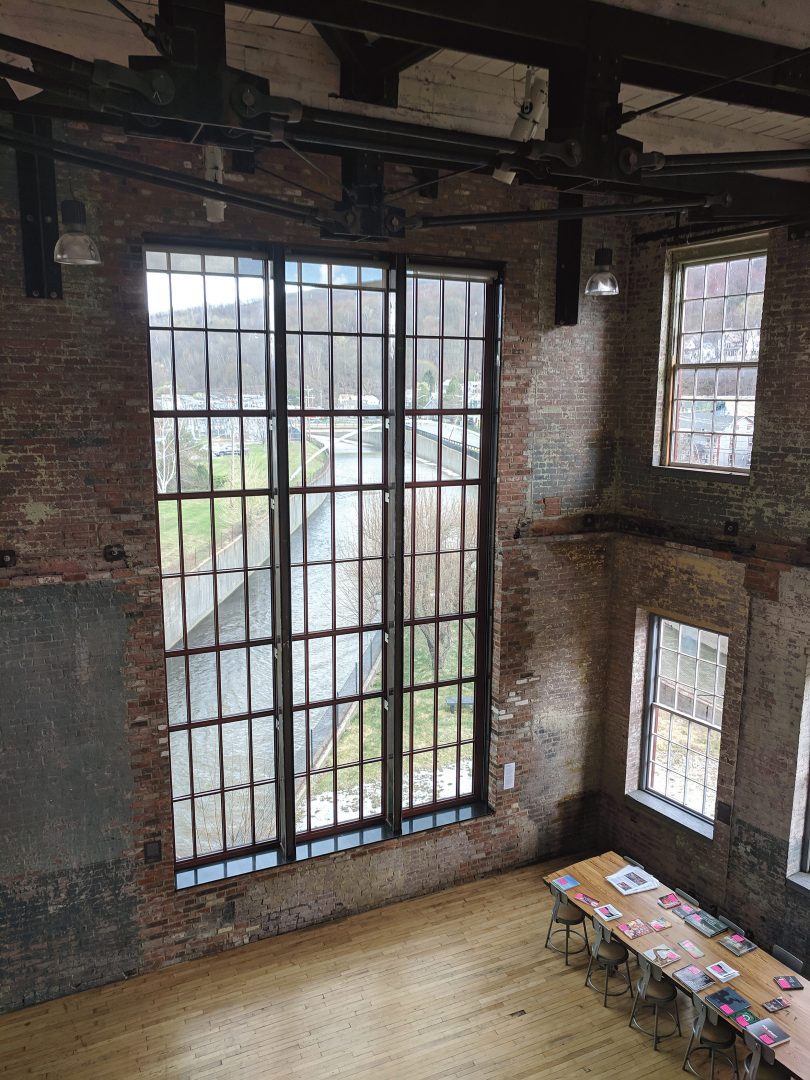
But the museum’s calling card is still modern art — in particular, large-scale, immersive ‘installation art’ that would be difficult to house in conventional museums. The unconventional works form an intriguing counterpoint to the century-old, high-ceilinged mill buildings that house them, which have retained their raw, industrial character over the years, with plenty of exposed brick, ductwork, and concrete floors.

Joseph said visitors appreciate the palpable sense of history they offer — even as MASS MoCA hurtles into its third decade of challenging the status quo.

Maker Space

The 16 acres of the MASS MoCA’s campus — 26 buildings occupying nearly one-third of the city’s downtown business district — form an elaborate system of interlocking courtyards and passageways, bridges and viaducts; a floor-to-ceiling window in one building overlooks the confluence of two branches of the Hoosic River.

By the late 1700s and early 1800s, businesses at or near the site included shoe manufacturers, a brickyard, a sawmill, cabinetmakers, hat manufacturers, machine shops for the construction of mill machines, marble works, wagon and sleigh makers, and an ironworks.

“Overnight visitors spend six times as much money as day visitors. Part of our economic-development agenda is getting people to understand there’s so much to do at MASS MoCA, and we’re just one of several institutions up here.”

In 1860, O. Arnold and Co. installed the latest equipment for printing cloth; large government contracts to supply fabric for the Union Army swelled business, and over the next four decades, Arnold Print Works became the largest employer in North Adams. By the end of the 1890s, 25 of the 26 buildings in the present-day MASS MoCA complex had been constructed, and by 1905, Arnold Print Works was one of the leading producers of printed textiles in the world, employing some 3,200 people.

In 1942, after a period of decline for Arnold, Sprague Electric Co. bought the site, converting the textile mill into an electronics plant, where physicists, chemists, electrical engineers, and technicians were called upon by the U.S. government during World War II to design and manufacture crucial components of some of its most advanced high-tech weapons systems, including the atomic bomb. After the war, Sprague’s products were used in the launch systems for Gemini moon missions, and by 1966 Sprague employed 4,137 workers. But, again, sales eventually declined, and in 1985, the company closed its North Adams operations.

“This campus has always made things,” Joseph said. “Now, what we make is art — performing arts as well as visual art.”

Indeed, when North Adams leaders began discussing a new use for the campus, the Williams College Museum of Art was seeking space to exhibit large works of contemporary art that would not fit in conventional museum galleries — and the idea of creating a contemporary arts center in North Adams began to take shape. With funding from both public and private sources, MASS MoCA opened in 1999.

Banners promote current, temporary exhibits

Banners promote current, temporary exhibits, but MASS MoCA has developed an array of long-term exhibits by prominent artists as well.

The ‘maker’ spirit of the complex extends to putting up the installations, many of which are not as simple as hanging a painting. The museum typically doesn’t hide the process, which can take several weeks, but instead embraces it.

“Because of the way our galleries are situated, we can’t help but put ourselves on view when installing an artist,” Joseph explained. “You might walk through and observe someone charging through the gallery with a forklift. This time of year, we’re moving from one gallery to the next, installing new art, and all that activity is usually on view to the public, in addition to everything that’s already installed in the galleries.”

She said the complex, for most of its history, has been home to a constant flow of humanity and industry, and the act of creation is as important — and worthy of viewing — as the static display of art.

“Even if you’re not a contemporary-art person, there’s so much to see in the architecture,” she told BusinessWest. “The buildings themselves are art. The fact that we fill them with art and ideas, and made these buildings accessible to the public, is a joyful experience. My grandparents worked here. My mom worked here. That’s real. I love coming to work every day and being in this site where I know my family history looms large.”

Even the performing-arts elements of the museum embrace the process as much as the outcome. For instance, in 2012, rock icon David Byrne teamed up with director Alex Timbers to create a theatrical piece called Here Lies Love — and, rather than perform it only as a finished product, presented it to audiences as a work in progress.

Similarly, just this year, actor Jon Hamm, director Danielle Agami, and Wilco’s Glenn Kotche led a team that developed a piece called Fishing, also performing it as an evolving work to audiences who were then invited to talk about what worked and what didn’t for them.

“It’s a phenomenal exchange — audiences love it,” Joseph said. “In this culture-drenched region, people get really excited about the creative process. Even if you are not the creator, you get to be involved.”

Permanence in Change

The process of developing and expanding an artistic idea has also taken shape on a macro level over the past decade on the MASS MoCA grounds. In 2008, the museum opened its first long-term exhibition, a three-story space housing about 100 works by famed large-scale wall artist Sol Lewitt — a display the Los Angeles Times once called “America’s Sistine Chapel.”

In 2013, the campus opened a previously unused building for a long-term exhibit by painter and sculptor Anselm Kiefer. And in 2017, the museum activated more buildings, almost doubling the previous gallery space from 135,000 square feet to 250,000, and installing permanent works by neoconceptual artist Jenny Holzer, multi-media artist Laurie Anderson (who makes use of virtual reality in her gallery), and James Turrell, whose interactive works make intriguing use of light and space, just to name a few.

The museum installed this floor-to-ceiling window

The museum installed this floor-to-ceiling window to give visitors a view of North Adams and, in particular, the point where two branches of the Hoosic River join up.

“Part of the joy of going to a museum is seeing the permanent collection,” Joseph said. “You might return time and again and see new exhibitions, but you can also visit old works in the collection like they are old friends to you. We never had that at MASS MoCA because we only had rotating exhibitions.

“But in 2008,” she went on, “people started to think about MASS MoCA not just as a pilgrimage site for Sol Lewitt fans, but also as a place where visitors could return and find something new at the galleries, but also have this body of work, this artist’s life work, where they were suddenly becoming experts. MASS MoCA members probably know more about Sol Lewitt than many Sol Lewitt scholars.”

The museum has expanded its community connections as well, such as an educational program that brings in 2,500 students from local public schools several times a year. Partner schools develop a curriculum of class projects based on what the students see at MASS MoCA. An invitational program for promising teenagers actually displays their artwork on the museum walls and provides grants to their teachers to stock their classrooms. One area teacher used the grant to purchase a kiln so students can create pottery.

“For these kids, she added, “seeing their art on the walls beside Sol Lewitt kind of raises the stakes for them.”

Another program, called the Studios at MASS MoCA, has hosted more than 500 artists and writers for residencies up to 10 weeks. Hosted by the museum’s Assets for Artists program, selected artists receive private studio space on campus, in addition to housing, free access to the museum’s galleries throughout the residency, optional financial and business coaching from Assets for Artists staff, and a daily group meal.

As part of its examination of the regional creative economy, the Berkshire Blueprint 2.0, a county-wide economic-development plan, recommended expanding the Studios program throughout Berkshire County, she noted. “I’m not sure how that would work, but it’s a great concept.”

And an exciting one, as MASS MoCA has long been a draw to this small city near the New York and Vermont lines — and from that destination status comes myriad ripple effects.

“We were founded with a two-headed mission,” Joseph said. “One was to present the best art of our time, and the second was to be an economic catalyst.”

It does that by leveraging all this activity — not just the performance and display of art, but its very creation — to develop new markets for artists, spur job creation, strengthen community identity, and even boost property values, all of which Joseph has witnessed and hopes to see continue.

“We’re in one of the most robust real-estate moments in North Adams in my adult life,” she said. “We’re happy to contribute to it — even if it’s one by one.”

Joseph Bednar can be reached at [email protected]

Manufacturing

Scaling Up

CEO Bill Bither

CEO Bill Bither

Over the past five years, Machine Metrics, a company that specializes in predictive analytics for manufacturers, has been scaling up its operation. But with an infusion of $11.3 million in venture capital last fall, this process enters a new and dynamic phase. The company has nearly doubled its workforce, expanded with a new office in Boston, and become much more aggressive in efforts to educate potential clients about its game-changing software.

Bill Bither was asked where he wanted to take Machine Metrics, the five-year-old startup he co-founded that specializes in predictive analytics for manufacturers.

He paused for a second or two, and then, in a voice that brimmed with confidence and conveyed the sentiment that he’d been asked this question — and given this answer — before, said simply and almost matter-of-factly, “we’re really looking to build a billion-dollar company.”

That’s not a phrase you hear often from entrepreneurs based in the 413, but Bither, who launched this venture with Eric Fogg and Jacob Lazier and serves as its CEO, believes that stated goal is certainly attainable. And those who have watched this company grow quickly and profoundly since it first gained attention as a member of one of Valley Venture Mentors’ first accelerator classes would certainly agree.

The company develops software systems that measure manufacturing productivity. To be more specific, these systems analyze performance in real time and send out alerts to clients when production falls behind.

Clients generally see a 20% improvement in efficiency, and the phrase most often used in relation to the software and its overall impact within a given shop is ‘game changer.’

There are now more than 100 manufacturers around the world using the company’s products, and Bither expects that number to climb steadily as awareness of the software, its capabilities, and the results it has generated for customers grows.

Bill Bither, left, seen here with co-founder and CTO Jacob Lazier

Bill Bither, left, seen here with co-founder and CTO Jacob Lazier, says Machine Metrics is adding clients across the country and overseas.

“What we’ve discovered since 2015 is that the market that we’re in is really large, and that industrial technologies are moving very quickly,” he told BusinessWest. “There’s a really high demand for companies to digitize their factories, and the key missing component to doing that is getting data from the factory floor; that’s the first step in digitizing a factory, and that’s what we do very well.”

To continue to do this well on a much larger scale, the company needed to move quickly on a number of fronts — from expanding its customer base beyond this region and this country to greatly expanding its team of engineers, salespeople, and marketers, to being far more aggressive when it comes to getting the word out.

And it has moved forward on all those fronts thanks in large part to an an infusion of $11.3 million in capital late last year.

The company has put that money to work to expand its data-science and product-development teams while accelerating global sales, said Bither, adding that, while the company has been scaling up on an ongoing basis over the past five years, that process has essentially entered a new, more dynamic phase.

“Last year, we grew about 200%, and this year we’ll probably be around that same number,” he explained, adding that this is now a truly global company that continues to expand geographically and in all other ways.

Now headquartered on Pleasant Street in Northampton — a move necessitated by the growth of its workforce — Machine Metrics has also opened an office in Cambridge, and now employs roughly 50 people, a number that has almost doubled since the company announced that infusion of capital.

“What we’re doing now is going even faster, looking at international expansion; having more engineers on the team helps us fulfill our vision quicker. We’ve shown that we’re leading the space that we’re in, and we need to keep leading the industry toward digitizing their factories.”

“We’ve doubled the size of our executive team, we’ve almost doubled the size of the workforce, and our customer count is now over 100,” said Bither. “What we’re doing now is going even faster, looking at international expansion; having more engineers on the team helps us fulfill our vision quicker. We’ve shown that we’re leading the space that we’re in, and we need to keep leading the industry toward digitizing their factories.”

For this issue, BusinessWest talked at length with Bither about the process of scaling up one of the most-watched startups in this region — and about the roadmap to becoming a billion-dollar company.

The Light Is Green

When he talked with BusinessWest earlier this month, Bither was in Toronto on vacation visiting family. Well, sort of.

“I have back-to-back meetings with clients today, which is what usually happens,” he explained. “A vacation trip turns into a work trip.”

There have been a number of work trips and vacations doubling as work trips for Bither and his partners over the past years, as they continue to bring awareness to a product that represents pioneering on a number of levels.

Indeed, while there have been production-monitoring software products on the market for some time, the software systems the company is now offering represent a huge step forward in what’s known as industrial IoT (Internet of Things) technology.

For clients, it has meant adding the phrase ‘being in the green’ to their lexicon. That’s the color that shows up on the dashboards, or large display boards, when machines are operating at or above the desired performance levels. An orange color means they are operating slightly below that level, and red means there’s trouble.

But beyond letting companies know how machines — or shifts of employees — are performing, the software can also predict when errors will occur and machines will fail, thus enabling manufacturers to avoid costly breakdowns that greatly impact overall productivity.

And as productivity improves, companies are better able to navigate what has long been the manufacturing sector’s most pressing — and perplexing — problem: a deep talent shortage that shows no signs of letting up any time soon.

All this explains why that phrase ‘game changer’ is being used so often by those who now have these systems operating in their plants. And it’s being heard both in this region — VSS CNC Inc. in Greenfield, Marox Corp. in Holyoke, and others are on the client list — and well outside it.

“We’re spread out across North America — I think we’re in roughly 40 states now,” he said. “And we’re starting to see some growth in Europe and South America. There’s still so much opportunity in this country, though, and that’s where we’re focusing most of our efforts.”

Bither, when pushed to guesstimate just how big the market is for industrial IoT technology, put the number at $85 billion, and said the mission moving forward, obviously, is to garner as large a share of that market as possible.

To do that, the company knew it had to expand its workforce, adding people in a number in a number of areas, but especially engineers in the field working with customers to digitize their factory floors.

As he talked with BusinessWest, Bither admitted he’d actually lost track of just how big the workforce was at that moment, a clear indication of how fast things are changing and how many people have joined the team.

“We’ve hired software developers, and we’ve added to our marketing team, our sales team, and our customer-success team,” he said, adding that the company has also brought on a chief financial officer, a vice president of Product, a vice president of Business Development, and a vice president of Sales, taking Machine Metrics and its leadership team to a much higher plane.

Meanwhile, the company has also opened an office in Boston, a step taken to not only better serve customers in that area, but also take advantage of the extremely deep pool of IT talent inside the 128 corridor.

“At the rate that we’re growing, it’s difficult to hire enough really skilled people in Western Mass. quickly enough,” he explained. “We’re combining the best manufacturing talent with the best software talent, and Boston really has a heavy concentration of software executives.”

Bither, who has been through the scaling-up process before — he grew the software company Atalasoft to 25 people before he sold it — said this experience at Machine Metrics is different in many ways, primarily because the company is a venture capital (VC)-backed enterprise.

“Therefore, the focus is on growing fast, not about being profitable — that’s the life of a VC-backed technology company,” he explained. “You’re really measured in growth and cash, more so than profits, and that’s different from what I’m used to.”

Moving forward, he said one key to continued growth and effective scaling of this venture is effective website content marketing, an approach designed to help educate and hopefully inspire movement within a sector, manufacturing, that has traditionally been slow to embrace new technologies and different ways of doing things.

Profound growth of its workforce forced Machine Metrics to seek larger quarters

Profound growth of its workforce forced Machine Metrics to seek larger quarters, and it found them in the old Post Office building on Pleasant Street in Northampton.

“We’ve been able to build quite a presence in this space without spending too much money because we’ve been able to build out content on our website and write a number of articles and blogs,” he explained. “And because of that, we’ve been able to bring in a lot of interested buyers that come through our website; our sales team will then talk to them, and a certain percentage of them will actually close.”

Another important marketing vehicle has been industry trade shows, such as the EASTEC show slated for next month at the Big E, but also the recent event in Hanover, Germany (the company’s first international show), where Machine Metrics had a large presence and was able to introduce itself and its software to new audiences.

“It was interesting because we were able to see what the landscape looks like in Europe,” he explained, adding that the company partnered with Amazon Web Services, a subsidiary of Amazon that provides on-demand cloud-computing platforms to individuals, companies, and governments, and thus gained considerable attention at the show.

The company also takes part in the International Manufacturing Technology Show, staged every other year in Chicago, and will be in Las Vegas in a few weeks for another large industry event, said Bither, adding that this exposure is critical to those scaling-up efforts.

Getting Things in Gear

Bither did not want to disclose current revenue figures for Machine Metrics, but he hinted strongly, not that he had to, that this venture is a long way from being a billion-dollar company.

But it seems to be on a path that would make that number more than a fantasy or pipe dream. This is a fast track greased by obvious need among manufacturers large and small to be able to track their performance in real-time analytics, and not rely on guesswork.

Whether the company can get to that magical milestone — or when, obviously — remains to be seen, but the scaling-up process continues, and like those clients it serves, this intriguing startup is certainly operating in the green — figuratively, if not literally.

George O’Brien can be reached at [email protected]

Community Spotlight

Community Spotlight

Mayor Will Reichelt

While the city will miss out on opportunities from its full ban on cannabis-related ventures, Mayor Will Reichelt says, there are new businesses of many kinds coming to the community.

West Springfield Mayor Will Reichelt recalls that, after his community’s City Council voted in the spring of 2018 to place a ban on any and all cannabis-related businesses, he received some texts from his counterparts in Holyoke and Westfield.

He doesn’t remember the exact wording of either one, but he told BusinessWest that they amounted to thank-you notes, as in — and he’s paraphrasing here, obviously — ‘thank you for the tax revenue that might be coming to our cities because it won’t be coming to yours.’

More than a year after that vote and those texts, Reichelt feels confident in saying that the full ban, while obviously well-intentioned, amounts to some missed opportunities for this community, for both the short and long term.

Indeed, West Springfield exists at the intersection of the Massachusetts Turnpike and I-91 (quite literally), and therefore, in many respects, it is the retail center of this region — complete with dozens of big-box stores, car dealerships, restaurants, and more — and draws people from across the region. But this retail hub will not include any cannabis dispensaries, despite a number of ideal sites for such facilities, resulting in, as those mayors pointed out in their texts, tax revenue that will go elsewhere.

But in Reichelt’s view, the ban has potentially deeper ramifications.

“A lot of our tax revenue comes from retail, most of it on Riverdale Street and Memorial Avenue; it’s car sales, it’s big-box stores — that’s a large portion of our commercial tax revenue,” he said. “And to not be open to new discussions, new ideas, and new businesses is going to hurt us in the long run because retail is changing; Amazon is coming, and not everyone is going to want to shop in Riverdale Plaza.

“If things change, we’re really going to struggle,” he went on, quickly adding that things certainly won’t change overnight or even over the next few years. “If we’re looking out 25 to 50 years, and West Springfield gets a name for itself that it’s not into these somewhat controversial but new and innovative business ideas, and the communities around us are, it will be easy to pass West Springfield by.”

Fortunately, at present, most traditional retailers, and consumers, have no intention of passing this community by. In fact, many retailers want in — and in a big way, for those reasons (and because of those roads) listed earlier. As an example, the mayor related the story of how Starbucks is very interested in landing a spot on Riverdale Street — specifically that very popular stretch south of I-91 — and how it will certainly be challenged to find one.

So while West Side won’t be entering the high-stakes competition for cannabis-related businesses any time soon, Reichelt and his administration will be focused on doing what this community has long been able to do — take advantage of its ideal location, already-deep portfolio of retail outlets, and heavy volume of traffic to attract more new businesses.

The team at 1105 Main: from left, Joe Stevens, Eric Waldman, Alex Waldman, and Liz Stevens.

The team at 1105 Main: from left, Joe Stevens, Eric Waldman, Alex Waldman, and Liz Stevens.

And it is enjoying success in this realm, as we’ll see later, with developments ranging from a new hotel on Riverdale Street to a new life for an old landmark just off Memorial Avenue, to the community’s first brewery just down that street.

Meanwhile, beyond those two main retail corridors, there are other intriguing prospects for development. One involves the property known to most as the United Bank building on Elm Street. That’s not its official name, but the bank has long occupied it and is therefore associated with it.

But United has all but moved out, and there us now a huge ‘for sale’ sign on the side of the property.

As the mayor gestured toward it while walking downtown with BusinessWest, he noted that, years ago, there were a number of a small storefronts within that footprint along the street. Turning back the clock and creating a new generation of destinations along that block would help build on growing momentum in that area of the city, he said.

Meanwhile, a former mill property along the Westfield River just over the line from Agawam is being gifted to the city by Neenah Paper, the manufacturer soon to vacate the property, said the mayor, adding that a number of new uses, including some residential options, are being explored.

These are just a few of the intriguing developments unfolding in West Side, a city that won’t be entering the intense competition for cannabis-related ventures anytime soon, but still has a host of other emerging business and economic-development stories.

Ale’s Well

Reichelt laughed heartily as he recalled the e-mail that is at the heart of a story he’s now told more times than he can count.

It was from his city planner, and typed onto the subject line was the phrase ‘Two Weeks Notice.’ Upon further reading, the alarmed mayor learned that this was not a reference to another job opportunity seized, but rather an update on the plans for an intriguing new business coming to the community.

“After that, I said, ‘can we just put ‘brewery’ in the subject line?’” said Reichelt, noting that the Two Weeks Notice Brewing Co., located in the former Angie’s Tortellinis facility since late last year, makes some nice IPAs, and has become a solid addition to the business landscape in West Side.

And it is just one of several of those over the past several months, including a new name over a familiar door.

That would be 1105 Main, an address, but also the name of a new eatery at the site of what would have to be considered a West Side landmark — the old Hofbrahaus restaurant.

Joe Stevens, who owned and operated that German restaurant with his wife, Liz, for decades, closed it roughly a year ago. The couple thought they had the building sold, but the deal fell through, prompting a reassessment of their plans.

“We starting talking about a theme restaurant,” said Joe, adding that what eventually emerged is a true family affair, involving sons Eric Waldman, who had been sous chef at a restaurant in Westchester County, N.Y. and was looking for a new and different challenge, and Alex Waldman.

Joe told BusinessWest they are calling this “an American eatery,” offering “familiar food with a twist.” As an example, he cited the lasagna, which is pan fried after it’s baked and includes a wild boar and bison bolognese.

The property at 1105 Main St. was substantially renovated for this makeover. The bar area, popular with regulars then and now, has a fresh look, as does the dining room, which has a brighter atmosphere and a hardwood floor, found underneath an inch of carpet glue after the old flooring had been ripped out.

The new eatery is drawing a mix of families and business people, said Joe, and it even complements another new business just across the street — Hot Brass, a firearm and bow range that shares space with Guns Inc., a seller of firearms.

“We like to say, ‘after you’re done shooting, come in for a shot and a beer,’” said Stevens, adding that a number of people have done just that, thus bringing still more vibrancy to the Memorial Avenue area that has changed dramatically over the past several years.

Indeed, the face of the street — home, of course, to the Big E — has been altered by the addition of Fathers & Sons’ new Audi and Volkswagen dealerships, as well a new retail plaza featuring a Florence Savings Bank branch and new stores in the Century Plaza.

West Springfield at a glance

Year Incorporated: 1774
Population: 28,529
Area: 17.5 square miles
County: Hampden
residential tax rate: $16.96
commercial tax rate: $32.55
Median Household Income: $40,266
Median Family Income: $50,282
Type of government: Mayor, City Council
Largest Employers: Eversource Energy, Harris Corp., Home Depot, Interim Health Care, Mercy Home Care
* Latest information available

Memorial Avenue, like the city’s other main retail corridor, is in a seemingly constant state of change, said Reichelt, adding that still more change is likely as new tenants are sought for two locations across from the Big E — the former Monte Carlo restaurant and the former Debbie Wong eatery.

Still further down the road is more property in flux, the former Medallion Motel and the vacant lot next to it, formerly the site of an auto-repair shop. Redevelopment of those parcels will likely have to wait for another day, said Reichelt, because they sit in the shadow of the Morgan-Sullivan Bridge, which crosses the Westfield River and connects West Side with Agawam and is still in the early stages of what is expected to a four-year reconstruction and widening project.

Traffic is often backed up at the site, which is why developers are unlikely to do anything in that area for some time, said the mayor, adding, as his counterpart in Agawam did a few months ago in this space, that the goal is to minimize the disruptions from the bridge project, especially during the 17 days of the Big E, and try to incentivize construction crews to reduce that four-year timetable for this initiative.

Forward Progress

Back on Riverdale Street, a new Marriott Courtyard is set to open later this spring, one of several new developments on or around that busy retail corridor, which, like Memorial Avenue, is in a seemingly constant state of the change.

Others include a gas station at the Costco in the Riverdale Shops, a project expected to commence later this year; the opening of a 1.5-mile bike path behind those shops, due to open in May; and a $21 expansion of the Agri-Mark facility on Riverdale Street, completed last fall.

Looking down the road, Reichelt said the site of now-closed Bertucci’s, located along that stretch south of I-91, is still awaiting new development, and he’s optimistic one will come because properties don’t generally remain vacant for long on that stretch of road.

Meanwhile, as noted, there are developments unfolding outside of those two main retail corridors that could have important ramifications for the community. This is especially true of the United Bank property on Elm Street.

“That used to be a collection of small stores,” he said of the facility, adding that it was renovated to house a bank branch and several of the institution’s departments. “There was a nice bookstore and coffee shop, a restaurant … it was a real destination.”

It can be that again, he went on, adding that his vision includes the community petitioning the state for additional liquor licenses and perhaps transforming the property into a home for a number of hospitality-related businesses that would complement those already thriving in that area, such as the Majestic Theater (located on that same block) and bNapoli restaurant.

Mayor Will Reichelt says redevelopment of the former United Bank building on Elm Street could be a catalyst for growth in the city’s downtown.

Mayor Will Reichelt says redevelopment of the former United Bank building on Elm Street could be a catalyst for growth in the city’s downtown.

“I’d like to section that property back off again,” he said. “If we can get two more restaurants down there, a coffee shop or bagel place, and businesses like that, we could get a lot more life in the downtown, creating a real destination.

“Everyone always talks about how they’d like to have a mini-Northampton,” he went on. “That’s never going to happen if you don’t have stuff for people to do. This [property] represents a huge opportunity for us to create more things to do.”

And while hopefully generating more things to do with that downtown project, another initiative may well create more places to live.

The Neehah Paper Co. has donated the 100,000-square-foot mill property (formerly Strathmore Paper and then Fibermark) to the city, said the mayor, adding that residential is perhaps the best reuse option, be it elderly housing, affordable housing, or perhaps some combination, although other opportunities for development exist.

“We’ve run some breweries through it, and there’s been some interest,” he explained. “But we can’t really do much until we own it. This represents a great opportunity because we’re going to an actual section of riverfront property, which we don’t have in town.”

Location, Location, Location

Returning to the matter of cannabis-related ventures and the ban that covers the full spectrum of such businesses, Reichelt reiterated his concern that this goes well beyond lost commercial tax revenue.

“Councilors like to say that we’re business-friendly,” he told BusinessWest. “I say, ‘well, no, you’re not; you just completely wiped out an entire industry from coming to town.’”

This makes West Side an island of sorts when it comes to the cannabis trade, he went on, adding that there is still a lot of business activity happening on that island, with the promise of more to come in the months and years ahead.

The great location and easy access to major highways that would make West Side a perfect host for marijuana-related businesses also make it ideal for most any type of retail and hospitality-related venture.

And, as it has for decades, the city will continue to make of the most of all that it has to offer.

George O’Brien can be reached at [email protected]

Berkshire County

Designs on the Future

Jonathan Butler, left, and Benjamin Lamb

Jonathan Butler, left, and Benjamin Lamb discuss the plan at a recent public forum.

Jonathan Butler knows what happens to a lot of reports, and he’s determined to avoid that fate.

“This wasn’t intended to be just a two-year study that ends up as a report that sits on a shelf,” he said, referring to Berkshire Blueprint 2.0, an 80-page action plan of sorts for the Berkshire County economy. “It very much means to be a new look at our economy, a new baseline for where we are that identifies challenges we have in different areas and action steps needed to move forward.”

The project, the successor to the original Berkshire Blueprint released in 2007, was overseen by 1Berkshire, the regional economic-development agency Butler serves as president and CEO.

The report’s most notable feature is how it breaks down the economy into five ‘clusters’ — advanced manufacturing, the creative economy, food and agriculture, healthcare, and hospitality and tourism — and then lays out the challenges facing each cluster, who some of the main stakeholders are, and a series of ‘action steps’ aimed at spurring economic growth.

“We’ve made a process that’s accountable to itself and the stakeholders,” Butler told BusinessWest. “We have a small-business economy in the Berkshires, with a lot of business sectors, and approaching it from this vantage point is a helpful way to establish more creative problem solving and open up doors to more scalability for our economy.”

He admitted there are far more than five key clusters in the region’s economy, specifically citing education, financial services, and e-commerce as three others that may be woven into future iterations of the blueprint. But 1Berkshire had to start somewhere, and chose clusters that import wealth — in other words, bring money into the region from outside — and have shown growth over the past decade with the potential to scale up further.

“It’s all about getting different businesses outside of their silos to create more collaboration, more interactivity — to create an environment where things can take off organically.”

‘Scalability’ is a word that comes up repeatedly with Butler, who unveiled the plan at a recent, well-attended public forum alongside Benjamin Lamb, 1Berkshire’s economic development director.

“We’ve lived through the dialogue of a declining economy and job loss, and the narrative for many years has been to bring more jobs into the region,” he explained. “But we’ve pivoted away from that. We don’t need more jobs in the region; we need scalability for existing jobs and a better hiring pipeline. There’s a disconnect between the available workforce and the skill set and type of workforce businesses need.”

“There’s also a strong sense of momentum and progress that wasn’t here 15 years ago. That’s something to be excited about, and something we want to see evolve in the coming years.”

For evidence, Butler said there’s typically 1,300 to 2,000 jobs posted in the region at any given time, and they span the spectrum of the workforce, from entry-level to mid-career, management, and upper management. Many of the blueprint’s action steps take direct aim at identifying, connecting, and training potential workers for lucrative careers.

“A lot of employers here do a great job innovating in their sector, in their market, and are in a position where they can be scaling up, growing, expanding into new products and expanding product lines — but they’re not confident they can take the leap and scale the company because they’re not finding the workforce they need to fill those jobs.”

The Nitty Gritty

As an example of how the report dives into the five sectors, let’s consider the creative economy, which comprises segments like visual arts, performing arts, literary arts, design, film and media, and museums and cultural institutions.

The blueprint notes that the sector has seen 9.5% job growth since 2010, and the concentration of employers in this realm is 62% higher in the Berkshires than it is nationally, spurred by rapid growth in the northern part of the county.

Assets include a diversity of business establishments, institutional support by the likes of the Berkshire Taconic Community Foundation (BTCF) and Massachusetts College of Liberal Arts, and existing collaborative relationships across the county. Challenges, the report notes, include further engaging local residents, overcoming perceptions to demonstrate the economic importance of the arts, sustaining organizational support, and providing housing and transportation for seasonal employment.

With these factors in mind, the blueprint’s recommended action steps include convening the region’s major cultural institutions in dialogue, developing an intensive business-resources-awareness campaign, providing support to the BTCF and the Creative Commonwealth Initiative, reconvening the Creative Resources Conference, creating a partnership between the Berkshire Innovation Center and the creative community, and expanding the Assets for Artists program, a MASS MoCA initiative that provides professional-development opportunties — and housing — to emerging artists.

Collectively, that’s a mouthful, and it’s only the barest summary of just one of the five sectors. (The full report, and an executive summary, are available at 1berkshire.com.) But it suggests the copious work that must follow if the blueprint is to avoid becoming just another binder collecting dust.

“There are real challenges, and we have to work in collaboration to overcome them,” Butler said. “But there’s also a strong sense of momentum and progress that wasn’t here 15 years ago. That’s something to be excited about, and something we want to see evolve in the coming years.”

While much of the Berkshire Blueprint focuses on the five central clusters, the report also identifies several cross-cutting issues that impact the region at large, including all clusters.

For example, consistent access to high-speed broadband internet has long been a challenge in Berkshire County. Recently, actions on the state level have helped bring communities up to an equitable standard of broadband access and internet speed, but further advocacy and work are still needed, especially for residential access.

In addition, New England’s energy costs are significantly higher than they are in other regions of the country. With the retiring of regional power plants, lack of new plant construction, high cost of fuel distribution, and a limited pipeline infrastructure, the Berkshires face significantly higher energy costs compared to other areas of the country and the Commonwealth.

In the realm of transportation, gaps in public-transit services, inadequate evening bus service, a lack of coordination of private and public transportation assets, and challenges of getting to and from employment reliably are among the region’s nagging challenges.

Finally, population loss has been a persistent issue for decades in the region. 1Berkshire’s Berkshire Initiative for Growth began to lay groundwork for recruiting and retaining individuals to the region to curb this trend. While portions of the report were implemented, a number of components were laid out as the responsibility of other members of the regional business community to integrate.

“Population loss has been a mature conversation in the Berkshires,” Butler said. “The reality is, we’ll probably see another decline of some sort in the 2020 census, which would continue a half-century trend. But I’m optimistic that a lot of work done over the past five or six years will eventually shift that. We’re seeing more and more young families come to the Berkshires for a variety of reasons: quality of life, work-life balance, and the fact that our economy is quite big and diverse for such a small region.”

Then and Now

The blueprint authors were quick to note that the decades-long national decline of traditional manufacturing has had a negative effect on Berkshire County, and that the departures of long-time major employers such as General Electric and Sprague Electric devastated the local economy.

“For too long, the narrative has been that our best days were behind us, confined to faded newsprint and wistful memory,” they note. However, “that narrative is out of date. For several years, Berkshire County leadership has felt a sense of cautious optimism that the tide is turning. New buildings, businesses, and partnerships are springing up everywhere. With the knowledge that Berkshire County has seen $1 billion in investment over the last three years, the writing is on the wall: the days of doom and gloom are over. The new Berkshire narrative is about growth and opportunity in a diversified regional economy, and there is room for everybody at the table.”

That’s optimistic talk for sure, and Butler believes it, noting that he and his wife are in their late 30s, want to stay in the region for a long time, and believe it’s a good place to be.

“When we made the move home to the Berkshires in our late 20s, we saw a lot of potential,” he told BusinessWest — along with plenty of challenges. “But the narrative then and what we see happening in the future are different — and that’s become a more mainstream idea now.”

An idea that, with any luck, will do much more than sit on a shelf.

Joseph Bednar can be reached at [email protected]

Opinion

Editorial

Meryl Streep?

That’s who Peter Wirth, co-owner of Mercedes-Benz of Springfield, suggests, tongue in cheek (we think; we hope), should play him in a movie about his life.

“Let’s see if she can really play anything,” he writes in one of the answers to questions put to all of this year’s honorees. And when asked what figure, past or present, he would like to have lunch with, he suggests Ernest Hemingway. “I feel like he would have a few good stories, and there would most certainly be cocktails accompanying the lunch.”

The collective answers to a host of revealing questions cast a bright and intriguing light on this year’s honorees, who join the 480 who came before them as owners of some of the most prestigious plaques to be found in Western Mass. Indeed, a 40 Under Forty winner is someone who stands out among his or her peers (there were nearly 200 nominations submitted this year) and is truly a rising star amid a galaxy of them.

Indeed, contrary to popular theory, there is quite a bit of young talent in this region, and it exists across the board, in sectors ranging from healthcare to retail; from financial services to nonprofit management; from law to casino administration.

Their stories continue until you know all you need to know about Alyson Yorlano. And, as noted, to tell their stories, we used a questionnaire format, one that allows honorees to use their own words to convey what’s important to them, what inspires them, who mentored them, and yes, who they think could play them in a movie.

The answers are certainly good reading. They reveal some common denominators — everything from a willingness to work hard to get where they want to go, to a passion for family and community. And, in many cases, honesty and a good sense of humor.

As when Alex Dixon, the now-former general manager of MGM Springfield (he’s returned to Las Vegas to manage Circus Circus but will be at the Log Cabin in June for the 40 Under Forty gala), revealed that, growing up, he wanted to be governor of Nevada, an Alvin Ailey dancer, or a running back for the Washington Redskins.

Beyond witty answers, the profiles of this year’s honorees should provide inspiration for others seeking to own one of these plaques themselves, and encouragement for those who might be worried about whether we have sufficient young leadership coming of age in the 413.

Take Donald Havourd, who has thrived in a Fortune 500 corporate environment at MassMutual while simultaneously founding and growing a business, Migliore, which manufactures and distributes luxury car-care products.

Or Joy Baglio, who poured her passion for writing into the creation of the Pioneer Valley Writers’ Workshop, growing it in only three years from a solo enterprise to one with 13 instructors teaching dozens of workshops and classes each year.

Or Dorothy Ostrowski, whose unique trajectory has taken her from the war-torn streets of Afghanistan to a wide-ranging career in the fast-paced world of emergency-room nursing, to ownership of a venerable West Springfield construction company.

We hope you enjoy reading these stories, but more importantly, we hope these 40 rising stars make you feel good about the future of this region. Because we certainly do.

Opinion

Opinion

By John Regan

Evidence from states that have imposed a surtax on incomes of more than $1 million shows that the policy causes irreparable harm to the economy while generating far less tax revenue than promised. A millionaires tax will cause the same harm in Massachusetts.

Lawmakers have refiled a proposal to amend the state Constitution to impose a graduated income tax, adding a 4% tax (representing an 80% increase in the personal income-tax rate) on all incomes over $1 million. The amendment would dictate that the revenue be spent on transportation and education.

A graduated income tax would eviscerate the small, family-owned businesses that form the heart of the Massachusetts economy. The surtax would take an estimated $2 billion from some 17,000 Main Street businesses and others that pay taxes at the individual rate and who would otherwise use the money to hire additional employers or expand their companies.

These companies are already drowning in more than $1.5 billion in new taxes and fees to pay for a financial shortfall in the Medicaid program and to fund the new paid family and medical leave program.

How do we know that surtaxes don’t work? Because our neighbors in Connecticut just drove their economy off a cliff by raising taxes three times in the past 10 years. Connecticut in 2009 added a 6.5% income-tax bracket for those earning more than $500,000 per year. The state followed up with a comprehensive $1.5 billion tax increase in 2011 to deal with a budget shortfall. A final round of tax increases took effect in 2015.

A graduated income tax would eviscerate the small, family-owned businesses that form the heart of the Massachusetts economy. The surtax would take an estimated $2 billion from some 17,000 Main Street businesses and others that pay taxes at the individual rate and who would otherwise use the money to hire additional employers or expand their companies.

According to information compiled by Pew Charitable Trusts, tax revenue for all 50 states is averaging 6.3% higher than it was at the start of the 2008 recession. Connecticut tax revenue, on the other hand, is only 3.8% higher, despite the three tax increases.

Once the economic heavyweight of New England, Connecticut is the only state in the nation which has yet to recover the jobs lost during the economic downturn. In addition, the state has seen an outmigration of residents since 2013 and the loss of major financial investors. Data from the Internal Revenue Service showed a spike in residents earning more than $200,000 per year leaving the state in 2015, and studies conducted by Connecticut state agencies and commissions have confirmed the loss of higher-income residents to other states.

Income-surtax laws have failed in other states as well. Within three years of Maryland enacting its millionaire tax, 40% of the state’s seven-figure earners were gone from the tax rolls — and so was $1.7 billion from the state tax base.

Similarly, in 2010, Boston College researchers released a report on the migration of wealthy households to and from New Jersey. They concluded that wealthier New Jersey households did in fact consider the high-earner taxes when deciding whether to move to or remain in New Jersey. From 1999 to 2003 — before the millionaires tax was imposed — there was a net influx of $98 billion in household wealth into the state. After the tax was implemented, an increasing number of wealthy families left the state, resulting in a loss of $70 billion in wealth.

Many of the business owners who fled Connecticut, Maryland and New Jersey moved to states that have worked to reduce, rather than boost, taxes, including North Carolina, New Hampshire, Georgia, and Tennessee.

John Regan is executive vice president of Government Affairs for Associated Industries of Massachusetts.