Home Posts tagged Events (Page 34)
Meetings & Conventions Sections
Cranwell Resort Blends History, Stunning Views, and Accessibility
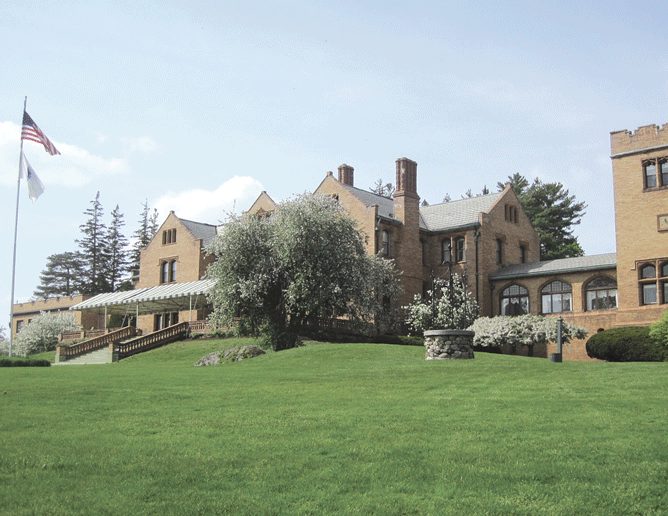
Cranwell Resort, Spa & Golf Club

Cranwell Resort, Spa & Golf Club offers stunning views of the Berkshires and an off-site alternative for corporate meetings.

Norma Probst, director of marketing for the Gilded Age Tudor-style mansion and grounds known as Cranwell Resort, Spa & Golf Club in Lenox, has a favorite phrase for summing up this destination.
“We’re high-end, not haughty,” she said, adding that this is a sentiment that covers the leisure market as well as the corporate market for meetings and retreats.
“‘Open to the public and year-round access’ is the overall message we put out there,” noted Probst, adding that the sign over the main entrance pretty much says it all: ‘public welcome.’
And the public heeds the sign.
Indeed, 70% of the spa services at the Spa at Cranwell, the largest such facility in the Northeast, are used by the local residents, meaning those who live in and around Lenox year-round or have second homes there. Meanwhile, Sloane’s Tavern, with its panoramic mountain views overlooking the golf course, seats 80 inside and 80 outside on the deck, and sees plenty of locals for weekly meals, including brunches and holidays.
This is not what some might expect when they visit a destination spa and resort traditionally defined by such adjectives as ‘elite’ and ‘high-end,’ but it is an operating philosophy that has served this institution well over the past 20 years, enabling it to bolster its reputation and ride out the economic downturns that can cripple such facilities.
Couple this accessibility with a down-to-earth operating style (something else one might not expect at such a prestigious address), and it’s easy to understand why Cranwell is ranked among the top 150 U.S. Resorts by Condé Nast Traveler, is a member of the Historic Hotels of America (HHA), and is a recipient of a host of other travel-industry accolades. And they also help explain, along with superb resort amenities and some different life-enriching options — Probst calls it “content of value” — why this destination overlooking the Berkshires is so unique.
Of course, the resort is perhaps best-known as a site for corporate meetings and retreats, and this side of the business has grown steadily over the years, thanks to word-of-mouth referrals, but also that brand of service that has earned high praise from guests, said Tim Paulus, director of sales, who shared some commentary.
After a managers meeting, Liberty Mutual Group responded with the following: “this year, our annual meeting was quite a success; just about every attendee had some comment about the excellent food, the uniqueness of their room, or the hospitality of your staff.”
Associated General Contractors of Massachusetts had similar comments: “facilities were excellent; staff at all levels was outstanding and extremely accommodating.”
For this issue’s focus on meetings and conventions, BusinessWest offers an up-close look at Cranwell, one that will explain how, in 20 short years, it has established itself as one of the premier destinations in the region.

History Lessons
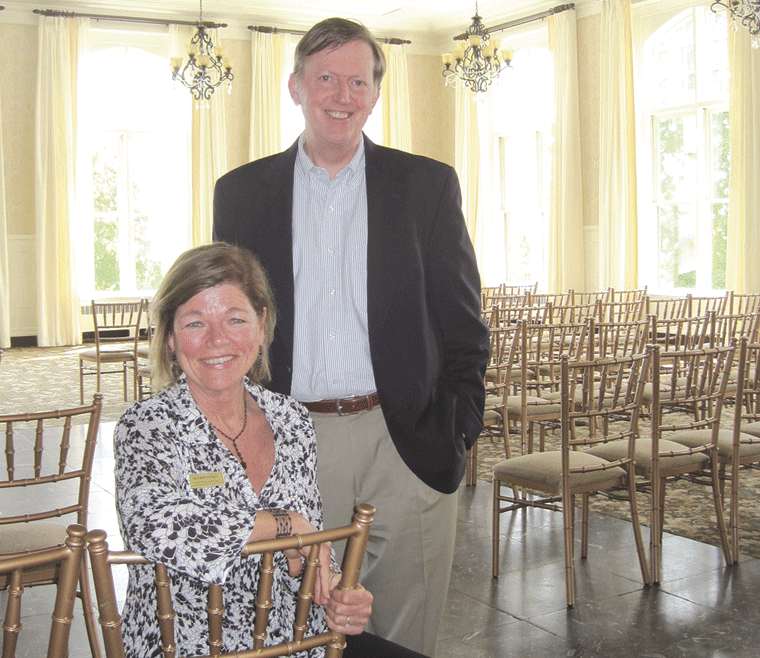
Norma Probst and Tim Paulus

Norma Probst and Tim Paulus, in the newly renovated ballroom, credit Cranwell’s open-door policy for its continued success.

Upon entering the stunning, gateless grounds of Cranwell, one’s attention is immediately drawn to the mansion that dominates the grounds. But it quickly moves to the many other structures on the campus, built during various points of Cranwell’s 116-year history, and representing myriad architectural styles.
To understand the current campus, one needs to know its history, which is replete with multiple ownership changes and several uses, from residence to boarding school to resort, with three attempts at the latter category, the last being successful.
Both the www.cranwell.com and www.historicinns.org websites explain that, in 1853, Rev. Henry Ward Beecher — a man who had presidential aspirations and was active in the women’s suffrage and anti-slavery movements — purchased Blossom Hill, where the current Cranwell mansion now stands, for $4,500.
A scandalous affair ended Beecher’s political hopes, and his sister, Harriet Beecher Stowe, author of the famous anti-slavery novel Uncle Tom’s Cabin, inherited the home.
Gen. John Rathbone purchased the property from Beecher in 1869 and built Wyndhurst, which was enormous by any standard of the day. But in 1894, the next owner, John Sloane, a relative of the Vanderbilts and co-owner of a furniture firm, demolished that mansion and constructed another Wyndhurst, which rivaled the enormity and elegance of the first.
It was during this grand era, the Gilded Age (1880-1920), that Sloan also commissioned Frederick Law Olmsted, famous landscape designer of New York City’s Central Park (and also Forest Park in Springfield), to design Cranwell’s grounds and original gardens. The Wyndhurst, the namesake of one of the three restaurants at Cranwell, is the mansion one sees today.
In 1925, Sloane’s daughter, Evelyn, sold the estate to a group of Florida developers who tried to run the property as the Berkshire Hunt and Country Club, but the Depression ended this first real attempt at a resort destination.
Then, in 1930, Edward Cranwell purchased the property and later deeded the estate to the Society of Jesus of New England, to be turned into a private school for boys.
A young Ted Kennedy attended for a few semesters, said Probst, noting that, after prospering for many years, the school slipped into decline, closing its doors in 1975.
The property’s current owner, Burak Investments, purchased the then-bank-owned Cranwell in 1993 after it had been a condominium development and, according to Probst, was starting to be reborn as a resort, with renovations to the mansion. But this venture languished during the tepid economic times, and the company eventually went bankrupt.
Today, Cranwell Resort, Spa & Golf Club, with much of its original grandeur restored, thrives as a premier four-season resort, offering the world-class, 35,000-square-foot Spa at Cranwell, three restaurants (the award-winning Wyndhurst, the Music Room, and Sloane’s Tavern), an 18-hole championship golf course designed by Stiles and Van Cleek, and 114 deluxe rooms and suites situated in various buildings on the campus.
These structures offer stark contrasts, from the opulence of the Gilded Age evidenced in the mansion to the utilitarian, red-brick dorms built by the boarding school, now home to 38 completely refurbished guest rooms and the administrative offices. There are also 60 privately owned condominiums, two cottages, and the elegant Carriage House.
However, the Carriage House that now stands is the second on that footprint. In December 2010, an electrical fire took the original facility, built in the late 1890s, and a new structure opened roughly a year ago, just a few yards uphill from the original to take advantage of the view from the third floor. The original architectural drawings for the Carriage House were retrieved from the Boston Public Library.
“They recreated much of the same architectural features of the original, including the turrets,” said Probst proudly. That consideration to honor architectural detail is what makes Cranwell an exemplar of the HHA.
A member since 2000, Cranwell is in the elite company of 240 other historic hotels. A member has to be at least 50 years old and listed in, or eligible for, the National Register of Historic Places. Member hotels are promoted nationally and internationally to those who prefer historic settings for their leisure and business travel.
“This, too, is what Cranwell is all about,” said Probst.

Trend Setters
After guests take in the stunning, 360-degree show of green in summer, harvest colors in the fall, or the winter’s snow-covered mountains, Cranwell offers many outdoor activities, including hiking, tennis, mountain biking, cross-country skiing, bonfires, and, of course, golf. And with Cranwell’s open-door policy, the resort caters to several markets.
“We have different sectors within each department,” Probst explained, referring specifically to golf. “For instance, we have golfers with full-season memberships, guests with golf packages, local residents who book a random tee time — so we are catering to quite a diverse group of guests.”
While the spa is also a strong local draw, and Cranwell’s overall market is global, 80% of leisure, banquets, weddings, and corporate meetings are booked from clients from Massachusetts, Connecticut, New York, and New Jersey.
“We do about 50 weddings a year,” said Probst. “which is a lot considering we have exclusivity; we don’t have two Saturday-night weddings going on at one time.”
About four years ago, Probst started promoting winter weddings, which has added to the hundreds of single- and multi-day meetings and conferences that Cranwell hosts.
But since the Great Repression, some trends have emerged, said Probst and Paulus, noting that, while companies are still willing to spend (perhaps not quite as much as before), there is a greater emphasis on value. Meanwhile, there is an accompanying demand for facilities and operations that are ‘green,’ and Cranwell is responding accordingly in both cases.
“From a meeting standpoint, I’ve seen more meeting planners wanting more content in their events that are away from the business part of the agenda, and then they can rationalize why they need to have an off-site meeting,” explained Probst, adding that she’s noticed that meeting planners’ jobs have become more difficult.
“They’re under a lot of pressure to deliver a full and robust meeting,” she said, “and they’re under budget constraints much more now than ever before.”
Some of the content that brings value includes Scotch and wine tastings, chef-assisted culinary demonstrations, Afro-Caribbean drumming (a personal addition by Probst), and other unique, interactive group activities.
“We’re trying to engage our guests more and help them come up with something that is more life-enriching that they can take with them,” she noted.
Meanwhile, in the ‘green’ realm, Paulus told BusinessWest that more attention is being paid to sustainability, on the part of both individual guests and corporate meeting planners.
“It’s a huge decision factor when it comes to choosing certain hotels and resorts,” he noted. “In fact, in my office, the last five or six trade journals [of the meeting and convention industry] have ‘green’ on the cover.
“So we’re undertaking more strides to be green here,” he continued. “We’re putting ourselves through some certification processes, which have to do with how we recycle things, how we buy locally, and how we maintain the golf course, reuse rainwater, and deal with electric usage.”
Paulus pointed to the Cranwell meeting rooms and their conference worktables as one example; there are no more tablecloths or skirting because it’s an excessive use of a product that will have to be washed and dried using electricity.
A very welcome trend both Probst and Paulus are starting to see is corporations opening their purse strings a bit more over the past few years.
Like all hospitality-related businesses, resorts suffered through the Great Recession as businesses cut back on discretionary spending, said Probst, adding that the resort sector was also set back by the negative publicity that accompanied lavish corporate outings staged by companies, such as American International Group (AIG), that eventually had to be bailed out by the federal government.
“We actually changed our promotional focus to ‘resort meetings at inn prices,’” she went on. “We wanted people to know that our meeting prices really weren’t any different than a cookie-cutter hotel down the street.”

Welcome Mat
Guests don’t find anything typical about Cranwell — no slightly stuffy attitude, no restrictive warnings or ordinary accommodations in the 114 rooms and suites spread between the mansion and the other buildings.
The mansion, for example, built in the late 1800s, has “a different configuration than a typical hotel downtown that is all stacked and every room is the same; it doesn’t quite lay out that way.”
And that unusual layout is what makes an historic Gilded Age Mansion so unique; the room shapes and the architectural detail, along with the 17 different fireplaces and elegant furniture, all add up to a memorable experience.
And that goes for all guests at the Cranwell, from corporate CEOs to those for whom the ‘public welcome’ sign was erected.

Elizabeth Taras can be reached at [email protected]
Mind Body Spirit Sections
Monastery Heights Caters to the Mind, Body, and Spirit

Monastery Heights resident Arlene Welsh

Monastery Heights resident Arlene Welsh relaxes during a Reiki session conducted by practitioner Michelle Noel Plante.

A peaceful oasis sits high on a hill in West Springfield, surrounded by 18 acres of grounds that are punctuated by walking paths and a beautiful grotto with a gazebo.
For more than 75 years, the historic stone building on the site was home to Passionate priests and brothers, and when a retreat center was added, people who visited Our Lady of Sorrows Monastery found hope and healing there.
Today, the well-known property is still a place that tends to the emotional, spiritual, social, and physical well-being of people. However, it has been transformed into a senior-living community known as Landmark at Monastery Heights, which caters to elders at all stages of life, from those in independent-living and assisted-living apartments to individuals in its Morningstar memory-care neighborhood, which offers 24-hour supervision and a full schedule of activities in a secure setting.
Residents who live on the independent- and assisted-living floors are housed side by side, which makes it easy for them and their families to add additional care when needed. It also makes moving unnecessary, and no one receiving extra assistance is ever identified as living within a particular unit.
But the hallmark of this senior community is the philosophy behind it —  a holistic approach to life and the concern paid to the total well-being of each resident, which has been enhanced by a plethora of new offerings this year that range from pet therapy to massage therapy to Reiki.
“We’ve added new programs that incorporate people’s mind, body, and spirit as we want to promote optimal well-being and health,” said Marketing Director Mary-Anne DiBlasio. “People want their parents cared for from a medical perspective, but also want them to live in a place where they are loved and respected, and that has a home-like setting.
“Everyone wants a beautiful location, but what really matters most is how the residents feel,” she continued. “This is a whole new way of community-based living that promotes the independence some people may have lost. Pride and dignity are very important to us.”
Residents have input into what happens, and as their interests are varied, they are encouraged to attend resident council meetings. Some have started their own programs, which include cribbage and Scrabble groups, while a close affiliation with the West Springfield Senior Center has allowed others to institute programs there such as a Seder service started by a Jewish resident.
“We try to give them as much say as possible,” said Regional Marketing Director Sharon Beaudry, adding that the facility recently met a request to add an extra day to the schedule of the hairdresser who works at Monastery Heights.
There is also a lot of interaction with the community, and the Monastery is home to family events as well as programs open to the public, such as a Fall Festival with a farmer’s market on the lawn, which features horse-drawn carriage rides and a vendor fair that includes a booth where Monastery residents sell crafts, photography, and artwork they take pride in. “It really brings out their creativity. The more engaged they become and motivated they are, the higher their level of self-satisfaction and self-worth, which is reflected in better health and wellness,” DiBlasio said.
The West Springfield Parks and Recreation Department holds its summer concert series at Monastery Heights, and residents join the public for relaxing evenings on the lawn. “It’s a way to continually keep ties between the community and what is happening here,” Beaudry said.
DiBlasio said choosing a new home for oneself or a parent can be difficult. “When people come to us, they are overwhelmed. But even if Landmark Heights is not appropriate, we take the time to listen and will make referrals,” she told BusinessWest. “Although we are always making improvements to the property, our focus is always on people.”

Renovating History

Mary-Anne DiBlasio, right, says developing a strong sense of community is a key to growing a successful facility.

Mary-Anne DiBlasio, right, says developing a strong sense of community is a key to growing a successful facility.

Beaudry said that, when the building’s interior was gutted by developer Simsbury Associates after it purchased the property in 1996, the company took care to maintain its historical charm.
“Whenever possible, they left exposed wood and marble as well as the brothers’ chanting chapel,” she said. Thought was also put into what is now the Morningstar neighborhood for people with dementia, which has its own courtyard and garden area.
And since the property opened as Landmark at Monastery Heights, elements such as bird feeders have been added outside and benches placed so people can enjoy nature whenever they venture outdoors.
But creating a strong sense of community is even more important than the surroundings, DiBlasio noted. “This is a new beginning for people, and we have modified our programs in the last year,” she said as she talked about meditation, reflexology, aromatherapy, and extras added to promote health and relaxation. For example, after each yoga class, a licensed reflexologist gives each (willing) participant a hand massage using essential oils.
Art therapy also proves soothing to the spirit, while a wide range of exercise classes that include tai chi, strength training and weekly yoga offer physical benefits.
Monastery Heights also boasts a walking club, and many residents, such as DiBlasio’s mother, Rosemarie Fernandes, enjoy walking the grounds.
Other physical needs are addressed by three full-time nurses, who are in charge of a range of programs and services that include balance assessments and laboratory and pharmacy services.
The former Passionate chapel, with its vaulted, carved ceiling, is a place where peace is almost tangible, and since Monastery Heights is interdenominational, both Catholic masses and Christian services are held there.
Residents also enjoy activities and performances at the West Springfield Senior Center, as well as on-site baking classes that people in independent living, assisted living, and the Morningstar neighborhood participate in. “There is no ‘us’ and ‘them’ here, and our residents with memory impairment are always co-mingling,” Beaudry said.
However, she noted that the number of people seeking independent-living apartments at Monastery is on the rise.
“People come here because they are isolated at home. Even if their children live locally, it is very difficult for them to manage their care, and it doesn’t solve the problem of their isolation,” Beaudry explained, adding that many can no longer drive.
“Living here gives them a level of independence again,” she continued, adding that residents are age 62 and older. “We take them to the grocery store, to do their banking, and to doctor’s appointments.”
A podiatrist visits the facility, and physical and occupational therapy are also administered on site, due to collaboration with a local agency. In addition, everyone who moves in is given a free physical evaluation to determine special needs, such as a raised toilet seat or having fluorescent tape put at the edge of a shower stall and grab bars to help those with poor vision.
“Someone with a walker may also be walking with it incorrectly,” Beaudry said. “We do things to help increase strength, agility, and core balance, and really keep a watchful eye on people. All of our staff is very mindful of that.”
Monastery Heights has its own store, which is stocked with items residents tend to run out of. “We want to be able to accommodate people and maximize their stay. This is their home, and we want to make sure they are completely happy. We always think about them as if they were our own mom or dad,” Beaudry said.
And there are two resident cats, as research shows that pets improve the overall quality of life. Residents can also bring their own small dogs to live there. “Studies have shown that having pets around brings health and happiness to people,” DiBlasio said, adding that the facility recently hosted a dog show.

Dementia Program
Three certified nursing assistants provide care to residents who live in 18 apartments in the Morningstar program, created for residents with dementia. “We invest equally in them as well as in our staff,” said Beaudry. “It all fits into the holistic aspect of our community.”
When residents in this area of the building — or any other — are experiencing anxiety, which can occur for people with dementia at sundown, specially trained staff members are able to give them hand massages or administer Reiki.
“They talk to them while quiet music plays,” Beaudry said. “We also have pet therapy. A woman comes in once a week with her dog, and you can see the residents’ demeanor change.”
In addition, Monastery staff members work with the Alzheimer’s Assoc. to determine the best way to engage residents in meaningful activities and help them express their feelings, since their verbal capacity is diminished.
Beaudry said the facility has adopted the association’s ‘Memories in the Making’ program, which uses artwork ranging from drawing to sculpture and cutting paper, then organizing it, as a creative outlet. “We frame their art and put it on display once a year. It makes the residents feel proud and very special,” she told BusinessWest.
There are also monthly outings to places such as vegetable stands or to take a cruise on the Connecticut River, as well as weekly trips to get ice cream.
“When people have memory loss, they still know who they are as a person and remember their history,” Beaudry said. “We find out what they used to enjoy doing and capitalize on that so our residents feel purposeful and proud.”
For example, a special area was set up for a man who enjoyed workworking, while those who loved to garden can do so in the Morningstar courtyard. Some residents help set the tables for meals, while others enjoy folding laundry.
“They love the tactile feeling, and it makes them feel useful,” Beaudry said. “We promote as much independence as possible, and knowing that they still have the ability to perform simple tasks gives them self-satisfaction, confidence, and a feeling of purpose. We focus on what they still can do.”
Thought is also given to the menu. “Research shows that diet is extremely important to the body and mind, so we work with nutritionists to create food that is reminiscent of what our residents grew up with, and we use organic, local vegetables whenever possible,” she noted.

Rounded Approach
DiBlasio said the facility’s low vacancy rate is the result of a community-based, comprehensive approach to senior living. “Our success comes from the respect and friendship we earn from our residents.
“We are committed to enhancing each resident’s sense of well-being and fulfillment,” she added, “by understanding and meeting their physical, social, and emotional needs on a daily basis.”
Which is, indeed, a truly holistic approach.

Chamber Corners Departments

ACCGS
www.myonlinechamber.com
(413) 787-1555

• June 5: ACCGS June Business@Breakfast, 7:15-9 a.m., at the Richard B. Flynn Campus Union at Springfield College, 263 Alden St., Springfield. Guest speaker will be Kirk Smith, president and CEO of the YMCA of Greater Springfield, speaking on “A New Way of Doing the Business of a Nonprofit: The Importance of Being VIVID!” Salute to Richard Flynn for his service as president of Springfield College as he leaves the college after 14 years to enjoy retirement. Also to be saluted will be O&G Industries, celebrating 90 years in business. Chief Greeter: John Doleva, president and CEO of Naismith Memorial Basketball Hall of Fame. Season Pass Sponsor: Freedom Credit Union; Season Sign Sponsor: FastSigns; Speaker Sponsor: Jewish Geriatric Services; Coffee Bar Sponsor: Skoler, Abbott & Presser, P.C.; Table Sponsor: La Quinta Inn and Suites. Cost is $20 for members, $30 general admission. Tickets are available at www.myonlinechamber.com or by e-mailing Cecile Larose at [email protected].
• June 7: “Small Business and the Affordable Care Act — What’s Coming?” noon-1:30 p.m., at Ludlow Country Club, 1 Tony Lema Dr., Ludlow. A panel of experts will discuss the impact of the Affordable Care Act on the regional business community and economy at the East of the River Five Town Chamber of Commerce (ERC5) Annual Meeting. Panelists will include Rick Lord, president of Associated Industries of Massachusetts; Peter Straley, president of Health New England; Steven Bradley, vice president of Government, Community Relations, and Public Affairs for Baystate Health; and David Leslie, controller for Glenmeadow Retirement Community. Cost is $20 for members, $30 general admission. Tickets are available at www.myonlinechamber.com or by e-mailing Cecile Larose at [email protected].
• June 12: Viva Las Chamber!, the June After-5, 5-7 p.m., at Chez Josef, 176 Shoemaker Lane, Agawam. Cost is $5 for members, $10 general admission. Tickets are available at www.myonlinechamber.com or by e-mailing Cecile Larose at [email protected].
• June 26: ACCGS Annual Meeting, 11:30 a.m.-1 p.m., at the Sheraton Springfield, 1 Monarch Place, Springfield. Featured speaker will be James T. Brett, president and CEO of the New England Council, New England’s voice of business on Capitol Hill. The chamber will also announce this year’s Richard J. Moriarty Citizen of the Year. Cost is $40 for members, $60 general admission. Tickets are available at www.myonlinechamber.com or by e-mailing Cecile Larose at [email protected].

CHICOPEE CHAMBER OF COMMERCE
www.chicopeechamber.org
(413) 594-2101

• June 5: Annual Golf Tournament, 10 a.m. start, at Chicopee Country Club. Cost is $125 per golfer; $100 for tee sponsorship. Hole-in-one sponsors: Curry Honda-Curry Nissan and Teddy Bear Pools & Spas. Cart sponsor: Pilgrim Interiors Inc.

FRANKLIN COUNTY CHAMBER OF COMMERCE
www.franklincc.org
(413) 773-5463

• June 21: 94th Annual Meeting and Legislative Breakfast, 7:30-9 a.m. at Eaglebrook School in Deerfield. State representatives and senators have been invited to speak. Cost is $12 for FCCC members, $15 for non-members.

GREATER EASTHAMPTON CHAMBER OF COMMERCE
www.easthamptonchamber.org
(413) 527-9414

• June 13: Networking By Night Business Card Exchange, 5-7 p.m. Hosted by Freedom Credit Union and Wireless Zone, 422 Main St., Easthampton. Enjoy hors d’ouevres, host beer and wine, and door prizes. Tickets are $5 for members, $15 for future members.
• July 26: 29th Annual Golf Tournament, starting at 9 a.m., at Southampton Country Club. Reserve now before the event sells out. Cost is $400 per team. Tee sponsorships available for $75 and $125. Contact the chamber to sign up a team or arrange a tee sponsor, a raffle prize, or gift donation.

GREATER HOLYOKE CHAMBER OF COMMERCE
www.holycham.com
(413) 534-3376
.
• June 19: Chamber Business Connections, 5-7 p.m., Massachusetts Green High Performance Computing Center, 100 Bigelow St., Holyoke. Sponsored by Northeast IT Systems and Westfield Bank. If you are in the IT/computer equipment, software, or sales industry, please attend as the chamber’s guest. Cost is $10 for chamber members, $15 for non-members. Join your friends and colleagues for this informal evening of networking.
• June 20: Ask a Chamber Expert Series: Blueprint Reading, 8:30-10 a.m., Greater Holyoke Chamber of Commerce Conference Room, 177 High St., Holyoke. Cost: $10 for members, $25 for the public, includes a continental breakfast. Call the chamber at (413) 534-3376 to sign up, or register at holyokechamber.com.
• June 26: Summer Recognition Breakfast, 7:30-9 a.m., Yankee Pedlar, 1866 Northampton St., Holyoke. Cost: $20 for members, $25 for the public. Call the chamber at (413) 534-3376 to sign up, or register at holyokechamber.com.

MASSACHUSETTS CHAMBER OF COMMERCE
massachusettschamberofcommerce.com
(413) 525-2506

• June 26: Manufacturing Matters Lunch Meeting, at Storrowton Tavern, West Springfield. Tickets are $30 for members, $40 for non-members. For more information on ticket sales, call (413) 525-2506 or e-mail [email protected].
• July 22: Massachusetts Chamber of Commerce Golf Tournament, at Tekoa Country Club, Westfield. Shotgun start at 11 a.m. Cost is $100 per golfer. For more information on registration and sponsorship opportunities, call (413) 525-2506 or e-mail [email protected].
• Nov. 12: Massachusetts Chamber of Commerce Annual Meeting & Awards Luncheon, 9 a.m., at the Double Tree, Westborough. For more information on ticket sales and sponsorship opportunities, contact the chamber office at (413) 525-2506 or e-mail [email protected]

GREATER NORTHAMPTON CHAMBER OF COMMERCE
www.explorenorthampton.com
(413) 584-1900
• June 6: June Arrive @ 5, 5-7 p.m. Hosted and Sponsored by Florence Savings Bank, 85 Main St., Florence. Help us celebrate Florence Savings Bank’s 140th anniversary. Cost is $10 for members. RSVP at [email protected].

NORTHAMPTON AREA YOUNG PROFESSIONAL SOCIETY
www.thenayp.com
(413) 584-1900
• June 12: Nonprofit Board Fair, 5 p.m., at the  Smith College Conference Center. Part of NAYP’s mission is to promote leadership and volunteerism in the next generation of community leaders. The Nonprofit Board Fair will feature more than 20 organizations that are actively seeking the next generation of leaders, and provide opportunities to showcase board, committee, and volunteering opportunities that exist at their nonprofits. The fair offers attendees a chance to hold discussions with more than 20 local nonprofits in one location. Sponsored by Gage-Wiley & Co. Inc. This free event will take the place of NAYP’s June Networking Social, and is open to all community members.

PROFESSIONAL WOMEN’S CHAMBER
www.professionalwomenschamber.com
(413) 755-1310
• June 6: Women of the Year Celebration Banquet, 5:30-8 p.m., at the Cedars Banquet Hall, 375 Island Pond Road, Springfield. Celebrate the accomplishments of Jean Deliso, president and owner of Deliso Financial and Insurance Services. Cost is $55 per person. For tickets, visit www.myonlinechamber.com or e-mail Cecile Larose at [email protected].

WEST OF THE RIVER CHAMBER OF COMMERCE
www.ourwrc.com
413-426-3880
• June 5: Wicked Wednesday, 5-7 p.m., at Lattitude. Wicked Wednesdays are monthly social events hosted by various businesses and restaurants. These events bring members and non-members together to socially network in a laid-back atmosphere. Free for vhamber members, $10 for non-members. This event is open to the public. Guests must pay at the door if they are non-members. For more information, contact the chamber office at (413) 426-3880 or e-mail [email protected].
• June 20: West of the River Chamber of Commerce Annual Breakfast Meeting, 7-9 a.m. at Chez Josef in Agawam. Tickets are $25 for members, $30 for non-members. Featured speaker: Mark Darren Gregor, business and career coach. Presenting sponsor: Hard Rock Hotel and Casino of New England. For more information on registration and sponsorship opportunities contact the chamber office at (413) 426-3880 or [email protected].
• August 19: West of the River Chamber of Commerce 10th Annual Golf Tournament, at Springfield Country Club, West Springfield. Cost is $125 per golfer. Presenting sponsor: Hard Rock Hotel and Casino of New England. For more information on registration and sponsorship opportunities, contact the chamber office at (413) 426-3880 or email [email protected].

GREATER WESTFIELD CHAMBER OF COMMERCE
www.westfieldbiz.org
(413) 568-1618
• June 10: Mayor’s Coffee Hour, 8-9 p.m., at the Arbors, 40 Court St., Westfield. Mayor Knapik will speak about all that is happening around Westfield and field questions. The event is free and open to the pubic. To register, call Pam Bussell at the chamber office at (413) 568-1618 or e-mail [email protected]
• June 12: June WestNet Connection, 5-7 p.m. Hosted by Westfield Bank of Southwick, 462 College Highway, Southwick. An evening of networking; don’t forget your business cards. Complimentary hors d’oeuvres and cocktails. Walk-ins are welcome. Tickets: $10 for members, $15 cash for non-members.  To register, call Pam Bussell at the chamber office at (413) 568-1618 or e-mail [email protected].
• June 14: June 2013 Chamber Breakfast, 7:15-9 a.m., at Shaker Farms Country Club, 866 Shaker Road, Westfield. Platinum Sponsor: First Niagara. Guest speaker: Steven Grossman, treasurer and receiver general. Anniversary salutes: the Carson Center, 50th; East Mountain Country Club, 50th. Tickets: $25 for members, $30 for non-members. To register, call Pam Bussell at the chamber office at (413) 568-1618 or email [email protected].

Health Care Sections
When Disaster Strikes, Caregivers Spring into Action

ResponseAs a surgeon at Brigham and Women’s Hospital in Boston and associate director of its Center for Surgery and Public Health, Dr. Atul Gawande knows a little something about how hospitals respond to emergencies.
And as a staff writer for the New Yorker, he was able to share some of that insight after twin explosions rocked the Boston Marathon last month, killing three people almost instantly and injuring more than 250 others, all of whom survived.
“They had their limbs blown off, vital arteries severed, bones fractured, flesh torn open by shrapnel or scorched by the blasts’ heat,” he wrote the day after the terrorist attack. “Yet, it now appears that every one of the wounded alive when rescuers reached them will survive. Medically speaking, this is no small accomplishment.”
He noted that, within minutes, the runners’ first-aid tent was converted to a mass-casualty triage unit, and emergency medical teams mobilized en masse throughout Boston, resuscitated the injured, dispersed them to eight different hospitals, despite the chaos and snarled traffic.
“How did this happen?” he asked. “Something more significant occurred than professionals merely adhering to smart policies and procedures. What we saw unfold was the cultural legacy of the Sept. 11 attacks and all that has followed in the decade-plus since. We are not innocents anymore.”
Gawande’s words resonate with Brian Rust, manager of Security Services at Cooley Dickinson Hospital.
“My philosophy has always been to steer away from the complexity of information-management systems and all this other stuff that sounds good when you get a degree in emergency preparedness,” he told BusinessWest. “Because, when something happens, people revert to what they know best. Doctors and nurses know how to take care of patients — two at a time, 10 at a time, it’s pretty much the same concept. That’s why hospitals respond so well to these events — they’re used to it. They deal with stressful situations all day long.”

In a disaster situation, says Jim Keefe (left, with Emergency Preparedness Coordinator Bob Moore),

In a disaster situation, says Jim Keefe (left, with Emergency Preparedness Coordinator Bob Moore), Holyoke Medical Center relies first on the accurate assessment and triage performed at the scene.

Gawande echoed that sentiment, noting that events in Boston happened too quickly for any well-practiced disaster plan to fall into place. Dr. Stanley Ashley, chief medical officer at Brigham and Women’s Hospital, told his colleague that “I mostly let people do their jobs.” And without being called, scores of doctors, nurses, and other staff just showed up at the hospital, ready to do what they knew how to do.
Yet, no hospital downplays the importance of planning for a mass-casualty event and then playing out their strategies during periodic drills — a challenge, given that no two scenarios are the same.
“The response is based on the nature of the event,” said Dr. Niels Rathlev, chair of Emergency Medicine at Baystate Medical Center. “With what happened in Boston, clearly trauma surgeons would play a role at the forefront of managing these victims. With a flu pandemic, it would be people from infectious diseases. With a fire like in West, Texas, there would likely be trauma surgeons and toxicologists” because of the toxicity of the chemicals in the fertilizer plant.
But there are similarities in each case, too. Baystate, like most hospitals, follows an incident command system in which emergency responders, police, fire, and other officials set up a command center near the disaster site and communicate with area hospitals about how many patients each is able to accept. Baystate, being the region’s only level 1 trauma center, would receive the most critically injured.
“We implement what we call our disaster plan — all hands on deck,” Rathlev said, meaning no one is allowed to leave, and additional medical professionals are called in. It also means sending home patients who don’t need beds, canceling non-urgent procedures, and clearing out the emergency room as much as possible, moving patients already admitted there to other beds in the hospital.
James Keefe, vice president of Inpatient Services at Holyoke Medical Center, said that facility follows a similar policy of not letting anyone go home during a crisis.
Meanwhile, “we rely on a lot of accurate assessment and triaging outside the hospital at the scene, and we provide resources according to our availability here. If we were going to receive a large number of injured, we would say, ‘don’t start any more elective surgeries. We need the operating rooms empty; don’t put another case in there.’”
In short, once incident commanders let hospitals know how many patients need care, each hospital must make a call based on its capacity. “And every day is different for us,” Keefe said. “We could have the emergency room jammed with 100 patients that day, or it could be empty.”
Planning for a contingency no one can really predict — after all, who foresaw a tornado touching down in Springfield two years ago? — may seem like an impossible task, but hospital leaders say it’s necessary. One look at the TV on Patriots’ Day demonstrates why.

Prepare for the Worst
“Speaking of the tornado, we’ve had our fair share of practice here — I’ve been here four years, and we’ve had three major events,” Rathlev said, referring to the twister, last November’s natural gas explosion in downtown Springfield, and the freak October 2011 snowstorm, which in many ways was more challenging for the hospital than the other two scenarios. “Everyone lost power, and we were inundated with patients who came here needing to plug in ventilators, home oxygen, BiPAP and CPAP machines. They came here because we had backup power.”
Tom Lynch, Baystate’s chief of Security, explained that the hospital has an emergency-planning committee — a multidisciplinary team of employees that includes physicians, other providers, and support staff — and part of the team’s role is to examine all disaster possibilities and try to determine which are most likely to occur locally. “We take that as a starting plan.”
He explained that regulatory agencies dictate some of the things that all hospitals have to do, including the exercise of at least two drills per year. “One has to be a mass-casualty drill, and it has to be community-based; that is the key. The whole idea is to have the involvement of public safety. It’s important for people inside the hospital to know who the outside players are, and for people on the outside to know what we’re doing. It makes it easier to communicate.”
Afterward, Lynch explained, the various players break down what happened during the drill. “It’s helpful to have people sit down in a room, see what we’re doing, and make suggestions about ways to improve it.
“We try to take advantage of every opportunity to learn something, even if it’s outside of our scheduled drills,” he continued. “If a situation presents itself, we say, ‘if it had gone to the next level, how would we handle it?’”
He gave two examples of using real-world, non-crisis situations to simulate emergencies. One was the opening of Baystate’s MassMutual Wing. When patients were moved into that area, the hospital essentially ran the transition like an evacuation drill. “We had observers come in from the city and from the Department of Public Health,” he explained.
Then, when the hospital opened its new Emergency Department, it ran a similar drill when moving patients. “When we had to close in one area and open in another area, it’s a great opportunity for a planning session in real time,” Lynch said. “Again, we had people come in from the outside to evaluate how we did that. Those are the kinds of things that build confidence and skills and allow you to work with people in the community. Then, in the event of some kind of issue, we feel like we have a place to start, and we know what to do.”

Brian Rust

Brian Rust says strategies and drills are important, but most critical are caregivers who know what to do in a crisis.

Specific considerations come into play depending on the emergency, Rathlev said, from decontamination in the case of a chemical explosion to the possibility that some victims will arrive at the hospital on their own, not by ambulance. “You have to secure the perimeter of the hospital and not let anyone in unless you’re sure they’ve been adequately decontaminated. Once that happens, they can be brought in.”
Hospitals also must prepare for an inflow of concerned family members, as well as media members, who want to know what’s happening at every turn. “It’s all very systematic, and we practice it on a regular basis,” Keefe said. Those practices often take the form of drills that are unannounced to virtually all participants until they launch, followed by a debriefing and discussion period involving all stakeholders.
Meanwhile, the hospital is constantly monitoring medical trends as part of its planning, since an emergency can conceivably take the shape of a widespread pandemic, not just a localized disaster.
“Every year, we review our policies and procedures, and this year we predicted a tough flu season,” he said, noting that flu cases were showing up earlier than usual, in October, and vaccines were proving ineffective for more than one-third of recipients. The situation never became too serious, but hospitals were alert to the possibility.
“The Department of Public Health asked us to test our ability to handle an influx of flu patients, but we do that anyway,” Keefe said. “If we know we’re going to get a large flu population, we’d open up more beds to take care of the less-ill population; we’d look for alternate locations to treat patients besides the ED.”

Hope for the Best
Rust noted that Cooley Dickinson, like virtually all acute-care hospitals, conducts drills regularly. “We try to plan for everything and anything, but the bottom line is, no matter what it is, it’s sort of the same response. Whether we have a large number of patients come in with a contagious disease or a large number with burns, it’s all about caring for patients.”
Rathlev noted that the larger hospitals in Boston quickly admitted around 25 or 30 patients each, and emergency response personnel worked very quickly to distribute all the injured who needed hospital care — about 140 in all. That kind of response is a reflection of both intensive planning and, as Gawande noted in the New Yorker, caregivers who simply knew what had to be done.
“There is a reason to have plans. That’s important. But that’s not the most important thing; to me, it’s having people who are available,” Rust said, noting that it can be a challenge to mobilize the entire hospital at once, and Cooley Dickinson is working on improving its notification system to manage it more quickly. Still, said all those BusinessWest spoke with, once word of a crisis gets out, medical professionals don’t need much prodding.
“People in our line of business would be rushing to help,” Keefe said. “We would have a hard time keeping people away; they’d want to come. I’m sure Mass General had people coming out of the woodwork — interns, residents, fellows … they want to help. Those guys deal with traumas on a daily basis.”
Rathlev isn’t surprised that disaster management has a high profile right now. “Since 9/11, interest in the public eye has somewhat waned, and now it’s obviously back at the forefront, given what happened in Boston,” he said. “I think it’s very important to teach young medical students and doctors how to manage these situations. The fire in West, Texas, the bombings in Boston … they could happen anywhere. That’s one lesson you have to come away with.”
People often have a short attention span regarding disaster preparedness, Rust agreed, expecting public interest, just like after 9/11, to spike and then fade — except for the people, like him, who are tasked with thinking about it all the time.
“Like everything else, it’s important right after something happens, and then the interest begins to wane and takes a back seat,” he said. “Everyone is so busy dealing with today and yesterday that it can be a challenge getting people thinking about tomorrow.”
But considering the various possibilities is critical, he continued, because large-scale events can occur at any moment. “We know something could happen. Whether it’s a bus tipping over or a dramatic terrorist attack, there’s no longer that shock.”
And, as Boston demonstrated, it won’t be shocking when doctors, nurses, and other caregivers spring into action immediately.
“It’s really that simple,” Rust said. “When we look at the concept of emergency preparedness, it goes back to what you do every day — just on a larger scale. It comes down to having people who know what to do every day, so they can do it any day.”

Joseph Bednar can be reached at [email protected]

Chamber Corners Departments

ACCGS
www.myonlinechamber.com
(413) 787-1555
• June 5: ACCGS June Business@Breakfast, 7:15-9 a.m., at the Richard B. Flynn Campus Union at Springfield College, 263 Alden St., Springfield. Guest speaker will be Kirk Smith, president and CEO of the YMCA of Greater Springfield, speaking on “A New Way of Doing the Business of a Nonprofit: The Importance of Being VIVID!” Salute to Richard Flynn for his service as president of Springfield College as he leaves the college after 14 years to enjoy retirement. Also to be saluted will be O&G Industries, celebrating 90 years in business. Chief Greeter: John Doleva, president and CEO of Naismith Memorial Basketball Hall of Fame. Season Pass Sponsor: Freedom Credit Union; Season Sign Sponsor: FastSigns; Speaker Sponsor: Jewish Geriatric Services; Coffee Bar Sponsor: Skoler, Abbott & Presser, P.C.; Table Sponsor: La Quinta Inn and Suites. Cost is $20 for members, $30 general admission. Tickets are available at www.myonlinechamber.com or by e-mailing Cecile Larose at [email protected].
• June 7: “Small Business and the Affordable Care Act — What’s Coming?” noon-1:30 p.m., at Ludlow Country Club, 1 Tony Lema Dr., Ludlow. A panel of experts will discuss the impact of the Affordable Care Act on the regional business community and economy at the East of the River Five Town Chamber of Commerce (ERC5) Annual Meeting. Panelists will include Rick Lord, president of Associated Industries of Massachusetts; Peter Straley, president of Health New England; Steven Bradley, vice president of Government, Community Relations, and Public Affairs for Baystate Health; and David Leslie, controller for Glenmeadow Retirement Community. Cost is $20 for members, $30 general admission. Tickets are available at www.myonlinechamber.com or by e-mailing Cecile Larose at [email protected].
• June 12: Viva Las Chamber!, the June After-5, 5-7 p.m., at Chez Josef, 176 Shoemaker Lane, Agawam. Cost is $5 for members, $10 general admission. Tickets are available at www.myonlinechamber.com or by e-mailing Cecile Larose at [email protected].
• June 26: ACCGS Annual Meeting, 11:30 a.m.-1 p.m., at the Sheraton Springfield, 1 Monarch Place, Springfield. Featured speaker will be James T. Brett, president and CEO of the New England Council, New England’s voice of business on Capitol Hill. The chamber will also announce this year’s Richard J. Moriarty Citizen of the Year. Cost is $40 for members, $60 general admission. Tickets are available at www.myonlinechamber.com or by e-mailing Cecile Larose at [email protected].

CHICOPEE CHAMBER OF COMMERCE
www.chicopeechamber.org
(413) 594-2101
• May 22: Business After Hours, 5-7 p.m., at Berkshire Bank, 1339 Memorial Dr. in Chicopee. For more information, contact the chamber at (413) 594-2101 or e-mail [email protected].
• June 5: Annual Golf Tournament, 10 a.m. start, at Chicopee Country Club. Cost is $125 per golfer; $100 for tee sponsorship. Hole-in-one sponsors: Curry Honda-Curry Nissan and Teddy Bear Pools & Spas. Cart sponsor: Pilgrim Interiors Inc.

FRANKLIN COUNTY
CHAMBER OF COMMERCE
www.franklincc.org
(413) 773-5463
• June 21: 94th Annual Meeting and Legislative Breakfast, 7:30-9 a.m. at Eaglebrook School in Deerfield. State representatives and senators have been invited to speak. Cost is $12 for FCCC members, $15 for non-members.

GREATER EASTHAMPTON CHAMBER OF COMMERCE
www.easthamptonchamber.org
(413) 527-9414
• June 13: Networking By Night Business Card Exchange, 5-7 p.m. Hosted by Freedom Credit Union and Wireless Zone, 422 Main St., Easthampton. Enjoy hors d’ouevres, host beer and wine, and door prizes. Tickets are $5 for members, $15 for future members.
• July 26: 29th Annual Golf Tournament, starting at 9 a.m., at Southampton Country Club. Reserve now before the event sells out. Cost is $400 per team. Tee sponsorships available for $75 and $125. Contact the chamber to sign up a team or arrange a tee sponsor, a raffle prize, or gift donation.

GREATER HOLYOKE
CHAMBER OF COMMERCE
www.holycham.com
(413) 534-3376
• May 21: Chamber Business Connections, 5-7 p.m. Sponsored and hosted by Sovereign Consulting, 4 Open Square Way, Suite 307. If you are in the architecture, engineering, or development industry, please attend as the chamber’s guest. Cost is $10 for chamber members, $15 for non-members. Presented by the Greater Holyoke Chamber of Commerce Ambassadors Committee. Join your friends and colleagues for this informal evening of networking.
• May 29: Greater Holyoke Chamber of Commerce Annual Meeting, 5 p.m., at the Delaney House in Holyoke. Program followed by grand reception, including the Fifield Awards. Sponsored by the Greater Holyoke Chamber Corporate Leaders. Cocktails from 5 to 5:30; annual meeting, 5:30; dinner begins at 6. Admission: $30 in advance, $40 at the door. Open to the public. The chamber will also honor chamber member retirees Rosalie Deane, Holyoke Housing Authority; David Dupont, superintendent of Holyoke Public Schools; and John Kelley, People’s United Bank.
• June 19: Chamber Business Connections, 5-7 p.m., Massachusetts Green High Performance Computing Center, 100 Bigelow St., Holyoke. Sponsored by Northeast IT Systems and Westfield Bank. If you are in the IT/computer equipment, software, or sales industry, please attend as the chamber’s guest. Cost is $10 for chamber members, $15 for non-members. Join your friends and colleagues for this informal evening of networking.
• June 20: Ask a Chamber Expert Series: Blueprint Reading, 8:30-10 a.m., Greater Holyoke Chamber of Commerce Conference Room, 177 High St., Holyoke. Cost: $10 for members, $25 for the public, includes a continental breakfast. Call the chamber at (413) 534-3376 to sign up, or register at holyokechamber.com.
• June 26: Summer Recognition Breakfast, 7:30-9 a.m., Yankee Pedlar, 1866 Northampton St., Holyoke. Cost: $20 for members, $25 for the public. Call the chamber at (413) 534-3376 to sign up, or register at holyokechamber.com.

MASSACHUSETTS
CHAMBER OF COMMERCE
(413) 525-2506
• June 26: Manufacturing Matters Lunch Meeting, at Storrowton Tavern, West Springfield. Tickets are $30 for members, $40 for non-members. For more information on ticket sales, call (413) 525-2506 or e-mail [email protected].
• July 22: Massachusetts Chamber of Commerce Golf Tournament, at Tekoa Country Club, Westfield. Shotgun start at 11 a.m. Cost is $100 per golfer. For more information on registration and sponsorship opportunities, call (413) 525-2506 or e-mail [email protected].
• Nov. 12: Massachusetts Chamber of Commerce Annual Meeting & Awards Luncheon, 9 a.m., at the Double Tree, Westborough. For more information on ticket sales and sponsorship opportunities, contact the chamber office at (413) 525-2506 or e-mail [email protected]

GREATER NORTHAMPTON CHAMBER OF COMMERCE
www.explorenorthampton.com
(413) 584-1900
• June 6: June Arrive @ 5, 5-7 p.m. Hosted and Sponsored by Florence Savings Bank, 85 Main St., Florence. Help us celebrate Florence Savings Bank’s 140th anniversary. Cost is $10 for members. RSVP at [email protected].

NORTHAMPTON AREA YOUNG PROFESSIONAL SOCIETY
www.thenayp.com
(413) 584-1900
• June 12: Nonprofit Board Fair, 5 p.m., at the  Smith College Conference Center. Part of NAYP’s mission is to promote leadership and volunteerism in the next generation of community leaders. The Nonprofit Board Fair will feature more than 20 organizations that are currently and actively seeking the next generation of leaders, and provide opportunities to showcase board, committee, and volunteering opportunities that exist at their nonprofits. The fair offers attendees a chance to hold discussions with more than 20 local nonprofits in one location. Sponsored by Gage-Wiley & Co. Inc. This event will take the place of NAYP’s June Networking Social, and is open for all community members at no cost.

PROFESSIONAL WOMEN’S CHAMBER
www.professionalwomenschamber.com
(413) 755-1310
• June 6: Women of the Year Celebration Banquet, 5:30-8 p.m., at the Cedars Banquet Hall, 375 Island Pond Road, Springfield. Celebrate the accomplishments of Jean Deliso, president and owner of Deliso Financial and Insurance Services. Cost is $55 per person. For tickets, visit www.myonlinechamber.com or e-mail Cecile Larose at [email protected].

WEST OF THE RIVER
CHAMBER OF COMMERCE
www.ourwrc.com
413-426-3880
• June 5: Wicked Wednesday, 5-7 p.m., at Lattitude. Wicked Wednesdays are monthly social events hosted by various businesses and restaurants. These events bring members and non-members together to socially network in a laid-back atmosphere. Free for vhamber members, $10 for non-members. This event is open to the public. Guests must pay at the door if they are non-members. For more information, contact the chamber office at (413) 426-3880 or e-mail [email protected].
• June 20: West of the River Chamber of Commerce Annual Breakfast Meeting, 7-9 a.m. at Chez Josef in Agawam. Tickets are $25 for members, $30 for non-members. Featured speaker: Mark Darren Gregor, business and career coach. Presenting sponsor: Hard Rock Hotel and Casino of New England. For more information on registration and sponsorship opportunities contact the chamber office at (413) 426-3880 or [email protected].
• August 19: West of the River Chamber of Commerce 10th Annual Golf Tournament, at Springfield Country Club, West Springfield. Cost is $125 per golfer. Presenting sponsor: Hard Rock Hotel and Casino of New England. For more information on registration and sponsorship opportunities, contact the chamber office at (413) 426-3880 or email [email protected].

GREATER WESTFIELD CHAMBER OF COMMERCE
www.westfieldbiz.org
(413) 568-1618
• June 10: Mayor’s Coffee Hour, 8-9 p.m., at the Arbors, 40 Court St., Westfield. Mayor Knapik will speak about all that is happening around Westfield and field questions. The event is free and open to the pubic. To register, call Pam Bussell at the chamber office at (413) 568-1618 or e-mail [email protected]
• June 12: June WestNet Connection, 5-7 p.m. Hosted by Westfield Bank of Southwick, 462 College Highway, Southwick. An evening of networking; don’t forget your business cards. Complimentary hors d’oeuvres and cocktails. Walk-ins are welcome. Tickets: $10 for members, $15 cash for non-members.  To register, call Pam Bussell at the chamber office at (413) 568-1618 or e-mail [email protected].
• June 14: June 2013 Chamber Breakfast, 7:15-9 a.m., at Shaker Farms Country Club, 866 Shaker Road, Westfield. Platinum Sponsor: First Niagara. Guest speaker: Steven Grossman, treasurer and receiver general. Anniversary salutes: the Carson Center, 50th; East Mountain Country Club, 50th. Tickets: $25 for members, $30 for non-members. To register, call Pam Bussell at the chamber office at (413) 568-1618 or email [email protected].

Cover Story Sections Travel and Tourism
Holyoke’s Happiness Machine Marks a Milestone

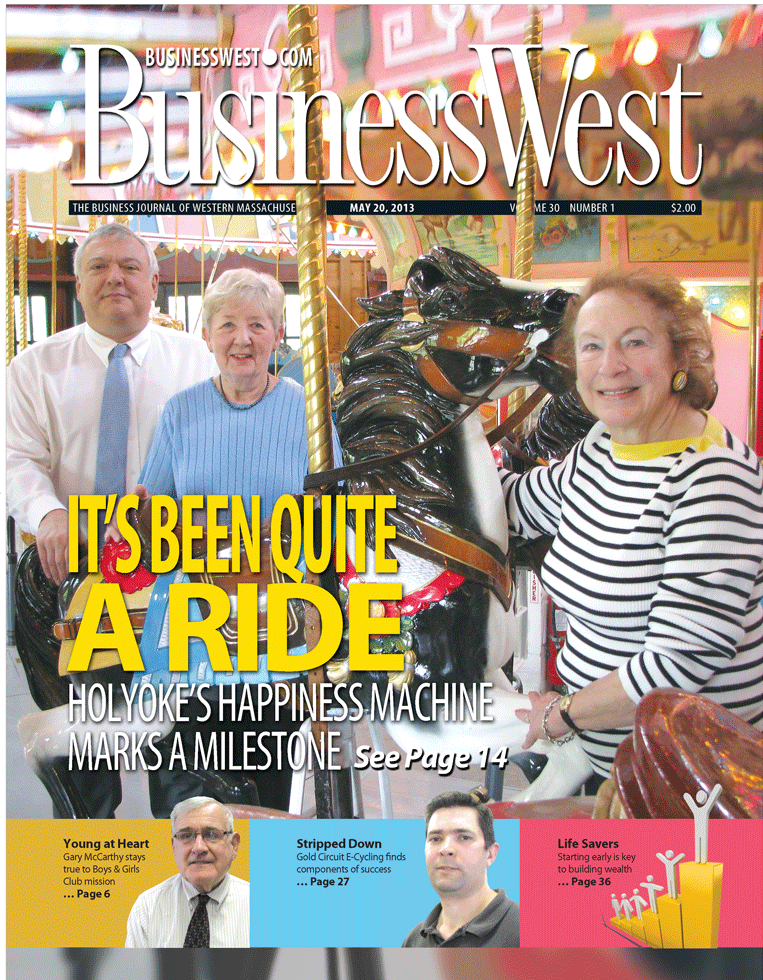
CoverBW-0513bThe Holyoke Merry-Go-Round marks 20 years in operation at Heritage Park this December.
Thus, this is a time of reflection and celebration in Holyoke, concerning both the remarkable story of how residents and businesses in the city rallied to keep the attraction within the community, and the success enjoyed since: more than 1 million riders, hundreds of events staged at the facility, restoration of nearly half the ride’s hand-crafted wooden horses, and the creation of untold memories for generations of area residents.
There will be many opportunities to rejoice and look back this year, with the highlight being a huge fund-raising gala at the Log Cabin Banquet and Meeting House on Sept. 19, an event that is expected to severely test the facility’s fire-code capacity.
But for those most closely involved with this landmark, known to them as PTC 80 (the 80th carousel built by the Philadelphia Toboggan Co.), this is a time for much more than celebrating — although they will do plenty of that. It’s an occasion to do some strategic planning and take important steps that will ensure there are many more anniversaries to celebrate down the road.
And it’s a time, said Angela Wright, to do some difficult, yet very necessary, succession planning when it comes to management of what those in the city call the ‘happiness machine.’

HolyokeMerryGoRound

Friends of PTC 80, as it’s called, will mark its milestone anniversary with an eye toward ensuring that there are more of these celebrations for decades to come.

Difficult, noted Wright, who was co-chair of the group that raised the money to keep the carousel in Holyoke and has been its volunteer director since it opened, because that’s the only word to describe what it will be like to “let go.”
“We’re reluctant to give up something that is close to all of us, and something that we worked so hard at —  it’s been a labor of love for all of us,” she said, referring to a strong corps of volunteers that has been with this project from the beginning and seen some of their ranks pass away in recent years. “We don’t want to let go of this, but it’s something we know we have to do.”
Elaborating, she said the Friends of the Holyoke Merry-Go-Round, as this group is called, is engaging in discussions about hiring a full-time executive director for the facility, an individual who will assume many duties currently carried out by those volunteers, from fund-raising to marketing, while also taking on the primary assignment — maintaining the relationships that have enabled this city treasure to survive and thrive, and creating new ones.
Hiring a director is one of many suggestions forwarded during strategic planning sessions staged recently with a consultant, Jeff Hayden, former city development director and current director of the Kittredge Center, said Maureen Costello, administrative manager of PTC 80.
Others include everything from recruiting additional board members to developing and implementing a marketing plan; from multi-faceted efforts to increase visitation to a host of initiatives to increase revenues, especially the scheduling of more birthday parties and other events.
These steps are in various, but mostly early, stages of implementation, said Costello, noting that one important step — a doubling of the price of a ride to $2 after more than 18 years — was undertaken in 2012.
“That was a difficult decision for us, because we had prided ourselves on keeping the ticket price at a dollar since we opened in 1993,” she explaned. “But it’s been very well-received by our visitors; many people said, ‘it’s about time you did this.’”
There will be more difficult and far-reaching steps taken in the months and years to come, said Jim Jackowski, business liaison and customer service and credit manager for Holyoke Gas & Electric and current president of the Friends board. He noted that, while the attraction’s first two decades in operation could be deemed an unqualified success, these are tenuous times for independently operated carousels like this one.
The challenges are many, and include everything from the high cost of insurance (carousels have historically had high mishap rates, although this one hasn’t recorded any) to the escalating competition for the time of young children (the ride’s lifeblood) and their parents.
“There are just a lot more things for kids and families to do today,” said Jackowski. “We have to respond to that by promoting ourselves and doing what we’ve always done — providing a truly unique experience.”
Wright agreed. “Many carousels are closing — hardly a week goes that we don’t hear of one of them shutting down,” she said, noting that she and others read about such casualties in industry publications like the Carousel News & Trader and Merry-Go-Round Roundup. “These things are becoming very expensive … our liability insurance is extremely high. Between insurance, staffing, maintenance, upkeep, promotions, and marketing, they’re becoming simply too expensive for many operators to run.”
For this issue and its focus on travel and tourism, BusinessWest takes a quick look back at how PTC 80 remained a Holyoke institution, but a more comprehensive glance ahead to the challenge of making sure the happiness machine will be there to create memories for future generations of area residents.

Turns for the Better

‘Middle horse #5’

‘Middle horse #5’ is next in line for a complete restoration. To date, nearly half of the horses on the carousel have been refurbished.

It’s known simply as ‘middle horse #5.’ And that says it all — if you know this carousel.
It has three rows of horses (there are 28 in all, both ‘standers’ and ‘jumpers,’ with two chariots), with the largest animals on the outside and the smallest on the inside. This particular specimen is fifth in a sequence known only to those intimately involved with this attraction. And it is showing some definite signs of wear and tear, much of it caused by the buckle on the stirrup, which has knocked off badly faded paint in several areas.
As a result, it is next in line for restoration work that will make it look like the much shinier and newer ‘middle horse #4’ just ahead. This work, to be carried out at the New England Carousel Museum in Bristol, Conn., will cost roughly $5,000, said Costello. To help pay that cost, the merry-go-round is staging a raffle this summer, with the winner gaining the right to give the horse a real name — like ‘Lancelot,’ ‘Flower Power,’ and others that have been assigned to other animals on PTC 80.
Restoring horses, staging raffles, and giving names to the stars of this attraction have been some of the many aspects of that labor of love which Wright described, made possible by the truly inspiring story of how Holyoke came together to keep its carousel a quarter-century ago.
Most in this region are now at least somewhat familiar with the saga, which began with Mountain Park owner Jay Collins’ decision to shut down the popular tourist attraction after the 1987 season ended.
After unsuccessful efforts to sell the park, the 300 acres it sat on, and all the equipment and inventory as one package (asking price: $4 million), Collins opted to start selling off the pieces. He had some attractive offers (up to $2 million, according to some accounts) for PTC 80, which was in extremely good condition. And while he was considering them, John Hickey, then manager of Holyoke’s Water Department, approached him with a plan to keep the carousel in the city.
The two agreed on a price of $875,000, and Collins gave Hickey one year to raise the money.
The rest, is, well, history.
An elaborate ‘save the merry-go-round’ campaign was launched, complete with a request for pledges with rhetorical calls to action that included ‘stop them from riding off with Holyoke’s mane attraction’ and ‘if you care about Holyoke’s future, put some money down on her past.’
In the end, residents, business owners, and schoolchildren heeded those calls, raising enough money to buy the carousel and build it a new home in Heritage State Park. Thus, PTC 80’s second life began in December 1993.
To say that it’s been a smooth ride since then would oversimplify things, said Wright, who noted that there have been many challenges over the first two decades, from getting people to come to downtown Holyoke to attracting revenue-generating events, such as birthday parties and weddings, to overcoming the loss several years ago of the four-day Celebrate Holyoke event that gave the carousel much-needed exposure and ridership.
“The real business challenge for us has been to replace the revenue from the Celebrate Holyoke festival, which was probably 10% to 15% of our annual revenue,” said Jackowski. “We’ve done it largely through the promotion of the birthday parties, the private functions, and the corporate functions, and spreading the word through an extended Pioneer Valley area.”
The attraction has managed to remain in the black throughout and meet its annual budget of roughly $100,000, he noted, largely through perseverance, imagination, and resourcefulness.
But if PTC 80, one of only 100 antique classic wooden merry-rounds still operating in North America, is to keep its Holyoke address, it must continue to act as a small business would, and that means strategic planning and, as Wright and Costello said, succession planning.

Round Numbers
That later assignment is a difficult one for many small businesses to even acknowledge, let alone address, said Wright, adding that it’s the same with the merry-go-round, where this exercise takes a number of forms.
For starters, it means active recruiting of younger professionals within the community to join the board and become involved with the carousel, she said, adding that a new generation of leadership must eventually take the reins — literally and figuratively — from the group that waged the campaign to save PTC 80 a quarter-century ago.
Succession planning also means developing and advancing a plan to hire a full-time executive director, said Costello, adding that the merry-go-round has a part-time operations manager (15 hours per week), and there are others who have held that position in the past.
Hiring a full-time manager would be a big step, one that would dramatically alter the budgetary picture, Wright told BusinessWest, but such a move is necessary given the current challenging climate. But the broad “transition,” as she called it, will nonetheless be difficult for the carousel’s older ‘friends.’
“We’ve all been here 25 years,” she said. “And we’re all somewhat reluctant to let anything happen to this merry-go-round. We all have a personal investment in this, and it’s a sizable investment.”
Succession planning is just part of the discussion when it comes to securing the long-term future of the merry-go-round, said Costello, adding that strategic planning initiatives involving the attraction, like those staged for businesses of all sizes, have focused on that acronym SWOT — strengths, weaknesses, opportunities, and threats.
Clearly, the 20th-anniversary celebrations fall into that third category, she said, adding that the attraction’s leadership intends to use the many events and special programs on tap this year to introduce (or re-introduce) people to the carousel, with several goals in mind. These include everything from increasing direct ridership to booking more special events involving both children and adults; from recruiting more supporters to simply raising more funds.
“The 20th anniversary is a time to reflect on the many things that we’ve accomplished here and be proud of those accomplishments,” Costello said. “But it’s also an opportunity to re-connect with our supporters and make more friends.
“We recognize that, while our merry-go-round was the crown jewel at Mountain Park, the people who remember the park are older now,” she went on. “We understand that those people are not going to be able to share their memories of Mountain Park, so we need to attract a new generation of riders and supporters, and we’re cognizant of that as we make our plans for the future.”
As it did 25 years ago, the Friends group is reaching out to the community for donations, she said, adding that donors can become members of the merry-go-round’s Ring of Honor, a collection of brass plaques that bear the names of supporters ranging from Holyoke schoolchildren to businesses across all sectors.
Beyond fund-raising, one of the main goals moving forward is to maximize other revenue resources, said Costello, adding that the increase in ticket prices resulted in a roughly 70% increase in total revenue in 2012, “which made a huge difference.”
But long-term, the merry-go-round must be more successful with scheduling events, she continued, because they are both solid revenue generators and vehicles for generating future ridership and more get-togethers.
Overall, the ongoing assignment for the merry-go-round’s leadership team is to make the attraction — and downtown Holyoke in general — more of a true destination for families with children, said Jackowski, adding that there are many developments that are moving the city closer to that designation.
“We hope, by keeping this building as attractive as it is, and this park as attractive as it is, that the future looks bright,” he told BusinessWest. “We have our new neighbor, the computing center, we’re hopeful that the canal walk comes to fruition in the next five years, and there is more development down here that creates optimism. We want to be the focal point of all that.”

The Ride Stuff
John Hickey, who passed away in 2008, once wrote of carousels, “man, and high tech, has not yet devised a better way to illuminate the faces of children and parents with pure joy. The lights, the music, the kids dashing for the right horse, the clang of the starting bell, and the motion … you don’t really understand human nature unless you know why a child on a merry-go-round will wave every time around … and their parent will wave back. It never fails … it never will.”
PTC 80 has lived up to those words for more than eight decades, and especially in its new home in Holyoke’s downtown. Its first two decades there have been an extraordinary ride in every sense of that word.
And that’s why this anniversary will be a time to celebrate, but also a time to make sure that the ride will continue for decades to come.

George O’Brien can be reached at [email protected]

Sections Travel and Tourism
Robert E. Barrett Fishway Offers Learning Experiences on a Grand Scale

Paul Ducheney

Paul Ducheney says the fishway was the culmination of years of study involving fish behavior, as well as considerable trial and error.

Paul Ducheney acknowledged that it’s difficult to look upon the elaborate, cutting-edge Frank E. Barrett Fishway and grasp that it was inspired by a net and a bucket.
But it was. Well, sort of.
As legend has it in Holyoke, in 1955, an Atlantic salmon was trying to make its way north on the Connecticut River, back to its birthplace to spawn, when it hit what was then a roadblock — the Holyoke Dam. The story goes that an engineer with what was then the Holyoke Water Power Co. caught the confused fish with said net, but then didn’t know what to do with it.
“So they said, ‘well, lets put it in a bucket of water and bring it up over the dam and dump it in,’” explained Ducheney, superintendent for Electric Production at the Holyoke Gas & Electric Department (HG&E), which acquired the dam in 2001. “And that was pretty much the start.”
Today’s Robert E. Barrett Fishway is the result of that ongoing story of how, through the use of exponentially more sophisticated means of fish attraction and larger buckets, HG&E has created a fishlift that has become a model for hydropower systems in this country and around the world.
The two-bucket system carries hundreds of thousands of anadromous fish — those born in fresh water (salmon, smelt, shad, striped bass, and sturgeon are common examples), and spend most of their life in the sea, but return to fresh water to spawn — over the dam each year so they continue their migratory journey north.
And while doing so, it provides powerful lessons to visitors, many of them schoolchildren on field trips, about these fish, hydropower, and how they can coexist.
This was the dream of Robert E. Barrett, former president of the Holyoke Water Power Co., whose imagination and perseverance made it reality.
The current fishway, opened in 1955, hosts more than 11,000 visitors a year between April and June, when the fish make their annual treks north, said Kate Sullivan, marketing coordinator for the HG&E, who told BusinessWest that the facility is still far too much of a best-kept secret from a tourism perspective, and that the utility is working to see that it loses that distinction.
“People are always amazed; they can’t believe this is in their own backyard,” said Sullivan. “And this was part of Robert Barrett’s mission, to make this an educational experience for kids, too.”
For this issue and its focus on travel and tourism, BusinessWest paid a visit to the fishway for an educational experience on a grand scale — in more ways than one.

Current Events

This illustration shows how the fishway

This illustration shows how the fishway enables migratory shad, Atlantic salmon, and other species to be collected, lifted in buckets over the dam, and released.
Illustration by Robert Oxenhorn

As she gave BusinessWest a tour of the facilities, Sullivan said the creation of such facilities to ferry fish over hydroelectric installations became a federal mandate for those seeking to hold licenses for such facilities decades ago, and there are many such lifts operating today.
But the fishway in Holyoke is somewhat unique because of the breadth and depth of the educational opportunities it provides and the large scale of the operation. Indeed, it is said to be most successful fishlift on the Atlantic coast in terms of the number of fish it ferries.
For visitors, it’s an opportunity to see how nature and modern technology can collaborate and create some powerful images.
Once through the entrance of the power station, visitors are led — on the right, past the giant HG&E turbines that harness the river’s power, and, on the left, past a series of historical pictures of the dam and older fish-assisting devices — out to the large outdoor observation deck. Standing high above the Connecticut River on the deck, they get a southern view of the river and the special canal, which shows the two ways fish enter the gathering area by way of a high-velocity water flow that attracts them to the main collection area just under the deck.
Visitors can then turn their attention to the north and experience the sights and sounds of water coming over a section of the dam, next to the lift structure. On the half-hour, a buzzer rings, signaling the start of the fishlift as its two large buckets begin carrying hundreds of fish and water more than 50 feet up and into an exit flume. This is the point where visitors then move inside to see the fish swim by the public viewing windows, giving them the feeling of being underwater with the fish.
Sullivan told BusinessWest that guided school-group tours take about an hour, which includes time for an activity.
“And this is very unique,” added Ducheney. “If you go to other lifts at other dams, they’re sort of separate from the powerhouse, so it’s pretty neat to see power generation integral with fish passage. It’s Holyoke’s best-kept secret.”
But that secret took some time to materialize.
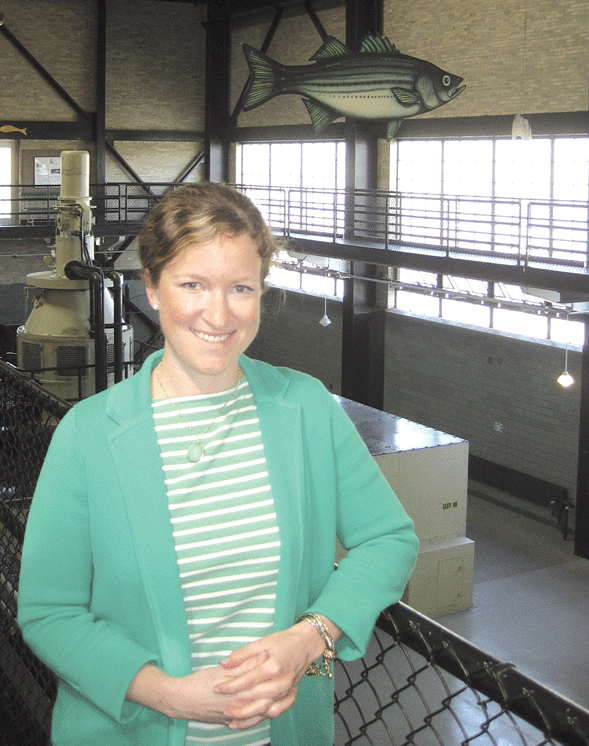
Kate Sullivan

Kate Sullivan says grassroots efforts have helped increase visitorship at the fishway, which is open only a few months a year.

Dams have been built to harness hydropower for centuries, and attempts to help fish on their migratory journeys have been part and parcel to those efforts, but finding a system that works effectively has often been a frustrating matter of trial and considerable error, said Ducheney, noting that Holyoke’s history serves up some good examples.
Since 1794, several dams have been constructed at South Hadley Falls, where the river drops more than 40 feet, and in October 1849, a large ‘timber crib’ dam was constructed, preventing upstream fish migration.
In 1866, Massachusetts enacted legislation requiring the construction of devices to permit passage of shad and salmon, which resulted in the first wooden fish ladder in 1873 — a system designed to replicate nature — on the South Hadley side of the river. However, the ladder was off the beaten path of the fish’s instinctual travels, said Ducheney, and fish passage didn’t go well; in fact, not one fish used any of the early ladders.
In 1900, the current, much larger dam made from Vermont stone was built, and in 1949, HWP received a license from the Federal Power Commission for the Holyoke Hydroelectric Project. As part of the license, HWP was required to “construct, maintain, and operate fish-protection devices.”
Soon after, the aforementioned lucky Atlantic salmon was saved and lifted over the dam. The stiffer federal mandate had engineers building a different type of fish passage because others hadn’t worked. More research into fish behavior resulted in the reason why: fish needed to sense the sound and current of rushing water on their journey, where a dam now stood. The solution was to create a gathering area by way of a high-velocity water flow that attracts the fish to the main collection area just under the deck, and the first lift, using a bucket in 1955, was built under Robert Barrett’s direction — the first successful fishlift in the country.
“It’s very important for the ecosystem,” Ducheney noted. “From a regulatory basis, today we have a mandate from the Federal Energy Regulatory Commission to operate the dam, and part of the conditions is to provide for safe and effective fish passage.”
Today, fish can continue upstream migration (if they’re not collected for hatcheries), where fishways further upstream at the smaller Turners Falls, Vernon, and Bellows Falls hydroelectric projects also provide a means to enhance passage for migrating species through a simpler elevated step process.

Hook, Line, and Sinker
When HG&E purchased the Holyoke Dam to operate the hydroelectric facilities and the Holyoke Canal System, more improvements were made to the fishlift, Ducheney explained to BusinessWest.
“It’s automated now, so it runs without operator intervention, and it’s tripled in size, so we can accommodate many more fish,” said Ducheney. “In fact, this lift has become a model for others, including the Susquehanna River and in Japan, China, Brazil, and European countries. Holyoke is pretty well-known for fish passage.”
And the fishlift is a first for something else that’s important.
“Literally, every fish is counted,” said Sullivan, noting that the Holyoke Dam is the first that fish encounter as they move north from Long Island Sound, so keeping accurate inventory is critical to tracking what happens to fish before and after they get to the Paper City.
The counters are biology students from Holyoke Community College who click a designated counter for each species of fish in a special viewing room just past the public viewing windows; its another form of educational experience of which Barrett would be proud.
Since the official counts started in 1965, the most prolific years for fish passage were in 1985 and 1992, at more than 1 million fish. In 2012, more than 500,000, mainly shad, were lifted over the dam.
Shad, said Ducheney, is a river herring, and while that may not sound delectable, he noted that shad is actually on the menu at New York’s famous Tavern on the Green restaurant at this time of year.
But restaurants aren’t the only interested parties when it comes to shad. The annual HG&E Shad Derby, one of the region’s largest fishing events, is held on two weekends in May and offers nearly 600 anglers of all ages the opportunity to win cash prizes and write plenty of their own fish stories as they enjoy the recreational benefits of the Connecticut River.
Marketing funds are tight, Sullivan said, so getting the word out about the fishway is a struggle. But thanks to HG&E’s newsletter to 18,000 customers, as well as more comprehensive grassroots efforts over the past couple of years to increase awareness of the facility, visitation has increased.
In just a short window of six weeks, from late April to mid-June, more than 11,000 visitors came through the fishlift last year, 2,000 more than in 2011, said Sullivan, noting that many of them are students from across the region.
The fishlift is open Wednesday through Sunday, 9 a.m. to 5 p.m., until June 16, due to the spawning season each spring. Also open on Memorial Day, the facility offers visitors of all ages a unique combination of science through tourism, and a chance to tell a real fish story about the ones that got away — or at least further upstream.

Elizabeth Taras can be reached at  [email protected]
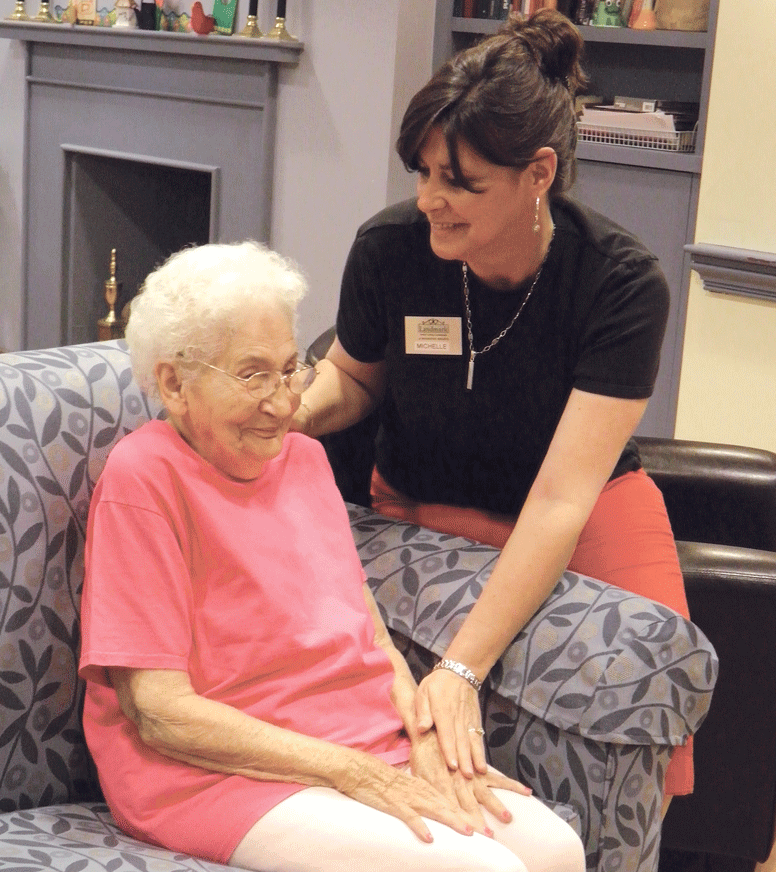
Sections Travel and Tourism
Museums10 Adds New Brush Strokes to Its Work in Hampshire County

Jessica Niccol

Jessica Niccol says Museums10 helps raise the profile of what she calls “an extraordinary set of historical collections.”

Like a particularly striking sculpture, a museum has many intriguing sides.
The Smith College Museum of Art is a good example of that, said Jessica Niccol, its director and chief curator. The institution was established not long after the college opened in 1875 and was conceived as a teaching museum. Unlike many prominent galleries then and since, it did not launch with a gift collection waiting in the wings, but accumulated its first pieces one at a time.
“So the staff, very mindfully, built a collection with an eye toward what was being studied at Smith College,” Niccol said. By 1879, the gallery featured 27 contemporary American paintings, featuring notable lights like Winslow Homer and a number of lesser-known artists, and steadily grew from there, helped immeasurably by local businessman Winthrop Hillyer, who appreciated the growing museum and decided to fund it.
“He loved that it would be as much of a benefit to the community of Northampton as it was to Smith,” Niccol said, noting that the orientation of the current building, opening onto Main Street in front and the campus in back, reflects that dual identity. “He saw that the museum could be a resource to the community and a gateway to the campus, and you see both of those things in the way the museum has developed over the past 140 years.”
But that dual focus on education (Smith boasts a robust program of college classes, tours serving thousands of schoolchildren each year, plus college students trained to be gallery instructors) and community outreach (including family days and monthly free Friday nights, featuring gallery talks and other special events) is not exclusive to Smith, but is a common theme running through many of Hampshire County’s art and history museums.
That’s one of the reasons Museums10 makes so much sense, said Kevin Kennedy, director of Communications for the Five College Consortium, from which Museums10 sprung in 2005.
“Much of the consortium’s efforts,” Kennedy said, “are really spent bringing people from the campuses [Smith College, Hampshire College, Amherst College, Mount Holyoke College, and UMass Amherst] together to share ideas, problems, solutions, things like that.”
Therefore, he continued, “it was natural for the directors of the campus museums to participate in that. It’s been going on informally for decades; it started growing organically, and then they decided to formalize it and actually create an organization.”
Kevin Kennedy

Kevin Kennedy says Museums10 acts as a lens to focus the significant energy of its members.

The art museums of the five colleges make up half Museum10’s membership, and they are joined by the Beneski Museum of Natural History, the Eric Carle Museum of Picture Book Art, Historic Deerfield, the Emily Dickinson Museum, and the Yiddish Book Center. The startup money came from the Mass. Cultural Council, with the goal of raising the profile of the Pioneer Valley as a center for cultural tourism.
“Hopefully it has benefited the community by making these rather extraordinary museum resources housed within the Upper Pioneer Valley more visible to people,” Niccol said. “One of the things that awes all of us is what an extraordinary set of historical collections we have here. And, collectively, we’re able to work together to give greater visibility to these resources to try to help visitors — by suggesting multiple museum visits around a special area of interest, for instance.”
To that end, early on, Museums10 launched a series of cross-institution events, starting in 2006 with GoDutch!, which explored the art and literature of Dutch culture, past and present. “All the museums included it as some aspect of their existing collection or brought in a new exhibition,” Kennedy said. “It was a big success.”
The goal was to increase attendance at the participating museums by 5%; instead, it boosted visitation by 15% across the board, and in some venues by as much as 40%.
So, in 2007, Museums10 launched a second system-wide event, this one called BookMarks: A Celebration of the Art of the Book. That was followed in 2010 by Table for 10, with a focus on food. “That was terrific because this is such a food-rich region, and we were able to tie into agriculture, restaurants, organic food creators, wine folks, you name it.”
Eight years into its existence, the goals of Museums10, and the way the individual institutions work together and share resources, are continually evolving. For this issue’s focus on travel and tourism, BusinessWest takes a look at how the organization paints a collective picture of a vibrant cultural scene in Hampshire County.

Drawing on Expertise
Alix Kennedy, executive director of the Carle — which, with only 11 years under its belt, is the youngest of the 10 museums — said Museums10 is about far more than marketing the museums.
“It’s also about how we can leverage resources we have so we can have a greater impact in our own communities,” she told BusinessWest. “The days when organizations try to exist in silos is over. Thankfully, there’s a tremendous amount of professional rapport that everyone gets to benefit from.”
Niccol agreed, noting that, because the museums have small staffs, “there’s an incredible benefit to building this professional network within the five-college area. We’ve really developed strong ties as the curators meet each other, educators meet each other, the marketing staffs meet each other. There’s fantastic communication and support with problem solving.”
Shared resources are critical, she said, such as bringing in educators and workshops for the entire Museums10 system in specific subjects, rather than each of them sending staff members to conferences around the country.
“A lot of things happened,” Alix Kennedy said, “by taking like-minded groups and this variety of different museums, who all share this incredible passion for education, and figuring out ways to give people access to our resources.”
The 30-year-old Yiddish Book Center boasts a wide range of exhibits, lectures, conferences, and educational programs for both college students and adult learners — not to mention big events like Yidstock, an annual summer festival that brings in top names in the klezmer musical tradition and draws visitors from across the country.
“There’s no other place like it,” said Lisa Newman, the center’s director of communications. “Sometimes we refer to ourselves as the first Yiddish museum; there’s no other institution like this, with the breadth of what’s here and all the programs created to promote Yiddish culture. And it’s all rooted in the first mission of the center, which was the rescue of more than a million Yiddish books otherwise destined for the trash.”
Newman added that she has come to appreciate the collective power of Museums10 in supporting that mission.
“I think it’s a really interesting collaboration internally and externally,” she said. “It helps all of us professionally to engage with one another, but in terms of the community, it makes a strong statement that we have these 10 very unique museums — that we have tremendous resources as well as engaging, interesting, and surprising places to visit, and we’re right here in your backyard with a tremendous amount of programming going on.”
As director of marketing for Historic Deerfield, Laurie Nivison said it can be difficult to adequately communicate what such a large, multi-building facility has to offer.
“We say ‘opening doors to the past’ because we have 11 houses and an extensive museum collection for people to explore. We want to make it a destination, not just for people in the local area, but those from outside the area looking for a daycation — just looking to come and explore.”
Museums10, she said, helps get the word out by linking Historic Deerfield’s goals with those of the broader cultural community.
“This is a good group of people,” Nivison said. “As nonprofits, this sort of collective power is helpful, because something one museum might be able to do, another museum might not have the budget to do. Part of Museums10 is leveraging our power, helping us get into those markets we may not otherwise be able to reach.”

Next Phase

Alix Kennedy

Alix Kennedy

“This community is rich in artists,” Alix Kennedy said, noting that the Carle makes an effort to promote and involve the many children’s book artists living in Western Mass. In fact, several museum officials who spoke with BusinessWest brought up the ‘creative economy’ of artists living and working in the Valley.
“We’re really proud of the fact that Museums10 is an important part of the cultural economy,” Niccol said. “Why do people come here? Part of it is the incredible beauty of the landscape, but the other part is the great bookstores, restaurants, concert venues, and museums, and we see ourselves as part of that.”
From those efforts, said Kevin Kennedy, sprung the impetus for what is now known as the Hampshire County Regional Tourism Council, launched in 2012 and funded by the Mass. Office of Travel and Tourism.
“The cultural profile of Hampshire County shows what a unique area it is, and we showed how people could come together to promote that aspect of this area,” he explained.
“It’s been such a natural transition,” said Alix Kennedy, who chairs the new organization. “I think all of us living in the Valley know this is an incredibly rich community for arts and culture, and yet, we’re not confident that people outside this community know that.”
But Museums10 and the tourism council are working to change that, she continued, by bringing some collective marketing muscle to the passion that already exists among the various institutions. “I see these two efforts working in parallel and, ultimately, working in partnership.”
“To a certain degree, I think it’s taken a little pressure off Museums10 to spend all its collaborative time to promote the region,” Kevin Kennedy said, explaining that the member museums are starting to focus more on smaller collaborations involving just a few of them, instead of the system-wide events of past years. “These joint productions were terrific, but they took a lot of energy, and that didn’t leave a lot for other things.
“We’re really taking a step back,” he added, “looking more at where the natural cohesions are among the museums that could be brought to the attention of the media and the public. If a few museums happen to be doing exhibits on photography, we’ll do a press release on that. It used to be an all-for-one approach, and all 10 museums needed to be involved to make it a Museums10 event. Now, if three or four museums are working together because they have similar exhibits or similar interests, Museums10 supports them in that effort.”
It all comes back to supporting culture in the Valley and cultivating new art and history lovers, Alix Kennedy said, noting that the Carle attracts a wide range of constituents, from families and elementary-school students to graduate-level art-degree programs Simmons College operates on site — not to mention those drawn by nostalgia.
“Those books are such symbols of their childhood, and it’s really exciting and reinvigorating to come in and say, ‘they have Charlotte’s Web drawings! I love that book!’” And, like some of the other Museums10 institutions, the Carle reaches into the community with programs like visits from book illustrators to schools in Springfield and Holyoke, hopefully sparking a passion in a new generation.
“The fact that we’ve got these 10 great institutions in the Valley speaks to our culture and the wealth of history and knowledge in the Valley,” Nivison said.
Kevin Kennedy agreed. “Each museum has so much energy,” he said, “and I think Museums10 can act as a lens to focus all that energy.”

Joseph Bednar can be reached at [email protected]

Green Business Sections
Gold Circuit E-Cycling Carves Out a Unique Niche

Matt Pronovost

Matt Pronovost says the mission at Gold Circuit E-Cycling is controlled growth.

Matt Pronovost calls it his “museum wall.”
It’s little more than a few wooden shelves in the back of the room cluttered with what could only be described as electronic artifacts, especially if you’re under age 40. There are a few 8-track players in the mix, two movie projectors, a ’60s-era console television (a model that sat on the living room floor), a turntable, an old Atari system, several beta camcorders and transistor radios, and maybe a half-dozen rotary telephones of various colors and shapes.
And then, there are the computers, most with brand names and model numbers that achieved fame (or infamy) but disappeared from the landscape decades ago. A Commodore 64 sits between a Digital UT102 and a Radio Shack TRS-80 Model III microcomputer. All three probably came out of the box 30 years ago, and they certainly look their age.
Pronovost said it takes something really unique to make the wall these days — like the old washboard and basin that came in a few weeks ago — partly due to the fact that he’s just about out of display space. But it’s mostly because he’d rather devote his time to the 99.9% of the stuff that comes in his door that he doesn’t even think about keeping.
This is what Gold Circuit E-Cycling is really all about.
This bin of circuit boards

This bin of circuit boards is one of many crowding the floor at Gold Circuit E-Cycling.

It’s a three-year old enterprise devoted to the recycling of computers and electronic equipment, an intriguing and fast-growing venture now occupying roughly half of one of the dozens of buildings comprising the sprawling Ludlow Mills complex. And it would seem to be the right business in the right place at the right time.
Indeed, as technology advances at a rate so rapid that it seems like a 40-inch flatscreen TV or five-year-old PC might soon be candidates for the museum wall (and there are more than a few of both on the floor waiting to be dismantled and recycled), area business owners and residents are increasingly challenged by the question of what to do with yesterday’s electronics as they acquire tomorrow’s products.
And Gold Circuit was created to provide an answer.
“Increasingly, people are realizing that there’s a solution to their problem, and it’s not the garbage can,” said Pronovost, adding that the business of e-cycling, as it’s called, is not exactly new, but it is picking up steam in the Northeast after migrating from the West Coast (as many trends do) a decade or so ago. “We’re here to help people make the responsible choice when it comes to unwanted electronic equipment.”
This venture, which recorded 25% growth in its first full year in business and will likely double its volume this year, collects or ‘demanufactures’ computers, electronics, batteries, home appliances, lawn equipment, metal furniture, copiers, printers, medical equipment, power tools, tires, fluorescent bulbs, styrofoam, pellet-fuel bags, and more, and sells the parts and material for scrap, thus keeping such items out of the waste stream.
There are charges for some products that are dropped off at the facility — anything with glass or refrigerant, for example, and tires as well — but many items can simply be left free of charge. And the company is making it even easier by staging collection events, such as one held recently at East Longmeadow High School.
Several dozen pieces of equipment arrive at the Gold Circuit facility each day, meaning the company is already essentially at full capacity in a 15,000-square-foot location it moved into just last year after outgrowing its original, 6,000-square-foot home in the Ludlow Mills complex.
When, how, and where the company next expands is a critical question, said Pronovost, adding that at present, the goal — and the challenge — is controlled, smart growth.
“I don’t want to grow too fast because expenses can really take off if you’re not careful,” he explained. “Like any business, we have to stay within ourselves and expand in a smart way.”
For this issue and its focus on green business, we look at a company that is certainly larger than the sum of all those parts amassed on the Gold Circuit floor.

Here’s the Breakdown
As he gave BusinessWest a tour of his facility, Pronovost stopped briefly at the museum wall — he tried, unsuccessfully, to find a date on that washboard — but quickly moved on to several large cardboard boxes, each destined for a vendor that would recycle the material in question and/or extricate the more valuable materials from them.
There was one for clean (as in unpainted) aluminum, a material that will fetch 65 cents a pound, he said, and another for ribbon wire, most of it from PCs. Three boxes contained low-grade, medium-grade, and high-grade circuit boards, respectively, designations that indicate that amount of gold in each one. And there were others for everything from transformers (separated by size) to plastic (one for lighter colors and one for black).
Meanwhile, there was a huge box filled with Styrofoam that was used to keep many of these products safe in their boxes. Sold by the bale, this material has a number of potential future uses, said Pronovost, especially as a composite material used in everything from furniture to picture frames.
How he came to be an expert on the future lives of such materials — and to create a business focused on e-cycling — is an intriguing story based on the most basic principles of entrepreneurship: seeing a need and creating a service to meet it.
“To be honest, I pretty much fell into this,” he explained, while retracing a career that started with work supporting those using computers, not breaking them down into component parts.
He started in what he called the “desktop-support field,” working at MassMutual for a few years before moving to a firm in Connecticut where he handled hardware setup and configuration work, as well as equipment auditing. As that company was repeatedly sold to larger corporations, with each transaction accompanied by a change in equipment, Pronovost segued into resale of the old hardware and, eventually, into selling parts and material for scrap, an operation carried out in-house.
“I had the right background to distinguish whether the parts I was looking at had value outside of scrap — whether they could be wholesaled out or brokered out, whether we tear it down or not tear it down,” he noted, adding that he quickly moved up the ranks within this division. “I made the transition from technician into sales, and was doing well with generating revenue.”
However, the Great Recession changed the equation quickly, he went on, adding that he was one of many to be laid off and forced to settle on a new career path. His was entrepreneurship.
“I decided to do it myself,” he said, with the ‘it’ being e-cycling. “I could see that there was a lot of opportunity, especially here in Western Mass.”
Elaborating, he said that there were, and still are, national outfits that would work with large corporations, such as MassMutual and Aetna, to help them scrap electronic equipment, but such operations historically haven’t had much interest in small businesses or residents. Meanwhile, some communities had collection operations (most of them pricey) at their transfer stations, he went on, but there was a definite void in service to large portions of the local market, and this was the need he set out to address with Gold Circuit.
He opened the doors in October 2010 and started small, handling the bulk of the work, including most of the demanufacturing, himself. Growth, he noted, has come through awareness — of both his company’s services and the need to seek out earth-friendly ways of dealing with yesterday’s electronic devices.

Hard-driving Entrepreneur

Employees at Gold Circuit

Employees at Gold Circuit ‘demanufacture’ a wide array of computers and electronics, with parts and materials sold as scrap.

Using an old laptop as an example, Pronovost said there is a good deal of scrap value in such devices, and his company has become adept at squeezing every cent from them.
“The screen, if it’s unbroken, can be torn down and reused,” he told BusinessWest. “The main [circuit] board probably has the most scrap value in that laptop, but the hard drive comes out to be shredded, and there’s a lithium battery — and right now, lithium is one of those commodities that’s sought after. Everything has scrap value.”
On the day BusinessWest visited the operation, there were several dozen old laptops awaiting their fate. A few of them might actually be sold to resellers if they are in very good condition, said Pronovost, as will the various pieces of equipment — computers, printers, VCRs, phones, air conditioners, toaster ovens, and more — crammed into the 20 or so large boxes on the shop floor.
This is a busy time of year — good weather inspires people to clean out their homes and businesses, apparently — and the floor is crowded with “inventory,” he went on, adding that Gold Circuit currently has several days worth of devices to demanufacture, and more comes in every day.
Pronovost has tweaked his original business plan slightly, but for the most part, the document’s projections for volume, or weight (400,000 pounds of material in 2012), revenue, growth, and employment have been on the money.
They were based on a number of factors, but mostly the incredibly fast pace of progress with computers, cell phones, and other electronic equipment, and the market for used items — or the lack thereof, as the case may be.
Indeed, he said that PCs more than seven years old, and some much younger than that, have little value other than as scrap when their owners decide to upgrade. And the same is largely true for today’s televisions.
“The older ones, those 20 or 25 years old, are still working,” said Pronovost with a laugh. “The newer HD models … they don’t work. And when they break, you generally have to replace them.”
This phenomenon is one of the many factors contributing to the company’s impressive growth rate, he continued, adding that others include everything from a lack of competition locally to strong word-of-mouth referrals, to heightened efforts in recent years to market the company.
But much of it comes down to partnerships, or working with a host of constituencies, from individual communities to area colleges and universities, to encourage responsible disposal of unwanted electronic items.
When the town of Longmeadow opened its new high school, Gold Circuit took roughly 12,000 pounds of old computers and other electronic equipment from the old one free of charge, said Pronovost, adding that another example of such partnership-building was the recent collection drive at Holyoke Community College to benefit a scholarship fund at the school. Participants paid a small fee to organizers to have everything from an old cell phone to a garage-cluttering air conditioner hauled away by Gold Circuit.
Such events are win-win-wins, said Pronovost, noting that the scholarship fund grows, the planet benefits because such items don’t wind up in area landfills, and Gold Circuit gains some invaluable exposure.
Looking ahead, he said the company, which now has four full-time employees, and several part-timers, will continue its efforts to chart steady but controlled growth.

Parting Thoughts
Pronovost said his museum wall often generates interest and conversation.
“People will say, ‘holy smokes, a Commodore 64 — I had one of those back in…,’ and they start adding up in the years,” he said, adding quickly that, while nostalgia is fine, it’s not what this business is all about.
Instead, it’s about meeting a growing need among area businesses and communities, and a desire to do the right thing when it comes to disposing of old equipment, styrofoam, and more.
“People are learning … they’re understanding that you can’t just throw things like this away,” he said, sweeping his hand across the shop floor. “And we’ve become an answer to their problem.”

George O’Brien can be reached at [email protected]

Sections Wealth Management
Critical for Effective Wealth Building

WealthBuildingSome watched the financial collapse in 2008 severely hamper their parents’ retirement plans. Others are simply working at jobs without pension benefits and doing the math.
For whatever reason, young people are starting to take a more serious look at their long-term financial future — a trend Patricia Grenier finds gratifying.
“For the first time in many years, I’m actually seeing young professionals — dual-income couples in their early 30s — coming in to talk about financial planning,” said Grenier, general partner with BRP/Grenier Financial Services in Springfield.
“That’s very surprising because, in the past, I always used to say, ‘I wish I could get them when they’re young, when time is on their side and they can ride the many ups and downs in the market.’ But now, they’re coming in at a much younger age, which gives us a lot more flexibility, a lot more time. It allows us to fix things and make adjustments as we go along.”
George Keady, senior member of the Keady Ford Montemagni Wealth Management Group at UBS Wealth Management in Springfield, makes a similar observation.
“The clear trend in the past five to seven years has been people starting younger,” he told BusinessWest, noting that some of that may be based on encouragement from their employers, many of which enroll them in self-funded retirement accounts almost immediately, and the employer must take the initiative to unenroll.
“Young people today assume they’ll have to take full responsibility for their retirement,” Keady said. “The era of defined benefits and pension payments is being reduced dramatically, so people are taking responsibility through 401(k) plans and savings.”
Doug Wheat agrees. “Certainly, many employers now automatically enroll new employees in 401(k) plans, and that has made a huge difference in what the participation rates are,” said the senior manager of Family Wealth Management in Holyoke. “While there may be more awareness, I think the automatic enrollment has made the most impact.”
While the world of the Internet age is definitely more educated on financial matters than it used to be, Grenier said many young professionals took lessons from the 2008 crash and what it did to the retirement savings of people they know, including their parents. Whatever the reason, they’re increasingly starting early to seek strategies to build and protect wealth.
“They’re more aware,” she said. “We have more knowledge 24/7; we know what’s going on. You can turn on the TV anytime and see exactly what’s happening in the world and in the economy. But there are strategies you need to apply that can’t be learned by turning on the TV. You have to sit down and plan.”

Planning Ahead

Pat Grenier

Pat Grenier says one of the biggest financial mistakes people make is underestimating how much money they will truly need down the road.

Some strategies are time-tested common sense, Grenier noted: save at least 10% toward retirement, prioritize spending and stay within one’s means, and do not build credit-card debt.
As for specific plans beyond the basics, when Grenier talks to younger investors, “they’re asking, ‘am I doing the right thing?’ even though retirement is 30 years down the road for them,” she told BusinessWest. “The lesson to be learned from this big downturn is you need to plan, you need to have a plan B, and if you think you have enough money, you don’t. You always need more money.”
To that end, she added, “I am seeing the younger ages more willing to plan and be flexible. And, unlike older clients, both spouses are usually involved in the decision-making process.”
Wheat said young professionals need to use the time they have to save for retirement, even though it seems so far down the road, “because they can take advantage of compounding interest by starting early. When you do that and build wealth slowly over time, the ultimate goal can be less daunting.
“If young people can target 10% to 15% of their take-home pay to put automatically in a 401(k) or 403(b) plan at work, it makes it relatively painless to contribute to retirement goals down the line,” he continued. “If they do that, it’s much easier to reach a retirement-savings goal which maintains their standard of living in retirement.”
That’s because, “in general, people underestimate how much they may need, and even when they’re contributing to a retirement plan, they often don’t contribute enough.”
If nothing else, Keady said, workers should maximize their company match if there is one, because every dollar makes a difference compounded over time. “If somebody starts putting $15 a week away in their 20s, in 40 years at 6%, they’d have $130,000.”
But that’s just the beginning, he said. “If they get started early, they can sit down and construct a real plan, not a one-size-fits-all solution. We have clients show up in their late 50s, and they’ve accumulated some money, but they really don’t totally comprehend what they need in the years ahead. People in their 40s who have accumulated some money have more options in the planning process.”
One reason young people might be starting on a savings and investment plan early is the cost of college tuition, which has far outpaced the general inflation rate over the past quarter-century.
“The young couples I’ve had this year are really concerned about the cost of education, what it will cost them to educate their children. Personally, I think college tuition is the next big bubble; it’s unsustainable,” Grenier said, noting that the average private college costs about $55,000 per year for tuition, room, and fees. “Even if their kids aren’t going to school for another 10 or 15 years, at today’s cost of college, there’s no way they’re going to be able to save enough money. Coming up with a strategy for them to alleviate the college load is really important.”
Wheat, who wrote about planning to pay for college in the May 6 issue of BusinessWest, agreed that it’s a daunting prospect. “Most people don’t have nearly enough to pay for college. The question becomes, how much debt are they willing to bear? Sometimes they take on more than they should — both college students and parents — and don’t think carefully about taking on more debt.”

Age-old Questions
For older individuals and couples, of course, expenses change as the retirement years loom.
“For people in their 50s and 60s,” Keady said, “those are the years where maybe tuition responsibilities are behind them, they’ve paid for their home, and now they’re thinking about themselves, thinking about retirement income, but also thinking about long-term care issues. That comes with longer life expectancy.”
What those people need to do, Wheat said, is to think about how much they need to maintain their standard of living, and then decide whether their goals are reasonable based on their expected income. If not, “are you going to cut back on your standard of living now or wait until retirement to do that, or do a little bit now and a little later?
“Most people, when they’re thinking about wealth building, really need to start with the basics of what they’re spending their money on and what their total expenses are,” he continued. “Are they spending money on things they really value, or are there places in their budget where they can cut back? For some people, creating artificial spending barriers is helpful for doing that. One of the classic ways to create an artificial spending barrier is to have part of your paycheck go directly into a savings account, where maybe it’s not as easily accessible and not as easily spent.”
Keady also suggested workers increase their withholding with every increase in their salary as another means to painlessly boost their savings. Still, Wheat said, most often the main issue is spending, not saving.
“It’s surprising how few people really know how much money they spend every year,” he told BusinessWest. “People know what their take-home pay is every week or every month, but they don’t necessarily think about it in terms of how much they’re spending for a whole year. The end result, for a lot of people, is spending small amounts of money on lots of things that are not that valuable to them, and it ends up being a lot of money — $20 on this, $25 on that, and $30 on this, and pretty soon it’s thousands of dollars every year.”
It’s an issue that knows no age limitations. “For younger people, the strategies are different because they’re in the saving mode and the spending mode; they might have young children,” Grenier said. “We know their expenses are going to be high, so we come up with a spending plan that suits their needs.”
Similarly, “if I have an older couple who are going to be retiring within the next few years, we’re going to try to find out what their expense needs are going to be and the sources of revenue coming in,” she explained. “If we can cover their fixed expenses, that’s strategy number one; then the rest of the money is gravy, the icing on the cake that allows them to keep up with inflation, allows them to do all those extra things, allows them to have peace of mind if the market drops, so they don’t have to panic.”
Still, the crash of 2008 has changed many experts’ minds about how to build an emergency fund. “Before the crash, we said, ‘make sure you have six months of living expenses.’ Now it’s one year, maybe two years of living expenses in investments they can easily get their hands on.”

Working for a Living
While younger professionals are still mapping out a career path, Wheat said, many older workers are realizing they’re going to have to work longer than they expected, and not just because of the impact 2008 had on many people’s savings.
“Over the past three or four years, Social Security has placed an incentive for people to delay accessing their Social Security benefits, keeping people in the workforce longer,” he said, noting that the traditional average retirement age of around 62-65 has slowly risen to around 65-67. “The fact is, people are living longer — 20 to 30 years after retirement.”
And, in many cases, Grenier said, “they’re outliving their money. It’s tough.”
Even the best-laid plans, for both younger and older investors, aren’t foolproof, which is why it’s important to continually reassess one’s goals and strategies, she added. “Planning is a dynamic process, and you have to make adjustments as life goes on, because life events happen. If you start early, you’ll have more options as to how to get there.”
Wheat said people often become overwhelmed by the prospect of changing course in their wealth-building plans, when actually making a change may not be so difficult. “Taking a half-hour or hour to make small changes can make a big difference.”
Fortunately, said Keady, whose group specializes in higher-net-worth individuals, today’s investors tend to be very engaged. “Clients are much more sophisticated and demanding. They want a comprehensive plan as they accumulate wealth. They expect more out of us than just investment advice. So we’ve got to adapt to changing client demands.”
Those demands, Grenier noted, are much easier to meet when clients start young, so they’re able to ride the inevitable ups and downs of the markets and take a long-term view.
“They can take more risks and look at alternative investments,” she said. “It’s exciting to me to see the younger people becoming more engaged.”

Joseph Bednar can be reached at [email protected]

Restaurants Sections
Theodores’ Thrives with Its Blend of Music, Barbecue, and Tradition

Keith Makarowski, left, and Keith Weppler

Keith Makarowski, left, and Keith Weppler say Theodores’ has become many things to many different kinds of customers.

The institution on Springfield’s Worthington Street known as Theodores’ is noted for many things — from the blues played on its stage to the barbecue smoked in its kitchen, to the pool hall upstairs where some of that food is enjoyed, said to be the oldest continuously operating billiards establishment in the country.
But lately, it seems the real story is the ghost, or ghosts, that some employees and a few odd patrons say they’ve heard or felt wandering the century-old landmark in the heart of the city’s entertainment district.
There were enough of those stories going around to prompt the producers of the TV show Ghost Hunters to stop by, take a look around, and get some readings back in 2008, roughly a decade after Keith Makarowski and Keith Weppler, who once worked together at Houlihan’s in Connecticut, acquired the place.
“They picked up some noises in the basement and also picked up some heat sensors from what they feel were apparitions,” said Makarowski, referring to the show’s team of experts. “There was some evidence, I guess, of random spiritual bodies.”
While not entirely in the believers’ category when it comes to the purported poltergeists, Makarowski and Weppler can’t dismiss the notion, either. They’ve both heard enough to create doubts.
“We were downstairs counting out the money one time; it was probably 2 or 3 in the morning,” said Weppler as he and his partner talked with BusinessWest at a table in the pool hall. “A few staff members from Theodores’ and the two bartenders from up here came down. We heard someone walking around, and we also heard some stools moved across the floor. We thought the door was unlocked and someone had gotten up there, but when we went to investigate, there was no one, and all the chairs had been set up on the tables for the next day.”
Said Makarowski, “I’ve never seen anything, but I’ve been here when some odd things that just can’t be explained have happened  — like things crashing, and then there’s no mess, and footsteps when there’s no one in the building.”
While the partners will find a few minutes to dwell upon the possible paranormal activity, they acknowledge that it’s somewhat old news. And besides, they’re generally much too busy tending to what is now a multi-faceted business operation.
Indeed, in 2002, the two acquired the pool hall (Smith’s, or Smitty’s, as it’s often called, named after the original owner of the property, Fred Smith), and purchased J.T.’s sports bar on Main Street a year later, giving them a sizable presence in downtown Springfield, where, said Weppler, business owners have to take advantage of every opportunity given to them, and ride out the many challenges.
At Theodores’, the former category involves everything from the business crowd at lunch and after work (which has been steady over the years) to the families that come downtown for Falcons and Armor Games and assorted Disney shows, to the eclectic constituency that gathers in the entertainment district on Thursday ‘bike nights’ in the summer. And then, there are those who want to hear some blues, as offered by the likes of Johnny Winter, Rod Piazza, Luther Allison, and countless others over the years.
Opportunity even came in the form of the freak October snowstorm in 2011, said Makarowski, noting that many cooped-up area residents needed a break from their four walls and found that at Theodores’, as well as working outlets with which to charge their electronic devices.
As for challenges, they include everything from the natural gas explosion last fall, which shut down the club for roughly a day and half during Thanksgiving weekend, one of its busiest of the year, to ongoing, yet unsuccessful to date, efforts to close downtown clubs at 1 p.m.
“It’s all part of doing business,” said Weppler, referring to items in both categories. “We tend to focus on all the great things that downtown can offer and try to key on those positives and build sales from the events that are already happening downtown. You just have to adapt, change, stay focused, and do the best you can to give people a great experience.”
For this, BusinessWest’s annual Restaurant Guide and its focus on landmark institutions, we look at an establishment that certainly isn’t your typical haunt in any way, shape, or form.

The Spirit Moves Them

Built in 1902, the building housing Theodores’

Built in 1902, the building housing Theodores’ has a lot of history — and a number of ghost stories — that only add character to the menu.

As he talked with BusinessWest about the property on Worthington Street, built in 1902, Weppler got up from his seat, went behind the service counter at the pool hall, and reached down for a dust-covered, framed photograph.
“That’s the Smith bowling team,” he said, motioning to a group of a half-dozen men standing and sitting around some bowling pins who practiced their craft on the fourth and fifth floors of the building, where there were alleys for more than a half-century. (Some of those aforementioned ghost stories involve hearing balls rolling down a lane decades after the alleys closed.)
There was no date on the photograph, but further commentary offered some hints.
“This was bowling before electricity,” said Makarowski. “You would bowl, and I would set up the pins and roll the ball back to you, and I’d bowl, and you’d set up up the pins.”
There is quite a bit of history to discuss when it comes to this property — and science (well, sort of), if you count the ghosts — but Makarowski and Weppler are far more interested in talking about the present and future in downtown Springfield, and, more specifically, their future.
They believe they’re well-positioned to take advantage of the positive developments that have taken place downtown and specifically in the entertainment district, and are withholding most comments about whether a casino will change the equation in the central business district if one goes there — and even if one is built in West Springfield or Palmer.
At Theodores’, they’re concentrating on taking full advantage of the establishment’s location, tradition, and ability to serve a host of constituencies.
“Theodores’ wears a lot of different hats for a lot of different people,” said Weppler, taking a phrase generally reserved for individuals and applying it to a restaurant and blues club. “For many business people, it’s a place to come for lunch, or after work, or for celebrations. For families, it’s a place to go before events at the MassMutual Center, and for other people, it’s a place to get great barbeque or listen to music. We’re a lot of things, and that’s what makes us successful.”
It had been this way since the late ’70s when it opened, and Weppler was well aware of all this as he became a consistent customer while working at the former Spaghetti Warehouse, just a few blocks away on Congress Street, in the mid-’90s.
Eventually, Weppler took on some shifts bartending at Theodores’, and as the restaurant’s owner, Teddy Rauh, closed in on retirement, he picked up more managerial assignments. When one attempted sale of the property fell through, the two commenced discussions about Weppler taking it over.
He approached Makarowski about going into business together, and the two acquired the restaurant and the property in 1999.
The blues music served up five nights a week is a huge part of Theodores’ identity and a major contributor to its success — it was named best blues club in the country  by the Memphis-based Blues Foundation in 2004 — but there are many ingredients in this recipe for success, as indicated by the main marketing slogan, ‘booze, blues, & BBQ.’
The menu is broad, with everything from burgers to steaks; jambalaya to chicken and sausage étouffée; sandwiches to salads. But the barbeque dominates the discussion.
And the process for smoking meat — from chicken to brisket, as well as the signature ribs, which come in three varieties — is much more of an art than a science, said Weppler.
“It’s never the same from one day to the next,” he said of the task of smoking a wide array of meats. “From the amount of the wood to the weight of the meat … it’s different every single day.
“Pork and brisket take 12 hours to smoke, and we’re literally putting it in every night and taking it out every day,” he went on. “We only smoke a limited amount of stuff, so when we run out, we run out.”
There is even a warning, of sorts, about these limited quantities right on the menu. “It is likely that on most days we will run out of certain items,” it reads. “Get here early or leave hungry.” Most regulars understand, and heed those instructions.
Meanwhile, the pool hall is now a big part of the mix, said the partners, noting that, while that descriptive phrase still works, the large room is not exactly that anymore.
That’s because there are simply fewer people playing that sport than decades ago, a statistical reality that explains why they have taken several tables out (seven remain, which they say is more than enough) and added such games as darts and foosball, brightened things up a bit, and made the second floor a venue for after-work gatherings, Christmas parties, and other get-togethers.
“When we first purchased it, this was an old-style Color of Money- or The Hustler-like pool hall,” said Makarowski, referring to two billiards-focused Paul Newman movies. “It was dingy, with a lot of classic players. But as those guys got older and pool fell off, we had to change and adapt and give it a fresh look and feel.”
Smith’s now focuses on craft beers — there are a few dozen on tap every day — and providing an atmosphere conducive to that wide array of events. Overall, it has become an important part of the bigger picture, said Weppler.

And on that Note …
As noted earlier, Weppler and Makarowski are not entirely believers when it comes to the many ghost stories concerning their establishment.
But they are firm believers in their landmark’s place not only in Springfield’s history, but in its future, thanks to the many hats it wears and the many constituencies it serves.
“We’ve always focused on just trying to have good food, good service, and good atmosphere,” Weppler said of the operating philosophy at Theodores’. “As long as we take care of the customers, we’ll have customers.”

George O’Brien can be reached at [email protected]

Restaurants Sections
Steaming Tender Mixes Hearty Food and Railroad Culture

Robin Lamothe says the Steaming Tender is a destination.

Robin Lamothe says the Steaming Tender is a destination.

Robin and Blake Lamothe like to dig through history — literally. And 26 years ago, they came across a historical project they couldn’t pass up.
“My husband was a general contractor; he restored historic homes and buildings, and he was also an antique restorer of Model A cars,” Robin Lamothe said. One day, while driving through Palmer, he discovered a Romanesque-style train station, built in 1884 based on a design by renowned architect Henry Hobson Richardson.
In 1987, the run-down station was “a hodgepodge of businesses — a diner, a pool hall, a judo studio, a mechanic shop,” she told BusinessWest. “It didn’t look too pretty, but, being a restorer, he could see the inner beauty of the building and its potential. Then he saw the for-sale sign.”
So they purchased the building, intending to convert it to an antique co-op. “We had done our research, and because this was a historical property, we thought we could get some grant monies,” Lamothe said. “But in the late ’80s and early ’90s, those programs were getting cut, so we were left to do it ourselves. That’s why it took so long.”
She referred to the 17 years it took to restore and reopen the station — not as an antique store, but as the Steaming Tender restaurant, a railroad-themed eatery tucked alongside an active rail line.
“Neither one of us has a restaurant background,” she said. “As I said, my husband is a general contractor, and my background is in the marketing and advertising business; I was an event planner and coordinated events.”
Those backgrounds, however, meshed well for their current endeavor. The restaurant, which opened in 2004, is a mix of hearty American food and rail culture; train-related artifacts and antiques line the walls throughout, from the large bell overhanging the bar to a stack of century-old luggage near the entryway — not to mention the vintage train cars sitting outside.
“We’re consistently trying to reinvent ourselves, so that our customers come in and always find something new,” said Lamothe, who runs the day-to-day operations at the Steaming Tender. “We’re always being creative. If we find antiquities that we feel would fit with the restaurant, we bring them in.”
It’s all part of what the Lamothes hope will be not just a meal for patrons, but an experience. “People travel in from Boston, New York … they make it a trip. We’re a destination restaurant.”

Training Their Sights

The restored 1909 parlor car

The restored 1909 parlor car on the property is used for special events, from company meetings to bridal showers.

It was a destination of sorts for the couple as well, who lived in the Worcester area when they discovered the property in 1987.
“We lived in Spencer at the time, commuting back and forth, and that was getting hard, so we found a house and moved here,” Robin said.
The property they bought was filled with antiques — much of which she characterized as “junk” — but it had potential. So they started selling items out of the old station to help fund the restoration. “It was flashlight shopping, and we had no water line. And it rained in here more than it rained outside.”
As the restoration progressed, including major roof and structural work, they intended to continue the antique sales as a business model. “But it slowly evolved into a restaurant,” Lamothe said. They first planned to lease the property to a restaurateur, “but nobody could envision the dream we had, so we ended up doing it ourselves.”
But the journey to that point was a long, 17-year slog. “We didn’t want the work to interfere with the integrity of the building,” she said, noting that Blake preserved much of the original floors and original brickwork. That’s the kind of pace that might turn frustrating, but Lamothe said they didn’t get discouraged.
“We always had a goal. It was taking a lot longer than we thought, but we never gave up,” she said. “Today, sitting in the dining room, I still can’t believe we’ve done this. It’s amazing. People come in and say they appreciate all the hard work we’ve done. This was a blank canvas for us. We did as much research as we could.”
That research left some gaps. But when their design choices — a style of window used in the interior, a paint color — later turned out to be historically accurate, the Lamothes considered it a sign that they were destined to take on this project.
The first iteration of the restaurant, in 2004, was an outdoor-seating, counter-service-only model, which allowed restoration work to continue uninterrupted inside. “It was a little kitchen with fried seafood, pub-style food,” she said. In the fall of 2005, the Steaming Tender converted to an indoor, sit-down establishment.
Lamothe described the cuisine at the Steaming Tender as “American flair” with a few ethnic styles mixed in, adding that “I’m open to anything that tastes good.” Baked lobster macaroni and cheese is a house favorite, a dual nod to the extensive pasta and seafood sections of the menu. Diners will also find a broad selection of salads, sandwiches, steaks, pork, and poultry, as well as plenty of appetizer and dessert options.
The highlight of the latter is the whiskey bread pudding, a staple from the early days that customers keep coming back for, Lamothe said. “We like watching their expressions: ‘oh my God, this is the best.’ It’s a phenomenal dessert. We sell pans of it around the holidays, and it’s becoming a tradition for some of the families.”
The key to the food quality, she said, is freshness. “We’re open five days a week, and we have seafood delivered three of those days. I’m always bringing in new product, keeping it fresh. I get trucks in every day, so I can keep the meats and produce fresh.”
Cleanliness is important too, she said. “We close on Monday and Tuesday, and those days are for maintainance, rethinking, cleaning, inventory, everything else … I probably work longer hours on Monday and Tuesday than when we’re open.”
And the bathrooms are not only clean, but works of art in their own right; each is adorned with hundreds of antique photos, mounted like a timeless, room-size scrapbook.

Off the Rails
Every aspect of the establishment, however, is dominated by trains. “Everything is railroad-themed,” Lamothe said, from the setting amid active rail lines to the antiques inside, to the overalls and red bandannas worn by the waitstaff.
With about 40 trains passing by each day, the Steaming Tender prints a schedule each morning, and Lamothe said the long, windowed wall parallel to the track is considered choice seating. “People want to know the schedule, so we have it on our website and give it as a handout. The peak time is between 1:30 and 3, when Amtrak passes, and the conductor gets off and does the track switching and maneuvering … it’s good for the rail fan.”
The Lamothes are always looking to buy old locomotives and cars to add to the ambiance outside the station, she added. “We bought a 1915 Porter steam locomotive as a marketing piece, and we bought a 1909 parlor car to hold private events and meetings. We do a lot of company meetings, bridal showers, and wedding rehearsal dinners in there.”
The restaurant’s location isn’t the most visible, at the terminus of the dead-end Depot Street off Route 20. “Many people still don’t know where we are, and we’re always tapping into new customers. That’s where my marketing background comes in. We’re always trying to get our name out there.”
Those efforts include a plethora of special events every month, from comedy shows to educational programs involving working trains. “Last week, we had a meet-the-engineer event. People got up close and touched the engine — we had about 60 people for that event. Another event, coming up on May 7, is a presentation my husband and I do on the history of the station. We have about 100 people signed up for that.”
The Lamothes have landed the occasional high-profile coup, like the day Good Morning America stopped by to film there. Other media outlets have done stories as well over the past decade. But mainly, marketing the Steaming Tender means constantly building buzz and positive word of mouth.
“We’re still getting the word out — about the architecture, the trains, the food,” she said. “There are a lot of positive things going on for us, and we play up all the components and build on that.”
For example, “we do holidays right here. Christmas is huge,” Lamothe said of the extensive decorations the staff puts up. “People have compared us to Disney World; we have music pumping out of the engine, and people feel like they’re coming somewhere special.”
Last year, that atmosphere included hundreds of nutcrackers on the tables and throughout the building, most purchased at Christmas Tree Shops, where store employees must have wondered who these shoppers were clearing out the entire stock, she recalled with a laugh.
This summer will feature a new draw to the old station: the restoration of the park and grotto originally designed by noted 19th-century landscape architect Frederick Law Olmsted.
“We’re down in an industrial area. This will never be manicured gardens, but we’re almost there,” Lamothe said. “We did some research and found out it was a Frederick Olmsted park buried in gravel. After about 20 years, we finally bought the piece from the railroad, and three years ago, we began excavating and restoring this park. We’ve uncovered the grotto, and we’ve got some granite curbing to shape the park, and we’re in the midst of laying topsoil now so we can get some nice grass.”
It’s a natural progression, she said, from the fact that locals already come out on the weekends to sit along the roadway and watch the trains pass. “Having a park will enhance that whole concept here.”

Rolling Along
Even as she recognizes the Steaming Tender’s somewhat nondescript location, Lamothe said she’s pleased that new customers are continually coming on board.
“Starting from nothing, being on a dead-end road, it’s amazing how much awareness there is out there,” she told BusinessWest. “And once people find us, the next thing you know, three days later, they’re back with a whole group of friends, wanting to show it off to people. People come in and say, ‘I can’t believe I’m in Palmer.’”

Joseph Bednar can be reached at [email protected]

Opinion
Springfield Makes Smart Choice with MGM

EditorialBWlogoEndeavors to place a casino in downtown Springfield have a long way to go — the process is really only in stage one — but the city is off to what would have to be considered a very solid start.
Indeed, it chose the right development to take to the next stage — MGM’s proposal for the South End — and it negotiated smartly, securing a host-community agreement that benefits the city and region in a number of ways, but without putting too great a financial burden on the company.
That agreement includes everything from annual payments to the city totaling $25 million to improvements for Riverfront Park; from support for local entertainment venues, including the MassMutual Center, Symphony Hall, and CityStage, to so-called community-impact payments that have the potential to greatly improve overall public safety downtown. There’s even a provision for MGM to finance construction of a pavilion at Franconia Golf Course, one that will, in theory, enable the course to host more events and the city to net more revenue.
The challenge now is to continue working with MGM to shape a project that will not only win the favor of voters in the city and then the Gaming Commission — although both of those are critical — but also succeed in the broad and complex goal of transforming the South End neighborhood.
And it is that piece that ultimately makes this project the far better option for Springfield than Penn National’s proposal to build in the city’s North End.
That plan, which did have some merit, would have relocated two large businesses — Peter Pan and the Republican —  thus creating what the developers called a ripple effect that would boost downtown (the Republican would have relocated there), Union Station (Peter Pan would have moved there), and an East Springfield industrial park (the newspaper’s printing operations would have gone there).
But those developments cannot be considered game-changing in stature. Those involving the city’s South End neighborhood are definitely worthy of that descriptive phrase, although it must be said that the game can be changed in many ways, and the jury is still very much out on whether a casino can positively transform a severely challenged urban area.
For now, though, this is clearly the right pick for Springfield.
The MGM plan could take a neighborhood that has, for the most part, been down and virtually out since the construction of I-91 fractured it, and give it the catalyst for progress that has been missing for four decades.
The MGM proposal, focused more on entertainment than it is on pure gaming, would bring people to the South End who would ordinarily avoid that part of town. And while doing so, it brings the promise of deeper change — new businesses, market-rate housing, momentum, and a real sense of hope.
When BusinessWest traveled with the City 2 City contingent to Bethlehem, Pa. last November, we heard from officials there who were determined not to simply put a casino within the city where it made sense from a traffic and parking perspective — although those matters figured into the equation. Instead, they focused on locating the casino where it would make a real difference — in that case, the site of the former steel mill that once gave the city its identity but then sat lifeless for years.
Today, there is plenty of life on that site, from new arts venues to fledgling businesses to new work/live projects that are bringing young people to Bethlehem and hope for the future. And little, if any, of it would have happened without the casino.
Springfield needs — and deserves — a project that can do the same thing. The MGM proposal has the vast potential for being the catalyst this city desires, and we’re encouraged by the fact that it is the last Springfield proposal standing.
As we said, there is a long way to go in this process, but the city is, to borrow a phrase from the industry, riding the right horse.
Now it has to get it to the finish line.

Architecture Sections
Architecture EL Seeks a Balance Between Beauty and Function

Kevin Shea

Kevin Shea says his firm has stayed busy in its first five years with a very diverse roster of jobs.

Kevin Shea says many kids grow up watching their dad build a garage or repair a shed. In his case, helping out around the house inspired him to pursue an equally hands-on career.
“I remember seeing old blueprints, and that was of interest to me,” said Shea, owner of Architecture EL Inc. in East Longmeadow. “Architecture actually ended up fitting my personality, that blend of hands-on and creative, mechanical and artistic. It worked out to be a good balance.”
After graduating from Roger Williams University in Rhode Island, he took a job with a small architecture firm for 18 years before deciding in 2008 to strike out on his own.
“I grew up in the Hampden-Wilbraham area, so this is pretty much my region,” he said. “Basically, we’re a small office built on the idea of direct design. The final product is never far from my hands.”
Architecture EL — the acronym stands for Environment Life — is essentially a two-person operation, though the firm will contract to bring on a handful of others for big jobs. “We’re trying to grow to the point where we can bring in some additional staff,” Shea said. “It’s just a matter of waiting for the economy to stabilize.”
In fact, the company has never operated in a thriving economy, launching in 2008, just before the financial crash kicked off the Great Recession, from which the region and nation are still trying to recover. But Shea — who repeatedly used the word ‘fortunate’ to describe the past few years while speaking to BusinessWest — said he has kept consistently busy, with dozens of projects on the docket now, albeit most of them small.
“Our work is commercial, municipal, residential … in Western Mass., most architects are jacks of all trades. And with the economy the past few years, you do whatever comes along.”

Built for Success
Shea has weathered an uncertain economic climate, he said, by focusing on personal service — working closely with clients from design conception through construction and occupancy — but also on that flexibility and diversity he mentioned.
“Historically, my base was strongly commercial. It started with medical and multi-family residential projects,” he said, adding that Architecture EL will take on most any type of proposal. “We’re small, so we’re pretty fortunate to have a nice volume of work and some good diversity.”
He detailed some of the firm’s recent and ongoing work to demonstrate that variety, from a demonstration center alongside the jet-engine fabrication facility at Pratt & Whitney in Middletown, Conn. to the Wilbraham Grange building on Main Street, which is being retrofit into a single-family residence.
In addition, “we’re currently bidding for improvements to the Hatfield Town Hall; we’re expanding their primary town offices and meeting rooms, and we also did a study for an elevator and accessible entry throughout the building. We also did a study for the Historical Society in hopes of fitting out the upper level for a museum.”
He also cited work for the Westfield Museum, which is moving into a historically registered building that once housed a whip manufacturing company. “We’re in the first phase — building envelope improvements, masonry restoration, windows, slate roof — and heading toward the next phase, which will really define the museum space. There’s a mix of historical elements, and it has its own host of issues, but it’s a neat little project.”
Almost all the firm’s assignments come from direct referrals, “people who are actually interested in doing the work, not just guys fishing.” The project log is mostly private work, but there are some public projects as well.
“It’s something different all the time,” he said, “but, at the end of the day, it’s all about solving a problem. Sometimes it’s the budget, sometimes it’s technical, sometimes it’s historical or accessibility … the reality is, it’s all about solving problems with a design solution.
“I think we do a pretty good job pulling everything together — the artistic and the technical sides,” Shea added, noting that some firms specialize in the technical side of the industry, while others were trained at universities that stress esoteric design concepts over functionality.
“My background is strongly rooted in creative design, but also supported by buildability and what will serve the client,” he explained. “And, of course, we look to be as forward-thinking as possible in energy-efficient design solutions.”
‘Green’ design is, of course, a hot trend in architecture and construction these days, but not only on large projects. For instance, homeowners and small businesses affected by the freak weather events of 2011 were also looking to rebuild in greener ways.
“There was a definite uptick with the hurricanes, tornadoes, and snowstorm; people were looking at better insulation, generators, better fuels; solar is certainly making inroads.”
The firm designed a few rebuilding jobs in Monson after the twister devastated that community, Shea recalled. “I felt fortunate to help people rebuilding their house or their business. Those were great jobs because people were really struggling, fighting with their insurance companies, and I felt good coming in and helping them, being part of the solution rather than part of the problem.”

Early Inspiration
As he works to meet client needs and eventually grow Architecture EL into a larger company, Shea recalled that his early life inspired not just his career choice, but his work ethic in general.
“Growing up, we were a small family that lived modestly. We used to fix everything that broke; we didn’t call people,” he said. “If we needed something built, we built it. Now, everyone hires someone to mow their lawn.”
He said a “Berkshires can-do mentality” was instilled in him early on. “It helped me all the way through my career. In college, I worked construction in the summer. They told me I was the first college kid who knew how to work. I’ve been working all my life, building and fixing things, very hands-on, and that just translated to how I tackle my business.”
And that work ethic is paying dividends today. “We get hired based on who we are, our experience, and our contacts,” he said. “We provide a great level of service and quality control. That’s what people are looking for.”

Joseph Bednar can be reached at [email protected]

Education Sections
At Veritas Prep, College Isn’t a Goal — It’s an Expectation

Veritas Preparatory Charter School Executive Director Rachel Romano

Veritas Preparatory Charter School Executive Director Rachel Romano

Everywhere one looks at the Veritas Preparatory Charter School in Springfield are not-so-subtle reminders concerning what this place is all about — preparation for college.
For starters, there are old-fashioned pennants, representing dozens of schools from across the country, adorning several walls in the cafeteria and the hallways by the front office. “We got started by ordering a bunch of them,” said Rachel Romano, the school’s founder and executive director. “People will come in and say, ‘where’s my college?’ and we’ll tell them they have to get us a flag.”
Meanwhile, the three classrooms are named for schools attended by some of the faculty members — Bryant, Depaul, and Chicago (short for the University of Chicago) are currently in use. And there are large banners for UMass Amherst — the alma mater of many staff members — and Syracuse, where Romano majored in broadcast journalism, but ultimately, and obviously, took another career path.
These visual displays are designed to keep both students and staff focused on what could be considered a goal, but what Romano would prefer to consider something more — an expectation.
And that distinction is one of a host of things that separates Veritas Prep, which currently has a fifth-grade class but will eventually serve grades 5-8, from other middle schools in Springfield, where close to half the individuals who start high school don’t finish it.
Many of the others can be learned through a discussion of one of Romano’s more imaginative programs, called ‘scholar dollar paychecks.’ It’s an initiative designed to introduce students to the world they’ll eventually be joining, a professional world in which they’ll take home a paycheck.
The checks they’ve been issued since last September, when the school opened, are based on an initial ‘salary’ of $100 in phony currency. The amount on the actual weekly check is determined by how well a student lives up to the many Veritas Prep expectations (there’s that word again) for conducting oneself.
There are ways to earn bonuses, through work that exemplifies the school’s unofficial slogan: DRIVE (determination, responsibility, integrity, vision, and enthusiasm). But there are also deductions that come in many flavors and denominations.
There are $3 assessments, for example, for things like not sitting up straight after a reminder to do so, talking out of turn, and having a ‘fixable uniform violation,’ such as having one’s shirt untucked. And then, there are $10 hits for things like disrespect toward staff or a student, swearing or inappropriate language, or even “consuming candy, gum, soda, energy drinks, sports drinks, or juices of minimal nutritional value” during school hours.
At Veritas, the school day is roughly two hours longer than at most public schools (7:20 a.m. to 4 p.m., with after-school activities that keep many in this former nursing home until 6), the school year is 10 days longer, and students leave each afternoon with at least an hour of homework to do. There are many reasons for this, said Romano, but the most obvious is that these students need the extra time in the classroom and the extra work.
Indeed, most all of them came in last August behind grade level for all subjects — in some cases, well behind, she said, citing one student who didn’t even know the alphabet, but was nonetheless in the fifth grade.
He’s getting caught up, slowly but surely, she told BusinessWest, adding that the first assignment for the staff is to get all students back up to grade level. And from there, the goal is get them ready — and motivated — to do all the work needed to attend one of those places represented by all those pennants and banners.
For this issue and its focus on education, BusinessWest takes an in-depth look at this unique charter school, where a different banner in the cafeteria tells the story. “Home to the hungriest students in Massachuetts,” it reads, with Romano adding, “they’re hungry for the knowledge to send them to college.”

Grade Expectations
When asked how she wound up essentially handling payroll for 81 fifth graders, among myriad other duties as executive director, Romano eased back in her chair and offered a look that would suggest that this was to be a long story.
And it was, but one worth telling.
It starts, in most respects, on 9/11 and the days that followed, but to relate the saga properly, she went back further, to some career decisions upon graduating from Syracuse with that broadcasting degree.

banner in the cafeteria at Veritas Prep

This banner in the cafeteria at Veritas Prep tells the story about what this unique school is all about.

“I soon realized that I didn’t love the career enough to move to Steubenville, Ohio and make $15,000 a year, which is probably what I would have had to do in 1999,” she said, using sarcasm to describe the flight path of most who choose that career route, adding quickly that she opted for media sales (radio and Internet advertising) instead of journalism, and was soon doing pretty well with that pursuit.
So well, in fact, that, by the summer of 2001, she was able to move up from an apartment at 53rd and 9th streets that she shared with two others to a place of her own downtown, just a block from the World Trade Center.
Sept. 11 was the Tuesday after a Monday night football game featuring the New York Giants. Romano, who watched with some co-workers until the end, was running just a little late that morning, but enough to become trapped in her apartment building while the Twin Towers were attacked, eventually to collapse, just a few hundred yards away. It was a sequence of events she could generally hear — “when the towers fell, that was the loudest noise I ever heard” — but couldn’t see (there was no television because power was out), which was a real problem.
“I didn’t know what was going on; I thought my building was on fire,” she recalled. “I heard the towers had collapsed, but you can’t process that information unless you actually see it. I definitely thought I was going to die that day; I actually called my mother to say goodbye — I thought it was over.”
She was eventually hustled into the building’s basement, where she and others stayed for hours, but later that afternoon was bused uptown. She eventually found her way to Grand Central Station, and, with nothing but the clothes on her back, got on a train to New Haven, where her very relieved mother picked her up and took her home to South Hadley.
Unable to return to her New York apartment for three months, she stayed in Western Mass. for a while and soon grew tired of people asking her to relive the events of that infamous day — so tired that she took a job substitute teaching in her hometown.
And that’s where the story really starts to turn.
Romano found the work tedious — she was subbing at South Hadley High School, after all — but in many ways rewarding. But she quickly came to the conclusion that, if she was going to make a seismic career shift into education, it should be in a place “where it mattered.”
And by that, she meant the ability to change the course of a student’s life, something she was quite sure she wasn’t going to do in South Hadley, but thought she could do in Springfield.
“Kids in South Hadley or Longmeadow … they’re going to be fine, in spite of school; they’re probably going to go to college, and if they don’t, they’ll make another choice, but they’ll be fine,” she told BusinessWest. “Kids in Springfield need school to be successful in this world, and, unfortunately for kids in Springfield, the schools they’re getting aren’t preparing them to be successful in this world.
“If I was going to teach,” she continued, “it was going to be in a place where I could make a difference in someone’s life.”
Fast-forwarding a little, she got a job teaching sixth grade at Duggan Middle School. And while she enjoyed the work, she didn’t feel it offered her enough opportunity to make an impact, so she segued into leadership and became an assistant principal.
“I embraced the challenge and eventually became obsessed with it,” she said. “First it was my classroom for three years, and then it was like, ‘I have to help fix this broken school.’ I eventually came to think that it didn’t really matter what I did as a sixth-grade teacher — I can give kids one great year, but that doesn’t change the trajectory of their lives.”

Spelling It Out
Still desiring a way to broaden her impact in the community through work in education, Romano started conceptualizing a new charter school for Springfield, one she envisioned to be much more of an equalizer than other facilities in the city.
But the timing wasn’t right, and for many reasons. For starters, she thought she wasn’t quite ready professionally for such a venture. And, more to the point, charter schools were capped at that time, and they were starting to lose favor in many communities due to poor results. “Charter schools haven’t been very big in this region, and, quite frankly, they haven’t been very successful; we’ve seen some of these schools close.”
So Romano took a job as principal with a charter school in Framingham, where she grew professionally and found a number of best practices to borrow, but still felt the environment wasn’t what she was looking for. “I went home every night thinking, ‘these kids are going to go to college no matter what I do.’”
Eventually, the cap on charter schools was lifted in communities with the 10 lowest-performing school districts (and Springfield certainly fit in that category), and Romano went about making her dream a reality.
She recruited a board of directors, which included many area business leaders, and, after considerable editing, whittled her plan for what would become Veritas down to the maximum 155 pages, as directed by the state Board of Education.
Beyond the plan was an attitude. “I wanted to bring to Springfield a school that would get results, a school that would be a game changer for the city,” she noted. “The last thing Springfield needed was another underperforming school.”
The school’s reason for being is effectively conveyed in this paragraph from its executive summary:
“Veritas Prep’s mission and educational program are created in response to the compelling need in Springfield for a public middle school that prepares students to achieve in high school and college,” Romano writes. “With a high-school graduation rate of 54%, Springfield students are not prepared with the skills and competencies they need to move forward. Long before high school, Springfield students begin the process of dropping out of their education — and the promise of their and our future — prior to the successful conclusion of 12th grade. The source of this process for many of our most underachieving students has its roots in the middle school years.”
Summarizing the school’s approach to changing the equation for its students, Romano said it “sweats the little things” as it teaches students how to be Veritas Prep scholars, and that phrase applies to both education and behavior.
“At Veritas, we have incredibly high expectations for both academics and behavior,” she explained, “and a lot of support so they can meet those expectations.”
The first week of school amounts to orientation, she went on. “And we start from scratch, almost as if they’ve never attended school before. We teach them how to sit up at their desks, which we call being ‘in slant.’ They have to listen, and they show they’re listening by asking and answering questions, nodding their head, and tracking the speaker.
“That sounds like a very basic expectation,” she went on, “but if you, as a fifth-grader, have always sat at your desk with your head on your hand looking out the window, that’s hard to do.”
The same approach is taken with everything from morning greetings — Romano gives each student a professional handshake — to the dress code. “When they come here, they’re here to be a student, and there are expectations to be met.”

A Stern Test
As for learning in the classroom, the basics apply there as well, said Romano, adding that the initial goal is to have students learning at grade level, which is challenging, because most of these fifth-graders entered the school year last fall at what was basically the third-grade level.
In a nutshell, the approach is not to dwell on what’s happened — or not happened, as the case may be — in the past, but to focus on steady improvement that will get the student back up to where he or she needs to be. And in a charter-school environment, faculty members can focus on individual students’ needs.
“The teachers here have the flexibility and nimbleness to adapt their program to the needs of their students,” she explained. “So if Ray needs more math tutoring this week than he does reading, that’s what he can get. Being able to really differentiate our students based on their needs is so important, as is the ability to respond to the data we get from assessments.
“They’re learning to think, which is not something many of them are used to doing,” said Romano in summing things up. “It’s been hard, but we have seen considerable progress with getting them to talk, to discuss, and write thoughtfully.”
Praise and recognition are big parts of the equation at Veritas, said Romano, adding that students are singled out for earning large paychecks, making considerable improvement over the last paycheck, attendance, homework completion, and a host of other things.
Such praise is often directed at a student’s resilience, she went on, adding that this is another trait the school works to emphasize.
“One of the things we also teach kids is how to bounce back from a deduction,” she said. “We tell them that they make choices, and every choice earns them a reward or a consequence. They either choose to do the right thing, follow the rules, and keep their scholar dollars, or they choose to do the wrong things and lose them. But it’s important to bounce back and learn from those mistakes.”
Those scholar dollars can be used to ‘buy’ trips (college campus visits on Saturdays) and extra curricular activities (such as movie night at school), and supplies at the school store. Students can also use their earnings to bid on items at the ‘scholar dollar auction.’ which happens at the end of each trimester. Coveted auction items include things like being the school leader for a day, teaching one’s favorite subject for a day, hiking with a teacher, playing chess with a teacher, getting a violin or ukulele lesson, movie night with 10 friends, and a day for your entire class to be out of uniform (that one usually gets the highest bids). These exercises enable students to learn about financial literacy, said Romano, or, more specifically, about not spending more than they earn.
Summing up the basic philosophical difference between Veritas and most Springfield public schools, she once again went back to that word expectations.
“There are so many excuses that people make about why kids in Springfield, or any urban area for that matter, don’t achieve as well as others,” she said. “We know what the challenges are. We know that these families are struggling and the parents may not have educations themselves. But I really think it comes down to expectations.
“The first question I’ll ask teaching candidates, after we’ve screened them and asked them to answer a set of essay questions, is, ‘do you believe our students can achieve at high levels?’” she continued. “After explaining that most of our students come to us several grade levels behind, I ask candidates, ‘do you think we should hold these students to the same expectations at the end of the year as the fifth graders in Longmeadow, for example?’
“It’s usually a very gut reaction — people say ‘absolutely’ or ‘absolutely not,’” she went on. “And I know, if you say ‘absolutely not,’ what you’re telling me is that it doesn’t matter if you show up to work every day — these kids will never be where those children are, and we can’t have that attitude here.”
Romano noted Veritas is still only nine or so months old, and there are myriad challenges ahead — from finding talented faculty members as the school adds grades in each of the next three years, to finding or building a gym (physical education is currently limited to what students can do outdoors or in the hallways), to getting students’ parents more engaged in their education.
But she can already feel a strong sense of accomplishment.
“It’s been a lot of work, a real grind,” she said of the process of conceptualizing the school, making it a reality, and then carrying out its mission every day. “But it’s been the most remarkable thing I’ve ever done.”

Degree of Difficulty
While payroll bonuses are highly prized, the most coveted honor at Veritas at present is the so-called Golden Toilet Seat.
It goes to the team — boys or girls — that has the cleanest restroom, as determined by rigorous weekly inspections.
“It’s a big deal. We do a drum roll and everything: ‘and the winner of the Golden Toilet Seat is …,’” said Romano. “I think some of them of them still believe it’s real gold, although a few might be catching on.”
By the time they move on from Veritas, the students will be firmly focused on a much bigger prize — a college education. Time will tell how many of them will get there, but all indications are that their odds will be greatly improved by attending this unique facility.
That’s because, here, college isn’t a goal. It’s an expectation.

George O’Brien can be reached at [email protected]

Chamber Corners Departments

CHICOPEE CHAMBER OF COMMERCE
www.chicopeechamber.org
(413) 594-2101.
• May 15: Salute Breakfast, 7:15-9 a.m., at Elms College, 291 Springfield St. in Chicopee. To reserve tickets, contact the chamber at (413) 594-2101 or [email protected].
• May 22: Business After Hours, 5-7 p.m., at Berkshire Bank, 1339 Memorial Dr. in Chicopee. For more information, contact the chamber at (413) 594-2101 or [email protected].

GREATER EASTHAMPTON CHAMBER OF COMMERCE
www.easthamptonchamber.org
(413) 527-9414
• May 9: Networking by Night Business Card Exchange, 5-7 p.m., at Amy’s Place Bar & Grill, 80-82 Cottage St., Easthampton. Sponsored by Easthampton Savings Bank; hors d’ouevres; door prizes; cash bar. Tickets are $5 for members, $15 for future members.
• May 17: Wine & Microbrew Tasting,  6- 9 p.m., at Wyckoff Country Club, 233 Easthampton Road, Holyoke. Enjoy more than 50 wines and microbrews, fine food, and an extraordinary raffle. Major Sponsor: Easthampton Savings Bank; Event Sponsor: Five Star Building Corp.; Wine Sponsor: Westfield Spirit Shop; Microbrew Sponsor: Big E’s Supermarket; Food Sponsor: Log Rolling @ The Log Cabin/Delaney House. Tickets are $35 in advance, $40 at door. Call (413) 527-9414, or visit or www.easthamptonchamber.org.

GREATER HOLYOKE
CHAMBER OF COMMERCE
www.holycham.com
(413) 534-3376.
• May 10: Ask a Chamber Expert Series: Hiring the Right Talent, 8:30- 10 a.m., at the Greater Holyoke Chamber of Commerce Conference Room, 177 High St. Join us for our second ACE (Ask a Chamber Expert) event with guest speaker Peter Brunault, senior professional in Human Resources (SPHR) of Employers Association of the NorthEast. Admission: $10 for members, $25 for non-members. Price includes a continental breakfast. Call the chamber at (413) 534-3376 to sign up or register at holyokechamber.com.
• May 15: Legislative Luncheon featuring State Treasurer Steven Grossman, starting at 11:30, at the Log Cabin Banquet & Meeting House, 500 Easthampton Road. Sponsored by Dowd Insurance and Goss & McLain Insurance. Admission: payment in advance, $30; payment at door, $40. Open to the public. For reservations call the chamber office at (413) 534-3376, or register online at holyokechamber.com.
• May 20: 45th Annual Chamber Cup 2013 Golf Tournament, at Wyckoff Country Club, 233 Easthampton Road, Holyoke. Registration and lunch at 10:30 a.m. Tee off at noon (scramble format); dinner following the golf with elaborate food stations catered by the Log Cabin. Cost is $125 per player, and includes lunch, 18 holes of golf, cart, and dinner. Dinner only, $25. Winner awards, raffles, and cash prizes follow dinner. Tournament Sponsors: Log Cabin and PeoplesBank. Corporate Sponsors: Dowd Insurance, Goss & McLain Insurance Agency, Holyoke Gas & Electric, Mountain View Landscapes, Holyoke Medical Center, People’s United Bank, and Resnic, Beauregard, Waite & Driscoll. For reservations call the chamber office at (413) 534-3376 or register online at holyokechamber.com.
• May 21: Chamber Business Connections, 5-7 p.m. Sponsored and hosted by Sovereign Consulting, 4 Open Square Way, Suite 307. If you are in the architecture, engineering, or development industries, attend as the chamber’s guest, Cost is $10 for chamber members, $15 for non-members. Presented by the Greater Holyoke Chamber of Commerce Ambassadors Committee. Join your friends and colleagues for this informal evening of networking.
• May 29: Greater Holyoke Chamber of Commerce Annual Meeting, starting at 5 p.m. at the Delaney House in Holyoke. Program followed by a grand reception, including Fifield Awards. Sponsored by the Greater Holyoke Chamber Corporate Leaders. Cocktails from 5 to 5:30 p.m.; annual meeting at 5:30 p.m. Dinner begins at 6. Admission: payment in advance, $30; payment at door, $40. Open to the public. The chamber will also honor chamber member retirees, Rosalie Deane, Holyoke Housing Authority; David Dupont, superintendent of Holyoke Public Schools; and John Kelley, Peoples United Bank.

MASSACHUSETTS
CHAMBER OF COMMERCE
(413) 525-2506.
• July 22: Massachusetts Chamber of Commerce Golf Tournament at Tekoa Country Club, Westfield. Shotgun start at 11 a.m. Cost: $100 per golfer.
For more information on registration and sponsorship opportunities, contact the chamber office at (413) 525-2506, or e-mail to [email protected].

PROFESSSIONAL WOMEN’S CHAMBER
www.professionalwomenschamber.com
(413) 755-1310.
• June 6: Women of the Year Banquet, 5:30-8 p.m., at the Cedars Banquet Hall, 375 Island Pond Road, Springfield. Join us as we honor our Woman of the Year, Jean Deliso, Deliso Financial & Insurance Services To reserve tickets, contact Cecile Larose at [email protected].

WEST OF THE RIVER
CHAMBER OF COMMERCE
www.ourwrc.com
(413) 426-3880
• August 19: West of the River Chamber of Commerce 10th Annual Golf Tournament at Springfield Country Club, West Springfield. Cost: $125 per-golfer. For more information on registration and sponsorship opportunities, contact the chamber office at (413) 426-3880, or e-mail to [email protected].

GREATER WESTFIELD
CHAMBER OF COMMERCE
www.westfieldbiz.org
(413) 568-1618.
• May 6: Mayor’s Coffee Hour, 8- 9 a.m., at the Holiday Inn Express, 39 Southampton Road, Westfield, MA 01085. Join the chamber and Mayor Dan Knapik for a meet-and-greet about the city. Free and open to the public. To register, call Pam at the chamber office at (413) 568-1618, or e-mail to [email protected].
• May 8: May WestNet Connection, 5- 7 p.m., at Amelia Park Children’s Museum, 29 South Broad St. Sponsor: Westfield YMCA. Cost: Members, $10, non-members, $15cash at the door. To register, call Pam at the chamber office at (413) 568-1618, or e-mail to [email protected].
• May 13: Greater Westfield Chamber of Commerce’s 52nd Annual Golf Tournament, at the The Ranch Golf Club, 65 Sunnyside Road, Southwick.
Schedule: 10 a.m., registration/lunch; 11 a.m., shotgun start; 11 a.m.-5 p.m., on-course refreshments; 4 p.m., cocktail hour; 5 p.m., dinner Great Sponsorship opportunities still available. Cost: foursome with dinner, $600; tee sign, $150; dinner only, $35. For sponsorship opportunities, to register or to donate a raffle, contact Pam at the Chamber office at (413) 568-1618, or e-mail to [email protected].

YOUNG PROFESSIONAL SOCIETY OF GREATER SPRINGFIELD
www.springfieldyps.com
• May 16: May ‘Third Thursday,’ 5-7 p.m. at Lattitude Restaurant, 1338 Memorial Ave., West Springfield.

Features
Springfield Eyes Bright Future, Casino or Not

SpringfieldProfilesMAPDomenic Sarno has been talking about a potential Springfield casino for a long time. But that’s not all he wants to talk about.
“We’ve handled the casino as a potentially $1 billion economic-development project with a gaming component,” the Springfield mayor said of the dual proposals put forth by MGM Resorts International and Penn National Gaming, “but we’re moving on three or four different other fronts besides the casino.”
Three or four would be a gross understatement. Those fronts range from ongoing tornado recovery to Union Station, which will begin its $78 million transformation to a multi-use transportation hub later this year; from the new data center at the former Technical High School — one of the final pieces of an ongoing revitalization of the State Street corridor — to continued efforts to draw more businesses and foot traffic downtown, among many other efforts.

Mayor Domenic Sarno

Mayor Domenic Sarno says efforts to locate a casino in the city constitute one of many economic-development related initiatives taking place in Springfield.

“So it’s more than just the casino,” Sarno said, before admitting he certainly welcomes such a huge development and the $15 million to $20 million in property-tax revenue that might accompany it  — not to mention thousands of jobs and, hopefully, opportunities for local businesses to partner with the casino developer, if Springfield does indeed land the project. “Both entities understand that they have to connect to the fabric of the city.”
Jeff Ciuffreda has become a bit weary of the casino issue as well. As executive director of the Affiliated Chambers of Commerce of Greater Springfield, he knew any stand taken by the ACCGS would be controversial with some, “so we supported it with one caveat — that it not distract from ongoing economic development.”
After all, an $800 million casino does change the equation downtown, and is not exactly the sort of project the City of Homes is accustomed to. Ciuffreda wants assurances that MGM or Penn National won’t ignore the small businesses that are in many ways the city’s backbone.
“We’ve had discussions with both developers, and there seems to be genuine interest in looking at ways for spinoffs of the casino to really benefit small and medium-sized businesses,” he said, noting that a casino is expected to purchase some $50 million to $55 million in goods and services annually.
“We’ve been trying to encourage them to be cognizant of the fact that they’re moving to an area with a lot of small to medium-sized businesses that may not be able to produce the quantity of goods and services they’re looking for, but maybe they can carve out a portion of those goods and services.”
So, the casino is certainly the elephant in the room when planning for the future. But while it’s not possible to move every project forward until the gaming question is settled, city leaders say, there is plenty more going on in Springfield, a community they insist is on the rise — no matter what the Mass. Gaming Commission decides later this year.

City on the Move
When they sat down with BusinessWest, Sarno and Kevin Kennedy, the city’s chief development officer, enthusiastically ran through a deep list of recent and ongoing economic-development initiatives.
Take Union Station, for example. Sarno cited the impact of other Union Station projects undertaken in various cities, from New Haven, Conn. to Washington, D.C. “In D.C., it was a decrepit, crime-riddled, drug-infested area, but when Union Station was done, it changed the whole thing. It’s not only about transportation; it’s an economic catalyst.”

ACCGS Executive Director Jeff Ciuffreda

ACCGS Executive Director Jeff Ciuffreda says many downtown businesses no longer have the “bunker mentality” that prevailed after the recession.

Kennedy also mentioned the interest UMass Amherst has shown in a downtown location. “That is real. We’re having discussions with them, and we’re expecting they will come to fruition, and a year from this fall, it’ll be the UMass Springfield campus.” That’s an important development, he said, “because bringing students downtown brings vibrancy; it creates excitement. It helps with the restaurants and all the retail along Main Street.”
And with the completion of the data center and a recently announced, $25 million redevelopment of the Indian Motorcycle property in Mason Square — a project being undertaken by American International College and First Resource Development Co. — the State Street corridor continues its impressive momentum. “AIC is really happy,” Kennedy said. “MassMutual is happy. The residents of Mason Square are happy.”
Ciuffreda noted several other recent successes, from new life in the former federal building on Main Street to the downtown relocations by the likes of Thing5, Accountable Care Associates, Cambridge College, and other businesses, to small but noticeable aesthetic improvements, such as James Kitchen’s art installations.
Then there’s the just-announced lighting project being undertaken along some of the city’s main thoroughfares: on Main Street in the downtown club district, on North Main Street in the North End, and along Sumner Avenue near the entrance to Forest Park.
The city has teamed up with Western Mass. Electric Co. to replace outdated light fixtures in those areas with lights that are both brighter and more energy-efficient, with an eye on expanding the effort to other neighborhoods.
Particularly in the historic neighborhoods, Kennedy said, the old, decorative light fixtures have a place, but the switch “saves us money and saves WMECo money, and citizens benefit because we’re changing the whole image of downtown safety and security; by improving the lighting, people will have more confidence to come downtown, and they’ll feel more safe and secure.”
Ciuffreda understands the reason for the change, noting that chamber members are being asked for their feedback on the new lights being tested. “I’ve heard people say, ‘I went to a Falcons game, and for the first time in a long time, I felt safe after I left, but then I walked down the street, and it was kind of dark.’”
“We want people to tell us what they think,” Kennedy said. “What we’re trying to do downtown is change the whole lighting arrangement, from decorative lighting to better illumination. In addition, we’ll soon be announcing a new security arrangement downtown so, generally, when someone gets out of work downtown, they’ll see a cop. When they go to an event at the MassMutual Center or CityStage, they’ll see a cop.”
“When people feel safe, they’re more likely to visit, and more bodies on the street means more vibrancy,” added Sarno, noting that further economic development will be limited unless the city addresses the safety issue — both perception and reality. “We’ve thought this out very well, and we’re trying to connect all the pieces of the puzzle. There’s a lot of work that might not seem very sexy up front, but behind the scenes, it’s helping us do the more sexy things.”

Still Standing
Impressively, Sarno noted, all this is taking place in the wake of a devastating tornado that ripped through several city neighborhoods in June 2011. A strategic disaster-recovery plan has been in the works for almost two years, but now federal money is beginning to arrive — including $21.9 million from the Department of Housing and Urban Development and $1.3 million from the Federal Emergency Management Agency — to put the plan into action.
“We were dealing with the disaster 24/7 for three months. And in the first two weeks, we started to think about how this could be an opportunity to redefine the city,” Sarno said. “That’s when we started piecing together DevelopSpringfield; we wanted a vision not only for the affected area, but a chance to redefine the whole city — to highlight strong areas and make areas in need better. Now that the money is starting to come in, we’re seeing fruit from these projects.
“It’s tough enough for an urban center as it is, and we were hit with one disaster after another,” he said of the freak weather events of 2011 and the natural-gas explosion downtown last fall. “A lot of people thought the tornado was a haymaker, the knockout. But the exact opposite happened. After seeing our resiliency, people are taking a second look at Springfield. We’re not saying we don’t have urban challenges; we do, and we’ll conquer them. But people have their eyes on the city.”
Kennedy agreed. “Confidence is back in Springfield,” he said, adding that progress has been aided by the “reliable and predictable way of going about our business. We developed a strategy and stuck to that strategy, as opposed to being all over the lot.”
Yet, Ciuffreda was quick to add that some projects — from the next phase in a downtown parking study to a UMass Springfield campus — simply can’t move forward until the site of the casino is known.
“My feeling is, [UMass] wants to do something that won’t compete with the other colleges and universities, but until the casino is sited, it makes it difficult for them to figure out where they want to be,” he said. “The parking, the lighting, the UMass presence — they’re all being overshadowed. Now, you can’t rush an $800 million development, but these other things can’t wait in the wings forever.”
That said, “the mayor and Kevin (Kennedy) have an eye on all of this and haven’t been distracted by casinos,” Ciuffreda was quick to add. “All these other projects seem to be getting their due attention.”
Even the 2009 decision to increase the mayoral term from two years to four has had an impact on development, Kennedy said, because it means the mayor no longer has to spend more than half his term in campaign mode. “It gives you the time to sketch out the vision and, more important, implement and execute that vision. That’s what we’re in the midst of doing now.”
Added Sarno, “you’ll always get naysayers asking ‘why are you making that move?’ But it’s like a chess game. Each move sets up another move, although it might not always be obvious.”

Better Days
From the chamber’s perspective, Ciuffreda said, Springfield is on the rebound from the Great Recession.
“Starting three years ago, we could see some small and mid-sized companies leaving the chamber, for mostly economic reasons,” he said. “We haven’t seen that in the last year or so; our numbers show a firming up of the economy. We’re seeing more participation in our programs. Folks aren’t in as much of a bunker mentality downtown — they’re coming out, they’re moving forward. I think there’s some momentum there.”
How a potential casino impacts that progress, both positively and negatively, remains to be seen.
“I can’t lie to you; there will be small businesses that will be hurt if Springfield wins the gaming license,” he noted. “But our hope is that, through employment and other opportunities, we can minimize those losses. Our real concentration is on maximizing the upside, the spinoff that will occur in these other areas. On balance, the chamber decided there was more good than bad, more upside than downside. That’s why we’re supportive of it.”
Meanwhile, Kennedy said, it’s business as usual on the economic-development front, and city leaders aren’t about to sit around waiting for the Gaming Commission’s verdict.
“Everyone knew the downtown was a problem, and we had to do our homework and spadework before we could fix it,” he told BusinessWest. “Even without the casino, if you add up Union Station, Indian Motorcycle, different road projects, the new schools — those are real, and we’ll see more things happening over the next two years. So we are working really hard to make sure we are not casino-centric, because we may not get the casino.”

Joseph Bednar can be reached at [email protected]

Departments Picture This

Send photos with a caption and contact information to:  ‘Picture This’ c/o BusinessWest Magazine, 1441 Main Street, Springfield, MA 01103 or to [email protected]

A Living Treasure

PriorAwardThe annual Dorothy Jordan Pryor Award and Lecture at Springfield Technical Community College honors a “living treasure” such as Pryor, the former English teacher, Affirmative Action officer, and trustee. The 2013 recipient, Setta McCabe, retired director of Public Relations and Publication and current WTCC-FM board member, spoke on the history of the college and the radio station.

Sports Minded

GSCVBThe Greater Springfield Convention & Visitors Bureau (GSCVB) recently launched the new Western MA Sports Commission, which will purse, attract, and support sporting events and sports-related business opportunities that positively impact the Western Mass. economy. During ceremonies at the MassMutual Center, a new logo was unveiled, and John Heaps, president of Florence Savings Bank, was introduced as chairman of the commission, Other members of the board, seated from left, are: Thomas Burke, Granby High School Coach; Steve McKelvey, associate professor and graduate program director at UMass Amherst; Shannah McArdle, director of sports marketing for the Mass. Office of Travel and Tourism; Louise Hines, director of sports and event marketing for the MassMutual Financial Group; John Doleva, president and CEO of the Naismith Memorial Basketball Hall of Fame; Paul Dinn, president of Dinn Brothers Trophy, Inc.; and J. Adam Filson, general counsel of Jiminy Peak Family of Companies. Other commission members not pictured include Kenneth Sinkiewicz, deputy director, of the Mass. Convention Center Authority, and Henry Thomas III, president & CEO of the Urban League of Springfield.

Naming Rights

EDnamedforGrinspoonandTrodermanBaystate Medical Center’s adult emergency department recently benefited from a  $1 million gift from local philanthropic leaders Harold Grinspoon and wife, Diane Troderman. In appreciation, the Level 1 adult trauma facility’s new name will be the Harold Grinspoon & Diane Troderman Adult Emergency Department at the Baystate Medical Center Emergency & Trauma Center. It joins the Sadowsky Family Pediatric Emergency Department as the two named elements of the new Emergency & Trauma Center at Baystate, which opened in December 2012. The Emergency & Trauma Center encompasses more than three times the size of the hospital’s former emergency room, with twice the number of private, adult patient-care spaces. Grinspoon established the Harold Grinspoon Foundation in 1993 in Springfield, and Troderman has been his active partner in all of his philanthropic activities. Pictured (from left) during the announcement event are: Mark Tolosky, president and CEO of Baystate Health; James Sadowsky of the Baystate Health Board of Trustees; Grinspoon; Troderman; John Davis of the Baystate Health Board of Trustees; Dr. Benjamin Liptzin, chair of the Department of Psychiatry, Baystate Health; and Dr. Richard Engelman, chief of Cardiac Surgical Research at Baystate Medical Center.

Unlimited Pride

20130411hru011220130411hru010120130411hru0105Human Resources Unlimited recently staged its annual Recognition and Fundraiser event at Springfield Country Club. Employer partners and volunteers were honored and successful program members were recognized. At top, from left, accepting the 2012 Armand Tourangeau Volunteer of the Year award is Jeff Lander, center, founder of Appilistic, flanked by (from left) Susan Smith, senior employment coordinator, Forum House; Renee Kosciusko, daughter of Armand Tourangeau; Carol Tourangeau, wife of Armand Tourangeau; and Susan Beckwith, program manager, Forum House. Middle left, 2012 Rookie Employer Award recipients (from left), Jackie Huntley, Tradewinds program member; Deb Post, HR manager, and Russell Prentiss, general manager, both of the Sturbridge Host Hotel & Conference Center; Michael Forest, program manager, Tradewinds; and Winnie Siano, senior employment coordinator, Tradewinds; Bottom, Donald Kozera, President of Human Resources Unlimited (second from right) poses with the winners of the Employer of the Year Award, representing Holiday Inn Express & Suites in Westfield. From left are: Arlie Meade, sales manager; Nathan Byrd, general manager, Ashish Patel, president, and Jacquie Clayton, guest services manager.
Photos by Paul Schnaittacher

Engineering Excellence

Tighe&Bond_MAACECAwardThe American Council of Engineering Companies of Massachusetts (ACEC/MA) presented Westfield-based engineering firm, Tighe & Bond, with a Gold Award during its 2013 Engineering Excellence and Awards Gala in Cambridge. The annual competition recognizes recent engineering achievements that demonstrate the highest degree of merit, ingenuity, complexity, and client satisfaction. This Gold Award recognized innovative upgrades that Tighe & Bond recently completed for the town of Sturbridge’s wastewater treatment facility, which became the first full-scale combined BioMag/CoMag wastewater system in the nation. The implementation of two new cutting edge and effective treatment processes, BioMag and CoMag, have increased wastewater treatment efficiency, improved water quality, as well as reduced costs and overall environmental impact. Sharing a moment after the awards ceremony are, from left, Ko Ishikura ACEC/MA president; Gregory Morse, Sturbridge DPW director; Ian Catlow, Tighe & Bond senior project manager; Mike Becker, Tighe & Bond construction observer; Peter Piattoni, ACEC/MA Awards chair; and Shaun Suhoski, Sturbridge town administrator.

Not Just Business as Usual

DSCF0153DSCF0165The Springfield Technical Community College (STCC) Foundation hosted its fourth annual Not Just Business As Usual event on April 4 at the Naismith Memorial Basketball Hall of Fame. In celebration of 40 years of excellence in Nursing at STCC, keynote speakers included “The Three Doctors,” Dr. George Jenkins, assistant professor of the Clinical Dentistry Section of Adult Dentistry at Columbia University; Dr. Rameck Hunt, board certified internist at University Medical Center at Princeton and assistant professor of Medicine at Robert Wood Johnson Medical School; and Dr. Sampson Davis, board certified emergency medicine physician at St. Michael’s Medical Center, Raritan Bay Medical Center and Easton Hospital, and assistant medical director of the Emergency Department at Raritan Bay Medical Center. As teenagers surrounded by negative influences with few positive role models growing up on the streets of Newark, N.J., the three friends made a pact to stick together, graduate college, and achieve their dreams of becoming medical doctors. All are now well known for their work in delivering messages of hope and inspiration. Over the past two years, the STCC Foundation event has provided more than $100,000 to support college and student needs. At top (from left) Drs. Davis, Hunt, and Jenkins sign copies of their books, The Pact, We Beat the Street, and The Bond. Bottom, above, Ira Rubenzahl, president of STCC, poses with Frank Colaccino, CEO at Colvest Group (center), and John Heaps, Jr., president of Florence Savings Bank.

Chamber Corners Departments

ACCGS
www.myonlinechamber.com
(413) 787-1555

• April 24: Join us for the chamber’s annual Beacon Hill Summit, hosted by state Sen. Gale Candaras, starting at 7 a.m. Join with other members of the Affiliated Chambers of Commerce of Greater Springfield Inc. and the Greater Holyoke Chamber of Commerce for a unique opportunity to hear directly from top legislators and members of the Patrick-Murray administration and an opportunity to voice your opinions, ideas, and concerns during the day’s formal sessions and social events. Speakers will include: Secretary of Administration and Finance Glen Shor, Senate President Therese Murray, Stephen Brewer, chair of the Senate and Joint Committees on Ways and Means, Mass. Taxpayers Foundation President Mike Widmer, and many others. The all-inclusive payment includes continental breakfast, transportation, and lunch at the Omni Parker House with members of the local delegation, a wrap-up reception at the 21st Amendment, and all materials. Buses depart at 7 a.m. from the Plantation Inn at Exit 6-off the MA Turnpike, and return at 7 p.m.
• May 1: Business@Breakfast, 7:30-9 a.m., at the Delaney House, One Country Club Road, Holyoke. Mayor’s Forum. The monthly Busness@Breakfast series pays tribute to individuals, businesses, and organizations for major contributions to civic and economic growth and for actions that reflect honor on the region. To reserve tickets, contact Cecile Larose at [email protected].

AMHERST AREA CHAMBER OF COMMERCE
www.amherstarea.com
(413) 253-0700

• April 24: Chamber After 5, 5-7 p.m., at the UMass Fine Arts Center. Sponsored by: Yankee Candle. Tickets are $10 for members, $15 for non-members. RSVP to [email protected]
• April 30: ‘Making Green Sexy’ — Chamber Brown Bag luncheon, noon-1:30 p.m., in the Woodbury Room of the Jones Library at Amherst College. The program, focused on green marketing/green business profitability, will be presented by Shel Horowitz, president of Accurate Writing and More. Using examples as diverse as toilet paper, the Empire State Building, ice cream, and a community organizing campaign, Horowitz’s presentation will look at the different message styles you need to move both green and non-green audiences to action. For more information, visit http://greenandprofitable.com/.

CHICOPEE CHAMBER OF COMMERCE
www.chicopeechamber.org
(413) 594-2101

• May 15: Salute Breakfast, 7:15-9 a.m., at Elms College, 291 Springfield St. in Chicopee. To reserve tickets, contact the chamber at (413) 594-2101 or [email protected].
• May 22: Business After Hours, 5-7 p.m., at Berkshire Bank, 1339 Memorial Dr. in Chicopee. For more information, contact the chamber at (413) 594-2101 or [email protected].

GREATER EASTHAMPTON CHAMBER OF COMMERCE
www.easthamptonchamber.org
(413) 527-9414

• April 25: Networking by Night Business Card Exchange, 5-7 p.m., at the new Easthampton High School, 70 Williston Ave. Tour and experience this new 21st century educational facility. Sponsored by Canon Real Estate Inc., Hors d’ouevres by the E.H.S. Culinary Department; door prizes. Tickets are $5 for members, $15 for future members
• May 9: Networking by Night Business Card Exchange, 5-7 p.m., at Amy’s Place Bar & Grill, 80-82 Cottage St., Easthampton. Sponsored by Easthampton Savings Bank; hors d’ouevres; door prizes; cash bar. Tickets are $5 for members, $15 for future members.
• May 17: Wine & Microbrew Tasting,  6- 9 p.m., at Wyckoff Country Club, 233 Easthampton Road, Holyoke. Enjoy more than 50 wines and microbrews, fine food, and an extraordinary raffle. Major Sponsor: Easthampton Savings Bank; Event Sponsor: Five Star Building Corp.; Wine Sponsor: Westfield Spirit Shop; Microbrew Sponsor: Big E’s Supermarket; Food Sponsor: Log Rolling @ The Log Cabin/Delaney House. Tickets are $35 in advance, $40 at door. Call (413) 527-9414, or visit or www.easthamptonchamber.org.

GREATER HOLYOKE CHAMBER OF COMMERCE
www.holycham.com
(413) 534-3376

• May 10: Ask a Chamber Expert Series: Hiring the Right Talent, 8:30- 10 a.m., at the Greater Holyoke Chamber of Commerce Conference Room, 177 High St. Join us for our second ACE (Ask a Chamber Expert) event with guest speaker Peter Brunault, senior professional in Human Resources (SPHR) of Employers Association of the NorthEast. Admission: $10 for members, $25 for non-members. Price includes a continental breakfast. Call the chamber at (413) 534-3376 to sign up or register at holyokechamber.com.
• May 15: Legislative Luncheon featuring State Treasurer Steven Grossman, starting at 11:30, at the Log Cabin Banquet & Meeting House, 500 Easthampton Road. Sponsored by Dowd Insurance and Goss & McLain Insurance. Admission: payment in advance, $30; payment at door, $40. Open to the public. For reservations call the chamber office at (413) 534-3376, or register online at holyokechamber.com.
• May 20: 45th Annual Chamber Cup 2013 Golf Tournament, at Wyckoff Country Club, 233 Easthampton Road, Holyoke. Registration and lunch at 10:30 a.m. Tee off at noon (scramble format); dinner following the golf with elaborate food stations catered by the Log Cabin. Cost is $125 per player, and includes lunch, 18 holes of golf, cart, and dinner. Dinner only, $25. Winner awards, raffles, and cash prizes follow dinner. Tournament Sponsors: Log Cabin and PeoplesBank. Corporate Sponsors: Dowd Insurance, Goss & McLain Insurance Agency, Holyoke Gas & Electric, Mountain View Landscapes, Holyoke Medical Center, People’s United Bank, and Resnic, Beauregard, Waite & Driscoll. For reservations call the chamber office at (413) 534-3376 or register online at holyokechamber.com.
• May 21: Chamber Business Connections, 5-7 p.m. Sponsored and hosted by Sovereign Consulting, 4 Open Square Way, Suite 307. If you are in the architecture, engineering, or development industries, attend as the chamber’s guest, Cost is $10 for chamber members, $15 for non-members.
Presented by the Greater Holyoke Chamber of Commerce Ambassadors Committee. Join your friends and colleagues for this informal evening of networking.
• May 29: Greater Holyoke Chamber of Commerce Annual Meeting, starting at 5 p.m. at the Delaney House in Holyoke. Program followed by a grand reception, including Fifield Awards. Sponsored by the Greater Holyoke Chamber Corporate Leaders. Cocktails from 5 to 5:30 p.m.; annual meeting at 5:30 p.m. Dinner begins at 6. Admission: payment in advance, $30; payment at door, $40. Open to the public. The chamber will also honor chamber member retirees, Rosalie Deane, Holyoke Housing Authority; David Dupont, superintendent of Holyoke Public Schools; and John Kelley, Peoples United Bank.

MASSACHUSETTS CHAMBER OF COMMERCE
(413) 525-2506

• July 22: Massachusetts Chamber of Commerce Golf Tournament at Tekoa Country Club, Westfield. Shotgun start at 11 a.m. Cost: $100 per golfer.
For more information on registration and sponsorship opportunities, contact the chamber office at (413) 525-2506, or e-mail to [email protected].

GREATER NORTHAMPTON CHAMBER OF COMMERCE
www.explorenorthampton.com
(413) 584-1900

• May 1: Northampton Chamber Monthly Arrive @5, 5-7 p.m., at the Eric Carle Museum, 125 West Bay Road, Amherst. Arrive when you can, stay as long as you can. A casual mix and mingle with your colleagues and friends.  Sponsored by: Wells Fargo Advisors, Johnson & Hill Staffing Services, and United Bank. Admission: $10 for members; $15 for non-members

PROFESSSIONAL WOMENS CHAMBER
www.professionalwomenschamber.com
(413) 755-1310

• June 6: Women of the Year Banquet, 5:30-8 p.m., at the Cedars Banquet Hall, 375 Island Pond Road, Springfield. Join us as we honor our Woman of the Year, Jean Deliso, Deliso Financial & Insurance Services To reserve tickets, contact Cecile Larose at [email protected].

WEST OF THE RIVER CHAMBER OF COMMERCE
www.ourwrc.com
(413) 426-3880

• April 25: Powerful Speed Networking Business After Hours with 3 Chambers, 5-7 p.m., at Chez Josef in Agawam. Featuring the West of the River Chamber of Commerce, Westfield Chamber of Commerce , and North Central Connecticut Chamber of Commerce. Free for chamber members, $10 for non-members. (Event is open to the public; must pay at the door if you’re a non-member). For more information contact the chamber office at (413) 426-3880, or e-mail to [email protected].
• May 1: West of the River Chamber of Commerce Membership Drive, at the
Holiday Inn, Enfield, Conn. Two shifts — 9-11:30 a.m. and 1:30-4 p.m. This is a great opportunity for you to network with other members while helping to grow your chamber. More members means more opportunity to grow your business. For more information contact the chamber office at (413) 426-3880, or e-mail to [email protected].
• May 1: Wicked Wednesday, 5-7 p.m. Hosted by Holiday Inn.
Free for chamber members, $10 for Non-members (event is open to the public-must pay at the door if you’re a non-member). Wicked Wednesdays are monthly social events hosted by various businesses and restaurants. These events bring members and non-members together to social network in a laid-back atmosphere. For more information contact the chamber office at (413) 426-3880, or e-mail to [email protected].
• August 19: West of the River Chamber of Commerce 10th Annual Golf Tournament at Springfield Country Club, West Springfield. Cost: $125 per-golfer. For more information on registration and sponsorship opportunities, contact the chamber office at (413) 426-3880, or e-mail to [email protected].

GREATER WESTFIELD CHAMBER OF COMMERCE
www.westfieldbiz.org
(413) 568-1618

• May 6: Mayor’s Coffee Hour, 8- 9 a.m., at the Holiday Inn Express, 39 Southampton Road, Westfield, MA 01085. Join the chamber and Mayor Dan Knapik for a meet-and-greet about the city. Free and open to the public. To register, call Pam at the chamber office at (413) 568-1618, or e-mail to [email protected].
n May 8: May WestNet Connection, 5- 7 p.m., at Amelia Park Children’s Museum, 29 South Broad St. Sponsor: Westfield YMCA. Cost: Members, $10, non-members, $15cash at the door. To register, call Pam at the chamber office at (413) 568-1618, or e-mail to [email protected].
n May 13: Greater Westfield Chamber of Commerce’s 52nd Annual Golf Tournament, at the The Ranch Golf Club, 65 Sunnyside Road, Southwick.
Schedule: 10 a.m., registration/lunch; 11 a.m., shotgun start; 11 a.m.-5 p.m., on-course refreshments; 4 p.m., cocktail hour; 5 p.m., dinner Great Sponsorship opportunities still available. Cost: foursome with dinner, $600; tee sign, $150; dinner only, $35. For sponsorship opportunities, to register or to donate a raffle, contact Pam at the Chamber office at (413) 568-1618, or e-mail to [email protected].

YPS-Young Professional Society of Greater Springfield
www.springfieldyps.com

• May 16: May ‘Third Thursday,’ 5-7 p.m. at Lattitude Restaurant, 1338 Memorial Ave., West Springfield.

40 Under 40 Cover Story The Class of 2013
The Young Business and Community Leaders of Western Massachusetts

In 2007, BusinessWest introduced a new recognition program called 40 Under Forty. It was intended as a vehicle for showcasing young talent in the four counties of Western Mass. and, in turn, inspire others to reach higher and do more in their community.
Six years later, it has accomplished all that and much more. The program has become a brand, the awards gala has become one of the most anticipated events of the year, and the 40 Under Forty plaque that sits on one’s desk has become both a coveted prize and symbol of excellence, recognized by all.
On June 20 at the Log Cabin Banquet & Meeting House in Holyoke, 40 more plaques will be handed out, to members of a class that is both distinguished and diverse. It includes bankers, lawyers, and accountants, but also a Holyoke city councilor, a contractor who specializes in blitz building, and Springfield’s senior project manager. And it represents virtually every business sector, from healthcare to education; from technology to the nonprofit realm.
With that, we introduce the Class of 2013 with words (enough to explain why they’re an honoree) and pictures that tell a big part of each story, whether the winner is captured with his or her children, dog, company mascot, or even a giant corpuscle. The stories are all different, but the common denominator is that these young individuals possess that most important of qualities: leadership.

Sponsored by:
2013 40 Under Forty Winners:

Timothy Allen
Meaghan Arena
Adrian Bailey Dion
Jason Barroso
Elizabeth Beaudry
Melyssa Brown
Kam Capoccia
Jeremy Casey
Tommy Cosenzi
Erin Couture
Geoffrey Croteau
William Davila
Ralph DiVito Jr.
Shaun Dwyer
Erin Fontaine Brunelle
William Gagnon
Allison Garriss
Annamarie Golden
Lina Alexandra Hogan
Samalid Hogan
Xiaolei Hua
Mark Jardim
Danny Kates
Jeremy Leap
Danielle Letourneau-Therrien
Isaac Mass
Kelvin Molina
Brenna Murphy McGee
Vanessa Pabon
John Pantera
Justin Pelis
Shonda Pettiford
Shannon Reichelt
N. Andrew Robb
Stacy Robison
Rachel Romano
Jennifer Root
Jonathan Stolpinski
Walter Tomala Jr.
Mark Zatyrka


Meet the Judges — Click Here

Photography for this special section by Denise Smith Photography

40 Under 40 The Class of 2013
Project Environmental Scientist, Tighe & Bond, age 36

Barroso-JasonJason Barroso went to UMass Amherst to study political science, but decided around his junior year that he didn’t really like politics that much.
So he switched gears and wound up earning a double major in Political Science and Earth Science, and he has built a successful career around the latter.
After a number of positions at other companies, Barroso joined Tighe & Bond in 2006. As a project environmental scientist, he provides services to a mix of clients, including municipalities, real-estate-development professionals, industrial corporations, and utility providers.
It’s a diverse job. For one thing, Barroso serves as Tighe & Bond’s point person for its demolition consulting and design business, a role he finds gratifying. “I like to drive by a site being redeveloped and know I had a part in making that redevelopment possible,” he said. “As cheesy as it may sound, it’s nice to see something growing out of something that was defunct.”
Meanwhile, in his role as emergency response coordinator for the firm, he directs assessment and response to transformer oil spills for major power utility providers throughout the region. There are usually about 30 of those events per year, but between June and October 2011 — a five-month period bookended by the spring tornadoes and the pre-Halloween snowstorm, not to mention a tropical storm in August — he dealt with 147 spills.
“That was pretty taxing on our folks,” he recalled. “It was quite a feat to get all that done along with our regular workload, but we made it through.”
And about his dislike for politics? Well, “I got bit by the political bug again,” he said with a laugh, and took a seat on the Ludlow Conservation Commission, acting as chairman for two years, then chaired the town’s Master Plan Committee. “Both professionally and personally, that just felt like a natural fit for me.”
But he wasn’t done. After the housing market collapsed and the Great Recession began, Barroso sought and won a seat on the Board of Selectmen, desiring to implement strategies aimed at minimizing property-tax increases and cuts to public services; he later chaired that board, too.
“It’s certainly given me a lot of perspective on the challenges of running a municipality, especially in this economic climate,” he said. “It’s been an amazing experience.”

— Joseph Bednar

40 Under 40 The Class of 2013
Assistant Vice President and Commercial Service Officer, Westfield Bank, age 28

Casey-JeremyThose who nominated Jeremy Casey for the 40 Under Forty Class of 2013 used a number of descriptive words and phrases to chronicle his career accomplishments and work within the community.
One said he was the “face of Westfield Bank” at many events and within many organizations, such as the Young Professional Society of Greater Springfield and the Springfield Rotary Club. Another said he had “a passion for civic leadership.”
But the word that came up most often was ‘innovative,’ and it was used in reference to everything from his work to launch an ultimate Frisbee league at Westfield State University while he was a student there, to innovative fund-raising ideas to benefit the Rotary Club, to his efforts to co-lead the Young Professionals Cup charity dodgeball tournament.
That competition, which started with 24 teams in 2011, has already grown to 44, drawing squads from across New England, while raising more than $10,000 for the YMCA of Greater Springfield and Junior Achievement.
Meanwhile, his career in banking has followed a similar trajectory. He started as a teller and has been promoted several times, most recently to assistant vice president. In that role, he is responsible for selling and servicing the bank’s cash-management products and growing the commercial-deposit customer base.
Casey was one of 12 professionals recently chosen for admission into the Business Leadership Mastery Alliance program, a results-focused initiative for executives and entrepreneurs committed to purposeful wealth-building endeavors in business, community, and life.
When asked about his definition of success and how to gauge that term, his answer was predictable given what others say about him.
“I don’t have a measurement for success,” he told BusinessWest. “It’s not money … it’s through my achievements that I want to help other people, and that really comes down to making connections.”
At 28, the connections he’s made to date, and the promise for more to come, have people taxing their vocabularies to describe what kind of leader Casey is.

— Elizabeth Taras

40 Under 40 The Class of 2013
Director of Sales, Yankee Candle Co., age 33

Divito-RalphRalph DiVito Jr. says the city of Springfield played a major role in his development.
“Where I grew up in Boston helped make me into who I am, but Western Mass. helped mold me into a productive adult and member of the community,” said the Springfield resident. “There is something about Springfield that is special and unique, and I feel at home here. I like everything the city has to offer, and every blessing I have been given, I am trying to give back.”
DiVito wants the City of Homes to return to its former glory, and has spent untold hours working toward that goal as the vice chairman of Rebuilding Together Springfield. His leadership and vision have helped chart the course for a long-term, sustainable future, and he has been a house captain two years in a row on National Rebuilding Day, recruiting volunteers, soliciting donations of building materials, and managing projects which help people improve their homes.
DiVito said there is a link between his professional and volunteer efforts. “I lead our division at work that helps independent store owners,” he said of his role at Yankee Candle, adding that they, as well as the homeowners Rebuilding assists, are “everyday people,” which is important because “Main Street is really the backbone of America, and when there are viable stores and viable homes, it helps make the community strong. So, in all aspects of my life, I am trying to create a place where people can coexist and support each other.”
His dedication at work has helped many locally owned businesses become stronger through marketing, communication, and grass-roots events. He also helped lead a fund-raiser for a shelter in Hoboken, N.J. when its resources were depleted following Hurricane Sandy.
DiVito said Springfield is a microcosm of America, as it is made up of different groups who form a great community. So he works tirelessly to help “get the city back on its feet. It’s my goal, one business at a time and one house at a time. I want to showcase to all of Western Mass. that this is a great place.”

— Kathleen Mitchell

40 Under 40 The Class of 2013
Owner, North Country Landscapes and Garden Center, age 34

Pelis-JustinJustin Pelis was making good use of his bachelor’s degree in Finance and Economics from UMass Amherst at a Boston accounting firm, but something just wasn’t right.
“I found myself spending more time in Boston Common than in the office,” Pelis recalled, and he made a move to head back to school with the goal of spending much more time outdoors.
With a second degree from the UMass Stockbridge School of Landscape Design and Horticulture, he purchased what was then a very small garden center in Westhampton called North Country Landscapes. With just two staff members at the start of the Great Recession, Pelis grew the business to 11 staffers who provide high-end, luxury landscape-design plans that include rock formations, stone patios, and walkways with integrated gardens.
Targeting what he calls the ‘aspirational gardener’ — the client who wants more of an artistic, outdoor living-room area that celebrates nature — Pelis took advantage of trends associated with the recession that impacted his industry.
“People were staying home more often, not going on vacations, and willing to put $20,000 or $30,000 into their backyard, with a patio and firepit,” he noted. “Now, they’re spending even more.”
While growing his business, Pelis has also broadened his involvement within the community, devoting more time and energy to civic causes that he finds personally rewarding and important in others’ lives.
Watching his late mother, who suffered for years with multiple sclerosis, enjoy an active quality of life through the Stavros Center, he decided to give back to that organization in her name by serving on the board beginning in 2012. Meanwhile, his love of art, and his desire to help others appreciate what is in their own backyard, has kept him active on the UMass Amherst Fine Arts Center board and gala committee.
A frequent attendee of Northampton Area Young Professionals and Northampton Chamber of Commerce events, Pelis donates time to bowl-a-thons, golf tournaments, and nonprofit auctions, as well as donating birdbaths and garden-themed gift baskets from North Country Landscapes for raffles.
“I find it to be the cheapest and the most rewarding form of advertisement for my business,” he said, “and it feels good.”

— Elizabeth Taras

Accounting and Tax Planning Sections
It’s Not Too Early to Start Thinking About Next Year

Cheryl Fitzgerald

Cheryl Fitzgerald

It’s never too early to start thinking about tax-planning ideas for 2013 for businesses and individuals.
With some of the new Obamacare taxes kicking in for 2013, as well as tax increases from the American Tax Relief Act of 2012, the sooner you start planning, the more you’ll be able to minimize your taxes.
Here are some things to think about.

Businesses
• General depreciation: New assets generally acquired and placed in service before Jan. 1, 2014 continue to be eligible for 50% bonus first-year depreciation.
Start planning for your acquisitions now so that assets that need to be ordered will be received and installed before the expiration of this provision. Buying a used asset does not qualify for the additional bonus depreciation; it must be a new asset, and not just new to you. Section 179 is still available for used assets.
• Qualified leasehold improvement depreciation: Qualified leasehold improvement property placed in service before Jan. 1, 2014 is depreciated over a reduced 15-year period. There are related party limitations, but if improvements qualify, this is a significant benefit over the 39-year life which is scheduled to return on January 1, 2014.
• Business tax extenders: The Tax Relief Act also extended many business-tax credits and other provisions. Notably, it extended through 2013 the research and development credit. Other business provisions extended through 2013 are the work opportunity tax credit, the employer wage credit for employees who are active-duty members of the uniformed services, and numerous other business credits.

Individuals
• Tax rates: 2013 brings us a new rate bracket that begins with the 39.6% rate. The threshold amounts are keyed to taxable income and are: $450,000 for married individuals filing joint returns and surviving spouses, $425,000 for heads of household, $400,000 for single individuals, and $225,000 for married individuals filing separate returns.
Therefore, for those within the new 39.6% range, above-the-line deductions and exclusions — and strategies to maximize them — now become ever-more valuable. At these same thresholds, the top capital-gains rate increases from 15% to 20%.
The Medicare portion of the FICA tax on wages increases from 1.45% (2.9% for self-employed) to 2.35% (3.8% for self-employed) for wages over $200,000. Individuals or couples with multiple W-2s may not have this tax withheld by their employer, but will be subject to the additional tax upon filing their 2013 income-tax return. To avoid a surprise liability on April 15, 2014, individuals with multiple sources of wages may want to consider increasing their federal withholding.
• 3.8% net investment income surtax: For years beginning in 2013, under the Patient Protection and Affordable Care Act of 2010, a new-investment income (NII) surtax applies. The NII surtax on individuals generally equals 3.8% of the lesser of:
• NII for the tax year, or
• The excess, if any, of modified adjusted gross income ($250,000 for filing status of married filing jointly or surviving spouse, $125,000 for filing status of married filing separately, and $200,000 for any other filing status).
NII includes not only interest, dividends, and capital gains, but also income from passive activities such as partnerships and rental real-estate income. One category of income notably excluded is flow through income from an S corporation in which the shareholder actively participates.
This gives a significant advantage to flow through K-1 income over W-2 wages taken by the shareholder, since that is subject to the 2.9% employee/employer combined Medicare tax and the added 0.9% when wages exceed $200,000. Although it appears simple that a shareholder would want to minimize their wages, rules related to reasonable compensation as well as state-tax consideration make this a complex planning area involving the business and individual.
Given that the thresholds are lower for the 3.8% tax than the 20% maximum tax on net capital gains, capital gains subject to the 20% tax invariably will also be subject to the additional 3.8% surtax, while net capital gain subject to the 3.8% surtax will not necessarily be subject to the maximum 20% rate.
Individuals who planned large capital-gain transactions prior to Dec. 31, 2012 most likely benefited from an 8.8% savings. If the sale qualified for installment-sale reporting, this additional tax might be an incentive to elect out-of-installment sale treatment.
• Roth conversions: This lifts most restrictions and now allows participants in 401(k) plans with in-plan Roth conversion features to make transfers to a Roth account at any time.
Those making such conversions may be recognizing a large amount of income that may push them into a higher income or capital-gain threshold bracket and result in the NII surtax applying. Timing conversions, doing them over a period of years, and/or reducing capital-gain recognition events during those years are strategies now worth considering.
• IRA distribution: The Tax Relief Act extends, through Dec. 31, 2013, the provision allowing tax-free distributions from individual retirement accounts to public charities by individuals age 70 1/2 or older, up to a maximum of $100,000 per taxpayer each year. Taking advantage of this provision for charitable giving may also help reduce exposure to one or more of the threshold amounts discussed earlier.
• Phaseout of itemized deductions and personal exemptions: The phaseout of these items are reinstated, but at modified adjusted gross income thresholds of $250,000 for single taxpayers, $275,000 for heads of household, and $300,000 for married taxpayers filing jointly.

Bottom Line
So, as you can see, 2013 tax planning needs to incorporate the interplay that one idea may have on another.
Additionally, it is important to monitor your tax planning as the year goes on instead of waiting until the end of the year. It is never too early to think about these things in order to help minimize some potential taxable transactions that occur throughout the year.

Cheryl Fitzgerald is a senior tax manager with the certified public accounting firm Meyers Brothers Kalicka, P.C. in Holyoke; (413) 536-8510.

Briefcase Departments

State Approves Projects Aimed at Boosting Jobs

BOSTON — The state Economic Assistance Coordinating Council (EACC) recently approved nine projects for participation in the Economic Development Incentive Program (EDIP), which are expected to create 1,209 new jobs and retain 5,935 existing jobs, in addition to leveraging nearly $267 million in private investment and supporting construction projects across the Commonwealth. Among the eight approved projects are four manufacturing companies and five projects located in Gateway Cities. The EDIP program helps reduce the cost of business for these companies, which is one of the five main focuses of the Patrick-Murray administration’s long-term economic-development plan. These are the first projects approved in 2013 by the Coordinating Council, which meets on a quarterly basis to review applications. “Supporting companies that are choosing to grow in Massachusetts is an important part of our effort to create economic opportunity for everyone,” said Secretary of Housing and Economic Development Greg Bialecki. “These investments will help these businesses expand here and fit with our overall economic-development strategy of making our businesses and communities stronger in the long term.” Two of the projects are based in Western Mass., at MassMutual in Springfield and Crane & Co. in Dalton. Last fall, MassMutual purchased the retirement plan portfolio of the Hartford Insurance Co., and will be moving back-office jobs from Connecticut to Springfield. The expansion at the Springfield facility will create 250 jobs while retaining 3,352 existing jobs. This project represents a private investment by the company of $59.4 million. The EACC has approved $3.75 million in EDIP investment tax credits (ITCs) to support MassMutual’s efforts and investments. Meanwhile, Crane & Co. is a seventh-generation, family-owned paper manufacturer that acquired a Kennebunk, Maine, company, William Arthur Inc., in late 2012. Crane & Co. will incorporate the Maine operations into its existing stationary operations located in North Adams. This project represents an investment of $5 million and will create 74 new jobs in Massachusetts while retaining 206. North Adams has awarded Crane a five-year special tax assessment valued at $291,030.


Sarno Argues Against Law That Limits Casino Tax Revenues

BOSTON — Springfield Mayor Domenic Sarno recently asked state lawmakers to approve legislation that would exempt a proposed casino’s land from the state’s tax-limiting law, allowing Springfield to collect an additional $15 to $20 million in annual property taxes. Sarno and his aides met with the chief of staff for House Speaker Robert DeLeo and Sen. Stephen Brewer, chairman of the Senate Ways and Means Committee. Sarno also testified on the bill before the Legislature’s Joint Committee on Revenue. Under Proposition 2 ½, Springfield cannot collect property taxes from ‘new growth,’ Sarno noted. “The Legislature has provided for a potentially huge economic driver in our city in the form of a casino,” he told members of the committee. “We all know that the benefits of a casino are still a few years away, but if we are lucky enough to have one, our benefits are even further away than you think due to the constraints of Proposition 2 ½ and its rules around how new growth is calculated.” Sarno is currently negotiating with two casino companies that are each proposing estimated $800 million casino resorts for Springfield. MGM Resorts International is planning a casino in the South End, and Penn National Gaming is planning a casino in the North End.


Springfield Wins $21.9M for Disaster Recovery

SPRINGFIELD — The U.S. Department of Housing and Urban Development (HUD) recently announced that it is allocating $21.9 million to the Springfield to aid its recovery from weather disasters in 2011.
The funding is in response to the June 1 tornado that swept through Springfield and surrounding communities, as well as Hurricane Irene, which brought flooding to many communities two months later; both events were declared federal disasters.
The funds are part of $514 million allocated among nine states nationwide through HUD’s Community Development Block Grant program.
“In the last two years, many communities have had to deal with the reality of our changing climate and the increasing severity of natural disasters,” said Shaun Donovan, HUD secretary. “HUD is continuing to work closely with state and local partners to help them realize a locally driven vision for restoring and rebuilding housing, infrastructure, and businesses that have been affected.”


Springfield Unemployment Declines in February

SPRINGFIELD — The city’s unemployment rate fell in February to 10.6% from 11.7% in January. Springfield’s unemployment rate was 11.4% a year ago in February 2012, according to figures from the state Executive Office of Labor and Workforce Development and the federal Bureau of Labor Statistics. As a region, Greater Springfield’s unemployment rate was 8% in February, down from 8.8% the previous month and 8.5% a year ago in February 2012. At the same time, the number of employed Springfield residents rose from 57,039 in January to 57,566 in February. The numbers are not adjusted for seasonal changes in the economy, and unemployment rates typically spike in January as holiday-season jobs end before spring construction jobs begin. The statewide unadjusted unemployment rate was 6.8% in February. Adjusted for inflation, the unemployment rate was 6.5%. The national average, adjusted for seasonality, was 7.7% in February. Meanwhile, Massachusetts has surpassed pre-recession job levels statewide. Revised numbers from the Bureau of Labor Statistics showed 3,318,500 jobs in February, compared to 3,304,300 in April 2008.

Chamber Corners Departments

ACCGS

www.myonlinechamber.com

(413) 787-1555


• April 10: April After 5, 5-7 p.m., at Twin Hills Country Club, 700 Wolf Swamp Road, Longmeadow. The event will feature the ERC5 Feast in the East. Join us for a culinary event sure to please your palate as dozens of local restaurants present their signature dishes. Proceeds benefit the ERC5 Scholarship Fund. Sponsorship opportunities are available. For more information and to purchase tickets, contact [email protected].


• April 3: ACCGS Business@Breakfast, 7:15-9 a.m., at the Springfield Marriott, 2 Boland Way, Springfield. Guest Speakers will be Carol Leary, president of Bay Path College, and Ira Rubenzahl, president of Springfield Technical Community College. They will speak on the subject “The Importance of Public and Private Higher Educational Institutions in Workforce Development.” Chief greeter: Sarah Tsitso, executive director of the Boys and Girls Club Family Center. Salute: the Horace Smith Fund, for its 115th anniversary. For more information and to purchase tickets for the breakfast event, contact [email protected].


AMHERST AREA

CHAMBER OF COMMERCE

www.amherstarea.com

(413) 253-0700


• April 10: Amherst Area Chamber Breakfast, 7:15-9 a.m., at Applewood at Amherst, 1 Spencer Dr., Amherst. Tickets: $17 for members, $20 for non-members. RSVP to [email protected] or register online at www.amherstarea.com.


CHICOPEE CHAMBER OF COMMERCE

www.chicopeechamber.org

(413) 594-2101


• April 17: April Salute Breakfast, 7:15-9 a.m., at the Kittredge Center, Holyoke Community College. Tickets are $20 for members, $26 for non-members. Sign up online at www.chicopeechamber.org.

• April 8: Meet Your Legislators, 5-8 p.m., at the Castle of Knights, 1599 Memorial Dr. in Chicopee. Meet the legislators who represent you and your business, and start a relationship and a partnership with the Commonwealth’s leadership. Your chamber membership affords you a valuable voice on issues that impact your bottom line. Sponsored by Mohegan Sun. Sign up online at www.chicopeechamber.org.


FRANKLIN COUNTY

CHAMBER OF COMMERCE

www.franklincc.org

(413) 773-5463


• April 19: Chamber Breakfast, 7:30-9 a.m., at the Franklin County Fairgrounds. Program to be announced. Sponsorship opportunities are available. For more information, contact the chamber at (413) 773-5463.


GREATER EASTHAMPTON CHAMBER OF COMMERCE

www.easthamptonchamber.org

(413) 527-9414


• April 13: REACH Fest Day, starting at 10 a.m. REACH invites local and national artists to show in a multi-city exhibition of contemporary practitioners working in a variety of non-traditional formats. REACH promotes visibility, aims to bridge the arts and spaces in neighboring cities, encourages collaborative experimentation, and invites community members to participate in experiencing an array of contemporary art practices that are exhibited in a variety of traditional, non-traditional, and underutilized spaces throughout participating cities and towns. With more than 25 artist installations and exhibitions, a series of events are scheduled for REACH Fest Day. There will be performances in Easthampton and Holyoke by contemporary movement and sound artists and the One-Minute Vidfest, a film festival at Popcorn Noir in Easthampton featuring one-minute short films submitted by more than 80 artists from Easthampton to Serbia. All exhibitions will be open for visitation in Holyoke from 10 a.m. to 4 p.m. and in Easthampton from 4 to 9 p.m., in conjunction with the monthly Art Walk Easthampton. For more information visit www.reachfest.com


GREATER HOLYOKE

CHAMBER OF COMMERCE

www.holycham.com

(413) 534-3376


• April 17: Chamber Business Connections, 5-7 p.m., Renaissance Manor on Cabot Street. members of nonprofit organizations may attend as our guest; limit two employees per organization. Tickets are $10 for members, $15 for non-members. For more information or to register, call the chamber office at (413) 534-3376 or visit www.holycham.com.


• April 18: Accessing Workforce Training Funds, 8-10 a.m., in the PeoplesBank Conference Room in Kittredge Center on the campus of Holyoke Community College. Learn if your company qualifies and what you have to do to get a piece of the pie. Price includes a continental breakfast. Tickets are $20 for members, $30 for non-members. For more information or to register, call the chamber office at (413) 534-3376 or visit www.holycham.com.


• April 25: Beacon Hill Summit. Buses depart at 7 a.m. and return at 7 p.m. Ticket cost of $180 includes transportation, breakfast, lunch with legislators, materials, and wrap-up reception. Call the chamber at (413) 534-3376 for more details or to sign up.


GREATER NORTHAMPTON CHAMBER OF COMMERCE

www.explorenorthampton.com

(413) 584-1900


• April 3: Arrive@5, from 5 to 7 p.m. at Smith Vocational and Agricultural High School, 80 Locust St., Northampton. Sponsored by King And Cushman Inc. and ACME Auto Body & Collision Center. Arrive when you can, stay as long as you can for a casual mix and mingle with your colleagues and friends. Tickets are $10 for members, $15 for non-members. To register, call the chamber office at (413) 584-1900 or visit www.explorenorthampton.com.


GREATER WESTFIELD

CHAMBER OF COMMERCE

www.westfieldbiz.org

(413) 568-1618


• April 10: WestNet Connection, 5-7 p.m., at Betts Piping Supply Co., 14 Coleman Ave., Westfield. Spend a couple of hours networking with local businesses. Tickets are $10 for members, $15 cash at the door for non-members. For more information or to register, contact Pam Bussell at (413) 568-1618 or e-mail [email protected].


YOUNG PROFESSIONAL SOCIETY OF GREATER SPRINGFIELD

www.springfieldyps.com


• April 18: Third Thursday, 5-7 p.m., at Adolfo’s Restaurant, 254 Worthington St., Springfield. Join YPS at Adolfo’s, an Italian restaurant and bar situated across from historic Stearns Square in the heart of Springfield’s Entertainment District. The menu features a selection of traditional Italian dishes along with creative house specialties and a wide choice of wines to match.

Agenda Departments

James Kitchen Art Exhibit

April 8-25: Like the unusual and disparate metal objects from which they are forged, James Kitchen’s thought-provoking sculptures stand at the intersection of art, science, technology, business, literature, pharmacy, mathematics, physics, history, sustainability, and the human desire to create. His goal is to integrate art into public life with works that evoke emotion or inspire innovation. Kitchen’s sculpture “Einstein’s Onion” will be exhibited outdoors on the campus of Western New England University as the featured piece of his WNEU Art Gallery exhibit; it is the first large Kitchen sculpture to be displayed at a college or university in the region. The unveiling of “Einstein’s Onion” is slated for April 8 at 12 noon on the Campus Mall area, near the gazebo. The Art Gallery exhibit of Kitchen’s work will follow on April 14-18. A related Art Gallery talk is slated for April 25 at 7 p.m. at Sleith Hall, Room 100. For more information about Kitchen and his work, visit www.jameskitchen.com.


HRU Fund-raiser

April 11: Human Resources Unlimited (HRU) will stage its annual recognition and fund-raiser event at Springfield Country Club in West Springfield from 7:30 to 9 a.m. This breakfast event is by invitation only and is limited to the first 200 registrants. HRU will recognize local employers that have distinguished themselves this past year through their commitment to hire individuals with a disability. In addition, the organization annually honors a special volunteer who has given of their time and talent to help advance HRU in achieving its mission. Two employers will be honored: the Holiday Inn Express & Suites in Westfield is receiving the agency’s Employer of the Year Award, and the Sturbridge Host Hotel is being recognized with the Rookie Employer Award. Jeff Lander of Appilistic will receive the Armand Tourangeau Volunteer of the Year Award for his efforts on behalf of HRU’s Westfield Service Forum House. Gold Sponsors for the event include FieldEddy Insurance and Meredith Management. The media sponsor is BusinessWest. Sponsorships for this event are still available and welcome. Annually, Human Resources Unlimited assists more than 1,200 individuals living with developmental disabilities, mental illness, or other disadvantages to increase their skills, return to work or school, and become productive, contributing members of the community. Sponsorships and donations assist the organization in advancing its mission. For further information or to make a reservation, contact Lynda at (413) 781-5359 or [email protected]. The suggested minimum donation is $100.


STCC Diversity Series

April 11: Steven Pemberton, business leader and child advocate, will speak at Springfield Technical Community College at 11 a.m. in Scibelli Hall (seventh floor). Pemberton is the chief diversity officer and divisional vice president for Walgreens and was named one of Fortune’s top 20 chief diversity officers in corporate America, as well as one of Savoy’s top 100 influential African-Americans in corporate America. He is the author of a memoir, A Chance in the World: An Orphan Boy, a Mysterious Past, and How He Found a Place Called Home, which chronicles his difficult path through foster care and determined search for his family. According to author and educator Stedman Graham, “Pemberton’s beautifully told story is a rags to riches journey — beginning in a place and with a jarring set of experiences that could have destroyed his life. But Steve’s refusal to give in to those forces, and his resolve to create a better life, shows a courage and resilience that is an example for many of us to follow.” The event is free and open to the public, and copies of Pemberton’s book will be on sale. For more information, contact Myra Smith at (413) 755-4414 or visit www.stcc.edu/diversity.


DevelopSpringfield Gala

April 12: DevelopSpringfield will be hosting its 2nd annual gala in celebration of Springfield, the many accomplishments the community has achieved over the past year, and the exciting new initiatives underway. The gala will take place at the MassMutual Center in Springfield. Festivities will include a cocktail reception, silent auction, dinner, dancing, and more. All proceeds will support DevelopSpringfield’s redevelopment initiatives, projects, and programs. An anticipated 400 attendees — including federal, state, and city officials; leaders from the business and nonprofit communities; and local residents — will come together in support of ongoing efforts to advance development and redevelopment projects, stimulate and support economic growth, and expedite the revitalization process in the city. Sponsorship packages as well as individual ticket opportunities are available. For more information, visit www.developspringfield.com, or contact Diane Swanson at (413) 209-8808 or [email protected].


Bankruptcy Seminar

April 16: As part of its series of free information sessions on business-law basics, the Center for Innovation & Entrepreneurship at Western New England University will present a session on bankruptcy, featuring attorneys George Roumeliotis of Roumeliotis  Law Group, Justin Dion of Bacon Wilson, and Kara Rescia of Eaton & Rescia. The event will take place from 5 to 7 p.m. at the WNEU School of Law, in the Blake Law Center. It is free and open to the public, and light refreshments will be provided. To learn more about upcoming events hosted by the Center for Innovation & Entrepreneurship, visit www.wne.edu/cie.


STCC Open House

April 18: The public is invited to Springfield Technical Community College’s open house slated for 1-4 p.m. in the Scibelli Hall gymnasium.
The open house is the perfect opportunity to learn about the variety of career and transfer programs available at STCC. This event is free and open to the public, and registration is not required. Guests will have an opportunity to meet with representatives from academic programs, admissions, athletics, financial aid, and student-support services.
The open house will feature a variety of career-exploration demonstrations from programs including architecture, automotive technology, biotechnology, computer information technology, energy-systems technology, engineering, fine arts, law enforcement, massage therapy, nursing, occupational therapy, and many more.

“Our hope is to give prospective students an opportunity to not just see the campus but explore career pathways and options,” said Dean of Admissions Louisa Davis-Freeman.
Founded in 1967 and located on 35 acres of the Springfield Armory National Historic Site, STCC is the only technical community college in Massachusetts, with an annual enrollment of more than 9,000 day, evening, weekend, and online students. For more information about open house, call (413) 755-3333 or visit www.stcc.edu.


Human Service Forum Breakfast

April 18: Michael Widmer, president of the Massachusetts Taxpayers Foundation, will provide an overview of state finances in the wake of the global recession and efforts to close the federal deficit when he delivers the keynote address of the Human Service Forum Breakfast, from 8 to 9:30 a.m. at the Log Cabin in Holyoke. Widmer will comment specifically on Gov. Deval Patrick’s tax proposal and the House Ways and Means budget that will be released the week prior to the breakfast. The foundation’s analysis of Patrick’s tax proposal shows that the elimination of the personal income-tax exemptions and the additional corporate taxes account for most of the $1.9 billion in new revenues. The analysis also summarizes the 44 personal income-tax exemptions and deductions that he has proposed to eliminate. Widmer has been president of the foundation since 1992. The event cost is $25 for Human Service Forum members and $35 for non-members. Those interesting in attending may register online at www.humanserviceforum.org.


Creating Better Organizations

April 19: Disorganized, unproductive meetings … unclear roles and accountabilities … politics and poor decision-making. Does this describe your workplace? Is there an alternative? Experience and explore a real-world-tested social technology for agile and purposeful organizations at a ‘taster event’ sponsored by Leadership Pioneer Valley, UMass Family Business Center, and Bredenberg Associates, from 1 to 5 p.m. at the UMass Continuing and Professional Education classroom at 100 Venture Way, Hadley. This thorough and experiential introduction to ‘Holacracy,’ by the pioneer of the method, Brian Robertson, is a fast-paced, concise ‘taste’ in a single session. Holacracy is an organizational operating system that concretely embodies the new capabilities called for by many organizational thought leaders today. It radically changes how an organization is structured, how decisions are made, and how power is distributed. In this half-day training — designed for business leaders, consultants, boards of directors, and community organizers — participants will experience a transformative governance process that creates clear roles and accountabilities, even when dynamically evolving. Learn more by visiting holacracy.org.


EANE Management Conference

April 25: The Employers Association of the NorthEast will hold its ninth annual management conference, “Leadership and Mentorship in Action,” at the Holiday Inn in Enfield, Conn. The conference will address the direct impact of mentoring and leadership development on the growth and success of organizations. Keynote speaker Doug Dvorak, a contributing author to the bestselling book The Masters of Success, will present his popular program “The Magic of Mentoring.” Additional presenters include Ravi Kulkarni and Lynn Turner of ClearVision Alliance. A panel of representatives from area companies will discuss next-generation mentoring. Conference breakout sessions include “Leadership Behavior and Employee Engagement,” “Building Effective Teams,” and “DiSC Work of Leaders.” For more information about the conference, contact Karen Cronenberger at (877) 662-6444 or [email protected]. To register, call (877) 662-6444 or visit www.eane.org.


EASTEC 2013

May 14-16: EASTEC, the premier manufacturing exposition in the Northeast will be held at the Eastern States Exposition in West Springfield on May 14 and 15 from 9 a.m. to 5 p.m. and on May 16 from 9 a.m. to 3 p.m. The event will offer a variety of exhibitors, educational offerings, tours of nearby facilities, and much more. For more information and to register to attend, visit www.easteconline.com.


40 Under Forty

June 20: BusinessWest will present its seventh class of regional rising stars at the annual 40 Under Forty gala at the Log Cabin Banquet & Meeting House in Holyoke. The event will feature music, lavish food stations, and introductions of the winners. Look for event details in upcoming issues of BusinessWest — including the must-read April 22 issue in which the class of 2013 will be profiled — or call (413) 781-8600, ext. 100 for more information.

Golf Preview Sections
Elmcrest’s Manager Puts Some Imaginative Spins on Golf Operations

Jim Haberern

Jim Haberern says Elmcrest has had to evolve from a somewhat closed society into one that’s much more open.

Jim Haberern called it his “temporary office.”

This would be the small, cluttered desk, chair, credenza, copier, and other pieces of equipment positioned in the center of what he termed the small-events room at the grille, or 19th hole, at Elmcrest Country Club in East Longmeadow, which he serves as manager.

Like the small room that is his permanent office, this space is getting a much-needed facelift. Indeed, as Haberern explained, while the club has undertaken many improvements over the years, some of the features would represent original equipment from when it was built almost 50 years ago.

“We’ve been doing a lot of painting and giving the place a new look,” he explained. “With the changes we’ve made, the room is much more versatile — and it’s also a lot cleaner, because just about everything in here had been here since day one. This was long overdue, and it was the right moment to do it.”

And just as the dance floor, some of the walls, ceilings, and woodwork from the club’s early days have required some change and modernization, so too have some of Elmcrest’s operating philosophies.

As Haberern explained, for decades the club operated as what he called a “closed society.” And by that, he meant the original core of members (only a few of whom remain) and the new members brought in on a steady basis until about 15 years ago, when those individuals started hitting 70 — and not on the scorecard.

As that group of original members dwindled in number, Elmcrest essentially had no choice but to become an open society, or at least one that was far more open than it and most other private clubs in this area have been historically.

And by open, he meant open to both new members of all ages and new ideas for attaining them. These have included many forms of marketing — something most private clubs had never done and some still refrain from — including print ads and sponsorship of a popular Saturday-morning golf show on radio station WEEI. But it also includes hosting more tournaments to introduce more people to the course and its amenities, and then giving participants a gift card good for another round, a practice that has paid off.

“Membership is moving in the right direction,” said Haberern, adding that there have been fairly steady increases over the past several years. “And a big reason for that is that people know who we are now. We were a closed society, and I had to open it up quite a bit.”

His efforts to continually cast a wider net continue with another new initiative aimed specifically at women. Noting that there are many professional women who may want to join a club but are reluctant because of their lack of golf skills, Haberern is putting together a package that would begin with lessons from a professional and eventually ease the individual into a golf membership.

Long-term, said Haberern, the unofficial goal for Elmcrest is to become more of a closed society again, meaning membership numbers closer to the 500 the club once enjoyed than the current 300. That day is still at least a few years away, he noted, adding that the economy is still far from fully recovered from not only the Great Recession, but the years just prior, when the golf industry started a decline that in many ways continues today.

So, for the immediate future, Haberern and his staff will continue to look for ways to be creative and keep this half-century-old club vibrant and on the cutting edge of new ideas on how to attract members and then provide them with value.


A Cut Above

Before talking about golf and the business that it is, Haberern wanted to discuss … carpentry.

Not the projects going on around his temporary office, necessarily, but the work of his uncle, Joe Pagos, who started Elmcrest with some business partners in the early ’60s.

Haberern said he started working at the club, and for his uncle, in the mid-’70s, when he was 10, and was soon handling odd jobs ranging from cleaning toilets to washing dishes to mowing greens. While performing such tasks, he did something that would pay dividends years down the road — watch, and, more importantly, listen to Pagos talk about business and serving people.

“Working with my uncle wasn’t easy, especially for a 10-year-old, because he was a very hardworking person and pretty demanding,” Haberern recalled. “But you learned his work ethic, his morals, and how things go. I’d have to say that it was probably the best education I ever had, sitting back or standing behind him and watching his business sense.

“He said, ‘I’m going to teach you everything; just keep your mouth shut and listen,’” he went on. “He taught me everything I needed to know, and mostly what he taught me was to be good to people, because if you are, they’ll be good to you.”

Such lessons served Haberern well when he assumed a leadership role in the family business in 2000. Learning the ropes from the ground up — not to mention all that insight from Pagos — gave Haberern a solid background in all aspects of a golf operation, and likely helped him interpret the warning signs about a decline in the industry that he started seeing as early as 1999.

“I could see then the golf business was heading for trouble,” he said, “and that you were going to have to do something more than open up the doors and expect new members to come in.”

In response to these trends, Haberern started taking the initiative, with some tactics that would have to be considered cutting-edge, if not well ahead of their time, when it comes to private clubs.

This included advertising, and, eventually, his strong presence on the radio, with a golf show that has the Elmcrest name attached to it. Haberern has also given the club a presence at the region’s annual golf expo, a stage usually preferred by public and resort courses open for general play.

“Almost everyone is doing things like that now,” he said of private clubs and marketing in general. “I was doing it five, six, or seven years ago; I’ve also liked to think outside the box.”

Other initiatives include being imaginative when it comes to tailoring membership packages to suit the needs of a specific demographic group, or even an individual.

To emphasize this point, Haberern showed BusinessWest a breakdown of current packages, many with deferred initiation, designed for families, individuals, younger individuals (there are two age groups, 30-35 and 19-29), seniors, juniors (ages 14-19), those on active duty in the military, and even those who live outside the area but have family here and visit frequently.

“I started hitting every demographic group I possibly could — kids under 30, people between 30 and 35 … before, clubs had individual and family memberships; now, I have a long list of them,” he noted. “Most people will fit into one of them, and if not, I can make one up for them.”

A willingness to take on more tournaments (but without negatively impacting members) has also benefited the club, said Haberern, noting that he is now staggering tournaments, starting earlier and ending later (Nov. 10 this year, with the seventh annual Marine Corps Breakfast & Golf Tournament) to achieve that result.

“I took a lot of dead time and filled it in with tournaments,” he said, adding that such outings bring in additional revenue — memberships certainly don’t cover all the costs at a private club — but, perhaps more importantly, also introduce players to the course, its clubhouse, and other amenities.

“Tournaments get people in the door,” he noted, “and that’s when you can give them information about the course and perhaps spark some interest. And with the free round you give them, we get a second opportunity to talk with them about membership or about bringing their own groups down for tournaments.”

The new initiative involving women members is something Haberern has been contemplating for some time, and he’s now ready to pull the trigger and implement it for this season.

“Everyone I’ve talked to about this likes the idea, and they think it will be well-received,” he told BusinessWest. “It’s a transition, from taking lessons to actually playing on a golf course. It should help people in business ease their way into the game and be less intimidated about playing.”


Course Correction

Haberern said he’s noted some improvement in the overall climate when it comes to the golf business.

“The economy has recovered somewhat, and people seem more willing to spend money on things like a club membership,” he noted, adding that it will likely be several more years before Elmcrest can be anything approaching that closed society he says it was years ago.

Which means he will continue to push the envelope when it comes to new and different strategic initiatives to brand Elmcrest and bring people to its front door and first tee.


George O’Brien can be reached at [email protected]

Cover Story
Crumpin-Fox Club Focuses on Providing an Experience

Mike Zaranek

Mike Zaranek says Crumpin-Fox is a thought-provoking golf course, meaning that one needs a game plan to attack it.

Mike Zaranek describes the Crumpin-Fox Club as a “thought-provoking golf course.”

And by that, he meant that one can’t — or shouldn’t — plan on muscling their way around this picturesque track in Bernardston, just outside Greenfield. Rather, they have to think their way around.

“There’s a lot of shot-making that’s involved here,” said Zaranek, the head golf professional, gesturing with his hand to the 18th hole as he looked out on the course from a seat at Zeke’s Smokehouse Grill, the club’s 19th hole. “It’s not a bomber’s golf course where you hit your driver on every hole and try to get it as close as you can to the green. This course makes you think off each tee, and on every second shot as well.”

And just as the player needs a strategic plan for taking on this Robert Trent Jones Sr. creation, Zaranek and the rest of the management team needs one of their own to enable the club to continue growing at a time of stern challenges and mounting competition in the golf industry.

The essence of that plan is to let the course become not merely a destination, but an experience, said Zaranek, adding that it does this naturally, through its views and challenges, both of which create lasting memories.

“Each tee you stand on, and each green you look back to the tee on, is like a postcard,” he explained, adding that this effect is heightened by many changes in elevation and is especially dramatic at fall-foliage time. “There is a uniqueness to it, and that’s what brings people back.”

Repeat business is obviously one of the keys to success for any golf operation, but it’s especially critical for one that charges just under $100 a round for public play — which accounts for roughly 60% of the business at this semi-private course — and is tucked away in one of the most remote areas of the state, just a few miles from the Vermont border.

The Crump’s eighth hole

The Crump’s eighth hole forces the player to make a number of decisions.

Thus, the staff puts the accent on the total experience — from the golf to the meal afterward — and also on both driving first visits (which often prompt return trips) and convincing players that Crumpin-Fox should be a more than a once-a-year course.

“That sentiment is summed up in one of our marketing slogans — ‘minutes away, worlds apart,’” said Zaranek. “We’re a destination, but we don’t want to be just a destination; we’d love to have people visit us two, three, or four times a year. Overall, we want to make this an experience, one that you’ll enjoy and want to mark on your calendar every year.”

For this issue and BusinessWest’s annual Golf Preview, we take an indepth look at what is still a hidden gem, and Zarenek’s efforts to make it less so.


On the Hole

The eighth hole at ‘the Crump,’ as it’s called, is certainly one of the more thought-provoking holes on this 7,023-yard layout.

There is water along almost the entire left side of this lengthy par 5 (nearly 600 yards from the tips). And the decision making really begins after the drive, even if it’s a very good one.

The player is faced with the option of hitting a safer mid-iron to a still-relatively wide section of fairway for a third shot of roughly the same length over the lake to a narrow, undulating green, or bringing out more artillery and hitting down to a narrower strip of fairway, leaving just a wedge onto the putting surface.

There are many such decisions to be made on this course, which offers what Zarenek described as a Pine Valley-like feel, if not look, although it has some of that, too.

This is a reference to the George Arthur Crump-designed track in Southern New Jersey that is generally regarded as the world’s most difficult course, and one of its very best. The comparison doesn’t involve degree of difficulty — although Crumpin-Fox is certainly challenging — but rather the notion that every hole is an entity unto its own, with other holes rarely visible from tees, greens, or fairways.

“Each hole is set in its own scenery here — you play that hole, and then you move on to another piece of scenery, and that’s what we mean by a Pine Valley-like course,” Zaranek explained. “You barely see the group in front of you or the group behind you all day.”

The overall tightness of the layout also contributes to that description.

“At one time, especially on the back nine, it was basically the tee, the fairway, about five feet of rough, and then there was brush, the jungle,” he noted, adding that the course has been opened up somewhat over the years, but still demands accuracy. “What you see is what you get in front of you.”

This was the general idea when, in 1969, area businessman David Berelson engaged the services of Roger Rulewich, a noted golf-course architect then with Robert Trent Jones Inc., to locate a parcel for a destination golf course.

The current site in Bernardston was chosen, but the project stalled and didn’t begin to take shape until 1977, when Andy St. Hillaire, owner of Mohawk Plastics, bought the land and project, completed what are now the back nine holes, and built the present clubhouse.

The name Crumpin-Fox, said Zaranek, was derived from some of the old soda bottles found on the property as construction of the course commenced. The Bernardston-based Crump Soda Co. was eventually sold in 1853 to one Eli Fox, he noted, and then renamed the Crump & Fox Soda Co.

In 1987, St. Hillaire sold the club to William Sandri, president of the Sandri Co., which owned a number of gas stations in Western Mass., Vermont, and New York, and would eventually diversify into a number of business sectors, including real estate, clean-energy products, and golf.

The company now has three courses that operate under the name Fox Golf. The others are the Fox Hollow Club in Trinity, Fla., which opened in 1994 — its 18th hole was at one time rated the number-one par 4 in Florida by Florida Golf Central magazine — and Fox Hopyard in East Haddam, Conn., which opened in 2001.


Round Numbers

All three clubs operate under the same model — that of a semi-private course that has members but is also open to the public at most times during the week. Zaranek said this model is perhaps the most successful in golf today because it offers both the stability provided by a core of members (that number is roughly 235 at Crumpin-Fox, one Zaranek said he’s comfortable with) and the flexibility and additional revenue opportunities that come with making the course open to the public.

Membership at Crumpin-Fox has been steady, with relatively little fluctuation in the number in recent years despite turbulence in the economy, said Zaranek, adding that the public-play component of the equation has been more impacted by the downturn, as well as a number of other contributing factors.

These include everything from the weather — which has both helped and hurt; the 2012 season began on March 23 (a record for the Crump) after a nearly snowless winter, but the hurricane of 2011 took a heavy toll — to new competition in the destination-course market.

Indeed, while the pace of new-course construction has slowed in recent years, some additions in the eastern part of the state, especially a new cluster of tracks in the Plymouth area, as well as the Ranch in Southwick and some new venues in Connecticut, have had an impact on play in Bernardston, said Zaranek.

“From Route 3 down to the Bourne Bridge, they built 15 or 16 golf courses since 1997, and that took some of the traffic we used to get from the Boston area,” he noted. “We still get some, though, and we’re seeing those numbers climb because people are expanding their visions, and they’ve played all those new courses. People say, ‘have you ever played Crump?’ and once people come out here once, I think they like putting us back on their docket.”

Last year, even with that early start, the club recorded roughly 19,000 rounds between members and guests, he told BusinessWest, adding that, in banner years (such as the late ’90s), volume has exceeded 25,000, and the present goal is to get closer to 22,000.

To get there, the general strategic plan for the course, which hasn’t really changed since it opened, is to convince players from maybe a 75- to 100-mile radius that Bernardston is not that far away, and certainly worth the time and trouble for a course that is unique and challenging.

And this is the message being sent to a host of constituencies, from smaller groups (a foursome or two) to larger entities, such as leagues or clubs, to charitable organizations planning fund-raisers. The club already hosts a number of events, said Zaranek, including a large gathering for Big Brothers Big Sisters and another for the It Takes a Community foundation.

While the Crump name certainly resonates within the Western Mass. market, it is still somewhat of an unknown commodity in other areas, especially with younger golfers, he continued, adding that one of the club’s stated goals is to build brand recognition across the region it serves.

With each of those aforementioned constituencies, the key is providing value — and an experience — that will drive repeat business, Zaranek explained, adding that this goal, or mission, has prompted improvements ranging from extensive renovations to Zeke’s Grill, including the addition of a smoker, to an ongoing facelift in the locker rooms.

“There are a lot of elements that go into making a club successful,” he explained. “And you have to make each guest that comes through feel like a member that day, and make them feel like they had a great experience. And that all has to gel together. We keep trying to improve everything we do every day.”

Long-term, the club is exploring a possible expansion of the clubhouse and perhaps the addition of a large pavilion for outings, he said, adding that many events are currently staged under tents erected on the driving range.

Course of Action

Zaranek said the club has historically strived to be open by Masters weekend, the unofficial start of the golf season for those in the Northeast.

Looking out on a course that still had a number of areas covered by more than a few inches of snow, he said that goal is likely within reach (the Masters is set for April 11-14), but some assistance from Mother Nature will probably be needed.

She has already contributed a dramatic setting that has contributed to those postcards Zaranek described, and given the Crump a strong selling point to draw players for what will likely be the first of several visits.

“It’s one of the most unique, pretty, and, yes, demanding golf courses that you’re ever going to play,” he said in summation. “You don’t go away forgetting many of these golf holes as you play them.”


George O’Brien can be reached at [email protected]

Opinion
Some Bright Spots for the Region

EditorialBWlogoThere is quite a bit to like about the story surrounding the startup company SolaBlock, profiled on page 30 of this issue.

For starters, this is a venture involving renewable energy, one of the more potential-laden growth areas for this region,  and one where some of that potential is starting to be realized. Specifically, this initiative involves a new take on solar energy; instead of installing panels on rooftops, this company, founded by Patrick Quinlan, will build them right into cinderblocks, and then, hopefully, into walls of all kinds — for commercial and residential buildings, gardens, and even those built to block noise from highways. (There’s considerable potential there, because such walls are not usually obstructed by trees.)

The concept will be put to the test this summer — thanks to a $40,000 state grant — at a small building in the Technology Park at Springfield Technical Community College, just a stone’s throw (literally) from the Scibelli Enterprise Center, where SolaBlock is now a tenant.

And that’s the other aspect of this story that bodes well for this region.

Opened more than dozen years ago now, the Enterprise Center was launched by then-STCC President Andrew Scibelli with the hope that it would eventually become home to hundreds of startups that would generate commerce and, more importantly, create jobs across the region.

But while the center has played host to some success stories — in realms ranging from website design to a cross-border (Connecticut and Massachusetts) phone book that was eventually acquired by one of the larger players in that now-declining market — it has not lived up to its own vast potential.

However, it is enjoying what could be described as a renaissance under director Marla Michel, an executive STCC shares with UMass Amherst. Helped financially by another new tenant (Square One) that doesn’t exactly fit the startup description but needed accessible space after the June 2011 tornado leveled its headquarters building, the center is slowly building the tenant base in its business incubator.

Indeed, it now hosts ventures involved with everything from development of sporting goods to group sales for a wide range of shows and events.

But the center’s mission is obviously to offer much more than square footage to be leased. It also provides a wide range of support services and counseling designed to help fledging operations get off the ground and to that next level.

The center still has a ways to go to become the force within the local economy that its creators had in mind when the facility opened its doors in 2000. But it is certainly moving in the right direction after years of struggle following the Great Recession.

And this bodes well for Western Mass. because, as we’ve said many times, real growth and prosperity in this region is not going to come from a casino or through efforts to attract large employers. It will happen organically, through the development of new concepts and new companies that will create jobs and, hopefully, stay in this region and grow.

It’s too early to say how the SolaBlock concept will fare long-term — this summer’s testing of the product might yield some indication of its potential within the building industry. But at the moment, it’s an intriguing story in its own right, and part of another, more far-reaching story as well.

And they both involve building blocks that may yet change the landscape in Western Mass.

Commercial Real Estate Sections

BID Strives to Improve, Promote Downtown Attractions


By KATHLEEN MITCHELL


Don Courtemanche lives in downtown Springfield. He walks to work and takes advantage of the cultural events, eateries, and other offerings readily available to him in the area.

“I think of downtown as a neighborhood. It’s a place where I want to live, stay, and raise my family,” said the executive director of the Springfield Business Improvement District, or BID, adding that he can walk to 40 restaurants from his home on Maple Street, which is not technically within the boundaries of the BID, but certainly impacted by the organization’s efforts.

BID board member Evan Plotkin says the ultimate goal of the organization is to make the downtown vibrant and culturally important to the region so it will attract new residents and businesses. “We want to see a return of the middle class and others who have left or abandoned the city,” said the president of NAI Plotkin on Taylor Street in Springfield, in the heart of the BID. “If you create a vibe that improves the perception of what downtown is, you will start to attract new retail businesses, restaurants, and a segment of the population that could move into apartments there.”

The boundaries of the 26-block BID stretch from the Connecticut River to Chestnut Street, and from Bliss Street to the railroad tracks. Union Station, which is undergoing renovation, is the northern bookend of the district. And although some people shy away from downtown because they think it’s unsafe, Cortemanche says that’s a false perception.

“People who are not familiar with the area tend to be skeptical in terms of its public safety,” he told BusinessWest.  “But if you look at the statistics, the BID is the safest neighborhood in the entire city in terms of crime.”

The problem, he went on, is that, “since downtown is the face of the city, whenever anything bad happens, people associate it with Main Street.” For example, when the tornado hit, people watched it cross the southern part of the downtown area on their TV screens because that is where the weather cameras are situated. “As a result, business in the BID plummeted, not because the buildings there were destroyed, but because people assumed the streets were impassable since the media reported the news from the downtown area. The general consumer doesn’t know where the BID begins and ends.”

Plotkin agrees. “A lot happens downtown that is blown out of proportion,” he said.

Still, in spite of economic woes that have hurt urban centers across the country, the BID has held its own in recent years. Its focus now is to continue to collaborate with groups that stage cultural events, bring more people downtown, and, most importantly, take measures to make people feel safe when they visit the district.

This is going to become easier thanks to a recent change in the state’s BID statute, which was passed in July by the Legislature as part of a jobs bill. It no longer allows commercial properties to opt out of membership or paying a fee to an established BID, which they were able to do in the past, even though they benefited from services.

Those services range from keeping the area clean to upgrading streetscapes; from undertaking capital improvements to assigning representatives to act as ambassadors during conventions to help direct tourists and serve as extra security on the street, along with helping to beautify the area and promoting attractions and events.


Ongoing Maintenance

Courtemanche said Springfield’s BID, like others across the state, suffered when property owners opted out of the organization. “It became incumbent on us to do more and more with less and less,” he explained.

But, thanks to the new law, there will be more revenue with which to work. “The statute allowed property owners to reaffirm their faith in the BID,” Courtemanche said, adding that it has a 98% approval rating from its members. “We have had meetings with our members who had opted out to see what they want, and their number-one priority is clean and safe streets.”

To that end, the BID has purchased new cleaning equipment, which includes an additional street sweeper, and has also established two new lighting initiatives. One is the installation of LED lights in existing fixtures owned by Western Mass Electric Co., which will double the amount of illumination and reduce energy use by 25%.

The second is a pilot program that began in January on Worthington Street that allows property owners to install new light fixtures on their buildings, with the BID picking up 75% of the cost. “It contributes to the perception of public safety and will have a huge effect because it will light up the beautiful architecture we have downtown after dark,” Courtemanche said.

Keith Weppler, who co-owns Theodore’s Booze Blues & BBQ on Worthington Street with Keith Makarowski, said they chose to have the energy-efficient lights installed. “They really light up the whole building,” said Weppler, who is another BID board member.

He cited other benefits the organization provides. “I see how dirty the streets are early in the morning after a weekend and what a difference it makes after the BID’s cleaning crew comes by. I really appreciate it, and although belonging to the BID doesn’t directly affect my business, it helps the city. Their communication with the police department as well as their work with other businesses is part of the synergy that creates a positive downtown.”

He has also taken advantage of the BID’s affiliation with city officials. “They know who to call if you have a problem,” he said, citing an instance when he had an issue with outdated parking signage outside his establishment and the BID helped get the matter resolved.

The BID has 30 security cameras linked with the Police Department and Department of Public Works, which can spot someone illegally dumping trash or relay the news that a traffic light is out and creating a backup at an intersection, Courtemanche said. It also stages events, including the Stearns Square Concert Series, which brings 5,000 to 8,000 people downtown every week in the summer.

“It started with 10 concerts and has grown to 12, and the spinoff is huge for the parking facilities, businesses, and restaurants in the district,” Courtemanche added. In addition, the organization supports a multitude of events, ranging from those held at the Springfield Museums on the Quadrangle to the World’s Largest Pancake Breakfast, the annual Spirit of Springfield’s Big Balloon Parade, productions at CityStage, and basketball games at the MassMutual Center.


New Promotions

Recently, the BID launched a number of new promotions designed to bring people downtown.

These include giving away tickets to Falcons and Armor games via a weekly drawing for people who register on the BID Facebook page.

“While that might not seem like a huge move, these people park, go out to eat, may visit a bar after the game, have a great time, and become comfortable downtown,” said Courtemanche.

The BID also employs social media to keep people abreast of ongoing news, such as whether restaurants were open after a gas explosion in November that destroyed a downtown bar and sent glass and bricks flying down Worthington Street.

It also recently finished a promotion that began in December in which people who took photos of themselves in front of restaurants such as Nadim’s and Subway on Main Street, where sidewalk construction is underway, were entered into a drawing for restaurant gift certificates.

“It was hugely popular,” Courtemanche said. “And right now, we are gearing up for spring, which is arguably our busiest or second-busiest season.”

In addition to power-washing the sidewalks, BID employees also fill about 300 planters and 300 hanging baskets scattered throughout the zone with flowers. “We also want to generate a buzz about real -state property here,” he said.

The agency’s plan is to hold open houses in approximately a dozen empty storefronts over the next few months. The first will be in a 3,000-square-foot space beneath the Chestnut Park apartment complex that has sat empty for years. “We will have food and entertainment, and hopefully it will result in a new tenant,” Courtemanche told BusinessWest.

Although real-estate brokers are welcome, the hope is that people who live and/or work downtown will attend the events and convey information about these sites to people they know who may want to open or expand a business. “The downtown consumers have a built-in bias as to what type of retailer they would like to see,” he said.

However, BID officials admit that a lot needs to be done before the area becomes a thriving neighborhood. But they are steadily working toward that goal.

“We still have a lot of vacant space, but we are on the road to the day when we become an urban theme park, which is what successful cities do to attract entrepreneurs,” Plotkin said.

Courtemanche agrees, and says small things add up. “A rising tide floats all ships, and casino or not, the fact that the BID continues to make huge leaps during one of the worst economic climates in decades is telling,” he said. “Businesses are continuing to open, and the area continues to grow.”


Future Outlook

Courtemanche said the BID is doing well. “There is certainly room for improvement, but we are holding our own and seeing growth in terms of more employees and more foot traffic. The biggest elephant in the room is where the casino will go, but once it lands, there is a lot of pent-up development that will take place,” he said. “The BID really is a special place.”

Plotkin agrees. “Every downtown has problems from time to time,” he said, “but if we can populate our area with an eclectic mix of diverse people and promote the restaurants and businesses, we will be able to bring about a renaissance here.”

Banking and Financial Services Sections
Country Bank Maintains Its Community Focus

Paul Scully

Paul Scully says Country Bank’s community involvement extends beyond philanthropy to financial-education programs for young and old.

To describe how Country Bank is getting stronger, Robert Kolb used an apt analogy.

Specifically, Kolb — the bank’s senior vice president and chief commercial banking officer, who came on board six months ago — said he wants to take a “barbell approach” to growing its loan portfolio. Picture Country’s reach geographically, he said, with Springfield and Worcester representing the weights and all the smaller towns in between, where Country has a branch presence, as the bar.

“If we want to continue to grow the portfolio, we have to put our toe in the waters of other areas,” Kolb said, noting that the bank does not have physical branches in those two larger cities, but sees opportunities there. “We’re looking to do more in the Worcester market and the Springfield market … we want to expand our presence in those markets.”

As a mutual savings bank with $1.4 billion in assets, and boasting 14 branches and 245 employees — Country has the reach to grow, said its president, Paul Scully, but continues to maintain an emphasis on small communities.

“We’re still focused on providing a full range of consumer and business products and services within our marketplace, and we view our marketplace as the geography between the Worcester and Springfield areas,” he noted. “Our branching strategy is the same: smaller towns.”

However, he noted, “branch locations don’t matter as much anymore; between mobile banking, remote capture, and other services, customers have really caught on to the fact that they can do all their banking and really never go into a branch. Technology has allowed us to expand our product offerings within more urban marketplaces without having a physical presence there.”

And growth is what Scully has in mind.

“Last year we originated about $105 million in commercial loans — pretty respectable, considering what the market was and what the competition is,” he said, noting that the bank boasts a loan portfolio of $838 million. “A lot of banks are looking for the same opportunities as we are, but there aren’t as many opportunities to go around. What every bank tries to do is differentiate themselves from the crowd.”

One of the ways Country has always tried to do so is through an emphasis on service.

“We look at ourselves as a small business,” Scully said. “We’re a good-sized bank, but we’re still a small business able to offer personalized service. We don’t have a high level of turnover; people who come into the branches see the same people who have been working with them for a long time. Customers are recognized and feel comfortable with the people they’re doing business with. They’re not calling an 800 number where someone across the country is answering. The service element is really a key factor in our success and has set us apart since 1850.”

Added Kolb, “on the commercial side, as an organization, we provide a nice match for what the market demands. We’re not too big and not too small.” But he also echoed Scully’s sentiments about service.

“The money’s still green at the bank across the street. It’s a pretty homogenous product. We all make mortgages and commercial loans; we all do deposits,” he said. “But what really differentiates us is service. It’s not just a tagline; it’s something that’s ingrained and apparent.

“When you walk around the teller line, the average tenure there is 20 years. In the business lines, it’s 10 to 15 years. They don’t stay here because it’s a local, sleepy bank in Massachusetts; they take a lot of pride in the relationships they’ve forged. It is the difference between us and the bank across the street.”


Wiring of the Green

Bob Kolb says Internet and mobile banking are key to a bank’s success today

Bob Kolb says Internet and mobile banking are key to a bank’s success today, but so is the personal service available at a branch.

But how important is that physical bank on the street, in the era of Internet and mobile banking? Kolb said it will always have its place.

“There are still customers out there that like to see the branch bank on the corner,” he explained. “Having that visibility is important, and it’s never going away; it’s the doorstep to us being active in the community. And giving back to the community is really part of the culture at Country Bank.”

But technology has certainly changed the way customers interact with banks, Scully told BusinessWest.

“We’re pretty much able to have a full range of products to meet everyone’s expectations, from savings accounts straight through to mobile banking and e-bill payment,” he said. “Last year, we converted our ATMs to digital ATMs, so there are no more envelopes; you put the check right into it. That’s the convenience factor; it expedites the transaction for a person sitting in their car with a couple kids or a dog who wants to be somewhere else.”

Those high-tech advances extend to remote capture for businesses that can conduct transactions without going to a branch, and retail online banking has come into its own as well, but there’s no longer as dramatic a split in the ages of people who use it.

“We used to think of it as a generational thing, with the older client base wanting to come into the branch,” Scully said. “People still want to know the branch is on the corner, but we’ve learned that age doesn’t matter. Almost everyone uses a computer, and we have a lot more seniors using e-billing and other technology, and we have people feeling more and more comfortable with security.”

For that reason, the bank’s educational outreach spans generations as well. Country conducts a banking program in area elementary schools, building early financial literacy by teaching students about savings and investment and providing them with passbooks to open their own in-school accounts. It has since expanded that to a ‘credit for life’ program for high-school seniors, teaching them about credit scores and smart handling of paychecks and expenses.

“But the other thing we’re focused on is the senior piece,” Scully noted. “We do a lot with senior centers, talking about banking technology and security, so they don’t feel intimidated using a computer for their banking.”

When Social Security switched over to electronic payments, “we did a lot with senior centers about what that change means and why e-banking is very secure,” he added. “Once seniors feel more comfortable with the technology and understand that their money is not at risk, they want to use e-banking; they want to use mobile banking.”

“The key,” added Kolb, “is to make those channels available, whether through the computer, at a branch, or on the phone, whether someone is 18 or 88 years old.”

In fact, Scully said, there’s no reason why remote banking shouldn’t be embraced by seniors. “Once people realize, ‘OK, I don’t have to go out in the snow and possibly fall down,’ suddenly they feel really good about it.”

For younger customers, he added, “it’s all about smartphones. They’re not looking to have a passbook; they don’t want to bring in some clunky old thing.”


Hometown Appeals

The Country Bank name is only 32 years old, but the institution has been around since 1850, when it was known as Ware Savings Bank. It took on its current name after a 1981 merger with Palmer Savings Bank; another merger with Leicester Savings Bank 17 years ago further increased the bank’s holdings.

From the time of the name change, Scully said, it has been important to communicate a sense of community ties. That’s why the name of each branch reflects its hometown: Country Bank of Ludlow, Country Bank of Palmer, etc. “We like to think of ourselves as that town’s small-town bank, their community bank,” he said — despite the occasional confusion of a customer who goes into a branch in a different town and wonders whether he can bank there because of the different name.

The small-town focus is a positive when it comes to lending, Kolb said.

“Small business is really the backbone of America, and it’s certainly the backbone of the small areas we operate in,” he told BusinessWest. “In Central and Western Mass., it’s about small business; it’s about Main Street. With our branch network and experienced lenders on the commercial side and on the mortgage-origination side, that puts us in a great spot to serve the community with the resources of a big bank, yet we’re small enough to be able to jump in the car and see someone at 7 at night, or be reminded when walking down the aisle of the grocery store that you need to see somebody.”

The hometown emphasis is also at the heart of Country’s philanthropic efforts. In 2012, Scully noted, the bank donated more than $600,000 to community organizations.

“They’re causes that people don’t think about because they don’t necessarily apply to their life, but there are so many people whose lives are affected,” he said, citing the bank’s support of domestic-violence task forces, food pantries, and other organizations. “Unless you need that service, you might not pay attention to the fact that their funding sources have been reduced, or that their needs have grown.”

But the bank offers more than money, he was quick to add, noting that management staff alone volunteered more than 1,400 hours last year at community events — “that’s personal time, nights and weekends” — and the bank has been expanding volunteer opportunities for all employees as well. “Now we have more than 100 volunteers giving back to the community.”

All the bank’s efforts — from its lending business to its charitable work — boil down to an effort to improve people’s quality of life,” Scully said. “Maybe we lend to a business that puts up a building and hires more people. Or we could be giving a scholarship to a kid who then graduates from college. Or we could be supporting social services. It’s all full circle, quality of life.”

Kolb was quick to note that “philanthropy is not something that drives revenue; it’s not a profit center. What it is, really, is part of the culture; it’s consistent with the mutuality of the company. What we’re trying to do for the communities we serve is not a revenue driver; it’s really part of who we are.”

Specifically, Scully added, “the profit is in the long-term impact in the community. Everyone benefits from it. And we didn’t start those things; it’s the legacy of the bank as it relates to every aspect of community life.”


Bottom Line

In many ways, despite its asset growth, some things have remained the same at Country Bank, Scully said. “Community banking is consistent banking. We’re taking what we believe we’ve done well and expanding it.”

And that requires constant reconsideration of business strategies. For example, “the [loan] portfolio is very heavy in real estate, so one of my objectives in coming here is to diversify the portfolio,” Kolb said, a process that will take some time considering an economy that is improving, but still far from thriving. “The idea is to start with small businesses and identify opportunities in that space where we can exploit our leverage with our infrastructure and the experience of our lenders and our service.”

Scully called today’s banking environment “an exciting time, but a challenging one,” but he noted that, particularly since the financial collapse in 2008 that was brought on partly by the misdeeds of the largest banks, there’s something appealing to many customers about a community bank’s consistency.

“That’s not to disparage super-regionals, but those organizations use their customer base as a means to produce revenue and income, which increase shareholder value,” Kolb noted. “What sets us apart, as a mutual bank, is that our depositors are in essence the drivers, and our mission is to service those individuals.”

“We have sort of a split personality,” Scully added. “Are we a big little bank or a little big bank? We’re sort of both; we can do almost any type of transaction a big bank can do, and by any standard we’re considered large, but by having a focus on the customer, the community perceives it as a little bank.”

But one that, barbells or not, is growing stronger.


Joseph Bednar can be reached at [email protected]

Conventions & Meetings Sections
Hotel Group Gives New Look, Feel, and Name to a Springfield Landmark

Shardool Parmar

Shardool Parmar says the large Mount Tom ballroom on the 12th floor showcases the downtown Springfield skyline and Connecticut River.

Shardool and Kishore Parmar, president and vice president respectively of the Pioneer Valley Hotel Group (PVHG), understand that they have two sizeable challenges when it comes to the property at 711 Dwight St. in Springfield.

The first is to get people to stop talking about it in the past tense — a still-common practice, especially when it comes to the rotating restaurant on the top floor that was once a major destination in the region — and using one of the names that used to be on the building, especially Holiday Inn.

The second is to convince several constituencies, from families to business travelers to event planners, to embrace the new name over the door — LaQuinta Inn & Suites — as one that represents both quality and an attractive option to the deep roster of other players in the local hospitality sector.

And the brothers Parmar believe that a recent $4.5 million renovation project, one that accompanied the new brand name on the landmark — will go a long way toward tackling both.

Indeed, the Parmars say they’re already noticing that while some people still talk nostalgically about the revolving restaurant, named Top o’ the Round, and how they had they had their high school prom there, many more are now talking about the new Mount Tom Ballroom, carved out of the space once occupied by the restaurant, and its stunning views of the Connecticut River and the Springfield skyline.

Meanwhile, they say the facility is catching the eye of event planners, some of whom are still getting quizzical looks, and more, when they reveal their choice for the company’s next function.

“Just recently, we’ve had meeting planners go back to their superiors after booking here and the superiors say, ‘there’s no way we’re going to book over there; are you crazy?’” he said with the laugh. “But they haven’t seen the space.”

Those who have generally report a facility that’s much brighter than the old Holiday Inn or, later, the Inn Place or CityPlace Inn and Suites, and also more customer friendly.

“This is probably one of the nicest looking LaQuinta hotels you’ll see in the whole country,” said Shardool. Indeed, PVGH recently won the Best Conversion award for all LaQuinta Inns & Suites in the U.S.

The Parmars realize that while they’ve made some progress with those aforementioned challenges, real success will take time and energy. It’s an assignment they embrace as one of the more visible components of a growing hospitality chain that also includes facilities in Ludlow and Hadley.

For this issue and its focus on meetings and conventions, BusinessWest toured what had been the forgotten hotel in Springfield, and gained a sense for what could happen next for this intriguing slice of the city’s skyline.


Suite Success

Wanting a better life for his two young sons, Laxman Parmar, PVHG’s CEO, brought the family to America in 1987, and eventually purchased the Seven Gables Motel (now Howard Johnson’s) on Boston Road in Springfield.

His two young sons essentially learned the hospitality business from the ground up at the motel, handling a number of odd jobs, from changing beds to cleaning bathrooms to tackling landscaping duties. And their learning opportunities multiplied as their father eventually came to preside over a hotel group that now also includes two facilities in Hadley, the Hampton Inn and Comfort Inn; and the Comfort Inn in Ludlow, which will soon change over to the Holiday Inn Express name in April.

Shardool and Kishore both enjoyed hospitality, but pursued degrees in engineering, and took jobs in related fields. A chemical engineer, Shardool worked in the biotech industry, while Kishore, an electrical engineer, worked at a Boston-area provider of information technology services.

They returned to the family business, however, when their father suffered a second stroke in 2005. And they took what they learned in the engineering field with them, skills and knowledge that have helped them shape decisions that have enabled the hotel chain to continue growing.

“If you look at the greatest CEOs in business history, most of them were engineers,” Shardool explained. He referenced Jack Welch, the former chairman of General Electric, who was a chemical engineer, and former Coca-Cola chairman Roberto Goizueta, a Cuban immigrant and also a chemical engineer.

“Engineers are good in business because we can quickly identify problems, and we have a great understanding of the mechanics of a business, not in the sense of equipment, but in the sense of what steps and what procedures need to take place to achieve the right outcome,” Shardool explained. “So when it comes down to making sure that rooms are clean, we don’t just take somebody’s word for it, we verify it.”

Kishore agreed.

Kishore Parmar

Kishore Parmar says customers are impressed by the contemporary new lobby of LaQuinta Inn & Suites.

“The worst thing you can do is let a problem linger,” he said. “And engineers hate problems that linger, we want solutions, very quickly.”

These attributes and attitudes certainly came into play as the Parmar brothers first assessed the risks and opportunities involved with the former Holiday Inn, and also with moving forward after they eventually triumphed in the competition to acquire the property from the company that was operating it in receivership.

While all those who looked at the facility saw a property in a advanced state of decline, the Parmars saw something else — what Shardool described as ‘great bones.’

“We saw what happened to the hotel more as neglect, and lack of good management than anything else,” said Shardool. “We essentially had an idea of what we wanted here, but it takes time.”

One of the first priorities for the new owners was to rebrand a facility they had already been renamed the CityPlace Inn and Suites. What ensued was in-depth research into national franchise options, and analysis about what might work within the Greater Springfield market.

This research eventually focused on LaQuinta, a name and a chain that is far better known in other regions of the country. What the brand offered was a reputation for quality (at least in those markets where it’s a known commodity), and an opportunity to succeed within a specific niche — a lower-priced product that appeals to those who don’t want or need all the amenities of a full-service hotel.

But what it lacked was name recognition in the 413 area code.

“The greatest thing and the worst thing about LaQuinta is that nobody knows what LaQuinta is,” Shardool explained to BusinessWest. “The greatest thing is that nobody has a preconceived idea of what it is, but of course the downside is that it’s not as well-known.”


Room for Improvement

Once they had zeroed in on the LaQuinta brand, the PVHG began formalizing what became a $4.5 million renovation, funded in part by a $2.5 million loan from the U.S. Department of Housing and Urban Development (HUD) and a secondary loan from NUVO Bank & Trust Company, along with PVHG’s own funds.

The motivation for the massive undertaking was to change the look, feel, and attitudes concerning the property, said Kishore, and the LaQuinta chain facilitated these efforts by providing a great amount of flexibility, or individuality when it came to design elements and overall layout of the facility.

“Our goal from the beginning was to have as few walls as possible,” added Shardool, adding the desired effect was a much brighter, far more modern, more customer-friendly facility, from the front lobby to the 12th-floor facilities, and the two brothers believe all that has been accomplished.

The hotel now offers 182 rooms, down from the original 207, and 28 suites, said Kishore, adding that the work was phased in to enable the facility to remain open during the rehab process. The Parmars would close down two to three floors to gut and renovate, while the other floors remained open for business.

The bright, contemporary, open design that allows people to move more freely through the hotel has generated strong word-of-mouth referrals, said the brothers.  Moving the complimentary breakfast down from the dark and cramped top floor to the main lobby area has allowed the staff to meet the customers during breakfast or at the comfortable bar with it’s lime green pendant lamps and stylish, geometric design bar-height chairs.

On the 12th floor what had been three rooms has been transformed into one large function area, renamed the Mt. Tom Ballroom, which comfortably accommodates 260 people for sit-down functions, and 400 for cocktail events. The Summit Room, also on the top floor, can be split into two separate rooms and can hold up to 80 seated guests and 200 for cocktail functions.

Starting from essentially scratch, sales staff at the hotel report considerable interest in the 12th floor’s facilities, with a number of events already booked.


Mint on the Pillow

Recent increased national advertising by LaQuinta has helped famililiarize people in this region with the brand, but the Parmars acknowledge that many still don’t know about their facility or its extensive renovations.

They hope to change all that through strong word-of-mouth marketing, and by creating positive experiences for those who choose what amounts to Springfield’s newest hotel.

“LaQuinta has a good leisure following, nationally, and Springfield is predominately a leisure and sports type of customer,” said Shardool. “The business market is not as strong in Springfield, but the hotel market is changing, and we know, it just takes time.”

And in time, they believe far fewer people will be talking about this landmark with the past tense.


Elizabeth Taras can be reached at [email protected]
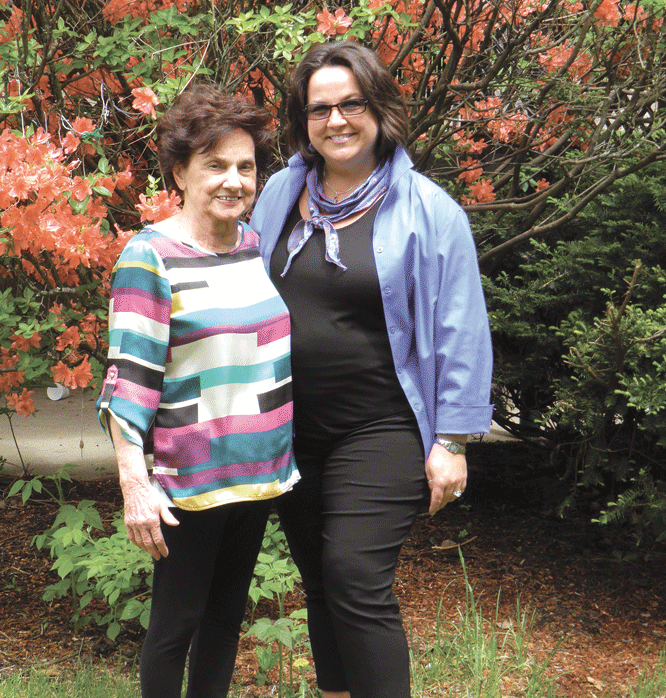
Conventions & Meetings Sections
Hoop Tournament Brings Net Results for the Conference and the City

Matt Hollander

Matt Hollander says the MAAC tournament not only provides a boost for downtown business, it gives the city a chance to display its ability to handle large events.

The UMass Amherst McCormack Center for Sport Research & Education has been gathering some much-anticipated data this month.

The center has been commissioned to quantify the overall economic benefit to Springfield and the region from the Metro Atlantic Athletic Conference (MAAC) Division I college basketball tournament, which recently wrapped up its second visit to Springfield, one during which the conference’s acronym became a discernable part of the local lexicon.

Nick Polimeni is naturally interested in what the study will show, but he told BusinessWest that he doesn’t have to wait for the numbers to declare that the tournament has been a success for Springfield and businesses in its downtown.

“I noticed a lot of different faces, a lot of team colors and team jerseys,” said Polimeni, manager of McCaffrey’s Public House on Main Street, just over a three-point shot’s distance from the MassMutual Center, where the tournament played out. “It was absolutely great for the downtown.”

Nadim Kashouh, owner of Nadim’s Mediterranean Restaurant and Grill, roughly a block from the arena, concurred. He wasn’t able to say if the 2013 tournament topped the first gathering in Springfield, but he could state with confidence that it provided a needed boost for businesses in the area.

“No doubt about it … it’s great for the city, and we need to see more of this type of event,” he told BusinessWest.

If Paul Lambert and Matt Hollander have their way, the city will see at least more of the MAAC tournament, and perhaps additional sporting events as well.

Lambert is vice president of Guest Experience and Programming for the Basketball Hall of Fame, and Hollander is general manager of the MassMutual Center. Both were part of the group that in 2009 convinced the MAAC to bring its tournament here from 2012 to 2014, and they will be among those trying to gain another three-year contract from the conference.

Hollander said the tournament has not only provided a boost for downtown businesses, including his own, but, perhaps more importantly, it has enabled the city to show that it can put on events of this magnitude, and that its mix of amenities and attractions provides a package that can be effectively sold.

“There are so many assets that we can brag about,” said Hollander. “I think, as locals, we sometimes forget, when you put it all together, how truly rich a fabric we have here.”

Lambert, meanwhile, said the first two tournaments staged in Springfield have shown how mutually beneficial the event has become for the Hall, the city, and the conference. The hoop shrine gains visibility and some additional visitorship from the three-day event, he noted, while the MAAC gains invaluable exposure from both the games and an elaborate exhibit on the conference that will be a feature in the Hall for at least the next four years. “The MAAC is the only conference to have a relationship like that with the Hall of Fame.”

Richard Ensor, now in his 25th year as commissioner of the MAAC, was part of the site-selection team that eventually chose Springfield. He said the city’s local organizing committee (LOC) has succeeded not only in effectively selling Springfield as a host for such events, but also in delivering a solid product.

“The LOC has been well-coordinated from the start of the bidding three years ago, their implementation, and the rollout of this year’s event,” he said just before tip-off for the men’s final. “They know how to put events on; they have a history of it.”

For this issue and its focus on meetings and conventions, BusinessWest takes an in-depth look at the how the MAAC tournament came to Springfield, and why, in addition to the men’s and women’s champions — Iona and Marist, respectively — there are many other winners to be counted.


Full-court Press

Lambert remembers the MAAC tournament site-selection committee’s first major visit to Springfield in 2009 — part of an 18-month-long bidding process — and how it didn’t get off to a fast start.

“We had the feeling when they first got here that they were on their way to ‘somewhere else,’” he recalled.  “They were tired; it had been a long day on the road for them. But once we got to talking about Springfield, the MassMutual Center, the Hall of Fame … by the time they left, it felt like they had gone from modest interest to some very strong interest.”

Backing up a few more years, Lambert said that, through much of its history, the MAAC’s tournament has been played on the home courts of conference members — Canisius College, Fairfield University, Iona College, Loyola University Maryland, Manhattan College, Marist College, Niagara University, Rider University, Saint Peter’s College, and Siena College. But in late 2008, coaches and administrators had expressed to the MAAC Council of Presidents and league office that these home-court sites had become too much of a playing and recruiting advantage for the host school. The council then decided to take the tournament to a neutral site (Webster Bank Arena in Bridgeport, Conn. was the first), and in late 2009, Springfield’s MassMutual Center won the bid for 2012 through 2014.

Looking back, both Lambert and Hollander said the city’s mix of strong points, from the Hall of Fame to its abundance of hotel rooms near the MassMutual Center, to its previous history of hosting college basketball games and tournaments, enabled it to prevail.

“That part, I think, is the easiest part of the sale, because we do have such a good infrastructure for these types of events,” said Hollander, noting that Springfield had a lengthy run hosting the Division II national championship tournament, and had demonstrated the ability to create a championship environment of restaurant dine-arounds, welcome signage, marketing efforts, educational programming, and ancillary events leading up to the games.

Ensor said the city’s history with basketball tournaments helped sell the site-selection committee, but so did the MassMutual Center’s track record for staging a variety of sporting events, and the Hall’s ability to stage gatherings such as its annual induction ceremony.

Ken Taylor, associate commissioner of the MAAC, noted that getting downtown business owners to support the event is what has made Springfield so successful attracting more than 6,000 fans of the 10 schools and 20 teams in each of the first two years.

“Our member schools stress two things that they enjoy about Springfield: first, the hospitality provided by the hotels, and the arena is first-class; second, the MassMutual Center is a neutral site — meaning no team has a home-court advantage,” Taylor went on. “Those two factors create a first-rate atmosphere for our student athletes, coaches, and fans.”

And the presence of those constituencies, especially the fans, creates opportunities for a host of businesses.

Polimeni cited a party he hosted for a group of Loyola alumni on the Saturday of tournament week as just one example. “It was huge … there were probably 60 of them, and they had a great time.”


The Big Dance

Assessing the first two years of the MAAC tournament’s presence in Springfield, conference administrators and LOC members alike say that, while the event remains a work in progress and all involved would like to see greater attendance at the games, the conference, the city, the Hall, and area businesses are all benefiting in some ways.

The MAAC exhibit at the Hall of the Fame is a good example, said Ensor, adding that, from the conference’s perspective, it provides an uncommon opportunity for visibility.

“This association with the Basketball Hall of Fame offers the MAAC the opportunity to be directly associated with the history of the sport,” he told BusinessWest. “And it provides the MAAC and its institutions with unique branding within the college-basketball community.”

But the MAAC is not alone in reaping rewards from the exhibit. Indeed, the conference invested more than $100,000 in the display, which was created by the Indian Orchard-based firm 42 design fab, which has handled a number of projects for the shrine. Meanwhile, businesses within the Hall complex, including Max’s Tavern, which hosted two events during tournament week, have also seen a boost.

“People can see how the investment on the part of the LOC brings returns,” said Ensor. “Not only that the fans and teams are spending, but we as a conference are spending.”

For the city, the Greater Springfield Convention & Visitors Bureau, and MassMutual Center, there are many benefits as well, said Hollander and Lambert, noting the obvious boost given to hotels, restaurants, and clubs. But there is the added vibrancy from events such as this year’s FanFest, sponsored by MGM Springfield. It featured a series of basketball-related events for children and adults of all ages, including relay races and dribbling and shooting contests. In addition, for Xfinity’s Bounce to the Arena, a mile-long parade of kids and adults (and some MAAC team cheerleaders) assembled at the Hall of Fame Center Court to shoot baskets, then proceed to dribble their way up Columbus Avenue, across to Main Street, and into the MassMutual Center.

“They were led by police cars, and folks were honking, cheering them on, and once they got to the center, they got to play at all the interactive FanFest games,” said Hollander.

But perhaps the greatest benefit to the city and those working to book meetings and conventions is the opportunity the MAAC conference provides to show what that team can do, said Hollander, and how this area can become host to other sporting events.

“It’s a great opportunity to showcase Springfield and the entire region,” he explained, “and also provide ample evidence that we stage events like this successfully.”


Final Buzzer

While ecstatic players from Iona and Marist were cutting down the nets following their wins in early March, and thus creating their own fond memories of Springfield, Lambert, Hollander, and others were already preparing themselves for the next bidding process for the MAAC tournament.

A request for proposals will be issued in April, and the selection will likely be made by the end of the year, said Ensor.

Whether Springfield prevails in that contest remains to be seen, but at present it seems to have a winning formula, one that is yielding net results, literally and figuratively, for all the parties involved.


Elizabeth Taras can be reached at [email protected]

Cover Story
UMass Chancellor Will Make Proper Planning a Priority

COVERart0313bAs he talked about UMass Amherst and the course he projects for the school he now serves as chancellor, Kumble Subbaswamy summoned a well-worn quote from Dwight Eisenhower: “plans are nothing; planning is everything.”

Those words were uttered in reference to preparations for D-Day, the largest amphibious invasion in history, but they’ve been borrowed by leaders in virtually every field, including academia, to describe the difference between having a plan on paper and engaging in effective, thorough, sensible planning.

There is a new strategic planning initiative underway at the Amherst campus, said Subbaswamy (known to colleagues as ‘Swamy’), one that will provide a detailed outline of where this soon-to-be-150-year-old institution needs to be with regard to everything from the life sciences to economic-development initiatives within the Commonwealth; from increasing the volume of research initiatives on the campus to improving graduation rates.


The faculty-led initiative, which should be ready by the summer, will shape the school’s trajectory for the next several years, said Subbaswamy, who came to the Amherst campus last July.

“Eisenhower was correct — planning is a forcing mechanism for us to think seriously about where we want to go,” he told BusinessWest. “Without planning, anything goes.

“This is a time when economic development is on a lot of people’s minds,” he continued, while juxtaposing the school’s current mission against the one it started with as one of the institutions created through the Land Grant Act of 1862. “Globalization has had an impact on what it means to be a 21st-century economic power; we still have a lot of assets that the state has invested in that can produce direct benefits to the Commonwealth and beyond, and we will be articulating that as part of our strategic plan.”

But planning has become a far more challenging assignment in the current fiscal climate, one in which state contributions to the state university have been declining, said Subbaswamy, adding that the funding situation leaves many question marks about everything from further progress in what has become known as the ‘Springfield Initiative’ to efforts at the university to help the state’s businesses become more globally competitive.

“If the expectation is that planning means that new resources will suddenly and magically appear, that’s unrealistic; that’s not what happens,” he said. “But if the goal is to say, ‘whether new resources come in or not, we want to prioritize where we spend our money,’ then the planning exercise is a very important one and a necessity.”

Moving forward, he said the school, its administrators, and faculty will be addressing what he called some of the “new challenges” facing those in higher education today. He put on that list such matters as the emergence of online education and what it means to residential institutions to continuously hone the model for a successful research university.

Meanwhile, one additional challenge for the UMass Amherst campus, and it’s not a recent phenomenon, is making its various programs and reputation for excellence as well-known within the state as it is outside.

“Sometimes, it feels like UMass Amherst is the best-kept secret inside the Commonwealth of Massachusetts — it has a far better reputation outside the state,” he explained, adding that this is likely due in large part to the Bay State’s many prestigious and well-known private institutions — Harvard and MIT top that lengthy list — which often overshadow the state university’s flagship campus.

“But I think people are beginning to recognize the difference between the publics and the privates,” he went on, “and, in particular, the important role that public institutions play within the Commonwealth. When you get into deeper conversations, you see that there is high and growing regard for UMass Amherst; people recognize, for example, that admission standards have gotten pretty high, and they recognize that the Commonwealth Honors College is a destination place for the best and the brightest inside the state and outside it as well.”

The Commonwealth’s stock of private schools may also play a role in what many have described as a less-than-passionate alumni base when it comes to the university, said Subbaswamy, who didn’t exactly disagree with that characterization. He said the school suffers from geographic challenges — many of its graduates live and work across the state, which is not a huge distance comparatively, but certainly psychologically — and also from a lack of what he called “connecting points.”

And he placed in that category everything from buildings and features on the campus itself — perhaps the most historic and best-known building, the chapel, has been closed for more than a decade — to a big-time sports program.

For this issue, BusinessWest conducted a wide-ranging interview with Subbaswamy, one that touched on everything from rising in the ranks nationally among research institutions to possible expansion into downtown Springfield — and how it all comes back to planning.


Class Action

After arriving last summer after a stints at two other major public schools — the University of Kentucky’s Lexington campus and the University of Indiana’s flagship campus in Bloomington — Subbaswamy said he commenced a lengthy, and in some ways ongoing, series of “meets and greets” with individuals and groups at both ends of the state.

The constituencies involved were both internal — faculty, staff, and students, among others — and external, ranging from alumni groups to state legislators to the Cranberry Growers Assoc., which, while based in Wareham on Cape Cod, boasts many members from the UMass School of Agriculture, and certainly isn’t among those lacking an appreciation for the state university.

“Among the cranberry growers, there is true adulation and respect for the institution,” said the chancellor, “because they readily admit that their business would not be what it is today without the continued work on the campus.”

In some respects, these meetings involved varying degrees of what Subbaswamy called “repairing relations” — his predecessor, Robert Holub, was essentially forced out after three years at the helm, and there has been considerable turnover in the chancellor’s office in recent years — but he told BusinessWest that this work is essentially done.

“Part of this work was reassuring our support base that everything is continuing on campus, that the positive momentum generated by my predecessors has not been slowed down, and that we’re on track to dealing with the new challenges in public higher education,” he explained. “The other was securing their continued support as we commence our 151st year.”

Those aforementioned constituencies have moved on, he explained, to the broader topic of what to expect from the school’s new leader.

And the answer to that question is clouded by a number of issues, but mostly the challenging fiscal situation, said the chancellor, adding that those who have expectations should manage them appropriately given the financial landscape.

And this mindset applies to both aspects of how a flagship university impacts economic development, he said, referring to both the narrow focus — the jobs at the campus and the spending it generates, for example — and the broader role stemming from transferring research into business opportunities, assisting existing businesses with becoming more competitive and moving in new and profitable directions, and drawing new businesses to the region.

“This is a role than can only be played by major research universities, public or private, and in this region, we’re it,” he explained. “And in a climate where the state has been reducing our appropriation over the past five or six years, we don’t have the resources that we can come up with to play that additional role in economic development.

“We have the knowhow, we have the expertise, and we have the desire,” he continued. “But we have a very limited ability to get engaged unless we find resources, whether it’s through the state, the local region, or federal assistance, to do it on the scale that’s needed to be a true catalyst.

“And we’re only one element in bringing about systemic change,” the chancellor went on. “The local government, local businesses, the state government, and the private sector — they all have a role to play in this. We’re ready, and we have a track record of getting involved with social change and economic development, but we can’t do it without resources.”

Quantifying matters, Subbaswamy said the university has been coping with a 26% reduction in state appropriations over the past several years. A current proposal from the governor to reverse the course of state assistance would certainly help, he went on, but it wouldn’t put the university even back to where it was five or six years ago.

Meanwhile, the campus infrastructure continues to age and deteriorate, he told BusinessWest, adding that the vast majority of the buildings are now more than 50 years old or fast approaching that number — there was a huge building boom in the ’60s and early ’70s, but then virtually nothing for the next 30 years — and there is currently $1.6 billion in deferred maintenance that needs to be undertaken.

The school has responded with efforts to become more efficient and cut fat where possible, but higher tuition and fees have also become reality, bringing the school dangerously close to limiting one of its historical assets in the Commonwealth — access to all economic classes of students.


Progress — by Degrees

The ongoing fiscal challenges are also going to play a role in the university’s involvement in the region’s largest community, said Subbaswamy, adding, again, that there are expectations about what the institution can and should do with regard to the City of Homes.

The Springfield Initiative has a number of moving parts, involving everything from the arts to biosciences (the Pioneer Valley Life Sciences Institute); from creating an active presence in the downtown — the university’s Design Center was relocated to Court Square — to work with Davis Foundation on issues involving education in urban settings.

The most recent talk, or speculation, has centered on broadening that downtown presence with a satellite facility, said Subbaswamy, adding that terminology, not to mention expectations, must be put in proper perspective.

“Somehow, the expectation that a large campus can be created suddenly, and without a comprehensive needs analysis, is unrealistic,” he explained, opting to use the phrase ‘satellite center’ to describe what, if anything, could develop. “Different people have different views on what they expect from UMass, and, in general, these expectations need to be managed properly.”

Elaborating, he said that many area officials have an ‘if-you-build-it-they-will-come’ thought process when it comes to a UMass facility in downtown Springfield, while he considers smaller, phased-in growth to be more practical, especially in these times.

“If you want to grow organically, and start with what we consider to be the highest priorities — how can we make a difference,” he said, “and then, based on that success and additional resources, grow more, I think that’s a much more realistic approach for today’s financial climate.”

And this brings him back to the subject of planning and the ongoing initiative at the university to chart a course for the years and decades to come.

UMass already has a number of stated priorities and strategic initiatives — some more clearly articulated than others, he said, adding that putting such matters within a plan, with clearly stated goals and methods for measuring results, makes it easier to achieve progress with those goals.

He cited work within the broad realm of life sciences as one example.

“We understand that the life sciences are of major importance to the state at this time, so we will have a focus on life-sciences research and development in this plan,” he explained. “We’re already doing [work in that field], but we haven’t explicitly stated it. By stating it, that allows different colleges and departments to align their resources in this general direction.”

Moreover, the strategic plan in progress will not only prioritize matters and provide a road map for reaching certain goals, it will ultimately leave the university better prepared for when the financial skies clear, said the chancellor.

“When you make an argument for new resources, having a cogent plan allows you to make an argument for those resources better than if you simply said, ‘give us money, and we’ll do good things,’” he told BusinessWest. “I’m sure we’ll do good things, but what is the benefit to society; what is the benefit to the Commonwealth?”

While undertaking this strategic planning, the new chancellor will look to address some of the other priorities that were reinforced during those meet and greets. These include making the school less of a well-kept secret within the Commonwealth and getting graduates more engaged with their alma mater.

The school’s almost-year-long sesquicentennial celebration may provide one of those key connecting points for the alumni base that Subbaswamy described.

The chancellor said the planned events, including a Founder’s Day that will be expanded into a Founder’s Week, will offer a springboard for fund-raising efforts that have been delayed by the change in the chancellor’s office, with the so-called ‘public phase’ of that initiative set to begin April 27. Meanwhile, it will also dovetail in many respects with the strategic-planning initiative and offer opportunities to show how, while the school may have changed in countless ways since 1863, its overall mission really hasn’t.

“When the Land Grant Act was passed 150 years ago and our campus was created, there were specific expectations about educating the general populace and conducting relevant research and making sure that this research translated into benefiting society,” Subbaswamy said. “As times have changed, the role of research universities has also evolved, but land-grant universities have maintained that original mission — teaching, research, and outreach.

“This will be a time for reflection on where you’ve come from,” he continued, “and also an opportunity to rethink how you want to focus for the future.”


School of Thought

As he talked about where the Amherst campus has been, where it is, and where it’s going, the chancellor didn’t borrow another famous Eisenhower quote — “unless we progress, we regress” — but that was the essence of the message he left with BusinessWest.

The school does, indeed, have the same mission it had when it was launched at the height of the Civil War, but education, technology, and the global economy have all changed in myriad ways.

Subbaswamy has many items on his to-do list, but proactive response to those changes are at the top of the chart — along with the constant planning that is, as Ike said, everything.


George O’Brien can be reached at [email protected]

Chamber Corners Departments

ACCGS

www.myonlinechamber.com

(413) 787-1555


• March 28: Lunch ‘n’ Learn, 11:45 a.m to 1 p.m., at the TD Bank Conference Center, 1441 Main St., Springfield. The topic will be “Implementation of the Healthcare Cost Containment Law: What Does It All Mean?” The guest speaker will be David Seltz, executive director of the Health Policy Commission. He will discuss the role of the Health Policy Commission and how the commission will develop policies to reduce overall cost growth while improving access to quality, ensuring accountable healthcare, and reforming the way healthcare is delivered and paid for in the Commonwealth. Tickets are $20, which includes a boxed lunch. For more information and to purchase tickets, contact [email protected].


• April 10: April After 5, 5-7 p.m., at Twin Hills Country Club, 700 Wolf Swamp Road, Longmeadow. The event will feature the ERC5 Feast in the East. Join us for a culinary event sure to please your palate as dozens of local restaurants present their signature dishes. Proceeds benefit the ERC5 Scholarship Fund. Sponsorship opportunities are available. For more information and to purchase tickets, contact [email protected].


• April 3: ACCGS Business@Breakfast, 7:15-9 a.m., at the Springfield Marriott, 2 Boland Way, Springfield. Guest Speakers will be Carol Leary, president of Bay Path College, and Ira Rubenzahl, president of Springfield Technical Community College. They will speak on the subject “The Importance of Public and Private Higher Educational Institutions in Workforce Development.” Chief greeter: Sarah Tsitso, executive director of the Boys and Girls Club Family Center. Salute: the Horace Smith Fund, for its 115th anniversary. For more information and to purchase tickets, contact [email protected].


AMHERST AREA

CHAMBER OF COMMERCE

www.amherstarea.com

(413) 253-0700


• April 10: Amherst Area Chamber Breakfast, 7:15-9 a.m., at Applewood at Amherst, 1 Spencer Dr., Amherst. Tickets: $17 for members, $20 for non-members. RSVP to [email protected] or register online at www.amherstarea.com.


CHICOPEE CHAMBER OF COMMERCE

www.chicopeechamber.org

(413) 594-2101


• April 17: April Salute Breakfast, 7:15-9 a.m., at the Kittredge Center, Holyoke Community College. Tickets are $20 for members, $26 for non-members. Sign up online at www.chicopeechamber.org.

• April 8: Meet Your Legislators, 5-8 p.m., at the Castle of Knights, 1599 Memorial Dr. in Chicopee. Meet the legislators who represent you and your business, and start a relationship and a partnership with the Commonwealth’s leadership. Your chamber membership affords you a valuable voice on issues that impact your bottom line. Sponsored by Mohegan Sun. Sign up online at www.chicopeechamber.org.


FRANKLIN COUNTY

CHAMBER OF COMMERCE

www.franklincc.org

(413) 773-5463


• April 1: Medicare & Social Security Workshop, 4:30-6 p.m., at the Franklin County Chamber of Commerce. Learn how to prepare for healthcare expenses. If you are concerned about healthcare expenses in retirement, now is the time to start planning. This begins with an overview of Medicare to help you understand the way healthcare works in retirement and what decisions you need to make now. Next, learn how to maximize your Social Security retirement income. Find out what you need to make the most of your benefits. You will learn important rules and strategies for collecting your retirement benefits, maximizing your spousal benefits, and coordinating Social Security with other sources of retirement income. To register, call the chamber office at (413) 773-5463 or e-mail [email protected].


• April 19: Chamber Breakfast, 7:30-9 a.m., at the Franklin County Fairgrounds. Program to be announced. Sponsorship opportunities are available. For more information, contact the chamber at (413) 773-5463.


GREATER EASTHAMPTON CHAMBER OF COMMERCE

www.easthamptonchamber.org

(413) 527-9414


• April 13: REACH Fest Day, starting at 10 a.m. REACH invites local and national artists to show in a multi-city exhibition of contemporary practitioners working in a variety of non-traditional formats. REACH promotes visibility, aims to bridge the arts and spaces in neighboring cities, encourages collaborative experimentation, and invites community members to participate in experiencing an array of contemporary art practices that are exhibited in a variety of traditional, non-traditional, and underutilized spaces throughout participating cities and towns. With more than 25 artist installations and exhibitions, a series of events are scheduled for REACH Fest Day. There will be performances in Easthampton and Holyoke by contemporary movement and sound artists and the One-Minute Vidfest, a film festival at Popcorn Noir in Easthampton featuring one-minute short films submitted by more than 80 artists from Easthampton to Serbia. All exhibitions will be open for visitation in Holyoke from 10 a.m. to 4 p.m. and in Easthampton from 4 to 9 p.m., in conjunction with the monthly Art Walk Easthampton. For more information visit www.reachfest.com


GREATER NORTHAMPTON CHAMBER OF COMMERCE

www.explorenorthampton.com

(413) 584-1900


• April 3: Arrive@5, from 5 to 7 p.m. at Smith Vocational and Agricultural High School, 80 Locust St., Northampton. Sponsored by King And Cushman Inc. and ACME Auto Body & Collision Center. Arrive when you can, stay as long as you can for a casual mix and mingle with your colleagues and friends. Tickets are $10 for members, $15 for non-members. To register, call the chamber office at (413) 584-1900 or visit www.explorenorthampton.com.


GREATER WESTFIELD

CHAMBER OF COMMERCE

www.westfieldbiz.org

(413) 568-1618


• April 10: WestNet, 5-7 p.m., at Betts Plumbing, 14 Coleman St., Westfield. Come an enjoy a night of networking. Meet chamber members and bring your business cards for a great networking opportunity. Tickets are $10 for members, $15 non-members. Payment can be made in advance or at the door with cash or check. Walk-ins are welcomed. Call the chamber at (413) 568-1618 or e-mail Pam Bussell at [email protected]. Your first WestNet is always free.


YOUNG PROFESSIONAL SOCIETY OF GREATER SPRINGFIELD

www.springfieldyps.com


• April 18: Third Thursday, 5-7 p.m., at Adolfo’s Restaurant, 254 Worthington St., Springfield. Join YPS at Adolfo’s, an Italian restaurant and bar situated across from historic Stearns Square in the heart of Springfield’s Entertainment District. The menu features a selection of traditional Italian dishes along with creative house specialties and a wide choice of wines to match.

Agenda Departments

Understanding Financial Reports

March 29: The Massachusetts Small Business Development Center Network’s Western Regional Office will present “Understanding Financial Reports” from 9 a.m. to 12 noon at PeoplesBank, second-floor conference center, 330 Whitney Ave., Holyoke. The workshop will be presented by Robb Morton of Boisselle, Morton & Associates, LLP. If you are in business, financial statements are an essential tool. Knowing how to read your financial statements can help you understand what happened last year in your business and what is likely to happen this year. The cost is $40. To register, call (413) 737-6712 or visit www.msbdc.org/wmass/training.html.


Not Just Business as Usual

April 4: The Springfield Technical Community College (STCC) Foundation will host its fourth annual Not Just Business as Usual event at the Naismith Memorial Basketball Hall of Fame. A cocktail and networking reception will be held from 5:30 to 7 p.m., followed by the dinner program and keynote speaker from 7 to 9 p.m.
This year, in celebration of 40 years of excellence in nursing at STCC, speakers include ‘The Three Doctors’ — Drs. George Jenkins, Rameck Hunt, and Sampson Davis — who are well-known for their work delivering messages of hope and inspiration. As teenagers growing up on the inner-city streets of Newark, N.J., the three friends made a pact to stick together, go to college, graduate, and achieve their dreams of becoming medical doctors. They have been lauded by Oprah Winfrey as being “bigger than rock stars” and have been featured as medical experts on the Tom Joyner Morning Radio Show and CNN. The Three Doctors received the Essence Award in 2000 for their accomplishments and leadership, and a BET Honors Award in 2009. Over the past two years alone, the Not Just Business as Usual event has provided the STCC Foundation with more than $100,000 to support college and student needs. Funds help to provide STCC students with access to opportunities — through scholarships, technology, and career direction — to be successful future employees and citizens. A variety of sponsorship opportunities are available. Individual tickets cost $175 each. If your business is interested in purchasing a table, contact Robert LePage at (413) 755-4477 or [email protected].


Live Comedy Night

April 6: Smith & Wesson will host a live comedy night to benefit to support two local children’s charities, the Shriners Hospitals for Children and the Ronald McDonald House. The event will begin at 6 p.m. at the Cedars Banquet Hall, 419 Island Pond Road, Springfield, and includes a cash bar, raffles, games, music, and hot and cold hors d’oeuvres prior to the show. The laughs begin at 7:15 p.m. with Teddie Barrett of Teddie B Comedy emceeing the show and introducing comedians Mark Scalia, Chance Langton, and Mike Whitman. Scalia began his stand-up career in Boston in the early 1990s and is now an international headliner. Langton is a nationally known comedian, musician, actor, writer, and basketball player who has been entertaining in comedy clubs for more than 20 years. Whitman was voted Boston’s Best New Comedian in 2008. Tickets cost $30 and may be purchased in advance by contacting Elaine Stellato at Smith & Wesson, (413) 747-3371; Karen Motyka at Shriners Hospital, (413) 787-2032; or Jennifer Putnam at Ronald McDonald House, (413) 794-5683.


HRU Fund-raising Event

April 11: Human Resources Unlimited (HRU) will stage its annual recognition and fund-raiser event at Springfield Country Club in West Springfield from 7:30 to 9 a.m. This breakfast event is by invitation only and is limited to the first 200 registrants. HRU will recognize local employers that have distinguished themselves this past year through their commitment to hire individuals with a disability. In addition, the organization annually honors a special volunteer who has given of their time and talent to help advance HRU in achieving its mission. Two employers will be honored: the Holiday Inn Express & Suites in Westfield is receiving the agency’s Employer of the Year Award, and the Sturbridge Host Hotel is being recognized with the Rookie Employer Award. Jeff Lander of Appilistic will receive the Armand Tourangeau Volunteer of the Year Award for his efforts on behalf of HRU’s Westfield Service Forum House. Gold Sponsors for the event include FieldEddy Insurance and Meredith Management. The media sponsor is BusinessWest. Sponsorships for this event are still available and welcome. Annually, Human Resources Unlimited assists more than 1,200 individuals living with developmental disabilities, mental illness, or other disadvantages to increase their skills, return to work or school, and become productive, contributing members of the community. Sponsorships and donations assist HRU in advancing its mission. For further information or to make a reservation, contact Lynda at (413) 781-5359 or [email protected]. The suggested minimum donation is $100.


DevelopSpringfield Gala

April 12: DevelopSpringfield will be hosting its 2nd annual gala in celebration of Springfield, the many accomplishments the community has achieved over the past year, and the exciting new initiatives underway. The gala will take place at the MassMutual Center in Springfield. Festivities will include a cocktail reception, silent auction, dinner, dancing, and more. All proceeds will support DevelopSpringfield’s redevelopment initiatives, projects, and programs. An anticipated 400 attendees — including federal, state, and city officials; leaders from the business and nonprofit communities; and local residents — will come together in support of ongoing efforts to advance development and redevelopment projects, stimulate and support economic growth, and expedite the revitalization process in the city. Sponsorship packages as well as individual ticket opportunities are available. For more information, visit www.developspringfield.com, or contact Diane Swanson at (413) 209-8808 or [email protected].


Bankruptcy Seminar

April 16: As part of its series of free information sessions on business-law basics, the Center for Innovation & Entrepreneurship at Western New England University will present a session on bankruptcy, featuring attorneys George Roumeliotis of Roumeliotis Law Group, Justin Dion of Bacon Wilson, and Kara Rescia of Eaton & Rescia. The event will take place from 5 to 7 p.m. at the WNEU School of Law, in the Blake Law Center. It is free and open to the public, and light refreshments will be provided. To learn more about upcoming events hosted by the Center for Innovation & Entrepreneurship, visit www.wne.edu/cie.


EANE Management Conference

April 25: The Employers Association of the NorthEast will hold its ninth annual management conference, “Leadership and Mentorship in Action,” at the Holiday Inn in Enfield, Conn. The conference will address the direct impact of mentoring and leadership development on the growth and success of organizations. Keynote speaker Doug Dvorak, a contributing author to the bestselling book The Masters of Success, will present his popular program “The Magic of Mentoring.” Additional presenters include Ravi Kulkarni and Lynn Turner of ClearVision Alliance. A panel of representatives from area companies will discuss next-generation mentoring. Conference breakout sessions include “Leadership Behavior and Employee Engagement,” “Building Effective Teams,” and “DiSC Work of Leaders.” For more information about the conference, contact Karen Cronenberger at (877) 662-6444 or [email protected]. To register, call (877) 662-6444 or visit www.eane.org.


EASTEC 2013

May 14-16: EASTEC, the premier manufacturing exposition in the Northeast will be held at the Eastern States Exposition in West Springfield on May 14 and 15 from 9 a.m. to 5 p.m. and on May 16 from 9 a.m. to 3 p.m. The event will offer a variety of exhibitors, educational offerings, tours of nearby facilities, and much more. For more information and to register to attend, visit www.easteconline.com.


40 Under Forty

June 20: BusinessWest will present its seventh class of regional rising stars at the annual 40 Under Forty gala at the Log Cabin Banquet & Meeting House in Holyoke. The event will feature music, lavish food stations, and introductions of the winners. Look for event details in upcoming issues of BusinessWest — including the must-read April 22 issue in which the class of 2013 will be profiled — or call (413) 781-8600, ext. 100 for more information.

Features
BusinessWest’s Difference Makers to Be Honored March 21


Difference Makers 2013 logoDetails are falling into place for the March 21 Difference Makers Gala at the Log Cabin Banquet and Meeting House in Holyoke, one of BusinessWest’s premiere events and now an early-spring tradition in Greater Springfield.

The menu for the lavish buffet is set, the traditional musical performance featuring area young people will spotlight the Children’s Chorus of Springfield, and the Taylor Street Jazz Band will again be on hand to provide entertainment throughout the evening.

The biggest news, of course, has been known for about a month now — the composition of the Difference Makers Class of 2013, one of the most intriguing and diverse groups since the start of the program in 2009. This year’s honorees are:

Michael Cutone, John Barbieri, and Thomas Sarrouf, organizers of Springfield’s C3, or Counter Criminal Continuum, Policing Program. The initiative, which makes use of counter-insurgency tactics used by U.S. Special Forces troops in Iraq and Afghanistan to combat gang violence and crime, has been successful in making residents of the Brightwood section of the city far more actively involved in the safety of their neighborhood. It has also succeeded in bringing about reductions in many categories of crime, including larceny, weapons violations, burglary, and motor-vehicle thefts.

John Downing, president of Soldier On. Over the past several years, Downing has created a number of programs to improve quality of life for veterans returning from service, all designed with the Soldier On slogan — “changing the end of the story” — firmly in mind. Perhaps his most celebrated accomplishment is an initiative that provides veterans with the opportunity to transition from homelessness to home ownership through a program that enables them to purchase an equity stake in their homes.

Bruce Landon, president and general manager of the Springfield Falcons. Over the past 45 years, Landon has gone from being a goaltender with the local American Hockey League franchise to holding nearly every title in the club’s front office, including his current role as general manager and co-owner. More significantly, though, he has put together ownership groups on three separate occasions, enabling Greater Springfield to retain its hockey team and thus reap the many benefits, including the economic boost to area businesses.

The Sisters of Providence, represented by Sr. Mary Caritas, SP, and Sr. Kathleen Popko, SP. Now celebrating the 140th anniversary of their arrival in Holyoke at the start of the Industrial Revolution, the Sisters of Providence are being honored for their long tradition of service to the community, especially in the broad realms of healthcare, education, and social service. The sisters’ mission — to serve segments of the population most in need and generally overlooked by traditional programs — is manifested today in programs such as Healthcare for the Homeless, methadone clinics, and cutting-edge elderly-housing initiatives.

Jim Vinick, senior vice president of investments at Moors & Cabot Inc. Vinick has a long and distinguished track record of service to the community, which is punctuated by his work with the Naismith Memorial Basketball Hall of Fame, which he has served in a number of capacities, and the Jimmy Fund, the fund-raising arm of the Dana Farber Cancer Institute, a cause that became a passion for Vinick after his son, Jeffrey, lost his battle against a rare form of testicular cancer in 1982.

“This year’s honorees provide more direct evidence that there are many ways for an individual or group to make a difference in this region,” said BusinessWest Editor George O’Brien, “and all of them are important to overall quality of life.”

O’Brien will emcee the Difference Makers Gala, which will begin at 5 p.m. with networking and opportunities to meet this year’s honorees, followed by the performance by the Children’s Chorus of Springfield and introductions of this year’s honorees.

Tickets to the gala cost $55 each, with tables of 10 available. For more information or to order tickets, call Melissa Hallock at (413) 781-8600, ext. 100, or e-mail [email protected].

Education Sections
Bay Path Women’s Conference Continues to Educate and Motivate

Carol Leary, left, and Caron Hobin

Carol Leary, left, and Caron Hobin say the key to the success of Bay Path’s conference is effectively matching speakers to themes, such as this year’s ‘Be Bold.’

Her business card might say ‘vice president of Planning and Student Development’ at Bay Path College, but Caron Hobin’s supplementary title is ‘event organizer.’

And in that capacity, she has played a lead role in organizing and presenting Bay Path’s Women’s Leadership Conference for the past 18 years. Which means she can name drop — through the conference, she’s met everyone from former Secretary of State Madeleine Albright to author and screenwriter Nora Ephron to poet Maya Angelou. But she’s also had some anxious moments with some of the famous speakers.

Hobin recalled a phone message in 2001 from the representative of the keynote speaker, actress Rita Moreno — the only performer to have been awarded an Emmy, Grammy, Oscar, and Tony —  the night before the sold-out conference.

“She had lost her only living relative the day before,” Hobin recalled, breathing deeply just remembering the stress she endured more than a decade ago. With less than 24 hours to go, getting a replacement was impossible.

“Moreno’s representative said that they’d let me know the next morning if she was coming,” remembered Hobin, who said she had no idea what to expect. But at 11:30 a.m. on the day of the event, Moreno called her directly and said, “I’m going to honor this commitment; I’m a performer, and I’m coming.”

And the show went on, just as it has every spring since 1996.

While Hobin remembers that scare, she has many more memories of inspiring speeches, educational programs, and Bay Path students enjoying the unforgettable experience of being escorts for those who take to the podium (more on that later).

This year, one student will have the honor of being escort for musician, actress, author, and entrepreneur Queen Latifah, the main keynoter for the March 22 event at the MassMutual Center. Latifah’s unique personality is just one manifestation of this year’s theme, “Be Bold,” which is based on the new Bold Scholarship to help students disadvantaged by the recent recession.

Bay Path President Carol Leary called the rest of the day “an amazing lineup of speakers” and promises that professional women, students, and interested individuals will be boldly inspired, entertained, and, above all, educated. Other speakers include Susan Cain, author of Quiet: The Power of Introverts in a World that Can’t Stop Talking, and Jenn Lim, CEO and ‘chief happiness officer’ of Delivering Happiness, LLC, who will discuss shaping a corporate culture.

Leary emphasized the educational component of the conference — which is modeled after a program both she and Hobin experienced while working at Simmons College — is geared especially toward alumni who not only never stop learning, but, like all professional women, want to be refreshed, inspired, and motivated by nationally and internationally known speakers.

“The beauty of this program is that it’s not just inspiration and motivation, but useful information, so that women can go back to their office the next day and say, ‘I just learned in one of the skill-building breakout sessions how to encourage introverts and extroverts  … practical tips I can use immediately.’

“That was one of the two primary purposes for putting the conference together,” she continued. “One, we wanted to expose our own students, faculty, staff, and alumni to well-known, well-respected, influential women, and two, it was an opportunity to bring it to a large venue to serve the outlying community.”

For this issue and its focus on education, BusinessWest takes an in-depth look at how Bay Path College’s conference has become part of the landscape in Western Mass., and how, after nearly two decades, it continues to evolve, mature, and give area professionals plenty to think about.

Words of Wisdom

Leary remembers Hobin’s first week at Bay Path in August 1995. Hobin had just left Simmons to assume the role of dean of Continuing Education.

“I told her what her first assignment was,” Leary said with a laugh before Hobin finished the sentence for her: “the conference.”

“I said, ‘we’re going to do it,’” said Leary, ‘and we’re going to take that Simmons concept of a women’s conference, and we’re going to bring it to Springfield.’”

Hobin said she was very familiar with the Simmons model for a women’s professional conference, and remembers thinking to herself, ‘how hard could it be?’

By March, she would find out — there were a number of challenges, logistical and otherwise, with staging the inaugural conference at the Sheraton and Marriott hotels in downtown Springfield, but she was helped in her efforts by successfully landing keynote speaker Elizabeth Dole (then-director of the American Red Cross). This was a timely booking since her husband, then-U.S. Sen. Bob Dole, had just announced that he would run as the Republican candidate in the 1996 presidential race. (Elizabeth Dole would later run for president herself in 2000.)

“Getting Elizabeth Dole as our first speaker really helped — that was the first big ‘get,’” said Hobin.

There have been more since, she told BusinessWest, adding that securing speakers is one of many responsibilities that fall to the team tasked with orchestrating the conference each year. That team includes Hobin; Leary; Kathy Wroblewski, director of Communications and Marketing; and Briana Sitler, director of Special Events.

To be more specific, the assignment is to match speakers to a theme, said Hobin, which is an intriguing process. “Sometimes the theme comes first and then the speakers follow, and sometimes a really great speaker becomes the lead and then a theme emerges as a result.”

While planning the 2012 conference, Hobin kept hearing, seeing, and reading the word ‘compassion’ in various publications and electronic media. Using Wroblewski as her barometer, Hobin started to pare down concepts and wordsmith possible titles for a theme (“Lead with Compassion” was eventually chosen), while also locking in a keynote speaker whose work is the epitome of compassion — Sr. Helen Prejean, a leading advocate for the abolition of the death penalty.

“I pick up on little cues, and it’s an evolution,” Hobin told BusinessWest, adding that everyone from staff to students is involved. “And I tell the students this: the universe sends you messages; you just have to listen.”


Star Search

Looking back, Hobin said the theme for the 2011 conference, “The Power of Choice,” was shaped in part by a Legal Studies student who was forced to drop out of the college for financial reasons.

Her former Bay Path professor bumped into her at the job she took to make ends meet, and, through the course of their conversation, learned about a book she was enjoying titled The Other Wes Moore. The teacher made the Bay Path staff aware of the book, which then became the summer ‘common read’ for all incoming freshmen.

Hobin, connecting the student’s financial issues and subsequent decision and the subject matter of the book — choice  — created the theme and landed the author, Wes Moore, as the morning keynoter.  The student in question actually became his escort, to assist him for the day.

Leary remembers seeing the student point out an underlined part of the book to Moore — the most critical part of the book for her, and, as it turned out, for Moore as well. During his keynote, Moore referenced the student in the large audience to explain how profound her life could be just by making a different choice.

“The part that she underlined was, ‘you will step out, but you will step back in if you want it bad enough,’ and you could see the emotional connection right then,’” said Leary, noting that the student did come back and finish her degree. “There’s a lot of learning that goes on during the conference on so many different levels.”

As just one example, she recalled the 2005 conference, headlined by Albright, the first female Secretary of State, who availed herself to sit with 15 students and Leary at a large table at the Marriott.

“There was an incredible dynamic between our students and this powerful woman,” said Leary, who distinctly remembers the students asking Albright who she thought would be the first female president — as well as the answer, Hillary Clinton.

“We really believe that we’re educating not only our own community,” said Leary, “but the professional women in the region who can be inspired by women, like Madeleine, that they may never have had the chance to meet otherwise.”

The opportunity for students to meet the keynote speakers is vital to the internal success of the program, said Hobin, adding that it has created a few much-coveted escort positions over the past 18 years. And the more famous the speaker, the more in demand the escort position is, said Hobin, adding that those seeking it must submit a two-page essay explaining why they want such an assignment. Applicants must then go through a rigorous series of interviews.


Meeting of the Minds

“Be Bold” might be the theme for this year’s conference, but that phrase also constitutes the unofficial directive for those organizing and presenting the conference since the beginning.

They have been bold — and imaginative and, above all, diligent about providing attendees with a program that will not only inform, but also inspire.

Their track record for success has made the conference a spring tradition in Greater Springfield — and a learning opportunity that, as Leary noted, comes on a number of levels.


Elizabeth Taras can be reached at [email protected]