Home Archive by category Cover Story (Page 9)

Cover Story

40 Under 40 Cover Story The Class of 2014
The Young Business and Community Leaders of Western Massachusetts


In 2007, BusinessWest introduced a new recognition program called 40 Under Forty. It was intended as a vehicle to showcase young talent in the four counties of Western Mass. and, in turn, inspire others to reach higher and do more in their community.

Seven years later, it has accomplished all that and much more. The program has become a brand, the awards gala has become one of the most anticipated events of the year, and the 40 Under Forty plaque that sits on one’s desk has become both a coveted prize and symbol of excellence, recognized by all.

On June 19 at the Log Cabin Banquet & Meeting House in Holyoke, 40 more plaques will be handed out, to members of a class that is both distinguished and diverse. It includes bankers, lawyers, and accountants, but also a Holyoke city councilor, a contractor who specializes in blitz building, and Springfield’s senior project manager. And it represents virtually every business sector, from healthcare to education; from technology to the nonprofit realm.

With that, we introduce the Class of 2014 with words (enough to explain why they’re an honoree) and pictures that tell a big part of each story, whether the winner is captured with his or her children, dog, or even boxing gloves or a giant candle. The stories are all different, but the common denominator is that these young individuals possess that most important of qualities: leadership.

Click here to download a PDF flipbook version of the 40 Under Forty Class of 2014

Sponsored by:
BaystateMedCenter130x70
Fathers&Sons130x70
HNE
StGermain130x70
Partner

YPS130x70


2014 40 Under Forty Winners:

Tamara Blake
Sandy Cassanelli
Robert Chateauneuf
Nick Colgin
Izabela Collier
G. David Condon IV
Jose Delgado
Justin Dion
Garett DiStefano
Patricia Faginski
Sean Gouvin
Nicole Griffin
Lee Hagon
Denise Hurst
Justin Hurst
Sean Jeffords
Danielle Klein-Williams
Dr. Andrew Lam
Angela Lussier
Ruby Maddox
Kevin Maltby
Andrew McMahon
Geoff Medeiros
Alex Morse
Meghan Parnell-Gregoire
Orlando Ramos
Jason Randall
Liz Rappaport
Robert Raynor
Alfonso Santaniello
Michael Schneider
Paul Silva
Michael Simolo
Noah Smith
Seth Stratton
Geoff Sullivan
Kyle Sullivan
Anthony Surrette
Jessica Wales
Francia Wisnewski

Meet the Judges — Click Here

Photography for this special section by Denise Smith Photography

Cover Story
Holyoke Blue Sox Reach for the (Future) Stars

COVER0414aHunter Golden is living the baseball dream. A dream that seemed unattainable when he actually, you know, played the game.

“I was a terrible baseball player. I was a pretty good athlete, but a terrible baseball player,” he said of his days in youth sports. “I wasn’t bad — I was brutal. I felt bad for my parents having to watch.”

Which is why his new role — as general manager of the Holyoke Blue Sox, hired last year by the team’s new owner, Clark Eckhoff — is more than a little surprising.

“Baseball has always been this mistress of mine since I was young,” Golden said. “It’s weird — baseball was always a source of conflict in my life. My dad was a diehard Yankee fan and owned season tickets; I was a Red Sox fan. My dad was great at baseball, and I stunk. I mean, I was indescribably bad, but I was always chasing it, trying to beat it.”

is ascension from sports blogger to upper management of a team in the New England Collegiate Baseball League (more on that later) is just one of many brainstorms wrought by Eckhoff, who previously owned the Wausau (Wisconsin) Woodchucks of the Northwoods League for 13 years, and was looking for a change when he bought the Blue Sox last summer.

“I saw this as a huge opportunity, based on the market and the great baseball culture here,” Eckhoff told BusinessWest. “My wife likes the New York area and the East Coast, and all our kids are in college but one, so we saw it as a different challenge, a new adventure. We’re going to grow this thing, and it’s something that’ll be really special for fans throughout the Pioneer Valley.”

To do that will require a significant boost in the team’s profile. “The biggest thing is, you have to promote the product. A lot of people in the Valley don’t even know we’re here,” he said.

MacKenzie Stadium

MacKenzie Stadium, adjacent to Holyoke High School, has been the Blue Sox’ home since 2007, and will host the NECBL All-Star Game in July.

“We’ve got to get people exposed to the product and see how affordable it is,” he continued. “Not only that, but our players are accessible; you can get autographs. Hey, your son might be getting the autograph of a future major-league baseball player. The product is very good, but we’ve got to bring it all together.”

The summer league — which attracts elite collegiate players from across the U.S. to play a 44-game schedule from June into August — has plenty to recommend it, Eckhoff said. “We’re getting the best kids in the country, but we also make it about entertainment, with giveaways and on-field promotions. In minor-league baseball, 80% of the fan base is coming out for an affordable family night.”

He and Golden believe that fan base is largely untapped — after all, Springfield remains the largest metro area in the country without a professional baseball team — and have some ambitious plans to make the Blue Sox more of a household name.

Cream of the Crop

Peruse the 30-man Blue Sox roster, Golden said, and you’ll see schools like Cal State-Fullerton, Miami, Vanderbilt, and other top baseball universities represented.

BlueSoxAllStarLogo“They’re the cream of the crop, the best guys out there,” he said, noting that two of the last five number-one major-league draft picks — Stephen Strasburg in 2009 and Mark Appel in 2013 — played in the New England Collegiate Baseball League (NECBL), as did notable lights like Andre Ethier, Andrew Bailey, Joe Nathan, Craig Breslow, Chris Ianetta, and scores of others.

“It’s a tremendous opportunity for these guys to really showcase their talent in a professional setting. Major League Baseball is a big believer in our product and the caliber of players we bring,” he said. “Watch the College World Series, and chances are you’ll see half our roster.”

This year, the team is heavily promoting catcher Max Pentecost, a Kennesaw State University junior who’s projected as an eventual first-round, top-20 major-league draft pick. “That’s how good these guys are. They’re no joke. We see 19-year-olds throwing in the mid-90s, hitting the ball 400-plus feet. They’re prodigies, and this is where they come to showcase themselves.”

Pentecost played for the Blue Sox in 2012 before spending last summer in the Cape Cod Baseball League, one of Holyoke’s main competitors for talent. But Golden noted that, while the CCBL may be a higher-profile league, the NECBL, with its longer road trips, offers an experience more reflective of the minor-league life. “We sell that to the players — it’s more of an opportunity to come and develop themselves professionally.”

And the professional baseball life is, despite its perceived glamor factor, a real job, he explained. “These guys get to the clubhouse at 9 in the morning, and they’re reading scouting reports, data reports, understanding the math, learning the pitching staff, how fast they throw, each pitcher’s arm slot — they’ve got to memorize all that stuff. They deal with injuries, they deal with the media … there’s a lot in a baseball player’s day.”

Other collegiate summer leagues across the country offer bigger stadiums and more fans, which can be seductive, but the NECBL has a reputation for taking seriously the job of preparing young men for professional ball — and the risk that career path entails.

“A lot of these kids turned down a lot of money to stay in college and get their degree. They’re coming to a collegiate league to advance their career and work toward a college degree,” Eckhoff said — a smart move for most, he added, since only 3% of all players who enter professional ball ever reach the majors. “It’s smart to at least graduate before entering the minor leagues; it’s a tough road.”

If the Blue Sox do their job with scouting, he added, fans will see more than one future major leaguer in action. As for recruiting, he said he enjoys the networking side of that important task.

“With me being older, it’s easier for me to pick up the phone,” he said. “I know the coaches at Fullerton, Stanford, Oregon, and the coaches trust me; we have a good relationship. They know the kids will have good host families and will be taken care of well.”

Those families, who volunteer to share their homes with the collegiates, are a key component in the success of a team, Eckhoff added. “I knew a lady in Wisconsin who hosted three or four players a year, over 18 or 19 years. She had a wall with [photos of] 70-something players who stayed with her. She stayed in touch with them, even flew to a wedding in Texas. That was incredible. It almost becomes like an extended family.”

Blogger Rhythm

Meanwhile, Golden’s path to professional baseball came through a relationship not with coaches and players, but with numbers.

After his washout as a player, he found some measure of satisfaction in sabermetrics, an innovative way to analyze a baseball player’s potential by crunching his in-game performance into, essentially, hard math. While Michael Lewis’s bestseller Moneyball brought the concept into the mainstream, a core of number crunchers led by the original sabermetrician, Bill James — whose newsletters Golden read meticulously — had long been touting new ways to measure performance.

Clark Eckhoff

Clark Eckhoff says his goal is to spread the word about the high quality of play and affordability of a Blue Sox game — and he’s confident that people will come.

That was a little odd, Golden conceded, since, as a child, he was a straight-A student — except in math, where he earned Ds. “Essentially, I got involved in two things I wasn’t good at — baseball and math — but they coalesced because of Bill James.”

In terms of impact, Moneyball was a “nuclear bomb” on the baseball-management scene, he said, although Athletics GM Billy Beane, the focus of that book, was hardly the first to put sabermetrics into practice. “But he was one of the first to be vocal about it and be successful with it.”

After graduating from Springfield College, Golden launched his own copywriting business, which morphed into a marketing consultancy, working with several national clients. But because he was passionate about baseball and sabermetrics, he started a blog on those topics in 2007.

“My friends really liked it,” he said. “Then Twitter came around, and Twitter turned into a gigantic barroom for baseball dorks. One thing led to another, and my work got noticed by ESPN, which had me come on board with their SweetSpot blog.” Appearances on outlets like the Sports Hub radio station in Boston raised his profile further, which attracted the attention of Eckhoff, who asked Golden to serve on a community-advisory board after he purchased the Blue Sox.

“He heard about me through the grapevine of local baseball dorks and brought me to the table,” Golden said. “We hit it off, and after three or four conversations, we got together for lunch, and he offered me the job.”

It was a big deal, he added, because the world of baseball management, a classic old-boys network, is a notoriously tough nut to crack for job seekers. “I always thought of the MLB employment site as a place they just stash résumés.

“It’s weird, though; once you’re in, you’re in,” he added, recalling sitting down in Dallas and chatting with former Yankees bullpen coach Dom Scala — who told stories about Billy Martin, Reggie Jackson, fights in the locker room, and humorous run-ins with George Steinbrenner — like the two were old pals.

And he loved this world, dealing for the first time with flesh-and-blood players and not just numbers — and in a much different way than, say, the management of the Springfield Falcons, the American Hockey League affiliate of the Columbus Blue Jackets.

“I think where we’re different — and, from a greedy standpoint, where it’s fun for me — is that we have a significant baseball-operations component to what we do,” Golden said. “With the Falcons, the Blue Jackets say, ‘here are your players; don’t break ’em.’ Ultimately, at the end of the day, the parent club dictates who the players are going to be. Here, we identify and recruit players we like for next year’s team, and our roster turns over year after year. We’re constantly in player-acquisition and analysis mode based on objective data, sabermetrics, and scouting.

“The challenge in this league is to win now; we have to get players who are good now,” he added. “It’s very easy to get seduced by prospects with a little more talent, who may be better off down the line.”

Even some very good players, unfortunately, reach their end in college, never even making it to single-A ball. “A lot of kids come here batting .340 in college and can’t hit with wood bats, and their career goes up in smoke,” Eckhoff said. “It happens. One kid came in and lost 140 points in one year.”

Race to the Top

The key to the team’s success, Golden said, is to take player development seriously, but also understand that families that show up at MacKenzie Stadium, near Holyoke High School, want to have a good — even silly — time.

“Our core product is baseball, but really, at the end of the day, we’re family entertainment,” he told BusinessWest. “We have the goofy promotions — the dizzy bat races, the sausage races — but also serious stuff, like recognizing community heroes and a Rays of Hope night. Just like a minor-league franchise, that’s ultimately what fans come back to see.”

Families with children are a key demographic, he said. “It’s expensive to see the Boston Red Sox. Between tickets and parking, before you even get in the park, you’re out $150 for a family of four. Then it’s $50, $75, maybe $100 more to feed everybody, then you drive all the way home.”

With Blue Sox tickets priced at $4 and $6, it’s a more manageable financial proposition. “You can bring $35 bucks to the park and have a really great time with your family,” Golden said. “We’re even cheaper than the movies, and you can be outside talking to each other. It’s an outstanding value for families.”

Meanwhile, the team is making an effort to be more visible in, and involved with, the community. “We’re working closely with area nonprofit organizations. We want to bring as many to the park as possible this year, and have ballplayers and the mascot at events. We’re going to have a nonprofit or two at the stadium every game this season. The community impact that has is substantial.”

The team is planning to get kids involved more as well, bringing them on the field for the national anthem, making players accessible for autographs, and conducting a summer baseball clinic.

In another move that makes sense in Holyoke, Golden said, “we’re aggressively courting the Hispanic and Latino market, which, from a sports standpoint, has gone mostly untapped here. That’s a baseball-crazy culture, and we’ve got a great opportunity to market to them.”

Whoever comes to the games, the idea is to show them a good time, Eckhoff said. “Every home game, we’ll have a different promotion, whether it’s a T-shirt giveaway or a bobblehead or something else. And our concession prices are more affordable. We’ll have dollar-hot-dog nights.”

He recalled one promotion in Wausau called the ‘chicken chuck,’ where fans tried to toss a rubber chicken back and forth and catch it in a frying pan. “You have 90 seconds between half-innings to show them something enjoyable; it could be a T-shirt toss or a chicken chuck. And they remember that.”

Added Golden, “if you wait two weeks after a game and ask a fan who attended the game what he remembers, it won’t be the players or the score, but they will remember the chicken chuck.”

Eckhoff was doing something right in Wisconsin. When he bought the Woodchucks in 1999, the team was drawing some 600 fans per night. By his 10th year, attendance averaged 2,000. He attributes that to the team getting the word out about the quality of play — about 15 of his players eventually made the majors, including Ben Zobrist — but the fun factor as well.

Stars Aligned

The New England Collegiate Baseball League has experienced similar growth since its founding in 1993 by former MLB Commissioner Fay Vincent. It began with four teams and eventually expanded to 12.

“That’s slow, sustainable growth,” Golden said. “That’s playing for the long game, and the caliber of baseball has continually gotten better over the years. More than 150 major-league players have come through the league, the lion’s share in the last 10 years.”

The Blue Sox, who began in 2001 as the Concord (N.H.) Quarry Dogs before relocating to Holyoke in 2007, have seen ups and downs of their own, but the new ownership believes a largely untapped base of potential fans is waiting to support quality summer baseball in the Valley — and that attendance, currently averaging about 1,000 per game, will follow. Hosting the league’s All-Star Game on July 20 is just one more draw.

“Our goal this year is to establish a real, genuine presence in the region and let people know we’re here,” Golden said. “We’re committed to the region, and we’re going to make this thing work.”

In the end, the numbers won’t lie. They never do. Just ask any sabermetrics dork.

Joseph Bednar can be reached at [email protected]

Banking and Financial Services Cover Story Sections
St. Germain Investment Management Gets Personal

COVER0314bWhen gauging the reputation of St. Germain Investment Management, Tim Suffish says, one measure is the number of non-clients who call out of the blue.

“It happens all the time,” he said. “People call with questions, and we just give the advice. We’re more than happy to take the calls. It’s a sign that the company is doing things right when random people call us and are reaching out for something. They’re always shocked and appreciative when one of the financial advisors spend time on the phone with them with no expectation of anything in return.”

Suffish, the firm’s senior vice president of equity markets, said it’s a reflection of the name St. Germain has built in Greater Springfield for the past 90 years. But the company, launched by D.J. St. Germain in 1924, hit some, well, depressing times in its early days.

“D.J. did fantastic with his investments the first five years. Then 1929 came along and wiped out a decent portion of his net worth,” said Mike Matty, the company’s current president, adding that surviving the Great Depression sparked the firm’s long-standing focus on investing conservatively.

“He realized that not losing an investment is every bit as important as making money. That has guided our conservative philosophy, and it’s the way we continue to make money,” Matty said. “During the most recent downturn, eight or nine people said to us, ‘we know we’re not going back to the old highs,’ and yet, this week, we’re at new highs. We hit a billion last year in assets under management.”

Matty, however, prefers to talk about people, not numbers, when considering how St. Germain has grown since the days of D.J.

Mike Matty

Mike Matty, president of St. Germain Investment Management

“It’s easy to start a business, but it’s tough to stay in business 90 years. The way you do that is treat the clients right, and we’ve done a terrific job with that philosophy,” he said. “We have a great team here; they could all work in Boston or New York, or wherever they want to be. But we all like working here in Western Mass.; we all want to be here.”

Suffish said there’s a certain satisfaction that comes with helping clients — whose only exposure to retirement savings to that point might be a company-sponsored 401(k) plan — really think about what they want from their golden years.

“They’re thinking about retirement, planning to leave their job and go from earning and putting money away for retirement to taking money from their retirement account,” he said. “It’s huge. People who haven’t gone through it don’t realize how … not traumatic, necessarily, but how serious it is, and the consideration and planning that goes into it.

“Once you’re into retirement, you want to make the most of it, so you don’t outlive your money,” he went on. “That’s our meat and potatoes; the most important thing we do is sitting down and talking with clients, people entrusting us with everything they have to last them through their last days.”

Human Touch

Matty said St. Germain had long been known strictly as an investment manager, but about a decade ago, the company began to broaden its scope to all-around financial planning.

“We now do comprehensive financial planning with people. We take a look at where their income streams are in retirement; are they adequately covered? And we’re the go-to call for people on other financial questions — buying a car, refinancing a house, whatever it may be, we get a call. That’s worked out very well for us.

“Life has gotten much more complicated these days,” he continued. “People get exposed to an immense amount of information overload on the Internet. Can you sit down and Google it? Sure, but you’ll see 150,000 results. People say to us, after trying to figure it out on their own, ‘I want to talk to someone who actually walks the walk before I do this.’ That’s what we’re great at.”

Mike Matty, left, and Tim Suffish

Mike Matty, left, and Tim Suffish say their most important job is talking one-on-one with clients and understanding their expectations for life after retirement.

Matty and Suffish are both CFAs, or chartered financial analysts. “CFAs are the financial-analysis equivalent of CPAs,” Matty said. “We’re super-knowledgeable, highly trained people. It’s New York or Boston expertise, accessible in Western Mass. at a reasonable cost.”

Suffish said a client was in reviewing his account recently and saw a photograph of D.J. St. Germain with a 1930s-era Packard. “He said, ‘I remember going for a ride in that car.’ The company has been here a long time, and the experience has been consistent. People change sometimes, but the St. Germain way keeps people here a long time.”

Still, the company has experienced a growth spurt in the past decade. When Suffish came on board in 2004, he was the seventh employee; now 20 people work there. But that growth has not come at the expense of the personal touch that has long been a priority.

“When people pick up the phone and call us, they get a receptionist, not voice mail. An automated voice drives people crazy,” Matty said. “It’s one of many small touches, one of the things that sets us apart from a lot of other financial firms out there. If you’ve got a half-million parked with a big brokerage firm, you’re a cog in the wheel there. To us, you’re a client. You’re going to hear from us, and we want to hear from you. You’re not just a nameless, faceless account number. We want to get to know you.”

And know your partner as well — even if that meeting comes late in the game.

“In a lot of cases, one spouse will open an account,” he said, and after that client dies, “we almost become a surrogate spouse for the survivor because they know nothing about the household finances.”

In such cases, the survivor’s concerns often boil down to one simple question.

“They ask, ‘can I live in the lifestyle I know now? That’s all I need to know.’ They don’t want to talk about realized gains versus unrealized gains. They say, ‘I’m a machinist. I’m hiring you guys to manage the money because that’s what you do.’

Such clients appreciate a conservative approach that stays the course, Matty said. “To us, the name of the game is giving people most of the upside and preventing them from losing much on the downside. More people get scared out of the market by losses than pulled into it by greed. And they pull out at exactly the wrong time.”

Age-old Concerns

Matty said a client’s age plays a factor in asset allocation, or what percentage of money is tied up in stocks, bonds, and other vehicles.

“We’ve extended out in the past few years beyond just a conservative stock philosophy,” he added, noting that equity-income accounts — a type of mutual fund that invests in companies with a history of solid dividend payments — have become a prominent part of the roster.

“Even with what we do on the management side, making sure we build a diverse portfolio, those types of stocks are still going to be a bumpy ride,” Suffish said. “When there’s a scare overseas or interest rates do something funny, those stocks will move around a bit.” But, he added, building a portfolio that focuses on income generation through dividend growth is a good fit for many clients.

Beyond that, conventional wisdom on asset mix has shifted over the years, he said. It used to be that subtracting one’s age from 100 gave the recommended percentage of assets in stocks. Now, it’s closer to 120 minus one’s age.

“But everyone is unique,” he added, and financial advisors must take into consideration factors like Social Security projections, pensions, retirement-account balances, expected inheritance, and overall lifestyle expectations.

“If somebody is 75 years old and has all their needs met by income sources like pension and Social Security, that client can afford to be more invested in stocks,” Suffish said. “The most important thing at St. Germain is the conversation between the financial advisor and the client. It’s not like picking Coke over Pepsi; that’s a very small factor. The most important thing is the conversation between the financial advisor and the client, us knowing them and their situation, and getting the financial mix right.”

It’s definitely a more complex financial world, Matty said.

“Fifty years ago, when you turned 65 years old, you could rely on Social Security and probably had a pension. Life expectancy was not a whole lot longer after retirement, and you had some pretty reliable income sources. People had more homogeneity,” he told BusinessWest.

“Now, we have 65-year-olds taking up skiing. They plan to live 30 more years. People are saying, ‘I don’t think Social Security is going to be there for me.’ Virtually no one has a pension anymore. There’s no homogeneity,” he went on. “A client might say, ‘I’ve got aged parents, and I’m taking care of a special-needs son, who will probably live with me forever. And there’s longevity in my family; people live into their 90s.’ Everyone is unique. In these circumstances, we really need to spend time getting to know you.”

Clients run the gamut, Matty said, from individuals with accounts large enough to grab the attention of a larger firm to people who have worked hard their entire lives to amass a couple hundred thousand dollars, or less.

“I tell these folks, ‘I know to you it’s a lot of money; it’s all you’ve got. I want to treat you with respect.’ We absolutely can take on folks who have millions, but if your money is significantly less, that’s fine by us too. People here are not paid on commission. They’re perfectly happy to sit down with a guy with $150,000 or a guy with $1.5 million.”

Committed, Not Commissioned

That policy of no commissions is uncommon in the industry, Matty said. “I don’t want to incentivize people here to do anything other than what’s in the best interest of the client. If they have cash in the bank, let them keep it in the bank. I’d rather spend time working with people, making a little bit off them every year, and keep them another 90 years, rather than get a big commission off them, then go out and find new clients next year. We have people here whose great-grandparents had accounts — people who have been here since the 1930s.”

St. Germain’s independence also allows advisors to give non-biased information, he said. “We’re not trying to sell any products to you. And at a lot of financial firms, people who work at the firm don’t have their money invested there. That’s not the case here.

“We live here, we work here, and we’re part of the community here, and we do our share to support the community that has supported us for the past 90 years,” he continued. “We try to give back at both the corporate level and personal level; virtually everyone here is volunteering or serving on boards, as well as all the financial support we give.”

Still, Matty said, what many clients appreciate most is simply being able to call and speak to someone with answers.

“I think we’re easy to talk to,” he said. “It’s a simple point, but it means an awful lot. Some people might prefer a website, but I find, especially as people get older, they want to call and talk to the same person, and not have to explain their circumstances every time. As clients get older, they really appreciate that.”

It’s an approach that has worked since D.J. St. Germain drove that Packard around Springfield — and will continue long after those who remember him are gone.

Joseph Bednar can be reached at [email protected]

Cover Story
Mike Mathis Has Become the Face of MGM Springfield
MikeMathis600x200A year or so ago, Mike Mathis could walk the streets of downtown Springfield in relative anonymity.

These days … well, not so much.
He said he was buttonholed recently by a business owner on Worthington Street who gave him a tutorial on the wide range of musical talent that resides in this region and advised him to exploit it. And a few days ago, he was recognized by the person working behind the counter at a car-rental agency, who asked about job opportunities — not for himself, but for family members who had left the area and were interested in coming back.

There have been many similar episodes over the past several months, and there will certainly be exponentially more for what everyone expects will be years to come.

That’s because Mathis is the face of the $800 million casino project proposed for Springfield’s South End, and, increasingly, that face is being recognized, a development he doesn’t mind at all.

Indeed, Mathis, whose business card now reads ‘president, MGM Springfield,’ likes talking with people about what could be called his project, although there is already a sizable team working on it. And more than that, he loves hearing from individuals about how this initiative could dramatically change things for the city and the region — and in positive ways.

‘Transformative’ was the word he said one state official used to describe the MGM Springfield project, and he’s not at all shy about borrowing that term.

Actually, he’s not shy about much of anything, a character trait he says is one of many necessitated by, and also honed by, life as the son of an Army officer who moved his family a number of times during his career.

“It was a wonderful childhood,” Mathis told BusinessWest, listing stops in Atlanta, Monterey, Calif., Frankfurt, Germany, and Huntsville, Ala., among many others. “The nature of moving around that often, and the whole culture of military kids and schools, is that you make friends really quickly. It forces you to be outgoing, and you need to be open to a lot of different cultures, because you’re going to experience them. So I give a lot of credit to my dad and my mom for helping me to get there in terms of my personality.”

Those qualities he listed have served him well in a career that started with a New Jersey law firm just after he earned his juris doctor at Georgetown University, but soon saw the dateline shift to Las Vegas, where he would become involved in one of the biggest projects in the industry’s history — that is, until the recession stopped it in its tracks (more on that later).

He would eventually be recruited by MGM Resorts International, where he would rise to the title of vice president of the Global Gaming Department, a position that would take him from Vegas to Macau, Japan, countless other stops, and eventually to Springfield, which, by the fall of 2012 had become ground zero in the fight for the coveted Western Mass. casino license.

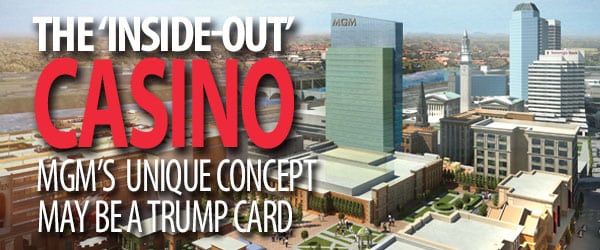
MGM’s proposed casino

Mike Mathis made frequent use of the word ‘transformative’ to describe the impact MGM’s proposed casino will have on Springfield and the surrounding region.

By last fall — Nov. 4, to be exact, the day Palmer voters said ‘no’ to Mohegan Sun’s plans to build a resort casino just off turnpike exit 8 — the MGM proposal was the proverbial last plan standing.

That phrase has been used quite extensively in the press, and Mathis doesn’t like it at all. He told BusinessWest that it conveys the sense that MGM will win this license — if that’s what happens — seemingly by default.

Instead, he said, MGM will have triumphed because it had the best plan, one that prevailed over Penn National’s bid to build a gaming complex in Springfield’s North End in what became the first stage of the license competition, and one he believes is a potentially groundbreaking concept for an urban gaming facility — what the company calls the ‘inside-out casino.’

“I think this project is going to set the bar for any other opportunities that a gaming company has to develop in a downtown urban environment,” he said, making reference to this plan’s focus on melding with its surroundings and putting the emphasis on family entertainment, not gaming. “If all goes well, people will look back at what we did in Springfield as the standard.”

For this issue and its focus on the casino era, BusinessWest talked at length with Mathis about everything from his career in this industry to the state of MGM’s proposal to the nagging presence of a referendum initiative that could undo everything that’s transpired since the gaming legislation was passed in the fall of 2011.

And in keeping with his character, he wasn’t shy about speaking his mind.

In the Background

Mathis remembers that it was a dark February day, one when the mercury barely touched 20 degrees. Those were the conditions when he and his wife, Lisa, whom he met while both were pursuing law degrees at Georgetown, boarded a plane at New York’s JFK airport to take up a fellow classmate’s advice to explore job opportunities in Las Vegas.

“It was 75 and perfect when we landed,” he said with a broad smile, adding that the weather was just one of many factors that would entice the couple to pack up and move roughly 2,500 miles west.

The bigger factor was that Las Vegas was at what would later be identified as the early stages of a massive building boom, one that this entrepreneurial couple wanted to be a part of.

MGM’s planned ‘inside-out’ casino

Mike Mathis says MGM’s planned ‘inside-out’ casino could set the standard when it comes to urban gaming facilities.

Backing up a bit, Mathis said his childhood spent moving from base to base, and the character traits it generated, definitely had an impact on his eventual career track and made it much easier to pick up and move across the country.

“My upbringing in a military family helps define my in a lot of ways,” he explained. “It’s not surprising to me that I’ve been attracted to hospitality and international development, because I’m very comfortable traveling, and I like experiencing new environments.”

He saw many environments in his youth, starting with the desert in Arizona, where he was born. Over the next decade and a half, his father’s work would take the family to the Southeast — Atlanta and Huntsville — and then to the West Coast and Monterey, a somewhat lengthier stint that was perhaps his favorite.

“We were there for four years,” he recalled. “I didn’t know how great that assignment was until we moved to New Jersey for middle school and high school.”

There was also a lengthy stay at a base near Frankfurt, one that afforded the family opportunities to travel throughout Europe, experiences that made a lasting impression on the young Mathis.

“My parents have always been great about exploring our environments and surroundings,” he said. “This was a working-class family, but my parents always put a priority on traveling. And my wife and I really go out of our way to make sure our kids see the world.”

Mathis probably couldn’t have imagined just how much of the world he would eventually see when he was wrapping up his law degree at Georgetown. He did a clerkship with a firm in New Jersey and a summer internship with a large Wall Street firm, experiences that exposed him to trial work and sophisticated corporate practice, respectively.

He eventually opted to return to New Jersey and spend more time in the courts.

Meanwhile, Lisa, who was in the same class with him at Georgetown, took a job with a Wall Street firm. Their schedules didn’t allow them to spend much time together, he said, and soon there was discussion about whether she would seek opportunities in New Jersey or he would do likewise in Manhattan.

Instead, they would both go to Las Vegas.

“We both got jobs with two of the top law firms in Las Vegas, who were happy to recruit some professionals from the East Coast because they were looking to broaden their practices,” Mathis recalled, adding that, within that first year, they both represented clients in the gaming industry; he worked with Las Vegas Sands, and Lisa with Caesars. Those stints eventually led to offers for in-house positions, which they both accepted.

Mathis spent the six years working with Las Vegas Sands, which he called a great learning experience, one in which he worked on not only the Venetian and Palazzo resort casinos, but also an expansion into Macau and the process of taking the company public.

“It was a really intense period with a lot going on, and I was right in the middle of all of it as a junior lawyer,” he explained. “It was just an incredible experience.”

He later accepted an offer to join Boyd Gaming and be general counsel for its flagship development on the Las Vegas strip — Echelon Place, at the site of the historic Stardust casino. The $4 billion venture would have included four hotels, a 140,000-square-foot casino, and the 650,000-square-foot Las Vegas ExpoCenter, but construction was halted in August 2008, roughly a year after it started, just as the effects of the Great Recession, which would devastate the Las Vegas economy, were starting to be felt.

While work at the site never resumed, Mathis considered his time at Boyd another key learning experience.

“Bill Boyd, who’s a legend in this industry, was an attorney who transitioned into an operator, so he was a great role model for me,” he said. “He was a very hands-on individual, very successful, very wealthy, but famous for working every day and knowing everyone’s names at each of the properties. I really respected that, and wanted to model my career after that type of engagement with the business, and with the people. He had a big impact on my outlook.”

Mathis described the demise of Echelon Place as the low point in his career — “I had only experienced the boom” — but he stayed with the Boyd group until 2011, when he accepted a position with MGM as vice president of Global Gaming Development for MGM Hospitality.

In that capacity, he has been one of the key players in advancing MGM’s latest developments — resort casinos in Macau, Delaware, and Springfield. And late last year, that focus was narrowed when he was made president of MGM Springfield.

Solid Bet

As he talked with BusinessWest in MGM’s offices in the TD Bank building — facilities crammed with architectural renderings and an elaborate model of the Springfield proposal — Mathis made it clear that he wasn’t taking anything for granted as the race for the Western Mass. license heads for the finish line. Nor was the company doing any coasting — another word he hears often — because there is no competition left.

“We’ve continued to work as if this were a five-operator race,” he said, referring to the number of companies that were bidding for the Western Mass. license in the final days of 2012 before the attrition started. “That’s what has helped make it such a detailed project; we felt a need to nail down a lot of specifics so that we could distinguish ourselves from our competitors. And that’s pretty unique to have as complete a design and as complete a program as we had early on.

“And we’ve continued to follow the Gaming Commission process, which is a very specific process,” he continued. “It requires engagement with surrounding communities, which has been ongoing, and it requires engagement with different entertainment venues. We’ve had a series of hearings in front of the Gaming Commission, and we passed suitability earlier in the year. We continue to keep our heads down and work and not take anything for granted.

“We’re at the point now where, from a development-operations standpoint, we can’t be arrogant about it, but we have to assume that we’re going to win the license,” he went on. “And we need to be ready to implement the project on day one.”

Overall, there are many aspects to the work being undertaken by the company at this juncture, roughly three months before the five-member Mass. Gaming Commission (MGC) is expected to decide the fate of the Western Mass. license.

There are some design elements to be finalized, he explained, as well as work to line up vendors (see story, page 19), secure tenants for the large retail component of the gaming complex, and ensure that a trained workforce will be in place when the doors open — sometime in 2017, if all goes according to plan.

But there are other, perhaps less obvious matters to contend with, he went on, using the broad term ‘education’ to categorize them.

Elaborating, he said that the gaming industry has been entrenched in Las Vegas and Macau for decades. Elected officials and the public at large are familiar with the concept and understand the business and what it brings to a community.

But in Massachusetts, it’s all foreign territory.

“And because of that, we need a lot of engagement at the local level,” he explained. “I feel the need to continually educate people not only in Springfield but across Western Mass., and make sure that everyone understands that this is a project that we think benefits not only the host community, but the region as well.

“This is unique for me personally,” he went on. “Prior to MGM, I just developed projects in Las Vegas, and it’s an entirely different process there.”

Locally, the process has a new and quite intriguing wildccard — an effort to repeal the state’s gaming legislation via a statewide referendum that would appear on this November’s election ballot. State Attorney General Martha Coakley ruled that the petition to put the matter on the ballot was unconstitutional because it would “impair the implied contracts between the [gaming] commission and gaming license applicants” and illegally “take” those rights without compensation.

Backers of the referendum then took their case to the state Supreme Judicial Court, which is expected to rule on the matter this summer, a few months after the Gaming Commission is likely to have awarded licenses for Western Mass. and the Boston area.

MGM has joined a coalition, which also includes other gaming companies, host communities, and backers of casino gambling, that was created to fight the repeal effort, which Mathis said could have a “chilling effect” on his company’s plans for a few months until the matter is decided.

“If we’re fortunate enough to win the license in May, to have the potential repeal hanging over our heads as an industry makes it difficult to do certain things,” he said, listing as examples some of the early financial commitments related to construction and other capital-intensive expenditures. “And that’s unfortunate; there will be a two-month window where we’re going to have to watch and see what the court does. It’s certainly not the way you want to kick off the project.”

For the immediate future, the company will be an interested spectator as Penn National Gaming, the recently announced winner of the contest for the state’s lone slots parlor license, decides how it will proceed with the repeal matter looming.

“The Commonwealth has invited our industry into this jurisdiction, and we’ve made a substantial investment in terms of time and money,” Mathis said. “We have other lines of business, and MGM will survive if this is repealed, but I think about the host community and all the potential that we promised them with this project, all the employment. These host communities will be impacted as much as anyone if this whole process is overturned.”

Odds Are

While monitoring the repeal effort and awaiting what everyone expects will be the green light from the Gaming Commission, the MGM team, and Mathis in particular, continue a dialogue with Springfield officials about the project, while also talking with and listening to area residents about this huge endeavor.

“What’s really great about this opportunity, and fairly unique because of the statute, is how much of a partner the city is through the host-community agreement,” he explained. “We always want to stay on the same page about all the things that we’re working on, and with other things that are happening in the city as well.”

And there are many initiatives on the drawing board or already underway, he went on, which makes the casino project even more intriguing.

“Even before we arrived in Springfield, [Chief Development Officer] Kevin Kennedy and the Economic Development office had been doing some really great things to make sure that Springfield continues to grow and improve its economic foundation,” he told BusinessWest. “There were a lot of great things happening in Springfield before we came on board, and we’re catalysts for future growth.

“Whether it’s Union Station or the UMass satellite campus moving in, I think Springfield is on the verge of a renaissance,” he went on. “And we’re excited to anchor that.”

And while there are a number of people involved with the MGM Springfield project, including several working in the downtown Springfield office, Mathis is the point person.

That’s why he’s far less anonymous than he was a year ago, and also why he’s hearing, and answering, a wide variety of questions — in the press, on the street, in the line at the breakfast buffet at the Sheraton, and, yes, at the counter at the car-rental agency.

And as might be expected (or not, as the case may be), a good deal of these queries have to do with employment opportunities — this project is expected to create 2,000 construction jobs and nearly 3,000 permanent jobs — and that makes Mathis feel even better about it.

“It’s really about jobs, and I wasn’t prepared for that,” he explained. “I’m sort of humbled by the idea that I walk around and people see the opportunity for a career in me; that’s a tremendous responsibility.

“People are really focused on when we’re going to open, when we’re going to start hiring, and what’s required for hiring,” he went on. “There’s not a day that goes by where I’m not approached in a very respectful way by citizens wanting to know about those opportunities. I’ll have an encounter with someone where it’s not about them getting a job, but about their brother, who’s an ironworker, or it’s about their daughter, who’s graduating next year, and they want to keep her home and interested in a career here.”

This return-to-Springfield aspect to this project is one of the more surprising, and also inspirational, story notes to date, said Mathis, and one of the many reasons why he makes use of that term ‘transformative,’ which he attributes to Jim Rooney, head of the Mass. Convention Center Authority, while noting that others have used it as well.

“I find it ironic that Springfield and Western Mass. are in the middle of the Knowledge Corridor, and it’s very difficult to keep that talent in state,” he went on.

“I think we have the ability to give some of the local talented young people a career opportunity and give them a reason to stay, and that will have a spin-off impact on other industries that will be able to tap into that growing labor pool.”

A Winning Hand?

When he and Lisa moved to Vegas, Mathis said, it was with the expectation that it would be a relatively short stay, like many of those stops from his youth.

But it lasted more than a dozen years, and thus provided ample evidence of how it’s difficult to forecast how one’s career path, or life in general, will unfold. So he’s not making any predictions about how long this assignment in Springfield might last.

What he does know, though, is that, if this project proceeds as planned, anonymity will become increasingly elusive.

That’s what happens when you’re the face of something transformative.


George O’Brien can be reached at [email protected]

Class of 2014 Cover Story Difference Makers
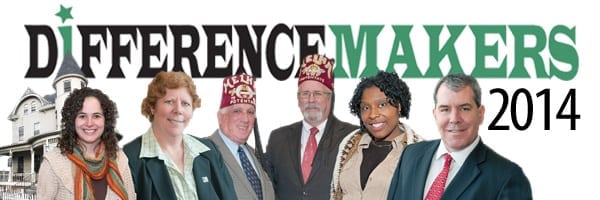
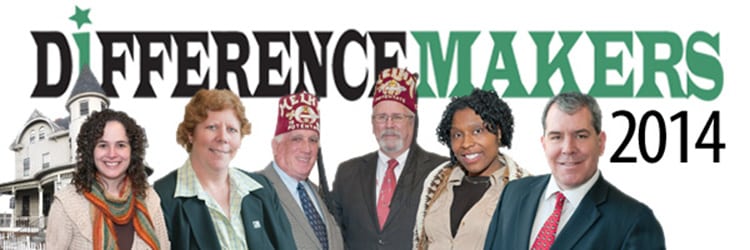
The Difference Makers Will Be Celebrated on March 20 at the Log Cabin

DiffMakers750x250


Sponsored By:
Baystate Medical PracticesFirst American Insurance • Health New England • Meyers Brothers Kalicka, P.C.Northwestern Mutual • Royal LLP • Sarat Ford Lincoln • 6 Pt. Creative WorksDiffernceMakers0213sponsors


When BusinessWest launched its Difference Makers program in 2009, it did so with the knowledge that there are, indeed, many different ways in which a group or individual can make a difference and impact quality of life in this region.

Each class has emphatically driven that point home, with honorees ranging from a Holyoke police chief to the founder of the Rays of Hope fund-raiser to battle breast cancer; from the president of Holyoke Community College to the director of the Regional Employment Board; from the man who kept hockey alive in Springfield for the past 30 years to some law-enforcement officials implementing counterintelligence tactics to confront gangs in Springfield’s North End.

This year’s class of Difference Makers is no exception, and it adds several new wrinkles to the contention that there is no shortage of ways that people can change others’ lives — and for the better.

Let’s start with Paula Moore. A schoolteacher — in fact, a substitute teacher at the time — she started a program to help keep young people off the streets and out of trouble. She would eventually call it the Youth Social Educational Training (YSET) program, and when the church that originally hosted these after-school sessions told Moore she would have to move it elsewhere, she used her own money and credit to acquire a dilapidated former school and renovate it into what is now known as YSET Academy.

She wasn’t going to take that drastic step, but felt compelled to by overwhelming need in the community and an unrelenting desire to do something about it.

And these were the same sentiments that drove five members of the Sisters of St. Joseph and a partnering layperson to scrape together $500 and prevail at the public auction of a long-vacant, seriously rundown gray Victorian on Sheldon Street in Springfield’s North End in 1982.

Two years later, the Gray House opened its doors, and ever since it has been providing food, clothing, adult-education programs, and its Kids Club to a ever-widening group of constituents.

Improving quality of life for low-income individuals has also been the mission of a nonprofit called Rebuilding Together, which provides assistance to help people stay in their homes when, because of illness, old age, or simply a lack of resources, they cannot undertake needed repairs and upkeep.

In its early years, the Springfield chapter of this agency provided support one day in April, and only to a few homeowners. Under the guidance of its first executive director, Colleen Loveless, the Springfield office has expanded its reach in every way imaginable, and has put in place an ambitious 10-year strategic plan that will change the face, and the fortunes, of a large section of the city’s Old Hill Neighborhood.

Meanwhile, Michael Moriarty has committed much of his time and energy to taking on another societal challenge — early literacy.
An attorney and now director of Olde Holyoke Development Corp., he has taken the lead in Holyoke’s Third Grade Literacy Initiative, helping to put in place an infrastructure and a battle plan to dramatically increase the number of young people able to read by the fourth grade — the time when people stop learning to read and begin reading to learn.
And then, there’s the Melha Shriners. The first fraternal organization named as a Difference Maker, it’s changing lives in many ways, but especially through its efforts to help fund the many Shriners Children’s Hospitals across the country — and now Mexico and Canada — and, perhaps more importantly, raise awareness of the incredible work being done at those facilities.

The Class of 2014 will be honored at the annual Difference Makers Gala on March 20 at the Log Cabin Banquet & Meeting House in Holyoke. The event will feature butlered hors d’oeuvres, lavish food stations, introductions of the Difference Makers, and remarks from the honorees. Tickets are $60 per person, with tables of 10 available.
For more information, or to order tickets, call (413) 781-8600, ext. 100.

Cover Story
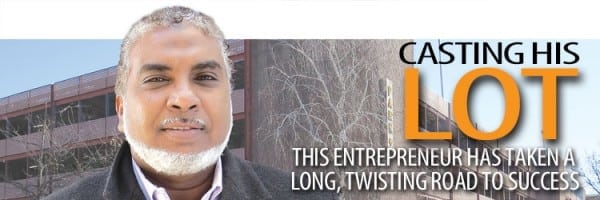
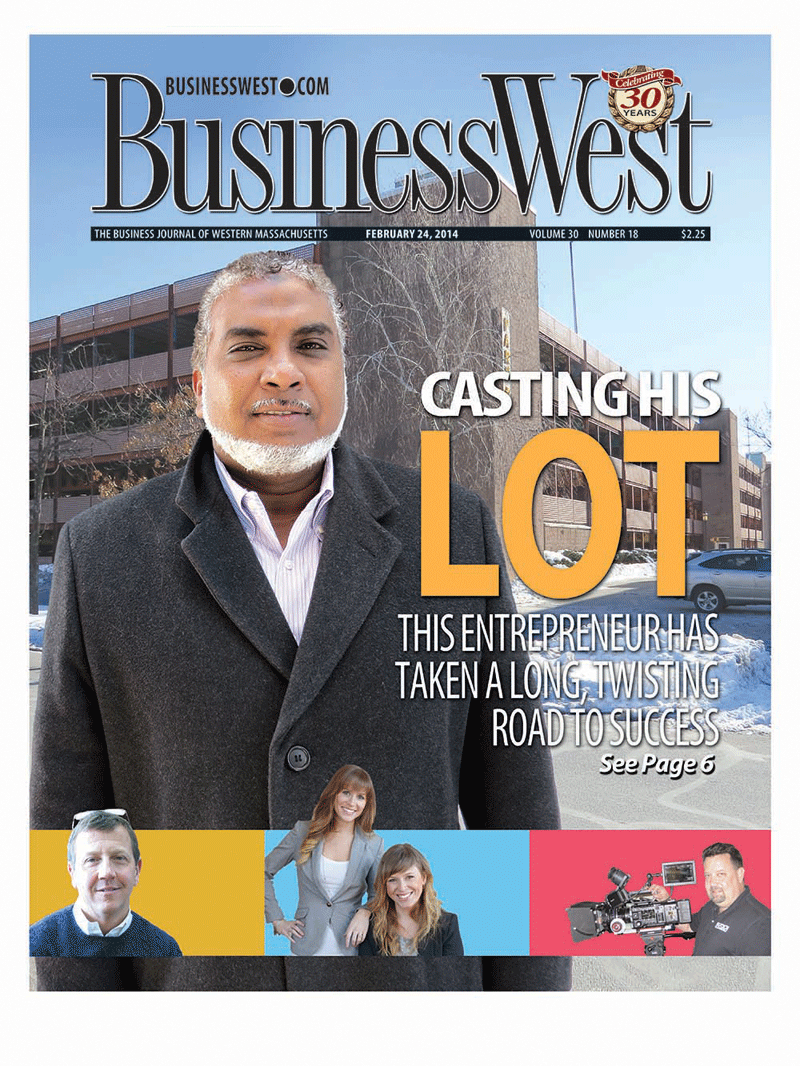
Yasir Osman Has Taken a Long, Twisting Ride to Entrepreneurship

COVER-0214bWhen Yasir Osman arrived in New York from his homeland of Sudan in 1989, he had $100 in his pocket and very limited knowledge of English.

“I knew ‘yes,’ ‘no,’ and had a good smile,” he said in a still-thick accent. “That was essentially it.”

Actually, he brought a few other things with him, although it would take several years before some would emerge. One was a basic understanding of business he gained while doing the books for his father, the owner of a butcher shop in Sudan’s capital city of Khartoum, starting at age 6. Another was an entrepreneurial spirit he believes he acquired from his time spent in that shop, watching his father work for himself, enjoy it, and take great pride in it.

And then, there were the business values that he would also take from his father, especially transparency and honesty, terms he would use early and often as he talked about how he runs what has become a multi-faceted operation.

Indeed, he has put all of the above to extremely good use as he’s made the shift from employee to business owner — and in a big way.

Osman, who would relocate to Springfield a few years after arriving in Brooklyn — only a few months after meeting his future wife, who grew up in the City of Homes — has taken an intriguing ride from being an attendant in a parking garage on East Court Street to working his way up with that enterprise to regional manager, to starting his own company, Executive Parking. That venture now manages more than a dozen garages and surface lots and hundreds of metered spaces for the parking authorities in Springfield and Holyoke. Osman also owns taxi operations that operate in both communities, and serves as a chaplain for the state Department of Corrections.

And he makes it abundantly clear that this entrepreneurial ride, which began just over five years ago, is really just getting started.

He wants to make Executive Parking more of a regional force, perhaps expanding it into Hartford, New Haven, and other New England cities, and then, perhaps, becoming a national player.

“There’s really no limit to where we can go from here,” he said, adding that he believes he has the know-how, the lean business model (more on that later), and the entrepreneurial drive to take this venture well beyond Springfield and the Northeast.

The Columbus Center Garage in downtown Springfield

The Columbus Center Garage in downtown Springfield is one of many facilities now managed by Executive Parking and its president, Yasir Osman.

But while casting a wide net in terms of hopes and aspirations, Osman is keeping a hard focus on his home of Springfield. In addition to basing two of his businesses here, he lives just a few blocks from downtown in the Hill-McKnight neighborhood, and is becoming increasingly vested in — and involved in — a city he believes is awash in potential and bound for better days.

“I love it here — I love being in Springfield,” he said. “I’ve been in the city for 22 years, and I’ve seen many ups and downs. But I’ve seen a lot of progress, and I think the city is heading in the right direction, especially with the economy; Springfield will see a lot happen in the next year or so.”

By that, he was referring to the casino slated to be built in the South End — a development that certainly has the potential to impact both of his business enterprises — but also other developments in and around downtown.

And as he looks ahead to a brighter future for the city, and himself, he has become one of the faces of a new breed of entrepreneur — minority business owners who are creating jobs as well as momentum in a city still trying to reinvent itself.

For this issue, BusinessWest talked at length with an individual who is still mastering English, but has become an entrepreneurial success story in any language.

His Lot in Life
As he wrapped up his talk with BusinessWest, and the conversation turned to the weather, as it often does in this winter that seemingly won’t end, Osman clicked on his phone to check the conditions in Khartoum, something he does regularly enough to have his device programmed to do so.

“It’s 72 degrees and sunny there,” he said with a nod of his head and a smile on his face, adding that he keeps tabs on much more than the forecast for the city he left 25 years ago. He still has family in Sudan, including his mother, whom he visited recently. In fact, his gray hair was mostly black from the dye job that his mother insists that he get before returning to what is still, in many respects, home.

By the late ’80s, though, it was a home that Osman knew he had to leave — and soon.

“The economy was very bad, and I was one of 10 children,” he said. “I saw my family struggling, I saw my father struggling, so I decided that something needed to be done.”

Osman Yasir

Osman Yasir says he has the team, and the experience, to take his parking venture regional and then national.

Picking up and leaving for the U.S. — something a growing number of people in that East African country were doing, or thinking about doing — was not an easy proposition, nor one without a good deal of risk. But it was certainly preferable to staying put.

Osman scraped together enough money to get a plane ticket to New York, and soon, with the help of a fellow countryman he connected with, was introduced to the city’s subway system. He would ride the train to Queens each day and actively pursue work, especially in realms where one could get by with just a little English — or very little, in his case — such as construction and security.

And while securing a succession of jobs, Osman was also working to gain a foothold with the English language. He took a few classes on the subject in New York, but has picked things up mostly from interacting with others — a broad constituency that has included everyone from his wife and children to customers in various parking garages.

“In my language [Sudanese], we move from right to left,” he explained. “In English, we move from left to right. That’s the hardest thing about learning the language; you have to think it in your mind before you speak it.”

He eventually saved enough money to buy a car, and was getting by in the Big Apple, when, through the intervention of another Sudanese native — a woman who was asked by Osman’s mother to help him find a wife — he met Asilla Eubanks. Five months later, they were married, and soon thereafter, the dateline for this story shifted to Springfield.

After relocating here, Osman soon took a job as a parking attendant at a small lot on East Court Street, working for a Hartford-based outfit called Professional Parking. He would stay with that firm for more than 15 years, serving in roles ranging from maintenance person to location manager; supervisor to city manager, meaning he oversaw all the lots and garages in Springfield.

The last title he had was regional manager, he noted, but in 2008 he was laid off from that post, a development that ultimately kick-started the next chapter of his career — as an entrepreneur.

The Space Race

He started by buying, at auction, a closed gas station with an accompanying convenience store on Allen Street in Springfield, and immediately began applying lessons in business not only from his youth and his father’s butcher shop, but also from the classroom, specifically the one at Cambridge College, where he earned a master’s degree in business management.

With a loan from NUVO Bank, he put the gas station back in operation and soon launched a taxi service and ran it out of a trailer on the Allen Street property. He now operates Ace Taxi, with eight cars, in Springfield, and Metro Taxi, with five vehicles, in Holyoke.

But the business he knew best was parking, and toward the end of 2008 he created Executive Parking.

“I just thought it was common sense to get into the business I understood most — and that’s parking,” he told BusinessWest, adding that his venture got a huge boost roughly a year ago, when it captured the contract to service the garages, surface lots, and metered spaces controlled by the Springfield Parking Authority (SPA) after submitting a bid $2.5 million lower than the company that previously had that assignment — Republic Parking.

When asked how he was able to submit such a number — and then convince the parking authority that service would actually improve — Osman laughed.

“Like I said, I know how to do parking,” he told BusinessWest. “Plus, I’m the owner of the company and the general manager of the company. I work … we don’t have a lot of overhead, like those other companies do.”

He’s also been applying those aforementioned lessons he learned while watching, and working for, his father all those years ago.

“You need transparency and to be honest in everything that you do — that’s what he taught me,” he explained, noting that his father passed away in 2007. “Communication is also important — communication with the people in the city, with your employees, with the managers, and with the public.

“Also, dedication — when you do something, give it 200%, not 100%,” he went on. “That’s another thing I learned from watching my father.”

Looking ahead, Osman is focused on what he called smart, controlled growth.

His first priority has been to bring stability to the lots and garages operated by the SPA, something he believes he’s done.

“We’ve stabilized the operation in Springfield — right now, things are going smooth,” he went on. “In the last year, since we’ve taken over the operation, we haven’t had even one complaint.

“Our plan is to take this operation to the next level and make it more customer-friendly, actually,” he went on. “We have training for our employees every three months, we talk to them about being more customer-friendly, and we talk to them about being sensitive to customers’ needs; we’re drilling into their heads the need to put customers first, and we’re getting results.”

The next challenge will be to expand regionally and, in essence, replicate the success registered in Springfield and Holyoke. And he believes there are opportunities to do so within New England.

“There are many possibilities with neighboring cities, such as Hartford, New Haven, Stamford — wherever we can help stabilize operations and make money for the city, we’ll be there,” he said. “We can do for them what we did in Springfield, where our low-cost, efficient operations enabled the Springfield Parking Authority to give $300,000 a year to the Springfield Police Department to put more officers downtown.”

Venturing Forth

Osman said he’s not sure how far he can take Executive Parking. But he is sure that, wherever this venture goes, Springfield will still be the base of the operation — and, more importantly, his home.

The Hill-McKnight neighborhood is nearly half the globe and worlds apart from the still-struggling country he left 25 years ago, but the same business principles that worked there are creating results — and opportunities — here.

In short, Osman has done quite a bit with that $100, those two words of English he knew, and those all-important lessons from his father.

And, as he said, the ride is really just getting started.

George O’Brien can be reached at [email protected]

Cover Story
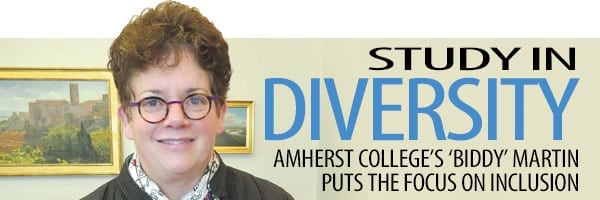
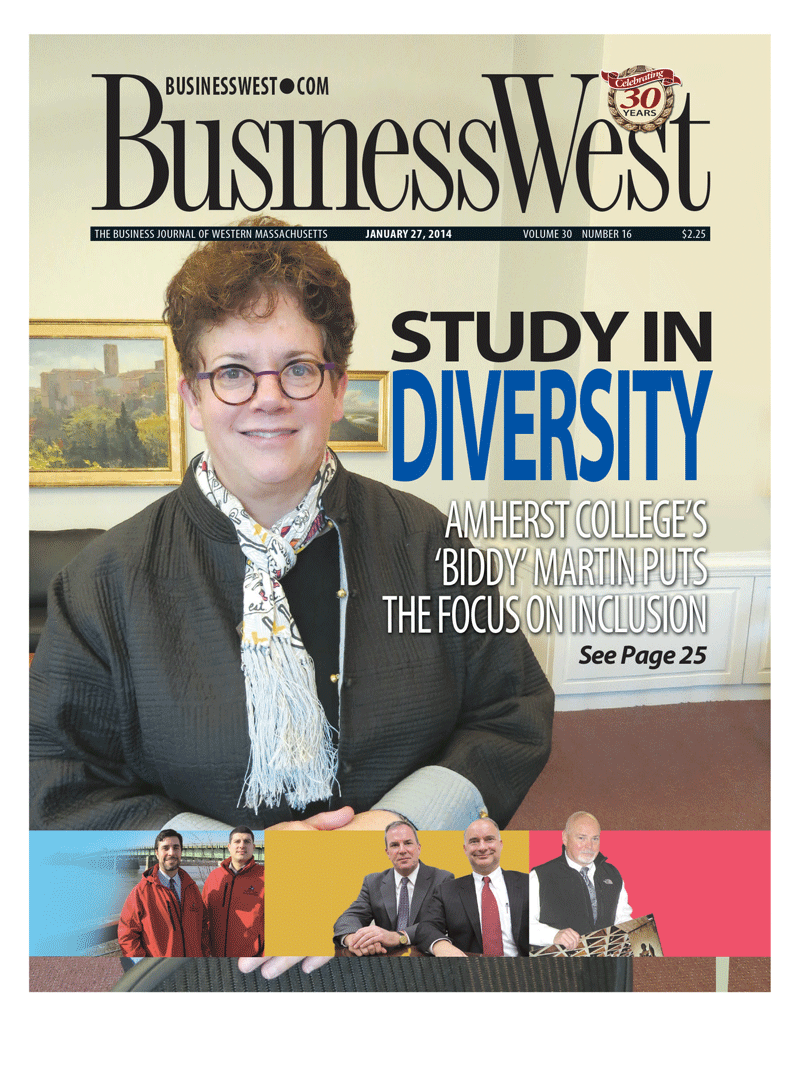
Amherst’s ‘Biddy’ Martin Puts the Focus on Inclusion

COVERart0114bIt’s called the ‘Committee of Six.’
That’s the name attached to an elected — and quite powerful — group of professors at Amherst College, who continue a tradition that is said to be as old (193 years) as the institution itself.
Tasked primarily with making recommendations on tenure and promotions, this group, an executive committee of the faculty whose influence is said to extend to all manner of administrative matters, meets with the president of the college and other administrators every Monday morning, often for three hours or more.
For Carolyn “Biddy” Martin, who took the helm at Amherst in late 2011, these sessions, which take place at a round table in the front of her spacious office in Converse Memorial Library, have constituted a learning experience on a number of levels, and comprise just one of many reasons why she summoned the word intense to describe both the college and the task of leading it.
“Those meetings are always interesting,” she said, noting that, while this panel is not entirely unique, it is unusual. “There are other places where there are tenure and promotion committees, but I don’t know of another place that has a committee of this sort that meets as regularly and at such length with the president, the provost, and the dean of the faculty of the institution. It was a godsend when I first came, because the extent of the contact, and the intensity of it, allows a new administrator to learn a lot about the college in a very short period of time.”
When asked what she’s learned, Martin — who came to Amherst after stints as provost at Cornell and then chancellor at the University of Wisconsin at Madison — paused for a moment as if to indicate this would be a lengthy answer. And it was, one that focused primarily on the faculty and its commitment to teaching, research, service to the community, and, in general, meeting or exceeding very high standards.
“The students are extraordinary, and the faculty is stronger than I could have even imagined it to be,” she told BusinessWest, “because of the way they combine high expectations for research with the incredible amount of intellectual capital they invest in teaching.
“And after working at research universities for most of my career, that investment in the art of teaching is a boon,” she went on. “I love seeing it, I love supporting it; I believe it’s essential.”
Among her many current initiatives, Martin told BusinessWest, is the drafting of a new strategic plan for the institution. While she generally used broad terms to discuss what will likely go in that plan, she said the school will continue to accelerate current work to create greater diversity on campus by aggressively recruiting and then supporting lower-income individuals and those with what would be considered non-traditional backgrounds.
This strategic initiative, launched more than 15 years ago, saw Amherst become the first college in the nation to eliminate loans for low-income students and one of the first to replace all loans with scholarships in financial-aid packages and extend need-blind admission to international students.
“This is a place that has put its money where its values are,” said Martin, adding quickly that the next challenge, and it’s a sizable one, is achieving progress in what she called “the really hard work, and maybe the hardest work.”
By this, she meant efforts to not merely bring such individuals onto the campus, but create cultural changes to ensure what Martin called “genuine inclusion.”
“We want an environment where no students feel as though they’ve been added on to a culture that has its core, its center, somewhere else,” she explained. “I can’t think of a more worthy project, but it’s not an easy project to change culture. But I love doing it.
“I admired what was accomplished here, and wanted to work at a place where, on a daily basis, or even an hourly basis, it’s possible to see the enlivening difference it makes to have people from so many different backgrounds learning together,” she continued. “I thought it would be an extraordinary challenge to see how that can be made into the educational advantage that it ought to be.”
For this issue and its focus on education, BusinessWest talked with Martin, the school’s first woman president and first openly gay president, about everything from these efforts to promote inclusion to the sometimes-difficult career transition from teaching to administration, and the different kinds of rewards in each realm.

Teaching Moments
Among the many items occupying space in a large bookshelf in one corner of Martin’s office is a white football helmet with a large red ‘W’ that instantly identifies it as being from the University of Wisconsin.
It was a gift from colleagues at the school where she served as chancellor for three years and became well-known for, among other things, her support of the sports teams (a pattern that has continued at Amherst) and her controversial and ultimately unsuccessful efforts to essentially separate the Madison campus from the rest of the University of Wisconsin system (more on that later).
It was in Madison where she earned a Ph.D. in German literature, with a dissertation titled The Death of God, the Crisis of Liberal Man, and the Meanings of Woman: A Study of the Works of Lou Andreas-Salome, and then an embark on a career that would take her from teaching into administration.
This was a path that would have seemed highly unlikely a decade earlier.
Indeed, Martin, who grew up in Northern Virginia, told BusinessWest that she can easily relate to many of those students at Amherst who fall into that non-traditional category, or who didn’t expect to ever be part of that school’s culture.
“My parents didn’t believe that girls should — or needed to — attend college,” she explained, adding that it was only because of the intervention of some teachers and advisors that she wound up attending the public school William & Mary in the early ’70s.
There, she earned a degree in English Literature and, during her junior year, studied abroad at Exeter University in England, where she met a number of German students and became fascinated by the divide between East and West Germany and how it had affected literature and culture.
When she returned to William & Mary for her senior year, she studied German extensively, and went to Germany to earn her master’s degree. One intriguing career stop while there came at a nursing home, where she served as a nurse’s aide.
“It was one of the most interesting — and hardest — jobs I ever had,” she explained, adding that she needed the work to support her studies, but also desired to learn German from people who were not academics. “It was a fascinating experience. This was a nursing home for women; most of them were in their 80s and 90s, so they had lived through both world wars. I learned a lot.”
Fast-forwarding a little, Martin said she began a career in teaching (both German and Women’s Studies) at Cornell, and eventually shifted into administration, a path she says she probably couldn’t have imagined even a few years earlier.
“But I’ve enjoyed it, and I find it conceptually and intellectually challenging,” she said, adding that she finds administration as rewarding as teaching, but obviously in different ways. “There’s almost nothing as rewarding as teaching, but administration also involves teaching — it’s just of a different sort and with different people. I think the biggest reward, obviously, comes from facilitating the success of students and faculty.”
At Madison, that process became more difficult due to budget cutbacks that forced reductions in faculty that brought about larger class sizes and other consequences, she told BusinessWest, adding that, eventually, she led an effort, which came to be known as the New Badger Partnership, to put in place a new business model for the school. Specifically, the plan would gain for the university status as a public authority reporting to its own board of trustees, a distinction already held by the University of Wisconsin Hospital and Clinics.
Martin eventually struck a deal with Gov. Scott Walker to separate UW-Madison from the rest of the system in this fashion, but the proposal met with staunch opposition from the University of Wisconsin regents and, later, from state legislators, many of whom feared the measure was the next step in making the school private. The Legislature would later pass a series of administrative and fiscal reforms that would apply to the entire system.

Course of Action
Choosing her words carefully, Martin said she didn’t necessarily feel compelled to leave the Madison campus, but understood it would be rather difficult to be impactful in that environment.
“I was worried, given the controversy about the initiative we’d tried, that I might be not be able to push as hard at Wisconsin as I needed,” she explained. “And I feel the reward from these jobs comes when you feel you can make a difference. And while I feel I made a difference while I was there, there would have been a limit to how much more I could have done, given the boldness of our initiative.”
She said she wasn’t necessarily looking for a job when she was approached about succeeding Anthony Marx as president of Amherst, but soon became intrigued by the prospect of leading one of the nation’s premier private schools — and again being in a position to make a difference.
In essence, she traded the financial woes and political turmoil at Madison for the scrutiny, internal politics, and, yes, the Committee of Six at Amherst. And she’s found it to be a good swap.
In a February 2012 piece about her transition to Amherst that appeared in the Chronicle of Higher Education, Martin referenced an unnamed former president of Dartmouth who had some thoughts on her new post. “Being president of Williams is fun,” he’s alleged to have said. “Being president of Dartmouth is a hard job. Being president of Amherst is an impossible job.”
Martin said it’s far from impossible, but it is challenging and — here’s that word again — intense.
And with that, she returned to her discussion about the faculty, and those high standards she mentioned.
“In ordered to get tenured here, you have to be doing cutting-edge work in your field, and you have to have been productive at the level of publication,” she explained. “But if your teaching isn’t also outstanding, it’s highly unlikely that you’ll get tenure.
“Unfortunately, that’s not true at all research universities, where research has priority,” she went on, adding that she and others consider Amherst a ‘research college,’ a phrase that the faculty, and students, have readily adopted. “And this signals that the expectations for scholarship and scientific research at Amherst exceed those you might expect at a liberal-arts college both in terms of productivity and the visibility and impact of the work.
“It’s an intense place,” she continued. “It’s intellectually very intense, because people don’t let themselves off the hook in teaching or in their participation in the governance of place just because they’re expected to do research.”
And while Amherst is, indeed, intense, the word that is being used increasingly to define it is diverse, a development that brings, as Martin said, both great promise and extreme challenge as she endeavors to build on the progress achieved by her predecessors and others at the school.
“The past few presidents and the faculty have done an incredible job of assembling a very diverse student body,” she told BusinessWest. “Given my own background, the fact that Amherst has done what it’s done to attract low-income students and support them is remarkable and quite inspiring.
“Tony Marx made it his highest priority that Amherst was aggressively recruiting and supporting low-income students and students from what would be considered non-traditional backgrounds,” she went on, adding that initiatives have included everything from community-college transfers to the recruitment of students from high schools. “And while the amount of financial aid is a key, so too are the very innovative and aggressive strategies that our admissions office has used to attract students who might otherwise think that Amherst is unaffordable, inaccessible, or not a place where they could succeed.”
At a recent White House summit devoted to improving access and success for low-income students nationally, Martin today announced four new initiatives aimed at providing low-income students access to college and fostering their success in higher education at Amherst and beyond. She said they will:
• Boost the number of Native Americans who go to college;
• Help low-income and disadvantaged students in Western Mass. get into college;
• Increase the proportion of low-income Amherst students who major in science and math fields; and
•  Close the college experience gap between low-income students and the student body as a whole.
The retention and graduation rates for low-income students are as high as they are for students overall, she continued, adding that the challenge moving forward is to be even more aggressive with this tack and, as she said, to move boldly on the bigger challenge — true inclusion.
“We have created a critical mass of diversity,” she went on. “But we have a lot of work to do before we get to a place where every student on this campus would say, ‘I feel as much at the center of the culture of the place as anyone else.’ We’re not there yet, at least in my opinion, but we’re going to work hard to get there.”

George O’Brien can be reached at [email protected]

Cover Story Sections Top Entrepreneur
Tim Van Epps Fuels Growth at Sandri

COVER0114aMike Behn was in Boston, “on a mission.”
His assignment in that spring of 2005 was to essentially finish the work started by his boss, Bill (W.A.) Sandri, the previous Christmas to recruit Sandri’s son-in-law, Tim Van Epps, to be the next leader of the Greenfield-based Sandri family of companies. At the time, the enterprise was known for its gas stations stretched across Western Mass., New York, Vermont, and New Hampshire, but was also dabbling in everything from golf courses to real estate.
Behn, who was then running the motor-fuels division for the company and is now COO, didn’t believe this would necessarily be a hard sell, but he understood that he had some work to do to bring Van Epps west. After all, the then-29-year-old had a highly lucrative job managing a portfolio for Mellon Financial, and was clearly enjoying life in New England’s largest city.
“I was out in Boston finding my way, and I think I was doing pretty well,” Van Epps recalled. “My wife and I just bought our first condo right in the Back Bay — we were right where we wanted to be. And I had the best job in the world; I was probably putting in a total of 30 hours a week, and I had things on autopilot. Everything was going great.”
But Van Epps was admittedly getting bored with this life, and this mindset dovetailed nicely with the two things Behn said he had to sell to his recruit: lifestyle — meaning both quality of life and the rewards that would eventually come to the president of such a company — and, especially, opportunities.
Elaborating, he said the latter came in the form of waking up a company that he called a “sleeping giant.”
Indeed, while Sandri was, by most accounts, doing well, with more than 100 gas stations in its portfolio and an exclusive agreement with Sunoco that covered New York and New England, it was not growing, said Behn, adding quickly that, in this business, that means it was going backward.
“We were in a corporate coma,” he told BusinessWest. “I told Tim there were so many things we could do to make more money for this company and make it bigger and better than it was; it had been sleeping for years. I think that kind of talk definitely had an impact.”
So much so that Van Epps took his father-in-law’s offer, which amounted to a 60% pay cut — “I thought my wife was going to kill me at the time” — and came to Sandri as executive vice president.
To say that he woke up the company — and that he was certainly not bored as he did so — would be huge understatements.
He grew Sandri from an oil company into a $250 million, full-service energy firm, dealing in everything from wood pellets to photovoltaics. He has also expanded the main businesses, gas stations, through imaginative initiatives that have produced a 60% increase in the total number of gallons sold (the main measuring stick in this industry) to more than 70 million, with plans to get to 100 million in the near future.
One of his latest endeavors has been a push into the highly competitive convenience-store market. The Sandri name is now on five such facilities, and the ambitious goal is to increase that number to 25 or 30 over the next five years.

convenience-store market

Movement into the convenience-store market, including this location in Orange, is one of the many new business ventures launched by Tim Van Epps since he joined Sandri nearly a decade ago.

Not everything has worked according to the script, though. For example, a foray into car washes was scuttled when Sandri officials came to the conclusion that those facilities, while profitable, were ultimately less valuable to the company than the parking spaces they took up. Meanwhile, another investment in tire-pressure valves that would light up when the pressure was low produced only boxes of unwanted inventory and was quickly halted.
And there has been some divestiture in recent years, most notably selling off Fox Hollow, the company’s golf course in Tampa, Fla. — “it just didn’t fit into the portfolio anymore,” said Van Epps — as well as its lubricants business and some underperforming real estate, with the proceeds from those sales funneled into other ventures, or “redeployed,” as he put it.
But overall, Van Epps has brought needed energy, of a different kind, to this company, and for his efforts he has been chosen as BusinessWest’s Top Entrepreneur for 2013, thus joining an eclectic mix of business leaders and organizations that have received the award since it was launched in 1996.
“Like those honored before him, Tim personifies the entrepreneurial spirit that has defined this region for more than 200 years,” said BusinessWest’s publisher, John Gormally. “He has fueled the imagination of the Sandri company and positioned it for continued growth.”

Entrepreneurial Drive

Van Epps said his grandfather-in-law, Acilio Remo (A.R.) Sandri, was a colorful character with a keen mind for business, a healthy appetite for real estate, and a way with words.
“One of the things he used to say to me was, ‘we don’t sell dirt, son,’” recalled Van Epps, adding that A.R.’s M.O. was to buy property — he acquired a lot of it on or near Route 91 in the ’60s and ’70s, for example — and hold onto it, on the theory that someday it would prove itself worthy of the investment.
Well, Van Epps does sell dirt — he’s unloaded a number of parcels in recent years, on the theory that the proceeds from unused or underutilized property, on which the company had been paying taxes, could help Sandri grow some of its other ventures.
And that’s just one of the ways he’s distinguished himself from previous generations of company leadership. Van Epps said that, when he arrived, he had little appetite for standing pat — which is essentially what the company had been doing for several years — and went about his business with what he called a “day trader’s mentality.”
Before getting into what he meant by that, it’s necessary to set the stage for his arrival and chronicle the first 78 years of the company.
Our story starts with A.R. Sandri, who was born in Barre, Vt., but grew up in Greenfield. Soon after graduating from high school, he took a job working as a clerk for the Pan-Am Oil Co., and in 1930, he was offered a lease on a gas station at 155 Main St. in Greenfield, and subsequently started the A.R. Sandri Co. Recently renovated, that station is still in the company’s portfolio, and a landmark of sorts in a service area created and then greatly expanded by A.R. and W.A. that came to be known within the corporation simply as ‘Sandri Land.’
Its borders were broadened greatly in the ’40s, ’50s, and ’60s, as A.R. began buying up real estate along what would become the I-91 corridor. At the same time he was bulking up his portfolio, A.R. was expanding the company into a fuel distributor and seller of heating oil, lube oil, and other related products. In 1964, he inked a deal with Sunoco to fly that company’s flag exclusively over the stations he was acquiring, and by 1969, he had 50 stations, as well as 2,200 heating-oil customers and 230 commercial and farm gasoline accounts.
In 1973, W.A. took the reins of the company, and within a few years he would launch initiatives that would achieve explosive growth. The most significant of these came in 1976, with the buyout of all Sunoco’s stations in Vermont and Southern New Hampshire, as well as New York, making Sandri, then with about 140 stations, the largest distributor of Sunoco gasoline, fuels, and lubes in the country.
Under W.A., the company bought a number of home-heating-oil companies, while also growing the lubricants business and developing some related ventures. And in 1987, he took Sandri in a completely new direction — golf.
Bernardston’s Crumpin-Fox

While the company has sold its golf course in Florida, it remains an aggressive player in the golf business and plans more improvements to Bernardston’s Crumpin-Fox, seen here.

He purchased the Crumpin-Fox Club in Bernardston from a friend when it was still a nine-hole layout, built a second nine, and then eventually added more layouts to what became known as the Fox family of courses within the company. Fox Hollow was opened in 1993, and in 2001, Fox Hopyard, in East Haddam, Conn., was added to the portfolio.
A few years into the new millennium, W.A., who passed away just over a year ago, started to get serious about succession planning and transitioning the company to the next generation of ownership, whomever that might be. Behn said there was no one in the Sandri family ready or willing to take over, and as a result there was actually talk of selling the enterprise. But eventually, W.A. set his sights on his son-in-law.
Van Epps remembers Christmas 2007 and, in particular, a discussion with W.A. over a single-malt scotch.
“We were sitting by the fire, and he said, ‘it’s becoming very common for in-laws to join family businesses,” he recalled. “He asked me if I would be interested in having a chat about the Sandri family of companies. And then he dropped it. A few weeks later, I was out skiing at Tahoe, and he called and asked if I wanted to come to Florida and meet his team.
“I liked what they were doing — I was curious about it,” he went on, adding that this curiosity turned into hard interest. “Then Mike came out, and we talked brass tacks.”

Burning Desires
Van Epps said the ensuing transition in leadership was a somewhat difficult time for both him and the company. “Stressful” was a word he used more than a few times to describe it, and “culture shock” was a phrase he borrowed to sum up what both he and most of his employees were going through.
He said the company was pretty set in its ways by the time he arrived, which meant, in his estimation, that it had lost a good bit of its entrepreneurial zeal.
He didn’t waste any time trying to find it again, and admits that this abrupt shifting of gears didn’t sit well with everyone. Meanwhile, Van Epps wanted to create his own team, rather than inherit one, and this resulted in some additional stress.
“You had people who were used to working for the former COO, and they were used to doing things their way,” he said. “I came in, and I wanted to change pretty much everything in the company, and when you have new blood that comes in and you have change, it’s stressful.
“From 2005 to 2008, it was pretty stressful to work at Sandri with all the changes that were happening,” he continued. “We lost some employees — I wanted some new blood in here, and I knew, when I came in here as an in-law, that I was going to have to operate this company as if it was my own money, and that’s exactly what I did.
“I had the mentality of a day trader — I guess I wanted instant gratification,” he went on. “And then you come to a company that’s been around for 80 years, and that’s not how it works.”
Moving quickly amid this culture shock, Van Epps put most of his focus on transitioning Sandri into a diversified energy company, a move that might seem to run counter to logic if one of the main products it sold was heating oil, but Van Epps believed it made perfect sense.
And he cited the move into the wood-pellets business — the company is now the largest marketer of bulk and bagged wood pellets in the country — as one example.
“In 2009, when the price of fuel oil went to $5 a gallon, we saw a runoff of our gallons of about 20%,” he recalled. “We wanted to know where those folks were going, and we soon discovered they were going to wood pellets, so we decided to get into that business.”
In March 2010, the company was awarded a $3.2 million grant from the Mass. Department of Energy Resources, which has been used for a variety of purposes, including the purchase of a small fleet of wood-pellet delivery trucks and the installation of several institutional, commercial, and residential renewable-energy systems, including facilities at Greenfield Community College, the Greenfield fire station, and other locations.
The company has made similar forays into solar and geothermal systems, and has met Van Epps’s goal of becoming what he called a “one-stop shop and energy company of the future.”

Getting Pumped
Beyond this diversity, though, Van Epps and his team have also fueled growth of the company’s core business — gasoline and gas stations — and recorded that aforementioned surge in the number of gallons sold.
That jump has come through some imaginative initiatives, including a partnership with the grocery store chain Price Chopper, which is a major player in New York and has a few stores in Massachusetts and other New England states.
Price Chopper teamed with Sunoco in one of the early rewards programs that have become prevalent in recent years, said Behn, adding that the lure of becoming one of the redemption stations for the program has prompted a number of formerly competing distributors to become Sandri partners.
“People could get 10 cents a gallon off for every $50 in groceries they purchased, with no limit on how much this could accumulate,” he explained. “We did a test in Keene, N.H., and the results were phenomenal. At that point, Tim and I went to Sunoco and said, ‘can we expand this program throughout our marketing area?’”
Sunoco agreed, and the program expanded first into New York state and then other regions, including Western Mass.
“We said, ‘we’ll give you coverage wherever you have a Price Chopper store; if we don’t have a Sunoco station, we’ll find one,’” Behn went on. “Tim and I hit the road, and in 2008, we convinced a number of distributors that are similar in structure to Sandri to take down their existing brand sign and put up a Sunoco sign, because they saw the power of the Price Chopper program.
“We’d go in with a PowerPoint and say, ‘here’s the program … you’re our first choice, and if you don’t want it, we’ll go to our second choice,’” he continued. “We didn’t miss on one, and now we have several distributors that used to be competitors that we’ve made into partners; it’s been a win-win for both of us.”
Another contributor to that surge in volume for the company has been its ability to convince independent station owners to take down rival fuel company flags and convert to Sunoco, said Behn, adding that, while the Price Chopper program is certainly a factor in the company’s success with conversions, Sandri’s quality of service and the fact that station owners can get the president of the company on the phone also play a big part in what is an ongoing source of growth.
Meanwhile, the company has been changing the nature of its portfolio in some respects, said Van Epps, as he returned to A.R.’s quote about dirt — and how he doesn’t agree with that sentiment.
Over the past several years, Sandri has sold many of its gas stations, redeployed that capital into other pursuits, and gained new wholesale customers in the process. In so doing, the company that once owned 140 stations now owns roughly 80 and supplies another 80, said Van Epps, adding that this shift toward becoming more of a wholesale company creates greater balance of fixed and variable margins.

A Matter of Convenience
Looking ahead, Van Epps said he still has that day-trader mentality, and is looking at ways to both geographically expand Sandri Land and, especially, make it more densely populated with business opportunities.
One of those ventures is the push into the highly competitive world of convenience stores, he said, adding that the company began to explore options in this realm roughly two years ago.
The initial thought was to embrace what Van Epps called the “urban model” of convenience stores, with the company leasing out its locations to a regional or national operator.
“We had meetings with some of these people, but at the 23rd hour, I decided that we could do this ourselves, and do it better ourselves,” he explained, adding that the Sandri name first went on such a facility early last year, and the current business plan calls for investing $25 to $30 million in what might eventually be 35 to 45 more stores.
“We’re calling these our ‘convenience stores of the future,’” said Van Epps, with four now operational — in Orange, Lee, Greenfield, and West Lebanon, N.H. — and more in the pipeline, with both new construction and rehabbing of existing facilities planned.
The challenge moving forward is to differentiate these stores in a very crowded market, said Behn, adding that Sandri intends to do that with such amenities and programs as free ATMs, 99-cent coffee, and customer-service representatives that reflect the company’s values.
And while the company sold its Florida golf course, it is by no means getting out of the golf business, said Van Epps, adding that it is essentially regrouping at a time of growing competition and challenge in this industry.
Elaborating, he said that when Crumpin-Fox was launched, there was very little competition in the high-end side of the business, both in this region and across the state, and as a result, golfers from around New England found remote Bernardston and made at least once-a-year pilgrimages.
But over the next two decades, the landscape changed considerably, with new courses such as the Ranch in Southwick and clusters of layouts — in Plymouth, for example — that gave the golfing public more options, which they have exercised.
This new environment has prompted Sandri to invest more than $1 million in the course, said Van Epps, adding that the immediate goal is to prompt golfers to “rediscover Crumpin-Fox.” Meanwhile, the company will look to sell more of that aforementioned dirt — some of the 600 acres the course sits on — for housing developments.
Looking back, and also ahead, Van Epps believes he and his team have the company positioned for stability and steady growth.
“Did we do everything right in the beginning? Absolutely not, but we’re at the point where I think we’re on the right track,” he told BusinessWest. “There’s no question that this company, which is operating in Franklin County, is going to be a lot bigger and a lot more successful than it’s ever been.
“We’re able to do some things now that we weren’t able to do in the past,” he went on. “We have a lot of pretty neat things going on here.”

Pedal to the Metal
Returning to that mission he went on in Boston to both recruit and “vet” Van Epps, Behn remembers meeting him at a Back Bay restaurant for lunch.
“This was his turf — it was a really exciting restaurant with a lot of young executives going in and out,” he recalled. “I said to myself, ‘I don’t think he’s going to want to leave this.’”
To make a long story short, he did. And the rest, you might say, is history very much still in the making.
Indeed, this is a story where some of the chapters have been written, but many are still in Van Epps’s imagination, waiting for the day trader to bring them to fruition.
“Bill and A.R. both wanted to see this company go on for five or six generations, probably more,” he said. “Five years from now, this company may not look like it does today, and that excites me; it gets me out of bed every morning and keeps me coming in here — the ability to go in any direction that we see fit to create growth and vibrancy.”
In other words, the sleeping giant is now wide awake.

Previous Top Entrepreneurs

• 2012: Rick Crews and Jim Brennan, franchisees of Doctors Express
• 2011: Heriberto Flores, director of the New England Farm Workers’ Council and Partners for Community
• 2010: Bob Bolduc, founder and CEO of Pride
• 2009: Holyoke Gas & Electric
• 2008: Arlene Kelly and Kim Sanborn, founders of Human Resource Solutions and Convergent Solutions Inc.
• 2007: John Maybury, president of Maybury Material Handling
• 2006: Rocco, Jim, and Jayson Falcone, principals of Rocky’s Hardware Stores and Falcone Retail Properties
• 2005: James (Jeb) Balise, president of Balise Motor Sales
• 2004: Craig Melin, president and CEO of Cooley Dickinson Hospital
• 2003: Tony Dolphin, president of Springboard Technologies
• 2002: Timm Tobin, then-president of Tobin Systems Inc.
• 2001: Dan Kelley, then-president of Equal Access Partners
• 2000: Jim Ross, Doug Brown, and Richard DiGeronimo, then-principals of Concourse Communications
• 1999: Andrew Scibelli, then-president of Springfield Technical Community College
• 1998: Eric Suher, president of E.S. Sports in Holyoke
• 1997: Peter Rosskothen and Larry Perreault, then-co-owners of the Log Cabin Banquet and Meeting House
• 1996: David Epstein, president and co-founder of JavaNet and the JavaNet Café

George O’Brien can be reached at [email protected]

Cover Story
LED Technology Could Be a Game Changer for Zasco Productions

COVER1213cMike Zaskey says LED (light-emitting diode) technology has been on his radar screen for more than a decade now.
He understood its vast potential to open new doors for the company he founded, Chicopee-based Zasco Productions, by enabling it to contend for projects — and there are many of them — that could benefit from the technology’s ability to produce a sharp, bright, high-quality video display image, even in direct sunlight, a considerable improvement over projection technology.
But he also understood its high price tag and how difficult — especially years ago, when this technology was considerably more expensive — it would likely be to recover it. “Virtually unattainable” was the phrase he used to describe the product for most of that decade.
Indeed, he and Barry Gadbois, manager of Operations and Business Development and also video director for the company, would spend countless hours at a whiteboard in Gadbois’ office crunching numbers and trying to get them to work.
Finally, last spring, they were confident that they could.
So Zasco proceeded with the purchase of Oracle LED Systems’ Black Widow HD9 indoor/outdoor display modules — 80 2-by-2-foot tiles, to be exact, which can be joined to create two 10-by-16-foot screens or a host of other configurations. The company’s marketing piece to prospective customers calls it “New England’s premier visual display system,” and then goes into much more detail, with bullet points such as these:
• “True 9mm resolution, 3-in-1 SMD LEDs for superb clarity”;
• “7,000 nits of brightness so that every image leaps off the screen, even in direct sunlight”;
• “Weather-resistant to shine through the toughest conditions!”;
• “Ability to create curved surfaces, plus an innovative frameless flex kit, and other features, make virtually any scenic application possible”; and
• “A network of nationwide cross-rental partners means that we can build nearly any size or number of displays!”

Rays of Hope event

Barry Gadbois says the LED display used at the Rays of Hope event last fall is a good example of how the technology allows groups to make “eye contact” with large audiences.

Slicing through all those numbers, letters, exclamation points, and technical terms (a nit, by the way, is a unit of visible light intensity, and ‘9mm resolution’ means the dots, or pixels, are just 9 millimeters apart, creating very high resolution), Zaskey said this roughly $300,000 acquisition has the vast potential to be a “game changer” for Zasco,  which started nearly 25 years ago as a wedding-video operation and has morphed into a multi-faceted event-production company that has handled everything from college commencement ceremonies to annual meetings for major corporations, to BusinessWest’s 40 Under Forty gala.
“This technology puts us on a different playing field,” he said, noting that the technology was used for concerts at this year’s Big E, the 20th annual Rays of Hope walk in October, and other events. “It’s a door opener for us.”
Gadbois agreed.
“There’s a certain level of client that requires service on a large scale that was inaccessible to us because we couldn’t meet the largest part of their needs, which was display technology like this,” he explained. “Now, we can go to clients who were inaccessible before and tell them, ‘not only can we cover your display needs, we can do it with the best stuff on the market, and we’re also a turn-key provider for all the other services you need.
“It’s a game changer for us,” he went on, “because it gives us a chance to introduce ourselves, and our core services, to customers who may have passed us over before because we didn’t have these displays.”
Zasco said the Black Widow system also gives Zasco an opportunity to fill out its calendar and provide a more level revenue stream, an important consideration for any business. He noted that the company is most busy in the late spring and early summer, with college commencements, corporate meetings, and other events, “but in July, we’re often sitting here waiting for the phone to ring. This will hopefully make it ring more often.”
For this issue, BusinessWest takes an indepth look at the Zasco company, its latest investment in technology, and how it has taken Zaskey and Gadbois from their work at that whiteboard to a new assignment — aggressively rewriting the business plan to reflect new opportunities.

Nit Withstanding
As he talked about the Black Widow, and LED technology in general, Zaskey drew a number of comparisons to HD televisions.
They’ve been around for years, he noted, and the technology has greatly improved while the price has come down considerably. In other words, the first person on the block to get one paid considerably more than someone who waited a few years. Meanwhile, that first one in has a set that today isn’t exactly obsolete, but it’s not as good as the newer editions.
“Like everything else that’s technology-driven, the quality increases and the price comes way down,” he explained, referring to LED systems. “And that gives us a competitive advantage, especially over some companies in the eastern part of the state that invested in this technology in the late ’90s and are possibly still trying to recoup those very large investments. It’s older technology, and they have to charge a premium for it.”
This phenomenon essentially explains what all the work with that whiteboard was all about, said Zaskey, adding that, while an investment in this kind of technology is always somewhat of a gamble, especially for a company of this small size, he and Gadbois were researching and waiting for something that they could consider a relatively safe bet.
And they believe they’ve made one, with the purchase of a system that is versatile, affordable (or at least much more so than what was on the market years ago), and won’t be obsolete before the end of next year, or this decade.
“We bought a product that’s very mature — this is as high a resolution value as we’ve seen in an outdoor display, and it’s probably as high a resolution value as anyone is going to bother to make,” said Gadbois. “The expense of developing something better than we have is probably prohibitive.”
The LED technology ushers in a new chapter in the life of an intriguing local company, one that got its start when Zaskey was in middle school learning how to handle a video camera.
What started as a hobby — videotaping weddings for family and friends of the family — eventually became a business, thanks to startup financing from his father. By the time he graduated from high school, Zaskey was starting to diversify into corporate work, such as training videos.
Eventually, companies that hired him started asking about how to display those videos at events. He saw an opportunity and invested in projection, lighting, and audio equipment, and essentially changed the course of what by then had become Zasco Productions.
Over the past 20 years, growth has been consistent, averaging about 10% annually, he said, and while most of the company’s work is in this region, it has been involved in projects in Las Vegas and other major cities, mostly east of the Mississippi.
Fast-forwarding to when LED technology came onto his radar screen, Zaskey said that, business-wise, the need for such an investment was growing because large-screen displays were now commonplace at corporate events and gatherings such as commencements, and projection technology has its limitations.
“The challenge has always been displaying video outside, in direct sunlight, or where ambient lighting conditions cannot be controlled. LED technology makes that possible. Projection outside is simply not an option — there’s just no projection that can compete with sunlight.”

Barry Gadbois

Barry Gadbois says consumers are becoming more demanding when it comes to video presentations, and LED technology is now an expectation.

Meanwhile, a discerning public, now quite used to HD television and 150-foot-wide LED scoreboards in sports stadiums, has come to increasingly expect — and, more importantly, demand — such high-quality visual displays.
“People have become accustomed to a very high level of technology, especially when it comes to video and audio,” Gadbois explained. “No one would now consider it acceptable to go to a major-league baseball game and see a scoreboard with little white lights. We’ve come to expect a very immersive, very technically advanced experience, and the natural extension of this is that it’s trickling down; it’s not just major-league ballparks or the biggest concerts or the biggest events. People have high expectations for their experience.”
As an example, he pointed to the Big E, which had essentially gotten by with projection technology at its concerts for years, but had, with its vendor, KMJ Video (a Zasco client), reached the conclusion that the target audience wanted, and deserved, something better.
“They [KMJ] were ready to make a move and enhance the experience for their customer,” said Zaskey, “and the timing was perfect, because we had just acquired this new technology.”
That aforementioned trickle-down effect has now reached college commencements — “parents want to see their son or daughter on a big screen in a sharp, high-definition image,” said Gadbois — as well as corporate gatherings and many other kinds of events, and this phenomenon was one of the factors that led the company to invest in LED technology, and to believe it will prove to be a very fruitful investment.

Shedding Light on the Subject

Now that Zasco has made this leap forward, said Zaskey and Gadbois, the obvious challenge becames making the most of the opportunity it presents.
“Equipment like this has to be in use,” said Zaskey, underscoring the assignment that faces any business that makes a large capital investment aimed at driving new business.
Elaborating, he said the work now facing the company involves everything from aggressive marketing to educating potential customers about how LED technology can add value, as well as quality, to their events, to expanding their horizons geographically.
And when it comes to the marketing and educational components of this assignment, there are inherent challenges, said Gadbois, adding that people need to see and experience the technology to understand what it can do.
“This isn’t a product you can put in your briefcase, bring to a client, and show it to them on their conference table,” he explained. “You can’t always build a 16-foot-wide wall for people. But if they can see it … there hasn’t been anyone, including us, who hasn’t looked at this for the first time and said, ‘wow, this really looks incredible.’
“Once we realized that we had a product that showed itself so well,” he went on, “we quickly understood that we had to get this in front of people.”
Zasco had a huge display of the LED technology at the Western Mass. Business Expo in November, and has marketed the technology in many other ways as well, said Zaskey, adding that perhaps the most effective promotional vehicles have been the recent events that have put the Black Widow system to the test.
Most of the 20,000-plus participants in this year’s Rays of Hope event were able to see for themselves, said Gadbois, adding that the LED technology (one 10-by-16 screen positioned near the starting line) gave organizers an opportunity to connect with the walkers and runners more effectively than in years past, when they had only a microphone with which to communicate.
“We changed their audience experience,” he explained. “Previously, they had a stage and sound. They have a crowd of thousands of people stretched over a large area. This technology enabled people to see and also hear, which is important.
“If you’re attending this event and not visually engaged — maybe you hear parts of what’s going on, but you’re talking to people around you because you’re distracted — that’s a completely different audience experience than if you can literally make eye contact and create a little bit of a relationship with a speaking subject typically talking about something that’s powerful and designed to motivate the audience,” Gadbois went on. “When you can make eye contact with 20,000 people, that’s a pretty neat experience, and we try to help our clients understand and leverage the value of that kind of power.”
And value can come in ways beyond this eye contact, said Zaskey, adding that nonprofits can use an LED display to provide creative and highly visible exposure to sponsors, a reality that could enable the technology to essentially pay for itself in such instances.
Looking ahead, he said the company’s investment should provide opportunities on a number of levels. As he said earlier, it will open doors that had previously been closed, and, once those doors are open, enable Zasco to present its full roster of services to those clients.
It could also make the company a bigger player in the Boston area and other large municipal markets where competitors may have older LED technology and, very possibly, a higher price tag for their services.
Meanwhile, because of the growing demand for high-quality video displays, Zasco could become a vendor, or partner, with competitors who don’t have LED technology but need it to satisfy increasingly demanding clients. Zaskey called such opportunities “good consolation prizes,” meaning Zasco didn’t get the contract but did get a chance to rent out its equipment, and said these could become a new and possibly lucrative revenue source.
“If you’re not going to win the whole pie, it’s always nice to have a piece of the pie,” he explained. “And this technology will give us many more opportunities to do that.”

A Bright Future
Zaskey told BusinessWest that the term LED has gone well beyond buzzword status in recent years. It has become, in many respects, a standard and an expectation for an increasingly demanding public.
“Anything LED sparks an emotion in people,” he said. “You have LED uplighting, LED lighting in your home that’s more energy-efficient. So when people say they have LED visual displays at their event, that elicits a response from their audience and gets people excited.”
The hope at Zasco is that this emotion grows stronger in the years to come. If it does, then this investment will certainly bring a return for a company that is now, more than ever, focused on the big picture.

George O’Brien can be reached at [email protected]

Cover Story Economic Outlook Sections
Economy Gains Momentum, but There Are Still Some Hills to Climb

COVER1213b3As the director of Economic and Public Policy Research for the Donohue Institute at UMass, Dan Hodge has been involved in a number of initiatives in — and involving — Springfield.
He had a role in the post-tornado initiative called Rebuild Springfield, for example, and has been both a close observer and color commentator of sorts with regard to the many different types of development that have emerged over the past several years.
Summing up the mood, or attitude, he believes is taking shape in the City of Homes, he said, “people are asking, ‘when are things going to happen here?’”
The answer, he went on, is now, or very soon.
Indeed, 2014 could be a watershed year, especially for Springfield, but also for the surrounding region, he said, noting such initiatives as the long-awaited redevelopment of Union Station and the recent announcement that UMass Amherst will proceed aggressively with establishment of a so-called satellite center at Tower Square, a $25 million undertaking.
And then, there’s that casino project that MGM Resorts International wants to build in the city’s South End. It is, at the moment, the only bidder for the coveted Western Mass. casino license still on the table. If MGM’s plan wins the favor of the Mass. Gaming Commission, and if the entire gaming initiative isn’t delayed — or waylaid — by a statewide referendum question now picking up speed (two big ‘ifs’), then cranes could start appearing on Main Street by next fall.

Dan Hodge

Dan Hodge says 2014 could be a year when things start to pick up, not only in Springfield, where many projects are expected to get underway, but with the economy in general.

“I think we could move from hearing people say, ‘it’s never going to happen,’ to ‘I think it’s going to happen,’ to ‘hey, it’s really happening,’” he noted, referring specifically to long-discussed projects like Union Station, but also to the city’s recovery in general.
And in some ways, the same can be said for the economy itself, said Hodge, noting that after four and a half years of tepid — at best — recovery, this region, and the state as a whole, is poised for something more substantial.
In fact, things started to improve late this year, said Alan Clayton-Matthews, senior contributing editor for MassBenchmarks and an associate professor of Economics and Public Policy at Northeastern University.
Massachusetts gross domestic product (GDP) grew at an annual rate of 3.5% in the third quarter of 2013, nearly a percentage point higher than the country as a whole, he noted, adding that this improvement (the state grew at only 1.7% in the second quarter) was due to slow but better job growth, rising wages and salary incomes, and a higher rate of spending on items subject to sales taxes. A recovering housing market and more robust consumer and business spending are driving economic growth and providing much-needed relief from what he called “considerable fiscal drag” in the form of mandated sequestration spending cuts and higher payroll taxes than last year.
Fourth-quarter numbers won’t be out for a few weeks, but Clayton-Matthews expects those trends to continue into next year, for which he projects further improvement to the employment picture, which is the real driver of additional spending.
“There are positive signs that private demand is picking up, and there is some backlog in demand that is now being felt in the market because of improving employment and household incomes, and improving wealth in households thanks to rising home prices and rising stock markets,” he said. “The net effect is that the economy is growing, and that will probably continue.”
However, discussion of the state and national economy and projections for brightening skies have come with a host of caveats in recent years, and 2014 will be no exception, said Michael Goodman, co-editor of MassBenchmarks and associate professor of Public Policy and chair of the Department of Public Policy at UMass Dartmouth.
Such caveats include the global economy, which continues to be weak, with several European countries still struggling with massive debt issues, and especially that aforementioned ‘drag,’ which has the potential to become significant and slow the pace of progress, he said, before using some terms more suited for driving to effectively get his points across.
Michael Goodman

Michael Goodman says the ecomic skies seem to be brightening, but several forces — some of them well out of the state’s control — could impede progress.

“When it comes to monetary policy, we have the pedal to the metal,” he told BusinessWest, referring to Federal Reserve policies intended to fuel confidence, bolster the markets, and generate growth. “But with fiscal policy, we have the emergency brake on.”
Indeed, while a year that gave us the dreaded fiscal cliff, sequestration, and a government shutdown is drawing to a close, he noted, the turmoil, partisan politics, and what he called “brinksmanship” on Capitol Hill remain, and there will be more recovery-threatening decisions to be made in the weeks and months to come.
“So how far is that car going to go?” he asked, returning to his analogy. “Given the recent track record, which isn’t incredibly encouraging, I think more of the same is the most sensible outlook.”
For this issue, BusinessWest takes its annual year-end look at the economy and the prospects for the future. The consensus is that, while this region appears to be picking up steam, there are still some big hills to climb.

On-the-money Analysis
As he talked with BusinessWest about the economy, the ongoing but limited recovery, and the forces that will shape the foreseeable future, Goodman summoned that old Chinese proverb (some would call it a curse): ‘may you live in interesting times.’
Some would use a different adjective to describe this period, but that term works, he said, adding that this has certainly been an intriguing time in which to watch the economy, discuss developments in the classroom, and attempt to make projections about what will happen next.
Clayton-Matthews agreed, and set the tone for his analysis by saying, “this has been a nightmare of a recession.”
And by that, he meant both the actual downturn, the so-called Great Recession, which officially ended toward the middle of 2009, and the often-painfully slow recovery that followed.
In many respects, it has been like the recession of the late ’80s and early ’90s — noted in Massachusetts for the loss of an entire industry (minicomputers), multiple bank failures, a 12% reduction in GDP, and an equally long and slow recovery period — but in some ways, especially the force of the turbulence confronting progress, it’s been worse.
But is the nightmare over?
That’s the $64,000 question, said Clayton-Matthews, adding that there are definitely signs that it might be.
These include three consecutive months of payroll growth registered in August, September, and October, he said, adding that, while the gains were outwardly not significant (perhaps 1.5%), they are made more impressive by the “significant headwinds coming from the federal government,” as he called them, referring to everything from sequestration to the shutdown.
“Considering all that, it’s nice that we’re having any payroll growth,” he said. “This is much faster growth than I was expecting.”
Clayton-Matthews said the payroll figures contradict, to some extent, household-survey results, which indicate that that there are fewer Massachusetts residents working now than at this time last year, but overall, he considers the payroll numbers more reliable, and he believes they translate into improving confidence and increased spending.
“It appears that both the national and state economies have been growing — not at a rapid rate, but they’ve been growing,” he said. “And that has been resulting in higher levels of employment and, therefore, household income, and the ability to spend and the willingness to spend.”
Cliff Noreen, president of Babson Capital, which has more than $188 billion in assets under management, agreed, offering this broad summation: “the U.S. economy continues to heal, but is not yet healthy.”
Elaborating, he said he has a host of numbers he can summon that would seem to justify optimism about the economy and where it’s heading, but also give credence to his belief that the healing process is far from over.

Cliff Noreen

Cliff Noreen says the economy is healing, but is not yet healthy, although it is likely to get healthier in 2014.

Start with those concerning corporate profits, which have reached record levels — $1.83 trillion — and are outperforming a stock market that is up more than 25% for the year, although this growth is attributable far more to cost-cutting and other efficiencies rather than climbing revenues.
Meanwhile, government debt, which exceeded more than $1 trillion a year ago, is now down to $650 billion, he noted, adding that, while this number is still historically high, the drop is encouraging. Meanwhile, there was more good news in the November jobs report, which revealed that the economy is up 2.1 million jobs this year and unemployment fell to 7% for the first time in five years.
“It does seem like the economy is finally getting stronger,” he told BusinessWest. Every year, we sit here and we hear that the economy will be stronger next year, and it doesn’t get stronger. But this year, it appears the economy is actually strengthening, and we should be into a better economic environment in 2014.”
Looking ahead, based on data in the New England Economic Partnership forecast for Massachusetts, Clayton-Matthews expects employment growth to continue and accelerate through 2014 into 2015, largely because of those rising numbers for employment and income and the resulting trickle-down effect, and expectations that the drag from the federal government, while still a factor, will be less impactful.
By 2015, payroll growth in the Bay State is expected to hit 2%, he went on, adding that the growth will come across many sectors of the economy, but especially construction (especially as the housing market improves), professional and business services, leisure and hospitality, education, healthcare, and the ‘information,’ or technology, sector.
After 2015, payroll growth is expected to taper off, due mostly to the escalating number of retiring Baby Boomers (a phenomenon that presents another challenge for the Commonwealth and its employers), but the immediate future is looking more promising.

Work in Progress
But while the economic skies would seem to be brightening, there are many forces that could impede progress, said Goodman, adding quickly that many of these forces originate outside the borders of this state, and the country, for that matter.
And with that, he returned to what he called “ongoing political shenanigans” on Capitol Hill, and his analogy to hitting the gas at the same time the emergency brake is on.
“The Fed is doing everything in its power to encourage growth,” he said. “It’s keeping interest rates low, it’s making it more attractive to borrow, it’s increasing the monetary supply through quantitative easing … the Fed is just trying to snap us out of this by encouraging investment and sparking economic growth.
“But at the same time, we’ve been engaging in these austerity-related budget policies,” he went on. “We have sequestration, the inability of the federal government to even pass a budget, moving from continuing resolution to continuing resolution, which injects all kinds of uncertainty into important parts of the economy, and the periodic brinksmanship, which has had such a demonstrably negative impact on economic activity in the periods leading up to those moments of truth.”
Although the Senate eventually passed a budget last week, other challenges loom. In another eight to 10 weeks, the latest continuing resolution that allows the federal government to continue operating will come to an end, said Goodman, adding that the debt ceiling is also nearing its limit. Which means there are more moments of truth to come, and they make it extremely difficult to project what will happen nationally and regionally.
Meanwhile, the same is true for what’s happening — or not happening — overseas, he said, adding that the international economy remains weak, and its overall health is certainly something well beyond the control of state and national leaders.
But it bears watching because of the Bay State’s strong export economy and its vulnerability to adverse conditions in Asia and especially Europe, where more than 40% of the state’s exports wind up.
“That’s been a growth driver for the entire state, and it has allowed us to do, until quite recently, a bit better that the country as a whole,” he said, referring to what’s generally referred to as the ‘innovation economy.’ “We’ve grown a bit faster until very recently, and we’ve had quite a difficult time with employment, housing, and other areas, even though we’ve certainly had challenges.
“All of that is driven by businesses and consumer markets around the world purchasing our products and services,” he continued, listing everything from healthcare to computer technology. “All of these things have been driven by demand from around the world, and we don’t know what’s going to happen with that demand.”
Compounding this vulnerability is the general uncertainty, not to mention actual cutbacks, in federal spending resulting from sequestration and other austerity measures, he went on.
“The fuel for the innovation economy has been not just that international and national private demand, but also federal funds in the form of research dollars, government contracts, and government expenditures,” Goodman explained. “When we think about the Pioneer Valley and its precision-manufacturing base and its reliance on government funding, the changes that are taking place, with many of them resulting from government policy choices, are putting some downward pressure on demand and creating a lot of uncertainty.”
At the same time, there are some other forces at play with regard to the economy, he went on, noting, for example, that many of those aforementioned products and services being exported but also sold in this country are enabling businesses to effectively do more with less, meaning fewer employees, which is certainly contributing to tepid gains in employment.
Also, noted Hodge, Massachusetts is facing the difficult challenge of creating employment opportunities for those without a college education, who increasingly face the prospect of being left behind in this innovation economy.
Elaborating, he said the state’s unemployment rate is at essentially the same level as the rest of the country — 7%. But because this state has a higher percentage of people with college degrees than other states, its unemployment numbers are skewed toward those who are less educated.
“This is a big challenge for the state,” he said, adding that there are several initiatives being undertaken, and a workforce study involving the Donahue Institute and the Pioneer Valley Planning Commission has been launched in an effort to identify strategies for enabling more members of this demographic to enter the workforce and stay in it. “One of the things we keep hearing is that there are some good programs out there, but they’re just not reaching enough people.
“The unemployment rate in Springfield is still over 10%, and it’s the same in Holyoke,” Hodge went on. “And the longer people are detached from the workforce, the less they see a future, and the harder it’s going to be for them. This is a big segment of the population, and it’s a largely untapped resource.”

The Bottom Line
When asked if it’s difficult to make a projection for the future of the regional and state economies, Clayton-Matthews laughed.
“It’s not difficult to make a projection,” he said, responding to the specific wording of the question. “But it is difficult to make an accurate projection.”
That’s because, while many arrows are pointing up, there are those headwinds to consider, as has been the case since the recession officially ended and the recovery, such as it is, began.
If all goes well — or at least better than it has — then that emergency brake Goodman mentioned may finally be taken off, and if it does, then the economy might actually be able to pick up some speed.

George O’Brien can be reached at [email protected]

Cover Story
Gulfstream’s Westfield Facility Is in Takeoff Mode

Fran Ahern

Fran Ahern, general manager of Gulfstream’s Westfield facility.

Fran Ahern acknowledged that the analogy isn’t perfect, but, for the most part, it works, and it helps him effectively tell the story of one of the region’s least-known — and least-understood — business success stories.
“We’re a service center for airplanes,” said Ahern, general manager of Gulfstream’s sprawling operation at Barnes Municipal Airport in Westfield. He would go on to draw a number of loose comparisons between his operation and the corner garage or auto dealership where one might bring their Buick for new tires, a tuneup, or an inspection sticker.
But as he did so, he noted that he and his staff of 230 are obviously working with much bigger vehicles — and numbers — of every kind.
Indeed, the Gulfstream G650, the latest model developed by this subsidiary of General Dynamics, costs roughly $65 million out of the box. It has a 100-foot wingspan, weighs roughly 40 tons when empty, and stands 25 feet high. Meanwhile, the various hangars at the Westfield operation cover more than 200,000 square feet of real estate. The latest addition, opened earlier this year as part of a $24 million expansion, spans 125,000 square feet and has a 50-foot-high ceiling and overhead crane.
Still, the comparisons to the corner garage are effective, said Ahern, noting that, in both situations, service — which in this case is provided to Gulfstream models as well as competitors’ aircraft — is king, word-of-mouth referrals are critical for attaining vital new customers, and retention is ultimately the most important ingredient in the formula for success.
“This is a relatively small business in that everyone knows everyone,” he said of the aerospace industry and especially the service component. “This facility has a good reputation in the marketplace, and that’s through the hard work of all the employees, but it’s also a business where it’s ‘what have you done for me lately?’ So you have to continue providing quality service.”
The Westfield operation is doing well in this close-knit environment, said Ahern, noting that it is near full capacity on a regular basis — there are ebbs and flows in this business, as with most others — and the new hangar and its amenities and equipment present opportunities to keep the service slate full.
Also, the company’s diversity of products and services has enabled it to expand its client list and do more for those already on it. Examples include an expansive shop where interior work — from re-upholstering seats to installing new cabinetry — takes place, as well as a mobile service, called FAST (Field & Airborne Support Team), which brings Gulfstream technicians to the planes needing work, instead of the other way around.
Gulfstream’s expanded presence in Westfield

Gulfstream’s expanded presence in Westfield has equated to roughly 100 new jobs and new opportunities for economic development in that area.

There have been challenges to overcome, certainly, especially in recent years, he noted. The sharp economic downturn impacted corporate travel significantly, with many corporations cutting back on this often-controversial expense item. Meanwhile, negative press about corporate fleets — especially those headlines about auto-industry executives taking company jets to Washington in the fall of 2008 to plead for bailout money — also impacted the industry.
“There were layoffs here and elsewhere as a result of those stories and their impact,” said Ahern, adding that some segments of the industry, especially the so-called ‘large-cabin’ planes, such as the G650 and other Gulfstream models, have rebounded from those setbacks.
And the skies certainly look brighter, he went on, as corporate travel rebounds in this country and expands in rapidly developing regions of the world such as Asia and South America, where Gulfstream is expanding its presence.
“We help make the world smaller,” said Ahern, referring to corporate air travel in general and Gulfstream in particular. “And that helps people get business done.”
For this issue, BusinessWest goes behind the scenes at a company where an intriguing kind of business is indeed getting done, and an operation is taking off — in every aspect of that phrase.

The Sky Is No Limit
Tracing the history of Gulfstream’s presence in this region, Ahern said the Georgia-based company’s name went on the sign outside the former KC Aviation facility at Barnes in 1998, a time of profound growth for the plane maker — and, thus, a need for facilities to build and service the aircraft. Gulfstream actually acquired three service centers from KC, with the others in Appleton, Wis. and Dallas, Texas.
That sign on the Westfield complex would be replaced by one that said ‘General Dynamics Aviation Services’ (the defense giant acquired Gulfstream in 1999) a few years later, Ahern went on, adding that this change was yet another illustration of how this business is very much like an auto-service center.
“The KC facilities were not only working on Gulfstream airplanes, but some of our competitors’ planes,” he explained. “And when Gulfstream acquired those facilities and put up Gulfstream signs, those other airplane owners didn’t think the facility would service those airplanes any more, so they stopped coming. “
The General Dynamics signs helped bring them back, he told BusinessWest, adding that the eventual strategy was to go back to Gulfstream signage, but with an intense marketing effort, one aimed at hammering home the point that the company was the only original equipment manufacturer (OEM) to service other OEM’s planes. Today, the facility at Barnes also services planes made by Bombardier, Dassault/Falcon, Cessna, Hawker Beechcraft, and others.
There have been few such instances of turbulence (another industry term) since Gulfstream came to Westfield as part of a broader effort on the part of the company to build service capacity across the country and, more recently, around the world, said Ahern.
The corporation, which first went into business with twin propeller jets in 1958, now has similar facilities domestically in Appleton; Brunswick, Ga.; Dallas; Las Vegas; Lincoln, Calif.; Long Beach, Calif.; Savannah, Ga.; Westfield; and West Palm Beach, Fla. It has also sites in Mexicali, Mexico; Luton, England; Beijing, China; and Sorocaba, Brazil.
These locations were chosen for strategic purposes, said Ahern, adding that they service geographic sectors and, especially in the case of the international locations, regions with strong growth in corporate air travel.
While the Westfield location, like all the others, handles what Ahern called “unscheduled maintenance” — planes based outside this area but which are in the Northeast and need service — the bulk of the aircraft in the hangars at any given time are based in New England and surrounding states such as New York and New Jersey. The Bay State’s sales-tax exemption on aircraft parts and maintenance, which has withstood several recent attempts to eliminate it, gives the Westfield location a competitive advantage that Ahern and others at Gulfstream certainly don’t want to lose.
The facility at Barnes specializes in everything from airframe maintenance to inspections; from avionics (instrumentation) services to that aforementioned interior work, which accounts for roughly 15% of the total volume. Much of the engine and airframe work is required, or scheduled, maintenance, he went on, adding that there are regular, hourly driven inspections for such aircraft.
The customer list is equally diverse, he continued, noting that it includes corporations, wealthy individuals, and commercial fleet operations such as Net Jets.
Ahern said the expansion completed earlier this year was driven by market demands for more capacity, and the simple fact that many of the latest large-cabin planes, such as the G650, were simply too big for the hangars at Barnes at the time.
To drive that point home, he pointed to the tail section of a G450 being serviced in one of the older hangars. There was probably less than five feet of clearance between the top of the tail and the ceiling, he said, adding that the G650 simply wouldn’t fit in that building.

Soar Subject
As he talked with BusinessWest in the new hangar at the Westfield location, Ahern pointed toward the back corner of the facility and something called a ‘tail dock.’
This is a moveable set of scaffolding, which, as the name implies, allows technicians easy and effective access to a plane’s tail assembly.

The new hangar at Gulfstream’s Westfield

The new hangar at Gulfstream’s Westfield facility provides the room — and opportunities — for continued growth.

And it represents a considerable improvement over the scissors lift that was used by crews before the expansion project, said Ahern, adding that there are many similar examples of how the facilities have not only been enlarged — in a big way — but upgraded and modernized  to improve efficiency, enhance service, and, hopefully, drive new business.
Another example is the overhead crane that was being used on this day for engine replacement on a G450, he noted, adding that, prior to the expansion, the facility would have to rent such equipment, an arrangement that was less efficient and less cost-effective.
Overall, the $24 million expansion project enables the company to add capacity — more and different kinds of jets can fit in the hangars — and also improve service to customers and broaden its impact on the community and local economy.
Elaborating on the service component, Ahern again referenced this tight industry sector where everyone knows everyone else, and noted that good experiences for customers lead not only to repeat business and word-of-mouth referrals, but also to some of those new models rolling out of Gulfstream assembly plants.
“You provide good service and a quality product to those customers with competitor aircraft, and maybe at some point, when they’re upgrading their airplane, they’re going to think about maybe upgrading to a Gulfstream,” he explained. “We have a saying around here: ‘product support sells new airplanes.’”
As for impact within the community, Ahern said it starts with the roughly 100 new jobs that have been added, many of which required technical skills and are good-paying positions. Meanwhile, with more planes in the hangars, the company can broaden its economic impact, he said, noting that the jets’ crews will stay in the area, often for several days, while they’re being serviced, staying in local hotels and dining at area eateries.
And from the economic-development standpoint, the state-funded expansion of Airport Industrial Road — one of the local and state incentives offered to induce Gulfstream to expand in Westfield — makes industrially zoned property at the airport more accessible for development, he noted.
Looking ahead, Ahern said, while the hangars are full many days, as they were when BusinessWest visited, there is always room for growth.
Elaborating, he said the company has to minimize those aforementioned peaks and valleys — to the extent possible — and move ever closer to what he called utopia: “100% loaded, 100% of the time.”
“Our goal is to get there, and right now, we’re pretty close,” he said, adding that, while the additional room and amenities in the expanded facilities, as well as programs like FAST and positive reviews in such industry publications as Professional Pilot magazine and Aviation International News will help close that narrow gap, ultimately, it’s quality of service that will eventually get it done.

Smooth Landing
While acknowledging that comparisons between service to the family mini-van and a $60 million jet aren’t perfect, Ahern said the principles of both business operations are essentially the same.
The tires may be a lot bigger on the jet, and the cost of the services provided to it will likely have a few more zeros, but in the end, it comes down to the customer’s experience, he noted, adding that Gulfstream has become an industry leader by understanding this and, more importantly, making those experiences positive.
And that’s plain speaking — or plane speaking, as the case may be.

George O’Brien can be reached at [email protected]

Cover Story
Honors College is Changing the Landscape at UMass Amherst

UMass senior and honors student Renee Barouxis

UMass senior and honors student Renee Barouxis

Dan Gordon says UMass Amherst has had an honors program since the early ’60s, and an honors college since 1999. What it didn’t have — at least to the degree that he and others would like — is what he called “an honors community.”
But now, it may have one of the best in the country.
The Commonwealth Honors College Residential Community (CHCRC), a $192 million, 517,637-square-foot complex across Commonwealth Avenue from the Mullins Center, opened its doors in August, and it’s already turning heads with a number of constituencies.
Indeed, the gleaming, seven-building campus within a campus is gaining the attention of other students at the university, high-school juniors and seniors weighing their options about where to pursue their undergraduate degrees, and other institutions looking to build an honors community of their own.
“I feel like a professional tour guide — that’s what I do,” said Gordon, interim dean of the Common Honors College, or the CHC, as it’s called, and a history professor, who told BusinessWest that he’s probably leading four or five visits a week.
There is plenty to show those who take the excursion — from the air-conditioned dorms to state-of-the-art classrooms; from the Roots Café, complete with a brick pizza oven, which is open 24/7, to the 200-seat, multi-function event hall. There’s even an art gallery, currently displaying photos from throughout the school’s 150-year history.
What’s much harder to show people, but is really the essence of the CHC, said Gordon, is that concept of community he mentioned. Tours don’t capture the honors students discussing leaders and intellectual innovators in a course called “Ideas that Changed the World.” Nor do they show the interaction between students and the two professors in residence at the CHCRC, or underclassmen pushing each other to reach higher.
Dan Gordon

Dan Gordon says the CHCRC is a “game changer” for the reputation of the honors college and UMass Amherst as a whole.

“We used to be an honors college with a list of academic requirements, but we really aspired to be an honors community, a living-and-learning community,” he explained. “We wanted a place where we can integrate what goes on in the student’s residence hall with their academic experience, where students could stay up late at night debating big ideas based on their readings in classes.
“It’s a dream come true,” he continued, “and a game changer for the reputation of the honors college and UMass Amherst as a whole.”
Indeed, it is this sense of community — as well as the amenities — that are making the Amherst campus more a “part of the mix,” or “part of the discussion,” when it comes to where top students will choose to pursue their degrees, said Wilmore Webley, an associate professor of Microbiology.
He said the CHCRC, as well as a number of other additions in recent years — from new sciences buildings to an integrated arts complex to a new academic facility taking shape in the center of the campus — have taken UMass from being a ‘safe’ or ‘fall-back’ school for students with other aspirations (something it was considered years ago) to being a school of choice.
Rebecca Spencer, an associate professor of Psychology in the school’s Neuroscience & Behavior Program, agreed, and said that at the same time, the new residential component is creating what she called “positive peer pressure among honors students.”
“You can already see it — people getting engaged in research early, getting engaged in the additional opportunities they have … and it becomes much more a lifestyle to be that high-achieving student here.”
The CHCRC, or at least its residential component, came a few years too late for Renee Barouxis, a political science major from Westfield who will graduate in May. But she said she can sense the feeling of community in this new campus, and believes it will be a tremendous asset for the university moving forward.
For this issue and its focus on education, BusinessWest joined the list of those taking a tour of the CHCRC. Those we talked with spoke enthusiastically about what’s been created on what used to be a parking lot and several tennis courts, and what it means for the school.

Grade Expectations
UMass Amherst Chancellor Kumble Subbaswamy said creation of the CHCRC is a reflection of an ongoing trend at large public universities to create honors residential communities.
There are facilities at the University of Michigan, the University of North Carolina at Chapel Hill, and especially Arizona State University that helped inspire the campus at UMass and serve as models for what would eventually take shape here.
And by getting into the game comparatively late, he went on, the university benefited from observing what other schools had done and learning from mistakes they had made, and, in the end, created a facility worthy of the phrase ‘state of the art.’
The Amherst campus had what was becoming an urgent need for more residential facilities, said Subbaswamy, noting that overall enrollment is up 22% from a decade ago, but also a desire to create that campus within a campus.
Students mulling top private schools with $60,000 price tags now have another big reason to consider the state university’s flagship campus, which, for in-state students, costs just over $23,000 annually, he said, adding that many top private schools are currently challenged by endowments diminished significantly the Great Recession and the fact that more students need help paying for a college education today.

Rebecca Spencer and Wilmore Webley, associate professors at UMass

Rebecca Spencer and Wilmore Webley, associate professors at UMass, say the CHCRC will make the school more competitive in its quest for top students.

“This gives an option to high achievers who have traditionally looked at the private colleges, and it provides an alternative that is much more affordable,” he said. “Many of those private colleges cannot support as many students as they used to.”
Tracing the history of the honors college at UMass Amherst, Gordon said it began in 1960 as a program that made honors courses available not only in the arts and sciences, but professional schools as well. By the late ’70s, there were 400 students enrolled in the program, a number that continued to swell through the ’80s and ’90s.
In 1996, the Mass. Board of Higher Education proposed the concept of an honors college for the Commonwealth, and accepted a model proposed by UMass Amherst. Commonwealth College, as it was called then, welcomed its first class in 1999. The college had requirements to be met for entry, including a minimum grade point average and class rank, he explained, and students were required to take a specifed number of classes and complete a senior honors thesis. The college staged a number of special programs and lectures annually.
While the college’s enrollment continued to grow, Gordon continued, its facilities didn’t, at least not proportionately. He described its offices as a series of cubicles in Goodell Hall, which served as the school’s library before the current 27-story tower opened in the early ’70s.
“There wasn’t even a sign in front of the building that said ‘Commonwealth Honors College’ — it was very cramped, and we were sharing space with many other programs,” he told BusinessWest, adding that, while honors students were encouraged to attend lectures at Goodell, many found the long trek from dorms located in remote corners of the campus inconvenient.
The limitations posed by the honors college’s location and facilities drove home the need for what could truly be called an honors community that would include residence halls, said Gordon, adding that long-time Honors College Dean Priscilla Clarkson, who died just weeks before the CHCRC opened its doors, led the drive to make it reality.
There are now roughly 3,000 honors students at the university, and about half of them live at the CHCRC, which consists of an administration building and six residence halls, all named after trees: Birch, Elm, Linden, Maple, Oak, and Sycamore.
The honors college, strategically located only a few minutes from most classroom buildings, also features nine seminar-style classrooms, two faculty members in residence, the events hall, an art gallery, a café, and the Bloom Honors Advising Center, which helps students maximize the opportunities available to them and plan their academic paths, especially that year-long senior honors thesis that remains a prerequisite for graduation.
And while the CHCRC is somewhat separated from the rest of the campus, it is very much an inclusive, rather than exclusive, community, said Gordon, who repeatedly summoned the word “permeable” to describe it.
He noted that more than 20% of the classes held in its classrooms are for courses open to all students, the Roots Café is open to all members of the campus community, and a roadway through the honors complex connects it to other areas on campus, especially a residential community called Southwest.
Still, the honors college and its new residential community have become something to aspire to, he said, adding that this phrase applies to students already on campus who can transfer into the honors program, and high-school students as well.

Course of Action
Gordon said there is already some evidence that CHCRC is making a difference and that the Amherst campus is become more of a viable option for top students. And it comes in the form of an informal statistic of sorts called “the melt.”
That’s not an acronym, but rather a term used to describe the sum of those students who get accepted at a school, say they’re attending, but then ultimately go elsewhere.
“The residential community has ratcheted up our competitiveness,” said Gordon, adding that there was recognizably less melt this past spring and summer (he didn’t have exact numbers), and he believes the CHCRC has something to do with that.
“We haven’t seen a big difference, but we will soon,” he said, noting, as others did, that the residential honors community is just one of many factors putting UMass increasingly into that aforementioned mix, or discussion.
“UMass is no longer the ‘safe’ school that some people used to consider it,” said Webley. “Every year, we see the average SAT scores moving up and the number of incoming students increasing, and with a community like this one, it will only continue to increase, because we’ll be able to attract the kinds of students with high academic standing that we’ve always said we wanted to attract.
“With the university putting this kind of investment into an academic facility, it’s saying, ‘we’re serious about this; we’re not just talking about this,’” he went on. “And that gets me excited as a professor.”
Beyond making the school more competitive when it comes to attracting top students, however, the new residential campus has created an intriguing learning environment, said Spencer, returning to that notion of positive peer pressure among those living and learning at the CHCRC.
“It takes those good students and puts them together, and they seem to have very quickly caught on to challenging each other,” she explained. “They hear in the hallway that one student’s already started their research as a freshman, so then they all feel they need to get their research started early, which is great for us.
“That’s one thing that Harvard probably has always had,” she went on, “and now we have it as well.”
Barouxis told BusinessWest that the honors college created this sense of community at something called ‘honors RAPs’ (residential/academic programs) on designated floors in some of the dorms spread across campus, but the new honors complex takes it to a much higher level.
“There was a sense of positive competition on my floor,” she said, noting that it was occupied by fellow political science majors. “I think the honors college saw how effective that program was, and that gave them even more inspiration to go about a project like this.”
Barouxis, who interned with U.S. Rep. Richard Neal’s office last spring and later worked on Elizabeth Warren’s successful campaign for the Senate, said she believes the honors complex and its many programs will not only inspire competition within the walls of its residence halls, but also inspire other students not currently in the program to reach higher and be a part of that community.
Webley agreed. “I take both honors and non-honors students,” he noted, “and my non-honors students are being challenged by the honors students, and they’re working very hard to improve their GPAs, because they hear the honors students talking about their experiences there. It’s a very positive thing.”
Added Spencer, “I’ve always incentivized students about what honors can do for them — there are opportunities that the honors college gives students that the general population doesn’t get, such as smaller class sizes and the opportunity to apply for small research grants.
“There are a lot of incentives beyond just the buildings,” she went on. “But what the buildings do is give a face to it — it gives that real distinct character to the honors college that it didn’t have before.”

Class Act
As he talked with BusinessWest about the CHCRC, Gordon repeatedly pointed out the windows of his office to the surrounding dorms, dominated by glass, brick, and attractive landscaping.
He did so to reference everything from the two faculty apartments to the complex’s proximity to academic facilities, to the view to the Holyoke Range to the south and west.
But he reiterated many times that it isn’t the air conditioning, the view, or the pizza oven (or, at least, not only those things) that make this facility special.
Instead, it’s that sense of community that has historically been missing from the equation, but is now there in abundance at a facility that may be setting a new standard when it comes to honors colleges. n

George O’Brien can be reached at [email protected]

Cover Story
Medical Marijuana Poses Business Opportunities — and Concerns

COVER1013bOne year ago, marijuana use was illegal in Massachusetts. Now, it falls under the category of economic development.
“It’s a business opportunity,” said Dr. Ronald Dunlap, president of the Mass. Medical Society. “In Maine, this is a more than $300 million industry, and that’s a small state.”

Those financial opportunities come in several forms. In January, the Mass. Department of Public Health (DPH) will choose up to 35 applicants — from a field of 158 — to open marijuana dispensaries for patients who have been certified by their physicians to use the drug.
At the same time, Internet entrepreneurs have been popping up as well.
“There are online services starting up where, if you pay $250, they will find you physicians who will certify you,” Dunlap said. “The people doing this are simply business people with money who are investing.”
But such activity poses issues with the medical-marijuana law, which was written to ensure that doctors can certify only patients with whom they have an established relationship.
And that’s just one point of confusion surrounding the new law, which is why at least 130 communities have placed moratoriums on marijuana dispensaries until they can work out the myriad zoning, housing, and public-health issues posed by such a sea change in the Bay State’s drug norms.
Helen Caulton-Harris, Springfield’s director of health and human services, explained that the city’s moratorium will give it time to develop a broad strategy for addressing the ancillary issues that have arisen with the legality of medical marijuana.
For example, “the law does not give immunity under federal law or obstruct federal enforcement of federal law,” she explained, nor does it supersede Massachusetts General Laws prohibiting the possession, cultivation, transport, distribution, or sale of marijuana for non-medical purposes. In addition, she noted, the new law requires no accommodation of the medical use of marijuana in any workplace or, in fact, accommodate smoking marijuana in any public place.
“The city must have the time to study the public-safety implications and whether additional resources are necessary,” she continued. “While I am appreciative of the thoughtful process of the state Department of Public Health and was a member of the state Public Health Council when these regulations were passed, the implications will directly impact our residents and perhaps our quality of life. In addition, on the local level, there must be a process to educate the residents about the potential impact of the regulations.”

Business Plans

Helen Caulton-Harris

Helen Caulton-Harris says Springfield needs time to grapple with the health, public-safety, and other issues that marijuana poses.

What is clear is that serious money is at stake, which is why the state has set significant financial barriers for entry into the marijuana market.
Specifically, a company that wants to open a dispensary would be subject to $50,000 in annual renewal and registration costs, as well as a yearly $500 registration fee for each of its employees. Applicants also had to make a $1,500 payment for the first phase of consideration, and a $30,000 payment for the second phase. In addition, the state is requiring potential business owners to have $500,000 cash on hand.
“This is a very competitive process, and we required applicants to meet high standards to advance,” DPH Commissioner Cheryl Bartlett said after the initial field of 181 applicants was trimmed by 23 earlier this month, mainly due to incomplete applications or insufficient capital. “We are fortunate that Massachusetts has a large field of serious applicants who are capable of making a significant investment to benefit qualified patients and safeguard communities.”
Each county in the state will be assigned at least one dispensary, but no more than five, with the total capped at 35 statewide. Twenty-two applicants are currently vying for sites in Hampden, Hampshire, Franklin, and Berkshire counties. Once licenses are approved early in 2014, it will take at least 120 days for a dispensary to open — hopefully giving cities and towns time to work out their issues and lift their moratoriums.
And those temporary moratoriums are now in place in at least 130 communities, including Agawam, East Longmeadow, Longmeadow, Ludlow, Hadley, Hampden, Hatfield, Palmer, Springfield, West Springfield, Westfield, and Williamsburg — and they typically apply to not only sellers, but home cultivation of marijuana, which will be permitted under certain circumstances for certified patients who lack easy access to a dispensary.
Unlike many of the other 19 states that allow medical-marijuana dispensaries, the Massachusetts law includes what’s known as ‘hardship cultivation,’ allowing certain individuals to grow their own marijuana — specifically, those who are physically unable to access reasonable transportation, demonstrate verified financial hardship, or lack a treatment center within a reasonable distance of their home.
“The city of Springfield needs to vet the potential impact of this section of the regulation on our residents as well as housing,” Caulton-Harris said. “Our thought process must include the impact on neighborhoods and mitigation strategies.”
To be assigned a dispensary license, entrepreneurs will have to prove to the DPH that their business plan is in compliance with all municipal regulations, ordinances, and bylaws. They are required to grow the marijuana they offer for sale, and they may also sell edible forms of marijuana.
The DPH noted that applicants will be evaluated on their ability to meet the health needs of patients, site appropriateness, geographical distribution of dispensaries, local support, and public-safety assurances.

Who Will Be Certified
?
Patient and physician eligibility rules run in the thousands of words, but at their heart, a patient may use marijuana for medical purposes only after receiving written certification from a doctor of a debilitating medical condition — defined as cancer, glaucoma, positive status for HIV, AIDS, hepatitis C, ALS, Crohn’s disease, Parkinson’s disease, multiple sclerosis, or another condition as determined in writing by the certifying physician.
‘Debilitating’ is defined as “causing weakness, cachexia, wasting syndrome, intractable pain, nausea, impairing strength or ability, and progressing to such an extent that one or more of a patient’s major life activities is substantially limited.”
As for physicians, they are required to conduct a clinical visit before issuing a certification, must complete and document a full assessment of the patient’s medical history and current medical condition, must explain the potential benefits and risks of marijuana use, and must have a role in the ongoing care and treatment of the patient.
In addition, physicians may not issue a certification for themselves or their immediate family members, and certifying doctors — as well as their family members and employees — may not have a financial interest in a dispensary, receive anything of value from a dispensary or any person related to the dispensary, or offer a discount to a qualifying patient for using a particular caregiver or dispensary.
If those standards are met, physicians may certify for up to a 60-day supply, which is defined as 10 ounces of marijuana. If a physician determines that a patient needs more than 10 ounces during that 60-day period, he must document the amount and rationale in the medical record and in the written certification.
It’s the language defining a bona-fide relationship that concerns Dunlap — or, rather, the potential skirting of that language, which the Mass. Medical Society (MMS) lobbied to include in the law.
“Let’s set aside the controversy over the indicators, and let’s assume there are five or six acceptable indicators,” he said, referring to medical conditions where marijuana would be an acceptable treatment. “People that I call Internet opportunists are essentially getting a doctor or list of doctors they feel will certify patients, and simply inviting patients to pay them money as a finder’s fee.”
Dunlap called it a “second level” of for-profit centers, which essentially say, “‘I will certify you, and you pay us $250.’ Most of it goes to the doctor, the rest to the center to find the physician.”
There are reasons why it’s important that a doctor and patient have an established relationship, he noted, the first of which is a knowledge of the patient’s medical history and the types of medications they’re already taking.
“That’s a big issue. If you wanted oxycodone and your doctor didn’t agree, we would have a problem with you going to one of the pill mills in Florida to get it. You’d be going around your primary-care physician to get a controlled substance,” he said. “There’s a lot of anxiety surrounding the fact that this is a parallel system to the treatment the physician might be aware of. We already have patients taking over-the-counter medications we don’t know about.”
Add to that the fact that marijuana has never gone through the rigorous clinical trials all other prescription drugs are subjected to — which is one of the reasons the MMS originally opposed the ballot question legalizing it — and it adds up to concern among doctors, not all of whom are expected to certify patients.
“Many doctors don’t feel there are indicators for marijuana and won’t want to certify patients, but there are doctors out there who will certify — if they have a real relationship with the patient,” Dunlap said. “If they don’t have that relationship, that will run afoul of the regulations we had adjusted.”
There is one other issue, he added, and that’s existing federal law, under which all marijuana use is still illegal. That affects its use, even medicinally, when federal funds are involved, such as in community health centers and government-subsidized housing.
“The federal government has not sued any physician in any state where marijuana has been legalized for medicinal purposes or medical use,” he said. “But it recently came to light that community health centers, which are federally funded, could lose their funding if they certify patients for marijuana. They have a conflict.”

Untangling the Knot
Conflicts, in fact, are at the heart of the moratoriums municipalities have set forth.
“The city itself has an internal team meeting on this,” Caulton-Harris said. “The Planning Department has issued a moratorium, and the Public Health Council has supported that moratorium, and we are going through the process now. We are thinking critically about some of the issues that might be before us as we think about dispensaries, as well as cultivation sites.”
Addressing all conceivable impacts — as well as the issues of fees, zoning changes, and municipal oversight — takes time, she added. For instance, while the law addresses the proximity of dispensaries and cultivation sites to schools, buildings that contain a doctor or pharmacy, motels, and hotels, other scenarios are less clear.
“While the regulations attempt to assure broad definition location exemptions, there are areas of concerns for the city of Springfield,” she noted. “For example, while we hope that all day-care facilities are licensed, we know that there are unlicensed facilities that exist with the city of Springfield. It is important that we have the time to think about and thoughtfully address those areas that are not covered in the regulations.”
She added that public-health officials have also expressed concern about the DPH’s strategy to inspect medical-marijuana treatment centers that dispense edible forms of the drug.
“The sanitary code does not currently have regulations in place to address inspection of medical-marijuana dispensaries,” she noted. “Depending on the number of centers in the city, additional staff may be required. The council felt it is critical that we are thoughtful about the implementation process as well as our responsibility to educate the residents about the potential impact of the legislation.”

Joint Concerns
When it comes to the Mass. Medical Society’s concerns about the health and legal risks of marijuana, Dunlap admits that ship has sailed, and today, he’s more focused on the role of physicians in the process.
“This is an opportunity to have a fast way to get marijuana to some people who need it, but they really would be better off just legalizing it as opposed to putting physicians in the pathway for potential liabilities,” he told BusinessWest. In short, he worries that some people — both doctors and business owners — might game the system.
“Again, we don’t have an issue if they have an existing relationship and the patient has one of the indicators,” he said of doctors issuing certifications. “But if you were the person who wrote 300 of those in your neighborhood, that will be an issue.”

Joseph Bednar can be reached at [email protected]

Cover Story
Mary-Beth Cooper Takes the Helm at Springfield College

COVER-BW1013aMary-Beth Cooper says her dog, Dakota, feels right at home on the picturesque Springfield College campus.
The 8-year-old yellow lab — now sporting a tag, a gift from some friends, that identifies him as ‘First Dog’ — has become somewhat of a fixture at the school only a month or so after moving into the President’s House, she said, adding that he’s making friends quickly, especially with students and faculty who appear willing to share their lunch or afternoon snack with him. “He loves it here; he’s very comfortable with the new surroundings.”
And the same can be said for his owner, the 13th president of the 128-year-old school and the first woman to hold that title.
She told BusinessWest she was comfortable with the institution long before she actually toured it, and even well before her first two interviews for the position, the first via Skype and the second at a hotel at Bradley International Airport — although those sessions and her subsequent visit certainly reinforced her opinion.
She liked the feel and the fit so much that she quickly terminated a quest for another college president’s position to focus all her energies on this one.
The primary reason why is the culture that pervades the school, one summed up by its motto (“Spirit Mind Body”), she said, noting that she was aware of it from work she had done, first as a volunteer and later as chair of the board, with the YMCA in the city of Rochester, N.Y., where she served as an administrator at both the University of Rochester and, later, the Rochester Institute of Technology.
Springfield College and the Y organization share a unique history, she said, noting that the college was once known as the International YMCA Training School, and there is still a strong relationship today. From that connection, she became familiar with the college’s humanics philosophy to educate the whole person.
But there were other factors that made her comfortable with the school located on the shore of Lake Massasoit, she said, listing, for starters, many similarities between Springfield and Rochester, and also between the work done within the community at both Springfield College and the Rochester schools she served.
Both cities are former manufacturing centers still trying to reinvent themselves, she said, noting that, while Rochester once boasted such industry giants as Kodak, IBM, and Xerox, its major employers today are those aforementioned colleges and a supermarket chain.

college and the community

Mary-Beth Cooper says she understands the relationship between a college and the community.

As for work within the community, she said the schools in Rochester and Springfield College have strong track records of caring that are part of the institutions’ fabric.
At SC, this tradition is perhaps best exemplified by the recent Humanics in Action Day, during which students, faculty, and staff (including Cooper) performed a day of concentrated community service throughout Springfield involving roughly 100 specific projects.
“Some people do service because they believe it’s an obligation,” she noted. “Students here are drawn to service because it’s part of who they are. And they go on from their experience here and become involved members of the community where they live.”
As she talked with BusinessWest just a few weeks after taking the reins at the school, Cooper noted that her predecessor, Richard Flynn, had registered some notable accomplishments in recent years — everything from increasing enrollment to significant building and renovation projects on campus, to several new academic initiatives, including an MBA program unwrapped in 2011. Meanwhile, he established and strengthened relationships with a number of constituencies, including the YMCA and Springfield City Hall.
“He did a lot of the hard work and left me in a good position,” she said with a laugh, noting quickly that there is still plenty to do in the months and years to come.
At the top of that list is raising the school’s profile, she said, adding that, while it is well-known regionally, the college is far more of an unknown commodity in other parts of the country. Also, while enrollment has risen, there is still room for improvement, and also a need to broaden the applicant pool for this school known for everything from its affiliation with the Y to its diverse degree offerings in health and fitness, to its strong graduate programs.
For this issue and its focus on education, BusinessWest talked at length with Cooper about her latest career challenge and how she intends to build on the progress recorded at this venerable Springfield institution.

Degree of Difficulty
Roughly five years ago, Cooper told BusinessWest, she decided that, from a personal- and professional-development standpoint, her next job in higher education should be as a college president.
However, her son, Calvin, was a sophomore in high school at that time, and she had basically already made another very personal decision — not to disrupt that important time of his life with a move to another part of the country, and to wait until he was at least a freshman in college to make such a career move.
Last fall, with Calvin firmly entrenched at the University of Delaware, she started looking at opportunities to lead a college campus, and was actually fairly deep into the process of applying for a job when friends and colleagues, including the director of the Greater Rochester Y, urged her to train her sights on the position at Springfield College she had seen posted in the Chronicle of Higher Education.
At the time, she was senior vice president of Student Affairs at RIT, a role she described as “responsibility for anything outside the classroom that doesn’t involve a transaction.”
That definition fits everything from sports — and she’s been involved with them for most of her career, and continues that pattern today — to what would be considered ‘town-gown’ activities and relationships.
Prior to that, she served as dean of students at the University of Rochester and vice president for Student Affairs at St. John Fisher College, also in Rochester.
This is not a traditional path to the president’s office, she noted, adding that many campus leaders today still come from the academic or development (fund-raising) realms. But she said her background has provided tremendous insight into how a campus functions and how a school can, and should, become involved in the community.
And she does have some background in academics, having taught as an adjunct professor at the University of Rochester’s Warner School of Education for many years.
Meanwhile, she has a strong track record of work within the Rochester community, working with both the YMCA and the United Way in that city, among other endeavors. In 2005, she was named one of the city’s “most influential women” by the Rochester Business Journal.
She said her work with the YMCA was particularly eye-opening, providing her with insight into the needs of a community and how an educational institution can help address them.
“As a member of the administration at the University of Rochester, I began to learn what that community needed,” she explained. “And for me, it was an opportunity to think about youth, families, affordable daycare, and the plight of a population much different than the students at the college. It was an interesting time for me, and it helped me understand the relationship between a school and a community.
“The core values at Springfield College could not have been a better match for me — it was a perfect fit,” she continued. “When I applied, I was hopeful that they would see it the same way.”
Obviously, they did, as she prevailed in what she called a “robust” search at Springfield College that involved more than 100 candidates, including some sitting college presidents.
She said she’s proud of being the first woman president at the school, and believes the choice represents another bit of progress when it comes to putting more women in the corner office on college campuses. But she contends that gender remains an issue in too many hiring scenarios.
“There are women in positions who are ready to take leadership roles,” she said. “Our workforce in higher education is like every other workforce; there are many people who are retirement-eligible, and when positions become available, you’ll see more and more female presidents. I don’t know how long it will take for real change to happen, but it will come.”
Since arriving on campus, she’s been very busy meeting with students, faculty, administrators, and other on-campus constituencies, and has met with Springfield Mayor Domenic Sarno to discuss the community and the school’s role within it.
She’s also taken in a number of Springfield College sporting events, including the recent gridiron triumph over Western New England University, attended the Basketball Hall of Fame induction ceremonies last month (the game was invented at Springfield College, and the first hall of fame was located on the campus), and has commenced a search for a running club to join.
“I’m not very fast, but I can run long distances,” she said, adding that she’s looking forward to getting out into the community in the months ahead and gaining a full appreciation of the challenges facing the region and the ways the college can help address them.
“People want my ear,” she went on. “So I’m trying to listen to our faculty, students, and staff and get their thoughts on what the college should focus on. And I’m trying to get out there.”

School of Thought
Since she first interviewed for the job — and especially since arriving on campus — Cooper said she’s been somewhat overwhelmed by the positive sentiments and equally positive energy that exists on campus, within the alumni ranks, and what could be called the Springfield College community.
“I’ve never been to a campus — and I’ve worked at several, big schools, small schools — where people speak so favorably about the institution,” she told BusinessWest. “Whether it’s alumni, parents, current students, staff, faculty … it’s almost unbelievable. And so something right must happen here in terms of what the experience is like.
“My hope is that I don’t become blasé about all this,” she went on. “My hope is that I continue to be amazed by the good will that goes on here.”
While it’s not her official job description, maintaining this steady flow of positivity is Cooper’s broad mission at the college. She said the philosophy she will take to this assignment is to resist resting on the accomplishments of the past several years and instead build on what’s been accomplished.
Efforts to continue growing enrollment are certainly part of this equation, she said, adding that, while she has no specific goals in mind, she believes there are opportunities to increase the numbers of both undergraduate and graduate students.
This can be accomplished through a combination of more aggressive marketing and awareness-building efforts, she said, adding that one of her priorities is to tell the school’s story through every vehicle available to do so, and especially ongoing efforts to anticipate the needs of both students and employers and then meet them through effective academic programming.
Elaborating, she said the school must maintain and sharpen its focus on properly preparing graduates for the rigors of the workforce and the specific challenges of their chosen fields.
And with that, she summoned the phrase “cross discipline,” which she used to describe the path higher education must take in the future.
Elaborating, she said that what students want — and need — today is the ability to couple study paths, such as a major and a minor, two majors, or a four-year degree with an additional one-year MBA, to enhance their odds of succeeding in a profession.
“The question is, what offerings do we provide for students that give them the most robust portfolio, a skill set to go out and be an entrepreneur, and understand the business side of a program as well as the content?” she said. “Cross discipline will be the key, and in fact, I’ve been blunt enough to stand in front of the faculty on my second day here and say, ‘the future of Springfield College really lies in your hands,’ because what we deliver for students is significant, and the experience we offer is stellar, and we must to continue to do that.”
And while focusing on what happens in the classroom, Cooper will also work to find new avenues to express that commitment to service that was one of the many factors that drew her to the school months ago.
“I’m going to examine our relationship with the community, and look at both what we’ve done in the past and what we might do in the future,” she said. “The community has incredible challenges, but so do so many other cities, in the Northeast in particular. We have to ask ourselves, ‘what is the role of this college, or any college, in dealing with these challenges?’”
Overall, she said, the challenge moving forward is to continually enhance what the the school can offer to students in terms of the “total experience,” but without eroding the traditions and programs the school is noted for.
“We have some terrific traditions,” she said, “and students embrace those, and they come here because of them.”

Tail End
Summing up her first month or so on campus, Cooper said it’s been a whirlwind of meetings, large and small, with a wide range of constituencies that, as she said, want her ear.
Through all that talking and especially listening, she’s become even more convinced that she, the school, and its culture constitute a perfect match.
“I’m really glad to be here,” she told BusinessWest. “I think this is going to be a great time for me and the school.”
Like the First Dog, she’s very comfortable in her new surroundings.

George O’Brien can be reached at [email protected]

Cover Story
Bill Ward Has Spent His Career Focused on the Big Picture: Jobs

COVERart0913b
Bill Ward has a wide assortment of photographs adorning the walls and shelves of his office in downtown Springfield.
There’s one of him conferring with Sen. Edward Kennedy, for example, and also one that puts him in a group with, among others, Dick and Rick Hoyt, the father-son team famous for their exploits in marathons and triathlons. There are others featuring a host of local, state, and national political leaders, and even a framed copy of the story announcing him as one of the first winners of BusinessWest’s Difference Makers award.
But maybe the one he’s most partial to shows him sharing the podium with Herb Almgren and Ben Jones. They were the first two chairmen of an organization called the Private Industry Council (PIC) — which would later become the Regional Employment Board of Hampden County — and individuals who would set a tone for the important work that Ward and those agencies would undertake.
It was Almgren, the long-time president of Shawmut Bank, who aggressively recruited Ward to be the first director of the PIC in 1981, later convinced Jones (who wasn’t even on the board at the time) to follow him as chair, and worked tirelessly to convince other business leaders of the need for workforce-development initiatives.
“He was very persuasive,” Ward recalled. “Thanks to him, people got the message that this was important work.”
And it was Jones, then-president of Monarch Life Insurance Co., who gave Ward a line he’s repeated dozens of times over the course of his career. “He was the first one to say to me that ‘a job is the best social program you can put in place,’” Ward recalled. “And he was certainly right about that.”
While Ward, who is “transitioning his career to its next phase” — that phrase has become his substitute for ‘retiring,’ because he said the latter is not at all accurate — is looking mostly ahead these days, and to what will come next, both for him and the region, he was compelled by BusinessWest to look back.
Indeed, as he prepares to leave the REB, probably by the end of the year if a successor has been chosen by then, he was asked to reflect on his career, the progress he’s seen in the broad realm of workforce development, the changes that have come to this region and its business community, and the many challenges looming for Greater Springfield — and his successor.
He started by going back to his days working at the Hampden County Skills Center, later known as the Mass. Career Development Institute (MCDI), where, for more than two years, he conducted extensive assessments of people who came to that organization seeking assistance and a path to a better life through gainful employment through training programs.
“I personally interviewed 2,000 low-income individuals, mostly women and adults, to gain perspective on their aspirations and goals,” he said, adding that some had been laid off from jobs, but many had never been in the workforce. “What I got from that was an incredible sense of the human potential in the city that was going to waste in part because people were not given the educational foundation or the training opportunities to make a better life for themselves and contribute to the workforce.”
And while reducing this wasted potential was never his official job description, it nonetheless became his career’s work. And he believes he can measure — in one way or another — what amounts to tangible progress.

Bill Ward, at right

Bill Ward, at right, is seen at an early annual meeting of the Private Industry Council with Herb Almgren, center, and Ben Jones.

“From a strategic point of view, there’s been a true buy-in at all levels on the absolute importance of workforce development to economic and community development,” he noted. “It happened here [in Greater Springfield] first, almost more than any other place, as a wholly embraced principle of economic growth.
“There’s been a really focused effort by the business community, and a level of collaboration has developed on how to address these workforce issues,” he went on. “What I see today is a better, stronger alignment in efforts to build a workforce; that’s been a major accomplishment.”

Hire Purpose
Before addressing a single question from BusinessWest, Ward spent probably half an hour reflecting on the words, deeds, and advice of Almgren, Jones, and many other individuals captured in the photos on his walls.
He did so to illustrate that what has been accomplished over the past three decades hasn’t resulted from the work of one man, but rather from the contributions of a wide array of individuals — from staff members to elected officials to volunteer board members.
Among the many anecdotes he offered was one concerning Jones a few months after he became chair of what was still the PIC.
“He was a very busy guy, and I remember going to his office one time to talk about a problem … like literacy within the community,” Ward recalled, noting that he didn’t remember the specific challenge in this case. “We talked for a long time, and finally he said to me, ‘Bill, from now on, if we’re going to meet for a half-hour, I want you to spend a maximum of eight to 10 minutes on the problem, and then I want you to spend the next 22 minutes on proposed or possible solutions, and what business can do about it.’
“That’s an interesting formula,” he went on. “And it impacted me. It forced me, in life going forward as I worked here, to look at a problem and say, ‘let’s get it defined quickly, and then let’s spend more time identifying solutions.’ That way, you don’t get into that ‘ain’t it awful’ game all the time.”
Ward said that story and many others help him explain how his career has been a series of personal and professional learning experiences that have made him a better administrator and helped him, his staff, his board, and supporters achieve positive results in many aspects of workforce development.
These range from a successful summer jobs program for young people to efforts to bolster adult basic education programs; from broad efforts to train workers for the region’s growing healthcare sector to programs aimed at having a pool of workers ready for the casino that will soon become part of the Western Mass. landscape.
And it all began very humbly, he recalled, adding that Almgren and others recognized the work he was doing at the Hampden County Skills Center and saw him as the potential leader of a new, federally funded initiative called the Private Industry Council, which involved the business community in efforts to help individuals become part of the workforce.
“He [Almgren] sensed that I was a willing learner,” said Ward. “I wanted to understand the dynamics between business people and the community at large. When you’re a willing learner, sometimes the teacher sees that potential and draws it out, and that’s what he did.”
The PIC started with a budget of $60,000, one full-time employee in Ward, and a part-time secretary. Today, the REB has 25 employees and a $15 million budget.
Ward credits both Almgren and especially Jones with giving the PIC, and then the REB, credibility in the community and something ultimately more important, access to business leaders who could drive change and progress.
“It was never said this way, but people felt that if Ben was involved with something, it was important work and things would get done,” he told BusinessWest. “And if he asked someone to come on the board, the response was almost always ‘yes.’”

Work — Force
Over the past 32 years, Ward said, the PIC and then the REB have achieved real progress in the broad realm of workforce development, with much of it coming in the form of answers to a nagging and somewhat perplexing problem that has dogged the region for most of his tenure — the so-called ‘skills gap.’
As the name suggests, this connotes the gap between the skills employers are demanding and those possessed by those seeking employment. In some ways, the gap is exaggerated by employers, but, by and large, it’s real, said Ward, adding that it is particularly acute in certain industry sectors, such as healthcare, precision manufacturing, and financial services.
And some of the REB’s most intriguing success stories have come in those sectors, where collaborative efforts involving industry players, academic institutions (especially the area’s community colleges and UMass Amherst), and REB officials have produced tangible results.
“We coined a phrase — we called it ‘sector strategy,’” Ward told BusinessWest. “What we’ve learned is that bringing these collaboratives together and getting agreement on a common mission and ways to identify progress is critical.”
Through such programs, said Ward, the REB and its various partners have succeeded in taking that word ‘collaboration’ out of the category of buzzword and making it something people can comprehend — and aspire to.
And one of the real challenges moving forward, he went on, is to make these collaborations between industry, higher education, and workforce-development groups more impactful.
“We need to touch more people and forge collaborations that create more and better jobs,” he explained, “so that, at least in several key industries, jobs will not go begging.”
Taking a big-picture perspective, Ward reiterated that perhaps the most significant and positive development during his tenure at the REB has simply been broad recognition of the fact that workforce development is, in fact, economic development.
While this may sound simple and logical, he went on, convincing legislative, business, and academic leaders of this hasn’t historically been easy.
And some of the most significant progress has come in efforts to engage the county’s two community colleges – Holyoke and Springfield Technical — in workforce-development efforts, he said, adding that, in many respects, this region is ahead of the rest of the state in this regard.
“Years ago, schools like this saw the workforce-development system as the stepchild,” he said, adding that, until recently, most community colleges were more focused on transferring students to four-year schools than preparing them for the workforce. “That’s all changed, and they see the other piece now, and there’s a huge alignment there.
“The first college that I know of to ever hire someone as the director of workforce development was Holyoke Community College,” he went on. “Years ago, these colleges thought of workforce development as something that limited their role, which they thought was to educate people and give them degrees. Now, they fully embrace their role in workforce development.”

Work in Progress
One of the challenges moving forward, he went on, is determining how to capitalize on this phenomenon to get the most responsive training programs for a host of industry sectors.
“Those leading the community colleges would be the first to say that their work is far from done, but there have been pockets of success,” he noted, adding that programs involving the wide spectrum of jobs in healthcare have, collectively, been the most visible and impactful initiative.
There will be plenty of other challenges for his successor and others involved in economic development when it comes to putting people to work, said Ward.
He put the economy at the top of that list, noting that, despite the best efforts of the REB and other agencies like it, unemployment will persist if employers lack the confidence and wherewithal to hire individuals — or if they persist in their desire to search for what has come to be known as a ‘purple squirrel.’ That’s a metaphor used by HR recruiters to identify the unrealistic expectations of a client company for the type of employee they desire.
“I think the phrase was born in the IT industry,” said Ward, adding that it now crosses all sectors and is certainly a factor in why unemployment remains high. “There is no such thing as a purple squirrel, but you keep searching for one anyway. Sometimes employers want a perfect person, and if they think there’s one coming in the door tomorrow, they’ll wait, and wait, and wait.”
Technology is another challenge, he said. As it advances, jobs are sometimes threatened because companies can do more with less, meaning fewer workers. Still, businesses can’t be afraid of technology, he said, and must instead embrace it to allow themselves — and the region as a whole — to become more competitive.
And the casino that eventually comes to Western Mass. will obviously be a challenge as well, he said, noting that workers will have to be trained for that work — the community colleges have already put programs in place — and, in the meantime, existing employers must prepare themselves for what 2,000 to 3,000 new jobs will mean for the employment landscape.
As for his own employment status, Ward said he’s seen a number of business leaders he’s worked with over the years struggle with the concept of retirement, and these tribulations have become yet another learning experience.
And that’s why he uses the term ‘transition phase.’
Meanwhile, he doesn’t like ‘consulting’ or ‘consultant’ much, either, but those words approximate what he will do and become — most likely in the fields of education and workforce development.
He expects he’ll do some advising (the term he much prefers) perhaps 10 hours a week, while also doing some volunteer work and getting back to golf and especially tennis, two sports he once enjoyed but put aside, especially after knee-replacement surgery five years ago.
“I’m transitioning to a different style of work,” he said, adding that his preference would be project work and, more specifically, initiatives with a beginning and an end. “I’m certainly not ready to fully retire.”

Developing Story
Look closely at the photo of Ward, Almgren, and Jones, and you’ll see three people seemingly looking out together in the same direction.
That’s obviously a photographer they’re looking toward, but it might as well be the region’s future.
The three men, and countless others, many of them captured in other pictures in Ward’s office, came together over the past three decades and embraced his overriding philosophy that workforce development is economic development.
Or, as Jones so eloquently put it, ‘a job is the best social program you can put in place.’
Bill Ward spent a career proving him right.

George O’Brien can be reached at [email protected]

Cover Story
Why Workplaces Must Nurture the Millennial

Charles Schewe

Charles Schewe says businesses need to harness the strengths of Millennials, from their idealism and confidence to their entrepreneurial bent and technological savvy.

Charles Schewe recalls a conversation he had with the head of a local bank, who told him about a recent interview with a young job seeker.
“He told me one of these guys came in, and halfway through the interview he said, ‘every day from 1:30 to 3, I go to the gym; I hope you can accommodate that.’”
That interviewee isn’t alone; the generation known as Millennials — who currently range in age from 13 to their early 30s — have a reputation for demanding work-life flexibility.
“Older people say, ‘what, are these people crazy?’” Schewe said. “There’s a sense that this is inappropriate, and we have to change them. But wait a minute — there are 72 million of them.”
Schewe, an author and professor of Marketing at the Isenberg School of Management at UMass Amherst, has been studying generational differences for more than 20 years. His most recent book — Defining Markets, Defining Moments: America’s 7 Generational Cohorts, Their Shared Experiences, and Why America Should Care — distills much of that research and applies it to the marketplace.
He says the Millennials — the second-largest generation in American history, behind the Baby Boomers — have arrived in the workforce with the baggage of a reputation for being lazy, entitled, narcissistic, and restless, perceptions that are, in many cases, exaggerated at best.
But whatever they bring to the business world, both positive and negative, Schewe said, their Boomer and Gen-X employers and managers had better learn how to incorporate their very distinct work styles. “Baby Boomers came up with casual Fridays; now it’s casual every day, and people at the top can’t change that. We need to learn to love them, not leave them, because they are the future of the workforce.
“The demographics are evident,” he reiterated. “There are 72 million of them marching into their 20s and early 30s, and they’re a force to be reckoned with, both in the marketplace and especially in the workplace.”

Tumultuous Times
The first step in dealing with Millennials, Schewe said, is understanding them and recognizing the factors that have shaped them. The term ‘cohort’ isn’t precisely a synonym for ‘generation,’ but a parallel to it, representing a group of people connected and shaped by common experiences.
“There’s a perception of Millennials out there — that they’re entitled, they’re lazy, they want everything but don’t want to give much, and so on. But that may not be true,” he told BusinessWest. “In the work I do and have done for the last 20 or so years with generational cohorts, there’s an understanding that what happens to us, what we experience from our environment and events — particularly hugely cataclysmic events when we’re coming of age, roughly 17 to 23 years of age — creates values that remain relatively stable in our lives.”
There are recent historical examples of this, he explained. “People in their 90s who experienced the Great Depression still save. The ones who went through World War II are still the most patriotic of any age group. Each group has different sets of values from the other groups, and yet there’s a cohesion of values within each group.”
The Millennials, who were born roughly between 1980 and 2000 — although some set the dates as far ahead as 1984 to 2004 — are, by either account, the second-largest cohort the U.S. has ever seen, trailing only the Baby Boomers. The earliest of them came of age during the rise of the Internet, and that has become perhaps their most important cultural touchstone.
“The introduction of the Internet changed everything,” Schewe said. Notably, it ushered in a brief moment of economic hope, followed by disillusionment, which then set the stage for the disappointments of the past decade.
“We didn’t know it at the time, but look back and see how different the world was in the late 1990s,” he said. “Young people all thought they would retire by 30 — they’d get an Internet company going and sell it off. But the [dot-com] bubble burst in 2000, then we had 9/11, then the wars in Iraq and Afghanistan.”
That was followed in short order by the global implosion of the financial markets in 2008 and the Great Recession, all of which has brought worry to a generation otherwise known for its confidence and high levels of education. But the Internet spawned something else as well — the sense of being connected to a global community, combined with a drive for technological advancement.
“The Internet has morphed into a constancy of change, and a media change — the life expectancy of a cell phone today is 18 months, and then we’ve got to get something new,” Schewe said. “We have this sense of constant speed. This sense of urgency and speed of change is a value Millennials have.”
Other factors — from the first African-American president to the scandals of Enron and Bernie Madoff; from the incompetence following Hurricane Katrina to the shootings at Columbine, Virginia Tech, and Newtown — have also coalesced into the Millennial generation’s unique mix of idealism and skepticism.

Workplace Revolution
But how does this youngest sector of the workforce interact on the job? That’s where executives and managers begin to wring their hands.
“I would say the cohort gap between Millennials and older managers is dramatic,” Schewe said. “There’s a huge gap and huge conflict between older managers who expect some sort of respect, and young people who come in and call the CEO by his first name; older people aren’t used to that. [Young workers] come in and dress the way they want to, and they expect that’s acceptable.”
They also have a reputation for casual irreverence that, as a professor, Schewe says is not completely unearned.
“I need to put on the syllabus that I prefer to be called Professor Schewe; they’ll call me Charles or Schewe, like, ‘hey, Schewe, when’s the exam?’ Or they’ll walk out the door to go to the bathroom in the middle of class — but they only do that once,” he told BusinessWest.
“They don’t have the respect for older people” that previous generations have shown, he continued. “We always thought wisdom, age, and experience had some sort of status … but that isn’t the way now. In part, it’s because they’re on top of things more than we are, particularly the technological advancements, and that gives them a sense of superiority over older people. In the past, there was some expectation of deference, but nowadays it’s just assumed we’re on an equal plane.”
The Millennial reputation for restlessness is also borne out by recent career trends. “On average,” he said, “a college graduate will have three career shifts by the age of 30. That’s not the way it was when this boy went into the job market. You were loyal to General Motors, and if you were lucky enough, you had a job all your life. Today, if they’re not happy, they’re likely to take your investment in them and go somewhere else.”
To slow down that revolving door — and avoid the costs of constantly recruiting, hiring, and training new employees — he said companies need to create a sense of community among their employees, as that’s something young workers crave.
“They’ve always been put in teams, even in school. They’re used to working with people,” Schewe said, noting that today’s forward-thinking companies are built much more around collaboration than in the past — and feature communal activities outside the office as well — because Millennials tend to be happier in such an environment. Again, he noted, if they’re not happy, they’ll jump ship.
Meanwhile, “they’re also extremely entrepreneurial, so give them challenges they can jump on, and they can take with them a sense of success, of being their own boss. That will make them more incentivized. And, of course, they’re multi-taskers, so give them multiple projects at the same time.”
The generation’s technological savvy can benefit the workforce in multiple, and often unexpected, ways, Schewe noted. For instance, it can become a sort of reverse mentorship, with Millennials teaching their managers about ways to incorporate new technology in the workplace.
That’s not easy for some older supervisors, who tend to look at employees below them in the managerial hierarchy as somehow lacking, he went on “when, in fact, they have skills and opportunities to guide managers above them. Companies should take advantage of that, and Millennials feel good about that. These people are far more creative and innovative in their thinking than prior generational cohorts.”
In addition, “they’re not going to be satisfied if they’re forced to do menial tasks; they need to be challenged,” he noted. “If, in their situation, they’re not being challenged, the company ought to think about moving them laterally — not down, because they’ll feel undervalued — but move laterally to find that sense of challenge.”

Changing Tides
Evidence suggests plenty of reluctance to embrace the Millennial way; recruiting firm Adecco found in a 2012 study that hiring managers were three times more likely to hire a worker over the age of 50 as they were to hire someone between 18 and 32. And 75% of managers in the survey said Millennials’ biggest job-seeking mistake was wearing inappropriate clothing to the interview, while 70% cited potentially compromising social-media content as a red flag to hiring.
But Schewe said Millennials bring plenty of positives as well, including their well-honed sense of idealism. While previous generations dreamed of working for a large company and making a large salary, today’s college students are just as likely to say they want to improve the world in some way. Others say money is less important than doing work that gratifies them or offers scheduling flexibility or work-life balance, so they have time to pursue their other interests.
“As an employer, how do you harness that? The answer is, you can shift the company — as any company should be doing anyway — in order to be more consistent with the marketplace, more into social responsibility, sustainability, even volunteerism. It’s unbelievable what my students do in terms of volunteering. It’s so pervasive at the university. They value that, and you as a company ought to tap into that,” he said, either by sponsoring programs or offering time off to pursue such activities.
The bottom line, he said, is that the career landscape will gradually be overtaken by a highly educated cohort — more than two-thirds of high-school graduates now go on to college, as opposed to 45% in 1960 — with much different ideas of how a workplace should operate.
Some Millennial habits seem odder than others — for instance, stories abound of young people bringing their helicopter parents to job interviews. And it’s not entirely predictable how the recent recession and a still-contracted job market will change the economic values of today’s college students.
Whatever the case, Boomers and Gen-Xers need to be ready, Schewe said.
“The point is, as an older cohort with a different set of values, you can’t just say, ‘they’ve got to bend to us; we’re not going to bend to them.’ There are just too many of them, and their values are too pervasive and too deeply embedded to be ignored.”

Joseph Bednar can be reached at [email protected]

Cover Story
Headwinds Continue to Impede the Recovery

CoverBW-0813aIt was Ronald Reagan who, while trying to unseat incumbent Jimmy Carter in the heated 1980 presidential race, famously asked Americans if they were better off than they were four years earlier.

Enough answered ‘no,’ either literally or figuratively, to put him in the White House. And since then, countless politicians have borrowed or slightly amended the phrase in an effort to advance their cause.

But economists have taken to employing that line as well, and many are asking that question today, although with a slight twist.

Indeed, people in virtually every region of the country can answer ‘yes,’ because four years ago was the height — or the nadir, depending on how one chooses to look at things — of the Great Recession, with national employment at or just above 10%. So the questions being asked today, especially in Western Mass., are ‘just how much better off are you than four years go?’ and, increasingly, ‘why aren’t we better off than we are?’

There are many factors that play into that latter query, ranging from persistent uncertainty on the part of business owners regarding the short and long term, to the emerging matter of sequestration and its impact on many sectors, from healthcare to precision manufacturing; from economic turmoil halfway around the globe to the simple fact that companies continue to find ways to do more with the same number of people (or fewer); from the expiration of the payroll-tax holiday, which has taken money out of the pockets of consumers, to widespread uncertainty about the effects of Obamacare.

Bob Nakosteen

Bob Nakosteen

Put it all together, and it adds up to a recovery that Bob Nakosteen, professor of Economics at UMass Amherst, called “surprisingly mediocre.”

Others we spoke to for this hard look at the economy and the prospects for real improvement used other words and phrases to describe the recovery (or lack thereof) to date, ranging from ‘painfully slow’ to ‘uneven’; ‘essentially jobless’ to ‘less than robust.’

That last, somewhat tongue-in-cheek offering was given by James Barrett, managing partner at Meyers Brothers Kalicka, P.C., who has prepared and analyzed second-quarter numbers for dozens of clients, and believes they speak to ongoing trends concerning companies in this region.

Jim Barrett

Jim Barrett

“Businesses are spinning faster than they used to, and they’re basically staying in place,” he told BusinessWest in what would be the first of several attempts to convey the opinion that businesses are working harder to merely stay at something approaching an even keel. “I haven’t talked to anyone, except in a few isolated cases, that has a June 30 year end that is hitting it out of the park. Companies are working harder, but they’re not necessarily seeing it on the bottom line.”

To be sure, there are some sources of optimism regionally, said Mary Burke, a senior economist with the Federal Reserve Bank of Boston, putting a surging housing market and its many ancillary benefits at the top of that list.

“The housing recovery is certainly one significant bright spot — prices are going up, people feel wealthier, they feel like things are moving in the right direction, they don’t feel stuck in their homes,” said Burke, adding that demand for housing has given the region’s construction sector its first real boost in years. “All that’s positive news, and it seems to be providing some momentum.”

Other encouraging developments include a record-busting stock market (indexes were up another 4% or more for July), long-awaited improvement in household balance sheets, and growth in some emerging business sectors, such as technology and the biosciences, she added, noting that the big question moving forward is whether these upward-arrow elements can overcome the considerable counterproductive pull of sequestration, rising interest rates, falling confidence among business owners, and other factors.

But the “$64 billion question” concerns if and when employers will begin hiring again, said Burke, noting that jobs, or the lack of them, has been the primary reason why the recovery has been defined by those aforementioned adjectives, with more discouraging news coming recently: July was the slowest hiring month since March.

“We still have a very elevated unemployment rate” of 7%, she noted. “It’s come down from the worst, but it’s still quite high.”

And it won’t be until a real, meaningful, and sustained dent is made in the jobless rate that more positive terms can be used to describe this recovery.

Getting Right Down to It

The lackluster state of the recovery is spelled out in the latest issue of MassBenchmarks, the journal of the Massachusetts economy published by the UMass Donahue Institute in collaboration with the Federal Reserve Bank of Boston.

It recaps a significant slowdown in the second quarter that was not unexpected, due to factors such as sequestration and the employment-tax hike mentioned above, but was nonetheless troubling.

Real gross domestic product in the state grew at an annual rate of 0.8%. That’s in contrast to the 1.7% GDP growth nationwide for the same quarter, and the 2.8% logged in the state in the first quarter of this year. Meanwhile, state payroll employment, which grew at an annual rate of 3% in the first quarter, stalled in the second quarter, declining by 0.1% on an annualized basis, a number that has analysts concerned.

“The recent rise in unemployment is particularly disconcerting,” wrote Alan Clayton-Matthews, MassBenchmarks senior contributing editor and associate professor of Economics and Public Policy at Northeastern University, noting that overall unemployment rose from 6.4% in March to 7% in June. “It appears that unemployment rates increased for both men and women, and those increases were concentrated among youth — those less than 25 years old, and those with less than a high-school education. However, unemployment rates also rose for those between the ages of 25 and 54, and for those with a high-school diploma and some college but less than a bachelor’s degree.”

Burke concurred. “It looks like we’re going in the wrong direction,” she noted, adding that the numbers were down in almost every metropolitan area in the state, and this consistency is, in and of itself, alarming. “For a while, it looked like Western Mass. was weaker, and Boston has been doing very well, for the most part, in this recession, so I’m really surprised that Boston had an increase in unemployment.”

Nakosteen, who also serves as the executive editor of MassBenchmarks, said that employment numbers for the Springfield metropolitan area, which includes part of Connecticut, were lower than they were a year ago — 286,000 for 2013 versus 290,000 for 2012.

“And that’s really not a good sign for a recovery,” he told BusinessWest, “because that’s been the pattern. Every month, employment is lower than it was a year ago — not by much, but enough. What these numbers tell me is that the recovery is experiencing some headwinds.”

He didn’t add the word ‘again,’ but it was certainly implied, and with good reason, because there always seems to be some impediment to real improvement, from the fiscal cliff to turmoil in a host of European countries.

And when asked to look behind the numbers and identify these headwinds, those we spoke with said federal policy moves are starting to take the toll that many predicted they would.

Indeed, sequestration is starting to have an impact on overall federal employment, said Burke, and there is mounting evidence that major defense contractors in Rhode Island and Connecticut are reducing their workforces or, at the very least, being wary about new hiring or replacing those who leave or retire.

“Growth has been quite tepid for the year, and some believe sequestration is having an impact, taking perhaps as much as a percentage point off GDP growth, according to one estimate I’ve seen,” she noted. “That is definitely having effects across the country because it affects how much money flows to the state governments from the federal government. State-government jobs have been falling in the region, and federal-level government jobs that are situated in the region have been falling as well.”

Locally, Dave Smith, president of Tell Tool in Westfield, which logs 55% to 60% of its parts-manufacturing business from the military, said company officials talked about sequestration as a business risk, and there was verbiage to that effect placed in the strategic plan. Accordingly, a flat year was projected, and that’s what has transpired.

“We haven’t seen a reduction in orders,” he explained. “I wouldn’t describe them as strong, but they’re stable.”

Elaborating, he said that, apart from a slowdown in orders for the F-35 joint strike fighter, for which Tell Tool makes several parts, sequestration hasn’t had a deep impact — yet.

And as he speculated on why, Smith said that, while military aircaft (such as those at Westover or at Barnes Municipal Airport in Westfield) are not in the air as much, they’re on the ground being serviced, which thus far has led to more orders for parts.

Overall, the manufacturing sector on the whole has been off by about 1% across the country, said Burke, noting that a big reason for this has been a decline in due in exports to spiraling economies in China and elsewhere.

As for the payroll tax increases, or the elimination of the tax holiday, Burke said there are no hard numbers available yet to quantify its impact, but there is plenty of anecdotal evidence that people are spending less.

“Retailers say they’re seeing consumers being stingy again, and they noticed that it started happening after the payroll-tax increase,” said Burke, noting that, while the policy change to the FICA tax represents a loss of $1,000 to $2,000 annually for most families, those amounts are enough to take a toll.


Hire Power

Another factor contributing to the decline in employment and sluggish second quarter is waning confidence among employers, said Burke, noting that the Business Confidence Index (BCI), as measured by Associated Industries of Mass., fell below neutral on its 100-point scale in June to 48.9 after a drop of 3.2 points from May.

June swoons are not uncommon for the BCI — it fell 8.5 points during that month a year ago — but this decline is perhaps yet another indicator that business owners are troubled by the slowdown in the first half of this year and are likely still concerned about will happen — or not happen — next.

“Confidence has been quite volatile,” she explained. “It’s always volatile, but even moreso in this recovery. There have been so many times when we might think we’re out of the woods, and then some other roadblock happens.”

Barrett agreed. “Although we’ve heard that things are bottoming or turning around,” he noted, “I don’t think people have seen enough of a turnaround to get moving. They haven’t seen the growth — and I don’t think they have the confidence yet — to start financing expected future growth long-term.”

Looking ahead, though, those we spoke with said they can find some reasons for optimism, and they don’t have to look very hard.

The housing market is certainly one of those factors, said Burke, who noted that this sector is stronger in the eastern part of the state, but things are improving in the 413 area code as well. Analysis she’s seen indicates that the market could certainly weather the 1% increase in interest rates that many are predicting.

Meanwhile, household balance sheets are improving, which puts people in a position to spend more, said Burke, noting that, while interest rates have increased somewhat, they are still at historically low levels.

Bill Sullivan, senior vice president of Commercial Lending at Holyoke-based PeoplesBank, concurred, noting that this is a time for companies to be proactive and ready for when the skies are considerably brighter.

He said the phrase ‘cautious optimism’ is quite overused and he didn’t want to contribute to that phenomenon, but he did anyway.

While doing so, he looked back to the recession of the early ’90s — which was like the current cycle in terms of how slow the recovery was — for what amounts to inspiration.

“You try to find a point in time where that recession turned around,” he said, “but to me, it just seemed like one morning, people woke up and said, ‘hey, we’re still in business. We have sales, though not at the level we like; let’s move forward.’

“I don’t know what moves that rock forward,” he went on, “but I think it starts with confidence; people are pessimistic, and they have to be, and they really have to believe it before they make a capital investment or hire employees.”

Those we spoke with said the best-case scenario is that the economy can work its way through these latest headwinds and start to pick up some speed. But there are many questions concerning when and if that will happen.

“We definitely have to get through these tax increases,” said Barrett, noting that policy changes that will impact wealthier Americans will start to be felt later this year. “And it takes a while for them to work their way through the economy; it’s the same with sequestration.”

While the impact of those steps is still taking shape, there will be another round of Congressional action to deal with matters such as the deficit and the debt ceiling, he continued, adding that anticipation about what will happen could heighten levels of uncertainty.

The key, again, is jobs, and unfortunately, recent history is showing that recoveries are becoming increasingly jobless, and most signs indicate that this trend will continue.

“We’ve been having these jobless recoveries, and there’s a lot of work going on to try and figure out why that is,” said Nakosteen. “The recession in the early ’90s, the one in the early 2000s, and this one … they’ve been not entirely jobless, but that’s the phrase that’s been attached to them. Economists don’t fully understand why that is, but jobs don’t seem to be generated as quickly as economies recover anymore.

“I’m pretty optimistic about the next two or three years,” he went on, “but I just can’t understand why we can’t get there more quickly.”

The Bottom Line

In comments to the Boston Globe made in reference to the sluggish second quarter recorded in the Bay State, Nakosteen seemed to sum up the frustration felt by many with regard to the recovery.

“I’ve never seen a report when the economy is supposed to be growing that’s so somber,” he said. “It’s so deflating in a way.”

Deflating, because even though the Great Recession cut deep and the impact was felt across the country and in every business sector, actual recovery, which has often seemed close and real, has instead proven to be slow and quite elusive.

“The kind of recession we had, a financial-crisis recession, has historically had very slow and painful recoveries,” said Nakosteen. “I’ve been surprised by just how slow and painful this one has been, even though I’ve read the history.”

George O’Brien can be reached at [email protected]

Cover Story
Resilience Drives Belmont Laundry for More Than a Century

Cover-BW0713cWhen Gaetano “Tommy” D’Amato was about 14, his mother became ill, and around that time, she began using Belmont Laundry to do the family’s heavy washing.

The centenarian, who celebrated his 100th birthday on May 8, remembers a horse and buggy — or horse and sled, depending on the weather — that came to pick up the family’s sheets from their home on the corner of Oakland and Orange streets in Springfield. “There weren’t any phones back then, but they told us they would be back every third day,” he said, adding that they couldn’t afford to have the laundry dried, so it was delivered wet, and his sister hung it on the clothesline. Over the years, D’Amato met many people who worked for the company, including one who retired after 47 years.

April McCarthy

April McCarthy, who runs the Belmont Laundry Wilbraham Road store, shows off a 1912 wringer washing machine used when her great-grandfather ran the business.

The laundry was founded in 1907 by Harry Samble, who emigrated to the U.S. with his family from Scotland. It has withstood the test of time, an achievement that has taken Herculean resolve due to deaths, a devastating fire, and dramatic changes in the industry and economy.

The tragedies began when Harry died unexpectedly. At the time, his son Robert was 14, and his wife, Corrine, was forced to run the business. History repeated itself a generation later, when Robert, who had taken over the business, died at age 43 and his wife, Dorothy, had to run the laundry. Ironically, their son, Robert Jr., was also 14.

Today, 89-year-old Dorothy still spends Friday mornings at the business on 333 Belmont Ave., which is run by her son Robert (Rob) Jr. and his children, Matthew, Derek, and April McCarthy. The company has expanded and has two branches: Belmont Laundry and Custom Dry Cleaners, which has four storefronts — two in Springfield, one in Longmeadow, and one in West Springfield — as well as the Belmont Linen and Uniform Rental service, which comprises the majority of the business.

“There is a lot to this, and you have to be good at many things to survive, grow, and remain strong, because there is always something that needs attention and improvement,” Rob said. “But we have not only kept up with things, we’ve been pioneers in the latest advances.

Robert Samble, left, with his son Matthew

Robert Samble, left, with his son Matthew, says the 106-year-old business has persevered through tragedy and calamity by keeping a constant focus on innovation.

“At one point, we were the only ones in the world using radio frequency identification chips with bar codes in our garments and entrance mats. We were also the first in the Northeast to put in spot cooling for our employees,” he told BusinessWest, noting that his sons spent an entire summer installing thousands of electronic chips in the mats used by area businesses.

“Every new idea that comes out gets evaluated, and if it’s feasible, we jump on it,” Rob continued, adding that Belmont is a green company and has recycled 23.5 million gallons of water over the past five years, recovered thousands of BTUs of energy, recycled thousands of hangers and garments each year, and uses environmentally friendly detergents and chemicals.


In the Beginning

Harry’s business began as a home-based operation. “The laundry was picked up on bicycles, washed in a tub in a barn behind the house, and brought back to people while it was still wet,” Rob said.

As the customer base grew, Harry graduated to a horse and wagon, then an electric truck, and, later, a gas-powered vehicle.

His wife Corrine ran the business after his early death, until the couple’s oldest son, Harry Jr., took over. He was joined by his younger brother Robert (Bob) when he returned from serving as a fighter pilot with the Army Air Corps during World War II. “By the early ’60s, my father had become president,” Rob recalled, explaining that his dad took the helm when Harry Jr. retired.

Competition had always been stiff, as there were more than 20 laundries in Springfield, but many of the owners were friends, and Bob’s cronies included Russ Dale of Dale Brothers Laundry on Union Street and Bill Hamilton of Royce Superior Laundry.

When Maytag began running coin-operated laundromats in low-income neighborhoods in 1958, they all signed on to the program. “They thought they would get rich,” Rob said. “But the laundromats were left open 24/7 without any supervision, which proved to be a bad idea.”

He remembers accompanying his father in the middle of the night when windows were shattered or money was stolen from coin boxes. It wasn’t long before Maytag’s experiment failed, and when the company switched gears and began selling washing machines to the public, many local laundries went under. The D’Amato family was one of millions who purchased a washer, which meant they could do their own laundry.

“The last nail in the coffin came when polyester was introduced, as it didn’t need ironing,” Rob said. “By the early ’70s, there were only two commercial laundries left in Springfield.”

As a child, he wanted to follow in his father’s footsteps. But during his teens, his interests shifted, and after graduating from high school, Rob attended Springfield Technical Community College for six months, worked as an auto mechanic, then moved to Arkansas, where he revived and ran a catfish farm.

In time, he returned to Springfield and was working as a refractory mason when his mother told him she was tired of running the struggling laundry. The year was 1974, the economy was floundering, and she said he either had to take over or the business would be sold. So Rob entered the family enterprise at a time when other laundries were closing their doors.

“I had held things together for eight years,” Dorothy said. “My youngest son was only 8 when my husband died. He was killed on Saturday, and I went to work the following Tuesday. It was a crazy time. I had had nothing to do with the business when my husband was alive, but my dad gave me advice, and everyone there was friendly and worked very hard.”

She also received help from her mother-in-law, who was in a nursing home. She was still very interested in the business and wanted to see an itemized expense sheet every week. “She had been treasurer at one time and signed all the checks,” Dorothy recalled. “I signed them too, once I took over, but the place was much smaller then. It was homey, and a lot of ladies worked there. I knew everyone by name.”

When clothes came into the laundry, they went to a ‘marker,’ who put a number on every garment. Each family was assigned their own number, which ensured they got their laundry back. “We used to wash wool blankets and hang them over a big board suspended from the ceiling, because they couldn’t go into the dryer. It was so different back then. Everything was done by hand. Now we use pulleys, lifts, and belts,” Dorothy said.

Although it was all she could do to keep the laundry operational, her husband had purchased new machines and rebuilt the structure before he died.

Rob said the company’s expansion began when his grandfather sought and received a variance to put an addition onto his building, which was in a residential zone. His father purchased adjacent properties as they became available, but by the time Rob became vice president, some of them had been sold to meet expenses.


New Ventures

The business took a new spin when Dorothy sent Rob to the National Institute of Dry Cleaning in Joliet, Ill. He returned with new ideas, but the manager immediately shot them down.

However, a short time later, the man had a stroke, and the trustees at Security National Bank named Rob vice president. “I was only 21 at the time,” he said.

His first coup was landing a contract after union workers walked off the job at the Worcester State School. “One day, the school showed up with a 53-foot trailer filled with sheets,” he said, adding that the Worcester operation also did the laundry for the Belchertown and Northampton state hospitals.

Belmont also served as a backup for Baystate Medical Center’s laundry and “they always had work for us,” Rob said. “The revenue we made from those accounts allowed us to grow into the textile-rental business.”

That venture was in line with the training he had received at the Institute of Dry Cleaning, because it did the laundry for a nearby prison. Rob’s work as an auto mechanic also came into play as he purchased old equipment and rebuilt it to keep up with the expanding business, which soon grew more competitive.

Large, national firms began vying for hospital accounts, and as a result, Belmont lost its contracts. But the company was already branching out into new territory, and in 1980 Rob hired two salesmen for the textile business. One didn’t last, but Ernest Gagnon, who stayed with the company for 20 years, helped make Belmont Laundry a recognized name in the uniform- and linen-rental industry.

The family laundry storefront also remained open, and in 1977, when Dale Brothers Laundry closed, Rob purchased its routes and customer list. “It was a good decision because we had done family laundry for so long, we were on automatic pilot, so although it was a dying industry, we were able to keep up with it,” he said. However, the business was threatened as one-hour cleaners were coming into vogue and Rob’s competitors were going bankrupt.

The next blow came in 1981 when Belmont Laundry was devastated by a fire. “We lost our offices and the store, but were so efficient, we delivered laundry and dry cleaning the next day,” Rob said.

He set up a temporary office and “scrimped and saved” until he had enough cash to build again, which was possible because he served as general contractor. “I only had enough money for a down payment and went back into debt. But I was able to rebuild with help from friends in the trades, who guided me,” he told BusinessWest.

In 1988, Rob purchased the Shea/Flair Dry Cleaning chain. “It made us the market leader in dry cleaning. We took over three plants with stores, which brought up us to seven locations. Then, in 1989, the economy tanked, and although we continued to invest in the stores and plants, it was a futile effort,” he said.

Today, four of those stores are still open, including one on Wilbraham Road in Springfield, which is run by Rob’s daughter, April McCarthy. The Main Street store is being used as a storage facility, and the former Flair location at the ‘X’ in Springfield, as well as another store, were sold.

“But our rental business continued to grow — we specialize in uniforms, sheets, and patient gowns,” Rob said, adding that the company’s accounts include restaurants and auto dealerships.

Rob’s sons began working at Belmont when they were about 10, and Matthew, now vice president, recalls straightening out hangers, then manning the counter when he was in high school. Derek, who is the dry-cleaning division manager, said he and Matt painted the roof of the building when he was 12.

They have followed the family tradition of implementing change. “I pushed for green cleaning, and by 2009, we were totally green; it was the right thing to do,” Derek said, adding that the company needed new machines, and he felt it was ready to handle more business.

“We put in a new shirt department and revamped it twice within five years,” he said. “Technology is changing so quickly, and I wanted to have the highest level of quality for our customers. The market has slowed, but we’ve held our own. We have tried different styles of marketing and spent time learning how to implement new ideas. I spend about 55 hours a week here and look forward to coming to work every day.”

April began working in the Longmeadow store when she was 14. “I had a lot of responsibility,” she said, adding that she closed the store at the end of the day.

When she went to Westfield State University, she worked in the West Springfield store, and although she earned degrees in elementary education and psychology, “I could never leave. I’ve been here almost 22 years, and it’s a great business. We depend on each other and have customers who have been coming to us since I started working as a teen. This is such a part of my life.”


Forging Forward

Matt and Rob plan to visit a laundry in Davenport, Iowa in August to evaluate the operation and see what they can learn from it. “We have to work to stay ahead of things. There are a lot of different angles to the business,” Matt said.

Rob agrees. “I’ve made mistakes, but it was diversity that put us on the map in the rental business, and it’s diversity that allowed us to stay in the retail business. We have a good product and take care of our employees. They are very good to us, and if it wasn’t for them, we wouldn’t be here today. They take care of our customers, who can rely on a consistent product.”

Which is exactly what D’Amato experienced when the centenarian called them a month ago for the first time in about 25 years. “They still do a good job,” he said.

Cover Story
Summer Jobs Initiative Provides Much More Than Paychecks

CoverBW0713bRupert Daniel grew up in the projects in the Boston suburb of Roxbury.
Family life wasn’t working out very well, he recalled, adding that he used the ample amounts of free time he had to get into trouble. He eventually wound up in the first in a series of group homes, where he learned a lesson that would change his life — although he certainly didn’t know it at the time.
“In the group home, you got a weekly allowance of 50 cents, but if you did extra chores like helping to clean the house or the bathrooms, you got $5 a week. I said, ‘OK … if you work, you get money’ — I put that together,” he said, adding that this realization would later help compel him to become a participant in one of this region’s first summer jobs programs in the early ’70s.
And through the process of applying for and then getting work at Forest Park, Emerson Wright Park, and other locations, he learned everything from how to present himself at job interviews to why it’s important to show up every day, on time.
And he learned some other things as well.
“When you’re working like that, you’re around all kinds of people,” he explained. “On the streets, you have your peers, but when you came into the summer jobs program, you had college students, and people involved who were successful. And you ask, ‘what makes them successful?’

Rupert Daniel, now a Springfield Police lieutenant

Rupert Daniel, now a Springfield Police lieutenant, said getting a summer job was in many ways a life-changing experience.

“I came to realize that a lot of it was hard work and education, and as I started getting older, I said, ‘I have a choice — do I want to hang out with these knuckleheads that are still getting into trouble, or do I want to be like these guys?’” he continued, adding that he chose the latter. And he’s been given every job he’s applied for in a career that has included work in corrections, the military (two tours of duty in Iraq and two more in Afghanistan), and 27 years with the Springfield Police Department, which he currently serves as a lieutenant, spending countless hours trying to keep young people from landing in the kind of trouble that he did.
Scripting more stories like Daniel’s is not the official mission of the summer jobs initiative administered by the Regional Employment Board of Hampden County (REB), but it might as well be, said Bill Ward, the organization’s long-time executive director, who said that the jobs program is designed to introduce young people to the world of work and assist them with making some of those important decisions that Daniel made about life and his career.
“This is our future workforce, and if these kids don’t develop solid work habits early on, then when it’s time for them to go to work, they just don’t really have it,” said Ward, using that tiny word to represent the sum of what it takes to thrive in what most would call the ‘real world.’
And with that, he summoned the phrase ‘attachment to the workforce’ to describe the program’s essence — and what it provides to conscientious participants.
“From a big-picture perspective, we’re giving young people an opportunity to learn good work habits,” he explained. “We tell kids that the soft skills are the hard skills — and before long, they know what we’re talking about.”
Brianna Davis certainly knows. Now roughly three weeks into a job with the REB through the summer jobs initiative, she told BusinessWest that she handles filing, copying, reception-desk work, and other duties, for which she is paid $10 an hour. Perhaps more important than the paycheck, though (that’s perhaps), she said she’s getting her first experience working in an office and with other people.
“This is a lot quieter than what I’m used to,” she said with a laugh, adding that her most recent gainful employment has been waitressing. “It’s a lot more focused work — sitting down and completing one task at a time or multi-tasking and getting things done — and I’m learning every day.”
For this issue, BusinessWest takes an in-depth look at the REB’s summer jobs program and the many reasons why those who support it describe it as an investment in its participants — and in the region’s future.

In the Right Mold
Joe Peters says he virtually grew up in the company his father started in Chicopee, Universal Plastics, which he now serves as CEO. And one thing he’s always remembered has been the importance his father placed on summer jobs for young people.
“Every summer, he made it a point to make sure that we were definitely employed,” he said, referring to himself and his siblings, “and that even some of our friends were employed.
“His philosophy was that there were always these things that needed to get done and never got done during the year, and summer was a great time to do them,” he went on. “And to have young people doing those things was important to him; it gave those kids something to do, it gave them some spending money, it taught them how to work with others — it was great experience.”
And Peters has continued that tradition, putting his six children (and some of their friends) to work during the summer, while also, and especially in recent years, becoming a strong supporter of the REB’s initiative.

Mark Miller, president of U.S. Tsubaki Automotive LLC, with Tom Portenstein

Mark Miller, president of U.S. Tsubaki Automotive LLC, with Tom Portenstein, who is now spending his second summer working at the Chicopee plant.

When asked why he became involved, Peters referenced a recent report authored by Andrew Sum, director of the Center for Labor Market Studies at Northeastern University, whom he’s heard speak a number of times on the subject of the importance of employment opportunities for young people. He said Sum’s message has always been consistent — and strong.
“The statistics show that a kid who’s employed during the summer … his chances for success going into life are so much better, because that job becomes a foundation for what work is all about,” said Peters. “They learn how you deal with an employer, how you save a little money … the things you need to learn.”
Ward said the Sum study — subtitled “The Case for Increased Youth Workforce Development” — verifies the importance of creating job opportunities for young people, and especially those who are at risk, while offering some chilling statistics about how the numbers of such opportunities are going down when they need to go up. Among the main findings:
• “The labor market for teens in Massachusetts and the nation remains extraordinarily depressed,” Sum writes. “Last year [2012], only 27% of the teens ages 16-19 in our state were employed during an average month. This is the lowest teen employment rate in our state’s history over the past 45 years. Twice as many teens worked in 1999 as in 2012 (54% vs. 27%).
• “Despite job growth in our state and the nation over the past few years, teen employment has continued to decline,” he went on. “From 2010 to 2012, approximately 56,000 more working-age residents became employed in our state, while teen employment fell by 15,000. Across the nation, total employment increased by 5.05 million between the fourth quarter of 2009 and the first two months of 2013, while teen employment fell by 12,000 over the same time period.
• “While all demographic and schooling groups of teens have experienced steep drops in their employment rates over the past decade,” he went on, “the youngest teens, males, blacks and Hispanics, and high-school students, especially low-income students, have fared much worse.”
These statistics are verified by the fact that, for every individual who gets a job through the REB’s initiative, there are probably two others who are on the outside looking in, said Ward, adding that, when young people don’t have employment opportunities, they and the region as a whole both suffer. Young men and women don’t get a chance to learn some of the lessons Rupert Daniel did, and the region is impacted long-term when it comes to the quality of the workforce that will be in place years and decades down the road.
Realizing this, state officials, and especially Gov. Deval Patrick, have been aggressive in support of programs to employ young people, he went on, adding that the Commonwealth’s YouthWorks initiative pumps $10 million annually into creating summer employment opportunities, and the $1 million awarded to the REB will fund roughly half of the 1,000 jobs it hopes to create this summer.
Overall, public support will finance nearly two-thirds of the jobs created this summer, he went on, while breaking down the program’s many components.
Close to 500 jobs will eventually be funded by the YouthWorks program, he said, and offered through vendors that include the New England Farm Workers Council (NEFWC) in Springfield, CareerWorks in Holyoke, the Valley Opportunity Council in Chicopee, and Westfield public schools. Meanwhile, another 130 jobs will be funded by the federal Workforce Investment Act and created through a host of vendors, including the NEFWC, the New North Citizens Council in Springfield, the Greater Springfield YMCA, Pathfinder Regional Vocational Technical High School, and Holyoke public schools.
Another 100 jobs will be funded by other public initiatives, said Ward, while 35 will be generated through corporate-sponsored programs that involve the MassMutual IT Academy, Baystate Health, U.S. Tsubaki, and other companies, and another 285 will be created at other private-sector worksites through vendors CareerPoint and FutureWorks. (Companies can fund a position through a donation of $1,000 to the REB.)
The summer program targets youths from low-income families — there are income restrictions that must be met — and individuals who don’t have the skills and/or connections that are traditionally needed to secure employment, said Ward, adding that more than half the participants are African-American, and another 40% are Hispanic.

The Job at Hand
Tom Portenstein is back for his second summer of work at U.S. Tsubaki’s Automotive Division in Chicopee, where he handles a variety of office functions, including data entry and work with human-resources administrators.
A recent graduate of Sacred Heart University in Connecticut, where he majored in marketing and sport management, he said he wants to eventually work in sports, but for the moment is keeping his options open. He said his involvement in the summer jobs program has provided learning experiences on many levels.
“I’ve never worked in an office setting before, and this [opportunity] has shown what you have to do,” he said. “You have to be there every day, five days a week, ready to work; you have to be accountable.”
Over the years, U.S. Tsubaki has provided a number of similar opportunities — in its plants and at other locations — through monetary donations to the REB, said Mark Miller, president of U.S. Tsubaki Automotive LLC and a member of the agency’s board of directors. And like others, he describes that support as an investment in the region and its future workforce.
“The Springfield area is hurting from an economic-development standpoint,” he told BusinessWest, “and whatever we can do to bolster these kids, whether they stay in this region or go somewhere else, is worth doing. We can help keep them off the streets and help them to learn some work habits and discipline — things that will serve them well later on in life.
“If you talk to some of the kids who have been in the program for a couple of years, in some cases it’s been very effective in turning their lives around,” he went on. “For the ones who get the opportunity and then take full advantage it, it makes a difference to them.”
For Brianna Davis, the opportunity to work for the REB represents a chance to earn more than she would waitressing (she’s done that at a local 99 restaurant, and therefore knows that summer opportunities — and hours — are limited) and also gain what she considers more valuable experience as she continues pursuit of a career in journalism at UMass Amherst after recently graduating from Holyoke Community College.
“Through this experience, I’m learning how to work independently, but also in the group context,” she explained, noting, again, that this is a new dynamic for her. “I’m putting my communication skills to work, as well as my group and individual working skills, and I’m gaining confidence in my ability.”
Looking back more than 30 years, Daniel said he took away many of the same things from his experiences, and these are some of the points he drives home when he talks to young people about the importance of staying out of the trouble that often found him in his youth. The general message he leaves is that, to avoid trouble, youths need to stay busy, and this is a need he works to address in many ways, from a boxing program he coordinates to efforts to convince kids to seek out summer employment opportunities, such as those offered through the REB, and then do what’s required to get and keep a job.
“One of the things I like about being a police officer is that you can influence people positively — you can get in there and fix things, or try to fix things,” he explained, noting that he puts his work to encourage people to secure summer jobs in that category.
“I see a lot of kids with the same issues I had when I was a kid, and I’ll flash back and think about what helped me out, and summer work was at the top of that list,” he went on, adding that a few of his boxing charges are now in the REB or trying to get in, and he’s determined to see that they make the most of those opportunities. “I know what it did for me, and I’m going to stay on them and make sure they go to work, and hopefully things will work out for them.”
And while the young people involved in the summer jobs initiative obviously benefit, said Peters, the region and its business community do as well, and in ways that reinforce the notion that support of the jobs program is an investment that will pay dividends.
“It’s good for our future, because we’re going to need employees five years from now, 10 years from now, and 20 years from now,” he told BusinessWest. “And if we don’t get them on the right track, we’re the ones that are going to pay a price down the road.”

Check, Please
Summing up the summer jobs initiative, Ward said there are a number of immediate benefits from the public and private funding of these employment opportunities.
“There’s a huge economic impact — young people now have disposable income, and they use it to buy things for school and for home; that money goes right into the economy.”
But the more significant rewards will come years down the road, he went on, when the region’s employers, and society in general, will benefit from having thousands of young people gain work-readiness skills as well as a greater understanding of what it takes to succeed in the workplace — and in life.
That’s a lesson Rupert Daniel learned while on his first summer job back in the ’70s, and something he’s committed his time and energy to helping others learn ever since. He discovered as a child that work puts money in your pocket — but it also does so much more.
And that’s why he, Ward, Peters, and others say the investments in summer jobs must continue.

George O’Brien can be reached at [email protected]

Cover Story
25 Ways to Enjoy Everyone’s Favorite Season

SummerInTheValleyIt’s officially summer in the Pioneer Valley, an exceedingly enjoyable, if all-too-short time marked by a seemingly endless variety of diversions. Some of these — Six Flags, Tanglewood, and Jacob’s Pillow come to mind — are well known, or should be. But others fall into that ‘best-kept-secret’ category, and shouldn’t. These include everything from the Holyoke Blue Sox to the Nash Dinosaur Tracks in South Hadley; from one of the few remaining drive-in movie theaters (located near the New Hampshire border) to the often-overlooked Quabbin Reservoir. For this issue, BusinessWest offers 25 intriguing suggestions for how one can devote some time during this summer in the Valley. There are myriad more, but these provide a good indication of what this region has to offer during everyone’s favorite time of the year.

Berkshires Arts Festival

www.berkshiresartsfestival.com
Ski Butternut, 380 State Road, Great Barrington, MA
(845) 355-2400
Schedule: July 4-6 and July 12-14
Admission: $5-12

The Berkshires Arts Festival has proven to be so successful in its 12 years of existence that organizers have expanded the event into a second week. The festival attracts hundreds of acclaimed artists and big-time collectors from across the country for two consecutive weekends, transforming Butternut from a ski lodge into an outstanding art gallery. And while the artwork is the main focus, the festival also provides musical entertainment from renowned local, national, and international acts. Visitors can also participate in fun, interactive events like a puppetry and storytelling workshop. Besides, it’s hard to turn down tented AC and free parking.

Berkshire Botanical Garden

www.berkshirebotanical.org
5 West Stockbridge Road, Stockbridge, MA
(413) 298-3926
Schedule: May 1 to Oct. 14, 9 a.m. to 5 p.m. daily
Admission: Free for members; adults, $15; seniors, $12; students, $12; children under 12, free

If the flora indigenous to, or thriving in, the Berkshires of Western Mass. is your cup of tea, try 15 acres of stunning public gardens at the Berkshire Botanical Garden in Stockbridge. Originally established as the Berkshire Garden Center in 1934, today’s not-for-profit, educational organization is both functional and ornamental, with a mission to fulfill the community’s need for information, education, and inspiration concerning the art and science of gardening and the preservation of the environment. In addition to the garden’s collections, among the oldest in the U.S., visitors can enjoy workshops, special events, and summer-guided tours on Wednesdays, Fridays, and Saturdays at 10 a.m., from June 15 through Sept. 1.

Blandford Fair

www.theblandfordfair.com
10 North St., Blandford, MA
Schedule: Labor Day weekend, Aug. 30 to Sept. 2
Admission: $5-10

Not much appears to have changed in the 145 years of the Blandford Fair, but that’s what makes it so charming. This Labor Day weekend, at the 146th edition of the event, fairgoers can witness the classic rituals of the giant pumpkin display, the pony draw, and the horseshoe tournament. Most likely not seen in the earlier days is the fantastically loud but always-intriguing chainsaw-carving demonstration and the windshield-smashing demolition derby, both highlights of this year’s fair. With many more exhibits and attractions to offer, a weekend at the Blandford Fair is a wonderful way to close out the summer.

BridgeOfFlowers

Bridge of Flowers

www.bridgeofflowersmass.org
Shelburne Falls, MA
Schedule: April 1 to Oct. 30
Admission: Free
Where can you find Siberian Iris and Iris Germanica (the bearded beauties, of course), Wild Wings, Ghost Train, Fire Breather, or False Indigo? The Bridge of Flowers, of course. With interesting names, and even more amazing flowers, this once-abandoned trolley bridge is now a garden pathway, cared for by the Shelburne Falls Area Women’s Club Bridge of Flowers Committee for more than 80 years. While advances in transportation doomed its original use, the bridge eventually bloomed as a tourist attraction, and from bulb season to Dahlia season, and every bloom season in between, it welcomes flower followers from all over the country.

Brimfield Antique Show

www.quaboaghills.com
Route 20, Brimfield, MA
(413) 283-6149
Schedule: July 9-14, Sept. 3-8 (Tuesday-Sunday); open from sunrise to sundown
Admission: Free
Call it tkotchke heaven, or adopt the old phrase ‘one man’s junk is another man’s treasure.’ But whatever your connection to this wide variety of aged items, you’ll find folks flocking to a mile-long stretch of antiques and collectibles along Route 20 in Brimfield during six days in July, rain or shine. The annual Brimfield Antique Show labels itself the “Antiques and Collectibles Capital of the United States,” and it’s hard to disagree when, during the course of three events a year — in May, July, and September — the shows attract 6,000 dealers who buy, sell, and trade items from bygone eras to more than 130,000 antiques aficionados from around the world.

Green River Festival

www.greenriverfestival.com
Greenfield Community College
One College Dr., Greenfield, MA
(413) 773-5463
Schedule: July 20-21
Admission: $65-75; weekend pass, $90; children 12 and under, free

The Green River Festival remains the Pioneer Valley’s one-stop option for fans of both hot-air balloons and eclectic musical acts. Located on the Greenfield Community College campus, the festival began in 1986 as purely a hot-air-balloon affair, but quickly integrated musical entertainment into the event. Now, the festival features a packed weekend lineup including acclaimed musicians drawn from an assortment of traditional as well as unconventional genres such as ‘high-intensity gypsy swing’ and ‘adventurous folk.’ Sore from the high-intensity dancing, visitors can sample the local cuisine, try their hand at a crafts workshop, or check out all the action from above in a colorful balloon.

HancockShakerVillage

Hancock Shaker Village

www.hancockshakervillage.org
1843 West Housatonic St., Pittsfield, MA
(413) 443-0188
Schedule: Through Oct. 27
Admission: $8-18

In 1774, a small group of persecuted English men and women known as the Shakers — the name is derived from the way their bodies convulsed during prayer — landed in New York Harbor in the hopes of securing religious freedom in America. Nearly 250 years later, their utopian experiment remains available to the public in the restored 19th-century village of Hancock. Through 20 refurbished buildings and surrounding gardens, Shaker Village successfully illuminates the daily lives of its highly productive inhabitants. After spending a day in the recreated town, visitors will surely gain a greater appreciation of the Shakers’ oft-forgotten legacy in the region.

2013BlueSoxOpeningDay

Holyoke Blue Sox

www.holyokesox.com
MacKenzie Stadium, 500 Beech St., Holyoke, MA
(413) 533-1100
Schedule: June 6 through early August (playoffs Aug. 4-12)
Tickets: $4-6; children 5 and under, free; group rates available

Valley residents do not have to trek out to Boston in order to catch a Sox game this summer. The Holyoke Blue Sox, members of the New England Collegiate Baseball League, play close to home at MacKenzie Stadium in Holyoke. These Sox may not have David Ortiz batting cleanup, but they do feature a roster comprised of elite collegiate baseball players from around the country, including some who have already been drafted into the major leagues. Frequent promotional events like postgame fireworks and numerous giveaways help make every game at MacKenzie Stadium a fun, affordable event for the whole family.

JacobsPillow

Jacob’s Pillow Dance Festival

www.jacobspillow.org
358 George Carter Road, Becket, MA
(413) 243-0745 (box office)
Schedule: June 15 – Aug. 25
Admission: $22 and up

As the 81st season of Jacob’s Pillow opens this summer, the annual dance festival finds itself firmly rooted as one of the premier venues for dance in the U.S. The picturesque, 220-acre campus in the Berkshires is a national historic landmark, and was recently awarded a National Medal of Arts by President Obama. Dance enthusiasts will surely marvel at the 350 free and ticketed recitals performed by celebrated companies from around the world, but any devotee of the arts will enjoy Jacob’s Pillow’s other offerings of photography and art exhibits, seminars, discussions, and film screenings, many of which come at no cost.

Lady Bea Cruise Boat

www.brunelles.com
1 Alvord St., South Hadley, MA
(413) 315-6342
Schedule: May through early October
Admission: $10-20; season passes available

Western Mass. residents should be reminded that Interstate 91 is not the only direct thoroughfare from South Hadley to Northampton. The Lady Bea will take you up and back on daily cruises along the Valley’s other major highway: the Connecticut River. If you don’t feel like sharing the 75-minute narrated voyage with others, rent the boat out for a private excursion. Or take advantage of the entertainment and themed cruises that feature local artists. Just like your car, the Lady Bea is climate-controlled and chock full of amenities, though your Honda Civic doesn’t come equipped with a full bar.

LupaZoo

Lupa Zoo

www.lupazoo.org
62 Nash Hill Road, Ludlow, MA
(413) 583-8370
Schedule: 10 a.m. to 5 p.m. daily
Tickets: $6-10

Lupa Zoo brings the African savannah to Western Mass. residents. The late Henry Lupa fulfilled his lifelong dream of creating a zoo right next to his Ludlow house, filling it with hundreds of animals and instilling a warm, familial atmosphere. At Lupa Zoo, you can be entertained by monkeys, feed giraffes on a custom-built tower, or marvel at the bright colors of tropical birds. In addition to offering animal shows and animal-feeding programs, the staff at Lupa Zoo promotes conservation and sustainability, so if you’re thinking about heading to the zoo, grab your bike from the garage and start pedaling.

MASS MoCA’s Bang on a Can

www.massmoca.org
1040 MASS MoCA Way, North Adams, MA
(413) 662-2111
Schedule: Museum summer hours: 10 a.m. to 6 p.m. daily. Bang on a Can: July 15 to Aug. 3, weekdays, 1:30 p.m. and 4:30 p.m.; Saturdays, 4:30 p.m.
Admission: Adults, $15; students, $10; children 7-16, $5; children 6 and under, free; members, free

MASS MoCA has a big-bang theory that large-scale, contemporary art isn’t the only interesting reason to venture to the northwest corner of the Commonwealth. So at MASS MoCA, the former 19th-century factory buildings turned art galleries, the annual Bang on a Can music series turns the whole campus into a spontaneous combustion chamber for music from talented students and renowned guest conductors. Daily gallery recitals offer an extra measure of creative expression during a visit to the multiple buildings housing contemporary forms of art. Bang on a Can recitals are free with museum admission.

Mountain Park at Mount Tom

www.iheg.com/mountain_park_main.asp
Mountain Park Access Road off Route 5, Holyoke, MA
(413) 586-8686 (box office)
Schedule: July 27 and Aug. 16; 8 p.m.
Admission: $31-75

Tucked inside dense woods near the base of Mount Tom is one of the Valley’s hidden gems. What began as a recreation area near a trolley station more than 100 years ago became a popular amusement park in the early to mid-1900s, only to fade from the landscape in the late ’80s. Reconstituted as a concert venue in 2009, Mountain Park is back in favor and playing host to established musical groups in a summer concert series. This summer, jam to English prog-rockers Yes (July 27) and Boston punk stars Dropkick Murphys (Aug. 16) at the park’s scenic amphitheater.

MtSugarl;oaf

Mount Sugarloaf State Reservation

www.mass.gov/dcr/parks/central/msug
300 Sugarloaf St., South Deerfield, MA
(413) 665-2928
Schedule: May through October, dawn to dusk
Admission: Free

If you really want to commemorate your summer of 2013, then you might want to drive or climb the steep road up Mount Sugarloaf in South Deerfield to take some photos with the family at one of the most picturesque locations in Western Mass. Indeed, the view from the Observation Tower atop the peak, overlooking the curved, tree-lined Connecticut River far below, is the most brochure-worthy, and published, image of this region. The state reservation, which consists of two summits, North and South Sugarloaf, boasts more than 500 acres of land for picnicking, picture taking, and hiking the many trails.  Be warned, some of the trails will be quite challenging … and provide some of the most stunning views of the Connecticut River Valley.

Nash Dinosaur Track Site and Rock Shop

www.nashdinosaurtracks.com
594 Amherst Road, South Hadley, MA
(413) 467-9566
Schedule: Thursday through Monday, 10 a.m. to 4 p.m.; Sunday, noon to 4 p.m.
Admission: Adults, $3; children, $2

Walk where the dinosaurs walked, literally. It’s hard to believe that the first documented dinosaur tracks found in North America were on the shores of the Connecticut River, near today’s site of Nash Dinosaur Track Site and Rock Shop in South Hadley. Originally uncovered in 1802 by a farmboy plowing his family farm, the findings weren’t officially called dinosaur tracks until the 1830s. Over the years, thousands of dinosaur tracks have been discovered; many were sold to museums and private individuals all over the world, but many more can be seen due to the extensive work of Carlton S. Nash. Visit the site and learn about some of this region’s earliest inhabitants, and also about the geology of the area.

NoprthfieldDriveIn

Northfield Drive-In

www.northfielddrivein.com
981 Northfield Road, Hinsdale, New Hampshire
(603) 239-4054
Schedule: Fridays and Saturdays at dusk, rain or shine
Admission: Adults, $9.50;
children under 12, $5.50

Take a trip back in time to the Northfield Drive-In and experience summer movie watching like your parents used to do … under the stars. Serving Massachusetts, New Hampshire, and Vermont for 65 years, the venue welcomes families to gather for a summer Friday or Saturday evening of clean, fun-filled entertainment, which includes two or three first-run movies. And don’t forget the hot dogs, pizza slices, and hot, buttered popcorn from the snack bar, of course.

Quabbin

Quabbin Reservoir

www.mass.gov/dcr/parks/central/quabbin
485 Ware Road, Belchertown, MA
(413) 323-7221
Schedule: Open dawn to dusk, year-round
Admission: Free

If you love the outdoors, there is nothing but pure nature on more than 25,000 acres overlooking the man-made, 412-billion-gallon Quabbin Reservoir. A warm summer day can be filled with hiking, biking, picnicking, nature photography, fishing, and wildlife watching, especially the growing population of resident eagles. After flooding five towns, the Commonwealth created the Quabbin during the 1930s as the main drinking-water source for the city of Boston. It has since become the ‘accidental wilderness’ due to the thousands of acres of protected watershed area. Be sure to visit the Quabbin Interpretive Services Program in the Quabbin Visitor Center to learn more about this carefully regulated, yet open-to-all, park.

SixFlags

Six Flags New England

www.sixflags.com/newengland
1623 Main St., Agawam, MA
(413) 786-9300
Schedule: Six Flags: weekdays, 10:30 a.m. to 9 p.m., weekends, 10 a.m. to 10 p.m. Hurricane Harbor: weekdays, 11 a.m. to 6:30 p.m.; weekends, 11 a.m. to 7 p.m.
Admission: $45-55; advance tickets and season passes available

Summer doesn’t have to be filled with lazy days. Consider a free-fall through a 250-foot enclosed waterslide at Six Flags New England called the Bonzai Pipeline. Just launched this summer, the all-new, 65-foot tall waterslide complex is in Hurricane Harbor water park and joins numerous rollercoasters boasting foreboding names like Scream, Mind Eraser, and Cyclone — and, of course, the world-famous Bizarro coaster, the centerpiece ride of the popular theme park. But fear not: the park has attractions for everyone along the stomach-queasiness spectrum. The carousel and bumper cars are significantly closer to sea level, as are the two giant wave pools in Hurricane Harbor. No matter what type of ride you prefer, Six Flags will provide many smiles — or screams — on a summer day.

stearnschristine

Stearns Square Concert Series

www.springfielddowntown.com
Worthington and Bridge streets
Springfield, MA
(413) 781-1591
Schedule: Thursdays, July 11 through Sept. 12; opening bands, 6-7:30 p.m.; headline bands, 8-9:30 p.m.
Admission: Free

The sounds of guitars, saxophones, and drums bouncing off the buildings in downtown Springfield tells you it’s summer in the city when the Stearns Square Concert Series makes its run from July 11 to Sept. 12. What started 13 years ago as the coolest free Thursday-night summer concert series to liven up the cerntral business district has become the hottest outdoor spot to catch a diverse range of live music, people watch, and marvel at the spectacle of motorcycles parked along the park that have given the successful series a secondary moniker — ‘Bike Night.’ This year’s slate of performers includes internationally acclaimed musicians Ana Popovic (Aug. 8), Springfield native Taj Mahal (July 18), and returning favorites FAT (Aug. 22), Roomful of Blues (Aug. 29), and Georgia Satellites (Sept. 5), to name a few.

Tanglewood

Tanglewood

www.bso.org
297 West St., Lenox, MA
(617) 266-1200
Schedule: June 23 through Sept. 1
Admission: $21 and up

For outdoor music, Tanglewood represents the best of what Western Mass. has to offer. This beautiful campus in Lenox has been the summer home of the Boston Symphony Orchestra since 1937, and has been drawing visitors from around the country for just as long. Pack some sandwiches for a picnic, throw a blanket and folding chairs in the car, and take in a magical evening of music on the lawn. While Tanglewood always puts forth its fair share of classical programs with superb concert soloists, it also offers performances by contemporary groups, like this summer’s shows by the Steve Miller Band and Guster, for those more inclined to the Beatles than Beethoven.

Western Mass. Vineyards and Wineries

www.masswinery.com
Various towns in Western Mass.
Schedule: Check websites
Admission: Free

Western Mass. is the perfect place to ‘wine’ down with friends at a winery, and there are several to choose from. Consider Green River Ambrosia in Greenfield (ever heard of honey wine?); or Mount Warner Vineyards in Hadley, open by appointment; or the Black Birch Winery in Southampton, which offers summer wine tastings on weekends. If you’re still thirsty for more local variety, try the Amherst Farm Winery in Amherst, Les Trois Emmes Winery & Vineyard in Hadley, or the Pioneer Valley Vineyard in Hatfield, which all have retail shops to explore as you’re sipping the fruits of the past year’s labor.

Williamstown Theatre Festival

www.wtfestival.org
1000 Main St., Williamstown, MA
(413) 597-3400
Schedule: June 26 through Aug. 18
Admission: $20 and up; some events free

For 58 years, the Williamstown Theatre Festival on the campus of Williams College has been offering Tony Award-wining theater in the Berkshires. During that time, the theater venue of the Main Stage and Nikos Stage has attracted such performers as E.G. Marshall, Blythe Danner, Colleen Dewhurst, and Christopher Reeve, and the summer of 2013 will be no different. The festival will present a range of both classical and original productions, late-night cabarets, free theatre, and other special programs like the Family Friday Workshops, from 4 to 6 p.m. from July 5 to August 9.

Yidstock

www.yiddishbookcenter.org/yidstock
Yiddish Book Center
Hampshire College, 893 West St., Amherst, MA
(413) 256-4900
Schedule: July 18-20, 7 p.m.; July 21, noon, 2, 4, and 7 p.m.
Admission: $8-38; festival pass: $135 for members or $175 general admission; pass includes admission to all concerts, lectures, and workshops

Forget Woodstock; discover the best in klezmer and new Yiddish music at the 2nd annual Yidstock. Set on the stage at the Amherst-based Yiddish Book Center, the weekend will offer an engaging glimpse of Jewish roots and jazzy soul music through popular Yiddish bands like the Klezmer Conservatory Band, Klezperanto, Margot Leverett & the Klezmer Mountain Boys, and the Yidstock All-Stars. Come early on Friday for a lecture on lost Hebrew musical treasures or learn Yiddish folk dance.

ZoarOutdoors

Zoar Outdoor

www.zoaroutdoor.com
7 Main Street, Charlemont, MA
(800) 532-7483
Schedule: Through Oct. 15
Admission: Varies; family packages available

This summer it may be time to cancel that Netflix account and take advantage of the many outdoor opportunities found at Zoar Outdoor. Zoar offers virtually every option available to the adventurous soul in Western Mass.: kayaking, rock climbing, white-water rafting, canoeing, and ziplining in the trees down a mountain that overlooks the Deerfield River. Zoar offers on-site camping and lodging to those itching to escape the pressures of the city and suburbia. For those inclined to get really close to nature and experience the Berkshires in the trees and on the water, the staff at Zoar also lead overnight rafting and zipping tours into the wilderness.

The Zoo in Forest Park and Education Center

www.forestparkzoo.org
Forest Park, 302 Sumner Ave., Springfield, MA
(413) 733-2251
Schedule: Weekdays, 10 a.m. to 4 p.m.; weekends, 10 a.m. to 5 p.m.
Admission: $4-8.50

Located in Springfield’s historic Forest Park, the Zoo and Education Center offers a number of exhibits and educational programs to the Valley’s animal lovers. Visitors to the zoo can behold the power of an African lion and alligator, or determine for themselves whether the Madagascar hissing cockroach lives up to its name. Children can be especially engaged at the Zoo in Forest Park through Zoo Camp and the Crew in Training volunteer program. End the visit with a train ride through the grounds.

Cover Story Sales and Marketing Sections
Hiring Top Sales Performers Is Certainly No Accident

By Jim Mumm
BW0613bCOVDetermining the right person to hire isn’t easy, and when it comes to hiring a top-performing sales superstar, it’s even more difficult.
Let’s face it: there is a sea of apparently strong candidates looking for a job. And don’t kid yourself; any sales person worth their salt is going to be able to talk a good game.
But making a poor hiring decision will cost you dearly. Depending on which expert you listen to, the cost of making a poor hiring decision is anywhere between one and two and a half times the candidate’s annual fully loaded salary.
What should strong leaders do to mitigate the risks and maximize the return on investment pertaining to hiring top-performing sales professionals?  What can an organization do to not only greatly reduce hiring mistakes, but also build a highly effective sales organization? We need to paint a very clear picture of the perfect fit before we start looking for the candidate.  Then, we can objectively determine if the candidate truly fits in our picture. Here’s how.
Managers must follow a systematic, step-by-step recruiting, hiring, and on-boarding process. This system begins with identifying the primary function indicators (PFIs) of the sales role you are attempting to fill. PFIs are the basic tasks that a salesperson must be able to accomplish, such as prospecting, negotiating, and closing. Next, a professional manager must identify and determine the winning attributes of the best-fit candidate. Finally, the manager must ascertain whether or not the candidate is a proper fit for the team by building a team matrix.
To accomplish this, the manager utilizes these three core components (PFIs, winner attributes, and team matrix) to develop a series of questions designed to uncover the information needed to make a good hiring decision.  The questions are constructed so that the answers reveal how well the candidate fits the desired job profile. Scores to all answers are summed, and the best-fit candidate is revealed.

Three Steps
Let’s break down each of the three components and reveal how questions are developed from each area and give some sample questions that could be used.
Step one of building a hiring template includes identifying the actual functions the sales professional will be expected to perform. We call these functions primary function indicators because they reveal the actual functions the candidate must be able to accomplish and the behaviors at which the candidates must be proficient to perform these functions. Finally, we must determine the questions we should ask that will help us determine whether or not the candidate can perform these behaviors to the desired level of proficiency.
For example, if you are attempting to hire a sales professional capable of bringing in new business, he would have to effectively prospect. A question might be, “if we hired you to build this new territory to $2 million in one year, how would you do it?” The answer to this question will speak volumes. And you should be able to differentiate a made-up answer from one given by a sales professional who has actually lived it.
To make this step easier, we incorporate the SEARCH model.  SEARCH is an acronym that stands for skills, experiences, attitudes, results, cognitive skills, and habits. If we can create questions that reveal the candidate’s relative strengths and weaknesses in these six areas, we are well on our way to determining if they can actually perform the tasks. Once you’ve determined the questions needed to determine a candidate’s PFIs, you are ready to proceed to step two.
Step two is to identify whether or not the candidate has what it takes to be a top performer (winner) in your specific organization. We call these ‘winner attributes.’ To figure out whether or not the candidate has the winner attributes you require, it is helpful to use the BAT method. BAT stands for behavior, attitude, and technique. Behavior is all about what they do, technique concerns how well they do it, and attitude is how they feel about doing it. Let’s take a look at each.
Behavior involves understanding the planning, goals, and actions necessary to be successful in that role in your organization. For example, how well does the candidate set long-term, short-term, and daily goals, and how does this compare to how well your top performers set goals? You might ask, “tell me about your experience building and executing a plan to hit your sales objectives,” followed by “tell me what you did when you found yourself behind your target goals.”
Again, the answers will reveal how the candidate thinks and should give you a good idea of whether or not they have actually successfully built plans. If you ask the same question pertaining to goals to 20 different candidates, you’ll get 20 different answers. It is our job as managers to understand the required behaviors our top salespeople have and to identify the candidates whose behaviors are the closest match.
Next is technique, which consists of personal presence, tactics, and strategy. These are all measures of how well they are able to perform the behaviors that are necessary for success. Finally, attitude involves what’s between your ears. For example, some people don’t mind attending networking events and actually enjoy meeting and talking to new people. However, others dread networking events and would sit in the corner, check their e-mails, and talk only to people they know. The difference is their attitude toward, or how they feel about, networking. You might ask, “what are your favorite and least favorite prospecting activities, and why?”
Some examples of winner attributes for top-performing salespeople are the desire to win, strong internal motivation, superior discipline, and the ability to build and nurture relationships. Again, the key is to develop written questions that will help you determine whether or not the candidate has these desired attributes.
The final step in developing the hiring template is to determine how well the candidate will fit within your team. When filling a position in an existing department, it is important to find a candidate who fits best with your specific team. Often, managers try to hire the best producers, only to end up with a group of ‘fighter pilots,’ when what they really needed was a group of strong team players who can work and play well together for the good of the organization.
The key questions to ask are, do they supply skills needed by our team, or do they have skills that everyone else has? Are they a match for the current team or for the future team that we’re trying to build? For example, if you need to land new business and you have a stable of account managers, you need to ask questions that reveal the candidate’s ability to bring in new business because it complements the skills of your existing sales staff.
Once you develop four or five questions from this area that will help you uncover the facts, add them to your previous questions from PFIs and winner attributes. By now, you should have a good 30 core questions to use for each and every interview. Score each candidate on a scale from one to 10 for each question and determine, before you start interviewing, a lowest acceptable summed score from all questions. Create a list of ‘must haves’ and ‘nice to haves.’ If any candidate doesn’t achieve the minimum score or have all the ‘must haves,’ they are eliminated from the process.

Moving Forward
Once you’ve developed this approach to recruiting and interviewing candidates, you’ll be able to choose the best fit objectively based on relative, objective scores. Once you’ve chosen the best-fit candidate and informed the others that they are no longer in consideration, it is now time to implement your 90-day on-boarding plan.
At this point, you’re probably thinking, who’s got time to do all this?  Before you decide this is too much work, ask yourself how much time you spent talking to poor performers last year. Think of how many hours were spent writing up politically and legally correct ‘fix-it-or-hit-the-road’ letters last year. How many hours did you spend trying to coach or motivate poor performers who weren’t hitting their sales objectives? How many hours did you agonize over a weaksales person that you wish you would have never hired in the first place, but now that you have, you are hoping they’ll finally provide an acceptable ROI?
Consider having to fire them and start back at the beginning of the hiring process all over again. Think about the recruiter fees, the advertising costs you spend to place the ad, all the time your real performers wasted trying to bring them up to speed.
Perhaps it’s less expensive to invest time now finding the right salesperson for the role and properly on-boarding them, instead of spending all the time on the back end when you are stuck with a bad hire. We’ve all heard the saying, ‘pay me now, or pay me later.’

Jim Mumm is CEO of Sandler Training, serving Western Mass. He is an award-winning trainer, author, speaker, and successful entrepreneur; (646) 330-5217; [email protected]; www.jimmumm.sandler.com


Using Psychological Science to Hire People Who Can Sell

By Michael A. Klein
“Do you know what you can learn about someone from an interview?” I like to ask potential clients. My answer: “Plenty, and it begins with how well someone performs during an interview.”
Now, some think that in sales, if the candidate sitting across from you can sell themselves to you, then they can sell. But can they really? You know that they can sell you on them. And for some products and services, potential customers need to be sold on the salesperson. But other components loom large: can they sell to others? And will they sell to others? And can they sell what you are hiring them to sell?
Résumés and interviews (behavioral interviews, specifically) can provide valuable information, and, of course, no job offer  — even for commission-based positions — should be made without a careful review of prior experiences, reference checks, and probably more than one interview. But that information is still amazingly limited, and tells us little about whether this person can and willsell your product or service to others. This is where small or mid-sized businesses can benefit from the millions of dollars that large companies have spent on selection testing and assessment.
While using psychological testing to predict performance has a controversial, and some would say problematic, history, work being done over the past 15 years has led to a clear conclusion: we can predict work-related behaviors with great accuracy legally, quickly, and easily through the use of reputable assessment tools.
It’s important to note that there are currently no regulations for claiming accuracy in the sale of pre-employment tests. Therefore, unless taken to court, test publishers and distributers roam freely about the commercial countryside, making outlandish claims regarding the ‘science’ and usefulness of their hiring tests.
Fortunately, there is a silver lining here.  industrial/organization (I/O) psychologists and other psychometricians have been setting guidelines for the design, construction, validation, and reliability of these tests for more than 25 years. As a result, reputable test publishers adhere to these guidelines and can easily back up their claims with detailed (and frequently updated) technical manuals, validity and reliability studies, and published peer reviews. In the case of selection tests, it can’t be said often enough: let the buyer beware.
If you know where to look, and can assess the assessment, you will save time, effort, and great expense in the hiring process. As much as human beings are complex creatures, no two people are the same, and measuring something as complex as personality can feel insulting to our egos, the selection-testing industry has learned which traits, values, and emotional and social skills are far more likely to lead to those behaviors that result in actual sales. Although seemingly complicated, if there is a magic bullet, it’s this: the more psychometric data you have on someone, the more likely you are to hire the right person and avoid a hiring disaster.
There are an amazing variety of pre-employment assessments available, and they generally fall into one or more of these categories: personality, values and motivators, interests, emotional intelligence (maturity and polish), cognitive ability (intelligence tests), skills, and knowledge.
Even once this data is gathered, there needs to be a clear differentiation between what can be scientifically justified for the specific position and what is simply a personally desirable characteristic. For example, while a hiring manager may believe that successful salespeople have a strong desire to be acknowledged for their achievements (this particular motivator is known as ‘recognition’), that may be true of all salespeople, not just successful ones. One of the most basic mistakes managers make is assuming that a high level of a specific attribute, trait, or skill is responsible for success when, in fact, it has little to no actual impact on performance.
A client of mine told me that he didn’t need to study his salespeople (i.e. determine what traits, motivators, etc. differentiate high performers from low) because he knew that his top people all had two particular behavioral styles (from a test known as the DISC): dominance and influence. I explained to him that almost all of his salespeople probably have those styles regardless of potential because he only hires people with those styles, not to mention the fact that the impact of these two styles on sales has no basis in science whatsoever.
His desire to simplify and find a single score, result, or number is very common and, unfortunately, very misguided.
To answer the question of whether they can do the job, we must look first at personality traits. Based on studies using the most accepted model of personality in business (the five-factor model, or FFM), the following are a few of the traits that predict this ability:
• Self-confidence — demonstrating a belief in oneself;
• Experience seeking — enjoyment of new opportunities and adventures;
• Openness to others — concern for others’ experiences and feelings; and
• Drive — ambition and eagerness to advance and succeed.
However, that only answers the question of whether they can do the job. Whether they will do the job is answered by looking at the key motivators and values of the candidate. From other studies, we know that these values and preferences are key:
• Connection — the desire to build social networks and collaborate; and
• Business — the desire for financial success and wealth.
Unfortunately, a great salesperson can have these traits and motivators, but can still cause major problems internally. For example, ego can get in the way of working with others in the office, impulsivity can result in frequent mistakes, and a lack of common sense can turn into unrealistic expectations of themselves and others. Here is where one’s EQ (emotional intelligence) comes into play.
In short, EQ tells us how well someone understands and manages themselves, others, and the world generally. While EQ increases with age and can also overlap with personality traits, it can also be developed. Therefore, personality is more about hardwiring, while EQ looks at skills. The following are a few EQ scales that are important to sales, but can also be problematic if they are too high:
• Assertiveness – expressing oneself appropriately and not aggressively;
• Optimism — Staying positive despite setbacks, seeing opportunity; and
• Self-regard — Knowing and accepting oneself and one’s strengths and weaknesses
Lastly, many clients ask about the accuracy of self-assessment testing. “What good is this if the job candidate is not answering the questions honestly?”  “Can’t they just answer how they think we want them to?” The good news here is that many tests now utilize questions that are difficult to game. For example: “would you like to be a race-car driver?” To a test taker, answering this affirmatively might mean that they interested in exciting experiences, or, alternatively, it could mean they are someone who is an adrenaline junkie or someone who takes too many risks.
The tests are constructed in such a way that we know how successful salespeople answer (or, rather, their patterns of answers) as opposed to focusing on any one question. When good science is involved, it becomes far less obvious to the test taker, as well as the fact that it’s the combination of responses that tell us something.
In addition, psychological self-assessments have developed ways of identifying faked results — again, because of developers doing their homework during test construction. So, for many tests, we receive a report that tells us the likelihood that someone has attempted to present himself or herself less honestly than hoped.
Finally, no test can determine on its own if a person is a good job candidate. Psychological assessments or pre-employment testing must be only one part of a larger selection process that includes many other sources of information, including thorough background checking. To reiterate, if there is a magic bullet in the process of hiring effective salespeople, it is this: the more information we have on someone before they start, the better-positioned we are to make a good decision.

Michael A. Klein is president of Northampton-based MK Insights2. He has more than 16 years of experience as an assessment specialist, consultant, speaker, and facilitator. He focuses on the application of psychological data for the selection and development of individuals in organizations, including executives, leaders, salespeople, and highly trained professionals, with a specialty in family-owned firms. He has worked both internally and externally in human capital, including positions in organizational development and human resources. He has experience in healthcare, financial services, publishing, entertainment, pharmaceuticals, construction, and private equity, and is a full member of the American Psychological Assoc. and Society for Industrial and Organizational Psychology; (413) 320-4664.

Cover Story
MGM’s Unique Concept May Be a Trump Card

BW-0613aCoverEditor’s Note: This is the latest in a series of stories concerning the ongoing competition for the Western Mass. casino license.

Mike Mathis says the phrase ‘inside-out casino’ wouldn’t technically be considered an industry term within the gaming sector, although he believes it’s close to becoming an important part of the lexicon, especially in the context of the competition for the Western Mass. casino license.
‘Inside-out’ is an adjective being used liberally by officials at MGM Resorts International, including Mathis, who serves as vice president of Global Gaming Development, to describe the company’s $800 million proposal for Springfield’s South End.
It is being used interchangeably with ‘outward-facing’ to describe what this proposed resort complex is — as well as how it differentiates itself from most urban gaming facilities, as well as the other players in the contest for the 413 area code’s casino license.
“This is really about changing and evolving the model of the casino box,” Mathis explained, adding that this concept is quite unique for an urban gaming complex. “In the traditional model, there are a couple of points of entry, with the operation heavily driven by gaming, with the few amenities being offered sort of buried within the facility, forcing the traffic through the casinos to get to those amenities.
“What we’ve done with our design is put all the great amenities around the gaming floor, with multiple points of entry,” he went on. “So the customer could spend their entire day at our resort — whether it’s in our entertainment plaza, where we’re going to have free public entertainment, or at any of the restaurants we’re going to have along Main Street — without necessarily having to go through the casino.”
In this respect, the Springfield proposal is much like some of the so-called ‘neighborhood casinos’ in Las Vegas that are especially popular with families, he noted, and also like MGM’s ambitious City Center, its flagship property in Vegas.
Opened in late 2009, at the height of the recession, the center boasts a combination of retail, entertainment, convention facilities, and residential units, and is thus a truly mixed-use facility, he explained, adding that, while the scale will be exponentially smaller with MGM Springfield, the concept is essentially the same.
And it will represent a meaningful change from the approach taken with most all urban casinos.
Elaborating, Mathis said most inner-city gaming complexes end up becoming islands unto themselves, with little connectivity to the neighborhoods around them. The inside-out model is different, he went on, adding that, with this design, restaurants and other amenities such as a bowling alley, theaters, a skating rink, and others, face out to the community surrounding the gaming complex. This makes such facilities more attractive to families and adults who don’t gamble.
Mathis

MGM-Springfield-Plaza

Top, Mike Mathis, seen near the tornado-damaged South End Community Center, says MGM’s conception of an inside-out casino is unique for an urban gaming facility. Above, an architect’s rendering of that same area as transformed by MGM Springfield.

“A lot of companies can build casinos — we build resorts,” he told BusinessWest. “And that’s what this will be — a true resort.”
Mathis and others at MGM believe this inside-out design will give the company an edge in the ongoing competition for the Western Mass. license, because of its uniqueness, potential to generating revenue beyond the casino floor, and ability to address many of the concerns raised by the Legislature when it passed a sweeping gaming measure in the fall of 2011 — especially those concerning impact on existing businesses and entertainment venues.
“We thought if we did it [the design concept] well, and we think we have, that our proposal would be unique in creating not only a gaming experience, but a tourism and economic-regeneration story in the downtown corridor,” he explained. “It would be something that would be well-received by the public, who may have their own thoughts about a casino coming to town, and we thought it would be well-received by the Gaming Commission as well; this is something unique that also supports the existing community. With this plan, we can check a lot of boxes.”
For this issue, BusinessWest continues its series of stories on the casino competition with a detailed look at this inside-out model, and why MGM believes this concept will give the company the equivalent of a trump card.

Coloring Outside the Lines
Mathis told BusinessWest that he’s been involved in many aspects of the project known now as MGM Springfield, including the drafting of the host-community agreement that was inked just over a month ago.
Early on, though, one of his primary responsibilities was to identify a site for the company’s foray into the Massachusetts market. Like other developers, MGM targeted the Western Mass. sector — it was considered a more open competition than those in the Boston and Southeast regions — and initially set its sights on rural Brimfield.
But that plan was scuttled due to a number of logistical hurdles, not the least of which was the complex matter of building a new interchange on the Mass. Turnpike, without which the project didn’t make sound business sense.
So the company recalibrated and eventually focused on Springfield, as other developers did, because of its proximity to Northern Conn., accessibility (especially from I-91), and the likelihood that a ballot initiative would pass in the city.
And the search within the city eventually took the company to the four-block area in the South End, much of which was heavily damaged by the June 1, 2011 tornado.

MGM officials say the inside-out concept will give the company an edge

MGM officials say the inside-out concept will give the company an edge in the competition for the Western Mass. casino license.

“There were a few key attributes to that site that really drove the decision,” he explained. “Its proximity to the MassMutual Center was important to us; the gaming legislation talks about having an operator supporting existing facilities and not cannibalizing or competing with existing entertainment facilities. Right across from the site is a state-owned, really wonderful entertainment venue that is, by all accounts, underperforming and undersupported. We thought this was a natural tie.
“Also, the proximity to I-91 is important,” he went on. “Oftentimes, traffic can drive the success or failure of a project early on. The ability to take millions of visitors off the highway into the project and then put them back onto the highway without interfering with the surface streets in the local neighborhood was critical for us.”
Elaborating, he said the site provided MGM with an opportunity to do something unique, while also addressing many of the concerns of the Legislature when it drafted its gaming measure.
And while much of the debate going forward will center on the ‘urban versus rural’ argument, with the Palmer and West Springfield proposals fitting the latter description, to one or extent or another, the inside-out casino concept forwarded by MGM takes those discussions to a different, higher level.
That’s because most urban casinos become those islands that Mathis described, adding that the plan for MGM Springfield seeks to address shortcomings with the traditional urban model, as outlined by Las Vegas casino consultant Andrew Klebanow in recent comments to the Boston Globe.
“We just haven’t seen it done right yet,” he told the Globe, in reference to the urban model, noting that, with few exceptions, these casinos are not connected to the neighborhoods around them, and casino patrons generally don’t get beyond the gaming complex.
He cited Horseshoe Casino Cincinnati, which opened just three months ago, as a facility that could be considered different. Designed by Rock Gaming in partnership with Caesars Entertainment, it was built downtown and designed with restaurants on the outside, facing the streets, to encourage foot traffic.
“I think it’s the next great effort to do this thing right,” Klebanow told the Globe. “It’s a porous building — there are multiple entrance and egress points — so it allows pedestrians to walk in and out.”
Mathis told BusinessWest that he has heard the phrase ‘inside-out’ used in reference to the Cincinnati casino, but he believes MGM Springfield will soon set a new standard when it comes to that term.

Outside the Box

Another view of the planned MGM Springfield, looking down Main Street.

Another view of the planned MGM Springfield, looking down Main Street.

Indeed, as he walked the site with BusinessWest, Mathis noted that MGM Springfield will not only change the tornado-ravaged landscape, but create a facility that will be truly worthy of the word ‘resort,’ rather than casino.
As he stopped in front of the battered former South End Community Center, for example, he said it will be one of several buildings that will be incorporated into the casino design, thus making the resort part of what he called the “downtown urban fabric.”
“This will be one of the most modest resorts you’ll ever see,” he noted. “The casino is hidden, in a lot of respects, inside the facility, and on the outside, it will be difficult to know there is even a casino within this complex, because we’ve matched the architecture with the surrounding Main Street facades.”
While walking back downtown from the South End, Mathis pointed to the marquee on the MassMutual Center, announcing the May 24 performance of hip-hop artist Pitbull as another example of how this outward-facing model will manifest itself.
“Providing quality entertainment is a big part of our proposal,” he said, adding that all ticketed events will be staged at outside venues such as the MassMutual Center and Sympony Hall. “Springfield was once known as a must-stop for the great entertainment acts in the country, and because of our relationships born out of the all the great entertainment we push through Las Vegas, we intend to put the city back on the entertainment map.”
Connecting the casino with the community in such ways is a big part of the inside-out model, said Mathis, adding that, overall, this concept is designed to make the casino part of the neighborhood, not an island within it.
And while the inside-out casino addresses concerns outlined in the gaming legislation, it also represents a sound business strategy for MGM, said Mathis, adding that this model creates more opportunities to attract families and individuals who have no interest in visiting the casino floor.
“We’re going to bring in the outdoors,” he said. “Our restaurant spaces are designed to have outdoor plazas so people can enjoy the outdoor experience, we have a skating rink and free outdoor entertainment — and these amenities speak to how we’re trying to get visitation from families who aren’t interested in the casino.
“And that’s part of our business plan,” he went on. “As a company, across all our businesses domestically, we’re unique in the business in that we generate close to 65% of our revenues outside the gaming floor.”
It will be difficult to generate that ratio in Springfield, he continued, because the scale of the project is much smaller than the company’s properties in Las Vegas, for example, which have 3,000 rooms and millions of square feet of convention space.
But MGM Springfield can — and likely will — generate more revenue outside of the casino floor than a traditional urban gaming complex, he noted, because of this inside-out operational philosophy.

Over and Out
MGM’s Springfield proposal has many more hurdles to clear before it becomes reality. The next challenge is a July referendum vote that will include the entire city. If that goes successfully — and most predict that it will — then the company must prevail over whichever Western Mass. proposals also make it before the state Gaming Commission.
But there is a quiet confidence among company officials, including Mathis, that the company is in a strong position to prevail, and the so-called ‘inside-out’ casino plan is one of the many reasons why.
The concept represents a fundamental change from how urban casinos have been built, he explained, and it brings potential benefits for the state, the city, the South End neighborhood, and the company.
“When they chose MGM a few weeks ago, Springfield officials said this proposal could set the standard for inside-out, or outward-facing, casinos, and we’re very proud of that,” said Mathis. “We intend to do just that.”

George O’Brien can be reached at [email protected]
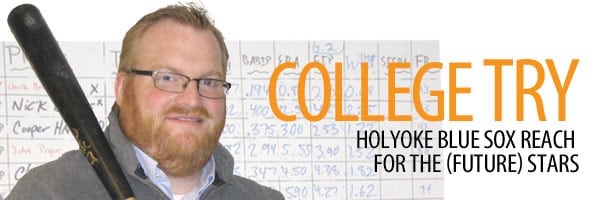
Cover Story Sections Travel and Tourism
Holyoke’s Happiness Machine Marks a Milestone

CoverBW-0513bThe Holyoke Merry-Go-Round marks 20 years in operation at Heritage Park this December.
Thus, this is a time of reflection and celebration in Holyoke, concerning both the remarkable story of how residents and businesses in the city rallied to keep the attraction within the community, and the success enjoyed since: more than 1 million riders, hundreds of events staged at the facility, restoration of nearly half the ride’s hand-crafted wooden horses, and the creation of untold memories for generations of area residents.
There will be many opportunities to rejoice and look back this year, with the highlight being a huge fund-raising gala at the Log Cabin Banquet and Meeting House on Sept. 19, an event that is expected to severely test the facility’s fire-code capacity.
But for those most closely involved with this landmark, known to them as PTC 80 (the 80th carousel built by the Philadelphia Toboggan Co.), this is a time for much more than celebrating — although they will do plenty of that. It’s an occasion to do some strategic planning and take important steps that will ensure there are many more anniversaries to celebrate down the road.
And it’s a time, said Angela Wright, to do some difficult, yet very necessary, succession planning when it comes to management of what those in the city call the ‘happiness machine.’

HolyokeMerryGoRound

Friends of PTC 80, as it’s called, will mark its milestone anniversary with an eye toward ensuring that there are more of these celebrations for decades to come.

Difficult, noted Wright, who was co-chair of the group that raised the money to keep the carousel in Holyoke and has been its volunteer director since it opened, because that’s the only word to describe what it will be like to “let go.”
“We’re reluctant to give up something that is close to all of us, and something that we worked so hard at —  it’s been a labor of love for all of us,” she said, referring to a strong corps of volunteers that has been with this project from the beginning and seen some of their ranks pass away in recent years. “We don’t want to let go of this, but it’s something we know we have to do.”
Elaborating, she said the Friends of the Holyoke Merry-Go-Round, as this group is called, is engaging in discussions about hiring a full-time executive director for the facility, an individual who will assume many duties currently carried out by those volunteers, from fund-raising to marketing, while also taking on the primary assignment — maintaining the relationships that have enabled this city treasure to survive and thrive, and creating new ones.
Hiring a director is one of many suggestions forwarded during strategic planning sessions staged recently with a consultant, Jeff Hayden, former city development director and current director of the Kittredge Center, said Maureen Costello, administrative manager of PTC 80.
Others include everything from recruiting additional board members to developing and implementing a marketing plan; from multi-faceted efforts to increase visitation to a host of initiatives to increase revenues, especially the scheduling of more birthday parties and other events.
These steps are in various, but mostly early, stages of implementation, said Costello, noting that one important step — a doubling of the price of a ride to $2 after more than 18 years — was undertaken in 2012.
“That was a difficult decision for us, because we had prided ourselves on keeping the ticket price at a dollar since we opened in 1993,” she explaned. “But it’s been very well-received by our visitors; many people said, ‘it’s about time you did this.’”
There will be more difficult and far-reaching steps taken in the months and years to come, said Jim Jackowski, business liaison and customer service and credit manager for Holyoke Gas & Electric and current president of the Friends board. He noted that, while the attraction’s first two decades in operation could be deemed an unqualified success, these are tenuous times for independently operated carousels like this one.
The challenges are many, and include everything from the high cost of insurance (carousels have historically had high mishap rates, although this one hasn’t recorded any) to the escalating competition for the time of young children (the ride’s lifeblood) and their parents.
“There are just a lot more things for kids and families to do today,” said Jackowski. “We have to respond to that by promoting ourselves and doing what we’ve always done — providing a truly unique experience.”
Wright agreed. “Many carousels are closing — hardly a week goes that we don’t hear of one of them shutting down,” she said, noting that she and others read about such casualties in industry publications like the Carousel News & Trader and Merry-Go-Round Roundup. “These things are becoming very expensive … our liability insurance is extremely high. Between insurance, staffing, maintenance, upkeep, promotions, and marketing, they’re becoming simply too expensive for many operators to run.”
For this issue and its focus on travel and tourism, BusinessWest takes a quick look back at how PTC 80 remained a Holyoke institution, but a more comprehensive glance ahead to the challenge of making sure the happiness machine will be there to create memories for future generations of area residents.

Turns for the Better

‘Middle horse #5’

‘Middle horse #5’ is next in line for a complete restoration. To date, nearly half of the horses on the carousel have been refurbished.

It’s known simply as ‘middle horse #5.’ And that says it all — if you know this carousel.
It has three rows of horses (there are 28 in all, both ‘standers’ and ‘jumpers,’ with two chariots), with the largest animals on the outside and the smallest on the inside. This particular specimen is fifth in a sequence known only to those intimately involved with this attraction. And it is showing some definite signs of wear and tear, much of it caused by the buckle on the stirrup, which has knocked off badly faded paint in several areas.
As a result, it is next in line for restoration work that will make it look like the much shinier and newer ‘middle horse #4’ just ahead. This work, to be carried out at the New England Carousel Museum in Bristol, Conn., will cost roughly $5,000, said Costello. To help pay that cost, the merry-go-round is staging a raffle this summer, with the winner gaining the right to give the horse a real name — like ‘Lancelot,’ ‘Flower Power,’ and others that have been assigned to other animals on PTC 80.
Restoring horses, staging raffles, and giving names to the stars of this attraction have been some of the many aspects of that labor of love which Wright described, made possible by the truly inspiring story of how Holyoke came together to keep its carousel a quarter-century ago.
Most in this region are now at least somewhat familiar with the saga, which began with Mountain Park owner Jay Collins’ decision to shut down the popular tourist attraction after the 1987 season ended.
After unsuccessful efforts to sell the park, the 300 acres it sat on, and all the equipment and inventory as one package (asking price: $4 million), Collins opted to start selling off the pieces. He had some attractive offers (up to $2 million, according to some accounts) for PTC 80, which was in extremely good condition. And while he was considering them, John Hickey, then manager of Holyoke’s Water Department, approached him with a plan to keep the carousel in the city.
The two agreed on a price of $875,000, and Collins gave Hickey one year to raise the money.
The rest, is, well, history.
An elaborate ‘save the merry-go-round’ campaign was launched, complete with a request for pledges with rhetorical calls to action that included ‘stop them from riding off with Holyoke’s mane attraction’ and ‘if you care about Holyoke’s future, put some money down on her past.’
In the end, residents, business owners, and schoolchildren heeded those calls, raising enough money to buy the carousel and build it a new home in Heritage State Park. Thus, PTC 80’s second life began in December 1993.
To say that it’s been a smooth ride since then would oversimplify things, said Wright, who noted that there have been many challenges over the first two decades, from getting people to come to downtown Holyoke to attracting revenue-generating events, such as birthday parties and weddings, to overcoming the loss several years ago of the four-day Celebrate Holyoke event that gave the carousel much-needed exposure and ridership.
“The real business challenge for us has been to replace the revenue from the Celebrate Holyoke festival, which was probably 10% to 15% of our annual revenue,” said Jackowski. “We’ve done it largely through the promotion of the birthday parties, the private functions, and the corporate functions, and spreading the word through an extended Pioneer Valley area.”
The attraction has managed to remain in the black throughout and meet its annual budget of roughly $100,000, he noted, largely through perseverance, imagination, and resourcefulness.
But if PTC 80, one of only 100 antique classic wooden merry-rounds still operating in North America, is to keep its Holyoke address, it must continue to act as a small business would, and that means strategic planning and, as Wright and Costello said, succession planning.

Round Numbers
That later assignment is a difficult one for many small businesses to even acknowledge, let alone address, said Wright, adding that it’s the same with the merry-go-round, where this exercise takes a number of forms.
For starters, it means active recruiting of younger professionals within the community to join the board and become involved with the carousel, she said, adding that a new generation of leadership must eventually take the reins — literally and figuratively — from the group that waged the campaign to save PTC 80 a quarter-century ago.
Succession planning also means developing and advancing a plan to hire a full-time executive director, said Costello, adding that the merry-go-round has a part-time operations manager (15 hours per week), and there are others who have held that position in the past.
Hiring a full-time manager would be a big step, one that would dramatically alter the budgetary picture, Wright told BusinessWest, but such a move is necessary given the current challenging climate. But the broad “transition,” as she called it, will nonetheless be difficult for the carousel’s older ‘friends.’
“We’ve all been here 25 years,” she said. “And we’re all somewhat reluctant to let anything happen to this merry-go-round. We all have a personal investment in this, and it’s a sizable investment.”
Succession planning is just part of the discussion when it comes to securing the long-term future of the merry-go-round, said Costello, adding that strategic planning initiatives involving the attraction, like those staged for businesses of all sizes, have focused on that acronym SWOT — strengths, weaknesses, opportunities, and threats.
Clearly, the 20th-anniversary celebrations fall into that third category, she said, adding that the attraction’s leadership intends to use the many events and special programs on tap this year to introduce (or re-introduce) people to the carousel, with several goals in mind. These include everything from increasing direct ridership to booking more special events involving both children and adults; from recruiting more supporters to simply raising more funds.
“The 20th anniversary is a time to reflect on the many things that we’ve accomplished here and be proud of those accomplishments,” Costello said. “But it’s also an opportunity to re-connect with our supporters and make more friends.
“We recognize that, while our merry-go-round was the crown jewel at Mountain Park, the people who remember the park are older now,” she went on. “We understand that those people are not going to be able to share their memories of Mountain Park, so we need to attract a new generation of riders and supporters, and we’re cognizant of that as we make our plans for the future.”
As it did 25 years ago, the Friends group is reaching out to the community for donations, she said, adding that donors can become members of the merry-go-round’s Ring of Honor, a collection of brass plaques that bear the names of supporters ranging from Holyoke schoolchildren to businesses across all sectors.
Beyond fund-raising, one of the main goals moving forward is to maximize other revenue resources, said Costello, adding that the increase in ticket prices resulted in a roughly 70% increase in total revenue in 2012, “which made a huge difference.”
But long-term, the merry-go-round must be more successful with scheduling events, she continued, because they are both solid revenue generators and vehicles for generating future ridership and more get-togethers.
Overall, the ongoing assignment for the merry-go-round’s leadership team is to make the attraction — and downtown Holyoke in general — more of a true destination for families with children, said Jackowski, adding that there are many developments that are moving the city closer to that designation.
“We hope, by keeping this building as attractive as it is, and this park as attractive as it is, that the future looks bright,” he told BusinessWest. “We have our new neighbor, the computing center, we’re hopeful that the canal walk comes to fruition in the next five years, and there is more development down here that creates optimism. We want to be the focal point of all that.”

The Ride Stuff
John Hickey, who passed away in 2008, once wrote of carousels, “man, and high tech, has not yet devised a better way to illuminate the faces of children and parents with pure joy. The lights, the music, the kids dashing for the right horse, the clang of the starting bell, and the motion … you don’t really understand human nature unless you know why a child on a merry-go-round will wave every time around … and their parent will wave back. It never fails … it never will.”
PTC 80 has lived up to those words for more than eight decades, and especially in its new home in Holyoke’s downtown. Its first two decades there have been an extraordinary ride in every sense of that word.
And that’s why this anniversary will be a time to celebrate, but also a time to make sure that the ride will continue for decades to come.

George O’Brien can be reached at [email protected]
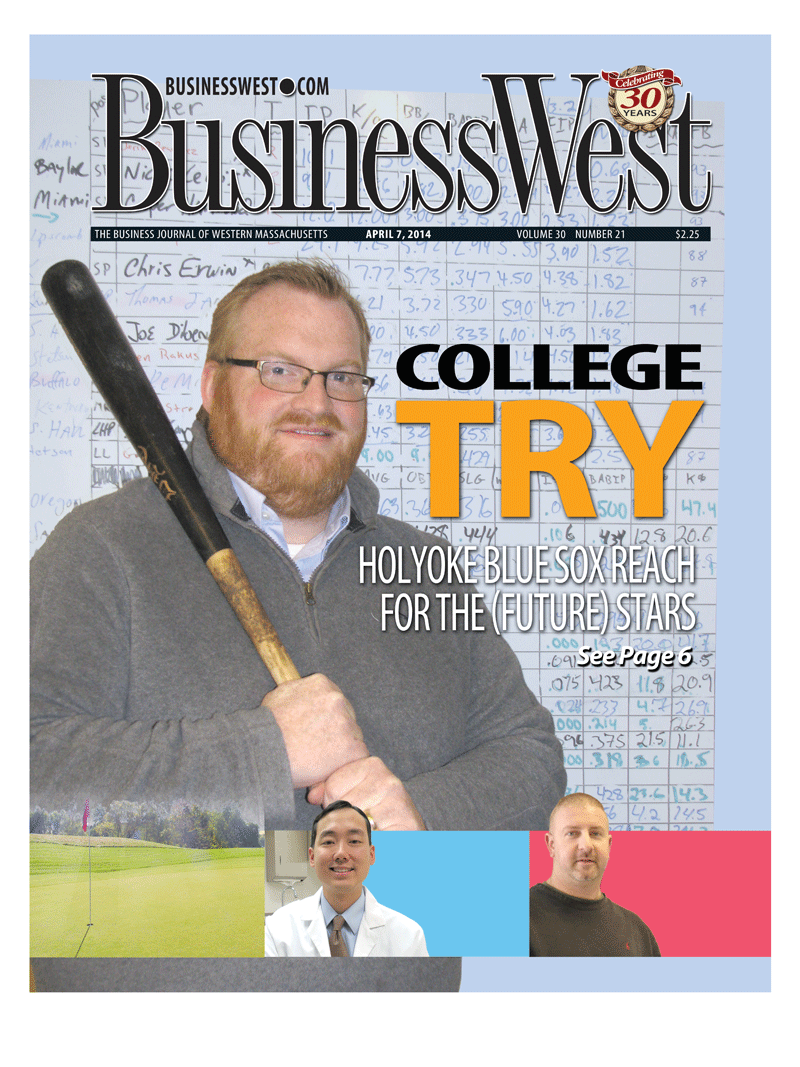
Cover Story Restaurants Sections
Area Landmarks Serve Up History — and Much More

BW0513aCovWhile all restaurants are destinations in many respects, some locations are unique, not just for the food prepared in the kitchen, but because of the rich history of the setting in question. For this special section, the 2013 Restaurant Guide, we venture to three establishments that could truly be called landmarks.


Inside:
Not Your Typical Haunt

Theodores’ Thrives with Its Blend of Music, Barbecue, and Tradition

All Aboard

Steaming Tender Mixes Hearty Food and Railroad Culture

Center-stage Cuisine

The Whately Inn Has Come a Long Way Since it Hosted Burlesque

Off the Menu

A list of the region’s finest restaurants

40 Under 40 Cover Story The Class of 2013
The Young Business and Community Leaders of Western Massachusetts

In 2007, BusinessWest introduced a new recognition program called 40 Under Forty. It was intended as a vehicle for showcasing young talent in the four counties of Western Mass. and, in turn, inspire others to reach higher and do more in their community.
Six years later, it has accomplished all that and much more. The program has become a brand, the awards gala has become one of the most anticipated events of the year, and the 40 Under Forty plaque that sits on one’s desk has become both a coveted prize and symbol of excellence, recognized by all.
On June 20 at the Log Cabin Banquet & Meeting House in Holyoke, 40 more plaques will be handed out, to members of a class that is both distinguished and diverse. It includes bankers, lawyers, and accountants, but also a Holyoke city councilor, a contractor who specializes in blitz building, and Springfield’s senior project manager. And it represents virtually every business sector, from healthcare to education; from technology to the nonprofit realm.
With that, we introduce the Class of 2013 with words (enough to explain why they’re an honoree) and pictures that tell a big part of each story, whether the winner is captured with his or her children, dog, company mascot, or even a giant corpuscle. The stories are all different, but the common denominator is that these young individuals possess that most important of qualities: leadership.

Sponsored by:
2013 40 Under Forty Winners:

Timothy Allen
Meaghan Arena
Adrian Bailey Dion
Jason Barroso
Elizabeth Beaudry
Melyssa Brown
Kam Capoccia
Jeremy Casey
Tommy Cosenzi
Erin Couture
Geoffrey Croteau
William Davila
Ralph DiVito Jr.
Shaun Dwyer
Erin Fontaine Brunelle
William Gagnon
Allison Garriss
Annamarie Golden
Lina Alexandra Hogan
Samalid Hogan
Xiaolei Hua
Mark Jardim
Danny Kates
Jeremy Leap
Danielle Letourneau-Therrien
Isaac Mass
Kelvin Molina
Brenna Murphy McGee
Vanessa Pabon
John Pantera
Justin Pelis
Shonda Pettiford
Shannon Reichelt
N. Andrew Robb
Stacy Robison
Rachel Romano
Jennifer Root
Jonathan Stolpinski
Walter Tomala Jr.
Mark Zatyrka


Meet the Judges — Click Here

Photography for this special section by Denise Smith Photography

Cover Story
Crumpin-Fox Club Focuses on Providing an Experience

Mike Zaranek

Mike Zaranek says Crumpin-Fox is a thought-provoking golf course, meaning that one needs a game plan to attack it.

Mike Zaranek describes the Crumpin-Fox Club as a “thought-provoking golf course.”

And by that, he meant that one can’t — or shouldn’t — plan on muscling their way around this picturesque track in Bernardston, just outside Greenfield. Rather, they have to think their way around.

“There’s a lot of shot-making that’s involved here,” said Zaranek, the head golf professional, gesturing with his hand to the 18th hole as he looked out on the course from a seat at Zeke’s Smokehouse Grill, the club’s 19th hole. “It’s not a bomber’s golf course where you hit your driver on every hole and try to get it as close as you can to the green. This course makes you think off each tee, and on every second shot as well.”

And just as the player needs a strategic plan for taking on this Robert Trent Jones Sr. creation, Zaranek and the rest of the management team needs one of their own to enable the club to continue growing at a time of stern challenges and mounting competition in the golf industry.

The essence of that plan is to let the course become not merely a destination, but an experience, said Zaranek, adding that it does this naturally, through its views and challenges, both of which create lasting memories.

“Each tee you stand on, and each green you look back to the tee on, is like a postcard,” he explained, adding that this effect is heightened by many changes in elevation and is especially dramatic at fall-foliage time. “There is a uniqueness to it, and that’s what brings people back.”

Repeat business is obviously one of the keys to success for any golf operation, but it’s especially critical for one that charges just under $100 a round for public play — which accounts for roughly 60% of the business at this semi-private course — and is tucked away in one of the most remote areas of the state, just a few miles from the Vermont border.

The Crump’s eighth hole

The Crump’s eighth hole forces the player to make a number of decisions.

Thus, the staff puts the accent on the total experience — from the golf to the meal afterward — and also on both driving first visits (which often prompt return trips) and convincing players that Crumpin-Fox should be a more than a once-a-year course.

“That sentiment is summed up in one of our marketing slogans — ‘minutes away, worlds apart,’” said Zaranek. “We’re a destination, but we don’t want to be just a destination; we’d love to have people visit us two, three, or four times a year. Overall, we want to make this an experience, one that you’ll enjoy and want to mark on your calendar every year.”

For this issue and BusinessWest’s annual Golf Preview, we take an indepth look at what is still a hidden gem, and Zarenek’s efforts to make it less so.


On the Hole

The eighth hole at ‘the Crump,’ as it’s called, is certainly one of the more thought-provoking holes on this 7,023-yard layout.

There is water along almost the entire left side of this lengthy par 5 (nearly 600 yards from the tips). And the decision making really begins after the drive, even if it’s a very good one.

The player is faced with the option of hitting a safer mid-iron to a still-relatively wide section of fairway for a third shot of roughly the same length over the lake to a narrow, undulating green, or bringing out more artillery and hitting down to a narrower strip of fairway, leaving just a wedge onto the putting surface.

There are many such decisions to be made on this course, which offers what Zarenek described as a Pine Valley-like feel, if not look, although it has some of that, too.

This is a reference to the George Arthur Crump-designed track in Southern New Jersey that is generally regarded as the world’s most difficult course, and one of its very best. The comparison doesn’t involve degree of difficulty — although Crumpin-Fox is certainly challenging — but rather the notion that every hole is an entity unto its own, with other holes rarely visible from tees, greens, or fairways.

“Each hole is set in its own scenery here — you play that hole, and then you move on to another piece of scenery, and that’s what we mean by a Pine Valley-like course,” Zaranek explained. “You barely see the group in front of you or the group behind you all day.”

The overall tightness of the layout also contributes to that description.

“At one time, especially on the back nine, it was basically the tee, the fairway, about five feet of rough, and then there was brush, the jungle,” he noted, adding that the course has been opened up somewhat over the years, but still demands accuracy. “What you see is what you get in front of you.”

This was the general idea when, in 1969, area businessman David Berelson engaged the services of Roger Rulewich, a noted golf-course architect then with Robert Trent Jones Inc., to locate a parcel for a destination golf course.

The current site in Bernardston was chosen, but the project stalled and didn’t begin to take shape until 1977, when Andy St. Hillaire, owner of Mohawk Plastics, bought the land and project, completed what are now the back nine holes, and built the present clubhouse.

The name Crumpin-Fox, said Zaranek, was derived from some of the old soda bottles found on the property as construction of the course commenced. The Bernardston-based Crump Soda Co. was eventually sold in 1853 to one Eli Fox, he noted, and then renamed the Crump & Fox Soda Co.

In 1987, St. Hillaire sold the club to William Sandri, president of the Sandri Co., which owned a number of gas stations in Western Mass., Vermont, and New York, and would eventually diversify into a number of business sectors, including real estate, clean-energy products, and golf.

The company now has three courses that operate under the name Fox Golf. The others are the Fox Hollow Club in Trinity, Fla., which opened in 1994 — its 18th hole was at one time rated the number-one par 4 in Florida by Florida Golf Central magazine — and Fox Hopyard in East Haddam, Conn., which opened in 2001.


Round Numbers

All three clubs operate under the same model — that of a semi-private course that has members but is also open to the public at most times during the week. Zaranek said this model is perhaps the most successful in golf today because it offers both the stability provided by a core of members (that number is roughly 235 at Crumpin-Fox, one Zaranek said he’s comfortable with) and the flexibility and additional revenue opportunities that come with making the course open to the public.

Membership at Crumpin-Fox has been steady, with relatively little fluctuation in the number in recent years despite turbulence in the economy, said Zaranek, adding that the public-play component of the equation has been more impacted by the downturn, as well as a number of other contributing factors.

These include everything from the weather — which has both helped and hurt; the 2012 season began on March 23 (a record for the Crump) after a nearly snowless winter, but the hurricane of 2011 took a heavy toll — to new competition in the destination-course market.

Indeed, while the pace of new-course construction has slowed in recent years, some additions in the eastern part of the state, especially a new cluster of tracks in the Plymouth area, as well as the Ranch in Southwick and some new venues in Connecticut, have had an impact on play in Bernardston, said Zaranek.

“From Route 3 down to the Bourne Bridge, they built 15 or 16 golf courses since 1997, and that took some of the traffic we used to get from the Boston area,” he noted. “We still get some, though, and we’re seeing those numbers climb because people are expanding their visions, and they’ve played all those new courses. People say, ‘have you ever played Crump?’ and once people come out here once, I think they like putting us back on their docket.”

Last year, even with that early start, the club recorded roughly 19,000 rounds between members and guests, he told BusinessWest, adding that, in banner years (such as the late ’90s), volume has exceeded 25,000, and the present goal is to get closer to 22,000.

To get there, the general strategic plan for the course, which hasn’t really changed since it opened, is to convince players from maybe a 75- to 100-mile radius that Bernardston is not that far away, and certainly worth the time and trouble for a course that is unique and challenging.

And this is the message being sent to a host of constituencies, from smaller groups (a foursome or two) to larger entities, such as leagues or clubs, to charitable organizations planning fund-raisers. The club already hosts a number of events, said Zaranek, including a large gathering for Big Brothers Big Sisters and another for the It Takes a Community foundation.

While the Crump name certainly resonates within the Western Mass. market, it is still somewhat of an unknown commodity in other areas, especially with younger golfers, he continued, adding that one of the club’s stated goals is to build brand recognition across the region it serves.

With each of those aforementioned constituencies, the key is providing value — and an experience — that will drive repeat business, Zaranek explained, adding that this goal, or mission, has prompted improvements ranging from extensive renovations to Zeke’s Grill, including the addition of a smoker, to an ongoing facelift in the locker rooms.

“There are a lot of elements that go into making a club successful,” he explained. “And you have to make each guest that comes through feel like a member that day, and make them feel like they had a great experience. And that all has to gel together. We keep trying to improve everything we do every day.”

Long-term, the club is exploring a possible expansion of the clubhouse and perhaps the addition of a large pavilion for outings, he said, adding that many events are currently staged under tents erected on the driving range.

Course of Action

Zaranek said the club has historically strived to be open by Masters weekend, the unofficial start of the golf season for those in the Northeast.

Looking out on a course that still had a number of areas covered by more than a few inches of snow, he said that goal is likely within reach (the Masters is set for April 11-14), but some assistance from Mother Nature will probably be needed.

She has already contributed a dramatic setting that has contributed to those postcards Zaranek described, and given the Crump a strong selling point to draw players for what will likely be the first of several visits.

“It’s one of the most unique, pretty, and, yes, demanding golf courses that you’re ever going to play,” he said in summation. “You don’t go away forgetting many of these golf holes as you play them.”


George O’Brien can be reached at [email protected]

Cover Story
UMass Chancellor Will Make Proper Planning a Priority

COVERart0313bAs he talked about UMass Amherst and the course he projects for the school he now serves as chancellor, Kumble Subbaswamy summoned a well-worn quote from Dwight Eisenhower: “plans are nothing; planning is everything.”

Those words were uttered in reference to preparations for D-Day, the largest amphibious invasion in history, but they’ve been borrowed by leaders in virtually every field, including academia, to describe the difference between having a plan on paper and engaging in effective, thorough, sensible planning.

There is a new strategic planning initiative underway at the Amherst campus, said Subbaswamy (known to colleagues as ‘Swamy’), one that will provide a detailed outline of where this soon-to-be-150-year-old institution needs to be with regard to everything from the life sciences to economic-development initiatives within the Commonwealth; from increasing the volume of research initiatives on the campus to improving graduation rates.


The faculty-led initiative, which should be ready by the summer, will shape the school’s trajectory for the next several years, said Subbaswamy, who came to the Amherst campus last July.

“Eisenhower was correct — planning is a forcing mechanism for us to think seriously about where we want to go,” he told BusinessWest. “Without planning, anything goes.

“This is a time when economic development is on a lot of people’s minds,” he continued, while juxtaposing the school’s current mission against the one it started with as one of the institutions created through the Land Grant Act of 1862. “Globalization has had an impact on what it means to be a 21st-century economic power; we still have a lot of assets that the state has invested in that can produce direct benefits to the Commonwealth and beyond, and we will be articulating that as part of our strategic plan.”

But planning has become a far more challenging assignment in the current fiscal climate, one in which state contributions to the state university have been declining, said Subbaswamy, adding that the funding situation leaves many question marks about everything from further progress in what has become known as the ‘Springfield Initiative’ to efforts at the university to help the state’s businesses become more globally competitive.

“If the expectation is that planning means that new resources will suddenly and magically appear, that’s unrealistic; that’s not what happens,” he said. “But if the goal is to say, ‘whether new resources come in or not, we want to prioritize where we spend our money,’ then the planning exercise is a very important one and a necessity.”

Moving forward, he said the school, its administrators, and faculty will be addressing what he called some of the “new challenges” facing those in higher education today. He put on that list such matters as the emergence of online education and what it means to residential institutions to continuously hone the model for a successful research university.

Meanwhile, one additional challenge for the UMass Amherst campus, and it’s not a recent phenomenon, is making its various programs and reputation for excellence as well-known within the state as it is outside.

“Sometimes, it feels like UMass Amherst is the best-kept secret inside the Commonwealth of Massachusetts — it has a far better reputation outside the state,” he explained, adding that this is likely due in large part to the Bay State’s many prestigious and well-known private institutions — Harvard and MIT top that lengthy list — which often overshadow the state university’s flagship campus.

“But I think people are beginning to recognize the difference between the publics and the privates,” he went on, “and, in particular, the important role that public institutions play within the Commonwealth. When you get into deeper conversations, you see that there is high and growing regard for UMass Amherst; people recognize, for example, that admission standards have gotten pretty high, and they recognize that the Commonwealth Honors College is a destination place for the best and the brightest inside the state and outside it as well.”

The Commonwealth’s stock of private schools may also play a role in what many have described as a less-than-passionate alumni base when it comes to the university, said Subbaswamy, who didn’t exactly disagree with that characterization. He said the school suffers from geographic challenges — many of its graduates live and work across the state, which is not a huge distance comparatively, but certainly psychologically — and also from a lack of what he called “connecting points.”

And he placed in that category everything from buildings and features on the campus itself — perhaps the most historic and best-known building, the chapel, has been closed for more than a decade — to a big-time sports program.

For this issue, BusinessWest conducted a wide-ranging interview with Subbaswamy, one that touched on everything from rising in the ranks nationally among research institutions to possible expansion into downtown Springfield — and how it all comes back to planning.


Class Action

After arriving last summer after a stints at two other major public schools — the University of Kentucky’s Lexington campus and the University of Indiana’s flagship campus in Bloomington — Subbaswamy said he commenced a lengthy, and in some ways ongoing, series of “meets and greets” with individuals and groups at both ends of the state.

The constituencies involved were both internal — faculty, staff, and students, among others — and external, ranging from alumni groups to state legislators to the Cranberry Growers Assoc., which, while based in Wareham on Cape Cod, boasts many members from the UMass School of Agriculture, and certainly isn’t among those lacking an appreciation for the state university.

“Among the cranberry growers, there is true adulation and respect for the institution,” said the chancellor, “because they readily admit that their business would not be what it is today without the continued work on the campus.”

In some respects, these meetings involved varying degrees of what Subbaswamy called “repairing relations” — his predecessor, Robert Holub, was essentially forced out after three years at the helm, and there has been considerable turnover in the chancellor’s office in recent years — but he told BusinessWest that this work is essentially done.

“Part of this work was reassuring our support base that everything is continuing on campus, that the positive momentum generated by my predecessors has not been slowed down, and that we’re on track to dealing with the new challenges in public higher education,” he explained. “The other was securing their continued support as we commence our 151st year.”

Those aforementioned constituencies have moved on, he explained, to the broader topic of what to expect from the school’s new leader.

And the answer to that question is clouded by a number of issues, but mostly the challenging fiscal situation, said the chancellor, adding that those who have expectations should manage them appropriately given the financial landscape.

And this mindset applies to both aspects of how a flagship university impacts economic development, he said, referring to both the narrow focus — the jobs at the campus and the spending it generates, for example — and the broader role stemming from transferring research into business opportunities, assisting existing businesses with becoming more competitive and moving in new and profitable directions, and drawing new businesses to the region.

“This is a role than can only be played by major research universities, public or private, and in this region, we’re it,” he explained. “And in a climate where the state has been reducing our appropriation over the past five or six years, we don’t have the resources that we can come up with to play that additional role in economic development.

“We have the knowhow, we have the expertise, and we have the desire,” he continued. “But we have a very limited ability to get engaged unless we find resources, whether it’s through the state, the local region, or federal assistance, to do it on the scale that’s needed to be a true catalyst.

“And we’re only one element in bringing about systemic change,” the chancellor went on. “The local government, local businesses, the state government, and the private sector — they all have a role to play in this. We’re ready, and we have a track record of getting involved with social change and economic development, but we can’t do it without resources.”

Quantifying matters, Subbaswamy said the university has been coping with a 26% reduction in state appropriations over the past several years. A current proposal from the governor to reverse the course of state assistance would certainly help, he went on, but it wouldn’t put the university even back to where it was five or six years ago.

Meanwhile, the campus infrastructure continues to age and deteriorate, he told BusinessWest, adding that the vast majority of the buildings are now more than 50 years old or fast approaching that number — there was a huge building boom in the ’60s and early ’70s, but then virtually nothing for the next 30 years — and there is currently $1.6 billion in deferred maintenance that needs to be undertaken.

The school has responded with efforts to become more efficient and cut fat where possible, but higher tuition and fees have also become reality, bringing the school dangerously close to limiting one of its historical assets in the Commonwealth — access to all economic classes of students.


Progress — by Degrees

The ongoing fiscal challenges are also going to play a role in the university’s involvement in the region’s largest community, said Subbaswamy, adding, again, that there are expectations about what the institution can and should do with regard to the City of Homes.

The Springfield Initiative has a number of moving parts, involving everything from the arts to biosciences (the Pioneer Valley Life Sciences Institute); from creating an active presence in the downtown — the university’s Design Center was relocated to Court Square — to work with Davis Foundation on issues involving education in urban settings.

The most recent talk, or speculation, has centered on broadening that downtown presence with a satellite facility, said Subbaswamy, adding that terminology, not to mention expectations, must be put in proper perspective.

“Somehow, the expectation that a large campus can be created suddenly, and without a comprehensive needs analysis, is unrealistic,” he explained, opting to use the phrase ‘satellite center’ to describe what, if anything, could develop. “Different people have different views on what they expect from UMass, and, in general, these expectations need to be managed properly.”

Elaborating, he said that many area officials have an ‘if-you-build-it-they-will-come’ thought process when it comes to a UMass facility in downtown Springfield, while he considers smaller, phased-in growth to be more practical, especially in these times.

“If you want to grow organically, and start with what we consider to be the highest priorities — how can we make a difference,” he said, “and then, based on that success and additional resources, grow more, I think that’s a much more realistic approach for today’s financial climate.”

And this brings him back to the subject of planning and the ongoing initiative at the university to chart a course for the years and decades to come.

UMass already has a number of stated priorities and strategic initiatives — some more clearly articulated than others, he said, adding that putting such matters within a plan, with clearly stated goals and methods for measuring results, makes it easier to achieve progress with those goals.

He cited work within the broad realm of life sciences as one example.

“We understand that the life sciences are of major importance to the state at this time, so we will have a focus on life-sciences research and development in this plan,” he explained. “We’re already doing [work in that field], but we haven’t explicitly stated it. By stating it, that allows different colleges and departments to align their resources in this general direction.”

Moreover, the strategic plan in progress will not only prioritize matters and provide a road map for reaching certain goals, it will ultimately leave the university better prepared for when the financial skies clear, said the chancellor.

“When you make an argument for new resources, having a cogent plan allows you to make an argument for those resources better than if you simply said, ‘give us money, and we’ll do good things,’” he told BusinessWest. “I’m sure we’ll do good things, but what is the benefit to society; what is the benefit to the Commonwealth?”

While undertaking this strategic planning, the new chancellor will look to address some of the other priorities that were reinforced during those meet and greets. These include making the school less of a well-kept secret within the Commonwealth and getting graduates more engaged with their alma mater.

The school’s almost-year-long sesquicentennial celebration may provide one of those key connecting points for the alumni base that Subbaswamy described.

The chancellor said the planned events, including a Founder’s Day that will be expanded into a Founder’s Week, will offer a springboard for fund-raising efforts that have been delayed by the change in the chancellor’s office, with the so-called ‘public phase’ of that initiative set to begin April 27. Meanwhile, it will also dovetail in many respects with the strategic-planning initiative and offer opportunities to show how, while the school may have changed in countless ways since 1863, its overall mission really hasn’t.

“When the Land Grant Act was passed 150 years ago and our campus was created, there were specific expectations about educating the general populace and conducting relevant research and making sure that this research translated into benefiting society,” Subbaswamy said. “As times have changed, the role of research universities has also evolved, but land-grant universities have maintained that original mission — teaching, research, and outreach.

“This will be a time for reflection on where you’ve come from,” he continued, “and also an opportunity to rethink how you want to focus for the future.”


School of Thought

As he talked about where the Amherst campus has been, where it is, and where it’s going, the chancellor didn’t borrow another famous Eisenhower quote — “unless we progress, we regress” — but that was the essence of the message he left with BusinessWest.

The school does, indeed, have the same mission it had when it was launched at the height of the Civil War, but education, technology, and the global economy have all changed in myriad ways.

Subbaswamy has many items on his to-do list, but proactive response to those changes are at the top of the chart — along with the constant planning that is, as Ike said, everything.


George O’Brien can be reached at [email protected]

Cover Story
Doctors Express Franchisees Are Our Top Entrepreneurs for 2012

Neither Rick Crews nor Jim Brennan remembers many of the specific details from that lunch they had together at Max’s Tavern in the late fall of 2009.

What they do recall is that, by the time the check came, they had a plan — or at least the resolve to begin the process of putting one together.

And it was certainly an ambitious plan.

Indeed, instead of going into business together and operating a single franchise of a growing national chain of urgent-care centers called Doctors Express — which was one of the options they discussed at that lunch — they decided instead to become what’s known as master franchisees, overseeing not a location of this chain, which offers an alternative to crowded emergency rooms and the primary-care physician’s office when it’s closed, but a region, in this case most of New England.

Taking that step would be a radical career departure for both Crews, who was essentially downsized from his job running the Springfield office for the financial-services giant UBS and looking for his next opportunity, and Brennan, who owned an investment-management company bearing his name that specialized in small-business investment, mezzanine financing, and commercial real estate.

But they believed they had the necessary ingredients — from entrepreneurial drive to trust in one another’s instincts and abilities — to take the plunge.

“The enthusiasm that we both showed for the idea was a big factor in allowing us to move forward,” said Crews. “We both saw a great opportunity, and we were on the same page on a lot of different things; we had, and still have, a shared vision of where we can go.”

Fast-forward roughly two and a half years from when they opened the doors to their first location on Cooley Street in Springfield. The two partners now have two locations locally (the other is in West Springfield), with plans for others in the formative stage. They also have two locations in the Greater Boston area (with three more on the way) opened as part of a large initiative funded by a capital raise in 2011, as well as five other Eastern Mass. sites now operated by franchisees. And there are plans being considered to take the brand into a number of other markets, from Central Mass. to New Hampshire and Maine.

Brennan said the goal is to have perhaps 30 locations throughout their New England territory within two or three years.

Beyond the physical expansion, though, what has been equally impressive is the trailblazing nature of this enterprise, which operates in a field, urgent care, that is still a relative unknown in some parts of the state and the New England region. The two partners have become a model operation for others exploring the Doctors Express franchise with regard to everything from marketing and generating press to finding new and different ways to improve the patient experience.

These include everything from high-definition TVs in examination rooms at some locations, to help ease the wait for the physician, to water bottles and cookies for all patients.

In recognition of the speed and efficiency with which Crews and Brennan have taken the Doctors Express brand across the state, and for the aggressive yet calculated way in which they carried out the plan they outlined over lunch, Crews and Brennan have been named BusinessWest’s Top Entrepreneurs for 2012.

Thus, they are the latest recipients of an award the magazine initiated in 1995 to pay homage to this region’s long history of entrepreneurship and to recognize those who are adding to that legacy and writing new chapters for an ongoing story. They join an eclectic roster of winners that includes Balise Motor Sales President Jeb Balise, former Springfield Technical Community College President Andrew Scibelli, Maybury Material Handling President John Maybury, Cooley Dickinson Hospital President Craig Melin, the Holyoke Gas & Electric Department, and last year’s honoree, Herbie Flores, director of the New England Farm Workers’ Council and aggressive investor in downtown Springfield.

“Rick Crews and Jim Brennan embody the true spirit of entrepreneurship,” said BusinessWest Publisher John Gormally. “They’ve dared to dream big and, in the process of doing so, have assumed a great deal of risk. They’re ambitious, confident, and imaginative, but above all else, they’re determined to succeed.

“And their impressive track record to date and promise for continued expansion makes them worthy recipients of our Top Entrepreneur award,” he went on. “Together, they’re a great addition to a long list of inspiring entrepreneurs and those who run their organizations with a decidedly entrepreneurial mindset.”

For this issue, BusinessWest takes an indepth look at how far Crews and Brennan have already taken their joint venture, and where they want to take it next.


Taking the Pulse of a Business

The front lobby of the West Springfield Doctors Express location was crowded on this Friday afternoon, with most of the two dozen chairs occupied by people of different ages and with varying degrees of discomfort.

Most were exhibiting flu-like symptoms, said Brennan as he sat down with BusinessWest for this interview. Both he and Crews would then go on to quote both newspaper articles and medical-industry reports about what was already a heavy flu season and would likely get worse as the winter wore on.

“With this epidemic of the flu, we’ve had to adjust our staffing model and put on more providers and healthcare staff,” said Brennan. “These are things that weren’t planned on and forecasted, but they’re part of doing business in healthcare today; you adjust to the need that’s out there.”

This subject matter is a world or two away from what Crews and Brennan knew professionally only four years ago. It’s certainly a far cry from what they might have been talking about had things gone differently when Crews took his search for a new career path to a higher level in the summer of 2009 after opting to leave UBS and take a severance package rather than go from full-time to part-time.

By then, he had logged several meetings with Steven Rosenkrantz, owner of the local office of a franchise called Entrepreneur’s Source, which, as the name suggests (sort of), matches aspiring entrepreneurs with franchises.

“I was looking for something where I could be the boss, and also run a business where people would leave happier than when they came in — those were the two priorities,” said Crews, adding that Rosenkrantz put a number of possibilities in front of him, from Cartridge World, a toner-cartridge sales enterprise, to Sports Clips, a haircutting chain. He even looked at opening a sports bar in South Hartford.

“I’m really glad I didn’t go that route,” he told BusinessWest, adding that Rosenkrantz eventually put Doctors Express, a chain started in Baltimore by an emergency-room physician, on the table for consideration.

Actually, there were two proposals — a single location of that franchise, or the master-franchisee designation, which would involve Massachusetts, Vermont, New Hampshire, Maine, and a portion of Connecticut.

“I liked the master-franchisee concept, but I’d knew I’d need a partner to do that, and Jim was the first person I thought of,” Crews explained, while setting the scene for that aforementioned lunch on Springfield’s riverfront.

The two had known each other for years by then and done some business together, and there was also the requisite comfort level and shared vision needed to create a business partnership.

“He coached my son in basketball, and I coached his son in baseball,” said Crews. “We had a good friendship prior to this, and we would often talk about going into business together someday.

“We got along, and we had a lot in common,” he continued. “We’re great dads, good husbands, we’re family-oriented and community-oriented … we coached sports. We made for a good team.”

Equally important, though, were the things they didn’t have in common, said Brennan, noting that their vastly different business skill sets have meshed nicely.

“Rick has been with a Fortune 500 company and managed 30 type-A personalities plus administrative staff, and that’s not my forte,” he explained. “I’m more independent, and while I don’t want to say I’m more creative, my skill set would be creative financing, expansion of a growing business, mezzanine financing, real estate, and small-business speculation. Having these skills and putting them together with Rick’s has made for an outstanding relationship, and that’s the key to our success.”


In the Right Vein

As they talked about all that’s happened since they became business partners, Brennan and Crews said that, while success has seemingly come quickly and easily, there have been some intriguing learning curves and growing pains to contend with, and that process is ongoing.

It has involved everything from honing the art and science of choosing locations — the basic theory is to choose a site with 50,000 people within three miles of the front door, but it’s far more complex than that — to the process of educating patients and healthcare professionals about the emergence of urgent-care facilities, especially in the Boston area, where it is still very much a foreign concept.

And then, there was simply the matter of learning the business of providing healthcare itself, which was outwardly daunting, because neither had anything approaching experience in medicine.

Crews took on that assignment aggressively and creatively, making himself chief administrator of the Cooley Street location for the first nine months of its existence. When asked what he learned on that job, he glanced toward the ceiling, offered a heavy sigh, and said, “what didn’t I learn?”

As he explained, “I wanted to learn the ins and outs of the business, and what better way to do that to actually run the center? I learned about healthcare — about insurance companies, coding, billing, staffing, scheduling challenges, working with doctors … how to run an urgent-care center.

“It was challenging, but it was also fun,” he continued. “Every day I was learning something new.”

Tracing the progression of their venture, or franchise territory, Crews and Brennan said that, even as they were cutting the ribbon on the Cooley Street location, there were discussions taking place about where to go next.

And ultimately, those decisions involved both ends of the state. Locally, after consideration of several locations, the decision was made to expand into West Springfield, with a facility that could draw residents from several neighboring communities, including Agawam, Westfield, and Holyoke; that location opened in 2012.

Meanwhile, only a few months after the Springfield facility opened its doors, the partners embarked on a capital raise aimed at netting $4 million to fuel a push into the Greater Boston area. That offering attracted the attention of investors locally, but also from across the country, said Brennan, adding that the first location funded by that group opened in Saugus early last month. Another, in Dedham, will open soon, and a letter of intent for a third, in Arlington, was recently inked. Eventually, there will be five sites sprung from that Boston offering, for which Crews and Brennan are general partners, with a 50% stake.

In addition, the partners operate a management company with five Boston-area franchisees under it. Those locations are in Braintree, Natick, Waltham, and North Andover, with another facility to open soon in Watertown.

This growth has necessitated expansion of the company’s corporate offices in Longmeadow, said Crews, adding that the team now includes Project Manager Melissa Nelson, charged with helping franchisees get their operations off the ground and running efficiently, as well as Controller Tim Sterett, who helps the partners plan and forecast for the future.

There are also people on the ground in various markets, including Western Mass., but especially the Greater Boston area, educating various constituencies about urgent care, how it is cost-effective for those who seek it, and how it can reduce congestion in the emergency room while also becoming a feeder service for hospitals.

“We have a business-development manager who is out in the community every day talking about urgent care,” said Crews. “We’ve also formed a co-op amongst all our franchisees, with the money to be spent monthly on advertising. Starting in a week, we’ll be doing our first TV commercials in Boston; we’ve been doing radio for the past month.”


Charting Results

Together, the team that Crews and Brennan has put together is scouting new locations in several areas of Massachusetts and a few bordering states, while also continuing that process of educating the public and the healthcare community about the concept of urgent care, and also striving to constantly improve the patient experience.

Which brings Crews back to those TVs in the examination rooms — now standard equipment in the Boston-area facilities and likely to be added at local locations.

“When someone goes into an exam room, they don’t like to wait for a doctor,” he explained. “So we have a policy that no one is supposed to wait more than 10 minutes for a doctor. However, depending on what you’re there for, you could be in the exam room for a long period of time. Having a TV in there helps to distract them from thinking about how long they’ve been there, and that’s especially true if you have children; it’s nice if they can put on Spongebob or the Disney Channel.”

Such attention to detail and the patient experience has helped Doctors Express gain acceptance and solid word-of-mouth referrals, said Brennan, adding that, from a big-picture perspective, success has come by creating relationships and making connections on a number of levels.

“When we go into a market, it’s important for us to create relationships not only with the primary-care physicians and hospitals, but also the medical groups in those areas,” Brennan explained. “There’s a new world of ACOs [accountable-care organizations] out there, and it’s important that we stay in contact with them and provide our services to those groups.

“Whether it’s Boston or Worcester, or wherever we go, one of the first things we do is reach out,” he continued. “We need to explain our story and what our plans are, and to date, we’ve been received very well. Originally, it was ‘who are you guys?’ because no one had ever heard of us, not just in our marketplace or in Boston, but in general. Now, most people have at least heard of Doctors Express.”

Looking ahead, the two partners said they are exploring a number of growth options. Locally, they’re looking for a location north of Springfield, perhaps in Chicopee. Meanwhile, they’re eyeing the Worcester market as the next possible expansion point, but also looking at potential opportunities in New Hampshire and Maine.

And from a bigger-picture perspective, they’re considering the possibility of taking their territory public, a move that would provide the infusion of capital needed to place dozens of proverbial push pins on a map of New England.

“That’s an aspiration, and there’s a way to get there,” said Brennan. “It all starts with the success we’re having, and we need to keep growing — it’s a snowball effect. I don’t think we’re there yet, though; we need to expand our business and get a good handle on what our revenues will be. If we continue to grow the way we are, maybe in a year we’ll know a lot more about whether that’s something we want to do.”

But the success of this venture can’t be measured simply by how many, and how quickly, locations can opened, said Crews, adding that there must be a balance between physical growth and maintaining high standards of quality in the locations already up and running. And the partners work hard to achieve that balance.

“You can’t just open center after center after center,” he told BusinessWest. “You have to make sure each location is successful and doing things properly, and that the service you’re providing is consistent and excellent. So there’s a lot of detail involved with every center that we open, and we also have to make sure our franchisees are opening with the same level of detail, service, and everything else. You have to spend the time and make sure you’re doing it right with each one — and it does take time.”

“And that’s the great thing about the master-franchisee concept,” he went on. “We can bring in great people under us to replicate exactly what we’re doing.”

Evidence that they are doing things right comes from the steady stream of phone calls from current and potential Doctors Express franchisees looking for advice and guidance about everything from marketing to staffing levels.

“I think I field at least two calls a week from people around the country, either current franchisees or potential franchisees,” said Crews. “They’re interested in what we’re doing, how we’re doing it, and why we’re so successful.”

Added Brennan, “with continued success, opportunities arise. Our goal is just to keep moving forward, continue growing, and keep our focus on what has made us successful and not deviate from that.”


Polishing the Script

Looking back, both Crews and Brennan are quite happy that they didn’t take the Cartridge World route or open that sports bar in Greater Hartford — not that they wouldn’t have been successful with either entrepreneurial gambit.

They just believe that, in Doctors Express, they’ve found a perfect match between a potential-laden business opportunity and their own talents and entrepreneurial drive.

“There hasn’t been a day when I haven’t gotten out of bed and looked forward to going to work — I love it,” said Crews. “I love the challenges — getting pulled in a million directions is where I thrive, and as we get bigger and busier, I get pulled in more directions. Yes, there are a lot of challenges that we face, but it’s exciting to work through them.”

Listening to that, it’s clear that the prognosis is continued progress for BusinessWest’s Top Entrepreneurs for 2012.

Previous Top Entrepreneurs

• 2011: Heriberto Flores, director of the New England Farm Workers’ Council and Partners for Community
• 2010: Bob Bolduc, founder and CEO of Pride
• 2009: The Holyoke Gas & Electric Department
• 2008: Arlene Kelly and Kim Sanborn, founders of Human Resource Solutions and Convergent Solutions Inc.
• 2007: John Maybury, president of Maybury Material Handling
• 2006: Rocco, Jim, and Jayson Falcone, principals of Rocky’s Hardware Stores and Falcone Retail Properties
• 2005: James (Jeb) Balise, president of Balise Motor Sales
• 2004: Craig Melin, president and CEO of Cooley Dickinson Hospital
• 2003: Tony Dolphin, president of Springboard Technologies
• 2002: Timm Tobin, then-president of Tobin Systems Inc.
• 2001: Dan Kelley, then-president of Equal Access Partners
• 2000: Jim Ross, Doug Brown, and Richard DiGeronimo, then-principals of Concourse Communications
• 1999: Andrew Scibelli, then-president of Springfield Technical Community College
• 1998: Eric Suher, president of E.S. Sports in Holyoke
• 1997: Peter Rosskothen and Larry Perreault, co-owners of the Log Cabin Banquet and Meeting House
• 1996: David Epstein, president and co-founder of JavaNet and the JavaNet Café


George O’Brien can be reached at [email protected]
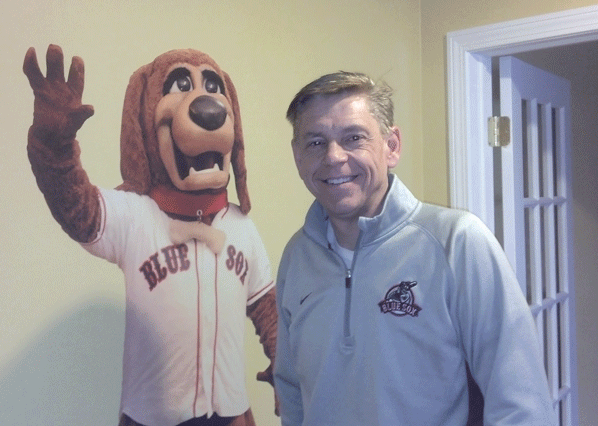
Cover Story

Click here to go to the 2012 WMBExpo site!

From the Editor and Publisher

A year ago, BusinessWest entered a new era in its service to Western Massachusetts and its business community, and a new phrase worked its way into the local lexicon: The Expo.

That’s short for Western Mass. Business Expo, a new fall tradition in this region that will mark its return on Oct. 11 at the MassMutual Center in downtown Springfield. The Expo, a day-long business event, was created as an extension of BusinessWest’s broad mission to inform, educate, inspire, and create invaluable connections between area businesses and the communities they serve.

To say that it succeeded in this role would be an understatement. That assertion can be quantified by citing the number of exhibiting companies at that inaugural show (more than 130) and the number of attendees (more than 2,200). And it can be qualified by simply recalling the high level of energy in the MassMutual Center that day and by noting how quickly and easily ŒThe Expo’ has become part of the vocabulary.

But as with every facet of our work at BusinessWest, the goal with the Expo is to continuously improve and build upon a solid foundation, and we believe we’ve done that with this unique and all-important event.

Starting with breakfast and a presentation from Richard Freeland, state commissioner of Higher Education, to lunch and an inspirational talk by Michael Clayton, professional speaker, trainer, and best-selling author, followed by the Better Business Bureau’s Torch Awards, the day is packed with informational programs designed to bring value to exhibitors and attendees. A full schedule of these offerings appears on the following pages.

But the Expo is about much more than amplifying that adage about knowledge being power. It’s also about bringing people together to network, share experiences, and trade thoughts about this region and its future. There will be all of that and more at the BusinessWest Expo Social, a premiere networking event that will wrap up the day’s festivities.

In the issue following last fall’s Expo, we called the event a ‘show of force,’ and that’s exactly what it was. It was a show of the depth, diversity, creativity, and determination of the region and its business community. This year’s Expo will be another show of force, one we hope you will join ‹and enjoy.

George O’Brien, Editor

John Gormally, Publisher

Kate Campiti, Associate Publisher

Cover Story
What’s Next for America’s First National Blueway

It used to be called “America’s best-landscaped sewer system.”

But no one’s laughing at the Connecticut River anymore, which is now being held up as a model of how dozens of diverse stakeholders — individuals and groups focused on such diverse goals as conservation, recreation, education, and economic development — can come together to benefit one of the nation’s longest rivers.

The river’s recent designation as the first National Blueway — part of President Obama’s America’s Great Outdoors Initiative — reiterated that success.

“This designation was based on 60 years of partnerships,” said Andrew French, project leader for the Silvio O. Conte National Fish and Wildlife Refuge in Sunderland, noting that the Connecticut River Watershed Council, a group that advocates for the environmental health of the river, formed in 1952.

“And so much has happened since then,” French continued. “It went from being characterized as the best-landscaped sewer to a partnership that’s being used as a model for the National Blueway system.”

That partnership, he said, has, over the years, brought together stakeholders from the realms of conservation, education, recreation, and economic development, many under the aegis of Friends of the Conte Refuge, a loose coalition of individuals and groups with interest in the health of the river and its watershed. And it’s critical that these parties work together, French stressed, or none of their individual efforts will be successful.

Andy French

Andy French says myriad stakeholders were crafting strategies for river use long before the Blueway designation.

“One of the things that Friends of the Conte feels most strongly about is that, when we talk about blueways, we’re not just focused on the river. We are focused on the watershed and all of the elements in it,” he told BusinessWest. “Our work not only needs to be interested in the flora and fauna, but it has to be relevant from a recreation standpoint; it has to be relevant from an economic standpoint. If we’re not interested in the economy, then any conservation is not going to be sustainable. The bottom line is that having that balance between conservation, recreation, and the economy is vital. It’s important to do all three.”

Those with a stake in the Connecticut River hope the Blueway designation helps to achieve just that, and advance goals that have been decades in the making.


Blue By You

U.S. Rep. Richard Neal has long been interested in the Connecticut River from both the ecological and economic angles. He told BusinessWest that, while the Blueway distinction doesn’t bring additional federal funds to the river’s stakeholders, it is meant to unify existing conservation efforts into a more cohesive strategy, one that preserves important U.S. rivers as natural interstate corridors that benefit both people and wildlife.

“The Connecticut River represents a great achievement for conservation and protection,” Neal said, adding that achievements like Blueway status “keep the idea of our scenic waterways in front of all of us.

U.S. Rep. Richard Neal

U.S. Rep. Richard Neal

“When you consider where the river was 40 years ago and what it is today, it is just extraordinary,” he added. “When you consider what those old mills dumped into the river, and today it’s alive with active and passive recreation … the river is back.”

U.S. Interior Secretary Ken Salazar said earlier this year that the Blueways program aims to protect and popularize the country’s rivers by taking a holistic approach to conservation. Unlike the current patchwork of federal protections, which typically only cover certain segments of a river, a national blueway will include the entire river “from source to sea,” as well as its surrounding watershed.

Salazar visited Hartford in May to announce that the 410-mile Connecticut River and its vast watershed, encompassing land in Connecticut, Massachusetts, New Hampshire, and Vermont, would be the first Blueway. In fact, according to the Appalachian Mountain Club, more than 10% of the U.S. population lives within 100 miles of the river’s 7.2 million-acre watershed.

“The Connecticut River watershed is a model for how communities can integrate their land and water stewardship efforts with an emphasis on source-to-sea watershed conservation,” he said at the time. “I am pleased to recognize the Connecticut River and its watershed with the first National Blueway designation as we seek to fulfill President Obama’s vision for healthy and accessible rivers that are the lifeblood of our communities and power our economies.”

Andrew Fisk, executive director of the Connecticut River Watershed Council, said the designation was gratifying for those in his organization, as well as the Conte Refuge, because it affirms the work they and others have already done in transforming the river from a polluted problem to one bounding with recreation and wildlife. Fisk said Salazar’s advance team was impressed by the region’s ability to bring more than 40 organizations together to work on issues of water quality, land conservation, and recreation.

French agrees. “That’s the direction we’ve been going in. I think America’s Great Outdoors is an outstanding initiative, and I’m not just saying that because I’m a public servant; I really believe that. I like it because it’s looking at the ecology of the landscape, it’s looking at the economy of the landscape, and it’s looking at the demand for space in the landscape. In many ways, it’s getting ‘real.’ We’re living within a working landscape, and we need to figure out how to do education, recreation, and conservation in that landscape.”

With that in mind, he continued, “over a year ago, after the America’s Great Outdoors Initiative came about, we were talking to members of Friends of Conte, and we said, ‘hey, this potential Blueway initiative seems like a good opportunity.’

It’s also an opportunity that was aided immeasurably by the waterway’s designation as an American Heritage River (AHR) in 1997, Neal said. In angling for that title, Neal actually traversed the entire length of the river — mostly by boat, but occasionally by car at impassable points. He said the Clinton-era AHR program brought additional funds for sewage cleanup as well as a ‘navigator,’ a federal employee charged with working with communities to identify resources for river cleanup and use.

“Because it had that designation,” Neal said, “it moved the river up in terms of priority” for later developments like the Blueway program.

The hope of the Blueway program is that many different stakeholders can form a network under the Blueway umbrella, creating a seamless system that will filter down to users in the form of information on water quality, recreational opportunities, and other aspects of the Connecticut River and its watershed. The fact that those partnerships already existed, French said, was clearly a factor in earning the Blueway designation.


Working Tidal

The America’s Great Outdoors Initiative, Salazar notes, is an attempt by the Obama administration to set up “a community-driven conservation and recreation agenda for the 21st century.” That agenda has three aspects: protecting and restoring lands of national significance, building a new generation of urban parks, and increasing the national focus on rivers. Joining with pre-existing partnerships, such as those that exist around the Connecticut River, demonstrate “how the federal family can be an effective conservation partner for community-led efforts.”

Still, the Blueway designation alone won’t make much difference in itself. “It will only do as much as we choose to do,” French said. “If you’ve got a foundation and a forum to communicate, coordinate, and collaborate, and you don’t use it, then nothing is going to happen.

“But a lot is already being done in this area,” he continued. “I look at the National Blueway system as an opportunity to just ramp it up a little more and save time and money. The landscape will benefit from Cabinet-level commitment.”

It’s a landscape that deserves the attention, Neal said. “It’s huge, and there are so many great stories along the Connecticut River — the sheer beauty and how important that river was to the success of those communities in the Valley. If you look at the seal of the city of Springfield, the Connecticut River is on that seal.”

French said it’s the interplay of economic and ecological interests that makes his partnerships so vital.

“Recreation is a big part of America’s outdoors; it connects people with the great outdoors. If you’re going to recreate outside, the environmental quality and conservation of the land is key. And if you don’t accompany your conservation efforts with recreation in mind, then the sustainability of your conservation potential is going to suffer. The same holds true for economics; quality recreation can lead to economic opportunities.

“The National Blueway system, in many ways, is being modeled after parts of the Silvio Conte Refuge,” he added. “It’s very much in line with what we as partners are trying to accomplish in the Connecticut River watershed.”


Joseph Bednar can be reached at [email protected]
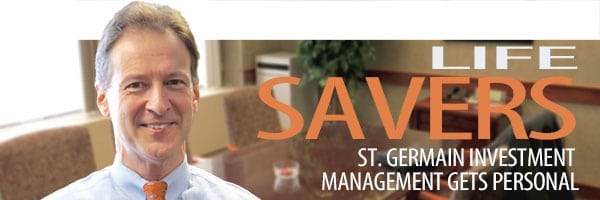
Cover Story
A Textbook Example of Effective Job Sharing

While job sharing is hardly a new concept — it’s at least a few decades old by most accounts — it has rarely succeeded, or even been tried, at a high-level administrative post, such as vice president of Philanthropic Services at the Community Foundation of Western Massachusetts, which is now being shared by Kristin Leutz and Katie Allan Zobel. For one of them (Leutz), this is a chance to live out research she did while attaining a master’s degree in Industrial/Organizational Psychology at Springfield College. For both, it’s a way to achieve coveted work/life balance while also carrying out highly rewarding work. What they’ve been doing for the past seven years can be described with one word: pioneering.

There’s a small pile of rocks — one of the owners actually called it a “sculpture” — sitting in the middle of the table, or leaf, that lies between the desks occupied by Katie Allan Zobel and Kristin Leutz.

These items come in all sizes and shapes (including a few that look like hearts — Leutz collects and treasures those), and they were brought back to Springfield from many different travel destinations. Most are gifts from one to the other, but some were found and simply added to the mix.


Kristin Leutz

Kristin Leutz says the unique job-sharing situation she entered allows her to live out the research she did at Springfield College and MassMutual.

“It’s … a shared pile of rocks,” said Leutz with a laugh, noting that this makes the unique office accessory symbolic in many ways. That’s because these two women share, well, just about everything.

That starts with a job — vice president of Philanthropic Services for the Community Foundation of Western Massachusetts — and its salary and needed benefits. They also share an office, a copier, that leaf with the rocks, a bookcase that is far too cluttered for either one’s good, the nameplate outside the door, and even the door itself (items chosen by both, ranging from newspaper cartoons to art created by Leutz’s youngest child, now compete for space).

It’s been this way since the late fall of 2005, when Zobel and Leutz applied as a team for a position then called director of Development, and prevailed over several traditional hopefuls — meaning singular men and women — in a decidedly different candidate-selection process (more on that later).

Currently, Leutz works Mondays and Tuesdays, Zobel takes over on Thursdays and Fridays, and they’re both in on Wednesday, or what has come to be known, alternately, as ‘overlap day,’ ‘hand-off day,’ and ‘pass-the-baton day.’

Between them, they have raised between $5 million and $8 million per year, said Kent Faerber, former president of the foundation and now interim president, and been highly successful in a multi-faceted position that has involved everything from fund-development management to PR and marketing, to promoting philanthropy across the region.

“This has been a very challenging job to share because of the sophistication of the work and the need for our external constituency to feel that their relationships with the foundation are seamless,” he told BusinessWest. “While a prospective donor might make initial contact with one of them, the other needed to be able to pick that up whenever he or she might call back or make contact later. They have developed quite extensive routines of information sharing and collaboration despite the fact that they are normally not in the office or on duty at the same time.”

When asked how they are able to succeed in this unique and challenging sharing arrangement, Leutz and Zobel used different words and phrases to say what amounts to the same thing: they work hard at it. And they need to, because, while having two minds working on all that goes into this job description is certainly beneficial for the foundation, such a scenario can get complicated.

“To try to figure this out is not simple; it’s not a straightforward thing,” Zobel said of job sharing in general. “We’re true pioneers.”

That’s a word that both used early and often, because there is very little job sharing going on in this region in general, and only a few examples from across the country of it working at such a high administrative level. The two are well-aware of this, and understand that their partnership could be considered ground-breaking and a potential model.

For this issue and its focus on women in business, we take a look at this unique employment arrangement, how it came about, and why, seven years later, it’s stronger than ever.

Sharing the Wealth

Carol Leary, president of Bay Path College and a long-time (now former) board member and president of the Community Foundation, remembers the search that eventually brought Leutz and Zobel to the organization — as well as her reaction to a situation (a teamed pair of candidates) that she hadn’t seen before and hasn’t seen since, at least at that level.

“I really didn’t have to be convinced very much — I loved the concept of trying it,” she recalled. “My sense was that the worst thing that could happen was that it wasn’t going to work … and I figured it was well-worth the risk because we didn’t want to lose either one of them.”

But Faerber, president of the foundation at the time, remembers that there was considerable skepticism among other members of the search panel, especially about the logistical aspects of such an arrangement. What eventually swayed them, he believes, was the prospect of putting two strong, creative minds to work on the many challenges and opportunities that would confront whomever held that title.

Katie Allan Zobel

Katie Allan Zobel says she wanted to work for the Community Foundation, but couldn’t handle a 55-hour week, and the job-sharing arrangement allowed her to advance her career goals.

“I was aware of the talent that these two brought to the position, so I was prepared to rethink whatever preconceptions I had about how this might get done,” he told BusinessWest, adding that other search committee members obviously felt the same way, as they chose the two over perhaps 25 other candidates. “There was awareness of the fact that, if you had two minds working on this, that was a fairly significant plus.”

How these two minds came to sit across the table from those interviewers is an intriguing story, which starts at Amherst College in the mid-’90s, where Leutz and Zobel worked together in the broad realm of fund-raising and alumni relations.

They thrived in those roles, but Leutz eventually left the school to pursue a master’s degree in something called Industrial/Organizational (I/O) Psychology at Springfield College. This is an emerging field, she explained, that involves the scientific study of employees, workplaces, and organizations, and covers many aspects of human resources and organizational development, including a wide range of work/life balance issues and trends.

These specific areas of study defined her master’s thesis work at MassMutual. “I was looking at what they called alternative work arrangements there,” she explained, adding that job sharing was part of the mix, but there was a very limited study pool. “I did a large-sample survey and qualitative study of their employees and what kinds of work/life arrangements they were using — alternative schedules, part-time work, and other initiatives.”

She would eventually go on to work for the company as an organizational-development consultant in the Human Resources department, working on what amounted to the human side of a large-scale implementation of the SAP technology system. Little did she know that soon she would be taking much of what she learned in the classroom and at the financial-services giant and applying it to what amounts to a pioneering experiment.

Fast-forwarding somewhat, Faerber reached out to Zobel in the early fall of 2005 when she was an independent consultant (Amherst College was one of her clients) and asked if she could provide temporary support for the Community Foundation when its director of development was stricken with the cancer that would eventually take her life, and was then on leave of absence.

Zobel recalls being somewhat reluctant at first, but agreed, and soon found the work rewarding and the foundation an organization she enjoyed working for. “I was here for three months, and came to realize what an amazing resource the Community Foundation is. I had no idea the extent of their work and the way in which they did that work; it was both surprising and so engaging that I wanted to stay and apply for that position.”

But she determined fairly quickly that the 55-hour work week that the job entailed was something she didn’t want at that time in her life, with two young children.

Zobel recalls initial discussions with Leutz (who by this time had left MassMutual after the birth of her first child, ironically because she couldn’t work out the flex-time arrangement she desired) about the possibility of sharing this job. She did so without knowing the full extent and specific direction of Leutz’s graduate work — “I knew it was organizational development, but not much more than that” — and found her very open to what at that time amounted to exploring uncharted territory.

“This was a chance to live out my research and test it out,” Leutz recalled. “I was working way too many hours at MassMutual after the birth of my son, and didn’t have the work/life balance that I wanted. Here was the work/life expert having no balance; it was like the shoemaker’s children having no shoes. I was home with my son and ready to work, but not full-time.”

“When Katie came to me with this opportunity, which represented a chance to work in philanthropy in a way that I hadn’t before, I was excited,” she continued, “and I knew how to structure the job. So we applied for the position as a team.”


Work in Progress

Since getting the job and putting both their names on the plate outside their office, Leutz and Zobel have had an additional — and unique — segment attached to an already-lengthy job description: making their employment arrangement work for all parties involved.

This assignment involves everything from financial considerations, or costs to the organization, to ensuring seamless (that’s another word both women used repeatedly) delivery of services to the many kinds of clients who work with the Community Foundation.

As for the financial side of things, if two people are going to take a job that would normally be carried out by one individual, they theoretically can’t cost more than that one person would if things are going to work out for the company. And for the most part, that’s been the case with Leutz and Zobel.

Neither one has needed health insurance through the organization, which helps — if both did, that would be an additional expense — and their salary and other benefits amount to no more than what one individual would earn. There are some additional expenses — two computers and two phones are required, and if they travel together on conferences, there are two plane tickets and two registration fees (they split a hotel room) — but not many.

As for achieving a seamless operating environment, this involves constant and highly effective communication and making the very most of those aforementioned hand-off days.

Backing up a bit, the co-vice presidents went into some detail about what the foundation does and what their responsibilities are.

The foundation itself administers a charitable endowment consisting of approximately 528 separately identified funds (totaling $110 million) serving Hampden, Hampshire, and Franklin counties. The foundation also plays a central role in the charitable distributions from four large private foundations in the region, administered by Bank of America and representing approximately $24.6 million in additional charitable assets.

As for Leutz and Zobel, their official job description reads this way: “manage fund development and donor services; provide charitable gift-planning services to individuals, families, and groups, including planned gifts and gifts on non-cash assets; serve as a partner to local professional advisors assisting their clients in charitable giving; promote philanthropy in the region among stakeholders including institutions, individuals, and corporations.”

There are myriad responsibilities that go with that description, said Zobel, adding that, for two people splitting a week to carry them out, there must be communication, organization, and efficient sharing of those most important ingredients: information and opinions.

Elaborating, Zobel said she and Leutz will use Tuesday evening and then their traditional Wednesday carpooling (they both live in Amherst) to stay abreast of what’s happening with their many constituencies and plan a smooth flow of service and teamwork.

“On Tuesday evening, Kristin puts down in an e-mail to me what we call our ‘transition memo,’” she explained. “It explains everything that has happened, with highlights and bullets and an ongoing project list that we continually update; some things come off the project list, while others are added on that we need to do.

“We use that Wednesday commute to talk things over,” she continued. “I’ll have read the memo, looked it over Tuesday, and we’ll talk about those things that really need discussion.”

Said Leutz, “we basically talk on the phone a lot on our off days as well. We try to respect time off, but we wind up talking a lot because it makes things easier. And we use that commute to make the most out of discussing things that need decisions together or relationships that we share equally.”


Checking Your Balance

And while this job-sharing relationship has worked out well for the Community Foundation, it has also been everything Leutz and Zobel could possibly have expected from it — and more.

Indeed, they both talked about how this arrangement has done more than help them achieve work/life balance. It has also enabled them to be in a creative, rewarding job they could not have taken on otherwise, while also putting them in a collaborative environment that has allowed them to stretch their collective imaginations and become even better at what they do.

It’s such an attractive work environment that Leutz has stayed in it far longer than she has any other employment situation.

“I’m a restless person — this is the longest I’ve stuck with anything,” she said. “And I think that’s because I’m a collaborative thinker; even if I was working full-time, I would want to work this way, with people, because it enhances my production.”

Zobel agreed. “To do this kind of work on your own would be much harder. I can get a lot of feedback from Kristin throughout the week and from week to week about what I’m doing right, what I should change … I get infused with new energy.”

The downside to the arrangement, or at least one of them, they said, is that they are now latched to each other career-wise, a fairly tenuous situation, but one that neither one is worried about at the moment. After all, the relationship has survived a parental leave (Leutz had her second child a year after they took the job) and the need for both to earn higher wages, which they’ve accomplished through outside consulting work.

“You have to be much more creative with your own career to stay committed to someone at this level,” said Zobel. “That’s not necessarily a disadvantage, but it’s certainly a challenge.”

When asked if job sharing is a viable option for area companies and individuals working for them, both Leutz and Zobel said they provide ample proof that such arrangements can work.

But both employer and employees have to fully understand the concept, its many potential benefits, and the myriad challenges before they attempt to implement such a practice, they said.

And that starts with individuals fully understanding that, when they split a job, they take half the salary. That sounds simple, but many don’t get that part, said Zobel.

“People get all excited about this idea when we talk about it,” she told BusinessWest. “What Kristin and I wanted was a really meaningful, significant, meaty job, and you don’t usually get that in a part-time job; you either have to work much more than part time, or you work part-time and don’t get everything you want.

“Many of our peers feel the same way,” she went on. “And that’s why they get so excited about this. But then when they realize they only get half the salary, they get these startled looks on their faces.”

Moving beyond that all-important consideration, such arrangements can only work when the two individuals can work together effectively and establish a very high level of trust, something that has been accomplished in this case.

“I know when I’m not here, the work is getting done at as well as I would have done it, if not better,” said Leutz, “because Katie is here and I have complete trust in her.”

In general, job sharing has worked best with positions like administrative assistant, Leutz explained, but it has been effective in a variety of settings and with many different job titles.

“Any job share should be able to be matched to the work and to the role, but there are certain jobs that would be very difficult for people to share, and there are many ways that people structure job shares,” she said. “Some people have very discreet responsibilities and don’t overlap very much, and other people share everything because of the nature of the work.

“There are examples from around the country where executive-level employees, women and men, have been able to do this,” she continued. “But they have tended to structure these arrangements very creatively depending on the organization and the needs of the job. And we figured we had to do that here; we had to really understand the nature of the work and make ourselves flexible.”

Looking back, Leutz and Zobel both noted that they didn’t have all the answers for that search panel back in 2005, and that it’s taken the ensuing seven years to completely fill in their canvas. They’re not sure how long this relationship will go on, but for now they’re more than content to continue their pioneering efforts.


Two the Future

The level of sharing between Leutz and Zobel apparently goes further than the two understood — at least until recently.

Indeed, Leutz has one of those office chairs with a large rubber ball as the seat — chosen for ergonomic reasons (something else she learned while studying I/O Psychology). And when BusinessWest noted that Zobel uses a more traditional model, she admitted to her office mate, “I often use yours when you’re not here,” which was news to Leutz.

But beyond the chair, the door, the copier, and the four weeks of vacation, the two share something else — a firm desire to make this situation work both for them and the organization. It’s been something they’ve certainly had to work at, and it is that commitment to not merely a job, but also a truly unique work arrangement, that has made it successful.

You might say it’s a working situation that’s rock solid — and in more ways than one.

George O’Brien can be reached at [email protected]

Cover Story
Entrepreneur Matches People with Business Opportunities

BW0812bCOVER
More than a decade ago, after the downsizing of his family’s business, Serv-U, Steve Rosenkrantz was trying to decide what to do next. He knew he wanted to run his own business, but didn’t know exactly which path to take. He enlisted the help of a company called Entrepreneur’s Source, which links clients with franchises — and the franchise they linked him with was Entrepreneur’s Source. Since then, he’s helped dozens of couples and individuals take charge of their lives and turn dreams into reality.

Tim Scussel still has many good things to say about the McDonald’s corporation.
“They were great … they made me an owner when I had no money,” said Scussel, who would eventually go on to operate three outlets for the fast-food chain — one at Mercy Medical Center in Springfield and the others in Enfield.
But things didn’t end well between Scussel and the company. Indeed, frustrated by what he considered unreasonable demands for him to essentially tear down and rebuild one of the Enfield locations — among many other things — the franchisee eventually sold out and commenced a search designed to identify what he would do next in terms of business ownership.
He didn’t know exactly what he wanted, but he had some parameters. He wanted to remain the kind of hands-on operator he was at McDonald’s — “I was at the stores every day; I was behind the counter working most days,” he said. But he also wanted a franchise, or corporate parent, that was more supportive and less combative. Meanwhile, he and his wife and full business partner, MaryAnn, desired fewer hours, a considerable drop in the number of times their beepers went off, and, overall, far greater control of their own destiny.
And Steve Rosenkrantz managed to find all that for them in an outfit called The Maids Home Services.
As the name suggests, this is a company that provides cleaning services, in this case for mostly residential clients. The Scussels now manage two such franchises, one serving Western Mass. and the other in the Greater Hartford area.
They arrived at this stage thanks to a process that Rosenkrantz, himself a franchisee with a company called Entrepreneur’s Source, describes with a number of words, phrases, and acronyms (like ILWE — income, lifestyle, wealth, and equity — more on that later), but boils down succinctly by saying that he helps people take charge of their lives.

Judy and Peter Yaffe

Judy and Peter Yaffe had never worked with seniors or the disabled before taking over a franchise of Homewatch Caregivers.

And by that, he meant that he often helps people transition from the corporate world to the realm of entrepreneurship. Put another way, he said he provides people with the resources to take a dream and make it reality.
Elaborating, he described his role as being not that of a consultant, but rather much more like a life coach and business coach combined. “People tell me what they want their life to be like,” he told BusinessWest, adding that, through an exhaustive process that could last from a few months to several years, he helps them find that life.
“We call ourselves coaches, not consultants,” he explained. “I think of a consultant as someone who’s an expert in a certain area, brought in to fix something; they get compensated, and they leave. A coach, quite simply, puts up guardrails on the highway and lets the client steer the car. We provide the inspiration.”
And very often, it’s with a business they would never have imagined being in.
Such was the case with the Scussels, and also with Jim Brennan and Rick Crews, two local businessmen, neither with anything approaching a background in health care, who wound up starting a Doctor’s Express franchise and now have several locally and in the Boston area.
And it was that way with Peter and Judy Yaffe, who had never worked with seniors or the disabled, but now operate a franchise of Homewatch Caregivers based in West Springfield. Over the course of roughly a decade in business, they’ve expanded into larger quarters twice, and now have eight office employees and about 100 caregivers in the field, who provide non-medical services to more than 80 clients a week, on average. And like most who have made the transition from employee to employer, they thoroughly enjoy that status.
“It was really a rush at the beginning — I really enjoyed the idea of not working for anyone else,” said Peter. “It was a complete and utter change for me, a 180-degree shift from what I had been accustomed to, and I loved it. I loved the free expression and the independence, and the idea of not needing a committee of people to agree with what I wanted to do. It was extremely exhilarating and stimulating.”
For this issue, BusinessWest takes an indepth look at Rosenkrantz’s entrepreneurial gambit, taken just over a decade ago, and how he assists others when they arrive at what he called the “career crossroads.”

Franchise Players

Tim and MaryAnn Scussel

Entrepreneur’s Source helped Tim and MaryAnn Scussel find a career that offers them far greater control over their own destiny.

As part of his efforts to market himself and stay in touch with clients and potential clients, Rosenkrantz sends out a number of company-produced correspondences that blend words and pictures to get some messages across — and remind people that he’s there and available for free consultation. Together, they pretty much tell the story of what he does and, to a large extent, how he does it.
There’s one with three portable toilets on the front and the headline, “you don’t have to love a product or service to capitalize on it.”
“Some people think you have to have an emotional connection to a business to be successful; the reality is, successful people are ‘in the business of business’ — they don’t have a love affair with the product of service,” it reads on the back. “The type of business you choose is less important than its ability to get you where you want to be.”
There’s another with that time-honored image of a needle in a haystack, with the headline “finding new career directions can be a little daunting.”
“On their own, most people find themselves wasting time, looking in all the wrong places,” it reads on the back. “They hunt for the business that will make them successful. But the business doesn’t make you successful: you make yourself successful. The business is just a vehicle.”
And then, there’s the one with a monster under a child’s bed and the one-word headline “boo!” On the back, the card explains what Rosenkrantz calls the FEAR (false evidence appearing real) factor. “Fears need a reality check,” the missive explains. “Exploring change can be uncomfortable, stirring up feelings like fear. But just because you have a feeling doesn’t mean events will bear it out. Give yourself permission to dream a little. We’ll take care of the monsters.”
In essence, what Rosenkrantz has been doing for the past 11 years is putting a strong touch of reality to all that hyperbole and, in the process, encouraging people to dream a little and help make their dreams real. Perhaps it’s best summed up with one more of those correspondences, the one with a closeup of a doorknob and the simple message, “you can’t open new doors with a closed mind.”
Opening minds to the full range of franchise opportunities has become an art and a science for Rosenkrantz, a process he knows intimately, because he went through it, from the other side of the desk — figuratively speaking, because most of his work is now carried out virtually, and there is no desk.
The story starts with the dramatic downsizing of what was once a chain of Serv-U hardware and home-improvement stores, owned and managed by Rosenkrantz and five cousins. When most of those pieces were sold off — a locksmith operation and decorating center remain — Rosenkrantz commenced a search for what to do next and turned to Entrepreneur’s Source for some guidance.
Like many of the people he now helps, he was intent on being in business for himself, and in an interesting twist of fate, one of the franchise opportunities put in front of him to consider was Entrepreneur’s Source.
“I was a model client; I went through the whole process in 2001,” he explained. “And I liked it so much that I said to my Entrepreneur’s Source coach, ‘I want to do what you’re doing.’ And he said that, coincidentally, one of the opportunities he had for me was that company.”
Over the past 11 years, Rosenkrantz, who is paid by franchisors when successful matches has made, has helped script many transition stories for individuals and couples, following those axioms printed on the company’s correspondences, especially the ones about keeping an open mind and finding opportunities in places that one wouldn’t expect.
And as he talked about what he does, he returned to that notion of being a life coach and business coach rolled into one.
“We are very empathetic about our clients,” he explained. “We get to understand what their emotions are, where they’ve been, and where they want to go to. It’s more than just looking at a résumé; it’s understanding the whole personal and family dynamics to be the best of our ability, to then fit the right business culture to their personality and what drives them. We don’t just throw ideas at them … we find out what makes them tick.”
And with that, he summoned that acronym (or phrase) ILWE, which pinpoints the four things he works to help people find.
“What we tell people is that you can have a great job and get the first two — income and, if it’s the right kind of job that gives you flexibility and autonomy, the lifestyle as well. What you generally can’t build as easily in the working-for-someone-else corporate world are the last two, wealth and equity.
“Building equity is about something of substance that you call yours,” he continued. “It’s your business to sell, or hand down to your children, to do what you want. Often, the first thing people say to me is, ‘the appeal to me of owning a business is that I want a clear, 10-year exit plan on my terms, not someone else’s.’”

At Home with the Idea
Many of these factors came into play with the Yaffes, who together launched a search for a business to run after Peter parted ways with Casual Corner in the fall of 2001 after a 20-year stint in which he served in many roles, including director of merchandise control.
Finding a job, especially one with the salary and benefits he was earning, wasn’t easy in the downturn that followed 9/11, said Yaffe, who told BusinessWest that his search took on a different complexion after he took in a PowerPoint presentation given by Rosenkrantz at a meeting involving the outplacement group he was involved with.
“I had never owned a business, but my background was a really good background for owning one,” he explained. “I just didn’t understand the product or service — but you can learn the product or service more easily than you can gain the financial background.”
The next step was a host of questions that comprise a big part of what Rosenkrantz calls the “discovery process.” Such questions cover everything from personal and financial background to the type of business the potential client believes he or she would be suited for and like to pursue.
“He has 500 franchises in his database, and he came up with five he wanted me to validate,” said Yaffe, adding that, while a few of these sparked some interest, he eventually asked for five more. That first batch included a paint business, a stained-glass operation, and a health-and-wellness outfit with a name that escaped him.
“Inches Away … Pounds Away … something like that,” he recalled, adding that, while he and Judy gave this option some real consideration, they ultimately concluded that the price — and the opportunity — were not quite right.
Somewhere along the way, Yaffe started thinking about home care, and while one of the companies he researched wasn’t in the Entrepreneur’s Source database, Rosenkrantz included a different company, Homewatch Caregivers, in the next batch of five.
Making a long story somewhat shorter, Peter Yaffe said he did some extensive research on the Denver-based company, and found it to be the match that the couple was looking for. It wasn’t something they knew a lot about from a business perspective, but they understood from personal experience both the importance of the service and its vast potential at a time when people are living longer and, in many cases, desiring to remain in their homes.
“The key to buying it was that we saw the potential for helping all these people because we had gone through it ourselves,” she said, noting that her mother needed some forms of assistance in the home, which she and others provided, and Tim’s parents also needed care. “We saw the potential for a business that would grow.”
So while Judy stayed on at a job as program director of the Hatikvah Holocaust Education Center in Springfield to secure needed benefits (she would join the venture roughly a year later), Peter leased a small space in West Springfield and commenced the process of getting the business off the ground.
The learning curve was fairly significant, he said, while echoing some of Rosenkrantz’s literature when he said that it’s not necessarily the type of business one gets into that determines success, but the skills and drive that one brings to the table.
“I never felt frightened,” said Peter. “I felt determined, and there was no question that I would be successful; failure never entered my mind — I wouldn’t allow it to enter my mind.”
As they talked with BusinessWest, the Yaffes stopped to offer a quick tour of their new offices — larger quarters in the same professional building on Union Street in West Springfield they’ve been in from the beginning. They’ve occupied the new space for several weeks now, but wall art and other forms of décor still sit in boxes waiting to be hung — testimony to how busy they’ve been and how successful their business has become.
It’s also an indicator of how well Rosenkrantz’ process works, and how people with the right skill sets and requisite measure of resolve can succeed in a business they probably couldn’t have imagined being in.

A Clean Break
Rosenkrantz, who said that he’s typically working with 30 or 40 people at a time and at all of the various stages of the process, told BusinessWest that his clients’ stories vary widely, but a common denominator is that they’re going through change — loss of a job, divorce, and relocation are just some of the triggers — and figuring out what to do with their lives.
And while he works with people of all ages, he says most of his clients are in their 40s, 50s, and 60s and might have achieved the first two parts of the ILWE equation (that’s might have), but are probably still searching for the others. And they possess many of the attributes necessary to be in business for themselves.
“They have good street smarts — they have some common-sense skills,” he said of those who have successfully made the transition. “They’ve lived a life, they understand personal and family battles and career battles, and they’ve persevered in many ways. Franchising really tends to embrace these people, while the corporate world, while it can’t say anything, generally doesn’t embrace that 63-year-old male.”
Franchising certainly embraced Tim Scussel. Indeed, as he talked about his relationship with McDonald’s, he noted that it lasted 35 years — and for roughly 33 of them, things were generally good.
But those last two … well, he summed them up with an anecdote or two that effectively conveyed his frustration with the corporate giant.
“They wanted me to rebuild the Enfield Street location, which I did,” he recalled. “A few years later, they said they wanted me to knock down the Elm Street location and rebuild it. I told them there was nothing wrong with it — it had all the latest equipment. When I said ‘no,’ they harassed the heck out of me for two years every single day, to the point where I finally said, ‘I’m done.’”
Long before he officially parted ways with the company, Scussel began the search for what would come next. He knew Rosencrantz from his days at Serv-U and counted him as a customer in a small swimming-pool cleaning-and-maintenance business he also operated.
“I was working on his pool one day and said to him, ‘Steve, it’s time to talk; what is out there for other businesses?’ I knew I was leaving McDonald’s — the train was leaving the station, and there was nothing I could do to stop it, short of knocking a building down. It was time to move on.”
After a lengthy period of discovery — ascertaining what the Scussels wanted from their next business venture — Rosencrantz presented them with several options, including a dry-cleaning outfit, a picture-framing operation, and The Maids. None seemed particularly appealing, Tim Scussel recalled, but he did copious amounts of homework on each, eventually had several conversations with the owner of The Maids, and liked what he saw and learned.
The couple started with the Hartford location and expanded into Western Mass. with what Tim called a satellite operation in 2006. The Great Recession certainly took its toll — maid service would, in most cases, anyway, fall into the category of discretionary spending — but they rode out the storm and are climbing back to something approaching pre-downturn business volume.
Meanwhile, they also have the lifestyle and supportive franchise that were both missing from the equation years ago.
“The culture here is to support the franchisee, not criticize,” he said. “The focus is on helping people grow their business, which is a breath of fresh air for me. That’s one of the things I was looking for, and I was able to find it.”

Taking Ownership of the Situation
A quick look around the Scussels’ facility in West Springfield reveals that they’ve traded golden arches for all things yellow and blue (mostly yellow)  — the corporate colors of The Maids Home Services.
The walls, marketing materials, uniforms for field employees, and business cards all feature that scheme, and they even have a bright yellow station wagon, decked out with the company name and logo, with which to visit clients and travel between the two locations.
But beyond the new colors, they also have a new and different relationship with their franchisor, and, in many respects, a different and better lifestyle. It came about through a unique business matchmaking process, which is both an art and a science, said Rosenkrantz, and a method by which people can truly take charge of their lives.

George O’Brien can be reached at [email protected]

Cover Story
High-end Burgers Coming to Greater Springfield

It’s called ‘the Frankenstein.’
This is the creation of a Providence-based restaurant called Luxe Burger, and, as the menu declares, it is truly a “monster sandwich.”
How about four so-called “gold-label” burgers (5 ounces each), two jumbo Nathan’s all-beef hot dogs, four slices of bacon, and American cheese, topped with Hereford black bean chili, cole slaw, and relish, two buttered rolls, and a double order of French fries? Finish it all (and your cardiologist would certainly prefer that you didn’t), and you get a free T-shirt.
The Frankenstein will be among many new menu items, including a host of burger concoctions, that area residents will soon have to sort through, as a new and different type of business competition (no, not casinos) unfolds in Greater Springfield.
Indeed, in a region where, until very recently, there were none of the high-end burger restaurants that have begun to populate other areas of the country, there will soon be at least three, depending on how you define that phrase ‘high end.’ Max Burger, part of the Max Restaurant Group, recently opened in the Longmeadow Shops, while Plan B Burger Bars will open an outlet in the Basketball Hall of Fame complex (the former Pazzo site) in early September, and Luxe Burger hopes to open its second location in the former tourism center, just a block away from the Hall of Fame, in time for the holidays. Recently, Five Guys Burgers and Fries, one of the fastest-growing chains in the country and one that some would put in the high-end category, recently opened locations in Westfield, West Springfield, and Enfield, and an independent operation, Bruburger, has opened in Feeding Hills.

Tim Taillefer

Tim Taillefer says Max Burger is off to a fast start in Longmeadow.

With these developments, there have already been several additions to the local culinary lexicon, with many more to come. Max Burger has a Kobe Classic, for example, as well as a shrimp burger and a portabella burger, among many others, while Luxe Burger also touts something called Death By Burger, the Fatty Melt Burger, served between two grilled-cheese sandwiches (Max Burger has one of those, too), and Tory’s Breakfast Burger. Plan B Burgers can get creative, too, with a Double Double (referring to both the burger and the cheddar cheese), an Atlantic salmon burger, the Squeeler (a half-pork, half-beef burger), and even a ‘pretzel burger.’
Just how much of an appetite — in both a literal and figurative sense — the region has for all this is soon to become known, but all those involved are optimistic about their chances for success, even as the field becomes more crowded.
“It’s going to be interesting, and I’m glad we’re in first,” said Timothy Taillefer, manager of the Max Burger location, noting that, at the moment, he’s focused not on the competition, but on getting his establishment, which opened July 23, off to a solid start. And he says it’s already exceeding expectations that were set very high.
Al Gamble

Al Gamble, seen outside the site of the Plan B Burger to open at the Basketball Hall of Fame in September, says his eatery will complement the many restaurants already at the Hall.

Al Gamble, CEO and co-founder of the Locals 8 Restaurant Group, which counts four existing Plan B Burger Bars (all in Connecticut) among the six restaurants in its family, told BusinessWest that the picture unfolding in Springfield mirrors what eventually happened in Hartford.
“We were the pioneers in Hartford,” he said, noting that the group’s first location opened in 2006. “And then others followed — Max Burger, Gold Burger, Burger Baby, and others — and in Springfield, you’re seeing the same thing. What we’ve found is that the competition creates an exciting synergy — people will want to go and try different things; they’ll try us, try them, and then come back to us.”
John Elkhay, president of Providence-based Chow Fun Food Group, which includes the first Luxe Burger, opened in 2010, agreed. He said that, contrary to popular opinion, competition is generally a good thing in the restaurant industry, because it creates a critical mass that can make a city, or even a specific neighborhood, a dining destination. He’s seen it in Providence’s Federal Hill area.
“There are more Italian restaurants side by side there than there probably are in the North End of Boston,” he explained. “People might think, ‘there’s 15 to 18 restaurants in a quarter-mile block; how can anyone survive? They survive because everyone goes there for Italian food; you wouldn’t dare eat anywhere else.
“As a restaurateur, you want to be on Federal Hill,” he continued. “And I think the same will be true for that part of Springfield. More competition drives more people, and everyone gets a bigger piece of the pie.”
For this issue, BusinessWest gives its readers a taste of what could become a compelling battle of the high-end burgers in Greater Springfield, with a side order of speculation on how all this might turn out.

Meat and Greet
Taillefer told BusinessWest that the 200-seat Longmeadow location is the ninth in the Max Restaurant Group family of eateries, and the second Max Burger.
The first was opened in West Hartford in 2010, he noted, adding that, since its debut, results have far exceeded expectations — so much so that company officials began scouting sites for a second location more than a year ago.
They eventually found one they considered ideal in a former Blockbuster video store in the Longmeadow Shops, a large retail complex located less than a mile from East Longmeadow and Enfield, two other growing, affluent communities.
“Based on the success in West Hartford, we felt Longmeadow would be a great fit,” he explained. “The communities are very similar in many respects, although West Hartford has many more restaurants; Longmeadow doesn’t have many, and nothing like this.”
Taillefer, like the others we spoke with, said that what defines high-end or upscale burgers is essentially the quality of the beef — hormone-free, with no antibiotics or steroids, and always fresh, not frozen. Beyond that, it’s how the beef is prepared and the environment in which it’s served that defines this growing class of restaurant that Max Burger has joined.
Overall, he expects that the restaurant’s diverse menu — in addition to burgers, there are also appetizers, salads, soups, and entrees — as well as the large selection of craft beers and full bar will make Max Burger a true destination.

John Elkhay

John Elkhay, seen with some friends and several of the Luxe Burger concoctions, believes competition only helps those in the restaurant business by making the city a destination.

And he believes that term will definitely apply to Sunday afternoons (and maybe Sunday, Monday, and Thursday nights, as well) in the fall. “People have already been telling me this will be a great place to watch a football game,” he said as he started switching on the nine flat-screen televisions, with a 10th likely to be located on the patio.
Taillefer, who spent six years as assistant manager at Max’s Tavern (also within the Hall of Fame complex) before being named general manager of the second Max Burger, spent several months “in training” at the West Hartford location, an experience he believes will prove invaluable.
His previous experience includes stints at the Delaney House in Holyoke, Legal Sea Foods in Boston, and, when he was in high school, the Captain Rivi’s food stand at what was then known at Riverside Park in Agawam (now Six Flags).
“The burgers would come at you on a conveyer belt,” he said of his assignment at the amusement park’s fast-food eatery. “Let’s just say I’ve come — and burgers have come — a long way since then.”

Steer — Clear
Gamble would agree, and he’s had a front-row seat for some of the latest evolutionary twists and turns. He formed Plan B Burgers (the ‘B’ stands for beef, burgers, beer, and bourbon) with partner Shawn Skehan in 2006. The chain is a division, of sorts, of the Locals 8 Restaurant Group — which also owns the Half Door European Beer Bar and Tisane Tea & Coffee Bar, both in Hartford’s West End — so named because, in some parts of Europe, the neighborhood restaurant is known simply as the ‘local.’
“That’s a play on who we are culturally — it defines what we’re about,” he explained. “We want to create a lot of restaurants where locals feel like it’s their restaurant; to do that is a long, complicated process that revolves around connecting to the community you open restaurants in.”
From its roots in West Hartford, the chain expanded into Simsbury, Glastonbury, and Milford, said Gamble, adding that, beyond the next wave (Springfield and Stamford, Conn.), the group — named one of the fastest-growing U.S. companies by Inc. magazine in 2009 and 2010 — plans to take the concept national.
Locals 8 was contacted by the Basketball Hall of Fame to gauge interest in assuming the space vacated by Pazzo, which shut its doors more than a year ago, Gamble continued, adding that the company believes the location offers great opportunity in the form of the local demographic base, the tens of thousands of cars that traverse that stretch of I-91 on a daily basis, and the growing restaurant infrastructure in and near the Hall.
He described that complex as a high-profile site, with a good tenant mix that includes restaurants such as Max’s, Samuel’s, and Mama Iguana’s.
“That was something we scrutinized internally,” he explained. “We asked ourselves, ‘if we came to that site, would we split the demographic of consumers or would we add to it?’ We talked to the restaurateurs who were there and talked to people in the South End, and felt that we would add to the mix and bring more people seeking diverse products to that area. I think we’re a complement to the mix that’s there.”
As he talked with BusinessWest amid construction workers readying the former site for its new use, Gamble said he was eyeing a Sept. 1 opening date — roughly a week ahead of the Basketball Hall of Fame induction ceremonies.
Elkhay said the Chow Fun Food Group has grown steadily over the years, and now includes an eclectic mix of eateries.
There’s Rick’s Roadhouse, which markets itself as “an escape from fine dining”; Ten Prime Steak and Sushi; XO Café, which “celebrates the fusion of fine cuisine, wine, and funky art”; Harry’s Bar & Burger, a small (600 square feet) establishment that serves sliders, hot dogs, shakes, and craft beers; and Luxe Burger, which was created with the logic that spawned many of the high-end (or higher-end) burger restaurants.
“Every restaurant has a hamburger, except really high-end dining, and even they’re in the hamburger business,” said Elkhay. “So I’m thinking that I must be crazy to do an exclusive hamburger place. But when you go into a niche, you get so many loyal customers.
“And when you’re focused on a hamburger, and a hamburger only, you’re able to be better, be more consistent, and do it for value because that’s all you’re doing; you’re not doing all the other things that are distracting, like entrees, fish cutting, and other things. It’s just hamburgers.”
He said the restaurant did extensive research and testing before launching, eventually settling on Hereford beef (“it tastes just like it did when the cowboys ate it 150 years ago — it’s like an American heartland steak”), a unique method of cooking it (the skillet), and a build-your-own format that he believes has created several thousand possible combinations of everything from toppings to buns to side orders.
The Springfield venture represents the first time the group has replicated one of its concepts, said Elkhay, adding that the group sees vast potential in Springfield and, more specifically, the growing restaurant corridor along the riverfront.
“Springfield wants to be a restaurant destination place like Providence,” he noted, “and we’re very proud to be part of the new turning point in Springfield. The more, the merrier — that’s our philosophy.”

The Ground Game
Elkhay said the Frankenstein has become part of the culinary culture in Providence. One of the local television news anchors tried (unsuccessfully) to polish one off recently, he said, adding that there is about a 30% success rate when it comes to finishing the $17.99 burger.
“We have a lot of hockey players who have tried it,” he said, noting that Providence College is not far from the eatery. “Usually, though, it’s not the size of the person that will determine whether they can finish it; sometimes, the skinny guys can finish it more easily than the bigger guys.”
Whether the sandwich becomes a hit in Springfield remains to be seen. But one thing Elkhay is certain about is the climate for high-end burgers in Greater Springfield. He believes the market is ready for some spirited burger competition, and will benefit from having so many options when it comes to what can be placed between two buns — or grilled-cheese sandwiches, as the case may be.
And that’s no bull. Well, actually, it is — lots of bull, and it’s coming to Greater Springfield.

George O’Brien can be reached at [email protected]
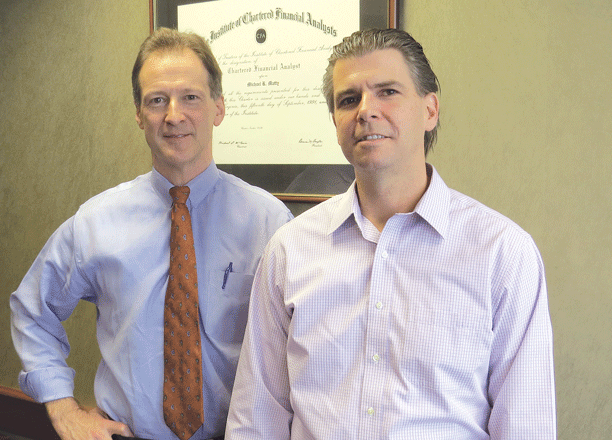
Cover Story
Roger Crandall Shapes a Vision for MassMutual

The six-foot-long fish mounted over Roger Crandall’s desk certainly looks real.
But in fact, this work of art, as he calls it, is a wood carving fashioned with the help of several dozen photographs of the 140-pound tarpon that Crandall hooked, battled for more than an hour and a half, landed, and then released off the Florida keys in 2006.
“I was looking through a fishing magazine, and found this woman in New Hampshire who does wood carvings of what are usually trout or salmon,” Crandall, the chairman, president, and CEO of MassMutual explained. “I sent her 50 pictures, she did some research on tarpon to get the dimensions right, and it took her three years to do it.”
Like just about everything else assuming floor, wall, and shelf space in Crandall’s large office at MassMutual, which he jokingly refers to as the hall of dinosaurs, the wood carving has meaning and tells a story — or several of them. In this case, the fish, which he admits probably wouldn’t fit anywhere else, relates his passion for the sport, which he enjoys for the challenge of fights like he had with the tarpon, but more for the relaxation it provides as well as the opportunity to get away from the numbers that have dominated his life and career.
“In a world, and a job in particular, where information is constantly coming at you, getting out onto a river or a flat is great,” he explained. “For that two, three, of four hours, there’s no Blackberry, there’s no crisis in Greece, there’s no low interest rates, no unclear regulatory policy, none of the things I deal with on a day-to-day basis; it’s a great way for me to de-stress and relax.”
Moving around the room, one will find dozens of objects that speak volumes about Crandall’s work and the mindset he brings to it. For example, there’s the 107-year-old grandfather clock, presented as a gift to a former president of MassMutual by the general agents association. Still keeping good time, the clock is there as a reminder of the importance of the relationship between the company and its agents and general agents, he said.
Hanging on a wall a few feet away, meanwhile, is a framed copy of an insurance policy sold in 1894. “We literally sell the same type of policy today,” said Crandall, adding that the document is a reminder that the foundations on which the company was built haven’t really changed — and won’t. “One of our best-selling products in the 1890s was also one of the best-selling products in 2011.”
And then, there are the model planes, or what Crandall referred to as “deal toys.” There are more than a dozen of them in total, and they represent individual aircraft or airlines that MassMutual has owned or invested in over the decades, he explained, noting a few that he’s particularly proud of. One would be a model of a jet owned by Morris Air, a small outfit started by David Neeleman in Salt Lake City that caught Crandall’s attention when he was an analyst for MassMutual in the early ’90s.
The company tripled its investment in Morris Air in just over 18 months when that venture was sold to Southwest Airlines, Crandall recalled, adding that the story got better — and the deal-toy collection grew significantly — when, after his non-compete agreement with Southwest expired, Neeleman started another airline that MassMutual became an original private equity investor in — JetBlue. “I think we made $80 million on a $15 million investment,” he said.
Although it would outwardly appear that Crandall’s office is outfitted as a way to salute past achievements, he described it collectively as an inspiration for the future — the tense that certainly occupies most of his time and attention.
He told BusinessWest that he’s focused on the year 2040, for example. That’s the year the U.S. is expected to be a nonwhite majority, and while that’s 28 years away, he’s already taking steps to position the company for that time, with steps ranging from a comprehensive effort to change the demographic mix of the company’s roster of agents to the introduction of many new products, to aggressive marketing to target groups ranging from African Americans to gays and lesbians.
A big part of getting the company positioned for the future is to remind customers and potential customers of the need to secure their futures — and then provide the products and services to help them do it, Crandall said, summing up matters by first borrowing an old Mandarin proverb — “when you’re safe, think about danger” — and then a quote attributed to Albert Einstein: “the most powerful force in the universe is compound interest.”
For this issue, BusinessWest talked at length with Crandall about tarpon, investments in airlines, and company history — but mostly about the future and how he intends to position the 161-year-old company to be fully ready for it.

On a Grand Scale
Crandall remembers that while he was in grade school, he would often go to the office on Saturdays with his father, a group life and health salesperson for MassMutual.
“I would stuff envelopes for him so he could do mailings, and got a penny an envelope,” he said, adding that he eventually took on more far-reaching duties. Indeed, when personal computing came into prominence, he would use an early spreadsheet program called VisiCalc (which predated Lotus and Excel) to help his father show prospective clients how much the premiums would be for group life insurance.
“Later, during summers when I was in college, I would go out on sales calls with him and sit in on meetings with MassMutual pension customers … that’s how I got a serious introduction to MassMutual,” he said, adding that while his father spent 34 years with the company, he didn’t picture himself following in those footsteps, let alone becoming CEO.
However, a series of circumstances, starting with the economic landscape he encountered upon graduating from the University of Vermont with a bachelor’s degree in 1988, put him on course that eventually led to that office on the second floor of the company’s State Street headquarters.
“I started in the real estate investment department, and it was the perfect time to get into that sector,” he recalled, “because we were about to have the biggest commercial real estate collapse since the Great Depression; it was actually a wonderful learning experience.”
MassMutual gave him the opportunity to take the charter financial analysts exam, and he eventually moved from real estate to the investment division to the securities investment division, where, fortuitously for him, the analyst assigned to watch the airline industry had just retired.
“At that time, my uncle, Bob Crandall, was president of American Airlines,” he explained. “So the guy I worked for said, ‘at least you’ll have one person to call,’ and told me to watch the airline industry.”
With a little guidance from his uncle, but mostly a keen eye for potential-laden ventures, Crandall steered MassMutual toward the Morris Air, JetBlue, and other deals now commemorated in his office. In 2000, he joined Babson Capital Management, LLCV, a MassMutual subsidiary, and in 2002 was named managing director of that company and head of its Corporate Bond Management, Public Bond Trading, and Institutional Fixed Income units.
In 2005, he was appointed chairman of Babson Capital and executive vice president of chief investment officer of MassMutual, eventually becoming president and CEO in January of 2010, and later named chairman as well.
He took those final steps to his current post at the height of the Great Recession, a downturn that severely tested all financial services institutions, but also brought a number of opportunities for MassMutual.
“The company is much stronger today than it was at the end of 2007,” he explained. “Our sales are higher, our earnings are higher, and our capital is higher. It was Rahm Emanuel (President Obama’s former chief of staff) who said, ‘don’t let a good crisis go to waste,’ and from our perspective, it became a great opportunity to remind people about the strength of a mutual company and how we differ from a stock company.
“It was also a time to remind people of the inherent strength that the mutual life insurance company products have,” he continued. “So we’ve actually been able to take market share as well as grow over the past three or four years.”

Dollars and Sense
Elaborating, he said MassMutual has done so essentially by focusing on what he called the “basics.”
And by this he means the three main pillars of the company’s operations — providing customers with financial security, paying the best dividends, and providing exceptional customer service.
For example, the company has “doubled down” on its roster of agents, going from 3,700 a few years ago to more than 5,000 today, he said, while also investing in new products, including a number of creative life insurance options, designed to meet the various needs of customers.
Such steps are part of those aforementioned efforts to position MassMutual for both today (and those opportunities from the fiscal crisis Crandall described) and the much different look and feel that this country — and the world — will have two, three, and four decades from now.
And with that, he turned to another item in his office, a framed commemorative photo, a gift from a Chinese entity that MassMutual has partnered with on a utility venture.
“My guess is that 20 or 30 years from now, someone’s going to look at that and say, ‘wow, MassMutual was thinking not five years ahead, but 10 and 20 years ahead in dealing with China. So I put that there to remind whoever’s sitting here in the future of that.”
To further explain his mindset, he referenced that acquired skill attributed to hockey legend Wayne Gretzky. “He said he would skate not to where the puck was, but to where he thought he would be,” said Crandall. “That’s what we’re trying to do.”
And in a figurative sense, the puck is going to a place and time, not far off, and in some cases, already here, where the demographic picture will be much different. The company has responded in a number of ways, he said.
“One of the big things we did was realize that the face of America is changing, and we needed a much more aggressive diversity strategy,” he explained. “So we’ve gone from having maybe 100 of our agents being multicultural to perhaps 1,000 over the past four years.
“Meanwhile, we’ve gone from having no dedicated multicultural marketing campaigns,” he continued, “to having dedicated campaigns for Hispanics, African Americans, Asian Americans, the gay and lesbian markets … we’ve really embraced diversity in a big way, and it’s making a huge difference for us. And we’ve only scratched the surface of the opportunities there.”

It’s not Foreign Policy
Another component of the company’s ‘getting back to basics’ strategic initiative is using marketing and other vehicles to emphasize the inherent advantages from doing business with a mutual company, Crandall continued.
“We’re owned by our policy holders, so we don’t get torn between two opposing views,” he explained. “Shareholders, we believe, are inherently, and rightly, more willing to take more risk than the policy holder is. Since we have just one constituency, we think that’s a huge advantage over having two, and you have to look no further than to a few public companies that are undergoing very sigfificant changes because their shareholders are pushing them to do that — their policy holders are not a big part of that public discussion.
“We’ve spent a lot of time redoing our advertising and marketing to remind people about mutuality,” he went on, pointing to a recent ad now framed and on his wall as one example. “We’re reminding people that we’re 160 years old (now 161) and we’ve been focused on policy holders since we were founded.”
These various pieces, from investment in new products to bolstering and greatly diversifying the roster of agents, to more aggressive marketing have all helped the company, said Crandall, noting that in 2011, MassMutual set records for sales of whole life insurance products and retirement products, and ended the year with record capital. And those trends have continued into the first half of 2012.
Looking ahead, he said there are tremendous opportunities to build on that recent progress, as evidenced by what many would describe as alarming statistics regarding Americans and how little they’ve done to secure a solid financial future.
“There are 50 million Americans who don’t have any life insurance, and that’s a huge opportunity for us,” he explained, adding that this is one of the reasons why, in addition to taking market share from competitors, the company can grow simply from what will, or should be, a much larger pie. “The other huge opportunity stems from the fact that Americans simply haven’t been saving enough money for probably the past 25 years.
“They’ve suddenly realized that they haven’t saved enough, and also realized that their house isn’t worth what they thought it was,” he continued. “So savings rates have tipped up, and we’ve done what I think is a very good job in our 401(k) business of reminding people how effective it is to save for retirement in that way, how steps taken in your 30s and 40s can make a difference when you’re in your 60s.”
Which brings him back to Albert Einstein and his comment on compound interest.
“Fundamentally, if you start saving early enough, you can solve all these problems,” he said, referring to the possibility of not having enough money for retirement, health care, or long-term care. “It’s very hard to take care of those things if you wait until you’re 60, and we want to help people understand that and start saving early.”

The Bottom Line
Among the myriad artifacts in Crandall’s office is a photograph of himself with David Neeleman in front of a JetBlue plane at New York’s JFK Airport.
Like the grandfather clock, framed insurance policy, and assorted deal toys, it is, as he said, a celebration of a past achievement, but also serves as inspiration for future success.
And it’s yet another example, said MassMutual’s top executive, of how even a company with 160 years of history to look back on, can only succeed if both eyes are on the future — and especially the distant future.

George O’Brien can be reached at [email protected]
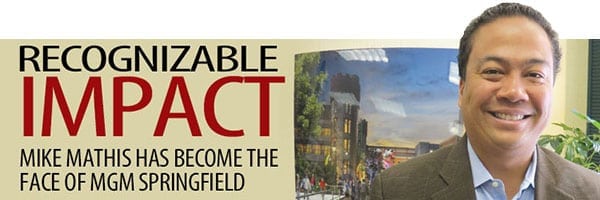
Cover Story
Nick Fyntrilakis Brings Energy to His Role in ‘Community Responsibility’

Nick Fyntrilakis says that every once in a great while he thinks about what might have happened, career-wise, had he prevailed in that highly controversial race for the 9th Hampden seat in the state House of Representatives in 1999, when he was only 24.
“My guess is that I’d probably still be in the State House somewhere, or in some role in government,” he conjectured, while contemplating several possible scenarios that could have played themselves out over the ensuing decade — such as a few terms in the House and then maybe a successful run at the state Senate seat vacated by Brian Lees in 2006 — or some other path.
But he didn’t prevail in that race, obviously, losing out in a Democratic primary that wound up being settled in the courts. So he shifted his focus from public service — he had been working as the aide to then-9th District seat holder Dennis Murphy — to an entrepreneurial gambit as a marketing consultant.
This started him down an interesting road to a job that could easily be considered public service — although he’s employed by the massive financial-services giant MassMutual.
Fyntrilakis now holds the title vice president of Community Responsibility, a post that comes complete with a lengthy job description that includes everything from consideration of the thousands of charitable-funding requests the company receives every year, to representing MassMutual on all manner of issues — and at all kinds of events — involving the city of Springfield.
Indeed, while President and CEO Roger Crandall has the helm at the company, Fyntrilakis is in many ways, if not most ways, the face of MassMutual in Springfield and Enfield, what he called the corporation’s “home-office communities.”
Summing up what he does in that capacity, while also simplifying things greatly, Fyntrilakis said he focuses much of his time and energy on what he calls “issues of the day.” These are in a constant state of flux, and vary in terms of how much of his time and energy they absorb. The list includes everything from helping to set the agenda for a recent visit to Springfield by the new chancellor of UMass Amherst, to ongoing work to revitalize the city’s State Street Corridor, to taking a lead role in determining MassMutual’s eventual contribution ($3 million) to Baystate Health’s $296 million Hospital of the Future.
He also chairs DevelopSpringfield, the nonprofit corporation formed in 2008 to advance development and redevelop projects, stimulate economic growth, and expedite the revitalization process within the city.
And then, there’s the tornado that roared through Springfield last June 1. It made his already-packed calendar and lengthy to-do list both exponentially more so. It brought a new category of consideration for the company’s philanthropic endeavors (more on that later) and eventually led MassMutual to designate Fyntrilakis as a loaned executive to help oversee recovery efforts along with Gerald Hayes, a vice president at Westfield State University.
In that role, Fyntrilakis has provided direction for the Rebuild Springfield initiative — a public-private collaboration involving Develop Springfield and the city’s redevelopment authority — which has undertaken development of a master plan that covers all impacted neighborhoods and the city as a whole.
To all of his various initiatives in Springfield, including tornado recovery, Fyntrilakis brings an approach, or philosophy, that he summed up with two words — ‘direct’ and ‘thoughtful’ — and then explained in some detail.
“We have real issues here in the community,” he explained. “If you try to tiptoe around things, that’s not real helpful to anyone; we have to be direct in our communications to each other, understand what the issues are, and get to the point on things.
“At the same time, we need to do things in a thoughtful way and a caring way,” he continued. “I believe that I do both, and I hope that I do both; we need to focus on what the issues are and deal with them in a direct manner, while at the same time, we have to be compassionate and understand the sensitivity of things.”
Both traits are certainly necessary when confronting what he sees as the biggest long-term issue facing Springfield — improving its education system.
“There are no easy answers to the education problem we have in Springfield,” he said. “What I would say is that we need radical change. What I would ask of the mayor and the School Committee as they approach this change of leadership in the superintendent’s office — ‘what is it that we’re going to do that’s significantly different from what we’re doing today in order to get a better result?’”
For this issue, BusinessWest talked at length with Fyntrilakis about his broad role and how he approaches it, and also about Springfield and its prospects for the future.

Learning Curves

Nick Fyntrilakis

Nick Fyntrilakis says he approaches his work on the many issues facing Springfield with the goal of being direct and “thoughtful.”

Born and raised in the City of Homes, Fyntrilakis remembers taking the bus from his neighborhood in East Springfield to the downtown in the early and mid-’80s.
He would visit many of the stores still doing business there then, including Steiger’s and Johnsen’s Bookstore, and eventually reach his father’s small breakfast-and-lunch restaurant on Main Street called Athens. He worked several different jobs there as he got older, while also devoting significant time to listening to what his father and others were saying about the city and its prospects moving forward.
This curiosity, or fascination, was blended with a sense of community service instilled by his parents  — his mother, who worked at the East Springfield branch of the city library, was one of the first members of the East Springfield Neighborhood Assoc., and both parents were involved in a number of political campaigns — and this mix propelled him toward government service.
He started as an aide to Murphy in 1996, not long after graduating from UMass Amherst with a double major (Environmental Science and Resource Economics). About a year and a half later, he decided to seek one of the two open seats on the Springfield School Committee.
“At that time, unlike today, it was very rare to get open seats that were not heavily contested,” he said, adding that there were eventually 13 candidates in the primary for three seats on the ballot. The field was whittled to six, and he ultimately finished third, joining the board when he was only 23.
“I enjoyed it,” he said of his stint on the school board. “It was hard work, but you get a real appreciation of what people are facing in terms of the process and the positives, negatives, and challenges involved with the public schools. There are 40-plus school buildings in the city, and you certainly start to learn about every nook and cranny of the city.”
Fyntrilakis decided to take this knowledge, as well as his love of politics, and seek a much higher office, Murphy’s House seat, in 1999. He eventually lost in the primary to Jack Keough by 32 votes, a number that prompted a complicated recount.
“That election was a real mess,” he recalled. “There were a variety of irregularities, including Republicans voting in a Democratic primary, inactive voters voting and not having their registration confirmed, and dead people voting — there were at least three confirmed dead voters that participated.”
The election was eventually thrown out in Hampden Superior Court, but Keough appealed that ruling. Faced with the appellate court’s desire to bring 150 inactive voters to court to verify their registration, Fyntrilakis dropped the case and returned his focus to the School Committee, to which he won another term in 2001.
Professionally, he started a consulting business, focusing on public relations and marketing. He did that for three years before winning a job at MassMutual. He started in the Hartford office, where he handled oversight of several education programs and outreach involving Hartford residents.
In 2005, he was given the opportunity to lead all educational programs in Springfield and Hartford, among other responsibilities, a career move that required him to step down from the school board. He became an assistant vice president in 2008 and succeeded Ron Copes in the role of director of Community Responsibility, or what had been known previously as Community Relations. He was named a vice president in late April.
When asked if there’s anything approaching a typical day in this job, Fyntrilakis laughed while shaking his head.
There are are a number regular assignments to be handled by him and his staff of nine, such as charitable giving, field programs involving the company’s 5,000 agents, and the LifeBridge free life-insurance program, but then there are those aforementioned issues of the day. He also sits on a number of boards and commissions, from the Springfield Chamber of Commerce to the Springfield Business Improvement District to the United Way.
“Every day is different, and that’s one of the things I like about what I do,” he explained. “We’re involved with a number of different entities, and also involved with improving the community. A lot of the work I do centers around what’s going on that week or what the hot issues are, and things are always changing.”

Twists of Fate
One of the more intriguing components of Fyntrilakis’s job description is overseeing the company’s charitable giving, currently about $7 million per year, and sifting through the more than 1,000 requests, or ‘asks,’ that arrive annually.
Generally speaking, this giving falls into three categories:
• Education, including many initiatives that fall under the corporation’s Career Pathways initiative, which provides scholarships, experiential learning opportunities for young people, and other components designed to track students into careers in financial services and, perhaps, MassMutual;
• ‘Community vitality,’ which includes support to cultural or community activities ranging from the Springfield Symphony Orchestra to July 4th fireworks; from CityStage to the Hoop City Jazz Festival; and
• The broad realm of economic development, which has been a focus area for only the past five or six years, he said. It includes efforts such as State Street Corridor work, downtown revitalization, and the various initiatives carried out by DevelopSpringfield.
The tornado doesn’t fit conveniently into any one category, but in reality, it touches all three, said Fyntrilakis, who noted that Springfield Mayor Domenic Sarno reached out to him just a few days after the tornado struck to take a lead role in the rebuilding effort.
Actually, his involvement in tornado-recovery efforts began within hours after the twister carved its half-mile-wide path of destruction through the city.
“I remember that night being on the phone with [Executive Director] Rick Lee at the Red Cross, saying ‘what do you need? What can we do? — you let us know, and we’re there,’” he told BusinessWest. “The first thing that we did, which was easy, was to cut a check for $100,000 to the Red Cross, and from there we did a lot more with the agency around volunteering and getting our employees involved. We were certainly on the ready to do whatever it was that the city wanted and the Red Cross needed to get the community back on its feet.”
Assessing what’s happened in the year since, Fyntrilakis said the creation of a master plan is an important initial step in the rebuilding process, and the best thing about that document is the level of involvement from city residents.
“One of the top priorities was community engagement, and ensuring that this wasn’t going to be the mayor’s plan or the City Council’s plan, or the consultant’s plan,” he explained. “This was going to be the community’s plan, and at the end of the day, we had that community involvement, exemplified by our last meeting in January, when we had 500 people at St. Anthony’s Social Center to hear the executive summary and ask questions.”
He said the mayor has asked those involved with Rebuild Springfield to use the tornado as a catalyst, not only for restoring damaged areas and encouraging new development, but for city-wide changes in such pressing areas as education, public safety, and job creation — and he believes that the disaster, and the resulting master plan for revitalization, can ultimately become just that, because of that community involvement.
“The best part of this plan, for me, is that it forces, or continues, dialogue among the various parties involved in certain aspects of improving the community,” he said, noting that there will be meetings within the designated tornado-damaged districts to continually gain input from residents and refine specific plans as necessary. “In the past, there wasn’t a formal structure to continue those conversations; people would say, ‘we’ve got our plan, now let’s go off and go about our business.’
“Now, it’s the reverse,” he continued. “We’ve said from the start, ‘we’re going to have a plan; what’s the implementation model, who’s leading it, and how do we drive that?’ There’s a real difference to how the city is approaching this moving forward.”

Work in Progress
When asked about the challenges of working with bureaucracy-laden partners such as City Hall, the School Department, and, in the case of the tornado, state and federal agencies, and also about the enormity of the issues the city is confronting, Fyntrilakis acknowledged that his work can sometimes be trying, but he has the patience and other qualities needed to cope.
“Certainly there are days when it feels like you’re trying to boil the ocean, and you wonder how you’re going to get that done,” he explained. “But those aren’t the majority of the days, because if they were the majority, you wouldn’t be doing this for very long.
“When you step back and look at some of the success — and you really need to concentrate on the success — and have a vision and a belief in what you’re doing and a passion for it, then you can sustain the energy requited to do the work,” he continued. “If you were to put your hands up in the air and say, ‘what am I going to do change things?’ or ‘what is MassMutual going to do to change things?’ on a particular issue, you’re not going to get very far. You have to have that belief and passion in what you’re doing.”
Fyntrilakis said he learned a number of lessons from his predecessor, Copes, about everything from setting priorities for expending time and resources to gaining the all-important momentum needed to achieve progress on pressing issues.
“He was certainly a role model for me, and he was very respected in the community,” Fyntrilakis explained. “He knew when to try to push to get things to move in the right direction, and also when not to.
“He tried to get people rowing in the same direction with a common focus,” he continued. “And that’s what I try to do in my work — to bring people together in this community, and to try to get people focused on what the objective is. I think we all want the same things … a better community, better schools, a more robust economic climate. We want a vital community; the question is, how do we get there?”
As one of the region’s largest employers, MassMutual is looked upon as a resource and potential contributing partner in virtually every endeavor facing Springfield, he said, adding that this simple fact presents one of the company’s biggest challenges — deciding when, where, how, and to what extent to get involved.
“We get invited to every conversation in town, which is great,” he said. “But it’s also somewhat impossible to be involved in every conversation in town, so we try to focus on where there’s the most need, where there are areas we can impact that align with our interests as an organization, and participate in and influence those. But we’re invited to everything.”
Which brings him back to the many problems facing the city’s School Department and the need to bring about that radical change he described.
“It’s a huge issue for the city,” he told BusinessWest. “If people are going to say that we’re chugging along and we’ve got some good things in the hopper, that may be true, but it’s just not happening fast enough to get us to where we need to be. We need significant change.”

The Bottom Line
As he mentioned, Fyntrilakis doesn’t think often about what might have happened if a few more people had voted for him in the House race back in 1999.
He’s very much preoccupied with the present, future, and those innumerable ‘issues of the day’ involving the city he grew up in and remains passionate about.
He’s not in public service in a very technical sense, but those two words probably best sum up everything in his lengthy job description — and concisely describe the philosophy he takes with him to work every day.

George O’Brien can be reached at [email protected]
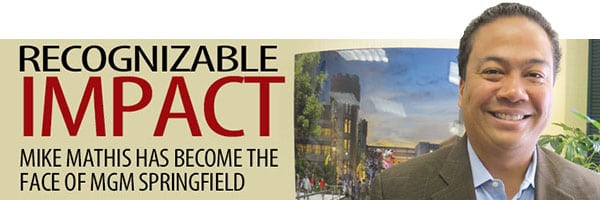
Cover Story
Wayne McCary Exits the Big E Stage with Plenty of Memories

Cover-BW0512bWayne McCary was asked to speculate on how many visits he might make to the Big E this fall.
He offered a slight chuckle and then a wide grin that spoke volumes. “I really don’t know, but I’m sure I’ll get there — I’ll be one of those people eating my way through the fair,” said the Big E’s outgoing president as he thought ahead briefly to what will be his first trip to the West Springfield landmark as a non-employee in more than four decades.
“I certainly don’t want to be a shadow,” he continued, referring to his desire not to even appear to be looking over the shoulder of his successor, Gene Cassidy, who will take over in a month. “However, I’m looking forward to seeing it through the eyes of a spectator, rather than having the 24/7 responsibility of running the show.”
And while he might enjoy not having that burden of responsibility, McCary made it clear that he’s had a lot of fun at the fair in his many capacities over the years. “Every business has its trials and tribulations, and we’ve had plenty, but I’ve enjoyed every day that I’ve ever been here.”
This attitude, if that’s what one chooses to call it, explains a lot about McCary, his lifelong love affair with outdoor entertainment, and especially his passion for the Big E. Indeed, he told BusinessWest (and he’s told just about everyone else) that the very first time he visited it, as a high-school student growing up on the Connecticut shore, he said to himself that he wouldn’t just work there someday — he would like to run the place.

Wayne McCary

Wayne McCary knew from his first visit to the Big E that this was an institution he wanted to be part of — and someday manage.

He’s done just that for the past few decades, orchestrating a number of changes, but also maintaining many traditions, some that go back as far as the fair itself — 1916. It’s been a delicate balancing act, he said of this mix of old and new concepts, and a necessary one in an age when people have less time to devote to recreation and entertainment, and so many more options when it comes to how to spend that time.
And as he reflected on his long tenure with the Big E, McCary used both words and numbers to convey what he considers an economic success story, as well as a career path that met and probably exceeded all his dreams.
With the latter, he tossed out figures like 40 million — the number of people he estimates have passed through the Big E gates for year-round events during his 21 years as president — and also 95%, the number of survey respondents who said they enjoyed the fall fair enough to plan a return trip; $225 million, the amount the Big E contributes to the local economy each year; and 1.26 million, the Big E attendance record, set in 2009.
As for the former, well, he turned to Robert Frost and borrowed the last two lines from his classic poem “The Road Not Taken” to wrap up his sentiments on his time at the Big E for its 2001 annual report: “Two roads diverged in a wood, and I — I took the one less traveled by, and that has made all the difference.”
For this issue, BusinessWest will look back with McCary on his lengthy career and, in essence, explain why he would choose that verse.

A Hard Act to Follow
Although McCary didn’t officially start working for the Big E until 1973, when he took the title executive assistant, he said his fingerprints have been on the current incarnation of the fair since the mid-’60s.
By then, he was booking talent for a Boston-based company called Lordly & Dame Inc., and the Big E was one of his clients. He told BusinessWest that he collaborated with then-Big E President Bill Wynne to orchestrate an important change in the fair’s philosophy on entertainment.
Up to that point, he explained, the fair was featuring well-known names from television and Hollywood — Jack Benny, Bob Hope, and Lorne Greene were among the names he mentioned — and charging patrons to see and hear them. “One of my early charges from him [Wynne] was to reinvent the format for entertainment at the Big E, and the biggest change was to go from paid celebrity concerts and appearances to free entertainment.”
And one of the first big acts to appear with this new format was Diana Ross & the Supremes, a group that that been selling out venues across the country, which prompted McCary and officials at the Big E to make elaborate plans for overflow crowds.
However, there were many empty seats in the Coliseum for both shows, and for a few reasons. “People either didn’t believe that it was the real group, or they didn’t perceive it would actually be free — that was such a new concept,” McCary recalled. “So it took a few years before the general public became acclimated to the fact that the Big E was actually going to give away that magnitude of talent.”
But the adjustment was eventually made, he continued, and today mostly free entertainment — there is paid admission to a few shows a year — remains one of the hallmarks of the Big E. And that development has been just one of many changes, large and subtle, to come to the show in recent decades.
How McCary would come to preside over them is an intriguing story that really starts in a different New England entertainment venue — Ocean Beach Park in New London. It was there that he spent countless hours as a teenager, getting a “taste,” as he put it, for the outdoor-amusement industry. “I spent most of my youth around that beach, almost every day of every summer; I first went to work there when I was 14.”
It was soon after that he made his first trip to the Big E in the late ’50s, a trip that would eventually shape the career path he chose.
“I was blown away by the diversity of what was here,” he said of the first visit to the Big E. “I left there thinking, ‘this would be a great place to work and be part of the management team in the future.’”
But it would be several years before he would get to find out first-hand.
Indeed, after graduating from the University of Hartford with a business degree, he would take a job with Hartford Bank & Trust, knowing that his real interests lay elsewhere. “I knew my destiny was in the outdoor-entertainment business.”
He eventually landed at Lordly & Dame, and was soon booking entertainment for 25 fairs and circuses, including many rising country music stars, such as Dolly Parton and Barbara Mandrell.
Although he enjoyed his work, McCary desired to work at a venue. And although he had opportunities to take his career in a number of directions, geographically and otherwise, he chose the Big E because of its diversity, strong agricultural heritage, and totally unique multi-state character.
As executive assistant, he said he “rode shotgun” on entertainment and handled a number of specific projects, such as an expansion and renovation of the midway in the mid-’70s.
He worked in that capacity for a a decade before leaving to become executive director of the Cumberland County Civic Center in Portland, Maine, only to return to the Big E as senior vice president in 1986. He would become executive vice president in 1989 and president in 1991.
And through his tenure in that position, he said he was driven by a single goal: “to make the Big E the Disney of the fair industry.”

Show of Resilience
Looking back on the past 40 years, and especially his tenure as president, McCary believes he’s succeeded in that goal.
For evidence, he returns to those numbers regarding attendance, economic impact, and repeat visitation, but also to the fact that the Big E has survived and thrived over the past several decades, while many state fairs have downsized or ceased operations altogether.
“The Big E is a nonprofit 501(c)(3), but it’s never been subsidized,” McCary explained, “and many of our counterparts, many of the big fairs in this country, are heavily subsidized by the state, and that’s turning out to be an albatross in today’s world.”

It took some doing, but Wayne McCary was finally able to coax a Big E visit out of of then-Massachusetts Gov. Mitt Romney.

It took some doing, but Wayne McCary was finally able to coax a Big E visit out of of then-Massachusetts Gov. Mitt Romney.

Elaborating, he said that, as states struggle financially — and most all of them are — they have been forced to cut back on their support for fairs, and there have been some casualties, such as the Michigan State fair, which ceased operations last year.
“It was a creature of the state, and the state could no longer afford to subsidize its existence,” said McCary, noting that California is another state that has dramatically reduced its support for fairs. “And there are other fairs whose destiny is in harm’s way.”
McCary attributes the Big E’s longevity and continued growth to a number of factors, including everything from its six-state personality to its focus on the visitor experience, to a successful bid to lengthen the fair from 14 to 17 days in 1994.
The addition of that third weekend — a proposal twice rejected by officials in West Springfield before they approved it — has provided the fair with a needed cushion against revenue-sapping bad-weather days as well as a way to lessen what is still a considerable traffic burden on neighborhoods surrounding the Big E.
“The 17-day fair has helped put a much more solid economic foundation under the fair,” he explained. “It alleviated the worst traffic conditions and allowed for some moderate growth.”
Another key to the Big E’s financial success has been the ability to grow its book of business for events throughout the year to more than 120, although those numbers have been challenged in recent years by the opening of the MassMutual Center and other publicly supported venues.
Maintaining and growing that year-round business will be a challenging but necessary assignment in the years to come.
“We need to continue to be successful in attracting as many year-round events as possible,” McCary told BusinessWest. “The cost of sustaining the exposition can’t be driven solely by the revenues that come in during the Big E. As good as they are, as with every business, overhead here doesn’t shrink, and that will be a challenge going forward.”
Lengthening the fair and expanding the year-round side of the business have been two of many accomplishments he can cite during his tenure. Others include:
• Establishment of the Big E/West Springfield Trust, whereby 1% of the Eastern States Exposition’s gross revenues are contributed to the fund annually, with allocations made to worthy organizations and town projects; since the fund’s inception in 1994, contributions have totaled nearly $2.5 million;
• More than $36 million in capital improvements to the infrastructure and new facilities, including a new Equine Arena last year;
• Creation of the Big E Super Circus, with is seen by 80,000 fairgoers each year; and
• Many new innovations, including an authentic Mardi Gras parade and many international exhibits.
And as he talked about these developments, McCary stressed repeatedly that success in business is never the result of just one individual, and that is especially true with the Big E.
“The positive outcome that we have had is the result of the hard work of dedicated employees, volunteers, agricultural exhibitors, concessionaires, and entertainers,” he told BusinessWest. “I’ve always had tremendous respect for every individual who plays a role on the outcome of the exhibition — be it a ticket taker, a volunteer in Storrowton Village, a ride operator, shuttle bus driver, or a 4-H exhibitor; every single person’s contribution makes a difference.
“I’ve never seen my job as being more important than any other person’s as part of the fabric of producing this place,” he continued. “And that’s something I’ve tried to instill in everyone here; it takes a lot of people working together to make all this happen.”

State of the Eastern States
McCary is fond of saying that the Big E is “in the business of making memories.”
He’s referring to visitors and participants when he says that, but he has many of his own. They involve interaction with individuals and families, weather (good and bad), and specific episodes — everything from meeting a number of celebrity entertainers to being able to shake then-Massachusetts Gov. Mitt Romney’s hand at the fair — finally.
“We had to basically shame him into coming,” he said, noting that the presumptive Republican presidential candidate was by far the most reluctant Massachusetts governor when it came to making personal trips to the Big E, although he eventually stopped by near the end of his tenure.
And then, there was 9/11.
That day and the ones that followed (the fair was slated to open three days after the terrorist attacks) led to some of the most difficult decisions he had to make in his tenure. And with the benefit of hindsight, he can say that most all of them were made correctly.
“Planes weren’t flying for a few days; professional sports were shut down,” he said when recalling the time just after the attacks. “We had to make the decision whether we should open the exposition. Would it be appropriate? Would it be safe to open? Those were the questions we needed to answer.
“We had a lot of discussions with many officials in the six New England states, from the governors’ offices to security to police,” he continued, “and in the end the chairman of our board said, ‘it’s your call.’ We did decide, obviously, to go forward, and our thinking was that you didn’t have to come to the Big E, but you could if you wanted to. And I had a feeling that, perhaps because of the nature of the fair and its tradition, and being part of the culture of New England, that it might be able to contribute to the healing process.”
As it turned out, he was right.
More than 1 million people came to the fair, said McCary, adding quickly that, while there was a different feel than anyone had ever experienced there, the fair did indeed help people move on after the tragedy. “People wanted an opportunity to be with other people,” he went on. “I think the fair and its traditions exemplified the spirit of America; people were not willing to let what happened in New York compromise their life.”
Looking ahead, McCary said that he considers it part of his job description as president to see that the tradition of the Big E is handed down to the next generation of leadership, just as it was handed down to him.
Thus, he’s working closely with Cassidy, long-time Big E CFO, on transition issues, with the goal of a seamless transfer of control. Until his last day, June 26, he intends to continue what has been an ongoing process of passing on what he knows to those who will lead the Big E into the future.
“When you’ve had a career that’s spanned nearly 40 years here, most of what you’ve learned isn’t written down anywhere,” he explained. “You carry it with you, and I’m trying to share as much of that experience as I can with my successor and others in leadership here.”
McCary believes he’s handing over a Big E that, despite numerous challenges, is well-positioned for the future. He lists a number of positive attributes, including its traditionally strong entertainment lineups and ability to attract top talent, a first-class physical plant (“it’s old, but in great shape”), a highly respected professional staff, ongoing commitments from the six New England states to maintain and strengthen their participation along the Avenue of States, and devotion to the agricultural traditions that have been part of the show since the beginning.
“I believe this is an opportunity for a new generation to pick up the torch and build, hopefully, on what I’m leaving behind,” he explained. “There will be new ideas, new challenges, and different approaches; it’s important to keep any company  healthy and prosperous going forward.”
Overall, he believes that, if the Big E can continue to provide the quality visitor experience it has historically, while also remaining on firm financial footing, it should remain viable decades into the future.
“To borrow that old Coke slogan — this is the real thing,” he said of the fair experience in general and the Big E in particular. “It’s a family destination, and there’s only a few remaining.”
And even at a time of unparalleled competition for individuals’ time — be they adults or children — McCary believes there will always be room for the fair.
“Our lifestyle today is such that so much of it is computerized and electronic, and quite often, people don’t even have a chance to socialize in the workplace — a lot of people work from home,” he explained. “But there is still something within most of us; we want to get out and touch things and smell things and be part of something. And the fair can bring all those things together, and that’s why 1.2 million people come here in September — they like the excitement, and they like the diversity.”

Eyes on the Prize
McCary is due to become a grandfather for the first time in a few weeks. That’s just one of many things he’s looking forward to as he hands over the reins. “My wife [Annette] and I are looking forward to doing more of the things we want to do, as opposed to things we have to do.”
And he’ll be transitioning to the next stage of his life with few, if any, regrets and a great deal of gratitude for what he’s been able to do professionally.
“Not many people have the luxury of working at something for most of their career that they have a passion for,” he said. “I’ve clearly had that luxury; it’s been a 40-year adventure.”
And this fall, he’ll have another luxury — a chance to relax and eat his way through the fair like everyone else.

George O’Brien can be reached at [email protected]

40 Under 40 Cover Story The Class of 2012
The Young Business and Community Leaders of Western Massachusetts

In 2007, BusinessWest introduced a new recognition program called 40 Under Forty. It wasn’t unique — business journals across the country have similar initiatives — but it was new to this region.

It was designed to enlighten the region and introduce it to 40 rising stars in the realms of business, nonprofit management, and community service. It was also created to inspire others to become leaders and find their own ways to join the ranks of 40 Under Forty winners. Five years later, the program continues to succeed on all levels, and a 40 Under Forty plaque has become a coveted prize across the four counties of Western Mass.
It has become a symbol of excellence, an honor that speaks to the energy, drive, passion, and commitment to help others that all the winners share.
With that, we introduce the Class of 2012, a diverse group that includes entrepreneurs, professionals, nonprofit managers, a state senator, and a police sergeant. The stories are all different, but the common denominator is that these young men and women possess that most important of qualities: leadership.

2012 40 Under Forty Winners:

Allison Biggs
Christopher Connelly
Scott Conrad
Erin Corriveau
Carla Cosenzi
Ben Craft
Michele Crochetiere
Christopher DiStefano
Keshawn Dodds
Ben Einstein
Michael Fenton
Tim Fisk
Elizabeth Ginter
Eric Hall
Brendon Hutchins
Kevin Jennings
Kristen Kellner
Dr. Ronald Laprise
Danielle Lord
Waleska Lugo-DeJesus
Trecia Marchand
Ryan McCollum
Sheila Moreau
Kelli Ann Nielsen
Neil Nordstrom
Edward Nuñez
Adam Ondrick
Gladys Oyola
Shardool Parmar
Vincent Petrangelo
Terry Powe
Jennifer Reynolds
Jessica Roncarati-Howe
Dan Rukakoski
Dr. Nate Somers
Joshua Spooner
Jaclyn Stevenson
Jason Tsitso
Sen. James Welch
Karen Woods

Photography for this special section by Denise Smith Photography

Meet Our Judges

This year’s nominations were scored by a panel of five judges, who accepted the daunting challenge of reviewing more than 110 nominations, and scoring individuals based on several factors, ranging from achievements in business to work within the community. BusinessWest would like to thank these outstanding members of the Western Mass. business community for volunteering their time to the sixth annual 40 Under Forty competition. They are:
40u40Judges2012

• Scott Foster, partner in the Business & Finance Department of the law firm Bulkley Richardson, develops practical, cost-effective legal strategies that complement the goals of the business and the business owner. His clients range from startups seeking venture capital to established businesses preparing for a transition to the next generation or a transfer to new owners. Foster, a member of the 40 Under Forty Class of 2011, is the co-founder of Valley Venture Mentors, an organization that provides critical mentoring to early-stage, pre-seed companies. He also serves on committees of local organizations focused on growing the business and entrepreneurial community in the Pioneer Valley.
• Jaimye Hebert is currently a vice president of Commercial Lending at Monson Savings Bank. Previously she worked for People’s United Bank (formerly known as the Bank of Western Massachusetts) as a vice president of Commercial Lending and various other positions, including credit officer and portfolio manager. A graduate of Springfield Technical Community College and Western New England University and a 40 Under Forty honoree in 2011, Hebert is a lifelong resident of Western Mass. and serves on the STCC Foundation board of directors. She is also actively involved with local organizations, including the American Cancer Society Relay for Life and the Pioneer Valley Junior Soccer League.
• Lynn Ostrowski is the director of Brand & Corporate Relations at Health New England. Her role includes oversight of brand, marketing and advertising, graphic design, communications, community relations, sponsorships, public relations, and government affairs. She recently joined the faculty of Elms College, appointed program coordinator for the Health Services Administration undergraduate degree. She earned her bachelor’s degree in Health Fitness and her master’s degree in Health Promotion & Wellness Management from Springfield College, and her doctorate in Health Psychology from Capella University.
• Kirk Smith is president and CEO of the YMCA of Greater Springfield, a position he took just over a year ago. He has been an operator of residential facilities and a nonprofit executive, minister, and motivational speaker for more than 17 years in Ohio, Florida, and Massachusetts. Smith holds a bachelor’s degree in Science of Human Services and a master’s in Organizational Management and Leadership from Springfield College. Smith has been featured on several national and local television shows and in news publications and magazines discussing YMCA work in urban communities and professional staff development.
• Jim Theroux is the Flavin Professor of Entrepreneurship at UMass Amherst. He had a business career in the cable-TV industry that began with Time-Warner Cable. After several years there, he went out on his own by raising $20 million in venture capital to start a new cable company. That company was sold in 1991, at which time Theroux joined the faculty at UMass Amherst. There, Theroux has partnered with scientists to form new companies. He is a co-founder of two biotech ventures and a food-science company. In addition to angel investing, Theroux is an advisor to many area businesses. He received his MBA at Harvard University and his doctorate in Educational Technology at UMass.

Sponsored by:
Cover Story
Working Mothers Struggle to Balance Career and Home Life

Kelly Tobin has three children, is a claims consultant for Disability Management Services in Springfield, and loves her job. In fact, she would definitely not want to be a stay-at-home mother.
But she does not have a minute to herself from the minute the alarm goes off until her head hits the pillow at night. “There is always something to be done and someone to take care of,” said the 41-year-old Hatfield woman.
Jessica Phaneuf agrees. “I start my day at 6 a.m. and don’t stop until 8 or 9 at night. It’s really difficult to achieve balance between family and work, and it’s stressful because I bring work home with me. When I am home, I want to focus on my children, but that’s not always possible,” said Phaneuf, who has an 8-month-son and 2-year-old daughter, and owns Fitness Together in Amherst and Northampton.

Kelly Tobin loves her job and her three children

Kelly Tobin loves her job, but the multitasking and constant demands of caring for her three children and doing well at work result in days when her stress level is almost intolerable.

Registered nurse Jennifer Crocker, who works in the intensive care unit at Cooley Dickinson Hospital and is going to school full-time, is also among the ranks of working mothers under stress. “There is a lot of prioritizing and reprioritizing every day,” she said, adding that she chose to work the night shift so she would have the flexibility to care for her 7-year-old daughter and 16-year-old son.
And Janet Casey knows no limits, as she gives her all to home and work. Six hours after giving birth to twins via cesarean section, Casey was on the phone conducting business. “The twins were born on Election Day, and I was managing seven political campaigns,” explained the owner of Marketing Doctor in West Springfield.
Casey has four children, including 15-month old twins Cassidy and Cooper. Cassidy has had a feeding tube since he was born, and during four surgeries Janet slept in a chair in the hospital and kept up with work via a laptop and iPad. “My clients didn’t even know I wasn’t in the office,” she said, adding that her husband was home caring for their other three children.
Jessica Carlson says women have better coping strategies than men

Jessica Carlson says women have better coping strategies than men when it comes to stress, and are more likely to take advantage of social support.

As these women can attest, balancing responsibilities at work and home is not easy. “When women are juggling multiple roles — mother, daughter, parent — it can result in a very high amount of stress with significant mental-health consequences such as depression and anxiety,” said Jessica Carlson, associate professor of Psychology at Western New England University.
Still, a study released last year by the University of North Carolina, which followed 1,300 working mothers, showed those who work have better health and fewer symptoms of depression than stay-at-home moms. However, it also revealed that mothers with part-time jobs do a better job nurturing their children and balancing their life than those who work full time.
But working part-time is not always possible, especially for women intent on getting ahead in the business world. As a result, guilt and stress are constant companions, and in spite of their ability to multitask, women make real sacrifices to accomplish all they must get done.
For this issue and its focus on Women in Business, we take an indepth look at what, for many women, appears to be a mission almost impossible.

Difficult Choices
Michelle Budig, associate professor of Sociology at UMass Amherst, says researchers in time management have found the number of hours women spend at work has increased dramatically since 1960, but the hours they spend caring for their children has not changed. “What women have sacrificed is their personal care, leisure, and sleeping time,” she said.
Crocker is frequently sleep-deprived. “My exhaustion level is crazy. I have learned to function on four hours of sleep. On occasion I catch up, but if something has to give, my sleep is the thing that gets sacrificed because it’s definitely a priority to be with my children,” said the 43-year-old.
She also puts in extra effort to teach her children to be independent, and although it adds to her workload, she wants them to attain life skills necessary for independence. “It would be so much easier to do more for them, but the more you do for children, the less they do for themselves.”
Research shows that, although the amount of hours working mothers are present in the home has diminished, they have preserved the number of hours they spend interacting with their children. “They are still reading to their children, giving them baths, making meals, and feeding them,” Budig said, adding that researchers find it surprising that women are still doing so much. What has gone by the wayside is household chores, and working moms are hiring more help, eating out more, and lowering their standards for household cleanliness. Although many husbands help out, time diaries kept by parents over a period of about 40 years showed that men spend only five hours more a week helping out at home than they did in the ’60s.
Crocker makes a real effort to spend quality time with her children. But like other working moms, she has missed out on important milestones while at work, which results in conflicted feelings. “It’s a struggle, and I have to remind myself I am working to support them and give them everything I can,” she said.
Tobin remembers getting a phone call from her day-care provider, who told her to listen to the tapping noise on the phone. “That is your daughter walking,” she was told, as the knowledge sunk in that she had missed her baby’s first steps.
These losses, combined with continuous worry, lead mothers to try to compensate for the time they must be away from their children. Crocker keeps watch on them from a distance by calling her day-care provider several times a day. “I make sure I talk to both of my children. I don’t miss a day, and it makes me feel better,” she said.
Casey also goes above and beyond. “I spend days in my daughter’s classroom as a volunteer,” she said. And like Crocker, she also calls her day-care provider every day. “I have guilt every day, depending on which child I am more concerned about,” she said.
In addition, she spends time playing with her children every night. “When I come home, my needs come last. But this is the road I chose. I don’t know any mother who can be 100% sane. You are always at a varying degree of insanity because of everything you have to do.”
That includes dealing with the fact that young children get sick frequently, which means someone has to stay home and care for them. “I have missed a lot of work,” Tobin said. Her husband is an attorney, so if he is scheduled to be in court, “he trumps me, even though we try to juggle it.”

Janet Casey, who has four small children and owns Marketing Doctor

Janet Casey, who has four small children and owns Marketing Doctor in West Springfield, says juggling motherhood and a business means her needs are always the last to be met.

Casey has a fair amount of flexibility. But from mid-January to the beginning of this month, her children suffered from pinkeye, strep throat, vomiting, and diarrhea. Since her husband had used all of his sick days, she stayed home when it was necessary. “My work really suffered. But the guilt connected to that is not as bad as when I know my family is suffering,” she said.

Bonuses and Penalities
Carlson says working mothers in high-level positions have equally high levels of stress hormones flooding their bodies. But they also have better coping strategies than men because they are more likely to take advantage of social support.
“So even though they have more stress, evidence suggests that they handle it better than men, and multiple roles offer more opportunities for success, which leads to higher self-esteem and greater self-efficacy,” Carlson said, explaining that, if a woman has a frustrating situation at work or home, doing well in the other arena can compensate for it.
Marriages also benefit when women work, because they are contributing to their family’s resources and are able to share issues in the workplace with their husbands. However, having children does affect a woman’s earnings. Budig recently testified before the U.S. Joint Economic Committee about a research project she conducted titled “Work-Family Policy Consequences of Employment and Wages of Mothers.” It showed that women are penalized for having children while employers “see fatherhood as a signal of more stability and greater commitment to work. It’s a complete opposite,” she said, adding that there is a “wage punishment” for motherhood.
“On average, women earn 6% less per child in terms of lower wages after all the adjustments,” Budig said, explaining the study took a wide variety of factors into consideration, including whether women return to work immediately or take time off after giving birth, as well as their education, job changes they make due to motherhood, and the types of jobs they hold.
However, women who make $75,000 or more suffer significantly less. They are only penalized by about 1% to 2% per child in terms of earnings, while the lowest wage earners are penalized as much as 15%.
This may be because they are often dependent on family members and friends for child care, so in a crisis they may be forced to quit their jobs or take time off from work, while women with higher incomes are more likely to have quality child care, sick time, and flexibility. “They have more resources to maintain their employment when life gets difficult. Research has shown the women with the least to lose — the lowest earners — get the largest penalty for having children,” Budig said.
Other losses result from difficult emotional choices, such as whether to leave work to attend school events. “You only get so many of these opportunities in a lifetime. There is a price, and for every choice you make you lose something,” Tobin said. “There are days when I get heart palpitations or when I have felt so overwhelmed, I am afraid I could have an anxiety attack or go over the edge if I think about how many balls I have in the air. But working mothers are always hard on themselves, and when you make the decision to be a working mother, you have made the choice to live in conflict.”

Hidden Assets
There are benefits to mastering motherhood and job responsibility, and research shows the juggling act enhances a woman’s competencies. “For example, mothers have to learn patience, which can serve them well in the workplace,” Carlson said. “It’s a symbiotic relationship, and having multiple roles doesn’t always have to be detrimental, as the effects can improve their skills at work and at home.”
Working mothers also provide a positive role model for their daughters. “Girls who see their mothers working have more egalitarian views on gender,” Carlson said.
The ability to multitask successfully is another asset that is often overlooked. “The question,” she explained, “is how an organization can help make use of these talents and help women shine.”
Some of the measures that could make a difference have been identified. They include flexible hours and telecommuting that would make the work-life balance easier for women.
But few businesses offer these perks. “There is a perception that face time is important, so even if the benefits are available, people don’t feel free to use them,” Carlson noted. And only about 10% of U.S. firms have established on-site child-care centers. “So strides are being made, but there is still a long way to go.”
Tobin made the decision to leave her job when was pregnant with her third child because she realized she had missed out on a lot with her other children, and her employer didn’t offer part-time positions. But in time she was told she could work 25 hours a week, which she eventually expanded upon.
“I was fortunate enough to have the best of both worlds. It was risky for my employer because it was uncharted territory, so I am forever indebted to them,” she said, adding that the arrangement allowed her to maintain her professional status without impacting her career.
However, some countries that put a high value on family life don’t put parents in this predicament. “In Sweden, parents get a year of paid leave when they have a child, and it is commonplace for men as well as women to take these leaves,” Carlson said.
But in the U.S., motherhood is not always seen as a plus, and a study conducted by researchers at Stanford University indicates that employers may discriminate against women with children. Budig said researchers submitted résumés that were almost identical to a number of companies. The one difference between them was that one group listed activities such as parent-teacher-organization involvement or other things that indicated the women had children. Their research showed that the résumés without references to children resulted in significantly more callbacks and salary offers.

Reality Check
Still, American women are doing their best to work and raise their families within the confines of the system. “You can’t deny that someone else is raising your kids during the hours when you are at work,” Casey said. “Your family suffers when you are at work, and your business suffers when you are with your family. It’s just reality.”
But overall, women are happy that they can achieve both goals. “I like my job, and work is my escape from home. It allows me to use my brain in a very different way,” Tobin said. “I have suffered from guilt and cried, wondering if I am doing the right thing. But at the end of the day, I know I wouldn’t want to be a stay-at-home mom.”